The paradigm shift towards sustainable energy has fundamentally redefined the architectural and dynamic characteristics of modern electrical grids, driving a rapid proliferation of inverter-based resources (IBRs) [
1]. In this evolving landscape, large-scale offshore wind farms (OWFs) stand out as quintessential examples of complex multi-node coupled networks. While these marine installations are crucial for harnessing massive and consistent wind energy, their integration presents profound stability and power quality challenges. Replacing conventional synchronous machines with power-electronic interfaces intrinsically reduces system inertia and transitions the primary stability concerns from low-frequency electromechanical oscillations to intricate, broadband electromagnetic dynamics [
2,
3].
A critical bottleneck in operating such sprawling coupled systems lies in the pervasive harmonic resonance induced by complex spatial topologies and active control components. The dense deployment of converter-interfaced generators injects highly dynamic, non-sinusoidal currents into the grid. When these emissions interact with the frequency-dependent impedances of the network, specifically, the distributed capacitance of extensive submarine transmission cables and the inductance of grid transformers, they form severe multi-node resonance loops [
4,
5]. The recent literature highlights that these harmonic behaviors are highly non-stationary, heavily modulated by time-varying meteorological conditions and the continuous adjustment of aerodynamic operating points [
6]. Consequently, minor perturbations can rapidly amplify into severe voltage and current distortions that propagate across the entire network topology.
Prolonged exposure to such high-frequency distortions accelerates insulation degradation and triggers severe localized thermal stress, ultimately jeopardizing grid reliability [
7]. To proactively mitigate these risks, continuous and accurate harmonic state reconstruction across all system nodes is imperative. However, achieving full observability is highly constrained by the spatial sparsity of expensive physical sensors in remote marine environments. Current monitoring mechanisms remain predominantly reactive, relying on rigid threshold alarms that fail to capture the subtle dynamic evolutions characterizing the sub-health states of system [
8]. While pure data-driven state estimation models have been extensively explored, they exhibit significant vulnerabilities, notably poor generalization under sparse labels and out-of-distribution shifts [
9]. Conversely, strict physics-based analytical solvers often fail to converge in complex environments due to the intractability of explicitly formulating high-dimensional, unmodeled dynamics [
10].
Recently, physics-informed neural networks (PINNs) have emerged as a transformative approach in dynamic system modeling, demonstrating remarkable success in embedding physical laws directly into neural network training to enhance state estimation under noisy or partial observations [
11]. Inspired by these advancements, but recognizing the limitations of standard continuous PINNs in handling large-scale discrete network topologies, this paper introduces a novel PINN-inspired topology-aware learning framework. By innovatively injecting physical consistency constraints and topological priors into a data-driven observer architecture, the proposed method overcomes the limitations of single-paradigm models, enabling highly robust multi-node harmonic state reconstruction under severely limited measurement conditions.
1.1. Prior Works and Motivations
Accurate harmonic state estimation has become a fundamental requirement for the stable operation of inverter-based grids [
12,
13], largely driven by the global integration of renewable energy and power-electronic interfaces [
14,
15,
16]. Early works extended multi-frequency state estimation to network-level harmonic analysis [
17], demonstrating that observability and measurement quality critically dictate estimation accuracy [
18]. Meanwhile, strict international grid codes continue to enforce rigorous harmonic compliance [
19,
20]. Concurrently, model-driven approaches have extensively investigated harmonic resonance utilizing modal and impedance analysis [
4,
21]. These studies reveal that resonance risks in OWFs are highly sensitive to submarine cable capacitance [
22,
23], converter control behaviors [
24], and frequency-coupled impedance [
25]. While these classical methods provide crucial theoretical foundations for recovering unmeasured harmonics, these predominantly rely on explicit system models and ideal measurement conditions. Such prerequisites are rarely satisfied in OWFs, which are characterized by partial observability and incomplete physical records.
To address these modeling complexities, deep learning (DL) sequence architectures have been increasingly adopted [
26]. For instance, long short-term memory (LSTM) networks are widely applied to capture short-term temporal harmonic variations [
27,
28,
29], while advanced Transformers excel at modeling long-range, non-stationary dynamic states [
30,
31,
32]. Furthermore, recent advances in topology-aware learning have shown that explicitly incorporating network structures improves state estimation in partially observable grids [
33,
34], especially when integrated with domain knowledge [
35]. This is vital for OWFs, as harmonic behaviors are not strictly local phenomena and cross-node coupling and propagation along the collection grid significantly affect harmonic levels. However, existing topology-aware research predominantly focuses on fundamental-frequency power flow or voltage estimation, leaving multi-node harmonic state reconstruction largely unexplored.
Additionally, PINNs and related physics-guided methods have gained traction for integrating data fitting with physical priors [
36]. Their core advantage lies in enhancing model robustness under sparse or noisy observations. However, applying strict PINNs to real-world OWF harmonic reconstruction presents severe practical bottlenecks. In actual operational data, effective harmonic processes are simultaneously influenced by hidden converter dynamics, aggregated impedance behaviors, and measurement abstractions. Consequently, it is intractable to formulate explicit, closed-form governing equation residuals suitable for standard collocation training. Meanwhile, purely data-driven sequence models struggle with the extreme data imbalance of supervisory control and data acquisition (SCADA) systems, often overfitting to steady-state operations. To mitigate this, ensemble tabular learners, such as Random Forests [
37,
38] and gradient boosting variants [
39,
40], have been benchmarked for power system tasks due to their statistical robustness, though they inherently lack sequence memory. Although generative models can synthesize data to mitigate sparsity [
41,
42], they risk introducing unphysical artifacts [
43]. Moreover, these conventional frameworks generally lack the capability of “virtual sensing”, estimating the dynamic states of unmonitored nodes based on sparse adjacent observations.
To systematically bridge these gaps, this paper proposes a PINN-inspired topology-aware learning framework for multi-node harmonic state reconstruction. Rather than claiming to construct a strictly parameterized partial differential equation (PDE)-solving PINN, we adopt the pragmatic philosophy of injecting physical knowledge into the learning process. By embedding physical consistency constraints and topological priors into a data-driven temporal observer, the proposed hybrid fusion architecture effectively captures the multi-node coupling characteristics. This framework uniquely unifies harmonic physical consistency, offshore node coupling structures, and observer-oriented virtual sensing, enabling stable multidimensional state reconstruction even under conditions of measurement sparsity and limited label diversity.
1.2. Contributions
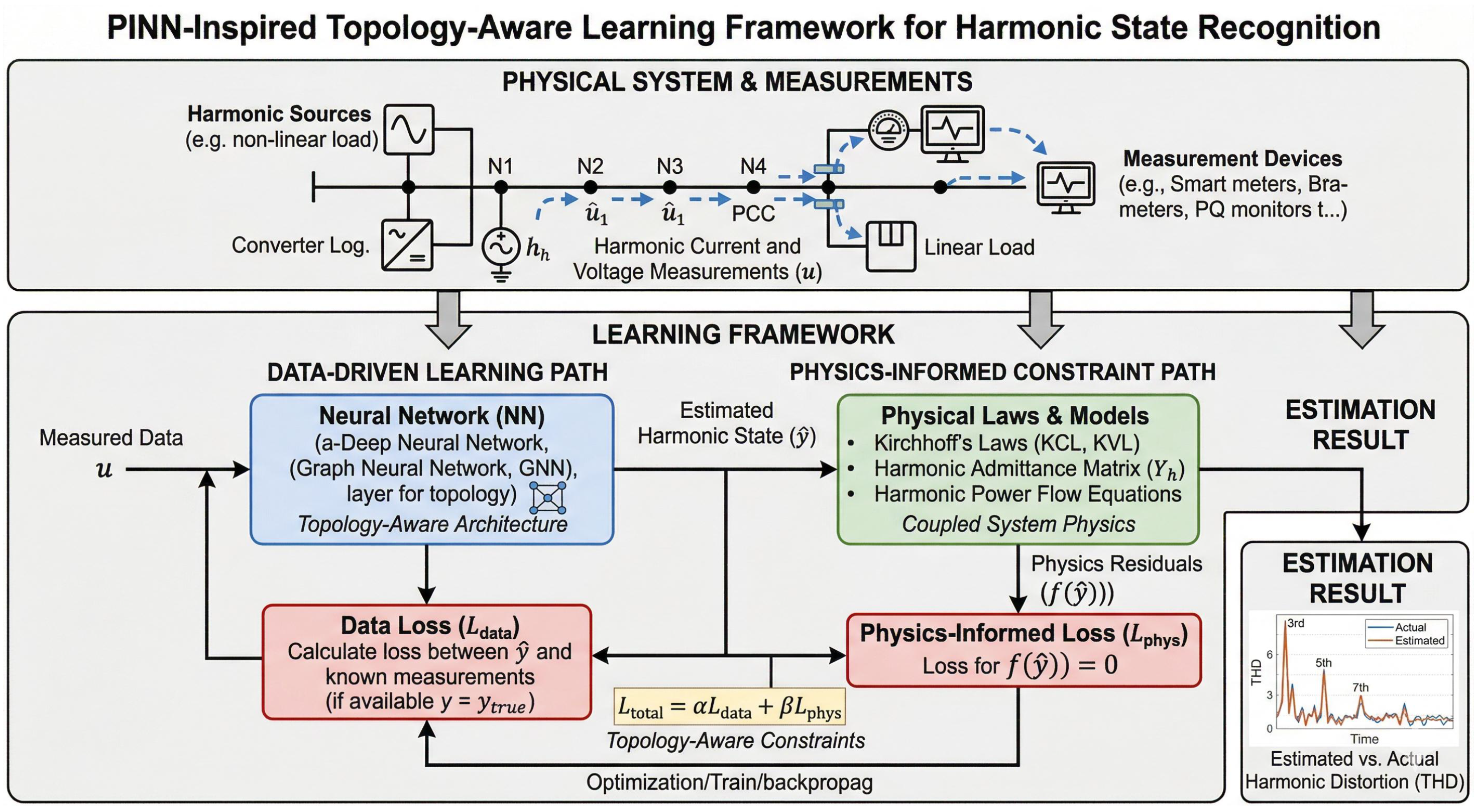
As analyzed above, harmonic state reconstruction in complex coupled networks is not a standard time-series forecasting problem, primarily due to inherent multi-node couplings and partial observability. While existing datasets may be insufficient to support strict physical equation solvers, they are adequate for training data-driven frameworks regularized by physical principles and statistical priors. Therefore, rather than claiming a strictly parameterized physical solver, this paper proposes a pragmatic PINN-inspired topology-aware learning framework. This approach systematically integrates data-driven temporal reconstruction, physics-guided objectives, and topology-aware priors to improve both estimation accuracy and system observability. The overall architecture and information flow of the proposed framework are illustrated in
Figure 1.
The main contributions are summarized as follows:
PINN-Inspired Framework for Intractable Physical Systems: Unlike standard continuous PINNs that rely on explicitly formulated partial differential equations, which are generally intractable for complex, highly coupled offshore wind farm dynamics, we propose a novel, pragmatic learning paradigm. By embedding harmonic consistency constraints and latent dynamic regularization into the loss function, the framework successfully regularizes data-driven networks using underlying physical laws, circumventing the convergence failures of strict equation solvers in noisy environments.
Topology-Aware Hybrid Observer Design: Rather than merely concatenating existing algorithms, we design a topology-aware hybrid fusion architecture to bridge the gap between physical propagation and statistical learning. This observer-style structure organically integrates the non-stationary temporal memory of deep sequence models with the statistical robustness of tree-based tabular learners. Guided by spatial asymmetric priors, this fusion mechanism mathematically resolves the severe node-to-node coupling effects that single-paradigm models fail to capture.
Cross-Node Virtual Sensing Capability: The fundamental engineering novelty of the proposed framework lies in addressing the pervasive spatial sparsity of physical sensors in marine environments. Moving beyond conventional single-node regression, we demonstrate that the constructed physics-guided observer achieves reliable cross-node virtual sensing. It stably infers and reconstructs the dynamic harmonic states of physically unmonitored turbines by exploiting the topological dependencies of adjacent coupled measurements.
Transparent Benchmarking on Meteorological-Driven Simulations: To ensure rigorous validation and reproducibility, the framework is comprehensively evaluated using high-fidelity multi-node electrical simulations driven by real-world Turkish meteorological datasets. Experimental results confirm that the hybrid observer achieves superior multidimensional reconstruction accuracy compared to state-of-the-art baselines. Furthermore, the implementation source code and an executable sample dataset are open-sourced to guarantee transparency and facilitate independent verification.
The remainder of this paper is organized as follows.
Section 2 formulates the multi-node harmonic state reconstruction problem and introduces the system topology.
Section 3 details the proposed PINN-inspired topology-aware learning framework, including the physics-guided objectives and the hybrid observer-style fusion strategy.
Section 4 presents a comprehensive experimental analysis, evaluating the main reconstruction performance, ablation studies, cross-node virtual sensing, and robustness under sparse labels. Finally,
Section 5 concludes the paper. The main abbreviations and mathematical symbols adopted in this study are summarized in
Table 1 for ease of reference.