Article

Decarbonising the Polish Energy Sector: A Cost–Benefit Analysis to 2050

Faculty of Management, Department of Organizational Management and Social Capital, AGH University of Krakow, al. A. Mickiewicza 30, 30-059 Krakow, Poland
Energies 2026, 19(11), 2561; https://doi.org/10.3390/en19112561
Submission received: 9 April 2026 / Revised: 14 May 2026 / Accepted: 22 May 2026 / Published: 26 May 2026
(This article belongs to the Section B1: Energy and Climate Change)

Abstract

This paper examines the costs and benefits of decarbonisation policy in the Polish energy generation sector. Accordingly, the analysis focuses on the costs of transforming the national energy mix up to 2050, as well as the environmental benefits associated with reducing emissions from electricity and district heating generation. The study addresses the question of which energy production structures are optimal at different levels of global warming costs, given the uncertainty surrounding the magnitude of human impact on the climate. The results indicate that relatively low SCC justify only a limited optimal reduction in CO2 emissions. Full decarbonisation of the Polish energy sector, corresponding to a 100% reduction in CO2 emissions by 2050, becomes socially optimal only at an SCC of around €165/tCO2. Simulations conducted for different EUA price levels allow for the construction of a MAC curve, which can be used to identify the economically optimal scope of decarbonisation policy. Due to its heavy reliance on coal and the high-emission starting point of its energy transition, Poland faces particularly high investment requirements. Achieving climate neutrality in the energy sector by 2050 is estimated to require approximately €228 billion in investment, including substantial expenditures on RES, the construction of nuclear power plants, and the development of energy storage infrastructure.

1. Introduction

A comprehensive cost–benefit analysis of decarbonisation of the national economy involves weighing the economic, social, and environmental costs against the long-term benefits of transitioning to a low-carbon economy. The full costs of decarbonisation include: investment costs for RES energy infrastructure, grid modernisation, electrification of transport and heating (e.g., EVs, heat pumps, hydrogen), transformation of industrial processes, losses related to fossil fuel-based infrastructure, job losses in the coal, oil, and gas industries, and increased costs for industries adapting to green standards. On the other hand, the most important benefits of decarbonisation include: economic growth, growth in green technology industries (e.g., batteries, hydrogen, EVs), improvements in energy efficiency leading to long-term savings, health benefits, and climate change mitigation (avoiding the economic burden of climate-related disasters). To fully account for these effects, a general equilibrium approach would be required. Such analyses are typically carried out using computable general equilibrium (CGE) models or integrated assessment models (IAMs), which capture complex interactions between economic sectors, energy systems and environmental impacts. This group includes, for example, the GEM-E3 model used by the European Commission [1]. Partial-equilibrium models are also extensively used to determine the optimal energy mix. This group includes models such as PRIMES, POLES, PLEXOS, MARKAL, EFOM, MESSAGE and TIMES, widely discussed in the literature (for example [2,3,4]).
There is a substantial body of literature analysing the economic impacts of the European Union’s full decarbonisation policy. These studies encompass a wide range of strategies, policy instruments, implementation timelines, and assessments of both the costs of the energy transition and the benefits associated with EU-wide reductions in greenhouse gas emissions. As a rule, however, they focus on entire economies rather than on individual sectors such as energy alone. For example, the European Commission’s report [5] employs the PRIMES and GEM-E3 models to present the EU’s long-term strategic vision, analysing eight alternative scenarios for achieving net-zero greenhouse gas emissions by 2050, i.e., climate neutrality. An extra 0.8% of the EU’s GDP (2.8% instead of 2%) would need to be invested into the energy system and infrastructure annually (around €175 to 290 billion a year). The Commission’s analysis indicates that the transition to a net-zero greenhouse gas emissions economy would have an overall positive impact on EU GDP. The key conclusions are that achieving “net zero” emissions is necessary in the context of the global fight against climate change, feasible given existing and emerging technological options, and economically beneficial for the European Union as a whole. Similarly, the IEA report [6] presents a global roadmap for the energy sector aimed at achieving net-zero greenhouse gas emissions by mid-century, including detailed technology deployment pathways and cost assessments (CAPEX and OPEX) for key technologies such as photovoltaic and wind power, energy storage, hydrogen, and carbon capture and storage (CCS). The report concludes that while the transition entails substantial short-term costs, it becomes macroeconomically neutral or even beneficial by 2050 due to lower fossil fuel expenditures and higher employment in low-carbon industries. In turn, the BloombergNEF report [7] estimates that Europe’s transition to a net-zero economy will require cumulative investments exceeding $32 trillion in energy and related technologies by 2050. The European Environment Agency report [8] provides a methodological framework for estimating the economic costs of climate impacts in Europe, including the costs of inaction related to health impacts, infrastructure damage, and extreme weather events. Drawing on data from reinsurance companies, the EEA estimates [8] that total economic losses from weather- and climate-related events in the EU-27 exceeded €560 billion over the period 1980–2021. Two further widely cited contributions should be mentioned in this incomplete overview. The first is the study by Jägemann et al. [9], which estimates the total cost of the energy transition by 2050 at between €139 and €633 billion (in 2010 prices). The second is the work by Capros et al. [10], which examines large-scale energy–economy models—including PRIMES, TIMES-PanEu, GEM-E3, NEMESIS, WorldScan, Green-X, and GAINS—that are extensively used in EU climate and energy policy analysis to simulate and quantify alternative decarbonisation pathways. The results indicate that achieving the EU emissions reduction target of 80% is feasible using currently available technological options, at a cost of less than 1% of GDP over the period 2015–2050.
With respect to research focused specifically on Poland, two studies deserve particular attention. The first is the McKinsey report [11], which estimates that achieving full decarbonisation would require additional capital expenditure of approximately €380 billion over the period 2020–2050, corresponding to an average of about €13 billion annually. At the same time, the report projects a reduction in operational costs of roughly €75 billion. The additional annual investment effort amounts to around 1–2 per cent of Poland’s GDP. According to McKinsey, the economic benefits of decarbonisation include lower expenditure on fossil fuel imports (improving the trade balance) and job creation that supports higher economic growth of a similar magnitude, i.e., 1–2 per cent of GDP, suggesting approximate cost neutrality of the decarbonisation pathway. The World Bank report [12] goes even further, predicting a positive net macroeconomic effect. It indicates that a faster decarbonisation trajectory would increase real GDP growth by an average of 0.2 percentage points per year over the next 25 years compared with a current-policies scenario, resulting in a cumulative GDP gain of at least 4 per cent by 2050. Growth dividends result from capital accumulation and productivity gains occurring from the reduction in production costs induced by the emissions trading system (ETS), as well as technology-driven changes in the energy mix and the reallocation of ETS revenues. Moreover, for the public health gains accruing from the reduction in air pollution, the benefits of full decarbonisation by 2050 appear even larger: the cumulative economic benefits of reduced mortality attributed to air pollution are estimated between $106 billion and $143 billion by 2050, or 0.86–1.2 per cent of GDP over the period.
This study, however, narrows the analysis to the costs and benefits of decarbonisation, not from the perspective of the entire economy, but solely from that of the Polish energy generation sector. Accordingly, it is conducted within a deliberately limited scope, focusing on the costs of transforming the country’s energy mix and on the positive environmental effects associated with reducing emissions of gaseous pollutants from electricity and district heating generation.
Although a growing body of literature examines the Polish energy transition, existing studies frequently focus on specific technologies, short- to medium-term policy analysis, or externally imposed decarbonisation scenarios [13,14,15,16,17,18,19,20]. Comparatively less attention has been devoted to long-term dynamic optimisation frameworks that jointly analyse endogenous technology pathways, carbon externality internalisation, and sensitivity to alternative SCC and carbon pricing assumptions. It is therefore appropriate to address this issue from a sectoral perspective and to assess the validity and scope of decarbonisation policies in the Polish energy sector.
The present study seeks to address this gap by applying a dynamic partial equilibrium optimisation model to evaluate long-term decarbonisation pathways for the Polish energy sector under alternative carbon cost assumptions. The analysis aims not to provide a deterministic forecast, but to examine how different valuations of carbon externalities influence cost-optimal system transformation trajectories. The central research goal addressed here does not concern the specific structure of electricity and heat generation in a decarbonised economy by 2050. Rather, it seeks to explore whether, and to what extent, a decarbonisation policy is economically justified once both production costs and negative externalities are taken into account. The model explores how system outcomes depend on key assumptions, providing a benchmark sensitivity framework, not a precise decision rule. Consequently, it focused on determining the level of external CO2 emission costs at which a zero-emission economic policy becomes economically justified. This perspective has not yet been sufficiently explored in the Polish literature. Simulations conducted for different EUA price levels made it possible to construct a marginal abatement cost (MAC) trajectory, which can be used to determine the economically optimal scope of decarbonisation policy. The lack of such estimates in the Polish literature makes this the core value and innovation of the study.
The study is based on an original model of national energy sector development. The key model assumptions are presented, and the results—including the structure and costs of energy production—are calibrated to 2024 data. Calculations are carried out for three scenarios that differ in the pace and scope of decarbonisation.
The structure of the paper is as follows: the second section describes the model assumptions; the third part presents the numerical specifications and scenarios; and the fourth part discusses the results of the model simulations.

2. The Model Assumptions

The tool applied in this analysis is own dynamic partial equilibrium model of the mid-term development of the Polish energy generation sector transformation pathways with high technological resolution. Unlike computable general equilibrium (CGE) models, which prioritise economy-wide interactions at the expense of detailed representation of the energy system, the applied approach allows for explicit modelling of generation technologies, investment decisions, and policy instruments relevant to the Polish power sector. Integrated assessment models (IAMs), while well-suited for global climate analysis, typically operate at a higher level of regional aggregation and therefore do not capture country-specific structural characteristics. Similarly, although the PRIMES model provides detailed representations for EU-wide analysis, its proprietary nature and limited flexibility constrain its applicability for customised scenario design. The dynamic structure of the model further enables the representation of intertemporal investment decisions, which are critical for assessing transition pathways in a coal-dependent energy system such as Poland. Consequently, the chosen modelling approach ensures both methodological transparency and alignment with the study’s research objectives.
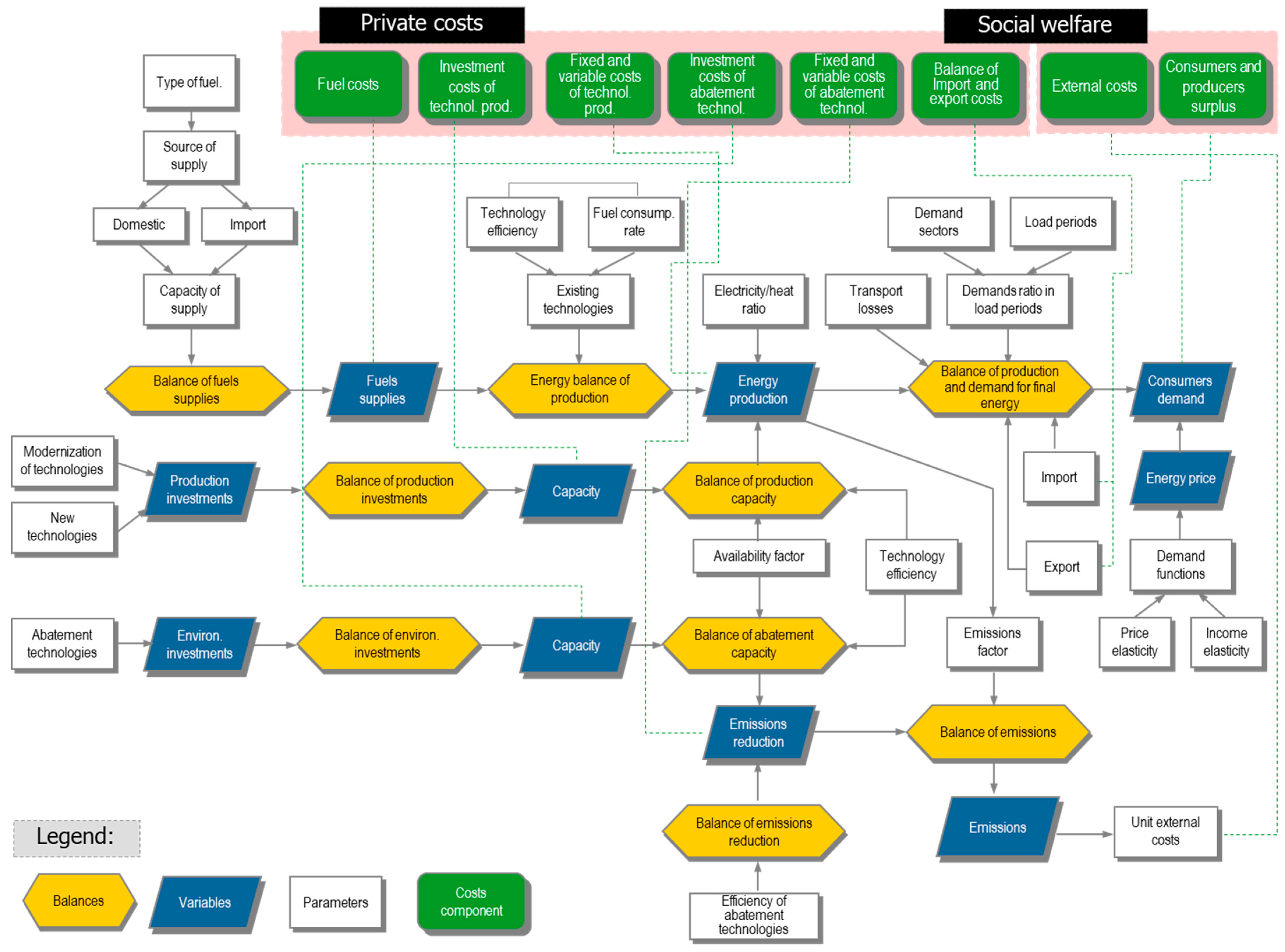
The Figure A1 in Appendix A illustrates the structure of the key interactions within the modelled system. It presents the links between the supply of energy carriers, generation and abatement technologies, their technical and economic parameters, and the demand of final consumers. Together, these elements form a system of techno-economic-environmental interrelationships. The diagram presents the key balances (constraints) and relationships between the variables of the model. It incorporates the main suppliers of electricity and heat, namely system power plants, district combined heat and power plants (CHPs), industrial CHPs, and municipal heat plants. Energy generation technologies are classified into three groups: existing plants, modernised plants, and new plants. Although two optimisation criteria can be applied in the model, this approach minimises resource costs, which means that energy demand is met at minimum cost. The cost components include investment, fixed, variable, and fuel costs of energy technologies; costs related to the purchase and sale of CO2 allowances; investment and variable costs of abatement technologies; electricity import costs; and revenues from electricity exports. External costs are calculated on the basis of the resulting gaseous emissions. This approach makes it possible to evaluate the analysed scenarios in terms of social costs, defined as the sum of resource and external costs. These calculations constitute the basis for evaluating the costs and benefits of the analysed scenarios and for verifying the economically justified scope of decarbonisation policy. A full mathematical formulation of the model is provided in [21]. Appendix A lists the most important, though not all, relationships found in the model.
This study applies a revised version of the model previously used in the author’s earlier research [21]. The model has been upgraded to reflect updated environmental policy targets, changing economic conditions (e.g., electricity demand, fuel prices), and technological developments (emerging technologies, declining investment costs of RES, improved conversion efficiencies, etc.). In contrast to the earlier version, the time horizon has been extended to 2050, with results calculated in annual intervals. This extension was necessary to enable a more accurate analysis of the full decarbonisation scenario for the electricity generation sector.
The new equations introduced in the model include: capacity balances for generation zones, formulated in two versions: seasonal and monthly; balance of available generation capacity, including reserves, maintenance outages, and transmission losses, required capacity reserves across time periods, balance for storage systems and power-to-heat technologies, an equation constraining the maximum capacity of new technologies (reflecting technical limitations such as grid connections); and an equation describing the balance of technology capacity growth. These additions have increased the level of detail of the results but have also significantly expanded the size of the model (see the model statistics in Table 1).
For analytical purposes, coal technologies are still included in the model, even though their practical implementation is currently impossible and not envisaged in government plans. This approach allows for a reliable economic assessment of their cost-effectiveness and supports the argument that they should be fully decommissioned. Similarly, abatement technologies remain under consideration, although their present implementation also appears unfeasible. Under less stringent emission requirements, however, they represented the cheapest option for coal technologies to comply with environmental standards. At present, emission regulations for coal are so restrictive that these units can only operate in the short term. In practice, they have no prospects and will be phased out. The effectiveness of these regulations in the context of decarbonisation policy is therefore of little relevance, a point that will be confirmed in the model calculations.
The model has been recalibrated using the latest production, economic, and environmental data for the Polish generation sector. A sensitivity analysis module has been introduced to account for risk parameters such as electricity demand growth, CO2 reduction targets, CO2 allowance prices, the costs of energy technologies, etc. In addition, the rate of implementation of new RES and nuclear investments has been updated, enabling a more detailed calculation of the optimal electricity and heat generation structure. This revision also made it possible to re-examine the RES mix and assess technologies that had not been feasible in the previous version of the model. However, the model does not resolve hourly dispatch, unit commitment, transmission congestion, seasonal storage adequacy, grid reinforcement needs, or reserve-market operation. That is why the results, characterised by high shares of wind and photovoltaic generation, should be interpreted primarily as a long-term structural decarbonisation pathway rather than a fully resolved operational system design.
Since the energy sector does not operate in isolation from other parts of the economy, the decarbonisation of industry, transport, households, services, and agriculture has also been taken into account. As a result, electricity demand is projected to be much higher than in previous model versions, reflecting the need to electrify multiple areas of energy use. Electricity demand is represented as an exogenous annual trajectory reflecting long-term growth consistent with assumed decarbonisation trends and gradual electrification of end-use sectors. This specification does not explicitly model sectoral demand composition or the detailed structural shifts associated with the electrification of transport, heating, and industrial processes.
This required adjustments to the model structure. Most importantly, the earlier approach of balancing heat and electricity demand separately has been replaced with a combined balancing framework. The demand for district heating, primarily in households, is now met not only by coal-fired CHPs, as in the past, but increasingly by electricity, reflecting a transition to electric heating systems. New Power-to-Heat installations (electric boilers and heat pumps) are also included as key sources of district heating, while simultaneously contributing to the stabilisation of the energy system. This shift necessitates a significantly faster growth rate for RES and nuclear technologies to meet the increased demand. Additionally, an accelerated schedule for the permanent shutdown of coal-fired generating units by 2035 has been adopted.
The key instrument for implementing the scenario of full decarbonisation of the energy sector by 2050 is the ETS. Under this framework, the trajectory of technological development and emission reductions is driven exclusively by high CO2 allowance prices. The social cost of carbon, similarly, forms part of the scenario inputs used to represent alternative policy and regulatory frameworks.
The following analysis framework was applied:
  • Model calibration to 2024 energy sector data, including updated demand, technology parameters, costs, and environmental data.
  • Optimisation calculations for the defined research scenarios.
  • Analysis of results, including the structure of electricity and heat generation, system and external costs, emissions, and other relevant indicators.
  • Discussion of findings, supported by sensitivity analysis for various levels of the external costs of CO2 emissions and other risk parameters.

3. Numerical Specification and Scenarios

This section presents the numerical assumptions used in the model and describes the scenarios analysed. It includes key parameter values for fuel prices, technology costs, capacity limits, CO2 allowance price trajectories, and investment rates. These parameters form the basis for the scenario analysis, which examines different pathways for the decarbonisation of the Polish electricity sector. The Table A1 included in Appendix A presents the technical, economic, and emissions parameters of all energy technologies incorporated in the model.

3.1. Statistical Data Used to Model Calibration

3.1.1. Electricity Production

This structure of electricity generation serves as the starting point for the optimisation calculations. In the case of the Polish energy sector, calibration is a challenging task, as national public statistics are often inconsistent. The two main institutions responsible for providing such data—the Energy Market Agency and the Polish Power Grids—report slightly different figures. Considerable effort was therefore made to ensure that the results of the optimisation calculations reproduce an electricity generation structure for Poland similar to that observed in 2024. Overall, the model assumptions (e.g., fuel prices, investment and operating costs of energy technologies, emission coefficients) are consistent with data published in online sources, primarily national energy statistics [22,23,24,25,26]. Total electricity production in 2024 amounted to 167 TWh. Production from coal-fired power plants (hard coal and lignite) accounted for 62.8% of the total, while production from RES (i.e., hydro, wind, and other renewable energy sources) accounted for 27.1%. In system power plants, 69.1 TWh of electricity was generated from hard coal, 35.8 TWh from lignite, and 16.77 TWh from gas-fired power plants. Wind power plants produced 24.8 TWh, hydropower plants generated 3.1 TWh, and other RES (PV and biomass) produced 17.3 TWh [27,28].
The electricity import–export balance was updated to reflect 2024 values, amounting to 13.2 TWh of imports and 15.2 TWh of exports [28]. Data on transmission losses and own consumption were taken from [20]. Transmission losses were assumed to equal 5.3% of the electricity fed into the grid, which is significantly lower than the approximately 9% observed several years ago. Own consumption in electricity generation was differentiated by technology groups and assumed to range from 1% to 8%, with the lowest values for renewable energy sources and the highest for coal-fired technologies.

3.1.2. Fuel Prices, Cost of Electricity Production and CO2 Emission Intensity

Fuel prices are subject to significant fluctuations due to political developments in global and local markets. The model calculations assume fuel prices for 2024 (Polish Power Exchange in OTC contracts) as follows: gas—53 PLN/GJ (i.e., 12.6 €/GJ); hard coal—22 PLN/GJ (i.e., 5.2 €/GJ); biomass—25 PLN/GJ (i.e., 5.9 €/GJ); lignite—15 PLN/GJ (i.e., 3.6 €/GJ); and nuclear fuel—1 €/GJ. Due to the lack of reliable long-term price forecasts, it is assumed that these prices will stabilise in the future. In general, Polish public statistics do not provide detailed information on electricity generation costs in the power sector for 2024. Available data published on national energy portals, along with fragmented information occasionally provided by public energy institutions or experts, offer only a rough estimate of the actual cost of electricity production [20,26,29]. The estimated costs are as follows:
-
Onshore wind power plants: approximately 300 PLN/MWh (i.e., 72 €/MWh),
-
Offshore wind power plants: 300–450 PLN/MWh; 420 PLN/MWh assumed (i.e., 100 €/MWh),
-
Hard and lignite coal-fired power plants (including CO2 allowance prices): 350–600 PLN/MWh; 480 PLN/MWh (i.e., 114 €/MWh) was assumed for hard coal, and 460 PLN/MWh (i.e., 110 €/MWh) for lignite,
-
Gas power plants (excluding CO2 allowance prices): OCGT (Open Cycle Gas Turbine)—70–130 USD/MWh (100 €/MWh assumed); CCGT (Combined Cycle Gas Turbine)—45–80 USD/MWh (80 €/MWh assumed),
-
CHP (Cogeneration): 50–90 USD/MWh (70 €/MWh assumed).
-
Photovoltaic (PV) plants: 180–300 PLN/MWh, 300 PLN/MWh assumed (71 €/MWh),
-
Nuclear power plants: 40–90 USD/MWh depending on country and technology; 82 €/MWh assumed.
Total CO2 emissions from the electricity generation sector in Poland in 2024 amounted to approximately 108.8 million tonnes of CO2, calculated on the basis of total gross electricity production of 167 TWh and an average emission intensity of 652 g CO2eq/kWh. Other data indicate that in 2023 (with no data available for 2024), electricity generation in Poland resulted in approximately 101.2 million tonnes of CO2 emissions. Of this total, system power plants accounted for 81.2 million tonnes, while CHP plants were responsible for 20 million tonnes [30]. With total electricity production in 2024 amounting to 167 TWh, this corresponds to approximately 600 g CO2/kWh, a value adopted for model calibration as the most likely.

3.1.3. Investment Cost and LULUCF Potential

The investment cost assumptions, along with other data on costs, production, and emissions, are based on official studies and forecast reports prepared for the Polish government, as well as publicly available statistical sources [16,20,22,23,24,25,26]. Detailed data on the energy technologies used in the model are provided in Table A1 in Appendix A. These assumptions are consistent with mainstream datasets used by institutions such as the International Energy Agency and the World Bank, as reflected in the estimations presented in Table A2 in Appendix A. The comparison of CAPEX indicates that the adopted assumptions remain within the ranges commonly reported in the literature, while also reflecting the uncertainty associated with future technological development. The values presented should therefore be interpreted as representative scenario assumptions rather than precise forecasts.
Scenarios aimed at achieving net climate neutrality should also account for greenhouse gas absorption by the LULUCF (Land Use, Land-Use Change and Forestry) sector. According to the report Climate Action Progress Report [31], Poland reported a net absorption of approximately 20 Mt CO2eq in the LULUCF sector in 2021. However, this figure is subject to considerable uncertainty. Other government sources indicate that the target for 2030 in the LULUCF sector is a net absorption of 38 Mt CO2eq [32]. Importantly, there is no reliable information on the share of LULUCF-related GHG absorption that can be directly attributed to activities linked to the energy sector (e.g., afforestation related to biomass use, utilisation of biomass residues, energy-related waste processing, or CO2 capture, if any). Due to this lack of disaggregated and attributable data, LULUCF absorption was not included in the model calculations as a mitigating factor for total emissions from the energy sector. Excluding LULUCF does not bias the comparative results of the analysed scenarios, as the study focuses on relative differences between alternative decarbonisation pathways rather than on absolute net-emission levels. The potential contribution of the LULUCF sector is largely exogenous to the electricity and heat generation structure modelled here and would affect all scenarios in a similar manner. Consequently, omitting LULUCF absorption does not alter the ranking of scenarios, the optimal technology mix, or the marginal cost relationships that underpin the economic assessment of decarbonisation policies.

3.1.4. The Development of Energy Technologies

It was assumed that existing coal-fired units would be able to operate for only 10 more years. This ensures their profitability while allowing coal- and gas-based technologies to serve as transitional fuels in the country’s energy transformation. However, the model still allows for extensive modernisation of existing coal-fired power plants to improve their energy efficiency, as well as for new investments in coal-fired power plants, including a CO2 sequestration option.
Nuclear energy is included in the optimisation framework as a potential low-carbon generation technology capable of providing a stable electricity supply under deep decarbonisation conditions. Its inclusion is particularly relevant in long-term scenarios characterised by high shares of variable RES and increasing system flexibility requirements. At the same time, significant uncertainties remain regarding future investment costs, construction lead times, financing conditions, regulatory approval, and public acceptance. Consequently, nuclear deployment in the model should be interpreted as a conditional optimisation outcome rather than a prediction of actual implementation. The first power plant with a capacity of approximately 5000 MW is expected to begin operation in 2035, followed by a second plant of similar capacity in the subsequent years.
Hydrogen technologies are incorporated to represent potential long-term flexibility and energy storage options within highly decarbonised energy systems. In particular, hydrogen may contribute to balancing variable RES generation, seasonal storage, and sector coupling applications. However, the future competitiveness of hydrogen depends on substantial technological progress, infrastructure development, electricity availability, and cost reductions. Therefore, its role in the model should be interpreted as exploratory and conditional on favourable techno-economic assumptions rather than as a deterministic projection. After 2040, hydrogen is assumed to become a competitive energy source, provided that its price remains favourable and the technology reaches maturity.
An important additional RES option is energy storage. Energy storage facilities are systems that enable electricity to be stored and used at a later time. They play a key role, particularly in the case of RES such as solar panels or wind turbines, which generate power intermittently. One of the largest energy storage facilities in Poland and Europe will be located in the Rymanów commune, with a capacity of 110 MW and an estimated investment cost of approximately PLN850 million, i.e., about €1840/kW [33]. In the model, this type of installation has been directly represented in large-scale batteries. According to estimates by the Polish Economic Institute, at least 10–15% of the electricity generated from RES will need to be stored to ensure effective utilisation.
The total capacity and investment rate of RES and nuclear power are critical to Poland’s decarbonisation strategy. In the model, the maximum assumed capacities of energy technologies up to 2050 are as follows: 30,000 MW for PV, 11,000 MW for nuclear power, 50,000 MW each for onshore and offshore wind farms, and 8000 MW for new hydrogen-fired combined cycle gas turbine (CCGT) plants. The maximum annual capacity growth rate for new technologies is set at 700 MW/year for nuclear, hydrogen-fired combined cycle gas turbine (CCGT) plants, energy storage (batteries) and power-to-heat installations, 1000 MW/year for wind and PV farms, and 500 MW/year for other technologies. If lower capacity limits are applied, the model fails to provide a feasible solution. The values assumed here are therefore considered necessary to ensure that the zero-emission target for 2050 can be achieved. In practice, the implementation of such rapid deployment rates may be constrained by non-economic factors that are not explicitly represented in the optimisation framework. These include administrative permitting processes, supply chain limitations, availability of skilled labour, financing constraints, grid connection bottlenecks, and social acceptance of large-scale infrastructure development. Such constraints may lead to more gradual deployment trajectories than those suggested by the model.
It is assumed that RES investment costs will fall steadily by 10% by 2050 compared with 2025.

3.1.5. Demand, EUA Prices and External Costs Estimations

As mentioned, the energy transition will require a significant increase in electricity consumption, particularly in transport and heating, as well as the use of hydrogen in sectors where currently available technologies cannot ensure compliance with stringent decarbonisation targets. The demand assumptions are based on studies prepared for the Polish government [34,35]. The reports assume an average annual GDP growth rate of 2.5% up to 2050. It is further assumed that carbon neutrality will be pursued across all sectors of the national economy. As a result, final electricity consumption is expected to grow by around 2% per year, rising from 167 TWh in 2025 to 270 TWh in 2050. At the same time, demand for central heating is projected to increase by 1.3% annually, from 220 PJ in 2025 to approximately 300 PJ in 2050 [15,33]. This additional demand for district heating will be met through new investments in Power-to-Heat installations (electric boilers and heat pumps) and hydrogen-fired CCGT CHP plants, as well as through the partial electrification of district heating systems.
In 2024, CO2 emission allowance (EUA) prices were highly volatile, with an annual average of €66.5/tCO2 [30]. Projections for the coming years are aligned with scenarios aiming to achieve carbon neutrality by 2050, prepared by the IEA [36], the European Commission [34,37]. It is therefore assumed that allowance prices will rise steadily, reaching €100/tCO2 in 2030–2035, €120 in 2035–2040, €140 in 2040–2045, and €165 after 2045.
The benefits of a decarbonisation policy are reflected in the external costs avoided. Using the ExternE methodology [38] and a dedicated study for Poland [39], external costs were assigned to specific pollutants: €11,000/tPM10, €6000/tNOx, and €7000/tSO2. Estimates of the social cost of carbon (SCC) vary significantly depending on assumptions such as discount rates and damage functions. American studies [40] estimate SCC within relatively broad, though comparatively low, ranges for 2020, amounting to $12, 43, 65, and 129 (in 2007 dollars), corresponding respectively to discount rates of 5%, 3%, and 2.5%, as well as to the 95th percentile. In this model, a baseline value of $50/tCO2 has been assumed, with alternative values discussed in the next section.

3.2. Scenarios

Three scenarios differing in the pace of decarbonisation are considered:
(1) Full Decarbonisation Policy (FDP).
A consistent implementation of the EU’s zero-emission strategy. This scenario requires the adoption of the upward CO2 allowance price trajectory described earlier.
(2) Mid Decarbonisation Policy (MDP).
A freeze of current policies caused by social resistance (e.g., high energy prices, speculative actions of financial institutions aimed at raising allowance prices) as well as political, economic, and military threats (e.g., the ongoing risk of war with Russia, low EU competitiveness compared to the USA and China). In this scenario, CO2 allowance prices are assumed to stabilise at the 2024 level of approximately €70/tonne.
(3) No Decarbonisation Policy (NDP).
A complete abandonment of decarbonisation efforts, for example, due to drastic political or military developments (e.g., war with Russia, a trade war with the USA). This scenario assumes a full withdrawal from the EU ETS.
The selection of three scenarios was deliberate. Conducting a cost–benefit analysis for only one scenario (e.g., FDP) would be incomplete and would fail to capture the full range of potential outcomes under alternative policy paths. Given the uncertainty surrounding whether current actions are optimal in relation to available alternatives, it is essential to explore different trajectories. Therefore, two additional variants were introduced—one assuming a relaxation of decarbonisation policies and another assuming their complete abandonment. This comparative approach enables an assessment of the economic implications of each option and provides a basis for evaluating whether an ambitious climate policy is justified, particularly in the context of a country such as Poland.
The model was run using the GAMS software package (GAMS Rev 237 WEX-VS8 23.7.3 x86/MS Windows) with the SIPLEX solver. Model statistics are presented in Table 1.

4. Results and Discussion

4.1. The Structural Changes

The analysis should begin by clarifying the structural changes associated with the decarbonisation of the Polish energy sector. As noted earlier, the previous approach of balancing heat and electricity demand separately has been replaced with a combined balancing framework. Achieving full decarbonisation of the generation sector is feasible only through a shift from the use of heat produced in coal CHPs to heating systems using electricity and Power-to-Heat installations (electric boilers and heat pumps). However, this transition represents a major technological and financial challenge, the detailed assessment of which lies beyond the scope of this analysis.

4.1.1. Total Electricity and Heat Production

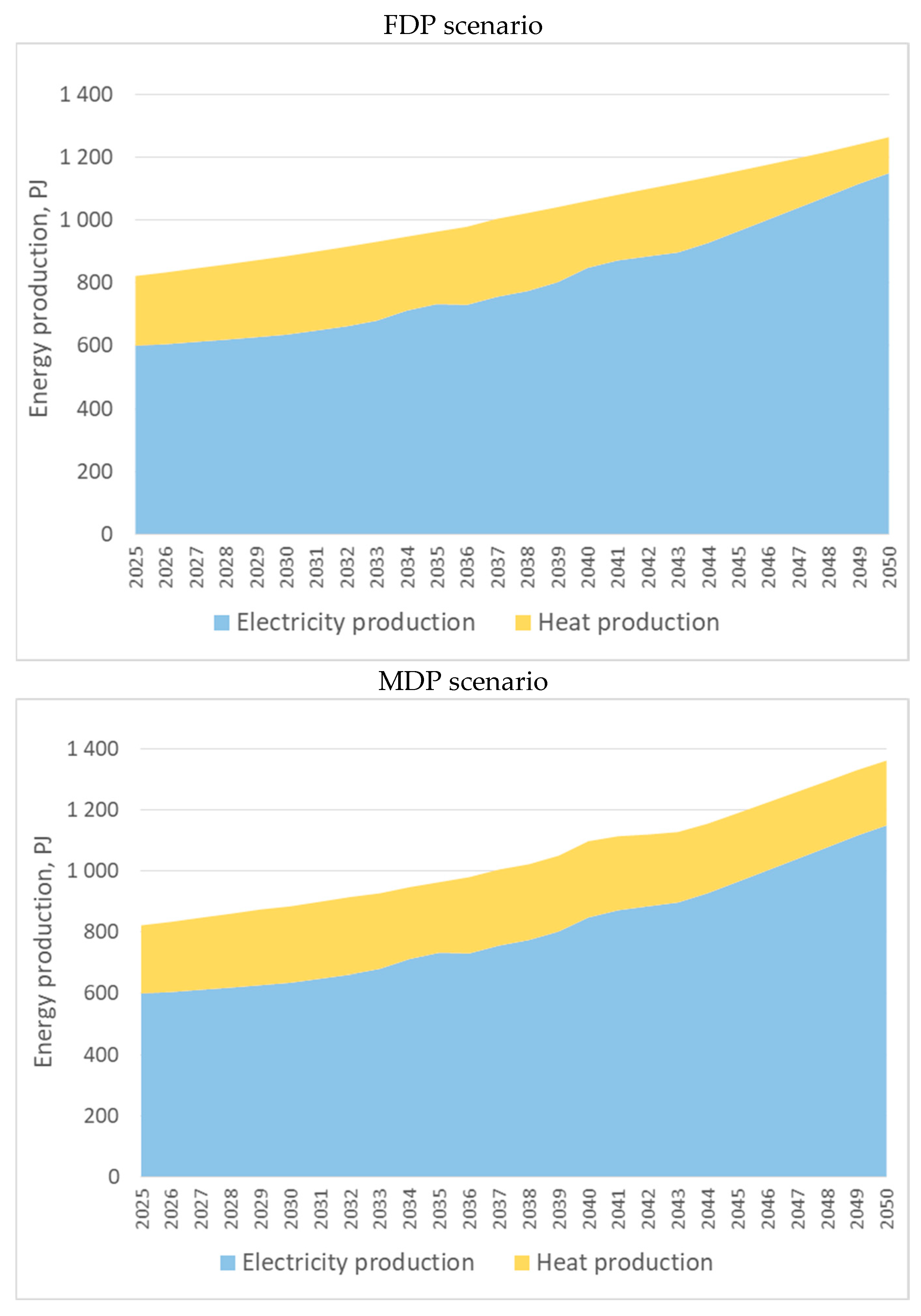
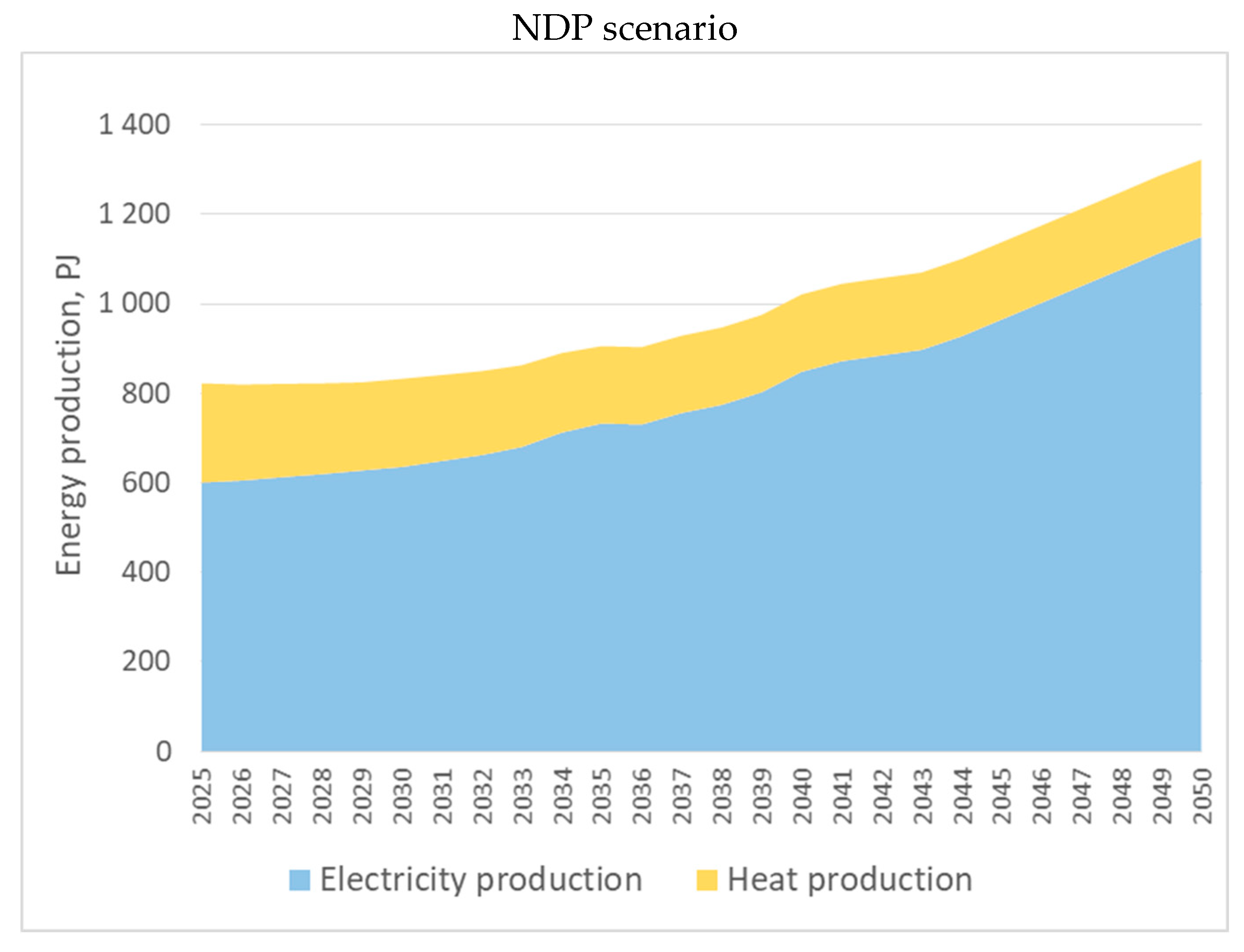
Figure 1 presents the total electricity and heat production across the analysed scenarios. Achieving full decarbonisation requires the complete phase-out of coal-based technologies. By 2050, heat production decreases to 115 PJ, with generation provided by Power-to-Heat technologies and hydrogen-fuelled combined cycle gas turbine (CCGT) units. In contrast, the moderate decarbonisation policy allows heat generation in CHPs to remain relatively stable, at around 200 PJ per year. Abandoning decarbonisation efforts leads to the continued dominance of coal technologies, with total heat demand at around 180 PJ per year.

4.1.2. Scenario-Specific Energy Mix Evolution

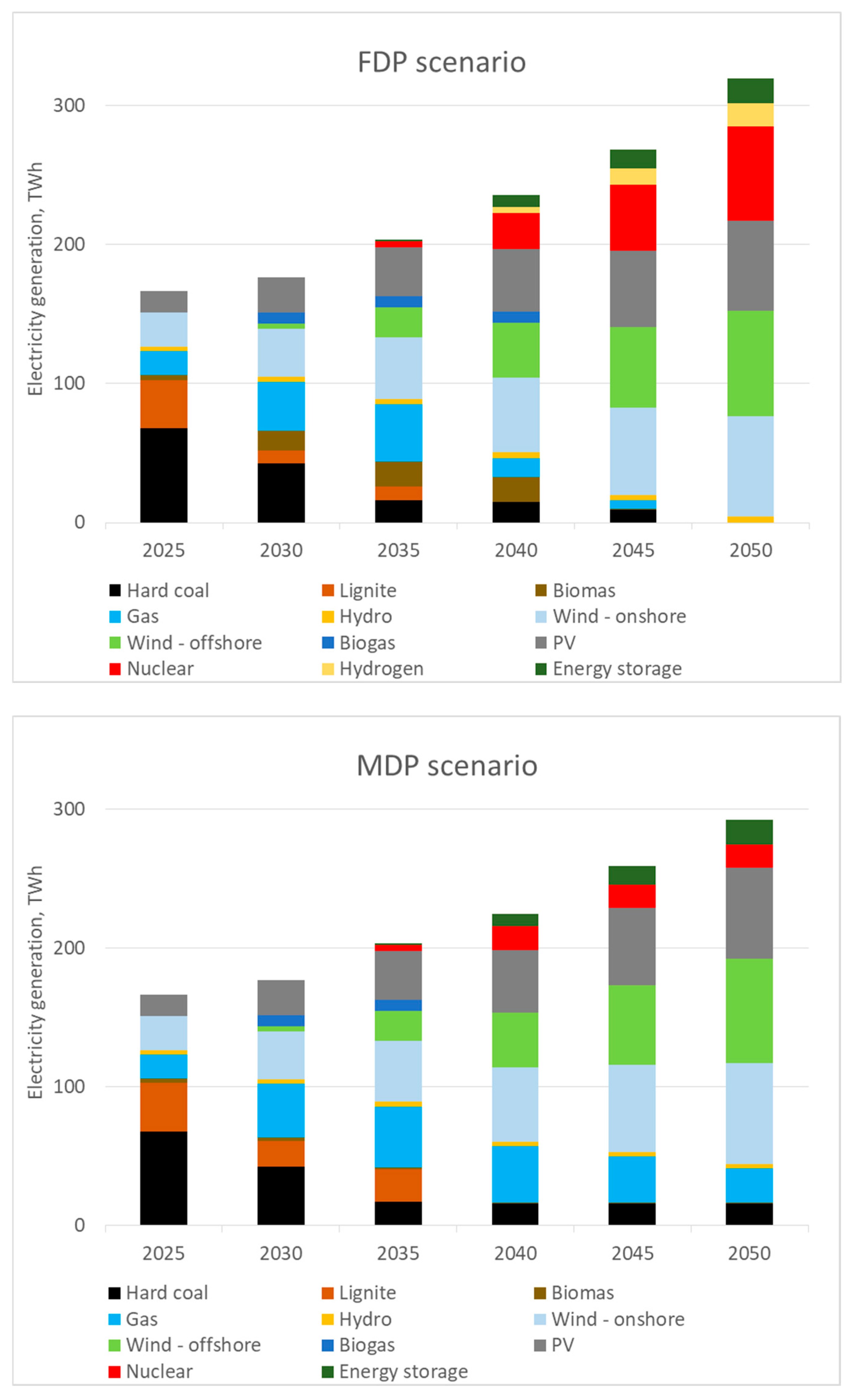
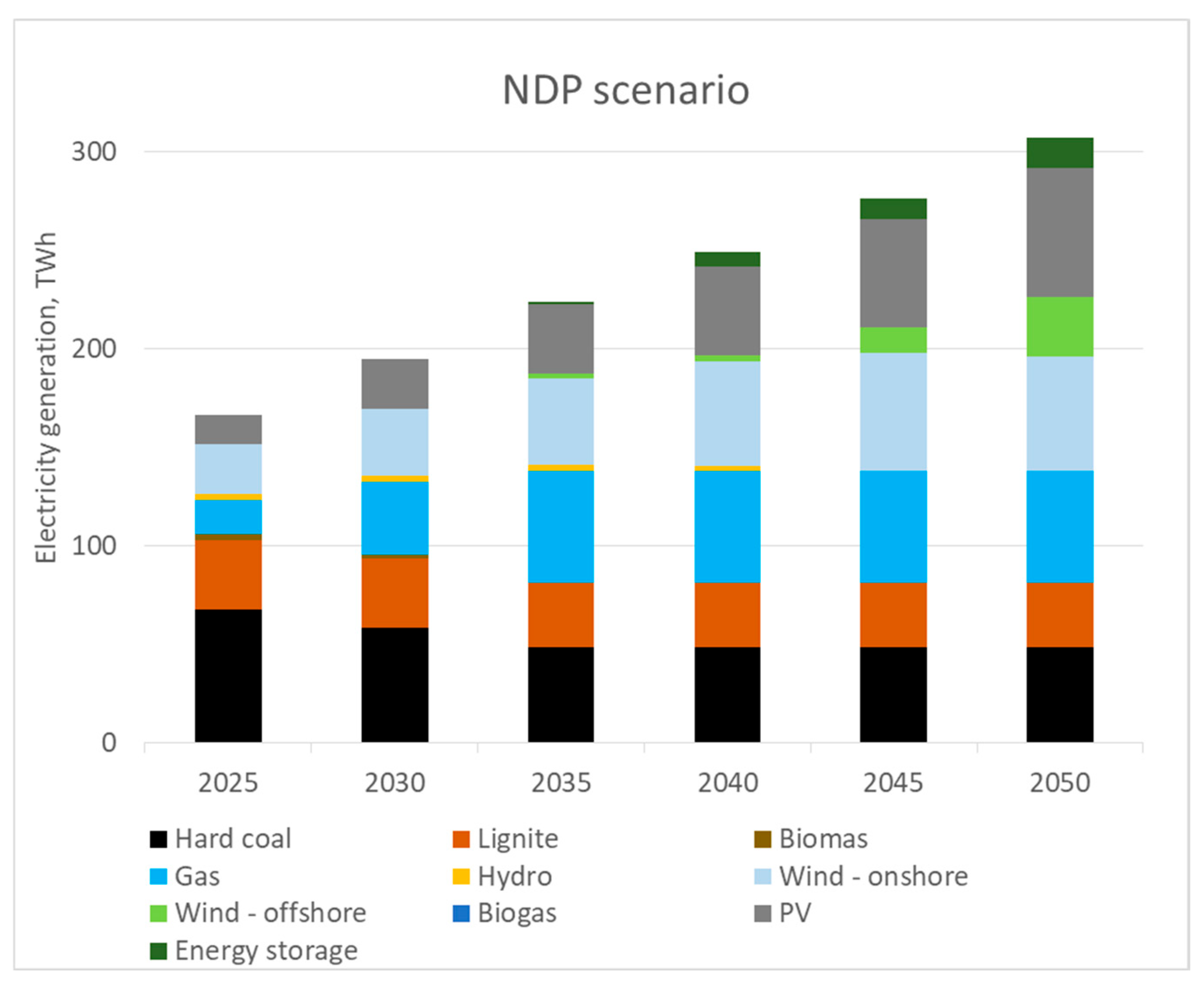
Figure 2 presents electricity generation over 2025–2050. For the sake of clarity and consistency, the production data are presented in five-year intervals. The analysis of the energy production structure requires some preliminary clarification. First, it should be noted that the total energy production levels differ between scenarios, reflecting the varying levels of heat generation illustrated in Figure 1. Therefore, the relatively limited scale of electricity generation in district heating plants implies a substantially higher level of heat production. Furthermore, the differences in electricity generation levels between 2025 and 2050 are driven not only by the assumed 2% annual growth in electricity demand, but also by the partial electrification of district heating systems. Second, the results for 57 competing energy technologies in the model (including their modernisation options for existing power plants) were aggregated into 13 groups based on the type of fuel and energy source. Third, only the FDP scenario can serve as a valid reference point for comparison with other studies on the Polish energy sector, as discussed below. The remaining scenarios are used here as comparative variants within the cost–benefit analysis framework. Fourth, the primary factor driving changes in the generation structure is the variation in CO2 emission allowance prices. In the FDP scenario, these prices were calibrated to ensure the achievement of zero CO2 emissions from the domestic energy sector by 2050. Notably, the assumed price trajectory is consistent with that adopted in other national studies (e.g., [34]), indicating that only such a projection of tradable allowance prices makes it possible to attain full decarbonisation of the sector. Fifth, the technical assumptions regarding the maximum total capacity in 2050 and annual capacity growth of new technologies—outlined in the numerical specification section—are critical for achieving diversification of the energy mix. While these constraints limit the model’s flexibility, they also reflect the realistic technical possibilities for the development of RES, such as grid connection capabilities. It is particularly noteworthy that only exceptionally high annual capacity growth rates for new technologies, as described earlier—levels unprecedented in the investment practice of the Polish energy sector—ensure the full decarbonisation of the sector.
In the FDP scenario, lignite- and hard coal–fired system power plants are rapidly phased out and practically decommissioned by 2034. No investments in new coal-fired units are envisaged. Only coal-fired CHPs remain competitive until around 2047. Coal-fired units must be replaced primarily due to the continuing increase in EUA prices, which fundamentally alters the relative cost competitiveness of power generation technologies. As allowance prices rise, the marginal cost of electricity and heat production from coal increases significantly, making coal-based generation unprofitable compared with low- and zero-carbon alternatives. Consequently, coal technologies are gradually replaced by biomass-based, biogas and gas-fired units, particularly combined cycle gas turbines (CCGT) and open cycle gas turbines (OCGT). According to the simulation results, these technologies become competitive as electricity producers around 2043 and as district heating producers by approximately 2049. At the same time, growing energy demand toward mid-century requires a substantial expansion of generation capacity, which leads to a rapid increase in investments in RES. These installations are developed throughout the entire modelling horizon up to 2050, in line with the ambitious investment trajectory assumed in this scenario. According to the model assumptions, approximately 12% of the electricity generated from these sources is directed to energy storage facilities and Power-to-Heat installations (electric boilers and heat pumps). They serve primarily to stabilise the power system by balancing the variability of RES generation. From 2035 onwards, nuclear energy is assumed to play an increasingly important role in the national energy mix, reaching an installed capacity of approximately 11,000 MW by 2050. As the scenario assumes that hydrogen becomes competitive under the adopted scenario assumptions with natural gas as a fuel after 2040, hydrogen-based technologies gradually enter the generation mix. New CCGT hydrogen-fired CHP units, hydrogen turbines in industrial CHP systems and Power-to-Heat installations become the only supplier of heat. In total, these hydrogen-based technologies reach a combined installed capacity of approximately 12,000 MW by 2050. At the same time, energy storage systems are assumed to reach a total capacity of around 10,000 MW in 2050. Detailed data on the generation structure in this scenario are presented in Table 2.
Easing climate policy by stabilising the price of CO2 allowances at the 2025 level (MDP scenario) does not ensure the continued operation of coal-fired system power plants, which are phased out at nearly the same rate as in the FDP scenario. Only domestic CHPs remain active until 2050, operating on a limited scale as competitive suppliers of electricity and, primarily, heat. Gas-fired technologies retain their market position for a considerably longer period, serving as transitional replacements for decommissioned coal units and forming an important component of district heat production. The main sources meeting electricity demand are RES technologies, with the same contribution as in the FDP scenario from offshore, onshore wind and PV. Lower EUA prices compared to the FDP scenario, resulting in higher CO2 emissions, lead to smaller nuclear investments, reaching approximately 2700 MW. Hydrogen-fired CCGT plants are not expected to be built, whereas energy storage technologies are expected to reach a total capacity of around 10,000 MW by 2050 (Table 2).
A complete abandonment of decarbonisation efforts (NDP scenario) would result in the stabilisation of electricity and heat generation from conventional hard coal- and lignite-fired technologies at approximately the same level as in 2025. The role of gas in both electricity and heat production gradually increases, while RES investments—onshore/offshore wind and PV installations—are developing on a slightly smaller scale than in previous scenarios. Nuclear investments are not developed here, while hydrogen-based technologies are still competitive.
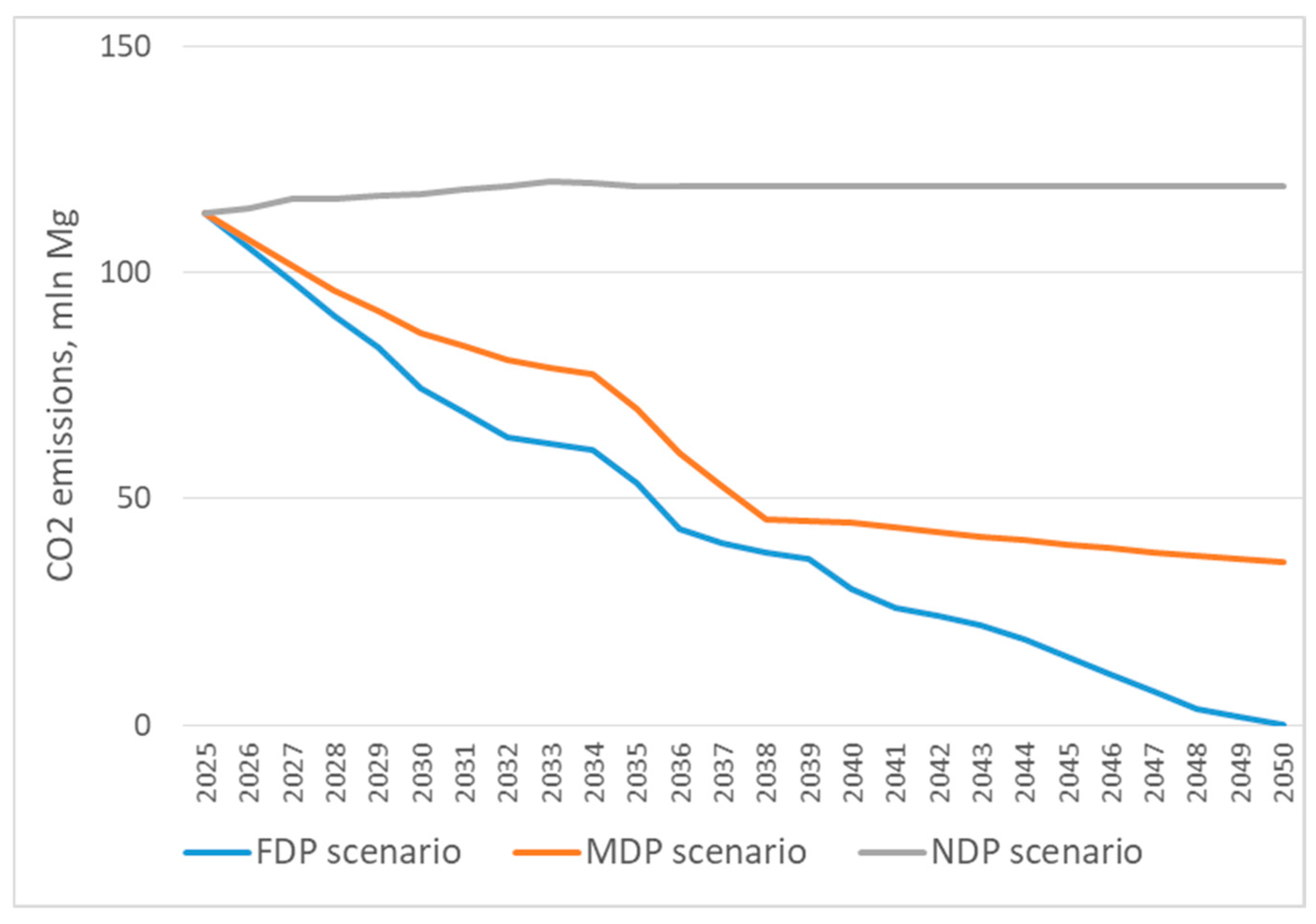
Changes in the generation mix result in distinct CO2 emission trajectories (Figure 3). It is important to emphasise that the full decarbonisation policy (FDP) achieves a complete elimination of CO2 emissions by 2050, whereas the moderate decarbonisation policy (MDP) results in three times lower emissions than in 2025. In this scenario, residual emissions originate mainly from coal-fired CHP plants, while system power plants become fully emission-free. In contrast, abandoning decarbonisation efforts (NDP) leads to the stabilisation of CO2 emissions throughout the analysed period.

4.2. Sensitivity Analysis

The assumptions adopted in the FDP scenario may not fully materialise. To partially account for this uncertainty, a sensitivity analysis was conducted for the key risk factors. The following risk factors have been identified: the growth rate of demand for electricity and heat, EUA prices, capital expenditure (CAPEX) for RES, investment rate of RES, gas and hydrogen prices, and discount rate. Calculations were performed for each parameter separately, while the other factors were held constant. The following parameters were analysed as comparative outcome indicators: discounted social costs, CO2 emissions in 2050 and the share of electricity generation from coal and RES in total sectoral output in 2050. Table 3 presents the results of simulations.
In terms of social costs, the results show moderate variation, consistent with the underlying structure of model dependencies. Changes in electricity demand affect costs primarily through required investment volumes: social costs increase by 8.9% under the high-demand variant, 4.7% under the moderate-demand variant and decrease by 4.7% under the low-demand variant, relative to the FDP scenario. Similar trends can be observed in the case of fluctuating demand for heat. A reduction in EUA prices also lowers system costs by 1.4% to 2.1%. A 30% reduction in CAPEX of RES reduces social costs by about 2.8%, confirming the strong sensitivity of the decarbonisation pathway to RES investment costs. The results for the other risk factors are particularly noteworthy. A 30% reduction in the rate of RES investment and a 30% increase in gas and hydrogen prices lead to an increase in social costs of approximately 2.4%, which is consistent with expectations. In both cases, part of the generation from RES and gas–hydrogen technologies must be replaced by coal-based technologies, resulting in higher CO2 emissions.
With regard to total CO2 emissions in 2050, it should be noted that lower-than-expected growth in electricity and heat demand, as well as lower CAPEX of RES, increases the likelihood of achieving full decarbonisation. However, other factors pose—albeit to varying degrees—a significant risk to meeting this target. In particular, higher-than-expected demand for electricity and heat, lower EUA prices, reduced rates of RES investment, as well as higher hydrogen and gas prices, do not support the structural transformation required for a zero-emission energy sector, but instead favour the continued use of coal-based technologies.
It is not surprising that CO2 emissions are closely correlated with the level of electricity generation from coal-fired power plants. This relationship is particularly evident in a scenario characterised by a 3% annual increase in electricity demand, low EUA prices, a 30% reduction in the rate of investment in RES, and a 30% increase in gas and hydrogen prices. Under such conditions, the full decarbonisation of the sector becomes unattainable. Nuclear energy constitutes a stable and competitive source of supply in all analysed variants, reaching a total installed capacity of approximately 11,000 MW in 2050 in the FDP base scenario. Similarly, RES represents an effective option across virtually all scenarios. Their share in the energy mix remains relatively stable, typically within the range of 60–70%. Reductions in RES investment costs do not alter their share in the mix, which stabilises at around 69%. In this context, the pace of investment deployment—rather than cost reductions alone—proves to be the decisive factor shaping the long-term structure of the energy mix. It should also be noted that a higher rate of electricity demand growth, under the assumed pace of RES deployment, not only reduces the probability of achieving zero CO2 emissions but also diminishes the share of RES in the energy mix, as coal-fired generation increasingly serves as the marginal source of supply.
The impact of the discount rate on the structure of energy production requires a broader discussion. At a high discount rate, projects with high upfront costs and long payback periods—such as RES, grid infrastructure, and nuclear power—become less attractive. Conversely, at a low discount rate, long-term investments become more economically viable. As a result, the attractiveness of wind and solar power, nuclear energy, grid modernisation, and energy storage investments increases, thereby supporting the energy transition and decarbonisation process. In principle, changes in the discount rate can significantly alter the relative profitability of technologies, shifting investment from low-emission to fossil-based options (or vice versa). This implies that a high discount rate discourages long-term investments, leading to a slower pace of decarbonisation, whereas a low discount rate accelerates the transition. However, this effect is not observed in the simulations conducted in this study. The primary reason is the binding investment constraint, whereby the assumed pace of RES deployment is fully utilised, leaving no scope for postponing investments. As a result, discounted social costs differ across scenarios because a lower discount rate increases the relative present value of future costs. Nevertheless, the resulting generation structures remain virtually unchanged.

4.3. A Comparative Analysis with Other Studies

It is not possible to achieve full consistency between the results of this simulation and the findings of other studies and policy documents assessing the technical, economic, and social impacts of full decarbonisation of the Polish energy sector. This is primarily due to differing—and in some cases, unspecified—economic and technological assumptions underlying these analyses, such as varying levels of energy demand, the pace of technological development, location-specific constraints, generation potential of various energy technologies, CO2 allowance price trajectories, and the role of energy imports and exports. Nevertheless, the significance of these studies in shaping current Polish energy policy warrants their consideration here.
However, it is noteworthy that none of the reviewed documents addresses the economic justification of climate policy at the national scale. There are no analyses—even partial ones—that evaluate or substantiate alternative development pathways for the Polish energy sector under uncertain climatic conditions. Instead, most studies focus on scenario sets that assume varying rates of economic growth, differing capacities to meet environmental requirements, the pace of phasing out coal technologies, and a wide range of cost developments (including renewable energy, nuclear technologies, fuels, EUA prices, etc.). Although these factors are economically relevant, they do not fundamentally alter the overall assessment of the feasibility or rationale for implementing the current climate policy.
One of the most important Polish documents examining the issue of decarbonisation is ‘Poland—Draft updated NECP 2021–2030’ [41]. This is an official EU/Polish planning document with targets for 2030, scenarios for RES share, efficiency and policy directions. It provides a basis for short-term analyses and the impact of EU regulations on the Polish energy sector. The main conclusions according to the NECP are: accelerated investment in RES and the transmission network; the need to introduce support mechanisms for structural transformations; the need to secure capacity in the face of increasing volatility in RES production. The document, however, does not provide a perspective extending to 2050. The second key document, Energy Policy of Poland until 2040 [42], outlines the future technological mix, in which coal-based generation is gradually replaced by gas, nuclear, and renewable energy technologies. It defines priorities for energy security, investment schedules, and the legislative framework. With regard to decarbonisation, EPP2040 establishes a framework for a significant reduction in coal’s share in the energy mix, while emphasising security of supply and the progressive introduction of nuclear power. The other central Polish document addressing the issue of decarbonisation was prepared by the Ministry of Climate and Environment [35]. This most recent planning document, prepared by the Polish government in accordance with EU requirements, constitutes an update of the existing National Energy and Climate Plan 2021–2030, with the planning horizon extended to 2040. In the so-called active climate policy scenario, CO2 emissions are projected to be reduced by 75% by 2040 relative to 1990 levels. The share of renewable energy sources in total energy production is expected to increase to 62%. The results presented here regarding the structure of electricity generation and the costs of transforming the generation sector are broadly consistent with those reported in this document.
In addition to official policy documents, numerous studies have been prepared by industry associations, government institutions, consulting firms, and academic researchers. One such study, ‘Polish Energy Sector 2050: Four Scenarios’ [13] presents a comparative analysis of four potential development pathways—ranging from conservative to highly ambitious decarbonisation—together with their corresponding economic implications and macroeconomic impacts. The study concludes that scenarios dominated by RES (particularly offshore wind and photovoltaics) require substantial investments in energy transmission infrastructure and storage systems. However, these scenarios also deliver a faster pace of CO2 emission reduction and lower overall system costs in the 2040–2050 timeframe. Other studies, such as ‘Poland Net-Zero 2050: Transformation of the Polish and EU Energy Sector until 2050’ [14] and ‘The National Power Industry in the Perspective of 2050’ [34], present scenarios that assume the achievement of carbon neutrality in the energy sector by 2050, in line with the objectives of the European Green Deal. Reports by consulting firms and research institutions, including the McKinsey study [11], academic paper [16], and earlier government report [20], also analyse alternative pathways characterised by different rates of transformation. The McKinsey report, in particular, outlines three scenarios: a conservative one (slower transition), a mixed one (RES combined with nuclear energy), and an ambitious one (full decarbonisation driven mainly by RES, energy storage, and hydrogen technologies). The key findings for the full decarbonisation scenario include: (a) a very high share of RES exceeding 70% by 2050, with varying contributions from photovoltaics and offshore and onshore wind farms; (b) nuclear energy serving as a stable baseload source—approximately 10 GW from two nuclear power plants—thus reducing the need for extreme expansion of RES and storage capacities; and (c) substantial energy storage requirements, including large-scale batteries, seasonal storage (power-to-gas/hydrogen), advanced demand-side response mechanisms, and broad sectoral integration (e.g., electrolysis and electric heating).
Similar to the projected energy mix, total investment expenditure—used as a key indicator of the feasibility of the decarbonisation pathway—varies substantially across the analysed studies. According to the most recent strategic document issued by the Ministry of Climate and Environment [35], the required capital expenditures (CAPEX) within the energy sector for the 2021–2040 period are estimated at €280 billion under the ambitious scenario. This estimate is strictly limited to the generation segment, excluding power transmission and distribution infrastructure. The projected emission reduction measures are aligned with the so-called transformation scenario, which aims to fulfil the requirements and objectives set forth in the European Union’s ‘Fit for 55’ legislative package. In the report by Energy Forum [13], investment expenditure on electricity generation infrastructure is estimated at €262 billion. Estimates presented in the government document ‘Energy Policy of Poland 2040’ [42] indicate that the transformation of the Polish energy sector by 2040 may require approximately €206–212 billion. By contrast, another scenario presented in ‘Polish Energy Sector 2050’ [13], representing the most ambitious variant—with a 73% share of renewable energy sources and no nuclear power in 2050 (while not achieving zero CO2 emissions)—estimates total investment expenditure at around €134 billion. In the study by Pluta et al. [16], investment outlays in a scenario that includes the development of nuclear energy amount to approximately €145 billion. Finally, the McKinsey report [11] estimates total investment expenditure of about €340 billion over the period 2025–2050, assuming a 2.5-fold increase in electricity demand by 2050 relative to current levels—significantly higher than in most other studies.
In summary, there is a very close correlation between the above-presented results of the FDP scenario and the directions and pace of structural changes necessary to completely decarbonise the Polish economy. The general conclusion drawn from the analysis of these sources is that coal-based generation must be phased out sooner or later, depending on the scenario considered. In some scenarios, coal technologies equipped with carbon capture and storage (CCS) remain in operation, which appears to be a questionable outcome. During the transition period, natural gas serves as a complementary source of electricity and heat. This implies that combined heat and power (CHP) plants, which have so far relied on hard coal to supply electricity and heat to district heating systems in Poland, are expected to switch to natural gas. After 2035, this fuel is assumed to be phased out in favour of hydrogen or other cost-effective low-emission technologies. The final stage of the transition in electricity generation is projected to be dominated by RES, nuclear power, and hydrogen-based technologies. This is not a surprising conclusion. Regardless of the type of approach (macro- or microeconomic), the type and detail of the model used or its assumptions, the set of zero-emission technologies is very limited. There is therefore little room for choosing optimal solutions, and the relatively small structural differences in the future energy mix presented in this article and the studies cited are of little significance for the overall economic assessment of the adaptation of the Polish energy sector to the requirements of the EU’s zero-emission policy.

4.4. SCC Estimates

The study distinguishes between the social cost of carbon (SCC) and EU ETS allowance (EUA) prices. SCC represents an estimate of the marginal external damage caused by an additional unit of CO2 emissions and therefore constitutes a normative welfare-based measure. In contrast, EUA prices reflect the market price of emission permits within the EU ETS framework and are determined by regulatory constraints, market expectations, and allowance scarcity. Although EUA prices may partially internalise carbon externalities, they should not be interpreted as direct estimates of SCC. Consequently, the analysis treats EUA prices as policy-driven market signals, while SCC values are used to represent broader societal external costs within the optimisation framework.
The EU Emissions Trading System (ETS) is designed to drive structural changes in national energy systems toward zero-emission technologies. The effectiveness of the ETS depends primarily on the EUA prices, which serve as the main instrument for inducing such transformations. Consequently, the effectiveness of the ETS does not necessarily align with its economic efficiency. An effective ETS should ensure that the structural changes it promotes are economically justified by the potential avoided external costs of climate change. Therefore, the structural transformations driven by EU policy instruments may not always be economically efficient—a hypothesis that will be verified in the following analysis.
However, it should be noted at the outset that there is no single ‘universal’ value for the external cost of CO2, commonly referred to in the literature as the social cost of carbon (SCC). Estimates of the SCC are highly sensitive to underlying assumptions, including the discount rate, time horizon, and adopted climate and economic scenarios. As a result, many authors emphasise the considerable uncertainty surrounding SCC estimates, which is why they are often presented as ranges rather than as single point values [43]. Moreover, in national or sectoral analyses (e.g., transport, energy), it is essential to account for local conditions such as the energy mix, transport structure, demographic characteristics, population density and other country-specific factors. Consequently, SCC estimates and their policy implications may differ substantially across countries.
SCC is defined as the discounted value of global damage caused by the emission of one additional tonne of CO2. Three principal Integrated Assessment Models (IAMs)—DICE, FUND and PAGE—have historically underpinned estimates of SCC. Methodological differences among these models, including damage functions, discounting and climate sensitivity, result in substantially divergent SCC values [44]. The estimates presented below therefore capture only part of the extensive body of research on SCC valuation. However, from the perspective of this article, the precise numerical value of the SCC is not of primary importance. Instead, the cost of CO2 emission reduction associated with the full decarbonisation of the Polish energy sector is used as a benchmark against which the economic justification of such a policy can be assessed. The key question addressed is thus: at what level of the SCC does full decarbonisation become economically justified?
The literature indicates a sharp increase in estimated SCC values in recent years. Earlier analyses, which have often been used in public policy design, typically reported SCC estimates in the range of several tens of $/tCO2. A 2017 report by the American Academy of Sciences [40] presents results from 2010 and 2013, indicating changes in SCC estimates over time. The estimates reported in 2010 for the year 2020 amounted to $7, 26, and 42 (in 2007 dollars) for discount rates of 5%, 3%, and 2.5%, respectively, and $81 for the 95th percentile at a discount rate of 3%. The corresponding updated SCC estimates reported in 2013 for 2020 were $12, 43, 65, and 129 (in 2007 dollars). More recent studies, incorporating advances in climate science, health impact assessments, systemic and tail risks, and lower discount rates, raise central SCC estimates to approximately USD 150–200 per tonne of CO2, with even higher values reported under high-risk or worst-case scenarios. A brief overview of the literature should begin with the most recent version of the meta-analysis database comprising 446 estimates of SCC published between 1980 and 2024 [43]. The results indicate that the mode of the empirical distribution lies between $75/tC and $100/tC (i.e., $20–27/t CO2). The mean SCC estimate is substantially higher than the mode, amounting to $402/tC ($109/tCO2), reflecting the pronounced right-skewness of the distribution. One of the most influential proposals for an international benchmark for carbon pricing is presented in the OECD report on Effective Carbon Rates [45]. The report defines three benchmark levels: the first two—€30/tCO2 by 2025 and €60/tCO2 by 2030—consistent with a slow decarbonisation pathway, while the third level—€120/tCO2 by 2030—corresponds to a faster decarbonisation scenario. Similarly, the U.S. Environmental Protection Agency [46] reports SCC values of $193/tCO2 for 2020, $230/tCO2 for 2030, and $308/tCO2 for 2050 (all expressed in constant prices). In turn, the report Social Cost of Carbon [47] advocates the use of the SCC as a global benchmark for effective carbon taxation. According to this study, the Net Effective Carbon Rate for OECD countries amounts to $51.4/tCO2 (2021 prices). In turn, Azar et al. [48] propose reference values for the social cost of carbon intended to serve as a global benchmark for effective carbon taxation. Their SCC pathway follows a linear trajectory, increasing annually in constant prices from $227/tCO2 (2021 prices) in 2021 to $392/tCO2 in 2050. Tol’s research [49] demonstrates that advances in scientific understanding of climate change impacts systematically raise SCC estimates, thereby implying the need for more stringent climate policy. His results show that SCC values increased from approximately $9 to $40/tCO2 under a high discount rate, and from $122 to $525/tCO2 under a low discount rate. A landmark study by Rennert et al. [50] estimates the SCC at $185/tCO2—substantially higher than earlier U.S. federal estimates of around $50/tCO2. Finally, the World Bank report [51] concludes that the explicit carbon price signal required to meet the climate objectives set under the Paris Agreement should reach at least $50–100/tCO2 by 2030.

4.5. Social Costs

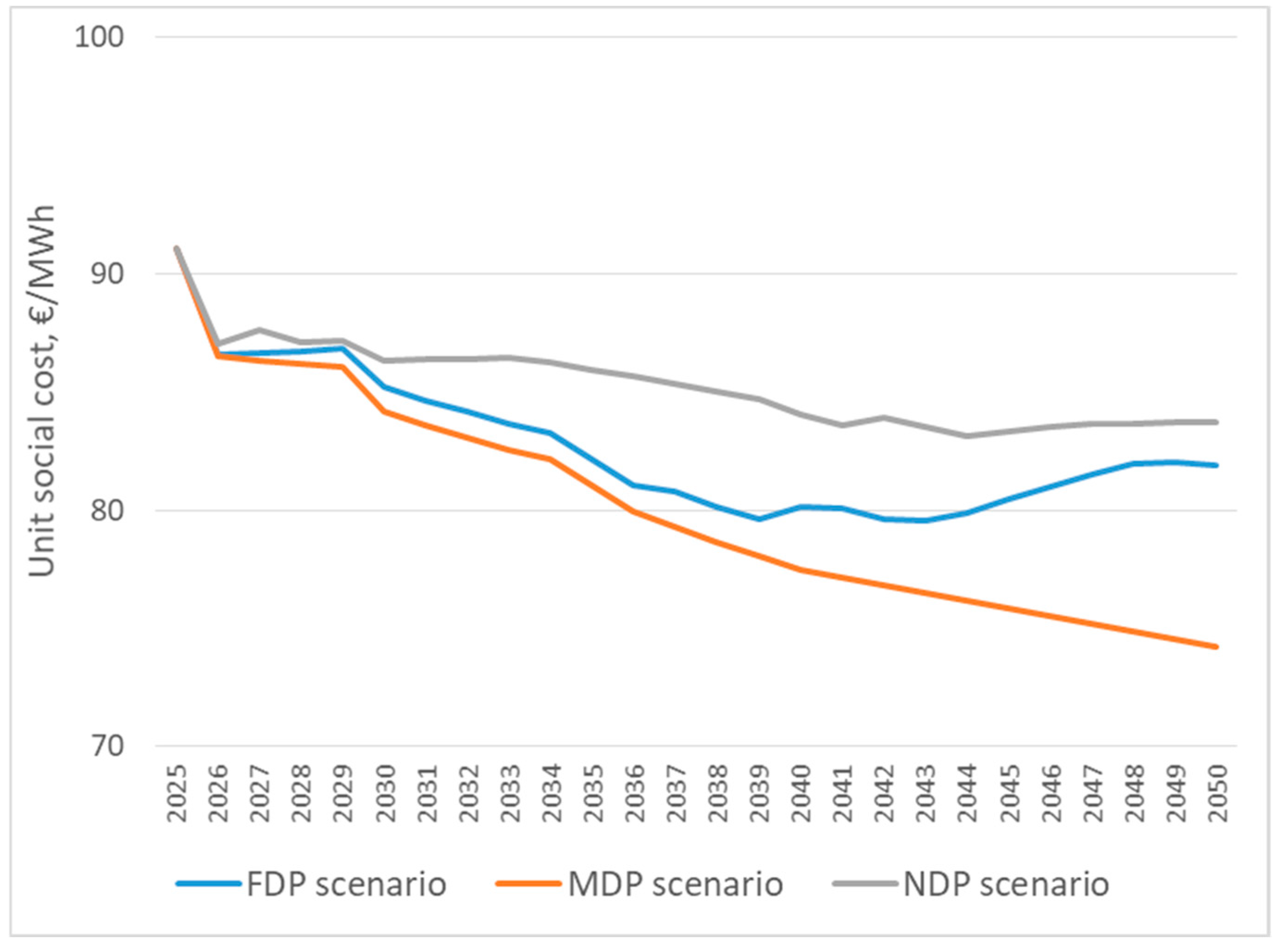
The key factor differentiating the analysed scenarios from an economic perspective is the level of social costs. These are defined as the sum of resource costs—including investment, fuel, variable, and fixed costs of energy technologies, as well as emissions abatement costs—while excluding expenditures on CO2 allowance purchases, which are treated as financial transfers between power producers and the government and external costs arising from air pollutant emissions. A relatively low SCC of €50/tCO2 is assumed; the role and sensitivity of SCC in shaping the results are discussed in detail later in this paper. Social costs, covering the combined production of electricity and district heating, are reported in discounted terms (Table 4). Figure 4 presents the unit social cost of energy generation over the period 2025–2050.
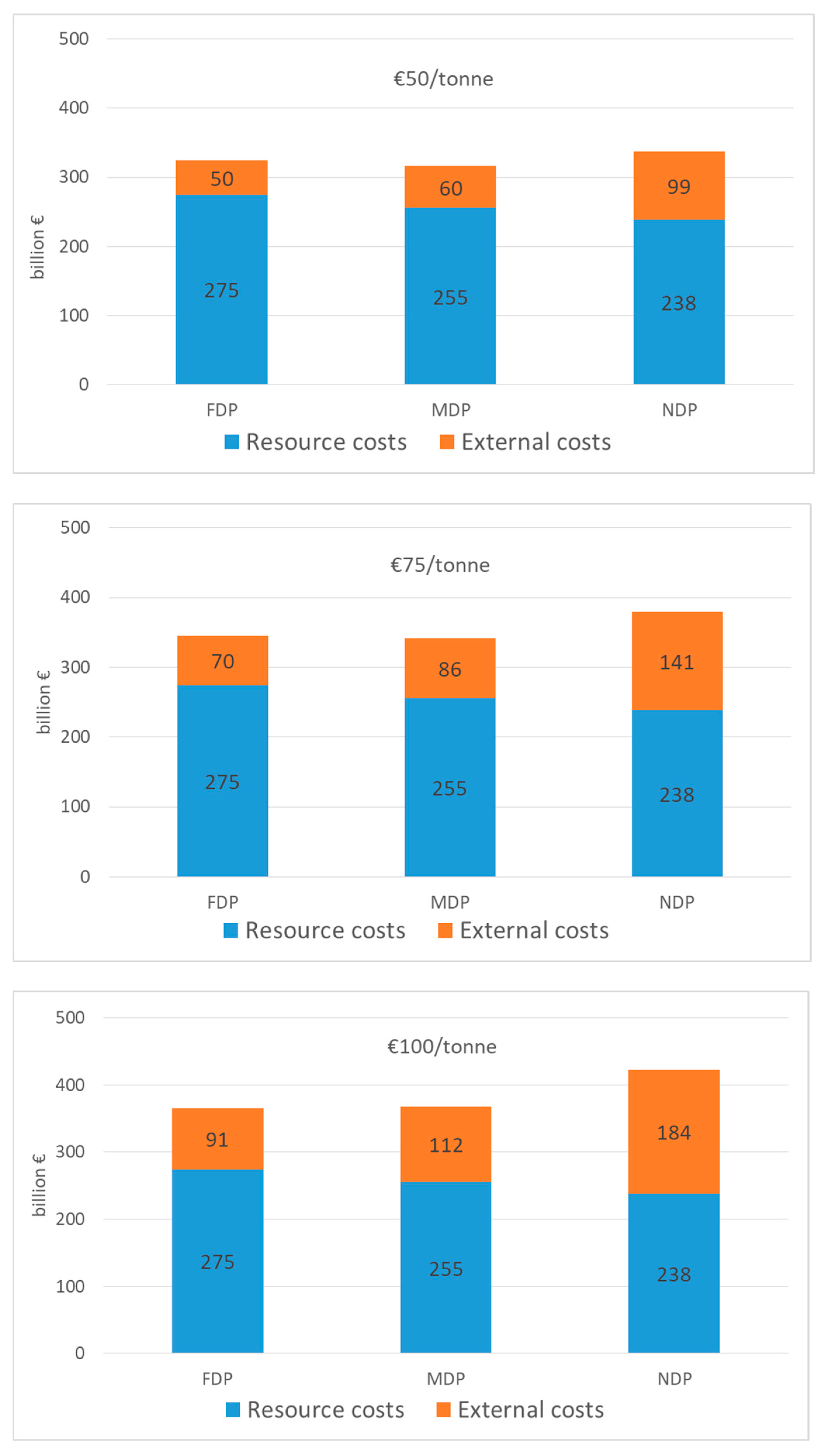
The first important conclusion is that the NDP scenario is the most expensive to implement, by as much as 4.0% compared to the FDP scenario. Abandoning the decarbonisation policy results in slightly lower energy generation costs (by 13.3%), but significantly higher external costs (by 99.5%), primarily associated with global warming. These costs dominate other negative environmental impacts in all scenarios, accounting for approximately 84% of the total. Consequently, the continued reliance on fossil fuels and gas-based energy is economically inefficient.
A more interesting conclusion emerges from a comparison of two alternative scenarios: FDP and MDP. As previously noted, the main differences lie in the structure of district heating production and quite clear differences in the structure of electricity generation. In the MDP scenario, relatively cheaper coal- and gas-based technologies are not entirely eliminated by 2050, while the development of nuclear technologies is somewhat less advanced than in the FDP scenario, and the same contribution from offshore, onshore wind and PV. Consequently, CO2 emissions are significantly, though not completely, reduced by 2050 (Figure 2). However, it is important to note that the unit social costs are lower in this case than in the FDP scenario, particularly after 2039, as illustrated in Figure 4. Therefore, the increased investment efforts after 2039 do not appear to be economically justified. As a result, the total costs of energy generation in the MDP scenario—representing a freeze of the decarbonisation policy—are 7% lower than in the FDP scenario. While external costs—primarily associated with CO2 emissions—are 21.7% higher, the total social cost remains 2.6% lower (Table 4). It should also be noted that if the balance of external costs accounted solely for global warming impacts, the total social cost would be even lower, by approximately 4%. These findings suggest that assuming SCC of €50/tCO2, decarbonisation of the Polish energy sector is economically inefficient compared with a more moderate policy alternative. In other words, the costs of achieving full decarbonisation appear to be too high relative to the associated climate benefits.
To verify this conclusion, additional model calculations were performed. It should be noted that, in addition to the elimination of CO2 emissions, there is an associated benefit in the form of avoided external costs related to other pollutants (PM, SO2, and NOx). These additional positive economic effects imply that the results presented below are slightly understated. The results for variable SCC, ranging from €25 to €120 per tonne of CO2, are presented here (Table 5). The reported SCC values should not be interpreted as endogenous threshold conditions generated by the model, but rather as scenario parameters used to explore how optimal system configurations vary under different valuations of carbon externalities. For simplicity, these costs were assumed to remain constant over the period 2025–2050.
Across all SCC levels considered, energy generation costs are stable, and only the total global warming costs increase in proportion to the SCC value (Figure 5). At the baseline SCC of €50/tCO2, the MDP scenario is 2.6% less costly to implement than the FDP scenario. However, as the SCC increases, the cost difference between the scenarios diminishes. At a social cost of carbon of approximately €90–95 per tonne of CO2, the FDP scenario becomes less costly than the MDP scenario, although it is not necessarily socially optimal. This will be discussed in more detail below.
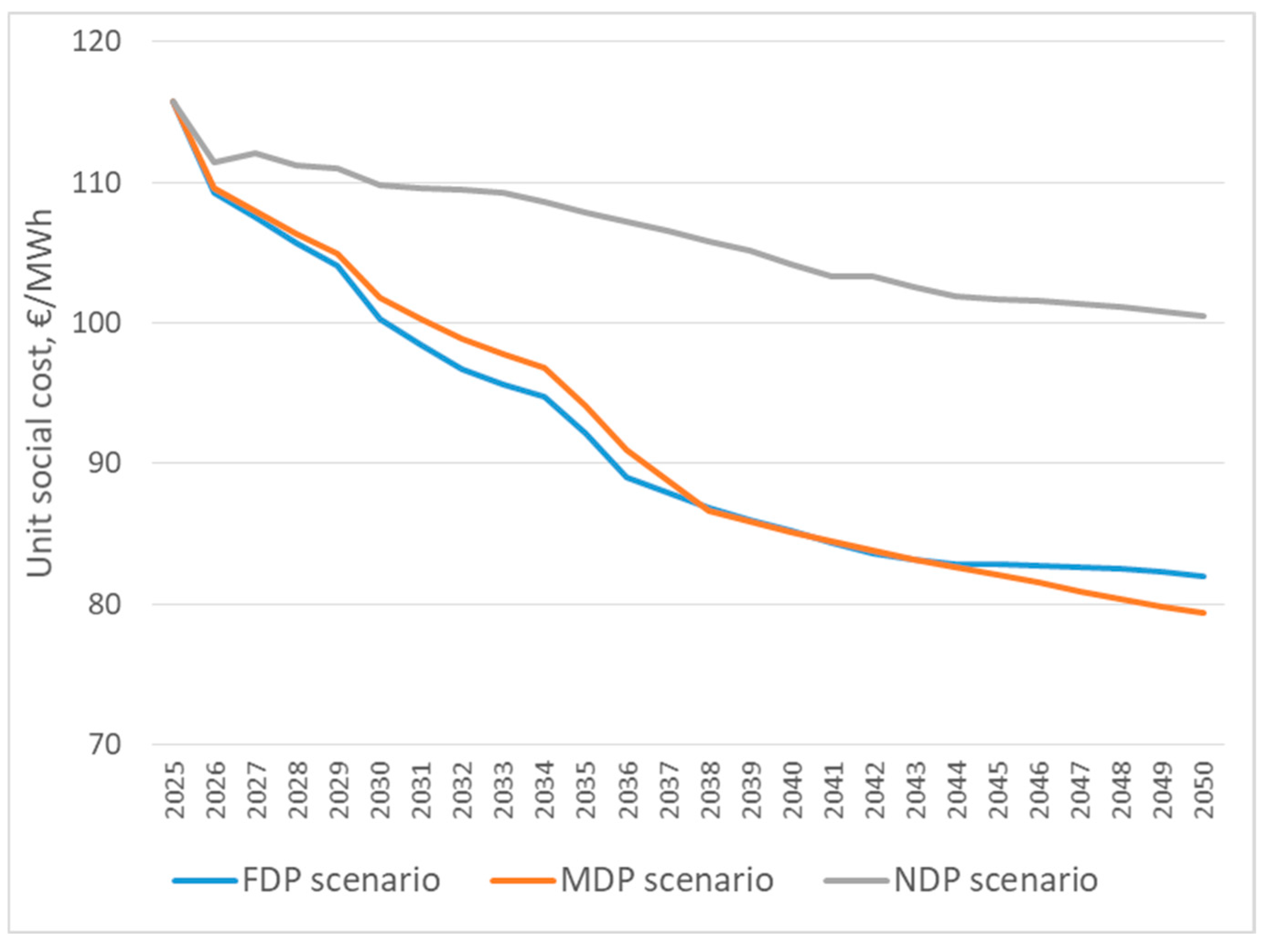
This is further confirmed by the unit social cost in the electricity sector calculated for this SCC level (Figure 6), which remains virtually identical for both the FDP and MDP scenarios throughout the 2025–2050 period. Overall, these findings indicate that a climate policy targeting the complete elimination of CO2 emissions in Poland by 2050 is economically justifiable only if the assumed SCC is substantially higher than the level preliminary adopted in this study.
This raises an important question: what energy production structures are optimal at different levels of global warming costs, given the uncertainty surrounding the extent of human impact on the climate? Accordingly, calculations were performed for a range of EUA price levels to explore the corresponding optimal generation structures, resource costs and the achievable levels of CO2 reduction by 2050. Next, for each scenario, the social cost was calculated as the sum of generation costs and climate-related external costs. The latter were quantified using a range of assumed SCC values, from €0 to €165/tCO2. This framework allows for the identification of the optimal scope of climate policy from an economic perspective. The results are presented in undiscounted terms, and the external costs considered relate exclusively to global warming (Table 6).
The higher EUA prices, the more expensive the optimal technology mix becomes in terms of resource costs, leading to higher levels of CO2 emission reduction. The calculated total social costs for each assumed level of the SCC should be interpreted as follows. For SCC = €0/tCO2, the cost-minimising strategy is to forego climate policy, resulting in total costs of approximately €455 billion, with no reduction in CO2 emissions. For SCC = €10/tCO2, the optimal strategy is to implement an ETS with an EUA price of €10/tCO2, yielding total costs of approximately €485 billion and a CO2 emissions reduction of around 10%.
It should be emphasised that at an SCC of €50/tCO2—the value adopted in this study—neither of the two scenarios considered is optimal. For the FDP scenario, total costs amount to approximately €604 billion, while for the MDP scenario, they are around €573 billion. In both cases, the social cost exceeds that of the optimal scenario, which achieves total social costs of approximately €571 billion alongside a 61% reduction in CO2 emissions. Both scenarios are therefore too ‘ambitious’ compared to the optimal solution. In turn, at SCC values of €100/tCO2, both scenarios yield similar social costs, in the range of €655–659 billion. However, even in this case, full decarbonisation is not economically optimal, as a scenario with approximately €650 billion in costs and an 80% reduction in CO2 emissions remains the least-cost option. This implies that the MDP scenario is insufficiently ambitious, while the FDP scenario is overly ambitious in terms of the level of CO2 emissions reduction. Finally, for SCC = €165/tCO2, the socially optimal (cost-minimising) strategy is to achieve a zero-emission energy sector, with total costs of approximately €730 billion and a CO2 emissions reduction of 100%. The optimal values for social costs are highlighted in grey (Table 6).

4.6. MAC Estimates

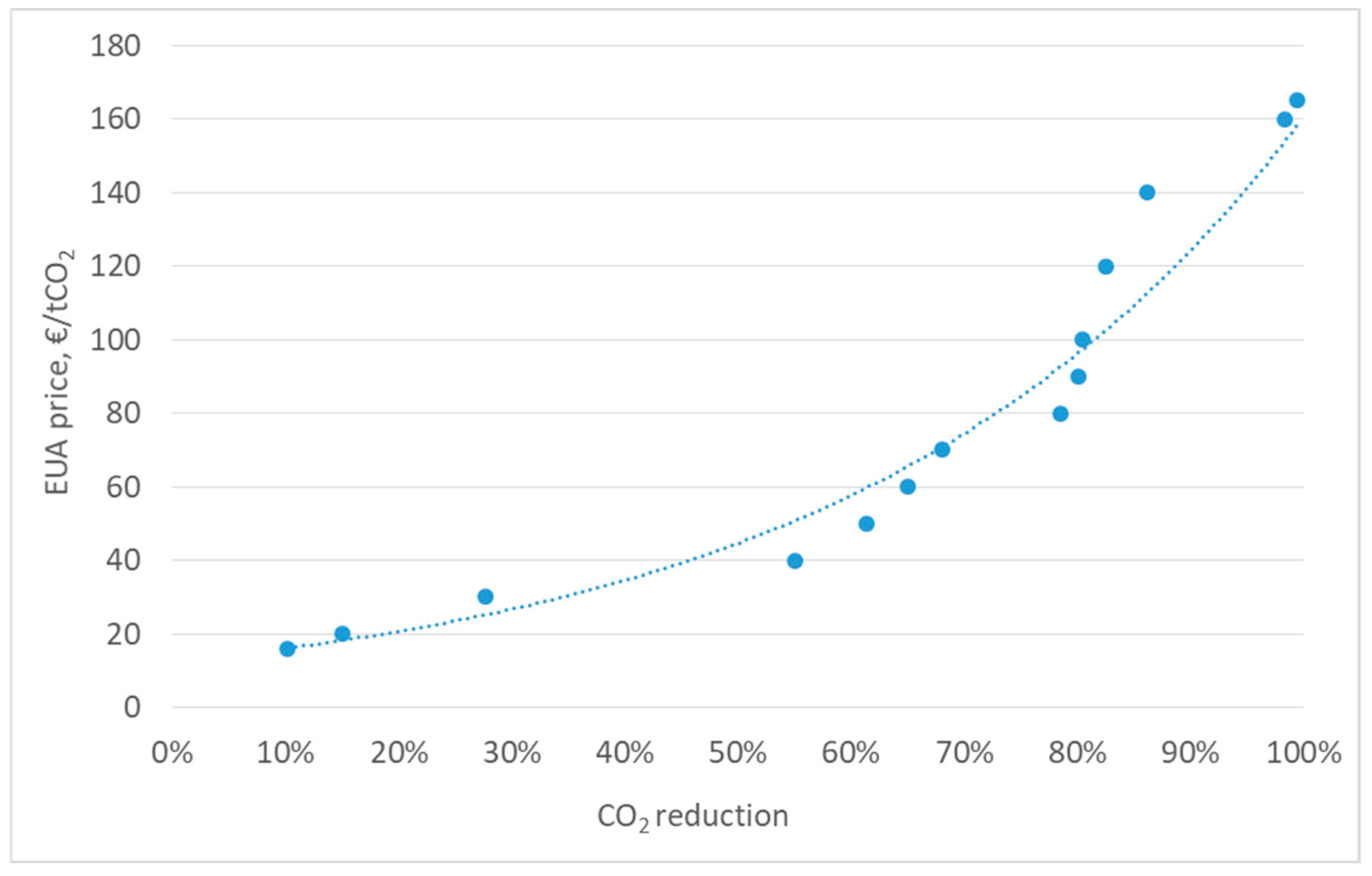
These results were used to estimate the marginal abatement costs (MAC) curve. The curve presented in Figure 7 can therefore be interpreted as a MAC trajectory, indicating the optimal level of CO2 emission reduction in 2050 relative to 2025.
A comparison of the FDP and MDP scenarios indicates that achieving net-zero emissions by 2050 is associated with a substantial increase in marginal abatement costs. An additional reduction of approximately 10% in emissions entails a disproportionately high marginal cost of €120–165/tCO2, reflecting the need for significantly greater investment in RES, hydrogen technologies, and large-scale energy storage to fully replace coal-based technologies.
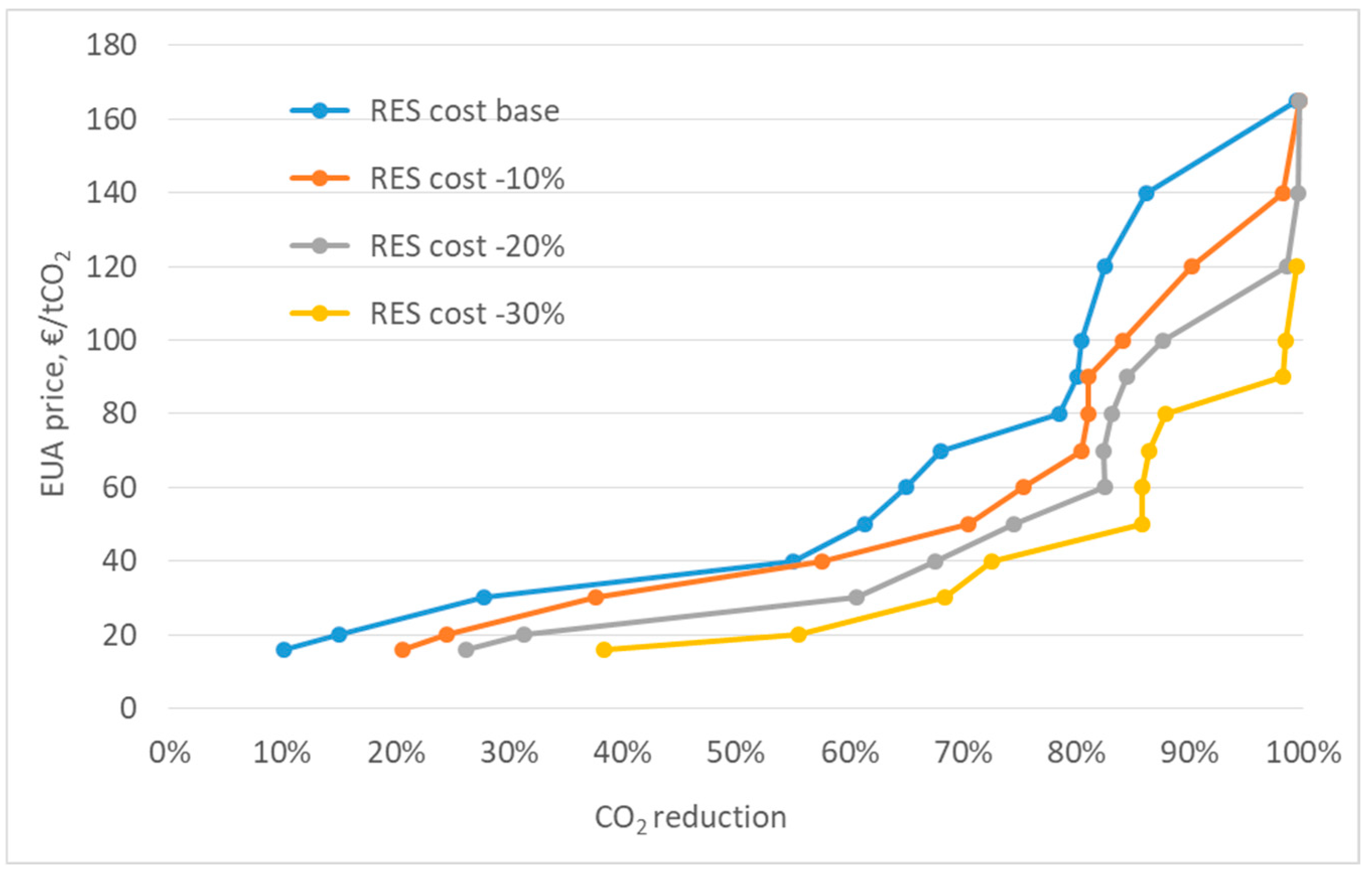
This raises an important question: to what extent might the potential—and highly plausible—decline in RES investment costs affect the MAC curve? Figure 8 presents the results of this analysis for hypothetical reductions in RES investment costs of 10%, 20%, and 30%.
As capital expenditure declines, the MAC decreases correspondingly. For example, an 80% reduction in CO2 emissions by 2050 is achieved at a cost of €90/tCO2 under baseline RES investment costs, €60/tCO2 with a 20% reduction in RES costs, and €45/tCO2 with a 30% reduction in RES investment expenditure. Assuming a plausible long-term trend of a 30% decrease in RES costs, full decarbonisation of the Polish energy sector by 2050 could be achieved at a MAC of approximately €120/tCO2. Consequently, this level of SCC would also justify a full decarbonisation trajectory.
These results are broadly consistent with existing estimates of MAC for the EU as a whole and for individual countries. However, they should be interpreted with caution, as they correspond to different CO2 reduction targets and modelling assumptions. Existing approaches can be distinguished between expert-based and model-derived MACs, which can be further divided into three main approaches: top-down, bottom-up, and hybrid methods. It should be noted that a bottom-up approach was used in this study. Bottom-up MAC approaches, such as financial accounting methods (expert-based) and engineering optimisation models, determine the least-cost sequential order of cost-effective abatement measures by calculating the relationship between CO2 reduction and direct costs, considering the techno-economic characteristics of each sectoral component.
A study that combines original research with a review of estimates by other authors is presented by Misconel [52]. It identifies the least-cost sequential order of investments in decarbonisation measures for the German energy system along the 2030–2045 pathway. The resulting MAC curve indicates that, in 2045, marginal costs range from several tens to over €1000/tCO2, with average values between approximately €100 and €200/tCO2. A study for Ireland using the TIMES model [53] reports similar cost ranges for the energy sector. In that case, decarbonisation begins with low-cost options, such as replacing carbon-intensive municipal waste (€0–15/tCO2) and coal or peat (€84–108/tCO2) with natural gas. Much deeper emission reductions—exceeding 60–80%—require substantially higher costs, in the range of €200–400/tCO2. In the study by Van den Bergh et al. [54], the MAC for the European Union is estimated at €20–80/tCO2 for an 80% emission reduction target. Gerbelová et al. [55], in an analysis of the Portuguese energy sector, find that by 2050, CO2 prices in the range of €50–100/tCO2 would lead to a sharp increase in emission reductions—from only about 7% at €50/tCO2 to as much as 79% at €100/tCO2, relative to 1990 emission levels.
In the case of Poland, the number of studies estimating marginal abatement costs is very limited. National reports and publications discussed earlier, which analyse the economic effects of adapting the Polish energy sector to climate regulations, typically present only total or aggregate costs. As a rule, they do not provide MAC estimates, largely because they do not assess the economic justification of decarbonisation policies. An additional difficulty is that, even when cost estimates are reported, it is often unclear whether they refer to the entire economy or solely to the energy sector. This necessitates a careful distinction between the results of macroeconomic (top-down) models and sectoral (bottom-up) models, which is crucial for the correct interpretation of MAC values. Another issue concerns the time horizon of the analyses and the scale of the required CO2 emission reductions. Earlier studies were based on much less ambitious climate targets, which naturally resulted in lower estimated MACs. The current challenges facing the European Union involve far more demanding reduction targets and, consequently, fundamentally different cost conditions. Finally, there are methodological issues inherent in MAC estimation itself (e.g., [56,57]). Many studies define the MAC as the cost of switching from one technology to another; deriving an average cost from such discrete comparisons can be highly misleading, as the decisive factor is the overall scale of the required emission reduction, which directly determines the MAC. A detailed discussion of these methodological issues, however, is beyond the scope of this article. Taken together, these factors lead to a very wide dispersion of MAC estimates. Nevertheless, two sources are worth noting. The first is the author’s earlier study [58], in which the MAC in the Polish power sector for the period 2020–2035 was estimated at approximately €70/tCO2, assuming a CO2 reduction target of 35% by 2035. The second is a World Bank report [59], which presents a MAC curve for Poland prepared in 2011 with a time horizon extending to 2030. The weighted average cost of CO2 emission reduction in the energy sector was estimated at about €22/tCO2. In that study, nuclear energy—identified as having the greatest mitigation potential—was also reported as the cheapest option (around €22/tCO2), although the underlying reasons were not clearly explained. Wind power was estimated at €30–40/tCO2, while photovoltaics were assessed at approximately €60/tCO2.

5. Conclusions

The stringency of climate policy should be directly proportional to the magnitude of climate risks attributable to human activity: the greater the threat, the more restrictive EU climate policy ought to be. This seemingly straightforward principle has important implications for the analysis presented in this study. The central research dilemma addressed here does not solely concern the specific structure of electricity and heat generation in a decarbonised economy by 2050. Rather, it seeks to explore whether, and to what extent, a decarbonisation policy is economically justified once both production costs and negative externalities are taken into account. In this study, the dilemma is examined through a partial analysis focused on Poland—a country that stands out among EU Member States due to its energy mix still being dominated by fossil fuels. Nevertheless, the conclusions drawn appear to be relevant not only for countries with different energy production structures but also, more broadly, for the European Union as a whole.
The first—though not the most important—conclusion of this analysis concerns the methodological tool employed. The model used in this study is appropriately scaled relative to professional forecasting tools commonly applied by Polish government institutions and research centres, such as PRIMES, TIMES, MESSAGE, and similar frameworks. This is evidenced by the fact that the energy mixes presented here are broadly consistent with those reported in official strategic and planning documents, as discussed in the preceding sections. This conclusion is further supported by the estimated investment expenditure required to achieve full decarbonisation of the Polish energy sector by 2050, which amounts to approximately €228 billion in this study. This figure is comparable to the estimates reported in the aforementioned forecasting studies.
At the same time, the research scenarios analysed in this article adopt a fundamentally different perspective on the optimal structure of Poland’s energy mix. Essentially, they do not seek to present an alternative technological pathway toward full decarbonisation of the Polish energy sector. Instead, their primary objective is to examine the economic rationale and underlying justification of climate policy in the energy sector itself. To the best of the author’s knowledge, this perspective has not yet been explored in the Polish literature. Consequently, the results presented in this study are important for assessing and justifying Poland’s energy policy, which entails substantial organisational and financial commitments. Under certain conditions, this publication therefore constitutes an argument in favour of the full decarbonisation of the Polish energy sector.
The main findings are as follows. The article examines three scenarios that reflect different levels of uncertainty regarding the economic impact of global warming. The first assumes no human influence on climate change, the second assumes a moderate human impact, and the third assumes that human influence on the climate is certain. The varying costs of CO2 allowances in these scenarios simulate structural transformations in the energy sector. Since these costs are incorporated into the model’s objective function, they directly influence the resulting generation mix. Consequently, the final structures of electricity and heat generation in Poland in 2050 differ across the three scenarios.
In the FDP scenario, lignite- and hard coal-fired system power plants are rapidly phased out and effectively decommissioned by 2034. Growing energy demand toward mid-century necessitates a substantial expansion of generation capacity, leading to a rapid increase in investments in RES. New energy storage facilities and Power-to-Heat installations play a key role in stabilising the power system. Hydrogen-based technologies will gradually enter the generation mix after 2040, reaching a total installed capacity of approximately 12,000 MW by 2050. At the same time, energy storage systems will expand to around 10,000 MW of capacity. In line with current government plans, nuclear power capacity will reach approximately 11,000 MW by 2050. It should be emphasised that all these investments are implemented under an intensive investment programme, requiring adherence to the assumed timeline and a rapid deployment rate of up to 1000 MW per year. A slower pace of investment would make it impossible to achieve the zero-emission decarbonisation target.
Easing climate policy by stabilising the price of CO2 allowances at the 2025 level (MDP scenario) does not ensure the achievement of zero emissions by 2050. Coal-based CHP plants remain in operation until 2050, albeit at a reduced scale, serving as competitive suppliers of electricity and, primarily, heat. Gas-fired technologies retain their role in the energy mix for a considerably longer period, acting as transitional replacements for decommissioned coal units. The main sources of electricity generation are RES technologies, with a similar contribution to that observed in the FDP scenario, particularly from offshore and onshore wind and photovoltaics. In addition, nuclear capacity reaches approximately 2700 MW. Hydrogen-fired CCGT plants are not deployed in this scenario, whereas energy storage technologies expand to a total capacity of around 10,000 MW by 2050.
Assuming that human activity has no impact on global warming, the least costly option is the NDP scenario, in which global warming costs are zero and system costs are 13.3% lower than in the FDP scenario (Table 4). When the effects of human-induced climate change are low (€50/tCO2), the most expensive is the NDP scenario without decarbonisation policy, with costs approximately 4.0% higher than in the FDP scenario. Notably, the FDP scenario is about 2.6% more expensive than the MDP scenario (in discounted terms). In the MDP scenario, relatively cheaper coal- and gas-based technologies are not entirely eliminated by 2050, while the development of nuclear technologies is somewhat less advanced than in the FDP scenario, and offshore, onshore wind and PV make the same contribution. As a result, the total costs of energy generation in the MDP scenario are 7% lower than in the FDP scenario. While external costs are 21.7% higher, the total social cost remains 2.6% lower.
Consequently, the relatively low level of global warming costs does not justify a policy of complete decarbonisation of the Polish energy sector, at least within the scope of this partial analysis. It is only at an SCC of around €90–95/tCO2 that both scenarios produce comparable levels of social costs. However, achieving zero emissions in the Polish energy sector is not optimal at this level of SCC. Model simulations conducted for a wide range of EUA prices (€0–165/tCO2) lead to the following conclusions. Relatively low SCCs justify only a limited optimal reduction in CO2 emissions. Full decarbonisation of the Polish energy sector, corresponding to a 100% reduction in CO2 emissions by 2050, becomes socially optimal only at an SCC of around €165/tCO2.
Simulations conducted for different EUA price levels made it possible to construct a MAC trajectory, which can be used to estimate the economically optimal scope of decarbonisation policy. The results lead to several key conclusions. First, MACs increase with the stringency of environmental targets. For relatively modest emission reductions of 20–60%, primarily achieved through the replacement of coal-fired technologies with gas-fired units, MACs remain low, at approximately €20–40/tCO2. Achieving deeper decarbonisation in the range of 60–90% requires the deployment of more capital-intensive solutions, such as high shares of RES, resulting in MACs of approximately €40–130/tCO2. The final stage of decarbonisation—reductions in the range of 90–100%—which relies on nuclear power, hydrogen technologies, and large-scale energy storage, entails substantially higher costs, reaching €130–165/tCO2. Second, MAC estimates are highly sensitive to model assumptions. Baseline scenarios, the set of technologies included, and the adopted time horizon all have a significant impact on the resulting MAC trajectory, as noted in the literature. This sensitivity is confirmed in this study through simulations with varying RES investment costs. In particular, assuming a plausible 30% reduction in RES investment costs, full decarbonisation of the Polish energy sector by 2050 could be achieved at an average MAC of approximately €120/tCO2.
Poland, due to its heavy reliance on coal and the high-emission starting point of its energy transition, faces particularly high investment requirements. Achieving climate neutrality in the energy sector by 2050 is estimated to require approximately €228 billion in investment, including substantial expenditures on RES, the construction of nuclear power plants, and the development of energy storage infrastructure. At the same time, the socio-economic benefits of the transition often outweigh its costs. These benefits include significant reductions in pollutant emissions, improved public health outcomes, lower operating costs associated with reduced dependence on imported fuels, enhanced energy security, and increased economic competitiveness. Consequently, although the total costs of the energy transition in Poland may be higher than the EU average due to the dominant role of coal in the current energy mix, the marginal benefits of decarbonisation—starting from a highly carbon-intensive baseline—are also likely to be correspondingly greater.
An optimal EU climate policy should aim to align the prices of EUA with the negative impacts of global warming. The challenge, however, lies in the considerable uncertainty surrounding these impacts, as estimates reported in the literature vary widely. This lack of consensus implies that the policy may be inefficient, in the sense that its costs could exceed its potential benefits. This study examined in greater detail the uncertainty surrounding the magnitude of the effects of global warming on a local scale. Consequently, it focused on determining the level of external CO2 emission costs at which a zero-emission economic policy becomes economically justified.
Both this study and the comparative analyses cited above indicate that the marginal costs of CO2 emission reductions under deep decarbonisation scenarios in the EU energy sector are often comparable to current estimates of the SCC, typically in the range of €150–300+/tCO2. From a societal perspective, this suggests that full decarbonisation is economically justified, particularly when long-term climate damages are taken into account. For Poland, the cost–benefit balance is more complex in the short term due to high upfront investment requirements. However, in the long run, the benefits of avoided emissions—valued using SCC estimates—substantially offset these costs. This study demonstrates that when SCC values from the mid-range of current estimates are applied, the discounted benefits of decarbonisation exceed the associated transition costs.
This study is subject to several limitations. First, the results are sensitive to assumptions regarding key parameters such as the SCC, technology costs, and fuel prices. Second, the model represents a stylised optimisation framework and does not capture all institutional and behavioural aspects of real-world energy systems. Third, some technologies are included to represent the broader opportunity space and should not be interpreted as immediate deployment options. Consequently, the findings should be interpreted as indicative of structural relationships and system sensitivities rather than precise forecasts or prescriptive policy thresholds.
Based on the model results, several policy implications can be derived to support an efficient decarbonisation pathway of the Polish energy sector. First, a stable and sufficiently high carbon pricing framework is essential, as the model assumes full internalisation of external costs, implying that consistent price signals are the primary driver of efficient investment decisions. Second, policy support should shift from technology-specific subsidies towards technology-neutral instruments such as competitive auctions or carbon contracts for difference, in order to avoid distortions of cost-optimal technology selection. Third, accelerated investment in grid infrastructure and system flexibility is required to enable the integration of variable RESs. Fourth, predictable coal phase-out trajectories are necessary to reduce stranded asset risks and support efficient capital turnover. Finally, long-term policy stability is crucial for reducing investment uncertainty and aligning private decisions with socially optimal transition pathways. These recommendations should be interpreted as measures to approximate the cost-efficient benchmark derived from the optimisation model under real-world institutional constraints.

Funding

This research project is supported by program “Excellence initiative–research university” for the AGH University of Krakow.

Data Availability Statement

The data presented in this study are available on request from the corresponding author.

Conflicts of Interest

The author declares no conflict of interest.

Appendix A

Figure A1. Structure of the Model.
Energies 19 02561 g0a1
Table A1. Energy Technologies Characteristics.
TechnologyNet
Efficiency
[%]
Load
Factor
[h]
Cogeneration
Factor
Capacity Installed
[MW]
CAPEX
[€/kW]
Fixed Costs—Electr.
[€/kW]
Fixed Costs—Heat
[€/kW]
Variable Costs—Electr.
[€/GJ]
Variable Costs—Heat
[€/GJ]
Emissions
Coefficient PM
[g/GJ]
Emissions Coefficient SO2
[g/GJ]
Emissions Coefficient NOx
[g/GJ]
Emissions Coefficient CO2
[tonne/PJ]
System power plants:
Hard coal-fired power plants—life extension4035650.9210,000037370.80.940241223220
Hard coal public power plants—simple modern.4035650.92016637370.80.940241223220
Hard coal public power plants—simple modern. + gas turbine4035650.92 035037370.80.932195180200
Hard coal public power plants—FBC4535650.92 095037370.80.9402476200
Hard coal-fired power plants—simple modern. with biomass co-firing3835650.92 033037370.80.940241223200
Hard coal-fired power plants—biomass co-firing3835650.92 4000047370.80.940241223200
Lignite-fired power plants—life extension3856070.974800037370.90.943256224280
Lignite-fired power plants—simple modern.3956070.97016637370.90.943256224280
Lignite-fired power plants—simple modern. + gas turbine3956070.97035037370.90.935207180250
Lignite-fired power plants—FBC4556070.97095037370.90.9432676250
Lignite-fired power plants—simple modern. with biomass co-firing3756070.97033037370.90.943256224250
Lignite-fired power plants—biomass co-firing3756070.971600059370.90.943256224250
New lignite-fired power plants—CO2 sequestration3556070.970350059370.90.94340750
Hydropower plants—life extension709381330006600.50.00000
Wind turbines power plants—life extension401806113,80003000.10.00000
PV power plants—life extension4020001750003000.10.00000
New coal-fired power plants4062000.970140037370.90.9404074200
New lignite-fired power plants4062000.970138037370.90.9434075250
New IGCC power plants47620010190037370.40.436274190
New gas turbines OCGT power plants4041001071419190.20.239375130
New CCGT power plants60410010120019190.20.2010690
New biomass power plants36500010147670370.50.5010655
New biogas power plants404100107149300.50.020808030
New PV power plants1420001012001500.10.001060
New nuclear power plants3662001050009300.50.00000
New hydropower power plants7020001023805800.50.00000
New wind turbines power plants—offshore4019001015501400.10.00000
New wind turbines power plants—onshore4040001036402400.10.00000
New CCGT H2 power plants60410010143019190.20.20000
New energy storage installations (batteries)95210010143019190.20.20000
New power-to-heat installations (electric boilers and heat pumps)95210000190019190.20.20000
CHP plants:
Hard coal-fired CHP plants—life extension5534950.333500037370.80.940241223100
Hard coal-fired CHP plants—biomass co-firing5534950.332000037370.80.94024122390
CCGT CHP plants—life extension6241000.714100026260.20.2010690
Hard coal-fired CHP plants—simple modern.5734950.33016637370.80.940241223100
Hard coal-fired CHP plants—simple modern. + gas turbine5534950.33035037370.80.93219518090
Hard coal-fired CHP plants—FBC6134950.33095037370.80.940247690
Hard coal-fired CHP plants—simple modern. with biomass co-firing5534950.33033037370.80.94024122390
New coal-fired CHP plants5634950.330140037370.80.9404074100
New gas turbines OCGT CHP plants 4034950.33071419190.20.2010690
New CCGT CHP plants6034950.330120019190.20.2010660
New oil CHP plants6034950.33083319190.20.2547063100
New CCGT H2 CHP plants6034950.330143019190.20.20000
Source: own estimations based on [16,20,22,23,24,25,26]. Note: Due to the minor role of industrial producers in total electricity generation, their data are not presented here. However, they are included in the model calculations.
Table A2. Capital expenditure (CAPEX) for energy technologies—estimates by the IEA and the World Bank (USD/kW).
TechnologyIEAWorld Bank
PV600–1200700–1300
Onshore wind1200–18001300–2200
Offshore wind2800–50003000–5500
Coal CO2 sequestration2500–45002800–5000
CCGT700–1200800–1300
OCGT400–900500–1000
Nuclear5000–85006000–10,000
CCGT H21100–18001000–2000
Hydro1500–50002000–6000
Energy storage installations400–1500400–1400
Source: [60,61].

Mathematical Formulation of the Model

The objective function is defined as the total discounted resource costs rest, required to satisfy a country’s energy demand for electricity and heat. Its components are investment costs icG,t, fixed costs fcG,t, variable costs vcG,t, and fuel costs fG,t of the energy technologies, investment costs icabatT,G,t and variable costs vcabatT,G,t of the abatement technologies, and import costs of electricity imt and revenues from electricity exports ext. This includes the balance of purchasing and selling CO2 allowances as well.
t c = t T C   d f t r e s t + i m t e x t       min
where
t T C r e s t = G i c G , t + f c G , t + v c G , t + f G , t + G T i c T , G , t a b a t + v c T , G , t a b a t + p r e p c t + G ( f r e e G , C O 2 , t + p e r G , C O 2 , t s a l e G , C O 2 , t )    
Discounting factor dft equals:
t T r d f t = 1 + r t t
Cost equations
Investment costs icG,t of the energy technologies are calculated as follows:
G G E     t T C       i c G , t = c r f G , t c t G , i n v e s t c a p t G , t c a p r G , t
Investment costs are assessed for the part of the capacity that is introduced during the calculation period, captG,t. This means that the investment costs of residual capacity caprG,t of the energy technologies operating before the base year are not taken into account. Unit investment cost ctG,“invest” is defined for all technologies. Capital recovery factor crfG,t is calculated according to the following formula:
G G E     t T C c r f G , t = r t 1 ( 1 + r t ) l t G
where ltG is the lifetime of the G technology.
The fixed and variable costs of the energy technologies are assessed separately for electricity and heat production, taking into account the cogeneration factor cogfG (set for each production technology), which specifies the proportion of electricity and heat production.
G G E     t T C       f c e l e c r G , t = c t G , f i x _ e l c a p G , t c o g f G
G G E     t T C       f c h e a t G , t = c t G , f i x _ h e a t c a p G , t ( 1 c o g f G )
G G E     t T C       v c e l e c t r G , t = c t G , var _ e l s i e p G , e l e c t r , s , i , t
G G E     t T C       v c h e a t G , t = c t G , var _ h e a t s i e p G , c i e p l o , s , i , t
Fuel costs fg,t of the energy technologies in each year are calculated as the sum of the volume of fuel supplies fsp,d,G,r,t of each fuel p from supply source d for electricity and heat production times their price fpp,d,t.
G G E     t T C       f G , t = p d r f s p , d , G , r , t f p p , d , t
Investment costs icabatT,G,t and variable costs vcabatT,G,t of the abatement technologies are calculated as follows:
G G E     t T C       T T O i c T , G , t a b a t = c r f G , t a c T , G , i n v e s t a c a p T , G , t
G G E     t T C       T T O v c T , G , t a b a t = a c T , G , var a p T , G , t
The import costs of electricity imt and revenues from electricity exports ext are calculated on the basis of the following relationships:
t T C       i m t = r s i i m p r , s , i , t i m p p r , t
t T C       e x t = r s i e k s r , s , i , t e k s p r , t
The cost of coal preparation plants prepct is given by the following formula:
p r e p c t = b p r e p b , t p c b
Balance equations
The balance of the fuel production capacities settles the relationship between the actual and potential possibilities of supplying energy fuels to the energy technologies. The potential of the fuel supplies is determined by domestic production and import capacities. This equation defines that the supply of fuel p from a specific source d in period t to energy producers G may not exceed the allowable level fcapp,d,t:
p P     d D       t T C G r f s p , d , G , r , t f c a p p , d , t
The balance of energy technologies is a condition that balances the stream of primary energy supplied to the energy technologies and the stream of final energy from the production processes:
p P     G G E     r R       t T C d f s p , d , G , r , t = s i e p G , r , s , i , t u s e G , p
This equation specifies the condition that, from each fuel p used by G technology to produce type of energy r in year t, only a limited amount of energy can be produced; this is defined by fuel consumption indicator fciG,p. This indicator has the following form:
G G E     p P     f c i G , p = s h a r e G , p e f f G
Fuel consumption indicator shareG,p is the ratio of energy carrier share (fuel) p in the input of G technology and net efficiency effG of energy technology G.
The next equation concerns a constant relationship between the volumes of electricity and heat production in energy technologies:
  G G E     t T C   s i e p G , e l e c t r ȍ , s , i , t = r s i e p G , r , s , i , t c o g f G
The balance of production and demand for final energy explains the use of the energy produced in the demand sectors. Total production of energy epG,r,s,i,t in individual energy technologies G in demand periods i in year t must meet the demand in a specific sector of the economy. This equation includes transmission losses tlr of the individual types of energy to the end users. In addition, the supply of electricity imported and exported must be accounted for to properly balance supply and demand:
s S     r R     i C     t T C G ( 1 t l r ) e p G , r , s , i , t + i m p r , s , i , t = N N p X N , s , r , i , t + e k s r , s , i , t
The energy import and export balances specify the conditions that limit the levels of imported and exported electricity:
  r R       t T C s i i m p r , s , i , t = d e m i r , t
  r R       t T C s i e k s r , s , i , t = d e m e r , t
The capacity of energy technology balance regulates the relationship between production volume and the capacity of the energy technology:
G G E     t T C r s i e p G , r , s , i , t c a p t G , t l f G u
Load factor of energy technology lfG is defined as the ratio of the maximum working time of energy technology with full capacity mcapG and the number of hours in year yh:
G G E     l f G = m c a p G y h
The next equation is used to properly balance the capacity of electricity and heat producers as a result of new investments. The equation assesses the relationship between the capacity of G energy technology in year t in relation to the existing residual capacity and new investments:
G G E     t T C c a p t G , t = c a p r G , t + t t i n v G , t
Residual capacity caprG,t concerns the volume of the existing energy technology’s capacities, which decrease each year with the annual depreciation rate drG. These are not subject to optimisation, and investments are only possible in the modernisation options. The construction of new facilities is also allowed.
Similar relationships are set for the abatement technologies. The first balance concerns production volume apT,G,t of abatement technology T implemented in energy technology G in year t as a function of its capacity acapT,G,t:
( T , G ) ( T O , G E )     t T C     a p T , G , t a c a p T , G , t l f G u
The next equation controls a similar relationship for the capacity of electricity and heat producers. Unlike before, there is no residual capacity of the abatement technologies. This is not necessary, as emissions reductions have been taken into account in the existing energy technologies by adopting the appropriate actual emissions coefficient. However, this requires taking into account the installed capacity of energy technologies:
( T , G ) ( T O , G E )       t T C a c a p T , G , t = t t a i n v T , G , t
An alternative option for implementing new energy technologies is the modernisation of existing energy technologies. Several modernisation options are provided here; the corresponding relationship is as follows:
  M M ( I )     t T C M ( c a p t M , t + c a p r M , t ) ( 1 + c i ) c b M
This inequality specifies that the sum of new capacity captM,t and residual capacity caprM,t of an existing technology that can be modernised is limited by its base capacity cbM and assumed capacity increase indicator ci.
Environmental constraints
The first equation defines the total emissions level emiG,z,t for energy technology G, type of pollution z, and year t. This is calculated based on the total fuel supply fsp,d,G,r,t and emission coefficient efG,z attributed to each technology G and type of pollution z. The equation also involves possible emissions reduction abatG,z,t in the new environmental investments:
G G E   z Z   t T C     e m i G , z , t p d r ( f s p , d , G , r , t e f G , z )   a b a t G , z , t
The level of emissions reduction is a function of abatement technology production apT,G,t, emission coefficient efG,z, and the efficiency of abatement installation aeT:
  G G E     z Z     t T C a b a t G , z , t = T a p T , G , t e f G , z a e T
The emissions may be limited to a global level or as the emissions standards applied to each energy technology. In the second case, the formula is as follows:
G G E   z Z   t T C   e m i G , z , t / r s i e p G , r , s , i , t e l G , z , t
The following equation specifies the required level of electricity from renewable energy sources (RES):
  G O D N     s i e p G , e l e c t r , s , i , t = r s i G e p G , e l e c t r , s , i , t l i t
The emissions trading system for CO2 is allowed in the model as well. The equation defines the CO2 emissions for each energy technology emiG,“CO2”,t as a result of the free allocation freeG,“CO2”,t, purchased perG,“CO2”,t, and sold saleG,“CO2”,t allowances.
G     t T C     e m i G , C O 2 , t f r e e G , C O 2 , t + p e r G , C O 2 , t s a l e G , C O 2 , t
In addition to the set of equations described above, the model also includes the following relationships:
-
balance of capacity expansion for new power plants
-
maximum capacity constraints for new power plants
-
balance of available generation capacity, including reserves, maintenance outages, and transmission losses
-
required capacity reserves across time periods
-
balance between available capacity and peak demand across time periods
-
energy balance for storage systems and power-to-heat technologies
Indexes of the model:
s—demand sectors for electricity and heat s ∈ S = {industry and constructions, transport, agriculture, trade and services, households}
r—type of final energy r ∈ R = {electricity, heat}
p—type of fuel used by energy technologies p ∈ P = {hard coal, lignite, gas, oil, nuclear, sun, water, wind, biomass, geothermal energy}
b—coal preparation plants, eight types
d—sources of fuel supplies d ∈ D = {domestic, import}
i—load periods i ∈ C = {summer-peak, summer-base, winter-peak, winter-base}
z—type of pollution emitted z ∈ Z = {SO2, NOX, CO2, PM}
T—abatement technology T ∈ TO = {wet scrubbers, spray dry scrubbers, sorbent injection processes, low NOx burners, selective catalytic reduction (SCR), selective non-catalytic reduction (SNCR)}
o(z,T)—sets of pairs of possible emissions reduction and type of pollution o ∈ ZT = {(SO2, wet scrubbers), (SO2, spray dry scrubbers), (SO2, sorbent injection processes), (NOX, low NOX burners), (NOX, selective catalytic reduction), (NOX, selective non-catalytic reduction)}
k—type of costs k ∈ K = {invest, fix_el, fix_heat, var_el, var_heat}
t—calculation period t ∈ TC = {2025–2050}
G—energy technologies of electricity and heat production G ∈ GE = {system power plants, district CHP plants, industry CHP plants, municipal heat plants—57 types of technologies}
Z(G)—system power plants in G
EC(G)—CHP plants in G
EP(G)—industry CHP plants in G
CP(G)—municipal heat plants in G
I(G)—existing technologies in G
M(I)—modernised technologies in I
O(G,M)—sets of pairs of G technology and possible modernisation options M
S(T,G)—sets of pairs of G technology and possible pollution control technologies T

References

  1. Gilmore, E.A.; Ghosh, M.; Johnston, P.; Siddiqui, M.; Macaluso, N. Modeling the Energy Mix and Economic Costs of Deep Decarbonization Scenarios in a CGE Framework. Energy Clim. Chang. 2023, 4, 100106. [Google Scholar] [CrossRef]
  2. Prina, M.G.; Manzolini, G.; Moser, D.; Nastasi, B.; Sparber, W. Classification and Challenges of Bottom-up Energy System Models—A Review. Renew. Sustain. Energy Rev. 2020, 129, 109917. [Google Scholar] [CrossRef]
  3. Capros, P.; Kannavou, M.; Evangelopoulou, S.; Petropoulos, A.; Siskos, P.; Tasios, N.; Zazias, G.; DeVita, A. Outlook of the EU Energy System up to 2050: The Case of Scenarios Prepared for European Commission’s “Clean Energy for All Europeans” Package Using the PRIMES Model. Energy Strategy Rev. 2018, 22, 255–263. [Google Scholar] [CrossRef]
  4. Després, J.; Mima, S.; Kitous, A.; Criqui, P.; Hadjsaid, N.; Noirot, I. Storage as a Flexibility Option in Power Systems with High Shares of Variable Renewable Energy Sources: A POLES-Based Analysis. Energy Econ. 2017, 64, 638–650. [Google Scholar] [CrossRef]
  5. A Clean Planet for All. A European Strategic Long-Term Vision for a Prosperous, Modern, Competitive and Climate Neutral Economy. European Commission, Brussels 2018, 773 Final. Available online: https://climatecooperation.cn/climate/a-clean-planet-for-all-a-european-long-term-strategic-vision-for-a-prosperous-modern-competitive-and-climate-neutral-economy/ (accessed on 20 December 2025).
  6. Net Zero by 2050. A Roadmap for the Global Energy Sector, IEA. 2021. Available online: https://iea.blob.core.windows.net/assets/deebef5d-0c34-4539-9d0c-10b13d840027/NetZeroby2050-ARoadmapfortheGlobalEnergySector_CORR.pdf (accessed on 20 December 2025).
  7. Huge Acceleration Required for Europe to Get on Track for Net Zero. BloombergNEF Report. 2023. Available online: https://about.bnef.com/insights/finance/huge-acceleration-required-for-europe-to-get-on-track-for-net-zero/ (accessed on 20 December 2025).
  8. Assessing the Costs and Benefits of Climate Change Adaptation. EEA. 2023. Available online: https://www.eea.europa.eu/en/analysis/publications/assessing-the-costs-and-benefits-of-climate-change-adaptation (accessed on 20 December 2025).
  9. Jägemann, C.; Fürsch, M.; Hagspiel, S.; Nagl, S. Decarbonizing Europe’s power sector by 2050—Analyzing the economic implications of alternative decarbonization pathways. Energy Econ. 2013, 40, 622–636. [Google Scholar] [CrossRef]
  10. Capros, P.; Paroussos, L.; Fragkos, P.; Tsani, S.; Boitier, B.; Wagner, F.; Busch, S.; Resch, G.; Blesl, M.; Bollen, J. European decarbonisation pathways under alternative technological and policy choices: A multi-model analysis. Energy Strategy Rev. 2014, 2, 231–245. [Google Scholar] [CrossRef]
  11. Carbon-Neutral Poland 2050. McKinsey. 2020. Available online: https://www.mckinsey.com/pl/~/media/mckinsey/locations/europe%20and%20middle%20east/polska/raporty/carbon%20neutral%20poland%202050/carbon%20neutral%20poland_mckinsey%20report.pdf (accessed on 10 December 2025).
  12. Country Climate and Development Report: Poland. World Bank. 2024. Available online: https://documents1.worldbank.org/curated/en/099103124172034930/pdf/P5005511e19baf0541b05618a228149c006.pdf (accessed on 10 December 2025).
  13. Polish Energy Sector 2050. 4 Scenarios. Forum Energii. Available online: https://www.forum-energii.eu/en/polish-energy-sector-2050-4-scenarios (accessed on 10 December 2025).
  14. Poland Net-Zero 2050: Transformation of the Polish and EU Energy Sector Until 2050. CAKE/KOBiZE. Available online: https://climatecake.ios.edu.pl/wp-content/uploads/2022/06/CAKE_Energy-transformation-2050_Summary_EN.pdf (accessed on 10 December 2025).
  15. Decarbonising Poland’s Power System: A Scenario-Based Evaluation. Clean Air Task Force. 2024. Available online: https://cdn.catf.us/wp-content/uploads/2024/02/01052434/CATF-Decarbonising-Polands-Power-System-A-Scenario-Based-Evaluation.pdf (accessed on 10 December 2025).
  16. Pluta, M.; Wyrwa, A.; Zyśk, J.; Suwała, W.; Raczyński, M. Scenario Analysis of the Development of the Polish Power System towards Achieving Climate Neutrality in 2050. Energies 2023, 16, 5918. [Google Scholar] [CrossRef]
  17. Wierzbowski, M.; Filipiak, I.; Lyzwa, W. Polish energy policy 2050—An instrument to develop a diversified and sustainable electricity generation mix in coal-based energy system. Renew. Sustain. Energy Rev. 2017, 74, 51–70. [Google Scholar] [CrossRef]
  18. Gutowski, A.; Maciejczak, M. Development of the Polish Power Sector towards Energy Neutrality—The Scenario Approach. Energies 2024, 17, 2763. [Google Scholar] [CrossRef]
  19. Skoczkowski, T.; Bielecki, S.; Węglarz, A.; Włodarczak, M.; Gutowski, P. Impact assessment of climate policy on Poland’s power sector. Mitig. Adapt. Strateg. Glob. Change 2018, 23, 1303–1349. [Google Scholar] [CrossRef]
  20. Model Optymalnego Miksu Energetycznego dla Polski do Roku 2060; Kancelaria Prezesa Rady Ministrów: Warszawa, Poland, 2013. Available online: https://www.google.com/url?sa=t&source=web&rct=j&opi=89978449&url=https://www.cire.pl/pliki/1/miks_ener_kprm_das_12_11_2013.pdf&ved=2ahUKEwjN4bqd75eSAxXbEhAIHZq0Cl8QFnoECB4QAQ&usg=AOvVaw0KKPOXBaqAtosUBYLfrJ-9 (accessed on 10 December 2025).
  21. Kudelko, M. Modeling of Polish energy sector—Tool specification and results. Energy 2021, 215, 119149. [Google Scholar] [CrossRef]
  22. Emissions in Power and CHP Plants; The Energy Market Agency: Warsaw, Poland, 2024.
  23. Energy Statistics; The Energy Market Agency: Warsaw, Poland, 2024.
  24. Heat Bulletin; The Energy Market Agency: Warsaw, Poland, 2024.
  25. Situation in Electricity Sector; The Energy Market Agency: Warsaw, Poland, 2024.
  26. Ministerstwo Klimatu i Środowiska. Wnioski z Analiz Prognostycznych Dla Sektora Energetycznego. Załącznik 2 do Polityki Energetycznej Polski do 2040 r. [Conclusions from Forecast Analyses for the Energy Sector. Appendix 2 to the Energy Policy of Poland until 2040]; Ministerstwo Klimatu i Środowiska: Warsaw, Poland, 2021.
  27. WysokieNapiecie.pl. Available online: https://wysokienapiecie.pl/krotkie-spiecie/pse-produkcja-energii-el-wzros-a-o-2-1-do-14-76-twh-w-2024-z-oze-27-1-ca-o-ci/ (accessed on 15 May 2025).
  28. Raport 2024 KSE. Zestawienie Danych Ilościowych Dotyczących Funkcjonowania KSE w 2024 Roku, PSE. 2025. Available online: https://www.pse.pl/dane-systemowe/funkcjonowanie-kse/raporty-roczne-z-funkcjonowania-kse-za-rok/raporty-za-rok-2024 (accessed on 15 May 2025).
  29. LCOE: Jakie są Koszty Wytwarzania Energii ze Źródeł Konwencjonalnych i Odnawialnych? Enerad.pl. Available online: https://enerad.pl/lcoe-jakie-sa-koszty-wytwarzania-energii-ze-zrodel-konwencjonalnych-i-odnawialnych/ (accessed on 10 May 2025).
  30. Raport z Rynku CO2. KOBiZE, No 145. 2024. Available online: https://www.kobize.pl/uploads/materialy/materialy_do_pobrania/raport_co2/2024/KOBiZE_Analiza_rynku_CO2_kwiecie%C5%84_2024.pdf (accessed on 10 May 2025).
  31. Climate Action Progress Report. 2023. Available online: https://climate.ec.europa.eu/document/download/c87bf87e-3785-46df-b270-4461814adeaa_en?filename=pl_2023_factsheet_en.pdf (accessed on 10 May 2025).
  32. Sektor LULUCF (Land Use, Land Use Change and Forestry)—Użytkowanie i Zmiana Użytkowania Gruntów oraz Leśnictwo, Ministerstwo Rolnictwa i Rozwoju Wsi. Available online: https://www.gov.pl/web/rolnictwo/sektor-lulucf-land-use-land-use-change-and-forestry---uzytkowanie-i-zmiana-uzytkowania-gruntow-oraz-lesnictwo (accessed on 10 May 2025).
  33. Gramwzielone.pl. Available online: https://www.gramwzielone.pl/magazynowanie-energii/108789/to-bedzie-jeden-z-najwiekszych-magazynow-energii-w-polsce-i-europie (accessed on 15 May 2025).
  34. The National Power Industry in the Perspective of 2050. ARE. 2022. Available online: https://www.cire.pl/files/portal/186/news/337815/61db83207c26859638f1afbc03c1f94cef4303e07d930bab36750f6732537277.pdf (accessed on 15 May 2025).
  35. Krajowy Plan w Dziedzinie Energii i Klimatu do 2030 r. z Perspektywą do 2040 r; Ministerstwo Klimatu i Środowiska: Warszawa, Poland, 2025. Available online: https://www.gov.pl/web/klimat/projekt-krajowego-planu-w-dziedzinie-energii-i-klimatu-do-2030-r-z-perspektywa-do-2040-r-wersja-przekazana-do-dalszego-procedowania-na-poziomie-rady-ministrow (accessed on 5 June 2025).
  36. World Energy Outlook 2021. IEA. Available online: https://iea.blob.core.windows.net/assets/4ed140c1-c3f3-4fd9-acae-789a4e14a23c/WorldEnergyOutlook2021.pdf (accessed on 15 May 2025).
  37. EU Reference Scenario 2020. Energy, Transport and GHG Emissions: Trends to 2050, EU. Available online: https://op.europa.eu/en/publication-detail/-/publication/96c2ca82-e85e-11eb-93a8-01aa75ed71a1/language-en (accessed on 15 May 2025).
  38. Bickel, P.; Friedrich, R. ExternE Externalities of Energy Methodology 2005 Update; European Communities: Luxembourg, 2005. [Google Scholar]
  39. Kudełko, M. External costs of Power Plants—Results of the NEEDS Project. Rynek Energii 2009, 83, 46–54. [Google Scholar]
  40. Valuing Climate Damages: Updating Estimation of the Social Cost of Carbon Dioxide; National Academies of Sciences, Engineering and Medicine; The National Academies Press: Washington, DC, USA, 2017. [CrossRef]
  41. Poland—Draft updated NECP 2021–2030. European Commission. Available online: https://commission.europa.eu/publications/poland-draft-updated-necp-2021-2030_en (accessed on 5 June 2025).
  42. Energy Policy of Poland until 2040 (EPP2040). Ministry of Climate and Environment. Available online: https://www.gov.pl/web/climate/energy-policy-of-poland-until-2040-epp2040 (accessed on 5 June 2025).
  43. Tol, R.S.J. Database for the Meta-Analysis of the Social Cost of Carbon (v2025.1). 2025. Available online: https://arxiv.org/html/2402.09125v3 (accessed on 20 September 2025).
  44. Technical Support Document: Technical Update of the Social Cost of Carbon for Regulatory Impact Analysis Under Executive Order 12866. Interagency Working Group on Social Cost of Greenhouse Gases, 2016, United States Government. Available online: https://www.google.com/url?sa=t&source=web&rct=j&opi=89978449&url=https://www.epa.gov/sites/default/files/2016-12/documents/sc_co2_tsd_august_2016.pdf&ved=2ahUKEwjio4jc462SAxWhcfEDHfPINlUQFnoECCEQAQ&usg=AOvVaw0WCX1qzhvZ3XPL235r5i5b (accessed on 20 September 2025).
  45. OECD. Effective Carbon Rates 2021: Pricing Carbon Emissions through Taxes and Emissions Trading; OECD Series on Carbon Pricing and Energy Taxation; OECD Publishing: Paris, France, 2021. [Google Scholar]
  46. EPA Report on the Social Cost of Greenhouse Gases: Estimates Incorporating Recent Scientific Advances; EPA, Docket ID No. EPA-HQ-OAR-2021-0317; U.S. Environmental Protection Agency: Washington, DC, USA, 2023; p. 20460. Available online: https://www.epa.gov/system/files/documents/2023-12/epa_scghg_2023_report_final.pdf (accessed on 20 September 2025).
  47. Molocchi, A.; Giulio, M. Social Cost of Carbon as an International Benchmark to Drive Countries’ Carbon Pricing during the Transition. Sustainability 2024, 16, 8573. [Google Scholar] [CrossRef]
  48. Azar, C.; Martín, J.G.; Johansson, D.J.; Sterner, T. The social cost of methane. Clim. Chang. 2023, 176, 71. [Google Scholar] [CrossRef]
  49. Tol, R.S.J. Social cost of carbon estimates have increased over time. Nat. Clim. Chang. 2023, 13, 532–536. [Google Scholar] [CrossRef]
  50. Rennert, K.; Errickson, F.; Prest, B.C.; Rennels, L.; Newell, R.G.; Pizer, W.; Kingdon, C.; Wingenroth, J.; Cooke, R.; Parthum, B.; et al. Comprehensive Evidence Implies a Higher Social Cost of CO2. Nature 2022, 610, 687–692. [Google Scholar] [CrossRef] [PubMed]
  51. Report of the High-Level Commission on Carbon Prices. World Bank. 2017. Available online: https://www.researchgate.net/publication/318284315 (accessed on 20 September 2025).
  52. Misconel, S. CO2 reduction potentials and abatement costs of renewables and flexibility options—A linear optimization approach for the German sector-coupled energy system until 2045. Energy Strategy Rev. 2024, 52, 101323. [Google Scholar] [CrossRef]
  53. Yue, X.; Deane, J.P.; O’Gallachoir, B.; Rogan, F. Identifying decarbonisation opportunities using marginal abatement cost curves and energy system scenario ensembles. Appl. Energy 2020, 276, 115456. [Google Scholar] [CrossRef]
  54. Van den Bergh, K.; Delarue, E. Quantifying CO2 abatement costs in the power sector. Energy Policy 2015, 80, 88–97. [Google Scholar] [CrossRef]
  55. Gerbelová, H.; Amorim, F.; Pina, A.; Melo, M.; Ioakimidis, C.; Ferrão, P. Potential of CO2 (carbon dioxide) taxes as a policy measure towards low-carbon Portuguese electricity sector by 2050. Energy 2014, 69, 113–119. [Google Scholar] [CrossRef]
  56. Kesicki, F.; Strachan, N. Marginal abatement cost (MAC) curves: Confronting theory and practice. Environ. Sci. Policy 2011, 14, 1195–1204. [Google Scholar] [CrossRef]
  57. Ward, D.J. The failure of marginal abatement cost curves in optimising a transition to a low carbon energy supply. Energy Policy 2014, 73, 820–822. [Google Scholar] [CrossRef]
  58. Kudełko, M. Are EU environmental regulations consistent with the concept of internalisation of externalities—The case of Polish electricity sector. Econ. Environ. J. Pol. Assoc. Environ. Resour. Econ. 2022, 81, 89–105. [Google Scholar] [CrossRef]
  59. Transition To A Low-Emissions Economy in Poland. The World Bank. 2011. Available online: https://www.esmap.org/sites/default/files/esmap-files/Poland_LCGSt_2011.pdf (accessed on 25 September 2025).
  60. IEA—Projected Costs of Generating Electricity. 2020 Edition. Available online: https://iea.blob.core.windows.net/assets/ae17da3d-e8a5-4163-a3ec-2e6fb0b5677d/Projected-Costs-of-Generating-Electricity-2020.pdf (accessed on 5 June 2025).
  61. World Bank Group—Global Data on Levelized Cost of Electricity Generation (LCOE). Available online: https://energydata.info/dataset/global-data-on-levelized-cost-of-electricity-generation-lcoe (accessed on 5 June 2025).
Figure 1. Electricity and heat production in Poland, 2025–2050, PJ.
Energies 19 02561 g001aEnergies 19 02561 g001b
Figure 2. Structure of electricity generation in Poland, 2025–2050, TWh.
Energies 19 02561 g002aEnergies 19 02561 g002b
Figure 3. CO2 emissions, mln Mg.
Energies 19 02561 g003
Figure 4. Unit social cost in the electricity sector in Poland, 2025–2050 (SCC = €50/tCO2), €/MWh.
Energies 19 02561 g004
Figure 5. Resource and external costs at €50/tCO2, €75/tCO2, and €100/tCO2, billion €.
Energies 19 02561 g005
Figure 6. Unit social cost in the electricity sector in Poland, 2025–2050 (SCC = €95/tCO2), €/MWh.
Energies 19 02561 g006
Figure 7. MAC curve of the Polish energy sector, 2025–2050.
Energies 19 02561 g007
Figure 8. MAC curves for different RES costs, %.
Energies 19 02561 g008
Table 1. The model statistics.
SpecificationNumber
Block of equations28
Single equations69,478
Block of variables 20
Single variables1,654,797
Non zero elements4,134,719
Table 2. Structure of electricity generation in Poland, 2025–2050, TWh.
TechnologyFDP ScenarioMDP Scenario
202520302035204020452050202520302035204020452050
Hard coal67.942.415.915.09.40.067.942.417.116.116.116.1
Lignite34.89.59.90.00.00.034.818.623.70.00.00.0
Biomass3.214.318.017.70.20.23.22.61.10.20.20.2
Gas17.434.841.213.96.20.017.438.744.041.233.625.1
Hydro3.14.04.04.04.04.03.13.13.13.13.13.1
Wind—onshore24.934.443.953.462.972.424.934.443.953.462.972.4
Wind—offshore0.03.621.639.657.675.60.03.621.639.657.675.6
Biogas0.08.28.28.20.00.00.08.28.20.00.00.0
Oil0.60.30.00.00.00.00.60.30.00.00.00.0
PV15.025.035.045.055.065.015.025.035.045.055.065.0
Hydrogen0.00.00.04.011.616.70.00.00.00.10.10.1
Nuclear0.00.04.326.047.767.60.00.04.317.017.017.0
Energy storage0.00.01.58.813.317.80.00.01.58.813.317.8
Total, TWh166.8176.5203.6235.6268.0319.3166.8176.9203.6224.5258.9292.5
RES27.746.160.267.867.168.027.738.851.562.969.174.0
Gas10.724.524.39.42.30.010.726.725.618.313.08.6
Coal61.529.412.76.43.50.061.534.520.07.26.25.5
Hydrogen0.00.00.01.74.35.20.00.00.00.00.00.0
Nuclear0.00.02.111.117.821.20.00.02.17.66.65.8
Energy storage0.00.00.73.75.05.60.00.00.73.95.16.1
Total, %100.0100.0100.0100.0100.0100.0100.0100.0100.0100.0100.0100.0
Table 3. Sensitivity analysis.
Risk ParametersSocial Costs
(Resource + External), Bln €
CO2 Emissions, Thous. TonsCoal/Total ProductionRES/Total Production
FDP scenario *3242180.0%68.0%
electricity demand rate:
      3%/year35613,6012.4%60.8%
      2.5%/year34048020.3%64.8%
      1.5%/year3102180.0%73.5%
heat demand rate:
      2%/year33129690.0%66.8%
      0.5%/year3172180.0%70.7%
EUA prices:
      80% of base price path32018,0894.0%73.3%
      50% of base price path31825,2746.1%76.9%
CAPEX of RES:
      20% decrease3202180.0%68.0%
      30% decrease3152180.0%68.0%
investment rate of RES:
      10% decrease32729840.0%64.8%
      30% decrease33214,2513.2%57.4%
H2 and gas price:
      10% increase33026850.3%69.9%
      30% increase33210,3952.4%70.0%
discount rate:
      3%4072950.0%68.0%
      0%6042950.0%68.0%
* FDP scenario: electricity demand rate—2%/year, heat demand rate—1.3%/year, EUA prices: €100 in 2030–2035, €120 in 2035–2040, €140 in 2040–2045, and €165 after 2045, decline of CAPEX of RES—10%, investment rate of RES—1–0.9 GW/year, H2 and gas price—40 PLN/GJ, discount rate—5%.
Table 4. Structure of social costs in the electricity sector in Poland, 2025–2050, billion €.
CostsFDPMDPNDPMDP/FDPNDP/FDP
Resource costs—discounted275255238−7.0%−13.3%
External costs—discounted50609921.7%99.5%
Total324316337−2.6%4.0%
Structure of external costs:
SO23.53.65.82.3%66.3%
NOX2.73.04.711.9%74.4%
CO2 *41.551.584.824.0%104.2%
PM1.92.43.822.0%94.8%
* €50/tCO2.
Table 5. Social costs under varying SCC, billion €.
Global Warming Costs, €/tCO2FDPMDPDifference FDP-MDP
25303.4290.1−4.6%
50324.2315.9−2.6%
75344.9341.6−1.0%
90357.4357.0−0.1%
95361.5362.10.2%
100365.7367.30.4%
120382.3387.91.4%
Table 6. Social costs for different SCC, billion €.
EUA Price,
€/tCO2
Resource Costs, Bln €CO2 Reduction,
%
SCC, €/tCO2
0102030405060708090100120140165
04550455486517547578609640670701732763824886963
1545810458485513540567595622650677704732787841910
2045915459486512538565591617644670696723775828894
3046528465489513536561585609633656680704752800860
4047655476496516536555576596616636656676716756806
5047761477496515536556572591610629648667704742790
6048665486503521538556573590608625643660695730774
7049268492508524541557573590606622639655687720761
8050678506520535549563578592607622637651679708744
9051580515528542555569582596610623637650677704738
10052380523536548561574587600613626639650677703735
12053082530543555567579592604616628641653677702733
14053986539551563574586598609621632644656679702731
165550100550561571582593604615626637648659681703730
Disclaimer/Publisher’s Note: The statements, opinions and data contained in all publications are solely those of the individual author(s) and contributor(s) and not of MDPI and/or the editor(s). MDPI and/or the editor(s) disclaim responsibility for any injury to people or property resulting from any ideas, methods, instructions or products referred to in the content.