


Abstract
Battery Energy Storage Systems (BESSs) are increasingly deployed in grid-scale applications, electric mobility, and renewable integration, where safety, reliability, and longevity are critical. Thermal runaway remains one of the most severe failure modes in lithium-ion batteries, often triggered by complex interactions between electrochemical, thermal, and mechanical phenomena. This paper presents an extended hybrid Physics-Informed Neural Network (PINN) framework for thermal anomaly prediction and early detection of runaway precursors in BESS. The proposed architecture integrates governing physical laws, specifically the Bernardi heat generation equation and Fick’s diffusion law, within a deep learning pipeline composed of a physics module, a temporal Bi-LSTM, and an attention mechanism for explainability, which may represent an obstacle in the application of deep learning algorithms. Beyond the initial formulation, the extended version presented here provides a deeper theoretical background, an expanded methodological justification, a more comprehensive comparison with state-of-the-art approaches, and a detailed discussion on scalability, uncertainty, and deployment challenges. The results for synthetic yet physically consistent datasets represent a proof of concept of the PINN approach, which can achieve superior generalization, robustness to noise, and interpretability compared to purely data-driven baselines, achieving an accuracy above 90% and an AUC of 0.95. The framework contributes to proactive safety management in cyber-physical energy systems and establishes a foundation for real-time, physics-aware anomaly detection in safety-critical BESS applications, e.g., marine transportation contexts and port environments.
1. Introduction
Seeking decarbonization to face climate change provides many incentives to develop a large variety of new technologies to energize systems and transportation, store energy, and drive processes, implying noteworthy research developments in all aspects of energy storage and electrification [1]. The rapid expansion of the new energy vehicle market and energy storage systems has brought attention to the thermal safety challenges of Battery Energy Storage Systems (BESSs) and has positioned lithium-ion batteries as a cornerstone technology for modern energy infrastructures, including grid balancing, frequency regulation, peak shaving, and renewable energy integration, with ongoing research on further increasing capacity and other performance parameters, while there is some effort too to enhance safety. Despite their advantages in energy density and efficiency, lithium-ion batteries are vulnerable to thermal anomalies that may escalate into thermal runaway, posing serious safety risks such as fires, explosions, and cascading system failures [2]. Several high-profile BESS incidents worldwide have underscored the urgent need for advanced monitoring, diagnostics, and predictive safety mechanisms. No single technique appears sufficient for reliable thermal runaway detection, and a multi-disciplinary approach is needed to integrate advanced sensing, electrochemical modeling and artificial intelligence, where threshold-based logic represents the safety baseline and validated data-driven approaches provide a solution more sensitive to weak precursors [3].
In the peculiar aspect of marine transport [4], there is a lack of detailed safety transportation management requirements to balance the safety and management costs in the process of lithium-ion battery storage in port areas and transportation.
Safer and more reliable solutions based on AI-based algorithms improving fault prediction may contribute to supporting the broader adoption of sustainable electric propulsion in marine applications [4]. In this regard, the reader is directed to the recent comprehensive review by Yin et al. [5] evidencing the various alternative propulsion technologies that are modifying the civil and industrial port landscape, including the introduction of LNG, methanol, ammonia, hydrogen and lithium-ion battery systems.
As reported in [6], even though the threat of overheating and thermal runaway is present in both traditional batteries and lithium-ion units, it should be noted that the latter poses an increased hazard connected to the inherent higher energy density. This facet was experimentally confirmed also in the work by Li et al. [7]. The possible tendency of extending battery life poses additional fire and explosion hazards as aging affects the gas production characteristics of lithium-ion batteries during thermal runaway [8]. Uneven aging is recognized as a triggering cause for irregular heat generation among the cells and state of charge imbalances within the pack, suitable for accelerating the aging process and increasing the load on BMSs [9].
Interestingly, it was recently verified that thermal runaway is usually caused by internal short circuits, and lithium dendrite piercing the separator is one of the main causes of these triggering causes [10].
As outlined in the review on the thermal runaway phenomenon and related fire dynamics in singe LIB cells as well as in multi-cell battery packs by Wang et al. [6], fire hazard mitigation and novel prevention strategies and technical measures currently represent a significant research challenge in different scientific domains. On one hand, the above-mentioned drawbacks have stimulated research on different battery systems; e.g., Zhu et al. [11] proposed a novel design strategy for the challenge of future real-time voltage–temperature monitoring to enhance the system’s thermal safety and operational reliability. Analogously, sodium–lithium hybrid systems were proposed in a detailed study of how microscale structural arrangements influence thermal propagation mechanisms. According to this line of research, the application of thermal conductive pads (TCPs) was suggested as an effective mitigating measure for temperature non-uniformity causing hotspots around central cells [12].
On the other hand, research focused on improved BMSs, while offering promising solutions to managing non-standard conditions and possible failure leading to potential process hazards like thermal runaway, even though it does in some situations, does not adequately predict and prevent battery damage. The last one can adversely affect nearby human and infrastructure safety due to the electrochemical hazards it may pose. For example, an intelligent early warning system based on gas composition monitoring (such as CO/H2) can identify the early signs of TR and shorten the accident response time [13]. The TR explosion venting characteristics of cells for lithium-ion batteries in confined spaces and the regularity of the influence of venting areas on explosion overpressure were accurately investigated to provide a basis for the design of venting safety measures and guide risk prevention during cell transportation, storage, and usage [14].
Conventional BMSs primarily rely on threshold-based logic, equivalent circuit models, or empirical degradation indicators [15]. While effective under nominal conditions, these approaches often fail to detect early-stage precursors of abnormal behavior, particularly under non-stationary, rare, or extreme operating regimes. In parallel, data-driven techniques based on machine learning, such as LSTMs, autoencoders, and convolutional architectures [16,17], have shown promise in anomaly detection and remaining useful life estimation. Quite recently, the concept of BSMSs acting as a complementary layer of protection to prevent potential hazards was introduced to address the gaps left by traditional BMSs [13].
Although diagnosing faults is crucial, the lack of a universal method for fault diagnosis makes it challenging to perform risk management accurately and effectively, possibly unlocking the potential of advanced ML approaches integrated into the system [18].
On that note, the accurate modeling of heat transfer processes, with a setup of proper regularization techniques for solving inverse problems [19], and the accurate estimation of the battery heat generation rate (HGR) and voltage distribution are of primary importance in fault diagnosis and require the combination of different optimized algorithms [20].
Research has identified three primary forms of abuse that can lead to thermal runaway in lithium-ion batteries: thermal [21], electrical [22] and mechanical abuse [23].
Accordingly, identifying the critical transition points throughout the thermal runaway process of lithium-ion batteries, which consists of five distinct stages—heating and discharging, voltage drop, safety venting, gas releasing and combustion, and abatement—is of primary importance in view of early warnings [24]. The experimental analysis of the heat accumulation dynamics revealed the underlying patterns and critical thresholds during thermal runaway propagation behavior in charging lithium-ion battery modules [25].
However, purely data-driven models typically suffer from limited extrapolation capability, data hunger, and a lack of physical interpretability, which is problematic in safety-critical domains. Additionally, they still face several challenges such as significant uncertainty, the scarcity of high-quality datasets, and the difficulty of predicting the behavior of multiple cells simultaneously, suggesting the adoption of novel approaches, e.g., based on integrated CFD–Genetic Programming methodology, to advance safety assessment for Li-ion systems [26].
This study is in line with the challenge recently identified by Chen [27], consisting of the integration of AI with advanced sensor networks and real-time data analytics to enable the development of autonomous, self-learning systems and improve monitoring and early warning systems, thus enhancing the safety and reliability of batteries.
Physics-Informed Machine Learning (PIML) has emerged as a powerful paradigm to address these limitations by embedding physical knowledge directly into the learning process. Among PIML techniques, PINNs explicitly encode governing equations as soft constraints in the loss function, ensuring that model predictions remain consistent with known physical laws [28]. Originally introduced for solving partial differential equations, PINNs have recently gained attention in energy systems, material science, and battery modeling.
Traditional anomaly detection methods in BESS primarily rely on threshold-based monitoring or data-driven approaches that lack physical interpretability and often underperform in unseen or extreme operating conditions [29,30].
A notable exception is provided by the paper of Lin et al. [15], who developed a composition degradation index using PINNs, attaining a random failure threshold model for thermal risk assessment in Li-ion batteries. To bridge this gap, we propose a hybrid modeling approach that leverages PINNs. PINNs integrate physical laws—specifically, the Bernardi equation [31] for heat generation and Fick’s law for lithium-ion diffusion—into the architecture and training process of deep learning models. This fusion enables more robust, generalizable, and physically consistent predictions of thermal behavior and early warning indicators of runaway events. The overarching goal is to demonstrate how physics-informed learning can enable proactive safety management by identifying subtle, interpretable precursors to thermal runaway before catastrophic failure occurs.
Thermal runaway poses significant safety risks, including fires and explosions, which have garnered substantial attention due to the increasing reliance on LIBs in consumer electronics, electric vehicles, and renewable energy storage systems [32]. The ability to accurately predict such events is critical for advancing battery safety, longevity, and performance. At the core of this methodology is PIML, which integrates physical laws into the framework of machine learning algorithms [28]. This innovative approach mitigates the limitations of traditional data-driven models that often fail to account for the complex electrochemical processes and interactions within batteries. By embedding physical equations governing thermal dynamics and chemical reactions into machine learning architectures, researchers can create robust predictive models that not only forecast thermal runaway but also adhere to fundamental scientific principles, leading to improved battery management and design [33]. Recent advancements in techniques such as PINNs have demonstrated promising results in predicting thermal runaway by utilizing historical data and incorporating physical knowledge into the training process. These models offer enhanced generalizability across various operational conditions, but challenges remain regarding data scarcity, computational demands, and the optimization of model parameters [34].
Despite the progress, controversies surrounding the effectiveness of PIML approaches persist, particularly in terms of scalability and generalization to unseen scenarios. Balancing the integration of physical constraints with the flexibility of machine learning remains a critical area of exploration, underscoring the need for continued innovation in both theoretical and practical aspects of predictive modeling for thermal runaway in BESS.
Recent approaches to BESS safety monitoring include purely data-driven anomaly detection methods (e.g., LSTMs, autoencoders) and rule-based threshold systems [35,36]. While effective in some cases, they often fail in extrapolative settings. PINNs have emerged as a powerful paradigm for encoding governing equations into machine learning, particularly in domains such as fluid dynamics and material science, but remain underexplored in energy storage safety.
Recent PINN frameworks have demonstrated utility in multi-physics battery modeling [37] and SOC/SOH estimation [38], but have not been applied to real-time thermal anomaly detection in BESS.
Other approaches to the reliability of complex systems, such as urban industrial ports exposed to emerging hazards, are based on a combination of ML techniques and continuous-time BNs to dynamically monitor the industrial process behavior and evaluate the system failure probability based on real-time process data [39]. From the perspective of system safety, the evolution of LIB thermal runaway was recently addressed by integrating Fault Tree–Dynamic BN and SVR methodology to perform risk assessment and prediction [40].
It is acknowledged that early warning signals based on single-parameter characteristics often provide limited advance notice, while multidimensional safety approaches, e.g., based on the CNN–Transformer, allow for integrating multiple feature parameters to accurately predict thermal runaway [41]. Together, these works underscore the need for hybrid models in BESS applications, where physical interpretability, data efficiency, and robustness under varying operational conditions are essential.
This paper addresses this gap with three specific contributions: a hybrid PINN architecture that integrates the Bernardi heat generation equation and Fick’s diffusion law as physics constraints within the loss function of a deep learning pipeline; a Bi-LSTM and attention mechanism for temporally interpretable detection of thermal runaway precursors; and a systematic comparison against threshold-based, autoencoder, Bi-LSTM, and CNN–Transformer baselines on physically consistent synthetic data. The obtained results represent a proof of concept of the accuracy, robustness to noise, and interpretability that the proposed framework can achieve.
The remainder of this paper is structured as follows:
- Section 2 (Methodology) details the governing physical equations and their integration into a custom PINN architecture combining a physics module and a temporal LSTM network with attention mechanisms. The subsections introduce the electrochemical process and the dataset, including both simulated normal operations and thermal anomaly scenarios, along with preprocessing steps. This section presents the loss function, training regime, and optimization techniques used to balance physical constraints and empirical accuracy.
- Section 3 (Results and Discussion) evaluates the model’s performance in predicting thermal anomalies, with an emphasis on attention-based interpretability and Bernardi heat signals.
- Section 4 (Conclusions and Future Work) discusses the limitations of current hybrid models and proposes future improvements, such as transfer learning and real-time deployment strategies, and concludes with a summary of contributions and potential directions for extending the framework to other safety-critical systems.
This integrated approach provides both a predictive and diagnostic tool for BESS safety management, contributing to safer battery operation and improved reliability in energy systems.
2. Methodology
2.1. Lithium-Ion Batteries
Lithium-ion batteries operate through reversible intercalation and deintercalation of lithium ions between the negative (graphite) and positive (typically lithium metal oxide) electrodes. The fundamental half-cell reactions can be summarized as follows [42]:
The negative electrode half-reaction for the graphite is
LiC6 ↔ C6 + Li+ + e−
The positive electrode half-reaction in lithium-doped cobalt oxide substrate is
where x is limited to approximately 0.5 in practical operation. Complete extraction of lithium from LiCoO2 (x → 1) leads to structural collapse of the layered oxide phase, rendering the reaction irreversible [43]. This stoichiometric constraint is relevant to the degradation mechanisms modeled by the PINN, as exceeding safe operating limits promotes side reactions (Equation (4)) and accelerates capacity fade.
Li(1−x)CoO2 + xLi+ + xe− ↔ LiCoO2
The resulting complete (stoichiometric) reaction can be written as
LiC6 + CoO2 ↔ C6 + LiCoO2
Under ideal operating conditions, these reactions proceed reversibly. However, deviations such as overcharge, overdischarge, high C-rates, or elevated temperatures can induce irreversible side reactions, i.e., Equation (4) [44]. These include lithium plating, electrolyte decomposition, Solid Electrolyte Interphase (SEI) layer degradation, and oxygen release from the cathode. Each of these phenomena contributes to excess heat generation and accelerates degradation. The total heat generation rate in a lithium-ion cell can be described by the Bernardi equation, which decomposes heat into reversible (entropic) and irreversible (ohmic and polarization) components. This formulation provides a physically grounded link between electrical operating conditions and internal thermal behavior, making it particularly suitable for integration into physics-informed learning frameworks.
Li+ + e− + LiCoO2 → Li2O + CoO
Overcharging up to 5.2 volts leads to the synthesis of cobalt (IV) oxide [44]:
LiCoO2 ↔ Li+ + CoO2 + e−
The transition metal in the positive electrode, cobalt (Co), is reduced from Co4+ to Co3+ during discharge and oxidized from Co3+ to Co4+ during charge. Concerns about the safety of lithium-ion batteries emerged even before their commercial introduction in 1991. The primary causes of battery fires and explosions are linked to electrochemical processes occurring at the negative electrode (anode).
Diffusion processes, in the absence of anomalous diffusion [45], are commonly described by Fick’s law, which in the given context governs lithium-ion transport within the solid particles and the electrolyte. Under high current loads or degraded conditions, concentration gradients intensify, leading to increased overpotentials, localized heating, and mechanical stress. These transport limitations play a critical role in the onset of thermal instability, especially when coupled with aging-induced heterogeneities. Additionally, another hazardous scenario arises when the lithiated graphite (LiC6) reacts violently with the electrolyte solvent—typically a liquid organic carbonate—once the anode temperature exceeds approximately 70 °C, even under open-circuit conditions [43]. Factors such as temperature, charge–discharge cycles, and mechanical stress can adversely affect the SEI, potentially triggering thermal runaway events [46]. By incorporating Fick’s law into the learning process, the PINN proposed here is able to capture not only surface-level thermal signals but also latent diffusion-driven dynamics that may act as early indicators of abnormal behavior.
In fact, as widely acknowledged, thermal runaway is not an instantaneous event, but rather the culmination of a chain of reinforcing mechanisms: increased temperature accelerates side reactions, generating additional heat, further rising temperature. Early-stage anomalies—such as subtle increases in temperature variance, voltage instability, or anomalous heat generation—are therefore critical targets for predictive monitoring. Detecting these weak signals requires models that are both sensitive and physically constrained, motivating the hybrid approach proposed in this work.
2.2. Model Development
Modeling thermal runaway involves numerous challenges, including the complexity of the electrochemical processes, the interaction of various materials within the battery, and the influence of external factors like temperature and charging rates. PIML represents a ground-breaking approach that merges physical laws with machine learning algorithms to develop models that are both data-driven and physically consistent. This innovative methodology is particularly useful for complex systems such as predicting thermal runaway in lithium-ion batteries, where understanding the underlying physical processes is crucial for safety and efficiency [47]. Despite heat and mass transfer in electrodes, other inhomogeneous media may offer a complicated scenario related to a non-classical geometry of the embedding substrate [48]; as previously anticipated, the validity of Fick’s law for mass transfer is assumed in the proposed model.
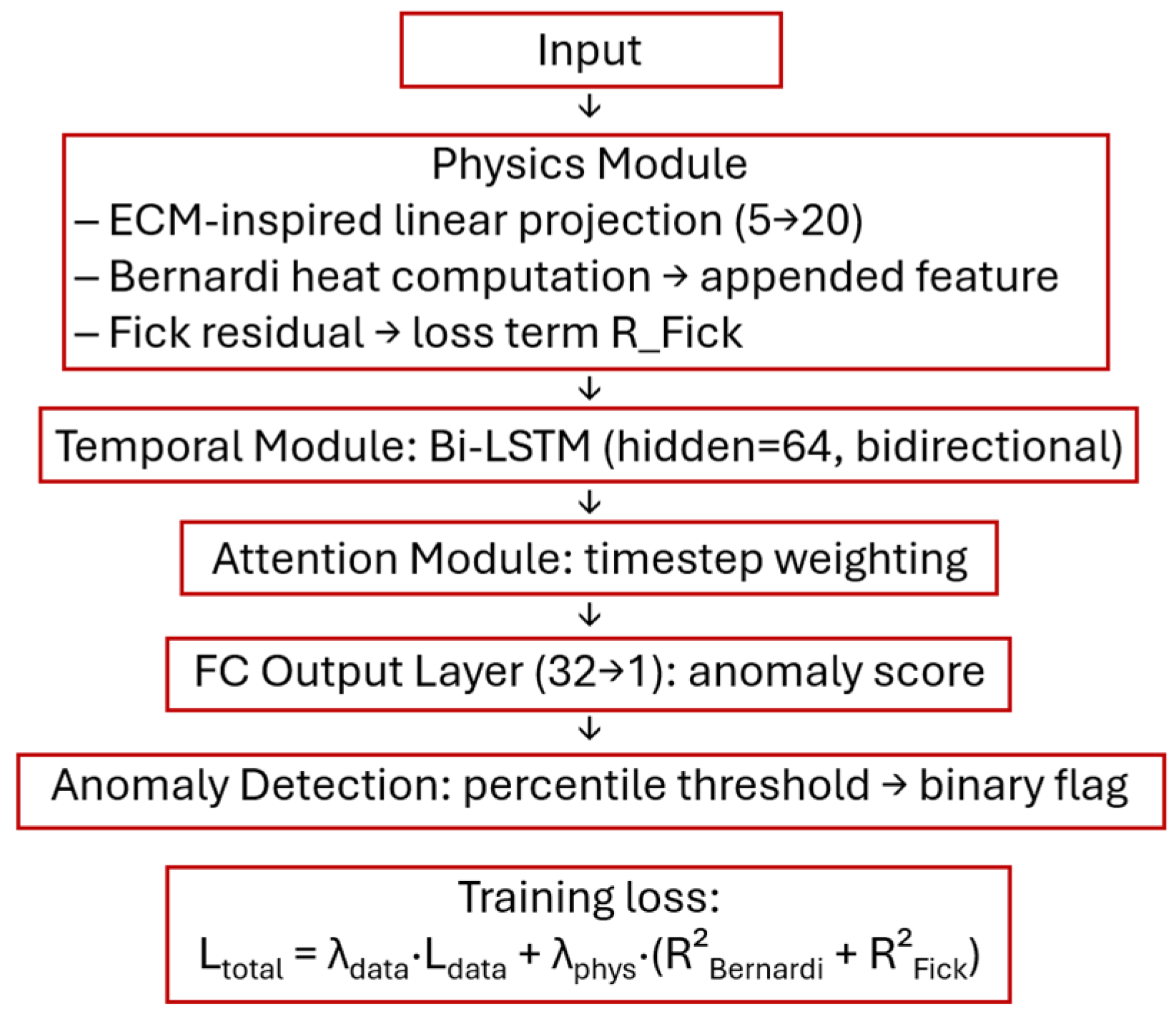
Figure 1 presents the overall architecture of the proposed PINN framework. The pipeline receives a multivariate time-series input that is passed to three tightly coupled components:
Figure 1.
Flowchart of the PINN framework architecture.
- Physics Module: A feedforward neural network approximating the electro-thermal behavior of the battery, constrained by the Bernardi equation and Fick’s law. This is a fully connected layer serving as an ECM-inspired linear projection, mapping input battery features to a multidimensional latent electro-thermal representation (Appendix A.1).
- Temporal Module: A Bi-directional Long Short-Term Memory (Bi-LSTM) network that captures temporal dependencies and dynamic patterns in multivariate time-series data (Appendix A.2).
- Attention and Anomaly Detection Module: An attention mechanism enhances interpretability by highlighting critical time windows, while clustering and threshold-based logic translate predictions into anomaly flags (Appendix A.3).
This modular structure allows the separation of physical consistency, temporal learning, and decision logic, while still enabling end-to-end training.
The core of the developed PINN approach lies in the loss function, describing the discrepancy between the output of a deep learning model and the target values [49].
As detailed in Appendix A.4, the loss function combines data fidelity with physics-based residuals to evaluate the performance of the model according to
where Ldata (data loss term) is the mean squared error between the network’s predicted output and the ground-truth anomaly labels, anchoring the model to observable measurements. It is noteworthy to observe that this term alone would produce a purely data-driven model.
Ltotal = λdata Ldata + λphys (RBernardi2 + RFick2)
The loss function enforces a dual objective:
- Fit the observed data (learning from measurements or simulations);
- Respect physical laws (heat generation and diffusion).
This facet represents the defining feature of PINNs: learning is constrained by physics, not purely driven by data.
Physics residuals (RBernardi and RFick) quantify how much the network violates physical laws. RBernardi is the residual of the Bernardi heat generation expressed by Equation (8), which quantifies the degree to which predicted heat, voltage, and temperature are mutually thermodynamically inconsistent; RFick is the residual of Fick’s second law, according to Equation (11), penalizing concentration dynamics that violate known lithium transport physics.
λdata and λphys are scalar weighting coefficients selected via grid search on the validation set, controlling the trade-off between empirical accuracy and physical fidelity. The squared form of the residuals ensures differentiability and symmetrically penalizes positive and negative violations.
The Bernardi heat equation can be written as
where q (W) is the - heat generation rate in the battery; I (A) is the applied current, positive for discharge; V (V) is the measured terminal voltage; U (V) is the open-circuit voltage, representing the thermodynamic equilibrium potential.
The first termon right side of Equation (7) represents irreversible heat from ohmic resistance and electrochemical polarization losses, the dominant source under degraded conditions. The second term on right side of Equation (7) represents reversible entropic heating or cooling and becomes significant at low currents or near phase-transition SOC regions. The sum of both terms constitutes the physically grounded heat signal used as an additional input feature to the Bi-LSTM and as the basis for the Bernardi residual in the loss function.
If the network predicts temperature (T^), voltage (V^), and heat (q^), it follows that the residual is
The model is thermodynamically consistent under the condition
while, if the residual is large, there is a physically inconsistent heat prediction.
RBernardi = 0
Fick’s second law is provided by
where c (mol m−3) is the lithium-ion concentration within the electrode solid particle or the electrolyte domain; t (s) is time; D (m2 s−1) is the diffusion coefficient, assumed constant at its nominal value in the baseline model; and ∇2c is the Laplacian of concentration representing the net diffusive flux divergence.
This equation allows us to describe how lithium redistributes spatially during charge and discharge phase. If the network predicts concentration c^(x,t), it follows that
Under normal conditions, concentration gradients remain bounded, and the residual RFick remains near zero. Under anomalous conditions, as with localized heating or degraded electrodes, concentration gradients intensify, producing a non-zero residual that serves as an early electrochemical indicator of impending thermal instability, detectable before any measurable temperature spike occurs. RFick penalizes diffusion dynamics inconsistent with physics, thus acting as a regularizer on latent electrochemical behavior.
The physics module is implemented as a feedforward neural network with three hidden layers of 64, 128, and 64 neurons, respectively, using tanh activation to improve the learning of smooth physical dynamics. The Bi-LSTM processes sequences of voltage, current, temperature, SOC, and derived features such as the Bernardi heat. The attention layer assigns weights to each timestep, effectively learning which temporal segments contribute most to anomaly prediction. This mechanism helps to provide explainable AI (XAI) capabilities [50], which can be regarded as a crucial requirement for safety-critical applications, where operator trust and regulatory compliance are essential. Optimizing intelligent algorithms involves selecting appropriate training methods, input features, and hyperparameters, with challenges for optimal performance connected to data underfitting or overfitting [51]. The anomalies are finally detected as the 95th percentile of the anomaly scores, which are computed as the average of the normalized attention entropy and reconstruction error for each input time sequence. In more detail, the normalized attention entropy is computed by first averaging the attention weights across all timesteps for each sequence, resulting in a probability distribution over the attention heads. The Shannon entropy of this distribution is then calculated for each sequence, and the resulting entropy values are normalized to the [0, 1] range using min–max normalization. The reconstruction error is instead computed as the mean squared error between the model’s prediction for each sequence and the average value of the input features within that sequence. This error is then normalized to the [0, 1] range using min–max normalization.
Due to the scarcity of labeled thermal runaway data, a synthetic dataset was generated using physically consistent simulation logic, which, analogously to the approach followed by Liang et al. [52], was rationally divided into two subsets.
The whole synthetic dataset comprises 10,000 samples, of which 6000 represent normal operation scenarios and 4000 represent controlled anomaly scenarios with varying severity. The dataset is partitioned into training (70%), validation (15%), and test (15%) subsets, corresponding to 7000, 1500, and 1500 samples, respectively. Partitioning is performed using stratified random sampling to preserve the normal-to-anomaly ratio across all three subsets. No temporal leakage occurs between subsets, as each sample represents an independently simulated operating episode rather than a segment of a continuous time series. The validation set is used exclusively for hyperparameter selection and early stopping; all reported performance metrics are computed on the held-out test set.
Normal operation scenarios span a wide range of currents, temperatures, and SOC levels, while anomaly scenarios introduce controlled deviations consistent with known runaway precursors. Gaussian noise and parameter variability are injected to emulate sensor uncertainty and operational diversity.
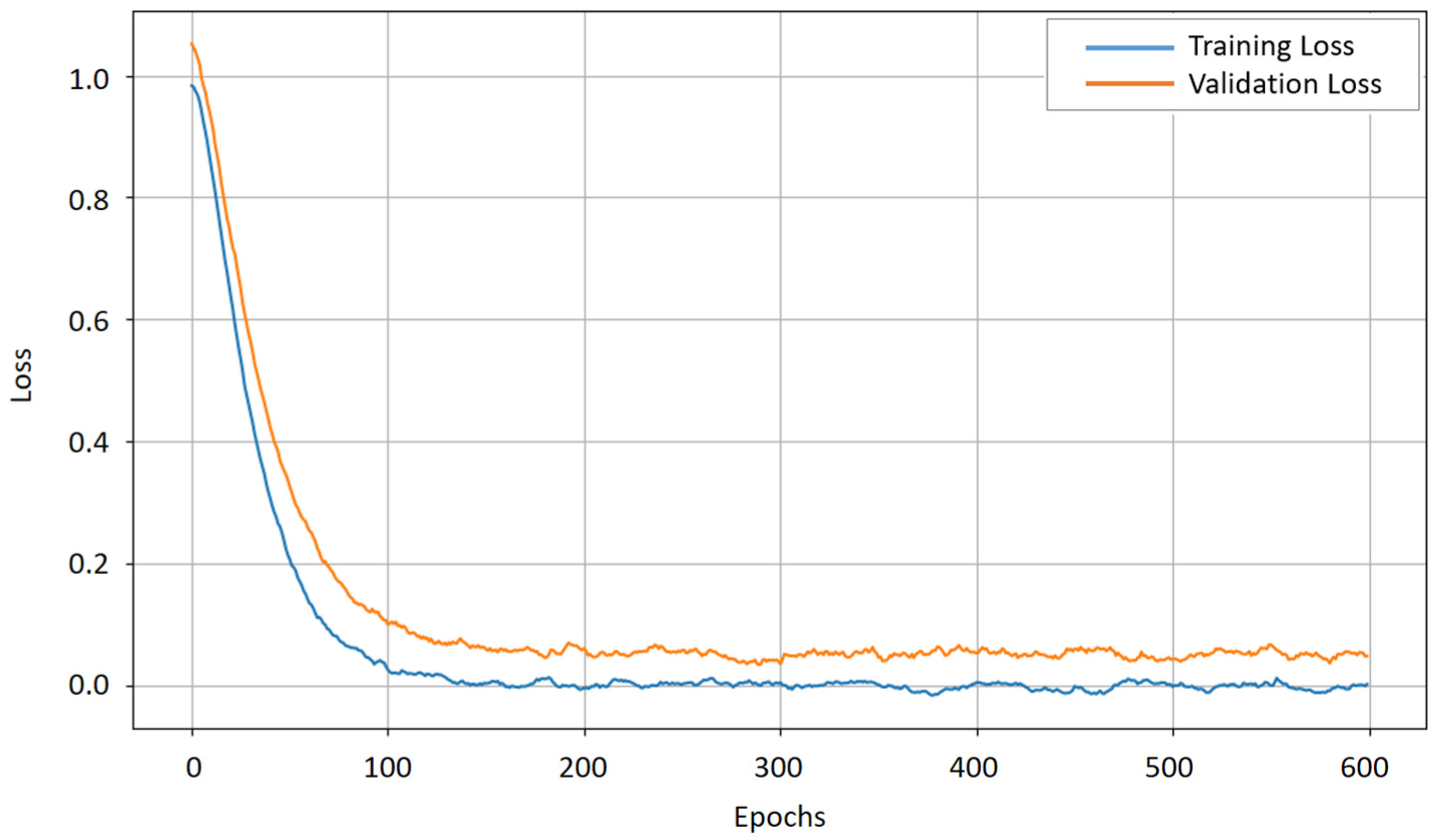
Training is performed using the Adam optimizer over 600 epochs with a batch size of 100. Experiments are conducted on an NVIDIA RTX A6000 GPU. Performance is evaluated using accuracy, precision, recall, F1-score, and ROC-AUC, with additional stress tests under shifted operating conditions.
3. Results and Discussion
In order to test the actual capability of the proposed PINN and to evaluate quantitatively its performance, the model is compared with three baseline models trained on the same synthetic dataset:
- A Bi-LSTM network without physics constraints.
- A denoising autoencoder trained on normal operation data.
- A rule-based threshold detection system.
- A CNN–Transformer, in analogy with the study by Han et al. [41].
The rule-based threshold detector flags a sample as anomalous when the observed temperature or voltage deviates by more than three standard deviations from the mean of the training distribution (±3σ). This threshold is grounded in the three-sigma rule of the normal distribution [53], under which values beyond ±3σ occur with a probability of approximately 0.27% under nominal Gaussian conditions, providing a low false positive rate in the absence of anomalies. The mean and standard deviation are estimated from the training split of the normal operation subset only, ensuring that the threshold is blind to anomaly characteristics.
The proposed PINN consistently outperforms baseline models, as shown in Table 1. Beyond quantitative gains, the model achieves a notably low false positive rate of 3%, suggesting reliable detection performance under the evaluated operating conditions. Attention visualizations reveal that detected anomalies correlate strongly with spikes in physics-derived heat generation, reinforcing the interpretability of the approach.
Table 1.
Comparison with three baseline models.
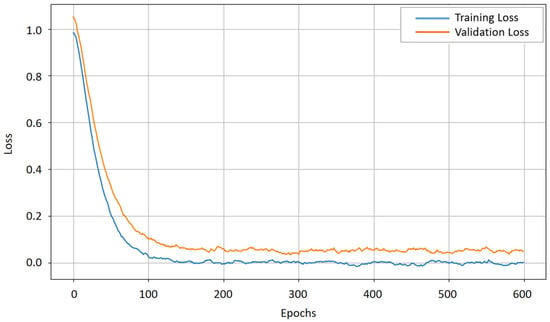
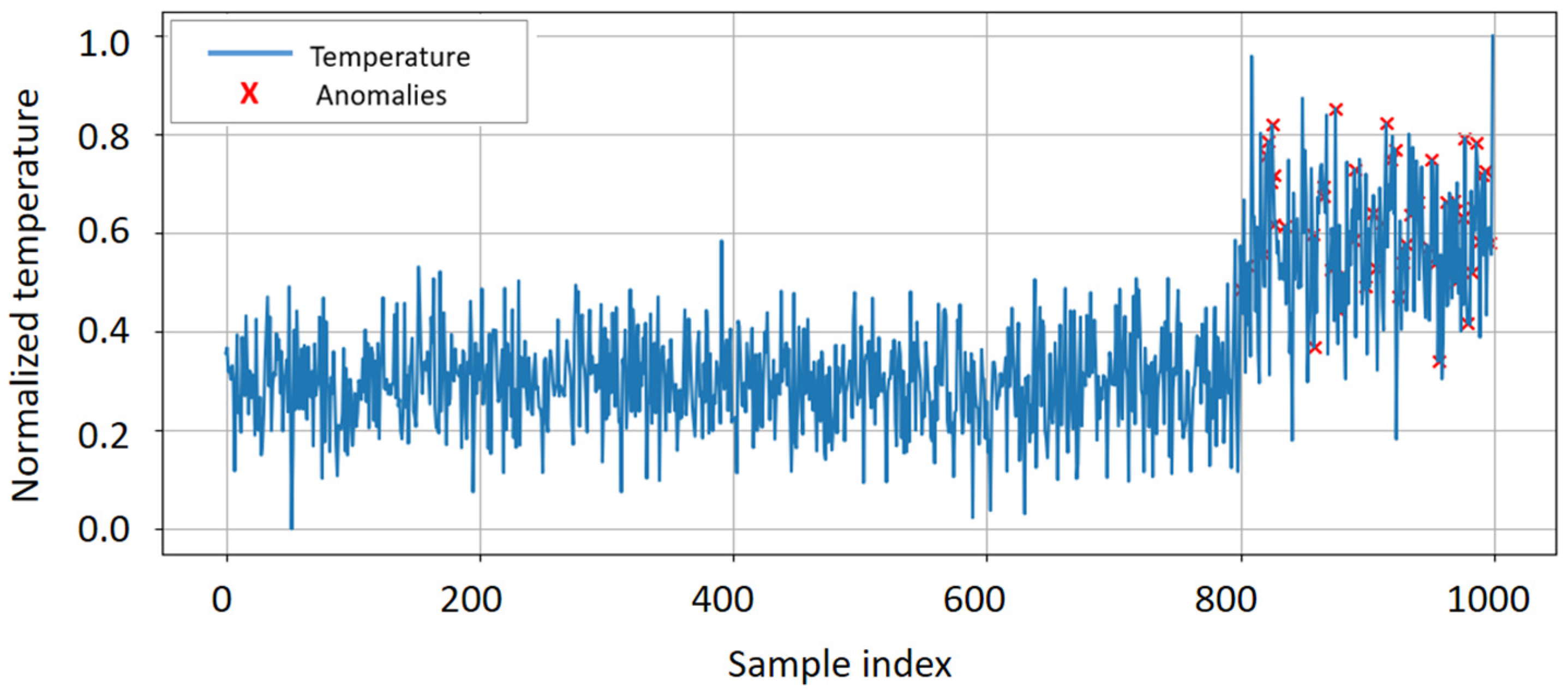
The model converges within 102 epochs with consistent reduction in physics and data loss terms (Figure 2); it achieves over 90% accuracy on the test set (model accuracy: 91%). Temperature spikes are correctly identified, as clearly visualized in Figure 3.
Figure 2.
Training and validation loss.
Figure 3.
Thermal anomaly detection.
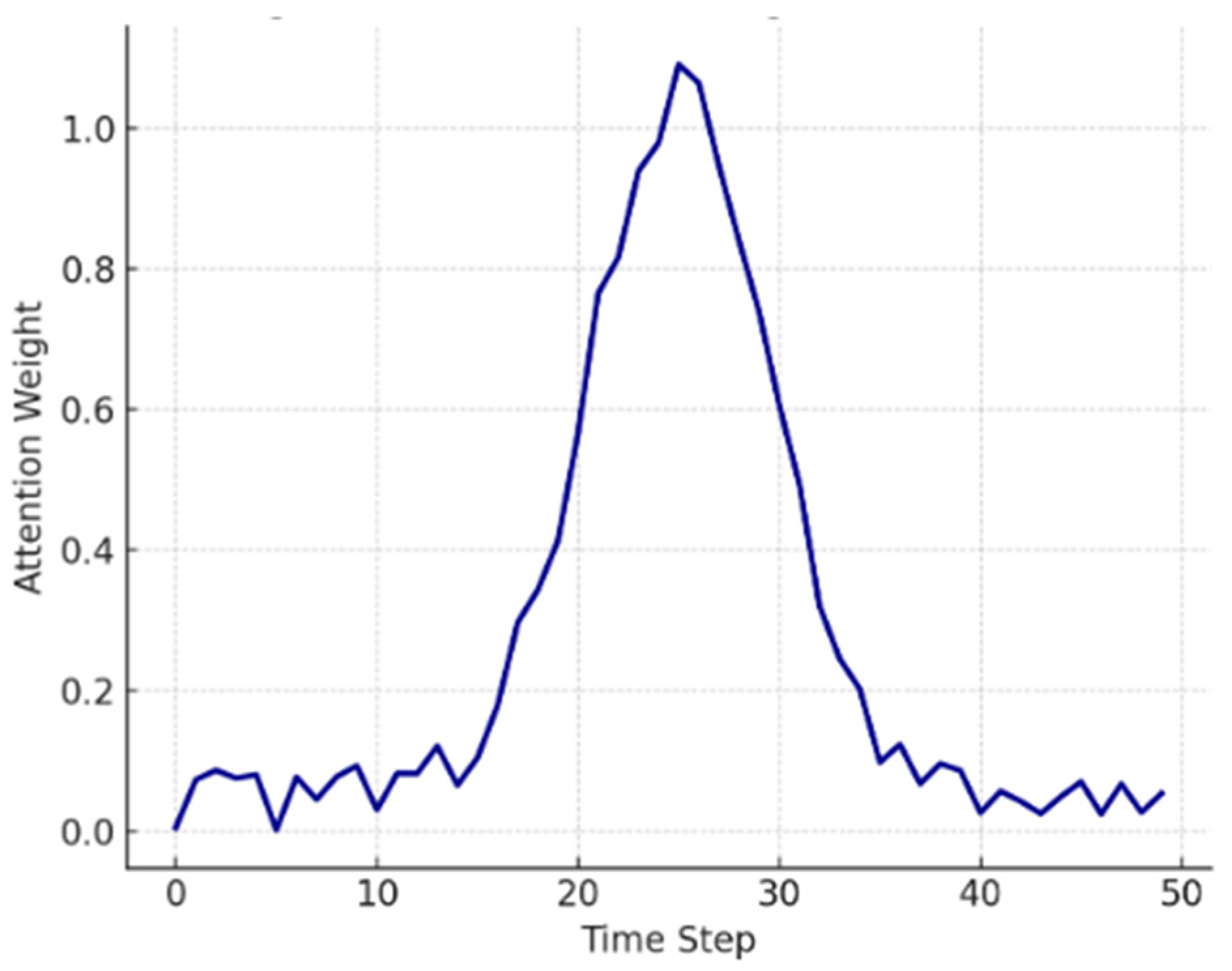
The attention weights in the Bi-LSTM highlight temporal windows with abrupt changes in internal heating (Figure 4). Attention visualizations reveal that detected anomalies correlate strongly with spikes in physics-derived heat generation, reinforcing the interpretability of the approach.
Figure 4.
Attention weights over time.
Additionally, false positives often occur in high-noise segments, while false negatives are rare and typically happen in low-intensity thermal drift conditions, suggesting the excellent model robustness to subtle precursor detection.
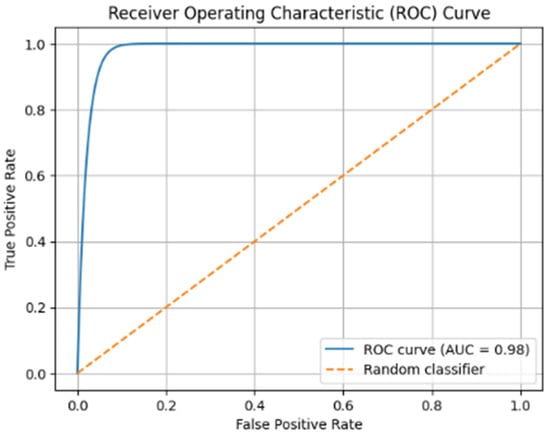
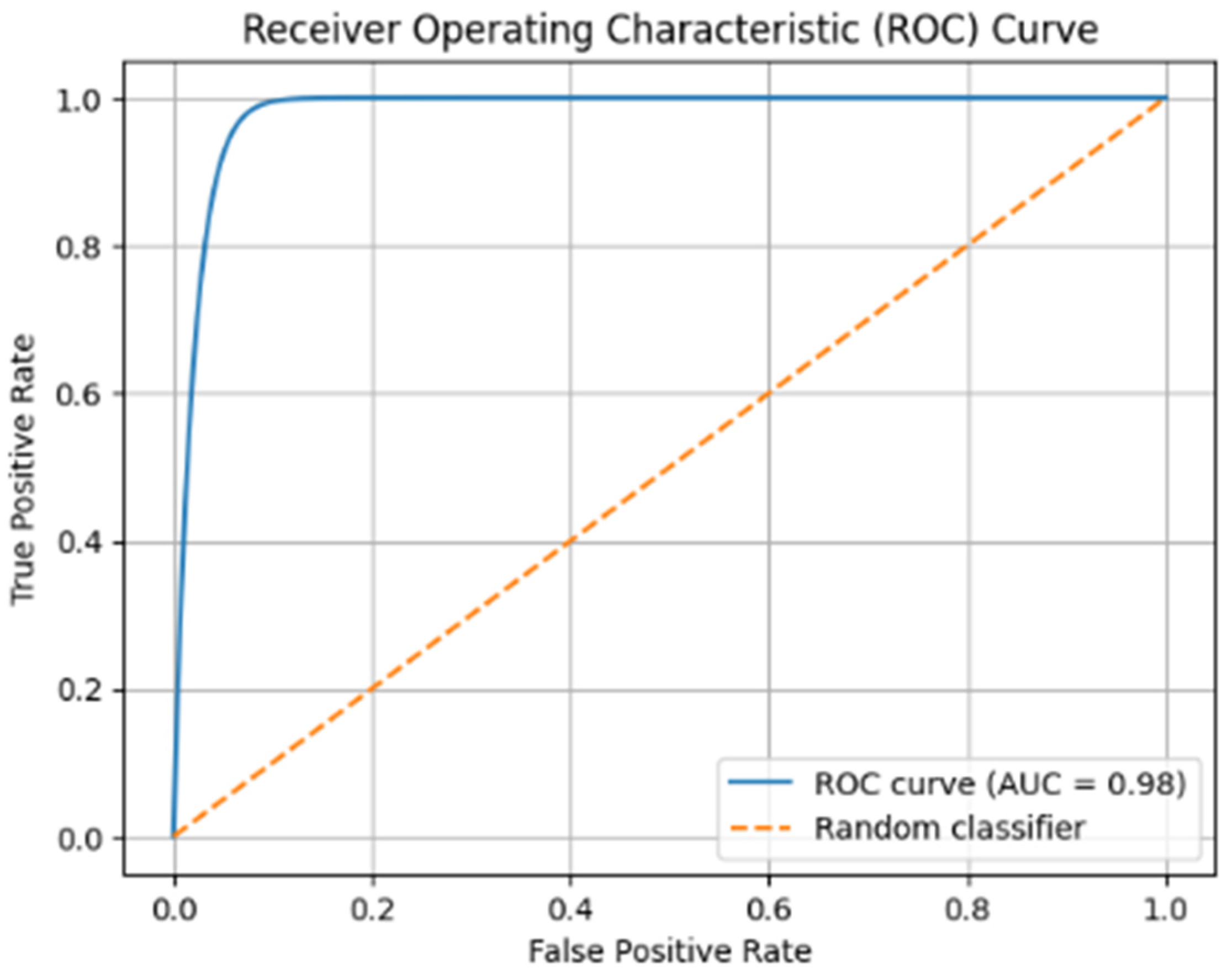
A Receiver Operating Characteristic curve (ROC) analysis (Figure 5) confirms the model’s high sensitivity and specificity, with an AUC of 0.98.
Figure 5.
Receiver Operating Characteristic curve (ROC).
The near-perfect AUC is obtained on physically consistent synthetic data and mainly demonstrates the discriminative potential of the physics-informed architecture rather than real-world operational optimality. In fact, most anomalies are detected with almost no false alarms. The attained AUC figure clearly indicates a very high discriminative capability of the model, while preserving a realistic overlap between normal and anomalous operating conditions.
While the PINN introduces additional computational overhead compared to empirical models, the increase remains moderate (corresponding to 2.1× parameters compared to Bi-LSTM alone). It is noteworthy that the physics-informed loss reduces data requirements and improves generalization, thus offsetting the added cost. The modular design holds significant potential and supports future extensions, such as distributed training, reduced-order physics models, or deployment on edge hardware.
To assess suitability for real-time deployment, inference latency and model complexity were profiled. Single-sample inference for the proposed PINN requires approximately 4.4 ms per timestep, compared to 2.1 ms for the Bi-LSTM baseline. The additional overhead is attributable to the evaluation of PDE residuals (R_Bernardi, R_Fick). The total parameter count is ~101 K, representing a 2.1× increase over the standalone Bi-LSTM. Edge deployment would require reduced-order physics approximations. These results reflect GPU-side computation only and do not account for data acquisition latency or communication overhead in an embedded BESS deployment.
4. Conclusions
This work outlines a Physics-Informed Neural Network (PINN) framework for predicting thermal anomalies and identifying early indicators of thermal runaway in lithium-ion batteries. By integrating key physical principles, specifically, the Bernardi equation for heat generation and Fick’s law for lithium-ion diffusion, into a deep learning architecture, the presented approach bridges the gap between data-driven prediction and physical interpretability.
The results demonstrate that PINNs not only match or exceed the performance of purely empirical models in anomaly detection but also provide physically grounded insights into the internal thermal and electrochemical dynamics of the battery system. The incorporation of attention mechanisms and temporal modeling further enhances the model’s ability to detect subtle shifts in behavior that precede critical failures. Notably, the use of the Bernardi heat term as both a predictive feature and an explanatory indicator highlights the dual diagnostic and prognostic value of this approach. As underlined by Yu et al. [3], progress in physics informed AI and standardized benchmarking can help the development of laboratory prototype into reliable safety functions for electric vehicles.
This work contributes to the emerging field of Physics-Informed Machine Learning within the wider context of cyber-physical safety applications. It validates the feasibility and benefits of PINNs in BESS safety monitoring—particularly for early detection of precursors such as temperature spikes and voltage variance—where data alone may be insufficient or unreliable. The proposed approach allows for the generalization of new operating regimes, interpretable diagnostics, and potential integration into real-time monitoring systems. Despite its advantages, the framework faces several challenges. First, reliance on synthetic data necessitates further careful validation against various datasets and real-world operating conditions. As argued by Lee [4], this limitation is connected to the different parameters affecting failure patterns, e.g., battery geometry, composition and electrochemical properties. Second, extending the physics module to capture additional phenomena—such as SEI growth, mechanical stress, and thermal propagation at pack level—will increase model fidelity but also complexity. Future research will explore uncertainty quantification, Bayesian PINNs, and dynamic Bayesian networks to integrate probabilistic risk assessment with physics-informed learning.
By demonstrating the practical viability of PINNs in detecting thermal anomaly precursors, this study opens the door to a new class of safety-critical AI applications grounded in scientific knowledge and engineered for operational resilience.
Hardware-in-the-loop (HIL) validation and formal latency benchmarking on representative edge platforms remain essential steps before operational deployment and are identified as an immediate priority for future work. In particular, edge deployment would require pre-compiled or reduced-order physics surrogates to achieve latency budgets compatible with embedded battery controllers.
Additionally, prioritizing validation with real-world BESS data is essential, as synthetic data, even though physically consistent, lacks the inherent complexity and heterogeneity of systems deployed in the field.
The modular nature of the proposed framework allows its extension to other storage technologies, such as lead-acid batteries, sodium-ion cells, or even hybrid supercapacitor systems. Each system would require tailoring the physical constraints embedded into the PINN (e.g., replacing Bernardi with Peukert’s law or introducing thermal capacitance models), but the overall structure remains compatible. This generalizability supports future deployments in heterogeneous energy storage environments requiring high reliability, supporting the transition towards a more sustainable and resilient marine transportation.
Author Contributions
Conceptualization, T.V. and S.G.; methodology, T.V.; software, T.V. and S.G.; formal analysis, T.V., A.P.R. and B.F.; funding acquisition, B.F.; writing—original draft preparation, T.V., S.G. and B.F.; writing—review and editing, S.G., A.P.R. and B.F.; supervision, B.F. All authors have read and agreed to the published version of the manuscript.
Funding
Funded by the European Union-NextGenerationEU and by the Ministry of University and Research (MUR), National Recovery and Resilience Plan (NRRP), Mission 4, Component 2, Investment 1.5, project “RAISE—Robotics and AI for Socio-economic Empowerment” (ECS00000035). Bruno Fabiano is part of RAISE Innovation Ecosystem.
Data Availability Statement
The original contributions presented in this study are included in the article and the details of the developed code can be found in Appendix A.
Conflicts of Interest
The authors declare no conflicts of interest. The funders had no role in the design of the study; in the collection, analyses, or interpretation of data; in the writing of the manuscript; or in the decision to publish the results.
Abbreviations
The following abbreviations are used in this manuscript:
| AUC | Area Under Curve |
| BESS | Battery Energy Storage System |
| BMS | Battery Management System |
| BSMS | Battery Safety Management System |
| ECM | Equivalent Circuit Model |
| HGR | Heat Generation Rate |
| HIL | Hardware-in-the-Loop |
| LiB | Lithium-ion Battery |
| LSTM | Long Short-Term Memory Network |
| ML | Machine Learning |
| MPINN | Multi-Physics-Informed Neural Network |
| PIML | Physics-Informed Machine Learning |
| PINN | Physics-Informed Neural Network |
| ROC | Receiver Operating Characteristic Curve |
| SEI | Solid Electrolyte Interphase |
| SOC | State Of Charge |
| SOH | State Of Health |
| TCP | Thermal Conductive Pad |
| TR | Thermal Runaway |
| XAI | Explainable Artificial Intelligence |
Appendix A. Python 3.9 Code Architecture
Appendix A.1. Physics Module
| def bernardi_equation(I, V, U, T, dUdT): return I * (V - U) + I * T * dUdT def fick_law(c, D=0.1): if c.requires_grad: grad_c = torch.autograd.grad(c.sum(), c, create_graph=True)[0] return D * grad_c else: return D * torch.clamp(torch.diff(c, dim=0, prepend=c[0:1]), min=-1, max=1) class PhysicsModule(nn.Module): def __init__(self): super().__init__() self.ecm = nn.Linear(5, 20) self.activation = nn.ReLU() def forward(self, x): out = self.ecm(x) return self.activation(out) mse = nn.MSELoss() def loss_function(y_pred, y_true, q, c): data_loss = mse(y_pred, y_true) bernardi_residual = bernardi_equation(q, c, 1.0, 1.0, 0.1) bernardi_loss = 0.03 * mse(bernardi_residual, y_true) try: fick_residual = fick_law(c.unsqueeze(-1) if c.dim() == 1 else c, D=0.1) fick_residual_mean = fick_residual.mean() if isinstance(fick_residual, torch.Tensor) else torch.tensor(0.0, device=device) fick_loss = 0.02 * torch.abs(fick_residual_mean - y_true.mean()) except Exception: fick_loss = 0.0 l2_loss = 0.0005 * torch.mean(y_pred ** 2) return data_loss + bernardi_loss + fick_loss + l2_loss |
Appendix A.2. Temporal Module
| class TemporalModule(nn.Module): def __init__(self, dropout=0.15, num_heads=4): super().__init__() self.lstm = nn.LSTM(20, 32, batch_first=True) self.dropout = nn.Dropout(dropout) self.num_heads = num_heads self.attention = nn.Linear(32, num_heads) self.last_attention = None def forward(self, x): # x: (batch, seq_len, features) lstm_out, _ = self.lstm(x) lstm_out = self.dropout(lstm_out) attn_logits = self.attention(lstm_out) # softmax over time dimension for each head attention_weights = torch.softmax(attn_logits, dim=1) self.last_attention = attention_weights # compute head-wise weighted sums: (batch, num_heads, 32) head_outputs = torch.einsum('bth,btf->bhf', attention_weights, lstm_out) aggregated = head_outputs.mean(dim=1) return aggregated |
Appendix A.3. Attention and Anomaly Detection Module
| model = PINN(num_heads=4) train_losses, val_losses = train_model(model, train_loader, val_loader, device, epochs=20) model.to(device) model.eval() attn_list = [] preds_list = [] with torch.no_grad(): loader_all = DataLoader(full_seq_dataset, batch_size=128, shuffle=False) for xb, yb in loader_all: xb = xb.to(device) y_pred = model(xb) preds_list.append(y_pred.cpu().numpy().flatten()) att = model.temporal_module.last_attention if att is None: lstm_out, _ = model.temporal_module.lstm(xb) lstm_out = model.temporal_module.dropout(lstm_out) att_logits = model.temporal_module.attention(lstm_out) att = torch.softmax(att_logits, dim=1) attn_list.append(att.cpu().numpy()) predictions_seq = np.concatenate(preds_list) attn_weights_seq = np.concatenate(attn_list, axis=0) # (M, seq_len, num_heads) def validate_model(model, test_loader, device): model.to(device) model.eval() val_losses = [] with torch.no_grad(): for batch in test_loader: x, y = batch x = x.to(device, non_blocking=True) y = y.to(device, non_blocking=True) y_pred = model(x) if x.dim() == 3: q = x[:, -1, 0] c = x[:, -1, 1] else: q = x[:, 0] c = x[:, 1] loss = loss_function(y_pred, y, q, c).item() val_losses.append(loss) avg_val_loss = np.mean(val_losses) print('Validation Loss:', avg_val_loss) return avg_val_loss, val_losses def entropy_per_sample(attn): eps = 1e-12 probs = att / (att.sum(axis=1, keepdims=True) + eps) ent = -np.sum(probs * np.log(probs + eps), axis=1) # (M, H) return ent.mean(axis=1) # (M,) def top_k_examples(attn, preds, labels, seqs, k=5): ent = entropy_per_sample(attn) idx = np.argsort(-ent)[:k] for i in idx: print(f″Sample {i}: label={int(labels[i])}, pred={preds[i]:.3f}, entropy={ent[i]:.3f}″) M, L, H = attn.shape fig, axs = plt.subplots(1, H, figsize=(3*H, 3), squeeze=False) for h in range(H): axs[0,h].bar(np.arange(L), attn[i,:,h]) axs[0,h].set_title(f'Head {h}') axs[0,h].set_xlabel('Timestep') axs[0,h].set_ylim(0, attn.max()) plt.suptitle(f'Sample {i} attention per head') plt.tight_layout() plt.show() display(seqs[i]) def compute_attention_entropy(attn_weights): avg_attn_per_head = attn_weights.mean(axis=1) # (M, num_heads) avg_attn_per_head = np.clip(avg_attn_per_head, 1e-10, 1.0) avg_attn_per_head = avg_attn_per_head / avg_attn_per_head.sum(axis=1, keepdims=True) entropies = np.array([entropy(row) for row in avg_attn_per_head]) return entropies def compute_reconstruction_error(model, loader, device): model.to(device) model.eval() errors = [] with torch.no_grad(): for xb, _ in loader: xb = xb.to(device) y_pred = model(xb) input_mean = xb.mean(dim=1, keepdim=True) error = torch.mean((y_pred - input_mean[:, :, 0:1]) ** 2, dim=1) errors.append(error.cpu().numpy()) return np.concatenate(errors) attn_entropy = compute_attention_entropy(attn_weights_seq) recon_errors = compute_reconstruction_error(model, loader_all, device) attn_entropy = np.atleast_1d(attn_entropy).flatten() recon_errors = np.atleast_1d(recon_errors).flatten() min_len = min(len(attn_entropy), len(recon_errors)) attn_entropy = attn_entropy[:min_len] recon_errors = recon_errors[:min_len] attn_entropy_norm = (attn_entropy - attn_entropy.min()) / (attn_entropy.max() - attn_entropy.min() + 1e-10) recon_errors_norm = (recon_errors - recon_errors.min()) / (recon_errors.max() - recon_errors.min() + 1e-10) anomaly_scores = 0.5 * attn_entropy_norm + 0.5 * recon_errors_norm anomaly_threshold = np.percentile(anomaly_scores, 90) anomaly_predictions = (anomaly_scores > anomaly_threshold).astype(int) |
Appendix A.4. PINN
| class PINN(nn.Module): def __init__(self, num_heads=4): super().__init__() self.physics_module = PhysicsModule() self.temporal_module = TemporalModule(num_heads=num_heads) self.fc = nn.Linear(32, 1) def forward(self, x): if x.dim() == 2: physics_output = self.physics_module(x) temporal_output = self.temporal_module(physics_output.unsqueeze(1)) elif x.dim() == 3: b, s, f = x.shape x_flat = x.reshape(b * s, f) physics_flat = self.physics_module(x_flat) physics_seq = physics_flat.view(b, s, -1) temporal_output = self.temporal_module(physics_seq) else: raise ValueError(f"Unexpected input shape {x.shape}") return self.fc(temporal_output) model = PINN(num_heads=4) train_losses, val_losses = train_model(model, train_loader, val_loader, device, epochs=20) model.to(device) model.eval() attn_list = [] preds_list = [] with torch.no_grad(): loader_all = DataLoader(full_seq_dataset, batch_size=128, shuffle=False) for xb, yb in loader_all: xb = xb.to(device) y_pred = model(xb) preds_list.append(y_pred.cpu().numpy().flatten()) att = model.temporal_module.last_attention if att is None: lstm_out, _ = model.temporal_module.lstm(xb) lstm_out = model.temporal_module.dropout(lstm_out) att_logits = model.temporal_module.attention(lstm_out) att = torch.softmax(att_logits, dim=1) attn_list.append(att.cpu().numpy()) predictions_seq = np.concatenate(preds_list) attn_weights_seq = np.concatenate(attn_list, axis=0) # (M, seq_len, num_heads) |
References
- Pasman, H.J.; Sripaul, E.; Khan, F.; Fabiano, B. Energy transition technology comes with new process safety challenges and risks—What does it mean? Process Saf. Prog. 2024, 43, 226–230. [Google Scholar] [CrossRef] [Scilit]
- Liu, H.; Shi, C.; Liu, C.; Chang, W. A Review of Lithium-Ion Battery Thermal Management Based on Liquid Cooling and Its Evaluation Method. Energies 2025, 18, 4569. [Google Scholar] [CrossRef] [Scilit]
- Yu, R.-Y.; Wang, B.-C.; Wang, Y. On-Board Implementation of Thermal Runaway Detection in Lithium-Ion Battery Packs: Methods, Metrics, and Challenges. Energies 2026, 19, 858. [Google Scholar] [CrossRef] [Scilit]
- Lee, J.; Park, S.-K.; Bazher, S.A.; Seo, D. Development of a Fault Prediction Algorithm for Marine Propulsion Energy Storage System. Energies 2025, 18, 1687. [Google Scholar] [CrossRef] [Scilit]
- Yin, R.; Du, M.; Shi, F.; Cao, Z.; Wu, W.; Shi, H.; Zheng, Q. Risk analysis for marine transport and power applications of lithium-ion batteries: A review. Process Saf. Environ. Prot. 2024, 181, 266–293. [Google Scholar] [CrossRef] [Scilit]
- Wang, W.; Liao, C.; Liu, L.; Cai, W.; Yuan, Y.; Hou, Y.; Guo, W.; Zhou, X.; Qiu, S.; Song, L.; et al. Comparable investigation of tervalent and pentavalent phosphorus based flame retardants on improving the safety and capacity of lithium-ion batteries. J. Power Sources 2019, 420, 143–151. [Google Scholar] [CrossRef] [Scilit]
- Li, Z.; Cheng, Z.; Yu, Y.; Wang, J.; Wang, L.; Mei, W.; Wang, Q. Thermal runaway comparison and assessment between sodium-ion and lithium-ion batteries. Process Saf. Environ. Prot. 2025, 193, 842–855. [Google Scholar] [CrossRef] [Scilit]
- Wang, H.; Wu, S.; Shao, C.; Luan, W.; Chen, H. Thermal runaway and gas generation dynamics in aged Lithium-ion batteries under low temperatures. J. Energy Storage 2025, 124, 116852. [Google Scholar] [CrossRef] [Scilit]
- Schuster, S.F.; Brand, M.J.; Berg, P.; Gleissenberger, M.; Jossen, A. Lithium-ion cell-to-cell variation during battery electric vehicle operation. J. Power Sources 2015, 297, 242–251. [Google Scholar] [CrossRef] [Scilit]
- Liu, Y.; Li, Y.; Xue, Z.; Bai, J. Three-dimensional thermo-electrochemical modeling of lithium dendrite penetration-induced separator failure and thermal runaway heat generation dynamics in lithium-ion batteries. Process Saf. Environ. Prot. 2025, 204, 108057. [Google Scholar] [CrossRef] [Scilit]
- Zhu, Z.; Chen, Q.; Qiao, D.; Wu, W.; Zheng, Y.; Hong, Y.; Guo, P.; Liu, L. Thermal runaway and propagation characteristics of sodium-ion and lithium-ion hybrid battery packs. Process Saf. Environ. Prot. 2025, 202, 107664. [Google Scholar] [CrossRef] [Scilit]
- Khange, S.; Sharma, A.K. Managing thermal non-uniformities and cell aging in Li-ion battery packs with passive cooling using thermal conductive pads. Process Saf. Environ. Prot. 2025, 200, 107288. [Google Scholar] [CrossRef] [Scilit]
- Shabana, R.; Sajid, Z.; Swamy, D.; Amin, T.; Khan, F. Why does the industry need battery safety management system (BSMS)? Process Saf. Environ. Prot. 2025, 197, 107029. [Google Scholar] [CrossRef] [Scilit]
- Liu, C.; Zhang, G.; Li, X.; Yuan, D.; Zhu, G.; Liu, C. Study on explosion venting efficacy of thermal runaway gases from lithium-ion batteries in a confined space: Impact of venting area. Process Saf. Environ. Prot. 2025, 203, 107876. [Google Scholar] [CrossRef] [Scilit]
- Lin, Y.; Guo, S.; Ye, M.; Qian, W.; Chen, H.; Chen, Q.; Wu, Z. Prognostic Modeling of Thermal Runaway Risk in Lithium-Ion Power Batteries Based on Multivariate Degradation Data. Energies 2025, 18, 6241. [Google Scholar] [CrossRef] [Scilit]
- Song, J.; Wang, H.; Liu, Y.; Wang, R.; Wang, K. Enhancing variational autoencoder for estimation of lithium-ion batteries State-of-Health using impedance data. Energy 2025, 337, 138739. [Google Scholar] [CrossRef] [Scilit]
- Qi, S.; Cheng, Y.; Li, Z.; Wang, J.; Li, H.; Zhang, C. Advanced deep learning techniques for battery thermal management in new energy vehicles. Energies 2024, 17, 4132. [Google Scholar] [CrossRef] [Scilit]
- Abdolrasol, M.G.M.; Ayob, A.; Lipu, M.S.H.; Ansari, S.; Kiong, T.S.; Saad, M.H.; Ustun, T.S.; Kalam, A. Advanced data-driven fault diagnosis in lithium-ion battery management systems for electric vehicles: Progress, challenges, and future perspectives. eTransportation 2024, 22, 100374. [Google Scholar] [CrossRef] [Scilit]
- Reverberi, A.P.; Fabiano, B.; Dovì, V.G. Use of inverse modelling techniques for the estimation of heat transfer coefficients to fluids in cylindrical conduits. Int. Commun. Heat Mass Transf. 2013, 42, 25–31. [Google Scholar] [CrossRef] [Scilit]
- Yalçın, S.; Panchal, S.; Herdem, M.S. A CNN-ABC model for estimation and optimization of heat generation rate and voltage distributions of lithium-ion batteries for electric vehicles. Int. J. Heat Mass Transf. 2022, 199, 12348. [Google Scholar] [CrossRef] [Scilit]
- Baakes, F.; Song, R.; Bernet, T.; Valenzuela García de León, J.; Jackson, G.; Adjiman, C.S.; Galindo, A.; Krewer, U. Pressure evolution and gas solubility of Li-ion battery electrolytes during thermal abuse conditions. J. Power Sources 2025, 640, 236619. [Google Scholar] [CrossRef] [Scilit]
- Guo, Z.; Ma, Z.; Liu, J.; Zhao, W.; Wang, S.; Zhao, H.; Ren, L. Overcharging cycle aging-induced severe degradation of safety properties of lithium-ion pouch battery cells subjected to mechanical abuse. Energy 2025, 320, 135168. [Google Scholar] [CrossRef] [Scilit]
- Gao, R.; Liang, H.; Zhang, Y.; Zhao, H.; Chen, Z. Characterization of lithium-ion batteries after suffering micro short circuit induced by mechanical stress abuse. Appl. Energy 2024, 374, 123931. [Google Scholar] [CrossRef] [Scilit]
- Meng, D.; Wang, Y.; Wang, J.; Liu, Z.; Li, H. Investigation of thermal runaway characteristics of lithium-ion battery under discharging condition coupled with thermal abuse. Process Saf. Environ. Prot. 2025, 203, 107877. [Google Scholar] [CrossRef] [Scilit]
- Meng, D.; Shi, X.; Wang, J.; Tang, F.; Li, H. Effect of environmental temperature on thermal runaway propagation of lithium-ion battery module during charging process. Energy 2025, 337, 138614. [Google Scholar] [CrossRef] [Scilit]
- Marseglia, G.; Leo, E.; Bonuso, S.; De Giorgi, M.G. Advancing thermal runaway prediction in lithium-Ion cells through genetic programming. Process Saf. Environ. Prot. 2026, 206, 108265. [Google Scholar] [CrossRef] [Scilit]
- Chen, M. Thermal Safety of Lithium-Ion Batteries: Current Status and Future Trends. Batteries 2025, 11, 112. [Google Scholar] [CrossRef] [Scilit]
- Raissi, M.; Perdikaris, P.; Karniadakis, G.E. Physics-informed neural networks: A deep learning framework for solving forward and inverse problems involving nonlinear partial differential equations. J. Comput. Phys. 2019, 378, 686–707. [Google Scholar] [CrossRef] [Scilit]
- Feng, X.; Ouyang, M.; Liu, X.; Lu, L.; Xia, Y.; He, X. Thermal runaway mechanism of lithium ion battery for electric vehicles: A review. Energy Storage Mater. 2018, 10, 246–267. [Google Scholar] [CrossRef] [Scilit]
- Coman, P.T.; Darcy, E.C.; Veje, C.T.; White, R.E. Modelling Li-Ion Cell Thermal Runaway Triggered by an Internal Short Circuit Device Using an Efficiency Factor and Arrhenius Formulations. J. Electrochem. Soc. 2017, 164, A587–A593. [Google Scholar] [CrossRef] [Scilit]
- Bernardi, D.; Pawlikowski, E.; Newman, J. A General Energy Balance for Battery Systems. J. Electrochem. Soc. 1985, 132, 5–12. [Google Scholar] [CrossRef] [Scilit]
- Ziegler, M.S.; Trancik, J.E. Re-examining rates of lithium-ion battery technology improvement and cost decline. Energy Environ. Sci. 2021, 14, 1635–1651. [Google Scholar] [CrossRef] [Scilit]
- Liu, L.; Zhou, W.; Guan, K.; Peng, B.; Xu, S.; Tang, J.; Zhu, Q.; Till, J.; Jia, X.; Jiang, C.; et al. Knowledge-guided machine learning can improve carbon cycle quantification in agroecosystems. Nat. Commun. 2024, 15, 357. [Google Scholar] [CrossRef] [Scilit] [PubMed]
- Heidari, M.; Ding, L.; Kheshti, M.; Bao, W.; Zhao, X.; Popov, M.; Terzijaet, V. A review on application of machine learning-based methods for power system inertia monitoring. Int. J. Electr. Power Energy Syst. 2024, 162, 110279. [Google Scholar] [CrossRef] [Scilit]
- Hong, S.; Kang, M.; Kim, J.; Baek, J. Sequential application of denoising autoencoder and long-short recurrent convolutional network for noise-robust remaining-useful-life prediction framework of lithium-ion batteries. Comput. Ind. Eng. 2023, 179, 109231. [Google Scholar] [CrossRef] [Scilit]
- Liu, K.; Zhao, S.; Wang, Y.; Li, K.; Wang, J.; Sun, Y.; Wu, Q.; Peng, Q. Advanced fault diagnosis in batteries: Insights into fault mechanisms, sensor fusion, and artificial intelligence. Adv. Appl. Energy 2025, 20, 100247. [Google Scholar] [CrossRef] [Scilit]
- Son, S.; Jeong, J.; Jeong, D.; Ho Sun, K.; Oh, K.-Y. Physics-Informed Neural Network: Principles and Applications Recent advances in neuromorphic computing. In Recent Advances in Neuromorphic Computing; IntechOpen: London, UK, 2024. [Google Scholar] [CrossRef] [Scilit]
- Singh, S.; Ebongue, Y.E.; Rezaei, S.; Birke, K.P. Hybrid Modeling of Lithium-Ion Battery: Physics-Informed Neural Network for Battery State Estimation. Batteries 2023, 9, 301. [Google Scholar] [CrossRef] [Scilit]
- Vairo, T.; Guarino, S.; Benvenuto, A.; Fabiano, B.; Setola, R. Emergent risks in complex systems: A Bayesian perspective on uncertainty and prediction. Reliab. Eng. Syst. Saf. 2026, 270, 112129. [Google Scholar] [CrossRef] [Scilit]
- Meng, H.; Yang, Q.; Zio, E.; Xing, J. An integrated methodology for dynamic risk prediction of thermal runaway in lithium-ion batteries. Process Saf. Environ. Prot. 2023, 171, 385–395. [Google Scholar] [CrossRef] [Scilit]
- Han, C.; Hu, L.; Ouyang, D.; Wang, Z. Research on thermal runaway warning threshold and machine learning model for large capacity energy storage batteries based on electric-thermal-mechanical-gas coupling. Process Saf. Environ. Prot. 2026, 208, 108471. [Google Scholar] [CrossRef] [Scilit]
- Bergveld, H.J.; Kruijt, W.S.; Notten, P.H.L. Battery Management System; Springer: Dordrecht, The Netherlands, 2002. [Google Scholar] [CrossRef] [Scilit]
- Amatucci, G.G.; Tarascon, J.M.; Klein, L.C. CoO2, The End Member of the Li x CoO2 Solid Solution. J. Electrochem. Soc. 1996, 143, 1114–1123. [Google Scholar] [CrossRef] [Scilit]
- Choi, H.C.; Jung, Y.M.; Noda, I.; Bin Kim, S. A Study of the Mechanism of the Electrochemical Reaction of Lithium with CoO by Two-Dimensional Soft X-ray Absorption Spectroscopy (2D XAS), 2D Raman, and 2D Heterospectral XAS−Raman Correlation Analysis. J. Phys. Chem. B 2003, 107, 5806–5811. [Google Scholar] [CrossRef] [Scilit]
- Reverberi, A.P.; Vocciante, M.; Fabiano, B. Scaling effects and front propagation in a class of reaction-diffusion equations: From classic to anomalous diffusion. Chem. Eng. J. 2019, 377, 121154. [Google Scholar] [CrossRef] [Scilit]
- Saqib, N.; Ganim, C.M.; Shelton, A.E.; Porter, J.M. On the Decomposition of Carbonate-Based Lithium-Ion Battery Electrolytes Studied Using Operando Infrared Spectroscopy. J. Electrochem. Soc. 2018, 165, A4051–A4057. [Google Scholar] [CrossRef] [Scilit]
- Wang, G.; Ping, P.; Kong, D.; Peng, R.; He, X.; Zhang, Y.; Dai, X.; Wen, J. Advances and challenges in thermal runaway modeling of lithium-ion batteries. Innovation 2024, 5, 100624. [Google Scholar] [CrossRef] [Scilit]
- Vairo, T.; Cademartori, D.; Clematis, D.; Carpanese, M.P.; Fabiano, B. Solid oxide fuel cells for shipping: A machine learning model for early detection of hazardous system deviations. Process Saf. Environ. Prot. 2023, 172, 184–194. [Google Scholar] [CrossRef] [Scilit]
- Guo, C.; Liu, L.; Sun, H.; Wang, N.; Zhang, K.; Zhang, Y.; Zhu, J.; Li, A.; Bai, Z.; Liu, X. Predicting Fv/Fm and evaluating cotton drought tolerance using hyperspectral and 1D-CNN. Front. Plant Sci. 2022, 13, 1007150. [Google Scholar] [CrossRef] [Scilit]
- Angelov, P.P.; Soares, E.A.; Jiang, R.; Arnold, N.I.; Atkinson, P.M. Explainable artificial intelligence: An analytical review. WIREs Data Min. Knowl. Discov. 2021, 11, e1424. [Google Scholar] [CrossRef] [Scilit]
- Singh, A.K.; Kumar, K.; Choudhury, U.; Yadav, A.K.; Ahmad, A.; Surender, K. Applications of artificial intelligence and cell balancing techniques for battery management system (BMS) in electric vehicles: A comprehensive review. Process Saf. Environ. Prot. 2024, 191, 2247–2265. [Google Scholar] [CrossRef] [Scilit]
- Liang, H.; Gao, R.; Zhao, H.; Chen, Z. Transfer Learning-Enhanced Safety Modeling for Lithium-Ion Batteries Under Mechanical Abuse. Batteries 2026, 12, 39. [Google Scholar] [CrossRef] [Scilit]
- Westfall, P.; Henning, K.S.S. Understanding Advanced Statistical Methods; CRC Press: Boca Raton, FL, USA, 2013; p. 543. ISBN 9781466512115. [Google Scholar]

Disclaimer/Publisher’s Note: The statements, opinions and data contained in all publications are solely those of the individual author(s) and contributor(s) and not of MDPI and/or the editor(s). MDPI and/or the editor(s) disclaim responsibility for any injury to people or property resulting from any ideas, methods, instructions or products referred to in the content. |
© 2026 by the authors. Licensee MDPI, Basel, Switzerland. This article is an open access article distributed under the terms and conditions of the Creative Commons Attribution (CC BY) license.