Article

Financial Drivers of Green Hydrogen Deployment: A Comparison Between Australia, Germany, and Brazil


by
Roberto Ivo Da Rocha Lima Filho
1,*,
Thereza Cristina Aquino
1,2,
Lino Guimarães Marujo
1,
Vinicius Botelho
2,
Kalyne Brito
2 and
Pedro Senna
3
1
Department of Industrial Engineering, Polytechnic School, Federal University of Rio de Janeiro, Rua Athos da Silveira Ramos, 149, Block F, Room: F-122, Rio de Janeiro 21941-909, Brazil
2
Grupo de Estudos do Setor Elétrico (GESEL), Federal University of Rio de Janeiro, Av. Pasteur 250, Room: 226, Rio de Janeiro 22290-240, Brazil
3
Department of Industrial Engineering (CEFET-RJ), Centro Federal de Educação Tecnológica Celso Suckow da Fonseca, Av. Maracanã, 229, Rio de Janeiro 20271-110, Brazil
*
Author to whom correspondence should be addressed.
Energies 2026, 19(10), 2488; https://doi.org/10.3390/en19102488 (registering DOI)
Submission received: 23 February 2026 / Revised: 27 April 2026 / Accepted: 7 May 2026 / Published: 21 May 2026
(This article belongs to the Special Issue Advances in Green Hydrogen Energy Production)

Abstract

The main challenge of hydrogen electrolysis lies in the high cost of hydrogen production. Achieving a decarbonized energy sector requires substantial investment to shift from carbon-intensive technologies to more sustainable alternatives. However, investment decisions in this context remain complex and uncertain. Currently, green hydrogen projects account for more than 500 initiatives worldwide and are expected to expand rapidly in the coming years. Evidence from feasibility studies suggests that green hydrogen produced from renewable energy is already technically viable and is approaching economic competitiveness. The current emphasis is on large-scale deployment and learning-by-doing processes to reduce electrolyzer costs and improve supply chain efficiency. This transition requires appropriate funding mechanisms, often involving significant public sector participation alongside private investment. This study analyzes the financing structures of green hydrogen projects in Germany, Australia, and Brazil using Principal Component Analysis (PCA) to identify the most relevant combinations of technical, economic, and financial variables. Unlike previous studies that address technical, economic, and financial dimensions in isolation, this study offers an integrated, empirically grounded analysis at the project level, combining cross-country comparison with a multivariate approach. The results indicate that project characteristics are strongly associated with capital intensity and financing structures, while cost variables such as levelized cost of hydrogen (LCOH) play a secondary role in explaining variation across projects. These findings suggest that financing arrangements—particularly those involving public support mechanisms—are closely associated with project configuration in this emerging sector. However, these results should be interpreted as patterns of statistical association rather than evidence of causal relationships. Overall, the analysis highlights the importance of coordinated financing strategies in supporting the development of green hydrogen and its potential contribution to emissions reduction in line with the Paris Agreement and the transition toward climate neutrality.

1. Introduction

Energy transition is one of the main mechanisms for limiting global warming to 1.5 °C by 2050 [1,2,3]. In addition, it is crucial to quickly expand the use of low-carbon and net-zero emissions technologies [4]. According to [5], in the decarbonization process foreseen until 2050, more than 90% of the technological solutions involve the insertion of renewable energy sources (RES), electrification, energy efficiency, bioenergy with carbon capture and storage (BECCS), and green hydrogen. The latter, according to [5], will account for 12% of final energy consumption, 66% of which will come from RES. Amid the intensifying global pursuit of carbon neutrality, green hydrogen is anticipated to contribute 49 exajoules (EJ) to the projected 353 EJ of global final energy consumption, thereby emerging as a pivotal element in the international energy trade [2].
Hydrogen energy functions as a vital enabling technology in the pursuit of carbon peaking and carbon neutrality objectives, significantly advancing the transformation of energy production and consumption patterns and contributing to the development of a clean, low-carbon, secure, and efficient energy system [1]. The transition toward a sustainable hydrogen economy is further propelled by the imperative to decarbonize global energy systems [4]. In this context, green hydrogen is expected to play a central role in the future energy transition, serving as a cornerstone for achieving key decarbonization targets [6]. At present, hydrogen production technologies remain in a competitive phase, with no single dominant pathway established, as multiple technological approaches continue to evolve concurrently [3]. According to more optimistic demand scenarios, green hydrogen could account for up to 22% of final demand consumption by 2050, with its share in the hydrogen mix reaching 80% [7].
Despite this potential, the green hydrogen industry remains nascent. In 2021, there were 522 projects with capacity above 1 megawatt (MW) planned for implementation, more than 50% are classified as “announced”, i.e., projects with declared intentions or in the initial study phase, while only 8% operate at gigawatt (GW) scale [7]. By 2025, more than 1700 projects had been announced, of which only 30% were considered committed, having reached final investment decision (FID), entered the construction phase, or commenced operations. Furthermore, between 2024 and 2025, a significant number of projects were either canceled or postponed [8]. This gap between ambition and execution suggests that hydrogen projects are increasingly confronting real-world constraints, facing technical, logistical, and infrastructure-related challenges, as well as economic and financial barriers.
In terms of technical challenges, hydrogen’s extremely low volumetric energy density, high flammability, propensity to leak, and tendency to embrittle metals impose significant infrastructure and safety constraints [9]. These characteristics illustrate how hydrogen projects, in practice, confront substantial implementation barriers. In addition, hydrogen supply chains are inherently inefficient, with a considerable share of initial energy inputs lost during the production, conversion, and transport processes. For instance, direct electrification is typically three to eight times more efficient than the use of hydrogen and fuel cells in transport applications [9].
Furthermore, hydrogen projects face uncertainties related to stack degradation and higher-than-expected failure rates of industrial components, increasing maintenance and insurance costs. Another critical issue concerns electrolyzer scalability, although electrolysis is a well-established technology at small scales, its expansion to industrial capacities introduces additional reliability and operational risks [10].
In parallel, economic and financial factors significantly limit the viability of green hydrogen projects. According to [11], three key factors contribute to the low success rate: (i) rising cost estimates for electrolyzers, driven by increasing equipment and financing costs; (ii) the lack of offtake agreements, reflecting a limited willingness to pay for still-expensive green hydrogen; and (iii) the need for hydrogen-specific support policies and regulatory frameworks to reduce cost gaps and investment risks. Evidence from stakeholders reinforces this perspective. Based on consultations with project developers and investors, Ziemsky and Ruprecht [10] found that technological barriers are secondary compared to the more critical political and economic challenges. Similarly, ref. [8] identified policy and market uncertainty, funding constraints, and the absence of offtake agreements as the main drivers of project cancelations and postponements. Without secured, long-term purchase agreements from buyers willing to pay a premium, projects face limited bankability, as they are perceived as too risky by traditional lenders [10,12]. Furthermore, political and regulatory uncertainties further deter investment. Complex and fragmented funding mechanisms, lengthy permitting processes, and the lack of harmonized international standards and certification schemes contribute to an unstable environment for long-term financial commitments [10,13,14].
The financial and economic viability of green hydrogen has increasingly attracted scholarly attention, especially after 2021, though the literature remains concentrated in specific dimensions of the problem. Several studies have focused on estimating the levelized cost of hydrogen (LCOH) through techno-economic analysis or economic modeling, as well as on understanding the sensitivity of LCOH to technical and economic parameters [1,3,4,6,15,16,17,18].
Study [1] evaluates the sensitivity of LCOH to raw materials prices, capital costs, carbon dioxide (CO2) transportation, discount rates, learning rates, economies of scale, and CO2 prices. The authors conclude that CO2 pricing alone is insufficient to make green hydrogen economically viable in the short term, and that viability depends on economies of scale and technological learning rates. Similarly, ref. [16] found that scaling up the plant size is highly beneficial.
On the other hand, ref. [3] identified that a 50% reduction in electricity prices could reduce the LCOH by 40–47%, making green hydrogen highly competitive with natural gas-based hydrogen production methods. Rezaei et al. [17] demonstrate that the LCOH is significantly influenced by financial variables, particularly the cost of equity and cost of debt, and that unfavorable financial conditions cannot be effectively offset by technical improvements alone, highlighting the importance of capital structure in determining project viability. Taghizadeh-Hesary et al. [19] reinforce this finding by examining the economic feasibility of real-world hydrogen projects in China, showing that borrowing interest rates and income tax rates are the most sensitive variables. The authors recommended diversifying financing channels, combining bank loans and green bonds, alongside de-risking instruments such as credit guarantee mechanisms, to attract private capital.
Another part of the literature focuses on qualitative studies [12,13,20,21,22]. Sarkar, Habib, and Thampi [12] explore how innovative contract structures and financing mechanisms can systematically de-risk investments in hydrogen projects in India’s emerging market. The authors emphasize the importance of deploying specific financial and policy instruments, such as contracts for difference (CfDs), take-or-pay agreements, offtake guarantees, and blended financing models, to share risks and protect developers from market volatility. Similarly, Harichandan and Kar [22] examine the financial aspects of the hydrogen sector, identifying key demand drivers and analyzing the complexities of its supply chain. The authors highlight that the substantial upfront capital required for production facilities and new infrastructure is the primary barrier to the hydrogen transition. To address this challenge and improve cost competitiveness, they outline several emerging and innovative financing models, such as green bonds, public–private partnerships (PPPs) and carbon-pricing mechanisms. They also note that the field relies heavily on reviewing articles and encourages future research based on industry data focus, particularly focused on designing supply chain risk mitigation mechanisms.
From a supply chain perspective, Zubairu, Jabri and Rejeb [13] conduct a systematic literature review and find that supply chain finance (SCF) capabilities, including environmental sustainability, financial considerations, and policy alignment, remain underexplored in hydrogen energy networks, representing a relevant gap for future research.
The role of public policy in shaping financing conditions has also been examined comparatively. Moura and Soares [20] analyze hydrogen policies across the European Union (EU), the United Kingdom (UK), and the United States (US), identifying distinct approaches and levels of policy intensity. While the EU pursues a strict regulatory framework oriented toward renewable hydrogen, the UK adopts a technology-neutral low-carbon approach, and the US focuses on production incentives, including nuclear and carbon capture-and-storage (CCS) technologies. Their findings suggest that financing structures are deeply embedded in national institutional frameworks, making cross-country comparisons essential for understanding the diversity of viable pathways.
At the equity investment level, Tudor [21] examines green hydrogen Exchange-Traded Funds (ETFs) and finds that these instruments currently exhibit lower returns and higher systematic risk compared to conventional and broader green energy portfolios, reflecting financial market uncertainty about the sector’s maturity. This risk profile has direct implications for the cost of equity in project finance structures.
Taken together, the existing literature has made important contributions to understanding the financial dimensions of green hydrogen projects. However, important gaps remain. Existing studies are largely fragmented: quantitative studies approaches focus on LCOH estimation and sensitivity analysis, while qualitative contributions examine financing mechanisms, policy frameworks, or supply chain challenges in isolation. Consequently, there is a lack of integrated, data-driven analysis that jointly considers technical, economic, and financial dimensions at the project level. Moreover, empirical evidence grounded in real-world green hydrogen projects remains limited, particularly regarding financing structures such as capital composition, public support mechanisms, and risk allocation. Where project-level data are unavailable, studies typically rely on assumptions or aggregate estimates, limiting the granularity of the analysis. Cross-country comparative studies are also scarce, especially those capturing how different national strategies shape project characteristics and investment patterns. Finally, the literature has yet to systematically assess which factors, such as scale, capital structure, or cost efficiency, are most decisive in differentiating projects. Addressing these gaps requires comparative and empirically grounded approaches capable of capturing the multidimensional nature of green hydrogen development.
This paper addresses these gaps by analyzing green hydrogen projects in Australia, Brazil, and Germany, three countries that represent distinct but complementary positions in the emerging hydrogen economy. Germany, as a major industrial economy with limited renewable self-sufficiency, has positioned itself as a leading importer and structured its national hydrogen strategy around international cooperation and demand development [14,23]. Australia, leveraging its vast renewable energy potential, has declared ambitions to become a major hydrogen exporter by 2050 and has invested across the full project value chain [14,24,25,26,27]. Brazil, still in the early stages of hydrogen infrastructure, holds significant competitive advantages in renewable energy production and port logistics, giving it strong potential to emerge as a competitive exporter via the electrolytic route [27,28]. Although China was already a major hydrogen actor, it had not yet emerged, at the time the research design was defined in 2021, as a consolidated reference case for this study’s specific focus on green hydrogen policy and financing. This was particularly because China’s first national medium- and long-term hydrogen plan was only released in March 2022, and early policy support remained more strongly oriented toward broader hydrogen industry development, fuel-cell vehicles, and technological upgrading than toward a mature green hydrogen policy-financing framework [29,30].
A methodological note is warranted regarding data sources. Given that the literature reviewed above does not systematically report detailed information on the financing structures of green hydrogen projects, including equity contributions, grant allocations, debt instruments, and government co-financing arrangements, this study draws substantially on gray literature, including national hydrogen strategies, government roadmaps, project announcements, and reports from international agencies such as the International Energy Agency (IEA), International Renewable Energy Agency (IRENA), World Economic Forum (WEF), and World Energy Council (WEC). In the present study, official documents and institutional reports provided important complementary information on project-level financing arrangements. It is important to note that the dataset used in this study is hybrid in nature, combining information from the IEA Hydrogen Projects database with financial data obtained from the prospectuses of 19 projects, including key variables such as capital expenditure (CAPEX), operational expenditure (OPEX), and the weighted average cost of capital (WACC). Other economic and financial variables, for which project-level data were unavailable, were derived from benchmark values and sector-level estimates reported in the academic and technical literature. This distinction is acknowledged as a methodological limitation of the study, and the findings should be interpreted accordingly.
Green hydrogen projects involve a wide range of interrelated technical, economic, and financial variables, which limits the ability of straightforward country-by-country comparisons to reveal meaningful patterns. Such differentiation is analytically necessary because green hydrogen projects differ substantially in scale, risk profile, and financing structure, and these differences have direct implications for investment decisions and policy design. Treating projects as homogeneous would obscure the factors that most influence their viability and comparability across national contexts. To move beyond descriptive analysis, this study applied Principal Component Analysis (PCA) to a dataset of green hydrogen projects drawn from three national contexts, with the aim of identifying which variables are most decisive in explaining how projects differ from one another. By examining how technical, economic, and financial dimensions combine to explain project differentiation, the analysis offers a more systematic empirical basis for understanding how project characteristics cluster and vary across countries, complementing, rather than replacing, comparative policy analysis. A central question guiding this investigation is whether capital structure and scale, rather than operational cost efficiency, emerge as the primary drivers of variance across, with implications for investment strategy and policy design.
The study advances the literature on green hydrogen in four ways. Rather than treating technical, economic, and financial dimensions in isolation, it examines them jointly at the project level, offering a more integrated picture of how green hydrogen ventures are structured in practice. It also draws on real-world project data to shed light on aspects that are often overlooked in the literature, such as financing arrangements, public support mechanisms, and how risk is allocated among stakeholders. By spanning three distinct national contexts, the analysis goes beyond single-country assessments and reveals how different strategic and policy environments shape the characteristics of hydrogen projects and the investment patterns that emerge from them. Finally, the study helps clarify which factors, including project scale, capital structure, and cost efficiency, matter most in distinguishing projects from one another and in shaping their prospects for implementation.
The remainder of the paper is organized as follows: Section 2 presents an overview of green hydrogen financing, Section 3 describes the methodology, Section 4 discusses the results, and Section 5 presents the main conclusions and recommendations for future research.

2. Hydrogen Project Financing Outlook

2.1. Finance the Energy Transition: Mechanisms and Challenges for the Hydrogen Industry

In view of the substantial investments required for renewable energy, the financing of the energy transition constitutes a structuring element in the transformation of energy systems toward a low-carbon pathway. Its relevance is not limited to expanding the supply of capital; rather, it lies above all in the capacity of the financial system to mobilize long-term resources, reduce financing costs, mitigate risks, and improve the allocation of capital across sectors and technologies. The effects of financing depend on factors such as the degree of maturity of the financial system, institutional quality, the regulatory environment, and the capacity to coordinate public and private instruments [31]. At the same time, significant obstacles continue to constrain the effectiveness of energy transition finance, including the large volume of investment required, technological and regulatory risks, information asymmetries, and heterogeneity across countries and financial instruments.
The centrality of hydrogen in the international context derives from the movement of countries towards the goals established in the Paris Agreement, a milestone in the mitigation of climate change and the decarbonization of energy systems [32]. The agreement has resulted in a series of national policies at the climate-energy nexus in which green hydrogen emerges as a long-term solution. At the same time, critical elements for the development of projects and, in general, of the hydrogen economy, such as the political-regulatory structure, economic aspects, and structure of funding, are still under development [33]. Given the prospects of growing demand for hydrogen to meet decarbonization and energy security goals, some countries have developed a robust set of public policies and financing instruments aimed at the accelerated development of the market. The implementation of national strategies, action plans, funding structure, and an appropriate policy and regulatory framework are essential conditions for transitions in the energy sector.
In this context, the literature argues for strengthening a more robust financial architecture by combining traditional and innovative mechanisms, such as green credit, green bonds, and digital finance, with stable regulatory frameworks and targeted public policies. Long et al. [34] analyze financial mechanisms that vary according to the stage of the energy transition, including public finance, private finance, market-based mechanisms, innovative financing instruments, risk-mitigation tools, and institutional support through capacity building. In the early stages, public subsidies, support for research, pilot projects, and regulatory incentives tend to prevail, as these help reduce uncertainty and stimulate initial adoption of clean technologies. As the transition advances, instruments aimed at scaling up and integrating energy systems become more important, including green bonds, project finance, feed-in tariffs, renewable energy certificates, power purchase agreements, and blended finance. At more mature stages, the focus shifts toward regulatory stability, refinancing, risk management, and the maintenance of long-term investments, thereby supporting the consolidation of more resilient and sustainable energy markets.
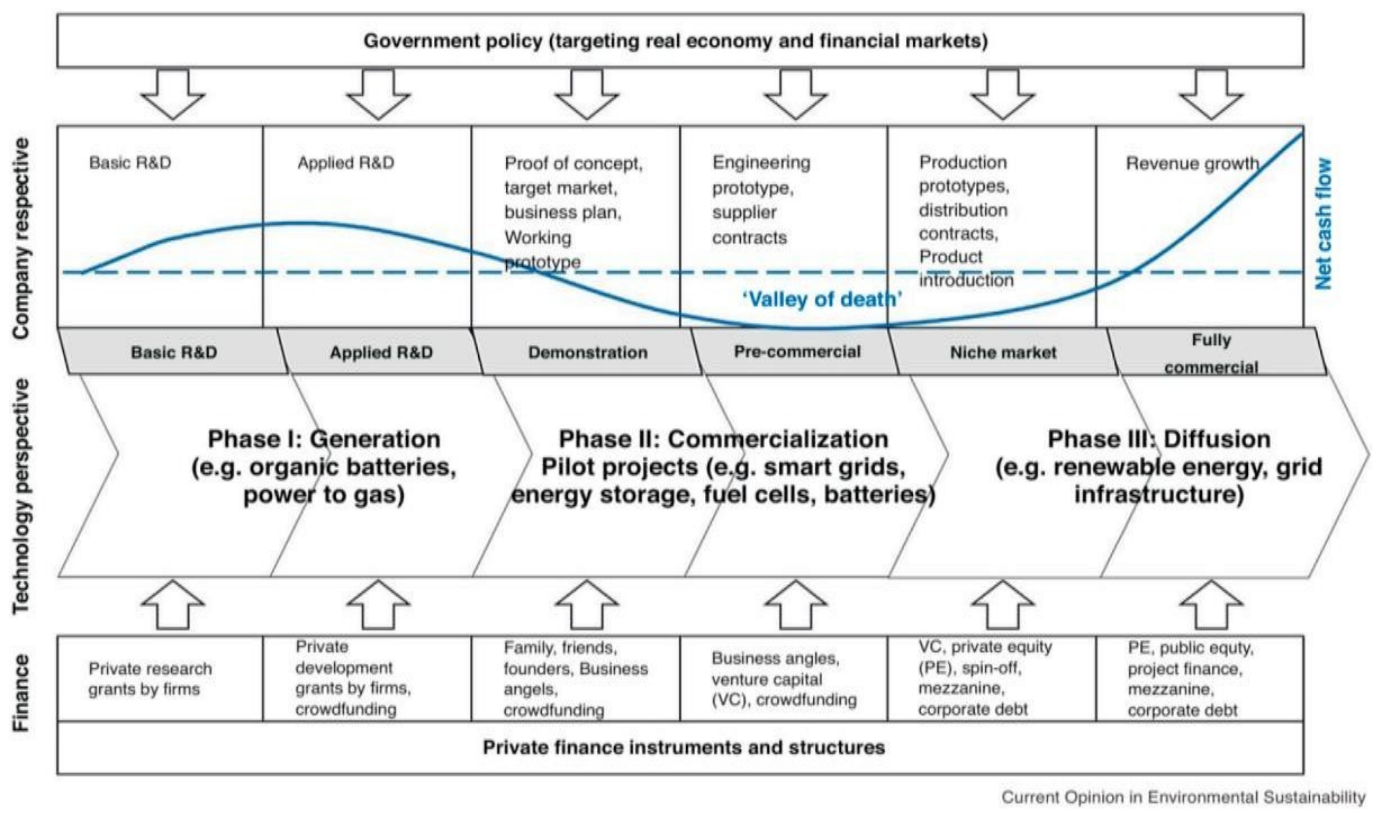
In this sense, the rapid advance of hydrogen technologies, added to the perception that their development is inevitable for a low-carbon society, resulted in a set of policies and financing structures focused on hydrogen [35]. As it is a technology under development and not yet disseminated on a large scale, the implementation and operation of projects in the green hydrogen production and logistics chain involves, in its initial phases, technological risks, including cost overruns, extended implementation timelines, learning curves, scalability constraints, and technical performance uncertainties in both implementation and operation. The framework developed by [36] relates the research and development (R&D) life cycle to a required funding mix: public investment via grants, subsidies, and incentives tends to generate positive cash flows for companies in early stages, while pilot demonstration, pre-commercial, and niche phases are most challenging as cash flows typically become negative. Only when the companies reach the commercial phase are they expected to be profitable and thus bankable. One structural feature of this innovation process is the potential needs, referred to in the literature as the “valley of death” [37].
This phased logic also explains why governments have accepted the role of market makers, creating structures that provide long-term guarantees for private companies to innovate and develop renewable energy production [38]. For most private investors, the combination of high risks and low returns represents a space of limited interest, given that the risks and costs of renewable energy far surpass those of other technologies.
In this way, Figure 1 shows different sources of financing in the phases of the project life cycle, considering they have different risks and return profiles and need to match the expectations of entrepreneurs.
Capital markets, particularly green bonds, are a key channel for supporting green initiatives [35]. Financial and technological innovations, such as blockchain, fintechs, green credit, investment funds, venture capital, and private equity, have expanded financing possibilities and supported the development of cleaner energy solutions. The depth of capital markets positively influences the progress of the transition, especially in more mature economies, where a broader range of instruments is available, and the cost of capital tends to be lower. Government agencies are involved in about 50% of R&D spending in the renewable energy sector [39]. In the market creation and deployment phase, additional public-sector players come into the picture, from state public banks to private-equity (PE) and venture-capital (VC) investment funds. Europe, for instance, has announced €70 billion of public funding pledged by different governments to support the hydrogen industry, with half of it coming from the European Union, aiming at reducing the cost of green hydrogen production, encouraging end uses in the industrial and transportation sectors, and improving electrolyzer performance [40].
On the other hand, IRENA [26] highlights that the main challenges of energy transition finance stem from the concentration of investment in a limited number of technologies, markets, and geographies, leaving much of the developing world and less mature segments on the margins. Although more mature renewable technologies have improved access to debt financing, projects in higher-risk settings continue to face significant barriers, including elevated capital costs, currency risks, less creditworthy offtakers, regulatory constraints, limited financial-instrument liquidity, and a mismatch between project characteristics and the preferences of institutional investors. Most companies have identified difficulties in securing affordable financing to implement innovative technological advances in green hydrogen [41]. The main factors that continue to hamper financing are as follows: (a) returns that are not commensurate with the level of risk; (b) high technological risk; (c) volatility in prices; and (d) limited results from pilot projects. In addition, there is a mismatch between short-term financing—typically 5 to 7 years—and the long-term nature of the investment (around 20 years), with amortization periods ranging from 10 to 20 years [41].
Overcoming these limitations requires a combination of long-term energy planning, stable regulatory frameworks, risk-mitigation instruments, and financial innovation. In this regard, development banks and other public financial institutions play a key role in expanding concessional finance, promoting blended finance, and supporting instruments such as guarantees, on-lending, green bonds, and contractual standardization mechanisms capable of enhancing project bankability and attracting private capital [26]. The capital-intensive nature of hydrogen projects—encompassing production, storage, transport, and end-use applications—requires specific financial instruments tailored to project risk profiles, long payback periods, and the evolution of market demand [42]. Rushton and Patonia [42] define bankability of hydrogen projects as the extent to which a project can be considered financeable by lenders and investors, based on the robustness of its risk-return profile, the predictability of its cash flows, and the strength of its legal and contractual structure. A bankable project must demonstrate technical viability, regulatory adequacy, transparent governance, and, above all, a high degree of revenue certainty over its life cycle. The main risks considered by lenders include technological and engineering risks, execution and development risks, financial and market risks, and regulatory and public policy risks, with demand (offtake) and regulatory risks identified as the most critical for enabling project financing.
Debt-financed hydrogen projects remain incipient [43], which is challenging given that no single financial agent has sufficient resources to develop a scalable market in a renewable energy technology on its own. Financial solutions such as Project Finance (PF) are more feasible for larger-scale projects with commercialization potential; however, obtaining PF depends on the project’s ability to demonstrate sufficient future cash flow generation to cover both operating expenditures and financing costs. The experience of projects that reached financial close indicates that they combined stable public support, long-term offtake agreements, value-chain coordination, and risk-mitigation instruments [42]. Entrepreneurs must liaise credible technology with an established customer base or long-term contracts with power producers and offtakers, securing prices and mitigating uncertainties [43].

2.2. Hydrogen Deployment Economics

The authors in [44] emphasize that hydrogen should be understood not as a primary energy source but as an energy carrier whose relevance derives from its versatility across hard-to-abate sectors, such as heavy transport, industry, energy storage, and the production of derivative fuels such as ammonia and methanol. In this context, the emergence of a hydrogen economy depends on the coordinated development of the entire value chain, as well as on the consolidation of specific markets, financing instruments, institutional governance centers, and international cooperation arrangements. The expansion of international hydrogen markets may contribute to cost reductions and to the optimization of production in strategically advantageous locations. As argued in [45], the development of the hydrogen economy will depend on the combination of technological innovation, institutional coordination, long-term financing, and the mitigation of geopolitical tensions, enabling hydrogen to become an effective component of a sustainable and economically viable energy transition.
On the other hand, Boretti and Pollet [46] argue that the hydrogen economy is characterized by market failures that limit the effectiveness of a purely free-market-driven dynamic, particularly in the early stages of technological development and supply chain formation. High upfront costs associated with production, storage, distribution, and end-use technologies, combined with market fragmentation, the absence of regulatory and technological standardization, and the need for coordinated infrastructure investments across the entire value chain, increase uncertainty and reduce incentives for private investment. In this setting, the risk of underinvestment in strategic assets and in research and development tends to undermine technological progress, the formation of economies of scale, and market consolidation. Therefore, the transition to a hydrogen economy requires active and long-term government intervention through stable regulatory frameworks, economic incentives, support for innovation, infrastructure coordination, and international harmonization initiatives to create the conditions for the efficient expansion of the sector and for the achievement of decarbonization goals.
According to Delpisheh et al. [47], the type and magnitude of the impacts arising from the implementation of hydrogen policies in an economy depend on the specific characteristics of the country under consideration. Several aspects are highlighted, including the sectors in which hydrogen is consumed, the technologies that hydrogen replaces, the domestic capacity for hydrogen production, the proximity of hydrogen production sites to observed demand centers, and the amortization schedule of capital investments. In addition, the socioeconomic consequences of integrating hydrogen into the energy mix depend on the long-term evolution of cost dynamics between hydrogen technologies and their sector-specific alternatives, which remain surrounded by significant uncertainty.

2.3. Policy Instruments for Hydrogen Development

As of October 2024, approximately 56 countries had formalized a dedicated hydrogen policy, of which 82% had adopted national strategies, while the remainder had issued roadmaps [48]. National strategies have primarily focused on fostering hydrogen production, especially green and blue hydrogen, and have become the main catalyst for government funding. The analysis of the strategies mentioned in [47] shows that R&D and subsidies are at the core of governmental attention. Regarding subsidies, ref. [14] demonstrates that they constitute a central component of national plans, taking the form of tax credits, public funds, R&D support, investment subsidies, support for hydrogen hubs, demand-side incentives, and certification and market-guarantee mechanisms.
These instruments align with a broader recognition that the energy transition will not happen on its own, leading governments to accept the role of market maker—creating structures that provide long-term guarantees for private companies to innovate and develop renewable energy production [38]. The risks and costs of renewable energy surpass by far those of other technologies; for most private investors, the combination of high risk and low return represents a space of limited interest. Public investment, therefore, plays an enabling role, particularly in the pre-commercial and niche phases of the innovation cycle, where cash flows are typically negative and private capital is scarce [36].
Vale de Paula et al. [14] argue that national plans have so far had a predominantly structuring and enabling effect, rather than producing fully consolidated outcomes in terms of mature market development. In general, national strategies have been successful in placing hydrogen at the center of decarbonization, energy security, and industrial policy agendas by establishing strategic direction, initial regulatory frameworks, R&D programs, financial incentives, and signals for private investment. The most visible results can be observed in project development, argue partnerships, and the definition of national roles within future global supply chains—as exporters, importers, logistics hubs, or producers oriented toward the domestic market. However, the authors note that these advances still coexist with significant limitations, including high costs, infrastructure bottlenecks, regulatory uncertainty, difficulties in coordinating supply and demand, and the absence of fully consolidated markets, indicating that the gains observed so far are promising, yet still partial and evolving.
On the other hand, ref. [49] contend that public support policies for low-carbon hydrogen generate significant but heterogeneous effects, depending on instrument design. Mechanisms based on actual hydrogen production—such as fixed premiums per unit produced and contracts for difference—tend to distort operational market signals more strongly, raising electricity prices at certain moments, lowering hydrogen prices, and altering the optimal dispatch of electrolyzers. By contrast, mechanisms based on installed capacity or investment subsidies interfere less with day-to-day operations and have therefore proven to be more cost-efficient for expanding renewable hydrogen production. Qadir et al. [50] conclude that the transition to renewable energy sources requires a robust political and institutional framework in which public policies play a decisive role by combining economic incentives, planning, regulation, and technological support to reshape the investment environment in favor of clean energy.

2.4. Financing Mechanisms of Selected Countries

This section describes the mechanisms proposed by Germany, Australia, and Brazil to finance projects across the hydrogen chain. These countries were selected because they represent complementary configurations of the hydrogen economy. Germany, as an advanced industrial economy, exhibits high potential demand in hard-to-abate sectors and has an explicit strategy of combining domestic production with imports, making it central to examining regulation, certification, long-term contracts, and market formation. It has become one of the leading global players in the hydrogen sector and maintains active commitments in more than forty countries. Germany’s fiscal strength provides it with the financial capacity to design funding programs aimed at attracting domestic and international investors to hydrogen production and export [23].
Australia stands out as a supply-oriented case due to its abundance of solar and wind resources, its tradition as an energy exporter, and its strategic position in the international trade of hydrogen and its derivatives. The Australian case is relevant for investigating how natural advantages and an export-oriented strategy can be translated into market leadership, or constrained by infrastructure, scale, and financing challenges [26].
Brazil combines attributes such as abundant renewable resources, a relatively clean electricity mix, potential for domestic use in refining, fertilizers, and industry, as well as export potential. However, it also faces challenges typical of emerging economies, such as higher capital costs, regulatory uncertainty, and infrastructure bottlenecks [28]. This combination enables a comparison, within the same analytical framework, of the determinants of public policy, incentives, and financing for renewable hydrogen.
Crucially, the heterogeneity across these cases is not a limitation but an analytical asset: by spanning different resource endowments, policy maturities, and financing environments, the sample maximizes the variance captured by the PCA, enabling a more robust identification of which variables consistently drive project differentiation regardless of national context.

2.4.1. Germany

Germany considers hydrogen as an essential element for advancing the decarbonization of several sectors, especially the hard-to-abate industries such as basic chemicals and steel, as well as aviation and heavy-duty shipping and transport, while also viewing it as a strategic asset for supply diversification [51,52]. In the long term, the country envisions green hydrogen as the primary production route to be adopted. To this end, the updated 2023 National Hydrogen Strategy doubled Germany’s domestic electrolyzer capacity target to 10 GW by 2030 [23,53]. However, given that domestic demand is projected to reach 95–130 terawatt-hour (TWh) by 2030, domestic production will fall drastically short of needs, with the country expecting to import between 50% and 70% of its required hydrogen [23,53]. Consequently, Germany is pursuing a highly outward-oriented strategy, establishing energy partnerships and hydrogen diplomacy with nations such as Australia, Namibia, Chile, Morocco, and Norway [23].
Given that the global market for this commodity is likely to be established within the next decade, the updated strategy permits limited, transitional use of low-carbon alternatives to accelerate early market development, particularly considering Germany’s extensive energy supply relationships across the European continent. Beyond decarbonization and energy security, the development of a hydrogen economy represents an opportunity to create a new industrial policy, one that takes into account the consequences of the COVID-19 pandemic [54].
Germany has presented the largest initiatives in green hydrogen development, through pilot and operational projects, as well as through greater availability of financial resources [29,55]. By 2030, €9 billion in public investments have been committed, of which of €8 billion are directed through the Important Projects of Common European Interest (IPCEI) program, supporting 62 projects throughout the green hydrogen value chain and funding up to 2,5 GW of electrolyzer capacity and 1800 km (KM) hydrogen pipeline core network [23,29,53]. To bridge the high cost gap between green hydrogen and fossil fuels and to mitigate investor risk, the government also employs several additional financial mechanisms.
Due to its expected role as a major hydrogen importer, Germany established H2Global, a double-auction mechanism operated by the Hydrogen Intermediary Trading Company GmbH (HINT.CO). Under this mechanism, HINT.CO signs long-term purchase agreements with international producers and short-term sales contracts with domestic consumers, while public funds cover the price difference between supply and demand. An initial allocation of €900 million was planned to support this stage [23,51]. Carbon contracts for Difference (CCfDs) further protect heavy industries from volatile carbon prices by guaranteeing a fixed strike price for avoided CO2 emissions, with roughly €50 billion set aside for this scheme [10,56]. Additionally, the Funding Guideline (2021–2024) initiative, launched in 2021, aims to finance international green hydrogen projects to promote the use of German technology abroad and further develop the hydrogen value chain. This non-refundable fund, with a total budget of €350 million, is designed to finance between 25% and 45% of the eligible costs of a project, with a maximum value of €15 million per project [52].
In view of the above, Germany, positioned as one of the main importers of hydrogen in the long term and as one of the leading suppliers of hydrogen technologies, plays a fundamental role in the viability of the international market. The proposed financing structure, designed to cover both domestic and foreign markets, enables the country to strengthen cooperation relations and achieve the multiple objectives of developing the hydrogen economy. The summary of the policies mentioned in the German case is presented in Table 1.

2.4.2. Australia

In November 2019, the Australian government published its National Hydrogen Strategy, outlining a comprehensive set of political, economic, productive, consumption, and human development actions to guide the country’s hydrogen economy [57,58]. Australia possesses a distinctive combination of characteristics that position it as a potential hub of the global hydrogen economy, and the proposed strategy is a crucial factor for consolidating the country’s role in this emerging market. Australia’s strategic vision is distinctly outward-oriented, aiming to transition from a major global fossil fuel exporter into a clean energy superpower focused on the large-scale production and export of green hydrogen, targeting international markets such as Japan, South Korea, and Germany [59,60].
Through a gradual and adaptive approach, Australia aims to become one of the top three hydrogen exporters to Asian markets by 2030 [59], with a production target of 0.5 million metric tons (MMTs) of green hydrogen, scaling up massively to 15 MMT annually by 2050, when it seeks to establish itself as a major global exporter of both green and blue hydrogen, in accordance with international requirements and demand [12]. The foundational premise of this approach is to achieve an ambitious economic stretch goal to drive the production cost of clean hydrogen down to under AUD 2 per kilogram (KG) [24,60]. To reach the economies of scale required for these cost reductions and export volumes, Australia is facilitating some of the largest green energy projects in the world, such as the 26 GW Asian Renewable Energy Hub and the 5 GW Murchison Renewable Energy Hub [24,60].
With respect to domestic consumption, the strategy also recognizes the relevance of developing regional hubs (i.e., large-scale demand clusters in ports, cities, regional or remote areas, such as Port Kembla in New South Wales, Gladstone in Queensland, and Bell Bay in Tasmania), as a necessary condition for sharing infrastructure, costs, fostering innovation, and quickly establishing maritime export routes [16,59,61]. The strategy also targets domestic decarbonization in hard-to-abate sectors such as heavy transport, green steel, and chemical processing, which could generate an additional 3 to 7 million tons of domestic demand per year [25]. It is worth noting that Australia currently has a portfolio of 58 hydrogen projects across various segments of the value chain, of which 3 are already operational, 44 are under development, and 11 are under construction [59].
In terms of financial commitment, between 2015 and 2019, the Australian government invested AUD 149 million in hydrogen economy development projects (AUD 5.04 million) and pilot projects (AUD 68.57 million). In 2019, an additional AUD 70 million was directed to studies carried out by the Australian Renewable Energy Agency (ARENA) to demonstrate the technical and commercial feasibility of hydrogen production through electrolysis. In 2020, the government further committed AUD 300 million through the Advancing Hydrogen Fund, managed by the Clean Energy Finance Corporation (CEFC), an Australian government green bank established to facilitate increased funding flows to the clean energy sector, with the aim of supporting the growth of the entire hydrogen production chain in a competitive, safe, innovative, and clean manner [62].
Australia’s finance approach is predominantly supply-side, focusing on reducing the high capital and operational costs associated with green hydrogen technologies to stimulate the market. To directly lower the cost of production, the federal government introduced the Hydrogen Headstart program, which provides approximately AUD 4 billion in competitive production credits, complemented by the Hydrogen Production Tax Incentive (HPTI), which offers an AUD 2/kg refundable tax offset for up to ten years per project, with an estimated budget impact of AUD 6.7 billion over a decade [25]. Public agencies such as CEFC and ARENA act as critical financing vehicles through a co-investment model, aiming to leverage $3 to $6 of private-sector capital for every $1 of government funding [60]. To ensure the achievement of its energy transition goals, the Australian government coordinates the activities of several complementary institutions spanning basic and applied research, demonstration projects, commercialization, and market development, including ARENA, Commonwealth Scientific and Industrial Research Organization (CSIRO), CEFC, Australian Energy Market Operator (AEMO), Australian Energy Market Commission (AEMC), Australian Energy Regulator (AER), Energy Security Board (ESB). According to [63], Australia already has more than 80 projects throughout the hydrogen value chain, with particular emphasis on export development, representing an expected financial commitment of approximately US$900 million by 2030.
On the demand side, Australia utilizes the Safeguard Mechanism, a baseline-and-credit scheme that requires large industrial polluters to keep emissions below a declining cap or purchase carbon credits, which effectively acts as a carbon price that increases buyers’ willingness to pay for renewable hydrogen [25]. To facilitate international trade and transparent pricing, Australia has also legislated a Guarantee of Origin scheme to certify the emissions intensity of hydrogen products [25].
Overall, the development of Australia’s Hydrogen economy underscores the importance of public policies at both national and state levels to promote the maturation of the entire production chain. Also noteworthy is the breadth of monitoring and follow-up mechanisms embedded in the national strategy, designed to track technological progress and adapt to the numerous possible trajectories of this emerging economy. The summary of the policies mentioned in the Australia case is presented in Table 2.

2.4.3. Brazil

Brazil stands out as one of the most promising countries for the development of the hydrogen economy, particularly in terms of green hydrogen production capacity and exportation. The country’s highly renewable energy matrix, currently around 85% clean sources, provides a significant competitive advantage, and estimates by the Energy Research Office (EPE) suggest a technical potential to produce up to 1.8 gigatons (Gt) of low-carbon hydrogen per year. In 2021, Brazil launched its national hydrogen strategy through the National Hydrogen Program (PNH2), operating under a Triennial Work Plan (2023–2025), though the funding mechanisms to be adopted in this early stage remained under development [64,65]. Nevertheless, R&D incentives linked to the National Electric Energy Agency (ANEEL) program had already begun attracting investments in hydrogen, particularly in the northeastern states, and the National Bank for Economic and Social Development (BNDES) had begun studying the potential of this nascent industry, seeking alignment with its traditional renewable energy loan lines that could be adjusted to accommodate green hydrogen projects.
It is worth noting, however, that the Brazilian hydrogen market remains highly centralized and fossil-fuel dependent. Approximately 95% of the country’s hydrogen production is gray hydrogen, derived from the steam reforming of natural gas without carbon capture [66,67,68], with Petrobras dominating this landscape by producing and consuming the vast majority of this hydrogen internally for hydrotreatment processes in its oil refineries [67,68]. The remaining fraction is primarily utilized in the chemical industry for fertilizer and ammonia production [68]. Beyond green hydrogen, Brazil is also exploring a diverse set of production routes, including biogenic hydrogen—produced via biogas, biomass, and ethanol reforming from its robust agribusiness sector—and natural or geological hydrogen, with preliminary explorations indicating promising reserves in underground basins across states such as Minas Gerais, Rio de Janeiro, Ceará, Roraima, and Tocantins [68].
In 2020, the National Energy Plan 2050 (PNE 2050) identified hydrogen as a disruptive technology in the national context, acknowledging its potential to significantly transform the energy market while recognizing the need for greater investment and analysis regarding the integration of this energy vector into the Brazilian electricity sector [69]. Building on this foundation, in 2021, the EPE released the document “Bases for the Consolidation of the Brazilian Hydrogen Strategy”, addressing fundamental aspects for the creation of a Brazilian strategy for hydrogen [70]. In the same year, the Brazilian government, through the National Energy Policy Council (CNPE) and the Ministry of Mines and Energy (MME), reinforced hydrogen’s role as a strategic element for the development of the national energy sector, with CNPE Resolution No. 2 of 2021 formally establishing hydrogen as one of the priority topics for research, development and innovation in the energy sector, while also mandating that regulatory agencies such as ANEEL and Brazil’s National Agency of Petroleum, Natural Gas and Biofuels (ANP) prioritize R&D resources for hydrogen technologies [71].
The core of Brazil’s hydrogen strategy is directed by the PNH2, structured following CNPE guidelines and operating under a Triennial Work Plan (2023–2025) that establishes three key strategic milestones: disseminating pilot plants across all regions of the country by 2025, consolidating Brazil as the most competitive producer of low-carbon hydrogen globally by 2030, and consolidating integrated low-carbon hydrogen hubs by 2035 [65,72]. To formalize this strategy, Brazil enacted a milestone Legal Framework for Low-Carbon Hydrogen (Law No. 14.948/2024), which officially defines low-carbon hydrogen as having a lifecycle greenhouse gas emission intensity of less than or equal to 7 kg of CO2 equivalent per kilogram of hydrogen (kgCO2eq/kgH2), and establishes the Brazilian Hydrogen Certification System (SBCH2) to validate the sustainability and emissions intensity of hydrogen produced in the country, ensuring alignment with international standards [68,72].
To stimulate the market and attract private investment, the 2024 legal framework introduced two major economic incentive programs. The first is the Special Incentive Regime for Low-Carbon Hydrogen Production (REHIDRO), which provides exemptions from the Social Integration Program (PIS) and the Contribution for the Financing of Social Security (COFINS). These are federal taxes levied on gross revenue in Brazil, structured as social contributions to finance social security; their cumulative and non-cumulative regimes can significantly affect firms’ cost structures and investment incentives. Under REHIDRO, these taxes are waived for a period of five years starting on 1 January 2025, benefiting producers by eliminating PIS and COFINS on equipment, construction materials, and labor required for hydrogen project deployment, provided that companies meet minimum requirements regarding the use of domestic goods and services and investments in R&D [68,72]. The second is the Program for the Development of Low-Carbon Hydrogen (PHBC), instituted through complementary Law No. 14.990/2024, which grants tax credits to producers or buyers of low-carbon hydrogen that can cover up to 100% of the price difference between low-carbon hydrogen and fossil-based substitutes, supported by a global budget limit of BRL18.3 billion to be distributed between 2028 and 2032 [68,72]. Additionally, BNDES provides dedicated credit lines for hydrogen projects, including a specific program offering up to BRL 300 million for green hydrogen production and technological development, leveraging blended, low-interest resources from the Climate Fund [68,72].
The Brazilian experience also reaffirms the relevance of international cooperation for the advancement of hydrogen projects. The energy partnership with Germany, relaunched in 2017 with an emphasis on diversifying the electricity matrix, modernizing the sector, and promoting decarbonization, gained renewed momentum following the launch of the German Hydrogen Strategy in 2020. From that point, Brazil began exploring possibilities for cooperation with Germany, especially regarding the supply of green hydrogen to meet future European demand. In this context, the “Sectoral Mapping Study of Green Hydrogen in Brazil” was launched in 2021, with the objective of identifying the main agents involved in the hydrogen value chain and the associated opportunities [64,67,70]. In October of the same year, the German Agency for International Cooperation (GIZ) announced an investment of €34 million, through the hydrogen Brazil initiative, to develop green hydrogen production projects in the country [73]. The program is structured around five central pillars: improvement of the national regulatory framework, dissemination of information and knowledge on green hydrogen, professional training, promotion of innovative projects and market expansion, including the planned construction of a 5 MW pilot electrolysis plant [74]. The initiative specifically provides funding for test laboratories and green hydrogen production technologies at federal universities, such as Federal University of Rio de Janeiro (UFRJ) and Federal University of Santa Catarina (UFSC) [70,74]. More recently, the Green Hydrogen Innovation Program, iH2Brasil, launched in 2022 under the Brazil–Germany bilateral partnership, has further fostered open innovation in the green hydrogen sector by supporting startup acceleration and financing pilot projects [66,68].
In terms of infrastructure and export hubs, Brazil presents significant opportunities through its various oceanic ports. Dozens of large-scale projects have been announced, heavily concentrated in coastal port complexes such as Pecém in Ceará, Suape in Pernambuco, and Açu in Rio de Janeiro [75]. These hubs are highly export-oriented, designed to supply green hydrogen and ammonia primarily to the European market—for instance, through a direct connection between the Port of Pecém and the Port of Rotterdam in the Netherlands [76]. The government also utilizes Export Processing Zones (EPZs), free trade areas located mainly at ports that offer significant tax incentives, to attract foreign direct investment for these export-oriented projects [68]. While this export focus promises significant economic growth, it also raises concerns about the risk of “green dependence”—a scenario where Brazil exports its clean energy to decarbonize the Global North while neglecting the decarbonization of its own domestic industries [77]. Furthermore, a significant spatial gap exists between the best production zones in the Northeast and the major industrial consumption centers in the Southeast, which will require substantial future investments in transport infrastructure and pipelines to connect supply with domestic demand [75].
The summary of the policies mentioned in this case is presented in Table 3.

2.4.4. Comparative Overview

A comparative analysis of the three countries reveals distinct but complementary strategic positions, shaped by their natural resources and industrial needs. Germany positions itself as a technology provider and a massive importer due to its limited renewable resource endowment. The country has built its hydrogen strategy around securing imports and de-risking demand through sophisticated financial instruments like CCfDs and H2Global, prioritizing green hydrogen but pragmatically allowing transitional low-carbon alternatives. Australia, by contrast, aims to leverage its vast, low-cost solar and wind resources to transition from a fossil fuel exporter into a global green hydrogen exporter, taking a supply-side approach. The financial instruments created by the country aim to drive production costs below AUD 2/kg and achieve economies of scale required for large-scale export through production subsidies and tax incentives, such as the Hydrogen Headstart program and the HPTI. Brazil, endowed with a largely renewable grid and vast renewable resources, adopts a technology-neutral “low-carbon” definition. The country occupies an intermediate position, combining a recently established regulatory framework with tax exemption regimes and subsidized credit lines from development banks, while simultaneously targeting both export markets and domestic decarbonization.
A cross-cutting feature across all three cases is the central role of public financial institutions, whether through state-backed intermediaries, green banks, or national development banks, in de-risking early-stage projects and mobilizing private capital, reflecting a shared recognition that green hydrogen markets cannot emerge without sustained and coordinated government intervention. The main similarities and differences across the three national hydrogen strategies are systematically summarized in Table 4, which highlights how each country’s policy design reflects its distinct resource endowments, market position, and decarbonization priorities.

3. Materials and Methods

3.1. Data Analysis

3.1.1. Data Cleansing

For this study, the database provided in [55] was used, comprising 42 hydrogen projects, of which 20 are from Australia, 18 are from Germany, and 4 are from Brazil. The database describes hydrogen projects announced worldwide and reports their main technical characteristics, including host country, development status, production technology, production capacity, use (or not) of dedicated energy source, and intended end uses.
Given these characteristics and the proposed objective of this work, four selection criteria were defined. The first criterion concerned the definition of the countries to be evaluated: Germany, Australia, and Brazil. The second criterion refers to the selection of production technology, including proton exchange membrane (PEM) electrolyzers, alkaline (ALK) electrolyzers, and electrolysis technologies. The third criterion concerned the source of the electricity used in production, namely surplus of renewable electricity and renewable energy plants. Finally, the fourth criterion referred to the project output: green hydrogen.
As expected, projects with financial and economic feasibility studies and under development are the most prevalent, accounting for 33.3% and 21.4% of the sample, respectively. When projects are classified by production technology, CCS routes account for 52.4% of the sample, while PEM represents 33.3%, and ALK is merely 6%. These technologies are among the most used in the three countries analyzed, partly due to the potential for hydrogen blending into the gas grid and the lower acquisition cost. The renewable electricity sources are mainly solar photovoltaic (PV) plants (21.4%) and onshore wind farms (14.3%). Regarding electrolyzer capacity, half of the projects (50.0%) with available capacity data are small-scale (<10 MW), while 16.7% are medium-scale (between 10 MW and 100 MW).
Finally, to evaluate the economic and financial aspects we complemented the original database with the following variables: (i) capital expenditure (CAPEX); (ii) operating expenditure (OPEX); (iii) levelized cost of electricity (LCOE); (iv) LCOH; (v) weighted average cost of capital (WACC); (vi) equity; (vii) debt; (viii) grant; and (ix) end use. While the analysis is grounded in real-world projects, the dataset is partly hybrid in nature. CAPEX and OPEX figures were drawn from project announcements and prospects, whereas other economic and financial variables (LCOE, LCOH, WACC, equity, debt, and grant shares) were estimated based on nationwide hydrogen roadmaps and benchmark values from the literature, particularly [16,17] for Australia and Germany and [78] for Brazil, as detailed in Table 5. Findings should therefore be interpreted with this data structure in mind, and future research should prioritize the collection of fully disaggregated project-level data as sector transparency improves. All assumptions are shown in Table 5.
Moreover, this dataset comprises an initial sample of 42 hydrogen projects, of which 19 include original, project-specific financial data obtained directly from publicly available prospectuses and technical documentation. These sources provide detailed information on key variables such as CAPEX, OPEX, WACC, and elements of the financing structure (Equity, Debt, and Grants). While this approach ensures dataset completeness and cross-country comparability, it may reduce the degree of within-country heterogeneity captured in the analysis. To address this limitation, robustness checks excluding proxy-based observations were performed, yielding qualitatively consistent PCA results (see Section 4). These considerations are explicitly acknowledged as a methodological boundary, and the findings should be interpreted in light of this hybrid data structure.

3.1.2. Exploratory Data Analysis

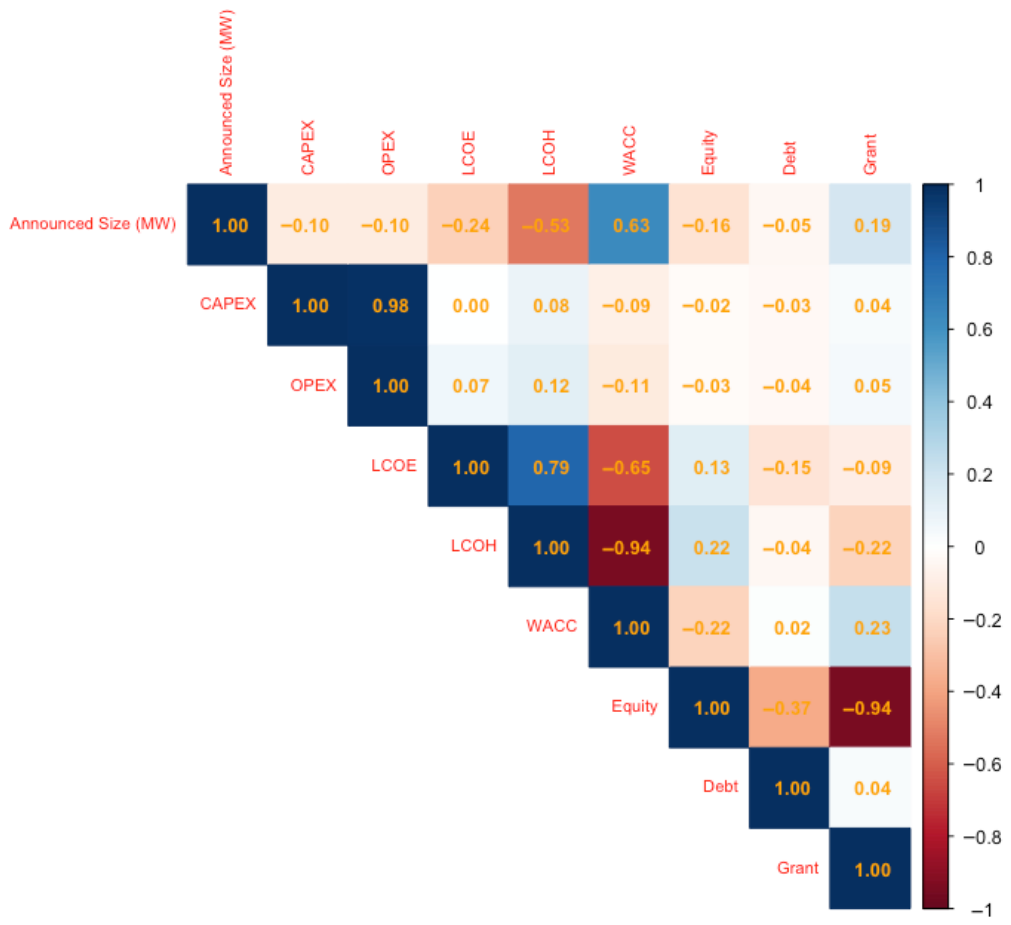
To understand the trend dynamics among those variables, we run a correlation matrix as shown in Figure 2.
The correlation matrix reveals strong structural coupling between CAPEX and OPEX (0.98), LCOH and WACC (−0.94), and Equity and Grant (−0.94), which indicates that project scale and financial structuring are jointly determined, forming a dominant latent dimension. The near-perfect correlation between CAPEX and OPEX (0.98) suggests a pronounced scale effect, whereby larger projects systematically entail higher operating expenditures. Rather than indicating a distinct economic relationship, this pattern is consistent with proportional scaling in capital-intensive infrastructure projects.
A similarly strong negative correlation is observed between LCOH and WACC (−0.94). While this might appear counterintuitive from a theoretical standpoint—since higher capital costs are typically expected to increase levelized costs—it likely reflects data structure and project heterogeneity—3 different countries, including differences in financing assumptions and technological maturity—6 types of technological life cycles. Therefore, this relationship should be interpreted with caution, as it may capture underlying clustering effects rather than a direct economic mechanism.
The strong negative association between Equity and Grant (−0.94) indicates a possible substitution pattern within the financing structure, whereby projects relying more heavily on public funding tend to require less private equity participation. This is consistent with the early-stage nature of the sector, where public government supports mechanisms partially crowd in or even replace private capital.
In contrast, operational cost and financing-led variables present a moderate correlation, which are seen between LCOE and LCOH (0.79) as well as LCOE and WACC (−0.65), suggest that operational cost conditions and capital costs are intertwined. These relationships indicate that electricity costs remain an important component of hydrogen production costs. The near absence of correlation between debt and other variables further highlights the limited role of traditional project finance in this nascent sector.
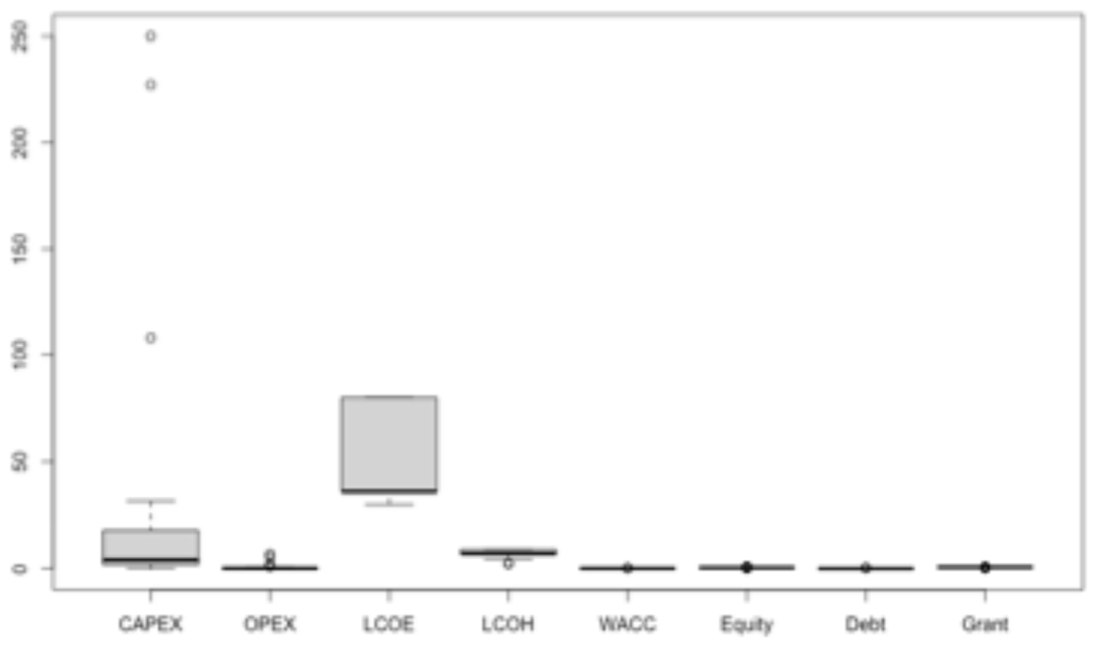
In terms of descriptive statistics—both indicators and boxplots—Table 6 and Figure 3 reveal substantial heterogeneity across the variables, both in terms of central tendency and dispersion.
CAPEX presents a markedly right-skewed distribution, as evidenced by a mean significantly higher than the median and the presence of extreme maximum values exceeding 200 M US$/MW (see Figure 3). The wide range and elevated standard deviation indicate strong dispersion led by three main projects—SALCOS—WindH2 (Germany), Unisa, Mawson Lakes campus, and Project Haber (Australia), which are large-scale and capital-intensive projects. OPEX exhibits a less pronounced pattern when compared to the latter, which indicates moderate positive skewness. This suggests that operational expenditures are more homogeneous across projects, with limited extreme variation, despite the outliers shown in Figure 3 below, which are related to the three projects mentioned above.
LCOE displays a relatively high standard deviation and a broad interquartile range, indicating significant variability in electricity costs across projects. The proximity between the mean and the median suggests a more symmetric distribution. In contrast, LCOH shows a narrower range and lower dispersion, with mean and median values more closely aligned. This indicates a more concentrated distribution of hydrogen production costs, suggesting that despite variation in input costs (LCOE), the resulting LCOH may be partially constrained by technological maturity.
The financial indicators—WACC, Equity, Debt, and Grant—exhibit relatively low standard deviations and narrow ranges, reflecting their importance in the financial structure as percentage variables.
Taken together, the descriptive indicators highlight an asymmetry in variables expressed in monetary terms (particularly CAPEX and, to a lesser extent, LCOE), whereas percentage-based financial variables remain tightly distributed. This is the reason standardization is applied. In terms of outliers, we have decided to include them within the model so as to remain as close as possible to the existing heterogeneity in green hydrogen projects.

3.2. Principal Components Analysis

In this work, we will perform principal component analysis (PCA), which is a technique to reduce the size of a data matrix to represent it in a low dimension, since not all random variables are significant. The PCA was conducted using a correlation matrix, rather than a covariance matrix. This choice is motivated by the heterogeneous scale of the variables included in the dataset—particularly CAPEX (measured in monetary units), installed capacity (MW), and financial ratios (percentages). Using a covariance matrix in this context would bias the results toward variables with larger magnitudes. Formally, the PCA was implemented on the standardized data matrix:
Z i j = X i j μ j σ j
where μ j and σ j are the mean and standard deviation of variable j . This transformation ensures zero mean and unit variance, implying that the PCA is effectively based on the correlation matrix rather than the covariance matrix. This ensures that all variables contribute equally to the component structure. Standardization was performed using Z-score normalization, implemented in R statistical 2026.01.1+403. software. This procedure centers each variable at zero mean and rescales it to unit variance. The use of standardized variables is particularly important in this study, as it avoids the dominance of scale-dependent variables and allows the identification of latent structures driven by relative variation rather than absolute magnitude.
In addition, prior to standardization, CAPEX and OPEX were divided by installed electrolyzer capacity (MW), generating intensity measures (US$/MW). This step was introduced to control for scale effects, avoiding any dominance effect. This was very important in order to incorporate two major projects—Project NEO and Wilhelmshaven LNG terminal—and minimize their dominance.
Categorical variables—specifically Country, Project Status, Electrolyzer Technology, and Electricity Type—were excluded from the model in order to avoid scale-influence and ensure that categorical information does not distort the variance structure.
In terms of robustness, it is important to underscore that PCA in this study is not used as a purely descriptive statistical tool, but as a method to uncover latent structural dimensions of green hydrogen projects, particularly the interaction between the capital intensity (CAPEX, capacity), financing structure (Equity, Grants, Debt) as well as operational efficiency (LCOE, LCOH).

PCA Mathematical Form

The dimensions formed by PCA are a linear combination of the continuous variables used, and the outcome is a higher-order covariance sequence (decreasing in its overall contribution). If they have positive (negative) covariance, they tend to show similar (opposite) behavior. Let X R n × k denote the data matrix, where n is the number of projects (observations) and k is the number of continuous variables. In this study, we consider X R 42 × 8 with the following variables:
X = [ CAPEX ,   OPEX ,   LCOE ,   LCOH ,   WACC ,   Equity ,   Debt ,   Grant ]
and since the variables are measured in different units, the data are standardized as in Equation (1).
The covariance (or correlation) structure is then given by
S = 1 n 1 Z Z
where S R k × k is symmetric. The principal components are obtained by solving the eigenvalue problem:
d e t ( S λ I ) = 0
which yields eigenvalues λ 1 λ 2 λ k and corresponding eigenvectors a 1 , a 2 , , a k . Each principal component is defined as a linear combination of the standardized variables:
Y m = a m Z = a m 1 Z 1 + a m 2 Z 2 + + a m k Z k
where
i.
Y m is the m -th principal component;
ii.
a m represents the loadings;
iii.
λ m = Var ( Y m ) .
The principal components satisfy the following properties:
i.
Var ( Y m ) = λ m ;
ii.
Components are ordered such that λ 1 λ 2 λ k ;
iii.
Total variance is preserved: m = 1 k λ m = k (under standardization);
iv.
Components are mutually orthogonal (uncorrelated).
The number of retained components is determined based on the cumulative explained variance criterion (typically ≥70%), complemented by scree plot inspection.
In the next section, we will deep dive into the output of PCA, considering the evaluation of the degree of influence of each variable from our list on each other and therefore, the weight of each variable on the component.

4. Results and Discussion

Based on the methodology presented in the previous section, PCA was applied with the following assumptions: (a) in cases of values not defined or unavailable in the project, the data from the national hydrogen strategies within the three countries was assumed; (b) End Use was established as dichotomous explanatory variables; (c) the variables Country, Status, Electrolyzer Technology, Production, and Electricity Type were categorized.
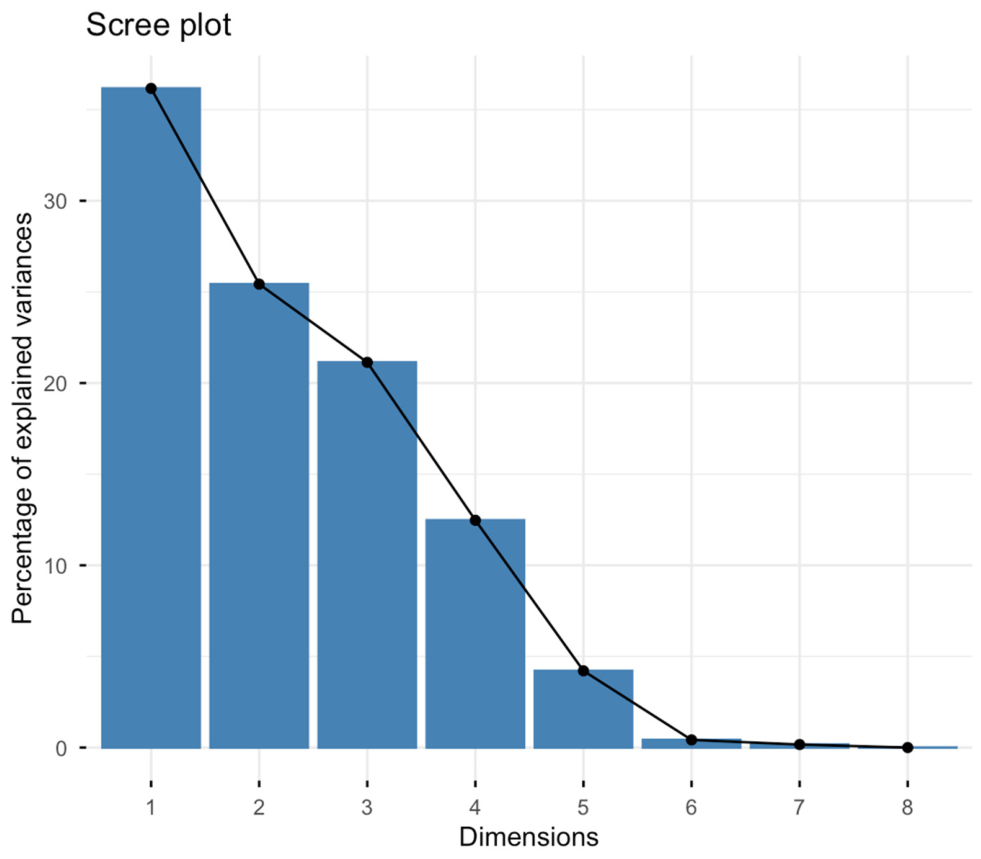
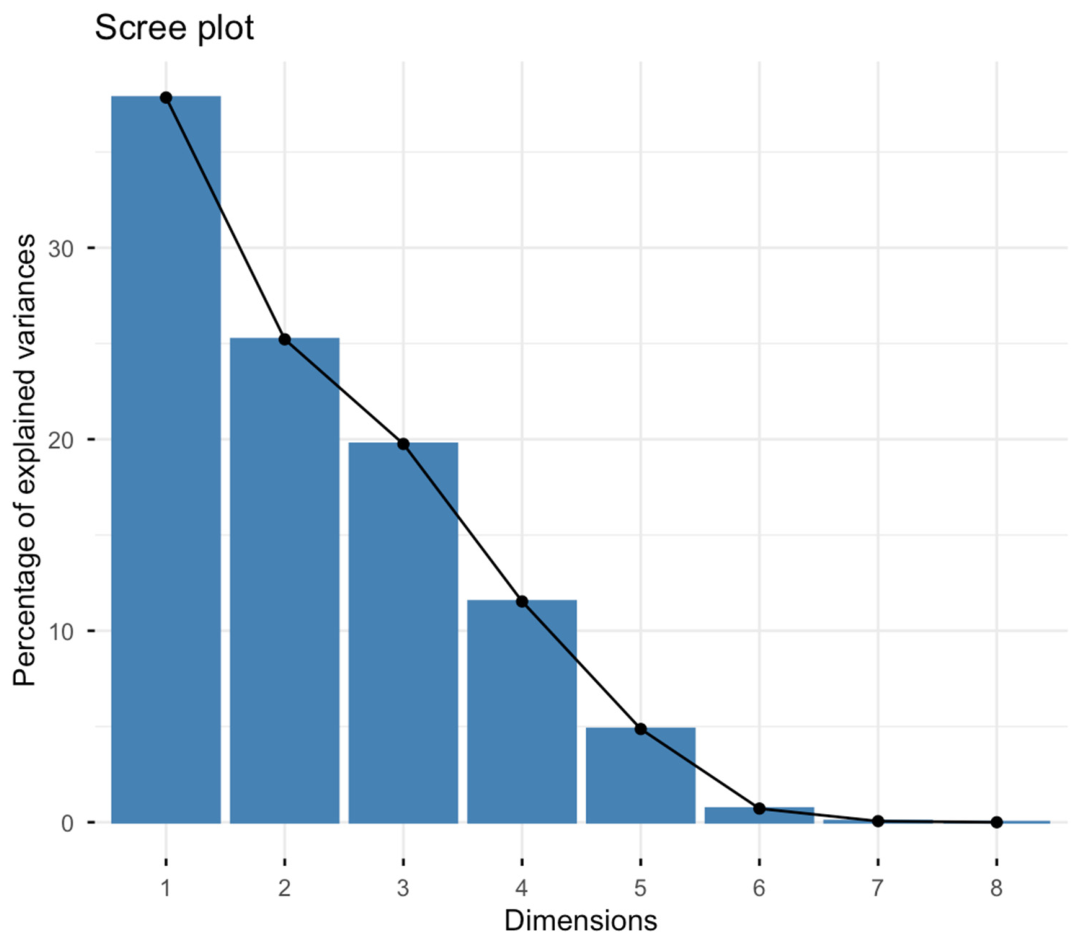
The PCA results, as illustrated in Table 7 as well as in Figure 4 and Figure 5, indicate a relatively steep decline in explained variance across the first components. The first principal component accounts for the largest share of total variance (36.2%), followed by a gradual decrease across subsequent dimensions. The first three components together explain a substantial proportion of the total variance (82.7%), while higher-order components contribute only marginally. The shape of the scree plot also indicates a clear elbow after the third or fourth component, implying that additional dimensions provide diminishing explanatory returns.
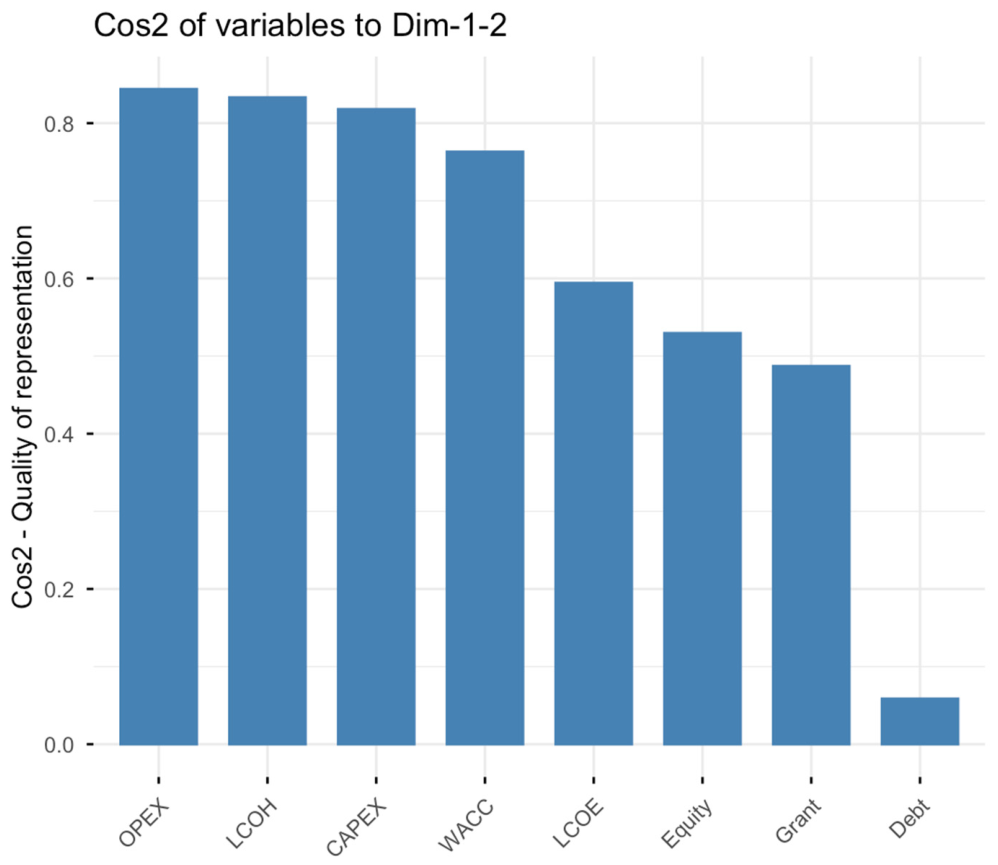
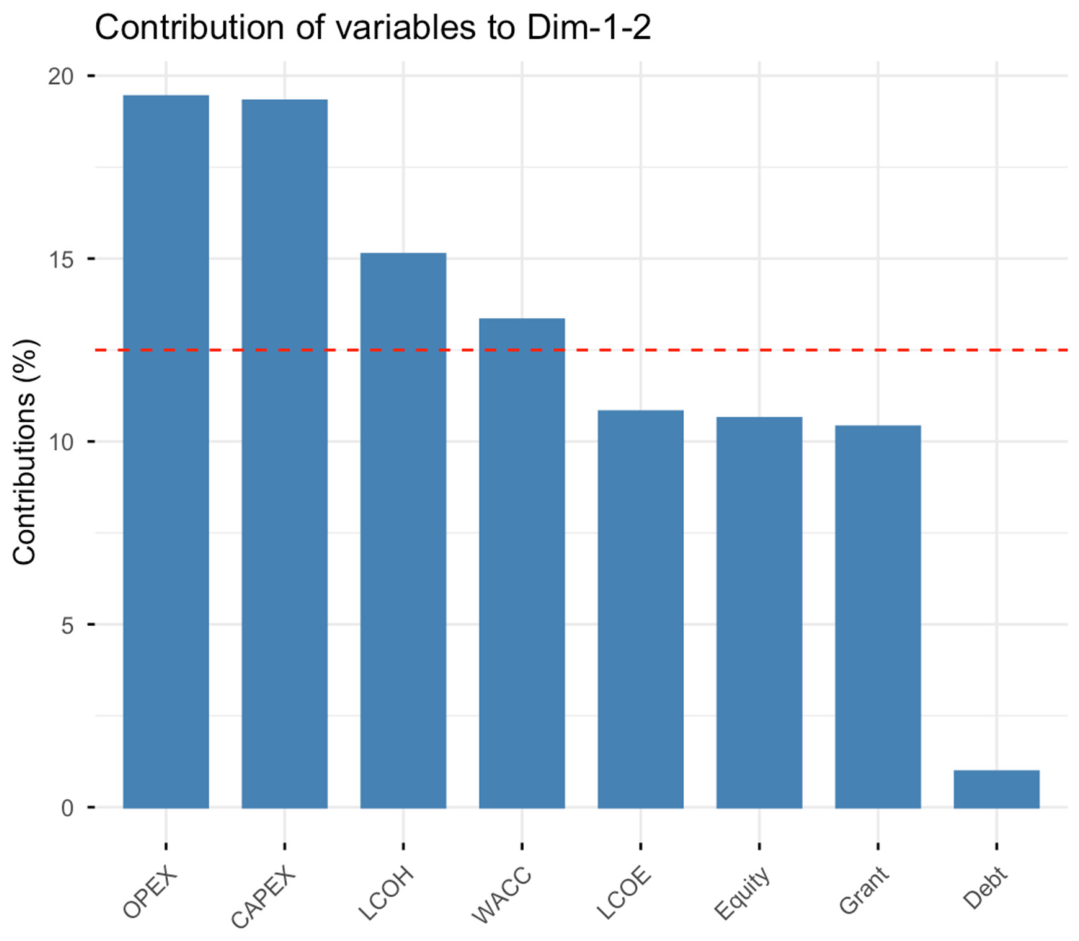
More explicitly, Figure 5 provides further insight into the quality of representation of each variable in the reduced-dimensional space. OPEX, LCOH, and CAPEX exhibit the highest values, indicating that these variables are well represented by the first two principal components. This implies that they play a prominent role in defining the primary variance structure of the dataset. WACC and LCOE also display relatively strong representation, albeit at a slightly lower level, indicating their relevance in shaping the second dimension. In contrast, Equity and especially Debt show weaker values. This is consistent with the correlation analysis, which indicated a limited systematic association between Debt and the other variables. As such, Debt appears to represent a more idiosyncratic or project-specific dimension that is not strongly aligned with the dominant variance structure.
Government-backed mechanisms—such as Germany’s National Hydrogen Strategy [54], its international funding guidelines [52], and instruments like H2Global [51]—illustrate how public guarantees, grants, and contracts for difference are used to lower perceived risk and improve bankability. Similar institutional efforts are visible in Australia’s hydrogen strategy [58] and its project mapping initiatives [59,63], as well as in Brazil’s policy guidelines [70,72,78], energy planning documents [64,67], and bilateral cooperation programs [73,74,85]. These policy frameworks substantiate the PCA result that grant financing explains variance across projects.
The contribution of WACC reinforces the idea that the cost of capital matters but remains secondary to capital access itself in early-stage sectors. Reports from financial institutions and advisory bodies emphasize that green hydrogen projects currently face high uncertainty, regulatory complexity, and demand risk [40,43,62]. Therefore, financial structuring—rather than purely financial optimization—becomes decisive. This interpretation is consistent with analyses of green finance mobilization for renewable energy and sustainable development [86,87,88].
This result is fully in line with [38], as there is a perception that the energy transition will not happen by itself, and governments must absorb the role of market maker by creating structures that provide funding guarantees for private companies to invest in green hydrogen and in other types of renewable energy. In addition, governments are realizing that the risk-cost ratio of renewable energy surpasses that of other technologies by far, and therefore, for most investors, the combination of high risk and low return is a no-go economic area, leaving renewable energy projects with a low priority in terms of investment. In the specific case of hydrogen, which is a nascent industry, the importance of CAPEX and OPEX and their respective financing is noted as fundamental to the success of these projects.
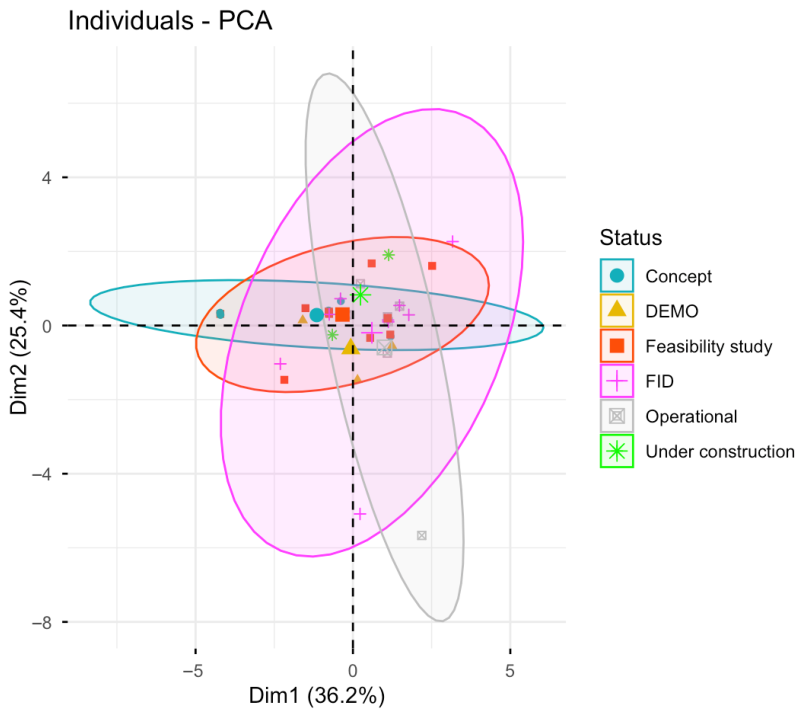
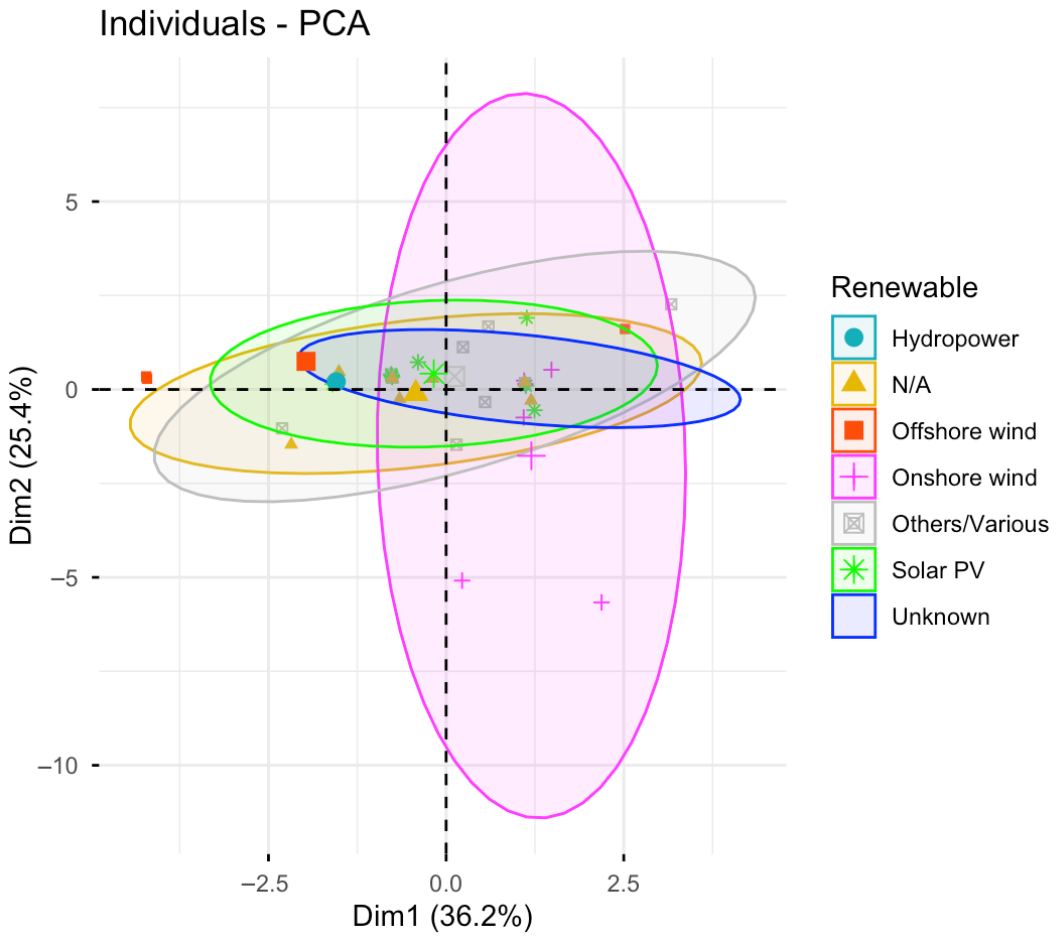
Another important point is the scale of these projects, considering that it can influence both components. It should be emphasized that the main projects are still in the pilot phase or in the study phase of economic and financial feasibility (finished or under development), as demonstrated in Figure 6. In addition, as shown in Figure 7, the predominance of solar/photovoltaic and wind energy as sources for the catalytic process must be noted. This fact converges with [38], according to which, in the period 2012–2017, one-third of all private equity investments were focused on the renewable energy industry, with venture capital funds targeting solar projects.
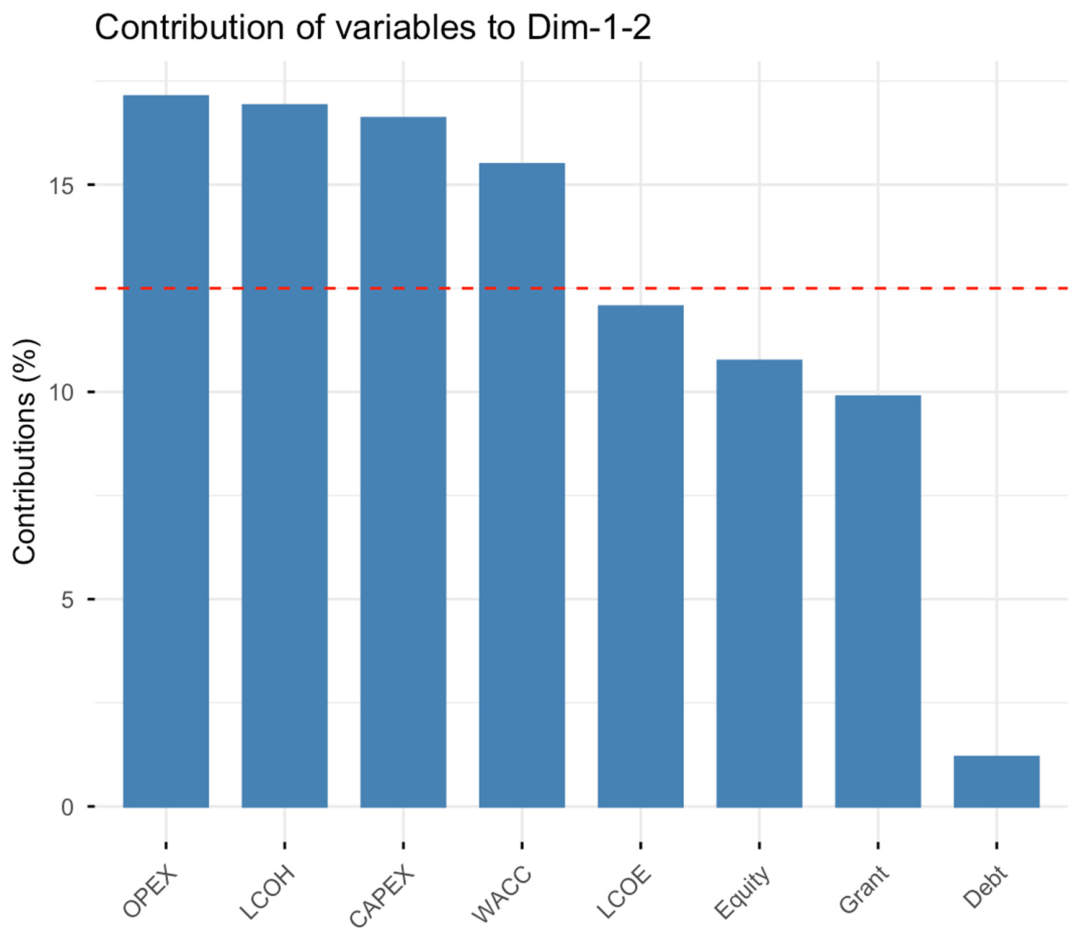
The persistence of these variables as dominant contributors, both shown in Table 8 as well as in Figure 8 below—OPEX, LCOH, CAPEX, and WACC—even with extreme-scale projects, supports the hypothesis that structural capital intensity defines the sector. This aligns with global assessments emphasizing that hydrogen scale-up depends fundamentally on mobilizing large volumes of capital before reaching cost parity with conventional fuels [41,57].
Overall, the PCA loadings empirically corroborate the argument derived from the systematic review: green hydrogen expansion is finance-led, and the feasibility of projects relies on the ability to secure blended finance, public guarantees, and strategic positioning within national hydrogen strategies [5,7,54,58,64].
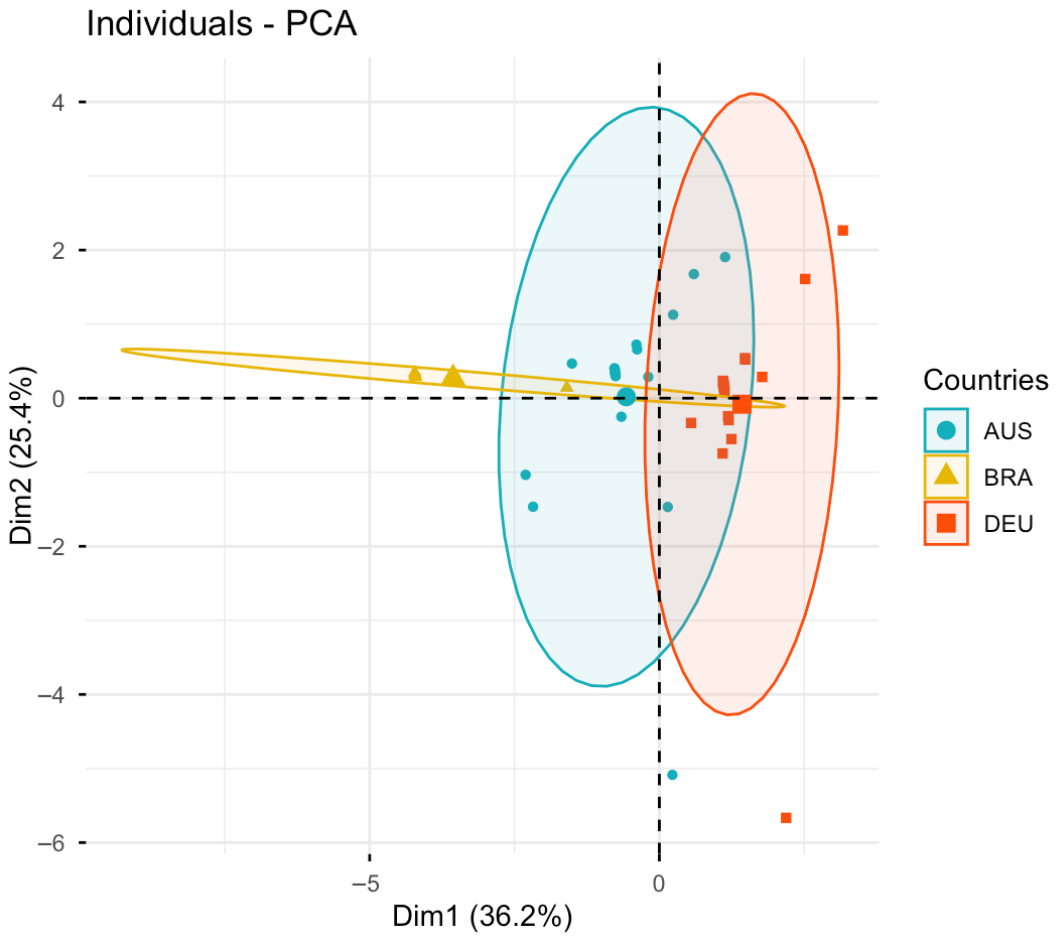
In terms of country-level patterns (Figure 9), the PCA reveals distinct clustering structures across Germany, Australia, and Brazil. German projects are predominantly located in the positive region of the first principal component, suggesting association with the capital–financing dimension captured by this axis. While PCA does not isolate individual policy instruments, this pattern is consistent with the structured financing environment observed in Germany [82,83].
Australian projects exhibit greater dispersion, particularly along the second principal component, indicating higher heterogeneity in costs and financial conditions across projects. This suggests a more diversified project landscape, rather than a purely scale-driven configuration [59,80,81].
Brazilian projects are tightly clustered and positioned in the negative region of the first component, indicating lower association with capital-intensity variables. This pattern is consistent with smaller-scale and more homogeneous project configurations. However, as a caveat, project maturity or development stage should be approached cautiously, as these dimensions are not directly captured by the PCA [78,79].
Overall, these results highlight cross-country differences in project structuring and financing patterns but should be interpreted as statistical associations rather than evidence of causal policy effects.
In fact, given the nascent context of the green hydrogen industry, as most of the projects are of medium and small scale, a large part of the financing of their respective CAPEX stems mainly from agencies and governmental bodies (BMWi, BMVi, ARENA, ANEEL), development banks (CEFC, BNDES, etc.), or directly from Federal or State Governments.
The results contribute to addressing several gaps identified in the literature review. The first concerns the application of PCA to a set of real-world hydrogen projects across the countries analyzed in this study. In this way, the analysis provides a data-driven assessment that considers the technical, economic, and financial dimensions of the projects, going beyond the fragmented approaches that characterize part of the existing literature, which tends to address these dimensions in isolation. Second, the empirical evidence drawn from actual project data sheds light on financing structures that are rarely captured in techno-economic models or qualitative policy studies. Third, the cross-country comparative design partially addresses the scarcity of studies examining how different national strategies shape project characteristics and investment patterns. Finally, the PCA results help identify which factors are most decisive in differentiating projects, an issue that the literature has not yet systematically addressed through multivariate empirical analysis. That said, some gaps remain only partially addressed; for example, the study does not directly measure project outcomes or financial performance, and the limited availability of granular financing data continues to constrain the depth of project-level empirical analysis.
These findings differ in important aspects from some previous studies. A substantial part of the literature on the hydrogen economy emphasizes operating cost variables, particularly electricity prices and LCOH, as the main determinants of project viability and competitiveness [1,2,3,4,6]. By contrast, the PCA results indicate that LCOE and LCOH have limited explanatory contribution to the first principal component, suggesting that operating cost efficiency is not yet the main factor differentiating projects at the current stage of market development. This difference may reflect the fact that most cost-oriented studies are based on techno-economic modeling rather than real project data. Although Rezaei et al. [17] and Taghizadeh-Hesary et al. [19] highlight the sensitivity of project viability to financial variables, the present analysis finds that access to capital prevails over capital cost optimization in explaining variance across projects. This suggests that, at the current stage of the hydrogen economy, access to financing may be a more relevant constraint than optimizing its cost, with potential implications for both investment strategy and public policy design.

PCA Robustness Check

Given the hybrid nature of the dataset, we conducted a robustness check by excluding observations that relied on proxy-based values. The results indicate that the PCA structure remains qualitatively stable, with no substantive changes in the ordering or relative importance of the principal components (see Figure 10 and Table 9). In particular, the dominance of the first components and the overall distribution of explained variance are preserved, suggesting that the core patterns identified in the baseline specification are not driven by the use of benchmark assumptions. This consistency reinforces the reliability of the findings and indicates that the main variance structure reflects underlying project characteristics rather than artifacts of data imputation.
In terms of variables’ contributions, Table 10 and Figure 11 show that the main structure remains largely unchanged, with one notable adjustment: CAPEX emerges as the second most influential variable, replacing LCOH. This shift suggests that, once proxy-based observations are excluded, the variance structure becomes more strongly anchored in capital intensity rather than cost-based indicators. Such a result is consistent with the economic literature on emerging energy technologies, which emphasizes the central role of upfront investment requirements and financing conditions in shaping project differentiation, particularly in capital-intensive and early-stage sectors like green hydrogen.
These considerations are explicitly acknowledged as a methodological boundary, and the findings should be interpreted in light of this hybrid data structure.

5. Caveats and Conclusions

The empirical findings of this study indicate a strong statistical concentration of variance around capital intensity and cost-related variables in green hydrogen projects. Across the sample, CAPEX (normalized by installed capacity), OPEX, and LCOH emerge as the primary contributors to the principal components, while financial variables—particularly Equity and Grants—play a secondary but still relevant role. These results suggest that project heterogeneity is closely associated with differences in cost structure, scale, and financing arrangements, rather than being driven by any single determinant in isolation. Importantly, the robustness check performed using only non-proxy observations confirms that this overall structure remains qualitatively stable, with only minor adjustments in variable rankings—most notably, a slight increase in the relative contribution of CAPEX compared to LCOH—thereby reinforcing the consistency of the main findings.
However, despite the robustness of these statistical patterns, several methodological caveats must be emphasized.
First, Principal Component Analysis (PCA) is a variance-maximization technique and does not establish causality. The prominence of CAPEX, OPEX, and financing variables in the principal components does not imply that these factors determine project feasibility or success. Rather, the results reflect covariance structures within the sample, capturing how variables co-vary across projects. Although PCA assumes linear relationships and orthogonality between components, it is important to highlight that path-dependent processes (so-called “S-curves”) can be linearized and as such, hydrogen markets and projects can be represented by this type of model, even with complex underlying economic dynamics.
Additionally, the analysis was conducted using only continuous variables, with CAPEX and OPEX normalized by installed capacity to control for scale effects. This improves comparability among projects. Moreover, categorical variables (such as country or technology type) were not included in the PCA estimation to avoid veering off scale influence.
Finally, when project-level data were unavailable, national hydrogen strategy parameters were used as proxies [52,58,64,69,70]. Although this ensured dataset completeness, it may reduce precision, particularly in financing structures and cost assumptions. Still, we decided to include all projects available in the IEA database [29,55]. Therefore, the findings should be interpreted as exploratory and indicative, rather than representative of the full global market, where dynamic processes such as technological learning, evolving financing instruments, or geopolitical shifts in hydrogen trade are not captured [33,85]. Future research could employ panel data methods or structural models to better account for these dynamics.
Notwithstanding these limitations, the results offer relevant insights into the structural characteristics of the green hydrogen sector. The PCA reveals that the first components capture a substantial share of the variance, primarily reflecting a cost–capital intensity dimension, while subsequent components capture variation in financial structuring. The inclusion of large-scale projects—such as Project NEO and the Wilhelmshaven LNG terminal—contributes to this variance and highlights the importance of maintaining such observations in the sample, given their strategic relevance. This finding is consistent with the broader literature on energy transitions, which emphasizes the co-evolution of technology, policy, and finance [5,18,21].
From a policy perspective, the results suggest that public financial support mechanisms—such as Grants, Concessional Funding, and Risk—sharing instruments—are closely associated with project characteristics, particularly in early-stage and capital-intensive contexts. At the same time, the limited role of Debt in explaining variance indicates that traditional Project Finance structures remain underdeveloped, reinforcing the need for policies that improve bankability, such as long-term contracts and regulatory certainty [24,25].
In conclusion, the development of the green hydrogen sector appears to depend on a complex interaction between cost structures, scale, and financing arrangements, rather than on a single dominant factor. Consequently, policy interventions should be understood as part of a broader ecosystem that simultaneously addresses technological, economic, and institutional constraints in order to support the long-term scaling of the industry and contribute to decarbonization objectives.

Author Contributions

Conceptualization, T.C.A. and R.I.D.R.L.F.; methodology, R.I.D.R.L.F. and V.B.; software, R.I.D.R.L.F.; validation, R.I.D.R.L.F. and T.C.A.; formal analysis, R.I.D.R.L.F.; investigation, K.B., R.I.D.R.L.F. and P.S.; resources, T.C.A., K.B. and R.I.D.R.L.F.; data curation, R.I.D.R.L.F. and L.G.M.; writing—original draft preparation, R.I.D.R.L.F., T.C.A. and V.B.; writing—review and editing, K.B., R.I.D.R.L.F., P.S. and T.C.A.; visualization, K.B. and R.I.D.R.L.F.; supervision, T.C.A. and R.I.D.R.L.F.; project administration, T.C.A.; funding acquisition, T.C.A. All authors have read and agreed to the published version of the manuscript.

Funding

This research is a National Electric Energy Agency (ANEEL) R&D Project “Roadmap Development and H2 Pilot Project at the Pecém Complex”, financed by EDP Brasil.

Data Availability Statement

Data can be made available upon formal request.

Acknowledgments

The authors thank EDP Brazil for financial support of the research and all researchers and other collaborators, who provided expertise that greatly assisted the research.

Conflicts of Interest

The authors declare no conflicts of interest.

Abbreviations

AEMCAustralian Energy Market Commission
AEMOAustralian Energy Market Operator
AERAustralian Energy Regulator
ANEELNational Electric Energy Agency
ARENAAustralian Renewable Energy Agency
BMWiFederal Ministry for Economic Affairs and Climate Action
BNDESNational Bank for Economic and Social Development
CAPEXCapital Expenditure
CCSCarbon Capture and Storage
CEFCClean Energy Finance Corporation
CNPENational Energy Policy Council
COAGCouncil of Australian Governments
CSIROCommonwealth Scientific and Industrial Research Organization
DEMODemonstration
EPEEnergy Research Office
FIDFeasibility Study in Development
GIZGerman Agency for International Cooperation
GHGGreenhouse gases
IEAInternational Energy Agency
IRENAInternational Renewable Energy Agency
IPCEIImportant Projects of Common European Interest
LCOELevelized Costs of Electricity
LCOHLevelized Costs of Hydrogen
LNGLiquefied Natural Gas
MMEMinistry of Mines and Energy
OPEXOperational Expenditure
PCAPrincipal Component Analysis
PEPrivate Equity
PEMPolymer Electrolyte Membrane
PFProject Finance
PNENational Energy Plan
R&DResearch and Development
RD&IResearch, Development and Innovation
RESRenewable Energy Sources
UFRJFederal University of Rio de Janeiro
UFSCFederal University of Santa Catarina
UNCTADUnited Nations Conference on Trade and Development
UNEPUnited Nations Environment Program
VCVenture Capital
WEFWorld Economic Forum
WECWorld Energy Council
WACCWeighted Average Cost of Capital

References

  1. Li, Y.; Hao, J.-S.; Zhou, S. Economic analysis of different hydrogen production routes under a CO2 pricing mechanism—A levelized cost of hydrogen-based study. Int. J. Hydrogen Energy 2025, 128, 47–67. [Google Scholar] [CrossRef]
  2. Kim, H.; Song, G.; Ha, Y. Green hydrogen export potential in each Southeast Asian country based on exportable volumes and levelized cost of hydrogen. Appl. Energy 2025, 383, 125371. [Google Scholar] [CrossRef]
  3. Tang, Y.; Li, Y. Comparative analysis of the levelized cost of hydrogen production from fossil energy and renewable energy in China. Energy Sustain. Dev. 2024, 83, 101588. [Google Scholar] [CrossRef]
  4. Kumar, D.; Zhang, C.; Holubnyak, E.; Demirkesen, S. Integrated assessment of levelized costs of hydrogen production: Evaluating renewable and fossil pathways with emission costs and tax incentives. Int. J. Hydrogen Energy 2024, 95, 389–401. [Google Scholar] [CrossRef]
  5. IRENA. World Energy Transitions Outlook: 1.5 °C Pathway; International Renewable Energy Agency: Abu Dhabi, United Arab Emirates, 2021. [Google Scholar]
  6. Correa, G.; Volpe, F.; Marocco, P.; Muñoz, P.; Falagüerra, T.; Santarelli, M. Evaluation of levelized cost of hydrogen produced by wind electrolysis: Argentine and Italian production scenarios. J. Energy Storage 2022, 52, 105014. [Google Scholar] [CrossRef]
  7. Hydrogen Council. Hydrogen for Net Zero: A Critical Cost-Competitive Energy Vector. 2021. Available online: https://hydrogencouncil.com/wp-content/uploads/2021/11/Hydrogen-for-Net-Zero.pdf (accessed on 2 March 2026).
  8. Hydrogen Council; McKinsey & Company. Global Hydrogen Compass 2025: Industry Progress and Lessons Learned from the First Wave of Mature Clean Hydrogen Projects. 2025. Available online: https://compass.hydrogencouncil.com/ (accessed on 2 March 2026).
  9. Johnson, N.; Liebreich, M.; Kammen, D.M.; Ekins, P.; McKenna, R.; Staffell, I. Realistic roles for hydrogen in the future energy transition. Nat. Rev. Clean Technol. 2025, 1, 351–371. [Google Scholar] [CrossRef]
  10. Ziemsky, V.; Ruprecht, D. Achieving successful green hydrogen projects in Germany: Insights from project developers and investors. SSRN 2026. Available online: https://ssrn.com/abstract=6368439 (accessed on 10 January 2026).
  11. Odenweller, A.; Ueckerdt, F. The green hydrogen ambition and implementation gap. Nat. Energy 2025, 10, 110–123. [Google Scholar] [CrossRef]
  12. Sarkar, A.; Habib, T.; Thampi, M. De-risking Green Hydrogen Financing by Innovative Contract Structures. In Green Hydrogen Transition: A Comprehensive Guide to Policies, Supply Chain and Market Dynamics in India; Springer Nature: Singapore, 2026; pp. 97–118. [Google Scholar]
  13. Zubairu, N.; Al Jabri, L.; Rejeb, A. A review of hydrogen energy in renewable energy supply chain finance. Discov. Sustain. 2025, 6, 186. [Google Scholar] [CrossRef]
  14. de Paula, E.V.; Nunes, B.; Santos, J.B. National hydrogen strategies and their role on the design of clean hydrogen supply chains. J. Bus. Econ. 2026, 96, 137–183. [Google Scholar] [CrossRef]
  15. Ademollo, A.; Calabrese, M.; Carcasci, C. An up-to-date perspective of levelized cost of hydrogen for PV-based grid-connected power-to-hydrogen plants across all Italy. Appl. Energy 2024, 379, 124958. [Google Scholar] [CrossRef]
  16. Rezaei, M.; Akimov, A.; Gray, E.M. Economics of renewable hydrogen production using wind and solar energy: A case study for Queensland, Australia. J. Clean. Prod. 2023, 435, 140476. [Google Scholar] [CrossRef]
  17. Rezaei, M.; Akimov, A.; Gray, E.M. Cost-competitiveness of green hydrogen and its sensitivity to major financial and technical variables. Int. J. Hydrogen Energy 2024, 90, 1365–1377. [Google Scholar] [CrossRef]
  18. Wolf, N.; Tanneberger, M.A.; Hock, M. Levelized cost of hydrogen production in Northern Africa and Europe in 2050: A Monte Carlo simulation for Germany, Norway, Spain, Algeria, Morocco, and Egypt. Int. J. Hydrogen Energy 2024, 69, 184–194. [Google Scholar] [CrossRef]
  19. Taghizadeh-Hesary, F.; Li, Y.; Rasoulinezhad, E.; Mortha, A.; Long, Y.; Lan, Y.; Zhang, Z.; Li, N.; Zhao, X.; Wang, Y. Green finance and the economic feasibility of hydrogen projects. Int. J. Hydrogen Energy 2022, 47, 24511–24522. [Google Scholar] [CrossRef]
  20. Moura, J.; Soares, I. Financing low-carbon hydrogen: The role of public policies and strategies in the EU, UK and USA. Green Financ. 2023, 5, 265–297. [Google Scholar] [CrossRef]
  21. Tudor, C. Enhancing sustainable finance through green hydrogen equity investments: A multifaceted risk-return analysis. Risks 2023, 11, 212. [Google Scholar] [CrossRef]
  22. Harichandan, S.; Kar, S.K. Financing the hydrogen industry: Exploring demand and supply chain dynamics. Environ. Sci. Pollut. Res. 2023, 32, 13281–13298. [Google Scholar] [CrossRef]
  23. Quitzow, R.; Nunez, A.; Marian, A. Positioning Germany in an international hydrogen economy: A policy review. Energy Strat. Rev. 2024, 53, 101361. [Google Scholar] [CrossRef]
  24. Khan, M.H.A.; Daiyan, R.; Han, Z.; Hablutzel, M.; Haque, N.; Amal, R.; MacGill, I. Designing optimal integrated electricity supply configurations for renewable hydrogen generation in Australia. iScience 2021, 24, 102539. [Google Scholar] [CrossRef]
  25. Nolan, T. Overcoming cost barriers to renewable hydrogen adoption in Australia. Energy Policy 2026, 212, 115180. [Google Scholar] [CrossRef]
  26. International Renewable Energy Agency (IRENA). Global Hydrogen Trade to Meet the 1.5 °C Climate Goal: Part I—Trade Outlook for 2050 and Way Forward; International Renewable Energy Agency: Abu Dhabi, United Arab Emirates, 2022. [Google Scholar]
  27. Popova, I. Key low-carbon development policies and instruments in Brazil. Int. Organ. Res. J. 2024, 18, 34–61. [Google Scholar] [CrossRef]
  28. Maldonado, M.; Vaz, C.; Borges, C.; Beck, Y.; Frazzon, E.; Walz, R.; Abreu, M. Estimating Brazil’s green hydrogen export potential through simulated long-term scenarios. Energy 2025, 333, 137346. [Google Scholar] [CrossRef]
  29. IEA. Global Hydrogen Review; International Energy Agency: Paris, France, 2021; Available online: https://www.iea.org/reports/global-hydrogen-review-2021 (accessed on 20 April 2026).
  30. Sandalow, D.; Meidan, M.; Andrews-Speed, P.; Hove, A.; Qiu, S.Y.; Downie, E. Guide to Chinese Climate Policy 2022; Oxford Institute for Energy Studies: Oxford, UK, 2022; Available online: https://chineseclimatepolicy.oxfordenergy.org/wp-content/uploads/2022/11/Guide-to-Chinese-Climate-Policy-2022.pdf (accessed on 12 April 2026).
  31. Fan, S.; Zhao, Y.; Zuo, S. Financial development and energy transition: A literature review. Energies 2025, 18, 4166. [Google Scholar] [CrossRef]
  32. IRENA. Global Energy Transformation: A Roadmap to 2050; International Renewable Energy Agency: Abu Dhabi, United Arab Emirates, 2019. [Google Scholar]
  33. Van de Graaf, T.; Overland, I.; Scholten, D.; Westphal, K. The new oil? The geopolitics and international governance of hydrogen. Energy Res. Soc. Sci. 2020, 70, 101667. [Google Scholar] [CrossRef]
  34. Long, P.D.; Tram, N.H.M.; Ngoc, P.T.B. Financial mechanisms for energy transitions: A review article. Fulbright Rev. Econ. Policy 2024, 4, 126–153. [Google Scholar] [CrossRef]
  35. Zioło, M.; Bąk, I.; Spoz, A. The role of financial markets in energy transitions. Energies 2024, 17, 6315. [Google Scholar] [CrossRef]
  36. Kovac, A.; Paranos, M.; Marcius, D. Hydrogen in energy transition: A review. Int. J. Hydrogen Energy 2021, 46, 10016–10035. [Google Scholar] [CrossRef]
  37. Polzin, F.; Sanders, M. How to finance the transition to low-carbon energy in Europe? Energy Policy 2020, 147, 111863. [Google Scholar] [CrossRef]
  38. Jolink, A.; Niesten, E. Handbook of Energy Economics and Policy; SKEMA Business School: Paris, France, 2017; Chapter 12; pp. 521–532. [Google Scholar]
  39. Mazzucato, M.; Semieniuk, G. Public financing of innovation: New questions. Oxf. Rev. Econ. Policy 2017, 33, 24–48. [Google Scholar] [CrossRef]
  40. Natixis. Green & Sustainable: Financing Green Hydrogen’s Development: Clearing the Hurdles. 2021. Available online: www.research.natixis.com (accessed on 3 March 2026).
  41. WEF. Financing the Transition to a Net-Zero Future—Insight Report; World Economic Forum: Geneva, Switzerland, 2021; Available online: https://www3.weforum.org/docs/WEF_Financing_the_Transition_to_a_Net_Zero_Future_2021.pdf (accessed on 22 March 2026).
  42. Rushton, H.; Patonia, A. Bankability of Hydrogen Projects: Key Risks, Financing Challenges and Mitigation Solutions (No. 52); OIES: Oxford, UK, 2026. [Google Scholar]
  43. Sander, N.; Baker, G.; Wood, G. The Push to Net Zero—Can Project Finance Fuel Investment in the Hydrogen Market? Growling WLG: London, UK, 2021. [Google Scholar]
  44. Zhiznin, S.Z.; Shvets, N.N.; Timokhov, V.M.; Gusev, A.L. Economics of hydrogen energy of green transition in the world and Russia. Part I. Int. J. Hydrogen Energy 2023, 48, 21544–21567. [Google Scholar] [CrossRef]
  45. Singla, M.K.; Gupta, J.; Beryozkina, S.; Safaraliev, M.; Singh, M. The colorful economics of hydrogen: Assessing the costs and viability of different hydrogen production methods-A review. Int. J. Hydrogen Energy 2024, 61, 664–677. [Google Scholar] [CrossRef]
  46. Boretti, A.; Pollet, B.G. Hydrogen economy: Paving the path to a sustainable, low-carbon future. Int. J. Hydrogen Energy 2024, 93, 307–319. [Google Scholar] [CrossRef]
  47. Delpisheh, M.; Moradpoor, I.; Souhankar, A.; Koutsandreas, D.; Shah, N. Advancing the hydrogen economy: Economic, technological, and policy perspectives for a sustainable energy transition. Renew. Sustain. Energy Rev. 2025, 226, 116238. [Google Scholar] [CrossRef]
  48. IRENA. The Potential for Green Hydrogen and Related Commodities Trade. 2025. Available online: https://www.irena.org/-/media/Files/IRENA/Agency/Publication/2025/Jun/IRENA_TEC_GH2_and_commodities_trade_2025.pdf (accessed on 20 April 2026).
  49. Hoogsteyn, A.; Meus, J.; Bruninx, K.; Delarue, E. Interactions and distortions of different support policies for green hydrogen. Energy Econ. 2024, 141, 108042. [Google Scholar] [CrossRef]
  50. Qadir, S.A.; Al-Motairi, H.; Tahir, F.; Al-Fagih, L. Incentives and strategies for financing the renewable energy transition: A review. Energy Rep. 2021, 7, 3590–3606. [Google Scholar] [CrossRef]
  51. H2 Global (2021). Available online: https://www.h2-global.de/ (accessed on 20 April 2026).
  52. BMWi. Overview of the Core Elements of the Funding Guideline to Support the International Establishment of Generating Installations for Green Hydrogen; Federal Ministry for Economic Affairs and Energy: Berlin, Germany, 2021.
  53. Pinto, J. The key tenets of a hydrogen strategy: An analysis and comparison of the hydrogen strategies of the EU, Germany and Spain. Glob. Energy Law Sustain. 2023, 4, 72–95. [Google Scholar] [CrossRef]
  54. BMWi. The National Hydrogen Strategy; Federal Ministry for Economic Affairs and Energy: Berlin, Germany, 2020.
  55. IEA. Hydrogen Production and Infrastructure Projects Database. 2021. Available online: https://www.iea.org/data-and-statistics/data-product/hydrogen-production-and-infrastructure-projects-database (accessed on 3 February 2026).
  56. Tholen, L.; Leipprand, A.; Kiyar, D.; Maier, S.; Küper, M.; Adisorn, T.; Fischer, A. The green hydrogen puzzle: Towards a german policy framework for industry. Sustainability 2021, 13, 12626. [Google Scholar] [CrossRef]
  57. WEC. International Hydrogen Strategies: A Study Commissioned by and in Cooperation with the World Energy Council Germany; World Energy Council: London, UK, 2020; Available online: https://www.weltenergierat.de/wp-content/uploads/2020/10/WEC_H2_Strategies_Executive-Summary_final.pdf (accessed on 17 March 2026).
  58. COAG. Australia’s National Hydrogen Strategy; COAG: Canberra, Australia, 2019. [Google Scholar]
  59. Rees, S.; Grubnik, P.; Easton, L.; Feitz, A.J. 2021 Australian Hydrogen Projects and Research Centres Dataset (November, 2021); Geoscience Australia: Canberra, Australia. [CrossRef]
  60. Geroe, S. ‘Technology not taxes’: A viable Australian path to net zero emissions? Energy Policy 2022, 165, 112945. [Google Scholar] [CrossRef]
  61. Hine, A.; Gibson, C.; Carr, C. Green hydrogen regions: Emergent spatial imaginaries and material politics of energy transition. Reg. Stud. 2024, 58, 1618–1635. [Google Scholar] [CrossRef]
  62. K&L GATES. The H2 Handbook: Legal, Regulatory, Policy and Commercial Issues Impacting the Future of Hydrogen; K&L GATES: Singapore, 2020. [Google Scholar]
  63. CSIRO. HyResource—Eyre Peninsula Gateway Project—Demonstrator Stage. 2022. Available online: https://research.csiro.au/hyresource/eyre-peninsula-hydrogen-and-ammonia-supply-chain-project/ (accessed on 4 January 2026).
  64. MME. Programa Nacional de Hidrogênio: Proposta de Diretrizes; Ministry of Mines and Energy: Brasília, Brazil, 2021.
  65. MME. Plano de Trabalho Trienal 2023–2025: Programa Nacional do Hidrogênio; Ministry of Mines and Energy: Brasília, Brazil, 2023.
  66. Chantre, C.; Eliziário, S.A.; Pradelle, F.; Católico, A.C.; Das Dores, A.M.B.; Serra, E.T.; Tucunduva, R.C.; Cantarino, V.B.P.; Braga, S.L. Hydrogen economy development in Brazil: An analysis of stakeholders’ perception. Sustain. Prod. Consum. 2022, 34, 26–41. [Google Scholar] [CrossRef]
  67. GIZ. Mapeamento do Setor de Hidrogênio Brasileiro: Panorama Atual e Potenciais para o Hidrogênio Verde; German-Brazilian Energy Partnership: Brasília, Brazil, 2021.
  68. EPE. Roadmap Tecnológico de Hidrogênio: Rotas Tecnológicas, Oportunidades de Inovação e Custos de Produção de Hidrogênio de Diferentes Intensidades de Carbono no Brasil. Nota Técnica; Empresa de Pesquisa Energética: Rio de Janeiro, Brazil, 2025. [Google Scholar]
  69. EPE. Plano Nacional de Energia 2050; Empresa de Pesquisa Energética: Rio de Janeiro, Brazil, 2020. [Google Scholar]
  70. EPE. Bases Para a Consolidação da Estratégia Brasileira do Hidrogênio; Empresa de Pesquisa Energética: Rio de Janeiro, Brazil, 2021. [Google Scholar]
  71. Resolução do CNPE nº 02, de 10 de Fevereiro de 2021, Estabelece Orientações Sobre Pesquisa, Desenvolvimento e Inovação no Setor de Energia no País. 2021. Available online: https://www.gov.br/mme/pt-br/assuntos/conselhos-e-comites/cnpe/resolucoes-do-cnpe/arquivos/2021/copy2_of_ResoluoCNPEn22021.pdf (accessed on 27 April 2026).
  72. EPE. Roadmap Tecnológico de Hidrogênio: Perspectivas Regulatórias Para o Hidrogênio de Baixo Carbono. Nota Técnica; Empresa de Pesquisa Energética: Rio de Janeiro, Brazil, 2025. [Google Scholar]
  73. Chiappini, G. Alemanha Anuncia € 34 Milhões para Desenvolver Mercado de Hidrogênio Verde no Brasil. Agência EPBR. 2021. Available online: https://eixos.com.br/hidrogenio/alemanha-anuncia-e-34-milhoes-para-desenvolver-mercado-de-hidrogenio-verde-no-brasil/ (accessed on 3 March 2026).
  74. Leite, F. H2Brasil na Prática. 2º Congresso Brasil-Alemanha de Hidrogênio Verde, 2021. 2021. Available online: https://www.gov.br/mme/pt-br/assuntos/secretarias/sntep/h2-brasil (accessed on 3 March 2026).
  75. Silveira Cachola, C.; Peyerl, D. Mapping green hydrogen clusters in Brazil: A data-driven approach for industrial decarbonization. Int. J. Hydrogen Energy 2026, 206, 153202. [Google Scholar] [CrossRef]
  76. Caiafa, C.; Romijn, H.; de Coninck, H. Identifying opportunities and risks from green hydrogen: A framework and insights from a developing region in Brazil. Clim. Policy 2024, 25, 612–630. [Google Scholar] [CrossRef]
  77. Ferreira, R.F.C.; de Almeida Vilela, B.; Couto, F.F.; Menezes, J.P.C.B. Green hydrogen regulation in Brazil. Energy Sustain. Dev. 2026, 93, 102006. [Google Scholar] [CrossRef]
  78. McKinsey & Company. Hidrogênio Verde: Uma Oportunidade de Geração de Riqueza com Sustentabilidade, para o Brasil e o Mundo; McKinsey & Company: Rio de Janeiro, Brasil, 2021. [Google Scholar]
  79. Matute, G.; Yusta, J.M.; Correas, L.C. Techno-economic modelling of water electrolysers in the range of several MW to provide grid services while generating hydrogen for different applications: A case study in Spain applied to mobility with FCEVs. Int. J. Hydrogen Energy 2019, 44, 17431–17442. [Google Scholar] [CrossRef]
  80. ARENA. DNM Renewable Hydrogen Feasibility Study. Ant Energy Solutions & Dyno Nobel Moranbah. 2020. Available online: https://arena.gov.au/knowledge-bank/dyno-nobel-renewable-hydrogen-feasibility-study/ (accessed on 10 April 2026).
  81. ARENA. ENGIE-YARA Renewable Hydrogen and Ammonia Deployment in Pilbara. 2020. Available online: https://arena.gov.au/assets/2020/11/engie-yara-renewable-hydrogen-and-ammonia-deployment-in-pilbara.pdf (accessed on 10 April 2026).
  82. Advisian. Australian Hydrogen Market Study. 2021. Available online: https://www.cefc.com.au/media/nhnhwlxu/australian-hydrogen-market-study.pdf (accessed on 10 April 2026).
  83. Frauhofer. H2 D—A Hydrogen Economy for Germany. 2021. Available online: https://www.isi.fraunhofer.de/de/competence-center/neue-technologien/projekte/h2-d.html#copy_cop (accessed on 25 February 2026).
  84. Agora Energiewande. European Energy Transition 2030: The Big Picture. 2019. Available online: https://www.agora-energiewende.org/fileadmin/Projekte/2019/EU_Big_Picture/153_EU-Big-Pic_WEB.pdf (accessed on 25 February 2026).
  85. IRENA. Geopolitics of the Energy Transformation: The Hydrogen Factor; International Renewable Energy Agency: Abu Dhabi, United Arab Emirates, 2022. [Google Scholar]
  86. Biljana, I.; Dragica, S.; Gordana, D. Green economy: Mobilization of international capital for financing projects of renewable energy source. Green Financ. 2019, 1, 94–109. [Google Scholar] [CrossRef]
  87. Bhattacharyya, R. Green finance for energy transition, climate action and sustainable development: Overview of concepts, applications, implementation and challenges. Green Financ. 2021, 4, 1–35. [Google Scholar] [CrossRef]
  88. Pontes, N. Why the State of Ceará May Become the Green Hydrogen Capital. Green Hydrogen. Platform, 16 June 2021. Available online: https://www.h2verdebrasil.com.br/en/noticia/why-the-state-of-ceara-may-become-the-green-hydrogen-capital/ (accessed on 20 February 2026).
Figure 1. Financing energy technology innovation and entrepreneurship. Source: [37].
Energies 19 02488 g001
Figure 2. Correlation matrix from listed variables.
Energies 19 02488 g002
Figure 3. Boxplot from listed variables.
Energies 19 02488 g003
Figure 4. Principal component output.
Energies 19 02488 g004
Figure 5. Principal components—variables’ Cos2 contribution output.
Energies 19 02488 g005
Figure 6. Principal components by project types.
Energies 19 02488 g006
Figure 7. Principal components by electricity type in the electrolytic route. Legend: N/A = Not Available. Data in [29].
Energies 19 02488 g007
Figure 8. Principal components by variable importance. Source: made by the authors.
Energies 19 02488 g008
Figure 9. Principal components by country. Source: made by the authors.
Energies 19 02488 g009
Figure 10. Principal components output from non-proxy data.
Energies 19 02488 g010
Figure 11. Principal components by variable importance from non-proxy data.
Energies 19 02488 g011
Table 1. Main hydrogen public policies in Germany.
YearPolicy TitlePurposeReferences
2020National Hydrogen StrategyDefine the necessary steps to meet its climate goals, create value chains for the economy, and promote international energy policy cooperation[54]
Package for the futureAccelerate the deployment of hydrogen technology in Germany and promote international partnerships.[54]
2021Funding GuidelineFund international green hydrogen projects to promote the use of German technology abroad and further develop the hydrogen value chain[52]
H2GlobalPromote the international hydrogen market and the import of hydrogen through dual auctions.[23,51]
2023Updated National Hydrogen StrategyA revised version of the original National Hydrogen Strategy, incorporating updated production targets, refined policy directions, and adjusted goals in response to market developments and technological progress since the strategy’s initial publication.[23,53]
Table 2. Main hydrogen public policies in Australia.
YearPolicy TitlePurposeReferences
2019National Hydrogen StrategyOutline political, economic, productive, consumption and human development actions for the hydrogen economy[57,58]
2021Hydrogen Guarantee of Origin scheme for AustraliaDevelop a hydrogen origin guarantee certification scheme[25]
2023Safeguard MechanismA primary greenhouse gas emissions policy functioning as a baseline-and-credit scheme, originally launched in 2016 and subsequently reformed in 2023[25]
Hydrogen Headstart programA federal supply-side financial initiative aimed at directly reducing the production costs of renewable hydrogen.[25]
2024Hydrogen Production Tax Incentive (HFTI)The HPTI is a complementary federal supply-side policy designed to support hydrogen developers, offering a refundable tax offset to reduce operational costs and improve project bankability.[25]
Table 3. Main hydrogen public policies in Brazil.
YearPolicy TitlePurposeReferences
2021CNPE Resolution No. 2, of 2021Established hydrogen as one of the priority topics for research, development, and innovation in the energy sector[71]
Basis for the Consolidation of the Brazilian Hydrogen StrategyAddress fundamental aspects for the creation of a Brazilian strategy for hydrogen[70]
H2 Brazil InitiativeDevelop green hydrogen production projects in Brazil[74]
2022National Hydrogen Plan (PNH2)Define a set of actions to boost the development of public policies, technology, and the market development of the hydrogen economy[64]
BNDES Hydrogen FundProvides dedicated credit lines for hydrogen projects, including a specific program offering up to R$300 million for green hydrogen[68,72]
2023Triennial Work PlanSet specific goals for hydrogen development, including disseminating pilot plants across the national territory by 2025; consolidating Brazil as the most competitive low-carbon hydrogen producer; and consolidating integrated hydrogen hubs by 2035[65]
2024Law No 14.948Establishes Brazil’s legal framework and National Policy for Low-Carbon Hydrogen, while introducing incentives for the sector, including the Special Incentive Regime for Low-Carbon Hydrogen Production (REHIDRO) and the Brazilian Hydrogen Certification System (SBCH2)[68,72]
Law No. 14.990Establishes the Low-Carbon Hydrogen Development Program (PHBC)
Table 4. Comparative overview of hydrogen public policies and strategic positioning: Germany, Australia, and Brazil.
IndicatorGermanyAustraliaBrazilReferences
Key Targets
  • 10 GW of domestic electrolyzer capacity by 2030
  • Import 50% to 70% of domestic demand (95–130 TWh)
  • Hydrogen production: 1.5 Mt/yr by 2030 and 15 Mt/yr by 2050
Clean Hydrogen cost target: <2 AUD/kg
  • Pilot plant by 2025
  • Global cost leadership
  • Integrated hubs by 2035
[12,23,25,53,60,65,72]
Primary Hydrogen FocusGreen HydrogenStrong focus on green hydrogenTechnology-neutral approach to low-carbon hydrogen[53,72]
Policy FocusDemand-side and import securitySupply-side cost reductionTax incentives and development financing[14,23,72]
Number of Projects (in 2025)22916070[55]
Total Public Commitment€9 billion committedAUD ~$10.7 billion (Headstart + HPTI)R$18.3 billion (PHBC, 2028–2032)[10,14,23,25,72]
Primary Strategy OrientationImporter-orientationExporter-orientationExporter-orientation and domestic demand[14,23,72]
Policy MaturityHighHighDeveloping (Legal Framework enacted 2024)[14,23,72]
Key Financing InstrumentsH2Global, CCfDs, and IPCEIHydrogen Headstart, HPTI, and co-investmentsREHIDRO, PHBC, and BNDES credit lines[10,14,23,25,72]
Table 5. Summary of the most important assumptions and current data for the PCA Model.
IndicatorGermanyAustraliaBrazilReferences
Installed Capacity (MW)Vary across projectVary across projectVary across project[8]
CAPEX (US$)Vary across projectVary across projectVary across project[8,16,17,31,78,79,80,81,82,83,84]
OPEX (US$)3% of CAPEX2.15% of CAPEX
DYNO—2.15% of CAPEX
YARA ENGIE—2.2% of CAPEX
3% of CAPEX[16,17,31,79,80,81]
LCOE (US$/MWh)80 US$/MWh36 US$/MWh
DYNO—39.3 US$/MWh
30 US$/MWh[8,82,83,84]
LCOH (US$/MWh)8.82 US$/kg6.86 US$/kg
DYNO—4.31 US$/MWh
2.30 US$/kg
EDPH2-Porto de Pecém—5.00 US$/kg
[8,82,83,84]
WACC (% a.a.)5% a.a.7.00% a.a.
DYNO—7.50% a.a.
15% a.a.
EDPH2-Porto de Pecém—7% a.a.
[8,31,80,81,82,83,84]
Equity (US$)40% of CAPEXDYNO—41% of CAPEX
Toyota Hydrogen Center, Altona, Victoria—53% of CAPEX
Remaining—60% of CAPEX
60% of CAPEX
EDPH2-Porto de Pecém—35% of CAPEX
[8,16,17,31,78,80,81,82,83,84]
Debt (US$)-Sun Metals Zinc Refinery—39% of CAPEX
Toyota Hydrogen Center, Altona, Victoria—5% of CAPEX
-[8,16,17,31,78,80,81,82,83,84]
Grant (US$)60% of CAPEXDYNO—59% of CAPEX
Sun Metals Zinc Refinery—61% of CAPEX
Toyota Hydrogen Center, Altona, Victoria—42% of CAPEX
Remaining—40% of CAPEX
40% of CAPEX
EDPH2-Porto de Pecém—65% of CAPEX
[8,16,17,31,78,80,81,82,83,84]
Table 6. Descriptive statistics.
MeasurementsInstalled Capac.CAPEXOPEXLCOELCOHWACCEquityDebtGrant
MWM US$/MWUS$US$/MWhUS$/kg%M US$/MWM US$/MWM US$/MW
Min.0.040.000.0030.002.305.00%0.00%0.00%4.13%
1st Qu.1.551.800.0536.006.865.00%40.00%0.00%50.00%
Median15.004.030.1036.006.867.00%40.00%0.00%60.00%
Mean835.8421.310.5454.367.296.73%43.71%1.05%55.25%
3rd Qu.145.0017.400.3780.008.867.00%50.00%0.00%60.00%
Max.20,000.00250.006.8180.008.8615.00%95.87%38.95%100.00%
Kurtosis33.2515.2216.761.104.668.76%5.33%38.65%5.70%
Skewness5.483.633.790.27−1.392.470.646.09(1.05)
Table 7. PCA output.
Components’ ImportancePC1PC2PC3PC4PC5PC6PC7PC8
Standard Deviations1.70101.42621.30030.99890.58040.18360.11540.0010
Proportion of Variance0.36170.25430.21140.12470.04210.00420.00170.0000
Cumulative Proportion of Variance0.36170.61590.82730.95200.99410.99831.00001.0000
Table 8. PCA variables’ contributions by each component.
Variables’ ContributionsPC1PC2PC3PC4PC5PC6PC7PC8
CAPEX0.01080.38670.10230.00230.00000.00470.49310.0000
OPEX0.01560.39270.08650.00100.00610.00680.49130.0000
LCOE0.20440.00140.10020.03270.59920.05470.00740.0000
LCOH0.28570.00330.07940.00170.03210.59130.00650.0000
WACC0.26190.00260.06450.00910.31830.34200.00170.0000
Equity0.10940.10470.27760.00050.00180.00000.00000.5060
Debt0.01610.00590.06210.82790.03080.00030.00000.0569
Grant0.09620.10270.22740.12470.01180.00010.00000.4371
Table 9. PCA output from non-proxy data.
Components’ ImportancePC1PC2PC3PC4PC5PC6PC7PC8
Standard Deviations1.74011.42041.25720.96050.62420.23920.06780.0000
Proportion of Variance0.37850.25220.19760.11530.04870.00720.00060.0000
Cumulative Proportion of Variance0.37850.63070.82830.94360.99230.99941.00001.0000
Table 10. PCA non-proxy database variables’ contributions by each component.
Variables’ ContributionsPC1PC2PC3PC4PC5PC6PC7PC8
CAPEX0.00570.47440.01330.00050.00500.00010.50110.0000
OPEX0.00790.47400.00780.00010.01240.00260.49520.0000
LCOE0.17200.01220.08690.09980.56860.05790.00250.0000
LCOH0.25100.00140.12100.00080.02880.59640.00070.0000
WACC0.22030.00270.11600.00020.32010.34040.00040.0000
Equity0.16580.01710.28270.01810.00030.00010.00010.5158
Debt0.01500.00180.19600.67240.05330.00180.00000.0597
Grant0.16230.01650.17640.20810.01150.00070.00010.4244
Disclaimer/Publisher’s Note: The statements, opinions and data contained in all publications are solely those of the individual author(s) and contributor(s) and not of MDPI and/or the editor(s). MDPI and/or the editor(s) disclaim responsibility for any injury to people or property resulting from any ideas, methods, instructions or products referred to in the content.