Secondary Voltage Drops in Dry-Type Transformers Caused by Coupled Magnetic Flux Effects of Voltage Unbalance and Harmonics in Isolated Offshore Power Systems


Abstract
1. Introduction
2. On-Site Measurements and Harmonic Analyses
2.1. Turn Ratio of Transformer
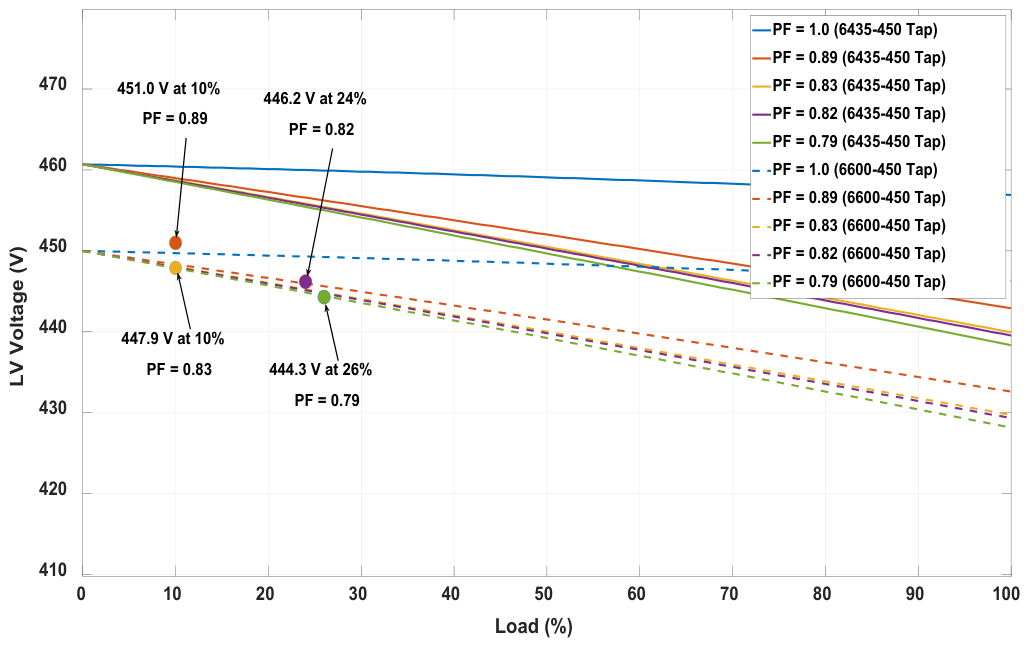
2.2. Voltage Drops Under Various Load Conditions
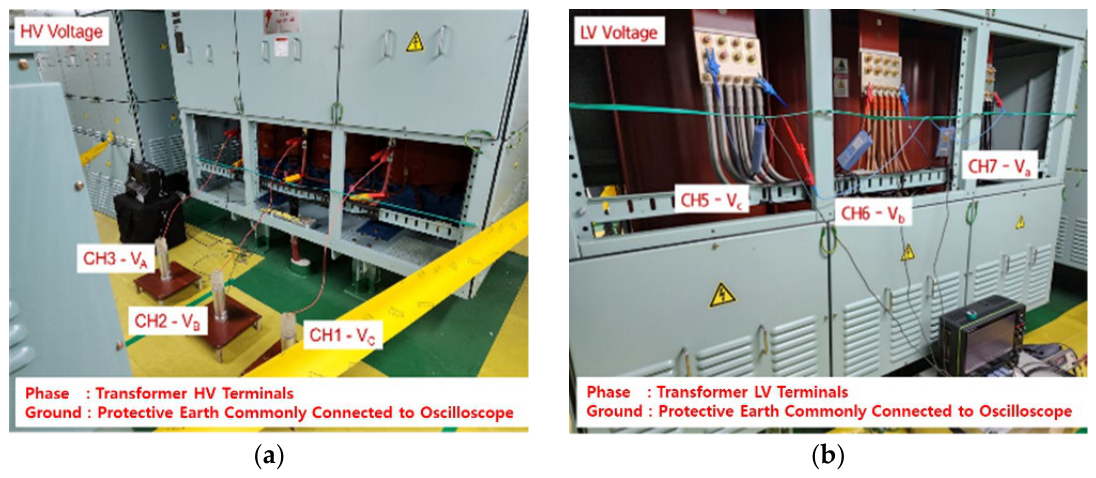
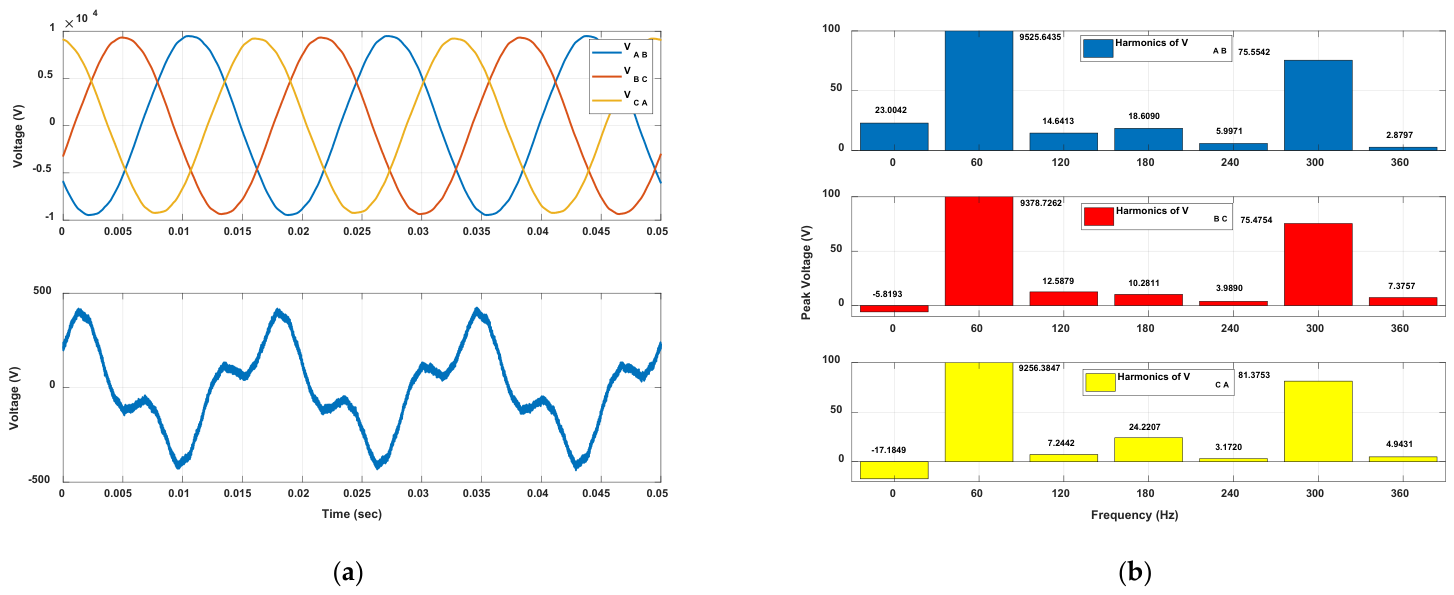
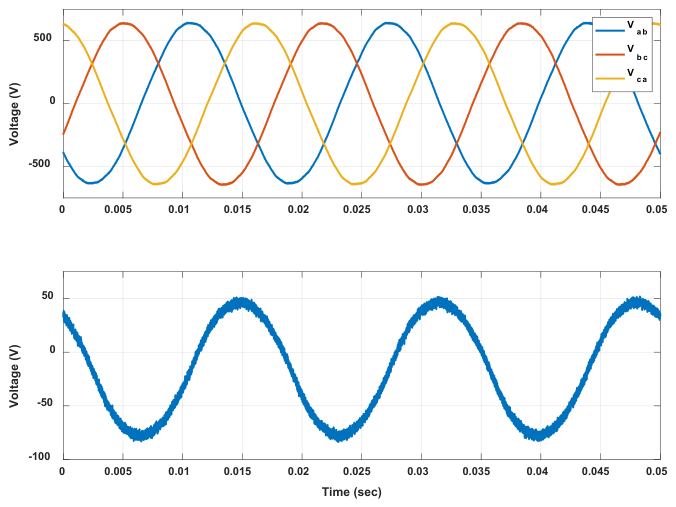
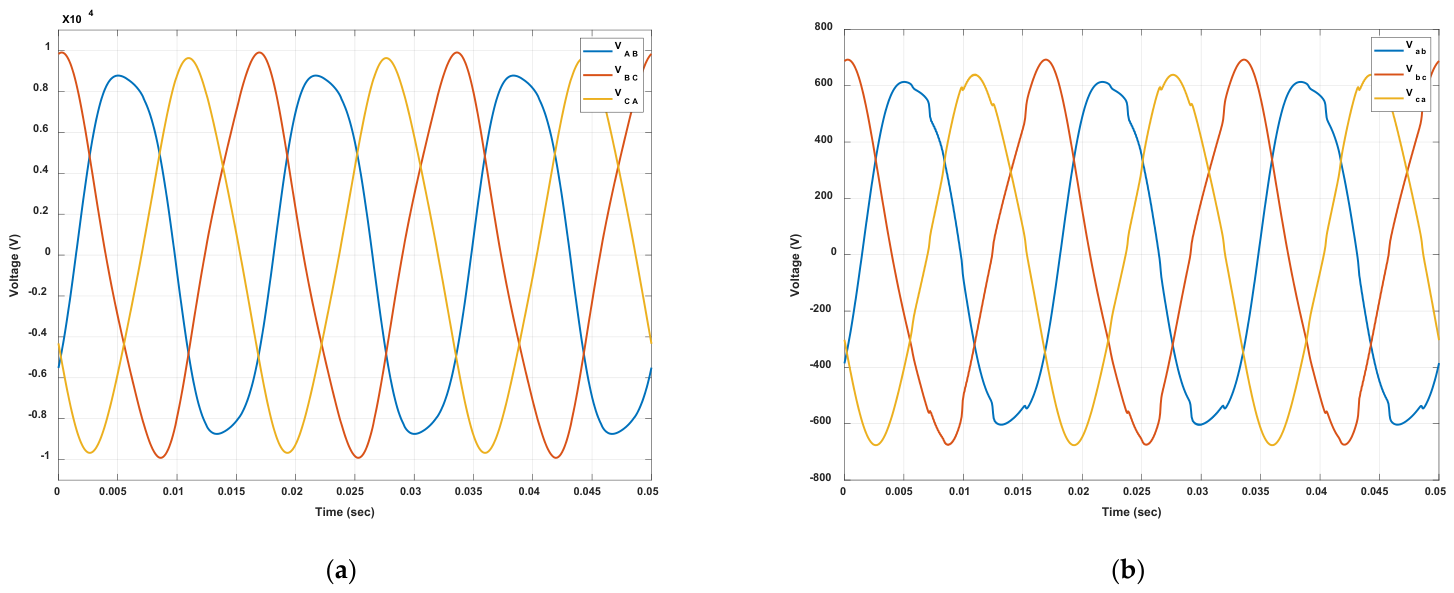
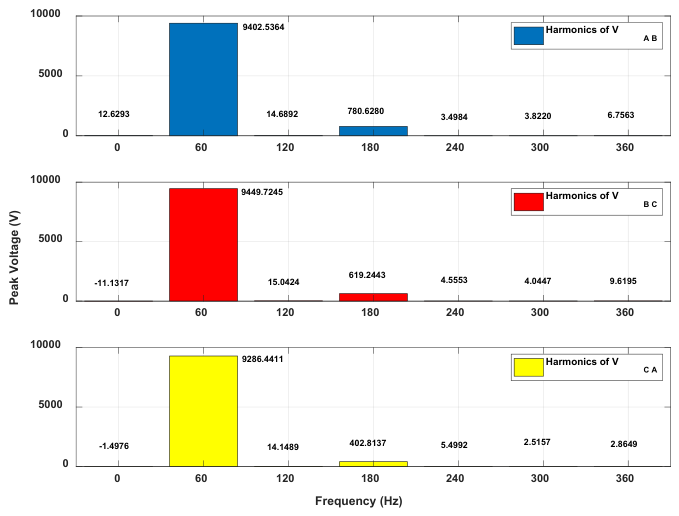
2.3. Primary and Secondary Voltages
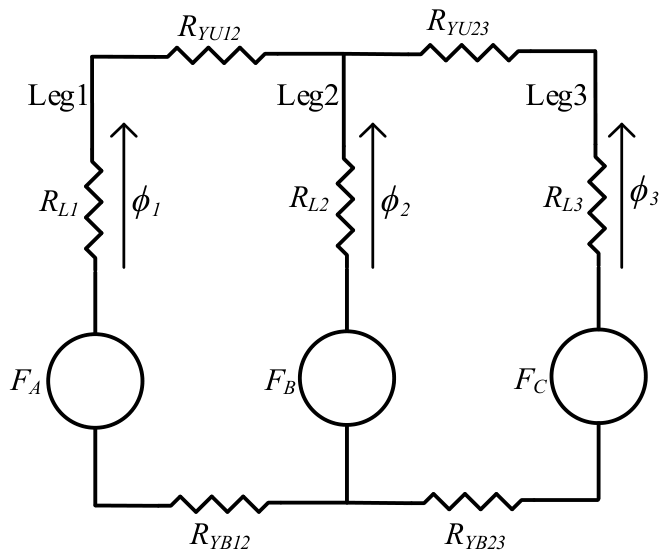
3. Analytical Study on Abnormal Voltage Drop Mechanisms
3.1. Theoretical Analysis
- Case I: Applying the balanced three-phase voltage with no harmonics and no residual flux in the transformer to the HV side.
- Case II: Applying the unbalanced three-phase voltage with no harmonics and no residual flux in the transformer to the HV side.
- Case III: Applying the unbalanced three-phase voltage with only an unbalanced third harmonic, without residual flux in the transformer to the HV side.
- Case VI: Applying the unbalanced three-phase voltage that includes both the unbalanced 3rd harmonic and a DC component, without residual flux in the transformer to the HV side.
- Case V: Applying the unbalanced three-phase voltage with an unbalanced third harmonic, a DC component, and residual flux represented as [−0.4 pu, −0.4 pu, and 0.8 pu] of the rated magnetic flux for each leg of the transformer to the HV side. These specific residual flux values are selected based on the guidelines in the CIGRE Technical Brochure to represent the worst condition [25].
- Case IV: Applying the unbalanced three-phase voltage with an unbalanced 3rd and 5th harmonics, a DC component, and residual flux represented as [−0.4 pu, −0.4 pu, and 0.8 pu] of the rated magnetic flux for each leg of the transformer to the HV side.
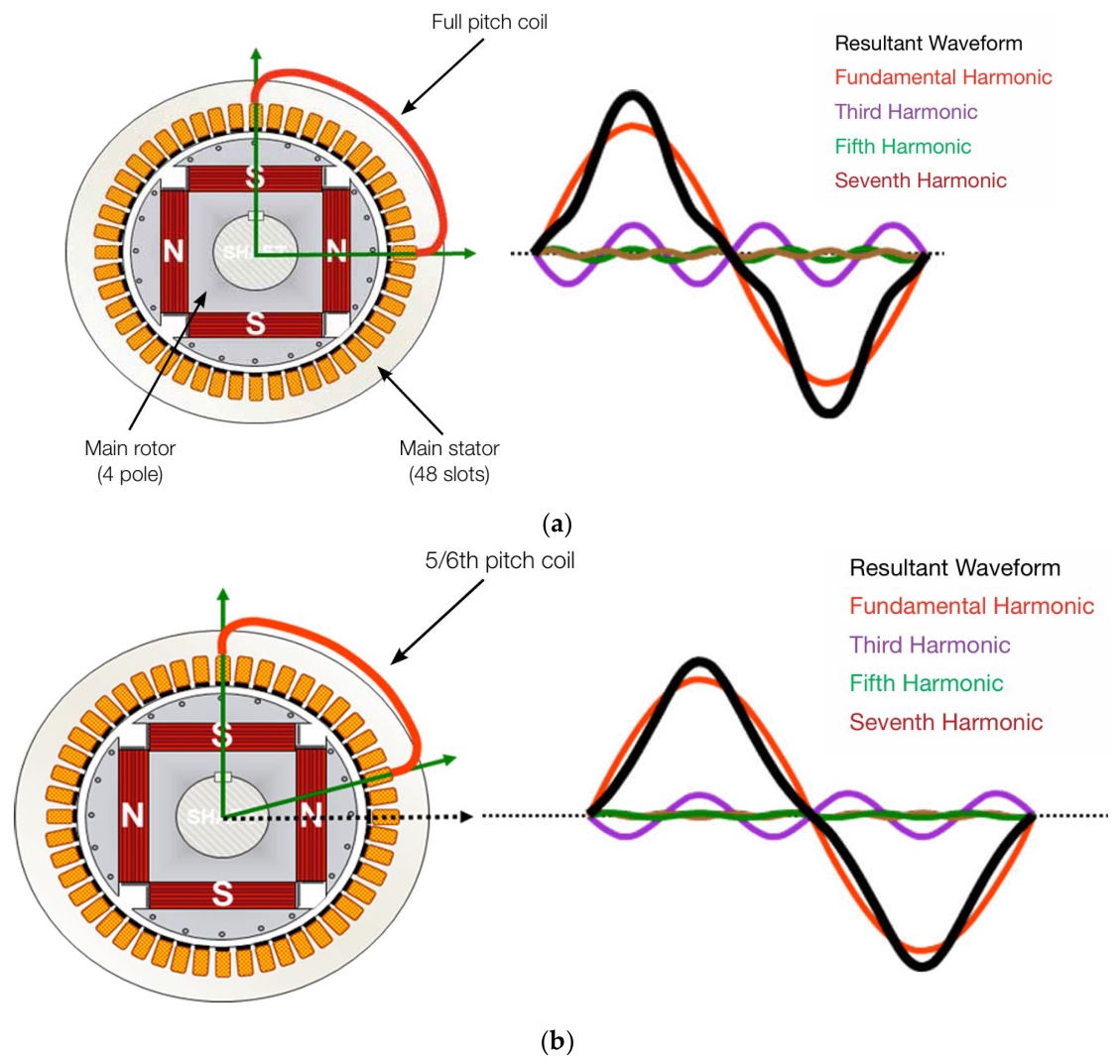
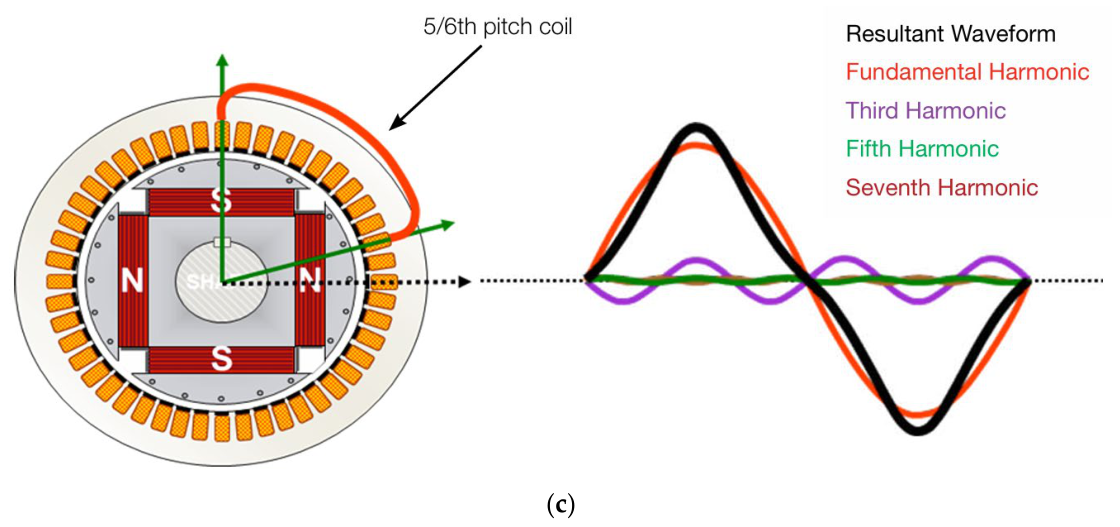
- 5/6th winding pitch: The 5/6th pitch is more effective at utilizing the fundamental magnetic flux, leading to a higher fundamental voltage output. This allows for a more compact generator design with reduced active materials (copper and lamination steel), offering a cost-effective solution. Moreover, it is particularly effective at suppressing fifth and seventh harmonics, which are often the most problematic in industrial power systems.
- 2/3rd winding pitch: This design is specifically engineered to eliminate triplen harmonics (3rd, 9th, 15th, etc.). By setting ρ = 2/3, the pitch factor for the third harmonic becomes kp3 = sin(π) = 0, theoretically zeroing out these components. While it excels at 3rd harmonic suppression, it may slightly amplify fifth and seventh harmonics compared to other designs and typically results in a lower zero-sequence impedance, which increases earth fault currents.
3.2. Experimental Analysis
3.2.1. Test1—Mitigating Unbalance of Fundamental Voltage
3.2.2. Test2—Mitigating Harmonic Components with Balanced Fundamental Voltage
4. Conclusions
Author Contributions
Funding
Data Availability Statement
Conflicts of Interest
References
- Gurkan, F.; Guangya, Y.; Al-Ali, H.A.H. A comparative study of different transformer connections for railway power supply-mitigation of voltage unbalance. In Proceedings of the 10th International Conference on Advances in Power System Control, Operation & Management (APSCOM 2015), Hong Kong, China, 8–12 November 2015. [Google Scholar]
- Kolagar, A.D.; Hamedani, P.; Shoulaie, A. The effects of transformer connection type on voltage and current unbalance propagation. In Proceedings of the 2012 3rd Power Electronics and Drive Systems Technology (PEDSTC), Tehran, Iran, 15–16 February 2012; pp. 341–346. [Google Scholar]
- Garcia-Rios, S.; Barrado-Rodrigo, J.A.; Gonzalez-Molina, F.; Guasch-Pesquer, L. Voltage and current performance of a three-phase transformer under unbalanced voltage supply. In Proceedings of the 2018 International Symposium on Fundamentals of Electrical Engineering (ISFEE), Bucharest, Romania, 1–3 November 2018. [Google Scholar]
- Paranavithana, P.; Perera, S.; Koch, R.; Emin, Z. Global Voltage Unbalance in MV Networks Due to Line Asymmetries. IEEE Trans. Power Deliv. 2009, 24, 2353–2360. [Google Scholar] [CrossRef]
- Zheng, T.; Makram, E.B.; Girgis, A.A. Evaluating power system unbalance in the presence of harmonic distortion. IEEE Trans. Power Deliv. 2003, 18, 393–397. [Google Scholar] [CrossRef]
- Schonek, J. The singularities of the third harmonic. In Cahier Technique No. 202; Schneider Electric: Rueil-Malmaison, France, 2001. [Google Scholar]
- Seddik, M.S.; Eteiba, M.B.; Shazly, J. Evaluating the Harmonic Effects on the Thermal Performance of a Power Transformer. Energies 2024, 17, 4871. [Google Scholar] [CrossRef]
- DNV GL. Rules for Classification: Ships, Part 4 Systems and Components, Chapter 8 Electrical Installations; DNV GL: Høvik, Norway, 2020. [Google Scholar]
- Yazdani-Asrami, M.; Mirzaie, M.; Akmal, A.A.S. No-load loss evaluation of distribution transformers supplied by nonsinusoidal voltage using three-dimensional finite element analysis. Energy 2013, 50, 205–219. [Google Scholar] [CrossRef]
- Radakovic, Z.; Fotic, P. The impact of voltage unbalance on the power losses in distribution transformers. Electr. Power Syst. Res. 2020, 180, 106155. [Google Scholar]
- Moses, P.S.; Masoum, M.A.S. Three-phase asymmetric transformer core saturation modeling for harmonic analysis in distribution networks. IEEE Trans. Power Deliv. 2010, 25, 3182–3191. [Google Scholar]
- Kütt, L.; Millar, R.J.; Niitsoo, J.; Karu, T.; Taklaja, P.; Jarkovoi, M. The role of load harmonics in audible noise of electrical transformers. In Proceedings of the 2014 Electric Power Quality and Supply Reliability Conference (PQ), Rakvere, Estonia, 11–13 June 2014; pp. 245–250. [Google Scholar]
- Cui, Y.; Abdulsalam, S.G.; Chen, S.; Xu, W. A sequential phase energization technique for transformer inrush current reduction—Part I: Principle and basic solutions. IEEE Trans. Power Deliv. 2005, 20, 943–949. [Google Scholar] [CrossRef]
- Cavallera, D.; Oiring, V.; Coulomb, J.-L.; Petrovic, O. Determining the Residual Magnetic Flux Value of a Single-Phase Transformer Using a Minor Hysteresis Loop. IEEE Trans. Power Deliv. 2021, 36, 2066–2074. [Google Scholar]
- Bradt, M.; Badrzadeh, B.; Cardenas, E.; Mueller, S. Harmonic and resonance issues in offshore wind power plants. IEEE Trans. Ind. Appl. 2014, 50, 1662–1670. [Google Scholar]
- Guerrero, J.M.; Chandorkar, M.; Lee, T.L.; Loh, P.C. Advanced control architectures for intelligent microgrids—Part I: Decentralized and hierarchical control. IEEE Trans. Ind. Electron. 2013, 60, 1254–1262. [Google Scholar] [CrossRef]
- IEEE Std C57.12.00-2015; IEEE Standard for General Requirements for Liquid-Immersed Distribution, Power, and Regulating Transformers. IEEE: Piscataway, NJ, USA, 2015.
- IEC 60076-1; Power Transformers—Part 1: General. IEC: Geneva, Switzerland, 1999.
- Harlow, J.H. Electric Power Transformer Engineering; CRC Press: Boca Raton, FL, USA, 2004. [Google Scholar]
- Kulkarni, S.V.; Khaparde, S.A. Transformer Engineering: Design and Practice; Marcel Dekker: New York, NY, USA, 2005. [Google Scholar]
- Shafieipour, M.; Ziomek, W.; Jayasinghe, R.P.; Alonso, J.C.G.; Gole, A.M. Application of Duality-Based Equivalent Circuits for Modeling Multilimb Transformers Using Alternative Input Parameters. IEEE Access 2020, 8, 153353–153363. [Google Scholar] [CrossRef]
- Jazebi, S.; de León, F. Duality-Based Transformer Model Including Eddy Current Effects in the Windings. IEEE Trans. Power Deliv. 2015, 30, 2312–2320. [Google Scholar] [CrossRef]
- Zhao, J.; de León, F.; Martinez, J.A.; Jalilian, A.; Wu, J. Topological Transient Models of Three-Phase, Three-Legged Transformer. IEEE Access 2019, 7, 102519–102529. [Google Scholar] [CrossRef]
- Alvarez-Marino, C.; de Leon, F.; Lopez-Fernandez, X.M. Equivalent Circuit for the Leakage Inductance of Multiwinding Transformers: Unification of Terminal and Duality Models. IEEE Trans. Power Deliv. 2012, 27, 353–361. [Google Scholar] [CrossRef]
- CIGRE Working Group A2.37. Transformer Reliability Survey; Technical Brochure 568; CIGRE: Paris, France, 2014. [Google Scholar]
- Al-Tayie, J.; Whitworth, C.; Biebighaeuser, A. AC Generators with 2/3rd and 5/6th Winding Pitch; White Paper No. WP105; Cummins Generator Technologies: Stamford, UK, 2013. [Google Scholar]
- Mailula, K.O.; Saha, A.K. Comparative Analysis of Shaft Voltage Harmonic Characteristics in Large-Scale Generators: OEM and Excitation System Comparisons. Energies 2025, 18, 6128. [Google Scholar] [CrossRef]
- Hsiao, C.Y.; Yeh, S.N.; Hwang, J.C. Design of High Performance Permanent-Magnet Synchronous Wind Generators. Energies 2014, 7, 7105–7124. [Google Scholar] [CrossRef]



| Tap No. | Designed Ratio | Measured Ratio | |||
|---|---|---|---|---|---|
| HV [V] | LV [V] | A-B/a-b | B-C/b-c | C-A/c-a | |
| 1 | 6765 | 450 | - | - | - |
| 2 | 6600 | - | - | - | |
| 3 | 6435 | 14.326 | 14.319 | 14.318 | |
| 4 | 6270 | - | - | - | |
| Phase | HV | LV | HV/LV Ratio | ||
|---|---|---|---|---|---|
| VRMS [V] | Max. ΔV [%] | VRMS [V] | Max. ΔV [%] | ||
| A-B/a-b | 6738.76 (1.021 pu) | 2.885 (VAB–VCA) | 453.52 (0.983 pu) | 0.557 (Vbc–Vca) | 14.859 |
| B-C/b-c | 6634.79 (1.005 pu) | 455.97 (0.988 pu) | 14.551 | ||
| C-A/c-a | 6548.34 (0.992 pu) | 453.40 (0.982 pu) | 14.443 | ||
| Average | 6640.63 (1.006 pu) | - | 454.30 (0.984 pu) | - | 14.617 |
| Phase | HV | LV | HV/LV Ratio | ||
|---|---|---|---|---|---|
| VRMS [V] | Max. ΔV [%] | VRMS [V] | Max. ΔV [%] | ||
| A-B/a-b | 6732.96 (1.020 pu) | 2.826 (VAB–VCA) | 449.45 (0.974 pu) | 0.327 (Vab–Vbc) | 14.980 |
| B-C/b-c | 6623.79 (1.004 pu) | 450.96 (0.977 pu) | 14.688 | ||
| C-A/c-a | 6546.45 (0.992 pu) | 449.63 (0.974 pu) | 14.560 | ||
| Average | 6634.40 (1.005 pu) | - | 450.01 (0.975 pu) | - | 14.743 |
| Parameters | Value |
|---|---|
| Capacity | 2.5 MVA |
| Rated voltage | 6435/450 V |
| Frequency | 60 Hz |
| Vector | Dd0 |
| %Z | 6.97% |
| Applied TR Model | Duality-based transformer model |
| Core Geometry | 3/0 (Ratio yoke/winding limb length: 0.8535 Ratio yoke/winding limb area: 1.0000) |
| Saturation properties | Excitation current: 0.19% Air-core reactance: 0.2 pu |
| Case | Components of Voltages | |||||||
|---|---|---|---|---|---|---|---|---|
| Fundamental | 3rd Harmonic | 5th Harmonic | DC | |||||
| Mag. [kVRMS] | Phase [Degree] | Mag. [kVRMS] | Phase [Degree] | Mag. [kVRMS] | Phase [Degree] | Mag. [V] | ||
| I | A | 3.8105 | 0 | - | - | - | - | - |
| B | 3.8105 | 120 | - | - | - | - | - | |
| C | 3.8105 | 240 | - | - | - | - | - | |
| II | A | 3.7750 | 0 | - | - | - | - | - |
| B | 3.9140 | 120 | - | - | - | - | - | |
| C | 3.8130 | 240 | - | - | - | - | - | |
| III | A | 3.7750 | 0 | 0.1000 | 300 | - | - | - |
| B | 3.9140 | 120 | 0.5000 | 60 | - | - | - | |
| C | 3.8130 | 240 | 0.1905 | 120 | - | - | - | |
| IV | A | 3.7750 | 0 | 0.1000 | 300 | - | - | 5.6391 |
| B | 3.9140 | 120 | 0.5000 | 60 | - | - | −6.9901 | |
| C | 3.8130 | 240 | 0.1905 | 120 | - | - | 4.1415 | |
| V | A | 3.7750 | 0 | 0.1000 | 300 | - | - | 5.6391 |
| B | 3.9140 | 120 | 0.5000 | 60 | - | - | −6.9901 | |
| C | 3.8130 | 240 | 0.1905 | 120 | - | - | 4.1415 | |
| VI | A | 3.7750 | 0 | 0.1000 | 300 | 0.1000 | 300 | 5.6391 |
| B | 3.9140 | 120 | 0.5000 | 60 | 0.5000 | 60 | −6.9901 | |
| C | 3.8130 | 240 | 0.1905 | 120 | 0.1905 | 120 | 4.1415 | |
| Case | HV | LV | ||||
|---|---|---|---|---|---|---|
| Phase | Voltage [kVRMS] | Ratio [%] | Phase | Voltage [kVRMS] | Ratio [%] | |
| I | A–B | 6.5998 | 99.9970 | a–b | 0.4615 | 99.9913 |
| B–C | 6.5998 | 99.9970 | b–c | 0.4615 | 99.9913 | |
| C–A | 6.5998 | 99.9970 | c–a | 0.4615 | 99.9913 | |
| II | A–B | 6.6590 | 100.8939 | a–b | 0.4656 | 100.8797 |
| B–C | 6.6918 | 101.3909 | b–c | 0.4679 | 101.3780 | |
| C–A | 6.5712 | 99.5636 | c–a | 0.4595 | 99.5580 | |
| III | A–B | 6.6822 | 101.2455 | a–b | 0.4673 | 101.2480 |
| B–C | 6.7060 | 101.6061 | b–c | 0.4689 | 101.5947 | |
| C–A | 6.5776 | 99.6606 | c–a | 0.4599 | 99.6447 | |
| IV | A–B | 6.6708 | 101.0727 | a–b | 0.4576 | 99.1463 |
| B–C | 6.6995 | 101.5076 | b–c | 0.4612 | 99.9263 | |
| C–A | 6.5740 | 99.6061 | c–a | 0.4563 | 98.8647 | |
| V | A–B | 6.6744 | 101.1273 | a–b | 0.4588 | 99.4063 |
| B–C | 6.6970 | 101.4697 | b–c | 0.4586 | 99.3630 | |
| C–A | 6.5741 | 99.6076 | c–a | 0.4561 | 98.8213 | |
| VI | A–B | 6.6974 | 101.4758 | a–b | 0.4603 | 99.7313 |
| B–C | 6.7112 | 101.6848 | b–c | 0.4596 | 99.5797 | |
| C–A | 6.5805 | 99.7045 | c–a | 0.4565 | 98.9080 | |
| Phase | HV | LV | HV/LV Ratio | ||
|---|---|---|---|---|---|
| VRMS [V] | Max. ΔV [%] | VRMS [V] | Max. ΔV [%] | ||
| A-B/a-b | 6779.48 (1.027 pu) | 1.710 (VBC–VCA) | 466.31 (1.010 pu) | 1.015 (Vab–Vbc) | 14.538 |
| B-C/b-c | 6692.42 (1.014 pu) | 461.63 (1.000 pu) | 14.497 | ||
| C-A/c-a | 6805.29 (1.031 pu) | 463.97 (1.005 pu) | 14.668 | ||
| Average | 6759.06 (1.024 pu) | - | 463.97 (1.005 pu) | - | 14.568 |
| Phase | HV | LV | HV/LV Ratio | ||
|---|---|---|---|---|---|
| VRMS [V] | Max. ΔV [%] | VRMS [V] | Max. ΔV [%] | ||
| A-B/a-b | 6676.52 (1.012 pu) | 0.131 (VAB–VCA) | 461.91 (1.001 pu) | 0.223 (Vab–Vbc) | 14.454 |
| B-C/b-c | 6675.25 (1.011 pu) | 462.94 (1.003 pu) | 14.419 | ||
| C-A/c-a | 6667.88 (1.010 pu) | 462.14 (1.001 pu) | 14.428 | ||
| Average | 6673.22 (1.011 pu) | - | 462.33 (1.002 pu) | - | 14.434 |
Disclaimer/Publisher’s Note: The statements, opinions and data contained in all publications are solely those of the individual author(s) and contributor(s) and not of MDPI and/or the editor(s). MDPI and/or the editor(s) disclaim responsibility for any injury to people or property resulting from any ideas, methods, instructions or products referred to in the content. |
© 2026 by the authors. Licensee MDPI, Basel, Switzerland. This article is an open access article distributed under the terms and conditions of the Creative Commons Attribution (CC BY) license.
Share and Cite
Sung, B.C.; Kim, S. Secondary Voltage Drops in Dry-Type Transformers Caused by Coupled Magnetic Flux Effects of Voltage Unbalance and Harmonics in Isolated Offshore Power Systems. Energies 2026, 19, 2466. https://doi.org/10.3390/en19102466
Sung BC, Kim S. Secondary Voltage Drops in Dry-Type Transformers Caused by Coupled Magnetic Flux Effects of Voltage Unbalance and Harmonics in Isolated Offshore Power Systems. Energies. 2026; 19(10):2466. https://doi.org/10.3390/en19102466
Chicago/Turabian StyleSung, Byung Chul, and Seongil Kim. 2026. "Secondary Voltage Drops in Dry-Type Transformers Caused by Coupled Magnetic Flux Effects of Voltage Unbalance and Harmonics in Isolated Offshore Power Systems" Energies 19, no. 10: 2466. https://doi.org/10.3390/en19102466
APA StyleSung, B. C., & Kim, S. (2026). Secondary Voltage Drops in Dry-Type Transformers Caused by Coupled Magnetic Flux Effects of Voltage Unbalance and Harmonics in Isolated Offshore Power Systems. Energies, 19(10), 2466. https://doi.org/10.3390/en19102466