Article

Secondary Voltage Drops in Dry-Type Transformers Caused by Coupled Magnetic Flux Effects of Voltage Unbalance and Harmonics in Isolated Offshore Power Systems


by
Byung Chul Sung
1,*,† and
Seongil Kim
2,*,†
1
Department of Power System Research, HD Hyundai Electric, Seongnam-si 13553, Gyeonggi-do, Republic of Korea
2
Marine Electrification Research Department, HD Korea Shipbuilding & Offshore Engineering, Seongnam-si 13553, Gyeonggi-do, Republic of Korea
*
Authors to whom correspondence should be addressed.
These authors contributed equally to this work.
Energies 2026, 19(10), 2466; https://doi.org/10.3390/en19102466
Submission received: 24 April 2026 / Revised: 16 May 2026 / Accepted: 18 May 2026 / Published: 21 May 2026
(This article belongs to the Section F: Electrical Engineering)

Abstract

This paper investigates abnormal secondary voltage drops in dry-type transformers operating in isolated offshore power systems. While conventional analyses primarily attribute voltage deviations to load conditions and transformer impedance, this study shows that noticeable voltage drops can also occur under no-load conditions due to the combined effects of voltage unbalance, harmonic distortion, and residual magnetic flux. A comprehensive approach integrating on-site measurements, PSCAD simulations, and laboratory experiments is employed to systematically analyze this phenomenon. The results indicate a coupled electromagnetic effect in which source-side voltage imperfections induce asymmetric core flux distribution, which is associated with reduced secondary voltage. In addition, a relationship between synchronous generator winding pitch and harmonic voltage distortion is observed, suggesting its influence on power quality in isolated grids. Simulation results show that the interaction of these factors can lead to a secondary voltage drop of approximately 4–6 V under no-load conditions, even in the absence of transformer defects. Finally, mitigation strategies based on voltage balancing and harmonic reduction are experimentally validated, restoring the secondary voltage to 1.002 pu. These findings provide practical insights for improving voltage stability and power quality in offshore and other isolated power systems.

1. Introduction

Transformers play a critical role in power systems by enabling efficient energy transfer and maintaining stable voltage levels. Ideally, transformer operation follows its rated turns ratio. However, modern power systems increasingly experience voltage unbalance and harmonic distortion due to the integration of renewable energy sources and power-electronics-based loads. These disturbances can distort core flux distribution, increase losses, and contribute to thermal stress and insulation aging, thereby affecting system reliability [1,2,3,4,5,6,7].
These issues are particularly critical in isolated power systems such as offshore platforms, where synchronous generators with limited short-circuit capacity are commonly used. To ensure operational safety, strict voltage quality requirements are imposed. According to DNV GL classification rules, steady-state voltage variation must remain within ±2.5%, and voltage must recover within ±3.0% following transient events such as load shedding [8].
For a 440 V system defined by IEC standards, this corresponds to a no-load voltage of approximately 451 V, applying the +2.5% upper limit. Accordingly, transformer systems are typically designed so that a 6.6 kV generator-side voltage produces approximately 451 V at no load.
However, field measurements on a 2.5 MVA Dd0 transformer installed on an offshore platform revealed a lower-than-expected no-load secondary voltage, even after tap adjustment. To compensate, the transformer tap was changed from 6600/450 V to 6435/450 V. However, the measured voltage still deviated from expected values, indicating that conventional design assumptions may be insufficient.
While such deviations are often attributed to non-linear loads, this study also considers the influence of synchronous generator winding pitch. The winding pitch affects harmonic suppression characteristics and may influence the distribution of harmonic components, including third harmonics, under specific operating conditions. This suggests that generator design parameters may contribute to voltage quality issues in isolated grids.
To clarify the academic contribution of this work, it is essential to distinguish it from previous studies that have examined these factors individually or in different papers. First, extensive research has been conducted on the impact of voltage unbalance and harmonics on transformer losses and efficiency [9,10]. However, these studies primarily focus on thermal characteristics and energy efficiency, often overlooking the steady-state magnitude drop of the secondary voltage under no-load conditions. Second, while some of the literature addresses the coupled electromagnetic effects of voltage distortion and core saturation, these analyses are typically confined to transient phenomena, magnetizing current distortion, or audible noise [11,12]. In contrast, this paper quantifies the impact of such coupled effects on long-term voltage regulation in isolated grids. Third, although the influence of residual flux is a well-known topic, it is predominantly studied in the context of transient inrush currents during switching operations [13,14]. This study demonstrates that residual flux can interact with source-side imperfections to cause a persistent voltage drop during steady-state operation. Lastly, while existing power quality studies in isolated or offshore grids often emphasize harmonic filter design or control algorithms [15,16], this paper establishes a fundamental causal link between the synchronous generator’s design parameters—specifically the winding pitch—and the transformer’s electromagnetic behavior from a systemic perspective.
By addressing these identified gaps, this paper provides several fundamentally new physical insights and contributions. It identifies and quantitatively proves the “coupled electromagnetic effect,” where voltage unbalance and specific harmonics interact with residual flux to create an asymmetric flux distribution, thereby reducing the effective flux and causing a secondary voltage drop even at no-load.
A combined methodology involving field measurements, PSCAD simulations, and laboratory experiments is used to isolate the contributing factors. The main contribution of this study is the demonstration of a system-level coupling effect between voltage unbalance, harmonic distortion, and residual magnetic flux, which can lead to reduced secondary voltage across all loading conditions.
Finally, mitigation strategies based on voltage balancing and harmonic reduction are experimentally validated, showing that the secondary voltage can be restored within regulatory limits. These results provide practical guidance for improving voltage stability and power quality in isolated power systems.

2. On-Site Measurements and Harmonic Analyses

To investigate the abnormal voltage drop, field measurements are conducted on an isolated offshore platform power system. The excessive voltage drop in transformers can be caused by various factors, including defects within the transformer and unusual conditions in the power system. The analysis, based on on-site measurements, aims to identify the primary causes of voltage drops in the onboard network of the isolated offshore platform.

2.1. Turn Ratio of Transformer

Reports indicate that the secondary side voltage of a 2.5 MVA 6600/450 V Dd0 dry-type transformer is approximately 440 V under no-load conditions, which is 10 V lower than the rated voltage of 450 V for the transformer in the no-load condition. This significant voltage drop may suggest internal issues within the transformer, such as a turn-to-turn fault or a core defect. Therefore, the investigation begins by assessing the state of the transformer through a measurement of the turn ratio.
The transformer used for this measurement has four distinct taps, as outlined in Table 1. To comply with the regulations of DNV GL, the tap is adjusted from 6600/450 V (Tap No. 2) to 6435/450 V (Tap No. 3). The integrity of the transformer is verified by measuring the turn ratio for Tap No. 3 with an AEMC transformer ratiometer. The results of these measurements are presented in Table 1.
The transformer with Tap No. 3 has a rated turn ratio of 14.300, with an allowable tolerance of ±0.5% of the rated turn ratio [17,18]. When examining the phase-to-phase ratios A-B and a-b, the maximum difference observed is 14.326. This value falls within the acceptable range of 14.229 (−0.5%) and 14.372 (+0.5%). These results indicate that there are no defects in the transformer itself.

2.2. Voltage Drops Under Various Load Conditions

When the transformer is under loaded conditions, the load currents pass through the leakage reactance of the transformer. These currents can cause the voltage on the secondary side to drop below the rated value determined by the turn ratio. The percentage of voltage drop under various load conditions can be calculated as follows [19]:
% V d r o p = % R · c o s θ + % X · s i n θ + % X · c o s θ % R · s i n θ 2 200
where %R is the percentage resistance of the transformer, %X is the percentage leakage reactance of the transformer, and θ is the angle corresponding to the power factor of the load. The %R accounts for the ohmic losses (copper losses) within the windings, while the %X represents the leakage reactance associated with the magnetic flux that escapes the core and does not link both windings. In large power transformers, %X is typically much larger than %R, making the leakage reactance the dominant factor in standard voltage regulation.
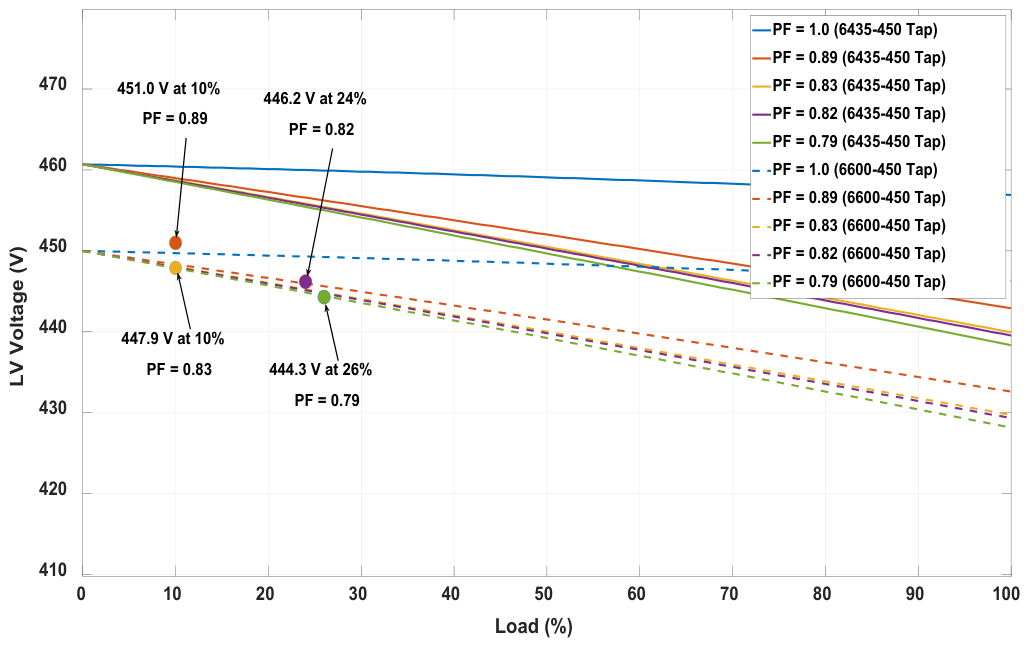
The theoretical voltage drop characteristics on the secondary side, calculated based on specific power factors and tap positions, are illustrated in Figure 1. In this analysis, the dotted lines represent the expected voltage profiles for the nominal Tap No. 2 (6600/450 V), while the solid lines depict the boosted voltage profiles for Tap No. 3 (6435/450 V). Each color in Figure 1 denotes a specific load power factor, providing a baseline for assessing the transformer’s performance under varying operational conditions. To evaluate the actual system response, on-site voltage measurements are conducted four times after adjusting the transformer to Tap No. 3. These measurements are recorded under different loading levels to ensure a comprehensive data set for alignment with the theoretical curves.
Under ideal operating conditions, the secondary voltage following the tap adjustment should have transitioned to the solid lines (Tap No. 3) to compensate for the insufficient voltage margin observed at Tap No. 2. However, the empirical data revealed a significant anomaly: the measured voltage drops under various loading conditions closely followed the dotted lines, which represent the lower voltage characteristics of the nominal Tap No. 2 (6600/450 V). This discrepancy indicates that the transformer undergoes an abnormal internal voltage drop on its secondary side equivalent to approximately one full tap ratio (2.5%). Consequently, the intended voltage compensation from the tap boost is effectively neutralized.

2.3. Primary and Secondary Voltages

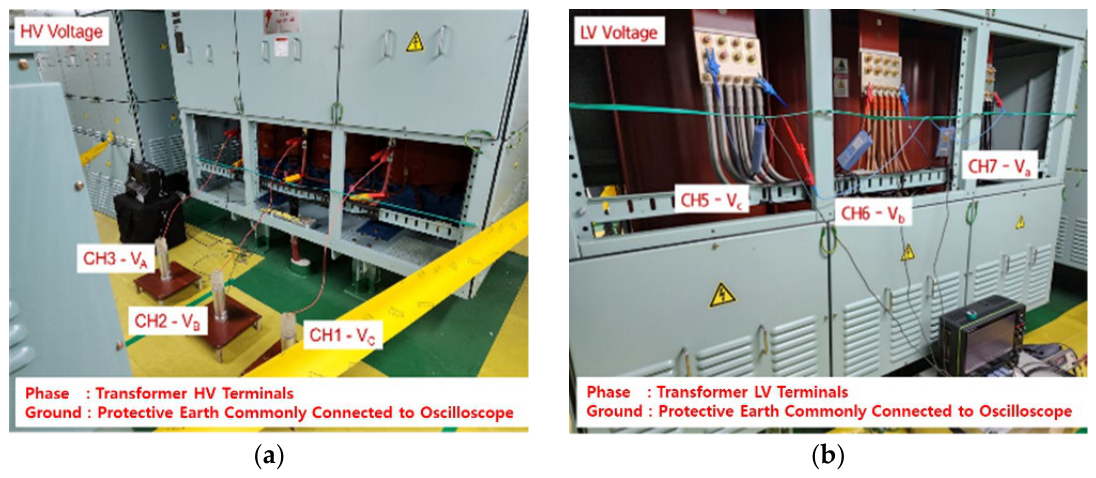
High voltage probes are used to perform direct measurements of both primary and secondary voltages in order to investigate the unique characteristics of the onboard networks of the isolated offshore platform where the transformer is installed. The IWATSU HV-P60 probe is used for measurements on the HV side (VA, VB, VC), while the LeCroy ADP305 probe is employed on the LV side (Vab, Vbc, Vca). The measurement setup is detailed in Figure 2. Because high-voltage differential probes are unavailable for directly measuring the 6600 V side, phase-to-earth voltages are measured instead.
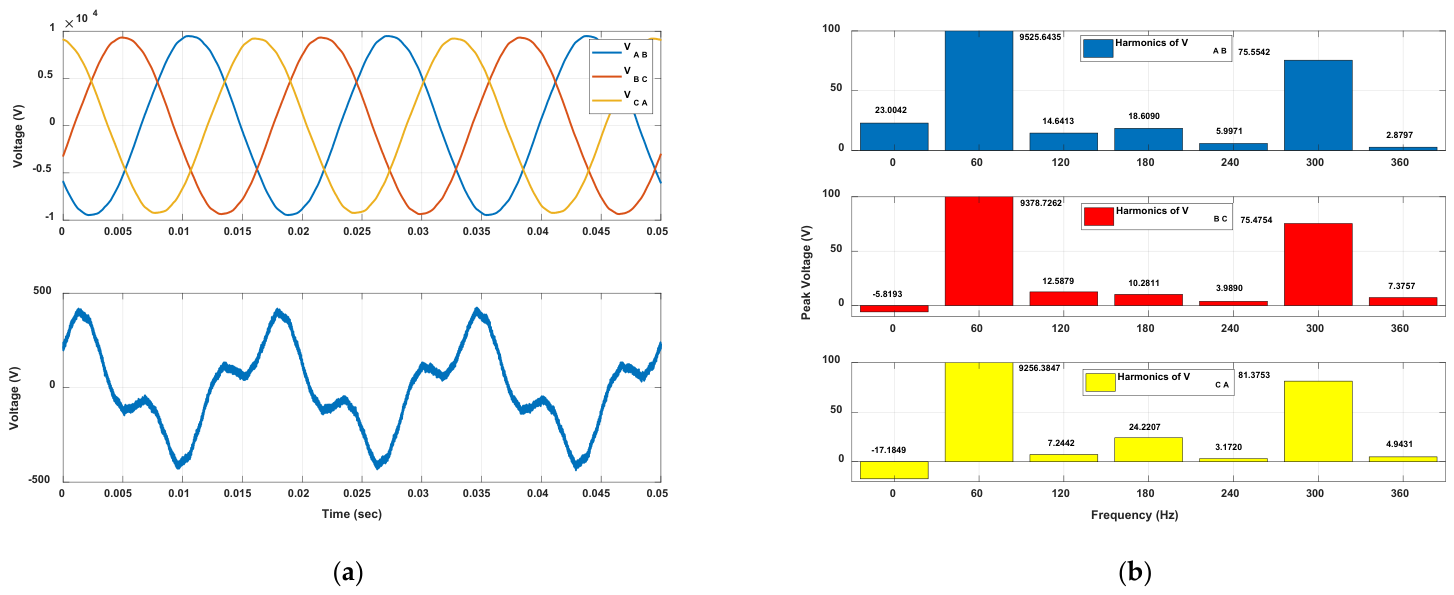
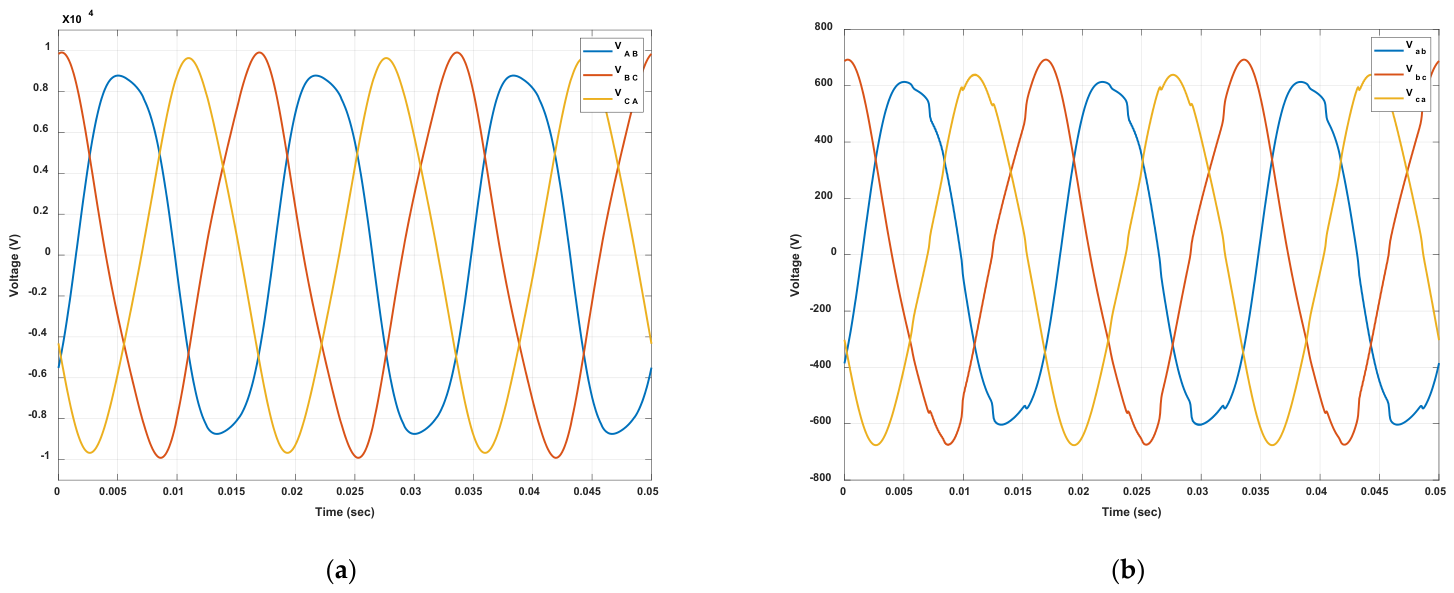
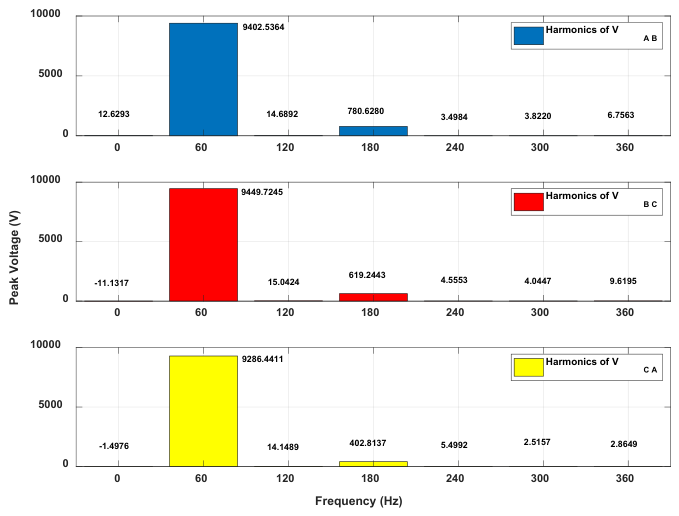
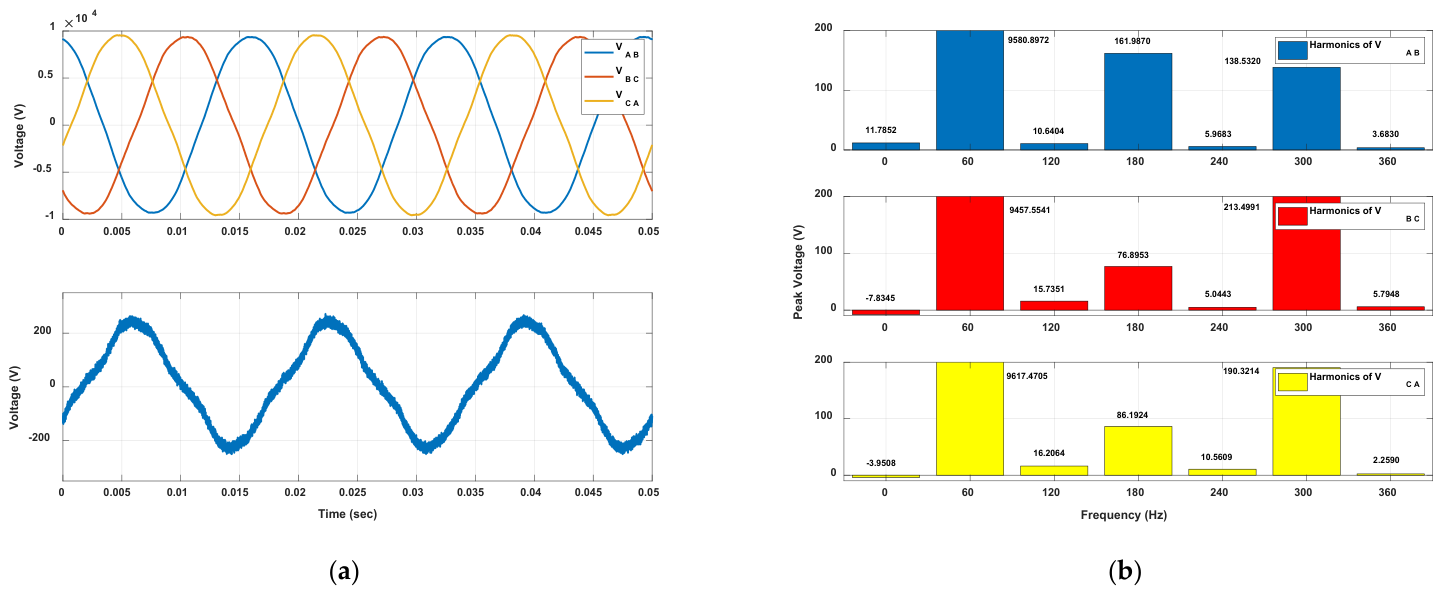
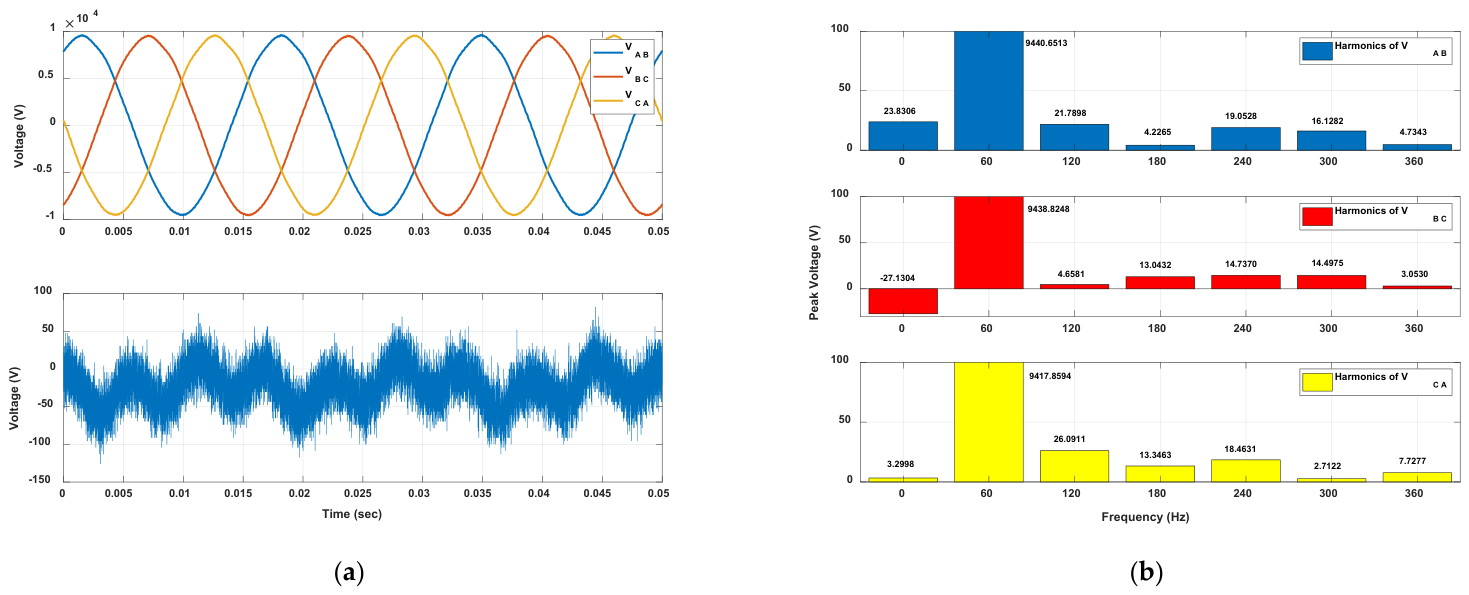
Voltage measurements are conducted under two conditions: no-load and 19% load. The results for the no-load condition are presented in Figure 3 and Figure 4, and summarized in Table 2. The HV side indicates the highest maximum unbalanced voltage, which reaches 2.885% in RMS values, as shown in Table 2. Moreover, the harmonics are analyzed to verify orders up to the sixth, which are applied unevenly across each winding. Additionally, the fifth harmonic is identified as the most significant component. The magnitudes of the DC and other harmonic components, from the 1st (fundamental) to the sixth order, as revealed by the harmonic analysis of the HV voltage, are displayed in Figure 3b. This indicates that harmonic distortion is not uniformly distributed across phases, which contributes to asymmetric flux formation in the transformer core.
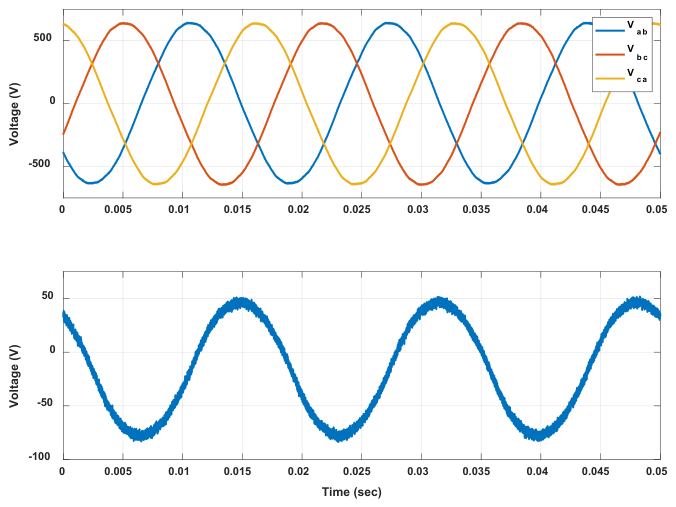
The instantaneous waveforms of line-to-line voltages induced on the LV side and the corresponding 3V0, which are calculated from the measured phase voltage (Va, Vb, and Vc), are illustrated in Figure 4. The maximum unbalanced voltage difference on the LV side is 0.557%, shown in Table 2, which is significantly smaller than the 2.885% unbalanced voltage difference observed on the HV side. The RMS voltages across each LV winding are measured at 453.32 V, 455.97 V, and 453.40 V, yielding an average value of 454.30 V. This average voltage is approximately 7 V lower than the expected rated voltage of around 461.54 V.
The other measurement is performed under a 19% load condition on the transformer. Table 3 indicates that there are slight changes in the unbalanced voltages on the primary and secondary sides, while the voltage drop on the secondary side increases with higher loads.

3. Analytical Study on Abnormal Voltage Drop Mechanisms

Building upon the on-site measurements and harmonic analyses presented in the previous section, it is evident that the secondary voltage deviation is closely linked to unbalanced fundamental voltages and disproportionate harmonic components on the HV side. To verify this correlation, this section employs both theoretical (simulation-based) and experimental approaches. These methods are utilized to evaluate the specific impact of power quality disturbances—including potential influences from generator design parameters such as winding pitch—and to investigate effective countermeasures for mitigating these voltage drops.

3.1. Theoretical Analysis

The transformer’s magnetic flux, Φm, is generated as described in Equation (2) due to the voltage applied to the winding with N1 turns. This magnetic flux induces an electromotive force (EMF) in another winding with N2 turns, adjusting the voltage as shown in Equation (3) and facilitating energy transfer [20].
Φ m = 2 × E 1 2 π × f × N 1 = E 1 4.44 × f × N 1
E 1 = 4.44 × f × N 2 × Φ m = E 1 N 1 × N 2 E 1 E 2 = N 1 N 2
where E1 is the RMS (Root-Mean-Square) voltage applied to the winding with N1 turns. f is the supply frequency in Hz. E2 is the RMS value of the induced voltage (EMF) for the winding with N2 turns.
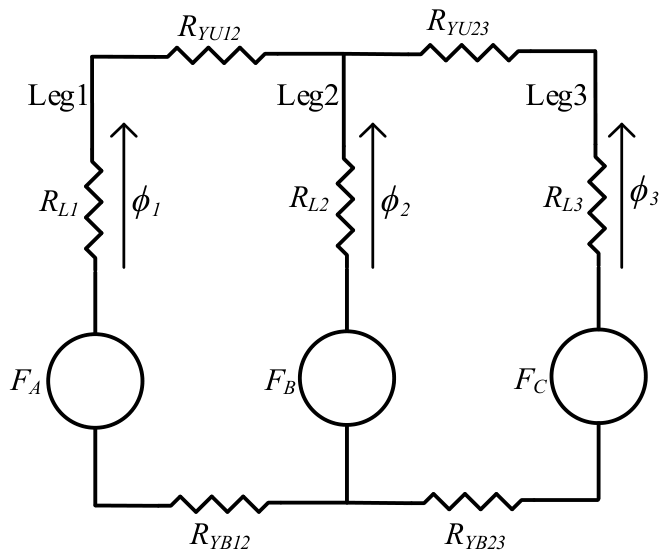
This concept can also expand to a three-phase transformer, which consists of three legs. The three-phase transformer has a magnetic circuit illustrated in Figure 5. FA, FB, and FC mean the magnetomotive forces for each leg. RL1, RL2, and RL3 are the reluctances of each leg. RYU12, RYU23, RYB12, and RYB23 are the reluctances of the upper yoke and the bottom yoke, respectively [21,22,23,24].
In the magnetic circuit depicted in Figure 5, the magnetic flux generated by the voltage applied to each phase winding with N1 turns induces a corresponding voltage in the winding with N2 turns. When the voltage applied to each phase winding is free of harmonic components and perfectly balanced, the magnetic flux in each leg is equal in both magnitude and phase. This condition results in the induced voltages on the low-voltage (LV) side being proportional to the turn ratio, ensuring the balance.
However, when there are imbalances in the fundamental voltage and harmonic components of the applied voltage, the magnetic flux in each leg also becomes unbalanced in magnitude and phase. Specifically, the total magnetic flux in each transformer leg is represented as the instantaneous algebraic summation of flux components generated by the fundamental, harmonic, DC, and residual flux terms in the time domain, as expressed in Equation (4).
ϕ L 1 = ϕ R E S + ϕ D C + ϕ H 1 + ϕ H 2 + ϕ H 3 +
where ϕL1 is the total magnetic flux in Leg1. ϕRES is the residual magnetic flux in Leg1. ϕDC is the magnetic flux generated by a DC (Direct Current) component in the applied voltage to Leg1. ϕH1, ϕH2, ϕH3,⋯ are the magnetic fluxes generated by the fundamental voltage and harmonic components in the applied voltage for Leg1. Equation (4) represents the instantaneous algebraic superposition of magnetic flux components in the time domain rather than a phasor-vector summation of RMS quantities. Therefore, the waveform shape and asymmetry of the resultant flux are determined by the temporal interaction among components having different magnitudes, frequencies, and phase angles.
When a perfectly balanced voltage is applied, it produces a balanced magnetic flux with equal magnitudes and phases that differ by 120 degrees for each leg, as ϕRES is evenly distributed among all legs. Consequently, their vector sum equals zero. In contrast, when an unbalanced voltage is applied to a transformer, it produces an unbalanced magnetic flux, which does not result in a vector sum of zero. This means that the magnitudes and phases of the harmonic components, including the DC component, are critical in determining both the magnitude and direction of the flux generated by every order of harmonic components, especially the fundamental component, which is dominant for the applied voltage. This has a significant impact on the magnitude and shape of the flux produced by the fundamental component, which represents the majority of the applied voltage’s components. As shown in the measurement results of Figure 3b, while the magnitude of the measured fifth harmonic may be larger in certain phases, this study mainly focuses on the third harmonic because triplen harmonics have a stronger influence on zero-sequence flux accumulation and asymmetric core excitation, which are directly linked to the mechanisms causing abnormal secondary voltage drops.
To validate the above analysis, simulation studies for the transformer, which have parameters shown in Table 4, are carried out using PSCAD to compare the RMS values of the line-to-line voltages on both the high-voltage (HV) and low-voltage (LV) sides. The RMS values from these simulations are calculated using a fundamental frequency of 60 Hz with 256 samples per cycle. Additionally, the voltages of the power source are configured as phase-to-ground voltages. The test cases included:
  • Case I: Applying the balanced three-phase voltage with no harmonics and no residual flux in the transformer to the HV side.
  • Case II: Applying the unbalanced three-phase voltage with no harmonics and no residual flux in the transformer to the HV side.
  • Case III: Applying the unbalanced three-phase voltage with only an unbalanced third harmonic, without residual flux in the transformer to the HV side.
  • Case VI: Applying the unbalanced three-phase voltage that includes both the unbalanced 3rd harmonic and a DC component, without residual flux in the transformer to the HV side.
  • Case V: Applying the unbalanced three-phase voltage with an unbalanced third harmonic, a DC component, and residual flux represented as [−0.4 pu, −0.4 pu, and 0.8 pu] of the rated magnetic flux for each leg of the transformer to the HV side. These specific residual flux values are selected based on the guidelines in the CIGRE Technical Brochure to represent the worst condition [25].
  • Case IV: Applying the unbalanced three-phase voltage with an unbalanced 3rd and 5th harmonics, a DC component, and residual flux represented as [−0.4 pu, −0.4 pu, and 0.8 pu] of the rated magnetic flux for each leg of the transformer to the HV side.
The detailed data of the voltage sources in each case are presented in Table 5. Moreover, Table 6 lists the modeling parameters for the transformer used in these PSCAD simulations. The rated voltage of the transformer for each winding is set at 6435/450 V. In these scenarios, the bus voltage of the HV side has a rated voltage of 6600 V. Meanwhile, the expected line-to-line voltage on the LV side should be approximately 461.54 V, based on the predetermined voltage ratio since the LV side of the transformer is open (no-load condition).
The line-to-line voltages on both HV and LV sides for all simulation cases are shown in Table 6. Table 6 also includes the ratios of these voltages compared to the rated voltages of 6600 V for the HV busbar and 461.54 V for the LV busbar. The deviation between simulation and measured results is within acceptable engineering tolerance. From all results, instantaneous voltages in the HV and LV windings for Case V are especially presented in Figure 6. Additionally, their harmonics from the DC to the sixth components are verified as shown in Figure 7.
In Case I, the HV voltage is applied in a perfect balance without any harmonics or residual flux. In this case, the rated voltage, nearly 461.54 V, is induced as the LV voltage accurately. Case II presents an unbalanced voltage applied without harmonics and transformer residual flux, resulting in all ratios of the induced LV voltage being similar to that of the applied voltage to the HV, like Case I. In Case III, unbalanced third harmonics are introduced in the applied HV voltages for each A–B, B–C, and C–A winding. Although these harmonic components influence the flux, their effect is minimal, leading to LV voltages having a ratio similar to those in Case II. On the other hand, Cases IV and V both experience the combined effects of unbalanced third harmonics and unbalanced DC components, with Case V additionally including the residual flux of the core. This combination causes a deviation in the LV voltage relative to the HV voltage, resulting in voltages across all phases that are approximately 4~6 V lower than the rated voltage of 461.54 V. By comparing the results of Cases IV and V, it is evident that the dominant mechanism of the abnormal voltage drop is mainly associated with asymmetrical excitation caused by unbalanced voltage and harmonic/DC components. In other words, the residual flux primarily acts as an initial magnetic bias condition that influences transient flux asymmetry and local saturation behavior, rather than significantly changing the steady-state RMS voltage magnitude. Consequently, the RMS voltages of Case IV and Case V become similar after transient conditions decay, although differences remain in the instantaneous flux distribution and saturation characteristics within the transformer core.
In Case VI, an unbalanced fifth harmonic component is superimposed onto the conditions of Case V to further investigate the effects of mixed harmonic distortions. Interestingly, the simulation results indicate that the magnitude of the secondary voltage drop is slightly reduced compared to Case V.
This behavior can be explained by the different sequence characteristics of the superimposed harmonics and their interaction within the non-linear core. While the 3rd harmonic behaves as a zero-sequence component that severely exacerbates the asymmetrical flux distribution in ungrounded configurations, the fifth harmonic acts as a negative-sequence component with an opposite phase rotation. It is inferred that the superimposition of this fifth harmonic flux dynamically altered the instantaneous peak of the total magnetic flux. This interaction partially offset the extreme localized saturation induced by the combination of the DC bias and third harmonics. Consequently, this partial flux cancellation effect within the non-linear region of the B-H curve slightly mitigated the secondary voltage drop. These findings highlight the highly complex and non-linear electromagnetic interactions that occur when multiple harmonic orders coexist in isolated offshore grids.
The characteristics of the voltage source in an isolated power system, such as an offshore platform, are primarily governed by the design of the synchronous generator’s stator windings. Among various design parameters, the winding pitch—defined as the ratio of the coil span to the pole pitch—plays a decisive role in shaping the EMF waveform and determining the harmonic distribution. The harmonic content of the generated voltage is mathematically regulated by the pitch factor, kp, expressed as [26,27,28]
k p n = s i n ( n π ρ 2 )
where n is the harmonic order (1, 3, 5, 7, ⋯) and ρ is the winding pitch ratio. In the design of synchronous generator stator windings, the pitch factor is a critical parameter that determines not only the geometric configuration but also the quality of the output voltage waveform and the magnitude of the fundamental voltage.
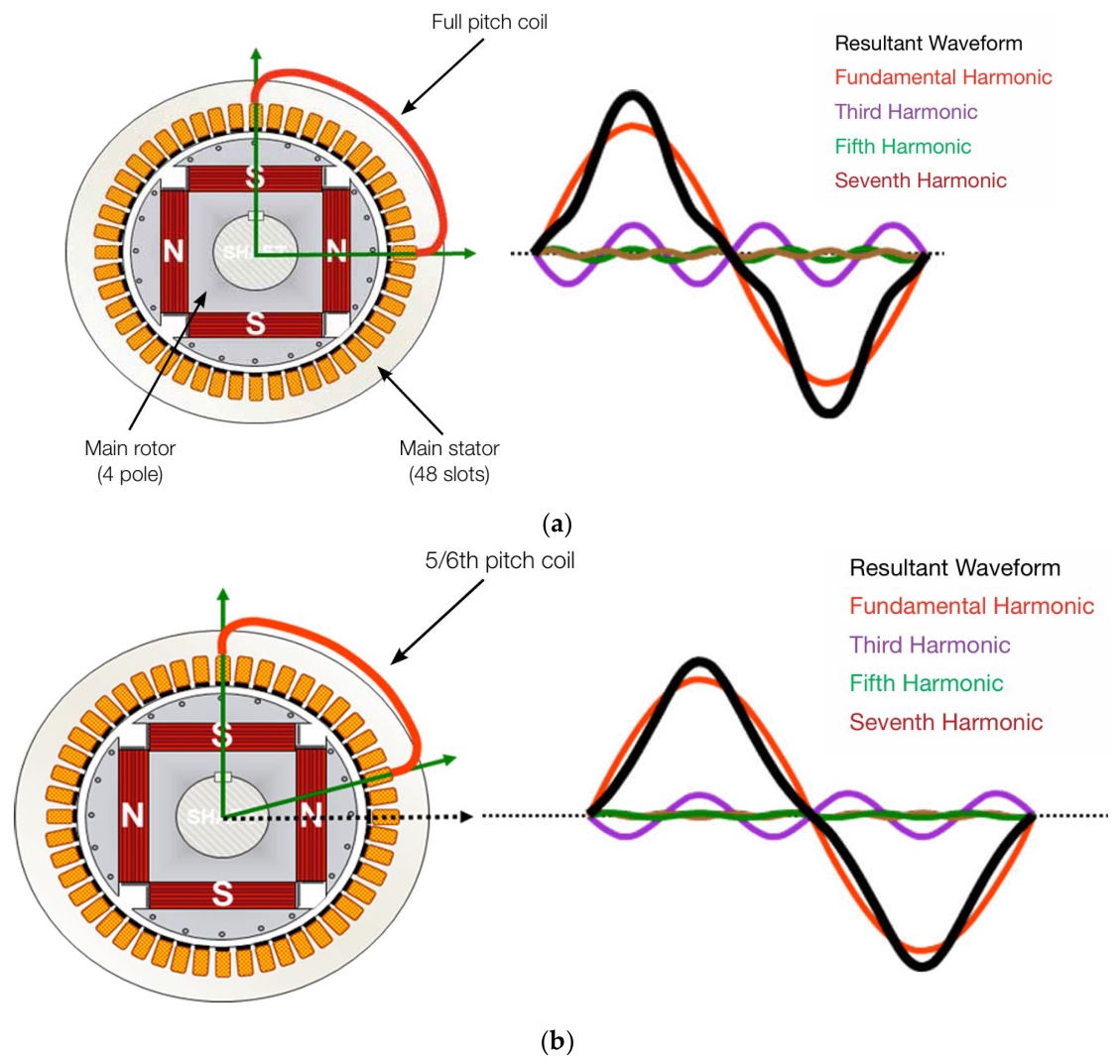
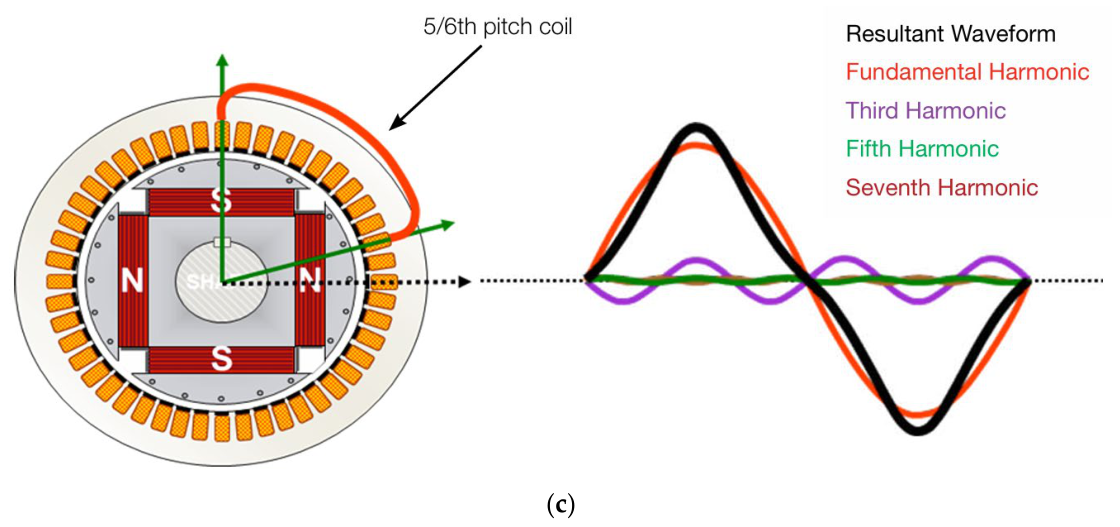
Typically, in synchronous generator design, the full winding pitch (ρ = 1) refers to a basic configuration where the coil span is exactly equal to the pole pitch, spanning 180 electrical degrees. In this configuration, the resultant EMF is the arithmetic sum of the EMFs induced in each coil side. However, full-pitch windings often result in high harmonic content, as shown in Figure 8a.
To improve the waveform, industrial generators commonly utilize short-pitch (or fractional-pitch) windings, where the coil pitch is shorter than the pole pitch. In industrial applications, two types of winding pitches are predominantly used: 5/6th winding pitch (ρ ≈ 0.83) and 2/3rd winding pitch (ρ ≈ 0.67). Their impact on power quality is shown in Figure 8b,c. It is also summarized as follows [26]:
  • 5/6th winding pitch: The 5/6th pitch is more effective at utilizing the fundamental magnetic flux, leading to a higher fundamental voltage output. This allows for a more compact generator design with reduced active materials (copper and lamination steel), offering a cost-effective solution. Moreover, it is particularly effective at suppressing fifth and seventh harmonics, which are often the most problematic in industrial power systems.
  • 2/3rd winding pitch: This design is specifically engineered to eliminate triplen harmonics (3rd, 9th, 15th, etc.). By setting ρ = 2/3, the pitch factor for the third harmonic becomes kp3 = sin(π) = 0, theoretically zeroing out these components. While it excels at 3rd harmonic suppression, it may slightly amplify fifth and seventh harmonics compared to other designs and typically results in a lower zero-sequence impedance, which increases earth fault currents.
Furthermore, when generators with different pitches are operated in parallel, the discrepancy in their instantaneous voltage waveforms leads to circulating currents through the neutral connections. These currents not only increase copper losses but also induce voltage unbalance across the phases. Therefore, the analysis of transformer voltage drops must account for these source-side imperfections, as the interaction between the generator’s harmonic profile and the transformer’s magnetic impedance can lead to non-linear voltage regulation issues [26,27,28].

3.2. Experimental Analysis

To verify the voltage drop caused by unbalanced voltage with an unbalanced harmonic component on the HV side, which is discussed in the previous sections, two experimental approaches are conducted. To ensure high reliability and controlled variables, the experiments are performed by connecting the system to a stable utility power source with high power quality, rather than an actual synchronous generator, which may exhibit inherent volatility.

3.2.1. Test1—Mitigating Unbalance of Fundamental Voltage

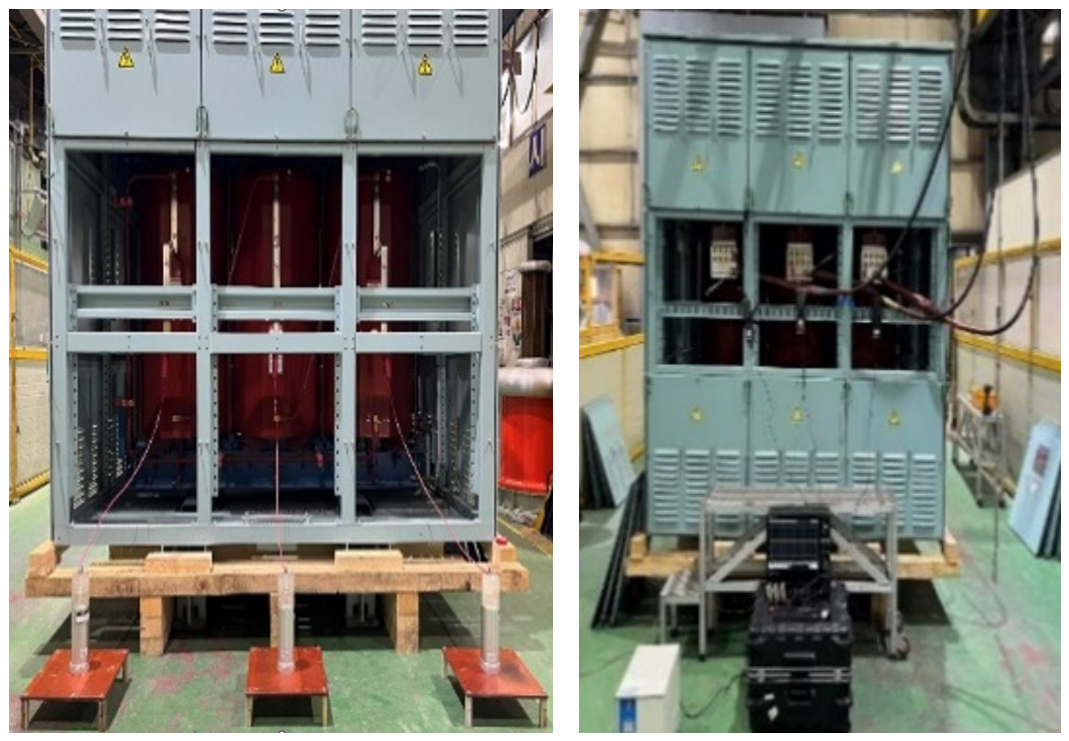
The measurements are conducted in transformer testing facilities, as shown in Figure 9. In addition to the differential probes (HVD3206A, Teledyne LeCroy, Chestnut Ridge, NY, USA) installed on the LV side, all other devices used are the same as those employed in the on-site measurements. Moreover, a full-scale transformer, constructed with the same design as the one installed, is tested in an unloaded state.
The voltages applied to each HV winding are analyzed for harmonics, as shown in Figure 10b. The magnitudes for some parts of the individual harmonic components increased compared to those in Figure 3b. However, the difference in fundamental components for each winding decreased to 159.92 V and 36.57 V, in contrast to the maximum and minimum values in Figure 3b, which are 269.26 V and 122.34 V, respectively.
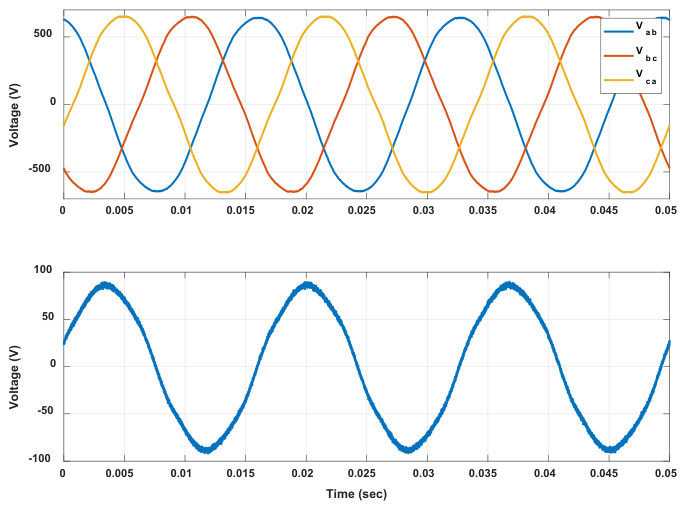
The waveform and harmonic analysis results of the induced voltage in the LV windings, corresponding to the voltages of the HV windings, are presented in Figure 11. A summary of the overall voltages for both HV and LV windings is provided in Table 7. Compared to the measurements in the isolated offshore platform, showing 0.984 pu from Table 2, this value is closer to the rated value. Additionally, this can be verified through the turn ratio; the voltage ratio between the HV and LV sides is 14.568, which is 0.049 lower than the ratio observed during on-site measurements under no-load conditions. This finding falls within the rated turns ratio range of 14.229 to 14.372 (see Section 2.1).

3.2.2. Test2—Mitigating Harmonic Components with Balanced Fundamental Voltage

In the transformer testing facilities, each phase voltage can be manually adjusted, as illustrated in Figure 12a. This adjustment results in a minimal voltage unbalance of only 0.131%, as shown in Table 8. Moreover, the fundamental components of the voltages applied to the HV winding, presented in Figure 12b through harmonic analysis, are closely aligned with each other, which is an improvement over previous cases. Achieving such a low voltage unbalance significantly decreases both the magnitude and degree of unbalance for all harmonic components. As a result, the voltages in the LV windings are induced by the turn ratio that closely matches its rated value.
The average value of the induced voltage in the LV windings is 1.002 pu, corresponding to the rated LV voltage, as shown in Table 8. Additionally, the ratio of the HV to the LV voltages has improved considerably, dropping from 14.568 in Test1 to 14.433 in Test2. This improvement is attributed to the reduced unbalance of both the fundamental voltages and specific harmonics, particularly the third harmonic. This finding highlights that unbalanced fundamental voltages and harmonics have a significant impact on voltage drop, as discussed in this study.

4. Conclusions

This study investigated abnormal secondary voltage drops observed in dry-type transformers operating in isolated offshore power systems. The results indicate that the observed voltage deviation cannot be adequately explained by conventional transformer impedance and load-based models alone. Instead, the combined influence of voltage unbalance and harmonic/DC-induced asymmetric excitation is identified as the dominant mechanism, while residual magnetic flux acts as a secondary magnetic bias factor.
Both simulation and experimental results demonstrate that interactions between source-side voltage unbalance and residual magnetic flux lead to asymmetric flux distribution in the transformer core. This phenomenon results in a secondary voltage reduction of approximately 4–6 V under no-load conditions, even in the absence of transformer defects.
In addition, the study confirms that synchronous generator winding pitch influences the harmonic characteristics of the generated voltage, which can affect voltage quality and contribute to voltage unbalance propagation in isolated power systems.
Experimental validation further shows that improving voltage balance and reducing harmonic distortion effectively mitigates the observed voltage drop. Under balanced and low-distortion conditions, the secondary voltage is restored to approximately 1.002 pu, consistent with design expectations.
From an engineering perspective, these results highlight the importance of considering source-side voltage quality in transformer design and operation for isolated grids. In particular, voltage regulation and tap-setting strategies should account for harmonic and unbalance effects in addition to nominal turns ratio assumptions.
Overall, this work provides experimentally validated evidence that coupled electromagnetic effects between voltage unbalance, harmonics, and residual flux can significantly influence transformer voltage behavior in offshore power systems.
It should be noted that the on-site measurements presented in this study are limited to a maximum load factor of 19% due to the practical operational constraints of the isolated offshore power system. Consequently, the experimental validation of the secondary voltage drop phenomenon in this paper primarily represents no-load and light-load conditions. While the theoretical analysis and PSCAD simulations are conducted across the full loading range up to 100%, definitively generalizing the experimental findings to heavy-load operations remains challenging at this stage.
Therefore, future research will focus on two main areas. First, further field measurements under high-load conditions are required to fully validate the theoretical models and comprehensively assess the impact of coupled magnetic flux effects across the entire operational spectrum. Second, while this study highlights the impact of harmonic components and residual flux, the optimization of generator winding pitch specifically for mitigating transformer secondary-side voltage drops remains an important area for further exploration. Future work will investigate how different pitch designs can be utilized as a proactive measure to enhance voltage quality in isolated offshore grids.

Author Contributions

Conceptualization, B.C.S. and S.K.; software, B.C.S.; formal analysis, B.C.S.; investigation, B.C.S. and S.K.; resources, S.K.; data curation, S.K.; writing—original draft preparation, B.C.S.; writing—review and editing, S.K.; visualization, B.C.S. and S.K. All authors have read and agreed to the published version of the manuscript.

Funding

This work was supported by the Korea Institute of Energy Technology Evaluation and Planning (KETEP) under the Ministry of Climate, Energy and Environment (MCEE) of the Republic of Korea (No. RS-2023-00301692).

Data Availability Statement

Data available on request due to institutional restrictions and intellectual property protection.

Conflicts of Interest

Author Byung Chul Sung was employed by the company HD Hyundai Electric. Seongil Kim was employed by the company HD Korea Shipbuilding & Offshore Engineering. The remaining authors declare that the research was conducted in the absence of any commercial or financial relationships that could be construed as a potential conflict of interest. The authors declare that this study received funding from the Korea Institute of Energy Technology Evaluation and Planning. The funder was not involved in the study design, collection, analysis, interpretation of data, the writing of this article, or the decision to submit it for publication.

References

  1. Gurkan, F.; Guangya, Y.; Al-Ali, H.A.H. A comparative study of different transformer connections for railway power supply-mitigation of voltage unbalance. In Proceedings of the 10th International Conference on Advances in Power System Control, Operation & Management (APSCOM 2015), Hong Kong, China, 8–12 November 2015. [Google Scholar]
  2. Kolagar, A.D.; Hamedani, P.; Shoulaie, A. The effects of transformer connection type on voltage and current unbalance propagation. In Proceedings of the 2012 3rd Power Electronics and Drive Systems Technology (PEDSTC), Tehran, Iran, 15–16 February 2012; pp. 341–346. [Google Scholar]
  3. Garcia-Rios, S.; Barrado-Rodrigo, J.A.; Gonzalez-Molina, F.; Guasch-Pesquer, L. Voltage and current performance of a three-phase transformer under unbalanced voltage supply. In Proceedings of the 2018 International Symposium on Fundamentals of Electrical Engineering (ISFEE), Bucharest, Romania, 1–3 November 2018. [Google Scholar]
  4. Paranavithana, P.; Perera, S.; Koch, R.; Emin, Z. Global Voltage Unbalance in MV Networks Due to Line Asymmetries. IEEE Trans. Power Deliv. 2009, 24, 2353–2360. [Google Scholar] [CrossRef]
  5. Zheng, T.; Makram, E.B.; Girgis, A.A. Evaluating power system unbalance in the presence of harmonic distortion. IEEE Trans. Power Deliv. 2003, 18, 393–397. [Google Scholar] [CrossRef]
  6. Schonek, J. The singularities of the third harmonic. In Cahier Technique No. 202; Schneider Electric: Rueil-Malmaison, France, 2001. [Google Scholar]
  7. Seddik, M.S.; Eteiba, M.B.; Shazly, J. Evaluating the Harmonic Effects on the Thermal Performance of a Power Transformer. Energies 2024, 17, 4871. [Google Scholar] [CrossRef]
  8. DNV GL. Rules for Classification: Ships, Part 4 Systems and Components, Chapter 8 Electrical Installations; DNV GL: Høvik, Norway, 2020. [Google Scholar]
  9. Yazdani-Asrami, M.; Mirzaie, M.; Akmal, A.A.S. No-load loss evaluation of distribution transformers supplied by nonsinusoidal voltage using three-dimensional finite element analysis. Energy 2013, 50, 205–219. [Google Scholar] [CrossRef]
  10. Radakovic, Z.; Fotic, P. The impact of voltage unbalance on the power losses in distribution transformers. Electr. Power Syst. Res. 2020, 180, 106155. [Google Scholar]
  11. Moses, P.S.; Masoum, M.A.S. Three-phase asymmetric transformer core saturation modeling for harmonic analysis in distribution networks. IEEE Trans. Power Deliv. 2010, 25, 3182–3191. [Google Scholar]
  12. Kütt, L.; Millar, R.J.; Niitsoo, J.; Karu, T.; Taklaja, P.; Jarkovoi, M. The role of load harmonics in audible noise of electrical transformers. In Proceedings of the 2014 Electric Power Quality and Supply Reliability Conference (PQ), Rakvere, Estonia, 11–13 June 2014; pp. 245–250. [Google Scholar]
  13. Cui, Y.; Abdulsalam, S.G.; Chen, S.; Xu, W. A sequential phase energization technique for transformer inrush current reduction—Part I: Principle and basic solutions. IEEE Trans. Power Deliv. 2005, 20, 943–949. [Google Scholar] [CrossRef]
  14. Cavallera, D.; Oiring, V.; Coulomb, J.-L.; Petrovic, O. Determining the Residual Magnetic Flux Value of a Single-Phase Transformer Using a Minor Hysteresis Loop. IEEE Trans. Power Deliv. 2021, 36, 2066–2074. [Google Scholar]
  15. Bradt, M.; Badrzadeh, B.; Cardenas, E.; Mueller, S. Harmonic and resonance issues in offshore wind power plants. IEEE Trans. Ind. Appl. 2014, 50, 1662–1670. [Google Scholar]
  16. Guerrero, J.M.; Chandorkar, M.; Lee, T.L.; Loh, P.C. Advanced control architectures for intelligent microgrids—Part I: Decentralized and hierarchical control. IEEE Trans. Ind. Electron. 2013, 60, 1254–1262. [Google Scholar] [CrossRef]
  17. IEEE Std C57.12.00-2015; IEEE Standard for General Requirements for Liquid-Immersed Distribution, Power, and Regulating Transformers. IEEE: Piscataway, NJ, USA, 2015.
  18. IEC 60076-1; Power Transformers—Part 1: General. IEC: Geneva, Switzerland, 1999.
  19. Harlow, J.H. Electric Power Transformer Engineering; CRC Press: Boca Raton, FL, USA, 2004. [Google Scholar]
  20. Kulkarni, S.V.; Khaparde, S.A. Transformer Engineering: Design and Practice; Marcel Dekker: New York, NY, USA, 2005. [Google Scholar]
  21. Shafieipour, M.; Ziomek, W.; Jayasinghe, R.P.; Alonso, J.C.G.; Gole, A.M. Application of Duality-Based Equivalent Circuits for Modeling Multilimb Transformers Using Alternative Input Parameters. IEEE Access 2020, 8, 153353–153363. [Google Scholar] [CrossRef]
  22. Jazebi, S.; de León, F. Duality-Based Transformer Model Including Eddy Current Effects in the Windings. IEEE Trans. Power Deliv. 2015, 30, 2312–2320. [Google Scholar] [CrossRef]
  23. Zhao, J.; de León, F.; Martinez, J.A.; Jalilian, A.; Wu, J. Topological Transient Models of Three-Phase, Three-Legged Transformer. IEEE Access 2019, 7, 102519–102529. [Google Scholar] [CrossRef]
  24. Alvarez-Marino, C.; de Leon, F.; Lopez-Fernandez, X.M. Equivalent Circuit for the Leakage Inductance of Multiwinding Transformers: Unification of Terminal and Duality Models. IEEE Trans. Power Deliv. 2012, 27, 353–361. [Google Scholar] [CrossRef]
  25. CIGRE Working Group A2.37. Transformer Reliability Survey; Technical Brochure 568; CIGRE: Paris, France, 2014. [Google Scholar]
  26. Al-Tayie, J.; Whitworth, C.; Biebighaeuser, A. AC Generators with 2/3rd and 5/6th Winding Pitch; White Paper No. WP105; Cummins Generator Technologies: Stamford, UK, 2013. [Google Scholar]
  27. Mailula, K.O.; Saha, A.K. Comparative Analysis of Shaft Voltage Harmonic Characteristics in Large-Scale Generators: OEM and Excitation System Comparisons. Energies 2025, 18, 6128. [Google Scholar] [CrossRef]
  28. Hsiao, C.Y.; Yeh, S.N.; Hwang, J.C. Design of High Performance Permanent-Magnet Synchronous Wind Generators. Energies 2014, 7, 7105–7124. [Google Scholar] [CrossRef]
Figure 1. On-site measured voltages alongside ordinary voltage drop curves.
Energies 19 02466 g001
Figure 2. Setup for primary and secondary voltage measurements conducted in the onboard network of an isolated offshore platform: (a) HV side and (b) LV side.
Energies 19 02466 g002
Figure 3. Measured results of HV side in onboard networks of isolated offshore platform under no-load condition: (a) waveforms of line-to-line voltage and 3V0; (b) harmonics of each line-to-line voltage.
Energies 19 02466 g003
Figure 4. Measured results of LV side in onboard networks of isolated offshore platform under no-load condition: waveforms of line-to-line voltage and 3V0.
Energies 19 02466 g004
Figure 5. Magnetic circuit of a three-phase transformer with three legs.
Energies 19 02466 g005
Figure 6. Instantaneous voltages for Case V (a) HV winding (b) LV winding.
Energies 19 02466 g006
Figure 7. Harmonics from the DC to the 6th components in applied voltages of HV windings for Case V.
Energies 19 02466 g007
Figure 8. Example of resultant waveform of the output phase voltage: (a) full winding pitch, (b) 5/6th winding pitch, (c) 2/3rd winding pitch [26].
Energies 19 02466 g008aEnergies 19 02466 g008b
Figure 9. Setup for HV and LV voltage measurements conducted in transformer testing facilities (left: HV side and right: LV side).
Energies 19 02466 g009
Figure 10. Measured Results of HV side in transformer testing facilities under no-load condition for Test1: (a) waveforms of line-to-line voltage and 3V0; (b) harmonics of each line-to-line voltage.
Energies 19 02466 g010
Figure 11. Measured Results of LV side in transformer testing facilities under no-load condition: waveforms of line-to-line voltage and 3V0.
Energies 19 02466 g011
Figure 12. Measured results of HV side in transformer testing facilities under no-load condition for Test2: (a) waveforms of line-to-line voltage and 3V0; (b) harmonics of each line-to-line voltage.
Energies 19 02466 g012
Table 1. Results of turn ratio measurement.
Tap No.Designed RatioMeasured Ratio
HV [V]LV [V]A-B/a-bB-C/b-cC-A/c-a
16765450---
26600---
3643514.32614.31914.318
46270---
Table 2. Summary of HV/LV voltage measurements under no-load condition referred to 6600/461.54 V (voltage of Tap No. 3 for 6600 V applied to HV side).
PhaseHVLVHV/LV Ratio
VRMS [V]Max. ΔV [%]VRMS [V]Max. ΔV [%]
A-B/a-b6738.76
(1.021 pu)
2.885
(VAB–VCA)
453.52
(0.983 pu)
0.557
(Vbc–Vca)
14.859
B-C/b-c6634.79
(1.005 pu)
455.97
(0.988 pu)
14.551
C-A/c-a6548.34
(0.992 pu)
453.40
(0.982 pu)
14.443
Average6640.63
(1.006 pu)
-454.30
(0.984 pu)
-14.617
Table 3. Summary of HV/LV voltage measurements under 19% load condition referred to 6600/461.54 V (voltage of Tap No. 3 for 6600 V applied to HV side).
PhaseHVLVHV/LV Ratio
VRMS [V]Max. ΔV [%]VRMS [V]Max. ΔV [%]
A-B/a-b6732.96
(1.020 pu)
2.826
(VAB–VCA)
449.45
(0.974 pu)
0.327
(Vab–Vbc)
14.980
B-C/b-c6623.79
(1.004 pu)
450.96
(0.977 pu)
14.688
C-A/c-a6546.45
(0.992 pu)
449.63
(0.974 pu)
14.560
Average6634.40
(1.005 pu)
-450.01
(0.975 pu)
-14.743
Table 4. Specifications of transformer.
ParametersValue
Capacity2.5 MVA
Rated voltage6435/450 V
Frequency60 Hz
VectorDd0
%Z6.97%
Applied TR ModelDuality-based transformer model
Core Geometry3/0
(Ratio yoke/winding limb length: 0.8535
Ratio yoke/winding limb area: 1.0000)
Saturation propertiesExcitation current: 0.19%
Air-core reactance: 0.2 pu
Table 5. Phase-to-ground source voltage for PSCAD simulations.
CaseComponents of Voltages
Fundamental3rd Harmonic5th HarmonicDC
Mag.
[kVRMS]
Phase
[Degree]
Mag.
[kVRMS]
Phase
[Degree]
Mag.
[kVRMS]
Phase
[Degree]
Mag.
[V]
IA3.81050-----
B3.8105120-----
C3.8105240-----
IIA3.77500-----
B3.9140120-----
C3.8130240-----
IIIA3.775000.1000300---
B3.91401200.500060---
C3.81302400.1905120---
IVA3.775000.1000300--5.6391
B3.91401200.500060--−6.9901
C3.81302400.1905120--4.1415
VA3.775000.1000300--5.6391
B3.91401200.500060--−6.9901
C3.81302400.1905120--4.1415
VIA3.775000.10003000.10003005.6391
B3.91401200.5000600.500060−6.9901
C3.81302400.19051200.19051204.1415
Table 6. Line-to-line voltage of HV/LV side referred to 6600/461.54 V (voltage of Tap No. 3 for 6600 V applied to HV side) in simulations.
CaseHVLV
PhaseVoltage [kVRMS]Ratio [%]PhaseVoltage [kVRMS]Ratio [%]
IA–B6.599899.9970a–b0.461599.9913
B–C6.599899.9970b–c0.461599.9913
C–A6.599899.9970c–a0.461599.9913
IIA–B6.6590100.8939a–b0.4656100.8797
B–C6.6918101.3909b–c0.4679101.3780
C–A6.571299.5636c–a0.459599.5580
IIIA–B6.6822101.2455a–b0.4673101.2480
B–C6.7060101.6061b–c0.4689101.5947
C–A6.577699.6606c–a0.459999.6447
IVA–B6.6708101.0727a–b0.457699.1463
B–C6.6995101.5076b–c0.461299.9263
C–A6.574099.6061c–a0.456398.8647
VA–B6.6744101.1273a–b0.458899.4063
B–C6.6970101.4697b–c0.458699.3630
C–A6.574199.6076c–a0.456198.8213
VIA–B6.6974101.4758a–b0.460399.7313
B–C6.7112101.6848b–c0.459699.5797
C–A6.580599.7045c–a0.456598.9080
Table 7. Summary of HV/LV voltage measurements for Test1 under no-load condition referred to 6600/461.54 V (voltage of Tap No. 3 for 6600 V applied to HV side).
PhaseHVLVHV/LV Ratio
VRMS [V]Max. ΔV [%]VRMS [V]Max. ΔV [%]
A-B/a-b6779.48
(1.027 pu)
1.710
(VBC–VCA)
466.31
(1.010 pu)
1.015
(Vab–Vbc)
14.538
B-C/b-c6692.42
(1.014 pu)
461.63
(1.000 pu)
14.497
C-A/c-a6805.29
(1.031 pu)
463.97
(1.005 pu)
14.668
Average6759.06
(1.024 pu)
-463.97
(1.005 pu)
-14.568
Table 8. Summary of HV/LV voltage measurements for Test2 under no-load condition referred to 6600/461.54 V (voltage of Tap No. 3 for 6600 V applied to HV side).
PhaseHVLVHV/LV Ratio
VRMS [V]Max. ΔV [%]VRMS [V]Max. ΔV [%]
A-B/a-b6676.52
(1.012 pu)
0.131
(VAB–VCA)
461.91
(1.001 pu)
0.223
(Vab–Vbc)
14.454
B-C/b-c6675.25
(1.011 pu)
462.94
(1.003 pu)
14.419
C-A/c-a6667.88
(1.010 pu)
462.14
(1.001 pu)
14.428
Average6673.22
(1.011 pu)
-462.33
(1.002 pu)
-14.434
Disclaimer/Publisher’s Note: The statements, opinions and data contained in all publications are solely those of the individual author(s) and contributor(s) and not of MDPI and/or the editor(s). MDPI and/or the editor(s) disclaim responsibility for any injury to people or property resulting from any ideas, methods, instructions or products referred to in the content.