Reliability Assessment Methods for Power Supply Systems Considering the Technical Condition of Electrical Equipment: A Critical Review

 ,
,  ,
,  ,
,  and
and
Abstract
1. Introduction
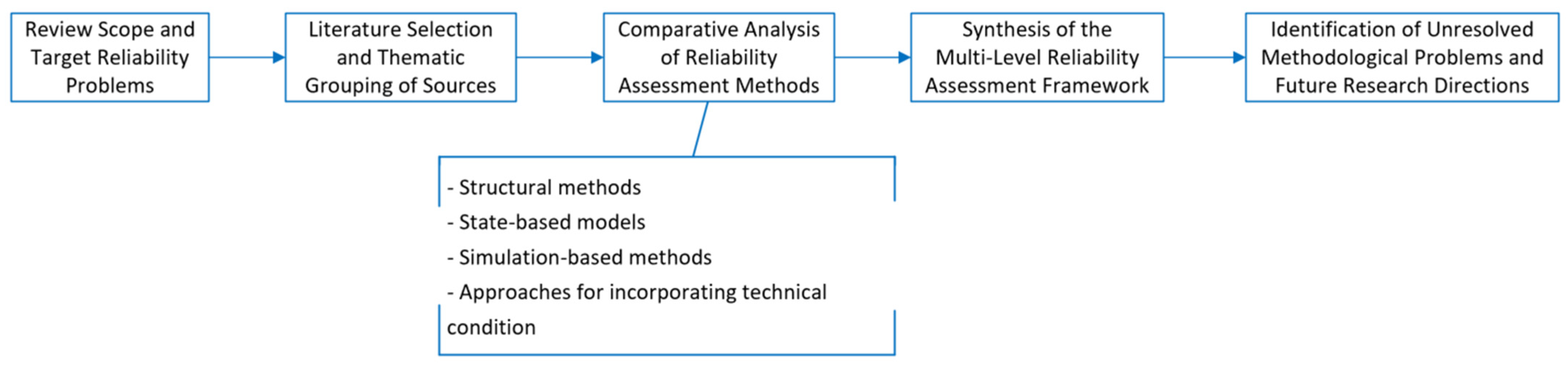
2. Review Scope, Source Selection Strategy, and Analytical Framework
3. Problem Formulation and Reliability Metrics
4. Structural Reliability Assessment Methods for Power Supply Systems
4.1. Fault Tree Analysis
4.2. Logic–Probabilistic Method
5. Markov Models for Reliability Assessment
6. Monte Carlo-Based Simulation
7. Incorporation of Technical Condition into Reliability Assessment
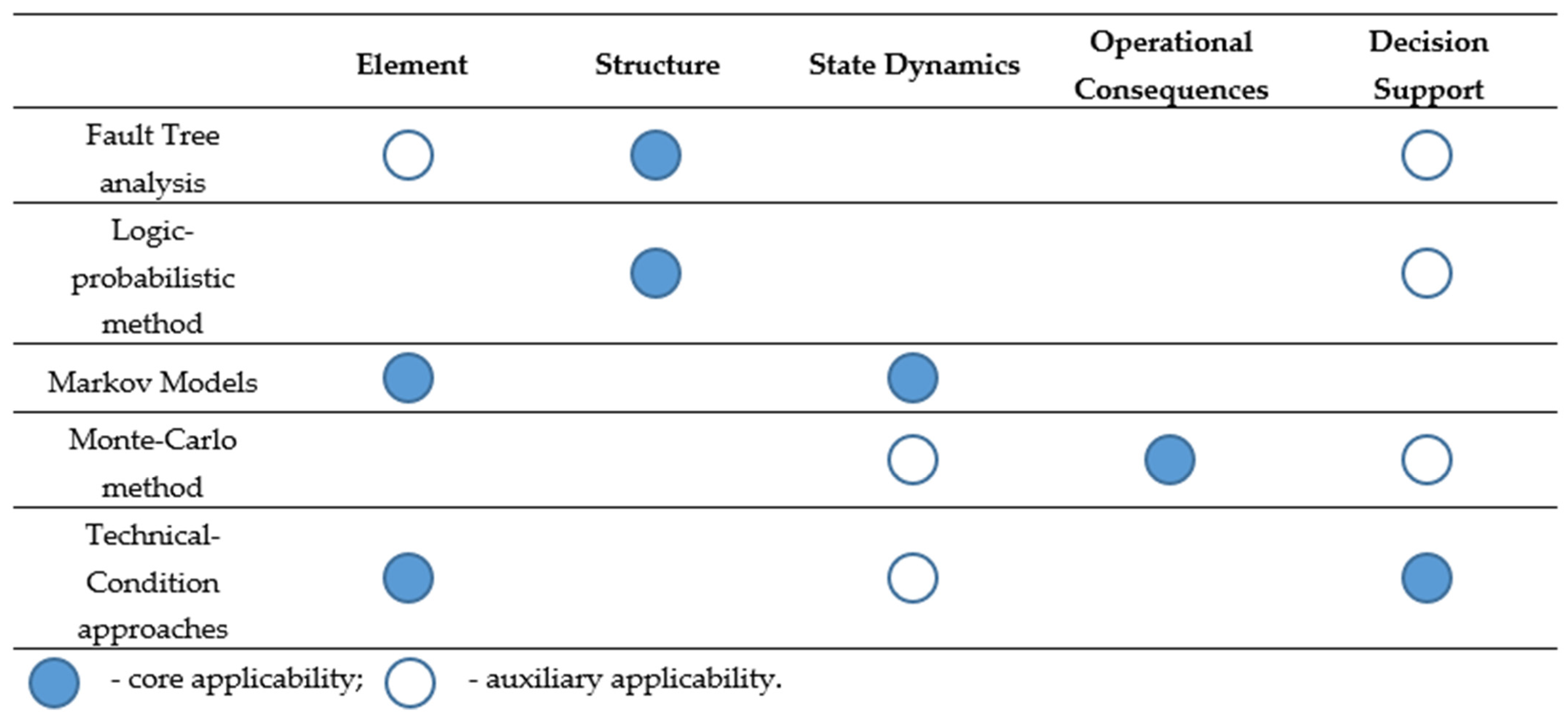
8. Comparative Analysis of Reliability Assessment Methods
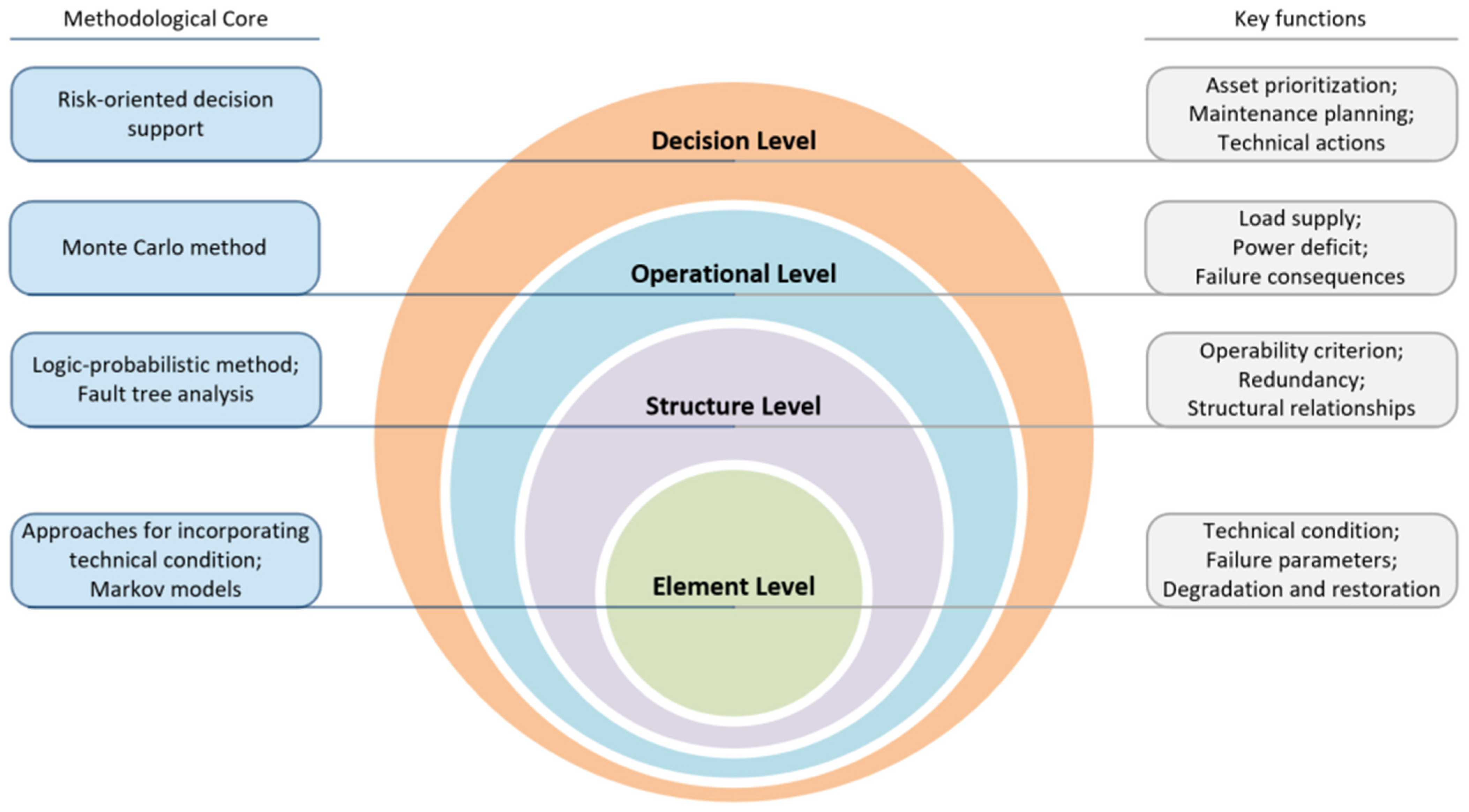
9. Multi-Level Framework for Comprehensive Reliability Assessment
10. Unresolved Problems and Future Research Directions
11. Conclusions
Author Contributions
Funding
Data Availability Statement
Conflicts of Interest
References
- Energy Strategy of the Russian Federation for the Period up to 2050. Approved by Order of the Government of the Russian Federation No. 908-r, 12 April 2025. Available online: https://static.government.ru/media/files/LWYfSENa10uBrrBoyLQqAAOj5eJYlA60.pdf (accessed on 8 February 2026).
- Kondrashova, Y.N.; Shalimov, A.V.; Markina, A.M.; Tretyakov, A.M. Reliability assessment of electrical equipment of a metallurgical enterprise power hub for individual sections with reference to types of technological production. Omsk. Sci. Bull. 2022, 2, 77–85. (In Russian) [Google Scholar] [CrossRef]
- Babanova, I.S. Current state and problems of reliability of power supply systems of industrial electrical complexes. Reliab. Saf. Power Eng. 2023, 16, 210–219. (In Russian) [Google Scholar] [CrossRef]
- Babanova, I.S. Risk assessment of technological disturbances at oil and gas enterprises. Reliab. Saf. Power Eng. 2023, 16, 143–150. (In Russian) [Google Scholar] [CrossRef]
- Kebede, F.S.; Olivier, J.-C.; Bourguet, S.; Machmoum, M. Reliability evaluation of renewable power systems through distribution network power outage modelling. Energies 2021, 14, 3225. [Google Scholar] [CrossRef]
- Hampannavar, S.; Longe, O.M.; Himabindu, N.; Deepa, B.; Swapna, M. Reliability modeling and assessment of a community microgrid with electric vehicle charging station as a critical load. e-Prime Adv. Electr. Eng. Electron. Energy 2024, 8, 100610. [Google Scholar] [CrossRef]
- Abramovich, B.N.; Bogdanov, I.A. Improving the efficiency of autonomous electrical complexes of oil and gas enterprises. J. Min. Inst. 2021, 249, 408–416. [Google Scholar] [CrossRef]
- Abramovich, B.N.; Sychev, Y.A.; Zimin, R.Y. Efficiency estimation of a hybrid electrical complex for voltage and current waveform correction in power systems of oil enterprises. In Proceedings of the IEEE Conference of Russian Young Researchers in Electrical and Electronic Engineering (ElConRus); IEEE: New York, NY, USA, 2019; Volume 1, pp. 401–406. [Google Scholar] [CrossRef]
- Wang, Y.; He, R.; Tian, Z. Opportunistic condition-based maintenance optimization for electrical distribution systems. Reliab. Eng. Syst. Saf. 2023, 236, 109261. [Google Scholar] [CrossRef]
- Naim, W.; Hilber, P.; Shayesteh, E. Data challenges in asset management of power distribution systems: Review and observations. In Proceedings of the 2023 IEEE Belgrade PowerTech (PowerTech); IEEE: New York, NY, USA, 2023. [Google Scholar] [CrossRef]
- Sekretarev, Y.A.; Gorshunov, A.A. Models of the current technical condition of electrical equipment for reliability calculation of power supply systems of single-load consumers within a risk-oriented approach. Energ. Proc. CIS High. Educ. Inst. Power Assoc. 2025, 68, 17–34. (In Russian) [Google Scholar] [CrossRef]
- Zhang, D.; Li, G.; Bie, Z.; Fan, K. An analytical method for reliability evaluation of power distribution systems with time-varying failure rates. Reliab. Eng. Syst. Saf. 2024, 250, 110290. [Google Scholar] [CrossRef]
- Li, S.; Li, X.; Cui, Y.; Li, H. Review of transformer health index from the perspective of survivability and condition assessment. Electronics 2023, 12, 2407. [Google Scholar] [CrossRef]
- Lakomov, I.V.; Pomogaev, Y.M. Analysis of methods for reliability calculation of electric power systems. Bull. Voronezh State Agrar. Univ. 2022, 15, 26–32. (In Russian) [Google Scholar] [CrossRef]
- Krupenev, D.S. Development of methodological foundations for system reliability analysis of electric power systems. Reliab. Saf. Power Eng. 2024, 17, 98–105. (In Russian) [Google Scholar] [CrossRef]
- Nazarychev, A.N.; Andreev, D.A. Methods and Mathematical Models for Integrated Assessment of the Technical Condition of Electrical Equipment; ISPU: Ivanovo, Russia, 2005; 223p. (In Russian) [Google Scholar]
- Gladkikh, T.D. Maintenance of electric networks: A review. Bull. South Ural State Univ. Ser. Power Eng. 2024, 24, 5–15. (In Russian) [Google Scholar] [CrossRef]
- Zhang, J.; Wang, B.; Ma, H.; He, Y.; Wang, H.; Zhang, H. Reliability evaluation method for underground cables based on double sequence Monte Carlo simulation. Processes 2025, 13, 505. [Google Scholar] [CrossRef]
- Boyarkov, D.A.; Kompaneets, B.S.; Sinitsin, V.I. Methodology for prioritizing the renewal of electric grid equipment based on determination of failure risks. Energetik 2024, 11, 22–26. (In Russian) [Google Scholar] [CrossRef]
- Oboskalov, V.P. Algorithmic aspects of calculating probabilistic indicators of power deficit and insufficient generation in electric power systems. Proc. Russ. Acad. Sci. Power Eng. 2020, 2, 59–74. (In Russian) [Google Scholar] [CrossRef]
- Belyaev, N.A. Accounting for the adequacy reliability criterion in optimization of the operation and development of an electric power system. Reliab. Saf. Power Eng. 2020, 13, 11–16. (In Russian) [Google Scholar] [CrossRef]
- Krupenev, D.S.; Lebedeva, L.M. Ensuring the maximum level of adequacy reliability of electric power systems during outage of generating units for modernization. Proc. Russ. Acad. Sci. Power Eng. 2020, 6, 31–39. (In Russian) [Google Scholar] [CrossRef]
- Oboskalov, V.P. Methodological problems in determining the probability of power deficit in an electric power system. Proc. Russ. Acad. Sci. Power Eng. 2022, 5, 62–80. (In Russian) [Google Scholar] [CrossRef]
- Oboskalov, V.P.; Abdel Menaem, A.S.H. Determination of adequacy reliability indicators of interconnected power systems by point estimation methods. Proc. Russ. Acad. Sci. Power Eng. 2020, 6, 40–53. (In Russian) [Google Scholar] [CrossRef]
- Krupenev, D.S.; Belyaev, N.A.; Boyarkin, D.A.; Iakubovskii, D.V. Clustering of electric power systems into reliability zones in adequacy assessment. Part 2. Bull. Russ. Acad. Sci. Energetics 2024, 2, 34–44. [Google Scholar] [CrossRef]
- Krupenev, D.S.; Belyaev, N.A.; Boyarkin, D.A. Clustering of electric power systems into reliability zones in adequacy assessment. Part 1. Proc. Russ. Acad. Sci. Power Eng. 2024, 1, 12–21. (In Russian) [Google Scholar] [CrossRef]
- Oboskalov, V.P.; Abdel Menaem, A.S.H. Modeling of rare events in calculating adequacy reliability indicators of electric power systems. Proc. Russ. Acad. Sci. Power Eng. 2021, 4, 24–41. (In Russian) [Google Scholar] [CrossRef]
- Tiwari, A.K.; Tiwari, A.K. Assessment of customer-oriented indicators and reliability study of a power supply system. Reliab. Nadezhnost’ 2023, 23, 49–56. (In Russian) [Google Scholar] [CrossRef]
- Vinogradova, A.V.; Vinogradov, A.V.; Bukreeva, A.K. Specific indicators of outage consequences in 110-kV electric networks. Eng. Technol. Syst. 2025, 35, 808–824. (In Russian) [Google Scholar] [CrossRef]
- Boyarkov, D.A.; Kompaneets, B.S. Methodology for assessing the technical condition of electric networks based on determining the probability of failure. Proc. High. Educ. Inst. Energy Sect. Probl. 2024, 26, 31–43. (In Russian) [Google Scholar] [CrossRef]
- Stawowy, M.; Rosiński, A.; Siergiejczyk, M.; Perlicki, K. Quality and reliability-exploitation modeling of power supply systems. Energies 2021, 14, 2727. [Google Scholar] [CrossRef]
- Wang, B.; Franchetti, G.; Bruni, T.; Marinelli, M. A tensor-based predictor-corrector algorithm for generation and transmission reliability assessment with sequential Monte Carlo simulation. Energies 2024, 17, 5967. [Google Scholar] [CrossRef]
- Pan, K.; Liu, H.; Gou, X.; Huang, R.; Ye, D.; Wang, H.; Glowacz, A.; Kong, J. Towards a systematic description of fault tree analysis studies using informetric mapping. Sustainability 2022, 14, 11430. [Google Scholar] [CrossRef]
- Chybowski, L. Importance analysis of components of a multi-operational-state power system using fault tree models. Information 2020, 11, 29. [Google Scholar] [CrossRef]
- San Martín Silva, G.; López Droguett, E. Quantum fault trees and minimal cut sets identification. Reliab. Eng. Syst. Saf. 2025, 262, 111147. [Google Scholar] [CrossRef]
- Sonawane, P.R.; Bhandari, S.; Patil, R.B.; Al-Dahidi, S. Reliability and criticality analysis of a large-scale solar photovoltaic system using the fault tree analysis approach. Sustainability 2023, 15, 4609. [Google Scholar] [CrossRef]
- Hosseini, S.A.; Ahmedi, A.; Blaabjerg, F.; Peyghami, S. Exploring wind farm reliability: Key concepts, databases and fault trees. Renew. Sustain. Energy Rev. 2025, 211, 115227. [Google Scholar] [CrossRef]
- Sahin, B.; Yazidi, A.; Roman, D.; Soylu, A. Ontology-based fault tree analysis algorithms in a fuzzy environment for autonomous ships. IEEE Access 2021, 9, 40915–40932. [Google Scholar] [CrossRef]
- Kang, J.; Sun, L.; Guedes Soares, C. Fault tree analysis of floating offshore wind turbines. Renew. Energy 2019, 133, 1455–1467. [Google Scholar] [CrossRef]
- Jung, S.; Yoo, J.; Lee, Y.-J. A software fault tree analysis technique for formal requirement specifications of nuclear reactor protection systems. Reliab. Eng. Syst. Saf. 2020, 203, 107064. [Google Scholar] [CrossRef]
- Petrova, R.M.; Gracheva, E.I.; Valtchev, S.; Miftakhova, N.K. Methods for assessing the reliability of in-plant power supply schemes. Vestn. Murm. State Tech. Univ. 2023, 26, 395–409. (In Russian) [Google Scholar] [CrossRef]
- Zatsepina, V.I.; Astanin, S.S. Reliability analysis of a power supply system considering the fault tolerance of relay protection. Tambov State Tech. Univ. Vestn. 2020, 26, 564–570. (In Russian) [Google Scholar] [CrossRef]
- Ryabinin, I.A. Logical-probabilistic calculus as a tool for investigating the reliability and safety of structurally complex systems. Autom. Remote Control 2003, 7, 178–186. (In Russian) [Google Scholar]
- Kondrateva, O.E.; Borovkova, A.M.; Bayeva, P.N.; Cherkasskiy, E.B. Estimation of reliability of TPS as a complex system using logical probabilistic methods. J. Phys. Conf. Ser. 2020, 1683, 042069. [Google Scholar] [CrossRef]
- Kovalev, A.P.; Kolesnik, L.I. Construction of equivalent schemes for structurally complex repairable systems for reliability and fire safety assessment. Sci. Bull. NIIGD Respir. 2022, 4, 26–36. (In Russian) [Google Scholar]
- Kovalev, A.P.; Kolesnik, L.I. Reliability and fire safety calculation of structurally complex systems repaired in operation. Sci. Bull. NIIGD Respir. 2023, 1, 43–54. (In Russian) [Google Scholar]
- Tokarev, I.S.; Tolmachev, V.N.; Kiryukhin, S.N.; Ivanitskij, S.S.; Pudkova, T.V. Calculation of reliability indicators for a power supply system with an integrated energy storage system. Sci. Works Kuban State Technol. Univ. 2024, 3, 116–130. (In Russian) [Google Scholar] [CrossRef]
- Chen, Y.; Wang, Y.; Yang, S.; Kang, R. System reliability evaluation method considering physical dependency with FMT and BDD analytical algorithm. J. Syst. Eng. Electron. 2022, 33, 222–232. [Google Scholar] [CrossRef]
- Nazarychev, A.N.; Andreev, D.A.; Manukyan, D.D.; Melnikova, O.S. Methodology for reliability assessment of electrical aggregates at auxiliary power stations based on diagnostic results. Energetik 2025, 10, 20–25. (In Russian) [Google Scholar] [CrossRef]
- Ge, L.; Hou, K.; Jia, H.; Liu, Z.; Zhu, L. Continuous-time Markov chain based sequential analytical reliability assessment approach for power distribution networks. Int. J. Electr. Power Energy Syst. 2025, 172, 111069. [Google Scholar] [CrossRef]
- Shevchenko, D.N. Technological limitations of the Markov method for reliability analysis. Reliab. Nadezhnost’ 2024, 24, 34–40. [Google Scholar] [CrossRef]
- Yadav, G.; Joshi, D.; Gopinath, L.; Soni, M.K. Reliability and availability optimization of smart microgrid using a specific configuration of renewable resources and considering subcomponent faults. Energies 2022, 15, 5994. [Google Scholar] [CrossRef]
- Swain, K.; Cherukuri, M.; Samanta, I.S.; Pati, A.; Giri, J.; Panigrahi, A.; Qin, H.; Mallik, S. Fuzzy Markov model for the reliability analysis of hybrid microgrids. Front. Comput. Sci. 2024, 6, 1406086. [Google Scholar] [CrossRef]
- Sekretarev, Y.A.; Gorshunov, A.A. Modeling the technical condition of electrical equipment in power supply systems of oil production facilities with various supply schemes. Proc. Transsib. 2023, 3, 120–130. (In Russian) [Google Scholar]
- Vukolov, V.Y.; Zharinov, I.V.; Kokorev, A.A.; Obalin, M.D. Optimization of distribution electric network configuration based on the theory of Markov processes. Vestn. NGIEI 2022, 6, 59–70. (In Russian) [Google Scholar] [CrossRef]
- Gu, Y.; Song, R. Research on power grid reliability probability distribution calculation based on the continuous Markov chain cross-entropy method. Informatica 2025, 49, 18. [Google Scholar] [CrossRef]
- Krupenev, D.S.; Boyarkin, D.A. Formation of repair schedules for equipment in microsystems based on the Monte Carlo Markov chain algorithm. Electr. Power Transm. Distrib. 2025, 2, 14–21. (In Russian) [Google Scholar]
- Bordyug, A.S. Development of a method for investigating the operational reliability of electric power systems. Vestn. Astrakhan State Tech. Univ. Ser. Mar. Eng. Technol. 2023, 2, 88–94. (In Russian) [Google Scholar] [CrossRef]
- Nazarychev, A.N.; Melnikova, O.S.; Manukyan, D.D.; Leontyev, I.V. Statistical data analysis of electrical aggregates at auxiliary power stations from the reliability perspective of gas industry enterprises. Reliab. Saf. Power Eng. 2025, 18, 156–163. (In Russian) [Google Scholar] [CrossRef]
- Kisuule, M.; Kurian, V.; Kotsampopoulos, P. Stochastic planning and operational constraint assessment of system-customer power supply risks in electricity distribution networks. Sustainability 2021, 13, 9579. [Google Scholar] [CrossRef]
- Terekhin, A.N.; Shiverskiy, E.A. Using the Monte Carlo method for estimating the reliability of equipment pipelines and pressure vessels at nuclear power plants. Vestn. MEI 2022, 6, 128–135. (In Russian) [Google Scholar] [CrossRef]
- dos Santos, E.P.; Buss, B.S.; da Rosa, M.A.; Issicaba, D. Composite reliability evaluation using sequential Monte Carlo simulation with maximum and minimum loadability analysis. Comput. Electr. Eng. 2025, 123, 110023. [Google Scholar] [CrossRef]
- Wu, J.; Zheng, J.; Mei, F.; Li, K.; Qi, X. Reliability evaluation method of distribution network considering the integration impact of distributed integrated energy systems. Energy Rep. 2022, 8, 422–432. [Google Scholar] [CrossRef]
- Wang, H.; Lu, H.; Sun, K.; Wu, X.; He, Y.; Du, X. Reliability evaluation method for distribution networks with distributed generations considering feeder fault recovery and network reconfiguration. IET Renew. Power Gener. 2023, 17, 3484–3495. [Google Scholar] [CrossRef]
- Xu, W.; Zeng, S.; Du, X.; Zhao, J.; He, Y.; Wu, X. Reliability of active distribution networks considering uncertainty of distributed generation and load. Electronics 2023, 12, 1363. [Google Scholar] [CrossRef]
- Wen, S.; Dai, D.; Xie, S.; He, Y. Multi-dimensional reliability assessment of distribution network optimal structure considering multi-source data. Electronics 2025, 14, 4378. [Google Scholar] [CrossRef]
- Guimarães, I.O.; da Silva, A.M.L.; Nascimento, L.C.; Fotuhi-Firuzabad, M. Reliability assessment of distribution grids with distributed generation via quasi-sequential Monte Carlo simulation. Electr. Power Syst. Res. 2024, 229, 110122. [Google Scholar] [CrossRef]
- Mastropietro, P.; Mutale, J.; Gross, G. Assessing electricity generation adequacy and capacity markets with Monte Carlo power flow, including an application to the recent European energy crisis. Energy Econ. 2025, 144, 108304. [Google Scholar] [CrossRef]
- Krstivojević, J.; Stojković Terzić, J. Enhancing reliability performance in distribution networks using Monte Carlo simulation for optimal investment option selection. Appl. Sci. 2025, 15, 4209. [Google Scholar] [CrossRef]
- Hu, B.; Sun, Y.; Huang, W.; Shao, C.; Niu, T.; Cheng, X.; Xie, K. Power system reliability assessment with quantification of demand response uncertainty based on the advanced sigmoid cloud model. CSEE J. Power Energy Syst. 2025, 11, 1347–1357. [Google Scholar] [CrossRef]
- Boyarkin, D.A. Use of multitask regression for the formation of random states of an electric power system in reliability assessment. Math. Math. Model. 2021, 2, 34–49. (In Russian) [Google Scholar] [CrossRef]
- Dzyubina, T.V.; Kovalev, G.F.; Krupenev, D.S. Methods for accounting for the reliability of primary energy resource supply to power plants in reliability analysis of electric power systems. iPolytech J. 2022, 26, 245–259. (In Russian) [Google Scholar] [CrossRef]
- Topilsky, D.V. Creation of a repair management system for power equipment based on a risk-oriented approach using the information system “Management of Preventive Maintenance and Repairs of Power Equipment (UPPRE)”. Izv. St. Petersburg State Univ. Econ. 2023, 2, 94–102. (In Russian) [Google Scholar]
- Nunes, E.; Gherardini, F.; Faccio, M.; Rossit, D.A. Challenges in predictive maintenance: A review. CIRP J. Manuf. Sci. Technol. 2023, 40, 212–229. [Google Scholar] [CrossRef]
- Nikishchenkov, S.A.; Kozmenkov, O.N.; Safronova, I.A. Economic efficiency assessment of automated monitoring systems for the technical condition of oil-filled transformers in railway transport. Autom. Transp. 2025, 11, 120–136. (In Russian) [Google Scholar] [CrossRef]
- Nazarychev, A.; Iliev, I.; Manukian, D.; Beloev, H.; Suslov, K.; Beloev, I. Review of operating conditions, diagnostic methods, and technical condition assessment to improve reliability and develop a maintenance strategy for electrical equipment. Energies 2025, 18, 5832. [Google Scholar] [CrossRef]
- Nazarychev, A.; Iliev, I.; Manukian, D.; Beloev, H.; Suslov, K.; Beloev, I. Methodology for developing a maintenance action program for power units of captive power plants based on an integrated priority indicator. Energies 2026, 19, 1584. [Google Scholar] [CrossRef]
- Zhukovskiy, Y.; Suslikov, P.; Rasputin, D. NILM-based feedback for demand response: A reproducible binary state-detection algorithm using active power. Electricity 2026, 7, 23. [Google Scholar] [CrossRef]
- Shaikh, M.S.; Raj, S.; Zheng, G.; Xie, S.; Wang, C.; Dong, X.; Lin, Y.; Wang, C.; Junejo, N.U.R. Applications, Classifications, and Challenges: A Comprehensive Evaluation of Recently Developed Metaheuristics for Search and Analysis. Artif. Intell. Rev. 2025, 58, 390. [Google Scholar] [CrossRef]
- Shaikh, M.S.; Raj, S.; Babu, R.; Kumar, S.; Sagrolikar, K. A Hybrid Moth–Flame Algorithm with Particle Swarm Optimization with Application in Power Transmission and Distribution. Decis. Anal. J. 2023, 6, 100182. [Google Scholar] [CrossRef]



| Literature Category and Search Focus | Representative Literature Focus | Reason for Inclusion and Analytical Dimension | Corresponding Section |
|---|---|---|---|
| General reliability methodology and reliability indices | Studies on reliability assessment of power supply and electric power systems, including structural reliability, adequacy reliability, power deficit indicators, and interruption consequences | To define the main groups of reliability assessment problems and the indices used to describe them | Section 2 and Section 3 |
| Structural methods | Studies on fault tree analysis, logic–probabilistic modeling, Boolean operability functions, decision diagrams, minimal cut sets, topology, redundancy, and switching logic | To analyze methods that formalize system structure and determine combinations of element states corresponding to operability | Section 4 |
| State-based models | Studies on Markov models, state transitions, degradation levels, restoration, repairable systems, and dynamic reliability assessment | To examine approaches that describe time-dependent changes in the states of elements and subsystems | Section 5 |
| Simulation-based methods | Studies on Monte Carlo simulation, sequential simulation, stochastic operating scenarios, adequacy assessment, power deficit, expected energy not supplied, and restoration sequences | To analyze methods used to calculate deficit-related and consequence-related reliability indices under uncertainty | Section 6 |
| Technical condition approaches | Studies on technical condition assessment, health indices, condition-based maintenance, consumed-life models, and asset diagnostics | To determine how diagnostic and operating information can be converted into element reliability parameters | Section 7 |
| Asset management and decision support | Studies linking reliability indices with renewal prioritization, maintenance planning, monitoring, and risk-oriented asset management | To connect calculated reliability indices with practical decisions in operating power supply systems | Section 8, Section 9 and Section 10 |
| Method | Object and Logic of Modeling | Main Advantages | Main Limitations | Typical Field of Application |
|---|---|---|---|---|
| Fault Tree Analysis | Top event and its cause-and-effect decomposition | Transparency of cause-and-effect relationships, identification of minimal cut sets, analysis of critical combinations of failures | Combinatorial growth of structure, labor-intensive updating, limited ability to represent time dynamics | Cause-and-effect analysis of the failure of a specified function and identification of critical combinations of failures |
| Logic–Probabilistic Method | Operability criterion and structural relationships of the system | Rigorous representation of complex topology, redundancy, and switching; separation of system structure from element parameters | Assumption of independent failures in the basic formulation; growth of computational complexity in direct logical expansion | Structural reliability assessment of systems with complex topology, redundancy, and switching logic |
| Markov Models | Transitions between states of elements or subsystems over time | Representation of restoration, multi-level degradation, and time-dependent state dynamics | Explosion in the number of states; difficulties in calibration of transition parameters | Description of degradation, restoration, and state transitions at the level of elements and limited subsystems |
| Monte Carlo Method | Stochastic scenarios of system operation over time | Flexibility in representing uncertainty; ability to calculate adequacy indices, power deficits, and consequences of failures | High computational burden; strong dependence on the quality of input data | Assessment of adequacy indices, failure consequences, and power deficits under stochastic conditions |
| Technical-Condition Accounting | Reliability parameters of individual elements | Ability to account for actual equipment condition, diagnostic results, operating conditions, and maintenance and operating history | Expert component in some approaches, shortage and heterogeneity of data, difficulties of statistical verification | Parameterization of reliability models on the basis of diagnostic, operational, and resource-related data |
| Level of Reliability Analysis | Main Task | Preferred Methodological Apparatus | Main Result |
|---|---|---|---|
| Element | Assessment of current technical condition, consumed life, degradation level, and restoration | Health index, correction factors, consumed life models, Markov models | Failure intensities, transition probabilities, equivalent operating time |
| System Structure | Formalization of the operability criterion, redundancy, and structural relationships | Logic–probabilistic method; for specific scenarios—fault tree analysis | Probability of failure-free operation, importance of structural elements, critical combinations |
| Operating Mode and Consequences | Assessment of failure consequences taking into account load regime, generation, constraints, and energy not supplied | Monte Carlo method, sequential simulation | Probability of power deficit, expected energy not supplied, indices characterizing outage consequences for consumers |
| Asset Management | Prioritization of technical actions and maintenance measures | Risk-oriented models, maintenance management systems | Asset priority rankings, technical action programs, optimized maintenance plans |
| Scientific Problem | Problem Description | Promising Direction of Development |
|---|---|---|
| High share of expert judgment in accounting for technical condition | Insufficient calibration of indices and correction factors against actual failures and defects | Calibration of indices and correction factors against actual failures, defects, and resource-related data |
| Stationarity of element reliability parameters | Insufficient account of time-varying failure intensities under the influence of operating mode and equipment condition | Reliability assessment accounting for technical condition and time-varying element parameters |
| Independence of failures | Incomplete representation of common-cause failures, dependent damage, and cascading effects | Development of hybrid structural–probabilistic models with physical and operational dependencies |
| Data scarcity | Non-unified databases of defects, repairs, and monitoring results | Formation of a unified digital data contour for defects, repairs, monitoring, and reliability indices |
| Insufficient linkage between calculated reliability indices and technical decision-making | Difficulty in translating reliability indices into decisions | Risk-oriented integration of reliability assessment with maintenance, repair, and asset management programs |
Disclaimer/Publisher’s Note: The statements, opinions and data contained in all publications are solely those of the individual author(s) and contributor(s) and not of MDPI and/or the editor(s). MDPI and/or the editor(s) disclaim responsibility for any injury to people or property resulting from any ideas, methods, instructions or products referred to in the content. |
© 2026 by the authors. Licensee MDPI, Basel, Switzerland. This article is an open access article distributed under the terms and conditions of the Creative Commons Attribution (CC BY) license.
Share and Cite
Iliev, I.; Nazarychev, A.; Solovev, S.; Beloev, I.; Suslov, K.; Beloev, H. Reliability Assessment Methods for Power Supply Systems Considering the Technical Condition of Electrical Equipment: A Critical Review. Energies 2026, 19, 2440. https://doi.org/10.3390/en19102440
Iliev I, Nazarychev A, Solovev S, Beloev I, Suslov K, Beloev H. Reliability Assessment Methods for Power Supply Systems Considering the Technical Condition of Electrical Equipment: A Critical Review. Energies. 2026; 19(10):2440. https://doi.org/10.3390/en19102440
Chicago/Turabian StyleIliev, Iliya, Alexander Nazarychev, Sergei Solovev, Ivan Beloev, Konstantin Suslov, and Hristo Beloev. 2026. "Reliability Assessment Methods for Power Supply Systems Considering the Technical Condition of Electrical Equipment: A Critical Review" Energies 19, no. 10: 2440. https://doi.org/10.3390/en19102440
APA StyleIliev, I., Nazarychev, A., Solovev, S., Beloev, I., Suslov, K., & Beloev, H. (2026). Reliability Assessment Methods for Power Supply Systems Considering the Technical Condition of Electrical Equipment: A Critical Review. Energies, 19(10), 2440. https://doi.org/10.3390/en19102440