1. Introduction
Building-integrated photovoltaics (BIPV) is gradually becoming widespread and socially accepted, although the BIPV market is still in its early stages due to several remaining barriers, including the lack of specific regulation and standardisation, financial support and information exchange among stakeholders [
1,
2,
3]. BIPV involves substituting building envelope construction elements with suitable photovoltaic (PV) modules, resulting in BIPV systems that combine electricity generation with the fulfilment of building envelope functions [
4]. Furthermore, BIPV systems enhance architectural integration and aesthetic appeal, enabling successful results even in historic or heritage-protected building contexts [
5,
6,
7].
In pursuit of this aesthetic improvement, which is becoming a market driver, the PV industry has made substantial efforts to develop colouring techniques for PV modules [
8,
9,
10,
11,
12,
13]. As a result, there is now a wide range of colours and finishes available in the market [
14], particularly for BIPV modules designed for façades. Several techniques have been developed to colour the front glass cover, including printing methods, bulk colouration, and interference-based colouring [
15,
16]. Typically, a coloured front glass is combined with a dark-coloured rear layer (backsheet or encapsulant) and ribbons to achieve a more uniform appearance of the front colour [
13].
While aesthetic requirements are critical in many BIPV applications, available information on the electrical and thermal behaviour of new coloured developments under real-world operation conditions remains limited. There are very few well-documented, long-term examples of coloured PV installations, making it difficult to fully understand and study the potential results and impacts of these innovative products. In particular, published studies addressing the operating temperature of coloured modules and their impact on electrical performance are scarce, and even more so those addressing the spectral performance under real operating conditions [
17,
18,
19].
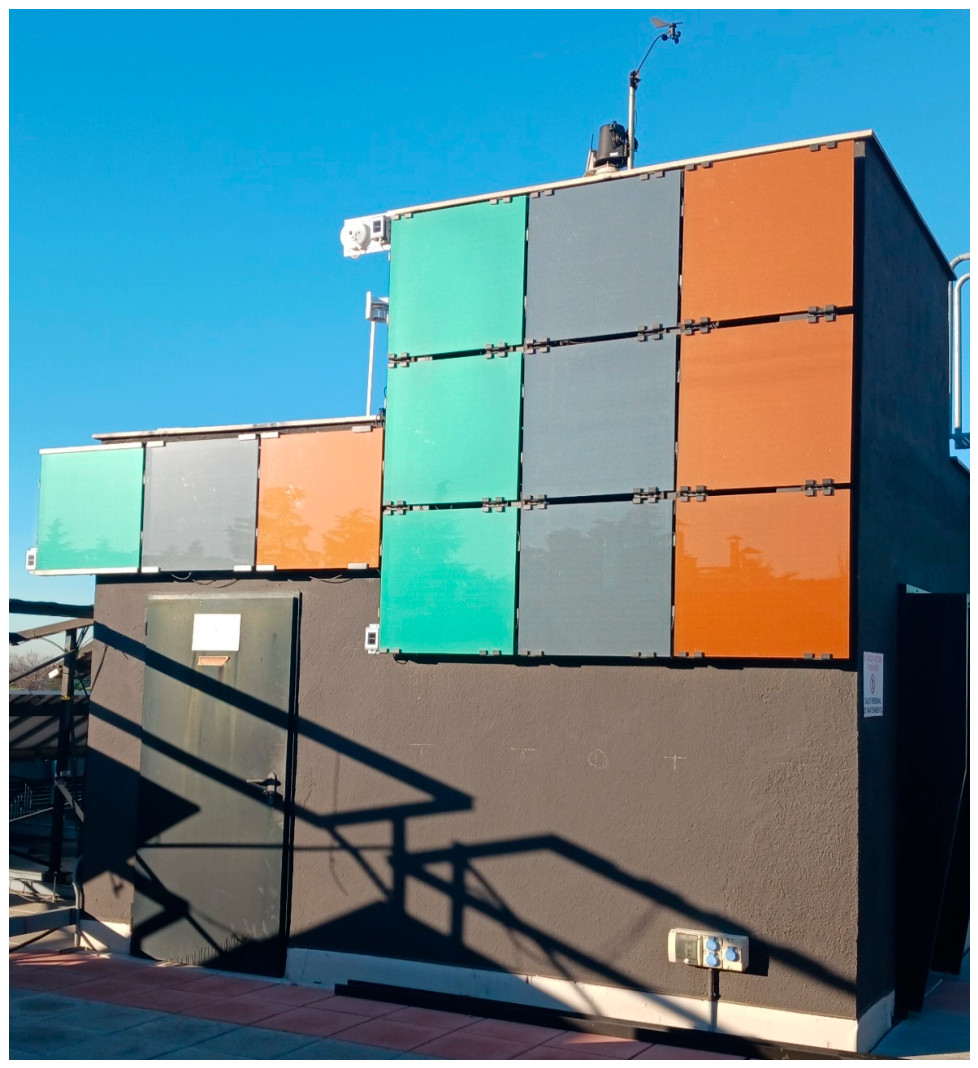
This work aims to advance knowledge of the real-world operational performance of such systems and to derive colour-specific thermal performance indicators, including the impact of module temperature and spectral performance on the efficiency of a BIPV ventilated façade (BIPV rainscreen). To this end, within the framework of RINGS-BIPV, an R+D national project devoted to advancing BIPV systems in new and retrofit projects, a demonstration ventilated façade comprising three strings, each consisting of four modules of the same colour (anthracite, green, and terracotta, respectively), was developed at the CIEMAT site in Madrid (40.45° N, −3.74° E), Spain, with a nearly east orientation (97.4° azimuth). Ventilated façades are probably the most widely used BIPV façade solution in both new construction and renovation projects.
This system has been continuously monitored since December 2024. Based on the experimental results, the performance ratio (
PR) of each string has been analysed, and the different power losses have been identified and quantified, including module temperature, mismatch, wiring, angle of incidence (AOI), soiling, and spectral losses. Concerning module temperature, the suitability of the Ross model for each coloured module once installed in the system was assessed, serving as an example of the use of simple temperature models to characterise the operating module temperature in BIPV ventilated façades on an annual basis. Regarding spectral effects, a previous study on the modelling of spectral effects in coloured BIPV modules was considered to aid in interpreting the results [
20].
2. Methodology
2.1. BIPV System Description and Monitoring
This study is based on the analysis of one complete year of experimental data from an opaque coloured BIPV ventilated façade. Modules are mounted vertically, facing east, on the outer wall of a rooftop enclosure of a building at CIEMAT. The outer pane of a ventilated façade provides weather protection to the load-bearing wall, while the rear air gap promotes natural ventilation, reducing moisture and thermal loads on the building envelope. In BIPV ventilated façades, PV modules act as the outer pane, while producing electricity at a reduced module operating temperature thanks to the rear ventilation. The air gap width of the demonstration façade under study is 10 cm, which falls in the range of representative regular ventilated façades [
21,
22,
23] and is recommended for BIPV façades [
24]. However, the optimal width depends on several factors, mainly related to the chimney effect: the materials’ thermal properties, the system’s design and geometry, and the local climate [
23].
The BIPV modules are opaque and consist of 16 monocrystalline silicon (m-Si) cells encapsulated between two sheets of glass with polyvinyl butyral (PVB), forming single PV laminates, and are identical in design except for their colour. Their front glass is coloured by screen printing (anthracite, green, or terracotta). Each module has a T-type thermocouple attached to its rear surface, positioned behind the centre of a central PV cell.
The BIPV array consists of three strings, each comprising four modules of the same colour (hereinafter, anthracite, green, and terracotta strings), with a total of 12 modules. Each string is connected to the building’s local grid through a microinverter, which keeps the string at its maximum power point. The system has been continuously monitored at 30 s intervals for over a year (from 1 January to 31 December 2025). Electrical parameters—voltage, current, and power—have been recorded for each module and for each string near the inputs of the microinverters.
During the same data acquisition cycle, ambient temperature, in-plane irradiance (commonly referred to as plane-of-array, or POA irradiance), and module temperatures were also measured. The irradiance sensors are three crystalline silicon calibrated reference cells IMT Solar Si-mV-85-Pt1000-4L (IMT Technology GmbH, Hameln, Germany) and one pyranometer Kipp & Zonen CMP6 (OTT HydroMet B.V., Delft, The Netherlands). Reference cells are distributed across three strategic locations of the ventilated façade to identify the periods during which all modules were homogeneously illuminated, i.e., when the three POA irradiance values were similar, within a tolerance of ±5% (
Figure 1).
Once the modules were mounted in the ventilated façade support structure, an electrical connection panel was developed to connect them to the electrical measurement devices and to the datalogger, enabling the collection of current, voltage, power, and temperature of each module and string.
2.2. Electrical Characterisation at Standard Test Conditions
Before installation on the façade, the modules’ current–voltage (I–V) curves were measured under standard test conditions (STC: 25 °C module temperature, 1000 W/m
2 irradiance, AM1.5G spectrum) using a class AAA large-area flash solar simulator Pasan MFG 305–SunSim3CM (Neuchâtel, Switzerland). Measurements were performed with a single 10 ms pulse according to IEC 60904-9 [
25]. These data were used to determine the installed power per string and to estimate the corresponding mismatch losses arising from connecting PV modules in series with different currents at the maximum power point (
Im).
2.3. Data Processing
After commissioning the measurement and data acquisition equipment of the BIPV façade, measurements were continuously recorded in daily files.
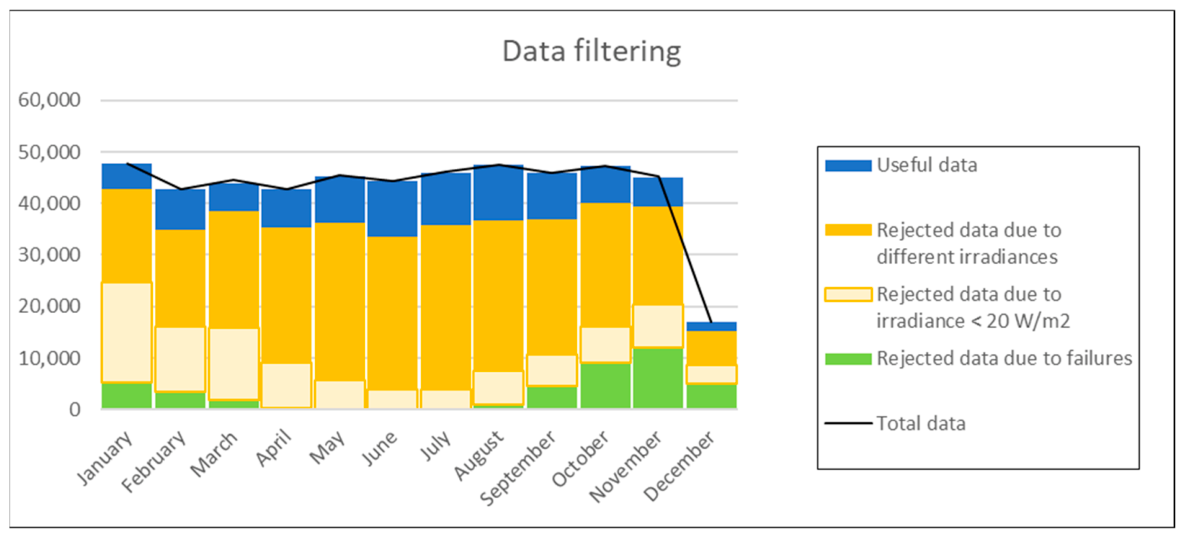
Table 1 summarises the steps followed to read and filter the monitored data every 30 s over one year, and to organise them into a data matrix sorted by variables and time. The filtering steps discard data gathered under partial shading and low irradiance conditions. To perform a more detailed analysis of the data and the effect of module temperature, a Python 3.13-based code was developed.
Figure 2 shows the results of data filtering over the year for the anthracite string. Similar charts are obtained for the other two strings. The seasonal evolution of the filtering can be observed, and it is also evident that in December, due to network maintenance outages, the number of monitored data points is substantially lower.
2.4. Data Analysis
To analyse the energy performance of each of the three strings, the performance ratio (
PR) is used, as recommended in IEC 61724-1 [
26]. This parameter is obtained by comparing the theoretical annual energy—calculated from the nominal installed power of each string (
PN) and the annual plane-of-array irradiation received by the BIPV system (
HPOA)—with the measured annual energy of each string (
EPV), computed as the sum of the energy recorded at each interval (Equation (1)).
The performance ratio is, in turn, the product of the complementary fractions of the different losses (
L) affecting the system, including module temperature, angular, spectral, soiling, wiring, and mismatch losses.
where
P and
GPOA are the average measured values over the interval Δ
t of the strings’ output power and the plane-of-array irradiance, respectively;
GSTC is the reference irradiance of 1 kW/m
2 at which the nominal power
PN was determined; and
Lk is a dimensionless parameter that denotes each type of power loss. Units of variables and parameters in Equation (1) are kWh/m
2 for
EPV and
HPOA, kW for
P and
PN, and kW/m
2 for
GSTC and
GPOA.
As this is a comparative analysis of coloured modules and all three microinverters are identical, AC generation is not considered. AC/DC conversion losses are assumed to be similar across strings and therefore do not affect the comparison.
2.4.1. Temperature Losses
Temperature losses,
Ltemp, are governed by the module temperature and the PV cell technology. The temperature coefficient of power (
γ) quantifies the change in module power per unit change in its temperature (expressed in W/°C for absolute values or °C
−1, for relative values) (Equation (2)) [
27].
where
Tc and
Tc,0 are the cell temperature in °C and the reference value 25 °C, respectively. The temperature coefficient of power is an intrinsic property of the PV cell technology and is therefore independent of the module’s front glass colour. It is typically provided in the PV module datasheets. Since these modules have a single-laminate structure, the temperature measured with a thermocouple on the back is assumed to closely approximate
Tc, in line with IEC 61853-2 [
28]. However, other sources report temperature differences between the module backsheet and the cells; for example, ASHRAE suggests differences of 0 °C, 1 °C, and 3 °C for poor, medium, and good rear ventilation, respectively [
29].
On the other hand, module temperature (
values are fitted using the Ross model [
30], as given in Equation (3).
where
Ta is the ambient temperature,
k is the Ross fitting coefficient, and
GPOA is the plane-of-array irradiance.
Despite its simplicity, the Ross model has been widely adopted as a steady-state temperature approach for modelling PV systems, particularly in BIPV applications [
31,
32]. Although some comparable models incorporate wind speed as an additional parameter [
28,
33,
34], the resulting improvements are generally marginal in BIPV contexts where wind has a limited effect due to the restricted airflow at the rear side of the modules [
35].
The experimental data were fitted to the Ross model to determine the effective nominal operating cell temperature (
NOCTeff) of each module and the corresponding averaged value for each string. To this end, the version of the Ross model adopted by the International Electrotechnical Commission (IEC) in earlier editions of the IEC 61215 standard [
36] was used to determine the nominal operating cell temperature (
NOCT), although accounting for the specific operating conditions imposed by the BIPV installation. In this approach, the fitting coefficient is derived for installed modules operating at the maximum power point and it is referred to as the installed or effective
NOCT (
NOCTeff), a parameter that depends on the mounting configuration [
37,
38].
Thus, Equation (3) is reformulated as Equation (4), where all temperatures are expressed in °C and
GPOA in watts. Temperature losses are also evaluated using this model, with coefficients corresponding to each colour.
2.4.2. Mismatch Losses
Mismatch losses,
Lmismatch, are estimated from the individual module I–V curves measured under standard test conditions. Since modules are connected in series within each string, the module with the lowest current at the maximum power point
Im (
Imin) determines the operating point of the remaining modules in that string, forcing them to operate at varying distances from their respective maximum power,
Pm. The corresponding voltage values for each module at
Imin are used to calculate the power reduction due to mismatch (Equation (5)).
2.4.3. Angular Losses
Angular losses,
LAOI, are calculated using the Martín–Ruiz model [
39], which is implemented in the pvlib library [
40,
41]. Calculations are made at each time interval employing irradiance data from Copernicus Atmosphere Monitoring Service (CAMS) and Photovoltaic Geographical Information System (PVGIS).
2.4.4. Soiling Losses
It is assumed that all modules experience, on average, the same level of surface soiling regardless of colour, as the glass finish is identical. Soiling losses, hereinafter denoted as
Lsoiling, are typically negligible at vertical tilt; however, it is advisable to refer to local soiling data to estimate their value [
42].
2.4.5. Wiring Losses
Ohmic losses are commonly referred to as wiring losses, Lwiring, although they also arise from current measuring devices and protection and connection components. Since, in this experimental BIPV installation, the microinverters are several metres away from the strings to facilitate the connection of all the measuring devices and protection equipment, wiring losses are expected to become higher than in a real BIPV installation, where the strings would be connected closer to the microinverters. Ohmic power losses are calculated by multiplying the wiring resistance by the square of the current (P = R × I2). Using the average operating current instead of the nominal values is recommended. The wiring resistance is the result of multiplying the resistivity of the conductor [mOhm × mm2/m] by the wiring length [m] and the inverse of its section [mm2].
2.4.6. Spectral Losses
Spectral losses, Lspectral, have not been directly determined from experimental measurements in this work. Instead, they have been inferred from the experimental PR values, after accounting for the remaining losses. The screen-printed coloured front glass of the modules reflects and absorbs part of the incident solar radiation. As a result, PV cells “see” a spectral distribution and radiation intensity different from those received by conventional PV modules. Most of this effect is already accounted for in the nominal power of each module.
The remaining spectral effect—i.e., the different interaction with the varying spectral distribution of solar radiation throughout the year—is what contributes to the spectral losses, which can be estimated from the experimental
PR values, after subtracting the effect of the remaining power losses (Equation (6)):
3. Results
3.1. Characteristic I–V Curves and Mismatch Losses
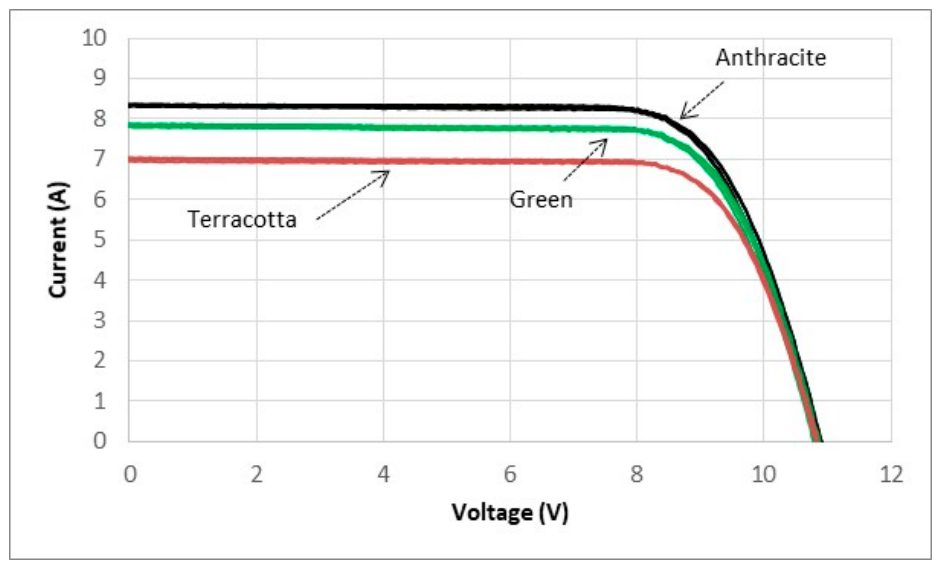
Figure 3 shows the 12 current–voltage curves measured with a solar simulator under standard test conditions. I–V curves corresponding to modules of the same colour nearly overlap. The most relevant finding is the colour-dependent current.
Table 2 includes the values of efficiency, maximum power (
Pm), voltage and current at the maximum power point (
Vm,
Im) for each module, as well as voltage and power values corresponding to the operating point of each string, which are determined by the module with the lowest current (
Im, min).
For each string, mismatch losses are determined by comparing its nominal power (four times the corresponding datasheet nominal power) with the actual power measured at STC, which is limited by the module with the lowest current in the string. Once the lowest Im is identified, the I–V curves of the remaining three modules are used to determine their operating points at that current, resulting in a slight deviation from their respective maximum power points (MPP).
3.2. Performance Ratios and Power Losses
Table 3 presents the experimental performance ratios (
PR) (Equation (1)), calculated using irradiance measured with the pyranometer. The resulting values are 0.85 (green), 0.83 (anthracite), and 0.82 (terracotta). To determine the uncertainties in
PR, an uncertainty of 5.2 °C in the module temperature measurement (including measurement uncertainty and dispersion) was considered, which together with the temperature coefficient of power γ of 0.32 %/°C, leads to a 1.7% uncertainty in power. Additional contributions include a 2.5% uncertainty in the STC power measurement, a 0.5% uncertainty in the power recorded by the datalogger, and a 2% uncertainty in the pyranometer measurement. The resulting uncertainty is 3.24%, which leads to the uncertainty values of ±0.027 for the anthracite and terracotta strings, and ±0.028 for the green string.
Table 3 also includes the temperature losses derived from Equation (2) using experimental module temperature data, as well as mismatch, soiling, angular, and wiring losses. Angular losses are assumed to be colour-independent. This simplification is based on the assumption that the angular dependence of spectral reflectance constitutes a second-order correction to the overall angular losses. Since the outer glass surface is similarly a non-structured, flat finish, the Martín-Ruiz model can be applied [
28]. However, this model may not be suitable for other types of coloured modules or surface finishes [
17,
32].
The resistance values used to estimate wiring losses were based on the cable type and length: 80 mΩ for the string wiring, 50 mΩ for the current-measuring devices, and 20 mΩ for the protection and connection components. These values correspond to power losses of 0.6% for the anthracite and green strings, and 0.5% for the terracotta string. In a typical installation with microinverters located close to the strings, wiring losses would decrease.
Spectral losses determined through Equation (6) are also included in
Table 3. They become 4.7%, 2.9% and 6.4% for the anthracite, green, and terracotta strings, respectively. This means that spectral losses are comparable to temperature losses in anthracite and terracotta colours. The uncertainties associated with the loss factors are reported in the table. Without an estimate of the uncertainty in angular and soiling losses, spectral losses derived from Equation (6) would have an uncertainty of at least 3%, which is reflected in the values reported in
Table 3. Empty parentheses indicate that uncertainty values are not available; consequently, the uncertainties associated with
Lspectral should be regarded as minimum estimates.
3.3. Module Temperature Characterisation and Modelling
The effective nominal operating cell temperature (
NOCTeff) values of each module were calculated using Equation (4) and irradiance data from the pyranometer. Half of the months—January to June—were considered since this period was taken as representative of the entire year. The obtained
NOCTeff values, together with the determination coefficient (
R2), mean bias error (
MBE), and mean absolute error (
MAE) are shown in
Table 4.
R2 ranges from 0.73 to 0.80, indicating that the Ross model explains a substantial proportion of the observed variability in all cases. MAE values range between 2.5 °C and 3.5 °C. Low
MBE values relative to
MAE suggest that negative errors (i.e., when the simulated temperature exceeds the measured value) in part offset positive errors. The average values of
NOCTeff for each string are also included in
Table 4.
Although colour-related trends are observed, the
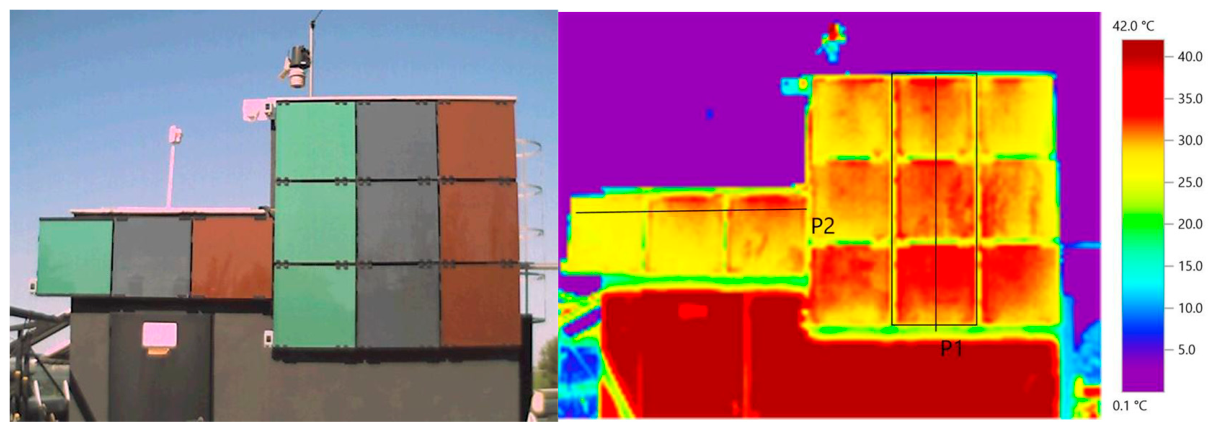
NOCTeff variability within each colour is also significant. One main reason is that the position of some modules is more favourable in terms of rear-side ventilation.
Figure 4 shows the spatial variation in module temperatures during operation on the façade, as measured by thermographic inspection using a Testo 880-1 infrared camera. This analysis was conducted on 23 April 2025, on a partially clear day, which helped minimise direct solar reflections that could affect temperature readings. A series of 10 images was captured over 15 min, and those showing the clearest thermal patterns of interest were selected.
The main objective of this procedure was to evaluate the thermal behaviour of the modules under real operating conditions, identify possible anomalies such as hot spots, and analyse the effect of colour and ventilation on the distribution of surface temperature. Considering the centre of each module (where a thermocouple is positioned on the rear side), temperature differences of up to 5 °C were observed both among the three colours and among modules of the same colour at different positions.
The simulated temperatures for each string were calculated for the full year using the average
NOCTeff value for each colour, obtained from the first six months and shown in
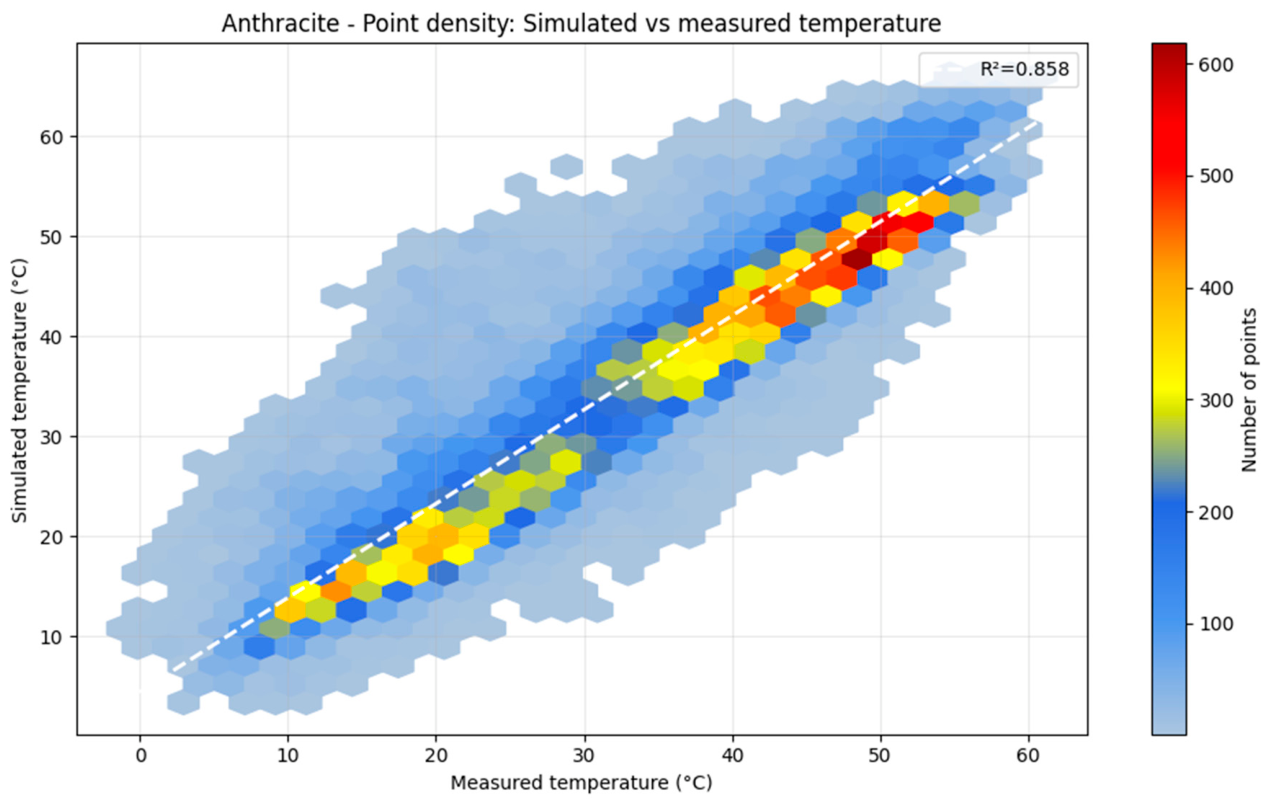
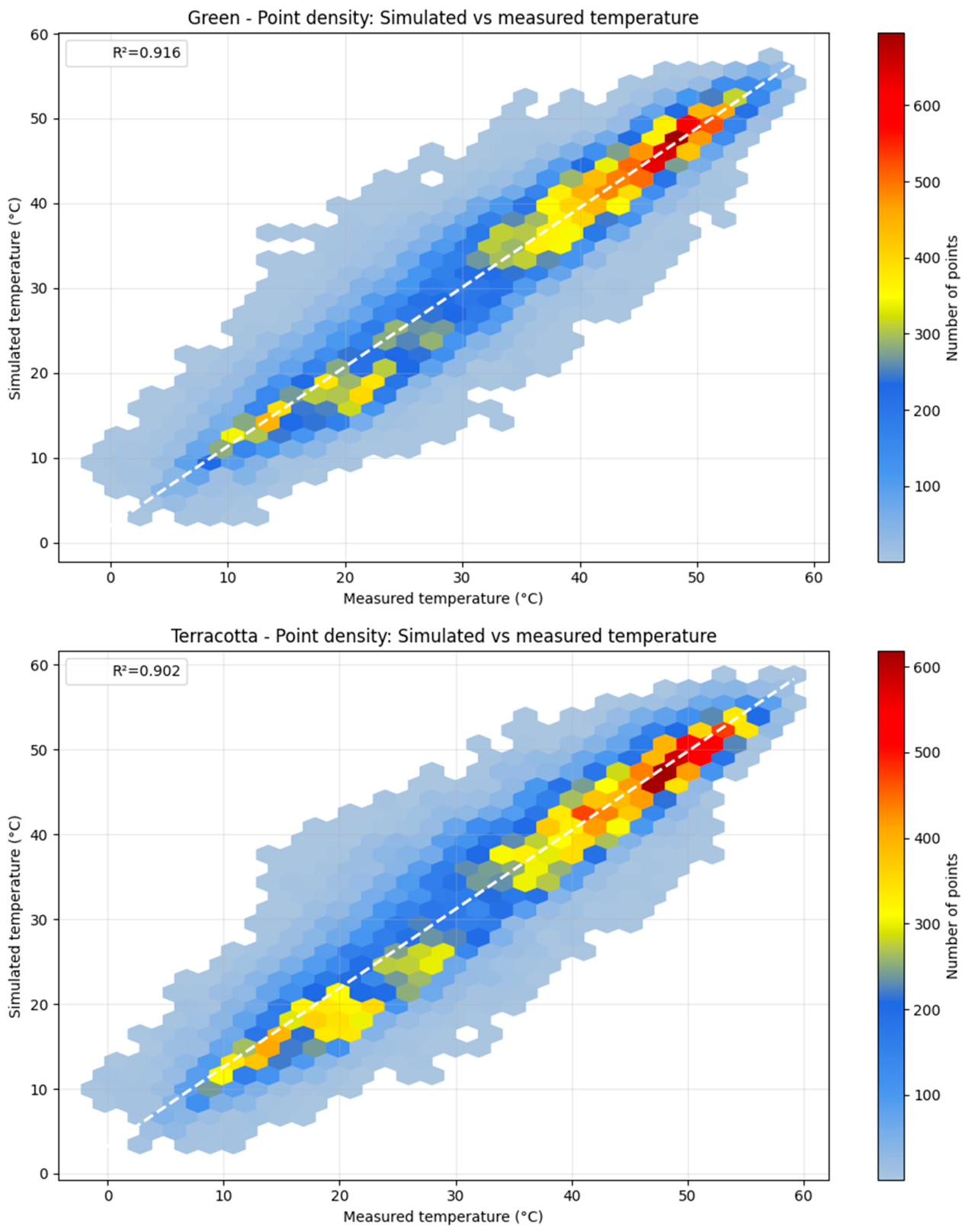
Table 4 (44.1 °C, 42.6 °C, and 43.4 °C for anthracite, green, and terracotta, respectively). The corresponding distributions of points (measured versus simulated temperatures) for each string are presented in the graphs in
Figure 5. These graphs show the regions where module temperature data are concentrated. Although significant differences can appear on a short-term basis (5 min intervals), the concentration of points near the fitting line indicates good agreement with the Ross model on average over a year (R
2 of 0.86, 0.92, and 0.90 for anthracite, green and terracotta strings, respectively). Moreover, using the
NOCTeff average temperatures to determine the 5 min module temperatures leads to annual temperature losses estimations of 4.7%, 4.3% and 4.5% (anthracite, green and terracotta, respectively), which means differences of 0.1 percentage points with respect to the temperature losses obtained with the measured module temperatures (see Equation (2) and
Table 3).
4. Discussion
All BIPV modules examined in this study contain 16 monocrystalline silicon solar cells and share the same PV laminate structure, differing only in the colouration of their front glass. The primary impact of this variation is on PV efficiency: under standard test conditions, average efficiencies of 17.4%, 16.4%, and 14.9% are achieved for the anthracite, green, and terracotta modules, respectively. Under real operating conditions in an east-facing BIPV ventilated façade in Madrid, Spain, the performance ratio (PR) obtained for each of the three strings (one per module colour) indicates that the green string performs slightly better than the anthracite and terracotta strings (by two and three hundredths, respectively): 0.85 (green), 0.83 (anthracite), and 0.82 (terracotta). This corresponds to a 3.5% higher PR for the green string compared with terracotta, and 2.4% compared with anthracite. These differences are comparable to the 3.24% uncertainty associated with the three strings.
It is important to note that rating losses, obtained by comparing the rated power on the modules’ datasheets with their actual performance under standard test conditions (STC), have not been considered to exclude eventual external sources of losses, which are not of interest in this study. Consequently, PR values accounting for rating losses (which typically range between 1% and 4%) would be correspondingly lower. AC losses are also not included.
Considering that the angular and soiling losses are the same for the three strings (6.1% and 0.5%, respectively), the main cause of the different performance ratios observed among module colours arises from their distinct spectral behaviour, which leads to power losses of 4.7%, 2.9%, and 6.4% for the anthracite, green, and terracotta colours, respectively. These spectral losses were estimated by excluding the contribution to PR of the remaining losses (Equation (6)). The associated uncertainties are mainly driven by the uncertainty in PR, reaching 3.34% when angular and soiling losses are not considered.
The differences in
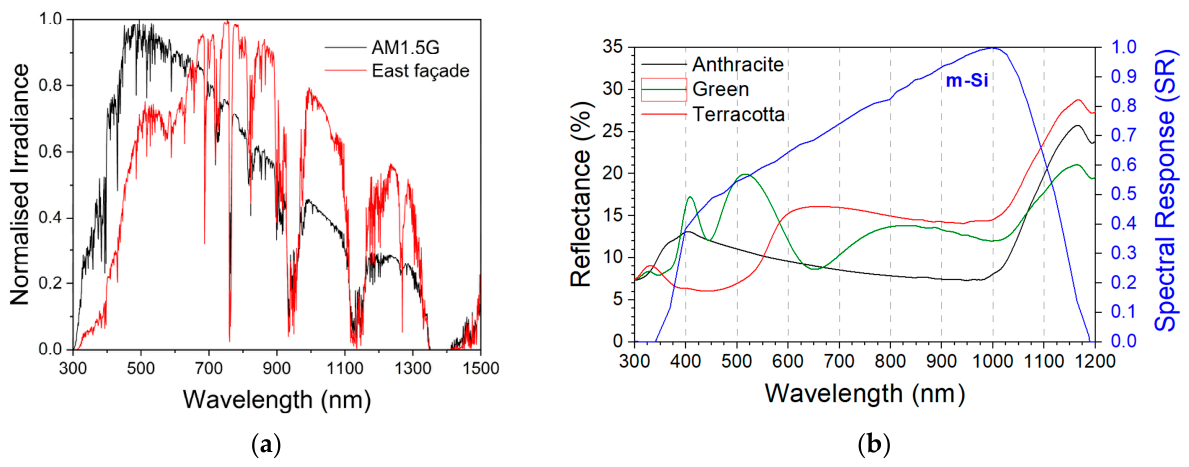
PR values presumably arise from a near-infrared (NIR) shift in the solar spectrum on clear days in the early morning, when the air mass increases substantially due to low solar elevation angles. This results in attenuation of the visible spectrum—particularly in the blue region—and a relative enrichment in the NIR range (see
Figure 6a). A similar effect is likely to occur for terracotta modules installed on west-oriented PV façades in the late afternoon.
The interaction of these solar spectra with the spectral reflectance of the modules results in different spectral losses (or gains) occurring in east-oriented façades. South-oriented façades are expected to be less sensitive to the spectral daily changes since most of the irradiance they receive is not so spectrally differentiated from the standard AM1.5G solar spectrum [
43].
Figure 6b shows significant differences in shape and magnitude in the reflectance spectra of modules. From 600 nm onwards, terracotta modules are significantly more reflective than green and anthracite modules, thus making less efficient use of the NIR spectrum shift during the highest irradiance periods on the east façade. A detailed spectral performance characterisation of the modules should consider the absorption and reflection spectra of the coloured glasses (or the transmittance), as also suggested in [
32].
Figure 6.
(
a) Normalised reference AM1.5G solar spectrum (ASTM G173 [
44]) compared with a normalised local solar spectrum on the east-facing vertical façade in the early morning (21 March 7:00 UTC). (
b) Spectral reflectance of each coloured module, together with the spectral response of a standard monocrystalline silicon PV cell.
Figure 6.
(
a) Normalised reference AM1.5G solar spectrum (ASTM G173 [
44]) compared with a normalised local solar spectrum on the east-facing vertical façade in the early morning (21 March 7:00 UTC). (
b) Spectral reflectance of each coloured module, together with the spectral response of a standard monocrystalline silicon PV cell.
Based on the module temperature monitoring, annual temperature losses are 4.6%, 4.2%, and 4.4% for anthracite, green and terracotta strings, respectively. When using the obtained string average
NOCTeff values to simulate module temperatures, annual temperature losses become 4.7%, 4.3%, and 4.5%, respectively. This means that, although a dispersion in simulated versus measured module temperatures is found on a five-minute data basis, in annual terms, overestimating and underestimating simulations partially compensate, which makes the model suitable for the annual performance ratio calculations of this system. Similar conclusions have been obtained in former works with BIPV ventilated façades and mock-ups with conventional PV modules [
35,
45].
The analysis also revealed that physical position and exposure to airflow appeared to have an even more significant influence than colour, suggesting that the architectural design and ventilation of the structure could play a key role in the system’s thermal management. The effect of module positioning on its temperature due to natural air convection on the back when installed on ventilated façades is not so clearly observed in this case study, since lateral boundary conditions are varied and vertical length is limited for showing this height-dependent temperature effect.
In this case study, however, the effect of module positioning on temperature due to natural air convection at the rear of ventilated façades is not clearly observed, as lateral boundary conditions vary and the vertical extent of the installation is insufficient to clearly capture the chimney effect.
5. Conclusions
The year-long monitoring of a demonstration coloured BIPV ventilated façade at the CIEMAT site has provided valuable information on the performance of the three coloured PV strings and on the influence of the various factors affecting their output power. Previous indoor measurements of each module’s I–V curve, together with the adjustment of operating module temperatures to the Ross model, have enabled more comprehensive performance characterisation.
In this BIPV case study, although anthracite modules exhibit the highest efficiency under standard test conditions (STC), green modules achieve the best performance ratio (PR) because of their lower spectral and thermal impacts. Differences in PR among module colours are primarily driven by the different interactions between their spectral reflectance and the solar spectrum variation. Terracotta modules show the highest power losses due to their higher reflectance at wavelengths above 600 nm, which makes them less efficient at exploiting the NIR shift associated with morning solar spectra, mostly received by east-oriented façades. A similar effect is expected for terracotta modules in west-oriented PV façades.
The obtained temperature losses are relatively similar across the three module colours, although a slight difference is observed, with the highest temperature losses being those of the anthracite modules, and the lowest corresponding to the green ones. Module position and airflow exposure can influence temperature more strongly than colour, highlighting the importance of architectural design and ventilation for thermal management.
It can also be concluded that the Ross thermal model provides sufficiently accurate results for annual performance assessments in this particular case and could likely be extended to other BIPV façades. A previous fitting of the module temperatures to the Ross model under real operation conditions is required to obtain the effective NOCT (NOCTeff) values, which are site- and module-positioning-dependent. The availability of these parameters can facilitate performance simulations of BIPV façades when module temperature monitoring is not available.
Results suggest that BIPV system design factors, such as module positioning in the façade, façade orientation and rear ventilation, may have a greater impact on performance than colour choice itself, underscoring the importance of incorporating architectural design into thermal management strategies to optimise BIPV system performance. Quantifying this relative impact would nonetheless require in-depth theoretical analysis and dedicated multi-configuration experimental campaigns beyond the scope of this study.
Additionally, these findings emphasise the importance of prior optical characterisation of the modules’ coloured front glass to better understand and predict the performance of this type of module.
Author Contributions
Conceptualisation, N.M.-C., J.P. and C.S.-S.; methodology, N.M.-C., J.P., C.S.-S., M.A.-A. and J.C.; software, Z.V. and M.R.; validation, Z.V., M.R. and J.P.; formal analysis, M.R., Z.V. and N.M.-C.; investigation, Z.V., M.R. and N.M.-C.; resources, M.A.-A. and J.C.; data curation, M.R. and Z.V.; writing—original draft preparation, N.M.-C.; writing—review and editing, J.P., C.S.-S. and J.C.; visualisation, M.R., Z.V., J.P. and C.S.-S.; supervision, N.M.-C.; project administration, N.M.-C. and J.P.; funding acquisition, N.M.-C. and J.P. All authors have read and agreed to the published version of the manuscript.
Funding
This publication is part of the R+D+I project “RINGS-BIPV Project (PID2021-124910OBC31)”, which is funded by MICIU/AEI/10.13039/5011000011033 and by ERDF/EU.
Data Availability Statement
The data presented in this study are available on request from the corresponding author.
Conflicts of Interest
The authors declare no conflicts of interest. The funders had no role in the design of the study; in the collection, analyses, or interpretation of data; in the writing of the manuscript; or in the decision to publish the results.
References
- Casalicchio, V.; Gonnella, G.; Maturi, L.; Barchi, G. Economic competitiveness of BIPV in energy sharing configurations across selected European countries. Energy Rep. 2025, 14, 2031–2046. [Google Scholar] [CrossRef] [Scilit]
- Giusti, L.; Rotilio, M.; Di, G.; Bonomo, P. Developments in the Built Environment An integrated methodology for assessing circularity and environmental sustainability in BIPV systems. Dev. Built Environ. 2025, 23, 100746. [Google Scholar] [CrossRef] [Scilit]
- Martín-Chivelet, N.; van Noord, M.; Tilli, F.; Yang, R.J.; Weerasinghe, N.; Daun, E.; Baggini, A. BIPV Market Development: International Technological Innovation System Analysis. Buildings 2025, 15, 3011. [Google Scholar] [CrossRef] [Scilit]
- Martín-Chivelet, N.; Kapsis, C.; Frontini, F. (Eds.) Building-Integrated Photovoltaics. A Technical Guidebook; Routledge: New York, NY, USA; London, UK, 2024; Available online: https://www.routledge.com/Building-Integrated-Photovoltaics-A-Technical-Guidebook/MartinChivelet-Kapsis-Frontini/p/book/9781032517056 (accessed on 11 May 2026).
- López, I.D.H.; Olivieri, L. Comprehensive review of building-integrated photovoltaics in the renovation of heritage buildings. J. Build. Eng. 2025, 108, 112883. [Google Scholar] [CrossRef] [Scilit]
- Pelle, M.; Lucchi, E.; Maturi, L.; Astigarraga, A.; Causone, F. Coloured BIPV technologies: Methodological and experimental assessment for architecturally sensitive areas. Energies 2020, 13, 4506. [Google Scholar] [CrossRef] [Scilit]
- Reijenga, T.; Ritzen, M.; Scognamiglio, A.; Kappel, K.; Frontini, F.; Moor, D.; Schneider, A.; Illich, P.; Delisle, V.; Kapsis, K.; et al. Successful Building Integration of Photovoltaics—A Collection of International Projects; International Energy Agency: Paris, France, 2020; Available online: https://iea-pvps.org/wp-content/uploads/2021/03/IEA-PVPS-Task-15-An-international-collection-of-BIPV-projects-compr.pdf (accessed on 11 May 2026).
- Rudzikas, M.; Donėlienė, J.; Bužavaitė-Vertelienė, E.; Balevičius, Z.; Leuvrey, C.; Šetkus, A. Design and investigation of 1D photonic crystal based structures for BIPV cell colorization by sol-gel dipping technology. Sol. Energy 2023, 250, 285–294. [Google Scholar] [CrossRef] [Scilit]
- Habets, R.; Vroon, Z.; Erich, B.; Meulendijks, N.; Mann, D.; Buskens, P. Structural color coatings for high performance BIPV. In Proceedings of the Iop Conference Series Earth and Environmental Science, Milan, Italy, 14–16 April 2021; IOP Publishing: Bristol, UK, 2021; Volume 855. [Google Scholar] [CrossRef] [Scilit]
- Lim, S.; Ahn, H.-S.; Gasonoo, A.; Lee, J.-H.; Choi, Y. Fabrication of Color Glass by Pearlescent Pigments and Dissolved EVA Film. Materials 2022, 15, 5570. [Google Scholar] [CrossRef] [Scilit]
- Ortiz Lizcano, J.C.; Procel, P.; Calcabrini, A.; Yang, G.; Ingenito, A.; Santbergen, R.; Zeman, M.; Isabella, O. Colored optic filters on c-Si IBC solar cells for building integrated photovoltaic applications. Prog. Photovolt. Res. Appl. 2022, 30, 401–435. [Google Scholar] [CrossRef] [Scilit]
- Ahn, H.-S.; Gasonoo, A.; Lim, S.-M.; Lee, J.-H.; Choi, Y. Fabrication of Color Glass with High Light Transmittance by Pearlescent Pigments and Optical Adhesive. Materials 2022, 15, 2627. [Google Scholar] [CrossRef] [Scilit]
- Borja Block, A.; Barretta, C.; Faes, A.; Virtuani, A.; Vlk, A.; Ledinský, M.; Oreski, G.; Ballif, C. Stability of black interconnect coatings for solar photovoltaic module applications. Sol. Energy Mater. Sol. Cells 2023, 262, 112540. [Google Scholar] [CrossRef] [Scilit]
- Eder, G.; Peharz, G.; Trattnig, R.; Bonomo, P.; Saretta, E.; Frontini, F.; Polo Lopez, C.S.; Rose Wilson, H.; Eisenlohr, J.; Martín Chivelet, N.; et al. Coloured BIPV Market, Research and Development; Report IEA-PVPS T15-07: 2019; International Energy Agency: Paris, France, 2019; Available online: http://iea-pvps.org/index.php?id=task15 (accessed on 11 May 2026).
- Borja Block, A.; Escarre Palou, J.; Courtant, M.; Virtuani, A.; Cattaneo, G.; Roten, M.; Li, H.Y.; Despeisse, M.; Hessler-Wyser, A.; Desai, U.; et al. Colouring solutions for building integrated photovoltaic modules: A review. Energy Build. 2024, 314, 114253. [Google Scholar] [CrossRef] [Scilit]
- Kuhn, T.E.; Erban, C.; Heinrich, M.; Eisenlohr, J.; Ensslen, F.; Neuhaus, D.H. Review of technological design options for building integrated photovoltaics (BIPV). Energy Build. 2021, 231, 110381. [Google Scholar] [CrossRef] [Scilit]
- Babin, M.; Jóhannsson, I.H.; Jakobsen, M.L.; Thorsteinsson, S. Experimental evaluation of the impact of pigment-based colored interlayers on the temperature of BIPV modules. EPJ Photovolt. 2023, 14, 34. [Google Scholar] [CrossRef] [Scilit]
- Peharz, G.; Ulm, A. Quantifying the influence of colors on the performance of c-Si photovoltaic devices. Renew. Energy 2018, 129, 299–308. [Google Scholar] [CrossRef] [Scilit]
- Pelle, M.; Causone, F.; Maturi, L.; Moser, D. Opaque Coloured Building Integrated Photovoltaic (BIPV): A Review of Models and Simulation Frameworks for Performance Optimisation. Energies 2023, 16, 1991. [Google Scholar] [CrossRef] [Scilit]
- Sanz-saiz, C.; Marcos, A.; Silva, J.P.; Polo, J. Modeling spectral effects of colored BIPV modules on vertical façades. Sustain. Energy Technol. Assess. 2025, 75, 104220. [Google Scholar] [CrossRef] [Scilit]
- Medeiros, S.; Pizzatto, F.; Raupp-pereira, F.; Arcaro, S.; Angioletto, E.; Rubem, O.; Montedo, K. Ventilated facade system: A review. Boletín La Soc. Española Cerámica Y Vidr. 2025, 64, 100443. [Google Scholar] [CrossRef] [Scilit]
- Balocco, C. A simple model to study ventilated facades energy performance. Energy Build. 2002, 34, 469–475. [Google Scholar] [CrossRef] [Scilit]
- Stazi, F.; Vegliò, A.; Di, C. Experimental assessment of a zinc-titanium ventilated facade in a Mediterranean climate. Energy Build. 2014, 69, 525–534. [Google Scholar] [CrossRef] [Scilit]
- Gan, G. Effect of air gap on the performance of building-integrated photovoltaics. Energy 2009, 34, 913–921. [Google Scholar] [CrossRef] [Scilit]
- IEC 60904-1:2020; Photovoltaic Devices—Part 1: Measurement of Photovoltaic Current-Voltage Characteristics. International Electrotechnical Commission: Geneva, Switzerland, 2020.
- IEC 61724-1:2021; Photovoltaic System Performance—Part 1: Monitoring. International Electrotechnical Commission: Geneva, Switzerland, 2021.
- IEC 60891:2021; Photovoltaic Devices—Procedures for Temperature and Irradiance Corrections to Measured I–V Characteristics. International Electrotechnical Commission: Geneva, Switzerland, 2021. Available online: https://webstore.iec.ch/en/publication/61766 (accessed on 11 May 2026).
- IEC 61853-2:2016; Photovoltaic (PV) Module Performance Testing and Energy Rating—Part 2: Spectral Responsivity, Incidence Angle and Module Operating Temperature Measurements. International Electrotechnical Commission: Geneva, Switzerland, 2016. Available online: https://webstore.iec.ch/publication/25811#additionalinfo (accessed on 11 May 2026).
- American Society of Heating, Refrigerating and Air-Conditioning Engineers (ASHRAE). ASHRAE Handbook—HVAC Applications; American Society of Heating, Refrigerating and Air-Conditioning Engineers, Inc.: Atlanta, GA, USA, 2019; Available online: https://www.ashrae.org/technical-resources/ashrae-handbook/description-2019-ashrae-handbook-hvac-applications (accessed on 11 May 2026).
- Ross, R.G. Interface design considerations for terrestrial solar cell modules. In Proceedings of the IEEE Photovoltaic Specialists Conference, Baton Rouge, LA, USA, 15–18 November 1976; pp. 801–806. [Google Scholar]
- Assoa, Y.B.; Mongibello, L.; Carr, A.; Kubicek, B.; Machado, M.; Merten, J.; Misara, S.; Roca, F.; Sprenger, W.; Wagner, M.; et al. Thermal analysis of a BIPV system by various modelling approaches. Sol. Energy 2017, 155, 1289–1299. [Google Scholar] [CrossRef] [Scilit]
- Babin, M.; Andersen, N.L.; Thorning, J.K.; Thorsteinsson, S. Yield analysis of a BIPV façade prototype installation. Energy Build. 2024, 322, 114730. [Google Scholar] [CrossRef] [Scilit]
- Skoplaki, E.; Palyvos, J.A. Operating temperature of photovoltaic modules: A survey of pertinent correlations. Renew. Energy 2009, 34, 23–29. [Google Scholar] [CrossRef] [Scilit]
- Faiman, D. Assessing the outdoor operating temperature of photovoltaic modules. Prog. Photovolt. Res. Appl. 2008, 16, 307–315. [Google Scholar] [CrossRef] [Scilit]
- Marcos-Castro, A.; Sanz-Saiz, C.; Polo, J.; Martín-Chivelet, N. Performance Ratio Estimation for Building-Integrated Photovoltaics—Thermal and Angular Characterisation. Appl. Sci. 2025, 15, 6579. [Google Scholar] [CrossRef] [Scilit]
- IEC 61215:2005; Terrestrial Photovoltaic (PV) Modules—Design Qualification and Type Approval. International Electrotechnical Commission: Geneva, Switzerland, 2005.
- TamizhMani, G.; Oh, J. BAPV modules: Installed-NOCT and temperature coefficients after 1-year exposure. In Proceedings of the 37th IEEE Photovoltaic Specialists Conference, Seattle, WA, USA, 19–24 June 2011; pp. 000838–000841. [Google Scholar] [CrossRef] [Scilit]
- Skoplaki, E.; Boudouvis, A.G.; Palyvos, J.A. A simple correlation for the operating temperature of photovoltaic modules of arbitrary mounting. Sol. Energy Mater. Sol. Cells 2008, 92, 1393–1402. [Google Scholar] [CrossRef] [Scilit]
- Martin, N.; Ruiz, J.M. Calculation of the PV modules angular losses under field conditions by means of an analytical model. Sol. Energy Mater. Sol. Cells 2001, 70, 25–38, Corrigendum in Sol. Energy Mater. Sol. Cells 2013, 110, 154. https://doi.org/10.1016/j.solmat.2012.11.002.. [Google Scholar] [CrossRef] [Scilit]
- Holmgren, F.W.; Hansen, W.C.; Mikofski, A.M. Pvlib Python: A Python Package for Modeling Solar Energy Systems. J. Open Source Softw. 2018, 3, 34. [Google Scholar] [CrossRef] [Scilit]
- Incident Angle Modifiers. Available online: https://pvlib-python.readthedocs.io/en/stable/reference/generated/pvlib.iam.martin_ruiz.html (accessed on 12 February 2026).
- Sanz-Saiz, C.; Polo, J.; Martín-Chivelet, N.; Alonso-García, M.D.C. Soiling loss characterization for Photovoltaics in buildings: A systematic analysis for the Madrid region. J. Clean. Prod. 2022, 332, 130041. [Google Scholar] [CrossRef] [Scilit]
- Martin, N.; Ruiz, J.M. A New Method for the Spectral Characterisation of PV Modules. Prog. Photovolt. Res. Appl. 1999, 7, 299–310. [Google Scholar] [CrossRef]
- ASTM G173-03(2020); Standard Tables for Reference Solar Spectral Irradiances: Direct Normal and Hemispherical on 37° Tilted Surface. American Society of Testing and Materials: West Conshohocken, PA, USA, 2020. [CrossRef] [Scilit]
- Martín-Chivelet, N.; Polo, J.; Sanz-Saiz, C.; Núñez Benítez, L.T.; Alonso-Abella, M.; Cuenca, J. Assessment of PV Module Temperature Models for Building-Integrated Photovoltaics (BIPV). Sustainability 2022, 14, 1500. [Google Scholar] [CrossRef] [Scilit]
| Disclaimer/Publisher’s Note: The statements, opinions and data contained in all publications are solely those of the individual author(s) and contributor(s) and not of MDPI and/or the editor(s). MDPI and/or the editor(s) disclaim responsibility for any injury to people or property resulting from any ideas, methods, instructions or products referred to in the content. |




 ,
,