The Impact of ‘Thermo-Protective’ Paints on the Thermal Insulation of External Walls


 , ,
, ,
Abstract
1. Introduction
2. Materials and Methods
2.1. Characteristics of Test Samples
2.2. How Thermal Insulation Paints Work
Infrared (IR) Radiation Reflection Mechanism
2.3. Research into the Thermal Properties of ‘Thermo-Insulating’ Paints
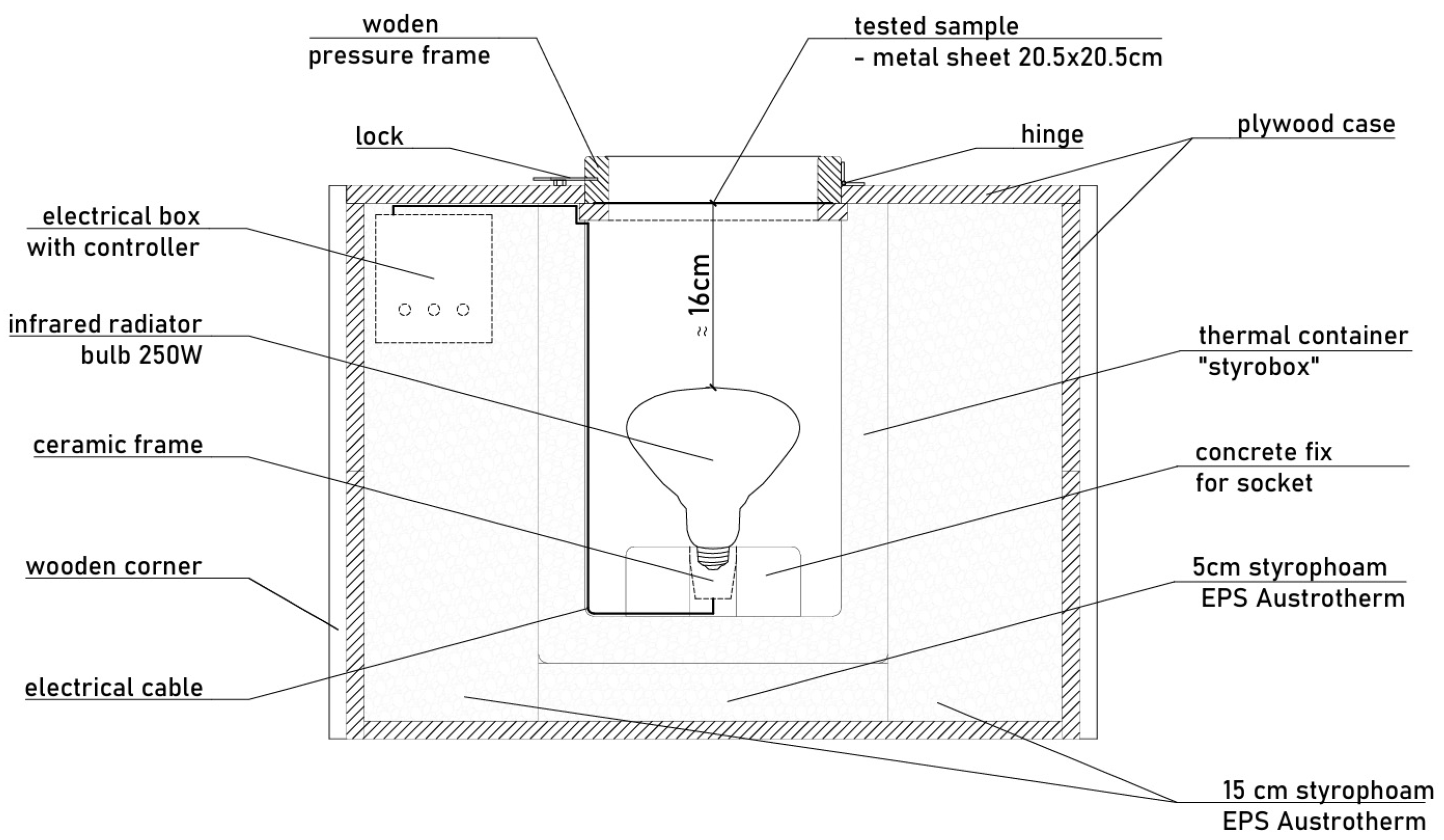
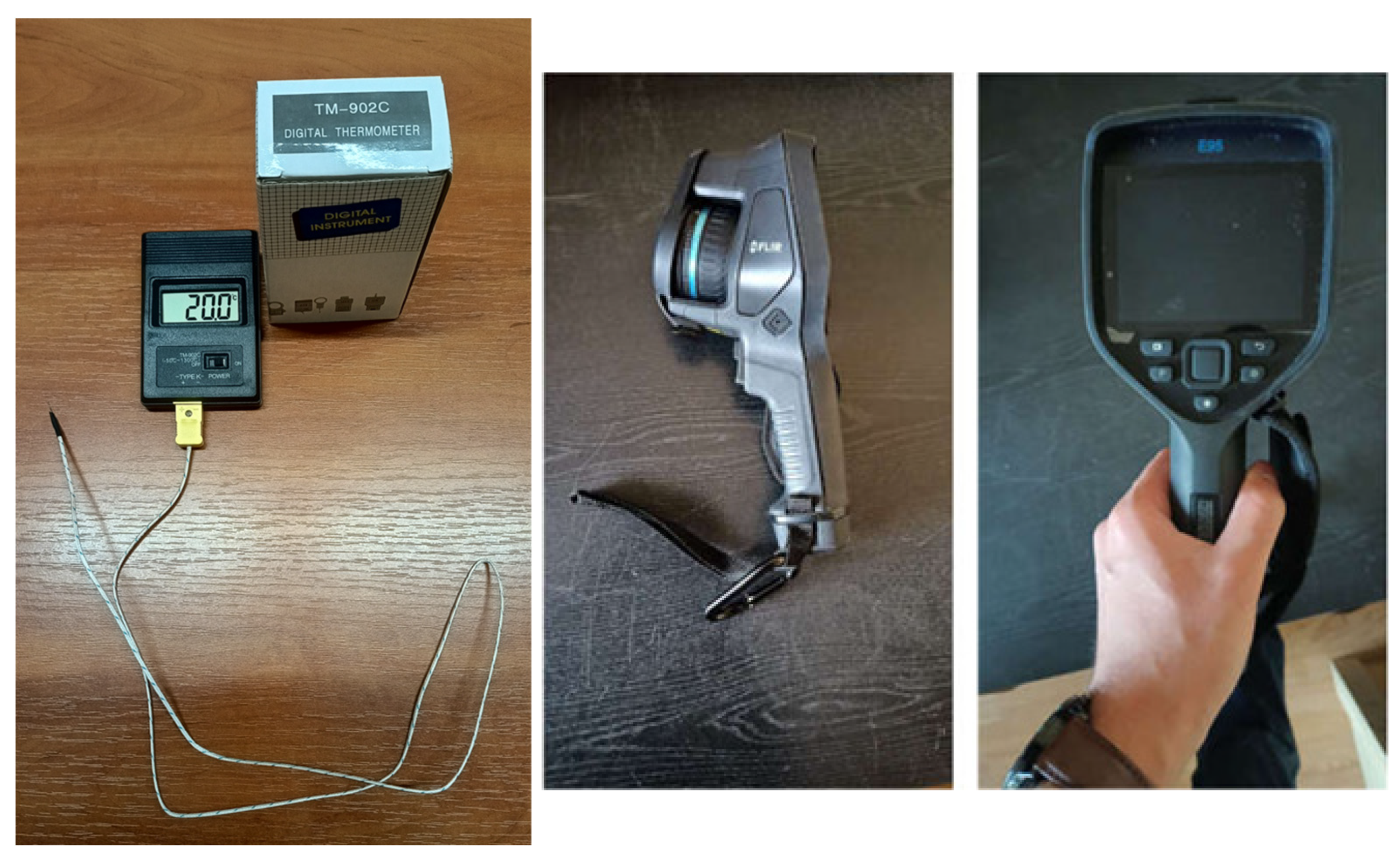
2.3.1. Heating Box with Radiant Heat Source
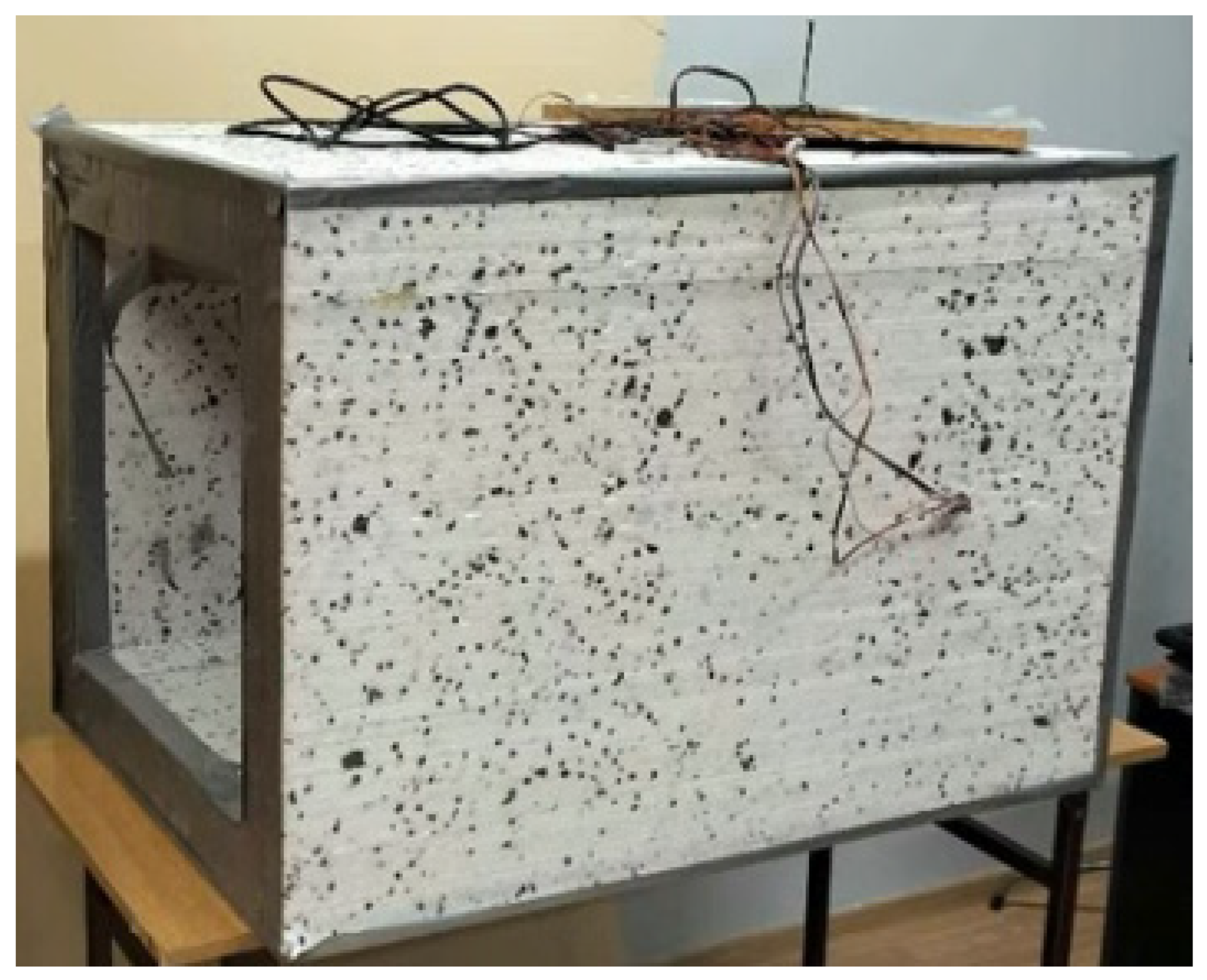
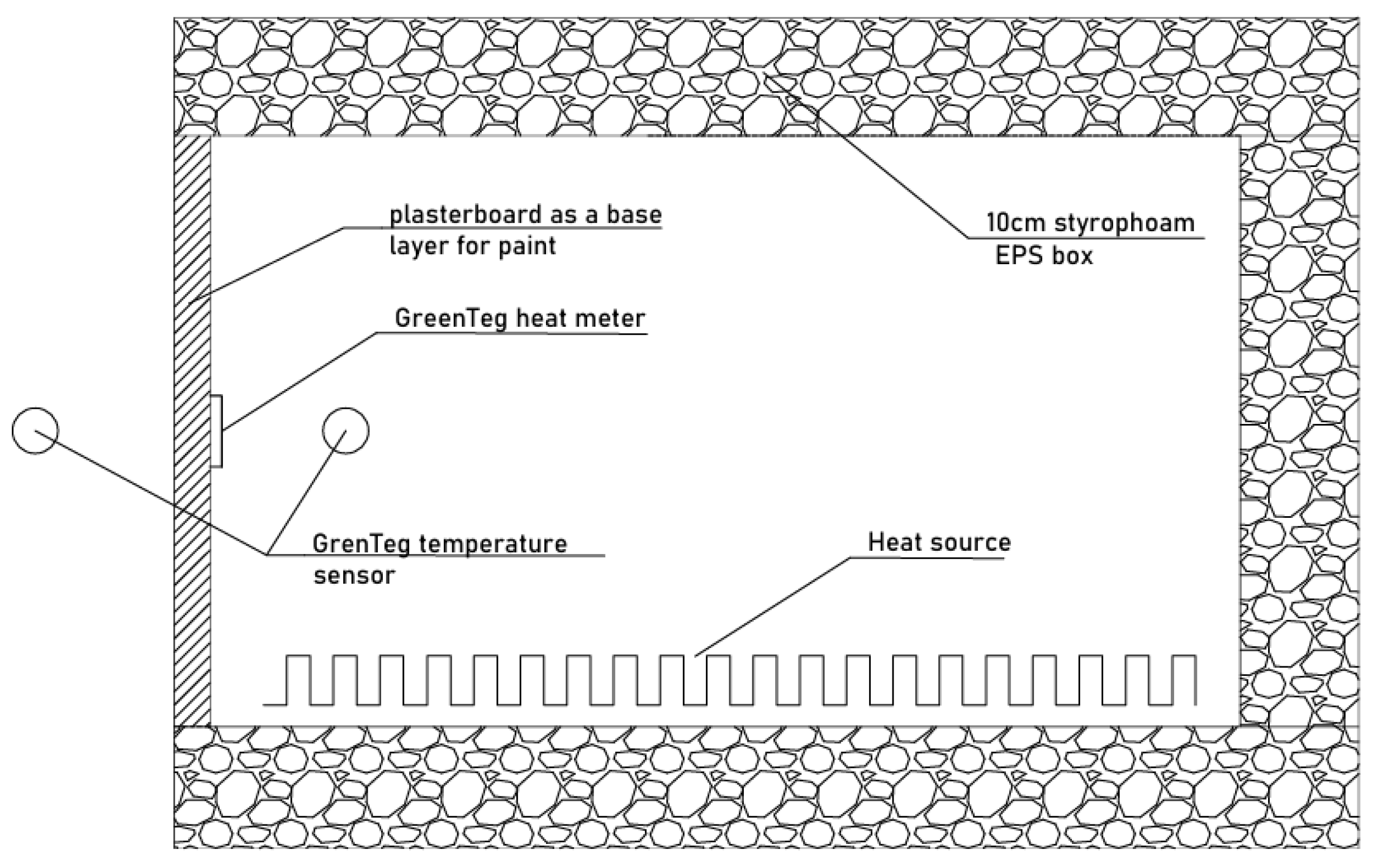
2.3.2. Heating Box with Convection Heat Source
- -
- for heat flux, determination error 3%. If we treat it as a normal distribution, we assume the measurement uncertainty as
- -
- for temperature, the measurement accuracy is ±0.1 °C, which usually means a rectangular distribution. Therefore, the measurement uncertainty is
- -
- for the temperature difference, the measurement uncertainty is
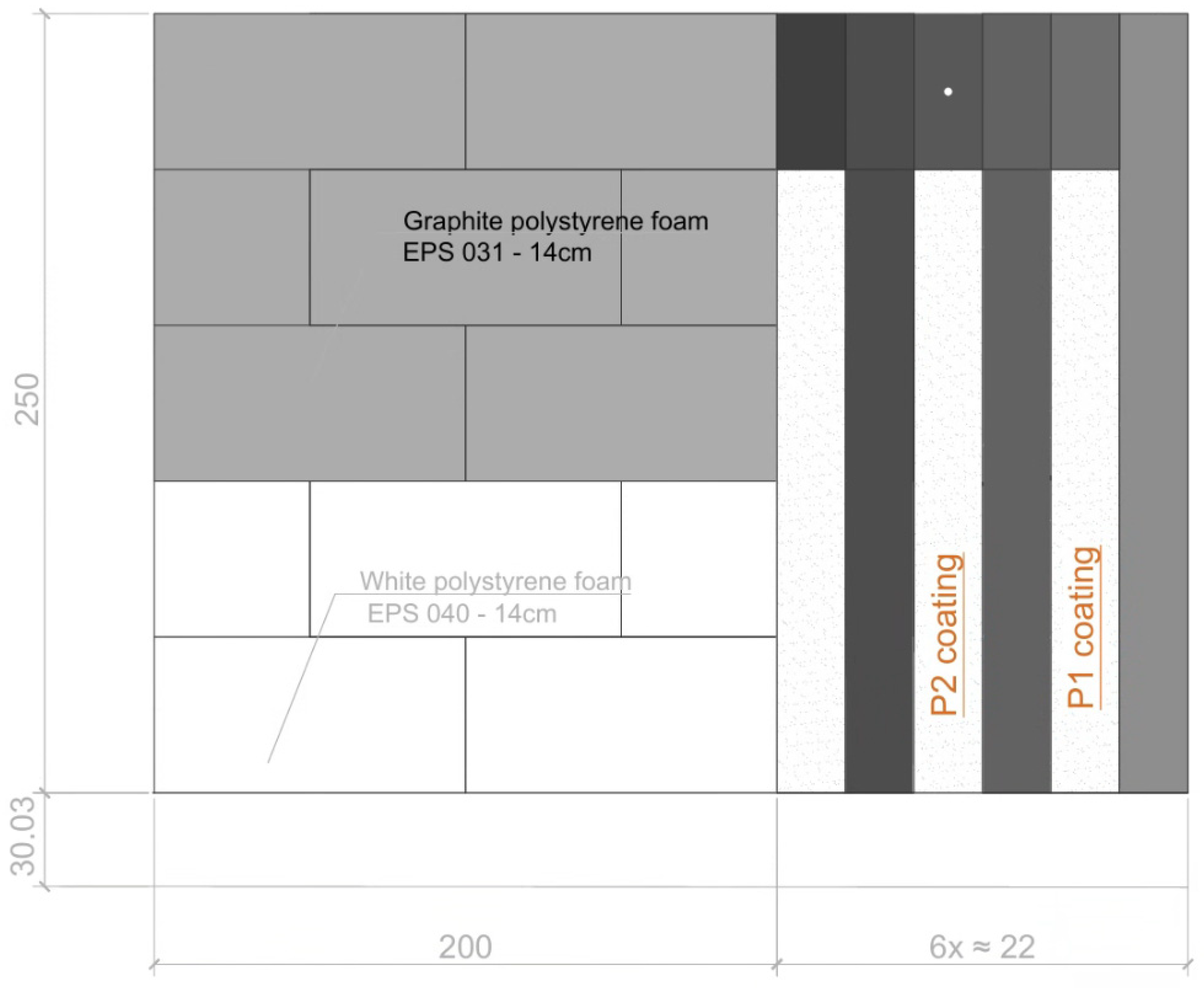
2.3.3. In Situ Field Tests on a Prototype Wall
2.3.4. Additional Comparative Tests of the Color of Thermal Insulation Coatings
3. Results and Discussion
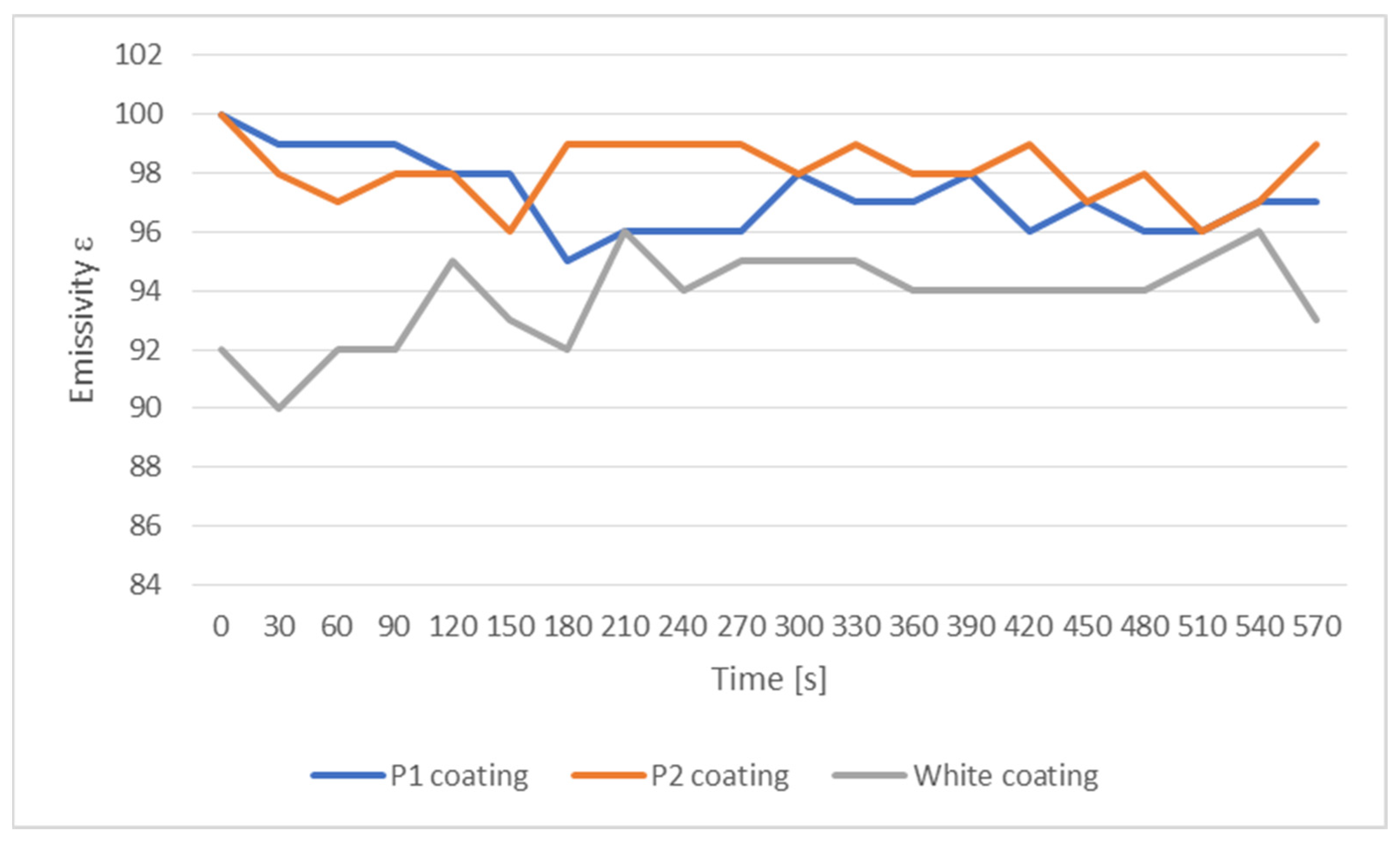
3.1. Results of Emissivity Coefficient Measurements Using a Heating Box with a Radiant Heat Source
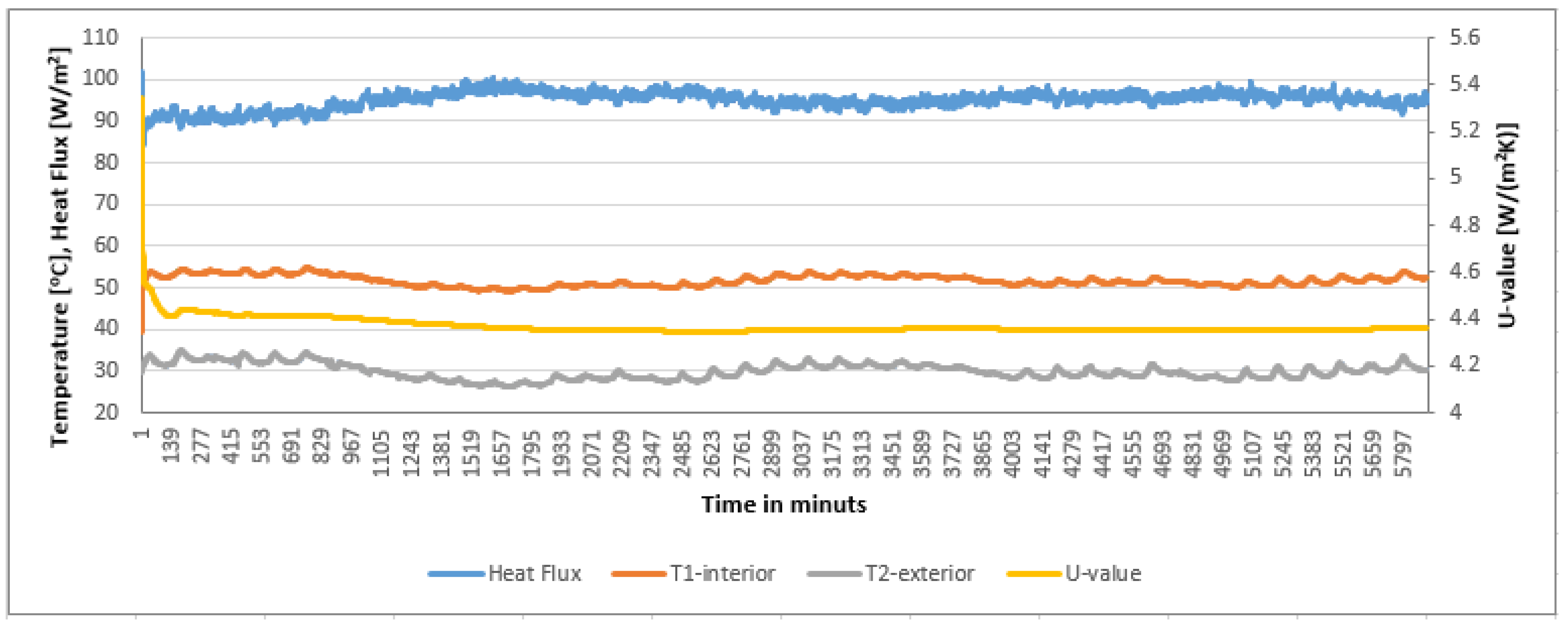
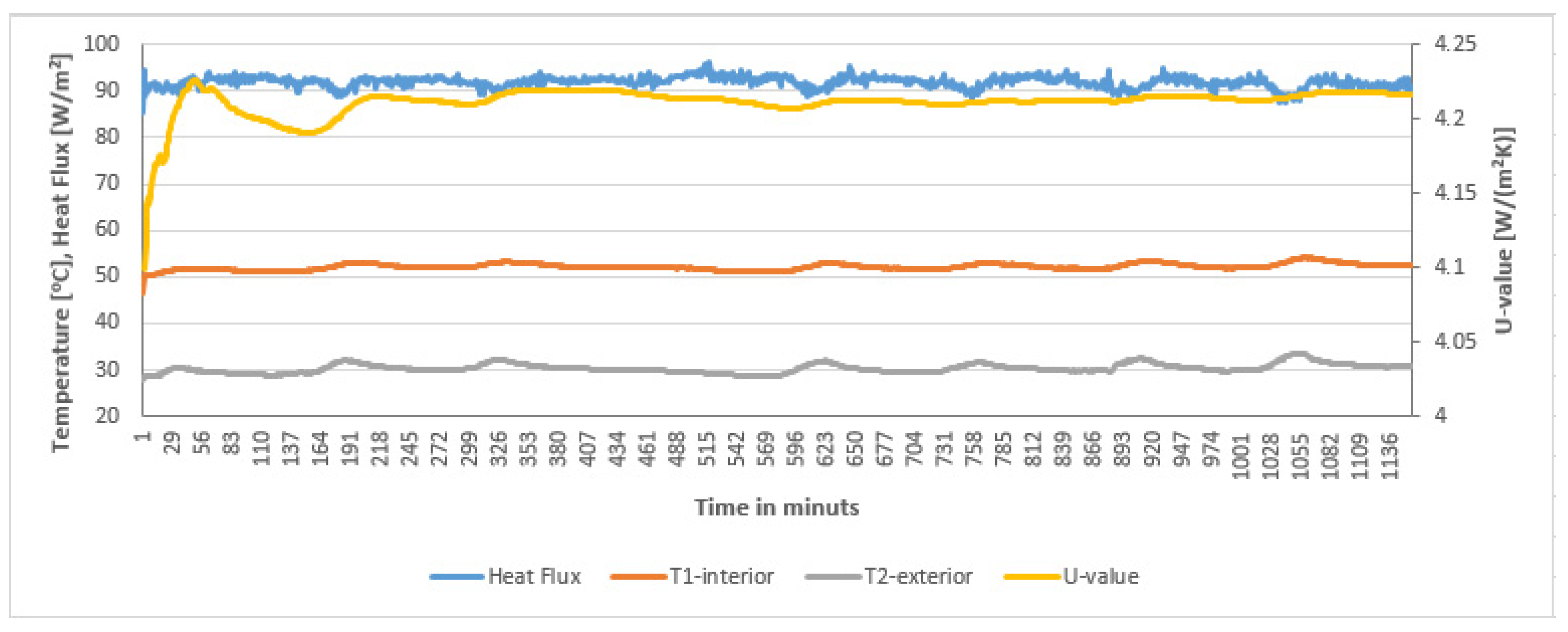
3.2. Measurement Results for a Heating Box with a Convection Heat Source
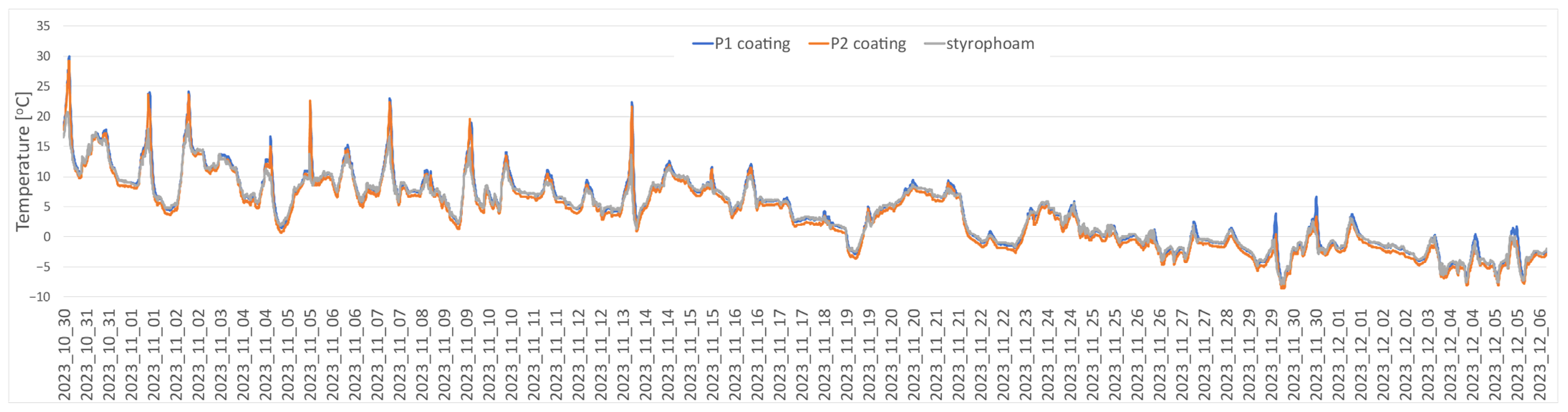
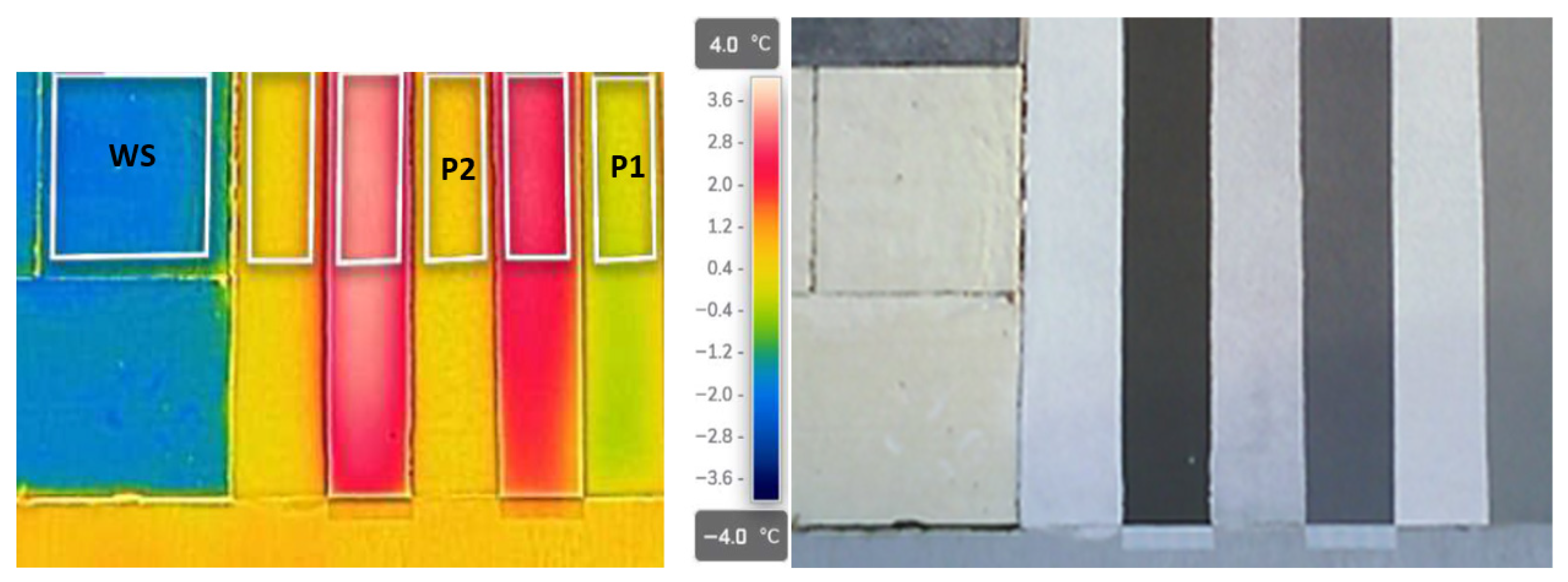
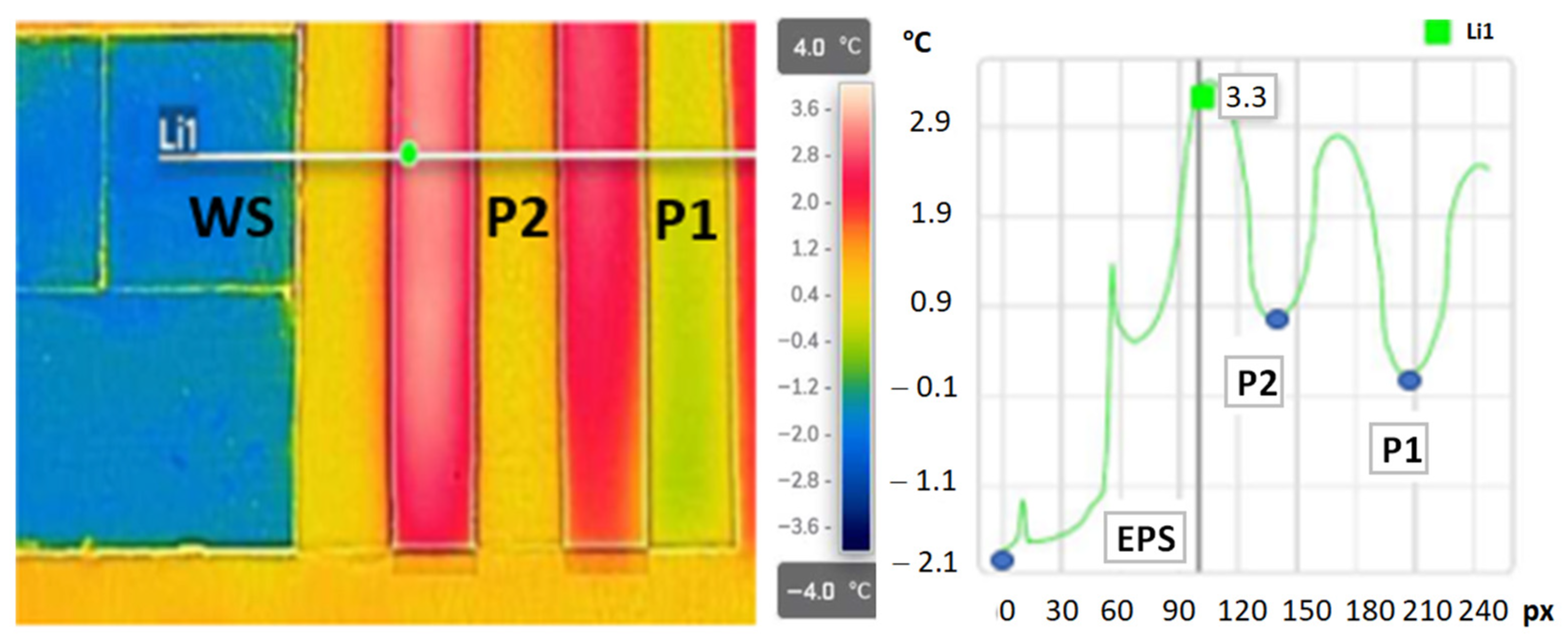
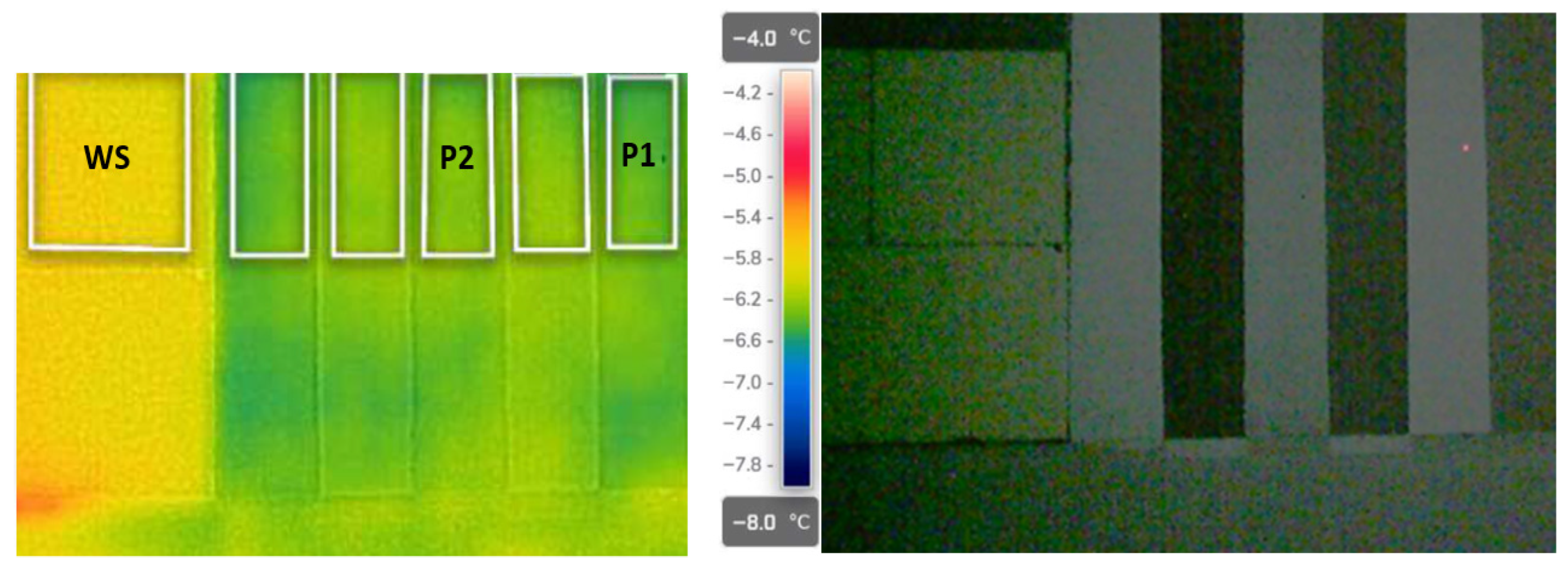
3.3. Results of In Situ Measurements on a Prototype Wall
4. Conclusions
- -
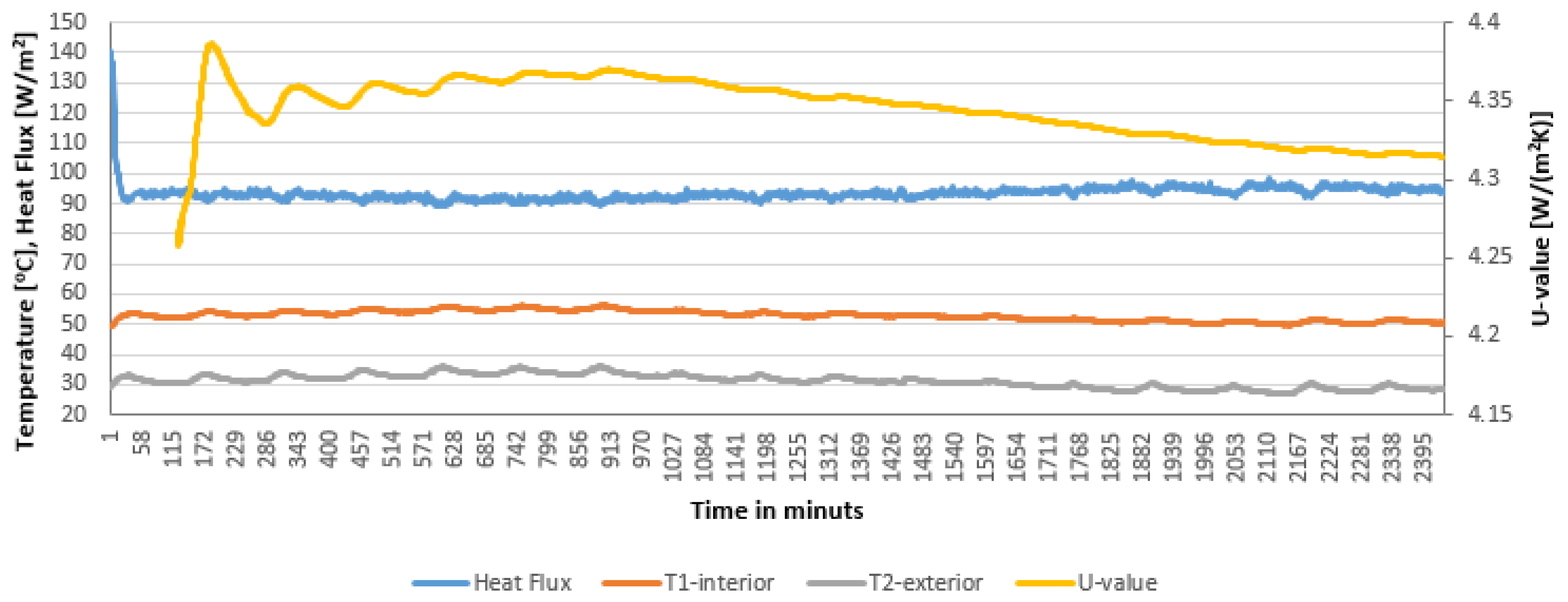
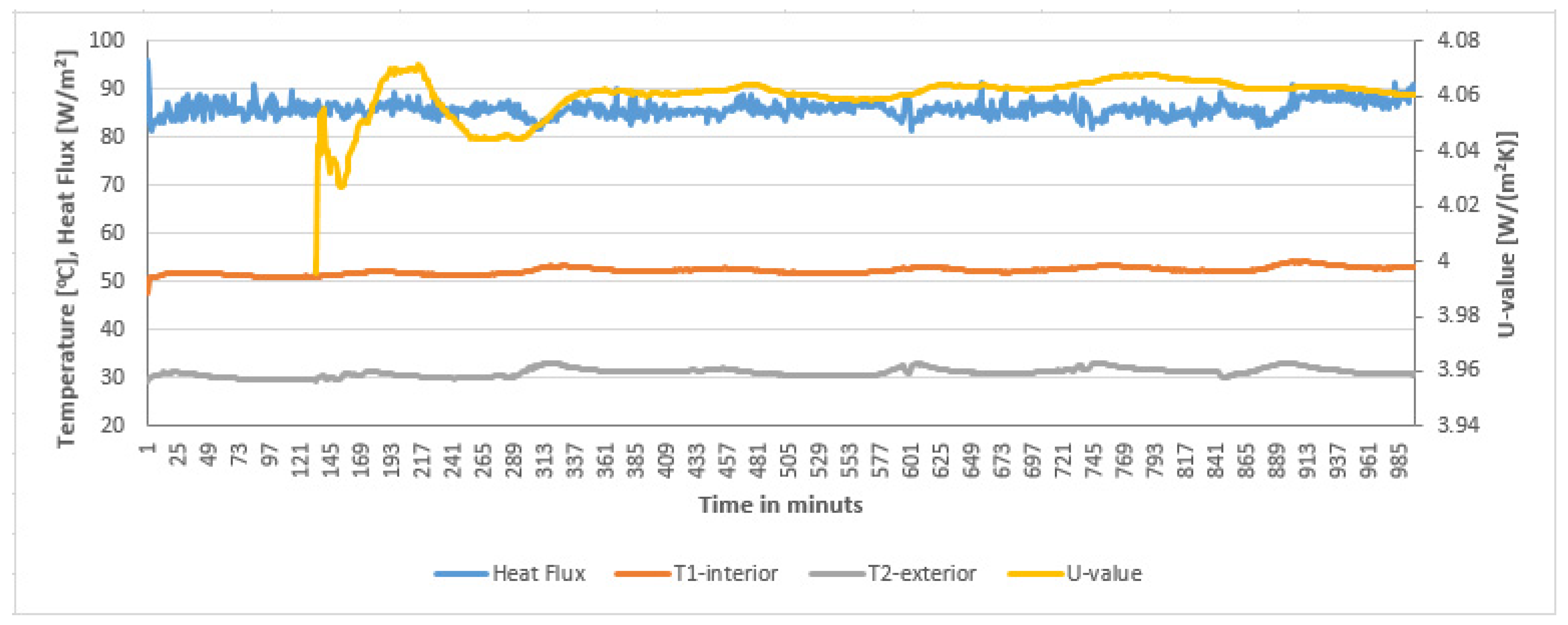
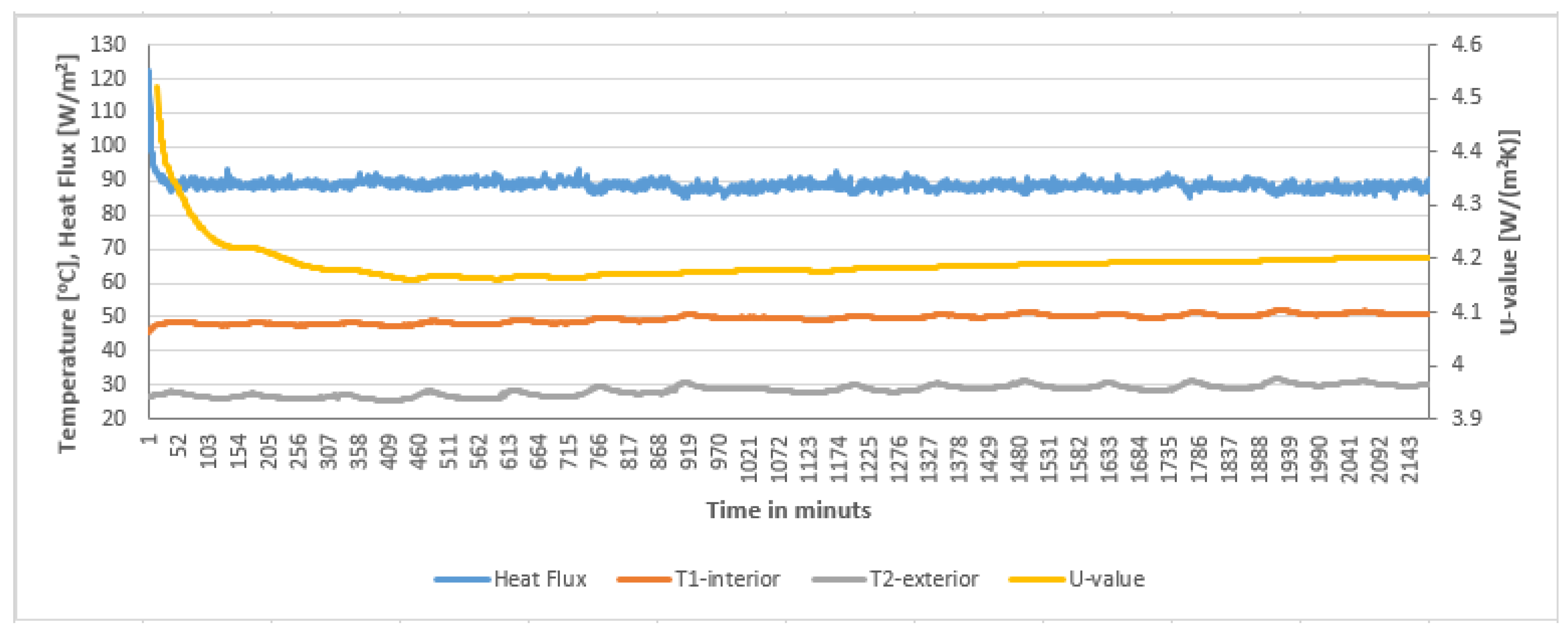
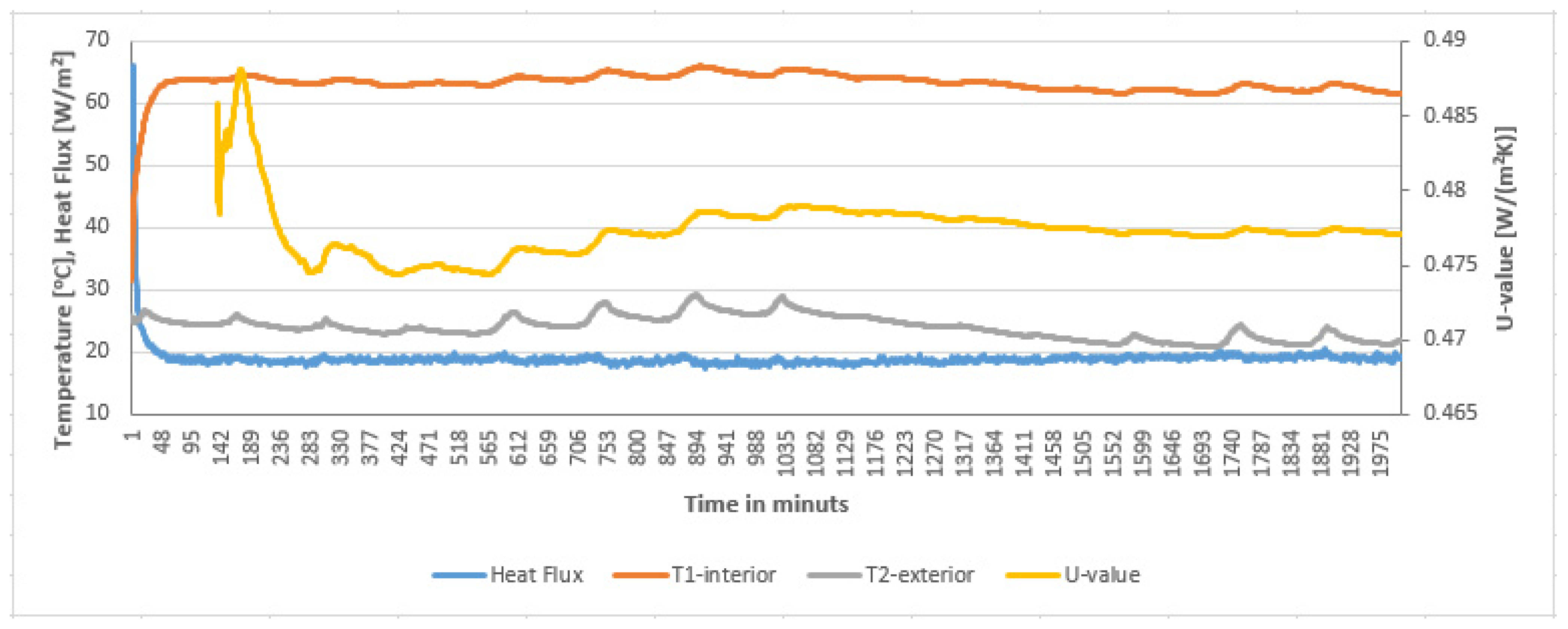
- The effect of the tested types of coatings with the addition of microspheres on the heat transfer coefficient of external partitions is very small at the coating thicknesses recommended by the manufacturers.
- -
- The change in the heat transfer coefficient relative to the almost plasterboard covered with heat-protective coatings is in the range of 0.05 to 0.3 W/(m2∙K), depending on the type of coating and the side of the sample covered with paint (interior, exterior).
- -
- Research indicates that covering the internal surfaces of the partition gives better thermal effects.
- -
- This type of covering is characterized by slightly better surface emissivity parameters than typical paint coverings used in construction.
- -
- The influence of this type of covering on the temperatures obtained on the surface of partitions is also small for the typically occurring temperatures on facades.
- -
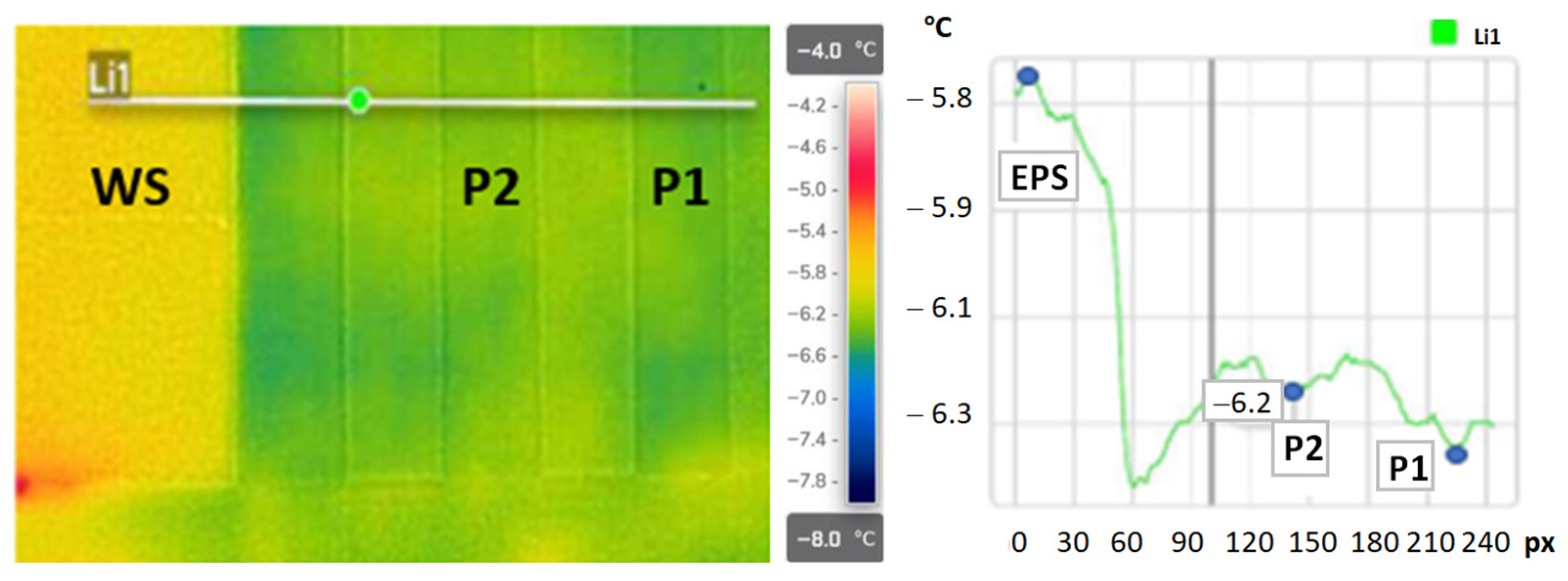
- In situ measurements carried out on the partition in the natural environment indicate a slight effect of surface temperature reduction by the tested coverings. Comparison with a fragment of the wall covered with white polystyrene, without an external expedition, shows that temperature values during periods of increased solar radiation intensity are usually the lowest for the white polystyrene surface.
Author Contributions
Funding
Data Availability Statement
Conflicts of Interest
References
- European Parliament; Council of the European Union. Directive (EU) 2024/1275 of the European Parliament and of the Council of 24 April 2024 on the Energy Performance of Buildings (Recast). Official Journal of the European Union, 2024. Available online: http://data.europa.eu/eli/dir/2024/1275/oj (accessed on 15 November 2025).
- Available online: https://www.consilium.europa.eu/en/policies/fit-for-55/ (accessed on 15 November 2025).
- Construction Law Act. Available online: https://isap.sejm.gov.pl/isap.nsf/DocDetails.xsp?id=wdu19940890414 (accessed on 15 November 2025).
- Regulation of the Minister of Infrastructure on the Technical Conditions to be Met by Buildings and Their Location. Available online: https://isap.sejm.gov.pl/isap.nsf/download.xsp/WDU20220001225/O/D20221225.pdf (accessed on 15 November 2025).
- Regulation of the Minister of Infrastructure and Development of 27 February 2015, pos. 376 on the Methodology for Determining the Energy Performance of a Building or Part of a Building and Energy Performance Certificates. Available online: https://isap.sejm.gov.pl/isap.nsf/DocDetails.xsp?id=WDU20150000376 (accessed on 15 November 2025).
- Available online: https://www.sejm.gov.pl/prawo/konst/polski/kon1.htm (accessed on 15 November 2025).
- Liua, S.; Zhua, K.; Cui, S.; Shena, X.; Tanc, G. A novel building material with low thermal conductivity: Rapid synthesis of foam concrete reinforced silica aerogel and energy performance simulation. Energy Build. 2018, 177, 385–393. [Google Scholar] [CrossRef] [Scilit]
- Yanga, W.; Liua, J.; Wanga, Y.; Gao, S. Experimental study on the thermal conductivity of aerogel-enhanced insulating materials under various hygrothermal environments. Energy Build. 2020, 206, 109583. [Google Scholar] [CrossRef] [Scilit]
- Zhang, T.; Zhang, Y.; Zhu, H.; Yan, Z. Experimental investigation and multi-level modeling of the effective thermal conductivity of hybrid micro-fiber reinforced cementitious composites at elevated temperatures. Compos. Struct. 2021, 26, 112988. [Google Scholar] [CrossRef] [Scilit]
- Pásztorya, Z.; Horváthc, T.; Glass, S.V.; Zelinka, S. Experimental investigation of the influence of temperature on thermal conductivity of multilayer reflective thermal insulation. Energy Build. 2018, 174, 26–30. [Google Scholar] [CrossRef] [Scilit]
- Liua, H.; Hua, M.; Jiaoa, J.; Li, Z.; Wua, X. Effective thermal conductivity modeling of hollow nanosphere packing structures. Int. J. Heat Mass Transf. 2020, 161, 120298. [Google Scholar] [CrossRef] [Scilit]
- Huang, J.; Xia, X.; Hu, X.; Li, S.; Liu, K. A general method for measuring the thermal conductivity of MOF crystals. Int. J. Heat Mass Transf. 2019, 138, 11–16. [Google Scholar] [CrossRef] [Scilit]
- Wang, H.; Hou, F.; Chang, C. Experimental and computational modeling of thermal conductivity of cementitious syntactic foams filled with hollow glass microspheres. Constr. Build. Mater. 2020, 265, 120739. [Google Scholar] [CrossRef] [Scilit]
- Zhang, C.; Zhang, C.; Huang, R.; Gu, X. Effects of hollow microspheres on the thermal insulation of polysiloxane foam. J. Appl. Polym. Sci. 2017, 134, 18. [Google Scholar] [CrossRef] [Scilit]
- Hu, Y.; Mei, R.; An, Z.; Zhang, J. Silicon rubber/hollow glass microsphere composites: Influence of broken hollow glass microsphere on mechanical and thermal insulation property. Compos. Sci. Technol. 2013, 79, 64–69. [Google Scholar] [CrossRef] [Scilit]
- Shao, N.; Zhang, Y.; Liu, Z.; Wang, D.; Zhang, Z. Fabrication of hollow microspheres filled fly ash based foam geopolymers with ultra-low thermal conductivity and relative high strength. Constr. Build. Mater. 2018, 185, 567–573. [Google Scholar] [CrossRef] [Scilit]
- Shen, Z.; Brooks, A.L.; He, Y.; Shrestha, S.S.; Zhou, H. Evaluating dynamic thermal performance of building envelope components using small-scale calibrated hot box tests. Energy Build. 2021, 251, 111342. [Google Scholar] [CrossRef] [Scilit]
- Barbaresi, A.; Bovo, M.; Santolini, E.; Barbaresi, L.; Torreggiani, D.; Tassinari, P. Development of a low-cost movable hot box for a preliminary definition of the thermal conductance of building envelopes. Build. Environ. 2020, 180, 107034. [Google Scholar] [CrossRef] [Scilit]
- Cao, X.; Tang, B.; Zou, X.; He, L. Analysis on the cooling effect of a heat-reflective coating for asphalt pavement. Road Mater. Pavement Des. 2015, 16, 716–726. [Google Scholar] [CrossRef] [Scilit]
- Bao, Y.; Kang, Q.L.; Ma, J.Z. Structural regulation of hollow spherical TiO2 by varying titanium source amount and their thermal insulation property. Colloids Surf. A Physicochem. Eng. Asp. 2018, 537, 69–75. [Google Scholar] [CrossRef] [Scilit]
- Synnefa, A.; Santamouris, M.; Akbari, H. Estimating the effect of using cool coatings on energy loads and thermal comfort in residential buildings in various climatic conditions. Energy Build. 2007, 39, 1167–1174. [Google Scholar] [CrossRef] [Scilit]
- Joudi, A.; Svedung, H.; Cehlin, M.; Rönnelid, M. Reflective coatings for interior and exterior of buildings and improving thermal performance. Appl. Energy 2013, 103, 562–570. [Google Scholar] [CrossRef] [Scilit]
- Wang, F.; Liang, J.; Tang, Q.; Wang, N.; Li, L. Preparation and Properties of Thermal Insulation Latex Paint for Exterior Wall Based on Defibred Sepiolite and Hollow Glass Microspheres. Adv. Mater. Res. 2009, 58, 103–108. [Google Scholar] [CrossRef] [Scilit]
- Nowoświat, A.; Miros, A.; Krause, P. Change in the properties of expanded polystyrene exposed to solar radiation in real aging conditions. Sustainability 2024, 16, 7320. [Google Scholar] [CrossRef] [Scilit]
- Norvaisiene, R.; Krause, P.; Buhagiar, V.; Burlingis, A. Resistance of ETICS with fire barriers to cyclic hygrothermal impact. Sustainability 2021, 13, 9220. [Google Scholar] [CrossRef] [Scilit]
- Liu, Z.; Yao, Z.; Lv, Z.; Huo, Z.; Tan, S.; Guo, S.; Qin, Y. Structural and thermal enhancemnets in hollow glass microspheres via ZnO nanoparticle coating. J. Coat. Technol. Res. 2025, 22, 1995–2007. [Google Scholar] [CrossRef] [Scilit]
- Herrera-Ramírez, L.C.; Cano, M.; Guzman de Villoria, R. Low thermal and high electrical conductivity in hollow glass microspheres covered with carbon nanofiber–polymer composites. Compos. Sci. Technol. 2017, 151, 211–218. [Google Scholar] [CrossRef] [Scilit]
- Qian, H.; Bismarck, A.; Greenhalgh, E.S.; Shaffer, M.S.P. Synthesis and characterisation of carbon nanotubes grown on silica fibres by injection CVD. Carbon 2010, 48, 277–286. [Google Scholar] [CrossRef] [Scilit]
- Wicks, S.S.; de Villoria, R.G.; Wardle, B.L. Interlaminar and intralaminar reinforcement of composite laminates with aligned carbon nanotubes. Compos. Sci. Technol. 2010, 70, 20–28. [Google Scholar] [CrossRef] [Scilit]
- Yamamoto, N.; Hart, A.J.; Garcia, E.J.; Wicks, S.S.; Duong, H.M.; Slocum, A.H.; Wardle, B.L. High-yield growth and morphology control of aligned carbon nanotubes on ceramic fibers for multifunctional enhancement of structural composites. Carbon 2009, 47, 551–560. [Google Scholar] [CrossRef] [Scilit]
- Król, D.; Motyl, P.; Piotrowska-Woroniak, J.; Patej, M.; Poskrobko, S. Heat Reflective Thin-Film Polymer Insulation with Polymer Nanospheres—Determination of Thermal Conductivity Coefficient. Energies 2022, 15, 6286. [Google Scholar] [CrossRef] [Scilit]
- Malewska, E.; Prociak, A.; Vevere, L.; Vanags, E.; Zemła, M.; Uram, K.; Kirpluks, M.; Cabulis, U.; Bryk, M. New Thermo-Reflective Coatings for Applications as a Layer of Heat Insulating Materials. Materials 2022, 15, 5642. [Google Scholar] [CrossRef] [Scilit]
- Shang, J.; Wang, M.; Wang, P.; Li, G.; Yang, M.; Li, Y. Study on Thermal Reflection Characteristics of Composite Inorganic Coatings. Appl. Sci. 2024, 14, 6898. [Google Scholar] [CrossRef] [Scilit]
- Simpson, A.; Fitton, R.; Rattigan, I.G.; Marshall, A.; Parr, G.; Swan, W. Thermal performance of thermal paint and surface coatings in buildings in heating dominated climates. Energy Build. 2019, 197, 196–213. [Google Scholar] [CrossRef] [Scilit]
- Yu, Z.; Du, X.; Zhu, P.; Zhao, T.; Sun, R.; Chen, J.; Wang, N.; Li, W. Surface modified hollow glass microspheres-epoxy composites with enhanced thermal insulation and reduced dielectric constant. Mater. Today Commun. 2022, 32, 104046. [Google Scholar] [CrossRef] [Scilit]
- Calovi, M.; Rossi, S. Durability and Thermal Behavior of Functional Paints Formulated with Recycled-Glass Hollow Microspheres of Different Size. Materials 2023, 16, 2678. [Google Scholar] [CrossRef] [Scilit]
- Peng, J.; Lai, J.-C.; Xiao, X.; Jin, W.; Zhou, J.; Yang, Y.; Gao, X.; Tang, J.; Fan, L.; Shanhui, F.; et al. Colorful low-emissivity paints for space heating and cooling energy savings. Proc. Natl. Acad. Sci. USA 2023, 120, e2300856120. [Google Scholar] [CrossRef] [Scilit]
- Kwon, T.K.; Zoh, H.D.; Ahn, W.; Lee, S.; Kim, T.H. Analysis of Indoor Thermal Environment Improvement in Apartment Buildings Through the Application of Heat-Reflective Paint. Buildings 2024, 14, 3834. [Google Scholar] [CrossRef] [Scilit]
- Farkoush, M.A.; Rashidi, A.; Alaei, M. Thermal insulation of water-based acrylic coatings reinforced with APTES-functionalized silica fume nanoparticles. Sci. Rep. 2026, 16, 2361. [Google Scholar] [CrossRef] [Scilit]
- Bozsaky, D. Laboratory Tests with Liquid Nano-ceramic Thermal Insulation Coating. Procedia Eng. 2015, 123, 68–75. [Google Scholar] [CrossRef] [Scilit]
- Bozsaky, D. Thermal insulation with nanotechnology-based materials. In Proceedings of the Internationales Symposium Eventmaterials, Wien, Austria, 19–20 November 2015; pp. 137–154. [Google Scholar]
- Bozsaky, D. Recent studies on thermodynamic processes in nano-ceramic thermal insulation coatings. Pollack Period. 2019, 14, 107–116. [Google Scholar] [CrossRef] [Scilit]
- Bozsaky, D. Thermodynamic tests with nano-ceramic thermal insulation coatings. Pollack Period. 2017, 12, 135–145. [Google Scholar] [CrossRef] [Scilit]
- Paul, G.; Chopkar, M.; Manna, I.; Das, P.K. Techniques for measuring the thermal conductivity of nanofluids: A review. Renew. Sustain. Energy Rev. 2010, 14, 1913–1924. [Google Scholar] [CrossRef] [Scilit]
- Pisello, A.L.; Goretti, M.; Cotana, F. A method for assessing buildings’ energy efficiency by dynamic simulation and experimental activity. Appl. Energy 2012, 47, 419–429. [Google Scholar] [CrossRef] [Scilit]
- Jo, J.H.; Carlson, J.D.; Golden, J.S.; Bryan, H. An integrated empirical and modeling methodology for analyzing solar reflective roof technologies on commercial buildings. Build. Environ. 2010, 45, 453–460. [Google Scholar] [CrossRef] [Scilit]
- Wray, C.; Akbari, H. The effects of roof reflectance on air temperatures surrounding a rooftop condensing unit. Energy Build. 2008, 40, 11–28. [Google Scholar] [CrossRef] [Scilit]
- Wang, X.X.; Kendrick, C.; Ogden, R.; Maxted, J. Dynamic thermal simulation of a retail shed with solar reflective coatings. Appl. Therm. Eng. 2008, 28, 1066–1073. [Google Scholar] [CrossRef] [Scilit]
- Zinzi, M.; Fasano, G. Properties and performance of advanced reflective paints to reduce the cooling loads in buildings and mitigate the heat island effect in urban areas. Int. J. Sustain. Energy 2009, 28, 123–139. [Google Scholar] [CrossRef] [Scilit]
- Moujaes, S.F.; Brickman, R. Thermal performance analysis of highly reflective coating on residences in hot and arid climates. J. Energy Eng. 2003, 129, 56–68. [Google Scholar] [CrossRef] [Scilit]
- Suehrcke, H.; Peterson, E.L.; Selby, N. Effect of roof solar reflectance on the building heat gain in a hot climate. Energy Build. 2008, 40, 2224–2235. [Google Scholar] [CrossRef] [Scilit]
- Kokogiannakis, G.; Tuohy, P.; Darkwa, J. Impact of material surface properties on building performance across a variety of climates. Int. J. Low Carbon Technol. 2012, 7, 181–186. [Google Scholar] [CrossRef] [Scilit]
- Synnefa, A.; Saliari, M.; Santamouris, M. Experimental and numerical assessment of the impact of increased roof reflectance on a school building in Athens. Energy Build. 2012, 55, 7–15. [Google Scholar] [CrossRef] [Scilit]
- Guo, W.; Qiao, X.; Huang, Y.; Fang, M.; Han, X. Study on energy saving effect of heat-reflective insulation coating on envelopes in the hot summer and cold winter zone. Energy Build. 2012, 50, 196–203. [Google Scholar] [CrossRef] [Scilit]
- Levinson, R.; Akbari, H.; Reilly, J.C. Cooler tile-roofed buildings with near-infrared-reflective non-white coatings. Build. Environ. 2007, 42, 2591–2605. [Google Scholar] [CrossRef] [Scilit]
- Synnefa, A.; Santamouris, M.; Apostolakis, K. On the development, optical properties and thermal performance of cool colored coatings for the urban environment. Sol. Energy 2007, 81, 488–497. [Google Scholar] [CrossRef] [Scilit]
- Uemoto, L.K.; Sato, N.M.N.; John, V.M. Estimating thermal performance of cool colored paints. Energy Build. 2010, 42, 17–22. [Google Scholar] [CrossRef] [Scilit]
- Santamouris, M.; Gaitani, N.; Spanou, A.; Saliari, M.; Giannopoulou, K.; Vasilakopoulou, K.; Kardomateas, T. Using cool paving materials to improve microclimate of urban areas–Design realization and results of the flisvos project. Build. Environ. 2012, 53, 128–136. [Google Scholar] [CrossRef] [Scilit]
- Synnefa, A.; Karlessi, T.; Gaitani, N.; Santamouris, M.; Assimakopoulos, D.N.; Papakatsikas, C. Experimental testing of cool colored thin layer asphalt and estimation of its potential to improve the urban microclimate. Build. Environ. 2011, 46, 38–44. [Google Scholar] [CrossRef] [Scilit]
- Joudi, A.; Harald Svedung, H.; Rönnelid, M. Energy efficient surfaces on building sandwich panels—A dynamic simulation model. Energy Build. 2011, 43, 2462–2467. [Google Scholar] [CrossRef] [Scilit]
- Joudi, A.; Svedung, H.; Bales, C.; Rönnelid, M. Highly reflective coatings for interior and exterior steel cladding and the energy efficiency of buildings. Appl. Energy 2011, 88, 4655–4666. [Google Scholar] [CrossRef] [Scilit]
- Achar, S.; Procopio, L.J. Developments in waterborne thermal insulation coatings. J. Prot. Coat. Linings 2013, 30, 48–59. [Google Scholar]
- Sahu, P.; Mahanwar, P.; Bambole, V. Effect of hollow glass microspheres and cenospheres on insulation properties of coatings. Pigment. Resin Technol. 2013, 42, 223. [Google Scholar] [CrossRef] [Scilit]
- Čekon, M. Thermodynamic Properties of Reflective Coatings. Adv. Mater. Res. 2013, 649, 179–182. [Google Scholar] [CrossRef] [Scilit]
- Čekon, M.; Kalousek, M.; Hraška, J.; Ingeli, R. Spectral optical properties and thermodynamic performance of reflective coatings in a mild climate zone. Energy Build. 2014, 77, 343–354. [Google Scholar] [CrossRef] [Scilit]
- Synnefa, A.; Santamouris, M.; Livada, I. A study of the thermal performance of reflective coatings for the urban environment. Sol. Energy 2006, 80, 968–981. [Google Scholar] [CrossRef] [Scilit]
- de Brito Filho, J.P.; Henriquez, J.R.; Dutra, J.C.C. Effects of coefficients of solar reflectivity and infrared emissivity on the temperature and heat flux of horizontal flat roofs of artificially conditioned nonresidential buildings. Energy Build. 2011, 43, 440–445. [Google Scholar] [CrossRef] [Scilit]
- Berdahl, P.; Bretz, S.E. Preliminary survey of the solar reflectance of cool roofing materials. Energy Build. 1997, 25, 149–158. [Google Scholar] [CrossRef] [Scilit]
- Shen, H.; Tan, H.; Tzempelikos, A. The effect of reflective coatings on building surface temperatures, indoor environment and energy consumption—An experimental study. Energy Build. 2011, 43, 573–580. [Google Scholar] [CrossRef] [Scilit]
- Akbari, H.; Konopacki, S. Calculating energy-saving potentials of heat-island reduction strategies. Energy Policy 2005, 33, 721–756. [Google Scholar] [CrossRef] [Scilit]
- Ichinose, M.; Inoue, T.; Sakamoto, Y. Long-term performance of high-reflectivity exterior panels. Build. Environ. 2009, 44, 1601–1608. [Google Scholar] [CrossRef] [Scilit]
- Jia, M.Q.; Jin, Y.H. Performance of Thermal Insulation Reflective Composite Coatings. Adv. Mater. Res. 2011, 239–242, 1771–1774. [Google Scholar] [CrossRef] [Scilit]
- Song, Z.; Zhang, W.; Shi, Y.; Song, J.; Qu, J.; Qin, J.; Zhang, T.; Li, Y.; Zhang, H.; Zhang, R. Optical properties across the solar spectrum and indoor thermal performance of cool white coatings for building energy efficiency. Energy Build. 2013, 63, 49–58. [Google Scholar] [CrossRef] [Scilit]
- Available online: https://www.tri-color.pl/spektrofotometry-przenosne/sv300 (accessed on 15 April 2026).
- Gawełek, M. Research and Analysis of Thermal Insulation Coatings Used in the Construction Industry. Master’s Thesis, Silesian University of Technology, Gliwice, Poland, 2024. [Google Scholar]
- ASTM E903-20; Standard Test Method for Solar Absorptance, Reflectance, and Transmittance of Materials Using Integrating Spheres. ASTM International: West Conshohocken, PA, USA, 2020.
- ASTM E1980-24; Standard Practice for Calculating Solar Reflectance Index of Horizontal and LowSloped Opaque Surfaces. ASTM International: West Conshohocken, PA, USA, 2024.
- Murzyn, P. Raport z Badań: Wyznaczenie Współczynnika Przewodzenia Ciepła λ Materiału o Nazwie: Cienkowarstwowa Powłoka Termoizolacyjna. KrakóW 2023. Available online: https://akterm.tech/images/certyfikaty/AGH.pdf (accessed on 5 May 2026).
- Klemm, P.; Chwieduk, D.; Francke, B.; Grabarczyk, S.; Klemm, P.; Kosiorek, M.; Kubik, J.; Pogorzelski, J.A.; Szudrowicz, B.; Ścisłewski, Z.; et al. Budownictwo Ogólne T2–Fizyka Budowli; Arkady: Warszawa, Poland, 2005. [Google Scholar]
- Więcek, B.; May, G. Termowizja w Podczerwieni. Podstawy i Zastosowania; Wydawnictwo PAK: Warsaw, Poland, 2011. [Google Scholar]
- Pudlik, W. Wymiana i Wymienniki Ciepła; Politechnika Gdańska: Gdańsk, Poland, 2012. [Google Scholar]
- ISO 9869-1:2014; Thermal Insulation—Building Elements—In-Situ Measurement of Thermal Resi-Stance and Thermal Transmittancepart 1: Heat Flow Meter Method. ISO: Geneva, Switzerland, 2014.
- Mokrzycki, W.; Tatol, M. Color difference ΔE―A Survey. Mach. Graph. Vis. 2011, 20, 383–411. [Google Scholar]



| Parameter | Measuring Method | P1 Coating | P2 Coating |
|---|---|---|---|
| TRS coefficient [%] | ASTM E903-20 [76] | - | 90.04 |
| Sunlight reflectance coefficient SRI [-] | ASTM E1980-24 [77] | - | - |
| Reduction of hot surface temperatures | - | from 185.0 to 94.5 °C | from 146.3 to 78.5 °C |
| Calculated thermal conductivity coefficient λ [W/(m∙K)] | - | 0.06690 [78] | 0.00053 |
| Brightness coordinates | SV300 3color CIELAB color space | L* = 95.32 | L* = 95.10 |
| Green/red color coordinates | a* = −1.19 | a* = −1.26 | |
| Blue/yellow coordinates | b* = 3.87 | b* = 3.29 |
| Number | Measurement time | P1 Coating–Exterior Paint | P2 Coating–Exterior Paint | Ref. White Coating–Exterior Paint | |||||||||
|---|---|---|---|---|---|---|---|---|---|---|---|---|---|
| T Tape. 0 | Ԑ Tape | T IR.0 | Ԑx | T Tape. 0 | Ԑ Tape | T IR.0 | Ԑx | T Tape. 0 | Ԑ Tape | T IR.0 | Ԑx | ||
| [°C] | [-] | [°C] | [-] | [°C] | [-] | [°C] | [-] | [°C] | [-] | [°C] | [-] | ||
| 1. | 00:30 | 39.7 | 96 | 39.7 | 100 | 38.5 | 96 | 38.7 | 100 | 44.6 | 96 | 44.6 | 92 |
| 2. | 01:00 | 49.3 | 96 | 49.3 | 99 | 44.6 | 96 | 44.6 | 98 | 54.3 | 96 | 54.3 | 90 |
| 3. | 01:30 | 56.4 | 96 | 56.4 | 99 | 53.4 | 96 | 53.4 | 97 | 63.1 | 96 | 63.0 | 92 |
| 4. | 02:00 | 62.0 | 96 | 62,0 | 99 | 60.7 | 96 | 60.8 | 98 | 69.8 | 96 | 69.8 | 92 |
| 5. | 02:30 | 68.0 | 96 | 68.0 | 98 | 65.8 | 96 | 65.9 | 98 | 74.8 | 96 | 74.8 | 95 |
| 6. | 03:00 | 71.3 | 96 | 71.3 | 98 | 71.0 | 96 | 71,0 | 96 | 78.5 | 96 | 78.4 | 93 |
| 7. | 03:30 | 74.7 | 96 | 74.7 | 95 | 72.8 | 96 | 72.8 | 99 | 82.8 | 96 | 82.8 | 92 |
| 8. | 04:00 | 76.8 | 96 | 76.8 | 96 | 75.1 | 96 | 75.1 | 99 | 84.3 | 96 | 84.3 | 96 |
| 9. | 04:30 | 79.3 | 96 | 79.3 | 96 | 78.1 | 96 | 78.1 | 99 | 86.8 | 96 | 86.8 | 94 |
| 10. | 05:00 | 81.0 | 96 | 81.0 | 96 | 79.2 | 96 | 79.1 | 99 | 89.0 | 96 | 89.0 | 95 |
| 11. | 05:30 | 82.2 | 96 | 82.2 | 98 | 80.4 | 96 | 80.4 | 98 | 90.5 | 96 | 90.6 | 95 |
| 12. | 06:00 | 83.6 | 96 | 83.6 | 97 | 81.7 | 96 | 81.8 | 99 | 91.6 | 96 | 91.6 | 95 |
| 13. | 06:30 | 84.3 | 96 | 84.3 | 97 | 83.3 | 96 | 83.2 | 98 | 92.6 | 96 | 92.6 | 94 |
| 14. | 07:00 | 85.0 | 96 | 85.0 | 98 | 83.8 | 96 | 83.7 | 98 | 94.4 | 96 | 94.4 | 94 |
| 15. | 07:30 | 87.1 | 96 | 87.1 | 96 | 84.9 | 96 | 84.9 | 99 | 94.8 | 96 | 94.8 | 94 |
| 16. | 08:00 | 87.3 | 96 | 87.3 | 97 | 85.9 | 96 | 86,0 | 97 | 95.7 | 96 | 95.7 | 94 |
| 17. | 08:30 | 87.7 | 96 | 87.7 | 96 | 86.6 | 96 | 86.6 | 98 | 96.8 | 96 | 96.8 | 94 |
| 18. | 09:00 | 88.6 | 96 | 88.6 | 96 | 88.3 | 96 | 88.4 | 96 | 97.4 | 96 | 97.4 | 95 |
| 19. | 09:30 | 90.1 | 96 | 90.1 | 97 | 88.2 | 96 | 88.2 | 97 | 97.5 | 96 | 97.5 | 96 |
| 20. | 10:00 | 90.4 | 96 | 90.4 | 97 | 88.2 | 96 | 88.2 | 99 | 97.3 | 96 | 97.3 | 93 |
| 97.3 | 98.1 | 93.8 | |||||||||||
| Variant/Option/Version | Inside Temp. (T1): | Outside Temp. (T2): | Measurement Uncertainty | Measurement Time (t): | Analysis Period: | U-Value: |
|---|---|---|---|---|---|---|
| Units | °C | °C | % | h | h | W/(m2∙K) |
| Gipsum Plasterboard | 51.8 | 30.0 | 6.05 | 984.33 | 984 | 4.36 |
| P1 coating_inside | 52.1 | 30.3 | 6.05 | 192.50 | 192 | 4.22 |
| P1 coating_outside | 52.8 | 31.2 | 6.05 | 405.33 | 384 | 4.31 |
| P2 coating_inside | 52.3 | 31.2 | 6.05 | 166.00 | 144 | 4.06 |
| P2 coating_outside | 49.5 | 28.4 | 6.05 | 362.50 | 360 | 4.20 |
| Gipsum Plasterboard + grey styrofoam d = 8 cm | 63.3 | 24.1 | 6.01 | 334.33 | 312 | 0.48 |
| Sample | P1 Coating | P2 Coating | White Styrofoam (WS) |
|---|---|---|---|
| Tmax [°C] | 0.8 | 1.4 | −1.2 |
| Tmin [°C] | −0.1 | 0.5 | −2.0 |
| Tavg [°C] | 0.2 | 0.8 | −1.7 |
| Sample | P1 Coating | P2 Coating | White Styrofoam (WS) |
|---|---|---|---|
| Tmax [°C] | −6.3 | −6.2 | −5.6 |
| Tmin [°C] | −6.5 | −6.4 | −5.9 |
| Tavg [°C] | −6.4 | −6.3 | −5.8 |
Disclaimer/Publisher’s Note: The statements, opinions and data contained in all publications are solely those of the individual author(s) and contributor(s) and not of MDPI and/or the editor(s). MDPI and/or the editor(s) disclaim responsibility for any injury to people or property resulting from any ideas, methods, instructions or products referred to in the content. |
© 2026 by the authors. Licensee MDPI, Basel, Switzerland. This article is an open access article distributed under the terms and conditions of the Creative Commons Attribution (CC BY) license.
Share and Cite
Gawełek, M.; Norvaisiene, R.; Krause, P.; Belok, J.; Wilk-Słomka, B.; Marchacz, M.; Sitek, M. The Impact of ‘Thermo-Protective’ Paints on the Thermal Insulation of External Walls. Energies 2026, 19, 2362. https://doi.org/10.3390/en19102362
Gawełek M, Norvaisiene R, Krause P, Belok J, Wilk-Słomka B, Marchacz M, Sitek M. The Impact of ‘Thermo-Protective’ Paints on the Thermal Insulation of External Walls. Energies. 2026; 19(10):2362. https://doi.org/10.3390/en19102362
Chicago/Turabian StyleGawełek, Mateusz, Rosita Norvaisiene, Paweł Krause, Janusz Belok, Beata Wilk-Słomka, Michał Marchacz, and Michał Sitek. 2026. "The Impact of ‘Thermo-Protective’ Paints on the Thermal Insulation of External Walls" Energies 19, no. 10: 2362. https://doi.org/10.3390/en19102362
APA StyleGawełek, M., Norvaisiene, R., Krause, P., Belok, J., Wilk-Słomka, B., Marchacz, M., & Sitek, M. (2026). The Impact of ‘Thermo-Protective’ Paints on the Thermal Insulation of External Walls. Energies, 19(10), 2362. https://doi.org/10.3390/en19102362