1. Introduction
Refrigeration and air-conditioning systems play an essential role in modern society, enabling thermal comfort, perishable product preservation, vaccine distribution, industrial productivity, digital infrastructure operation, etc. [
1]. Their importance has expanded steadily over the past several decades due to population growth, urbanisation, industrial diversification, climate change, and the proliferation of electronic and data-intensive technologies. Cooling demand is rising faster than any other energy end-use sector, especially in emerging economies, making the refrigeration sector a major focal point in global energy planning and climate mitigation strategies.
The International Energy Agency (IEA) estimates that cooling demand could triple by 2050, driven largely by developing regions in Africa, Asia, and Latin America [
2]. The energy demand for cooling alone is anticipated to increase by 45% by 2050, rising from 7 exajoules (EJ) in 2016 to 12 EJ [
3]. Such an increase in cooling demand represents a significant challenge to achieving the IPCC goal of limiting global temperature rise to 2 °C.
The increasing demand is caused by the growing “cooling gap”, a socio-economic divide that puts over one billion people at risk due to lack of access to basic cooling services [
4]. Cooling is increasingly recognised as essential to health, productivity and equity as global temperatures rise. Filling this gap means not only expanding access to refrigeration and air conditioning in heat-stressed regions but also doing so with sustainable, high-efficiency technology so that human prosperity does not further accelerate climate change.
Refrigeration and air conditioning already represent approximately 20% of global electricity consumption [
5], with the International Institute of Refrigeration (IIR) estimating the refrigeration and air-conditioning sector’s climate impact at about 7–10% of global greenhouse gas (GHG) emissions when both direct and indirect emissions are included. Absent stronger action, cooling emissions could reach 4.4–6.1 GtCO
2-
eq in 2050, i.e., >10% of projected global emissions [
5].
The environmental problem associated with refrigerants started to be a concern in the 1970s, when it was demonstrated that chlorofluorocarbons (CFCs), commonly used in refrigeration, aerosols, and foam production, could rise into the stratosphere and break down ozone molecules [
6]. Ozone (O
3) in the stratosphere absorbs harmful ultraviolet radiation from the Sun, protecting human health, ecosystems, and materials.
The discovery of the Antarctic “ozone hole” in 1985 by the British Antarctic Survey provided dramatic visual and scientific confirmation of the problem. That same year, governments adopted the Vienna Convention for the Protection of the Ozone Layer, which established a framework for international cooperation but did not yet mandate reductions. The Montreal Protocol followed two years later with binding commitments.
To date, much of the response has focused on progressively replacing one class of refrigerants with another, driven largely by environmental regulation and incremental technological improvements. While this approach has delivered important gains, it may not fully capture the scale of transformation required. The transition currently underway raises a broader question about whether the sector is undergoing a simple substitution process or moving toward a more fundamental reconfiguration. In this context, natural refrigerants, such as carbon dioxide (CO2), ammonia (NH3), and hydrocarbons (HCs), are increasingly positioned not only as low-impact alternatives but also as potential enablers of a more systemic shift in how cooling technologies are designed, deployed, and regulated. Exploring this possibility provides a useful lens for reinterpreting the ongoing transition and its implications for sustainable cooling.
This perspective paper examines the technological, economic, and environmental implications of replacing synthetic refrigerants with natural refrigerants in several sectors of the refrigeration and air-conditioning market. The remainder of this paper is organised as follows:
Section 2 compares synthetic refrigerants and natural refrigerants.
Section 3 presents the state of the art in vapour-compression cycle technology employing natural refrigerants.
Section 4 provides a technological comparison of synthetic versus natural refrigerants.
Section 5 discusses the major accomplishments and obstacles in implementing natural refrigerants.
Section 6 of this perspective paper summarises the main results and future prospects for natural refrigerants.
2. Global Regulatory Frameworks Driving Transition
2.1. The Montreal Protocol
In the early 1980s, scientists made a startling discovery over Antarctica: the Earth’s ozone layer was thinning dramatically each spring, creating what became known as the “ozone hole” [
7]. This finding caused widespread concern, as stratospheric ozone plays a vital role in shielding life on Earth from the Sun’s harmful ultraviolet radiation.
Further research revealed that the damage was not a natural fluctuation but the result of human activity. CFCs and other ozone-depleting substances (ODSs), commonly used in refrigeration, aerosol sprays, and various industrial applications, were identified as the primary causes [
8]. Once released, these chemicals drift into the stratosphere, where they break down and release halogen atoms, especially chlorine. A single chlorine atom can destroy many ozone molecules through catalytic reactions, leading to significant thinning over time.
The global response was both rapid and unprecedented in the context of environmental governance. In 1987, nations adopted the Montreal Protocol on Substances that Deplete the Ozone Layer, a legally binding international agreement to phase out CFCs and other ODSs. The treaty was later strengthened through amendments, which targeted hydrofluorocarbons (HFCs), powerful greenhouse gases. Ratified by virtually every member of the United Nations, the Montreal Protocol is widely regarded as one of the most successful environmental agreements ever implemented.
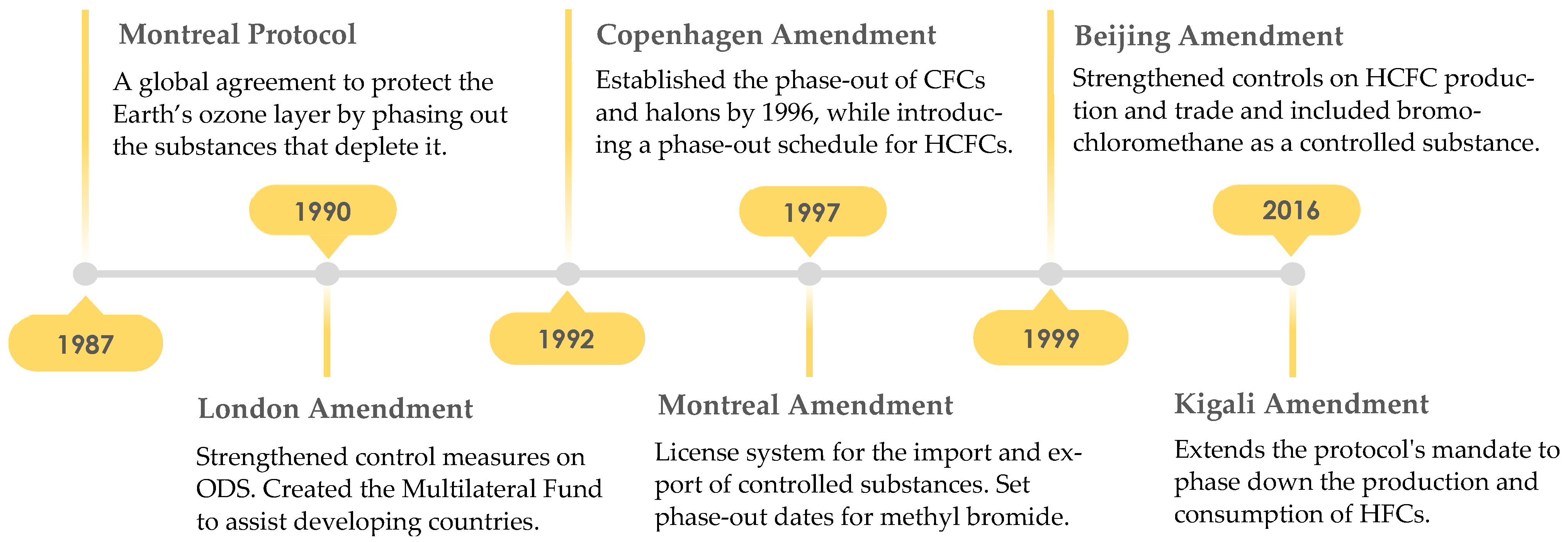
The Montreal Protocol on substances that deplete the ozone layer was agreed on 16 September 1987 and entered into force on 1 January 1989 [
9]. Its central aim is to protect the Earth’s stratospheric ozone layer by phasing out the production and consumption of ozone-depleting substances. Over time, the treaty has been strengthened through multiple amendments and adjustments, creating a dynamic legal framework that has evolved in response to scientific discovery and technological innovation, as depicted in
Figure 1.
The Montreal Protocol was adopted and signed in Montreal, Canada, marking a decisive global commitment to protect the ozone layer. The initial agreement required industrialised countries to freeze CFC production at 1986 levels and reduce it by 50% by 1999. Although these commitments may appear modest by later standards, they represented an unprecedented level of international cooperation on an environmental issue.
The agreement was significantly strengthened in 1990 with the London Amendment. This revision added new controlled substances, including carbon tetrachloride and methyl chloroform, and established the Multilateral Fund to provide financial and technical assistance to developing countries. By recognising equity concerns and supporting less developed nations in meeting their obligations, the amendment reinforced the treaty’s global and cooperative character.
Further reinforcement came in 1992 with the Copenhagen Amendment, which accelerated the phase-out schedules for CFCs, halons, and other ozone-depleting substances. It also introduced controls on hydrochlorofluorocarbons (HCFCs) and methyl bromide. These changes reflected growing scientific evidence about the severity of ozone depletion and the need for faster action.
In 1997, the Montreal Amendment introduced licensing systems for the import and export of controlled substances and added further controls on methyl bromide, a pesticide widely used in agriculture. These measures enhanced monitoring and trade regulation, helping to prevent the illegal production and trafficking of restricted chemicals.
The Beijing Amendment of 1999 continued to close regulatory gaps by introducing controls on bromochloromethane and placing production caps on HCFCs. This amendment tightened enforcement and addressed loopholes that had emerged as the treaty evolved.
The most transformative update came in 2016 with the Kigali Amendment. Although HFCs do not deplete the ozone layer, they are powerful greenhouse gases commonly used as replacements for CFCs and HCFCs. The Kigali Amendment mandates a global phase-down of HFC production and consumption, expanding the treaty’s mission from solely protecting the ozone layer to also contributing to climate change mitigation. It is estimated that this measure could help avoid up to 0.4 °C of global warming by the end of the century.
The global regulatory landscape compels a rapid transition away from synthetic refrigerants toward environmentally benign alternatives.
Table 1 summarises the Montreal Protocol’s timeline of main achievements and its measurable impact.
Nevertheless, the ozone hole continued to grow throughout the late 1980s and 1990s, as concentrations of ozone-depleting substances in the stratosphere reached their peak. However, by the mid-1990s and early 2000s, atmospheric levels of many of these chemicals began to level off and gradually decline due to the global phase-out. Satellite observations since the late 1990s have shown signs of stabilisation and slow recovery in the ozone layer, despite the record-breaking size of the ozone hole observed in the peak year of 2006 [
10]. The size and duration of the Antarctic ozone hole have varied along the years, influenced by meteorological conditions as well as occasional volcanic eruptions or major wildfires. Despite these fluctuations, the long-term trend indicates improvement: ozone holes are generally smaller and shorter-lived than during the peak years of depletion. For instance, the 2025 Antarctic ozone hole was the smallest and shortest-lived since 2019, reflecting continued recovery. Scientific assessments by organisations such as NASA, the National Oceanic and Atmospheric Administration, the United Nations, and the World Meteorological Organisation project that assuming continued compliance with the Montreal Protocol, the global ozone layer is likely to return to its 1980 levels around 2040. Recovery over the Arctic is expected around 2045, while the Antarctic ozone hole may not fully return to pre-depletion levels until about 2066 due to the region’s unique and persistent polar atmospheric conditions. The slow pace of recovery is largely due to the longevity of ozone-depleting substances. Many of these chemicals remain in the atmosphere for 50 to 100 years, meaning that even after emissions cease, it takes decades for their concentrations to decline sufficiently.
The problematic of the ozone hole stands as a rare example of effective global environmental cooperation. The Montreal Protocol halted and began reversing ozone depletion and simultaneously reduced the risks associated with harmful ultraviolet radiation and contributed to climate change mitigation by limiting powerful greenhouse gases. It represents a strong demonstration that coordinated international action, guided by science, can successfully address global environmental challenges.
2.2. European Union Regulatory Framework
The European Union (EU) anticipated and complemented the Montreal Protocol through its own regulatory framework on fluorinated greenhouse gases, commonly referred to as the F-gas Regulations. The EU’s approach demonstrates how global agreements can be translated into detailed, enforceable regional law that goes even further than international commitments. The central legislative instrument is Regulation (EU) 517/2014, adopted in 2014 and replacing earlier legislation from 2006 [
11]. In 2024, the EU adopted a strengthened recast regulation (Regulation (EU) 2024/573) significantly tightening phase-down schedules and expanding restrictions [
12].
The EU’s F-gas rules target a group of fluorinated greenhouse gases that, while not harmful to the ozone layer, have a very high global warming potential. These include HFCs, perfluorocarbons (PFCs), sulphur hexafluoride (SF6), and nitrogen trifluoride (NF3). Such gases are widely used in refrigeration, air conditioning, heat pumps, electrical switchgear, insulating foams, aerosols, and fire protection systems. Because they can trap far more heat than CO2, even relatively small emissions have a significant climate impact.
The connection between the EU’s F-gas framework and the Montreal Protocol on Substances that Deplete the Ozone Layer is both historical and strategic. The Montreal Protocol originally focused on phasing out ozone-depleting substances such as CFCs and HCFCs. As these chemicals were eliminated, HFCs emerged as substitutes. Although they did not damage the ozone layer, they contributed substantially to global warming. This gap was addressed at the international level through the Kigali Amendment, which introduced a global phase-down of HFCs.
However, the European Union moved early. Even before the Kigali Amendment entered into force in 2019, Regulation 517/2014 had already introduced a cap-and-phase-down system for HFCs. In effect, the EU anticipated and operationalised the climate dimension of the Montreal regime and did so with greater speed and ambition.
A central feature of both Kigali and the EU framework is the phase-down mechanism. Under the Kigali Amendment, countries follow differentiated schedules: developed countries reduce HFC consumption earlier, while developing countries operate under later baselines and slower reduction paths. EU Regulation 517/2014 established a quota system that capped the total quantity of HFCs (measured in CO2 equivalent tonnes) that could be placed on the EU market. This cap declined in stages from 2015 to 2030, aiming at a 79% reduction compared with baseline levels.
The new Regulation (EU) 2024/573 goes further, accelerating reductions, and sets the EU on a path toward a near-complete phase-out of HFCs by 2050, with steep cuts already required by 2030. This trajectory exceeds the minimum obligations under Kigali and reflects the EU’s broader climate agenda, particularly under the European Green Deal and its legally enshrined objective of climate neutrality by 2050.
Another distinctive feature of the EU system is its regulation not only of bulk gases but also of the equipment that contains them. Over time, the EU has imposed bans on the sale of certain high-global-warming-potential (GWP) refrigeration and air-conditioning systems, restrictions on servicing existing equipment containing high-GWP HFCs, mandatory leak checks, recovery obligations, and certification requirements for technicians working with these substances. The 2024 recast expands these bans, including stricter rules for heat pumps and commercial refrigeration. By targeting emissions at the point of use, the EU closes regulatory gaps that global rules do not comprehensively address.
Monitoring and enforcement mechanisms further distinguish the EU approach. The Montreal Protocol relies on national reporting and international compliance procedures, supported by trade measures against non-parties. Building on this model, the EU has established more granular controls suited to its single market: an electronic HFC quota registry; customs monitoring; detailed reporting obligations for importers, exporters, and producers; and penalties determined at Member State level. Such harmonised enforcement is essential to preventing market distortions and illegal trade within the EU.
In environmental terms, the EU’s F-gas policy has driven a sharp decline in HFC supply since 2015. The quota system has accelerated the shift toward low-GWP alternatives, including natural refrigerants such as HCs, CO2, and NH3. Technological innovation in cooling has progressed rapidly as a result. Taken together, the global phase-out of ozone-depleting substances under the Montreal Protocol, the HFC phase-down under the Kigali Amendment, and the EU’s accelerated and product-focused F-gas restrictions have positioned Europe as a leader in climate-friendly cooling technologies.
There is also an important economic dimension. One of the enduring lessons of the Montreal regime is that environmental regulation can stimulate innovation. Industries that initially resisted the phase-out of CFCs eventually developed viable and often superior alternatives. A similar dynamic has unfolded in Europe. Manufacturers of refrigeration and air-conditioning equipment have invested heavily in natural refrigerants and low-GWP technologies. Although compliance has imposed short-term adjustment costs, it has also created competitive advantages in global markets increasingly shaped by climate policy.
Finally, the EU’s ambitious domestic action strengthens its climate diplomacy. By demonstrating that deep reductions in fluorinated gases are technically and economically feasible, the EU reinforces international momentum and supports full implementation of the Kigali Amendment worldwide. Despite their alignment, the Montreal Protocol and EU F-gas Regulations differ in several ways, as depicted in
Table 2.
2.3. U.S. AIM Act and SNAP Rules
Refrigerant regulation in the United States is primarily governed by the American Innovation and Manufacturing Act (AIM Act), enacted in 2020 to address the climate impact of HFCs. The AIM Act mirrors Kigali’s objectives by mandating an 85% phase-down of HFCs by 2036, using a national allowance allocation and trading system administered by the United States Environmental Protection Agency (EPA) [
13]. In parallel, EPA regulates refrigerant transitions under the Clean Air Act and the Significant New Alternatives Policy (SNAP) programme. SNAP looks at alternatives to ozone-depleting substances and high-GWP refrigerants and makes a list of acceptable ones. These include lower-GWP synthetic refrigerants and natural refrigerants. Recent EPA technology transition rules further restrict high-GWP HFCs in new equipment across sectors such as commercial refrigeration and residential air conditioning. Together, these regulations aim to reduce greenhouse gas emissions, promote safer alternatives, and align U.S. policy with global climate commitments while maintaining safety and industry competitiveness.
2.4. Asian and Middle Eastern Regulations
Across Asia and the Middle East, refrigerant regulations are strongly shaped by commitments under the Montreal Protocol [
14]. Most countries in these regions are classified as developing parties, meaning they follow a staggered HFC phase-down schedule beginning with a baseline freeze and gradual reductions starting in 2024, reaching an 80–85% reduction by the mid-2040s.
In Asia, major economies such as China, India, Japan, and South Korea have adopted national cooling action plans, HFC quota systems, and energy efficiency standards aligned with Kigali targets. Japan and South Korea have implemented particularly strict F-gas management and recovery rules, while China and India are scaling up production controls and promoting low-GWP alternatives.
In the Middle East, countries such as the United Arab Emirates, Saudi Arabia, and Qatar are integrating HFC controls into national environmental laws, supported by technical and financial assistance from the Multilateral Fund under the Montreal Protocol [
15]. Given the region’s high cooling demand, policies increasingly emphasise natural refrigerants, improved servicing practices, and energy-efficient air-conditioning technologies. Together, these measures demonstrate how Asian and Middle Eastern regulatory frameworks operationalise global treaty obligations while addressing rapid urbanisation and climate challenges.
3. Synthetic Refrigerants Versus Natural Refrigerants
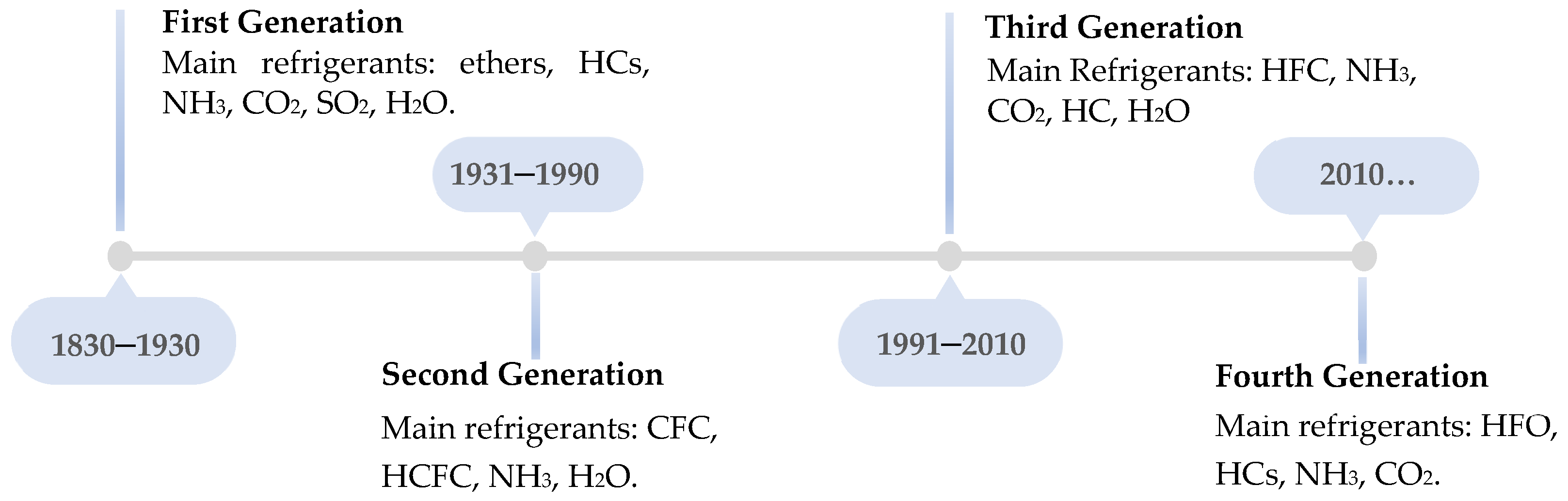
At the heart of refrigeration technology lies the vapour-compression cycle, which uses refrigerants as working fluids to absorb and reject heat. Historically, refrigerants have transitioned through four generations [
16], as depicted in
Figure 2.
The evolution of refrigerants can be broadly categorised into four generations, each driven by shifting priorities in safety, environmental protection, and efficiency.
The first generation of refrigerants (1830s–1930s) consisted mainly of naturally occurring substances such as NH3 (R-717), CO2 (R-744), sulphur dioxide (SO2, R-764), chloromethane (CH3Cl, R-40), and H2O (R-718). These refrigerants generally had good thermodynamic properties and low environmental impact. However, many were toxic, flammable, or operated at very high pressure, which led to safety concerns and frequent accidents, particularly in early domestic refrigeration systems. As refrigeration became more widespread, there was increasing demand for safer alternatives.
The second generation (1930s–1990s) introduced synthetic refrigerants, primarily CFCs and later HCFCs, such as R-12 and R-22. These refrigerants were non-toxic, non-flammable, and chemically stable, making them ideal for large-scale commercial and household use. However, they contributed to the depletion of the ozone layer, leading to the creation of the Montreal Protocol, as described in
Section 2.
The third generation (1990s–2010s) consisted mainly of HFCs, such as R-134a and R-410A, developed to eliminate the ozone depletion potential (ODP) of CFCs and HCFCs and widely adopted in refrigeration and air-conditioning systems. However, although they do not harm the ozone layer, many HFCs have very high-GWP, contributing significantly to climate change. This environmental concern led to the Kigali Amendment as described in
Section 2.
The fourth generation (2010s–present) focuses on refrigerants with both zero ODP and very low GWP. This generation includes a renewed use of natural refrigerants such as CO
2, NH
3, and HCs, as well as newly developed synthetic refrigerants known as hydrofluoroolefins (HFOs), such as tetrafluoropropene (R-1234yf), and hydrochlorofluoroolefins (HCFOs), such as chlorotrifluoropropene (R-1233zd) [
17]. These refrigerants are more environmentally sustainable, although some are mildly flammable and require updated safety standards.
The current global trend is toward adopting low-GWP refrigerants to meet climate targets and improve overall environmental performance. Overall, the evolution of refrigerants reflects a shift from prioritising safety to addressing ozone protection and finally to tackling climate change while maintaining efficiency and system reliability.
3.1. Synthetic Refrigerants
Synthetic refrigerants, also known as fluorinated or halocarbon refrigerants, are man-made chemical substances categorised into CFCs, HCFCs, HFCs, HFOs, and HCFOs [
18]. The main reasons for their development were to overcome safety concerns (toxicity, flammability and corrosiveness) associated with early natural refrigerants.
CFCs gained popularity due to their chemical stability, non-flammability, and favourable thermodynamic properties. However, their powerful ODP led to their global phase-out, as described in
Section 2.
HCFCs were subsequently introduced as transitional substitutes with lower ODP. Although less harmful than CFCs, HCFCs still contributed to ozone depletion and climate change and are currently being phased out globally, as described in
Section 2.
HFCs replaced ozone-depleting refrigerants because they have zero ODP. Nevertheless, many HFCs possess extremely high GWP, typically ranging from 1300 to 3900, making them significant contributors to climate change. Their use is therefore being gradually reduced under the Kigali Amendment, as described in
Section 2.
HFOs and HCFOs have been introduced as next-generation refrigerants with very low GWPs and negligible ODP. These refrigerants break down rapidly in the atmosphere. As a result, the chlorine present in HCFOs is considered not to reach the stratosphere to damage the ozone layer. While these refrigerants reduce climate impacts compared with HFCs, several concerns remain, including mild flammability in some applications, higher costs due to complex blends, limited long-term environmental data, and the atmospheric formation of persistent degradation products, such as trifluoroacetic acid (TFA), a highly persistent pollutant, leading to concerns that they are part of the “forever chemicals” (PFAS) class [
17]. As a result, HFOs and HCFOs represent an improvement but not a completely risk-free solution. The long-term environmental effects of increased TFA accumulation from rising HFO and HCFO use are prompting further investigation.
Despite the success of the Montreal Protocol in reversing much of the ozone damage caused by CFCs and HCFCs, concerns about the long-term environmental impact of synthetic refrigerants continue to drive the search for more sustainable alternatives.
Table 3 provides a comparative overview of five representative synthetic refrigerants, tracking their chemical evolution from ozone-depleting substances to modern, low-impact alternatives. It evaluates them based on environmental impact, physical properties, and current regulatory status.
Table 3 shows a clear trend in ODP toward safety. Older CFCs, such as R-12, have a high ODP, while recent HFCs and HFOs have an ODP of zero. Regarding GWP, R-12’s is massive (8100), whereas HFO R-1234yf reduces it to only 4. Most refrigerants have normal boiling points (TNBPs) ranging from −24 °C to −41 °C, making them suitable for standard refrigeration and air-conditioning cycles. The critical temperature (TCP) of all listed compounds remains near 100 °C, allowing for efficient heat rejection in ordinary ambient settings.
3.2. Natural Refrigerants
Natural refrigerants, including NH
3 (R-717), CO
2 (R-744), HCs (e.g., propane (R-290) and isobutane (R-600a)), and water (R-718), were the original working fluids used in early refrigeration systems [
18]. During the mid-twentieth century they were largely replaced by synthetic refrigerants due to safety concerns and the industrial promotion of fluorinated chemicals.
Today, natural refrigerants are experiencing a resurgence because of their extremely low environmental impact, high energy efficiency, and long-term regulatory stability. Natural refrigerants offer several important advantages:
Very low global warming potential (typically below 3).
Zero ozone depletion potential.
Excellent thermodynamic performance.
Stable chemical behaviour without persistent environmental degradation products.
Long-term regulatory certainty because they occur naturally in the environment.
These characteristics make natural refrigerants highly compatible with global decarbonisation goals, net-zero targets, and PFAS-free environmental policies.
Table 4 outlines the thermodynamic and environmental properties of five primary natural refrigerants.
Table 4 shows that every refrigerant listed has an ODP of 0, meaning that they do not damage the ozone layer. Their GWP is also remarkably low, especially when compared with synthetic refrigerants. The GWP range of HCs is due to a combination of factors related to how GWP is calculated and measured. GWP is measured over a specific timeframe (usually 100 years). However, IPCC reports have updated their methodologies. Newer reports sometimes show different values based on whether a 20-year or 100-year horizon is used. The lower end of that spectrum (around 3) is the most cited value for environmental regulation compliance, like the F-gas Regulation.
In terms of thermodynamic properties, R-744 has the lowest boiling point (−78.46 °C), making it excellent for low-temperature refrigeration, though its low critical point (31.1 °C) requires specialised transcritical system designs in warmer climates. The hydrocarbons (R-290 and R-600a) have similar environmental profiles but different boiling points. R-600a is commonly used in domestic refrigerators due to its higher boiling point and efficiency in small systems. R-717 is a favourite for large-scale industrial cooling due to its high critical temperature and excellent heat transfer properties. R-718 is the safest and most inexpensive natural refrigerant. However, the main limitation of water as a refrigerant in refrigeration and air-conditioning systems is its triple point (0.61 kPa and 0.01 °C). Operating under deep vacuum conditions and the low specific volumetric cooling capacity of R-718 lead to high volumetric flow rates across typical refrigeration and air-conditioning temperatures. In addition, the pressure ratio required for a given temperature boost is significant. Moreover, the high isentropic exponent of water causes elevated compressor discharge temperatures [
19].
4. Vapour-Compression Technologies Using Natural Refrigerants
Natural refrigerants can be used in various vapour-compression system architectures, including conventional single-stage cycles, transcritical systems, cascade configurations, secondary loops, and hybrid systems. Each refrigerant presents unique thermodynamic advantages and engineering challenges. In the following subsections, the main natural refrigerants (ammonia, carbon dioxide, and hydrocarbons) are revisited to highlight their potential and the challenges associated with their implementation.
4.1. Ammonia Systems
Ammonia has long been a cornerstone of industrial refrigeration systems such as food processing plants, cold storage facilities, and ice rinks. Its exceptional thermodynamic properties, particularly its high latent heat of vaporisation, allow it to provide more cooling capacity per unit mass flow than most other refrigerants.
Ammonia also exhibits a high acoustic velocity in the gas phase [
20], allowing for higher gas velocities in pipelines and valves without excessive pressure losses. This enables smaller pipe diameters and more compact system designs. In theoretical cycle comparisons, R-717 achieves a coefficient of performance (COP), defined as the ratio between the cooling capacity and power input (also known as energy efficiency ratio (EER) in the air-conditioning sector [
21]), outperforming common alternatives such as R290, R-22, and R-134a [
22].
However, ammonia presents engineering challenges due to its toxicity and mild flammability. Safety standards such as European EN-378 [
23] and ASHRAE-15 [
24] impose strict limits on allowable refrigerant charges and require gas detection systems, ventilation, and dedicated machinery rooms in large installations. In addition, ammonia is incompatible with copper and requires alternative materials such as stainless steel or specialised alloys. Despite these limitations, modern low-charge ammonia systems and cascade configurations with CO
2 are expanding its use beyond traditional industrial applications. Ammonia-based chillers have demonstrated energy efficiency improvements of 9–17% compared with comparable HFC systems [
22].
4.2. Carbon Dioxide Systems
Carbon dioxide is another widely adopted natural refrigerant, particularly in commercial refrigeration systems such as supermarkets [
25]. The main constraint of CO
2 is a relatively low critical temperature (31.1 °C), meaning that systems operating in warm climates must reject heat in the supercritical region. These transcritical systems operate at very high pressures (typically around 10 MPa) resulting in increased equipment costs and reduced efficiency due to two major energy losses. A throttling loss occurs during the expansion process, which is enhanced in transcritical systems due to the considerable pressure differential. Second, high CO
2 temperatures during cooling might cause heat rejection loss and inefficiency. To tackle the low efficiency in high-temperature and high-operating-pressure situations, Yu et al. [
26] give a comprehensive analysis of ten modified technologies to improve the efficiency of transcritical carbon dioxide refrigeration systems. Common technologies include internal heat exchangers, subcooling, flash gas bypass, parallel compression, two-stage compression, evaporative cooling, and CO
2-based mixtures, while special techniques to tackle the throttling losses include expanders, ejectors, and vortex tubes. These special methods can be described as follows:
Ejectors: Ejector-based expansion has emerged as a key strategy to recover throttling losses in transcritical CO
2 systems, improving efficiency particularly under high ambient temperatures [
27]. An ejector is a basic part in which a primary flow enters a primary nozzle, expands and accelerates, and entrains a secondary flow coming from a suction chamber [
28]. This technology was first created by Maurice Leblanc in 1910 for the steam refrigeration cycle [
29]. Since then, it has been thoroughly researched for use with a variety of working fluids [
26]. The adoption of a two-phase ejector has lately emerged as a viable cycle alteration due to its lack of moving parts, low cost, straightforward design, and minimal maintenance needs. The recovery of expansion energy that is typically lost in throttling operations at a standard expansion valve is the ejector’s primary advantage. The ejector improves the COP by raising the suction pressure above evaporator levels, which reduces compressor work. Furthermore, the use of a flash gas bypass reduces the required evaporator size [
30]. Ejectors can be classified based on their geometry and adaptability as constant-area ejectors, variable-geometry ejectors, and multi-ejector assemblies [
31]. Comparative performance studies clearly indicate distinctive advantages for each ejector type under transcritical CO
2 conditions. Cabello et al. [
32] stated that single-stage constant-area ejectors working around the ideal gas-cooler pressure (9–10.5 MPa) improved the COP by 8% to 12% over throttling cycles. Zhang et al. [
33] demonstrated that variable-geometry ejectors operating at the optimal heat rejection pressure (8.9–9.5 MPa) might increase the COP by 15–25%, surpassing fixed-geometry devices, especially under instable ambient conditions. Torrella et al. [
34] showed that using multi-ejector arrangements increased cooling capacity and overall efficiency by up to 12% when an internal heat exchanger was included. Recently, Lv et al. [
35] investigated ejector CO
2 refrigeration systems for warm climates, combining ejectors and subcooling. Their results show COP improvements up to 26.3% compared with conventional systems, with annual energy savings reaching 7.1%, demonstrating strong potential for supermarket applications under warmer conditions. Different schematic ejector expansion transcritical CO
2 cycles can be found in Yu et al. [
26].
Expanders: Expander-based work recovery is a promising technology for enhancing transcritical CO
2 refrigeration systems [
36]. Its effectiveness depends on the isentropic efficiency achieved during expansion, which varies with the fluid state, as two-phase flow leads to higher friction losses. Transcritical cycles perform better than conventional ones because expansion mainly occurs in a single-phase region; only the final stage involves two-phase flow, where CO
2 liquid and vapour densities are relatively similar. Expanders can operate independently or be coupled with compressors, recovering up to 37% of compressor work [
37] and increasing the system COP by about 33% [
38]. Various designs such as scroll, piston, and screw expanders have been analysed by Singh and Dasgupta [
36]. An early theoretical work on a rolling piston expander identified key design parameters and modelled expansion in two stages, achieving about 50% efficiency despite leakage and friction losses [
39]. Further studies reported up to 58.7% isentropic efficiency [
39], with later designs achieving up to 77% efficiency [
40]. A combined screw compressor–expander model was investigated, with a focus on how rotor forces generated during compression and expansion could be partially balanced to reduce axial and radial bearing loads. This design led to the COP increasing from 2.79 to 4.8 [
41]. Research on scroll expanders using simulation models incorporating valve losses, internal leakage, and heat transfer predicted efficiency between 50% and 68% [
42]. Improved designs emphasised integrating the expander with a compressor to effectively utilise shaft power, achieving efficiency up to 72% while identifying leakage losses of about 20% [
43]. Advanced configurations, including intercooling and sub-compressors, reduced main compressor power consumption, and gap profile optimisation improved volumetric efficiency up to 96% [
44]. Research into CO
2 expanders also highlight the evolution of turboexpanders and vane expanders. Early turboexpander prototypes achieved 50% efficiency, later reaching 69% with axial-flow designs [
45], though radial inward-flow was deemed superior to radial outflow [
46]. Vane expander research reported 64% theoretical efficiency [
47], but real-world performance was often limited by internal leakage and pressure drops [
48]. Enhancements like pressurised vane slots improved efficiency by 15–45% [
49]. Despite progress, recent work advocates for multi-criteria decision making to synthesise qualitative and quantitative findings for future designs [
50].
The vortex tube, discovered by Ranque [
51] and improved by Hilsch [
52], is a device that separates a single inlet gas stream into simultaneous hot and cold streams through what is known as the Ranque–Hilsch effect [
53]. Since then, researchers have integrated the vortex tube as an expansion device in vapour-compression cycles to improve efficiency [
54]. Maurer [
55] introduced a transcritical cycle where the vortex tube handles two-phase flow. This system eliminates throttling valves, dividing the refrigerant into superheated vapour, saturated liquid, and saturated gas. Li et al. [
56] proposed a configuration where saturated liquid exits the cold side and superheated vapour exits the hot side. Assuming 100% separation efficiency, this model predicts a 37% efficiency increase, while 50% separation efficiency still yields a 20% improvement. Despite these theoretical gains in various applications, experimental validation remains absent [
57]. The primary challenge for future research is demonstrating a functional two-phase vortex tube and achieving high separation efficiency in practice.
4.3. Hydrocarbon Systems
Hydrocarbons such as propane (R-290) and isobutane (R-600a) are increasingly used in domestic refrigeration, small commercial systems, and heat pumps [
58]. They possess excellent thermodynamic properties, low costs, and very low global warming potentials. Hydrocarbon systems typically achieve higher energy efficiency than many synthetic refrigerants. Studies show COP improvements ranging from approximately 2% to over 20% depending on the application and replacement scenario [
58]. In addition, hydrocarbon systems require smaller refrigerant charges, often 40–58% lower than comparable synthetic refrigerant systems, due to their favourable thermophysical properties.
The primary limitation of HCs is their high flammability. This risk is mitigated through strict safety standards, charge limitations, and the use of sealed electrical components. As a result, HCs are widely adopted in domestic refrigerators and increasingly used in air-conditioning and heat-pump technologies. Research to enlarge the range of application of HCs has been conducted. For example, Faruque et al. [
59] performed a thermodynamic analysis of a hydrocarbon-based triple cascade refrigeration system for ultra-low temperatures. Their results show that optimal refrigerant combinations enhance performance, achieving a maximum COP of 0.59 at −100 °C, confirming HCs as viable alternatives for ultra-low temperatures applications.
4.4. Comparative Performance and Applications
The performance of different refrigerants depends on system design, operating conditions, and safety considerations.
Table 5 summarises typical applications and performance characteristics for seven common refrigerants, categorised by their chemical type, typical applications, and thermodynamic performance. It highlights the shift from synthetic refrigerants toward natural alternatives.
Natural refrigerants generally provide superior thermodynamic performance in medium-and low-temperature applications. Although CO
2 efficiency decreases in hot climates, advanced transcritical technologies significantly mitigate these limitations. Synthetic refrigerants are standard industrial chemicals, often characterised by high stability but varying environmental impacts. R-404A is primarily used for low-temperature commercial refrigeration. It has the lowest COP in this list (2.0–2.5) and is noted for its high GWP. R-134a is the “standard baseline” for medium-temperature systems, offering a good COP range of 3.0–3.2 but a high GWP. R-410A is the refrigerant generally applied in residential air conditioning, featuring a high compression ratio and capable of achieving a high COP in the range of 3.0–3.5. Ammonia boasts the highest COP (3.5–4.5) due to its excellent thermophysical and heat transfer properties. Propane (R-290) is mainly used in domestic refrigeration. It is highly efficient (COP 3.5–4.0) but requires careful handling due to its high flammability. Carbon dioxide (R-744) performance is highly dependent on the type of cycle. In the subcritical cycle, it is highly efficient in cool climates (COP 3.0–3.3), whereas in the transcritical cycle, it presents lower efficiency (COP 2.5–3.0), unless paired with recent developments like the ejectors described in
Section 4.2.
Regarding the toxicity/flammability column, a further description shall be made since it uses the ASHRAE Standard 34 classification system. This alphanumeric code is the industry shorthand for how dangerous a refrigerant is to handle. The letter indicates the toxicity of the substance based on allowable exposure levels. Class A (lower toxicity) means that there is no evidence of toxicity at concentrations less than or equal to 400 ppm. Class B (higher toxicity) means that there is evidence of toxicity at concentrations below 400 ppm. Ammonia (NH3) falls into this category, reflecting its risk to human health if a leak occurs. Common problems range from irritating the eyes, skin, and respiratory system, preventing its application in confined living spaces. The number indicates how easily the refrigerant catches fire and how intensely it burns. Number 1 (no flame propagation) means that the substance is non-flammable under standard test conditions, while 2L (lower flammability) means “mildly flammable” with a slow burning velocity. The “L” stands for Low. Ammonia falls here. Number 2 (flammable) means lower flammability but more than 2L. Number 3 (higher flammability) means a highly flammable or explosive substance. Propane (R-290) is an A3 substance, meaning that it is safe regarding toxicity but requires strict spark-proof engineering because it is highly combustible. This classification dictates where and how these substances can be used. For example, because R-290 (A3) is highly flammable, it is usually restricted to small “charge” amounts (like domestic fridges) to prevent explosions. Conversely, ammonia (B2L) is highly efficient but requires specialised industrial settings with ventilation because it is toxic when inhaled.
4.5. Environmental Impact Assessment
The total CO2-equivalent (CO2-eq) emissions of refrigeration, air conditioning and heat pump systems are divided into direct emissions and indirect emissions. They are mainly caused by refrigerant leakage during system operation, maintenance, and decommissioning and fossil fuel consumption to produce the electricity required, respectively.
GWP integrates the radiative forcing of a substance over a chosen time horizon, relative to that of CO
2. GWP is commonly used in refrigeration and air-conditioning policies to calculate limits and quotas of fluorinated gases or tax rates on certain GHGs [
11,
60]. Another metric is the global temperature change potential (GTP), which is defined as the ratio of a substance’s change in global mean surface temperature to that of CO
2 at a certain time point [
60]. The most proposed time horizons are 20 (for short evaluations and decisions), 100 (for potential analyses) and 500 (long-term scenario) years [
61]. While the GWP and GTP values for CO
2 are constant and equal to one, because it is taken as reference, the values of other GHG substances vary with different time horizons.
Environmental impact assessments often use metrics such as life cycle assessment (LCA), total equivalent warming impact (TEWI), and life cycle climate performance (LCCP) to evaluate the full environmental footprint of refrigeration systems [
62,
63]:
Life cycle assessment is an established method standardised by ISO 14040 and 14044 [
64,
65] considered a comprehensive and scientifically reliable method for environmental metrics of products and services [
66]. Studies consistently demonstrate emission reductions exceeding 50% when switching from HFC-based systems to natural refrigerants [
67].
The total equivalent warming impact evaluates greenhouse gas emissions from refrigeration, air conditioning, and heat pump systems by combining direct emissions (refrigerant leakage) and indirect emissions (electricity use). It is widely recommended as a comparative indicator of global warming impacts across system options [
68]. Defined in the EN 378-1:2016 standard, TEWI is calculated as the sum of three components: emissions from annual refrigerant leakage over the system lifetime, emissions from unrecovered refrigerant at end of life, and emissions from energy consumption during operation as follows [
69]:
where
m is the mass of refrigerant (in kg),
Lannual is the annual leakage of refrigerant (in %),
n is the lifetime of the installation (in years),
αrec is the refrigerant recovered at the end of life (in %),
Eannual is the annual electricity consumption (in kWh), and
β is the carbon intensity factor (in kg CO
2-eq kWh
−1).
Makhnatch and Khodabandeh [
70] showed that TEWI results vary depending on whether GWP or GTP metrics are used. For example, R-134a has a 16.3% higher TEWI than R-152a using GWP100 but only 5.2% higher with GTP100, suggesting that alternative refrigerants may not always yield lower impacts. Fischer [
71] noted that TEWI is more accurate over long time horizons relative to system lifetime. However, Purvis et al. [
72] argued that TEWI remains debated and incomplete. Consequently, more comprehensive metrics, like LCCP, have been introduced.
The life cycle climate performance metric extends beyond TEWI by including additional greenhouse gas emissions across the full life cycle of refrigeration, air conditioning, and heat pump systems [
73]. Unlike TEWI, which focuses on direct and indirect emissions during operation, LCCP accounts for emissions from material production, refrigerant manufacturing, system operation, transportation, and end-of-life disposal. This concept builds on earlier work by Papasavva and Moomaw [
74], who emphasised the importance of electricity sources and refrigerant degradation by-products. The IIR has played a key role in standardising LCCP, releasing official guidelines in 2016 and later providing a calculation tool in 2018 [
75,
76]. LCCP includes both direct emissions (DEs) and indirect emissions (IEs) while introducing additional parameters such as emissions from material manufacturing, recycling, and refrigerant production and disposal as follows:
In comparison with TEWI, the LCCP method introduces additional parameters to account for indirect emissions across the full life cycle. These include
Adp, the adaptative GWP representing the GWP of refrigerant atmospheric degradation products (in kgCO
2-eq);
munit and
mr, the mass of the unit and the mass of recycled materials (in kg), respectively;
MM and
RM, the specific emissions associated with manufacturing and disposal of the unit and recycled materials (in kgCO
2-eq kg
−1), respectively; and
RFM and
RFD, which represent emissions from refrigerant production and disposal (in kgCO
2-eq kg
−1), respectively. Studies by Makhnatch and Khodabandeh [
77,
78] show that although LCCP is more comprehensive, its additional parameters (e.g., manufacturing and transport emissions) often have a smaller impact compared with operational factors already captured in TEWI—especially for low-GWP refrigerants. Key contributors to LCCP variability remain system lifetime, leakage rate, and electricity carbon intensity. Supporting work by Boström and Ljungberg [
79] confirmed the limited sensitivity of these additional parameters.
Table 6 illustrates how different refrigerants contribute to global warming based on their chemical properties and leakage rates. It highlights the stark contrast between traditional synthetic refrigerants and natural alternatives.
The analysis of
Table 6 demonstrates that R-404A is by far the most harmful refrigerant. Despite having the same leakage volume as CO
2, its high GWP results in massive direct emissions of 390 tonnes of CO
2 equivalent. Natural refrigerants have negligible direct emission impacts; specifically, ammonia stands out with a GWP of 0, meaning that leakages do not contribute to global warming at all.
Table 6 also demonstrates that the type of gas is often more important than the volume of the leak. For example, R-134a has half the leakage of CO
2, yet its climate impact is 715 times greater (71.5 vs. 0.1 tCO
2-eq).
4.6. Economic Considerations
Economic studies focused on the general economic viability of natural refrigerants systems are relatively scarce and often limited in scope. However, the findings presented in this paper suggest a clear economic trend. Although natural refrigerant systems may incur slightly higher initial capital expenditures, stemming from high-pressure components in CO2 cycles or specialised safety measures for ammonia and hydrocarbons, these costs are typically offset by operational savings. Superior energy efficiency, lower refrigerant replacement costs, and long-term regulatory stability frequently result in a lower total cost of ownership over a typical 15–20-year system lifespan.
Specifically, research has moved toward evaluating high-efficiency configurations, such as those utilising waste heat. Giunta and Sawalha [
80] examined the utilisation of surplus heat from CO
2 supermarket refrigeration systems for district heating, demonstrating annual cost savings of up to 16%. While they concluded that profitability is highly sensitive to heating demand and energy pricing, the economic benefits remain clear. Toffoletti et al. [
81] analysed a multi-generation supermarket system integrating ice thermal energy storage. Although the storage system increased overall energy consumption, it significantly improved cost efficiency by optimising equipment sizing and leveraging favourable utility tariffs, yielding substantial long-term economic savings.
5. Discussion
The transition from synthetic to natural refrigerants represents a potentially structural and long-term transformation in the refrigeration and air-conditioning sector, shaped by the convergence of environmental imperatives, regulatory frameworks, and technological innovation. The analysis presented in this study demonstrates that natural refrigerants are not only technically viable but increasingly advantageous across environmental, thermodynamic, and economic dimensions. Nevertheless, their large-scale deployment remains constrained by a combination of engineering, safety, and systemic barriers that require further critical examination.
From an environmental standpoint, natural refrigerants demonstrate clear environmental advantages under most evaluated metrics. Their zero ozone depletion potential and near-zero global warming potential directly address both historical ozone-related concerns and contemporary climate change challenges. Unlike synthetic refrigerants, particularly HFCs and emerging HFOs, natural refrigerants do not produce persistent atmospheric degradation by-products such as trifluoroacetic acid. This aspect is gaining importance as regulatory attention expands beyond global warming potential toward broader environmental persistence and toxicity concerns, including those associated with PFASs. When evaluated using comprehensive metrics such as TEWI and LCCP, natural refrigerant systems consistently demonstrate lower overall environmental burdens, largely due to reductions in both direct emissions and indirect emissions.
Thermodynamic performance further reinforces the case for natural refrigerants. Ammonia remains a benchmark for high-efficiency industrial refrigeration, benefiting from excellent heat transfer characteristics and high latent heat of vaporisation. Hydrocarbons, including propane and isobutane, provide strong performance in small-scale and domestic applications, often achieving higher coefficients of performance than conventional HFC-based systems while requiring lower refrigerant charges. Carbon dioxide, while thermodynamically less favourable under certain conditions due to its low critical temperature, has undergone significant technological evolution. The development of transcritical cycle enhancements such as ejectors and expanders has enabled CO2 systems to achieve competitive efficiencies even in warmer climates. These developments illustrate a broader trend in which system-level innovation compensates for intrinsic fluid limitations, highlighting the importance of integrated design approaches.
Economic considerations also play a decisive role in the transition. Although natural refrigerant systems often involve higher initial capital costs, stemming from safety requirements, specialised materials, or high-pressure components, these costs are frequently offset over the system lifetime. Improved energy efficiency, lower refrigerant costs, and reduced exposure to regulatory uncertainty contribute to a lower total cost of ownership. In contrast, synthetic refrigerant systems are subject to evolving regulatory constraints, including phase-down schedules, taxation, and potential bans, which introduce financial risks and can necessitate costly retrofits. From a long-term investment perspective, natural refrigerants therefore offer greater stability and predictability.
Despite these advantages, several barriers continue to limit widespread adoption. Safety concerns remain the most prominent challenge. Ammonia’s toxicity, hydrocarbons’ flammability, and the high operating pressures of CO2 systems impose stringent design and operational requirements. Compliance with safety standards necessitates additional components, such as leak detection systems, ventilation, explosion-proof equipment, and reinforced piping, all of which increase system complexity and cost. Moreover, these safety considerations restrict the applicability of certain refrigerants in specific contexts, particularly in densely populated or confined environments.
Performance sensitivity to ambient conditions represents another important limitation. CO2 systems, for example, experience reduced efficiency at high outdoor temperatures due to transcritical operation. Although mitigation strategies such as ejector-based expansion, evaporative cooling, and hybrid system configurations have significantly improved performance, they also introduce additional system complexity and require careful optimisation. Similarly, while water is environmentally ideal, its high boiling point limits its applicability to niche or specialised systems, preventing broader adoption in conventional vapour-compression cycles.
Beyond technical challenges, structural and market-related barriers play a critical role. The refrigeration industry has historically been built around synthetic refrigerants, resulting in mature supply chains, standardised components, and a workforce trained to operate and maintain these systems. Transitioning to natural refrigerants therefore requires substantial changes not only in technology but also in industry practices. This includes the redesign of equipment, the development of new manufacturing processes, and the implementation of comprehensive training programmes for engineers and technicians. In developing regions, where cooling demand is expected to grow most rapidly, these challenges are amplified by limited financial resources, inadequate infrastructure, and insufficient technical expertise.
To address these barriers, coordinated research and innovation efforts are essential. Future work should prioritise the optimisation of natural refrigerant systems for extreme climatic conditions, particularly through advanced cycle configurations and hybrid solutions. Reducing refrigerant charge and improving system containment can enhance safety and expand application ranges. Standardisation and mass production of components (especially for CO2 systems) are critical to reducing costs and enabling wider adoption. In addition, digitalisation offers promising opportunities to improve system performance and safety. The integration of sensors, internet of things technologies, and artificial intelligence can enable real-time monitoring, predictive maintenance, and automated control, thereby mitigating risks associated with leakage and operational inefficiencies.
Equally important are policy and socio-technical dimensions. Regulatory frameworks must continue to incentivise low-GWP technologies while supporting the transition through financial mechanisms, training initiatives, and certification schemes. The success of this transition will depend not only on technological readiness but also on the alignment of industry practices, workforce capabilities, and policy instruments. Ultimately, the shift toward natural refrigerants should be understood as part of a broader transformation toward sustainable cooling systems that integrate efficiency, safety, and reduced environmental impact.
6. Conclusions and Future Perspectives
As demonstrated throughout this study, the progressive evolution from CFCs and HCFCs to HFCs and more recently to HFOs has addressed specific environmental concerns but has not fully resolved the broader sustainability challenge. In this context, natural refrigerants emerge not simply as alternatives but also as structurally superior and future-proof solutions.
The analysis confirms that each major natural refrigerant offers distinct advantages across application domains. Ammonia provides unmatched efficiency in industrial systems, particularly when implemented in modern low-charge configurations. Carbon dioxide has proven highly adaptable in commercial refrigeration, with technological advancements mitigating historical efficiency penalties in warm climates. Hydrocarbons offer a practical and efficient pathway for domestic and small-scale applications, with safety risks being increasingly manageable under current standards.
A key conclusion is that the transition to natural refrigerants aligns environmental performance with long-term regulatory certainty. Unlike synthetic refrigerants, which have undergone successive phase-outs, natural refrigerants are unlikely to face future restrictions due to their inherent environmental compatibility. This reduces investment risk and supports long-term planning across the sector.
However, their full adoption is constrained by safety concerns, performance limitations in certain conditions, and infrastructural barriers. Addressing these challenges requires a coordinated effort in research, technological innovation, policy development, and industry transformation. By focusing on system optimisation, safety enhancement, cost reduction, and digital integration, the refrigeration sector should overcome these barriers and fully realise the potential of natural refrigerants in achieving sustainable cooling within the shortest feasible timeframe and become the default global standard of the refrigeration and air-conditioning sector.
Future Perspectives
The transition from synthetic to natural refrigerants is not without challenges. Safety considerations, performance constraints under certain operating conditions, and infrastructural inertia continue to slow adoption. Overcoming these barriers requires an integrated approach that combines technological innovation, policy support, and workforce development. Several key areas will define the success and speed of the transition to sustainable cooling:
The next decade will likely see an increase in cascade and secondary loop systems that combine the strengths of different natural fluids. The pair NH3/CO2 in cascade systems for industrial refrigeration is a perfect example of the potentiality of hybrid systems. Further research is required to optimise transcritical CO2 cycles for extreme tropical climates, potentially through the integration of solar-assisted cooling or advanced evaporative precooling technologies.
Currently, the higher initial capex of natural refrigerant systems remains a barrier in developing economies. Future perspectives must include the mass production and standardisation of high-pressure CO2 components and leak-proof HC compressors. As economies of scale are achieved, the total cost of ownership will become even more favourable, making natural refrigerants the default global economic choice.
The transition is not merely a matter of hardware but of human capital. There is an urgent need for globalised training and certification programmes for technicians to handle flammable (e.g., HC), toxic (e.g., NH3), and high-pressure (e.g., CO2) fluids safely. Furthermore, policy frameworks should move beyond GWP-based metrics to incorporate life cycle climate performance, which accounts for both direct emissions and the indirect emissions from energy consumption.
The integration of artificial intelligence and the internet of things into refrigeration systems represents a promising area of development. Predictive maintenance and real-time leak detection are particularly important for managing the safety risks associated with ammonia and hydrocarbon refrigerants. In addition, AI-driven energy management, supported by machine learning techniques, can potentially enhance the thermodynamic performance and operational efficiency of systems using natural working fluids.
As global temperatures rise and the “cooling gap” in developing nations narrows, demand for air conditioning is expected to grow exponentially. The long-term climate outcomes will depend significantly on how ensuring that this new demand is met with natural refrigerants from the outset, avoiding the “technology lock-in” of high-GWP working fluids in rapidly urbanising regions.
In summary, the transition to natural refrigerants is an engineering challenge, an environmental necessity, and an economic opportunity. By prioritising natural solutions today, the industry can provide the cooling the world needs without warming the planet further.