Article

In Situ Strain Monitoring of a Type IV Composite Hydrogen Storage Vessel Under Hydraulic Fatigue Using Embedded FBG Sensors


1
Jiangsu Provincial Institute of Special Equipment Safety Supervision and Inspection, Nanjing 210036, China
2
School of Mechanical Engineering, Southeast University, Nanjing 211189, China
*
Author to whom correspondence should be addressed.
Energies 2026, 19(10), 2269; https://doi.org/10.3390/en19102269
Submission received: 3 April 2026 / Revised: 29 April 2026 / Accepted: 6 May 2026 / Published: 8 May 2026
(This article belongs to the Special Issue Advances in Hydrogen Storage and Transportation Equipment)

Abstract

A 70 MPa Type IV hydrogen composite pressure vessel (CPV) was instrumented with embedded Fiber Bragg Grating (FBG) sensors to realize in situ strain monitoring during hydraulic fatigue cycles. FBG arrays were co-wound with carbon fibers during the filament winding process, forming an integrated multi-point sensing network within the composite layers. Hydraulic fatigue tests were conducted under pressure cycling between 2 MPa and 87.5 MPa, reaching 48,000 cycles. The embedded FBG sensors were able to stably record cyclic strain evolution with peak amplitudes of approximately 6000 με in the hoop layer and 3500 με in the helical layer under hydraulic cycling. The hoop layers exhibited gradually decreasing strain amplitudes from the inner to outer regions, while the helical layer maintained stable signal performance. Analysis of fiber survival times indicated that the FBGs embedded in helical layers remained functional throughout the entire test, confirming the long-term monitoring capability under high-pressure oil environments. This study demonstrates a practical embedded-sensing approach compatible with the filament-winding process, providing experimental support for fatigue-life evaluation and in-service safety monitoring of high-pressure hydrogen storage vessels.

1. Introduction

High-pressure hydrogen storage at 70 MPa has become a mainstream solution for both onboard and distributed energy systems, posing increasingly stringent requirements for structural lightweighting and safety assurance [1,2]. This trend is driven by the accelerating adoption of fuel cell electric vehicles (FCEVs), hydrogen-powered heavy-duty trucks, portable energy units, and refueling infrastructure. Countries including Japan, South Korea, Germany, and the United States have already deployed extensive hydrogen refueling networks where 70 MPa Type IV vessels serve as the standard storage configuration [3]. In parallel, stationary hydrogen buffering tanks in refueling stations experience frequent charge–discharge cycles, rapid pressurization, and significant thermal gradients, further emphasizing the need for structurally robust, fatigue-resistant storage systems [4].
Type IV composite pressure vessels (CPV), consisting of a polymer liner and a carbon fiber/epoxy overwrap, offer superior specific strength and mass efficiency compared with metallic or Type III vessels. Their carbon fiber layers enable high burst strength with significantly reduced structural weight, making them indispensable for mobile hydrogen applications [5]. However, their mechanical properties are highly sensitive to manufacturing parameters such as the winding angle, layer sequence, resin content, curing conditions, and fiber volume fraction [6,7]. Minor deviations in these parameters can lead to anisotropic stiffness distributions, local stress concentrations, residual stresses from curing shrinkage, or fiber misalignment—all of which influence the long-term fatigue performance of the vessel [8].
Under prolonged high-pressure cycling and environmental fluctuations, the composite layers undergo multiscale and progressive degradation [9]. Repeated refueling cycles induce internal stresses that cause matrix microcracking, fiber–matrix interface debonding, resin plasticization, delamination growth, and gradual loss of stiffness. Environmental factors such as temperature fluctuation, moisture, and hydrogen permeation further accelerate degradation mechanisms. These processes collectively reduce the burst margin and compromise service reliability over time [10]. Traditional design approaches rely on conservative safety factors and rigorous qualification tests, but they provide limited insight into the actual internal strain states that govern failure initiation [11]. Therefore, for 70 MPa operating conditions, it is of great engineering significance to establish an in situ monitoring technique that can be co-fabricated with the vessel structure and provide continuous internal strain data throughout its service life.
Among available sensing technologies, Fiber Bragg Grating (FBG) sensors possess intrinsic advantages including compact size, immunity to electromagnetic interference, high strain and temperature resolution, multiplexing capability, and compatibility with composite manufacturing. Their small diameter allows them to be conformally co-laid with carbon fibers during wet filament winding, where they can be embedded between layers without disturbing the structural integrity or inducing significant local defects [12]. This unique compatibility enables embedded, multi-point, and continuous strain monitoring within the composite structure during both fabrication and service [13].
Compared with conventional nondestructive techniques such as acoustic emission (AE), ultrasonic C-scan, and digital image correlation (DIC) [14,15], FBG sensing offers several advantages. AE provides sensitive detection of damage events but cannot quantify local strain or capture slow damage evolution. Ultrasonic C-scan requires unloading and immersion and is unsuitable for in-service evaluation. DIC provides full-field measurements but is limited to surface deformation and cannot resolve internal strain changes in thick composite structures. In contrast, FBG sensing allows direct observation of in situ strain evolution under cyclic pressure loading [16,17]. It provides spatially localized strain data that reflect the true mechanical environment experienced by internal composite layers—something unattainable using external sensors.
In the broader field of composite structures, FBG and distributed optical fiber sensors have been widely applied to structural health monitoring of large-scale components such as aircraft wings, helicopter rotor blades, spacecraft panels, and wind turbine blades [18]. For example, embedded FBG arrays have been used in aerospace industries to capture strain redistribution during high-load maneuvers and to detect delamination in laminated skins before catastrophic growth [19]. In wind energy applications, FBG sensors integrated within spar caps and trailing edges successfully track fatigue-induced deformation over millions of cycles, providing critical insights for lifetime prediction [20]. Similar successes have been observed in civil engineering structures such as bridges, pipelines, and pressure vessels, demonstrating excellent compatibility with manufacturing processes and long-term engineering practicality [21]. These examples highlight the strong potential of embedded optical fiber sensing for hydrogen storage applications, where real-time internal strain monitoring could significantly enhance operational safety.
For composite pressure vessels, particularly Type IV designs, coupling the sensing network directly with the fabrication process offers an opportunity to achieve continuous, real-time perception throughout manufacturing, qualification testing, and field operation. Embedding sensors during filament winding yields a vessel that can “monitor itself,” providing high-fidelity strain data during pressurization, curing, and in-service loading cycles. Such integration not only improves the reliability of safety assessment and fatigue life prediction [22], but also paves the way for next-generation smart hydrogen tanks equipped with digital twins and adaptive control systems. Real-time internal strain data could further support predictive maintenance strategies, early-warning detection of abnormal structural response, and post-event forensic analysis of vessel failures.
Despite the clear promise of embedded sensing technologies, several challenges remain before they can be widely adopted in high-pressure hydrogen storage vessels. During wet filament winding, the optical fiber may experience compression, bending, or shear as it is placed between carbon fiber tows [23]. Resin flow and consolidation pressure can introduce microbending losses or shift the Bragg wavelength, affecting signal integrity [24]. Additionally, curing shrinkage leads to residual stresses that may degrade fiber survival rate or alter the strain transfer efficiency. During operation, the polymer liner expands under internal pressure and contracts during depressurization, creating complex stress gradients that must be captured accurately [25]. Embedded sensors at different winding depths experience different mechanical environments—inner hoop layers endure the highest circumferential stresses, while helical layers contribute primarily to axial reinforcement [26]. These variations highlight the importance of carefully selecting sensor placement and understanding layer-wise loading behavior.
Motivated by these scientific and engineering needs, this study focuses on a 70 MPa Type IV composite hydrogen storage vessel and establishes an embedded FBG array for in situ strain monitoring. Multiple fibers were embedded at different winding layers to capture spatial strain distribution and assess signal survivability over long-term cyclic loading. Hydraulic fatigue tests were conducted under pressure cycling between 2 MPa and 87.5 MPa for up to 48,000 cycles at ambient temperature, simulating realistic operational conditions encountered in hydrogen refueling. This test duration corresponds to the typical service life of onboard hydrogen tanks, making the dataset highly relevant to both industry and regulatory bodies.
The aims of this work are threefold:
(1)
To develop a process-compatible and industrially deployable embedded sensing scheme for Type IV hydrogen vessels, without compromising structural strength or manufacturability.
(2)
To obtain high-resolution internal strain data during high-pressure cycling, enabling direct observation of layer-wise mechanical behavior and progressive stress redistribution.
(3)
To study the long-term stability and survivability of embedded fibers under realistic hydraulic fatigue environments, providing insights into optimal embedding strategies and sensor protection techniques.
The experimental results of this study provide valuable evidence and technical guidance for fatigue-life evaluation, safety margin prediction, and in-service structural health monitoring of high-pressure hydrogen storage vessels. By integrating sensing and manufacturing processes, this research contributes to the development of intelligent composite pressure vessels capable of real-time structural diagnosis, ultimately supporting the safe and reliable deployment of hydrogen energy systems.

2. Vessel Test Setup

2.1. Preparation of the In Situ Test Vessel

The in situ monitoring vessel used in this study was a Type IV hydrogen storage vessel manufactured by Jiangsu Guofu Hydrogen Energy Technology Equipment Co., Ltd., Suzhou, China. The vessel featured a rotationally molded nylon liner and a composite overwrap composed of T700 carbon fibers and epoxy resin supplied by Zhongfu Shenying Carbon Fiber Co., Ltd., Lianyungang, China. To capture the internal strain distribution of the filament-wound layers, five optical fibers were embedded during the winding process in synchronization with the carbon fibers—four dedicated to strain measurement and one for temperature compensation.
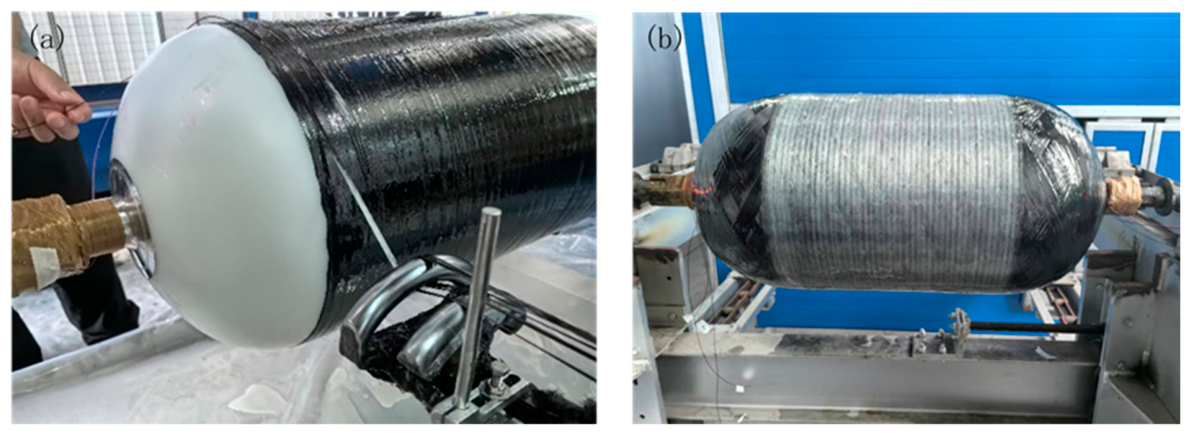
FBG sensors were provided by SmarStek Technologies Co., Ltd., Beijing, China. The FBGs exhibited a strain sensitivity coefficient of 1.2 pm/με and a temperature sensitivity coefficient of 0.1 pm/°C. Each strain-sensing optical fiber integrated nine Bragg gratings, each with a grating length of 10 mm. The temperature-sensing fiber was encapsulated within a prefabricated carbon-fiber interlayer to minimize strain coupling effects. The configuration of the embedded fibers and their integration with the winding process are illustrated in Figure 1a.
The placement of embedded optical fibers was determined based on the stress distribution characteristics of filament-wound composite pressure vessels. Under internal pressure, hoop stress dominates and exhibits a through-thickness gradient, with the highest stress located near the inner liner.
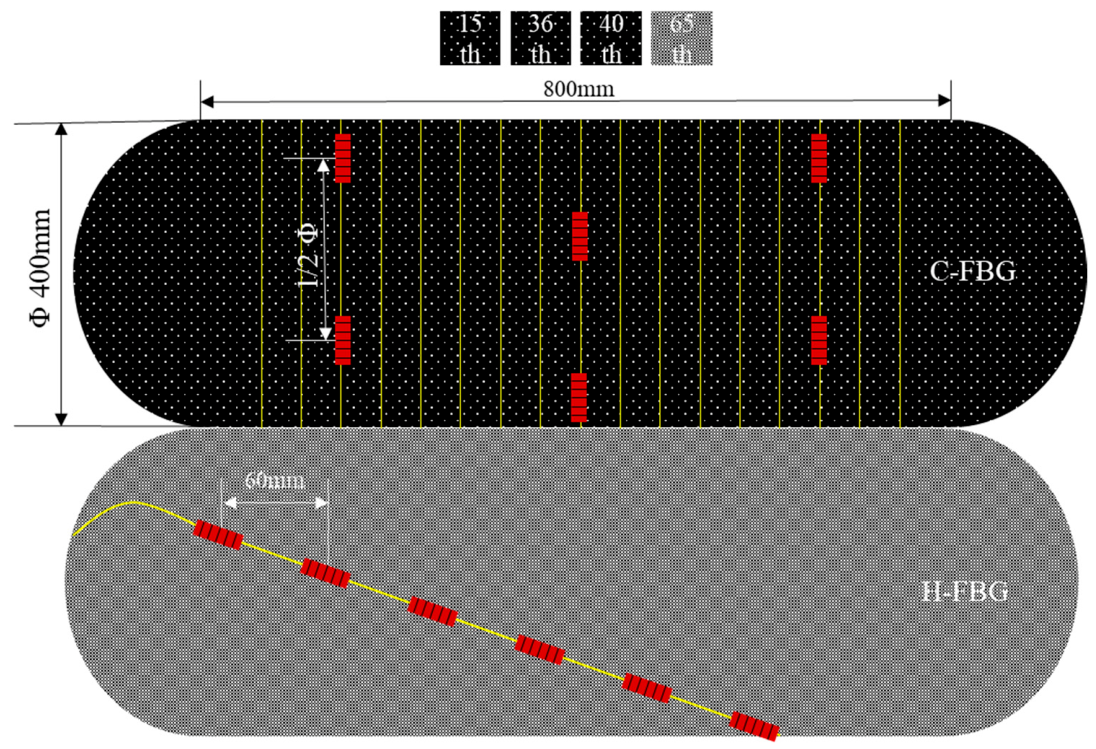
Three strain-sensing optical fibers were arranged in the 15th, 36th, and 40th hoop winding layers, designated as C1, C2, and C3, respectively. One fiber was positioned in the 65th helical winding layer, designated as H1, as illustrated in Figure 2. The notation “C” denotes hoop layers, while “H” denotes helical winding layers. After winding completion, the vessel was rotated and cured in a curing oven, as shown in Figure 1b, ultimately yielding a fiber-wound vessel with embedded optical fibers. The internal fibers within the fabricated vessel underwent continuity testing to verify their viability.
In addition, a temperature-sensing fiber was embedded in a strain-isolated interlayer region using a prefabricated carbon-fiber pocket. This intermediate layer is located between composite plies where mechanical strain transfer is minimized, allowing the fiber to primarily respond to temperature variations.
The Bragg wavelength shift in FBG sensors is influenced by both strain and temperature, which can be expressed as:
Δ λ   =   k ε · ε   +   k T · Δ T
where Δ λ is the wavelength shift, ε is strain, Δ T is temperature variation, and k ε and k T are sensitivity coefficients. By using the temperature compensation fiber to obtain Δ T , the mechanical strain can be estimated by separating the thermal contribution from the total wavelength shift.

2.2. Hydraulic Fatigue Test Setup

The design and manufacture of refillable vessels for hydrogen fuel, mounted on motor vehicles, with a nominal working pressure of 35 MPa or 70 MPa, a nominal volume greater than or equal to 20 L and not exceeding 450 L, and an operating temperature not lower than −40 °C and not higher than 85 °C, were in accordance with GB/T 42612–2023 [27]. According to GB/T 42612–2023, the hydrostatic test pressure for vessels with a nominal pressure of 70 MPa was 105 MPa. In hydraulic pressure cycling tests, the lower pressure limit was 2 MPa, and the upper limit was 1.25 times the nominal pressure, i.e., 87.5 MPa.
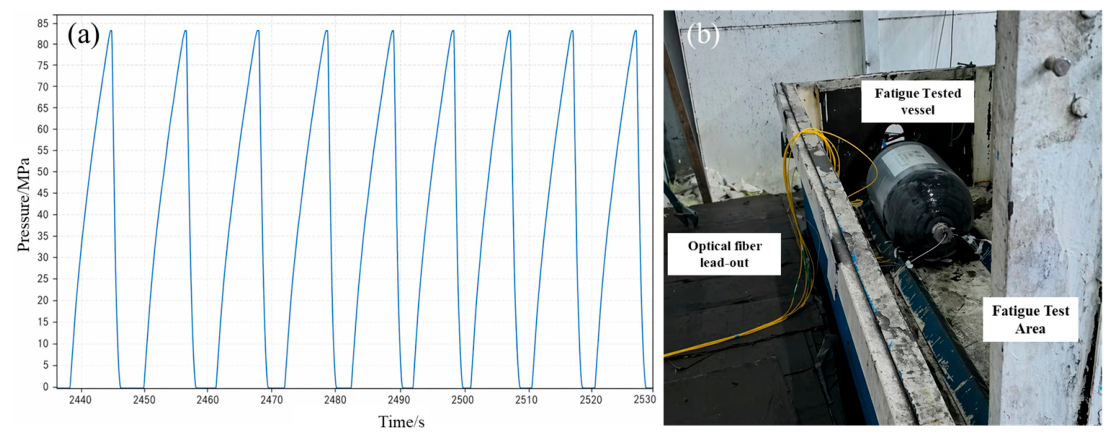
Therefore, the vessel was first pre-filled to capacity, then pressurized to 105 MPa to verify its pressure-bearing capability. Subsequently, the vessel underwent hydraulic fatigue pressure cycling test with the test pressure configuration shown in Figure 3a.
The internal strain signals from the gas vessel were transmitted via fiber optic patch cables to an external fiber optic grating demodulator. The demodulator employed was the handheld SN-FBGI-16A-03 model from SmarStek Technologies Co., Ltd., Beijing, China. operating within a wavelength range of 1528–1568 nm and featuring a scanning frequency of 3 Hz, as illustrated in Figure 3b.

3. In Situ Fatigue Monitoring Results

3.1. Strain Monitoring Signals

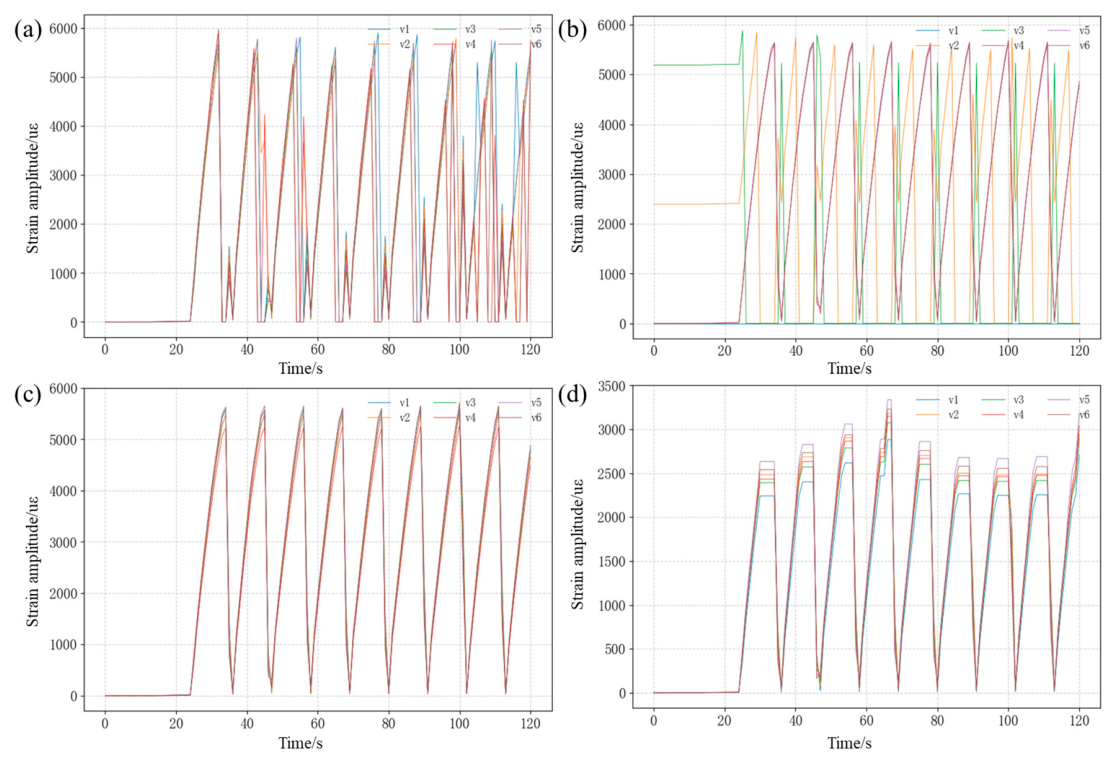
At the commencement of the cyclic test, signals could be acquired from each optical fiber, as illustrated in Figure 4, where v1-v6 denote the strain values at six grid points along the same fiber. Overall, the peak strain in the hoop winding layer decreased gradually from the inner to the outer regions. Channel C1 achieved 5997.8 με, and both Channel C2 and Channel C3 reached 5996.7 με. The peak strain in the helical winding layer reached 3571.8 με. Channel C1, being closest to the inner liner as shown in Figure 2, was prone to higher strain levels. During successive pressurisation and depressurisation cycles, it was susceptible to generating additional vibration signals, resulting in secondary strain peaks. Channel C2 exhibited a distinct time lag in the occurrence of strain peaks at each grating point. Furthermore, significant secondary strain peaks also appeared at grating points v1 and v2. v2 grid points also exhibited pronounced secondary strain peaks. Channel H1 displayed considerable peak fluctuations with a certain plateau period, yet remained relatively stable overall. Compared to other channels, channel C3 demonstrated the highest stability and superior sensing performance.
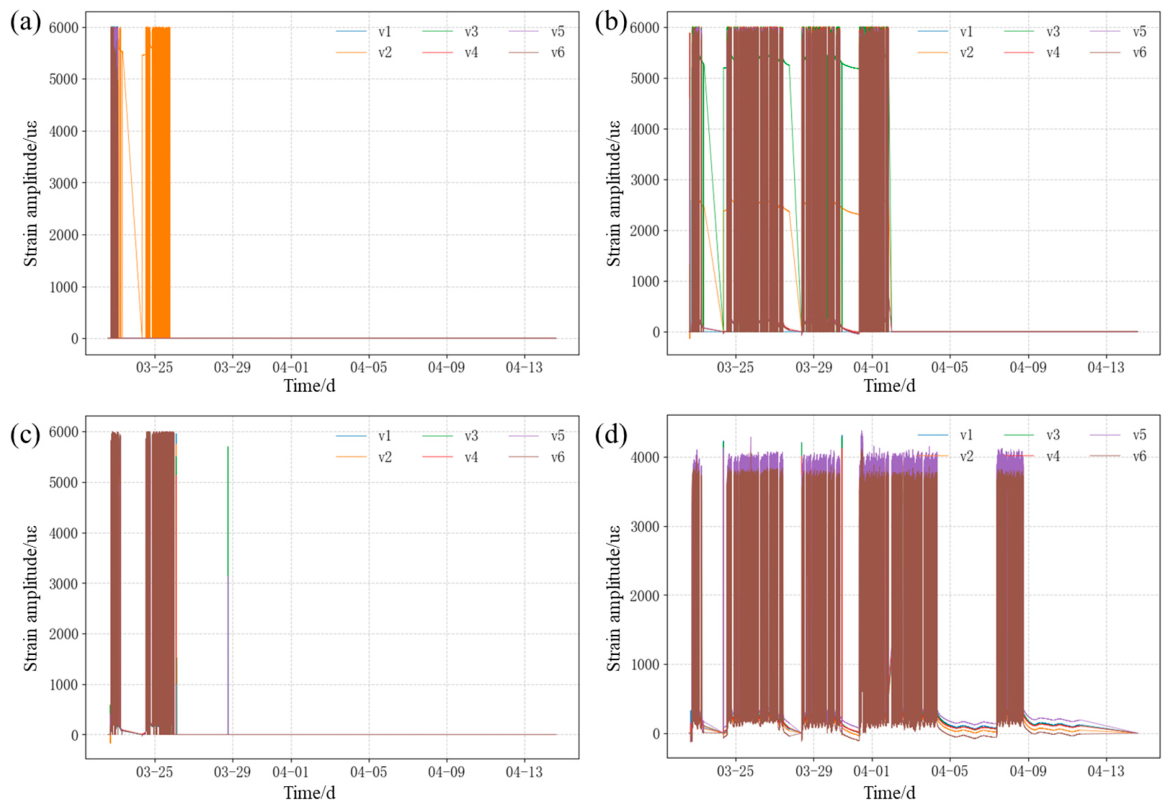
To simulate fatigue damage in gas vessels under high-cycle loading, an 18-day pressure cycling test comprising 48,000 cycles was conducted. The analysis revealed a significant number of negative values in the hoop winding of the C2 fiber. This phenomenon related to signal aliasing in the fiber’s data acquisition under high strain conditions. Through threshold filtering, the negative data points were removed to obtain valid strain data. The monitoring signals from each channel are shown in Figure 4. During the cyclic testing, the hydraulic fatigue testing machine exhibited overheating, necessitating cessation of pressurisation at 50 °C. Consequently, discontinuities occurred within the cyclic process. Furthermore, during sustained pressurisation, the internal fluid temperature rose, causing the strain in the winding layer to exhibit an upward trend.
Despite the presence of local noise and signal discontinuities, the overall strain signals exhibit stable and repeatable cyclic patterns, indicating that the measured data are sufficient for analyzing relative strain evolution and sensor behavior.

3.2. Fiber Survival Analysis

As shown in Figure 5, during the 19-day pressure cycling test, the innermost circumferentially wound fiber failed prematurely, whereas the helically wound fiber remained intact until the conclusion of the pressure cycles. Owing to significant noise in the acquired data, the number of fatigue cycles endured by the fibers during pressure cycling was calculated by comprehensively considering the amplitude, significance, and intervals of strain peaks. Using the persistently viable H1 fiber as the reference, the final fatigue cycles at failure for each fiber were determined. The survival times and fatigue cycles of the fibers are presented in Table 1. Specifically, the innermost C1 fiber exhibited complete failure after 7272 fatigue cycles, having survived for 73 h and 9 min. C2 fiber failed after 28,374 cycles, enduring 241 h and 49 min. C3 fiber failed after 15,011 cycles, with a survival time of 144 h and 32 min.
Channel C1, subjected to greater stress, exhibited rapid deactivation of most grid points after 1800 fatigue cycles, with only grid point v2 surviving to 7272 cycles. This indicated a high-stress failure mode within the vessel’s winding layer. For Channel C2, all points except v1 deactivated simultaneously at 28,300 cycles, indicating the potential for fiber optic use in vessels undergoing a full 22,000-cycle service life under lower stress conditions. Most grid points in the C3 channel deactivated at 8600 cycles, yet signals abruptly appeared at grid points v3 and v5 during the 15,000th cycle, indicating potential signal interference from external system contact issues within the monitoring system. The H1 channel maintained viability throughout 48,000 pressure cycles, demonstrating the feasibility and reliability of implanted fibers during long-term monitoring within the spiral winding process.

4. Discussion

The results obtained from the embedded FBG array provide important insights into the internal mechanical behavior, structural degradation mechanisms, and sensor–composite interactions occurring in a Type IV hydrogen storage vessel subjected to long-term hydraulic fatigue loading. Several significant findings arise from the analysis of strain evolution, layer-wise stress response, temperature-induced drift, and optical fiber survivability. Together, these observations deepen the understanding of how CPVs behave under realistic service conditions and demonstrate the feasibility and limitations of FBG-based in situ monitoring.
First, the trend of decreasing strain amplitude from the inner hoop layer toward the outer hoop layer confirms the expected stress transfer gradient across the thickness of the composite overwrap. According to classical thin-shell theory and progressive failure analyses of filament-wound structures, the inner hoop layers carry the majority of hoop stress during pressurization, owing to their proximity to the polymer liner and their relatively small radial position. The FBG measurements clearly captured this mechanical hierarchy: the innermost layers experienced strain magnitudes nearly 20–25% higher than the outer layers under identical loading conditions. This finding validates the assumption that embedded FBGs—when correctly integrated—faithfully follow the composite deformation field without introducing significant perturbation. Furthermore, the consistency of strain amplitude across multiple cycles indicates that the sensing performance remained stable during the initial loading stages, demonstrating the robustness of the embedding process for early-life vessel monitoring.
However, as the number of cycles increased, the vessel exhibited gradual baseline drift and subtle reductions in peak strain amplitude, phenomena often associated with the accumulation of internal damage and stress redistribution.
Another important observation concerns the helical layer, which displayed significantly lower strain sensitivity compared with the hoop layers. This result aligns with the known structural role of helical windings, which primarily contribute to axial reinforcement and to resisting end-dome loads rather than providing circumferential stiffness. The stability of the helical strain response over 48,000 cycles suggests that helical layers experience delayed or less severe damage initiation relative to hoop layers. Such information could be particularly valuable for designing health monitoring strategies: sensors positioned in helical layers may serve as long-lived reference channels for verifying system stability, whereas sensors in inner hoop layers function as early indicators of structural degradation.
The survival behavior of embedded optical fibers provides additional insight into the interaction between sensor robustness and composite durability. In this study, not all FBG sensors survived the full 48,000-cycle test. Fiber failure manifested as sudden loss of reflected spectra, diminishing signal-to-noise ratio, or significant wavelength instability. These failure signatures suggest three potential mechanisms:
(1)
microbending or fracture induced by local resin cracking or fiber–matrix debonding;
(2)
excessive strain concentration resulting from resin shrinkage or uneven consolidation during curing;
(3)
cumulative cyclic stresses causing microscopic fatigue damage in the optical fiber itself.
Interestingly, the survival time of the sensors correlated with their placement within the winding sequence. Inner hoop layers, which experience larger mechanical strains and more severe load fluctuations, demonstrated earlier sensor degradation. Conversely, fibers embedded in outer layers or helical orientations tended to remain operational for longer durations. This pattern provides valuable guidance for future sensor placement strategies—specifically, redundant sensing in inner layers and protective buffering materials may be necessary to ensure long-term structural visibility.
A notable implication of the observed fiber survival patterns is that FBG failure does not necessarily coincide with structural failure of the vessel; rather, it marks the limit of the sensor’s ability to withstand cyclic stresses. In practical applications, this distinction is critical. For in-service structural health monitoring, sensor durability must exceed or at least closely match the vessel’s service life. Therefore, the development of reinforced optical fibers, optimized embedding angles, resin-rich protective pockets, or hybrid sensing strategies combining FBGs with more compliant distributed fibers may be needed.
From a broader perspective, the experiment demonstrates the feasibility of embedding FBG arrays into Type IV hydrogen vessels without compromising structural integrity or manufacturing efficiency. The intact signals recorded across tens of thousands of cycles validate the fundamental compatibility of FBGs with filament winding processes. Moreover, the spatial distributions of strain provide valuable empirical data for validating finite element models of CPVs. Numerical simulations often assume ideal bonding, perfect fiber alignment, and uniform material properties; the present results provide realistic internal strain data that can be used to refine damage models, calibrate material parameters, and evaluate the accuracy of predicted stress fields. The potential integration of experimental data with digital twin frameworks could significantly enhance reliability-based design and lifetime prediction for hydrogen storage systems.
Nonetheless, certain limitations and considerations must be acknowledged. First, while the embedded FBG system successfully captured representative internal strains, the number of sensing locations remains limited by multiplexing capacity and practical embedding constraints. Pressure vessels with more complex winding patterns or higher thickness may require distributed optical fiber sensing to achieve finer spatial resolution. Second, hydraulic fatigue inherently involves coupled thermal–mechanical effects; thus, future studies should incorporate active temperature compensation or distributed temperature sensing to isolate mechanical strain more accurately. Third, fiber survival is influenced by both global structural behavior and localized microstructural features that are not fully observable in the present test. Detailed microscopy or post-fatigue imaging may help clarify the micro-mechanisms governing sensor failure.

5. Conclusions

This paper addressed the mechanical response and monitoring requirements of 70 MPa Type IV CPVs under high-pressure cyclic service conditions. An embedded in situ monitoring system based on FBG arrays was established, and long-term hydraulic fatigue testing was conducted with a lower limit of 2 MPa and an upper limit of 87.5 MPa. By synchronously embedding FBG fiber during the winding process, the monitoring system was integrated with the winding process itself. This established a multi-point distributed internal strain measurement system, providing a viable technical pathway for in situ testing of CPVs. Experimental results indicated that strain amplitudes decreased progressively from the innermost to the outermost layers across different winding layers. The hoop layer signals exhibited greater sensitivity to changes, while the helical winding layer signals remained the most stable, demonstrating long-term monitoring capability. After 18 days and 48,000 pressure cycles, the innermost hoop fibers first became inactive, whereas helical-wound layer fibers maintained continuous signal transmission throughout the entire test period. This validated the high reliability and fatigue adaptability of fiber placement in this layer. The research findings demonstrate that the embedded fiber optic monitoring method enables in situ strain tracking without compromising the structural integrity of the vessel. This provides novel technical support for the safety assessment and in-service monitoring of high-pressure hydrogen storage equipment, which is potentially applicable to fatigue life certification of onboard hydrogen storage systems.
Building upon this research, the following studies may be pursued:
(1)
Multi-source signal fusion and life prediction model development. Subsequent work may integrate fiber strain signals with acoustic emission, temperature, and hydrogen permeation monitoring data to establish a multi-physics life prediction model, achieving closed-loop correlation from strain monitoring to fatigue assessment.
(2)
Expanded application of distributed fiber optic monitoring technology. Future work may incorporate DOFS and optical time-domain reflectometry to capture full-field strain distributions across vessels, enabling continuous monitoring of complex regions such as spiral zones and pole ends.
(3)
Integration of manufacturing processes with monitoring systems. Future vessel production will couple fiber pre-embedding with winding processes, enabling simultaneous formation of monitoring systems and structural components. This enhances production consistency and advances inspection automation.

Author Contributions

X.M.: Writing—original draft, Methodology, Conceptualization, Funding acquisition. W.Z.: Visualization, Software, Methodology. W.D.: Validation, Formal analysis, Resources, Investigation. Z.Z.: Formal analysis, Software, Data curation. S.H.: Data interpretation, Validation. X.W.: Validation, Formal analysis. L.Z.: Investigation, Data curation. Y.Y.: Resources, writing—review & editing, Supervision, Project administration. All authors have read and agreed to the published version of the manuscript.

Funding

This research was funded by the Jiangsu Provincial Market Supervision Administration Science and Technology Program (KJ2024001).

Data Availability Statement

The original contributions presented in this study are included in the article. Further inquiries can be directed to the corresponding author.

Acknowledgments

The authors express sincere gratitude to all those who have supported this research.

Conflicts of Interest

Author Xiangdong Ma, Wenli Dong, Shen He, Xiao Wu, Longyang Zhan are employed by the company Jiangsu Provincial Institute of Special Equipment Safety Supervision and Inspection. The remaining authors declare that the research was conducted in the absence of any commercial or financial relationships that could be construed as a potential conflict of interest.

Abbreviations

The following abbreviations are used in this manuscript:
FBGFiber Bragg Grating
FCEVsfuel cell electric vehicles
CPVscomposite pressure vessels
AEacoustic emission
DICdigital image correlation

References

  1. Zhang, M.; Lv, H.; Kang, H.; Zhou, W.; Zhang, C. A literature review of failure prediction and analysis methods for composite high-pressure hydrogen storage tanks. Int. J. Hydrogen Energy 2019, 44, 25777–25799. [Google Scholar] [CrossRef]
  2. Feki, I.; Shirinbayan, M.; Nouira, S.; Bi, R.T.; Maeso, J.-B.; Thomas, C.; Fitoussi, J. Composites in high-pressure hydrogen storage: A review of multiscale characterization and mechanical behavior. Compos. Part C 2025, 16, 100555. [Google Scholar] [CrossRef]
  3. Hua, Z.; Gao, W.; Chi, S.; Wang, X.; Zheng, J. Development status and challenges of high-pressure gaseous hydrogen storage vessels and cylinders in China. Renew. Sustain. Energy Rev. 2025, 214, 115567. [Google Scholar] [CrossRef]
  4. Kim, J.H.; Lee, H.; Lee, M.-K.; Ha, S.-J. Predictive maintenance and reinspection strategies for hydrogen refueling station pressure vessels: A case study in South Korea. J. Energy Storage 2024, 97, 112860. [Google Scholar] [CrossRef]
  5. Bouhala, L.; Polesel, J.; Karatrantos, A.; Perbal, S.; Senf, B.; Hiekel, A.; Reinhardt, H.; Rauscher, A.; Mäder, T. Review of State-of-the-art of structural health monitoring in hydrogen composite pressure vessels. Compos. Part C Open Access 2025, 18, 100635. [Google Scholar] [CrossRef]
  6. Nachtane, M.; Tarfaoui, M.; Abichou, M.A.; Vetcher, A.; Rouway, M.; Aâmir, A.; Mouadili, H.; Laaouidi, H.; Naanani, H. An Overview of the Recent Advances in Composite Materials and Artificial Intelligence for Hydrogen Storage Vessels Design. J. Compos. Sci. 2023, 7, 119. [Google Scholar] [CrossRef]
  7. Reda, R.; Khamis, M.; Ragab, A.E.; Elsayed, A.; Negm, A.M. Numerical analysis of the impact of winding angles on the mechanical performance of filament wound type 4 composite pressure vessels for compressed hydrogen gas storage. Heliyon 2024, 10, e33796. [Google Scholar] [CrossRef]
  8. Hu, D.; Shao, W.; Lu, D.; Xu, Y.; Wang, J. Design and material optimization of carbon fiber composite winding reinforcement layer for Type IV hydrogen storage vessels. J. Energy Storage 2024, 100, 113459. [Google Scholar] [CrossRef]
  9. Eun, J.H.; Kim, D.H.; Ahn, H.C.; Lee, J.S. Compatibility of liner materials for type IV hydrogen storage vessels and the interlaminar properties of liner/CFRP composites. Int. J. Hydrogen Energy 2025, 133, 431–439. [Google Scholar] [CrossRef]
  10. Lin, S.; Yang, L.; Xu, H.; Jia, X.; Yang, X.; Zu, L. Progressive damage analysis for multiscale modelling of composite pressure vessels based on Puck failure criterion. Compos. Struct. 2021, 255, 113046. [Google Scholar] [CrossRef]
  11. Gabardi, M.; Tozzetti, L.; Faralli, S.; Solazzi, M.; Benedetti, D.; Rajbhandari, S.; Buttaro, G.; Di Pasquale, F. Embedding fiber Bragg grating sensors in carbon composite structures for accurate strain measurement. IEEE Sens. J. 2023, 23, 16882–16892. [Google Scholar] [CrossRef]
  12. Zhou, W.; Wang, J.; Pan, Z.-B.; Liu, J.; Ma, L.-H.; Zhou, J.-Y.; Su, Y.-F. Review on optimization design, failure analysis and non-destructive testing of composite hydrogen storage vessels. Int. J. Hydrogen Energy 2022, 47, 38862–38883. [Google Scholar] [CrossRef]
  13. Meemary, B.; Vasiukov, D.; Deléglise-Lagardère, M.; Chaki, S. Sensors integration for structural health monitoring in composite pressure vessels: A review. Compos. Struct. 2025, 351, 118546. [Google Scholar] [CrossRef]
  14. Mehdikhani, M.; Aravand, M.; Sabuncuoglu, B.; Callens, M.G.; Lomov, S.V.; Gorbatikh, L. Full-field strain measurements at the micro-scale in fiber-reinforced composites using digital image correlation. Compos. Struct. 2016, 140, 192–201. [Google Scholar] [CrossRef]
  15. Aramburu, A.B.; Da Cruz, J.A.; Xavier da Silva, A.A.; Acosta, A.P.; Minillo, L.Q.; de Avila Delucis, R. Non-destructive testing techniques for pressure vessels manufactured with polymer composite materials: A systematic review. Measurement 2025, 246, 116729. [Google Scholar] [CrossRef]
  16. Wachtarczyk, K.; Yadav, N.; Błachut, A.; Gąsior, P.; Schledjewski, R.; Kaleta, J. Fatigue and residual strain monitoring for thermoplastic composite using embedded FBG inscribed in highly-birefringent side-hole elliptical core optical fiber. Measurement 2024, 238, 115404. [Google Scholar] [CrossRef]
  17. Alhussein, A.N.D.; Qaid, M.R.T.M.; Agliullin, T.; Valeev, B.; Morozov, O.; Sakhabutdinov, A. Fiber Bragg Grating Sensors: Design, Applications, and Comparison with Other Sensing Technologies. Sensors 2025, 25, 2289. [Google Scholar] [CrossRef]
  18. Zhang, J.; Qian, K.; Qiu, D.; Zhang, G.; Long, Y.; Zhu, L.; Liu, S. FBG strain monitoring data denoising in wind turbine blades based on parameter-optimized variational mode decomposition method. Opt. Fiber Technol. 2023, 81, 103527. [Google Scholar] [CrossRef]
  19. Zhao, X.; Jin, K.; Yan, M.; Nan, P.; Zhou, F.; Xin, G.; Lim, K.-S.; Ahmad, H.; Zhang, Y.; Yang, H. Inverse heat transfer for real-time thermal evaluation of aircraft thermal protection structure with embedded FBG sensors. Appl. Therm. Eng. 2025, 260, 124869. [Google Scholar] [CrossRef]
  20. Zhu, P.; Feng, X.; Liu, Z.; Huang, M.; Xie, H.; Soto, M.A. Reliable packaging of optical fiber Bragg grating sensors for carbon fiber composite wind turbine blades. Compos. Sci. Technol. 2021, 213, 108933. [Google Scholar] [CrossRef]
  21. Shi, J.; Kong, D.; Li, C.; Guo, R.; Xian, G.; Liu, H.; Tan, X. Strain and damage monitoring of optical fiber sensor-embedded carbon fiber reinforced polymer confined cracked pipes. Polym. Compos. 2025, 46, 5419–5438. [Google Scholar] [CrossRef]
  22. Goossens, S.; Berghmans, F.; Muñoz, K.; Jiménez, M.; Karachalios, E.; Saenz-Castillo, D.; Geernaert, T. A global assessment of barely visible impact damage for CFRP sub-components with FBG-based sensors. Compos. Struct. 2021, 272, 114025. [Google Scholar] [CrossRef]
  23. Yu, Y.; Liu, X.; Cui, X.; Wang, Y.; Qing, X. In-situ cure monitoring of thick CFRP using multifunctional piezoelectric-fiber hybrid sensor network. Compos. Sci. Technol. 2023, 240, 110079. [Google Scholar] [CrossRef]
  24. Tamagawa, T.; Minakuchi, S.; Niwa, S.; Takeda, N. Consolidation deformation of composite corner depending on compression force during layup: In situ monitoring using fiber-optic-based embeddable shape sensor. Compos. Part A Appl. Sci. Manuf. 2023, 165, 107371. [Google Scholar] [CrossRef]
  25. Saeter, E.; Lasn, K.; Nony, F.; Echtermeyer, A.T. Embedded optical fibres for monitoring pressurization and impact of filament wound cylinders. Compos. Struct. 2019, 210, 608–617. [Google Scholar] [CrossRef]
  26. Fu, H.; Lv, C.; Meng, J.; He, M.; Wu, J.; Gong, L. Strength and fatigue study of on-board type III cryo-compressed hydrogen storage cylinder. Int. J. Hydrogen Energy 2024, 57, 1081–1088. [Google Scholar] [CrossRef]
  27. GB/T 42612–2023; Fully-Wrapped Carbon Fiber Reinforced Cylinders with a Plastic Liner for the On-Board Storage of Compressed Hydrogen. Standardization Administration of the People’s Republic of China (SAC): Beijing, China, 2023.
Figure 1. In situ fatigue test vessel fabrication: (a) fiber-wound implantation; (b) fiber-embedded vessel rotation curing.
Energies 19 02269 g001
Figure 2. Schematic diagram of fiber-wound layers and optical fiber embedding.
Energies 19 02269 g002
Figure 3. Hydraulic fatigue pressure cycling test setup: (a) cycling pressure configuration; (b) experimental setup.
Energies 19 02269 g003
Figure 4. Cyclic loading initial strain signals: (a) C1 strain signal; (b) C2 strain signal; (c) C3 strain signal; (d) H1 strain signal.
Energies 19 02269 g004
Figure 5. In situ strain data throughout the process: (a) C1 strain data; (b) C2 strain data; (c) C3 strain data; (d) H1 strain data.
Energies 19 02269 g005
Table 1. Fiber Survival Fatigue Cycles and Duration.
v1v2v3v4v5v6
C1 Fatigue cycles180472721805180018001790
C1 Inactivation time08:53:2073:09:2008:53:2008:53:1908:53:1908:53:19
C2 Fatigue cycles028,37428,37428,34928,33728,321
C2 Inactive Time00:00:00241:49:56241:49:58241:49:55241:49:55241:49:45
C3 Fatigue Count8619863115,011859214,9857962
C3 Inactivation Time80:41:4880:41:25144:32:3080:41:37144:32:1977:54:48
H1 Fatigue CyclesNot deactivatedNot deactivatedNot deactivatedNot deactivatedNot deactivatedNot deactivated
H1 Deactivation TimeNot deactivatedNot deactivatedNot deactivatedNot deactivatedNot deactivatedNot deactivated
Note: Bold values indicate the maximum survival cycles and the corresponding longest inactivation time within each fiber channel.
Disclaimer/Publisher’s Note: The statements, opinions and data contained in all publications are solely those of the individual author(s) and contributor(s) and not of MDPI and/or the editor(s). MDPI and/or the editor(s) disclaim responsibility for any injury to people or property resulting from any ideas, methods, instructions or products referred to in the content.