Article

The Influence of Raw Materials for Fatty Acid Methyl Ester Production on the Aging Rate of Diesel Fuel Blends with Biocomponents


Faculty of Civil Engineering, Mechanics and Petrochemistry, Warsaw University of Technology, Lukasiewicz Street 17, 09-400 Plock, Poland
*
Author to whom correspondence should be addressed.
Energies 2026, 19(10), 2251; https://doi.org/10.3390/en19102251
Submission received: 15 March 2026 / Revised: 29 April 2026 / Accepted: 3 May 2026 / Published: 7 May 2026
(This article belongs to the Section I1: Fuel)

Abstract

We present a rapid screening method to assess the aging of diesel blends containing fatty acid methyl esters (FAME) produced from two contrasting feedstocks: refined sunflower oil (SFME) and used cooking oil (UCO). Diesel–FAME blends at several biocomponent concentrations (0–50% v/v) were subjected to accelerated thermal aging at 90, 120 and 150 °C and monitored by peroxide value (PV), anisidine value (AV) and acid value measurements. Kinetic analysis of PV and AV trends, supported by Arrhenius plots, reveals feedstock-dependent oxidation pathways: UCO-FAME exhibits higher initial PV and AV and a faster progression to secondary oxidation products, whereas SFME accumulates hydroperoxides more at moderate temperatures and decomposes more slowly. The method distinguishes formation-dominated and decomposition-dominated regimes, quantifies apparent rate constants as functions of temperature and FAME content, and identifies an inflection in apparent activation behavior for UCO blends near 120 °C. The novelty of this work lies in the direct comparison of blend oxidation kinetics for refined versus waste-derived FAME and in proposing a practical, rapid protocol for identifying unstable feedstocks to support improved quality control of diesel–FAME blends.

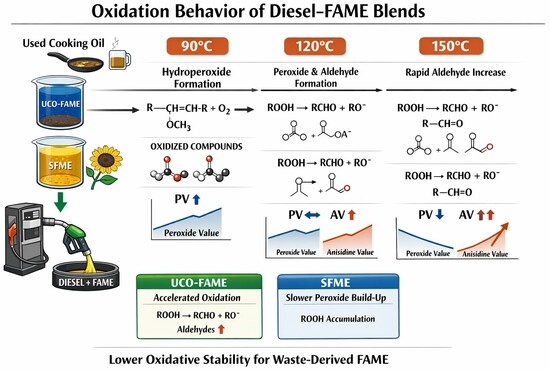
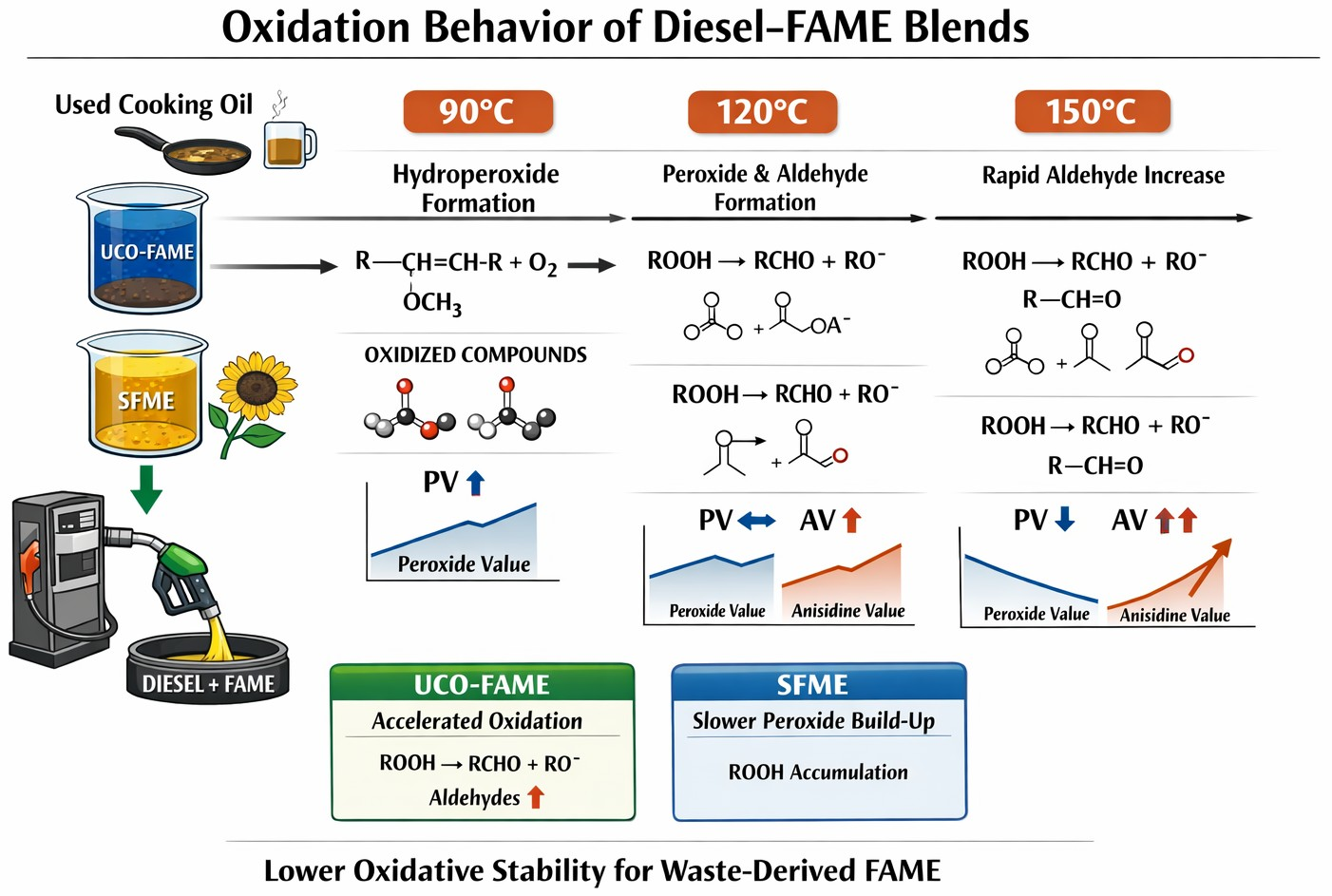
Graphical Abstract

1. Introduction

The growing demand for energy and the need to reduce greenhouse gas emissions are driving the development of alternative energy sources, including biofuels. One of the most common biofuels used in transport are fatty acid methyl esters (FAME), used as an admixture to diesel fuel. The introduction of FAME into conventional fuels stems from EU directives such as RED II, which oblige Member States to achieve a specific share of renewable energy in the transport sector, reaching 14.9% by 2030 [1]. In addition, RED III and the Fuel Quality Directive (FQD) further strengthen the role of waste-derived feedstocks and advanced biofuels, while EN 590 [2] limits the FAME content in commercial diesel to 7% v/v, and EN 14214 [3] specifies strict quality requirements for FAME, including oxidation stability.
FAME are produced by transesterification of plant oils or animal fats with alcohols (especially methanol) in the presence of alkaline or acidic catalysts. The type of raw material significantly influences the physicochemical properties of the final product, including its resistance to oxidation and aging [4]. This issue is particularly important for the durability and stability of fuel blends, especially during storage in varying climatic conditions [5]. FAME are biodegradable, have low toxicity, and contain almost no sulfur, which reduces emissions of particulate matter and sulfur oxides. However, their functional properties depend strongly on the fatty acid profile of the feedstock. For example, rapeseed methyl esters (RME) exhibit better oxidative stability but poorer low-temperature properties than soybean methyl esters (SME) [6]. FAME from animal fats (TME) show high oxidation resistance but have a high freezing point, limiting its use in cold climates [7].
Biofuels, particularly biodiesel (FAME), have gained increasing attention due to their potential to reduce greenhouse gas emissions, enhance energy security, and support circular-economy strategies through the utilization of renewable or waste-derived feedstocks. According to the IEA, global biofuel demand is projected to increase by nearly 30% between 2023 and 2028, driven by climate policies, energy diversification goals, and the need to decarbonize hard-to-electrify sectors such as transport [8]. Biodiesel is typically produced via transesterification of vegetable oils or waste cooking oils with short-chain alcohols in the presence of alkaline, acidic, or enzymatic catalysts [9,10]. The resulting fatty acid methyl esters (FAME) are blended with diesel fuel to improve combustion properties and reduce emissions. To further enhance fuel quality and performance, various additives are commonly used in diesel–biodiesel blends. These include antioxidants (e.g., TBHQ, BHT, PG) to improve oxidative stability [11,12], cold-flow improvers to lower cloud and pour points [13], cetane enhancers such as 2-ethylhexyl nitrate or di-tert-butyl peroxide to improve ignition quality [14,15], and detergent–dispersant additives to maintain injector cleanliness and reduce deposit formation [16]. As highlighted in recent studies, including the work of Hrynchuk et al. [17], the interplay between feedstock composition, production method, and additive use plays a crucial role in determining the oxidative behavior and overall quality of biodiesel and diesel–FAME blends.
Although B7 (7% of biocomponents in a fuel blend) blends dominate the market, higher blends such as B20 and B30 are increasingly used in industrial and fleet applications. However, increasing the FAME content reduces blend stability, manifested by increased acid value, deposit formation, color change, and increased viscosity [18]. The aging of FAME and their blends occurs through oxidation, hydrolysis, and polymerization. In the presence of oxygen and elevated temperatures, peroxides are formed, which subsequently transform into aldehydes, carboxylic acids, and polymers [19]. Water accelerates hydrolysis and further destabilizes the fuel [20]. This makes the oxidation behavior of higher blends particularly relevant for storage stability.
The resistance of FAME to oxidation depends on their fatty acid composition: unsaturated esters (e.g., from soybean or sunflower oil) are more susceptible to oxidation than saturated esters (e.g., from animal fats or palm oil) [5]. However, saturated FAME have poorer cold-flow properties, requiring a compromise between oxidation resistance and low-temperature performance [21].
Standard methods for assessing oxidative stability include the Rancimat test (EN 14112), which measures induction time and requires ≥8 h for pure FAME [22]. Additional parameters such as acid value (EN 14104) [23], kinematic viscosity (EN ISO 3104) [24], and total contamination (EN 12662) [25] are also used. However, these methods primarily assess compliance with standards and do not provide detailed insight into oxidation pathways. The analysis of primary and secondary oxidation products—such as peroxides, aldehydes, and ketones—offers a more informative assessment of degradation processes, especially under accelerated aging conditions.
Previous studies have shown that SME and sunflower oil FAME exhibit lower oxidation stability than RME and palm-oil FAME [19,26]. Antioxidants such as BHT (3,5-di-tert-butylo-4-hydroksytoluen) or tocopherols can improve stability, but their effectiveness depends on FAME type and dosage [27]. Demirbas [26] and Knothe & Gerpen [28] have demonstrated that FAME rich in polyunsaturated fatty acids oxidize rapidly during storage. More recent studies highlight the increasing use of waste-derived feedstocks such as used cooking oil (UCO), whose chemical profile is highly variable and requires individual assessment [29,30].
Most studies focus on pure FAME rather than diesel–FAME blends, leaving a gap in understanding the oxidation behavior of real-world fuels. Moreover, standard stability tests provide limited mechanistic insight and do not quantify the formation of primary, secondary, and acidic oxidation products [4,7]. There is also a lack of comparative studies evaluating the oxidation kinetics of blends containing FAME from refined oils versus UCO under controlled accelerated aging conditions [31].
The present study addresses this gap by applying an extended analytical approach integrating peroxide value (PV) [32] and anisidine value (AV) to monitor the formation of primary [33], secondary, and acidic oxidation products. This multi-parameter method enables a more detailed assessment of oxidation progression than standard stability tests.
The objective of this work was to evaluate the aging behavior of diesel–FAME blends produced from two contrasting feedstocks—refined sunflower oil and used cooking oil—under accelerated thermal conditions (90, 120, and 150 °C). Rapeseed oil is the most widely used and analyzed feedstock for FAME production in Europe. The present study focuses on these two materials to highlight the influence of alternative feedstocks, which can be used as biocomponents, on oxidation pathways. The study aims to determine how feedstock origin and FAME concentration influence the degradation of kinetics and overall fuel stability. The results contribute to a better understanding of the risks associated with UCO-based FAME and support the development of rapid assessment methods for evaluating feedstock suitability for transesterification.

2. Materials and Methods

FAME used in the study were produced from refined sunflower oil and used cooking oil (UCO). Both feedstocks were selected to represent contrasting oxidation stability profiles and to reflect current EU recommendations promoting waste-derived raw materials (RED II/III). Transesterification was carried out under alkaline conditions using methanol and sodium hydroxide as a catalyst. The transesterification of both feedstocks was processed in a 2000 mL borosilicate glass reactor placed in a thermostated heating bath. The total working volume during synthesis was 1600 mL. Mixing was carried out using a laboratory mechanical stirrer (SBS-ER-3000, Stainberg System, Berlin, Germany) equipped with a two-blade propeller impeller with a diameter of 60 mm. The viscosity of the reaction medium under processing conditions was approximately 9–11 mm2/s. The mixture was stirred at 1000 rpm throughout the 90 min reaction to ensure uniform dispersion of methanol and catalyst and to maintain homogeneous reaction conditions. After phase separation, the ester layer was neutralized to pH = 7, washed with warm deionized water and dried using silica gel with a moisture indicator until color stabilization, following the procedure described in [32,33].
Before preparing the blends, the obtained FAME were characterized by determining density [34], kinematic viscosity [24], total methyl ester contents [35], peroxide value [36], anisidine value [37] and acid value [23]. These parameters allowed verification of the quality of the feedstocks and provided baseline values for further oxidation studies.

Properties of the Tested FAME

The initial characterization of the FAME samples (Table 1) revealed substantial differences between the two feedstocks, which strongly influenced their oxidation behavior during aging. UCO-FAME exhibited significantly higher peroxide and anisidine values than SFME, indicating the presence of pre-oxidized structures formed during repeated thermal use in food processing. Similar observations were reported by Knothe & Gerpen [28], who demonstrated that oils subjected to high-temperature frying accumulate hydroperoxides, aldehydes and polymeric compounds that accelerate subsequent oxidation of the resulting methyl esters. Demirbas [26] also noted that biodiesel produced from thermally degraded oils shows reduced oxidative stability due to the presence of partially oxidized triacylglycerols.
Although both FAME types met the density and viscosity requirements of EN 14214, the acid value of UCO-FAME exceeded the standard limit, which is typical for waste-derived feedstocks and reflects hydrolysis during frying. This is consistent with findings by authors who reported elevated acid values in UCO-based biodiesel due to the presence of free fatty acids formed during thermal degradation [32,33,38]. These initial differences are crucial because fuels with higher initial peroxide and aldehyde content tend to oxidize faster due to the autocatalytic nature of lipid oxidation, as described by Morales [39]. Peroxide and anisidine values are not specified as normative parameters in EN 14214 [3] or ASTM D6751 [40]; nevertheless, previous studies have reported correlations between PV/AV and standard oxidation indicators (e.g., Rancimat induction time), although those studies often considered unprocessed edible oils rather than processed FAME, which may affect direct comparability [41].
Diesel–FAME blends were prepared at concentrations of 0%, 5%, 7%, 10%, 20% and 50% (v/v). All fuel blends were prepared by volumetric mixing of components, and compositions are reported in volume percent (vol.%), in accordance with standard fuel blending procedures and the EN 590 specification [2]. Petro-diesel without biocomponents was used as the reference fuel. For clarity and reproducibility, Table 2 additionally provides the conversion of blend compositions from volume percent (v/v) to mass percent (w/w), calculated using the experimentally determined densities of petro-diesel and both FAME types.
The blends were subjected to accelerated aging at 90 °C, 120 °C and 150 °C for 8, 16 and 24 h in a thermostated laboratory dryer without light exposure. These temperatures were selected to represent moderate (90 °C), intensified (120 °C) and severe (150 °C) oxidation conditions, enabling observation of changes in both the formation and decomposition of oxidation products.
After aging, the samples were analyzed for peroxide value (primary oxidation products), anisidine value (secondary oxidation products) and acid value (acidic oxidation products). All measurements were performed in triplicate, and the results are presented as mean values.
To evaluate oxidation kinetics, zero-order reaction models were fitted to the experimental PV–time and AV–time data, and the statistical significance of the regression parameters (slope and intercept) was assessed using p-values at a significance level of 0.05. The adequacy and interpretation of the linear models followed the methodological approach described by Pyshyev [42], enabling consistent comparison of oxidation rates across blends with different FAME concentrations and feedstock origins.

3. Results and Discussion

3.1. Peroxide Value

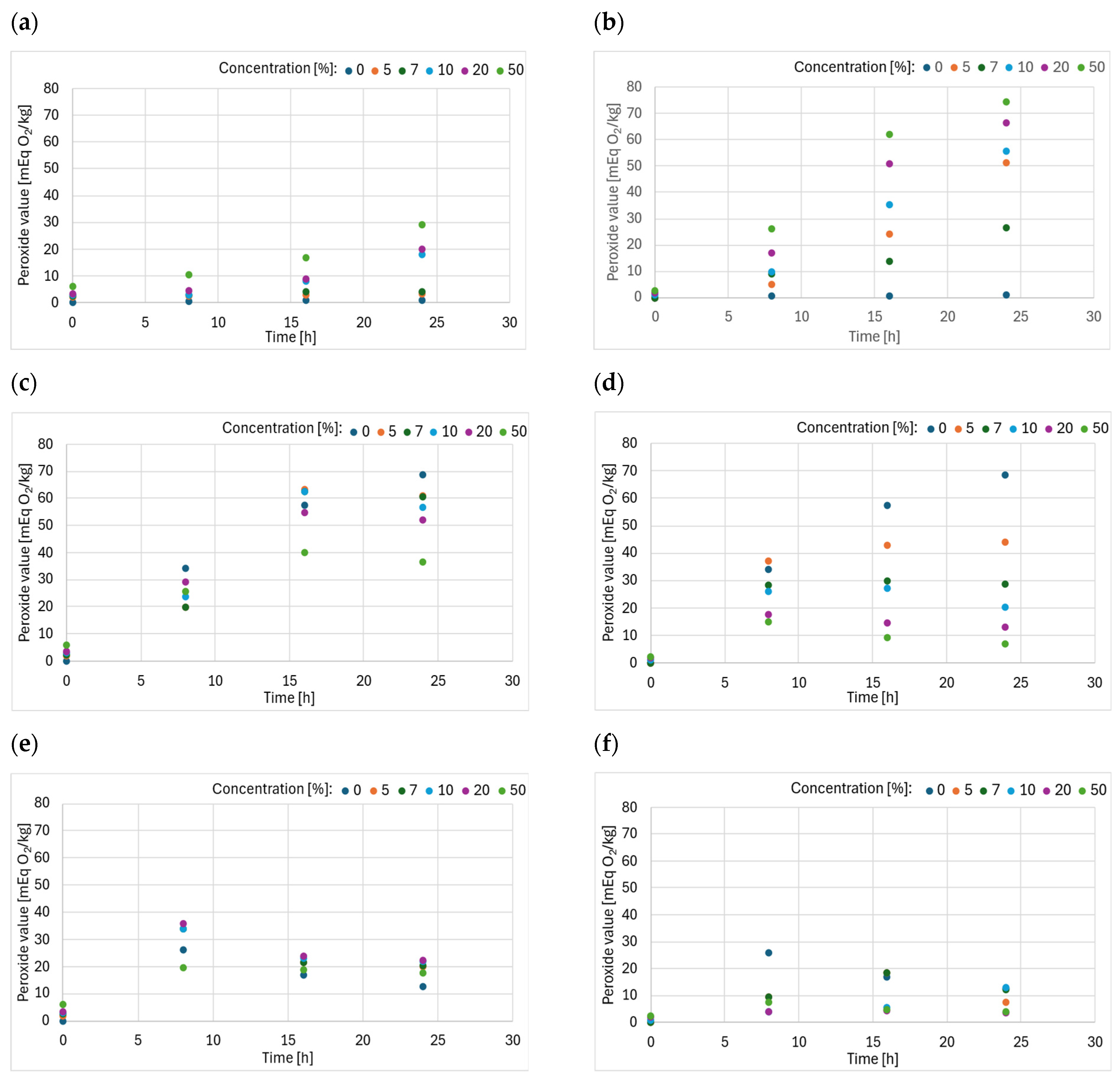
Changes in peroxide value (PV) as a function of time, temperature and FAME concentration (Figure 1) clearly demonstrate that both the thermal conditions and the origin of the FAME significantly affect the formation and decomposition of primary oxidation products in diesel–FAME blends. At 90 °C (Figure 1a,b), a monotonic increase in PV was observed for all blends, with the rate and final PV increasing with FAME concentration. This effect is particularly pronounced for blends containing SFME (Figure 1b), where the highest FAME contents (20% and 50%) reach PVs of about 75 mEq O2/kg after 24 h, compared to approximately 30 mEq O2/kg for UCO-FAME blends (Figure 1a). This shows that sunflower-oil methyl esters are more prone to hydroperoxide formation at moderate temperatures than UCO-FAME. The lower PV in UCO-FAME blends at 90 °C can be attributed to the presence of pre-oxidized structures and radicals originating from the thermal history of the used cooking oil, which may promote faster decomposition of newly formed hydroperoxides and shift the balance between formation and degradation.
At 120 °C (Figure 1c,d), the behavior of the system becomes more complex and strongly dependent on both FAME type and concentration. For UCO-FAME blends (Figure 1c), PV continued to increase with time for all concentrations, although the slopes are lower than at 90 °C, indicating that hydroperoxide formation is still dominant but partially counteracted by their thermal decomposition. In contrast, SFME blends (Figure 1d) show a distinctly different pattern: at low FAME concentrations (5–10%), PV still increases with time, but at higher concentrations (20% and 50%) PV initially increases and then decreases or remains nearly constant. This suggests that at 120 °C and high SFME content, the rate of hydroperoxide decomposition becomes comparable to or higher than the rate of their formation. Such behavior is typical for highly unsaturated esters at elevated temperatures, where hydroperoxides are thermally unstable and rapidly decompose into secondary oxidation products [43].
At 150 °C (Figure 1e,f), the dominance of decomposition processes was evident for both FAME types. PV either remains low or decreases with time, regardless of FAME concentration. This indicates that at this temperature hydroperoxides are transient species that do not accumulate in the system. Instead, they are rapidly converted into aldehydes, ketones, and acids, which is consistent with the classical mechanism of lipid oxidation at high temperatures. The similarity of trends for UCO-FAME and SFME at 150 °C suggests that, beyond a certain temperature threshold, the detailed composition of the FAME becomes less important than the general instability of hydroperoxides.
The kinetic analysis based on zero-order models (Table 3) provides a quantitative description of these observations. At 90 °C, the rate constants for PV formation increased with FAME concentration for both FAME types, but the absolute values are higher for SFME blends, confirming their higher susceptibility to hydroperoxide formation. The high R2 values (typically above 0.8) indicate that, under these conditions, PV increases approximately linearly with time, and the formation of primary oxidation products is the dominant process. At 120 °C, the rate constants for UCO-FAME blends remain positive across all concentrations, although they are lower than at 90 °C, reflecting the increasing contribution of decomposition. For SFME blends, however, the rate constants decrease markedly with increasing FAME content, and for 20% and 50% FAME the fits show low R2 values, indicating that a simple zero-order model is no longer adequate due to the competing formation and decomposition processes. This directly explains the irregular or flattened PV curves observed in Figure 1d and addresses the reviewer’s concern about the lack of explanation for these patterns.
At 90 °C, all PV–time relationships were statistically significant (p < 0.05), confirming a clear and regular zero-order oxidation trend for both UCOME and SFME. At 120 °C, UCOME maintained statistically significant kinetics, whereas SFME showed predominantly non-significant p-values, indicating higher variability and loss of linearity due to its more polyunsaturated composition. At 150 °C, only isolated cases remained significant, as high temperature accelerates both peroxide formation and its secondary decomposition, disrupting the linear PV increase. Overall, UCOME exhibited more stable and statistically supported oxidation kinetics across temperatures, while SFME showed non-linear behavior at elevated temperatures driven by faster and more complex oxidative pathways.
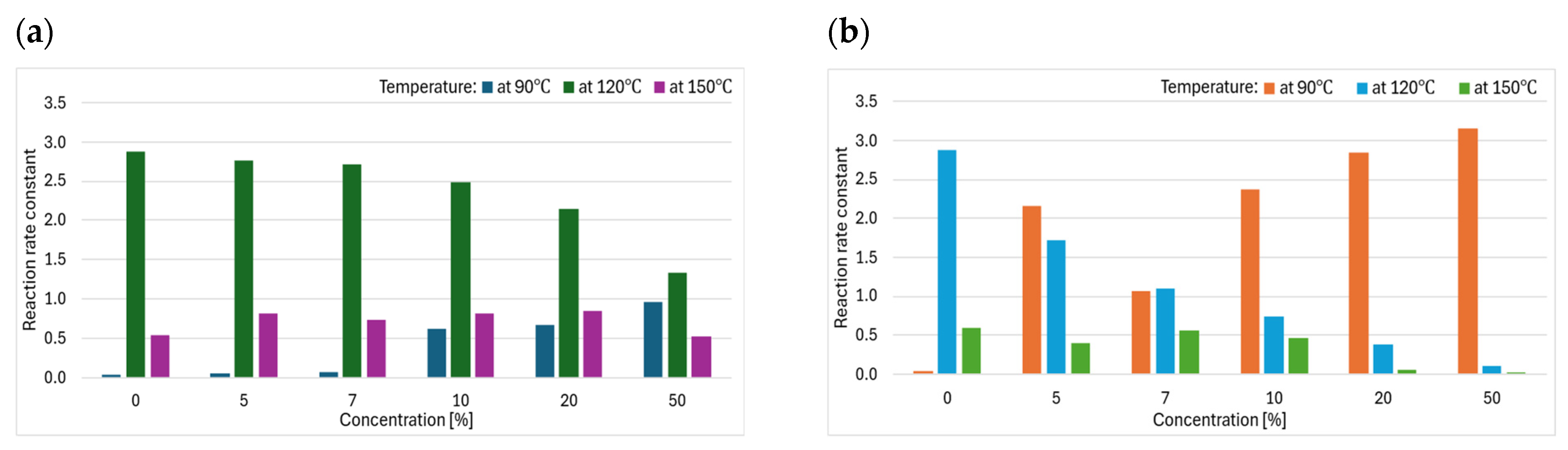
Figure 2 summarizes the dependence of the zero-order rate constants on FAME concentration for each temperature and FAME type. At 90 °C, the rate constants increase with FAME content for both UCO-FAME and SFME, but the slope is steeper for SFME, confirming that sunflower oil esters generate hydroperoxides more rapidly at moderate temperatures. At 120 °C, the rate constants for UCO-FAME decrease slightly with concentration, reflecting the growing role of decomposition, whereas for SFME they drop sharply and approach zero or even negative effective values at high concentrations, which is consistent with the observed decrease in PV over time. At 150 °C, the rate constants are low for both FAME types and show only weak dependence on concentration, indicating that hydroperoxide formation is no longer the controlling step of the oxidation process.
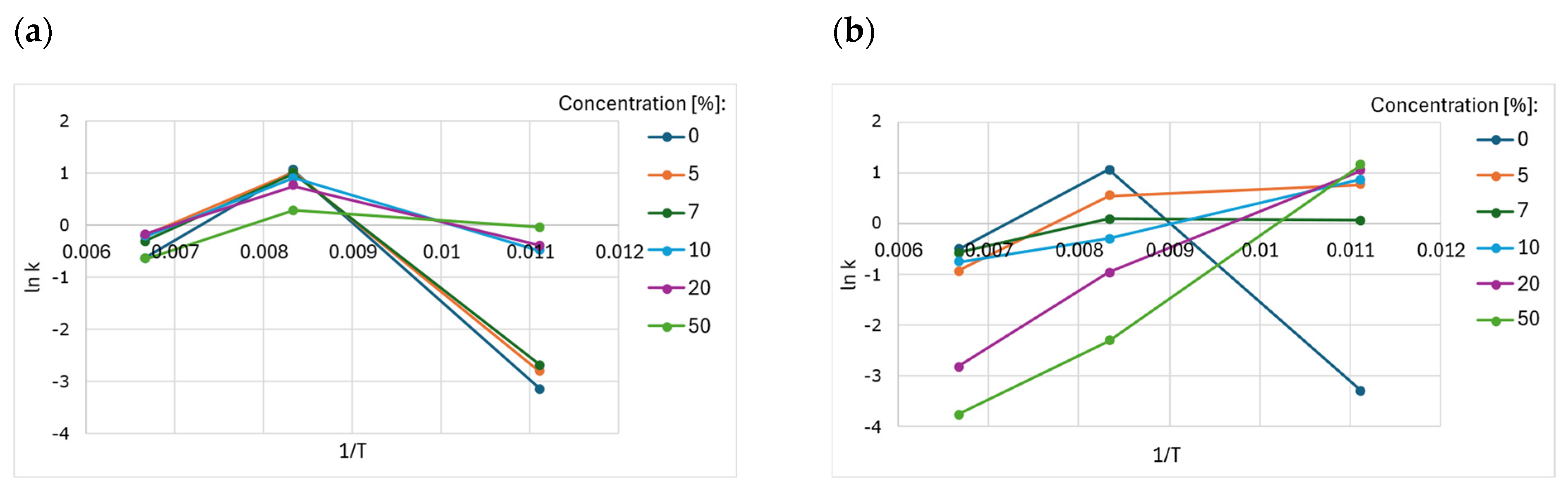
The temperature dependence of the rate constants is further illustrated by the Arrhenius plots ( l n k = l n A E a R T , equation in logarithmic form [33]) in Figure 3. Figure 3 shows Arrhenius plots of the apparent rate constants; colored markers denote different FAME concentrations in the diesel–FAME blends (0%, 5%, 7%, 10%, 20%, 50% v/v), as specified in the legend. For UCO-FAME blends (Figure 3a), a clear inflection point is observed around 120 °C, where the slope of the Arrhenius line changes. Below this temperature, the apparent activation energy corresponds to the formation of hydroperoxides, while above it the effective activation energy reflects the predominance of decomposition reactions. This inflection is characteristic of systems containing pre-oxidized components and radicals, where the oxidation mechanism shifts from initiation and propagation to rapid breakdown of unstable intermediates. For SFME blends (Figure 3b), the Arrhenius plots are more linear, especially at lower concentrations, suggesting a more uniform mechanism across the studied temperature range. The absence of a pronounced inflection point indicates that, in the case of SFME, the transition from formation-dominated to decomposition-dominated behavior is more gradual.
The combined analysis of Figure 1, Figure 2 and Figure 3 and Table 3 shows that peroxide value is strongly dependent on both temperature and FAME concentration, and that the oxidation behavior of diesel–FAME blends cannot be described solely by a simple increase in PV with time. At lower temperatures and moderate FAME contents, hydroperoxide formation dominates, particularly for SFME. At intermediate temperatures (120 °C), the balance between formation and decomposition becomes highly sensitive to FAME type and concentration, leading to non-monotonic PV trends, especially for SFME at high contents. At the highest temperature (150 °C), hydroperoxides are short-lived intermediates and their decomposition controls the process, resulting in low or decreasing PVs. The differences between UCO-FAME and SFME reflect the impact of feedstock history: UCO-FAME, derived from thermally treated oil, contains pre-oxidized structures that favor rapid decomposition of hydroperoxides and faster progression toward secondary oxidation products, while SFME, produced from refined oil, shows a more classical accumulation of hydroperoxides at moderate temperatures before significant decomposition occurs.

3.2. Anisidine Value

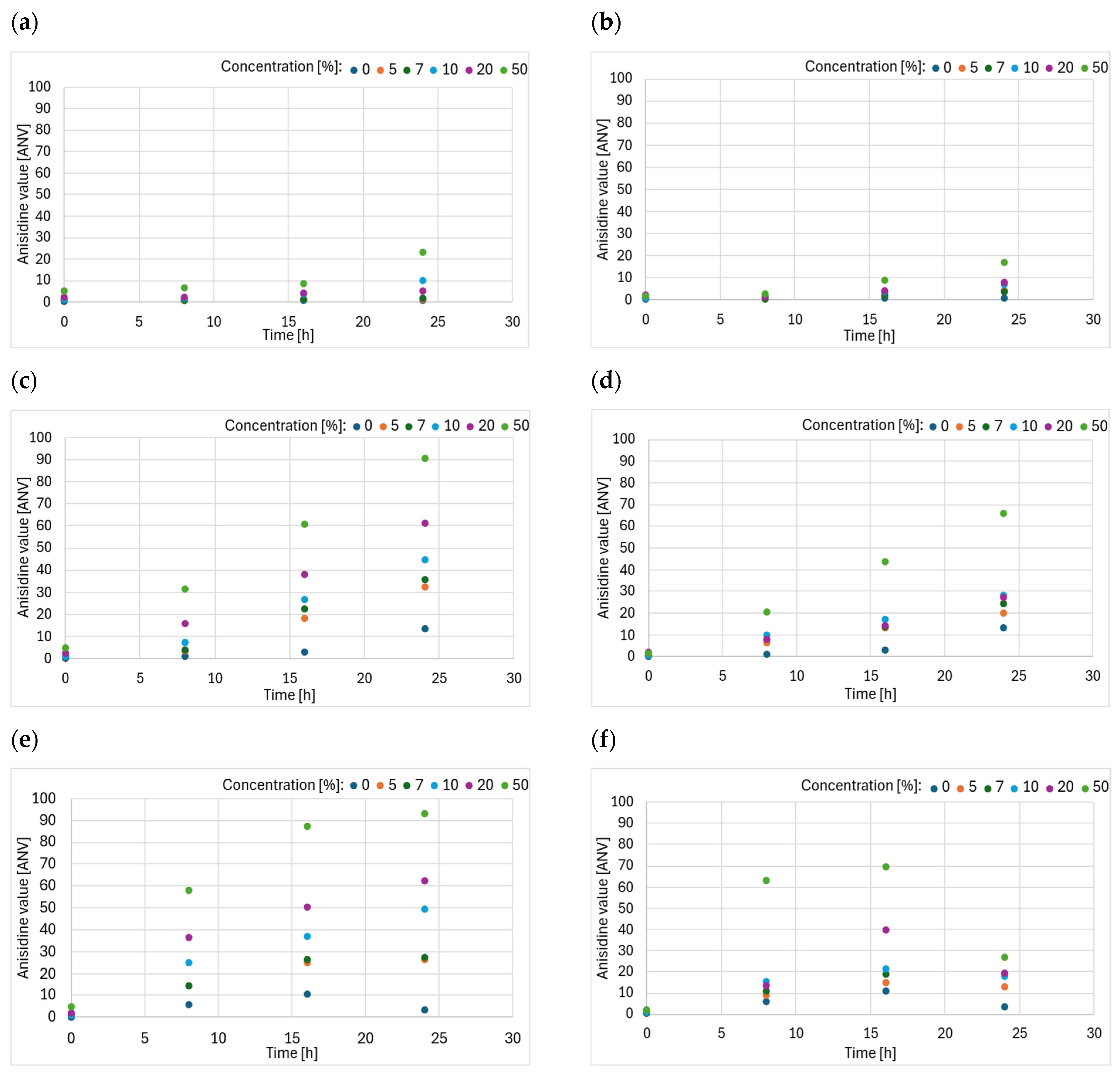
Changes in anisidine value (AV), presented in Figure 4, provide detailed insight into the formation and accumulation of secondary oxidation products, primarily aldehydes and ketones, during the thermal aging of diesel–FAME blends. The behavior of AV as a function of temperature, time and FAME concentration reveals clear differences between the two feedstocks and complements the peroxide value analysis by illustrating the progression from primary to secondary oxidation stages.
At 90 °C (Figure 4a,b), both UCO-FAME and SFME blends showed a gradual increase in AV with time, but the magnitude of this increase is significantly higher for UCO-FAME. After 24 h, UCO-FAME blends reach AVs several times higher than those of SFME blends at the same concentrations. These results show that UCO-FAME contains pre-existing oxidation intermediates that accelerate the conversion of hydroperoxides into aldehydes. Such behavior is consistent with the findings of Knothe & Gerpen [28] and Gui et al. [30], who reported that biodiesel produced from used cooking oil accumulates aldehydes more rapidly due to the presence of thermally degraded fatty acids. In contrast, SFME, derived from refined sunflower oil, exhibits a more gradual increase in AV, reflecting a slower progression of oxidation.
At 120 °C (Figure 4c,d), the differences between the two feedstocks became even more pronounced. UCO-FAME blends show a sharp increase in AV across all concentrations, indicating that hydroperoxide decomposition becomes the dominant process at this temperature. The rapid rise in AV suggests that the oxidation mechanism shifts toward radical-driven pathways, which are characteristic of pre-oxidized oils. SFME blends also show an increase in AV, but the effect is less pronounced, especially at lower concentrations (5–20%). Only at 50% FAME does SFME exhibit a strong increase in AV, indicating that high concentrations of polyunsaturated esters promote aldehyde formation under elevated temperatures.
At 150 °C (Figure 4e,f), both FAME types exhibit rapid increases in AV, but the effect remains significantly stronger for UCO-FAME. This confirms that at high temperatures the decomposition of hydroperoxides is extremely fast, and the system rapidly accumulates secondary oxidation products. The high AVs observed for UCO-FAME blends at 150 °C reflect the combined effect of pre-existing oxidation products and the thermal instability of unsaturated esters. SFME blends also show increased AV, but the rate of accumulation is lower, indicating that the oxidation mechanism is less influenced by prior thermal degradation.
The kinetic analysis presented in Table 4 supports these observations. For most conditions, the zero-order kinetic model provides a good fit, with high R2 values indicating a linear increase in AV with time. The rate constants for UCO-FAME are consistently higher than those for SFME, confirming that UCO-FAME produces secondary oxidation products more rapidly. At 90 °C, the rate constants for UCO-FAME were already significantly higher than those for SFME, reflecting the influence of pre-oxidized structures. At 120 °C and 150 °C, the rate constants for UCO-FAME increase sharply, while those for SFME increase more moderately. This demonstrates that the oxidation mechanism of UCO-FAME is more sensitive to temperature and shifts more rapidly toward aldehyde formation.
At 90 °C, the AV–time relationships for UCOME were mostly statistically non-significant (p > 0.05), indicating weak or irregular formation of secondary oxidation products, whereas SFME showed significant trends at several concentrations, reflecting a more reactive polyunsaturated profile. At 120 °C, both FAME types exhibited predominantly significant AV increases with time (p < 0.05), demonstrating that elevated temperature accelerates the formation of aldehydes and ketones in a more systematic manner. At 150 °C, statistical significance was again observed mainly at intermediate concentrations, while very low and very high FAME levels produced non-significant trends, suggesting competing formation and degradation pathways of secondary oxidation products. Overall, SFME displayed more consistent statistical significance across temperatures, whereas UCOME showed greater variability, reflecting differences in fatty-acid composition and the stability of intermediates formed during secondary oxidation.
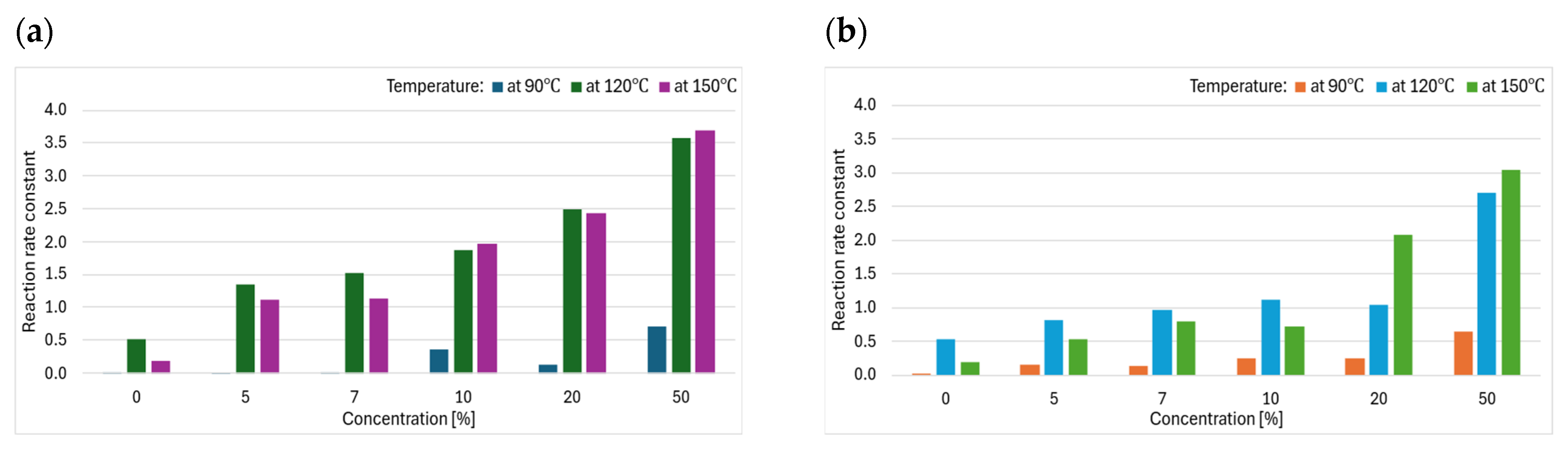
Figure 5 illustrates the dependence of the rate constants on FAME concentration. For UCO-FAME (Figure 5a), the rate constants increase steadily with concentration at all temperatures, indicating that higher proportions of UCO-FAME in the blend lead to faster accumulation of aldehydes. This reflects the combined effect of unsaturation level and the presence of pre-oxidized compounds. For SFME (Figure 5b), the rate constants remain relatively low and stable between 5% and 20% FAME, but increase sharply at 50% FAME, especially at 150 °C. This suggests that high concentrations of polyunsaturated esters in SFME promote aldehyde formation only under severe oxidation conditions.
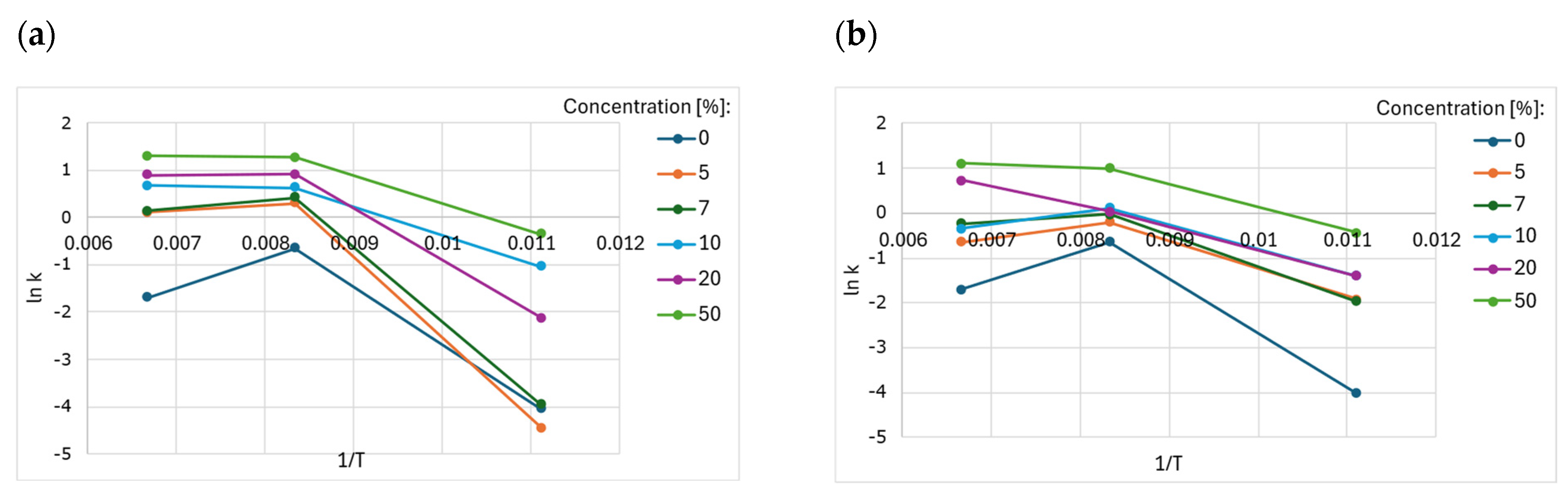
The temperature dependence of the rate constants is further illustrated in Figure 6, which presents Arrhenius plots for the formation of secondary oxidation products. For UCO-FAME blends (Figure 6a), a clear inflection point is observed around 120 °C, indicating a change in the dominant oxidation mechanism. Below this temperature, the apparent activation energy corresponds to the formation of aldehydes from hydroperoxides, while above it the effective activation energy reflects the predominance of radical-driven decomposition pathways. This behavior is characteristic of systems containing pre-oxidized components and aligns with the findings of Choe and Min [44], who described similar shifts in oxidation mechanisms for thermally degraded oils. For SFME blends (Figure 6b), the Arrhenius plots are more linear, indicating a more uniform oxidation mechanism across the studied temperature range. The absence of a pronounced inflection point suggests that the transition from formation-dominated to decomposition-dominated behavior is more gradual for SFME.
The combined analysis of Figure 4, Figure 5 and Figure 6 and Table 4 demonstrates that anisidine value is strongly dependent on both temperature and FAME concentration, and that the oxidation behavior of diesel–FAME blends is significantly influenced by the origin of the FAME. UCO-FAME, derived from thermally treated oil, exhibits rapid accumulation of secondary oxidation products due to the presence of pre-oxidized structures and radical-driven pathways. SFME, produced from refined oil, shows a more classical progression of oxidation, with slower accumulation of aldehydes at moderate temperatures and significant increases only at high concentrations and temperatures. These findings highlight the importance of feedstock selection in biodiesel production and demonstrate that UCO-FAME poses a higher risk of aldehyde accumulation, which can negatively affect fuel stability by increasing acidity, promoting polymer formation, and causing filter plugging.
The combined PV and AV results clearly show that the oxidation of diesel–FAME blends follows the typical sequence of lipid autoxidation, with the dominant reaction pathways shifting depending on temperature and feedstock origin. At 90 °C, hydroperoxide formation is the prevailing process, which is reflected in the steady increase in PV, particularly for SFME. This indicates that sunflower oil esters undergo classical autoxidation, where unsaturated chains readily form hydroperoxides. UCO-FAME behaves differently: despite forming hydroperoxides, it shows lower PV and higher AV, demonstrating that these intermediates decompose more rapidly into aldehydes. This is consistent with the presence of pre-oxidized structures in UCO-FAME.
At 120 °C, the oxidation pathway becomes more balanced between hydroperoxide formation and decomposition. UCO-FAME still shows increasing PV, but the simultaneous rise in AV indicates that decomposition becomes increasingly important. In SFME blends, especially at higher concentrations, PV stabilizes or decreases, which means that hydroperoxide breakdown exceeds formation. This behavior is typical for polyunsaturated esters at elevated temperatures, where hydroperoxides lose stability and rapidly convert into aldehydes and ketones.
At 150 °C, hydroperoxide decomposition dominates for both FAME types. PV remains low or decreases, while AV rises sharply, confirming that hydroperoxides are short-lived intermediates and the system quickly accumulates secondary oxidation products. The effect is strongest for UCO-FAME, which progresses faster toward aldehyde formation due to the presence of radical-initiating compounds originating from its thermal history.
The trends indicate that UCO-FAME undergoes accelerated oxidation, characterized by rapid hydroperoxide decomposition and early formation of secondary products, while SFME exhibits a more gradual progression with hydroperoxide accumulation at moderate temperatures. Such mechanistic differences explain the lower oxidative stability of UCO-derived FAME and highlight the importance of feedstock quality in biodiesel production.

4. Conclusions

The study demonstrated that the origin of the raw material used for FAME production has a decisive influence on the oxidation behavior and aging rate of diesel–FAME blends. FAME obtained from used cooking oil exhibited significantly higher initial peroxide and anisidine values than FAME produced from refined sunflower oil, confirming the presence of pre-oxidized structures formed during previous thermal processing. These initial differences strongly affected the oxidation kinetics of the blends during accelerated aging.
At 90 °C, blends containing sunflower oil FAME showed a faster increase in peroxide value, indicating a higher tendency to form primary oxidation products. In contrast, UCO-FAME blends exhibited lower peroxide values but consistently higher anisidine values across all temperatures, reflecting rapid decomposition of hydroperoxides into secondary oxidation products. At 120 °C and 150 °C, the oxidation mechanism shifted toward decomposition, particularly for UCO-FAME, which showed a clear inflection point in the Arrhenius plots, indicating a change in the dominant reaction pathway. This behavior is characteristic of feedstocks containing pre-oxidized compounds and aligns with observations reported in previous studies on thermally degraded oils.
The results confirm that UCO-FAME is more susceptible to accelerated formation of aldehydes and ketones, which may negatively affect fuel stability by increasing acidity and promoting polymer formation. Sunflower oil FAME, although more prone to forming hydroperoxides at moderate temperatures, showed slower progression toward secondary oxidation products. These findings highlight the need for careful evaluation of waste-derived feedstocks before their use in biodiesel production and demonstrate that the analytical approach applied in this study, combining peroxide value and anisidine value, provides a more informative assessment of oxidation processes than standard stability tests.
Importantly, the results also indicate that waste-derived feedstocks producing inherently unstable FAME may require additional upgrading steps, such as hydrogenation, to reduce the content of reactive unsaturated compounds and improve the oxidative stability of the resulting biohydrocarbons.
The PV–time and AV–time relationships, supported by statistically significant regressions in most conditions (p < 0.05), confirm the characteristic multi-stage autoxidation mechanism of FAME, with systematic hydroperoxide formation at lower temperatures and concurrent generation and degradation of secondary oxidation products at elevated temperatures. The observed PV, AV and p-value patterns reflect the intrinsic oxidative behavior of fatty acid methyl esters, indicating that the oxidation pathway itself does not preclude their use as biocomponents but highlights the need for appropriate control of oxidative stability under thermal stress.
The novelty of this work lies in the direct comparison of oxidation pathways for FAME originating from refined and waste-derived feedstocks under identical experimental conditions, supported by combined PV–AV analysis and kinetic interpretation. This unified approach enables clearer identification of mechanistic differences than previously reported studies focusing on single feedstocks or isolated temperature ranges.
The study also has limitations, including the use of only one type of waste-derived FAME, laboratory-scale blend preparation, and accelerated oxidation conditions that do not fully replicate long-term storage environments. These factors should be considered when extrapolating the results to real-world fuel systems.
Despite these limitations, the findings support sustainable development goals by promoting the safe and informed use of renewable components in diesel fuels. Improved understanding of oxidation behavior in waste-derived FAME contributes to more reliable integration of biodiesel into the fuel supply chain, reduces dependence on fossil resources, and aligns with strategies aimed at lowering greenhouse-gas emissions.
Future research should focus on extending the analysis to additional waste-derived feedstocks, evaluating the influence of antioxidants, and assessing long-term storage stability under real operating conditions.

Author Contributions

Conceptualization, P.G.; Methodology, P.G., I.W.; Validation, P.G., I.W.; Formal Analysis, M.S., M.K.; Investigation, P.G., M.S., M.K.; Resources, P.G.; Writing—Original Draft Preparation, P.G.; Writing—Review and Editing, I.W.; Visualization, P.G., I.W.; Supervision, P.G.; Project Administration, P.G.; Funding Acquisition, P.G. All authors have read and agreed to the published version of the manuscript.

Funding

The work was financed from the funds of the budget of the City of Plock, in connection with the Competition of the Mayor of the City of Plock for the financing of research grants implemented under the task “Cooperation with universities”.

Data Availability Statement

The original contributions presented in this study are included in the article. Further inquiries can be directed to the corresponding author.

Conflicts of Interest

The authors declare no conflicts of interest.

References

  1. European Parliament; European Council. Directive (EU) 2018/2001 of the European Parliament and of the Council of 11 December 2018 on the Promotion of the Use of Energy from Renewable Sources, L 328/82; European Parliament: Strasbourg, France; European Council: Brussels, Belgium, 2018. [Google Scholar]
  2. EN 590+A1; Automotive Fuels—Diesel—Requirements and Test Methods. ISO: Geneva, Switzerland, 2022.
  3. EN 14214; Liquid Petroleum Products—Fatty Acid Methyl Esters (FAME) for Use in Diesel Engines and Heating Applications—Requirements and Test Methods. ISO: Geneva, Switzerland, 2019.
  4. Mittelbach, M.; Remschmidt, C. Biodiesel: The Comprehensive Handbook; Boersedruck GmbH: Vienna, Austria, 2004. [Google Scholar]
  5. Knothe, G. Dependence of biodiesel fuel properties on the structure of fatty acid alkyl esters. Fuel Process. Technol. 2005, 86, 1059–1070. [Google Scholar] [CrossRef]
  6. Dunn, R.O. Cold weather properties and performance of biodiesel. J. Am. Oil Chem. Soc. 2005, 82, 895–903. [Google Scholar]
  7. Lapuerta, M.; Armas, O.; Rodríguez-Fernández, J. Effect of biodiesel fuels on diesel engine emissions. Prog. Energy Combust. Sci. 2008, 34, 198–223. [Google Scholar] [CrossRef]
  8. IEA. Transport Biofuels—Renewables 2023—Analysis; International Energy Agency: Paris, France, 2023; Available online: https://www.iea.org/reports/renewables-2023/transport-biofuels (accessed on 8 April 2026).
  9. Ma, F.; Hanna, M.A. Biodiesel production: A review. Bioresour. Technol. 1999, 70, 1–15. [Google Scholar] [CrossRef]
  10. Aransiola, E.F.; Ojumu, T.V.; Oyekola, O.O.; Madzimbamuto, T.; Ikhu-Omoregbe, D.I.O. A review of current technology for biodiesel production: State of the art. Biomass Bioenergy 2014, 61, 276–297. [Google Scholar] [CrossRef]
  11. Tang, H.; Wang, A.; Salley, S.O.; Ng, K.Y.S. The effect of natural and synthetic antioxidants on the oxidative stability of biodiesel. J. Am. Oil Chem. Soc. 2008, 85, 373–382. [Google Scholar] [CrossRef]
  12. Kongolo, E.; De Jager, D.; Ameh, A.E.; Oyekola, O. Improvement of the oxidation stability of biodiesel from waste cooking oil using various antioxidants. Res. Sq. 2023. [Google Scholar] [CrossRef]
  13. Kumar, S.; Singhal, M.K.; Sharma, M.P. Improvement of oxidation stability and cold flow properties of biodiesel using mixed oil strategy. Waste Biomass Valor. 2023, 15, 649–664. [Google Scholar] [CrossRef]
  14. Örs, İ. Experimental investigation of the cetane improver and bioethanol addition for the use of waste cooking oil biodiesel as an alternative fuel in diesel engines. J. Braz. Soc. Mech. Sci. Eng. 2020, 42, 177. [Google Scholar] [CrossRef]
  15. Saikia, N.; Sakunthalai, R.A.; Chakradhar, M.; Masilamani, S.; Maheshwari, M.; Saxena, D. Effects of high cetane diesel on combustion, performance, and emissions of heavy-duty diesel engine. Environ. Sci. Pollut. Res. 2023, 30, 61246–61256. [Google Scholar] [CrossRef]
  16. Santos, A.P.F.; da Silva, K.K.; Dweck, J.; d’Avila, L.A. Characterization of fuel detergent–dispersant additives by thermogravimetry. J. Therm. Anal. Calorim. 2018, 131, 783–788. [Google Scholar] [CrossRef]
  17. Daryono, E.D.; Wardana, I.N.G.; Cahyani, C.; Hamidi, N. Study of the interesterification process of palm oil into methyl esters with biocatalysts of aromatic compounds. Chem. Chem. Technol. 2025, 19, 473–481. [Google Scholar] [CrossRef]
  18. Encinar, J.M.; González, J.F.; Rodríguez-Reinares, A. Ethanolysis of used frying oil. Fuel Process. Technol. 2007, 88, 513–522. [Google Scholar] [CrossRef]
  19. Meher, L.C.; Vidya Sagar, D.; Naik, S.N. Technical aspects of biodiesel production by transesterification. Renew. Sust. Energy Rev. 2006, 10, 248–268. [Google Scholar] [CrossRef]
  20. ASTM D4625; Standard Test Method for Middle Distillate Fuel Storage Stability at 43 °C (110 °F). ASTM International: West Conshohocken, PA, USA, 2021.
  21. Ramos, M.J.; Fernández, C.M.; Casas, A.; Rodríguez, L.; Pérez, Á. Influence of fatty acid composition on biodiesel properties. Bioresour. Technol. 2009, 100, 261–268. [Google Scholar] [CrossRef]
  22. EN ISO 14112:2014; Fat and Oil Derivatives—Fatty Acid Methyl Esters (FAME)—Determination of Oxidation Stability (Accelerated Oxidation Test). ISO: Geneva, Switzerland, 2014.
  23. EN ISO 14104; Fat and Oil Derivatives—Fatty Acid Methyl Esters (FAME)—Determination of Acid Value. ISO: Geneva, Switzerland, 2021.
  24. EN ISO 3104; Petroleum Products—Transparent and Opaque Liquids—Determination of Kinematic Viscosity and Calculation of Dynamic Viscosity. ISO: Geneva, Switzerland, 2023.
  25. EN ISO 12662; Liquid Petroleum Products—Determination of Total Contamination in Middle Distillates. ISO: Geneva, Switzerland, 2024.
  26. Demirbas, A. Biodiesel from waste cooking oil via base-catalytic and supercritical methanol transesterification. Energy Convers. Manag. 2009, 50, 923–927. [Google Scholar] [CrossRef]
  27. Christensen, E.; McCormick, R.L. Long-term storage stability of biodiesel and biodiesel blends. Fuel Process. Technol. 2014, 128, 339–348. [Google Scholar] [CrossRef]
  28. Knothe, G.; Gerpen, J.V. The Biodiesel Handbook; AOCS Publishing: New York, NY, USA, 2005. [Google Scholar]
  29. Hoekman, S.K.; Broch, A.; Robbins, C. Review of biodiesel composition, properties, and specifications. Renew. Sust. Energy Rev. 2012, 16, 143–169. [Google Scholar] [CrossRef]
  30. Gui, M.M.; Lee, K.T.; Bhatia, S. Feasibility of edible oil vs. non-edible oil vs. waste edible oil as biodiesel feedstock. Energy 2008, 33, 1646–1653. [Google Scholar] [CrossRef]
  31. Graboski, M.S.; McCormick, R.L. Combustion of fat and vegetable oil derived fuels in diesel engines. Prog. Energy Combust. Sci. 1998, 24, 125–164. [Google Scholar] [CrossRef]
  32. Grabowski, P.; Szwarczyńska, A.; Nowakowska, A. Effect of FAME type on the rate of aging in the presence of oxygen. A preliminary study. Przemysł Chem. 2024, 103, 769–775. [Google Scholar]
  33. Grabowski, P.; Nowakowska, A. Anisidine value as oxidation stability indicator in FAME. Biofuel 2025, 16, 571–578. [Google Scholar] [CrossRef]
  34. EN ISO 3675; Crude Petroleum and Liquid Petroleum Products—Laboratory Determination of Density—Hydrometer Method. ISO: Geneva, Switzerland, 2004.
  35. EN 14103; Fat and Oil Derivatives—Fatty Acid Methyl Esters (FAME)—Determination of Ester and Linolenic Acid Methyl Ester Contents. ISO: Geneva, Switzerland, 2020.
  36. EN ISO 3960; Animal and Vegetable Fats and Oils—Determination of Peroxide Value—Iodometric (Visual) Endpoint Determination. ISO: Geneva, Switzerland, 2017.
  37. EN ISO 6885; Animal and Vegetable Fats and Oils—Determination of Anisidine Value. ISO: Geneva, Switzerland, 2016.
  38. Grabowski, P.; Szwarczyńska, A. Non-Normative Oxidation Stability Indication of FAME Produced from Rapeseed and Used Cooking Oil. Energies 2024, 17, 4210. [Google Scholar] [CrossRef]
  39. Morales, A.; Marmesat, S.; Dobarganes, M.C.; Marquez-Ruiz, M.; Velasco, J. Formation of Hydroperoxy-, Keto- and Hydroxy-Dienes in FAME from Oils: Influence of Temperature and Addition of a-Tocopherol. J. Am. Oil Chem. Soc. 2012, 89, 675–684. [Google Scholar] [CrossRef]
  40. ASTM D6751; Standard Specification for Biodiesel Fuel Blend Stock (B100) for Middle Distillate Fuels. ASTM International: West Conshohocken, PA, USA, 2020.
  41. Maszewska, M.; Florowska, A.; Dłużewska, E.; Wroniak, M.; Marciniak-Lukasiak, K.; Żbikowska, A. Oxidative Stability of Selected Edible Oils. Molecules 2018, 23, 1746. [Google Scholar] [CrossRef]
  42. Pyshyev, S.; Prysiazhnyi, Y.; Bilushchak, H.; Korchak, B.; Pochapska, I.; Yavorskyi, O. Creation of experimental-statistical and kinetic models of the coumarone-indene-carbazole resin production process. Results Eng. 2025, 25, 103689. [Google Scholar] [CrossRef]
  43. Sabliov, C.M.; Fronczek, C.; Astete, C.E.; Khachaturyan, M.; Khachatryan, L.; Leonardi, C. Effects of Temperature and UV Light on Degradation of a-Tocopherol in Free and Dissolved Form. J. Am. Oil Chem. Soc. 2009, 86, 895–902. [Google Scholar] [CrossRef]
  44. Choe, E.; Min, D.B. Mechanisms and Factors for Edible Oil Oxidation. Compr. Rev. Food Sci. Food Saf. 2006, 5, 169–186. [Google Scholar] [CrossRef]
Figure 1. Time dependence of peroxide value during aging at different temperatures for the petro-diesel:FAME blend at different concentrations: (a) UCO-FAME at 90 °C, (b) SFME at 90 °C, (c) UCO-FAME at 120 °C, (d) SFME at 120 °C, (e) UCO-FAME at 150 °C, (f) SFME at 150 °C.
Energies 19 02251 g001
Figure 2. Change in the constant rate of primary oxidation reaction of the fuel mixture depending on the concentration of FAME (a) from used frying oil and (b) from sunflower oil.
Energies 19 02251 g002
Figure 3. Dependence of the logarithm of the rate constant on the inverse of the temperature for the formation of primary oxidation products in fuel blends depending on the FAME concentration (a) from used frying oil and (b) from sunflower oil.
Energies 19 02251 g003
Figure 4. Time dependence of anisidine value during aging at different temperatures for the petro-diesel:FAME blend at different concentrations: (a) UCO-FAME at 90 °C, (b) SFME at 90 °C, (c) UCO-FAME at 120 °C, (d) SFME at 120 °C, (e) UCO-FAME at 150 °C, (f) SFME at 150 °C.
Energies 19 02251 g004
Figure 5. Constant rate changes in anisidine value (AV) during accelerated aging for diesel–FAME blends (a) from used frying oil and (b) from sunflower oil.
Energies 19 02251 g005
Figure 6. Dependence of the logarithm of the rate constant on the inverse of the temperature for the formation of secondary oxidation products in fuel blends depending on the FAME concentration (a) from used frying oil and (b) from sunflower oil.
Energies 19 02251 g006
Table 1. Comparison of the values of the properties of the FAME prepared from different oil and petro-diesel.
ParametersFAME from Used Cooking Oil
(UCO-FAME)
FAME from Sunflower Oil
(SFME)
Norm Values [3]Petro-DieselNorm Values [2]
Density in 15 °C, kg/m3891 ± 4893 ± 3860–900833 ± 3820–845
Kinematic viscosity in 40 °C, mm2/s4.45 ± 0.144.58 ± 0.243.50–5.003.54 ± 0.182.00–4.50
Total concentration of methyl esters, % v/v95.6 ± 0.894.9 ± 0.9min. 96.50.0 ± 0.0max. 7%
Peroxide number, meq O2/kg12.83 ± 2.114.94 ± 1.21Non-normative parameter0.99 ± 0.08Non-normative parameter
Anisidine number, AnV8.61 ± 0.531.11 ± 0.08Non-normative parameter0.69 ± 0.05Non-normative parameter
Acid number, mg KOH/g2.50 ± 0.243.52 ± 0.24max. 0.50.0 ± 0.0Non-normative parameter
Colorlight yellowlight yellowNon-normative parametertransparentNon-normative parameter
Table 2. Composition of fuel blend in % v/v and w/w used in studies.
Blend% v/v FAME% w/w FAME (UCO-FAME)% w/w FAME (SFME)
B55%5.33%5.34%
B77%7.45%7.47%
B1010%10.62%10.65%
B2020%21.09%21.14%
B5050%51.68%51.78%
Table 3. Analysis of kinetic equations based on changes in peroxide value.
FAME from Used Cooking OilFAME from Sunflower Oil
Temperature = 90 °C
Conc. [%]Zero order kinetic equationR2p-valueConc. [%]Zero order kinetic equationR2p-value
0c = 0.0432t + 0.09840.89100.02810c = 0.0371t + 0.04980.90440.0245
5c = 0.0600t + 1.98500.99920.00025c = 2.1617t − 5.80440.92490.0192
7c = 0.0677t + 2.45700.92090.02027c = 1.0680t − 0.38460.97130.0073
10c = 0.6149t + 0.50620.83130.044110c = 2.3694t − 2.92420.96990.0076
20c = 0.6740t + 1.05700.85090.038820c = 2.8480t − 0.06730.97320.0067
50c = 0.9584t + 4.10400.94750.013350c = 3.1557t + 3.54380.97100.0073
Temperature = 120 °C
Conc. [%]Zero order kinetic equationR2p-valueConc. [%]Zero order kinetic equationR2p-value
0c = 2.8724t + 5.61670.95260.0120c = 2.8724t + 5.61670.95260.012
5c = 2.7580t + 3.39400.87260.03295c = 1.7189t + 10.33800.72450.0744
7c = 2.7186t + 3.70900.87250.0337c = 1.0967t + 8.62480.60720.1104
10c = 2.4920t + 6.47100.84310.040910c = 0.7387t + 9.87490.38960.1879
20c = 2.1523t + 9.01800.86020.036320c = 0.3806t + 7.35540.32510.2149
50c = 1.3305t + 10.99900.80010.052850c = 0.0994t + 7.21180.04010.3999
Temperature = 150 °C
Conc. [%]Zero order kinetic equationR2p-valueConc. [%]Zero order kinetic equationR2p-value
0c = 0.5331t + 3.75710.59140.11550c = 0.5997t + 1.62510.71180.0782
5c = 0.8163t + 3.61210.84220.04125c = 0.3929t + 4.18180.27960.2356
7c = 0.7334t + 6.50700.73920.07017c = 0.5617t + 3.22340.57890.1196
10c = 0.8083t + 5.94100.81990.047310c = 0.4662t + 0.25000.89530.0269
20c = 0.8415t + 5.70700.85150.038620c = 0.0595t + 2.74700.33780.2094
50c = 0.5219t + 7.36000.83340.043650c = 0.0231t + 4.43590.01290.4432
Table 4. Analysis of kinetic equations based on changes in anisidine value.
FAME from Used Cooking OilFAME from Sunflower Oil
Temperature = 90 °C
Conc. [%]Zero order kinetic equationR2p-valueConc. [%]Zero order kinetic equationR2p-value
0c = 0.0174t + 0.35910.66550.09210c = 0.0180t + 0.36460.64910.0921
5c = −0.0116t + 1.20530.56810.12325c = 0.1459t + 0.12590.92820.0183
7c = 0.0191t + 0.90110.37780.19277c = 0.1389t − 0.06200.83870.0421
10c = 0.3548t − 0.19000.81630.048310c = 0.2466t + 0.25430.95490.0114
20c = 0.1183t + 1.91280.90550.024220c = 0.2463t + 0.65570.76520.0626
50c = 0.7034t + 2.19410.76530.062650c = 0.6429t − 0.25820.89930.0259
Temperature = 120 °C
Conc. [%]Zero order kinetic equationR2p-valueConc. [%]Zero order kinetic equationR2p-value
0c = 0.5217t − 1.76120.77480.05990c = 0.5217t − 1.76120.77480.0599
5c = 1.3464t − 2.33360.92970.01795c = 0.8129t + 0.33550.99950.0002
7c = 1.5267t − 2.52940.93740.01597c = 0.9687t + 0.02740.98550.0037
10c = 1.8682t − 2.57230.95990.010210c = 1.1212t + 0.46870.99410.0015
20c = 2.4921t − 0.53700.98700.003320c = 1.0331t + 0.48660.96160.0097
50c = 3.5710t + 3.94130.99940.000250c = 2.6963t + 0.61260.99800.0005
Temperature = 150 °C
Conc. [%]Zero order kinetic equationR2p-valueConc. [%]Zero order kinetic equationR2p-value
0c = 0.1838t + 2.93940.17780.28920c = 0.1838t + 2.93940.17780.2892
5c = 1.1107t + 2.84810.91550.02165c = 0.5281t + 2.90680.74880.0674
7c = 1.1410t + 3.83860.90600.02417c = 0.7892t + 2.75090.87910.0312
10c = 1.9575t + 4.76810.96580.008610c = 0.7110t + 5.17250.66120.0935
20c = 2.4391t + 8.67360.93250.017220c = 2.0818t + 0.95960.96450.0090
50c = 3.6833t + 16.72200.88480.029750c = 3.0294t + 17.21700.78640.0566
Disclaimer/Publisher’s Note: The statements, opinions and data contained in all publications are solely those of the individual author(s) and contributor(s) and not of MDPI and/or the editor(s). MDPI and/or the editor(s) disclaim responsibility for any injury to people or property resulting from any ideas, methods, instructions or products referred to in the content.