Article

Thermal Characterization of a Stainless Steel Flat Pulsating Heat Pipe and Benchmarking Against Copper


by
Larissa Krambeck
1,2,*,
Kelvin Guessi Domiciano
1,
Maria Eduarda Beé
1,
Marco Marengo
2 and
Marcia Barbosa Henriques Mantelli
1
1
Heat Pipe Laboratory, Department of Mechanical Engineering, Federal University of Santa Catarina, Florianopolis 88040-900, Brazil
2
Department of Civil Engineering and Architecture, University of Pavia, 27100 Pavia, Italy
*
Author to whom correspondence should be addressed.
Energies 2026, 19(1), 45; https://doi.org/10.3390/en19010045 (registering DOI)
Submission received: 30 October 2025 / Revised: 6 December 2025 / Accepted: 17 December 2025 / Published: 21 December 2025

Abstract

Copper is widely used in two-phase devices for electronic cooling due to its ease of manufacture and high thermal conductivity. However, such high-heat conduction can limit the performance of pulsating heat pipes (PHPs) through transverse heat leakage. The use of lower-conductivity materials such as stainless steel enhances phase-change heat transfer by promoting stronger flow oscillations and reducing parasitic heat leakage, but it may be overall detrimental due to its poor thermal linkage between evaporator and condenser sections. Therefore, in this study, two main objectives are addressed: (i) experimentally characterizing the thermal behavior of a mini flat-plate PHP made of stainless steel (AISI 316L), and (ii) benchmarking its performance against a copper counterpart. Both devices were manufactured by diffusion bonding and tested under different orientations to evaluate operational robustness. The stainless steel PHP initiated oscillations at lower heat loads and showed larger temperature oscillations compared to the copper PHP, demonstrating effective phase-change heat transfer despite its lower thermal conductivity. A filling ratio of 71% of water provided the most stable operation, while orientation affected startup conditions and oscillation amplitude. Overall, stainless steel achieved comparable thermal performance to copper at low-to-moderate heat loads from 2.6 to 13.0 W/cm2, with additional benefits including reduced mass (~11% lighter), higher mechanical strength, and corrosion resistance. These results indicate that stainless steel is a viable alternative to copper at least for miniature flat-plate PHPs, offering a balance between thermal efficiency, mechanical robustness, and operational reliability.

1. Introduction

Pulsating heat pipes (PHPs), also referred to as oscillating heat pipes (OHPs), transfer heat through the oscillatory motion of confined liquid slugs and vapor bubbles (plugs) within a closed-loop system composed of interconnected channels. Unlike conventional heat pipes, PHPs do not rely on a capillary structure for fluid circulation, which is a distinctive feature of their operation [1]. Most pulsating heat pipes reported in the literature are manufactured using multiple U-shaped turns of round tubes due to their ease of fabrication [2,3]. However, while this configuration is suitable for certain applications, it is not appropriate for others because of the high contact resistance associated with round tubes. Flat configurations are preferred in electronic applications because their geometry improves surface contact and reduces thermal contact resistance [4]. The operating principle is illustrated in Figure 1.
In a PHP, the two phases of the working fluid—liquid slugs and vapor bubbles—exist in quasi-equilibrium, allowing the internal pressures to be approximated by the saturation pressure corresponding to the device’s operating temperature [5]. When heat is applied to the evaporator section, the high temperature causes the thin liquid layer surrounding the vapor bubbles to evaporate, increasing the local pressure. Conversely, in the condenser section, the lower temperature promotes vapor condensation, reducing the local pressure. This pressure imbalance drives the back-and-forth motion of the liquid slugs and vapor plugs, establishing a pulsating flow cycle [6]. This mechanism enables PHPs to handle high and/or concentrated heat fluxes. However, their operation typically involves a delayed startup, as initiating the thermodynamic cycle of the working fluid—particularly the displacement of large vapor bubbles—requires a significant temperature difference [7].
Copper is widely used in two-phase devices for electronic cooling due to its ease of manufacture and high thermal conductivity [8,9,10]. However, excessive conduction can limit phase-change performance in flat pulsating heat pipes (PHPs) through transverse heat leakage, particularly during the startup process. This startup phase requires substantial heat input to initiate oscillations, during which the phase change of the working is not yet effective. Under these conditions, heat is primarily transferred by conduction between adjacent channels, causing a homogenization of the evaporator temperature and reducing the temperature gradients necessary to drive the oscillating slug-annular flow—a critical mechanism for efficient heat transfer [11]. Consequently, in high-conductivity materials such as copper, this effect can delay the onset of PHP operation or reduce device performance, particularly under low or localized heating conditions. In addition, transverse heat conduction can induce localized dry-out, which may ultimately lead to a complete cessation of the two-phase oscillating motion [3].
Although several groups studied different case material for tubular PHPs as copper [12], aluminum [13,14,15], and stainless steel [16,17,18], copper remains the most extensively studied and commonly used material in the literature for flat plate heat pipes [19,20,21,22,23].
The use of lower-conductivity materials may enhance phase-change heat transfer by promoting stronger flow oscillations and reducing parasitic heat leakage. In addition, selecting suitable materials involves balancing multiple factors, including lower weight, reduced cost, higher mechanical strength, and chemical compatibility with the working fluid—challenges that are particularly critical in miniaturized devices. In this scenario, stainless steel emerges as a promising option. Furthermore, using stainless steel supports broader sustainability goals. A Life Cycle Assessment (LCA) by Monticelli et al. [24] demonstrated that replacing copper with stainless steel in systems employing loop heat pipes can significantly diminish environmental impact, especially in terms of resource extraction and material processing. This strategy mitigates the peak impacts associated with copper-based designs and promotes more environmentally responsible thermal management solutions.
Despite these advantages, implementing stainless steel, particularly in miniaturized flat plate PHPs, can lead to significant changes in thermal performance due to the operating characteristics of PHPs. Specifically, the material properties influence in the heat available for phase change, which affects bubble formation and, in turn, impacts fluid dynamics, flow patterns, and startup behavior. The literature has not sufficiently explored these effects, nor compared stainless steel PHPs to copper-based devices, to assess both limitations and potential performance improvements. In practice, material selection is often based primarily on compatibility with the working fluid at the operating temperature and ease of manufacturing, rather than on how the case material itself can influence device performance [25,26].
In the context of flat PHPs, only a few studies have investigated the use of stainless steel as the casing material. Wits et al. [27] evaluated the thermal performance of a 316L stainless steel flat PHP featuring twelve 2 × 2 mm parallel channels and tested with three different working fluids: water, methanol, and ammonia. Among them, ammonia exhibited reduced oscillations and the best thermal performance; however, the device operated only in the gravity-assisted orientation, failing to function when the evaporator and condenser were positioned at the same level.
Comparative studies involving different casing materials are also limited. To the best of the authors’ knowledge, only Malla et al. [28,29] have addressed this topic. Although Malla et al. [28,29] compared flat plate PHPs made of stainless steel and copper, their designs are not directly applicable to electronic cooling applications. Their prototypes employed 5 mm-thick plates, which exaggerated the influence of the casing material, and incorporated a glass cover for flow visualization. While this configuration enabled direct observation of the flow behavior, it compromised the accuracy of the thermal performance assessment. Despite these limitations, their findings revealed that stainless steel promoted higher fluid velocities at lower heat inputs and enhanced pulsating motion, suggesting potential advantages in replacing copper with stainless steel. Furthermore, they demonstrated that lower thermal conductivity improves pulsating action and reduces fluid flow resistance, whereas higher thermal conductivity decreases the spreading (dry) resistance but weakens the pulsating behavior.
Overall, flat-plate PHPs made entirely of stainless steel remain scarcely investigated in the literature. To date, the study by Wits et al. [27] is the only one that analyzed a fully stainless steel device, and regarding comparative evaluations, only Malla et al. [28,29] have experimentally examined how the casing material’s effective thermal conductivity influences PHP performance. These observations reveal two clear research gaps.
Accordingly, to address these gaps, the present work aims to achieve two main objectives: (i) an experimental characterization of the thermal behavior of a miniature stainless steel flat plate pulsating heat pipe, and (ii) a performance benchmarking against a copper device.
To this end, a stainless steel mini PHP was fabricated using diffusion bonding and subjected to a series of thermal tests. The device dimensions were selected to be representative of typical configurations used in electronic cooling applications. Its thermal performance was then compared with that of a copper device, also manufactured by diffusion bonding, following the same design, dimensions, and experimental conditions in order to ensure a fair comparison.
In this way, it can be stated that the proposed work relies on two innovative aspects: the fabrication of a novel stainless steel pulsating heat pipe using an advanced technique such as diffusion bonding, and the direct comparison of PHP thermal performance by changing only the casing material—from stainless steel to copper—while keeping the geometry identical. The outcomes of this study provide a deeper understanding of the influence of wall material properties on PHP thermal behavior and demonstrate the potential advantages of stainless steel for advanced cooling applications.

2. Materials and Methods

The methodology adopted for the design, fabrication, and testing of the stainless steel two-phase device is described in this section. The objective was to develop a miniaturized flat pulsating heat pipe (PHP) suitable for electronic cooling applications in compact systems.
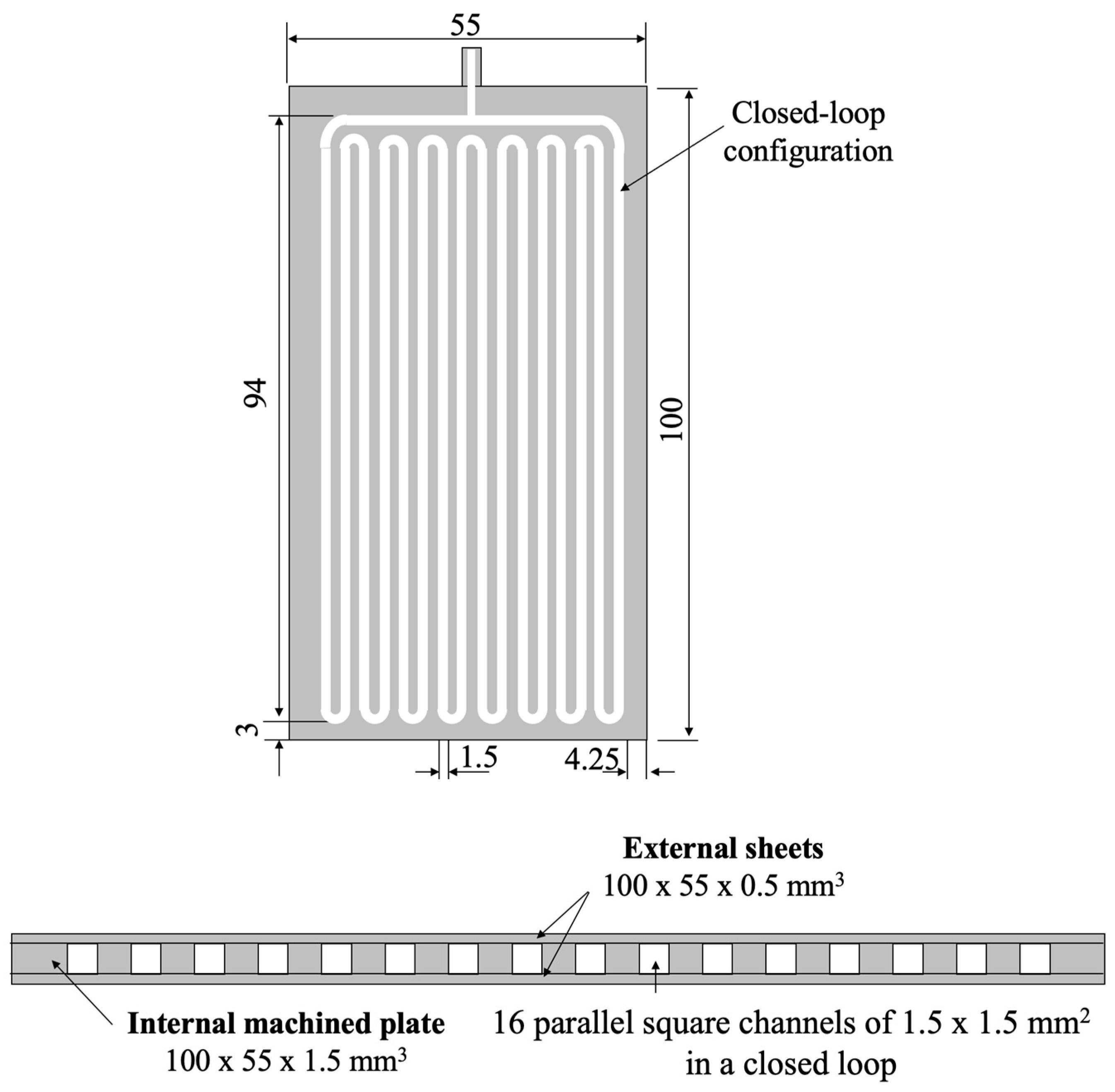
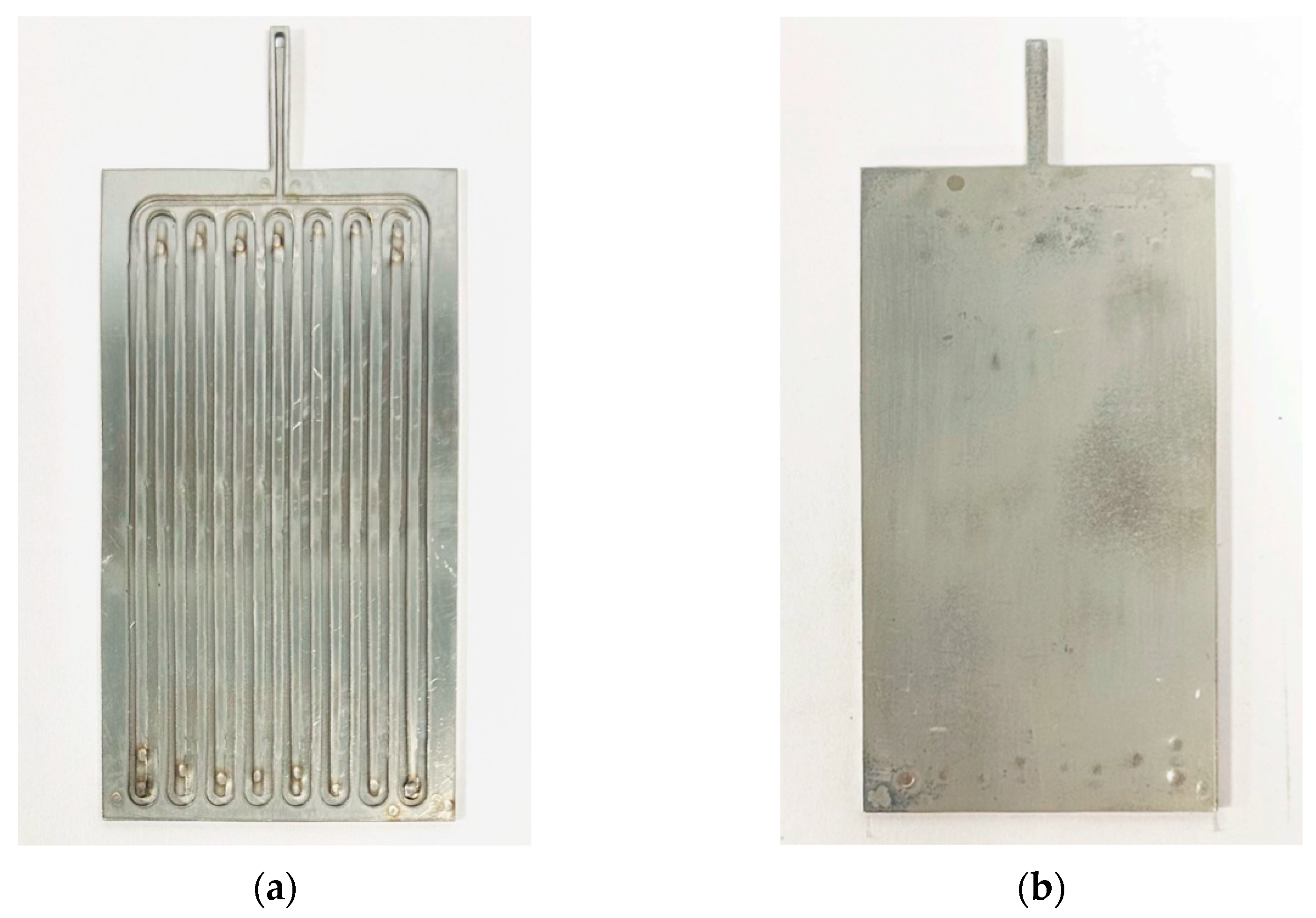
The stainless steel PHP (AISI 316L) was designed with external dimensions of 100 × 55 mm and a closed-loop internal configuration consisting of 16 square channels, each with a 1.5 mm side length, as detailed in Figure 2. The device was fabricated by stacking flat AISI 316L plates, which were first subjected to electropolishing to improve surface roughness and flatness and to ensure optimal bonding quality (approximately 0.1 mm was removed from each plate). The plates were then preliminarily joined by spot welding and subsequently diffusion bonded to achieve hermetic sealing and structural integrity. The internal plate was precisely shaped by waterjet cutting to define the channel network. It was 1.5 mm thick, while the external plates were 0.5 mm-thick, resulting in a compact sandwich structure of only 2.5 mm (Figure 2).
A detailed view of the internal plate, captured just before the closing plate was positioned, is presented in Figure 3a.
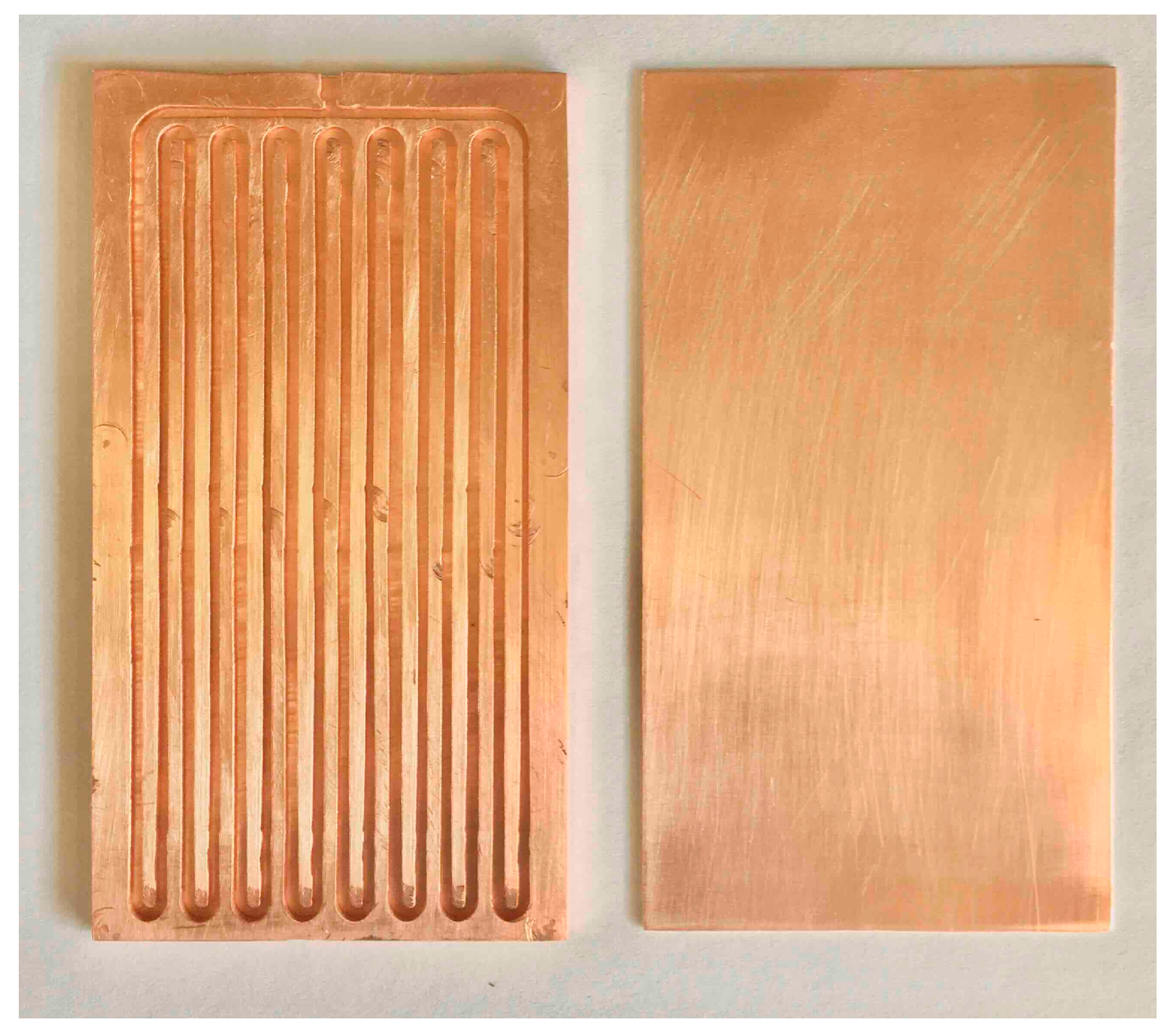
For benchmarking purposes, a copper PHP with identical design and dimensions, previously fabricated and characterized in earlier studies [30,31], was later tested under the same conditions to enable a direct material-to-material performance comparison. Importantly, both the stainless steel and copper devices share exactly the same channel geometry (rectangular cross-section of 1.5 × 1.5 mm), ensuring that any observed differences in thermal behavior originate solely from the wall material properties rather than from variations in channel shape. In addition, both devices were manufactured using the same sequence of fabrication steps—waterjet cutting of the internal plate, spot welding for preliminary joining, and final diffusion bonding—thus ensuring that the production route was identical. Material-dependent adaptations were required within this sequence, most notably the electropolishing step applied only to the stainless steel plates to prepare the surfaces for diffusion bonding and the specific bonding cycles tailored to each material, which are detailed in Table 1. The only design-related difference between the two devices lies in the filling tube: for the stainless steel PHP, the capillary had to be incorporated during diffusion bonding, as post-assembly machining is challenging at the miniature scale, whereas in the copper PHP, the capillary was added later through brazing. Figure 4 illustrates the copper plates at the same stage of assembly as the stainless steel device, immediately before the closing plate was attached.

2.1. Manufacturing of Flat PHPs

Both devices were fabricated through diffusion bonding in a Jung® furnace (JUNG Brasil, Blumenau, SC, Brazil) at the Heat Pipe Laboratory, Federal University of Santa Catarina (UFSC), following a procedure developed in-house. The thermal cycle consisted of the simultaneous application of heat and pressure for a defined period to form a monolithic structure [32]. The fabrication procedure was identical for both materials; only the diffusion-bonding cycle parameters differed, as required by the thermal and mechanical properties of each material. The specific cycle parameters varied according to the material and are summarized in Table 1.
Pressure was applied using stainless steel matrices and screws, with the reported values corresponding to those applied at room temperature. The process was conducted in an inert atmosphere composed of 95% argon and 5% hydrogen. During the thermal cycle, atomic diffusion occurs at the mating surfaces, producing a hermetically sealed solid piece with an internal closed channel network. This technique enables the fabrication of miniaturized devices with high structural integrity and very low thermal resistance at the bonded interfaces [33]. The final stainless steel PHP obtained after diffusion bonding is shown in Figure 3b. The resulting characteristics of both devices are summarized in Table 1.
The first point to note is that the stainless steel (AISI 316L) PHP is approximately 10.8% lighter than the copper PHP for the same geometry. Although both devices share identical overall geometry and internal configuration, slight dimensional deviations were observed, primarily due to differences in the flat plates and fabrication procedures. For the stainless steel PHP, the designed plate thickness was 2.50 mm, whereas the final measured thickness was 2.28 mm. This reduction of approximately 9% resulted from the electropolishing process (about 0.1 mm removed from each plate), which was used to prepare the surfaces for diffusion bonding, and from the diffusion bonding itself (around 0.02 mm), which causes microstructural coalescence and compaction. Consequently, the stainless steel device exhibited slightly smaller external dimensions and a lower mass than expected, the designed mass was 83.32 g, while the final measured mass was 65.55 g.
Additionally, the copper and stainless steel closing plates had slightly different thicknesses (the copper closing plate was 0.55 mm thicker), and no electropolishing was applied to the copper parts, further contributing to the observed discrepancy. Variations in the internal void volume were also identified, mainly attributed to the waterjet cutting and electropolishing processes, which caused an increase of up to 20% in the channel width. These manufacturing deviations led to an overall internal volume difference of approximately 32% compared to the copper PHP.
Distilled and deionized water was chosen as the working fluid due to its high latent heat of vaporization, excellent material compatibility, and the fulfillment of the confinement condition for a 1.5 mm hydraulic diameter, as confirmed by the Bond number criterion [34].

2.2. Experimental Setup

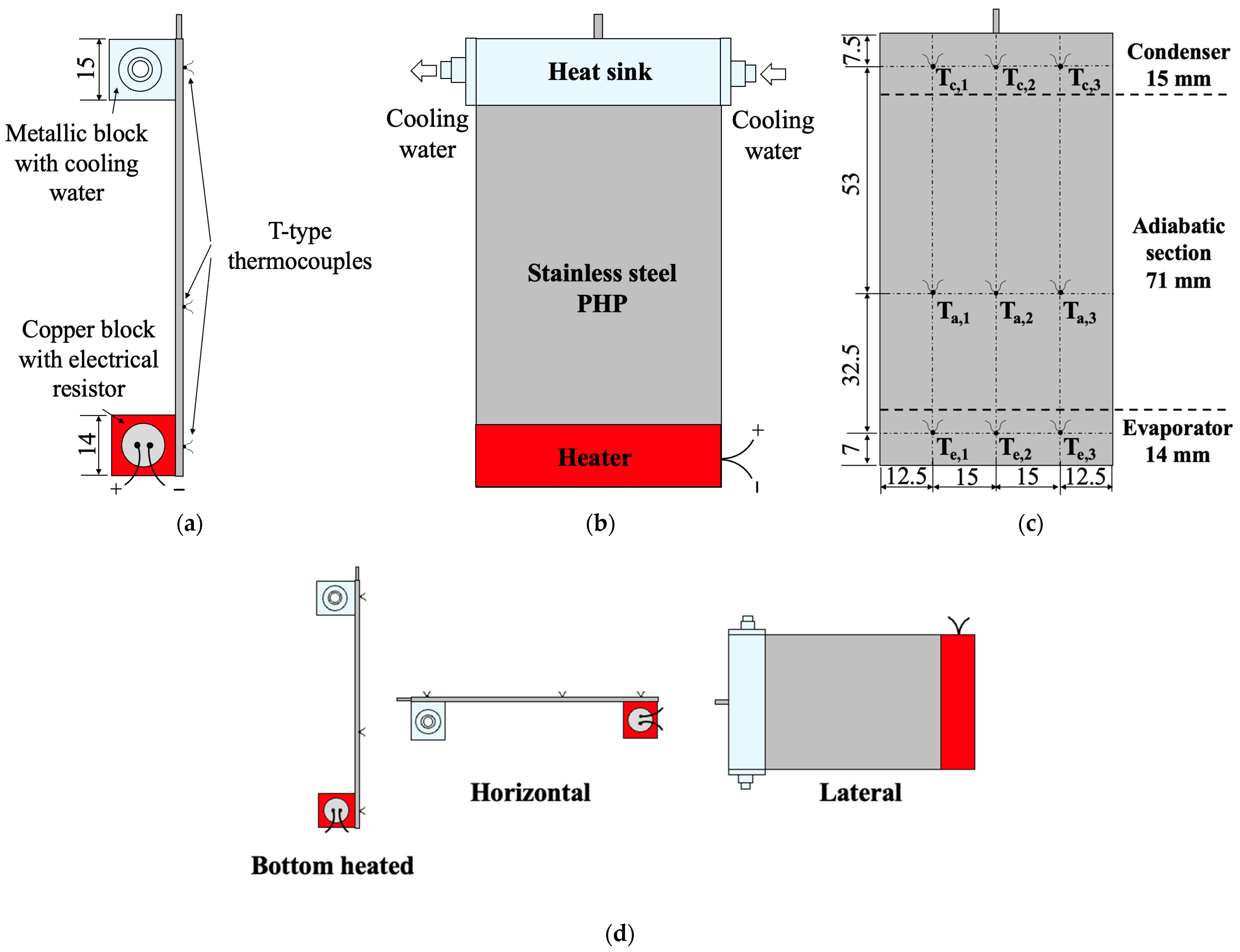
For the thermal experiments, the PHP was divided into three distinct regions: an evaporator of 14 mm, an adiabatic section of 71 mm, and a condenser of 15 mm. Figure 5a presents the schematic design of the experimental setup. Heat was applied to the evaporator at one end of the PHP, simulating the heat generated by an electronic chip, using a copper block (14 × 55 × 14 mm3) with an electrical cartridge resistor (maximum 500 W, 200 Ω, 10 mm diameter, 60 mm length) via the Joule effect. The resistor was powered by a TDK-Lambda® GEN300-17 (TDK-Lambda Americas Inc., San Diego, CA, USA) power supply.
As a heat sink, cooling water at 20 °C with a flow rate of 4 L/min from a Lauda Ecoline® RE212 thermal bath (LAUDA DR. R. WOBSER GMBH & CO. KG, Lauda-Königshofen, Germany) circulated through a metallic block (15 × 55 × 22 mm3) attached to the condenser section at the opposite end of the PHP, as shown in Figure 5b.
On the external surface of the PHP, T-type thermocouples (Omega Engineering Inc., Norwalk, CT, USA) were distributed along each region, as indicated in Figure 5c. The thermocouples were secured with Kapton® tape (DuPont™, Wilmington, DE, USA). Temperature measurements were recorded using a DAQ system (NI® SCXI-1000, National Instruments Corp., Austin, TX, USA) connected to a Dell® computer (Dell Computadores do Brasil Ltda., São Paulo, Brazil), with a sampling rate of 1 sample per second [35,36,37,38]. Data acquisition and preliminary signal processing were performed in LabVIEW 2013 (National Instruments Corp., Austin, TX, USA), while all subsequent data analysis were conducted in Microsoft Excel (Microsoft 365) to ensure reproducible processing of the temperature signals.
The experimental setup was insulated with a 30 mm thick Isoglass® blanket (Isoglass Indústria e Comércio Ltda., São Paulo, Brazil), with a thermal conductivity of 0.045 W/m·°C at 100 °C, to minimize heat losses to the environment.

2.3. Experimental Procedure

Once the device had been properly installed in the experimental setup, the tests were conducted. Initially, the PHP was evacuated using a vacuum pump (Edwards® T-Station 85, Edwards Vacuum, Crawley, UK) until the internal pressure dropped below 4 × 10⁻⁵ mbar. Subsequently, the device was charged with distilled and deionized water at different filling ratios, as previously mentioned, followed by a purging step to eliminate any non-condensable gases.
Once the preparation was completed, the experimental tests were carried out. The PHP was positioned in the desired orientation, and the thermal load was applied in increments of 10 W (1.3 W/cm2), starting from 10 W, until the evaporator temperature reached 100 °C, at which point the power supply was turned off. However, preliminary exploratory tests revealed that oscillations did not initiate when the evaporator temperature approached 100 °C. For this reason, the upper temperature limit was increased to 150 °C during the startup phase, after which stable oscillatory motion was successfully established. This empirically determined threshold was therefore adopted as the startup temperature limit for all experiments. The heat flux was calculated by dividing the supplied power by the heater surface area (770 mm2). Each power level was maintained for 600 s to ensure steady-state operation.
All tests were repeated three times under identical conditions. A test was considered repeatable when the temperature readings at each section differed by less than 0.5 °C between tests. Steady state was defined as temperature fluctuations within ± 0.1 °C sustained for one minute, indicating that the device had reached a stable operating condition. For operating regimes classified as unstable, the same one-minute criterion cannot be applied because the PHP naturally exhibits large temperature oscillations. In these cases, steady state was instead defined as a statistically stationary oscillatory regime. Based on the recorded data, individual oscillation cycles typically lasted around 3 min. Therefore, a measurement window of 10 min was sufficient to capture several complete oscillation cycles, providing a representative average of the unstable operation.
The experimental tests were divided into three main studies, summarized in Table 2:
  • Filling Ratio Study: The effect of working fluid volume on the heat transfer performance of the stainless steel mini PHP was investigated. Various filling ratios were tested to identify the optimal fluid volume, defined as the ratio of working fluid to the total internal channel void volume. Baseline tests were also conducted without fluid, where heat transfer occurred solely via conduction.
  • Orientation Effect: The impact of gravity was investigated by testing the mini-PHP in three orientations: horizontal, vertical bottom-heated (evaporator below condenser), and lateral (condenser and evaporator side by side), as illustrated schematically in Figure 5d. The optimum filling ratio identified from Test I was used for these experiments.
  • Benchmarking Comparison: The thermal performance of the stainless steel PHP was compared with that of a copper mini-PHP under identical operating conditions. Both devices were tested using the same filling ratio to ensure that any differences in thermal behavior were attributed solely to the tube material rather than variations in the amount of working fluid. Maintaining an identical filling ratio was essential to allow a fair comparison.
The liquid volume was measured using a 2 mL graduated pipette with a resolution of ±0.02 mL and a maximum uncertainty of ±0.01 mL, resulting in an overall liquid volume uncertainty of ±0.01 mL.

2.4. Data Reduction

The temperature distribution was employed to characterize the thermal behavior of both devices under different conditions. Also, the overall thermal resistance, R, was calculated to assess the PHP efficiency and compare their thermal performances, defined as:
R = T ¯ e T ¯ c q = T ¯ e T ¯ c U · I ,
where T ¯ e and T ¯ c represent the average temperatures of the evaporator and condenser, respectively, and q is the applied heat load supplied and measured from the power supply output, using the parameters: U (voltage) and I (electrical current). The influence of heat losses to the surroundings was considered negligible, since their measurements showed values less than 1% of the input power. The average evaporator temperature was calculated using the readings from three thermocouples placed along the evaporator section: Te,1, Te,2, Te,3. Similarly, the average condenser temperature was determined from three thermocouples positioned along the condenser section: Tc,1, Tc,2, Tc,3.
Experimental uncertainties, δ, were evaluated using the error propagation method, as proposed by Kline and McClintock [39], calculated by:
δ ( x ) 2 = i = 1 n ( f x i δ ( x i ) ) 2
where x is the variable related to an uncertainty, and f is the function used to estimate the measured variable.
The uncertainties included contributions from the thermocouples, data acquisition system, and power supply unit. The temperature sensors were calibrated within the experimental setup, and the combined uncertainties for temperature, voltage, and electric current are summarized in Table 3. In the presented results, the vertical error bars represent the calculated uncertainties of the thermal resistance.

3. Results and Discussion

This section presents and discusses the experimental results obtained from the stainless steel flat pulsating heat pipe. The analysis focuses on the influence of the filling ratio on the thermal performance of the stainless steel PHP and the effect of device orientation on startup and steady-state behavior. In addition, a benchmarking comparison between stainless steel and copper flat PHPs was carried out under identical operating conditions. For each case, the thermal response, operational stability, and overall thermal resistance were analyzed to elucidate the influence of material properties and operating parameters on the heat transfer performance.

3.1. Filling Ratio Study of the Stainless Steel Flat PHP

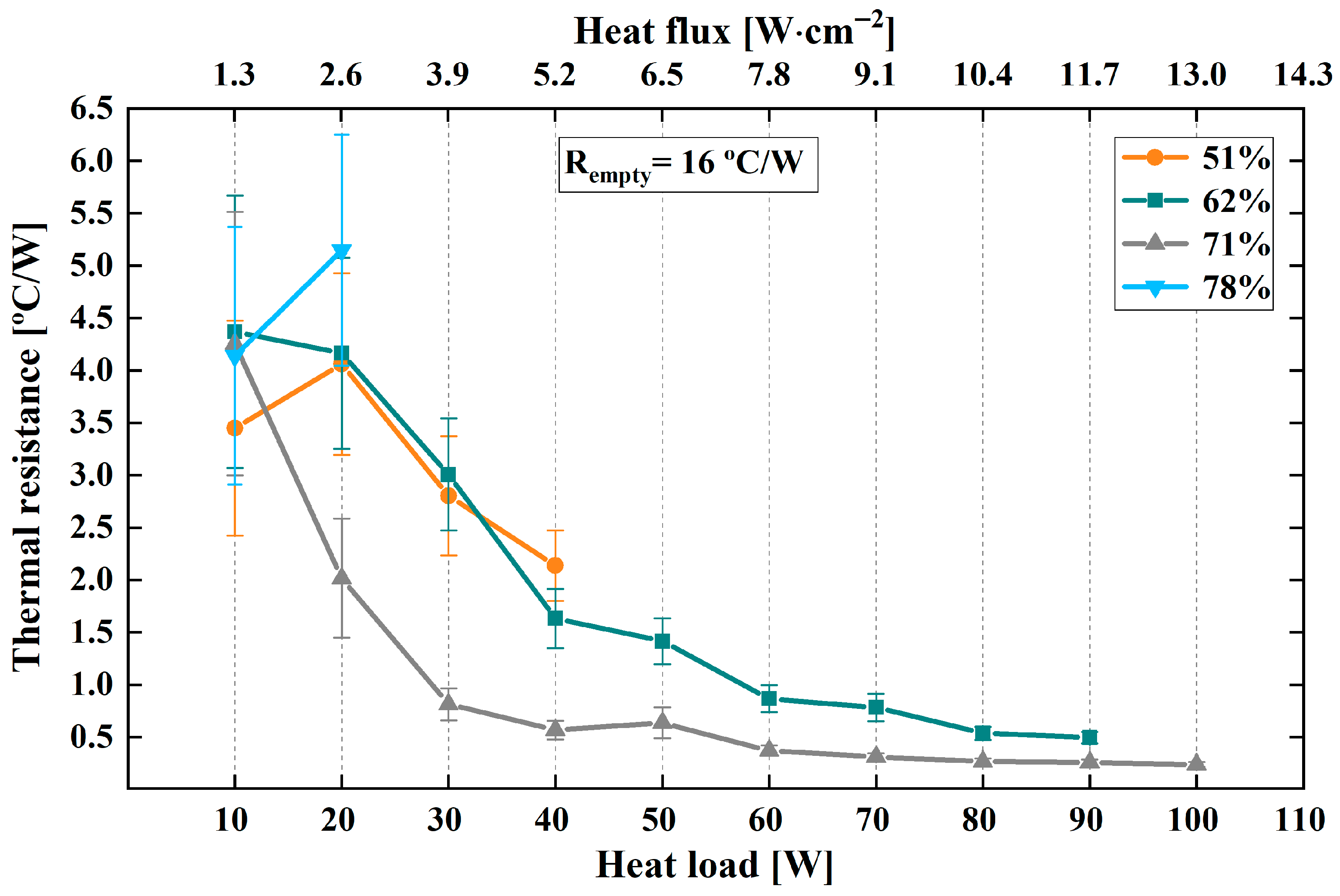
Figure 6 presents the thermal resistance as a function of heat load (and corresponding heat flux) under steady-state conditions for the stainless steel flat PHP, tested with several filling ratios (51, 62, 71, and 78%) in the horizontal orientation. Vertical error bars represent the uncertainties in the resistance measurements. The thermal resistance of the empty device, i.e., without working fluid, was approximately 16 °C/W. This value is not shown in the graph to preserve clarity, since the high resistance of the empty stainless steel PHP would otherwise distort the scale of the plot.
According to Figure 6, the working fluid significantly improved the thermal performance of the pulsating heat pipe. The maximum thermal resistances for all filling ratios were around 4.5 °C/W, already much lower than that of the empty device (16 °C/W). The PHP with filling ratios of 51% and 62% started operating at a heat input of about 20 W (2.6 W/cm2), with the thermal resistance progressively decreasing as the heat load increased. Their performance was similar, although slightly inferior to that of the 71% case. For the FR of 51%, the limited amount of working fluid likely caused intermittent dry-out events, restricting stable operation to heat loads up to 40 W (5.2 W/cm2). In the 62% case, the oscillations were more regular, though occasional temperature peaks in the evaporator could happen. At 90 W, the thermal resistance reached the low value of 0.50 ± 0.05 °C/W.
For the 71% filling ratio, the PHP started oscillating at 20 W (2.6 W/cm2) and maintained stable operation throughout the entire tested range up to 100 W. The continuous decrease in thermal resistance indicated efficient heat transfer. The lowest measured resistance was 0.24 ± 0.04 °C/W at 100 W (13.0 W/cm2), demonstrating superior thermal performance, 67 times lower than the empty PHP.
At the highest filling ratio (78%), the working fluid volume was excessive. Although a brief temperature drop in the evaporator was observed at startup, the vapor pressure difference was insufficient to drive the motion of the large liquid mass. Consequently, the liquid remained stagnant, causing the evaporator temperature and overall thermal resistance to increase continuously. The test was stopped when the evaporator temperature reached the safety limit of 150 °C during startup.
In conclusion, due to the low thermal conductivity of stainless steel, the PHP is more sensitive to the filling ratio compared with PHPs made of more conductive materials. In this case, effective heat transfer relied more heavily on the internal oscillating motion of the working fluid rather than wall conduction. The 71% filling ratio provided the best balance between vapor generation and liquid return, resulting in the most stable and efficient thermal performance among the tested conditions. Based on these results, the optimal filling ratio for the present stainless steel flat PHP, under this experimental configuration, was determined to be 71% of water.

3.2. Orientation Effect in the Thermal Behavior

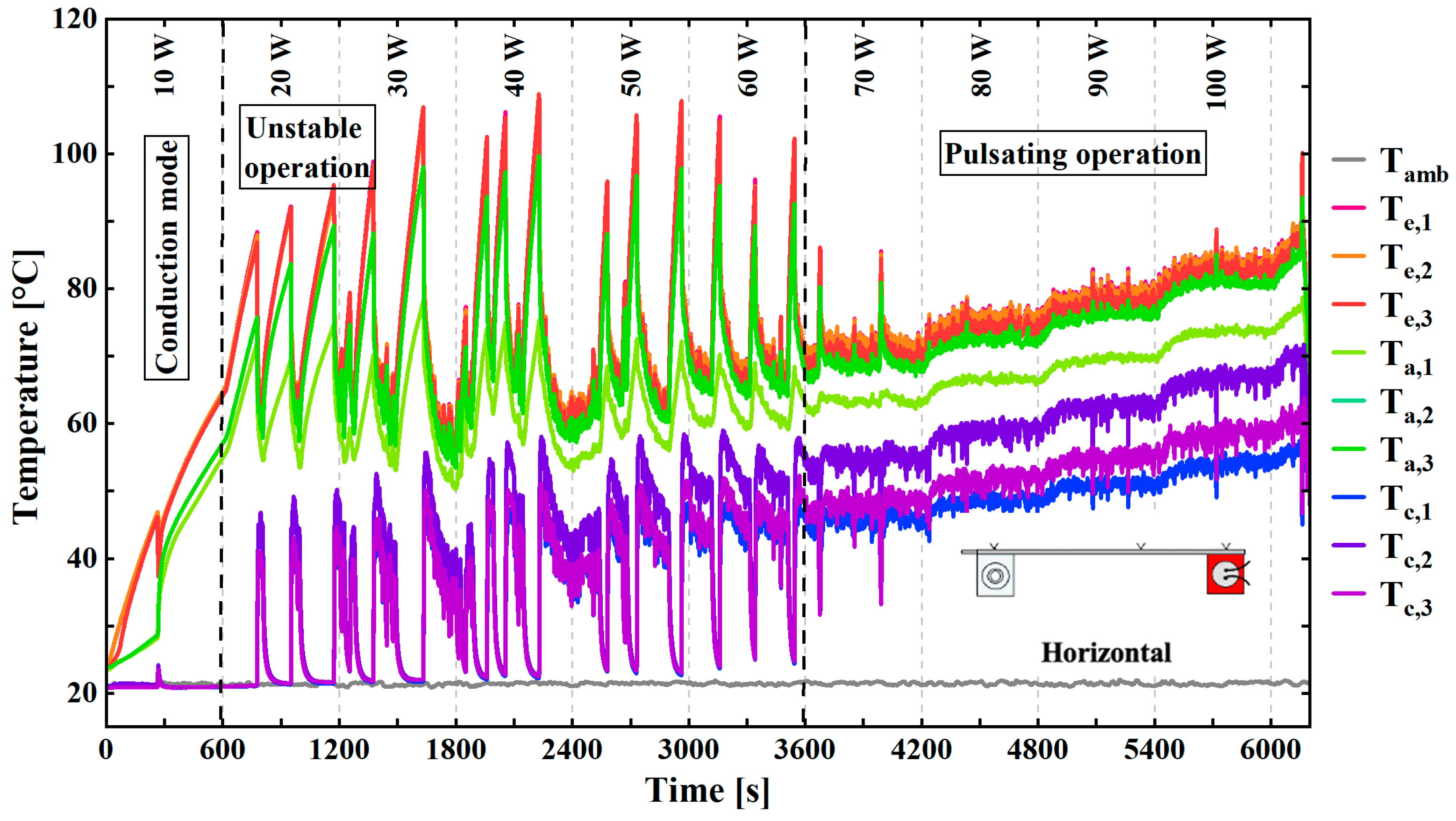
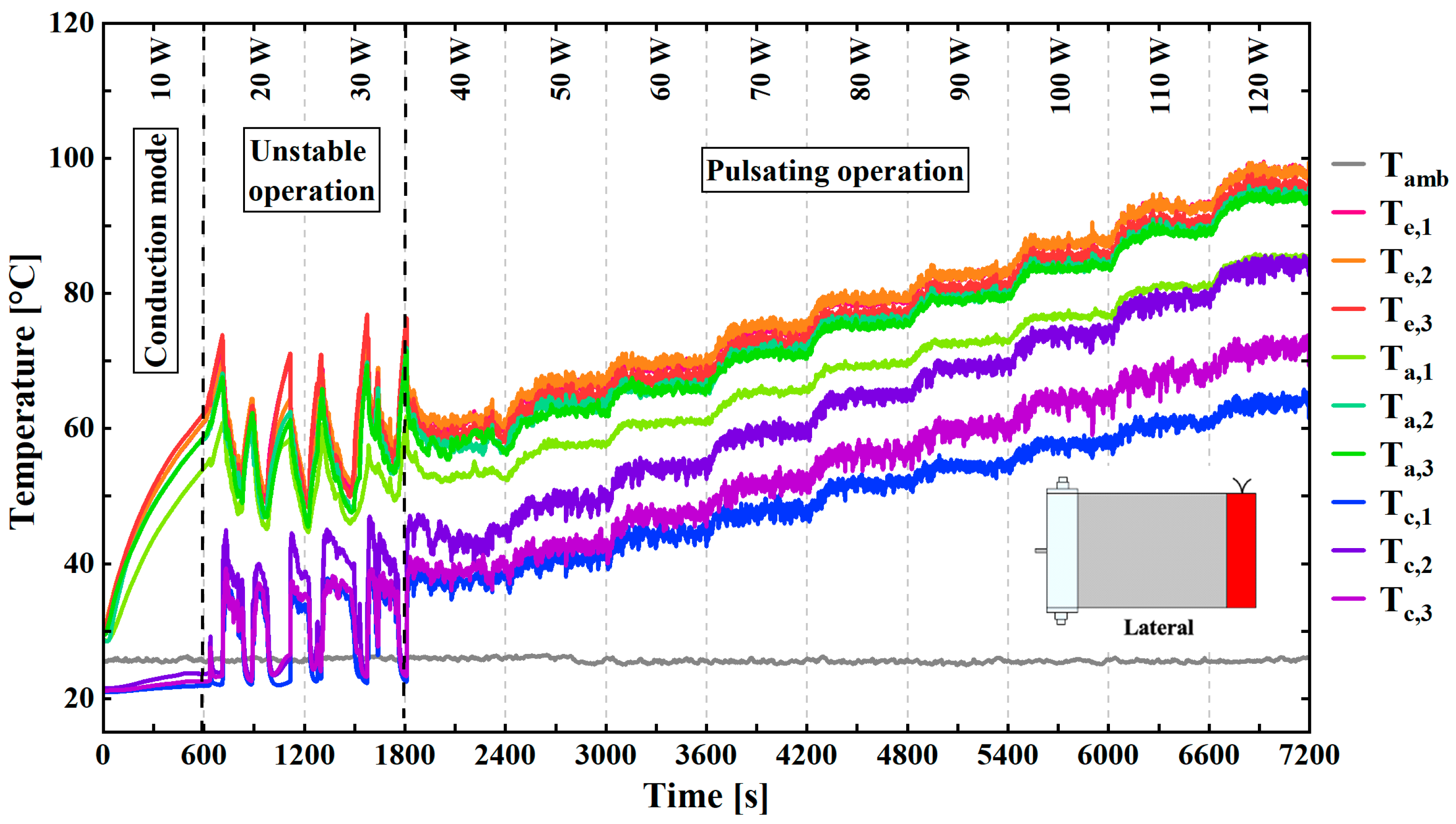
Figure 7, Figure 8 and Figure 9 show the transient temperature responses of the stainless steel PHP under three different orientations (horizontal, bottom-heated, and lateral, respectively), using the previously determined optimal filling ratio. The orientation of each PHP, as illustrated schematically in Figure 5d, is indicated by the icons included in the figures, and for each applied heat load, the temperatures in all orientations eventually reached a steady state.
According to Figure 7, when heat was applied to the evaporator in the horizontal position, the evaporator temperatures increased steadily. At a heat input of 10 W (1.3 W/cm2), bubble motion was observed, indicating the onset of activity within the PHP; however, the heat load was insufficient to sustain a continuous slug–plug flow. At this stage, the evaporator and adiabatic temperatures approached each other, suggesting limited circulation and redistribution of the working fluid within the channels, with heat transfer occurring mainly by conduction. When the input increased to 20 W (2.6 W/cm2), the PHP entered the characteristic oscillating regime (unstable operation), evidenced by high-amplitude temperature fluctuations. This oscillatory behavior persisted up to 70 W (9.1 W/cm2), beyond which the amplitude of oscillations gradually decreased, indicating a transition toward a more stable circulating regime. At 110 W (13.0 W/cm2), the evaporator temperature reached the safety limit of 100 °C, and the experiment was stopped as early signs of dry-out were observed.
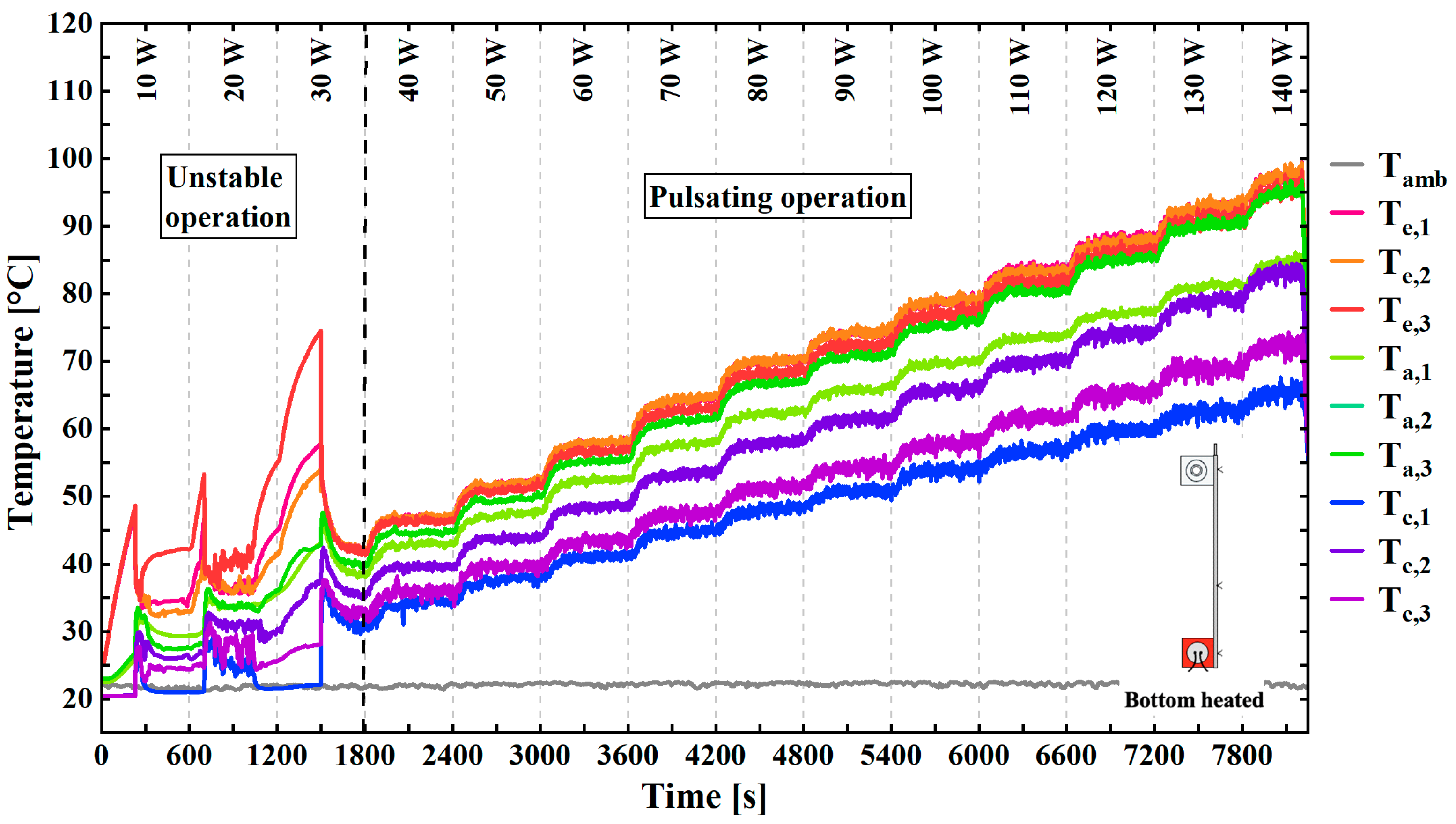
In the vertical bottom-heated configuration (Figure 8), the PHP exhibited unstable and intermittent operation at low heat inputs (below 30 W). The device attempted to initiate oscillations but could not maintain them consistently. This instability is likely due to the opposing effect of gravity on vapor bubbles in this orientation: when vapor pressure differences became insufficient to overcome buoyancy, the slug–plug motion could not be sustained. At 30 W (3.9 W/cm2), the temperature difference between the evaporator and condenser reached a critical threshold, enabling stable oscillations and proper PHP operation. Once activated, the PHP maintained this behavior as the heat load increased, operating stably up to 140 W (18.2 W/cm2), before reaching the safety limit of 100 °C in the evaporator.
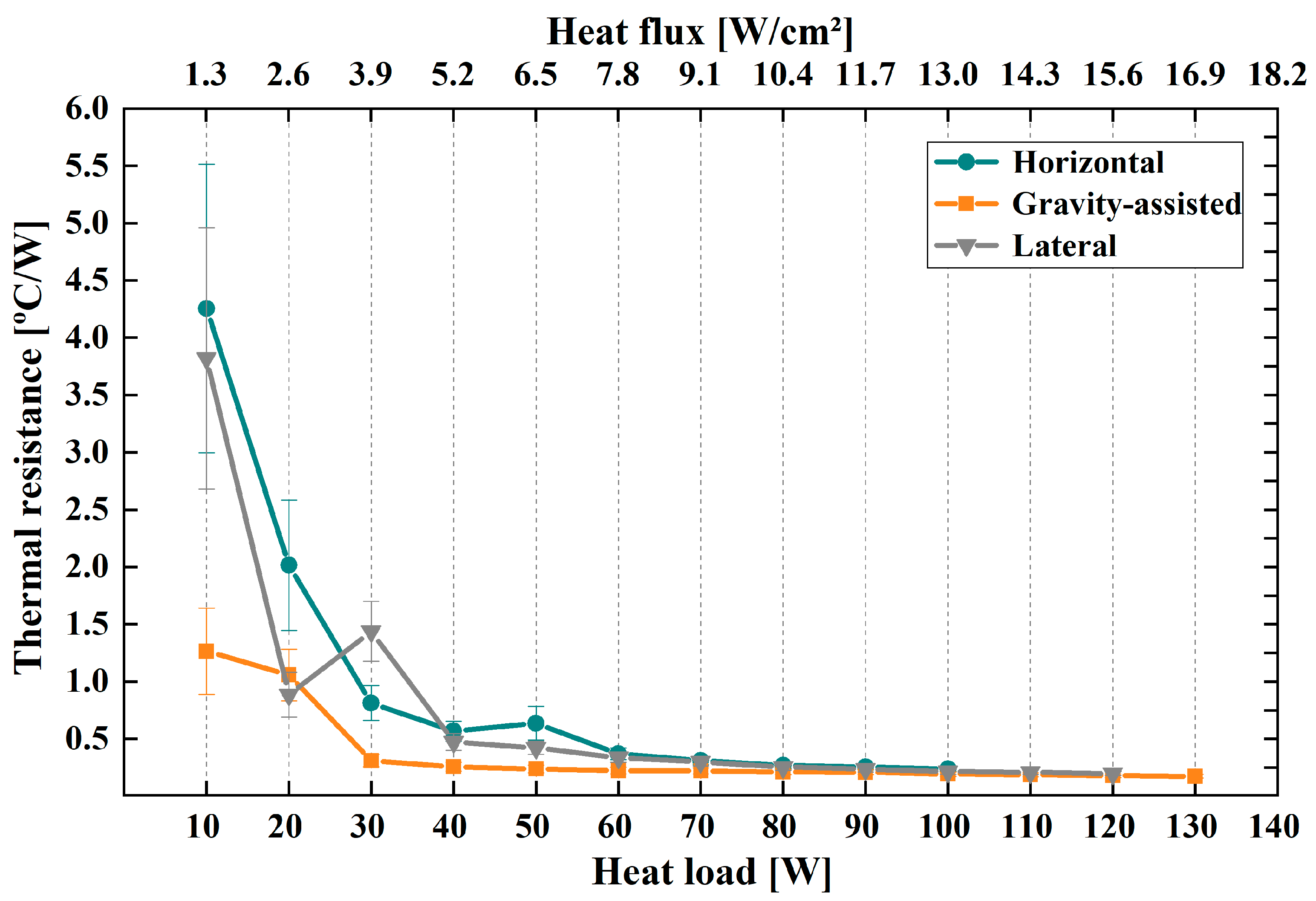
In the lateral position, shown in Figure 9, no significant activity was observed at 10 W, as the heat load was insufficient to initiate oscillations, and heat was mainly transported by conduction. At 20 W (2.6 W/cm2), the combined effect of temperature rise, and vapor pressure difference triggered the onset of slug–plug motion. The highest oscillation amplitudes occurred under 20 and 30 W (2.6 and 3.9 W/cm2), indicating vigorous and efficient heat transport. Beyond 40 W (5.2 W/cm2), the system stabilized into a continuous circulation regime with smaller temperature fluctuations—lower than in the horizontal case, but slightly higher than in the bottom-heated configuration. The device could operate up to 120 W (15.6 W/cm2) without the evaporator temperature exceeding 100 °C.
In all cases, the main difference observed in the performances among the tested orientations, once the stable circulation regime was established, was the temperature oscillation amplitude.
The PHP orientation significantly influenced the startup conditions and overall thermal behavior. While all configurations eventually reached a stable circulation regime, the main difference among them was the amplitude of the temperature oscillations and the time required to achieve stable operation. The horizontal orientation exhibited the largest temperature oscillations and the highest evaporator temperatures for the startup (up to 100 °C), indicating more intense thermal dynamics but also a greater tendency toward dry-out. In contrast, the vertical bottom-heated and lateral orientations achieved lower maximum evaporator temperatures during the startup (around 75 °C) and more stable operation after that.
The differences in stabilization time arise directly from how gravity interacts with the vapor–liquid distribution. In the horizontal configuration, gravity neither aids liquid return nor bubble displacement, so circulation develops only after strong vapor pressure oscillations form, delaying stabilization. In the bottom-heated orientation, gravity promotes liquid drainage toward the evaporator, allowing circulation to establish more rapidly. The lateral configuration benefits from partial gravity assistance, leading to stabilization times between the two extremes. Thus, the role of gravity provides a consistent physical explanation for the observed differences in startup and stabilization among the tested orientations.
Figure 10 presents a comparison of the overall thermal resistance for the three orientations to evaluate the influence of orientation on the heat transfer performance of the stainless steel PHP. As already observed, the thermal resistance of the empty PHP was approximately 16 °C/W; therefore, the introduction of the working fluid immediately reduced the thermal resistance since the first applied heat loads, confirming its contribution to effective heat transport.
From 30 W (3.9 W/cm2) onward, all orientations transitioned from the unstable startup phase to a stable pulsating regime, resulting in a continuous decrease in thermal resistance as the heat input increased. At 50 W (6.5 W/cm2), the thermal resistances of the horizontal, bottom-heated, and lateral orientations converged to nearly identical values, indicating that the PHP became independent of gravitational effects once fully activated. This behavior highlights that, despite the sensitivity of the stainless steel PHP to orientation during startup, its thermal performance becomes uniform at higher heat loads when stable circulation is established.

3.3. Benchmarking Comparison

The benchmarking analysis aims to compare the thermal performance of the stainless steel PHP with that of a copper PHP under identical operating conditions. Since both devices share the same geometric configuration and working fluid, this comparison isolates the influence of the container material on heat transfer characteristics and startup behavior. The differences observed between the two materials provide valuable insight into the impact of wall thermal conductivity on PHP dynamics and overall efficiency.
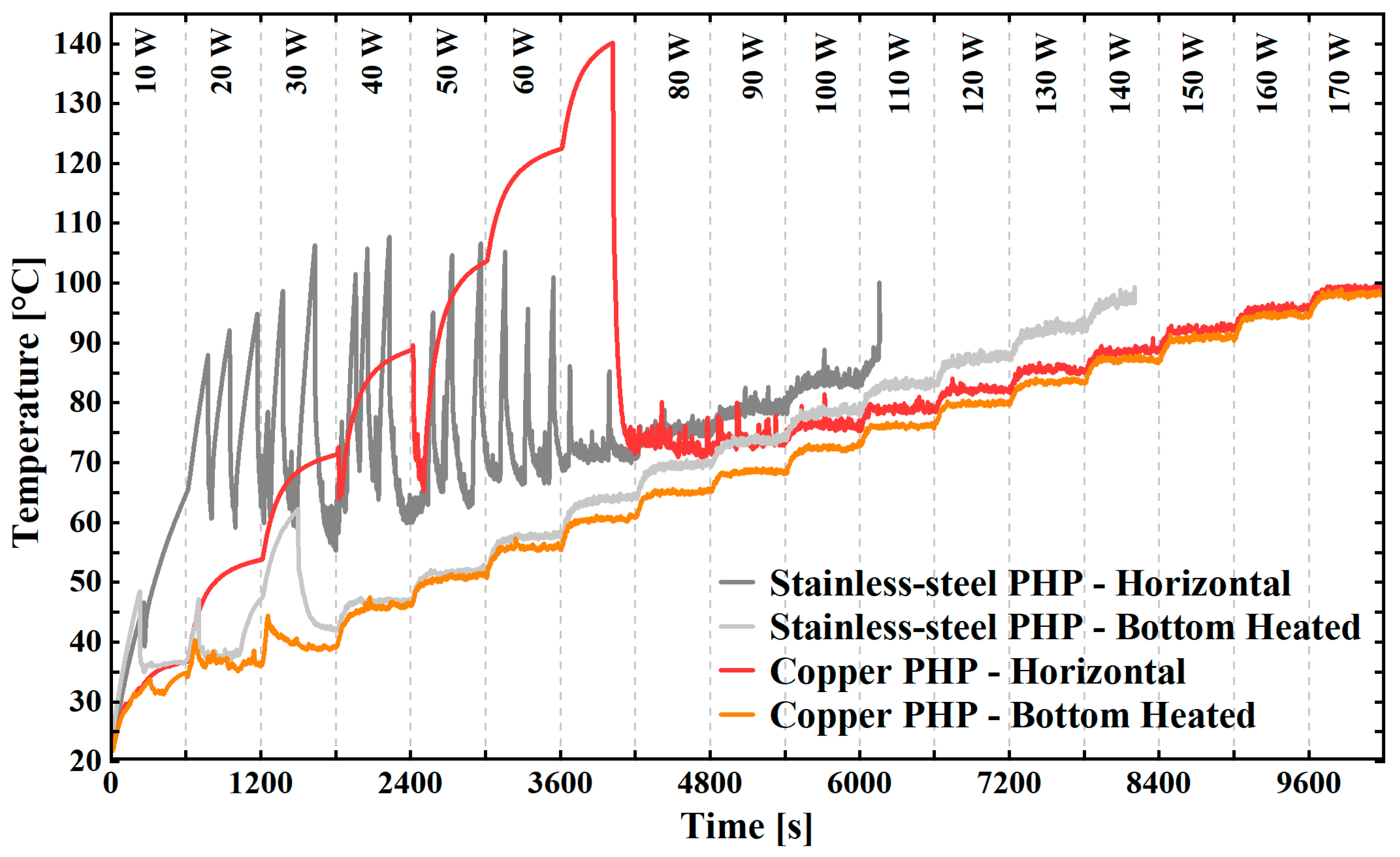
To compare the transient thermal behavior of the two materials, Figure 11 shows the average evaporator temperature as a function of time for the stainless steel and copper flat pulsating heat pipes (PHPs) under both horizontal and bottom-heated orientations, considering all tested heat loads for each device. The tests were interrupted when the evaporator temperature reached 100 °C. As previously mentioned, the evaporator temperature was allowed to increase up to 150 °C during startup to ensure stable operation; thereafter, the 100 °C safety limit was observed. The heat load was increased in 10 W increments, and in all cases, the average evaporator temperature rose progressively with power input until reaching steady-state conditions.
In the horizontal orientation, the stainless steel and copper PHPs exhibited distinct thermal behaviors. For the copper PHP (red line), oscillations only began at around 70 W, when the evaporator temperature approached 140 °C, indicating a relatively high startup temperature requirement. Below this threshold (10–60 W), heat transfer occurred mainly through conduction. In contrast, the stainless steel PHP (dark grey line) initiated oscillations at a much lower heat load of approximately 20 W, corresponding to an evaporator temperature near 90 °C with high temperature amplitudes. Once the oscillating regime was established, both PHPs demonstrated stable performance. The copper PHP could sustain operation up to 170 W, while the stainless steel PHP began showing signs of dry-out at 110 W, setting its upper operational limit at 100 W.
In the vertical bottom-heated orientation, both PHPs displayed qualitatively similar behavior, although notable differences were observed during the startup phase. The stainless steel PHP (light grey line) exhibited higher transient temperature peaks before reaching steady operation, suggesting greater thermal inertia and slower vapor–liquid distribution adjustment due to the lower wall thermal conductivity. For heat inputs above 70 W, the evaporator temperature of the stainless steel device rose more than that of the copper PHP (orange line). This indicates that, while the copper wall assisted in spreading and conducting heat effectively—supporting stable operation up to 170 W—the stainless steel PHP reached the 100 °C threshold earlier, around 140 W, being therefore limited by the material conduction.
Overall, the differences in transient temperature behavior between the two materials can be attributed to their distinct thermal conductivities. The lower thermal conductivity of stainless steel leads to slower heat spreading through the wall, causing higher temperature gradients and larger oscillation amplitudes, particularly at lower heat loads, which produces behavior similar to that of a tubular PHP. Conversely, the copper PHP exhibited smaller and more stable temperature oscillations, as heat was more uniformly distributed through the wall.
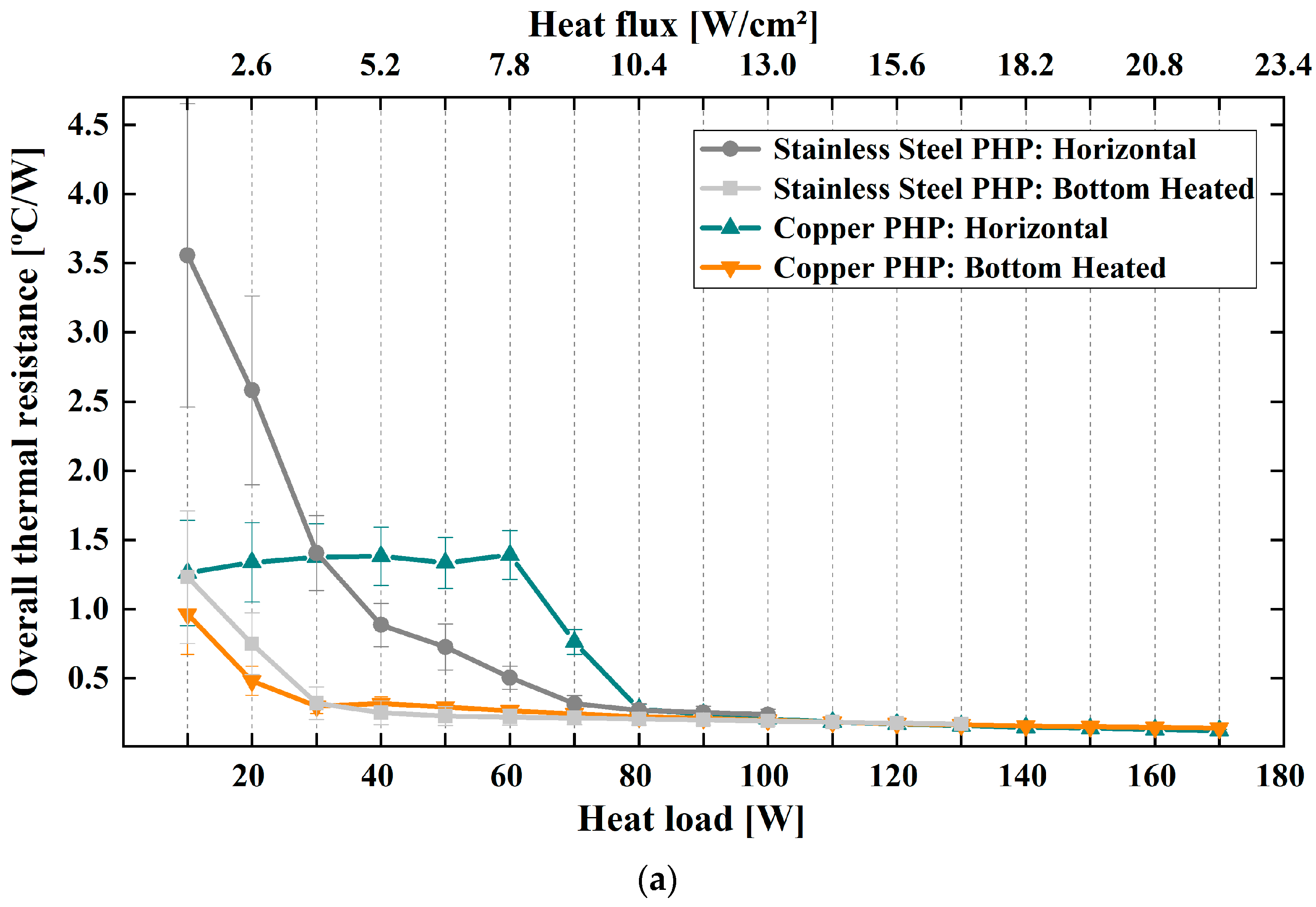
Figure 12a presents the overall thermal resistance of both the stainless steel and copper PHPs as a function of input power under horizontal and vertical bottom-heated orientations. Vertical error bars indicate the thermal resistance uncertainties. The thermal resistance of the empty devices, Rempty, was approximately 16.0 °C/W for the stainless steel PHP (as previously mentioned) and 1.37 °C/W for the copper PHP. Overall, both devices performed satisfactorily, each exhibiting distinct operational characteristics and limitations.
In the horizontal orientation, the stainless steel PHP (dark grey line) demonstrated excellent thermal performance, with the thermal resistance decreasing steadily from the lowest tested heat input (10 W). The resistance was already much lower than the conduction-only value of 16.0 °C/W. The lowest measured resistance was 0.24 ± 0.04 °C/W at the maximum heat input of 100 W (13.0 W/cm2), indicating efficient heat transfer across the entire tested range. In contrast, the copper PHP (red line) showed thermal resistance values close to its conduction-only limit up to 60 W (7.8 W/cm2), suggesting that heat transfer occurred predominantly by conduction at lower loads. At around 70 W, the device transitioned to the pulsating regime, as evidenced by a sharp drop in thermal resistance with further increases in power input. Once activated, the copper PHP exhibited superior performance, achieving a minimum thermal resistance of 0.12 ± 0.01 °C/W at the highest applied heat load of 170 W (22.1 W/cm2).
Under the vertical bottom-heated orientation, both devices—the stainless steel PHP (light grey line) and the copper PHP (orange line)—achieved comparable thermal performance within experimental uncertainty. The main difference between them was the maximum sustainable heat load: the stainless steel PHP operated stably up to 130 W, reaching a thermal resistance of 0.17 ± 0.03 °C/W, while the copper PHP handled up to 170 W with a minimum resistance of 0.14 ± 0.01 °C/W.
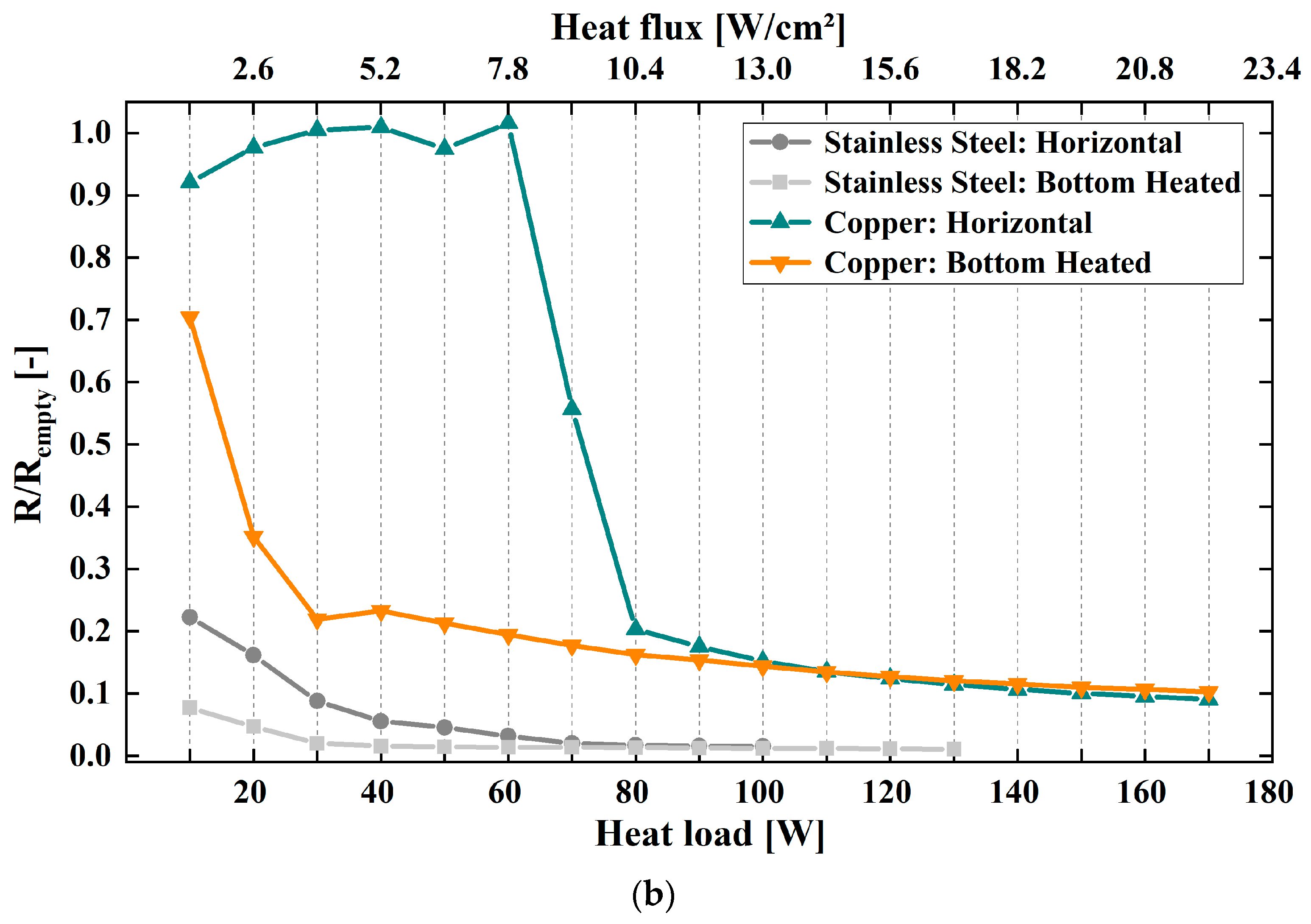
Figure 12b presents the ratio between the overall thermal resistance and the thermal resistance of the empty device for both PHPs in the two orientations. This comparison highlights the relative enhancement in heat transfer performance generated by each working-fluid–container combination. Because stainless steel and copper exhibit substantially different wall thermal conductivities, this normalized metric provides a more appropriate basis for comparison; direct thermal-resistance values alone do not fully reflect the effectiveness of each PHP. In this context, a lower ratio corresponds to a greater enhancement in heat transfer arising from phase-change activity.
For the copper PHP in the horizontal orientation (red line), the ratio remained close to unity up to approximately 60 W, indicating that heat transfer was predominantly governed by conduction and that oscillations had not yet been established. After activation, a modest improvement was observed, and the ratio gradually decreased, stabilizing around 0.15 at higher heat loads. In contrast, in the vertical bottom-heated configuration (orange line), the copper PHP demonstrated earlier and more pronounced performance gains beginning near 30 W and continuing up to 170 W, as gravity-assisted liquid return promoted stronger circulation and phase-change heat transport.
The stainless steel PHP in both orientations (dark and light gray lines) showed substantial performance enhancement over nearly the entire heat-load range. The ratio started around 0.2 and decreased to approximately 0.01 at 130 W in the gravity-assisted case, reflecting highly effective phase-change-driven heat transfer relative to its empty baseline. These results further confirm the favorable activation behavior and vigorous oscillatory performance of stainless steel PHPs, particularly when early startup and sustained oscillations are critical.
In conclusion, depending on the applied heat load, the present thin stainless steel PHP can achieve nearly identical thermal performance to that of the copper PHP, despite the much lower thermal conductivity of stainless steel. The primary advantage of copper lies in its ability to sustain higher heat loads—approximately 40 W more in the bottom-heated configuration—thanks to enhanced heat conduction through the wall. In the horizontal orientation, the difference increases to about 70 W, mainly due to the earlier onset of dry-out in the stainless steel evaporator, which causes a sharp temperature rise. If this local dry-out phenomenon can be mitigated, the stainless steel PHP could potentially operate effectively up to around 130 W as well.
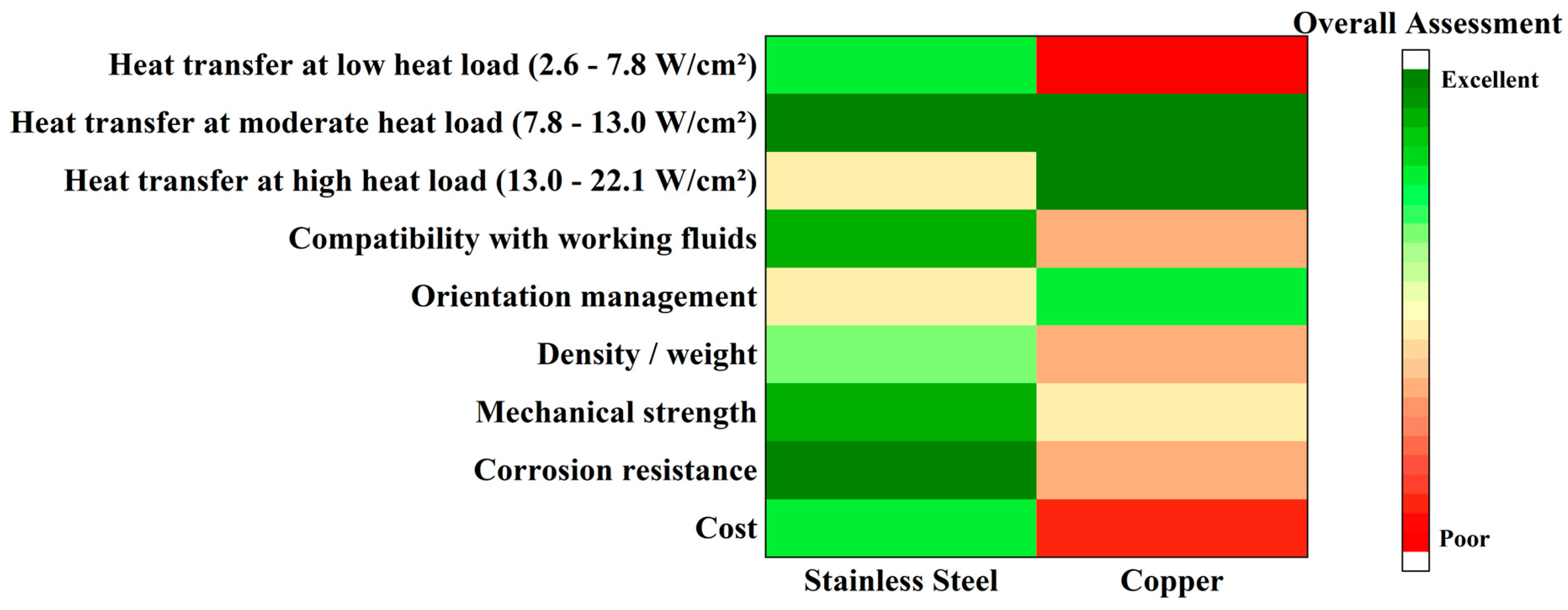
Beyond thermal performance, other material properties play a crucial role in PHP design. Depending on the intended application, factors such as weight, environmental resistance, mechanical strength, and compatibility with working fluids must also be considered. Based on the experimental results, it is evident that changing the PHP construction material leads to significant variations in fluid flow behavior and operating conditions, effectively producing a device with different thermal dynamics. Figure 13 compares key attributes of stainless steel and copper, including heat transfer performance at different heat loads, mechanical strength, corrosion resistance, and fluid compatibility. In this context, the observed differences in heat transfer capacity are directly related to the choice of material for the fabrication of miniature flat-plate PHPs. While copper offers superior performance at high heat loads, stainless steel provides advantages in mechanical robustness, chemical stability, and reduced mass—approximately 11% lighter in the fabricated device—which may be critical for long-term reliability and specific application requirements.
The colormap in Figure 13 further highlights the trade-offs between stainless steel and copper for miniature flat-plate PHP fabrication. Stainless steel scores higher in properties such as corrosion resistance, mechanical strength, density/weight, compatibility with working fluids, and heat transfer at low and moderate heat loads (2.6 to 13.0 W/cm2). This reflects its robustness, chemical stability, and suitability for early activation at lower heat inputs. In contrast, copper performs better at high heat loads (above 13.0 W/cm2), which is consistent with its superior thermal conductivity and its ability to sustain larger power inputs. Cost is another important factor in material selection. In contrast to copper, AISI 316L stainless steel is generally less expensive on a per-kilogram basis, which can reduce the material cost of PHP devices. Beyond raw material price, stainless steel also offers advantages during fabrication: its high oxidation resistance and dimensional stability reduce the occurrence of defects and rework, thereby improving process yield. As a result, stainless steel often provides a competitive overall fabrication cost and a favorable cost-to-performance ratio. Overall, these results reinforce that the optimal choice of PHP material depends on the intended operating conditions: stainless steel is advantageous for applications requiring mechanical durability, chemical resistance, and reliable operation at lower to moderate heat loads, while copper is preferable when high heat flux performance is the primary requirement.
Future research should investigate the effect of different working fluids on PHP performance, as fluid properties strongly influence heat transfer behavior but were not examined in this study.

4. Conclusions

In this work, two innovative aspects were considered: the fabrication and experimental characterization of a stainless steel flat plate pulsating heat pipe, representative of typical configurations used in electronic cooling applications, using an advanced manufacturing technique such as diffusion bonding; and the direct comparison of PHP thermal performance by changing only the casing material, from stainless steel to copper (benchmark), while keeping the geometry identical.
The results show that using stainless steel promotes earlier phase change of the working fluid and enhances phase-change heat transfer through increased temperature oscillations, resulting in behavior similar to that of a tubular PHP. Due to the lower thermal conductivity of stainless steel, the PHP is more sensitive to the filling ratio, with effective heat transfer relying primarily on the internal oscillating motion of the working fluid rather than wall conduction. A filling ratio of 71% (horizontal orientation) provided the best balance between vapor generation and liquid return, achieving the most stable and efficient thermal performance among the tested conditions. This value, however, is not universal and should be interpreted as specific to the present geometry, channel dimensions, working fluid, and operating conditions. Nevertheless, the results indicate that higher filling ratios tend to be more suitable for this type of miniature flat-plate PHP. Orientation also significantly influenced startup and overall thermal behavior.
The stainless steel PHP can achieve nearly identical thermal performance to the copper device at low to moderate heat loads (2.6 to 13.0 W/cm2), despite its lower thermal conductivity. Copper, however, sustains higher maximum heat loads (above 13.0 W/cm2) due to enhanced wall conduction.
Beyond thermal metrics, stainless steel provides practical engineering advantages such as higher mechanical strength, improved resistance to corrosion and oxidation, reduced mass (approximately 11% lighter than copper), and better compatibility with harsh or reactive environments. These characteristics make stainless steel PHPs particularly suitable for applications involving aerospace systems, high-humidity or corrosive environments, hydrogen-compatible systems, vacuum or space electronics, and mechanically demanding or vibration-loaded platforms.
This study also presents inherent limitations. Only a single working fluid was evaluated, which restricts the generality of the results to other fluid–material combinations. The experiments represent short-term behavior, and long-term reliability, cyclic thermal fatigue, and degradation mechanisms were not assessed. Furthermore, the absence of numerical or analytical modeling limits the ability to extrapolate the findings to different dimensions or operating conditions. Additionally, future studies should incorporate dimensionless parameters such as the Fourier and Biot numbers to better quantify transient heat diffusion and wall–fluid thermal coupling, thereby providing a more rigorous theoretical framework to complement the present experimental findings. Future work should also include non-intrusive infrared thermography to visualize oscillatory patterns without modifying the PHP geometry, enabling deeper investigation of flow regimes under realistic operating conditions. These aspects should be addressed in future work to fully establish the operational robustness and broader applicability of stainless steel flat-plate PHPs.
Overall, the results highlight the value of stainless steel as a viable material for miniature flat-plate PHPs, with material selection primarily guided by the intended operating conditions. In particular, the present findings show that copper remains clearly advantageous only at high heat-flux levels, whereas stainless steel provides a more balanced, robust, and efficient performance under low to moderate heat loads. The results also emphasize the importance of wall material properties, filling ratio, and orientation in optimizing PHP performance.

Author Contributions

Conceptualization, L.K. and K.G.D.; methodology, L.K., K.G.D. and M.E.B.; validation, L.K., K.G.D. and M.E.B.; formal analysis, L.K.; investigation, L.K., K.G.D. and M.E.B.; data curation, K.G.D. and M.E.B.; writing—original draft preparation, L.K.; writing—review and editing, M.M. and M.B.H.M.; visualization, L.K. and K.G.D.; supervision, M.M. and M.B.H.M.; project administration, L.K.; funding acquisition, M.M. and M.B.H.M. All authors have read and agreed to the published version of the manuscript.

Funding

This research was funded by the National Council for Scientific and Technological Development (CNPq), the National Fund for Scientific and Technological Development (FNDCT), and the Ministry of Science, Technology, and Innovations (MCTI), under project numbers 441678/2023-8 and 405784/2022-8. Scholarships were provided by CNPq under grant numbers 381267/2023-7 and 201670/2024-0, and by the Foundation for Research Support of Santa Catarina (FAPESC) under grant number 3003/2021.

Data Availability Statement

The datasets generated and analyzed during the current study are partially included in this published article. Additional data supporting the findings of this study are available from the corresponding author upon reasonable request.

Conflicts of Interest

The authors declare no conflicts of interest. The funders had no role in the design of the study; in the collection, analyses, or interpretation of data; in the writing of the manuscript; or in the decision to publish the results.

Abbreviations

LCALife Cycle Assessment
OHPOscillating Heat Pipe
PHPPulsating Heat Pipe
UFSCFederal University of Santa Catarina

References

  1. Khandekar, S.; Panigrahi, P.K.; Lefèvre, F.; Bonjour, J. Local Hydrodynamics of Flow in a Pulsating Heat Pipe: A Review. Front. Heat Pipes 2010, 1, 023003. [Google Scholar] [CrossRef]
  2. Nikolayev, V.S. Physical Principles and State-of-the-Art of Modeling of the Pulsating Heat Pipe: A Review. Appl. Therm. Eng. 2021, 195, 117111. [Google Scholar] [CrossRef]
  3. Mameli, M.; Besagni, G.; Bansal, P.K.; Markides, C.N. Innovations in Pulsating Heat Pipes: From Origins to Future Perspectives. Appl. Therm. Eng. 2022, 203, 117921. [Google Scholar] [CrossRef]
  4. Yang, H.; Khandekar, S.; Groll, M. Performance Characteristics of Pulsating Heat Pipes as Integral Thermal Spreaders. Int. J. Therm. Sci. 2009, 48, 815–824. [Google Scholar] [CrossRef]
  5. Karimi, G.; Culham, J.R. Review and Assessment of Pulsating Heat Pipe Mechanism for High Heat Flux Electronic Cooling. In Proceedings of the The Ninth Intersociety Conference on Thermal and Thermomechanical Phenomena in Electronic Systems, Las Vegas, NV, USA, 1–4 June 2004; pp. 52–59. [Google Scholar]
  6. Mameli, M.; Marengo, M.; Khandekar, S. Local Heat Transfer Measurement and Thermo-Fluid Characterization of a Pulsating Heat Pipe. Int. J. Therm. Sci. 2014, 75, 140–152. [Google Scholar] [CrossRef]
  7. Khandekar, S.; Charoensawan, P.; Groll, M.; Terdtoon, P. Closed Loop Pulsating Heat Pipes—Part B: Visualization and Semi-Empirical Modeling. Appl. Therm. Eng. 2003, 23, 2021–2033. [Google Scholar] [CrossRef]
  8. Boyd Corporation. Two-Phase Thermal Solution Guide. Available online: https://www.boydcorp.com (accessed on 10 October 2025).
  9. Somers-Neal, S.; Phan, N.; Watanabe, N.; Ueno, A.; Nagano, H.; Saito, Y. Experimental and Numerical Investigations of a Diffusion Bonded Flat-Type Loop Heat Pipe for Passive Thermal Management. Appl. Therm. Eng. 2024, 257, 124485. [Google Scholar] [CrossRef]
  10. Huang, G.; Liu, W.; Luo, Y.; Li, Y.; Chen, H. Fabrication and Thermal Performance of Mesh-Type Ultra-Thin Vapor Chambers. Appl. Therm. Eng. 2019, 162, 114263. [Google Scholar] [CrossRef]
  11. Yoon, A.; Kim, S.J. The Effect of Substrate Conduction on the Thermal Performance of a Flat Plate Pulsating Heat Pipe. In Proceedings of the 10th International Conference on Heat Transfer, Fluid Mechanics and Thermodynamics, Orlando, FL, USA, 14–16 July 2014; pp. 1411–1416. [Google Scholar]
  12. Liu, J.; Liu, D.; Shang, F.; Yang, K.; Zheng, C.; Cao, X. Experimental Study of Thermal Performance of Pulsating-Heat-Pipe Heat Exchanger with Asymmetric Structure at Different Filling Rates. Energies 2024, 17, 3725. [Google Scholar] [CrossRef]
  13. Mameli, M.; Piacquadio, S.; Viglione, A.S.; Catarsi, A.; Bartoli, C.; Marengo, M.; Di Marco, P.; Filippeschi, S. Start-Up and Operation of a 3D Hybrid Pulsating Heat Pipe on Board a Sounding Rocket. Microgravity Sci. Technol. 2019, 31, 249–259. [Google Scholar] [CrossRef]
  14. Abela, M.; Mameli, M.; Nikolayev, V.; Filippeschi, S. Experimental Analysis and Transient Numerical Simulation of a Large Diameter Pulsating Heat Pipe in Microgravity Conditions. Int. J. Heat. Mass. Transf. 2022, 187, 122532. [Google Scholar] [CrossRef]
  15. Pagliarini, L.; Cattani, L.; Bozzoli, F.; Mameli, M.; Filippeschi, S.; Rainieri, S.; Marengo, M. Thermal Characterization of a Multi-Turn Pulsating Heat Pipe in Microgravity Conditions: Statistical Approach to the Local Wall-to-Fluid Heat Flux. Int. J. Heat. Mass. Transf. 2021, 169, 120930. [Google Scholar] [CrossRef]
  16. Pfotenhauer, J.M.; Sun, X.; Berryhill, A.; Shoemaker, C.B. The Influence of Aspect Ratio on the Thermal Performance of a Cryogenic Pulsating Heat Pipe. Appl. Therm. Eng. 2021, 196, 117322. [Google Scholar] [CrossRef]
  17. Bruce, R.; Barba, M.; Bonelli, A.; Baudouy, B. Thermal Performance of a Meter-Scale Horizontal Nitrogen Pulsating Heat Pipe. Cryogenics 2018, 93, 66–74. [Google Scholar] [CrossRef]
  18. Cattani, L.; Vocale, P.; Bozzoli, F.; Malavasi, M.; Pagliarini, L.; Iwata, N. Global and Local Performances of a Tubular Micro-Pulsating Heat Pipe: Experimental Investigation. Heat Mass Transf./Waerme-Und Stoffuebertragung 2022, 58, 2009–2027. [Google Scholar] [CrossRef]
  19. Li, Q.; Wang, L.; Zhang, D.; Cheng, G. Vibration-Enhanced Performance of Asymmetric Channel Flat-Plate Pulsating Heat Pipes: Reducing Thermal Resistance and Start-up Time under Dynamic Loads. Appl. Therm. Eng. 2025, 281, 128588. [Google Scholar] [CrossRef]
  20. Xie, Y.; Yin, Y.; Zhou, S.; Liu, X.; Pan, Y. Visualization Analysis of Heat Transfer and Flow Behavior in Flat-Plate Pulsating Heat Pipe with Sintered Powder Wick Layer. Int. Commun. Heat Mass Transf. 2025, 167, 109326. [Google Scholar] [CrossRef]
  21. Pagnoni, F.; Ayel, V.; Romestant, C.; Bertin, Y. Experimental Behaviors of Closed Loop Flat Plate Pulsating Heat Pipes: A Parametric Study. In Proceedings of the Joint 19th IHPC and 13th IHPS, Pisa, Italy, 10–14 June 2018. [Google Scholar]
  22. Krambeck, L.; Domiciano, K.G.; Betancur-Arboleda, L.A.; Mantelli, M.B.H. Novel Flat Plate Pulsating Heat Pipe with Ultra Sharp Grooves. Appl. Therm. Eng. 2022, 211, 118509. [Google Scholar] [CrossRef]
  23. Winkler, M.; Rapp, D.; Mahlke, A.; Zunftmeister, F.; Vergez, M.; Wischerhoff, E.; Clade, J.; Bartholomé, K.; Schäfer-Welsen, O. Small-Sized Pulsating Heat Pipes/Oscillating Heat Pipes with Low Thermal Resistance and High Heat Transport Capability. Energies 2020, 13, 1736. [Google Scholar] [CrossRef]
  24. Monticelli, M.; Accardo, A.; Bernagozzi, M.; Spessa, E. A Comparative Life Cycle Analysis of an Active and a Passive Battery Thermal Management System for an Electric Vehicle: A Cold Plate and a Loop Heat Pipe. World Electr. Veh. J. 2025, 16, 100. [Google Scholar] [CrossRef]
  25. Mantelli, M.B.H. Thermosyphons and Heat Pipes: Theory and Applications; Springer International Publishing: Berlin/Heidelberg, Germany, 2021; ISBN 978-3-030-62772-0. [Google Scholar]
  26. Sun, X.; Jia, L. Visual Experimental Study on Flat-Plate Pulsating Heat Pipe with Double Condensers. Int. J. Heat Fluid Flow 2025, 114, 109831. [Google Scholar] [CrossRef]
  27. Wits, W.W.; Groeneveld, G.; Van Gerner, H.J. Experimental Investigation of a Flat-Plate Closed-Loop Pulsating Heat Pipe. J. Heat Transf. 2019, 141, 091807. [Google Scholar] [CrossRef]
  28. Malla, L.K.; Dhanalakota, P.; Mahapatra, P.S.; Pattamatta, A. Thermal and Flow Characteristics in a Flat Plate Pulsating Heat Pipe with Ethanol-Water Mixtures: From Slug-Plug to Droplet Oscillations. Int. J. Heat Mass Transf. 2022, 194, 123066. [Google Scholar] [CrossRef]
  29. Malla, L.K.; Vempeny, D.T.; Dileep, H.; Dhanalakota, P.; Mahapatra, P.S.; Srivastava, P.; Pattamatta, A. Thermal Performance Comparison of Flat Plate Pulsating Heat Pipes of Different Material Thermal Conductivity Using Ethanol-Water Mixtures. Appl. Therm. Eng. 2024, 236, 121475. [Google Scholar] [CrossRef]
  30. Krambeck, L.; Domiciano, K.G.; Mantelli, M.B.H. A New Flat Electronics Cooling Device Composed of Internal Parallel Loop Heat Pipes. Exp. Comput. Multiph. Flow 2024, 6, 277–286. [Google Scholar] [CrossRef]
  31. Krambeck, L.; Domiciano, K.G.; Mameli, M.; Filippeschi, S.; Mantelli, M.B.H. Comparison of the Thermal Performance of a Wire-Plate and a Pulsating Heat Pipe. In Proceedings of the 41st UIT International Heat Transfer Conference, Napoli, Italy, 19–21 June 2024. [Google Scholar]
  32. Gietzelt, T.; Toth, V.; Huell, A. Diffusion Bonding: Influence of Process Parameters and Material Microstructure; IntechOpen: London, UK, 2016; ISBN 978-953-51-2597-6. [Google Scholar]
  33. Mendes, L.P.; Amaral, M.C.; de Andrade Caldas, L.; Martins, B.M.; Domiciano, K.G.; Krambeck, L.; Xavier, F.A.; Mantelli, M.B.H. Evaluation of Copper Diffusion Bonding Parameters Applied to the Manufacture of Flat Heat Pipes. Mater. Res. 2025, 28, e20250065. [Google Scholar] [CrossRef]
  34. Taft, B.S.; Williams, A.D.; Drolen, B.L. Review of Pulsating Heat Pipe Working Fluid Selection. J. Thermophys. Heat Trans. 2012, 26, 651–656. [Google Scholar] [CrossRef]
  35. Iwata, N.; Bozzoli, F.; Pagliarini, L.; Cattani, L.; Vocale, P.; Malavasi, M.; Rainieri, S. Characterization of Thermal Behavior of a Micro Pulsating Heat Pipe by Local Heat Transfer Investigation. Int. J. Heat Mass Transf. 2022, 196, 123203. [Google Scholar] [CrossRef]
  36. Jiao, A.J.; Ma, H.B.; Critser, J.K. Experimental Investigation of Cryogenic Oscillating Heat Pipes. Int. J. Heat Mass Transf. 2009, 52, 3504–3509. [Google Scholar] [CrossRef] [PubMed]
  37. Ekrami, A.H.; Sabzpooshani, M.; Shafii, M.B. Series Flat Plate Pulsating Heat Pipe: Fabrication and Experimentation. AUT J. Mech. Eng. 2021, 5, 639–654. [Google Scholar] [CrossRef]
  38. Fuke, H.; Okazaki, S.; Ogawa, H.; Miyazaki, Y. Balloon Flight Demonstration of an Oscillating Heat Pipe. J. Astron. Instrum. 2017, 6, 1740006. [Google Scholar] [CrossRef]
  39. Kline, S.J.; McClintock, F.A. Describing Uncertainities in Single Experiments. Mech. Eng. 1953, 75, 3–8. [Google Scholar]
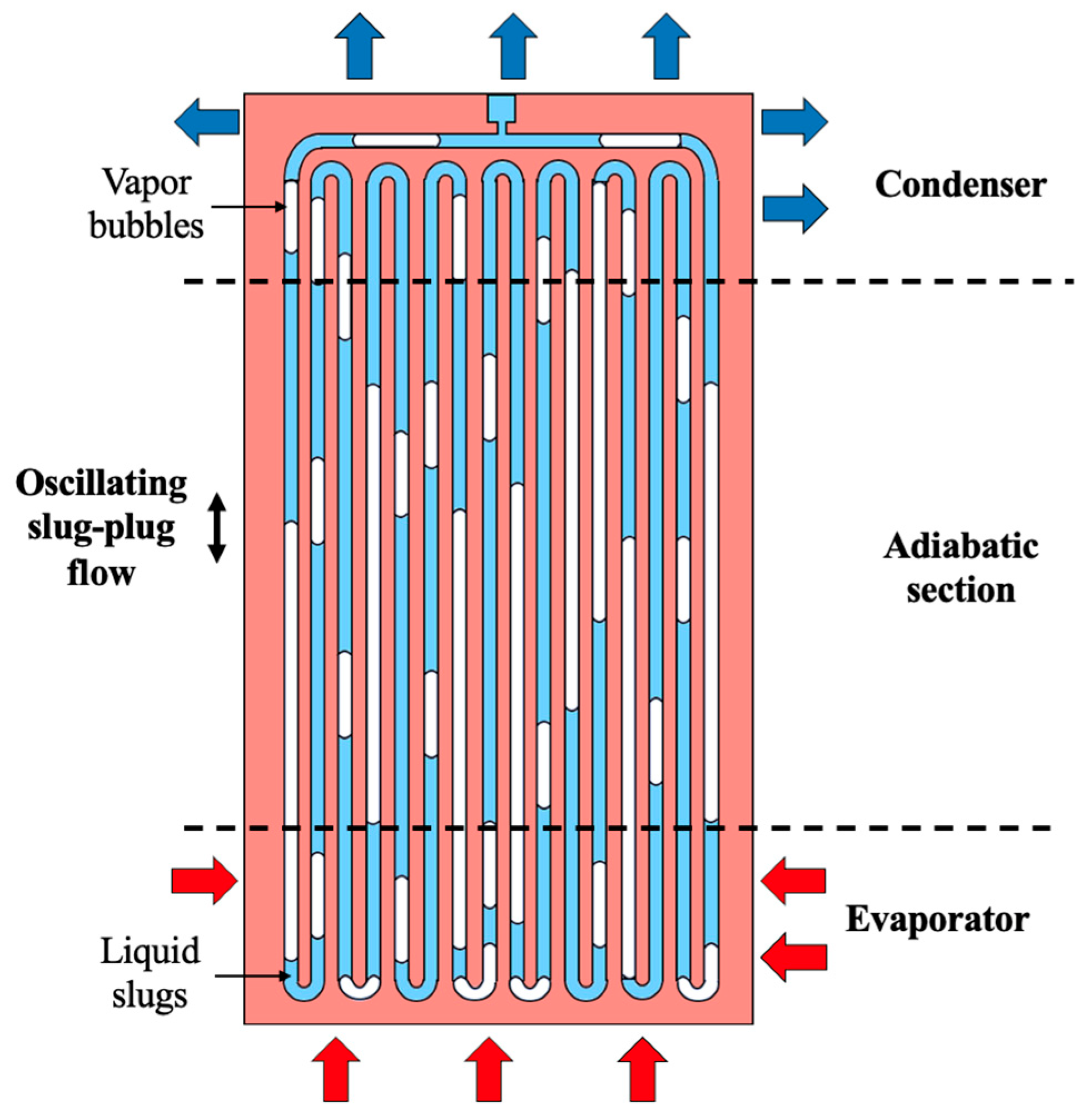
Figure 1. Operating principle of flat PHP.
Energies 19 00045 g001
Figure 2. Design of stainless steel flat PHP: internal plate and cross-section.
Energies 19 00045 g002
Figure 3. Stainless steel PHP: (a) view of the internal plate before stacking the closing plate, and (b) device after diffusion bonding.
Energies 19 00045 g003
Figure 4. Copper PHP during assembly, showing the plates before attaching the closing plate.
Energies 19 00045 g004
Figure 5. Experimental setup for thermal tests: (a) lateral view, (b) front view, (c) bottom view, and (d) testing position.
Energies 19 00045 g005
Figure 6. Thermal resistance of filling ratio study.
Energies 19 00045 g006
Figure 7. Transient temperature response of a stainless steel PHP in horizontal orientation.
Energies 19 00045 g007
Figure 8. Transient temperature response of a stainless steel PHP in bottom heated orientation.
Energies 19 00045 g008
Figure 9. Transient temperature response of a stainless steel PHP in lateral orientation.
Energies 19 00045 g009
Figure 10. Influence of orientation on the thermal performance of the stainless steel PHP, represented by the overall thermal resistance.
Energies 19 00045 g010
Figure 11. Benchmarking of the transient average evaporator temperatures for stainless steel and copper PHPs operated under horizontal and bottom-heated orientations.
Energies 19 00045 g011
Figure 12. Benchmark comparison of the thermal performance of stainless steel and copper PHPs: (a) Overall thermal resistance as a function of input power under horizontal and bottom-heated orientations, and (b) Ratio of the empty device thermal resistance to the overall thermal resistance.
Energies 19 00045 g012aEnergies 19 00045 g012b
Figure 13. Colormap of key material properties of stainless steel and copper for miniature PHPs.
Energies 19 00045 g013
Table 1. Key characteristics of the stainless steel PHP and benchmarking copper PHP.
ParameterStainless Steel PHPCopper PHP (Benchmark)
Length [mm]100100
Width [mm]5555
Final thickness [mm]2.282.60
U-Turns88
Channel size [mm2]1.5 × 1.51.5 × 1.5
Diffusion bonding cycle1160 °C, 24 h, 9 MPa875 °C, 1 h, 9 MPa
MaterialAISI 316LCu 99% (C11000)
Density [g/cm3]7.998.96
Final Mass [g]65.55105.36
Internal void volume [mL]3.75 ± 0.022.85 ± 0.02
Working fluidDistilled and deionized water
Table 2. Experimental tests.
TestPHPFilling Ratio (FR)
[%]
OrientationHeat Source/Heat Sink
Filling ratio studyStainless Steel0, 51, 62, 71, and 78 ± 1HorizontalThermal loads applied of 10 W steps/
Cooling water at 20 °C, 4 L/min
Orientation effectStainless Steel71 ± 1Horizontal
Bottom heated
Lateral
Benchmarking comparisonStainless Steel71 ± 1Horizontal
Bottom heated
Copper70 ± 1
Table 3. Maximum experimental uncertainties.
ParameterInstrumentResolution/AccuracyIndividual UncertaintyCombined Uncertainty
TemperatureThermocouple calibrationVaries per thermocoupleVaries per thermocouple±0.13 °C
Thermometer0.1 °C0.029 °C
Acquisition system
(DAQ-NITM SCXI-1000, National Instruments Corp., Austin, TX, USA)
0.01 °C0.003 °C
RepeatabilityVaries per thermocoupleVaries per thermocouple
VoltagePower supply unit
(TDK-LambdaTM GEN300-17, TDK-Lambda Americas Inc., San Diego, CA, USA)
Resolution: 0.036 V
Accuracy: 0.3 V
0.01 V
0.15 V
±0.15 V
Electric currentResolution: 2.04 mA
Accuracy: 68 mA
0.001 A
0.034 A
±0.034 A
Disclaimer/Publisher’s Note: The statements, opinions and data contained in all publications are solely those of the individual author(s) and contributor(s) and not of MDPI and/or the editor(s). MDPI and/or the editor(s) disclaim responsibility for any injury to people or property resulting from any ideas, methods, instructions or products referred to in the content.