Article

Fast Fault Identification Scheme for MMC-HVDC Grids Based on a Novel Current-Limiting DC Circuit Breaker

1
School of Electrical Engineering and Automation, Nantong University, Nantong 226019, China
2
Department of Electrical and Electronic Engineering, University of Bath, Bath BA2 7AY, UK
*
Author to whom correspondence should be addressed.
Energies 2026, 19(1), 272; https://doi.org/10.3390/en19010272
Submission received: 25 November 2025 / Revised: 19 December 2025 / Accepted: 30 December 2025 / Published: 5 January 2026
(This article belongs to the Topic Power System Protection)

Abstract

The development of high-performance DC circuit breakers (DCCBs) and rapid fault detection schemes is a crucial and challenging part of advancing Modular Multilevel Converter (MMC) HVDC grids. This paper introduces a new current-limiting DCCB that uses the differential discharge times of shunt capacitors to generate artificial current zero-crossings, thus facilitating arc quenching. This mechanism significantly reduces the effect of fault currents on the MMC. The shunt capacitors and arresters in the proposed breaker also offer voltage support during faults, effectively stopping transient traveling waves from spreading to nearby non-fault lines. This feature creates an effective line protection boundary in multi-terminal HVDC systems. Additionally, a fast fault detection scheme with primary and backup protection is proposed. A four-terminal MMC-HVDC (±500 kV) simulation model is built in PSCAD/EMTDC to validate the scheme. The results demonstrate the excellent fault detection performance of the proposed method. The voltage and current behavior during the interruption process of the new DCCB is also analyzed and compared with that of a hybrid DCCB.

1. Introduction

Voltage source converter-based high-voltage direct current (VSC-HVDC) transmission technology is widely regarded as a key solution for integrating large-scale renewable energy sources, such as wind and photovoltaic power [1]. Its advantages—including no commutation failure risk, flexible power control, and the capability to form multi-terminal DC grids—also make it a significant direction for future power system development [2,3]. However, VSC-HVDC systems, which rely on fully controllable power electronic devices, exhibit low overcurrent tolerance and inherent inertia. As a result, DC short-circuit currents can rise extremely rapidly under fault conditions [4]. Moreover, unlike AC faults, DC fault currents lack natural zero-crossing points, which complicates fault interruption [5]. These technical constraints underscore the need for protection systems that can rapidly detect and isolate DC line faults. Therefore, the development of high-performance DC circuit breakers (DCCBs), along with fast and reliable fault identification methods, constitutes a critical research challenge for the further deployment of Modular Multilevel Converter (MMC) HVDC grids [6].
DCCBs are typically classified into three main categories [7]: mechanical oscillatory type (which employs current zero-crossing via oscillation), solid-state type, and hybrid type. The mechanical oscillatory DCCBs can be further divided into passive self-oscillating and active pre-charged oscillating subcategories. The former takes a relatively long time to reach a current zero-crossing, making it challenging to meet the requirements for rapid interruption [8]. Solid-state DCCBs can interrupt within milliseconds but have high on-state losses. Around 2011, ABB successfully developed a hybrid DCCB with a 9 kA interrupting capacity [9]. By the end of 2016, China’s independently developed ±200 kV high-voltage DCCB was put into operation in the Zhoushan five-terminal project, capable of interrupting a 15 kA short-circuit current within 3 milliseconds. In 2017, NR Electric developed the world’s first 500 kV hybrid DCCB with a 25 kA interrupting capacity within 3 ms [10]. Although notable progress has been achieved in DCCB technology, current solutions still face limitations and are very costly, making widespread adoption a long-term goal [11].
To address the high cost of DCCBs, references [12,13,14,15,16] have proposed multi-line DC circuit breakers. This design shares certain branches of a hybrid DCCB among multiple lines, thereby reducing the overall cost of multi-line disconnection in HVDC grids. Reference [16] employs a multiport DC breaker with integrated energy dissipation, thereby addressing the high-cost challenge. Meanwhile, to alleviate the demanding requirement for ultra-fast protection speeds, references [17,18,19,20,21] have introduced DCCBs with inherent current-limiting capabilities. Reference [21] uses a bidirectional current-limited branch in the hybrid DCCB topology to achieve current limitation.
Given the rapid development of DC fault currents in MMC-HVDC grids, DCCBs must cooperate with ultra-fast single-ended protection schemes to prevent the fault current from exceeding the DCCB’s rated breaking capacity. In practice, current-limiting reactors (CLRs) are typically installed at both ends of DC lines to suppress the rapid rise of short-circuit currents [22]. These CLRs consequently form a protective boundary, aiding in fault identification for different lines within a meshed network [23,24]. Building on this, reference [25] proposed fast fault-detection schemes that leverage the way CLRs smooth fault-induced traveling waves and attenuate high-frequency components. However, the vast majority of conventional DCCBs are based on parallel branches across the DC line for interruption [26]. These branches have negligible influence on fault characteristics prior to the DCCB’s operation, making it challenging to study the impact of the DCCB itself on protection schemes or to design protection schemes that leverage DCCB characteristics.
This paper proposes a fast fault identification scheme based on a novel current-limiting DCCB with a line-to-ground parallel capacitor branch. The core innovation lies in how this DCCB’s topology inherently shapes system characteristics. The shunt capacitors and arresters not only provide voltage support and create artificial current zero-crossings for arc quenching but also actively suppress the propagation of transient traveling waves to healthy lines. This mechanism naturally establishes a clear protection boundary in multi-terminal grids. Capitalizing on this distinct feature, we develop a tailored fast fault detection scheme that includes both primary and backup protection. The scheme’s effectiveness is validated through a ±500 kV four-terminal MMC-HVDC model built in PSCAD/EMTDC, with its performance compared against a conventional hybrid DCCB.
The paper is structured as follows: Section 1 details the principle of the novel DCCB. Section 2 analyzes its impact on fault characteristics. Section 3 presents the proposed protection scheme. Section 4 provides simulation verification, and Section 5 concludes the work.

2. Principle of Novel Current-Limiting DCCB

2.1. Topology of the Current-Limiting DCCB

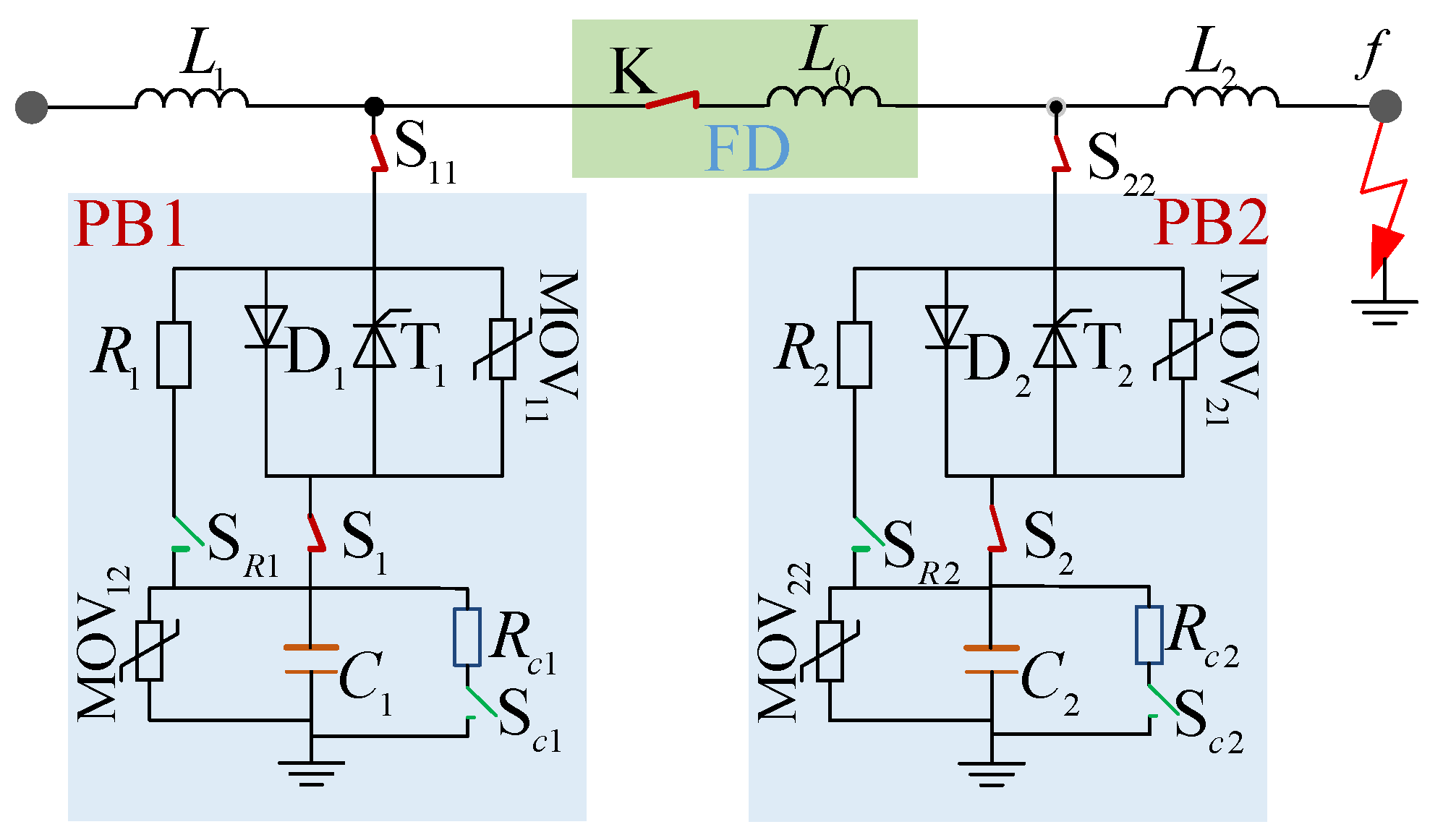
This study proposes a novel current-limiting DCCB structure. While the fundamental principle of utilizing sequential capacitor discharge to induce artificial current zero-crossing is based on the concept introduced in Ref. [27], this paper optimizes the topology for HVDC application. The proposed topology (Figure 1) integrates dedicated pre-charging branches (R1, SR1) and, crucially, energy absorption branches (RC1, SC1). The proposed current-limiting DCCB primarily consists of three parts: Parallel Branch 1 (PB1), Parallel Branch 2 (PB2), and a Fast Disconnector (FD). The FD consists of an ultra-fast vacuum mechanical switch driven by an electromagnetic repulsion mechanism. PB1 and PB2 share an identical structure, each comprising charging resistors (R1, R2) and charging switches (SR1, SR2), capacitor banks (C1, C2), conventional mechanical switches (S1, S2) and branch isolation switches (S11, S22), diode valve groups (D1, D2), thyristor valve groups (T1, T2), capacitor discharge resistors (RC1, RC2) and discharge switches (SC1, SC2), metal oxide varistors (MOVs) for capacitor protection (MOV12, MOV22), and MOVs for thyristor protection (MOV11, MOV21). PB1 and PB2 serve as the core components of the current-limiting DCCB and are connected in parallel across the FD branch. The FD consists of an ultra-fast vacuum mechanical switch and an inductor L0, which prevents excessively rapid discharge between the capacitor banks. Inductors L1 and L2 in Figure 1 represent the equivalent current-limiting reactors on the input and output sides of the DCCB, respectively, which serve to suppress the rapid rise in the DC short-circuit current.

2.2. Operating Principle of the Current-Limiting DCCB

During the pre-charging startup phase, switches S1, S2, SR1, and SR2 are closed. The DC line charges capacitor banks C1 and C2 through large resistors R1 and R2, respectively. The charging process forms an LCR second-order charging circuit, with the charging rate controlled by R1 and R2, and the time constant τ1 = 1/(R1C1). After pre-charging is completed, the voltage difference across S1 and S2 is slight, and the required closing speed is not critical; hence, conventional mechanical switches suffice for S1 and S2. During steady-state operation, the line intermittently charges C1 and C2 through diodes D1 and D2 to maintain their voltage.
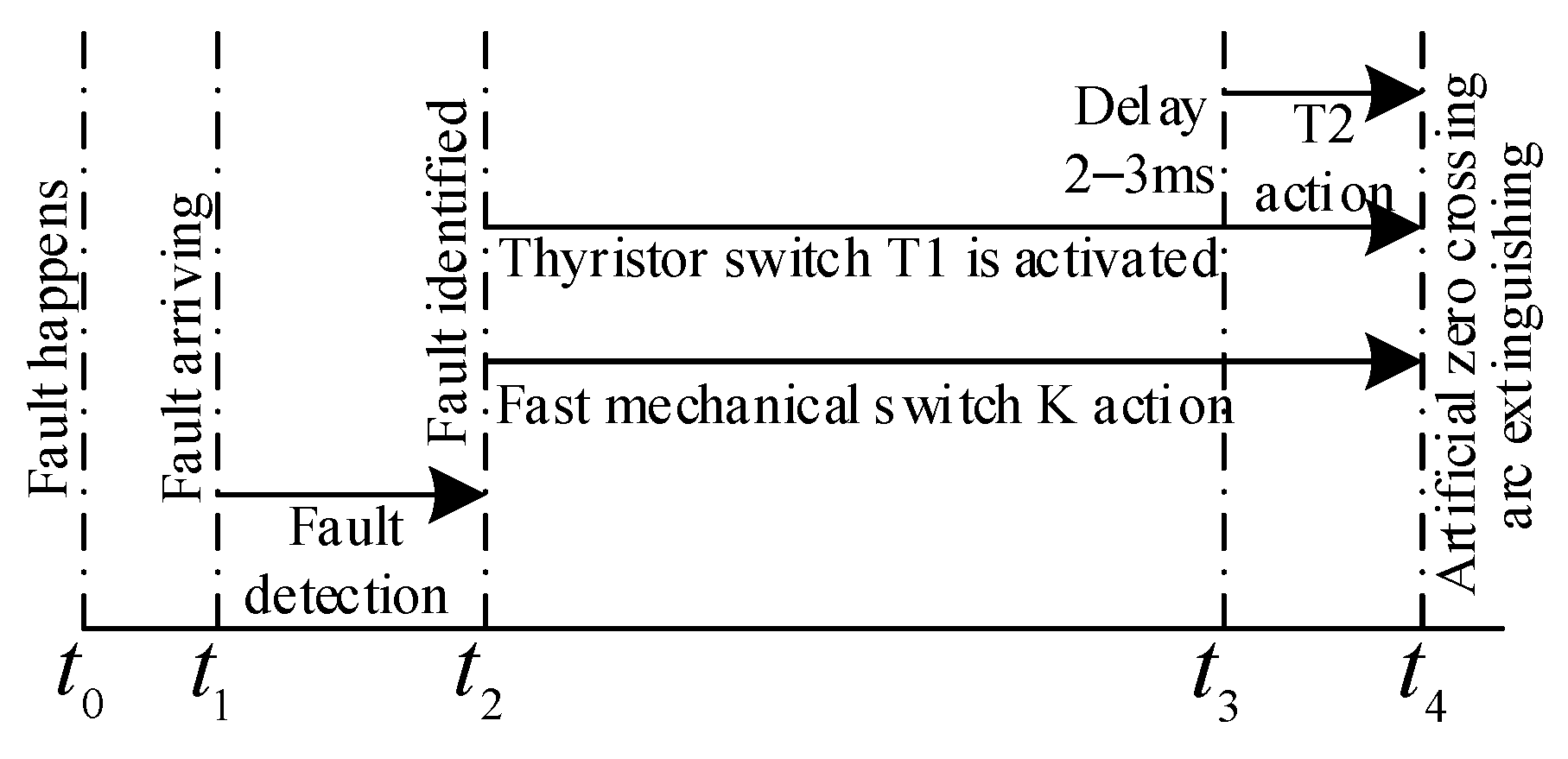
When a fault occurs on the DC line, the entire sequence of events is shown in Figure 2. At time t0, a ground fault happens at location f on the line. At time t1, the fault-induced traveling wave reaches the protection device, triggering it to start fault identification. To keep costs down, the rated voltage of thyristors T1 and T2 might not be very high. During the fault detection period (t1t2), the fault traveling wave can cause MOV21 and MOV11 to break down. After the breakdown, C1 and C2 discharge slowly into the fault line through MOV21 and MOV11, respectively, helping to clamp the line voltage.
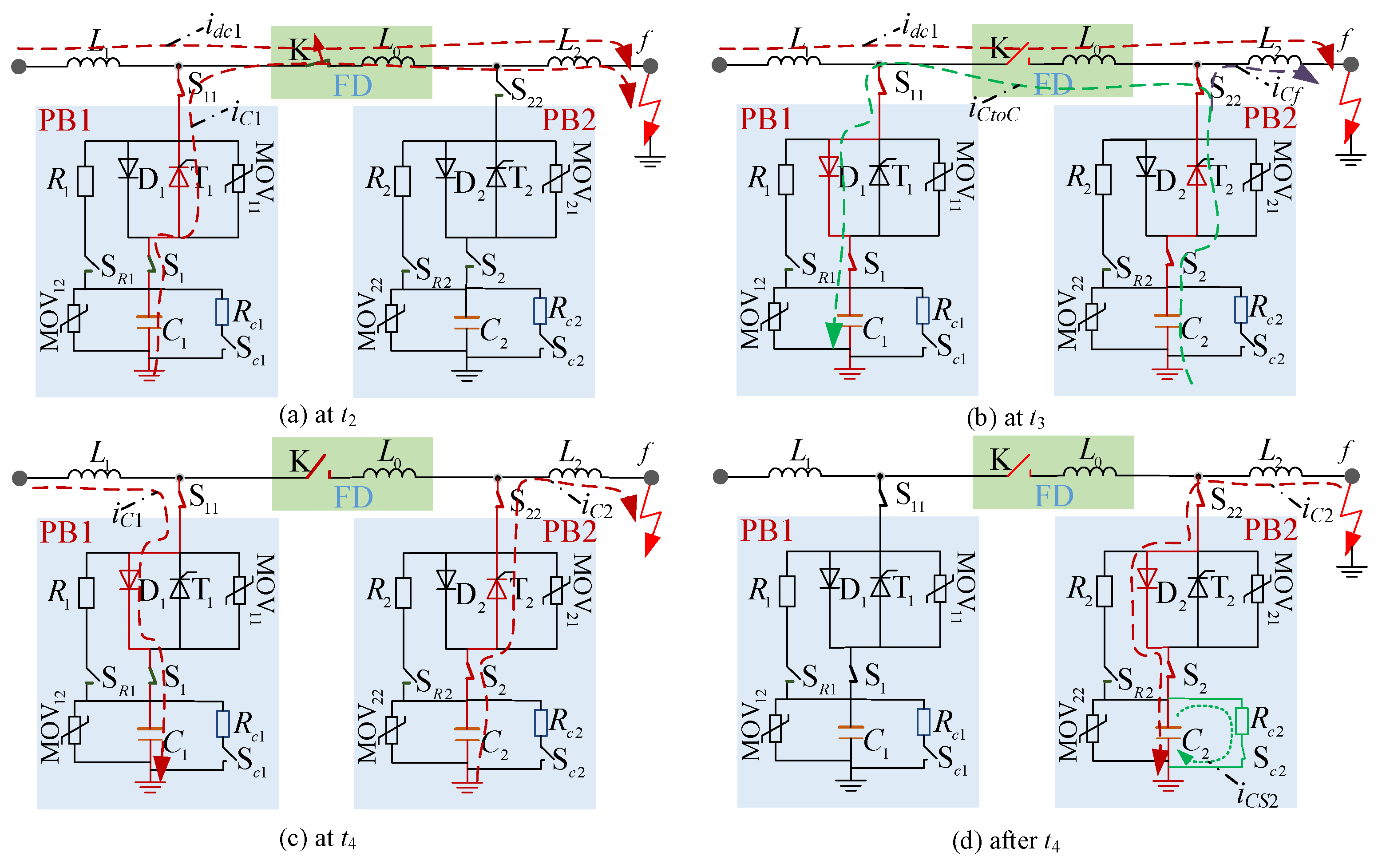
At time t2, after the protection device detects the specific faulty line, thyristor switch T1 is triggered. As shown in Figure 3a, C1I quickly discharges toward the fault point through T1, K, L0, L2, and the fault line (iC1), forming a secondary LCR discharge circuit. This discharge sustains a gradually decreasing line voltage, alleviating overcurrent stress on the converter. Meanwhile, the ultra-fast mechanical switch K begins to open, accompanied by arcing.
Several milliseconds later, at time t3, K has opened enough to create a sufficient physical gap (Generally 2–3 ms), and thyristor switch T2 is triggered. As shown in Figure 3b, since the voltage on C2 is now higher than that on C1, C2 discharges into C1 through T2, L0, and D1 (iCtoC), causing the current through K to drop to zero, which quenches the arc and achieves DC interruption. C2 also discharges to the fault point through L2 (iCf). The inductor L0, which has a small inductance, mainly acts to prevent excessively rapid discharges between the capacitors (C2 and C1) due to their direct parallel connection.
As shown in Figure 3c, after the FD section isolates the faulty line, the power supply charges C1 through D1 until it is fully charged (iC1). The active component C2 in PB2 continues to discharge through T2 (or D2), L2, and the DC line, forming a second-order LCR oscillatory circuit (iC2).
As shown in Figure 3d, when the current oscillates to zero, T2 turns off. Capacitor C2 is then charged via D2 (iC2), and any remaining energy is gradually dissipated through MOV21 and resistors R2 and RC2 (iCS2). Since active components stay in the isolated faulty line section, the nature of the fault (temporary or permanent) can be determined by analyzing the properties of the oscillating current.

2.3. Parameter Constraints and Stability Analysis of Sequential Discharge

To ensure the reliability of the artificial current zero-crossing, the selection of capacitance parameters (C1, C2) and the limiting inductor (L0) must satisfy specific energy and time constraints.
(1)
Energy Constraint for Zero-Crossing Creation
The core principle of the proposed DCCB involves injecting a reverse current iinj from C2 to C1 to cancel out the fault current ifault flowing through the mechanical switch K. When thyristor T2 is triggered at time t3, a localized L-C oscillation circuit is formed by C2, C1, and L0. The equivalent capacitance of this loop is Ceq = C1C2/(C1 + C2). The peak magnitude of the injected current, Iinj_peak, is determined by the voltage difference between the two capacitor banks:
I i n j _ p e a k U C 2 ( t 3 ) U C 1 ( t 3 ) L 0 / C e q
where UC2(t3) remains near the rated voltage (as it is isolated before t3), while UC1(t3) has dropped significantly due to its prior discharge into the fault line between t2 and t3. To guarantee a successful zero-crossing, the injected current must exceed the fault current with a safety margin ksafe (typically 1.2–1.5):
I i n j _ p e a k k s a f e i f a u l t ( t 3 )
This inequality represents the energy constraint. It implies that for a given fault level and inductor L0, the capacitors must store sufficient energy to generate the required counter-current. The sequential operation naturally enhances stability because the voltage drop on C1 maximizes the potential difference ΔU = UC2UC1, thereby allowing smaller capacitance values to interrupt larger fault currents compared to non-sequential topologies.
(2)
Time Constraint for Arc Extinction
The timing of the zero-crossing is critical for the dielectric recovery of the mechanical switch K. The discharge process creates a sinusoidal current pulse with a half-period Tosc:
T o s c = π L 0 C e q
The time constraint imposes two requirements:
Delay Coordination: The zero-crossing must occur only after the mechanical switch has achieved a sufficient contact gap (typically 2–3 ms) to withstand the transient recovery voltage.
Current Rate of Change (di/dt): The value of L0 and Ceq determines the di/dt near the zero-crossing. If Ceq is too small, the pulse width is too narrow, leading to a high di/dt that may cause arc reignition. Conversely, if Ceq is too large, the cost increases unnecessarily.
In this study, C1 and C2 are selected as 150 μF and L0 is tuned to ensure that the injected current pulse creates a stable zero-crossing window of approximately hundreds of microseconds, providing sufficient time for the vacuum switch to de-ionize.

3. Impact of DCCBs on the Fault Detection Scheme

3.1. Impact of Conventional Series Type DCCBs

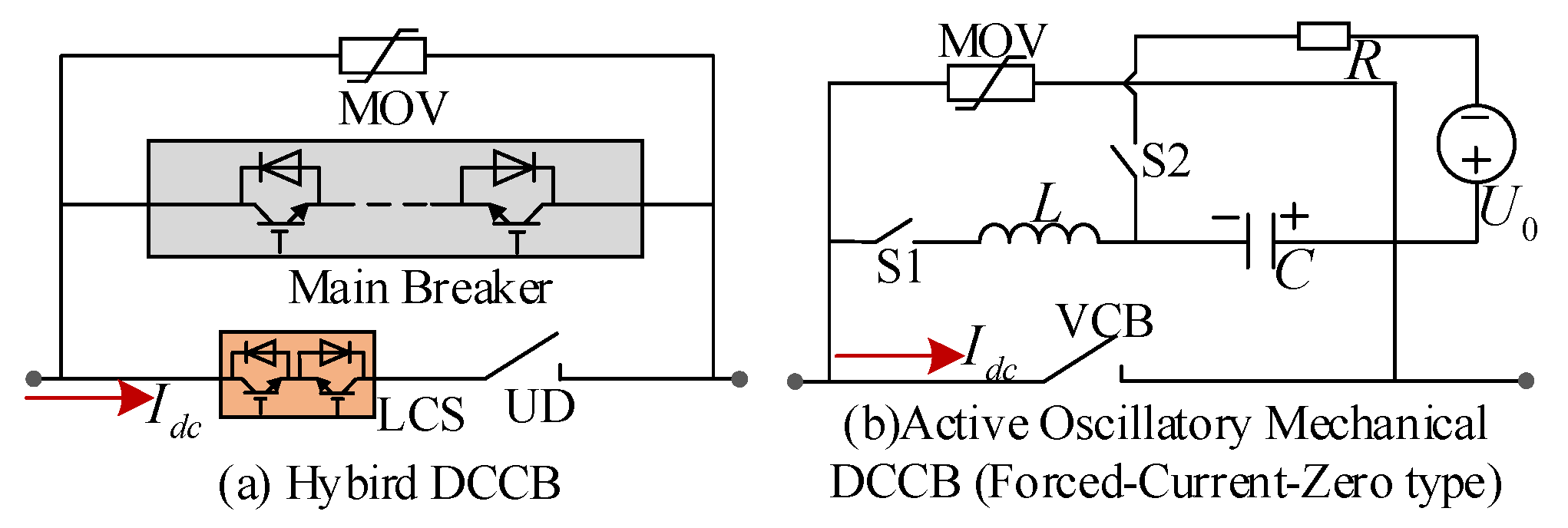
Hybrid DCCBs are typically used in real systems [9,10,11], mainly composed of a main branch, a transfer branch, and an energy absorption branch, as shown in Figure 4a. After a fault is detected by the protection device, the load commutation switch (LCS) in the transfer branch and the ultra-fast disconnector (UD) operate, diverting the current into the main breaker within the main branch. After a few milliseconds (typically 2–3 ms), once the UD in the main branch has opened sufficiently to create a gap, the main breaker operates, transferring the fault current to the parallel energy absorption branch (MOV) for dissipation.
Figure 4b illustrates the topology of a mechanical DCCB used in another multi-terminal VSC-HVDC real project [7,8]. Here, the DC source (U0) pre-charges the capacitor (C) through the resistor (R) and the switch (S2). After a fault, the vacuum circuit breaker (VCB) begins to arc during its opening process. Then, switch (S1) is closed, allowing the inductor (L) and capacitor (C) to generate a resonant current in the circuit, forcing the current through the VCB to become zero.

3.2. Impact of the Proposed Current-Limiting Types DCCB

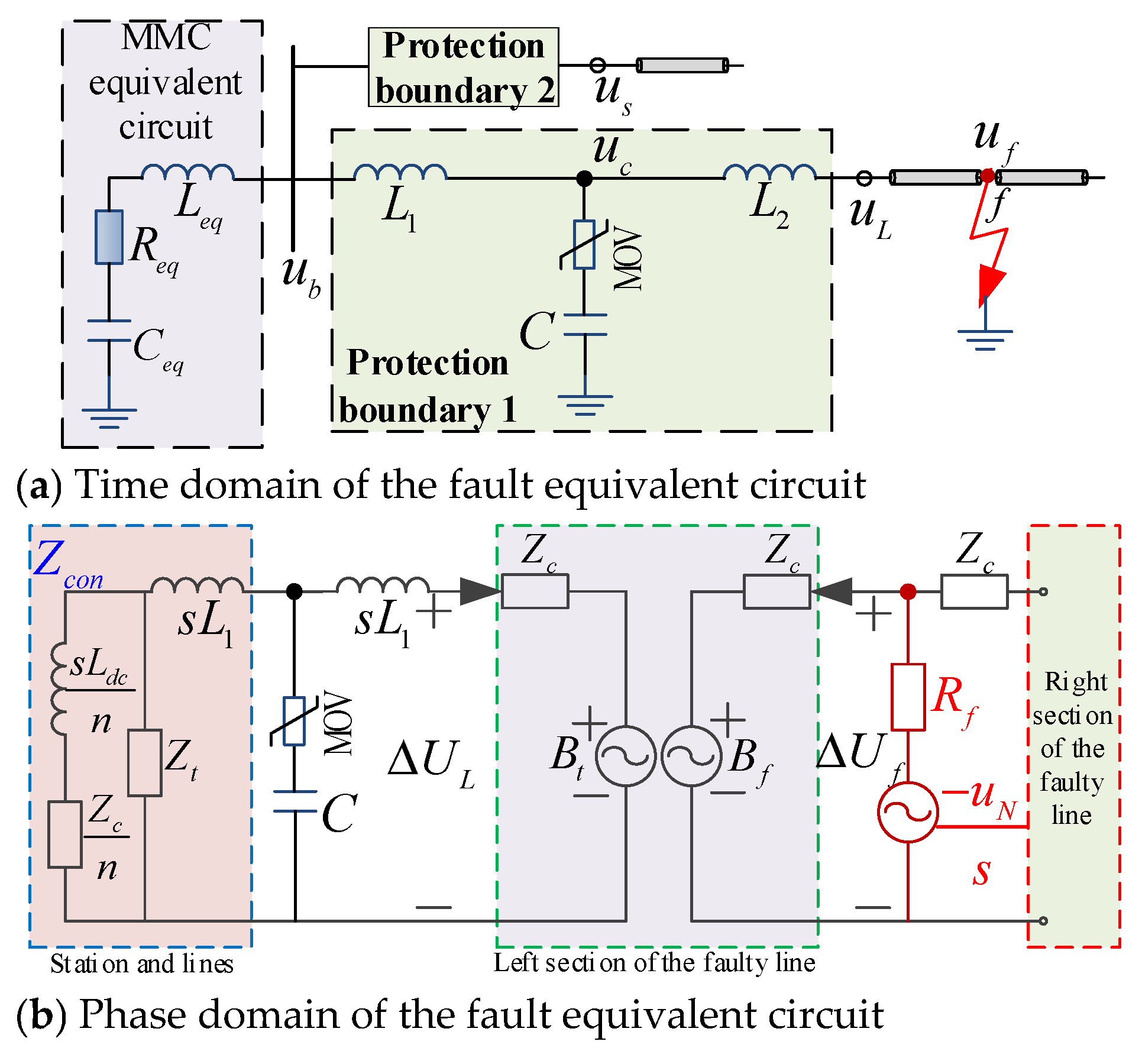
Unlike the conventional oscillatory DCCB where the LC branch is connected across the break and remains inactive before tripping, the proposed DCCB employs a line-to-ground shunt topology. This configuration allows the capacitors to actively shape the fault characteristics immediately upon the arrival of the traveling wave, acting as a protection boundary. Before the fault is identified, the proposed types DCCB can be equivalently represented as Protection Boundary 1 in Figure 5 (ignoring the large pre-charging resistors and diodes), where C represents the equivalent capacitance. In VSC-HVDC grids, the MMC must avoid locking during the protection process. Thus, the MMC can be modeled as a capacitor with an initial voltage discharging through a resistor and an inductor [22]. In Figure 5a, Ceq, Req, and Leq represent the equivalent capacitance, resistance, and inductance of the MMC, respectively.
As shown in Figure 5, after a monopolar ground fault, the fault resistance Rf is located at position f on the DC line. The transmission line is modeled as a distributed-parameter system. Using the Laplace transform, the phase-domain fault equivalent circuit shown in Figure 5b can be constructed, where the DC transmission line is modeled as a Thevenin equivalent. If the length of the left section of the fault line is d, the Thevenin model can be written as follows:
B t = 2 H ( d ) Δ U f B f = 2 H ( d ) Δ U t
where ΔUt and ΔUf are the fault voltage components at the line port and fault point, respectively, and Bt and Bf are the reverse and forward traveling waves, respectively. The transfer function H(d) needs to consider the delay, attenuation, and distortion of fault traveling waves propagating along the transmission line, which can be expressed as follows:
H ( d ) = 1 k a d 1 + t a d s e d s / v
where H(d) consists of two parts, the numerator part is the equivalent propagation delay, and the denominator part simulates the attenuation and distortion of traveling waves through a first-order inertial element [25]. When a fault occurs in the circuit, the fault additional state is t = 0. The fault power supply −uN/s is applied at the fault point, and the fault resistance is Rf. Before the fault traveling wave arrives, Bf = 0, so the voltage at the fault point is solved as
Δ U L = 2 H ( d ) Δ U f ( Z c o n + s L 2 Z c + Z c o n + s L 2 )
where Zc is the surge impedance of the line, uN is the rated line voltage, and ε(t) is the unit step function. The voltage ΔUf will propagate along the DC line toward the line terminal. Upon encountering the series inductor L2, the wave will undergo reflection and refraction due to the impedance discontinuity.
Δ U L = 2 H ( d ) Δ U f ( Z c o n + s L 2 Z c + Z c o n + s L 2 )
where Zcon is the equivalent impedance on the left side of L2. Transform the fault voltage traveling wave ΔUL from the phase domain to the time domain, and ignore the attenuation distortion effect of H(d). The resulting change in voltage, ΔuL, across the inductor can be expressed as
Δ u L = 2 Z c u N ε ( t τ ) 2 R f + Z c ( Z c o n Z c + Z c o n + Z c Z c + Z c o n e ( t - τ ) / T )
where traveling wave propagation delay τ = d/v, v is the traveling wave velocity. When the fault-induced traveling wave reaches the terminal, it begins to decay from an initial amplitude of approximately twice the fault voltage. The decay time constant of the voltage traveling wave is given by T = L2/(Zc + Zcon). Meanwhile, at point uc in Figure 5a, the voltage is clamped by the equivalent capacitance C and the conducting MOV group. After the traveling wave arrives at the terminal, Δuc will be clamped to
u m o v Δ u c 0
where un is the rated voltage of the capacitor (i.e., the rated line voltage), and umov is the breakdown voltage of the MOV. Applying voltage division and neglecting the equivalent resistance Req of the MMC, the voltage on the DC bus can be approximated as
u m o v L e q L e q + L 1 Δ u b 0
From the above derivation, it can be observed that after the fault-induced traveling wave passes through Protection Boundary 1, the magnitude of the voltage change on the DC bus, |Δub|, is less than umov. Similarly, the voltage change Δus on the non-faulty line connected to the same DC bus, after passing through Protection Boundary 2, must also satisfy Δus < umov.

4. The Proposed Fast Fault Identification Scheme

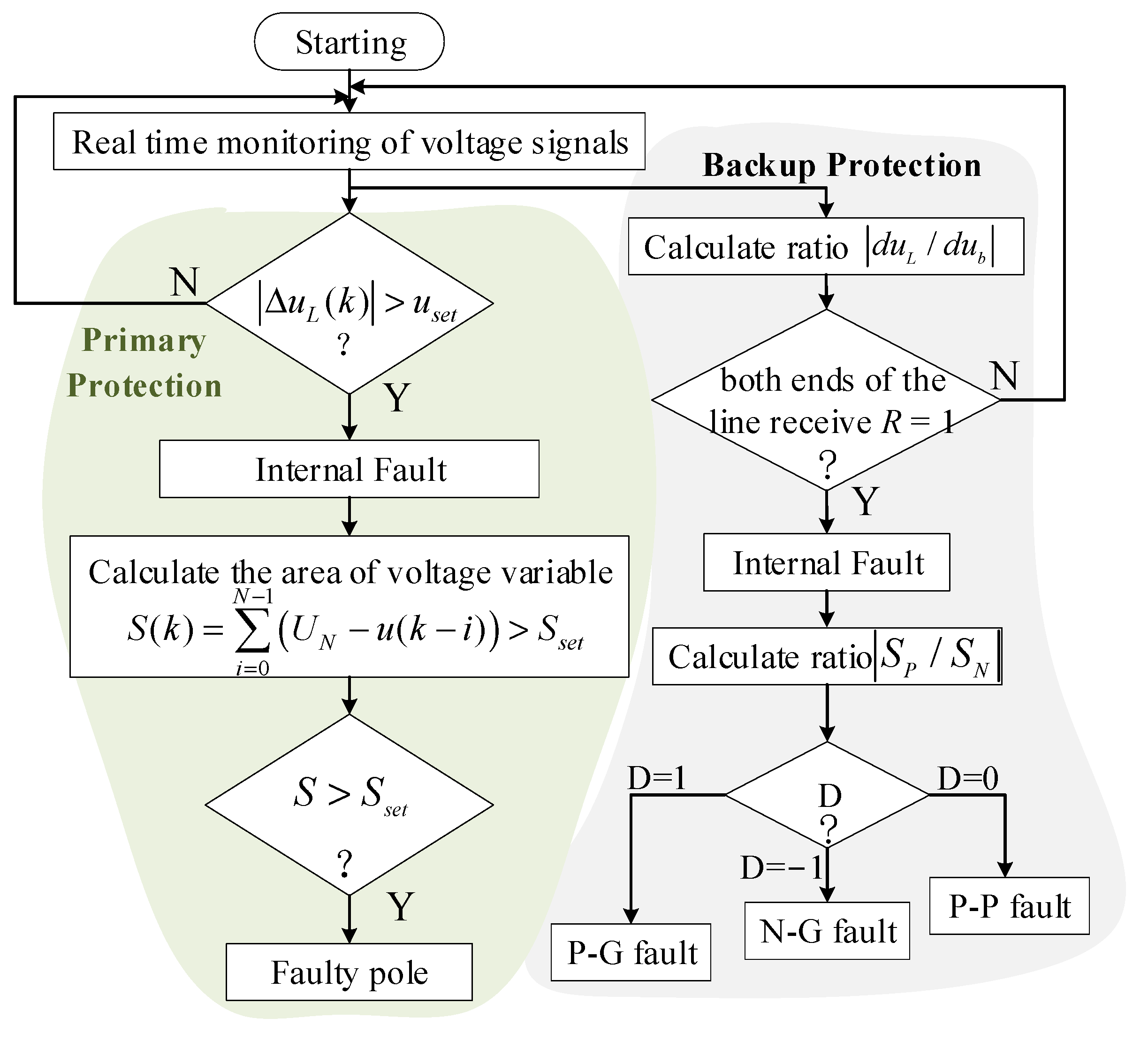
The overall flowchart of the proposed protection scheme is depicted in Figure 6. It comprises both main and backup protection. The main protection utilizes single-ended measurements to enable ultra-fast tripping of the faulty line. The backup protection, in contrast, employs directional information from both line ends to ensure reliable fault area identification.

4.1. Primary Protection

As derived in the previous section, due to the presence of the protection boundary, the magnitude of the voltage change on the faulty line will exceed umov, while that on the non-faulty line will remain below umov. Based on this characteristic, this paper proposes the following fast fault identification criterion:
Δ u L ( k ) > u s e t Δ u L ( k ) = i = 1 3 Δ u L ( k ) Δ u L ( k i ) / 3
where ∆uL(k) denotes the average rate of change in the measured voltage (ARCMV) on the line side at the k-th sampling point, and uset represents the protection setting threshold, which should be greater than umov ≈ 90 kV. According to Equation (8), the minimum theoretical voltage drop for a 500 Ω fault is 285 kV. In this study, it is set to 1.3 times umov. This provides a wide reliability margin against external clamping effects while maintaining high sensitivity for high-resistance faults.
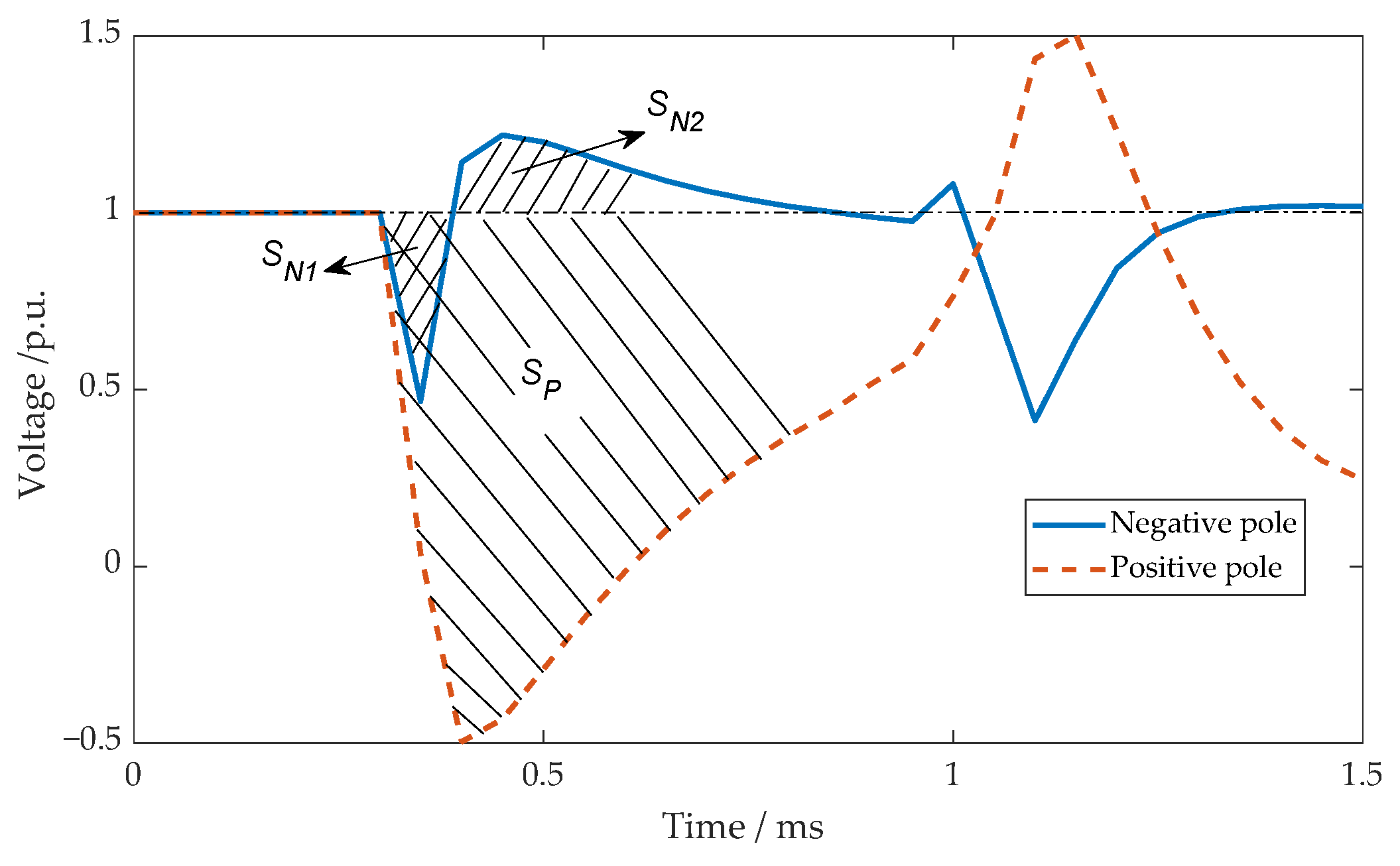
Because of the coupling between the two poles in a bipolar DC transmission line built on the same tower, a significant interference may be induced on the sound pole when a single-pole ground fault occurs on the other pole, requiring further discrimination. According to Ref. [22], a single-pole fault produces both α-mode and zero-mode transient components at the fault point, with the α-mode component propagating faster than the zero-mode component. For the non-faulty pole, when the α-mode transient arrives at the terminal, the fault voltage initially decreases. Then, with the arrival of the zero-mode transient, the fault voltage rises again, as shown in Figure 7.
Figure 7 shows the voltage variations measured by R12 after a positive-pole ground fault F1 occurs 100 km from the Beijing station.
The area enclosed between the rated line voltage and the measured voltage waveform is illustrated in Figure 7. For the faulty pole (positive pole), Sp is a significantly large positive value. In contrast, for the non-faulty pole (negative pole), the area SN1 is positive, while SN2 is negative, resulting in a relatively small net area. Based on this characteristic, the proposed faulted pole identification criterion in this paper is as follows:
S ( k ) = i = 0 N 1 U N u ( k i ) > S s e t
where u is the measured pole voltage, UN is the rate voltage, and k is the current sampling instant. The number of window data points, N, is critical for distinguishing the faulty pole. Sset is empirically determined from simulations to exceed the maximum mutual-coupling interference induced on the healthy pole. As established in wave propagation theory, the line-mode component travels close to the speed of light, while the zero-mode component travels significantly slower due to ground impedance. When a single-pole-to-ground fault occurs, the faulty pole voltage drops immediately upon the arrival of the line-mode wave. In contrast, the healthy pole voltage initially drops due to mutual coupling but recovers rapidly once the slower zero-mode wave arrives (as shown in Figure 7). To reliably capture this characteristic “dip-and-recover” behavior on the healthy pole, the window data points N must cover the time delay between the line-mode and zero-mode arrivals. In our simulation, we selected a window of 0.3 ms (N = 6), which provides a robust margin for discrimination while ensuring ultra-fast operation.

4.2. Backup Protection

To enhance the reliability of the protection system by identifying faults with extremely high fault resistance and addressing potential failure of the primary protection, this paper proposes a communication-based backup pilot protection scheme. Leveraging the fault current-limiting reactor’s (CLR) ability to smooth fault-induced traveling waves. The proposed method uses the ratio of the ARCMV on the line side to that on the bus side to determine fault direction.
The direction criterion is defined as follows:
R ( k ) = 1   ,   Δ u L ( k ) / Δ u b ( k ) > K s e t 1 ,             o t h e r w i s e
where ΔuL(k) and Δub(k) denote the ARCMV on the line side and on the DC bus at the k-th sampling point, where the reliability coefficient Kset is set to 1.2 (Providing a 20% safety margin). When a forward fault occurs (on the line), the ARCMV on the line side exceeds that on the bus side, fault directional signal R(k) = 1 is sent to the opposite terminal of the line. Conversely, for a backward fault (on the bus or adjacent lines), the voltage change propagates through the bus to the line side, but is dampened by the CLR, resulting in a ratio less than Kset. During the maintenance period of the fault directional signal (typically a few milliseconds, including signal and transmission delays), if the directional signals at both ends are positive, it indicates an internal fault.
Backup protection is generally used to identify high-resistance faults. When a high-resistance fault occurs, using the amplitude in Equation (12) to distinguish the fault becomes inefficient and may cause misoperation. To improve the sensitivity of the fault pole criterion, we distinguish the fault line by comparing the relative magnitude of S(k) of the positive (SP(k)) and negative poles (SN(k)). The faulty pole is then identified using the following criteria:
D ( k ) = 1 ,   S P ( k ) / S N ( k ) > k p 1 ,   S P ( k ) / S N ( k ) < 1 / k p 0 ,   o t h e r w i s e
where kp should be slightly greater than 1; in this study, it is set to 1.2 (Providing a 20% safety margin). A calculated result of D(k) = 1 indicates a positive-pole-grounding (P-G) fault, D(k) = −1 indicates a negative-pole-grounding (N-G) fault, and D(k) = 0 represents a bipolar pole-to-pole (P-P) fault.

5. Simulation Results

5.1. Introduction to the Simulation System

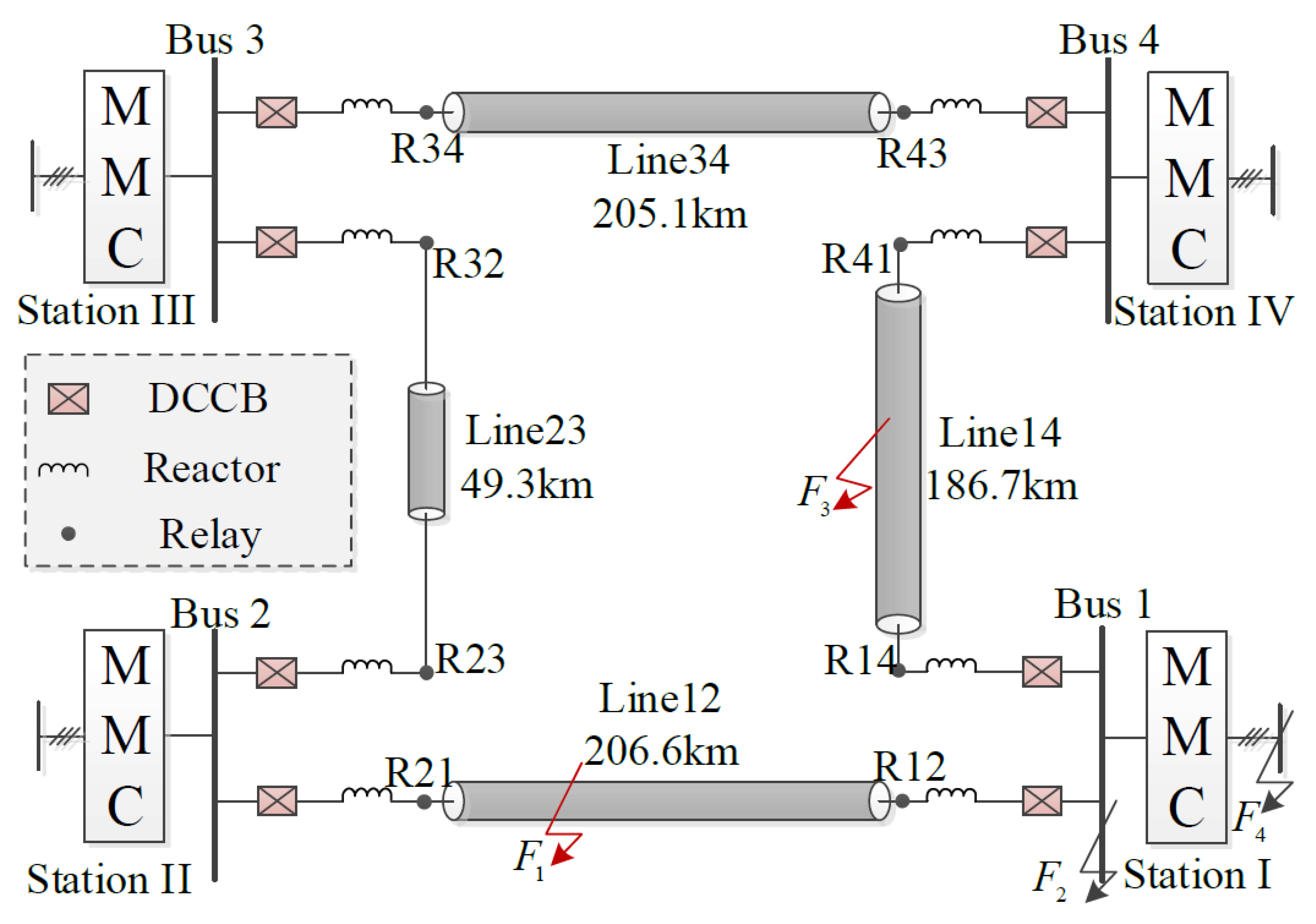
The 4-terminal MMC-HVDC grid simulation model is built in PSCAD/EMTDC, utilizing parameters derived from a practical project in China. The topology of the MMC-HVDC grid is depicted in Figure 8, where half-bridge submodule (SM) MMCs and high-capacity hybrid DCCB are adopted. To accurately represent the dynamic behavior of the converters while maintaining computational efficiency for system-level protection studies, the Detailed Equivalent Model (DEM) available in PSCAD/EMTDC is utilized for all MMC stations, and the Nearest Level Control (NLC) modulation strategy is adopted. The main grid topology is a symmetrical bipolar structure, with overhead transmission lines used [22]. The converter stations operate under a hierarchical control structure based on dual-loop vector control in the d-q synchronous reference frame. The entire system forms a ring shape, with stations connected to Station I, II, III, and IV. Among these, the station I acts as the slack bus for the DC grid, employing constant DC voltage control, while the other stations operate with constant active power control [22].
Since the DC grid has low inertia, fault CLRs are installed in series at both ends of each line to prevent a rapid rise in short-circuit currents. In Figure 8, the CLRs at both ends of Line 23 are 300 mH, while those on the other lines are 200 mH. Faults F1–F4 occur in different zones, and R(1–4)(1–4) indicate the signal measurement points of the line protection devices.
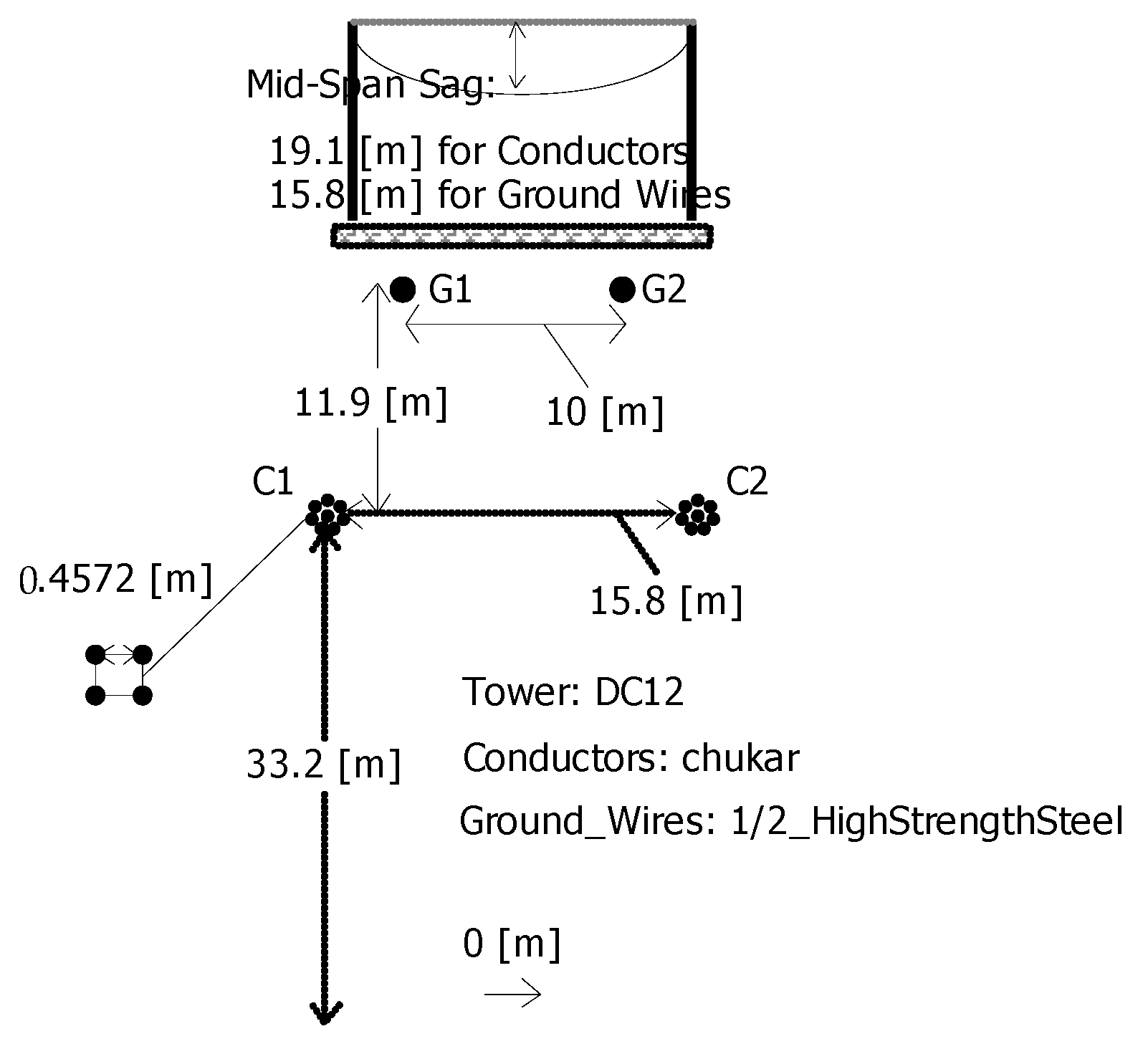
Each converter station uses dual-loop vector control, with simulation parameters listed in Table 1 [22]. The bipolar overhead DC lines are composed of type 4 × JL/G2A-720/50, which are modeled with frequency-dependent properties in the simulation. The lengths of the lines are as shown in Figure 8, and the transmission line tower structure is depicted in Figure 9.

5.2. Operating Characteristics of the Novel DCCB

5.2.1. Voltage and Current Behavior During the Interruption Process

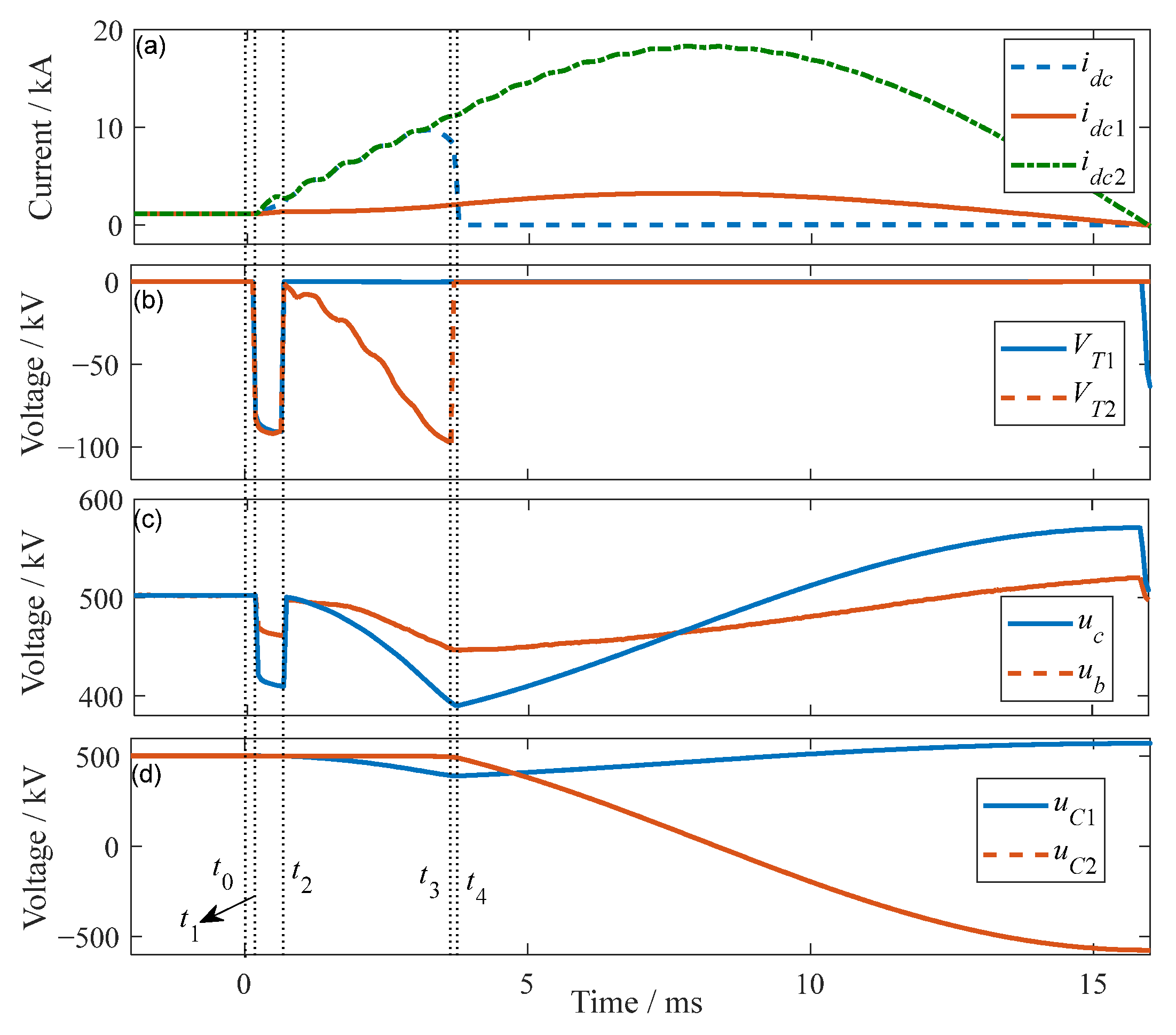
This section examines the interruption process of the DCCB at location R21 following a positive-pole-to-ground fault that occurs 50 km from Station I on Line 12. The interruption sequence is illustrated in Figure 10. In the simulation, C1 and C2 are set to 150 μF, and the breakdown voltage of the MOV11 and MOV21 is approximately 90 kV. The thyristor T2 is triggered 3 ms after the mechanical switch K operates to quench the arc.
The overall interruption process is consistent with the expected DCCB operating sequence. A fault occurs at time t0, and the resulting traveling wave reaches the protection location at time t1. At this point, both MOV11 and MOV21 break down to limit the voltage across thyristors T1 and T2 to the MOV breakdown voltage, as shown in Figure 10b. Meanwhile, the voltage uC is clamped to the value given by Equation (9), and the DC bus voltage ub is clamped to the value specified by Equation (10), as depicted in Figure 10c.
At time t2, after fault identification is completed, thyristor T1 is triggered. Capacitor C1 discharges through T1, causing its voltage to decrease, as shown in Figure 10d. The voltage across the still-inactive thyristor T2 increases gradually, as illustrated in Figure 10b. At time t3, thyristor T2 is conducting, and the current idc through the mechanical switch K is forced to zero artificially, thereby extinguishing the arc and achieving DC interruption.
In Figure 10a, idc1 represents the short-circuit current contributed by the converter. Throughout the interruption process, the voltage clamping effect limits the magnitude of this current, demonstrating the current-limiting capability of the proposed DCCB. This effectively prevents overcurrent damage to the converter valves, ensuring their safety. idc2 denotes the current flowing from the DCCB toward the fault. After K opens, this current oscillates in a second-order circuit formed by capacitor C2, inductor L2, and the DC line. MOV21 ultimately absorbs the energy after T2 is turned off. During the oscillation, the voltage across C2 may become negative and reach substantial magnitudes, with any overvoltage being absorbed by MOV22. Meanwhile, after the faulted section is isolated, capacitor C1 is charged back to its rated voltage, un, through a diode, as shown in Figure 10d.
Similar interruption behavior is observed for different fault types and locations; therefore, detailed descriptions are omitted here.

5.2.2. Comparison with Hybrid DCCBs

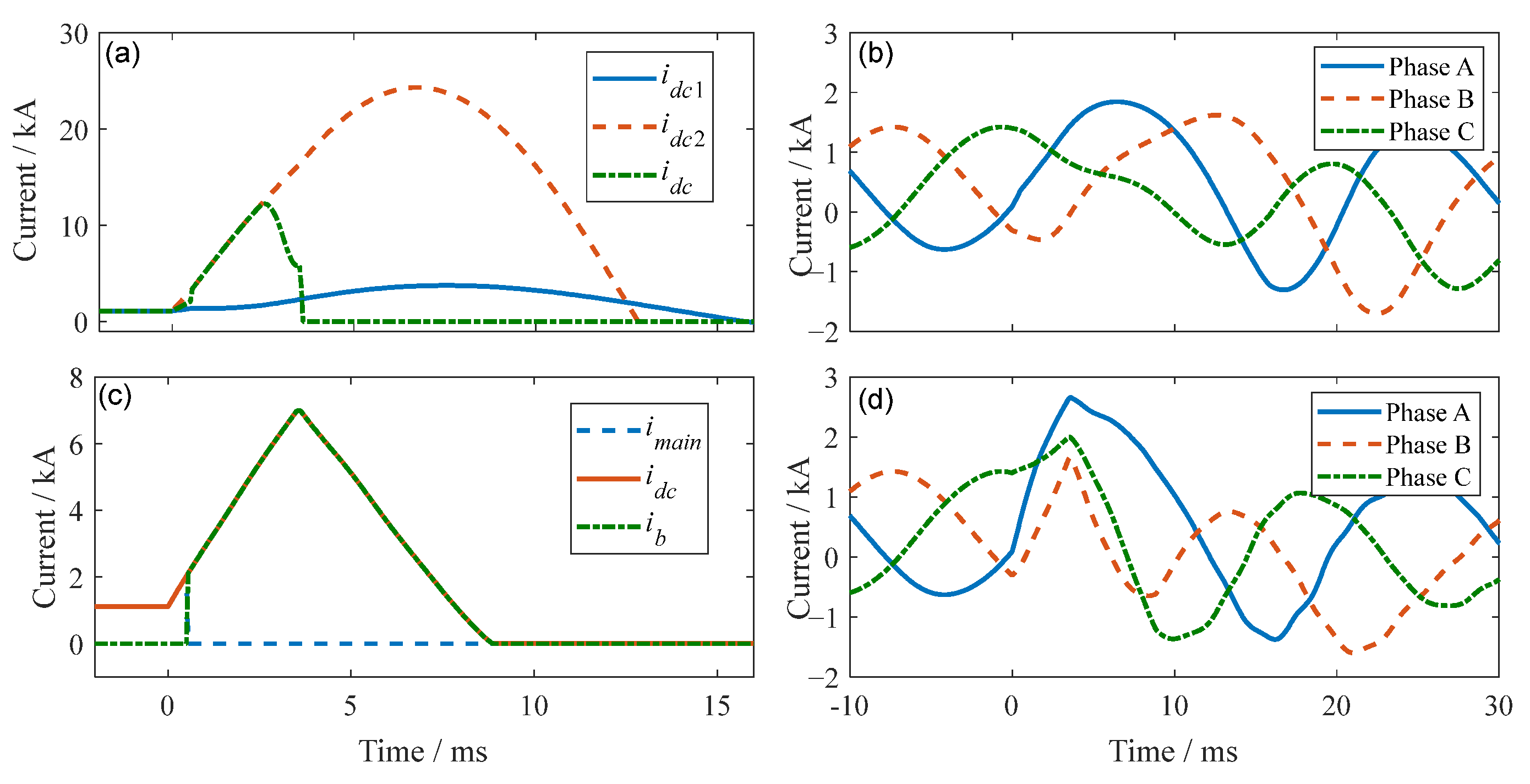
The Hybrid DCCB is selected as the benchmark because it is the adopted solution in the reference Zhangbei ±500 kV project and represents the current industrial state-of-the-art for high-voltage applications. This section compares the operational characteristics of the proposed current-limiting DCCB and a hybrid DCCB during a positive-pole-to-ground fault near station I at location R21. The results are shown in Figure 11. Figure 11a,b illustrate the performance of the proposed current-limiting DCCB, while Figure 11c,d depict that of the hybrid DCCB.
In Figure 11c, imain represents the current through the main branch of the hybrid DCCB, ib denotes the current in the transfer branch, and idc indicates the short-circuit current contributed by the converter station during the fault. Compared to idc1 in Figure 11a, it is evident that although the hybrid DCCB operates more quickly, the converter must withstand a significantly larger short-circuit current than with the proposed DCCB.
Figure 11b,d show the current variations in the upper half-bridge arm of the Station I converter. A comparison reveals that when the proposed current-limiting DCCB is employed, the current change in the converter arms during the entire interruption process is minimal. This further demonstrates the novel current-limiting DCCB’s ability to enhance converter protection and reduce the required short-term overcurrent capability of the converter.

5.3. Fault Identification Results

This section verifies the performance of the proposed voltage-based protection scheme. The following analysis focuses on the voltage transient characteristics utilized by the protection criteria. To validate the proposed scheme, the high-fidelity voltage waveforms generated in PSCAD/EMTDC: 5.0.0 were exported to Matlab: 24.2.0.3070828 (R2024b) for digital signal processing. To emulate the behavior of a physical protection device and ensure data consistency, Discretization, Noise Injection, and Sliding Window Processing are applied.

5.3.1. Single-Pole-to-Ground Faults

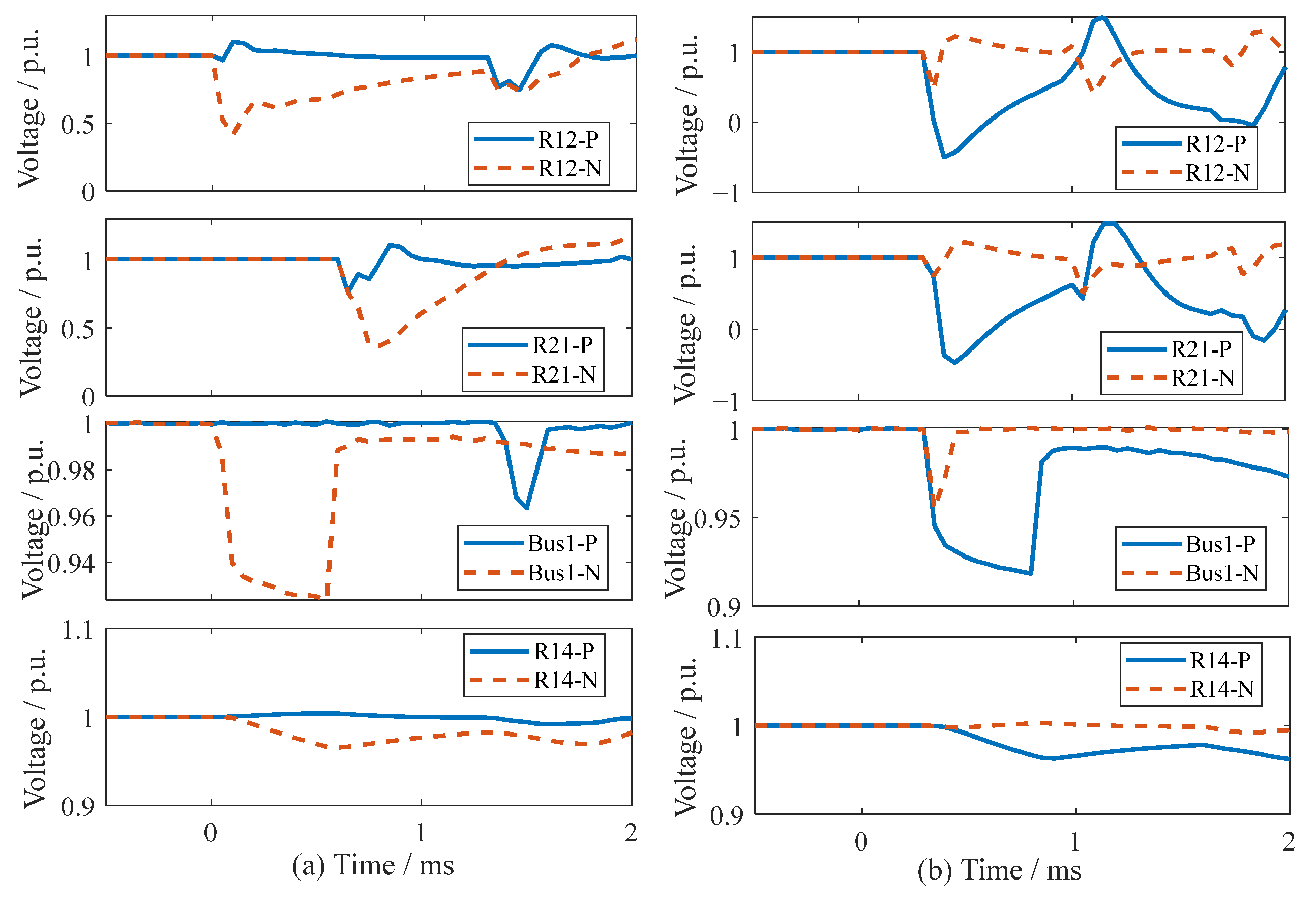
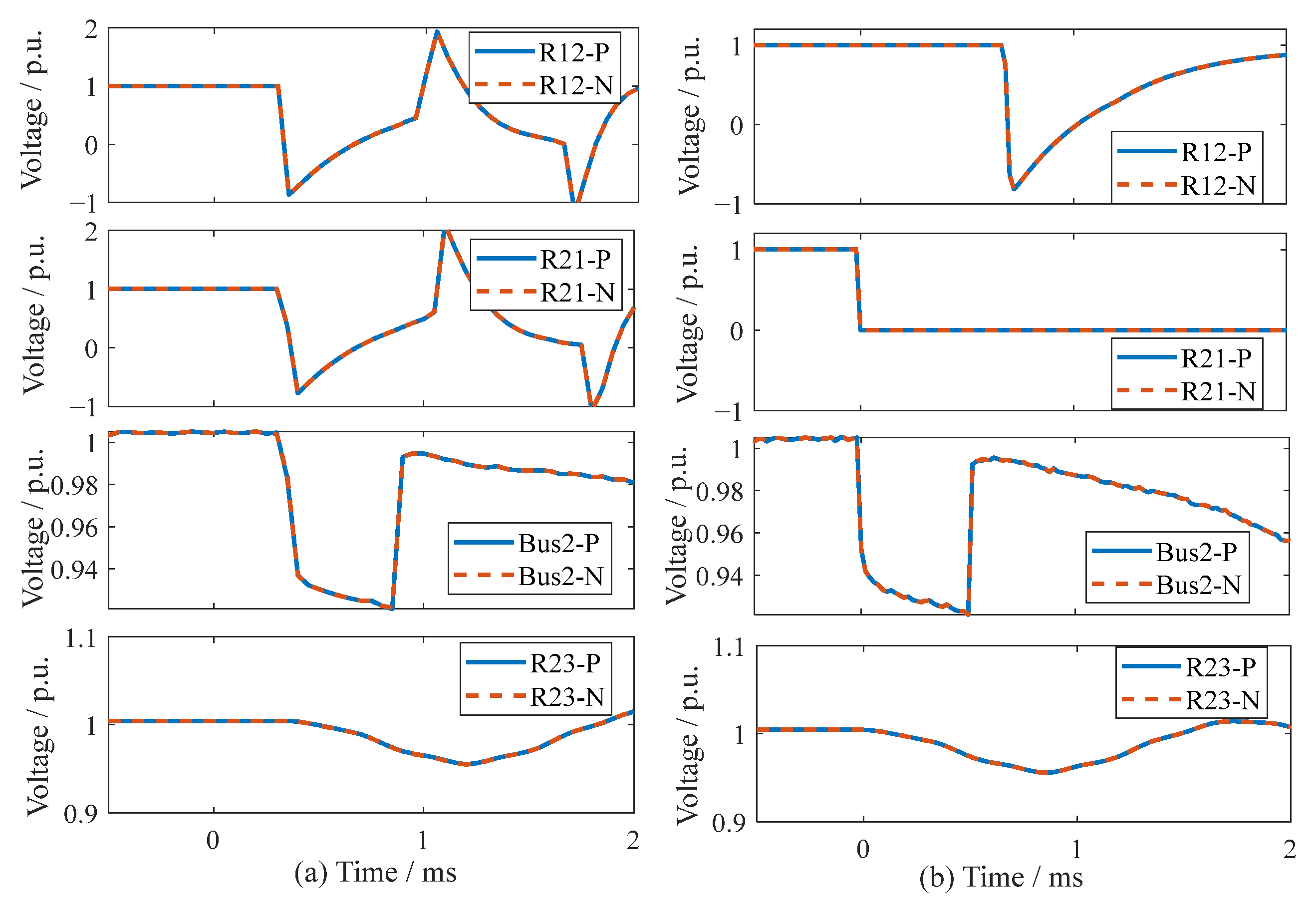
A simulation was conducted for a negative-pole-to-ground fault with a 300 Ω fault resistance at location F1, 15 km from Station I on line 12 in Figure 1. The resulting voltage variations at different locations are shown in Figure 12a. Here, R12-P denotes the positive-pole voltage at protection location R12, R12-N represents the negative-pole voltage, and similarly for R21-P, R14-P, and so on. Bus1-P indicates the positive-pole voltage on the DC bus at Converter Station 1 (Beijing Station).
As observed in Figure 12a, when the fault-induced traveling wave reaches protection location R12, the voltage on the faulty pole at the Beijing Station DC bus drops from un to ub. After approximately 0.5 ms, fault identification is completed, and with the activation of the thyristor switch, the voltage recovers to un, consistent with the derivation in Equation (4). Furthermore, by comparing the voltage changes at in-zone protection locations (R12, R21) and the nearest out-of-zone protection location (R14), it is evident that the voltage variation remains significant within the zone even with a 300 Ω fault resistance, while the out-of-zone voltage change is minimal due to attenuation by the line protection boundary.
Similarly, Figure 12b shows the voltage variations for a direct positive-pole-to-ground fault at location F1, 100 km from the Beijing converter station. As illustrated, the low fault resistance results in larger voltage changes at in-zone protection locations, and the non-faulty pole experiences considerable interference (which can be eliminated using the faulty pole identification criterion). Nevertheless, due to the presence of the line protection boundary, the voltage variations on the Beijing Station DC bus and at location R14 remain small and nearly identical to those in Figure 12a.

5.3.2. Bipolar Pole-to-Pole Faults

Similarly to the analysis of the single-pole-to-ground fault, Figure 13a illustrates the voltage variations at various locations following a bipolar short-circuit fault at location F1, which is 100 km from the Beijing converter station. As observed, the voltage changes on the positive and negative poles are identical. The DC bus voltage at Station I converter behaves similarly to the single-pole fault case, dropping to ub after the arrival of the fault-induced traveling wave. It recovers to un after fault identification and subsequent thyristor operation. In contrast, the magnitude and rate of change in the voltage at the nearest out-of-zone protection location, R23, remain very small.
Similarly, Figure 13b illustrates the voltage variations for a bipolar short-circuit fault at location F1, which is 206.6 km from the Beijing converter station (the end of the line). As shown, the voltage behavior at the DC bus of Station I and location R23 is nearly identical to that in Figure 13a. This further confirms that the proposed line protection boundary effectively blocks the propagation of fault-induced traveling waves to adjacent lines.

5.3.3. Fault Identification Results Under Various Faults

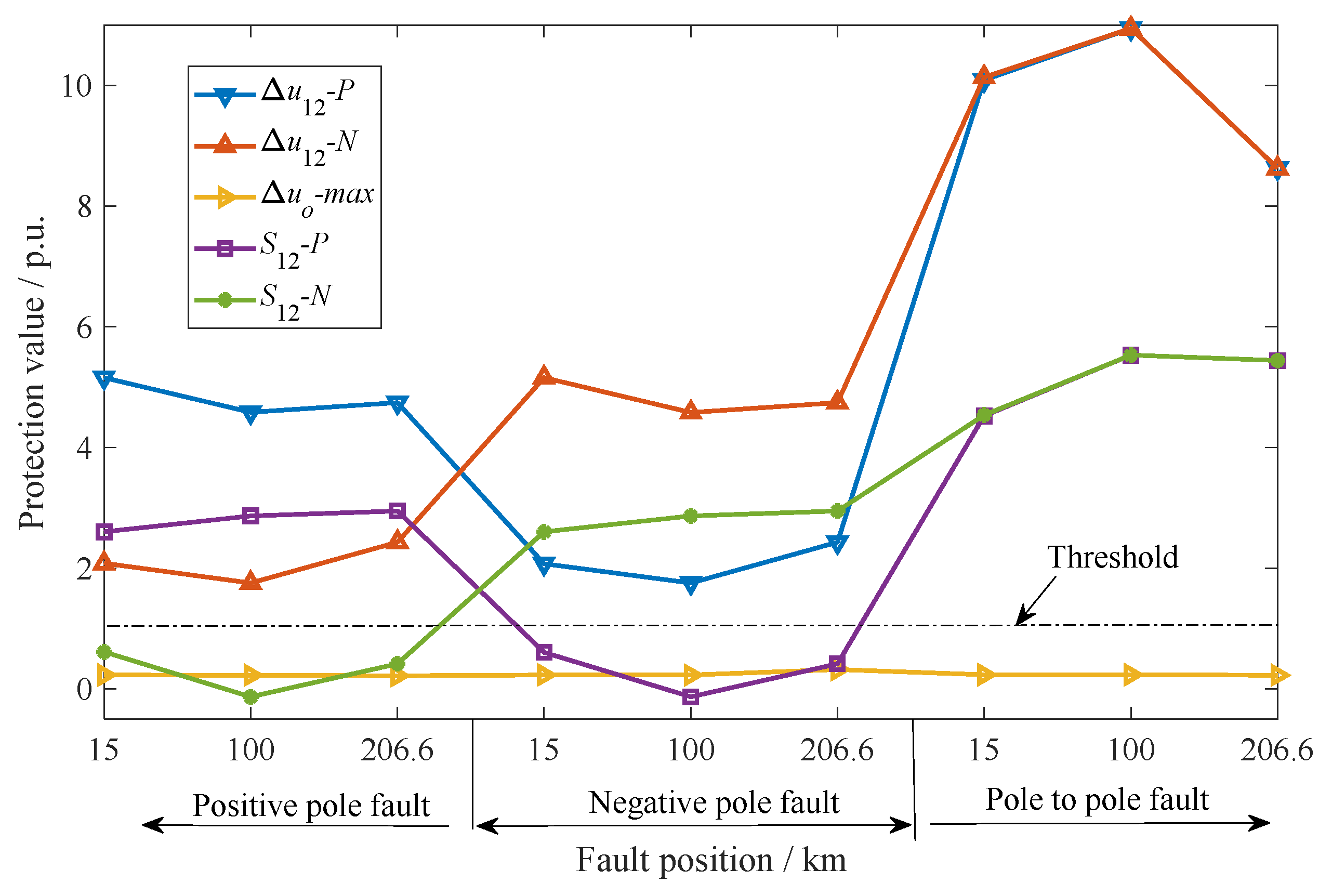
This section assesses the performance of the proposed primary protection scheme for faults occurring at three different locations along the line: 15 km from Station I, 100 km from Station II, and at the line’s end. For each location, three fault types were simulated: positive-pole-to-ground fault with 100 Ω fault resistance, negative-pole-to-ground fault with 100 Ω fault resistance, and bipolar short-circuit fault. The protection results are summarized in Figure 14.
In Figure 14, Δu12-P and Δu12-N represent the protection values of the fault identification criterion for the positive and negative poles, respectively, calculated at the in-zone location R12. Δuo-max denotes the maximum value of the fault identification criterion among all out-of-zone locations and different poles. S12-P and S12-N indicate the protection values of the faulty pole identification criterion for the positive and negative poles, respectively, also calculated at R12 (all values are normalized).
As observed in Figure 14, for positive-pole-to-ground faults at different locations, both Δu12-P and Δu12-N exceed the setting threshold. Meanwhile, S12-P is greater than the threshold while S12-N is lower, correctly identifying a positive-pole fault. Similarly, for negative-pole-to-ground faults, the results are analogous: S12-P is below the threshold and S12-N exceeds it, enabling accurate detection of a negative-pole fault. In the case of bipolar short-circuit faults, all protection values at R12 surpass the threshold, confirming a bipolar fault.
For all fault types and locations, Δuo-max remains significantly below the setting threshold and is largely unaffected, ensuring reliable non-operation for out-of-zone faults. Furthermore, during busbar faults (F2), AC-side three-phase faults (F4), power flow variations, and transient processes resulting from DCCB operations, the calculated protection values at all locations remain well below the setting threshold, thereby preventing maloperation.

5.3.4. Influence of Fault Resistances and Noise Environment

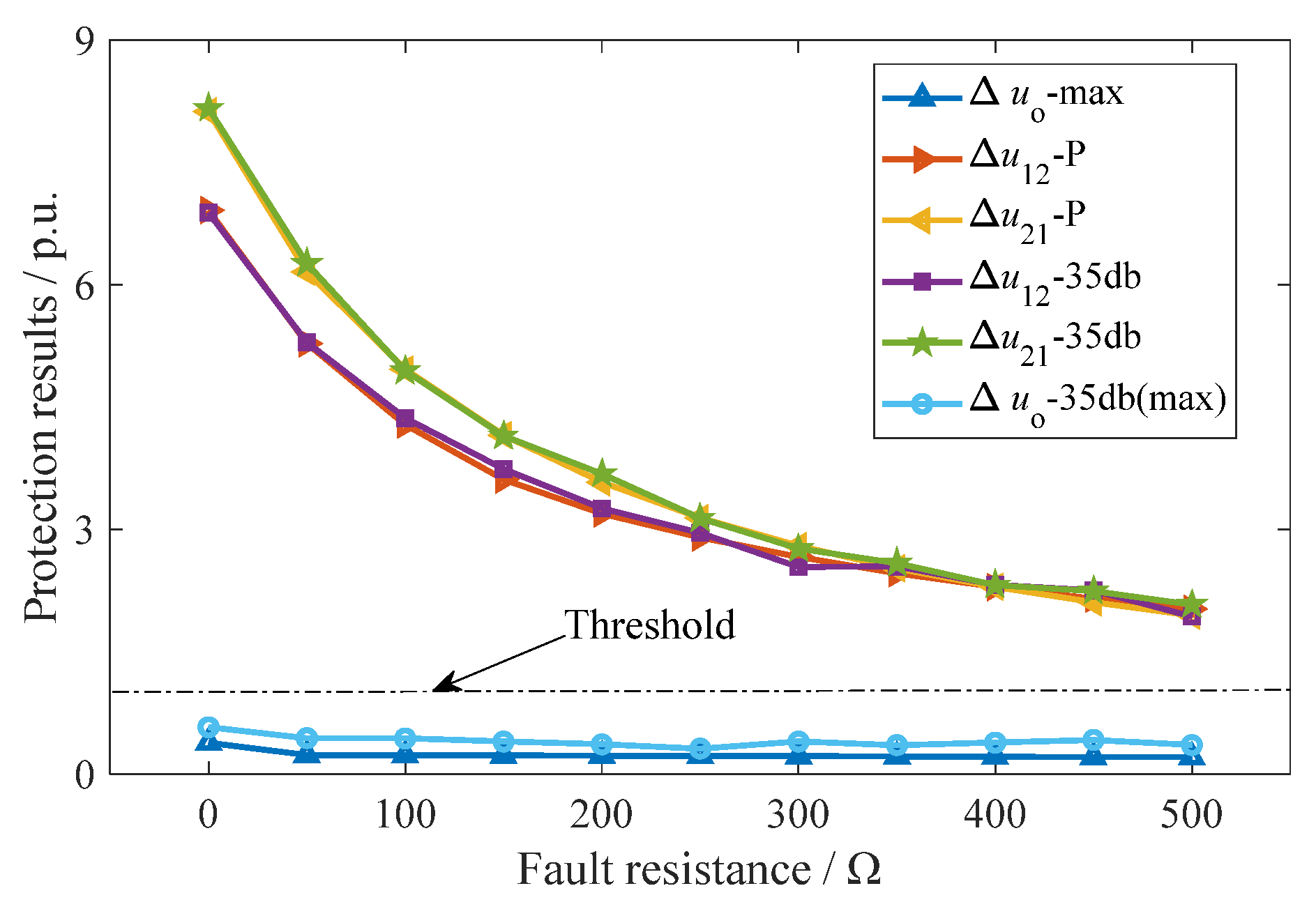
This section examines the impact of fault resistance on the performance of the fault identification criterion. Simulations were conducted for positive-pole-to-ground faults with varying fault resistances (0–500 Ω) at a location 50 km from Station II on line 12. The corresponding protection results are shown in Figure 15.
As observed in Figure 15, the values of Δuo-max at out-of-zone locations remain largely unaffected by the increase in fault resistance and stay well below the setting threshold throughout the variation. In contrast, the in-zone values Δu12-P and Δu21-P decrease gradually as the fault resistance increases. Nevertheless, even at 500 Ω, the distinction between in-zone and out-of-zone values remains clear, allowing the protection device to identify the fault correctly.
To evaluate protection reliability in noisy environments, we added Gaussian white noise at different signal-to-noise ratios (SNRs) to the measured signals, and protection remained reliable. The results at an SNR of 35 dB are in Figure 15. Compared to noise-free conditions, for faults within the protection zone, the protection value is less affected because the voltage changes are large. Outside the protected zone, the protection value increases with noise but stays below the threshold. The results show that even in high noise, the protection boundary stays clear and retains reliable operation.

5.3.5. Verification of the Backup Protection Scheme

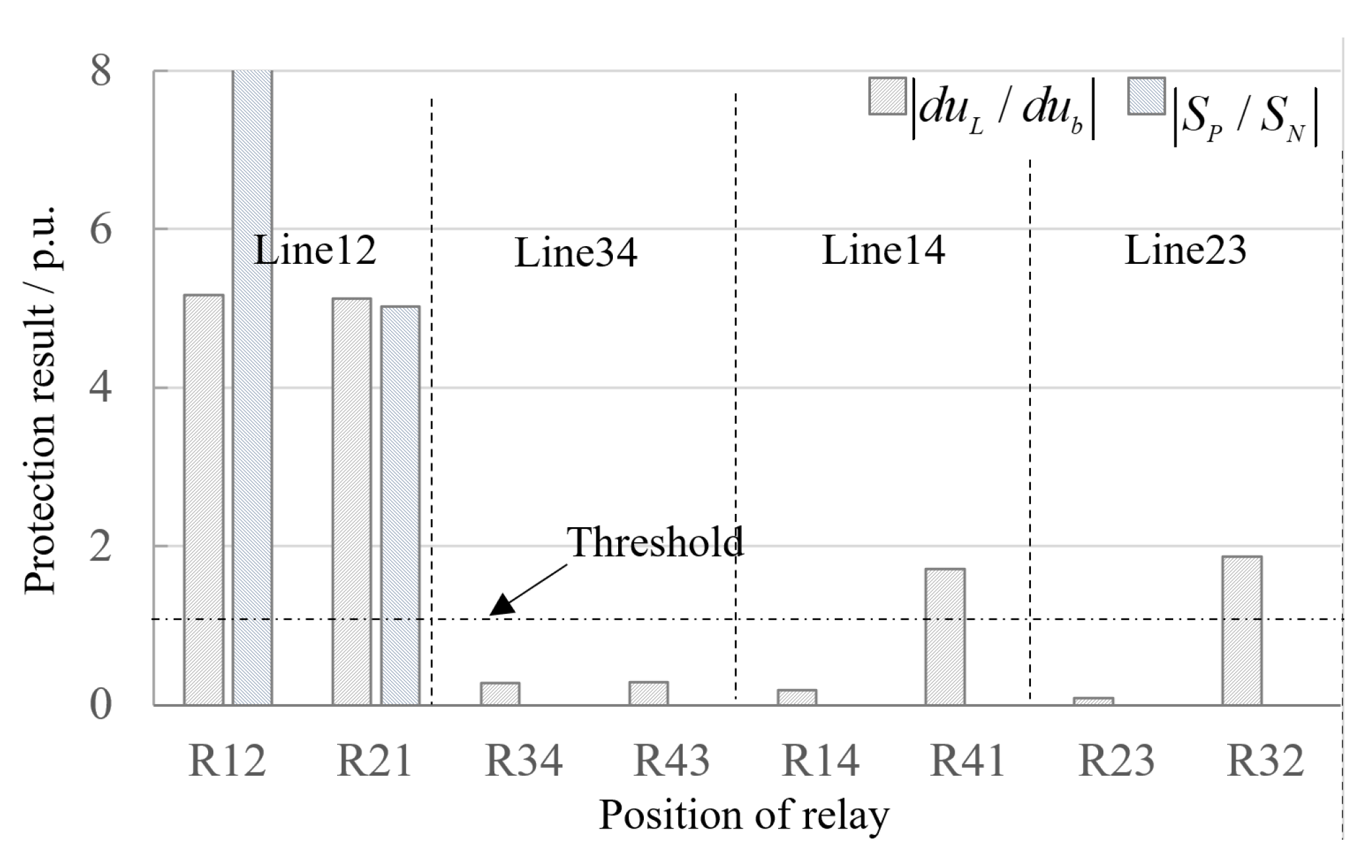
A simulation was conducted for a positive-pole-to-ground fault with a significant fault resistance of 800 Ω at a location 50 km from Station II on line L12. The results obtained using the backup protection scheme are shown in Figure 16.
As observed in Figure 16, the values of |duL/dub| at the in-zone locations, R12 and R21, significantly exceed the protection setting threshold, whereas at most one end of the out-of-zone locations exceeds the threshold. This enables the identification of a fault in the line 12 section and triggers the faulty pole discrimination procedure. The calculated |SP/SN| ratio is far greater than the protection setting value, confirming a positive-pole-to-ground fault.
The backup protection scheme ensures reliable backup operation in the event of primary protection failure. However, practical implementation must account for factors such as communication delays. This study focuses on validating the correctness of the principle; further detailed analysis is not expanded upon here.
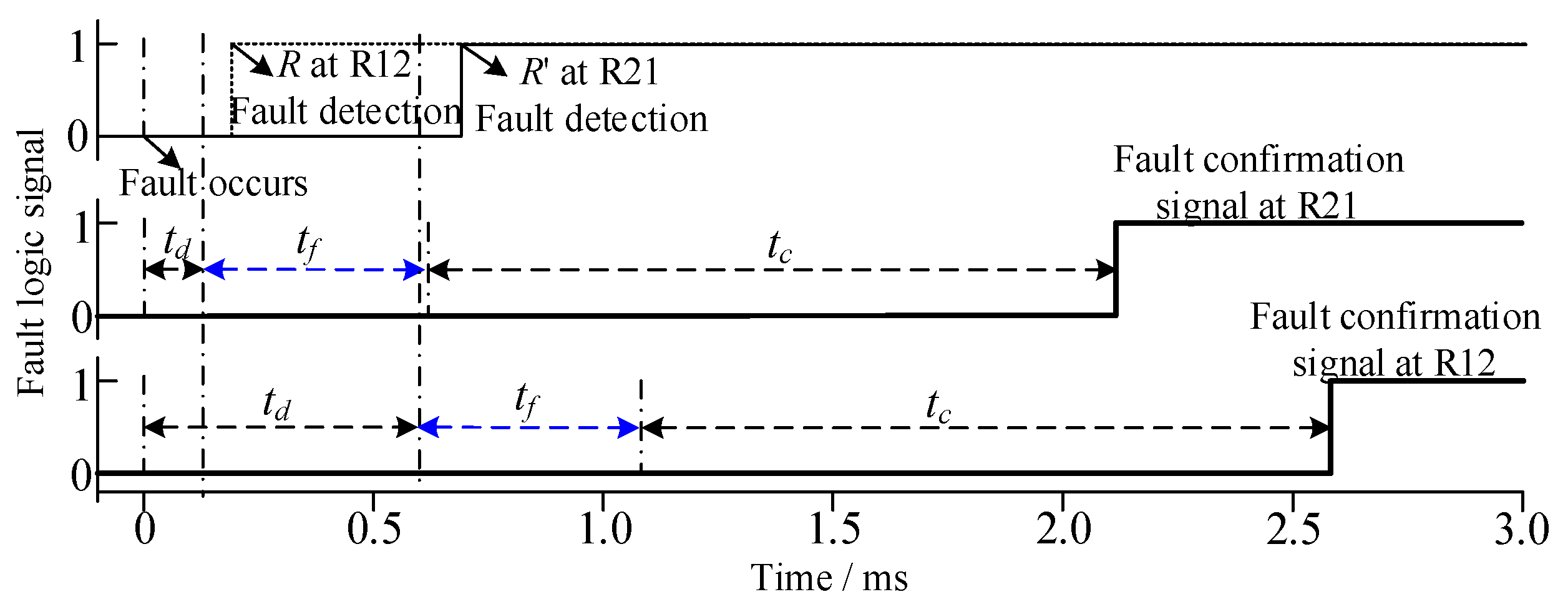
The timing of the backup protection scheme is shown in Figure 17. After a fault occurs 50 km from R12. After a delay time td for traveling-wave transmission, R12 detects the fault first (R = 1). The action time of backup protection can be expressed as
t Σ = t d + t f + t c
where tf is the total delay of signal processing, and tc is the total communication delay.
Communication systems are typically fiber-optic, and transmission-theoretical delay and node delay must be considered. In an optimistic situation, the communication delay tc is about 1.5–2 ms for a 200 km line. There is a similar process in the remote protection of R21. As shown in Figure 17, with the protection of R12 and R21, the overall action time is optimistically estimated to be less than 3 ms.

5.3.6. Comparison with Other Methods

This study compares the proposed scheme with various protection methods utilizing the CLR-based line boundary in terms of reliability, cost, complexity, and capability to detect high-impedance faults. The comparison results are summarized in Table 2.
Reference [28] employed the change rate of line-side voltage (du/dt) to identify the fault, but it primarily relies on the steepness of the initial traveling wave header. Reference [29] used the ratio of voltage on both sides of CLR to distinguish the fault, but relying on the smoothing effect of CLR, if the CLR is small, the performance will decrease. Reference [30] utilized the high-frequency signal ratio on both sides of CLR to set up the direction protection. However, these high-frequency features are highly susceptible to the damping effect of fault resistance and the smoothing effect of CLRs. In contrast, the proposed scheme does not rely solely on the transient edge. Instead, it leverages the unique topology-dependent response of the current-limiting DCCB. The shunt capacitor and MOV branches actively clamp the bus voltage while allowing the line-side voltage to drop significantly. This creates a sustained and distinct voltage difference (Δu) determined by the circuit structure rather than just the transient frequency.
As shown, all methods meet the requirement for rapid fault detection in terms of identification time. However, the proposed scheme offers distinct advantages: it eliminates the need for directional criteria, relies solely on single-pole single-point voltage information, and exhibits lower complexity and higher reliability. Moreover, it demonstrates superior performance in identifying high-impedance faults compared to other methods.
These benefits primarily stem from the novel current-limiting DCCB, which establishes an effective line protection boundary. This boundary efficiently blocks the propagation of fault-induced traveling waves to non-faulted lines, thereby preventing maloperation and enhancing the overall robustness of the protection system.

6. Conclusions

This paper presents a novel current-limiting DCCB and a corresponding fast fault-identification scheme. The proposed DCCB utilizes the sequential discharge of shunt capacitors to create artificial current zero-crossings, enabling efficient arc interruption. A key feature of its unique topology is that the shunt capacitors and MOVs provide crucial voltage support during faults. This mechanism effectively suppresses the propagation of transient traveling waves to adjacent healthy lines, thereby establishing a reliable protection boundary in multi-terminal HVDC grids.
Leveraging this distinctive characteristic, a rapid fault identification scheme incorporating both primary and backup protection was developed based on the analysis of fault-induced voltage traveling waves. Simulation tests conducted on a realistic four-terminal MMC-HVDC system demonstrated the scheme’s effectiveness. The results confirm its ability to accurately and reliably identify various fault types, including high-resistance faults up to 800Ω, showcasing excellent protection performance.
Future work will extend this research in several directions:
(1) Research will be conducted on the coordination strategy between the proposed boundary-based scheme and other protection layers; (2) the long-term impact of component degradation, specifically the aging of MOVs and capacitors under repeated discharge stresses; and (3) the applicability of the proposed DCCB and detection algorithm in more complex, large-scale MTDC networks and extreme operating conditions.

Author Contributions

Conceptualization, X.Z. and X.Y.; methodology, Q.C.; software, X.Y.; validation, Z.L. and X.Z.; formal analysis, X.Y.; investigation, Q.C.; resources, C.G. and X.Y.; data curation, Q.C.; writing—original draft preparation, Q.C. and X.Y.; writing—review and editing, Z.L., C.G. and X.Z.; visualization, X.Y.; supervision, X.Z.; project administration, X.Z.; funding acquisition, C.G. and X.Z. All authors have read and agreed to the published version of the manuscript.

Funding

This research was funded by National Natural Science Foundation of China (52377104) and Natural Science Foundation of the Jiangsu Higher Education Institutions of China (22KJA470006).

Data Availability Statement

The original contributions presented in the study are included in the article, further inquiries can be directed to the corresponding author.

Acknowledgments

The authors would like to thank the National Natural Science Foundation of China and the Natural Science Foundation of the Jiangsu Higher Education Institutions of China for their support.

Conflicts of Interest

The authors declare no conflicts of interest.

References

  1. Zhang, W.M.; Li, T.C.; Wang, X.Z.; Liu, Q.Q.; Liu, S.Y.; Luo, M.Y.; Dai, Z.H. Protection Principle of DC Line Based on Fault Component of Line Mode Voltage with Current-Limiting Reactor. Energies 2025, 18, 4271. [Google Scholar] [CrossRef]
  2. Zhang, W.; Wang, D. S-Transform Based Traveling Wave Directional Pilot Protection for Hybrid LCC-MMC-HVDC Transmission Line. Energies 2022, 15, 4802. [Google Scholar] [CrossRef]
  3. Yang, R.; Fang, K.; Chen, J.; Chen, Y.; Liu, M.; Meng, Q. A novel protection strategy for single pole-to-ground fault in multi-terminal DC distribution network. Energies 2023, 16, 2921. [Google Scholar] [CrossRef]
  4. Wang, T.; Chen, K.; Zhang, L.E.; Hu, X.Y.; Li, H.X.; Ye, P.Q. Research on Fault Identification of Hybrid Multi-Feed High-Voltage Direct Current System Based on Line Commutated Converter and Voltage Source Converter. Energies 2024, 17, 2215. [Google Scholar] [CrossRef]
  5. Yu, X.; Ma, G.; Yao, Y.; Xiao, L. A pilot protection scheme for MMC-HVDC grids independent of line boundaries based on fault component integration. Int. J. Electr. Power Energy Syst. 2025, 172, 111182. [Google Scholar] [CrossRef]
  6. Ren, C.L.; Hu, Y.G.; Lu, X.; Chen, Y.; Xia, K.P.; Li, H.L. Advanced Non-Unit Protection Strategy for MMC-HVDC Grids Leveraging Two-Dimensional High-Frequency Characteristics via HHT and SVM. Energies 2025, 18, 3096. [Google Scholar] [CrossRef]
  7. Heidary, A.; Niasar, M.G.; Marvasti, F.D.; Popov, M. Superconducting Magnetic Energy Storage-Based DC Circuit Breaker for HVDC Applications. IEEE Trans. Power Electron. 2024, 39, 13890–13899. [Google Scholar] [CrossRef]
  8. Mokhberdoran, A.; Gomis-Bellmunt, O.; Silva, N.; Carvalho, A. Current Flow Controlling Hybrid DC Circuit Breaker. IEEE Trans. Power Electron. 2018, 33, 1323–1334. (In English) [Google Scholar] [CrossRef]
  9. Häfner, J.; Jacobson, B. Proactive Hybrid HVDC Breakers—A key innovation for reliable HVDC grids. In Proceedings of the Electric Power System of the Future—Integrating Supergrids and Microgrids International Symposium in Bologna, Bologna, Italy, 13–15 September 2011. [Google Scholar]
  10. Chen, W.J.; Zeng, R.; He, J.J.; Wu, Y.; Wei, X.G.; Fang, T.X.; Yu, Z.Q.; Yuan, Z.; Wu, Y.F.; Zhou, W.D.; et al. Development and prospect of direct-current circuit breaker in China. High Volt. 2021, 6, 1–15. [Google Scholar] [CrossRef]
  11. Davidson, C.; Grieshaber, W.; Modéer, T.; Smith, D.; Yang, B.; Yu, Z.; Zhang, R. DC Circuit Breakers for High-Voltage dc Grids: Present and Future. IEEE Power Energy Mag. 2024, 22, 87–99. [Google Scholar] [CrossRef]
  12. Xu, J.Z.; Song, B.Q.; Lu, Y.; Zhao, C.Y.; Li, G.; Liang, J. A Multi-Port Current-Limiting Hybrid DC Circuit Breaker. IEEE Trans. Power Del. 2021, 36, 1672–1682. [Google Scholar] [CrossRef]
  13. Zhang, S.; Zou, G.B.; Gao, F.; Wei, X.Y.; Zhou, C.H. A Comprehensive Review of Multiport DC Circuit Breakers for MTdc Grid Protection. IEEE Trans. Power Electron. 2023, 38, 9100–9115. [Google Scholar] [CrossRef]
  14. Zhao, X.B.; Xu, J.Z.; Li, G.; Yuan, J.S.; Liang, J. Coordinated Control of DC Circuit Breakers in Multilink HVDC Grids. CSEE J. Power Energy Syst. 2023, 9, 2224–2235. [Google Scholar] [CrossRef]
  15. Pourfaraj, A.; Iman-Eini, H.; Hamzeh, M.; Langwasser, M.; Liserre, M. A Thyristor-Based Multiline Hybrid DCCB in Protection Coordination with MMC in Multiterminal DC Grids. IEEE J. Emerg. Sel. Top. Power Electron. 2024, 12, 5055–5064. [Google Scholar] [CrossRef]
  16. Ding, S.; Yang, M.; Feng, M.K.; Sima, W. A Multiport DC Breaker with Integrated Energy Dissipation Capability for Offshore MTDC Systems. IEEE Trans. Ind. Electron. 2025, in press. [Google Scholar] [CrossRef]
  17. Lee, J.I.; Dao, V.; Dinh, M.C.; Lee, S.J.; Kim, C.S.; Park, M. Combined Operation Analysis of a Saturated Iron-Core Superconducting Fault Current Limiter and Circuit Breaker for an HVDC System Protection. Energies 2021, 14, 7993. [Google Scholar] [CrossRef]
  18. Ahmad, M.; Wang, Z.X.; Shafique, M.; Nadeem, M.H. Significance of fault-current-limiters and parameters optimization in HVDC circuit breakers for increased capacity of VSC-HVDC transmission networks application. Energy Rep. 2022, 8, 878–892. [Google Scholar] [CrossRef]
  19. Zhang, X.; Zhuo, C.R.; Yang, X. A natural commutation current topology of hybrid HVDC circuit breaker integrated with limiting fault current. IET Gener. Transm. Distrib. 2023, 17, 1509–1524. [Google Scholar] [CrossRef]
  20. Hou, J.J.; Qin, X.H.; Fan, Y.F.; Song, G.B.; Wu, X.F.; Li, P.L.; Gao, C. A selective and staged active current limiting control strategy for fault identification in MMC HVDC power grids. Int. J. Electr. Power Energy Syst. 2024, 160, 110143. [Google Scholar] [CrossRef]
  21. Shu, H.C.; Shao, Z.X. A bi-directional current-limiting hybrid DC circuit breaker with fast-breaking capability. Electr. Power Syst. Res. 2024, 226, 109902. [Google Scholar] [CrossRef]
  22. Yu, X.; Gu, J.; Zhang, X.; Mao, J.; Xiao, L. A non-unit fault location scheme for MMC-HVDC grids based on the geometric features of the fault voltage. CSEE J. Power Energy Syst. 2024; in press/in Early Access. [Google Scholar]
  23. Ñancupil-Quirilao, I.; Torres-Ávila, R.; Palma-Behnke, R.; Álvarez-Malebrán, R.; Espín-Sarzosa, D.; Cortés, M.; Leanez, F.; Flores-Quiroz, A.; Reyes, J.; Esperguel, E.; et al. Identification and Design of Special Protection Schemes for the Energy Transition. IEEE Trans. Power Del. 2025, 40, 18–29. [Google Scholar] [CrossRef]
  24. Sun, Y.; Fan, Y.; Hou, J.; Song, G. A Unit Protection Scheme Based on the Transient Current Coordinate Mapping Interval. Prot. Control. Mod. Power Syst. 2025, 10, 103–120. [Google Scholar] [CrossRef]
  25. Psaras, V.; Tzelepis, D.; Vozikis, D.; Adam, G.P.; Burt, G. Non-Unit Protection for HVDC Grids: An Analytical Approach for Wavelet Transform-Based Schemes. IEEE Trans. Power Del. 2021, 36, 2634–2645. [Google Scholar] [CrossRef]
  26. Yu, J.Q.; Zhang, Z.R.; Xu, Z. Adaptive sequential reclosing strategy for hybrid HVDC circuit breakers in MMC-based DC grids. High Volt. 2022, 7, 890–902. [Google Scholar] [CrossRef]
  27. Teng, S.F.; Zhang, Z.F.; Xiao, L.Y. Research on a Novel DC Circuit Breaker Based on Artificial Current Zero-Crossing. IEEE Access 2020, 8, 36070–36079. [Google Scholar] [CrossRef]
  28. Leterme, W.; Beerten, J.; Van Hertem, D. Nonunit Protection of HVDC Grids with Inductive DC Cable Termination. IEEE Trans. Power Del. 2016, 31, 820–828. [Google Scholar] [CrossRef]
  29. Haleem, N.M.; Rajapakse, A.D. Application of new directional logic to improve DC side fault discrimination for high resistance faults in HVDC grids. J. Mod. Power Syst. Clean Energy 2017, 5, 560–573. [Google Scholar] [CrossRef]
  30. Liu, J.; Tai, N.; Fan, C. Transient-Voltage Based Protection Scheme for DC Line Faults in Multi-terminal VSC-HVDC System. IEEE Trans. Power Del. 2016, 32, 1483–1494. [Google Scholar] [CrossRef]
Figure 1. Topological structure of new type DCCB.
Energies 19 00272 g001
Figure 2. Action sequence of the new type DCCB.
Energies 19 00272 g002
Figure 3. DCCB at different stages of work.
Energies 19 00272 g003
Figure 4. Topology of conventional DCCBs.
Energies 19 00272 g004
Figure 5. Fault equivalent circuit with CLRs and new type DCCB.
Energies 19 00272 g005
Figure 6. Overall flowchart of the proposed protection scheme.
Energies 19 00272 g006
Figure 7. Characteristics of a positive pole to ground fault.
Energies 19 00272 g007
Figure 8. Topology of the MMC-HVDC simulation system.
Energies 19 00272 g008
Figure 9. The tower structure of the transmission line.
Energies 19 00272 g009
Figure 10. Breaking process of the proposed current-limiting DCCB. (a) Currents; (b)Voltages across the thyristors in PB1 and PB2; (c) Line side and DC bus voltages; (d) C1 and C2 voltages.
Energies 19 00272 g010
Figure 11. Comparing with hybrid DCCB. (a) Currents in proposed DCCB; (b) Currents in hybrid DCCB; (c) Currents of MMC with proposed DCCB; (d) Currents of MMC with hybrid DCCB.
Energies 19 00272 g011
Figure 12. The voltage variation after a positive pole to ground fault. (a) When a 15 km fault occurs; (b) When a 100 km fault occurs.
Energies 19 00272 g012
Figure 13. The voltage variation after a pole-to-pole fault. (a) When a 15 km fault occurs; (b) When a 100 km fault occurs.
Energies 19 00272 g013
Figure 14. The protection results after different faults.
Energies 19 00272 g014
Figure 15. Influence of fault resistances.
Energies 19 00272 g015
Figure 16. Testing results of the backup protection.
Energies 19 00272 g016
Figure 17. Timing of backup protection action in case of a high impedance 50 km fault.
Energies 19 00272 g017
Table 1. Main parameters of the converter stations in the simulation system.
StationsIIIIIIIV
Parameters
SM/mF10101515
Number of SM228228312312
Arm reactor/mH150150100100
Lt/%15151515
Ratio (kV/kV)520/265235/265235/265520/265
SCR/kA16.318.218.723.8
Capacity/MW3000300016001600
Table 2. Comparing with different Primary Protection methods.
MethodsDirection
Protection
Detection TimeSignal PositionFault Resistance Identification
ProposedNone<1 ms1>500 Ω
Change rate of line-side voltage [28]None<1 ms1>100 Ω
Ratio of voltage on both sides of CLR [29]Yes<1 ms2200 Ω
High frequency signal ratio on both sides of CLR [30]Yes1 ms2>200 Ω
Disclaimer/Publisher’s Note: The statements, opinions and data contained in all publications are solely those of the individual author(s) and contributor(s) and not of MDPI and/or the editor(s). MDPI and/or the editor(s) disclaim responsibility for any injury to people or property resulting from any ideas, methods, instructions or products referred to in the content.