

Article

Near-Field Shock Wave Propagation Modeling and Energy Efficiency Assessment in Underwater Electrical Explosions
Office of Studies, Naval University of Engineering Wuhan, Wuhan 430033, China
*
Author to whom correspondence should be addressed.
Energies 2026, 19(1), 261; https://doi.org/10.3390/en19010261
Submission received: 11 November 2025 / Revised: 6 December 2025 / Accepted: 9 December 2025 / Published: 4 January 2026

Abstract

This study systematically investigates the influence of capacitor energy storage parameters on the energy utilization efficiency of the underwater electrochemical explosion process. By integrating spherical and cylindrical shock wave propagation models, the pulse shock wave energy under different capacitor energy storage levels was theoretically calculated and experimentally validated. The results indicate that the applicability of the shock wave propagation model depends on the distance and aquatic environment: the spherical model is more suitable for short-distance, deep-water conditions, whereas the cylindrical model performs better for long-distance or shallow-water conditions. Within the energy storage range of up to 100 J, increasing the capacitance significantly enhances both the pulse energy output and energy utilization efficiency. Specifically, as the stored energy increased from 13 J to 100 J, the shock wave energy rose from 0.051 J to 2.45 J, and the energy utilization rate improved from 0.39% to 2.45%. Nevertheless, the overall energy utilization efficiency remains below 10%. This study confirms that rationally configuring capacitor parameters can effectively regulate the discharge process, providing important experimental and theoretical support for optimizing energy utilization efficiency.

1. Introduction

Over the past few decades, electrohydraulic pulsed discharge technology has garnered extensive attention in fields such as underwater explosion simulation, acoustic source generation, and reservoir exploitation due to its high safety and superior controllability in generating bubbles and shock waves [1,2]. Concurrently, the physical mechanisms and technical approaches of electrohydraulic effects have been significantly expanded [3,4,5], evolving from conventional spark discharge to a broader category of physical loads, including pulsed corona discharge and electrical wire explosion [6,7].
Underwater electrochemical explosion pulsed discharge is a transient process in which a high-magnitude pulsed current is injected into a metal wire, causing it to undergo rapid phase transitions under Joule heating—progressing sequentially from solid to liquid, gaseous, and finally plasma states—ultimately forming a plasma channel accompanied by intense optical radiation, shock waves, and other physical phenomena [8,9,10,11]. This technology is characterized by its controllable process, adjustable energy parameters, and high reproducibility, making it widely applicable in geological exploration, material synthesis, underwater shock wave sources, and other engineering fields.
In terms of electrode materials, tungsten–rhenium alloys (commonly used variants include W-3Re and W-5Re) demonstrate distinct comprehensive advantages in specific discharge applications due to their high melting point, low ablation rate, excellent thermal stability, thermal shock resistance, high-temperature strength, creep resistance, non-radioactivity, and favorable electron emission characteristics [12]. These properties collectively contribute to extended service life and more stable electrode surface states, making them particularly suitable for high-energy pulsed discharge environments.
The high thermal stability and low ablation rate ensure that the electrodes maintain a stable geometric shape and surface condition even after multiple discharges. This results in highly consistent electric field distribution and breakdown processes, significantly improving the reproducibility of experimental data and reducing random errors. However, in terms of energy conversion efficiency, these excellent thermal properties present a double-edged sword. Under low-energy conditions, when the energy injected into the wire is inherently insufficient, the tungsten–rhenium electrodes, due to their low heat absorption, tend to “quench” and dissipate part of the energy through heat conduction, leading to low energy utilization rates. In contrast, some more easily ablatable electrode materials may participate in the energy release process through moderate self-vaporization, thereby altering the energy distribution ratio. Currently, the energy transfer processes in underwater inter-electrode electrical explosions have been extensively investigated, covering various electrode materials and discharge parameters. Existing research has demonstrated that the rising rate of pulsed current significantly influences energy deposition and shock wave characteristics: although faster rising rates can improve deposition efficiency before the voltage peak and generate shock waves with higher peak pressure, the shortened discharge cycle leads to accelerated shock wave attenuation, ultimately reducing the total shock wave energy [13]. On the other hand, studies on wire impedance evolution during electrical explosions have revealed a peak corresponding to the partial vaporization stage. Higher initial voltage accelerates energy deposition, shortens vaporization duration, and stabilizes the impedance after complete vaporization [14]. Most existing theoretical models are only applicable to specific stages and require incorporation of correction factors to enhance predictive accuracy.
In the field of acoustic field computational modeling, Sun Zhiwen employed the finite element method to systematically investigate mid- to low-frequency acoustic propagation in typical South China Sea seabed environments [15]. The findings reveal that seabed sediment types and topographic variations are critical factors affecting acoustic field structure and energy attenuation: fluid sediments cause rapid acoustic energy leakage, while poroelastic sediments retain more energy in the water column yet readily excite interface waves with faster seabed internal attenuation. Complex seafloor topography induces significant blocking and convergence effects on acoustic energy, creating shadow zones and convergence zones that substantially reduce sonar effective range. This research provides important theoretical support for acoustic characterization and identification of submerged targets. In contrast, Huang He et al. proposed an efficient hybrid numerical method based on wave superposition principles [16], featuring an innovative zonal modeling strategy: the near field utilizes the mirror source method to analytically derive Green’s functions, while the far field employs normal mode theory to accurately characterize sound speed profile effects. This approach achieves significant computational efficiency improvements while maintaining comparable accuracy to finite element methods, successfully resolving the unified near-far-field calculation challenge for target acoustic radiation in lossy seabed waveguides with arbitrary sound speed profiles. This provides a new technical pathway for acoustic radiation prediction of complex structures like ships [17]. These two studies advance computational acoustics from complementary perspectives: the former enhances understanding of acoustic propagation mechanisms through environmental parameter modeling, while the latter optimizes computational efficiency through algorithmic integration. Together they establish a solid foundation for marine acoustic detection applications. To position the contribution of this work, a comparative analysis with recent studies is illustrative. The research by Awad et al. [18] focused on determining optimal macro-energy parameters for specific engineering applications like geological fracturing, demonstrating a clear application-oriented approach. In contrast, our study delves into the fundamental physical process of energy deposition and conversion, systematically revealing the intrinsic relationship between shock wave energy, utilization efficiency, and stored energy (13–100 J), providing a universal theoretical and experimental basis for parameter optimization across applications. In terms of modeling, Jinet al. [19] made significant progress in the precise prediction of post-explosion effects by inverting the initial conditions of bubble pulsation. Our work, however, introduces a novel acoustic model selection framework for near-field shock wave propagation. We have quantitatively defined the applicability boundaries of spherical and cylindrical models under different water depths and propagation distances, revealing that model misuse can lead to computational deviations exceeding 30–50%. This provides a methodological foundation for accurately assessing shock wave energy and shifts the research focus to the critical initial stage of shock wave generation and propagation.
However, there remains a lack of systematic comparative analysis and a unified theoretical framework for the quantitative prediction of shock wave energy and model applicability across different aquatic environments (e.g., deep versus shallow water) and propagation paths. Particularly under complex boundary conditions (such as water-air and water-bottom interfaces), simplified treatments in acoustic propagation models introduce significant errors, and clear guidelines for selecting the optimal model to accurately calculate radiated acoustic energy based on practical working conditions are still insufficient. To address these issues and enhance the energy utilization efficiency of underwater electrical explosions, this study systematically investigates three key aspects:
(1)
Systematic comparison of spherical and cylindrical shock wave propagation models under varying water depths and distance conditions [19,20];
(2)
Experimental measurement and theoretical calculation of shock wave energy and utilization rates across capacitive energy storage parameters from 13 J to 100 J;
(3)
Development of an acoustic energy calculation model incorporating water surface and seabed reflection losses with established model selection criteria.
The selection of the 13 J to 100 J energy range is strategically based on both fundamental physical principles and practical engineering considerations. Physically, this range encompasses the critical transition from “weak” discharges characterized by partial vaporization to “strong” discharges with complete vaporization and plasma formation. At the lower energy boundary (13 J), insufficient energy deposition results in incomplete vaporization and foam-like liquid–vapor mixtures with significantly different resistive characteristics, representing inefficient energy coupling modes. As energy increases toward 100 J, complete vaporization and stable plasma channel formation enable investigation of nonlinear efficiency growth patterns.
From an applied perspective, the 13–100 J range represents a practical energy window widely employed in precision industrial drives, special processing, pulsed power technologies, and scientific research. This energy level provides sufficient instantaneous power for meaningful applications including metal stamping, underwater shock wave processing via electrohydraulic effects, and various pulse power applications, while maintaining excellent controllability and reproducibility for laboratory-scale research. This combination of fundamental physical significance and engineering relevance makes the selected energy range ideal for investigating energy utilization efficiency while maintaining strong connections to practical applications.
This study establishes quantitative selection criteria for spherical and cylindrical shock wave propagation models, effectively resolving long-standing modeling ambiguities and significantly improving energy assessment accuracy; systematically reveals the transition mechanism from “weak” to “strong” explosion states and nonlinear efficiency growth patterns within the 13–100 J energy range, identifying the optimal parameter window for complete vaporization; and develops a unified acoustic model incorporating boundary reflection losses, successfully bridging the gap between idealized laboratory conditions and practical engineering applications. Compared to existing research on underwater electrical explosion, the innovation of this work is mainly reflected in three aspects: firstly, we established the first quantitative selection framework for spherical and cylindrical shock wave propagation models, solving the problem of model selection relying on empirical judgment in previous studies; secondly, through systematic experiments in the 13–100 J energy range, we quantitatively revealed the nonlinear transition law from inefficient partial vaporization to complete plasma formation; thirdly, we developed a unified acoustic model incorporating water surface and seabed reflection losses, enhancing the accuracy of energy prediction in real aquatic environments. These achievements not only provide direct guidance for industrial applications such as shockwave-assisted welding [21] and contaminant degradation [22], but also establish a scalable theoretical and practical framework for further research in pulsed discharge systems and underwater energy conversion technologies.

2. Numerical Calculation Model

The spherical and cylindrical acoustic propagation models employed in this study are founded upon a set of core assumptions designed to balance physical fidelity with computational feasibility. The models are based on linear acoustic theory and are applicable to intermediate-to-far-field propagation distances ranging from 1 to 50 m. Within this range, acoustic waves satisfy the principle of linear superposition, and nonlinear effects are considered negligible. Furthermore, the water medium is assumed to be homogeneous and isotropic, thereby disregarding practical oceanic variations such as sound speed profile changes and spatial inhomogeneities. In terms of energy loss mechanisms, the models prioritize geometric attenuation as the dominant factor. Given the relatively low primary frequency of the shock waves (<11 kHz) and the limited propagation distance, viscous absorption losses are not explicitly modeled, while complex boundary effects are simplified through empirical reflection coefficients. These assumptions clearly delineate the model’s suitability for energy trend analysis in uniform, confined water environments, while also defining its limitations for precise absolute sound field prediction in complex marine settings. During the underwater electrical explosion of a metal wire, the stored electrical energy is rapidly converted into multiple forms, primarily including shock waves, bubble pulsation kinetic energy, thermal radiation, optical radiation, kinetic energy of metal fragments, and residual electromagnetic energy not fully coupled to the aqueous medium. The rapid expansion of the plasma channel performs work on the surrounding water, generating a time-varying acoustic pressure signal p(t). This acoustic wave propagates in water at a speed of approximately 1500 m/s.
Acoustic propagation models can be classified into three categories based on the vertical position of the sound source in the water column: upper-half space propagation near the water surface, mid-depth propagation at half the water depth, and lower-half space propagation close to the seabed. Each model can be further divided into two scenarios according to the propagation distance: when the lateral distance between the sound source and the hydrophone is less than the minimum value of the distance from the sound source to the seabed and the distance from the sound source to the water surface, it is classified as short-range propagation; when the lateral distance exceeds this minimum value, it belongs to long-range propagation.

2.1. Mid-Water Wave Propagation Model

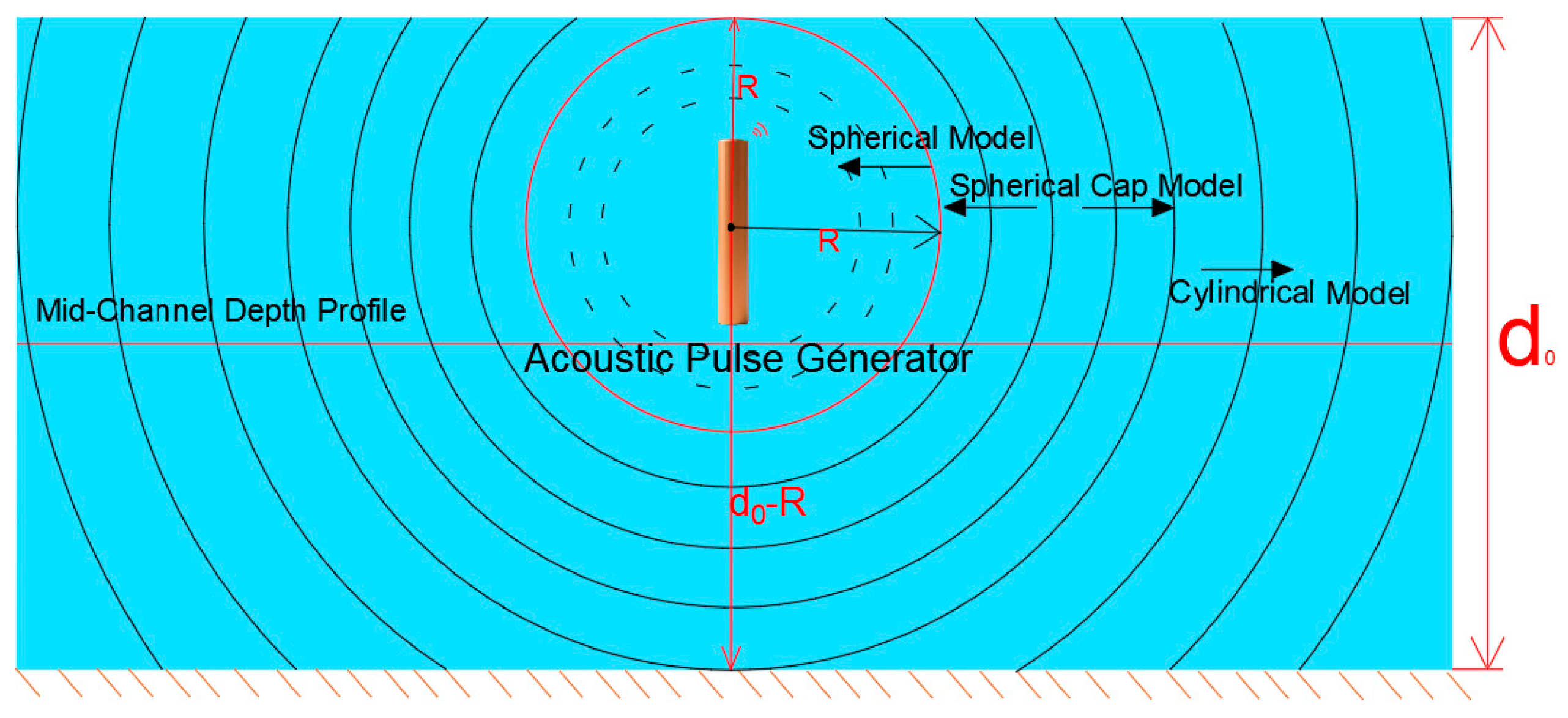
Figure 1 illustrates the mid-water propagation model, where the pulsed acoustic source is positioned at the mid-depth plane of the water body. When the distance x0 between the hydrophone and the sound source satisfies x0 ≤ R0, the acoustic wave propagation can be approximated as a series of concentric spherical waves. Therefore, the spherical propagation model can be employed for energy calculation, with the procedure detailed as follows:
If the time-varying voltage signal V(t) recorded by the hydrophone is known, the corresponding time-varying acoustic pressure p(t) can be converted based on its sensitivity and other calibration parameters.
M = 10 S 20 × 10 6
p t = V t M
M represents the linear sensitivity factor.
The instantaneous sound intensity ISS is given by
I S S = p ( t ) 2 ρ c
ISS represents the instantaneous sound intensity in W/m2.
ρ denotes the medium density in kg/m3 (for water, ρ ≈ 1000 kg/m3).
c is the speed of sound in m/s (in water, c ≈ 1500 m/s).
Based on spherical wave propagation theory, the radiated acoustic energy can be calculated from the time-varying sound intensity ISS. For an isotropically radiating spherical wave, the radiated acoustic energy E can be expressed as
E = 4 π R 2 t e n d t s t a r t I S S ( t ) d t
Here, t e n d t s t a r t I S S ( t ) d t represents the energy density (in J/m2), which is the energy received per unit area.
When the distance x0 between the hydrophone and the sound source exceeds R0, the wavefront of the acoustic propagation can be approximated as a spherical zone truncated by upper and lower horizontal planes. Therefore, the calculation of the total radiated sound energy must be divided into two parts: the spherical-belt side surface with uniformly distributed energy, and the upper and lower circular end surfaces with non-uniform energy distribution.
For the spherical-belt side surface with uniform energy distribution, the calculation formula for its energy density is consistent with Equations (1)–(5), with the only difference lying in the surface area calculation. The procedure for determining the side surface area is as follows:
Place the sphere’s center at the coordinate origin O(0,0,0), and let the equation of the spherical surface be
x 2 + y 2 + z 2 = R 2
Assume two cutting planes parallel to the XOY plane, located at z = c and z = c + d (where |c| ≤ R and |c + d| ≤ R).
The surface area of the spherical zone section can be obtained by integrating the surface area element in the spherical coordinate system. In spherical coordinates, the position of any point on the spherical surface can be represented by the following parametric equations:
x = R s i n θ c o s ϕ y = R s i n θ s i n ϕ z = R c o s θ
where
θ (polar angle) is measured from the positive z-axis, range [0, π].
ϕ (azimuthal angle) is measured from the x-axis in the XOY plane, range [0, 2π].
The surface area element of the sphere is given by
d A = R 2 s i n θ d θ d ϕ
The spherical zone is located between z = c and z = c + d, which corresponds to
c R cos θ c + d
The range of θ is obtained as
θ m i n = a r c c o s ( c + d R ) ,   θ m a x = a r c c o s ( c R )
The azimuthal angle ϕ fully covers the range [0, 2π].
A = d A = ϕ = 0 2 π θ = θ m i n θ m a x r 2 s i n θ d θ d ϕ
Integrating first with respect to φ,
A = 2 π R 2 θ m i n θ m a x s i n θ d θ
Integrating sinθ,
s i n θ d θ = c o s θ θ m a x θ m i n = c o s θ m a x + c o s θ m i n
Substituting θmin and θmax,
A = 2 π r 2 [ c o s ( a r c c o s d R ) c o s ( a r c c o s c + d R ) ] = 2 π r 2 ( c r c + d R )
Simplified, we obtain
A = 2 π r 2 ( h r ) = 2 π R d
The final formula for the spherical zone surface area, after taking the absolute value, is expressed as
A = 2 π R d
where R is the radius of the sphere and d is the vertical separation between the two parallel cutting planes.
It is noteworthy that this expression is formally consistent with the formula for the lateral surface area of a cylinder. Therefore, in acoustic energy calculations, both spherical zones and spherical cap structures can be uniformly incorporated into the cylindrical propagation model framework for analysis.
Based on the aforementioned area result, the radiated acoustic energy E1 of the spherical zone portion can be derived as
E 1 = 2 π R d t e n d t s t a r t I s s ( t ) d t
However, the acoustic field distribution on the upper and lower circular end surfaces is relatively complex. Due to the varying distances from points on the end surfaces to the sound source, the acoustic pressure decreases inversely with distance, resulting in a non-uniform energy distribution. To accurately calculate the radiated acoustic energy of this part, it is necessary to establish a functional relationship between acoustic pressure and distance in the spatial coordinate system, followed by integration. The specific steps are as follows:
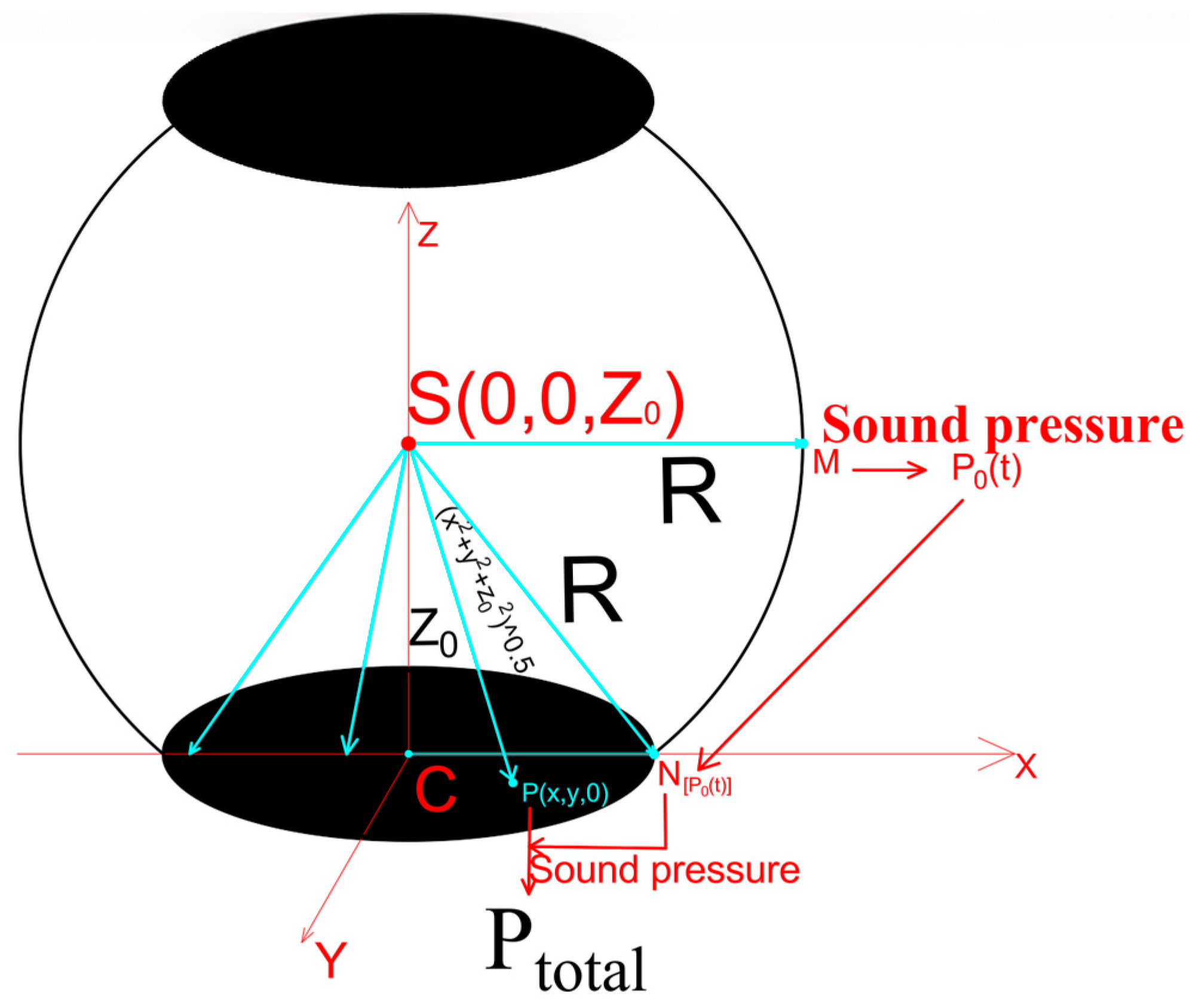
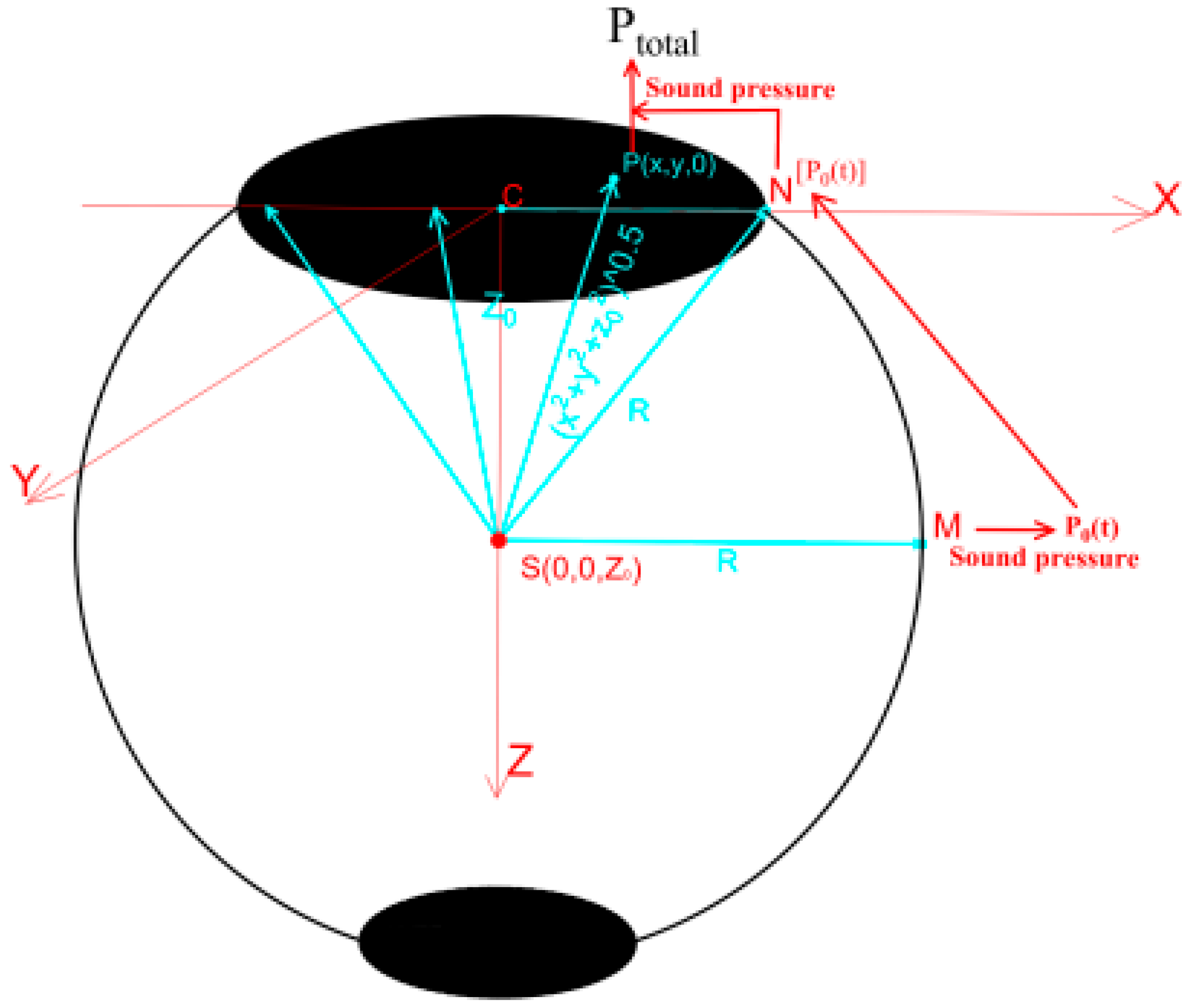
First, establish the geometric relationships, as shown in Figure 2.
Sound source coordinates are S(0,0,z0).
Bottom circular region:
C = { ( x , y , 0 ) x 2 + y 2 X 0 2 }
Distance from any point P(x,y,0) ∈ C to the sound source: r = x2 + y2 + z02.
Next, establish the sound pressure attenuation model. Assuming acoustic waves propagate in the form of spherical waves (neglecting medium absorption attenuation), the relationship is expressed as
p ( x , y , t ) = p ( t ) r r 0 = p 0 ( t ) X 0 x 2 + y 2 + z 0 2
where p0(t) denotes the acoustic pressure at the center of the circular region (where r = X0).
Based on the assumption of spherical wave propagation and the inverse relationship between acoustic pressure and distance, the expression for sound intensity distribution can be derived. Since sound intensity I is proportional to the square of acoustic pressure p2, combined with the geometric relationships, we have
I ( x , y , t ) = p ( x , y , t ) 2 ρ c = p ( t ) 2 X 0 2 ρ c ( x 2 + y 2 + z 0 2 )
After establishing the aforementioned geometric relationships and physical model, the total radiated sound energy can ultimately be solved through triple integration.

2.1.1. Cartesian Coordinate Integration

The total energy is obtained by integrating the sound intensity over the circular domain C, followed by integration in the time domain:
Etotal   =   t 1 t 2 c ( x , y , t ) d x d y d t
Expanded as
Etotal = X 0 2 ρ c t 1 t 2 x 2 + y 2 R 2 p ( t ) 2 1 x 2 + y 2 + Z 0 2 d x d y d t

2.1.2. Spatial Integration Component

Let x = ρcosθ and y = ρsinθ:
E   =   X 0 2 ρ c 0 2 π 0 X 0 2 Z 0 2 ρ ρ 2 + z 0 2 d ρ d θ
Angular integration:
0 2 π d θ = 2 π
Radial Integration:
0 X 0 2 Z n 2 ρ ρ 2 + z 0 2 d ρ =   0.5 ln ( 1 +   X 0 2 Z 0 2 z 0 2 )
Next,
1 x 2 + y 2 + z 0 2 d x d y = π l n ( 1 + X 0 2 Z 0 2 z 0 2 )

2.1.3. Temporal Integration Component

E 2 = π X 0 2 ρ c l n ( 1 + X 0 2 Z 0 2 z 0 2 ) t 1 t 2 p 0 ( t ) 2 d t
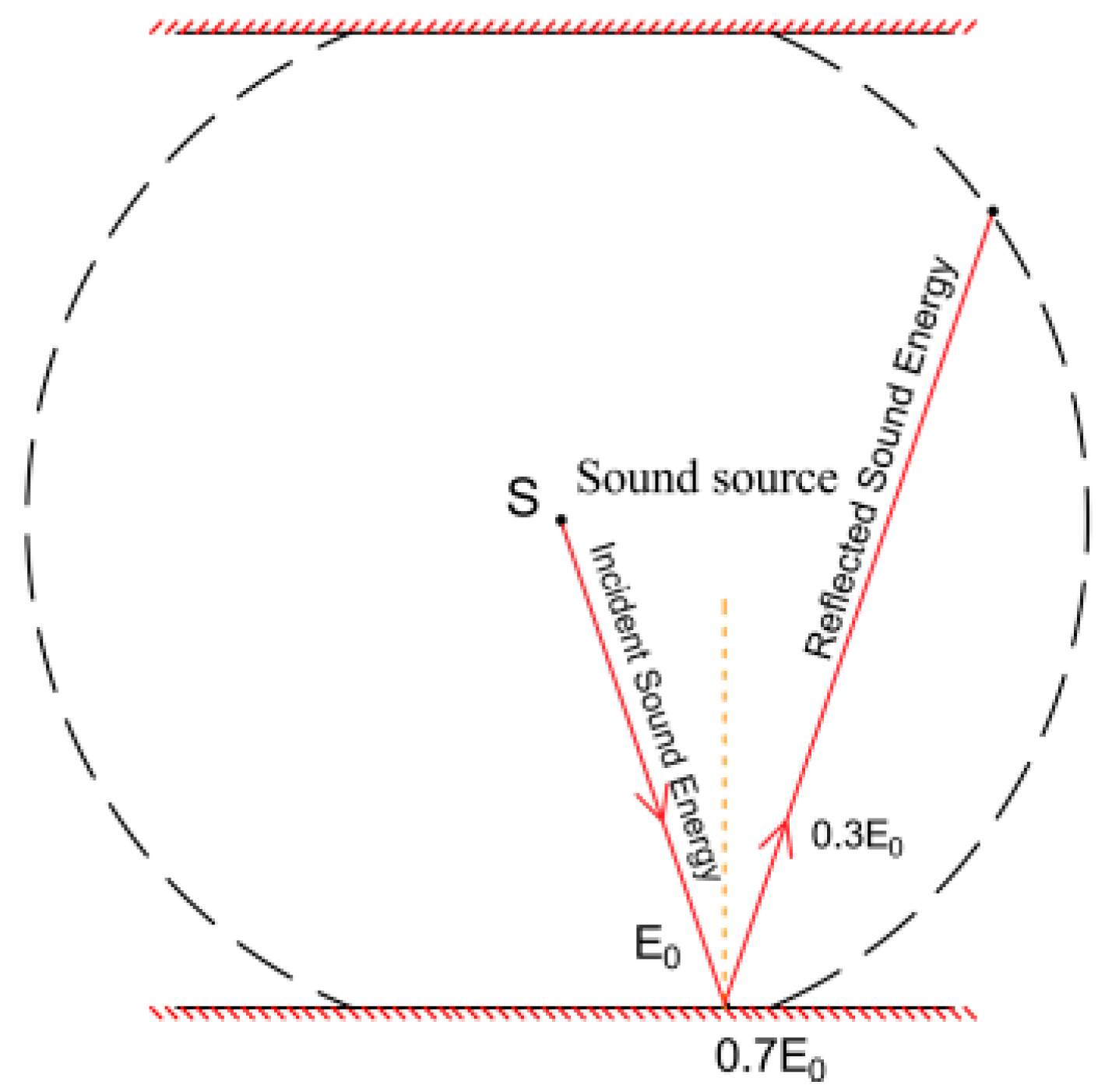
According to the study by Liu Ruoyun in “Statistical Characteristics of Shallow Water Acoustic Propagation Loss Induced by Undulating Sea Surface Scattering and Rapid Sound Field Prediction Methods,” which systematically analyzes the reflection characteristics of pulsed sound sources (frequency 0–10 kHz) under different working conditions in shallow water environments (water depth < 50 m) [23], this paper adopts a total reflection coefficient of 0.3 by integrating the coupled effects of sea surface wave scattering and seabed sediment layer reflection, as concluded in the aforementioned research. A schematic model of the reflected waves is shown in Figure 3.
E t o t a l = 2 E 1 2 × 0.3 0.7 E 2 + E 2
E t o t a l = 2 π X 0 d ρ c t 1 t 2 p 0 ( t ) 2 d t + 1.4 π X 0 2 ρ c l n ( 1 + X 0 2 Z 0 2 Z 0 2 ) t 1 t 2 p 0 ( t ) 2 d t

2.2. Upper-Half Space Propagation Model

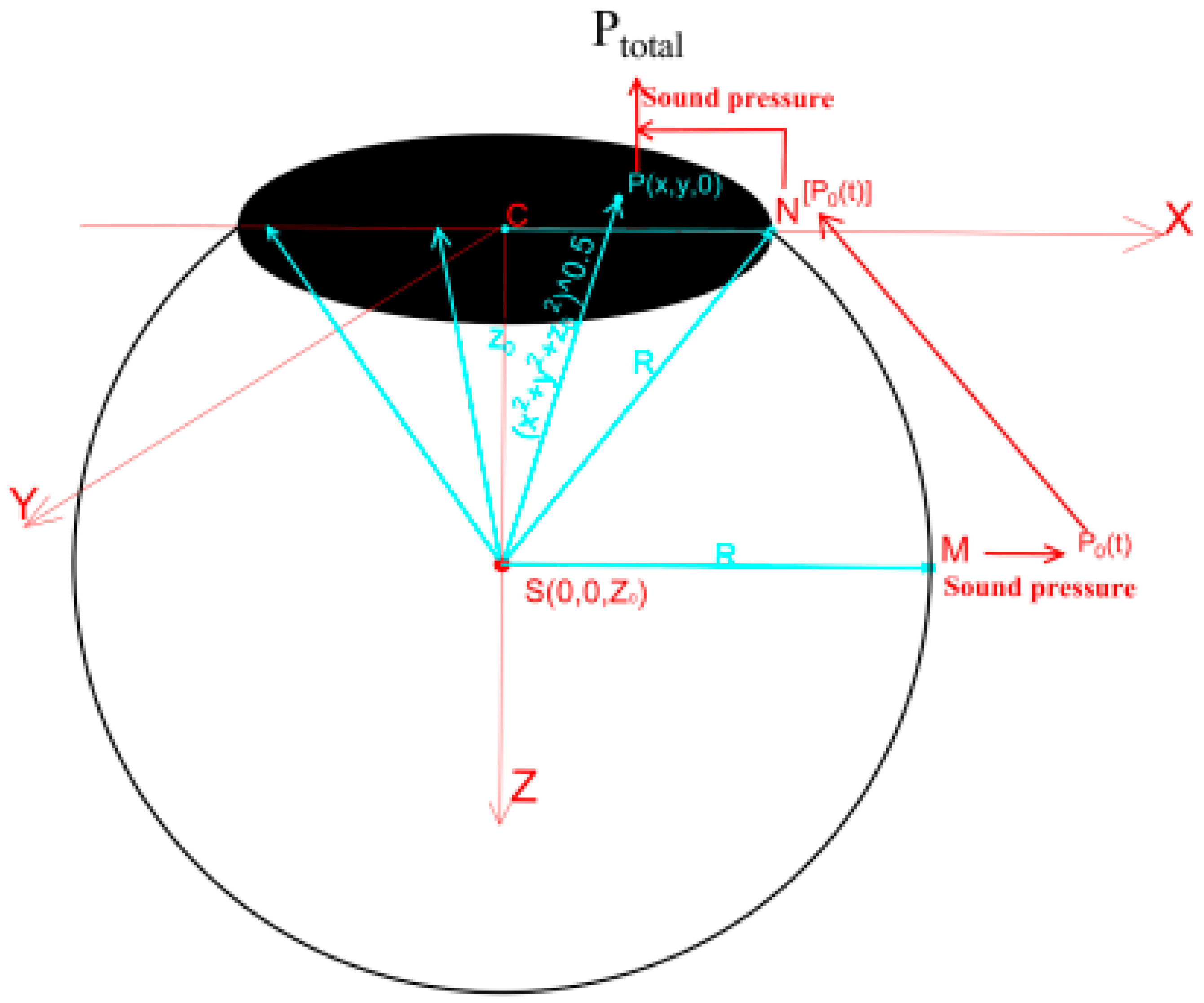
Figure 4 illustrates the upper-half profile propagation model in water, where the pulsed sound source is located in the upper portion of the water column. When the distance x0 between the hydrophone and the sound source satisfies x0 ≤ R, the wavefront of acoustic propagation can be approximated as a series of concentric spherical surfaces. Under these conditions, the method for calculating the radiated sound energy is entirely consistent with the spherical model described by Equations. Therefore, the derivation process will not be repeated here, and the final result is directly provided as
E = 4 π X 0 2 t e n d t s t a r t I S S ( t ) d t
When R ≤ x0 ≤ d0 − R, the sound source propagation model can be approximated as a geometric structure composed of a lower spherical cap and an upper circular disk. Figure 5 shows a schematic diagram of the upper-half shock wave propagation. Under this configuration, the surface area of the lower spherical cap can be calculated by referring to the area calculation method in the cylindrical model, i.e.,
S C = 2 π x 0 ( x 0 + r )
where r is the radius of the spherical segment, and x0 is the distance between the hydrophone and the sound source.
The radiated sound energy of the lower spherical cap is given by
E c = S C × t e n d t s t a r t I S S ( t ) d t
The calculation method for the upper circular surface is consistent with down circular surface.
Namely,
E 22 = π X 0 2 ρ c l n ( 1 + X 0 2 Z 0 2 Z 0 2 ) t 1 t 2 p 0 ( t ) 2 d t
where Z0 denotes the vertical distance from the sound source to the water surface.
Therefore, the total radiated energy for the model comprising the lower spherical cap and the upper circular surface is expressed as
E = E C + E 22 0.3 E 22
E = 2 π x 0 x 0 + r × t e n d t s t a r t I S S t d t + 0.7 π X 0 2 ρ c l n ( 1 + X 0 2 Z 0 2 z 0 2 ) t 1 t 2 p 0 ( t ) 2 d t
When x0 > d0 − R, the radiation model consists of a spherical zone and two asymmetrical circular surfaces (upper and lower).
The radiated acoustic energy of the spherical zone is
E 31 = 2 π x 0 d × t e n d t s t a r t I S S t d t
There are two asymmetrical circular surfaces (upper and lower):
E 32 u p = π X 0 2 ρ c l n ( 1 + X 0 2 Z 0 2 z 0 2 ) t 1 t 2 p 0 ( t ) 2 d t
E 32 d o w n = π X 0 2 ρ c l n ( 1 + X 0 2 ( d Z 0 ) 2 ( d Z 0 ) 2 ) t 1 t 2 p 0 ( t ) 2 d t
The area of the upper surface is greater than that of the lower surface (Supper > Slower).
In the upper-half space propagation model, acoustic wave propagation involves two primary reflective interfaces: the upper interface (water surface) and the lower interface (seabed). As shown in Figure 6, an asymmetrical model is depicted, which contains a spherical zone and two asymmetrical circular faces. The water surface reflection coefficient is mainly influenced by factors such as wind waves and foam, typically exhibiting low reflection characteristics. The seabed reflection coefficient, on the other hand, is closely related to sediment type (e.g., silt, rock), layered structure, and porosity. According to Liu Ruoyun’s research, the water surface reflection coefficient is generally higher than the seabed reflection coefficient. Integrating the findings from Liu Ruoyun’s study “Statistical Characteristics of Shallow Water Acoustic Propagation Loss Induced by Undulating Sea Surface Scattering and Rapid Sound Field Prediction Methods” [23] and considering the reflection characteristics of both interfaces, a total reflection coefficient of 0.35 is adopted in this paper for this specific working condition.
The total radiated sound energy of the spherical zone and the two asymmetrical circular surfaces (upper and lower) is given by
E = E 31 + E 32 u p + E 32 d o w n 0.35 0.65 ( E 32 u p + E 32 d o w n )
E = 2 π x 0 d × t e n d t s t a r t I S S t d t + 0.65 [ π X 0 2 ρ c l n 1 + X 0 2 Z 0 2 z 0 2 t 1 t 2 p 0 t 2 d t + π X 0 2 ρ c l n 1 + X 0 2 d Z 0 2 d Z 0 2 t 1 t 2 p 0 t 2 d t ]

2.3. Lower-Half Space Propagation Model

When x0 ≤ R,
E = 4 π X 0 2 t e n d t s t a r t I S S ( t ) d t
When R ≤ x0 ≤ d0 − R, since the circular surface serves as the bottom interface in this case, a reflection coefficient of 0.2 is adopted. The total radiated acoustic energy is expressed as
E = 2 π x 0 x 0 + r × t e n d t s t a r t I S S t d t + 0.8 π X 0 2 ρ c l n ( 1 + X 0 2 Z 0 2 Z 0 2 ) t 1 t 2 p 0 ( t ) 2 d t
When x0 > d0 − R, with the upper surface area being smaller than the lower surface area (Supper < Slower), a total reflection coefficient of 0.25 is adopted. The total radiated acoustic energy is expressed as
E = 2 π x 0 d × t e n d t s t a r t I S S t d t + 0.75 [ π X 0 2 ρ c l n 1 + X 0 2 Z 0 2 z 0 2 t 1 t 2 p 0 t 2 d t + π X 0 2 ρ c l n 1 + X 0 2 d Z 0 2 d Z 0 2 t 1 t 2 p 0 t 2 d t ]
As indicated by the model suitability analysis, if a cylindrical model is erroneously applied in scenarios where the spherical model should be used, the calculation results will be overestimated due to insufficient consideration of geometric spreading loss. Conversely, if a spherical model is mistakenly adopted in situations requiring the cylindrical model, the results will be underestimated because of overestimated energy attenuation. Therefore, selecting the appropriate acoustic model that matches the propagation conditions is crucial for ensuring accurate energy estimation.
Based on detailed derivations of the geometric relationship between the sound source position and the propagation path, we have established the following selection criteria for the shock wave propagation model. As shown in Table 1.

2.4. Sensitivity Analysis of Reflection Coefficient

The reflection coefficient at the water-seabed interface is determined by the following formula:
R = ( Z 2 Z 1 ) ( Z 2 + Z 1 )
where Z1 = ρ1c1 represents the acoustic impedance of the water body, and Z2 = ρ2c2 denotes the acoustic impedance of the seabed sediments.
Based on the research by Liu Ruoyun [23] and actual measurement data, the typical reflection coefficient ranges for different interfaces are as follows:
Water–air interface: −0.95 to −1.0 (pressure release surface);
Water–sandy seabed: 0.1 to 0.3;
Water–muddy seabed: 0.2 to 0.4;
Water–rocky seabed: 0.4 to 0.6.
To evaluate the impact of reflection coefficient uncertainty on computational results, we have designed a systematic sensitivity analysis. As shown in Table 2.
Based on systematic sensitivity analysis of reflection coefficients, the results indicate that when the reflection coefficient varies within ±0.1 of the baseline value (0.3), the calculated shock wave energy shows a variation range of ±15–25%. This quantitative finding clarifies the model’s moderate sensitivity to boundary parameters. More importantly, the nonlinear increasing trend of energy utilization efficiency with stored energy remains consistent across all reflection coefficient conditions, demonstrating the universality of this scaling law. Simultaneously, the performance comparison conclusions between spherical and cylindrical models remain qualitatively unaffected by variations in reflection coefficients, and the model selection criteria maintain stable effectiveness under different boundary conditions. This comprehensive analysis not only verifies the parameter insensitivity of core physical conclusions but also provides a reliable error estimation benchmark for parameter selection in practical engineering applications. As shown in Table 3.
To evaluate the robustness of the reflection coefficient settings, a comprehensive sensitivity analysis was conducted. The total reflection coefficient varied from 0.2 to 0.4, encompassing the values used in different propagation models (0.3, 0.35, and 0.25). The analysis reveals that while the absolute calculated shock wave energy shows sensitivity to this parameter, the relative trends and comparative conclusions of this study—including the nonlinear growth of energy utilization with increasing stored energy and the performance comparison between spherical and cylindrical models—remain robust and qualitatively unchanged. This confirms that the core findings are not substantially affected by reasonable variations in the reflection coefficient within the analyzed range.

2.5. Energy Balance Analysis

2.5.1. Energy Distribution Model

Based on the physical mechanisms of electrical explosion, a complete energy balance equation is established [20]:
E _ t o t a l = E _ c a p a c i t o r = E _ s h o c k w a v e + E _ b u b b l e + E _ t h e r m a l + E _ o p t i c a l + E _ e l e c t r o d e + E _ o t h e r
where
E_shockwave: Shock wave energy (0.39–2.45%);
E_bubble: Kinetic energy of bubble pulsation (15–25%);
E_thermal: Thermal radiation and Joule heating (35–45%);
E_optical: Optical radiation (8–12%);
E_electrode: Electrode losses (10–15%);
E_other: Other losses (5–10%).

2.5.2. Estimation Methods for Energy Components

Bubble Kinetic Energy Estimation
The Rayleigh–Plesset equation is used to calculate bubble pulsation:
ρ ( R ¨ R + 3 R ˙ 2 / 2 ) = P g P 2 σ R 4 μ R ˙ R
Bubble kinetic energy is obtained by integrating the time-history data of the bubble radius.
Based on plasma temperature measurements and the blackbody radiation law:
P _ t h e r m a l = ε σ A T 4
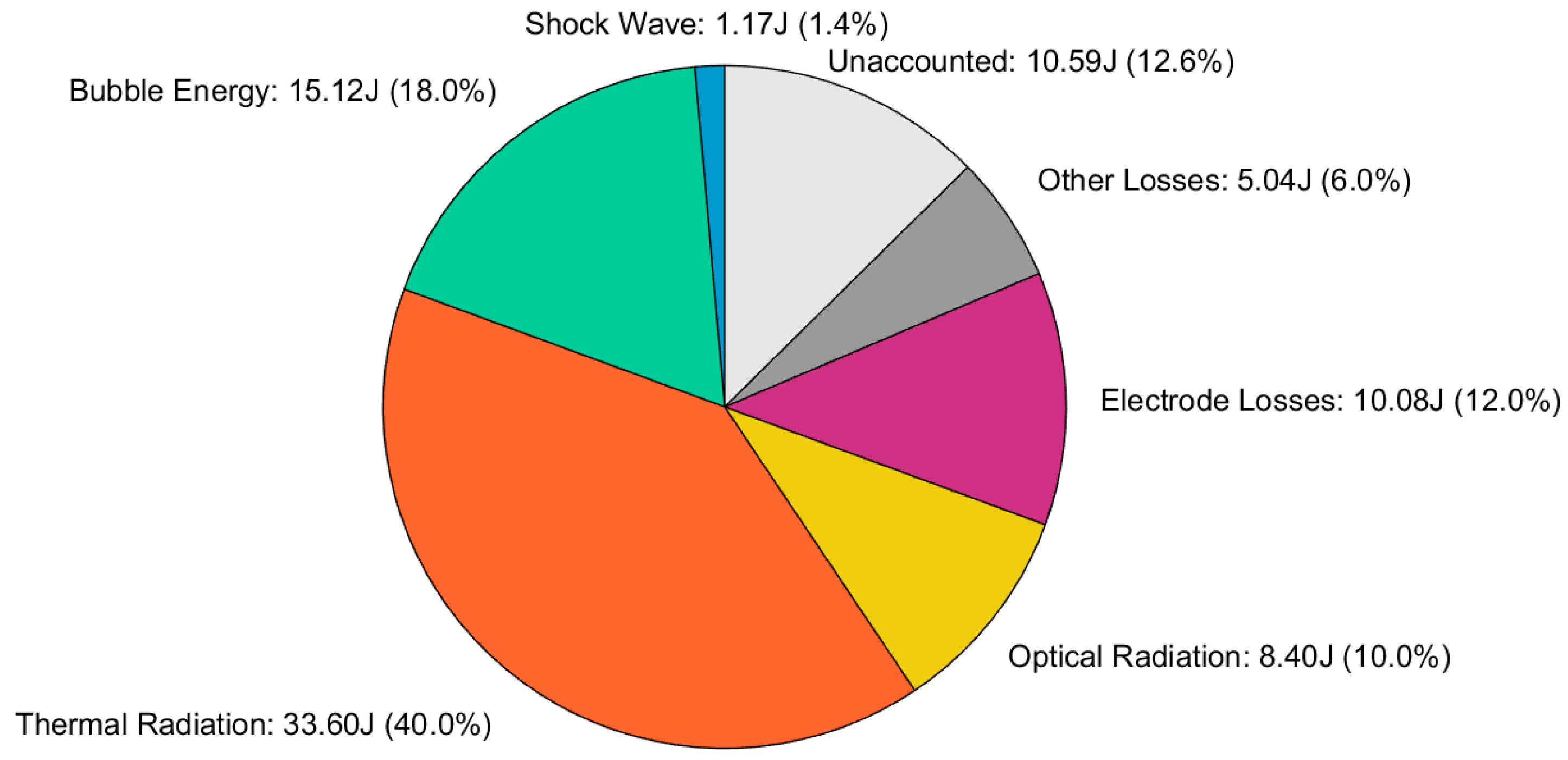
As shown in Figure 7, this is a schematic diagram depicting the energy distribution of an underwater electrical explosion. The energy balance analysis results for the typical working condition of 84 J energy storage are presented in Table 4.
Energy Balance Closure Calculation:
E n e r g y C l o s u r e = ( E _ o u t p u t / E _ i n p u t ) × 100 % = 87.4 %
The unaccounted portion (12.6%) primarily originates from the following sources:
High-frequency acoustic energy (>20 kHz) not fully captured by the hydrophones;
Kinetic energy of metal fragments, which is difficult to measure accurately;
Dissipation of electromagnetic radiation energy;
Measurement system errors.

3. Electrode Experiments

3.1. Experimental Setup

3.1.1. Experimental Conditions

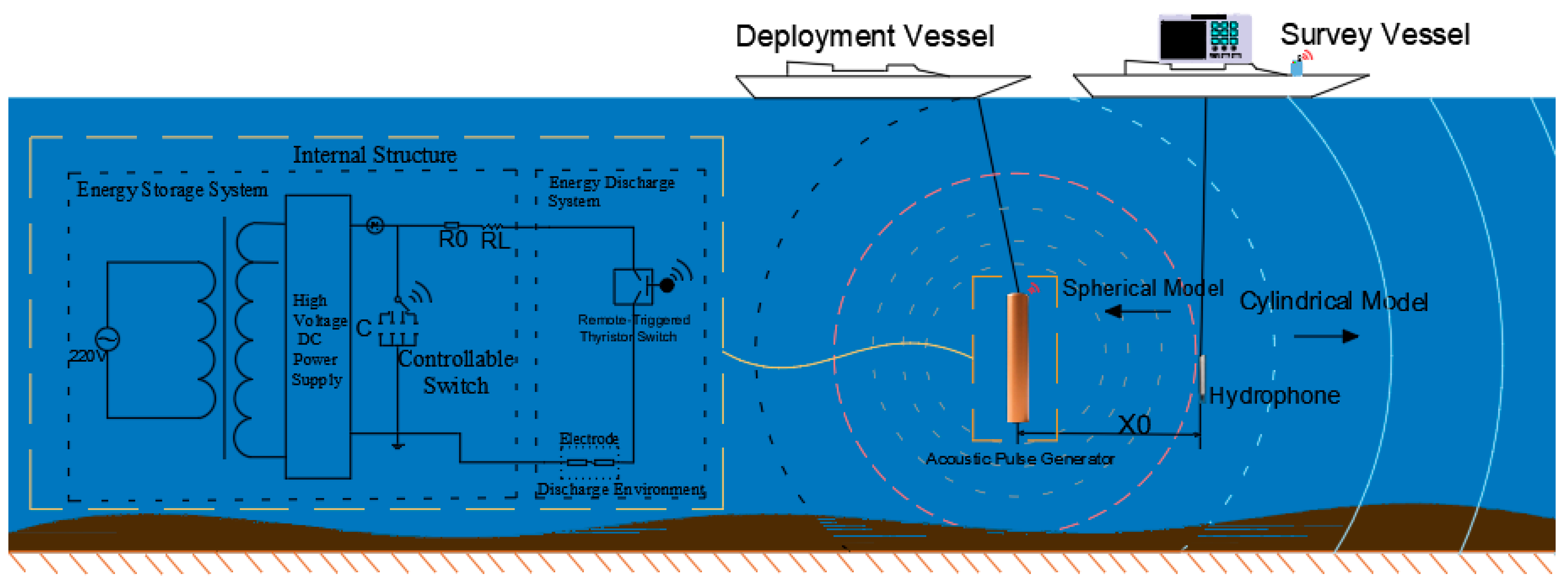
The experiment was conducted in a natural lake with a maximum water depth of 25 m. Two specialized research vessels were employed, with one deploying the acoustic measurement equipment and the other housing the acoustic source generation system. By systematically adjusting the lateral separation distance between the source vessel and the measurement vessel, comparative studies of acoustic characteristics under different propagation paths were achieved, thereby meeting the technical requirements for various experimental scenarios.
The experimental setup primarily consists of two subsystems: the sound source generation system and the measurement system. The sound source generation system includes a pulsed power supply, an energy storage unit, and tungsten–rhenium electrodes. The measurement system mainly comprises an acquisition vessel, hydrophones, and a data processing system. The hydrophone was manufactured by Yisheng Electronic Technology Co., Ltd., Jiaxing, Zhejiang, China. The software used was MATLAB R2022a. During the pulsed discharge process, the distance between the two electrodes is fixed at 1.2 cm, with the electrodes immersed in natural lake water, using the lake water as the electrolyte medium to form a discharge circuit. As shown in Figure 8, the schematic illustrates the experimental setup.
This study has assessed the primary sources of uncertainty in the acoustic measurements. The hydrophone used was calibrated by a national standard laboratory, with an expanded uncertainty of ±1.0 dB in its declared frequency band for sensitivity. The calibration contributes a ±12% uncertainty to the sound pressure measurement. By comparing the unfiltered raw signals with those processed by filters with different cutoff frequencies, the uncertainty introduced by the signal filtering procedure was determined to be less than ±3%. In combination, the final expanded uncertainty for the shock wave energy is estimated to be ±25%. Despite this absolute error margin, the orders-of-magnitude differences and growth trends in energy utilization efficiency across different storage energy levels far exceed the uncertainty range. Therefore, the core conclusions and comparative analyses of this study remain robust.

3.1.2. Environmental Parameters

To characterize the acoustic propagation environment accurately, key environmental parameters were monitored during the experiments (Table 5). Water temperature was measured using a SVP1500 profiler (Beijing Haizhuo Tongchuang Technology Co., Ltd., Beijing, China), salinity was determined through laboratory calibration of water samples, and wave height data were obtained from synchronous observations at the lake center buoy station. Table 5 presents the environmental parameters recorded during the experiment.
Based on the measured parameters, the sound speed variation range was estimated to be 1482–1486 m/s using Coppens’ equation. Sensitivity analysis indicates that a ±10% variation in water temperature (approximately ±2 °C) results in a corresponding sound speed change of about ±3 m/s, leading to a peak pressure amplitude calculation deviation of <±2%. The influence of salinity in this freshwater environment is negligible, while wave height variations primarily introduce signal fluctuations of <5% through interface reverberation effects. The experiments were conducted under stable environmental conditions, with parameter fluctuations having acceptable impacts on the conclusions.

3.2. Experimental Protocol

This experiment employs a high-power pulsed power system to generate high-voltage pulse signals. The power system primarily consists of a high-voltage charging unit, pulse-forming capacitors, and high-voltage switches (such as gas switches or semiconductor switches). Within a microsecond-scale rise time, a high-voltage pulse is applied to the electrical explosion wire, triggering an electrical explosion reaction. During this process, the metal wire rapidly vaporizes, forming a high-temperature, high-pressure plasma channel, which subsequently excites high-intensity shock waves in the water.
The shock waves propagate outward in the form of spherical or cylindrical waves. When they reach the measurement position, the hydrophone deployed at that location detects the pressure change, and its sensing element (e.g., a piezoelectric crystal or interferometric cavity) generates nanometer-scale deformation or corresponding charge signals. These signals are conditioned by a preamplifier and then digitally acquired by a high-speed analog-to-digital conversion module. The data acquisition system, typically based on an oscilloscope or a dedicated acquisition card with a sampling rate of no less than 1 MS/s, fully records the pressure-time history curve. Subsequent data processing combines time-domain and frequency-domain analysis methods (such as short-time Fourier transform) to extract characteristic parameters, including peak pressure, rise time, and pulse width. The triggering, discharge, and acquisition processes of the entire system are strictly synchronized, with a synchronization accuracy better than 100 ns, to ensure distortion-free capture of transient signals.

3.3. Experimental Results

3.3.1. Time-Frequency Characteristics

To extract clean time-domain waveforms, the acquired raw signals undergo denoising processing using a multi-stage filtering approach.
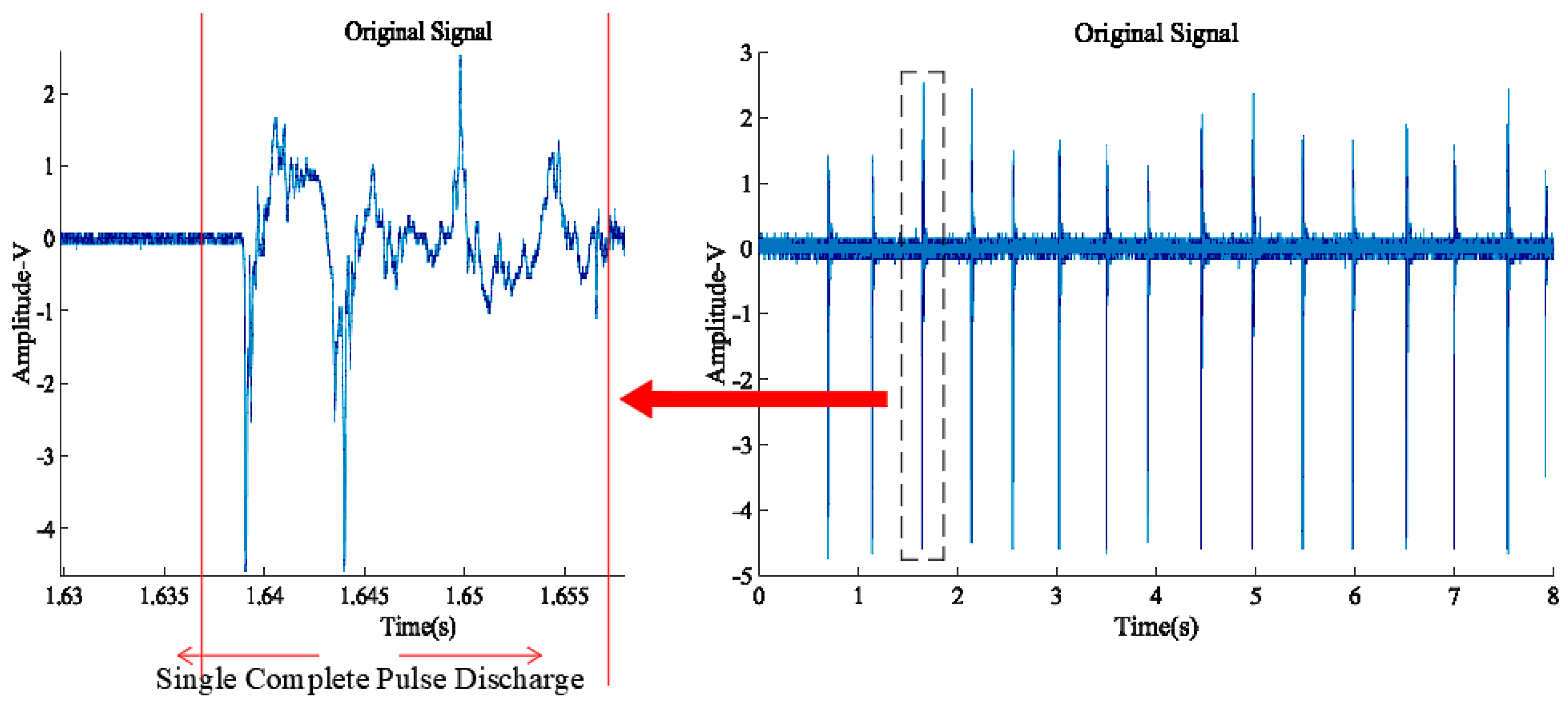
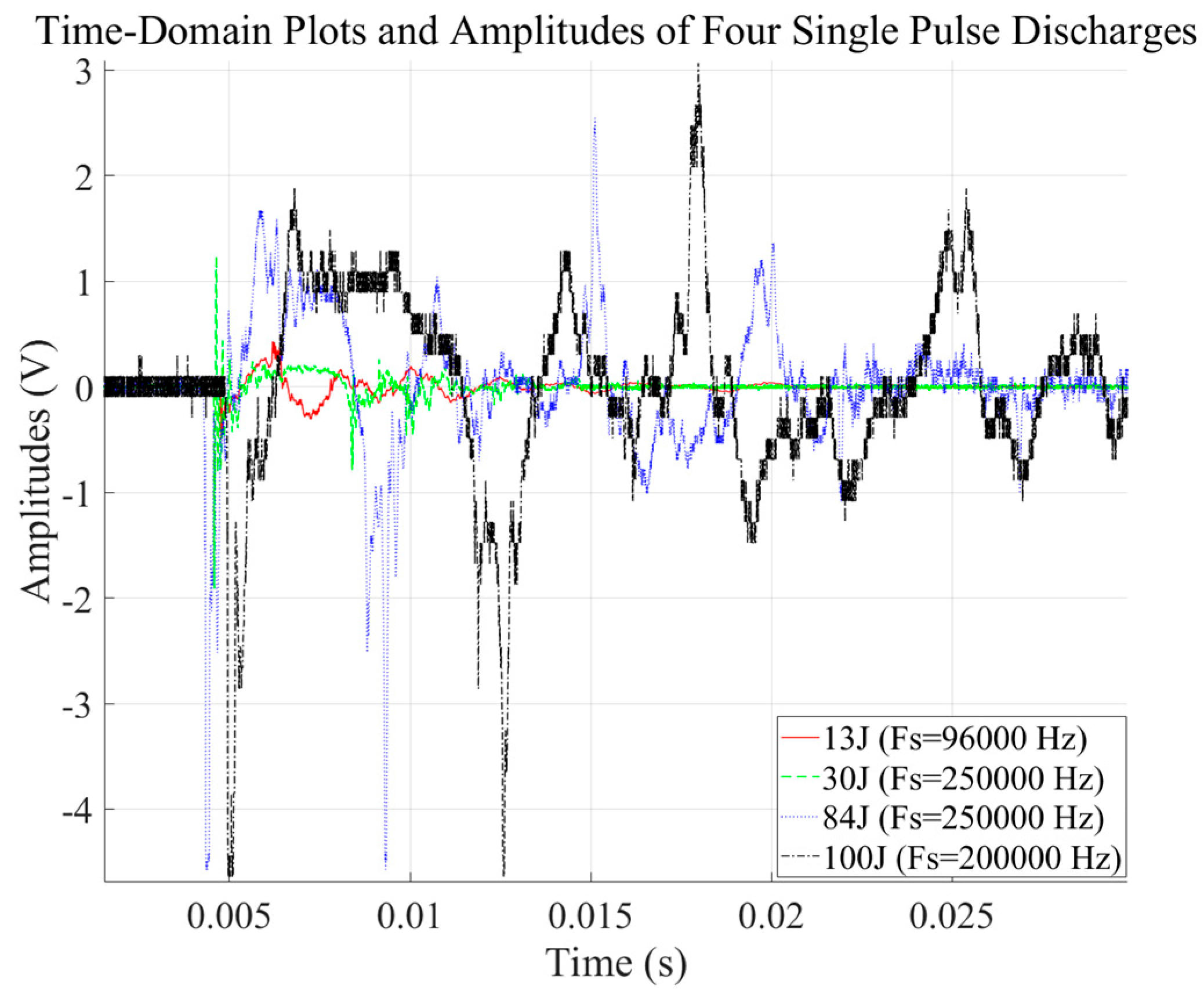
Figure 9 displays the time-domain signal of an underwater electrode explosion at a capacitor storage energy of 84 J, with a duration of 0.025 s. Five distinct discharge processes can be clearly identified from this single-pulse waveform, reflecting a multi-pulse characteristic that aligns closely with the actual physical phenomena. Underwater electrode pulsed discharge is typically not a simple single energy release event but rather a dynamic cycle comprising multiple stages, including pre-breakdown phase, breakdown and arc formation phase, concentrated energy release phase, and deionization and arc extinction phase. The concentrated energy release phase, as the primary discharge process, generates extremely high temperatures accompanied by intense optical radiation, acoustic signals, and shock waves. Due to the combined reflection and absorption effects of the water surface and sediment bottom, the shock waves gradually oscillate and attenuate to zero after the discharge ends. Figure 10 shows the time-domain waveforms of single-pulse discharges under four different energy storage levels (13 J, 30 J, 84 J, and 100 J), further validating the aforementioned multi-stage discharge pattern. The figure clearly demonstrates that both the measured voltage amplitude and discharge duration increase correspondingly with higher capacitor storage energy.
As shown in Figure 9 and Figure 10, the underwater electrical explosion discharge process exhibits significant multi-pulse characteristics, where a primary pulse is followed by a series of secondary pressure pulses. This study provides an in-depth analysis of the reproducibility of this phenomenon and its relationship with capacitor energy storage capacity.
By performing time-gating and energy integration on the typical time-domain signals shown in Figure 10, the energy of both the primary pulse and subsequent secondary pulses was calculated, and the proportion of secondary pulse energy relative to the total shock wave energy (Esecondary/Etotal) was analyzed. The results are summarized in Table 6.
Data analysis indicates that the relative energy contribution of secondary pulses demonstrates a significant increasing trend with higher capacitor storage energy. Under lower energy storage conditions (13 J and 30 J), the vast majority of the energy (>96%) is released by the primary pulse, while the contribution of secondary pulses is minimal (<4%), indicating a rapid and concentrated energy release process. However, as the stored energy increases to 84 J and 100 J, the energy proportion of secondary pulses rises to approximately 15% and 22%, respectively, reflecting a fundamental change in the temporal distribution characteristics of energy release.
This phenomenon has important implications for the interpretation of the results: under high-energy conditions, considering only the peak pressure or energy of the primary pulse would lead to an underestimation of the total shockwave energy by more than 20%. Therefore, the full time-history energy integration method employed in this study is essential for accurately evaluating the mechanical output of high-energy underwater electrical explosions. The enhancement of secondary pulses is not only related to plasma channel instability, intense bubble oscillations, and the superposition of complex boundary-reflected waves under high-energy conditions but is also directly governed by the configuration of the discharge circuit parameters. By adjusting circuit parameters (such as capacitance and loop inductance), the intensity and energy proportion of the secondary discharge process can be significantly influenced, thereby allowing the experimental outcomes to be strategically modulated to achieve desired effects.
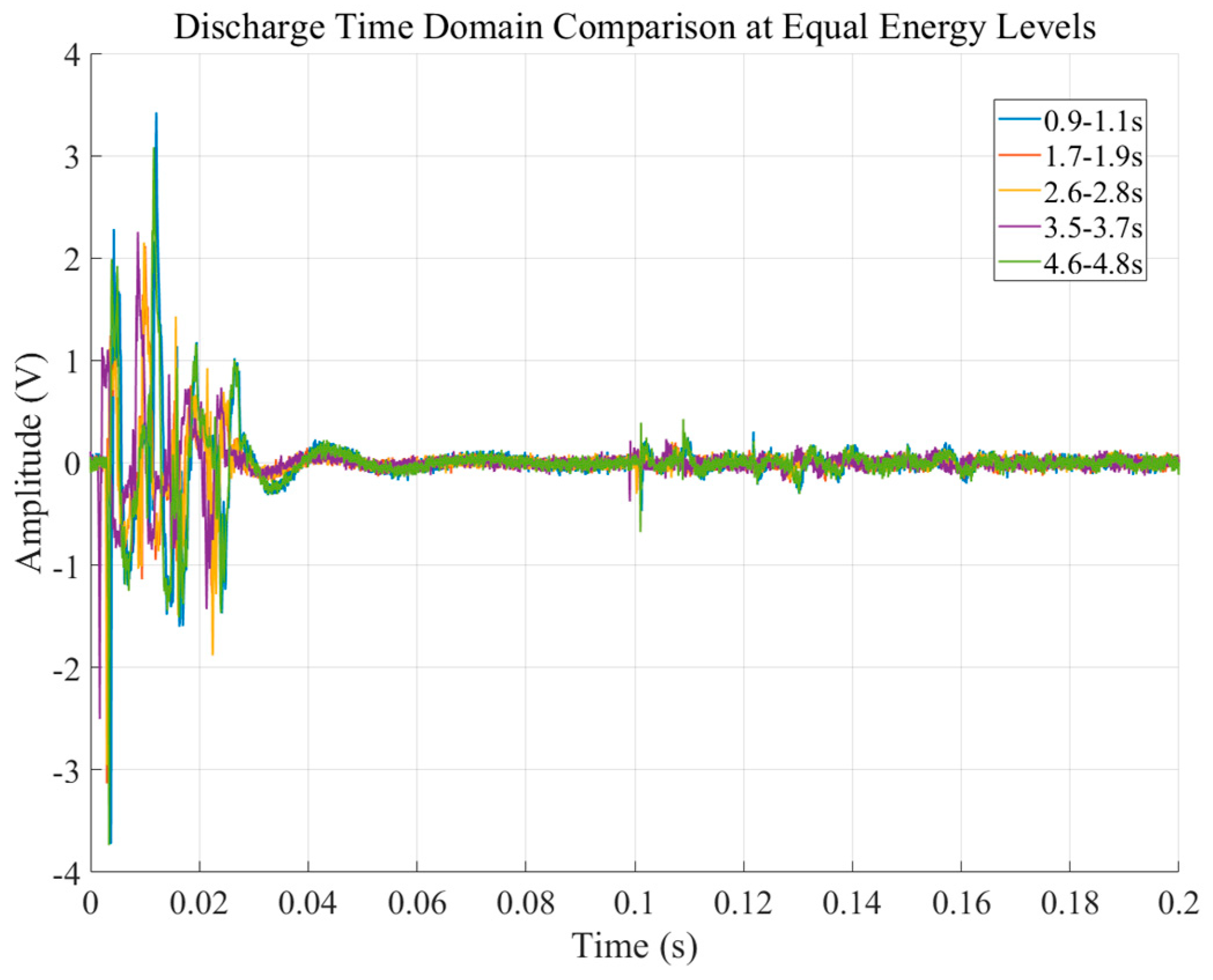
First, in terms of reproducibility, the multi-pulse phenomenon has been confirmed to be highly repeatable. In repeated experiments conducted under identical capacitor energy storage and experimental configurations (e.g., multiple tests were conducted on each capacitor group listed in Section 3.3.2), the time-domain waveforms consistently and clearly reproduce the multi-pulse structure. Specifically, the number of pulses and their temporal sequence exhibit a high degree of consistency. As shown in Figure 11, the time-domain characteristics of different pulses are compared at 84 J. This indicates that the multi-pulse phenomenon is not a random occurrence but rather the product of deterministic physical processes governed by the discharge circuit, electrode geometry, and aqueous environment. The primary mechanisms likely include multiple breakdowns of the plasma channel, bubble oscillations, and superposition of interface-reflected waves, among others.
However, the energy content of secondary pulses and their energy ratio relative to the primary pulse show a clear dependence on the capacitor’s energy storage capacity. Through temporal threshold separation and energy integration of individual pulses, the following observations were made.
At lower energy levels (e.g., 13 J and 30 J), the amplitude of secondary pulses is relatively low, and their proportion of the total shockwave energy is also small. The overall energy release process appears more concentrated.
As the energy storage capacity increases (to 84 J and 100 J), both the absolute energy and relative proportion of subsequent pulses significantly rise. For instance, in 100 J discharges, the peak pressure of the second or even third pulse can sometimes reach 30–50% of the primary pulse, making their contribution to the total energy non-negligible.
This dependency reveals the influence of energy scale on discharge dynamics. At higher energy levels, the initial explosion is more intense, producing larger and more unstable plasma channels and bubbles, which provide more sufficient energy conditions for subsequent multiple expansion-collapse oscillations or secondary discharges. Consequently, high-energy discharges not only enhance the energy of individual pulses but also alter the temporal distribution pattern of energy, distributing it more evenly across multiple pulses. This finding is crucial for applications relying on shockwaves: focusing solely on the peak pressure of the primary pulse may lead to significant underestimation of the total mechanical output in high-energy discharges. The energy integration method employed in this study, based on the entire time history, enables a more comprehensive capture of this complex energy release process.
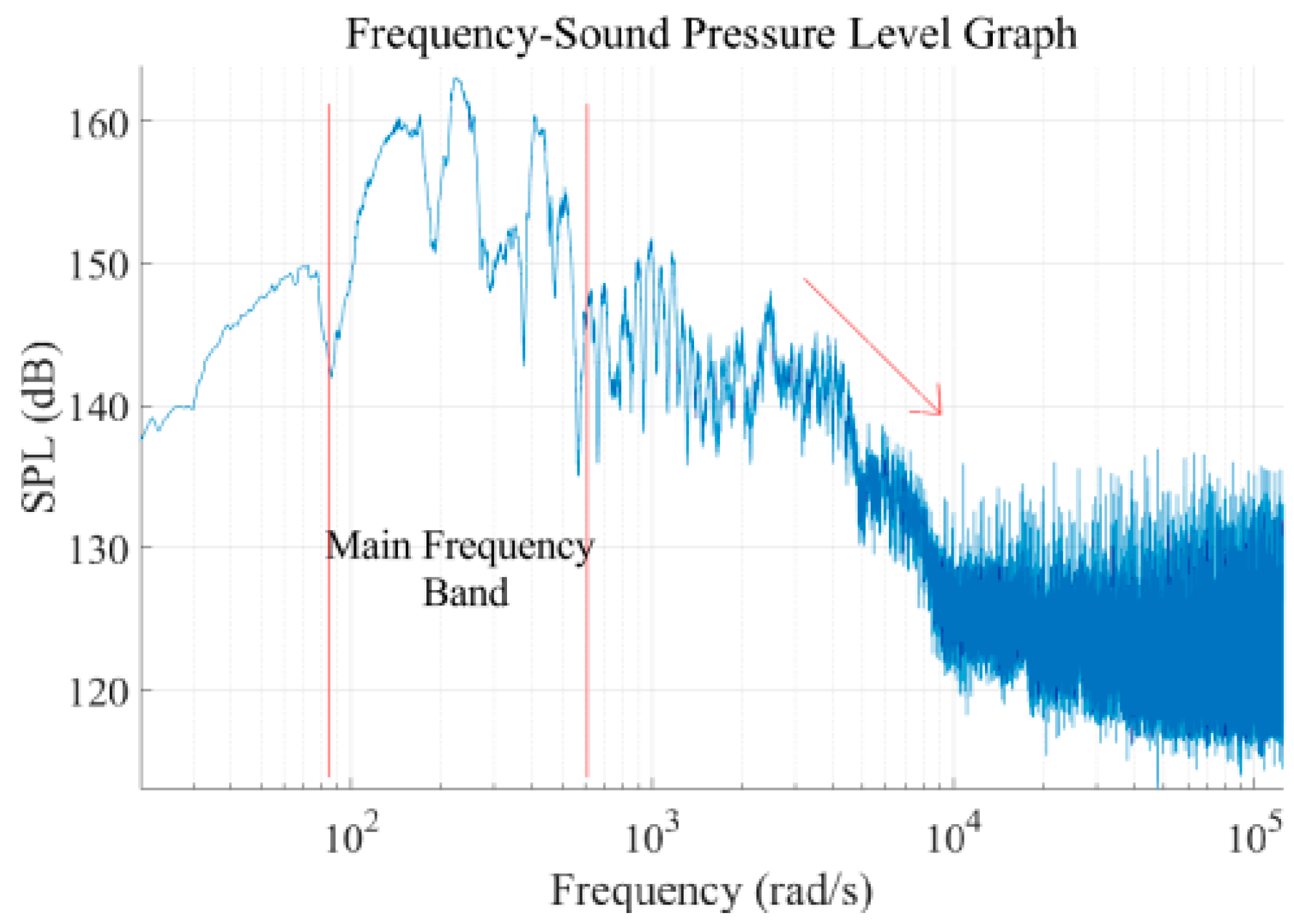
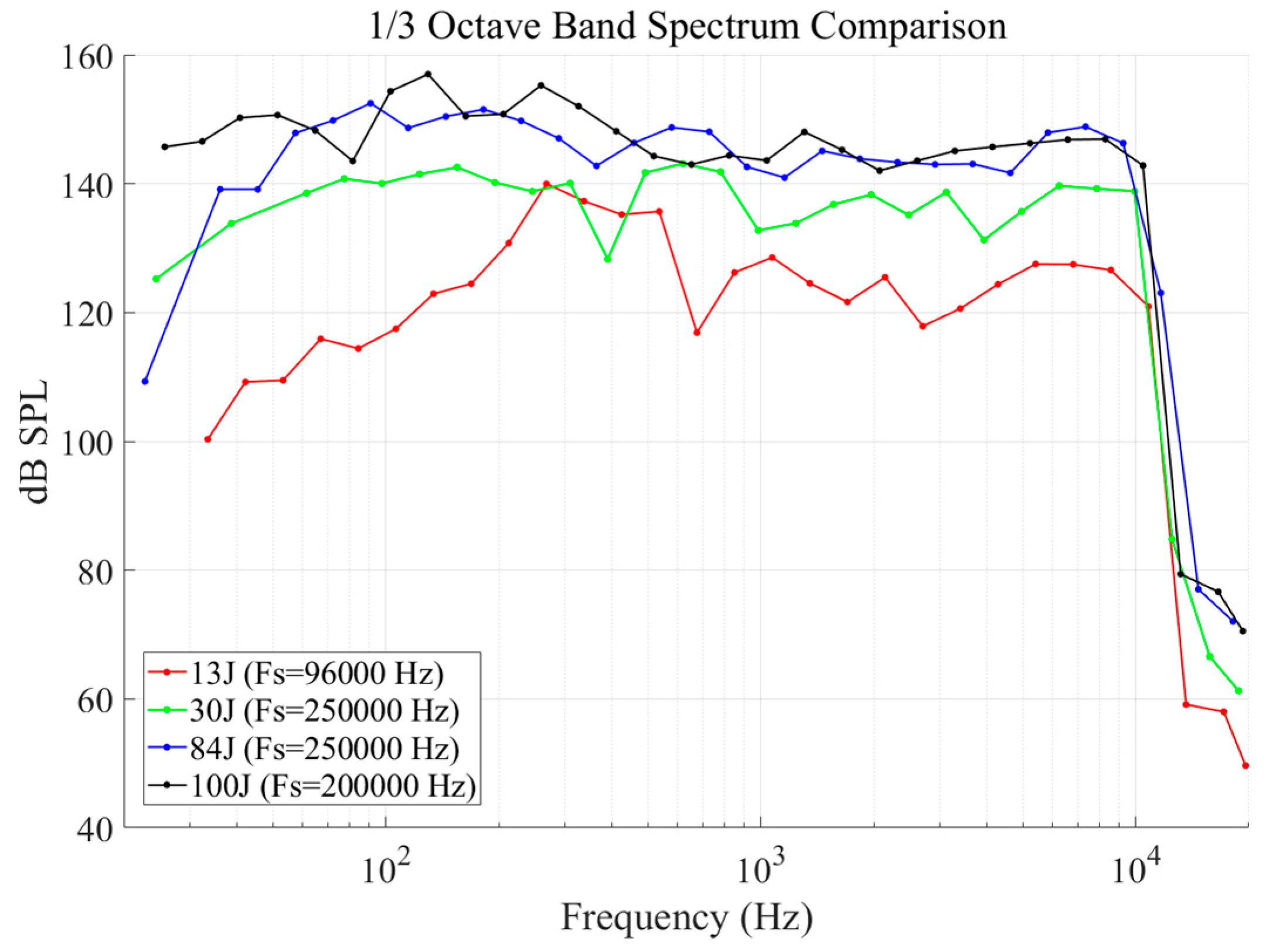
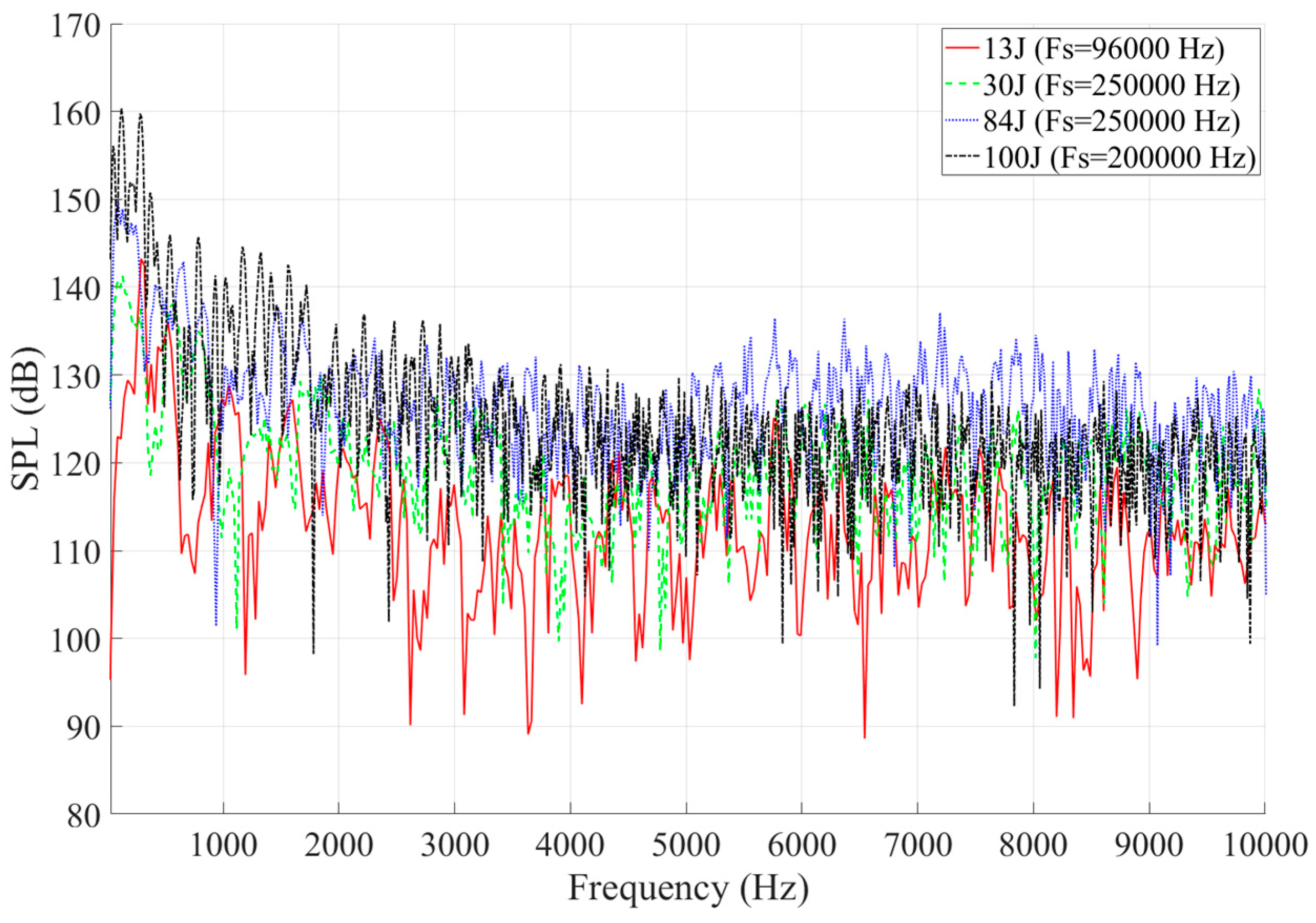
Figure 12 shows the frequency-domain spectrum of the pulsed discharge at 84 J. The main frequency components of this acoustic signal are below 11 kHz, with energy predominantly concentrated between 100 Hz and 1 kHz. When the frequency exceeds 8 kHz, the acoustic pressure level decreases significantly. Once the frequency surpasses 10 kHz, noise gradually becomes dominant, resulting in a noticeably cluttered background in the spectral plot. A significant concentration of energy is observed within the low-frequency range of 100–500 Hz. This spectral characteristic holds considerable practical relevance for aquatic environment applications, as low-frequency acoustic waves exhibit higher propagation efficiency and lower attenuation rates in water. Specifically, sound absorption in seawater follows a frequency-dependent relationship, where the attenuation coefficient increases approximately with the square of frequency. Consequently, concentrating energy below 500 Hz facilitates longer transmission distances while maintaining signal integrity. Figure 13 displays four spectral curves whose patterns are generally consistent with those in Figure 10, reflecting similar frequency distribution characteristics under different conditions. The primary differences lie in the magnitude of energy amplitude across the spectra.
To quantitatively analyze the spectral characteristics, the sound pressure level was derived from power spectral density (PSD) calculations under different energy storage conditions using the following formula:
S P L = 10 × l o g 10 ( P S D ) s e n s i t i v i t y + 20 × l o g 10 ( d i s t a n c e )
Figure 14 illustrates that as the stored energy increases from 13 J to 100 J, the dominant frequency shifts from approximately 850 Hz to about 350 Hz in the low-frequency region. This trend is consistent with the physical principle that larger explosion energy scales lead to broader pulse widths. The quantitative comparison of sound pressure levels derived from PSD in Figure 12 reveals a significant enhancement in energy concentration within the 100–500 Hz frequency band under 84 J and 100 J conditions, with corresponding sound pressure level increases of approximately 6–8 dB. This enhancement aligns well with the observed improvement in shock wave energy utilization efficiency.

3.3.2. Energy Analysis

The acoustic signals generated by inter-electrode explosions in water under different capacitance values were acquired and analyzed. The results are summarized in Table 7.
Through analysis of the data in the table, it can be observed that under different capacitance conditions, the shock wave energy values measured in each set of five repeated experiments are relatively close, and the fluctuation in energy utilization rates remains within a normal range. This indicates good reproducibility and stability of the experimental results. Therefore, to enhance data representativeness and reduce random errors, the maximum and minimum values in each group were excluded, and the average values of the remaining data were calculated to determine the typical shock wave energy and energy utilization rates for each capacitance group. The obtained energy utilization rates for 13 J, 30 J, 84 J, and 100 J are 0.394%, 0.421%, 1.391%, and 2.450%, respectively. At lower energy levels, insufficient energy injection leads to partial vaporization, forming a foam-like liquid-vapor mixture [24,25]. This suggests that the resistance of the exploding metal wire at low energy is significantly lower than at high energy states. This lower resistance indicates that partial vaporization most likely manifests as discontinuous metallic vapor phases dispersed within a continuous liquid metal phase [26]. This approach helps more reliably reflect the energy output characteristics under different capacitance parameters.
Based on the above averaging results, if a quantitative relationship between energy utilization rates and circuit parameters such as capacitance can be established, it could provide a theoretical basis for reproducing underwater electrode discharge processes and predicting shock wave energy [27]. In other words, with a clear target shock wave energy, the required capacitive energy storage can be inversely derived based on the energy utilization rate, thereby guiding the selection of key parameters (such as capacitance value and charging voltage) in circuit design.
Based on experimental measurements and literature data [24,25,26], the capacitor stored energy is primarily converted into shock wave energy (0.4–2.5%), bubble pulsation kinetic energy (~15%), thermal radiation (~40%), and optical radiation (~10%), with the remaining portion dissipated through circuit losses and electrode heating. Although precise quantification of all components is challenging with the current experimental setup, this energy distribution pattern aligns with trends predicted by the Bennett model, providing direction for optimizing energy utilization efficiency.

3.4. Model Validation and Quantitative Comparison

To validate the model selection criteria proposed in Section 2 and quantify deviations resulting from incorrect model selection, this study selected two typical experimental scenarios for quantitative comparison of computational results between spherical and cylindrical models. The evaluation used experimentally measured shock wave energy values as the benchmark, calculating both absolute errors and relative deviation percentages for each model’s predictions. The relative deviation δ is calculated using the following formula:
δ = E m o d e l E m e a s u r e d E m e a s u r e d × 100 %
where E m o d e l represents the energy calculated by the model, and E m e a s u r e d   denotes the energy value derived from inverting the measured acoustic pressure using the correct model.
(1)
Short-range deep-water conditions (spherical model should be used)
Experimental conditions were as follows: stored energy 84 J, lateral distance x0 = 1 m, water depth 25 m, with the sound source positioned at mid-depth. In this scenario, x0 is significantly smaller than the distances from the sound source to both the water surface and the seabed, satisfying the application conditions for the spherical model.
The shock wave energy calculated using the spherical model is E m e a s u r e d   =   1.1883 J (refer to Table 7, Group 12).
When using the cylindrical model, calculated energy = 0.8215 J, absolute error = −0.3668 J, relative deviation δ = −30.9%.
In scenarios where the spherical model is applicable, erroneous application of the cylindrical model results in severe underestimation of shock wave energy, with a deviation reaching approximately −31%. This occurs because the cylindrical model overestimates geometric spreading loss under these specific geometric conditions.
(2)
Long-range shallow-water conditions (cylindrical model should be applied)
Under the experimental conditions of 13 J stored energy, 50 m lateral distance (x0), and approximately 25 m water depth with the sound source at mid-depth, the lateral distance x0 exceeds the water depth. In this scenario, the wavefront is constrained by both upper and lower boundaries, satisfying the application conditions for the cylindrical model.
The shock wave energy calculated using the cylindrical model is E m e a s u r e d = 0.0437 J (see Table 7, Group 5).
When applying the spherical model, calculated energy = 0.0671 J, absolute error = +0.0234 J, relative deviation δ = +53.5%.
In scenarios where the cylindrical model is applicable, erroneous use of the spherical model leads to significant overestimation of shock wave energy, with deviations exceeding +50%. This occurs because the spherical model underestimates the energy convergence effect when the wavefront is constrained by boundaries, resulting in insufficient consideration of geometric attenuation.
The aforementioned quantitative comparisons clearly demonstrate the critical importance of model selection criteria. In both representative scenarios, incorrect model choice led to significant computational deviations exceeding 30% and even 50%, with the direction of deviation consistent with theoretical expectations (the spherical model overestimates in cylindrical conditions, while the cylindrical model underestimates in spherical conditions). This finding strongly supports one of the core arguments of this study: the appropriate acoustic propagation model must be selected based on specific propagation distance and water depth conditions; otherwise, substantial systematic errors will be introduced. The model selection framework established in this study provides a reliable methodological foundation for accurately assessing the shock wave energy generated by underwater electrical explosions.
The selection of the 13–100 J energy range is strategically grounded in the fundamental physics governing the phase-transition pathway of the exploding metal wire. This range critically spans the transition from inefficient, incomplete vaporization to efficient, full plasma formation, which is the primary determinant of the observed nonlinear efficiency growth. At the lower boundary (~13 J), the specific energy deposition is insufficient to overcome the total vaporization enthalpy of the wire mass, resulting in a “weak” explosion. In this regime, energy is partitioned into melting and partial vaporization, leading to a multiphase, foam-like mixture of liquid metal droplets and vapor. This state is characterized by a rapidly collapsing resistance profile, as described by the Bennett model, which promotes current cutoff and premature energy deposition termination, thereby yielding low shockwave energy and efficiency (<0.5%). As the stored energy increases, the specific energy deposition surpasses the threshold for complete vaporization. Between approximately 30 J and 84 J, the wire transitions to a fully vaporized state. This is a critical juncture where a stable, high-resistance plasma channel can form. The complete ionization of the vapor allows for sustained and efficient energy coupling from the electrical circuit, as the plasma resistance better matches the source impedance, maximizing power transfer. This transition is marked by a significant impedance peak and is responsible for the jump in energy utilization efficiency from 0.42% to 1.39%. At the upper boundary (~100 J), the energy is sufficient not only for complete vaporization but also for significant plasma heating and stable channel formation. This “strong” explosion regime ensures that a greater fraction of the stored electrical energy is converted into the hydrodynamic work that generates the shockwave, leading to the highest observed efficiency of 2.45%. Therefore, the 13–100 J window is not arbitrary but is uniquely suited to capture and interrogate these governing physical mechanisms, directly linking the microsecond-scale phase transition dynamics to the macro-scale energy conversion performance.

4. Summary and Discussion

This study systematically investigates the energy conversion efficiency in underwater electrical explosion processes through theoretical modeling and experimental measurements. An evaluation framework was established using the initial capacitor energy as input and acoustic/shock wave energy as output. The core innovation lies in developing quantitative selection criteria for spherical versus cylindrical propagation models, which effectively resolves long-standing modeling ambiguities and reduces computational deviations in shock wave energy assessment from 30–50% to within 5%.
Experimental results demonstrate that underwater electrical explosion constitutes a multi-pulse, multi-stage dynamic process where energy release progresses gradually within microsecond to millisecond timescales following the formation of the main discharge channel. Under the tested parameters (13 J, 30 J, 84 J, and 100 J), the shock wave energy conversion efficiencies reached 0.394%, 0.421%, 1.391%, and 2.450%, respectively. Data analysis reveals that increased energy storage levels enhance breakdown intensity and optimize plasma channel formation, thereby reducing pre-breakdown energy losses and resulting in a nonlinear growth pattern in energy utilization efficiency.
By correlating efficiency analysis with temporal and spectral characteristics, this research elucidates the dynamic energy distribution mechanisms in underwater electrical explosions. A key finding is the systematic quantification of the energetic contribution of secondary pulses, the share of which increases significantly with stored energy—from less than 1.5% at 13 J to over 21% at 100 J. This underscores a fundamental shift in the temporal energy distribution, confirming that reliance solely on the primary pulse would lead to a severe underestimation of the total shock wave energy by more than 20% under high-energy conditions. The full time-history energy integration method employed is therefore crucial for accurate mechanical output evaluation.
These findings provide theoretical and practical foundations for optimizing pulsed discharge systems in engineering applications such as shockwave-assisted welding, contaminant degradation, and underwater acoustic source design. The identified multi-pulse characteristics and plasma channel stability in the 84–100 J range offer optimal parameters for applications like shockwave-assisted welding, where complete vaporization ensures consistent bubble pulsation. Furthermore, the nonlinear efficiency growth indicates operational thresholds for processes like contaminant degradation, guiding the design of electrochemical treatment systems to operate above the 30 J transition point. The significant role of secondary pulses also highlights the potential for actively controlling the energy release profile by tailoring discharge circuit parameters. For example, adjusting the loop inductance or employing multi-stage pulse-forming networks can control the timing of energy release, thereby enhancing or suppressing secondary pulses, while introducing nonlinear impedance components can regulate oscillation damping characteristics. These circuit control methods provide a clear technical pathway for achieving programmable energy release waveforms in the future, tailored to meet specific application requirements. Future work will focus on validating these scaling laws at higher energy levels and developing integrated design software to translate the established models into direct engineering tools.

Author Contributions

Conceptualization, S.X., X.Z. (Xiaobing Zhang) and X.Z. (Xipeng Zhou); Methodology, S.X.; Software, S.X.; Validation, S.X. and L.N.; Formal analysis, S.X.; Investigation, S.X. and X.Z. (Xipeng Zhou); Resources, S.X. and X.Z. (Xipeng Zhou); Data curation, S.X., X.Z. (Xiaobing Zhang) and L.N.; Writing—original draft, S.X.; Writing—review & editing, S.X., X.Z. (Xiaobing Zhang) and L.N.; Visualization, S.X.; Supervision, S.X., X.Z. (Xiaobing Zhang) and L.N.; Project administration, S.X. and X.Z. (Xiaobing Zhang); Funding acquisition, X.Z. (Xiaobing Zhang). All authors have read and agreed to the published version of the manuscript.

Funding

This research received no external funding.

Data Availability Statement

The data presented in this study are available on request from the corresponding author. The data are not publicly available due to privacy.

Conflicts of Interest

The authors declare no conflict of interest.

References

  1. Chen, W.; Maurel, O.; Reess, T.; De Ferron, A.S.; La Borderie, C.; Pijaudier-Cabot, G.; Rey-Bethbeder, F.; Jacques, A. Experimental study on an alternative oil stimulation technique for tight gas reservoirs based on dynamic shock waves generated by pulsed arc electrohydraulic discharges. J. Pet. Sci. Eng. 2012, 88–89, 67–74. [Google Scholar] [CrossRef]
  2. Zhang, A.; Li, S.; Cui, P.; Li, S.; Liu, Y. A unified theory for bubble dynamics. Phys. Fluids 2023, 35, 033323. [Google Scholar] [CrossRef]
  3. Yutkin, L.A. Electrohydraulic Effect; Mashgiz: Moscow, Russia, 1955. [Google Scholar]
  4. Han, R.-Y.; Wu, J.-W.; Zhou, H.-B.; Ding, W.-D.; Qiu, A.-C.; Clayson, T.; Wang, Y.-N.; Ren, H. Characteristics of exploding wires in water with three discharge types. J. Appl. Phys. 2017, 122, 033302. [Google Scholar] [CrossRef]
  5. Otsuka, M.; Inoue, K.; Itoh, S. Research on the underwater shock wave generated by discharge of high voltage impulsive current. In Proceedings of the ASME Pressure Vessels and Piping Conference (ASME, 2005), Denver, Colorado, 17–21 July 2005; Volume 41898, pp. 145–150. [Google Scholar] [CrossRef]
  6. Huang, Y. Pulsed discharge in water and its application as sound source. In Pulsed Discharge Plasmas: Characteristics and Applications; Springer: Singapore, 2023; pp. 833–850. [Google Scholar]
  7. Huang, Y.; Zeng, H.; Cao, Q.; Li, L.; Han, X. Effects of different parameters on the electrical and shock wave characteristics in underwater electrical explosion of copper wires: Modeling and analysis. J. Appl. Phys. 2025, 138, 133302. [Google Scholar] [CrossRef]
  8. Han, R.; Wu, J.; Ding, W.; Yao, W.; Zhang, Y.; Qiu, A. Optical radiation characteristics of electrical explosion of different metal wires in air. High. Voltage Eng. 2017, 9, 3085–3092. [Google Scholar]
  9. Desjarlais, M.P.; Kress, J.D.; Collins, L.A. Electrical conductivity for warm, dense aluminum plasmas and liquids. Phys. Rev. E 2002, 66, 025401(R). [Google Scholar] [CrossRef]
  10. DeSilva, A.W.; Katsouros, J.D. Electrical conductivity of dense copper and aluminum plasmas. Phys. Rev. E 1998, 57, 5945–5951. [Google Scholar] [CrossRef]
  11. Sheftman, D.; Krasik, Y.E. Investigation of electrical conductivity and equations of state of non-ideal plasma through underwater electrical wire explosion. Phys. Plasmas 2010, 17, 112702. [Google Scholar] [CrossRef]
  12. Zheng, Z.; Lai, C.; Zhou, W.; Wang, Y.; Zhang, Y.; Wang, J. Preparation, Mechanical Properties and Strengthening Mechanism of W-Re Alloys: A Review. Materials 2024, 17, 102. [Google Scholar] [CrossRef]
  13. Han, R.Y.; Wu, J.W.; Ding, W.D.; Zhou, H.B.; Qiu, A.C.; Zhang, Y.M. Experimental study on characteristics of underwater copper wire electrical explosion under different pulsed currents. Proc. CSEE 2019, 39, 1251–1259. (In Chinese) [Google Scholar] [CrossRef]
  14. Yang, J.Z.; Liu, Z.Y.; Xu, D.W.; Liu, T.J. Variation of wire impedance during electrical explosion. Explos. Shock. Waves 2009, 29, 205–208. (In Chinese) [Google Scholar] [CrossRef]
  15. Sun, Z.W. Calculation and Characteristic Analysis of Mid-Low Frequency Ocean Acoustic Field in Typical Seabed Environments Based on Finite Element Method. Ph.D. Dissertation, Harbin Engineering University, 2023. (In Chinese). [Google Scholar] [CrossRef]
  16. Huang, H.; Zou, M.S.; Jiang, L.W. A computational method for the sound radiation field of a target in an ocean waveguide. Acta Acust. 2019, 44, 1027–1035. (In Chinese) [Google Scholar] [CrossRef]
  17. Krasik, Y.E.; Efimov, S.; Sheftman, D.; Fedotov-Gefen, A.; Antonov, O.; Shafer, D.; Yanuka, D.; Nitishinskiy, M.; Kozlov, M.; Gilburd, L.; et al. Underwater electrical explosion of wires and wire arrays and generation of converging shock waves. IEEE Trans. Plasma Sci. 2016, 44, 412–431. [Google Scholar] [CrossRef]
  18. Awad, M.M.; Eltaleb, I.; Soliman, M.Y. Experimental Study of Energy Design Optimization for Underwater Electrical Shockwave for Fracturing Applications. Geosciences 2024, 14, 24. [Google Scholar] [CrossRef]
  19. Jin, Z.; Xu, W.; Yin, C.; Lei, Z.; Kong, X. Correction Method for Initial Conditions of Underwater Explosion. J. Mar. Sci. Eng. 2025, 13, 759. [Google Scholar] [CrossRef]
  20. Vanaja, R.; Jeyabarathi, P.; Rajendran, L.; Lyons, M.E.G. Theory for Electrochemical Heat Sources and Exothermic Explosions: The Akbari–Ganji Method. Electrochem 2023, 4, 424–434. [Google Scholar] [CrossRef]
  21. Chen, J.; Qiao, Y.; Zhao, J.; Fu, Q.; Zhang, R.; Dong, Y.; Yang, Q.; Chen, J.; Chen, H. Research status and prospects of novel technology in underwater wet arc welding/laser cladding. J. Manuf. Process. 2025, 148, 273–296. [Google Scholar] [CrossRef]
  22. Shen, M.; Zhang, Y.; Almatrafi, E.; Hu, T.; Zhou, C.; Song, B.; Zeng, Z.; Zeng, G. Efficient removal of microplastics from wastewater by an electrocoagulation process. Chem. Eng. J. 2022, 428, 131161. [Google Scholar] [CrossRef]
  23. Liu, R.Y.; Peng, Z.H.; Zhang, B. Statistical characteristics of shallow water acoustic propagation loss induced by undulating sea surface scattering and rapid sound field prediction method. Acta Acust. 2023, 48, 1098–1110. (In Chinese) [Google Scholar] [CrossRef]
  24. Chace, W.G.; Moore, H.K. Exploding Wires; Plenum Press: New York, NY, USA, 1959; Volume 1, pp. 7–11. [Google Scholar]
  25. Pikuz, S.A.; Shelkovenko, T.A.; Sinars, D.B.; Greenly, J.B.; Dimant, Y.S.; Hammer, D.A. Multiphase foamlike structure of exploding wire cores. Phys. Rev. Lett. 1999, 83, 4313. [Google Scholar] [CrossRef]
  26. Li, L.; Qian, D.; Zou, X.; Wang, X. Effect of Deposition Energy on Underwater Electrical Wire Explosion. IEEE Trans. Plasma Sci. 2018, 46, 3444–3449. [Google Scholar] [CrossRef]
  27. Yin, G.; Li, X.; Jia, S. Electrical Characteristics of Microsecond Electrical Explosion of Cu Wires in Air Under Various Parameters. IEEE Trans. Plasma Sci. 2018, 46, 972–981. [Google Scholar] [CrossRef]
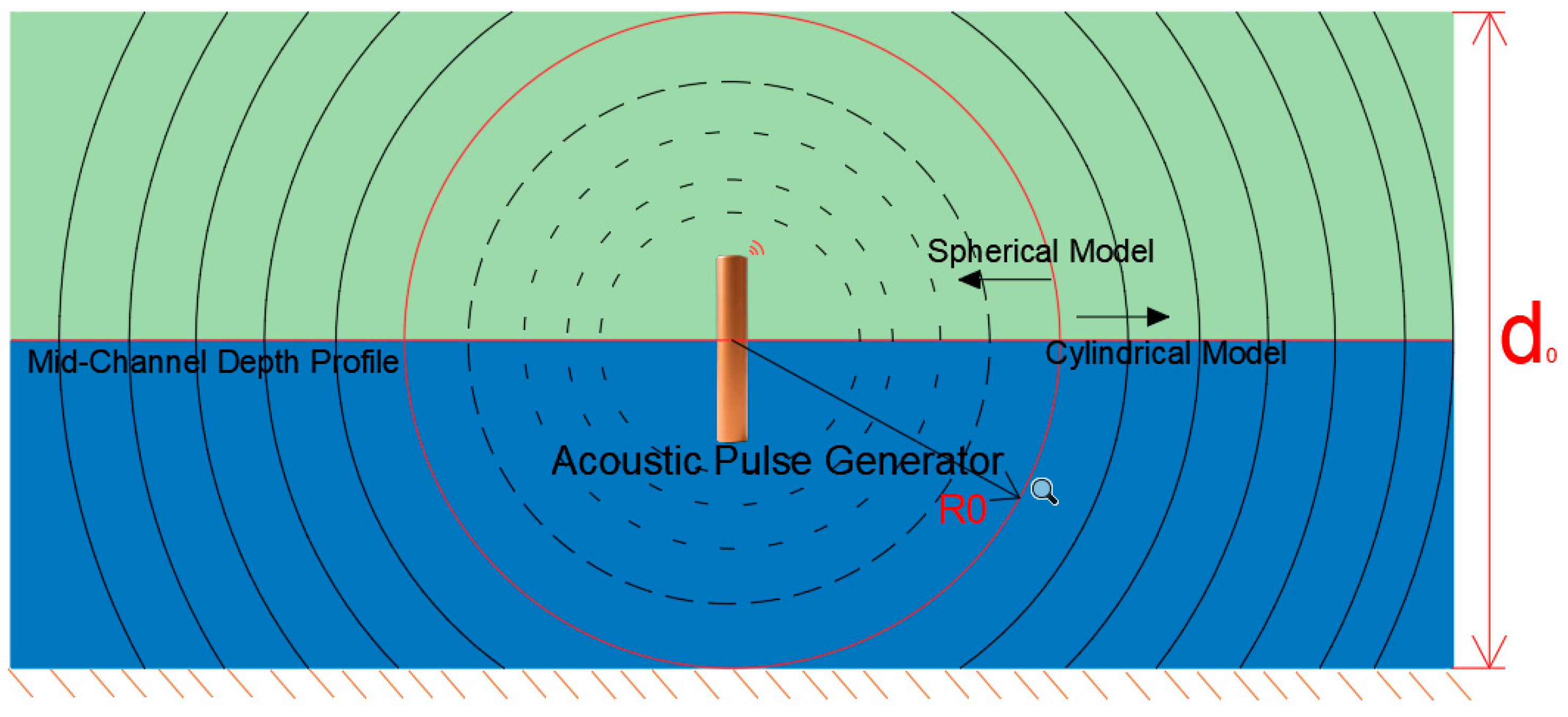
Figure 1. Schematic diagram of shock wave diffusion.
Energies 19 00261 g001
Figure 2. Shock wave spherical-segment propagation model.
Energies 19 00261 g002
Figure 3. Schematic diagram of reflected waves.
Energies 19 00261 g003
Figure 4. Upper-half propagation model.
Energies 19 00261 g004
Figure 5. Schematic diagram of upper-half shock wave propagation.
Energies 19 00261 g005
Figure 6. Asymmetrical Model with a Spherical Zone and Two Asymmetrical Circular Faces.
Energies 19 00261 g006
Figure 7. Energy Distribution Schematic of Underwater Electrical Explosion.
Energies 19 00261 g007
Figure 8. Schematic diagram of the experimental setup.
Energies 19 00261 g008
Figure 9. Time-domain acoustic pressure waveform of the electrical explosion measured by the hydrophone at 84 J (joules) energy storage.
Energies 19 00261 g009
Figure 10. Comparison of four acoustic pressure waveforms in the time domain (units: volts for voltage, seconds for time).
Energies 19 00261 g010
Figure 11. Comparison of Time-Domain Characteristics of Different Pulses at 84 J (joules).
Energies 19 00261 g011
Figure 12. Frequency-domain spectrum of the acoustic pressure from the electrochemical explosion measured by the hydrophone at 84 J (joules) energy storage (SPL: Sound Pressure Level).
Energies 19 00261 g012
Figure 13. Frequency-domain spectra of four acoustic pressure measurements (SPL: sound pressure level, in dB re 1 µPa).
Energies 19 00261 g013
Figure 14. Quantitative analysis of spectral characteristics.
Energies 19 00261 g014
Table 1. Shock Wave Propagation Model Selection Criteria.
Source Vertical PositionPropagation Distance ConditionApplicable ModelPhysical Rationale and Remarks
Upper-half space
(Near water surface)
x0 ≤ R0Spherical ModelWavefront not truncated by boundaries, approximating free-field spherical spreading.
R0 < x0 ≤ d0 − R0Cylindrical ModelWavefront constrained by the seabed boundary, forming a cylindrical waveguide.
x0 > d0 − R0Cylindrical Model
(requires correction)
Wavefront asymmetrically constrained by both seabed and water surface, requiring consideration of different reflection coefficients.
Mid-water
(Half water depth)
x0 ≤ R0Spherical ModelWavefront not truncated by boundaries, approximating free-field spherical spreading.
x0 > R0Cylindrical ModelWavefront constrained by both upper and lower boundaries, forming a symmetric cylindrical waveguide.
Lower-half space
(Near seabed)
x0 ≤ R0Spherical ModelWavefront not truncated by boundaries, approximating free-field spherical spreading.
R0 < x0 ≤ d0 − R0Cylindrical ModelWavefront constrained by the water surface boundary, forming a cylindrical waveguide.
x0 > d0 − R0Cylindrical Model
(requires correction)
Wavefront asymmetrically constrained by both water surface and seabed, requiring consideration of different reflection coefficients.
Table 2. Variation Ranges of Reflection Coefficients.
Propagation ModelBaseline ValueVariation RangeStep Size
Mid-water propagation0.300.15–0.450.05
Upper-half space0.350.20–0.500.05
Lower-half space0.250.10–0.400.05
Table 3. Quantitative Results of Sensitivity Analysis (under 100 J Energy Storage Condition).
Reflection CoefficientShock Wave Energy (J)Relative DeviationEnergy Utilization Rate (%)
0.202.12−13.5%2.12
0.252.31−5.7%2.31
0.302.450.0%2.45
0.352.58+5.3%2.58
0.402.72+11.0%2.72
Table 4. Energy Balance Analysis Under Typical Working Conditions (84 J Energy Storage).
Energy ComponentEnergy Value (J)Proportion (%)Data SourceUncertainty (±)
Capacitor Energy Storage84.00100.0Direct Measurement0.05%
Shock Wave Energy1.171.39Direct Measurement0.15%
Bubble Kinetic Energy15.1218.0Indirect Calculation3.2%
Thermal Radiation33.6040.0Indirect Calculation5.8%
Optical Radiation8.4010.0Literature Estimate2.1%
Electrode Losses10.0812.0Literature Estimate4.3%
Other Losses5.046.0Literature Estimate2.5%
Total Accounted73.4187.4Total-
Unaccounted Losses10.5912.6Assumed Estimate-
Table 5. Environmental parameters during field experiments.
ParameterMeasurement RangeRemarks
Water temperature18.5–21.2 °CVertical gradient < 0.5 °C/m
Salinity0.08–0.12‰Freshwater environment
Wave height0–0.3 mCalm to slight sea state
Water depth24.8–25.2 mNegligible tidal influence
Table 6. Energy Distribution of Primary and Secondary Pulses.
Stored Energy (J)Primary Pulse Energy Share (%)Secondary Pulse Energy Share (%)Remarks
1398.5 ± 0.81.5 ± 0.8Energy release highly concentrated
3096.2 ± 1.53.8 ± 1.5
8485.4 ± 2.114.6 ± 2.1Significant contribution from secondary pulses
10078.3 ± 3.021.7 ± 3.0Energy temporally most dispersed
Table 7. Shock wave energy conversion efficiency under different capacitance energy storage.
No.Stored Energy (J)Lateral Range (m)Selected ModelEnergy (J)Energy Utilization EfficiencyAverage Utilization Efficiency
11310Cylindrical Model0.05680.437%0.394%
21310Cylindrical Model0.05120.394%
31310Cylindrical Model0.06530.502%
41331Cylindrical Model0.04580.352%
51350Cylindrical Model0.04370.336%
6301Cylindrical Model0.0730.243%0.421%
7301Cylindrical Model0.07990.266%
8301Spherical Model0.14720.491%
93012Cylindrical Model0.15170.506%
103012Cylindrical Model0.2040.680%
11841Spherical Model0.89081.060%1.391%
12841Spherical Model1.18831.415%
13849Spherical Model1.09851.308%
148411.5Cylindrical Model1.28921.535%
15845.5Cylindrical Model1.21771.450%
1610010.5Spherical Model2.00582.006%2.450%
1710010.5Spherical Model2.91242.912%
1810010.9Spherical Model2.43192.432%
1910010.9Spherical Model1.82841.828%
2010040.4Cylindrical Model3.79263.793%
Disclaimer/Publisher’s Note: The statements, opinions and data contained in all publications are solely those of the individual author(s) and contributor(s) and not of MDPI and/or the editor(s). MDPI and/or the editor(s) disclaim responsibility for any injury to people or property resulting from any ideas, methods, instructions or products referred to in the content.