Diagenetic Path of Deeply Buried Clastic Rocks and Pore Evolution of Reservoirs in the Oligocene Huagang Formation of the Xihu Sag


Abstract
1. Introduction
2. Geological Setting
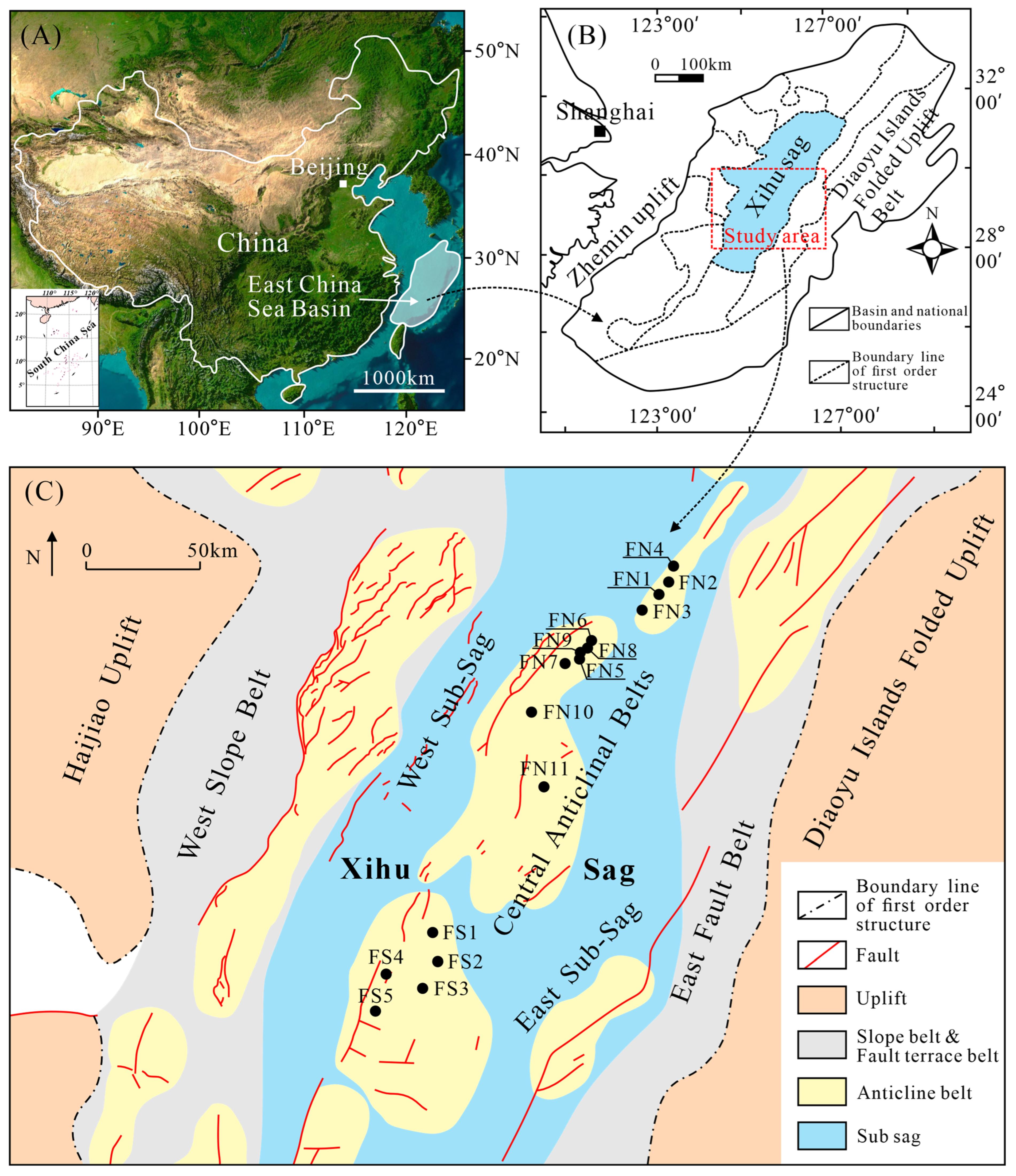
2.1. Location of the Study Area
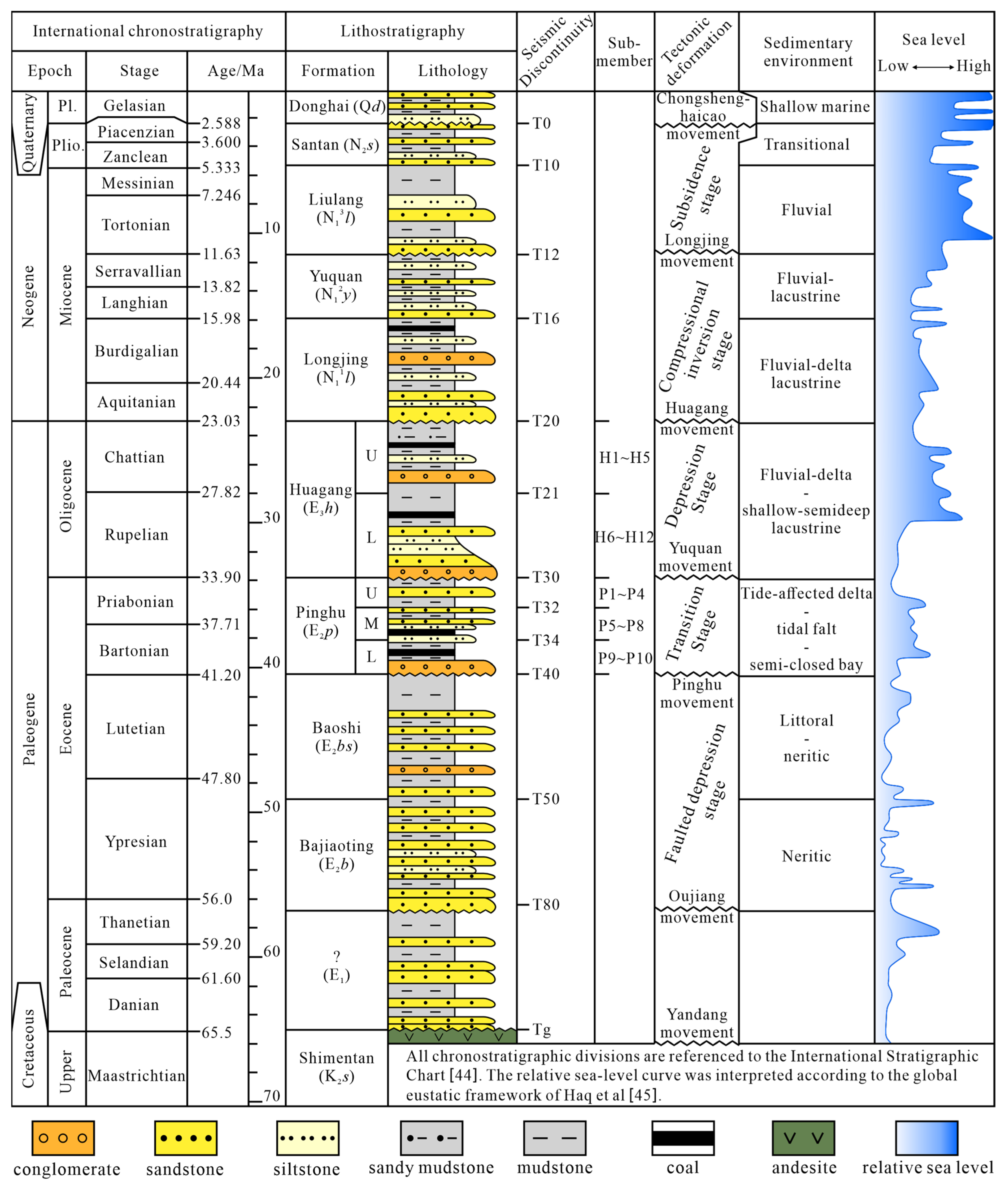
2.2. Stratigraphy and Sedimentology


3. Samples and Methods
3.1. Samples
3.2. Experimental Methods
4. Results
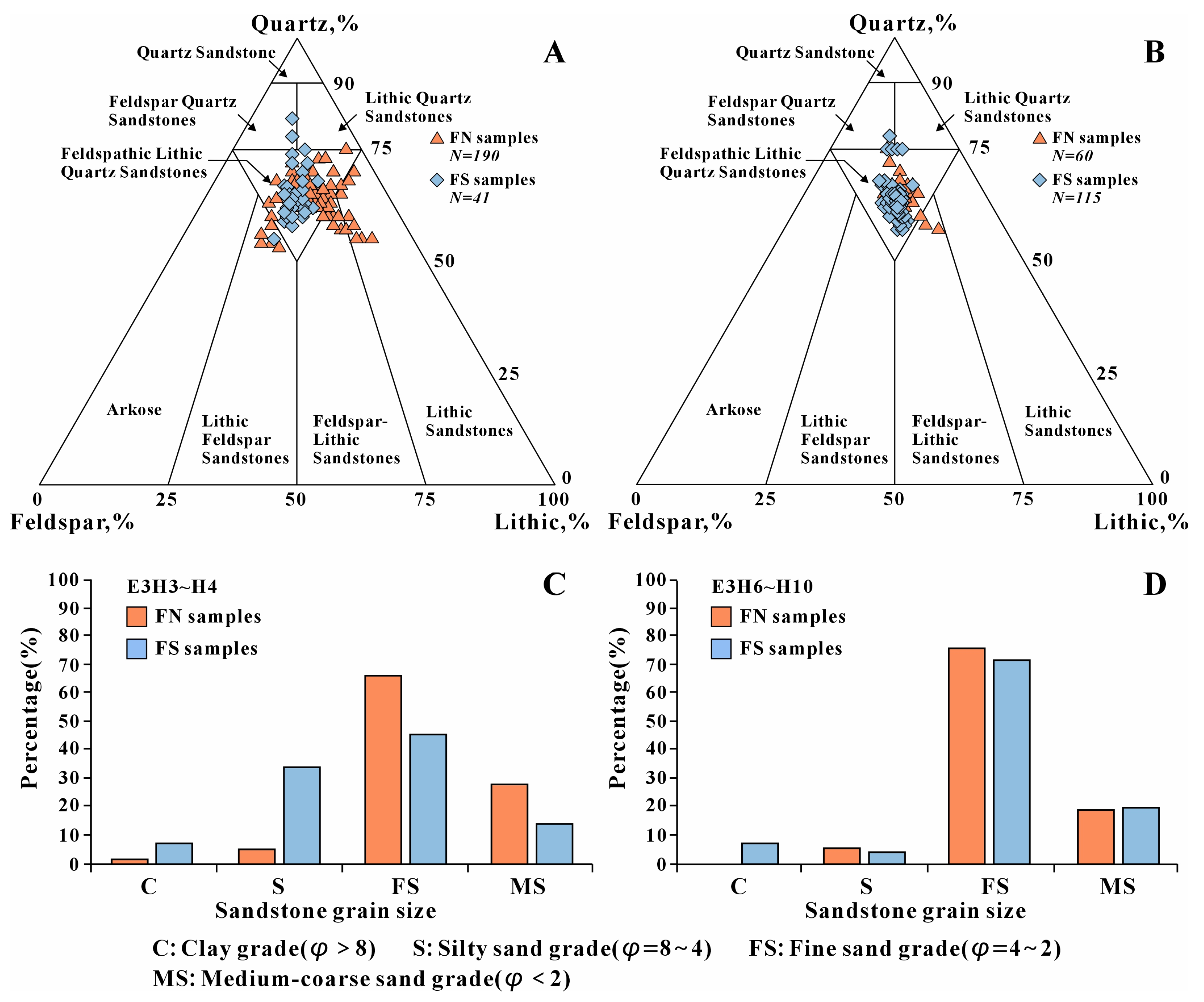
4.1. Petrological Characteristics of the Clastic Reservoir
4.2. Pore Types and Petrophysical Characteristics
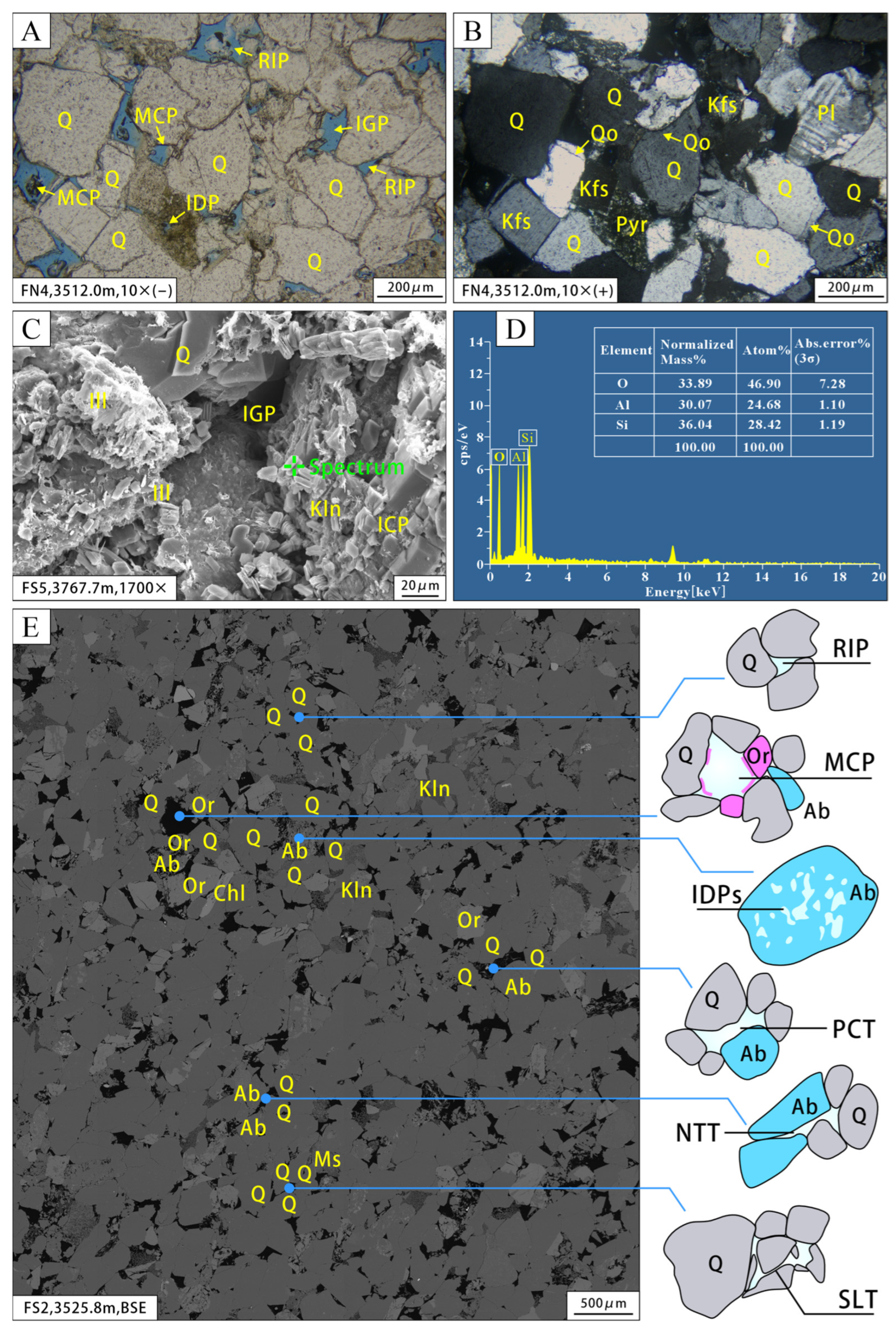
4.3. Micropore and Throat Characteristics
4.4. Diagenesis Characteristics
4.4.1. Compaction
4.4.2. Cementation
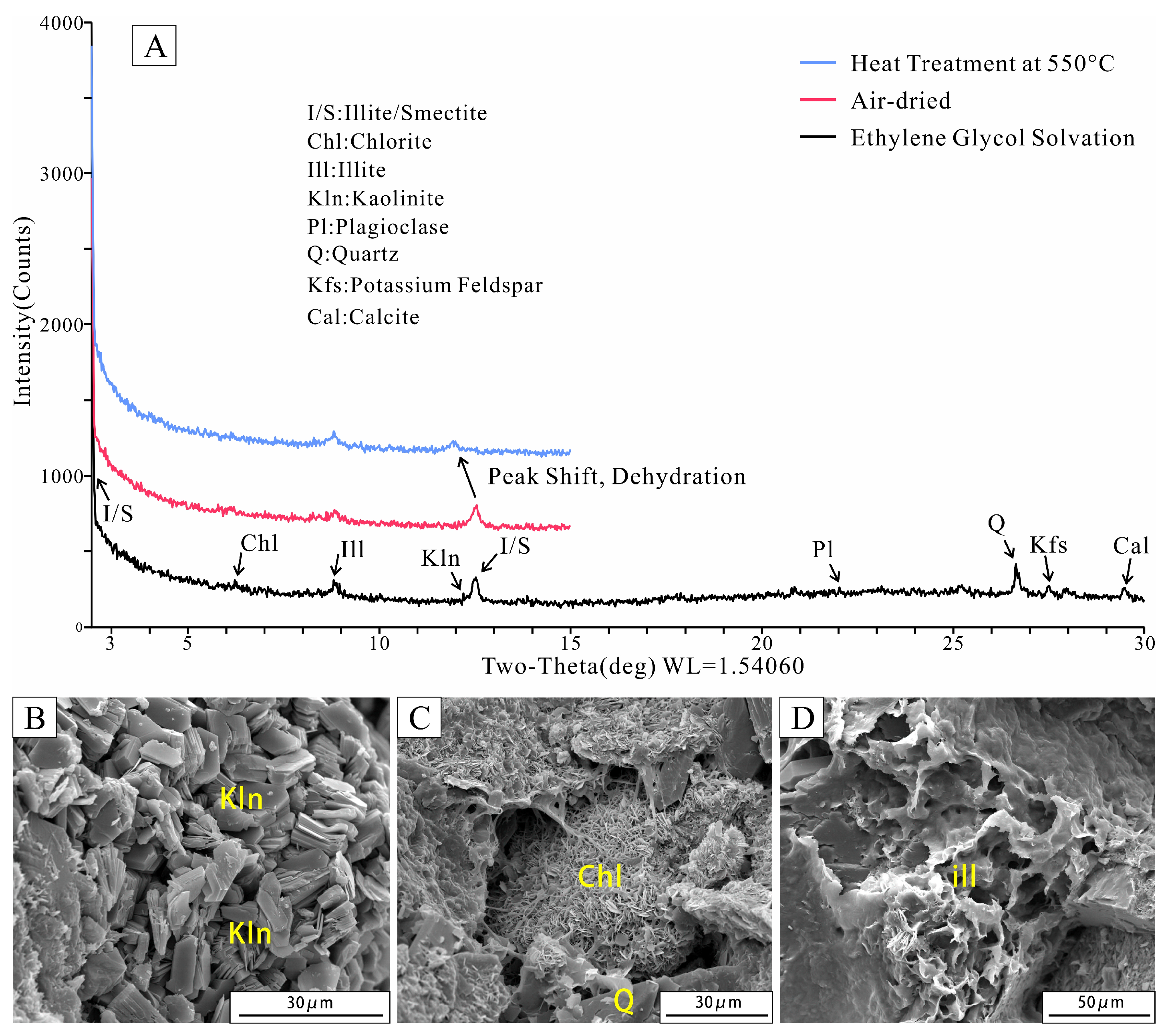
Clay Cements
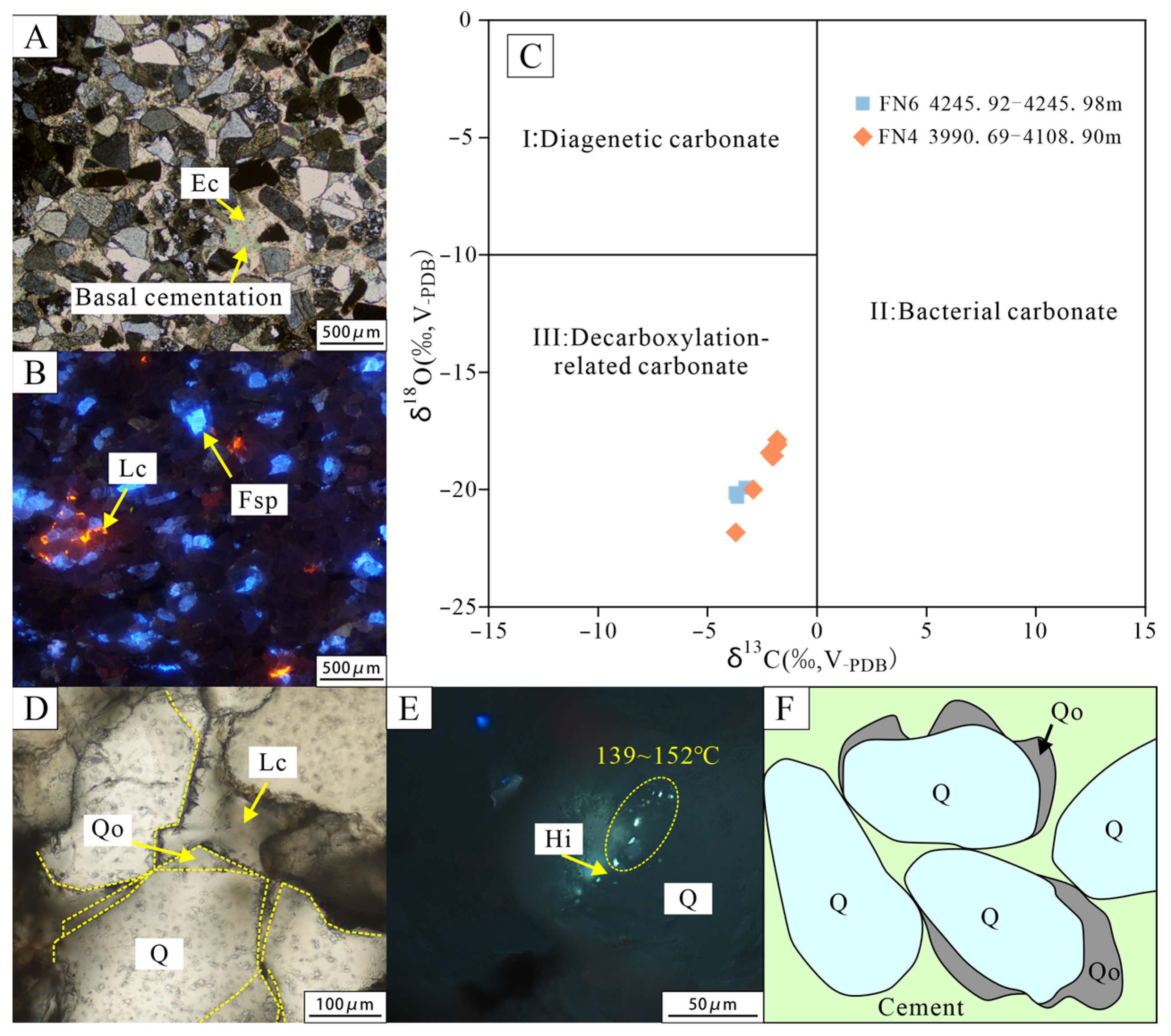
Carbonate Cements
Silica Cements
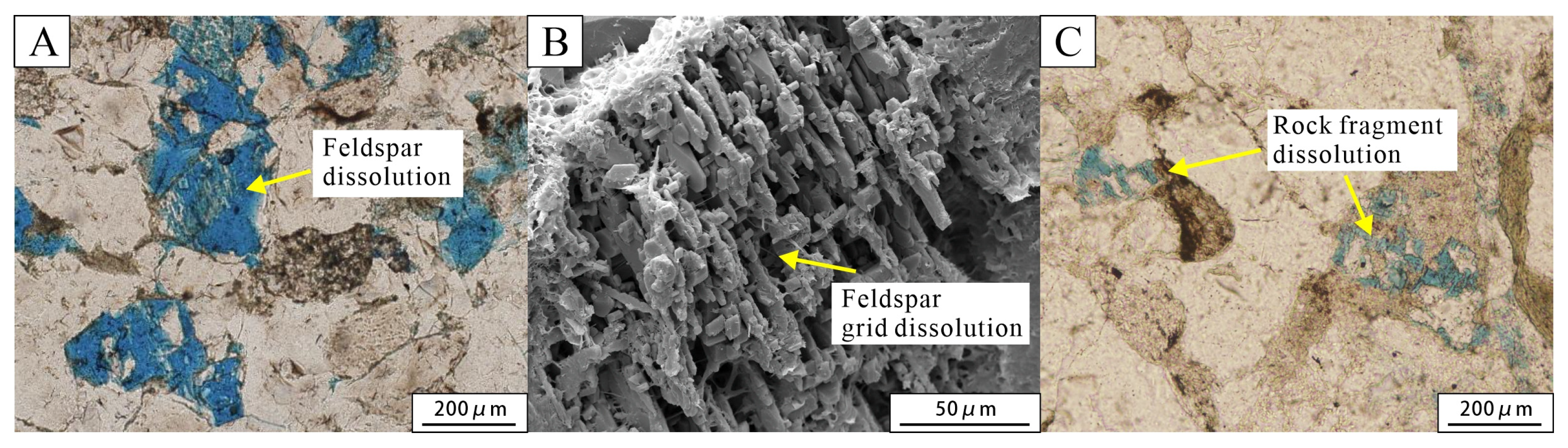
4.4.3. Dissolution
5. Discussion
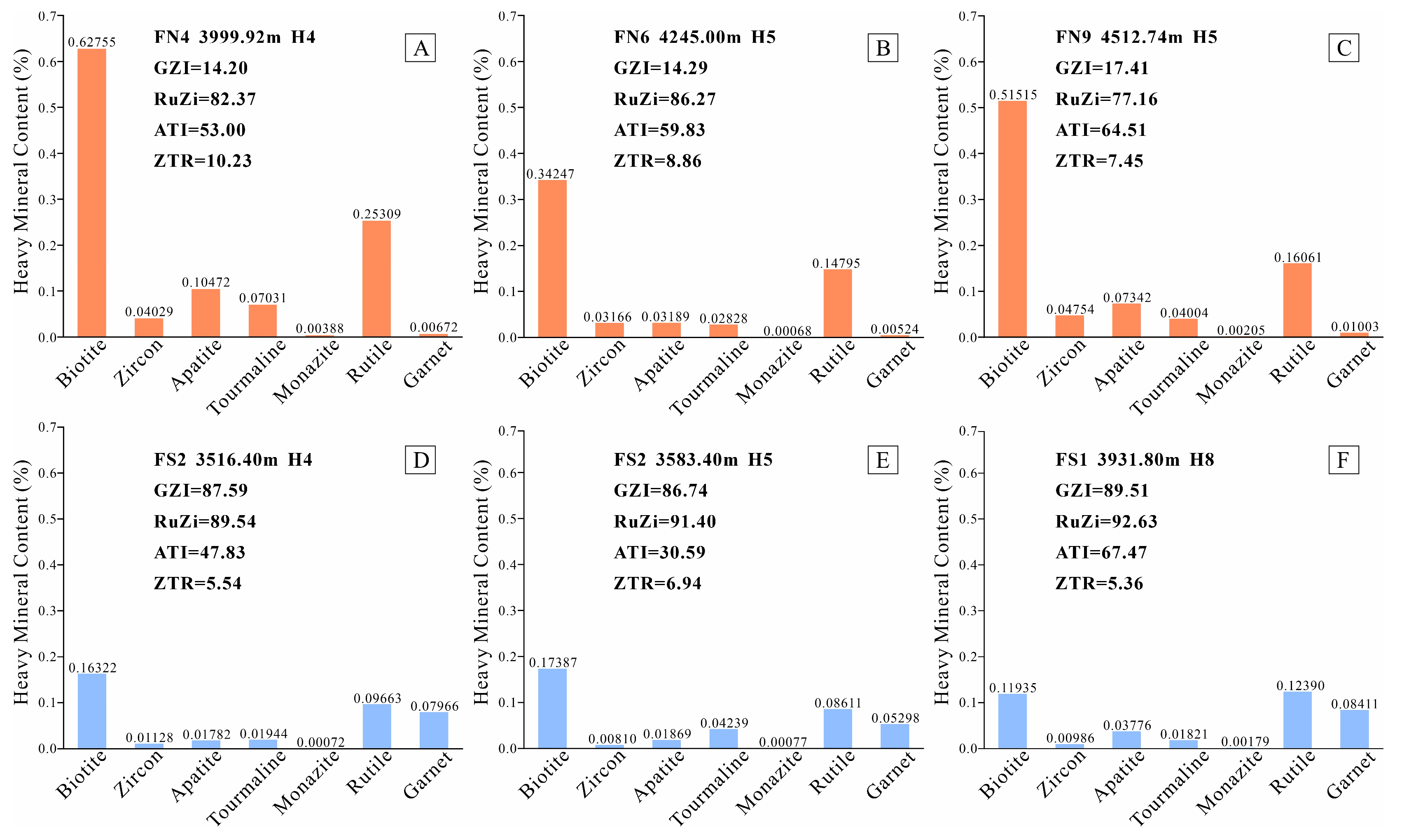
5.1. Influence of Provenance on Reservoir Quality
5.2. Influence of Diagenesis on Reservoir Quality
5.3. Diagenetic Environment and Diagenetic Sequence
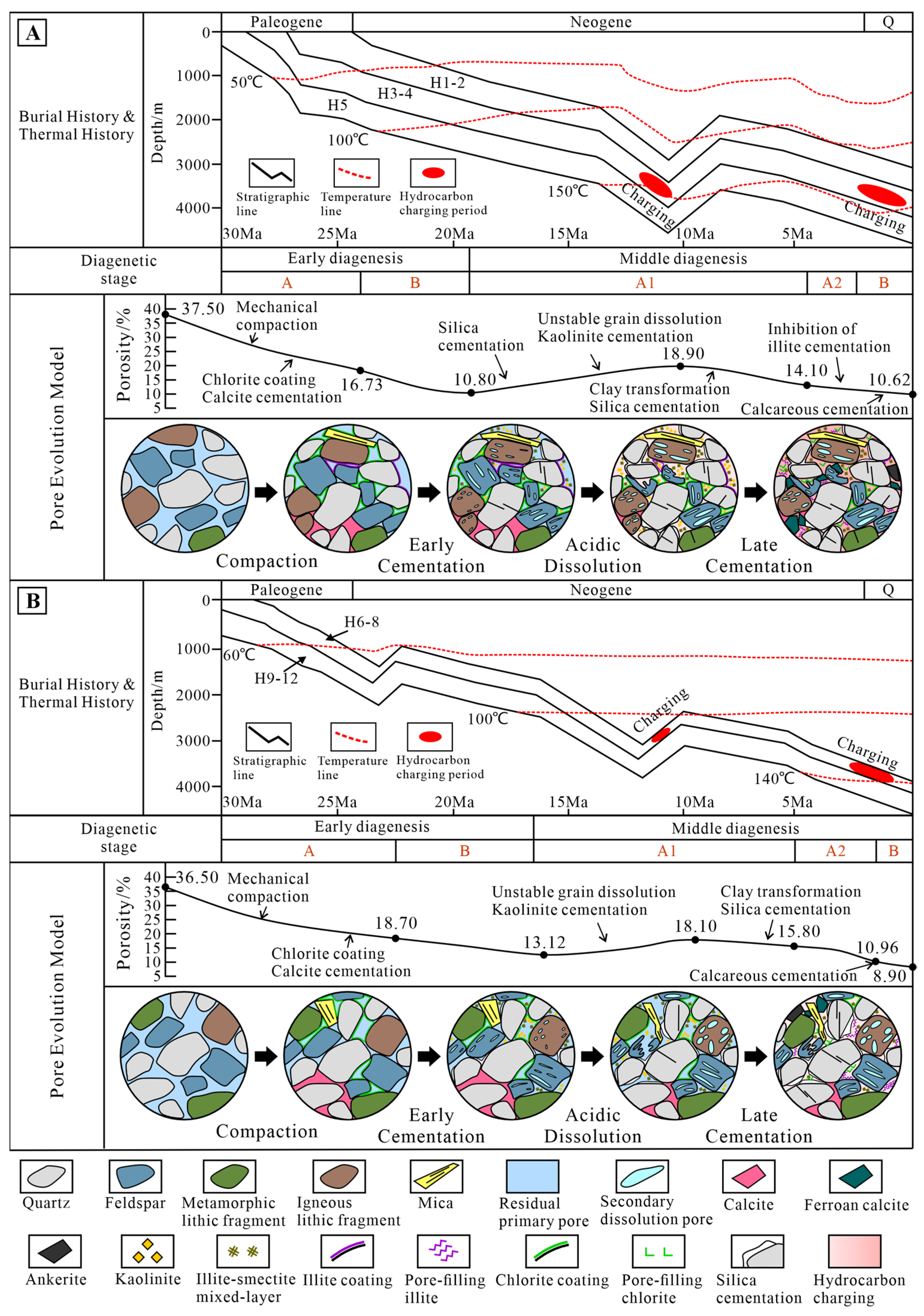
5.4. Pore Evolution Process

6. Conclusions
- (1)
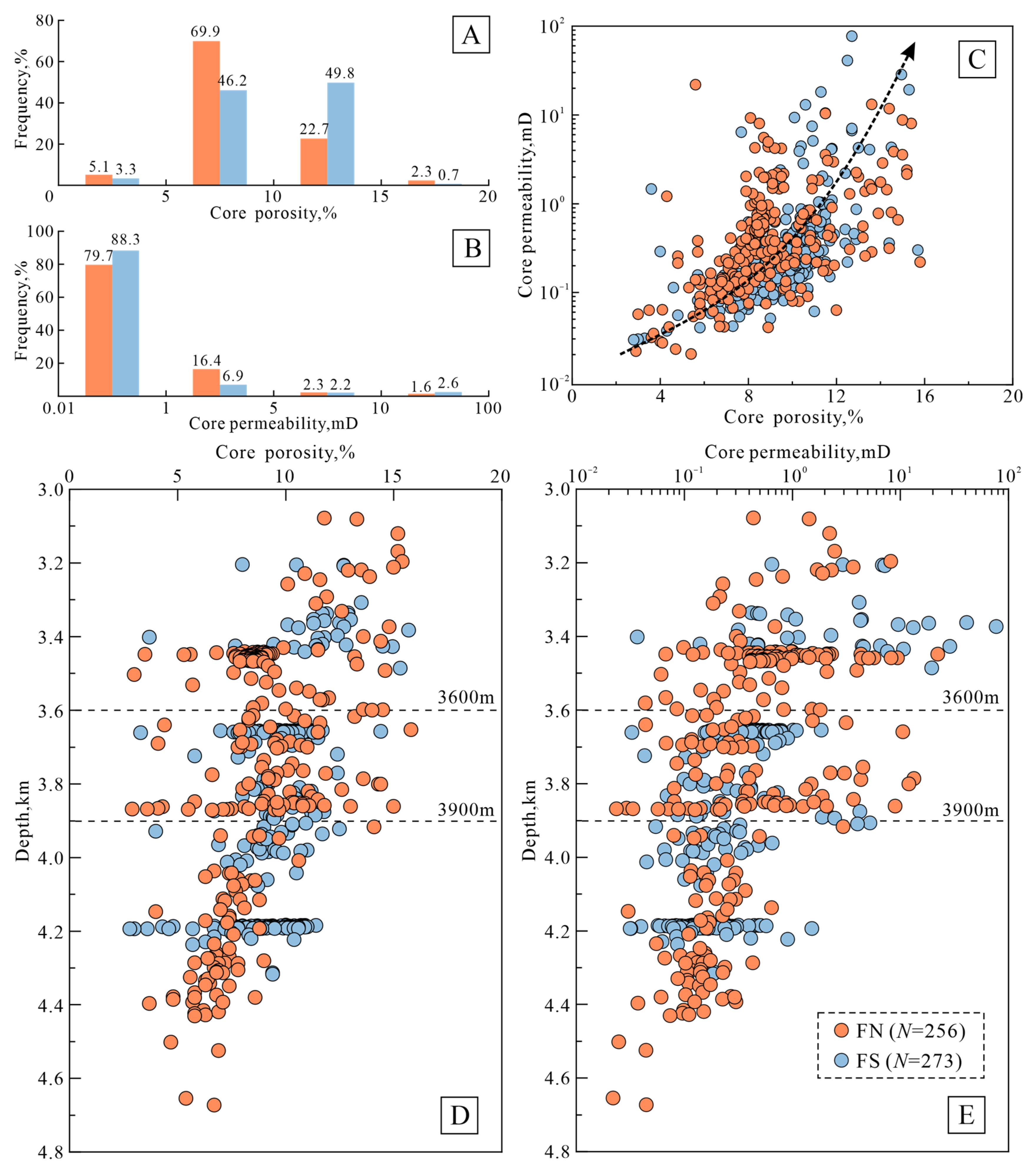
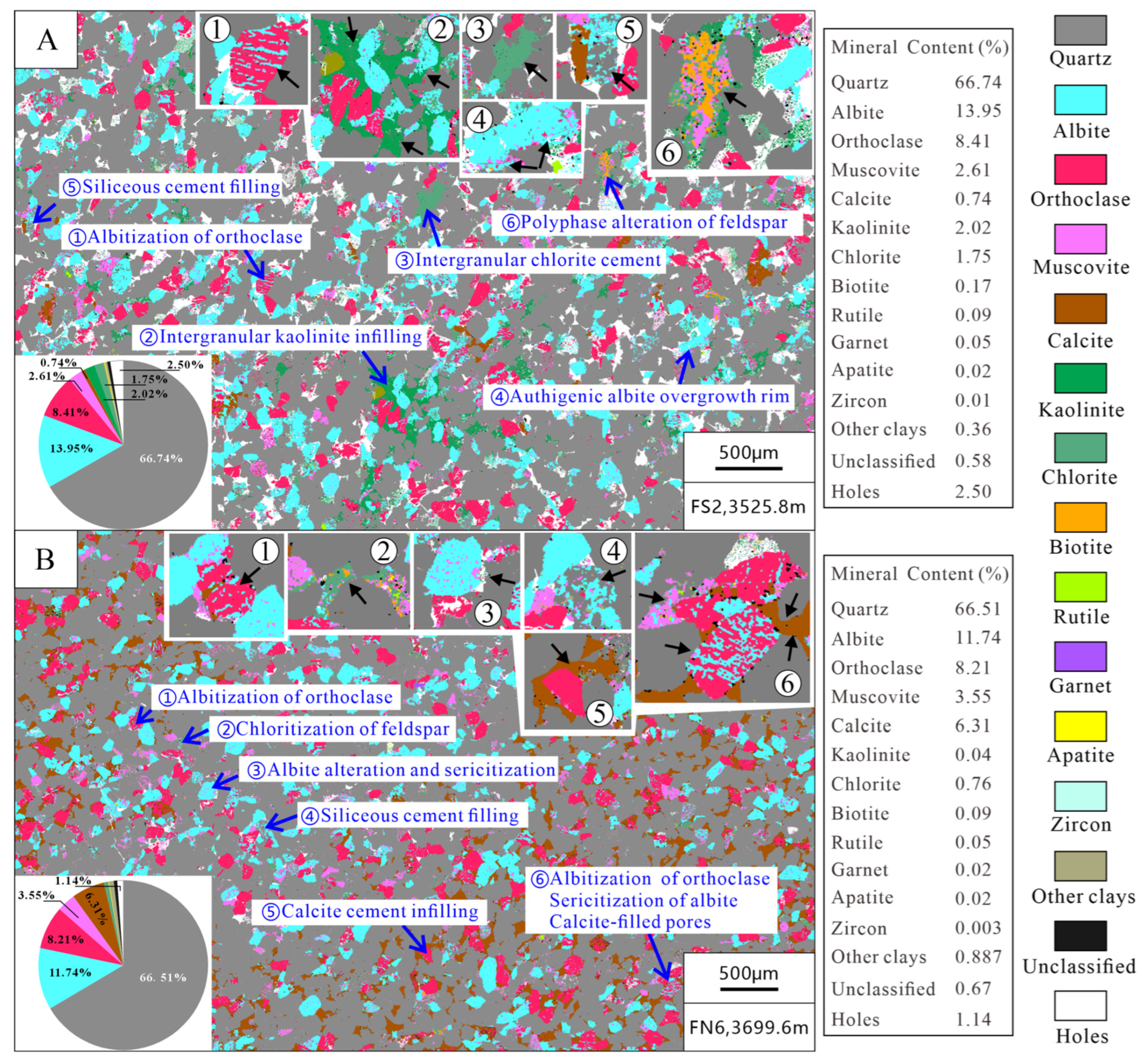
- The reservoir sandstones of the Huagang Formation in the Central Anticlinal Belt are dominated by feldspar-lithic quartz sandstones. The grain size proportion of silty sand-class grains is relatively greater in the south (FS area) than in the north (FN area), and the sorting is better. The comprehensive analysis of the GZI, RuZi, ATI and ZTR shows that the Huagang Formation is a near-source sedimentary system, with sediments ranging from mature to immature. The reservoirs in the FN area are characterized by a high biotite content and low GZI, low RuZi, high ATI, and moderate ZTR values, indicating that the provenance consists primarily of acidic igneous rocks, with relatively weak resistance to compaction and favorable prospects for dissolution modification. Reservoirs in the FS area are characterized by a low biotite content and very high GZI, high RuZi, high ATI, and low ZTR values, indicating that the provenance primarily consists of high-grade metamorphic rocks rich in garnet and rutile, and the resistance to compaction is relatively strong, but prospects for dissolution modification are less promising compared to the FN area.
- (2)
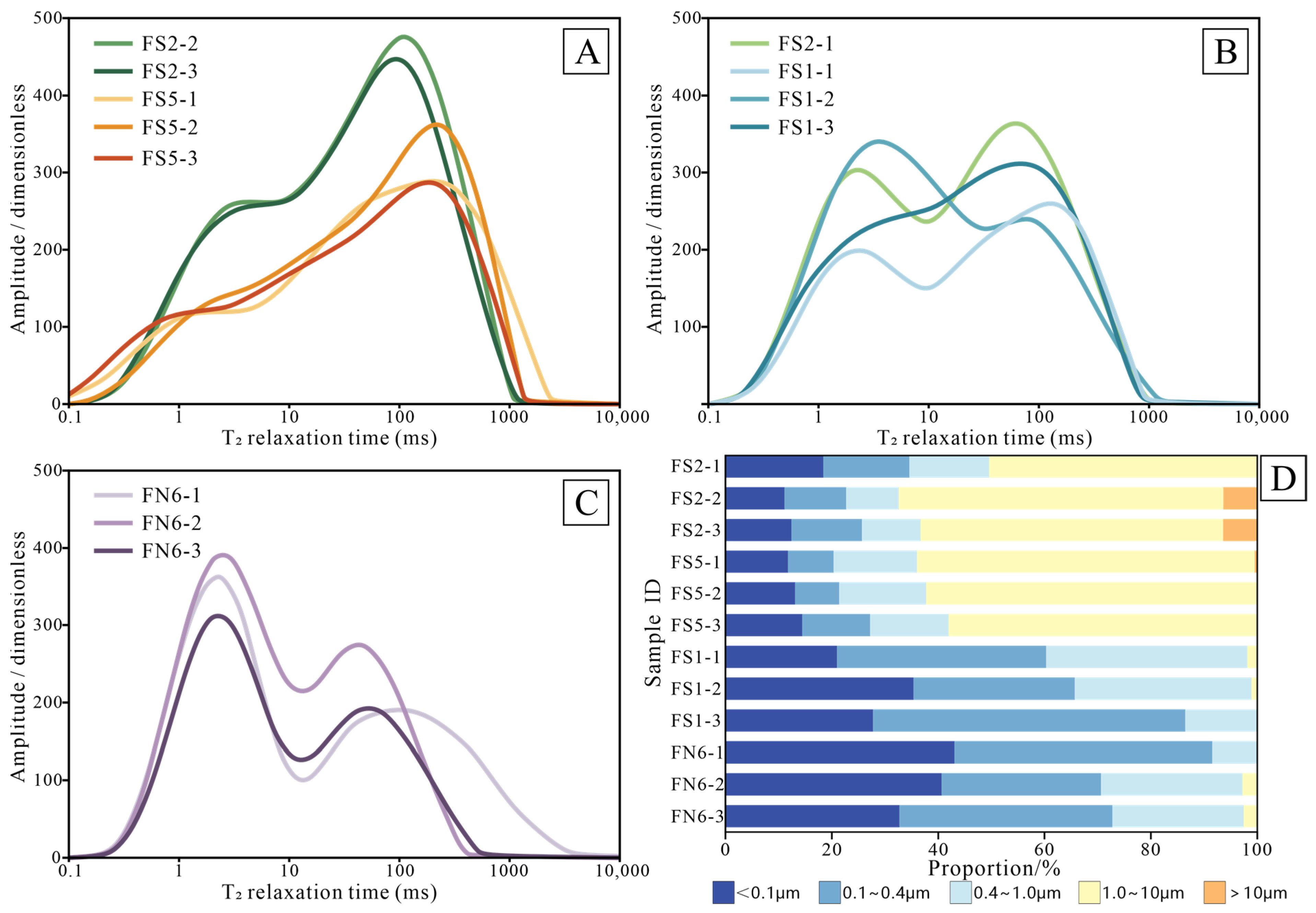
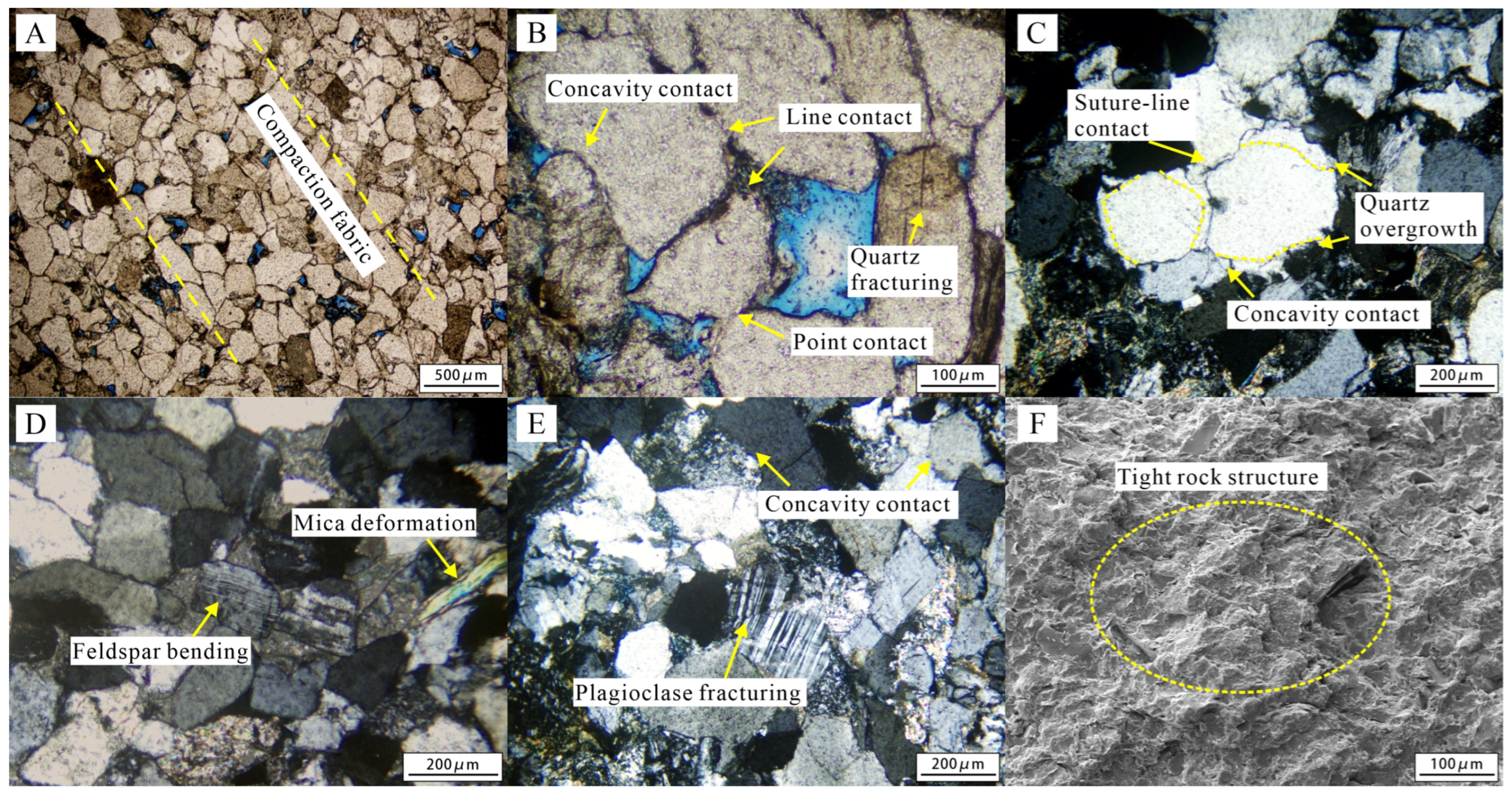
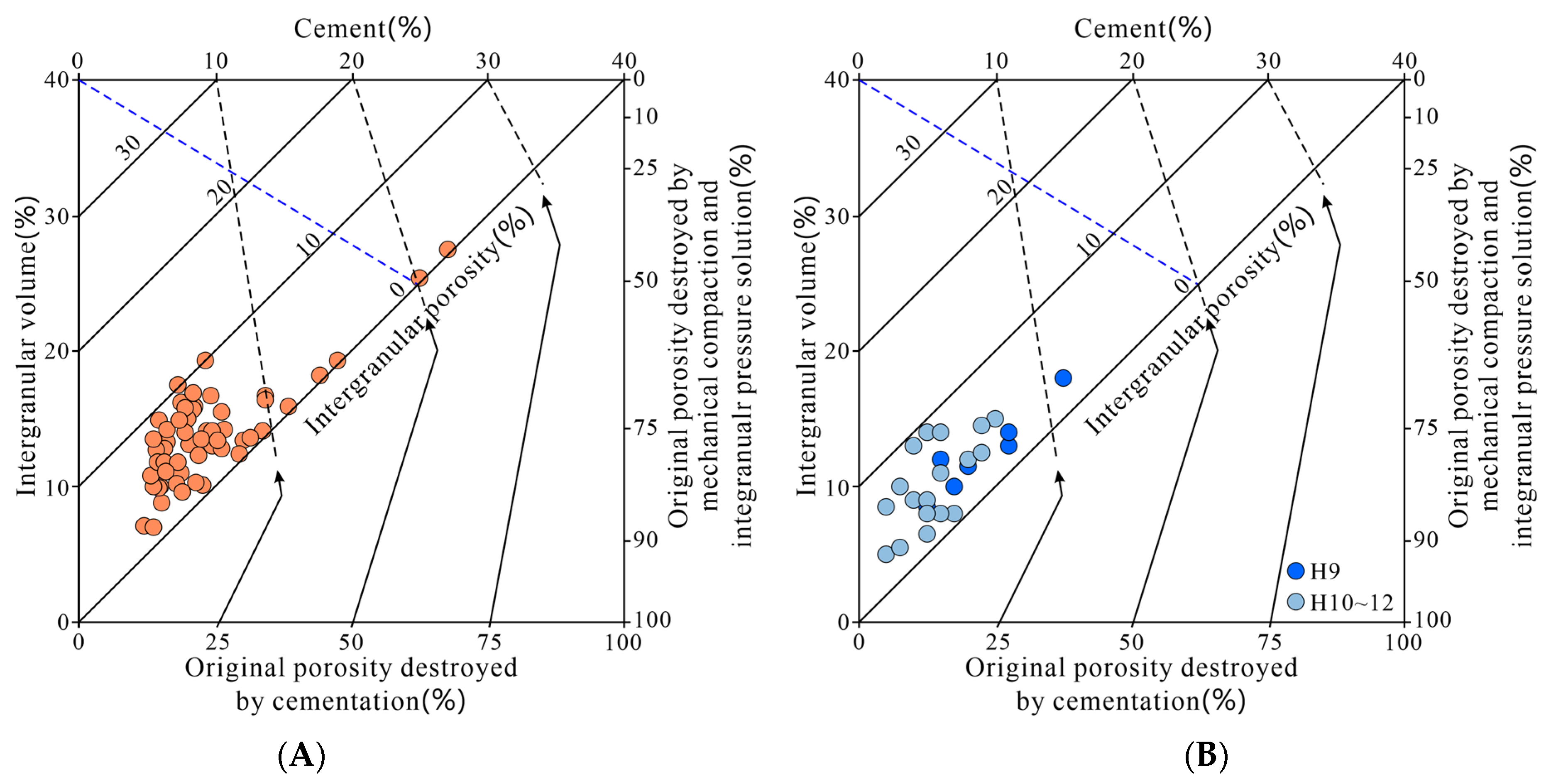
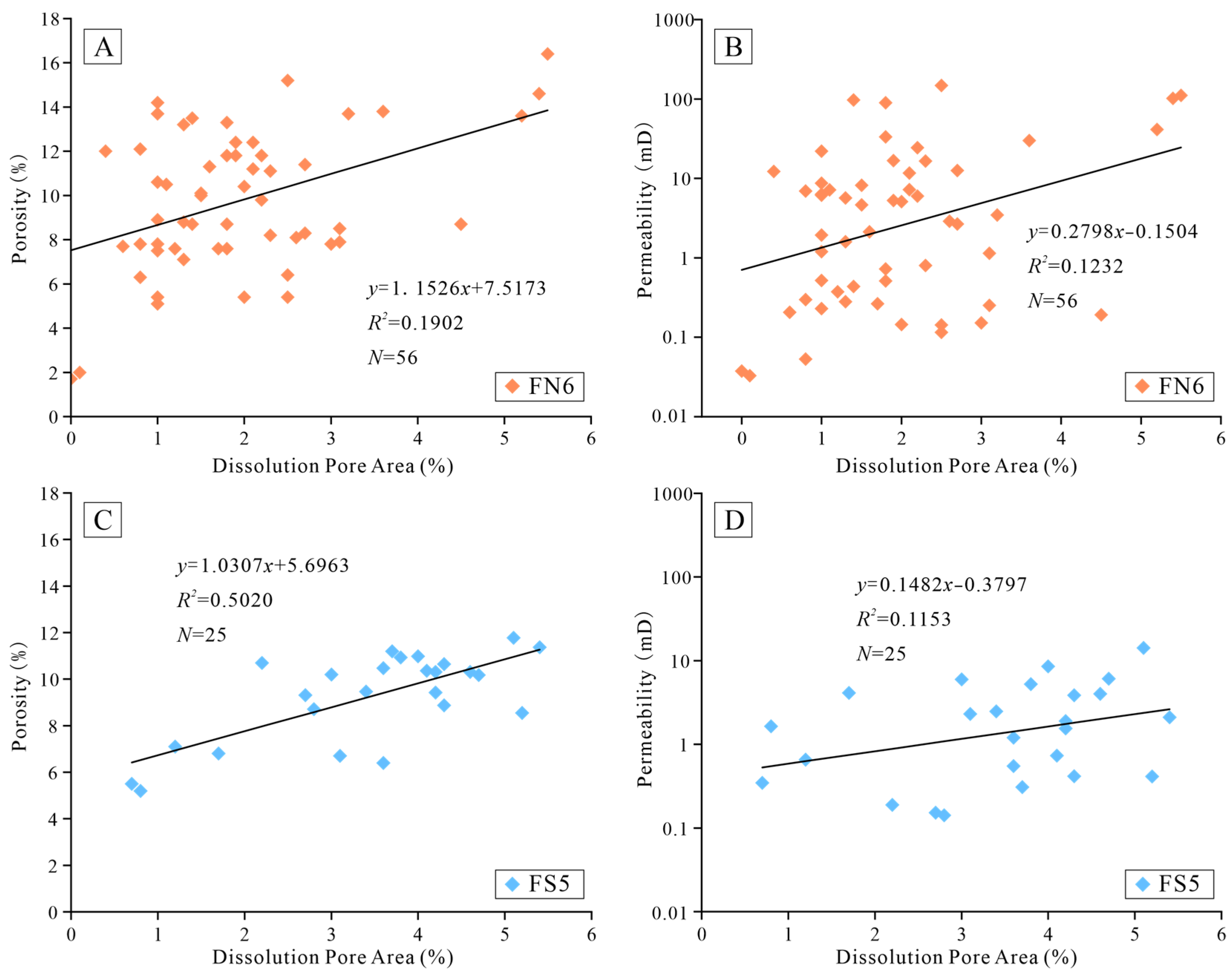
- The Huagang Formation at a burial depth of 3500–4400 m is a low-porosity and low-permeability reservoir, and the sandstone reservoirs with a burial depth of ≥4400 m are tight reservoirs. Vertically, the petrological characteristics of the reservoir in the FN area decrease faster than those in the FS area with increasing burial depth. However, within the burial depth range of 3600–3900 m, there is a strong dissolution zone with relatively better petrological characteristics in the FN area. The pattern of deep sandstone T2 NMR curves is classified into three types, i.e., mesopores are most developed, macropores are least developed, and pore throat radius gradually decreases with increasing burial depth. Compaction in the FN and FS areas results in average relative pore losses of 76% and 81%, respectively, constituting the primary destructive factor affecting reservoir petrological characteristics; cementation causes average relative pore losses of 18% and 12%, respectively, representing a secondary destructive factor. In the FN area, dissolution is the primary constructive diagenetic process.
- (3)
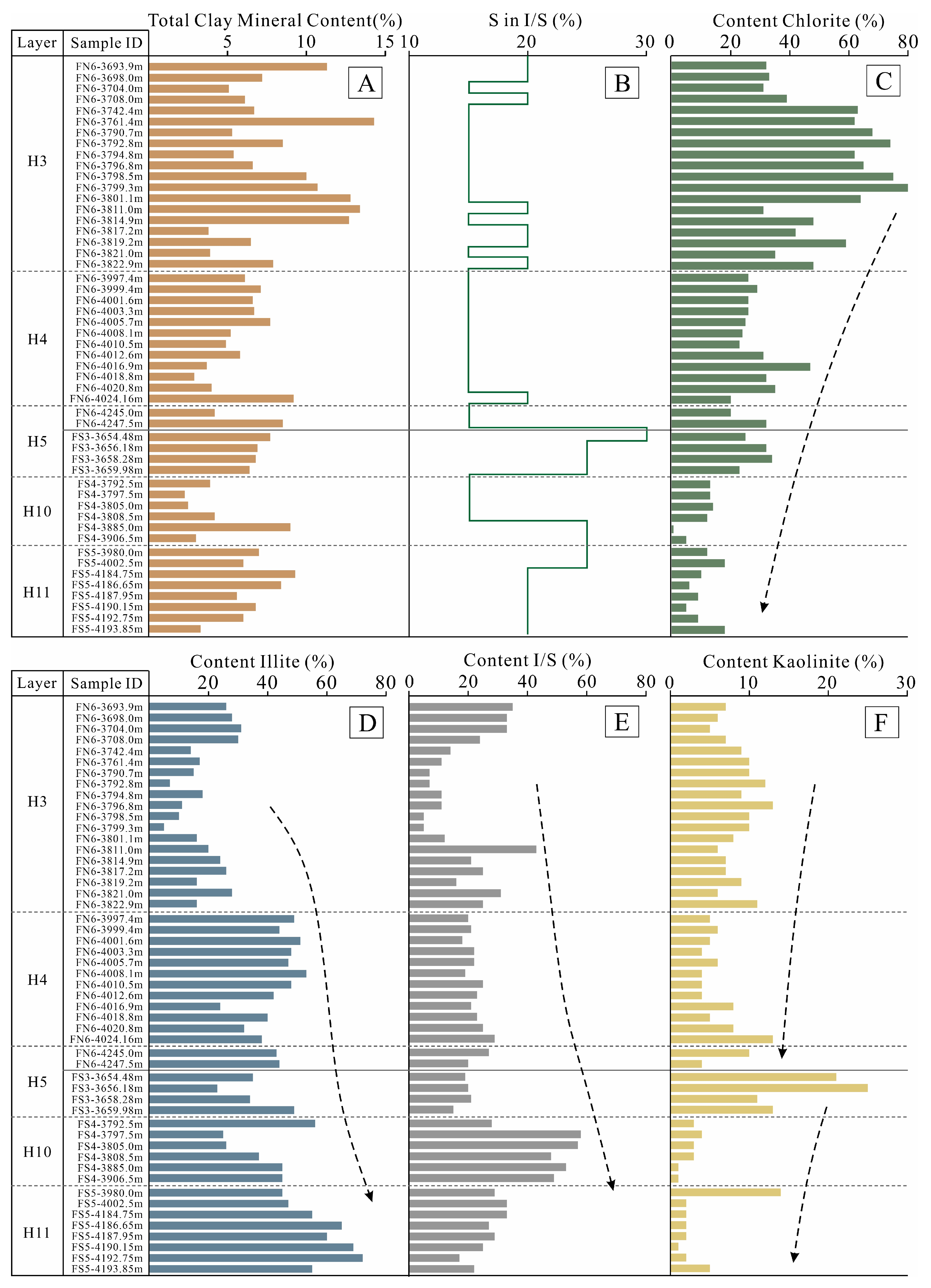
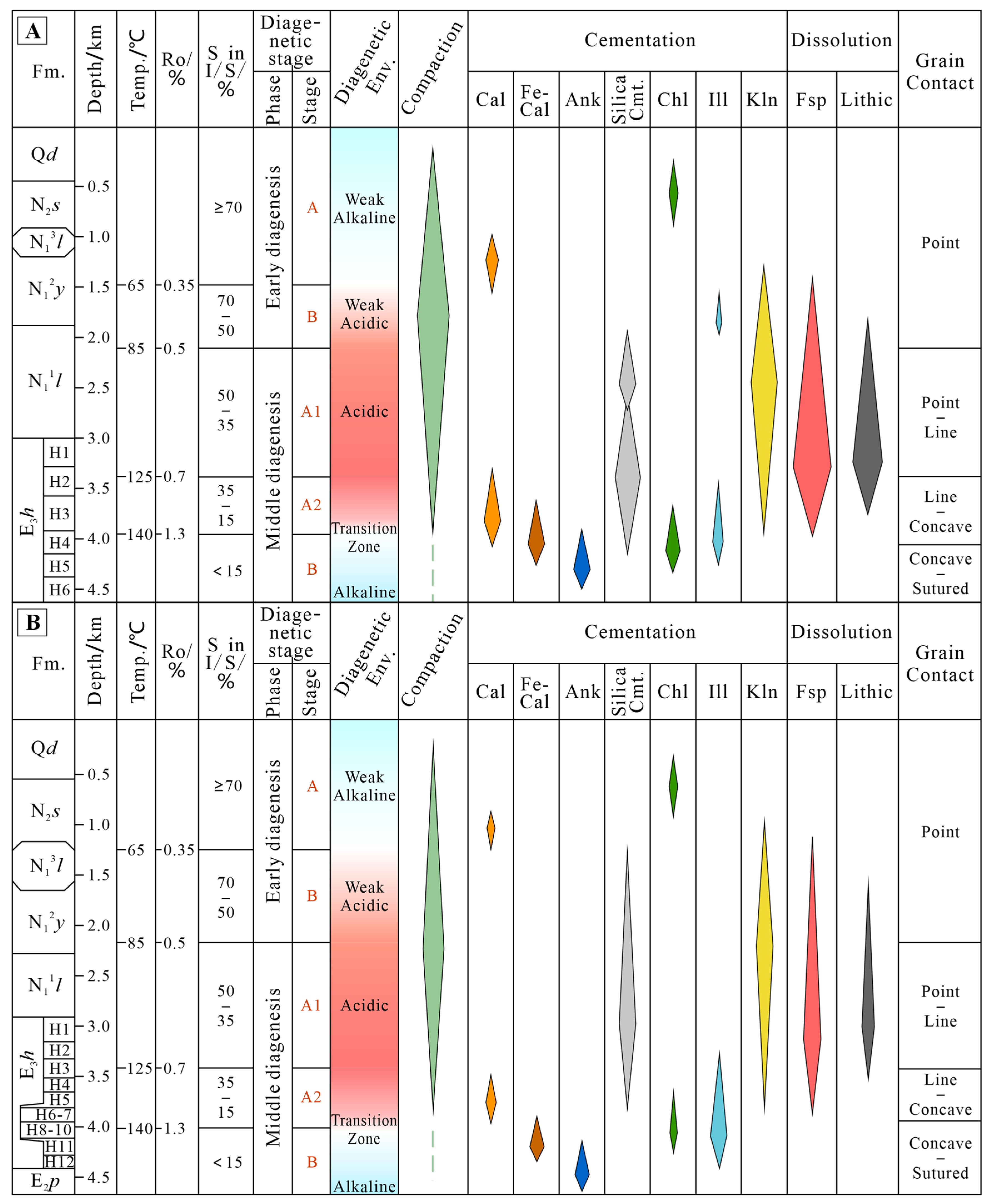
- The content of authigenic clay cements in the Huagang Formation reservoirs exhibits significant vertical variation: chlorite and kaolinite cement contents gradually decrease with increasing burial depth, whereas those of I/S mixed-layer and illite cements increase. The diagenetic regimes differ between the two areas. In the FN area, which currently has higher geothermal temperatures, diagenesis is characterized by two stages of quartz secondary overgrowths and two stages of calcite cementation. Vertically, its Upper Member is divided into an acidic diagenetic environment and an acid-alkaline transition zone at a burial depth of approximately 3900 m. In contrast, the FS area experiences lower present-day temperatures and features one stage of quartz secondary overgrowths alongside two stages of calcite cementation. Here, the formation is similarly divided at around 4000 m depth. Consequently, multistage diagenesis has cumulatively reduced reservoir porosity by 26.88% in the H3–H4 sublayers of the FN area and by 27.60% in the H6–H8 sublayers of the FS area.
Author Contributions
Funding
Data Availability Statement
Acknowledgments
Conflicts of Interest
References
- Zou, C.; Yang, Z.; He, D.; Wei, Y.; Li, J.; Jia, A.; Chen, J.; Zhao, Q.; Li, Y.; Li, J.; et al. Theory, Technology and Prospects of Conventional and Unconventional Natural Gas. Pet. Explor. Dev. 2018, 45, 604–618. [Google Scholar] [CrossRef]
- Wang, J.; Wang, B.; Hu, Z.; Shang, F.; Liu, D.; Li, Z.; Qiu, Q.; Song, Z.; Hu, Z. Genetic Mechanisms of High-Quality Deep to Ultra-Deep Clastic Reservoirs: A Case Study of the Permian-Triassic Strata in the Hinterland of the Junggar Basin. Oil Gas Geol. 2025, 46, 151–166. [Google Scholar] [CrossRef]
- Cao, Y.; Yuan, G.; Yang, H.; Wang, Y.; Liu, K.; Zan, N.; Xi, K.; Wang, J. Current Situation of Oil and Gas Exploration and Research Progress of the Origin of High-Quality Reservoirs in Deep-Ultra-Deep Clastic Reservoirs of Petroliferous Basins. Acta Pet. Sin. 2022, 43, 112. [Google Scholar] [CrossRef]
- Dai, J.; Ni, Y.; Dong, D.; Qin, S.; Zhu, G.; Huang, S.; Yu, C.; Gong, D.; Hong, F.; Zhang, Y.; et al. 2021–2025 Is a Period of Great Development of China’s Natural Gas Industry: Suggestions on the Exploration and Development of Natural Gas during the 14th Five-Year Plan in China. Nat. Gas Geosci. 2021, 32, 183–197. [Google Scholar] [CrossRef]
- He, D.; Ma, Y.; Liu, B.; Cai, X.; Zhang, Y.; Zhang, J. Main Advances and Key Issues for Deep-Seated Exploration in Petroliferous Basins in China. Earth Sci. Front. 2019, 26, 1–12. [Google Scholar] [CrossRef]
- Jia, C.; Pang, X. Research Processes and Main Development Directions of Deep Hydrocarbon Geological Theories. Acta Pet. Sin. 2015, 36, 1457. [Google Scholar] [CrossRef]
- Xu, C.; Zou, W.; Yang, Y.; Duan, Y.; Shen, Y.; Luo, B.; Ni, C.; Fu, X.; Zhang, J. Status and prospects of exploration and exploitation of the deep oil & gas resources onshore China. Nat. Gas Geosci. 2017, 28, 1139–1153. Available online: http://www.nggs.ac.cn/EN/10.11764/j.issn.1672-1926.2017.07.014 (accessed on 24 December 2025).
- Zhu, G.; Sun, C.; Zhao, B.; Li, T.; Chen, Z.; Yang, H.; Gao, L.; Huang, J. Formation, Evaluation Technology and Preservation Lower Limit of Ultra-Deep Ancient Fracture-Cavity Carbonate Reservoirs below 7000 m. Nat. Gas Geosci. 2020, 31, 587–601. [Google Scholar] [CrossRef]
- Ma, B.; Cao, Y.; Eriksson, K.A.; Jia, Y.; Gill, B.C. Depositional and Diagenetic Controls on Deeply-Buried Eocene Sublacustrine Fan Reservoirs in the Dongying Depression, Bohai Bay Basin, China. Mar. Pet. Geol. 2017, 82, 297–317. [Google Scholar] [CrossRef]
- Morad, S.; Ketzer, J.M.; De Ros, L.F. Spatial and Temporal Distribution of Diagenetic Alterations in Siliciclastic Rocks: Implications for Mass Transfer in Sedimentary Basins. Sedimentology 2000, 47, 95–120. [Google Scholar] [CrossRef]
- Wang, J.; Cao, Y.; Liu, K.; Liu, J.; Kashif, M. Identification of Sedimentary-Diagenetic Facies and Reservoir Porosity and Permeability Prediction: An Example from the Eocene Beach-Bar Sandstone in the Dongying Depression, China. Mar. Pet. Geol. 2017, 82, 69–84. [Google Scholar] [CrossRef]
- Higgs, K.E.; Zwingmann, H.; Reyes, A.G.; Funnell, R.H. Diagenesis, Porosity Evolution, and Petroleum Emplacement in Tight Gas Reservoirs, Taranaki Basin, New Zealand. J. Sediment. Res. 2007, 77, 1003–1025. [Google Scholar] [CrossRef]
- Morad, S.; Al-Ramadan, K.; Ketzer, J.M.; Ros, L.F.D. The Impact of Diagenesis on the Heterogeneity of Sandstone Reservoirs: A Review of the Role of Depositional Facies and Sequence Stratigraphy. AAPG Bull. 2010, 94, 1267–1309. [Google Scholar] [CrossRef]
- Qian, W.; Yin, T.; Zhang, C.; Tang, H.; Hou, G. Diagenetic Evolution of the Oligocene Huagang Formation in Xihu Sag, the East China Sea Shelf Basin. Sci. Rep. 2020, 10, 19402. [Google Scholar] [CrossRef]
- Wang, W.; Yue, D.; Zhao, J.; Li, W.; Wang, B.; Wu, S.; Li, S. Diagenetic Alteration and Its Control on Reservoir Quality of Tight Sandstones in Lacustrine Deep-Water Gravity-FLow Deposits: A Case Study of the Yanchang Formation, Southern Ordos Basin, China. Mar. Pet. Geol. 2019, 110, 676–694. [Google Scholar] [CrossRef]
- Zhang, Y.; Pe-Piper, G.; Piper, D.J.W. How Sandstone Porosity and Permeability Vary with Diagenetic Minerals in the Scotian Basin, Offshore Eastern Canada: Implications for Reservoir Quality. Mar. Pet. Geol. 2015, 63, 28–45. [Google Scholar] [CrossRef]
- Radwan, A.E.; Husinec, A.; Benjumea, B.; Kassem, A.A.; El Aal, A.A.; Hakimi, M.H.; Thanh, H.V.; Abdel-Fattah, M.I.; Shehata, A.A. Diagenetic Overprint on Porosity and Permeability of a Combined Conventional-Unconventional Reservoir: Insights from the Eocene Pelagic Limestones, Gulf of Suez, Egypt. Mar. Pet. Geol. 2022, 146, 105967. [Google Scholar] [CrossRef]
- Xi, K.; Cao, Y.; Liu, K.; Wu, S.; Yuan, G.; Zhu, R.; Kashif, M.; Zhao, Y. Diagenesis of Tight Sandstone Reservoirs in the Upper Triassic Yanchang Formation, Southwestern Ordos Basin, China. Mar. Pet. Geol. 2019, 99, 548–562. [Google Scholar] [CrossRef]
- Zhang, X.; Cai, Q.; Wang, W.; Hu, Q.; Ren, L.; Su, A.; Hu, M.; Hu, Z.; Deng, Q. Differential Development Characteristics and Main Controlling Factors of High-Quality Clastic Reservoirs in the Middle-Deep Strata: A Case Study on the Paleogene Yacheng Formation and Neogene Sanya Formation around Ya’nan Area, Qiongdongnan Basin. Oil Gas Geol. 2025, 46, 876–893. [Google Scholar] [CrossRef]
- Zhong, D.; Zhu, X.; Zhang, Z.; Cai, J.A.X.Z. Controlling Factors of Sandstone Reservoir of the Paleogene in Dongying Sag. Pet. Explor. Dev. 2003, 30, 376. Available online: https://www.sciengine.com/PED/doi/10.0000/1000-0747-30-376 (accessed on 24 December 2025).
- Huang, D.; Zhu, Y.; Yan, Z.; He, X.; Li, C.; Liu, C.; Liu, B. Diagenetic Controls on Reservoir Quality in Deep Ultra-Thick Sandstones: A Case Study from the Huagang Formation, Xihu Depression, East China Sea. Energy Geosci. 2025, 100474. [Google Scholar] [CrossRef]
- Huang, X.; Lin, C.; Huang, D.; Duan, D.; Lin, J.; He, X.; Liu, B. Diagenetic Differential Evolution of Huagang Formation Sandstone Reservoir in North-Central Part of Central Reversal Structural Belt in Xihu Sag. Pet. Geol. Recovery Effic. 2022, 29, 1–14. [Google Scholar] [CrossRef]
- Su, A.; Chen, H.; Wang, C.; Li, Q.; Li, P. Densification Mechanism and Diagenesis Fluid Evolution of Low-Porosity and Low-Permeability Tight Sandstone Reservoir: An Example from Huagang Formation in the Northern of the Central Anticlinal Zone in Xihu Depression, East China Sea. J. China Univ. Min. Technol. 2016, 45, 972–981. [Google Scholar] [CrossRef]
- Wang, W.; Lin, C.; Zhang, X.; Dong, C.; Ren, L.; Lin, J. Provenance, Clastic Composition and Their Impact on Diagenesis: A Case Study of the Oligocene Sandstone in the Xihu Sag, East China Sea Basin. Mar. Pet. Geol. 2021, 126, 104890. [Google Scholar] [CrossRef]
- Xu, F.; Xu, G.; Liu, Y.; Zhang, W.; Cui, H.; Wang, Y. Factors Controlling the Development of Tight Sandstone Reservoirs in the Huagang Formation of the Central Inverted Structural Belt in Xihu Sag, East China Sea Basin. Pet. Explor. Dev. 2020, 47, 101–113. [Google Scholar] [CrossRef]
- Bjørlykke, K.; Jahren, J. Open or Closed Geochemical Systems during Diagenesis in Sedimentary Basins: Constraints on Mass Transfer during Diagenesis and the Prediction of Porosity in Sandstone and Carbonate Reservoirs Geohorizon. AAPG Bull. 2012, 96, 2193–2214. [Google Scholar] [CrossRef]
- Bjørlykke, K. Relationships between Depositional Environments, Burial History and Rock Properties. Some Principal Aspects of Diagenetic Process in Sedimentary Basins. Sediment. Geol. 2014, 301, 1–14. [Google Scholar] [CrossRef]
- Yuan, G.; Cao, Y.; Gluyas, J.; Li, X.; Xi, K.; Wang, Y.; Jia, Z.; Sun, P.; Oxtoby, N.H. Feldspar Dissolution, Authigenic Clays, and Quartz Cements in Open and Closed Sandstone Geochemical Systems during Diagenesis: Typical Examples from Two Sags in Bohai Bay Basin, East China. AAPG Bull. 2015, 99, 2121–2154. [Google Scholar] [CrossRef]
- Clark, S. Constraining Diagenetic Timings, Processes and Reservoir Quality in Igneous-Affected Basins. Ph.D. Thesis, Durham University, Durham, UK, 2014. Available online: https://etheses.dur.ac.uk/10827/ (accessed on 24 December 2025).
- Gluyas, J.; Garland, C.; Oxtoby, N.H.; Hogg, A.J.C. Quartz Cement: The Miller’s Tale. In Quartz Cementation in Sandstones; John Wiley & Sons, Ltd.: Hoboken, NJ, USA, 2000; pp. 199–218. ISBN 978-1-4443-0423-7. Available online: https://onlinelibrary.wiley.com/doi/abs/10.1002/9781444304237.ch14 (accessed on 24 December 2025).
- Luo, L.; Meng, W.; Gluyas, J.; Tan, X.; Gao, X.; Feng, M.; Kong, X.; Shao, H. Diagenetic Characteristics, Evolution, Controlling Factors of Diagenetic System and Their Impacts on Reservoir Quality in Tight Deltaic Sandstones: Typical Example from the Xujiahe Formation in Western Sichuan Foreland Basin, SW China. Mar. Pet. Geol. 2019, 103, 231–254. [Google Scholar] [CrossRef]
- Zhang, J.; Pas, D.; Krijgsman, W.; Wei, W.; Du, X.; Zhang, C.; Liu, J.; Lu, Y. Astronomical Forcing of the Paleogene Coal-Bearing Hydrocarbon Source Rocks of the East China Sea Shelf Basin. Sediment. Geol. 2020, 406, 105715. [Google Scholar] [CrossRef]
- Zhu, W.; Zhong, K.; Fu, X.; Chen, C.; Zhang, M.; Gao, S. The Formation and Evolution of the East China Sea Shelf Basin: A New View. Earth-Sci. Rev. 2019, 190, 89–111. [Google Scholar] [CrossRef]
- Cai, H.; Zhang, J.; Tang, X. Characteristics of the Fault Systems and Their Control on Hydrocarbon Accumulation in the Xihu Sag, East China Sea Shelf Basin. Nat. Gas Ind. 2014, 34, 18–26. [Google Scholar] [CrossRef]
- Zhang, G.; Zhang, J. A Discussion on the Tectonic Inversion and Its Genetic Mechanism in the East China Sea Shelf Basin. Earth Sci. Front. 2015, 22, 260. [Google Scholar] [CrossRef]
- Wang, W.; Lin, C.; Zhang, X.; Dong, C.; Ren, L.; Lin, J. Effect of Burial History on Diagenetic and Reservoir-Forming Process of the Oligocene Sandstone in Xihu Sag, East China Sea Basin. Mar. Pet. Geol. 2020, 112, 104034. [Google Scholar] [CrossRef]
- Yang, Y.; Huang, Z.; Pan, Y.; Liu, C.; Qu, T.; Li, Z. Hydrocarbon Accumulation Process and Reservoir-Forming Models of Structure A in the Central Inversion Tectonic Belt of the Xihu Depression, East China Sea Basin. Nat. Gas Ind. B 2024, 11, 341–356. [Google Scholar] [CrossRef]
- Zhang, J.; Lu, Y.; Krijgsman, W.; Liu, J.; Li, X.; Du, X.; Wang, C.; Liu, X.; Feng, L.; Wei, W.; et al. Source to Sink Transport in the Oligocene Huagang Formation of the Xihu Depression, East China Sea Shelf Basin. Mar. Pet. Geol. 2018, 98, 733–745. [Google Scholar] [CrossRef]
- Lin, C.; Sun, X.; Ma, C.; Zhang, X.; Zhao, Z. Physical Property Evolution of Huagang Formation in Central Inversion Tectonic Belt in Xihu Depression. J. China Univ. Min. Technol. 2017, 46, 700–709. [Google Scholar] [CrossRef]
- Quan, Y.; Chen, Z.; Jiang, Y.; Diao, H.; Xie, X.; Lu, Y.; Du, X.; Liu, X. Hydrocarbon Generation Potential, Geochemical Characteristics, and Accumulation Contribution of Coal-Bearing Source Rocks in the Xihu Sag, East China Sea Shelf Basin. Mar. Pet. Geol. 2022, 136, 105465. [Google Scholar] [CrossRef]
- Sun, X.; Lin, C.; Dong, C.; Zhang, X.; Ma, C.; Lin, J.; Xie, J. Influence of Chlorite on Siliceous Cement under Control of Reservoir Lithology. Earth Sci. 2017, 42, 1599–1607. [Google Scholar] [CrossRef]
- Wang, W.; Lin, C.; Zhang, X.; Dong, C.; Ren, L.; Lin, J. Structural Controls on Sandstone Compaction within the Anticline Crest and Flank: An Example from the Xihu Sag, East China Sea Basin. J. Pet. Sci. Eng. 2022, 211, 110157. [Google Scholar] [CrossRef]
- Li, H.; Yang, X.; Zhu, H.; Wang, W. Depositional and Diagenetic Controls on the Evolution of Abnormally High Porosity in Braided River Deltaic Sandstones (Oligocene), Xihu Depression, East China Sea. Geoenergy Sci. Eng. 2023, 226, 211751. [Google Scholar] [CrossRef]
- International Commission on Stratigraphy. International Chronostratigraphic Chart (v2024/12). Available online: https://stratigraphy.org/chart (accessed on 24 December 2025).
- Haq, B.U.; Hardenbol, J.; Vail, P.R. Chronology of Fluctuating Sea Levels since the Triassic. Science 1987, 235, 1156–1167. [Google Scholar] [CrossRef] [PubMed]
- Zhu, H.; Lu, Y.; Pan, Y.; Qiao, P.; Raza, A.; Liu, W. Nanoscale Mineralogy and Organic Structure Characterization of Shales: Insights via AFM-IR Spectroscopy. Adv. Geo-Energy Res. 2024, 13, 231–236. [Google Scholar] [CrossRef]
- Yang, R.; He, S.; Yi, J.; Hu, Q. Nano-Scale Pore Structure and Fractal Dimension of Organic-Rich Wufeng-Longmaxi Shale from Jiaoshiba Area, Sichuan Basin: Investigations Using FE-SEM, Gas Adsorption and Helium Pycnometry. Mar. Pet. Geol. 2016, 70, 27–45. [Google Scholar] [CrossRef]
- Fang, L.; Xu, F.; Xu, G.; Liu, J.; Liang, H.; Gong, X.; Fang, L.; Xu, F.; Xu, G.; Liu, J.; et al. Quantitative Classification of Shale Lithofacies and Gas Enrichment in Deep-Marine Shale of the Late Ordovician Wufeng Formation and Early Silurian Longyi1 Submember, Sichuan Basin, China. Energies 2025, 18, 1835. [Google Scholar] [CrossRef]
- Huo, H.-L.; Liu, C.-L.; Huang, D.-W.; Tian, A.-Q.; Awan, R.S.; Gao, H.-Y.; Liu, C.-X.; Chen, X.-Y.; Tian, Z.-Y.; Yang, T.-Z.; et al. Diagenesis and Burial History Controls on Oligocene Huagang Sandstones, Southern Xihu Sag (East China Sea Basin): Implications for the Formation of Effective Reservoirs. Mar. Pet. Geol. 2025, 182, 107592. [Google Scholar] [CrossRef]
- Folk, R.L.; Andrews, P.B.; Lewis, D.W. Detrital Sedimentary Rock Classification and Nomenclature for Use in New Zealand. N. Z. J. Geol. Geophys. 1970, 13, 937–968. [Google Scholar] [CrossRef]
- Liu, Y.; Xu, G.; Zeng, B.; Xu, F.; Zhang, W.; Gao, Y.; Yuan, H. Relationship between porosity evolution and hydrocarbon charging in tight sandstone reservoirs in Oligocene Huagang Formation, Xihu Sag, East China Sea Basin. Pet. Geol. Exp. 2018, 40, 168–176. [Google Scholar] [CrossRef]
- Liu, J.; Li, S.; Qin, L.; Yi, Q.; Chen, X.; Kang, S.; Shen, W.; Shao, L. Hydrocarbon Generation Kinetics of Paleogene Coal in Xihu Sag, East China Sea Basin. Acta Pet. Sin. 2020, 41, 1174. [Google Scholar] [CrossRef]
- Liu, Y.; Lin, C.; Lin, J.; Huang, X.; Liu, B. Pore Structure Characteristics and Genesis Analysis of Deep Tight Sandstone in Xihu Depression, East China Sea Basin. Nat. Gas Geosci. 2024, 35, 405–422. Available online: http://www.nggs.ac.cn/EN/10.11764/j.issn.1672-1926.2023.07.006 (accessed on 24 December 2025).
- Sun, J.; You, X.; Zhang, Q.; Xue, J.; Chang, Q. Development Characteristics and Genesis of Deep Tight Conglomerate Reservoirs of Mahu Area in Junggar Basin, China. J. Nat. Gas Geosci. 2023, 8, 201–212. [Google Scholar] [CrossRef]
- Zhang, X.; Lin, C.; Chen, Z. The Characteristics of Chlorite Minerals from Upper Triassic Yanchang Formation in Zhenjing Area, Ordos Basin. Acta Geol. Sin. 2011, 85, 1659–1671. Available online: http://geo.ijournals.cn/dzxbe/dzxbe/article/abstract/2010358 (accessed on 24 December 2025).
- Yan, Q.; Lei, H.; Xian, B.; Wang, J.; Luo, Z.; Yang, Z.; He, J.; Niu, J.; Pu, Q.; Tian, R. Influence of Source Rock Properties on the Development of Authigenic Chlorite in Conglomerate Reservoirs and Its Significance for Oil and Gas Reservoirs: A case study from the Lower Urhe Formation in the Mahu Depression, Junggar Basin. Acta Sedimentol. Sin. 2020, 38, 367–378. [Google Scholar] [CrossRef]
- Cai, L.; Yang, T.; Tian, J.; Yi, J.; Ren, Q. Advances in Studies of Development and Growth Mechanisms of Clay Minerals in Tight Sandstone Reservoirs. Acta Sedimentol. Sin. 2023, 41, 1859–1889. [Google Scholar] [CrossRef]
- Zhao, W.; He, S.; Guo, X.; Wang, Y.; Hao, X.; Xiong, W. Characteristics of Quartz Overgrowth in Sandstones from Es3 Interval Central Anticlinal Belt in Dongying Depression and Its Significance. Earth Sci. Online 2020, 45, 3487–3501. [Google Scholar] [CrossRef]
- Liu, K.; Wang, J.; Yin, G.; Chen, J.; Wu, Y.; Li, Y.; Dai, Z.; Yao, W.; Jiang, Z.; Xu, J. Quartz Dissolution and Its Mechanisms in the Pinghu Formation, Baowu Area, Xihu Sag, East China Sea Shelf Basin. Oil Gas Geol. 2025, 46, 1349–1366. Available online: https://www.sciopen.com/article/10.11743/ogg20250421 (accessed on 24 December 2025).
- Hansley, P.L. Petrologic and Experimental Evidence for the Etching of Garnets by Organic Acids in the Upper Jurassic Morrison Formation, Northwestern New Mexico. J. Sediment. Res. 1987, 57, 666–681. [Google Scholar] [CrossRef]
- Morton, A.; Mundy, D.; Bingham, G. High-Frequency Fluctuations in Heavy Mineral Assemblages from Upper Jurassic Sandstones of the Piper Formation, UK North Sea: Relationships with Sea-Level Change and Floodplain Residence. In Mineralogical and Geochemical Approaches to Provenance; Rasbury, E.T., Hemming, S.R., Riggs, N.R., Eds.; Geological Society of America: Boulder, CO, USA, 2012; ISBN 978-0-8137-2487-4. [Google Scholar] [CrossRef]
- Xu, M.; Wei, X.; Yang, R.; Wang, P.; Cheng, X. Research Progress of Provenance Tracing Method for Heavy Mineral Analysis. Adv. Earth Sci. 2021, 36, 154. [Google Scholar] [CrossRef]
- Morton, A.; McGill, P.; Morton, A.; McGill, P. Correlation of Hydrocarbon Reservoir Sandstones Using Heavy Mineral Provenance Signatures: Examples from the North Sea and Adjacent Areas. Minerals 2018, 8, 564. [Google Scholar] [CrossRef]
- Lewin, A.; Meinhold, G.; Hinderer, M.; Dawit, E.L.; Bussert, R.; Lünsdorf, N.K. Heavy Minerals as Provenance Indicator in Glaciogenic Successions: An Example from the Palaeozoic of Ethiopia. J. Afr. Earth Sci. 2020, 165, 103813. [Google Scholar] [CrossRef]
- Hubert, J.F. A Zircon-Tourmaline-Rutile Maturity Index and the Interdependence of the Composition of Heavy Mineral Assemblages with the Gross Composition and Texture of Sandstones. J. Sediment. Res. 1962, 32, 440–450. [Google Scholar] [CrossRef]
- Liu, C.; Gao, H.; Liu, B.; Li, W.; Huang, Z.; Qu, T.; Yang, Y.; Xia, Y.; Shan, L. Analysis on the Difference of Diagenetic Evolution and Its Influencing Factors between North and South of Huagang Formation Reservoir in Central Inversion Zone of Xihu Sag. Geol. Rev. 2024, 70, 1353–1365. [Google Scholar] [CrossRef]
- Wang, Z.; Qiu, J. Effects of Compaction and Cementation on the Chang 8 Member Reservoir in the Ordos Basin. J. Southwest Univ. 2018, 40, 56–68. Available online: https://www.sciengine.com/JSUST/doi/10.11885/j.issn.1674-5086.2017.07.28.01 (accessed on 24 December 2025).
- Houseknecht, D.W. Assessing the Relative Importance of Compaction Processes and Cementation to Reduction of Porosity in Sandstones1. AAPG Bull. 1987, 71, 633–642. [Google Scholar] [CrossRef]
- Qu, T.; Huang, Z.; Chen, J.; Li, T.; Dong, J.; Li, Z.; Wang, B.; Yang, Y.; Guo, X. Pore Structure Characteristics and Their Diagenetic Influence: A Case Study of Paleogene Sandstones from the Pinghu and Huagang Formations in the Xihu Depression, East China Sea Basin. Math. Geosci. 2022, 54, 1371–1412. [Google Scholar] [CrossRef]
- Wang, F.; Chen, D.; Wang, Q.; Du, W.; Chang, S.; Wang, C.; Tian, Z.; Cheng, M.; Yao, D. Quantitative Evaluation of Caprock Sealing Controlled by Fault Activity and Hydrocarbon Accumulation Response: K Gasfield in the Xihu Depression, East China Sea Basin. Mar. Pet. Geol. 2021, 134, 105352. [Google Scholar] [CrossRef]
- Zhao, X.; Dai, M.; Liu, S.; Ge, J.; Zhao, T. Diagenetic-pore Quantitative Evolution of the Reservoir from LowerHuagang Formation in the South-central Xihu Sag. J. Southwest Pet. Univ. 2024, 46, 21–34. [Google Scholar] [CrossRef]



| Analytical Method | Total Samples | FN Area Samples | FS Area Samples | Primary Purpose (Relevant Section) |
|---|---|---|---|---|
| Thin-section petrography | 406 | 231 (FN2, FN4, FN6, FN9) | 175 (FS1, FS2, FS3, FS4, FS5) | Petrography and pore type statistics (4.1, 4.2) |
| Petrophysical analysis | 529 | 256 (FN2, FN4, FN6, FN9) | 273 (FS1, FS2, FS3, FS4, FS5) | Reservoir porosity and permeability characteristics (4.2) |
| HPMI and NMR analysis | 12 | 3 (FN6) | 9 (FS1, FS2, FS5) | Micropore and throat characteristics (4.3) |
| Scanning electron microscopy (SEM) | 32 | 11 (FN6) | 21 (FS3, FS5) | Diagenetic mineralogy and texture (4.4.2) |
| Automated mineralogy (TIMA) | 16 | 10 (FN4, FN6, FN9) | 6 (FS1, FS2, FS5) | Heavy mineral provenance tracing (5.1) |
| X-ray diffraction (XRD) | 51 | 33 (FN6) | 18 (FN3, FN4, FN5) | Clay mineralogy and cement content (4.4.2) |
| Carbon-Oxygen isotope analysis | 10 | 10 (FN4, FN6) | - | Origin of carbonate cements (4.4.2) |
| Fluid inclusion microthermometry | 2 | 2 (FN4: 3990.69 m, 3999.92 m) | - | Timing of silica cementation (4.4.2) |
| Sample Number | Depth/m | HPMI | NMR | |||||||
|---|---|---|---|---|---|---|---|---|---|---|
| Displacement Pressure/MPa | Median Pressure/MPa | Median Radius/μm | Average Throat Radius/μm | Maximum Mercury Injection Saturation % | Mercury Withdrawal Efficiency % | Movable Fluid Saturation % | Bound Fluid Saturation, % | Porosity of Movable Fluid, % | ||
| FS2-1 | 3521.2 | 0.19 | 0.84 | 0.89 | 0.93 | 90.03 | 23.88 | 55.51 | 44.49 | 14.57 |
| FS2-2 | 3522.5 | 0.05 | 0.28 | 2.72 | 2.58 | 96.85 | 17.77 | 64.63 | 35.37 | 14.58 |
| FS2-3 | 3527.8 | 0.05 | 0.40 | 1.85 | 2.33 | 91.44 | 20.33 | 67.37 | 32.63 | 14.08 |
| FS5-1 | 3875.4 | 0.07 | 0.71 | 1.03 | 2.349 | 89.90 | 9.80 | 46.09 | 53.91 | 11.57 |
| FS5-2 | 3890.9 | 0.17 | 0.81 | 0.91 | 1.192 | 87.77 | 14.81 | 37.53 | 62.47 | 9.49 |
| FS5-3 | 3930 | 0.12 | 1.00 | 0.74 | 1.785 | 87.89 | 15.87 | 66.18 | 33.82 | 8.90 |
| FS1-1 | 3932.2 | 0.67 | 2.45 | 0.31 | 0.2147 | 87.15 | 18.99 | 55.05 | 44.95 | 9.20 |
| FS1-2 | 3935 | 0.70 | 3.29 | 0.23 | 0.1854 | 90.35 | 26.62 | 43.05 | 56.95 | 11.54 |
| FS1-3 | 3939.6 | 0.78 | 3.82 | 0.20 | 0.1666 | 85.52 | 20.72 | 60.69 | 39.31 | 10.97 |
| FN6-1 | 4000.6 | 1.00 | 5.32 | 0.14 | 0.2 | 92.20 | 37.39 | 43.83 | 56.17 | 7.20 |
| FN6-2 | 4247.2 | 0.30 | 10.10 | 0.07 | 0.33 | 77.55 | 37.22 | 43.04 | 56.96 | 7.40 |
| FN6-3 | 4248.4 | 0.30 | 5.53 | 0.13 | 0.33 | 78.98 | 30.91 | 41.79 | 58.21 | 7.10 |
Disclaimer/Publisher’s Note: The statements, opinions and data contained in all publications are solely those of the individual author(s) and contributor(s) and not of MDPI and/or the editor(s). MDPI and/or the editor(s) disclaim responsibility for any injury to people or property resulting from any ideas, methods, instructions or products referred to in the content. |
© 2025 by the authors. Licensee MDPI, Basel, Switzerland. This article is an open access article distributed under the terms and conditions of the Creative Commons Attribution (CC BY) license.
Share and Cite
Zhang, X.; Xu, F.; Xu, G.; Zhang, W.; Yu, Q.; Liu, J. Diagenetic Path of Deeply Buried Clastic Rocks and Pore Evolution of Reservoirs in the Oligocene Huagang Formation of the Xihu Sag. Energies 2026, 19, 238. https://doi.org/10.3390/en19010238
Zhang X, Xu F, Xu G, Zhang W, Yu Q, Liu J. Diagenetic Path of Deeply Buried Clastic Rocks and Pore Evolution of Reservoirs in the Oligocene Huagang Formation of the Xihu Sag. Energies. 2026; 19(1):238. https://doi.org/10.3390/en19010238
Chicago/Turabian StyleZhang, Xichun, Fanghao Xu, Guosheng Xu, Wu Zhang, Qing Yu, and Jinshui Liu. 2026. "Diagenetic Path of Deeply Buried Clastic Rocks and Pore Evolution of Reservoirs in the Oligocene Huagang Formation of the Xihu Sag" Energies 19, no. 1: 238. https://doi.org/10.3390/en19010238
APA StyleZhang, X., Xu, F., Xu, G., Zhang, W., Yu, Q., & Liu, J. (2026). Diagenetic Path of Deeply Buried Clastic Rocks and Pore Evolution of Reservoirs in the Oligocene Huagang Formation of the Xihu Sag. Energies, 19(1), 238. https://doi.org/10.3390/en19010238