Article

Multifunctional Benzene-Based Solid Additive for Synergistically Boosting Efficiency and Stability in Layer-by-Layer Organic Photovoltaics


1
Key Laboratory of Luminescence and Optical Information, Ministry of Education, Department of Physics, School of Science, Beijing Jiaotong University, Beijing 100044, China
2
Tangshan Research Institute of Beijing Jiaotong University, Tangshan 063000, China
*
Authors to whom correspondence should be addressed.
Energies 2026, 19(1), 211; https://doi.org/10.3390/en19010211 (registering DOI)
Submission received: 17 November 2025 / Revised: 14 December 2025 / Accepted: 25 December 2025 / Published: 31 December 2025
(This article belongs to the Section A2: Solar Energy and Photovoltaic Systems)

Abstract

The realization of desirable vertical phase separation, enabled by sequential processing that allows for the separate deposition and targeted regulation of donor and acceptor components to construct a well-defined donor–acceptor (D-A) interface, serves as a pivotal factor governing the performance of layer-by-layer organic photovoltaics (LOPVs). This study explores the utility of 4-trifluoromethyl benzoic anhydride (4-TBA), a multifunctional benzene-based solid additive, in the PM6/L8-BO LOPV system, focusing on its role in regulating the vertical phase separation of donor-PM6 and acceptor-L8-BO components to form a well-structured D-A interface. To this end, 4-TBA is doped into the donor-PM6 layer, acceptor-L8-BO layer, or both layers, and its effects on device performance are systematically characterized. The results show that simultaneous doping of 0.05 wt% 4-TBA in both PM6 and L8-BO layers yields the optimal performance, with the power conversion efficiency reaching 18.49% compared to the pristine device with a PCE of 17.05%, and this is accompanied by a significant increase in short-circuit current density from 24.71 mA/cm2 to 26.65 mA/cm2. Additionally, the optimal devices exhibit better stability, as unencapsulated devices retain 76% of their initial PCE after 175 h under ambient conditions compared to 73% for the devices without 4-TBA doping. Essentially, solid additive 4-TBA modulates molecular packing via its interaction between the donor and acceptor molecules and enhances molecular aggregation and hydrophobicity, thereby suppressing bimolecular and trap-assisted recombination, reducing trap density of states, and forming favorable interpenetrating networks. This work validates 4-TBA, which contains benzene rings and other functional groups, as a versatile additive suitable for the LOPV system and offers a generalizable strategy for optimizing LOPV performance by leveraging multifunctional solid additives.

1. Introduction

Organic photovoltaics (OPVs) have emerged as a compelling alternative in the renewable energy landscape owing to their unique advantages such as light weight, mechanical flexibility, and compatibility with roll-to-roll manufacturing for low-cost large-scale production [1,2]. Over the past decade, significant strides have been made in improving the power conversion efficiency (PCE) of OPVs, with state-of-the-art devices now exceeding 20% [3,4,5]. This progress is primarily driven by two key factors: the development of high-performance materials and the optimization of device architectures to enhance charge separation and transport [6,7,8,9,10]. Among various OPV architectures, the layer-by-layer (LbL) structure has attracted considerable attention due to its distinct advantages over the traditional bulk-heterojunction (BHJ) design [11,12]. In BHJ OPVs, donor and acceptor materials are randomly mixed in a single active layer, which often leads to uncontrolled phase separation, excessive grain boundaries, and inefficient charge extraction—all of which promote bimolecular recombination and limit device performance [13,14,15]. In contrast, the LbL architecture enables precise control over the vertical distribution of donor and acceptor layers, facilitating tailored phase separation and improved charge transport to the corresponding electrodes [16,17]. This structural advantage makes LbL OPVs (LOPVs) particularly promising for achieving high stability and reproducibility, critical prerequisites for their commercialization. However, the performance of LOPVs remains constrained by challenges in active-layer morphology optimization. Even with sequential deposition, the formation of disordered molecular packing, residual trap states, and poor interlayer compatibility can significantly hinder exciton dissociation and charge transport [18,19,20]. To address these issues, additive engineering has emerged as a facile and effective strategy for modulating active-layer morphology. Additives are typically categorized into liquid and solid types, each with distinct strengths and limitations.
Liquid additives have been widely used to adjust film-forming kinetics by modifying the solubility of donor/acceptor materials, such as 1,8-diiodooctane [21]. Their high diffusion rate enables rapid optimization of nanostructure, but their volatility often causes uneven concentration gradients during drying, leading to inconsistent device performance and residual defects that degrade long-term stability [22]. Additionally, most liquid additives are toxic, posing environmental risks for large-scale production. Solid additives, by contrast, offer superior stability and reproducibility due to their low volatility and strong intermolecular interactions with active-layer components [23,24]. Solid additives with high crystallinity enhance photoactive material ordering via noncovalent bonds or crystal centers, thereby improving morphology and device performance [25,26]. For volatile solid additives specifically, high volatility enables easy residual removal (boosting device stability), while broad concentration tolerance enhances practical reproducibility [27,28]. Furthermore, unlike liquid additives that only provide temporary solubility adjustment, solid additives interact with donor and acceptor materials through more stable intermolecular forces. This stable interaction enables precise and long-lasting regulation of molecular packing and phase separation, leading to a more robust active layer morphology that retains its structure under high-temperature or -humidity operational conditions and thereby enhances long-term device stability. Moreover, many solid additives are non-toxic and environmentally friendly, which aligns with the green manufacturing requirements for large-scale OPV production.
Notably, Benzene ring-modified donor/acceptor materials and solid additives play a crucial role and hold significant potential in the performance enhancement of OPVs, contributing to enhanced device performance. This is primarily because the benzene ring-based molecular structure of these materials can strengthen intermolecular interactions, improve film morphology, and optimize charge transport. The strategy of introducing benzene rings at the end of the side chains in small-molecule acceptors can effectively inhibit the excessive aggregation of molecules in non-halogenated solvents, enhance molecular ordering, and further improve the device efficiency of organic solar cells processed with non-halogenated solvents [29]. Low-cost commercial halogenated benzene additives utilize halogen-mediated weak interactions to regulate morphology, with their volatility ensuring stability [28,30,31]. Peng et al. reported on the development of efficient benzene additives for organic solar cells through the programmed fluorination and/or bromination of benzene cores, systematically studying halogenated benzene derivatives to explore their effects on melting/boiling points, volatility, interactions with host blends, and device performance. They found that halogenated benzene derivatives with appropriate volatility and strong molecular interactions exhibit good universality in optimizing binary and ternary blend OPVs, achieving a high PCE of 19.43% in the ternary PBTz-F:PM6:L8-BO system [28]. Huang et al. proposed a design strategy for the benzene-based solid additive NBN by incorporating non-halogenated strong electron-withdrawing groups on the benzene ring. The solid additives-treated D18:BTP-eC9 binary device and D18:L8-BO:BTP-eC9 ternary OSC achieve outstanding PCEs of 20.22% and 20.49% respectively, as solid additives optimize blend film morphology, enhance light absorption, improve charge transport, mitigate charge recombination, and show universality in different active layer systems while also boosting device stability [32]. Zhang et al. reported that the volatile solid additives DBP and BIP were introduced into the LOPVs to regulate the crystallinity of the acceptor BTP-eC9 and the morphology of the active layers, which better promotes exciton dissociation, charge transfer, and suppresses bimolecular recombination [33]. To solve the problem of extra components in multi-component OPVs easily damaging the optimized morphology of binary blends, Chen et al. proposed a dual-additive strategy combining the liquid additive DIO and the solid additive DIB. This strategy regulates film formation kinetics to construct an ideal hierarchical morphology, thereby promoting exciton dissociation and charge transport while reducing energy loss for enhanced device performance [34].
Recently, 4-(trifluoromethyl)benzoic anhydride (4-TBA) has become a notable multifunctional additive in perovskite solar cells, and its molecular structure includes a benzene ring functionalized with carbonyl (-C=O) and trifluoromethyl (-CF3) groups [35]. In perovskite solar cells, 4-TBA can retard perovskite crystallization to form large, defect-free grains by coordinating strongly with lead ions, passivate surface defects through electron-rich carbonyl groups, and improve moisture and thermal stability via hydrophobic trifluoromethyl groups. These properties of 4-TBA, including modulating crystallization, passivating traps, and enhancing stability, directly address the key challenges faced by LOPVs, suggesting it could serve as a versatile cross-system additive. Against this backdrop, this study explores the application of 4-TBA to optimize the LbL-structured PM6/L8-BO OPV system. PM6 and L8-BO form a well-established donor–acceptor pair with strong light absorption and good charge transport potential, but their LbL devices still suffer from suboptimal molecular packing and trap-assisted recombination. We hypothesize that 4-TBA is expected to interact synergistically with PM6 and L8-BO and that its carbonyl groups can passivate trap states in the active layer, its trifluoromethyl groups can enhance stability via hydrophobicity and hydrogen bonding with organic cations, and its benzene ring can promote ordered molecular stacking. By combining theoretical simulations, morphological analysis, and device performance characterizations, we systematically investigate the effects of 4-TBA on active layer morphology and charge dynamics in LOPVs. This work aims to validate the versatility of 4-TBA as an additive for OPVs, provide insights into the mechanism of additive–organic interactions, and offer a new strategy for improving the efficiency and stability of LOPVs.

2. Materials and Methods

2.1. Material Processing and Device Fabrication

For the fabrication of the non-fullerene solar cells, the preparation steps are carried out in the following sequence: the ITO glass substrate (Advanced Election Technology Co., Ltd., Yingkou, China) was ultrasonically cleaned with deionized water, isopropanol, and ethanol for 30 min, then dried with ultrapure nitrogen and treated with ultraviolet ozone plasma for 1.5 min. Subsequently, PEDOT:PSS (Advanced Election Technology Co., Ltd./Xi’an Yuri Solor Co., Ltd., Xi’an, China) was spin-coated on ITO glass at 5000 rpm and annealed at 150 °C for 15 min. For devices with a layer-by-layer structure, a PM6 (HyperPV Technology Co., Ltd., Jiaxing, China) solution was prepared in CF at a concentration of 8 mg/mL and stirred on a magnetic stirring table at 40 °C for 10 h; an L8-BO (HyperPV Technology Co., Ltd., Jiaxing, China) solution was prepared in CF (DIB was used at a concentration of 10 mg/mL in L8-BO, DIB was purchased from Shanghai Aladdin Biochemical Technology Co., Ltd., Shanghai, China) at a concentration of 8 mg/mL and stirred on a magnetic stirring table at 40 °C for 10 h; a 4-TBA solution was prepared in CF at a concentration of 2 mg/mL and stirred on a magnetic stirring table at 40 °C for 10 h; and a PDINN (HyperPV Technology Co., Ltd., Jiaxing, China) solution was prepared in MeOH at a concentration of 1 mg/mL and stirred on a magnetic stirring table for 10 h. The 4-TBA (Shanghai Aladdin Biochemical Technology Co., Ltd., Shanghai, China) additive was incorporated into the PM6/L8-BO blend 2 h before application, and the resulting mixture was maintained under continuous stirring at 40 °C. The PM6 solution and L8-BO solution were cooled to room temperature before use. The PM6 solution was spin-coated on a PEDOT:PSS layer at a rotating speed of 2000 with a thickness of ~90 nm, and then the L8-BO solution was spin-coated on a donor layer at a rotating speed of 2500 with a thickness of ~50 nm and annealed at 100 °C for 5 min. Then the PDINN was spin-coated on the active layer at 3000 rpm and then evaporated using a 100 nm Ag electrode in a vacuum to form a layer-by-layer ITO/PEDOT: PSS/Donor/Acceptor/PDINN/Ag device. The fabricated solar cells have an active area of 3.7 mm2 to allow for photovoltaic actions.

2.2. Device Characterization

The photovoltaic performance of organic solar cells is characterized by a system combining a source meter (Keysight B2912A, Santa Rosa, CA, USA) and a xenon-based solar simulator (Zolix SS150, Beijing, China, AM-1.5G 100 mW/cm2) in the following air condition: without encapsulation, 25 °C, and relative humidity of 40%. The external quantum efficiency (EQE) spectrum was measured using the Omni-λ300 system (Zolix, Beijing, China). UV–visible absorption was carried out with a UV-2600 spectrometer (Shimadzu, Kyoto, Japan), and all film samples were spin-casted on quartz glass substrates. A Fourier transform infrared spectroscopy (FTIR) spectrometer (Thermo lS5, Waltham, MA, USA) was employed to conduct an analysis of the FTIR spectra. The FTIR spectrum of the 4-TBA additive was measured using a thin film prepared by spin-coating a 10 mg/mL solution; 4-TBA Atomic force microscope (AFM) images were obtained in tap mode (Bruker Nano inc ICON2-SYS, Billerica, MA, USA). Transmission electron microscopy (TEM) images of active layers were obtained by a JEOL JEM-1400 TEM (JEOL Ltd., Tokyo, Japan) operated at 80 kV.

2.3. The Dependence of Jsc and Voc on Plight

J S C ( P l i g h t ) α
V O C n ( k T / q ) ln ( P l i g h t )
where k, T, and q represent the Boltzmann constant, absolute temperature, and fundamental charge, respectively.

2.4. Exciton Dissociation Efficiency (Pdiss) and Charge Collection (Pcoll) Calculation

The photocurrent density (Jph) curves and effective voltage (Veff) curves of the device were investigated. Where Jph is related to the current density under light (JL) and in a dark state (JD), the expression is:
J p h = J L J D
The Veff is related to the bias voltage (Vbi, the voltage when Jph is equal to zero) and the changeable applied voltage (V); the expression is:
V e f f = V b i V
Pdiss and Pcoll are estimated by the following equations:
P d i s s = J s c / J s a t
P c o l l = J m a x / J s a t
where Jsat is the saturation photocurrent density at a high Veff, and Jmax is the current density at maximum output power of the device.

2.5. The Trapped Density of States (tDOS) Calculation

The capacitance versus frequency (C-F) and capacitance versus voltage (C-V) measurements of LOPVs with different 4-TBA ratios were carried out in dark conditions. The C-V curves of LOPVs exploit the existence of a depletion region formed at semiconductor/metal junctions in LOPVs. The capacitance in the depletion region obeys the Mott–Schottky relation:
1 C 2 = 2 ( V b i V ) A 2 e ε 0 ε r N
where Vbi is built-in potential, A is active area, e is elementary charge, ε 0 is vacuum permittivity, ε r   is relative permittivity, and N is charge concentration. The C−2-V curves of LOPVs can be evaluated according to the corresponding C-V curve. Vbi and N can be deduced from the intercept and slope of the linear region in C−2-V curves, respectively. The trapped density of states (tDOS) versus demarcation energy (Eω) curves were evaluated to analyze the effect of 4-TBA content on tDOS in LOPVs.
The Eω can be obtained according to the following equation:
E ω = l n ω 0 ω × T K B
where T is the thermodynamic temperature, KB is the Boltzmann constant, ω is the angular frequency, and ω0 is the attempt-to-escape angular frequency. ω0 is defined as the angular frequency where the value of ω  d C d ω is the minimum.
The tDOS can be evaluated by the following:
t D O S = l n ω K B T   d C d ω   V b i e W d
where Wd is the depletion region width. Wd can be obtained from the following equation:
W d = A ε 0 ε r C g
where Cg is the geometric capacitance deduced from C-V curves under a large applied reverse bias.

3. Results

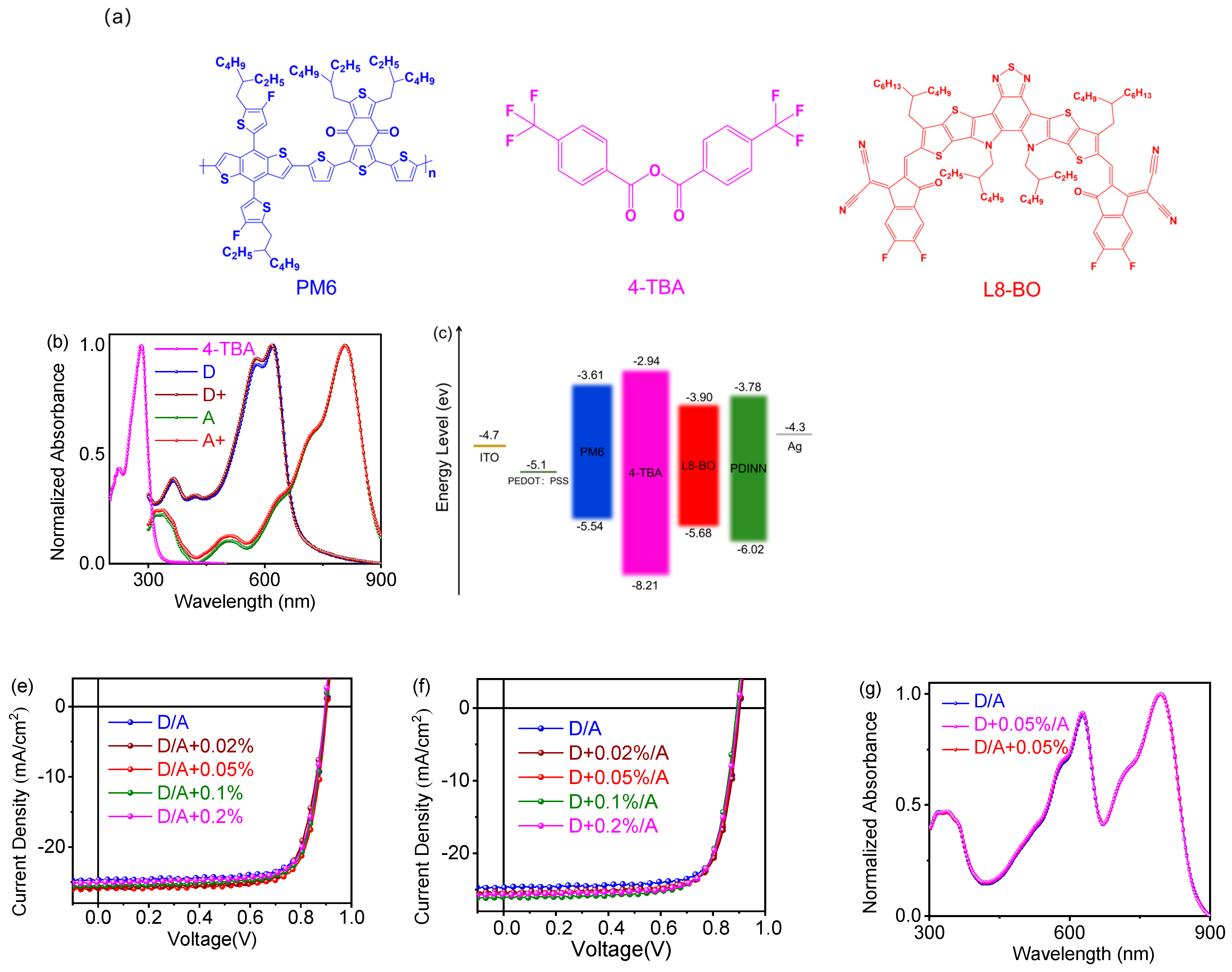
The chemical structures; normalized UV–Vis absorption spectra; and energy levels of the donor PM6, acceptor L8-BO, and solid additive 4-TBA are presented in Figure 1a–c. The complementary absorption between 4-TBA and the PM6/L8-BO blend is beneficial for enhancing photon utilization efficiency. Importantly, 4-TBA has the potential to modify the HOMO and LUMO levels, forming cascading energy levels among these materials that favor exciton dissociation and charge transport through interactions with donor and acceptor molecules [35]. In Figure 1b, it can be observed that when 4-TBA is doped into the donor and acceptor, there is a slight change in absorption in the short wavelength region. This could be attributed to the interaction between 4-TBA and the donor and acceptor molecules, which leads to molecular aggregation. Notably, as revealed by the Fourier transform infrared (FTIR) spectra in Figure 1d, no distinct characteristic peaks associated with 4-TBA are detected when it is doped into the donor-PM6 layer, into the acceptor-L8-BO layer, or into both the donor and acceptor layers simultaneously. This result suggests that the solid additive 4-TBA is likely to volatilize during the spin-coating and annealing process. To explore the effectiveness of the solid additive strategy, a series of devices were prepared to evaluate the effect of the solid additive strategy on the photovoltaic parameters. The active layer is fabricated by sequential processing with the ITO/PEDOT:PSS/PM6/L8-BO/PDINN/Ag LOPVs device structure (Figure S1). The current density–voltage (J-V) characteristic curves of LOPVs with different doping ratios in the donor layer were measured under AM 1.5 G 100 mW/cm2 illumination, as shown in Figure 1e. The reference LbL PM6/L8-BO device without doping solid additive 4-TBA exhibits a PCE of 17.05% with a Jsc = 24.71 mA/cm2, Voc = 0.900 V, and FF = 76.65%. The optimal device, based on an LbL active layer of PM6:4-TBA/L8-BO with 0.05 wt% 4-TBA doped in the donor-PM6 layer, shows an enhanced PCE of 17.47% with a Voc of 0.896 V, a Jsc of 25.66 mA/cm2, and an FF of 76.00%. Corresponding photovoltaic parameters are summarized in Table 1. Doping 4-TBA into the donor layer enhances device PCE, with PCE showing a trend of first increasing and then decreasing as the doping ratio rises. This result raises a further question as to whether the solid additive functions within the acceptor L8-BO layer. When the acceptor L8-BO layer is doped with 0.05 wt% 4-TBA, the device performance is optimized with a PCE of 17.90%, Voc of 0.907 V, Jsc of 25.91 mA/cm2, and FF of 76.17%. As the doping ratio of the solid additive 4-TBA in the acceptor layer varies, the performance of acceptor-layer-doped devices follows a trend similar to that of donor-layer-doped devices with an initial increase followed by a decrease. Corresponding J-V characteristic curves and parameter summaries are shown in Figure 1f and Table 2. Moreover, when 0.05 wt% 4-TBA was doped into the donor and acceptor layers of the LbL PM6 and L8-BO film, respectively, subtle variations in absorption within the short wavelength range could still be observed (Figure 1g). This further confirms that the performance variations induced by 4-TBA doping are induced by interactions between 4-TBA and the donor and acceptor molecules, which modulate the film optical absorption properties.
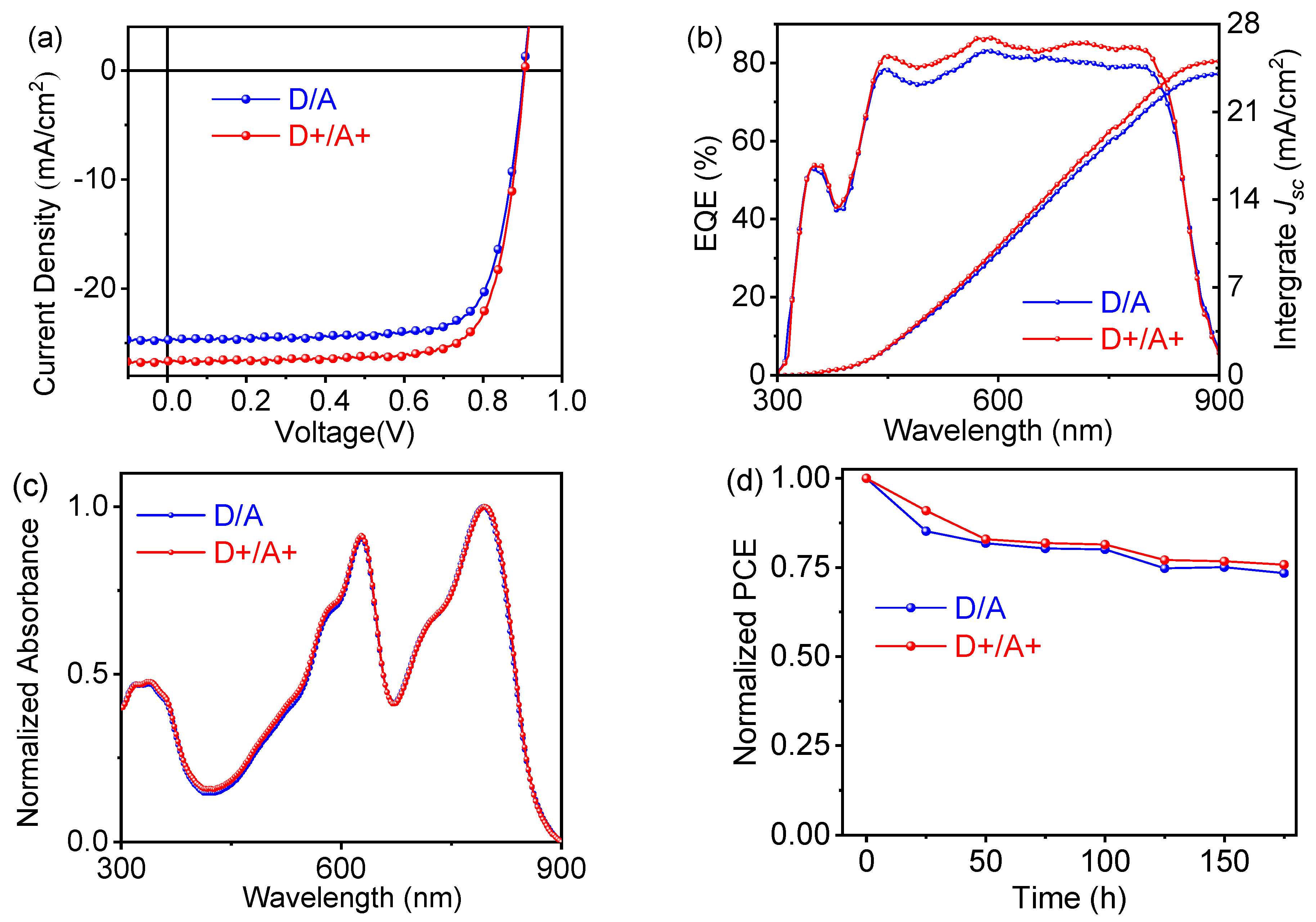
Based on the above results, it is encouraged to utilize solid 4-TBA for simultaneous doping in both the donor PM6 and acceptor L8-BO layers, as this further enhances the device performance. When 0.05 wt% 4-TBA is doped in both the donor and acceptor layer, the device PCE reaches a maximum of 18.49%, with a Voc of 0.907 V, Jsc of 26.65 mA/cm2, and FF of 76.51% (Figure 2a and Table 3). The Jsc shows a significant increase when doping 4-TBA in both the donor and acceptor layer, while the Voc and FF show a slight change. The external quantum efficiencies (EQEs) of the LOPVs based on 4-TBA doping in both the donor and acceptor layer were measured to investigate the origin of the increase in Jsc using the solid additive strategy, as illustrated in Figure 2b. The LOPVs based on 4-TBA doping in both the donor and acceptor layers exhibit higher EQE responses in almost all photoelectric response ranges as compared to the LOPVs without solid additive 4-TBA doping. Moreover, no shift in the absorption peak and the expansion of the absorption range of the 4-TBA doping in both donor and acceptor layer devices in the EQE response implies that the performance of LOPVs induced by doping solid additive 4-TBA is mainly attributed to the enhanced absorption of the LbL active layer (Figure 2c and Figure S2). Furthermore, the stability of LOPVs, both with and without the solid additive 4-TBA, was evaluated through maximum power point tracking. Devices containing 4-TBA doped in both the donor and acceptor layers exhibited good stability, retaining 76% of their initial PCE after 175 h of storage and measurement in air conditions (Figure 2d and Tables S1 and S2). This performance outstripped undoped devices, which retained only 73% of their initial PCE. 4-TBA has been shown to enhance the stability of perovskite films and devices, primarily because its trifluoromethyl group forms hydrogen bonds with organic cations, thereby suppressing cation vacancies, and confers moisture resistance via hydrophobicity. Meanwhile, its electron-rich carbonyl groups passivate undercoordinated Pb2+ defects, while strong interactions between 4-TBA and perovskite precursors further stabilize the crystal structure [35]. Moreover, molecular aggregation in OPVs enhances non-radiative decay pathways in thin films under illumination, reducing exciton lifetime and diffusion length [36]. Thus, the enhanced stability of LOPVs induced by doping 4-TBA can be attributed to establishment of molecular aggregation and hydrophobicity induced by the interaction between solid additive 4-TBA and the donor and acceptor molecules.
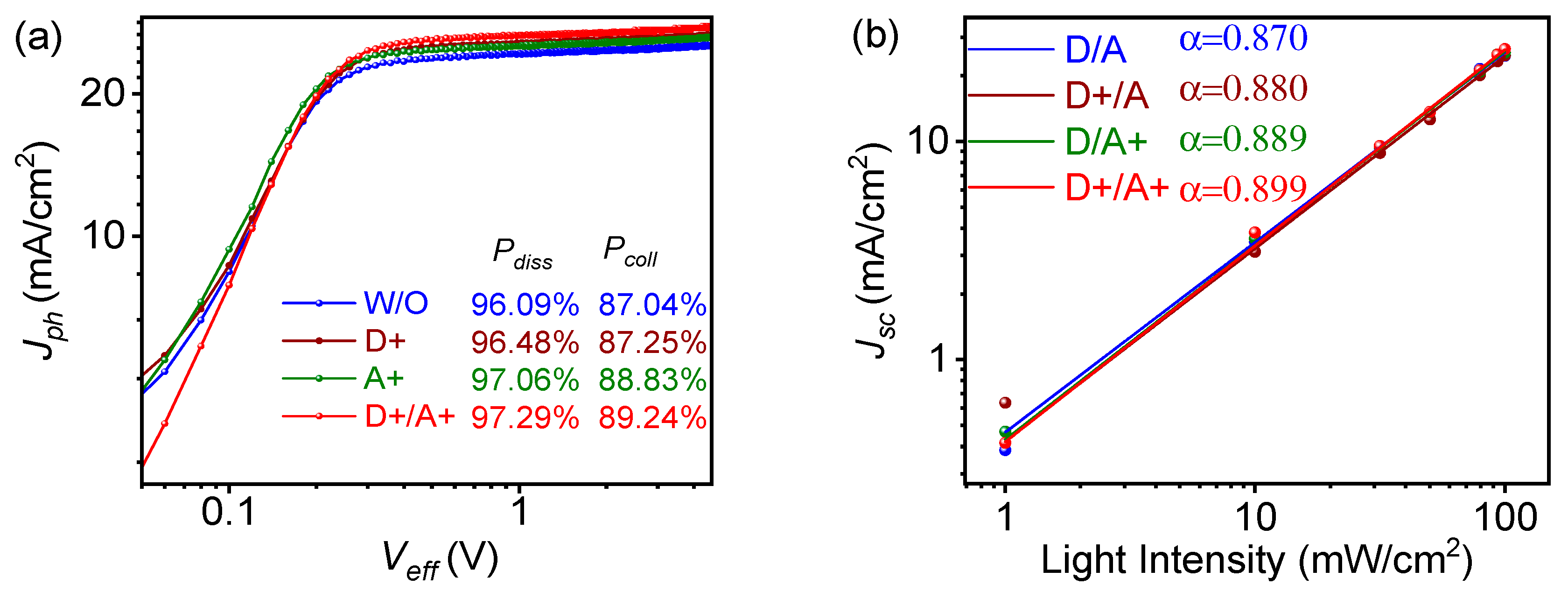
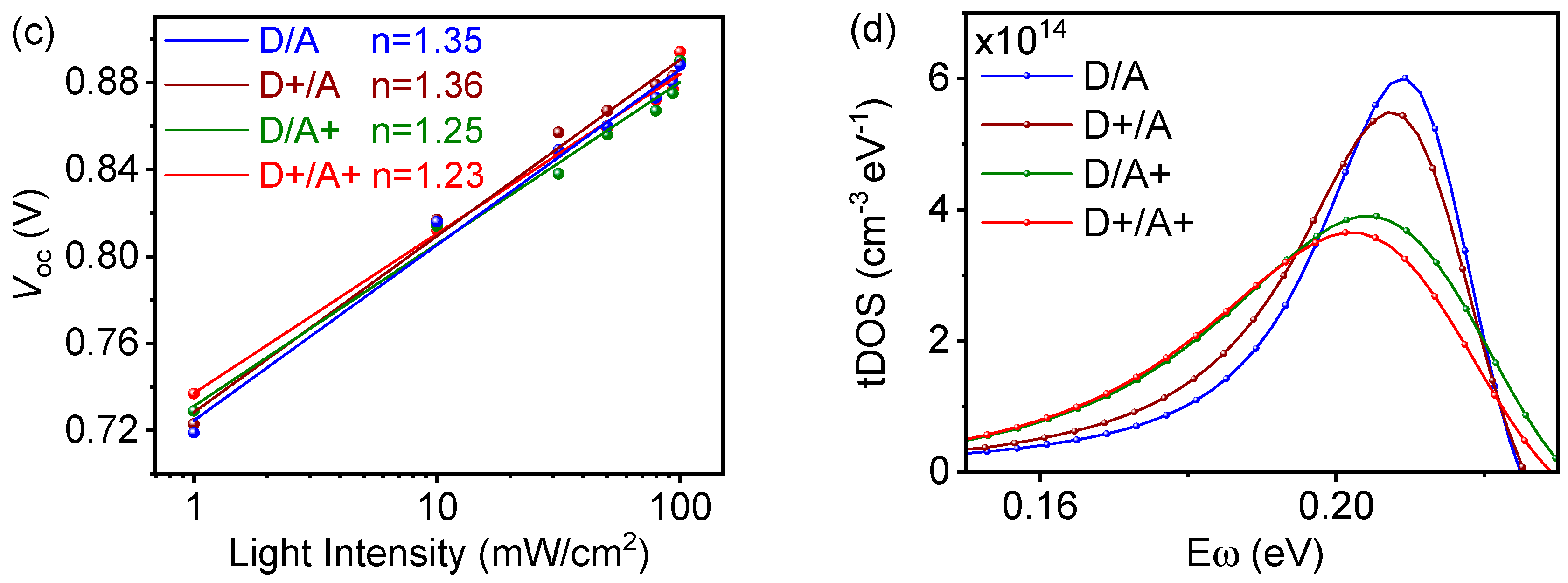
To investigate the underlying change in photovoltaic parameters affected by doping solid additive 4-TBA, a series of charge transport characterizations were carried out. The photocurrent density (Jph) versus effective voltage (Veff) curves of the devices on LbL PM6/L8-BO without 4-TBA, with 4-TBA individually doped into the donor layer, with 4-TBA individually doped into the acceptor layer, and with simultaneously doping 4-TBA in both the donor and acceptor layer were measured to analyze the changes in exciton dissociation efficiency (Pdiss) and charge collection efficiency (Pcoll), as illustrated in Figure 3a. All the devices show Jph increases with Veff in the low-effectiveness region and reaches a saturated photocurrent density (Jsat) at a Veff of 4 V, indicating that excitons can be effectively dissociated into free charge carriers and subsequently collected by the electrodes. The Pdiss and Pcoll of the devices without 4-TBA, with 4-TBA individually doped into the donor layer, with 4-TBA individually doped into the acceptor layer, and with simultaneously doping 4-TBA in both the donor and acceptor layer are 96.09% and 87.04%, 96.48% and 87.25%, 97.06% and 88.83%, and 97.29% and 89.24%, respectively. The devices with the doped solid additive 4-TBA exhibit higher Pdiss and Pcoll, suggesting that more D-A interfaces and favorable active layer/metal interactions can be formed to facilitate exciton dissociation and charge collection. Moreover, to investigate the charge recombination loss inside LOPVs, the dependence of Voc and Jsc on light intensity (Plight) was measured. In Figure 3b, the key parameter α values for the LOPV devices without 4-TBA, with 4-TBA individually doped into the donor layer, with 4-TBA individually doped into the acceptor layer, and with simultaneously doping 4-TBA in both the donor and acceptor layer are 0.870, 0.880, 0.889, and 0.899, respectively. These α values are referred to as the slopes of the fitted lines, and the bimolecular recombination is negligible if the exponential factor α is 1 using the equation Jsc P l i g h t . Therefore, the higher α values reveal that doping solid additive 4-TBA can effectively suppress bimolecular recombination in LOPVs. Figure 3c exhibits the key parameter β values of LOPV devices without 4-TBA, with individually doping 4-TBA in the donor layer, with individually doping 4-TBA in the acceptor layer, and with simultaneously doping 4-TBA in both the donor and acceptor layer are 1.35, 1.36, 1.25, and 1.23, respectively. The relationship between Voc and Plight can be used to describe the trap-assisted recombination through βkT/q, where q is the elementary charge, k is the Boltzmann constant, and T is the absolute temperature. The lower β value in the devices with the doped solid additive 4-TBA indicates that the solid additive strategy can effectively reduce trap-assisted recombination, which facilitates charge transport. Furthermore, the trap density of states (tDOS) in these devices was measured to further analyze and confirm that the solid additive 4-TBA restrains trap-assisted recombination and bimolecular recombination processes, based on capacitance versus frequency and capacitance versus voltage curves. Generally, the tDOS is defined as the density of deep trap states in the active layers, and E is the disorder parameter. The tDOS of LOPVs without 4-TBA, with 4-TBA individually doped into the donor layer, with 4-TBA individually doped into the acceptor layer, and with 4-TBA simultaneously doped into both the donor and acceptor layers are illustrated in Figure 3d, which are associated with the surface (deep) traps of the films. The tDOS values of these devices are 2.22 × 1013 cm−1 eV−1 (without 4-TBA), 2.03 × 1013 cm−1 eV−1 (4-TBA in donor layer), 1.45 × 1013 cm−1 eV−1 (4-TBA in acceptor layer), and 1.35 × 1013 cm−1 eV−1 (4-TBA in both layers). The decreased tDOS values indicate that introducing the solid additive 4-TBA into the donor and acceptor layers of LOPVs can reduce the surface traps in the active layers, thereby leading to an increase in Jsc for the optimized LOPVs.

4. Discussion

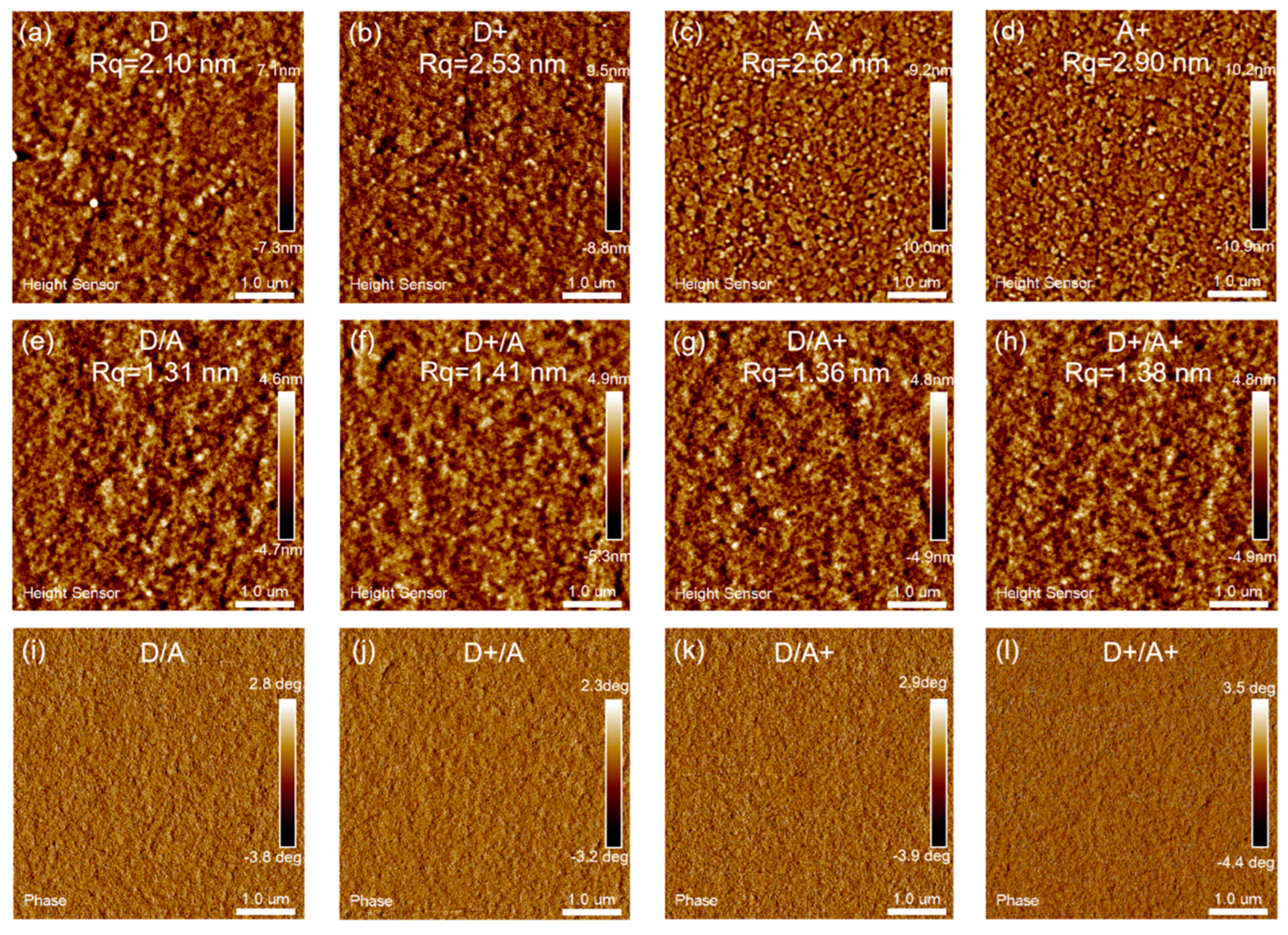
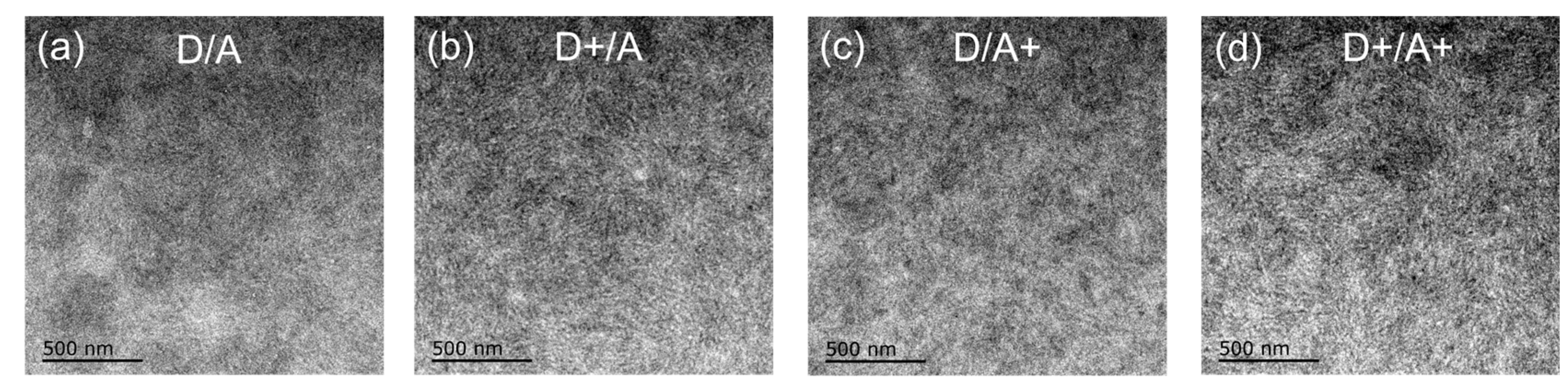
To better understand the role of solid additive 4-TBA in enhancing device performance, AFM images were obtained to investigate its effect on morphological evolution. As shown in Figure 4a–d, when solid additive 4-TBA was doped, the root-mean-square roughness (Rq) of the PM6 layer increased from 2.10 nm to 2.53 nm, while that of the Rq of the L8-BO layer increased from 2.62 to 2.90 nm. This result suggests that doping 4-TBA may induce aggregation of donor and acceptor molecules. More importantly, the LbL PM6:L8-BO with individually doped 4-TBA in the donor layer, with individually doped 4-TBA in the acceptor layer, and with doping 4-TBA in both the donor and acceptor layers exhibited a rougher surface with Rq values of 1.41 nm, 1.36 nm, and 1.38 nm, compared to the LbL PM6:L8-BO without 4-TBA, which had an Rq value of 1.31 nm (Figure 4e–h). Meanwhile, more distinct interpenetrating networks were observable in the corresponding AFM phase images (Figure 4i–l). The films without and with the solid additive 4-TBA exhibited moderate roughness variation, along with Rq values around 1.31–1.38 nm. A moderately rough surface can increase the actual contact area between the active layer and the electrode, reduce the interfacial contact resistance, minimize charge transport losses at the interface, and thereby change the value of FF. Meanwhile, incident light undergoes multiple scattering and reflection on the rough surface, which lengthens the propagation path of light within the active layer, increases the interaction probability between photons and donor/acceptor materials, improves the light absorption efficiency, and consequently raises the value of Jsc. The LbL PM6/L8-BO film with 4-TBA exhibits a more obvious fibrous profile than the LbL PM6/L8-BO film without 4-TBA, which creates more D/A interface areas for exciton dissociation. Furthermore, transmission electron microscopy (TEM) of the LbL PM6/L8-BO films without and with 4-TBA solid additive doping was carried out, which could provide an enhanced visualization of phase morphology (Figure 5a–d). It can be observed that the LbL PM6/L8-BO films with 4-TBA solid additive doping demonstrated a high density of small black crystallites and delicate interpenetration of bright and dark regions, while the LbL PM6/L8-BO films without 4-TBA solid additive doping displayed predominantly darkened regions. This observation provides evidence of a highly homogeneous D/A distribution that fosters efficient, direct charge transport pathways. These results further confirm that the aforementioned variations in absorption, Jsc enhancement, and stability improvement are attributed to 4-TBA regulating the phase distribution in both the donor and acceptor layers, leading to optimized interpenetrating networks and molecular aggregation.

5. Conclusions

This study successfully demonstrates the application of the benzene-based solid additive 4-TBA as an effective morphology modulator and trap suppressor for LOPVs based on the PM6/L8-BO system. Specifically, 4-TBA interacts synergistically with PM6/L8-BO via its functionalized benzene ring, enabling favorable molecular aggregation and D-A phase separation, reducing trap density, and suppressing charge recombination. Consequently, simultaneous doping of 0.05 wt% 4-TBA into the donor and acceptor layers yields optimal performance, with a PCE of 18.49%, compared to 17.05% for pristine devices. The Jsc also increases from 24.71 to 26.65 mA/cm2, accompanied by enhanced light absorption and improved carrier transport. Moreover, the unencapsulated devices with optimal 4-TBA doping exhibit better stability, retaining 76% of their initial PCE after 175 h of storage and measurement in air conditions, compared to 73% for devices without 4-TBA doping. Ultimately, this study establishes a general optimization strategy for LOPVs using multifunctional solid additives based on functionalized benzene rings. Future research will extend this strategy to more LOPV systems and advance large-scale fabrication.

Supplementary Materials

The following supporting information can be downloaded at: https://www.mdpi.com/article/10.3390/en19010211/s1.

Author Contributions

J.L. and P.H. contributed equally to the work. Conceptualization, J.L., P.H., and Y.X.; methodology, J.L., P.H., and X.Z.; formal analysis, J.L., P.H., and X.Z.; investigation, J.L., P.H., W.X., Y.F., G.L., Z.W., S.H., F.Z., and X.Z.; writing—original draft preparation, J.L., P.H., and X.Z.; writing—review and editing, J.L., P.H., and X.Z.; funding acquisition, X.Z. All authors have read and agreed to the published version of the manuscript.

Funding

This research was funded by the National Natural Science Foundation of China (Grant No. 12574451, 62104016, 12574453); National Training Program of Innovation and Entrepreneurship for Undergraduates (202610004002).

Data Availability Statement

The data that supports the findings of this study are available within the article and its Supplementary Material.

Acknowledgments

We acknowledge financial support by the National Natural Science Foundation of China (Grant No. 12574451, 62104016, 12574453), National Training Program of Innovation and Entrepreneurship for Undergraduates (202610004002).

Conflicts of Interest

The authors declare no conflicts of interest.

References

  1. Heeger, A.J. 25th anniversary article: Bulk heterojunction solar cells: Understanding the mechanism of operation. Adv. Mater. 2014, 26, 10–28. [Google Scholar] [CrossRef] [PubMed]
  2. Zhang, G.; Zhao, J.; Chow, P.C.; Jiang, K.; Zhang, J.; Zhu, Z.; Zhang, J.; Huang, F.; Yan, H. Nonfullerene acceptor molecules for bulk heterojunction organic solar cells. Chem. Rev. 2018, 118, 3447–3507. [Google Scholar] [CrossRef]
  3. Zhu, L.; Zhang, M.; Zhou, G.; Wang, Z.; Zhong, W.; Zhuang, J.; Zhou, Z.; Gao, X.; Kan, L.; Hao, B. Achieving 20.8% organic solar cells via additive-assisted layer-by-layer fabrication with bulk pin structure and improved optical management. Joule 2024, 8, 3153–3168. Available online: https://www.cell.com/joule/fulltext/S2542-4351(24)00355-6 (accessed on 16 November 2025). [CrossRef]
  4. Zhao, B.; Zhu, L.; Xiong, S.; Yu, J.; Wang, X.; Zhao, J.; Tan, L.; Zhang, J.; Zhong, J.; Kan, L. Boosting Binary Organic Solar Cells Over 20% Efficiency via Synchronous Modulation of Charge Transport and Phase Morphology. Adv. Energy Mater. 2025, 15, e04947. [Google Scholar] [CrossRef]
  5. Fu, J.; Li, H.; Liu, H.; Huang, P.; Chen, H.; Fong, P.W.; Dela Peña, T.A.; Li, M.; Lu, X.; Cheng, P. Two-step crystallization modulated through acenaphthene enabling 21% binary organic solar cells and 83.2% fill factor. Nat. Energy 2025, 10, 1251–1261. [Google Scholar] [CrossRef]
  6. Cao, W.; Xue, J. Recent progress in organic photovoltaics: Device architecture and optical design. Energy Environ. Sci. 2014, 7, 2123–2144. [Google Scholar] [CrossRef]
  7. Zhou, H.; Zhang, L.; Tian, H.; Ni, Y.; Xie, Y.; Jeong, S.Y.; Huang, T.; Woo, H.Y.; Zhang, J.; Zhu, X. Layered All-Polymer Solar Cells with Efficiency of 18.34% by Employing Alloyed Polymer Donors. Small 2025, 21, 2410581. [Google Scholar] [CrossRef]
  8. Zhang, L.; Zhou, H.; Xie, Y.; Xu, W.; Tian, H.; Zhao, X.; Ni, Y.; Jeong, S.Y.; Zou, Y.; Zhu, X. Cascaded energy and charge transfer synergistically prompting 18.7% efficiency of layered organic solar cells with 1.48 eV bandgap. Adv. Energy Mater. 2025, 15, 2404718. [Google Scholar] [CrossRef]
  9. Zhu, X.; Zhang, G.; Zhang, J.; Yip, H.-L.; Hu, B. Self-stimulated dissociation in non-fullerene organic bulk-heterojunction solar cells. Joule 2020, 4, 2443–2457. [Google Scholar] [CrossRef]
  10. Zhang, B.; Jiang, M.; Mao, P.; Wang, S.; Gui, R.; Wang, Y.; Woo, H.Y.; Yin, H.; Wang, J.L.; An, Q. Manipulating alkyl inner side chain of acceptor for efficient as-cast organic solar cells. Adv. Mater. 2024, 36, 2405718. [Google Scholar] [CrossRef]
  11. Zhang, L.; Zhuo, Z.; Ma, X.; Tian, H.; Zhao, X.; Xie, Y.; Yang, K.; Lee, B.H.; Zhu, X.; Woo, H.Y. 19.6% efficiency of layer-by-layer organic photovoltaics with decreased energy loss via incorporating TADF materials with intrinsic reverse intersystem crossing. Energy Environ. Sci. 2025, 18, 9171–9182. [Google Scholar] [CrossRef]
  12. Xu, W.; Zhou, H.; Tian, H.; Zhang, L.; Du, J.; Yao, J.; Jeong, S.Y.; Woo, H.Y.; Zhou, E.; Ma, X. Achieving light utilization efficiency of 3.88% and efficiency of 14.04% for semitransparent layer-by-layer organic solar cells by diluting donor layer. Chem. Eng. J. 2025, 508, 161148. [Google Scholar] [CrossRef]
  13. Yang, C.; Jiang, M.; Wang, S.; Zhang, B.; Mao, P.; Woo, H.Y.; Zhang, F.; Wang, J.-l.; An, Q. Hot-Casting Strategy Empowers High-Boiling Solvent-Processed Organic Solar Cells with Over 18.5% Efficiency. Adv. Mater. 2024, 36, 2305356. [Google Scholar] [CrossRef] [PubMed]
  14. Gao, W.; Qi, F.; Peng, Z.; Lin, F.R.; Jiang, K.; Zhong, C.; Kaminsky, W.; Guan, Z.; Lee, C.S.; Marks, T.J. Achieving 19% power conversion efficiency in planar-mixed heterojunction organic solar cells using a pseudosymmetric electron acceptor. Adv. Mater. 2022, 34, 2202089. [Google Scholar] [CrossRef]
  15. Zhang, Z.; Zhang, Y.; Sun, S.; Zhou, H.; Wang, J.; Xu, Y.; Du, X.; Jeong, S.Y.; Woo, H.Y.; Zhang, F. Over 18.7% efficiency for bulk heterojunction and pseudo-planar heterojunction organic solar cells achieved by regulating intermolecular compatibility. J. Mater. Chem. A 2024, 12, 24622–24632. [Google Scholar] [CrossRef]
  16. Tian, H.; Zhou, H.; Zhang, L.; Xu, W.; Gong, R.; Ni, Y.; Jeong, S.Y.; Zhu, X.; Woo, H.Y.; Ma, X. Over 19.2% Efficiency of Layer-By-Layer Organic Photovoltaics by Ameliorating Exciton Dissociation and Charge Transport. Adv. Funct. Mater. 2025, 35, 2422867. [Google Scholar] [CrossRef]
  17. Xie, Y.; Zhou, C.; Ma, X.; Jeong, S.Y.; Woo, H.Y.; Huang, F.; Yang, Y.; Yu, H.; Li, J.; Zhang, F. High-Reproducibility Layer-by-Layer Non-Fullerene Organic Photovoltaics with 19.18% Efficiency Enabled by Vacuum-Assisted Molecular Drift Treatment. Adv. Energy Mater. 2024, 14, 2400013. [Google Scholar] [CrossRef]
  18. Xie, Y.; Wang, K.; Yu, H.; Li, J.; Jeong, S.Y.; Woo, H.Y.; Shi, Y.; Ma, X.; Zhang, F.; Zhu, X. Improving the Efficiency of Layer-by-Layer Organic Photovoltaics to Exceed 19% by Establishing Effective Donor–Acceptor Interfacial Molecular Interactions. ACS Appl. Mater. Interfaces 2025, 17, 15741–15754. [Google Scholar] [CrossRef]
  19. Zhou, M.; Liao, C.; Duan, Y.; Xu, X.; Yu, L.; Li, R.; Peng, Q. 19.10% Efficiency and 80.5% Fill Factor Layer-by-Layer Organic Solar Cells Realized by 4-Bis (2-Thienyl) Pyrrole-2, 5-Dione Based Polymer Additives for Inducing Vertical Segregation Morphology. Adv. Mater. 2023, 35, 2208279. [Google Scholar] [CrossRef]
  20. Zhang, C.; Sun, S.; Han, T.; Chi, J.; Dong, R.; Han, S.; Zhou, H.; Xu, Y.; Cai, L.; Du, X. Superior charge dynamics via ternary doping layer-by-layer strategy in high-efficiency organic solar cells. Chem. Eng. J. 2025, 522, 167959. [Google Scholar] [CrossRef]
  21. Kwon, S.; Kang, H.; Lee, J.H.; Lee, J.; Hong, S.; Kim, H.; Lee, K. Effect of processing additives on organic photovoltaics: Recent progress and future prospects. Adv. Energy Mater. 2017, 7, 1601496. [Google Scholar] [CrossRef]
  22. Arredondo, B.; Pérez-Martínez, J.C.; Munoz-Díaz, L.; del Carmen López-González, M.; Martín-Martín, D.; del Pozo, G.; Hernández-Balaguera, E.; Romero, B.; Lamminaho, J.; Turkovic, V. Influence of solvent additive on the performance and aging behavior of non-fullerene organic solar cells. Sol. Energy 2022, 232, 120–127. [Google Scholar] [CrossRef]
  23. Mao, P.; Zhang, B.; Zhang, H.; Jiang, M.; Wang, Y.; Li, Y.; Wu, J.; Wang, J.-l.; An, Q. In-situ volatilization of solid additive assists as-cast organic solar cells with over 20% efficiency. Mater. Sci. Eng. R Rep. 2025, 165, 101022. [Google Scholar] [CrossRef]
  24. Zhao, Z.; Chung, S.; Tan, L.; Zhao, J.; Liu, Y.; Li, X.; Bai, L.; Lee, H.; Jeong, M.; Cho, K. Molecular order manipulation with dual additives suppressing trap density in non-fullerene acceptors enables efficient bilayer organic solar cells. Energy Environ. Sci. 2025, 18, 2791–2803. [Google Scholar] [CrossRef]
  25. Chong, K.; Xu, X.; Meng, H.; Xue, J.; Yu, L.; Ma, W.; Peng, Q. Realizing 19.05% efficiency polymer solar cells by progressively improving charge extraction and suppressing charge recombination. Adv. Mater. 2022, 34, 2109516. [Google Scholar] [CrossRef]
  26. Zhang, D.; Li, Y.; Li, M.; Zhong, W.; Heumüller, T.; Li, N.; Ying, L.; Brabec, C.J.; Huang, F. Targeted adjusting molecular arrangement in organic solar cells via a universal solid additive. Adv. Funct. Mater. 2022, 32, 2205338. [Google Scholar] [CrossRef]
  27. Fu, J.; Chen, H.; Huang, P.; Yu, Q.; Tang, H.; Chen, S.; Jung, S.; Sun, K.; Yang, C.; Lu, S. Eutectic phase behavior induced by a simple additive contributes to efficient organic solar cells. Nano Energy 2021, 84, 105862. [Google Scholar] [CrossRef]
  28. Ran, Y.; Liang, C.; Xu, Z.; Jing, W.; Xu, X.; Duan, Y.; Li, R.; Yu, L.; Peng, Q. Developing efficient benzene additives for 19.43% efficiency of organic solar cells by crossbreeding effect of fluorination and bromination. Adv. Funct. Mater. 2024, 34, 2311512. [Google Scholar] [CrossRef]
  29. Wu, X.; Jiang, X.; Li, X.; Zhang, J.; Ding, K.; Zhuo, H.; Guo, J.; Li, J.; Meng, L.; Ade, H. Introducing a Phenyl End Group in the Inner Side Chains of A-DA’D-A Acceptors Enables High-Efficiency Organic Solar Cells Processed with Nonhalogenated Solvent. Adv. Mater. 2023, 35, 2302946. [Google Scholar] [CrossRef]
  30. Wu, G.; Xu, X.; Liao, C.; Yu, L.; Li, R.; Peng, Q. Improving cooperative interactions between halogenated aromatic additives and aromatic side chain acceptors for realizing 19.22% efficiency polymer solar cells. Small 2023, 19, 2302127. [Google Scholar] [CrossRef] [PubMed]
  31. Wang, J.; Wang, Y.; Bi, P.; Chen, Z.; Qiao, J.; Li, J.; Wang, W.; Zheng, Z.; Zhang, S.; Hao, X. Binary organic solar cells with 19.2% efficiency enabled by solid additive. Adv. Mater. 2023, 35, 2301583. [Google Scholar] [CrossRef]
  32. Liu, L.; Li, H.; Xie, J.; Yang, Z.; Bai, Y.; Li, M.; Huang, Z.; Zhang, K.; Huang, F. Organic Solar Cell with Efficiency of 20.49% Enabled by Solid Additive and Non-Halogenated Solvent. Adv. Mater. 2025, 37, 2500352. [Google Scholar] [CrossRef] [PubMed]
  33. Li, H.; Liu, L.; Yu, J.; Xie, J.; Bai, Y.; Yang, Z.; Dong, M.; Zhang, K.; Huang, F.; Cao, Y. High Efficiency Non-Halogenated Solvent Processed Organic Solar Cells Through Synergistic Effects of Layer-by-Layer and Solid Additive. Adv. Funct. Mater. 2025, 35, 2505226. [Google Scholar] [CrossRef]
  34. Guan, S.; Li, Y.; Bi, Z.; Lin, Y.; Fu, Y.; Wang, K.; Wang, M.; Ma, W.; Xia, J.; Ma, Z. Fine-tuning the hierarchical morphology of multi-component organic photovoltaics via a dual-additive strategy for 20.5% efficiency. Energy Environ. Sci. 2025, 18, 313–321. [Google Scholar] [CrossRef]
  35. Liu, F.; Xu, J.; Ma, Y.; Ahn, Y.; Du, X.; Yang, E.; Xia, H.; Lee, B.R.; Hangoma, P.M.; Park, S.H. Functional design and understanding of effective additives for achieving high-quality perovskite films and passivating surface defects. J. Energy Chem. 2025, 102, 597–608. [Google Scholar] [CrossRef]
  36. Zhang, W.; Du, X.; Ma, Y.; Qiao, J.; Zheng, Q.; Hao, X. Revealing Design Rules for Improving The Photostability of Non-Fullerene Acceptors from Molecular to Aggregation Level. Adv. Funct. Mater. 2024, 34, 2308591. [Google Scholar] [CrossRef]
Figure 1. (a) Chemical structure of donor-PM6, solid additive 4-TBA, and acceptor-L8-BO. (b) Normalized UV-Vis absorption spectra of 4-TBA, pristine donor-PM6, PM6 with 0.05 wt% 4-TBA, pristine acceptor-L8-BO, and L8-BO with 0.05 wt% 4-TBA. (c) Energy level diagram of LOPV device. (d) FTIR spectra of 4-TBA, pristine LbL PM6/L8-BO film, LbL PM6/L8-BO film with 0.05 wt% 4-TBA in the donor-PM6 layer, LbL PM6/L8-BO film with 0.05 wt% 4-TBA in the acceptor-L8-BO layer, and LbL PM6/L8-BO film with 0.05 wt% 4-TBA in both the donor-PM6 and acceptor-L8-BO layers. (e) The photovoltaic J-V characteristics for LOPVs PM6/L8-BO with different 4-TBA doping ratios in donor-PM6 layer. (f) The photovoltaic J-V characteristics for LOPVs PM6/L8-BO with different 4-TBA doping ratios in acceptor-L8-BO layer. (g) Absorption spectra of LbL PM6/L8-BO films without, with 0.05 wt% 4-TBA doping ratios in the donor-PM6 layer, and with 0.05 wt% 4-TBA doping ratios in the donor-PM6 layer, respectively.
Energies 19 00211 g001
Figure 2. LOPVs PM6/L8-BO without solid additive and with 0.05 wt% 4-TBA doping in both donor-PM6 and acceptor-L8-BO layer (a) The photovoltaic J-V characteristics. (b) The EQE spectra and calculated integral current densities. (c) Normalized absorption spectra. (d) Normalized PCE over time of the LOPVs stored in air conditions.
Energies 19 00211 g002
Figure 3. LOPVs based on PM6/L8-BO without doping the solid additive 4-TBA, with 4-TBA individually doped in the donor-PM6 layer, with 4-TBA individually doped in the acceptor-L8-BO layer, and with 4-TBA simultaneously doped in both the donor-PM6 and acceptor-L8-BO layers: (a) Jph-Veff, (b) Jsc-Plight, (c) Voc-Plight, and (d) tDOS-Eω profiles.
Energies 19 00211 g003aEnergies 19 00211 g003b
Figure 4. AFM height images: (a) pristine donor-PM6 film; (b) donor-PM6 film with 0.05 wt% 4-TBA; (c) pristine acceptor L8-BO film; (d) acceptor L8-BO film with 0.05 wt% 4-TBA; (e) LbL PM6/L8-BO film; (f) LbL PM6/L8-BO film with 0.05 wt% 4-TBA in the donor-PM6 layer; (g) LbL PM6/L8-BO film with 0.05 wt% 4-TBA in the acceptor-L8-BO layer; (h) LbL PM6/L8-BO film with 0.05 wt% 4-TBA in both the donor-PM6 layer and acceptor-L8-BO layer. AFM phase images: (i) LbL PM6/L8-BO film; (j) LbL PM6/L8-BO film with 0.05 wt% 4-TBA in the donor-PM6 layer; (k) LbL PM6/L8-BO film with 0.05 wt% 4-TBA in the acceptor-L8-BO layer; (l) LbL PM6/L8-BO film with 0.05 wt% 4-TBA in both the donor-PM6 and acceptor-L8-BO layers.
Energies 19 00211 g004
Figure 5. TEM images: (a) LbL PM6/L8-BO film; (b) LbL PM6/L8-BO film with 0.05 wt% 4-TBA in the donor-PM6 layer; (c) LbL PM6/L8-BO film with 0.05 wt% 4-TBA in the acceptor-L8-BO layer; (d) LbL PM6/L8-BO film with 0.05 wt% 4-TBA in both the donor-PM6 and acceptor-L8-BO layers.
Energies 19 00211 g005
Table 1. The photovoltaic parameters of LbL PM6/L8-BO devices with donor-PM6 layers prepared using various 4-TBA doping ratios and acceptor-L8-BO layers without 4-TBA doping.
TBA in Donor
[wt%]
Voc
[V]
Jsc
[mA/cm2]
FF
[%]
PCE (a)
[%]
00.900
(0.898 ± 0.003)
24.71
(24.58 ± 0.15)
76.65
(76.50 ± 0.51)
17.05
(16.82 ± 0.23)
0.02 0.900
(0.898 ± 0.003)
25.35
(24.71 ± 0.43)
76.42
(75.81 ± 0.32)
17.44
(17.11 ± 0.32)
0.05 0.896
(0.896 ± 0.003)
25.66
(25.05 ± 0.35)
76.00
(76.06 ± 0.25)
17.47
(17.29 ± 0.18)
0.10.890
(0.895 ± 0.004)
26.03
(24.90 ± 0.34)
75.12
(74.92 ± 0.34)
17.40
(17.18 ± 0.13)
0.20.896
(0.896 ± 0.004)
25.61
(24.78 ± 0.46)
75.45
(74.81 ± 0.28)
17.31
(17.08 ± 0.21)
(a) Calculation based on more than 20 devices.
Table 2. The photovoltaic parameters of LbL PM6/L8-BO devices with acceptor-L8-BO layers prepared using various 4-TBA doping ratios and donor-PM6 layers without 4-TBA doping.
4-TBA in Acceptor
[wt%]
Voc
[V]
Jsc
[mA/cm2]
FF
[%]
PCE (a)
[%]
00.900
(0.898 ± 0.003)
24.71
(24.58 ± 0.15)
76.65
(76.50 ± 0.51)
17.05
(16.82 ± 0.23)
0.020.896
(0.896 ± 0.003)
25.77
(25.12 ± 0.25)
75.03
(75.01 ± 0.35)
17.32
(17.18 ± 0.14)
0.050.907
(0.898 ± 0.004)
25.91
(25.33 ± 0.38)
76.17
(75.58 ± 0.38)
17.90
(17.55 ± 0.35)
0.10.896
(0.896 ± 0.003)
25.52
(25.21 ± 0.25)
76.67
(76.16 ± 0.41)
17.53
(17.31 ± 0.21)
0.20.896
(0.896 ± 0.002)
24.99
(25.01 ± 0.31)
76.82
(76.08 ± 0.33)
17.20
(17.03 ± 0.17)
(a) Calculation based on more than 20 devices.
Table 3. The photovoltaic parameters of LbL PM6/L8-BO devices for donor and acceptor layers prepared with and without 0.05 wt% 4-TBA, respectively.
Active LayerVoc
[V]
Jsc
[mA/cm2]
Cal. Jsc [mA/cm2]FF
[%]
PCE (a)
[%]
D/A0.900
(0.898 ± 0.003)
24.71
(24.58 ± 0.15)
24.0276.65
(76.50 ± 0.51)
17.05
(16.82 ± 0.23)
D+/A+0.907
(0.899 ± 0.005)
26.65
(25.65 ± 0.44)
25.0476.51
(75.69 ± 0.44)
18.49
(18.02 ± 0.30)
(a) Calculation based on more than 20 devices.
Disclaimer/Publisher’s Note: The statements, opinions and data contained in all publications are solely those of the individual author(s) and contributor(s) and not of MDPI and/or the editor(s). MDPI and/or the editor(s) disclaim responsibility for any injury to people or property resulting from any ideas, methods, instructions or products referred to in the content.