Review of Coupled Dynamic Modeling Methods for Floating Offshore Wind Turbines


Abstract
1. Introduction
2. Dynamic Methodologies
2.1. Aerodynamics

2.2. Hydrodynamics
2.3. Elastodynamics
2.4. Mooring Dynamics
2.5. Servodynamics
- -
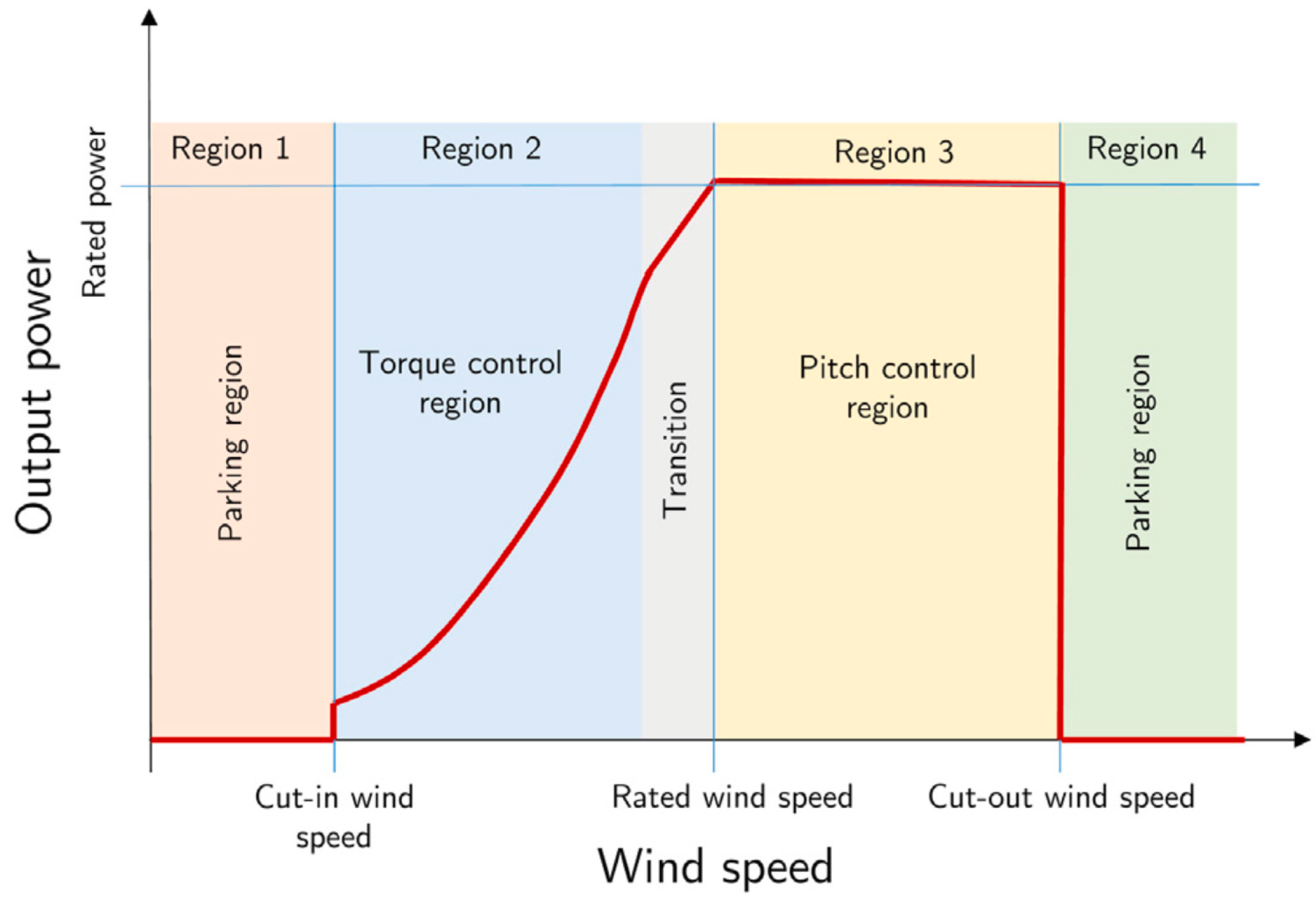
- Region 1: Wind speed is below cut-in; the turbine remains shut down as power generation is infeasible.
- -
- Region 2: Wind speed lies between cut-in and rated values. The objective is to maximize energy capture, typically by adjusting generator speed to track the optimal tip-speed ratio, with pitch angle held fixed at an optimal setting.
- -
- Region 3: Wind speed exceeds rated. Control shifts to power regulation, maintaining output at rated capacity by increasing pitch angle to shed excess aerodynamic load.
- -
- Transition zone between Regions 2 and 3: The controller smoothly switches strategies to ensure a seamless shift from power maximization to power limitation without abrupt changes.
3. Coupled Modeling Method
3.1. Time-Domain Method
3.1.1. Fully Coupled Method
3.1.2. Semi-Coupled Method
3.2. Frequency-Domain Method
4. Development of Numerical Software
5. Future Trends and Challenges
5.1. Integrated Marine Energy Systems

5.2. Wake Modeling

5.3. Intelligent Computing and Prediction
6. Conclusions
Funding
Data Availability Statement
Conflicts of Interest
References
- Zheng, C.W.; Xiao, Z.N.; Peng, Y.H.; Li, C.Y.; Du, Z.B. Rezoning global offshore wind energy resources. Renew. Energy 2018, 129, 1–11. [Google Scholar] [CrossRef] [Scilit]
- Jung, C.; Sander, L.; Schindler, D. Future global offshore wind energy under climate change and advanced wind turbine technology. Energy Convers. Manag. 2024, 321, 119075. [Google Scholar] [CrossRef] [Scilit]
- Global Offshore Wind Report, 2024. Available online: https://wfo-global.org/wp-content/uploads/2025/04/WFO_Global-Offshore-Wind-Report-2024_final.pdf (accessed on 4 November 2025).
- Subbulakshmi, A.; Verma, M.; Keerthana, M.; Sasmal, S.; Harikrishna, P.; Kapuria, S. Recent advances in experimental and numerical methods for dynamic analysis of floating offshore wind turbines—An integrated review. Renew. Sustain. Energy Rev. 2022, 164, 112525. [Google Scholar] [CrossRef] [Scilit]
- Barooni, M.; Ashuri, T.; Sogut, D.V.; Wood, S.; Taleghani, S.G. Floating offshore wind turbines: Current status and future prospects. Energies 2022, 16, 2. [Google Scholar] [CrossRef] [Scilit]
- Wang, C.M.; Utsunomiya, T.; Wee, S.C.; Choo, Y.S. Research on floating wind turbines: A literature survey. IES J. Part A Civ. Struct. Eng. 2010, 3, 267–277. [Google Scholar] [CrossRef] [Scilit]
- Butterfield, S.; Musial, W.; Jonkman, J.; Sclavounos, P.; Wayman, L. Engineering Challenges for Floating Offshore Wind Turbines. In Proceedings of the Copenhagen Offshore Wind 2005 Conference and Expedition Proceedings, Copenhagen, Denmark, 26–28 October 2005. [Google Scholar]
- Wijaya, M.R.A.; Adiputra, R.; Prabowo, A.R.; Putranto, T.; Smaradhana, D.F. Characterization of the applied materials for floating offshore wind turbine members: A review on the current state. Procedia Struct. Integr. 2023, 48, 41–49. [Google Scholar] [CrossRef] [Scilit]
- Allen, C.; Viscelli, A.; Dagher, H.; Goupee, A.; Gaertner, E.; Abbas, N.; Hall, M.; Barter, G. Definition of the UMaine VolturnUS-S Reference Platform Developed for the IEA Wind 15-Megawatt Offshore Reference Wind Turbine (No. NREL/TP-5000-76773); National Renewable Energy Laboratory (NREL): Golden, CO, USA; University of Maine: Orono, ME, USA, 2020.
- Rivkin, D.A.; Silk, L. Wind Turbine Systems; Jones & Bartlett Publishers: Sudbury, MA, USA, 2013. [Google Scholar]
- Dagli, B.Y.; Tuskan, Y.; Gökkuş, Ü. Evaluation of offshore wind turbine tower dynamics with numerical analysis. Adv. Civ. Eng. 2018, 2018, 3054851. [Google Scholar] [CrossRef] [Scilit]
- Ma, K.T.; Luo, Y.; Kwan, C.T.; Wu, Y. Mooring System Engineering for Offshore Structures; Gulf Professional Publishing: Houston, TX, USA, 2019. [Google Scholar]
- Cerik, B.C.; Huang, L. Recent advances in mechanical analysis and design of dynamic power cables for floating offshore wind turbines. Ocean Eng. 2024, 311, 118810. [Google Scholar] [CrossRef] [Scilit]
- Borg, M.; Collu, M. A comparison between the dynamics of horizontal and vertical axis offshore floating wind turbines. Philos. Trans. R. Soc. A 2015, 373, 20140076. [Google Scholar] [CrossRef] [Scilit]
- Skaare, B.; Nielsen, F.G.; Hanson, T.G.; Yttervik, R.; Havmøller, O.; Rekdal, A. Analysis of measurements and simulations from the Hywind Demo floating wind turbine. Wind Energy 2015, 18, 1105–1122. [Google Scholar] [CrossRef] [Scilit]
- Akel, N. Grid Stability Benefits with Seatwirl vs. Horizontal Shaft Windpower Plant. Master’s Thesis, Chalmers University of Technology, Gothenburg, Sweden, 2017. [Google Scholar]
- Matsuoka, R.; Yoshimoto, H. 2015S-OS1-1 Verification of Precision Concerning the Design of Advanced Spar Type Structure. In Proceedings of the Conference Proceedings the Japan Society of Naval Architects and Ocean Engineers 20, Kobe, Japan, 25–26 May 2015; pp. 1–4. [Google Scholar]
- Mahfouz, M.Y.; Molins, C.; Trubat, P.; Hernández, S.; Vigara, F.; Pegalajar-Jurado, A.; Bredmose, H.; Salari, M. Response of the International Energy Agency (IEA) Wind 15 MW WindCrete and Activefloat floating wind turbines to wind and second-order waves. Wind Energy Sci. 2021, 6, 867–883. [Google Scholar] [CrossRef] [Scilit]
- Qaiser, M.T.; Ejaz, J.; Osen, O.; Hasan, A. Digital twin-driven energy modeling of Hywind Tampen floating wind farm. Energy Rep. 2023, 9, 284–289. [Google Scholar] [CrossRef] [Scilit]
- Henderson, A.R.; Witcher, D. Floating offshore wind energy—A review of the current status and an assessment of the prospects. Wind Eng. 2010, 34, 1–16. [Google Scholar] [CrossRef] [Scilit]
- Vita, L.; Ramachandran, G.K.V.; Krieger, A.; Kvittem, M.I.; Merino, D.; Cross-Whiter, J.; Ackers, B.B. Comparison of numerical models and verification against experimental data, using Pelastar TLP concept. In Proceedings of the International Conference on Offshore Mechanics and Arctic Engineering, St. John’s, NL, Canada, 31 May–5 June 2015; American Society of Mechanical Engineers: New York, NY, USA, 2015; Volume 56574, p. V009T09A047. [Google Scholar]
- Adam, F.; Steinke, C.; Dahlhaus, F.; Grossmann, J. The Floating Offshore Fundament-GICON-SOF. A Possible Alternative to Fixed Foundations. Das schwimmende Offshore Fundament-GICON-SOF. Eine Moegliche Alternative zu festen Gruendungen. 2013. Available online: https://www.researchgate.net/publication/301285177_Das_Schwimmende_Offshore_Fundament_-_GICON-SOF (accessed on 4 November 2025).
- Milano, D.; Peyrard, C.; Capaldo, M. Numerical Prototyping of Floating Offshore Wind Turbines: Virtual Operation in Real Environmental Conditions. In Proceedings of the International Conference on Offshore Mechanics and Arctic Engineering, Online, 3–7 August 2020; American Society of Mechanical Engineers: New York, NY, USA, 2020; Volume 84416, p. V009T09A044. [Google Scholar]
- Aubault, A.; Cermelli, C.; Lahijanian, A.; Lum, A.; Peiffer, A.; Roddier, D. WindFloat contraption: From conception to reproduction. In Proceedings of the 31st International Conference on Offshore Mechanics and Arctic Engineering, Riode Janeiro, Brazil, 1–6 July 2012. [Google Scholar]
- Ishihara, T.; Yamaguchi, A.; Taki, S. The challenge to the world’s first floating wind farm. In Proceedings of the Grand Renewable Energy, Tokyo, Japan, 27 July–1 August 2014. [Google Scholar]
- Guignier, L.; Dory, J.N.; Percher, Y.; Mariani, R. Design of DampingPool® Floating Wind Turbine for Deep Water Conditions. In Proceedings of the ISOPE International Ocean and Polar Engineering Conference, Rhodes, Greece, 16–21 June 2024; ISOPE: Goyang, Republic of Korea, 2024. [Google Scholar]
- Fukushima Offshore Wind Consortium. Fukushima Floating Offshore Wind Farm Demonstration Project (Fukushima FORWARD); Fukushima Offshore Wind Consortium: Onahama Port, Japan, 2014. [Google Scholar]
- Gomes, J.G.; Lin, Y.; Jiang, J.; Yan, N.; Dai, S.; Yang, T. Review of offshore wind projects status: New approach of floating turbines. In Proceedings of the 2022 5th International Conference on Power and Energy Applications (ICPEA), Guangzhou, China, 18–20 November 2022; pp. 676–686. [Google Scholar]
- Shen, Y.; Liu, C.; Pan, W.; Li, Y.; Wang, X. Design and fully coupled dynamic response analysis of a new floating offshore wind platform. J. Mar. Sci. Eng. 2023, 11, 1368. [Google Scholar] [CrossRef] [Scilit]
- Lu, S.; He, F.; Cai, Y.; Yang, X.; Zhang, G. Numerical Study of Motion Responses of a New Combined Floating Wind Turbine and Wave Energy Converters. In Proceedings of the International Conference on Offshore Mechanics and Arctic Engineering, Singapore, 9–14 June 2024; American Society of Mechanical Engineers: New York, NY, USA, 2024; Volume 87820, p. V05AT06A044. [Google Scholar]
- Chen, J.; Wang, C.; Wu, X.; Feng, F.; Li, Y. Parametric Sensitivity Analysis of Mooring Chains of a Floating Offshore Wind Turbine in Shallow Water. J. Mar. Sci. Eng. 2024, 12, 2202. [Google Scholar] [CrossRef] [Scilit]
- Díaz, H.; Serna, J.; Nieto, J.; Guedes Soares, C. Market needs, opportunities and barriers for the floating wind industry. J. Mar. Sci. Eng. 2022, 10, 934. [Google Scholar] [CrossRef] [Scilit]
- Robertson, A.; Musial, W.; Shields, M.; Aubault, A.; Ikari, M.; Kitzing, L. Considerations for the global commercialization of floating offshore wind energy. Nat. Rev. Clean Technol. 2025, 1, 734–749. [Google Scholar] [CrossRef] [Scilit]
- McCoy, A.; Musial, W.; Hammond, R.; Mulas Hernando, D.; Duffy, P.; Beiter, P.; Pérez, P.; Baranowski, R.; Reber, G.; Spitsen, P. Offshore Wind Market Report: 2024 Edition (No. NREL/TP-5000-90525); National Renewable Energy Laboratory (NREL): Golden, CO, USA, 2024.
- Wayman, E.N.; Sclavounos, P.D.; Butterfield, S.; Jonkman, J.; Musial, W. Coupled dynamic modeling of floating wind turbine systems. In Proceedings of the Offshore Technology Conference, Houston, TX, USA, 1–4 May 2006. [Google Scholar]
- Dong, Y.; Chen, Y.; Liu, H.; Zhou, S.; Ni, Y.; Cai, C.; Zhou, Y.; Li, Q.A. Review of study on the coupled dynamic performance of floating offshore wind turbines. Energies 2022, 15, 3970. [Google Scholar] [CrossRef] [Scilit]
- Bashetty, S.; Ozcelik, S. Review on dynamics of offshore floating wind turbine platforms. Energies 2021, 14, 6026. [Google Scholar] [CrossRef] [Scilit]
- Chen, J.; Hu, Z.; Wan, D.; Xiao, Q. Comparisons of the dynamical characteristics of a semi-submersible floating offshore wind turbine based on two different blade concepts. Ocean Eng. 2018, 153, 305–318. [Google Scholar] [CrossRef] [Scilit]
- Chen, J.; Hu, Z. Experimental investigation of aerodynamic effect–induced dynamic characteristics of an OC4 semi-submersible floating wind turbine. Proc. Inst. Mech. Eng. Part M J. Eng. Marit. Environ. 2018, 232, 19–36. [Google Scholar] [CrossRef] [Scilit]
- Chen, J.; Li, Z.; Yin, Z.; Fan, S.; Deng, Y. Experimental research on wind tracking performance of a single-point moored floating offshore wind turbine. J. Renew. Sustain. Energy 2025, 17, 013305. [Google Scholar] [CrossRef] [Scilit]
- Otter, A.; Murphy, J.; Pakrashi, V.; Robertson, A.; Desmond, C. A review of modelling techniques for floating offshore wind turbines. Wind Energy 2022, 25, 831–857. [Google Scholar] [CrossRef] [Scilit]
- He, J.; Men, X.; Jiao, B.; Lin, H.; Sun, H.; Lin, X.M. Coupled Aero–Hydrodynamic Analysis in Floating Offshore Wind Turbines: A Review of Numerical and Experimental Methodologies. J. Mar. Sci. Eng. 2024, 12, 2205. [Google Scholar] [CrossRef] [Scilit]
- Chen, P.; Chen, J.; Hu, Z. Review of experimental-numerical methodologies and challenges for floating offshore wind turbines. J. Mar. Sci. Appl. 2020, 19, 339–361. [Google Scholar] [CrossRef] [Scilit]
- Huang, H.; Liu, Q.; Bashir, M.; Malkeson, S.; Li, C.; Yue, M.; Miao, W.; Wang, J. Dynamic performance optimization of a floating offshore wind turbine based on fractal-inspired design principles. Energy 2025, 324, 135963. [Google Scholar] [CrossRef] [Scilit]
- Martin, H. Aerodynamics of Wind Turbines; Routledge: London, UK, 2015. [Google Scholar]
- Shen, W.Z.; Mikkelsen, R.; Sørensen, J.N.; Bak, C. Tip loss corrections for wind turbine computations. Wind. Energy Int. J. Prog. Appl. Wind. Power Convers. Technol. 2005, 8, 457–475. [Google Scholar] [CrossRef] [Scilit]
- Glauert, H. Airplane propellers. In Aerodynamic Theory: A General Review of Progress Under a Grant of the Guggenheim Fund for the Promotion of Aeronautics; Springer: Berlin/Heidelberg, Germany, 1935; pp. 169–360. [Google Scholar]
- Rahimi, H.; Hartvelt, M.; Peinke, J.; Schepers, J.G. Investigation of the current yaw engineering models for simulation of wind turbines in BEM and comparison with CFD and experiment. J. Phys. Conf. Ser. 2016, 753, 022016. [Google Scholar] [CrossRef] [Scilit]
- Dai, J.C.; Hu, Y.P.; Liu, D.S.; Long, X. Aerodynamic loads calculation and analysis for large scale wind turbine based on combining BEM modified theory with dynamic stall model. Renew. Energy 2011, 36, 1095–1104. [Google Scholar] [CrossRef] [Scilit]
- Papi, F.; Jonkman, J.; Robertson, A.; Bianchini, A. Going beyond BEM with BEM: An insight into dynamic inflow effects on floating wind turbines. Wind Energy Sci. 2024, 9, 1069–1088. [Google Scholar] [CrossRef] [Scilit]
- Matha, D.; Schlipf, M.; Cordle, A.; Pereira, R. Challenges in simulation of aerodynamics, hydrodynamics, and mooring-line dynamics of floating offshore wind turbines. In Proceedings of the 21st International Offshore and Polar Engineering Conference, International Society of Offshore and Polar Engineers, Maui, HI, USA, 19–24 June 2011. [Google Scholar]
- Sebastian, T.; Lackner, M.A. Characterization of the unsteady aerodynamics of offshore floating wind turbines. Wind Energy 2013, 16, 339–352. [Google Scholar] [CrossRef] [Scilit]
- Sebastian, T.; Lackner, M. A Comparison of First-Order Aerodynamic Analysis Methods for Floating Wind Turbines. In Proceedings of the 48th AIAA Aerospace Sciences Meeting Including the New Horizons Forum and Aerospace Exposition, Orlando, FL, USA, 4–7 January 2010. [Google Scholar]
- Tran, T.; Kim, D.; Song, J. Computational fluid dynamic analysis of a floating offshore wind turbine experiencing platform pitching motion. Energies 2014, 7, 5011–5026. [Google Scholar] [CrossRef] [Scilit]
- Liew, J.; Heck, K.S.; Howland, M.F. Unified momentum model for rotor aerodynamics across operating regimes. Nat. Commun. 2024, 15, 6658. [Google Scholar] [CrossRef] [Scilit]
- Song, X.; Chao, L.; Wang, Z. Prediction on the pressure pulsation induced by the free surface vortex based on experimental investigation and Biot-Savart Law. Ocean Eng. 2022, 250, 110934. [Google Scholar] [CrossRef] [Scilit]
- Sebastian, T.; Lackner, M.A. Development of a free vortex wake method code for offshore floating wind turbines. Renew. Energy 2012, 46, 269–275. [Google Scholar] [CrossRef] [Scilit]
- Rodriguez, S.N.; Jaworski, J.W. Strongly-coupled aeroelastic free-vortex wake framework for floating offshore wind turbine rotors. Part 2: Application. Renew. Energy 2020, 149, 1018–1031. [Google Scholar] [CrossRef] [Scilit]
- Kecskemety, K.M.; McNamara, J.J. Influence of wake dynamics on the performance and aeroelasticity of wind turbines. Renew. Energy 2016, 88, 333–345. [Google Scholar] [CrossRef] [Scilit]
- Shaler, K.; Kecskemety, K.M.; McNamara, J.J. Benchmarking of a free vortex wake model for prediction of wake interactions. Renew. Energy 2019, 136, 607–620. [Google Scholar] [CrossRef] [Scilit]
- Perez-Becker, S.; Papi, F.; Saverin, J.; Marten, D.; Bianchini, A.; Paschereit, C.O. Is the Blade Element Momentum theory overestimating wind turbine loads?—An aeroelastic comparison between OpenFAST’s AeroDyn and QBlade’s Lifting-Line Free Vortex Wake method. Wind Energy Sci. 2020, 5, 721–743. [Google Scholar] [CrossRef] [Scilit]
- Wang, X.; Cai, C.; Cai, S.G.; Wang, T.; Wang, Z.; Song, J.; Rong, X.; Li, Q.A. A review of aerodynamic and wake characteristics of floating offshore wind turbines. Renew. Sustain. Energy Rev. 2023, 175, 113144. [Google Scholar] [CrossRef] [Scilit]
- Zhang, Z.; Yang, H.; Zhao, Y.; Han, Z.; Zhou, D.; Zhang, J.; Tu, J.; Chen, M. A novel wake control strategy for a twin-rotor floating wind turbine: Mitigating wake effect. Energy 2024, 287, 129619. [Google Scholar] [CrossRef] [Scilit]
- Gao, Y.; Chen, J. Investigation on Wake Evolution Dynamics for Various Floating Offshore Wind Turbine Platforms. Energies 2025, 18, 5620. [Google Scholar] [CrossRef] [Scilit]
- Feng, X.; Fang, J.; Lin, Y.; Chen, B.; Li, D.; Liu, H.; Gu, Y. Coupled aero-hydro-mooring dynamic analysis of floating offshore wind turbine under blade pitch motion. Phys. Fluids 2023, 35, 045131. [Google Scholar]
- Wu, C.K.; Nguyen, V. Aerodynamic simulations of offshore floating wind turbine in platform-induced pitching motion. Wind Energy 2017, 20, 835–858. [Google Scholar] [CrossRef] [Scilit]
- Xu, S.; Wang, N.; Zhuang, T.; Zhao, W.; Wan, D. Large eddy simulations of wake flows around a floating offshore wind turbine under complex atmospheric inflows. Int. J. Offshore Polar Eng. 2023, 33, 1–9. [Google Scholar] [CrossRef] [Scilit]
- Haider, R.; Li, X.; Shi, W.; Lin, Z.; Xiao, Q.; Zhao, H. Review of computational fluid dynamics in the design of floating offshore wind turbines. Energies 2024, 17, 4269. [Google Scholar] [CrossRef] [Scilit]
- Heinz, S. A review of hybrid RANS-LES methods for turbulent flows: Concepts and applications. Prog. Aerosp. Sci. 2020, 114, 100597. [Google Scholar] [CrossRef] [Scilit]
- Li, N.; Liu, Y.; Li, L.; Chang, S.; Han, S.; Zhao, H.; Meng, H. Numerical simulation of wind turbine wake based on extended k-epsilon turbulence model coupling with actuator disc considering nacelle and tower. IET Renew. Power Gener. 2020, 14, 3834–3842. [Google Scholar] [CrossRef] [Scilit]
- Rezaeiha, A.; Micallef, D. Wake interactions of two tandem floating offshore wind turbines: CFD analysis using actuator disc model. Renew. Energy 2021, 179, 859–876. [Google Scholar] [CrossRef] [Scilit]
- Sorensen, J.N.; Shen, W.Z. Numerical modeling of wind turbine wakes. J. Fluids Eng. 2002, 124, 393–399. [Google Scholar] [CrossRef] [Scilit]
- Shen, W.Z.; Sørensen, J.N.; Zhang, J. Actuator surface model for wind turbine flow computations. In Proceedings of the European Wind Energy Conference, Milan, Italy, 7–10 May 2007. [Google Scholar]
- Faltinsen, O.M. Sea Loads on Ships and Offshore Structures; Cambridge University Press: Cambridge, UK, 1990. [Google Scholar]
- Riste, K.B. Development of a Frequency-Domain Model for Dynamic Analysis of the Floating Wind Turbine Concept-WindFloat. Master’s Thesis, NTNU, Taipei City, Taiwan, 2016. [Google Scholar]
- Vijayakumar, G.; Panneer, S.R. Hydrodynamic Analysis of Barge Floater with Moonpool for 5 MW Wind Turbine using WAMIT. In Proceedings of the International Conference on Marine Technology, Kuala Terengganu, Malaysia, 25–28 June 2012; Volume 90. [Google Scholar]
- Qin, H.; Peng, L.; Wang, Z.; Wu, S.; He, W.; Yang, Y.; Zhang, H. Wave Motion Response Analysis of Flip-Type Ocean Aquaculture Platforms Based on AQWA. J. Mar. Sci. Eng. 2025, 13, 211. [Google Scholar] [CrossRef] [Scilit]
- Cummins, W.E. The Impulse Response Function and Ship Motions. In Proceedings of the Symposium on Ship Theory, Hamburg, Germany, 25–27 January 1962. [Google Scholar]
- Jonkman, J.M. Dynamics of offshore floating wind turbines—Model development and verification. Wind Energy Int. J. Prog. Appl. Wind Power Convers. Technol. 2009, 12, 459–492. [Google Scholar] [CrossRef] [Scilit]
- Zeng, X.; Shao, Y.; Feng, X.; Xu, K.; Jin, R.; Li, H. Nonlinear hydrodynamics of floating offshore wind turbines: A review. Renew. Sustain. Energy Rev. 2024, 191, 114092. [Google Scholar] [CrossRef] [Scilit]
- Qiu, W.; Peng, H. Numerical solution of body-exact problem in the time domain. J. Ship Res. 2013, 57, 13–23. [Google Scholar] [CrossRef] [Scilit]
- Xiao, Q.; Zhu, R.; Huang, S. Hybrid time-domain model for ship motions in nonlinear extreme waves using HOS method. Ocean Eng. 2019, 192, 106554. [Google Scholar] [CrossRef] [Scilit]
- Chen, J.; Zhang, F.; Sun, C. Research on fully coupled method for floating offshore wind turbines considering nonlinear time-domain hydrodynamic effects. Ocean Eng. 2025, 340, 122245. [Google Scholar] [CrossRef] [Scilit]
- Chen, J.; Zhang, F.; Sun, C.; Deng, Y. Real-time wetted-surface modeling method for floating offshore wind turbines: Validation and application to compartment flooding conditions. Phys. Fluids 2025, 37, 107123. [Google Scholar] [CrossRef] [Scilit]
- Benitz, M.A.; Schmidt, D.P.; Lackner, M.A.; Stewart, G.M.; Jonkman, J.; Robertson, A. Comparison of hydrodynamic load predictions between reduced order engineering models and computational fluid dynamics for the oc4-deepcwind semi-submersible. In Proceedings of the International Conference on Offshore Mechanics and Arctic Engineering, San Francisco, CA, USA, 8–13 June 2014; American Society of Mechanical Engineers: New York, NY, USA, 2014; Volume 45547, p. V09BT09A006. [Google Scholar]
- Kvittem, M.I.; Bachynski, E.E.; Moan, T. Effects of hydrodynamic modelling in fully coupled simulations of a semi-submersible wind turbine. Energy Procedia 2012, 24, 351–362. [Google Scholar] [CrossRef] [Scilit]
- Song, J.; Lim, H.C. Study of floating wind turbine with modified tension leg platform placed in regular waves. Energies 2019, 12, 703. [Google Scholar] [CrossRef] [Scilit]
- Wang, L.; Robertson, A.; Jonkman, J.; Liao, Y.; Berthelsen, P.A.; Abdelmoteleb, S.E.; Rohrer, P.; Rajasree, V.R.; Bachynski-Polić, E.; Clement, C.; et al. OC7 phase I: Toward practical sea-state-dependent modeling of hydrodynamic viscous drag and damping. Ocean Eng. 2025, 336, 121745. [Google Scholar] [CrossRef] [Scilit]
- Mohseni, M.; Soares, C.G. CFD analysis of wave loading on a 10 MW TLP-type offshore floating wind turbine in regular waves. Ocean Eng. 2024, 301, 117540. [Google Scholar] [CrossRef] [Scilit]
- Liu, Y.; Ge, D.; Bai, X.; Li, L. A CFD study of vortex-induced motions of a semi-submersible floating offshore wind turbine. Energies 2023, 16, 698. [Google Scholar] [CrossRef] [Scilit]
- Zha, R.; Liang, J.; Chen, J.; Wu, X.; Li, X.; Liang, Z. Numerical Study on Hydrodynamic Performances of Novel Dual-Layer Flower-Shaped Heave Plates of a Floating Offshore Wind Turbine. Energies 2025, 18, 4304. [Google Scholar] [CrossRef] [Scilit]
- Cheng, P.; Huang, Y.; Wan, D. A numerical model for fully coupled aero- hydrodynamic analysis of floating offshore wind turbine. Ocean Eng. 2019, 173, 183–196. [Google Scholar] [CrossRef] [Scilit]
- Tran, T.T.; Kim, D.H. Fully coupled aero-hydrodynamic analysis of a semi-submersible FOWT using a dynamic fluid body interaction approach. Renew. Energy 2016, 92, 244–261. [Google Scholar] [CrossRef] [Scilit]
- Chen, J.H.; Pei, A.G.; Chen, P.; Hu, Z.Q. Study on gyroscopic effect of floating offshore wind turbines. China Ocean Eng. 2021, 35, 201–214. [Google Scholar] [CrossRef] [Scilit]
- Jahangiri, V.; Ettefagh, M.M. Multibody dynamics of a floating wind turbine considering the flexibility between nacelle and tower. Int. J. Struct. Stab. Dyn. 2018, 18, 1850085. [Google Scholar] [CrossRef] [Scilit]
- Kane, T.R.; Levinson, D.A. The use of Kane’s dynamical equations in robotics. Int. J. Robot Res. 1983, 2, 3–21. [Google Scholar] [CrossRef] [Scilit]
- Al-Solihat, M.K.; Nahon, M. Flexible multibody dynamic modeling of a floating wind turbine. Int. J. Mech. Sci. 2018, 142, 518–529. [Google Scholar] [CrossRef] [Scilit]
- Fudlailah, P.; Allen, D.H.; Cordes, R. Verification of Euler–Bernoulli beam theory model for wind blade structure analysis. Thin-Walled Struct. 2024, 202, 111989. [Google Scholar] [CrossRef] [Scilit]
- Chen, J.; Hu, Z. A higher-order coupling model of the blades of the floating offshore wind turbine. In Progress in the Analysis and Design of Marine Structures; CRC Press: Boca Raton, FL, USA, 2017; pp. 879–888. [Google Scholar]
- Júnior, C.J.; Cardozo, A.C.; Júnior, V.M.; Neto, A.G. Modeling wind turbine blades by geometrically-exact beam and shell elements: A comparative approach. Eng. Struct. 2019, 180, 357–378. [Google Scholar] [CrossRef] [Scilit]
- Wang, L.; Liu, X.; Renevier, N.; Stables, M.; Hall, G.M. Nonlinear aeroelastic modelling for wind turbine blades based on blade element momentum theory and geometrically exact beam theory. Energy 2014, 76, 487–501. [Google Scholar] [CrossRef] [Scilit]
- Rezaei, M.M.; Behzad, M.; Haddadpour, H.; Moradi, H. Aeroelastic analysis of a rotating wind turbine blade using a geometrically exact formulation. Nonlinear Dyn. 2017, 89, 2367–2392. [Google Scholar] [CrossRef] [Scilit]
- Shabana, A.A. An overview of the ANCF approach, justifications for its use, implementation issues, and future research directions. Multibody Syst. Dyn. 2023, 58, 433–477. [Google Scholar] [CrossRef] [Scilit]
- Chen, J.H.; Hu, Z.Q.; Liu, G.L.; Wan, D.C. Study on rigid-flexible coupling effects of floating offshore wind turbines. China Ocean Eng. 2019, 33, 1–3. [Google Scholar] [CrossRef] [Scilit]
- Zhao, Z.; Wang, W.; Shi, W.; Qi, S.; Li, X. Effect of floating substructure flexibility of large-volume 10 MW offshore wind turbine semi-submersible platforms on dynamic response. Ocean Eng. 2022, 259, 111934. [Google Scholar] [CrossRef] [Scilit]
- Li, H.; Gao, Z.; Bachynski-Polić, E.E.; Zhao, Y.; Fiskvik, S. Effect of floater flexibility on global dynamic responses of a 15-MW semi-submersible floating wind turbine. Ocean Eng. 2023, 286, 115584. [Google Scholar] [CrossRef] [Scilit]
- Silva de Souza, C.E.; Bachynski, E.E. Effects of hull flexibility on the structural dynamics of a tension leg platform floating wind turbine. J. Offshore Mech. Arct. Eng. 2020, 142, 011903. [Google Scholar] [CrossRef] [Scilit]
- Karimirad, M.; Moan, T. Extreme dynamic structural response analysis of catenary moored spar wind turbine in harsh environmental conditions. J. Offshore Mech. Arct. Eng. 2011, 133, 041103. [Google Scholar] [CrossRef] [Scilit]
- Luan, C.; Gao, Z.; Moan, T. Development and verification of a time-domain approach for determining forces and moments in structural components of floaters with an application to floating wind turbines. Mar. Struct. 2017, 51, 87–109. [Google Scholar] [CrossRef] [Scilit]
- Luan, C.; Gao, Z.; Moan, T. Comparative analysis of numerically simulated and experimentally measured motions and sectional forces and moments in a floating wind turbine hull structure subjected to combined wind and wave loads. Eng. Struct. 2018, 177, 210–233. [Google Scholar] [CrossRef] [Scilit]
- Ran, X.; Leroy, V.; Bachynski-Polić, E.E. Hydroelastic response of a flexible spar floating wind turbine: Numerical modelling and validation. Ocean Eng. 2023, 286, 115635. [Google Scholar] [CrossRef] [Scilit]
- Jonkman, J.; Branlard, E.; Hall, M.; Hayman, G.; Platt, A.; Robertson, A. Implementation of Substructure Flexibility and Member-Level Load Capabilities for Floating Offshore Wind Turbines in OpenFAST; Technical Report, NREL/TP-5000-76822; National Renewable Energy Laboratory (NREL): Golden, CO, USA, 2020. [Google Scholar]
- Chen, J.; Hu, Z.; Liu, G.; Tang, Y. Comparison of different dynamic models for floating wind turbines. J. Renew. Sustain. Energy 2017, 9, 063304. [Google Scholar] [CrossRef] [Scilit]
- Yang, R.; Zheng, X.; Chen, J.; Wu, Y. Current status and future trends for mooring systems of floating offshore wind turbines. Sustain. Mar. Struct. 2022, 4, 40–54. [Google Scholar] [CrossRef] [Scilit]
- Shen, M.; Hu, Z.; Liu, G. Dynamic response and viscous effect analysis of a TLP-type floating wind turbine using a coupled aero-hydro-mooring dynamic code. Renew. Energy 2016, 99, 800–812. [Google Scholar] [CrossRef] [Scilit]
- Masciola, M.; Robertson, A.N.; Jonkman, J.M.; Coulling, A.; Goupee, A. Assessment of the importance of mooring dynamics on the global response of the DeepCWind floating semisubmersible offshore wind turbine. In Proceedings of the 23th International Conference on Offshore and Polar Engineering, Anchorage, AK, USA, 30 June–4 July 2013; pp. 359–368. [Google Scholar]
- Pillai, A.C.; Gordelier, T.J.; Thies, P.R.; Dormenval, C.; Wray, B.; Parkinson, R.; Johanning, L. Anchor loads for shallow water mooring of a 15 MW floating wind turbine—Part I: Chain catenary moorings for single and shared anchor scenarios. Ocean Eng. 2022, 266, 111816. [Google Scholar] [CrossRef] [Scilit]
- Chen, J.; Hu, Z.; Liu, G.; Wan, D. Coupled aero-hydro-servo-elastic methods for floating wind turbines. Renew. Energy 2019, 130, 139–153. [Google Scholar] [CrossRef] [Scilit]
- Masciola, M.; Jonkman, J.; Robertson, A. Implementation of a multisegmented, quasi-static cable model. In Proceedings of the ISOPE International Ocean and Polar Engineering Conference, Anchorage, AK, USA, 30 June–5 July 2013. [Google Scholar]
- Hall, M.; Goupee, A. Validation of a lumped-mass mooring line model with DeepCwind semisubmersible model test data. Ocean. Eng. 2015, 104, 590–603. [Google Scholar] [CrossRef] [Scilit]
- Li, C.B.; Zhang, Z.; Zhang, J.; Li, X.; Choung, J.; Chen, M. Investigation on local mooring stresses of floating offshore wind turbines considering mooring chain geometrical and material nonlinearity. Ocean Eng. 2024, 312, 119166. [Google Scholar] [CrossRef] [Scilit]
- Rui, S.; Zhou, Z.; Gao, Z.; Jostad, H.P.; Wang, L.; Xu, H.; Guo, Z. A review on mooring lines and anchors of floating marine structures. Renew. Sustain. Energy Rev. 2024, 199, 114547. [Google Scholar] [CrossRef] [Scilit]
- Zhan, J.M.; Cai, W.H.; Hu, W.Q.; Gong, Y.J.; Li, T.Z. Numerical study on the six-DOF anchoring process of gravity anchor using a new mesh update strategy. Mar. Struct. 2017, 52, 173–187. [Google Scholar] [CrossRef] [Scilit]
- Aubeny, C.P.; Chi, C. Mechanics of drag embedment anchors in a soft seabed. J. Geotech. Geoenviron. Eng. 2010, 136, 57–68. [Google Scholar] [CrossRef] [Scilit]
- Andersen, K.H.; Murff, J.D.; Randolph, M.F.; Clukey, E.C.; Erbrich, C.T.; Jostad, H.P.; Hansen, B.; Aubeny, C.; Sharma, P.P.; Supachawarote, C. Suction anchors for deepwater applications. In Proceedings of the 1st International Symposium on Frontiers in Offshore Geotechnics, ISFOG, Perth, Australia, 19–21 September 2005; pp. 3–30. [Google Scholar]
- Cerfontaine, B.; Knappett, J.; Brown, M.J.; Davidson, C.; Sharif, Y. Optimised design of screw anchors in tension in sand for renewable energy applications. Ocean Eng. 2020, 217, 108010. [Google Scholar] [CrossRef] [Scilit]
- Desai, C.S.; Muqtadir, A.; Scheele, F. Interaction analysis of anchor-soil systems. J. Geotech. Eng. 1986, 112, 537–553. [Google Scholar] [CrossRef] [Scilit]
- López-Queija, J.; Robles, E.; Jugo, J.; Alonso-Quesada, S. Review of control technologies for floating offshore wind turbines. Renew. Sustain. Energy Rev. 2022, 167, 112787. [Google Scholar] [CrossRef] [Scilit]
- Gaertner, E.; Rinker, J.; Sethuraman, L.; Zahle, F.; Anderson, B.; Barter, G.; Abbas, N.; Meng, F.; Bortolotti, P.; Skrzypinski, W.; et al. Definition of the NREL 5-MW Offshore Reference Wind Turbine; Report No. NREL/TP-500059100; NREL: Golden, CO, USA, 2015.
- Bak, C.; Zahle, F.; Bitsche, R.; Kim, T.; Yde, A.; Henriksen, L.C.; Hansen, M.H.; Blasques, J.P.A.A.; Gaunaa, M.; Natarajan, A. The DTU 10-MW reference wind turbine. In Proceedings of the Danish Wind Power Research, Fredericia, Denmark, 27–28 May 2013. [Google Scholar]
- Gaertner, E.; Rinker, J.; Sethuraman, L.; Zahle, F.; Anderson, B.; Barter, G.; Abbas, N.; Bortolotti, P.; Scott, G.; Feil, R.; et al. Definition of the IEA 15-Megawatt Offshore Reference Wind Turbine; National Renewable Energy Laboratory: Golden, CO, USA, 2020.
- Truong, H.V.A.; Dang, T.D.; Vo, C.P.; Ahn, K.K. Active control strategies for system enhancement and load mitigation of floating offshore wind turbines: A review. Renew. Sustain. Energy Rev. 2022, 170, 112958. [Google Scholar] [CrossRef] [Scilit]
- Han, D.; Wang, W.; Li, X.; Su, X. Optimization design of multiple tuned mass dampers for semi-submersible floating wind turbine. Ocean Eng. 2022, 264, 112536. [Google Scholar] [CrossRef] [Scilit]
- Li, C.; Zhuang, T.; Zhou, S.; Xiao, Y.; Hu, G. Passive vibration control of a semi-submersible floating offshore wind turbine. Appl. Sci. 2017, 7, 509. [Google Scholar] [CrossRef] [Scilit]
- Hu, Y.; He, E. Active structural control of a floating wind turbine with a stroke-limited hybrid mass damper. J. Sound Vib. 2017, 410, 447–472. [Google Scholar] [CrossRef] [Scilit]
- Luo, M.; Jin, X.; Yue, Y.; Chen, Y. Bidirectional vibration control for fully-coupled floating offshore wind turbines. Ocean Eng. 2024, 292, 116523. [Google Scholar] [CrossRef] [Scilit]
- Brodersen, M.L.; Bjørke, A.S.; Høgsberg, J. Active tuned mass damper for damping of offshore wind turbine vibrations. Wind Energy 2017, 20, 783–796. [Google Scholar] [CrossRef] [Scilit]
- Dinh, V.N.; Basu, B.; Nagarajaiah, S. Semi-active control of vibrations of spar type floating offshore wind turbines. Smart Struct. Syst. 2016, 18, 683–705. [Google Scholar] [CrossRef] [Scilit]
- He, J.; Jin, X.; Xie, S.Y.; Cao, L.; Lin, Y.; Wang, N. Multi-body dynamics modeling and TMD optimization based on the improved AFSA for floating wind turbines. Renew. Energy 2019, 141, 305–321. [Google Scholar] [CrossRef] [Scilit]
- Saghi, H.; Zi, G. Pitch motion reduction of a barge-type floating offshore wind turbine substructure using a bidirectional tuned liquid damper. Ocean Eng. 2024, 304, 117717. [Google Scholar] [CrossRef] [Scilit]
- Coudurier, C.; Lepreux, O.; Petit, N. Modelling of a tuned liquid multi-column damper: Application to floating wind turbine for improved robustness against wave incidence. Ocean Eng. 2018, 165, 277–292. [Google Scholar] [CrossRef] [Scilit]
- Xue, M.A.; Dou, P.; Zheng, J.; Lin, P.; Yuan, X. Pitch motion reduction of semisubmersible floating offshore wind turbine substructure using a tuned liquid multicolumn damper. Mar. Struct. 2022, 84, 103237. [Google Scholar] [CrossRef] [Scilit]
- Manmathakrishnan, P.; Pannerselvam, R. Design and Performance evaluation of Single axis gyrostabilizer for motion stabilization of a scaled Barge model. In Proceedings of the OCEANS 2019 MTS/IEEE SEATTLE, Seattle, WA, USA, 27–31 October 2019; pp. 1–7. [Google Scholar]
- Wang, C.; Chen, J.; Wang, S.; Fan, S.; Ren, H.; Liu, D. Sensitivity analysis and optimization of passive gyrostabilizers to mitigate pitch motion of a semi-submersible floating offshore wind turbine. Ocean Eng. 2025, 329, 121147. [Google Scholar] [CrossRef] [Scilit]
- Lifes 50 Project. State-of-the-Art Design Practice and Guidelines for Floating Offshore Wind Turbines; European Commission: Brussels, Belgium, 2016; Available online: https://www.lifes50plus.eu (accessed on 1 March 2016).
- Bayati, I.; Jonkman, J.; Robertson, A.; Platt, A. The effects of second-order hydrodynamics on a semisubmersible floating offshore wind turbine. J. Phys. Conf. Ser. 2014, 524, 012094. [Google Scholar] [CrossRef] [Scilit]
- Zhang, L.; Shi, W.; Karimirad, M.; Michailides, C.; Jiang, Z. Second-order hydrodynamic effects on the response of three semisubmersible floating offshore wind turbines. Ocean Eng. 2020, 207, 107371. [Google Scholar] [CrossRef] [Scilit]
- Jonkman, B.; Jonkman, J. FAST v8. 16.00 a-bjj; National Renewable Energy Laboratory: Golden, CO, USA, 2016; p. 1355.
- Wang, B.; Gao, X.; Li, Y.; Liu, L.; Li, H. Dynamic response analysis of a semi-submersible floating wind turbine based on different coupling methods. Ocean Eng. 2024, 297, 116948. [Google Scholar] [CrossRef] [Scilit]
- Kim, H.; Boo, S.Y. Coupled and uncoupled analysis of Y-Wind semi Wind Turbine Foundation. In Proceedings of the SNAME Offshore Symposium, Houston, TX, USA, 14 February 2018; SNAME: Alexandria, VA, USA, 2018; p. D013S007R002. [Google Scholar]
- Gao, S.; Wang, D.; Lei, Y.; Shen, K.; Wang, B.; Chen, J.; Xu, Y. Comparative study of coupled and uncoupled analysis of semi-submersible floating offshore wind turbines. In Proceedings of the ISOPE International Ocean and Polar Engineering Conference, Shanghai, China, 5–10 June 2022. [Google Scholar]
- Deng, Y.; Zhang, S.Y.; Yang, Y.; Zhang, B.; Wang, Y.; Chen, J.; Hou, W. Aerodynamic damping in decoupled dynamic modeling of floating offshore wind turbines. Ocean Eng. 2025, 340, 122327. [Google Scholar] [CrossRef] [Scilit]
- Lee, K.H. Responses of Floating Wind Turbines to Wind and Wave Excitation; Massachusetts Institute of Technology: Cambridge, MA, USA, 2005. [Google Scholar]
- Pegalajar-Jurado, A.; Borg, M.; Bredmose, H. An efficient frequency-domain model for quick load analysis of floating offshore wind turbines. Wind Energy Sci. 2018, 3, 693–712. [Google Scholar] [CrossRef] [Scilit]
- Hall, M.; Housner, S.; Zalkind, D.; Bortolotti, P.; Ogden, D.; Barter, G. An open-source frequency-domain model for floating wind turbine design optimization. J. Phys. Conf. Ser. 2022, 2265, 042020. [Google Scholar] [CrossRef] [Scilit]
- Chen, P.; Cheng, Z.; Deng, S.; Hu, Z.; Moan, T. A frequency domain method for fully coupled modelling and dynamic analysis of floating wind turbines. Mar. Struct. 2025, 99, 103715. [Google Scholar] [CrossRef] [Scilit]
- Cordle, A.; Jonkman, J. State of the art in floating wind turbine design tools. In Proceedings of the ISOPE International Ocean and Polar Engineering Conference, Maui, Hawaii, 19–24 June 2011. [Google Scholar]
- Chen, J.; Yin, Z.; Zheng, C.; Li, Y. Sensitivity analysis of mooring chain fatigue of floating offshore wind turbines in shallow water. J. Mar. Sci. Eng. 2024, 12, 1807. [Google Scholar] [CrossRef] [Scilit]
- Thomsen, J.B.; Bergua, R.; Jonkman, J.; Robertson, A.; Mendoza, N.; Brown, C.; Galinos, C.; Stiesdal, H. Modeling the TetraSpar floating offshore wind turbine foundation as a flexible structure in OrcaFlex and OpenFAST. Energies 2021, 14, 7866. [Google Scholar] [CrossRef] [Scilit]
- Nygaard, T.A.; De Vaal, J.; Pierella, F.; Oggiano, L.; Stenbro, R. Development, verification and validation of 3DFloat; Aero-servohydro-elastic computations of offshore structures. Energy Procedia 2016, 94, 425–433. [Google Scholar] [CrossRef] [Scilit]
- Jonkman, J.M.; Denis, M. Dynamics of offshore floating wind turbines: Analysis of three concepts. Wind Energy 2011, 14, 557–569. [Google Scholar] [CrossRef] [Scilit]
- Hassan, G. Bladed Theory Manual Version 4.0; Technical Report; DNV Services UK Limited: Bristol, UK, 2010. [Google Scholar]
- Larsen, T.J.; Hansen, A.M. How 2 HAWC2, the User’s Manual; Technical Report; Risø National Laboratory, Technical University of Denmark: Roskilde, Denmark, 2007. [Google Scholar]
- Chen, J. SAToe—Research on a Multi-Physics Coupled Numerical Tool for Floating Offshore Wind Turbine. South. Energy Constr. 2025, 1–24. [Google Scholar] [CrossRef]
- Papi, F.; Troise, G.; Behrens de Luna, R.; Saverin, J.; Perez-Becker, S.; Marten, D.; Ducasse, M.L.; Bianchini, A. A code-to-code comparison for floating offshore wind turbine simulation in realistic environmental conditions: Quantifying the impact of modeling fidelity on different substructure concepts. Wind Energy Sci. Discuss. 2023, 9, 1–34. [Google Scholar]
- Perez-Becker, S.; Marten, D.; Nayeri, C.N.; Paschereit, C.O. Implementation and Validation of an Advanced Wind Energy Controller in Aero-Servo-Elastic Simulations Using the Lifting Line Free Vortex Wake Model. Energies 2021, 14, 783. [Google Scholar] [CrossRef] [Scilit]
- Shim, S.; Kim, M.H. Rotor-floater-tether coupled dynamic analysis of offshore floating wind turbines. In Proceedings of the ISOPE International Ocean and Polar Engineering Conference, Vancouver, BC, Canada, 6–11 July 2008. [Google Scholar]
- Xie, S.; He, J.; Zhang, C.; Kan, Y.; Ma, J.; Zhang, Z. Aero-hydro-servo-elastic coupled modeling and dynamics analysis of a four-rotor floating offshore wind turbine. Ocean. Eng. 2023, 272, 113724. [Google Scholar] [CrossRef] [Scilit]
- Yang, Y.; Bashir, M.; Michailides, C.; Li, C.; Wang, J. Development and application of an aero-hydro-servo-elastic coupling framework for analysis of floating offshore wind turbines. Renew. Energy 2020, 161, 606–625. [Google Scholar] [CrossRef] [Scilit]
- Håland, F. Combining Fully Coupled Analysis and Linear Potential Theory Time Domain Analysis to Obtain Cross Sectional Loads in the Substructure of a Floating Offshore Wind Turbine. Master’s Thesis, NTNU, Taipei City, Taiwan, 2022. [Google Scholar]
- Bakhshandehrostami, A.; Han, K.J.; Parkinson, S.; Alblas, L.; Collier, W.; Sun, F.C. Verification of interface between an aeroelastic code and a time domain Rankine solver for completing structural analysis of floating wind turbine foundation design. J. Phys. Conf. Ser. 2021, 2018, 012007. [Google Scholar] [CrossRef] [Scilit]
- Jonkman, J. Definition of the Floating System for Phase IV of OC3; National Renewable Energy Laboratory (NREL): Golden, CO, USA, 2010.
- Robertson, A.; Jonkman, J.; Masciola, M.; Song, H.; Goupee, A.; Coulling, A.; Luan, C. Definition of the Semisubmersible Floating System for Phase II of OC4; National Renewable Energy Laboratory (NREL): Golden, CO, USA, 2014.
- Huang, Y.; Zhuang, Y.; Wan, D. Hydrodynamic study and performance analysis of the OC4-DeepCwind platform by CFD method. Int. J. Comput. Methods 2021, 18, 2050020. [Google Scholar] [CrossRef] [Scilit]
- Yin, Z. Review of fully coupled analysis of offshore wind turbine under wind-wave excitation conditions in OC5 project. In Proceedings of the InIET Conference Proceedings CP788, Guangzhou, China, 14 October 2021; The Institution of Engineering and Technology: Stevenage, UK, 2021; Volume 2021, pp. 104–110. [Google Scholar]
- Robertson, A.N.; Wendt, F.; Jonkman, J.M.; Popko, W.; Dagher, H.; Gueydon, S.; Qvist, J.; Vittori, F.; Azcona, J.; Uzunoglu, E.; et al. OC5 project phase II: Validation of global loads of the DeepCwind floating semisubmersible wind turbine. Energy Procedia 2017, 137, 38–57. [Google Scholar] [CrossRef] [Scilit]
- Robertson, A.N.; Wendt, F.; Jonkman, J.M.; Popko, W.; Borg, M.; Bredmose, H.; Schlutter, F.; Qvist, J.; Bergua, R.; Harries, R.; et al. OC5 Project Phase Ib: Validation of hydrodynamic loading on a fixed, flexible cylinder for offshore wind applications. Energy Procedia 2016, 94, 82–101. [Google Scholar] [CrossRef] [Scilit]
- Robertson, A.N.; Gueydon, S.; Bachynski, E.; Wang, L.; Jonkman, J.; Alarcon, D.; Amet, E.; Beardsell, A.; Bonnet, P.; Boudet, B.; et al. OC6 Phase I: Investigating the underprediction of low-frequency hydrodynamic loads and responses of a floating wind turbine. J. Phys. Conf. Ser. 2020, 1618, 032033. [Google Scholar] [CrossRef] [Scilit]
- Robertson, A.; Wang, L. Oc6 phase ib: Floating wind component experiment for difference-frequency hydrodynamic load validation. Energies 2021, 14, 6417. [Google Scholar] [CrossRef] [Scilit]
- Wang, L.; Robertson, A.; Jonkman, J.; Yu, Y.H. OC6 phase I: Improvements to the OpenFAST predictions of nonlinear, low-frequency responses of a floating offshore wind turbine platform. Renew. Energy 2022, 187, 282–301. [Google Scholar] [CrossRef] [Scilit]
- Bergua, R.; Robertson, A.; Jonkman, J.; Branlard, E.; Fontanella, A.; Belloli, M.; Schito, P.; Zasso, A.; Persico, G.; Sanvito, A.; et al. OC6 project Phase III: Validation of the aerodynamic loading on a wind turbine rotor undergoing large motion caused by a floating support structure. Wind Energy Sci. 2023, 8, 465–485. [Google Scholar] [CrossRef] [Scilit]
- Gao, Z.; Wan, L.; Michailides, C.; Moan, T.; Soulard, T.; Bourdier, S.; Babarit, A.; O’Sullivan, K.; Lynch, K.; Murphy, J. D4.6–Synthesis–Modelling and Testing: Methodology and Validation; EU FP7 MARINA Platform Project; NTNU: Taipei City, Taiwan, 2014. [Google Scholar]
- Wan, L.; Gao, Z.; Moan, T. Experimental and numerical study of hydrodynamic responses of a combined wind and wave energy converter concept in survival modes. Coast. Eng. 2015, 104, 151–169. [Google Scholar] [CrossRef] [Scilit]
- Ren, N.; Gao, Z.; Moan, T.; Wan, L. Long-term performance estimation of the Spar-TorusCombination (STC) system with different survival modes. Ocean Eng. 2015, 108, 716–728. [Google Scholar] [CrossRef] [Scilit]
- Windt, C.; Faedo, N.; García-Violini, D.; Peña-Sanchez, Y.; Davidson, J.; Ferri, F.; Ringwood, J.V. Validation of a CFD-based numerical wave tank model of the 1/20th scale wavestar wave energy converter. Fluids 2020, 5, 112. [Google Scholar] [CrossRef] [Scilit]
- Legaz, M.J.; Coronil, D.; Mayorga, P.; Fernández, J. Study of a hybrid renewable energy platform: W2Power. In Proceedings of the International Conference on Offshore Mechanics and Arctic Engineering, Madrid, Spain, 17–22 June 2018; American Society of Mechanical Engineers: New York, NY, USA, 2018; Volume 51326, p. V11AT12A040. [Google Scholar]
- Rhinefrank, K.; Prudell, J.; Schacher, A. Development and Characterization of a Novel Direct Drive Rotary Wave Energy Point Absorber MTS-IEEE Oceans Conference Proceedings. In Proceedings of the OCEANS 2009, Biloxi, MS, USA, 26–29 October 2009; pp. 1–5. [Google Scholar]
- Michailides, C.; Luan, C.; Gao, Z.; Moan, T. Effect of flap type wave energy converters on the response of a semi-submersible wind turbine in operational conditions. In Proceedings of the International Conference on Offshore Mechanics and Arctic Engineering, San Francisco, CA, USA, 8–13 June 2014; American Society of Mechanical Engineers: New York, NY, USA, 2014; p. V09BT09A014. [Google Scholar]
- Hallak, T.S.; Gaspar, J.F.; Kamarlouei, M.; Calv’ario, M.; Mendes, M.J.; Thiebaut, F.; Guedes Soares, C. Numerical and experimental analysis of a hybrid windwave offshore floating platform’s hull. June. In Proceedings of the International Conference on Offshore Mechanics and Arctic Engineering, Madrid, Spain, 17–22 June 2018; American Society of Mechanical Engineers: New York, NY, USA, 2018; p. V11AT12A047. [Google Scholar]
- Zho, B.; Hu, J.; Jin, P.; Sun, K.; Li, Y.; Ning, D. Power performance and motion response of a floating wind platform and multiple heaving wave energy converters hybrid system. Energy 2023, 265, 126314. [Google Scholar] [CrossRef] [Scilit]
- Lee, H.; Poguluri, S.K.; Bae, Y.H. Performance analysis of multiple wave energy converters placed on a floating platform in the frequency domain. Energies 2018, 11, 406. [Google Scholar] [CrossRef] [Scilit]
- Muliawan, M.J.; Karimirad, M.; Moan, T. Dynamic response and power performance of a combined Spar-type floating wind turbine and coaxial floating wave energy converter. Renew. Energy 2013, 50, 47–57. [Google Scholar] [CrossRef] [Scilit]
- Zhang, H.; Zhang, N.; Cao, X. Conceptualization and dynamic response of an integrated system with a semi-submersible floating wind turbine and two types of wave energy converters. Ocean Eng. 2023, 269, 113517. [Google Scholar] [CrossRef] [Scilit]
- Chen, Z.; Sun, J.; Yang, J.; Sun, Y.; Chen, Q.; Zhao, H.; Qian, P.; Si, Y.; Zhang, D. Experimental and numerical analysis of power take-off control effects on the dynamic performance of a floating wind-wave combined system. Renew. Energy 2024, 226, 120353. [Google Scholar] [CrossRef] [Scilit]
- Zhou, M.R.; Pan, Y.; Ren, N.X.; Zhu, Y. Operational performance of a combined TLP-type floating wind turbine and heave-type floating wave energy converter system. In Proceedings of the 2nd 2016 International Conference on Sustainable Development (ICSD 2016), New York, NY, USA, 21–22 September 2016; Atlantis Press: Paris, France, 2016; pp. 341–345. [Google Scholar]
- Petracca, E.; Faraggiana, E.; Ghigo, A.; Sirigu, M.; Bracco, G.; Mattiazzo, G. Design and techno-economic analysis of a novel hybrid offshore wind and wave energy system. Energies 2022, 15, 2739. [Google Scholar] [CrossRef] [Scilit]
- Li, L.; Gao, Y.; Yuan, Z.; Day, S.; Hu, Z. Dynamic response and power production of a floating integrated wind, wave and tidal energy system. Renew. Energy 2018, 116, 412–422. [Google Scholar] [CrossRef] [Scilit]
- Zhang, H.; Cao, X.; Zhou, Z.; Zhang, N. Experimental investigation on hydrodynamic response and motion suppression of a floating wind-wave-tidal hybrid system under freak waves. Renew. Energy 2026, 256, 123944. [Google Scholar] [CrossRef] [Scilit]
- Masood Ahmad, M.; Kumar, A.; Ranjan, R. Recent developments of tidal energy as Renewable energy: An overview. In River and Coastal Engineering: Hydraulics, Water Resources and Coastal Engineering; Springer: Cham, Switzerland, 2022; pp. 329–343. [Google Scholar]
- López, M.; Rodríguez, N.; Iglesias, G. Combined floating offshore wind and solar PV. J. Mar. Sci. Eng. 2020, 8, 576. [Google Scholar] [CrossRef] [Scilit]
- Costoya, X.; DeCastro, M.; Carvalho, D.; Arguilé-Pérez, B.; Gómez-Gesteira, M. Combining offshore wind and solar photovoltaic energy to stabilize energy supply under climate change scenarios: A case study on the western Iberian Peninsula. Renew. Sustain. Energy Rev. 2022, 157, 112037. [Google Scholar] [CrossRef] [Scilit]
- Wise, A.S.; Bachynski, E.E. Wake meandering effects on floating wind turbines. Wind Energy 2020, 23, 1266–1285. [Google Scholar] [CrossRef] [Scilit]
- Li, Z.; Dong, G.; Yang, X. Onset of wake meandering for a floating offshore wind turbine under side-to-side motion. J. Fluid Mech. 2022, 934, A29. [Google Scholar] [CrossRef] [Scilit]
- Messmer, T.; Hölling, M.; Peinke, J. Enhanced recovery and non-linear dynamics in the wake of a model floating offshore wind turbine submitted to side-to-side and fore-aft motion. J. Fluid Mech. 2024, 984, A66. [Google Scholar] [CrossRef] [Scilit]
- Lee, H.; Lee, D.J. Effects of platform motions on aerodynamic performance and unsteady wake evolution of a floating offshore wind turbine. Renew. Energy 2019, 143, 9–23. [Google Scholar] [CrossRef] [Scilit]
- Jensen, N.O. A Note on Wind Generator Interaction; Tech. Rep. Risø-M-2411; Risø National Laboratory: Roskilde, Denmark, 1983. [Google Scholar]
- Kati’c, I.; Højstrup, J.; Jensen, N. A simple model for cluster efficiency. In Proceedings of the European Wind Energy Association Conference and Exhibition, Rome, Italy, 7–9 October 1986; pp. 407–410. [Google Scholar]
- Barthelmie, R.J.; Larsen, G.C.; Frandsen, S.T.; Folkerts, L.; Rados, K.; Pryor, S.C.; Lange, B.; Schepers, G. Comparison of wake model simulations with offshore wind turbine wake profiles measured by sodar. J. Atmos. Ocean. Technol. 2006, 23, 888–901. [Google Scholar] [CrossRef] [Scilit]
- Thørgersen, M.; Sørensen, T.; Nielsen, P.; Grötzner, A.; Chun, S. WindPRO/PARK: Introduction to Wind Turbine Wake Modelling and Wake Generated Turbulence. In EMD Modelling and Wake Generated Turbulence; EMD International A/S: Aalborg, Denmark, 2005. [Google Scholar]
- Göçmen, T.; Van der Laan, P.; Réthoré, P.E.; Diaz, A.P.; Larsen, G.C.; Ott, S. Wind turbine wake models developed at the technical university of Denmark: A review. Renew. Sustain. Energy Rev. 2016, 60, 752–769. [Google Scholar] [CrossRef] [Scilit]
- Ishihara, T.; Qian, G.W. A new Gaussian-based analytical wake model for wind turbines considering ambient turbulence intensities and thrust coefficient effects. J. Wind Eng. Ind. Aerodyn. 2018, 177, 275–292. [Google Scholar] [CrossRef] [Scilit]
- Larsen, G.C.; Madsen Aagaard, H.; Bingöl, F.; Mann, J.; Ott, S.; Sørensen, J.N.; Okulov, V.; Troldborg, N.; Nielsen, N.; Thomsen, K. Dynamic Wake Meandering Modeling; Risø National Laboratory: Roskilde, Denmark, 2007. [Google Scholar]
- Li, Z.; Yang, X. Resolvent-based motion-to-wake modelling of wind turbine wakes under dynamic rotor motion. J. Fluid Mech. 2024, 980, A48. [Google Scholar] [CrossRef] [Scilit]
- Wang, Y.; Lin, J.; Zhang, J. Investigation of a new analytical wake prediction method for offshore floating wind turbines considering an accurate incoming wind flow. Renew. Energy 2022, 185, 827–849. [Google Scholar] [CrossRef] [Scilit]
- Jonkman, J.; Doubrawa, P.; Hamilton, N.; Annoni, J.; Fleming, P. Validation of FAST. Farm against large-eddy simulations. J. Phys. Conf. Ser. 2018, 1037, 062005. [Google Scholar] [CrossRef] [Scilit]
- Jonkman, J.M.; Annoni, J.; Hayman, G.; Jonkman, B.; Purkayastha, A. Development of fast. farm: A new multi-physics engineering tool for wind-farm design and analysis. In Proceedings of the 35th Wind Energy Symposium, Grapevine, TX, USA, 9–13 January 2017; p. 0454. [Google Scholar]
- Shaler, K.; Jonkman, J. FAST. Farm development and validation of structural load prediction against large eddy simulations. Wind Energy 2021, 24, 428–449. [Google Scholar] [CrossRef] [Scilit]
- Sandberg, R.D.; Fasel, H.F. High-accuracy DNS of supersonic base flows and control of the near wake. In Proceedings of the Users Group Conference, Williamsburg, VA, USA, 7–11 June 2004; pp. 80–88. [Google Scholar]
- Liu, M.; Liang, Z.; Liu, H. Numerical Investigations of Wake Expansion in the Offshore Wind Farm Using a Large Eddy Simulation. Energies 2022, 15, 2022. [Google Scholar] [CrossRef] [Scilit]
- Yang, P.; Najafi, H. A Comparative Study of the Influence of Different Wake Models on Wind Farm Layout Optimization. In Proceedings of the ASME 2021 15th International Conference on Energy Sustainability collocated with the ASME 2021 Heat Transfer Summer Conference, Virtual, 16–18 June 2021. [Google Scholar]
- Mikkelsen, R. Actuator Disc Methods Applied to Wind Turbines. Doctoral Dissertation, Technical University of Denmark, Copenhagen, Denmark, 2003. [Google Scholar]
- Wang, H.; Li, G.; Wang, G.; Peng, J.; Jiang, H.; Liu, Y. Deep learning based ensemble approach for probabilistic wind power forecasting. Appl. Energy 2017, 188, 56–70. [Google Scholar] [CrossRef] [Scilit]
- Zhang, F.; Guo, Z.; Sun, X.; Xi, J. Short-term wind power prediction based on EMD-LSTM combined model. In Proceedings of the IOP Conference Series: Earth and Environmental Science, Changsha, China, 18–20 September 2020; IOP Publishing: Bristol, UK, 2020; Volume 514, p. 042003. [Google Scholar]
- Chen, J.; Zhu, Q.; Shi, D.; Li, Y.; Zhu, L.; Duan, X.; Liu, Y. Multi-position multi-step wind speed prediction model using space-time correlation. Proc. CSEE 2019, 39, 2093–2106. [Google Scholar]
- Dai, Q.; Che, J.; Huo, X.; Qi, W. Offshore Wind Power Prediction Based on Improved K-MEANS and DCNN-LSTM-TRANSFORMER. In Proceedings of the International Conference of Electrical, Electronic and Networked Energy Systems, Xi’an, China, 18–20 October 2024; Springer Nature: Singapore, 2024; pp. 318–325. [Google Scholar]
- Zhang, S.; Zhu, C.; Guo, X. Wind speed multi-step forecasting using high-resolution and multi-objective ensemble model with error correction. IEEE Access 2024, 12, 73141–73159. [Google Scholar] [CrossRef] [Scilit]
- Wu, X.; Li, J.; Lu, W.; Chen, J. Wake prediction of a fully coupled floating wind turbine using dynamic mode decomposition and bidirectional long short-term memory method. Phys. Fluids 2025, 37, 115112. [Google Scholar] [CrossRef] [Scilit]
- Yin, J.; Ding, J.; Yang, Y.; Yu, J.; Ma, L.; Xie, W.; Nie, W.; Bashir, M.; Liu, Q.; Li, C.; et al. Wave-induced motion prediction of a deepwater floating offshore wind turbine platform based on Bi-LSTM. Ocean Eng. 2025, 315, 119836. [Google Scholar] [CrossRef] [Scilit]
- Shi, W.; Hu, L.; Lin, Z.; Zhang, L.; Wu, J.; Chai, W. Short-term motion prediction of floating offshore wind turbine based on muti-input LSTM neural network. Ocean Eng. 2023, 280, 114558. [Google Scholar] [CrossRef] [Scilit]
- Jiang, H.; Wang, H.; Vaz, M.A.; Bai, X. Research on dynamic response prediction of semi-submersible wind turbine platform in real sea test model based on machine learning. Appl. Ocean. Res. 2024, 142, 103808. [Google Scholar] [CrossRef] [Scilit]
- Ilardi, D.; Kalikatzarakis, M.; Oneto, L.; Collu, M.; Coraddu, A. Computationally aware surrogate models for the hydrodynamic response characterization of floating spar-type offshore wind turbine. IEEE Access 2023, 12, 6494–6517. [Google Scholar] [CrossRef] [Scilit]
- Wang, Z.; Qiao, D.; Yan, J.; Tang, G.; Li, B.; Ning, D. A new approach to predict dynamic mooring tension using LSTM neural network based on responses of floating structure. Ocean Eng. 2022, 249, 110905. [Google Scholar] [CrossRef] [Scilit]
- Bjørni, F.A.; Lien, S.; Midtgarden, T.A.; Kulia, G.; Verma, A.; Jiang, Z. Prediction of dynamic mooring responses of a floating wind turbine using an artificial neural network. In Proceedings of the IOP Conference Series: Materials Science and Engineering, Suzhou, China, 17–19 March 2021; IOP Publishing: Bristol, UK, 2021; Volume 1201, p. 012023. [Google Scholar]
- Chen, P.; Chen, J.; Hu, Z. Software-in-the-Loop combined reinforcement learning method for dynamic response analysis of FOWTs. Front. Mar. Sci. 2021, 7, 628225. [Google Scholar] [CrossRef] [Scilit]



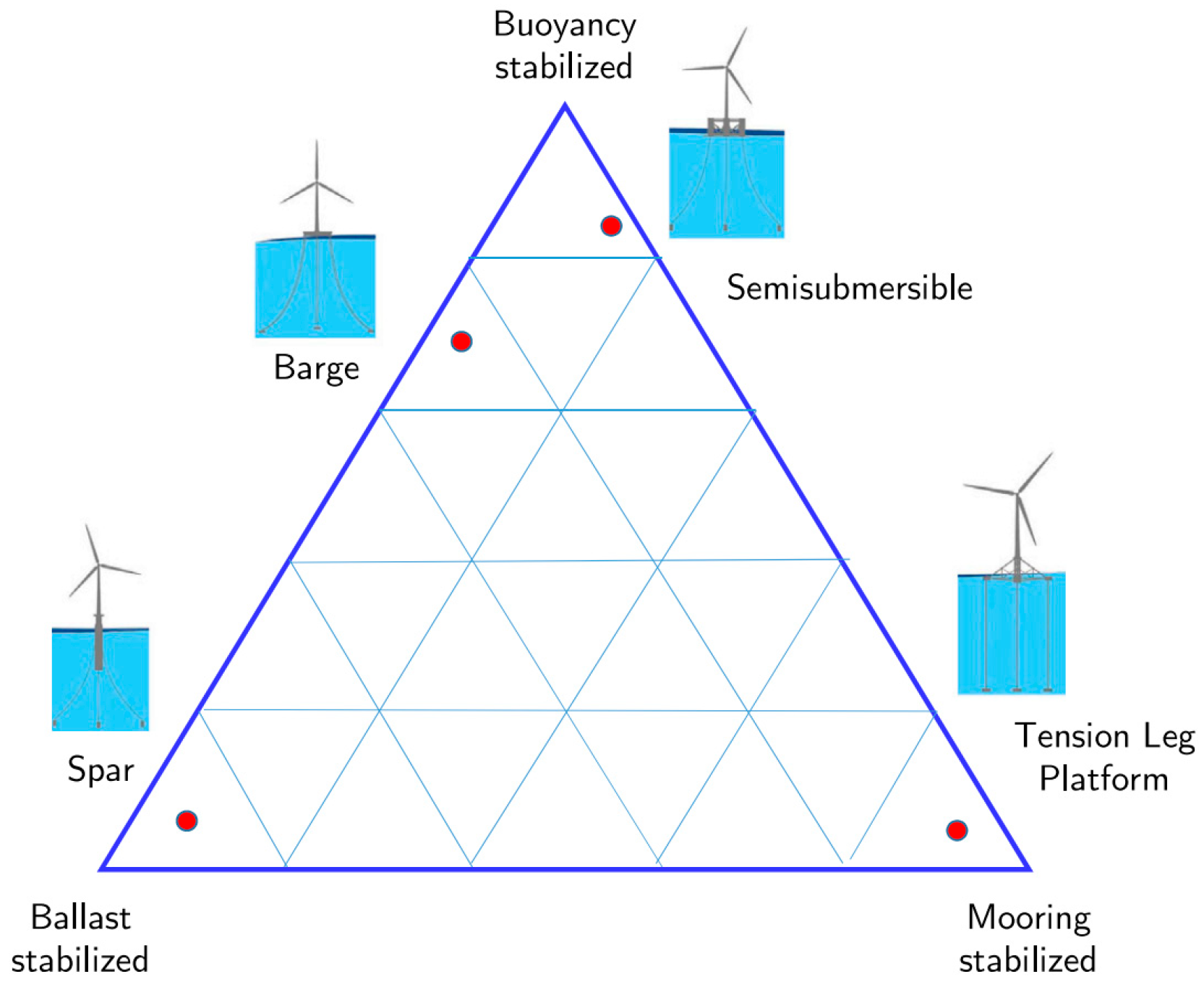
| Types | Projects’ Name | Development Company | Country | Site | Time |
|---|---|---|---|---|---|
| Ballast stabilized | Hywind [15] | Equinor | Norway | Southwest coast | 2009 |
| SeaTwirl [16] | SeaTwirl Engineering | Sweden | Lysekil | 2011 | |
| Advanced Spar [17] | Japan Marine United | Japan | Fukushima | 2013 | |
| Windcrete [18] | U.P. Catalunya | Spain | - | 2016 | |
| Hywind Tampen [19] | Equinor | Norway | North Sea | 2022 | |
| Mooring stabilized | Blue H TLP [20] | Blue H Technologies | The Netherlands | Adriatic Sea | 2008 |
| PelaStar [21] | Glosten Associates | USA | - | 2013 | |
| Gicon-SOF [22] | GICON | Germany | - | 2015 | |
| Provence Grand Large (PGL) [23] | SBM Offshore | France | Mediterranean Sea | 2023 | |
| Buoyancy stabilized | WindFloat [24] | Principle Power | Portugal | Aguçadoura coast | 2020 |
| Compact Semi-Sub [25] | Mitusui Engineering | Japan | Fukushima | 2013 | |
| Floatgen [26] | BW Ideol | France | Le Croisic | 2015 | |
| V-Shape Semi-Sub [27] | Mitsubishi Heavy Industries | Japan | Fukushima | 2015 | |
| Three Gorges Lead [28] | Three Gorges | China | Yangjiang | 2021 | |
| FuYao [29] | CSSC Haizhuang | China | Wailuo | 2022 | |
| Guanlan [30] | CNOOC | China | Wenchang | 2023 | |
| OceanX [31] | Mingyang Smart Energy | China | Yangjiang | 2024 |
| Method | Basic Principle | Applicable Scenario | Advantages | Limitations |
|---|---|---|---|---|
| BEM | Combines blade element theory with momentum theory | Routine design and loads assessment | High computational efficiency; suitable for optimization | Relies on empirical corrections; struggles with highly unsteady conditions during large platform motions |
| FVM | Vortex filaments in a Lagrangian framework | Unsteady aerodynamic analysis, aeroelastic response under wave-induced motions | Good balance of accuracy and cost; effectively captures unsteady aerodynamic loads | Numeric instability during large platform motions; modeling viscosity and geometries can be limited |
| CFD | Numerical solution of the N-S equations | High-fidelity research, benchmark validation | Detailed pressure/velocity fields; highest physical fidelity; suitable for large platform motions conditions | High computational expense; high grid resolution for boundary layers |
| Method | Basic Principle | Applicable Scenario | Advantages | Limitations |
|---|---|---|---|---|
| Potential Flow Theory | Solves the Laplace equation with boundary conditions | Large-scale structures; preliminary design stage (D/L > 0.2) | High computational efficiency; suitable for optimization | Neglects fluid viscosity; requires correction for viscous effects |
| Morison’s Equation | Semi-empirical formula (inertia force + drag force) | Slender/small-scale members (D/L < 0.2) | Simple formulation; high computational efficiency | Relies on empirical coefficients; not suitable for large-scale structures |
| CFD Method | Numerical solution of the N-S equations | Complex flows; detailed analysis | High accuracy; captures complex flow phenomena | High computational cost; time-consuming |
| Models | Computational Efficiency | Computational Accuracy | Primary Advantages | Applicable Scenarios |
|---|---|---|---|---|
| Single Rigid Body Model | ★★★★ | ★ | Simple modeling, high computational efficiency | Conceptual design, preliminary screening |
| Multi-Rigid Body Model | ★★★ | ★★ | Considers component coupling, high efficiency | Scheme optimization |
| Rigid–Flexible Coupling Model | ★★ | ★★★ | Balances accuracy and efficiency; mainstream method | Detailed design, control optimization |
| Hydroelastic Model | ★ | ★★★★ | Accurate fluid–structure interaction, wet-modal analysis | Hydroelastic response, FSI analysis |
| Methods | Basic Concept | Advantages | Limitations | Applications |
|---|---|---|---|---|
| Catenary Equation | Based on catenary theory, ignoring inertial and damping effects | High computational efficiency, simple formulation | Unable to capture dynamic effects | Conceptual design, initial screening |
| Lumped Mass Method | Discrete mass-spring model considering nonlinear effects | Accounts for dynamic mooring effects | Cannot consider torsional stiffness | Detailed design, extreme condition, and fatigue analysis |
| Finite Element Method | Continuum mechanics approach accurately describing deformations and stresses | Highest theoretical accuracy, detailed stress distribution analysis | High computational cost, poor convergence | Refined strength assessment, local stress analysis |
| Method | Basic Principle | Accuracy | Efficiency | Scenario |
|---|---|---|---|---|
| Fully Coupled | Solves loads and dynamics jointly in each time step via time integration. | High; suitable for nonlinear loads and control behavior. | Relatively low, depends on the flow-field solver. | Detailed design stage. |
| Semi-Coupled | Allows separate solving of loads; uses load time history or simplified models. | Acceptable for engineering (may need iterations). | Fits engineering workflow needs. | Common commercial collaborations |
| Frequency domain | Based on linear superposition; solves in the frequency-domain. | Captures main characteristics but misses nonlinear behavior. | Fast solution speed. | Preliminary design |
| Code Name | Aerodynamics | Structural Dynamics | Hydrodynamics | Mooring Model | Controller Model | References |
|---|---|---|---|---|---|---|
| FAST | (BEM or GDW) + DS + DI | T: Mod/MBS P: Rigid | PF + QD + MD | QS/FE/Dyn | DLL or UD or SM | Jonkman, et al. [148] |
| FAST + CHARM3D | (BEM or GDW) + DS | T: Mod/MB P: Rigid | PF + ME + MD + NA + IP + IW | FE/Dyn | DLL or UD | Shim and Kim [167] |
| F2A (FAST + AQWA) | (BEM or GDW) + DS | T: Mod/MB P: Rigid | PF + ME | QS/Dyn | DLL or UD | Yang, et al. [169] |
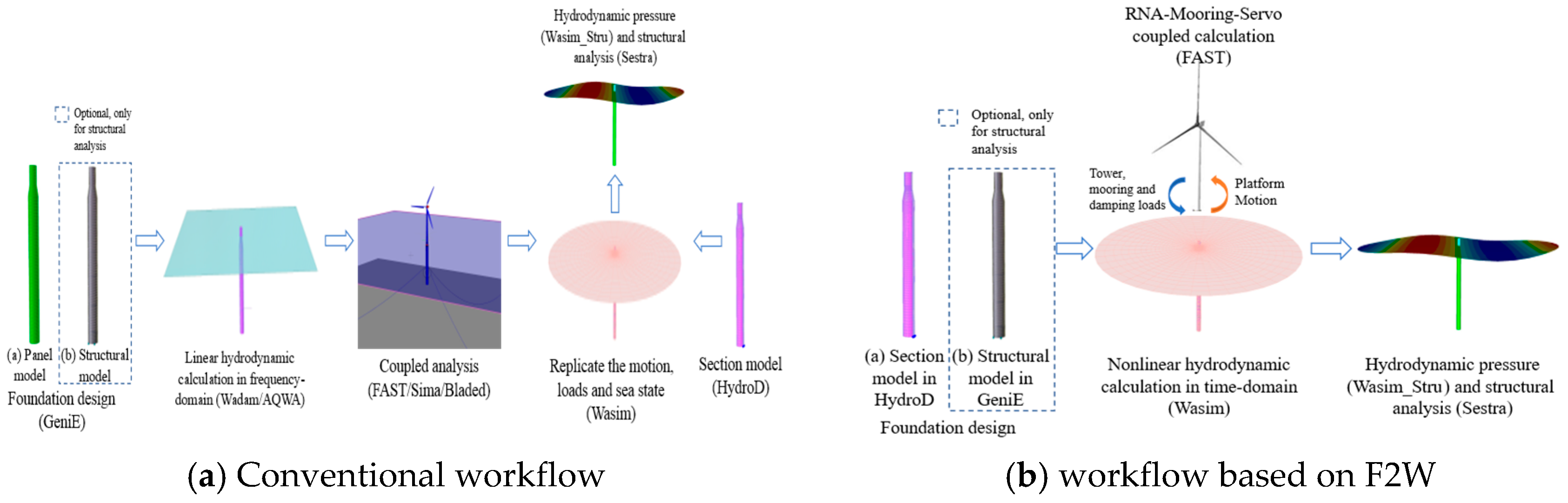
| F2W (FAST + WAMIT) | (BEM or GDW) + DS | T: Mod/MB P: Rigid | TF + ME + MD + IP + IW | QS/Dyn | DLL or UD | Chen, et al. [83] |
| BLADED | (BEM or GDW) + DS | T: Mod/MB P: MB | ME + IP + IW | QS | DLL | Hassan [162] |
| QBlade | BEM + FVM | T: Mod/MB P: MB | PF + QD + MD | QS/Dyn | DLL | Perez-Becker et al. [166] |
| SIMA (SIMO/RIFLEX) | BEM + DS + DI | T: FE P: Rigid | PF + ME | FEM | DLL or UD | Chen et al. [158] |
| OrcaFlex | BEM, GDW, or FDT | T: FE P: Rigid | PF + ME | LM/Dyn | UD | Thomsen et al. [159] |
| HAWC2 | (BEM or GDW) + DS | T: MB/FE P: MB/FE | ME | FE/Dyn | DLL or UD | Larsen and Hansen [163] |
| 3Dfloat | BEM + FDT | T: FE P: FE | ME + (IW) | FE/Dyn | DLL or UD | Nygaard et al. [160] |
| DeepLinesWT | BEM | T: FE P: FE | PF + ME + (IW) | FE/Dyn | DLL | Papi et al. [165] |
| SIMPACK + HydroDyn | BEM or GDW | T: Mod/MB P: Rigid | PF + QD | QS | DLL | Matha et al. [168] |
| SAToe | BEM | T: Mod/MB P: Rigid | PF + ME + MD + NA + QD | QS/Dyn | UD | Chen et al. [164] |
| Structural Dynamics: • T = Turbine • P = Platform • W = Water • Mod = Modal • MB = Multi-Body • FE = Finite Element •N/A = Not Applicable | Aerodynamics: • BEM = Blade-Element/Momentum • GDW = Generalized Dynamic Wake • DS = Dynamic Stall • FDT = Filtered Dynamic Thrust • FWV = Free-Wake Vortex | Hydrodynamics: • PF = Potential Flow theory • ME = Morison Equation • MD = Mean Drift • NA = Newman’s Approximation • IP = Instantaneous Position • IW = Instantaneous Water Level • QD = Quadratic Drag | Mooring Model: • QS = Quasi-static • Dyn = Dynamic • LM = Lumped Mass • FE = Finite Element | |||
| Project | Time | Primary Objectives | Key Technical Focus |
|---|---|---|---|
| OC3 | 2007–2010 | Establish benchmark for coupled simulation tools of FOWTs, focusing on spar-type platforms. | Used Hywind Spar (5 MW turbine) to validate aero-hydro-servo-elastic coupling models. |
| OC4 | 2014–2017 | Validate semi-submersible platform modeling tools through code-to-code comparisons. | Adopted OC4-DeepCwind semi-sub design (5 MW turbine); compared Morison equation vs. potential flow theory. |
| OC5 | 2017–2020 | Validate simulation tools against physical test data (1:50 scale model). | Conducted decay/wave tests to separate wave excitation/radiation forces, quantifying viscous drag errors. |
| OC6 | 2019–2023 (phased) | Three-way validation: high-fidelity tools (CFD), engineering tools, and experimental data. | Introduced the TetraSpar platform (1:43 scale) and analyzed nonlinear hydrodynamics/wake effects. |
| OC7 | 2024–2027 (ongoing) | Improve hydrodynamic load predictions for large-scale FOWTs (10 MW+) and reduce LCOE to €40–60/MWh. | Focuses on viscous drag tuning, structural flexibility, and farm-scale wake modeling. |
Disclaimer/Publisher’s Note: The statements, opinions and data contained in all publications are solely those of the individual author(s) and contributor(s) and not of MDPI and/or the editor(s). MDPI and/or the editor(s) disclaim responsibility for any injury to people or property resulting from any ideas, methods, instructions or products referred to in the content. |
© 2025 by the author. Licensee MDPI, Basel, Switzerland. This article is an open access article distributed under the terms and conditions of the Creative Commons Attribution (CC BY) license.
Share and Cite
Chen, J. Review of Coupled Dynamic Modeling Methods for Floating Offshore Wind Turbines. Energies 2026, 19, 205. https://doi.org/10.3390/en19010205
Chen J. Review of Coupled Dynamic Modeling Methods for Floating Offshore Wind Turbines. Energies. 2026; 19(1):205. https://doi.org/10.3390/en19010205
Chicago/Turabian StyleChen, Jiahao. 2026. "Review of Coupled Dynamic Modeling Methods for Floating Offshore Wind Turbines" Energies 19, no. 1: 205. https://doi.org/10.3390/en19010205
APA StyleChen, J. (2026). Review of Coupled Dynamic Modeling Methods for Floating Offshore Wind Turbines. Energies, 19(1), 205. https://doi.org/10.3390/en19010205