Article

Optimization of Isolated Microgrid Sizing Considering the Trade-Off Between Costs and Power Supply Reliability


by
Caison Ramos
1,*,
Gustavo Marchesan
1,
Ghendy Cardoso, Jr.
1,
Igor Dal Forno
1,
Tiago Pitol Mroginski
1,
Olinto Araújo
2,
Welisson Costa
3,
Rodrigo Gadelha
3,
Vitor Batista
3,
André P. Leão
3,
João Paulo Vieira
3,
Eduardo de Campos
4,
Caio Barroso
4 and
Mariana Resener
5
1
Laboratório de Análise e Proteção de Sistemas Elétricos (LAPES), Centro de Excelência em Energia e Sistemas de Potência (CEESP), Programa de Pós-Graduação em Energia Elétrica (PPGEE-UFSM), Universidade Federal de Santa Maria (UFSM), Santa Maria 97105-900, RS, Brazil
2
Colégio Técnico Industrial de Santa Maria (CTISM), Universidade Federal de Santa Maria (UFSM), Santa Maria 97105-900, RS, Brazil
3
Grupo de Sistemas de Energia Elétrica e Inovação (GSEI), Programa de Pós-Graduação em Engenharia Elétrica (PPGEE), Universidade Federal do Pará (UFPA), Belém 66075-110, PA, Brazil
4
Norte Energia S.A. (NESA), Brasília 70390-025, DF, Brazil
5
Faculty of Applied Sciences, Simon Fraser University (SFU), Surrey, BC V3T 0N1, Canada
*
Author to whom correspondence should be addressed.
Energies 2026, 19(1), 195; https://doi.org/10.3390/en19010195 (registering DOI)
Submission received: 8 October 2025 / Revised: 19 November 2025 / Accepted: 1 December 2025 / Published: 30 December 2025
(This article belongs to the Section F1: Electrical Power System)

Abstract

Isolated microgrids with green hydrogen storage offer a promising solution for supplying electricity to remote communities where conventional grid expansion is infeasible. Designing such systems requires balancing two conflicting objectives: minimizing installation and operation costs while maximizing supply reliability. This paper proposes a multi-objective optimization methodology, based on the Non-dominated Sorting Genetic Algorithm II, to determine the optimal sizing of multiple microgrid components. This sizing explicitly addresses both the power capacities (kW) (for photovoltaic panels, wind turbines, electrolyzers, and fuel cells) and the energy storage capacities (kWh and kg) (for batteries and hydrogen tanks, respectively), aiming to generate Pareto-optimal solutions that explore this trade-off. The proposed method evaluates the trade-off by minimizing two objectives: the Net Present Value, which includes investment, replacement, and maintenance costs, and the total expected interruption hours, derived from an hourly energy balance analysis. The methodology’s effectiveness is validated using four distinct case studies. Three of these are based on real locations with specific load profiles and climate data. To test the method’s robustness, a fourth case study uses a fictitious load profile, designed with pronounced seasonal variations and a clear distinction between weekday and weekend consumption. Our results demonstrate the method’s ability to identify efficient hybrid renewable topologies combining photovoltaic and/or wind generation, batteries, and hydrogen systems (electrolyzer, storage tank, and fuel cell). The obtained cost–reliability curves provide practical decision-support tools for system planners.

1. Introduction

The electrification of remote communities presents a global challenge, necessitating solutions that effectively integrate economic, social, and environmental aspects [1]. In this scenario, isolated microgrids emerge as an efficient alternative for ensuring energy access [2]. The architecture of isolated microgrids, which combines various generation units and storage systems, optimizes energy use and mitigates the challenges intrinsic to the intermittency of renewable sources and the impacts of extreme events, thereby enhancing the resilience of the energy supply [3].
In practice, realizing these potentials faces significant hurdles, particularly the widespread dependence on diesel generation. The Amazon region is a prime example, where many isolated communities still rely on this model. This approach imposes high operational costs due to fuel logistics and causes significant environmental impacts [4].
Within the spectrum of storage technologies, while batteries (BESS) are effective for short-term balancing, they face limitations for prolonged storage due to self-discharge and high capacity cost. Green hydrogen (GH2), in contrast, has gained prominence as a strategic solution for energy security in isolated microgrids [5]. The significant advantage of GH2 is its capacity for long-term energy storage, allowing excess renewable energy to be stored efficiently for use in periods of low resource availability. This ability to ensure reliability across seasons, and combined with a total absence of polluting emissions, is the primary justification for its use despite high investment costs [6].
The viability of green hydrogen-based microgrids, especially in communities with limited resources, lies in minimizing investment and operational costs. However, this pursuit of economic efficiency cannot compromise energy security, which translates into ensuring a continuous and reliable energy supply [7]. In isolated environments, where connection to the conventional electrical grid is impractical, supply interruptions can lead to severe consequences, ranging from the shutdown of essential services and economic activities and production losses to a substantial deterioration in the quality of life for inhabitants [8].
The literature has addressed the optimal sizing of microgrids from various perspectives. In ref. [9], for example, a methodology is proposed for the optimal sizing of isolated direct current (DC) microgrids, employing multi-objective optimization to minimize carbon emissions and the cost of photovoltaic (PV) and battery systems. However, the limitation of this approach lies in its restricted technological scope, focusing exclusively on PV and battery energy storage systems (BESS), without exploring the complexity of integrating hydrogen-based systems. In this context, the inclusion of electrolysis, storage tanks, and fuel cells adds new modeling and operational challenges, especially as the fuel cell and electrolyzer undergo deterioration over their hours of use, requiring sizing strategies that prioritize the minimization of their operational hours.
Similarly, ref. [10] establishes a multi-objective optimization model that integrates battery degradation, cost, and carbon emissions. While it is a relevant study, its main limitation relative to the present paper is the lack of specification or in-depth analysis of green hydrogen technology as the microgrid’s foundation. Additionally, the minimization of emissions can be considered a secondary objective in the present context, since the use of green hydrogen, by its nature, already implies a low or zero-emission solution.
Another relevant paper, ref. [11], proposes a single-objective methodology for the sizing and management of isolated microgrids with hydrogen storage, integrating PV, wind, a fuel cell, an electrolyzer, and an H2 tank. The paper’s objective is to minimize the Levelized Cost of Energy (LCOE), an indicator representing the average cost per unit of electricity over the system’s entire lifecycle, while also ensuring supply reliability, quantified by the Loss of Power Supply Probability (LPSP), and managing surplus generation. Although it focuses on hydrogen and reliability, this study is limited to a single-objective analysis with an emphasis on handling surplus energy.
To contextualize the present study, a detailed literature review was conducted. Table 1 and Table 2 summarize key papers (2016–2024) addressing the optimal sizing of microgrids. This summary details the system components, grid connection type, optimization algorithms, and primary objectives used in the literature. This review highlights two primary research gaps. First, the literature is dominated by single-objective approaches, which focus almost exclusively on minimizing cost (LCOE or NPV) and treat reliability as a simple constraint. Second, many studies rely on commercial software tools, which, while effective, limit modeling flexibility and do not natively support multi-objective optimization to generate a full Pareto front.
The following abbreviations are used in the tables: PV (Photovoltaic), WT (Wind Turbine), BESS (Battery Energy Storage System), FC (Fuel Cell), H2 Tank (Hydrogen Tank), ELE (Electrolyzer), GA (Genetic Algorithm), MILP (Mixed-Integer Linear Programming), WOA (Whale Optimization Algorithm), MFO (Moth–Flame Optimizer), PSO (Particle Swarm Optimization), TA-MaEA (Two-Archive Many-objective Evolutionary Algorithm), DE (Differential Evolution), SOS (Symbiotic Organisms Search), BFE (Stochastic Fractal Search), GPOA (Gradient Pelican Optimization Algorithm), and HS (Harmonic Search).
This paper addresses these gaps by proposing a new methodology, the Cost-Supply Interruption Trade-off Method (CSITM), a native multi-objective optimization framework for sizing isolated microgrids with green hydrogen storage. The main contributions of this work are (1) the development of the CSITM, which effectively integrates an 8760-hour energy balance simulation within the NSGA-II algorithm to minimize total life-cycle cost (NPV) and interruption hours; (2) the generation of practical Pareto-optimal fronts that serve as decision-support tools, allowing planners to quantify the exact ‘price of reliability’; and (3) a robust demonstration of the method’s applicability to realistic planning scenarios, including a new fictitious case study with high seasonality, an analysis of long-term load growth, and a sensitivity analysis on key hydrogen technology costs. The remainder of this paper is organized as follows. Section 2 details the proposed methodology, including the simulation models and the optimization framework. Section 3 presents the case studies used to evaluate the methodology. Section 4 presents and discusses the results of these new, expanded analyses. Finally, Section 5 provides the final conclusions of the paper.

2. Cost-Supply Interruption Trade-Off Method

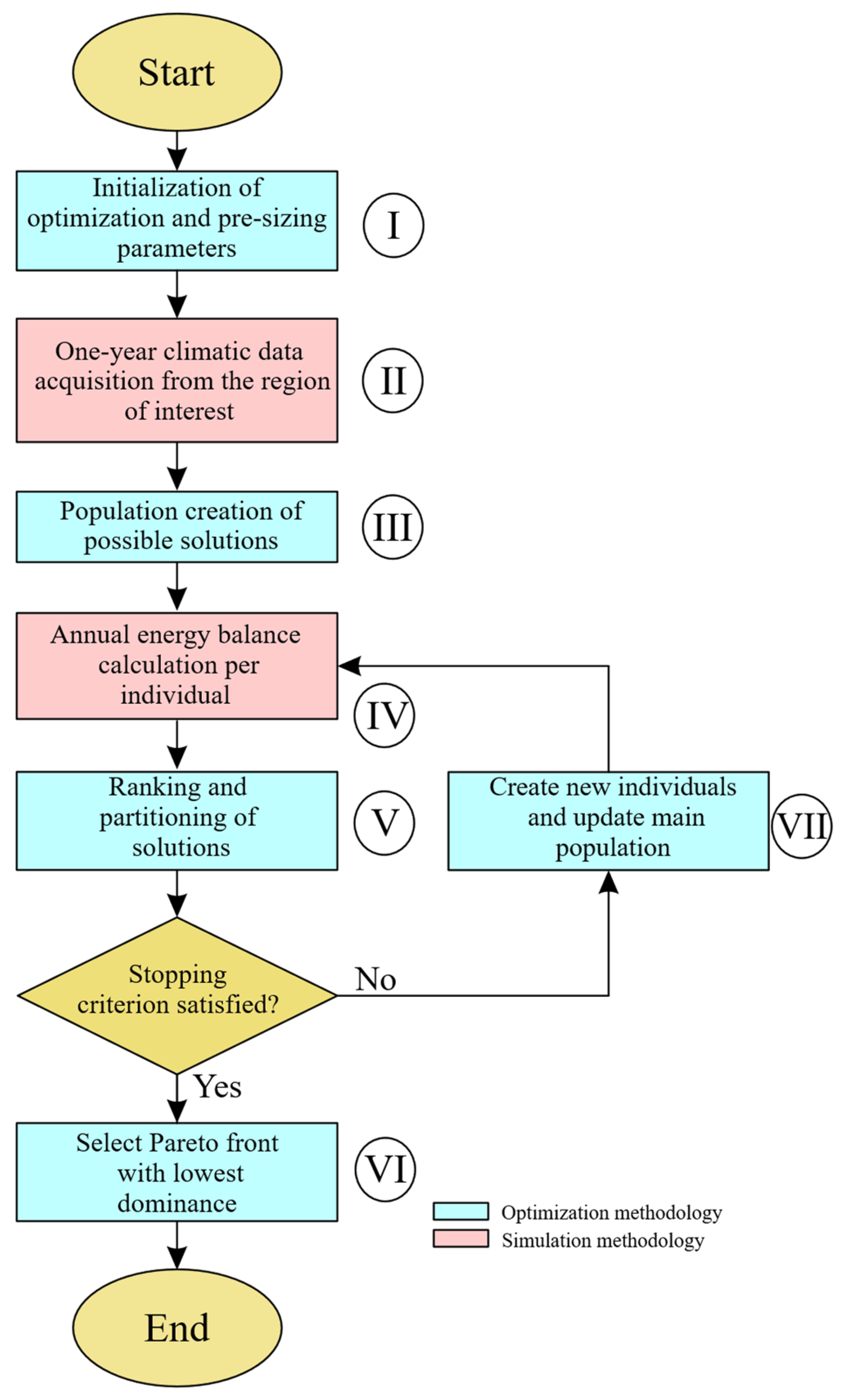
This section presents the methodology for the Cost–Supply Interruption Trade-off Method (CSITM). The optimization approach, illustrated by the flowchart in Figure 1, utilizes the NSGA-II algorithm to solve the multi-objective optimization problem. The target system for this study is an isolated microgrid whose topology integrates diverse generation and storage sources: a photovoltaic (PV) system, a wind turbine, a battery energy storage system (BESS), and a hydrogen storage cycle.
The process begins with the configuration of initial parameters, as outlined in Block I. This stage involves defining the decision variables, such as the minimum and maximum sizing limits for the system components, and establishing the algorithm’s hyperparameters, including population size, the maximum number of generations, and the crossover and mutation probabilities.
The second stage, represented by Block II, comprises the acquisition of hourly time-series data of climatic variables, such as solar irradiance, temperature, and wind speed, for a one-year period. This data is necessary for calculating approximate power outputs. Based on pre-defined limits, an initial population of N individuals is created in Block III, where each one represents a candidate solution that describes a complete system configuration.
Each proposed solution is evaluated through an energy balance simulation with hourly resolution in Block IV. This simulation analyzes the system’s performance over a year, comparing, hour by hour, the available power in the microgrid with the load’s demand. During the analysis, the state of charge of the storage systems and their charge and discharge operations are monitored, allowing for the identification of any moments of power deficit.
From the results, in Block V, the two objective functions of the problem are quantified: the system’s total cost (comprising capital, operational, and maintenance expenses) and the total hours of interruption. The cost is calculated based on the nominal power of the equipment and its projected utilization throughout its lifespan. The hours of interruption are the sum of the hours during which a power deficit occurred.
After this initial evaluation, the algorithm enters its main evolutionary cycle. The population is ranked using the non-dominated sorting method, segregating it into Pareto fronts, and the crowding distance is calculated. In each generation, the stopping criterion is checked, which in the present methodology corresponds to the maximum number of iterations. When this criterion is met, in Block VI, the process is terminated, and the Pareto front with the lowest degree of dominance is returned as the result.
Otherwise, in Block VII, the algorithm proceeds with the creation of a new offspring population through selection, crossover, and mutation. This is combined with the main population, and the N best individuals from this union, chosen based on ranking and elitism, form the population for the next generation. This cycle then returns to the fitness evaluation stage, repeating until the stopping condition is met.
In summary, the methodology is divided into two main groups: a simulation methodology, which defines the microgrid architecture used for sizing and the dispatch management strategies; and an optimization methodology, which defines the problem’s objectives and constraints.

2.1. Simulation Methodology—Isolated Microgrid Topology and Microgrid Management

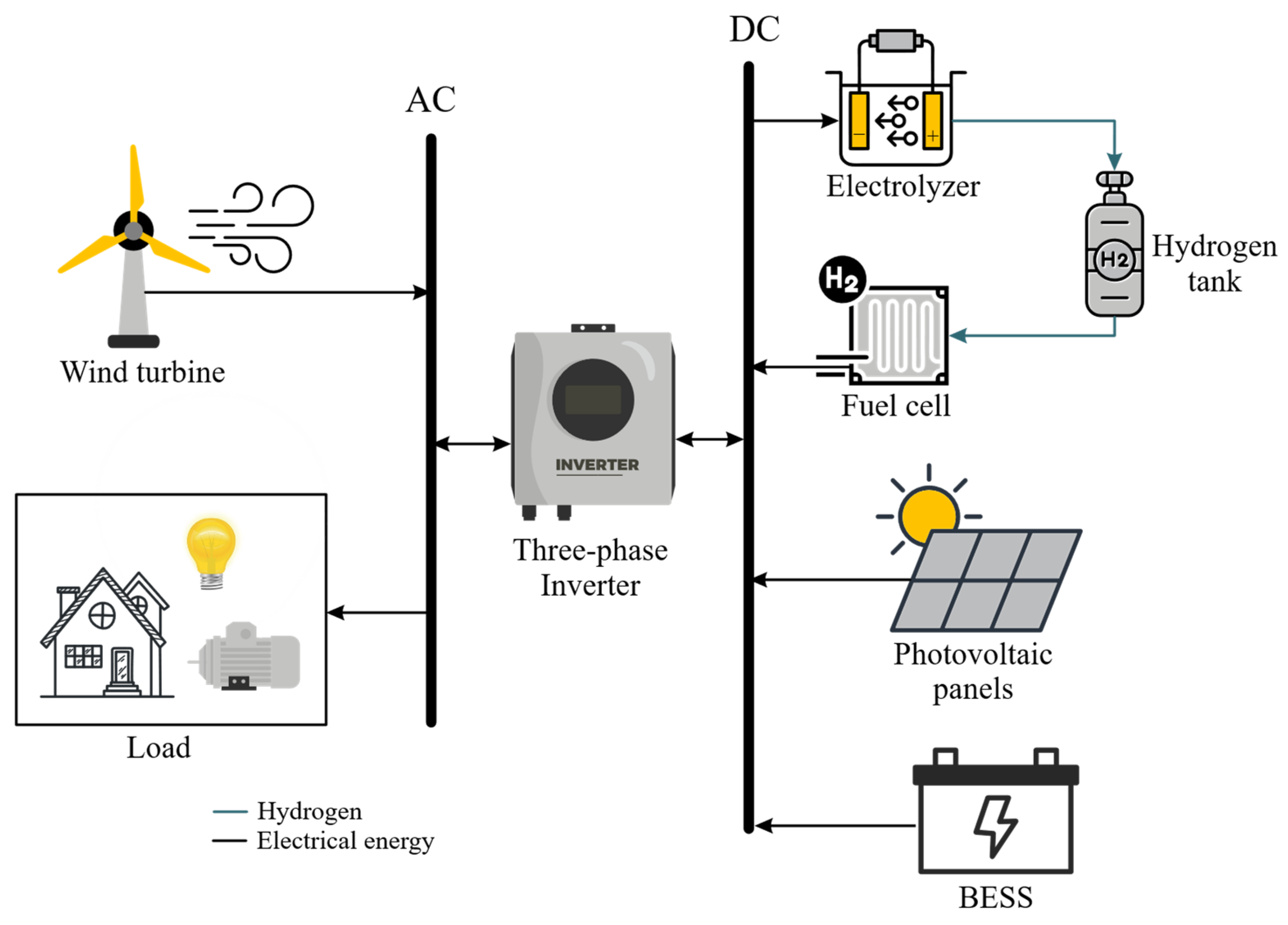
The target system of this study is a hybrid microgrid designed for isolated operation, ensuring energy security through a diversified generation and storage topology. As illustrated in the architecture of Figure 2, the system integrates a photovoltaic array, a wind turbine, a battery energy storage system (BESS), and a hydrogen-based storage cycle.
The electrical infrastructure is organized around two main buses: a direct current (DC) bus, which centralizes the dispatchable generation and storage sources (photovoltaic array, BESS, and hydrogen system), and an alternating current (AC) bus, which couples the wind turbine and the consumer loads. The interconnection between these buses is handled by a three-phase bidirectional inverter, which manages the power flow.
The adopted energy management strategy hierarchically prioritizes the uninterrupted supply to the load. At each step, the dispatch logic assesses whether the combined power from intermittent renewable sources (wind and photovoltaic) is sufficient to meet the demand. In cases of a generation deficit, the system sequentially draws upon its storage assets: first, the BESS is activated to supplement the necessary power. If the demand is still not met, the hydrogen system’s fuel cell is activated to ensure supply.
In surplus scenarios, where renewable generation exceeds consumption, the excess energy is directed to the storage systems. The priority is to recharge the BESS, owing to its higher cycle efficiency. Once the batteries reach their maximum capacity, the remaining energy surplus is then allocated to hydrogen production via electrolysis, storing energy for long-term use. It is crucial to highlight an operational constraint of the hydrogen system: it operates unidirectionally, meaning that the energy supplied by the fuel cell is used exclusively to power the loads and cannot be routed back to the electrolyzer.

2.2. Optimization Methodology—NSGA-II

Non-dominated Sorting Genetic Algorithm II (NSGA-II), one of the most popular algorithms for optimization, is classified as a metaheuristic multi-objective genetic algorithm and is commonly applied to solve problems with conflicting objectives [38]. Unlike single-objective optimization problems, where the goal is to find an optimal solution with respect to a single objective function, in multi-objective problems the focus is on identifying a set of Pareto-optimal (non-dominated) solutions.
Initially proposed in [39], it is based on the use of a non-dominated sorting mechanism and a niche-sharing operator and the crowding distance metric. Crowding distance is a measure used to preserve diversity in the population. The strengths of NSGA-II include its computational efficiency and its ability to generate well-distributed solutions along the Pareto front.
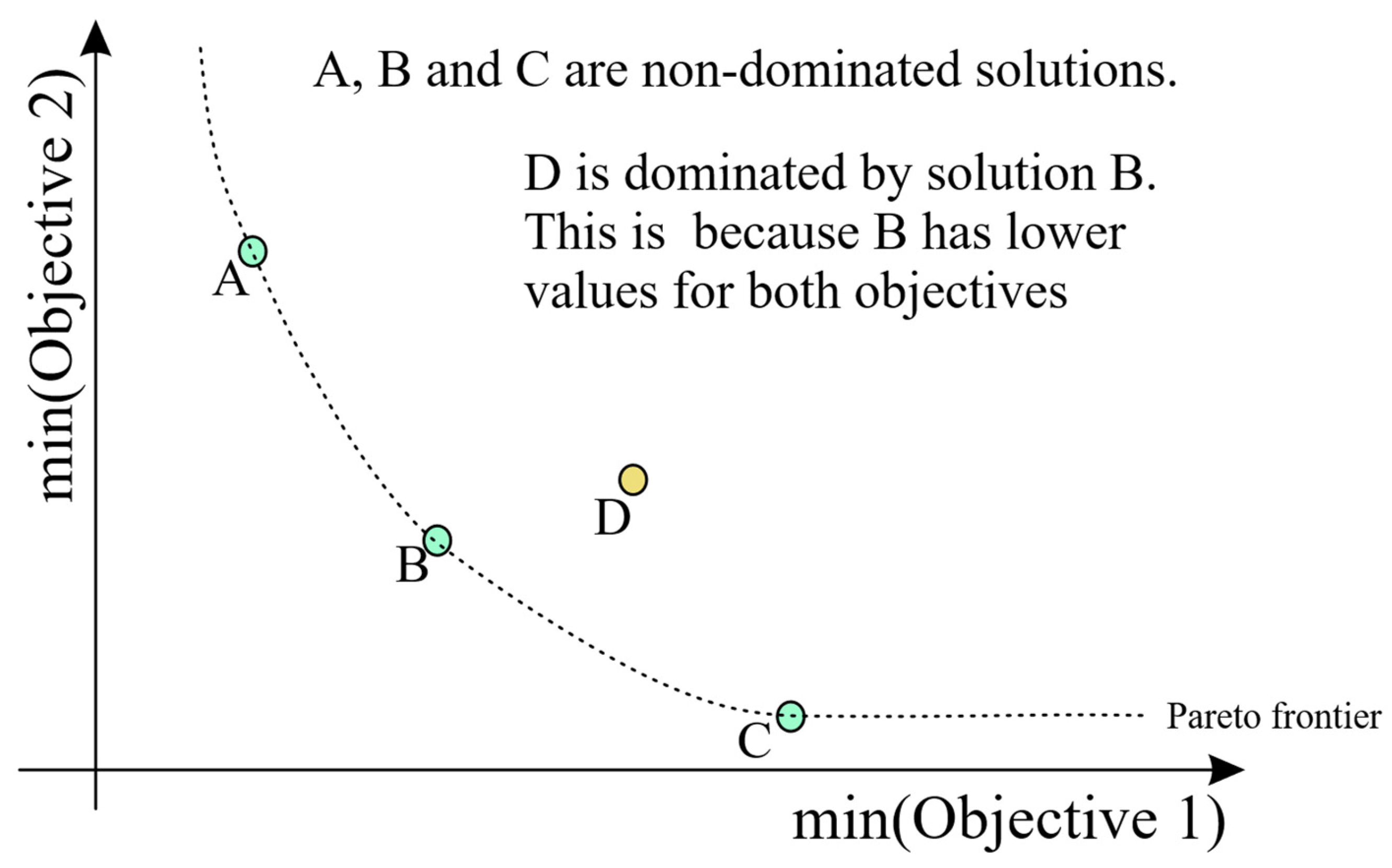
The non-dominated sorting of this method is performed based on the Pareto fronts and the distance between samples. Given a set of possible solutions, this algorithm classifies the set into several fronts according to the dominance of the solutions, as shown in Figure 3. Subsequently, the distances between the samples of the same front are calculated and ranked according to the greatest distance.
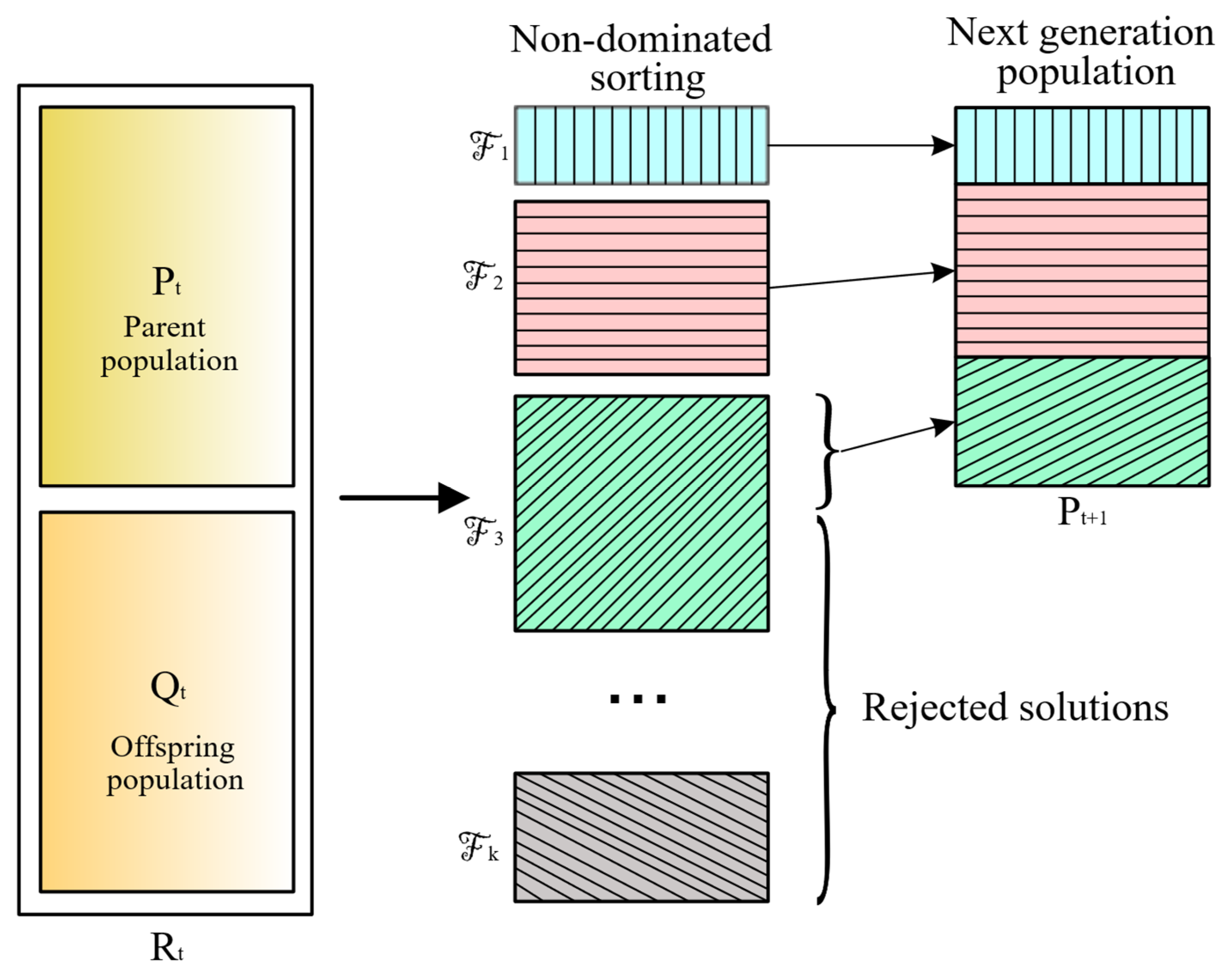
Figure 4 illustrates the sorting of a combined population Rt and the creation of the next generation’s population, Pt+1, by the NSGA-II. The set Rt is formed by combining the parent population Pt and the offspring population Qt. Qt, in turn, is created from crossover and mutation of the set Pt. In the first step, a ranking by dominance of the set Rt is performed. In the second step, Rt now sorted, is partitioned to form the new population Pt+1.
Crowding distance is used in the NSGA-II algorithm with the objective of promoting a better spread of solutions along the Pareto frontier. This prevents the excessive concentration of solutions in a single point or region, ensuring a more balanced distribution of results. Furthermore, the distance is employed as a ranking criterion for individuals within the same front [40].
This metric quantifies the relative distance between each solution and its nearest neighbors. For each objective, the algorithm calculates the normalized distance between the two neighboring solutions, i − 1 and i + 1. The crowding distance for solution i is the sum of these normalized distances across all objectives. Based on this central point, the diversity operator identifies the extremes and prioritizes those individuals that are farther apart during the selection process. This aims to disperse the results along the Pareto front and guarantee a better exploration of the solution space. Equation (1) demonstrates the calculation of the crowding distance for a problem with two objective functions, f(x) and g(x).
c d ( x i ) =   f x i 1 f ( x i + 1 ) max f X m i n ( f X ) + g x i 1 g ( x i + 1 ) max g X m i n ( g X )

2.3. Optimization Methodology—Objective Functions

The objectives of the method are to obtain microgrids with the lowest cost and a high index of energy security. Based on this, the metrics of Net Present Value (NPV) of the isolated microgrid’s cost and the possible hours of interruption are used, respectively.

2.3.1. Microgrid Cost

The microgrid cost analysis is quantified by the NPV, which aggregates all projected costs over the system’s useful life into a single present-day value. According to Equation (2), the NPV is composed of the sum of three cost components: the initial investment ( I n v ), maintenance costs ( O & M ) and replacement costs ( R e p ).
Future O&M and R e p costs are brought to the present using a discount rate ( i r ). This rate represents the time value of money, incorporating factors such as expected inflation and the opportunity cost of capital.
The starting point for this calculation is the Initial Investment Cost, detailed in Equation (3). It is determined dynamically for each evaluated system configuration and results from the sum of the nominal capacity of each piece of equipment multiplied by its unit cost ( C i ) per kW, kWh or kg.
min f =   k = 1 6 I n v k +   i = 1 l t 1 1 + i r i t = 1 t m a x O & M k , i , t + R e p k , i , t
I n v k = S k C i k                                 x   { 1,2 , 3,4 , 5,6 }
where:
  • k : equipment index (1 for photovoltaic panels, 2 for wind turbines, 3 for batteries, 4 for hydrogen tank, 5 for electrolyzer, and 6 for fuel cells).
  • i : years of microgrid use.
  • l t : useful life of the microgrid.
  • t : instant of analysis of the energy balance in hours.
  • t max : total hours of the annual energy balance (8760 h)
  • S : nominal capacity of the equipment with index k that constitutes the microgrid.
The annual operation and maintenance cost ( O & M ) is generally calculated from a unit cost and a binary variable for equipment use ( B k ), as demonstrated in Equation (4). In the cases of wind turbines and the hydrogen tank, represented by Equation (5), costs associated with the equipment’s capacity are budgeted. As for the operation and maintenance costs of fuel cells, equivalent to Equation (6), in addition to the association with capacity, it is also associated with their hours of use.
O & M k = C o m k   B k
O & M k = C o m k   B k S k
O & M k , i = C o m k B k S k U F C i
The replacement cost ( R e p ) is calculated from a unit replacement value multiplied by the nominal capacity of the equipment and the number of times each piece of equipment needs to be replaced during the microgrid’s useful life.
R e p k , i , t = C r k S k V i

2.3.2. Interruption Hours

The second objective function considered in the model corresponds to the probable hours of energy supply interruption (IT), represented by Equation (8). This metric is evaluated individually for each solution (or individual) in the population throughout the optimization process, being directly derived from the microgrid’s hourly energy balance.
The calculation is performed as follows: in each time interval (hour), it is verified if the sum of the generated, stored, and available power in the battery and the power that can be supplied by the fuel cell is less than the power demanded by the load. Whenever this condition is met, one hour of interruption is counted. This behavior is mathematically described by Equation (9).
min g = I T
I T =   t = 1 t m a x   1 ,   i f   P l o a d ( t ) > P a ( t ) 0 ,   i f   P l o a d t   P a ( t )       t      
where:
  • P load ( t ) : load power at instant t;
  • P a ( t ) : available generated and stored power.

2.4. Optimization Methodology—Constraints

The constraints can be divided into pre-sizing and capacity limitation, generation and storage, and power dispatch. The pre-sizing constraints, represented by Equation (10), are the constraints that define the search space and limit the minimum ( x k m i n ) and maximum ( x k m a x ) nominal capacities of each piece of equipment. In Equation (11), the power flows ( z k 1 , k 2 , t :  power flow from k 1  to k 2  at instant t) are limited so that they do not exceed the capacity of each piece of equipment.
S k m i n   S k S k m a x                       k
z k 1 , k 2 , t S k                         k
The generation and storage constraints are restrictions that limit the maximum generation and storage at a moment of analysis t. For photovoltaic and wind generation, simplified equations are used that determine generation from the climatic conditions at the moment of analysis. For photovoltaic generation, represented by Equation (12), power generation considers irradiance and temperature data, associated with the size of the panels and converter efficiency. The temperature coefficient of the module is also used for calculation. Considering wind generation, Equation (13) uses wind speed.
The storage constraints, defined by Equations (14) and (15), define the maximum permissible limits for the battery and hydrogen systems. The constraint of Equation (14) defines that the battery’s state of charge must remain between 20% and 100% of the battery capacity. Equation (15) defines that hydrogen must remain between 0% and 100% of the tank’s capacity.
x 1 , t η c o n v S 1 1 +   α ( T t T n )   I t I n                     t
x 2 , t =   0 ,         v t < v c i     v t   > v c o   n w S 2 v t 2 v c i 2 v n 2 v c i 2 ,         v c i v t < v n         η w S 2 ,               v n v t < v c o   t
0.2 S 3 S o C S 3
0 S o H S 4
where:
  • x k , t : available power of equipment k, at instant t;
  • η conv : converter efficiency;
  • α : temperature coefficient of a photovoltaic module;
  • T t : temperature at instant t;
  • T n : nominal temperature (25 °C);
  • I t : irradiance at instant t;
  • I n : nominal irradiance;
  • η w : wind turbine efficiency;
  • v t : wind speed at instant t;
  • v ci : cut-in wind speed of the wind turbine;
  • v co : cut-off wind speed of the wind turbine;
  • v n : nominal operating wind speed of the wind turbine.
The power dispatch constraints define the operation of the microgrid’s management system. Equations (16) and (17) establish that the energy generated by the photovoltaic and wind sources, respectively, can be directed to the batteries, the electrolyzer, and directly to the load. Equations (18) and (19) deal with power flows related to the battery and hydrogen. Equation (18) specifies that the battery, considering its state of charge in the previous instant, can supply energy to the load or receive energy from the photovoltaic and wind generators, in addition to being subject to self-discharge. Equation (19) defines that the hydrogen stored in the tank, based on the storage level of the previous period, can be used exclusively by the fuel cell (variable w 4,6 ) and is replenished from the energy supplied to the electrolyzer, according to a conversion constant C e l , which corresponds to the higher heating value of hydrogen divided by the electrolyzer’s efficiency.
The restriction expressed in Equation (20) establishes that the electrolyzer can only receive energy from photovoltaic and wind generation. Finally, Equation (21) determines that the power supplied by the fuel cell to the load is proportional to the amount of hydrogen received from the tank, adjusted by a conversion factor C H 2 , defined as the lower heating value of hydrogen multiplied by the fuel cell’s efficiency.
x 1 , t = z 1,3 , t + z 1,5 , t + z 1 , l o a d , t
x 2 , t = z 2,3 , t + z 2,5 , t + z 2 , l o a d , t
S o C t = S o C t 1 z 3 , l o a d s d + z 1,3 ,   t + z 2,3 ,   t
S o H t = S o H t 1 + C e l z 5,4 , t w 4,6
z 5,4 = z 1,5 , t + z 2,5 , t
z 6 , l o a d = w 4,6 C H 2

3. Case Studies

For carrying out the simulations, irradiance, temperature, and wind speed data were obtained from the Prediction Of Worldwide Energy Resources (POWER) platform of the National Aeronautics and Space Administration (NASA) [41]. The data pertains to the year 2020, with a one-year horizon and a one-hour interval.

3.1. Loads and Locations—Fictitious Microgrid

For this case study, a fictitious microgrid was modeled in a representative scenario with high potential for renewable energy: the city of Osório, on the coast of Rio Grande do Sul. The analysis uses a standard residential load profile and meteorological data for solar irradiance, temperature, and wind speed for the year 2020, for the location at latitude −29.9117° and longitude −50.2873°.
The choice of Osório is strategic, as the municipality is nationally known as the “Land of Good Winds,” hosting one of the largest wind farm complexes in Latin America. Its privileged geography, between the Serra do Mar and the Atlantic Ocean, ensures a wind regime of high consistency and intensity throughout the year, making the region a natural laboratory for studies on the integration of renewable sources.
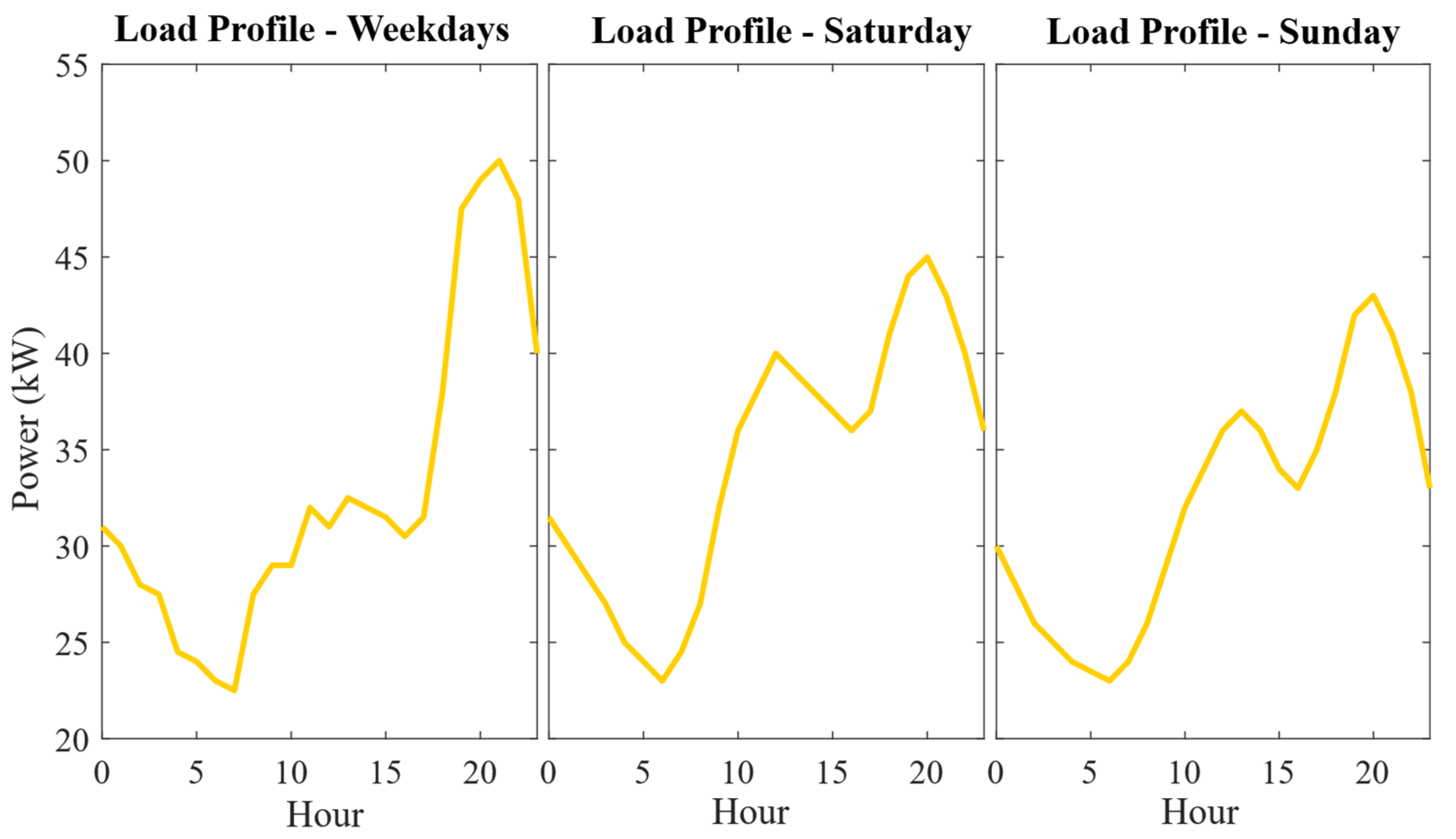
Figure 5 illustrates the hypothetical load profiles developed to represent the consumption of a hypothetical residential load, which forms the basis of the demand time series used in the simulations. To enhance the model’s fidelity, three archetypal daily profiles were created that distinguish consumption patterns between weekdays, Saturdays, and Sundays.
The weekday profile exhibits bimodal behavior, with an early-morning consumption trough of approximately 22.5 kW and a prominent evening demand peak that reaches 50 kW at 9 PM, reflecting the concentration of residential activities in this period. In contrast, the weekend profiles show higher demand during daytime hours and smaller evening peaks, reaching 45 kW on Saturday and 43 kW on Sunday.
To extend these daily profiles to an annual time series and incorporate consumption variations throughout the year, a seasonal model was applied, whose monthly gain factors are detailed in Table 3. This approach adjusts the magnitude of the base daily profiles to reflect the specific climatic and behavioral characteristics of the Southern Region of Brazil.
The methodology captures the region’s characteristic annual bimodal consumption pattern, highlighting a primary consumption peak in winter (with a 1.20 multiplier factor in July, driven by heating loads) and a secondary peak in summer (with a 1.15 factor in January, associated with cooling loads). The periods of lower consumption occur in the shoulder seasons, such as autumn, which registers the lowest gain factor of 0.90 in May. The synthesis of the three distinct daily profiles with the seasonal gain factors thus results in an annual load time series (8760 h) that serves as input data for the simulations in this case study. It is important to emphasize that, although Figure 5 depicts a 24-hour timescale for illustrative purposes of the load morphology, the capacity sizing optimization performed by the CSITM utilizes this complete annual horizon. This ensures that the sizing accounts for seasonal variations and is not limited to a single daily dispatch profile.
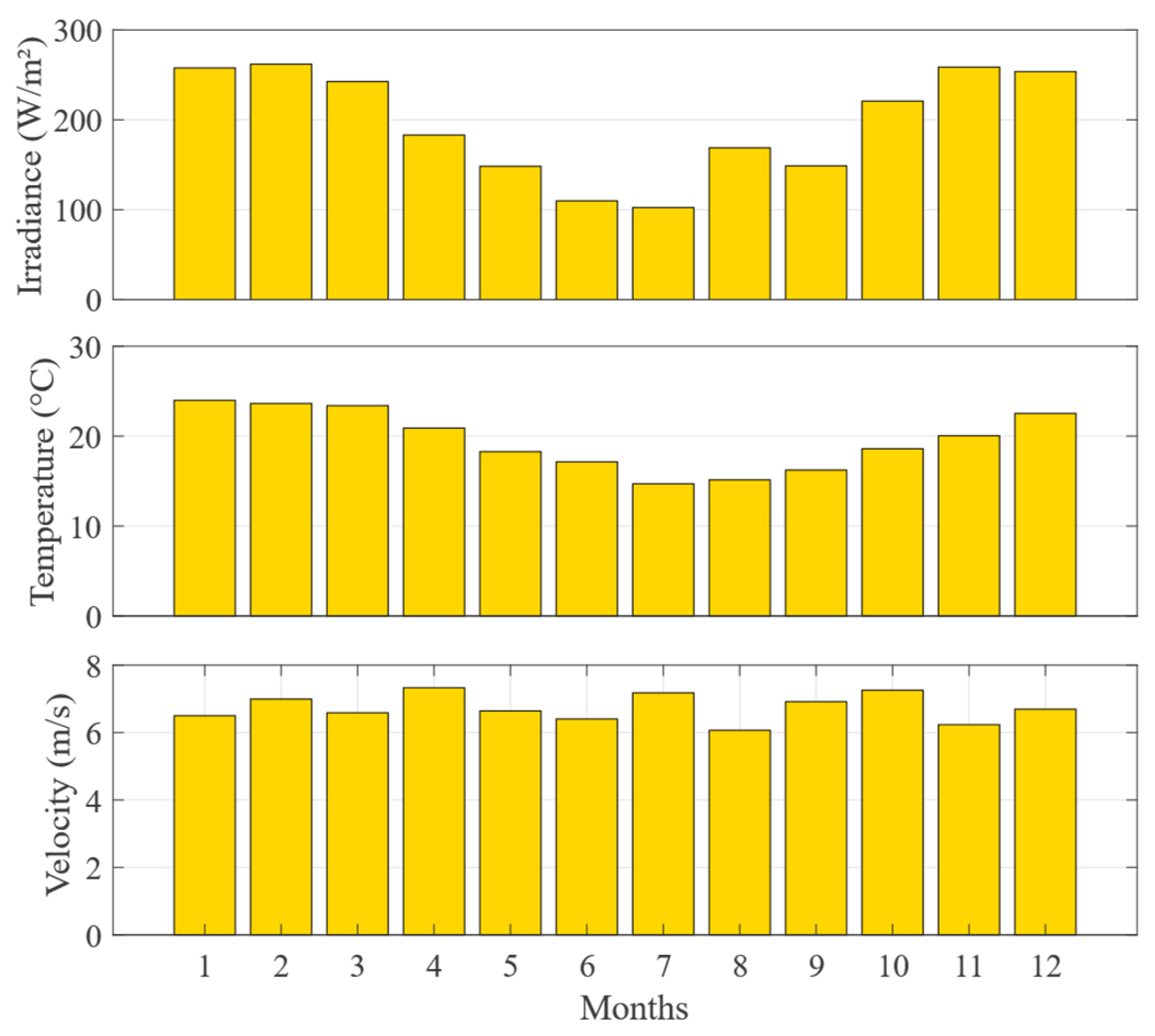
The behavior of the irradiance and temperature variables throughout the year at the specified location is presented in Figure 6. It is observed that, in this region, the average temperature varies between 14 °C and 24 °C, while the average irradiance is in the range of 200 to 700 Wh/m2. The data indicates that the periods with the highest potential for solar energy generation are concentrated in the months of January to March and October to December. In these months, both the irradiance and temperature conditions are more favorable for the performance of photovoltaic modules, contributing to more efficient energy production. Conversely, the lowest levels of irradiance and temperature occur between April and August. Wind speed remains relatively stable throughout the year, typically between 6 and 8 m/s.

3.2. Loads and Locations—Real Microgrids

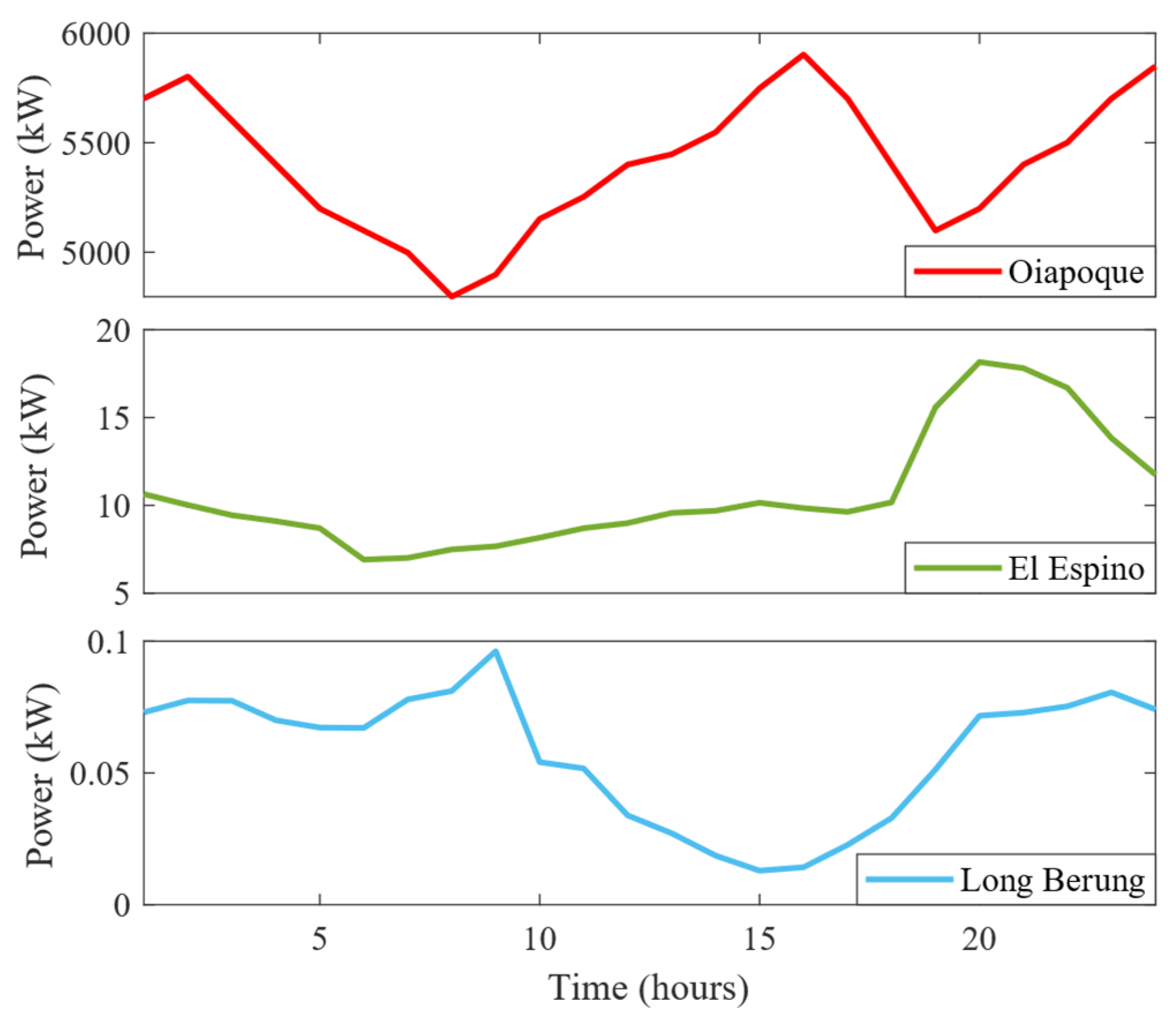
In order to demonstrate the applicability of the proposed methodology, three case studies were carefully selected. These cases cover load profiles with fundamentally different orders of magnitude and morphologies, representing a broad spectrum of electric power systems. The daily demand curves for each scenario are presented in Figure 7.
The first profile represents the electrical demand of the city of Oiapoque, Brazil, a medium-sized distribution system. This system exhibits a load curve that reaches a maximum demand of 6 MW at 02:00 and 16:00. The second case study refers to the community of El Espino, in Bolivia. In contrast to the first, this profile displays a load morphology typical of systems with a residential predominance. The demand is characterized by a single, well-defined nightly peak, reaching 18.2 kW at 20:00. Finally, the third profile represents an isolated microgrid in a rural community in Malaysia, exemplifying a very low-power system. With a peak demand of only 100 W, consumption is predominantly concentrated in the evening period.
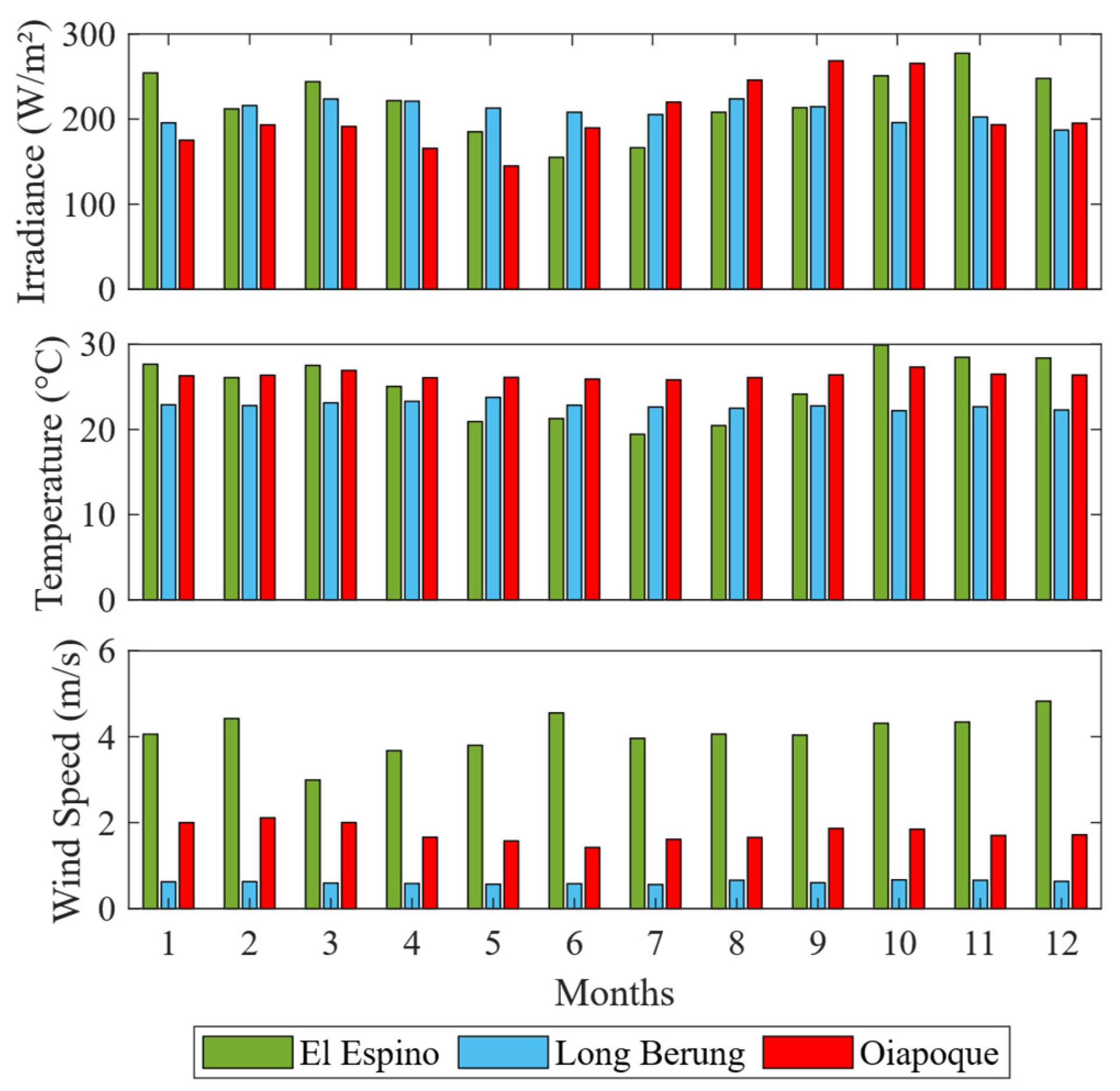
Figure 8 presents the average climatic conditions throughout 2020 for the three locations. The detailed characterization of each region, including its climatic conditions, is discussed in the following subsections.

3.2.1. Oiapoque, Brazil

Oiapoque, located in the extreme north of Brazil, in the state of Amapá, on the border with French Guiana on the banks of the Oiapoque River (approximately 3°50′00″ N, 51°49′00″ W, 8 m above sea level), has an isolated electrical system managed by two distinct companies, with a hybrid energy supply composed of a diesel thermoelectric power plant and a photovoltaic plant, operating in a complementary manner. The humid equatorial climate features average temperatures between 24 °C and 28 °C, relative humidity above 80%, and high annual precipitation, exceeding 3000 mm, concentrated between January and June. Industrial activity is practically nonexistent, making electricity consumption predominantly residential, commercial, and public service-based, driven by households, small businesses, and public agencies. The winds in the region are generally light to moderate, prevailing from the eastern quadrant, and have low average intensity, exerting minimal impact on local wind generation [42].

3.2.2. El Espino, Bolivia

El Espino is a Guarani indigenous community located in southeastern Bolivia, in the department of Santa Cruz, near the border with Paraguay (approximately 19°04′00″ S, 63°34′00″ W, 480 m above sea level), in a transition area between the Bolivian Chaco and the sub-Andean valleys. Access by paved road facilitates the transport of goods and integration with urban centers, unlike other, more isolated villages. The tropical savanna climate features high temperatures throughout the year, with averages between 24 °C and 27 °C, which can exceed 35 °C in the hottest months. Although subsistence agriculture is still practiced, the local economy partially relies on nearby oil projects, which generate employment and income, reducing agricultural dependence. The combination of easy access, basic infrastructure, and favorable conditions for solar energy led to the implementation of a pilot microgrid in December 2016, ensuring a stable and sustainable electricity supply, promoting energy inclusion, and improving the community’s quality of life. The winds in the region are generally weak to moderate, with average monthly speeds varying between 4 m/s and 6 m/s, prevailing from the eastern quadrant. These conditions limit the potential for local wind power generation [43,44].

3.2.3. Long Berung, Malaysia

Long Berung is a Penan village located in the Ulu Baram region, within the Miri Division, in the state of Sarawak, Malaysia (approximately 3°17′02.5″ N, 115°25′34.7″ E, 598 m above sea level), home to about 300 inhabitants. Situated in a remote and hard-to-reach area, with roads originally opened for logging, the village is not served by the national electricity grid. The humid equatorial climate has average annual temperatures between 24 °C and 27 °C and high precipitation throughout the year. The population’s subsistence is based on small-scale agriculture for their own consumption, with an emphasis on rice and vegetables, while some men earn income from temporary or permanent jobs in logging companies. In 2010, a photovoltaic microgrid with batteries was installed, intended to provide electricity for residential lighting and the operation of basic home appliances. The winds in the region are generally weak, with average speeds between 3 m/s and 5 m/s, prevailing from the eastern quadrant, offering low potential for wind generation [44].

3.3. Simulation Data

Table 4 summarizes the assumptions adopted in the simulation and optimization. Lower and upper limits were defined for the design variables, adjusted to the scale of each microgrid: Long Berung (tens of kW), El Espino and Osório (hundreds of kW), and Oiapoque (tens of MW). The useful lives of the equipment, their average efficiencies, and the costs of installation, O&M, and replacement are also defined. The optimization process was configured with a population of 500 individuals, 300 iterations, a mutation rate of 40%, and a crossover of 70%. Finally, general parameters such as annual inflation (10.5%), temperature coefficient (−0.43%/°C), self-discharge of 6%/month, and characteristic wind speeds (3–25 m/s, nominal 14 m/s) ensure the model’s realism.

4. Results

This section presents the results obtained from applying the methodology to the previously described case studies. Initially, a comparison is made between the performance of the proposed methodology and the results provided by HOMER Pro software version 3.18.4. Subsequently, the Pareto frontiers obtained for each analyzed microgrid configuration are discussed.

4.1. Results Comparisons

To validate the performance of the proposed multi-objective CSITM methodology, this section compares its results against HOMER Pro, a widely used industry-standard software. It is critical to note that HOMER Pro is used here strictly as a single-objective benchmark, as its optimization approach is fundamentally different from the one proposed in this paper.
The HOMER Pro software, originally developed by NREL (National Renewable Energy Laboratory), is a consolidated commercial tool. Its approach is based on mono-objective optimization, where the main criterion is the minimization of financial metrics, such as the Net Present Cost or the Levelized Cost of Energy. While it considers technical parameters, system reliability generally enters as a constraint to be met, not as an objective to be optimized. This means HOMER is designed to find the single cheapest solution for a pre-defined reliability level.
In contrast, the CSITM methodology was designed as a native multi-objective optimization approach. It simultaneously evaluates two conflicting objectives: minimizing the life cycle cost and maximizing reliability (quantified by minimizing interruption hours). Thus, while HOMER points to a single lowest-cost solution, CSITM generates a complete set of trade-off solutions (a Pareto front), allowing the decision-maker to see the cost of reliability and choose the ideal balance.
To create a valid point of comparison, we configured the CSITM methodology to find the solution with zero hourly energy interruptions and compared this single point against the best-cost solution from HOMER (which was also constrained to have zero interruptions). Table 5 presents this comparison for the three systems analyzed.
The results demonstrate that the proposed CSITM methodology identifies lower-cost solutions in all scenarios, even while adhering to maximum reliability constraints. In Oiapoque, for example, the life cycle cost was reduced from USD 170.5 million (HOMER) to USD 144.9 million (CSITM). In Osório, a reduction from USD 847,000 to USD 755,120 was achieved. Consistent results were also observed in El Espino (a reduction from USD 323,590 to USD 315,360) and Long Berung (from USD 3023.81 to USD 2637.40). These findings validate that the proposed methodology can identify more economical solutions without compromising energy security.
The resulting configurations were validated through annual energy balance simulations (year 2020), which confirmed the absence of supply interruptions. The structural analysis of the systems reveals significant differences between the approaches. While HOMER tends to favor simplified arrangements, such as the oversizing of batteries in Oiapoque (250 MWh) and the non-consideration of hydrogen technologies, CSITM promotes more balanced hybrid architectures. Noteworthy is the inclusion of electrolyzers (12 MW in Oiapoque and 25 kW in El Espino), fuel cells (6 MW and 20 kW, respectively), and hydrogen storage tanks, which expand flexibility and operational resilience. This diversified integration of resources results in more robust configurations, with lower cost and greater alignment with long-term sustainability and energy security guidelines.

4.2. Pareto Frontiers: Cost Versus Possible Interruption Hours

Although Table 5, constructed from HOMER’s assumptions, presents viable and mathematically optimized solutions for maximum energy security systems, these results are based on idealized scenarios with unrestricted investments. In contrast, in many real-world microgrids, the cost associated with implementing maximum reliability solutions may not be economically justifiable.
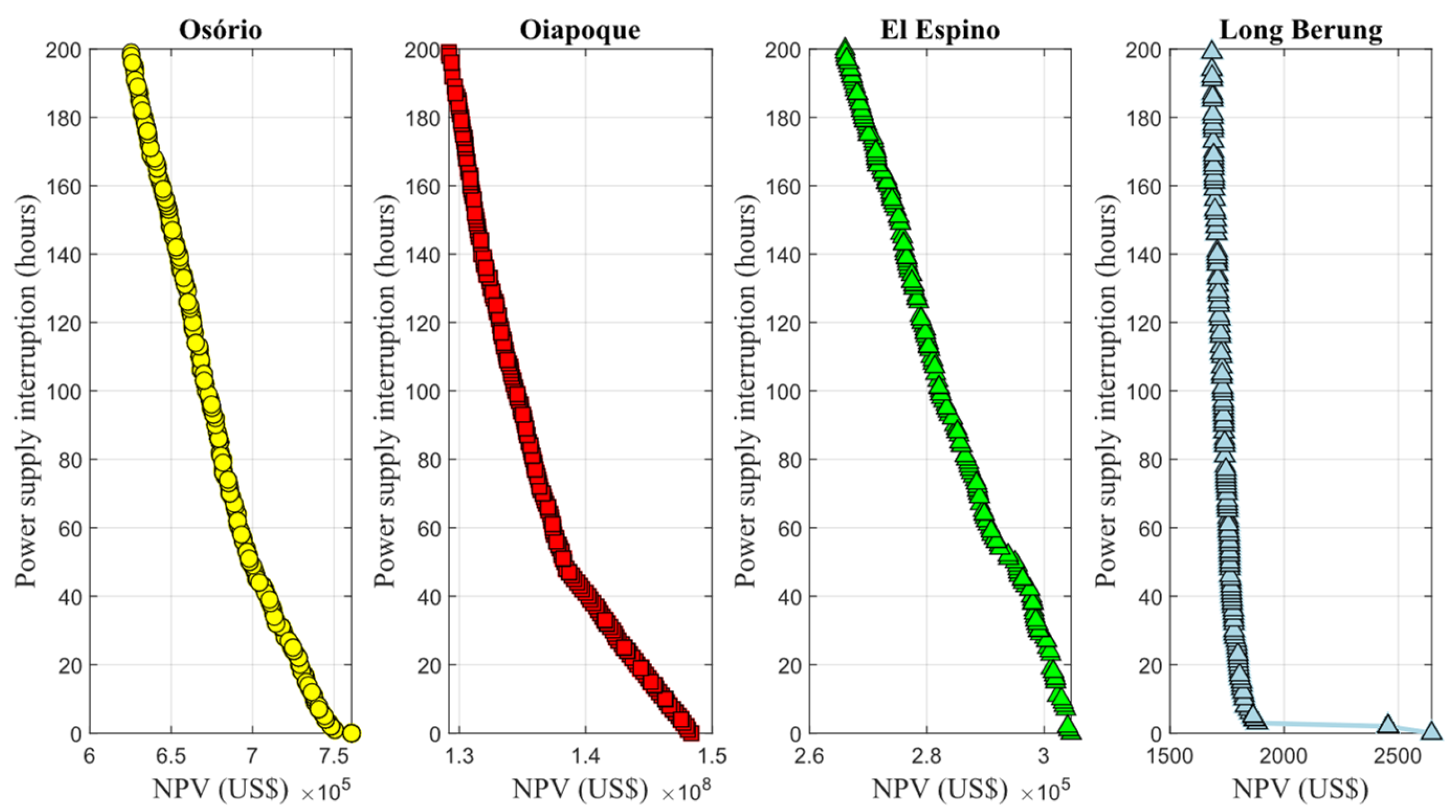
Thus, the method proposed here differentiates itself by incorporating criteria of techno-economic feasibility and suitability to the application context. Figure 9 presents the Pareto frontiers obtained for the four case studies, highlighting the trade-off between cost (NPV) and the probable hours of electricity supply interruption. In all analyzed microgrids, an inverse relationship is observed: the reduction of NPV is associated with an increase in interruptions, while lower levels of unavailability imply higher costs.
In Osório, the NPV varies approximately between USD 622,000 and USD 755,000. The solutions are quite diversified, contemplating combinations of photovoltaic and wind generation, batteries, and hydrogen storage (electrolyzer, fuel cell, and H2 tank).
This diversification is driven by two main factors. First, the coexistence of wind and solar resources, with their distinct availability profiles, allows the optimized configurations to alternately prioritize photovoltaic and wind generation. Such variability directly impacts the storage strategy, as surplus energy is not exclusively intended for nighttime supply; wind generation, although intermittent, can act as the primary source during certain periods.
Second, the adopted seasonal load profile, combined with the constancy of winds in Osório, allows for the generation of energy surpluses at certain times of the year (summer) for later use during periods of higher consumption (winter). This behavior favors the inclusion of hydrogen, whose main advantage lies in its long-duration storage capacity with marginal losses.
In Oiapoque, the NPV varies between USD 130 and 150 million. This wide range demonstrates that adjustments in tolerated interruption hours can result in substantial savings of up to USD 20 million.
A deeper analysis of the frontier reveals a clear inflection point near the 55-hour interruption threshold. For solutions demanding supply security greater than this (fewer than 55 h of failure), the hydrogen storage system proves to be economically viable. However, for solutions that tolerate more than 55 h of interruption, the high capital cost of hydrogen technology ceases to be justifiable, and the algorithm begins to prioritize configurations based exclusively on a large-scale battery storage system.
The Pareto frontier for El Espino is concentrated in a narrower cost range, between USD 260,000 and 320,000, but maintains the trade-off trend. The savings for plants that allow up to 200 hours of interruption are approximately USD 60,000. The solutions reflect the region’s greater wind potential, including wind generation in several cases (in addition to photovoltaic, batteries, and hydrogen) to contribute to cost reduction and reliability improvement.
This frontier also shows an inflection point, though at a different threshold of 48 h. For solutions demanding supply security higher than this (fewer than 48 h of failure), the hydrogen storage system again proves economically viable. Conversely, for solutions tolerating more than 48 h of interruption, the algorithm prioritizes configurations based exclusively on larger-scale battery storage, as the high capital cost of hydrogen is no longer justified.
In Long Berung, costs vary between USD 1500 and USD 2500, demonstrating that, even in small-scale systems, the compromise between economy and reliability remains relevant. Due to the low local demand (less than 1 kW), the solutions are less diversified, being essentially composed of photovoltaic generation associated with batteries.
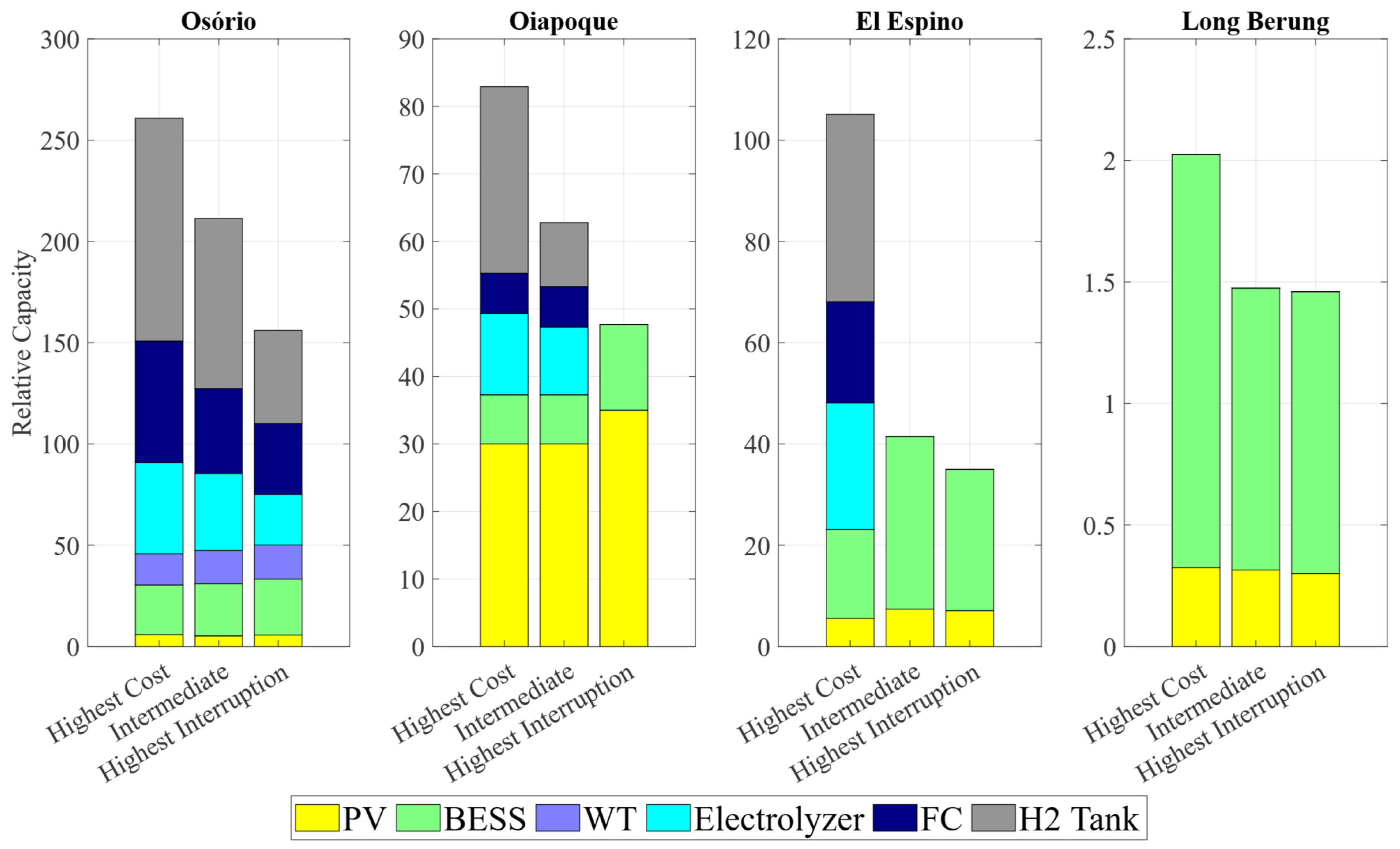
Figure 10 and Table 6 complement this analysis by detailing the technological composition of the solutions at specific points on the frontier: highest cost (zero interruptions), intermediate (50 interruptions), and highest interruption (200 interruptions). These analyses allow for a visual and numerical identification of the technology combinations that support the observed cost-reliability trade-offs in each microgrid. Specifically, in the simulations for Osório, Oiapoque, and El Espino, a clear trend emerges: the hydrogen storage system is progressively undersized as the number of tolerated interruptions increases.

4.3. Load Growth Rates

A common behavior in isolated microgrids is that increased energy availability often stimulates a corresponding increase in consumption over time. It is, therefore, essential to analyze how the cost-reliability trade-off curve behaves under gradual load growth throughout the microgrid’s lifespan, acting as a sensitivity analysis for future demand uncertainty.
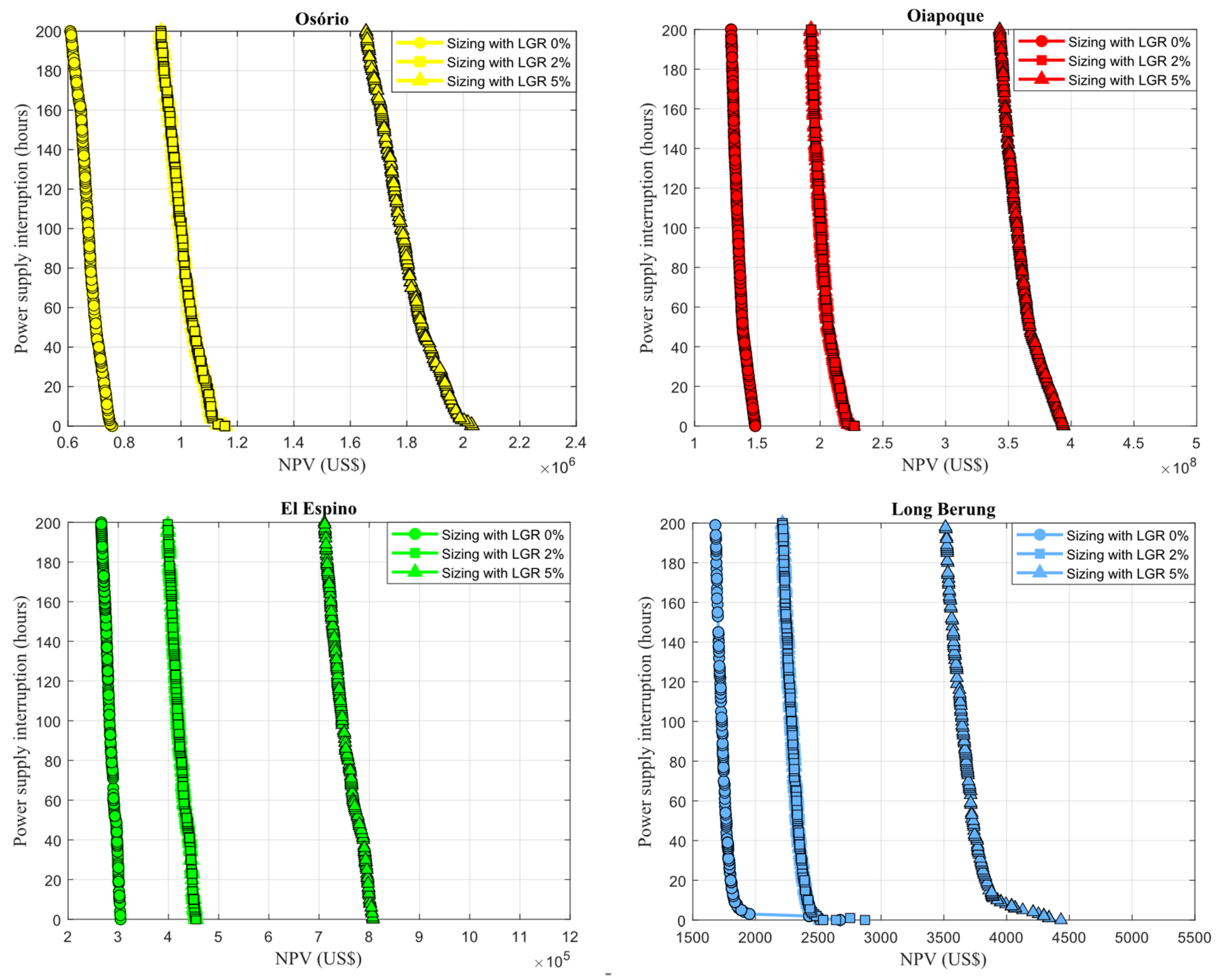
To this end, three scenarios were analyzed, corresponding to annual load growth rates (LGR) of 0%, 2%, and 5%. Figure 11 and Table 7 present the NPV-versus-interruption curves and the specific NPVs for the zero-interruption solutions, respectively.
As shown in Figure 11, the fundamental shape of the trade-off curve remains consistent as the LGR increases from 0% to 5%. However, the entire frontier is uniformly shifted to the right, indicating significantly higher life cycle costs.
A key observation, particularly at the lowest interruption levels (highest reliability) for Osório, Oiapoque, and Long Berung, is a pronounced “accentuation” of the curve. This steepening indicates that the economic penalty for achieving near-zero interruptions becomes disproportionately larger as the anticipated load growth increases.

4.4. Hydrogen Equipment Costs

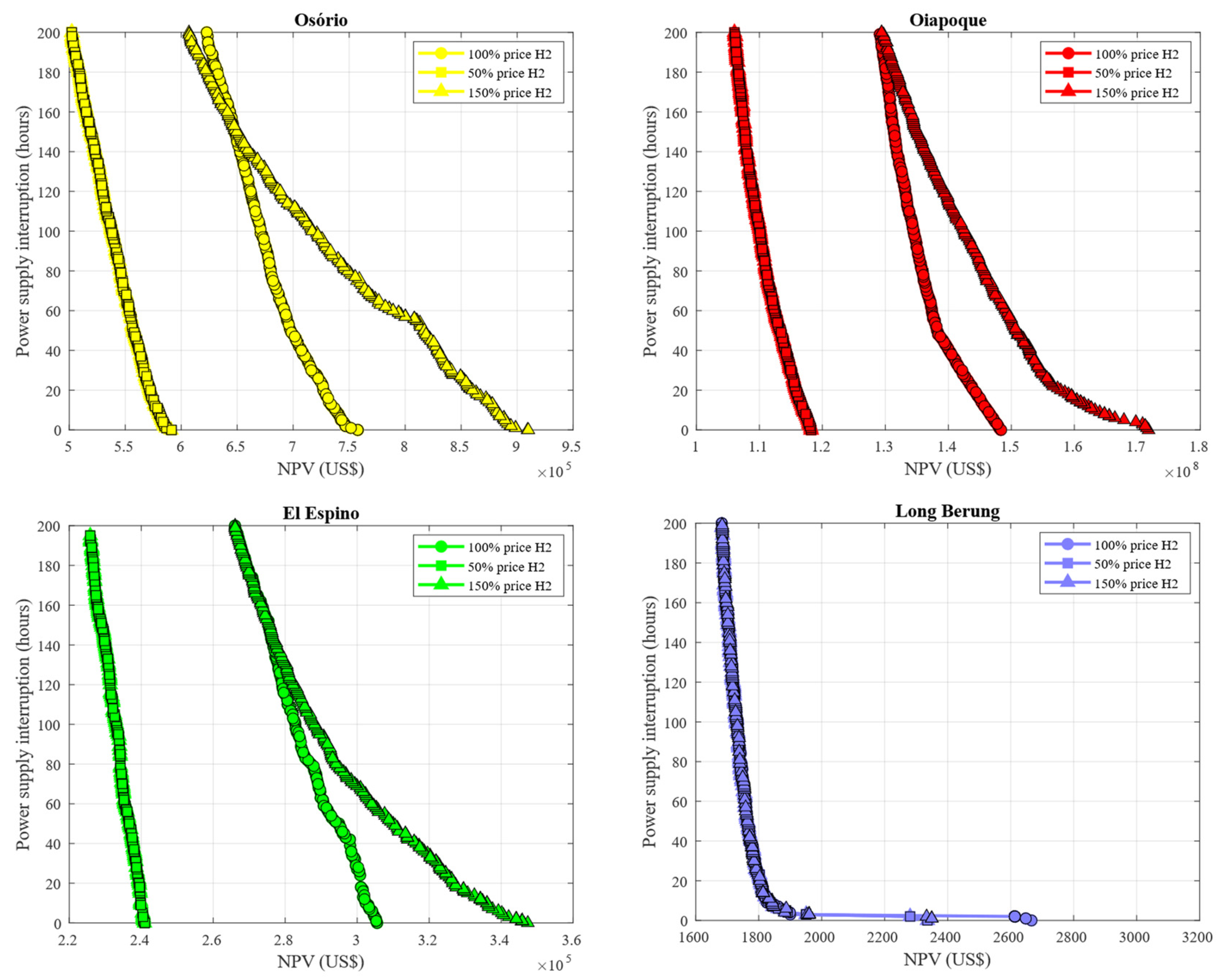
Figure 12 and Table 8 present the results of the sensitivity analysis, comparing the baseline scenario (100% H2 cost) with a 50% cost reduction and a 150% cost increase. This price variation was applied to all hydrogen system components: the electrolyzer, the storage tank, and the fuel cell.
The primary finding is that the economic viability of systems requiring high reliability (i.e., low interruptions) is critically dependent on the cost of hydrogen technology. As shown by the Pareto frontiers, for systems that can tolerate a high number of interruptions, the H2 price is almost irrelevant. This is evidenced by the near-complete overlap of all three price curves (50%, 100%, and 150%) at high interruption levels (the top of the graphs). In these scenarios, the optimization algorithm prioritizes battery-only configurations, as batteries are the more cost-effective solution for short-duration storage.
However, as reliability requirements increase (moving toward the bottom of the graphs), the cost gap between the scenarios expands dramatically. To achieve few or zero interruptions, long-duration storage (hydrogen) becomes mandatory to ensure energy security, and its cost subsequently becomes a dominant factor in the total NPV.
Table 8 quantifies this sensitivity at the zero-interruption point. For Osório, Oiapoque, and El Espino, a 50% increase in H2 price substantially elevates the total project cost, while a 50% reduction yields significant savings.
Long Berung is the notable exception. As shown in Table 8, the NPV remains identical across all three price scenarios. This indicates that for this very low-demand microgrid, hydrogen is never the economically viable solution, even when maximum reliability is required. The system can achieve the zero-interruption target using only batteries, rendering the H2 price irrelevant in this specific case.

5. Conclusions

This paper presents a novel multi-objective methodology for sizing isolated microgrids, which simultaneously considers the minimization of costs and the reduction in interruption hours. Unlike approaches that assume idealized scenarios and unlimited investments, the proposed method incorporates practical constraints, reflecting real-world application conditions. The analysis of the Pareto frontiers confirmed that no single solution can combine the lowest cost with maximum reliability. This highlights the methodology’s importance in quantifying these trade-offs and offering decision-makers a set of viable solutions. The proposed method proved effective for exploring this solution space, identifying economically attractive alternatives without compromising system robustness.
The results also demonstrated the method’s ability to adapt to the specific electrical and geographical characteristics of each microgrid. In Osório, seasonality and significant wind potential favored the inclusion of hydrogen storage. In Oiapoque, high solar availability led to hybrid arrangements dominated by photovoltaic generation. In El Espino, greater wind potential allowed for a higher participation of wind turbines. Finally, in Long Berung, the low load and lower resource diversity restricted the solutions to simple photovoltaic and battery configurations.
Ultimately, the significant economic gains identified using the methodology can enhance the feasibility of implementing microgrids in isolated communities, while technological diversity, especially the integration of hydrogen, contributes to greater resilience and long-term sustainability. Furthermore, this study confirmed that the cost of hydrogen critically impacts the viability of high-reliability solutions. Consequently, the anticipated gradual decrease in hydrogen equipment costs is likely to spur its wider adoption in isolated microgrids.
As this paper focuses on the strategic planning (optimal sizing) level, the results obtained here serve as a necessary foundation for future research at the operational (dispatch) and real-time control levels. Future work could leverage these optimized sizings to develop and test advanced Energy Management Systems (EMS) or stability control algorithms, such as the approach suggested by [53], to evaluate the system’s real-time performance and dynamic stability. A further direction for future work involves refining the reliability metrics.
The present study used Interruption Hours (equivalent to the Loss of Load Hours, LOLH) as the reliability objective. While this is an intuitive metric for planners, a valuable extension would be to replace or augment this objective with Energy Not Supplied (EENS). This would allow the optimization to explore the trade-off between cost and the magnitude of unserved energy (kWh), rather than just the duration (hours) of the interruption, providing a more granular assessment of reliability.

Author Contributions

C.R.—Conceptualization, Methodology, Software, Data curation, Investigation, Validation, Formal analysis, Visualization, Resources, Writing—original draft. G.M.—Conceptualization, Methodology, Investigation, Writing—review and editing. G.C.J.—Conceptualization, Methodology, Supervision, Writing—review and editing, Validation. I.D.F.—Methodology, Investigation, Visualization. T.P.M.—Methodology, Software, Visualization, Resources. O.A.—Validation, Formal analysis, Writing—review and editing. W.C.—Methodology, Writing—review and editing, Validation. R.G.—Software, Methodology. V.B.—Software, Methodology. A.P.L.—Conceptualization, Writing—review and editing. J.P.V.—Conceptualization, Supervision, Project administration, Writing—review and editing. E.d.C.—Funding acquisition, Project administration, Writing—review and editing. C.B.—Funding acquisition, Project administration, Writing—review and editing. M.R.—Methodology, Writing—review and editing. All authors have read and agreed to the published version of the manuscript.

Funding

The authors gratefully acknowledge Norte Energia for funding project PD-07427-0422/2022 through ANEEL’s R&D program, which enabled this study. This work was also partially supported by the Coordination for the Improvement of Higher Education Personnel (CAPES/PROEX), Brazil—Funding Code 001, and by the National Council for Scientific and Technological Development (CNPq), under grant number 445102/2024-1.

Data Availability Statement

The original contributions presented in the study are included in the article; further inquiries can be directed to the corresponding author.

Conflicts of Interest

Authors Eduardo de Campos and Caio Barroso were employed by the Norte Energia SA. The remaining authors declare that the research was conducted in the absence of any commercial or financial relationships that could be construed as a potential conflict of interest.

Abbreviations

The following abbreviations are used in this manuscript:
ACAlternating Current
BESSBattery Energy Storage System
BFEStochastic Fractal Search
CSITMCost-Supply Interruption Trade-off Method
DCDirect Current
DEDifferential Evolution
ELEElectrolyzer
FCFuel Cell
GAGenetic Algorithm
GH2Green hydrogen
GPOAGradient Pelican Optimization Algorithm
HSHarmonic Search
H2 TankHydrogen tank
InvInitial Investment
ITInterruption hours
LCOELevelized Cost of Energy
LOLHLoss of Load Hours
LPSPLoss of Power Supply Probability
MFOMoth–Flame Optimizer
MILPMixed-Integer Linear Programming
NASANational Aeronautics and Space Administration
NPVNet Present Value
NRELNational Renewable Energy Laboratory
NSGA-IINon-dominated Sorting Genetic Algorithm II
O&MOperation and Maintenance
POWERPrediction Of Worldwide Energy Resources
PSOParticle Swarm Optimization
PVPhotovoltaic
RepReplacement Costs
SOSSymbiotic Organisms Search
TA-MaEATwo-Archive Many-objective Evolutionary Algorithm
WOAWhale Optimization Algorithm
WTWind Turbine

References

  1. Karamov, D.N.; Ilyushin, P.V.; Suslov, K.V. Electrification of Rural Remote Areas Using Renewable Energy Sources: Literature Review. Energies 2022, 15, 5881. [Google Scholar] [CrossRef]
  2. Jeyaprabha, S.B.; Milanović, J.V. Probabilistic Techno-Economic Design of Isolated Microgrid. IEEE Trans. Power Syst. 2023, 38, 5267–5277. [Google Scholar] [CrossRef]
  3. Picioroaga, I.; Luca, M.; Tudose, A.; Sidea, D.; Eremia, M.; Bulac, C. Resilience-Driven Optimal Sizing of Energy Storage Systems in Remote Microgrids. Sustainability 2023, 15, 16002. [Google Scholar] [CrossRef]
  4. Barbosa, M.O.; Peyerl, D.; Mendes, A.B. The Economic and Environmental Benefits of Adopting Natural Gas in Isolated Systems of Amazonas State, Brazil. Environ. Dev. 2023, 47, 100889. [Google Scholar] [CrossRef]
  5. Barbosa, L.T.; Vasconcelos, S.D.; Rosas, P.A.C.; Castro, J.F.C.; Barbosa, D.C.P. Assessment of Green Hydrogen as Energy Supply Alternative for Isolated Power Systems and Microgrids. Energies 2024, 17, 4774. [Google Scholar] [CrossRef]
  6. Marocco, P.; Ferrero, D.; Gandiglio, M.; Ortiz, M.M.; Sundseth, K.; Lanzini, A.; Santarelli, M. A Study of the Techno-Economic Feasibility of H2-Based Energy Storage Systems in Remote Areas. Energy Convers. Manag. 2020, 211, 112768. [Google Scholar] [CrossRef]
  7. Quispe, J.C.; Obispo, A.E.; Alcantara, F.J. Economic Feasibility Assessment of Microgrids with Renewable Energy Sources in Peruvian Rural Areas. Clean Technol. Environ. Policy 2024, 26, 1415–1438. [Google Scholar] [CrossRef]
  8. Pesantes, L.A.; Hidalgo-Leon, R.; Rengifo, J.; Torres, M.; Aragundi, J.; Cordova-Garcia, J.; Ugarte, L.F. Optimal Design of Hybrid Microgrid in Isolated Communities of Ecuador. J. Mod. Power Syst. Clean Energy 2024, 12, 488–499. [Google Scholar] [CrossRef]
  9. Kassab, F.A.; Celik, B.; Locment, F.; Sechilariu, M.; Liaquat, S.; Hansen, T.M. Optimal Sizing and Energy Management of a Microgrid: A Joint MILP Approach for Minimization of Energy Cost and Carbon Emission. Renew. Energy 2024, 224, 120186. [Google Scholar] [CrossRef]
  10. Zhu, X.; Ruan, G.; Geng, H.; Liu, H.; Bai, M.; Peng, C. Multi-Objective Sizing Optimization Method of Microgrid Considering Cost and Carbon Emissions. IEEE Trans. Ind. Appl. 2024, 60, 5565–5576. [Google Scholar] [CrossRef]
  11. Yadav, S.; Kumar, P.; Kumar, A. Excess Energy Management and Techno-Economic Analysis of Optimal Designed Isolated Microgrid with Reliability and Environmental Aspects. Energy Convers. Manag. 2025, 333, 119772. [Google Scholar] [CrossRef]
  12. Roberts, J.J. Otimização de Sistemas Híbridos de Geração de Energia Solar-Eólico-Diesel Através de Métodos Metaheurísticos e Função Multiobjetivos. Ph.D. Thesis, Universidade Estadual Paulista, Guaratinguetá, Brazil, 2016. [Google Scholar]
  13. Li, B.; Roche, R.; Paire, D.; Miraoui, A. Sizing of a stand-alone microgrid considering electric power, cooling/heating, hydrogen loads and hydrogen storage degradation. Appl. Energy 2017, 205, 1244–1259. [Google Scholar] [CrossRef]
  14. Qolipour, M.; Mostafaeipour, A.; Tousi, O.M. Techno-economic feasibility of a photovoltaic-wind power plant construction for electric and hydrogen production: A case study. Renew. Sustain. Energy Rev. 2017, 78, 113–123. [Google Scholar] [CrossRef]
  15. Singh, A.; Baredar, P.; Gupta, B. Techno-economic feasibility analysis of hydrogen fuel cell and solar photovoltaic hybrid renewable energy system for academic research building. Energy Convers. Manag. 2017, 145, 398–414. [Google Scholar] [CrossRef]
  16. Gökçek, M.; Kale, C. Techno-economical evaluation of a hydrogen refuelling station powered by wind-pv hybrid power system: A case study for İzmir-çeşme. Int. J. Hydrogen Energy 2018, 43, 10615–10625. [Google Scholar] [CrossRef]
  17. Luta, D.N.; Raji, A.K. Decision-making between a grid extension and a rural renewable off-grid system with hydrogen generation. Int. J. Hydrogen Energy 2018, 43, 9535–9548. [Google Scholar] [CrossRef]
  18. Abdin, Z.; Mérida, W. Hybrid energy systems for off-grid power supply and hydrogen production based on renewable energy: A techno-economic analysis. Energy Convers. Manag. 2019, 196, 1068–1079. [Google Scholar] [CrossRef]
  19. Diab, A.A.Z.; Sultan, H.M.; Mohamed, I.S.; Kuznetsov, O.N.; Do, T.D. Application of different optimization algorithms for optimal sizing of pv/wind/diesel/battery storage stand-alone hybrid microgrid. IEEE Access 2019, 7, 119223–119245. [Google Scholar] [CrossRef]
  20. Bandyopadhyay, S.; Mouli, G.R.C.; Qin, Z.; Elizondo, L.R.; Bauer, P. Techno-economical model based optimal sizing of pv-battery systems for microgrids. IEEE Trans. Sustain. Energy 2020, 11, 1657–1668. [Google Scholar] [CrossRef]
  21. Cano, A.; Arevalo, P.; Jurado, F. Energy analysis and techno-economic assessment of a hybrid pv/hkt/bat system using biomass gasifier: Cuenca-ecuador case study. Energy 2020, 202, 117727. [Google Scholar] [CrossRef]
  22. Cao, B.; Dong, W.; Lv, Z.; Gu, Y.; Singh, S.; Kumar, P. Hybrid microgrid many-objective sizing optimization with fuzzy decision. IEEE Trans. Fuzzy Syst. 2020, 28, 2702–2710. [Google Scholar] [CrossRef]
  23. Jahangir, M.H.; Fakouriyan, S.; Rad, M.A.V.; Dehghan, H. Feasibility study of on/off grid large-scale pv/wt/wec hybrid energy system in coastal cities: A case-based research. Renew. Energy 2020, 162, 2075–2095. [Google Scholar] [CrossRef]
  24. Rad, M.A.V.; Ghasempour, R.; Rahdan, P.; Mousavi, S.; Arastounia, M. Techno-economic analysis of a hybrid power system based on the cost-effective hydrogen production method for rural electrification, a case study in Iran. Energy 2020, 190, 116421. [Google Scholar] [CrossRef]
  25. Ishraque, M.F.; Shezan, S.A.; Rashid, M.M.; Bhadra, A.B.; Hossain, M.A.; Chakrabortty, R.K.; Ryan, M.J.; Fahim, S.R.; Sarker, S.K.; Das, S.K. Techno-economic and power system optimization of a renewable rich islanded microgrid considering different dispatch strategies. IEEE Access 2021, 9, 77325–77340. [Google Scholar] [CrossRef]
  26. Babaei, R.; Ting, D.S.-K.; Carriveau, R. Optimization of hydrogen-producing sustainable island microgrids. Int. J. Hydrogen Energy 2022, 47, 14375–14392. [Google Scholar] [CrossRef]
  27. Hakimi, S.M.; Hasankhani, A.; Shafie-Khah, M.; Lotfi, M.; Catalão, J.P.S. Optimal sizing of renewable energy systems in a microgrid considering electricity market interaction and reliability analysis. Electr. Power Syst. Res. 2022, 203, 107678. [Google Scholar] [CrossRef]
  28. Alluraiah, N.C.; Vijayapriya, P. Optimization, design, and feasibility analysis of a grid integrated hybrid ac/dc microgrid system for rural electrification. IEEE Access 2023, 11, 67013–67029. [Google Scholar] [CrossRef]
  29. Kamal, M.M.; Ashraf, I.; Fernandez, E. Optimal sizing of standalone rural microgrid for sustainable electrification with renewable energy resources. Sustain. Cities Soc. 2023, 88, 104298. [Google Scholar] [CrossRef]
  30. Adedoja, O.S.; Sadiku, E.R.; Hamam, Y. A techno-economic assessment of the viability of a photovoltaic-wind-battery storage-hydrogen energy system for electrifying primary healthcare centre in sub-saharan africa. Energy Convers. Manag. X 2024, 23, 100643. [Google Scholar] [CrossRef]
  31. Bacha, B.; Ghodbane, H.; Dahmani, H.; Betka, A.; Toumi, A.; Chouder, A. Optimal sizing of a hybrid microgrid system using solar, wind, diesel, and battery energy storage to alleviate energy poverty in a rural area of Biskra, Algeria. J. Energy Storage 2024, 84, 110651. [Google Scholar] [CrossRef]
  32. El-Sattar, H.A.; Hassan, M.H.; Vera, D.; Jurado, F.; Kamel, S. Maximizing hybrid microgrid system performance: A comparative analysis and optimization using a gradient pelican algorithm. Renew. Energy 2024, 227, 120480. [Google Scholar] [CrossRef]
  33. Hussain, S.; Sharma, S.K.; Lal, S. Feasible synergy between hybrid solar pv and wind system for energy supply of a green building in kota (india): A case study using ihoga. Energy Convers. Manag. 2024, 315, 118783. [Google Scholar] [CrossRef]
  34. Oyewole, O.; Nwulu, N.; Okampo, E.J. Multi-objective optimal sizing and design of renewable and diesel-based autonomous microgrids with hydrogen storage considering economic, environmental, and social uncertainties. Renew. Energy 2024, 231, 120987. [Google Scholar] [CrossRef]
  35. Raza, A.; Chen, Y.; Li, M.; Abouzeid, S.I.; Abdelhameed, E.H. Feasibility and optimal size analysis of off grid hybrid ac-dc microgrid system: Case study of El Kharga Oasis, Egypt. J. Energy Storage 2024, 97, 101127. [Google Scholar] [CrossRef]
  36. Rowe, K.; Mokryani, G.; Cooke, K.; Campean, F.; Chambers, T. Bi-level optimal sizing, siting and operation of utility-scale multi-energy storage system to reduce power losses with peer-to-peer trading in an electricity/heat/gas integrated network. J. Energy Storage 2024, 83, 110609. [Google Scholar] [CrossRef]
  37. Sun, X.; He, H.; Ma, L. Harmony search meta-heuristic algorithm based on the optimal sizing of wind-battery hybrid micro-grid power system with different battery technologies. J. Energy Storage 2024, 75, 109312. [Google Scholar] [CrossRef]
  38. Ahmed, F.; Zhu, S.; Yu, G.; Luo, E. A Potent Numerical Model Coupled with Multi-Objective NSGA-II Algorithm for the Optimal Design of Stirling Engine. Energy 2022, 247, 123468. [Google Scholar] [CrossRef]
  39. Deb, K.; Agrawal, S.; Pratap, A.; Meyarivan, T. A Fast Elitist Non-Dominated Sorting Genetic Algorithm for Multi-Objective Optimization: NSGA-II. In Proceedings of the 6th International Conference on Parallel Problem Solving from Nature (PPSN VI), Paris, France, 18–20 September 2000; pp. 849–858. [Google Scholar]
  40. Deb, K.; Pratap, A.; Agarwal, S.; Meyarivan, T. A Fast and Elitist Multiobjective Genetic Algorithm: NSGA-II. IEEE Trans. Evol. Comput. 2002, 6, 182–197. [Google Scholar] [CrossRef]
  41. NASA. Prediction of Worldwide Energy Resources (POWER). 2025. Available online: https://power.larc.nasa.gov/ (accessed on 15 October 2025).
  42. de Sá Leitão, A.H.; Rosas, P.A.C.; Júnior, G.L.M.; Cunha, M.; Giribola, N. Economic Load Dispatch in Brazilian Isolated Electricity System: A Case Study of Oiapoque. Renew. Energy 2025, 245, 122695. [Google Scholar] [CrossRef]
  43. Lorenzoni, L.; Cherubini, P.; Fioriti, D.; Poli, D.; Micangeli, A.; Giglioli, R. Classification and Modeling of Load Profiles of Isolated Mini-Grids in Developing Countries: A Data-Driven Approach. Energy Sustain. Dev. 2020, 59, 208–225. [Google Scholar] [CrossRef]
  44. Wong, S.Y.; Chai, A. An Off-Grid Solar System for Rural Village in Malaysia. In Proceedings of the 2012 Asia-Pacific Power and Energy Engineering Conference, Shanghai, China, 27–29 March 2012; pp. 1–4. [Google Scholar]
  45. Artaş, S.B.; Kocaman, E.; Bilgiç, H.H.; Tutumlu, H.; Yağlı, H.; Yumrutaş, R. Why PV Panels Must Be Recycled at the End of Their Economic Life Span? A Case Study on Recycling Together with the Global Situation. Process Saf. Environ. Prot. 2023, 174, 63–78. [Google Scholar] [CrossRef]
  46. Delaney, E.L.; Leahy, P.G.; McKinley, J.M.; Gentry, T.R.; Nagle, A.J.; Elberling, J.; Bank, L.C. Sustainability Implications of Current Approaches to End-of-Life of Wind Turbine Blades—A Review. Sustainability 2023, 15, 12557. [Google Scholar] [CrossRef]
  47. Akinyele, D.; Olabode, E.; Amole, A. Review of Fuel Cell Technologies and Applications for Sustainable Microgrid Systems. Inventions 2020, 5, 42. [Google Scholar] [CrossRef]
  48. Tomić, A.Z.; Pivac, I.; Barbir, F. A Review of Testing Procedures for Proton Exchange Membrane Electrolyzer Degradation. J. Power Sources 2023, 557, 232569. [Google Scholar] [CrossRef]
  49. Li, R.; Bao, L.; Chen, L.; Zha, C.; Dong, J.; Qi, N.; Tang, R.; Lu, Y.; Wang, M.; Huang, R.; et al. Accelerated Aging of Lithium-Ion Batteries: Bridging Battery Aging Analysis and Operational Lifetime Prediction. Sci. Bull. 2023, 68, 3055–3079. [Google Scholar] [CrossRef]
  50. Fazelpour, F.; Soltani, N.; Rosen, M.A. Economic Analysis of Standalone Hybrid Energy Systems for Application in Tehran, Iran. Int. J. Hydrogen Energy 2016, 41, 7732–7743. [Google Scholar] [CrossRef]
  51. Zine, Y.; Benmouna, A.; Becherif, M.; Hissel, D. Towards Maximum Efficiency of an Open-Cathode PEM Fuel Cell System: A Comparative Experimental Demonstration. Int. J. Hydrogen Energy 2024, 86, 72–85. [Google Scholar] [CrossRef]
  52. Virah-Sawmy, D.; Beck, F.J.; Sturmberg, B. Ignore Variability, Overestimate Hydrogen Production–Quantifying the Effects of Electrolyzer Efficiency Curves on Hydrogen Production from Renewable Energy Sources. Int. J. Hydrogen Energy 2024, 72, 49–59. [Google Scholar] [CrossRef]
  53. Li, H.; Wang, Y.; Yu, H.; Zhang, H.; Ding, Y.; Wang, P. Hidden Markov Jump System Based Robust Control of Inverter-Fed Power Systems with Asynchronous Sliding Mode Observer. IEEE Trans. Ind. Electron. 2025, in press. [Google Scholar]
Figure 1. CSITM operational flowchart.
Energies 19 00195 g001
Figure 2. Microgrid architecture.
Energies 19 00195 g002
Figure 3. Example of a Pareto front for a two-objective minimization problem. Solutions A, B and C are non-dominated.
Energies 19 00195 g003
Figure 4. Sorting by the Pareto frontier and the creation of a new population.
Energies 19 00195 g004
Figure 5. Fictitious load profiles of Osório.
Energies 19 00195 g005
Figure 6. Climatic conditions of Osório [41].
Energies 19 00195 g006
Figure 7. Load profiles of the isolated communities.
Energies 19 00195 g007
Figure 8. Climatic conditions of the isolated communities [41].
Energies 19 00195 g008
Figure 9. Pareto frontiers of cost versus interruption hours for Osório, Oiapoque, El Espino, and Long Berung.
Energies 19 00195 g009
Figure 10. Equipment composition in scenarios of highest cost, intermediate sample, and highest interruptions.
Energies 19 00195 g010
Figure 11. Pareto frontiers of cost versus interruption hours with different LGRs.
Energies 19 00195 g011
Figure 12. Pareto frontiers of cost versus interruption hours with different prices of hydrogen equipment.
Energies 19 00195 g012
Table 1. Summary of Published Works for Optimized Microgrid Sizing (Part 1, 2016–2022).
Ref.EquipmentGridOptimizationObjective
[12]PV, WT, BESS, DieselIsolatedGACost min. and reliability max.
[13]PV, FC, BESS, H2 Tank, ELEConnectedMILPCost min.
[14]PV, FC, WT, BESS, H2 Tank, ELE, DieselConnectedHOMEREconomic viability
[15]PV, FC, BESS, H2 Tank, ELEIsolatedHOMERCost min.
[16]PV, WT, FC, H2 Tank, ELEIsolatedHOMERCost min.
[17]PV, WT, BESS, FC, H2 Tank, ELEConnectedHOMERCost min.
[18]PV, WT, BESS, DieselIsolatedHOMERCost min.
[19]PV & BESSIsolatedWOA, WSE, PSO, MFOCost min. and reliability max.
[20]PV, BESS, HydrokineticIsolatedPSOCost min.
[21]PV, WT, BESS, DieselConnectedHOMERCost min., CO2 min. and reliability max.
[22]PV, WT, BESS, Diesel, TidalIsolated & ConnectedTA-MaEACost min.
Table 2. Summary of Published Works for Optimized Microgrid Sizing (Part 2, 2022–2024).
Ref.EquipmentGridOptimizationObjective
[9]PV & BESSConnectedMILPCost min. and CO2 min.
[23]PV, WT, BESS, FC, H2 Tank, ELE, BiogasConnectedHOMERCost min.
[24]PV, WT, BESS, DieselIsolatedHOMERCost min. and CO2 min.
[25]PV, WT, BESS, FC, H2 Tank, ELEIsolatedHOMERCost min.
[26]PV, WT, FC, H2 Tank, ELEIsolatedHOMERCost min.
[27]PV, WT, FC, H2 Tank, ELEConnectedEquationsCost min. and reliability max.
[28]PV, WT, H2 Tank, ELE, DieselConnectedHOMERCost min. and CO2 min.
[29]PV, WT, BESS, Biomass, Hydro, BiogasIsolatedPSO, GA, DECost min.
[30]PV, WT, BESS, FC, H2 Tank, ELEIsolatedHOMERCost min.
[31]PV, WT, BESS, DieselIsolatedPSO, SOS, BFECost min. and energy access max.
[32]PV, BESS, Biomass, DieselIsolatedGPOAEfficiency max.
[33]PV, WT, BESSIsolatediHOGACost min.
[34]PV, WT, FC, H2 Tank, ELE, DieselIsolatedMILPCost, CO2 min. and energy access max.
[35]PV, WT, BESS, DieselIsolatedHOMERCost min. and CO2 min.
[36]WT, BESS, FC, ELE, H2 TankIsolatedMILPCost min.
[37]WT & BESSIsolatedHSCost min. and reliability max.
Table 3. Seasonal gain factors for the load of Osório.
MonthGain FactorJustification
January1.15Summer peak
February1.12Summer, consumption is still high with air conditioning
March1.05Transition to autumn, milder temperatures
April0.95Autumn, low consumption
May0.9Consumption valley, mild temperatures before the cold
June1.15Beginning of winter, significant increase due to heaters
July1.2Peak of the year, intense use of showers and heaters
August1.18Harsh winter, consumption remains very high
September0.98Transition to spring, consumption starts to drop
October1Pleasant temperatures
November1.02Spring, heat starts to increase the air conditioning load
December1.1Beginning of summer, end-of-year holidays and heat
Table 4. Simulation data.
ParametersValue per Load
OiapoqueOsório/El EspinoLong Berung
Max. and min. PV panels (kW)0–90,0000–3000–30
Max. and min. wind turbine (kW)0–90,0000–3000–30
Max. and min. FC (kW)0–30,0000–1000–10
Max. and min. electrolyzer (kW)0–30,0000–1000–10
Max. and min. BESS (kWh)0–300,0000–10000–100
Max. and min. H2 tank (kg)0–60,0000–2000–20
Useful lives [45,46,47,48,49,50]
Microgrid20 years
Photovoltaic panel25 years
Wind turbine20 years
FC20,000 h
Electrolyzer30,000 h
BESS15 years
Tank25 years
Converter15 years
Efficiencies (%) [51,52]
FC50
Electrolyzer60
Converter97
Units cost [26,34]
WT installation (USD/kW)1000
WT O&M (USD/year.kW)20
WT replacement (USD/kW)1000
PV installation (USD/kW)2000
PV O&M (USD/year.kW)50
PV replacement (USD/kW)2000
Electrolyzer installation (USD/kW)1500
Electrolyzer O&M (USD/year)20
Electrolyzer replacement (USD/kW)1500
H2 tank installation (USD/kg)665
H2 tank O&M (USD/year.kg)10
H2 tank replacement (USD/kg)400
FC installation (USD/kW)3000
FC O&M (USD/op/h)0.02
FC replacement (USD/kW)2500
BESS installation (USD/kW)200
BESS O&M (USD/year.kW)10
BESS replacement (USD/kW)180
Converter installation (USD/kW)625
Converter O&M (USD/year.kW)10
Converter replacement (USD/kW)625
General variables
Inflation rate (%)10.5
Temperature coefficient (%)−0.43
Battery self-discharge6% per month
U C I (m/s)3
U C O (m/s)25
Nominal wind speed (m/s)14
Table 5. Comparison of results between HOMER Pro and CSITM with zero interruption hours.
OsórioOiapoqueEl EspinoLong Berung
Total costs (USD)CSITM755.12 k144.9 M315.364 k2637.4
HOMER847 k170.5 M323.59 k3023.81
PV Panels (kW)CSITM5929,500560.325
HOMER9529,51252.30.245
WT
(kW)
CSITM155000
HOMER1773809720
Fuel Cell
(kW)
CSITM606000200
HOMER60000
Electrolyzer (kW)CSITM4512,000250
HOMER40000
BESS
(kWh)
CSITM24573,0001751.7
HOMER434250,0002505
H2 Tank
(kg)
CSITM11027,624370
HOMER68000
Table 6. Cost and equipment composition in scenarios of highest cost, intermediate sample, and highest interruptions.
OsórioOiapoqueEl EspinoLong Berung
Total costs (USD)Highest Cost755.12 k149.9 M315.364 k2637.4
Intermediate698.97 k137.413 M291.687 k1745.52
Highest interruption622.42 k129.1 M266.085 k1683.82
PV Panels (kW)Highest Cost5929,500560.325
Intermediate5330,000740.315
Highest interruption5735,000710.3
WT
(kW)
Highest Cost154000
Intermediate163000
Highest interruption168000
Fuel Cell
(kW)
Highest Cost606000200
Intermediate42600000
Highest interruption35000
Electrolyzer (kW)Highest Cost4512,000250
Intermediate3810,00000
Highest interruption25000
BESS
(kWh)
Highest Cost24573,0001751.7
Intermediate25873,0003411.16
Highest interruption27612,7002791.16
H2 Tank
(kg)
Highest Cost11027,624370
Intermediate84948100
Highest interruption46000
Table 7. NPV of zero interruptions with different LGRs.
LocationLGR 0%LGR 2%LGR 5%
Osório755.12 k1.18 M2.05 M
Oiapoque149.9 M225.1 M387.5 M
El Espino315.36 k453.27 k810.5 k
Long Berung263729054486
Table 8. NPV of zero interruptions with different prices of hydrogen equipment.
Location50% H2100% H2150% H2
Osório598.72 k755.12 k1.73 M
Oiapoque118.9 M149.9 M177.5 M
El Espino242.05 k315.36 k343.5 k
Long Berung263726372637
Disclaimer/Publisher’s Note: The statements, opinions and data contained in all publications are solely those of the individual author(s) and contributor(s) and not of MDPI and/or the editor(s). MDPI and/or the editor(s) disclaim responsibility for any injury to people or property resulting from any ideas, methods, instructions or products referred to in the content.