1. Introduction
Meeting growing energy demands requires the urgent development and commercialization of high-energy-density rechargeable batteries. Lithium metal electrodes, characterized by their high theoretical capacity (3860 mAh g
−1) and low redox potential (−3.04 V vs. SHE), are widely regarded as promising anode materials for these systems [
1,
2,
3]. However, several obstacles hinder the practical use of lithium metal in rechargeable batteries. In particular, changes in surface morphology during electrochemical plating/stripping cause interfacial instability and accelerate electrolyte decomposition, potentially leading to internal short circuits due to dendrite growth [
2,
3,
4,
5,
6,
7,
8,
9].
To elucidate how such morphological changes evolve during cycling, direct observation of lithium morphology within the cell is often attempted using advanced imaging and spectroscopic techniques. Unfortunately, many of these approaches are not fully representative of practical batteries because they require specialized cell configurations that differ substantially from commercial cells. Furthermore, advanced equipment has limited accessibility and often involves complex measurement conditions and challenging data interpretation [
10,
11,
12,
13]. Post-mortem destructive analyses also struggle with surface preservation owing to the air sensitivity and ductility of lithium, as well as the need for specialized sampling, which limits reproducibility and reliability.
Complementary to such post-mortem or operando imaging approaches, electrochemical measurements offer a non-destructive way to probe lithium metal behavior under realistic operating conditions. Because surface morphology and the adjacent porous network directly govern Li
+-transport pathways, these structural features are necessarily reflected in measurable electrochemical quantities such as interfacial impedance, overpotential, and voltage relaxation. A prominent example is electrochemical impedance spectroscopy (EIS), which has been widely used to quantify the interfacial impedance of lithium metal electrodes [
4,
5,
6,
7,
8,
9,
14,
15,
16]. To describe the unconventional shapes of lithium metal impedance spectra, which complicate straightforward electrochemical characterization, researchers have often employed transmission line models (TLMs) originally developed for porous electrode analysis [
4,
5,
8]. However, EIS is highly sensitive to the measurement environment (e.g., temperature, cell configuration) and, in practical systems, may not reflect operating conditions as directly as direct-current (DC) measurements.
In this context, DC-based analyses are attractive because they probe the electrode response under conditions closer to real operation. Yet the broader use of DC methods has been limited by the difficulty of deconvolving the individual electrode contributions from two-electrode cell data. Our previous study addressed this issue by demonstrating that the kinetic contributions of each electrode are embedded in the open-circuit voltage (OCV) relaxation following a galvanostatic pulse and can be quantitatively extracted using an equivalent-circuit modeling framework [
17].
The surface evolution of lithium metal electrodes has primarily been studied with a focus on solid electrolyte interphase (SEI) formation and plating/stripping uniformity. Previous studies indicate that large overpotentials arise at the initial stage of cycling owing to the native oxide film and initial SEI formation; as cycling progresses, however, the effective surface area increases because of surface roughening and SEI cracking/reformation, which rapidly reduces interfacial resistance and the corresponding overpotential [
4,
5,
6,
7,
8,
9,
14,
15,
16]. With further cycling, the accumulation of dead lithium and structural changes in the interface-adjacent porous layer (e.g., increased tortuosity) complicate Li
+-transport pathways [
14,
15,
18]. This substantially increases the concentration overpotential under current application and slows the OCV relaxation after current interruption, which is governed by Li
+ redistribution within the electrolyte–porous layer region [
15,
19].
In combination with our earlier findings [
17], these observations imply that changes in surface morphology and the adjacent porous network are consistently encoded in the overall voltage response, with OCV relaxation in particular expected to capture the depth-wise ion-transport characteristics of porous lithium metal electrodes. In principle, therefore, lithium surface morphology could be quantitatively inferred from a careful analysis of voltage transients. Nevertheless, while previous studies have successfully quantified electrode resistance or interfacial properties, the extraction of morphological information, which ultimately governs Li
+-transport pathways, has largely remained qualitative, relying on indirect schematic interpretation rather than rigorously quantified metrics.
This study proposes a method for quantitatively estimating surface morphology changes of lithium metal electrodes using only OCV data derived from simple DC measurements. The key idea is that the OCV transients after galvanostatic phases sensitively reflect changes in Li
+ transport paths within the electrolyte in the porous region of the lithium metal electrode surface [
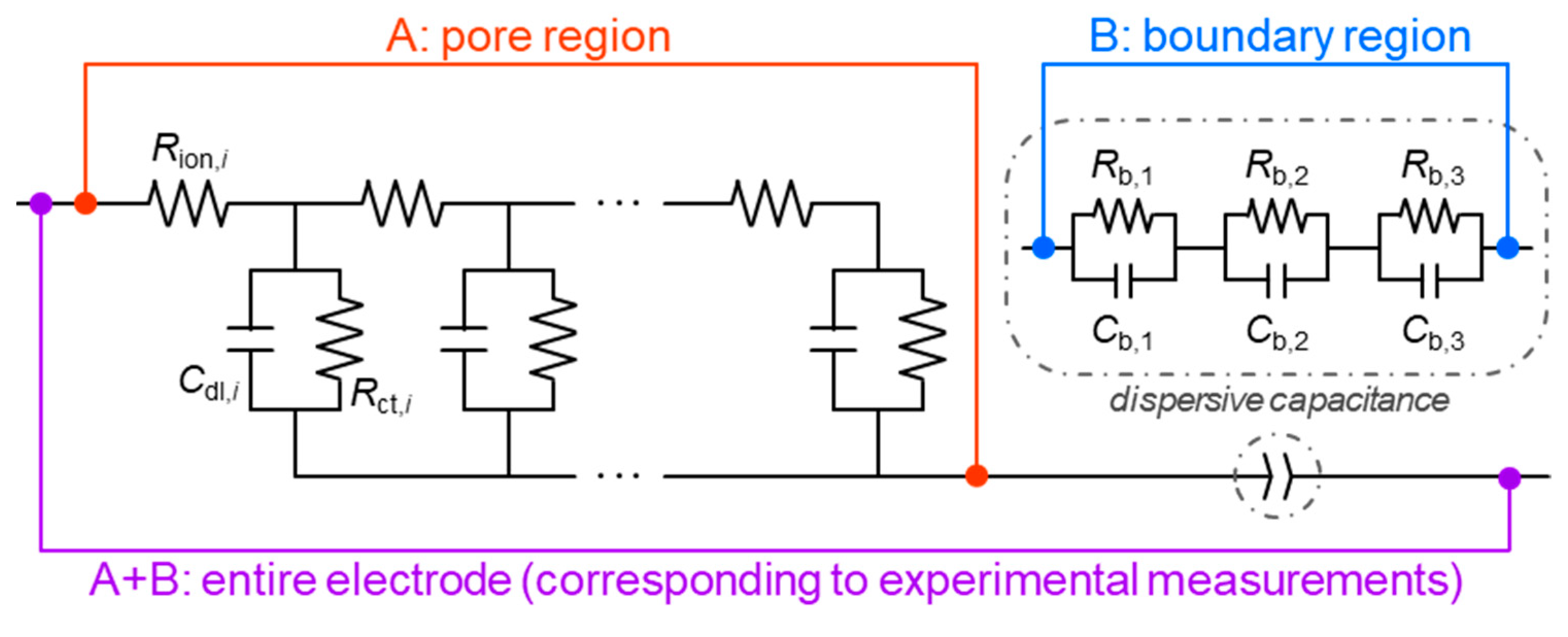
15,
19]. We employ a simplified TLM that discretizes the electrode surface into ten segments in the depth direction, and use this TLM to estimate the resistance and capacitance of each segment from OCV traces. The segment-wise parameters are then converted into a relative area index and interpreted in conjunction with the associated time constants, thereby providing a depth-resolved area profile as a function of pulse number. The proposed approach offers a quantitative framework for tracking changes in Li
+ pathways in the interface-adjacent porous layer via DC voltage signals to derive morphological indices, thereby diminishing reliance on complex operando apparatus. Consequently, it provides a methodological foundation for establishing systems that monitor and diagnose the degradation of lithium metal electrodes.
3. Results
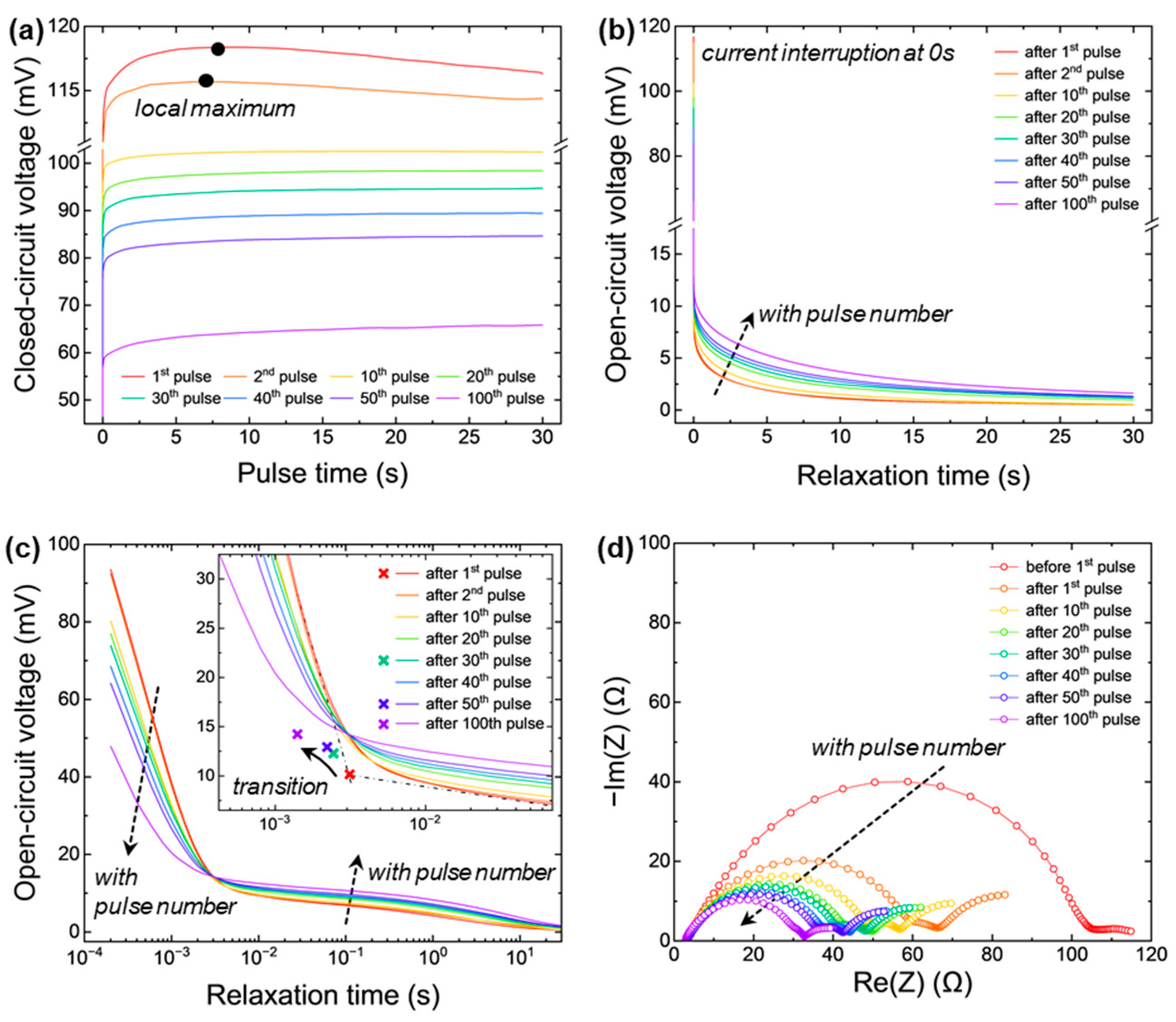
Figure 2 shows the response of the two-electrode Li-SC to repeated galvanostatic pulses at 1 mA followed by relaxation periods. The closed-circuit voltage (CCV) during the pulse and the OCV during the subsequent rest are plotted in
Figure 2a and
Figure 2b, respectively, on a linear time scale with the start of each phase set to zero. In the 1st and 2nd pulses, the CCV (
Figure 2a) exhibits an initial sharp rise, followed by a peak (marked with ●) and then a gradual decrease. As the pulse sequence continues, the initial overpotential and peak are suppressed, and the CCV evolves into a monotonically increasing profile. In contrast, the OCV (
Figure 2b) decays monotonically after every pulse, with a rapid initial drop followed by a slower tail. With increasing pulse number, the magnitude of the initial drop diminishes, whereas the long-time relaxation becomes slower.
To resolve the evolution of relaxation behavior more clearly, the OCV traces are replotted on a logarithmic time axis in
Figure 2c. A transition time can be identified from the intersection of an early, fast-relaxation regime and a later, slow-relaxation regime (see the inset for the determination procedure and the resulting values). As the number of pulses increases, both the initial OCV level and the short-time decay (before the transition time) are reduced, whereas the voltage associated with the long-time relaxation (after the transition time) increases. The relative weight of the slow component thus grows at the expense of the fast component. At the same time, the transition time shifts to earlier times (see the inset), indicating a decrease in the characteristic time constant of the fast-relaxing contribution. The reduction in the initial CCV rise and OCV decay with repeated pulses indicates a decrease in the interfacial reaction overpotential, consistent with previous findings [
4,
5,
6,
7,
8,
9,
14,
15,
16]. The mid-to-late stages of the CCV are difficult to interpret simply by analyzing the voltage curve because the ongoing interfacial reaction causes the surface morphology and effective area to change over time, and an electrolyte concentration gradient forms simultaneously. However, given that the shape changes during OCV are negligible, the entire relaxation curve following the initial rapid decrease (interfacial reaction overpotential relaxation) can be analyzed in terms of Li
+ redistribution.
These trends are consistent with the evolution of interfacial resistance derived from EIS. As shown in
Figure 2d, the semicircle diameter in the impedance spectra decreases with cycling, evidencing a reduction in interfacial resistance. This reduction coincides with the suppression of the initial CCV overshoot (
Figure 2a) and the attenuation of the short-time OCV decay (
Figure 2c), implying an increase in effective surface area with repeated plating/stripping, in agreement with previous reports on lithium metal electrodes [
4,
5,
6,
7,
8,
9,
14,
15,
16].
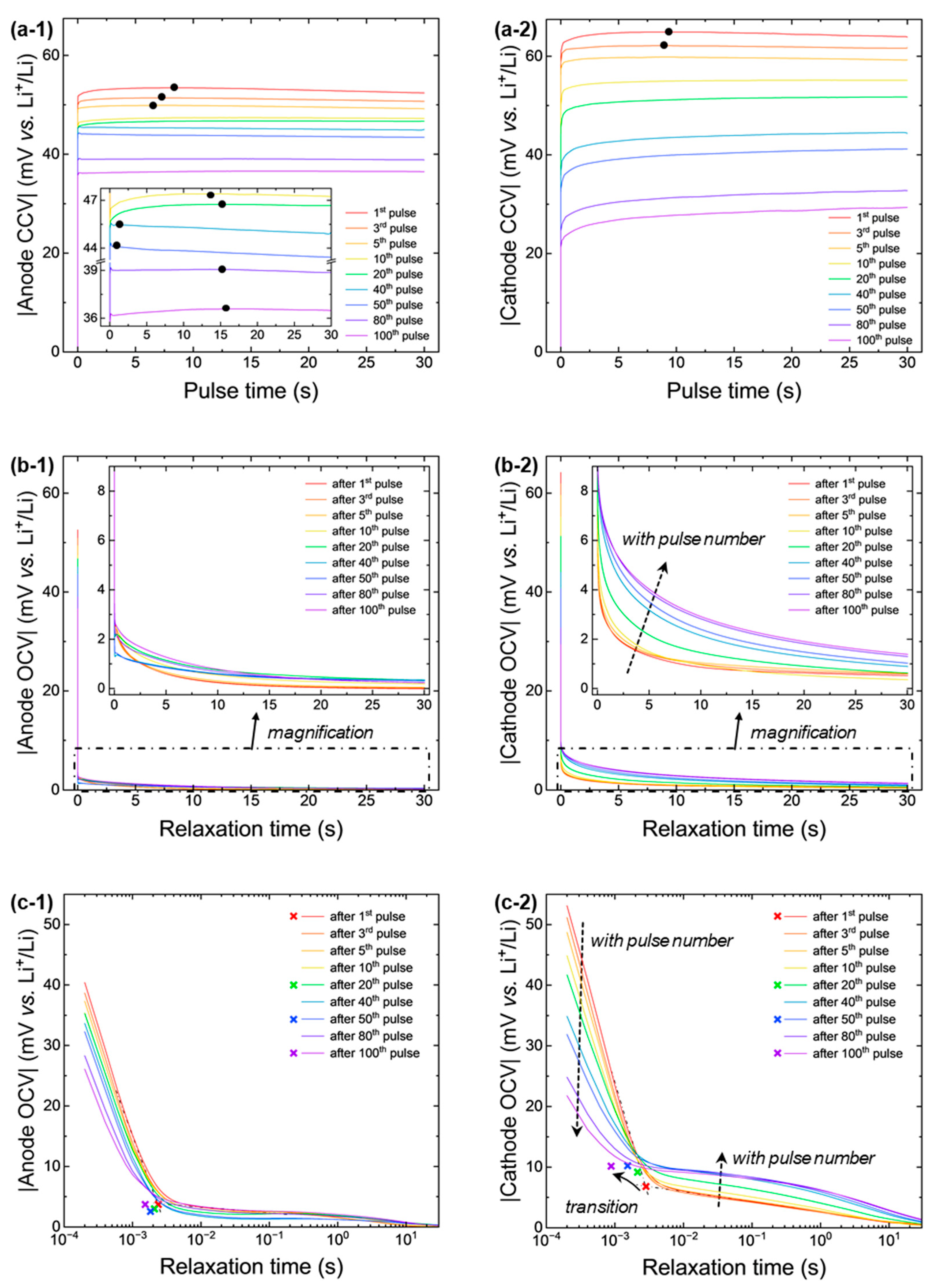
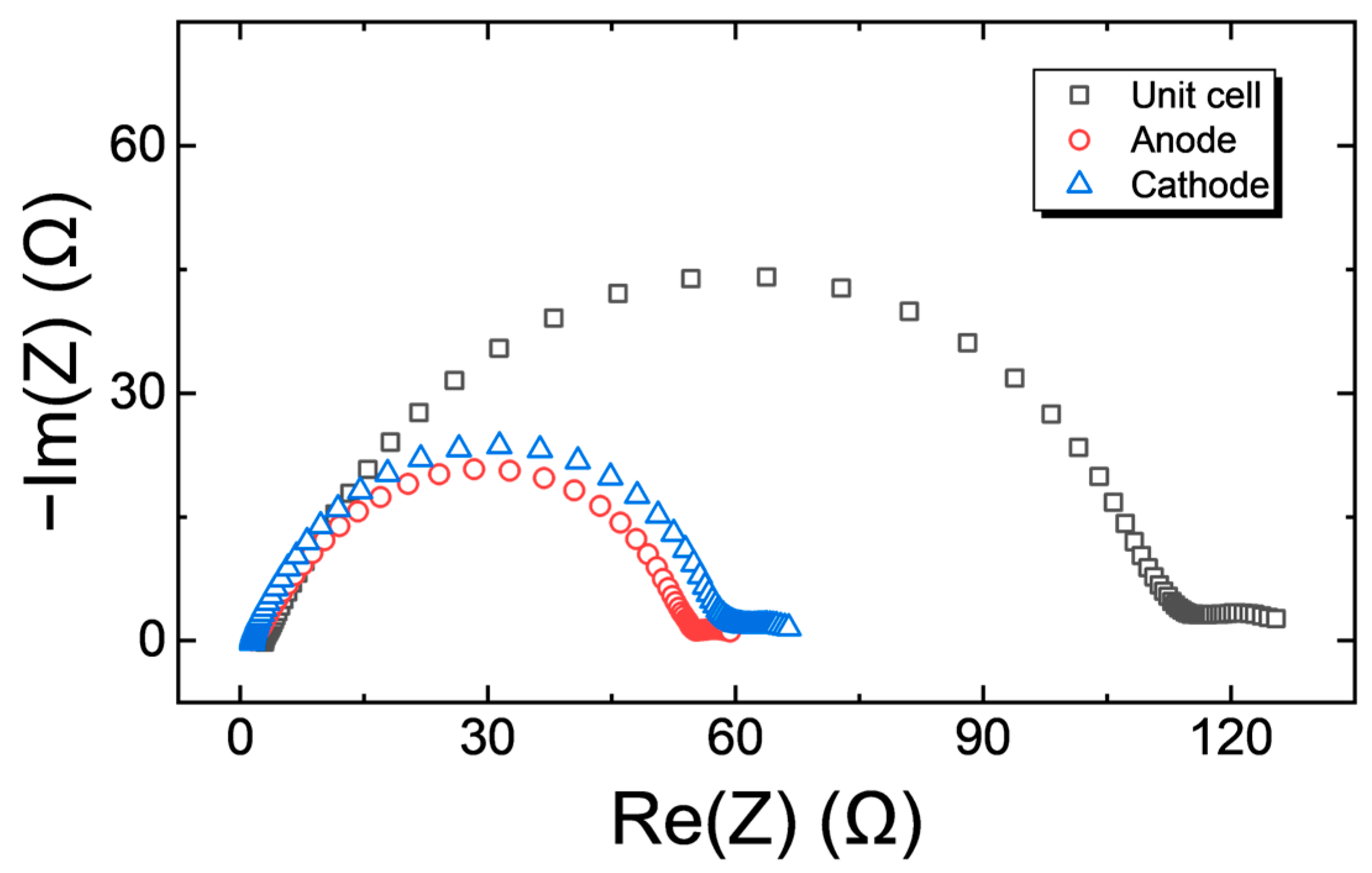
To identify which electrode governs these changes, the pulse–relaxation experiment was repeated in three-electrode Li-SCs while recording the individual potentials of the stripping electrode (anode) and plating electrode (cathode). Both electrodes are made of identical lithium foil, as confirmed by the impedance spectra of the as-prepared cell before the 1st pulse (
Figure A2 in
Appendix A), which show no significant difference in interfacial impedance. Nevertheless, clear differences emerge between the anode and cathode responses during the pulse (
Figure 3(a-1) and
Figure 3(a-2), respectively) and during relaxation (
Figure 3(b-1,b-2)), and these differences become increasingly pronounced with cycling. In
Figure 3(a-1,a-2), the voltage overshoot, i.e., an initial sharp increase followed by a local maximum (marked with ●) and gradual decay, appears at both electrodes during the early pulses but remains clearly visible at the anode even after many cycles. Although not the main focus of this work, this behavior can be rationalized by differences in the spatial non-uniformity of the kinetics. At the cathode, continuous formation of fresh lithium deposits rapidly smooths out the initial heterogeneities, whereas at the anode, repeated stripping limits the growth of effective surface area and allows the original non-uniform reactivity of the Li foil to persist for a longer period. In the OCV traces (
Figure 3(b-1,b-2)), the progressive slowing of voltage relaxation with pulse number is mainly observed at the cathode, while the anode continues to reach its equilibrium potential (0 V vs. Li
+/Li) rapidly, even after later pulses.
The OCV traces for anode and cathode are also replotted on a logarithmic time axis in
Figure 3(c-1) and
Figure 3(c-2), respectively. Both electrodes demonstrate that the transition time between short-time decay and long-time relaxation shifts to earlier times with an increasing number of pulses. Notably, the cathode (
Figure 3(c-2)) exhibits behavior similar to that observed in
Figure 2c, while the anode (
Figure 3(c-1)) lacks a distinct trend in the transition shift. Taken together, these observations indicate that the changes in the cell-level OCV behavior in the two-electrode configuration are predominantly governed by morphological evolution at the Li plating electrode, i.e., by the accumulation and restructuring of deposits.
Motivated by this result, the subsequent analysis focuses on the cathode OCV relaxation curves, which exhibit the most pronounced cycle dependence. These transients were decomposed and quantified using the TLM-based circuit in
Figure 1. The circuit parameters were obtained by nonlinear least-squares fitting so that the simulated voltage trace reproduced the experimental OCV relaxation over the fitted time window (
Table 1a–d). To assess the quality of the fits, we evaluated the RMSE between the simulated and experimental voltage traces (
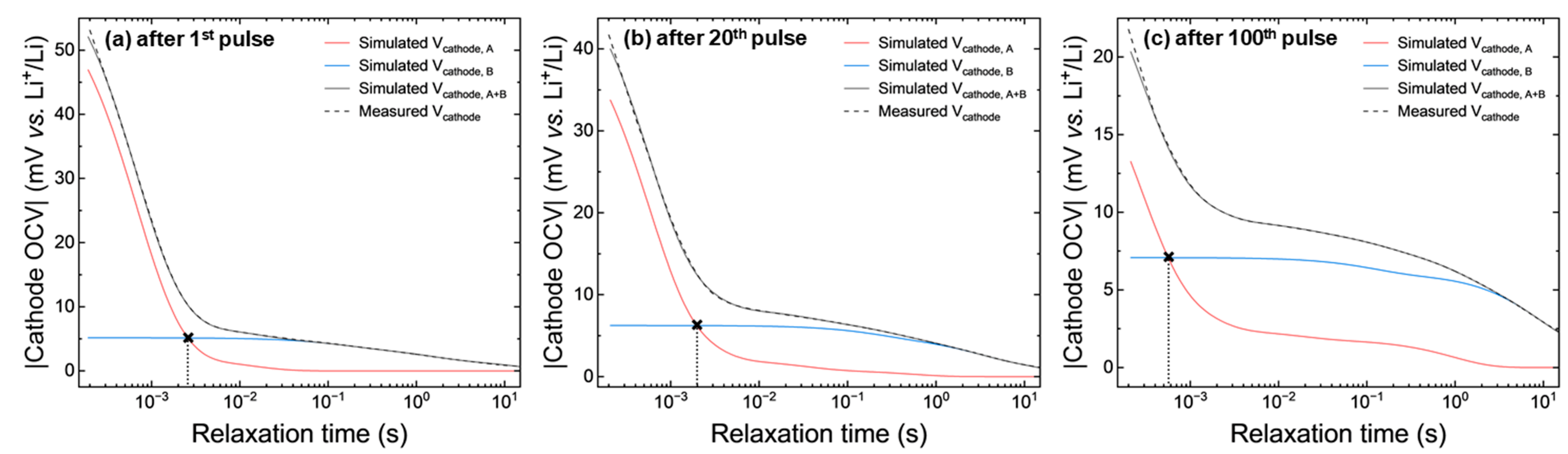
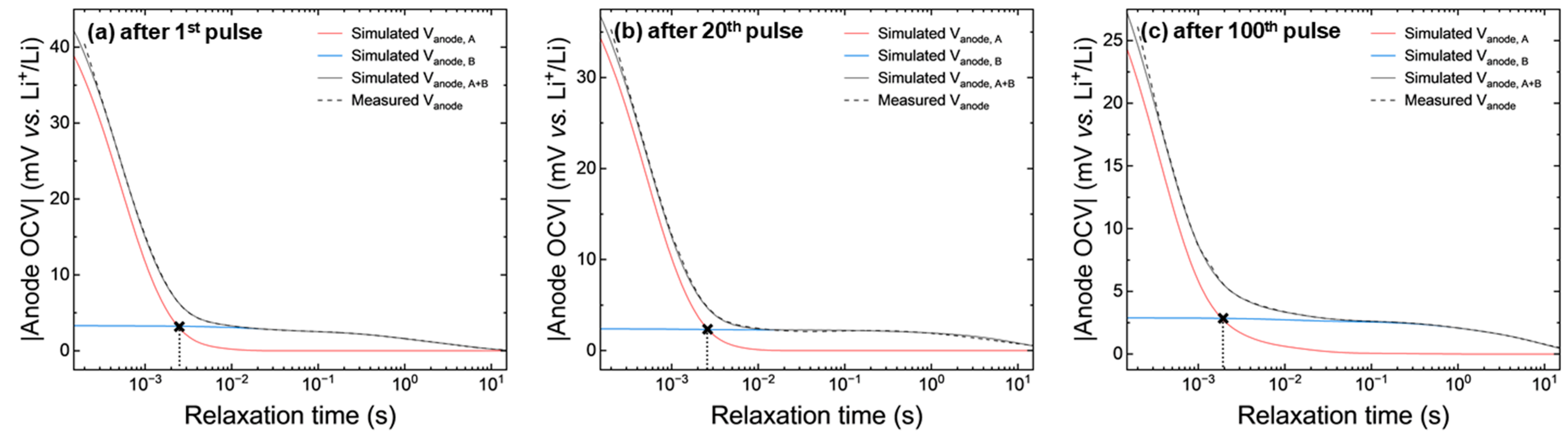
Table 1e). The resulting RMSE values were typically below 0.1 mV, corresponding to less than 1% of the total OCV change during the fitted interval, indicating excellent agreement between the model and the data. The fitted circuit parameters were used to simulate the voltage responses of the pore region (A; TLM ladder), the boundary region (B; dispersive capacitance), and the full circuit (A + B) under the same pulse–rest conditions.
Figure 4a–c present representative relaxation curves following the 1st, 20th, and 100th pulses. In all cases, the response of region A dominates the early-time relaxation, whereas region B governs the long-time tail. As the pulse number increases, the contribution of region B to the overall voltage response becomes more pronounced, reflecting the expanding influence of the slowly responding boundary region. Consistent with
Figure 2c, the crossover from A-dominated to B-dominated behavior shifts to earlier times as the pulse number increases: initially, the contribution of the boundary region is confined to long times, but with continued cycling it progressively extends toward shorter time scales.
The same procedure was applied to the anode OCV relaxation curves (
Figure A3a–c in
Appendix A). In contrast to the cathode, the contribution of region B to the anode voltage is small and does not show a systematic increase with pulse number; instead, it fluctuates without a clear trend. This lack of progressive depth-wise evolution is consistent with the absence of a growing dendritic domain at the anode, where repeated stripping does not create new Li deposits that would extend the active region deeper into the TLM domain. Overall, these findings support an interpretation in which the TLM ladder (region A) primarily represents the domain occupied by active Li dendrites, including Li
+ transport in pores and charge transfer at pore walls, whereas region B predominantly reflects Li
+ transport in regions filled with dead Li and other slowly responding components.
To examine the morphological evolution more closely, the fitted parameters of each segment constituting region A were analyzed. Using the segment-wise
Cdl,i and
Rct,i values obtained from fitting the cathode OCV relaxation curves (
Table 1), the interfacial area in each segment was estimated under the assumption that it is proportional to
Cdl,i and inversely proportional to
Rct,i. In both metrics, the total interfacial area, taken to be proportional to the sum of all parallel
Cdl,i values or, alternatively, to the inverse of the overall parallel
Rct, increases with pulse number (last columns in
Table 1b,c). However, the
Cdl-based total area increases by nearly forty-fold after 100 pulses, whereas the
Rct-based total area increases by only ~1.2-fold over the same range. If the
Cdl-based area is interpreted as the entire surface accessible for double-layer formation, and the
Rct-based area as the surface that is electrochemically active for charge-transfer reactions, these results suggest that the growth of charge-transfer-active area is modest compared with the expansion of electrochemically accessible surface. The fraction of truly active area within the total surface therefore decreases with cycling.
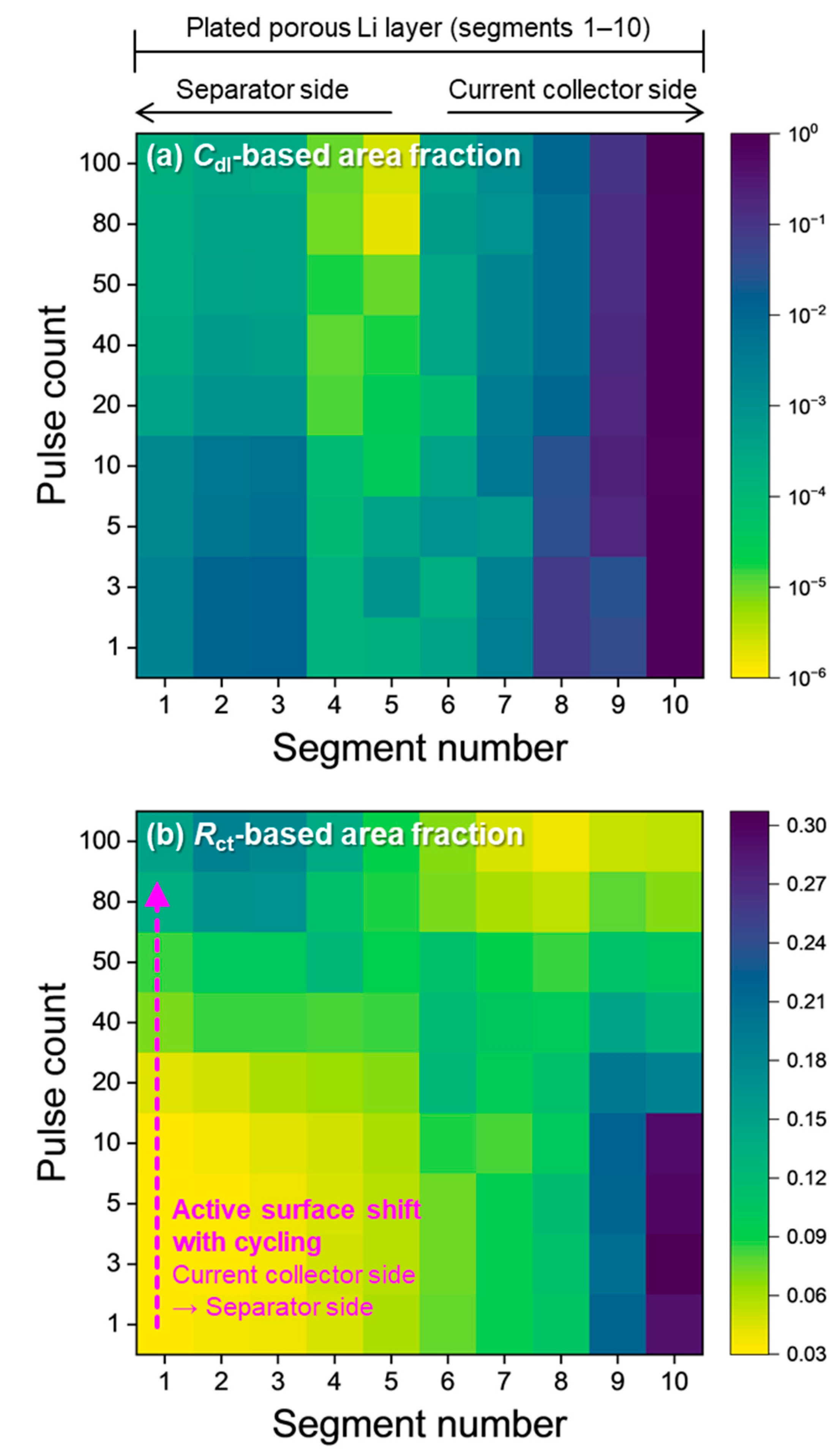
Figure 5 summarizes how this area is distributed over depth as a function of pulse number.
Figure 5a and
Figure 5b display heatmaps of the relative area fractions constructed from
Cdl,i and
Rct,i, respectively. For each pulse, the
Cdl-based area fraction of segment
i is defined as
Cdl,i divided by the sum of
Cdl over all segments in region A, whereas the
Rct-based area fraction is given by (1/
Rct,i) normalized by the sum of (1/
Rct) over all segments. Here,
Cdl- and
Rct-based areas should be regarded as effective metrics, since both parameters can also be influenced by local SEI properties and non-ideal double-layer behavior. Accordingly, we focus on relative, depth-wise trends and the associated time constants, rather than attributing the absolute changes in
Cdl or
Rct to morphology or SEI evolution alone.
In the
Cdl-based map (
Figure 5a), segment 10 (
i = 10) carries the largest area fraction (above ~60%) for all pulses. The fractions of segments
i = 8–10 increase with cycling, while those of segments
i = 1–3 decrease. Thus, the relative contribution of the inner, current-collector-side region increases at the expense of the separator-side region. This trend is consistent with dendrites that grow deeper into the electrode and progressively fill the inner pore volume, forming a dense dendritic domain. By contrast, the
Rct-based map (
Figure 5b) shows a different evolution. At low pulse numbers (up to ~10 pulses), segment 10 still has the highest area fraction (around 30%), but its dominance diminishes at later cycles. As the pulse count increases, the
Rct-based fractions of the shallow segments (
i = 1–5) increase markedly, whereas those of the deeper segments (
i = 8–10) decrease. Beyond roughly the 50th pulse, the separator-side segments collectively account for the majority of the
Rct-based area. In other words, the charge-transfer-active surface progressively shifts toward the electrode side facing the separator. For clarity,
Figure 5b is annotated with an arrow to highlight this progressive shift in the charge-transfer-active surface toward the separator side with cycling.
This picture agrees qualitatively with operando depth-resolved measurements reported in the literature. Lv et al. used operando neutron depth profiling during galvanostatic Li plating to map Li density and plating activity across the electrode thickness, showing that Li density in the deeper region near the current collector grows more strongly with time, while the most active region shifts toward the electrolyte side [
10]. In addition, the well-known observation that Li
+ depletion in the electrolyte near the electrode surface promotes the growth of thin, needle-like deposits [
14,
21] supports our finding that the
Cdl-based area fraction on the current-collector side increases as dendritic branches extend into and occupy inner pores.
In fact, to clarify the apparently opposing trends in the Cdl-based and Rct-based area fractions, it is important to distinguish between (i) the electrochemically accessible surface that contributes to double-layer charging and (ii) the charge-transfer-active surface that participates in Faradaic reactions. With repeated plating, dendritic growth and the formation of an increasingly tortuous porous/deposit network can markedly increase the electrolyte-accessible interfacial area, particularly in deeper regions where deposits progressively fill the pore space; this tendency is reflected in the Cdl-based area fraction. In contrast, a substantial portion of this newly created surface can be partially blocked or rendered less active for charge transfer due to dead-Li accumulation, electronically/ionically isolated domains, and local SEI thickening/inhomogeneity, so the Rct-based “active” fraction does not necessarily follow the same depth trend. Meanwhile, near the separator-facing side, freshly formed deposits and shorter ion-transport paths can sustain a relatively larger fraction of charge-transfer-active surface, leading to the observed progressive shift in the Rct-based area fraction toward shallow segments despite the continued growth of the Cdl-accessible area in deeper segments. Thus, the divergence between the two metrics is consistent with a morphology in which the interior becomes increasingly “accessible but less active,” whereas the separator-side region remains comparatively more active for charge transfer.
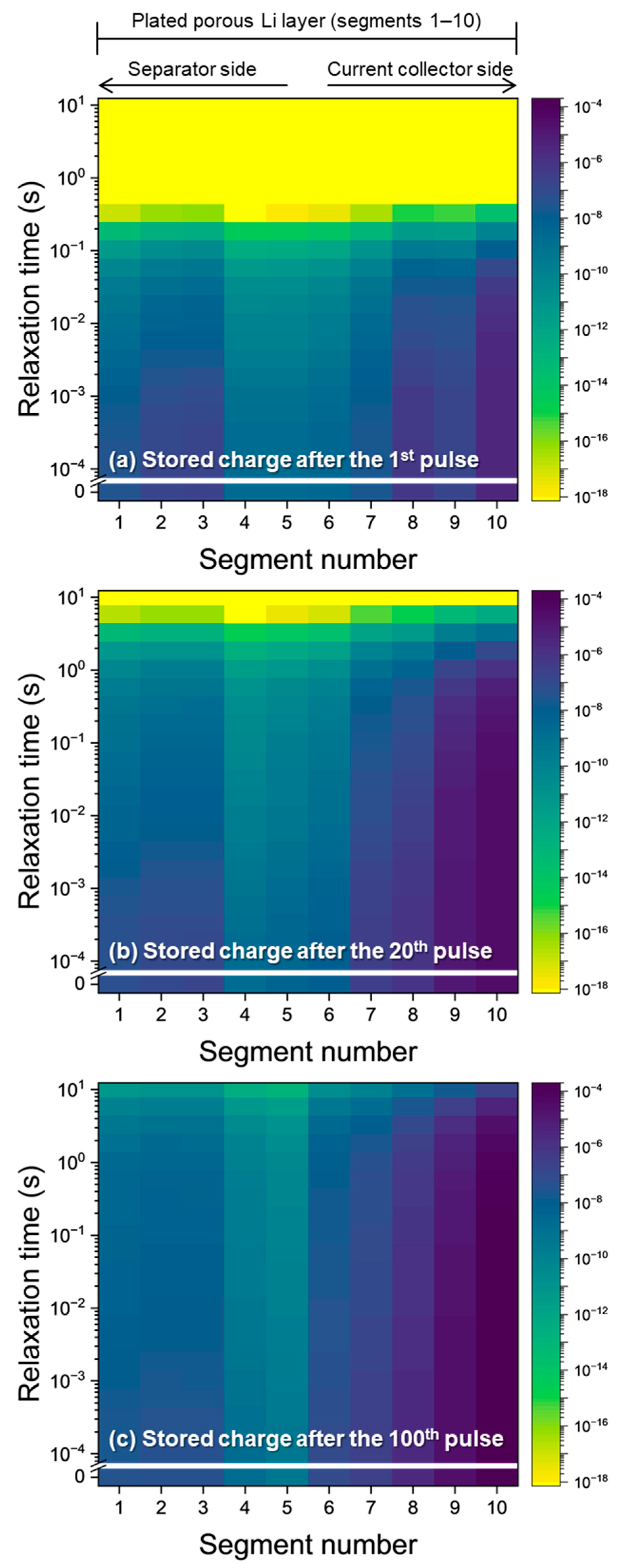
During the pulse, most of the applied current drives Li plating/stripping, whereas a smaller portion is associated with charging of the interfacial double layer and related capacitive processes. The charge accumulated in each segment during current application subsequently relaxes during the rest period; its evolution is shown in
Figure 6. The charge over the relaxation time is calculated as
, where
Vi(t) is the local potential measured from the circuit simulation at each
Cdl,i node. After the 1st pulse (
Figure 6a), the total charge stored across all segments at the moment of current interruption is as small as 4.2 × 10
−6 C and decays almost completely within several tens of milliseconds, with particularly rapid relaxation centered around segments i = 4–6. After the 20th pulse, the total stored charge increases to 4.2 × 10
−5 C, about 10 times larger than after the 1st pulse, and the relaxation time extends to the order of seconds. After 100 pulses, the total charge reaches 1.9 × 10
−4 C (a ~45-fold increase relative to the 1st pulse), and relaxation becomes even slower. Despite this marked increase in total charge, segments i = 4–6 consistently exhibit comparatively fast decay, suggesting that the ion-transport pathways in the mid-depth region remain relatively short or low-resistance even as the overall amount of deposited material grows.
Viewed as depth profiles at representative times, the mid-depth segments (i = 4−6) consistently exhibit faster charge decay than the deeper segments (i = 8−10), while the separator-side segments (i = 1−3) retain relatively short effective time constants even at later cycles. This qualitative ‘cross-sectional’ contrast supports the emergence of a sluggish interior domain that increasingly governs the long-time tail.
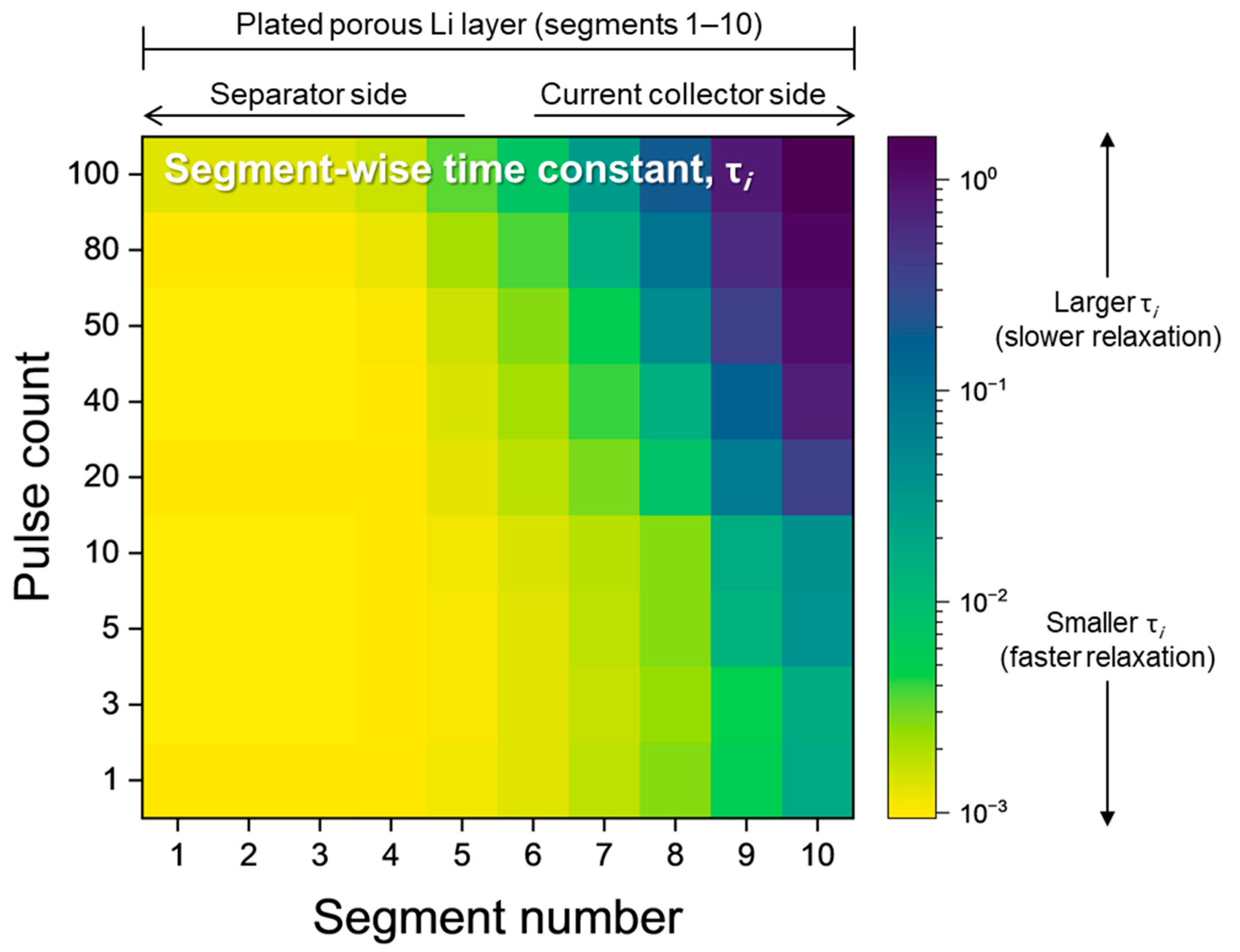
Figure 7 presents the evolution of the segment-wise time constants of the cathode as a function of pulse count. Whereas the changes in area (proportional to
Cdl,i) show somewhat ambiguous dependencies across segments and cycles, the time constant
τi, reflecting both
Rion,i and
Rct,i, exhibits much clearer segment-wise contrasts and cycling trends. By the physical definition of a time constant for first-order relaxation,
τi is taken as the time at which the pulse-induced charge stored in each segment decays to 1/
e ≈ 36.8% of its initial value. In practice,
τi is obtained by interpolating the time when the segment-wise stored charge relaxes to 36.8%. Initially, all segments display
τi values on the order of 10
−3–10
−2 s, indicating broadly similar relaxation behavior throughout the porous layer. As the pulses are repeated, the time constants of all segments generally increase, reflecting the combined effect of enlarged interfacial area (increased
Cdl) and the accompanying changes in
Rion,i and
Rct,i. After 100 pulses, the time constants of the separator-side segments (
i = 1–3) increased by a factor of approximately 1.4, those of the middle segments (
i = 4–7) by roughly one order of magnitude, and those of the current-collector-side segments (
i = 8–10) by as much as two orders of magnitude. This implies that the active lithium surface area grows preferentially in the separator-side region, simultaneously reducing the local transport and charge-transfer resistances and thus accelerating relaxation in those segments. In other words, a surface that initially exhibits comparable activity over most depths evolves, through morphological changes and porous-layer formation during repeated plating, into a state where the dominant active surface is shifted toward the outer region adjacent to the separator.
A closer look at the deeper segments (approximately
i = 8–10) reveals that their time constants, which are initially comparable to those of the other segments (~10
−3–10
−2 s), increase by up to one–two orders of magnitude with cycling. In contrast, the separator-side segments (
i ≈ 1–3) remain close to their initial values, and the mid-depth segments (
i ≈ 4–7) take intermediate values. Together with the charge-relaxation behavior in
Figure 6, where segments around
i = 4–6 consistently exhibit the fastest decay, this trend suggests that the near-separator and mid-depth regions retain relatively low-resistance pathways, whereas the innermost region near the current collector becomes increasingly sluggish. The progressive increase of
τi in the deeper segments can be attributed to the accumulation of dead Li and the growing complexity of the pore structure, which lengthen ion-transport pathways and increase tortuosity in those regions. Consequently, the distribution of time constants evolves from being relatively uniform at early cycles to a clear gradient in which
τi is smallest near the separator and becomes progressively larger toward the current-collector side. This is consistent with the behavior observed in
Figure 2 and
Figure 4, where the transition in OCV relaxation shifts to earlier times while the slow relaxation component at longer times becomes more prominent.
In summary, the segment-wise analysis of time constants reveals that (i) as Li dendrites grow with repeated plating, the charge-transfer-active surface area in the separator-side segments increases, so that their local voltage relaxation remains comparatively fast, and (ii) the accumulation of largely inactive deposits in the interior segments complicates the Li
+-transport pathways, leading to slower local voltage relaxation and an increasing contribution of these interior regions to the long-time OCV tail. As a result, the overall OCV relaxation evolves from being dominated by the surface-adjacent region in the early cycles to reflecting an increasing contribution from the interior region at later stages. This picture is qualitatively consistent with post-mortem observations reported in the literature [
1,
9,
10,
11,
12,
13,
18,
21]. Furthermore, these results demonstrate that simple DC voltage-relaxation signals, combined with TLM-based parameter analysis, can serve as an effective tool for tracking changes in the surface morphology of lithium metal electrodes associated with dendritic growth and dead-Li accumulation.
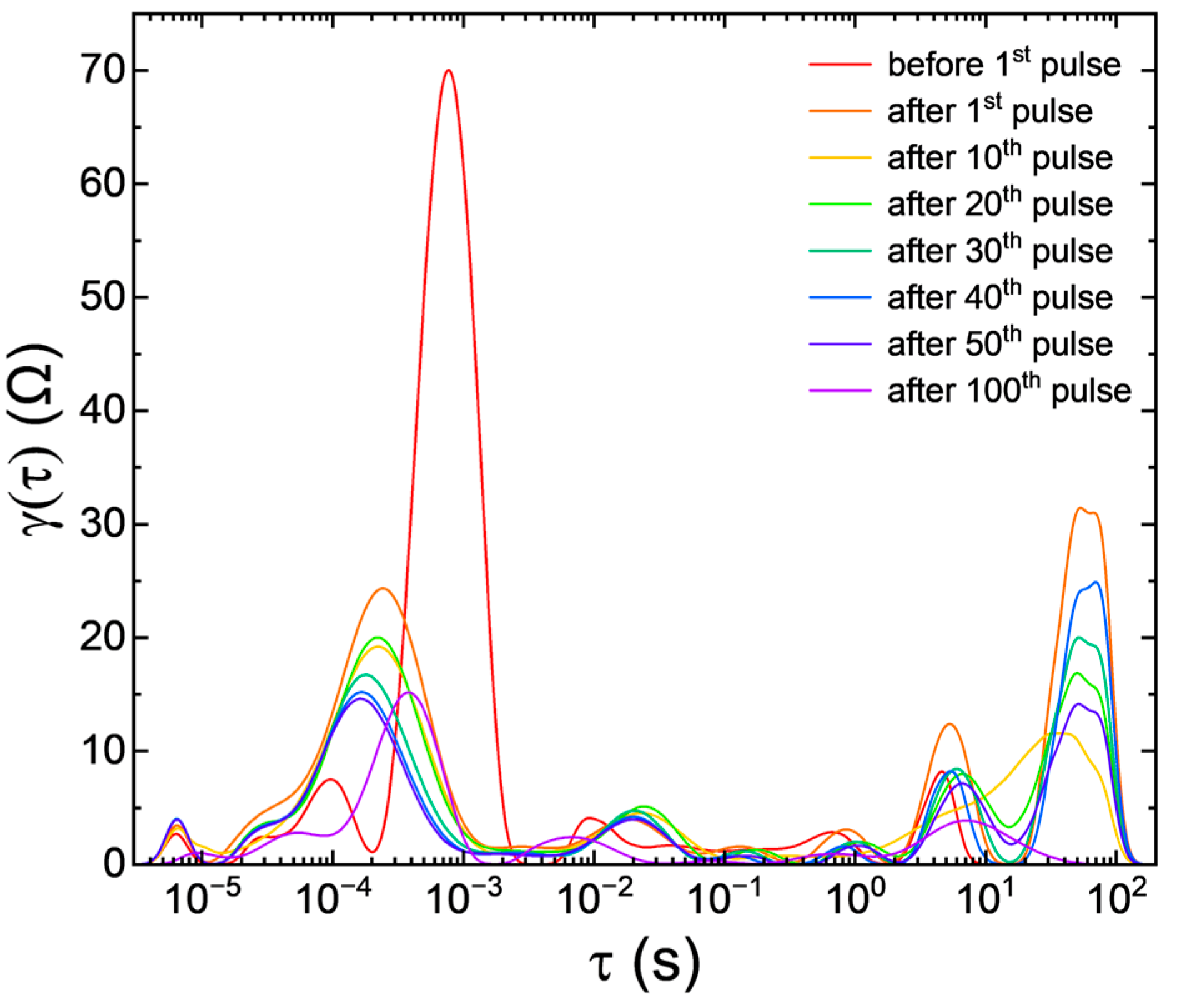
To provide a complementary perspective on resistance evolution, we include a distribution of relaxation times (DRT) analysis of the measured EIS data (
Figure A4 in
Appendix A). The prominent short-time feature observed in the pristine state is strongly suppressed after initial cycling, consistent with the overall reduction in interfacial impedance and the attenuation of the short-time voltage-relaxation component discussed above. Although a direct one-to-one mapping between DRT peaks and the depth-resolved time constants extracted from the DC transient fitting is limited, the overall evolution of the DRT features is qualitatively consistent with the interpretation developed here.
Finally, it should be noted that the present analysis intentionally adopts a simplified, depth-resolved TLM to enable quantitative interpretation of OCV relaxation using a minimal DC dataset. This simplification entails several limitations. First, the model assumes a one-dimensional depth discretization and assigns uniform effective properties (e.g.,
Rion,i,
Rct,i, and
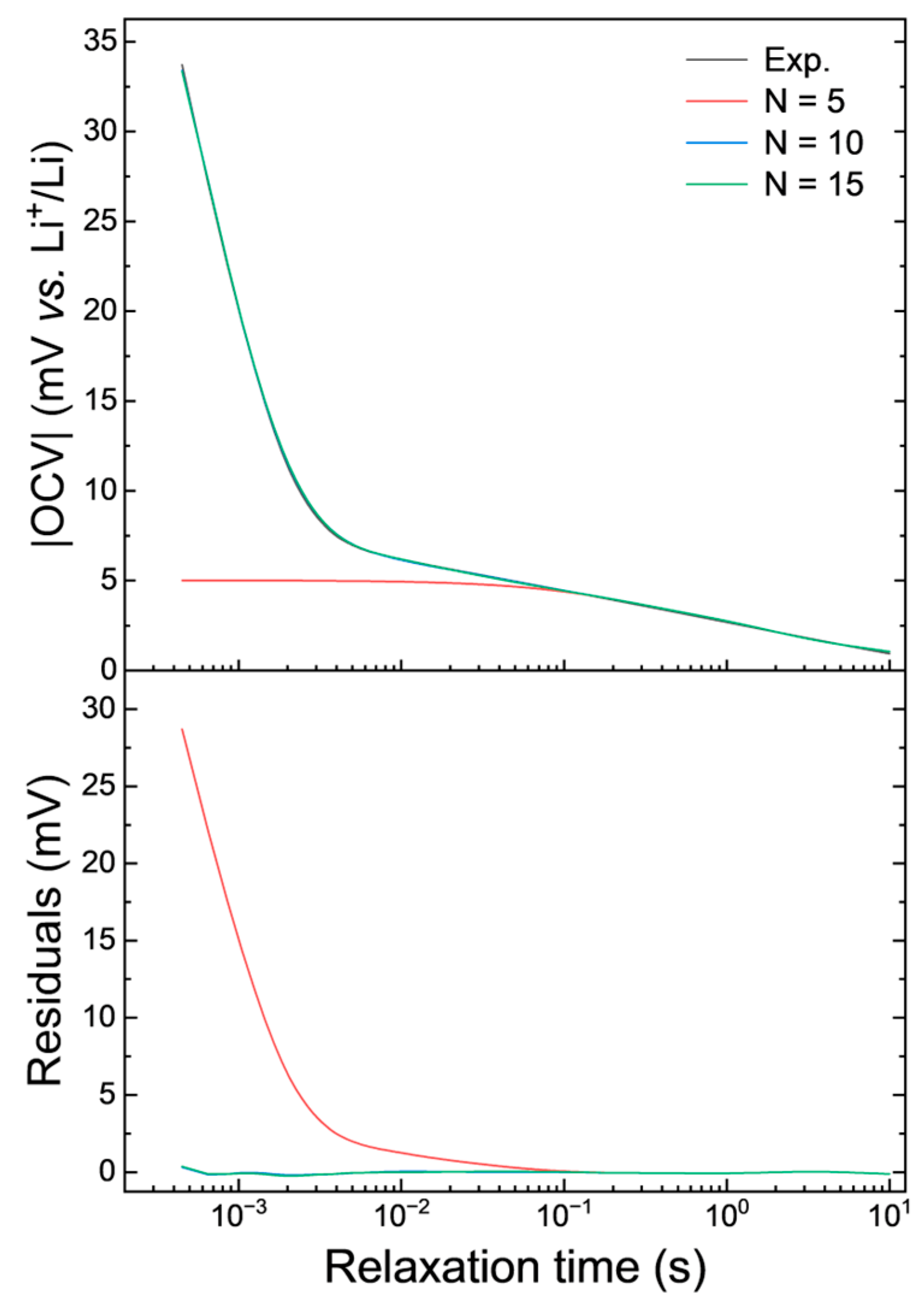
Cdl,i) within each segment, whereas the actual lithium morphology and the SEI/porous network are heterogeneous and evolve in a spatially complex manner. Second, the choice of ten segments represents a practical compromise, as shown by the discretization-sensitivity analysis in
Figure A1: fewer segments reduce depth resolution and can obscure systematic depth-wise trends, whereas increasing the number of segments substantially increases the number of fitted parameters and can aggravate parameter correlation and non-uniqueness without providing proportionate gains in interpretability. Third, as with many inverse problems, fitting voltage transients with a multi-parameter circuit model can admit correlated parameter sets (e.g., trade-offs among
Rion,
Rct, and
Cdl) that yield similarly low fitting errors; therefore, the obtained parameters should be regarded as effective values constrained by the model structure and the fitted time window. Accordingly, in this work, we primarily interpret the relative, segment-wise evolution (e.g., depth-dependent trends in effective area indices and time constants) rather than claiming a unique microstructural reconstruction. More rigorous uniqueness/uncertainty quantification and stronger physical constraints, potentially supported by complementary operando and post-mortem characterization, remain important directions for future work.
In addition, while this study focuses on Li symmetric cells under moderate current pulses to establish a depth-resolved DC diagnostic, the proposed OCV-relaxation/TLM framework can be extended to more demanding operating conditions. At higher current densities and/or after longer cycling, larger concentration polarization and stronger spatial inhomogeneity are expected, which may increase nonlinearity and broaden the distribution of relaxation times. Accordingly, the pulse amplitude and rest duration should be selected such that the measured OCV relaxation is primarily governed by electrolyte/porous-layer redistribution rather than by ongoing far-from-equilibrium reactions. Nonetheless, the key observables used in this work, namely, changes in the relative weight of short- vs. long-time relaxation and the depth-dependent evolution of effective time constants, should remain informative as long as voltage transients can be captured reliably with sufficient time resolution and signal-to-noise ratio. Extension to lithium metal full cells is also feasible, provided that the dominant electrode governing the relaxation response can be identified or constrained (e.g., via three-electrode validation, reference-electrode calibration, or complementary half-cell/diagnostic measurements). These considerations suggest that the proposed method can serve as a practical DC-based diagnostic in realistic cells, although systematic validation across higher rates, extended cycling, and full-cell chemistries warrants further study. Additionally, several related studies have reported complementary perspectives on lithium metal interfacial and morphological evolution, including impedance/TLM-based interpretations and materials/electrolyte strategies to regulate plating/stripping and suppress dendrite growth [
4,
22,
23]. Considering the insights from these works, the present DC OCV-relaxation/TLM framework may be further extended and validated under broader, more practical cell conditions.