Article

Experimental Design and Numerical Analysis of Volume Internal Heat Generation Source in Fluids Based on Microwave Heating

1
Shanghai Institute of Applied Physics, Chinese Academy of Sciences, Shanghai 201800, China
2
State Key Laboratory of Thorium Energy, Shanghai Institute of Applied Physics, Chinese Academy of Sciences, Shanghai 201800, China
3
School of Physical Science and Technology, ShanghaiTech University, Shanghai 201210, China
*
Authors to whom correspondence should be addressed.
Energies 2026, 19(1), 172; https://doi.org/10.3390/en19010172 (registering DOI)
Submission received: 24 November 2025 / Revised: 16 December 2025 / Accepted: 26 December 2025 / Published: 28 December 2025

Abstract

Liquid-fueled molten salt reactors (MSRs) are characterized by the use of liquid nuclear fuel, which leads to a unique thermal-hydraulic phenomenon in the core involving the simultaneous occurrence of nuclear fission heat generation and convective heat transfer. This distinctive behavior creates a critical need for high-fidelity experimental data on internally heated flows, yet such studies are severely constrained by the lack of methods to generate controllable, high-power-density volumetric heat sources in fluids. To address this methodological gap, this study proposes and numerically investigates a novel experimental concept based on microwave heating. The design features an innovative multi-tier hexagonal resonant cavity with fifteen strategically staggered magnetrons. A comprehensive multi-physics model was developed using COMSOL Multiphysics to simulate the coupled electromagnetic, thermal, and fluid flow processes. Simulation results confirm the feasibility of generating a volumetric heat source, achieving an average power density of 6.9 MW/m3. However, the inherent non-uniformity in microwave power deposition was quantitatively characterized, revealing a high coefficient of variation (COV) for power density. Crucially, parametric studies demonstrate that this non-uniformity can be effectively mitigated by optimizing the flow channel geometry. Specifically, using a smaller diameter tube or an annulus pipe significantly improved temperature field uniformity, reducing the temperature COV by over an order of magnitude, albeit at the cost of reduced absorption efficiency. Preliminary discussion also addresses the extension of this approach towards molten salt experiments. The findings establish a practical design framework and provide quantitative guidance for subsequent experimental investigations into the thermal-hydraulic behavior of internally heated fluids, offering a promising pathway to support the design and safety analysis of liquid-fueled MSRs.

1. Introduction

Against the dual backdrop of rising global energy demand and increasing environmental pressures, nuclear energy has gained prominence as a clean, efficient, and stable energy source. As a leading candidate of the Generation IV advanced nuclear reactor systems [1], molten salt reactors (MSRs) have attracted significant research interest worldwide due to their inherent advantages and broad application prospects, including inherent safety features, high-temperature thermal efficiency, and efficient thorium utilization [2,3]. Following the MSRE reactor built and operated by Oak Ridge National Laboratory (ORNL) in the 1960s [4], the Shanghai Institute of Applied Physics (SINAP) in China has independently developed and successfully achieved criticality and full-power operation of the TMSR-LF1 experimental reactor. Research continues to focus on advancing small modular molten salt reactor technologies.
Concurrently, several other countries and institutions are actively engaged in developing liquid-fueled MSRs, including fast-spectrum designs. Notable examples include the 1 MWt graphite-moderated molten salt research reactor at Abilene Christian University, which has recently obtained a construction permit from the U.S. Nuclear Regulatory Commission (NRC) [5,6]. Furthermore, Hanyang University in South Korea is developing a natural circulation-based multi-purpose innovative small modular molten salt fast reactor system, conducting both conceptual design and fundamental research on key technologies [5,7,8].
The key technical feature of MSRs is the use of Liquid Nuclear Fuel. The fission material (such as UF4) is dissolved in the molten salt carrier (such as FLiBe), which also acts as a coolant [5,9]. It is the main distinction from commercial water-cooled reactors and other advanced reactor designs. The liquid nature of the fuel salt presents significant thermal-hydraulic design challenges, especially in the case of high power density of fuel salt. Firstly, during normal operation, the fuel salt in the core exhibits a very high volumetric heat generation rate. Current experimental MSR designs typically achieve power densities around 20 MW/m3 or lower [10], with future designs aimed at exceeding 100 MW/m3 or more [11]. This is mainly because increasing power density is one of the best ways to enhance the economic efficiency of MSRs [10,12]. Secondly, the fuel salt also acts as the primary coolant, responsible for removing heat from structural components within the core, such as graphite moderator and alloys. Maintaining these materials below their temperature limits is critical for structural integrity, which places high demands and expectations on design accuracy [12,13]. Consequently, experimental investigation into the thermal-hydraulic behavior of fluids with internal heat generation is essential for validating flow and heat transfer models, which underpin the design and development of MSRs.
Nevertheless, the simultaneous flow and self-heating characteristics of molten fuel salts represent a unique thermodynamic phenomenon rarely observed in nature, with parallels limited to nuclear fission/fusion, chemical neutralization, or combustion processes. Experimental methodologies capable of replicating internal heat generation in flowing fluids remain scarce. Experimental investigations of internally heated fluids originated in 1962 at UCLA, where alternating current heating of electrolyte aqueous solutions revealed laminar flow temperature profiles consistent with theoretical predictions [14]. Subsequent studies by Kinney [15] and Michiyoshi [16] employed analogous methods but were limited to bulk temperature measurements, with insufficient resolution for turbulent flow wall temperature gradients and wall heat transfer characteristics. Recently, Park [17] adopted a similar approach by using electrical dissipation in an H2SO4 electrolyte solution to generate an internal heat source, investigating secondary flow effects in laminar flow through a horizontal pipe. However, the achieved power density remained relatively low, with a maximum value of only 1.09 MW/m3. Furthermore, their study did not include a reliable analysis of the power density distribution within the fluid. Notably, no substantive experimental progress has been reported in molten salt systems with volume internal heat sources over the past five decades.
Recent advances in studies of molten salts with internal heat sources have primarily focused on numerical simulations. The group of Politecnico di Milan [12,18,19] conducted comparative COMSOL/FLUENT analyses of FLiBe salt flow in core channels, revealing that conventional Nusselt (Nu) correlations overestimate heat transfer coefficients by up to 70% under internal heating conditions, prompting the development of global correction factors. Similarly, Fiorina [20] proposed Reynolds-Prandtl (Re-Pr) correction models based on RANS simulations for high-Prandtl (7.5 < Pr < 20) molten salts, introducing enhanced wall functions to quantify volume internal heat source effects on wall heat transfer augmentation. Lecce [21] advanced modified Nu correction factors via OpenFOAM simulations, demonstrating improved temperature field prediction accuracy for high-Pr molten salts using low-Reynolds turbulence models. These numerical studies lack enough experimental validation due to methodological challenges in replicating volume internal heat sources.
Early studies in the 20th century used alternating current (AC) Joule heating to simulate internal heat sources in fluids. In contrast, recent advances in non-contact microwave heating technology offer a more precise and powerful approach for generating volumetric heat in polar fluids, presenting significant potential for experimental applications. Microwave heating has received widespread attention in chemical engineering and process intensification owing to its advantages of being fast, selective, and volumetric, enabling enhanced reaction rates and yields [22,23]. These applications, however, are predominantly designed for batch processing or small-scale continuous flow chemical synthesis, where the primary objective is to achieve intense, localized heating to drive chemical reactions. Consequently, existing microwave reactor designs are not optimized for, nor have they been applied to, the distinct requirements of large-scale thermal-hydraulic experiments for nuclear applications. Such experiments demand the generation of a uniform, high-power-density (MW/m3 scale) volumetric heat source within meter-long flow channels to accurately simulate conditions in an MSR core. Microwave heating for our purpose is advantageous because it is fast (heating only the reactants and energy loss is less), convenient (microwave power can be adjusted optionally), and environmentally benign (using electric energy for heating and no environmental pollution).
To address this methodological gap, this study proposes an innovative experimental concept for generating a volumetric heat source in fluids using microwave heating. A multi-physics numerical model was developed with COMSOL Multiphysics to validate the feasibility of the approach and to guide the design of experimental parameters. The model further enabled analysis of the inherent non-uniformity in power deposition and its dependence on the fluid geometry. The fundamental novelty of this work lies in the adaptation and numerical investigation of microwave heating specifically for MSR-relevant thermal-hydraulic experimentation. First, it presents the conceptual design and simulation of a system capable of achieving high average power densities (~6.9 MW/m3) relevant to MSR fuel salts. This represents a significant advance over the capabilities of classical AC Joule heating methods, providing a more representative experimental basis for reactor core conditions. Furthermore, the work provides a systematic analysis of power deposition uniformity and demonstrates that channel geometry—such as reduced tube diameter or an annulus—can be actively leveraged as a design parameter to improve temperature field uniformity. This offers a practical strategy to mitigate the inherent non-uniformities of microwave heating for controlled convection experiments. Finally, the design employs a cost-effective array of commercial magnetrons within a segmented cavity, balancing performance, scalability, and practical feasibility for future experimental builds. These results provide a design basis and practical guidance for subsequent experimental investigations into flow and heat transfer in fluids with a volume internal heat generation source.

2. Conceptual Design of the Experimental Setup

Microwaves are a form of electromagnetic radiation. When exposed to a microwave field, polar molecules such as water and nitrate salts undergo high-frequency oscillations. This molecular motion generates heat through friction, enabling rapid, non-contact, and controllable volumetric heating within the fluid. An innovative experimental apparatus was conceptualized and designed based on this principle to study the volume internal heat generation source in fluids using microwave heating.
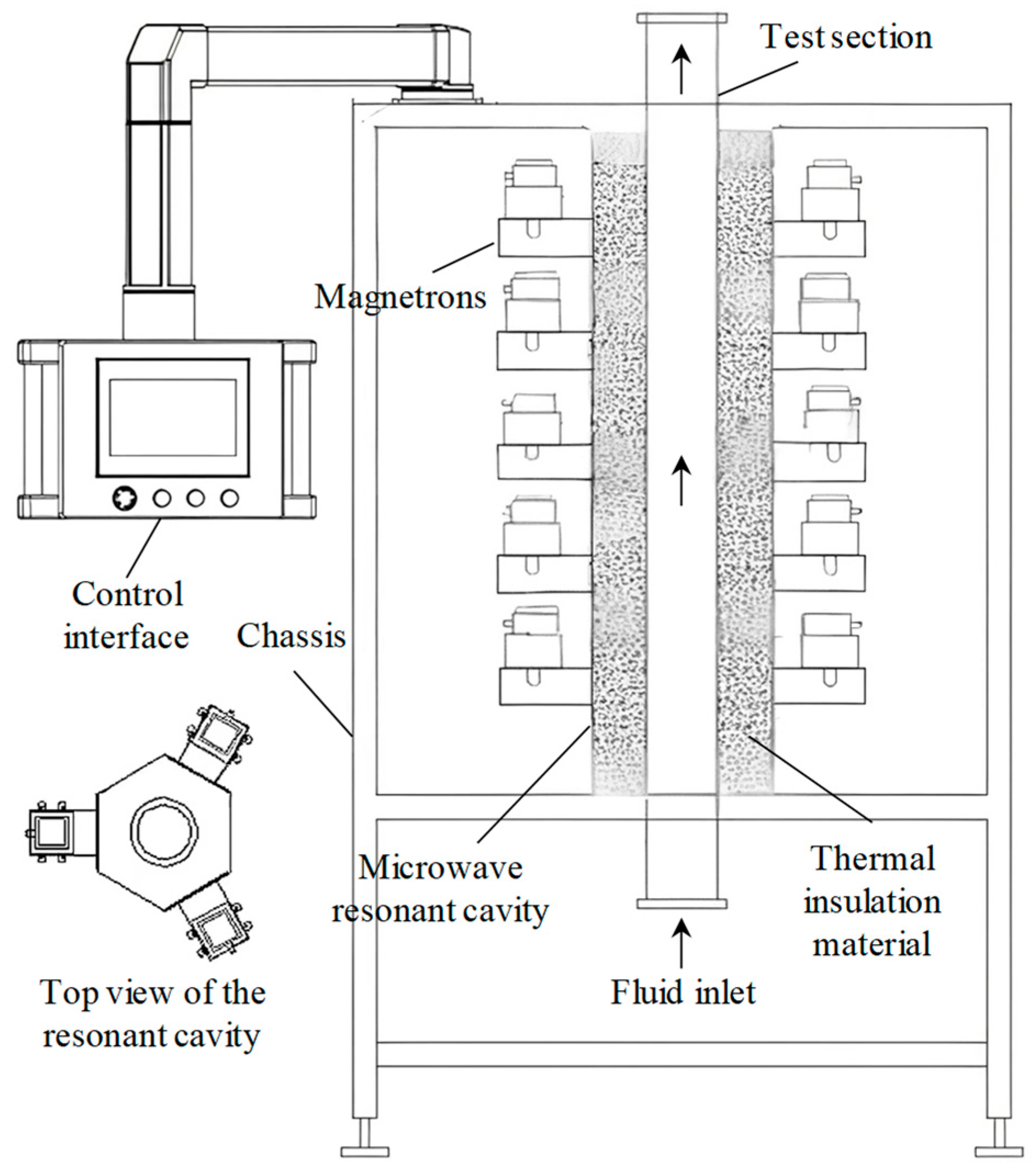
As shown in Figure 1, the system integrates a microwave resonant cavity, a magnetron array, a test section, and a control interface. The tube of test section has a total length of 1.6 m or more, with a 1-m central zone where microwave energy is focused to create volumetric heating within the molten salt or water flowing through the tube. A critical component of the design is a vertically oriented regular hexagonal prism cavity (height: 1 m; face-to-face distance: 0.278 m). The cavity is engineered to ensure microwave field distribution as uniform as possible. The hexagonal geometry was selected after consideration of alternatives like circular or rectangular cavities. Key design drivers included the need for satisfactory heating uniformity, practical manufacturability, and ease of integrating magnetron ports and instrumentation. The multiple flat facets of the hexagon provide stable mounting surfaces and help promote a blended electromagnetic field pattern conducive to mitigating pronounced hot spots, offering a favorable balance for this experimental application.
The cavity incorporates a multi-tier magnetron configuration, with 1.5 kW magnetrons operating at 2.45 GHz arranged in 5 vertical tiers. Each tier distributes three magnetrons at 120° intervals across adjacent hexagonal facets, fed by waveguide-coupled power transmission. This configuration achieves a total microwave input power of 22.5 kW (15 magnetrons), providing sufficient power density to simulate internal heat generation rates in the reactor core while maintaining operational flexibility for parametric studies. The power density can reach 6.9 MW/m3 under these parameters of heating power, which is close to the volumetric power density of fuel salt in the design of some small modular molten salt reactors.
The distribution of the microwave field and the resulting power deposition depend not only on the cavity design but also on the geometry of the heated medium. Therefore, the shape and dimensions of the test section are crucial design parameters. Since typical fuel salt channels in an MSR’s core are often circular or rectangular pipes [5,10], the geometry of the test section can be adapted accordingly to meet specific heating performance and experimental objectives. Furthermore, as microwaves reflect off metallic surfaces, the test section must be constructed from non-metallic materials with low microwave absorption, such as quartz or ceramic [22]. The fluid inside must be polar molecules, like water or nitrate salts, to effectively interact with the microwave. The heating efficiency is ultimately determined by the relative permittivity of fluid [23].

3. Modeling and Simulation

3.1. Geometric Modeling

Power distribution has a direct effect on temperature distribution and further affects the research on various thermal fluid mechanics behaviors. In the graphite assembly channel of a liquid fuel molten salt reactor, the fission heat source of liquid fuel salt is related to fission nuclide concentration, neutron flux, and flow velocity [24,25]. The power in the region near the graphite moderator wall will be higher when the flow velocity is lower or the channel diameter is larger, but the fission power can be considered uniform in the channel with a smaller diameter [24,25]. Therefore, designing to obtain a uniformly distributed and sufficiently high microwave heating power density is a key objective in simulating the volume internal heat generation source phenomenon of fuel salt.
In order to obtain a fluid volume internal heat source similar to the fission heat source prototype by microwave simulation, the power density distribution of the volume internal heat source for microwave heating is simulated and optimized by COMSOL Multiphysics 5.4 software for the conceptual design of the experimental setup. One is to change the arrangement of the magnetron array and the size structure of the resonant cavity; the other is to select an appropriate polar fluid.
Common water was preferred as the heated fluid for calculation in this paper, and on this basis, the design of the resonant cavity and waveguide was carried out to establish and validate the proposed microwave heating concept. Water serves as an accessible and well-characterized polar fluid for this initial proof-of-principle and for planned near-future separate-effect experiments aimed at isolating the influence of a volumetric heat source on convective heat transfer mechanisms. It is, however, recognized that direct extrapolation of quantitative results to molten salts (e.g., FLiBe, FLiNaK, nitrate salts) requires careful consideration due to significant differences in dielectric properties (complex permittivity ε′, ε″) governing microwave absorption, and thermophysical properties (Prandtl number Pr, thermal conductivity, etc.) affecting heat transfer. Preliminary experimental tests by our group have demonstrated that ternary nitrate salt, a common simulant with a Prandtl number comparable to some fluoride salts, can be effectively melted and heated by microwaves, achieving a power density approximately 51% of that for water under similar conditions. This confirms the fundamental feasibility of the method for molten salts. A primary obstacle to detailed numerical scaling at this stage is the notable scarcity of reliable data for the complex permittivity of molten salts across relevant temperature ranges. Future work, therefore, necessitates targeted measurements of these properties.
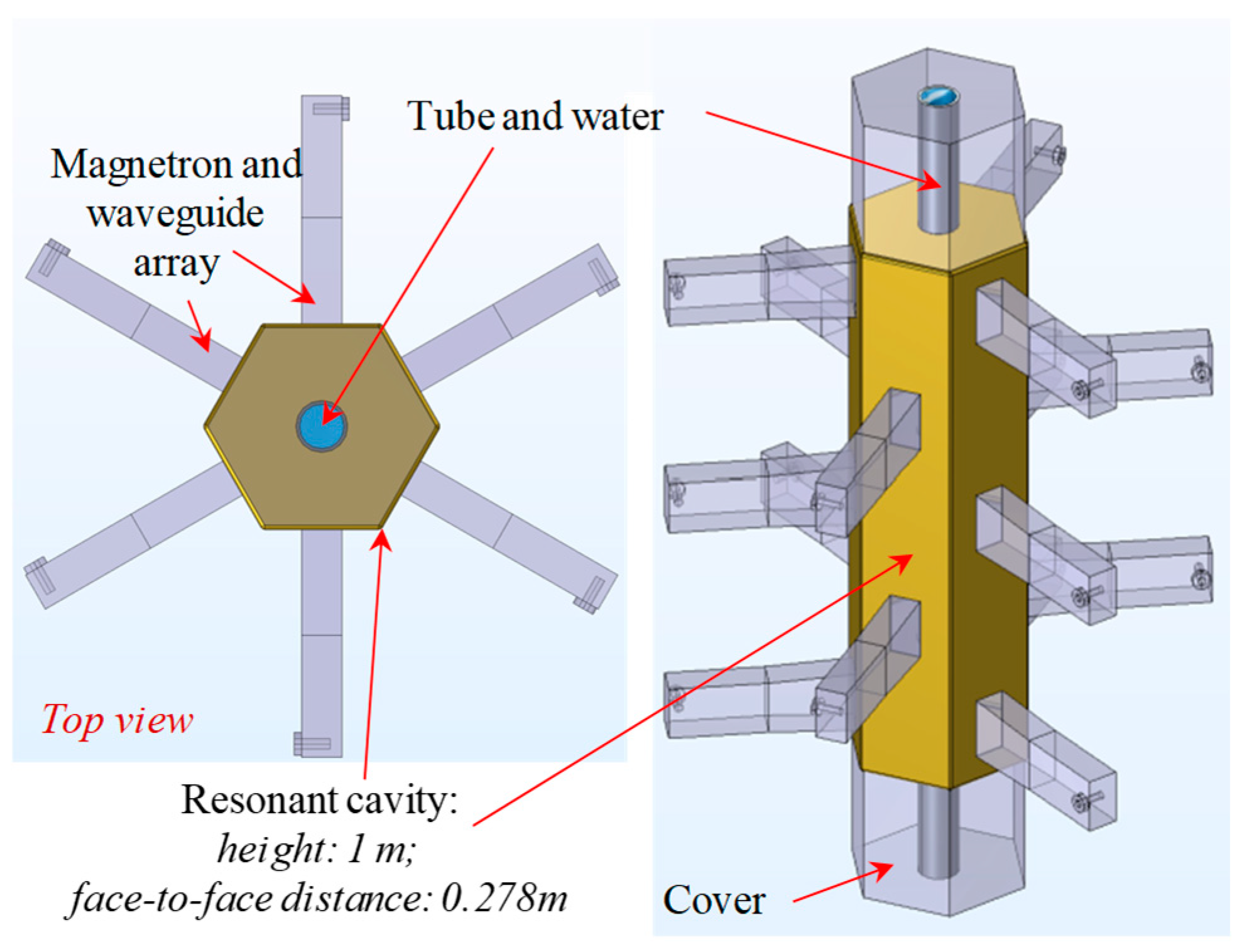
The computational geometry of the experimental setup, as illustrated in Figure 2, comprises four primary domains: the magnetron and waveguide array, the resonant cavity with its covers, the tube, and the fluid (water). The tube is modeled as a solid domain, while the fluid domain is enclosed within it. The remaining space is defined as an air domain. The covers are essential for safety in the simulation to prevent microwave leakage through the tube openings.
Key geometric structure parameters of the model are summarized in Table 1. The main resonant cavity has a height of 1 m and is internally subdivided into five relatively independent sub-cavities. Each sub-cavity incorporates three magnetron-waveguide units arranged at 120-degree intervals. Notably, these units are staggered by 60 degrees between adjacent layers. This staggered configuration is implemented to improve the axial uniformity of the power deposition profile along the flow direction. The mechanism involves averaging out the inherent symmetric power pattern of each sub-cavity by rotating it in adjacent layers, thereby preventing the constructive superposition of local non-uniformities. Consequently, a more homogenized heating profile within the fluid can be achieved. All the edges inside the cavity are chamfered with a radius of 5 mm.

3.2. Mathematical Model

The heating process of flowing water within a microwave cavity involves multiphysics computations, encompassing electromagnetic wave propagation, heat transfer, and fluid flow. This is governed by Maxwell’s equations, Fourier’s energy equation, and the Navier–Stokes equations.
In the microwave cavity, water molecules oscillate rapidly under the influence of the electromagnetic field. However, due to microwave attenuation and reflection, the electromagnetic field distribution is non-uniform. Therefore, determining this distribution is the primary step. Maxwell’s equations are solved to compute the electromagnetic field intensity E within the waveguides, cavity, and water, as expressed in Equation (1):
1 μ r × × E k 0 2 ( ε r j σ ω ε 0 ) E = 0
where μ r is the relative permeability, ∇ represents the gradient operator, E is the electric field strength, ε r is the relative permittivity, σ is the conductivity, ω is the angular frequency, ε 0 is the permittivity in vacuum, while k 0 represents the number of waves in free space.
The resulting electromagnetic power dissipation density, which serves as the volumetric heat source, is then calculated by Equation (2):
P d ( r , t ) = 1 2 ω ε 0 ε r E 2
where ε r denotes the imaginary part of the relative permittivity.
A perfect electric conductor boundary condition is applied on the outer surfaces of the system, as defined in Equation (3):
n × E = 0
where n represents the normal vector at the interface.
The heat generated by electromagnetic dissipation is transferred according to Fourier’s energy equation, given by Equation (4):
k 2 T + ρ C p T t = Q e
where k is the thermal conductivity (W/(m·K)), T is the temperature (K), ρ is the density (kg/m3), Cp is the specific heat capacity at constant pressure (J/(kg·K)), and Qe is the heat source (W). The initial temperature of the water is set to 293.15 K.
In this study, the deionized water flow is modeled as an incompressible Newtonian fluid. The flow in the tube is turbulent, with a Reynolds number of approximately 14,000. The mass conservation and Navier–Stokes equations are employed to describe the fluid flow, as shown in Equations (5) and (6), respectively:
ρ · u t + ρ ( u · ) u = · p I + μ ( u + ( u ) T + F
· u = 0
where μ is the dynamic viscosity (Pa·s), u is the velocity vector (m/s), I is the dimensionless identity matrix, p is the hydrodynamic pressure (Pa), and F represents the body force vector (N/m3). A no-slip boundary condition is applied at the inner wall of the tube, and the pressure is set to atmospheric. The outlet is controlled with a backflow suppression and pressure outlet condition.

3.3. Boundary Conditions and Numerical Setup

Current simulations, performed with water, represent a necessary first step in validating the core design concept and analyzing the fundamental interplay between microwave power deposition, geometry, and resulting temperature fields. The main materials used in the experimental setup include water, a quartz tube, and stainless steel. Their thermophysical properties, such as thermal conductivity, dynamic viscosity, specific heat capacity, and density, vary with temperature. The key parameters adopted in the simulation are provided in Table 2. The temperature-dependent correlations for the density, heat capacity, dynamic viscosity, and thermal conductivity of water are sourced from the COMSOL Multiphysics built-in material library, valid within the range of 273–373 K. The relative permittivity ( ε = 78, ε = 8) for water is taken from literature [22] and corresponds to a reference temperature of 298.15 K. Given the simulated bulk temperature rise is moderate (~8 K), the dielectric properties are treated as constant, which is a reasonable simplification for this scoping study. These values facilitate a more accurate analysis and modeling of the heating behavior of deionized water inside the designed microwave cavity.
The flow was modeled as turbulent using the standard k − ε turbulence model with standard wall functions. This approach offers robust convergence for the current analysis, focusing on bulk flow and thermal development. To adequately resolve the near-wall region for potential future heat transfer analysis, a three-layer boundary layer mesh was applied. At the inlet, a fully developed turbulent velocity profile corresponding to the mean velocity of 0.2 m/s was prescribed. The turbulence at the inlet was specified with a medium intensity of 5% and a length scale equal to the hydraulic diameter of the pipe. This configuration aims to minimize inlet effects and the influence of potential mixed convection. The input power of each magnetron was set to its rated value of 1.5 kW. The volumetric heat source term derived from the electromagnetic simulations was applied to simulate microwave heating in the coupled multiphysics computation.

3.4. Grid Independence Verification

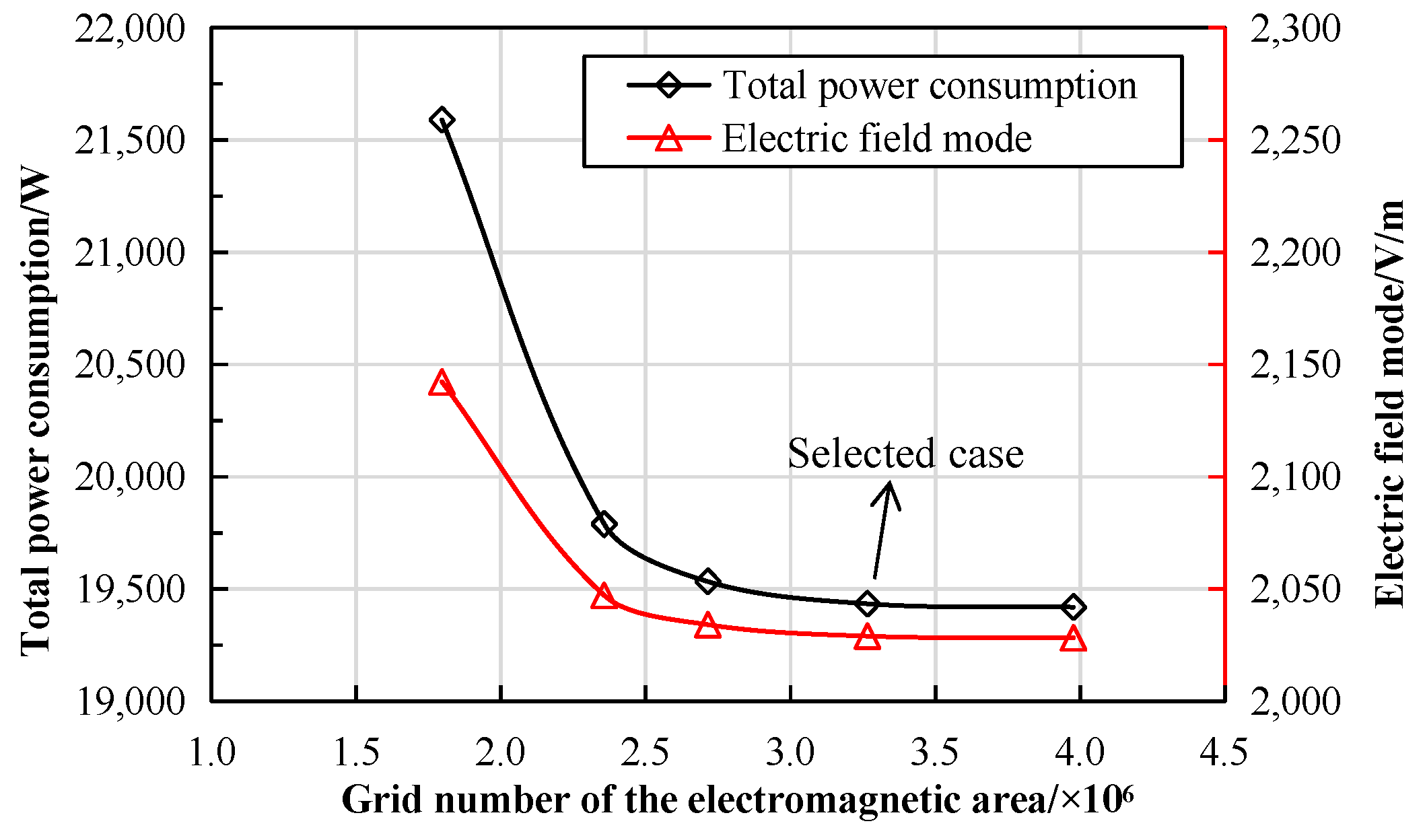
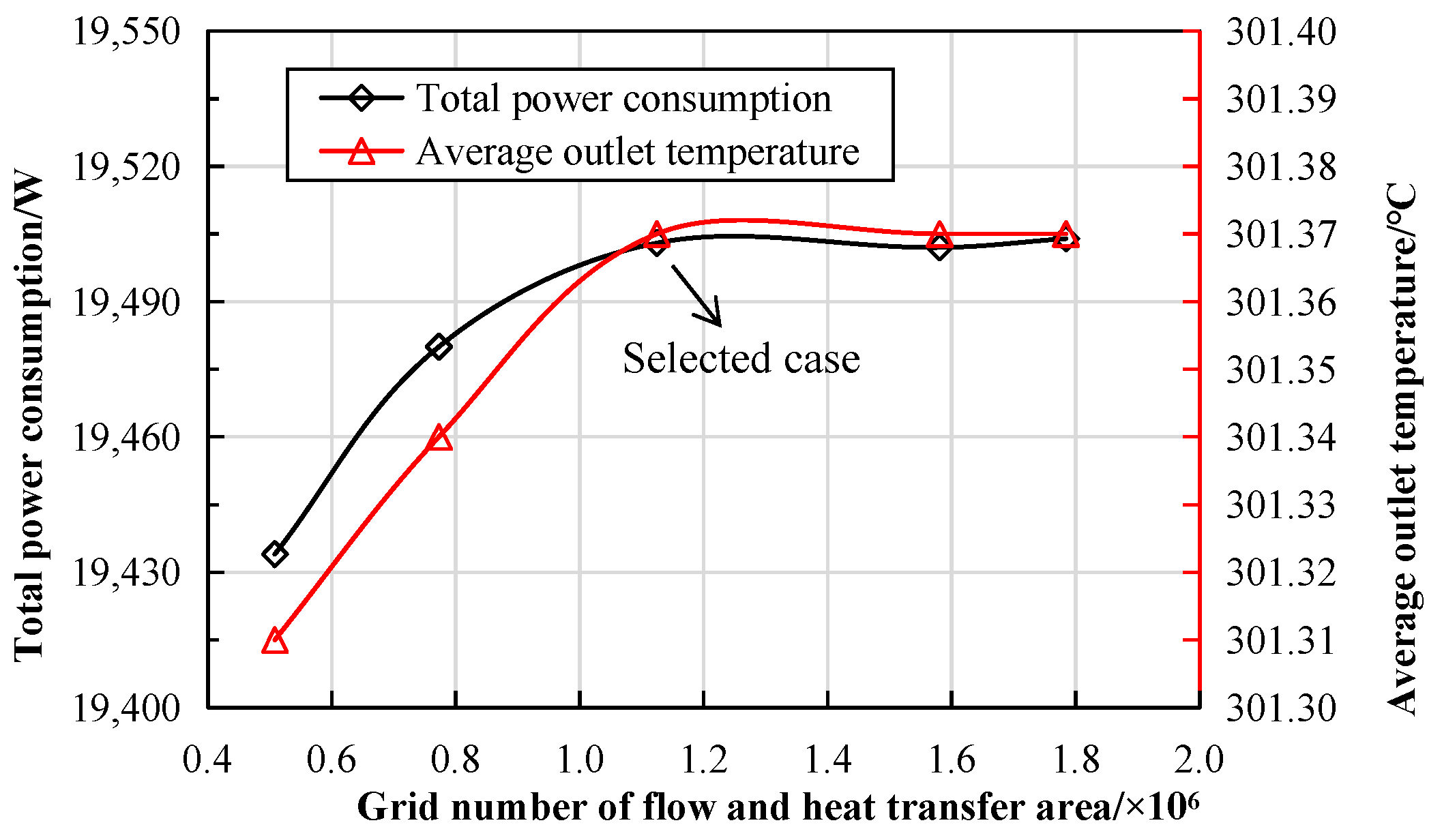
Numerical accuracy and computational cost are strongly influenced by mesh quality and resolution. To ensure sufficient computational precision while maintaining reasonable cost, a comprehensive grid independence study was conducted. This study was performed in two sequential phases: first, for the electromagnetic field simulation alone, and then for the fully coupled electromagnetic-thermal-fluid model. As shown in Figure 3, the relative changes in both total power dissipation and the electric field norm diminish as the number of elements in the electromagnetic domain increases. Based on this result, a mesh configuration from the plateau region of these curves was selected for the electromagnetic domain. Subsequently, this selected electromagnetic mesh was retained, and the fluid domain mesh was refined. A three-layer boundary layer mesh (with a growth factor of 1.2) was applied near the tube walls to better capture gradients, and the rest of the fluid domain was further refined. Figure 4 demonstrates that the relative changes in total power dissipation and outlet mean temperature become negligible with further refinement of the fluid mesh. Integrating the results from both stages of the grid independence analysis, the final mesh configuration, comprising approximately 4.94 million elements in total, was selected for all subsequent results and discussions.

4. Results and Discussions

4.1. Power and Temperature Distribution of Volumetric Heat Source

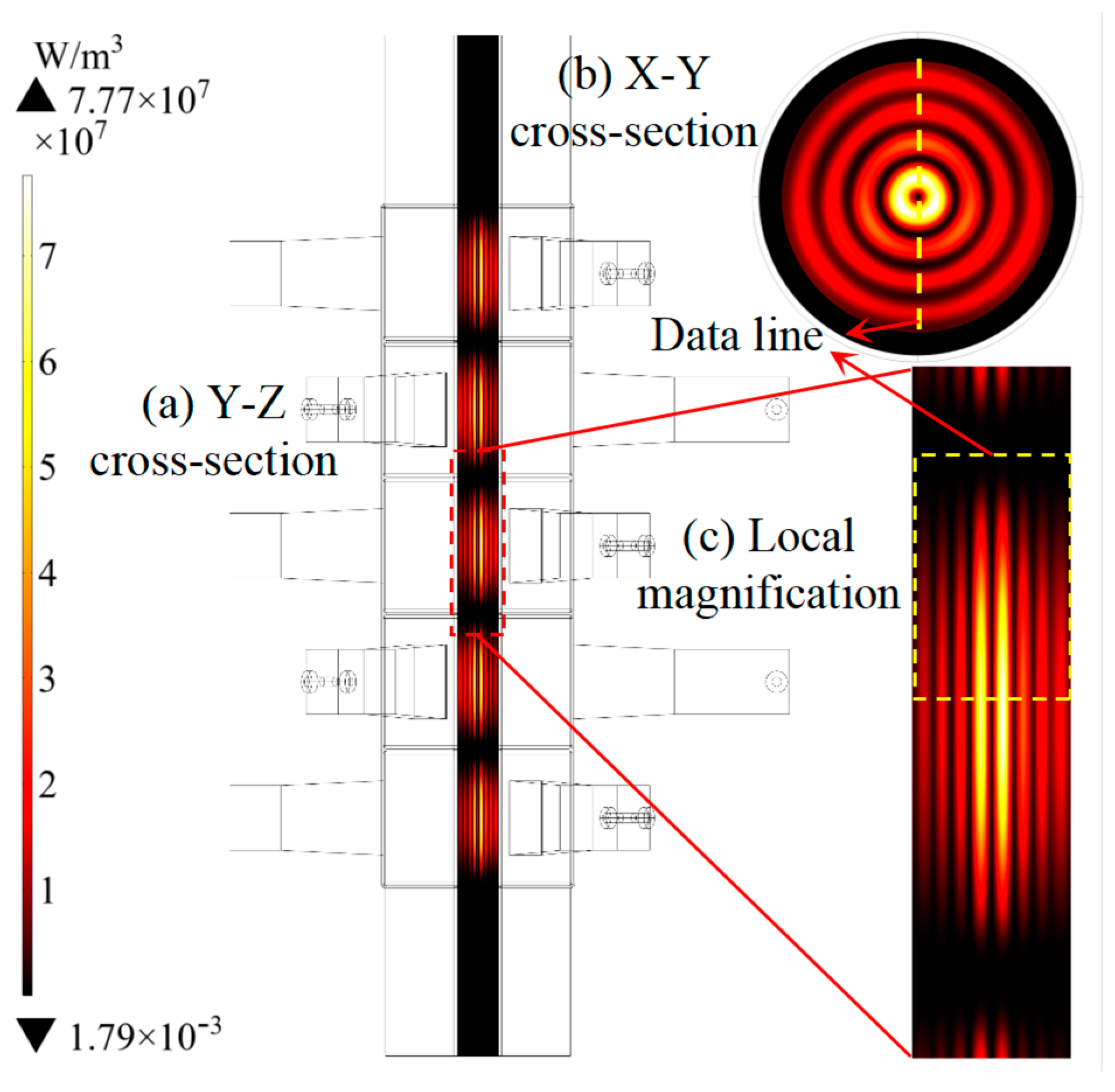
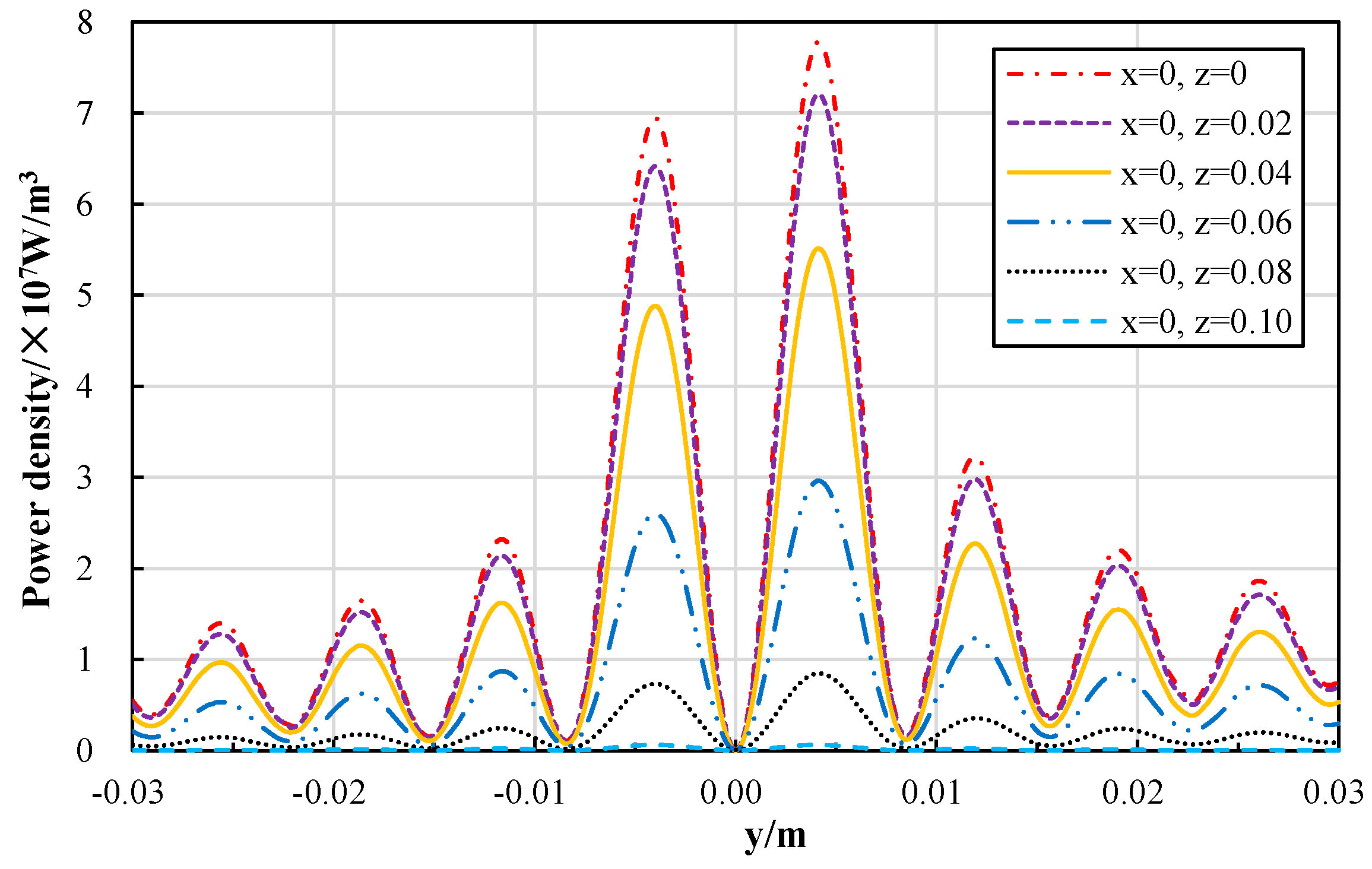
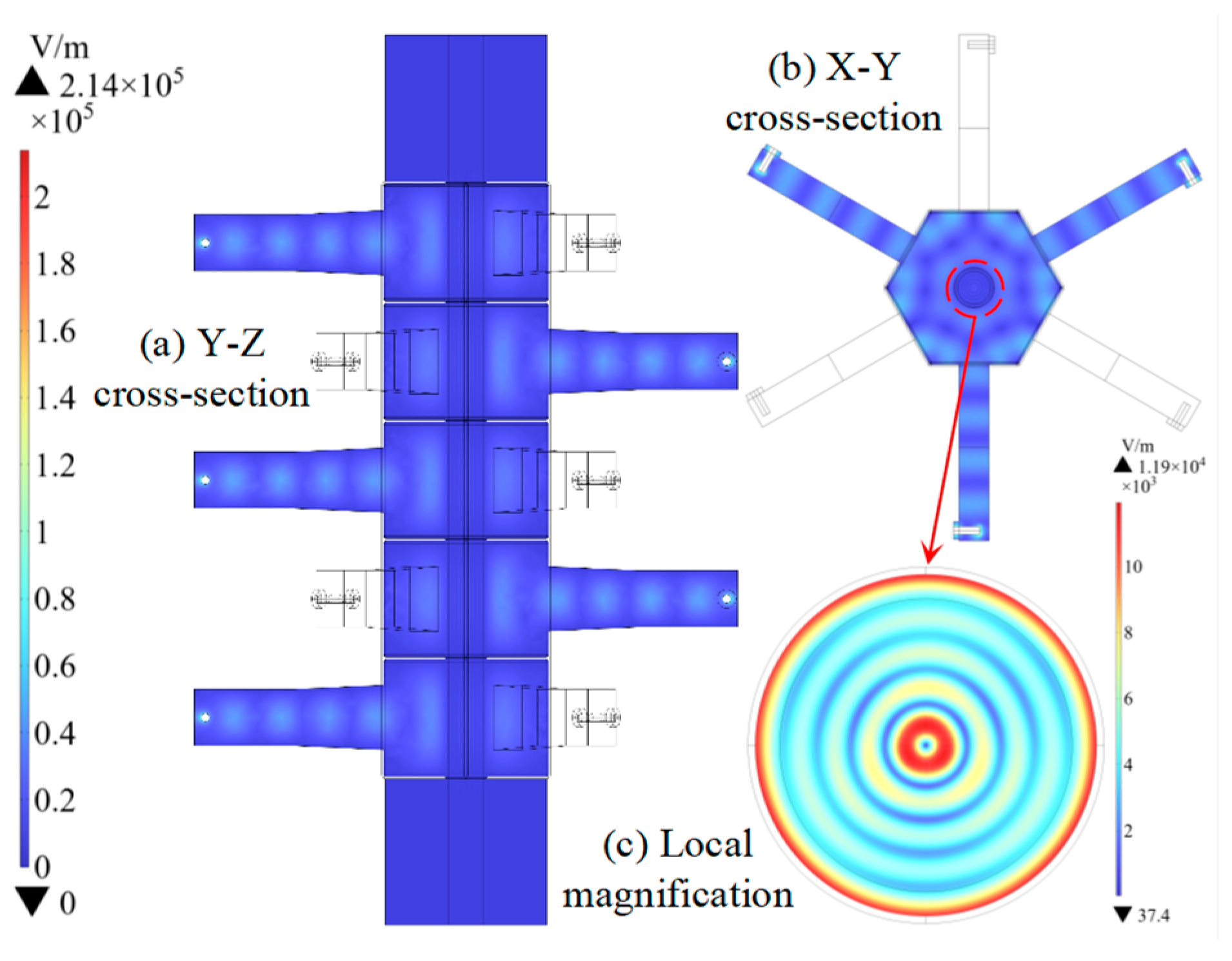
Multiphysics numerical simulations were performed for a tube with a diameter of 60 mm and a wall thickness of 5 mm. The resulting electric field distribution across different cross-sections is presented in Figure 5, while the corresponding power density distribution is shown in Figure 6. The maximum magnitude of the electric field is consistently observed near the magnetron feed ports. The X-Y cross-section reveals that the electric field distribution within the tube coincides with the power density profile. However, both distributions are non-uniform in the radial direction, exhibiting an approximately annular profile on the X-Y plane, as illustrated in Figure 6. From the power density distribution on the Y-Z plane in Figure 6, it can be seen that the 1 m long heated section is divided into five sub-cavities, each exhibiting a similar power deposition pattern. A detailed view in Figure 6 shows that the power density is significantly lower at both ends of each sub-cavity, corresponding to the connecting regions between adjacent cavities. These low-power zones occupy approximately 20% of the total axial length. Furthermore, the power density in the central region of the pipe is higher than that near the edges. However, the specific configuration of the three magnetron power inputs per cavity results in a localized power minimum at the very center of the cavity. Due to symmetry, the power density distribution was analyzed along half of the central cavity’s axial length (0 < z < 0.10 m), corresponding to the data line indicated in Figure 6. The result is plotted in Figure 7.
As shown in Figure 7, the power density exhibits a wavelike profile along the y-direction, characterized by eight distinct peaks and nine troughs. Along the z-axis, the power density generally decreases with increasing distance from the central region. In the areas between adjacent resonant cavities, the power density approaches zero. More than 80% of the analyzed region exhibits a power density exceeding 1 MW/m3. Approximately 10% of the region falls in the range of 0.1 MW/m3, while the remaining 10% lies below 0.1 MW/m3. Owing to the three-magnetron input configuration in each cavity, the power density distribution is not perfectly axisymmetric. For example, at z = 0, the maximum power density reaches about 77.7 MW/m3 for y > 0, which is about 11.6% higher than the value of 69.5 MW/m3 for y < 0. This higher value represents the global maximum within the system. The latter represents the highest power density observed in the system. Furthermore, the central peaks exhibit significantly higher power densities than the outer ones. For y > 0, the second, third, and fourth peaks reach values of 32.0, 21.6, and 18.5 MW/m3, respectively. To quantitatively assess the radial non-uniformity of the power deposition, the Coefficient of Variation (COV) and the ratio of maximum to minimum value (Max/Min) were calculated for the power density profile at the central cross-section (z = 0). The COV, defined as the standard deviation divided by the mean, provides a normalized measure of dispersion. For the base case (D = 0.06 m), the power density COV is 1.04, and the Max/Min ratio is 70, quantitatively confirming the highly non-uniform nature of the microwave energy deposition. The ratio among the four peaks from center outward is approximately 4.2:1.7:1.2:1, underscoring the dominance of the central peak.
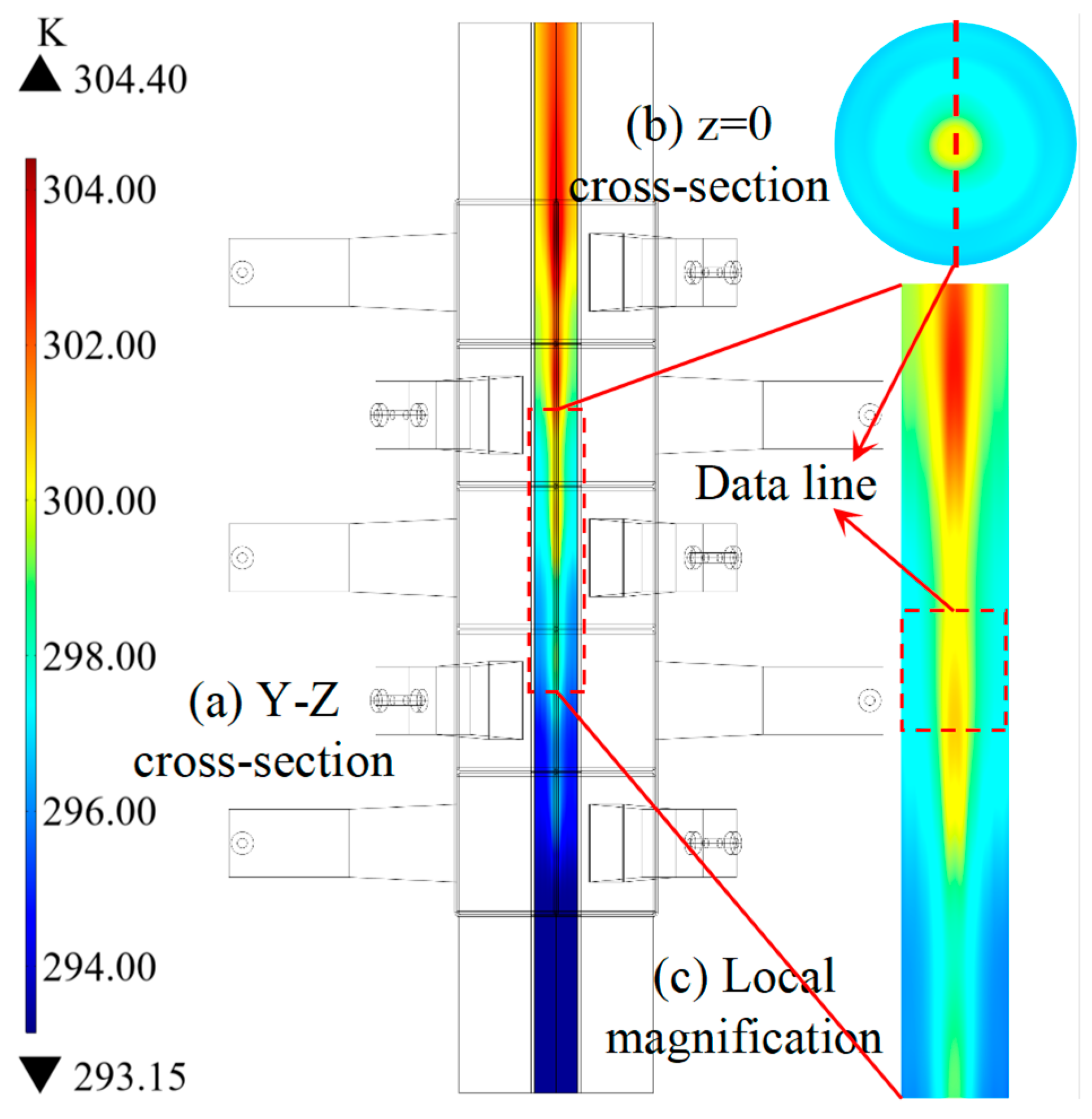
For the entire heating section, the total absorbed microwave power reaches 19,503 W, yielding an average power density of 6.9 MW/m3. This value represents an approximately 70-fold increase over previously reported volumetric heat sources in fluids and approaches the power density level typical of research-scale molten salt reactor fuel salts. With a total input power of 22,500 W, the energy efficiency is 86.68%. Although the reflectivity is moderately high, it remains within an acceptable range. However, the spatial distribution of power density is highly non-uniform, which directly influences the resulting temperature field. The temperature distributions across different cross-sections, obtained from the coupled multiphysics simulation, are presented in Figure 8.
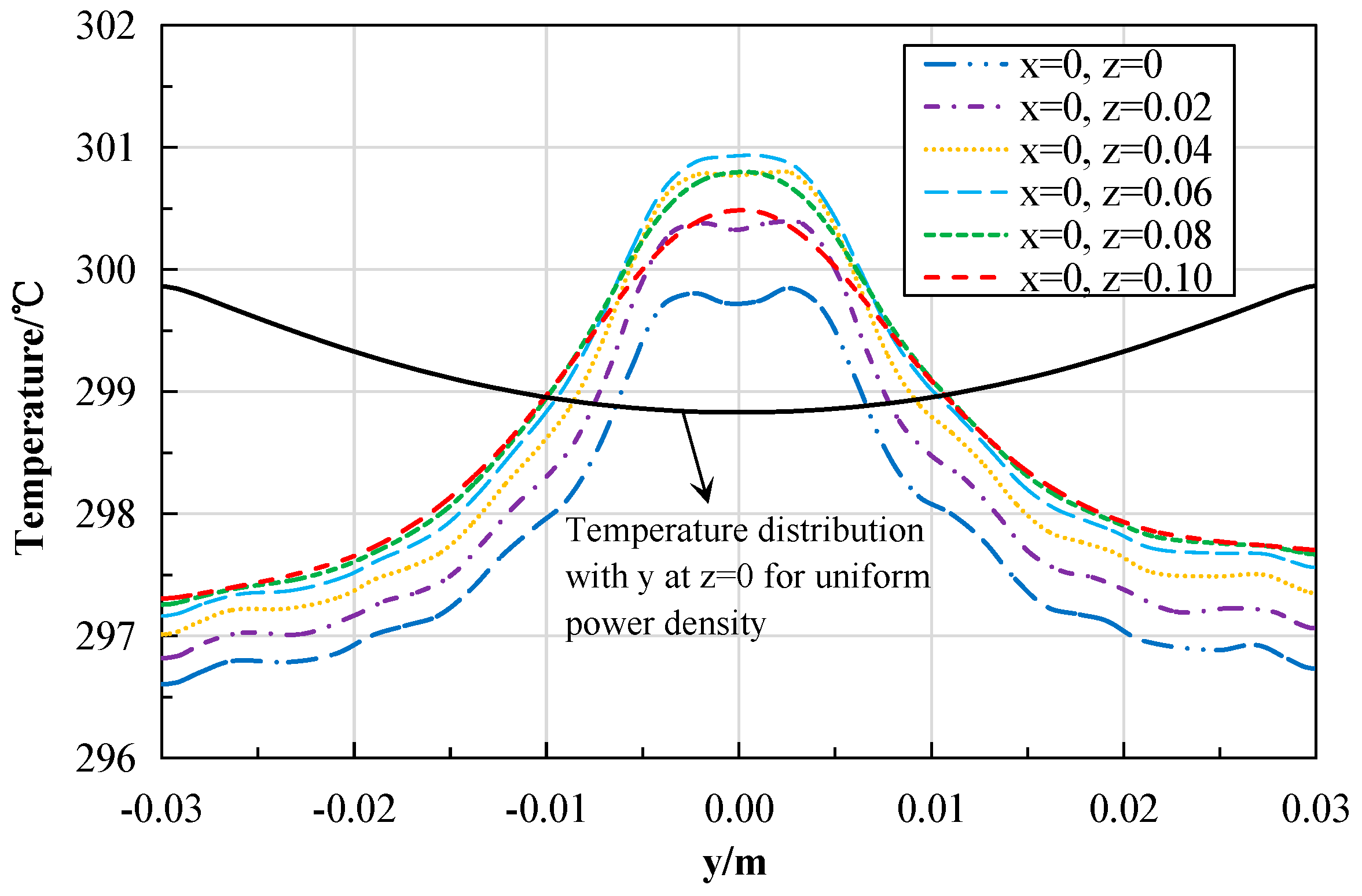
As shown in Figure 8, under fully turbulent flow conditions with a Reynolds number of 14,000 and an inlet temperature of 293.15 K, the average outlet temperature reaches 301.37 K. This results in a total temperature rise of 8.22 K between the inlet and outlet. In the cross-section at z = 0, the maximum radial temperature difference is approximately 3.2 K. The significantly higher power density near the central region leads to a noticeably elevated temperature in that area compared to the surrounding zones. However, despite the power density varying by up to 70 times between peaks and troughs, the resulting temperature distribution does not exhibit a difference in the same magnitude due to the strong convective mixing effect of the turbulent flow. The radial temperature profile was also evaluated using the COV and Max/Min metrics. The definition of the temperature COV calculation is shown in Equation (7), where Ti represents the temperature of a specific point, Ta is the average temperature of the water after heating, and T0 is the initial temperature. A smaller COV value indicates a more uniform temperature distribution. For the same cross-section (z = 0), the temperature COV is 0.00366, and the Max/Min ratio using degrees Celsius is 1.138. These values, significantly lower than their counterparts for power density, demonstrate that turbulent convective transport effectively mitigates the extreme non-uniformity present in the microwave power deposition, leading to a more homogenized thermal field. The radial temperature profile along half of the central cavity’s axial length (0 < z < 0.10 m), corresponding to the data line indicated in Figure 8, is plotted in Figure 9.
C O V = n ( T i T a ) 2 n / ( T a T 0 )
As shown in Figure 9, the radial temperature profile is characterized by higher temperatures in the central region and lower temperatures near the walls. While this trend is generally consistent with the power density distribution, the temperature profile does not exhibit the pronounced peaks and troughs observed in the power density. As the fluid flows along the z-direction, the temperature in the near-wall region gradually increases, though the rate of temperature rise slows. In the central region, the temperature initially rises but then decreases at positions such as z = 0.08 m and z = 0.10 m. This reversal occurs due to the significant attenuation of power density in the central area along the flow direction, combined with strong fluid mixing effects. The maximum radial temperature difference is approximately 3.8 K at z = 0.06 m, while the minimum difference is about 3.2 K at z = 0.10 m, which corresponds to the outlet of the cavity section. For comparison, under a uniform power density distribution with the same total deposited power and inlet velocity, the temperature profile shows a center-low and edge-high pattern, as indicated by the black line in Figure 9. The maximum temperature difference in this uniform heating case is about 1.02 K, which is notably smaller than the radial temperature differences achieved with microwave heating.
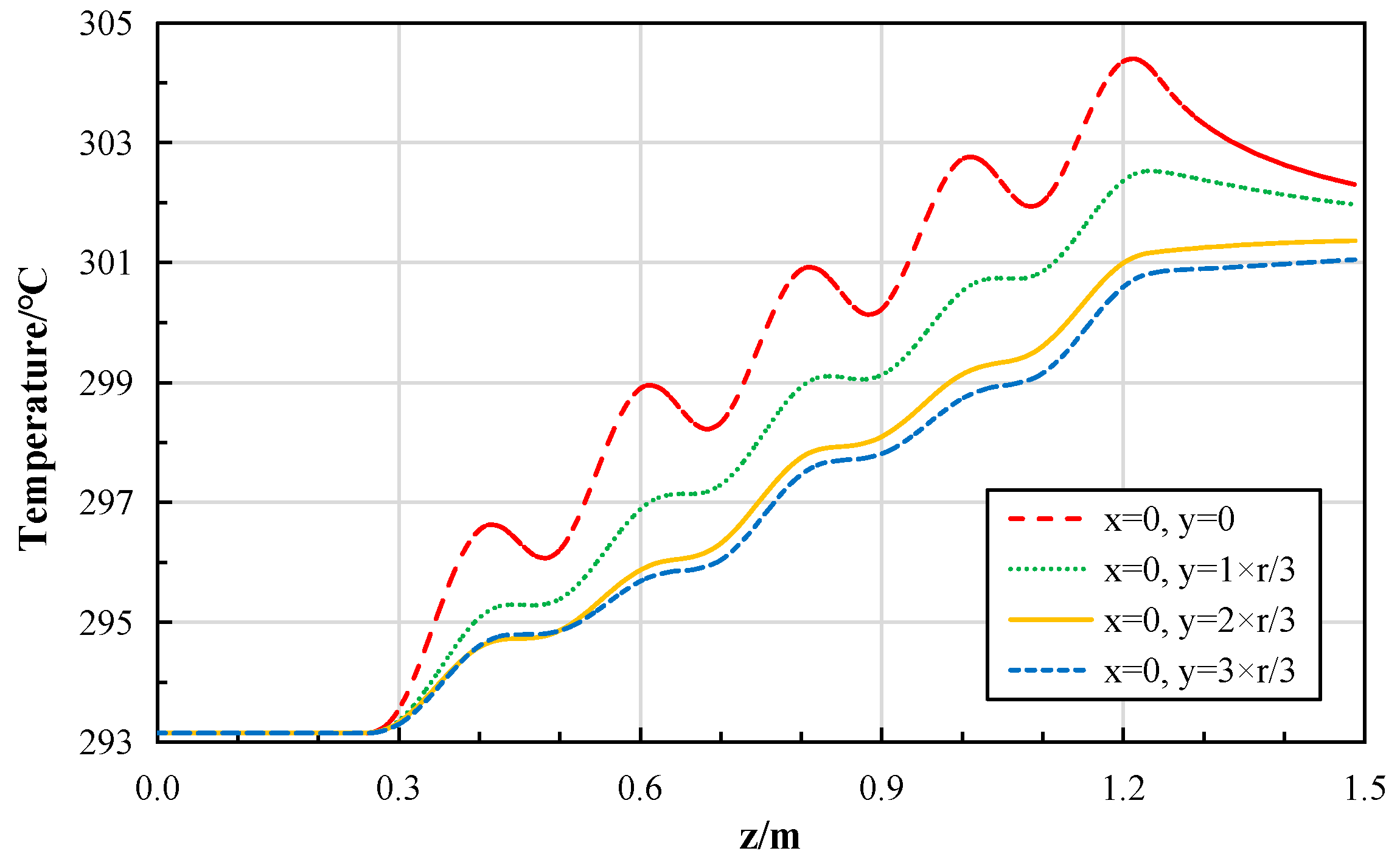
Figure 10 shows the axial temperature rise at different radial positions along the flow direction (z-axis). The overall temperature increase correlates with the segmented power deposition profile. Specifically, the centerline exhibits the most rapid temperature rise due to the higher power density in the central region. However, a noticeable temperature decrease occurs near the outlet, attributable to the attenuation of local power density and fluid mixing. In contrast, regions with more gradual axial variations in power density display relatively stable temperature profiles, forming plateau-like sections. This behavior further reflects the non-uniform nature of the radial power distribution.
To sum up the analysis above, the numerical results demonstrate that the proposed experimental setup can effectively generate a volumetric heat source in the fluid, achieving an average power density of 6.9 MW/m3. Furthermore, the power density can potentially be increased by raising the magnetron input power. However, the simulations also reveal significant non-uniformity in the power density distribution, both radially and axially. As a result, the corresponding temperature profile differs considerably from that under a uniform heat source assumption. This non-uniformity presents certain challenges for experimental studies utilizing such an internal heat source. For instance, in forced convection heat transfer experiments, the impact of this non-uniformity on wall heat transfer must be carefully evaluated beforehand. Similarly, in natural circulation studies with internal heating, the non-linear temperature rise may significantly influence transient flow behavior.

4.2. Influence of Geometric Shapes of Tube on Uniformity

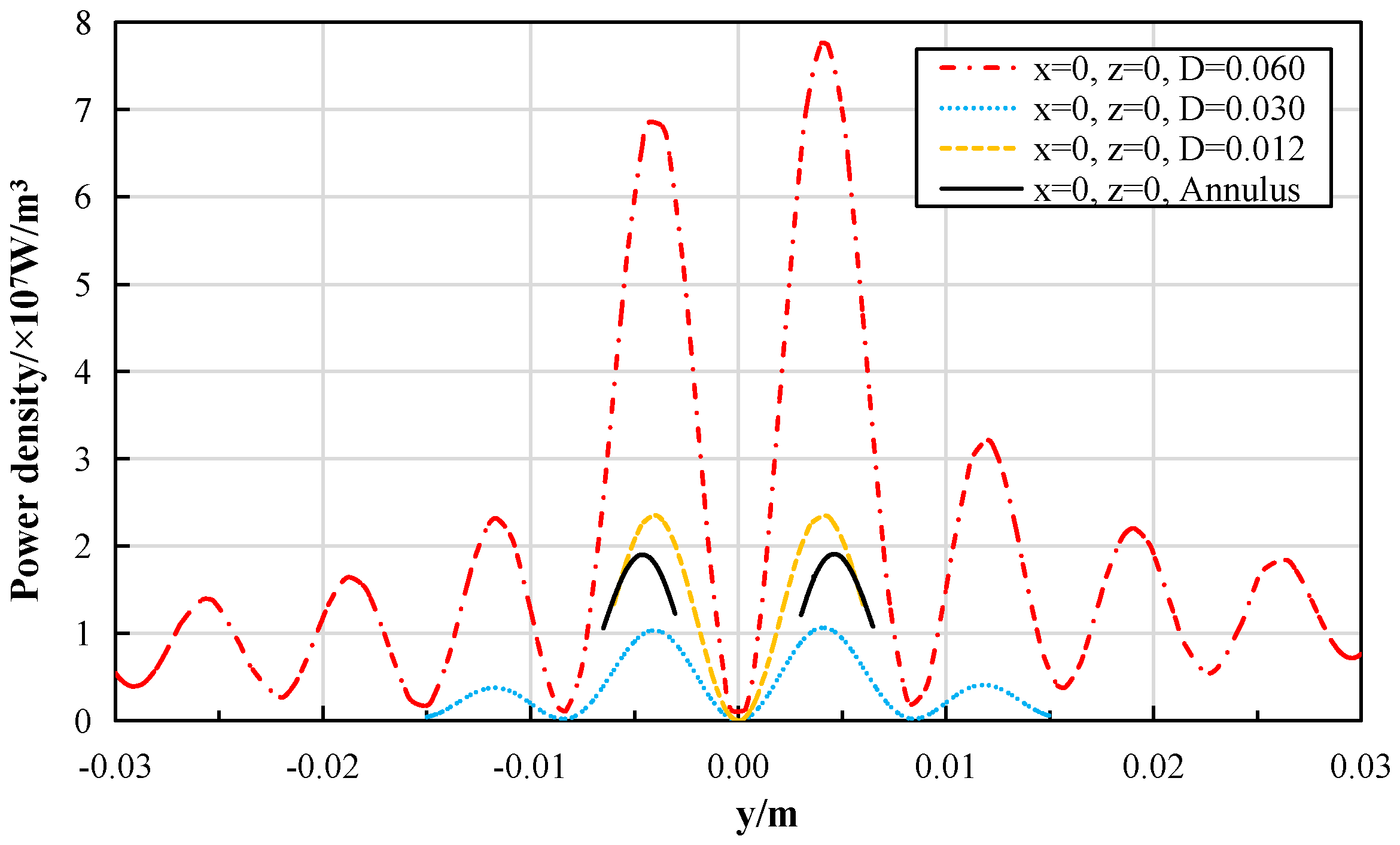
To achieve a more uniform power density distribution, an alternative approach was explored based on the existing microwave heating design. This method maintains the original power deposition profile but alters the flow channel geometry. Numerical simulations were conducted for three different channel configurations: tubes with inner diameters of 30 mm and 12 mm, and an annulus pipe with outer and inner diameters of 13 mm and 6 mm, respectively. According to the shape of the tube and the absorbed power, the temperature rise at the inlet and outlet was controlled to be consistent, highlighting the uniformity. As shown in Figure 11, the electromagnetic field distribution, and consequently the power density profile, remains largely unaffected by the channel size. This occurs because the electromagnetic field is largely independent of the fluid flow field. This characteristic allows for the selection of a suitable power density distribution pattern through geometric design. However, reducing the channel size causes an impedance mismatch, which significantly reduces the power absorption efficiency to approximately 5%. Despite this, the average power density remains substantial across all cases. For the D = 0.03 m tube, it reaches about 1.67 MW/m3. The 0.012 m inner diameter tube and the annulus pipe achieve even higher values, approximately 8.6 MW/m3 and 9.68 MW/m3, respectively, with improved radial uniformity in power density compared to the original design.
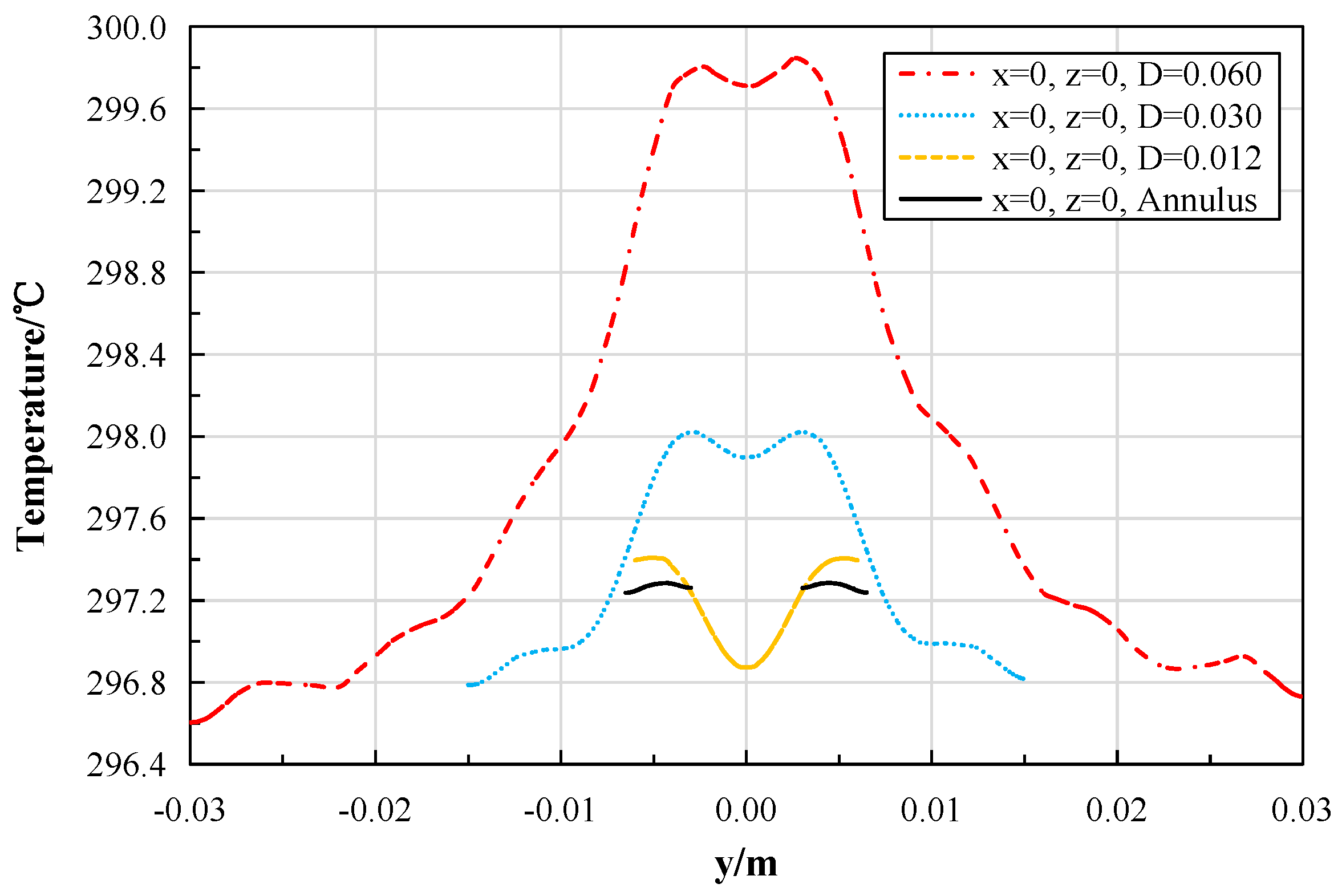
The temperature distributions resulting from microwave heating in different channel geometries are presented in Figure 12. By selecting channel dimensions that better match the inherent power density profile, a more uniform temperature field is achieved. This improvement is particularly evident in the case of the 0.012 m inner diameter tube and the annulus pipe. For the tube with an inner diameter of 0.012 m, the radial temperature profile resembles that of a uniform power density case, exhibiting a radial temperature difference of approximately 0.54 °C. In the annulus pipe, the radial temperature difference is less than 0.1 °C, which can be considered effectively uniform.
The quantitative metrics in Table 3 provide a clear and systematic comparison of the heating uniformity achieved with different channel geometries. It can be observed that the annulus pipe achieves exceptional performance, with a temperature COV as low as 0.00005 and a Max/Min ratio of 1.002. These values confirm the earlier qualitative assessment that its temperature field is effectively uniform. The tube with D = 0.012 m also shows significant improvement in temperature uniformity (COV = 0.00068) compared to the larger tubes, while still maintaining a high average power density. Importantly, the temperature COV for the optimized annulus case is comparable in magnitude to that of the idealized uniform heat source case (COV = 0.00129) applied to the D = 0.06 m tube, quantitatively demonstrating that geometric adaptation can bring the system remarkably close to the uniform heating ideal. From an engineering implementation perspective, the annulus geometry, while offering superior thermal uniformity, presents greater fabrication complexity compared to a simple tube. Key practical considerations include ensuring precise concentric alignment of the inner and outer walls to maintain a uniform flow gap, addressing potential sealing challenges at the ends, and guaranteeing structural integrity under operational flow pressures. These are well-understood engineering challenges that can be managed through careful mechanical design, precision machining, and standard pressure vessel practices, making the annulus or a smaller diameter tube a viable option for high-precision experimental facilities where thermal uniformity is a critical requirement.
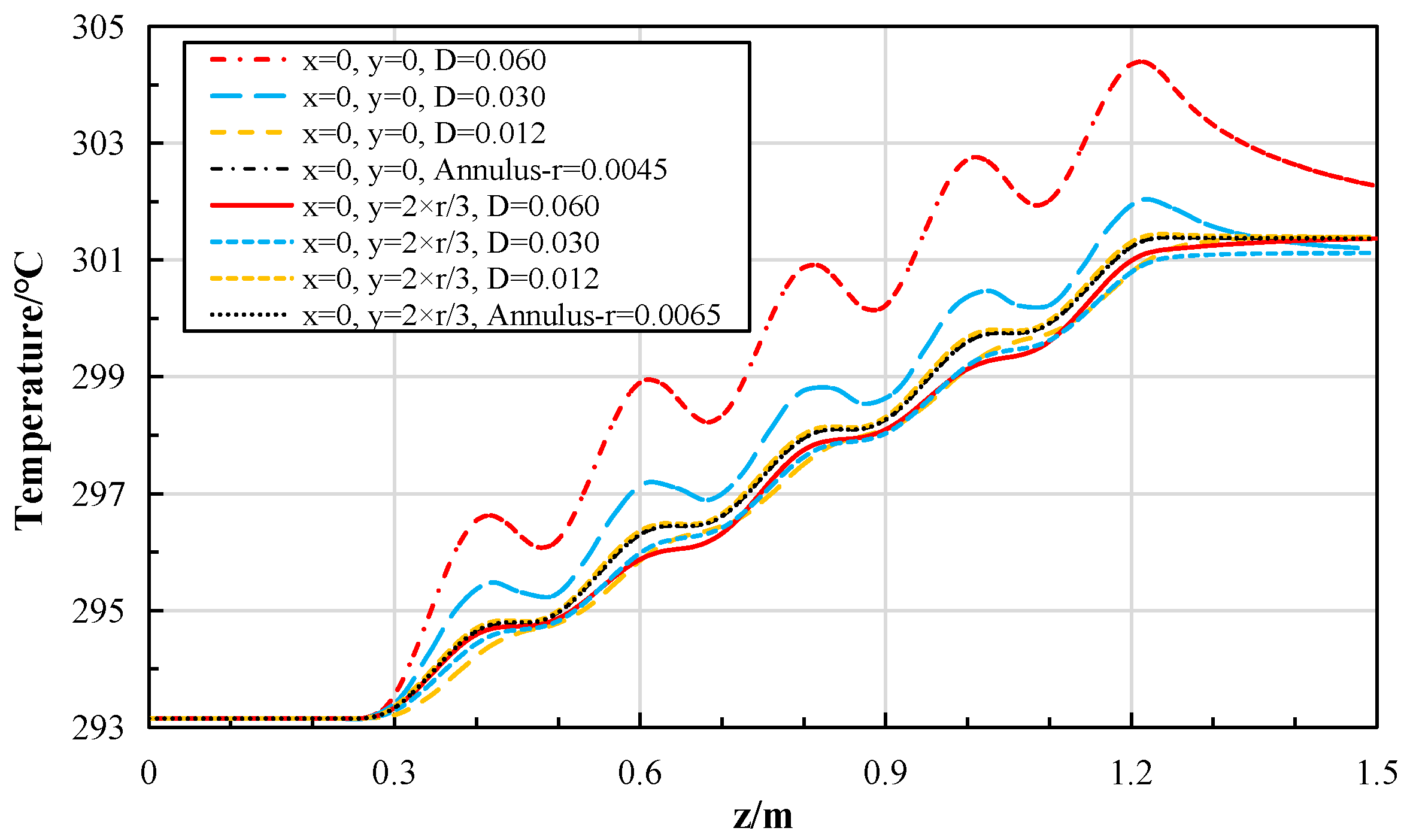
Figure 13 shows the axial temperature rise at different radial positions along the flow direction. While all cases exhibit the influence of the segmented cavity design through the presence of temperature plateaus, the temperature profiles differ significantly with channel size. The smaller diameter channels, specifically the 0.012 m tube and the annulus, demonstrate a more linear temperature increase. In contrast, the larger channels (0.03 m and 0.06 m in diameter) show a distinct temperature decrease at the outlet of each cavity segment. This temperature drop results from the non-uniform axial power density distribution, which has a more pronounced effect in larger flow channels.
In summary, the current resonant cavity design can accommodate internally heated fluid experiments across various channel sizes and is capable of producing a relatively uniform volumetric heat source and temperature distribution. However, impedance matching remains a critical consideration, as smaller diameter channels lead to significantly reduced heating efficiency and higher reflectivity, which may risk damaging the magnetrons. In engineering, adjustment can be achieved by using tuning bolts and installing protective measures. Despite this limitation, the proposed approach offers a feasible pathway toward achieving a uniform internal heat source in fluids. It provides a practical and effective solution for thermal-hydraulic experiments requiring high power densities in fluids. Future work will focus on analyzing the influence of this heat source design on separate-effect studies, such as convection heat transfer, and on conducting experimental validation to verify the numerical predictions. These efforts will support the practical implementation of this design.

5. Conclusions

This paper has presented the conceptual design and numerical validation of an innovative microwave-based system for generating a volumetric heat source in fluids, specifically targeting thermal-hydraulic experiments relevant to liquid-fueled molten salt reactors. The comprehensive multi-physics simulations lead to the following key conclusions:
First, the proposed design, centered around a hexagonal resonant cavity with a multi-tier staggered magnetron array, is numerically demonstrated to be effective. It can generate a high-power-density internal heat source, with an average power density exceeding 6.9 MW/m3, which meets and can be scaled beyond the requirements for simulating MSR fuel salt conditions. Second, a detailed quantitative analysis was conducted using uniformity metrics such as the Coefficient of Variation (COV) and the Max/Min ratio. The results clearly delineate the inherent non-uniformity in microwave power deposition and quantify how turbulent convective flow mitigates this non-uniformity in the temperature field. Third, and most significantly, the study identifies and validates channel geometry as a critical and effective design parameter for managing heating uniformity. By adapting the flow channel cross-section (e.g., reducing the tube diameter or employing an annulus), the temperature uniformity can be drastically improved, achieving a near-uniform thermal field in the annulus case, as evidenced by a temperature COV of less than 0.01. This strategy provides a practical solution to a central challenge in applying microwave heating to controlled convection experiments. Finally, the work discusses the applicability and current limitations regarding the use of water as a simulant fluid and outlines the necessary steps, such as measuring molten salt dielectric properties, to extend this method to direct MSR-relevant experiments.
Future work will primarily focus on the construction and experimental testing of a prototype based on this design to validate the numerical predictions. Concurrently, efforts will be directed towards measuring the complex permittivity of candidate molten salts to enable accurate fluid-specific simulations. The validated experimental platform will then be employed for detailed separate-effect studies, systematically evaluating the impact of a non-uniform volumetric heat source on both forced and natural convection heat transfer processes. These steps are essential for transforming this promising numerical concept into a robust tool for advancing the fundamental understanding of heat transfer in internally heated fluids, with direct implications for next-generation reactor technology.


Author Contributions

Conceptualization, S.W., C.Z., and Y.Z.; Methodology, S.W. and J.T.; Software, S.W.; Investigation, S.W., J.T. and H.D.; Resources, J.T. and C.Z.; Data curation, S.W., P.H., H.Y., S.X., and Y.C.; Writing—original draft, S.W.; Writing—review and editing, C.Z. and Y.Z.; Project administration, C.Z. and Y.Z. All authors have read and agreed to the published version of the manuscript.

Funding

This research was funded by the Young Potential Program of Shanghai Institute of Applied Physics, Chinese Academy of Sciences (SINAP-YXJH-202403), TMSR Industrial Foundation (Basic research projects) (SINAP-CYJJ-202401; SINAP-CYJJ-202501), research program of the State Key Laboratory of Thorium Energy, Shanghai Institute of Applied Physics, Chinese Academy of Sciences (SYS-ZBS-202403), and research program of Shanghai Institute of Applied Physics (SINAP-QYJS-202202).

Data Availability Statement

The original contributions presented in this study are included in the article. Further inquiries can be directed to the corresponding authors.

Conflicts of Interest

The authors declare no conflicts of interest.

References

  1. GIF. A Technology Roadmap for Generation IV Nuclear Energy Systems; GIF-002-00; U.S. DOE Nuclear Energy Research Advisory Committee and Generation IV International Forum: Washington, DC, USA, 2002. [Google Scholar]
  2. Serp, J.; Allibert, M.; Beneš, O.; Delpech, S.; Feynberg, O.; Ghetta, V.; Heuer, D.; Holcomb, D.; Ignatiev, V.; Kloosterman, J.L.; et al. The Molten Salt Reactor (MSR) in Generation IV: Overview and Perspectives. Prog. Nucl. Energy 2014, 77, 308–319. [Google Scholar] [CrossRef]
  3. Zhang, D.; Liu, L.; Liu, M.; Xu, R.; Gong, C.; Zhang, J.; Wang, C.; Qiu, S.; Su, G. Review of Conceptual Design and Fundamental Research of Molten Salt Reactors in China. Int. J. Energy Res. 2018, 42, 1834–1848. [Google Scholar] [CrossRef]
  4. Robertson, R.C. MSRE Design and Operation Report I: Description of Reactor Design Oak Ridge National Laboratory; Report No. ORNL-TM-728; Oak Ridge National Lab: Oak Ridge, TN, USA, 1965. [Google Scholar]
  5. International Atomic Energy Agency (IAEA). Status of Molten Salt Reactor Technology; Technical Reports Series No. 489; IAEA: Vienna, Austria, 2023. [Google Scholar]
  6. Head, T.L.; Berry, A.M.; Brewster, K.J.; Brown, R.L.; Burden, H.N.; Byrd, R.; Doty, T.; Dowdy, J.; Hill, K.A.; Jinkerson, R.; et al. A Molten Salt Test Loop for Component and Instrumentation Testing. Ann. Nucl. Energy 2023, 186, 109772. [Google Scholar] [CrossRef]
  7. Park, J.; Choi, W.; Lim, J.; Kim, T.; Kim, Y.; Yoon, Y.; Kim, S.; Kim, S.J. Design Concepts and Requirements of Passive Molten Salt Fast Reactor (PMFR). In Proceedings of the Transactions of the Korean Nuclear Society Spring Meeting, Jeju, Republic of Korea, 19–20 May 2022; pp. 1–6. [Google Scholar]
  8. Choi, W.; Park, J.; Lee, J.; Im, J.; Cho, Y.; Kim, Y.; Kim, S.J. Experimental and Numerical Assessment of Helium Bubble Lift during Natural Circulation for Passive Molten Salt Fast Reactor. Nucl. Eng. Technol. 2024, 56, 1002–1012. [Google Scholar] [CrossRef]
  9. Dai, Z. Thorium Molten Salt Reactor Nuclear Energy System. In Molten Salt Reactors and Thorium Energy; Woodhead Publishing: Cambridge, UK, 2017; pp. 803–814. [Google Scholar]
  10. Hu, S. Thermal-Hydraulic Design and Characteristics Research of the Core of 100 MW Level Liquid-Fueled Molten Salt Reactor. Ph.D. Thesis, University of Chinese Academy of Sciences, Beijing, China, 2024. [Google Scholar]
  11. Hu, S.; Zhou, C.; Zhu, G.; Zou, Y.; Yu, X.; Xue, S. Development and Validation of a Thermal-Hydraulic Analysis Code for Dual-Cooled Assemblies in Molten Salt Reactors. Nucl. Technol. 2024, 47, 090602. [Google Scholar]
  12. Luzzi, L.; Cammi, A.; Marcello, V.; Pini, A. Thermal-Hydraulics of Liquid-Fueled MSRs. In Molten Salt Reactors and Thorium Energy; Woodhead Publishing: Cambridge, UK, 2017; pp. 167–187. [Google Scholar]
  13. Fiorina, C.; Cammi, A.; Luzzi, L.; Mikityuk, K.; Ninokata, H.; Ricotti, M.E. Thermal-Hydraulics of Internally Heated Molten Salts and Application to the Molten Salt Fast Reactor. J. Phys. Conf. Ser. 2014, 501, 012030. [Google Scholar] [CrossRef]
  14. Inman, R.M. Experimental Study of Temperature Distribution in Laminar Tube Flow of a Fluid with Internal Heat Generation. Int. J. Heat Mass Transf. 1962, 5, 1053–1058. [Google Scholar] [CrossRef]
  15. Kinney, R.B.; Sparrow, E.M. Turbulent Pipe Flow of an Internally Heat-Generating Fluid. J. Heat Transf. 1966, 88, 331–333. [Google Scholar] [CrossRef]
  16. Michiyoshi, I.; Kikuchi, Y.; Furukawa, O. Heat Transfer in a Fluid with Internal Heat Generation Flowing through a Vertical Tube. J. Nucl. Sci. Technol. 1968, 5, 590–595. [Google Scholar] [CrossRef]
  17. Park, D.; Chung, B. Experimental Investigation of Secondary Flow Effect Caused by Internal Heat Generation in Horizontal Laminar Pipe Flow. Appl. Therm. Eng. 2025, 257, 128563. [Google Scholar] [CrossRef]
  18. Luzzi, L.; Cammi, A.; Marcello, V.; Fiorina, C. An Approach for the Modelling and the Analysis of the MSR Thermo-Hydrodynamic Behaviour. Chem. Eng. Sci. 2010, 65, 4873–4883. [Google Scholar] [CrossRef]
  19. Marcello, V.; Cammi, A.; Luzzi, L. A Generalized Approach to Heat Transfer in Pipe Flow with Internal Heat Generation. Chem. Eng. Sci. 2010, 65, 1301–1310. [Google Scholar] [CrossRef]
  20. Fiorina, C. Impact of the Volume Heat Source on the RANS-based CFD Analysis of Molten Salt Reactors. Ann. Nucl. Energy 2019, 134, 376–382. [Google Scholar] [CrossRef]
  21. Lecce, F.; Dulla, S.; Ravetto, P.; Cammi, A.; Lorenzi, S.; Fiorina, C. CFD-Based Correlation for Forced Convection Heat Transfer in Circular Ducts of Internally Heated Molten Salts. In Proceedings of the International Conference on Nuclear Engineering, London, UK, 22–26 July 2018; American Society of Mechanical Engineers: New York, NY, USA, 2018; Volume 6, p. V06BT08A062. [Google Scholar]
  22. Chen, R.; Qiao, N.; Arowo, M.; Zou, H.-K.; Chu, G.-W.; Luo, Y.; Sun, B.-C.; Chen, J.-F. Modeling for Temperature Distribution of Water in a Multiwaveguide Microwave Reactor. Ind. Eng. Chem. Res. 2020, 59, 4762–4774. [Google Scholar] [CrossRef]
  23. Wu, J.; Ma, Y.; Yin, S.; Yin, C.; Yin, K.; Yang, Y.; Zhu, H. Compact Microwave Continuous-Flow Heater. Processes 2024, 12, 1895. [Google Scholar] [CrossRef]
  24. Poppendiek, H.F.; Palmer, L.D. Forced Convection Heat Transfer in Pipes with Volume Heat Sources Within the Fluids; Oak Ridge National Laboratory: Oak Ridge, TN, USA, 1952. [Google Scholar]
  25. Poppendiek, H.F.; Palmer, L.D. Heat Transfer in Heterogeneous Circulating-Fuel Reactors. Nucl. Sci. Eng. 1958, 3, 85–106. [Google Scholar] [CrossRef]
Figure 1. Conceptual design diagram of the experimental setup.
Energies 19 00172 g001
Figure 2. Schematic diagram of the geometric model.
Energies 19 00172 g002
Figure 3. Verification of grid independence in electromagnetic field computing.
Energies 19 00172 g003
Figure 4. Verification of grid independence in flow field computing.
Energies 19 00172 g004
Figure 5. Electric field mode distribution at different cross-sections.
Energies 19 00172 g005
Figure 6. Power density distribution at different cross-sections.
Energies 19 00172 g006
Figure 7. Power density distribution with y at different z heights.
Energies 19 00172 g007
Figure 8. Temperature distribution at different cross-sections.
Energies 19 00172 g008
Figure 9. Temperature distribution with y at different z heights.
Energies 19 00172 g009
Figure 10. Temperature distribution with z at different y heights.
Energies 19 00172 g010
Figure 11. Power density distribution with y at different shapes of the pipe.
Energies 19 00172 g011
Figure 12. Temperature distribution with y at different shapes of the pipe.
Energies 19 00172 g012
Figure 13. Temperature distribution with z at different shapes of the pipe.
Energies 19 00172 g013
Table 1. Model geometric structure parameters.
StructuresParametersValue
Regular hexagonal resonant cavityFace-to-face distance0.278 m
Total height1 m
Sub-resonant cavity height0.2 m
Wall thickness0.003 m
Quartz tubeTotal length1.5 m
Inner diameter0.06 m
Wall thickness0.005 m
WaveguideLength0.3286 m
Rectangular cross-section length0.1092 m
Rectangular cross-section width0.0546 m
Table 2. Material parameter (Unit of temperature: K).
PropertiesParametersValueTemperature Range (K)
Real part of the relative dielectric constant ( ε )Quartz1.5-
Water78-
Imaginary part of the relative dielectric constant ( ε )Quartz0-
Water8-
Density (kg/m3)Quartz2210-
Water1.0335 × 10−5 × T3 − 0.013395 × T2 + 4.9693 × T + 432.257293.15–373.15
Steel7850-
Constant pressure heat capacity (J/(kg·K))Quartz730-
Water12,010.147 − 80.407 × T + 0.310 × T2-5.382 × 10⁻⁴ × T3 + 3.6257 × 10⁻⁷× T4273.15–553.75
Steel475-
Dynamic viscosity (Pa·s)Water1.380 − 0.02122 × T + 1.3605 × 10⁻⁴ × T2 − 4.645 × 10⁻⁷ × T3 + 8.904 × 10⁻¹⁰ × T4 − 9.079 × 10⁻¹³ × T5 + 3.8457 × 10⁻¹⁶ × T6273.15–413.15
Thermal conductivity (W/(m·K))Quartz1.4-
Water−0.8691 + 0.008949 × T − 1.5837 × 10⁻⁵ × T2 + 7.9754 × 10⁻⁹ × T3273.15–553.15
Steel44.5-
Table 3. Quantitative comparison of uniformity for different channel geometries.
Channel GeometryAverage Power Density (MW/m3)Power COVPower Max/MinTemperature COVTemperature Max/Min Using °C
Tube, D = 0.06 m17.821.04700.003661.138
Tube, D = 0.03 m3.500.96630.001611.052
Tube, D = 0.012 m14.120.46670.000681.023
Annulus Pipe15.970.151.80.000051.002
Uniform power density for D = 0.066.90010.001291.040
Disclaimer/Publisher’s Note: The statements, opinions and data contained in all publications are solely those of the individual author(s) and contributor(s) and not of MDPI and/or the editor(s). MDPI and/or the editor(s) disclaim responsibility for any injury to people or property resulting from any ideas, methods, instructions or products referred to in the content.