Article

Sustainable Design and Energy Efficiency in Supertall and Megatall Buildings: Challenges of Multi-Criteria Certification Implementation


1
Department of Architecture, Institute of Civil Engineering, Warsaw University of Life Sciences, Nowoursynowska 159, 02-776 Warsaw, Poland
2
Department of Sustainable Construction and Geodesy, Institute of Civil Engineering, Warsaw University of Life Sciences, Nowoursynowska 159, 02-776 Warsaw, Poland
*
Authors to whom correspondence should be addressed.
Energies 2026, 19(1), 133; https://doi.org/10.3390/en19010133 (registering DOI)
Submission received: 5 December 2025 / Revised: 17 December 2025 / Accepted: 20 December 2025 / Published: 26 December 2025

Abstract

Rapid urbanization, rising energy consumption, and the environmental pressures of the 21st century have led the construction sector to focus on sustainable design solutions to protect the natural environment and combat climate change. Technological advances are leading to an increasing number of ultratall buildings. However, due to the complex issues involved, these structures currently serve primarily as symbols and serve as testing grounds for technological innovation. Therefore, there is a clear need to analyze the issues involved in designing high-rise buildings sustainably in the context of contemporary environmental challenges. Global multi-criteria certifications exist to establish parameters verifying a building’s impact on its surroundings. This study systematically assessed the sustainable strategies of the world’s twenty tallest buildings using a four-category model: A—passive design, B—active mechanical systems, C—renewable energy integration, and D—materials, water, and circularity strategies. The quantitative assessment (0–60) was supplemented with qualitative analysis and correlational research, including LEED certification. A novel element of the study is a multi-criteria comparative analysis, culminating in an assessment of the degree of implementation of sustainable development strategies in the world’s tallest buildings and linking the results to LEED certification levels. The results identify categories requiring further improvement. The results indicate that Merdeka 118 (46.7%), followed One World Trade Center (43.3%) and Shanghai Tower (41.7%) received the highest scores. Category B dominated all buildings, categories A and D demonstrated moderate implementation, and category C demonstrated the lowest performance due to economic and technical constraints at extreme heights. LEED Platinum-certified buildings demonstrated significantly higher levels of technology integration than Gold or non-certified buildings. The study results emphasize the need for integrating passive design strategies early in the design process, improving renewable energy solutions, and long-term operational monitoring supported by digital tools (such as IoT and digital twins).

1. Introduction

The 21st century is characterized by enormous technological progress, as well as the challenges of growing consumerism and, consequently, increasing energy demand. At the same time, efforts are being made to address the growing problems and visible consequences of environmental pollution and global warming. The environmental footprint, derived from the EF concept (dating back to the 1990s), is a tool for measuring the pressures exerted by humans on the environment. It is expressed in carbon dioxide equivalents [1]. Sustainable design is a crucial element of all actions undertaken in the modern world. The circular economy is increasingly recognized as a key political and economic element in promoting sustainable urban development [2]. Buildings are among the leading energy consumers. Renewable energy is being promoted worldwide for its sustainability and decarbonization potential. Utilizing renewable energy in buildings is essential for a modern, sustainable construction industry. Electricity storage technologies are being integrated into buildings [3]. Multi-criteria building certification systems are becoming increasingly common and often even constitute a market requirement. This is related to corporate social responsibility (CSR), in which companies are among the most influential drivers of socio-economic change worldwide [4]. In the 21st century, characterized by rapid economic development, a global trend towards designing high-rise buildings is visible. This is often related to the competition for international dominance, and such projects become iconic elements of a given country [5,6]. The Global Status Report for Building and Construction (Buildings–GSR), conducted by UNEP, provides an annual review of the progress of the construction sector globally. It analyzes the state of financial policy and technology and monitors the sector’s compliance with the goals of the Paris Agreement. According to the 2024–2025 Report, significant progress in the use of renewable energy and electrification was observed in 2024. The number of green building certificates also increased. By 2023, 20% of new commercial buildings in OECD countries will have been certified [7]. The most popular certifications worldwide are BREEAM, LEED, and DGNB [8]. In China, which leads the world in terms of the number of tallest buildings, a local system is also used: the China Green Building Evaluation Label (China Three Star), developed in 2006 by the Ministry of Housing and Urban–Rural Development of the People’s Republic of China [9]. Previous research conducted by many scientists indicates that technological innovations can improve energy efficiency and thus reduce energy consumption [10].
Existing literature extensively discusses sustainable development strategies in mid-rise and high-rise buildings, but there is a lack of systematic comparative analyses for supertall buildings. These projects are associated with specific structural, climatic, and energy conditions. Existing studies rarely integrate structural engineering knowledge with sustainability frameworks and certification. Available publications are fragmented, examining separate issues such as structural engineering, environmental performance, or certification. These studies analyze single strategies, such as PV, structural and wind impact analysis, SHM, prefabrication, or studies on the circular economy. Existing studies do not integrate these aspects while also addressing the world’s tallest buildings. Furthermore, the existing literature does not sufficiently consider the diversity of sustainability strategies or examine how structural innovations intersect with environmentally friendly design strategies in ultratall buildings. Previous analyses have indicated a discrepancy between the predicted and actual performance of certified buildings. However, there is a lack of research assessing how certification frameworks address the design issues and complexities involved in designing sustainable buildings of extreme height. This study addresses the identified research gap regarding the lack of an integrated, comparative, and multidimensional assessment of sustainable design strategies in the world’s tallest buildings. These structures combine pro-environmental technologies, state-of-the-art construction, material strategies, and certification schemes. The article posed the following research questions: 1. What sustainable design strategies are implemented in the world’s tallest buildings? 2. What structural innovations, aerodynamic shapes, and optimization solutions support the environmental performance of supertall buildings? 3. What are the regional patterns of implementing sustainable certification systems in Asian countries (these countries are leading the world in tallest buildings)? The study also formulated the following research hypotheses: 1. Supertall buildings utilize multi-criteria certifications, with LEED being the dominant one. 2. Asian megacities are leading the implementation of sustainable solutions in supertall buildings. This is related to rapid urbanization, legal regulations, and investments in green technologies. 3. Advanced construction strategies are linked to the implementation of pro-environmental solutions—aerodynamic shapes and optimized foundations enable reduced material consumption and energy-efficient operation.
The construction industry, responsible for approximately 25% of global waste, faces numerous challenges related to the design of increasingly complex structures and building operations, including significant energy consumption and environmental degradation. High-rise buildings were selected due to the current trend toward vertical design and as the most representative sector in which technological advances are linked to environmental challenges. The aim of the study is to analyze and compare sustainable design strategies in the world’s tallest buildings, taking into account pro-environmental technologies, construction innovations and the use of multi-criteria certification systems. The study critically examines the applicability of Sustainability Assessment Systems (SAS) in the context of very tall buildings, pointing out the potential challenges of implementing North American or European assessment frameworks in Asian megacities. This study contributes to expanding the state of knowledge on sustainable high-rise buildings and continues the analysis of the vertical city paradigm.

2. Materials and Methods

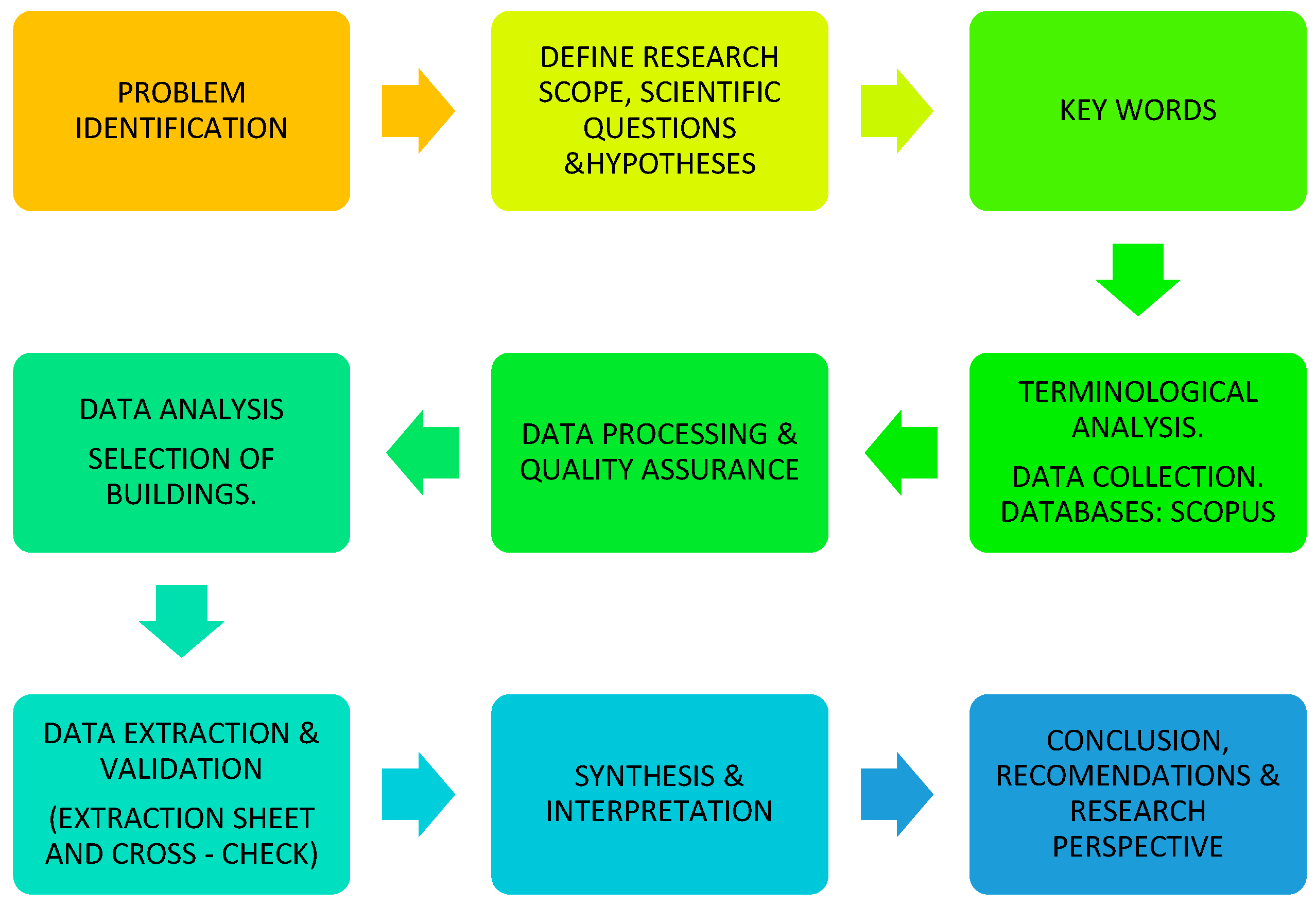
To achieve this goal, a multi-stage research approach was adopted to ensure transparency, repeatability, and analytical reliability. After identifying the lack of research on megatall and supertall buildings, a comparative analysis was conducted to assess the multidimensional sustainability strategies of the world’s tallest buildings, including structural and environmental optimization issues. The methods used are shown in Figure 1.
The first method employed was a terminology analysis, adopted to clarify key terms related to the design of tall buildings and environmentally friendly buildings. Sustainability and multi-criteria certification systems were discussed, followed by the lack of a uniform definition of tall and high-rise buildings worldwide. In the literature analysis, using a search engine, the topic trends and the number of publications published in the years 2000–2025 were examined, containing the following keywords: megatall (filters used: engineering, environmental science, energy, materials science, multidisciplinary), supertall buildings (filters used: engineering, materials science, environmental science, multidisciplinary), sustainable tall buildings (filters used: engineering, energy, materials science), renewable energy integration (filters used: engineering, environmental science, energy, materials science, multidisciplinary), vertical city (filters used: engineering, environmental science, energy, material science, multidisciplinary), LEED (filters used: materials science, engineeering, environmental science, energy, multidisciplinary), renewable integration (filters used: engineering, energy, environmental science, materials science, multidisciplinary).
According to the CTBUH definition, the term “megatall” refers to buildings over 600 m tall, and “supertall” refers to buildings over 300 m tall. Since there are currently only four buildings in the world taller than 600 m, it was decided to expand the study to include buildings over 450 m tall—constituting a representative group while ensuring diversity in technologies and regions. Therefore, the selection criterion was supertall buildings exceeding 450 m tall and completed by 2025. This selection is based on the logic of extreme case studies. These projects represent critical cases where energy efficiency, structural performance, and multi-criteria certification criteria reach their highest levels of complexity. The goal of this approach is an analytical analysis that identifies constraints, trade-offs, and design strategies that arise particularly under extreme altitude conditions. The world’s tallest buildings often serve as experimental studies for advanced technologies and certification, providing boundary data for high-rise building design. Height was measured to the architectural peak. The list presented in this article was based on the Council on Tall Buildings and Urban Habitat (CTBUH) Reports and official architectural reports. Buildings in the design or construction phase were excluded. Methodological limitations include the exclusion of buildings under 450 m (belonging to the supertall > 300 m group), which may limit the generalizability of the results; dependence on the availability of reports and publications; and a lack of data on actual energy consumption. The focus on extremely high buildings over 450 m in height limits the external validity of the results. The results should be interpreted as specific to the context of buildings with extreme heights. However, this limitation is inherent to the research objective, which is to investigate the challenges of sustainable development in the most extreme architectural, structural, and engineering design conditions, also taking into account the effects of wind and seismic activity. Due to their iconic and record-breaking nature, the buildings analyzed may represent best-case scenarios for sustainable development rather than average practices in the supertall building sector.
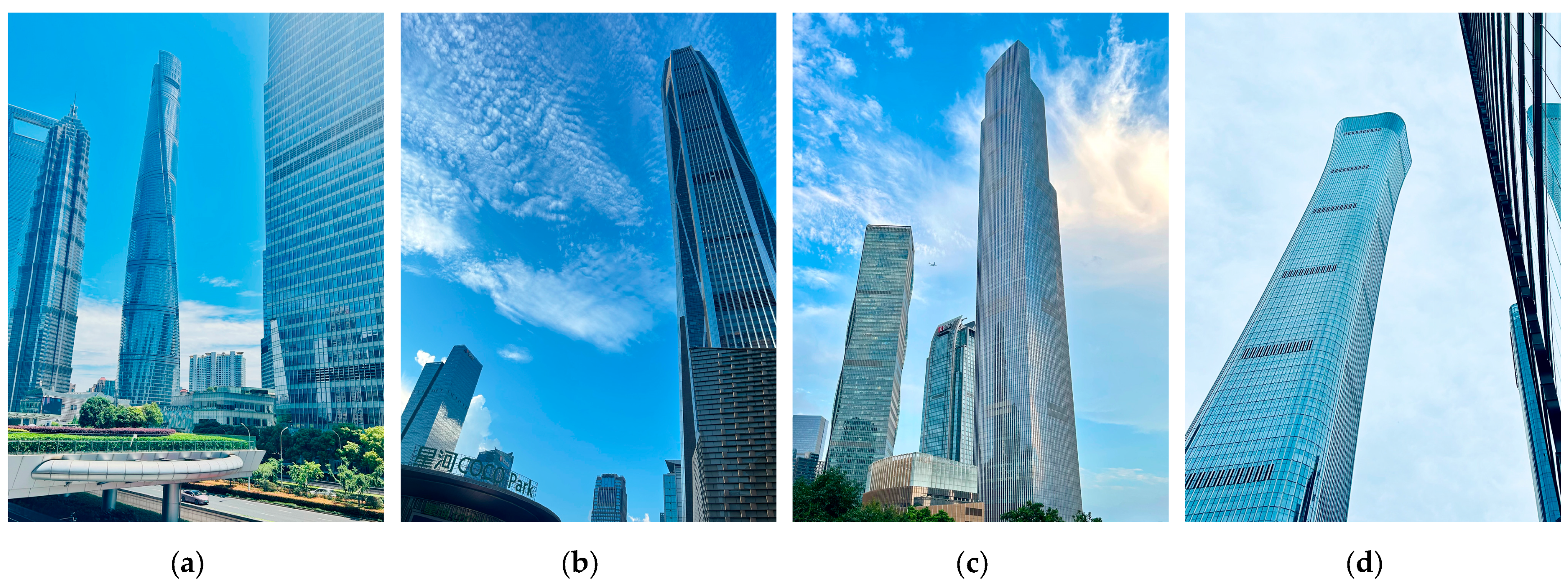
Case studies were then analyzed, discussing the structural and environmental aspects of individual buildings. The buildings were examined in terms of energy efficiency, integration of renewable energy sources (BMSs, photovoltaic panels, small wind turbines, rainwater and greywater collection and management systems), sustainable materials and prefabrication, and construction and design issues (including the impact of wind on the building, type of structure, and foundation). The study was limited by differences in certification criteria and the lack of comprehensive data for some buildings. Data was sourced from official LEED reports, CTBUH publications, investor websites, and academic articles. Additionally, the authors conducted direct visual observations of selected buildings during research visits to several Chinese megacities (Shanghai, Shenzhen, Beijing, and Guangzhou), enabling visual observations and assessment of elements such as shading solutions, façade orientation, building relationships with the surroundings, scale, proportion, and the actual impact of architectural form on context. The authors observed the following buildings: Shanghai Tower (Shanghai), Ping An Finance Centre (Shenzhen), Guangzhou CTF Finance Centre (Guangzhou), and CITIC Tower (Beijing). Data were analyzed using a qualitative comparative approach to identify common sustainability strategies and regional differences. A structured data extraction procedure was used to ensure repeatability and eliminate subjectivity. A Data Extraction Form (DEF) was created with variables grouped into categories: general characteristics (height, number of floors, year, region), structural system, façade design, HVAC and mechanical systems, renewable energy technologies, water management strategies, sustainable material use, certification data (levels, categories, obtained points), and energy performance indicators (Appendix A.1 Sustainable Development Strategy Assessment Cards). All data were double-checked by two independent researchers. Sustainability strategies were coded using a four-category system developed for this study: Category A (Passive design strategies), Category B (Active systems and mechanical efficiency), Category C (Renewable energy integration), and Category D (Material, water, and circularity strategies). Each strategy was coded as 0 = not used, 1 = conceptually integrated only, 2 = implemented on a measurable scale, and 3 = implemented as a primary design driver. This coding allows for comparative quantification. The results are presented in table form.
The authors then discuss the issues in the following sections: multi-criteria certification, sustainable solutions in tall and high-rise buildings, building structure and economics, and design issues (including construction, wind impact, façade design, and foundations). Finally, the Theoretical and Design Conclusions and Research Perspectives are presented.

3. Results

3.1. Literature Analysis

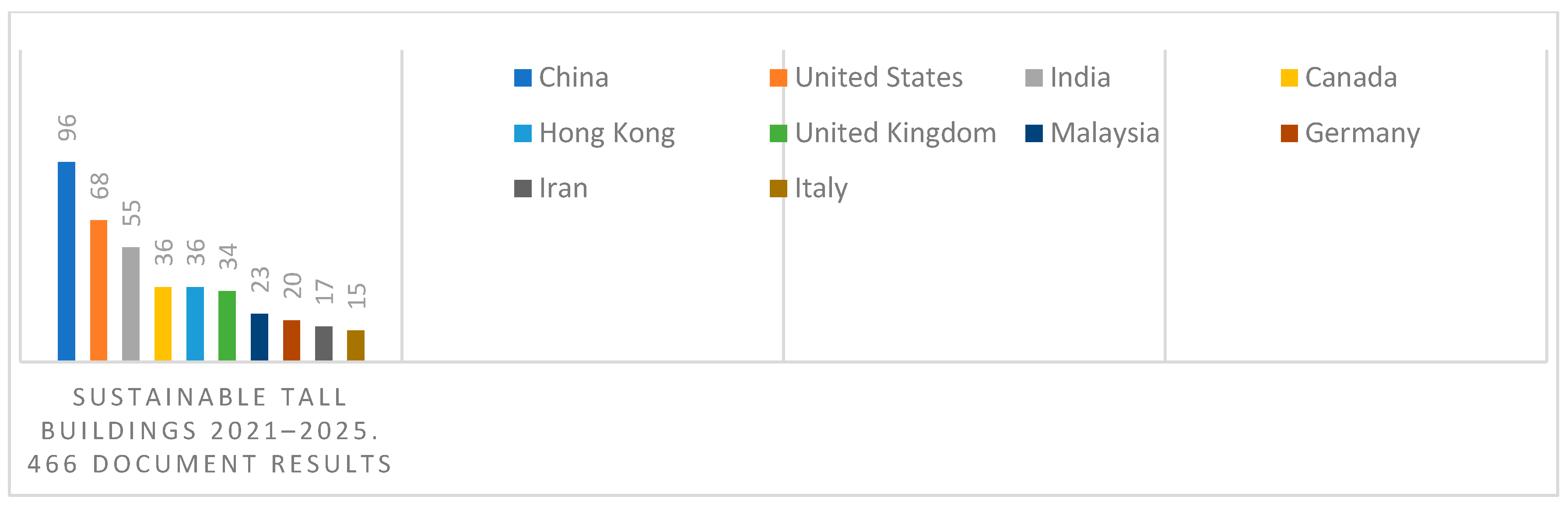
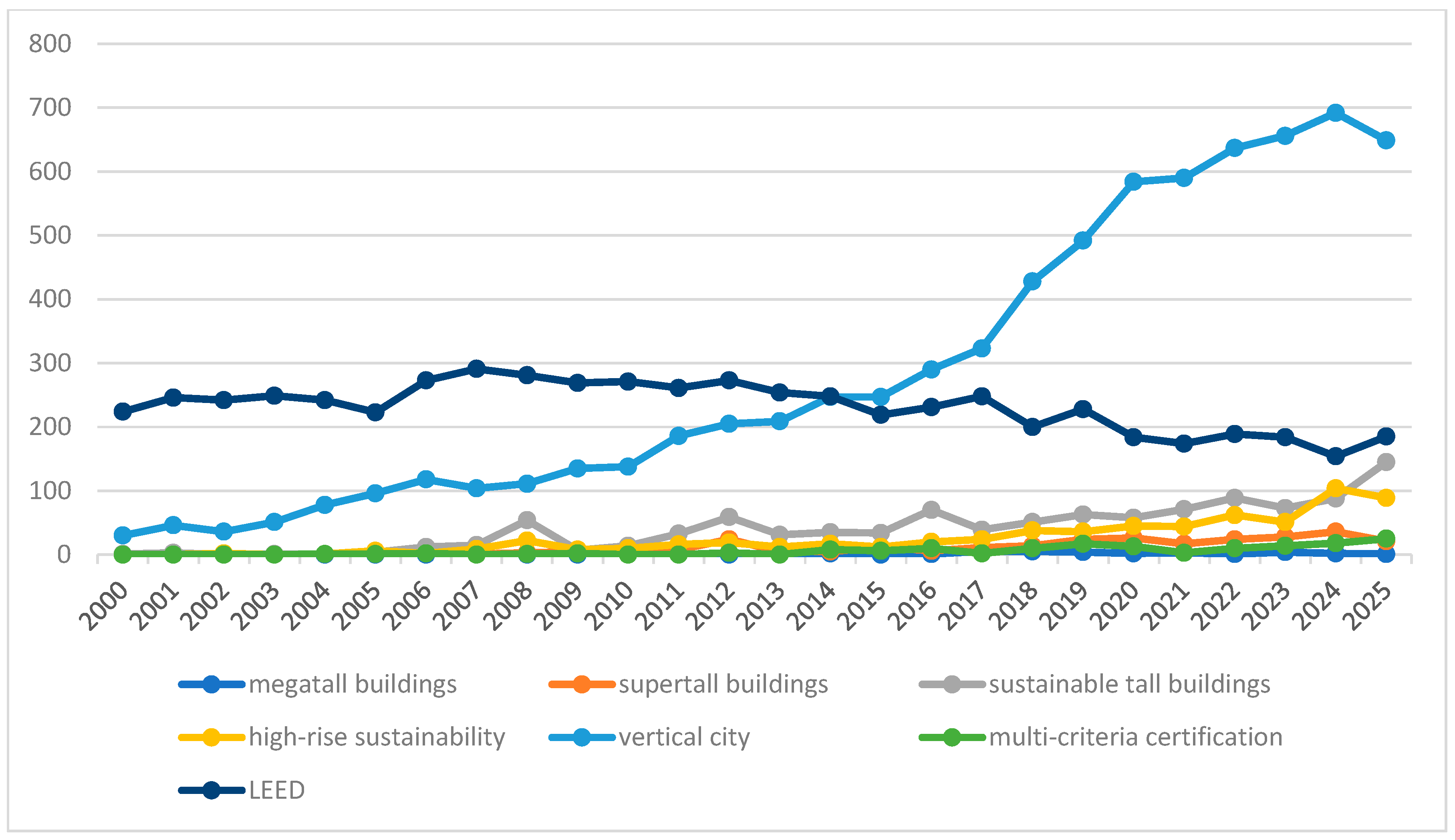
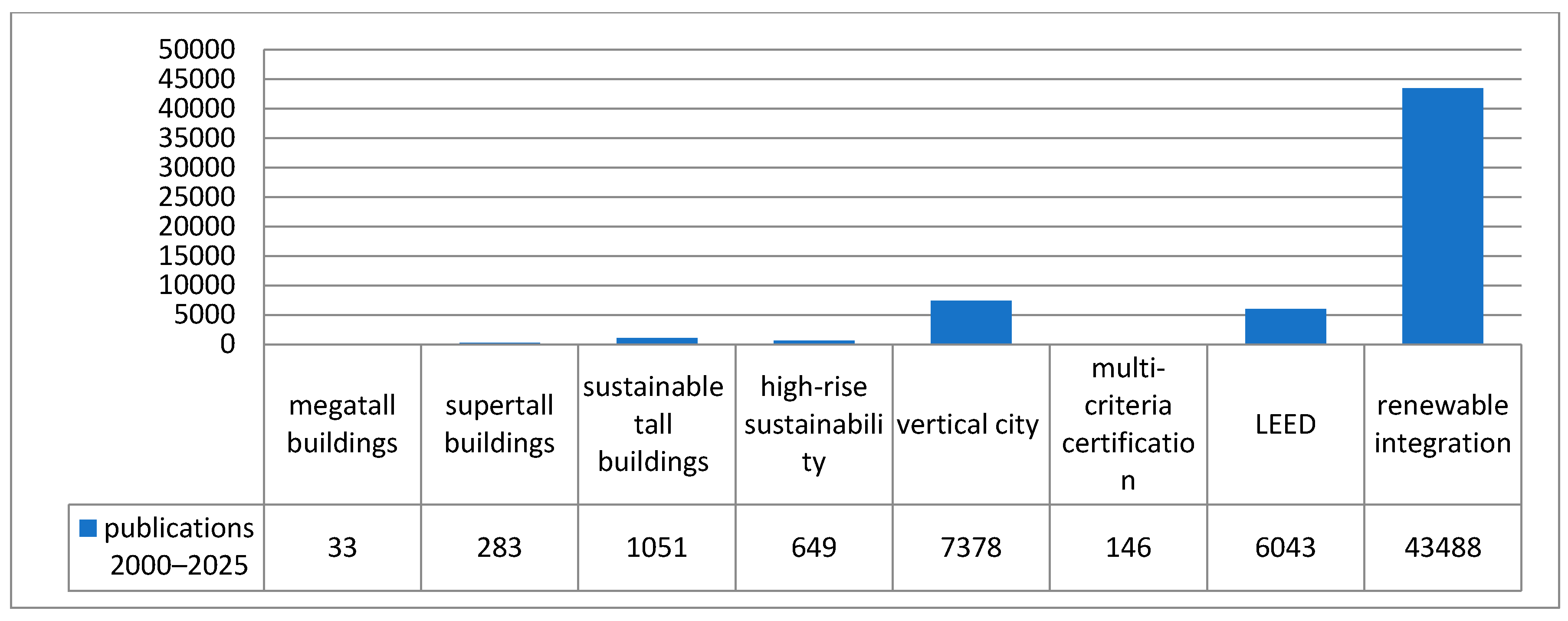
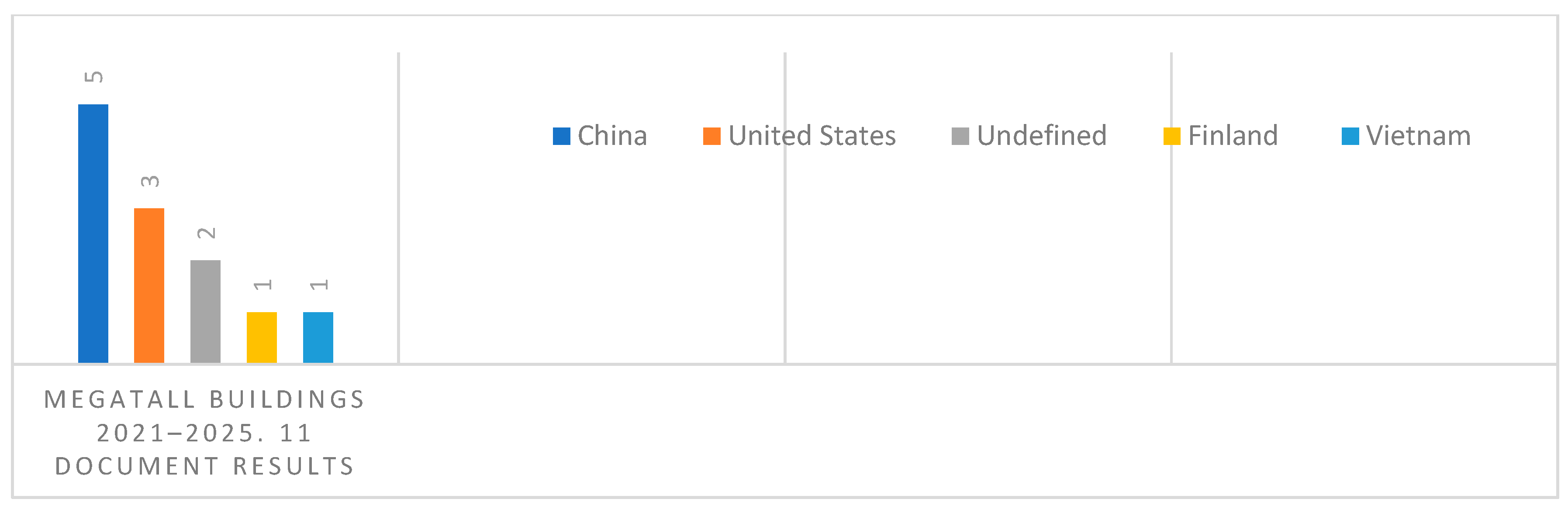
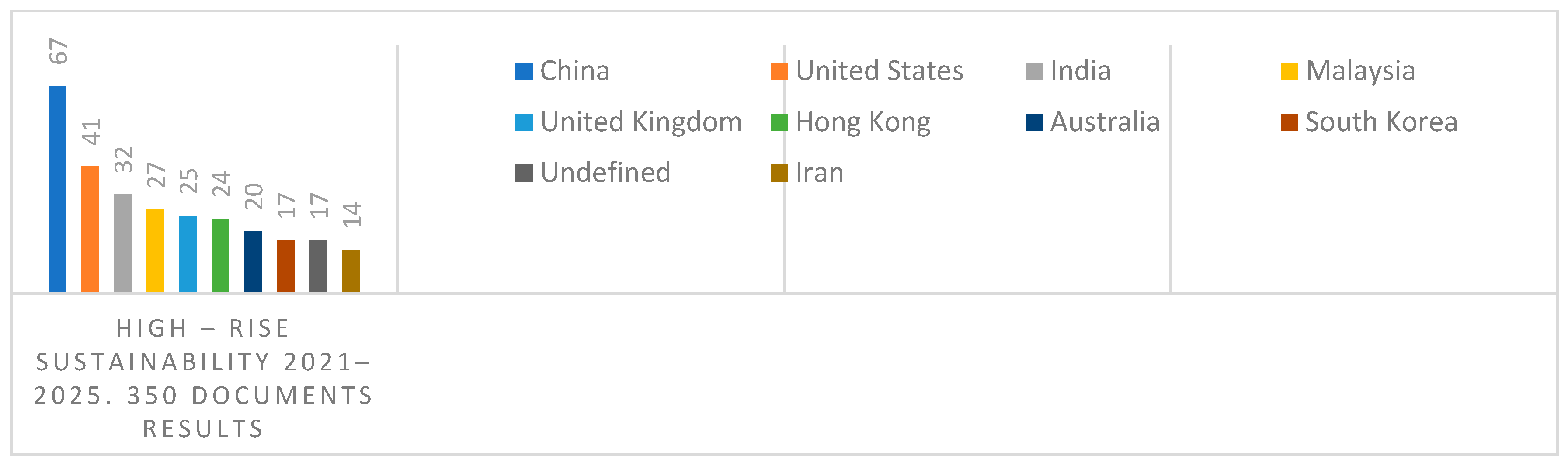
An analysis of the literature published between 2000 and 2025, conducted using the Scopus search engine (including the filters described in the methods) and based on keywords, revealed that only 33 documents were published using the keyword “megatall” (Figure 2 and Figure 3). However, there is a noticeable upward trend in the use of the term “vertical city.” The phrase “supertall buildings” appeared in 283 cases and “sustainable tall buildings” in 1051 cases. The keyword “high-rise sustainability” appeared in 649 cases, “multi-criteria certification” in 146 cases, “LEED” in 6043 cases, and “renewable integration” in 43,488 cases. Next, we examined which regions of the world produced the most publications using selected keywords related to sustainable development and high-rise buildings between 2021 and 2025. The table shows the top 10 search results. The following study clearly indicates that only 11 documents were published using the keyword “megatall buildings” between 2021 and 2025 (filters: engineering, environmental science, energy, materials science, multidisciplinary) (Figure 4). China leads the way in the number of publications using the keywords “megatall buildings,” “sustainable tall buildings” and “high—rise sustainability”. The United States is in second place (Figure 4, Figure 5 and Figure 6).

3.2. Sustainability and Multi-Criteria Certification

With the growing interest in low-impact buildings, the need arose to establish parameters to verify this impact. The first initiatives emerged at the end of the 20th century, followed by the development of sustainable building certificates [11]. The systems arose from the need to combat climate change and reduce greenhouse gases, as well as to improve the quality of life of users [12]. Environment, society, and economy constitute the three pillars of sustainable development. Most sustainability rating systems are developed in accordance with these principles. Green Building Rating Systems (GBRSs) are environmentally oriented tools that contribute to balancing the three pillars and increasing practicality. Sustainability rating systems consist of three stages: classification (expectations of change determine the impact category based on inputs and outcomes), characterization (determining the impact of inputs and outcomes), and value (weighting the category relative to others) [13]. BREEAM was the first rating system, established in 1990 in the UK, and is now an international standard used in 85 countries [8]. It was developed by Building Research Facilities Ltd, Garston, UK (BRE), a leading centre of building science in the United Kingdom, located in Garston. BREAAM lists recognized low- and zero-emission technologies, such as solar radiation, wind, geothermal and hydrothermal energy sources, hydropower, biomass, waste heat, and heat or electricity from waste incineration. The aim of the Ene 04 Low-Carbon Design category is to design buildings to reduce their energy needs [1]. Buildings are assessed according to benchmarks and then classified and certified according to a scale of approved, good, very good, excellent, and exceptional. BREEAM was the first rating system, established in 1990 in the United Kingdom, and is now an international standard used in 85 countries [8]. Its main goals include neutralizing the environmental impact of building operations and supporting innovation in the construction industry. LEED (Leadership in Energy and Environmental Design) was developed in 1998 by the US Green Building Council in the United States and is currently one of the most popular global standards for assessing sustainable buildings. This standard promotes sustainable practices in energy efficiency, water management, sustainable materials, and indoor environmental quality. Points are awarded in nine areas related to sustainability: integrative process (planning and assessments), location and transportation (LT), sustainable locations (SS), water efficiency (WE), energy and atmosphere (EA), materials and resources (MR), indoor environmental quality (EQ), and innovation (IN). Depending on the number of points earned, a silver, gold, or platinum certificate is awarded. The DGNB building rating system was introduced in 2007 in Stuttgart by the German Sustainable Building Council. The goal was to improve the overall quality of buildings throughout their entire life cycle and to develop sustainability aspects [14]. Certified buildings can be at one of four levels: certified, silver, gold, or platinum. The DGNB System, New Construction, Buildings Criteria Set, Version 2023 document states that the goal of sustainable design is to design buildings to minimize greenhouse gas emissions that impact the climate. Benefits include life-cycle-oriented building design and environmentally friendly decision-making. If a life-cycle assessment (LCA) approach (with a particular focus on greenhouse gas reduction) is used in planning, it is subject to assessment. The CO2 balance is often calculated for a building throughout its entire life cycle. The minimum requirement for platinum-certified buildings, even if they are not yet designed, is that they be greenhouse gas neutral upon completion. Currently, the construction sector has solutions to reduce environmental impact, and sustainable building certificates have become one of the tools [15]. There are dozens of systems around the world, mainly for commercial buildings. Globally recognized systems include DGNB (created in Germany), WELL (USA), HQE (France), and Green Star (Australia). There are also local systems, such as the China Green Building Evaluation Label (China Three Star), developed in 2006 in the People’s Republic of China [9]. Green building projects often receive additional financial support [16]. Mazur et al. point out that in the case of LEED and BREEAM, the most effective approach is to begin certification work at the same time as building planning so that the criteria can be implemented during the construction phase. The researchers point out that the construction industry’s focus on SDGs can contribute to sustainable development [17].
Ali, Al-Kodmany, and Armstrong emphasize that the priorities for tall and supertall buildings have recently focused on achieving greater energy efficiency. Architects and structural designers are adopting both active and passive approaches to implementing technological and design innovations to meet the energy needs of a growing population and address climate change. The researchers point to tall buildings as requiring enormous amounts of energy to build and operate, as well as the practical need to transition to renewable energy sources. They also emphasize the need for further research to address these challenges and improve the energy efficiency of tall buildings [18]. Rebelatto, Salvia, Brandli, and Filho also point out that energy is responsible for a significant portion of carbon dioxide emissions, and improving building energy efficiency is a mitigation strategy. Their study relied on a SWOT analysis of LEED, BREEAM, and DGBN certifications, highlighting their contribution to building energy efficiency internationally. The results indicated the need for continuous improvement of these systems, which should include consideration of economic factors and life-cycle perspectives [19]. Al-Shammari, Al-Juboori, and Erzaij emphasize that some systems, such as LEED and BREEAM, are considered international, while others, such as Pearl Rating Systems (PRS), are local in nature. The researchers point out that the systems share similar goals and can lead to the construction of green buildings and improved efficiency of existing facilities, but they also emphasize that each technique has its own unique structure, certification process, and weighting standards. These inequalities raise a number of questions about whether global rating systems adequately address the specific circumstances of a given country [20]. Mulya et al. emphasize that Green Building Rating Systems (GBRS) certifications aim to reduce carbon dioxide emissions from buildings and improve occupant comfort, but most studies focus on low-rise and mid-rise buildings, ignoring the impact of GBRS on commercial high-rise buildings [21]. Harris, Ryan, Marino, and Gharehbaghi discuss green building (sustainable construction) as one that focuses on processes implemented in an environmentally efficient and responsible manner throughout the entire life cycle of buildings. This includes material production, on-site assembly, operation, and demolition. The researchers add that despite the complexity, the transition to green design is still necessary, and their study focuses on supporting knowledge about green high-rise buildings [22]. Na and Vi also state that the sustainable goal is the majority of current architectural trends, and to achieve this goal, energy saving in buildings should be a priority [23].

3.3. The World’s Tallest Buildings

Al-Kodmany points out that there is no single, universally used definition of tall buildings. For example, in Germany, the term refers to buildings over 22 m tall, while in the UK, it refers to any structure over 20 m and/or a building that dominates the surrounding area. The ASHRAE (American Society of Heating, Refrigerating, and Air-Conditioning Engineers) Technical Committee for Tall Buildings defines tall buildings as buildings over 091 m tall [24]. The Council on Tall Buildings and Urban Habitat (CTBUH) has developed international standards for measuring and defining tall buildings worldwide. The document does not specifically define a tall building; it considers it subjective because its perception depends on the context. As an example, a 14-story building might not be considered tall in Hong Kong or Chicago, but in a provincial European city, it might be significantly taller than other buildings. The document provides definitions for supertall: a building 300 m or taller, and megatall: a tall building 600 m or taller. The CTBUH distinguishes three height categories, which measure a building from the level of the lowest main entrance. The first measurement refers to the height of the architectural top of the building’s architectural structure, including the spire. This is the most commonly used measurement and is also used to define the world’s tallest buildings by the CTBUH. The second measurement is the height to the highest occupied floor (floor level), and the third is the height to the top of the highest point (regardless of the material or function of the element) [25].
A literature review using the keyword “megatall” revealed that existing publications on this type of building describe structural issues, key challenges, innovations, and optimization. More and more reinforced concrete supertall and megatall tower structures are being built due to the global demand for high-rise buildings as well as advances in concrete technology. Abdelrazaq discusses Merdeka 118 as an extensive mixed-use project that utilized high-performance concrete to optimize the size of structural elements, thereby improving the building’s economics by maximizing usable floor space [26]. Van discusses the design process for tall buildings as a three-step process: rough estimation of the size of foundations and supporting structure components, verification of established sizes with full consideration of foundation-soil integration, and design optimization using parametric analysis [27]. Liu et al. discuss pedestrian-level wind environment around high-rise building exterior platforms to ensure pedestrian comfort and safety [28]. Gu, Lu, Fan and Gao point out that in recent years, more and more high-rise buildings have been constructed, but their simulation consumes huge computational resources and thus forces the need for fast methods of automated analysis [29]. Tang, Zheng, and Liu emphasize that most high-rise buildings currently employ aerodynamic solutions, such as corner modifications, to reduce loads and reduce the building’s response to high winds. The researchers discuss their analyses of aeroelastic models under twisted wind flow (TWF) [30].

3.4. Pro-Ecological Solutions and Renewable Energy in High-Rise Buildings: Case Studies

In order to supplement the literature review with empirical data, it was necessary to refer to existing buildings (in accordance with the principle adopted in the methodology). Table 1 lists the twenty tallest buildings in the world based on data from the CTBUH measured to the architectural top of the building. The columns contain information on the building name, location, year of construction completion, height, number of floors, type of structure, building function and green building certificate status. According to the list, in 2025, there will be only four supertall buildings in the world. The Burj Khalifa (Dubai, United Arab Emirates), with a height of 828 m, completed in 2010, is the tallest building in the world. Malaysia’s Merdeka 118 (2023), in second place, is 679 m high. The Shanghai Tower, built in 2015, is 632 m high, and the Makkah Royal Clock Tower in Saudi Arabia (2012) is 601 m high. A slightly shorter building that does not qualify for supertall status (it is 1 m short) is the Ping An Finance Center (Shenzhen, China), with a height of 599 m. All other buildings fall into the megatall category. The comparison shows the dominant office function as well as the multifunctionality of the buildings.
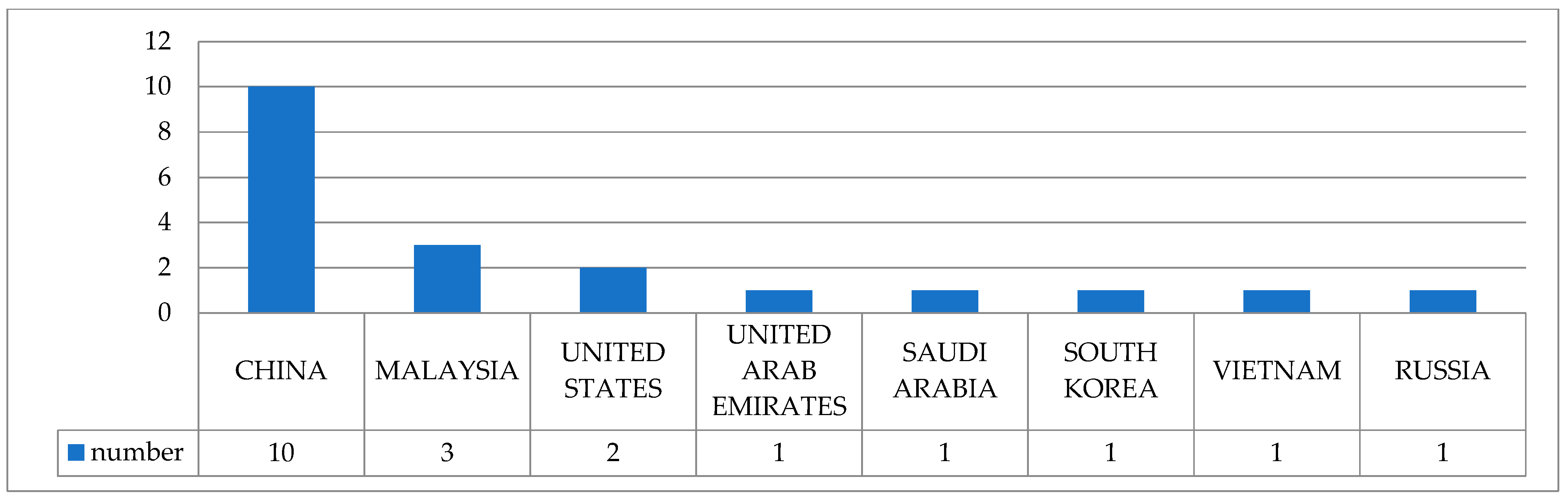
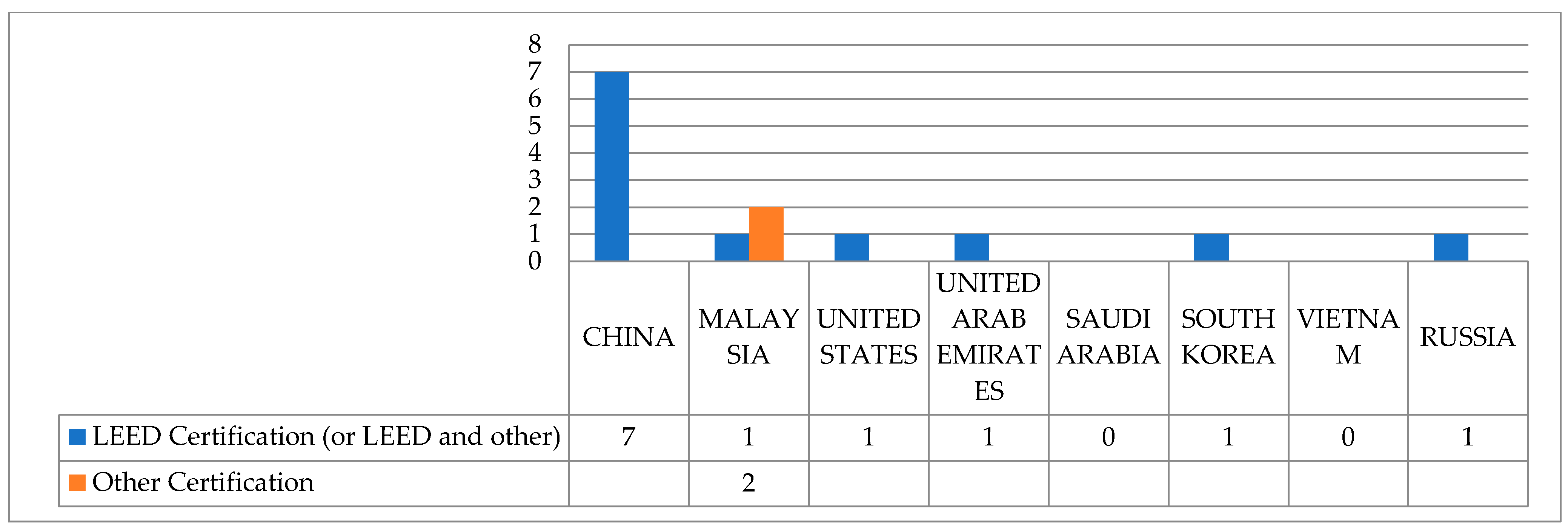
Figure 7 shows the breakdown of the world’s twenty tallest buildings by country. China is clearly the leader with 10 buildings, followed by Malaysia with three buildings, the USA with two buildings, and the remaining countries (United Arab Emirates, Saudi Arabia, South Korea, Vietnam, Russia), each with one building. Figure 8 shows the number of certified buildings. Twelve of the twenty buildings have sustainable building certificates. China is also the clear leader here, with seven buildings. Malaysia, the USA, South Korea, the United Arab Emirates, and Russia each have one certified building. The only international certification in the table is LEED, available at Platinum and Gold levels (in various variants). Other international certifications are not found among the twenty tallest buildings in the world. The CITIC Tower has LEED-CS Gold Pre-certification but has been awarded the local China Certificate of Green Building Label—Three Star.
Table 2 contains information about high-rise buildings over 450 m currently under construction. None of the buildings will exceed 600 m. The tallest will be Burj Binghatti Jacob (United Arab Emirates), at 595 m, followed by Six Senses Residences (United Arab Emirates), at 517 m. Both buildings will be residential. Three of the ten buildings listed below have or are applying for LEED certification, while information about the remaining buildings is unknown at this stage.
As shown in Figure 9, the extreme verticality and articulation of very tall buildings’ facades impose specific constraints on passive strategies and limit the feasibility of local renewable energy systems.

3.4.1. Burj Khalifa, Dubai, United Arab Emirates

Construction of the multifunctional complex, with an area of approximately 460,000 m2 and a height of 828 m, began in 2010. Its implementation was made possible by combining state-of-the-art structural solutions. In this type of project, the design phase requires combining architectural vision with structural capabilities, as well as selecting the appropriate construction strategy. For example, such a strategy could involve selecting and optimizing the appropriate system for additional strength and stiffness while also reducing costs and construction time. The tower was constructed using state-of-the-art geodetic electro-optical total station technology. The slab foundation rests on a 3.7 m high-strength reinforced concrete pile. Effective wind mitigation was a key consideration. The designers created a three-dimensional model to conduct analyses to assess the actual intended building displacements for the anticipated movements [31]. The building’s three-axis, Y-shaped plan, with each floor spiraling back upwards, results in wind vortices not connecting with each other [32]. At the same time, this treatment maximizes views of the Persian Gulf. The main construction material is concrete; the heat-resistant cladding system consists of vertical aluminum ribs and stainless-steel panels. The glass used in the building boasts very high solar and thermal efficiency. It also helps reduce glare and reflect sunlight, preventing interior overheating. Conducting electricity at a higher voltage reduces energy losses, while an electronic metering system enables continuous monitoring and potential optimization of energy consumption. The building also features a building management system (BMS), supporting operating costs and more efficient use of building resources and services. An additional challenge is its resistance to extreme desert temperature fluctuations and strong winds. Burj Khalifa was not designed in accordance with the guidelines for multi-criteria green building certification, but in 2024, it received LEED Platinum certification under the v4.1 Operations and Maintenance: Existing Buildings.

3.4.2. Merdeka 118, Kuala Lumpur, Malaysia

Merdeka 118, a 679 m tall building, was completed in 2023 atop Petaling Hill in Kuala Lumpur, Malaysia. The diamond-shaped building has 118 floors above ground and 6 underground levels. During the design phase, a series of wind tunnel analyses were conducted to determine the anticipated wind loads. A reinforced concrete core and outriggers ensured the structure’s stability under wind and earthquake forces. Steel intermediate columns were also used. Similar to the Burj Khalifa, the building has a slab-and-pile foundation [33]. In 2024, the building received the LEED BD+C: Core and Shell v3-LEED 2009 Platinum certification, scoring 86/110 points (in the sustainable sites category: 24/28, water efficiency: 8/10, energy and atmosphere: 27/55, material and resources: 7/13, indoor environmental quality: 10/12, innovation: 6/6, and regional priority credits: 4/4). The building incorporates energy efficiency-oriented design strategies, low-emission materials, a rainwater harvesting system, smart metering devices, low-flow devices, and an intelligent building management system. It also features an electric vehicle charging system, good access to public transportation, and bicycle infrastructure. The building features amenities that support waste separation, reuse, and recycling of materials. The designers are also striving to obtain further GreenRE (Green Real Estate Index) and GBI (Green Building Index) certifications, as well as WELL Building Standard certification.

3.4.3. Shanghai Tower, Shanghai, China

The Shanghai Tower, at 632 m, is the tallest building in China and belongs to a group of very tall skyscrapers in Shanghai’s central financial district (alongside the Mao Tower (421 m) and the Shanghai World Financial Center (492 m)). The building, with 128 floors above ground and five underground levels, was completed in 2015. It was designed as nine cylindrical modules ranging in height from 12 to 15 stories. The building has a double-layer façade, the first of which was designed to minimize wind loads. A series of wind tunnel tests was conducted in various possible configurations involving spiral rotation. The structural system consists of a reinforced concrete core, outriggers, and a megaframe. The foundation consists of a system of piles (the piles extend to a depth of approximately 87 m) and foundation slabs (6 m thick) [33]. Zhang B., in his study, analyzed the effective implementation of LEED certification in the Shanghai Tower building by analyzing green building practices during the design, construction, and operation stages. The study results indicated that the building not only successfully achieved LEED Gold certification but also became an important benchmark for green buildings. Strategically located at the mouth of the Yangtze River in the region’s typical humid subtropical climate, China’s tallest building is a symbol of Shanghai’s modern urban development. It houses offices, a hotel, an exhibition space, and an observation deck. To meet LEED’s stringent water management requirements, a rainwater harvesting system was designed to harvest rainwater from the roof. This system is used for watering plants and flushing toilets, contributing to reduced potable water demand. Water-saving installations were also incorporated, along with a water resource monitoring system that tracks water consumption in real time. The project utilized double curtain walls to improve thermal insulation and reduce air conditioning loads, contributing to reduced energy demand according to simulation results. Furthermore, energy efficiency simulation tools were utilized, and the building was equipped with an efficient LED lighting system. Other elements designed in accordance with certification requirements included renewable energy devices: wind turbines on the roof and a ground-source heat pump system providing efficient heating and cooling. These elements were intended to reduce the building’s environmental impact and improve the quality of the indoor environment [34].

3.4.4. Makkah Royal Clock Tower, Mecca, Saudi Arabia

The 601 m tall Makkah Royal Clock Tower was completed in 2012 in Mecca, Saudi Arabia. A clock with four faces sits atop the tower. The building has 120 floors above ground and three underground levels. Up to a height of approximately 347 m, the structure is reinforced concrete, consisting of a central core and a complex of columns. Subsequent floors are constructed using a lighter, composite steel–concrete structural system with a reinforced concrete core, reaching a height of 393 m. The upper section is a megaframe structure of steel and concrete. A 4.85 m thick transfer slab is used at roof level. The foundation consists of piles and platforms. Numerous wind tunnel tests and CFD analyses were conducted during the design phase [33].

3.4.5. Ping an Finance Centre, Shenzhen, China

The 599 m tall Ping An Finance Centre is located in Shenzhen and is the iconic center of the developing Futian business district. It is also a symbol of modernity and innovation. Its shape resembles a traditional Chinese lantern, symbolizing lighting the way to the future. The skyscraper consists of 118 floors above ground, measuring 63 × 63 m. The tower’s streamlined shape brings tangible benefits in terms of improved structural properties and wind resistance [35]. The structural system consists of a composite concrete core and seven external double-layer chord trusses, steel outriggers, eight supercolumns, and diagonal bracing. A seismic performance assessment was also conducted [36]. The building is LEED Gold certified. A high-performance glass façade, consisting of integrated insulating glass units with a low-emissivity coating, reduces heat transfer while maximizing daylight access, which also translates into lower cooling requirements and energy consumption. An energy management system monitors energy consumption in real time. To ensure efficient passenger transportation without consuming significant amounts of energy, the building features a regenerative drive system that recovers energy. The higher zones of the tower have lower ambient temperatures, so the HVAC system has full access to fresh air with limited recirculation.

3.4.6. Lotte World Tower, Seoul, South Korea

At 555 m, the Lotte World Tower, built in 2017, is the tallest building in Korea. The building has 123 floors (divided into three segments), and its base measures 70.8 × 70.8 m. The structure consists of a concrete core and external supercolumns connected by outriggers. The LWT base is a 6.5 m thick slab. In the case of supertall buildings, structural health monitoring (SHM) is a technology that identifies the current condition of the structure and assesses its safety and serviceability. In the Lotte World Tower, SHM was incorporated into the design, construction, and occupancy phases [37]. In 2017, the building received LEED BD+C: New Construction v3-LEED 2009 Gold certification, scoring 66/110 points (in the sustainable sites category: 20/26, water efficiency: 10/10, energy and atmosphere: 14/53, material and resources: 6/14, indoor environmental quality: 8/15, innovation: 4/6, and regional priority credits: 4/4). The LWT is powered by a range of renewable energy sources: geothermal, photovoltaic, and wind turbines. Ventilation accessories are equipped with energy recovery for exhaust air extraction. Variable frequency drives ensure efficient HVAC system operation. Graywater reuse systems and low-flow fixtures have enabled 30% water savings.

3.4.7. One World Trade Center, New York City, United States

The 541 m tall skyscraper has an octahedral shape resting on a rectangular base. The rectangular structure has wall corners to reduce wind impact. It was built in 2014 in Lower Manhattan, New York City, United States. The building has 104 floors and five underground levels. As the sun moves and weather conditions change, much like the crystal that inspired the design, the building’s form refracts sunlight, and the facades change color. A massive square reinforced concrete core, housing stairwells and elevators, is located in the center. The skyscraper is set in granite rock, and its foundation rests on strip footings and strip foundations. The foundation was anchored to a depth of 24 m to withstand extreme winds. One World Trade Center received LEED Gold BD+C, 37/62 certification. The building was constructed of so-called green concrete and was partially supplied with energy by 12 hydrogen-powered batteries. Replacing 50% of the cement with industrial byproducts reduced the building’s carbon footprint. The building utilizes largely recycled steel, as well as drywall and ceiling tiles. In addition to fuel cells, it is equipped with energy-saving technology. It also features a “daylight” system that automatically controls the building’s lighting. The WTC also has rainwater storage tanks, which are used to cool the building and irrigate the landscape. Water drawn from the Hudson River supports the building’s air conditioning system [38]. 80% of the skyscraper’s waste is recycled.

3.4.8. Guangzhou CTF Finance Centre, Guangzhou, China

The Guangzhou CFT Finance Centre in Guangzhou, China, is a 530 m tall, mixed-use skyscraper. It is located east of the central axis of Zhujiang New City in the Tianhe District. Zhujiang New City is a rapidly developing business district that is also becoming a recreational, commercial, and lifestyle center for the city. Icons such as the Opera House and the Canton (TV) Tower are nearby. The dynamic setbacks of the structure have been sculpted to accommodate the varying heights of nearby skyscrapers. The structure consists of a core and megacolumns, as well as steel outriggers and double-layered chord trusses. Wind tunnel tests achieved design wind forces and accelerations, ensuring occupant comfort. Computer analysis confirmed that the CFT would meet seismic requirements. The façade features self-cleaning and exceptionally corrosion-resistant terracotta. Additionally, this material is produced in multiple locations across China, reducing the environmental impact of transportation. CFTGZ was designed to meet LEED Gold standards. In 2018, it was awarded LEED BD+C: Core and Shell v3-LEED 2009 Gold certification with a score of 66/110 (in the sustainable sites category: 22/28, water efficiency: 10/10, energy and atmosphere: 12/55, material and resources: 5/13, indoor environmental quality: 8/12, innovation: 5/6, and regional priority credits: 4/4). The building has multi-level connections to public transportation. High-efficiency chillers and heat recovery from water-cooled chiller condensers contribute to the building’s sustainable design.

3.4.9. Tianjin CTF Finance Centre, Tianjin, China

The 530 m Tianjin CFT Finance Centre was built in 2019 in Tianjin, on the axis of the government center and the local public transport station. The tower’s aerodynamic shape reduces vortex dispersion and mitigates the potential for resonant wind forces and loads on the structure. The structure consists of an inner core and surrounding columns. The tower rests on a 5.5 m thick pile cap. The building was designed in accordance with LEED Gold standards. In 2020, the LEED BD+C: Core and Shell v3-LEED 2009 achieved a Gold rating of 62/110 points (in the categories of sustainable sites: 21/28, water efficiency: 10/10, energy and atmosphere: 11/55, material and resources: 2/13, indoor environmental quality: 8/12, innovation: 6/6, and regional priority credits: 4/4). The CFTTJ features energy and water reduction systems, as well as sustainable strategies that include a high-performance envelope that provides excellent daylighting and views. The exterior wall was designed using parametric modeling to optimize paneling and façade curvature. The curtain wall features a double U-shaped mullion that reduces the glazing area by up to 70%.

3.4.10. CITIC Tower, Beijing, China

Construction of CITIC Tower began in 2018 in the Central Business District of Beijing, China. The building has 108 floors and is 528 m tall and is located in a high seismic zone where the average ground acceleration exceeds PGA = 0.2 g for a 475-year return period [39]. The building has LEED-CS Gold Pre-certification and China Certificate of Green Building Label-Three Star. The building’s shape is inspired by the ancient Chinese “zun” vessel. The building’s plan is a square with rounded corners (78 × 78 m), which narrows in the central section at a height of 385 m (54 × 54 m) and then widens at the top (69 × 69 m). This is a special case because high-rise buildings are typically smallest at the top—this shape reduces wind loads and seismic mass [40]. The project used parametric design and BIM technology.

3.4.11. Taipei 101, Taipei, China

The 508 m tall Taipei 101, located in Taiwan, was built in 2004. It was designed by C.Y. Lee & Partners Architects/Planners. The building originally featured a graywater treatment system and low-emissivity glass. The skyscraper first achieved LEED Platinum certification in 2011. In 2016, it achieved LEED Platinum O+M: Existing Buildings certification (82/110 points) after undergoing three-year renovations (including electrical systems, mechanical heating, ventilation, and air conditioning equipment, and the introduction of a building management system enabling more accurate energy monitoring and analysis). A third LEED v4.1 Re-certification at the Platinum level was awarded in 2021. Temperature and humidity sensors are located on each floor, which send information to the management system, which determines when mechanical and lighting equipment is turned on or off [41]. Lighting fixtures were also replaced with more energy-efficient ones. It now achieves significantly higher savings in electricity and water consumption. As part of the building’s management initiatives, part of Zhong Qiang Park was also adapted to restore and protect habitats.

3.4.12. Shanghai World Financial Center, Shanghai, China

The 492 m tall Shanghai World Financial Center is located in the Lujiazui district of Shanghai. The 101-story building was built in 2008 on a square base measuring 57.95 × 57.95 m. The structure utilizes reinforced concrete, braced steel core, a megaframe, and cantilever trusses. To mitigate wind-induced vibrations, two mass dampers were installed on the 90th floor. These dampers effectively reduce building sway, ensuring a safe environment for office occupants [42,43]. Optimizing form and function was key to the design. The modular system, repeated every 13 floors, simplified the production and assembly of components, thus shortening construction time and reducing material waste. The foundation consists of piles that absorb increased lateral loads caused by wind and earthquakes.

3.4.13. International Commerce Centre, Hong Kong, China

The 484 m tall International Commerce Centre is located in Hong Kong, China. It was completed in 2010. Its height was reduced from previous plans due to regulations prohibiting buildings from being built higher than the surrounding mountains. The building was designed by the architectural firm Kohn Pedersen Fox Associates (KPF) in collaboration with Wong & Ouyang. Since the implementation of ISO 50001 [44] Energy Management Systems certification in 2011, significant investments have been made in improving energy efficiency. A computer-aided building management system monitors the building’s energy consumption. The International Commerce Centre features a water-cooled chiller with a centrifugal separator, which increases the coefficient of performance and thus contributes to reduced energy consumption. The building also features a low-emission curtain wall, natural atrium lighting, and energy-efficient lighting fixtures. The building’s waste management program has increased the number of recyclable materials. In addition to the baseline audit, the International Commerce Centre offers its tenants free energy audits upon request.

3.4.14. Wuhan Greenland Center, Wuhan, China

The 476 m tall Wuhan Greenland Center is located in Wuhan, China. The skyscraper was originally designed to be 636 m tall but was redesigned during construction to accommodate airspace regulations. Construction began in 2012 and was completed in late 2020. The building’s form is characterized by a three-legged base that provides an efficient aerodynamic profile: a conical body, gently rounded corners, and a domed top. This design reduces wind resistance and vortex shedding, which typically causes very tall buildings to sway [45]. The Wuhan Greenland Center utilizes a triangular floor plan that tapers gently upwards, providing additional stability and protection against strong winds and seismic events. The building features energy recovery using an enthalpy wheel integrated into the ventilation system, which captures energy from exhaust systems and then uses it to preheat or cool the air entering the building. Another element is the graywater system—water from the laundry, sinks, and showers is used for cooling. Additionally, low-flow fixtures conserve water. The lighting system uses energy-efficient ballasts and lamps, and the control system responds to daylight, automatically turning off electric lighting when sufficient daylight is available.

3.4.15. Central Park Tower, New York City, United States

Central Park Tower, standing 472 m tall, is located in New York City, United States of America. The building has 98 floors above ground and three underground levels. It was completed in 2020. Central Park Tower holds the Guinness World Record for being the world’s tallest cantilevered building. The façade of the upper floors is largely a curtain wall composed of aluminum and glass. The building is equipped with a BMS to control key building systems and efficiently distribute heating and cooling throughout its 98 floors. Central Park Tower boasts advanced mechanical systems, including pressure reduction, heat exchangers, pump sets, air handling units, and exhaust systems. The building also houses weather monitoring stations to assess the impact of wind and other environmental factors.

3.4.16. Lakhta Center, St. Petersburg, Russia

The Lakhta Center was built between 2015 and 2018 and is 462 m tall. Located in St. Petersburg, the building’s structure consists of a 26 m diameter reinforced concrete core, which carries 70% of the total vertical load, and ten main perimeter columns connected to the core by outriggers. The building has three underground floors and 86 above-ground floors, and its plan is a polygon inscribed in a circle with a diameter of 66 m. The foundation consists of 264 bored reinforced concrete piles, each 2 m in diameter and 55 and 65 m long [46]. In 2018, the building earned LEED BD+C: Core and Shell v3-LEED 2009 Platinum certification, scoring 82/110 points (in the sustainable sites category: 23/28, water efficiency: 10/10, energy and atmosphere 24/55, material and resources 6/13, indoor environmental quality 9/12, innovation 6/6, and regional priority credits 4/4). Heat generated by the technical equipment is used for space heating. The building is equipped with noise-reducing devices such as silencers and sound-insulating curtain walls.

3.4.17. Vincom Landmark 81, Ho Chi Minh City, Vietnam

Vincom Landmark 81 was built in 2018 in Ho Chi Minh City, Vietnam, on a former shipyard site near a river. The main challenge was the very soft clay soil, which, combined with the very heavy weight of the 461 m building, posed a challenge for structural designers, geotechnical engineers, and contractors [47]. Vincom Landmark 81 has 81 floors and three underground levels. The structural designers designed a thick raft supported by barrette piles. This allowed for maximum flexibility in the project’s subsequent development. Fire safety was ensured based on the internationally recognized NFPA 5000 Building Construction and Safety standard. The building was equipped with eco-friendly windows, which help minimize energy consumption and maintain a comfortable interior temperature. Vincom Landmark 81 also features an advanced water management system.

3.4.18. Changsha IFS Tower T1, Changsha, China

The Changsha IFS Tower is a pair of skyscrapers located in Changsha, Hunan Province, China. Tower T1 (93 floors) is 452 m tall, while Tower T2 (65 floors) is 315 m tall. Construction began in 2013 and was completed in 2018. The complex features an underground network with a transit hub. Tower T1 has a rectangular form covered with a glass façade, divided by a series of metal ribs. At the top, the façade is set back several meters. The main structure consists of a reinforced concrete core and an external megaframe connected by outriggers. The foundation slab was set at a depth of 42 m. In 2025, the building was certified under the LEED O+M: Existing Buildings v4 standard—LEED v4 Platinum, scoring 83/110 points (in the categories of location and transportation: 15/20, sustainable sites: 5/10, water efficiency: 11/12, energy and atmosphere: 28/56, material and resources: 6/8, indoor environmental quality: 8/17, regional priority credits: 4/4, innovation: 6/6). The building features energy-saving systems to improve efficiency, and green roofs contribute to the well-being of residents.

3.4.19. Petronas Twin Tower 1 and Petronas Twin Tower 2, Kuala Lumpur, Malaysia

Construction of the 88-story Petronas Tower in Kuala Lumpur, Malaysia, began in 1993 and was completed in 1996. The 452 m tall buildings are founded on piles (ranging in depth from 60 to 114 m) and a 4.6 m thick foundation slab. The structure is based on a reinforced concrete core and external columns. Rigorous testing and simulations were conducted during the design phase to assess the impact of wind loads on the structure. The towers feature a two-story bridge located on the 41st and 42nd floors [48]. In April 2025, the building received a provisional GBI Gold rating (expiring 21 June 2019—22 June 2022) in the Non-Residential Existing Building (NREB) category. Among other improvements, the renovation included the installation of an energy-efficient toilet flush system. The management company promotes the use of biodegradable and eco-friendly products, which have a positive impact on the environment and help reduce costs. This also includes promoting non-toxic recycled materials and low-VOC products in paints, adhesives, and fixtures such as carpets and ceiling panels. Energy-efficient lighting fixtures were also installed during the renovation.
Table 3 contains a summary of pro-ecological solutions identified in the tallest buildings in the world.

4. Discussion

The construction industry is responsible for 25% of global solid waste generation, which consists of difficult-to-recycle materials [49]. Design priorities for tall and supertall buildings currently focus on achieving greater energy efficiency. Al-Kodmany points out that designing tall buildings with energy savings in mind is an evolutionary process that should be further explored to improve energy efficiency by developing creative solutions and implementing sustainable strategies [18]. Architects and engineers strive to save energy by implementing technological innovations [50]. Innovative design strategies focus on creating architecture that meets environmental standards but also contributes to shaping cultural identity.

4.1. Multi-Criteria Certification

Multi-criteria certification is one of the solutions used in the construction industry to reduce energy consumption in buildings. The dominant systems include LEED, BREEAM, DGNB, and WELL. Kristoffersen, Leslie Schultz, and Kamari point out that the approach to sustainability in these systems encompasses the following categories: thermal comfort, indoor air quality, acoustics, daylighting, electric lighting, and health. According to the researchers, these systems focus on the perspective of building users [51]. The most commonly used certification worldwide is LEED. A 2019 study by Amiri, Ottelin, and Sorvari, analyzing 44 articles, showed that the energy efficiency of LEED-certified buildings was questionable at that time [52]. The results of a 2025 review by Leite Ribeiro, Piccinini Scolaro and Ghisi indicate significant variability in the energy efficiency of LEED-certified buildings, resulting from variable factors such as geographical location, building type, and discrepancies between predicted and actual energy consumption. Researchers also emphasize that LEED is a very important element in promoting sustainable building practices, but its energy efficiency framework requires improvement to take into account the climatic and cultural context [11]. Tsirovasilis, Katafygiotou and Psathiti conducted a study in 2025 comparing the LEED, BREEAM, and WELL certification systems to check their compliance with sustainable development goals and assess their effectiveness in environmental, social, and economic dimensions. Fifty items, consisting of articles and official manuals, were analyzed. The results showed that LEED leads to optimized energy consumption, WELL to improved occupant health and indoor environmental quality, and BREEM contributes to life cycle integration. However, all systems showed gaps in performance after the building was commissioned. To improve overall effectiveness, the researchers identified improvements: adaptive performance tracking, occupant feedback loops, and benchmarking adapted to actual building use [53]. The study by Wong et al. [54] showed that BREEAM-C indicators are rooted in the principles of circular economy and are taken into account in the design, construction, operation and management of buildings.

4.2. Sustainable Solutions in High-Rise Buildings

Achieving sustainability in building design is a way to objectively reduce the negative impacts of the construction sector. This includes reducing greenhouse gas emissions through the use of natural resources and the use of recycled materials. Hafez et al. point out that some researchers define sustainable buildings as green buildings that are better able to reduce greenhouse gas emissions than conventional buildings, meaning they can achieve the net-zero carbon building commitment [55]. The greenhouse effect and extreme weather events caused by energy have stimulated the development of renewable energy sources [56]. Chen et al. indicate that incorporating wind energy into building operation can cover approximately 15% of energy demand, while integrating solar energy can increase the share of renewable energy sources to 83%. Researchers also emphasize that financial subsidies increase the attractiveness of innovations [56]. Renewable energy in Chinese buildings was 40% in 2025 and 88.1% in 2020, higher than in any other developed country [57]. Green buildings utilize renewable energy sources such as wind, geothermal, and solar energy and also incorporate energy-efficient appliances, water-saving solutions, sustainable building materials, and green roofs. The introduction of green building assessment methods has played a significant role in promoting this type of facility [58]. Shao et al. point out that solar energy technology is one of the most developed methods of using renewable energy. Benefits are brought by the installation of photovoltaics on roofs, as well as the increasing number of façade photovoltaic systems [59]. Waste management concepts in the fields of construction, architecture and engineering are becoming increasingly important elements of sustainable design discussions in the European Union and around the world [60]. Almusaed, Yitmen, Myhren and Almssad highlight the potential of improving energy efficiency through the reuse of building materials [61]. A study by Wu, Ye, and Cu, which used bibliometric analysis to summarize the development of recycled building materials from 1995 to 2025, highlights the growing global interest in this field. Key research topics include life-cycle assessment (LCA) and sustainability, as well as bio-based and natural materials, recycled concrete and asphalt, construction and demolition waste, and environmental impacts [62]. Wind flow around buildings offers a potentially low-cost source of renewable energy in cities. Building-integrated wind turbines are characterized by complex wind flows with low average speeds and high levels of turbulence. However, their location is crucial, as improper placement can reduce power output to zero, even in strong winds [63].

4.3. Building Structure and Economics: Design Issues

The enormous consumption of building materials processed from materials extracted from the earth’s crust poses a serious threat to the environment [64]. According to a recent United Nations study, by 2050, the world’s population will exceed 9.7 billion, primarily living in urban areas. Consequently, the built environment is predicted to be dominated by high-rise buildings, further underscoring the urgent need for sustainable design. Currently, the main materials used to build this type of building are reinforced concrete and steel, which, unfortunately, are associated with a significant problem of carbon dioxide emissions contained in these materials and, at the same time, contribute to global warming [65,66]. Due to urbanization, energy consumption in buildings continues to rise (almost half of energy consumption in buildings is for cooling and heating) [67]. Over the past two decades, many buildings have been constructed with increasing height. Due to the dynamic changes in this parameter, the main issue in structural design is related to considering the impact of wind on the building. A study by Rahimian, Udilovich, Shleykov, Kelly, and Garber highlights that data collected from monitoring tall buildings indicates that wind tunnel studies predict the building’s response to wind with sufficient accuracy. Furthermore, it indicates that current practice in designing tall buildings for wind energy incorporates many aspects of performance-based engineering that have been developed over many decades [68]. Due to the higher bending moment caused by high-speed wind forces at the top of the building, such structures require the use of increased amounts of materials [69]. The issue of wind impact on very tall buildings is increasingly prevalent in regions prone to tropical cyclones. Field studies of the dynamic properties of structures and wind-induced responses to tall buildings, conducted on high-rise buildings in Hong Kong, Guangzhou, and Taiwan, among others, have deepened our understanding of the structure’s modal parameters and vibrations. In 2017, Hea et al. analyzed the impact of Typhoon Haima, including wind speed and direction on the cladding and the acceleration response of the PAFC structure in Shenzhen, China. The building is located in the central business district of Futian, a coastal city in Shenzhen, in the southern part of mainland China. From spectral analysis, the researchers observed, among other things, that the bulging shape of the building corners generated local vortex shedding (at a relatively high frequency). The conclusion based on field measurements is that the PAFC performance parameters satisfactorily met the comfort criterion during Typhoon Haima [35]. Due to its enormous height, curved façade, and spiral shape, wind was the dominant lateral load and influenced many aspects of the structural design of the 632 m Shanghai Tower. A detailed study of the wind climate was conducted, including the impact of typhoons and their profiles in the area. Optimization studies showed that the lateral wind load could be effectively reduced with a specific building configuration. In the case of the Shanghai Tower, various wind tunnel test methods were conducted at different stages of the project. Zhaoa, Ding and Suna emphasize that methods for modifying a building’s shape often turn into design inspiration for architects [70]. A 2025 study by Chen et al. highlights the crucial influence of slope on wind load behavior for tall buildings. Experimental studies revealed that slope plays a key role in shaping flow modes (the researchers divide flow into gentle and steep slopes). In the case of gentle slopes, wind load amplification arises due to topographic acceleration and thus an increase in aerodynamic forces, which can increase wind loads on high-rise buildings by up to 20% [71].
Eissa et al. emphasize the sensitivity of facades as a key factor in determining their usability and resistance to high winds. The researchers note that, despite advances in design regulations and standards, facades worldwide are subject to wind-induced damage. They also emphasize that research on facades subjected to wind loads serves to introduce new wind mitigation strategies and to investigate various facade configurations to reduce wind forces on high-rise buildings. In their article, the researchers referenced ASCE 7 and GB 50009 standards [72,73]. Their main conclusions included that modified corners can reduce drag and lift forces by 35% and 75%, respectively, and that facades play a key role in energy-efficient buildings with aerodynamically improved shapes. This is intended to help address the new challenges posed by climate change and contribute to the design of a new generation of sustainable high-rise buildings [74].
Peng, Yu and Yan-Song from the Arup Group structural design studio emphasize that in high-rise buildings used as offices, the main structural elements are located in the central core and around the perimeter. This solution creates more free space, allowing for flexible division of space. In the case of the China Zun project (Figure 3), preliminary studies determined that this solution would not provide sufficient lateral stiffness, so the perimeter structure should work with the core to create a double load-bearing system. Ultimately, a perimeter truss megaframe consisting of mega columns, mega braces, and transfer trusses was used, carefully studied by architect Kohn Pedersen Fox Associates using advanced parametric design [40]. Due to Singapore’s location on the edge of the Eurasian seismic plate, Marina One’s designers, in addition to strong wind loads, also had to contend with the possibility of earthquakes. For this reason, many buildings are constructed with advanced composite materials, and the structures incorporate a reinforced concrete core, steel bracing, and tuned mass dampers to enhance stability [75]. The structural system of the 599 m Pin An Finance Centre in Shenzhen consists of a composite concrete core, external double-layer chord trusses, steel outriggers, supercolumns and diagonal superbracing between the supercolumns [36]. In 2022, Ilgın conducted a study collecting data from 140 tall buildings (≥300 m) to analyze structural systems, contributing to more cost-effective designs for supertall buildings. The results confirmed the most frequently preferred structural systems: central core typology, cantilever frame system, composite material, tapered prismatic, and free forms [76].
An important issue is damage detection and assessment of buildings through sensor deployment and monitoring. Sivasuriyan et al. [77] indicate that the degree of damage can be predicted based on initial stiffness using piezoelectric sensor patches and electro-mechanical impedance techniques by acquiring a global dynamic technique. The SHM approach is extremely useful for real-time monitoring of structures. Various types of sensors are used: optical sensors, piezoelectric sensors, microelectromechanical system sensors, accelerometers, temperature sensors, and accelerometers.
Another aspect of tall buildings concerns the importance of foundation design. Diaphragm walls have become an integral element of underground urban construction, valued for their space-saving and efficiency. These structures are designed to accommodate deep excavations and prevent water ingress [78]. Diaphragm walls are specialized geotechnical works and are typically used in buildings with deep basements (those with several underground levels) and in transportation infrastructure. A significant advantage is that they can be constructed very close to existing structures. Diaphragm walls therefore play a key role as the foundation of many high-rise buildings. They extend vertically or at a slight angle to counteract lateral forces resulting from earth and water pressure. They also resist lateral loads induced by seismic events or other dynamic forces affecting the foundation. Diaphragm wall systems typically consist of multiple wall panels and feature a unique reinforcement feature: prefabricated reinforcement cages. A typical panel consists of two cages (the cage is divided into main vertical bars, spacer bars, and horizontal ties or connectors). Reductions in bar consumption, and therefore lower carbon dioxide emissions, can be expected by optimizing the reinforcement for specific lengths [79,80]. Diaphragm walls have environmentally friendly aspects because they prevent contaminants from escaping. These structures also do not disrupt groundwater flow.

4.4. Quantitative Analysis

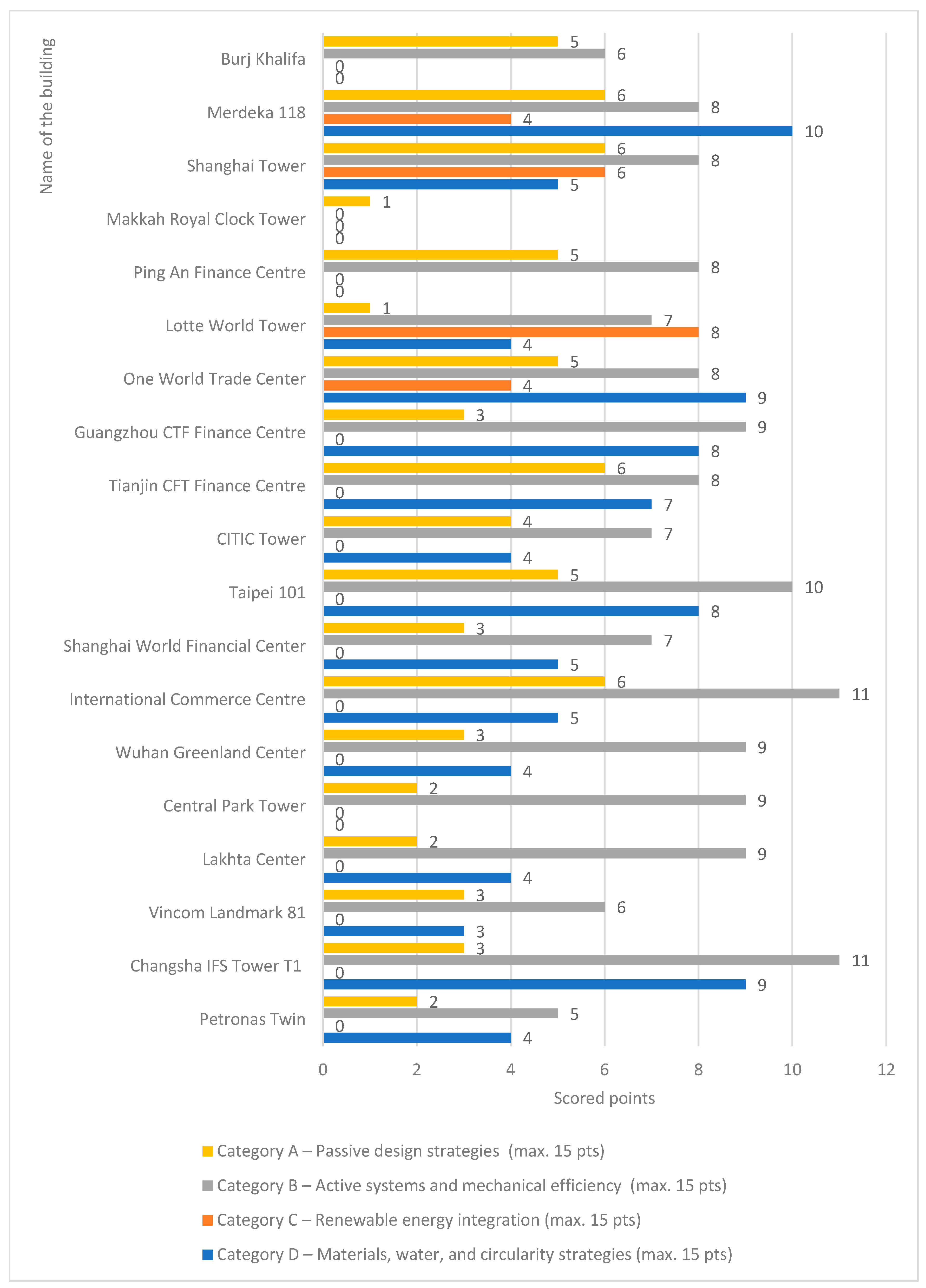
Based on the methodological procedures described in Chapter 2, the authors conducted a quantitative analysis to assess the implementation of sustainable development strategies in the world’s tallest buildings. This approach allowed for a systematic comparison of the solutions implemented. Figure 10 shows the results of the tallest buildings’ assessments of their implementation of four categories of sustainable development strategies: Category A—Passive Strategies; Category B—Active Systems and Mechanical Efficiency; Category C—Integration of Renewable Energy Sources; and Category D—Materials, Water Management, and Circularity Strategies. This chart allows for a quick comparison of the progress of individual buildings in each category. The full Sustainable Development Strategy Assessment Cards for all buildings studied are included in the appendices.
Table 4 lists buildings ranked by total score, with a maximum score of 60%. Percentage scores facilitate the assessment of the level of implementation relative to the full scale. The highest scores were achieved by Merdeka 118 (46.7%), followed One World Trade Center (43.3%) and Shanghai Tower (41.7%). These buildings stand out for their advanced technical and material solutions. Average scores in the table range from 20% to 35%, indicating moderate progress and limitations in the full implementation of sustainable strategies. At the bottom of the table are Central Park Tower (18.3%), Burj Khalifa (18.3%), Petronas Twin Towers (18.3%), and Makkah Royal Clock Tower (1.7%). Some results may be due to a lack of data or limited implementation of sustainable solutions in older buildings or those located in different regions (with different requirements and conditions).
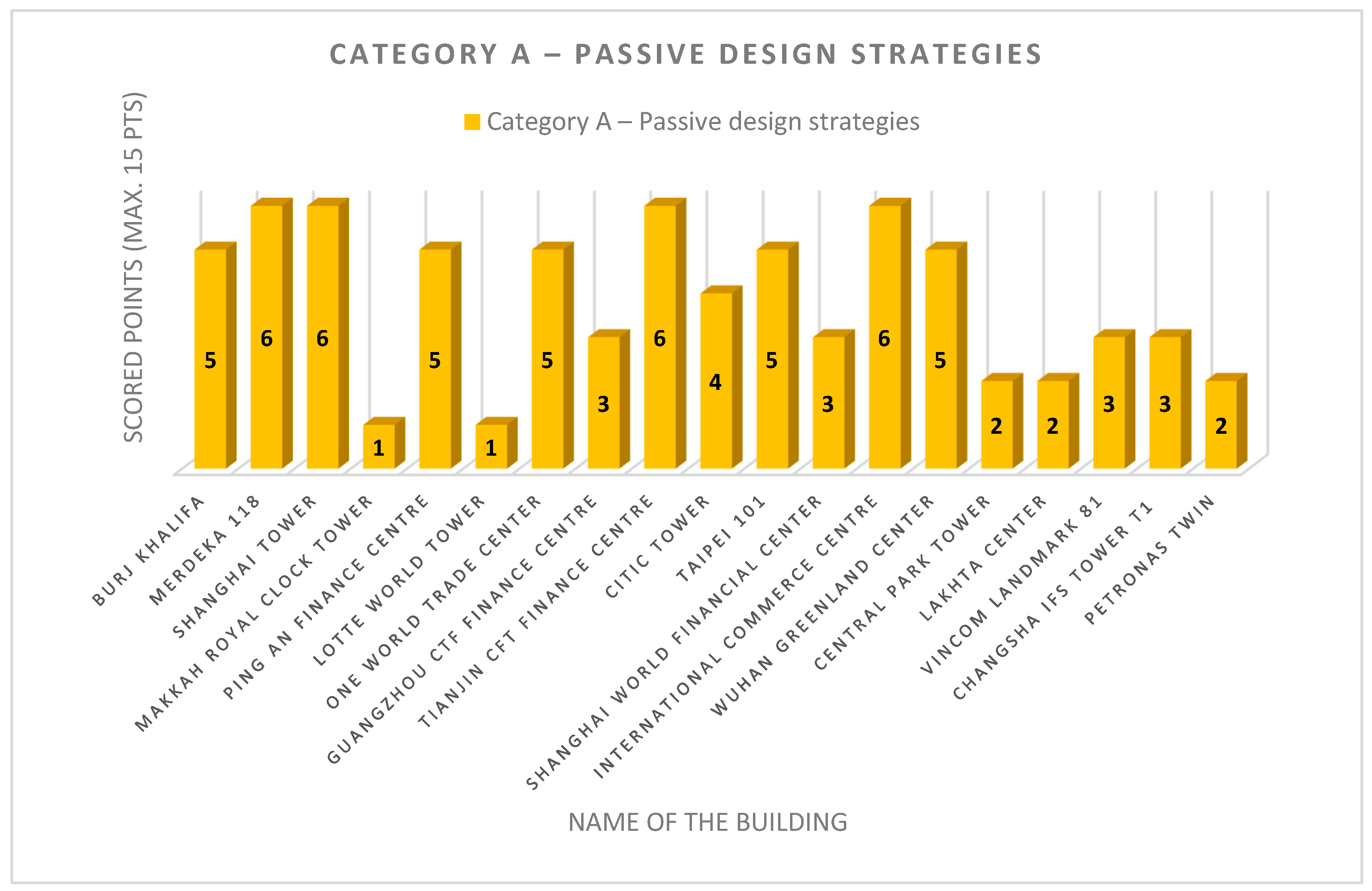
Category A analysis (Figure 11) indicates that passive strategies have been implemented to a moderate degree, with an average score of around 3.5 out of 15. Many buildings utilize orientation optimization, but natural light and thermal mass are not key factors. The International Commerce Centre (Merdeka 118, Shanghai Tower, International Commerce Centre, and Tianjin CFT Finance Centre) achieved relatively high scores. Some buildings, such as the Makkah Royal Clock Tower and Lotte World Tower, implement passive strategies almost entirely.
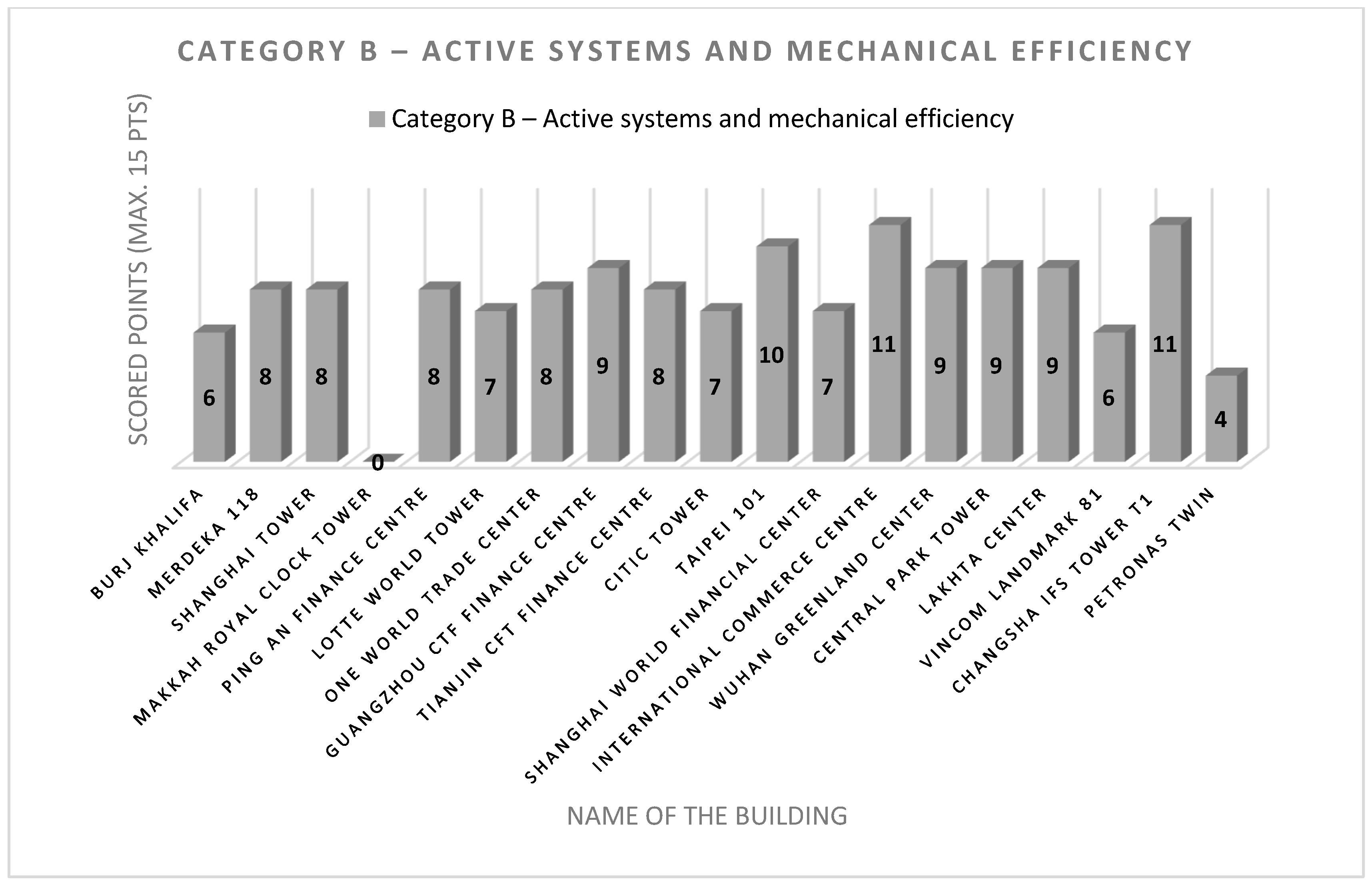
Category B—Active systems and mechanical efficiency (Figure 12) achieved one of the highest average scores. This indicates that most buildings have advanced HVAC systems, automated LED lighting, heat recovery systems, and comprehensive building management systems (BMS). The high ratings for the International Commerce Centre and Changsha IFS Tower T1 confirm that effective energy management and occupant comfort are key design aspects of the world’s tallest buildings. This area appears to be dominant in sustainability strategies. It is also a significant factor in determining the certification (LEED dominates in these cases).
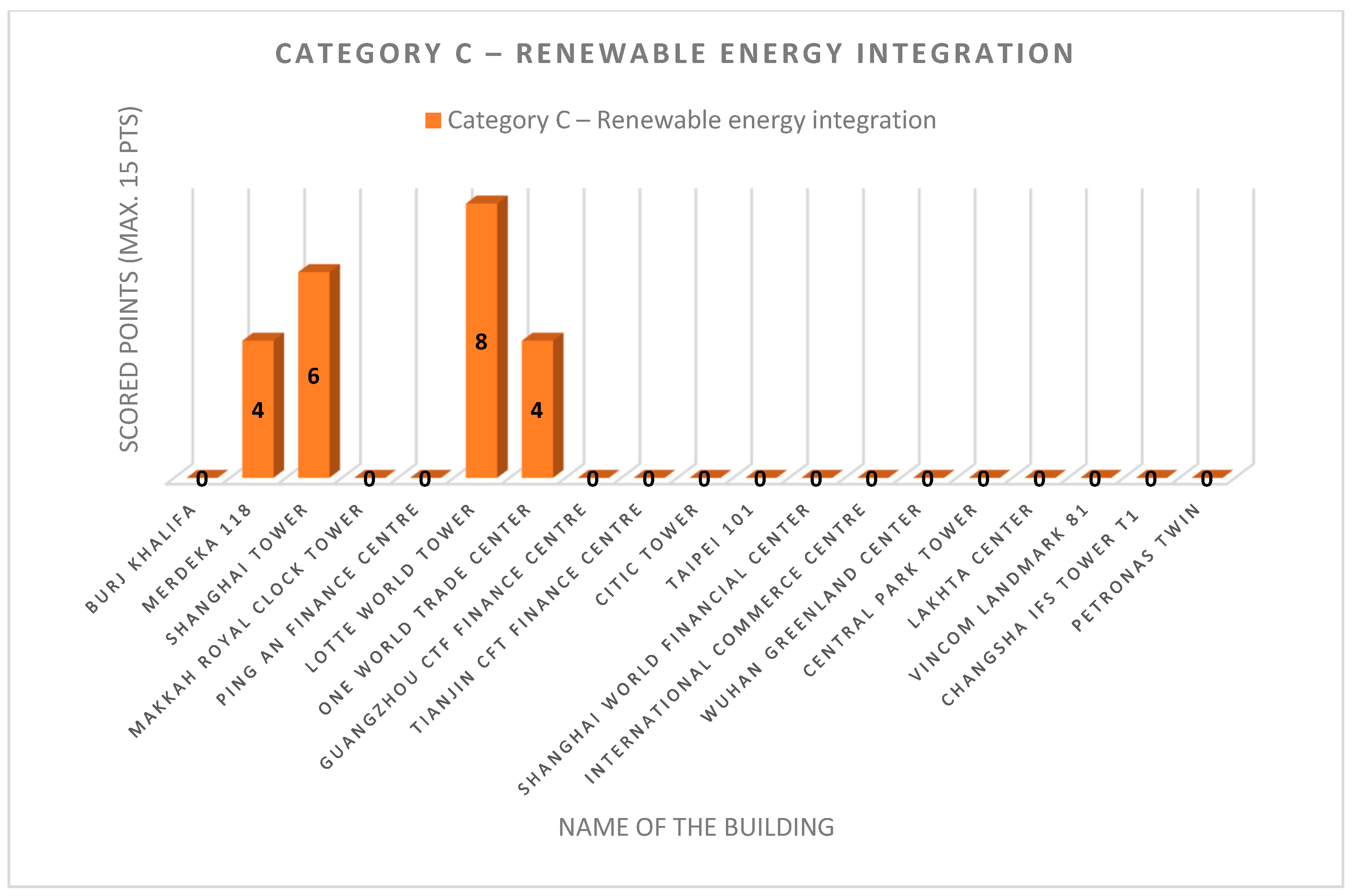
Category C—Renewable Energy Integration (Figure 13) received the lowest scores among the analyzed categories (average of approximately 1 point out of a possible 15). Many buildings lack photovoltaic panels or energy storage. Exceptions include the Lotte World Tower and Merdeka 118. This low implementation may be due to challenges related to economic efficiency in the context of skyscraper height and location. This indicates a significant area for improvement.
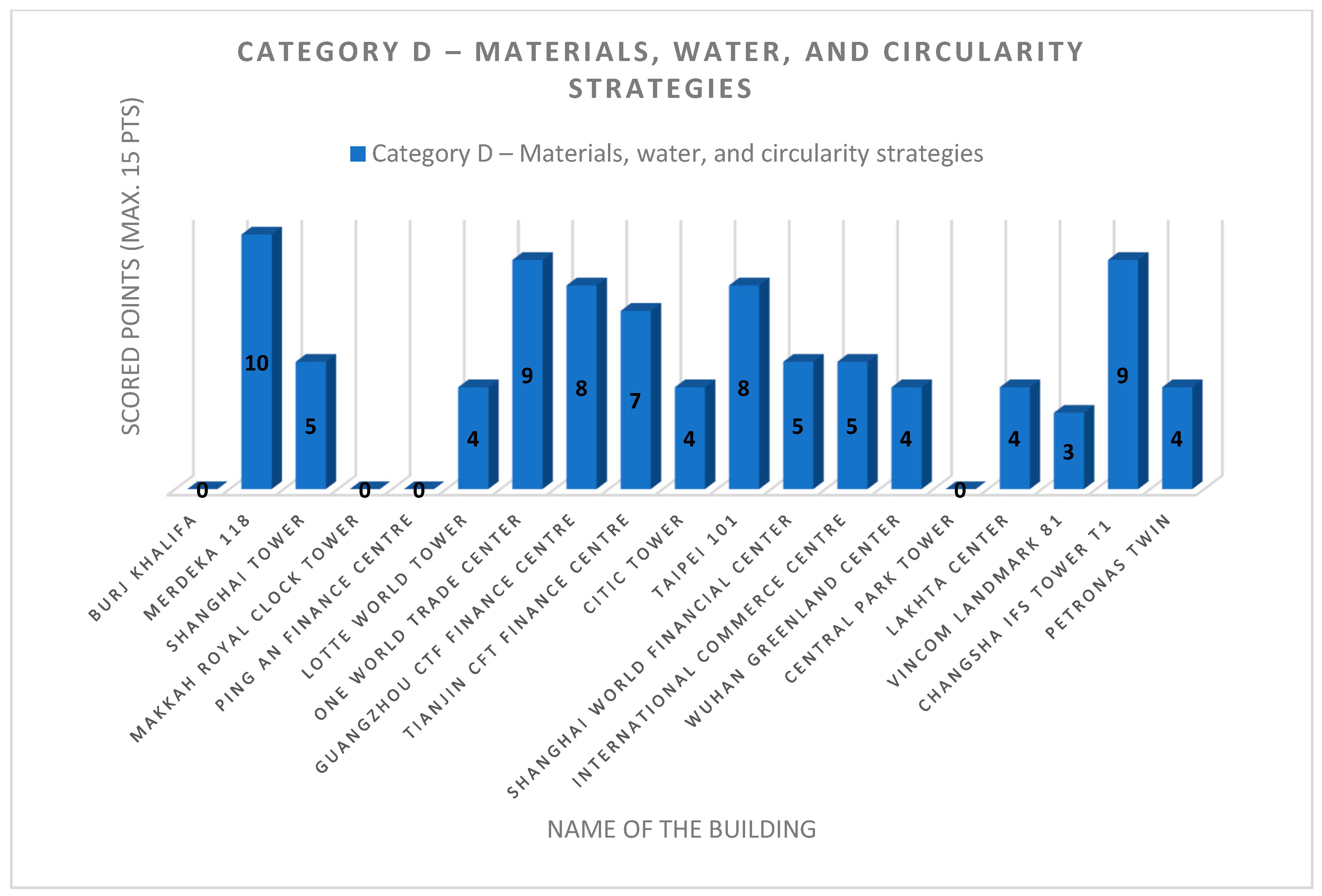
In Category D—Materials, Water, and Circularity Strategies (Figure 14), varying levels of implementation can be observed (average score of approximately 4.8 out of 15). Merdeka 118, One World Trade Center, and Changsha IFS Tower T1 stand out for their use of low-carbon materials, high water efficiency, and good waste management and circularity. Burj Khalifa scores almost zero (this may be due to a lack of data or poor implementation). However, the area of Material, Water, and Circularity Strategies is currently receiving particular attention from investors, driven by growing environmental awareness and certification requirements.
Quantitative analysis indicates the dominance of Category B—Active systems and mechanical efficiency. Passive strategies, as well as materials and water management (Categories A and D), are used moderately—often supporting moderate measures. The greatest deficit occurs in the integration of renewable energy sources.

4.5. Qualitative Analysis

The aim of the qualitative analysis, based on quantitative analysis and the development of a Sustainable Development Strategy Assessment Card, was to deepen understanding of the causes of differences in results. The authors aimed to identify specific challenges and solutions implemented to assess individual strategy categories and their impact on overall performance. It was also important to determine the sustainability of buildings within their technological, economic, and local contexts. The analysis was limited by the lack of certain data. Regional differences and technological maturity are additional issues. These two factors hindered direct comparisons between buildings.
Qualitative observations indicate that passive design strategies in supertall buildings remain relatively limited. Only a few examples demonstrate strong architectural responses to climate change, such as form optimization. Some buildings have shapes resulting from reducing form load through manipulation of façade geometry, such as the Shanghai Tower, Merdeka 118k, and the Tianjin CFT Finance Centre (aerodynamic shaping improves overall energy efficiency). Natural ventilation and solar control are among the design elements that are difficult to implement in high-rise buildings. This is due to climatic conditions—extreme wind forces—and, consequently, safety guidelines and technological limitations. Due to technological and safety limitations, natural ventilation and solar control are difficult in high-rise buildings due to extreme wind forces. The International Commerce Centre, Changsha IFS Tower T1, and One World Trade Center are characterized by solutions such as heat recovery, pump systems, and advanced monitoring systems. Mechanical systems are key factors influencing energy efficiency and operational performance in high-rise buildings, reflecting global industry trends. The dominance of category B (active systems and mechanical efficiency) can also be interpreted as path dependency in the development of building technologies. HVAC, BMS, and automation systems have been the primary tools for improving operational efficiency for many years, making them the most technologically advanced and most cost-effective. Therefore, investors and designers prefer these types of solutions, which are characterized by low implementation risk.
The integration of renewable energy represents a key weakness and a potential future challenge. The buildings analyzed lack photovoltaic systems, solar thermal collectors, wind turbines, and geothermal heating. The Lotte World Tower, Shanghai Tower, and Merdeka 118 are examples of buildings that partially utilize renewable energy solutions. This is due to technical constraints (limited roof area, very high energy demand), economic constraints, and the constraints of wind and solar power at extreme altitudes. As a result, renewable energy often does not contribute significantly to operational performance (playing only a token role).
In the latter category, significant variation can be observed. Some buildings achieved high scores thanks to the use of low-emission materials and advanced water-saving systems (Merdeka 118, One World Trade Center, and Changsha IFS Tower 1). Integration of responsible waste management solutions is also evident, as required by certification requirements. However, older buildings, such as the Burj Khalifa, Makkah Royal Clock Tower, and Vincom Landmark 81, lack such solutions or have limited them. This observed disparity reflects the evolution of sustainability standards over time and is also due to regulatory differences in different parts of the world.

4.6. Correlation Analysis

The purpose of the correlation analysis was to determine whether LEED Platinum-certified buildings implemented more technologies than LEED Gold buildings. For each building, the sum of strategies from categories A–D and the presence of LEED certification were compared. The correlation is clear and unambiguous—LEED Platinum-certified buildings implement significantly more technologies. Table 5 shows Technology integration scores across buildings with different LEED certifications.
Although the correlation analysis shows a clear relationship between certification level and technology integration, it should be considered a preliminary finding. Future research plans to employ advanced statistical analyses that take into account building age, region, and function, allowing for a more precise assessment of the impact of LEED certification on technology implementation in the world’s tallest buildings.

4.7. Trend Analysis over Time

The goal of the trend analysis over time was to determine whether technologies correlated with the year of building completion. The results in Table 6 clearly indicate a trend: the newer the building, the higher the scores in categories B and D.

4.8. Limitations

The study has several limitations that should be considered when interpreting the results. The analysis is a limited sample, as it covers twenty of the tallest buildings. This allows for the identification of trends but does not allow for full generalization of the results. The second limitation of the study was that the adopted methodology relied primarily on publicly available data. Consequently, the ability to truly assess operational efficiency was limited. The analysis conducted in this study focuses on the presence of technologies, not their long-term performance. These limitations clarify directions for further research, which require statistical analyses. These analyses should take into account location-specific variables. Measured data on actual energy and water use should also be integrated.
Nevertheless, the analyses conducted are important from the perspective of sustainable development and the perception of supertall buildings by external stakeholders.

5. Conclusions

5.1. Theoretical and Design Conclusions

The results of this study confirm that the 21st century, characterized by rapid technological advances and rapid urbanization, simultaneously faces challenges related to consumerism, growing energy demand, and environmental degradation. The construction industry is responsible for 25% of globally generated solid waste, which is often difficult to reuse. Therefore, the sustainable design of high-rise buildings is becoming an environmental imperative and an expression of technological progress. Research conducted by scientists from various regions of the world indicates that technological innovations can improve energy efficiency and thus reduce energy consumption. Current high-rise building design practices utilize wind energy, incorporating multiple aspects of performance-based engineering. An analysis of the world’s twenty tallest buildings confirmed the global trend of designing high-rise buildings with a focus on sustainability. Among the most frequently implemented strategies are water recovery and reuse systems, both rainwater and graywater, as well as intelligent energy management systems (BMS). The growing use of low-emission façade materials is also worth highlighting. Multi-criteria certification systems provide benchmarks for sustainable construction. The study identified LEED as the leading system for high-rise buildings—over half of the world’s tallest buildings have it. The examples analyzed also feature the use of renewable energy sources (photovoltaic panels, small wind turbines, and geothermal systems). The Shanghai Tower, Lotte World Tower, and Merdeka 118 are examples of the integration of multiple renewable energy and building management systems. The study also found that Asian metropolises such as those in China, Malaysia, and South Korea are leading the transformation of vertical cities. Façade innovations, intelligent control systems, and regional design strategies responsive to climate conditions emphasize a high level of technological advancement. This reflects the global trend promoting environmentally friendly development and the market demand for multi-criteria green building certifications. Designing for very high wind forces in earthquake-prone areas, as well as wind tunnel analyses, highlights the complexity of multidisciplinary design. The research and discussion demonstrated that contemporary high-rise buildings integrate renewable energy systems, facade optimization, and circular design strategies aimed at reducing energy consumption and minimizing environmental impact. Reusing building materials, using prefabricated components, and optimizing reinforcement in elements such as diaphragm walls demonstrate the growing role of the circular economy in high-rise building design. It should be noted that the scoring system assumes equal weighting for all categories, which may not reflect the actual impact of individual strategies. Future studies could introduce weightings based on life-cycle analyses or actual monitoring of energy and water consumption.
The authors’ study highlights the apparent variation in the implementation of sustainable development strategies in the world’s tallest buildings. There is a dissonance between the potential of contemporary technological advancements and the practical application of these strategies in various parts of the world. The megatall and supertall buildings analyzed are characterized primarily by advanced mechanical systems (operational efficiency), while the integration of renewable energy remains underutilized (technical, spatial, and economic constraints). This points to the conclusion that achieving sustainable development in the vertical city paradigm requires the introduction of technological innovations and a shift in design priorities at an early stage (including the integration of passive solutions that respond to climate change). The low C category score may also be related to the design of certification systems, such as those in the LEED study, where integrating renewable energy sources competes with other energy efficiency strategies. In the case of the tallest buildings, where the potential for renewable energy sources is technically limited, investors may prefer solutions that provide a higher point return with lower design risk. This result indicates the need for further evolution of certification systems to better address the specific needs of the world’s tallest buildings.
This analysis of the world’s twenty tallest buildings indicates that sustainability rating systems (LEED) strongly influence the implementation of active systems (B) and operational efficiency, while passive strategies (A) and renewable energy integration (C) remain underutilized due to technical, spatial, and economic constraints. The results highlight the existing instability between construction optimization, passive design, and active systems implementation, where SAS criteria can serve as a driver for the development of energy-efficient technologies. There is a risk that SAS criteria may not fully address the challenges of integrating multiple strategies in very tall buildings. The study findings reveal both opportunities—the potential for better integration of passive design and renewable energy solutions—and ongoing challenges in achieving holistic sustainability in high-rise architecture.

5.2. Research Perspectives

It should be noted that the current assessment is based largely on publicly available reports and investor data, which allows for the assessment of the presence of technology rather than actual operational performance. Future research should focus on monitoring the actual energy and water efficiency of certified high-rise buildings and improving their performance tracking. It is crucial to develop local versions of leading international certifications that take into account the climatic and cultural conditions of a given region. Technological innovations, including façade elements, energy storage, and intelligent building management systems, will play a key role in achieving the goal of a sustainable vertical city.
Further research should aim to achieve long-term operational efficiency, as there is often a discrepancy between predicted and actual performance. Expanding datasets and integrating digital twins, IoT sensors, and AI-driven monitoring may enable more accurate assessment of energy consumption throughout the building’s lifecycle in the future. Attention should also be paid to the economic and technical aspects of using renewable energy systems in very high-rise buildings. These elements constitute a gap in the design of high-rise buildings.

Author Contributions

Conceptualization, A.P.; methodology, A.P. and E.K.; software, A.P.; validation, A.P. and E.K.; formal analysis, A.P. and E.K.; investigation, A.P.; resources, A.P.; data curation, A.P.; writing—original draft preparation, A.P.; writing—review and editing, A.P. and E.K.; visualization, A.P.; supervision, A.P.; project administration, A.P.; funding acquisition, E.K. All authors have read and agreed to the published version of the manuscript.

Funding

This research received no external funding.

Data Availability Statement

The original contributions presented in the study are included in the article; further inquiries can be directed to the corresponding author.

Acknowledgments

During the preparation of this manuscript, the authors used the following databases: Web of Science, Google Scholar, and ResearchGate. The authors have reviewed and edited the output and take full responsibility for the content of this publication.

Conflicts of Interest

The authors declare no conflicts of interest. The funders had no role in the design of the study; in the collection, analyses, or interpretation of data; in the writing of the manuscript; or in the decision to publish the results.

Abbreviations

The following abbreviations are used in this manuscript:
CTBUHThe Council on Tall Buildings and Urban Habitat
CSRcorporate social responsibility
EFenvironmental footprint,
GBRSsGreen Building Rating Systems
LEEDLeadership in Energy and Environmental Design
BREEAMBuilding Research Establishment Environmental Assessment Method
DGNBDeutsche Gesellschaft für Nachhaltiges Bauen
GBIGreen Building Index

Appendix A. Sustainable Development Strategy Assessment Cards Developed by the Authors

Strategy Coding Legend: 0—not used; 1—conceptually integrated only; 2—implemented on a measurable scale; 3—implemented as a primary design driver.
Average category: total points divided by number of categories.

Appendix A.1. Sustainable Development Strategy Assessment Card: Burj Khalifa

  • Location: Dubai, United Arab Emirates
  • Assessment Date: 2 December 2025
  • Assessor: Authors
  • Certifications: LEED Platinum certification under the v4.1 Operations and Maintenance: Existing Buildings (2024)

Table A1. Category A—Passive design strategies.
StrategyNotes/DescriptionCode (0–3)
Orientation optimizationY-shaped floor plan, floor rotation minimizes wind vortex merging and maximizes views1
Daylighting optimizationThe glass used in the building boasts very high solar and thermal efficiency1
Passive solar heating/shadingHigh-performance glass facade and aluminum and steel panels reduce overheating and reflections; the system primarily functions as passive cooling2
Natural ventilationNo information about the use; high-rise building likely based on full air conditioning0
Thermal massA structure based on massive concrete, helping to buffer temperatures 1
Total category A: 5/15, Average: 1.0.
Table A2. Category B—Active systems and mechanical efficiency.
StrategyNotes/DescriptionCode (0–3)
High—efficiency HVACHVAC with additional energy savings, air units with thermal wheels, variable speed systems, control systems.2
Demand—controlled ventilationNo data0
High—efficiency lighting (LED + controls)No detailed data, LEED O+M, 1 was assumed1
Heat recovery systemsNo data0
Building automation/BMSBMS and electronic measurement system3
Total category B: 6/15, Average: 1.2.
Table A3. Category C—Renewable energy integration.
StrategyNotes/DescriptionCode (0–3)
Photovoltaic panelsNo data0
Solar thermal collectorsNo data0
Geothermal systemsNo data0
Energy storageNo data0
Hybrid renewable solutionsNo data0
Total category C: 0, Average: 0.
Table A4. Category D—Materials, water, and circularity strategies.
StrategyNotes/DescriptionCode (0–3)
Low—carbon/recycled materialsHigh-strength concrete and steel—no data on low emissions0
Life Cycle Assessment (LCA)No data0
Water—saving fixturesNo data0
Greywater/rainwater systemsNo data0
Design for disassembly/circularityNo data0
Total category D: 0, Average: 0.
Table A5. Summary.
Table A5. Summary.
CategoryScore (Sum)AverageNotes
A51.0
B61.2
C00.0
D00.0
Total categories: 11/60, Average category: 2.75.
Additional Notes:
The project was not designed with green systems in mind. The building achieved LEED Platinum certification in 2024. Strengths: advanced BMS systems, high-performance façade, aerodynamic optimization. No data on renewable energy integration or water and material strategies.

Appendix A.2. Sustainable Development Strategy Assessment Card: Merdeka 118

  • Location: Kuala Lumpur, Malaysia
  • Assessment Date: 2 December 2025
  • Assessor: Authors
  • Certifications: LEED Platinum, 86/110, (LEED BD+C: Core and Shell)
Table A6. Category A—Passive design strategies.
StrategyNotes/DescriptionCode (0–3)
Orientation optimizationThe building is designed primarily with wind loads in mind, the building has a diamond-shaped facade and multi-faceted glass surface—this may help disperse light/heat2
Daylighting optimizationFaçade with “low-E/glazed glass”2
Passive solar heating/shadingLow-emission (low-E) and high-performance glass façade, which reduces heat gain and cooling load—passive heat gain reduction.1
Natural ventilationNo data—high-rise building, probably full mechanical ventilation0
Thermal massThe reinforced concrete core design provides high thermal inertia, but not as a primary strategy1
Total category A: 6/15, Average: 1.2.
Table A7. Category B—Active systems and mechanical efficiency.
StrategyNotes/DescriptionCode (0–3)
High—efficiency HVACHigh scores in the LEED “Energy and Atmosphere” category; designed for energy efficiency2
Demand—controlled ventilationSystems with daylight sensors, which suggests automation and optimization of internal systems1
High—efficiency lighting (LED + controls)LED lighting2
Heat recovery systemsNo data0
Building automation/BMSIntelligent building management system BMS and smart metering3
Total category B: 8/15, Average: 1.6.
Table A8. Category C—Renewable energy integration.
StrategyNotes/DescriptionCode (0–3)
Photovoltaic panelsBuilding—integrated photovoltaic on the roof/podium of the building—although the share in the building’s power supply is a small percentage (~1.2% of the electricity demand)1
Solar thermal collectorsHot water for the building is supplied by a solar-thermal system located on the roof.3
Geothermal systemsNo data0
Energy storageNo data0
Hybrid renewable solutionsNo data0
Total category C: 4/15, Average: 0.8.
Table A9. Category D—Materials, water, and circularity strategies.
StrategyNotes/DescriptionCode (0–3)
Low—carbon/recycled materialsLow-emission materials were used2
Life Cycle Assessment (LCA)No data0
Water—saving fixturesLow-flow devices3
Greywater/rainwater systemsRainwater harvesting3
Design for disassembly/circularityInfrastructure for waste separation, reuse and recycling2
Total category D: 10/15, Average: 2.0.
Table A10. Summary.
Table A10. Summary.
CategoryScore (Sum)AverageNotes
A61.2
B81.6
C40.8
D102.0
Total categories: 28/60, Average category: 7.0.
Additional Notes:
The building achieved LEED BD+C: Core and Shell v3—Platinum (86/110).
It features low-emission materials, rainwater harvesting, intelligent BMS, smart metering, low-flow fixtures, recycling infrastructure, EV charging, good transport connections, and bicycle storage.

Appendix A.3. Sustainable Development Strategy Assessment Card, Shanghai Tower

  • Location: Shanghai, China
  • Assessment Date: 2 December 2025
  • Assessor: Authors
  • Certifications: LEED Platinum BD+C: Core and Shell, 82/100, China Green Building
Table A11. Category A—Passive design strategies.
StrategyNotes/DescriptionCode (0–3)
Orientation optimizationNo data on optimization with respect to world pages1
Daylighting optimizationLarge glazing area; no information about deliberate optimization1
Passive solar heating/shadingNo data on passive shading systems1
Natural ventilationThe double façade allows for indirect ventilation and reduces air conditioning loads.2
Thermal massReinforced concrete core, but not as the main energy strategy1
Total category A: 6/15, Average: 1.2.
Table A12. Category B—Active systems and mechanical efficiency.
StrategyNotes/DescriptionCode (0–3)
High—efficiency HVACHigh-efficiency HVAC systems, energy simulations, LEED-compliant optimization2
Demand—controlled ventilationThe building is LEED Gold certified; probably used1
High—efficiency lighting (LED + controls)Effective LED system2
Heat recovery systemsNo data0
Building automation/BMSAdvanced water and energy consumption monitoring systems—BMS3
Total category B: 8/15, Average: 1.6.
Table A13. Category C—Renewable energy integration.
StrategyNotes/DescriptionCode (0–3)
Photovoltaic panelsNo data0
Solar thermal collectorsNo data0
Geothermal systemsGround-source heat pump system (GSHP)3
Energy storageNo data0
Hybrid renewable solutionsRooftop wind turbines + GSHP, hybrid renewable energy system3
Total category C: 6/15, Average: 1.2.
Table A14. Category D—Materials, water, and circularity strategies.
StrategyNotes/DescriptionCode (0–3)
Low—carbon/recycled materialsNo data0
Life Cycle Assessment (LCA)No data0
Water—saving fixturesWater-saving devices, consumption monitoring3
Greywater/rainwater systemsRainwater collection system for irrigation and toilets2
Design for disassembly/circularityNo data0
Total category D: 5, Average: 1.0.
Table A15. Summary.
Table A15. Summary.
CategoryScore (Sum)AverageNotes
A61.2
B81.6
C61.2
D51.0
Total categories: 26/60, Average category: 6.5.
Additional Notes:
  • The building is LEED Gold certified.
  • The double-skin façade is a key energy strategy.
  • The building is a benchmark for sustainable construction in China.

Appendix A.4. Sustainable Development Strategy Assessment Card: Makkah Royal Clock Tower

  • Location: Mecca, Saudi Arabia
  • Assessment Date: 2 December 2025
  • Assessor: Authors
  • Certifications: No certification in official databases
Table A16. Category A—Passive design strategies.
StrategyNotes/DescriptionCode (0–3)
Orientation optimizationNo data0
Daylighting optimizationNo data0
Passive solar heating/shadingNo data0
Natural ventilationNo possibility of natural ventilation in such a tall and fully air-conditioned facility0
Thermal massReinforced concrete construction can provide thermal mass, but not as a conscious strategy1
Total category A: 1, Average: 0.2.
Table A17. Category B—Active systems and mechanical efficiency.
StrategyNotes/DescriptionCode (0–3)
High—efficiency HVACNo data0
Demand—controlled ventilationNo data0
High—efficiency lighting (LED + controls)No data0
Heat recovery systemsNo data0
Building automation/BMSNo data0
Total category B: 0, Average: 0.0.
Table A18. Category C—Renewable energy integration.
StrategyNotes/DescriptionCode (0–3)
Photovoltaic panelsNo data0
Solar thermal collectorsNo data0
Geothermal systemsNo data0
Energy storageNo data0
Hybrid renewable solutionsNo data0
Total category C: 0, Average: 0.0
Table A19. Category D—Materials, water, and circularity strategies.
StrategyNotes/DescriptionCode (0–3)
Low—carbon/recycled materialsNo data0
Life Cycle Assessment (LCA)No data0
Water—saving fixturesNo data0
Greywater/rainwater systemsNo data0
Design for disassembly/circularityNo data0
Total category D: 0, Average: 0.0.
Table A20. Summary.
Table A20. Summary.
CategoryScore (Sum)AverageNotes
A10.2
B00
C00
D00
Total categories: 1/60, Average category: 0.25.
Additional Notes:
  • The skyscraper was built in 2012, at a time when large-scale projects in the Middle East rarely incorporated sustainable strategies (structural and air-conditioning solutions predominated).
  • The building’s height and hotel/pilgrimage function dictate its complete reliance on active cooling systems.

Appendix A.5. Sustainable Development Strategy Assessment Card Ping an Finance Centre

  • Location: Shenzhen
  • Assessment Date: 2 December 2025
  • Assessor: Authors
  • Certifications: LEED Platinum (Operations & Maintenance: Existing Buildings), LEED Gold (Core & Shell), BREAAM, Three Star
Table A21. Category A—Passive design strategies.
StrategyNotes/DescriptionCode (0–3)
Orientation optimizationNo orientation analysis data; geometry optimized primarily for wind1
Daylighting optimizationVery high daylight transmittance thanks to the high-performance façade2
Passive solar heating/shadingLow-e facade reduces heat gains1
Natural ventilationThe higher parts of the tower have access to fresh air thanks to the climatic conditions1
Thermal massNo use of thermal mass as a strategy0
Total category A: 5, Average: 1.0.
Table A22. Category B—Active systems and mechanical efficiency.
StrategyNotes/DescriptionCode (0–3)
High—efficiency HVACAccess to fresh air in higher zones, optimized for subtropical climates2
Demand—controlled ventilationAir recirculation control1
High—efficiency lighting (LED + controls)No data0
Heat recovery systemsRegenerative drive elevators recover energy2
Building automation/BMSAdvanced real-time energy monitoring system3
Total category B 8, Average: 1.6.
Table A23. Category C—Renewable energy integration.
StrategyNotes/DescriptionCode (0–3)
Photovoltaic panelsNo data0
Solar thermal collectorsNo data0
Geothermal systemsNo data0
Energy storageNo data0
Hybrid renewable solutionsNo data0
Total category C: 0, Average: 0.0.
Table A24. Category D—Materials, water, and circularity strategies.
StrategyNotes/DescriptionCode (0–3)
Low—carbon/recycled materialsNo data0
Life Cycle Assessment (LCA)No data0
Water—saving fixturesNo data0
Greywater/rainwater systemsNo data0
Design for disassembly/circularityNo data0
Total category D: 0, Average: 0.0.
Table A25. Summary.
Table A25. Summary.
CategoryScore (Sum)AverageNotes
A51.0
B81.6
C00.0
D00.0
Total categories: 13/60, Average category: 3.25.

Appendix A.6. Sustainable Development Strategy Assessment Card: Lotte World Tower

  • Location: Seoul, Republic of Korea
  • Assessment Date: 2 December 2025
  • Assessor: Authors
  • Certifications: LEED BD + C: New Construction, Gold, 66/110
Table A26. Category A—Passive design strategies.
StrategyNotes/DescriptionCode (0–3)
Orientation optimizationNo information about conscious optimization of orientation0
Daylighting optimizationHigh-performance façade and LEED certification suggest good use of daylight1
Passive solar heating/shadingNo data0
Natural ventilationNo data0
Thermal massThe concrete core and slabs were not described as a thermal mass element0
Total category A: 1, Average: 0.2.
Table A27. Category B—Active systems and mechanical efficiency.
StrategyNotes/DescriptionCode (0–3)
High—efficiency HVACVariable frequency drives (VFD)2
Demand—controlled ventilationNo data0
High—efficiency lighting (LED + controls)LEED Gold suggests a high probability of LED1
Heat recovery systemsEnergy recovered from exhaust air2
Building automation/BMSSHM and energy-saving systems, advanced BMS2
Total category B: 7, Average: 1.4.
Table A28. Category C—Renewable energy integration.
StrategyNotes/DescriptionCode (0–3)
Photovoltaic panelsPV as one of the main renewable energy sources2
Solar thermal collectorsNo data0
Geothermal systemsgeothermal energy3
Energy storageNo data0
Hybrid renewable solutionsRenewable energy: geothermal energy, PV, wind turbines3
Total category C: 8, Average: 1.6.
Table A29. Category D—Materials, water, and circularity strategies.
StrategyNotes/DescriptionCode (0–3)
Low—carbon/recycled materialsNo data0
Life Cycle Assessment (LCA)No data0
Water—saving fixturesLow-flow devices (30% water savings)2
Greywater/rainwater systemsGrey water reuse system2
Design for disassembly/circularityNo data0
Total category D: 4, Average: 0.8.
Table A30. Summary.
Table A30. Summary.
CategoryScore (Sum)AverageNotes
A10.2
B71.4
C81.6
D40.7
Total categories: 20/60, Average category: 5.
Additional Notes:
  • Combination of geothermal energy, PV panels and wind turbines
  • SHM (Structural Health Monitoring) increases the safety and efficiency of facility maintenance, which indirectly supports sustainable development.
  • Significant water savings (30%) thanks to grey water + low-flow devices.

Appendix A.7. Sustainable Development Strategy Assessment Card: One World Trade Center

  • Location: New York City, USA
  • Assessment Date: 2 December 2025
  • Assessor: Authors
  • Certifications: LEED Gold BD + C, 37/62
Table A31. Category A—Passive design strategies.
StrategyNotes/DescriptionCode (0–3)
Orientation optimizationNo detailed information on orientation optimization, but the unique octahedron form suggests natural solar gain control.1
Daylighting optimizationAutomatic “daylight” system controlling the lighting2
Passive solar heating/shadingNo specific shading systems mentioned, but the building’s design and orientation likely minimize solar heat gain.1
Natural ventilationNo significant mention of natural ventilation, likely mitigated by advanced HVAC systems0
Thermal massConcrete core provides some thermal mass benefits, but no further details on its design role in passive cooling.1
Total category A: 5, Average: 1.0.
Table A32. Category B—Active systems and mechanical efficiency.
StrategyNotes/DescriptionCode (0–3)
High—efficiency HVACHigh-efficiency HVAC systems are integrated into the building, contributing to its energy efficiency goals.2
Demand—controlled ventilationThe building has a “daylight” system that controls lighting, suggesting the possibility of demand-controlled ventilation as well.1
High—efficiency lighting (LED + controls)Daylight system and energy-saving lighting technology are used to minimize energy consumption.2
Heat recovery systemsEnergy-saving technology is implemented.1
Building automation/BMSAdvanced building automation systems are in place for energy efficiency and comfort.2
Total category B: 8, Average: 1.6.
Table A33. Category C—Renewable energy integration.
StrategyNotes/DescriptionCode (0–3)
Photovoltaic panelsNo data0
Solar thermal collectorsNo data0
Geothermal systemsNo data0
Energy storage12 hydrogen-powered batteries supply energy to the building, contributing to its renewable energy system.2
Hybrid renewable solutionsHydrogen-powered fuel cells and possibly other renewables like wind or solar may be integrated into a hybrid system.2
Total category C: 4, Average: 0.8.
Table A34. Category D—Materials, water, and circularity strategies.
StrategyNotes/DescriptionCode (0–3)
Low—carbon/recycled materialsGreen concrete (replacing 50% of cement with industrial byproducts), recycled steel, drywall, and ceiling tiles are used.3
Life Cycle Assessment (LCA)No detailed data on LCA, but green concrete and recycled materials suggest that life-cycle considerations were made.1
Water—saving fixturesRainwater storage tanks used for cooling and irrigation.3
Greywater/rainwater systemsRainwater is stored and used for cooling and irrigation purposes.2
Design for disassembly/circularityNo data available on circularity, but emphasis on material reuse and energy-saving suggests circularity considerations.0
Total category D: 9, Average: 1.8.
Table A35. Summary.
Table A35. Summary.
CategoryScore (Sum)AverageNotes
A51.0
B81.6
C40.8
D91.8
Total categories: 26/60, Average category: 6.5.
Additional Notes:
  • Green concrete (replacing 50% of cement with industrial byproducts) reduces the carbon footprint of the building.
  • 12 hydrogen-powered batteries contribute to the building’s renewable energy systems.
  • 80% of waste is recycled, supporting sustainability in construction and operation.

Appendix A.8. Sustainable Development Strategy Assessment Card: Guangzhou CTF Finance Centre

  • Location: Guangzhou, China
  • Assessment Date: 2 December 2025
  • Assessor: Authors
  • Certifications: Hotel: LEED BD+C: New Construction, Gold 61/100, Office/Retail: LEED BD+C: Core and Shell
Table A36. Category A—Passive design strategies.
StrategyNotes/DescriptionCode (0–3)
Orientation optimizationNo detailed data on orientation optimization, though the building’s design likely takes local sun exposure1
Daylighting optimizationThe use of self-cleaning, corrosion-resistant terracotta on the façade likely supports effective daylight control.1
Passive solar heating/shadingNo detailed data, but the building’s advanced façade materials and shading might reduce solar heat gain.1
Natural ventilationNo information available. Probably due to the height: HVAC systems for comfort0
Thermal massNo data0
Total category A: 3, Average: 0.6.
Table A37. Category B—Active systems and mechanical efficiency.
StrategyNotes/DescriptionCode (0–3)
High—efficiency HVACHigh-efficiency chillers and cooling systems are probably implemented2
Demand—controlled ventilationNo data available, but given the advanced HVAC systems, demand-controlled ventilation could be a part of the design.1
High—efficiency lighting (LED + controls)LEED Gold certification suggests the use of high-efficiency LED lighting with controls.2
Heat recovery systemsHeat recovery from water-cooled chiller condensers2
Building automation/BMSAdvanced BMS was probably integrated for managing energy consumption and environmental control.2
Total category B: 9, Average: 1.8.
Table A38. Category C—Renewable energy integration.
StrategyNotes/DescriptionCode (0–3)
Photovoltaic panelsNo data0
Solar thermal collectorsNo data0
Geothermal systemsNo data0
Energy storageNo data0
Hybrid renewable solutionsNo data0
Total category C: 0, Average: 0.0.
Table A39. Category D—Materials, water, and circularity strategies.
StrategyNotes/DescriptionCode (0–3)
Low—carbon/recycled materialsSelf-cleaning, corrosion-resistant terracotta is used on the façade, reducing maintenance and transportation impact.2
Life Cycle Assessment (LCA)No detailed data available, but the LEED Gold certification suggests a likely LCA for material selection.1
Water—saving fixturesWater efficiency is a key feature, with a full score in the LEED water efficiency category.3
Greywater/rainwater systemsNo specific data, but the highwater efficiency score suggests the presence of such systems2
Design for disassembly/circularityNo data available, but circularity may be considered due to LEED Gold standards.0
Total category D: 8, Average: 1.6.
Table A40. Summary.
Table A40. Summary.
CategoryScore (Sum)AverageNotes
A30.6
B91.8
C00.0
D81.6
Total categories: 20/60, Average category: 4.0.
Additional Notes:
  • High-efficiency chillers and heat recovery systems contribute to the building’s sustainable design.
  • Water-saving features contribute to a full score in the LEED Water Efficiency category (10/10).
  • Facade with self-cleaning and corrosion-resistant terracotta reduces the environmental impact of maintenance and transportation.

Appendix A.9. Sustainable Development Strategy Assessment Card: Tianjin CFT Finance Centre

  • Location: Tianjin, China
  • Assessment Date: 2 December 2025
  • Assessor: Authors
  • Certifications: LEED Gold
Table A41. Category A—Passive design strategies.
StrategyNotes/DescriptionCode (0–3)
Orientation optimizationNo specific information on orientation, but the aerodynamic shape likely reduces solar heat gain and optimizes natural daylight.1
Daylighting optimizationThe high-performance envelope provides excellent daylighting and views, optimizing natural light use2
Passive solar heating/shadingThe design of the exterior wall and parametric modeling likely helps in controlling solar heat gain.2
Natural ventilationNo significant data on natural ventilation; reliance likely on HVAC systems given the building’s height.0
Thermal massThe aerodynamic shape and high-performance envelope likely help in regulating temperatures.1
Total category A: 6, Average: 1.2.
Table A42. Category B—Active systems and mechanical efficiency.
StrategyNotes/DescriptionCode (0–3)
High—efficiency HVACEnergy and water reduction systems likely include high-efficiency HVAC components for energy savings.2
Demand—controlled ventilationHigh-performance envelope may work in conjunction with this system.1
High—efficiency lighting (LED + controls)LEED Gold certification suggests high-efficiency LED lighting with controls.2
Heat recovery systemsBuilding likely incorporates energy-saving technology.1
Building automation/BMSGiven the LEED Gold rating and focus on energy efficiency, it’s likely that a building management system (BMS) is in place.2
Total category B: 8, Average: 1.6.
Table A43. Category C—Renewable energy integration.
StrategyNotes/DescriptionCode (0–3)
Photovoltaic panelsNo data0
Solar thermal collectorsNo data0
Geothermal systemsNo data0
Energy storageBuilding’s focus on energy-efficient design suggests the possibility of energy storage systems.0
Hybrid renewable solutionsNo data0
Total category C: 0, Average: 0.0.
Table A44. Category D—Materials, water, and circularity strategies.
StrategyNotes/DescriptionCode (0–3)
Low—carbon/recycled materialsThe building was constructed with a focus on sustainability, but no specific data on low-carbon or recycled materials.1
Life Cycle Assessment (LCA)No specific data on LCA, but the building was designed with sustainability in mind, achieving LEED Gold certification.1
Water—saving fixturesWater efficiency systems are implemented, earning a perfect score (10/10) in the LEED water efficiency category.3
Greywater/rainwater systemsNo specific mention of greywater systems, but the building’s water-saving features are likely to include such solutions.2
Design for disassembly/circularityNo data0
Total category D: 7, Average: 1.4.
Table A45. Summary.
Table A45. Summary.
CategoryScore (Sum)AverageNotes
A61.2
B81.6
C00.0
D71.4
Total categories: 21/60, Average category: 5.25.
Additional Notes:
High-performance envelope optimizes daylighting and energy efficiency, contributing to the building’s LEED Gold certification.

Appendix A.10. Sustainable Development Strategy Assessment Card: CITIC Tower

  • Location: Beijing, China
  • Assessment Date: 2 December 2025
  • Assessor: Authors
  • Certifications: LEED-CS Gold Precertification, China Certificate of Green Building Label-Three Star
Table A46. Category A—Passive design strategies.
StrategyNotes/DescriptionCode (0–3)
Orientation optimizationNo specific mention of orientation optimization, but the building’s unique shape likely helps optimize sunlight penetration and wind load management.1
Daylighting optimizationThe building’s design and shape, including the narrowing and widening of the upper portion, likely optimize daylight penetration.1
Passive solar heating/shadingNo explicit mention of shading strategies, but the building’s shape could mitigate solar heat gain at different levels.1
Natural ventilationNo specific mention of natural ventilation; HVAC systems are likely used to control indoor climate.0
Thermal massNo data on thermal mass, but the shape of the building and material selection may aid in temperature regulation.1
Total category A: 4, Average: 0.8.
Table A47. Category B—Active systems and mechanical efficiency.
StrategyNotes/DescriptionCode (0–3)
High—efficiency HVACHVAC systems are likely efficient, though specific mention of VFD is not available.1
Demand—controlled ventilationNo specific mention of demand-controlled ventilation, but given the advanced design, it is likely part of the system.1
High—efficiency lighting (LED + controls)LEED-CS Gold Precertification suggests that the building includes efficient lighting systems such as LEDs.2
Heat recovery systemsNo data on heat recovery systems, but the advanced technologies and LEED certification likely include some form of heat recovery.1
Building automation/BMSBIM technology and advanced design suggest a comprehensive Building Management System (BMS) is in place.2
Total category B: 7, Average: 1.4.
Table A48. Category C—Renewable energy integration.
StrategyNotes/DescriptionCode (0–3)
Photovoltaic panelsNo data0
Solar thermal collectorsNo data0
Geothermal systemsNo data0
Energy storageNo data0
Hybrid renewable solutionsNo data available, but the building’s sustainable certifications suggest the possibility of hybrid energy solutions.0
Total category C: 0, Average: 0.0.
Table A49. Category D—Materials, water, and circularity strategies.
StrategyNotes/DescriptionCode (0–3)
Low—carbon/recycled materialsNo data available on the specific use of low-carbon or recycled materials, but the building’s sustainability ratings suggest such materials are likely used.1
Life Cycle Assessment (LCA)No specific data available, but the design and sustainability certifications suggest that LCA was likely considered.1
Water—saving fixturesNo data on specific water-saving fixtures, but the LEED Gold Precertification indicates water efficiency features are in place.2
Greywater/rainwater systemsNo data0
Design for disassembly/circularityNo data0
Total category D: 4, Average: 0.8.
Table A50. Summary.
Table A50. Summary.
CategoryScore (Sum)AverageNotes
A40.8
B71.4
C00.0
D40.8
Total categories: 15/60, Average: 3.75.
Additional Notes:
LEED-CS Gold Precertification and China Green Building Label Three Star showcase the building’s commitment to sustainability. Parametric design and BIM technology played a key role in optimizing the building’s structural form and sustainability features. Unique architectural shape reduces wind loads and seismic mass, which is essential given the building’s location in a high seismic zone.

Appendix A.11. Sustainable Development Strategy Assessment Card: Taipei 101

  • Location: Taiwan
  • Assessment Date: 2 December 2025
  • Assessor: Authors
  • Certifications: LEED Platinum (2011), LEED Platinum O+M: Existing Buildings (2016), LEED Recertification Platinum (2021)
Table A51. Category A—Passive design strategies.
StrategyNotes/DescriptionCode (0–3)
Orientation optimizationNo specific data available, but the building’s design likely maximizes natural light.1
Daylighting optimizationThe use of low-emissivity glass suggests an attempt to optimize daylight while reducing heat gain.2
Passive solar heating/shadingThe graywater system and low-emissivity glass suggest passive solar management, but no specific mention of shading.1
Natural ventilationNo specific mention of natural ventilation, but HVAC systems are in place.0
Thermal massThe use of advanced glass might help with temperature regulation.1
Total category A: 5, Average: 1.0.
Table A52. Category B—Active systems and mechanical efficiency.
StrategyNotes/DescriptionCode (0–3)
High—efficiency HVACMechanical heating, ventilation, and air conditioning systems were upgraded during renovations.2
Demand—controlled ventilationThe introduction of a building management system (BMS) likely includes demand-controlled ventilation.2
High—efficiency lighting (LED + controls)Lighting fixtures were replaced with energy-efficient ones during renovations.2
Heat recovery systemsNo specific mention of heat recovery, though the BMS may control temperature and ventilation for efficiency.1
Building automation/BMSThe BMS provides detailed monitoring and control of energy use, including lights and HVAC.3
Total category B: 10, Average: 2.0.
Table A53. Category C—Renewable energy integration.
StrategyNotes/DescriptionCode (0–3)
Photovoltaic panelsNo data0
Solar thermal collectorsNo data0
Geothermal systemsNo data0
Energy storageNo data0
Hybrid renewable solutionsThe building’s sustainability initiatives suggest potential future integration.0
Total category C: 0, Average: 0.
Table A54. Category D—Materials, water, and circularity strategies.
StrategyNotes/DescriptionCode (0–3)
Low—carbon/recycled materialsNo data on the use of recycled or low-carbon materials, but sustainable building practices are evident.1
Life Cycle Assessment (LCA)No direct mention of LCA, though renovations aimed at energy savings and environmental impact reduction.1
Water—saving fixturesThe building’s management system enables improved water efficiency and significant savings in consumption.2
Greywater/rainwater systemsThe building includes a graywater treatment system for reuse3
Design for disassembly/circularityNo data available on design for disassembly, but sustainable water systems and management suggest circular strategies.1
Total category D:8, Average: 1.6.
Table A55. Summary.
Table A55. Summary.
CategoryScore (Sum)AverageNotes
A51.0
B102.0
C00.0
D81.6
Total categories: 23/60, Average category: 5.75.
Additional Notes:
  • Renovations: Significant improvements, including a new Building Management System (BMS), resulted in better energy and water efficiency.
  • Sustainability Initiatives: The graywater system, low-emissivity glass, and focus on energy-efficient lighting demonstrate the building’s ongoing commitment to reducing its environmental impact.

Appendix A.12. Sustainable Development Strategy Assessment Card, Shanghai World Financial Center

  • Location: Shanghai, China
  • Assessment Date: 2 December 2025
  • Assessor: Authors
  • Certifications: No certification in official databases
Table A56. Category A—Passive design strategies.
StrategyNotes/DescriptionCode (0–3)
Orientation optimizationNo specific mention of orientation optimization, but building form likely reduces energy demand by limiting direct solar gain.1
Daylighting optimizationNo direct mention of daylighting, but the design likely considers daylight access given the building’s use of modular systems and space planning1
Passive solar heating/shadingNo data0
Natural ventilationNo mention of natural ventilation, though mechanical systems are in place0
Thermal massNo specific mention of thermal mass, but the reinforced concrete core may provide some passive thermal regulation.1
Total category A: 3, Average: 0.6.
Table A57. Category B—Active systems and mechanical efficiency.
StrategyNotes/DescriptionCode (0–3)
High—efficiency HVACHVAC systems likely include high-efficiency elements, though no specific mention of VFD.1
Demand—controlled ventilationNo specific mention of demand-controlled ventilation, but likely integrated with building systems for energy savings.1
High—efficiency lighting (LED + controls)High-efficiency lighting, consistent with practices commonly applied in LEED-oriented projects2
Heat recovery systemsNo mention of heat recovery systems, though such systems might be integrated in advanced building management systems.1
Building automation/BMSThe use of advanced structural elements suggests a comprehensive Building Management System (BMS) for optimized energy use.2
Total category B: 7, Average: 1.4.
Table A58. Category C—Renewable energy integration.
StrategyNotes/DescriptionCode (0–3)
Photovoltaic panelsNo data0
Solar thermal collectorsNo data0
Geothermal systemsNo data0
Energy storageNo data0
Hybrid renewable solutionsNo hybrid renewable systems mentioned, although sustainability certification suggests a possibility.0
Total category C: 0, Average: 0.0.
Table A59. Category D—Materials, water, and circularity strategies.
StrategyNotes/DescriptionCode (0–3)
Low—carbon/recycled materialsThe use of modular systems likely contributed to material efficiency, but no direct data on low-carbon or recycled materials.1
Life Cycle Assessment (LCA)No data available, but the building’s sustainable design and modular construction likely considered life cycle impacts.1
Water—saving fixturesNo direct mention of water-saving fixtures; however, LEED-aligned water efficiency strategies are likely applied.2
Greywater/rainwater systemsNo data0
Design for disassembly/circularityThe modular design system likely makes disassembly and reuse of materials easier, though no specific mention of circularity strategies.1
Total category D: 5, Average: 1.0.
Table A60. Summary.
Table A60. Summary.
CategoryScore (Sum)AverageNotes
A30.6
B71.4
C00.0
D51.0
Total categories: 15/60, Average category: 3.75.
Additional Notes:
The Shanghai World Financial Center incorporates sustainable technologies and practices, but lacks advanced integration of renewable energy sources. No LEED certification confirmed in official databases

Appendix A.13. Sustainable Development Strategy Assessment Card, International Commerce Centre

  • Location: Hong Kong, China
  • Assessment Date: 2 December 2025
  • Assessor: Authors
  • Certifications: No certification in official databases
Table A61. Category A—Passive design strategies.
StrategyNotes/DescriptionCode (0–3)
Orientation optimizationThe design likely takes into account the surrounding mountains and environmental factors to optimize performance1
Daylighting optimizationNatural atrium lighting suggests an effort to use daylight efficiently.2
Passive solar heating/shadingLow-emission curtain wall helps to minimize solar heat gain while allowing daylight.2
Natural ventilationNo mention of natural ventilation, though mechanical HVAC systems are in place.0
Thermal massNo specific mention of thermal mass, but low-emission glass and efficient systems help regulate indoor temperatures.1
Total category A: 6, Average: 1.2.
Table A62. Category B—Active systems and mechanical efficiency.
StrategyNotes/DescriptionCode (0–3)
High—efficiency HVACThe building utilizes a water-cooled chiller with centrifugal separator to improve HVAC efficiency.3
Demand—controlled ventilationNo specific mention, but the BMS and energy-efficient systems likely enable demand-controlled ventilation.2
High—efficiency lighting (LED + controls)Energy-efficient lighting fixtures are used throughout the building.2
Heat recovery systemsNo mention of specific heat recovery systems, though the BMS may control heating and cooling.1
Building automation/BMSThe computer-aided Building Management System (BMS) enables energy monitoring and management.3
Total category B: 11, Average: 2.2.
Table A63. Category C—Renewable energy integration.
StrategyNotes/DescriptionCode (0–3)
Photovoltaic panelsNo data0
Solar thermal collectorsNo data0
Geothermal systemsNo data0
Energy storageNo data0
Hybrid renewable solutionsNo data0
Total category C: 0, Average: 0.0.
Table A64. Category D—Materials, water, and circularity strategies.
StrategyNotes/DescriptionCode (0–3)
Low—carbon/recycled materialsWhile there is no direct mention of low-carbon or recycled materials, it likely includes sustainable materials.1
Life Cycle Assessment (LCA)No data available, but energy saving systems and building design likely incorporate life cycle analysis (LCA)1
Water—saving fixturesNo specific mention, but the energy-efficient systems and cooling technology suggest that water conservation measures are in place.2
Greywater/rainwater systemsNo data 0
Design for disassembly/circularityNo data on design for disassembly, though the building’s waste management program indicates some consideration of sustainability in material.1
Total category D: 5, Average: 1.0.
Table A65. Summary.
Table A65. Summary.
CategoryScore (Sum)AverageNotes
A61.2
B112.2
C00.0
D51.0
Total categories: 22/60, Average category: 5.5.
Additional Notes:
  • A water-cooled chiller and a building management system (BMS) are key technologies that help reduce energy consumption.
  • The building’s commitment to energy efficiency is reflected in low-emission curtain walls, natural lighting systems, and energy-efficient lighting fixtures.

Appendix A.14. Sustainable Development Strategy Assessment Card, Wuhan Greenland Center

  • Location: Wuhan, China
  • Assessment Date: 2 December 2025
  • Assessor: Authors
  • Certifications: No certification in official databases
Table A66. Category A—Passive design strategies.
StrategyNotes/DescriptionCode (0–3)
Orientation optimizationNo direct mention, but the conical and aerodynamic design likely optimizes wind load management.1
Daylighting optimizationThe lighting system responds to daylight, automatically turning off electric lighting when sufficient daylight is available.2
Passive solar heating/shadingNo explicit mention of passive solar heating, but the building’s form likely reduces solar gain at different levels.1
Natural ventilationNo data on natural ventilation, though mechanical ventilation with energy recovery is in place.0
Thermal massThe building’s design uses its form to contribute to passive heating and cooling strategies.1
Total category A: 5, Average: 1.0.
Table A67. Category B—Active systems and mechanical efficiency.
StrategyNotes/DescriptionCode (0–3)
High—efficiency HVACThe system uses energy recovery through an enthalpy wheel in the ventilation system.2
Demand—controlled ventilationThe ventilation system adjusts based on the indoor air quality.1
High—efficiency lighting (LED + controls)The lighting system uses energy-efficient ballasts and lamps, controlled by daylight sensors.2
Heat recovery systemsEnergy recovery using the enthalpy wheel integrated into the ventilation system.2
Building automation/BMSThe building’s lighting and HVAC systems are controlled by automation systems.2
Total category B: 9, Average: 1.8.
Table A68. Category C—Renewable energy integration.
StrategyNotes/DescriptionCode (0–3)
Photovoltaic panelsNo data0
Solar thermal collectorsNo data0
Geothermal systemsNo data0
Energy storageNo data0
Hybrid renewable solutionsNo data0
Total category C: 0, Average: 0.
Table A69. Category D—Materials, water, and circularity strategies.
StrategyNotes/DescriptionCode (0–3)
Low—carbon/recycled materialsNo data0
Life Cycle Assessment (LCA)No data0
Water—saving fixturesThe building includes low-flow fixtures to conserve water.2
Greywater/rainwater systemsA graywater system recycles water from laundry, sinks, and showers for cooling.2
Design for disassembly/circularityNo data0
Total category D: 4, Average: 0.8.
Table A70. Summary.
Table A70. Summary.
CategoryScore (Sum)AverageNotes
A51.0
B91.8
C00
D40.8
Total categories: 18/60, Average category: 4.5.

Appendix A.15. Sustainable Development Strategy Assessment Card, Central Park Tower

  • Location: New York City, USA
  • Assessment Date: 2 December 2025
  • Assessor: Authors
  • Certifications: No certification in official databases
Table A71. Category A—Passive design strategies.
StrategyNotes/DescriptionCode (0–3)
Orientation optimizationNo direct mention of orientation optimization, though the cantilevered design may help reduce wind load on the building.1
Daylighting optimizationNo mention of daylighting optimization. However, the glass curtain wall might allow natural light into the building.1
Passive solar heating/shadingNo mention of passive solar heating or shading strategies.0
Natural ventilationNo data on natural ventilation; the building appears to rely on mechanical systems.0
Thermal massNo data0
Total category A: 2, Average: 0.4.
Table A72. Category B—Active systems and mechanical efficiency.
StrategyNotes/DescriptionCode (0–3)
High—efficiency HVACThe building features advanced mechanical systems, including heat exchangers, air handling units, and exhaust systems.2
Demand—controlled ventilationThe advanced mechanical systems suggest that the BMS might optimize ventilation1
High—efficiency lighting (LED + controls)The advanced mechanical systems imply energy-efficient systems, including lighting controls.1
Heat recovery systemsThe building features heat exchangers, which suggests that some level of heat recovery is integrated into the HVAC system.2
Building automation/BMSBMS system3
Total category B:9, Average: 1.8.
Table A73. Category C—Renewable energy integration.
StrategyNotes/DescriptionCode (0–3)
Photovoltaic panelsNo data0
Solar thermal collectorsNo data0
Geothermal systemsNo data0
Energy storageNo data0
Hybrid renewable solutionsNo data0
Total category C: 0, Average: 0.
Table A74. Category D—Materials, water, and circularity strategies.
StrategyNotes/DescriptionCode (0–3)
Low—carbon/recycled materialsNo data0
Life Cycle Assessment (LCA)No data0
Water—saving fixturesNo data0
Greywater/rainwater systemsNo data0
Design for disassembly/circularityNo data0
Total category D: 0, Average: 0.
Table A75. Summary.
Table A75. Summary.
CategoryScore (Sum)AverageNotes
A20.4
B91.8
C00
D00
Total categories: 11/60, Average category: 2.75.

Appendix A.16. Sustainable Development Strategy Assessment Card, Lakhta Center

  • Location: St. Petersburg, Russia
  • Assessment Date: 2 December 2025
  • Assessor: Authors
  • Certifications: Tower: LEED BD + C: Core and Shell, Platinum, 82/110
Table A76. Category A—Passive design strategies.
StrategyNotes/DescriptionCode (0–3)
Orientation optimizationNo data0
Daylighting optimizationNo direct mention, but the building’s design likely allows natural light through the façade.1
Passive solar heating/shadingNo mention of passive solar heating or shading; however, the design might help reduce solar gain through its unique structure.1
Natural ventilationNo data0
Thermal massNo data0
Total category A: 2, Average: 0.4.
Table A77. Category B—Active systems and mechanical efficiency.
StrategyNotes/DescriptionCode (0–3)
High—efficiency HVACThe building is designed to use heat generated by technical equipment for space heating, which suggests a high-efficiency HVAC system.2
Demand—controlled ventilationNo specific mention of demand-controlled ventilation, but the high-efficiency HVAC system likely optimizes air quality and temperature.1
High—efficiency lighting (LED + controls)No mention of specific lighting systems, though it is implied that energy efficiency is part of the building’s design.1
Heat recovery systemsHeat from technical equipment is used for space heating, indicating an efficient heat recovery system.2
Building automation/BMSNo specific mention, but LEED Platinum certification suggests that a BMS system is used to optimize building systems.3
Total category B: 9, Average: 1.8.
Table A78. Category C—Renewable energy integration.
StrategyNotes/DescriptionCode (0–3)
Photovoltaic panelsNo data0
Solar thermal collectorsNo data0
Geothermal systemsNo data0
Energy storageNo data0
Hybrid renewable solutionsNo data0
Total category C: 0, Average:0.
Table A79. Category D—Materials, water, and circularity strategies.
StrategyNotes/DescriptionCode (0–3)
Low—carbon/recycled materialsNo data0
Life Cycle Assessment (LCA)The building earned LEED Platinum certification, which suggests some assessment of the building’s lifecycle impacts.1
Water—saving fixturesThe building scored 10/10 in water efficiency under LEED, implying the use of water-saving fixtures.3
Greywater/rainwater systemsNo data0
Design for disassembly/circularityNo data0
Total category D: 4, Average: 0.8.
Table A80. Summary.
Table A80. Summary.
CategoryScore (Sum)AverageNotes
A20.4Passive strategies are limited
B91.8
C00No renewable energy systems implemented.
D40.8
Total categories: 15/60, Average: 3.75.

Appendix A.17. Sustainable Development Strategy Assessment Card, Vincom Landmark 81

  • Location: Ho Chi Minh City, Vietnam
  • Assessment Date: 2 December 2025
  • Assessor: Authors
  • Certifications: No certification in official databases
Table A81. Category A—Passive design strategies.
StrategyNotes/DescriptionCode (0–3)
Orientation optimizationNo data0
Daylighting optimizationThe use of environmentally friendly windows, which can improve energy efficiency, suggests optimizing natural lighting.2
Passive solar heating/shadingNo data0
Natural ventilationNo data, probably HVAC0
Thermal massThe design uses a “thick base supported by piles” and “environmentally friendly windows” (which may indicate thermal insulation), it can be assumed that thermal mass elements were used1
Total category A: 3, Average: 0.6.
Table A82. Category B—Active systems and mechanical efficiency.
StrategyNotes/DescriptionCode (0–3)
High—efficiency HVACThe building with an advanced water management system and energy-efficient windows suggests that HVAC technology has been used2
Demand—controlled ventilationNo data0
High—efficiency lighting (LED + controls)Given that the building is modern and has elements of sustainable development, it can be assumed that efficient lighting was used.2
Heat recovery systemsNo data0
Building automation/BMSAn advanced water management system suggests there is also a building automation system (BMS)2
Total category B: 6, Average:1.2.
Table A83. Category C—Renewable energy integration.
StrategyNotes/DescriptionCode (0–3)
Photovoltaic panelsNo data0
Solar thermal collectorsNo data0
Geothermal systemsNo data0
Energy storageNo data0
Hybrid renewable solutionsNo data0
Total category C: 0, Average: 0.
Table A84. Category D—Materials, water, and circularity strategies.
StrategyNotes/DescriptionCode (0–3)
Low—carbon/recycled materialsEcological windows, suggest the use of energy-saving materials1
Life Cycle Assessment (LCA)No data0
Water—saving fixturesThe building is equipped with an advanced water management system, which suggests the use of water-saving devices2
Greywater/rainwater systemsNo data0
Design for disassembly/circularityNo data0
Total category D: 3, Average: 0.6.
Table A85. Summary.
Table A85. Summary.
CategoryScore (Sum)AverageNotes
A30.6
B61.2Focus on energy efficiency and automation
C00No renewable energy integration
D30.6Limited focus on materials and water management
Total categories: 12/60, Average: 3.0.

Appendix A.18. Sustainable Development Strategy Assessment Card, Changsha IFS Tower T1 (Prada Changsha IFS)

  • Location: Changsha, China
  • Assessment Date: 2 December 2025
  • Assessor: Authors
  • Certifications: LEED O + M: Existing Buildings v4 standard—LEED v4 Platinum, scoring 83/110 points; LEED O + M: Existing Buildings v4 standard—LEED v4 Platinum, 83/110
Table A86. Category A—Passive design strategies.
StrategyNotes/DescriptionCode (0–3)
Orientation optimizationNo data0
Daylighting optimizationGlass facade—high level of natural lighting1
Passive solar heating/shadingNo data, metal “ribs” may reduce radiation1
Natural ventilationNo data, probably HVAC0
Thermal massThe reinforced concrete core provides thermal mass1
Total category A: 3, Average: 0.6.
Table A87. Category B—Active systems and mechanical efficiency.
StrategyNotes/DescriptionCode (0–3)
High—efficiency HVACLEED Platinum and Energy & Atmosphere category 28/56—high HVAC efficiency3
Demand—controlled ventilationLEED Indoor Environmental Quality—good results (8/17)—likely use of ventilation control2
High—efficiency lighting (LED + controls)Typical for LEED Platinum buildings, although no direct information is available2
Heat recovery systemsLEED EA high score—most likely used1
Building automation/BMSPremium class building + LEED O+M: monitoring and automation necessary3
Total category B: 11, Average: 2.2.
Table A88. Category C—Renewable energy integration.
StrategyNotes/DescriptionCode (0–3)
Photovoltaic panelsNo data, LEED EA score does not indicate renewable energy0
Solar thermal collectorsNo data0
Geothermal systemsNo data0
Energy storageNo data0
Hybrid renewable solutionsNo data0
Total category C: 0, Average: 0.
Table A89. Category D—Materials, water, and circularity strategies.
StrategyNotes/DescriptionCode (0–3)
Low—carbon/recycled materialsLEED Materials & Resources: 6/8—very good results indicate a high level of implementation3
Life Cycle Assessment (LCA)LEED MR partially assumes LCA; high scores suggest use2
Water—saving fixturesLEED Water Efficiency: 11/12—very high-water savings3
Greywater/rainwater systemsPossible due to high WE score1
Design for disassembly/circularityNo data0
Total category D: 9, Average: 1.8.
Table A90. Summary.
Table A90. Summary.
CategoryScore (Sum)AverageNotes
A30.6
B112.2Very powerful active systems and energy efficiency
C00.0
D91.8Very strong water-materials strategies thanks to LEED Platinum
Total categories: 23/60, Average: 5.75.
Additional Notes:
  • There is a lack of implementation of renewable energy sources and strong passive design strategies.
  • Green roofs improve user well-being, but they serve an environmental function more at the micro level than at the energy level.

Appendix A.19. Sustainable Development Strategy Assessment Card, Petronas Twin

  • Location: Kuala Lumpur, Malaysia
  • Assessment Date: 2 December 2025
  • Assessor: Authors
  • Certifications: GBI Rating, Gold (validity date: 21 June 2019–22 June 2022)
Table A91. Category A—Passive design strategies.
StrategyNotes/DescriptionCode (0–3)
Orientation optimizationNo data0
Daylighting optimizationLarge glazing, but no evidence of design for this purpose1
Passive solar heating/shadingLack of information on sun protection strategies beyond the facade0
Natural ventilationA mechanically air-conditioned skyscraper, no natural ventilation0
Thermal massThe reinforced concrete core and columns provide thermal mass1
Total category A: 2, Average: 0.4.
Table A92. Category B—Active systems and mechanical efficiency.
StrategyNotes/DescriptionCode (0–3)
High—efficiency HVACNo information on HVAC upgrades; only basic GBI Gold upgrades available1
Demand—controlled ventilationNo data0
High—efficiency lighting (LED + controls)Energy-saving lighting2
Heat recovery systemsNo data0
Building automation/BMSPremium class building, but no data on the modernization of the BMS system1
Total category B: 5, Average: 1.0.
Table A93. Category C—Renewable energy integration.
StrategyNotes/DescriptionCode (0–3)
Photovoltaic panelsNo data0
Solar thermal collectorsNo data0
Geothermal systemsNo data0
Energy storageNo data0
Hybrid renewable solutionsNo data0
Total category C: 0, Average: 0.
Table A94. Category D—Materials, water, and circularity strategies.
StrategyNotes/DescriptionCode (0–3)
Low—carbon/recycled materialsFeatured biodegradable materials, recyclates, low-VOC products2
Life Cycle Assessment (LCA)No data0
Water—saving fixturesInstalling energy-efficient flushing systems—one of the main improvements2
Greywater/rainwater systemsNo data0
Design for disassembly/circularityNo data0
Total category D: 4, Average: 0.8.
Table A95. Summary.
Table A95. Summary.
CategoryScore (Sum)AverageNotes
A20.4Minimal passive strategies, typical of 1990s projects
B51.0
C00.0
D40.8
Total categories: 11/60, Average category: 2.75.
Additional Notes:
Despite its scale and significance, the building is characterized by a limited level of transformation towards full sustainability.

References

  1. Starzyk, A.; Rybak-Niedziółka, K.; Nowysz, A.; Marchwiński, J.; Kozarzewska, A.; Koszewska, J.; Piętocha, A.; Vietrova, P.; Łacek, P.; Donderewicz, M.; et al. New Zero-Carbon Wooden Building Concepts: A Review of Selected Criteria. Energies 2024, 17, 4502. [Google Scholar] [CrossRef]
  2. Ravinder, B. Rethinking construction: From linear to circular economy through conceptual frameworks. J. Appl. Bioanal. 2025, 11, 372–387. [Google Scholar] [CrossRef]
  3. Luo, D.; Liu, J.; Wu, H.; Zhang, G.; Pan, Z.; Huang, J. Advancing Smart Net-Zero Energy Buildings with Renewable Energy and Electrical Energy Storage. J. Energy Storage 2025, 131, 115850. [Google Scholar] [CrossRef]
  4. Bijlani, V.A. Smart Green Buildings for Advancing Corporate Social Responsibility Goals. In Global Corporate Governance; Nedzel, N.E., Idowu, S.O., Diaz Diaz, B., Guia Arraiano, I., Schmidpeter, R., Eds.; CSR, Sustainability, Ethics & Governance; Springer Nature: Cham, Switzerland, 2025; pp. 43–72. ISBN 978-3-031-86329-5. [Google Scholar]
  5. Acuto, M. High-Rise Dubai Urban Entrepreneurialism and the Technology of Symbolic Power. Cities 2010, 27, 272–284. [Google Scholar] [CrossRef]
  6. Zhao, M.; Zhang, J.; Cai, J. Influences of New High-Rise Buildings on Visual Preference Evaluation of Original Urban Landmarks: A Case Study in Shanghai, China. J. Asian Archit. Build. Eng. 2020, 19, 273–284. [Google Scholar] [CrossRef]
  7. United Nations Environment Programme. Not Just Another Brick in the Wall: The Solutions Exist—Scaling Them Will Build on Progress and Cut Emissions Fast. In Global Status Report for Buildings and Construction 2024/2025; United Nations Environment Programme: Washington DC, USA, 2025; ISBN 978-92-807-4215-2. [Google Scholar]
  8. Piętocha, A. The BREEAM, the LEED and the DGNB Certifications as an Aspect of Sustainable Development. Acta Sci. Pol. Archit. 2024, 23, 121–133. [Google Scholar] [CrossRef]
  9. Piętocha, A.; Li, W.; Koda, E. The Vertical City Paradigm as Sustainable Response to Urban Densification and Energy Challenges: Case Studies from Asian Megacities. Energies 2025, 18, 5278. [Google Scholar] [CrossRef]
  10. Jin, L.; Duan, K.; Tang, X. What Is the Relationship Between Technological Innovation and Energy Consumption? Empirical Analysis Based on Provincial Panel Data from China. Sustainability 2018, 10, 145. [Google Scholar] [CrossRef]
  11. Leite Ribeiro, L.M.; Piccinini Scolaro, T.; Ghisi, E. LEED Certification in Building Energy Efficiency: A Review of Its Performance Efficacy and Global Applicability. Sustainability 2025, 17, 1876. [Google Scholar] [CrossRef]
  12. Ferreira, A.; Pinheiro, M.D.; Brito, J.D.; Mateus, R. A Critical Analysis of LEED, BREEAM and DGNB as Sustainability Assessment Methods for Retail Buildings. J. Build. Eng. 2023, 66, 105825. [Google Scholar] [CrossRef]
  13. Awadh, O. Sustainability and Green Building Rating Systems: LEED, BREEAM, GSAS and Estidama Critical Analysis. J. Build. Eng. 2017, 11, 25–29. [Google Scholar] [CrossRef]
  14. Ferrari, S.; Zoghi, M.; Blázquez, T.; Dall’O’, G. New Level(s) Framework: Assessing the Affinity Between the Main International Green Building Rating Systems and the European Scheme. Renew. Sustain. Energy Rev. 2022, 155, 111924. [Google Scholar] [CrossRef]
  15. Akçay, C.; Sarı, M. Sustainable Healthcare Infrastructure: Design-Phase Evaluation of LEED Certification and Energy Efficiency at Istanbul University’s Surgical Sciences Building. Buildings 2025, 15, 2385. [Google Scholar] [CrossRef]
  16. Pham, D.H.; Kim, B.; Lee, J.; Ahn, Y. An Investigation of the Selection of LEED Version 4 Credits for Sustainable Building Projects. Appl. Sci. 2020, 10, 7081. [Google Scholar] [CrossRef]
  17. Mazur, Ł.; Resler, M.; Koda, E.; Walasek, D.; Daria Vaverková, M. Energy Saving and Green Building Certification: Case Study of Commercial Buildings in Warsaw, Poland. Sustain. Energy Technol. Assess. 2023, 60, 103520. [Google Scholar] [CrossRef]
  18. Ali, M.M.; Al-Kodmany, K.; Armstrong, P.J. Energy Efficiency of Tall Buildings: A Global Snapshot of Innovative Design. Energies 2023, 16, 2063. [Google Scholar] [CrossRef]
  19. Rebelatto, B.G.; Salvia, A.L.; Brandli, L.L.; Leal Filho, W. Examining Energy Efficiency Practices in Office Buildings Through the Lens of LEED, BREEAM, and DGNB Certifications. Sustainability 2024, 16, 4345. [Google Scholar] [CrossRef]
  20. Al-Shammari, M.; Al-juboori, O.A.; Erzaij, K. Analytical Comparison of Leading Sustainability Systems in the Iraqi Environment. E3S Web Conf. 2024, 586, 01003. [Google Scholar] [CrossRef]
  21. Mulya, K.S.; Ng, W.L.; Biró, K.; Ho, W.S.; Wong, K.Y.; Woon, K.S. Decarbonizing the High-Rise Office Building: A Life Cycle Carbon Assessment to Green Building Rating Systems in a Tropical Country. Build. Environ. 2024, 255, 111437. [Google Scholar] [CrossRef]
  22. Harris, S.; Ryan, G.; Marino, M.; Gharehbaghi, K. The Green Design of High-Rise Buildings: How Is the Construction Industry Evolving. Technol. Sustain. 2023, 2, 89–99. [Google Scholar] [CrossRef]
  23. Na, L.T.H.; Vi, L.T.H. An Analysis of Passive Design Strategy for Diamond Lotus Riverside High-Rise Apartment Project in Ho Chi Minh City. In Proceedings of the Third International Conference on Sustainable Civil Engineering and Architecture, Da Nang City, Vietnam, 19–21 July 2023; Reddy, J.N., Wang, C.M., Luong, V.H., Le, A.T., Eds.; Lecture Notes in Civil Engineering; Springer Nature: Singapore, 2024; Volume 442, pp. 51–56. ISBN 978-981-99-7433-7. [Google Scholar]
  24. Al-Kodmany, K. The Sustainability of Tall Building Developments: A Conceptual Framework. Buildings 2018, 8, 7. [Google Scholar] [CrossRef]
  25. Council on Tall Buildings and Urban Habitat. CTBUH Height Criteria: For Measuring & Defining Tall Buildings [PDF]; CTBUH: Chicago, IL, USA, 2023. [Google Scholar]
  26. Abdelrazaq, A.K. Design and Construction of Merdeka 118 Tower Using High Performance Concrete: Pushing the Boundaries of Concrete Technology for a Megatall Building. Rev. ALCONPAT 2025, 15, 175–187. [Google Scholar] [CrossRef]
  27. Van, H.C. Raft Thickness Rational Design for Megatall Skyscrapers: Case Studies. Eng. Technol. Appl. Sci. Res. 2024, 14, 14781–14787. [Google Scholar] [CrossRef]
  28. Liu, Z.; Zheng, C.; Lu, D.; Wang, Y.; Chen, Y.; Jin, Z.; Zhang, Z. Effects of Wind Shields on Pedestrian-Level Wind Environment Around Outdoor Platforms of a Megatall Building. Atmosphere 2024, 15, 171. [Google Scholar] [CrossRef]
  29. Gu, Z.; Lu, W.; Fan, Y.; Gao, Y. Automated Simplified Structural Modeling Method for Megatall Buildings Based on Genetic Algorithm. J. Build. Eng. 2023, 77, 107485. [Google Scholar] [CrossRef]
  30. Tang, L.; Zheng, C.; Liu, H. Effects of Corner-Recession on Wind-Induced Responses and Aerodynamic Damping of a Square Megatall Building Under Twisted Wind Flow. J. Build. Eng. 2023, 75, 107018. [Google Scholar] [CrossRef]
  31. Yusuf, D.A.; Ahmed, A.; Sagir, A.; Yusuf, A.A.; Yakubu, A.; Zakari, A.T.; Usman, A.M.; Nashe, A.S.; Hamma, A.S. A Review of Conceptual Design and Self Health Monitoring Program in a Vertical City: A Case of Burj Khalifa, U.A.E. Buildings 2023, 13, 1049. [Google Scholar] [CrossRef]
  32. Jin, X.-H.; Zhang, G.; Zuo, J.; Lindsay, S. Sustainable High-Rise Design Trends—Dubai’s Strategy. Civ. Eng. Archit. 2013, 1, 33–41. [Google Scholar] [CrossRef]
  33. Konar, T. Mega-Tall Buildings: Current Trends, Challenges and Future Prospects. Discov. Civ. Eng. 2025, 2, 138. [Google Scholar] [CrossRef]
  34. Zhang, B. A Practical Study of LEED Certification for the Shanghai Tower Building Project. Int. J. Glob. Econ. Manag. 2024, 3, 183–188. [Google Scholar] [CrossRef]
  35. He, Y.; Han, X.; Li, Q.; Zhu, H.; He, Y. Monitoring of Wind Effects on 600 m High Ping-An Finance Center during Typhoon Haima. Eng. Struct. 2018, 167, 308–326. [Google Scholar] [CrossRef]
  36. Poon, D.C.K.; Hsiao, L.; Zhu, Y.; Pacitto, S.; Zuo, S.; Gottlebe, T.; Srikonda, R. Performance-Based Seismic Evaluation of Ping An International Finance Center. In Proceedings of the Structures Congress 2011, Las Vegas, NV, USA, 14–16 April 2011; American Society of Civil Engineers: Las Vegas, NV, USA, 2011; pp. 983–993. [Google Scholar]
  37. Park, H.S.; Oh, B.K. Real-Time Structural Health Monitoring of a Supertall Building Under Construction Based on Visual Modal Identification Strategy. Autom. Constr. 2018, 85, 273–289. [Google Scholar] [CrossRef]
  38. Golasz-Szołomicka, H.; Szołomicki, J. Wieżowiec One World Trade Center w Nowym Jorku—Współczesny Ekologiczny Biurowiec o Hybrydowej Konstrukcji. Bud. Archit. 2018, 17, 141–158. [Google Scholar] [CrossRef]
  39. Xu, L. Citic Tower Construction Key Technology. Int. J. High-Rise Build. 2019, 8, 185–192. [Google Scholar] [CrossRef]
  40. Liu, P.; Cheng, Y.; Zhu, Y.-S. The Structural Design of “China Zun” Tower, Beijing. Int. J. High-Rise Build. 2016, 5, 213–220. [Google Scholar] [CrossRef]
  41. Al-Kodmany, K. Green Retrofitting Skyscrapers: A Review. Buildings 2014, 4, 683–710. [Google Scholar] [CrossRef]
  42. Shi, W.; Shan, J.; Lu, X. Modal Identification of Shanghai World Financial Center Both from Free and Ambient Vibration Response. Eng. Struct. 2012, 36, 14–26. [Google Scholar] [CrossRef]
  43. Wang, X.; Zhang, G.; Li, Y.; Kong, H.; Liu, L.; Zhang, C. Field Measurements of Wind-Induced Responses of the Shanghai World Financial Center during Super Typhoon Lekima. Sensors 2023, 23, 6519. [Google Scholar] [CrossRef]
  44. ISO 50001; Energy Management Systems is an International Standard Created by the International Organization for Standardization (ISO), 2011 ISO 50001 (1st Edition). Available online: https://www.iso.org/iso-50001-energy-management.html (accessed on 19 December 2025).
  45. Al-Kodmany, K. Sustainability and the 21st Century Vertical City: A Review of Design Approaches of Tall Buildings. Buildings 2018, 8, 102. [Google Scholar] [CrossRef]
  46. Travush, V.I.; Shulyat’ev, O.A.; Shulyat’ev, S.O.; Shakhraman’yan, A.M.; Kolotovichev, Y.A. Analysis of the Results of Geotechnical Monitoring of “Lakhta Center” Tower. Soil Mech. Found Eng. 2019, 56, 98–106. [Google Scholar] [CrossRef]
  47. Truong, Q.T.; Phan, T.H.; Pham, Q.D.; Pham, H.N. Design and Construction Solution of Foundation for Landmark 81—The Tallest Tower in Vietnam. In Proceedings of the Geo-Congress 2020, Minneapolis, MN, USA, 25–28 February 2020; American Society of Civil Engineers: Minneapolis, MN, USA, 2020; pp. 1–14. [Google Scholar]
  48. Li, Z.; Yu, M.; Zhuang, S.; Qian, Y.; Feng, R. Modal Analysis and Harmonic Response Analysis of the Petronas Twin Towers. Appl. Comput. Eng. 2023, 10, 316–323. [Google Scholar] [CrossRef]
  49. Kouka, D.; Russo, M.; Barreca, F. Building Sustainability Assessment: A Comparison Between ITACA, DGNB, HQE and SBTool Alignment with the European Green Deal. Heliyon 2024, 10, e34478. [Google Scholar] [CrossRef]
  50. Golański, M.; Juchimiuk, J.; Podlasek, A.; Starzyk, A. Design for Manufacturing and Assembly (DfMA) in Timber Construction: Advancing Energy Efficiency and Climate Neutrality in the Built Environment. Energies 2025, 18, 6332. [Google Scholar] [CrossRef]
  51. Kristoffersen, A.E.; Schultz, C.P.L.; Kamari, A. A Critical Comparison of Concepts and Approaches to Social Sustainability in the Construction Industry. J. Build. Eng. 2024, 91, 109530. [Google Scholar] [CrossRef]
  52. Amiri, A.; Ottelin, J.; Sorvari, J. Are LEED-Certified Buildings Energy-Efficient in Practice? Sustainability 2019, 11, 1672. [Google Scholar] [CrossRef]
  53. Tsirovasilis, E.; Katafygiotou, M.; Psathiti, C. Comparative Assessment of LEED, BREEAM, and WELL: Advancing Sustainable Built Environments. Energies 2025, 18, 4322. [Google Scholar] [CrossRef]
  54. Wong, D.H.; Zhang, C.; Di Maio, F.; Hu, M. Potential of BREEAM-C to Support Building Circularity Assessment: Insights from Case Study and Expert Interview. J. Clean. Prod. 2024, 442, 140836. [Google Scholar] [CrossRef]
  55. Hafez, F.S.; Sa’di, B.; Safa-Gamal, M.; Taufiq-Yap, Y.H.; Alrifaey, M.; Seyedmahmoudian, M.; Stojcevski, A.; Horan, B.; Mekhilef, S. Energy Efficiency in Sustainable Buildings: A Systematic Review with Taxonomy, Challenges, Motivations, Methodological Aspects, Recommendations, and Pathways for Future Research. Energy Strategy Rev. 2023, 45, 101013. [Google Scholar] [CrossRef]
  56. Chen, L.; Hu, Y.; Wang, R.; Li, X.; Chen, Z.; Hua, J.; Osman, A.I.; Farghali, M.; Huang, L.; Li, J.; et al. Green Building Practices to Integrate Renewable Energy in the Construction Sector: A Review. Environ. Chem. Lett. 2024, 22, 751–784. [Google Scholar] [CrossRef]
  57. Lin, W.; Shafique, M.; Luo, X. Achieving Net-Zero Emissions in China’s Building Sector: Critiques and Strategies of Minimizing Embodied Carbon. Energy Build. 2025, 345, 115878. [Google Scholar] [CrossRef]
  58. Bayasgalan, A.; Park, Y.S.; Koh, S.B.; Son, S.-Y. Comprehensive Review of Building Energy Management Models: Grid-Interactive Efficient Building Perspective. Energies 2024, 17, 4794. [Google Scholar] [CrossRef]
  59. Shao, T.; Wang, J.; Wang, R.; Chow, D.; Nan, H.; Zhang, K.; Fang, Y. Multi-Objective Optimization for the Energy, Economic, and Environmental Performance of High-Rise Residential Buildings in Areas of Northwestern China with Different Solar Radiation. Appl. Sci. 2024, 14, 6719. [Google Scholar] [CrossRef]
  60. Schützenhofer, S.; Kovacic, I.; Rechberger, H.; Mack, S. Improvement of Environmental Sustainability and Circular Economy Through Construction Waste Management for Material Reuse. Sustainability 2022, 14, 11087. [Google Scholar] [CrossRef]
  61. Almusaed, A.; Yitmen, I.; Myhren, J.A.; Almssad, A. Assessing the Impact of Recycled Building Materials on Environmental Sustainability and Energy Efficiency: A Comprehensive Framework for Reducing Greenhouse Gas Emissions. Buildings 2024, 14, 1566. [Google Scholar] [CrossRef]
  62. Wu, J.; Ye, X.; Cui, H. Recycled Materials in Construction: Trends, Status, and Future of Research. Sustainability 2025, 17, 2636. [Google Scholar] [CrossRef]
  63. Mao, Z.; Yang, G.; Zhang, T.; Tian, W. Aerodynamic Performance Analysis of a Building-Integrated Savonius Turbine. Energies 2020, 13, 2636. [Google Scholar] [CrossRef]
  64. Huang, B.; Chen, Y.; McDowall, W.; Türkeli, S.; Bleischwitz, R.; Geng, Y. Embodied GHG Emissions of Building Materials in Shanghai. J. Clean. Prod. 2019, 210, 777–785. [Google Scholar] [CrossRef]
  65. Elnimeiri, M.M.; Hwang, Y. Towards Sustainable Structure of Tall Buildings by Significantly Reducing the Embodied Carbon. Sustainability 2025, 17, 2754. [Google Scholar] [CrossRef]
  66. Chen, Y.; Fang, Y.; Feng, W.; Zhang, Y.; Zhao, G.X. How to Minimise the Carbon Emission of Steel Building Products from a Cradle-to-Site Perspective: A Systematic Review of Recent Global Research. J. Clean. Prod. 2022, 368, 133156. [Google Scholar] [CrossRef]
  67. Xi, C.; Ren, C.; Wang, J.; Feng, Z.; Cao, S.-J. Impacts of Urban-Scale Building Height Diversity on Urban Climates: A Case Study of Nanjing, China. Energy Build. 2021, 251, 111350. [Google Scholar] [CrossRef]
  68. Rahimian, A.; Udilovich, K.; Shleykov, I.; Kelly, D.; Garber, J. On Performance-Based Wind Design of Tall Buildings. J. Wind. Eng. Ind. Aerodyn. 2025, 267, 106248. [Google Scholar] [CrossRef]
  69. Al-Kodmany, K. The Vertical City: A Sustainable Development Model; WIT Press: Southampton, UK; Boston, MA, USA, 2018; ISBN 978-1-78466-257-8. [Google Scholar]
  70. Zhaoa, X.; Ding, J.M.; Suna, H.H. Structural Design of Shanghai Tower for Wind Loads. Procedia Eng. 2011, 14, 1759–1767. [Google Scholar] [CrossRef]
  71. Chen, Z.; Zhao, Z.; Wang, S.; Xu, Y.; Qin, Z.; Li, K.; Kim, B. Impact of Sloped Terrain on Wind Loads in High-Rise Buildings: An Experimental Wind Tunnel Investigation. J. Wind. Eng. Ind. Aerodyn. 2025, 264, 106156. [Google Scholar] [CrossRef]
  72. ASCE/SEI 7-22; ASCE 7: Minimum Design Loads and Associated Criteria for Buildings and Other Structures (ASCE/SEI 7-22). American Society of Civil Engineers: Reston, VA, USA, 2022.
  73. GB 50009-2012; Load Code For The Design of Building Structures, National Standard of the People’s Republic of China. Ministry of Housing Urban-Rural Construction of the People’s Republic of China: Beijing, China. Available online: https://www.scribd.com/document/722382313/GB-50009-2012-Load-code-for-the-design-of-building-structures (accessed on 19 December 2025).
  74. Eissa, M.; Metwally, O.; Alawode, K.J.; Elawady, A.; Lori, G. Performance of High-Rise Building Façades Under Wind Loading: A State-of-the-Art Review. J. Build. Eng. 2025, 113, 114072. [Google Scholar] [CrossRef]
  75. Aslantamer, Ö.N.; Ilgın, H.E. Space Efficiency of Tall Buildings in Singapore. Appl. Sci. 2024, 14, 8397. [Google Scholar] [CrossRef]
  76. Ilgın, H.E. A Study on Interrelations of Structural Systems and Main Planning Considerations in Contemporary Supertall Buildings. Int. J. Build. Pathol. Adapt. 2023, 41, 1–25. [Google Scholar] [CrossRef]
  77. Sivasuriyan, A.; Vijayan, D.S.; Górski, W.; Wodzyński, Ł.; Vaverková, M.D.; Koda, E. Practical Implementation of Structural Health Monitoring in Multi-Story Buildings. Buildings 2021, 11, 263. [Google Scholar] [CrossRef]
  78. Bigonah, N.; Khaksar, R.Y.; Fathollahi-Fard, A.M.; Gheibi, M.; Wacławek, S.; Moezzi, R. Seismic Stability and Sustainable Performance of Diaphragm Walls Adjacent to Tunnels: Insights from 2D Numerical Modeling and Key Factors. Buildings 2023, 14, 60. [Google Scholar] [CrossRef]
  79. Widjaja, D.D.; Khant, L.P.; Kim, S.; Kim, K.Y. Optimization of Rebar Usage and Sustainability Based on Special-Length Priority: A Case Study of Mechanical Couplers in Diaphragm Walls. Sustainability 2024, 16, 1213. [Google Scholar] [CrossRef]
  80. Vijayan, D.S.; Sivasuriyan, A.; Devarajan, P.; Krejsa, M.; Chalecki, M.; Żółtowski, M.; Kozarzewska, A.; Koda, E. Development of Intelligent Technologies in SHM on the Innovative Diagnosis in Civil Engineering—A Comprehensive Review. Buildings 2023, 13, 1903. [Google Scholar] [CrossRef]
Figure 1. Methodological Workflow of the Study.
Energies 19 00133 g001
Figure 2. Line graph illustrating the number of publications from 2000 to 2025 containing selected keywords, based on a Web of Science search.
Energies 19 00133 g002
Figure 3. Bar chart illustrating the number of publications from 2000 to 2025 containing selected keywords, based on a Web of Science search.
Energies 19 00133 g003
Figure 4. Analysis of the number of publications published in 2021–2025 containing the keyword “megatall buildings” by country, based on the Web of Science search engine.
Energies 19 00133 g004
Figure 5. Analysis of the number of publications published in 2021–2025 containing the keyword “sustainale tall buildings” by country, based on the Web of Science search engine.
Energies 19 00133 g005
Figure 6. Analysis of the number of publications published in 2021–2025 containing the keyword “high-rise sustainability” by country, based on the Web of Science search engine.
Energies 19 00133 g006
Figure 7. Division of the twenty tallest buildings into individual countries.
Energies 19 00133 g007
Figure 8. Number of buildings among the world’s twenty tallest with green building certification, broken down by country.
Energies 19 00133 g008
Figure 9. (a) Shanghai Tower, Shanghai; (b) Ping An Finance Center, Shenzhen; (c) Guangzhou CTF Finance Centre, Guangzhou; (d) CITIC Tower, Beijing. Source: photos by Anna Piętocha (2024, 2025).
Energies 19 00133 g009
Figure 10. Quantitative assessment of sustainability strategies implemented in a selected group of 20 of the world’s tallest buildings, according to the adopted categories A–D.
Energies 19 00133 g010
Figure 11. Bar chart for category A—Passive design strategies.
Energies 19 00133 g011
Figure 12. Bar chart for category B—Active systems and mechanical efficiency.
Energies 19 00133 g012
Figure 13. Bar chart for category C—Renewable energy integration.
Energies 19 00133 g013
Figure 14. Bar chart for category D—Materials, water and circularity strategies.
Energies 19 00133 g014
Table 1. The twenty tallest buildings in the world (Height to Architectural Top).
NameCity
and Country
CompletionHeightFloorsMaterialFunctionCertifications
1Burj KhalifaDubai, United Arab Emirates2010828163Steel over concreteOffice/Residential/HotelLEED Platinum certification under the v4.1 Operations and Maintenance: Existing Buildings (2024)
2Merdeka 118Kuala
Lumpur,
Malaysia
2023679118Concrete–Steel CompositeHotel/Serviced Apartments/OfficeLEED Platinum, 86/110, (LEED BD+C: Core and Shell)
3Shanghai Tower Shanghai,
China
2015632128Concrete–Steel CompositeHotel/OfficeLEED Platinum BD+C: Core and Shell, 82/100, China Green Building Three-Star rating for Energy Efficiency
4Makkah Royal Clock TowerMecca, Saudi Arabia2012601120Steel over concrereServiced Apartments/Hotel/Retail-
5Ping An Finance CentreShenzen,
China
2017599115Concrete–Steel CompositeOfficeLEED Platinum (Operations and Maintenance: Existing Buildings), LEED Gold (Core and Shell), BREAAM, Three Star
6Lotte World TowerSeoul, South Korea2017555123Concrete–Steel CompositeHotel/Residential/Office/RetailLEED BD+C: New Construction, Gold, 66/110
7One World Trade CenterNew York City, United States201454194Concrete–Steel CompositeOfficeLEED Gold BD+C, 37/62
8/9Guangzhou CTF Finance CentreGuangzhou, China2016530111CompositeHotel/Residential/OfficeHotel: LEED BD+C: New Construction, Gold 61/100
Office/Retail: LEED BD+C: Core and Shell
8/9Tianjin CTF Finance CentreTianjin, China201953097Concrete–Steel CompositeHotel/Serviced Apartments/OfficeLEED Gold
10CITIC TowerBeijing, China2018528109Concrete–Steel CompositeOfficeLEED-CS Gold Pre-certification, China Certificate of Green Building Label—Three Star
11TAIPEI 101Taipei, China2004508101CompositeOfficeLEED Platinum (2011)
LEED Platinum O+M: Existing Buildings (2016)
LEED Re-certification Platinum (2021)
12Shanghai World Financial CenterShanghai,
China
2008492101Concrete–Steel CompositeHotel/Office-
13International Commerce CentreHong Kong, China2010484108Concrete–Steel CompositeHotel/Office-
14Wuhan Greenland CenterWuhan, China2023476101Concrete–Steel CompositeHotel/Serviced Apartments/Office-
15Central Park TowerNew York City, United States202047298All-ConcreteResidential/Retail-
16Lakhta CenterSt. Petersburg, Russia201946287Concrete–Steel CompositeOfficeTower: LEED BD+C: Core and Shell, Platinum, 82/110
17Vincom Landmark 81Ho Chi Minh City, Vietnam201846181Concrete–Steel CompositeHotel/Residential-
18Changsha IFS Tower T1
(Prada Changsha IFS)
Changsha,
China
201845294Concrete–Steel CompositeHotel/OfficeLEED O+M: Existing Buildings v4 standard—LEED v4 Platinum, 83/110
19/20Petronas Twin Tower 1Kuala Lumpur,
Malaysia
198845288Concrete–Steel CompositeOfficeGBI Rating, Gold
(validity date: 21 June 2019–22 June 2022)
19/20Petronas Twin Tower 2Kuala Lumpur,
Malaysia
198845288Concrete–Steel CompositeOfficeGBI Rating, Gold
(validity date: 21 June 2019–22 June 2022)
Table 2. Buildings in the world over 450 m high that are under construction.
NameCity
and Country
CompletionHeightFloorsMaterialFunctionEnergy
Label
1Burj Binghatti JacobDubai, United Arab Emirates2026595105N/AResidentialno information
2Six Senses ResidencesDubai, United Arab Emirates2028517125All-ConcreteResidentialno information
3China International Silk Road CenterXi’an, ChinaN/A498101Concrete–Steel CompositeHotel/Officeno information
4Tianfu CenterChengdu, China202748995N/AOffice/Exhibitionno information
5Rizghao CenterRizhao202848594All-ConcreteResidential/Hotel Officeno information
6North Bund TowerShanghai, China203048097N/AObservation/Serviced Apartments/Hotel/OfficeLEED Platinum targeted, China Three Star targeted
7Torre Rise Monterrey202647588All-ConcreteOffice/Residential/Office/Hotelno information
8Wuhan CTF Finance CenterWuhan, China202947584CompositeOfficeLEED Gold targeted
9Suzhou CSC Fortune CenterSuzhou, China2028460100CompositeResidential/Officeno information
10International Land–Sea-Center
(Architecturally Topped Out)
Chongqing, China202545898Concrete–Steel CompositeHotel/OfficeLEED Gold BD+C: Core and Shell
Table 3. Pro-ecological solutions in tallest buildings in the world.
NameCity
and Country
Pro-Ecological Solutions and Renewable Energy
1Burj KhalifaDubai, United Arab Emiratesan anti-glare shield for the intense desert sun, water from air conditioning is collected via a condensate collection system and is used to irrigate the nearby park.
2Merdeka 118Kuala
Lumpur,
Malaysia
low-emission materials, rainwater harvesting systems, smart metering devices, low-flow devices and smart building management systems, electric vehicle charging installations
3Shanghai Tower Shanghai,
China
270 wind turbines generate renewable energy, photovoltaics, automates environmental controls, sky gardens, double curtain wall, water recycling, double-skin façade to reduce energy use
4Makkah Royal Clock TowerMecca, Saudi Arabiano information
5Ping An Finance CentreShenzen,
China
high-performance glass façade that reduces heat gain while maximizing daylight access, External, vertical stone fins provide shading (on the results of a solar tracking analysis), open space and setting the ground floor back increases wind penetration
6Lotte World TowerSeoul, South Koreapowered by a range of renewable energy sources: geothermal, photovoltaic, and wind turbines, graywater reuse systems and low-flow fixtures, variable frequency drives ensure efficient HVAC system operation
7One World Trade CenterNew York City, United Statesreplacing 50% of cement with industrial products, steel, recycled plasterboard and ceiling tiles, energy-saving technologies, a “day light” system, rainwater storage tanks (for cooling the building and irrigation of greenery), water taken from the river to support the building’s air conditioning system
8Guangzhou CTF Finance CentreGuangzhou, Chinahigh-efficiency refrigeration units and heat recovery from these units, photovoltaic panels on the roof, environmentally, corrosion-resistant and manufactured in multiple locations in China, terracotta glazing bars, lush terraces
9Tianjin CTF Finance CentreTianjin, Chinaenergy reduction and water-saving systems, sustainable strategies including high-performance cladding providing excellent daylight and views.
10CITIC TowerBeijing, Chinaintegrated building energy management system (Z. BEMS),
free cooling system, which utilizes external cooling sources for air conditioning, a rooftop photovoltaic system, energy feedback system in the elevators, which allows a portion of the total energy consumption to be recycled directly to other equipment
11TAIPEI 101Taipei, Chinagraywater treatment system, low-emission glass, temperature and humidity sensors on each floor transmitting information to the management system, energy-efficient lighting fixtures, adaptation of the park to restore and protect habitats
12Shanghai World Financial CenterShanghai,
China
modular system, repeated every 13 floors, simplified the production and assembly of components, thus shortening construction time and reducing material waste
13International Commerce CentreHong Kong, Chinaa computerized building management system controls the building’s energy consumption; a water-cooled chiller with a centrifugal separator that increases the coefficient of performance; a low-emission curtain wall; energy-efficient lighting fixtures; and a building waste management program
14Wuhan Greenland CenterWuhan, Chinagraywater system—water from laundry, sinks and showers is used for cooling; low-flow fittings save water, the lighting system uses energy-saving ballasts and lamps; the control system responds to daylight by automatically turning off electric lighting
15Central Park TowerNew York City, United StatesBMS for efficient distribution of heating and cooling, advanced mechanical systems, including pressure reduction, heat exchangers, pump sets, ventilation units and exhaust systems, weather monitoring stations allowing for the assessment of the impact of wind and other environmental factors
16Lakhta CenterSt. Petersburg, Russiaheat generated by technical devices used for heating rooms; devices with reduced noise levels, such as silencers and soundproof curtain walls
17Vincom Landmark 81Ho Chi Minh City, Vietnameco-friendly windows that help minimize energy consumption and maintain the appropriate interior temperature; advanced water management system
18Changsha IFS Tower T1Changsha,
China
energy-saving systems that improve efficiency and green roofs that contribute to the well-being of residents
19
20
Petronas Twin Tower 1 and Tower 2Kuala Lumpur,
Malaysia
installation of an energy-saving toilet flushing system, promoting the use of biodegradable and ecological products, energy-saving lighting fixtures
Further details are presented in Appendix A, containing the Sustainable Development Strategy Assessment Cards developed by the authors.
Table 4. Ranking (from highest to lowest):
NameTotal Points%
of 60
NameTotal Points%
of 60
1Merdeka 1182846.711Laktha Center1525.0
2One World Trade Center2643.311Shanghai World Financial Center1525.0
3Shanghai Tower2541.711CITIC Tower1525.0
4Changsha IFS Tower T12338.314Ping An Finance Centre1321.7
4Taipei 1012338.315Vincom Landmark 811220.0
6International Commerce Centre2236.716Central Park Tower1118.3
7Tianjin CFT Finance Centre2135.016Burj Khalifa1118.3
8Guangzhou CFT Finance Centre2033.318Petronas Twin1118.3
8Lotte World Tower2033.320Makkah Royal Clock Tower11.7
10Wuhan Greenland Center1830.0
The ranking is based on total points (from the highest to lowest). Buildings with identical total scores share the same rank; therefore, ranking numbers are not strictly sequential.
Table 5. Technology integration scores across buildings with different LEED certifications.
GruopExample BuildingsAverage Score (0–60)Conclusion
LEED PLATINUMMerdeka 118, Shanghai Tower, Ping An, Taipei 101, Lakhta Center, Changsha IFS22–25 ptsHighest level of technology integration
LEED GOLDLotte World Tower, One WTC, Tianjin CTF, CITIC Tower, Petronas Twin Towers12–15 ptsClearly lower integration
No certificationICC, SWFC, Wuhan Greenland, Central Park Tower, Landmark 8110–18 ptsLarge variation, on average lower than Platinum
Table 6. Quantitative correlation between the year of completion of the building and the total points.
Construction PeriodExamplesCharacteristics:Trend:Average Score (0–60)
1990–2005Petronas Towers (1988), Taipei 101 (2004)Very low passive strategies (A).
No renewable energy (C).
Limited automation (B5 max = 1–2).
Minimal water technologies (D).
Limited technical solutions, installation technologies are still developing.10–16 pts
2008–2015SWFC (2008), ICC (2010), Shanghai Tower (2015)Increasing share of BMS.
First installations of energy-efficient lighting.
Improved HVAC efficiency.
No renewable energy sources.
Beginning of significant automation (B increasing to an average of 1.4–2.2)16–25 pts
2016–2020Ping An (2017), Tianjin CTF (2019), Central Park Tower (2020)Highly efficient HVAC systems.
Building automation is standard (B5 = 2–3).
Advanced ventilation control (DCV) is emerging.
Water management is developing (D = 1–2).
Active technologies are becoming the basis for high-rise design.18–22 pts
2021–2023Merdeka 118 (2023), Wuhan Greenland Center (2023), Ping An (2017–recert.), Changsha IFS (LEED O+M v4 Platinum)High-quality HVAC, energy recovery (enthalpy wheel).
Advanced BMS, real-time monitoring.
Strong water and material strategies (D = 1.8–3.0).
No renewable energy
highest technology integration22–24 pts
Disclaimer/Publisher’s Note: The statements, opinions and data contained in all publications are solely those of the individual author(s) and contributor(s) and not of MDPI and/or the editor(s). MDPI and/or the editor(s) disclaim responsibility for any injury to people or property resulting from any ideas, methods, instructions or products referred to in the content.