Article

Driving Factors of Final Energy Consumption in the European Union: A Comprehensive Analysis

1
Department of Cybernetics, Informatics, Finance and Accounting, Faculty of Economic Sciences, Petroleum-Gas University of Ploiesti, 39 Bucharest Avenue, 100680 Ploiesti, Romania
2
Department of Business Administration, Faculty of Economic Sciences, Petroleum-Gas University of Ploiesti, 39 Bucharest Avenue, 100680 Ploiesti, Romania
*
Authors to whom correspondence should be addressed.
Energies 2025, 18(7), 1703; https://doi.org/10.3390/en18071703
Submission received: 25 February 2025 / Revised: 24 March 2025 / Accepted: 26 March 2025 / Published: 28 March 2025
(This article belongs to the Special Issue Decarbonization and Sustainability in Industrial and Tertiary Sectors)

Abstract

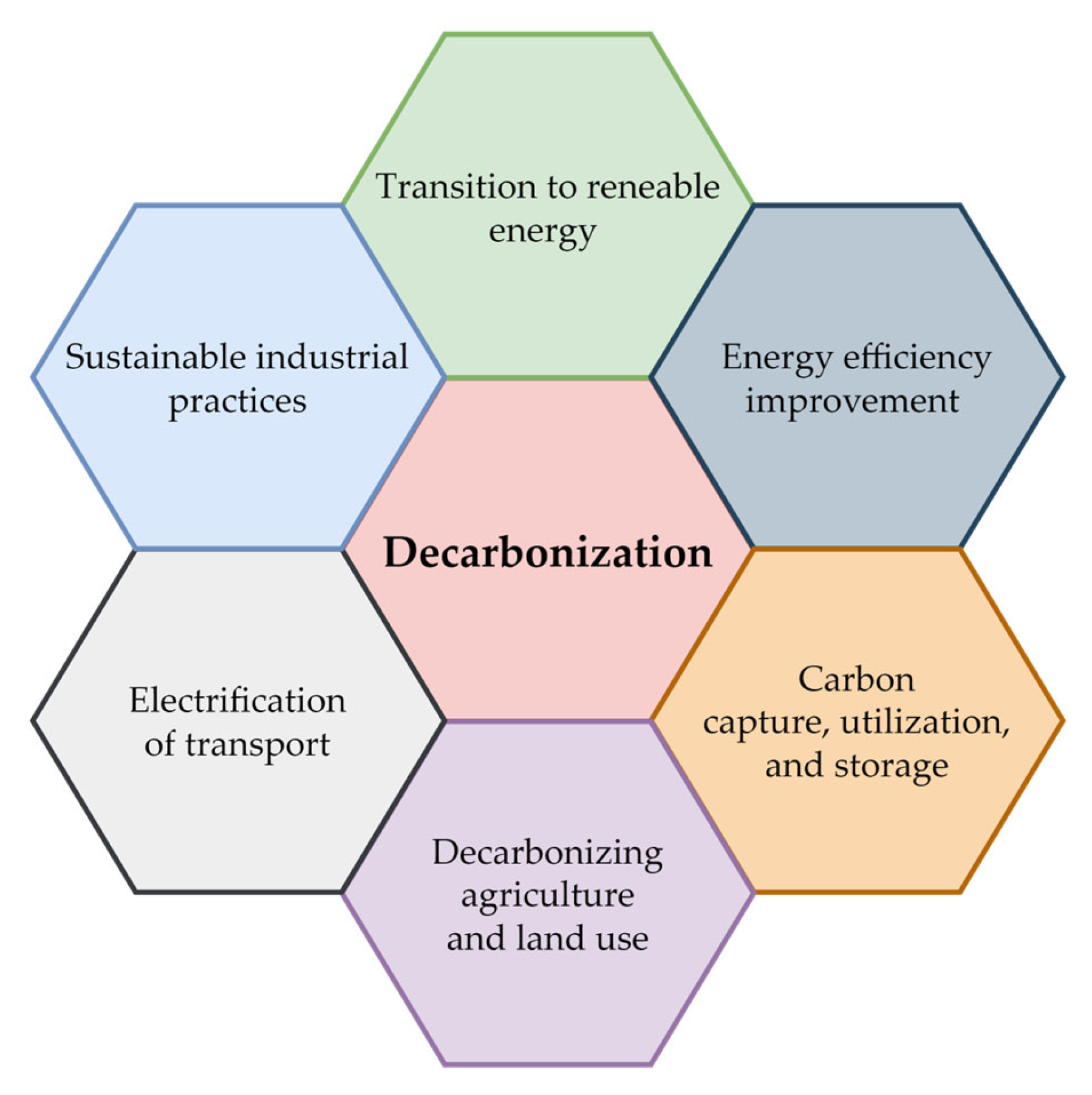
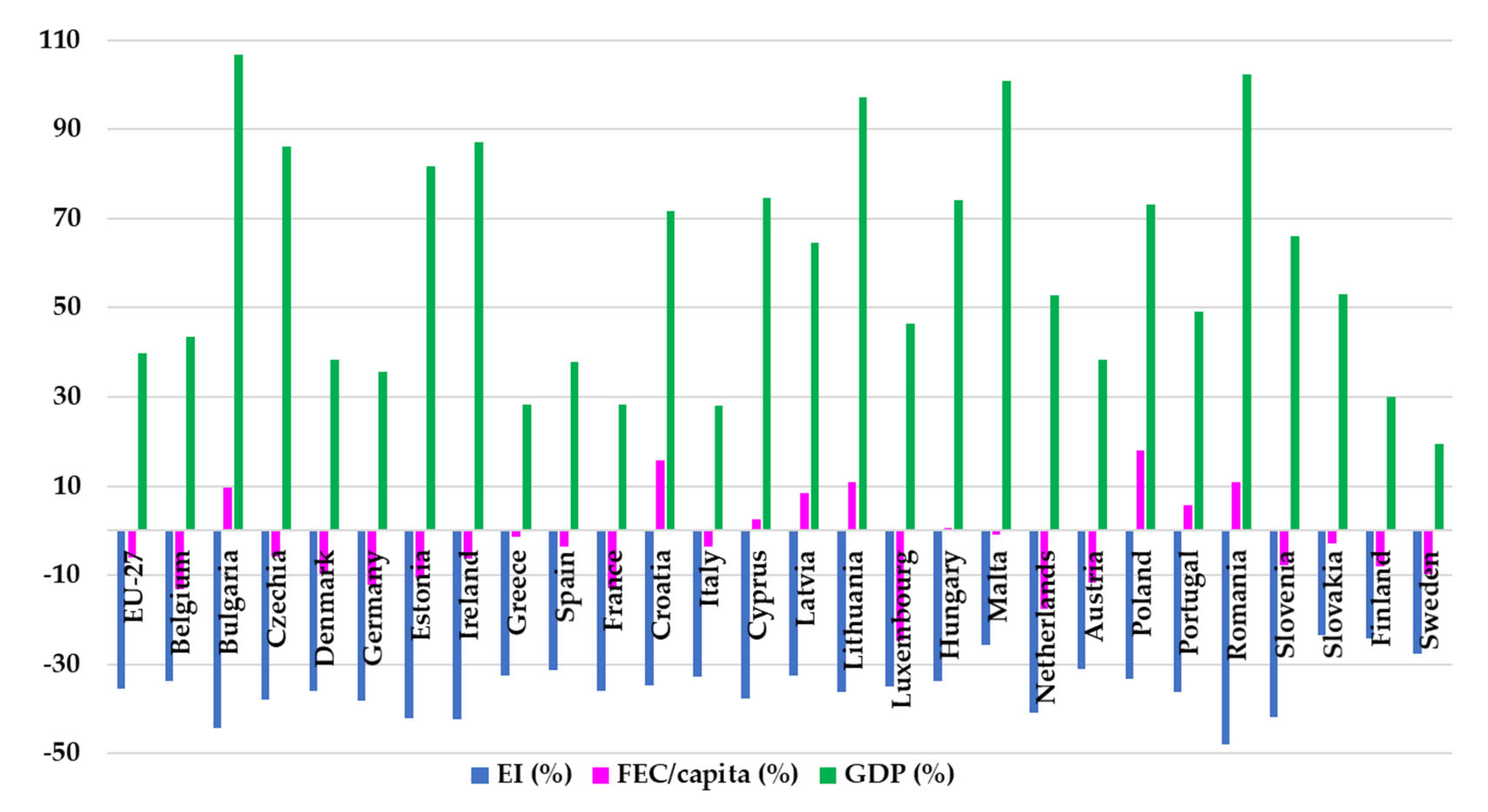
The global efforts to combat climate change, decarbonize the economies, and move towards a more sustainable future are focused on improving energy efficiency and reconfiguring the energy mix. Considering the impact on the environment and economic activity of energy production and consumption, this paper focuses on identifying the driving factors of final energy consumption in the European Union countries, which are undisputed leaders in the transition to a low-carbon economy. The goals of the paper are (1) to establish a model pattern that shows the relationships between the variation in final energy consumption and its driving forces and (2) to perform a comparative analysis to better understand the differences between the European Union (EU) economies in terms of energy efficiency improvement and decarbonization opportunities. Taking into consideration the objective of the research, comparative and correlation analyses were performed, and a decomposition technique (factorial analysis) was used in order to analyze the dynamic relationships between energy-related indicators for the EU as a whole and the 27 EU countries in 2023 compared to 2015. The research question is as follows: what are the main factors that generate final energy consumption in the EU? The hypothesis of this paper (H1) is that the variation in final energy consumption is determined by economic activity, lifestyle and consumer behavior, climate effect, and energy savings. This study’s main conclusions are that the variation in final energy consumption between 2015 and 2023 in EU countries was mostly due to key factors linked to economic activity, lifestyle and consumer behavior, climate effect, and energy savings. Thus, transport contributed the most to the variation in energy consumption, followed by services and manufacturing. The results indicate a shift to less energy-intensive sectors that positively impacted final energy consumption reduction, leading to energy savings. Concerning lifestyle and consumer behavior, household energy consumption had the highest contribution to the variation in energy consumption, followed by the number of passenger cars and the average annual net earnings. The climate effect was mostly due to the change in the cooling degree days that explained over 34.4% of the variation in the final energy consumption in households per capita. As for the energy savings effect, the results show that an increase in investments in the energy sector targeting efficiency improvements contributed to a reduction in energy consumption, leading to energy savings.
Keywords: energy efficiency; energy consumption; decarbonization; driving factors; comprehensive analysis; European Union energy efficiency; energy consumption; decarbonization; driving factors; comprehensive analysis; European Union