Article

Deep Reinforcement Learning-Based Distribution Network Planning Method Considering Renewable Energy


1
State Grid Economic and Technological Research Institute Co., Ltd., Beijing 102209, China
2
School of Electrical and Information Engineering, Tianjin University, Tianjin 300072, China
*
Author to whom correspondence should be addressed.
Energies 2025, 18(5), 1254; https://doi.org/10.3390/en18051254
Submission received: 2 January 2025 / Revised: 10 February 2025 / Accepted: 19 February 2025 / Published: 4 March 2025

Abstract

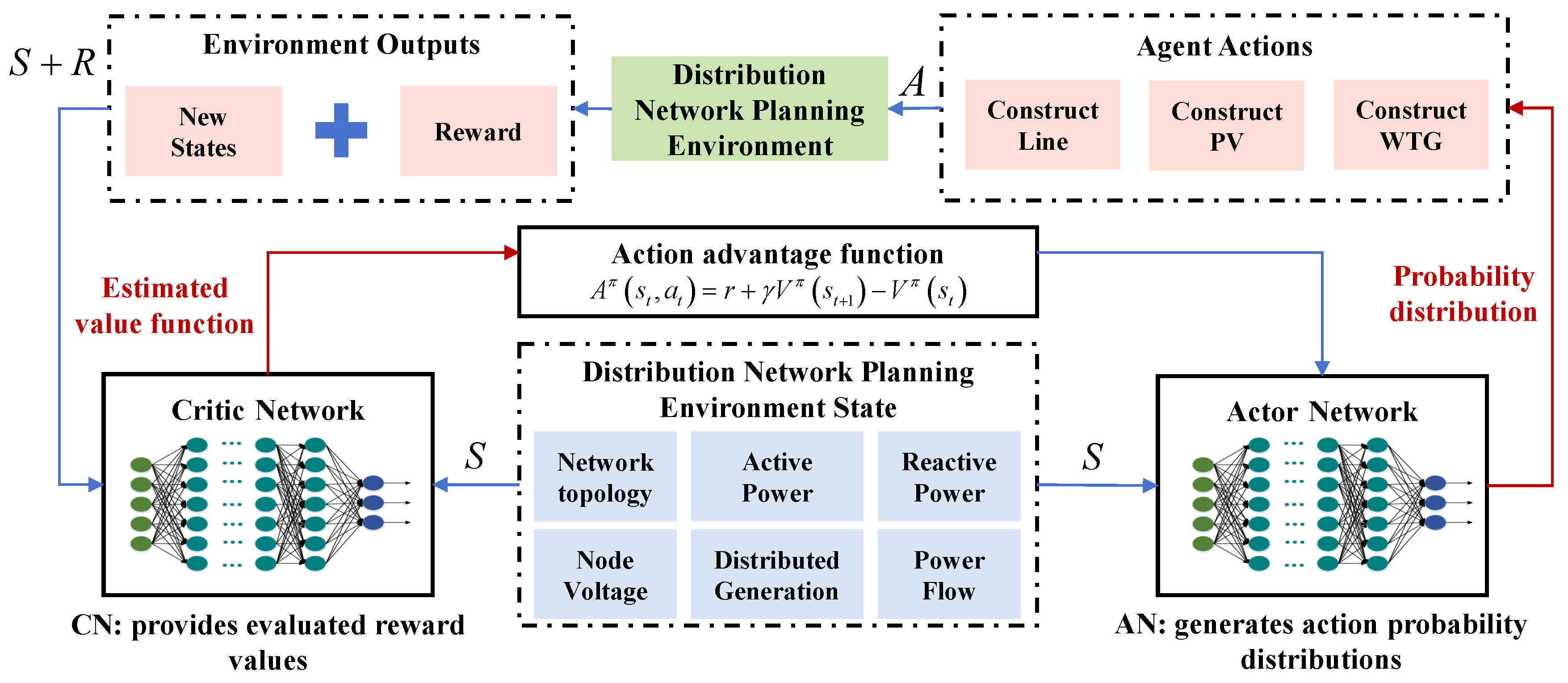
Distribution networks are an indispensable component of modern economic societies. Against the background of building new power systems, the rapid growth of distributed renewable energy sources, such as photovoltaic and wind power, has introduced many challenges for distribution network planning (DNP), including different source-load compositions, complex network topologies, and varied application scenarios. Traditional heuristic algorithms are limited in scalability and struggle to address the increasingly complex optimization problems of DNP. The emergence of new artificial intelligence provides a new way to solve this problem. Based on the above discussion, this paper proposes a DNP method based on deep reinforcement learning (DRL). By defining state space and action space, a Markov decision process model tailored for DNP is formulated. Then, a multi-objective optimization function and a corresponding reward function including construction costs, voltage deviation, renewable energy penetration, and electricity purchase costs are designed to guide the generation of network topology schemes. Based on the proximal policy optimization algorithm, an actor-critic-based autonomous generation and adaptive adjustment model for DNP is constructed. Finally, the representative test case is selected to verify the effectiveness of the proposed method, which indicates that the proposed method can improve the efficiency of DNP and promote the digital transformation of DNP.
Keywords: DNP method; DRL; Markov decision process model; proximal policy optimization DNP method; DRL; Markov decision process model; proximal policy optimization