Review

A Brief Review of Multi-Physics Coupling Research on Hydroelectric Generators

1
State Key Laboratory of Hydroscience and Engineering, Department of Energy and Power Engineering, Tsinghua University, Beijing 100084, China
2
S.C.I. Energy (Swiss), Future Energy Research Institute, Seidengasse 17, 8706 Zurich, Switzerland
*
Author to whom correspondence should be addressed.
Energies 2025, 18(5), 1074; https://doi.org/10.3390/en18051074
Submission received: 18 January 2025 / Revised: 13 February 2025 / Accepted: 20 February 2025 / Published: 22 February 2025
(This article belongs to the Section A: Sustainable Energy)

Abstract

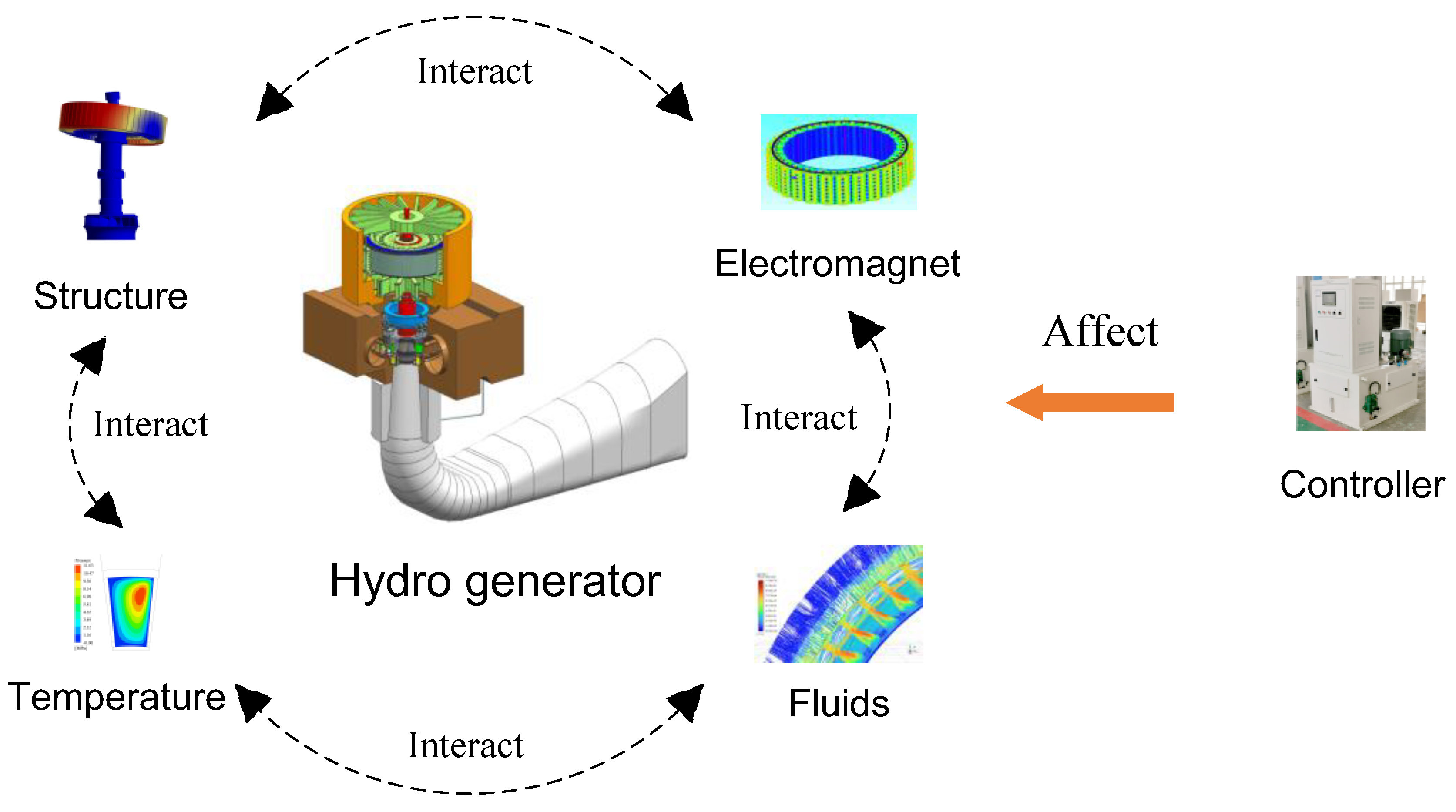
Hydropower, with its high degree of flexibility, plays an important role in the transformation of the global energy mix. Generators are the core component of the hydropower units; their performance directly affects the efficiency and reliability of the hydroelectric units. The dynamic characteristics of a generator during operation are usually the result of the coupling and interaction of multiple physical fields. Therefore, the interactions among electromagnetic, thermal, structural, and fluid fields inside hydroelectric generators have become of great concern. This paper briefly reviews the hydroelectric generator multi-physics coupling investigations, which include research conducted through field measurements, theoretical analysis, and numerical simulations. The review covers electromagnetic vibrations of generators under the influence of electromagnetic and structural fields, heat generation of generators under the influence of electromagnetic and thermal fields, ventilation and heat dissipation of generators under the influence of flow and thermal fields, and physical field changes of generators under the influence of electromechanical signals. The review also highlights unresolved issues in the field of hydropower that could benefit from fundamental research using a multi-physics coupling approach.
Keywords: hydroelectric generator; electromagnetic vibration; ventilation; heat dissipation; thermal stress; control strategy hydroelectric generator; electromagnetic vibration; ventilation; heat dissipation; thermal stress; control strategy