Article

Technical Benchmarking of Site Acceptance Testing Methods of Offshore Wind Farm HVAC Power Cables

1
Department of Microelectronics and Computer Science (DMCS), Lodz University of Technology, 90-543 Lodz, Poland
2
Onsite Hv Solutions, 6004 Luzern, Switzerland
3
Twentsche Kabelfabriek (TKF), 7481 Haaksbergen, The Netherlands
4
Onsite Hv Solutions Central Europe, 00-232 Warsaw, Poland
*
Author to whom correspondence should be addressed.
Energies 2025, 18(24), 6624; https://doi.org/10.3390/en18246624
Submission received: 26 September 2025 / Revised: 6 December 2025 / Accepted: 15 December 2025 / Published: 18 December 2025
(This article belongs to the Section A3: Wind, Wave and Tidal Energy)

Abstract

The reliability of an offshore wind farm (OWF) depends strongly on the export and inter-array cable installations. AC export cables (EXCs) are typically up to 120 km long and operate at voltages ranging from 220 to 275 kV. The newest inter-array cables (IACs) operate at 66 kV and can be up to 20 km long. They connect individual wind turbines to the offshore substation. This paper discusses current failure statistics and costs, as well as the technical challenges associated with different site acceptance testing (SAT) methods for offshore wind farm export and inter-array cables. The technical benchmark analysis for both EXCs and IACs shows the most reliable solutions for SAT. Moreover, practical applications based on 13 international OWF installations show that damped AC (DAC) supports quality control of newly installed EXC and IAC cable systems and provides a solid basis for in-service condition-based maintenance.

1. Introduction

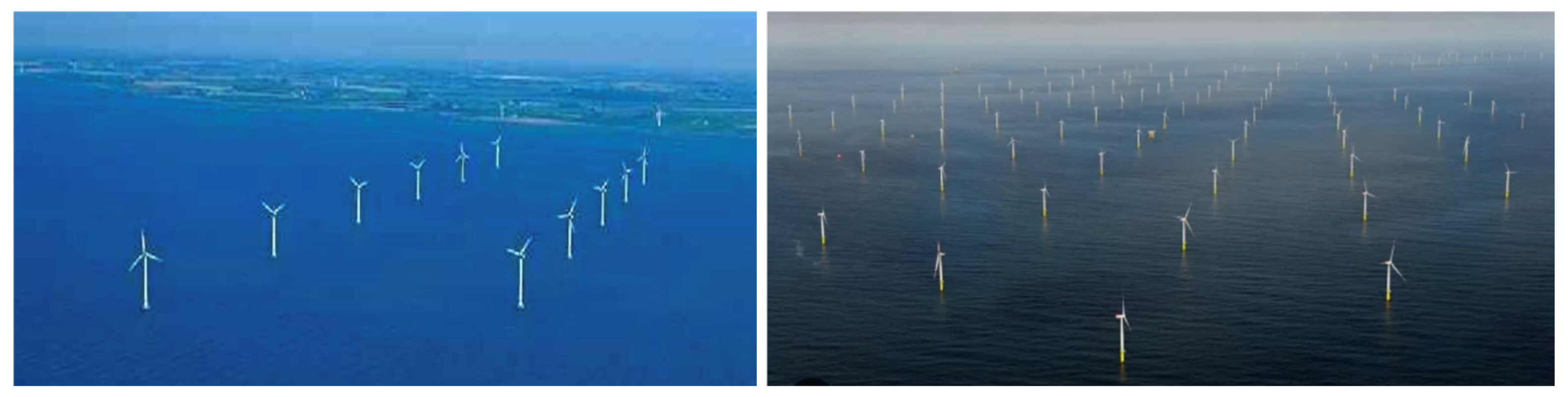
The development of offshore wind farms (OWFs) has accelerated significantly since the commissioning of Vindeby in Denmark in 1991, marking the world’s first offshore wind installation, with a total capacity of 4 MW [1], as shown in Figure 1. This stands in great contrast to the OWFs built today, such as Hornsee-2, with an installed capacity of 1.3 GW (Figure 1).
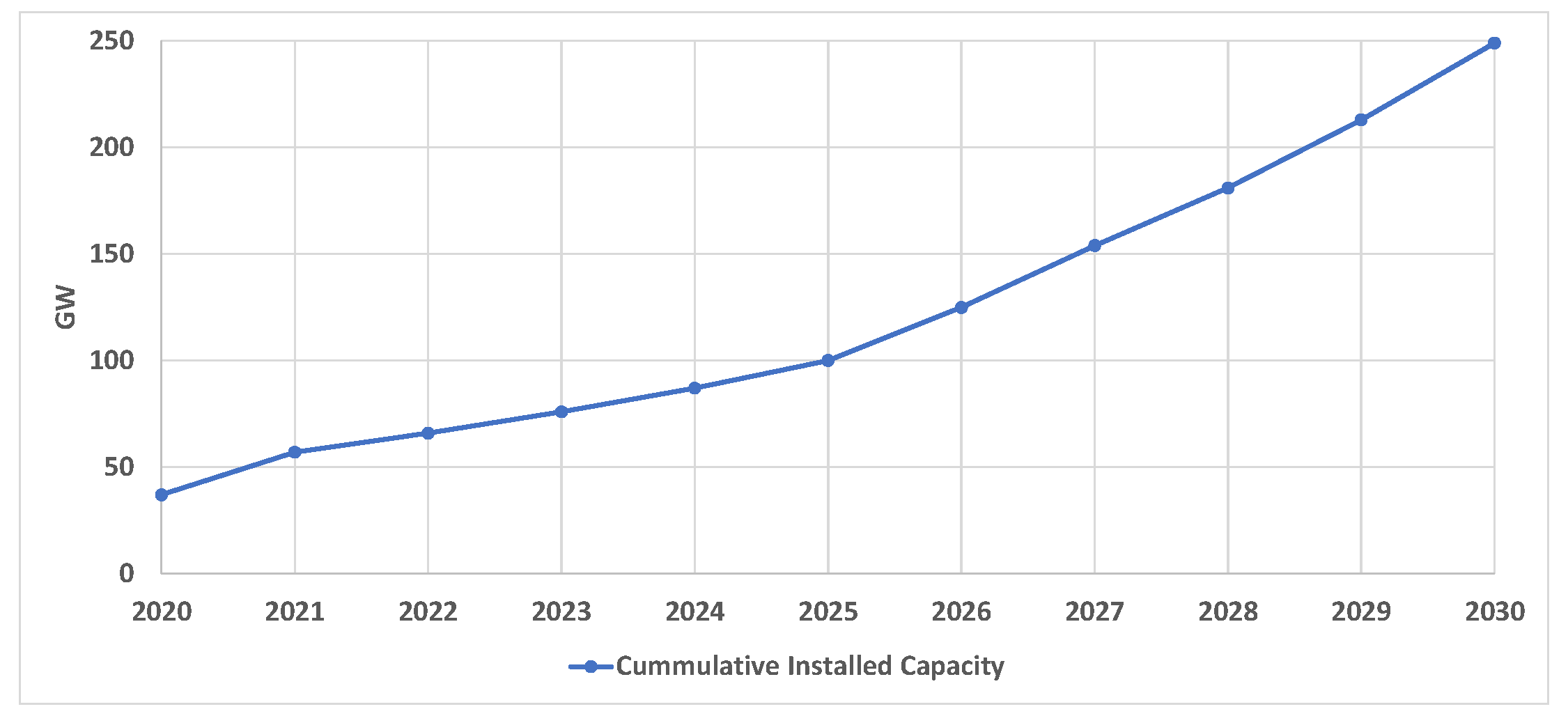
Since then, global offshore wind capacity has expanded rapidly, reaching approximately 117 GW by 2023, and is projected to grow to 234 GW by 2030 [2,3], as shown in Figure 2. This growth is driven by the global transition to renewable energy, with over 50 countries now operating offshore wind assets across all continents [3].
Commercial wind turbines have undergone significant evolution, with single units now capable of reaching up to 14 MW in rated power. In comparison, prototypes are being tested at 18 MW, and future concepts envision capacities of up to 22 MW [5,6].
In general, considering the Baltic Sea, it is evident that from the perspective of grid companies, midterm trends are shifting from the awarded few GW wind farms to more than 10 GW of power generation, with a further outlook of a few tens of GW in the future [7].
However, this rapid expansion presents significant technological and operational challenges. Considering countries’ ambitions to achieve up to 50% of power generation from offshore wind farms in the future and to ensure a reliable power supply, it is necessary to place greater emphasis on the accreditation and technical verification of proposed and future technological choices and solutions.
In particular, due to the extremely high demand for upscaling, current technological solutions pose a significant risk to design and manufacturing, installation, quality assurance, and technical end-verification. This may pose risks to the reliability of offshore wind farm power generation and to investment returns. As noted in [8,9], the power cables in an offshore wind farm are critical assets in terms of failure frequency and severity.
Therefore, the authors will continue in this contribution a discussion on technical reliability challenges for OWF power cables, having in mind
(a)
The very fast-changing world of OWF developments;
(b)
That since the discussion started in 2019 by some of the authors on this topic, not many solutions have been proposed to the critical issues in [10,11,12,13];
(c)
That, e.g., at the last Cigré 2024 biennial meeting, the Working Group B1 Insulated Cables Conference, presented a total of 85 papers, of which only one contribution was partially dedicated to the topic of OWF cables.
Field experience indicates that approximately 12% of newly installed cable circuits fail their initial acceptance testing, with the vast majority of failures occurring at joints and terminations. In most cases, these problems are linked to workmanship issues during assembly rather than to design limitations (about 80%). This situation is much more remarkable and worrisome because, when considering the total costs of a wind farm, the offshore cables, including offshore cable laying, account for less than 20% of the total capital costs [1,2,3,5].
Most problems are due to poor workmanship during cable installation and assembly, including [8,9,10,11,12,13]
(a)
Incorrect mounting dimensions;
(b)
Use of inappropriate materials and/or tools;
(c)
Missing and/or incorrectly installed parts that distribute the electric field in joints and terminations, e.g., insulating tapes, spacers, fillers, defective deflectors, semiconductor materials, and so on.
It is evident from the above discussion that quality control is needed at all stages of cable design, manufacturing, installation, and operation. One of the most essential methods to ensure the desired quality is testing the equipment at various stages of the cable’s life. In particular, site acceptance testing (SAT) should be carefully designed and executed.
At present, the most common tests are
(a)
A 24 h soak test at the nominal operating (network) voltage (U0) for export cables and/or inter-array cables;
(b)
VLF (very low frequency) voltage-withstand tests on individual IAC sections.
These tests do not provide a complete picture of the equipment’s condition, and they should be supplemented by comprehensive PD (partial discharge) detection or localization. At present, there are two widely used approaches for partial discharge testing:
(a)
AC resonance testing (ACRT);
(b)
Damped AC testing (DAC).
The ACRT test has been used for a long time and has proven very useful for testing land cables. On the other hand, the DAC approach has been used for about 20 years and shows substantial growth in applications, especially in offshore cable installations.
Since there are no universally agreed-upon testing procedures for offshore power cables, the authors undertook a comprehensive comparison of all site acceptance testing methods applicable to submarine cables. The findings of this study are reported in the following sections of this paper.
The paper is organized as follows: Section 2 contains an introduction to the role of power cables in an offshore wind farm design. In particular, the statistics on cable failures are compared with those of other wind farm components. Section 3 reviews the available cable testing methods with an emphasis on key considerations for selecting appropriate SAT methodologies for both export and inter-array cables. Section 4 describes cable testing techniques. The emphasis is on illustrating the main differences among the test methods currently used to test OWF cable systems.
The following two chapters are devoted to a detailed analysis of the available test methods for the export and the inter-array cables. Section 5 deals with export cables and concentrates on the comparison of the two primary PD testing methods, ACRT and DAC. Comparison includes such parameters as cost and manpower, electromagnetic background noise interference, and the possibility of cable damage during the test. Section 6 deals with inter-array cables. As in the previous chapter, key testing parameters for ACRT and DAC PD testing methods are compared, including PD localization along the entire cable length.
The last two chapters summarize the topics addressed in Section 1, Section 2, Section 3, Section 4, Section 5 and Section 6. Section 7 outlines the recommended test parameters for the withstand test for site acceptance testing (SAT) and condition-based maintenance (CBM). Section 8 contains the conclusions.

2. Offshore Wind Farm Power Cables

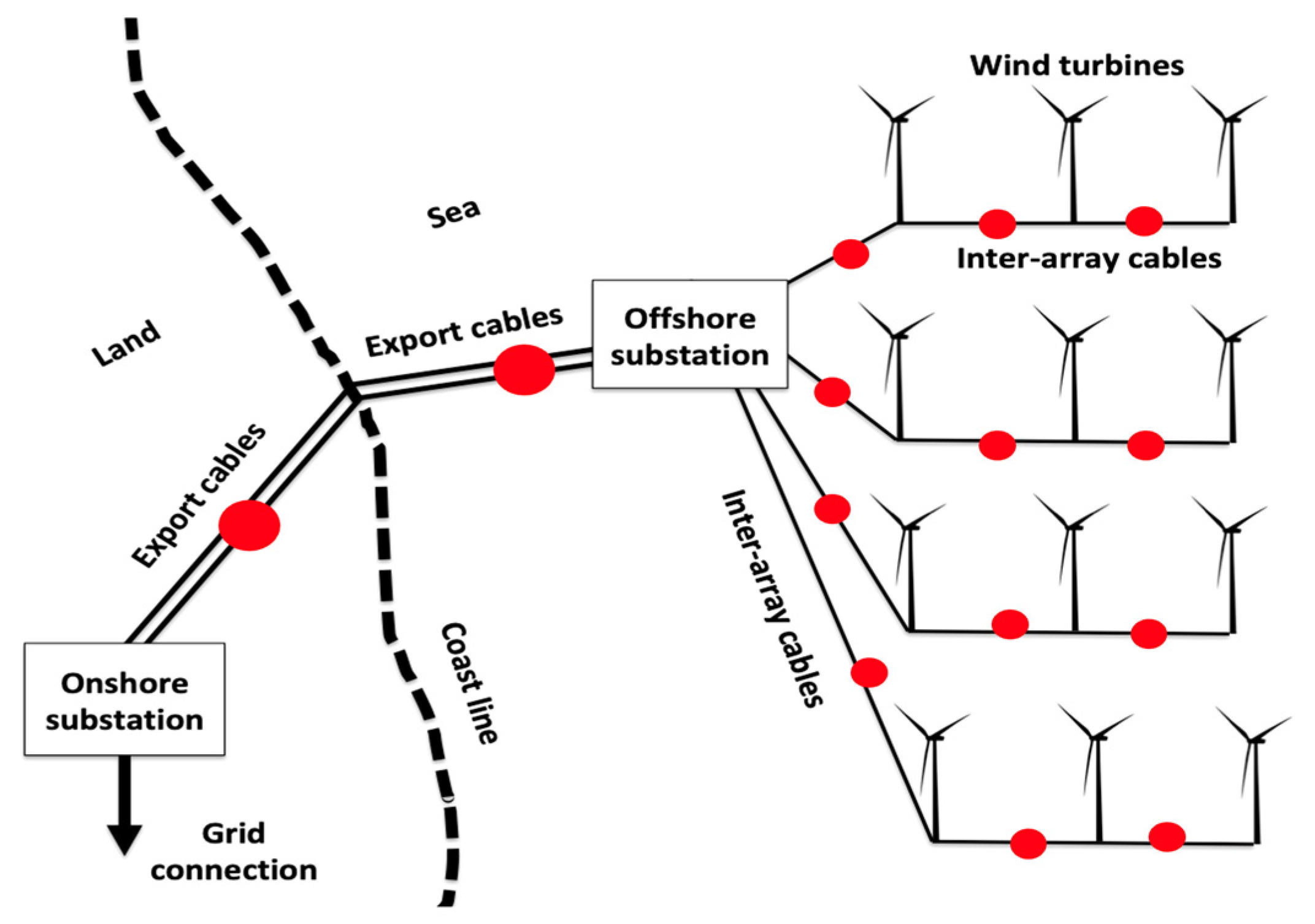
Most offshore wind farms have a typical configuration in which wind turbines, each of several MW, are connected by inter-array cables in strings, and all strings are connected to one or more offshore substations (OSSs). Currently, the state of the art is at 66 kV, with an expected transition to 132 kV as turbines continue to scale up. The connection of the OSS to the onshore grid is accomplished via one or more export cables (mainly in the 220 kV or 275 kV range), as shown in Figure 3.
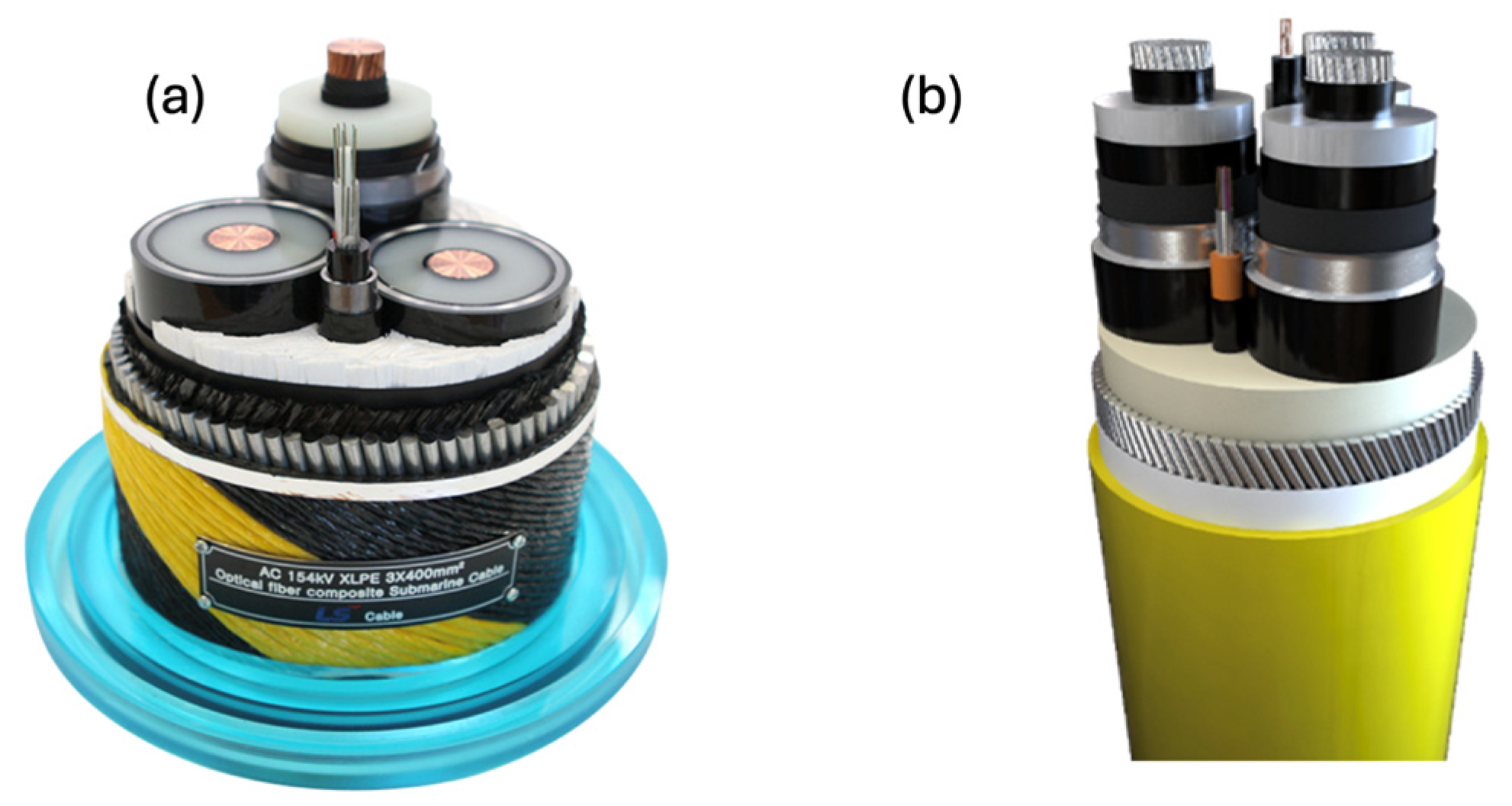
In [6], an extensive discussion is provided on all matters related to failures of both the export and inter-array cables, as shown in Figure 4. Also, recommendations have been made for quality assurance of OWF cable systems. Moreover, since the 2021 discussion about the basic risk factors of cable failures at the OWF, there has been little progress in addressing those problems [10].
According to Reference [10], the severity and frequency of failures of the export and inter-array cables are reported to be the highest compared to other offshore wind farm components, such as wind turbine foundations, transformers, generators, and switchgear.
It is reported in [6] that over the past 20 years, power cable failures have accounted for up to 80% of total financial losses and OWF insurance claims worldwide. Failure to apply proper preventive measures may result in
(a)
Randomness of the solutions used to dictate by the optimization of prices and schedules;
(b)
Numerous disputes regarding compensation for improper technical workmanship or defects during the warranty period;
(c)
Unacceptable lack of reliability requirements due to the low level of quality assurance in the design, production, transportation, and installation processes.
Based on the expectations of the on-site acceptance test, this article discusses the fundamental aspects of achieving higher reliability and, consequently, lower failure costs for inter-array and export power cable connections in offshore wind farms.
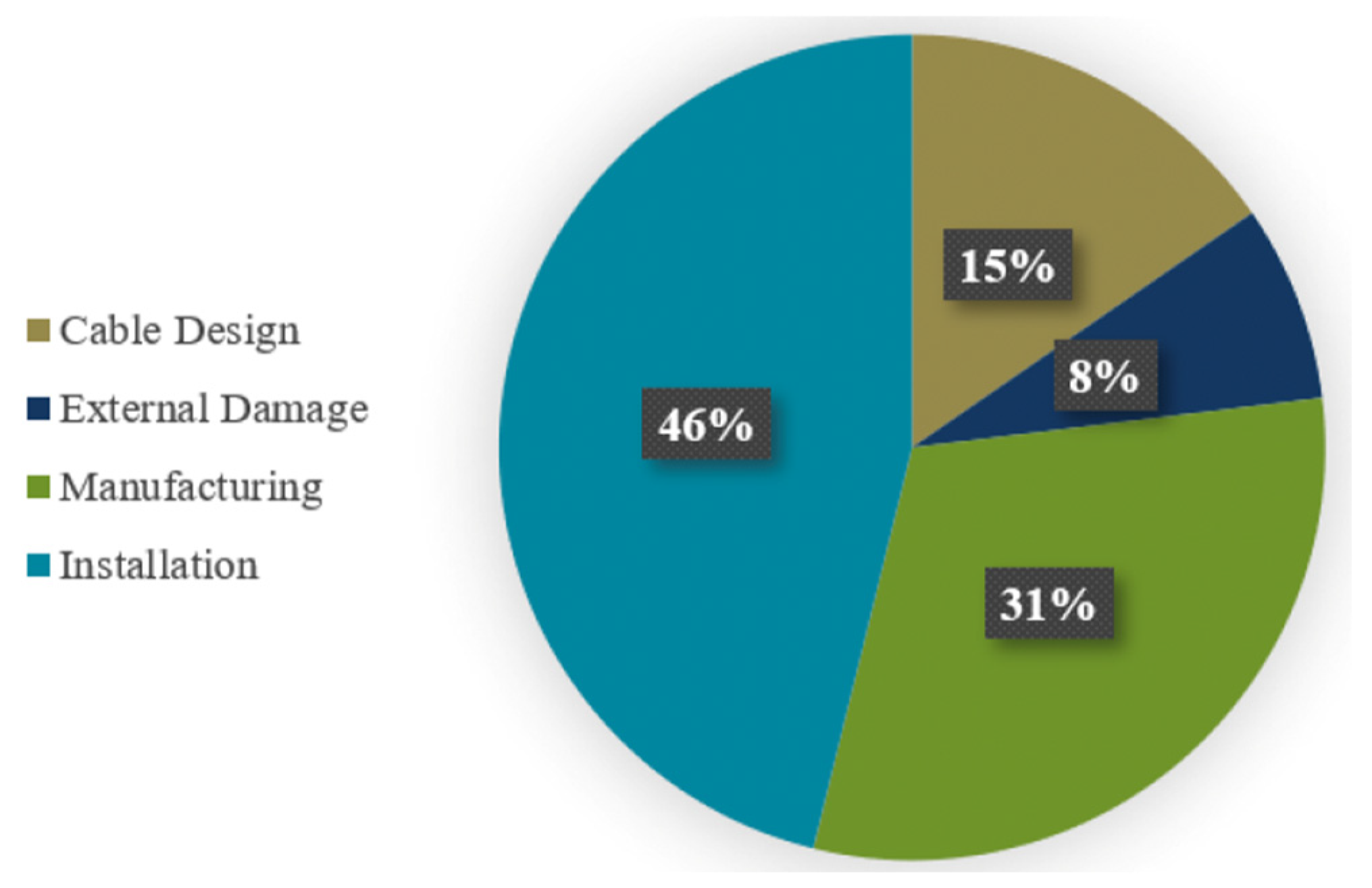
According to [9], for inter-array and export cables used in OWFs, four main failure modes can be distinguished: 46% incorrect installation, 31% manufacturing irregularities, 15% ineffective cable design, and 8% external damage (see Figure 5).
The same reference also reports that challenging conditions at sea can affect not only the failure rate but also the time required to repair a failure, thereby causing variations in the resulting downtime. Based on past data analysis, the average downtime due to inter-array cable failures and repairs was 38 days, and the average downtime due to export cable failures and repairs was 62 days [9].
The above discussion is based on the existing feedback from midsize WTGs of a few hundred MWs and inter-array cables, with voltage ratings of 33 kV and 66 kV. Considering the above statistics, there is no doubt that the causes of these problems must be examined in relation to the reasons for cable failures.
It is expected that, if nothing is performed, the problems with cable failures will worsen, as the voltage levels will soon double to 132 kV for the inter-array cables. New wind farms will be installed at greater depths by transitioning to floating wind farms.
Therefore, in the following sections, the technical aspects of quality assurance for site acceptance testing (SAT) for both OWF export and inter-array cables will be discussed.

3. Testing Considerations

The export (EC) and inter-array (IAC) cable systems at offshore wind farms (OWFs) present distinct challenges during post-installation testing due to their physical and electrical characteristics.
Export cables, typically rated between 220 kV and 275 kV, span distances from several tens of kilometers. These lengths result in very high cable capacitance—often exceeding 20 µF—which, in turn, requires substantial reactive power to energize using conventional alternating current (AC) test systems. The size and power demands of these systems make conventional AC resonant test systems’ site acceptance testing (SAT) impractical for export cables.
Inter-array cables, generally rated up to 66 kV, connect clusters of wind turbines (typically 5 to 10) in string configurations to the offshore substation. While individual IAC segments may be only 1–4 km long, even longer lengths can be applied, allowing the full length of a complete string to extend up to 15–20 km. Testing these strings in their entirety is logistically complex due to limited access and space constraints on the WTG or offshore substation platforms. As with export cables, conventional AC testing systems are often unsuitable due to their large footprint, weight, and power requirements. Moreover, it is technologically impossible to conduct dedicated tests (monitored by accurate partial discharge measurement) during on-site acceptance tests.
Due to these limitations, some developers opt for simplified or minimal SAT approaches, driven by time, cost, and logistical constraints. Common practices include
(a)
Performing a 24 h soak test at the nominal operating (network) voltage (U0) for export cables and/or inter-array cables;
(b)
Using VLF (very low frequency) voltage withstand tests on individual IAC sections;
(c)
Omitting comprehensive PD (partial discharge) detection or localization.
This automatically generates a risk for quality assurance for the OWF operation. To address these concerns, Table 1 and Table 2 outline key considerations for selecting appropriate SAT methodologies for both export and inter-array cables. These include
(a)
The complexity of the offshore logistics (weather, access, vessel availability);
(b)
The need for high diagnostic sensitivity, especially in detecting and locating defects in accessories such as joints and terminations;
(c)
Time- and cost-efficiency of test execution;
(d)
The trade-off between system compactness and test performance.
A best-practice approach to SAT should be based not solely on regulatory minimums but also on what is technically feasible, logistically efficient, and diagnostically meaningful. Testing strategies must be selected with a focus on long-term reliability, ensuring that defects introduced during manufacturing, transport, or installation can be identified and corrected before the system is energized.
Currently, to reduce the cost of ensuring quality after installation, e.g., by reducing the SAT criteria to minimum possible, some subcontractors impose a defect notification period (DNP) on their clients. DNP is an agreed-upon, short-term period within which the client must notify the subcontractor of detected defects.
In the case of warranties that involve quality or performance over an extended period, the DNP often covers the repair or replacement of defects noticed shortly after installation.
The DNP could be a procedural requirement for enforcing warranty rights, but it does not guarantee quality. Of course, this approach does not meet the reliability expectations that owners of investment properties have in offshore wind farms.
Regarding the requirements for post-installation testing and quality assurance, [10,11,12,13] point out that special attention should be paid to long sections of the offshore export power cables. However, these publications do not provide any concrete suggestions, see Table 1 and Table 2, for example, on
(a)
How can the required power be generated on-site, high voltages to overstress long cable circuits, e.g., those with lengths of 50 to 120 km or capacitive loads greater than 15 µF [12,13]?
(b)
How can partial discharge (PD) events be accurately detected and localized in long cable systems [12,13]?
(c)
What criteria apply for adequate quality assurance of newly installed or in-service cable circuits [12,13]?
According to IEC standards, an alternative to the overvoltage test is a 24 h voltage-withstand test at a power frequency of 50 or 60 Hz and at the normal operating voltage Uo.
It is recognized that this solution has limited value in detecting potential weaknesses in a newly installed cable system due to the lack of stress, particularly the inability to detect partial discharge.
It is known that repair costs for long cable installations, especially offshore, are high [8,9,12,13]. Therefore, a proper quality assurance process must be agreed upon, including typical characteristics of long offshore cable systems:
(a)
The need to conduct PD tests of the entire cable section (turntable) at the factory before shipping it for on-site installation;
(b)
The presence of pre-installed (factory-installed) joints;
(c)
The presence of joints installed on-site at sea;
(d)
Accessibility and space constraints that affect access to the offshore cable;
(e)
The impossibility of conducting distributed partial discharge tests on individual connectors of the submarine cable.
In the following sections, we will examine the performance of various testing technologies—exceptionally damped AC (DAC) and AC resonant (ACRT) methods—and evaluate their effectiveness in offshore applications. Special attention will be paid to testing reliability, partial discharge detection, diagnostic capability, and overall suitability for the long-length cable systems.
It should be noted that, although there are several references on the application of the DAC methodology for long-length AC cable lines [6,7,13,16], only one publication [17] describes AC resonant testing (ACRT) for cable lines with a long length.

4. OWF Power Cables Testing Technologies

To ensure the long-term performance of the offshore wind farm (OWF) cable systems, it is essential to apply suitable high-voltage testing technologies after installation. Over the past two decades, several testing methods have been developed and standardized to verify the insulation integrity and operational readiness of long, high-voltage power cable systems.
Among these, two prominent techniques recognized in international and national recommendations [10,11,12,13,18,19,20,21,22,23,24,25,26,27,28,29] and industry practice are
(a)
AC Resonant Testing (ACRT)—Continuous AC voltage testing at frequencies between 20 and 300 Hz;
(b)
Damped AC Testing (DAC)—Application of damped resonant voltage signals within the same frequency range.
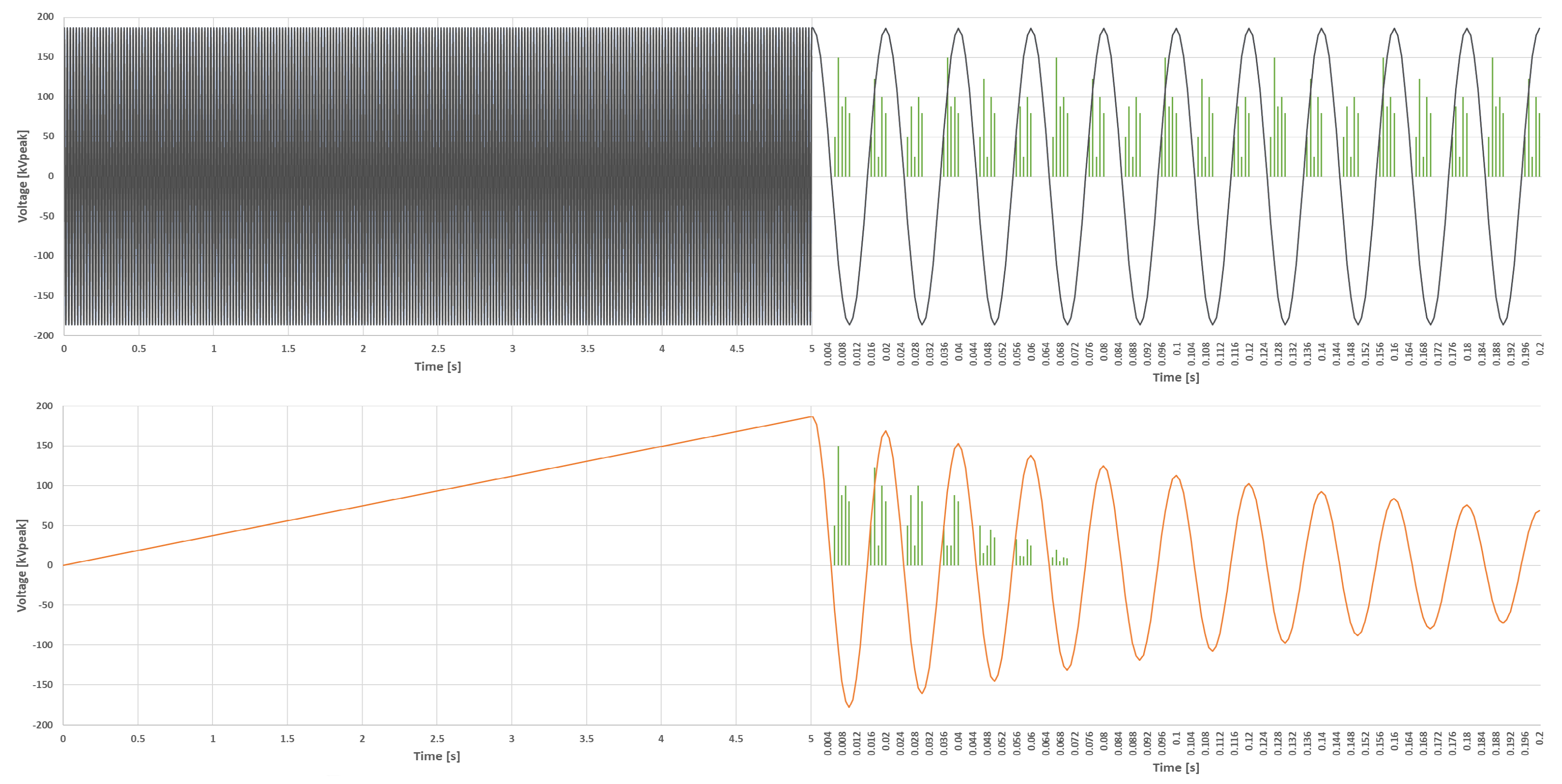
Figure 6 illustrates the main differences among the test methods described above. Both methods have their own advantages and disadvantages.
Regarding the similarities in the results of both voltage testing methods on the same type of insulation defects, the following statements can be made [10,11,12,13,21,22,29]:
(a)
There is no significant diversity between the partial discharge inception voltage (PDIV) and partial discharge extinction voltage (PDEV).
(b)
Between detectable partial discharge levels, no differences have been reported.
(c)
DAC cycles make the occurrence of partial discharges in relation to the DAC voltage decay visible, providing more information about the partial discharge pattern.
(d)
At the maximum voltage level, there is no effect of diversity in the voltage stresses in kV/mm. The damaging effect of the DAC test voltage is lower than that of AC stress due to DAC voltage decay.
(e)
There is no significant diversity for dielectric losses as measured at similar test voltage levels and voltage frequencies in the range of 10–300 Hz.
(f)
The development of various on-site power cable testing methods [5] over the past two decades has provided parameters for repeatable quality control (see Table 3).
Considering the fundamental aspects of quality assurance of the OWF export cables, several testing and diagnostic parameters have been developed over the past few decades for post-installation testing of power cables [11,12], as shown in Table 3 and Table 4.
Referring to Table 4 and based on the authors’ extensive worldwide experience in successfully testing power cables using the SAT method in hundreds of different installations with voltages up to 275 kV, Table 5 summarizes the recommended testing parameters.

5. Technical Comparison of Testing Methods of OWF Export Cables

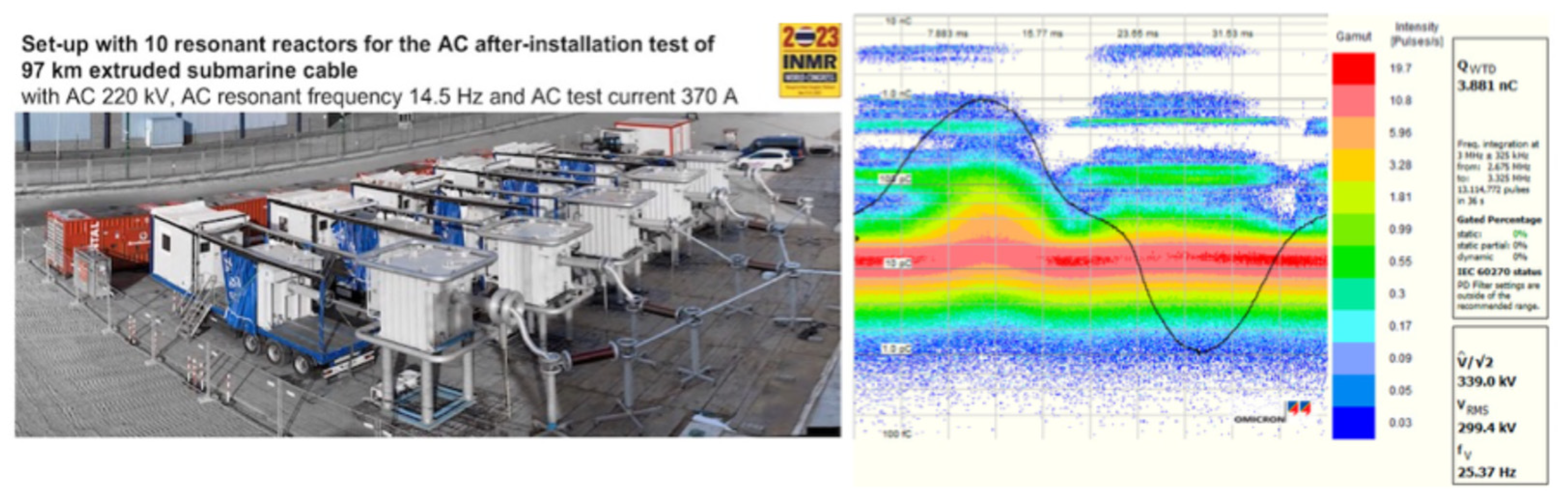
AC resonant testing (ACRT) is not easy to apply. It does not provide a clear picture of the possible presence of PD activity over long lengths, which are typical for OWF export cables, as shown in Figure 7.
As a result, the following conclusions for testing EXC systems using ACRT can be made
(a)
Very high effort regarding time, costs, and manpower to set up and to energize the test object;
(b)
Lack of possibility to detect and to localize discharging defects in the complete cable system due to very high electromagnetic background noise (see Figure 7);
(c)
High destructiveness to the cable system due to the continuous character of the AC high over-voltage;
(d)
Very low price/performance ratio for developers and contractors.
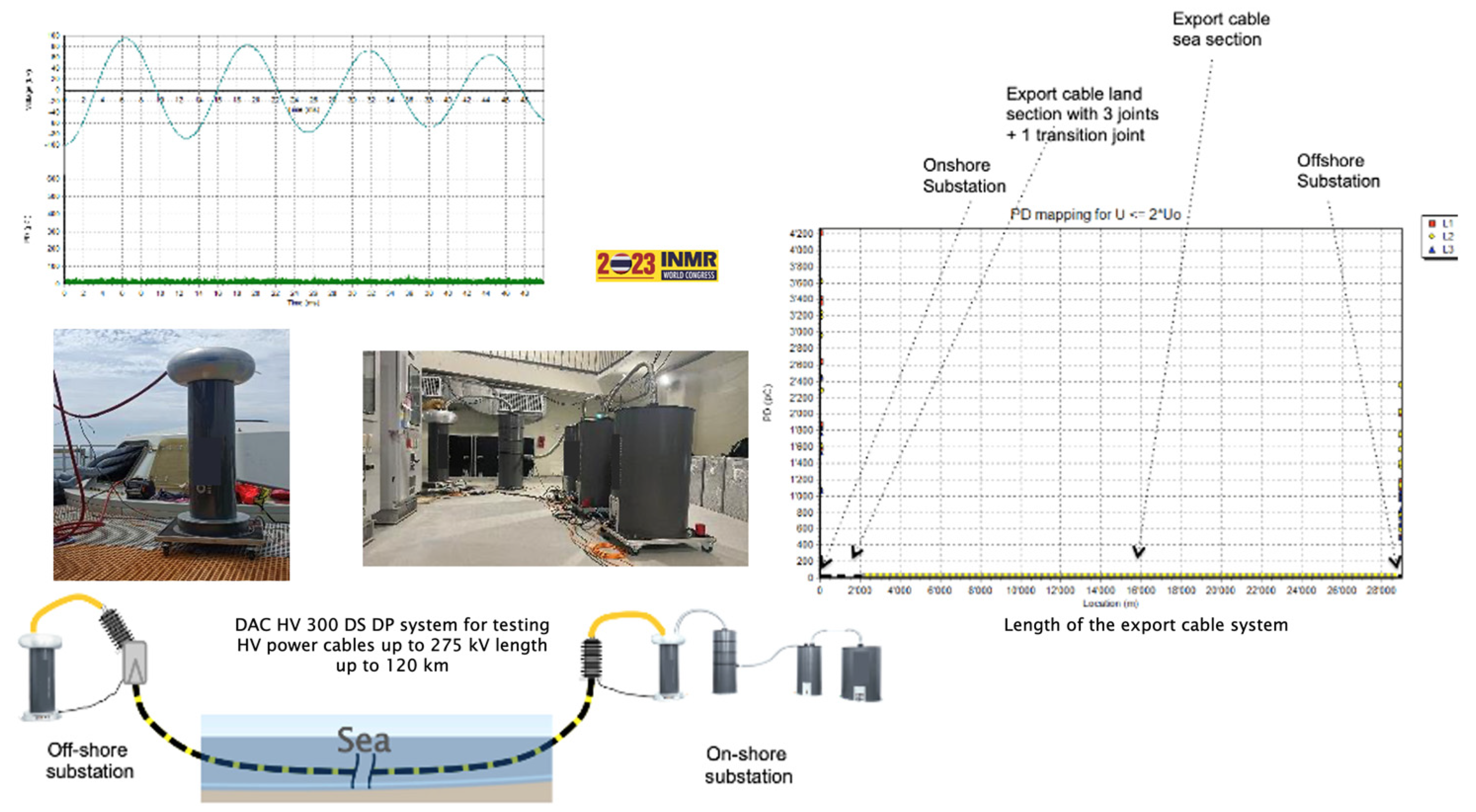
Site acceptance testing of very long cable lengths using the damped AC (DAC) method is a straightforward and easy-to-apply approach. It provides a clear picture of PD activities, as shown in Figure 8. As a result, the following conclusions for testing EC systems using DAC can be made:
(a)
Low effort regarding time, costs, power demand, and manpower due to the very compact test system;
(b)
Possibility to detect and to localize discharging defects in the complete cable system due to very low electromagnetic background noise interference;
(c)
No destructiveness to the cable system due to the damped character of the AC high over-voltage stress and PD monitored test.
Considering the fundamental aspects of quality assurance for OWF export cables, several testing and diagnostic parameters have been developed over the past few decades, following the implementation of the post-installation testing for power cables [10,11,12,13], as shown in Table 3 and Table 4.
Based on the above discussion, several essential aspects were selected and analyzed from a quality assurance perspective for newly installed OWF export cable circuits to support decisions on the advantages and disadvantages, risks, and impacts of all possible SAT methods for OWF export cables.
In Table 6, Table 7, Table 8, Table 9, Table 10 and Table 11, benchmarks are provided for each technical aspect discussed.
Based on the above multi-criteria comparison, damped AC testing appears to be the most appropriate and effective SAT method for export cables with lengths exceeding 30 km, and it is undoubtedly suitable for typical lengths of 80–120 km. It meets both the technical and logistical demands of offshore applications, with a robust assessment of cable condition before commissioning. In contrast, both ACRT and soak testing fail to provide sufficient diagnostic resolution or practical deployment flexibility for long offshore cable systems.

6. Technical Comparison of Testing Methods of OWF Inter-Array Cables

Site acceptance testing of IAC using AC resonant testing (ACRT) is not straightforward or easy to use. It does not provide a clear picture of PD activities (see Figure 9). As a result, the following conclusions for testing IAC systems using ACRT can be made:
(a)
PD-monitored testing, including localization of a complete cable string, is not possible due to a lack of sufficient power and the presence of high EM interference.
(b)
Very high effort regarding time, costs, and manpower due to the considerably large size and number of the systems needed to energize a power cable.
(c)
No possibility to detect and to localize discharging defects in the complete IAC strings due to very high electromagnetic background noise.
(d)
High destructiveness to the cable system due to the continuous character of the AC high over-voltage.
(e)
Very low price/performance ratio for developers and contractors.
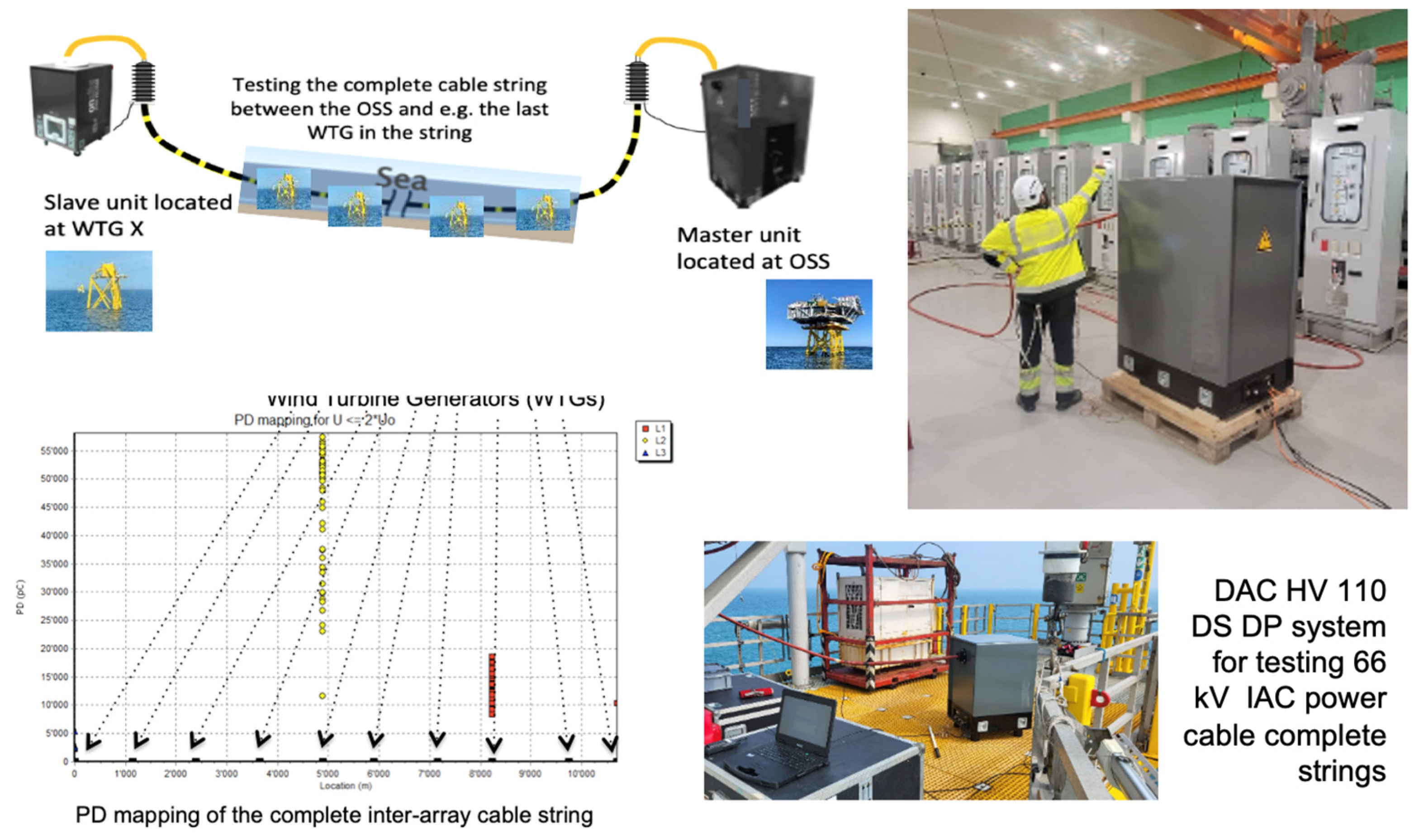
Site acceptance testing of inter-array cables for an OWF using the damped AC (DAC) method is straightforward. It provides a clear picture of PD activities, as shown in Figure 10. As a result, the following conclusions for testing IAC systems using DAC can be made:
(a)
PD-monitored testing, including localization of discharges in a complete cable string, is possible.
(b)
Low effort regarding time, costs, and manpower due to a very compact solution needed to energize a power cable.
(c)
Possibility to detect and to localize discharging defects in the complete cable system due to very low electromagnetic background noise.
(d)
Due to the damped character of the AC high over-voltage stress and PD monitored test, there is no destructiveness to the cable system.
To support decisions on the advantages and disadvantages, risks, and impacts of all possible site acceptance testing methods for offshore wind farm inter-array cables, several key aspects were selected based on the above discussion and analyzed from the perspective of quality assurance of newly installed OWF interconnect circuits. It compares the most common testing methods applied to the IAC systems:
(a)
Damped AC (DAC) Testing;
(b)
Very Low Frequency (VLF) Testing—Sinusoidal or cosine-rectangular at 0.1 Hz;
(c)
Soak Testing at U0.
Each method is evaluated based on its technical capabilities, diagnostic performance, suitability for offshore deployment, and impact on testing logistics. Table 12, Table 13, Table 14, Table 15 and Table 16 summarize the analysis of each technical aspect.
Based on the detailed technical evaluation of various testing methods for inter-array cables and strings considered by different OWF projects, it can be concluded that both VLF and ACRT lag in these areas and are primarily suited to simpler, shorter, or onshore applications. Soak testing is not considered meaningful for SAT in any modern OWF context. The most suitable SAT method is damped AC (10–300 Hz) with sensitive PD detection and localization (see Table 4).
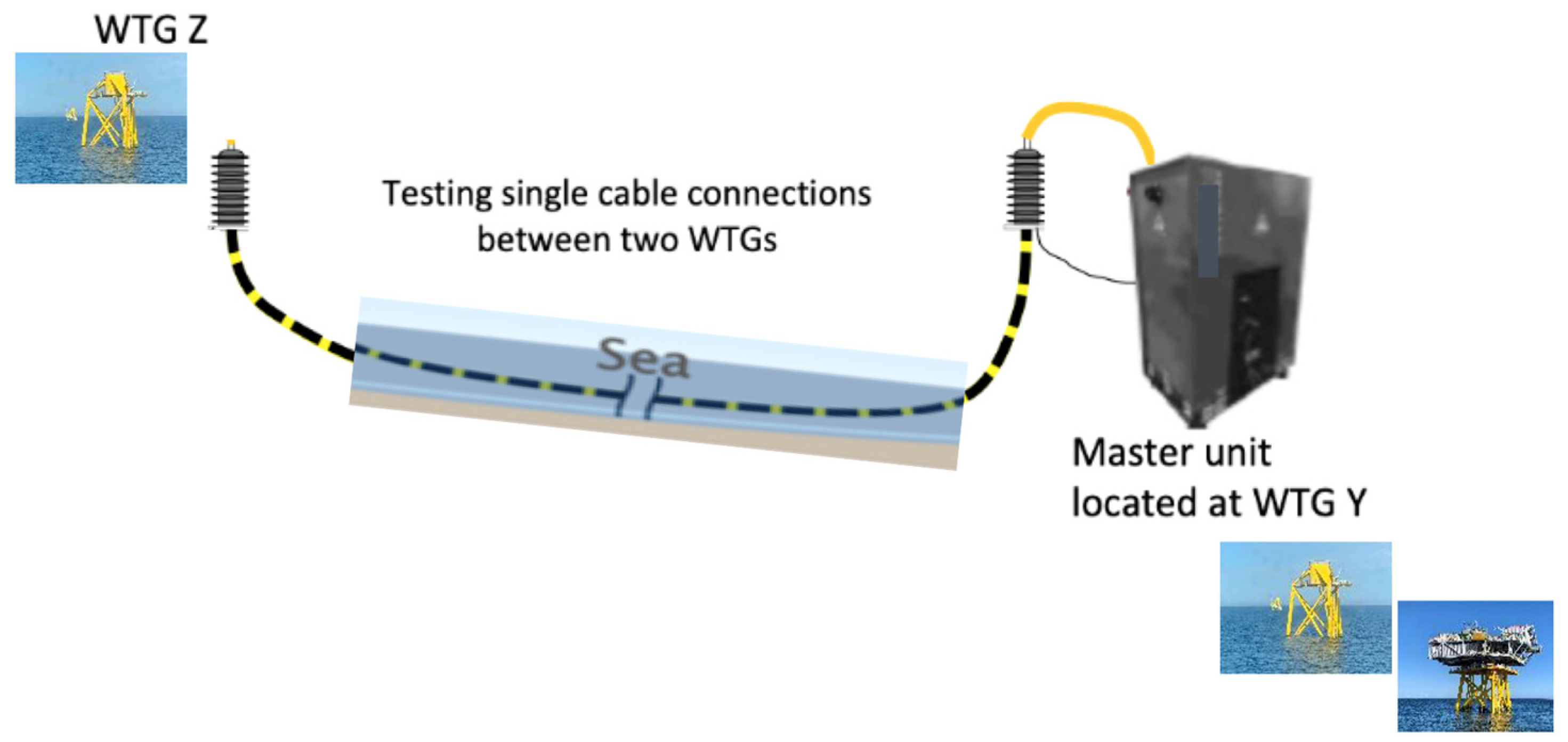
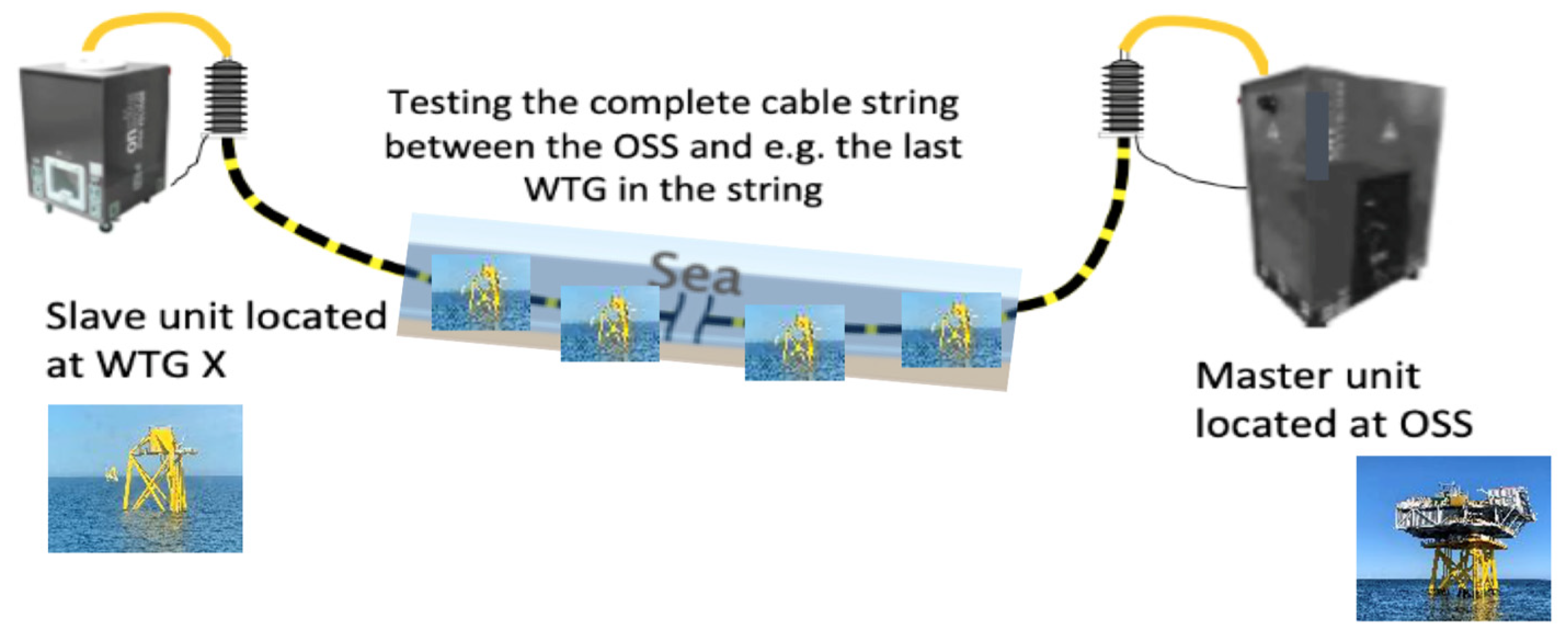
In recent international projects where damped AC (DAC) with partial discharge (PD)-monitored testing has been applied, it has been observed that moving away from the conventional testing of single cable sections (between individual WTGs), as shown in Figure 11, to testing of a complete IAC string, as shown in Figure 12 (e.g., from the offshore substation to the last WTG in the string), has the following advantages (see Table 17):
(a)
Testing full strings allows verification of all components under real operating configurations.
(b)
The number of required tests is reduced by up to 80%, significantly decreasing preparation, execution time, and costs.
(c)
Complete strings yield more representative condition data, valuable for future condition-based maintenance (CBM) strategies.
A detailed comparison in Table 17 confirms that complete string testing provides a reduction in test count and improved coverage of the complete IAC connections.
Being combined with sensitive PD detection, as shown in Table 4, it offers not only superior technical reliability, but also considerable logistical and economic advantages, which could be annotated to emphasize the reduction in test count and improved coverage.
The comparison of the available SAT methods confirms that DAC is the most effective and practical approach for verifying the integrity of the OWF inter-array cable systems. It enables full-string diagnosis, supports offshore operation, and offers reliable partial discharge detection and localization. In contrast, VLF, ACRT, and soak testing are limited either by equipment constraints or diagnostic capabilities and are less suitable for large-scale OWF projects.

7. Discussion

AC resonance testing (ACRT) voltage is acknowledged as the testing method that best represents breakdown voltage and partial discharge levels in cables under normal operating conditions.
However, its benefits are significantly compromised by the heavy, bulky units, which are impractical for offshore applications. Several testing methods have been proposed and well-studied as alternatives to on-site resonance AC voltage testing. The 24 h soak testing and the DC voltage testing are not the preferred testing methods nowadays due to their apparent drawbacks.
VLF and DAC are two popular methods, each with its own advantages and disadvantages in voltage withstand testing. To reveal weaknesses in the cable system that might not be detected during voltage withstand testing, additional diagnostics, such as dielectric losses and partial discharge measurements, are increasingly performed during on-site testing.
When it comes to voltage testing with partial discharge measurement (which is increasingly indispensable), DAC demonstrates its superiority because its measured PD parameters (PDIV, PD amplitude, etc.) are closer to those obtained under AC voltage testing. Along with its higher capabilities in testing long lengths of cable, DAC is the best solution for testing inter-array cables.
Therefore, some cable manufacturers recommend using a DAC for on-site testing of long cable systems as an alternative to the heavy and costly resonance AC voltage source. Regarding test parameters, they acknowledge [28] as a compilation of industry experience on the subject and therefore recommend following its guidelines for site acceptance testing (SAT) and condition-based maintenance (CBM), as presented in Table 18.
Moreover:
(a)
If for VLF testing, frequencies will be considered between 0.1 and 0.01 Hz, the field stress should be limited to a maximum of 10 kV/mm or lower. Some industry standards recommend compensating for the lower testing field stress by increasing the testing time to 90 min or more.
(b)
If any, the pass/fail criterion for PD testing should be independent of the chosen method (AC, VLF, or DAC). The recommendation is that there be no detectable PD at 1.5 Uo.

8. Conclusions

The discussion of this paper has been summarized in Table 19 for export cables and in Table 20 for inter-array cables. Summarizing the following conclusions can be made:
  • Analysis presented in this paper confirms that export and inter-array cables are the most critical components in terms of failure frequency and severity in offshore wind farms. Their technical characteristics, installation environment, and operational importance necessitate dedicated site acceptance testing (SAT) procedures to ensure long-term reliability and mitigate the high costs of repairs and downtime.
  • A comparative evaluation of available SAT methods shows that soak testing provides limited diagnostic information. In contrast, AC resonant testing faces significant practical constraints for long offshore cable systems, including export cables above 30 km and inter-array cables above 10 km.
  • Damped AC (DAC) testing has been demonstrated to be the most suitable SAT method for long export and inter-array cables. Its advantages include compact test equipment, low logistical requirements, and the ability to provide sensitive (see Table 4), non-destructive diagnostics, including standardized partial discharge detection and localization along the full cable length. DAC is particularly effective for export cables longer than 30 km (typically 80–120 km) and inter-array strings exceeding approximately 20 km, where conventional methods are impractical.
  • However, where practical, the ARCT should not be abandoned, as it has proven its worth over a long history of applications in the land cable installations.


Author Contributions

Conceptualization, E.G. and G.J.A.; methodology, E.G. and L.P.; investigation, J.P. and R.P.; writing—original draft preparation, E.G., G.J.A., and L.P.; writing—review and editing, G.J.A., R.P., and J.P.; visualization, E.G. and J.P.; supervision, E.G. All authors have read and agreed to the published version of the manuscript.

Funding

This research received no external funding.

Data Availability Statement

The original contributions presented in this study are included in the article. Further inquiries can be directed to the corresponding author.

Conflicts of Interest

Author Jaroslaw Parciak was employed by the company Onsite Hv Solutions. Author Laurens Pots was employed by the company TKF (Twentsche Kabelfabriek). Author Robert Parciak was employed by the company Onsite Hv Solutions Central Europe. The remaining authors declare that the research was conducted in the absence of any commercial or financial relationships that could be construed as a potential conflict of interest.

Abbreviations

The following abbreviations are used in this manuscript:
OWFOffshore wind farm
WTGWind turbine generator
OSSOffshore substation
OpExOperating expenses
CapExCapital expenditures
HVACHigh-voltage alternating current
DACDamped alternating current
ACRTAlternating current resonance testing
VLFVery low frequency

References

  1. Nikolaos, N. Deep Water Offshore Wind Technologies. Master’s Thesis, Strathclyde University, Glasgow, Scotland, 2004. [Google Scholar]
  2. Hornsea 2, the World’s Largest Wind Farm, Enters Full Operation. Available online: https://www.evwind.es/2022/08/31/hornsea-2-the-worlds-largest-wind-farm-enters-full-operation/87630 (accessed on 1 September 2025).
  3. Available online: https://sawea.org.za/sites/default/files/content-files/Market%20Reports/GWR-2024_digital-version_final.pdf (accessed on 1 September 2025).
  4. UK Wind and Global Offshore Wind: 2024 in Review. Available online: https://www.renewableuk.com/energypulse/blog/uk-wind-and-global-offshore-wind-2024-in-review/ (accessed on 1 July 2025).
  5. List of Most Powerful Wind Turbines. Available online: https://en.wikipedia.org/wiki/List_of_most_powerful_wind_turbines (accessed on 1 September 2025).
  6. Offshore Power Cable Demand Is Rising Rapidly, but Is the Market Equipped to Cope with This Boom? Available online: https://www.spinergie.com/blog/offshore-power-cable-demand (accessed on 1 September 2025).
  7. Gulski, E. Międzynarodowe Warsztaty—Polskie Farmy Wiatrowe na Bałtyku. Available online: https://offshorewindpoland.pl/glownie-wnioski-z-warsztatow-offshore-wind/ (accessed on 1 September 2025).
  8. Buljan, A. GCube Insurance: Offshore Wind Needs to Mitigate Supply Chain Risks. Available online: https://www.offshore-energy.biz/gcube-insurance-offshore-wind-needs-to-mitigate-supply-chain-risks/ (accessed on 21 February 2022).
  9. Strang-Moran, C. Subsea Cable Management: Failure Trending for Offshore Wind, European Academy of Wind Energy. Available online: https://wes.copernicus.org/preprints/wes-2020-56/ (accessed on 1 September 2025).
  10. Gulski, E.; Anders, G.J.; Parciak, J.; Sieminski, J.; Piesowicz, E.; Paszkiewicz, S. Discussion of Electrical and Thermal Aspects of Offshore Wind Farms Power Cables Reliability. Renew. Sustain. Energy Rev. 2021, 151, 111580. [Google Scholar] [CrossRef]
  11. Gulski, E.; Jongen, R.; Rakowska, A.; Siodla, K. Offshore Wind Farms On-Site Submarine Cable Testing and Diagnosis with Damped AC. Energies 2019, 12, 3703. [Google Scholar] [CrossRef]
  12. Gulski, E.; Anders, G.J.; Jongen, R.; Parciak, J.; Damped, A.C. Testing and Diagnosis of Wind Farms HVAC Long Length Cable Circuits. Energies 2022, 15, 8426. [Google Scholar] [CrossRef]
  13. Gulski, E.; Anders, G.J.; Jongen, R.; Parciak, J.; Putter, H.; Götz, D. Testing and Diagnosis of Power Cables using Damped AC Voltages. CIGRE Sci. Eng. 2024, 29, 1–26. [Google Scholar]
  14. Product Information. Available online: https://www.lscns.co.kr/en/product/prod_view.asp?searchSeq=3106&searchCate=112 (accessed on 1 September 2025).
  15. Leading Supplier of Connectivity Solutions. Available online: https://www.tkf.nl/en/catalogue?category=3030 (accessed on 1 September 2025).
  16. Jongen, R. After-Laying Testing of 66 kV Offshore Wind Farm Power Cables, IEEE PES ICC C37W, Spring 2024. Available online: https://onsitehv.com/en/wp-content/uploads/2024/04/2024_OG_After-laying-Testing.pdf (accessed on 1 September 2025).
  17. Hummel, R. Partial Discharge & Commissioning Testing of Long (+20 km) 400 kV XLPE Cables. In Proceedings of the Congress (INMR 2023), Bangkok, Thailand, 12–15 November 2023. [Google Scholar]
  18. IEC 60060-3; High Voltage Test Techniques Part 3: Definitions and Requirements for Onsite Testing. International Electrotechnical Commission: Geneva, Switzerland, 2006.
  19. IEEE 400; Guide for Field Testing and Evaluation of the Insulation of Shielded Power Cable Systems Rated 5 kV and Above. IEEE Standards Association: Piscataway, NJ, USA, 2024.
  20. HD 632 S2; Power Cables with Extruded Insulation and Their Accessories for Rated Voltages Above 36 kV (Um = 42 kV) up to 150 kV (Um = 170 kV). CENELEC: Brussels, Belgium, 2008.
  21. IEEE 400.4; Guide for Field-Testing of Shielded Power Cable Systems Rated 5 kV and above with Damped Alternating Current Voltage (DAC). IEEE Standards Association: Piscataway, NJ, USA, 2015.
  22. IEEE 400.3; Guide for PD Testing of Shielded Power Cable Systems in a Field Environment. IEEE Standards Association: Piscataway, NJ, USA, 2022.
  23. IEC 60270; Partial Discharges Measurements. International Electrotechnical Commission: Geneva, Switzerland, 2022.
  24. IEC 60885-3; Test Methods for Partial Discharge Measurements on Lengths of Extruded Power Cable. International Electrotechnical Commission: Geneva, Switzerland, 2015.
  25. CIGRE TB 502; High Voltage On-Site Testing with Partial Discharge Measurement. CIGRE: Paris, France, 2012.
  26. Cigre TB 722; Recommendations for Additional Testing for Submarine Cables from 6 KV (UM = 7.2 KV) up to 60 KV (UM = 72.5 KV). CIGRE: Paris, France, 2018.
  27. Cigre TB 680; Implementation of Long AC HV and EHV Cable Systems. CIGRE: Paris, France, 2017.
  28. Cigre TB 841; After Laying Tests on AC and DC Cable Systems with New Technologies. CIGRE: Paris, France, 2021.
  29. ACP OCRP-2024; Recommended Practice for Design, Deployment, and Operation of Submarine Cables in the United States (OCRP5). American Clean Power Association Standards Committee: Washington, DC, USA, 2024.
  30. IEC 63026; Submarine Power Cables with Extruded Insulation and Their Accessories for Rated Voltages from 6 kV (Um = 7,2 kV) up to 60 kV (Um = 72,5 kV)—Test Methods and Requirements. International Electrotechnical Commission: Geneva, Switzerland, 2019.
  31. IEC 60840; Power Cables with Extruded Insulation and the Accessories for Rated Voltages Above 30 kV up to 150 kV Test Methods and Requirements. International Electrotechnical Commission: Geneva, Switzerland, 2023.
  32. IEC 62067; Power Cables with Extruded Insulation and the Accessories for Rated Voltages Above 150 kV. International Electrotechnical Commission: Geneva, Switzerland, 2022.
  33. JDR Adopts Resonant Test Tech for 66kV Inter-Array Cables. Available online: https://www.offshore-energy.biz/jdr-adopts-resonant-test-tech-for-66kv-inte (accessed on 1 September 2025).
  34. AC Test System with Variable Frequency for Testing Array Cables. Available online: https://www.highvolt.com/en/productdetail/ac-test-systems/wrv-o (accessed on 1 September 2025).
Figure 1. Development of offshore wind farms: (left) in 1991, the world’s first 4 MW offshore wind farm (with 11 of 0.36 MW turbines) Vindeby in Denmark [1]; (right) in 2022, the world’s biggest 1300 MW offshore wind farm (with 165 of 7.8 MW wind turbines) HornSea-2 in the UK [2].
Energies 18 06624 g001
Figure 2. Development of offshore wind farms installed capacity: expectations up to 2030 [4].
Energies 18 06624 g002
Figure 3. Schematic layout of an OWF: wind turbines (numbers up to a few hundred) presently up to 7 MW generated power; inter-array cables (lengths between turbines up to 2 km) HVAC up to 66 kV; export cables (sea part lengths up to 90 km) HVAC up to 230 kV and HVDC up to 320 kV [10].
Energies 18 06624 g003
Figure 4. Examples of offshore wind farms power cables cross-sections: (a) an example of an HVAC export power cable [14], with circuit lengths of up to, e.g., 120 km and (b) an example of an HVAC inter-array power cable [15], with complete inter-array cable string lengths of up to, e.g., 20 km.
Energies 18 06624 g004
Figure 5. Recorded failure causes for export and inter-array cables [9].
Energies 18 06624 g005
Figure 6. Visual comparison of onsite energizing and patrial discharge measurement by continuous AC voltages (ACRT) (top) and by damped AC voltages (DAC) (bottom), showing energizing (left) and diagnostic (right) views [13].
Energies 18 06624 g006
Figure 7. Example of a SAT for a very long power cable using the AC resonant (ACRT) method: (left) hardware system needed to energize the test object; (right) PD detection results characterized by a background noise in the range of several nanocoulombs [17].
Energies 18 06624 g007
Figure 8. Example of a SAT of a very long OWF export power cable using damped AC (DAC): (left) hardware system needed to energize the test object; (right) PD detection characterized by background noise of below 50 picocoulombs and PD localization mapping [12].
Energies 18 06624 g008
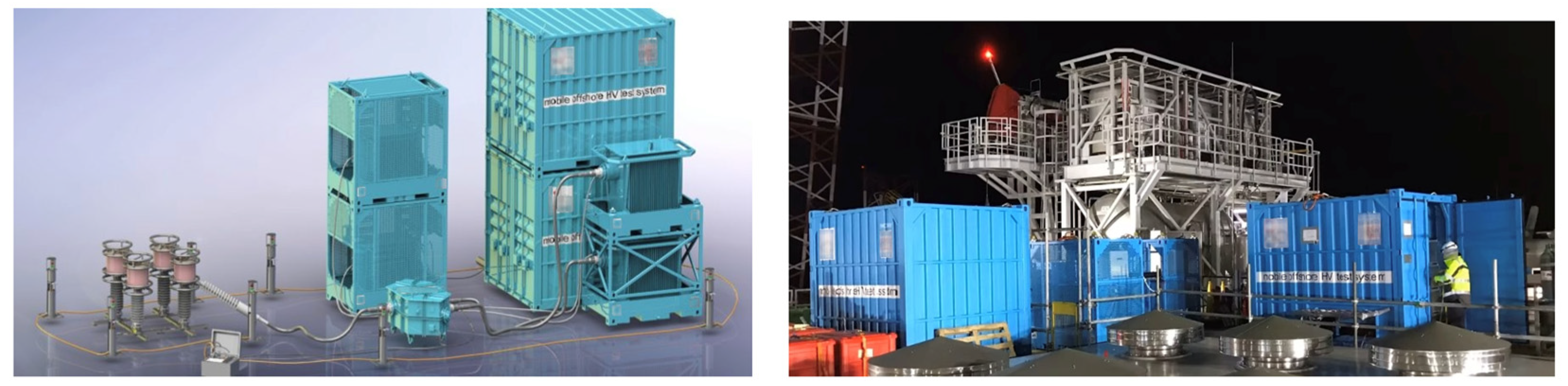
Figure 9. Example of AC resonant (ACRT) installation for SAT of 66 kV inter-array [33,34].
Energies 18 06624 g009
Figure 10. Example of a SAT of a 12 km long inter-array 66 kV cable string using a dual-side high power damped AC (DAC) 110 kV system [16].
Energies 18 06624 g010
Figure 11. Schematic test configuration of a single inter-array cable section from one WTG to the next, up to the OSS.
Energies 18 06624 g011
Figure 12. Schematic test setup of a complete IAC string between the OSS and the last wind turbine. Such IAC strings can be up to 20 km long.
Energies 18 06624 g012
Table 1. Fundamental aspects to be considered by the selection of the quality assurance method to perform site acceptance testing (SAT) of OWF export cables (EXCs) and inter-array cables (IACs).
Site Acceptance Tests for EXCs are not easy due to
                (a)
The length of the cables;
                (b)
Their location on the sea;
                (c)
Such conditions; as weather, logistics, time schedules, costs, etc.
Site Acceptance Tests for IACs are not easy due to
                (a)
The fact that an IAC string is a connection of several IAC sections installed under sea conditions;
                (b)
The length of the IAC strings and their accessibility only via WTG platforms located on the sea;
                (c)
Such conditions as weather, logistics, time schedules, costs, etc.
Best practice has so far shown that to maintain the required reliability of the installation in further operation, the terms of acceptance tests must be agreed upon in accordance with
                (a)
What is practically best possible and meaningful to be realized;
                (b)
What provides a sound basis for an appropriate assessment of the installation quality, e.g., to avoid future complaints for conscious neglect.
The assessment should not be based on the application of minimum standards or those based on the application of DNP methods, i.e., based on the period of reporting defects.
Table 2. SAT method expectations for EC and IAC to reduce transportation and installation costs and to introduce fewer failures.
Export Cables (EXCs)Inter-Array Cables (IACs)
Non-destructive testing and possibly high accuracy to pinpoint the weak spots, e.g., in accessories like terminations of factory or subsea joints and/or cable insulation.
Quality verification of the complete tens of kilometers long EXC connection, e.g., to verify if, during transportation and installation, no damage or defects have been introduced to the cable system.Quality verification of the IAC sections and above all, the complete strings, e.g., to verify if, during transportation, installation, no damage or defects have been introduced to the cable system.
Short time-effort, less space, weight, and costs needed to set up and to execute the test, e.g., days instead of weeks, tens m2 instead of hundreds m2, a few tons instead of a few hundreds of tons, etc.Short time-effort, less space, low weight, costs, and offshore transportation required to set up and to execute the tests, e.g., hours instead of days, single m2 instead of hundreds m2, a few tens of kg instead of a few tons, etc.
Effectiveness of manpower, time, and power supply effort during the test execution, e.g., hours instead of days, kVA instead of MVA, etc.Effectiveness of manpower, time, and power supply effort during the test execution, e.g., hours instead of days, a few kVA instead of a few MVA, etc.
Flexible and efficient way of testing complete IAC strings, e.g., by giving full fingerprint, etc.
Table 3. Testing parameters for newly installed and used OWF export cables [10,11,12,13] and acceptance criteria for newly installed long-length power cables, with a cable voltage class up to 275 kV [10,11,12,13].
Voltage Withstand TestPartial DischargesDielectric Losses
PD inception/extinction voltage (PDIV/PDEV)Dissipation factor Tan δ
PD amplitude in [pC]
PD amplitude–test voltage (qV) characteristics
Phase-resolved pattern
Partial discharge sites localization by the so-called PD mapping in a complete cable circuitThe ratio of tip-up Tan δ (Δ Tan δ)
Table 4. Testing parameters and acceptance criteria for newly installed long-length power cables, with a cable voltage class up to 275 kV [10,11,12,13].
Testing CriteriaEvaluation Criteria
Testing voltage levelTesting parameters compliant: [19,21,30,31,32]
Post-installation test at voltage level: 1.34 to 2.0Uo (to be agreed between the parties and depending on cable voltage class)
EM background noise level for partial discharge measurement Below 50 pC with a tolerance of ±20%
Withstand the test acceptance criterion.No breakdown occurred during the selected over-voltage time at the maximum test voltage, as confirmed by [19,31,32].
Partial discharge detection acceptance criterionNo concentration of more than 6 PD events per cycle up to the maximum test voltage level
Dissipation factor (Tan δ) acceptance criterion conforms to [10,11,12,13]Up to the maximum test voltage level, the dissipation factor should be less than 0.4%. Depending on the type of cable insulation material, the Δ Tan δ value should be less than 0.2% (with a tolerance of ±20%).
Table 5. Testing parameters.
OWF Export Cables Up to 275 kVDamped AC (10–300 Hz)AC Resonant (10–300 Hz)Soak Test
Site Acceptance Test (SAT) parametersVoltage level1.4–2 Uo1.4–2 UoUo
Duration50 excitations30–60 min24 h
Condition-Based Maintenance (CBM) parametersVoltage level1.0–1.7 Uo1.0–1.7 UoNOT Applicable
DurationAfter agreementAfter agreementNOT Applicable
Table 6. Impact on power grid stability.
OWF Export Cables up to 275 kVDamped AC (10–300 Hz)AC Resonant (10–300 Hz)Soak Test
Impact on power grid stabilityNo: There is no impact due to non-destructive testing, with the primary goal being to detect and localize future insulation defects.Yes: There might be a negative impact (risk) due to Breakdown/No-breakdown criteria.
A destructive test without a breakdown can increase the risk of future network failures.
Yes: There might be a negative impact due to
-
The presence of reactive power;
-
In case of a breakdown during test, network stability decreases, e.g., due to power frequency variations.
Therefore, some grid operators generally do not permit this SAT method.
Table 7. Evaluation of SAT characteristics.
OWF Export Cables up to 275 kVDamped AC (10–300 Hz)AC Resonant (10–300 Hz)Soak Test
Effectiveness of the after-laying testingHigh: Applicable to all types of potential insulation faults caused by partial discharges, monitored voltage with detection and localization of impending faults under test bench conditions; breakdown of considerable insulation faults possible.Low: Effective only for very rough insulation defects due to the Pass/Fail destructive criterion by breakdown during the voltage withstand test only.Very low: Only by very rough insulation defects that might create a breakdown at Uo.
Unnecessary destructiveness during after-laying testingLow: During applied-voltage withstand testing, in case of any forthcoming defects, sensitive PD detection (see Table 4) and localization in complete cable systems indicate harmfulness and the location of a potential breakdown.High: During applied-voltage withstand testing, there is no way to detect or localize upcoming discharge defects in parallel. Not applicable
Applicability for testing long lengths of offshore cablesHigh: Due to
  • Compactness of the system and very low on-site power demand;
  • Possibility to energize cables with lengths up to 100 km with one system;
  • Possibility to detect and to localize discharging defects.
Low: Due to
  • Extremely high size/weight of the systems and very high-power demand onsite;
  • Lack of a possibility to detect and to localize the discharging defect.
No: It is known that the soak test does not contribute to the quality assurance of very long export cables installed, so there is no guarantee of the quality and reliability of the installed cable system.
Table 8. Partial discharge detection.
OWF Export Cables up to 275 kVDamped AC (10–300 Hz)AC Resonant (10–300 Hz)Soak Test
Effective standardized PD measurementYes: Centralized, standardized [23] at cable ends.
For long cable runs, bilateral partial discharge detection is used.
No: The ACRT system produces a high level of EM disturbances that significantly decreases the sensitivity of the PD measurement. Therefore, ACRT cannot perform sensitive (see Table 4), standardized PD measurements. Moreover, distributed unconventional PD detection at cable accessories connected to the cable sheath is not applicable.Not applicable
PD characteristics comparable to AC 50 HzYesYesNot applicable
A voltage source has its own noise level of the power sourceLow: (Below 3 pC)High: Up to a few thousand of pCsNot applicable
Noise level of a complete onsite PD measuring circuit consisting of a voltage source, test object, and connectionsLow: ≤25 pC with tolerance of ± 20%High: Up to a few thousand of pCsNot applicable
PD localization along the whole cable lengthYes: Overall, at terminations, all joint types and all cable sections.No: Due to very high EM disturbances and a lack of TDR-based localization in a complete cable system.Not applicable
Effectiveness in the detection and localization of PD in a complete cable systemHigh: Due to dual-side detection in accordance with [23,24] standardized PD detection and low noise level.No: Due to HF PD local detection at cable terminations, no full detection on the complete export cable length.Not applicable
Table 9. Testing and condition assessment of power cables.
OWF Export Cables up to 275 kVDamped AC (10–300 Hz)AC Resonant (10–300 Hz)Soak Test
Cable condition assessment based on the obtained resultsComplete: Based on the following parameters:
  • Breakdown: yes/no;
  • Partial discharge detection dependent on voltage;
  • Partial discharge location is dependent on cable length;
  • Tangent delta dependent on voltage.
Limited: Decisions based by a breakdown, Yes/No only.Limited: Decisions based by a breakdown in the case of a very rare, extreme installation defect.
Testing and measurement techniques suitable for detecting problemsComplete: Due to the following:
  • Installation errors that result in a breakdown;
  • Installation problems not causing a direct breakdown, but that cause PD;
  • Localization of the distributed or localized PD activity.
Limited: To significant installation errors, which will cause a breakdown during voltage withstand.Not applicable
Table 10. Test systems’ physical properties.
OWF Export Cables up to 275 kVDamped AC (20–300 Hz)AC Resonant (20–300 Hz)Soak Test
System size/weightSmall: Limited footprint (below 15 m2), low weight (truck load capacity below 1.5 tons).
For testing longer lengths, the same system is applicable.
Large: Extended footprint (up to a few hundred m2), heavy, fixed installed on many truck trailers (1 trailer: 40 ft > 25 tons).
For testing longer lengths, several trailers are required.
Not applicable
Required input powerLow: (<20 kVA)Large: (>1000 kVA), increasing with cable capacitance.Not applicable
System erecting effortLow: Modular system, setup time < 1 h.High: Heavy and large, setup time several hours/days.Not applicable
History of applicationIn use for more than 20 years. In use for more than 25 years.Not applicable
Table 11. Overall benchmark of technical, logistic, weather, and economic aspects.
OWF Export Cables up to 275 kVDamped AC (10–300 Hz)AC Resonant (10–300 Hz)Soak Test
Quality verification of the complete tens of km long EXC connectionsHighLowNot applicable
Non-destructive testing and possibility to pinpoint the weak spotsHighLowNot applicable
Short time-effort and costs needed to set up the testingYesNoNot applicable
Effectiveness of manpower and time-effort in the test executionHighLowNot applicable
Price performance ratioHighLowLow
Table 12. Testing parameters for newly installed OWF inter-array cables [10,11,12,13].
OWF Inter-Array Cables up to 66 kVDamped AC (10–300 Hz)VLF Sinusoidal 0.1 Hz or Cosine-Rectangular 0.1 HzAC Resonant (10–300 Hz)Soak Test
Site Acceptance Test (SAT) parametersVoltage level2 Uo3 Uo2 UoUo
Duration50 excitations15–60 min30–60 min24 h
Condition Based Maintenance (CBM) parametersVoltage level1.4–1.7 Uo1.5–2.3 Uo1.4–1.7 UoNOT applicable
DurationAfter agreementAfter agreementNOT applicable NOT applicable
Table 13. Ability to perform PD-monitored voltage test incl. Tan Delta test of a complete string, e.g., of 8 wind turbines or more.
Damped AC (10–300 Hz)VLF Sinusoidal 0.1 Hz or Cosine-Rectangular 0.1 Hz AC Resonant (10–300 Hz)Soak Test
Max. cable length to be tested Yes, between the OSS and the last WTG, the complete cable string, e.g., up to 20 km and above.No, from one WTG to the next WTG cable section only (approx. 1 km)No, from one WTG to the next WTG cable section only (approx. 1 km)No, voltage withstand test only from OSS to the next WTGs (approx. 1–3 km)
Ability to detect PD on complete IAC strings with length, e.g., >10 kmYes, applying dual-side solutions, PD detection, and localization in cable lengths of up to a few tens of kilometers can be tested.No, due to cable lengths limitation and presence of high level of EM disturbancesNo, due to cable lengths limitation and presence of high level of EM disturbancesNot applicable
Table 14. Partial discharge detection, including localization.
Damped AC (10–300 Hz)VLF Sinusoidal 0.1 Hz or Cosine-Rectangular 0.1 Hz AC Resonant (10–300 Hz)Soak Test
Effective standardized PD measurementYesYes, in case of VLF Sinusoidal 0.1 Hz
NO in case of VLF Cosine-Rectangular 0.1 Hz
NoNot applicable
PD characteristics comparable to AC 50 Hz YesNoYesNo
Noise level of the power sourceVery low due to dedicated system design and circuits configuration low, 25 pC ± 20% (conform IEC 60270) possible High due to presence of EM interferences from the voltage sourceVery high due to presence of high (range of several nC) EM interferences from the source Very high due to presence of extreme high EM interferences from network
PD localization along the whole cable lengthYes, due to application of dual-side PD detection and localizationNoNoNot applicable
Table 15. Technical aspects for the use on offshore platforms.
Damped AC (10–300 Hz)VLF Sinusoidal 0.1 Hz or Cosine-Rectangular 0.1 HzAC Resonant (10–300 Hz)Soak Test
Protect against offshore conditions and ensure it is safe for transportation and use on the platform.Dedicated PD- and Tan Delta-based solution for 33 kV and for 66 kV available on the market; due to compactness, easy to transport and install.No dedicated solution available on the marketNo dedicated solution available on the marketNOT applicable
Size of a complete voltage system, PD detection system, Tan Delta system
Table 16. Overall benchmarking of technical logistics, weather, and economic aspects.
Damped AC (10–300 Hz)VLF Sinusoidal 0.1 Hz or Cosine-Rectangular 0.1 HzAC Resonant (10–300 Hz)Soak Test
Quality verification of the IAC sections and complete stringsYesNoNoNot applicable
Non-destructive testing and high accuracy to pinpoint the weak spots
Short time-effort and costs needed to transport and install offshore
Effectiveness of manpower and time-effort in the test execution
Table 17. Single inter-array cable testing versus complete inter-array cable strings.
Benchmark CriteriaTesting Single IAC Cable Sections Between Individual WTGsTesting of Complete IAC Strings Between OSS and the Last WTG at the End of a String
The test provides information about the conditionLimited information due to testing a single cable section without the connecting terminations.High-quality information due to testing the complete IAC string, including all connections on individual WTGs.
Number of tests needed to be executedSimilarly to the number of all WTGs, e.g., 80.
Compared to complete IAC string testing, more preparatory work is needed before testing, such as installing test adapters.
The number of IAC strings ≈ is 80% lower than for testing single IAC cable sections, e.g., 16 (with 5 WTGs in one string).
Less test preparation work is required compared to a single IAC test, e.g., fewer installations of test adapters.
Basis for condition-based maintenance (CBM) for OpExPartial fingerprint limited due to lack of information on the complete IAC string, as only the individual sections have been tested separately.A complete fingerprint is highly valuable because it provides comprehensive information about the entire tested IAC string under normal operating conditions.
Costs of execution, logistic effort, and execution risks4 to 5 times higher than the testing of the complete IAC only.4 to 5 times lower than testing all cable sections between individual WTGs.
Table 18. Recommended test parameters for the withstand test for site acceptance testing (SAT and condition-based maintenance (CBM)).
PurposeCable ClassACVLFDAC
Voltage Level (kV)F (Hz)Duration (min)Voltage (sin)Voltage (co-rect.)F (Hz)Duration (min)Voltage Level (kV)F (Hz)Number of Excitations
SAT45 < U < 1152.0 Uo10–300603.0 Uo4.2 Uo0.1602.0 Uo10–30050
132 < U < 1611.7 Uo2.5 Uo3.6 Uo1.7 Uo
CBM45 < U < 1151.7 Uo2.2 Uo3.1 Uo1.7 Uo
132 < U < 1611.5 Uo2.0 Uo2.8 Uo1.5 Uo
Table 19. Summary technical benchmark of SAT for EXCs.
Export Cables (EXCs)Damped AC (10–300 Hz)AC Resonant (10–300 Hz)Soak Test
Impact on power grid stability; for more details, see Table 6.NoYesYes
Evaluation of SAT characteristics; for more details, see Table 7.Very applicableLess acceptableNot acceptable
Partial discharge detection; for more details, see Table 8.YesNoNot applicable
Testing and condition assessment of power cables; for more details, see Table 9.CompleteLimitedNot applicable
Test systems physical properties; for more details, see Table 10.CompactLargeNot applicable
Overall benchmark of technical, logistic, weather, and economic aspects; for more details, see Table 11.HighLowNot applicable
Table 20. Summary technical benchmark of SAT of IACs.
Inter-Array Cables (IAC)Damped AC (10–300 Hz)VLF Sinusoidal 0.1 Hz, or Cosine-Rectangular 0.1 HzAC Resonant (10–300 Hz)Soak Test
Ability to perform PD-monitored voltage test incl. Tan Delta test of a complete string, e.g., of 8 wind turbines or more; for more details, see Table 13.YesNoNoNot applicable
Partial discharge detection, including localization; for more details, see Table 14.YesYes/NoNoNot applicable
Technical aspects for the use of offshore platforms; for more details, see Table 15.Dedicated market available solutionsNo dedicated solutionsNo dedicated solutionsNot applicable
Overall benchmarking of technical logistics, weather, and economic aspects; for more details, see Table 16.YesNoNoNot applicable
Applicability for Sat of complete IAC strings; for more details, see Table 17.YesNoNoNot applicable
Disclaimer/Publisher’s Note: The statements, opinions and data contained in all publications are solely those of the individual author(s) and contributor(s) and not of MDPI and/or the editor(s). MDPI and/or the editor(s) disclaim responsibility for any injury to people or property resulting from any ideas, methods, instructions or products referred to in the content.