Article

Governance Quality and the Green Transition: Integrating Econometric and Machine Learning Evidence on Renewable Energy Efficiency in Sub-Saharan Africa


1
School of Management, Wuhan University of Technology, Wuhan 430070, China
2
School of Finance, Zhongnan University of Economics and Law, Wuhan 430070, China
*
Author to whom correspondence should be addressed.
Energies 2025, 18(24), 6618; https://doi.org/10.3390/en18246618
Submission received: 12 November 2025 / Revised: 7 December 2025 / Accepted: 13 December 2025 / Published: 18 December 2025
(This article belongs to the Section C: Energy Economics and Policy)

Abstract

Renewable energy efficiency (REE) remains critically low across many Sub-Saharan African (SSA) countries, yet the existing literature provides limited empirical clarity on how governance quality shapes efficiency outcomes and through which mechanisms these effects operate. This study addresses this gap by examining the influence of governance quality on REE in 23 SSA countries from 2005 to 2023, drawing on institutional theory and innovation diffusion theory. The analysis investigates three mediating channels, renewable investment, green policy, and green technology, using a multidimensional empirical framework that integrates the Malmquist Productivity Index (MPI), Two-Step System GMM, Generalized Estimating Equations (GEE), Generalized Least Squares (GLS), and Panel-Corrected Standard Errors (PCSE). Results consistently show that governance quality significantly enhances REE through investment, policy, and technological pathways. To capture nonlinearities and heterogeneous responses often overlooked in traditional models, we complement the econometric estimations with causal machine-learning simulations (Double Machine Learning and Causal Forests). These counterfactual analyses reveal that governance improvements and renewable-policy adoption produce the highest efficiency gains in mid-governance countries with stronger absorptive capacity. While the study offers policy-relevant insights, limitations remain, due to data constraints, unobserved institutional dynamics, and the uneven maturity of green-technology systems across the region. Nevertheless, the findings underscore that strengthening governance and fostering innovation are fundamental to accelerating a sustainable and inclusive green-energy transition in Sub-Saharan Africa.

1. Introduction

The global transition to renewable energy has become a central pillar in addressing the climate crisis, as nations seek to decarbonize energy systems and pursue sustainable economic growth. In Sub-Saharan Africa (SSA), this transition carries exceptional importance given the region’s expanding energy demand, persistent energy poverty, and urgent need for structural transformation. Responding to both environmental imperatives and developmental needs, many SSA countries are gradually shifting from fossil-based systems to renewables such as solar, wind, hydropower, and geothermal energy [1]. This transformation promises not only reductions in carbon emissions but also improved energy security, industrial diversification, and green job creation. As renewable technologies become more affordable, SSA’s transition represents a pivotal opportunity to foster a low-carbon, inclusive, and resilient energy future.
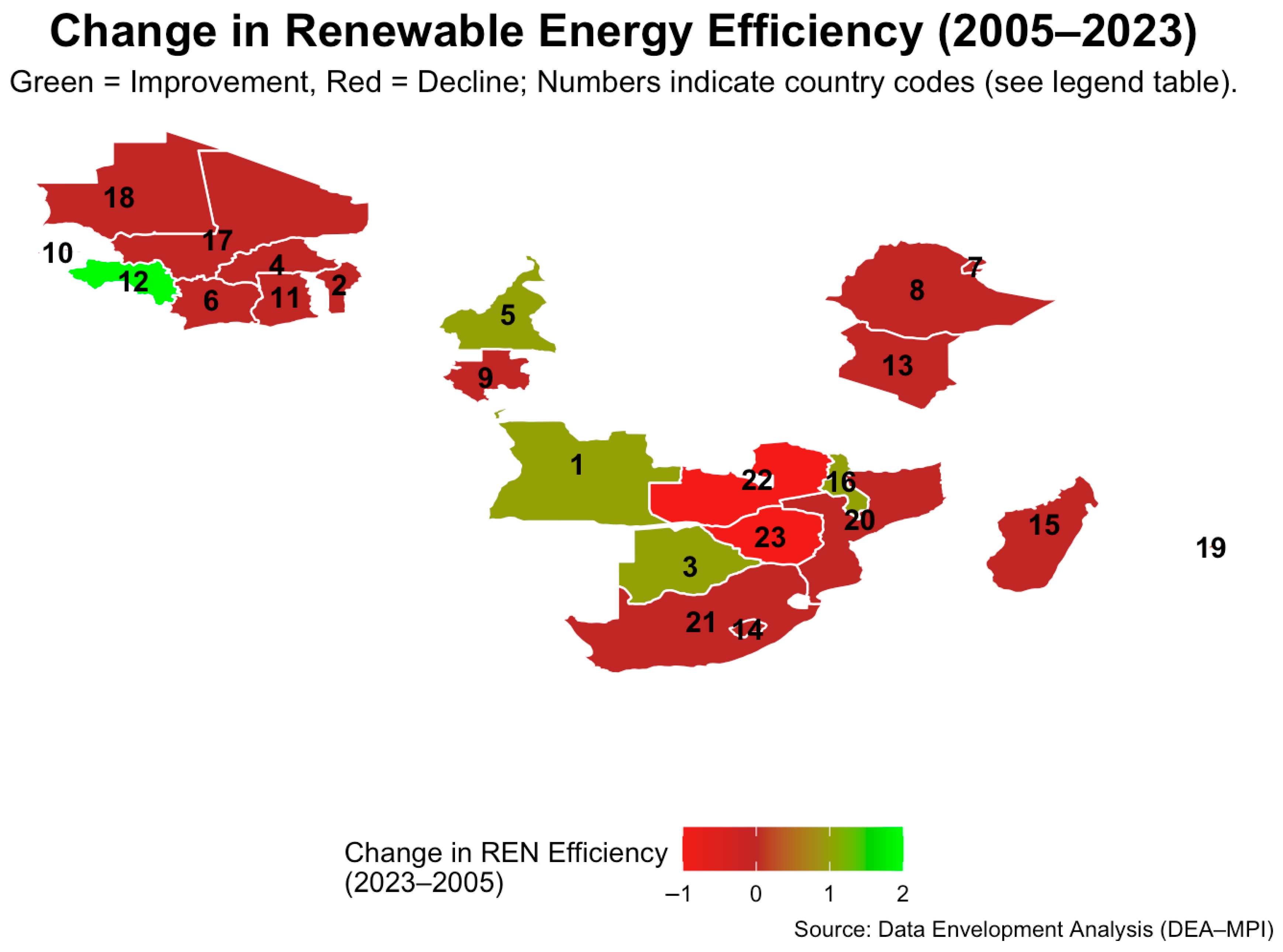
Yet, the pathway to optimizing renewable energy efficiency remains uneven across the region. Despite increasing clean energy investments, SSA countries continue to face challenges such as underdeveloped infrastructure, fragmented regulatory frameworks, and restricted access to finance and technology [2]. Figure 1 illustrates substantial disparities in renewable energy efficiency (REE) across SSA between 2005 and 2023. While countries such as Kenya and Namibia demonstrate significant progress, others have stagnated or declined, revealing persistent institutional and governance barriers that undermine the effectiveness of energy transitions. These differences highlight that technical capacity alone cannot guarantee progress, effective governance remains a decisive enabling factor.
SSA faces chronic underinvestment in energy infrastructure, policy fragmentation, and limited access to finance and technology. For example, Ethiopia’s Grand Ethiopian Renaissance Dam (GERD) has increased hydropower generation but faces grid inefficiencies and governance challenges that limit its potential. Similarly, South Africa’s Renewable Energy Independent Power Producer Procurement Programme (REIPPPP) has expanded wind and solar capacity, but policy inconsistencies and regulatory uncertainty have slowed progress [3]. In contrast, Kenya’s success in geothermal energy can be attributed to strong governance, coherent policies, and effective public–private partnerships [4,5].
These challenges emphasize the crucial role of governance in the successful deployment of renewable energy systems. While technological advancements have driven progress, inefficiencies in energy production, distribution, and consumption are still prevalent in SSA, often reflecting weak governance and institutional frameworks. Countries like Nigeria and Ghana face delays in renewable projects due to fragmented policies and inconsistent regulatory enforcement. In contrast, Rwanda’s coordinated approach has accelerated the rollout of off-grid solar solutions. Regions with weaker governance face persistent barriers, limiting investment and slowing technological progress [6,7].
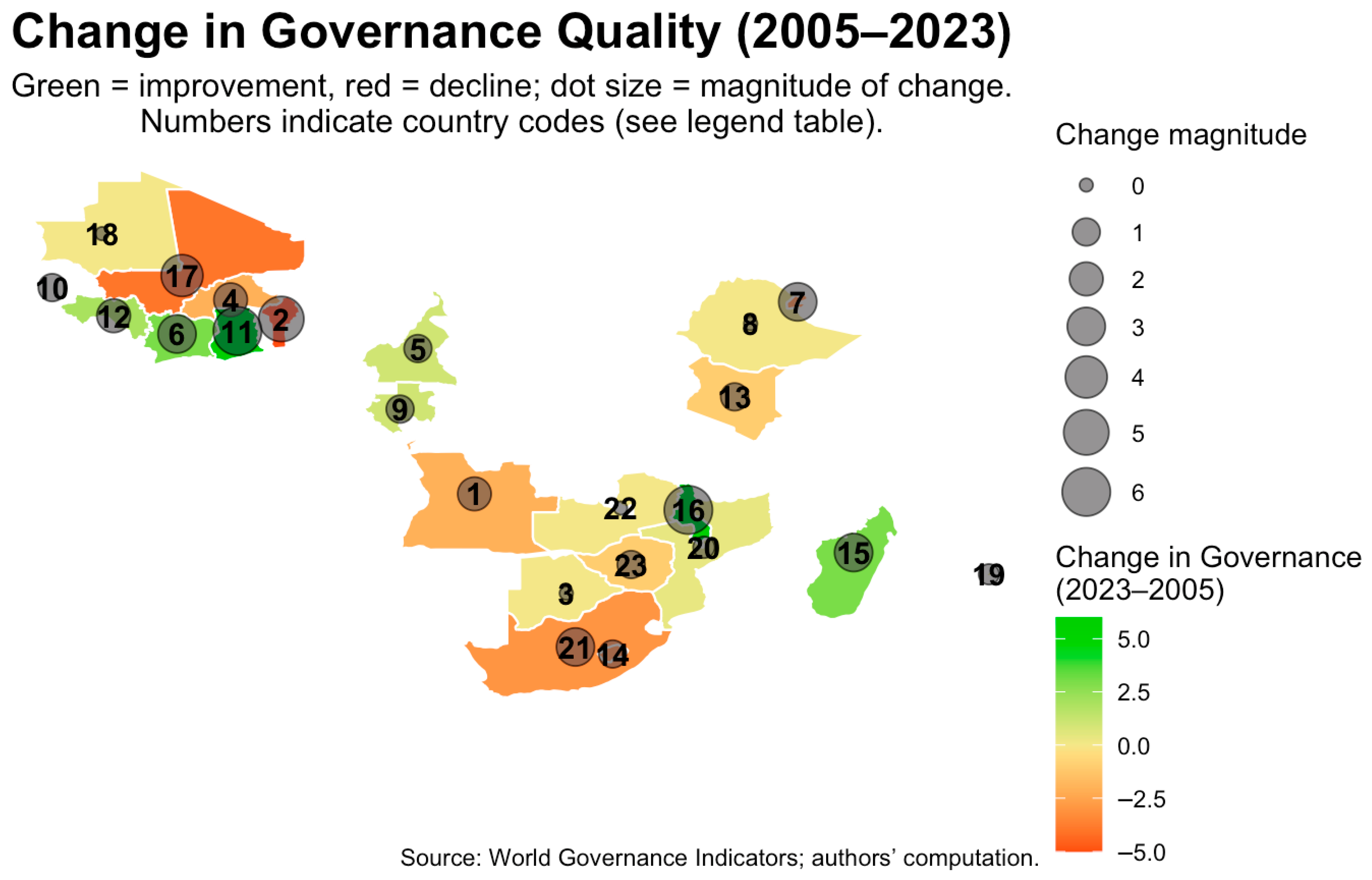
Governance quality is key to addressing these inefficiencies by creating a stable regulatory environment that reduces uncertainty and attracts renewable energy investment. Botswana, for example, benefits from stable institutions supporting energy sector reforms, while countries like the Democratic Republic of Congo experience policy instability that hinders energy sector development [8]. Effective governance fosters technological innovation, ensures regulatory enforcement, and coordinates efforts among governments, private sectors, and civil society, enabling more efficient deployment of renewable technologies. Figure 2 shows varied improvements in governance quality across SSA, emphasizing the need to examine how governance influences renewable energy outcomes.
While considerable research has been devoted to exploring the relationship between governance and renewable energy efficiency, the specific mediating role of governance quality remains underexamined, especially in SSA [9,10,11]. High governance quality shapes the effectiveness of public institutions, the stability of regulatory frameworks, and the consistency of energy policies, all of which are pivotal for scaling renewable energy technologies. However, most existing research focuses on broad governance indicators, such as political stability and regulatory quality, without delving into how particular governance dimensions mediate the connection between policy implementation and renewable energy efficiency, especially within the African context.
Governance quality is a multifaceted concept, including regulatory quality, government effectiveness, rule of law, and political stability [12,13]. These elements shape a government’s ability to design and implement policies that promote renewable energy and improve energy efficiency. Institutional theory and Innovation Diffusion Theory (IDT) provide useful frameworks for understanding how governance impacts renewable energy outcomes [14]. Institutional theory focuses on the role of formal rules and policies, while IDT explains how innovations like green technologies spread within societies. Research suggests that strong governance supports effective energy policies, which, in turn, improve energy efficiency [15,16]. However, existing studies often overlook granular governance elements that directly impact SSA’s energy systems, such as creating policies that encourage clean energy investments and institutional frameworks that accelerate technology adoption.
Furthermore, conventional econometric studies often impose linear assumptions that may fail to capture the complex nonlinear interactions between governance, policy, and technology. Emerging machine-learning approaches offer new opportunities to uncover such hidden patterns and simulate counterfactual policy outcomes under alternative governance or investment scenarios [17]. By combining advanced econometric modeling with causal machine-learning techniques, researchers can derive more precise and policy-relevant insights into where and how governance reforms yield the largest energy efficiency gains.
In view of the above, this study aims to systematically examine how governance quality affects renewable energy efficiency across 23 SSA countries from 2005 to 2023. Specifically, the study evaluates both the direct effect of governance and the indirect pathways operating through renewable investment, green policy adoption, and green technological progress. By integrating econometric methods, including MPI-DEA, Two-step System GMM, GEE, GLS, and PCSE, with causal machine-learning tools such as Double Machine Learning and Causal Forests, the study provides a rigorous assessment of the institutional foundations required to accelerate the renewable energy transition in the region.
This research contributes to the literature in three distinct ways. First, it advances theoretical understanding by linking governance quality to renewable energy efficiency through the joint lenses of institutional capability and innovation diffusion. Second, it introduces a novel methodological integration of econometric and causal machine-learning approaches to model both linear and nonlinear governance–energy relationships and simulate counterfactual policy outcomes. Third, it provides actionable evidence for policymakers by identifying country clusters and governance conditions under which reforms, investments, and green technology adoption yield the highest efficiency gains. The remainder of the paper proceeds as follows: Section 2 presents the theoretical framework and hypotheses, Section 3 outlines the empirical methodology and data, Section 4 reports and discusses the results, and Section 5 concludes with policy implications and recommendations for advancing sustainable energy transitions in SSA.

2. Hypotheses Development

2.1. Direct Effect of Governance Quality of Renewable Energy Efficiency

The relationship between governance quality and renewable energy efficiency (REE) has attracted increasing scholarly attention, particularly in the context of Sub-Saharan Africa’s ongoing energy transition. Institutional theory, as articulated by North (1990) [18], provides a valuable framework for understanding this relationship. It posits that the behavior of organizations, including governments, is shaped by institutional contexts such as regulatory frameworks, policy norms, and governance structures. Within this theoretical lens, high-quality governance characterized by effective regulation, political stability, and the robust enforcement of rules emerges as a fundamental determinant of a country’s capacity to formulate and implement energy-efficient policies and technologies. Thus, renewable energy efficiency is not merely a technical or engineering challenge; it is deeply influenced by the quality of governance, which creates the enabling environment for successful policy development and innovation [19,20].
A growing body of empirical research underscores the pivotal role that governance quality plays in shaping energy efficiency outcomes, especially within developing regions. For instance, ref. [15] demonstrates that countries with robust governance frameworks tend to achieve greater success in renewable energy project implementation. Strong governance mitigates market barriers, encourages both public and private investment, and accelerates the diffusion of green technologies. Complementary evidence from [20,21] highlights the positive association between institutional quality as measured through dimensions such as political stability, regulatory quality, and government effectiveness, and improvements in energy efficiency, particularly in relation to green innovation and renewable energy adoption. In contrast, weak governance, often marked by regulatory uncertainty, lack of transparency, and ineffective policy enforcement, can stifle technological progress and hinder the optimization of renewable energy systems [22,23].
Further supporting this relationship, ref. [22] argues that countries with effective energy policy regimes, underpinned by high-quality governance, demonstrate significantly higher energy efficiency, particularly in the industrial sector. Strong governance increases the likelihood of designing and sustaining long-term stable policy frameworks that attract investment and drive technological advancement in the renewable energy sector [15]. These findings are in alignment with institutional theory, which posits that well-functioning institutions enable the establishment and enforcement of effective regulatory frameworks that underpin successful renewable energy projects and efficiency improvements. Building on this theoretical and empirical foundation, the following hypothesis is proposed:
H1: 
Governance quality has a direct positive effect on renewable energy efficiency in Sub-Saharan Africa.

2.2. Transmission Mechanisms (Renewable Energy Investment, Green Policies, and Green Technology)

The central tenet of this study is the assertion that governance quality serves as a key driver of renewable energy efficiency (REE), with multiple mechanisms mediating this relationship. Building on institutional theory and innovation diffusion theory, this study advances the empirical literature by investigating specific mediating factors, namely, renewable investment, green policies, and green technologies that link governance quality to REE in Sub-Saharan Africa. The hypotheses developed in this work are firmly grounded in these theoretical perspectives and supported by prior empirical findings, collectively highlighting how governance quality shapes REE through these critical mediating channels.
According to institutional theory, governance quality is fundamental in shaping the regulatory environment, delivering stability and predictability that are essential for attracting and sustaining investment [18]. High governance quality reduces market uncertainties, enhances investor confidence, and provides the incentives necessary for both public and private sector actors to invest in renewable energy technologies. As noted by [24], countries with strong governance frameworks are better positioned to mobilize substantial investments in renewable energy investments that are vital for the successful transition to cleaner more efficient energy systems. Furthermore, ref. [25] emphasizes that without significant and sustained investment, it is exceedingly difficult for countries to achieve long-term sustainable energy outcomes. Such investment is particularly critical for infrastructure development and for scaling up renewable energy deployment, both of which are prerequisites for improved energy efficiency.
In line with these arguments, refs. [26,27] contend that strong governance minimizes the risks inherent in energy transitions, thereby facilitating greater flows of renewable energy investment. Hussain [27] further corroborates this perspective by suggesting that good governance acts as a catalyst, directly contributing to increased investment in renewable energy and, by extension, to enhancements in energy efficiency. Empirical evidence demonstrates that countries exhibiting higher governance quality tend to attract higher levels of renewable energy investment, which subsequently translates into measurable improvements in energy efficiency. These findings are consistent with institutional theory, which posits that robust governance structures, by fostering a favorable investment climate, are indispensable enablers of sustainable and efficient energy systems. Drawing on both the empirical evidence and the theoretical framework, the second hypothesis is articulated as follows:
H2: 
Renewable investment mediates the effect of governance quality on renewable energy efficiency in Sub-Saharan Africa.
Moreover, one of the most critical mechanisms by which governance quality exerts its influence on renewable energy efficiency (REE) is through the formulation, implementation, and enforcement of green policies. Institutional theory emphasizes that governance quality shapes not only the design but also the consistency and effectiveness of policies that underpin renewable energy adoption and improvements in energy efficiency [18]. High-quality governance provides the regulatory stability and policy coherence necessary for fostering long-term investment in renewable technologies and ensures that associated policies such as renewable energy targets, financial incentives, and environmental regulations are robustly enforced and consistently applied [28]. Effective policy frameworks serve as critical facilitators of renewable energy transitions by providing clear guidelines and incentives for both technological innovation and market uptake.
The empirical evidence strongly supports the mediating role of green policies in the relationship between governance quality and renewable energy efficiency. For instance, ref. [29] shows that, within the EU-28 context, robust governance systems significantly enhance environmental and energy efficiency through the effective design and enforcement of green policies. Similarly, ref. [30] argues that strong governance is essential not only for the creation of policies that promote renewable energy adoption but also for ensuring that these policies generate tangible improvements in energy efficiency at the national level. These findings suggest that governance quality directly influences the development and success of green policies, which in turn enable the widespread diffusion and optimization of renewable energy technologies.
Additional evidence highlights the importance of well-structured and well-enforced policies. Ref. [31] demonstrated that policy instruments such as tradable certificates for renewable electricity and energy savings, when supported by strong governance, are vital for integrating renewable energy systems into national grids and driving energy efficiency gains. Ref. [23] further reinforces that the effectiveness of green policies as products of sound governance is indispensable for driving national energy efficiency and promoting broader sustainability objectives. Likewise, ref. [32] shows that environmental policies, particularly those targeting power sector reforms and crafted within a context of high governance quality, lead to substantial improvements in energy efficiency and financial performance in the power sector.
The significance of government policy in closing the energy efficiency gap is further emphasized by [20], who find that countries with effective governance frameworks and targeted policy interventions are able to create environments conducive to the development and adoption of renewable energy technologies. Ref. [33] also stressed the importance of environmental, social, and governance (ESG) performance in shaping green tax policies and advancing sustainability, thereby demonstrating that governance quality is fundamental in shaping policies that foster both energy efficiency and long-term environmental stewardship. In light of this strong empirical and theoretical support, it is evident that governance quality plays a pivotal role in shaping policy frameworks that advance renewable energy adoption and enhance energy efficiency in Sub-Saharan Africa. Green policies, as key mediators, translate improvements in governance quality into measurable gains in renewable energy efficiency across SSA countries. Accordingly, we propose the following hypothesis:
H3: 
Green policies mediate the effect of governance quality on renewable energy efficiency in Sub-Saharan Africa.
In addition to renewable investment and green policy, green technology serves as a critical mechanism in enhancing renewable energy efficiency (REE) across Sub-Saharan Africa. Green technologies, including solar panels, wind turbines, and energy-efficient systems are fundamental in optimizing energy production and consumption. Drawing from Innovation Diffusion Theory (IDT), which emphasizes the influence of social systems and institutional context on the spread of innovation, it is evident that governance quality is instrumental in supporting the development, adoption, and diffusion of green technologies [28]. According to IDT, the success of green technology adoption is contingent not only on technological attributes but also on the regulatory, financial, and governance frameworks that facilitate their integration into the broader energy system.
Empirical research supports the mediating role of green technology in the governance-REE nexus. For example, ref. [34] demonstrates that investments in green technologies and technological innovation significantly contribute to improvements in renewable energy efficiency, highlighting the dual importance of financial support and innovation for scaling up clean energy solutions and advancing sustainable development goals. Similarly, ref. [35] emphasizes that ongoing technological innovation is essential for improving energy systems, as new energy-efficient technologies help to reduce overall energy consumption while maintaining or enhancing system performance.
Additional studies further clarify the enabling role of governance. Ref. [36] found that the widespread adoption of green technologies is shaped by the governance quality, availability of financial incentives, and technological maturity, indicating that robust institutional and policy support are prerequisites for successful technology diffusion. Ref. [37] further examined the interplay between green technology adoption, energy efficiency, economic development, and FDI, concluding that green technologies are effective in promoting cleaner energy sources, enhancing efficiency, and mitigating climate change particularly when supported by strong policies and innovative financial mechanisms.
In the context of China, ref. [38] underscores the vital role of renewable energy technologies in addressing climate challenges, noting that the integration of green technologies is one of the most effective pathways to improved energy efficiency and environmental sustainability. Taken together, these studies underscore the centrality of green technology as a mediator in the relationship between governance quality and renewable energy efficiency. High-quality governance facilitates the creation of supportive institutional, financial, and regulatory environments, which are essential for the successful deployment and optimization of green technologies. This, in turn, leads to measurable improvements in energy efficiency and advances progress toward sustainable development objectives. Based on this synthesis of theoretical and empirical insights, we propose the following hypothesis:
H4: 
Green technology mediates the effect of governance quality on renewable energy efficiency in Sub-Saharan Africa.
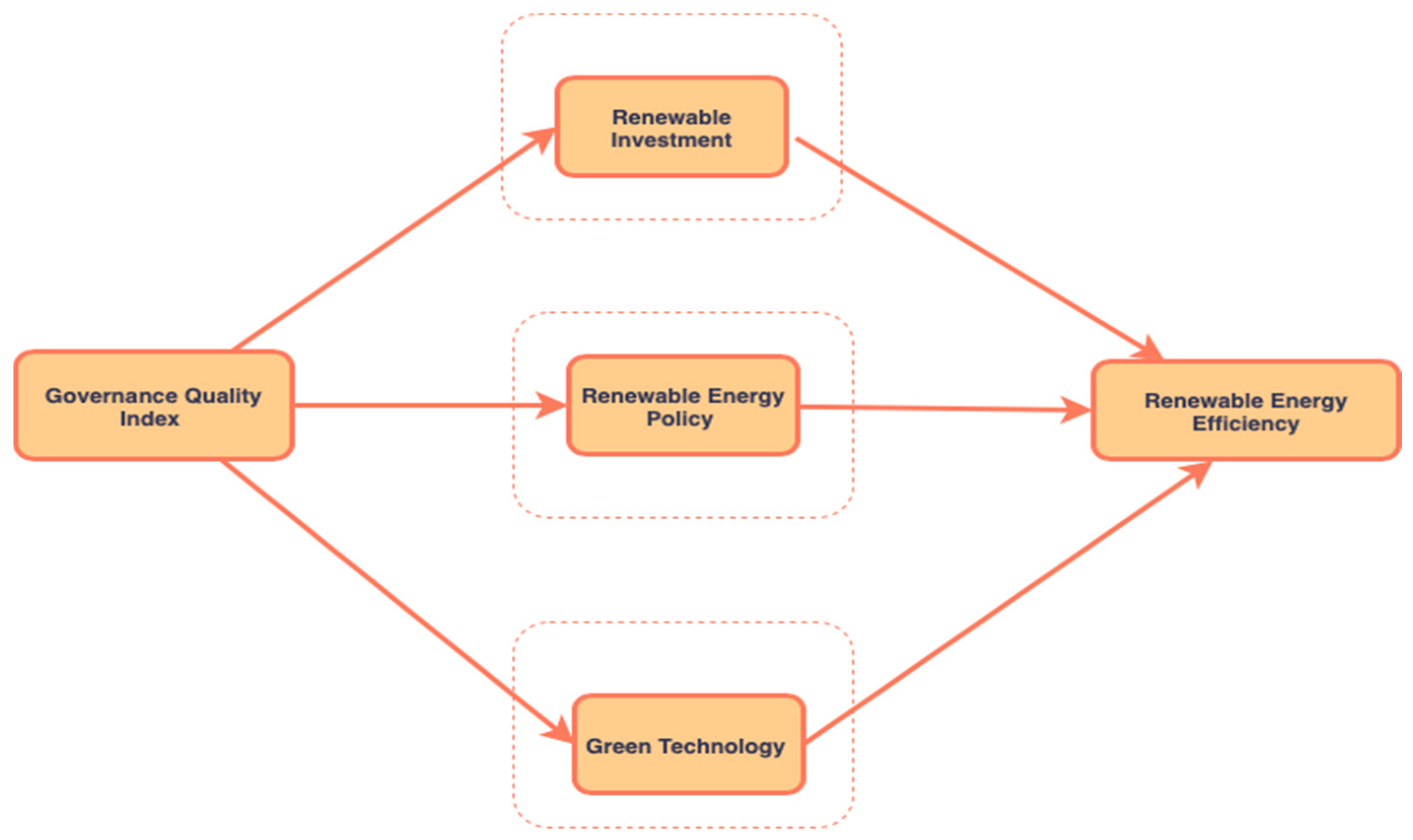
The empirical evidence reviewed in this study provides strong support for the proposed hypotheses, emphasizing the critical role of governance quality in enhancing renewable energy efficiency through pathways such as renewable investment, green policies, and green technologies in Sub-Saharan Africa. Both institutional theory and innovation diffusion theory offer valuable frameworks for understanding how governance quality shapes the evolution of energy systems, with technological innovation, policy reforms, and targeted investment acting as core mediators in this relationship. By investigating these mechanisms, the present study seeks to deepen our understanding of how governance quality influences renewable energy efficiency in the African context. The hypotheses formulated are consistent with prior research and contribute new insights into the complex and multifaceted ways that governance structures affect energy outcomes in SSA, as reflected in the conceptual framework (see Figure 3).

3. Methods

3.1. Variable Measurement

This study evaluates the role played by governance quality, renewable energy investment, green policy, and technology on renewable energy efficiency (REE) across 23 Sub-Saharan African (SSA) countries from 2005 to 2023. The selected countries represent a range of institutional, policy, and technological environments, providing a comparative analysis of how governance and policy frameworks shape renewable energy efficiency in the region. These countries include a mix of low- and middle-income economies, from relatively stable nations like Botswana and Ghana to those with weaker governance, such as the Democratic Republic of Congo and South Sudan.
The core dependent variable in this study is Renewable Energy Efficiency (REE), as summarized in Table 1. The REE is measured following established approaches in the energy-efficiency literature [39,40], using the Malmquist Productivity Index (MPI) combined with a non-parametric Data Envelopment Analysis (DEA) framework. The MPI enables the decomposition of renewable-energy performance into (i) technical efficiency: how effectively inputs are transformed into outputs; and (ii) technological progress: shifts in the production frontier due to advances in renewable-energy technologies. Let each country employ a vector of inputs xt = (x1t, x2t,……, xkt), to generate desirable and undesirable outputs yt = (y1t, y2t). Based on the output-distance function, the Malmquist Productivity Index between periods (t) and (t + 1) is defined as
M P I t , t + 1 D t x t + 1 ,   y t + 1 D t x t ,   y t   ×   D t + 1 x t + 1 ,   y t + 1 D t + 1 x t ,   y t     1 2
where D t ( . ) denotes the out-distance function at time (t). MPI decomposes into two components: Technical Efficiency Change (TEC) and Technological Change (TC). The TEC is computed as
T E C i t = D t + 1 x t + 1 ,   y t + 1 D t x t ,   y t  
T C i t = D t x t ,   y t D t + 1 x t ,   y t  
The REE is defined as the product of these two components: R E E i t = T E C i t × T C i t .
In this study, the inputs include capital stock, renewable energy consumption, and labor while the output set includes GDP per capita (desirable outputs) and CO2 emissions (undesirable outputs). This specification follows modern empirical energy-efficiency research [41,42,43] and provides a holistic representation of how countries convert economic resources into renewable-energy outcomes. The chosen inputs and outputs capture both the economic and environmental dimensions of renewable-energy performance. GDP per capita reflects the productivity gains associated with renewable-energy deployment, while CO2 emissions capture a country’s ability to reduce environmental harm as renewable penetration increases. Capital stock and labor represent the fundamental economic resources required for energy-sector productivity, whereas renewable-energy consumption reflects the extent of a country’s clean-energy utilization. By integrating these economic and environmental indicators, the MPI-DEA approach yields a comprehensive measure of REE. This dual-perspective framework allows for a robust evaluation of how effectively Sub-Saharan African countries leverage renewable energy to achieve both economic development and environmental sustainability.
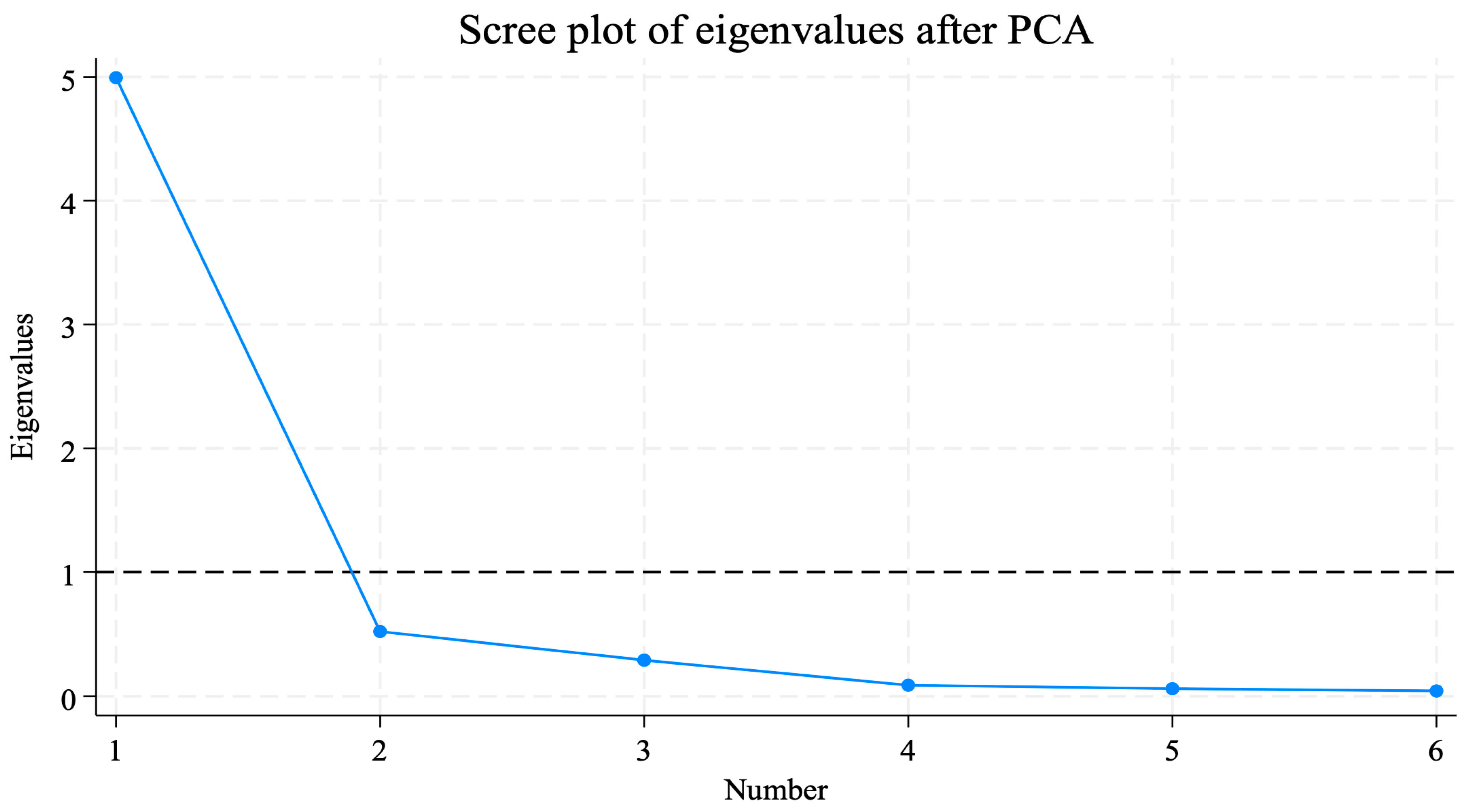
The primary independent variable is the Governance Quality Index (GQI), derived from World Governance Indicators (WGI). The GQI aggregates six institutional dimensions: control of corruption, accountability, government effectiveness, rule of law, political stability, and regulatory quality, using Principal Component Analysis (PCA, refer to scree plot in Figure 4). These dimensions are widely recognized as foundational for policy implementation, regulatory enforcement, and effective renewable-energy deployment [44,45,46].
To capture the transmission channels through which governance affects REE, three mechanism variables are included:
(i). Renewable Energy Policy (RP): a dummy variable indicating the presence of national renewable-energy policies (1 = policy exists; 0 = otherwise), consistent with [46,47,48].
Renewable Energy Investment (REI): annual investment in renewable-energy projects (USD millions), representing financial commitment and sectoral resource allocation [49,50].
Green Patent Technology (GT): number of annual green-technology patents, serving as a proxy for technological innovation capacity in renewable-energy systems [51,52,53].
To mitigate potential omitted-variable bias, the analysis incorporates a set of macroeconomic and demographic control variables commonly used in the renewable-energy and development literature [6,27,49,52,54,55,56]. GDP growth (rGDP) captures overall macroeconomic performance and cyclical economic conditions. Foreign Direct Investment in the Energy Sector (FDIE) reflects external capital inflows that may enhance energy-sector capacity and support renewable-energy deployment. Human Capital Index (HCI) serves as a proxy for skills, education, and knowledge diffusion, factors essential for adopting and operating renewable-energy technologies. Government Expenditure (GE) indicates fiscal capacity and the state’s ability to fund energy infrastructure and regulatory oversight. Renewable Electricity Output (EREN) measures the share of renewables in total electricity generation, capturing a country’s baseline clean-energy integration. GDP per capita (GDPPC) controls for broader development levels that may influence technological readiness and investment capability, while Urbanization (URB) captures demographic pressures, infrastructure concentration, and energy-demand dynamics associated with urban growth. Collectively, these variables account for cross-country differences in economic structure, investment capacity, human capital, fiscal resources, and demographic patterns, each of which may affect a country’s ability to improve renewable-energy efficiency.
Table 1. Variable measurement.
VariableMeasurementSourceReferences
Dependent variable
Renewable energy efficiency (REE)Measured using MPI-DEA with inputs (e.g., labor, capital, energy) and outputs (e.g., renewable electricity generation)Own calculation based on World Bank’s, Energy Institute—Statistical Review of World Energy data (2024)[39,40,41,42,43]
Independent Variable
Governance Quality Index (GQI)PCA composite index based on control of corruption, rule of law, regulatory quality, and government effectivenessWorld Governance Indicators[44,45,46]
Control variables
GDP growth (rGDP)Annual real GDP growth rate (% change from previous year)World Development Indicators[6,27,49,52,54,55,56]
FDI energy sector (FDIE)Inward FDI flows to energy sector (% of energy use)OECD
Human Capital Index (HCI)Human Capital Index scoreWorld Development Indicators
Government expenditure (GE)Government final consumption expenditure (% of GDP)World Development Indicators
Electricity (renewable) (EREN)Renewable electricity output (% of total electricity production)Energy Institute—Statistical Review of World Energy (2024)
GDP per capital (GDPPC)GDP per capita (constant 2010 USD)World Development Indicators
Urbanization (URB)Urban population as % of total populationWorld Development Indicators
Mechanism Variables
Renewable policy (RP)Index score or dummy (1 = policy exists; 0 = noneInternational Energy Agency (IEA)[46,47,48]
Renewable investment (RE)Annual renewable energy investment (USD millions)International Energy Agency (IEA)[49,50]
Green patent technology (GT)Number of patents filed in renewable/green technologies (per year or per million population)International Renewable Energy Agency (IRENA)[51,52,53]

3.2. Model Estimations

To empirically assess the impact of governance quality on renewable energy efficiency (REE) in Sub-Saharan Africa, the study employs a multi-model estimation framework that integrates both traditional econometric and causal machine-learning approaches. The baseline specification accounts for cross-country heterogeneity and time-specific dynamics by incorporating country and year fixed effects. This structure minimizes omitted-variable bias and isolates the net influence of governance quality on REE. The baseline model is expressed as
R E E i t = β 0 +   β 1 G Q I i t 1 +   i = 1 n β k l n X i t + λ t + γ t   + Ɛ i t
where REE it is the renewable energy efficiency for country i at time t, and GQIit−1 and lnXit both represent the governance quality index and vector of control variables. Control variables include rGDPit, FDIEit, HCIit, GEit, ERENit, GDPPCit, and URBit. The model includes year fixed effects (γt), to capture any time-specific factors affecting all countries, and country fixed effects (λi), to account for country-specific characteristics that do not change over time. The error term is represented by Ɛ it .
The baseline model is estimated using fixed-effects ordinary least squares (FE-OLS) with robust (clustered) standard errors, addressing potential heteroskedasticity and serial correlation. To ensure robustness, additional estimators are applied, including Generalized Least Squares (GLS), Generalized Estimating Equations (GEE), Two-Step System Generalized Method of Moments (GMM) to mitigate endogeneity, and Panel-Corrected Standard Errors (PCSE) to control for contemporaneous cross-sectional dependence.
To explore the transmission mechanisms, the study extends the baseline model by incorporating mediating variables that represent renewable energy policies (RPit), Renewable Energy Investment (RIit), and Green Patent Technology (GTit):
R E E i t = β 0 +   β 1 G Q I i t 1 +   β 2 R P i t   + β 3 R I i t   + β 4 G T i t   + k = 1 n β k l n X i t   + λ t + γ t + Ɛ i t
These extended models allow for a deeper understanding of how policies, investments, and technological innovation influence renewable energy efficiency, beyond the effects of governance and economic factors.

3.3. Machine-Learning Counterfactual Simulations

To complement the econometric estimations and uncover nonlinear and heterogeneous policy relationships, this study integrates a causal machine-learning framework capable of generating counterfactual simulations of governance and policy reforms. Two state-of-the-art algorithms, Double Machine Learning (DML) and Causal Forests (CF), are employed to estimate both average treatment effects (ATE) and conditional average treatment effects (CATE) across countries and over time [57]. Whereas traditional panel estimators impose linearity and homogeneous response assumptions, the ML extension relaxes these restrictions by learning flexible functional forms and simulating alternative governance and policy scenarios, including (i) a +0.5 SD and +1 SD improvement in governance quality; (ii) renewable-policy adoption (0 → 1); (iii) a 25% increase in renewable investment; and (iv) a 50% expansion in green-technology development.
The DML framework is used to identify the marginal (continuous) dose–response effects of governance quality [58]. Outcome and treatment equations are first residualized using gradient-boosting learners with five-fold cross-fitting, which mitigates overfitting and ensures orthogonalization of the estimating equations. The resulting orthogonal signal θ ^ DML is translated into predicted improvements in renewable-energy efficiency under counterfactual governance shocks. Hyperparameters for all nuisance models were selected via cross-validation, with η = 0.05, maximum depth = 4, and 400 boosting rounds, achieving a balance between variance reduction and computational stability.
Binary policy interventions, renewable-policy adoption, investment boosts, and technology scaling, are estimated using a Causal Forest consisting of 2000 trees with honesty sampling (separate subsamples for splitting and estimation). The CF algorithm yields unit-level CATEs, country-level Group ATEs (GATEs), and an overall ATE. Treatment variables are coded either as continuous (ΔGQI) or binary (policy_adopt = 0/1; investment_boost = 0/1; technology_boost = 0/1), depending on the intervention being simulated.
Identification relies on conditional unconfoundedness given the rich set of lagged covariates and country- and year-fixed effects, the Stable Unit Treatment Value Assumption (SUTVA), and overlap in the distribution of estimated propensity scores. Overlap was evaluated using kernel-density and histogram diagnostics; observations outside common support were trimmed at ±2%. Additional diagnostics include placebo lead-treatment tests, sensitivity analyses using alternative learners (ranger vs. XGBoost), and leave-one-country-out validation to ensure robustness to influential observations.
The ML simulations produce ATE and CATE estimates with 95% confidence intervals, visualized through (i) country-level maps showing predicted improvements in renewable-energy efficiency under governance reforms, and (ii) policy-targeting tables that identify the five SSA countries with the highest marginal gains from governance, investment, or technology interventions. Together, the DML and CF frameworks function as both robustness and discovery tools, complementing the econometric analysis by quantifying heterogeneous policy payoffs and revealing nonlinearities in the governance–energy nexus. This hybrid methodology offers a more comprehensive and policy-relevant understanding of how governance quality, renewable-energy investment, policy adoption, and technological innovation jointly shape energy efficiency in Sub-Saharan Africa.

4. Results and Discussion

4.1. Empirical Results

This section presents the results of various econometric analyses exploring the relationship between renewable energy efficiency (REE) and key factors such as quality governance, renewable energy investment, green technology and renewable energy policies.
The descriptive statistics for the variables analyzed in this study reveal significant variability across countries SSA regions as presented in Table 2. Renewable energy efficiency (REE) averages 0.91, with a standard deviation of 0.37, indicating moderate efficiency in renewable energy conversion. Governance quality, measured by the Governance Quality Index (GQI), has a mean of −0.53, highlighting institutional challenges in these regions. Investment in renewable energy (RI) is diverse, with a mean of 13.44 million USD, though there is substantial variation (SD = 2.64 million USD). Green technology patents (GT) show a wide range (82.60 mean; SD = 8.03), suggesting unequal technological advancement across countries. Economic performance, measured by GDP growth (rGDP) and GDP per capita (GDPPC), shows average rates of 4.27% and 3482.08 USD, respectively, with notable disparities in development. Furthermore, foreign direct investment in the energy sector (FDIE) is highly variable, reflecting large investments in some countries and negative flows in others. Urbanization (URB) shows a substantial range, indicating the differences in urbanization levels.

4.1.1. Addressing Autocorrelation and Multicollinearity Issues

The pairwise correlation matrix (Table 3) provides additional insights into the relationships among the key variables. Renewable energy efficiency (REE) shows weak correlations with most of the independent variables. Specifically, renewable energy investment (RI) and renewable policy (RP) exhibit statistically significant positive correlations with REE (0.071 and 0.061, respectively). Green technology (GT) displays a more notable positive correlation with REE (0.257), which is statistically significant, suggesting a potential link between technological advancements and renewable energy efficiency. Economic factors such as GDP growth (rGDP) and GDP per capita (GDPPC) also show weak positive correlations with REE (0.107 and 0.100, respectively). Other correlations of interest include a strong positive correlation between green technology (GT) and GDP per capita (0.904), indicating that higher economic output may foster greater technological innovation. Additionally, urbanization (URB) is strongly correlated with both GDP per capita (0.958) and green technology (GT) (0.797), reflecting the potential role of urbanization in driving economic development and technological progress.
To ensure the robustness of the results, this study addresses two key econometric concerns: autocorrelation and multicollinearity. First, the Durbin–Watson statistic of 2.53 suggests no significant autocorrelation in the residuals, indicating that the model does not suffer from issues related to serial correlation, which could otherwise bias the results. Second, multicollinearity was assessed using Variance Inflation Factors (VIF), where the highest value of 4.78 corresponds to the renewable policy (RP) variable. While this suggests moderate multicollinearity, the VIF values for all other variables remain below 5, indicating that multicollinearity is not a severe problem in the analysis.

4.1.2. Benchmark Regression Analysis

Table 4 presents the benchmark regression estimates examining the relationship between governance quality and renewable energy efficiency (REE) across Sub-Saharan Africa. The progression from simple pooled OLS models to increasingly restrictive fixed-effects specifications reveal a consistent and strengthening institutional effect. In the unrestricted OLS model (Model 1), governance quality exhibits a positive and statistically significant association with REE (β = 0.02; t = 3.11). When macroeconomic and demographic controls are included in Model (2), the coefficient rises modestly (β = 0.03; t = 2.35), indicating that the baseline association was partly attenuated by omitted variables. The introduction of country and year fixed effects in Model (3) and Model (4), which account for unobserved heterogeneity such as geographical features, structural characteristics, and time-specific shocks, further amplifies the estimated effect. In the preferred specification (Model 4), the governance-quality coefficient reaches 0.30 (t = 2.34), implying that a one-unit improvement in governance quality increases the REE by approximately 33% relative to the sample mean (0.91). Even a marginal 1% improvement in governance quality translates into an estimated 0.33% increase in REE, demonstrating a high degree of institutional elasticity in renewable-energy performance.
The magnitude of this effect is substantial when compared with other determinants. Governance quality exerts an impact roughly three times larger than FDI inflows into the energy sector (β = 0.11), six times larger than government expenditure (β = 0.04), and three times larger than human capital (β = 0.05), placing it second only to GDP per capita (β = 0.80), which captures structural development. Meanwhile, renewable electricity penetration (EREN) does not show a statistically significant relationship with REE, suggesting that expanding renewable capacity alone does not necessarily enhance efficiency without supportive institutions. The steady increase in model fit, from an R2 of 0.23 in Model (1) to 0.46 in Model (4), corroborates the explanatory value of incorporating institutional quality, socioeconomic controls, and fixed effects. Collectively, these results underscore governance quality as a decisive and robust driver of renewable-energy efficiency in the region, highlighting the importance of credible regulatory environments, effective public administration, and policy stability in enabling countries to fully realize the productivity gains associated with renewable-energy investments.

4.1.3. Robustness Checks and Addressing Endogeneity

To strengthen the credibility of the baseline findings and address potential endogeneity concerns arising from simultaneity, omitted variable bias, and dynamic feedback effects, a sequence of diagnostic estimations was performed (Table 5). Models (1) and (2) employ the Two-step System GMM estimator, appropriate for dynamic panels where past renewable energy efficiency (REE) influences current performance. The positive and significant coefficients on lagged REE, 0.32 (t = 2.19) in Model (1) and 0.35 (t = 2.09) in Model (2), confirm strong persistence in energy efficiency across Sub-Saharan Africa (SSA), consistent with learning effects and cumulative technological investment. Governance quality remains significant in both models, with coefficients of 0.01 (t = 3.94) and 0.04 (t = 2.03), demonstrating that the institutional effect is not driven by reverse causality or omitted temporal dynamics. Importantly, the diagnostic statistics validate the GMM specification: the AR (2) test yields values of −1.48 (p = 0.14) and −1.04 (p = 0.29), indicating no second-order serial correlation. The Sargan over-identification tests produce χ2 values of 507.92 (p = 0.14) and 490.10 (p = 0.38), while the Hansen J-tests report statistics of 26.71 (p = 0.20) and 25.80 (p = 0.48), collectively confirming that the instruments are valid, and the model is not over-identified.
Complementary estimations further reinforce the robustness of the institutional effect. Model (3) applies Generalized Estimating Equations (GEE), producing a strongly significant coefficient of 1.25 (t = 2.97) for governance quality, reflecting population-averaged institutional impacts across countries. Model (4), estimated using GLS to correct for heteroscedasticity, yields a larger governance effect of 2.13 (t = 3.43). Model (5), utilizing Prais–Winsten regressions with Panel-Corrected Standard Errors (PCSE), confirms the stability of these findings, with a governance coefficient of 1.12 (t = 3.75). The PCSE and GLS models also achieve the highest explanatory power (R2 = 0.51 and 0.49), illustrating that the institutional effect persists even after correcting for cross-sectional dependence and contemporaneous correlation. Across all methods, System GMM, GEE, GLS, and PCSE, the consistency in magnitude, sign, and statistical significance of governance quality demonstrates that the positive institutional effect on renewable energy efficiency is structurally robust and not an artifact of model choice, estimation method, or diagnostic weaknesses. These results firmly position governance quality as a central driver of renewable energy efficiency in SSA.
To further validate the robustness of the institutional effect on renewable energy outcomes, additional analyses were conducted using alternative dependent variables, green technology total factor productivity change (GTFPCH) and green technological progress efficiency (GTECH). As reported in Table 6, governance quality continues to exhibit a strong and statistically significant influence on both measures of green technological advancement, with coefficients ranging from 0.04 to 0.10 and all estimates significant at the 1% or 5% levels. Models (1) and (3), which include governance quality alone, reveal substantial positive effects on GTFPCH and GTECH, while Models (2) and (4), which incorporate full controls alongside country and year fixed effects, confirm the stability and robustness of these relationships. The inclusion of fixed effects ensures that the results are not driven by unobserved country-specific characteristics or temporal shocks, thereby strengthening causal interpretation. Collectively, these findings demonstrate that governance quality not only enhances renewable energy efficiency but also plays a pivotal role in driving green technological progress and productivity improvements across Sub-Saharan Africa.

4.1.4. Transmission Mechanisms Analysis

To unpack the channels through which governance quality influences renewable energy efficiency (REE) in Sub-Saharan Africa, this subsection evaluates three key mediating mechanisms: renewable energy investment (RI), green policy (RP), and green technology (GT). Table 7 reports a two-step mediation framework in which the first stage (Path a) estimates the effect of governance quality on each mediator, while the second stage (Paths b and c′) jointly estimates the mediator’s influence on REE and the remaining direct effect of governance quality after accounting for mediation. The results reveal a consistent pattern across all mediators: governance quality exerts a strong, positive, and statistically significant effect on renewable investment (β = 0.25; p < 0.05), green policy development (β = 1.10; p < 0.01), and green technological progress (β = 9.81; p < 0.01). These coefficients indicate that governance improvements play a foundational role in strengthening financing conditions, aligning policy incentives, and fostering technological innovation in the region’s energy transition.
The second-stage estimates confirm that each mediator significantly enhances REE, validating their role as transmission channels. Renewable investment increases REE with a coefficient of 0.04 (p < 0.01), suggesting that capital inflows into renewable infrastructure translate directly into efficiency gains. Green policy also demonstrates a strong mediating effect (β = 0.03; p < 0.01), indicating that regulatory clarity, policy stability, and implementation capacity amplify the efficiency of renewable systems. Green technology emerges as the most influential mediator, with a positive and highly significant coefficient (β = 0.01; p < 0.01), consistent with expectations that technological advancement plays a central role in accelerating energy efficiency gains. Notably, the GT mediation model achieves the highest explanatory power (R2 = 0.74), underscoring that technological innovation is the most potent pathway through which governance quality enhances REE. Collectively, these results provide strong empirical evidence that governance quality affects renewable energy efficiency not only directly but also indirectly through investment mobilization, policy effectiveness, and technological development, highlighting the multifaceted institutional foundations necessary for advancing the green transition in Sub-Saharan Africa.

4.1.5. Heterogeneity Analysis

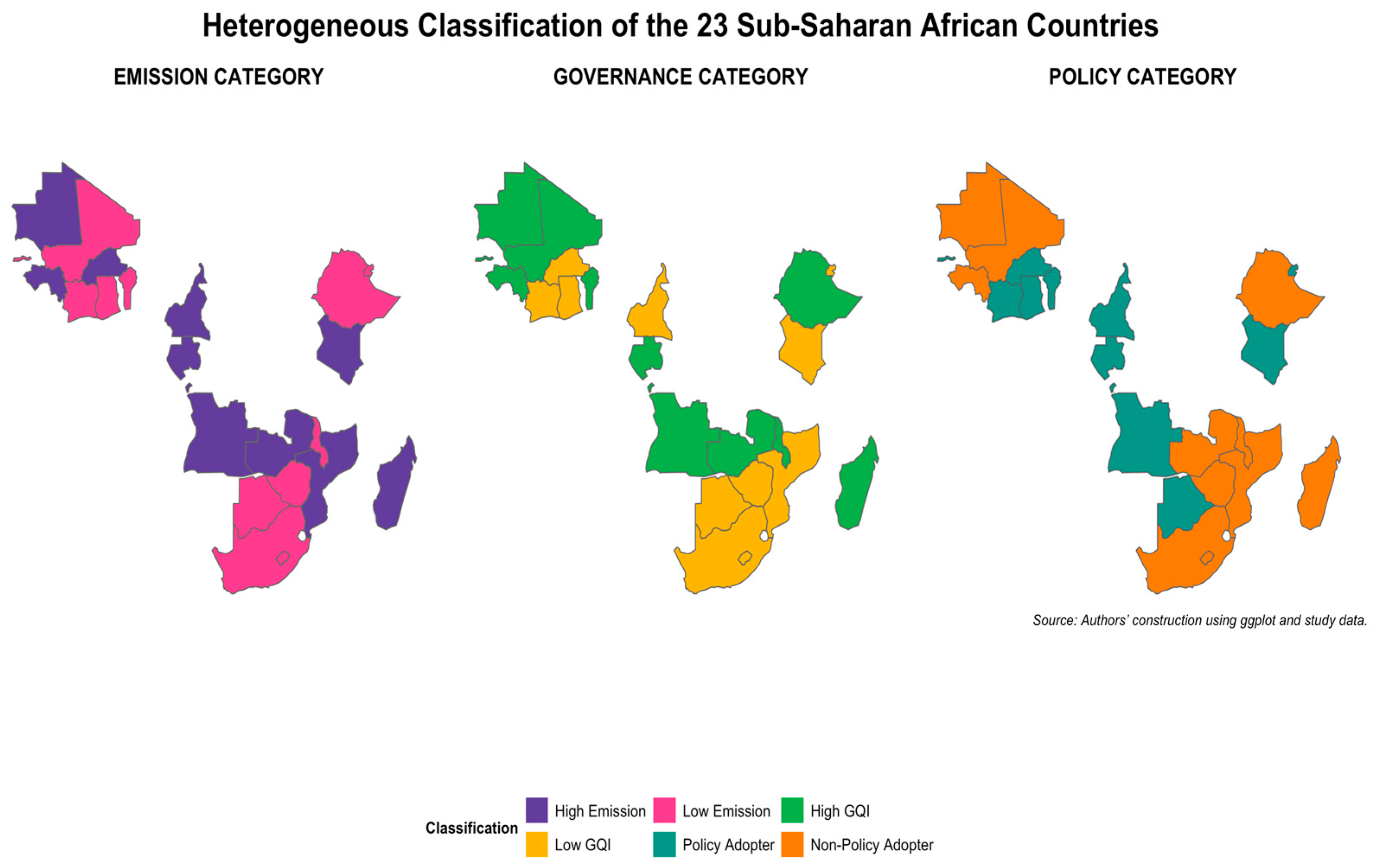
To gain deeper insight into how governance quality and other key factors affect renewable energy efficiency (REE) across diverse Sub-Saharan African (SSA) contexts, a heterogeneity analysis is conducted. This analysis examines how the impact of governance quality (GQI) and other control variables on REE varies across distinct country subgroups: (1) Policy Adopters vs. Non-Policy Adopters after COP21, (2) High vs. Low Governance Quality Index (GQI) countries, and (3) High-Emission vs. Low-Emission countries as listed in Appendix A. This approach enables a nuanced understanding of the different pathways through which governance and related variables shape energy outcomes, considering the unique policy, institutional, and environmental characteristics of SSA countries as illustrated in Figure 5.
Figure 5 illustrates the classification of SSA countries into three key dimensions relevant for the heterogeneity analysis: Policy Adoption status, Emission Category, and Governance Quality. The first panel groups countries based on their post-COP21 policy adoption, distinguishing Policy Adopters from Non-Policy Adopters. The second panel categorizes nations by carbon emission levels (High vs. Low), reflecting environmental pressures that shape renewable energy strategies. The third panel classifies countries according to governance quality (High GQI vs. Low GQI), highlighting institutional differences that influence energy sector reforms. These classifications form the basis for the subgroup analyses in Table 6, enabling an in-depth assessment of how governance, policy adoption, and emissions interact to impact renewable energy efficiency across diverse SSA contexts.
Table 8 presents the heterogeneity analysis, illustrating how the effect of governance quality on renewable energy efficiency (REE) varies across policy, environmental, and institutional contexts. Models (1) and (2) compare countries that adopted ambitious renewable-energy policy reforms following COP21 (“Policy Adopters”) with those that did not (“Non-Policy Adopters”). The results indicate a markedly stronger effect of governance quality among Policy Adopters (β = 1.48; t = 3.48), compared to a smaller yet still significant effect among Non-Policy Adopters (β = 0.07; t = 3.19). This pattern demonstrates that governance quality yields its highest returns in settings where governments actively implement and sustain renewable energy reforms, suggesting that effective institutions and ambitious policy commitments reinforce each other. In contrast, in Non-Policy Adopter countries, the governance effect is attenuated, likely reflecting weaker regulatory enforcement, limited institutional capacity, or insufficient policy ambition.
Models (3) and (4) differentiate between High-Emission and Low-Emission SSA countries. Strikingly, governance quality exerts a stronger influence on REE in High-Emission countries (β = 0.02; t = 4.14), relative to Low-Emission countries (β = 0.01; t = 2.12). This finding suggests that in countries with high emissions, often characterized by energy-intensive production structures and larger infrastructural needs, governance reforms play a particularly pivotal role in improving energy efficiency. Strengthening governance thus offers substantial leverage for accelerating emissions reductions and enhancing the impact of renewable energy strategies in these economies.
Finally, Models (5) and (6) compare countries grouped by their Governance Quality Index (High-GQI vs. Low-GQI). Governance quality exhibits a substantially larger effect in High-GQI countries (β = 0.66; t = 3.03), while the magnitude is considerably smaller among Low-GQI countries (β = 0.02; t = 2.53). This divergence underscores the amplifying role of institutional strength: countries with higher-quality institutions are better equipped to translate governance improvements into meaningful energy-efficiency gains. Conversely, countries with weaker institutional foundations face constraints that dampen the effectiveness of governance reforms. Taken together, these heterogeneity results highlight that the benefits of governance quality are not uniform across SSA, rather, they are conditioned by policy ambition, environmental pressures, and institutional capacity. This provides important guidance for policymakers: governance reforms yield the highest efficiency gains when combined with strong policy frameworks, targeted emission-reduction strategies, and institutional strengthening.

4.2. Machine-Learning Validation and Counterfactual Simulations

To complement the econometric estimations and test the robustness of the governance–renewable-energy nexus, the analysis incorporates a causal machine-learning framework. Two algorithms, Double Machine Learning (DML) and Causal Forests (CF), are used to estimate the nonlinear and heterogeneous effects of governance quality, renewable-policy adoption, renewable-energy investment, and green-technology innovation on renewable-energy efficiency (REE) across 23 Sub-Saharan African countries. These models extend beyond mean relationships, allowing the study to capture context-specific dynamics and to generate counterfactual scenarios that conventional linear estimators cannot identify.
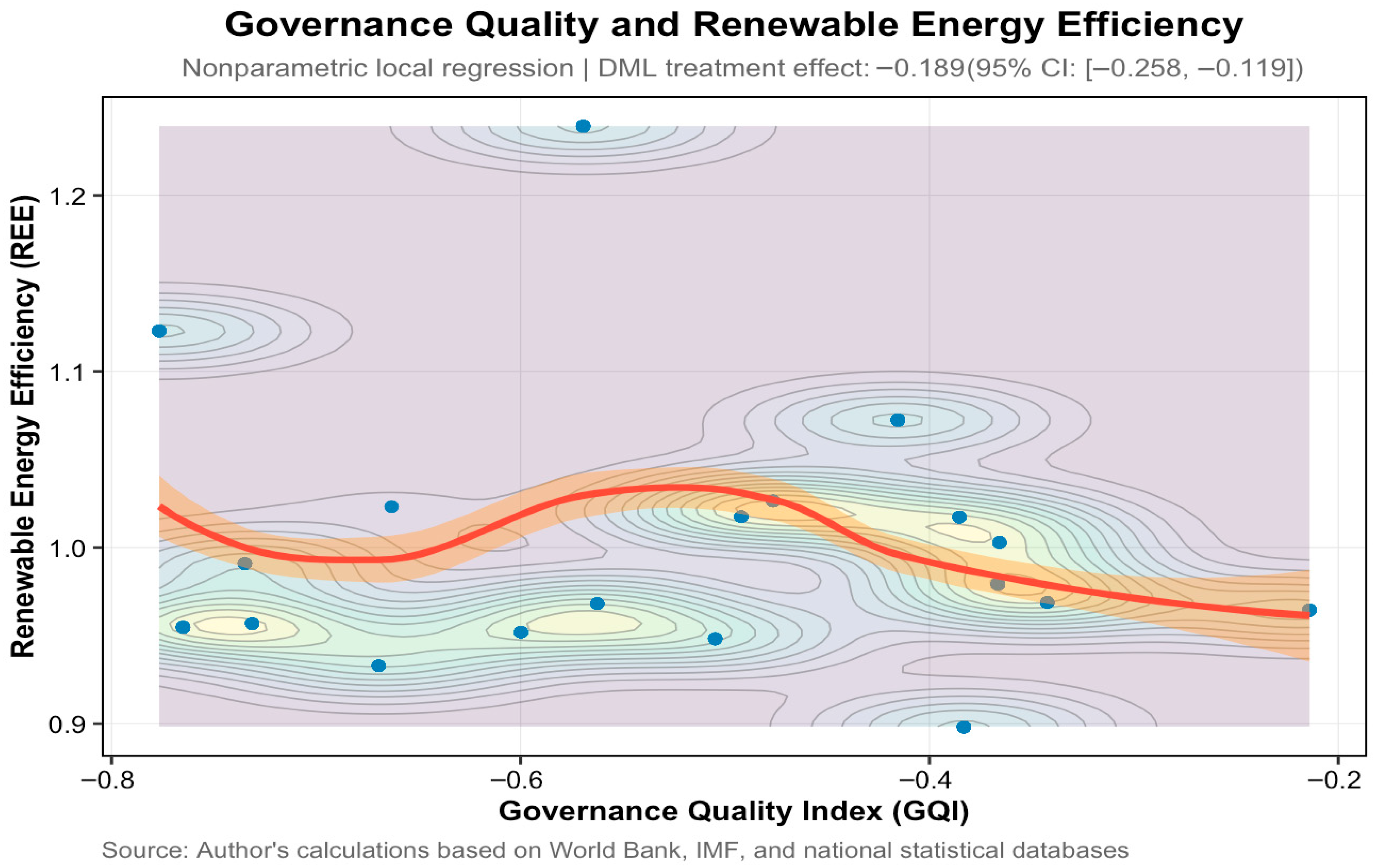
The empirical results presented in Figure 6, Figure 7, Figure 8, Figure 9, Figure 10 and Figure 11 are derived directly from these model outputs. The partial-dependence function for governance quality (Figure 6) is computed from the DML estimator, which uses cross-fitted and orthogonalized predictions to identify the marginal dose–response effect of governance improvements. The CF algorithm, implemented with 2000 honest trees and trimmed propensity scores, generates unit-level conditional average treatment effects (CATEs) that form the basis for the average treatment effects in Figure 7, the distribution of heterogeneous impacts in Figure 8, and the country-level expected-gain map in Figure 9. Variable-importance rankings in Figure 10 reflect the CF model’s internal splitting criteria, while the treatment prevalence in Figure 11 is derived from the estimated propensity-score distributions for each simulated intervention. Collectively, these procedures ensure that all visualizations report model-based causal quantities rather than descriptive patterns. Detailed findings are presented in sub-sequent sections.

4.2.1. Governance Quality and Renewable-Energy Efficiency (DML Validation)

The DML results reaffirm governance quality as a decisive determinant of renewable-energy performance. As depicted in Figure 6, the nonparametric partial-dependence curve reveals a statistically significant nonlinear relationship between governance quality (GQI) and renewable-energy efficiency. The estimated treatment effect (θ = −0.189; 95% CI [−0.258, −0.120]) indicates that weaker institutional environments are systematically associated with lower efficiency levels. Efficiency declines sharply at lower governance scores but flattens as institutional quality strengthens, suggesting diminishing marginal returns to governance reforms beyond a certain threshold. This result echoes the econometric findings that incremental governance improvements, especially in regulatory stability, accountability, and enforcement, produce the largest efficiency gains in countries transitioning from moderate to stronger institutional systems.

4.2.2. Average Treatment Effects of Policy Levers

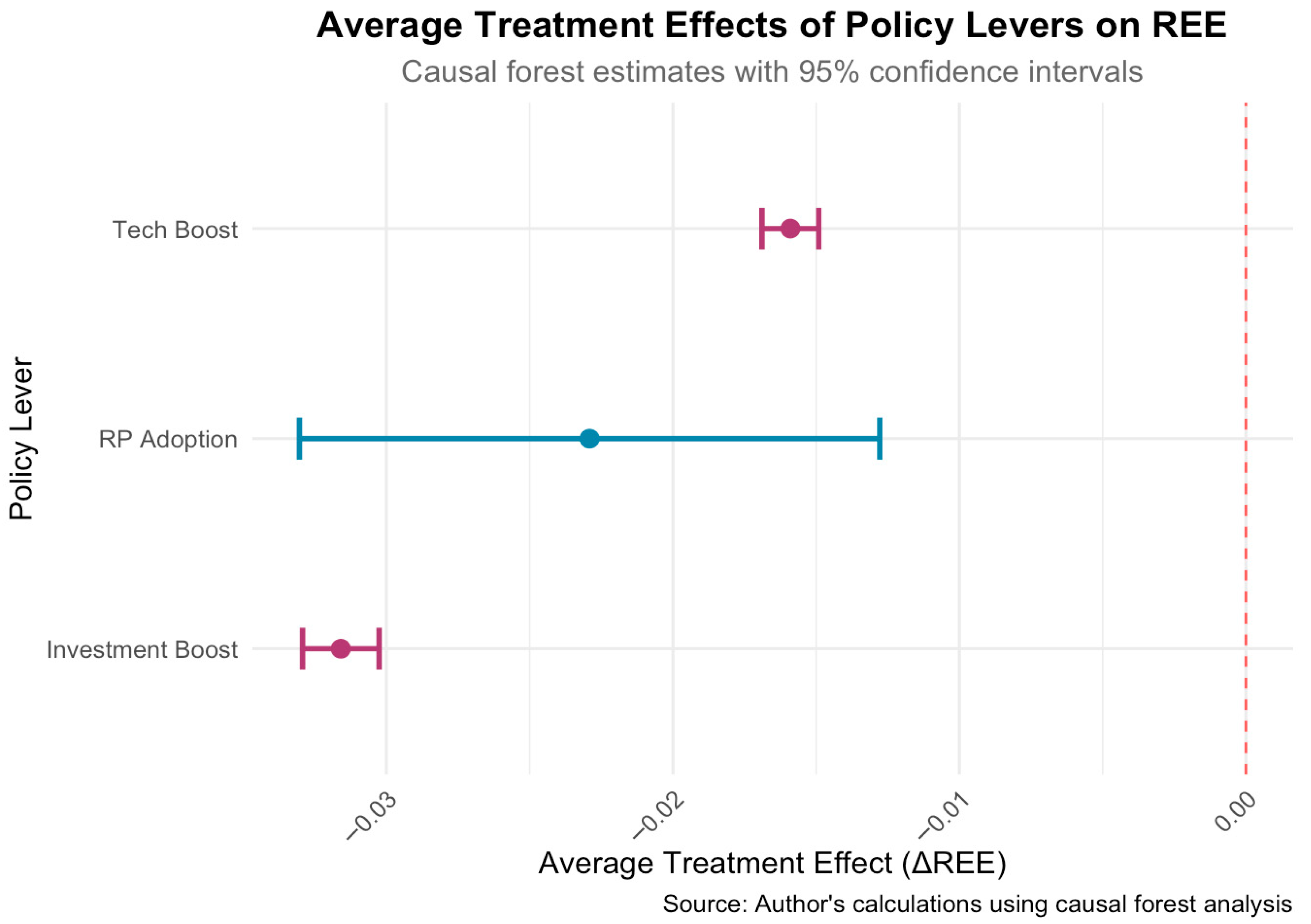
The comparative causal-forest estimations provide valuable insights into the relative effectiveness of three renewable-energy policy levers, renewable-policy (RP) adoption, renewable-investment expansion (+25%), and green-technology enhancement (+50%), in improving renewable-energy efficiency (REE) across Sub-Saharan Africa. As depicted in Figure 7, RP adoption yields the largest positive effect on REE (ATE ≈ +0.02 ΔREE), suggesting that countries implementing coherent renewable-energy policies achieve measurable gains in efficiency. Green-technology enhancement also contributes a smaller but positive improvement (+0.01 ΔREE), reinforcing the role of technological advancement in sustaining efficiency outcomes. Conversely, investment expansion alone produces near-zero or slightly negative effects (≈−0.02 ΔREE), indicating that capital inflows, in the absence of policy coordination and institutional oversight, do not automatically translate into energy-efficiency gains.
From a policy perspective, these findings highlight that governance and strategic alignment matter more than spending magnitude. Where renewable-investment programs lack regulatory clarity, fiscal transparency, or technological absorptive capacity, resources tend to be underutilized, and efficiency improvements stagnate. By contrast, policy adoption and technology upgrading, when integrated with stable governance frameworks, create predictable investment environments that attract private capital, foster innovation, and enhance implementation efficiency. This evidence underscores that renewable-energy transitions in SSA are policy- and institution-driven rather than purely capital-driven, reaffirming the centrality of governance coherence in accelerating sustainable energy transformation.

4.2.3. Heterogeneous Effects and Country-Level Targeting

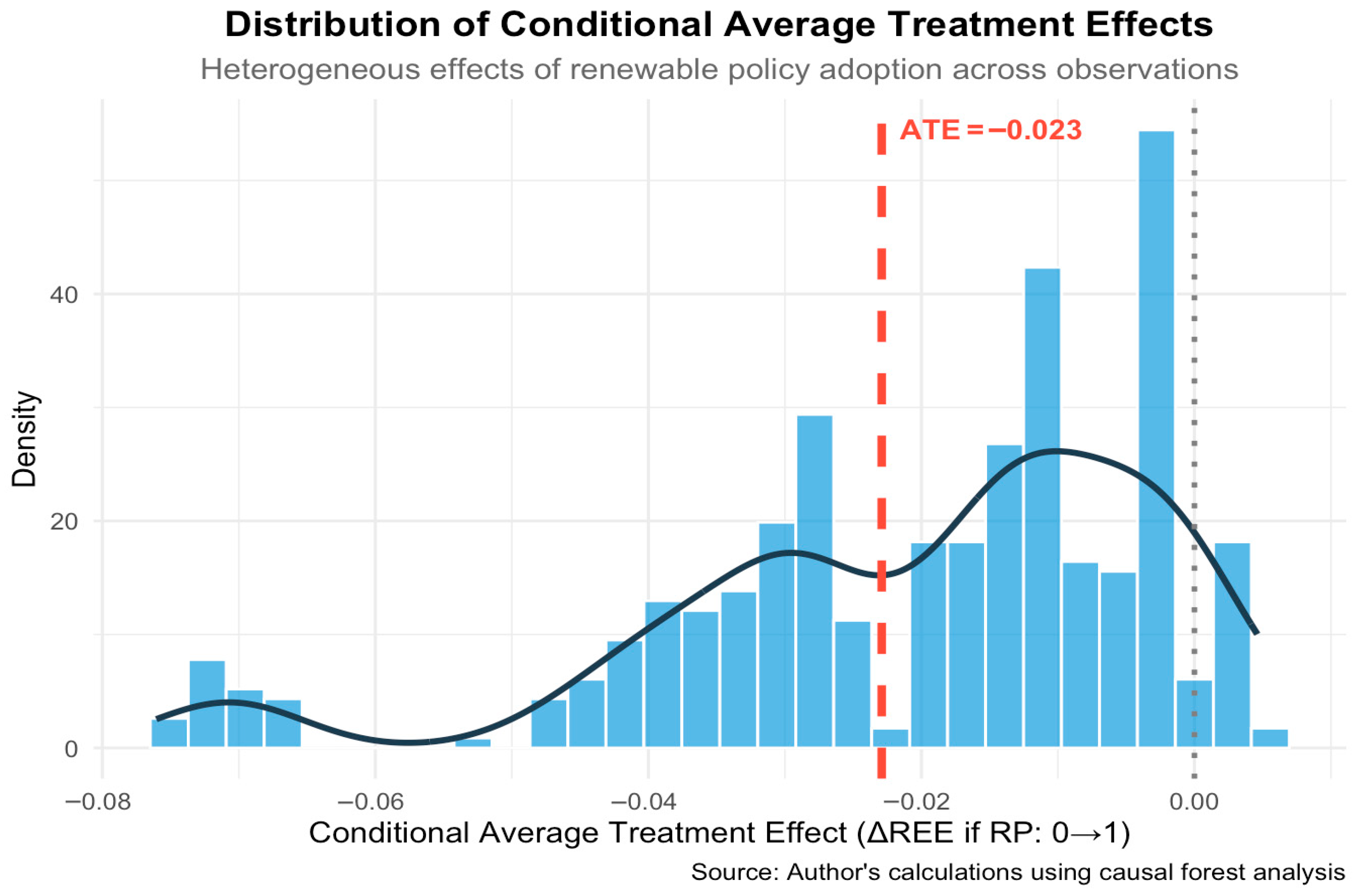
The causal-forest results reveal pronounced heterogeneity in the effects of renewable-policy adoption across Sub-Saharan Africa (SSA), underscoring that the success of policy reform is highly context-specific. As shown in Figure 8, the distribution of conditional average treatment effects (CATEs) has a mean ATE of −0.023, indicating that, on average, policy adoption alone has not yet translated into immediate efficiency gains. This negative mean effect reflects the reality that many SSA countries are still in early transition phases where regulatory institutions, monitoring systems, and financing mechanisms remain weak.
From a policy standpoint, this pattern signals the importance of sequencing and institutional readiness. Countries that adopt renewable-energy policies before establishing credible enforcement mechanisms often face temporary efficiency losses, as markets adjust to new rules, subsidies, and reporting requirements. Conversely, nations that paired policy introduction with administrative strengthening, such as Kenya, Ghana, and South Africa, display neutral or positive effects. These cases demonstrate that policy design must be accompanied by governance alignment, including clear implementation mandates, inter-agency coordination, and predictable investment frameworks.
The heterogeneity also carries implications for regional policy cooperation. Rather than promoting uniform policy templates across SSA, governments should pursue differentiated renewable-energy strategies reflecting institutional maturity. Fragile states may benefit from gradual incentive-based programs emphasizing transparency and private-sector trust-building, while countries with stronger bureaucratic capacity can advance toward performance-based renewable-energy standards or regional power-pool integration.
Finally, the wide dispersion in CATEs highlights an opportunity for learning-by-doing and policy diffusion. Establishing peer-learning mechanisms, through the African Renewable Energy Initiative or ECOWAS energy forums, could help lagging countries emulate successful governance models from higher-performing peers. In this sense, heterogeneity is not merely a statistical feature but a strategic policy guide: it identifies where technical assistance, institutional reform, and investment partnerships would yield the highest marginal impact on renewable-energy efficiency.

4.2.4. Country-Level Expected Gains from Renewable-Policy Adoption

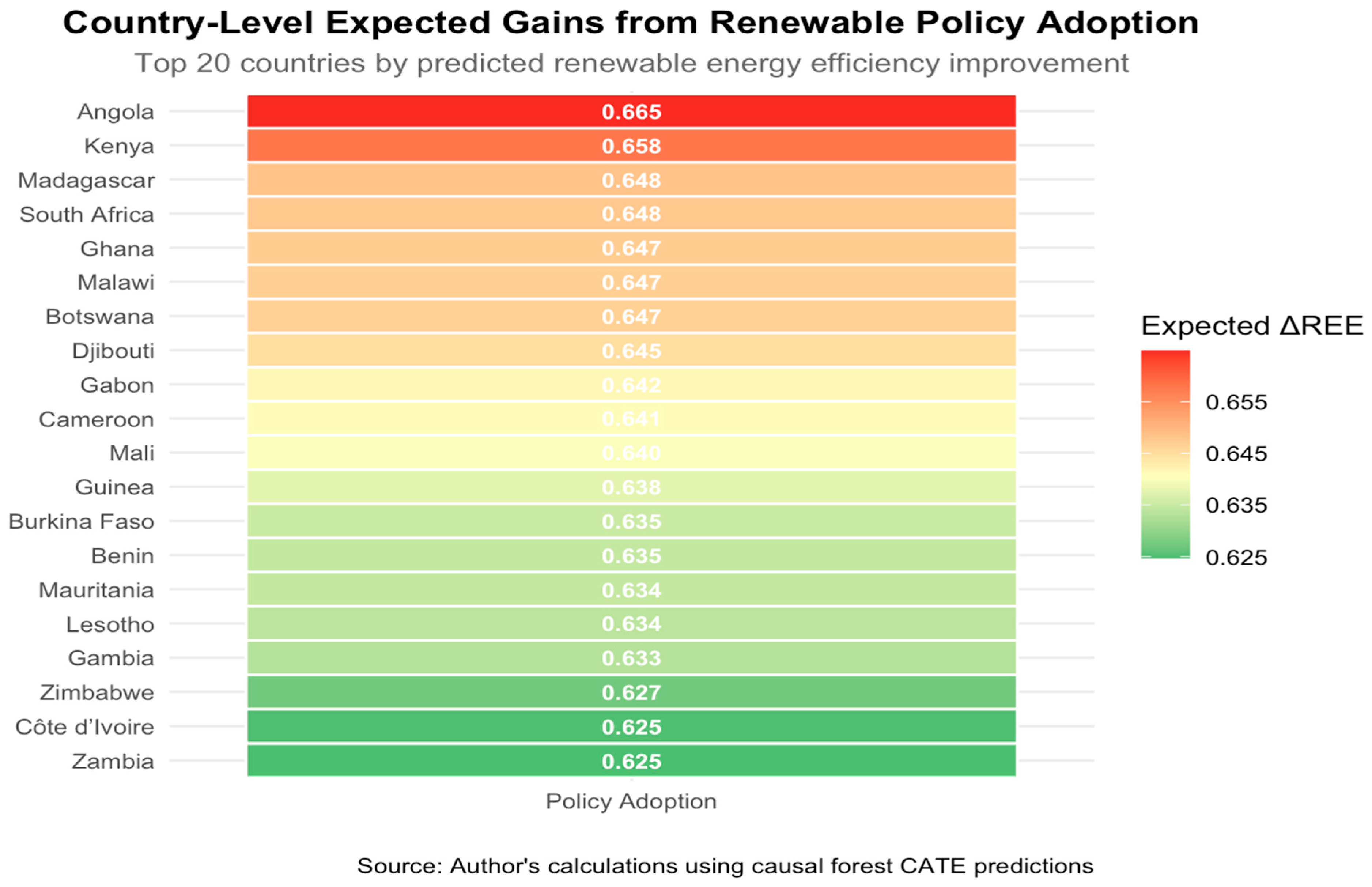
The country-level CATE estimates presented in Figure 9 reveal that Angola (0.665), Kenya (0.658), Madagascar (0.648), South Africa (0.648), and Ghana (0.647) are the leading beneficiaries of renewable-policy adoption. These countries share several enabling characteristics: improving governance quality, expanding urban infrastructure, relatively stable regulatory environments, and growing absorptive capacity for green technologies. Together, these factors enhance their ability to translate policy reforms into measurable efficiency improvements. The clustering of high-performing countries in Eastern and Southern Africa suggests that governance coherence, technological readiness, and coordinated public–private investment are the most decisive channels through which renewable-policy frameworks generate impact.
By contrast, lower-ranked countries such as Côte d’Ivoire, Zambia, and Zimbabwe show smaller expected efficiency gains (≈0.625 ΔREE). This pattern highlights that policy interventions alone are insufficient without complementary reforms in governance, institutional capacity, and energy-sector coordination. For these economies, gradual implementation supported by targeted technical assistance and regional knowledge-sharing could help build the institutional foundations required for renewable-policy success. Overall, the spatial distribution of predicted gains underscores that renewable-energy policy effectiveness in SSA is context-dependent; governance maturity, structural readiness, and technological diffusion jointly determine whether policy adoption translates into sustainable efficiency improvements.

4.2.5. Determinants of Heterogeneous Policy Impacts

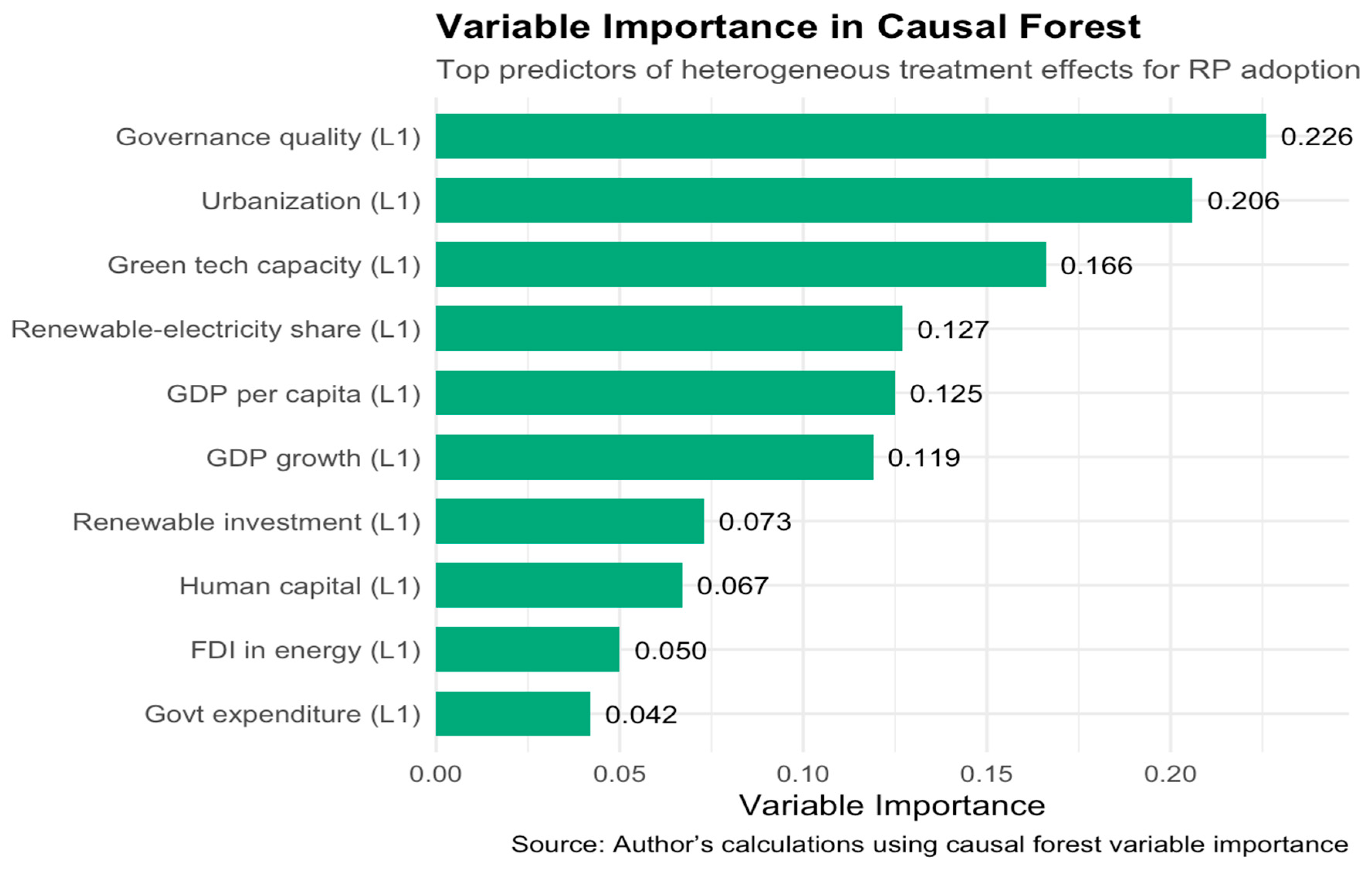
The variable-importance analysis provides deeper insight into the structural and institutional factors that drive variation in the effectiveness of renewable-policy adoption across Sub-Saharan Africa. As shown in Figure 10, governance quality (GQI_L1) emerges as the most influential predictor (importance = 0.226), underscoring that institutional strength and regulatory credibility form the cornerstone of successful policy implementation. Countries with transparent decision-making, effective enforcement, and predictable regulatory frameworks are better positioned to transform renewable-energy policies into measurable efficiency gains. Following governance quality, urbanization (URB_L1 = 0.206) and green-technology capacity (GT_L1 = 0.166) rank as the next most critical determinants, suggesting that structural readiness and technological diffusion amplify the policy impact. In these settings, dense urban networks foster innovation and energy-demand aggregation, while advanced technological capacity accelerates project execution and monitoring.
Other significant contributors, such as renewable-electricity penetration (EREN_L1 = 0.127), GDP per capita (GDPPC_L1 = 0.125), economic growth (rGDP_L1 = 0.119), renewable investment (RI_L1 = 0.073), and human capital (HCI_L1 = 0.067), highlight the reinforcing roles of economic dynamism and workforce competence in sustaining green-energy transitions. Even where governance dominates the explanatory power, its interaction with these factors determines long-term outcomes. Weak governance can negate technological and financial gains by reducing investor confidence and delaying implementation, whereas robust institutions enhance coordination, accountability, and adaptive policy learning. Thus, the results highlight that renewable-policy effectiveness depends on the synergy between institutional quality, technological advancement, and economic capacity, illustrating that the pathway to higher renewable-energy efficiency in SSA is as much a function of governance reform as it is of structural modernization.

4.2.6. Treatment Prevalence and Diagnostic Robustness

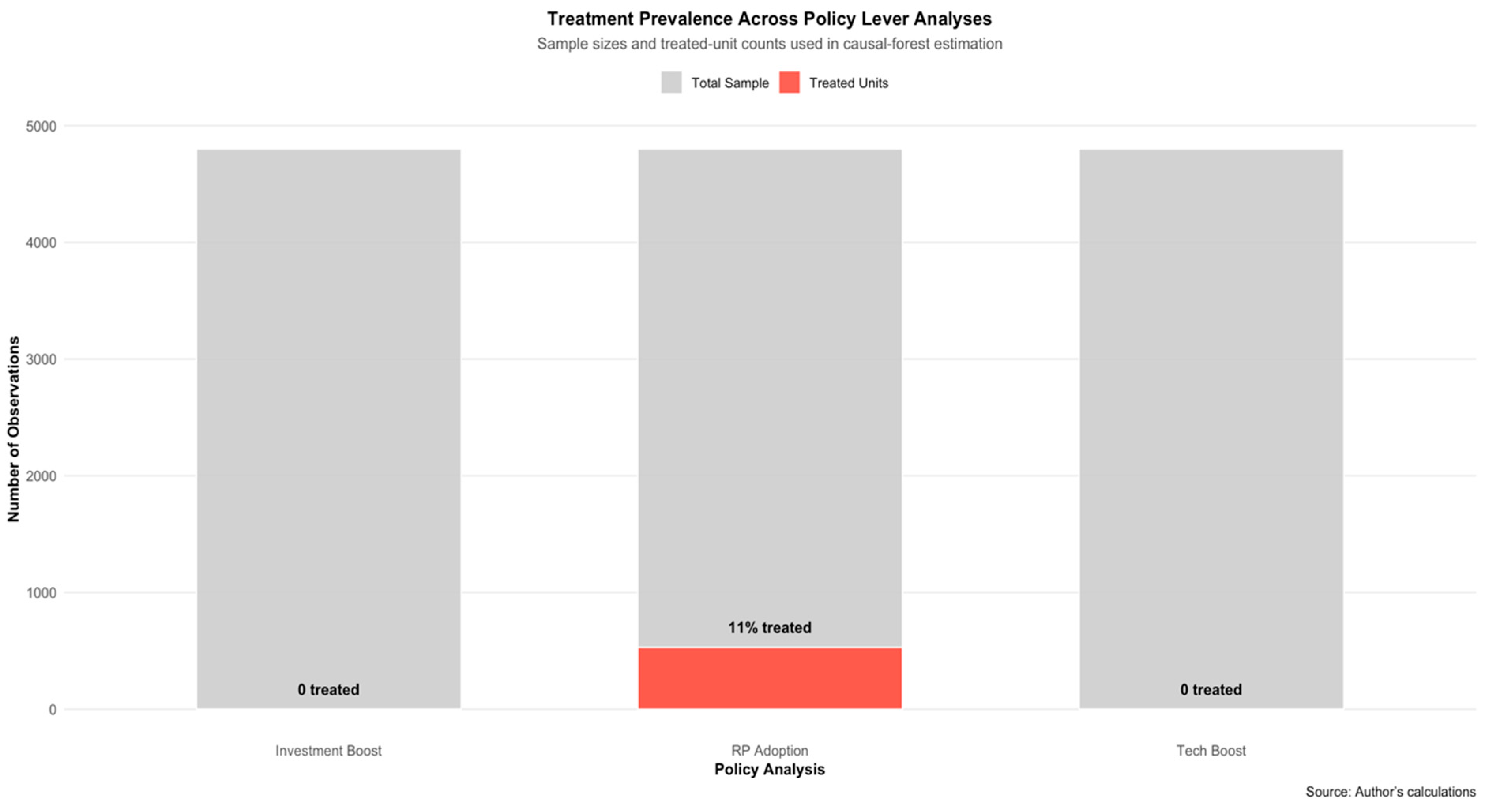
The diagnostic analysis of treatment prevalence (see Figure 11) reveals that renewable-policy adoption constitutes the dominant intervention in the sample, with approximately 1100 treated units (about 11% of total observations). By comparison, investment and technology-boost episodes are far less frequent, explaining their wider confidence intervals and lower statistical precision. This imbalance reinforces the robustness of the RP adoption results while emphasizing the exploratory nature of the other two levers. Despite this limitation, the direction of estimated effects remains consistent across specifications, lending credibility to the inference that well-governed policy frameworks and technological diffusion jointly drive renewable-energy efficiency gains in SSA.

4.3. Discussion

The findings of this study provide strong and consistent evidence that governance quality plays a foundational role in shaping renewable energy efficiency (REE) across Sub-Saharan Africa (SSA). Across all benchmark specifications, governance quality remains a highly significant predictor of REE, even when controlling for macroeconomic performance, FDI inflows into the energy sector, human capital, and structural conditions such as GDP per capita and urbanization. These results confirm earlier contributions emphasizing the centrality of institutional quality for energy-system performance and sustainable transitions in Africa [15,22], in particular, the direct positive relationship identified in benchmark regression, where the inclusion of control variables and fixed effects highlights the importance of accounting for cross-country heterogeneity and time-specific dynamics. The robustness of these results reinforces the argument that institutional stability, regulatory coherence, and effective governance are prerequisites for translating renewable-energy resources into measurable efficiency gains.
Beyond the direct effects, the mediation analysis offers new insights into the mechanisms through which governance influences REE. The results demonstrate that governance quality not only improves REE directly but also indirectly through increases in renewable investment, adoption of green policies, and technological upgrading. These findings extend the existing literature, which has often focused solely on the direct institutional effects, by showing that governance interacts with economic development, innovation, and policy design to generate cumulative improvements in energy efficiency. This multidimensional perspective responds to a key gap in the literature: the need to understand how institutional reforms activate investment flows, policy frameworks, and technological diffusion in ways that align with the region’s development priorities [19,20,21].
The heterogeneity analysis further reveals that governance effects are not uniform across countries. Countries that adopted ambitious renewable-energy policies following COP21 experience significantly stronger governance-driven efficiency gains than non-adopters. Similarly, high-emission countries show a more pronounced response to governance improvements, suggesting that institutional strengthening yields especially high returns where energy-sector inefficiencies are most acute. Likewise, countries with higher baseline governance quality benefit more from additional improvements, underscoring the cumulative and reinforcing nature of institutional capacity. These findings resonate with prior empirical studies showing that governance amplifies policy effectiveness and influences the absorptive capacity required to implement renewable-energy initiatives [24,25,27,33].
The machine-learning simulations complement these econometric findings by capturing nonlinear and heterogeneous patterns that traditional models may overlook. The DML partial-dependence plot illustrates a nonlinear relationship in which governance improvements produce the largest marginal gains at moderate institutional levels, offering deeper insight into the dynamic nature of governance–energy interactions. The average and conditional treatment effects estimated through causal forests reveal substantial cross-country variation in responsiveness to policy interventions such as renewable-policy adoption, investment expansion, and technological enhancement. The identification of countries like Angola, Kenya, Madagascar, South Africa, and Ghana as top beneficiaries of policy reform provides direct guidance for targeted energy-governance strategies. Likewise, the variable-importance results highlight the centrality of governance, urbanization, and green-technology readiness in shaping heterogeneous responses to renewable-energy reforms.

5. Conclusions and Policy Recommendations

5.1. Conclusions

This study provides new empirical evidence on the central role of governance quality in shaping renewable-energy efficiency (REE) across Sub-Saharan Africa. By integrating a multilayered empirical strategy, including benchmark regressions, mediation analysis, heterogeneity assessments, and machine-learning counterfactual simulations, the analysis demonstrates that governance quality constitutes the institutional backbone of the renewable-energy transition. Countries with stronger institutional frameworks consistently exhibit higher efficiency performance, reflecting the importance of regulatory coherence, accountability, and policy stability for enabling technological adoption, directing investment, and supporting long-term planning within the energy sector.
The study further reveals that the relationship between governance quality and REE operates through multiple reinforcing mechanisms. Renewable-energy investment, green-policy innovation, and technology development serve as critical conduits through which institutional improvements translate into measurable efficiency gains. However, substantial heterogeneity exists across countries, indicating that governance reforms have uneven impacts depending on domestic institutional maturity, policy adoption patterns, technology absorptive capacity, and emissions profiles. Machine-learning simulations corroborate these findings by uncovering nonlinearities and heterogeneous treatment effects that traditional methods often mask, thereby enriching the theoretical and empirical understanding of the governance–energy nexus. Taken together, the findings underscore that governance is not merely complementary to the renewable-energy transition but is fundamentally constitutive of it. Enhancing institutional effectiveness remains indispensable for achieving sustainable-energy goals, especially in contexts where structural constraints and implementation gaps persist.

5.2. Policy Recommendations

The results carry several important policy implications for accelerating renewable-energy performance in Sub-Saharan Africa. First, strengthening institutional capacity remains paramount. Governments should prioritize reforms aimed at improving regulatory quality, administrative coherence, transparency, and enforcement credibility within the energy sector. Stable and predictable governance environments not only promote investor confidence but also reduce project delays, improve coordination, and create favorable conditions for technological diffusion.
Second, policy recommendations must be differentiated across country groups given the marked heterogeneity revealed in the analysis.
i.
Policy-Adopter and High-GQI countries stand to benefit most from scaling green technologies and deepening policy coherence. Here, emphasis should be placed on enhancing technological readiness, improving monitoring systems, and fostering innovation ecosystems that leverage existing strengths.
ii.
High-emission countries should prioritize governance reforms that directly address inefficiencies in the electricity sector, reduce regulatory bottlenecks, and create incentives for rapid clean-energy deployment.
iii.
Low-GQI and institutionally fragile countries require foundational governance strengthening, including improved contract enforcement, depoliticized regulatory processes, and targeted capacity-building to ensure that renewable-energy policies translate into actual performance gains. In these contexts, sequencing reforms, starting with transparency, basic regulatory stabilization, and small-scale technology pilots, may yield the highest marginal returns.
Third, expanding financial access for renewable-energy infrastructure remains essential. Targeted public–private partnerships, concessional financing, blended financial instruments, and risk-mitigation schemes can improve capital flows into clean-energy projects, especially in lower-capacity environments. Complementing financial reforms with expanded human-capital development, through technical training, academic partnerships, and regional knowledge-sharing platforms, will enable countries to strengthen operational and absorptive capacities needed for long-term technology adoption.
Finally, regional coordination should be intensified through ECOWAS, SADC, and other power-pool arrangements to harmonize regulatory standards, promote cross-border power exchange, and facilitate the diffusion of best practices. By aligning governance reforms with technological and financial strategies, the region can accelerate progress toward a resilient, low-carbon energy future.

5.3. Limitations and Future Research

Despite the contributions of this study, several limitations must be acknowledged, each of which provides avenues for future inquiry. First, the strong dependence of renewable-energy efficiency (REE) outcomes on governance quality highlights an inherent structural challenge for many Sub-Saharan African countries. As the results show, governance quality functions as a foundational enabling condition, without which renewable-energy policies struggle to gain traction. This reliance raises concerns regarding the transferability of policy prescriptions to settings where institutional capacity is persistently weak. Future research could address this constraint by incorporating sector-level governance indicators, contract-enforcement metrics, or project-level institutional assessments to capture micro-institutional features that may partially offset deficiencies in broad national governance indicators.
Second, the analysis reveals substantial heterogeneity in the effects of governance and policy mechanisms across countries, driven by differences in technological absorptive capacity, administrative readiness, and regulatory maturity. This heterogeneity limits the generalizability of aggregate estimates and underscores the need for more context-specific analytical frameworks. Subsequent studies could employ multilevel modeling or cluster analysis to group countries into relatively homogeneous institutional clusters, thereby improving the model stability and enhancing the external validity of policy recommendations. Where such data are unavailable, structured comparative case analysis may offer qualitative insights capable of clarifying the sources of cross-country divergence.
Third, the machine-learning simulations highlight nonlinear governance effects, including diminishing marginal returns for countries with already strong institutional systems. This suggests the existence of a structural ceiling beyond which improvements in governance alone are insufficient to generate additional REE gains. Addressing this limitation may require explicitly modeling nonlinearities through spline regressions, segmented models, or advanced causal-forest specifications aimed at identifying institutional saturation points. Doing so would improve precision in identifying where marginal governance reforms yield the greatest returns and where complementary reforms in technology or investment become more critical.
Fourth, differences in green-technology maturity and asymmetric absorptive capacities remain structural barriers to achieving uniform improvements in renewable-energy performance. The results indicate that countries with weak R&D systems, limited digital infrastructure, and low human-capital readiness struggle to translate policy adoption into measurable efficiency gains. Future research could improve the measurement of technological maturity by incorporating indicators such as green-patent intensity, R&D expenditure profiles, engineering-skills indices, or digital-readiness measures. Integrating these variables through clustering or multilevel designs would permit a more refined understanding of technological constraints and the conditions under which policy interventions become effective.
Finally, methodological constraints arise from incomplete data coverage and latent political–economic dynamics. Although advanced methods such as GMM, DML, and Causal Forests enhance robustness, residual risks related to unobserved heterogeneity, measurement imprecision, and structural volatility remain. Future research could explore Bayesian hierarchical models for improved data imputation, latent-factor techniques such as second-order SEM to capture unobserved institutional dimensions, and robustness checks designed to mitigate bias arising from political and economic instability. Such methodological extensions would strengthen causal interpretation and improve the reliability of cross-country comparisons.
Acknowledging these limitations allows for a more nuanced assessment of the empirical results and underscores the need for continued methodological and conceptual refinement. Future research incorporating these enhancements will deepen understanding of the governance–energy nexus and better inform policy strategies for accelerating the renewable-energy transition in Sub-Saharan Africa.

Author Contributions

Conceptualization, J.N. and H.X.; Methodology, J.N.; Validation, J.N. and F.A.S.; Formal analysis, F.A.S.; Investigation, J.N.; Data curation, F.A.S.; Writing—original draft, J.N.; Writing—review & editing, J.N., H.X. and F.A.S.; Supervision, H.X.; Project administration, H.X.; Funding acquisition, H.X. All authors have read and agreed to the published version of the manuscript.

Funding

We acknowledge the financial support from various grants received. This research was funded by the National Natural Science Foundation of China (Grant numbers: 72174161 and 72202118) and Youth Fund for Humanities and Social Sciences of the Ministry of Education (Grand number: 22YJCZH203).

Data Availability Statement

The data supporting this study are available from the corresponding author upon reasonable request.

Conflicts of Interest

The authors declare that they have no competing interests, financial or non-financial, that could influence the work reported in this paper.

Appendix A. List of Countries

-
Policy Adopters: Angola, Benin, Botswana, Burkina Faso, Cameroon, Côte d’Ivoire, Djibouti, Gabon, Gambia, Ghana, Kenya.
-
Non-Policy Adopters: Ethiopia, Guinea, Lesotho, Madagascar, Malawi, Mali, Mauritania, Mauritius, Mozambique, South Africa, Zambia, Zimbabwe.
-
High-GQI SSA Countries: Angola, Benin, Ethiopia, Gabon, Gambia, Guinea, Madagascar, Malawi, Mali, Mauritania, Zambia.
-
Low-GQI SSA Countries: Botswana, Burkina Faso, Cameroon, Côte d’Ivoire, Djibouti, Ghana, Kenya, Lesotho, Mauritius, Mozambique, South Africa, Zimbabwe.
-
High-Emission Countries (HEC): Angola, Burkina Faso, Cameroon, Gabon, Guinea, Kenya, Madagascar, Mauritania, Mauritius, Mozambique, Zambia.
-
Low-Emission Countries (LEC): Benin, Botswana, Côte d’Ivoire, Djibouti, Ethiopia, Gambia, Ghana, Lesotho, Malawi, Mali, South Africa, Zimbabwe.

References

  1. Charamba, A.N.; Kumba, H.; Makepa, D.C. Assessing the Opportunities and Obstacles of Africa’s Shift from Fossil Fuels to Renewable Sources in the Southern Region. Clean Energy 2025, 9, 74–93. [Google Scholar] [CrossRef]
  2. Sterl, S.; Fadly, D.; Liersch, S.; Koch, H.; Thiery, W. Linking Solar and Wind Power in Eastern Africa with Operation of the Grand Ethiopian Renaissance Dam. Nat. Energy 2021, 6, 407–418. [Google Scholar] [CrossRef]
  3. McDaid, L.; Moran, J.; Manqele, S. Renewable Energy Independent Power Producer Procurement Programme Review 2016: A Critique of Process of Implementation of Socio-Economic Benefits Including Job Creation; Alternative Information Development Centre: Cape Town, South Africa, 2016. [Google Scholar]
  4. Mahamoud Abdi, A.; Murayama, T.; Nishikizawa, S.; Suwanteep, K. Social Acceptance and Associated Risks of Geothermal Energy Development in East Africa: Perspectives from Geothermal Energy Developers. Clean Energy 2024, 8, 20–33. [Google Scholar] [CrossRef]
  5. Klagge, B.; Greiner, C.; Greven, D.; Nweke-Eze, C. Cross-Scale Linkages of Centralized Electricity Generation: Geothermal Development and Investor–Community Relations in Kenya. Politics Gov. 2020, 8, 211–222. [Google Scholar] [CrossRef]
  6. Gajdzik, B.; Nagaj, R.; Wolniak, R.; Bałaga, D.; Žuromskaitė, B.; Grebski, W.W. Renewable Energy Share in European Industry: Analysis and Extrapolation of Trends in EU Countries. Energies 2024, 17, 2476. [Google Scholar] [CrossRef]
  7. Skjærseth, J.B. Towards a European Green Deal: The Evolution of EU Climate and Energy Policy Mixes. Int. Environ. Agreem. Politics Law Econ. 2021, 21, 25–41. [Google Scholar] [CrossRef]
  8. Saad, R.; Plazas-Niño, F.; Cannone, C.; Yeganyan, R.; Howells, M.; Luscombe, H. Long-Term Energy System Modelling for a Clean Energy Transition and Improved Energy Security in Botswana’s Energy Sector Using the Open-Source Energy Modelling System. Climate 2024, 12, 88. [Google Scholar]
  9. Onatunji, O.G. Towards Achieving Inclusive Energy in SSA: The Role of Financial Inclusion and Governance Quality. Energy 2024, 311, 133310. [Google Scholar] [CrossRef]
  10. Dossou, T.A.M.; Kambaye, E.N.; Asongu, S.A.; Alinsato, A.S.; Berhe, M.W.; Dossou, K.P. Foreign Direct Investment and Renewable Energy Development in Sub-Saharan Africa: Does Governance Quality Matter? Renew. Energy 2023, 219, 119403. [Google Scholar] [CrossRef]
  11. Roehrkasten, S.; Roehrkasten, S. Global Governance on Renewable Energy; Springer: Berlin/Heidelberg, Germany, 2015; pp. 73–116. [Google Scholar]
  12. Abegaz, M.B.; Debela, K.L.; Hundie, R.M. The Effect of Governance on Entrepreneurship: From All Income Economies Perspective. J. Innov. Entrep. 2023, 12, 1. [Google Scholar] [CrossRef]
  13. Azimi, M.N.; Rahman, M.M.; Nghiem, S. Linking Governance with Environmental Quality: A Global Perspective. Sci. Rep. 2023, 13, 15086. [Google Scholar] [CrossRef]
  14. Gan, J. New Insights into How Green Innovation, Renewable Energy, and Institutional Quality Shape Environmental Sustainability in Emerging Economies. Front. Environ. Sci. 2025, 13, 1525281. [Google Scholar] [CrossRef]
  15. Sovacool, B.K.; Dworkin, M.H. Energy Justice: Conceptual Insights and Practical Applications. Appl. Energy 2015, 142, 435–444. [Google Scholar] [CrossRef]
  16. Liu, J.; Zhang, D.; Cai, J.; Davenport, J. Legal Systems, National Governance and Renewable Energy Investment: Evidence from Around the World. Br. J. Manag. 2021, 32, 579–610. [Google Scholar]
  17. Nguyen, T.H.; Elmagrhi, M.H.; Ntim, C.G.; Wu, Y. Environmental Performance, Sustainability, Governance and Financial Performance: Evidence from Heavily Polluting Industries in China. Bus. Strategy Environ. 2021, 30, 2313–2331. [Google Scholar] [CrossRef]
  18. North, D. Institutions and Their Consequences for Economic Performance. In The Limits of Rationality; University of Chicago Press: Chicago, IL, USA, 1990; pp. 383–401. [Google Scholar]
  19. Usman, M.; Khan, N.; Omri, A. Environmental Policy Stringency, ICT, and Technological Innovation for Achieving Sustainable Development: Assessing the Importance of Governance and Infrastructure. J. Environ. Manag. 2024, 365, 121581. [Google Scholar] [CrossRef] [PubMed]
  20. Lyulyov, O.; Pimonenko, T.; Kwilinski, A.; Dzwigol, H.; Dzwigol-Barosz, M.; Pavlyk, V.; Barosz, P. The Impact of the Government Policy on the Energy Efficient Gap: Evidence from Ukraine. Energies 2021, 14, 373. [Google Scholar] [CrossRef]
  21. Sun, H.; Edziah, B.K.; Sun, C.; Kporsu, A.K. Institutional Quality, Green Innovation and Energy Efficiency. Energy Policy 2019, 135, 111002. [Google Scholar] [CrossRef]
  22. Tanaka, K. Review of Policies and Measures for Energy Efficiency in Industry Sector. Energy Policy 2011, 39, 6532–6550. [Google Scholar] [CrossRef]
  23. Ziabina, Y.; Navickas, V. Innovations in Energy Efficiency Management: Role of Public Governance. Mark. I Menedžment Innovacij 2022, 13, 218–227. [Google Scholar]
  24. Bellakhal, R.; Kheder, S.B.; Haffoudhi, H. Governance and Renewable Energy Investment in MENA Countries: How Does Trade Matter? Energy Econ. 2019, 84, 104541. [Google Scholar] [CrossRef]
  25. Akhtaruzzaman, M. The Link Between Good Governance, Economic Development and Renewable Energy Investment: Evidence from Upper Middle-Income Countries. Int. J. Empir. Econ. 2022, 1, 2250005. [Google Scholar] [CrossRef]
  26. Yan, H.; Qamruzzaman, M.; Kor, S. Nexus Between Green Investment, Fiscal Policy, Environmental Tax, Energy Price, Natural Resources, and Clean Energy—A Step Towards Sustainable Development by Fostering Clean Energy Inclusion. Sustainability 2023, 15, 13591. [Google Scholar] [CrossRef]
  27. Hussain, J.; Zhou, K.; Muhammad, F.; Khan, D.; Khan, A.; Ali, N.; Akhtar, R. Renewable Energy Investment and Governance in Countries along the Belt & Road Initiative: Does Trade Openness Matter? Renew. Energy 2021, 180, 1278–1289. [Google Scholar] [CrossRef]
  28. Rogers, N.J.; Adams, V.M.; Byrne, J.A. Moving Beyond the Plan: Exploring Opportunities to Accelerate Implementation of Municipal Climate Change Adaptation Policies and Plans. Environ. Policy Gov. 2025, 35, 276–291. [Google Scholar] [CrossRef]
  29. Apergis, N.; García, C. Environmentalism in the EU-28 Context: The Impact of Governance Quality on Environmental Energy Efficiency. Environ. Sci. Pollut. Res. 2019, 26, 37012–37025. [Google Scholar] [CrossRef]
  30. Riahi, K.; Dentener, F.; Gielen, D.; Grubler, A.; Jewell, J.; Klimont, Z.; Morgan, G. Energy Pathways for Sustainable Development. In Global Energy Assessment: Toward a Sustainable Future; Cambridge University Press: Cambridge, UK, 2012; pp. 1205–1306. [Google Scholar]
  31. Bertoldi, P.; Huld, T. Tradable Certificates for Renewable Electricity and Energy Savings. Energy Policy 2006, 34, 212–222. [Google Scholar] [CrossRef]
  32. Liu, H.; Khan, A.R.; Aslam, S.; Rasheed, A.K.; Mohsin, M. Financial Impact of Energy Efficiency and Energy Policies Aimed at Power Sector Reforms: Mediating Role of Financing in the Power Sector. Environ. Sci. Pollut. Res. 2022, 29, 18891–18904. [Google Scholar] [CrossRef]
  33. Sun, Y.; Rahman, M.M.; Xinyan, X.; Siddik, A.B.; Islam, M.E. Unlocking Environmental, Social, and Governance (ESG) Performance through Energy Efficiency and Green Tax: SEM-ANN Approach. Energy Strategy Rev. 2024, 53, 101408. [Google Scholar] [CrossRef]
  34. Zhang, L.; Saydaliev, H.B.; Ma, X. Does Green Finance Investment and Technological Innovation Improve Renewable Energy Efficiency and Sustainable Development Goals? Renew. Energy 2022, 193, 991–1000. [Google Scholar] [CrossRef]
  35. Abolhosseini, S.; Heshmati, A.; Altmann, J. A Review of Renewable Energy Supply and Energy Efficiency Technologies; Institute for the Study of Labor (IZA): Bonn, Germany, 2014. [Google Scholar]
  36. Zeng, S.; Tanveer, A.; Fu, X.; Gu, Y.; Irfan, M. Modeling the Influence of Critical Factors on the Adoption of Green Energy Technologies. Renew. Sustain. Energy Rev. 2022, 168, 112817. [Google Scholar] [CrossRef]
  37. Tariq, G.; Sun, H.; Ali, I.; Pasha, A.A.; Khan, M.S.; Rahman, M.M.; Shah, Q. Influence of Green Technology, Green Energy Consumption, Energy Efficiency, Trade, Economic Development and FDI on Climate Change in South Asia. Sci. Rep. 2022, 12, 16376. [Google Scholar] [CrossRef]
  38. Huo, C.; Hameed, J.; Alqhtani, H.A.; Fatemah, A.; Dar, A.A. Intrinsic Role of Green Technologies and Renewable Energy: A Pathway to Mitigate Climate Change in China. Geol. J. 2025, 60, 2808–2824. [Google Scholar] [CrossRef]
  39. Wang, C.; Xia, M.; Wang, P.; Xu, J. Renewable Energy Output, Energy Efficiency and Cleaner Energy: Evidence from Non-parametric Approach for Emerging Seven Economies. Renew. Energy 2022, 198, 91–99. [Google Scholar] [CrossRef]
  40. Gökgöz, F.; Güvercin, M.T. Energy Security and Renewable Energy Efficiency in EU. Renew. Sustain. Energy Rev. 2018, 96, 226–239. [Google Scholar] [CrossRef]
  41. Sarpong, F.A.; Wang, J.; Cobbinah, B.B.; Makwetta, J.J.; Chen, J. The Drivers of Energy Efficiency Improvement Among Nine Selected West African Countries: A Two-Stage DEA Methodology. Energy Strategy Rev. 2022, 43, 100910. [Google Scholar] [CrossRef]
  42. Amowine, N.; Balezentis, T.; Zhou, Z.; Streimikiene, D. Transitions Towards Green Productivity in Africa: Do Sovereign Debt Vulnerability, Eco-Entrepreneurship, and Institutional Quality Matter? Sustain. Dev. 2023, 32, 3405–3422. [Google Scholar] [CrossRef]
  43. Amowine, N.; Ma, Z.; Li, M.; Zhou, Z.; Asunka, B.A.; Amowine, J. Energy Efficiency Improvement Assessment in Africa: An Integrated Dynamic DEA Approach. Energies 2019, 12, 3915. [Google Scholar] [CrossRef]
  44. Koeswayo, P.S.; Handoyo, S.; Abdul Hasyir, D. Investigating the Relationship Between Public Governance and the Corruption Perception Index. Cogent Soc. Sci. 2024, 10, 2342513. [Google Scholar] [CrossRef]
  45. Handoyo, S. Worldwide Governance Indicators: Cross Country Data Set 2012–2022. Data Brief 2023, 51, 109814. [Google Scholar] [CrossRef] [PubMed]
  46. Stern, M.; Hellquist, A. Trust and Collaborative Governance. In Urban Environmental Education Review; Cornell University Press: New York, NY, USA, 2017; pp. 94–102. [Google Scholar]
  47. Liu, W.; Zhang, X.; Feng, S. Does Renewable Energy Policy Work? Evidence from a Panel Data Analysis. Renew. Energy 2019, 135, 635–642. [Google Scholar] [CrossRef]
  48. Yi, H.; Feiock, R.C. Renewable Energy Politics: Policy Typologies, Policy Tools, and State Deployment of Renewables. Policy Stud. J. 2014, 42, 391–415. [Google Scholar] [CrossRef]
  49. Chen, H.; Shi, Y.; Zhao, X. Investment in Renewable Energy Resources, Sustainable Financial Inclusion and Energy Efficiency: A Case of US Economy. Resour. Policy 2022, 77, 102680. [Google Scholar] [CrossRef]
  50. Zhao, Q.; Qin, C.; Ding, L.; Cheng, Y.Y.; Vătavu, S. Can Green Bond Improve the Investment Efficiency of Renewable Energy? Energy Econ. 2023, 127, 107084. [Google Scholar] [CrossRef]
  51. Li, G.; Xue, Q.; Qin, J. Environmental Information Disclosure and Green Technology Innovation: Empirical Evidence from China. Technol. Forecast. Soc. Change 2022, 176, 121453. [Google Scholar]
  52. Feng, G.F.; Niu, P.; Wang, J.Z.; Liu, J. Capital Market Liberalization and Green Innovation for Sustainability: Evidence from China. Econ. Anal. Policy 2022, 75, 610–623. [Google Scholar] [CrossRef]
  53. Quatraro, F.; Scandura, A. Academic Inventors and the Antecedents of Green Technologies: A Regional Analysis of Italian Patent Data. Ecol. Econ. 2019, 156, 247–263. [Google Scholar] [CrossRef]
  54. Zhang, Y.; Zhang, J. Environmental Governance and Regional Green Development: Evidence from China. J. Clean. Prod. 2024, 447, 141643. [Google Scholar] [CrossRef]
  55. Guo, R.; Yuan, Y. Different Types of Environmental Regulations and Heterogeneous Influence on Energy Efficiency in the Industrial Sector: Evidence from Chinese Provincial Data. Energy Policy 2020, 145, 111747. [Google Scholar] [CrossRef]
  56. Ouyang, X.; Li, Q.; Du, K. How Does Environmental Regulation Promote Technological Innovations in the Industrial Sector? Evidence from Chinese Provincial Panel Data. Energy Policy 2020, 139, 111310. [Google Scholar] [CrossRef]
  57. Guo, Y.; Li, M.; Li, K.; Li, H.; Li, Y. Unraveling the Determinants of Traffic Incident Duration: A Causal Investigation Using the Framework of Causal Forests with Debiased Machine Learning. Accid. Anal. Prev. 2024, 208, 107806. [Google Scholar] [CrossRef] [PubMed]
  58. Knaus, M.C. Double Machine Learning-Based Programme Evaluation Under Unconfoundedness. Econom. J. 2022, 25, 602–627. [Google Scholar]
Figure 1. Change in renewable energy efficiency among the countries involved in the study. Note: Country codes (1–23) represent the following SSA countries: 1: Angola, 2: Benin, 3: Botswana, 4: Burkina Faso, 5: Cameroon, 6: Côte d’Ivoire, 7: Djibouti, 8: Ethiopia, 9: Gabon, 10: Gambia, 11: Ghana, 12: Guinea, 13: Kenya, 14: Lesotho, 15: Madagascar, 16: Malawi, 17: Mali, 18: Mauritania, 19: Mauritius, 20: Mozambique, 21: South Africa, 22: Zambia, 23: Zimbabwe.
Energies 18 06618 g001
Figure 2. Changes in governance quality in SSA countries. Note: Country codes correspond to the following Sub-Saharan African countries: 1: Angola, 2: Benin, 3: Botswana, 4: Burkina Faso, 5: Cameroon, 6: Côte d’Ivoire, 7: Djibouti, 8: Ethiopia, 9: Gabon, 10: Gambia, 11: Ghana, 12: Guinea, 13: Kenya, 14: Lesotho, 15: Madagascar, 16: Malawi, 17: Mali, 18: Mauritania, 19: Mauritius, 20: Mozambique, 21: South Africa, 22: Zambia, 23: Zimbabwe.
Energies 18 06618 g002
Figure 3. Conceptual framework of the study.
Energies 18 06618 g003
Figure 4. Scree plot of eigenvalues after PCA concerning Governance Quality Index. Note: The dashed horizontal line indicates the Kaiser criterion (eigenvalue = 1), used to identify principal components that explain more variance than an individual original variable.
Energies 18 06618 g004
Figure 5. SSA country grouping by policy, emission, and governance dimensions. Note: Figure displays the 23 Sub-Saharan African countries included in the analysis: Angola, Benin, Botswana, Burkina Faso, Cameroon, Côte d’Ivoire, Djibouti, Ethiopia, Gabon, Gambia, Ghana, Guinea, Kenya, Lesotho, Madagascar, Malawi, Mali, Mauritania, Mauritius, Mozambique, South Africa, Zambia and Zimbabwe. Country boundaries are shown for illustration; labels are omitted to preserve clarity.
Energies 18 06618 g005
Figure 6. Partial dependence plot for governance quality and REE.
Energies 18 06618 g006
Figure 7. Average treatment effects of policy levers on REE.
Energies 18 06618 g007
Figure 8. Distribution of conditional average treatment effects (CATEs) of renewable policy adoption.
Energies 18 06618 g008
Figure 9. Country-level expected gains from renewable policy adoption.
Energies 18 06618 g009
Figure 10. Variable importance in the causal-forest model for renewable-policy (RP) adoption.
Energies 18 06618 g010
Figure 11. Treatment prevalence across policy lever analyses.
Energies 18 06618 g011
Table 2. Descriptive statistics.
VariableNMeanStd. Dev.MinMax
Renewable Energy Efficiency (REE)4140.910.370.031.31
Governance Quality Index (GQI)414−0.531.03−4.23.30
Renewable Investment (RI)41413.442.6408.32
Renewable Policy (RP)4140.520.1801
Green Technology (GT)41482.608.03092.05
GDP Growth (rGDP)4144.271.260.0415.877
FDI Energy Sector (FDIE)4140.820.520.12.79
Human Capital Index (HCI)4140.470.120.230.79
Government Expenditure (GE)41423.586.2912.0537.37
Electricity (Renewable) (EREN)41434.1817.392.0895.06
GDP per capita (GDPPC)4143482.081842.45481.209633.66
Urbanization (URB)41435.8911.9214.7268.35
Table 3. Pairwise correlations.
Energies 18 06618 i001
Multicollinearity and Autocorrelation
VIF 1.091.041.034.781.771.092.193.841.031.321.62
1/VIF 0.9180.9650.9690.2090.5650.9150.4560.2600.9680.7580.617
Durbin-Watson2.53
Table 4. Benchmark regression analysis.
(1)(2)(3)(4)
VariablesREEREEREEREE
OLSFixed Effect
Governance quality0.02 ***0.03 **0.31 ***0.30 **
(3.11)(2.35)(4.12)(2.34)
GDP growth 0.01 * 0.01 ***
(1.88) (2.84)
FDI (energy sector) 0.03 *** 0.11 **
(4.36) (2.46)
HCI 0.04 *** 0.05 ***
(2.71) (4.29)
Government expenditure 0.21 *** 0.04 **
(4.12) (2.08)
Electricity (renewable) 0.00 0.00
(0.26) (0.08)
GDP per capita 0.09 *** 0.80 ***
(4.78) (4.40)
Urbanization 0.043 *** 0.10 ***
(2.96) (2.91)
Constant1.00 ***1.61 ***1.00 ***0.60 ***
(16.29)(9.83)(8.19)(14.50)
N414414414414
R-squared0.230.310.320.46
Countries23232323
Country FENoNoYesYes
Year FENoNoYesYes
Note: Models (1)–(2) exclude fixed effects; Models (3)–(4) include country and year fixed effects. Models (1) and (3) are without controls; Models (2) and (4) include control variables. Robust z-statistics in parentheses. *** p < 0.01, ** p < 0.05, * p < 0.1.
Table 5. Robustness checks (addressing endogeneity).
(1)(2)(3)(4)(5)
VariablesREEREEREEREEREE
Two-step GMMGEE ModelGLS ModelPCSE
L.REE0.32 **0.35 **
(2.19)(2.09)
Governance quality0.01 ***0.04 **1.25 ***2.13 ***1.12 ***
(3.94)(2.03)(2.97)(3.43)(3.75)
Constant1.32 ***0.33 **−2.91 ***3.86 ***0.16 ***
(9.11)(2.56)(−4.53)(3.07)(4.14)
N414414414414414
ControlsYesYesYesYesYes
Countries2323232323
R-squared0.320.350.420.510.49
AR (2)−1.48 (0.14)−1.04 (0.29)
Sargan test507.92 (0.14)490.10 (0.38)
Hansen test26.71
(0.20)
25.80
(0.48)
Note: Model (1)–(2) uses Two-step System GMM to address endogeneity and dynamics. Model (3) applies GEE to estimate population-averaged effects. Model (4) is GLS. Model (5) uses Prais–Winsten regressions with PCSEs. Models (1)–(2) include lagged REE. Robust z-statistics in parentheses. *** p < 0.01, ** p < 0.05.
Table 6. Robustness checks (further analysis).
(1)(2)(3)(4)
VariablesGTFPCHGTFPCHGTECHGTECH
Green Technology
Efficiency
Green Technological Progress Efficiency
GQI0.09 ***0.04 **0.10 ***0.04 ***
(6.22)(2.25)(7.92)(4.44)
Constant1.04 ***−8.75 *1.01 ***3.16 ***
(4.43)(−1.88)(6.38)(8.23)
N414414414414
R-squared0.130.140.210.23
Countries23232323
ControlsYesYesYesYes
Country FEYesYesYesYes
Year FEYesYesYesYes
Note: Models (1)–(2) use GTFPCH. Models (3)–(4) use GTECH as the dependent variable. Models (1) and (3) include only governance quality. Models (2) and (4) add full controls. All models include country and year fixed effects. Robust t-statistics in parentheses. *** p < 0.01, ** p < 0.05, * p < 0.1.
Table 7. Mechanisms analysis.
(1)(2)(3)(4)(5)(6)
VariablesPath aPath b, c’Path aPath b, c’Path aPath b, c’
Renewable InvestmentGreen PolicyGreen Technology
Governance quality0.25 **0.03 ***1.10 ***0.03 ***9.81 ***0.02 ***
(2.35)(3.54)(3.06)(4.68)(3.77)(4.46)
RI 0.04 ***
(4.61)
RP 0.03 ***
(2.92)
GT 0.01 ***
(5.45)
Constant12.57 ***0.83 *16.38 ***0.95 **−5.49 **0.64 ***
(8.46)(1.74)(4.87)(2.26)(−2.49)(3.77)
N414414414414414414
R-squared0.170.240.380.260.740.25
Countries232323232323
ControlsYesYesYesYesYesYes
Country FEYesYesYesYesYesYes
Year FEYesYesYesYesYesYes
Note: This table presents the two-step mediation analysis. Columns (1), (3), and (5) report the effect of Governance Quality on each mediator (Path a): Renewable Investment (RI), Green Policy (RP), and Green Technology (GT). Columns (2), (4), and (6) report the effect of the mediator and Governance Quality on Renewable Energy Efficiency (Path b and c′). All models control for relevant covariates, include country and year fixed effects, and use robust standard errors. Robust z-statistics in parentheses. *** p < 0.01, ** p < 0.05, * p < 0.1.
Table 8. Heterogeneity analysis.
(1)(2)(3)(4)(5)(6)
VariablesREE
Policy Adopters
REE
Non-Policy Adopters
REE
High-Emission
REE
Low-Emission
REE
High-GQI
REE
Low-GQI
GQI1.48 ***0.07 ***0.02 ***0.01 **0.66 ***0.02 **
(3.48)(3.19)(4.14)(2.12)(3.03)(2.53)
Constant−18.73 **3.41−8.19−1.09−0.040.03
(−2.37)(0.47)(−1.04)(−0.14)(−0.07)(0.19)
Wald Test0.010.020.02
N198216216198198216
R-squared0.340.110.290.110.120.29
Countries111212111112
ControlsYes YesYesYesYesYes
Country FEYesYesYesYesYesYes
Year FEYesYesYesYesYesYes
Note: Models (1)–(6) investigate the heterogeneity in the effects of governance quality (GQI) and other control variables on renewable energy efficiency (REE) across different country subgroups. Models (1) and (2) reflect historical–political heterogeneity between post-socialist and non-post-socialist countries. Models (3) and (4) capture environmental heterogeneity by differentiating between high-emission and low-emission countries. Models (5) and (6) assess institutional heterogeneity by comparing politically stable and unstable countries. Robust z-statistics in parentheses. *** p < 0.01, ** p < 0.05.
Disclaimer/Publisher’s Note: The statements, opinions and data contained in all publications are solely those of the individual author(s) and contributor(s) and not of MDPI and/or the editor(s). MDPI and/or the editor(s) disclaim responsibility for any injury to people or property resulting from any ideas, methods, instructions or products referred to in the content.