Article

Economic and Efficiency Impacts of Repartition Keys in Renewable Energy Communities: A Simulation-Based Analysis for the Portuguese Context


1
IT-Instituto de Telecomunicações, 6201-001 Covilhã, Portugal
2
Department of Electromechanical Engineering, Faculty of Engineering, University of Beira Interior, Calçada Fonte do Lameiro, 6201-001 Covilhã, Portugal
*
Author to whom correspondence should be addressed.
Energies 2025, 18(24), 6567; https://doi.org/10.3390/en18246567
Submission received: 25 November 2025 / Revised: 11 December 2025 / Accepted: 13 December 2025 / Published: 16 December 2025
(This article belongs to the Section A1: Smart Grids and Microgrids)

Abstract

Renewable Energy Communities (RECs) are a cornerstone of the European Union’s energy transition strategy, promoting decentralized and participatory energy models. A fundamental design aspect of RECs is the choice of Keys of Repartition (KoRs), which govern the allocation of locally generated energy among participants. This study evaluated the economic and technical impacts of four KoR strategies—static, dynamic (based on load or production), and hybrid—within the Portuguese regulatory framework. A simulation-based methodology was employed, considering both small and large-scale communities, with and without energy storage systems, including stationary batteries and electric vehicles (EVs). Results show that storage integration markedly improves self-sufficiency and self-consumption, with stationary batteries playing the most significant role, while EVs provided only a residual contribution. Furthermore, the results demonstrated that the choice of KoR has a decisive impact on REC performance: in small-scale communities, outcomes depend strongly on participant demand profiles and storage availability, whereas in large-scale communities, operational rules become the key factor in ensuring efficient energy sharing, higher self-consumption, and improved balance between generation and demand.

1. Introduction

With the Paris Agreement on 4 November 2016, the European Union (EU) reshaped its energy policy, committing to accelerating the energy transition. This initiative aims to significantly reduce greenhouse gas emissions while promoting balanced, sustainable, inclusive, and accessible economic growth. In this regard, the energy transition is not limited to an environmental transformation; it is also conceived as a strategic opportunity to enhance economic resilience, stimulate technological and scientific innovation, and simultaneously combat and reduce social inequalities in access to electrical energy (democratization) [1].
In line with these ambitions, some EU Member States, like Portugal, have reinforced their environmental commitments by announcing, during the United Nations Climate Change Conference, the goal of achieving carbon neutrality by 2050 [2]. This target reflects a clear and unequivocal determination to lead the energy transition and address the global challenges of climate change. However, achieving these goals requires overcoming several significant challenges, often illustrated by the energy trilemma. The energy trilemma highlights the need to balance three fundamental dimensions: ensuring energy security by maintaining a reliable supply of energy; promoting environmental sustainability by reducing greenhouse gas emissions and encouraging the use of endogenous and renewable energy sources; and ensuring economic accessibility by providing electrical energy at competitive, fair, and equitable prices for all [3].
Overcoming these challenges requires adopting innovative public policies, the modernization and digitalization of energy infrastructures, and collaboration among governments, businesses, and citizens. Furthermore, it is essential to break with established paradigms by promoting a decentralized system of energy generation and consumption while investing in emerging technologies and fostering active societal participation in the development and implementation of innovative, disruptive, and sustainable solutions [4].
Over the past years, both Citizen Energy Communities (CECs) and Renewable Energy Communities (RECs) have gained increasing relevance within the European Union’s strategy for a sustainable, decentralized, and participatory energy system [5]. The inclusion of these concepts in the European legislative framework reflects a broader policy objective: to mobilize local actors and unlock the potential of distributed energy resources, thereby supporting the achievement of climate and energy targets [6]. These concepts aim to facilitate the active participation of businesses and citizens in the energy transition, foster the development of innovative solutions within the energy sector, and promote self-consumption, decentralized renewable energy generation, and the right to share energy [7].
Although both CECs and RECs share the overarching objective of empowering consumers and democratizing the energy system, they differ in terms of scope, governance, and legal foundation. CECs, introduced under Directive (EU) 2019/944, are legal entities based on open and voluntary participation, designed to allow active involvement of citizens, local authorities, and small enterprises across multiple areas of the energy market. CECs may involve any form of energy, including both renewable and non-renewable sources, and can engage in a wide range of activities such as energy generation, distribution, aggregation, and supply [8]. Notably, CECs are not restricted geographically, and their governance must remain under the effective control of non-commercial actors.
In contrast, RECs, as defined in Directive (EU) 2018/2001, focus exclusively on renewable energy sources [9]. These entities are also grounded in the principles of open and voluntary participation and autonomous governance, but their activities are typically confined to the local level. RECs are primarily aimed at delivering environmental, social, and economic benefits to their members or to the local community, rather than generating financial profit [10].
At the European level, various approaches to energy sharing within RECs have been defined, primarily based on the concept of Keys of Repartition (KoR). These KoRs determine how the energy generated within the community is distributed among its members and can take different forms [11]. One common approach involves static KoRs, which remain constant over time and can be differentiated by weekdays, weekends, or public holidays, with the option of incorporating seasonal variations [12]. Another KoR relies on variable coefficients, which are updated at predefined intervals (e.g., hourly, quarter-hour, etc.) based on specific parameters, such as consumption or production levels. A third option involves hybrid coefficients, combining both static and dynamic elements. In addition, there are more advanced KoRs that employ dynamic or real-time coefficients, requiring continuous monitoring, control and management of energy flows. These advanced KoRs aim to optimize energy distribution within the community by adapting in real-time to changing conditions [13].
Some EU Member States have already implemented regulatory frameworks that enable the use of different KoR approaches to energy-sharing. In Austria, RECs are allowed to use static, dynamic, or even hybrid KoRs, with 15 min matching intervals that favor real-time optimization of self-consumption. In France, this flexibility is also available: examples like Enercoop’s collective self-consumption projects illustrate the use of customizable sharing models, with energy allocation and pricing managed directly by the community members. In Finland, national regulations similarly permit static, dynamic, or hybrid KoRs, enabling energy to be distributed based on real-time demand and consumption profiles [14].
In Italy, the legislative framework (Legislative Decree No. 199/2021) also supports the use of static, dynamic, or hybrid KoRs, with additional financial incentives for communities achieving high self-consumption rates [15]. Current rules limit installations to 200 kW, although this is expected to increase to 1 MW under forthcoming changes. In Slovenia, the regulation allows communities to choose their preferred redistribution method, including dynamic allocation based on consumption patterns [16].
In Greece, the predominant model is advanced KoR, implemented through virtual net metering. While this is the most widespread model, the legal framework also permits the use of static and dynamic KoRs, giving communities additional options depending on their configuration [17].
Spain and Luxembourg impose no regulatory restrictions on the choice of energy-sharing methodology. Therefore, RECs and other energy communities have full flexibility to apply static, dynamic, hybrid, or advanced KoR models, allowing for tailored and innovative approaches suited to each community’s needs [14].
In Portugal, this flexibility is supported by a strong legislative foundation. Portugal partially transposed the European directives through Decree-Law No. 162/2019, which established a legal framework recognizing the right to share electrical energy [16]. This law empowered citizens and companies to actively participate in the production and management of their own electrical energy, encouraging decentralization, technological innovation, and equitable energy access, in line with sustainability and energy democracy principles. More recently, Decree-Law No. 15/2022 consolidated this right by introducing dynamic energy-sharing, allowing the efficient optimization of energy flows among collectively acting prosumers. This legal development has encouraged the emergence of new service areas and innovative business models based on collaborative and intelligent energy management. Under current Portuguese regulation, energy communities can define their sharing strategies using static, dynamic or hybrid KoRs, with a 15 min matching period, enabling real-time energy allocation [18].
In the specialized literature, energy sharing or trading is not a recent topic, but rather a line of research that has been widely studied and analyzed, covering various technical, economic, and environmental aspects. Depending on the rules and strategies adopted for energy sharing or trading, these approaches can be classified into five main categories: heuristic, metaheuristic, optimization, artificial intelligence, and market-oriented techniques. Heuristic techniques are based on predefined rules for energy sharing, offering simple and robust solutions [19,20]. However, they present limitations in terms of efficiency and economic performance. Metaheuristic techniques allow the optimization of energy sharing or trading in complex and highly distributed systems. Moreover, they enable the allocation of electrical energy based on multiple objectives [21,22,23]. Common examples include Genetic Algorithms (GA), Particle Swarm Optimization (PSO), and Differential Evolution (DE). Despite their excellent performance in large-scale and highly complex systems, these techniques present some limitations, such as high computational cost, dependence on the parameterization of the metaheuristic algorithm, and the risk of convergence to local optima. Optimization techniques—including linear programming (LP), nonlinear programming (NLP), and mixed-integer linear programming (MILP)—allow the problem to be formulated precisely and the inclusion of multiple technical, economic, and environmental constraints [24,25]. However, they face difficulties in dealing with uncertainties and exhibit lower flexibility when applied to large-scale and highly complex problems. Recently, artificial intelligence-based techniques have gained prominence due to their ability to adapt to dynamic and uncertain scenarios, providing greater flexibility in the management and sharing of electrical energy. Among the most widely used approaches are machine learning, deep learning, and reinforcement learning. These techniques are particularly useful in highly distributed systems with a high penetration of renewable sources, where the variability of production and consumption makes traditional optimization methods less efficient [26,27,28]. In parallel, market-oriented techniques, including game theory, auction mechanisms, and blockchain-based solutions, represent a growing trend aligned with decentralized market models and peer-to-peer trading [29,30,31]. These techniques offer greater economic efficiency, flexibility, and scalability. However, they also present some limitations, such as implementation complexity, dependence on legislation and regulation, and the risk of inequalities, where agents with more resources may gain advantages to the detriment of smaller consumers or producers.
There is a wide range of rules and strategies for energy sharing that directly affect the efficiency, fairness, and economic viability of RECs. The perception of justice and transparency in the energy-sharing process is a determining factor for social acceptance and, consequently, for the long-term sustainability of these communities. However, the practical application of these rules and strategies, within the specific context of RECs and in compliance with the current legal framework, remains underexplored and requires further in-depth analysis. Despite the growing literature on energy-sharing strategies within RECs, a systematic comparison of different KoRs remains limited. Previous studies often focus on a single community configuration and rarely consider the combined effects of storage integration and regulatory context. This study addresses these gaps by evaluating static, dynamic, and hybrid KoRs across small- and large-scale communities, considering the integration of stationary storage and the inclusion of EVs, which is uncommon in this type of study, and situating the analysis within the Portuguese regulatory framework. From this perspective, the present study proposes a detailed analysis of the effects of different KoRs on energy management and sharing within a REC, considering both economic and efficiency aspects.
While KoRs are central, the overall performance of a REC further depends on a wide range of technical and structural factors. The characteristics of the REC—such as the number of participants, the composition of the energy mix, the installed capacity, and the consumption profiles of the participants—directly influence the flexibility, fairness, and efficiency of the community. In addition, energy storage, either through stationary batteries or EVs, plays a strategic role in optimizing self-consumption, minimizing interactions with the power grid, and improving energy management. Furthermore, emerging solutions such as hydrogen storage and flexible resource management are gaining attention as complementary approaches to enhance the flexibility and resilience of energy communities. Hydrogen-based storage allows long-term energy retention and seasonal balancing, while flexible demand-side resources can be coordinated to better match variable renewable generation with consumption. Recent studies have highlighted the potential of these technologies to improve self-consumption, reduce curtailment, and support grid stability, demonstrating their relevance in future decentralized and participatory energy systems [32,33,34]. These technologies also increase the REC’s resilience, promote a more efficient use of locally produced renewable energy, and reinforce both the economic and environmental sustainability of the community.
Thus, this article proposes a detailed analysis of the effects of different KoRs on energy management and sharing within an REC. The study considers communities with different numbers of participants, covering both small- and large-scale RECs, and further evaluates the impact of integrating stationary storage systems and EVs. The aim is to better understand the overall efficiency of the REC, the fairness of energy distribution among participants, and the economic sustainability of the community, using metrics such as Annual Savings, Payback Period, Self-sufficiency Ratio (SSR), Self-consumption Ratio (SCR), and Energy Storage Systems State of Health (SOH).
By adopting a simulation-based approach tailored to the Portuguese legal and regulatory framework, this research analyzes how the application of different KoRs—namely static, dynamic, and hybrid—affects the distribution of locally generated renewable energy among community members. The study examines how different sharing strategies influence both the fairness and efficiency of energy allocation and determines the most suitable strategy based on technical performance indicators and economic outcomes.
This study is structured as follows. Section 1 introduces the topic and provides the contextual background. Section 2 presents the KoRs defined under Portuguese regulation. Section 3 details the methodology adopted for the analysis. Section 4 presents and discusses the simulation results. Finally, Section 5 concludes the study by summarizing the main findings and outlining future research directions.

2. Key of Repartition Under Portuguese Regulation

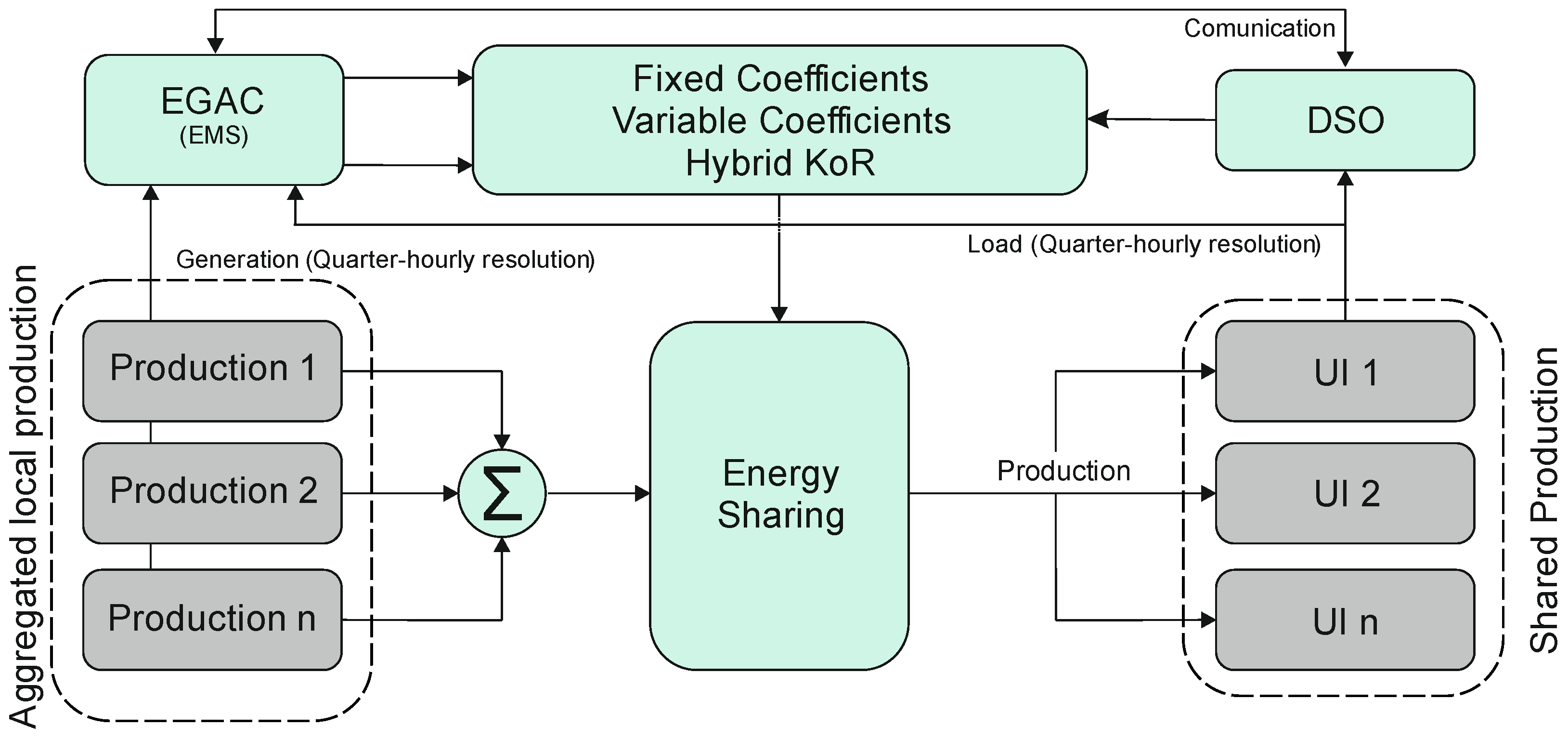
In the Portuguese context, the operation of an REC is structured around the coordinated interaction of energy producers, consumers, a central management entity, and the Distribution System Operator (DSO). This model allows for locally generated energy to be virtually shared among participants according to rules defined by current legislation. Figure 1 illustrates the key components and data flows involved in an REC in the Portuguese framework. On the left side of the figure, there are multiple local production units (Production 1 to Production n), which generate renewable energy. Their combined production is aggregated and fed into the Energy-sharing module at quarter-hourly intervals.
The aggregated production is then distributed among the different user installations (UI 1 to UI n), shown on the right side of the figure. The amount of energy each user receives is determined by the selected KoR, which is calculated and managed by the EGAC (Entidade Gestora do Autoconsumo Coletivo). The EGAC acts as the Energy Management System (EMS) and is responsible for defining the sharing coefficients and communicating them to the DSO. The DSO is responsible for the virtual distribution of energy to the users. If the EGAC fails to provide these coefficients, the DSO defaults to using proportional coefficients based on measured load data. Communication between the EGAC and DSO is carried out via a digital platform, as mandated by the regulatory framework.
Under Portuguese regulation, RECs are allowed to define their energy-sharing strategies using static, dynamic or hybrid KoRs. These KoRs are applied within a 15 min settlement period. This regulatory flexibility supports different levels of complexity and adaptability, depending on the technological maturity and objectives of each REC.
In the following sections, several heuristic energy-sharing rules applicable under the current Portuguese legislative framework (KoRs) will be presented, outlining their characteristics, implementation logic, and suitability for different RECs.

2.1. KoRs with Static Coefficients

Among the KoRs with static coefficients, the identical sharing KoR, represented in Equation (1), is particularly notable for its simplicity and straightforward implementation. It is based on the principle of equal division, meaning that each member receives the same proportion of the total energy generated by the community during each time interval. Although the absolute amount of energy distributed may vary depending on overall production, the proportion allocated to each participant remains fixed. This method is advantageous due to its transparency and ease of application; however, it may be economically inefficient, as it does not consider differences in individual consumption or contribution levels [12,35].
λ j t = 1 N
where λ j t is the sharing coefficient for participant j at time instant t , and N is the total number of community participants.
Another popular KoR with static coefficients is based on the proportional allocation of energy according to the financial investment made by each member in the REC. As can be seen in Equation (2), in this KoR, coefficients are calculated based on each participant’s individual contribution relative to the total cost of the infrastructure. This KoR inherently favors members with higher financial contributions, regardless of their actual energy consumption or production [12,36].
λ j t = C j i n v j = 1 N C j i n v
where C j i n v is the investment made by each participant j .
The total power assigned to each participant at the time instant t is determined by Equation (3).
P p a r t i c i p a n t j t = λ j t j = 1 N P P V j t
where P P V j t is the power generated by each participant j at time instant t .

2.2. KoRs with Dynamic Coefficients

In contrast to static KoRs, dynamic KoRs assign dynamic coefficients that change at each time instant t , enabling more tailored energy allocation among REC members. These coefficients can be adjusted dynamically according to specific parameters, such as individual consumption or production levels [12,35].
In the literature, one of the most widely used KoR with dynamic coefficients is based on proportional consumption sharing, represented in Equation (4). This key allocates the REC’s collective energy production according to each participant’s load relative to the total REC load. Consequently, a participant cannot be assigned an energy share that exceeds their actual load [13,36,37,38].
λ j t = L o a d j t j = 1 N L o a d j t
where L o a d j t is the load of each participant j at time instant t .
This KoR can encourage participation in RECs, as it fairly reflects each members’ consumption needs. However, it may also create unintended incentives for members to increase their consumption in order to receive a larger share of the energy generated, which can undermine the community’s sustainability goals and its overall generation efforts.
Another widely reported dynamic KoR in the literature is based on proportional production sharing, as represented in Equation (5). In this KoR, the total energy generated within the REC is proportionately distributed among participants according to their production at each time instant t . Unlike the KoR with proportional consumption sharing, this sharing key promotes energy generation rather than consumption. As a result, active participants are rewarded for injecting energy into the REC, encouraging distributed renewable generation. However, members without local generation assets do not receive any portion of the community’s shared energy, as they do not contribute to REC production [12].
λ j t = P P V j t j = 1 N P P V j t
As with the static KoRs, the total power allocated to each participant at time instant t is determined by Equation (3).

2.3. Hybrid KoRs

Hybrid KoRs combine different types of sharing coefficients, including static, dynamic, or a combination of both [12,14]. This approach offers the advantage of optimizing energy allocation within the REC by integrating two or more types of coefficients.
One of the most commonly documented hybrid KoRs in the literature involves a two-step sharing mechanism based on proportional production sharing. In the first stage, represented by Equations (6) and (7), the total energy generated by the community is allocated proportionally to the individual energy production of each participant, as discussed in Section 2.2.
λ 1 j t = P P V j t j = 1 N P P V j t
P n e t t j =   λ 1 j t · j = 1 N P P V j t   L o a d j t
where P n e t t j represents the mismatch between the attributed power and the load of participant j at time instant t , i.e., the difference between the energy originally allocated and the participant’s actual load.
In the second stage, if a mismatch exists—i.e., some participants produce more than they consume (surplus) while others consume more than they produce (deficit)—the total surplus is redistributed among the deficit participants. As represented in Equation (8), the redistribution coefficient λ 2 is determined proportionally to each deficit participant’s share of the total deficit, ensuring that excess energy is allocated according to actual shortfalls.
λ 2 j t = P n e t + t j j = 1 N P n e t + t , i f   P n e t t j > 0 P n e t t j j = 1 N P n e t t , i f   P n e t t j < 0 .
Equation (9) corrects the initial energy mismatch of each participant by distributing the lesser between total excess and total deficit, in proportion to their share as defined in Equation (8). This allows for a balanced redistribution that improves equity and efficiency within the REC.
P n e t t j = P n e t t j + λ 2 j t min j = 1 N P n e t ,   j = 1 N P n e t +
Equation (10) determines the final power assigned to each participant after the redistribution process. It combines the participant’s actual load with their net mismatch ( P n e t t j ), which reflects the surplus adjusted through hybrid sharing. This allows for a more balanced and fair energy allocation within the REC.
P p a r t i c i p a n t j t = L o a d j t + P n e t t j

3. Methodology

This section outlines the methodological framework employed to assess the performance of different KoR strategies within a REC. The section is structured around three core components: the definition of community scenarios and participant configurations, the characterization of data profiles used for PV generation and consumption, and the application of performance metrics to assess the results of each simulation.

3.1. Community Scenarios and Participant Configuration

To evaluate the effects of different KoRs in relation to the structural and functional characteristics of each REC, this study considered both small- and large-scale communities, reflecting the diversity of possible implementation contexts. In both cases, the integration of energy storage solutions, including stationary batteries and EVs, was considered, since these technologies play a fundamental role in managing self-consumption, reducing grid dependency, and consequently increasing efficiency. For the simulations, different participant profiles (residential prosumers) equipped with photovoltaic systems and storage solutions were created. Each residential prosumer was assumed to have an installed PV capacity of 9 kWp (30 photovoltaic modules of 300 Wp) and lithium-ion batteries with a capacity of 30 kWh. In addition, to assess the impact of electric mobility on REC performance, it was assumed that 30% of the participants own EVs, modeled based on the specifications of the Nissan Leaf e+ (2025). The inclusion of this element allows for the analysis of bidirectional integration through Grid-to-Vehicle (G2V) and Vehicle-to-Grid (V2G) mechanisms and its effects on the flexibility, efficiency, and economic sustainability of the REC.

Storage Systems Characterization

As previously discussed, this study accounted for two types of storage systems integrated into the REC: stationary batteries and electric vehicles. These systems play a crucial role in increasing self-consumption, enhancing flexibility, and supporting grid interactions.
The stationary storage systems consist of lithium-ion batteries with a nominal capacity of 30 kWh. The detailed technical specifications of the stationary batteries used in the simulations are summarized in Table 1.
In addition to stationary storage, the study incorporates EVs with bidirectional charging capabilities, enabling both Vehicle-to-Grid (V2G) and Grid-to-Vehicle (G2V) energy transactions. Thirty percent of the participants are assumed to own EVs, which are modeled using the 2025 Nissan Leaf e+ configuration [39], as presented in Table 2.
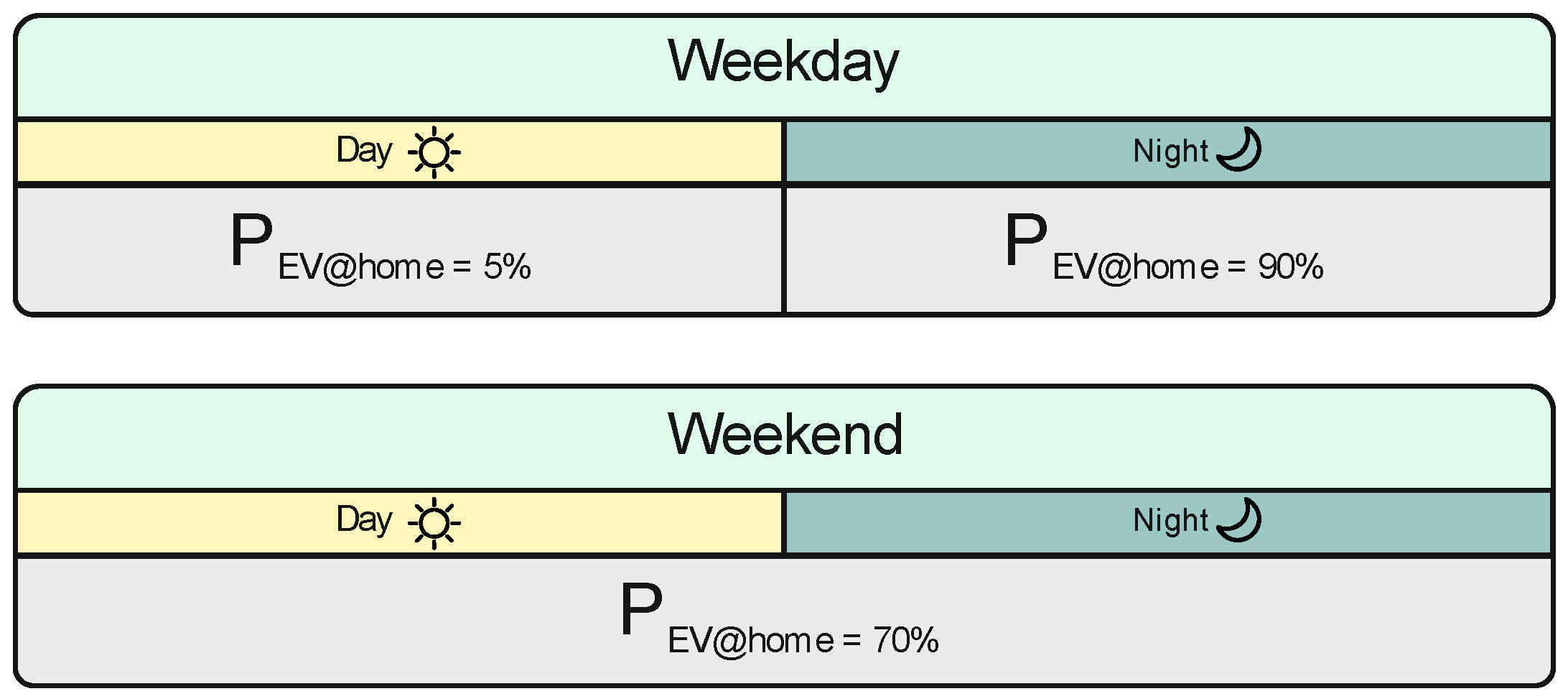
Additionally, given the essential role of EVs in ensuring personal mobility, and to more accurately reflect real-life conditions, the availability of EVs for charging and discharging is modeled probabilistically, based on the likelihood of the vehicle being at home, denoted by the parameter P E V @ h o m e [40,41]. As illustrated in Figure 2, EVs are assumed to have a 5% probability of being at home during the daytime on weekdays, increasing to 90% at night. On weekends, this probability is set at 70% throughout the day.
Furthermore, to represent the impact of EV mobility, each time a vehicle leaves home, it is assumed to undertake a random trip of 30 to 225 km. This results in a reduction in the state of charge (SoC) ranging from 10% to 60%, depending on the distance travelled.

3.2. Energy Storage Management Strategy

The efficient management of energy storage systems plays a key role in the self-sufficiency and flexibility of an REC as it enables the adjustment and balancing of renewable generation variability and load fluctuations. Therefore, the definition of appropriate operational strategies is crucial to enhance self-consumption, reduce grid dependency, and simultaneously strengthen the efficiency as well as the economic and environmental sustainability of the REC. In this context, the present study adopted an approach focused on the analysis of operational costs, seeking to optimize the use of energy storage solutions integrated into the REC.
The operational cost associated with the use of the energy storage systems considered ( D i s c h a r g e c o s t ) is calculated as a function of the replacement cost ( R E P C o s t ), the total energy available over their lifetime ( E L i f e t i m e ), and the amount of discharged energy at time step t , using Equations (11) and (12).
E L i f e t i m e = N c y c l e s , M a x S t o r a g e   C a p a c i t y D o D
D i s c h a r g e c o s t j t = R E P C o s t j E L i f e t i m e j E D i s c h a r g e j t
In this way, the use of energy storage systems occurs only when the associated operational cost is lower than the energy price in the Iberian market (MIBEL), ensuring that operations are economically advantageous and contribute to the longevity of the considered storage solutions.
The dispatch strategy follows a well-defined hierarchy, designed to optimize the use of storage systems and maximize economic efficiency. Stationary batteries are considered first by checking whether their associated operational cost is competitive (lower) compared to the prevailing energy price in the MIBEL. If an energy deficit persists after using stationary batteries, EVs are employed, if their operational costs are also lower than the energy price. In the absence of favorable economic conditions, storage systems are not used, thereby ensuring economically efficient operation and promoting their longevity.
Regarding the charging process of EVs, the strategy considers both technical and economic criteria. EVs are prioritized for charging whenever they are connected to the domestic grid with a state of charge below 40%, ensuring their availability for mobility. Additionally, vehicles are charged when the energy price is lower than the equivalent cost of operating a combustion engine vehicle. For this calculation, a reference fossil fuel price of €1.60/L, an average consumption of 5 L/100 km, and an energy consumption of 1.6 kWh/100 km for EVs were considered.

3.3. Data Profiles

To evaluate the performance of the different KoRs presented in Section 2, simulations were conducted using representative profiles of PV production and energy consumption comprising 30 participants. These profiles were constructed to reflect realistic operating conditions within a residential energy community, considering both the temporal variability of solar production and typical household demand patterns.

3.3.1. PV Profiles

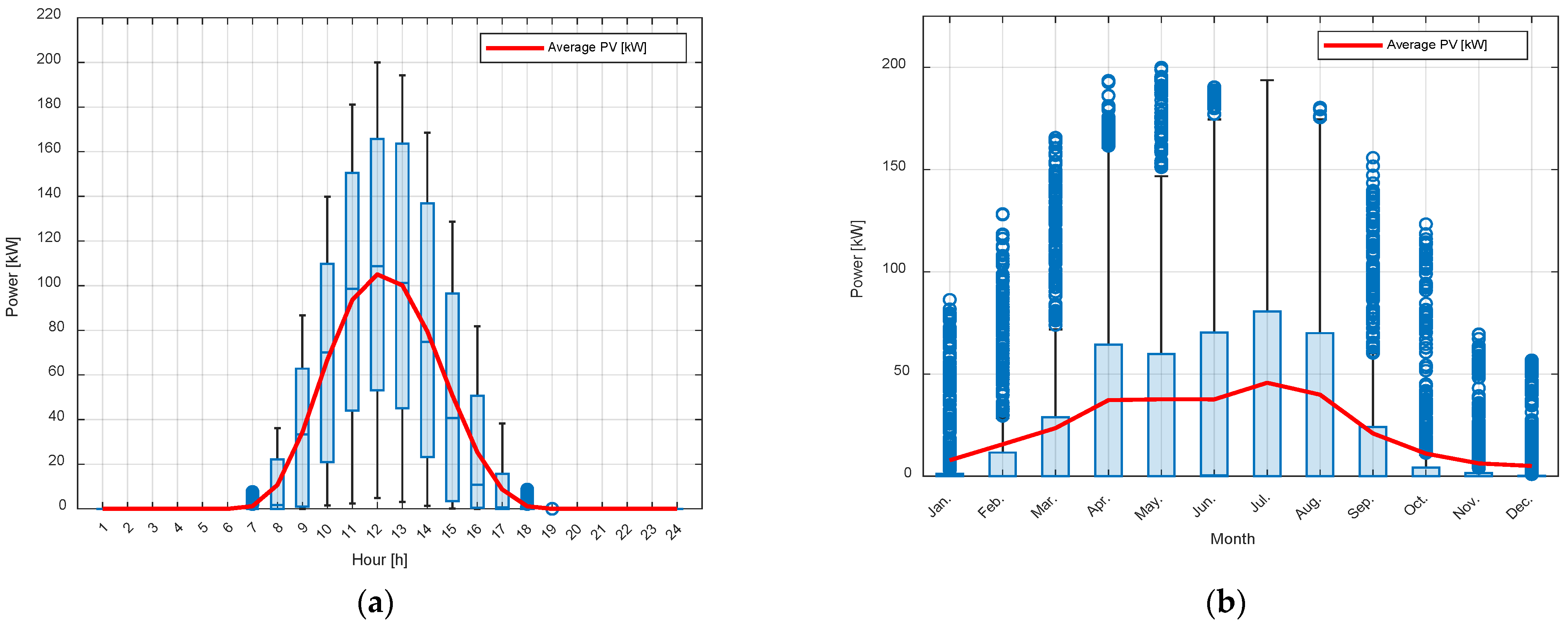
Figure 3a presents the hourly distribution of the total aggregated PV production from all of the participants, accumulated hour by hour throughout the year, where blue circles indicate outliers. This aggregation reflects the sum of the instantaneous power generated by all community members at each hour of the day. The irradiance profile used to simulate photovoltaic production was obtained from [42], considering a single geographical point, according to the regulatory proximity constraint imposed on members of energy communities (in Portugal, a maximum radius of 4 km [18]). To represent the architectural diversity and the different orientations and tilts of PV systems in urban contexts, azimuth angles (ranging from 0° to 360°) and tilt angles (from 0° to 90°) were randomly generated from a Gaussian distribution for each participant. Thus, although irradiance is common to all, the production profiles vary according to the orientation and inclination of each system.
As anticipated, the aggregated PV production depicted in Figure 3a follows a bell-shaped daily pattern, reaching its peak at 12:00 with a maximum community-wide output of approximately 200 kW. This behavior reflects the typical solar irradiance profile, which peaks when the sun is at its highest position in the sky, resulting in optimal conditions for PV production.
Figure 3b illustrates the aggregated monthly distribution of PV production across all participants. As expected, the highest production levels were observed during the spring and summer months, particularly between April and August. This seasonal variation is consistent with typical solar irradiance patterns in temperate climates of the Northern Hemisphere, where longer daylight hours and higher solar angles during summer contribute to increased photovoltaic generation. In contrast, the winter months exhibit significantly lower production due to shorter days, lower sun angles, and higher frequency of cloud cover, which limit the availability of solar production.

3.3.2. Load Profiles

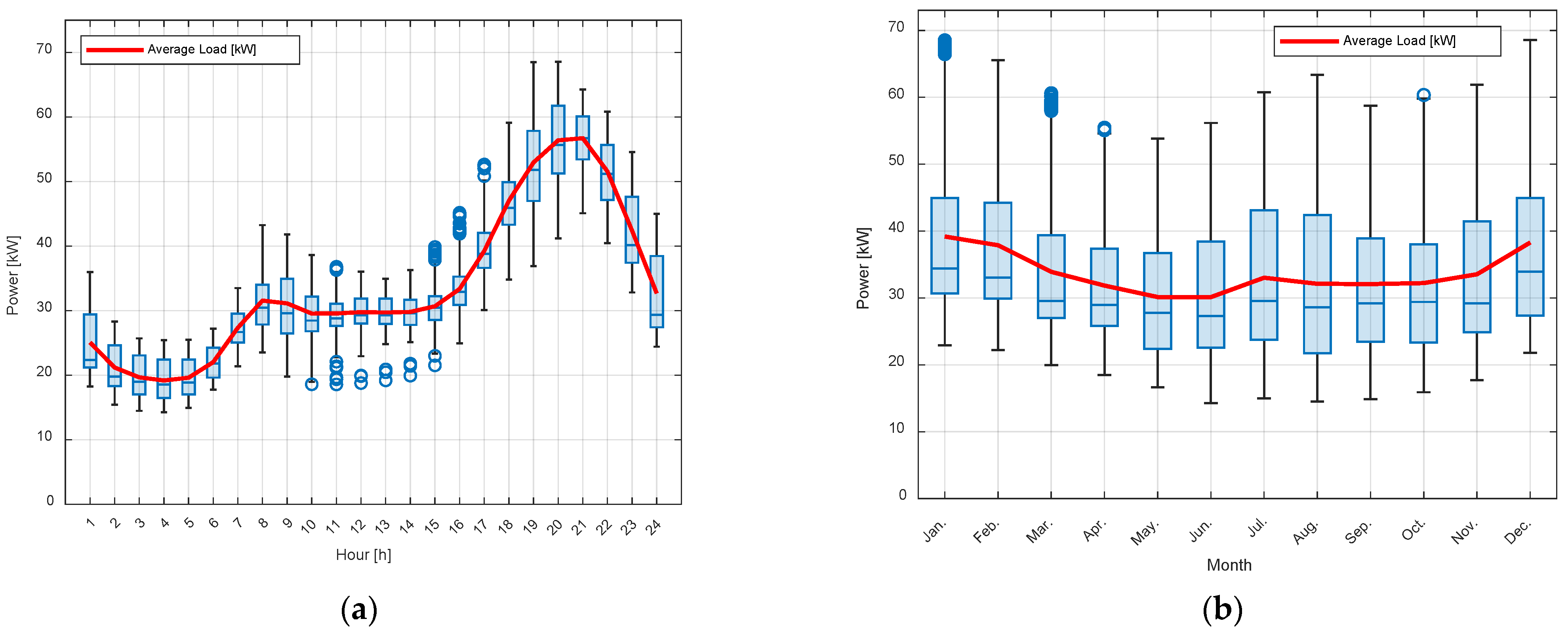
Figure 4a illustrates the aggregated hourly demand of the REC, over the course of a day. The load profiles were obtained from [43], which provides detailed residential consumption data representative of typical household usage. The aggregated load profile exhibited a clear daily pattern, with the highest consumption observed during the evening hours, especially around dinner time, when occupants typically engage in energy-intensive activities such as cooking, lighting, and using household appliances. Conversely, the load dropped significantly during the nighttime, reflecting the period when most residents are asleep and energy usage is minimal. This daily variation in consumption is characteristic of residential households and captures the behaviors and lifestyles of the REC participants.
Figure 4b depicts the aggregated monthly distribution of electrical load across all participants. Unlike PV production, the load profile remained relatively stable and linear throughout the year, reflecting consistent daily residential consumption patterns. However, a noticeable slight increase in consumption occurred during the winter months, likely due to higher heating demands and increased indoor activity as a result of colder weather.

3.4. Evaluation Metrics

To systematically assess the impact of each KoR introduced earlier, one needs to apply a set of performance metrics to the simulation results. These metrics were carefully selected from the literature based on their clarity, interpretability, and ability to provide both quantitative and qualitative insights into the operational behavior of the REC. The following section presents several metrics considered relevant for evaluating the efficiency, self-sufficiency, and overall performance of the simulated energy community scenarios.

3.4.1. Annual Savings

To capture the economic impact of the simulated scenarios on both the REC and its participants, a metric was defined to quantify the annual financial savings. As depicted in Equation (13), this indicator serves to evaluate the potential cost reduction achieved through participation in the energy community [13,44,45].
A n n u a l   S a v i n g s = j = 1 N t = 1 T L o a d j t t = 1 T E n e r g y B o u g h t j t E n e r g y P r i c e t
where E n e r g y B o u g h t j t is the amount of energy purchased by participant j at the time instant t , and E n e r g y P r i c e t denotes the energy market price at time instant t .

3.4.2. Savings per Kilowatt-Hour

This indicator measures the financial benefit associated with each kilowatt-hour of energy consumed, allowing for a fair comparison of savings across all participants, regardless of their total consumption. As shown in Equation (14), this metric is determined by the ratio between the annual savings and the sum of the REC’s energy demand and the energy sold back to the grid [13].
S a v i n g s   p e r   k W h = A n n u a l   S a v i n g s t = 1 T ( j = 1 N L o a d j t )
where E n e r g y S o l d j t is the amount of energy sold by participant j at time instant t .

3.4.3. Payback Period

The payback period, defined in Equation (15), represents an estimate of the time required for the REC to recover the total initial investment. A shorter payback period indicates greater long-term financial viability and sustainability of the energy community [13].
P B P = j = 1 N I n v e s t m e n t j A n n u a l   S a v i n g s
where I n v e s t m e n t j is the total investment made by participant j .

3.4.4. Self-Sufficiency Ratio (SSR) and Self-Consumption Ratio (SCR)

The self-sufficiency ratio (SSR) and self-consumption ratio (SCR) are among the most commonly used metrics in the literature to evaluate the performance of an energy community. These ratios provide an understanding of how much of the REC’s consumed energy is supplied by its own production (SSR), and how much of the REC’s generated energy is consumed internally (SCR) [5].
High SSR and SCR percentages indicate reduced dependency on the main grid and more efficient utilization of the community’s resources. These ratios are also closely linked to the economic viability of the REC, since higher self-consumption and self-sufficiency reduce interactions with the electrical grid. The SSR and SCR are mathematically defined by Equations (16) and (17), respectively:
S S R = t = 1 T j = 1 N E n e r g y l o c a l l y   c o n s u m e d j t t = 1 T j = 1 N L o a d j t
S C R = t = 1 T j = 1 N E n e r g y l o c a l l y   c o n s u m e d j t t = 1 T j = 1 N P V j t
where E n e r g y l o c a l l y   c o n s u m e d j t is the locally consumed energy by participant j at time instant t .

3.4.5. Energy Storage Systems State of Health (SOH)

To assess the state of health (SoH) of the storage systems belonging to each participant, it is essential to incorporate a metric that quantifies battery degradation over time [46]. The SoH can be expressed as:
S O H = 1 t = 1 T 1 A B a t j = 1 N P D i s c h a r g e j t
where P D i s c h a r g e j t represents the power discharged by participant j at time t , and A B a t is the total energy that the battery can deliver over its lifetime, defined in Equation (19).
A B a t = N C y c l e s · D O D ¯ · C a p B a t j
where N C y c l e s is the expected number of full charge–discharge cycles, D O D ¯ is the average depth of discharge, and C a p B a t j is the nominal capacity of the battery for participant j .

4. Simulation Results

This section presents the results obtained from the simulation of different REC configurations and KoRs. The goal was to evaluate the impact of various storage setups and KoR mechanisms on the energy and economic performance of RECs in the Portuguese context. Two distinct REC scenarios were simulated to capture different scales and operational conditions:
  • A small-scale scenario involving 3 randomly selected participants from the dataset of 30 participants;
  • A large-scale scenario comprising the entire set of 30 participants.
Within each scenario, three storage configurations were tested:
  • Without storage systems;
  • With stationary batteries only (without EVs);
  • With full storage systems integration (with stationary batteries and EVs).
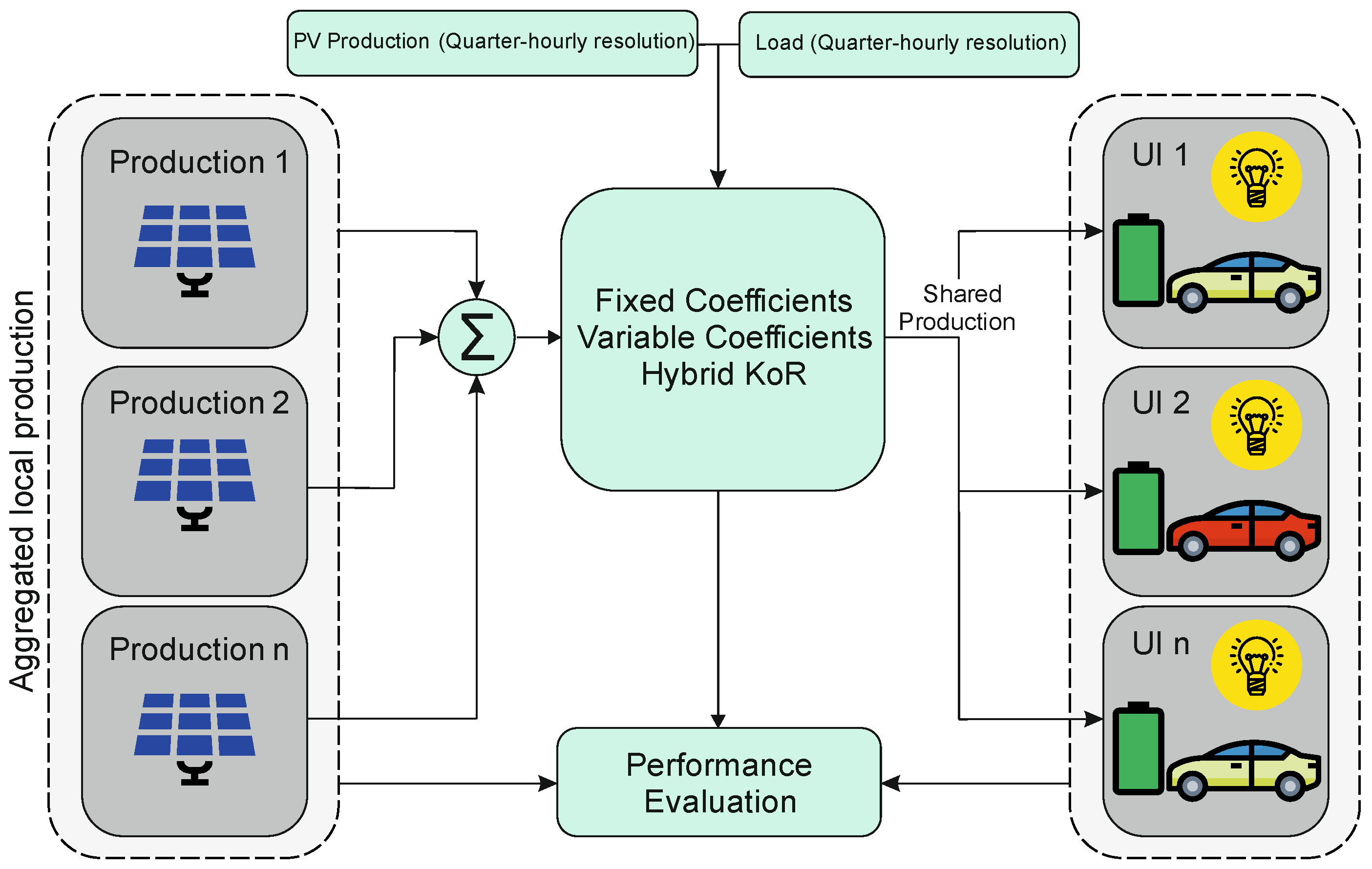
For each combination of scale and storage configuration, the KoR strategies introduced in Section 2 were applied independently, as illustrated in Figure 5. This systematic approach allows for a comprehensive comparison of the performance outcomes under varying technical and social conditions. The evaluation was based on the performance indicators defined in Section 3.3, namely: Annual Savings, Savings per kWh, SSR, SCR, and SOH of stationary batteries and EVs when applicable.

4.1. Small-Scale Community Scenario

This subsection analyses the results of different KoRs on a small-scale REC composed of three randomly selected participants from the full dataset of 30 households. This approach enables the assessment of different KoR performances and the role of storage technologies in a limited community context, allowing for the evaluation of their impact on energy autonomy, self-consumption, and grid interaction in early stage or small-scale REC implementations.

4.1.1. Without Storage Systems

As shown in Table 3, in the scenario without storage systems, the Dynamic KoR-Load achieved the highest annual savings (€3141.1) and the shortest payback period (10.98 years). Accordingly, the best-performing results for each performance metric are highlighted in Table 3. Its weak technical performance (SSR: 0.448, SCR: 0.276) reflects a strong dependence on the power grid. The Hybrid KoR-Production/Load, although slightly behind in economic terms (€3133.3; 11.01 years), reached the lowest grid dependence, reflected in the highest SCR (0.276) and competitive SSR (0.447), thus enhancing local energy autonomy. The Static KoR and Dynamic KoR-Production presented similar results, with slightly lower savings and higher grid imports, confirming their more limited effectiveness in maximizing community benefits.
From the perspective of grid interaction, both Dynamic KoR-Load and Hybrid KoR resulted in lower energy imports (Grid Buy: 1.08 × 10⁵ kWh) and reduced exports (Grid Sell: 4.9 × 10⁴ kWh) compared to the other KoRs.
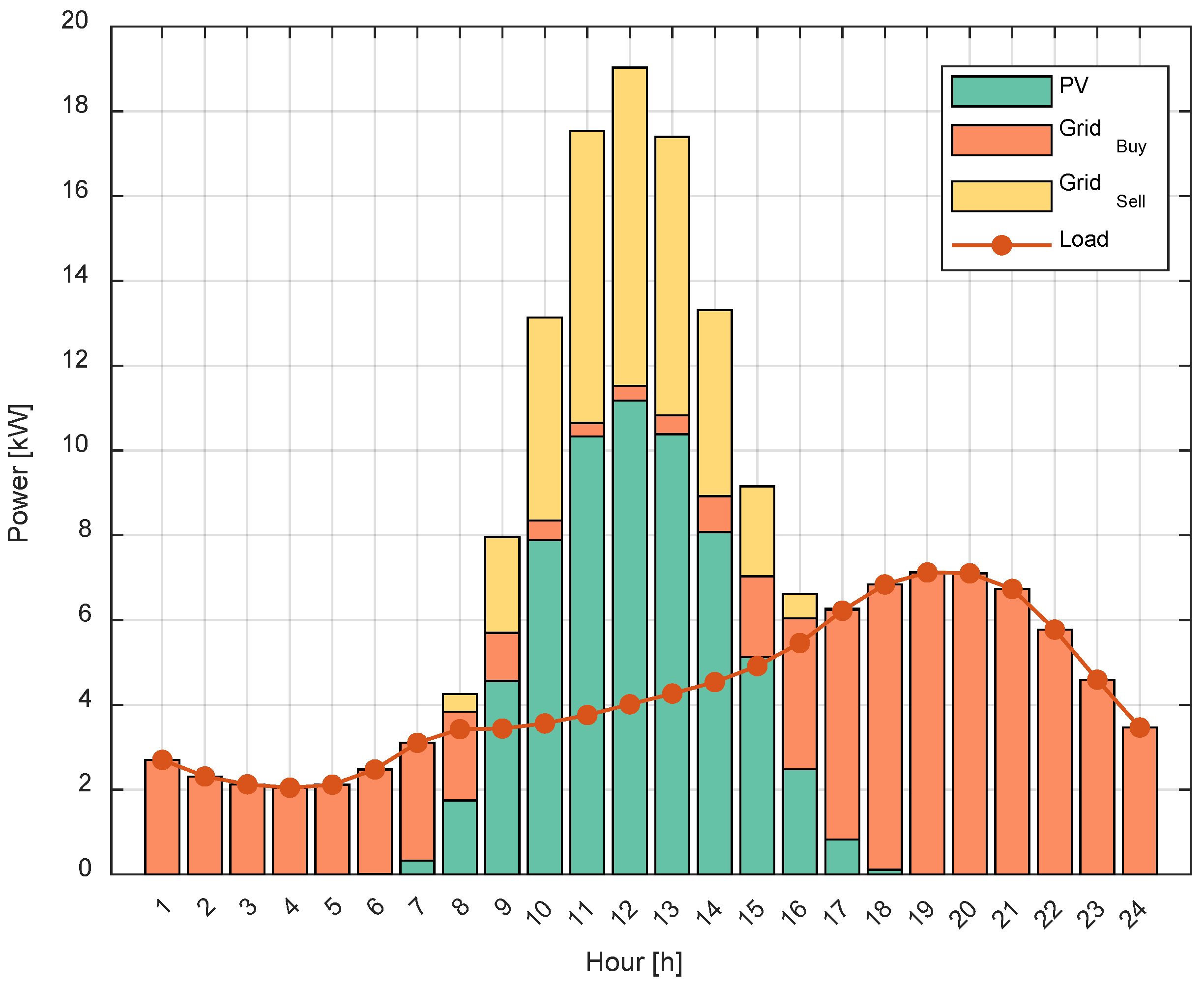
Figure 6 illustrates the community’s aggregated average power for each hour over a full year under the Dynamic KoR-Load strategy in the no-storage scenario. As expected, without any storage capacity, the REC must import energy from the grid during nighttime—when PV generation falls to zero—and export all surplus generation during daylight hours once the REC demand is met. This clear diurnal pattern underscores the importance of storage systems in shifting excess solar energy into periods of low generation.

4.1.2. With Stationary Batteries

In this scenario with stationary batteries only, shown in Table 4, the Hybrid KoR-Production/Load presented the best overall performance. It achieved the highest annual savings (€8351.2), the greatest savings per kWh (€0.0560), and the shortest payback period (4.13 years). In addition, it reached the strongest energy autonomy, with the highest self-sufficiency ratio (SSR: 0.953) and self-consumption ratio (SCR: 0.588), while minimizing imports from the grid (Grid Buy: 6.13 × 10⁴ kWh).
The Dynamic KoR-Production and Dynamic KoR-Load followed closely, with very competitive economic results (savings above €8190) and strong technical indicators (SSR: 0.940–0.946; SCR: 0.581–0.584), highlighting their effectiveness in maximizing the benefits of stationary storage integration.
In contrast, the Static KoR, although still delivering significant improvements compared to the scenario without storage systems, presented lower economic outcomes (€6856.7; 5.03 years) and reduced technical performance (SSR: 0.803; SCR: 0.496).
Regarding battery SOH, all KoRs preserved values above 94%, with the Static KoR showing the highest level (96.03%), while the dynamic and hybrid approaches converged around 94.6–94.7%, indicating that the more advanced redistribution methods improved economic and technical performance without significantly compromising battery lifespan.
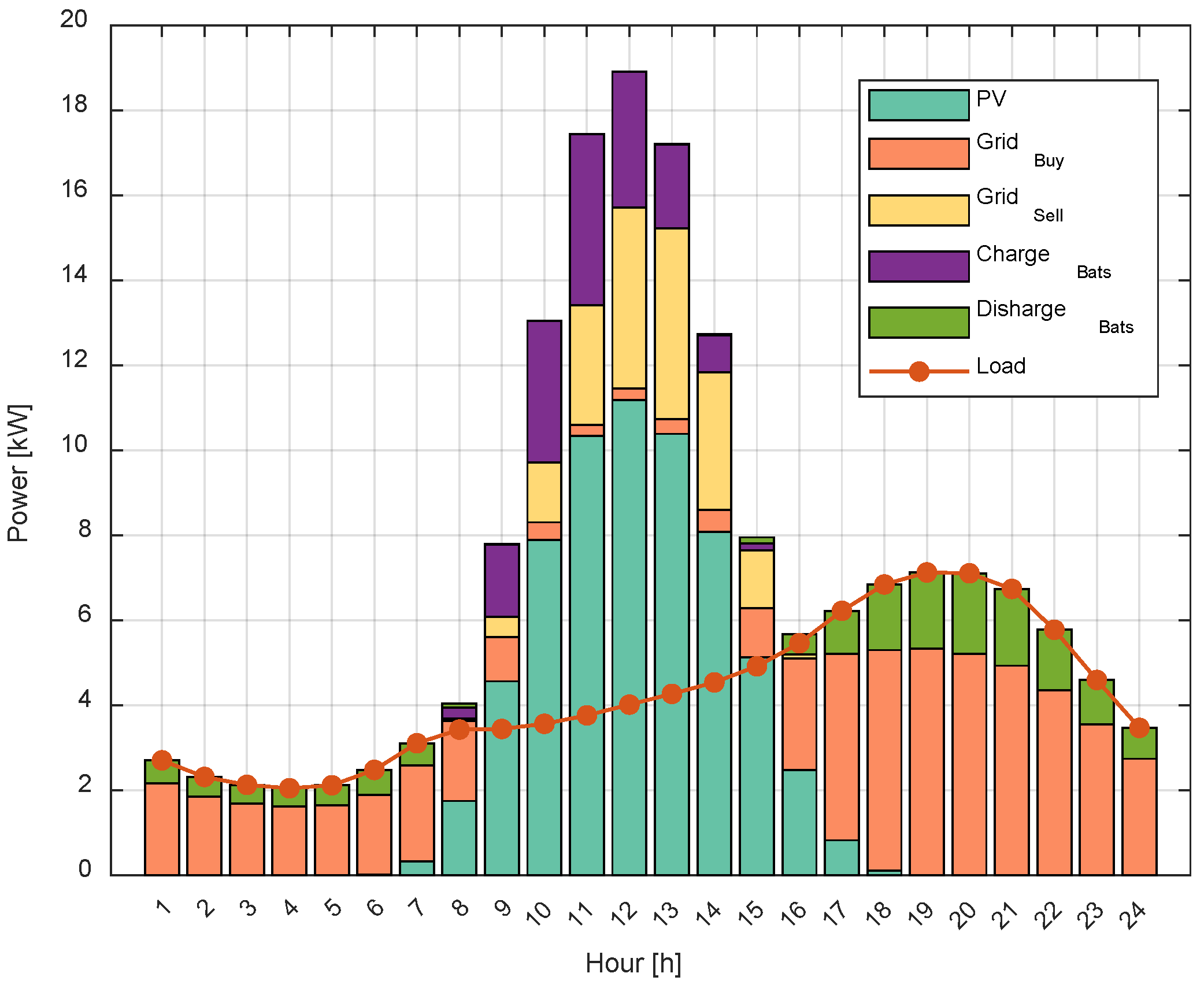
Figure 7 illustrates the REC’s average hourly power profile over the course of one year when applying the Hybrid KoR-Production/Load strategy with stationary batteries. The integration of stationary storage significantly reduces nighttime grid imports and daytime surplus exports, leading to a smoother and more balanced power profile. This outcome highlights the substantial improvements in energy autonomy and grid interaction that can be achieved through stationary battery integration.

4.1.3. With Stationary Batteries and Electric Vehicles

In this mixed-storage scenario (including both stationary batteries and EVs), presented in Table 5, all redistribution strategies achieved significant improvements in economic and technical performance. Among them, the Dynamic KoR-Load provided the strongest overall results, with the highest annual savings (€8557.3), the greatest savings per kWh (€0.0574), and the shortest payback period (4.03 years). It also reached the highest self-sufficiency ratio (SSR: 0.970) and one of the best self-consumption ratios (SCR: 0.599) while reducing grid imports to 5.98 × 10⁴ kWh and limiting exports (Grid Sell: 1.21 × 10⁴ kWh).
The Hybrid KoR-Production/Load followed closely, achieving competitive savings (€8546.7) and payback (4.04 years), together with the strongest SCR (0.598) and a robust SSR (0.969). Similarly, Dynamic KoR-Production performed at a high level (€8503.9; 4.06 years). By comparison, the Static KoR, although still delivering substantial economic benefits (€8481.4; 4.07 years), exhibited slightly lower technical indicators (SSR: 0.958; SCR: 0.591), confirming its relative limitations when compared with dynamic and hybrid redistribution approaches.
Importantly, in all KoRs, the SOH of the batteries and EVs remained high (SOH Bats ≈ 94.6%; SOH EVs ≈ 99.9%), confirming that the integration of mixed-storage systems can be achieved without compromising asset longevity.
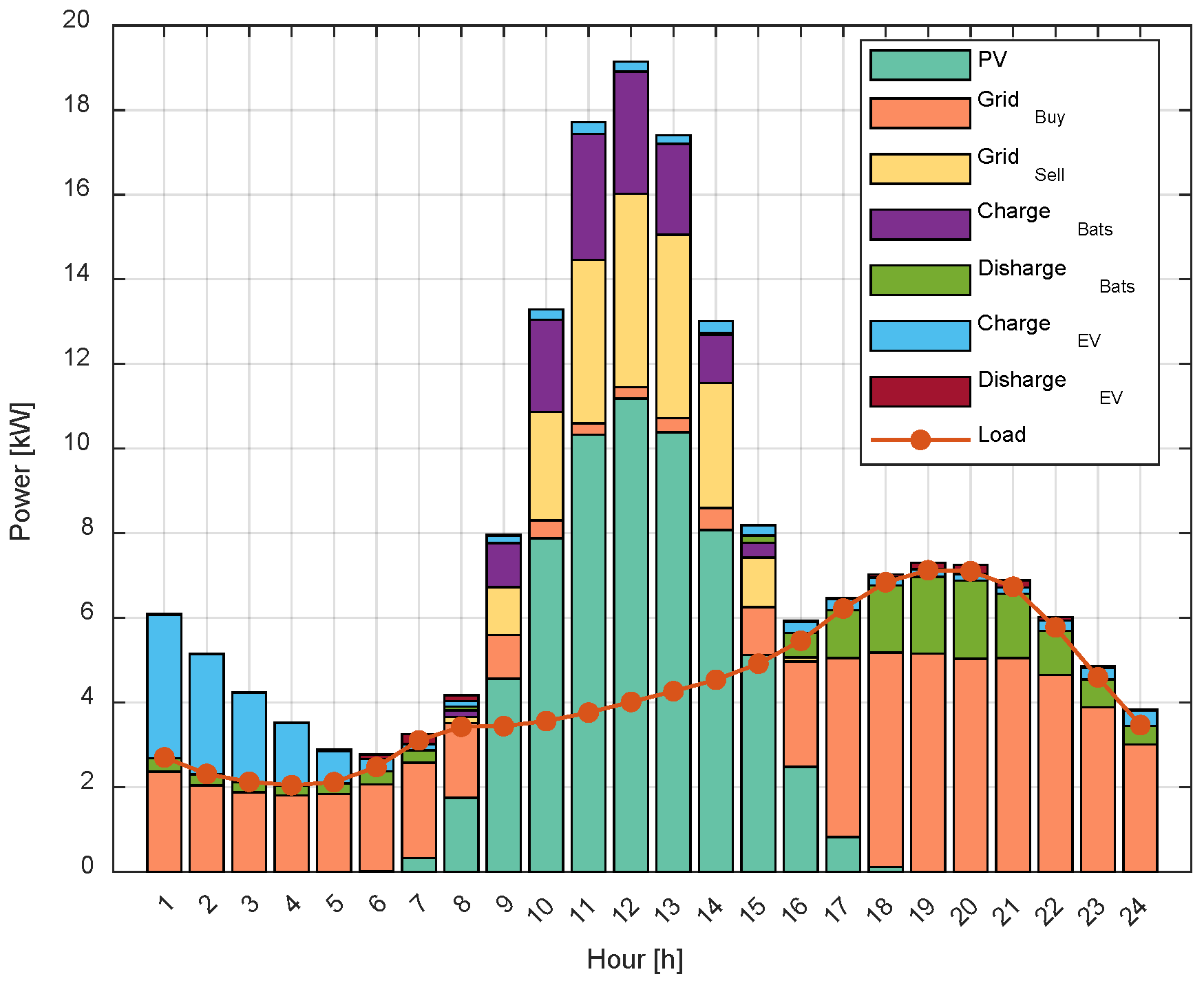
Figure 8 illustrates the community’s hourly average power over an entire year under the Dynamic KoR-Load, with both stationary batteries and EVs deployed. The stationary batteries exhibit a characteristic charge–discharge cycle: absorbing excess PV generation during daylight hours and releasing stored energy overnight, thereby smoothing the overall power profile. Meanwhile, EVs charge predominantly at night—mirroring typical daytime vehicle use—and, despite their bidirectional capability, contribute only minimally to the community via V2G discharges. This residual V2G output underscores that in this scenario, the primary storage benefit is provided by the stationary batteries, while EVs serve mainly as flexible loads.

4.1.4. Results Analysis and Discussion

From the analysis of the results, one can draw conclusions about the impact of storage systems and different KoRs on the overall performance of small-scale RECs, taking into account their structural and functional characteristics. In the first scenario, where only PV production is considered and there is no form of energy storage, annual savings range approximately between €3060 and €3140, depending on the type of KoR applied. The payback period is high (around 11 years), which compromises the economic sustainability and attractiveness of the community. In addition, both the SSR (0.44) and SCR (0.27) indicators present low values, reflecting a strong dependence on the power grid. The amounts of energy purchased from and sold to the grid are very high, highlighting the difficulty of locally integrating renewable production. The differences among the various KoRs are not significant, although the Dynamic KoR-Load and Hybrid KoR-Production/Load rules present slight advantages compared to the others KoRs as they enable a better alignment between production and consumption and, consequently, a fairer energy distribution among participants. The absence of energy storage systems strongly limits the potential for improvement, which explains the proximity of the results among KoRs.
The second scenario, which considers the introduction of stationary storage systems, showed a significant improvement compared to the first scenario. Annual savings doubled, ranging between €6856 and €8351, while the payback period was reduced to only 4–5 years, making the community clearly more attractive and sustainable. The SSR increased to values between 0.80 and 0.95, and the SCR approached 0.60, demonstrating a greater capacity for self-consumption and reduced dependence on the power grid. In addition, both energy purchases from and sales to the grid decreased significantly, meaning that a larger share of the locally generated energy is consumed within the community. The state of health (SOH) of the batteries remained between 94% and 96%, showing that the adopted storage operation strategy does not significantly compromise their longevity.
In this scenario, with the introduction of stationary batteries, the differences among KoRs become more pronounced, i.e., as the system’s flexibility increases, the differences become more significant. The static rule presented lower performance indicators (smaller annual savings and a longer payback period). In contrast, dynamic rules, which allow for more efficient adjustment and sharing of renewable generation among participants, achieved better performance results. This is reflected in a substantial reduction in purchased energy and a significant increase in self-consumption. The hybrid approach (Hybrid KoR-Production/Load) achieved the best results, demonstrating that combining criteria based on both production and load profiles increases efficiency and maximizes the benefits of storage integration.
Finally, in the third scenario, which combines stationary storage with EVs, the best overall results were obtained. Annual savings exceeded €8500, while the payback period stabilized at around 4 years. The SSR reached values close to 0.97, and the SCR approached 0.60, consolidating a high degree of self-consumption and reduced dependence on the power grid. Regarding storage degradation, stationary batteries presented an SOH of around 94.5%, while EVs achieved 99.9%. It is important to highlight that in the case of EVs, the SOH calculation only considers interactions with the power grid, excluding usage associated with mobility. These results confirm that electric mobility, when integrated as a complement to stationary storage systems, contributes not only to increasing system flexibility but also to strengthening its economic and environmental sustainability.
Among the different KoRs, dynamic and hybrid rules maintained a slight advantage, although the differences became less significant as system flexibility increased. In this scenario, however, the Dynamic KoR-Load achieved the best results.
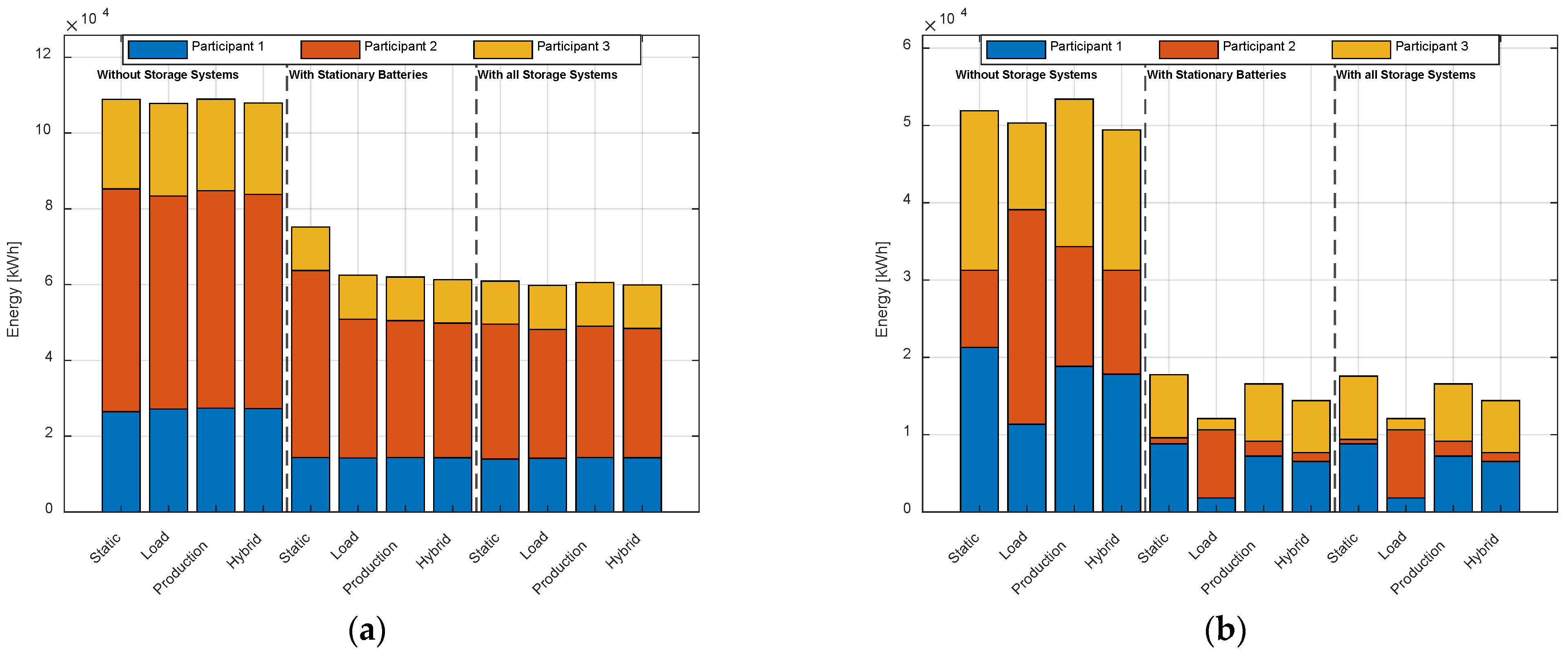
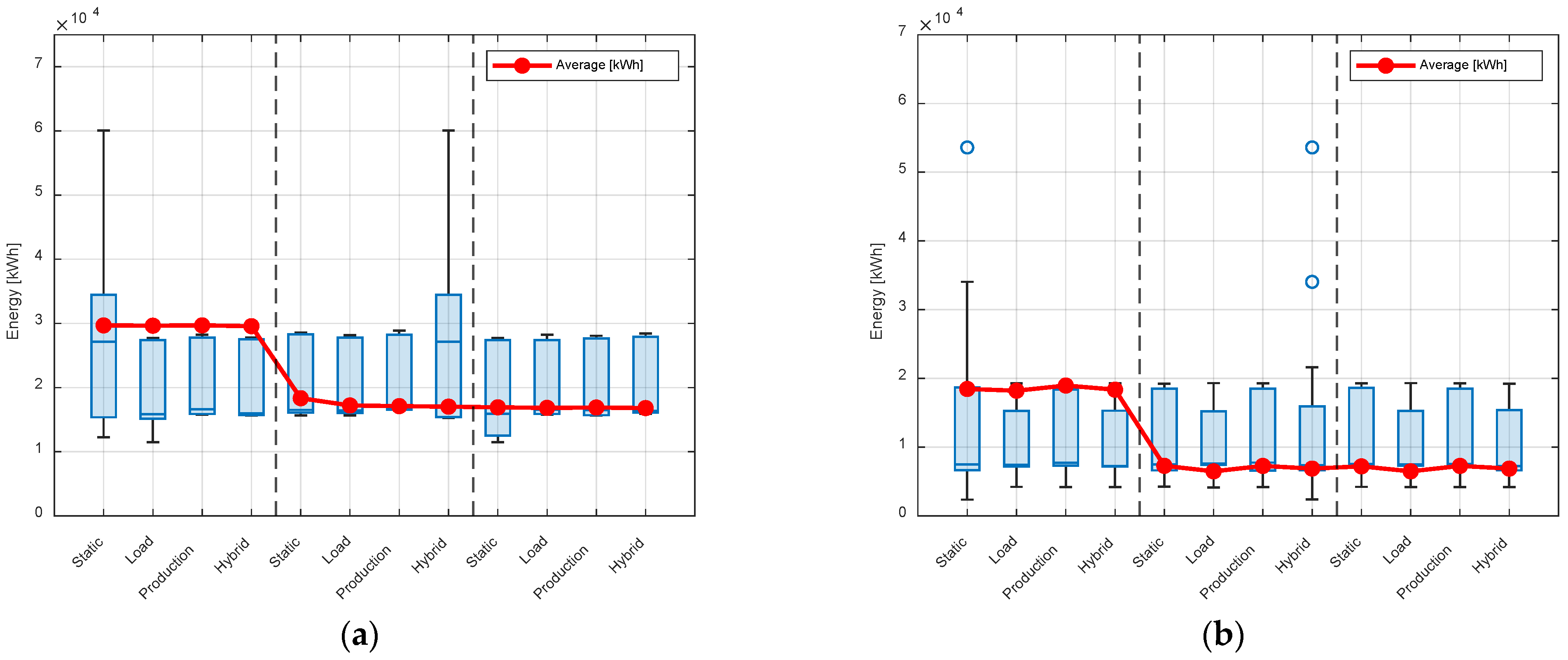
To complement the analysis, Figure 9a,b summarizes the amount of energy purchased from and sold to the grid in each scenario and for each KoR. These figures provide a clear overview of the progressive reduction in grid dependence enabled by the integration of storage systems, as well as the relative advantages of dynamic and hybrid rules compared to the static approach.
Overall, one can conclude that the absence of storage systems strongly limits the efficiency and economic viability of an REC, resulting in low levels of self-consumption and long payback periods. The integration of storage systems considerably improves performance, enabling substantial savings, higher self-sufficiency, and a faster return on investment. With regard to KoRs, static rules prove insufficient to exploit the potential flexibility of RECs, particularly when storage capacity is available. Dynamic and hybrid rules provide relevant benefits by adapting to real-time variations in generation and load. For small-scale RECs, the Dynamic KoR-Load proved to be the most effective in two scenarios, while the Hybrid KoR-Production/Load achieved the best results in one scenario. These findings demonstrate that in small-scale RECs, the structural and functional characteristics of each community—namely the load profile of participants and the presence of stationary or vehicle-based storage systems—play a decisive role in selecting the most suitable KoR, directly influencing economic efficiency, fairness in energy sharing, and the level of self-consumption achieved.

4.2. Large-Scale Community Scenario

This subsection examines the performance of the selected KoR strategies applied to a large-scale REC scenario involving all 30 participants from the dataset. This study allows for the analysis of storage system effectiveness and control approaches in a fully developed community setting, providing insights into their influence on energy self-sufficiency, local consumption optimization, and grid dependency reduction in large-scale RECs.

4.2.1. Without Storage Systems

Under the scenario without storage systems, as shown in Table 6, the Hybrid KoR-Production/Load strategy demonstrated the most balanced and robust performance across all key indicators. It achieved the highest annual savings (€22,725.2), the greatest savings per kWh (€0.0193), and the shortest payback period (15.18 years). In addition, it recorded the highest self-sufficiency ratio (SSR: 0.249) and self-consumption ratio (SCR: 0.348), while slightly reducing grid imports (8.87 × 10⁵ kWh) compared to the other approaches. These results indicate a more efficient use of locally generated energy, maximizing self-consumption even in the absence of storage assets.
The Dynamic KoR-Load followed closely, with annual savings of €22,559.4, a payback of 15.29 years, and solid technical performance (SSR: 0.247; SCR: 0.345). Similarly, the Dynamic KoR-Production achieved competitive economic results (€22,435.7; 15.38 years), although its higher energy exports (Grid Sell: 5.69 × 10⁵ kWh) slightly reduced the local energy utilization.
In contrast, the Static KoR delivered the weakest results, with lower annual savings (€22,463.7) and the longest payback period (15.36 years), alongside reduced energy autonomy (SSR: 0.245; SCR: 0.343).
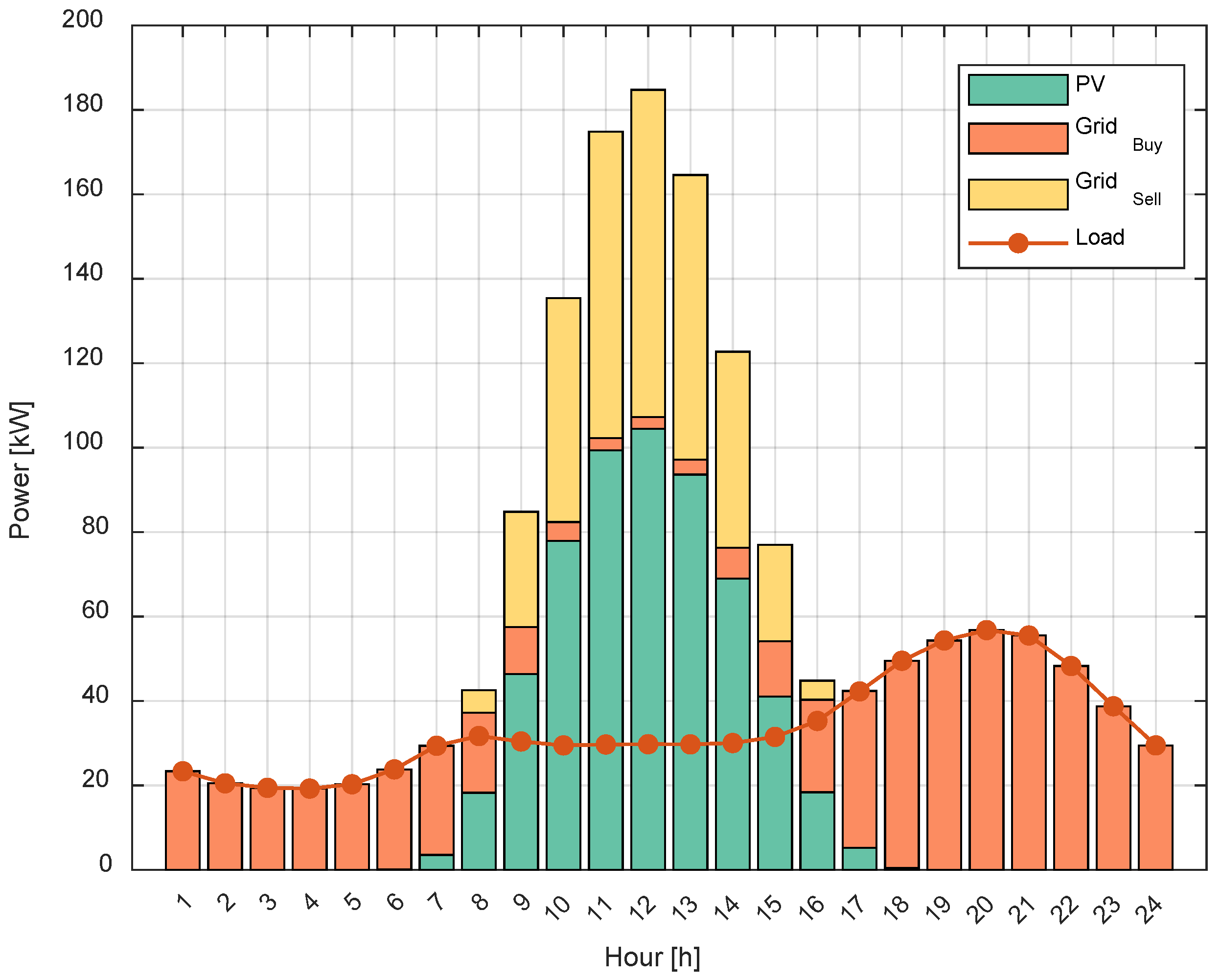
Figure 10 presents the hourly aggregated average power profile of the REC with 30 participants over a one-year period with the Hybrid KoR-Production/Load strategy in the absence of energy storage systems. The results revealed a pronounced diurnal pattern, characterized by consistent energy imports during nighttime hours due to the unavailability of photovoltaic generation, and systematic exports of surplus energy during daylight, once local demand has been satisfied. This operational behavior reflects the inherent temporal mismatch between generation and consumption in solar-based systems without buffering capabilities. The findings emphasize the critical role of storage technologies in enabling load shifting and enhancing the community’s energy autonomy and self-consumption performance.

4.2.2. With Stationary Batteries

In the scenario with stationary batteries but excluding EVs, the Hybrid KoR-Production/Load strategy emerged as the most balanced and effective approach. As shown in Table 7, it delivered the highest overall performance, with annual savings of €65,029.9, the greatest savings per kWh (€0.0551), and the shortest payback period (5.31 years). It also achieved the strongest energy autonomy, presenting the highest self-sufficiency ratio (SSR: 0.567) and self-consumption ratio (SCR: 0.794), while minimizing imports from the grid (5.11 × 10⁵ kWh).
The Dynamic KoR-Production and Dynamic KoR-Load followed closely, with highly competitive outcomes (annual savings between €64,386 and €64,866; payback periods of 5.32–5.36 years). Both strategies maintained strong SSR (0.563–0.565) and SCR (0.787–0.791) values, confirming their effectiveness in leveraging battery storage to improve energy autonomy and reduce grid dependence.
In contrast, the Static KoR demonstrated the most limited performance, with lower annual savings (€60,684.6) and the longest payback period (5.69 years), alongside comparatively weaker technical indicators (SSR: 0.534; SCR: 0.747).
Regarding battery SOH, all KoRs preserved high values above 95%, with the Static KoR showing the highest battery SOH (96.05%), and the hybrid and dynamic strategies presenting slightly lower but consistent levels (≈95.6–95.7%).
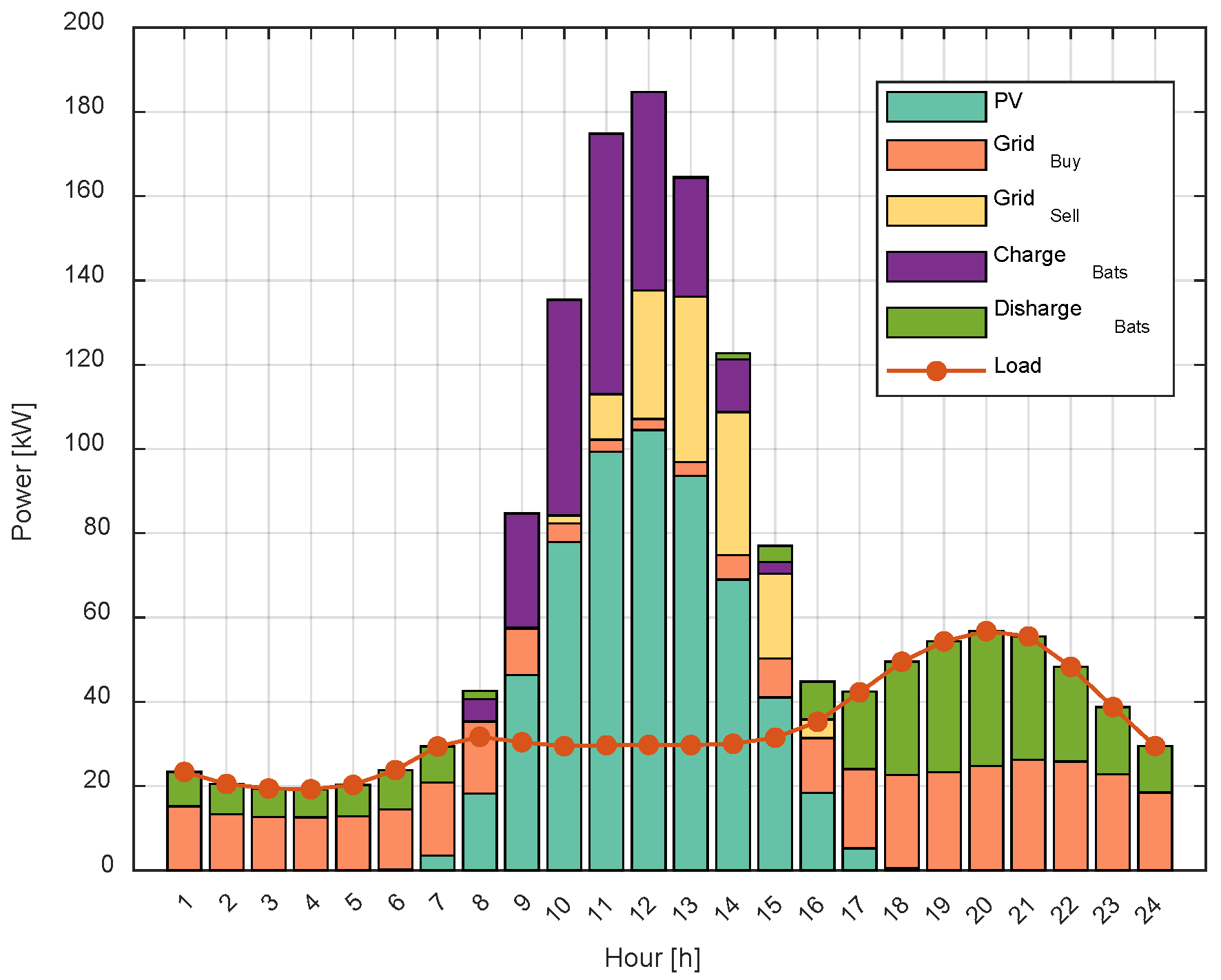
Figure 11 illustrates the community’s aggregated hourly average power profile over a year, considering 30 participants operating under the Hybrid KoR-Production/Load strategy with stationary battery storage. The integration of stationary batteries substantially mitigates grid imports during nighttime hours and attenuates the volume of surplus energy exported during periods of high solar generation. This results in a significantly smoother power profile, highlighting the effectiveness of stationary storage systems in increasing self-sufficiency, improving self-consumption rates, and reducing reliance on the electrical grid.

4.2.3. With Stationary Batteries and Electric Vehicles

When considering all storage systems, the Hybrid KoR-Production/Load strategy exhibited the most robust and well-balanced performance. As shown in Table 8, it delivered the highest overall technical outcome, with annual savings of €65,955.8, the greatest savings per kWh (€0.0559), and the shortest payback period (5.23 years). It also reached the strongest self-sufficiency ratio (SSR: 0.573%) and self-consumption ratio (SCR: 0.801), while minimizing grid imports (5.04 × 10⁵ kWh), confirming its effectiveness in maximizing local energy use.
The Dynamic KoR-Load followed closely, achieving very competitive annual savings (€65,910.8) and equivalent savings per kWh (€0.0559), together with a high SSR (0.572) and SCR (0.800). Similarly, the Dynamic KoR-Production provided strong results (€65,797.9; 5.24 years), with balanced technical indicators (SSR: 0.571; SCR: 0.799). These findings confirm that dynamic and hybrid approaches are the most effective redistribution strategies when multiple storage systems are integrated.
In contrast, the Static KoR remained the worse performing option, with lower annual savings (€65,721.3) and a slightly longer payback period (5.25 years), as well as comparatively weaker energy autonomy (SSR: 0.570; SCR: 0.798).
In terms of asset durability, all KoRs preserved excellent SOH, with batteries maintaining around 95.6% and EVs close to 99.96%, indicating that integrating both stationary and EV storage does not compromise the storage system’s lifespan.
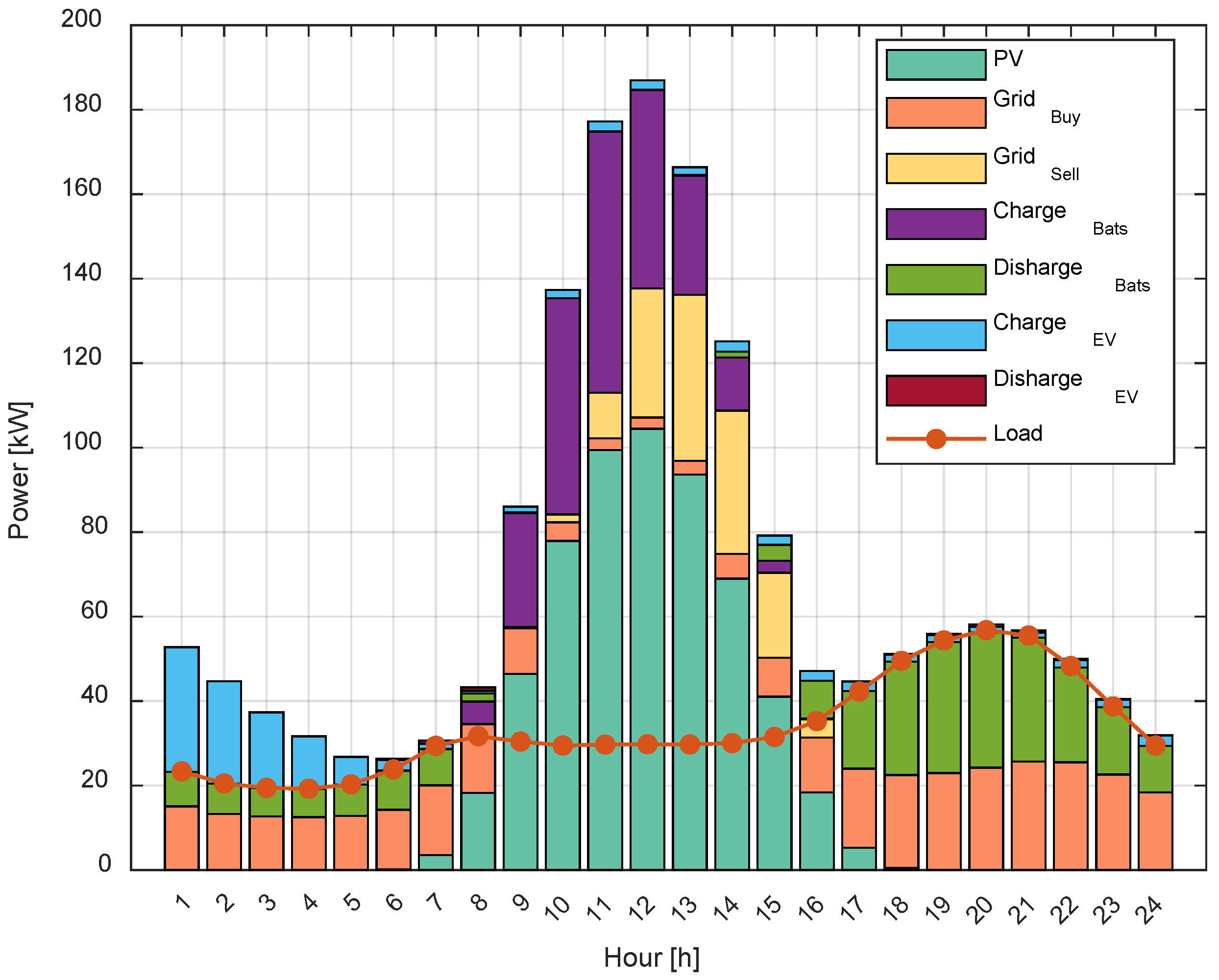
Figure 12 illustrates the average hourly power profile of the community over a one-year period when operating under the Hybrid KoR-Production/Load strategy with both stationary batteries and EVs. The stationary batteries display a typical diurnal storage behavior, charging during periods of surplus photovoltaic production and discharging throughout the night to meet REC demand. This energy shift contributes to a notable reduction in electrical grid reliance and a smoother overall power profile. EV charging is concentrated at night, reflecting prevalent daily mobility patterns that limit daytime availability for grid interaction. Although the EVs are technically capable of V2G operation, their discharge contribution to the community remains marginal. This limited V2G engagement highlights the dominant functional role of stationary batteries in enhancing energy self-sufficiency, while EVs act primarily as responsive consumption devices rather than dispatchable storage units in this setup.

4.2.4. Results Analysis and Discussion

In this case study, with a large-scale community, the comparison between the three scenarios highlights a significant improvement in both energy and economic performance as stationary storage systems and, subsequently, EVs are introduced. In the first scenario, with only PV production and no storage, the indicators reveal rather low efficiency: annual savings are modest, the payback period exceeds 15 years, and both SSR and SCR remain low, around 25% and 35%, respectively. A strong dependence on the electrical grid is also observed, with considerable energy purchased annually, while a large share of PV generation is exported. In this context, the differences among the various KoRs are only marginal: the Hybrid KoR-Production/Load achieves slightly superior economic and technical results; however, the overall impact remains limited by the absence of storage systems.
With the introduction of stationary storage systems (second scenario), annual savings nearly triple, while the payback period drops sharply to about five years. Energy indicators also show substantial gains, i.e., the SSR rises to values close to 55% and the SCR approaches 80%. This means that most of the generated energy is consumed locally, thereby reducing both purchases from and exports to the grid. In addition, the SOH remains high (around 95–96%), confirming the technical feasibility and durability of the storage systems. The differences among the KoRs are more pronounced; however, once again, the Hybrid KoR-Production/Load achieved the best economic and technical results, ensuring an SSR of 56.7% and an SCR of 79.4%. This demonstrates that combining criteria based on both generation and load profiles enhances efficiency and maximizes the benefits of storage integration.
To further assess the impact of storage systems and different KoRs on participant-level equity, Figure 13a,b presents box plots for each KoR and scenario, showing the distribution of energy imported from and exported to the grid across all participants. Each box represents the variability of all community members relative to the average, highlighting how evenly or unevenly energy is shared. The results show that in scenarios without storage systems, both imports and exports are not only higher on average but also display greater variability, indicating a less balanced distribution among participants. In contrast, the introduction of stationary and EV based storage reduces both median values and dispersion, reflecting a more uniform energy management across the community.
The highest level of both economic and technical efficiency was reached in the scenario with stationary batteries and EVs. Annual savings increased slightly compared to the previous case, the payback period stabilized at around 5.2 years, and both the SSR (up to 57.3%) and the SCR (up to 80.1%) reached their maximum values. The integration of EVs adds further flexibility to the REC without compromising the SOH of either the stationary batteries (95.6%) or the vehicles themselves (99.96%). In this scenario, the Hybrid KoR-Production/Load also proved to be the most efficient, although the difference with the dynamic rules remained relatively small.
The analysis of the different KoRs (Static, Dynamic-Load, Dynamic-Production, and Hybrid-Production/Load) shows that their selection has a direct impact on the economic and energy performance of RECs. The Static KoR consistently delivered the most modest results. Although it guarantees equity, since it is based on fixed coefficients, it does not reflect the natural variations of PV generation or participant load. Therefore, it results in lower savings and weaker performance indicators across all scenarios and case studies. The dynamic rules, based on load or production, achieved clear improvements compared to the Static KoR. The Dynamic-Load rule seeks to optimize energy sharing according to participant demand but does not always fully exploit the periods of highest PV generation. Conversely, the Dynamic-Production KoR focuses on maximizing PV utilization but does not fully adapt to fluctuations in participant demand. Although the differences between these two dynamic rules were not very pronounced, both consistently delivered improved performance.
In this case study, and across the various scenarios considered, the emphasis falls on the Hybrid KoR-Production/Load, which combines both perspectives. By adapting to both PV generation and participant demand, it is able to share energy more efficiently, enhance self-consumption, reduce grid purchases during periods of high demand, and prevent large volumes of energy from being exported. This translates into higher annual savings, superior SSR and SCR indices, and shorter payback periods. Even when the differences compared to the dynamic KoRs were small, the Hybrid KoR-Production/Load was consistently proven to be the most efficient both economically and technically.
Comparing the performance of the different KoRs in both small- and large-scale RECs further confirms that their selection has a direct impact on the economic and energy performance of the communities. This impact is particularly relevant in small-scale RECs, where the structural and functional characteristics of each community—such as participant demand profiles and the presence of stationary or vehicle-based storage systems—are decisive factors. However, in large-scale RECs, these factors become less critical, and the key element is the selection of operational rules capable of ensuring more efficient energy sharing, promoting self-consumption and optimizing the balance between generation and demand.

5. Conclusions

This study presented a comprehensive simulation-based assessment of energy-sharing strategies in RECs under the Portuguese regulatory framework, systematically comparing static, dynamic (load and production-based), and hybrid KoRs across different community sizes and levels of storage integration.
The inclusion of storage systems proved to be a key factor in improving REC performance. Stationary batteries significantly increased SSR and SCR, while maintaining high SOH levels. The integration of EVs did not compromise the SOH of either stationary batteries or EVs, confirming their technical viability. However, due to the intermittent nature of EV availability, their impact on additional economic savings and energy autonomy was marginal. Participant-level analysis further demonstrated that storage reduces variability in imported and exported energy, ensuring a fairer distribution of benefits across community members.
Regarding energy-sharing strategies, hybrid KoRs that combine production and load-based criteria consistently achieved the best overall results, maximizing annual savings, self-consumption, and energy equity. Dynamic rules, particularly load-based ones, also performed well, especially in small-scale communities where structural and functional characteristics (such as participant load profiles and the presence of storage systems) play a decisive role. Static KoRs, while administratively simple, were consistently less effective across all scenarios.
Comparing the performance of the different KoRs in both small- and large-scale RECs further confirmed that their selection has a direct impact on the economic and energy performance of the communities. This impact is particularly relevant in small-scale RECs, where community-specific factors (such as participant demand profiles and storage availability) are decisive. In large-scale RECs, these factors are less critical, and the primary determinant of performance is the choice of operational rules capable of ensuring more efficient energy sharing, promoting self-consumption and optimizing the balance between generation and demand.

Author Contributions

Conceptualization, J.F. (João Faria) and J.P.; methodology, J.F. (João Faria), J.F. (Joana Figueira) and J.P.; software, J.F. (João Faria); validation, J.F. (João Faria), J.F. (Joana Figueira), J.P., S.M. and M.C.; formal analysis, J.F. (Joana Figueira); investigation, J.F. (João Faria), J.F. (Joana Figueira). and J.P.; resources, J.F. (João Faria), J.F. (Joana Figueira) and J.P.; data curation, J.F. (João Faria), J.F. (Joana Figueira) and J.P.; writing—original draft preparation, J.F. (João Faria), J.F. (Joana Figueira) and J.P.; writing—review and editing, S.M. and M.C.; visualization, J.F. (João Faria) and J.F. (Joana Figueira); supervision, J.P., S.M. and M.C.; project administration, J.P., S.M. and M.C.; funding acquisition, J.P., S.M. and M.C. All authors have read and agreed to the published version of the manuscript.

Funding

J.F. (João Faria) was supported by the doctoral grant SFRH/BD/151349/2021 financed by the Portuguese Foundation for Science and Technology (FCT), with funds from MPP2030, under the MIT Portugal Program and by national funds through FCT—Fundação para a Ciência e a Tecnologia, I.P., and, when eligible, co-funded by EU funds under project/support UID/50008/2025—Instituto de Telecomunicações, with DOI identifier https://doi.org/10.54499/UID/50008/2025.

Data Availability Statement

The original contributions presented in this study are included in the article. Further inquiries can be directed to the corresponding author.

Conflicts of Interest

The authors declare no conflict of interest.

References

  1. UNFCCC. Paris Agreement. In Proceedings of the 21st Conference of the Parties to the United Nations Framework Convention on Climate Change, UNFCCC, Paris, France, 30 November–13 December 2015. [Google Scholar]
  2. Chen, L.; Msigwa, G.; Yang, M.; Osman, A.I.; Fawzy, S.; Rooney, D.W.; Yap, P.S. Strategies to Achieve a Carbon Neutral Society: A Review. Environ. Chem. Lett. 2022, 20, 2277–2310. [Google Scholar] [CrossRef]
  3. Shirazi, M. Assessing Energy Trilemma-Related Policies: The World’s Large Energy User Evidence. Energy Policy 2022, 167, 113082. [Google Scholar] [CrossRef]
  4. Kotowicz, J.; Lyulyov, O.; Miskiewicz, R. Clean and Affordable Energy within Sustainable Development Goals: The Role of Governance Digitalization. Energies 2022, 15, 9571. [Google Scholar] [CrossRef]
  5. Faria, J.; Marques, C.; Pombo, J.; Mariano, S.; Calado, M.D.R. Optimal Sizing of Renewable Energy Communities: A Multiple Swarms Multi-Objective Particle Swarm Optimization Approach. Energies 2023, 16, 7227. [Google Scholar] [CrossRef]
  6. Medina-Bousoño, A.; Sierra, J. Empowering Citizens for Energy Communities in the European Union. In An Agenda for Sustainable Development Research; World Sustainability Series; Springer: Cham, Switzerland, 2024; pp. 3–19. [Google Scholar] [CrossRef]
  7. European Commission. Clean Energy for All Europeans; European Union, Ed.; Publications Office: Singapore, 2019. [Google Scholar]
  8. European Parliament. Council Directive (EU) 2019/944 of the European Parliament and of the Council of 5 June 2019 on Common Rules for the Internal Market for Electricity and Amending Directive 2012/27/EU; European Parliament: Strasbourg, France, 2019. [Google Scholar]
  9. European Parliament. Council Directive (EU) 2018/2001 of the European Parliament and of the Council of 11 December 2018 on the Promotion of the Use of Energy from Renewable Sources (Recast); European Parliament: Strasbourg, France, 2018. [Google Scholar]
  10. Ahmed, S.; Ali, A.; D’angola, A. A Review of Renewable Energy Communities: Concepts, Scope, Progress, Challenges, and Recommendations. Sustainability 2024, 16, 1749. [Google Scholar] [CrossRef]
  11. Faria, J.P.D.; Pombo, J.A.N.; Mariano, S.J.P.S.; Calado, M.R.A. Plug-and-Play Framework for Assessment of Renewable Energy Community Strategies. IEEE Access 2025, 13, 29811–29829. [Google Scholar] [CrossRef]
  12. Mustika, A.D.; Rigo-Mariani, R.; Debusschere, V.; Pachurka, A. A Two-Stage Management Strategy for the Optimal Operation and Billing in an Energy Community with Collective Self-Consumption. Appl. Energy 2022, 310, 118484. [Google Scholar] [CrossRef]
  13. Eisner, A.; Neumann, C.; Manner, H. Exploring Sharing Coefficients in Energy Communities: A Simulation-Based Study. Energy Build. 2023, 297, 113447. [Google Scholar] [CrossRef]
  14. Directorate-General for Energy of the European Commission. Energy Sharing for Energy Communities—A Reference Guide; European Commission: Brussels, Belgium, 2024. [Google Scholar]
  15. Repubblica Italiana. Decreto Legislativo 8 Novembre 2021, n. 199—Attuazione della Direttiva (UE) 2018/2001 del Parlamento Europeo e del Consiglio, del 11 Dicembre 2018, sulla Promozione dell’uso Dell’energia da Fonti Rinnovabili; Istituto Poligrafico e Zecca dello Stato: Rome, Italy, 2021. [Google Scholar]
  16. República Portuguesa. Decreto-Lei n.o 162/2019 de 25 de Outubro—Estabelece o Regime Jurídico Aplicável Ao Autoconsumo de Energia Elétrica; Presidency of the Council of Ministers: Rome, Italy, 2019. [Google Scholar]
  17. Frieden, D.; Tuerk, A.; Antunes, A.R.; Athanasios, V.; Chronis, A.G.; D’herbemont, S.; Kirac, M.; Marouço, R.; Neumann, C.; Catalayud, E.P.; et al. Are We on the Right Track? Collective Self-Consumption and Energy Communities in the European Union. Sustainability 2021, 13, 12494. [Google Scholar] [CrossRef]
  18. República Portuguesa. Decreto-Lei n.o 15/2022 de 14 de Janeiro—Estabelece a Organização e o Funcionamento Do Sistema Elétrico Nacional; Istituto Poligrafico e Zecca dello Stato: Rome, Italy, 2022. [Google Scholar]
  19. Gimeno, J.Á.; Llera-Sastresa, E.; Scarpellini, S. A Heuristic Approach to the Decision-Making Process of Energy Prosumers in a Circular Economy. Appl. Sci. 2020, 10, 6869. [Google Scholar] [CrossRef]
  20. Krawinkler, A.; Breitenecker, R.J.; Maresch, D. Heuristic Decision-Making in the Green Energy Context:Bringing Together Simple Rules and Data-Driven Mathematical Optimization. Technol. Forecast. Soc. Change 2022, 180, 121695. [Google Scholar] [CrossRef]
  21. Suresh, V.; Janik, P.; Jasinski, M.; Guerrero, J.M.; Leonowicz, Z. Microgrid Energy Management Using Metaheuristic Optimization Algorithms. Appl. Soft Comput. 2023, 134, 109981. [Google Scholar] [CrossRef]
  22. Ivanov, O.; Neagu, B.C.; Grigoras, G.; Scarlatache, F.; Gavrilas, M. A Metaheuristic Algorithm for Flexible Energy Storage Management in Residential Electricity Distribution Grids. Mathematics 2021, 9, 2375. [Google Scholar] [CrossRef]
  23. Villalonga Palou, J.T.; Serrano González, J.; Riquelme Santos, J.M. Estimation of Energy Distribution Coefficients in Collective Self-Consumption Using Meta-Heuristic Optimization Techniques. Sustainability 2024, 16, 2741. [Google Scholar] [CrossRef]
  24. Cosic, A.; Stadler, M.; Mansoor, M.; Zellinger, M. Mixed-Integer Linear Programming Based Optimization Strategies for Renewable Energy Communities. Energy 2021, 237, 121559. [Google Scholar] [CrossRef]
  25. El Barkouki, B.; Laamim, M.; Rochd, A.; Chang, J.W.; Benazzouz, A.; Ouassaid, M.; Kang, M.; Jeong, H. An Economic Dispatch for a Shared Energy Storage System Using MILP Optimization: A Case Study of a Moroccan Microgrid. Energies 2023, 16, 4601. [Google Scholar] [CrossRef]
  26. Zhou, Y. AI-Driven Battery Ageing Prediction with Distributed Renewable Community and E-Mobility Energy Sharing. Renew. Energy 2024, 225, 120280. [Google Scholar] [CrossRef]
  27. Jnr, B.A. Enabling Sustainable Energy Sharing and Tracking for Rural Energy Communities in Emerging Economies. Renew. Energy Focus 2024, 51, 100633. [Google Scholar] [CrossRef]
  28. Bento, P.; Nunes, H.; Pombo, J.; Calado, M.D.R.; Mariano, S. Daily Operation Optimization of a Hybrid Energy System Considering a Short-Term Electricity Price Forecast Scheme. Energies 2019, 12, 924. [Google Scholar] [CrossRef]
  29. Almeida, J.; Soares, J.; Limmer, S.; Aliyan, E.; Faia, R.; Lezama, F.; Ramos, S.; Vale, Z. Community-Based Energy Sharing Using Game Theory Approaches for Benefit Distribution. In Proceedings of the 2024 International Conference on Intelligent Systems Applications to Power Systems (ISAP), Budapest, Hungary, 16–19 September 2024; pp. 1–6. [Google Scholar]
  30. He, Y.; Wu, H.; Wu, A.Y.; Li, P.; Ding, M. Optimized Shared Energy Storage in a Peer-to-Peer Energy Trading Market: Two-Stage Strategic Model Regards Bargaining and Evolutionary Game Theory. Renew. Energy 2024, 224, 120190. [Google Scholar] [CrossRef]
  31. Gomes, L.; Vale, Z. Costless Renewable Energy Distribution Model Based on Cooperative Game Theory for Energy Communities Considering Its Members’ Active Contributions. Sustain. Cities Soc. 2024, 101, 105060. [Google Scholar] [CrossRef]
  32. Luo, F.; Wang, S.; Lv, Y.; Mu, R.; Fo, J.; Zhang, T.; Xu, J.; Wang, C. Domain Knowledge-Enhanced Graph Reinforcement Learning Method for Volt/Var Control in Distribution Networks. Appl. Energy 2025, 398, 126409. [Google Scholar] [CrossRef]
  33. Shengyuan, W.; Fengzhang, L.; Chengshan, W.; Yunqiang, L.; Ranfeng, M.; Jiacheng, F.; Lukun, G. Collaborative Configuration Optimization of Soft Open Points and Distributed Multi-Energy Stations with Spatiotemporal Coordination and Complementarity. J. Mod. Power Syst. Clean Energy 2024, 13, 2086–2097. [Google Scholar] [CrossRef]
  34. Wang, S.; Luo, F.; Fo, J.; Lv, Y.; Wang, C. Two-Stage Spatiotemporal Decoupling Configuration of SOP and Multi-Level Electric-Hydrogen Hybrid Energy Storage Based on Feature Extraction for Distribution Networks with Ultra-High DG Penetration. Appl. Energy 2025, 398, 126438. [Google Scholar] [CrossRef]
  35. Li, N.; Hakvoort, R.A.; Lukszo, Z. Cost Allocation in Integrated Community Energy Systems—Performance Assessment. Appl. Energy 2022, 307, 118155. [Google Scholar] [CrossRef]
  36. Minuto, F.D.; Lanzini, A. Energy-Sharing Mechanisms for Energy Community Members under Different Asset Ownership Schemes and User Demand Profiles. Renew. Sustain. Energy Rev. 2022, 168, 112859. [Google Scholar] [CrossRef]
  37. Grzanic, M.; Capuder, T. Is Dynamic Energy Sharing Really Necessary? The Case Study of Collective Renewable Self-Consumers in Croatia. In Proceedings of the 2023 IEEE PES Conference on Innovative Smart Grid Technologies—Middle East, ISGT Middle East, Abu Dhabi, United Arab Emirates, 12–15 March 2023. [Google Scholar]
  38. Ogando-Martínez, A.; García-Santiago, X.; Díaz García, S.; Echevarría Camarero, F.; Blázquez Gil, G.; Carrasco Ortega, P. Optimization of Energy Allocation Strategies in Spanish Collective Self-Consumption Photovoltaic Systems. Sustainability 2023, 15, 9244. [Google Scholar] [CrossRef]
  39. Nissan 2025 Nissan LEAF Features: Range, Charging, Battery & More. Available online: https://www.nissanusa.com/vehicles/electric-cars/2025-leaf/features.html (accessed on 8 December 2025).
  40. Malya, P.P.; Fiorini, L.; Rouhani, M.; Aiello, M. Electric Vehicles as Distribution Grid Batteries: A Reality Check. Energy Inform. 2021, 4, 29. [Google Scholar] [CrossRef]
  41. Yun, S.; Woo, J.R.; Kwak, K. Unlocking Peak Shaving: How EV Driver Heterogeneity Shapes V2G Potential. Energy 2025, 329, 136773. [Google Scholar] [CrossRef]
  42. European Commission Joint Research Centre Photovoltaic Geographical Information System (PVGIS). Available online: https://re.jrc.ec.europa.eu/pvg_tools/en/ (accessed on 10 October 2025).
  43. Wilcox, S.; Marion, W. Users Manual for TMY3 Data Sets (Revised); National Renewable Energy Lab.: Golden, CO, USA, 2008. [Google Scholar] [CrossRef]
  44. Manso-Burgos, Á.; Ribó-Pérez, D.; Alcázar-Ortega, M.; Gómez-Navarro, T. Local Energy Communities in Spain: Economic Implications of the New Tariff and Variable Coefficients. Sustainability 2021, 13, 10555. [Google Scholar] [CrossRef]
  45. Queiroz, H.; Lopes, R.A.; Martins, J.; Silva, F.N.; Fialho, L.; Bilo, N. Assessment of Energy Sharing Coefficients under the New Portuguese Renewable Energy Communities Regulation. Heliyon 2023, 9, e20599. [Google Scholar] [CrossRef] [PubMed]
  46. Soleimani, A.; Vahidinasab, V.; Aghaei, J. Enabling Vehicle-to-Grid and Grid-to-Vehicle Transactions via a Robust Home Energy Management System by Considering Battery Aging. In Proceedings of the SEST 2021—4th International Conference on Smart Energy Systems and Technologies, Vaasa, Finland, 6–8 September 2021. [Google Scholar]
Figure 1. Key components and data flows in a Portuguese REC.
Energies 18 06567 g001
Figure 2. Probability of EV availability at home throughout the week.
Energies 18 06567 g002
Figure 3. (a) Hourly distribution of the total aggregated PV production; (b) monthly distribution of the total aggregated PV production.
Energies 18 06567 g003
Figure 4. (a) Hourly distribution of the total aggregated load demand; (b) hourly distribution of the total aggregated load demand.
Energies 18 06567 g004
Figure 5. Simulated REC configuration.
Energies 18 06567 g005
Figure 6. Small-Scale Community Scenario without storage systems.
Energies 18 06567 g006
Figure 7. Small-Scale Community Scenario with stationary batteries.
Energies 18 06567 g007
Figure 8. Small-Scale Community Scenario with stationary batteries and EVs.
Energies 18 06567 g008
Figure 9. Energy transactions with the grid (Small-Scale REC). (a) Total imported energy; (b) total exported energy.
Energies 18 06567 g009
Figure 10. Large-Scale Community Scenario without storage systems.
Energies 18 06567 g010
Figure 11. Large-Scale Community Scenario with stationary batteries.
Energies 18 06567 g011
Figure 12. Large-Scale Community Scenario with stationary batteries and EVs.
Energies 18 06567 g012
Figure 13. Distribution of imported and exported energy to the grid. (a) Imported energy; (b) exported energy.
Energies 18 06567 g013
Table 1. Technical specifications of the stationary battery storage system.
ParameterValue
TechnologyLithium-Ion
Storage Capacity30 kWh
Maximum Number of Cycles ( N c y c l e s , M a x )4000
Replacement Cost ( R E P C o s t ) €5000
Depth of Discharge ( D o D ) 0.8
Table 2. Specifications of the 2025 Nissan Leaf EV used in the study.
ParameterValue
ModelNissan Leaf e+ (2025)
Battery TechnologyLithium-Ion
Storage Capacity60 kWh
Maximum Number of Cycles ( N c y c l e s , M a x )4000
Replacement Cost ( R E P C o s t ) €10,000
Depth of Discharge ( D o D ) 0.8
Table 3. Performance Metrics—Small-Scale REC Without Storage Systems.
MetricsAnnual
Savings (€)
Savings per kWh (€)Payback
Period
SSRSCRGrid BuyGrid SellSOH BatsSOH EVs
KoRs
Static KoR3061.90.020511.270.4360.2691.09 × 1055.19 × 104--
Dynamic KoR-Load3141.10.021110.980.4480.2761.08 × 1055.03 × 104--
Dynamic KoR-Production3058.70.020511.280.4360.2691.09 × 1055.34 × 104--
Hybrid KoR-Production/Load3133.30.021011.010.4470.2761.08 × 1054.94 × 104--
Table 4. Performance Metrics—Small-Scale REC With Stationary Batteries.
MetricsAnnual
Savings (€)
Savings per kWh (€)Payback
Period
SSRSCRGrid Buy (kWh)Grid Sell (kWh)SOH
Bats (%)
SOH EVs (%)
KoRs
Static KoR6856.70.04605.030.8030.4967.52 × 1041.78 × 10496.03-
Dynamic KoR-Load8198.40.05504.210.9400.5816.25 × 1041.21 × 10494.74-
Dynamic KoR-Production8306.90.05574.150.9460.5846.20 × 1041.66 × 10494.57-
Hybrid KoR-Production/Load8351.20.05604.130.9530.5886.13 × 1041.44 × 10494.61-
Table 5. Performance Metrics—Small-Scale REC with all Storage Systems.
MetricsAnnual
Savings (€)
Savings per kWh (€)Payback PeriodSSRSCRGrid Buy (kWh)Grid SELL (kWh)SOH Bats (%)SOH EVs (%)
KoRs
Static KoR8481.40.05694.070.9580.5916.09 × 1041.76 × 10494.5599.92
Dynamic KoR-Load8557.30.05744.030.9700.5995.98 × 1041.21 × 10494.5999.92
Dynamic KoR-Production8503.90.05714.060.9610.5946.06 × 1041.66 × 10494.5799.92
Hybrid KoR-Production/Load8546.70.05734.040.9690.5985.99 × 1041.44 × 10494.6199.92
Table 6. Performance Metrics-Large-Scale REC Without Storage Systems.
MetricsAnnual Savings (€)Savings per kWh (€)Payback
Period
SSR (%)SCR (%)Grid Buy (kWh)Grid Sell (kWh)SOH Bats (%)SOH EVs (%)
KoRs
Static KoR22,463.70.019015.360.2450.3438.90 × 1055.54 × 105--
Dynamic KoR-Load22,559.40.019115.290.2470.3458.89 × 1055.46 × 105--
Dynamic KoR-Production22,435.70.019015.380.2450.3438.91 × 1055.69 × 105--
Hybrid KoR-Production/Load22,725.20.019315.180.2490.3488.87 × 1055.51 × 105--
Table 7. Performance Metrics-Large-Scale REC With Stationary Batteries.
MetricsAnnual
Savings (€)
Savings per kWh (€)Payback
Period
SSRSCRGrid Buy (kWh)Grid Sell (kWh)SOH Bats (%)SOH EVs (%)
KoRs
Static KoR60,684.60.05145.690.5340.7475.50 × 1052.18 × 10596.05-
Dynamic KoR-Load64,385.80.05465.360.5630.7875.16 × 1051.94 × 10595.68-
Dynamic KoR-Production64,865.80.05505.320.5650.7915.13 × 1052.18 × 10595.63-
Hybrid KoR-Production/Load65,029.90.05515.310.5670.7945.11 × 1052.06 × 10595.64-
Table 8. Performance Metrics-Small-Scale REC with all Storage Systems.
MetricsAnnual
Savings (€)
Savings per kWh (€)Payback PeriodSSRSCRGrid BuyGrid SellSOH Bats (%)SOH EVs (%)
KoRs
Static KoR65,721.30.05575.250.5700.7985.07 × 1052.16 × 10595.6399.96
Dynamic KoR-Load65,910.80.05595.230.5720.8005.05 × 1051.94 × 10595.6399.96
Dynamic KoR-Production65,797.90.05585.240.5710.7995.07 × 1052.18 × 10595.6399.96
Hybrid KoR-Production/Load65,955.80.05595.230.5730.8015.04 × 1052.06 × 10595.6499.96
Disclaimer/Publisher’s Note: The statements, opinions and data contained in all publications are solely those of the individual author(s) and contributor(s) and not of MDPI and/or the editor(s). MDPI and/or the editor(s) disclaim responsibility for any injury to people or property resulting from any ideas, methods, instructions or products referred to in the content.