Article

Improved Biomethane Potential by Substrate Augmentation in Anaerobic Digestion and Biodigestate Utilization in Meeting Circular Bioeconomy


1
Department of Biological Sciences and Biotechnology, School of Life Sciences, Botswana International University of Science and Technology, Private Bag 0016, Palapye, Botswana
2
Department of Chemical Engineering, School of Earth Sciences and Engineering, Botswana International University of Science and Technology, Private Bag 0016, Palapye, Botswana
*
Author to whom correspondence should be addressed.
Energies 2025, 18(24), 6505; https://doi.org/10.3390/en18246505
Submission received: 23 September 2025 / Revised: 12 November 2025 / Accepted: 17 November 2025 / Published: 12 December 2025

Abstract

Waste generated from agricultural activities is anticipated to increase in the future, especially in less developed countries, and this could cause environmental health risks if these wastes are not well managed. The anaerobic digestion (AD) by co-digesting organic waste is a technology used to produce biogas while utilizing biodigestate as a biofertilizer; however, AD requires a lot of water to be efficient, which could pose water challenges to arid areas. This study evaluated biogas production under semi-dry conditions by augmenting the process with a high-water content wild melon and determined the nutrient composition of the resultant biodigestate. Batch studies of AD were performed to evaluate methane potential of the different animal waste using an online and standardized Automatic Methane Potential Test System (AMPTS) II light for approximately 506 h (21 days) at 38 °C. The highest biomethane potential (BMP) determined for mono and co-substrate digestion was 29.5 NmL CH4/g VS (CD) and 63.3 NmL CH4/g VS (CMWM), respectively, which was calculated from AMPTS biomethane yield of 3166.2 NmL (CD) and 1480.6 NmL (CMWM). Water-displacement method was also used to compare biogas yield in wet and semi-dry AD. The results showed high biogas yield of 8480 mL for CM (mono-substrate) and 10,975 mL for CMCC in wet AD. Semi-dry AD was investigated by replacing water with a wild melon (WM), and the highest biogas production was 8000 mL from the CMCC combination augmented with WM. Generally, in wet AD, co-digestion was more effective in biogas production than mono-substrate AD. The biodigestate from different substrate combinations were also evaluated for nutrient composition using X-ray Fluorescence (XRF) analysis, and all the samples contained fair amount of essential nutrients such as calcium (Ca), phosphorus (P), potassium (K) and microelements such as chloride (Cl), magnesium (Mn), iron (Fe), zinc (Zn). This study successfully implemented semi-dry AD from co-digested animal wastes to produce biogas as an energy solution and biofertilizer for crop production, thereby creating a closed-loop system that supports a circular bioeconomy. In addition, the study confirmed that lowering the water content in the AD process is feasible without compromising substantial biogas production. This technology, when optimized and well implemented, could provide sustainable biogas production in areas with water scarcity, therefore making the biogas production process accessible to rural communities.

1. Introduction

In recent years, the circular bioeconomy has been well-known as a revolutionary concept for accomplishing sustainable developments and solving some urgent environmental issues [1,2,3]. Circular bioeconomy places a strong emphasis on using biological resources effectively to build closed-loop systems that cut down on waste and dependency on non-renewable resources [4,5,6]. There is a growing demand for creative ways to improve energy security and sustainability worldwide, where economies are heavily reliant on fossil fuels. Despite agriculture being a vital part of most economies, the industry frequently faces challenges with resource efficiencies, such as energy, nutrients, and waste management [7,8]. Since agriculture produces a lot of organic waste, especially from raising livestock and poultry, the possibility of converting these waste streams to valuable resources, such as producing biogas, offers a promising way to reduce waste and provide energy and nutrient recovery for soil amendments [9,10,11,12].
Anaerobic digestion (AD) of organic matter produces biogas, a sustainable energy source that has become a competitive alternative to fossil fuels [1,13,14,15]. In the AD process, a consortium of microorganisms is used to break down organic matter without oxygen, producing biogas, which is primarily made up of methane (CH4) and carbon dioxide (CO2) [11,16,17]. This biogas can be used for several purposes, such as heating, power generation, and vehicle fuel, thus providing both urban and rural areas with a sustainable energy source [18]. In addition, a nutrient-rich resultant residue of an AD process for the production of biogas, called biodigestate, can also be utilized in improving agricultural soils for better produce [12]. The conversion of animal and agricultural wastes to produce biogas and the injection of the biodigestate into the soil is a clean and sustainable way to manage waste that could pose health challenges, as well as environmental pollution [4,11,19].
The potential use of different agricultural, abattoir, or food waste as substrates in the AD process has been documented [1,10,20]. However, a high amount of water required in the wet AD process is one of the major obstacles in biogas production [21,22]. Traditionally, wet AD techniques use a lot of water, which can be a challenge in arid areas experiencing water scarcity or remote areas subjected to austere water challenges [2,23,24]. Therefore, it is crucial to investigate alternative approaches that can maximize biogas output while utilizing less water. Dry or semi-dry AD technology is an alternative that is typically performed under reduced water content; as such, it has high solid content and can benefit from co-digesting different substrates that have high water content [25,26]. Previous studies have used fruit and vegetable waste in AD to optimize biogas yield while minimizing water usage [27,28,29]. However, these substrates are intended for human consumption and would therefore compete with food production resources. Oduor et al. [29] used water hyacinth in AD, which requires a lot of water for cultivation and therefore would not be ideal for arid areas. This study thus introduces a novel approach that utilizes a locally sourced, inexpensive, non-edible wild melon (Citrullus lanatus var. citroides), which is abundant in the Kalahari Desert, and does not require typical agricultural inputs such as land preparation, irrigation, or fertilizers. As a result, this wild melon does not compete with food production resources and can be harvested freely, reducing biogas production costs. Therefore, this wild melon will serve as both a substrate rich in readily accessible sugars and a partial water source, improving semi-dry anaerobic digestion for biogas generation.
This study; therefore, aims to investigate the potential of wild melon as a water replacement in semi-dry AD. Cow dung (CD), cow cud (CC), and chicken manure (CM) were used as primary substrates, while wild melon (WM) was used to augment water needs. The intrinsic high-water content of WM will alleviate water scarcity problems related to AD [2]. In addition, WM is carbohydrate-rich and provides readily digestible carbohydrates to expedite the start of the AD process. According to our knowledge, this is the first time this wild melon has been used for the improvement of semi-dry AD. Moreover, the utilization of biodigestate back into the process chain to create a closed-loop system is advantageous. Hence, this study also investigated the nutrient content of biodigestate and its potential for utilization in crop production.

2. Materials and Methods

2.1. Material Collection and Preparation

CD and CC were collected in closed containers from a local abattoir and kept in the cold room at 4 °C until used, while CM was also collected from local chicken farms in Palapye, Botswana. The WM was collected from the bushes and was aseptically chopped into small pieces before being fed into the biodigester. Freshly collected substrates were used for all substrate characterization. Sodium hydroxide (NaOH) was purchased from Honeywell/Fluka (Seelze, Germany), and thymolphthalein indicator was from Sigma–Aldrich (Darmstadt, Germany). Distilled water used was purified from an 18 ΩM water purifier (ThermoFisher Scientific Barnstead Pacific TII, Niederelbert, Germany).

2.2. Substrate Characterization by Proximate Analysis

The selected substrates (CC, CD, CM, and WM) and various combinations were characterized by thermogravimetric analysis (TGA) using a LECO thermogravimetric analyzer (TGA 701, LECO Corporation, St. Joseph, MI, USA), which measured their mass change as a function of temperature. Proximate analysis of mono- and co-substrates was carried out to determine parameters such as the samples’ moisture content, total solids, volatile solids, fixed carbon, and ash content. The experiments were performed using proximate test using ASTM D7582 MVA in biomass method [30,31]; one gram of each of the prepared samples was placed into zero-weighted crucibles and then loaded into the furnace. The samples were subjected to incremental temperatures, and the change in mass was recorded. For moisture determination, the thermogravimetric analyzer was set to run from 23 °C to 107 °C at 15 °C/min under nitrogen gas at a medium-low flow rate (5.01 pm). To determine the volatile solids, the temperature was then ramped up to 700 °C at 50 °C/min. The temperature was cooled down to approximately 600 °C to allow combustion in the presence of oxygen to determine fixed carbon content. Then the run continued until the temperature reached 750 °C, still at 50 °C/min, to determine the ash content of the substrates. The data was then extracted from the machine into Microsoft Excel, while fixed carbon was automatically calculated by the analyzer.
Carbon-to-nitrogen (C:N) ratio was determined by running samples through a carbon, sulfur, and nitrogen elemental analyzer (Elementar Unicube CHNS (He), Hanau, Germany). The samples were first dried at 80 °C in an oven (240 L Digital Oven model 278, Scientific Manufacturing CC, South Africa) and ground into fine powders. Two milligrams of each sample were loaded into the elemental analyzer, where they undergo combustion in the presence of oxygen at 1100 °C, where carbon, hydrogen, and nitrogen are converted to CO2, H2O, and N2, respectively. The produced gases (CO2 and N2) are then separated based on their retention times in the chromatographic column. The separated gases were then detected and quantified using the thermal conductivity detection (TCD), and the C:N ratio was calculated.

2.3. Determination of Biomethane Potential by AMPTS

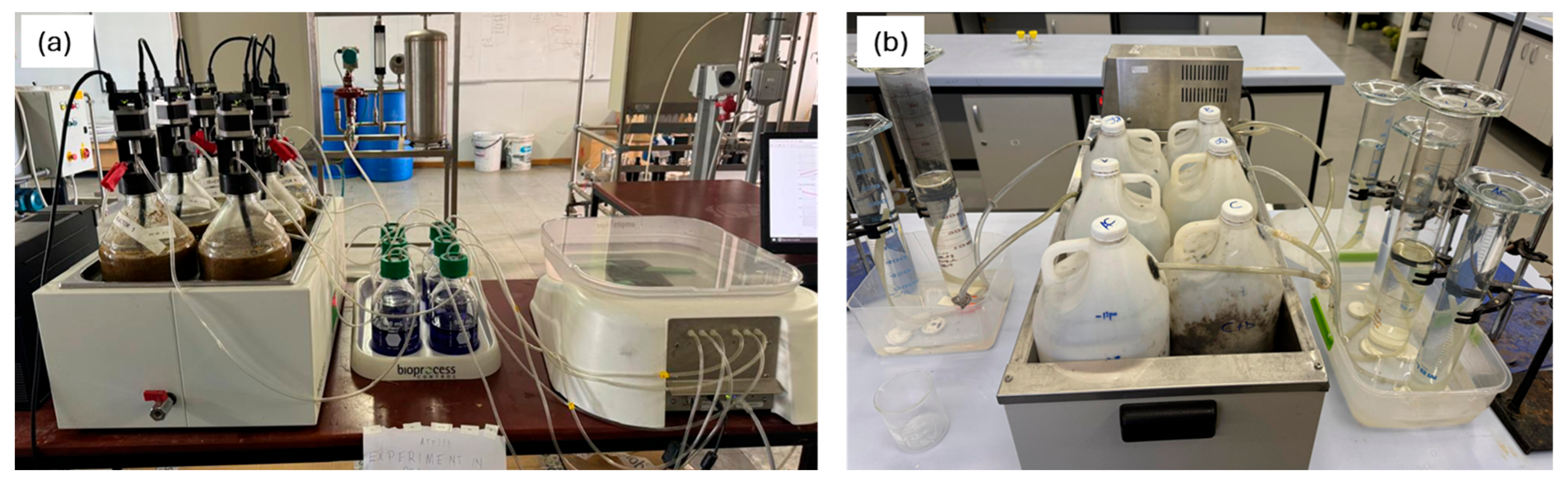
BMP is a crucial factor used to determine how efficiently the substrate produces biomethane in AD. To determine the substrate’s BMP, selected substrates were subjected to AD by the Automatic Methane Potential Test System (AMPTS), Figure 1a, to quantify the normalized biomethane yield under standard temperature and pressure. The sample preparation and AMPTS II Light (Bioprocess Control, Lund, Sweden) set-up were performed following the AMPTS operation manual as outlined by Marczewski et al. [32]. A fixed mass (400 g or 700 g, including 50 g of CD serving as an inoculum) of substrates was fed into 2000 mL reactor bottles, and the volume was made up to 1800 mL with distilled water. The fed reactor bottles were then placed in a water bath set at 38 °C, representing mesophilic conditions. The motors and tubes were connected to the reactor bottles, and the reactors were purged with nitrogen gas to remove oxygen. The rotating mixers were then set to 40% speed. A 3 M NaOH solution with thymolphthalein (0.002% v/v) was used as a CO2 scrubber in the CO2 fixing unit of the system before pure biomethane production was measured by the gas analysis component of the AMPTS. The amount of biogas produced by the digestion of the different substrates for 21 days was recorded and used together with the TS and vs. values obtained from the TGA to calculate BMP. The BMP was calculated using Equation (1).
B M P = V S V B M I S M I B M V S , s S
where B M P stands for biomethane potential, V S   represents the volume of methane produced by the sample (NmL), V B represents the volume of methane produced by the blank (NmL), M I S represents the amount of inoculum in the sample (g), M I B represents the amount of inoculum in the blank (g), M V S , s S represents the amount of VS of substrate contained in the sample bottle (g VS) as explained by the bioprocess control operation and maintenance manual.

2.4. Biogas Production by Water-Displacement Method

Biogas production by the water displacement method [33] was carried out using 5 L plastic biodigesters connected through delivery tubes to a water container, and tubes connected from the water container going into the inverted measuring cylinder to measure the volume of the water displaced by the produced biogas (Figure 1b). For mono-substrate AD, 2 kg of substrate (CC, CD, and CM) were mixed with 500 mL of distilled water, and for co-substrate AD, equal amounts (1 kg) of each substrate were mixed, and 500 mL of water was added. For semi-dry digestion, the substrate mixtures were halved to 1 kg for each mono-substrate and to 500 g for each co-digested substrate. Instead of water, 1 kg of chopped wild melon was used as a water substitute. One hundred grams of CD was added as an inoculum for all the set-ups that did not contain CD. The plastic biodigesters were tightly closed and immersed in a water bath set at 38 °C, where fermentation was allowed to take place. The mixtures were swirled daily to release biogas trapped within the substrate and to maintain uniform temperature and pH inside the biodigester. Biogas production was monitored daily by measuring the volume of water that had been displaced by the produced biogas.

2.5. Elemental Analysis of the Substrates and Biodigestate Using X-Ray Fluorescence

Analysis of nutritional elements in the biodigestates was determined using an Olympus Portable X-ray fluorescence (XRF) analyzer (Delta Premium-50 kV, Innov-X Systems, Waltham, MA, USA) with reference to the Delta family, following the user manual. First, the substrates were dried at 100 °C overnight, after which the dried samples were ground into a fine powder using a mortar and pestle. The powdered samples were then placed in small sampling bags, and the XRF gun was used to detect the elements at three different spots of each sample. Afterwards, the average value was calculated and recorded as the percentage parts per million (% ppm) of the elements present in the sample.

3. Results and Discussions

3.1. Proximate Analysis and C:N Analysis of the Used Substrates

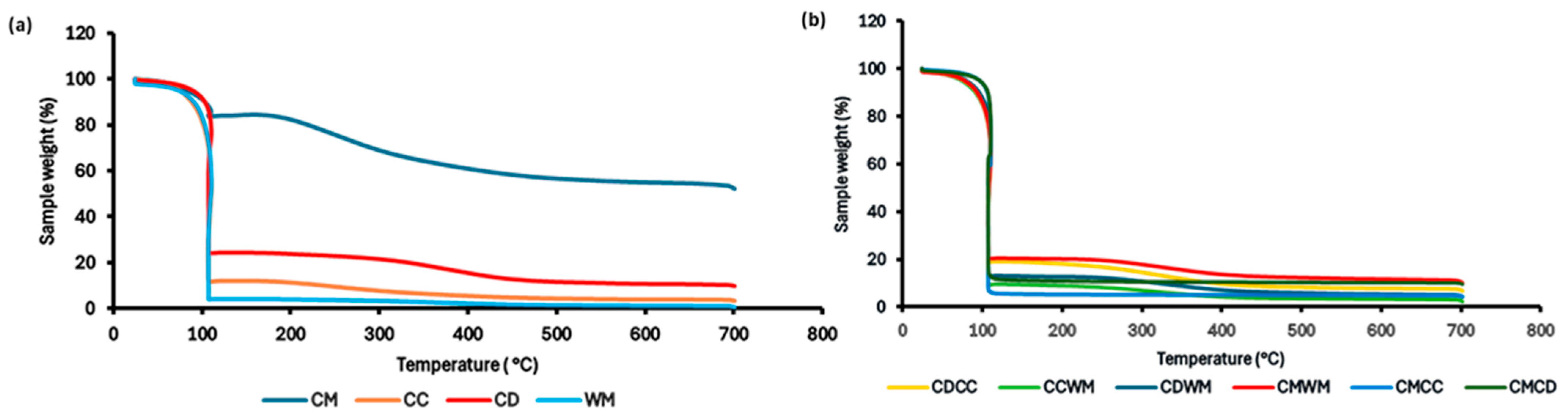
The TGA results in Figure 2a,b depict the weight loss of the different substrates as a function of temperature. The initial steep decline between 0 °C and 107 °C represents water loss from 100% to a lower percentage for respective substrates. The subsequent flat decline represents the decomposition of volatile solids, and the remaining weight comprises the ash and fixed carbon of the substrates; the parameters are summarized in Table 1.
For mono-substrates, it is observed that WM has a higher water content (95.8%) than CC, CD, and CM (88.14%, 76.03%, and 15.72%, respectively) (Table 1). The CC contains a lot of water from the rumen from food that has not yet reached the intestines, where water is absorbed, whereas the other two substrates are basically excreted matter [34]. CM showed the lowest water content, which could be attributed to the birds’ digestive system’s effective water absorption; however, it contained more volatile solids than all the other substrates. The high VS could be due to the fact that chicken diets typically contain higher levels of protein and less fiber compared to those of rumen animals, which feed heavily on grass [35]. CM showed the highest percentage (8.9%) of fixed carbon and ash compared to the other substrates. The high ash content in CM could be due to the inorganic compounds such as calcium, potassium, and phosphorus present, possibly from the chicken feeds, and were unable to burn completely during combustion [36]. It was observed that combining CM with either CC or CD improved the substrate’s moisture content to above 50% but slightly reduced its volatile solids content to less than 20%. This enhanced moisture content implies that combining CM with other substrates improves the supplemental moisture required for maintaining optimal hydration in the AD process. Subsequently, incorporating WM further increased the moisture content, a crucial factor in the AD process, which facilitates microbial activity and consequently enhances biogas yields. This implies that in areas experiencing water scarcity, CM can be co-digested with high-water-content substrates such as WM to stimulate the digestion process.
The C:N ratio influences both the quantity and quality of biogas produced by regulating microbial growth and the decomposition of organic waste, which directly impacts biogas production. Therefore, maintaining an optimal C:N ratio [25,26,27,28,29] is crucial for maximizing biogas production efficiency [29]. The results indicate that substrates CC and CD have favorable C:N ratios of 32 and 23, respectively, whereas CM exhibits a high C:N ratio of 8, and WM displays the lowest ratio of 20 (Table 1). These findings align with previous studies by Ashekuzzaman and Poulson [37] and Wang et al. [26], which reported similar C:N ranges for cow dung and chicken manure. A high C:N ratio in WM suggests inadequate nitrogen is needed for proper cellular metabolic functions, which limits microbial activity and ultimately reduces biogas yield. Conversely, the low C:N ratio in CM indicates elevated nitrogen levels and could lead to ammonia accumulation that is toxic to methanogenic populations [29]. Co-digestion of these substrates can balance the C:N ratio within an optimal range to enhance biogas production and system performance.

3.2. Biomethane Production Curves from Different Substrates Using AMPTS

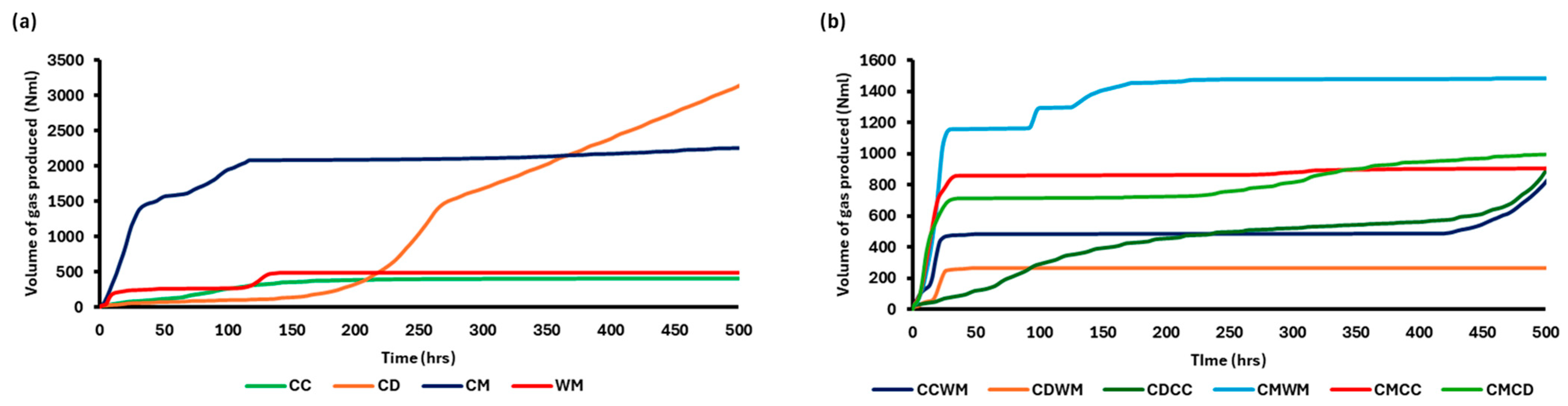
Figure 3 shows cumulative biomethane production for different substrates for an AD period of 504 h (21 days). Figure 3a reveals that for mono-substrate AD, CD yielded a significantly high cumulative biomethane (3166.2 NmL CH4) compared to CM (2262.6 NmL CH4), while WM (497.8 NmL CH4) and CC (408.3 NmL CH4) showed biomethane production. CD took a longer lag phase before drastic exponential biomethane production to 3166.2 NmL CH4, while CM showed immediate biomethane production and reached the peak production faster than the other substrates at 2262.8 NmL CH4. This is expected as CM contains a higher percentage of volatile solids [38]. WM yielded more biomethane than CC (408.3 NmL CH4), reaching 497.8 NmL CH4 after 142 h and remaining stagnant for the rest of the AD period. The low biomethane production could be attributed to WM having high water content (95.78%) and less volatile solids (3.66%). According to Orhorhoro et al. [39], production of biomethane is directly proportional to the amount of volatile solids of the substrate. CC and WM had relatively low percentages of volatile solids of 8.6% and 3.7%, respectively, and high-water content, thus yielding low methane volumes.
For co-digestion, CMWM performed relatively well, as observed in Figure 3b, it produced the highest volume (1480.6 NmL CH4) of biomethane in 154 h compared to when CM was used alone, which reached peak production (2262.6 NmL CH4) in 227 h. This could suggest that WM reduced the retention time of decomposition by providing simple sugars for microorganisms, thereby aiding the fast digestion of organic matter.
The inclusion of WM as a co-substrate and water source in semi-dry AD is expected to improve process efficiency by supplying soluble, easily convertible sugars to biomethane and substrate-bound water. These readily available simple sugars serve as a carbon source that instantly stimulates the activity of hydrolytic microorganisms, thereby enhancing the hydrolysis rate and biomethane generation [27,28,29]. According to Wang et al. [15], fruit- and vegetable-based substrates exhibit high biodegradability and rapid microbial conversion, which significantly improve biogas yields. The hydrolytic bacteria then rapidly metabolize these simple sugars, leading to an increase in their enzymatic activity and microbial proliferation. This; therefore, facilitates the decomposition of complex organic substances found in other substrates, such as proteins, lipids, and cellulose, into simple monomers. The rate of biomethane production in dry AD was also linked to the substrate moisture level, where increased moisture levels lead to increased water activity for microbial growth and substrate bioavailability. This synergistic effect of free water, accessible substrate, and microbial interaction accelerates the overall digestion process, contributing to more efficient biogas recovery [17].

3.3. Determination of Biomethane Potential (BMP) of the Different Substrates

BMP is a good measure of how a substrate is efficient in AD and guides the selection of the best substrate for efficient biomethane production. The calculated BMP results are displayed in Table 2.
In case of mono-substrates, CD had the highest BMP of 29.5 NmL CH4/g VS, followed by CM at 21.9 NmL CH4/g VS, and significantly low BMP for CC (5.9 NmL CH4/g VS). For co-digestion, there was a considerable increase in BMP (63.3 NmL CH4/g VS) when CM was co-digested with MW, an improvement of 2-fold from CD alone, followed by CCWM (23.7 NmL CH4/g VS), which is a 4-fold increase from CC alone (Table 2). This implies that WM plays a critical role in aiding the AD process to counterbalance the elevated nitrate levels of CM, whereas in the CCWM combination, WM provides easy-to-digest carbohydrates and moisture content, thereby creating a less hostile environment for the methanogens to thrive [39,40].
However, combining CD with the other two substrates resulted in a lower BMP than individual substrates; for example, CDCC (17.4 NmL CH4/g VS) and CMCD (12.9 NmL CH4/g VS) had lower BMP than CD alone. These results highlight the significant impact of substrate composition and its availability to microorganisms on the production of biomethane. It is evident from Table 2 that high vs. or BMP does not correlate with high biogas production, for example, the highest vs. (107.38 g VS) was obtained from CM, but only 15% of it was degraded, leaving 85% of the BMP unexploited. High vs. content or BMP does not always lead to its complete utilization, indicating that biogas yield assessment cannot rely solely on the amount of vs. or BMP values, rather direct measurements of biogas production are needed, since vs. may not be completely converted to biogas [32,37,41].

3.4. Biogas Production Using the Water Displacement Method in Wet and Semi-Dry Digestion

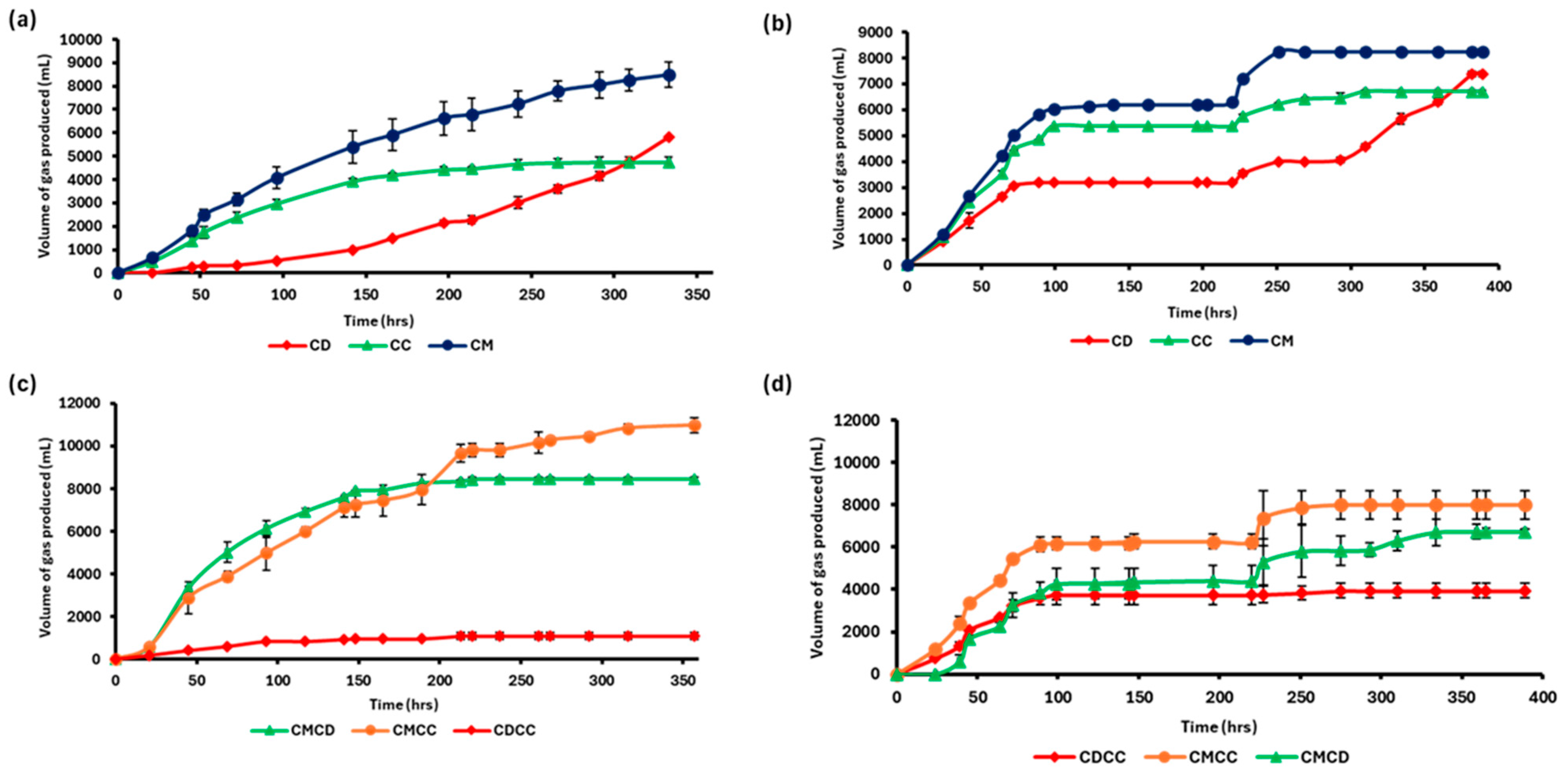
In Figure 4a, wet digestion of mono-substrates (CD, CC, and CM) exhibited different gas production rates, with CM having the highest gas production (8480 mL), followed by CD (5805 mL), and lastly CC with 4750 mL. All three substrates showed a steady increase in biogas production for up to 333 h (~14 days), with CD having a lag phase of 2 days, and co-digestion producing relatively more biogas than mono-substrate digestion. The same trend was reflected for semi-dry digestion of mono-substrate (Figure 4b, where CM (8250 mL) had the highest biogas production, followed by CD (7370 mL) and lastly CC (6700 mL). Figure 4c shows wet digestion of different substrate combinations, while Figure 4d shows the results of semi-dry digestion of the same substrate combinations but augmented with WM to replace water. It is observed that combinations containing CM produced high biogas, owing to the CM’s high volatile solid content [41,42]. CMCC was the best combination, yielding more biogas than the other combinations in both wet and semi-dry AD of 10,975 mL and 8000 mL, respectively. CMCD combinations were the second highest with 8440 mL and 6725 mL for wet and semi-dry AD, respectively. This high biogas production efficiency by CMCC could be attributed to the synergistic effort from the introduction of the ruminant methanogens from CC into the CM, which has a high percentage of volatile solids [39,42]. Conversely, the CDCC combination yielded low (1100 mL) for wet AD and 3935 mL for semi-dry AD. This could be explained by the fact that CC and CD are substrates derived from the same source and share the same characteristics, such as C:N ratio and moisture content; as such, no synergistic effect occurs between these two substrates. Hence, co-digesting substrates with similar C:N ratios and moisture content is unlikely to improve their biogas production potential [43].
Notably, semi-dry digestion appears to achieve peak gas production faster than wet digestion, and this could be attributed to the rapid breakdown of wild melon, providing readily available saccharides to fermentative bacteria to quickly convert them to volatile fatty acids. Unlike the smooth increase in biogas production observed in wet AD, semi-dry AD shows a 2-step increase in biogas production after 223 h (9 days) for all the substrates. This could imply that carbohydrates in wild melons are readily available and facilitate rapid microbial digestion. Once these carbohydrates are depleted, the digestion curves plateau until microorganisms begin to break down the more difficult lignocellulosic materials from CC and CD, causing the curves to rise again. This implies that substrates were digested separately. In addition, previous studies by Mirmohamadsadeghi et al. [43] and Rabii et al. [44] further suggest that melons can improve the kinetics of anaerobic digestion; therefore, facilitating better utilization of the available substrates and resulting in a shorter hydraulic retention time (HRT) while maximizing biogas output.
In this study, the CMCC combination achieved the highest biogas production. This demonstrates that co-digestion with complementing C:N ratios is critical in a synergistic approach for proper microbial growth and functioning in the biodigester, since ammonia produced from substrate with low C:N ratios neutralizes VFAs produced by fermentative bacteria and helps maintain the pH within the neutral range [29].
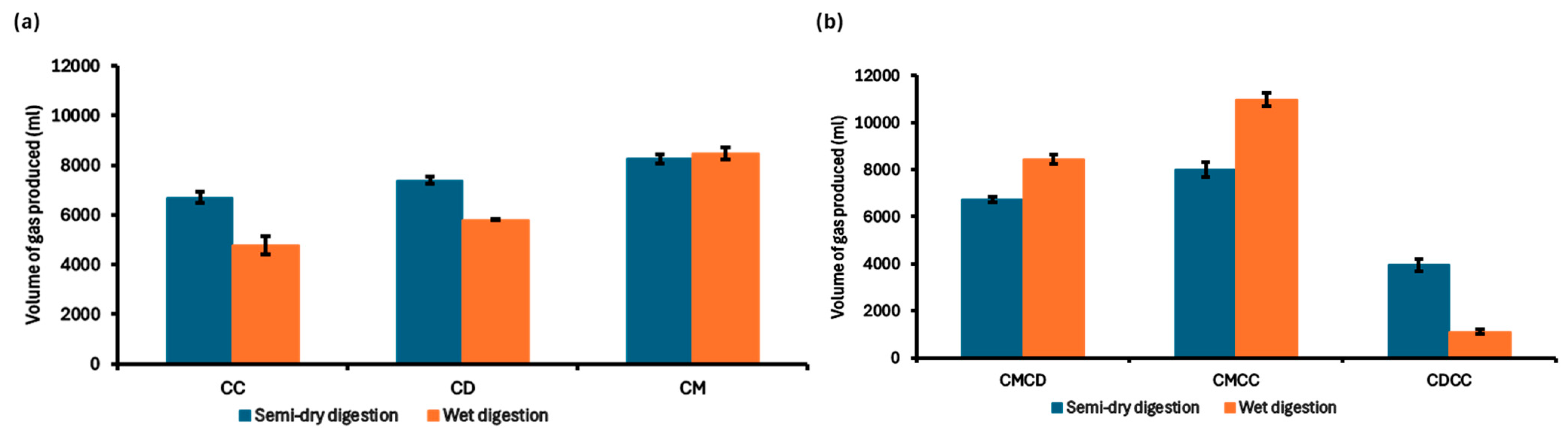
Figure 5 shows the overall biogas yields for the different substrates and combinations under both wet and semi-dry AD. In Figure 5a, it is shown that CM had the highest overall production of biogas compared to CC and CD in both wet and semi-dry AD. On the combinations, CMCC yielded more biogas, closely followed by CMCD, while CDCC yielded the lowest biogas (Figure 5b) in both wet and semi-dry AD. CM stands out as a good substrate for AD, which could be influenced by its high volatile solids and nitrogen content, as well as good buffering capacity [35,36,38]. This is also corroborated by the CMWM data from AMPTS, which exhibited the highest BMP. However, the CDCC combination did not perform well since they are almost the same type of substrate with high non-degradable matter. Generally, co-digestion of substrates performs better than mono-digestion. Although wet anaerobic digestion generally generates more biogas than semi-dry digestion of substrates, the biogas generated under semi-dry conditions in this study is comparable to wet digestion. Statistical analysis using a paired t-test showed that there was no significant difference between the wet- and semi-dry digestion with P(0.80) > 0.05. Therefore, the semi-dry digestion method is a viable approach to produce sufficient biogas to meet daily energy needs in rural areas experiencing water scarcity.

3.5. Analysis of Biodigestate Nutrient Composition Using XRF

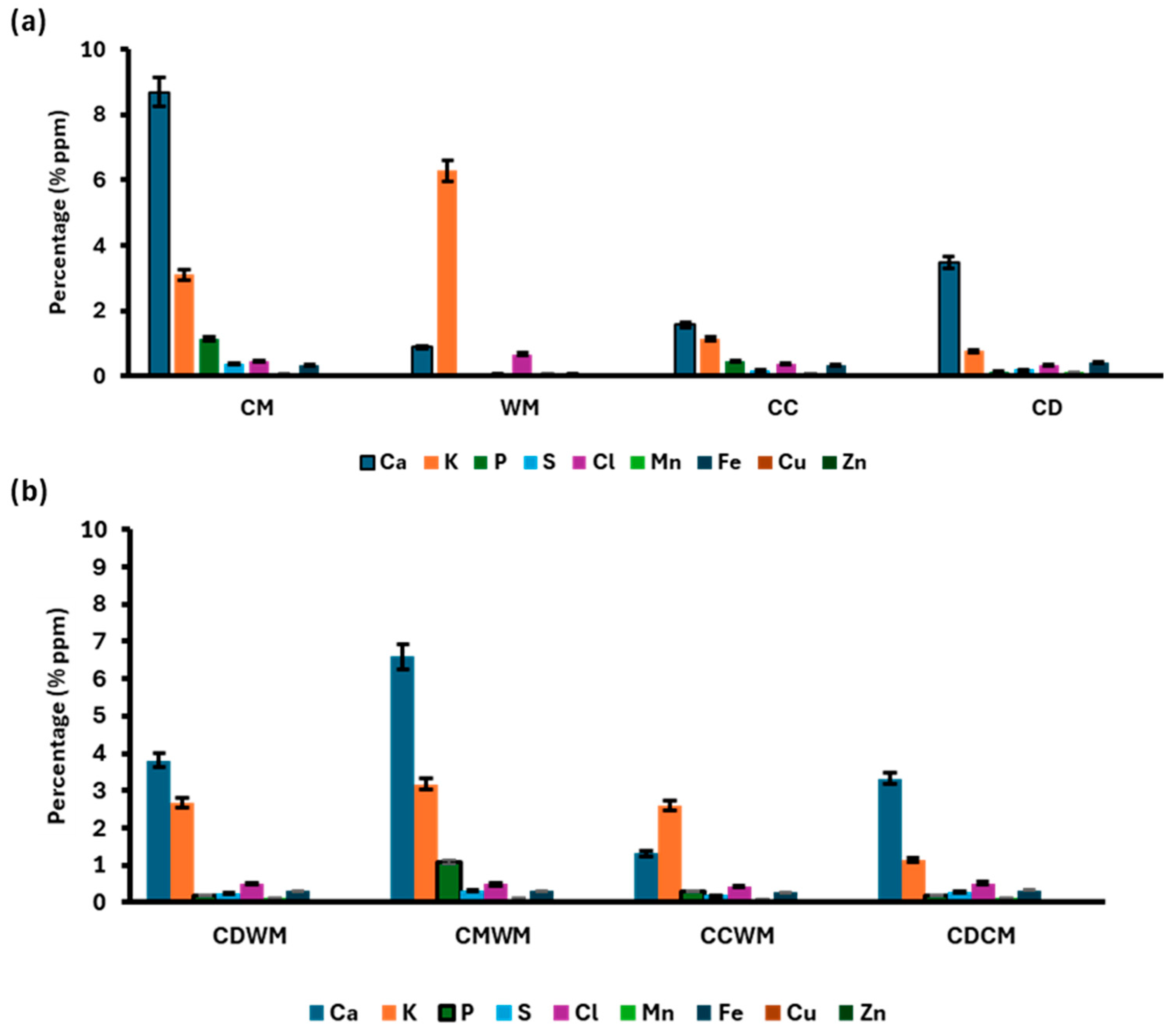
The results in Figure 6a,b show the nutrient composition of the biodigestates recovered from the water displacement of AD. The results revealed that nutrient composition varies significantly among the tested substrates. It is observed that both mono- and co-digested biodigestates contained essential macronutrients, which are beneficial for plant growth, despite the variation in nutrient composition according to feedstock used, for example, calcium (Ca) and potassium (K) were predominant in all the biodigestates, with CM, WM, and CD contributing greatly to these nutrients. CM had up to 8.9% ppm Ca and 3.1% ppm K, and it was the only substrate that contained Mn, whereas WM had the highest K of 6.3% ppm, and CD had Ca contents of up to 3.5% ppm. Phosphorus (P) was also present in relatively high percentages in all substrates except WM. In addition, the biodigestates contained traces of microelements that are also required for plant growth, such as Cl, Mn, Fe, Zn, and others. This variation implies that biodigestate is a complex mixture of organic and inorganic compounds, indicating its potential as an effective fertilizer capable of improving the physical, chemical, and biological properties of agricultural soils, thereby increasing crop productivity [4,45]. The detection of trace amounts of heavy metals in the biodigestate does not preclude its use as a fertilizer, since elements such as Cu and Zn serve as micronutrients for plant growth and are involved in critical physiological functions, such as enzyme activity and metabolic processes within plants [46,47]. However, elevated amounts of heavy metals negatively affect plant growth through the disruption of essential processes such as chlorophyll synthesis, nutrient absorption, and oxidative damage [48]. Furthermore, high Cl percentages (~1% ppm) in all the substrates and their combinations are an essential factor to consider when evaluating the biodigestate’s potential as a fertilizer, since it has been established that excessive amounts of Cl can be detrimental to overall soil health and plant growth, such as impeding water uptake by plant roots [6]. The use of biodigestate from semi-dry AD is important and contributes to the circular bioeconomy since it converts organic waste into a valuable nutrient-rich resource, reducing reliance on synthetic fertilizers, consequently offering a cost-effective alternative for farmers while supporting sustainable waste management [3,6,49].
Key advantages of using biodigestate as a fertilizer include its capacity to provide a sustained release of nutrients, allowing for gradual uptake by plants over an extended period. Unlike synthetic fertilizers, which may cause nutrient leaching and environmental pollution, biodigestate presents a lower risk of ecological harm. In addition, other than biodigestate’s nutrient content, it contains organic matter that can improve soil structure and increase water retention, helping to reduce soil erosion [49], as well as playing a key role in nutrient recovery and circular economy models. Martin–Sanz–Garrido et al. [49] also emphasizes that although digestate holds potential as a sustainable fertilizer, it encounters significant environmental and economic challenges. Environmentally, it risks contamination with heavy metals and pathogens. Economically, its adoption in agriculture is limited by seasonal nutrient variability, which makes it difficult to standardize. Additionally, biodigestate pricing depends on its nutrient content and competition with synthetic fertilizers, thereby limiting its market viability.

4. Conclusions

The generation of large volumes of agricultural and abattoir waste has the potential to cause environmental pollution if not properly managed. This study investigated the potential of semi-dry AD by co-digesting animal wastes for sustainable biogas production by replacing water with a high-moisture inedible wild melon. BMP of substrates (CC, CD, CM, and their combinations) was calculated using the results from AMPTS biogas production and TGA analyses. The highest BMP (63.3 NmL CH4/g VS) was obtained from the CMWM combination, followed by CD and CCWM combinations with 29.5 NmL CH4/g vs. and 23.7 NmL CH4/g VS, respectively. Wet AD results showed that co-digested substrates produced more biogas than single substrates; however in semi-dry AD showed that single substrates produced relatively more biogas than co-digested substrates, with CM (8250 mL), CD (7370 mL), and CC (6700 mL) versus CMCC (8000 mL), CMCD (6725 mL), and CCCD (3935 mL), respectively. The highest biogas production was observed in wet co-digestion of CMCC, which was 10,975 mL, while 8000 mL was recorded in semi-dry co-digestion for (348 h) 14 days. Paired t-test indicated that there was no significant difference in biogas production between wet- and semi-dry AD (P (0.80) > α (0.05)), ighting the potential of implementing semi-dry AD by co-digesting animal waste and using wild melon as a water substitute, thus benefiting from the synergistic effects between the substrates. The nutrient composition of the biodigestates was investigated using XRF, and the results showed that all the biodigestates predominantly contained Ca, K, and P. The presence of some microelements essential for plant growth, such as Cl, Mn, Fe, and Zn, indicates that the biodigestate has potential for use in nutrient-deficient soils. In conclusion, semi-dry AD of organic matter could prevent potential environmental harm by valorizing waste into renewable energy and nutrient-rich fertilizer for waste management, while saving water and promoting resource utilization efficiency. In the future, co-substrate ratios will need to be optimized for maximum process synergy before upscaling the AD process to achieve efficient performance. In addition, comprehensive life-cycle assessment and circular economy models need to be determined for the optimized utilization of the biodigestate.

Author Contributions

W.B.: Experimental design and investigation, data analysis, preparing original draft, N.O.: AMPTS methodology, experimental work, data analysis, and manuscript editing, A.G.: project conceptualization, funding acquisition, supervision, and correction of the manuscript. L.L. project conceptualization, funding acquisition, supervision, project design and data analysis, project administration, and correction of the manuscript. All authors have read and agreed to the published version of the manuscript.

Funding

This research was funded by the African Centre for Technology Studies (ACTS) in Kenya in collaboration with the Botswana Digital & Innovation Hub (BDIH). Project number: ACTS/RIMP/BDIH/BIUST/2023, and the APC was funded by the same project funder.

Data Availability Statement

The original contributions presented in this study are included in the article. Further inquiries can be directed to the corresponding author.

Acknowledgments

The authors would like to thank the Botswana International University of Science and Technology (BIUST) for the laboratory facilities used for sample analysis and the financial support from the African Center for Technology Studies (ACTS) in collaboration with Botswana Digital and Innovation Hub (BDIH).

Conflicts of Interest

The Authors declare no conflicts of interest.

References

  1. Dhungana, B.; Lohani, S.P.; Marsolek, M. Anaerobic co-digestion of food waste with livestock manure at ambient temperature: A biogas based circular economy and sustainable development goals. Sustainability 2022, 14, 3307. [Google Scholar] [CrossRef]
  2. Ghisellini, P.; Cialani, C.; Ulgiati, S. A review on circular economy: The expected transition to a balanced interplay of environmental and economic systems. J. Clean. Prod. 2016, 114, 11–32. [Google Scholar] [CrossRef]
  3. Lubańska, A.; Kazak, J.K. The role of biogas production in circular economy approach from the perspective of locality. Energies 2023, 16, 3801. [Google Scholar] [CrossRef]
  4. Abbas, Y.; Yun, S.; Mehmood, A.; Ali Shah, F.; Wang, K.; Eldin, E.T.; Al-Qahtani, W.H.; Ali, S.; Bocchett, P. Co-digestion of cow manure and food waste for biogas enhancement and nutrients revival in bio-circular economy. Chemosphere 2023, 311, 137018. [Google Scholar] [CrossRef] [PubMed]
  5. Chodkowska-Miszczuk, J.; Martinát, S.; Van Der Horst, D. Changes in feedstocks of rural anaerobic digestion plants: External drivers towards a circular bioeconomy. Renew. Sustain. Energy Rev. 2021, 148, 111344. [Google Scholar] [CrossRef]
  6. Skrzypczak, D.; Trzaska, K.; Gil, F.; Chawla, Y.; Mikula, K.; Izydorczyk, G.; Samoraj, M.; Tkacz, K.; Turkiewicz, I.; Moustakas, K.; et al. Towards anaerobic digestate valorization to recover fertilizer nutrients: Elaboration of technology and profitability analysis. Biomass Bioenergy 2023, 178, 106967. [Google Scholar] [CrossRef]
  7. Ahmad, A.; Buhari, M.; Yauri, I.Y. Comparative analysis of biogas production from agricultural wastes. Int. J. Sci. Glob. Sustain. 2024, 10, 68–74. [Google Scholar] [CrossRef]
  8. Ncube, A.; Sadondo, P.; Makhanda, R.; Mabika, C.; Beinisch, N.; Cocker, J.; Gwenzi, W.; Ulgiati, S. Circular bioeconomy potential and challenges within an African context: From theory to practice. J. Clean. Prod. 2022, 367, 133068. [Google Scholar] [CrossRef]
  9. Appels, L.; Baeyens, J.; Degrève, J.; Dewil, R. Principles and potential of the anaerobic digestion of waste-activated sludge. Prog. Energy Combust. Sci. 2008, 34, 755–781. [Google Scholar] [CrossRef]
  10. Feng, L.; Aryal, N.; Li, Y.; Horn, S.J.; Ward, A.J. Developing a biogas centralised circular bioeconomy using agricultural residues-Challenges and opportunities. Sci. Total Environ. 2023, 868, 161656. [Google Scholar] [CrossRef]
  11. Hasan, M.M.; Mofijur, M.; Uddin, M.N.; Kabir, Z.; Badruddin, I.A.; Khan, T.M.Y. Insights into anaerobic digestion of microalgal biomass for enhanced energy recovery. Front. Energy Res. 2024, 12, 1355686. [Google Scholar] [CrossRef]
  12. Jiang, Y.; Zhang, Y.; Li, H.; Li, H.; Yan, H.; Xing, S. Research on the control system for the use of biogas slurry as fertilizer. Agronomy 2024, 14, 1439. [Google Scholar] [CrossRef]
  13. De Baere, L. Anaerobic digestion of solid waste: State-of-the-art. Water Sci. Technol. 2006, 41, 283–290. [Google Scholar] [CrossRef]
  14. Matheri, A.N.; Ndiweni, S.N.; Belaid, M.; Muzenda, E.; Hubert, R. Optimising biogas production from anaerobic co-digestion of chicken manure and organic fraction of municipal solid waste. Renew. Sustain. Energy Rev. 2017, 80, 756–764. [Google Scholar] [CrossRef]
  15. Wang, B.; Strömberg, S.; Li, C.; Nges, I.A.; Nistor, M.; Deng, L.; Liu, J. Effects of substrate concentration on methane potential and degradation kinetics in batch anaerobic digestion. Bioresour. Technol. 2015, 194, 240–246. [Google Scholar] [CrossRef]
  16. Mata-Alvarez, J.; Dosta, J.; Romero-Güiza, M.S.; Fonoll, X.; Peces, M.; Astals, S. A critical review on anaerobic co-digestion achievements between 2010 and 2013. Renew. Sustain. Energy Rev. 2014, 36, 412–427. [Google Scholar] [CrossRef]
  17. Schnürer, A. Biogas Production: Microbiology and Technology. In Advances in Biochemical Engineering/Biotechnology; Springer: Berlin/Heidelberg, Germany, 2016. [Google Scholar] [CrossRef]
  18. Chen, Y.; Cheng, J.J.; Creamer, K.S. Inhibition of anaerobic digestion process: A review. Bioresour. Technol. 2008, 99, 4044–4064. [Google Scholar] [CrossRef]
  19. Manyi-Loh, C.E.; Lues, R. Anaerobic digestion of lignocellulosic biomass: Substrate characteristics (challenge) and innovation. Fermentation 2023, 9, 755. [Google Scholar] [CrossRef]
  20. Mohamed Ali, A.; Alam, M.Z.; Abdoul-latif, M.F.; Jami, M.S.; Gamiye Bouh, I.; Adebayo Bello, I.; Ainane, T. Production of biogas from food waste using the anaerobic digestion process with biofilm-based pretreatment. Processes 2023, 11, 655. [Google Scholar] [CrossRef]
  21. Hayyat, U.; Khan, M.U.; Sultan, M.; Zahid, U.; Bhat, S.A.; Muzamil, M. A review on dry anaerobic digestion: Existing technologies, performance factors, challenges, and recommendations. Methane 2024, 3, 33–52. [Google Scholar] [CrossRef]
  22. Sganzerla, W.G.; Costa, J.M.; Tena-Villares, M.; Buller, L.S.; Mussatto, S.I.; Forster-Carneiro, T. Dry anaerobic digestion of brewer’s spent grains toward a more sustainable brewery: Operational performance, kinetic analysis, and bioenergy potential. Fermentation 2022, 9, 2. [Google Scholar] [CrossRef]
  23. Bansal, V.; Tumwesige, V.; Smith, J.U. Water for small-scale biogas digesters in sub-Saharan Africa. GCB Bioenergy 2017, 9, 339–357. [Google Scholar] [CrossRef]
  24. Ghaedi, M.; Nasab, H.; Ehrampoush, M.H.; Ebrahimi, A.A. Evaluation of the efficiency of dry anaerobic digester in the production of biogas and fertilizer using activated sludge and plant waste. Sci. Rep. 2024, 14, 24727. [Google Scholar] [CrossRef]
  25. Czekała, W.; Nowak, M.; Bojarski, W. Characteristics of substrates used for biogas production in terms of water content. Fermentation 2023, 9, 449. [Google Scholar] [CrossRef]
  26. Wang, Z.Y.; Hu, Y.; Wang, S.; Wu, G.; Zhan, X. A critical review on dry anaerobic digestion of organic waste: Characteristics, operational conditions, and improvement strategies. Renew. Sustain. Energy Rev. 2023, 176, 113208. [Google Scholar] [CrossRef]
  27. Kalogiannis, A.; Diamantis, V.; Eftaxias, A.; Stamatelatou, K. Long-Term Anaerobic Digestion of Seasonal Fruit and Vegetable Waste Using a Leach-Bed Reactor Coupled to an Upflow Anaerobic Sludge Bed Reactor. Sustainability 2023, 16, 50. [Google Scholar] [CrossRef]
  28. Hallaji, S.M.; Kuroshkarim, M.; Moussavi, S.P. Enhancing methane production using anaerobic co-digestion of waste activated sludge with combined fruit waste and cheese whey. BMC Biotechnol. 2019, 19, 19. [Google Scholar] [CrossRef]
  29. Oduor, W.W.; Wandera, S.M.; Murunga, S.I.; Raude, J.M. Enhancement of anaerobic digestion by co-digesting food waste and water hyacinth in improving treatment of organic waste and bio-methane recovery. Heliyon 2022, 8, 10580. [Google Scholar] [CrossRef]
  30. Nyoni., K.; Kelebopile, L. Physio-chemical and Thermal Characterization of Demineralized Poultry Litter using Mechanical Sizing Fractioning, Acid Solvents, and Deionized Water. J. Chem. Environ. 2023, 2, 82–96. [Google Scholar] [CrossRef]
  31. ASTM D7582; Standard Test Methods for Proximate Analysis of Coal and Coke by Macro Thermogravimetric Analysis. ASTM International: West Conshohocken, PA, USA, 2015.
  32. Marczewski, P.; Sytek-Szmeichel, K.; Zubrowska-Sudol, M. Assessment of Potential of Organic Waste Methane for Implementation in Energy Self-Sufficient Wastewater Treatment Facilities. Energies 2025, 18, 5534. [Google Scholar] [CrossRef]
  33. Bagi, Z.; Ács, N.; Bálint, B.; Horváth, L.; Dobó, K.; Perei, K.R.; Kovács, K.L. Biotechnological intensification of biogas production. Appl. Microbiol. Biotechnol. 2007, 76, 473–482. [Google Scholar] [CrossRef] [PubMed]
  34. Committee on Nutrient Requirements of Dairy Cattle; Board on Agriculture and Natural Resources; Division on Earth and Life Studies; National Academies of Sciences, Engineering, and Medicine. Nutrient Requirements of Dairy Cattle: Eighth Revised Edition; National Academies Press: Washington, DC, USA, 2021. [Google Scholar] [CrossRef]
  35. Wedwitschka, H.; Gallegos Ibanez, D.; Schäfer, F.; Jenson, E.; Nelles, M. Material characterization and substrate suitability assessment of chicken manure for dry batch anaerobic digestion processes. Bioengineering 2020, 7, 106. [Google Scholar] [CrossRef]
  36. Li, Z.; Reimer, C.; Picard, M.; Mohanty, A.K.; Misra, M. Characterization of chicken feather biocarbon for use in sustainable biocomposites. Front. Mater. 2020, 7, 3. [Google Scholar] [CrossRef]
  37. Ashekuzzaman, S.M.; Poulsen, T.G. Optimizing feed composition for improved methane yield during anaerobic digestion of cow manure based waste mixtures. Bioresour. Technol. 2011, 102, 2213–2218. [Google Scholar] [CrossRef] [PubMed]
  38. Diagi, E.A.; Akinyemi, M.L.; Emetere, M.E.; Ogunrinola, I.E.; Ndubuisi, A.O. Comparative Analysis of Biogas Produced from Cow Dung and Poultry Droppings. IOP Conf. Ser. Earth Environ. Sci. 2019, 331, 012064. [Google Scholar] [CrossRef]
  39. Orhorhoro, E.K.; Ebunilo, P.O.; Sadjere, G.E. Experimental determination of effect of total solid (TS) and volatile solid (VS) on biogas yield. Am. J. Mod. Energy 2017, 3, 131. [Google Scholar] [CrossRef]
  40. Sheng, K.; Chen, X.; Pan, J.; Kloss, R.; Wei, Y.; Ying, Y. Effect of ammonia and nitrate on biogas production from food waste via anaerobic digestion. Biosyst. Eng. 2013, 116, 205–212. [Google Scholar] [CrossRef]
  41. García, J.; Davies, S.; Villa, R.; Gomes, D.M.; Coulon, F.; Wagland, S.T. Compositional analysis of excavated landfill samples and the determination of residual biogas potential of the organic fraction. Waste Manag. 2016, 55, 336–344. [Google Scholar] [CrossRef]
  42. Johari, S.A.M.; Aqsha, A.; Shamsudin, M.R.; Lam, M.K.; Osman, N.; Tijani, M.; Jawaid, M.; Khan, A. (Eds.) Technical trends in biogas production from chicken manure. In Manure Technology and Sustainable Development; Sustainable Materials and Technology; Springer Nature: Singapore, 2023; pp. 145–182. [Google Scholar] [CrossRef]
  43. Mirmohamadsadeghi, S.; Karimi, K.; Zamani, A.; Amiri, H.; Horváth, I.S. Enhanced Solid-State Biogas Production from Lignocellulosic Biomass by Organosolv Pretreatment. BioMed Res. Int. 2014, 2014, 1–6. [Google Scholar] [CrossRef] [PubMed]
  44. Rabii, A.; Aldin, S.; Dahman, Y.; Elbeshbishy, E. A Review on Anaerobic Co-Digestion with a Focus on the Microbial Populations and the Effect of Multi-Stage Digester Configuration. Energies 2019, 12, 1106. [Google Scholar] [CrossRef]
  45. Surendra, K.C.; Takara, D.; Hashimoto, A.G.; Khanal, S.K. Biogas as a sustainable energy source for developing countries: Opportunities and challenges. Renew. Sustain. Energy Rev. 2014, 31, 846–859. [Google Scholar] [CrossRef]
  46. Koszel, M.; Przywara, A.; Kachel-Jakubowska, M.; Kraszkiewicz, A. Evaluation of the Use of Biogas Plant Digestate as a Fertilizer in Field Cultivation Plant. In Proceedings of the IX International Scientific Symposium “Farm Machinery and Processes Management in Sustainable Agriculture”, Lublin, Poland, 22–24 November 2017; pp. 181–186. [Google Scholar]
  47. Zhang, S.; Hua, Y.; Deng, L. Nutrient Status and Contamination Risks from Digested Pig Slurry Applied on a Vegetable Crops Field. Int. J. Environ. Res. Public Health 2016, 13, 406. [Google Scholar] [CrossRef] [PubMed]
  48. Gupta, M.; Dwivedi, V.; Kumar, S.; Patel, A.; Niazi, P.; Yadav, V.K. Lead toxicity in plants: Mechanistic insights into toxicity, physiological responses of plants and mitigation strategies. Plant Signal. Behav. 2024, 19, 2365576. [Google Scholar] [CrossRef] [PubMed]
  49. Martín-Sanz-Garrido, C.; Revuelta-Aramburu, M.; Santos-Montes, A.M.; Morales-Polo, C. A Review on Anaerobic Digestate as a Biofertilizer: Characteristics, Production, and Environmental Impacts from a Life Cycle Assessment Perspective. Appl. Sci. 2025, 15, 8635. [Google Scholar] [CrossRef]
Figure 1. (a) AMPTS and (b) water displacement method set-ups used in this study.
Energies 18 06505 g001
Figure 2. Thermogravimetric characterization of (a) mono-substrates and (b) co-substrates used in biogas production.
Energies 18 06505 g002
Figure 3. Average cumulative biomethane yield for (a) mono-substrates and (b) for co-substrates using AMPTS over 504 h. The experiments were performed in duplicates.
Energies 18 06505 g003
Figure 4. Cumulative biogas production of mono-substrate in (a) wet AD and (b) semi-dry AD, and co-substrates (c) wet AD and (d) semi-dry AD for up to 400 h (16 days).
Energies 18 06505 g004
Figure 5. Comparison of overall cumulative biogas yields (a) wet and semi-dry for mono-substrate AD and (b) wet and semi-dry for co-digestion AD.
Energies 18 06505 g005
Figure 6. X-ray fluorescence elemental analysis of (a) mono- and (b) co-digested substrates in % ppm of the elements in the substrates.
Energies 18 06505 g006
Table 1. Physicochemical characterization of the used substrates.
SubstrateMoisture (%)Volatile Solids (%)Fixed Carbon (%)Ash (%)C:N
CC88.148.552.011.3132
CD76.0314.544.085.3623
CM15.7232.668.8542.778
WM95.783.660.20.3620
CDCC81.3112.123.023.56-
CMCD67.3819.585.477.58-
CMCC75.4315.464.444.67-
CDWM87.198.641.832.34-
CCWM90.927.071.20.8-
CMWM79.6310.472.127.78-
Table 2. Calculated biomethane potential of mono-substrates and co-substrates from AMPTS digestion.
SubstrateSubstrate Weight (g)Substrate VS
(g VS)
VS Consumed, (%)Av. Gas Produced (NmL CH4)BMP
(NmL CH4/g VS)
CC70078.8211.26408.35.2
CD700107.3815.343166.229.5
CM40094.1623.542262.621.9
CDCC70043.476.21954.517.4
CMCD40077.0419.26997.612.9
CMCC40056.4814.12903.4516.0
CDWM70032.834.69265.38.1
CCWM70036.475.21863.2523.7
CMWM40020.245.061480.663.3
BLANK0-0.78199.0-
Disclaimer/Publisher’s Note: The statements, opinions and data contained in all publications are solely those of the individual author(s) and contributor(s) and not of MDPI and/or the editor(s). MDPI and/or the editor(s) disclaim responsibility for any injury to people or property resulting from any ideas, methods, instructions or products referred to in the content.