Mineral Sequestration of CO2 Using Metallurgical Slags: A Brief Literature Review



Abstract
1. Introduction
2. Direct Mineral Sequestration—Process Characteristics
- Slag dissolution:
- Carbon dioxide solubility:
- Carbonation reactions:
(Ca2+, Mg2+) + CO32− ↔ (CaCO3, MgCO3)(aq)
- Precipitation reaction:
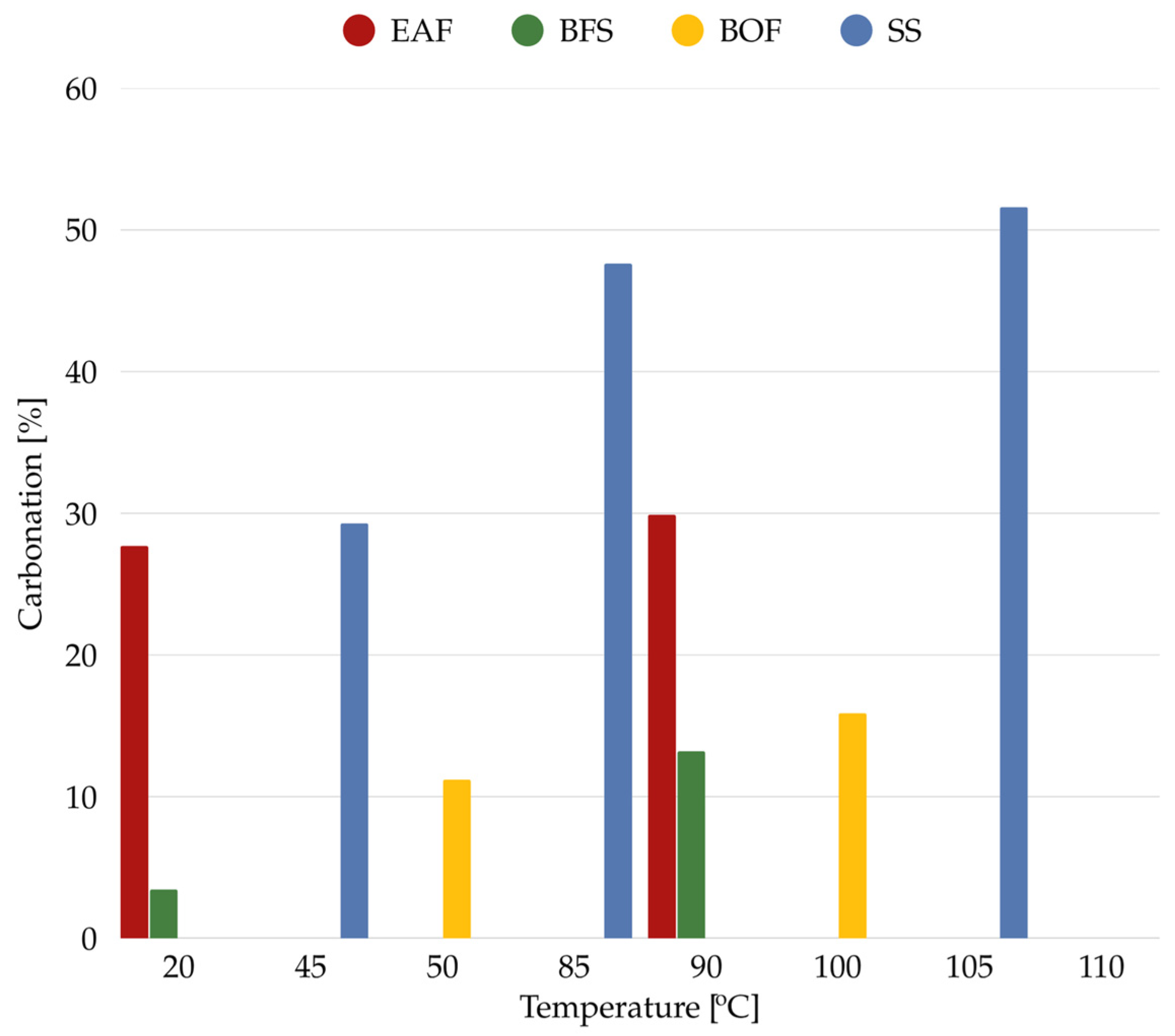
2.1. The Effect of Temperature on the Direct Carbonation Process
2.2. The Influence of Pressure on the Efficiency of Carbonation of Metallurgical Slags
2.3. The Influence of the Liquid-to-Solid Ratio (L/S) on the Efficiency of Carbonation of Metallurgical Slags
2.4. The Influence of Reaction Time on the Carbonation Process of Metallurgical Slags
2.5. Effect of the Carbonation Process on the Phase Composition of Metallurgical Slags
3. Indirect Mineral Sequestration—Process Characteristics

| Slag Type | CaO Content | Process Characterisation | Reference | ||||
|---|---|---|---|---|---|---|---|
| Type of Process, L/S, Duration | Reagent | Temperature | Pressure | Results | |||
| Blast furnace slag | CaO: 40.6% (±0.1) | CH3COOH NaOH | 30–70 °C | 0.1–3 MPa | binding of 1 kg of CO2 requires 4.4 kg slag, 3.6 dm3 CH3COOH, and 3.5 kg NaOH, resulting in 2.5 kg of 90% CaCO3 | [25] | |
| Converter slag | CaO: 44.5% | duration: 2 h | HCl, CH3COOH; NH4Cl | 80 °C | CO2 absorbed: 22.9 Mg/h slag required: 141.4 Mg/h CaCO3 generated: 52.3 Mg/h | [67] | |
| Blast furnace slag | (NH4)2SO4-to-slag mass ratio of 3:1 duration: 1 h | (NH4)2SO4 | 370 °C | total CO2 sequestration capacity: 316 kg/Mg | [71] | ||
| Steelmaking slag | CaO: 38.7% | acid-to-solid ratio: 0.5; 1.0 g/g duration: 1 h | TBP, CH3COOH, ultrapure water | 40–94 °C | max. leached ratio of CaO: 75% | [72] | |
| Basic oxygen furnace slag | CaO: 40% | duration: 10, 15, 60 min | NH4Cl, NH4OH | 10, 80 °C | 99.5% carbonation ratio; CO2 bound by calcium: 30.52%; vaterite | [73] | |
| Basic oxygen furnace slag | CaO: 47.74% | 50 g/L duration: 24 h | HCl, CH3COOH | 25–900 °C | CO2 absorption: 2.6–6.9 mmol/g | [74] | |
| Steel slag | Ca: 35.79% | NH4Cl, S/L ratio: 200 g/L duration: 15, 30, 45, 60 min | NH4Cl | 30, 40, 60, 80 °C | CO2 sequestration capacity: 46–178 g/kg | [75] | |
| Steel slag | Ca: 15.58% | HCl L/S ratio: 50 kg/kg solution concentration: 1.2 mol/L duration: 0.25 min | 25 °C | max. Ca extraction: 87% | [24] | ||
| Blast furnace slag | Ca (30.4 wt. %) | pressure-swing carbonation duration: 5, 10, 30, 40, 50, 60, 120, 180, 240, 300, 360 min | 20 °C | 0.1 MPa, under vacuum | max. CO2 uptake capacities: 21.1 and 24.5 g CO2/kg, respectively, corresponding to 48.0 CaCO3/g and 55.7 CaCO3/g; max. CO2 uptake: 267.1 g CO2/kg, corresponding to 607.0 g CaCO3/g | [76] | |
| Electric arc furnace slag | CaO: 39.04% | carbonation under microwave irradiation | 2.4 mol/L NH4Cl—0.8 mol/L CaCl2—1.6 mol/L NH3·H2O—400 mL | 12, 25, 35 °C | vaterite | [77] | |
| Steel converter slag | CaO: 51.4% | NH4Cl | 20, 45, 50, 60 °C | 70% of the CO2 was utilised and converted into PCC | [68] | ||
| Steel converter slag | CaO: 44.9% | NH4NO3, CH3COONH4 NH4Cl | 30 °C | max. Ca extraction efficiency: 73% | [78] | ||
- A decrease in particle size leads to an increase in the specific surface area, thereby enhancing the mass transfer rate. Consequently, the comminution of slag particles significantly improves both the kinetics and efficiency of calcium extraction.
- Higher extractant concentrations favour calcium dissolution; however, excessively elevated concentrations may induce the co-dissolution of impurities from the slag matrix, ultimately lowering the purity of the precipitated CaCO3.
- The effect of temperature on calcium extraction is strongly dependent on the chemical characteristics of the extractant applied, indicating that its optimisation requires case-specific evaluation.
- A reduction in the solid-to-liquid ratio generally promotes calcium extraction; nonetheless, this improvement occurs at the expense of the overall process throughput, thus necessitating a balance between extraction efficiency and production capacity.
4. Application of the Process in Practice
5. Conclusions
6. Directions for Future Research
- Optimisation of process parameters: the determination of conditions allowing for maximum efficiency with minimum energy input, taking into account the mechanical activation of the material and the influence of the varied chemical composition of slags.
- Development of hybrid technologies: combining direct and indirect methods to improve the efficiency and quality of the carbonates obtained.
- Life cycle assessment (LCA): an assessment of the environmental and economic balance of carbonation processes under industrial conditions, taking into account the energy consumption and by-products generated.
- Research on the stability and application of products: a long-term assessment of the durability of carbonate compounds and development of new ways to use mineralised slags in a circular economy.
- Process scaling and integration with industry: the design of pilot and industrial installations, including the integration of technology with existing steelworks and cement plants.
Author Contributions
Funding
Conflicts of Interest
Nomenclature
| BOF | Basic Oxygen Furnace |
| GGBFS | Ground Granulated Blast Furnace Slag |
| EAF | Electric Arc Furnace |
| EAFRS | Electric Arc Furnace Reducing Slag |
| LF | Ladle Furnace |
| AOG | Argon Oxygen Decarburisation |
| CC | Stainless Steel Slag—Continuous Casting Slag |
| SS | Steelmaking Slag |
| L/S | Liquid/Solid |
| S/L | Solid/Liquid |
| Max. | Maximum |
References
- Climate Change 2022: Mitigation of Climate Change. Available online: https://www.ipcc.ch/report/ar6/wg3/ (accessed on 13 August 2025).
- Kim, J.; Sovacool, B.K.; Bazilian, M.; Griffiths, S.; Lee, J.; Yang, M.; Lee, J. Decarbonizing the Iron and Steel Industry: A Systematic Review of Sociotechnical Systems, Technological Innovations, and Policy Options. Energy Res. Soc. Sci. 2022, 89, 102565. [Google Scholar] [CrossRef]
- Somers, J. Technologies to Decarbonise the EU Steel Industry; Publications Office of the European Union: Luxembourg, 2022. [Google Scholar]
- Emissions Measurement and Data Collection for a Net Zero Steel Industry–Analysis-IEA. Available online: https://www.iea.org/reports/emissions-measurement-and-data-collection-for-a-net-zero-steel-industry (accessed on 10 November 2025).
- IEA. Iron & Steel. Available online: https://www.iea.org/energy-system/industry/steel#tracking (accessed on 13 August 2025).
- Mazzotti, M.; Carlos, J.; Allam, R.; Lackner, K.S.; Meunier, F.; Rubin, E.M.; Sanchez, J.C.; Yogo, K.; Zevenhoven, R. Mineral Carbonation and Industrial Uses of Carbon Dioxide. In IPCC Special Report on Carbon Dioxide Capture and Storage; Cambridge University Press: Cambridge, UK, 2005. [Google Scholar]
- Lackner, K.S.; Butt, D.P.; Wendt, C.H. Progress on Binding CO2 in Mineral Substrates. Energy Convers. Manag. 1997, 38, S259–S264. [Google Scholar] [CrossRef]
- Lackner, K.S.; Wendt, C.H.; Butt, D.P.; Joyce, E.L.; Sharp, D.H. Carbon Dioxide Disposal in Carbonate Minerals. Energy 1995, 20, 1153–1170. [Google Scholar] [CrossRef]
- Pan, S.Y.; Chiang, P.C.; Chen, Y.H.; Tan, C.S.; Chang, E.E. Kinetics of Carbonation Reaction of Basic Oxygen Furnace Slags in a Rotating Packed Bed Using the Surface Coverage Model: Maximization of Carbonation Conversion. Appl. Energy 2014, 113, 267–276. [Google Scholar] [CrossRef]
- Seifritz, W. CO2 Disposal by Means of Silicates. Nature 1990, 345, 486. [Google Scholar] [CrossRef]
- Liu, W.; Teng, L.; Rohani, S.; Qin, Z.; Zhao, B.; Xu, C.C.; Ren, S.; Liu, Q.; Liang, B. CO2 Mineral Carbonation Using Industrial Solid Wastes: A Review of Recent Developments. Chem. Eng. J. 2021, 416, 129093. [Google Scholar] [CrossRef]
- Kumar, R.; Chung, W.J.; Khan, M.A.; Son, M.; Park, Y.K.; Lee, S.S.; Jeon, B.H. Breakthrough Innovations in Carbon Dioxide Mineralization for a Sustainable Future. Rev. Environ. Sci. BioTechnol. 2024, 23, 739–799. [Google Scholar] [CrossRef]
- Chen, Z.; Cang, Z.; Yang, F.; Zhang, J.; Zhang, L. Carbonation of Steelmaking Slag Presents an Opportunity for Carbon Neutral: A Review. J. CO2 Util. 2021, 54, 101738. [Google Scholar] [CrossRef]
- Uliasz-Bocheńczyk, A. A Comprehensive Review of CO2 Mineral Sequestration Methods Using Coal Fly Ash for Carbon Capture, Utilisation, and Storage (CCUS) Technology. Energies 2024, 17, 5605. [Google Scholar] [CrossRef]
- Jiang, L.; Cheng, L.; Zhang, Y.; Liu, G.; Sun, J. A Review on CO2 Sequestration via Mineralization of Coal Fly Ash. Energies 2023, 16, 6241. [Google Scholar] [CrossRef]
- Uliasz-Bochenczyk, A.; Pawluk, A.; Pyzalski, M. The Mineral Sequestration of CO2 with the Use of Fly Ash from the Co-Combustion of Coal and Biomass. Gospod. Surowcami Miner. 2017, 33, 143–156. [Google Scholar] [CrossRef][Green Version]
- Uliasz-Bochenczyk, A.; Pomykała, R. Mineral Sequestration of CO2 with the Use of Cement Waste. Energy Procedia 2011, 4, 2855–2860. [Google Scholar] [CrossRef]
- Huntzinger, D.N.; Gierke, J.S.; Kawatra, S.K.; Eisele, T.C.; Sutter, L.L. Carbon Dioxide Sequestration in Cement Kiln Dust through Mineral Carbonation. Environ. Sci. Technol. 2009, 43, 1986–1992. [Google Scholar] [CrossRef] [PubMed]
- Noack, C.W.; Dzombak, D.A.; Nakles, D.V.; Hawthorne, S.B.; Heebink, L.V.; Dando, N.; Gershenzon, M.; Ghosh, R.S. Comparison of Alkaline Industrial Wastes for Aqueous Mineral Carbon Sequestration Through a Parallel Reactivity Study. Waste Manag. 2014, 34, 1815–1822. [Google Scholar] [CrossRef]
- Chandel, S.S.; Singh, P.K.; Katiyar, P.K.; Randhawa, N.S. A Review on Environmental Concerns and Technological Innovations for the Valorization of Steel Industry Slag. Min. Metall. Explor. 2023, 40, 2059–2086. [Google Scholar] [CrossRef]
- Abdul, F.; Iizuka, A.; Ho, H.J.; Adachi, K.; Shibata, E. Potential of Major By-Products from Non-Ferrous Metal Industries for CO2 Emission Reduction by Mineral Carbonation: A Review. Environ. Sci. Pollut. Res. 2023, 30, 78041–78074. [Google Scholar] [CrossRef]
- Huijgen, W.J.J.; Comans, R.N.J. Carbon Dioxide Sequestration by Mineral Carbonation; Energy Research Centre of the Netherlands: Petten, The Netherlands, 2003.
- IEAGHG. From Carbon Dioxide to Building Materials—Improving Process Efficiency. Available online: https://ieaghg.org/publications/from-carbon-dioxide-to-building-materials-improving-process-efficiency/ (accessed on 14 August 2025).
- Kunzler, C.; Alves, N.; Pereira, E.; Nienczewski, J.; Ligabue, R.; Einloft, S.; Dullius, J. CO2 Storage with Indirect Carbonation Using Industrial Waste. Energy Procedia 2011, 4, 1010–1017. [Google Scholar] [CrossRef]
- Eloneva, S.; Teir, S.; Salminen, J.; Fogelholm, C.J.; Zevenhoven, R. Fixation of CO2 by Carbonating Calcium Derived from Blast Furnace Slag. Energy 2008, 33, 1461–1467. [Google Scholar] [CrossRef]
- Myers, C.A.; Nakagaki, T.; Akutsu, K. Quantification of the CO2 Mineralization Potential of Ironmaking and Steelmaking Slags under Direct Gas-Solid Reactions in Flue Gas. Int. J. Greenh. Gas Control 2019, 87, 100–111. [Google Scholar] [CrossRef]
- Pan, S.Y.; Chiang, P.C.; Chen, Y.H.; Tan, C.S.; Chang, E.E. Ex Situ CO2 Capture by Carbonation of Steelmaking Slag Coupled with Metalworking Wastewater in a Rotating Packed Bed. Environ. Sci. Technol. 2013, 47, 3308–3315. [Google Scholar] [CrossRef] [PubMed]
- Yadav, S.; Mehra, A. Experimental Study of Dissolution of Minerals and CO2 Sequestration in Steel Slag. Waste Manag. 2017, 64, 348–357. [Google Scholar] [CrossRef]
- Gopinath, S.; Mehra, A. Carbon Sequestration During Steel Production: Modelling the Dynamics of Aqueous Carbonation of Steel Slag. Chem. Eng. Res. Des. 2016, 115, 173–181. [Google Scholar] [CrossRef]
- Zhang, Y.; Ying, Y.; Xing, L.; Zhan, G.; Deng, Y.; Chen, Z.; Li, J. Carbon Dioxide Reduction Through Mineral Carbonation by Steel Slag. J. Environ. Sci. 2025, 152, 664–684. [Google Scholar] [CrossRef] [PubMed]
- Wang, Y.-J.; Tao, J.; Li, J.-G.; Zeng, Y.-N.; Qin, S.; Liu, S.-H.; Wang, Y.-J.; Tao, M.-J.; Li, J.-G.; Zeng, Y.-N.; et al. Carbonation of EAF Stainless Steel Slag and Its Effect on Chromium Leaching Characteristics. Crystals 2021, 11, 1498. [Google Scholar] [CrossRef]
- Baciocchi, R.; Costa, G.; Polettini, A.; Pomi, R. Influence of Particle Size on the Carbonation of Stainless Steel Slag for CO2 Storage. Energy Procedia 2009, 1, 4859–4866. [Google Scholar] [CrossRef]
- Huijgen, W.J.J.; Witkamp, G.J.; Comans, R.N.J. Mineral CO2 Sequestration by Steel Slag Carbonation. Environ. Sci. Technol. 2005, 39, 9676–9682. [Google Scholar] [CrossRef]
- Stolaroff, J.K.; Lowry, G.V.; Keith, D.W. Using CaO- and MgO-Rich Industrial Waste Streams for Carbon Sequestration. Energy Convers. Manag. 2005, 46, 687–699. [Google Scholar] [CrossRef]
- Quaghebeur, M.; Nielsen, P.; Horckmans, L.; Van Mechelen, D. Accelerated Carbonation of Steel Slag Compacts: Development of High-Strength Construction Materials. Front. Energy Res. 2015, 3, 171002. [Google Scholar] [CrossRef]
- Mehdizadeh, H.; Jiang, Y.; Ling, T.-C. CO2 Sequestration via Mineralization of Basic Oxygen Furnace Slag. In Carbon Dioxide Sequestration in Cementitious Construction Materials; Woodhead Publishing: Cambridge, UK, 2024; pp. 135–155. [Google Scholar] [CrossRef]
- Su, T.H.; Yang, H.J.; Shau, Y.H.; Takazawa, E.; Lee, Y.C. CO2 Sequestration Utilizing Basic-Oxygen Furnace Slag: Controlling Factors, Reaction Mechanisms and V–Cr Concerns. J. Environ. Sci. 2016, 41, 99–111. [Google Scholar] [CrossRef]
- Ko, M.S.; Chen, Y.L.; Jiang, J.H. Accelerated Carbonation of Basic Oxygen Furnace Slag and the Effects on Its Mechanical Properties. Constr. Build. Mater. 2015, 98, 286–293. [Google Scholar] [CrossRef]
- Librandi, P.; Nielsen, P.; Costa, G.; Snellings, R.; Quaghebeur, M.; Baciocchi, R. Mechanical and Environmental Properties of Carbonated Steel Slag Compacts as a Function of Mineralogy and CO2 Uptake. J. CO2 Util. 2019, 33, 201–214. [Google Scholar] [CrossRef]
- Librandi, P.; Costa, G.; De Souza, A.C.B.; Stendardo, S.; Luna, A.S.; Baciocchi, R. Carbonation of Steel Slag: Testing of the Wet Route in a Pilot-Scale Reactor. Energy Procedia 2017, 114, 5381–5392. [Google Scholar] [CrossRef]
- Srivastava, S.; Cerutti, M.; Nguyen, H.; Carvelli, V.; Kinnunen, P.; Illikainen, M. Carbonated Steel Slags as Supplementary Cementitious Materials: Reaction Kinetics and Phase Evolution. Cem. Concr. Compos. 2023, 142, 105213. [Google Scholar] [CrossRef]
- He, D.; Yang, L.; Guo, J. Effect of Carbonation Degree on Mineral Composition, Microstructure, and Cementitious Properties of BOF Slag. J. Sustain. Metall. 2024, 10, 2267–2281. [Google Scholar] [CrossRef]
- Elyasi Gomari, K.; Rezaei Gomari, S.; Hughes, D.; Ahmed, T. Exploring the Potential of Steel Slag Waste for Carbon Sequestration Through Mineral Carbonation: A Comparative Study of Blast-Furnace Slag and Ladle Slag. J. Environ. Manag. 2024, 351, 119835. [Google Scholar] [CrossRef] [PubMed]
- Siriwardena, D.P.; Peethamparan, S. Quantification of CO2 Sequestration Capacity and Carbonation Rate of Alkaline Industrial Byproducts. Constr. Build. Mater. 2015, 91, 216–224. [Google Scholar] [CrossRef]
- Ukwattage, N.L.; Ranjith, P.G.; Li, X. Steel-Making Slag for Mineral Sequestration of Carbon Dioxide by Accelerated Carbonation. Measurement 2017, 97, 15–22. [Google Scholar] [CrossRef]
- Uliasz-Bocheńczyk, A.; Mokrzycki, E. CO2 Mineral Sequestration with the Use of Ground Granulated Blast Furnace Slag. Gospod. Surowcami Miner. 2017, 33, 111–124. [Google Scholar] [CrossRef]
- Omale, S.O.; Choong, T.S.Y.; Abdullah, L.C.; Siajam, S.I.; Yip, M.W. Utilization of Malaysia EAF Slags for Effective Application in Direct Aqueous Sequestration of Carbon Dioxide Under Ambient Temperature. Heliyon 2019, 5, e02602. [Google Scholar] [CrossRef]
- Bonenfant, D.; Kharoune, L.; Sauvé, S.; Hausler, R.; Niquette, P.; Mimeault, M.; Kharoune, M. CO2 Sequestration Potential of Steel Slags at Ambient Pressure and Temperature. Ind. Eng. Chem. Res. 2008, 47, 7610–7616. [Google Scholar] [CrossRef]
- Vegas, I.; Oleaga, A.; García-Cortés, V.; Santamaria, A.; San-Jose, J.T. Assessment of Steelmaking Slags Subjected to Accelerated Carbonation. Ain Shams Eng. J. 2024, 15, 102790. [Google Scholar] [CrossRef]
- Bonfante, F.; Ferrara, G.; Humbert, P.; Garufi, D.; Tulliani, J.M.; Palmero, P. Direct Aqueous Carbonation of Electric Arc Furnace Slag: Process Optimisation Through Experimental Design. Mater. Struct. 2025, 58, 127. [Google Scholar] [CrossRef]
- Pan, S.Y.; Chung, T.C.; Ho, C.C.; Hou, C.J.; Chen, Y.H.; Chiang, P.C. CO2 Mineralization and Utilization Using Steel Slag for Establishing a Waste-to-Resource Supply Chain. Sci. Rep. 2017, 7, 17227. [Google Scholar] [CrossRef] [PubMed]
- Diener, S.; Andreas, L.; Herrmann, I.; Ecke, H.; Lagerkvist, A. Accelerated Carbonation of Steel Slags in a Landfill Cover Construction. Waste Manag. 2010, 30, 132–139. [Google Scholar] [CrossRef] [PubMed]
- Mohamed, A.M.O.; El-Gamal, M.; Hameedi, S. Advanced Mineral Carbonation: An Approach to Accelerate CO2 Sequestration Using Steel Production Wastes and Integrated Fluidized Bed Reactor; Springer Series in Geomechanics and Geoengineering; Springer: Cham, Switzerland, 2018; pp. 387–393. [Google Scholar] [CrossRef]
- Capelo-Avilés, S.; Tomazini de Oliveira, R.; Gallo Stampino, I.I.; Gispert-Guirado, F.; Casals-Terré, A.; Giancola, S.; Galán-Mascarós, J.R. A Thorough Assessment of Mineral Carbonation of Steel Slag and Refractory Waste. J. CO2 Util. 2024, 82, 102770. [Google Scholar] [CrossRef]
- Boone, M.A.; Nielsen, P.; De Kock, T.; Boone, M.N.; Quaghebeur, M.; Cnudde, V. Monitoring of Stainless-Steel Slag Carbonation Using X-Ray Computed Microtomography. Environ. Sci. Technol. 2014, 48, 674–680. [Google Scholar] [CrossRef]
- Chang, E.E.; Pan, S.Y.; Chen, Y.H.; Chu, H.W.; Wang, C.F.; Chiang, P.C. CO2 Sequestration by Carbonation of Steelmaking Slags in an Autoclave Reactor. J. Hazard. Mater. 2011, 195, 107–114. [Google Scholar] [CrossRef]
- Santos, R.M.; Van Bouwel, J.; Vandevelde, E.; Mertens, G.; Elsen, J.; Van Gerven, T. Accelerated Mineral Carbonation of Stainless Steel Slags for CO2 Storage and Waste Valorization: Effect of Process Parameters on Geochemical Properties. Int. J. Greenh. Gas Control 2013, 17, 32–45. [Google Scholar] [CrossRef]
- Nielsen, P.; Boone, M.A.; Horckmans, L.; Snellings, R.; Quaghebeur, M. Accelerated Carbonation of Steel Slag Monoliths at Low CO2 Pressure—Microstructure and Strength Development. J. CO2 Util. 2020, 36, 124–134. [Google Scholar] [CrossRef]
- Qian, C.; Pei, J.; Fan, Y.; Zhang, X. Steel Slag Powder-CO2 Contact State in Static or Rotary Process of Carbon Fixation. Chem. Eng. J. 2024, 496, 153958. [Google Scholar] [CrossRef]
- Rushendra Revathy, T.D.; Palanivelu, K.; Ramachandran, A. Direct Mineral Carbonation of Steelmaking Slag for CO2 Sequestration at Room Temperature. Environ. Sci. Pollut. Res. 2016, 23, 7349–7359. [Google Scholar] [CrossRef] [PubMed]
- Zhu, F.; Cui, L.; Liu, Y.; Zou, L.; Hou, J.; Li, C.; Wu, G.; Xu, R.; Jiang, B.; Wang, Z. Experimental Investigation and Mechanism Analysis of Direct Aqueous Mineral Carbonation Using Steel Slag. Sustainability 2023, 16, 81. [Google Scholar] [CrossRef]
- Sun, L.; Wang, H.; Wang, Y. Properties of Carbonated Steel Slag Admixture in the Cementitious System. Adv. Civil. Eng. 2023, 2023, 5547591. [Google Scholar] [CrossRef]
- Johnson, D. Accelerated Carbonation of Waste Calcium Silicate Materials; SCI Lecture Papers Series; Society of Chemical Industry: London, UK, 2000; pp. 1–10. [Google Scholar]
- Baras, A.; Li, J.; Ni, W.; Hussain, Z.; Hitch, M. Evaluation of Potential Factors Affecting Steel Slag Carbonation. Processes 2023, 11, 2590. [Google Scholar] [CrossRef]
- De Persis, S.; Dollet, A.; Teyssandier, F. Pressure Dependence of Gas-Phase Reaction Rates. J. Chem. Educ. 2004, 81, 832–833. [Google Scholar] [CrossRef]
- Wang, Y.J.; Zhang, J.B.; Liu, S.H.; Li, J.G.; Zeng, Y.N.; Wang, Y.T.; Zhang, X.; Liu, B.; Zhang, X.P.; Peng, L.J.; et al. Mechanisms for Reinforcing Cement-Based Materials with Carbonated AOD Stainless Steel Slag Rich in Acicular Aragonite. J. Iron Steel Res. Int. 2025, 32, 3096–3313. [Google Scholar] [CrossRef]
- Kodama, S.; Nishimoto, T.; Yamamoto, N.; Yogo, K.; Yamada, K. Development of a New PH-Swing CO2 Mineralization Process with a Recyclable Reaction Solution. Energy 2008, 33, 776–784. [Google Scholar] [CrossRef]
- Said, A.; Laukkanen, T.; Järvinen, M. Pilot-Scale Experimental Work on Carbon Dioxide Sequestration Using Steelmaking Slag. Appl. Energy 2016, 177, 602–611. [Google Scholar] [CrossRef]
- Teir, S.; Kuusik, R.; Fogelholm, C.J.; Zevenhoven, R. Production of Magnesium Carbonates from Serpentinite for Long-Term Storage of CO2. Int. J. Miner. Process 2007, 85, 1–15. [Google Scholar] [CrossRef]
- Yanagisawa, Y. A New CO2 Disposal Process via Artificial Weathering of Calcium Silicate Accelerated by Acetic Acid. Energy 2001, 26, 341–354. [Google Scholar] [CrossRef]
- Hu, J.; Liu, W.; Wang, L.; Liu, Q.; Chen, F.; Yue, H.; Liang, B.; Lü, L.; Wang, Y.; Zhang, G.; et al. Indirect Mineral Carbonation of Blast Furnace Slag with (NH4)2SO4 as a Recyclable Extractant. J. Energy Chem. 2017, 26, 927–935. [Google Scholar] [CrossRef]
- Bao, W.; Li, H.; Yi, Z. Selective Leaching of Steelmaking Slag for Indirect CO2 Mineral Sequestration. Ind. Eng. Chem. Res. 2010, 49, 2055–2063. [Google Scholar] [CrossRef]
- Song, Q.; Guo, M.Z.; Ling, T.C. Synthesis of High-Purity and Stable Vaterite Via Leaching-Carbonation of Basic Oxygen Furnace Slag. ACS Sustain. Chem. Eng. 2024, 12, 4081–4091. [Google Scholar] [CrossRef]
- Wu, W.; Janiak, C.; Zhao, B.; Sun, Y.; Zhang, B.; Zhao, J. Study on Carbon Dioxide Storage by Basic Oxygen Furnace Slag Carbonization Method. Processes 2024, 12, 2325. [Google Scholar] [CrossRef]
- Zheng, X.; Zhou, Q.; Wang, Y.; He, Q.; Yan, S.; Ji, L. Impurities in Steel Slag during the CO2 Mineralization: Optimization and Multicycle Operation. Ind. Eng. Chem. Res. 2025, 64, 7156–7164. [Google Scholar] [CrossRef]
- Ho, H.J.; Iizuka, A. Chemical-Free Pressure-Swing Carbonation of Blast Furnace Slag for CO2 Utilization and Sequestration. ACS Sustain. Chem. Eng. 2025, 13, 3842–3852. [Google Scholar] [CrossRef]
- Tong, Z.; Ma, G.; Zhou, D.; Yang, G.; Peng, C. The Indirect Mineral Carbonation of Electric Arc Furnace Slag Under Microwave Irradiation. Sci. Rep. 2019, 9, 7676. [Google Scholar] [CrossRef]
- Said, A.; Mattila, H.P.; Järvinen, M.; Zevenhoven, R. Production of Precipitated Calcium Carbonate (PCC) from Steelmaking Slag for Fixation of CO2. Appl. Energy 2013, 112, 765–771. [Google Scholar] [CrossRef]
- Zhang, Y.; Yu, L.; Cui, K.; Wang, H.; Fu, T. Carbon Capture and Storage Technology by Steel-Making Slags: Recent Progress and Future Challenges. Chem. Eng. J. 2023, 455, 140552. [Google Scholar] [CrossRef]
- Biava, G.; Depero, L.E.; Bontempi, E. Accelerated Carbonation of Steel Slag and Their Valorisation in Cement Products: A Review. Span. J. Soil Sci. 2024, 14, 12908. [Google Scholar] [CrossRef]
- Ragipani, R.; Bhattacharya, S.; Suresh, A.K. A Review on Steel Slag Valorisation via Mineral Carbonation. React. Chem. Eng. 2021, 6, 1152–1178. [Google Scholar] [CrossRef]
- Librandi, P.; Costa, G.; Stendardo, S.; Baciocchi, R. Carbonation of BOF Slag in a Rotary Kiln Reactor in View of the Scale-Up of the Wet Route Process. Environ. Prog. Sustain. Energy 2019, 38, e13140. [Google Scholar] [CrossRef]
- Li, N.; Mo, L.; Unluer, C. Emerging CO2 Utilization Technologies for Construction Materials: A Review. J. CO2 Util. 2022, 65, 102237. [Google Scholar] [CrossRef]
- Liu, X.; Wu, P.; Liu, X.; Zhang, Z.; Ai, X. The Utilization of Carbonated Steel Slag as a Supplementary Cementitious Material in Cement. Materials 2024, 17, 4574. [Google Scholar] [CrossRef]
- Moon, E.J.; Choi, Y.C. Development of Carbon-Capture Binder Using Stainless Steel Argon Oxygen Decarburization Slag Activated by Carbonation. J. Clean. Prod. 2018, 180, 642–654. [Google Scholar] [CrossRef]
- Hu, C.; Su, H.; Fu, J.; Li, E.; Ding, F.; Feng, X. Stability Transformation Mechanism of Steel Slag Aggregate with Autoclaved Carbonation. J. Wuhan Univ. Technol. Mater. Sci. Ed. 2025, 40, 412–426. [Google Scholar] [CrossRef]
- Pang, B.; Zhou, Z.; Xu, H. Utilization of Carbonated and Granulated Steel Slag Aggregate in Concrete. Constr. Build. Mater. 2015, 84, 454–467. [Google Scholar] [CrossRef]
- Zeng, T.; Hu, Z.; Huang, C.; Chang, J. Influence of Carbonation on the Properties of Steel Slag–Magnesium Silicate Hydrate (MSH) Cement. Materials 2023, 16, 6737. [Google Scholar] [CrossRef] [PubMed]
- Zhong, J.X.; Cao, L.Y.; Li, M.; Wang, S.P.; Liu, F.; Lv, X.W.; Peng, X.Q. Mechanical Properties and Durability of Alkali-Activated Steel Slag–Blastfurnace Slag Cement. J. Iron Steel Res. Int. 2023, 30, 1342–1355. [Google Scholar] [CrossRef]
- Zhang, S.; Ghouleh, Z.; Liu, J.; Shao, Y. Converting Ladle Slag into High-Strength Cementing Material by Flue Gas Carbonation at Different Temperatures. Resour. Conserv. Recycl. 2021, 174, 105819. [Google Scholar] [CrossRef]
- Chen, Z.; Li, R.; Zheng, X.; Liu, J. Carbon Sequestration of Steel Slag and Carbonation for Activating RO Phase. Cem. Concr. Res. 2021, 139, 106271. [Google Scholar] [CrossRef]
- Hou, J.; Liu, Q.; Liu, J.; Wu, Q. Material Properties of Steel Slag-Cement Binding Materials Prepared by Precarbonated Steel Slag. J. Mater. Civil. Eng. 2018, 30, 04018208. [Google Scholar] [CrossRef]
- Huang, X.; Zhang, J.; Zhang, L. Accelerated carbonation of steel slag: A review of methods, mechanisms and influencing factors. Constr. Build. Mater. 2024, 411, 134603. [Google Scholar] [CrossRef]
- CCU Projects Database. Available online: https://database.co2value.eu/ (accessed on 20 August 2025).
- Zhao, Q.; Chu, X.; Mei, X.; Meng, Q.; Li, J.; Liu, C.; Saxén, H.; Zevenhoven, R. Co-Treatment of Waste from Steelmaking Processes: Steel Slag-Based Carbon Capture and Storage by Mineralization. Front. Chem. 2020, 8, 571504. [Google Scholar] [CrossRef]
- Zevenhoven, R.; Legendre, D.; Said, A.; Järvinen, M. Carbon dioxide dissolution and ammonia losses in bubble columns for precipitated calcium carbonate (PCC) production. Energy 2019, 175, 1121–1129. [Google Scholar] [CrossRef]
- Yang, Y.; Xu, W.; Wang, Y.; Shen, J.; Wang, Y.; Geng, Z.; Wang, Q.; Zhu, T. Progress of CCUS Technology in the Iron and Steel Industry and the Suggestion of the Integrated Application Schemes for China. Chem. Eng. J. 2022, 450, 138438. [Google Scholar] [CrossRef]
- Kamyab, H.K.; Nielsen, P.; Van Mierloo, P.; Horckmans, L. Carbstone Pavers: A Sustainable Solution for the Urban Environment. Appl. Sci. 2021, 11, 6418. [Google Scholar] [CrossRef]
- The Production Process of Circular Carbstone Building Blocks. Available online: https://www.carbstone.be/en/the-production-process-of-circular-carbstone-building-blocks/ (accessed on 19 August 2025).
- Lee, H.; Kim, T.W.; Kim, S.H.; Lin, Y.W.; Li, C.T.; Choi, Y.M.; Choi, C. Carbon Dioxide Capture and Product Characteristics Using Steel Slag in a Mineral Carbonation Plant. Processes 2023, 11, 1676. [Google Scholar] [CrossRef]
- Carbon8. Available online: https://www.carbon8.co.uk/ (accessed on 19 August 2025).
- Technology—Blue Planet Systems. Available online: https://www.blueplanetsystems.com/technology (accessed on 19 August 2025).
- YouTube. Transforming Carbon into Concrete: Blue Planet’s Revolutionary Approach—Carbon Summit. Available online: https://www.youtube.com/watch?v=HU9mo15X520 (accessed on 19 August 2025).
- Decarbonized Concrete—CarbiCrete. Available online: https://carbicrete.com/ (accessed on 19 August 2025).

| Slag Type | CaO Content | Process Characterisation | Reference | |||
|---|---|---|---|---|---|---|
| Type of Process, L/S, Duration | Temperature | Pressure | Results | |||
| Basic oxygen furnace (BOF) steel slags | CaO: 42.5 ± 1.9% | CO2—slurry duration: 16 h | 60–140 °C | 0.5–10 MPa | ~160–190 g CO2/kg slag | [35] |
| gas (CO2 concentration 20%), relative humidity: 65% | 20 °C | calcium conversion–0.73% | [36] | |||
| CaO: 41.5% | slag ratios: 0 (without water), 2, 5, 10 duration: 0.5, 1, 6, 12, 24, 48, 96 min. | 50, 75, 100 °C | 1, 100, 200, 250, 300 kg/cm2 | carbonation degree: min. 2.74%, max. 71.1% | [37] | |
| free CaO: 6.28; 4.90; 3.94% CaO: 42.28; 41.71; 41.11% | CO2 (g), H2O (g) | from ambient temperature to ~450 °C | transformation from CaO to CaCO3 | [38] | ||
| CaO: 34.287; 45.761 | duration: up to 240 h | 25, 90 °C | 0.1 MPa | calcite and aragonite | [28] | |
| CaO: 51% | CO2—compacts duration: from 15 min to 4 h | 50 °C | 0.13, 0.10 MPa | CO2 uptake: 18, 21% | [39] | |
| Ca: 212.42, 319.08 g/kg | 40–47% CO2 flow L/S: 0.17 duration: 30 min. | 25–37 °C 45–53 °C | atmospheric | CO2 uptake: 4–6% | [40] | |
| CaO: 54.59% | CO2—10% water in the wet powder sample max. duration: 1, 2, 4 h | 30, 60 °C | max. CO2 sequestration: ~7% | [41] | ||
| CaO: 46.70% | CO2—slurry L/S: 10:1 duration: 0 3, 5, 8, 10, 15, 20, 30 min | 25 °C | carbonation degree: 9.54–38.28% | [42] | ||
| Blast furnace slag (BFS) | CaO: 42.81% | CO2—slurry L/S: 3:1, 4:1 duration: 2, 4 days | 20 ± 2 °C 90 ± 2 °C | 1.0, 3.0, 5.0 MPa | sequestration: 3.45% (20 ± 2 °C) 13.21% (90 ± 2 °C) | [43] |
| Ground granulated blast furnace slag (GGBFS) | CaO: 39.80% | CO2—slurry L/S: 0.2; 0.3 humidity: 65 ± 5% CO2 concentration: 10 ± 0.5% duration: 7, 14, 21, 28 days | 40 ± 1 °C | CO2 sequestration: 1.32, 1.83% | [44] | |
| CaO: 42.5% | L/S: from 0.25:1 to 3:1 | 20–80 °C | 1 to 6 MPa | sequestration potential: 29.47 kg CO2/Mg slag (29.47 g CO2/kg slag) | [45] | |
| CaO: 44.0% | direct gas–solid duration: 30 d | ambient | degree of carbonation: 39% | [46] | ||
| Electric arc furnace (EAF) slag | CaO: 20.91% | CO2—slurry L/S: 2:1, 5:1, 10:1 duration: 0.5, 1, 2, 3, 4 h | ambient | 0.5 MPa | sequestration capacity: 58.36 g CO2/kg slag | [47] |
| CaO: 432,333.3, 402,000, 445,333.3, 500,333.3 mg/kg | L/S: 0 to 0.6 L/kg duration: from 0.5 to 24 h | 30 to 50 °C | 0.3 MPa | max. CO2 uptakes: 130 g CO2/kg | [32] | |
| suspension gas mixture (15% CO2, 85% N2) L/S = 10 kg/kg | CO2 sequestration capacity: 7.66 g CO2/100 g slag (76.6 g CO2/kg slag) | [48] | ||||
| CaO: 45% | CO2—compacts duration: from 15 min to 4 h | 50 °C | 0.13, 1 MPa | CO2 uptake: 7.3; 11.2% | [39] | |
| CaO: 23.42% | 100% CO2, gas mixture (40% CO2, 60% air) water: 1.25–1.5 kg duration: 4, 4.5 h | 70, 100 °C | states of carbonation (values in wt. % as CaCO3): initial: 1.2 1 h–2.2%, 2 h–2.3%, 3 h–2.4%, 4 h–2.3% | [49] | ||
| CaO: 27.10% | CO2 slurry duration: from 20 to 60 min | 20, 40, 60 °C | CO2 uptake of 7.7% carbonation degree: 30.2% | [50] | ||
| Electric arc furnace reducing slag (EAFRS) | L/S: 25 mL/g | 25–80 °C | max. conversion: 0.394 kg CO2/kg slag (394 g CO2/kg slag) | [51] | ||
| Electric arc furnace slag (EAF), ladle furnace slag (LF) | accelerated carbonation | 20–40 °C | the lowest pH decreased leaching: Ca, Cu, Ba, Fe, Mn, Pb | [52] | ||
| Ladle furnace (LF) slag | CaO: 51.32% | 10% CO2, balanced with air (fluidised bed reactor) | up to 200 °C | up to 0.6 MPa | 1 kg of LF slag could capture 0.262 kg of CO2 (262 g CO2/kg slag) | [53] |
| gas mixture (15% CO2, 85%N2)—suspension L/S = 10 kg/kg | CO2 sequestration capacity: 24.7 g CO2/100 g slag (247 g CO2/kg slag) | [48] | ||||
| CaO: 50.06% | 20 ± 2 °C 90 ± 2 °C | sequestration: 27.72% 29.90% | [43] | |||
| Ladle (white) slag (LS) | gas mixture (10% CO2, 90% N2)—slurry CO2—slurry L/S = 5, 10, 20, 30, 35 mL/g duration: 12 h | 25, 50 °C | 0.2, 0.4, 0.6 MPa | sequestration capacity: 276.65 g CO2/kg slag (10% CO2), 359.79 g CO2/kg slag (pure CO2) | [54] | |
| Fine-grained stainless steel slag | CO2—mixture with 10% water | 80 °C | 2 MPa | CO2 binding: 59 g/kg slag | [55] | |
| Linz–Donawitz steel slag | CaO: 35.5% | CO2—suspension L/S = 2–20 kg/kg | 25–225 °C | 0.1–3.0 MPa | max. carbonation degree of Ca content: 74% | [33] |
| Low Carbon steel LF slag | CaO: 48.4% | 100% CO2, gas mixture (40% CO2, 60% air) water: 1.25–1.5 kg duration: 4, 4.5 h | 70, 100 °C | states of carbonation (values in wt. % as CaCO3): initial: 2.1 1 h–10.8%, 2 h–16.6%, 3 h–21.4%, 4 h–24% | [49] | |
| Ultra-fine steelmaking slag | aqueous carbonation | 40–160 °C | 4.83 MPa | CO2 capture capacities per gram of dry solid slag: 0.127 kg CO2 | [56] | |
| Stainless steel slags: argon oxygen decarburisation (AOD) slag | CaO: 54.8% | slurry carbonation duration: 5–120 min | 30–180 °C | 0.2–3 MPa | CO2 uptake: 0.26 g CO2/g slag (260 g CO2/kg slag) | [57] |
| Stainless steel slag | CaO: 42.59% | 100% CO2, gas mixture (40% CO2, 60% air) water: 1.25–1.5 kg duration: 4 h | 100 °C | states of carbonation (values in wt. % as CaCO3): initial: 1.5 1 h–2.2%, 2 h–2.5%, 3 h–3.6%, 4 h–3.9% | [49] | |
| Stainless steel slag—continuous casting (CC) slag | CaO: 50.0% | 0.31 g CO2/g slag (310 g CO2/kg slag) | [58] | |||
| Stainless steel slag | gas−slurry | 90 °C | 0.8 MPa | CO2 uptake: 9.35, 11.49, 13.37, 15.56% CO2 | [31] | |
| CaO: 46.4% | 5–100% CO2, duration: 160 h | 10–60 °C | 0.15 MPa | total CO2 uptakes: 95 g CO2/kg; 106 g CO2/kg slag | [58] | |
| CaO: 41.51% | gas mixture (CO2–20–25%)-slag duration: 2 h | 0.1, 0.3, 0.5, 1.0 MPa | carbon fixation rate: 6.4% | [59] | ||
| Steelmaking slag | CaO: 28.27% | aqueous route L/S: 10 duration: 3 h | room | 0.6 MPa | max. sequestration: 82 g CO2/kg slag | [60] |
| CaO: 28.27% | gas–solid route duration: 3 h | room | 0.3 MPa | Max. sequestration: 11.1 g CO2/kg slag | [60] | |
| Steel slag | CaO: 64.73± 2.14% 51.79 ± 2.31% 39.10 ± 1.78% | aqueous route L/S: 1, 5, 10, 15, 20 mL/g | 25, 45, 65, 85, 105 °C | 0.1, 0.5, 1.0, 1.5, 2 MPa | max. sequestration capacity: 283.5 g CO2/kg slag max. carbonation efficiency: 51.61% | [61] |
| CaO: 45.3 ± 0.5% | CO2—slurry duration: 16 h | 20–140 °C | up to 2.0 MPa | ~180–160 g CO2/kg slag | [35] | |
| CaO: 37.8% | gas mixture (CO2–20%) L/S = 0, 10, 20, 30, 50, 100% duration: 12 h, 1, 3, 7, 14 days alkali activators: NaOH, Na2SiO3·9H2O | 20 °C | carbonation degree: max. 49.4% CO2 uptake: 20.1% | [62] | ||
| Slag Type | Phase Composition of Slags | Phase Composition of Slags After the Carbonation | Reference |
|---|---|---|---|
| Basic oxygen furnace (BOF) slags | Slag 1: CaO, MgO, FeO, Fe2O3, Ca(OH)2, Mg(OH)2, SiO2, Al2O3, Fe3O4, Ca2SiO4, Ca2MgSi2O7, Mg2SiO4, Ca2FeAlO5 Slag 2: CaO, MgO, Fe2O3, Ca(OH)2, Mg(OH)2, Ca2SiO4, CaCO3, SiO2, Al2O3, Ca2Fe2O5, CaAl2Si2O8, Ca2Fe2O5, MgCr2O4 | CaCO3 in the form of calcite and aragonite is the main product of carbonation. In addition, small amounts of MgCO3 were found. | [28] |
| Basic-oxygen furnace slag | ~40% dicalcium silicate (Ca2SiO4–C2S), ~30% calcium ferrite (Ca2Fe2O5), ~20% Mg-wüstite ((Mg, Fe)O), 5–10% free lime (free-CaO) and <5% metal iron | Ca(OH)2 formed from free lime hydration was the most reactive phase, followed by C2S. Carbonation of Ca2Fe2O and Mg-wüstite also contributed to the overall slag carbonation. | [37] |
| Basic oxygen furnace (BOF) slags | hatrurite (C3S), larnite (C2S), grossular (C3A), mayenite (C12A7), srebrodolskite(C2F), C2S, RO phase, f-CaO | After carbonation, a gradual increase in the intensity of calcium carbonate peaks and a decrease in the intensity of calcium silicate peaks were observed, with a complete disappearance of the calcium oxide peak. The RO and calcium ferrite peaks remain relatively unchanged, indicating that mainly calcium silicate and CaO undergo carbonation, while the iron-bearing phases do not react significantly. Initially, amorphous calcium carbonate is formed, which over time transforms into calcite. | [42] |
| Ground granulated blast furnace slag (GGBFS) | amorphous glass phase | The carbonation process resulted in the formation of a significant amount of calcium carbonate (calcite), amounting to 9.32%. | [46] |
| Oxygen decarburization slag (AOD slag) | ~81.5% dicalcium silicate (Ca2SiO4), ~10% magnesite (MgO), ~8.4% fluorite (CaF2), magnesium–calcium silicate (Ca3MgSi2O8), magnesium–aluminium spinel (MgO∙Al2O3) | 83.4% aragonite (CaCO3(A)), 10.2% dicalcium silicate (Ca2SiO4), 6.2% silica (SiO2), hydrated calcium silicate (Ca5(OH)2Si6O16∙4H2O)—trace phase | [66] |
| Electric arc furnace (EAF) slag | mayenite (Ca12Al14O33), forsterite (Mg2SiO4), calcite (CaCO3), larnite (Ca2SiO4), merwinite (Ca3Mg(SiO4)2), magnesite (MgCO3), hematite (Fe2O4), monohydrocalcite (CaCO3. H2O), portlandite (Ca(OH)2), wustite (FeO), chromite (FeCr2O4), quartz (SiO2), angenite (CaCO3)2 | After carbonation, calcite becomes the dominant phase, with aragonite (CaCO3) and dolomite (CaMg(CO3)2) also present. The intensity of the mayenite, larnite, and merwinite peaks decreases, and some of these peaks disappear completely. | [47] |
| Electric arc furnace (EAF) slag | amorphous 15.6%, wüstite (FeO) 34.9%, magnetite (Fe2+Fe23+O4) 10%, hematite (Fe2O3) 1.5%, calcium ferrite (Fe2O5Ca2) 1.3%, β-C2S (β-Ca2SiO4) 18%, α-C2S (α-Ca2SiO4) 3.5%, gehlenite (Ca2Al(AlSi)O7) 8.7%, mayenite (Ca12Al14O33) 3.8% | amorphous 4%, wüstite (FeO) 9%, magnetite (Fe2+Fe23+O4) 4%, hematite (Fe2O3) 5%, calcium ferrite (Fe2O5Ca2) 7%, β-C2S (β-Ca2SiO4) 1%, α-C2S (α-Ca2SiO4) 9%, gehlenite (Ca2Al(AlSi)O7) 2%, mayenite (Ca12Al14O33) 7% | [49] |
| Electric arc furnace (EAF) slag | oxide (FeO), aluminosilicates (i.e., akermanite, Ca4MgAl3SiO14, gehlenite, Ca2Al2SiO7), larnite (Ca2SiO4) and merwinite (Ca3MgSi2O8), (CaCO3), iron manganese oxide (Fe2MnO4) | After carbonation, the peaks corresponding to calcium carbonate show increased intensity, larnite is no longer detectable, and the merwinite peaks become less intense. The remaining phases do not exhibit significant reactivity in the carbonation process. | [50] |
| Stainless steel slag | amorphous 22%, magnetite (Fe2+Fe23+O4) 3%, akermanite (Ca2MgSi2O7) 23%, bredigite (Ca7Mg(SiO4)4) 36%, merwinite (Ca3Mg(SiO4)2) 2.1%, enstatite (Mg2Si2O6) 3.3%, rankinite (Ca3Si2O7) 2%, quartz-crist-trid. (SiO2) 4.4%, gibbsite (γ-Al(OH)3) 1.3%, periclase (MgO) 1.9%, magnesite (MgCO3) 5.9%, calcite (CaCO3) 1.3% | amorphous 8.5%, hematite (Fe2O3) 2.7%, akermanite (Ca2MgSi2O7) 24.7%, rankinite (Ca3Si2O7) 45.8%, gibbsite (γ-Al(OH)3) 1.3%, periclase (MgO) 6.4%, calcite (CaCO3) 3.4% | [49] |
| Stainless steel slag | merwinite [Ca3Mg(SiO4)2], bredigite [Ca14Mg2(SiO4)8], portlandite [Ca(OH)2], cuspidine (Ca4Si2O7F2), akermanite−gehlenite [Ca2Mg-(Si2O7)−Ca2Al(AlSiO7)], periclase (MgO), magnesium−iron−chromium oxide [(Mg,Fe)Cr2O4] | After carbonation, the portlandite phase is no longer present, and the intensity of diffraction peaks of mineral phases such as merwinite, cuspidine, bredygite, periclase, and akermanite–gehlenite has decreased significantly. At the same time, a new phase has appeared—calcite. | [55] |
| Stainless steel slag | calcite (CaCO3), gehlenite (Ca2Al(AlSiO7), akermanite (Ca2Mg(Si2O7)), merwinite (Ca3Mg (SiO4)2), bredigite (Ca7Mg(SiO4)4), portlandite (Ca (OH)2), periclase (MgO), free lime (CaO), donathite ((Fe,Mg)(Cr,Fe)2O4), cuspidine (Ca4(Si2O7)(F,OH)2), Calcio-olivine (γ-Ca2SiO4) | Carbonation products: calcite and Mg-calcite. Portlandite undergoes carbonation first. Carbonation of merwinite and bredygite leads to the formation of calcite and Mg-calcite. | [58] |
| Steelmaking slag | mayenite (Ca12Al14O33), forsterite (Mg2SiO4), calcite (CaCO3), larnite or dicalcium silicate (Ca2SiO4), merwinite (Ca3Mg(SiO4)2) wustite (FeO), magnetite (Fe3O4), monohydrocalcite (CaCO3∙H2O), portlandite (Ca(OH)2), chromite (FeCr2O4), quartz (SiO2) | After carbonation, the portlandite peaks disappeared, and the intensity of the calcite peaks increased slightly. Peaks of aragonite (CaCO3) and dolomite (CaMg(CO3)2) appeared. A decrease in intensity was observed, and in some places the peaks of mayenite, larnite, and merwinite disappeared, while as a result of the dissolution of these minerals, peaks of corundum (Al2O3) and magnetite appeared. | [60] |
| Low Carbon steel LF slag | amorphous 19.2%, SC2—γ (MUMME) (γ-Ca2SiO4) 49.8%, gehlenite (Ca2Al(AlSi)O7) 11.84%, mayenite (Ca12Al14O33) 5.8%, alpha iron (Fe) 1.07%, magnetite (Fe3O4) 1.3%, wüstite (FeO) 0.95%, quartz-crist-trid. (SiO2) 1.16%, periclase (MgO) 4.21%, magnesite (MgCO3) 1.55%, calcite (CaCO3) 1.2% | amorphous 11.1%, SC2—γ (MUMME) (γ-Ca2SiO4) 43.06%, gehlenite (Ca2Al(AlSi)O7) 9.46%, mayenite (Ca12Al14O33) 5.92%, alpha iron (Fe) 0.44%, magnetite (Fe3O4) 1.7%, wüstite (FeO) 0.15%, quartz-crist-trid. (SiO2) 3.1%, periclase (MgO) 1.38%, magnesite (MgCO3) 2.24%, calcite (CaCO3) 19.72% | [49] |
Disclaimer/Publisher’s Note: The statements, opinions and data contained in all publications are solely those of the individual author(s) and contributor(s) and not of MDPI and/or the editor(s). MDPI and/or the editor(s) disclaim responsibility for any injury to people or property resulting from any ideas, methods, instructions or products referred to in the content. |
© 2025 by the authors. Licensee MDPI, Basel, Switzerland. This article is an open access article distributed under the terms and conditions of the Creative Commons Attribution (CC BY) license (https://creativecommons.org/licenses/by/4.0/).
Share and Cite
Uliasz-Bocheńczyk, A.; Mokrzycki, E. Mineral Sequestration of CO2 Using Metallurgical Slags: A Brief Literature Review. Energies 2025, 18, 6492. https://doi.org/10.3390/en18246492
Uliasz-Bocheńczyk A, Mokrzycki E. Mineral Sequestration of CO2 Using Metallurgical Slags: A Brief Literature Review. Energies. 2025; 18(24):6492. https://doi.org/10.3390/en18246492
Chicago/Turabian StyleUliasz-Bocheńczyk, Alicja, and Eugeniusz Mokrzycki. 2025. "Mineral Sequestration of CO2 Using Metallurgical Slags: A Brief Literature Review" Energies 18, no. 24: 6492. https://doi.org/10.3390/en18246492
APA StyleUliasz-Bocheńczyk, A., & Mokrzycki, E. (2025). Mineral Sequestration of CO2 Using Metallurgical Slags: A Brief Literature Review. Energies, 18(24), 6492. https://doi.org/10.3390/en18246492