
Chiller System Power Prediction by Physical-Informed Neural Network

 ,
,  ,
,
Abstract
1. Introduction
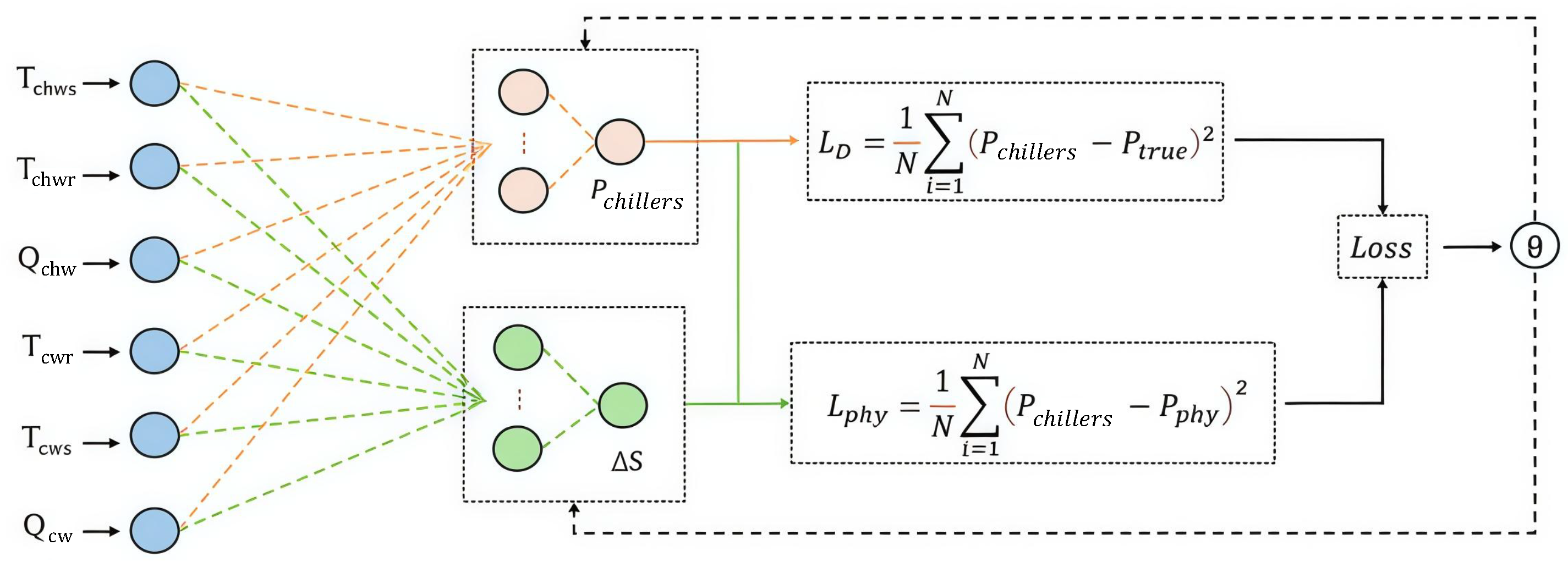
- Addressing the issue of sparse operational data for chillers under real-world conditions, this paper embeds prior physical knowledge into neural networks by exploring the physical relationships between power consumption, flow rates, and water temperatures, thereby proposing a PINN-based chiller power prediction model.
- Extensive experiments on real industrial data validate the effectiveness of the proposed predictive model, particularly under conditions of data scarcity.
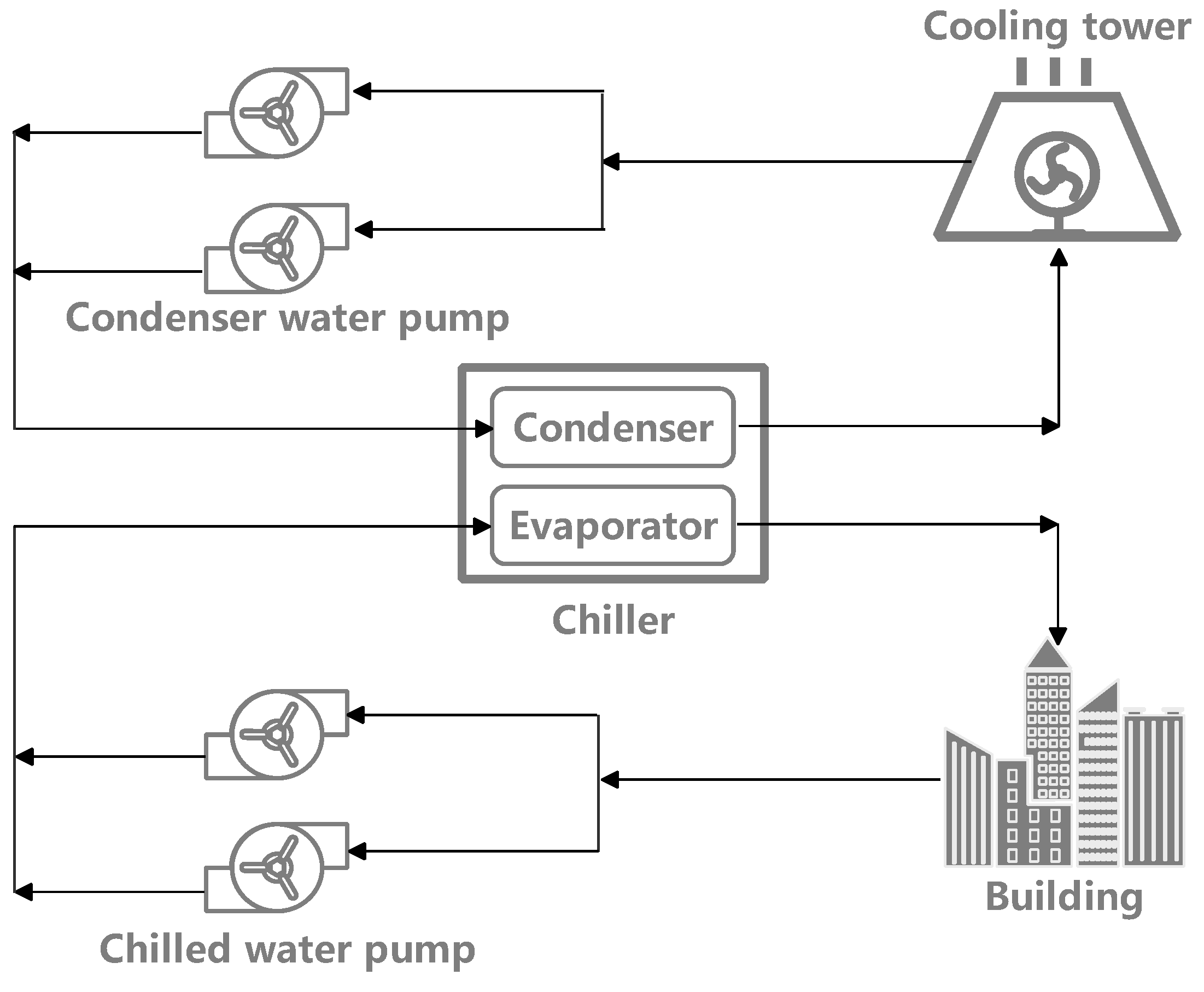
2. Architecture and Working Principle of Chiller System
3. PINN Prediction Model Architecture
3.1. Chiller Power Prediction Model
3.2. Pump Power Prediction Model
4. Experiment
4.1. Data Source
4.2. Experimental Setup
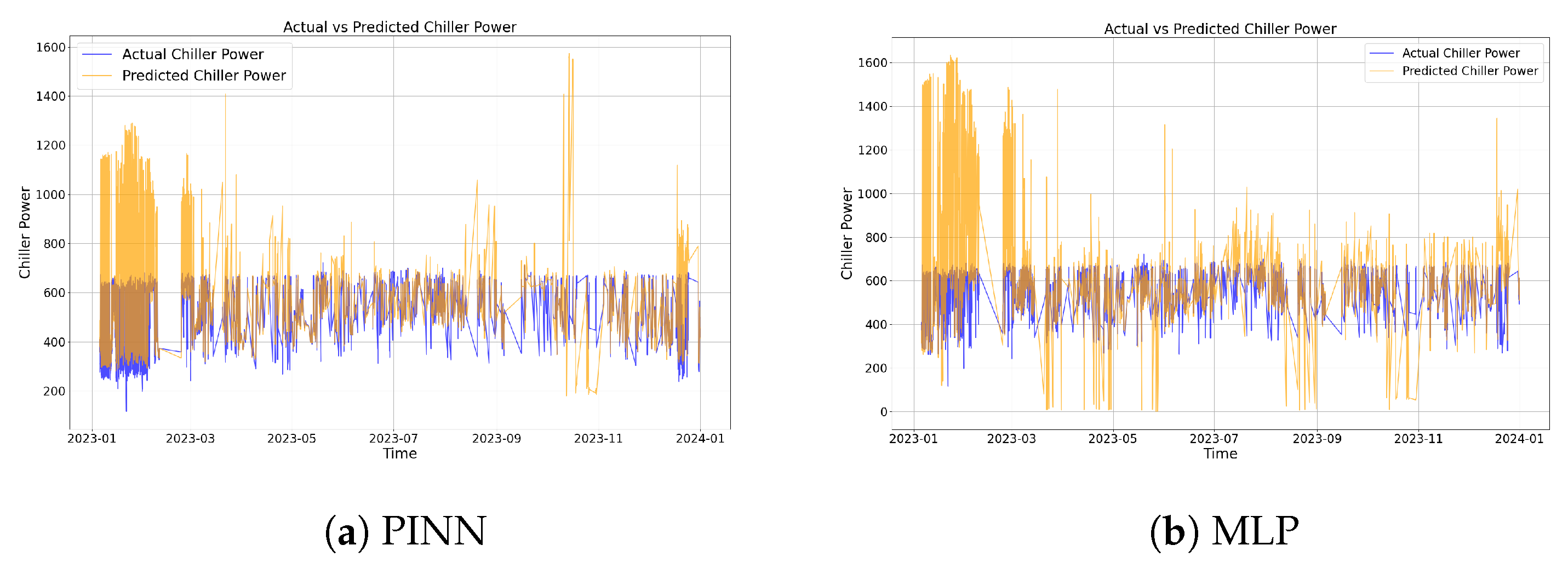
4.3. Chiller Power Prediction Results
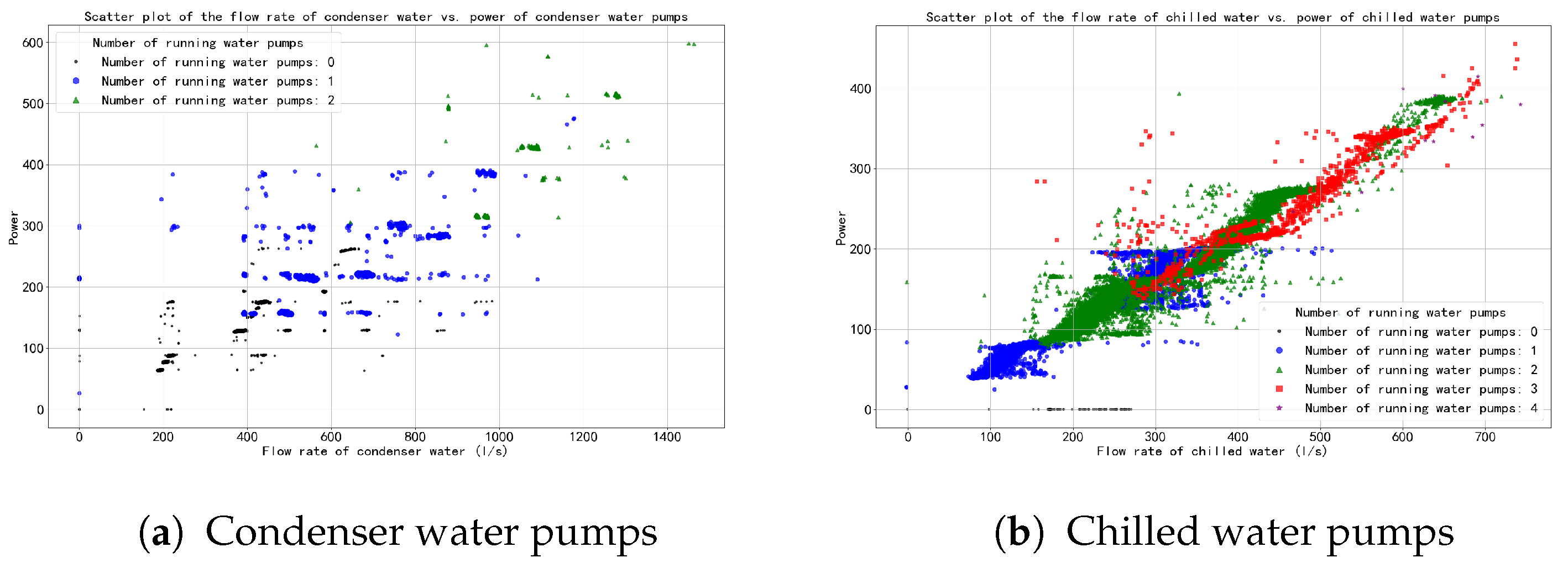
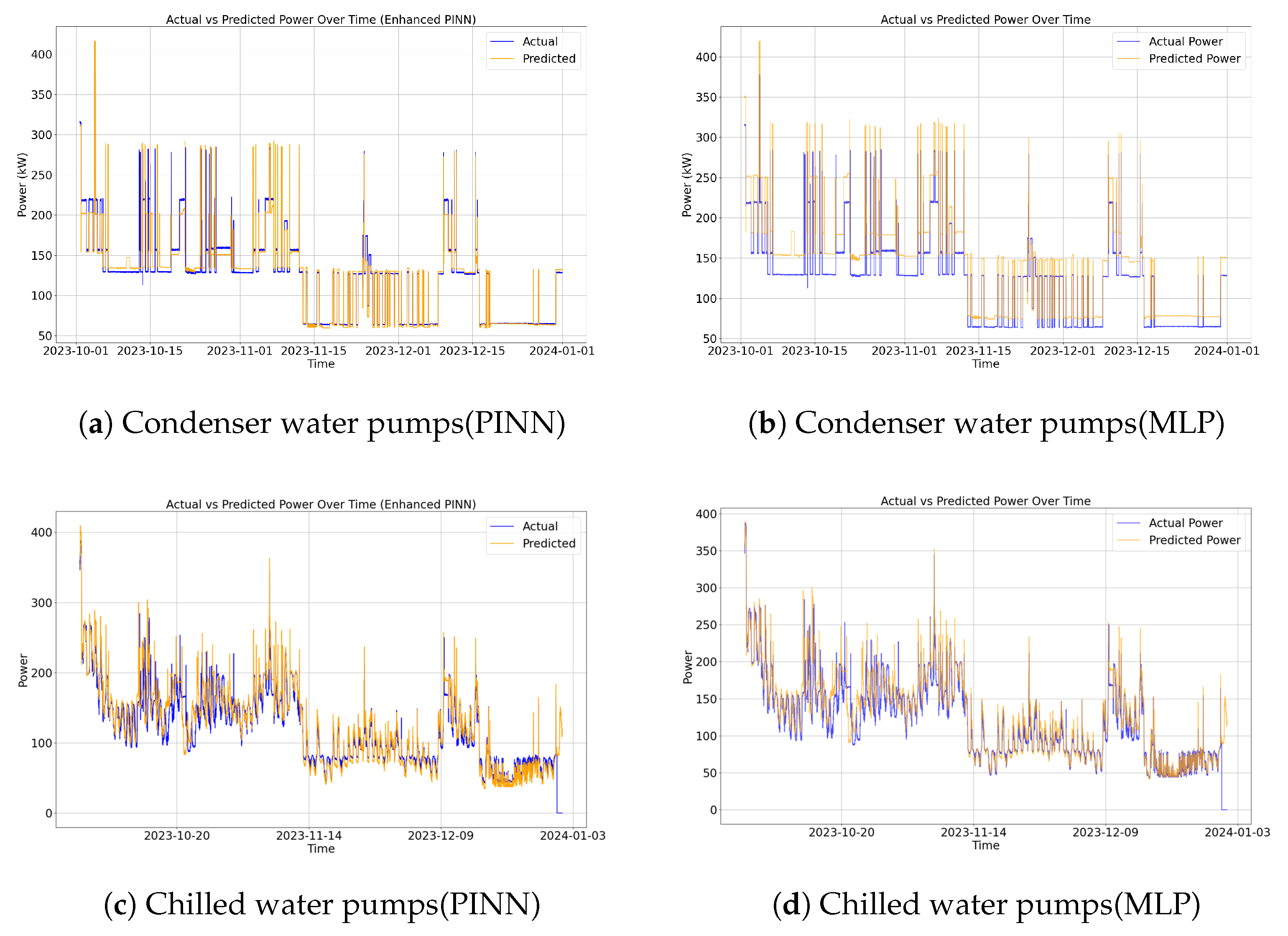
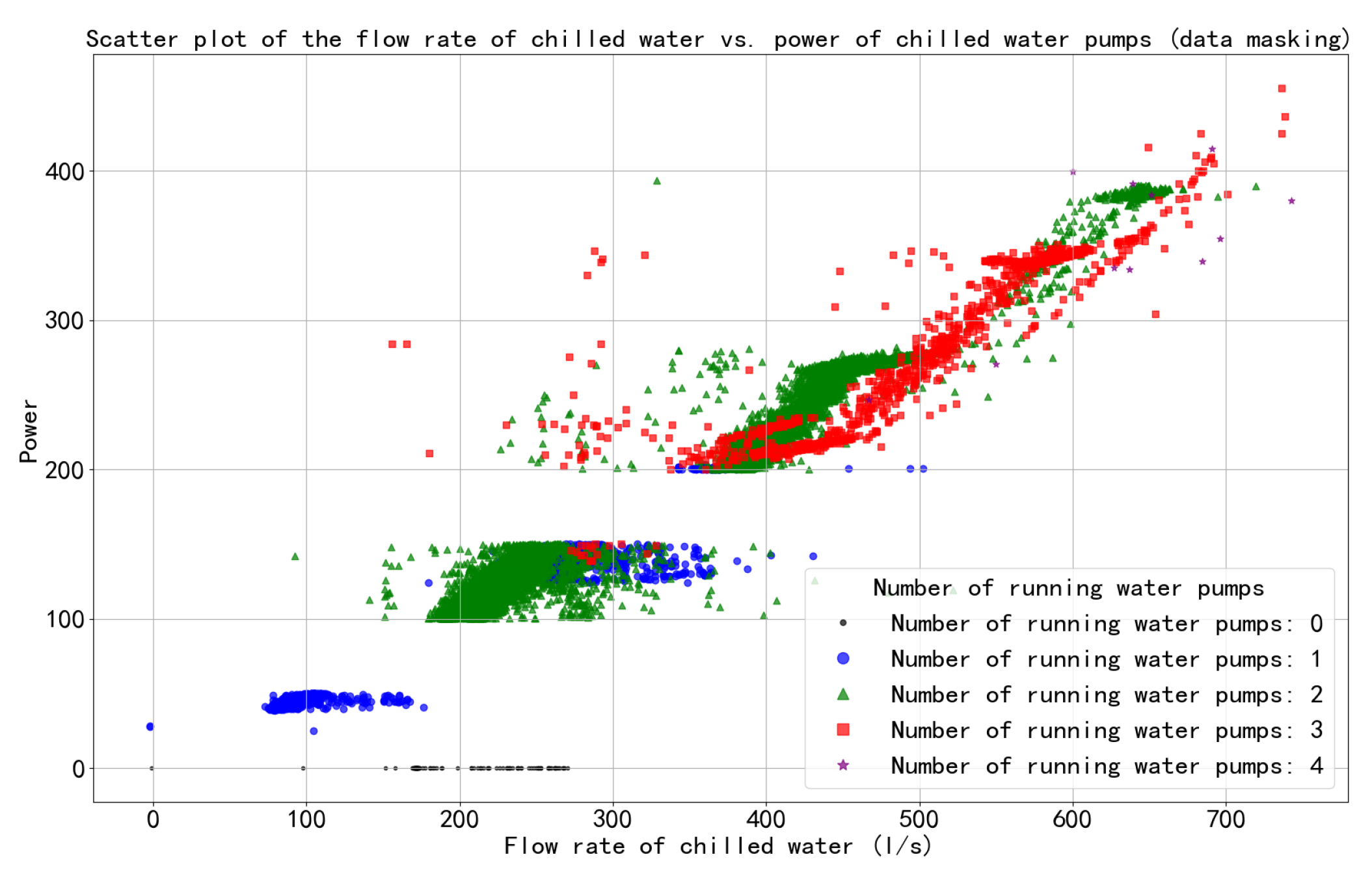
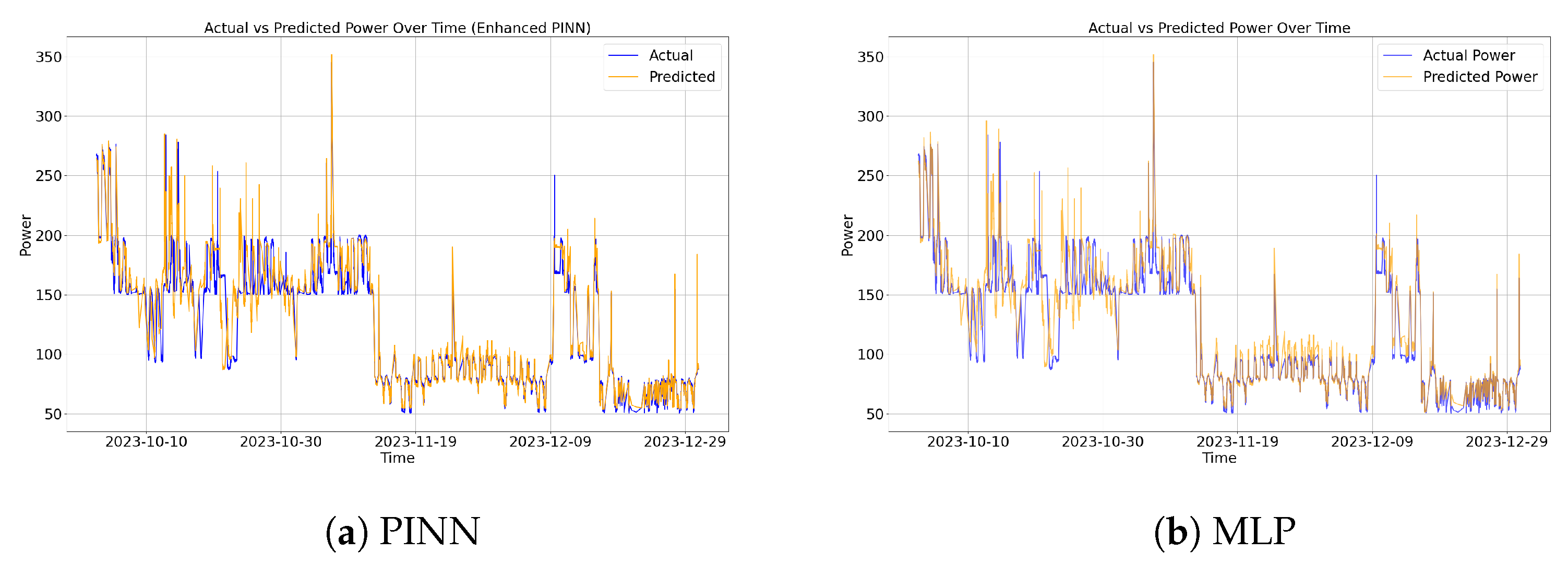
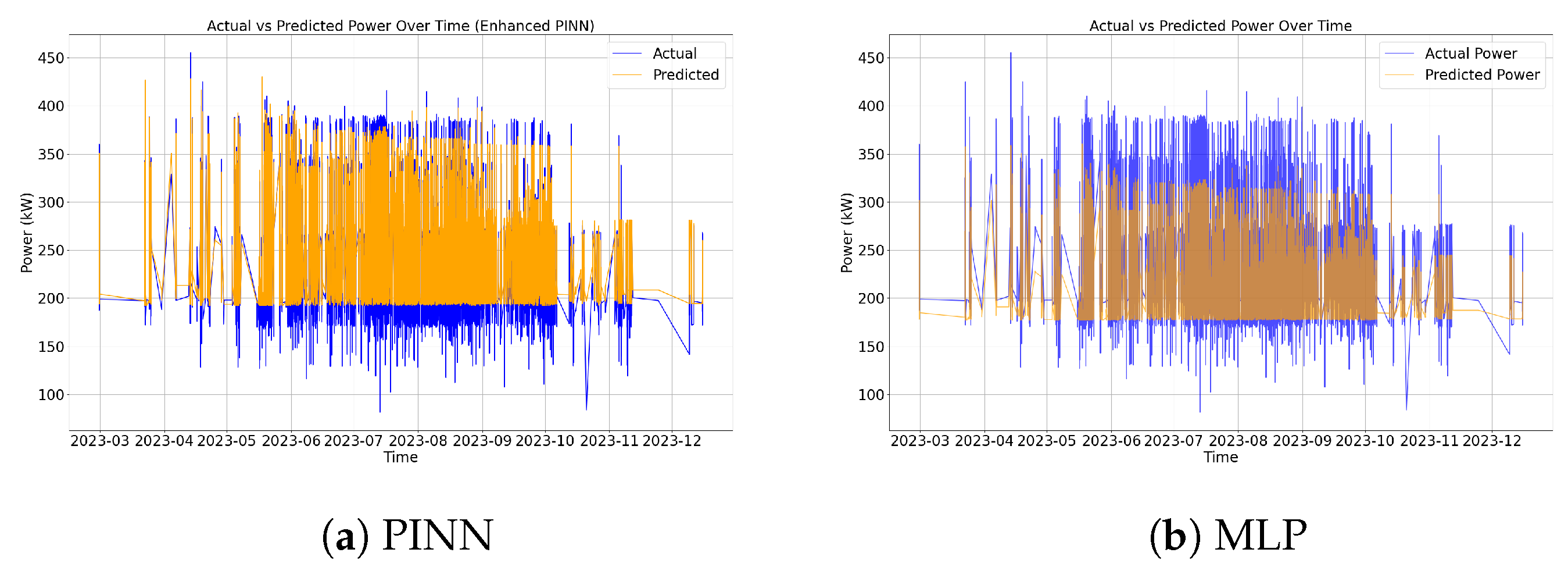
4.4. Pump Power Prediction Results
4.5. Ablation Experiments
5. Conclusions
Author Contributions
Funding
Data Availability Statement
Conflicts of Interest
References
- Blad, C.; Bøgh, S.; Kallesøe, C. A Multi-Agent Reinforcement Learning Approach to Price and Comfort Optimization in HVAC-Systems. Energies 2021, 14, 7491. [Google Scholar] [CrossRef]
- Manic, M.; Wijayasekara, D.; Amarasinghe, K.; Rodriguez-Andina, J.J. Building energy management systems: The age of intelligent and adaptive buildings. IEEE Ind. Electron. Mag. 2016, 10, 25–39. [Google Scholar] [CrossRef]
- Ciampi, F.G.; Rega, A.; Diallo, T.M.; Pelella, F.; Choley, J.Y.; Patalano, S. Energy consumption prediction of industrial HVAC systems using Bayesian Networks. Energy Build. 2024, 309, 114039. [Google Scholar] [CrossRef]
- Kannan, T.; Lork, C.; Tushar, W.; Yuen, C.; Wong, N.C.; Tai, S.; Lan, L.; Wood, K.L. Energy management strategy for zone cooling load demand reduction in commercial buildings: A data-driven approach. IEEE Trans. Ind. Appl. 2019, 55, 7281–7299. [Google Scholar] [CrossRef]
- Wu, C.; Pan, H.; Luo, Z.; Liu, C.; Huang, H. Multi-objective optimization of residential building energy consumption, daylighting, and thermal comfort based on BO-XGBoost-NSGA-II. Build. Environ. 2024, 254, 111386. [Google Scholar] [CrossRef]
- Mishra, A.; Lone, H.R.; Mishra, A. DECODE: Data-driven energy consumption prediction leveraging historical data and environmental factors in buildings. Energy Build. 2024, 307, 113950. [Google Scholar] [CrossRef]
- Gao, Y.; Shi, S.; Miyata, S.; Akashi, Y. Successful application of predictive information in deep reinforcement learning control: A case study based on an office building HVAC system. Energy 2024, 291, 130344. [Google Scholar] [CrossRef]
- Shakya, P.; Ng, G.; Zhou, X.; Wong, Y.W.; Dubey, S.; Qian, S. Thermal Comfort and Energy Analysis of a Hybrid Cooling System by Coupling Natural Ventilation with Radiant and Indirect Evaporative Cooling. Energies 2021, 14, 7825. [Google Scholar] [CrossRef]
- Abdelaziz, A.; Santos, V.; Dias, M.S. Machine Learning Techniques in the Energy Consumption of Buildings: A Systematic Literature Review Using Text Mining and Bibliometric Analysis. Energies 2021, 14, 7810. [Google Scholar] [CrossRef]
- Holkar, K.S.; Waghmare, L.M. An overview of model predictive control. Int. J. Control Autom. 2010, 3, 47–63. [Google Scholar]
- Schwenzer, M.; Ay, M.; Bergs, T.; Abel, D. Review on model predictive control: An engineering perspective. Int. J. Adv. Manuf. Technol. 2021, 117, 1327–1349. [Google Scholar] [CrossRef]
- Afram, A.; Janabi-Sharifi, F. Theory and applications of HVAC control systems—A review of model predictive control (MPC). Build. Environ. 2014, 72, 343–355. [Google Scholar] [CrossRef]
- Yao, Y.; Shekhar, D.K. State of the art review on model predictive control (MPC) in Heating Ventilation and Air-conditioning (HVAC) field. Build. Environ. 2021, 200, 107952. [Google Scholar] [CrossRef]
- Chua, K.J.; Chou, S.K.; Yang, W.; Yan, J. Achieving better energy-efficient air conditioning—A review of technologies and strategies. Appl. Energy 2013, 104, 87–104. [Google Scholar] [CrossRef]
- Salimian Rizi, B.; Pavlak, G.; Cushing, V.; Heidarinejad, M. Predicting uncertainty of a chiller plant power consumption using quantile random forest: A commercial building case study. Energy 2023, 283, 129112. [Google Scholar] [CrossRef]
- Chaerun Nisa, E.; Kuan, Y.D. Comparative assessment to predict and forecast water-cooled chiller power consumption using machine learning and deep learning algorithms. Sustainability 2021, 13, 744. [Google Scholar] [CrossRef]
- Yu, F.; Ho, W.; Chan, K.; Sit, R. Critique of operating variables importance on chiller energy performance using random forest. Energy Build. 2017, 139, 653–664. [Google Scholar] [CrossRef]
- Ahmad, M.W.; Mourshed, M.; Rezgui, Y. Trees vs Neurons: Comparison between random forest and ANN for high-resolution prediction of building energy consumption. Energy Build. 2017, 147, 77–89. [Google Scholar] [CrossRef]
- Liang, X.; Liu, Y.; Chen, S.; Li, X.; Jin, X.; Du, Z. Physics-informed neural network for chiller plant optimal control with structure-type and trend-type prior knowledge. Appl. Energy 2025, 390, 125857. [Google Scholar] [CrossRef]
- Kim, J.H.; Seong, N.C.; Choi, W. Forecasting the Energy Consumption of an Actual Air Handling Unit and Absorption Chiller Using ANN Models. Energies 2020, 13, 4361. [Google Scholar] [CrossRef]
- Liang, X.; Zhu, X.; Chen, K.; Chen, S.; Jin, X.; Du, Z. Endowing data-driven models with rejection ability: Out-of-distribution detection and confidence estimation for black-box models of building energy systems. Energy 2023, 263, 125858. [Google Scholar] [CrossRef]
- Liang, X.; Liu, Z.; Wang, J.; Jin, X.; Du, Z. Uncertainty quantification-based robust deep learning for building energy systems considering distribution shift problem. Appl. Energy 2023, 337, 120889. [Google Scholar] [CrossRef]
- Ma, Z.; Jiang, G.; Hu, Y.; Chen, J. A review of physics-informed machine learning for building energy modeling. Appl. Energy 2025, 381, 125169. [Google Scholar] [CrossRef]
- Sun, Y.; Sun, Q.; Qin, K. Physics-Based Deep Learning for Flow Problems. Energies 2021, 14, 7760. [Google Scholar] [CrossRef]
- Li, P.; Guo, F.; Li, Y.; Yang, X.; Yang, X. Physics-informed neural network for real-time thermal modeling of large-scale borehole thermal energy storage systems. Energy 2025, 315, 134344. [Google Scholar] [CrossRef]
- Ni, W.; Tian, G.; Xie, G.; Ma, Y. Power prediction of oscillating water column power generation device based on physical information embedded neural network. Energy 2024, 306, 132493. [Google Scholar] [CrossRef]
- Xiao, T.; You, F. Building thermal modeling and model predictive control with physically consistent deep learning for decarbonization and energy optimization. Appl. Energy 2023, 342, 121165. [Google Scholar] [CrossRef]
- Xiao, T.; You, F. Physically consistent deep learning-based day-ahead energy dispatching and thermal comfort control for grid-interactive communities. Appl. Energy 2024, 353, 122133. [Google Scholar] [CrossRef]
- Jia, Y.; Wang, J.; Hosseini, M.R.; Shou, W.; Wu, P.; Mao, C. Temporal graph attention network for building thermal load prediction. Energy Build. 2024, 321, 113507. [Google Scholar] [CrossRef]
- Gokhale, G.; Claessens, B.; Develder, C. Physics informed neural networks for control oriented thermal modeling of buildings. Appl. Energy 2022, 314, 118852. [Google Scholar] [CrossRef]
- Wang, X.; Dong, B. Physics-informed hierarchical data-driven predictive control for building HVAC systems to achieve energy and health nexus. Energy Build. 2023, 291, 113088. [Google Scholar] [CrossRef]
- Ma, Z.; Jiang, G.; Chen, J. Physics-informed ensemble learning with residual modeling for enhanced building energy prediction. Energy Build. 2024, 323, 114853. [Google Scholar] [CrossRef]





| Models | Chiller Prediction Model | Pump Prediction Model |
|---|---|---|
| Layers | 2 | 2 |
| Hidden size | 128 | 128 |
| Activation function | ReLU | ReLU |
| Optimizer | Adam | Adam |
| Learning rate | 0.001 | 0.001 |
| Epoch | 1200 | 3000 |
| 0.3 | 0.3 |
| Model | Methods | MAE (kW) | RMSE (kW) | MAPE | |
|---|---|---|---|---|---|
| Chiller (interpolation) | MLP | 40.025 | 43.978 | 9.172% | 0.841 |
| PINN | 17.812 | 25.811 | 4.608% | 0.942 | |
| Chiller (extrapolation) | MLP | 106.102 | 201.995 | 15.604% | −3.326 |
| PINN | 91.994 | 184.618 | 13.644% | −1.087 |
| Model | Methods | MAE (kW) | RMSE (kW) | MAPE | |
|---|---|---|---|---|---|
| Condenser water pump | MLP | 22.046 | 25.632 | 18.891% | 0.738 |
| PINN | 10.138 | 17.455 | 8.201% | 0.866 | |
| Chilled water pump | MLP | 13.081 | 22.459 | 13.471% | 0.829 |
| PINN | 12.733 | 21.775 | 12.512% | 0.835 | |
| Chilled water pump (data masking) | MLP | 12.962 | 18.581 | 10.436% | 0.847 |
| PINN | 10.009 | 16.172 | 7.320% | 0.896 |
| Model | Methods | MAE (kW) | RMSE (kW) | MAPE | |
|---|---|---|---|---|---|
| Condenser water pump | MLP | 154.390 | 175.566 | 66.653% | −24.041 |
| PINN | 36.562 | 43.356 | 29.058% | −1.417 | |
| Chilled water pump | MLP | 23.360 | 28.518 | 9.651% | 0.188 |
| PINN | 11.187 | 16.447 | 5.510% | 0.834 |
| Model | MAE (kW) | RMSE (kW) | MAPE | ||
|---|---|---|---|---|---|
| Chiller | 0.1 | 20.517 | 26.631 | 5.152% | 0.939 |
| 0.3 | 17.812 | 25.811 | 4.608% | 0.942 | |
| 0.5 | 24.319 | 37.657 | 9.325% | 0.913 | |
| Condenser water pump | 0.1 | 11.347 | 18.667 | 9.144% | 0.853 |
| 0.3 | 10.138 | 17.455 | 8.201% | 0.866 | |
| 0.5 | 20.430 | 25.280 | 18.501% | 0.629 | |
| Chilled water pump | 0.1 | 12.857 | 22.488 | 12.690% | 0.829 |
| 0.3 | 12.733 | 21.775 | 12.512% | 0.835 | |
| 0.5 | 13.957 | 22.994 | 12.701% | 0.827 |
| Model | MLP | PINN |
|---|---|---|
| Condenser water pump | 4.774 | 8.150 |
| Chilled water pump | 6.731 | 8.017 |
| Chilled water pump (data masking) | 6.983 | 8.027 |
Disclaimer/Publisher’s Note: The statements, opinions and data contained in all publications are solely those of the individual author(s) and contributor(s) and not of MDPI and/or the editor(s). MDPI and/or the editor(s) disclaim responsibility for any injury to people or property resulting from any ideas, methods, instructions or products referred to in the content. |
© 2025 by the authors. Licensee MDPI, Basel, Switzerland. This article is an open access article distributed under the terms and conditions of the Creative Commons Attribution (CC BY) license (https://creativecommons.org/licenses/by/4.0/).
Share and Cite
Zhu, K.; Hu, J.; Sun, H.; Li, Y.; Chen, T.; Xing, B.; Wu, J.; Liu, R.; Wang, Y.; Sun, H.; et al. Chiller System Power Prediction by Physical-Informed Neural Network. Energies 2025, 18, 6363. https://doi.org/10.3390/en18236363
Zhu K, Hu J, Sun H, Li Y, Chen T, Xing B, Wu J, Liu R, Wang Y, Sun H, et al. Chiller System Power Prediction by Physical-Informed Neural Network. Energies. 2025; 18(23):6363. https://doi.org/10.3390/en18236363
Chicago/Turabian StyleZhu, Kongyang, Junzhe Hu, Hui Sun, Ying Li, Tao Chen, Baoyuan Xing, Juzhuo Wu, Ruixuan Liu, Yongcai Wang, Haitao Sun, and et al. 2025. "Chiller System Power Prediction by Physical-Informed Neural Network" Energies 18, no. 23: 6363. https://doi.org/10.3390/en18236363
APA StyleZhu, K., Hu, J., Sun, H., Li, Y., Chen, T., Xing, B., Wu, J., Liu, R., Wang, Y., Sun, H., & Zhang, L. (2025). Chiller System Power Prediction by Physical-Informed Neural Network. Energies, 18(23), 6363. https://doi.org/10.3390/en18236363