

Article

Household Challenges in Solar Retrofitting to Optimize Energy Usage in Subtropical Climates

1
Sydney School of Architecture, Design and Planning, The University of Sydney, 148 City Road, Darlington, NSW 2008, Australia
2
School of the Environment, The University of Queensland, St Lucia, QLD 4072, Australia
3
OH Architecture, 101 Days Road, Grange, QLD 4051, Australia
*
Author to whom correspondence should be addressed.
Energies 2025, 18(23), 6312; https://doi.org/10.3390/en18236312 (registering DOI)
Submission received: 15 September 2025 / Revised: 3 November 2025 / Accepted: 21 November 2025 / Published: 30 November 2025

Abstract

This study investigates the architectural design factors that influence the adoption of eco-friendly solar energy technologies for the partial retrofitting of older residential buildings in densely populated urban areas in a developed country. This research study employs a mixed-method approach, combining quantitative and qualitative frameworks along with comparative analysis and utilizing standard fact-finding procedures to examine the adoption of eco-friendly energy systems and their integration into existing infrastructures. The feasibility study, complemented by a detailed technical investigation, identifies several significant factors affecting the intention to undertake sustainable solar retrofitting. These factors include performance expectations, facilitating conditions, motivation, price/value perceptions, and environmental knowledge. This study highlights key constraints and tipping points that influence households’ decisions to implement light retrofitting and explores three distinct system configurations to enhance cost-effectiveness. The insights gained from this research study are valuable for a range of stakeholders, including homeowners, designers, technology developers and manufacturers, real estate developers, builders, and government entities. The findings guide effective strategies to encourage eco-friendly retrofits through both passive and active systems, contributing to future environmental sustainability goals. This research study addresses a gap in the literature regarding the environmental sustainability of solar retrofitting in densely populated urban settings in developed countries. Addressing the pressing issue of global warming contributes to advancing sustainable solar housing technologies and provides a comprehensive foundation for the early stages of the design process.

1. Background

Intensifying public concern for the environment raises questions about why human impact continues to increase. Much attention has focused on ‘top-down’ macro-responses such as the Kyoto accord, which have resulted in multilateral moves to lower greenhouse gas (GHG) emissions. Another important example is the Sustainable Development Goals formulated by the United Nations. At the macro-level, interventions aimed at environmental improvement encompass sectoral and regional initiatives within the circular economy, including the establishment of eco-industrial complexes. At the micro-level, the principle of ‘think global, act local’ emphasizes the importance of individual actions in mitigating environmental harm.
One setting for effective climate action involves people’s homes, particularly after a purchase, when adjustments to an existing house are standard. To complement broader environmental objectives, addressing residential energy consumption is fundamental, especially in older, less efficient buildings. Optimizing solutions and encouraging stakeholders to recognize the value of energy savings are vital to justifying costs and achieving effective results in the long term [1].
The brief for this project was to retrofit a pre-war detached house for a family of six. We assumed further that within budget limits; the buyer has a personal interest in energy and environmental sustainability. Influenced by land prices, the premises’ architectural character, and recognition of sunk costs, the initial decision was whether to demolish and replace, modify, or do nothing to the property. Given sufficient funding, the first two courses seemed more likely to proceed. Arguments supporting demolition and replacement are that new homes are characteristically energy-efficient [2].
The counterpoint is that though households might achieve such efficiency, construction can lead to environmental and conservation issues. For instance, demolishing existing buildings, clearing sites of vegetation, and the disposing of detritus and surplus building materials could significantly increase both the embodied energy and environmental impact of construction, often outweighing the operational benefits. Furthermore, the additional landfill created from existing material necessitates remedial decontamination and landscaping. The architectural character of these houses is of heritage value and is subject to council regulations. In contrast, older homes tend to be less energy-efficient, and upgrading them to meet current standards can be a complicated process. The argument for renovation emphasizes the significant environmental impact of buildings; approximately 40–42% of their carbon emissions are attributable to energy use, while around 30% result from the materials embodied in the structure [3]. At the micro-level, a feasible alternative to the costs of demolition is retrofitting, which applies at two scales.
Light retrofitting proposes minor alterations to a building’s fabric, reducing its environmental impacts. Other relevant actions might include retaining the character of the house, improving the passive systems, and managing the demand for active systems. New technologies, such as solar photovoltaics (PVs), can be front-loaded as part of an upgrade and refurbishment process. Solar electric and thermal systems reduce electricity demand, carbon emissions, and lifetime costs. Part of the challenge is to harness the climate to meet typical household needs.
Deep retrofitting, by contrast, likely involves a comprehensive renovation of the building to lower energy consumption, which would increase the embodied energy but could threaten embedded factors such as the original architectural character. It could require compliance under the building regulations of many jurisdictions [4].
The challenge lies in the inconsistencies between the retrofitted elements and the building’s original architectural style. For example, it includes the impact that adding solar systems and upgrades, such as high-performance windows, has on the building’s character. Therefore, this study explores the solution of implementing a light retrofit.
The solution set uses a minimalist design approach favouring conservation over utilization. The strategies used involve limiting interventions to the building’s envelope, improving passive systems and discrete applications of insulation to roof and floor spaces, maximizing use of building services, particularly solar electric and solar thermal systems.
One drawback of the solution set is the envelope’s energy inefficiency, along with the associated emissions and running costs. Implementing solar systems can effectively reduce emissions at a reasonable running cost. In regions like Queensland, where carbon pollution remains high, the adaptive reuse of existing buildings is crucial for tackling the climate crisis. This approach is applicable and relevant worldwide.

2. Scoping the Problem

2.1. The Setting

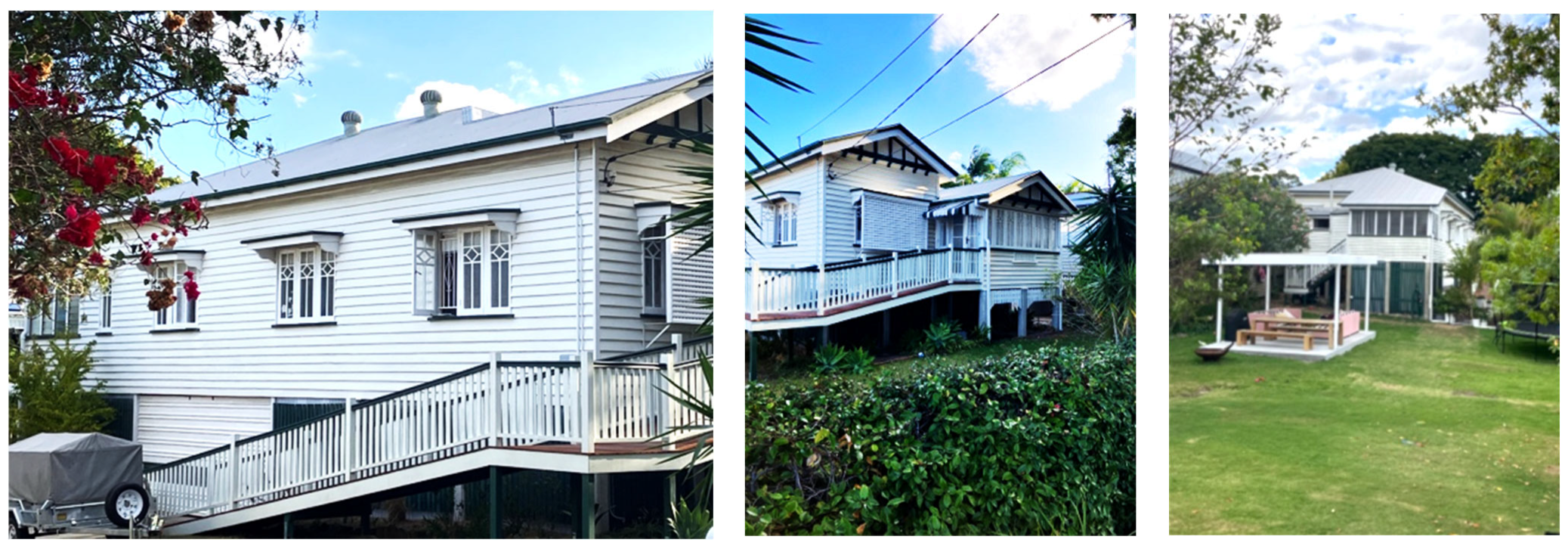
This article analyses the procedural and technical choices open to a person faced with the decision framework depicted above. The new homeowner has opted to retrofit the property, not to demolish it. The family (six people in all) resides in Brisbane, an advanced, subtropical city in eastern Australia, which, at 27 degrees south, lies further from the equator than Miami, United States. Moreover, a point relevant to this analysis is that while in Florida the sun shines in the south, in Brisbane it traverses the northern sky. The house, in an inner metropolitan suburb, enjoys a large backyard. Living spaces are on the second floor with storage and utilities, and the garage is on the ground level. After some discussion, the family has decided to retrofit the property rather than demolishing it.
Given the many background elements, the objective of the current study is to explore how architectural factors can reduce environmental pressure by tackling domestic energy requirements. Confronting the design challenge of retrofitting a pre-war house, a central strategy can be to mitigate impact using solar systems. The use of such free energy reduces operational emissions, whilst retention of the building fabric conserves embodied ones. The rewards for households become apparent, with significant reductions in operational costs, payback time, and carbon output. Moderated energy needs provide a significant micro-level contribution to a sustainable future.

2.2. Definitions

  • Retrofitting Types: A light retrofit adapts specific building components without disrupting other areas. In contrast, a deep retrofit requires significant changes to building services and may involve large-scale interventions, such as changing occupancy.
  • Solar Electric Systems: Also known as photovoltaic (PV) systems, these collect sunlight to generate electricity, typically comprising solar panels, an inverter to convert DC to AC, and sometimes, batteries for storage.
  • Bill Savings: Solar generation and storage can significantly reduce energy bills. It is essential to assess these savings against the initial investment costs.
  • Payback Period: The time required to recover the cost of an investment and reach a break-even point.
  • Return on Investment (ROI): ROI measures the profitability of an investment, calculated as the percentage of net profit divided by the initial cost. It helps compare different investment opportunities, accounting for the holding period.
  • Investment Gain (RI): This measures the percentage gain or loss on an investment, calculated by dividing the gain or loss by the original purchase price.
  • Discounted Cash Flow: DCF evaluates an investment’s value based on expected future cash flows adjusted for the time value of money, emphasizing the importance of present value over future cash.
  • Self-Sufficiency and Self-Consumption: Self-consumption is the percentage of energy used from the solar system, while self-sufficiency measures the percentage of energy consumed generated by the system. A 60% self-consumption target is recommended.
  • Energy Efficiency and Emissions Abatement: Enhancements like efficient lighting, heat pumps, and improved building envelopes can significantly boost energy productivity and reduce emissions.
  • Energy Sufficiency and Conservation: This concept focuses on maintaining sufficient energy service consumption while avoiding excess, promoting an equitable and environmentally friendly approach.
  • Embedded and Embodied Carbon: Carbon intensity measures the CO2 emissions produced per kWh of electricity. Retaining existing materials during retrofitting reduces overall carbon intensity.

2.3. Customary Problems with Retrofitting

The key issues that households face in solar retrofitting include high upfront costs (despite long-term savings), integration with existing structures, and performance optimization despite fluctuating weather. Affordability and split incentives between landlords and tenants can also play a role in adoption. Solar designs in warm climates can lead to overheating, which requires increased cooling efforts. This issue is worsened by roofs that act as heat sinks, contributing to the urban heat island effect and decreasing solar panel efficiency during peak temperatures.
Households might struggle in integrating solar electric and solar thermal hot water systems (HWSs) into daily routines, leading to variable performance and opinions. Integration of rooftop energy with the grid raises stability challenges. Initial investment costs, lack of knowledge about solar technologies and pertinent regulations, and a shortage of qualified installers can hinder adoption, particularly if building owners and occupants have differing incentives.
Passive solar systems leverage architectural design and natural energy to heat, cool, and power buildings without mechanical equipment. Key elements include building orientation for sunlight, thermal mass for heat storage, effective insulation, energy-efficient glazing, and shading. These systems lower energy consumption, resulting in cost savings and a reduced carbon footprint. They are known to present challenges:
  • High temperatures and thermal mass: Materials like concrete can help regulate temperature but can also lead to overheating during heatwaves.
  • Building orientation and shading: Optimal orientation and shading are critical to passive cooling, but many existing buildings lack these features.
  • Comfort difficulties: High humidity makes it hard to maintain comfortable indoor temperatures with passive cooling.
  • Integration with existing structures: Retrofitting passive design features into current buildings can be complex.
Active solar systems use mechanical or electrical components, like pumps and fans, to capture and distribute solar energy as electricity or heat. In contrast to passive systems, which depend on natural processes, active systems circulate air or liquid to transport solar energy to storage or heating/cooling devices [5]. Their set of potential problems includes the following:
  • High temperatures and efficiency: Solar panels operate best under cooler conditions; high temperatures can reduce their energy output and return on investment.
  • Weather impact: Severe weather, including intense winds and hail, can damage solar panels and mounts, necessitating stronger systems.
  • Cost: The high initial investment for solar panel systems can deter some households from installing them.
  • Solar electric and solar thermal end-use management: Households might struggle to align systems such as hot water provision with solar operation, reducing overall efficiency.

2.4. Energy Criteria in Retrofitting

Retrofitting existing homes is no trivial exercise from an energy perspective, as it challenges established precepts. Ideally, energy consumption occurs with acceptable efficiency.

2.4.1. Energy Efficiency

Energy consumption is efficient when less energy provides the same level of service. This efficiency can be measured using energy efficiency ratings, such as the Australian star rating system. To achieve optimal efficiency, consider enhancing a product’s performance by comparing its energy rating, opting for energy-efficient technologies like LED bulbs, or implementing energy-saving measures in the home. A long-term perspective, spanning ten years, is essential to evaluating household appliances and other systems such as rooftop solar systems. Minimum energy performance standards for these appliances mandate that the consumption of fuel and electricity be reduced. In the years 2022–2023, Australia’s Greenhouse and Energy Minimum Standards led to a decrease in electricity consumption of between 5.5 and 8.5 gigawatt-hours. This reduction resulted in savings of approximately AUD 1.3 billion to AUD 2.1 billion for households and businesses across the nation. Nonetheless, energy consumption in 2023 reached a staggering 273,106 GWh, highlighting the urgent need to mitigate environmental impacts [6]. This approach can be applied effectively to all household systems and their architectural integration.
The Australian housing energy efficiency policy has yet to address housing energy sufficiency, which is defined as a level of energy service consumption consistent with equity, wellbeing, and environmental limits.

2.4.2. Energy Sufficiency

Energy sufficiency could reduce energy use for households and, more broadly, apply at the national level [7]. An urgent regenerative process incorporating retrofitting is taking hold. It involves transformation by adding new systems and removing old ones at the end of their life cycle. Constraints like household affordability, potential emissions, the high cost of energy plans, and reluctance to adopt new environmental technologies can hinder optimization efforts. However, there are situations when households reach a tipping point where traditional retrofitting methods—such as relying solely on energy efficiency measures—become insufficient. For example, in homes with high energy consumption, despite maximizing energy efficiency, a tipping point can arise for adopting solar retrofitting. Affordable optimization is required using energy sufficiency, achieved through appropriate technical integration to retain the embedded factors of architectural character and embodied energy in the structure in question. The concept of energy sufficiency relates to having enough energy but not using too much. More specifically, energy sufficiency is defined as a level of energy consumption consistent with equity, wellbeing, and environmental limits and, additionally, as a strategy for reducing energy service consumption to achieve that goal [8].

2.4.3. Self-Consumption and Self-Sufficiency

Other important energy criteria for retrofitting a home include self-consumption and self-sufficiency. Self-consumption refers to the energy produced by a solar photovoltaic (PV) system that is used directly in the home, with any excess exported back to the grid. The self-consumption rate is (Total production − Exports)/Total production.
Self-sufficiency, on the other hand, indicates the percentage of the home’s energy needs met by its own energy production. (Total consumption − Imports)/Total consumption. Consultants suggest that achieving a self-consumption rate of 60% is realistic.
When comparing these definitions to earlier recommendations regarding energy efficiency, it is clear that there are significant differences [9].
Energy efficiency reduces overall energy use by getting more work out of less energy. At the same time, self-consumption is the practice of generating and using a household’s own energy, such as from solar panels, to meet the household’s needs and reduce reliance on grid power. Energy efficiency focuses on waste reduction and using fewer resources, whereas self-consumption focuses on achieving energy autonomy and cost savings by generating and utilizing one’s own energy supply.

3. Method and Means

3.1. Research by Design

‘Probably all good design is informed by some research—research-based design. However, can research arise from design?’ [10]. Design-based methods have evolved from analysis–synthesis models to those that reflect the activities designers use to create buildings, specifically those arising from design problems. This inductive and holistic approach is suited to investigating issues concerning sustainability, around which ends, and means are not clearly defined. The design-by-research model assumes three stages. Analysis involves researching the current situation, projection focuses on the ideal state, and synthesis concerns the actual outcome [11]. In this model, the pre-design phase involves gathering and analysing information. This process informs both the architect and the client and serves as the foundation for creating design solutions. Recently, design methods have shifted from simple analysis–synthesis models to ones that tackle specific design problems. This research study is based on the newer approach.
Research by design uses case studies and descriptive–analytical methods. The reasoning behind this research approach lies in several key processes.
  • Learning and Reflection: Architects study past projects to understand the thought processes behind them, analyzing what worked and what did not and learning from both successes and mistakes.
  • Developing Best Practices: By systematically examining successful projects, architects can identify and document evidence-based approaches that offer valuable lessons for future endeavors.
  • Benchmarking: Case studies enable architects to compare their own work against industry standards or exemplary projects, serving as a tool to refine their methods and elevate their own standards.
  • Client Communication: These case studies serve as powerful tools to demonstrate the feasibility of specific design approaches, justify design decisions, and build client trust by showcasing successful past projects.
  • Informing Research and Theory: This methodology contributes to the body of knowledge in architecture by providing empirical insights into design processes, leading to the development of new theories, and informing future design guidelines [12,13].
Whilst there are limitations to this approach, such as its focus on depth rather than breadth, architects must consider case study research within a performance-based framework that links design decisions to measurable outcomes [14]. Of further importance is front-loading the design process by including these factors in the early stages of the design process [15].

3.2. Sustainable Retrofitting

Retrofitting is part of a larger energy transformation within the power and building sectors. The importance of the current research study is evident from a recent industry report on household energy use. It forecasts the need for a power supply system that, first, meets customer needs and, second, grossed up to the national scale, reaches a target of 50% renewables by 2030, 80% by 2035, and net-zero emissions by 2050. The three main findings identify several constraints on this transformation:
  • Households are looking for ways to reduce consumption and change behaviour as the cost-of-living increases.
  • Electricity suppliers are considering issues of cost and financial incentives.
  • Interest in and uptake of new-energy technology has lately waned [16]. The Australian Government provides guides for the selection of solar systems for households wishing to explore the environmental and economic impacts on their family. They form another basis for this study’s methodology, especially the advice to engage in forward planning before purchasing and using electricity bills to estimate the amount of energy consumed annually by a typical household of similar size in the exact location (climate zone) [17].

3.3. National Energy Usage Benchmarks, System Selection Process, and Budget Guidelines

The National Energy Retail Rules (NERR) require the Australian Energy Regulator (AER) to develop electricity consumption benchmarks for residential customers. Their purpose is to allow customers to compare their usage with that of similar households in their area and to assist them in making informed choices about energy. Under Rule 169 of the NERR, electricity consumption benchmarks must be based on
  • Consumption information provided to the NERR by distributors.
  • Localized zones, determined by jurisdictional ministers responsible for energy supply;
  • Household size.
There are hidden limitations and benefits in these requirements. Households in all climate zones with a controlled load (off-peak) generally use 25–45% more electricity than those without. Households with PV systems typically consume 5–15% less electricity from the grid than those without, excluding the self-consumption of electricity generated by their domestic system, which is operationally cost-free [18]. Baseline studies start from energy efficiency technologies as the given and then optimize energy consumption by adding solar packages [19].
Further relevant to the case for retrofitting, the demand profile for household energy end use in Australia assumes typical practices as follows: HVAC, 40%; water heating, 25%; appliances, 23%; lighting, 7%; and cooking, 5% [20]. This information is used in the research methodology to explore new ways to reduce usage, lower energy costs, enhance residents’ comfort and health, increase resilience to extreme weather events such as power outages by lowering electricity peak demand, and reduce greenhouse gas emissions from residential energy usage [21]. Solar retrofitting requires additional interventions to manage end usage, i.e., from the most significant consumption technologies to the least significant ones.

3.4. Solar Retrofitting System Brief

A sound step in retrofitting is to assess the need for future solar upgrades.
First, a national energy benchmark is selected based on household size and climate, capturing typical energy consumption. The current case study’s national household benchmark is 26.6 kWh of daily energy consumption for the expected household size.
Second, faced with what might be a significant expense in retrofitting, sensible clients will look for financial and technical advice. They approach the decision environment with three headline questions:
  • What are the specific benefits of solar retrofitting for households (in subtropical climates)?
  • How can households ensure that the right solar system for our needs and budget is selected?
  • What key decision-making factors should households and consultants consider when planning for solar retrofitting?
Solar consultants could start the conversation by outlining typical indicators for optimizing energy consumption:
  • Bill savings: Of central interest will be the amount of grid power displaced by the solar energy generated and stored, its cost, and revenue from any available feed-in tariff (for supplying power to the grid) to offset initial capital expenditure. Recent research by the Federal Government reports that bill savings for 2023 to 2024 in Southeast Queensland amounted to 44% with solar and 96% with solar plus battery backup [22].
  • Cost-effectiveness and Return on Investment (ROI): Consultants evaluate the financial returns on investments made in solar systems. The ideal payback period for these systems ranges from one to five years, while their lifespan can provide benefits for approximately 19 years, with an optimal lifespan around 25 years, as energy yields typically decrease over time [23]. Although the payback period indicates how many years it will take to recover the initial investment, it is a less effective criterion for financial decision-making compared to discounted cash flow analysis (DCA). Additionally, in situations with multiple contributing factors, such as economic subsidies and the high costs of advanced technologies like batteries, the decision-making environment can be somewhat opaque, requiring clear explanations [24]. In this study, cost-effectiveness plays a central role in the analyses conducted using ROI and DCA.
  • Energy efficiency and emissions abatement: Advisors should add that households can achieve considerable energy productivity gains through more extensive adoption of mature technologies such as efficient lighting, heat pumps, improved building envelopes, and higher-efficiency appliances and equipment. Emissions are reduced in the process.
Third, along with these pointers, consultants use the following principles, which, coupled with the national energy usage benchmarks, form a framework for solar retrofitting:
  • Achieve a solar self-sufficiency rate of 90% and a self-consumption rate of 60% through batteries and electric vehicles.
  • Design a solar system that matches existing and projected energy end use.
  • Upfront cost can be saved if systems are bought as packages rather than purchased piece by piece.
  • Monitor usage through a system such as an inverter.
  • Use electricity bills to validate monitoring.
  • Make effective use of electricity tariffs and times of use, i.e., avoiding peak use to reduce cost and reduce emissions.
With these sources of information at hand, households should proceed to consider five essential factors when assessing the energy balance involved in a partial retrofit:
  • Site, system types, efficiency, and technological advancements.
  • Cost of systems, payback periods, and life cycle energy.
  • Climate, usage profiles, and energy demand.
  • Energy sources and supply chain efficiency.
  • Emissions related to carbon reduction [25].
Consumption levels recorded in household energy bills usually form the basis of the retrofitting system brief, since this is a way of setting performance objectives for the system and gauging the number of panels and the inverter needed for the existing house. The end-usage benchmarks are taken as the basis for estimating how and when the solar energy is used by the household. Since the case study domicile in the present enquiry was newly purchased, these data were not available. Hence, the solar retrofit system brief specified that the household should use:
  • The largest possible generation system for a residential property;
  • The most efficient array for the available roof space and local environmental conditions.

3.5. Establishing System Parameters and Practices

The selection process holds that the optimum PV size should be a 10 kW system. To set performance objectives, the national usage benchmark for a family of more than six members is 9709 kWh per year, and daily consumption is 26.6 kWh. This estimate represents the consumption required by the installed solar system to achieve net-zero emissions.
Australia’s Clean Energy Council (CEC) offers cost guidance for setting budget objectives for solar energy systems. Typically, a 10 kW system costs between AUD 7600 and AUD 14,100, factoring in current prices and available incentives. Additional household services, such as solar hot water systems and battery storage, are also considered. The CEC establishes regulations for the solar industry through its accreditation process. It provides guidelines for installers, including a requirement for a site survey to assess the feasibility of the solar system and outline potential solutions. Generally, a solar consultant will estimate system requirements, followed by a technical site-scoping study to verify the quoted costs. Reputable companies usually have a solid installation track record, work with CEC-accredited suppliers and installers, and may also comply with quality management standards [26].
The technical advances in generation, inverters, and battery storage mean that there is considerable opportunity to fine-tune the basic systems for retrofitting. The objective is to achieve an ongoing balance between the demand for and supply of energy at the household level. Although admirable, the rapid pace of innovation creates more problems than it solves when applied to existing buildings, as evidenced by the current grid infrastructure and technologies serving the premises being obsolete. Yet, such obsolescence presents an opportunity to implement new active and passive technologies in conjunction with solar systems to provide households with more ways to support their lifestyle [25].
In these circumstances, solar consultants should ideally inform clients of several practices which, coupled with the national energy usage benchmarks, form a framework for solar retrofitting:
  • Improve energy efficiency by using passive systems such as insulation and natural ventilation to reduce load on active systems.
  • Shift electric use to daytime, e.g., mobile appliances should charge on solar power during the day.
  • Switch off heating and cooling at night.
  • Use appliances effectively and avoid standby mode.
  • Transition from existing energy sources to all-electric systems.
  • Reduce carbon emissions [27].
These practices formed the basis of optimizing household energy consumption in this study. The results are reported in two parts: feasibility and detailed results.

4. Feasibility Study Results

4.1. Identifying Candidate Energy Systems

4.1.1. Site Survey, End-Usage Pattern, and System Design

The first of the three parts of the feasibility exercise surveys the case study house’s existing passive and active systems to establish the possibility of upgrading and adding energy-efficient appliances and installations. Regarding the passive systems, the integrity of the building envelope was inspected. The main deficiencies were the lack of insulation and ventilation. Of the active systems, the main shortfall was inadequacy in the provision of energy-efficient HVAC systems for winter and summer heating and cooking, lighting, and cooking and other appliances, as well as an electric storage hot water system (HWS) (Table 1).
The user pattern was not available, so the typical pattern assumed was that HVAC, appliances, and cooking were predominantly used both during the day and at night and that water heating and lighting are used during the night. Water heating was assumed to use off-peak electricity.
To match existing and projected energy needs, three priorities emerged:
  • Explore retaining the existing services to reduce costs.
  • Replace the existing HWS with a solar thermal system, packaged with a solar electric system to save on installation costs.
  • Make provision for future energy needs to be provided by a battery storage system.
The second feasibility task required working with solar system providers. Three companies were approached. The process involved collecting data about the site, construction of the building, and the location of services such as electricity and water appliances. In particular, the roof pitch and its orientation, construction, structural strength, and age were evaluated. Frequent underestimation of installation costs needs noting. An on-site technical inspection of the feasibility of selected systems should be carried out.
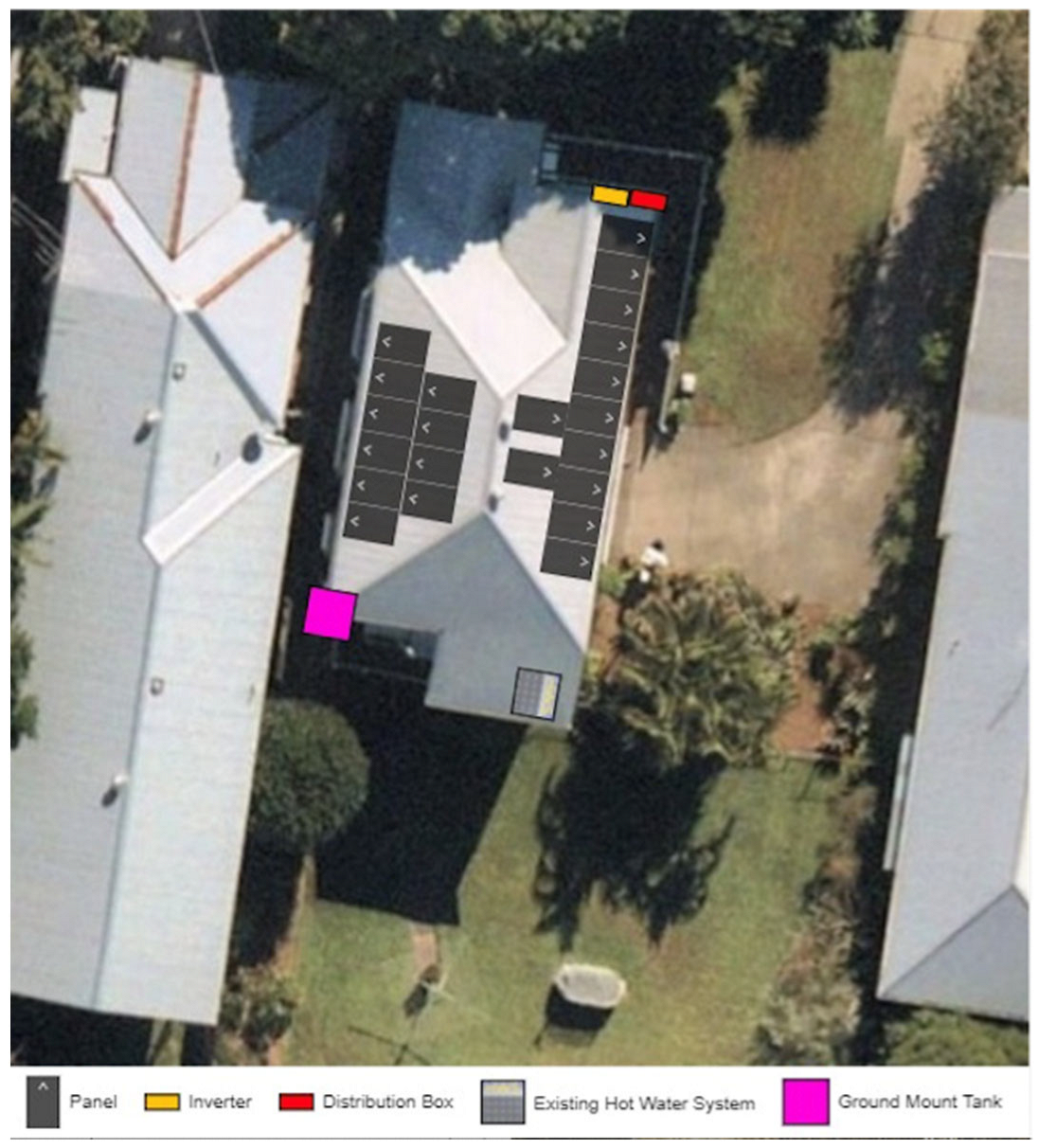
The third stage was the documentation of appropriate hardware. Satellite or drone imagery is essential to integrating the system from the outset, including factors such as the building form, roof material, building configuration and orientation, shading, and a roof plan layout with the proposed design of system elements, namely, the location of the solar panels, the inverter, the battery, and the switchboard (Figure 1). The rooftop view is used to explore the feasibility of the location of the solar hardware, in this case, 22 × 440 W panels and an 8 kW hybrid inverter. As determined by the orientation of the house, the system is installed east–west, with a ground-mounted tank, a heat pump water heater (with an electric booster), and a 270-litre capacity.

4.1.2. System Comparison

This extensive background research study and information enabled the selection and subsequent consideration of three systems judged financially and technically feasible for the case study house.
A heat pump water heater is included in two of them, given that the existing HWS was inefficient and due for replacement. The details of the options are listed in Table 2 and summarized as follows:
  • System 1: Grid-tied, generation only, an electric heat pump HWS.
  • System 2: Grid-tied with solar generation and storage.
  • System 3: Grid-tied, generation only, an electric heat pump HWS, battery-ready.
System recommendations considered warranties, component hardware, and potential economic performance, such as the payback period, lifetime benefits, self-consumption, and import/export of energy to the grid. Households use these data to see if a system meets their needs.

4.1.3. Observations and Limitations

Summary of insights from Table 2 and additional data include the following:
  • System packages have very different potential operational performance; unpacking supply performance is needed; self-consumption is a much smaller fraction of the whole than expected, with nearly two-thirds of the generated power being exported to the grid; higher-yield panels assist in optimizing the space on the roof, i.e., creating more power with fewer panels; battery power is limited, 21% of consumption. Unpacking supply performance is, therefore, needed. The operational performance of various system packages varies significantly; a clearer understanding of supply performance is necessary.
  • Export to gid constitutes is a much larger fraction of total generation than initially anticipated, with nearly two-thirds of the generated power being exported to the grid, indicating that the households could improve economic performance. The feed-in tariff is reduced, hence economic gains are decreased, undermining economic performance.
  • Utilizing higher-yield panels can optimize roof space, allowing for greater power generation from fewer panels.
  • Battery storage is limited to 21% of total consumption, further emphasizing the need to analyse supply performance.
  • The economic performance of the systems is increasingly intertwined with their operational performance, necessitating a forward-looking analysis. More robust economic analysis can provide a deeper understanding of the benefits.
  • Understanding household behaviour regarding demand management is critical to accurately estimating potential operational performance.
  • Historical data linking climate conditions to operational performance and associated emissions reductions indicate a potential decrease of 12.3 to 11.41 tons of CO2 annually. However, this approach has its limitations: it does not account for the impact of occupant demand management practices, and these practices must consider local microclimatic conditions along with both passive and active strategies [28].
  • A recent EIA study on the life cycle assessment (LCA) of photovoltaic (PV) systems shows that emissions mainly occur during manufacturing. However, PV systems produce significantly lower carbon emissions compared with fossil fuels. Since 2015, environmental impacts have improved, particularly in payback times for non-renewable energy sources. Key updates include enhanced efficiency in Mono-Si PV panels, which minimize material waste and decrease demand for poly-Si, as well as higher efficiency in CdTe PV panels. Overall, the assessment indicates only minor deviations in environmental impacts across all evaluated technologies [29].
  • Challenges for emissions abatement arise under extreme weather conditions. For example, specific days when external temperatures reach 37 degrees Celsius or higher lead to overheating and occupant discomfort, increasing energy demand and environmental impacts. Households can mitigate these effects if solar systems maintain comfort through careful demand management and the use of passive systems, which warrants additional exploration.

5. Detailed Study Results

5.1. Site System Upgrade and Technical Advancement

A more detailed study was performed to explore the findings above.
The comparison of three systems, as presented, is characterized as solutions-oriented rather than by how they meet existing and future energy needs. In this case study, the client wished to maintain the existing house, though in the long term, a new dwelling could be built on the site. The cost benefits of the three systems use different methodologies and baselines, that is, assumptions about the tariffs and energy usage patterns and how they compare and pay back. Several matters pertain to the following:
  • How do the solutions revolve around the existing active and passive systems, the site, and the climate?
  • How do the solutions achieve a balance between the demand for and supply of energy in the context of climate variability?
A key constraint on energy supply is that the efficiency of systems relates to transaction losses as energy changes from one state to another. The technologies reviewed in this article involve two forms: solar electric and solar thermal. Households mostly use solar electric energy to service HVAC systems for cooling, appliances, and lighting, with solar thermal energy being used for water heating. Recently, as the cost of the former systems has fallen, preference for an all-electric house is emerging. However, in the subtropical setting of this case study, there remain efficiency benefits obtainable from solar thermal systems. Campey notes that a quarter of the average Australian household’s energy consumption is used for heating water, for the bathroom, kitchen, and laundry.

5.2. Solar Electric Systems

Environmental conditions at the site and climate influence the demand for and supply of energy from a solar system.
First, the biophysical factors at and around the site place constraints on system performance, potentially reducing solar access and altering its impact on the number and tilt of panels. As seen in the current case study, mature trees to the north shade the building. Building form is oriented with roof areas mostly facing east and west, rather than north, which is optimum. An adjacent building to the west at the minimum legal setback to the boundary further shades the building. These factors constrain the solar layout and potentially influence performance (Figure 1).
Second, the number of panels, layout, and tilt can be optimized for heating and cooling loads. Solar Choice [30] recommends that ‘given that the main loads occur in winter months when solar availability is reduced, tilt angles should be more vertical (approximately equal to latitude plus 15°) to maximize exposure to the low winter sun. If major loads consist of cooling and refrigeration, the tilt angle should be reduced (approximately latitude minus 10°) to maximize output during summer. For grid-connected systems, the summer optimum angle should be used to maximize annual output of the modules.’ However, heating and cooling loads reveal a different picture. For Brisbane, using 18 degrees Celsius as a neutral temperature, buildings have heating requirements for 250 days per year and 100–200 cooling days [31].
The third point is the availability and direction of solar radiation. Local monitoring shows that Brisbane receives 1400 W per m2 in summer and half this amount in winter. Equator-facing panes at tilt angles of 27–30 degrees are recommended to accommodate seasonal variations in cloud cover [32].

5.3. Solar Thermal Systems

HWSs can utilize various energy sources, including gas, electricity, and solar power from rooftop collectors. Many different options are available. An efficient model that matches household size to the climate can lead to significant energy, emissions, and cost savings. Gas-boosted (i.e., supplemented) solar HWSs are recognized as having the lowest emissions, though electric boosters are very common and often standard components of solar hot water systems, acting as backup heating elements for days when there is not enough sunlight to heat water sufficiently.
Heat pumps and high-performance solar HWSs tend to have a higher initial purchase price than other options, but they are inexpensive to operate and produce low greenhouse gas emissions. In some jurisdictions, there can be public incentives to help reduce the purchase cost. For solar, it is essential to position the rooftop collectors carefully to maximize the sun’s access. These systems have the lowest greenhouse gas emissions and free up solar electric energy for other uses. On the other hand, a heat pump relies on air temperature and does not require rooftop collectors, which makes it a suitable choice in areas with limited solar exposure.
Electric storage HWSs are generally the cheapest to buy but the most expensive to run, while solar and heat pump arrangements are more expensive initially but offer long-term cost savings. Heat pumps are the most energy-efficient option, using significantly less electricity than electric storage systems. Solar HWSs can be very efficient in sunny climates, especially when combined with a PV system [33]. Additionally, reducing hot water usage by using water-efficient appliances, taking shorter (two-minute) showers, and utilizing eco settings on appliances can assist in constraining energy use [34].

5.4. Candidate System Features and Performance

5.4.1. System Features

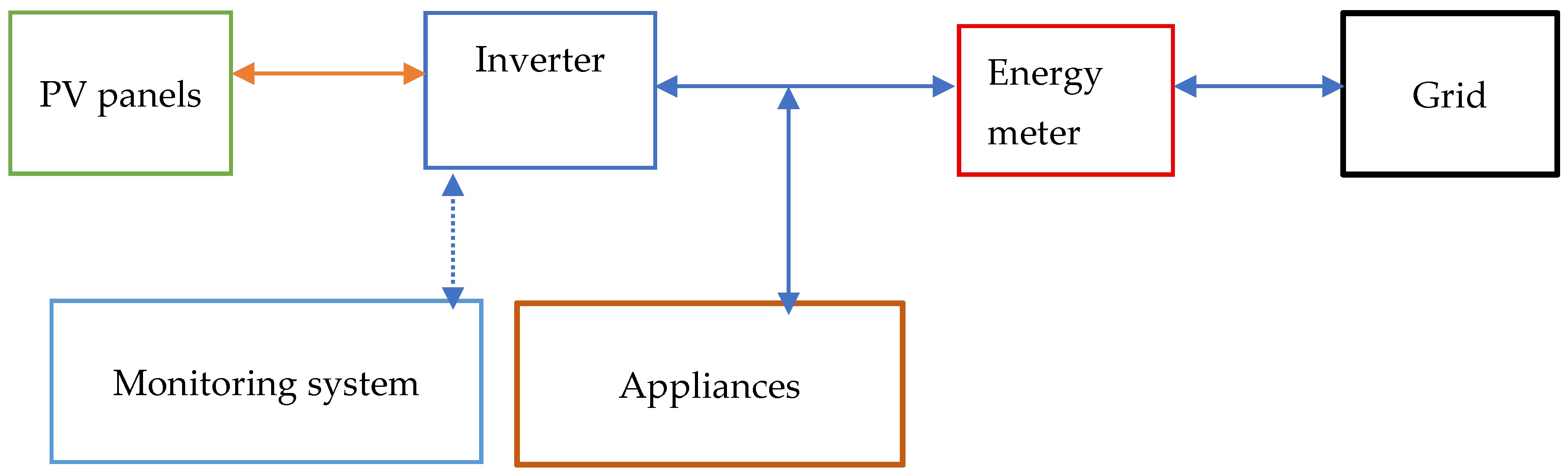
System 1 is a conventional residential energy solution that utilizes a grid-tied inverter for generating power. It converts DC energy from solar panels into AC power, which can be used to power appliances. Any excess energy produced is exported back to the grid (Figure 2).
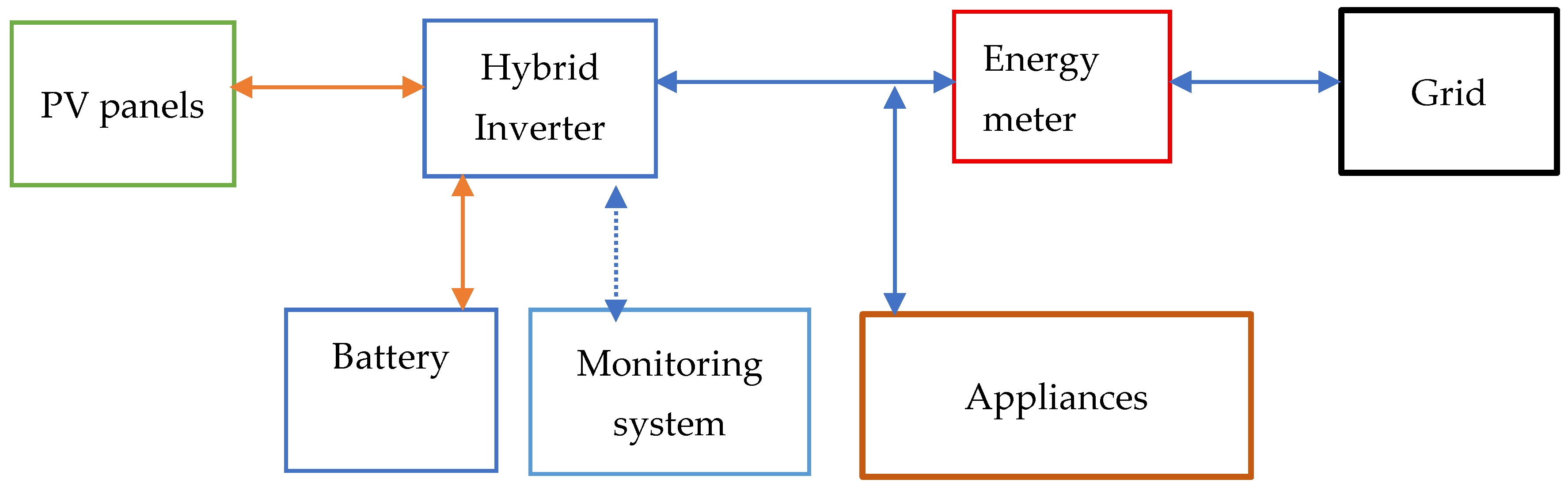
System 2 incorporates a battery and a hybrid inverter, offering enhanced energy independence, backup power, and cost savings. Hybrid inverters integrate solar, battery storage, and grid connectivity to provide reliable, self-sufficient power by allowing you to use solar power directly, store excess energy for later use or during outages, and feed any surplus back into the grid for credits. This system optimizes energy usage, reduces electricity bills, and offers backup power, enhancing energy independence and resilience (Figure 3) [35].
During the day, households use solar power to run appliances and charge batteries. Any surplus solar energy is sent to the grid. At night, the stored energy in batteries can be utilized to power appliances, reducing reliance on grid electricity. A key feature of the battery storage solution in System 2 is the implementation of control systems to manage solar power usage throughout the day. Given the variable availability of solar radiation in the Brisbane climate, the self-power mode enhances the system’s ability to increase self-consumption and self-sufficiency, as will be reported in due course. System 3, which utilizes a single hybrid inverter, can be phased and built without batteries. Households can add solar panels and batteries in the future, rendering the system ‘battery-ready’. Forward-thinking consumers also consider this option for retrofitting storage to existing residential systems, which only generate power (cf. System 1). Batteries for residential use provide standby power and can also operate appliances. However, they are typically not used for heating, ventilation, and air conditioning (HVAC) systems for two reasons. First, the high initial purchase cost means that a household usually only has one battery with a capacity of 7–13 kW installed. Second, a 5 kW HVAC system can consume more power than the battery can provide.

5.4.2. System Usage

The system usages were developed using assumptions of system demand shown in Table 3, to indicate the household potential usage pattern.
The schedule for the existing system is assumed to be spread equally across the day and night, and off-peak usage for water heating is sourced from off-peak electricity. This gives a daytime usage of 9.05 kWh and a nighttime usage of 17.56 kWh.
In Systems 1 and 3, to improve self-consumption, water heating is scheduled for the daytime (15.7 kWh), giving a nighttime demand of (10.910kWh). In System 2, the battery adds a further 9.6 kWh of self-consumption during the day (25.3 kWh) and displaces grid energy at night (1.32 kWh).

5.4.3. Energy Outcomes and System Performance

The implications of end-usage scheduling are illustrated in Table 4. It presents various operational performance characteristics of the candidate systems, with a key distinction noted for System 2. This system enables a comparison of the self-consumption and self-sufficiency rates of the three solar systems: Systems 1 and 3 have self-consumption rates of 36% and 59%, respectively, while System 2 boasts rates of 60% for self-consumption and 98% for self-sufficiency. The objective is to achieve an optimum self-consumption rate of 60% and a solar self-sufficiency rate of 90%. Notably, only System 2 comes close to meeting these targets.

5.5. Economic Performance, Cost Effectiveness, and Discounted Cash Flow

In Australia, energy distribution companies have service plans for solar as well as non-solar, grid-only customers. This choice is based on current peak-use tariffs and feed-in tariffs (FITs) for energy exported back to the grid. Given the ‘industrial’ nature of the products involved, the capital cost is conventionally seen as a tangible financial investment by the household. The differential return on investment comprises the cost of servicing through a grid-sourced energy plan minus that occasioned through a solar electricity plan. Benefits include solar feed-in tariffs, carbon offsetting, a (reduced) tariff or pricing structure for green power, and the social advantages of energy derived from renewable sources. These elements are included in the cost of servicing the systems.
A comprehensive account follows regarding energy costs relating to the three candidate energy systems. These results come from a discounted cash flow model with imputed time value of money estimates, a nominated lifespan for the system, and the inclusion of terminal residual costs (which apply if the system must be removed and recycled at expiry).
Solar systems typically have a payback period ranging from 1 to 5 years, with expected operational benefits lasting about 19 years. The optimal lifespan for such systems is approximately 25 years, as energy yields gradually decrease over time.

5.5.1. Economic Performance and Cost Effectiveness

First, cost–benefit relativities demonstrated by consultants use different methodologies and baselines because of assumptions about tariffs and usage patterns. Part of any preparatory study should be to firm up the methods to help improve the validity of available data sets.
For potential purchasers who are conscious of costs, it is essential to compare competing systems, as outlined in Table 5. The existing system serviced by the grid only with off-peak electricity for the hot water system has an estimated annual cost of AUD 3511.
In contrast, residential grid-tied System 1, which includes solar water heating, fits within a budget of AUD 14,000. It provides estimated annual savings of AUD 637 and has a payback period of 22 years. Residential storage System 2, which comprises solar PV panels and a battery utilizing the existing electric hot water system, exceeds the budget but offers significantly greater net savings (AUD 1920) and a shorter payback period (8.33 years). System 3 is like System 1 with larger gross costs attributed to a more detailed quotation.
Additionally, when households compare the costs of tariffs and utility services for solar systems, it is important to evaluate the available system options. The cost of a grid-only option is AUD 4056 annually, which includes purchasing green power to help offset emissions. In contrast, other packages—such as solar panels combined with hot water systems (Systems 1 and 3)—not only cover the utility bill but also provide savings. Systems that include solar panels and batteries (System 2) enhance these benefits by offering greater bill savings and greater resilience to fluctuations in the feed-in tariff. Furthermore, the declining value of the feed-in tariff undermines systems without battery storage, exposing them to an estimated 3.6% annual increase in grid costs.

5.5.2. Discounted Cash Flow (DCF) and Net Present Value (NPV)

Increasingly, the application of solar energy systems is seen as a financial investment. DCF and NPV estimates are calculated to address these issues.
Table 6 shows the estimates based on the net savings from the PV and heat pump hot water system: Systems 1 and 3 show DCF values of AUS 4141, and AUS 4186, respectively. However, the net savings are insufficient to achieve a positive NPV. System 2 shows that the PV–battery combination achieves a greater DCF of AUD 12.462 after 10 years, although it does not achieve a positive NPV, and further calculation indicates that this would be achievable with an additional 5 years.

5.6. Climate Classification, Comfort, and System Performance

5.6.1. Climate Data and Climate Zones

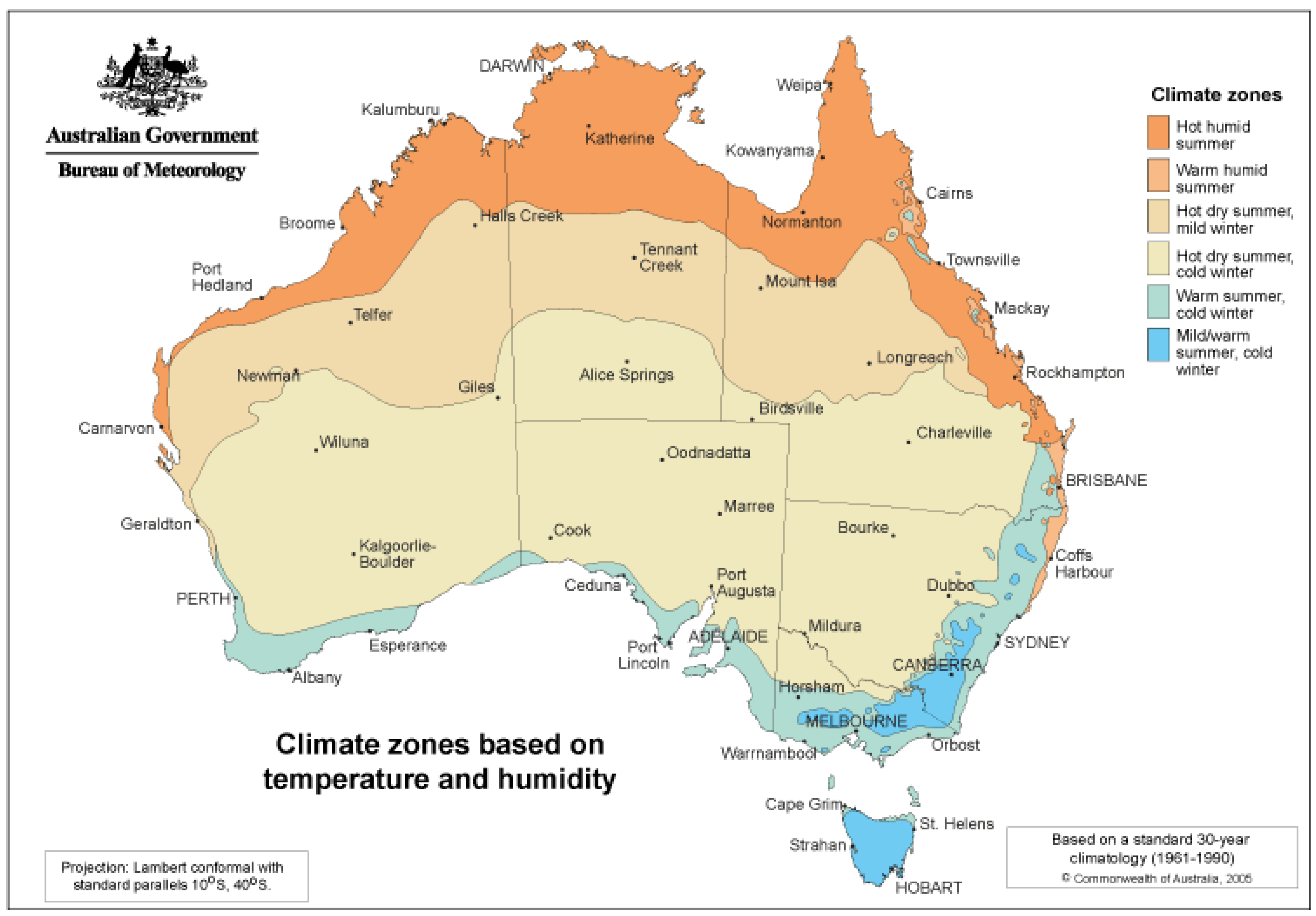
Brisbane has a humid subtropical climate (Köppen climate classification: Cfa) characterized by year-round periods with warm-to-hot temperatures) (see Figure 4).
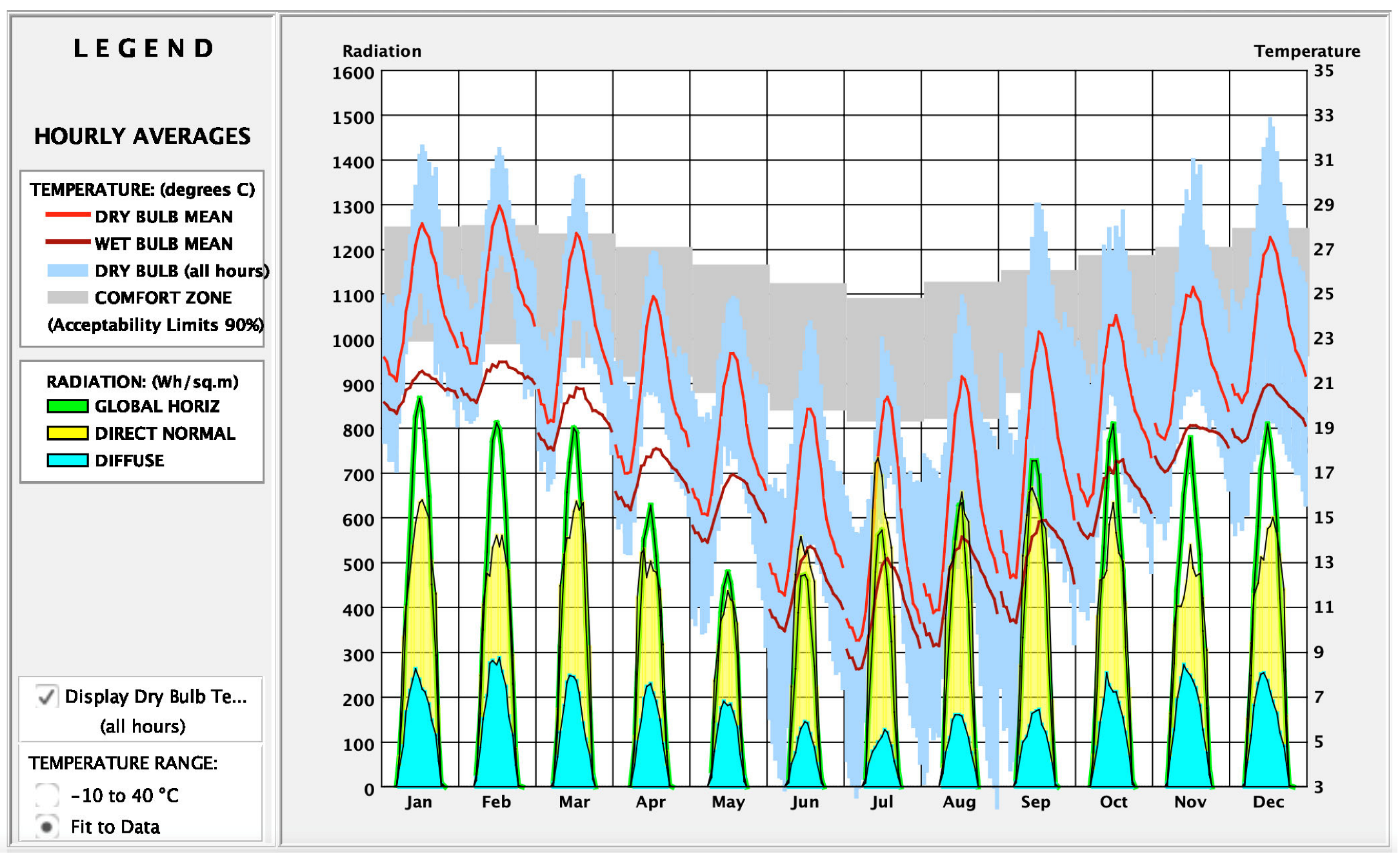
Generally, 3 months of mild cool winter from June to August are experienced. Brisbane’s average coldest night during winter is around 6 °C. In 2009 the hottest winter day (from June to August) was 35.4 °C. The average July day, however, is around 22 °C, with sunny skies and low humidity, occasionally as high as 27 °C, whilst maximum temperatures below 18 °C are uncommon and usually associated with brief periods of cloud and winter rain. The highest recorded temperature is 43.2 °C, but temperatures above 38 °C are uncommon in summer. The highest minimum temperature ever recorded in Brisbane is 28.0 °C, whilst the lowest maximum temperature is 10.2 °C [38]. (see Figure 5).
The climatic variables used to design the system (Table 7) are based on Figure 5. Independent variables are irradiance and sky cover for the design of the PVs. Additional design factors are noted.

5.6.2. Environmental Conditions and Seasonal Variation

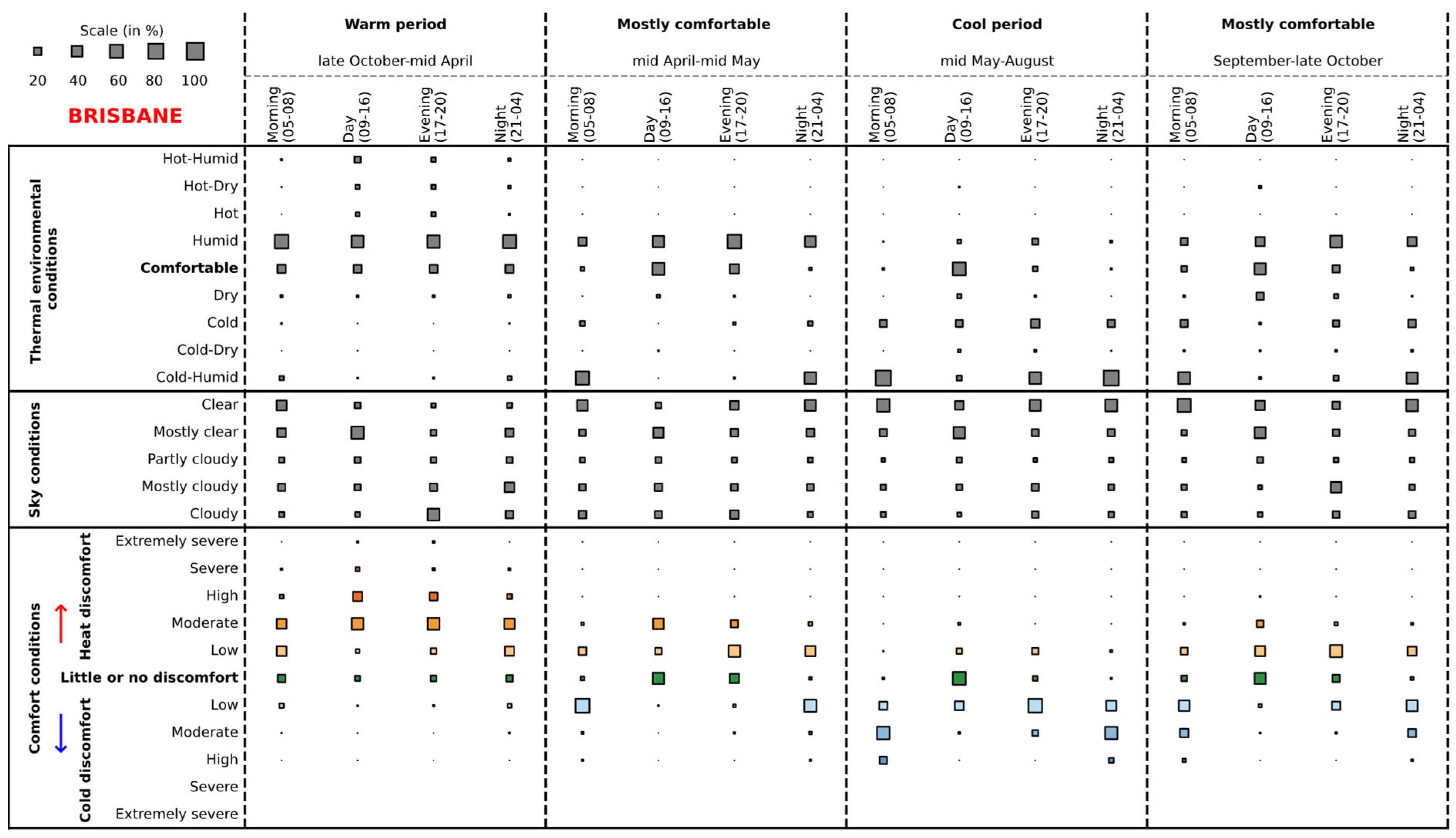
A graphical analysis of environmental conditions provides an overview of the factors influencing thermal comfort conditions [40]. Using 2035 as a near-future outlook, four periods, corresponding to summer, autumn, winter, and spring, are observed. In addition, sky conditions which influence supply and demand for energy are noted.
Macro environmental conditions: Several design variables can be developed through interpretation of these data at the macro-level (Figure 6).
First, the thermal environment is warm and humid in summer, comfortable in autumn, and cool in winter.
Second, regarding the sky conditions, which influence energy supply and demand, from April to mid-September, the skies are clear and mostly clear.
Thirdly, comfortable conditions prevail in April, May, October, and November. Winter has cool, humid weather, mitigated by clear skies, bringing more consistent availability of solar energy for heating. Summer features variable conditions with high humidity and demands for cooling. Solar energy availability is typically higher in summer than in winter, but cloud cover in Brisbane moderates this effect. High discomfort from overheating occurs during the daytime, from late October to early April.
The wet season in summer brings overcast days, reducing solar availability, whilst clearer skies in winter provide more solar wattage. Notable is the prevalence of underheating and overheating periods, which are normally met with active system end usage.
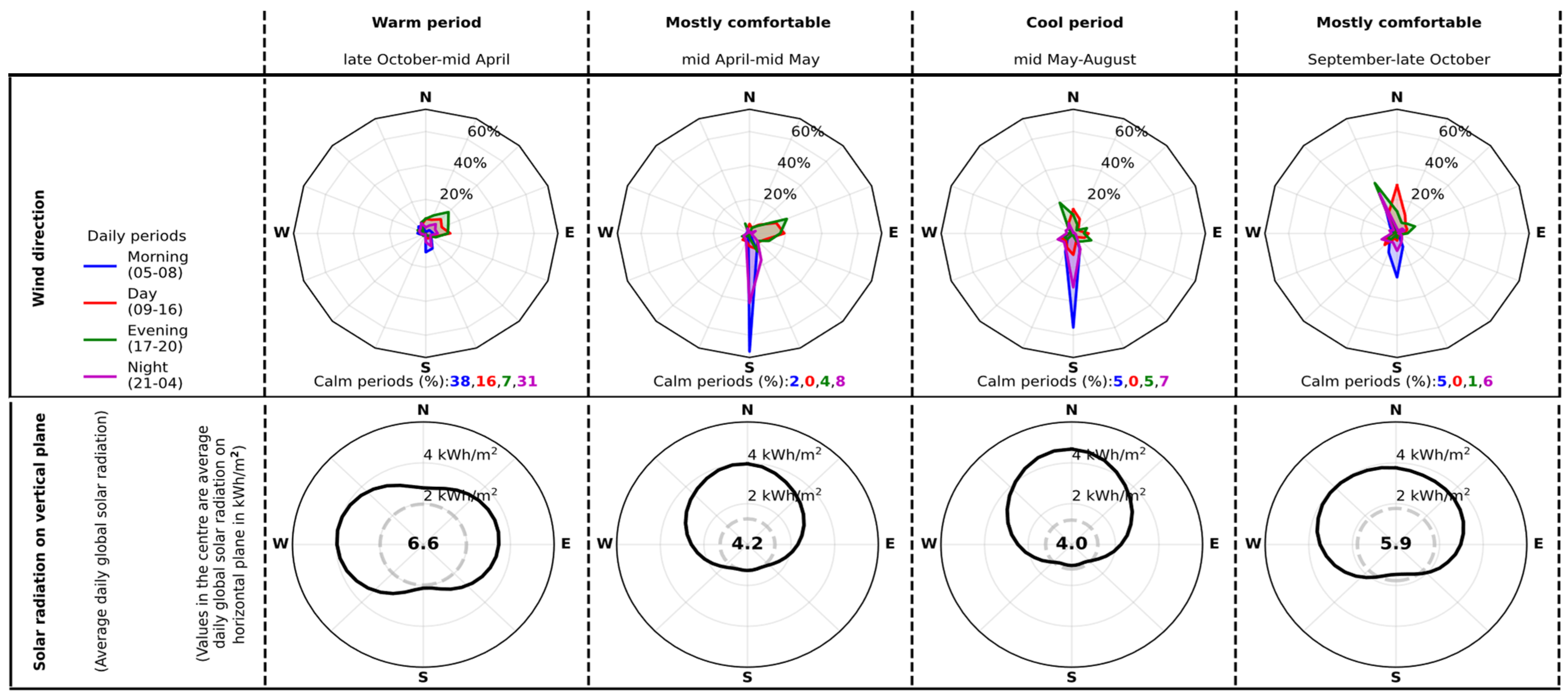
Micro environmental conditions at and around the site: The case study residence constrains the solar layout and potentially influence performance and comfort Optimising passive strategies for the design of the building is needed.
As seen in Figure 7 wind direction is important to flow-through ventilation from the optimum wind northeast direction for summer, spring, and autumn should be considered. All year round, but particularly in late October to mid-April, solar radiation in the vertical plane should be accounted for with fixed shading. In hot weather an important strategy is to prevent heat gain into the build. Additional microclimate controls are advisable such as vegetation.
Design recommendations were developed based on environmental conditions and seasonal variations (see Figure 6 and Figure 7):
  • PV Systems: Fixed solar panels with optimal winter tilt angles to maximize energy supply in winter. Demand management, passive systems to reduce energy demand, and battery storage systems account for potential shading from cloud cover during the wet season and optimize output to service HVAC cooling loads and daily variations.
  • HVAC Systems: Given the variability in temperature and humidity, HVAC systems should adjust for seasonal changes, with a focus on energy efficiency.
  • Building Orientation: Buildings should ideally align east–west to maximize exposure to northern sunlight, particularly in winter months, but also shade against high summer sun angles.
  • Water Management: Implement rainwater-harvesting systems to capitalize on the wet season and ensure water availability during drier months.
  • Insulation and Ventilation: Adequate insulation will reduce heating and cooling costs, with natural ventilation utilized to maintain comfort during milder months.
Linking specific climatic variables directly to design recommendations can yield better-performing, more resilient systems suited to Brisbane’s environmental conditions.

5.6.3. Overheating and System Implications

Overheating is a specific constraint separate from typical climate conditions. Addressing the problem is crucial because it can cause discomfort, health issues, and even premature death, particularly in vulnerable populations. Further, overheating can negatively impact productivity and overall well-being in both residential and commercial settings [41]. Increasing concern thus relates to overheating in buildings and heat stress on occupants [42].
An understandable response is the increased energy consumption and higher costs associated with cooling systems. These issues provide challenges for the optimization of household energy consumption, which is essential in periods of high demand. Managing both supply and demand with passive systems is well recognized as an opportunity to address overheating in conjunction with low- and high-energy efficiency technological systems for cooling (i.e., ceiling fans and air conditioning). To improve household self-consumption and self-sufficiency, the strategy involves using active systems during the day and passive low-energy systems at night.
A climate analysis of an overheating period during the summer months, specifically from December 2023 to February 2024, was undertaken. Environmental data from the Australian Bureau of Meteorology indicate that rainfall across Greater Brisbane was below average, with most locations recording 70% or less of their typical receipt. Daytime temperatures were generally close to the long-term average. Simultaneously, minimum temperatures were cooler than the long-term average for all locations, with inland sites experiencing temperatures more than a degree lower than average [43].
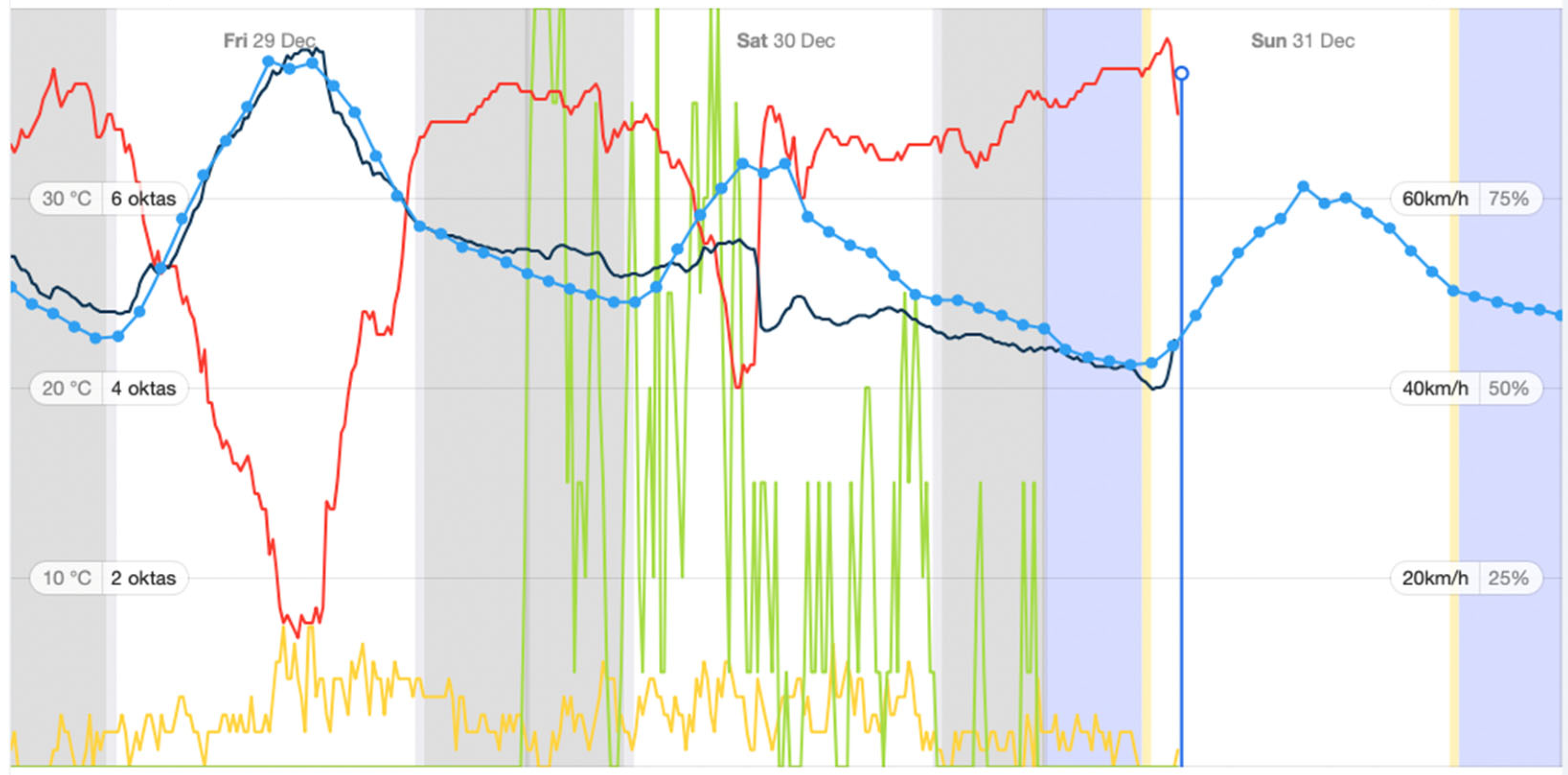
This study used a local period from 29 to 31 December 2023 (see Figure 8).
The mean average maximum temperature for December 2023 was 29.7 °C, and the warmest day was the 29th, with 37.7 °C. During hot summer days, a guideline for optimal efficiency when using air conditioners recommends setting the AC temperature to 8 degrees below the outside temperature [44]. On extremely hot days, to avoid increased costs and higher emissions, households should consider adjusting their settings accordingly to minimize costs and emissions. In this case, the internal set point would be 29.7 °C, referring to the maximum ambient external temperature. If a building operates in passive mode, it must be in AC mode when the external temperature reaches 29.7 °C from 10:00 am to 6:00 pm, providing eight hours of active system operation for a 7 kW air conditioning system.
Nighttime consumption shifts to passive mode with ceiling fans. This move results in imports from the grid of 4.14 kWh, which can be offset by storage (as in System 2). The thermal response of the lightweight building used in this case study has high rates of temperature equalization between internal and external temperatures due to a lack of thermal mass. However, insulation in the roof addresses 40% of solar heat gains during the day, along with window blinds and shading. Humidity is not controlled, being very low during the day (25%), balanced by high levels (80%) at night.
These climate data undergird management strategies toward the potential integration of passive and active solar systems using a grid-tied solution (i.e., Systems 1 and 3). Household demand management is assumed to maximize solar self-consumption, energy efficiency, and energy sufficiency scenarios (Table 8).
This approach to solar retrofitting allows households to achieve energy sufficiency, resulting in reduced costs and emissions.
Households should look further to improve self-consumption through demand management, particularly by taking up the synergies offered by integrating passive and active systems. During times of the year with hot weather, it is beneficial to synchronize the cooling demand from HVAC systems with the generation supply from solar panels installed on site; doing so reduces the peak load on the grid. Households can use a combination of both passive and active systems for this purpose, providing an opportunity to reduce emissions, since such practice aligns with reducing peak loads on the grid [45].

5.7. Managing Energy Demand: Steps for Optimization

  • Integrate Systems. Combining solar, passive, and active systems to optimize energy use by managing demand and supply is needed. A nuanced integration of environmental conditions among solar, passive, and active systems optimizes energy use by managing demand and supply fluctuations.
  • Explore Scenarios: We examined solar energy supply scenarios based on thermal conditions, primarily categorized as ‘comfortable’:
    • Self-sufficiency scenario: Maximize solar self-consumption and use of active systems during the day.
    • Energy efficiency scenario: Improve system efficiency by replacing older appliances.
    • Energy sufficiency scenario: Minimize active system usage and optimize operational timing based on climatic factors to avoid peak loads.
  • Adjust System Usage: Managing end-use demand involves adjusting system usage between day and night (Table 9). For example, during the summer, self-sufficiency can be increased by operating all HVAC and water heating systems while reducing the usage of half the appliances and some cooking activities during daylight hours. This strategy can create a demand of 21.95 kW during those hours, with a smaller load at night. Ceiling fans and other passive cooling methods, such as open windows and flow-through ventilation, can likewise provide comfort at night.
  • Implement passive cooling: Improving energy efficiency by utilizing passive cooling systems during the day can help reduce overall energy demand. However, the effectiveness of this approach relies on optimizing passive systems in a solar retrofit.
  • Optimize solar retrofits; Additionally, retrofitting solar HWSs can enhance energy efficiency while drawing very little power, especially in the colder winter months. Although a heat pump water system would consume more energy than a standard electric storage hot water system, it still uses less energy overall [46].

5.8. Occupant Lifestyle Influences: Steps for Sustainable Design

  • Consider Climate and Lifestyle: Queensland climate and outdoor living create opportunities that are mirrored in the design of pre-war houses. They return to past strategies, whereby people lived more closely and were more attuned to natural phenomena. From the evidence in this study, solar retrofitting with active and passive systems is a normal progression.
  • Utilize Passive Systems: Leverage the natural airflow designs of pre-war Queensland homes for effective solar retrofitting and avoid deviating from this design to minimize reliance on energy-consuming air conditioning. The original design of these pre-war Queensland houses is inherently conducive to solar retrofitting in a subtropical climate. The layout, with living spaces on the upper floor, ground floor storage, cellular spaces, and semi-external areas like verandas, is a thoughtful response to the climate, maximizing airflow and solar control through the roof using minimal materials [47].
  • Adopt Sustainable Retrofitting Strategies: In the case study situation, subsequent renovation of the house’s facade moved away from this design, potentially leading to the need for air conditioning. A sustainable solar retrofitting strategy should aim to minimize air conditioning since it is the largest end use of energy. The following strategies apply (Figure 9).
    • East zone: Adding roof insulation is recommended. The lightweight construction of the house responds quickly to external temperatures and requires natural ventilation for cooling and solar control through roof insulation.
    • North zone: Adapting the ground floor for storage and rumpus space is a feasible use.
    • South zone: Changing the kitchen layout would result in a less complex interior, and more operable windows could be added for ventilation. Adding external semi-enclosed spaces, such as a pergola, could enhance the experience of the garden.
  • Return to the Original Design: Revive the north–south orientation which enhances cross-ventilation and enables independence from active systems. Extend the roof to create shading and space for solar panels, improving daylighting, which includes a north–south axis and could lead to microclimatic adaptations. Retaining this form is a relevant conservation strategy and could simplify planning while improving cross-ventilation, enhancing the building’s capability to operate without active systems. Extending the roof area to the east for verandas and shading to reduce the morning sun in summer would also be beneficial. This approach would increase space for solar thermal panels for water heating. Adding skylights would add more daylight indoors. The current east–west orientation of the roof reduces solar panel efficiency by 10–20%, highlighting the importance of retrofitting for the microclimate [48].

5.9. Active Systems: Steps in Design Management

  • Manage HVAC and Water Heating: Use HVAC systems during peak months to manage discomfort and schedule water heating during the day. A focus on demand management centres on controlling the operation of the two main end-use items: HVAC and water heating. The typical pattern for use in the existing house is to operate the HVAC system to alleviate severe discomfort in the three months of winter and summer. Water heating takes place during the night with off-peak electricity. Experimenting with alternative demand management scenarios revealed the significant impact of three distinct energy usage schedules to better integrate solar, active, and passive systems in the building.
  • Increase Self-Sufficiency: This involves scheduling all HVAC and water heating usage, half of the appliances’ usage, and some cooking during daylight hours. Low-energy technologies, such as ceiling fans, can provide comfort at night. The daily daytime demand of 21.95 kWh is met by solar power; the nighttime demand of 4.66 kW is met by grid or battery power (Table 9).
  • Enhance Energy Efficiency: Replacing the current electric HWS with a solar hot water system significantly reduces power demand to 4 kW [33,46]. An important energy efficiency measure is to prioritize replacing existing systems that are consciously and extensively used, i.e., fridges and HWSs Replacing and improving the efficiency of HVAC systems and appliances would further reduce demand (assume 30%). Daily daytime demand is reduced to 14.1 kWh, which is met by solar power, and the nighttime demand is 3.67 kWh (Table 9).
  • Improve Energy Sufficiency: This involves operating passive heating and cooling systems during the day and night, in the low-discomfort months of April, May, October, and November. Hence, updating the present passive systems in conjunction with the solar retrofit is central to the energy savings. Daily daytime demand is reduced to 3.4 kWh, which is met by solar power, and the nighttime demand is 3.4 kWh (Table 9).

5.10. Export Opportunities

Energy distribution companies can, with due diligence, take reasonable steps to safeguard the health and safety of occupants and the energy network. However, the network is highly regulated. If consumers prioritize economic issues, then significant questions arise about how subsidies for solar systems influence consumer behaviour [49]. Today, the complexity of technical advancement provides a challenge to households but is often insufficiently recognized as a constraint in the decision-making process. Several examples of solar residential supply chains exporting to the grid can be cited:
  • Fixed energy exporting to the grid is limited for safety and security reasons;
  • Flexible connection permits variability (e.g., quantity requirements and time of day considerations) in export limiting and can be used for grid safety and security reasons;
  • DC coupling, batteries, and panels can be connected before conversion to AC (as seen in residential System 2).
Households might find that fixed export constraints mean that if kW generation exceeds the limit of the inverter, excess solar energy is wasted, since it is converted into heat rather than being exported [50]. Another innovation is DC coupling, through which solar panels and batteries share a single inverter. It can lower operational costs and reduce emissions by enhancing efficiency and simplifying system design. This setup minimizes energy conversion steps, leading to reduced power losses and increased storage efficiency. The simpler design also translates to lower initial costs and easier system management [51]. The reduction in demand significantly impacts the flow of energy through the grid. The network experiences several challenges due to supply chain inefficiencies, especially in grids that still rely heavily on fossil fuel sources and centralized generation. One of the primary limitations of the grid system is energy conversion.
In general, for every 1 kW reduction in grid power consumed by households, there is a corresponding 1 kW decrease in generation capacity in the supply system. This drop leads to a further 1 kW of energy that is concentrated in the generation system. In this study, the household reduction resulting from solar energy generation—46.5 kWh per day—translates into a diminution of 49.89 kWh in centralized daily electricity generation.
The current discussion amongst energy companies and regulators examines ways to manage energy exports from distributed energy generators equitably and how this situation influences household energy plans’ affordability and environmental impact [52]. The potential for alternative, more efficient generation from the bidirectional functionality of the grid is significant. However, smaller distributed generators like rooftop solar ones could disrupt the grid’s security. In response to this, energy companies in Queensland typically prohibit inverters over 5 kW without export limits. However, export limits often allow single-phase homes to increase inverter capacity to 10 kilowatts if managed by a Dynamic Connections program [53]. This new technical advance moves along from the more prescriptive approaches of earlier periods. However, several queries remain:
  • How efficient will the new technical advance be for households?
  • How much of this power can displace fossil generation in the supply chain, or will it be sold back to households?

5.11. Emissions, Carbon Abatement, and Tariff Plans

Emissions abatement is concerned mainly with displacing fossil fuel supply in the electricity grid. Currently, 1 kWh of electricity consumed is estimated to release 0.74 kg CO2-e/kWh (Australian Government, 2024a) [46]. In the case study example of retrofitting, the annual household consumption is 9709 kWh, which, using grid power, would release 7185 kg CO2-e. Solar generation using a 10 kW system is estimated to generate 15,512 kWh, saving 11,480 kg CO2-e and making the household carbon-positive in respect of its net emissions.
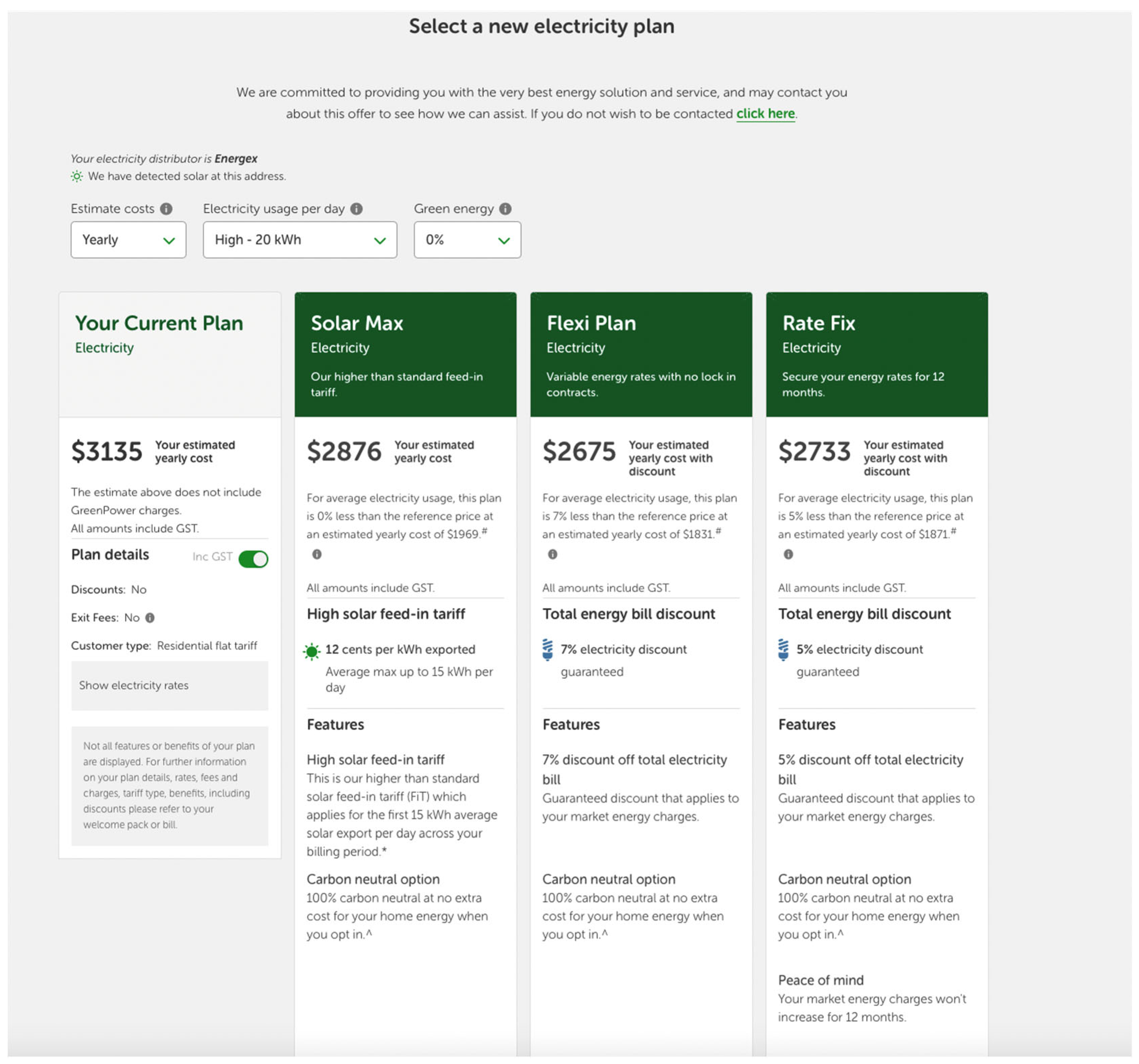
Households can now identify different pathways through their energy retailers to reduce emissions, as seen in Figure 10, and additional analysis is found in Appendix A. The process examines annual costs and uses previous plans as a baseline. However, the options are extensive and show little cost variation between Solar Max and other grid-only plans; each of the four plans and numerous tariff options further complicate decision making. The final contract contains an agreement to tariff rates for sub-services, such as green power, which allows households to purchase renewable energy to achieve complete emissions abatement. A more detailed analysis is shown in Table 10. Several observations are noted:
  • The difference between the FIT and Peak tariff costs. This is an indicator of the business case for PV and reduction in emissions.
  • The tariff plans offered are very similar; the Solar Max system could better model the potential costs, factor in self-consumption, or acknowledge that self-consumption is not included.
  • Illustration of a more realistic comparison is shown from this study.
  • The servicing from the grid with green power costs AUD 480.60, bringing the total cost to 4085.08 AUD per annum. System 1, the servicing from panels, reduces the cost to 34% of the amount quoted above. Green power costs AUD 218, reducing cash flow for payback on the solar system. Some households could regard this trade-off as a contradiction. As shown for System 3, the panel and battery combination reduces household electricity costs to 342 AUD per annum.
  • The emissions calculations are no longer provided nor historical data on household performance.
Reducing emissions through site-based generation and storage is not just a personal but also a national priority for carbon abatement. Technological advances in site-based management amplify investment and subsequent emissions reduction. Domestic batteries and intelligent control systems reduce additional running costs, as evidenced in System 2. Participating in this approach makes households part of a larger, less environmentally impactful initiative. Even so, the current policy options incorporating batteries are suboptimal.

6. Discussion

Cost-effectiveness is the core factor in retrofitting solar systems. Classification based on investment and profit provides important evidence for decision making. Inconsistencies between the building’s original architectural style and the design of the solar retrofit can occur, compromising the effectiveness of both the building and the solar systems.
A solution proposed in this study is to pursue a light retrofit, which conserves and improves the existing building fabric whilst exploring how solar systems integrate with the building and its environment, as well as household needs and their lifestyle. This solution is a counterpoint to the desire to demolish and rebuild.
However, as the cost-of-living rises, many households are looking for ways to reduce expenses, particularly in energy consumption. Solar energy presents a viable solution for families to manage budgets and adopt sustainable practices when applied to older buildings. A crucial aspect is selecting an efficient solar system tailored to individual needs and financial constraints.
Key considerations include the efficiency of solar hardware. Choosing high-yield solar panels maximizes limited roof space and meets energy needs. For instance, a 10 kW system can produce 42.5 kWh daily, exceeding the average daily consumption of larger households. Adding battery storage increases cost-effectiveness and is complementary to the light retrofitting approach.
Bundling energy solutions—combining PV with water heating—such as Systems 1 and 3, can yield savings over time, with examples showing costs around AUD 14,000–16,000 and net annual savings of AUD 637–644, leading to payback periods of about 20 years. Moreover, residential PV and storage solutions, such as battery systems, such as System 2, enhance self-consumption of solar energy by up to 60% and self-sufficiency to 97%, offer a payback of 8.3 years, and provide long-term savings despite potentially higher upfront costs. From an investment perspective, this study shows that the PV–battery combination is not particularly profitable. Discounted cash flow analysis indicates 15 years, due to the high cost of the systems, the high discount rate, and rising electricity costs. However, households face several constraints on decision making, including uncertainty about system benefits, affordability amid rising costs of living, perceptions of energy costs, and scepticism towards new technologies. Decision-making factors impact affordability, and households are encouraged to reduce energy consumption through efficiency, better tariffs, and the integration of renewable technologies.
Hence, solutions that focus solely on building fabric upgrades, without considering solar integration or low-cost technologies, limit their effectiveness. Emphasizing energy efficiency and demand management is essential to sustainable energy solutions.
As per Table 11, decision-making factors place constraints on households in several domains [54]:
  • System characteristics: uncertainty about solutions, performance, and benefits.
  • Affordability: related to a high cost of living and tight cash flow.
  • Supply: perceptions of a high cost of energy and low environmental impact, i.e., little reduction in emissions (system service maintenance requirements or costs are not included; all benefits must, therefore, be assumed as gross figures).
  • Technology: the view that new technologies have little benefit and are too expensive and capital costs are too high.
The system constraints presented in this report remain relevant even when a household establishes an upgrade budget, and specific component options are clearly defined. The primary limitations affecting the affordability of decision-making processes for both households and consultants stem from economic factors and emissions concerns [33,47]. It is a significant oversight to concentrate exclusively on enhancing the building envelope to improve energy efficiency during retrofitting efforts. Instead, a more holistic approach should be adopted—one that includes the integration of solar energy with affordable technological solutions, the replacement of outdated systems with energy-efficient alternatives, and the implementation of robust demand management strategies. These elements are essential for achieving effective and sustainable energy conservation. Supply constraints from energy companies pressure households, pushing them toward energy self-sufficiency and efficiency. Energy demand is intrinsically linked to household lifestyle. Openings for demand management through domestic changes can reduce the need for a technical fix. However, technical advances in solar technologies are rapid and extensive, requiring constant change in integration strategies. Similarly, supply chain issues, as the network transforms from centralized to the inclusion of more distributed power systems, demand attention to safety and security of the grid.
If existing technologies are unaffordable and new technical solutions out of reach, constraints which can reduce the possible system size emerge in this domain, leaving few options for expansion. For all this, there can occur a tipping point at which household energy demand and expenditure justify the adoption of new technologies. The shift motivates high-consumption households to turn to solar retrofitting to accommodate lifestyle changes, such as increased demand from electric vehicles, and heating and cooling needs [55]. An additional observation of note is that tipping points are increasingly centred on the perceptions of households of the retail process and the upstream supply chain.

7. Conclusions

This research study identifies several principles and metrics for solar retrofitting to improve household sustainability. A feasibility study of a detailed operational study explores the application of light solar retrofitting using these principles. A process-based approach is used to optimize strategies for households to meet affordability, economic, and technical constraints. Practitioner guidance is available throughout the report. This case study of solar retrofitting a pre-war dwelling demonstrates the potential for integrating sustainable technologies to meet the energy demands of a larger household. By evaluating three distinct solar systems, it becomes evident that a grid-tied system with battery storage provides the most favorable balance of self-consumption and self-sufficiency, despite retaining an existing electric hot water unit. This study underlines the importance of aligning energy production and consumption patterns, emphasizing strategies such as shifting appliance use to the daytime and enhancing passive cooling to reduce reliance on active systems.
The findings suggest that thoughtful integration of solar technologies with efficient home design can achieve significant energy savings and reduce carbon emissions, especially during peak usage periods. The preservation of architectural character in pre-war homes adds a layer of complexity that warrants further investigation.
The emerging hypothesis which advocates a light approach to retrofitting could offer a viable pathway for sustainable home retrofitting that preserves the unique qualities of older structures. Continued research is essential to refining these strategies and providing households in subtropical climates with additional insights into and examples of effective photovoltaic techniques. The implications of future enquiries should be examined in policymaking about demand efficiency to recognize the importance of supply-side offsets through solar technologies.

8. Research Limitations/Implications

This study offers crucial insights for stakeholders, including homeowners, designers, technology developers and manufacturers, providers, real estate developers, builders, and government entities. The findings guide how these stakeholders can effectively encourage customers to undertake eco-friendly retrofits by using passive and active systems aligned for future environmental sustainability. This research study underscores the significance of exploring the antecedents that influence household intentions to adopt eco-friendly technologies, contributing to the attainment of future sustainability goals.
The limitations of this study in particular regard generalizability beyond the single case study. Firstly, the sample size is a significant limitation. A single case study may not adequately represent the broader population, making it challenging to draw universal conclusions. The findings may reflect unique circumstances or variables that are not applicable in different contexts or larger groups. A larger sample size could enhance the robustness of the findings and allow for more comprehensive insights.
Secondly, the geographic specificity of the case study presents another limitation. The research constraints are related to the externalities of the case, regional factors, cultural differences, or local conditions that are not relevant elsewhere. This geographic focus can affect the applicability of the results to other settings, thus limiting this study’s impact and relevance in a more global context.
Lastly, the assumptions made during the analysis warrant attention. Any underlying assumptions regarding methodologies or theoretical frameworks can introduce biases or affect the interpretation of results. It is essential to critically examine these assumptions to understand how they influence the conclusions drawn and to consider alternative interpretations that could arise from different theoretical perspectives. Key factors used in this study are economic, environmental, technical, and social, set in an architectural context.

Author Contributions

Conceptualization, methodology, validation, formal analysis, investigation, R.H. Resources, J.H. Writing—original draft preparation, R.H. Writing—review and editing, D.W. All authors have read and agreed to the published version of the manuscript.

Funding

This research study received no external funding.

Data Availability Statement

The original contributions presented in this study are included in the article. Further inquiries can be directed to the corresponding author.

Acknowledgments

We thank the academic editors and anonymous reviewers for their suggestions and valuable comments, in addition to the consultants and their companies for their support.

Conflicts of Interest

John Hyde is employed by OH Architecture. The other authors declare no conflicts of interest.

Abbreviations

The following abbreviations are used in this manuscript:
PVPhotovoltaic
HWSHot water system
HVACHeating ventilation and air conditioning
HPHeat pump
AC, DCAlternating current, direct current

Appendix A. Energy and Cost Balance

Table A1. Energy and cost balance for an average 6-person household with energy consumption of 26.6 kWh per day using a 2022/23 energy plan.
Case 0: Servicing from Grid
Daily consumption, kWhAnnual consumption Annual cost at 0.331386 AUD per kWh
26.69709AUD 3217.43
Supply chargeSupply charge at 1.060400 AUD per day
365AUD 387.05
Green powerAnnual cost at 0.0495 AUD per kWh
AUD 480.60Balance
Total debitsAUD 4085.080
Case 1: Existing System, serviced by off-peak electricity
Average daily consumption Annual grid consumption Annual cost at 0.331386 AUD per kWh
19.957281.75AUD 2402.98
Supply charge per daySupply charge at 1.060400 AUD per day
365AUD 387.05
Existing water heater Annual cost at 0.15 AUD per kWh
6.652427.25AUD 364.08
Green powerAnnual cost at 0.0495 AUD per kWh
7281.75AUD 360.45
Total debitsAUD 3514.56Balance
Total creditsAUD 0.00−AUD 3514.56
Case 2: System 1, servicing from 10 kW solar electric panels and heat pump water heater
Daily consumption Annual consumption Annual cost at 0.331386 AUD per kWh
10.913982.15AUD 1314.11
Supply charge per daySupply charge at 1.060400 AUD per day
365AUD 387.05
10 kW solar productionAnnual generationDebitsAUD 1701.16
42.515,512.5
Self-consumption
9.043299.6AUD 1088.87
Heat pump water heater
6.652427.25AUD 800.99
Solar power exported Annual energy balanceBuy back at 0.066 AUD per kWh
26.819785.65AUD 645.85
Green powerAnnual cost at 0.0495 AUD per kWh
AUD 197.12
26.6Total debitsAUD 1898.28Balance
Total creditsAUD 2535.71AUD 637.44
Case 3: System 2, servicing from 10.kW kW solar electric panels and 9.6 kW battery
Daily consumption Annual consumptionAnnual cost at 0.331386 AUD per kWh
1.31478.15AUD 157.79
Supply charge per daySupply charge at 1.060400 AUD per day
365AUD 387.05
10 kW PV generationAnnual generation
42.515,512.5
Self-consumption
9.043299.6AUD 1088.87
Existing hot water system
6.652427.25AUD 800.99AUD 1889.86
9.6kW battery
9.63504AUD 1156.32
Remaining PV generationAnnual energy balanceBuy back rate at 0.066 AUD per kWh
23.868708.9AUD 574.79
Total debitsAUD 544.84Balance
Total creditsAUD 2819.98AUD 2275.14
Case 4: System 3, servicing from 10 kW solar electric panels and HP water heater
Daily consumption Annual consumptionAnnual cost at 0.331386 AUD per kWh
10.913982.15AUD 1314.11
Supply charge per daySupply charge at 1.060400 AUD per day
365AUD 387.05
9.6kW PV generationAnnual generation by PVs
42.815,622
Self-consumption
9.043299.6AUD 1088.87
Heat pump water heater
6.652427.25AUD 800.99
Remaining PV generationAnnual energy balanceBuy back rate at 0.066 AUD per kWh
27.119895.15AUD 653.08
Green powerAnnual cost at 0.0495 AUD per kWh
AUD 197.12
Total debitsAUD 1701.16Balance
Total creditsAUD 2542.94AUD 841.78

References

  1. Welch, S.E.; Memari, A.M. A review of the previous and current challenges of passive house retrofits. Build. Environ. 2023, 245, 110938. [Google Scholar] [CrossRef]
  2. Champion Homes, Knockdown and Rebuild. Available online: https://www.championhomes.com.au/knockdown-rebuild (accessed on 31 October 2025).
  3. Levin, H. Systematic Evaluation and Assessment of Building Environmental Performance; SEABEP: Washington, DC, USA, 1969. [Google Scholar]
  4. Queensland Government. Queensland Development Code, Mandatory Part 4.1—Sustainable Buildings. 2025a. Available online: https://www.housing.qld.gov.au/__data/assets/pdf_file/0019/36064/QDCMP4.1SustainableBuildings.pdf (accessed on 31 October 2025).
  5. Ali, H.M. (Ed.) Advances in Nanofluid Heat Transfer; Elsevier: Amsterdam, The Netherlands, 2022. [Google Scholar]
  6. Australian Government. Australian National Greenhouse Accounts Factors, for Individuals and Organizations Estimating Greenhouse Gas Emissions. 2024b. Available online: https://www.dcceew.gov.au/sites/default/files/documents/national-greenhouse-accounts-factors-2022.pdf (accessed on 31 October 2025).
  7. Sorrell, S.; Gatersleben, B.; Druckman, A. The limits of energy sufficiency: A review of the evidence for rebound effects and negative spillovers from behavioural change. Energy Res. Soc. Sci. 2020, 64, 101439. [Google Scholar] [CrossRef]
  8. KR Foundation. Energy Sufficiency. Available online: https://www.energysufficiency.org/about/contact-and-about/ (accessed on 31 October 2025).
  9. Smappee. How Are Self-Consumption and Self-Sufficiency Calculated? Available online: https://support.smappee.com/hc/en-gb/articles/360044277371-How-is-Self-Consumption-and-Self-Sufficiency-calculated-#:~:text=Self%2Dsufficiency%20is%20the%20percentage,%2D%20Import)%20%2F%20Total%20consumption (accessed on 31 October 2025).
  10. Hauberg, J. Research by Design: A Research Strategy. Available online: https://www.researchgate.net/profile/Jorgen-Hauberg-2/publication/279466514_Research_by_design_a_research_strategy/links/6055b61492851cd8ce52b3cb/Research-by-design-a-research-strategy.pdf (accessed on 31 October 2025).
  11. Roggema, R. Research by design: Proposition for a methodological approach. Urban Sci. 2016, 1, 2. [Google Scholar] [CrossRef]
  12. Sarvimaki, M. Case Study Strategies for Architects and Designers: Integrative Data Research Methods; Routledge: Oxfordshire, UK, 2017. [Google Scholar]
  13. Nnaemeka, C.N. Case Study as a Tool for Architectural Research. Acad. Edu. 2015, 1–18. [Google Scholar]
  14. Hyde, R.; Watson, S.; Cheshire, W.; Thomson, M. The Environmental Brief: Pathways for Green Design; Taylor & Francis: Abingdon, UK, 2007. [Google Scholar]
  15. Watson, S. Front-Loading the Building Design Process for Environmental Benefit. Available online: https://espace.library.uq.edu.au/view/UQ:10116/Watson_paper_CRC.pdf (accessed on 31 October 2025).
  16. QHES, Queensland Household Energy Survey. Available online: https://qhes.com.au/wp-content/uploads/2023/08/2023-QHES-Report.pdf (accessed on 31 October 2025).
  17. Australian Government. Solar Consumer Guide; Department of Climate Change, Energy, Environmental and Water: Canberra, ACT, Australia, 2025. Available online: https://www.energy.gov.au/solar (accessed on 31 October 2025).
  18. Australian Energy Regulator. Residential Energy Consumption Benchmarks. Final Report for the Australian Energy Regulator. Available online: https://www.aer.gov.au/system/files/Residential%20energy%20consumption%20benchmarks%20-%209%20December%202020_0.pdf (accessed on 31 October 2025).
  19. Wingrove, K.; Heffernan, E.; Daly, D. Increased home energy use: Unintended outcomes of energy efficiency focused policy. Build. Res. Inf. 2024, 52, 577–595. [Google Scholar] [CrossRef]
  20. Campey, T.; Bruce, S.; Yankos, T.; Hayward, J.; Graham, P.; Reedman, L.; Brinsmead, T.; Deverell, J. Low Emissions Technology Roadmap; CSIRO: Canberra, ACT, Australia, 2017.
  21. Solar Run. How to Increase Your Solar Self-Consumption. 2023. Available online: https://www.solarrun.com.au/how-to-increase-your-solar-self-consumption/#Purchase_an_electric_car (accessed on 31 October 2025).
  22. Vorrath, S. Rooftop Solar Saves Money, and Batteries Can Wipe Out Bills: Labor Pushes Household Savings, Renew Economy. Available online: https://reneweconomy.com.au/rooftop-solar-saves-money-and-batteries-can-wipe-out-bills-labor-pushes-household-savings/ (accessed on 31 October 2025).
  23. Office of Renewable Efficient and Renewable Energy. End-of-Life Management for Solar Photovoltaics, USA. Available online: https://www.energy.gov/eere/solar/end-life-management-solar-photovoltaics (accessed on 31 October 2025).
  24. Kiran, D.R. (Ed.) Chapter Twenty-Two—Machinery Replacement Analysis. In Principles of Economics and Management for Manufacturing Engineering; Elsevier: Amsterdam, The Netherlands, 2022; pp. 259–267. Available online: https://www.sciencedirect.com/science/article/abs/pii/B9780323998628000029 (accessed on 31 October 2025).
  25. Torcellini, P.; Pless, S.; Deru, M.; Crawley, D. Zero Energy Buildings: A Critical Look at the Definition; No. NREL/CP-550-39833; National Renewable Energy Lab. (NREL): Golden, CO, USA, 2006.
  26. Clean Energy Council, Costs and Savings. Available online: https://www.cleanenergycouncil.org.au/consumers/buying-solar/costs-and-savings (accessed on 31 October 2025).
  27. Sustainability Victoria, Comprehensive Energy Efficient Retrofits to Existing Victorian Houses. Available online: https://assets.sustainability.vic.gov.au/susvic/Report-Energy-Comprehensive-Energy-Efficiency-Retrofits-to-Existing-Victorian-Houses-PDF.pdf (accessed on 26 October 2025).
  28. Climate Change Portal—For Development Practitioners and Policy Makers. Available online: https://climateknowledgeportal.worldbank.org/climate-change-overview#:~:text=High%2Dend%20emissions%20scenario%20(RCP8,to%20pre%2Dindustrial%20temperature%20levels (accessed on 31 October 2025).
  29. IEA PVPS Programme, Fact Sheet: Environmental Life Cycle Assessment of Electricity from PV Systems. Available online: https://iea-pvps.org/fact-sheets/fact-sheet-environmental-life-cycle-assessment-of-electricity-from-pv-systems/ (accessed on 26 October 2025).
  30. Solar Choice, Tilting Solar Panels. Available online: https://www.solarchoice.net.au/blog/solar-panel-tilt-and-orientation-in-australia/ (accessed on 31 October 2025).
  31. BOM. Average Annual and Monthly Heating and Cooling Degree Days. 2023a. Available online: http://www.bom.gov.au/climate/maps/averages/degree-days/?maptype=hdd18&period=an. (accessed on 31 October 2025).
  32. University of Queensland, Local Weather Can Have a Dramatic Effect on the Electricity Production from a PV Array. Available online: https://solar-energy.uq.edu.au/about/weather-and-local-environment (accessed on 31 October 2025).
  33. Sustainability Victoria. Compare Water Heating Running Costs. Available online: https://www.sustainability.vic.gov.au/energy-efficiency-and-reducing-emissions/save-energy-in-the-home/water-heating/calculate-water-heating-running-costs (accessed on 31 October 2025).
  34. Your Home, Hot Water Systems. Available online: https://www.yourhome.gov.au/energy/hot-water-systems (accessed on 31 October 2025).
  35. Sigenergy. How Hybrid Inverters Optimize Energy Efficiency for Homes. Available online: https://www.sigenergy.com/en/news/info/1693.html (accessed on 31 October 2025).
  36. Harvard Business School, Discounted Cash Flow (dcf) Formula: What It Is & How to Use It. Available online: https://online.hbs.edu/blog/post/discounted-cash-flow (accessed on 22 October 2025).
  37. BOM. Climate Classification Maps. Available online: https://www.bom.gov.au/jsp/ncc/climate_averages/climate-classifications/index.jsp. (accessed on 19 November 2025).
  38. Brisbane Climate. Adapted from Wki. 2024. Available online: https://en.wikipedia.org/wiki/Climate_of_Brisbane#cite_note-1 (accessed on 25 November 2023).
  39. Climate Consultant. Available online: https://climate-consultant.informer.com/6.0/ (accessed on 31 October 2025).
  40. Upadhyay, A.K. Climate information for building designers: A graphical approach. Archit. Sci. Rev. 2017, 61, 58–67. [Google Scholar] [CrossRef]
  41. Climate Change Committee. Risks to Health, Wellbeing and Productivity from Overheating in Buildings. Available online: https://www.theccc.org.uk/wp-content/uploads/2022/07/Risks-to-health-wellbeing-and-productivity-from-overheating-in-buildings.pdf (accessed on 31 October 2025).
  42. McArdle, P. Queensland Electricity Demand Climbs Higher Still, on Friday 29th December 2023, WattClarity. Available online: https://wattclarity.com.au/articles/2023/12/29dec-qld-demand-higher-still/ (accessed on 31 October 2025).
  43. BOM, Greater Brisbane in Summer 2022-23: Below Average Rainfall, Cooler Nights. Available online: http://www.bom.gov.au/climate/current/season/qld/archive/202302.brisbane.shtml#:~:text=The%20mean%20daily%20maximum%20temperature,temperature%20reached%2022.3%20°C (accessed on 31 October 2025).
  44. Engel, P. How to Save Money on Your Home Heating and Cooling Costs|Choice. Available online: https://www.choice.com.au/home-and-living/cooling/air-conditioners/articles/air-conditioner-energy-saving-tips#:~:text=%22But%20generally%2C%20for%20the%20best,cooler%20than%20the%20outside%20temperature.&text=%22So%20if%20it%27s%20a%20sweltering,%27ll%20cost%20you%20less.%22 (accessed on 31 October 2025).
  45. Worrol, P. Queensland Experts Advise on Heatwave-Proof Housing Amid AC Use. Available online: https://www.miragenews.com/queensland-experts-advise-on-heatwave-proof-1150355/ (accessed on 31 October 2025).
  46. Sustainability Victoria. Heat-Pump Hot Water Systems. Available online: https://www.sustainability.vic.gov.au/energy-efficiency-and-reducing-emissions/save-energy-in-the-home/water-heating/choose-the-right-hot-water-system/heat-pump-water-heaters (accessed on 31 October 2025).
  47. Evans, I. The Queensland House; Flannel Flower Press: Mullumbimby, NSW, Australia, 2001. [Google Scholar]
  48. Solar Calculator. What If Your Panels Don’t Face North? Available online: https://solarcalculator.com.au/solar-panel-orientation/ (accessed on 31 October 2025).
  49. Wazed, S. NCC2025 Energy Efficiency-Advice on the Technical Basis. Available online: https://policycommons.net/artifacts/12289823/ncc2025-energy-efficiency/13183863/ (accessed on 31 October 2025).
  50. UPEC. What Does Traditional and Character Housing Look Like? The Urban and Regional Planning Education Centre. Available online: https://urpec.com.au/what-does-traditional-and-character-housing-look-like/ (accessed on 31 October 2025).
  51. Bennett, A. Understanding Australian Solar in 2024: Three Key Concepts to Master. Available online: https://www.solarquotes.com.au/blog/three-key-concepts-2024/ (accessed on 31 October 2025).
  52. Queensland Competition Authority. Draft Determination—Solar Feed-In Tariff for Regional Queensland 2023–24. Available online: http://www.qca.org.au/wp-content/uploads/2023/03/solar-feed-in-tariff-2023-24-draft-determination-draft-determination-final.pdf (accessed on 31 October 2025).
  53. Energex. Dynamic Connections for Energy Exports. Available online: https://www.energex.com.au/our-services/connections/residential-and-commercial-connections/solar-connections-and-other-technologies/dynamic-connections-for-energy-exports (accessed on 31 October 2025).
  54. Sujeetha, S.; Erik, O.; Ahlgren, E. Determining the factors of household energy transitions: A multi-domain study. Technol. Soc. 2019, 57, 54–75. [Google Scholar] [CrossRef]
  55. Ambrose, M.; James, M.; Law, A.; Osman, P.; White, S. The Evaluation of the 5-Star Energy Efficiency Standard for Residential Buildings; Commonwealth of Australia: Canberra, ACT, Australia, 2013. [Google Scholar]
Figure 1. Layout panels of System 3, ‘battery-ready’, case study residence, Brisbane. Adapted from consultants’ information.
Energies 18 06312 g001
Figure 2. Schematic for Systems 1 and 3 without a battery, case study residence, Brisbane.
Energies 18 06312 g002
Figure 3. The schematic diagram of residential storage solutions for Systems 2 and 3 with battery, case study residence, Brisbane.
Energies 18 06312 g003
Figure 4. Brisbane climate zone: warm humid summer [37].
Energies 18 06312 g004
Figure 5. Brisbane climate data that affect system performance. Adapted from [39].
Energies 18 06312 g005
Figure 6. Macro seasonal variation for Brisbane, based on a near-future outlook for 2035. (Source: Anir Upadhyay). Key: Red, severe discomfort. Orange and blue, high, moderate and low discomfort. Green, no discomfort.
Energies 18 06312 g006
Figure 7. Important variables of wind direction and the solar radiation in the vertical plane. Based on seasonal variation for Brisbane, based on a near-future outlook for 2035. (Source: Anir Upadhyay.).
Energies 18 06312 g007
Figure 8. Climatic conditions on the warmest day in 2023 followed by more average conditions. Adapted from WillyWeather. (Blue: Temperature Forecast; Black: Temperature Real-time; Red: Humidity Real-time; Green: Cloud Real-time; Yellow: Wind Real-time.).
Energies 18 06312 g008
Figure 9. Left, east zone. Middle, north zone. Right, south zone and pergola.
Energies 18 06312 g009
Figure 10. Sample energy plan options for 2023 from a local energy company. Key. Electricity discounts, blue arrow, FIT, green star.
Energies 18 06312 g010
Table 1. Existing household end-use systems, case study residence, Brisbane.
Household SystemTypeWater (Litres)Daily Electricity Use (kW)Location
HVACAir conditioning 7Kitchen
HVAC Heat pump 8.3Kitchen
LightingLighting and ceiling fans 0.015–0.09Bedrooms
and living room
HWS Electric storage80 (small unit) 1.8Interior or exterior
AppliancesElectric stove, fridge, television, and computers Kitchen and other locations
Table 2. Hardware and performance of systems, case study residence, Brisbane.
Hardware and PerformanceSystem 1: Residential Grid-Tied Solution with Heat Pump HWSSystem 2: Residential Grid-Tied and Storage SystemSystem 3: Residential Grid-Tied Heat Pump HWS, Battery-Ready
System hardware
System size10.375 kW10.375 kW9.6 kW
Solar panels, number and power25 × 415 W25 × 415 W22 × 440 W
Inverter types: grid-tied and hybrid10 kWPV 5 kW + Hybrid 5 kWHybrid inverter 8 kW
BatteryNone9.6 kWNone
HP/HWS270 litres None270 litres
Economic performance
Annual electricity bill after solar AUD 593AUD 468.47
Undiscounted lifetime electricity bill savings AUD 50,919.00 AUD 61,611.00 AUD 23,789.00 (10 years payback)
System costs, including services and rebatesAUD 13,980.00 AUD 15,999.00 AUD 16,280.00
Net nominal savingsAUD 36,939.00 AUD 45,612.00 AUD 7509.00
System performance
Daily solar 42.542.242.8
Yearly output, kWh1512.51540.31562.2
Grid energy imported 21%21%30%
Solar energy to battery0%21%0
Self-consumption 21%42%30%
Export to the grid79%58%70%
Environmental performance
C02 removal, tons per year12.312.311.41
Table 3. The indicative residential usage of systems. Existing system; System 1: grid-tied solution with heat pump HWS; System 2: residential grid-tied and storage system; System 3: residential grid-tied solution with heat pump HWS.
SystemsExisting SystemSystem 1System 2System 3
System
Demand
System
Demand per Cent
Daily kWhDayNightDayNightDayNightDayNight
HVAC40%10.645.325.325.325.325.325.325.325.32
Appliances23%6.123.063.063.063.063.063.063.063.06
Battery 9.6−9.60
Hot water25%6.6506.656.65 6.65 6.65
Lighting7%1.8601.8601.8601.8601.86
Cooking 5%1.330.670.670.670.670.670.670.670.67
Total100%26.609.0517.5615.7010.9125.301.3115.7010.91
Table 4. Energy outcomes. System 1: grid-tied solution with heat pump HWS; System 2: residential grid-tied and storage system; System 3: residential grid-tied solution with heat pump HWS.
Existing SystemSystem 1System 2System 3
Daily electricity consumption, kWh26.626.626.626.2
Daily av. solar energy production, kWh042.542.242.8
Energy imported, kWh010.911.911.97
Solar energy consumed, kWh015.7025.1815.70
Solar energy exported, kWh026.9217.6626.92
Self-consumption, %036.%60%36%
Self-sufficiency, %059%98%59%
Table 5. Cost effectiveness estimates. Existing system; Systems 1: grid-tied solution with heat pump HWS; System 2: residential grid-tied and storage system; System 3: residential grid-tied solution with heat pump HWS.
Cost-Effectiveness MethodologyExisting SystemSystem 1System 2System 3
Step 1: Calculate Annual Costs and Usage
Review the potential 12 months of electricity bills to find total kWh usage or estimate by multiplying average daily usage by 3659709970997099709
Add total electricity debits for a typical year −AUD 2790−AUD 1701.00−AUD 545.00−AUD 1701.00
Add carbon offsetting costs of green power−AUD 360.00−AUD 197.00AUD 0.00 −AUD 197.00
Add off-peak costs−AUD 362.00
Total−AUD 3511AUD 1898.00−AUD 545.00−AUD 1898.00
Step 2: Estimate Solar System Savings
Estimate annual energy generation based on system size kW 15,51315,51315,622
Calculate savings from using generated electricity instead of grid power; consider using high-energy appliances and demand management during peak solar hours (self-consumption) AUD 1088.00AUD 1890.00AUD 1088.00
Calculate savings from solar hot water system (self-consumption)AUD 801.00 AUD 801.00
Calculate savings from battery system (self-consumption) AUD 1156.00
Factor in any feed-in tariff for excess power sold back to the gridAUD 646.00AUD 574.00AUD 653.00
Total AUD 2535.00AUD 3465.00AUD 2542.00
Step 3: Calculate Net Cost
Start with the gross cost of the system AUD 13,980.00AUD 15,990.00AUD 16,280.00
Deduct government incentives (rebates, tax credits, etc.)IncludedIncludedIncluded
Add financing costs if applicable N/AN/AN/A
Step 4: Calculate Payback Period
Divide the net cost by annual savings for an estimate of payback time 21.958.3325.28
Consider potential increases in energy prices and any solar incentives: deduct from annual bill savings; annual increase of 3.6%AUD 68.33AUD 19.62AUD 68.33
Step 5: Use Online Calculators
Utilize tools like the solar calculator for a personalized savings and payback estimate based on the specific system characteristics
Table 6. DCF and NPV estimates. System 1: grid-tied solution with heat pump HWS; System 2: residential grid-tied and storage system; System 3: residential grid-tied solution with heat pump HWS. Adapted from [36].
Discount Cash Flow (DCF) and Net Present Value (NPV)
NPV adds a fourth step to the DCF calculation process. After forecasting the expected cash flows, selecting a discount rate, discounting those cash flows, and totalling them, NPV then deducts the upfront cost of the investment from the DCF.
Formula: The NPV is the sum of all future cash flows (inflows minus outflows), discounted to the present.
Steps to Calculate the DCF System 1System 2System 3
1. Estimate annual savings: Determine potential savings on the electricity bill each year.AUD 638.00 AUD 1920 AUD 645
2. Consider potential increases in energy prices and any solar incentives: Add to energy costs.3.60%3.60%3.60%
3. Choose a discount rate: Select a discount rate (r) that reflects the opportunity cost of money (the rate of return which could be earned on an alternative investment). A higher discount rate will result in a lower present value.5%5%5%
4. Calculate the present value (PV) for each year: Use the formula to find the present value for each of the 10 years. The formula for each year is PVt = Savingst(1 + r)t
YearsSystem 1System 2System 3
1AUD 587.48AUD 1767.96AUD 593.92
2AUD 540.95AUD 1627.95AUD 546.89
3AUD 498.12AUD 1499.03AUD 503.58
4AUD 458.67AUD 1380.33AUD 463.70
5AUD 416.97AUD 1254.84AUD 421.55
6AUD 383.95AUD 1155.47AUD 388.17
7AUD 353.55AUD 1063.97AUD 357.43
8AUD 325.55AUD 979.72AUD 329.12
9AUD 299.77AUD 902.13AUD 303.06
10AUD 276.03AUD 830.69AUD 279.06
5. Compare with the initial investment: Subtract the initial investment from the total DCF to find the net present value (NPV). A positive NPV indicates that the investment is potentially profitable.
System 1System 2System 3
Initial investmentAUD 13,980.00AUD 15,990.00AUD 16,280.00
DCFAUD 4141AUD 12,462AUD 4186
NPV−AUD 9838.95−AUD 3527.91−AUD 12,093.52
Table 7. Key climatic variables for Brisbane and their implications for system design.
Climate VariableMonthly AverageDesign Implications
Solar irradianceHigh in summer; lower in winter, averaging 5–6 kWh/m2/day.Optimize solar panel tilt at 27–30 degrees for efficiency; consider shading during peak summer months.
TemperatureSummer highs: up to 43.2 °C; winter lows: around 6 °C.Design heating and cooling systems to handle extreme temperatures; ensure insulation for energy efficiency.
HumidityHigh in summer (60–80%); low in winter (40–60%).Incorporate dehumidification solutions in summer months; ensure ventilation to manage indoor air quality.
PrecipitationWet season in summer; dry winter months.Design for runoff with proper drainage; consider water catchment systems for dry months.
Wind speedVelocity of 1 and 7 m/s. Strong wind conditions.Design for natural ventilation.
Sky coverHigh in humid period January–May.Variable solar output during the humid period means optimum demand management. Ensure structural stability of outdoor installations.
ComfortComfortable April, May, October, and November.Develop seasonal strategies for heating and cooling; enhance indoor comfort during milder months.
Table 8. Maximizing self-consumption for very high temperatures on Brisbane’s warmest day, 29 December 2023.
Grid-Tied System Solution PerformancekWh
Electricity consumption, kWh58.59
Solar energy production, kWh55.10
Energy imported, kWh4.14
Solar energy consumed, kWh55.1
Solar energy exported, kWh0
Self-consumption 100.00%
Self-sufficiency 92.93%
Table 9. Comparison of active system improvements and their effects on self-consumption, energy efficiency, and sufficiency to optimize solar energy and grid use, aiming to meet the daily consumption benchmark of 26.6 kWh or reduce consumption below this threshold.
System DemandSelf-Consumption
Mode
Energy Efficiency
Mode
Energy Sufficiency
Mode
StrategiesMaximize direct solar usage Maximize system efficiencyMinimize system usage
DayNightDayNightDayNight
HVAC 10.6406.440.0000.00
Appliances 3.063.06 2.062.062.06
Water heating 6.6504000.
Lighting and ceiling fans0.930.930.930.930.670.67
Cooking 0.670.670.670.670.670.67
Total 21.954.6614.103.673.403.40
Energy demand26.617.756.80
Energy efficiency assumed to be 30% on new HVAC systems and appliances, installation on solar hot water system. Solar hot water system in energy sufficiency mode operates without electricity boost.
Table 10. Feed-in tariffs and comparison of systems.
Solar MaxFlexi PlanRate FixedGrid ServiceExisting SystemSystem 1System 2System 3
Usage per day20 kWh 20 kWh 20 kWh 26.6 kWh 26.6 kWh26.6 kWh26.6 kWh26.6 kWh
Estimated costAUD 2876.00AUD 2675AUD 2733.00AUD 4085.00AUD 3514.00AUD 1898.00AUD 544.00AUD 1701
Peak AUD 0.33 AUD 3217.00AUD 2402.00AUD 1314.00AUD 158.00AUD 1314.00
Supply charge/day AUD 1.55AUD 1.06 AUD 387.00AUD 387.00AUD 387.00AUD 387.00AUD 387.00
Feed-in tariffAUD 0.06 AUD 645.00AUD 0.00AUD 653.00
Green powerAUD 0.04 AUD 480.00AUD 360.00AUD 197.00AUD 0.00AUD 187.00
Discounts0%7%
Table 11. The system constraints and decision-making factors for tipping points in system selection.
System Constraints
Perception of the costs and benefits.Uncertainty about the specific benefits of solar retrofitting for households in subtropical climatesHouseholds unsure that the right solar system for their needs and budget is selectedLack of awareness of key decision-making factors that households and consultants must consider when planning for solar retrofitting
Affordability Constraints
Households are looking at ways to reduce consumption and change behaviour as the cost of living increases.Reduce demand through energy conservation and low energy technologies for cooling and
heating
Select the energy system they can afford, and as older appliances reach their end of life, replace them with solar thermal and solar electric systemsExplore the energy plans available such as time-of-use tariff, solar max plans, and green power to offset emissions
Supply Constraints
Electricity suppliers are looking at issues of cost and value for money.Explore opportunities to manage demand through energy self-sufficiency, energy efficiency, and energy sufficiency Utilize subsidies and market discountsPrioritize solar energy for peak demand in electricity generation to meet needs for space cooling and solar thermal power for water heating
Technological Constraints
Household interest in and uptake of new-energy technology has waned.Reduce demand by using passive systems in the buildingPrioritize solar electricity generationUse low-cost systems with the ability to be extended, i.e., battery-ready, and add more panels when efficiency improves
Disclaimer/Publisher’s Note: The statements, opinions and data contained in all publications are solely those of the individual author(s) and contributor(s) and not of MDPI and/or the editor(s). MDPI and/or the editor(s) disclaim responsibility for any injury to people or property resulting from any ideas, methods, instructions or products referred to in the content.