1. Introduction
Hydrogen is increasingly recognized as a cornerstone of global decarbonization strategies, with applications spanning fuel cells, ammonia synthesis, methanol production, and green steelmaking. At present, large-scale hydrogen production is dominated by Steam Methane Reforming (SMR), a carbon-intensive process emitting approximately 9–10 kg CO2 per kg H2. Although water electrolysis offers a cleaner pathway, it remains highly energy-intensive, requiring about 180–200 MJ per kg H2, and is currently limited by electricity costs and infrastructure constraints.
Dry Reforming of Methane (DRM) offers a promising alternative by simultaneously utilizing two major greenhouse gases, CH
4 and CO
2, to produce synthesis gas (syngas, CO + H
2) according to Equation (1):
The reaction’s strongly endothermic nature (ΔH° = +247.3 kJ mol
−1) necessitates high temperatures (>700 °C) and efficient catalyst design [
1]. Unlike SMR, DRM valorizes waste CO
2 as a reactant, positioning it as a carbon utilization pathway within circular economy frameworks and industrial symbiosis systems such as steelmaking, cement, and refinery off-gas recycling. When powered by renewable heat or integrated with carbon capture and utilization (CCU) strategies, DRM could contribute to negative-emission hydrogen and low-carbon syngas production, addressing both energy and climate objectives [
2,
3].
Despite significant advances in catalyst development and reaction kinetics, relatively few studies have examined DRM through a sustainability and systems-engineering lens, integrating life-cycle assessment (LCA), techno-economic analysis (TEA), and data-driven modelling. In particular, the potential of physics-informed machine learning (ML), where thermodynamic and process knowledge constrain predictive models, remains underexplored, especially when combined with uncertainty quantification and scenario-based assessment [
4,
5].
Accordingly, this study aims to advance the sustainable implementation of DRM through a multi-perspective approach by performing the following:
Developing physics-informed ML models that incorporate thermodynamic and sustainability features to predict CH4/CO2 conversion and syngas yields;
Employing sensitivity and Monte Carlo simulations to quantify uncertainty and identify robust operating windows;
Benchmarking the techno-economic and environmental performance of DRM against SMR and electrolysis, highlighting pathways for integration with CO2 utilization and renewable heat systems.
2. Materials and Methods
This study utilizes experimental data from published DRM experiments, employing a Ni/CaFe
2O
4 catalyst as reported by [
6]. The dataset comprises 27 observations, each representing a unique combination of process parameters: feed ratio (CH
4/CO
2), reaction temperature (°C), and metal loading (%). The target outputs are CH
4 conversion, CO
2 conversion, H
2 yield, and CO yield, which serve as key indicators of DRM efficiency and hydrogen production performance. Only data from [
6] were used in this analysis. All machine learning analyses were performed using scikit-learn (version 1.3) and CatBoost (version 1.2.7).
Feature Set
The dataset consists of three input variables—feed ratio (CH
4/CO
2), temperature (°C), and metal loading (%)—which are known to influence DRM performance. The outputs include CH
4 and CO
2 conversion, H
2 yield, and CO yield (all in %), reflecting key indicators of reaction efficiency and hydrogen productivity.
Table A1 (
Appendix A) summarizes these variables and the experimental runs.
3. Thermodynamic Basis
The thermodynamics of DRM provide a crucial foundation for assessing its sustainability and feasibility. The DRM reaction is strongly endothermic, with a standard enthalpy change (ΔH°) of +247.3 kJ mol−1, necessitating high-temperature operation (typically above 700 °C) to achieve significant conversion rates. While the enthalpy remains effectively constant with temperature, the Gibbs free energy (ΔG) becomes progressively less positive as temperature increases, thereby shifting the equilibrium toward syngas formation. This thermodynamic trend is consistent with experimental observations showing higher CH4 and CO2 conversions at elevated temperatures.
The reaction also results in a positive entropy change (ΔS), as four moles of gaseous products are formed from two moles of reactants. This entropy gain, combined with the endothermic enthalpy, means DRM is entropy-driven, emphasizing the need for sufficient thermal energy input.
While the positive entropy change (ΔS) contributes to the temperature dependence of equilibrium, it is the combined effect of enthalpy and entropy—expressed through the Gibbs free energy (ΔG)—that governs the shift in equilibrium. As temperature increases, the negative effect of the exponential term exp(−ΔG/RT) in the equilibrium constant expression is reduced, further favouring product formation. Thus, the observed increase in equilibrium conversion with temperature arises from both the positive entropy contribution and the diminishing magnitude of ΔG at higher temperatures.
In this study, the constant reaction enthalpy was included as a feature in the physics-informed machine learning (ML) models. Although this value does not vary across experiments, its inclusion grounds the ML framework in thermodynamic reality and provides a physical constraint that complements data-driven learning, ensuring predictions are both accurate and chemically meaningful.
The reaction enthalpy was calculated from standard enthalpies of formation using Equation (2):
CH4–74.8 kJ/mol,
CO2–393.5 kJ/mol,
CO–110.5 kJ/mol,
This confirms the strong endothermic nature of DRM. To quantify the variation in Gibbs free energy (Δ
G) with temperature, we computed Δ
G using the standard relation:
where
= +247.3 kJ/mol and
= +0.216 kJ/mol (derived from stoichiometric entropy change for CH
4 + CO
2 → 2CO + 2H
2),
Table 1.
Table A2 presents ΔG values from 600 °C to 900 °C:
Δ
G(
T) values indicated that the reaction becomes thermodynamically favourable above approximately 700 °C. Accordingly, the experimental dataset includes reaction enthalpy (Δ
H°) as a fixed feature (see
Table A2). These results confirm that Δ
G decreases linearly with temperature and becomes negative near 900 °C, indicating that DRM transitions from thermodynamically unfavourable to favourable at high temperatures. This supports the experimental observation that conversions improve markedly above 780 °C.
4. Sustainability Metrics
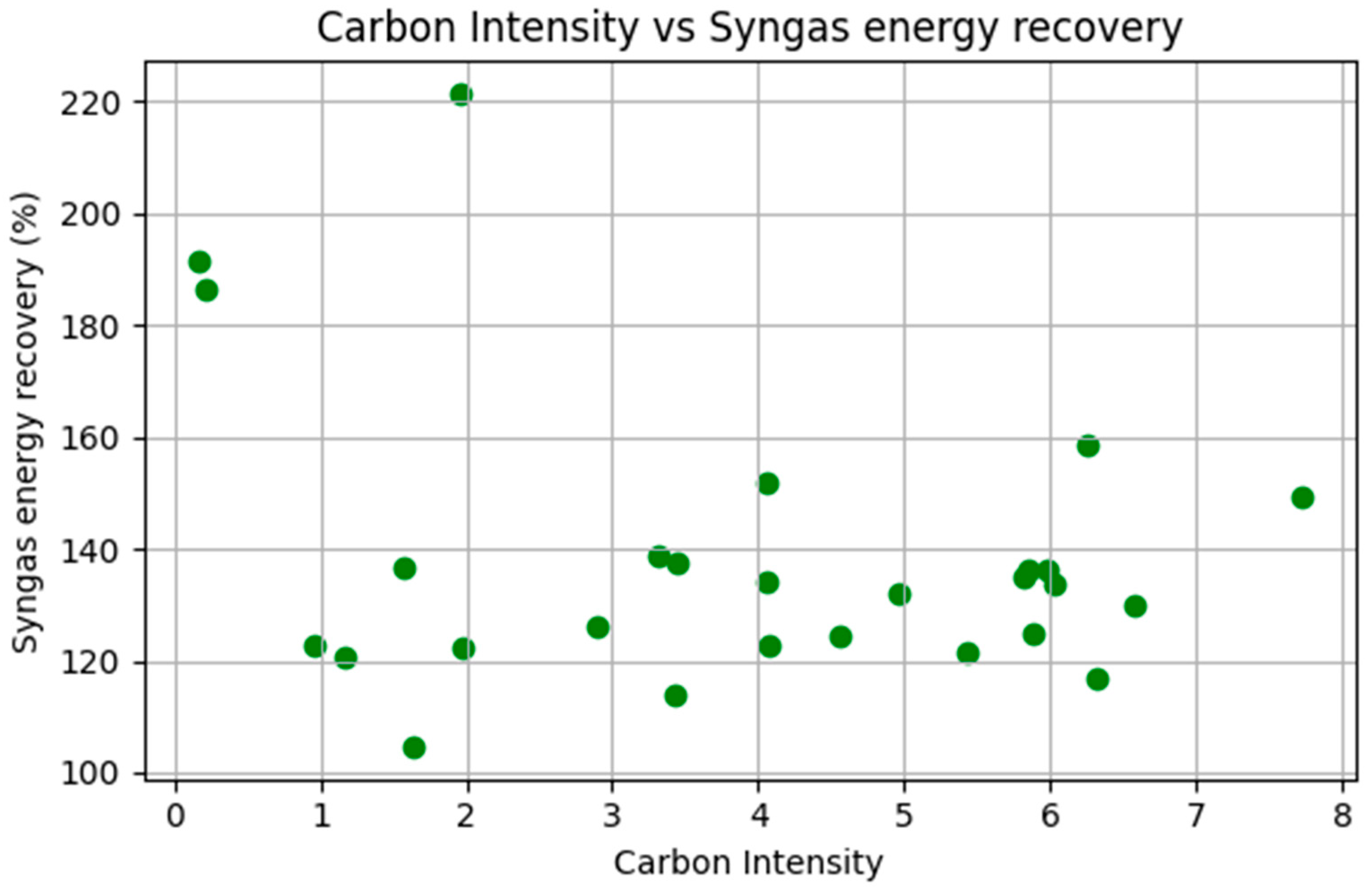
The sustainability of DRM was evaluated using two key metrics: carbon intensity (CI) and syngas energy recovery (SER). These indicators reflect the environmental and energetic aspects of the process, offering a more comprehensive assessment than conversion or yield alone.
4.1. Syngas Ratio (H2/CO) Trends
The syngas ratio (H2/CO) is a critical parameter for downstream applications such as Fischer–Tropsch synthesis and methanol production. In this study, the syngas ratio was calculated for each experimental run as the ratio of predicted H2 yield to CO yield. Across the tested operating space, the H2/CO ratio ranged from approximately 0.9 to 1.1, with values closest to unity observed at near-stoichiometric feed ratios (CH4/CO2 ≈ 1.0) and elevated temperatures (T ≥ 780 °C). At lower feed ratios or temperatures, the syngas ratio tended to decrease slightly due to reduced H2 yield and increased CO formation via side reactions such as the reverse water–gas shift. Conversely, higher feed ratios or temperatures favoured H2 production, modestly increasing the H2/CO ratio. These results indicate that DRM can be tuned to produce syngas with a ratio close to 1:1 under optimal conditions, aligning with the requirements for many industrial processes. The ability to predict and control the syngas ratio through process variables further demonstrates the flexibility of DRM as a platform for tailored syngas production.
4.2. Carbon Intensity of Hydrogen Production
To assess the sustainability of DRM under different operating conditions, we calculated two primary metrics: the carbon intensity of hydrogen production and the syngas energy recovery of the DRM process (see
Table 2). These metrics provide insight into the environmental and energetic performance of the reaction, complementing the predictions from machine learning models.
Carbon intensity (CI) is defined as the ratio of unconverted CO
2 to the amount of hydrogen produced (Equation (3)):
This metric is dimensionless because both the numerator and denominator are percentages; thus, the units cancel. CI expresses the amount of unconverted CO2 per unit of hydrogen produced, normalized to the process outputs, and serves as a rapid comparative indicator of process sustainability.
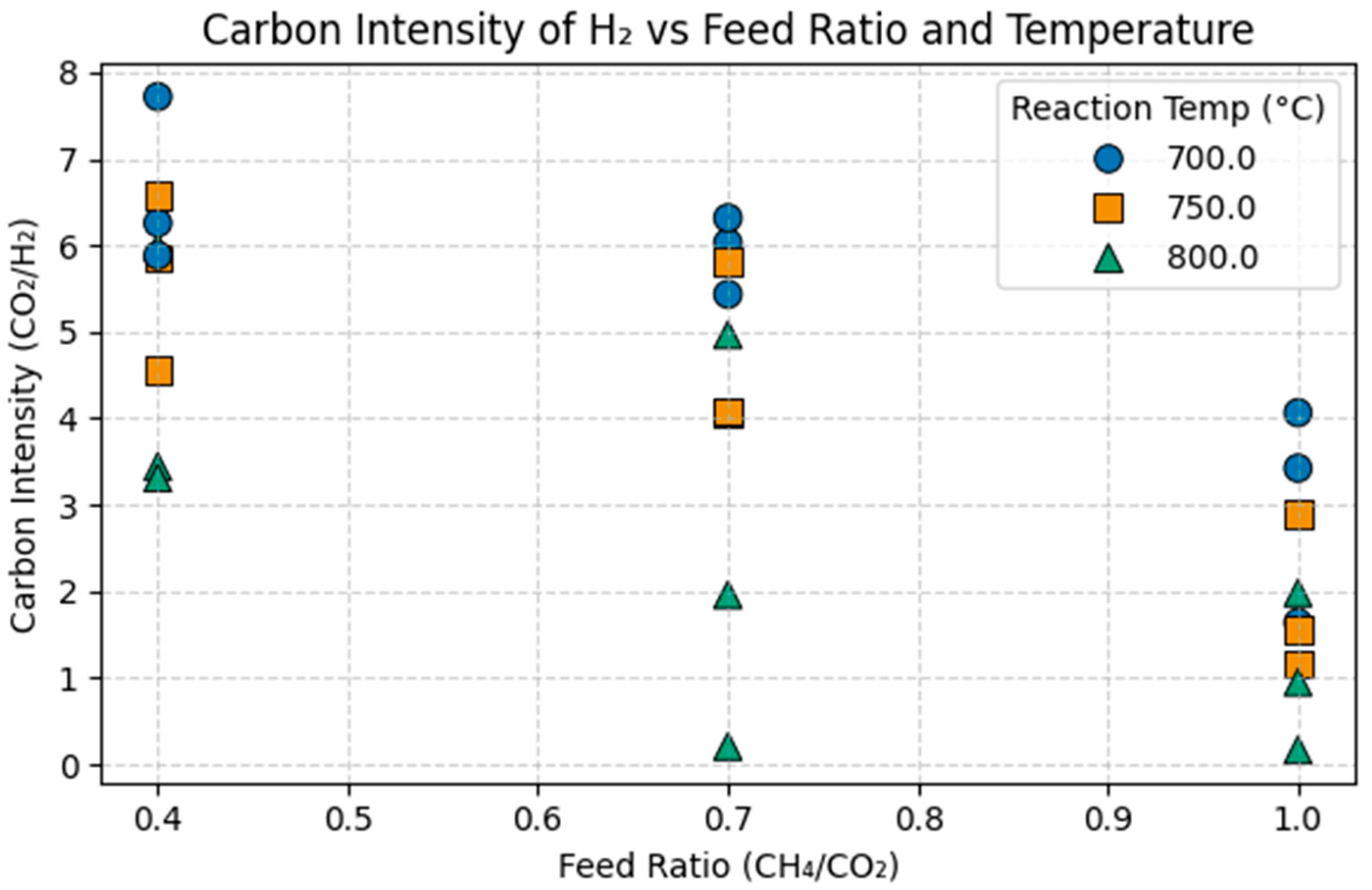
This dimensionless metric reflects the residual carbon footprint per unit of hydrogen generated; lower values indicate more effective CO2 utilization and cleaner hydrogen production. In this study, CI values ranged from 0.17 to 7.72.
The lowest CI values were consistently observed at near-stoichiometric feed ratios (CH4/CO2 ≈ 1.0) and temperatures above 780–800 °C. These conditions are thermodynamically favourable for both CH4 and CO2 activation, resulting in higher H2 yields and less unreacted CO2. This aligns with the entropy-driven nature of DRM and the shift in Gibbs free energy (ΔG) toward syngas formation at elevated temperatures.
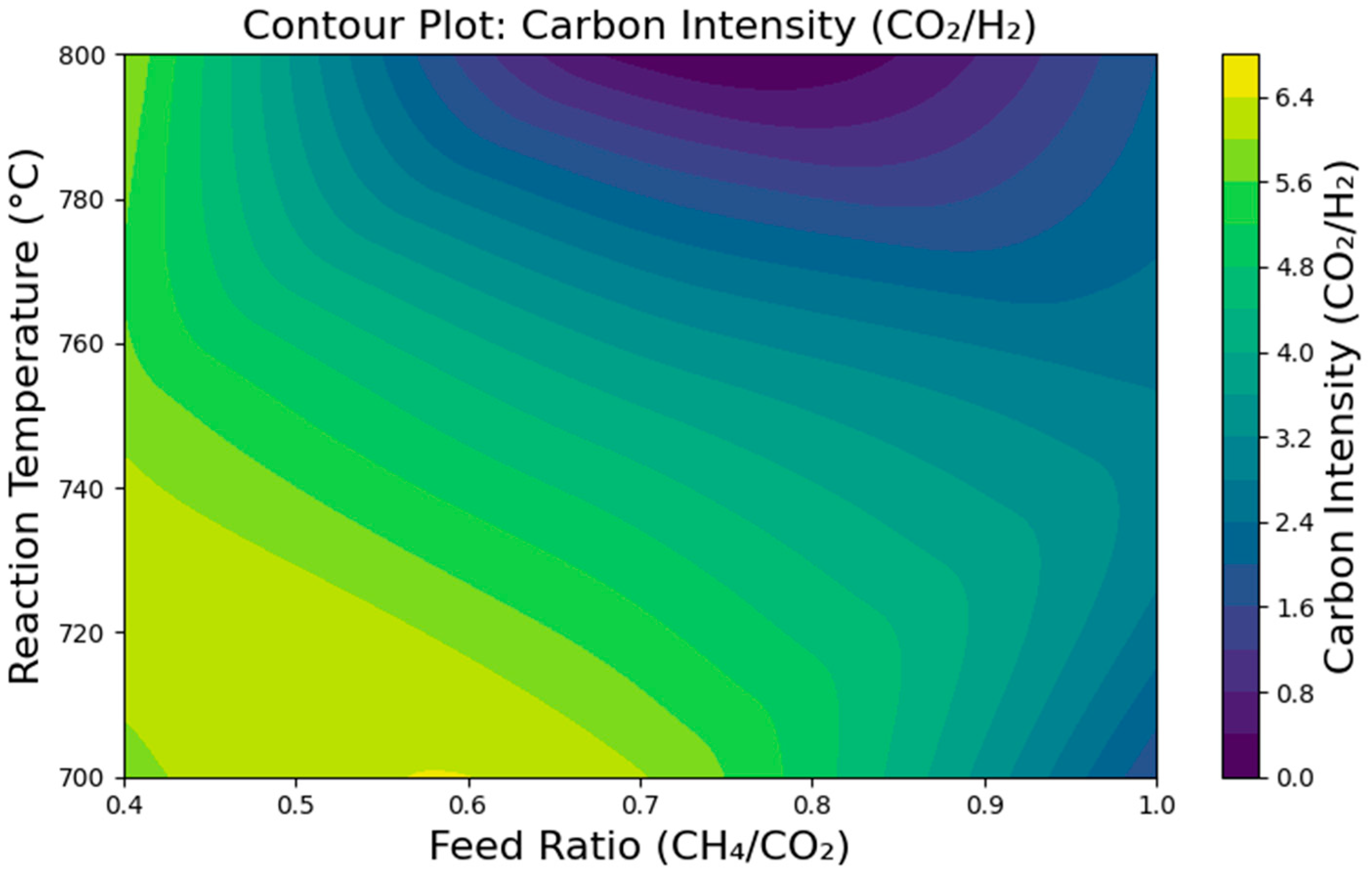
Contour plots (
Figure 1) illustrate this trend, with darker regions (low CI) corresponding to high temperatures and balanced feed ratios. Conversely, higher CI values were observed at low feed ratios and temperatures below 750 °C, indicating poor CO
2 utilization and less-sustainable operation (
Figure 2).
These results highlight the importance of both thermal input and reactant balance in minimizing the carbon footprint of hydrogen production via DRM. Incorporating CI as a sustainability metric, alongside thermodynamic features such as reaction enthalpy, improves the interpretability and relevance of the machine learning models in this study [
7,
8,
9,
10].
Limitations:
CI is not directly equivalent to standard LCA metrics such as kg CO2/kg H2, which account for all cradle-to-gate emissions, including upstream and downstream contributions. CI, as used here, is a process-level indicator that reflects only the residual CO2 in the reactor effluent relative to hydrogen yield. It does not capture upstream emissions from feedstock production, energy use, or catalyst manufacture. We have added a statement in the main text to clarify this distinction and to recommend that CI be used as a complementary, not substitutive, metric alongside full LCA-based indicators.
4.3. Syngas Energy Recovery of DRM
Syngas energy recovery (SER) was calculated as the ratio of the higher heating value (HHV) of the syngas products (H
2 and CO) to the energy content of the CH
4 feedstock, Equations (4) and (5) [
5,
11].
where
HHV(CH4): 55.5 MJ/mol
HHV(H2): 120 MJ/mol
HHV(CO): 10.1 MJ/mol
Note:
This metric does not account for the thermal energy input required for the endothermic DRM reaction and is used as a comparative indicator of energy recovery, not absolute thermodynamic efficiency. Values above 100% reflect the endothermic nature of DRM and the high energy content of syngas relative to CH4 alone.
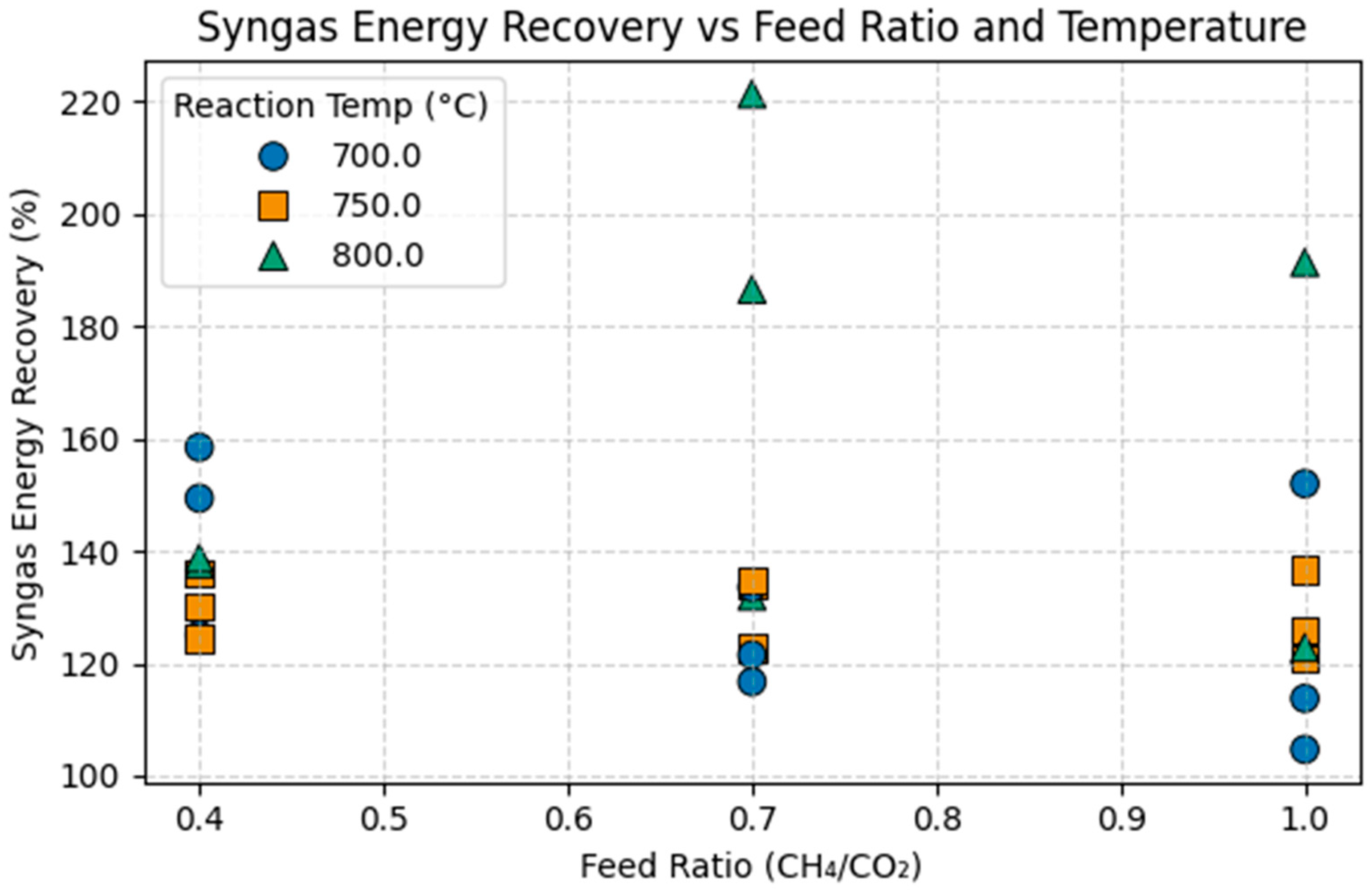
In the experimental dataset, syngas energy recovery values ranged from 104.68% to 191.35% (
Table 2). As shown in
Figure 3, syngas energy recovery values increased with temperature and peaked near CH
4/CO
2 ratios of 1.0. Under these conditions, CH
4 conversion and H
2 yield were maximized, ensuring efficient energy recovery in the syngas products. At lower temperatures and unbalanced feed ratios, efficiency declined due to incomplete conversion and unutilized CH
4.
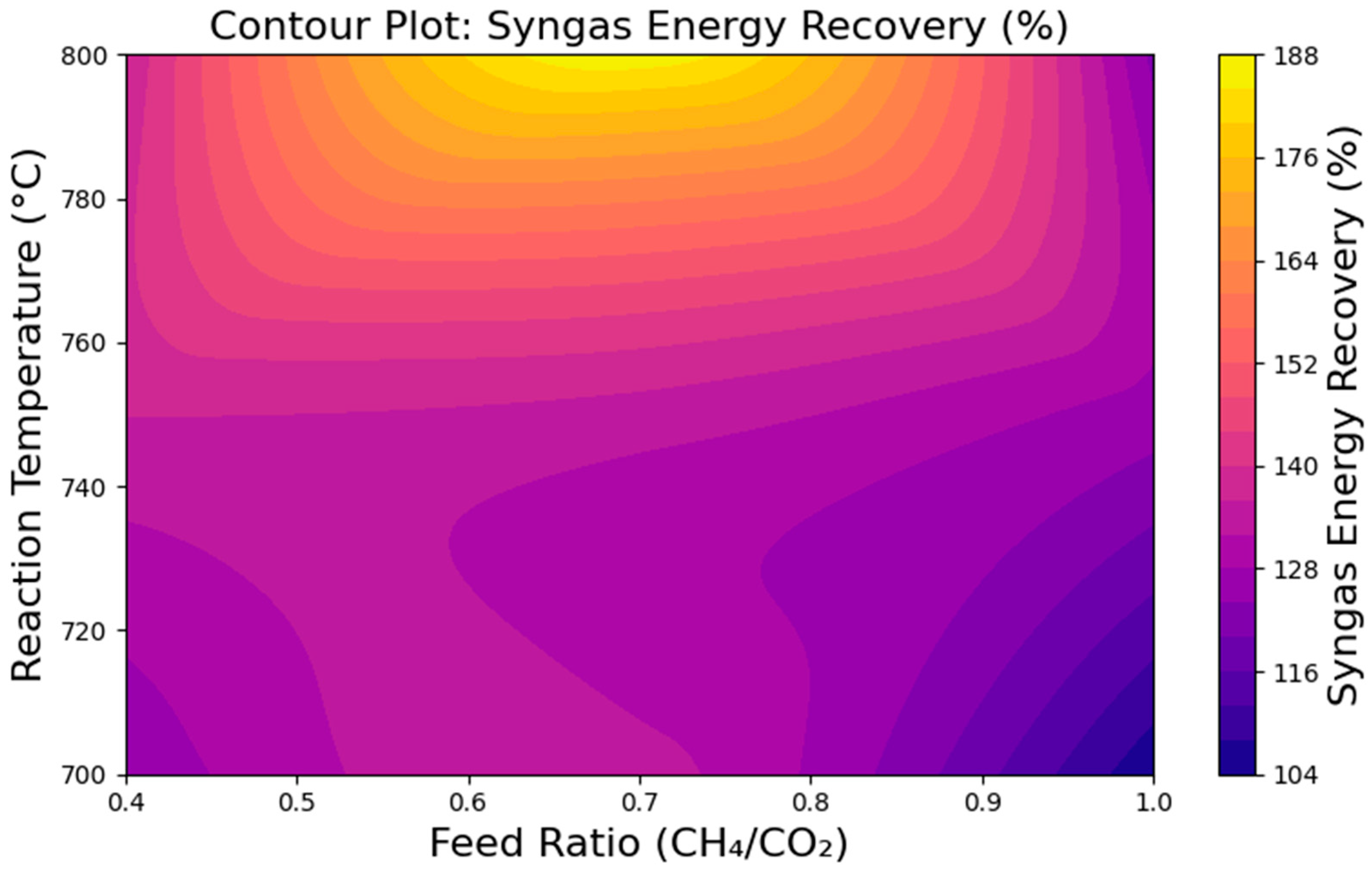
Contour plots (
Figure 4) further illustrate these trends, showing broad regions of high efficiency at elevated temperatures and balanced feed ratios (
Figure 3). These findings confirm that operating DRM at 780–800 °C with CH
4/CO
2 ≈ 1.0 yields the most sustainable performance, reinforcing the thermodynamic principle that temperature is the dominant driver in this endothermic process.
4.4. Visualization of Sustainability Metrics
Contour plots (
Figure 1 and
Figure 4) were generated to visualize the variation of carbon intensity and syngas energy recovery across the DRM operating space. These plots show the following:
Carbon intensity decreases with increasing temperature and feed ratio (
Figure 1).
Syngas energy recovery increases under the same conditions, peaking in the same region
Figure 3).
These trends highlight the dual benefit of operating DRM at high temperatures and balanced CH4/CO2 ratios: improved conversion and yield, as well as enhanced sustainability. Lower carbon intensity is achieved at higher feed ratios and temperatures, confirming that optimal DRM conditions favour CO2 utilization and cleaner hydrogen. Syngas energy recovery peaks near CH4/CO2 ≈ 1.0 and T ≥ 780 °C, consistent with thermodynamic expectations.
Integrating thermodynamic features, carbon intensity, and syngas energy recovery metrics provides a comprehensive framework for evaluating DRM sustainability. The results emphasize that high temperatures and balanced CH4/CO2 feed ratios are critical for maximizing both environmental and energetic performance, supporting the development of cleaner hydrogen production pathways.
5. Comparative Modelling: Machine Learning vs. Kinetic Models
To benchmark data-driven approaches against traditional methods, DRM performance was modelled using both simplified kinetic expressions and machine learning regressors [
4]. This dual approach enabled a comprehensive evaluation of predictive accuracy, interpretability, and generalizability for key outputs: CH
4 conversion, CO
2 conversion, H
2 yield, and CO yield.
5.1. Linear Kinetic Models
Linear kinetic models assumed first-order dependence on a single reactant, consistent with surface reaction-controlled kinetics. These models produced near-perfect fits (R2 = 1.0) for CH4 and CO2 conversions:
(α = 1, β = 0), indicating dependence only on CH4 concentration.
(α = 0, β = 1), indicating dependence only on CO2 concentration.
These models matched experimental data well, reflecting minimal complexity and confirming surface reaction control. However, they could not capture the nonlinear behaviour observed in H2 and CO yields.
5.2. Nonlinear Kinetic Models
To address these limitations, nonlinear kinetic models were developed using fitted exponents:
(α = 1.58, β = –0.28), indicating a stronger dependence on CH4 and a slight inverse dependence on CO2.
(α = 1.55, β = –0.26.)
Similar nonlinear behaviour as H2 is demonstrated. CO yield also increases with CH4 and slightly decreases with CO2, similar to H2 yield. This shows reasonable alignment but is not perfect.
These expressions suggest a stronger dependence on CH4 and a slight inverse dependence on CO2, likely due to complex surface phenomena such as competitive adsorption or reverse water–gas shift reactions. While these models captured general trends, they deviated from experimental values due to limited flexibility and inability to model feature interactions.
5.3. Machine Learning Models
To capture the nonlinear and multivariate dependencies among process variables and product yields, three supervised machine learning (ML) algorithms—CatBoost, Random Forest (RF), and Support Vector Regression (SVR)—were developed and benchmarked. All models were implemented in Python (scikit-learn v1.3) and trained using a 90:10 train–test split. Hyperparameters were optimized via GridSearchCV, employing 3-fold and 5-fold cross-validation to ensure robustness. To further enhance generalizability for the relatively small dataset (
n = 27), Leave-One-Out Cross-Validation (LOOCV) was also conducted [
11].
Each model was trained to predict CH4 conversion, CO2 conversion, H2 yield, and CO yield using temperature, feed ratio, metal loading, and reaction time as the baseline input variables. The predictive frameworks were assessed using mean absolute error (MAE), root mean square error (RMSE), and the coefficient of determination (R2) on both cross-validated and test datasets.
All machine learning models were tuned using grid search with cross-validation (GridSearchCV), optimizing for the lowest root mean square error (RMSE) on the validation set. The following parameter grids were used for RF and CatBoost, and the best hyperparameters for each target are given in
Table A3:
Random Forest:
- o
n_estimators: [50, 100, 200]
- o
max_depth: [None, 10, 20]
CatBoost:
- o
iterations: [50, 100, 200]
- o
learning_rate: [0.01, 0.1, 1]
All other models (e.g., Ridge, Lasso, SVR, XGBoost, LightGBM, MLP) were similarly tuned using appropriate parameter grids, as detailed in the revised
Section 2.
Among the baseline models, CatBoost and Random Forest exhibited the highest predictive accuracy, achieving R2 > 0.90 for CH4 and CO2 conversions with normalized RMSE < 0.05. CatBoost’s ordered boosting and built-in regularization mitigated overfitting under limited data conditions, while RF’s ensemble averaged enhanced stability and variance reduction. SVR yielded slightly improved accuracy for CO yield prediction, confirming the suitability of kernel-based regression for capturing subtle nonlinearities in CO formation kinetics.
In addition to these baseline models, a physics-informed ML framework was later introduced (see
Section 5) to incorporate thermodynamic and sustainability-based engineered features such as reaction enthalpy (ΔH), carbon intensity (CI), and syngas energy recovery. These features enabled the models to better reflect underlying process constraints and sustainability trade-offs, thereby improving accuracy and interpretability.
Model uncertainty was minimized through the combined use of GridSearchCV and LOOCV, ensuring reproducibility and robust statistical validation. Feature-importance analysis further revealed that temperature and feed ratio were dominant predictors for conversions and yields, consistent with the reaction thermodynamics and kinetic trends discussed in
Section 3.
Overfitting Risk and Cross-Validation Approach
Given the relatively small dataset (
n = 27), there is an inherent risk of overfitting when training machine learning models, especially with the inclusion of engineered features in the physics-informed framework. To mitigate this, we employed
Leave-One-Out Cross-Validation (LOOCV), which is particularly well-suited for small datasets. In LOOCV, each data point is used once as a test sample while the remaining points form the training set, and this process is repeated for all data points. This approach maximizes the use of available data for both training and validation, providing an unbiased estimate of model generalizability and helping to detect and reduce overfitting. The consistently high R
2 and low RMSE values across LOOCV folds [
11] confirm that the models retain predictive power without memorizing the training data. This robust validation strategy ensures that the improved accuracy observed with the physics-informed ML framework reflects genuine predictive capability rather than overfitting to the limited dataset.
Key results:
CatBoost and Random Forest achieved R2 > 0.90 for CH4 and CO2 conversions, capturing strong nonlinear relationships.
SVR performed slightly better for CO yield due to its kernel-based flexibility.
Combined GridSearchCV and LOOCV minimized model uncertainty and enhanced robustness.
Physics-informed enhancements (
Section 5) further improved accuracy and interpretability through physically grounded features (ΔH, CI, EE).
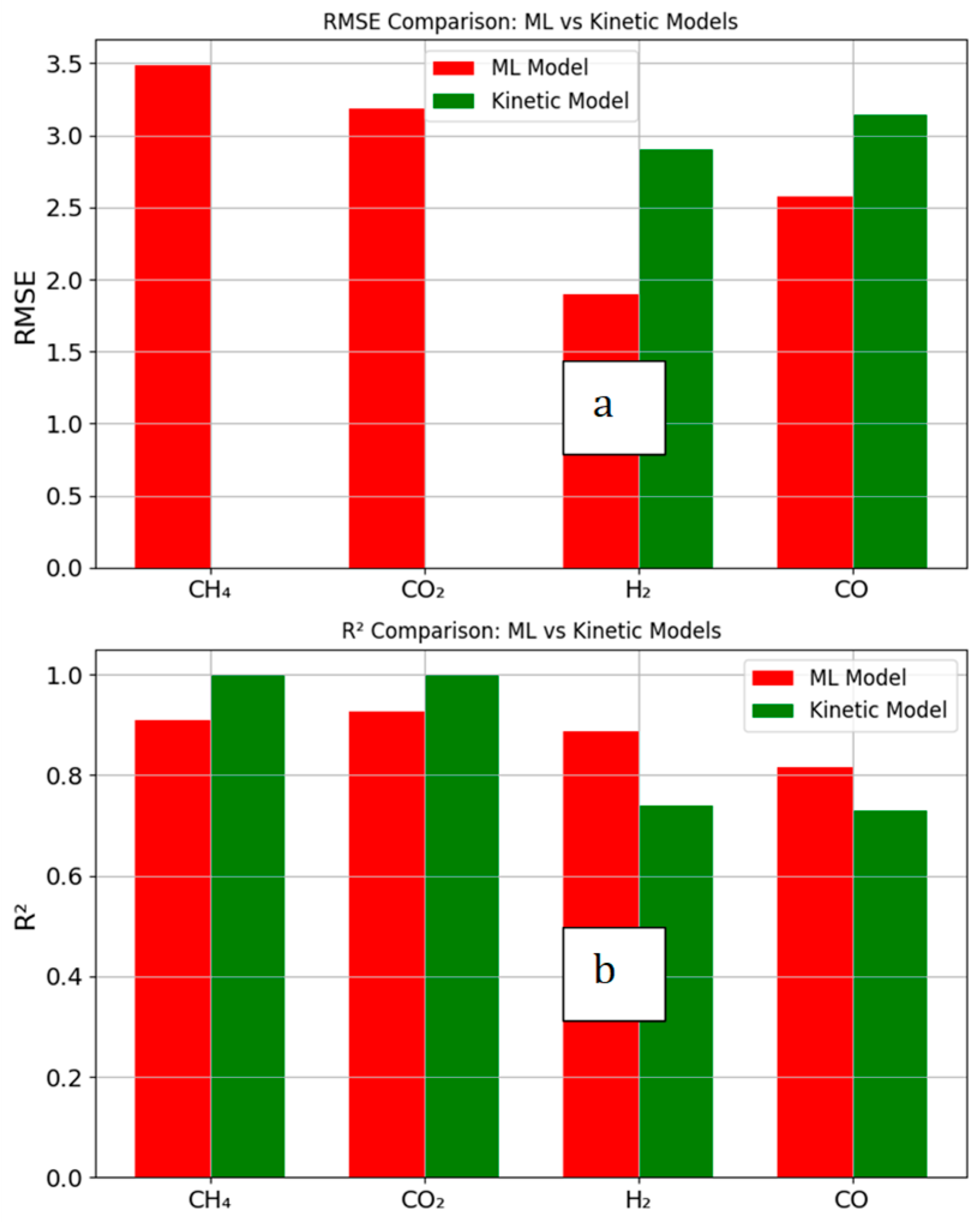
5.4. Comparative Performance Summary
Table 3 presents selected kinetic model outputs, while
Table 4 compares RMSE and R
2 values across all models.
5.5. Model Comparison and Discussion
This comparison demonstrates that machine learning (ML) and kinetic modelling are complementary. Kinetic models provide interpretability and are grounded in physical chemistry, describing reaction steps and rate laws. In contrast, ML models offer superior accuracy and adaptability, particularly in data-scarce or nonlinear regimes, but do not directly reveal reaction mechanisms.
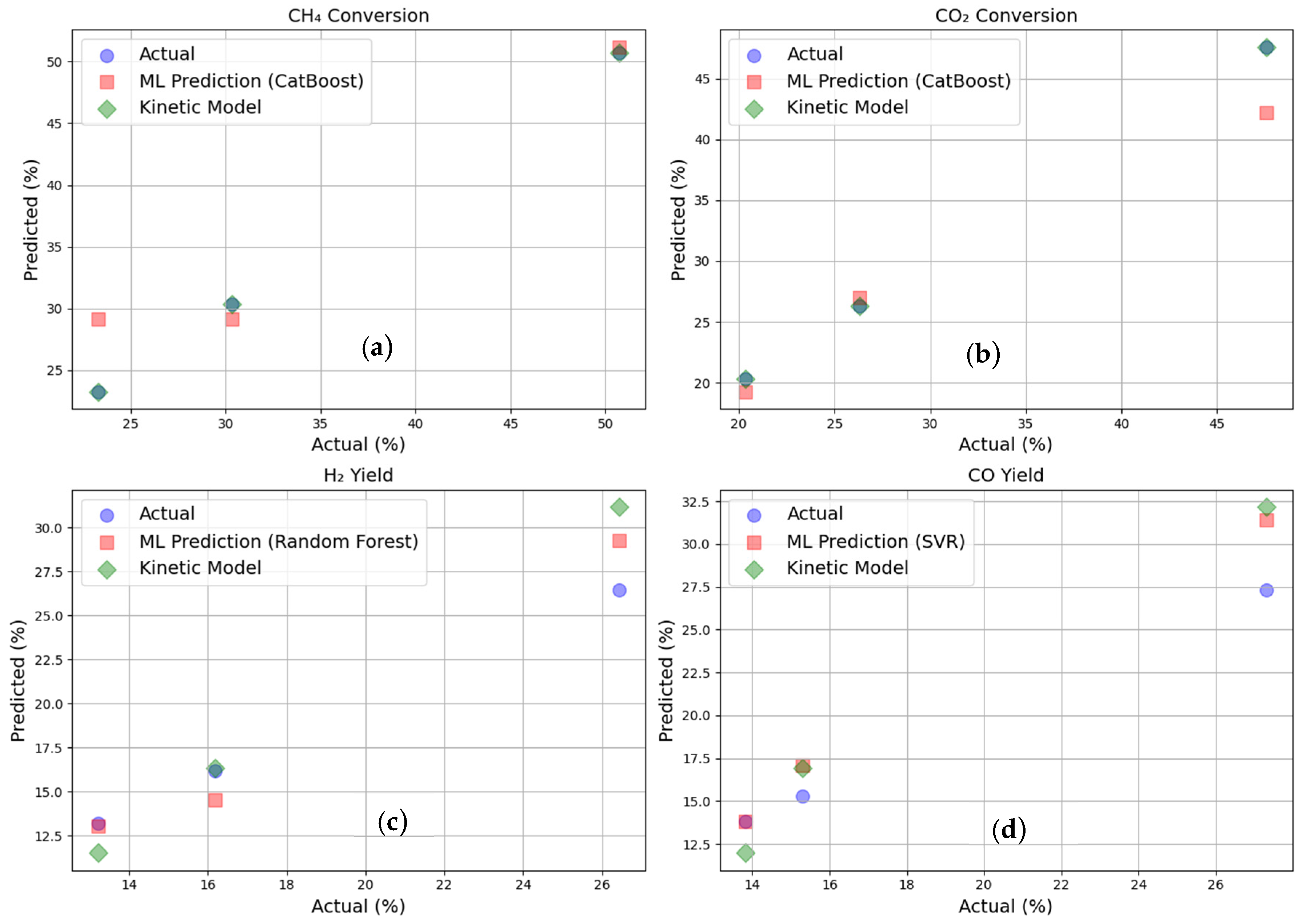
While ML models are data-driven and lack inherent chemical interpretability (see
Table 5,
Figure 5 and
Figure 6), they can still support mechanistic understanding by performing the following:
Identifying influential variables (e.g., temperature, feed ratio, Ni loading).
Revealing nonlinear interactions that may indicate mechanistic thresholds.
Guiding hypothesis generation for further experimental or theoretical validation.
Therefore, ML is a valuable tool for uncovering trends and optimizing conditions but should be used alongside mechanistic studies (such as spectroscopy, DFT, or kinetic modelling) to fully elucidate reaction pathways.
5.6. Activation Energy Analysis
The temperature dependence of the reaction rate constant for DRM was analyzed using the Arrhenius equation:
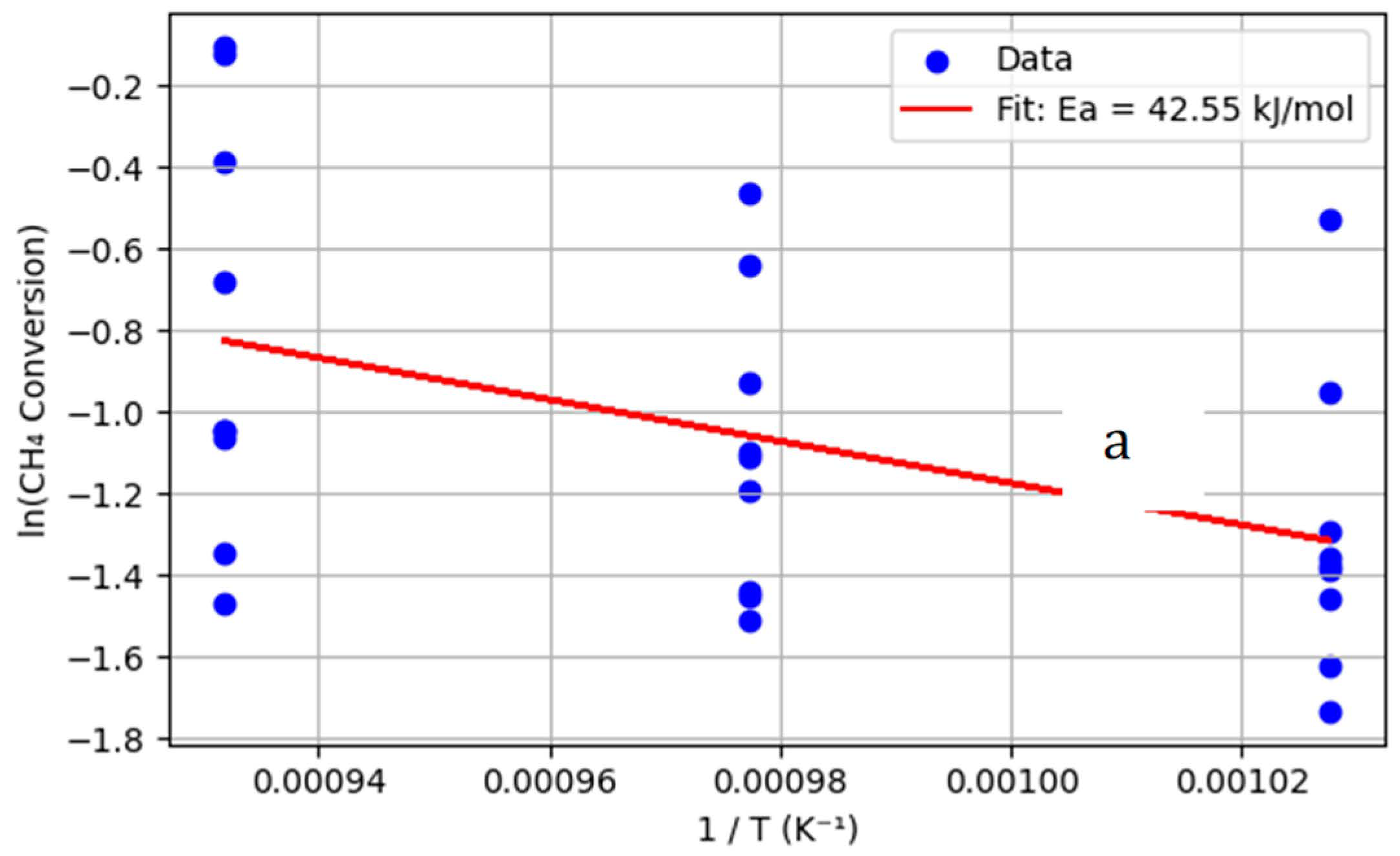
where k is the apparent rate constant, A is the pre-exponential factor, Ea is the activation energy, R is the universal gas constant (8.314 J/mol·K), and T is the absolute temperature. Activation energies were estimated from the slope of ln(k) vs. 1/T plots, based on experimentally determined rate constants under varying temperatures. This approach ensures that the kinetic analysis is correctly referenced to reaction rates, not directly to conversion or yield.
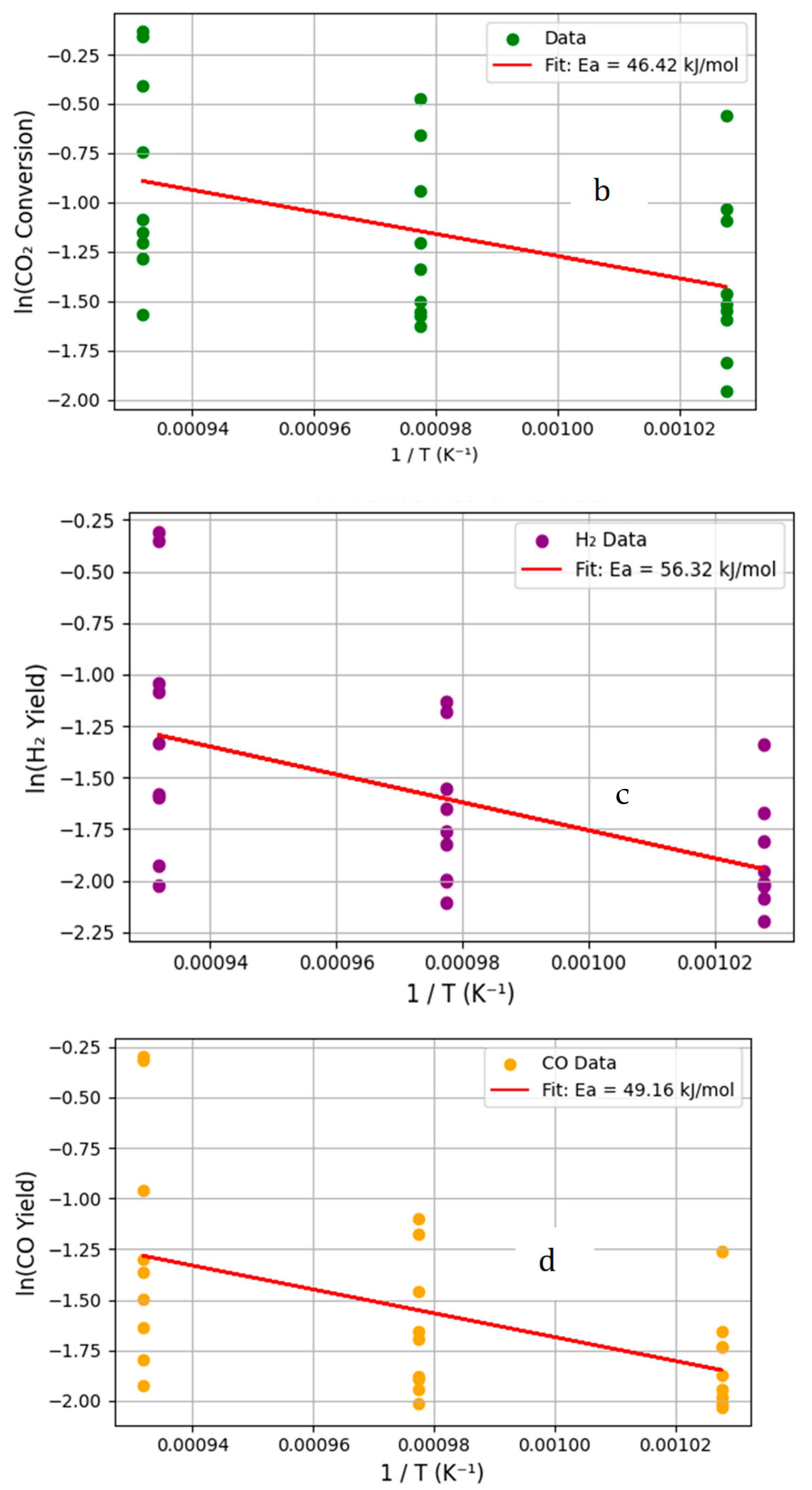
Activation energies were estimated from Arrhenius plots for all major DRM outputs:
These values fall within the expected range for surface reaction-controlled kinetics (30–150 kJ/mol), confirming that DRM under the studied conditions is governed by chemical kinetics rather than diffusion limitations.
The higher activation energy for H
2 yield (56.3 kJ/mol) reflects the energetic demands of breaking C–H bonds, forming H–H bonds, and the impact of side reactions such as reverse water–gas shift (RWGS) and strong hydrogen adsorption on the catalyst. CO formation, with a lower activation energy (49.2 kJ/mol), is more thermodynamically favourable due to direct bond rearrangements [
12].
Both CH4 and CO2 conversions (42.6 and 46.4 kJ/mol) further support a surface reaction-controlled regime. This insight justifies the use of kinetic and machine learning models that emphasize reaction-driven behaviour.
The linearity of Arrhenius plots (
Figure 7) supports a surface reaction-controlled mechanism. The higher activation energy for H
2 yield highlights the need for catalyst design that lowers the energy barrier for H
2 formation and suppresses side reactions. Maintaining high temperatures is essential for surface-driven kinetics. In summary, activation energies indicate that temperature and catalyst design are critical for optimizing DRM, particularly for selective syngas production.
6. Physics-Informed ML Modelling for DRM
Physics-informed ML (PIML) frameworks integrate process knowledge and thermodynamic principles into data-driven models, enabling improved accuracy, interpretability, and generalization beyond the experimental domain.
The modelling approach involved three steps:
Step 1: Baseline ML Setup
The initial model used only process variables (feed ratio, reaction temperature, metal loading) as inputs and predicted CH4 conversion, CO2 conversion, H2 yield, and CO yield using a Random Forest regressor. While this approach captured general trends, it did not reflect underlying reaction mechanisms or sustainability metrics.
Step 2: Physics-Informed Feature Engineering
Three thermodynamic and sustainability-based features—reaction enthalpy (ΔH); carbon intensity (CI) Equation (3); and syngas energy recovery, Equation (4)—were incorporated into the ML models. These features served as physics-based constraints, embedding fundamental chemical and energy relationships into the predictive architecture. These features introduced thermodynamic constraints and sustainability metrics into the learning process, anchoring the model in chemical reality.
Step 3: Model Retraining and Evaluation
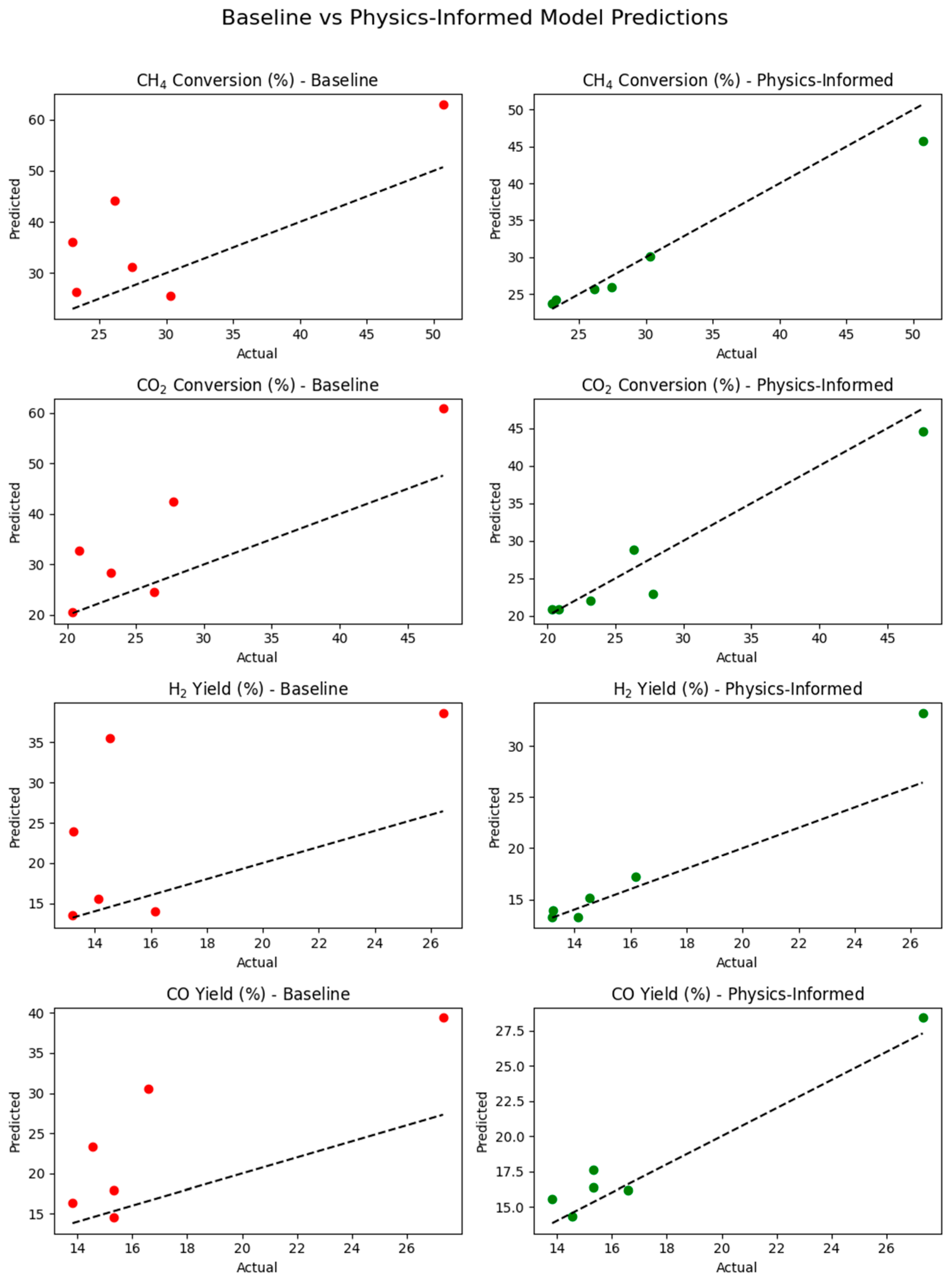
Models were retrained using both baseline and physics-informed features. Performance, evaluated by R
2 and RMSE, improved significantly for all targets when physics-informed features were included (see
Figure 8). These features impose soft physical constraints, improving generalization. The inclusion of ΔH, CI, and EE markedly improved predictive accuracy and physical interpretability across all targets (CH
4 and CO
2 conversion, H
2 and CO yields). Mean RMSE decreased by 20–40% relative to baseline models, while R
2 values consistently exceeded 0.90 across validation folds. The improvements were most pronounced for CO
2 conversion and H
2 yield, indicating that the PIML models effectively captured the coupling between reaction thermodynamics and energy utilization.
7. Feature Importance
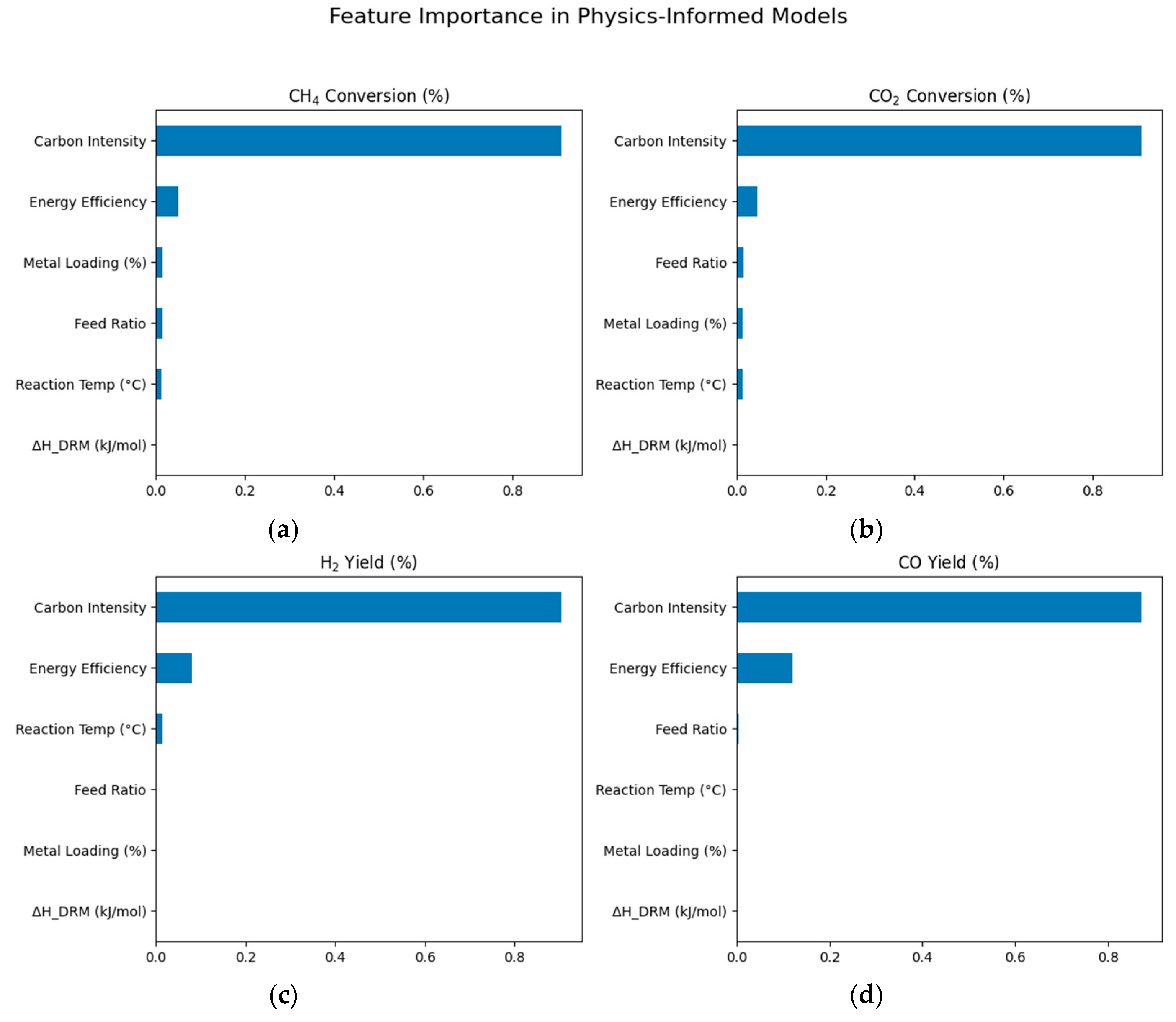
Feature importance analysis revealed that carbon intensity, syngas energy recovery, and reaction temperature were the most influential predictors, confirming the value of physics-informed modelling (
Figure 9).
Physics-informed ML modelling significantly improves predictive performance and interpretability for DRM
Table 6. By embedding thermodynamic and sustainability metrics, the models better capture the underlying reaction behaviour and offer insights into optimal operating conditions.
8. Sensitivity and Scenario Analysis
8.1. Sensitivity Mapping
Sensitivity analysis using partial dependence plots (PDPs) and permutation importance quantified the impact of each input feature on DRM performance. PDPs revealed nonlinear relationships, particularly between temperature and H
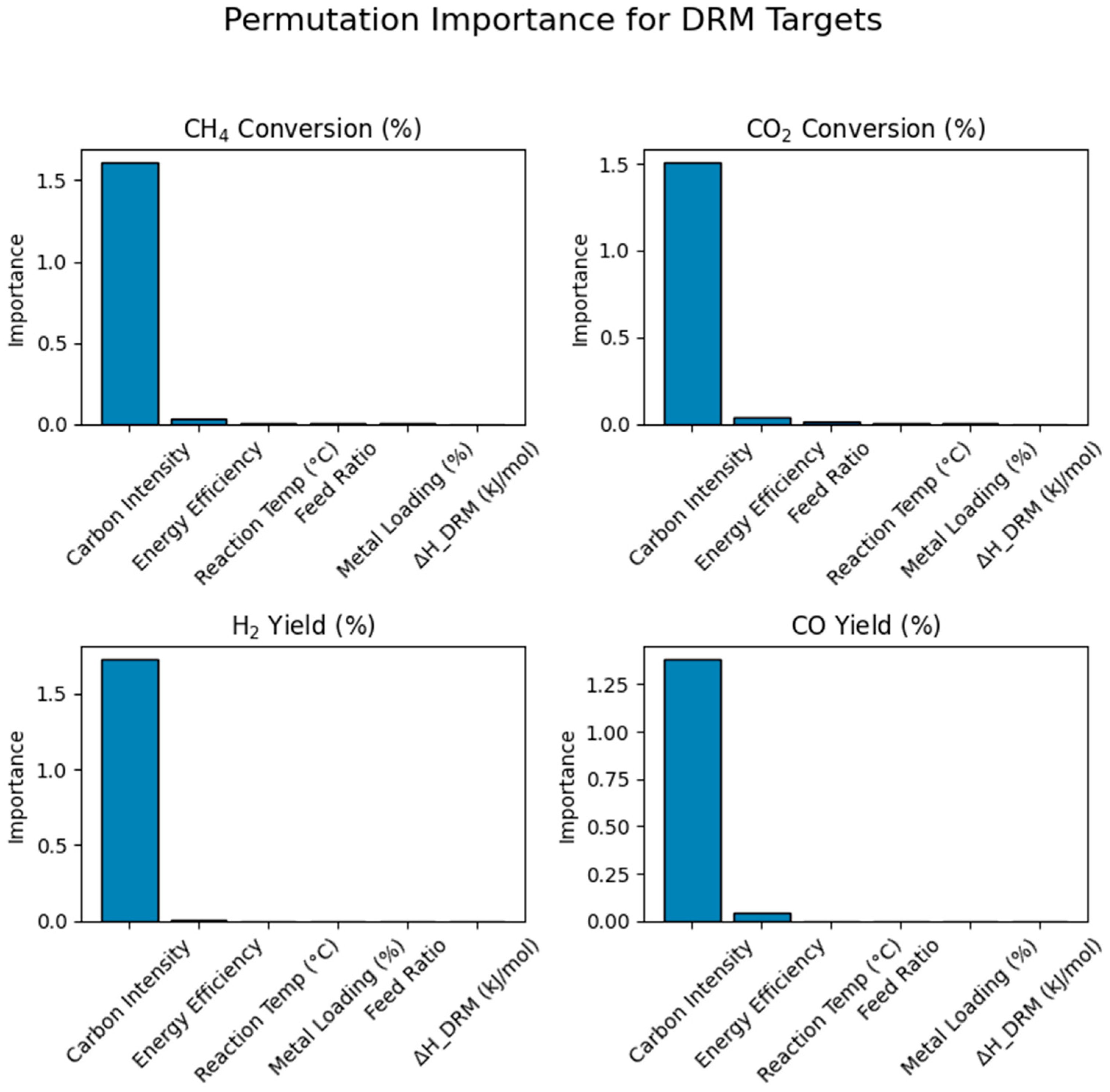
2 yield, highlighting the importance of thermal input. Permutation importance consistently ranked carbon intensity (CI) as the most influential feature across all targets, followed by syngas energy recovery (SER), reflecting the significance of these sustainability metrics (see
Figure 10).
Sensitivity analysis results (
Figure 10) show that reaction temperature is the most influential parameter for CH
4 and CO
2 conversions, followed by feed ratio, while metal loading has a secondary effect. For sustainability metrics, carbon intensity (CI) and syngas energy recovery (SER) dominate model predictions, confirming that operating windows near CH
4/CO
2 ≈ 1.0 and T ≥ 780 °C are optimal for minimizing CI and maximizing SER.
8.2. Comparison with Feature Importance in Physics-Informed Models
Carbon intensity consistently ranked highest across all targets, confirming its dominant role in DRM performance. Syngas energy recovery showed moderate influence, especially for CO and CO2 conversion. ΔH_DRM, being constant, contributed no sensitivity but remains conceptually important.
These insights help prioritize experimental variables and refine control strategies.
9. Expanded Monte Carlo Simulation Analysis
The Monte Carlo analysis identifies stable performance regimes, analogous to process operability windows, offering guidance for industrial DRM control systems. Monte Carlo simulations were used to quantify uncertainty in DRM performance due to variability in key operating parameters: feed ratio, temperature, and metal loading. This probabilistic approach supports risk-aware decision-making and robust process design.
9.1. Assumptions
Input variables (feed ratio, temperature, metal loading) were assumed to follow uniform distributions within experimentally observed bounds. The trained Random Forest models were assumed to reliably capture nonlinear relationships between inputs and outputs.
9.2. Simulation Setup
Feed Ratio: (CH4/CO2): 0.4 to 1.0.
Temperature: 700 °C to 800 °C.
Metal Loading: 5% to 15%.
A total of 1000 random input combinations were generated via uniform sampling, and the ML models predicted six key performance metrics for each combination: CH4 conversion, CO2 conversion, H2 yield, CO production, carbon intensity, and syngas energy recovery.
The choice of 1000 iterations ensure statistical robustness, while uniform distributions reflect the absence of prior bias regarding the likelihood of specific operating conditions. In other words, each value within the defined range for each input variable (feed ratio, temperature, metal loading) is considered equally probable in the simulation. This approach is appropriate when there is no prior information or operational constraint favouring certain values over others, and it ensures that the uncertainty quantification is not artificially skewed by subjective assumptions. This methodology provides a comprehensive and unbiased assessment of uncertainty for all key DRM performance metrics.
9.3. Results and Interpretation of Montecarlo Simulations
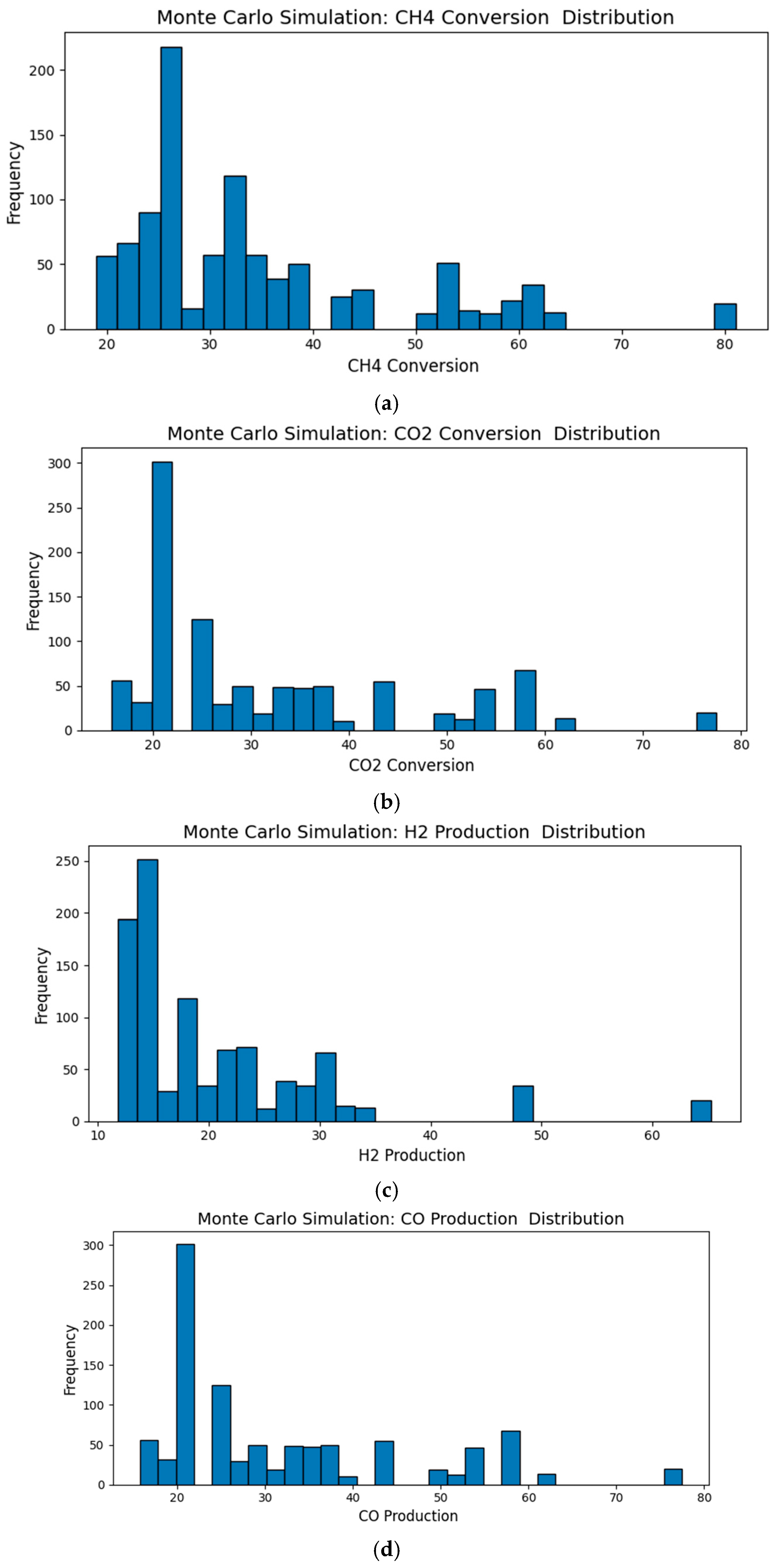
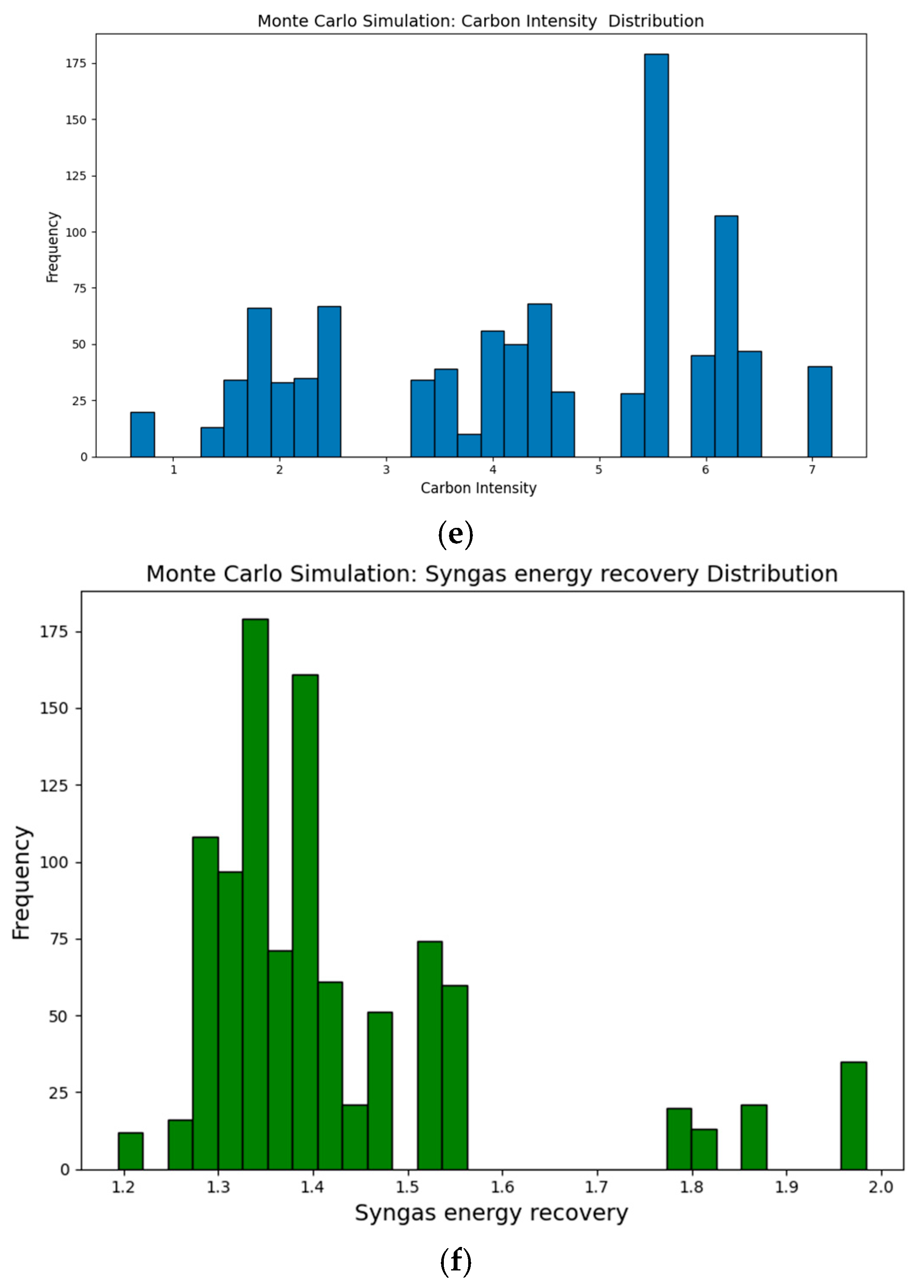
Monte Carlo simulations revealed broad and multimodal output distributions for all performance metrics (see
Figure 11a–f):
CH4 conversion ranged from 25% to 60% (95% confidence range for CH4 yield), with higher values achieved at elevated temperatures and balanced feed ratios.
CO2 conversion ranged from 15% to 85% (95% confidence range for CO2 yield), with stable operating zones around 30–40% conversion.
H2 yield varied from 10% to 75%, with most values between 15% and 35% (95% confidence range for H2 yield); higher yields required optimized catalyst and thermal conditions.
CO production closely mirrored CO2 conversion, reflecting the 1:1 stoichiometry of DRM.
Carbon intensity was skewed toward lower values, indicating that sustainable operating conditions are achievable, especially with higher H2 yield and CO2 conversion.
Syngas energy recovery values were tightly clustered, with optimal performance requiring balanced feed ratio, temperature, and metal loading.
9.4. Partial Dependence Insights
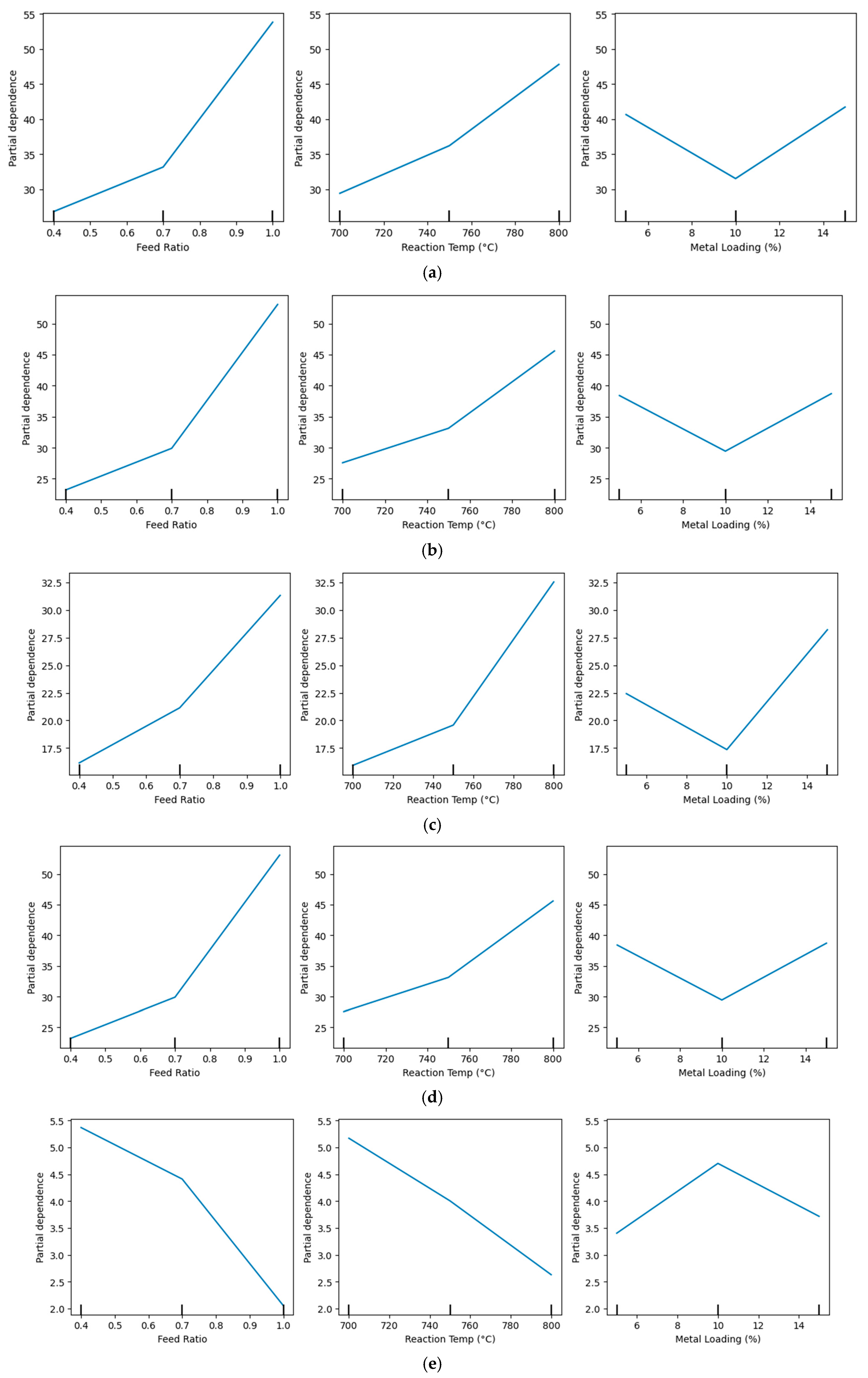
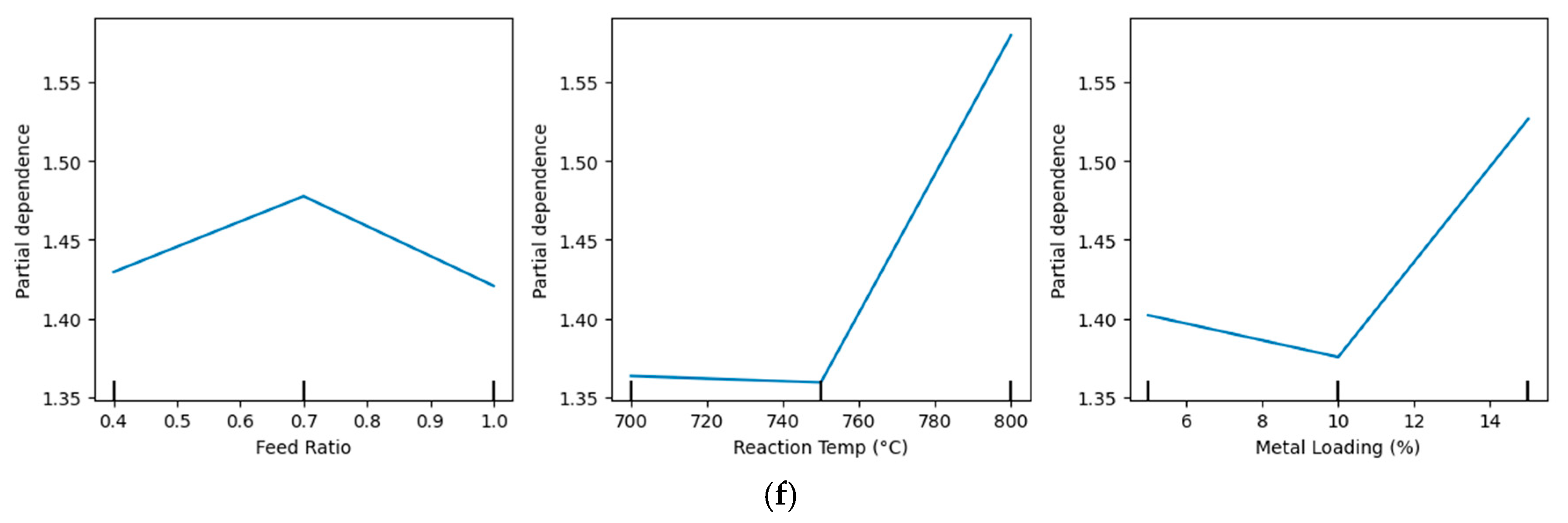
The partial dependence plots (
Figure 12a–e,
Table 7) provided further insight into how each input variable—feed ratio, temperature, and metal loading—individually influences the predicted outputs, while holding other variables constant. For CH
4 conversion, temperature emerged as the most influential factor, with higher values consistently enhancing conversion efficiency. Feed ratio also showed a positive trend, where increased CH
4 content improved conversion, while metal loading had a moderate effect, plateauing beyond an optimal threshold.
Feed Ratio: Slightly increasing trend—higher CH4 content improves conversion.
Temperature: Strong positive effect—higher temperatures enhance CH4 activation.
Metal Loading: Moderate influence—optimal loading improves conversion but plateaus.
In the case of CO2 conversion, both temperature and feed ratio played significant roles. Elevated temperatures promoted CO2 activation, while balanced feed ratios optimized reactant availability, leading to improved conversion. Metal loading contributed by influencing catalyst dispersion and surface area, though its effect was less pronounced.
Feed Ratio: Balanced ratios favour CO2 conversion by optimizing reactant availability.
Temperature: Higher temperatures drive CO2 activation and conversion.
Metal Loading: Influences catalyst dispersion and surface area for CO2 adsorption.
H2 yield was strongly dependent on temperature and metal loading. Higher temperatures favoured the endothermic DRM reaction, boosting hydrogen production, while moderate metal loading enhanced catalytic activity. However, excessive loading risked catalyst sintering, which could diminish performance. Feed ratio also influenced H2 yield, with higher CH4 availability generally leading to increased output.
Feed Ratio: Higher ratios generally increase H2 yield due to better CH4 availability.
Temperature: Elevated temperatures enhance the endothermic DRM reaction, boosting H2 yield.
Metal Loading: Moderate loading improves catalytic activity; excessive loading may cause sintering.
For CO production, the trends closely mirrored those observed for CH4 and CO2 conversion. Temperature was again the dominant driver, underscoring the importance of thermal activation, while feed ratio had a similar positive influence. Metal loading contributed positively but was less dominant in comparison.
Feed Ratio: Similar to CH4—more CH4 leads to more CO.
Temperature: Strongest driver—thermal activation is key.
Metal Loading: Positive but less dominant.
Carbon intensity was most sensitive to feed ratio and temperature. Lower feed ratios, which correspond to higher CO2 content, tended to reduce carbon intensity. Elevated temperatures also helped lower CI by improving both CO2 conversion and H2 yield. The effect of metal loading was nonlinear, with both under- and over-loading potentially increasing carbon intensity.
Feed Ratio: Lower feed ratios (more CO2) reduce CI.
Temperature: Higher temperatures reduce CI by improving CO2 conversion and H2 yield.
Metal Loading: Nonlinear—both under- and over-loading can increase CI.
Syngas energy recovery was influenced by all three input variables. An optimal feed ratio was necessary, as excessive CH4 or CO2 could reduce efficiency. Temperature had a consistently positive effect, enhancing conversion and energy recovery, while metal loading showed a moderate influence, with optimal levels improving overall process efficiency.
Feed Ratio: Optimal range exists—too much CH4 or CO2 reduces efficiency.
Temperature: Syngas energy recovery increases with temperature due to better conversion.
Metal Loading: Moderate effect—optimal catalyst loading enhances energy recovery.
9.5. Summary of Monte Carlo Insights
Monte Carlo analyses identify robust operating windows where H2 yield and CO2 conversion remain stable despite input fluctuations. Such windows are critical for scale-up and industrial deployment, ensuring consistent performance under real-world variability. The results confirm that precise feed control, stable heat supply, and optimized catalyst loading are essential for reliable syngas production, supporting techno-economic decisions and adaptive control strategies in industrial DRM systems.
9.6. Industrial Relevance
The sensitivity analysis and Monte Carlo simulations conducted in this study identified robust operating windows for DRM, where H2 yield and CO2 conversion remain stable despite fluctuations in feed ratio, temperature, and catalyst loading. These stable regions are crucial for industrial scale-up, as they ensure consistent syngas production and process reliability under real-world operating conditions, where variability is inevitable. The identification of these windows supports the development of adaptive control strategies, enabling operators to maintain optimal performance even as input parameters change. Precise feed control and stable heat supply were shown to be essential for maximizing hydrogen yield and minimizing carbon intensity, directly impacting process economics and sustainability.
These insights are particularly valuable for the design and operation of commercial DRM reactors, where process robustness and efficiency are key to economic viability. By providing a framework for risk-aware decision-making and process optimization, this study contributes to the advancement of DRM as a scalable and sustainable technology for low-carbon hydrogen and syngas production.
10. Techno-Economic Implications of Dry Reforming of Methane (DRM)
To evaluate the technical feasibility and economic viability of DRM, techno-economic metrics were derived from the ML predictions and sustainability features [
13].
10.1. Energy Input per kg H2
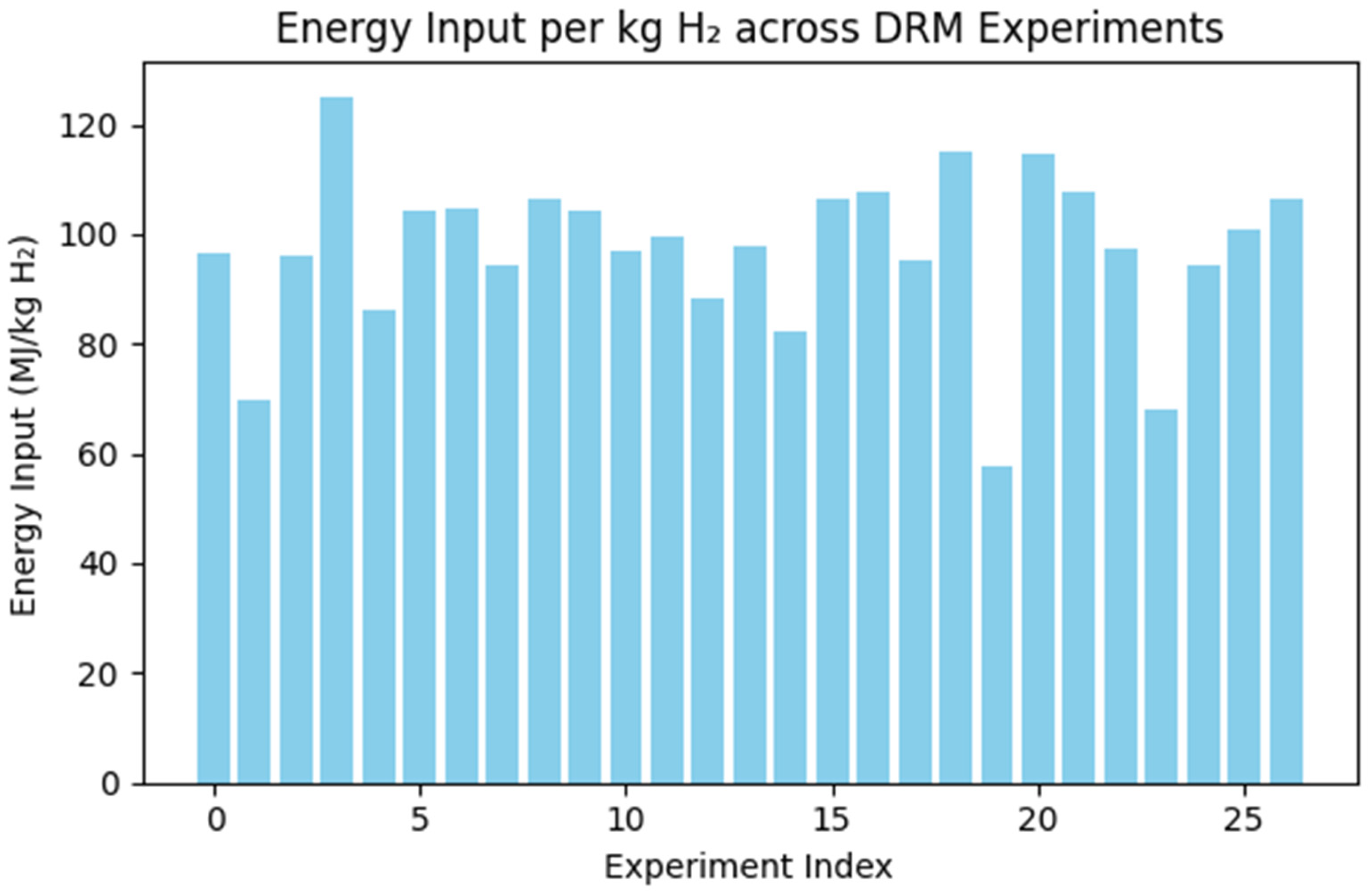
The energy required to produce 1 kg of hydrogen via DRM was estimated using CH
4 conversion and H
2 yield data from 27 experimental runs (see
Figure 13,
Table 8). Using the higher heating value (HHV) of CH
4 (55.5 MJ/kg), the average energy input was calculated as (Equation (10)):
The average energy input was 97.17 MJ/kg H
2, which is lower than typical values for Steam Methane Reforming (SMR, ~142 MJ/kg H
2) and electrolysis (~180–200 MJ/kg H
2). This indicates that, under optimized conditions, DRM can be a more energy-efficient pathway for hydrogen production [
13,
14]:
10.2. CO2 Avoided per kg Syngas (g/kg)
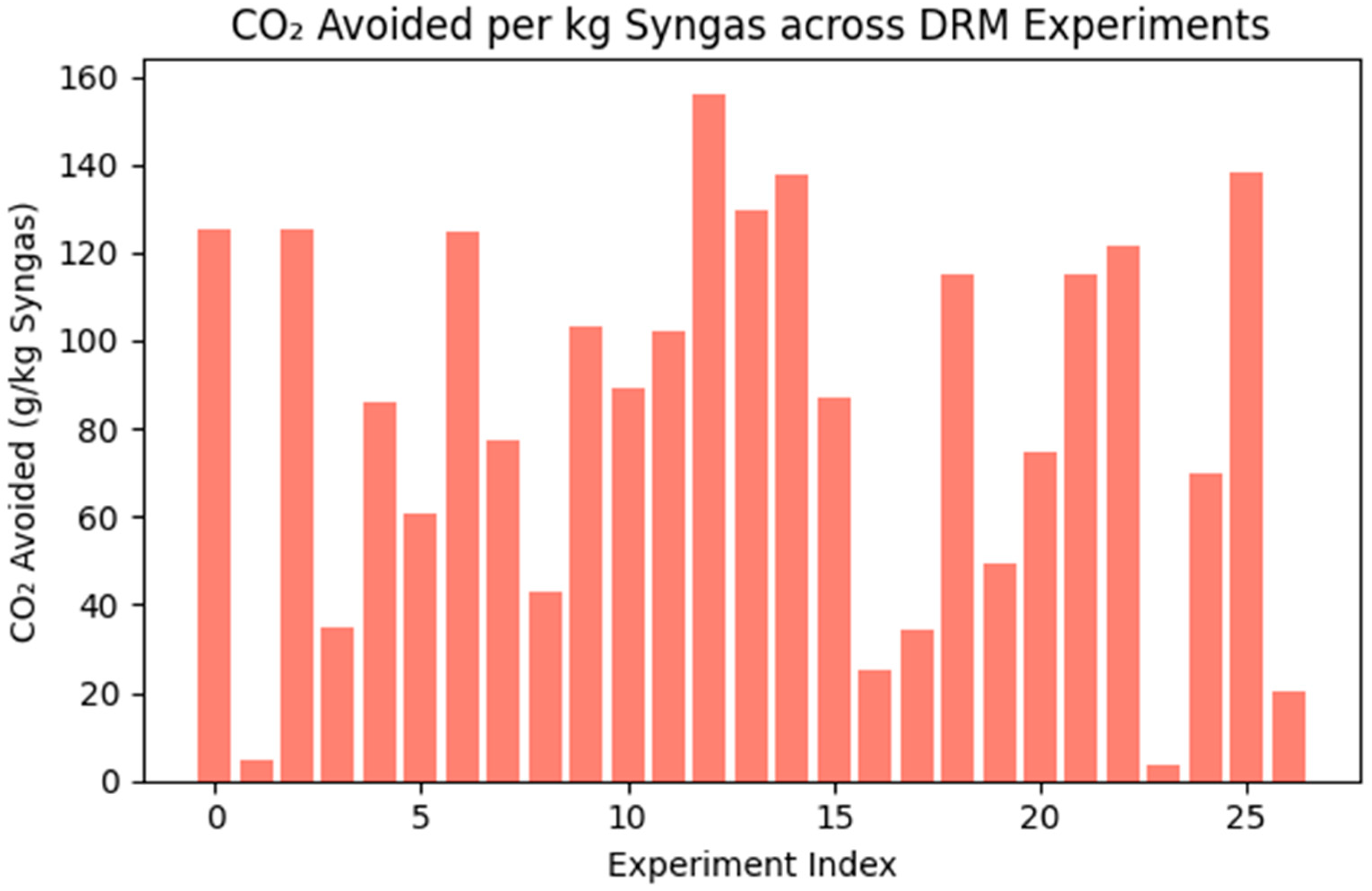
The amount of unconverted CO
2 per kg of syngas (H
2 + CO) was estimated as follows:
where
The average CO
2 avoided was 83.41 g/kg, indicating moderate CO
2 utilization. Lower values correspond to better carbon capture and cleaner syngas production;
Figure 14.
Together, these metrics offer a comprehensive view of DRM’s performance. High syngas energy recovery combined with low carbon intensity highlights the potential of DRM as a sustainable hydrogen production technology;
Figure 15. These insights can inform process optimization, policy development, and investment strategies in clean energy systems.
10.3. Comparative Energy Input by Technology
Table 9 compares the energy input required for hydrogen production by DRM, SMR, and electrolysis. DRM, based on experimental data, requires approximately 97 MJ/kg H
2, while SMR and electrolysis require ~142 MJ/kg H
2 and ~180–200 MJ/kg H
2, respectively. These results highlight DRM’s potential syngas energy recovery in DRM under optimized conditions.
Benchmarking DRM Against SMR and Electrolysis
To substantiate the competitiveness of DRM, we benchmarked its energy input, cost, and emissions against Steam Methane Reforming (SMR) and water electrolysis. As shown in
Table 9 and
Figure 16, the energy input required for hydrogen production by DRM is approximately 97 MJ/kg H
2, which is significantly lower than SMR (~142 MJ/kg H
2) and electrolysis (~180–200 MJ/kg H
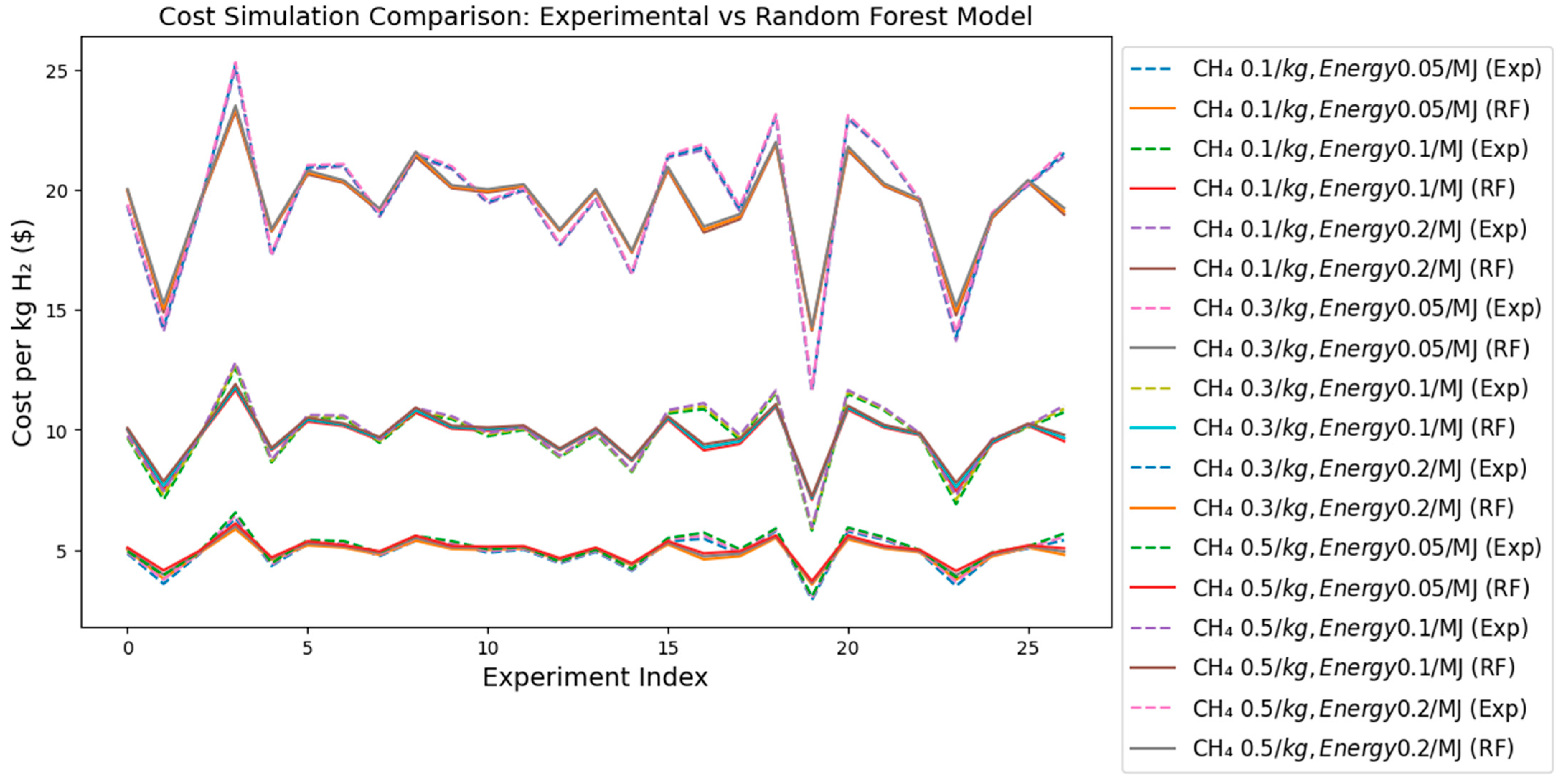
2). Cost simulations indicate that, under favourable feedstock and energy price scenarios, the cost of hydrogen from DRM ranges from 5 to 25 USD per kg H
2, making it competitive with SMR and approaching the cost of electrolysis, especially when renewable energy prices are low or carbon pricing is applied.
10.4. Cost Simulation for H2 Production
To assess the economic feasibility of DRM, cost simulations were performed using experimentally derived energy input values and varying feedstock and energy prices. Simulations considered CH
4 prices of 0.10, 0.30, and 0.50 USD per kg, and energy prices of 0.05, 0.10, and 0.20 USD per MJ. The cost per kg H
2 was calculated as (Equation (12)):
Costs ranged from approximately 5 to 25 USD per kg H
2, depending on the scenario. Lower CH
4 and energy prices significantly reduced production costs, highlighting DRM’s economic potential under favourable conditions. Similar techno-economic analyses have reported comparable sensitivities of hydrogen cost to feed and energy prices for DRM and SRM systems [
19,
20,
21]. The cost elasticity patterns observed here are consistent with other studies, which show that the levelized cost of hydrogen (LCOH) is strongly influenced by energy price and process efficiency [
19,
20,
21,
22]. Cost elasticity, in this context, refers to the proportional change in the levelized cost of hydrogen (LCOH) in response to a proportional change in input prices (e.g., energy or methane feedstock). A Random Forest regression model was also used to simulate costs under untested conditions and optimize process parameters, supporting scenario analysis for techno-economic assessments [
13,
23].
Figure 16 presents a comparison of hydrogen production cost simulations for DRM using experimentally derived energy input values and predictions from a Random Forest (RF) regression model. The RF model was trained using CH
4 conversion and H
2 yield as input features and effectively captured nonlinear relationships in the data. Cost per kg H
2 was simulated under varying CH
4 and energy price scenarios. RF-based predictions closely follow experimental trends while offering smoother estimates and improved generalizability.
Figure 16.
Cost per kg H
2 simulated using experimental energy input (dashed lines) and Random Forest model predictions (solid lines) across 27 DRM runs under varying CH
4 and energy prices [
23].
Figure 16.
Cost per kg H
2 simulated using experimental energy input (dashed lines) and Random Forest model predictions (solid lines) across 27 DRM runs under varying CH
4 and energy prices [
23].
As expected, higher CH4 and energy prices result in higher cost per kg H2. The cost ranges from approximately 5 to 25 USD/kg depending on the scenario. The RF model can be used to simulate cost under untested conditions or optimize process parameters. It supports scenario analysis for techno-economic assessments. Lower CH4 and energy prices significantly reduce production costs, highlighting DRM’s economic potential under favourable conditions.
10.5. Syngas Energy Recovery Assumption and Sensitivity Analysis
The cost model assumed a base-case
thermal-to-hydrogen conversion efficiency (η) of 94.9%, corresponding to the optimal operating condition identified in
Section 9.1 (800 °C, CH
4/CO
2 = 1.0). To examine cost elasticity, a single-factor
sensitivity analysis was performed for methane feed price (3–12 USD GJ
−1) and thermal energy price (0.04–0.16 USD kWh
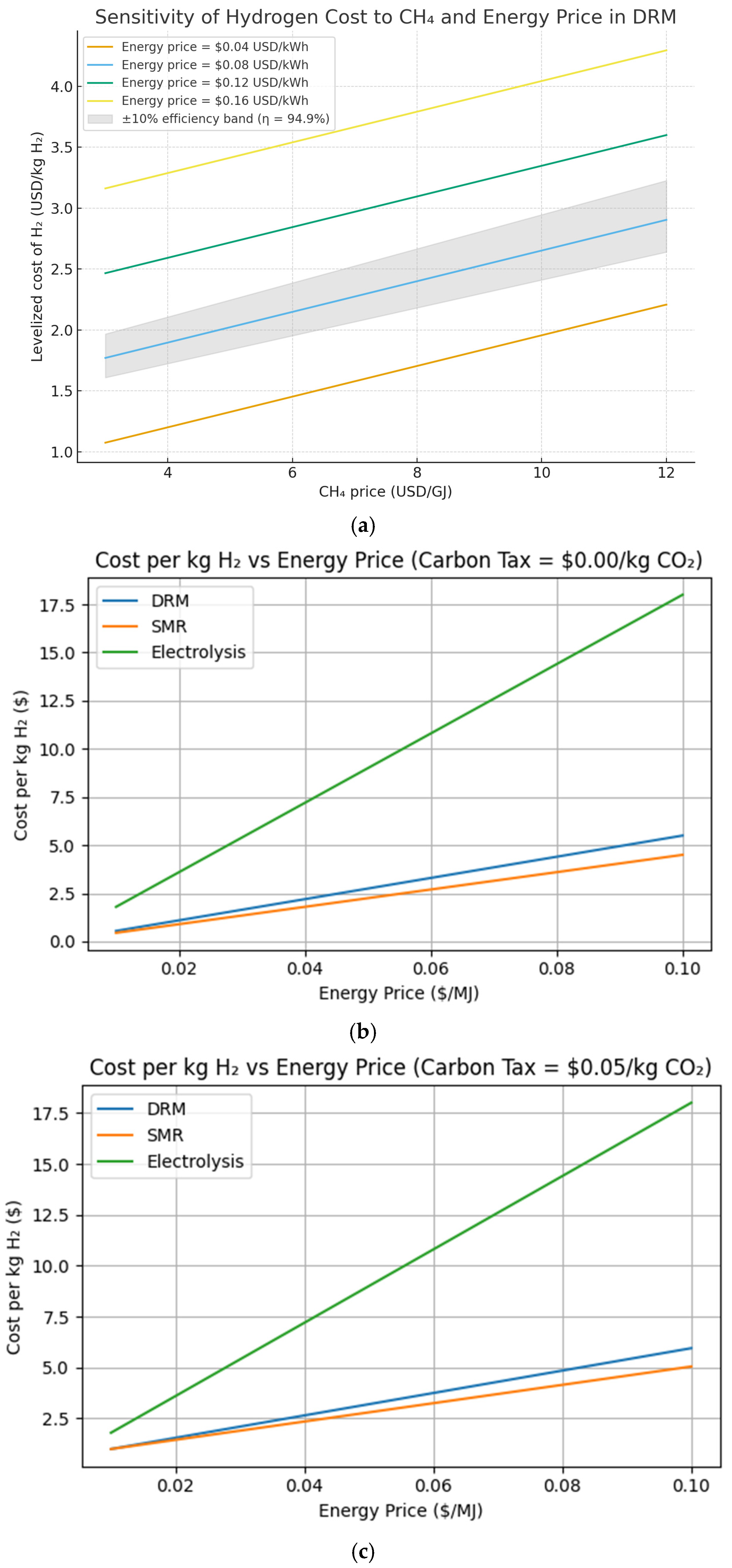
−1) while keeping other parameters constant. The resulting variation in levelized hydrogen cost (LCOH) is shown in
Figure 17a.
The shaded region in
Figure 17f represents a ± 10% variation in η (85–105% of the base value). LCOH increases almost linearly with both parameters, but the
energy–price slope is steeper (elasticity ≈ 0.65) than that of CH
4 (≈0.42), indicating stronger sensitivity to energy cost. This underscores the importance of heat recovery and renewable energy sourcing in minimizing hydrogen production costs for DRM.
10.6. Scenario Modelling
Comparative scenario modelling was conducted to benchmark DRM against Steam Methane Reforming (SMR) and water electrolysis under varying energy prices and carbon tax regimes. DRM showed competitive performance in regions with low-carbon electricity and moderate carbon pricing. Previous assessments integrating carbon pricing and renewable energy inputs show similar crossover trends among DRM, SMR, and electrolysis [
20,
21,
22].
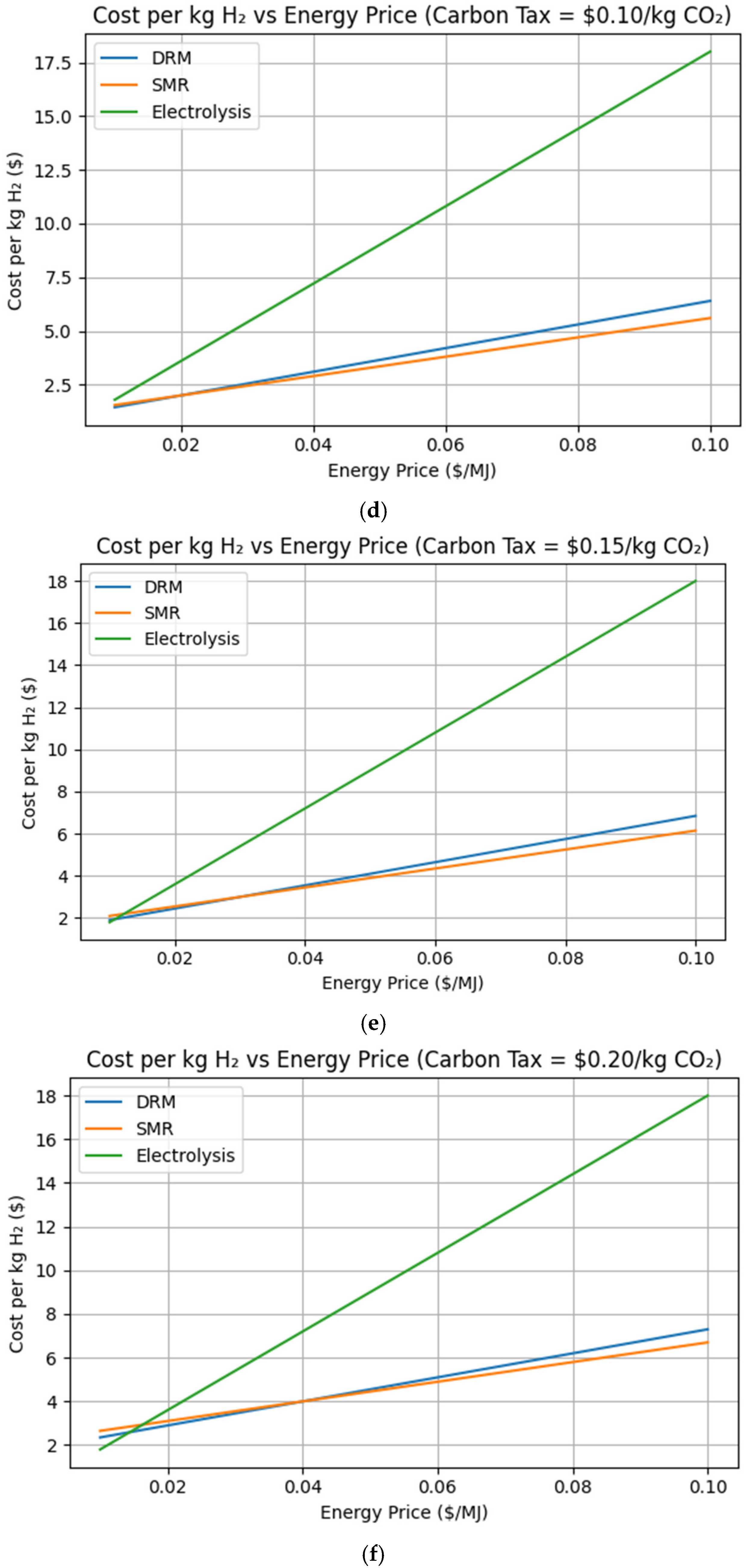
Figure 17b: Cost per kg H
2 as a function of energy price for DRM, SMR, and electrolysis with zero carbon tax. Electrolysis costs rise steeply with energy price, while SMR remains the most cost-stable. DRM is competitive at lower energy prices but becomes less so as energy prices increase.
Figure 17c: Cost per kg H
2 as a function of energy price for DRM, SMR, and electrolysis with a carbon tax of 0.05 USD/kg CO
2. The carbon tax increases costs for DRM and SMR, narrowing the cost gap with electrolysis, which is unaffected by carbon pricing.
Figure 17d: Cost per kg H
2 as a function of energy price for DRM, SMR, and electrolysis with a carbon tax of 0.10 USD/kg CO
2. Higher carbon tax further increases the cost of DRM and SMR relative to electrolysis, making electrolysis more competitive at moderate to high energy prices.
Figure 17e: Cost per kg H
2 as a function of energy price for DRM, SMR, and electrolysis with a carbon tax of 0.15 USD/kg CO
2. Electrolysis approaches cost parity with DRM and SMR at higher carbon tax rates, especially as energy prices rise.
Figure 17f: Cost per kg H
2 as a function of energy price for DRM, SMR, and electrolysis with a carbon tax of 0.20 USD/kg CO
2. At high carbon tax and energy price, electrolysis can become the most cost-competitive hydrogen production method.
11. Life-Cycle Assessment (LCA)
To evaluate the environmental performance of Dry Reforming of Methane (DRM) for hydrogen-rich syngas production, a simplified cradle-to-gate life-cycle assessment (LCA) was performed using the 27 experimental runs presented in
Table A1. The objective was to quantify the net carbon balance (kg CO
2 eq kg
−1 H
2) under different energy supply and feedstock scenarios, thereby linking catalytic performance to system-level sustainability.
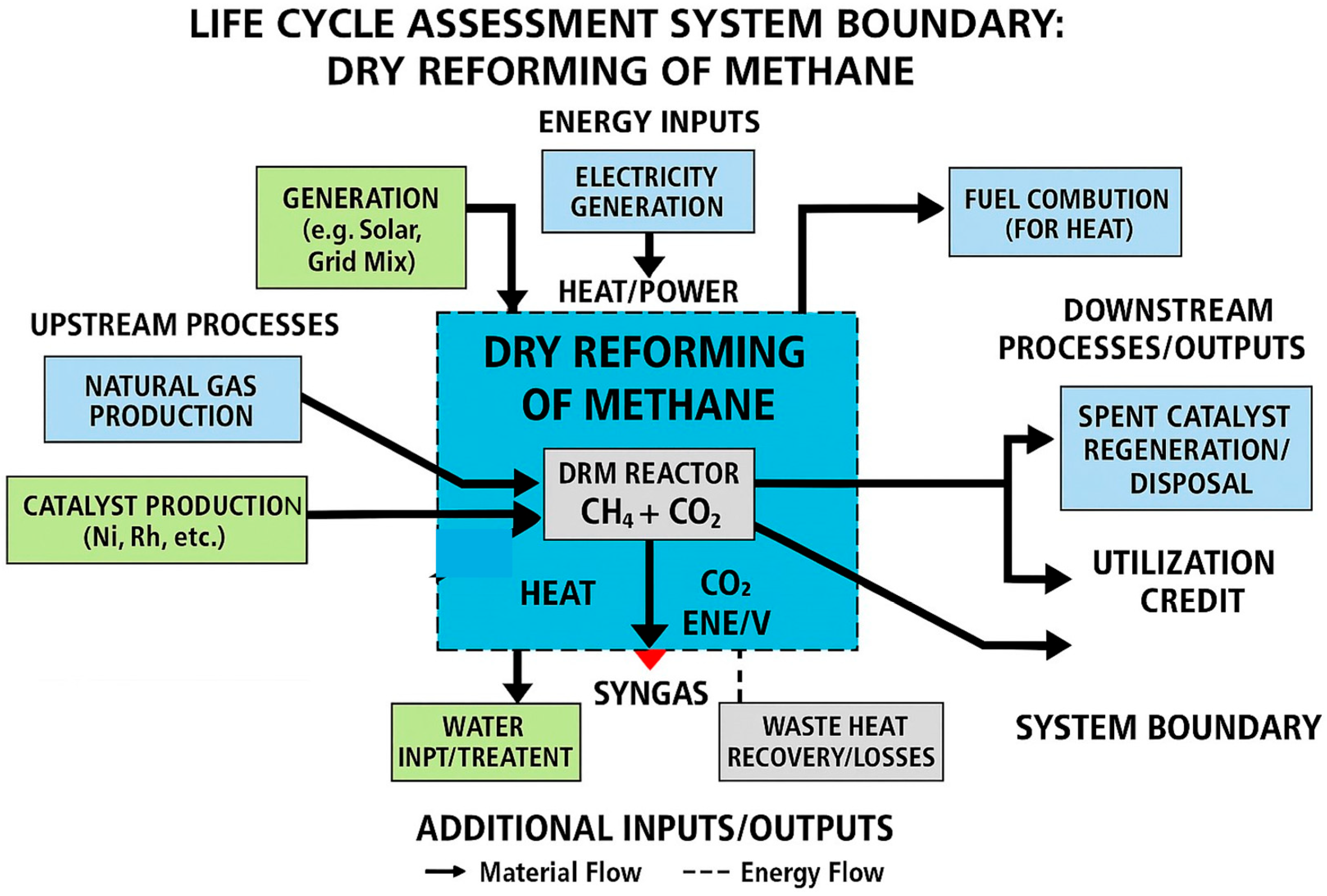
Figure 18 illustrates the cradle-to-gate system boundary applied in this study’s life-cycle assessment of Dry Reforming of Methane (DRM). The boundary encompasses all major upstream and process inputs, including natural gas production (CH
4 feed), CO
2 capture or supply, catalyst production (e.g., Ni, Rh), and heat or energy sources. These inputs feed into the DRM reactor, where methane and carbon dioxide are converted to syngas (H
2 + CO) with the aid of a catalyst and external heat. The primary outputs considered are syngas for further processing, spent catalyst for regeneration or disposal, process emissions and waste heat, and the environmental credit associated with CO
2 utilization. This system boundary enables a comprehensive evaluation of the environmental impacts and sustainability metrics associated with DRM hydrogen production, from resource extraction up to the plant gate.
11.1. Methodology and Assumptions
The functional unit was 1 kg of H
2 produced. For each run, the molar CH
4 feed per kilogram of H
2 was calculated from the reported H
2 yield:
CH4’s actual reaction was obtained from the measured CH4 conversion, and the corresponding CO2 feed (set by the experimental CH4:CO2 ratio) determined the CO2 utilization credit. Heat demand was estimated from DRM reaction enthalpy (ΔH(DRM) = +247.3 kJ mol−1 CH4 reacted), assuming 70% thermal efficiency.
Emission factors, derived from Ecoinvent and GREET averages, were as follows:
Upstream CH4 supply (natural gas): 2.3 kg CO2 eq kg−1 CH4.
Upstream CH4 supply (biogas): 0.5 kg CO2 eq kg−1 CH4.
Heat from natural gas combustion: 0.056 kg CO2 MJ−1.
Renewable heat: 0 kg CO2 MJ−1.
CO2 converted: credited as −1 kg CO2 per kg CO2 fixed.
Three industrially relevant configurations were analyzed:
Scenario A: Natural-gas feed + natural-gas heat (baseline).
Scenario B: Natural-gas feed + renewable heat.
Scenario C: Biogas feed + renewable heat.
Electricity for gas compression/separation, recycle streams, and catalyst embodied emissions were excluded here but addressed in
Section 10.5. Per-run numerical outputs—including molar and mass CH
4 input, CO
2 converted, heat demand, and net CO
2 balance—are available in
Table A4.
11.2. Interpretation
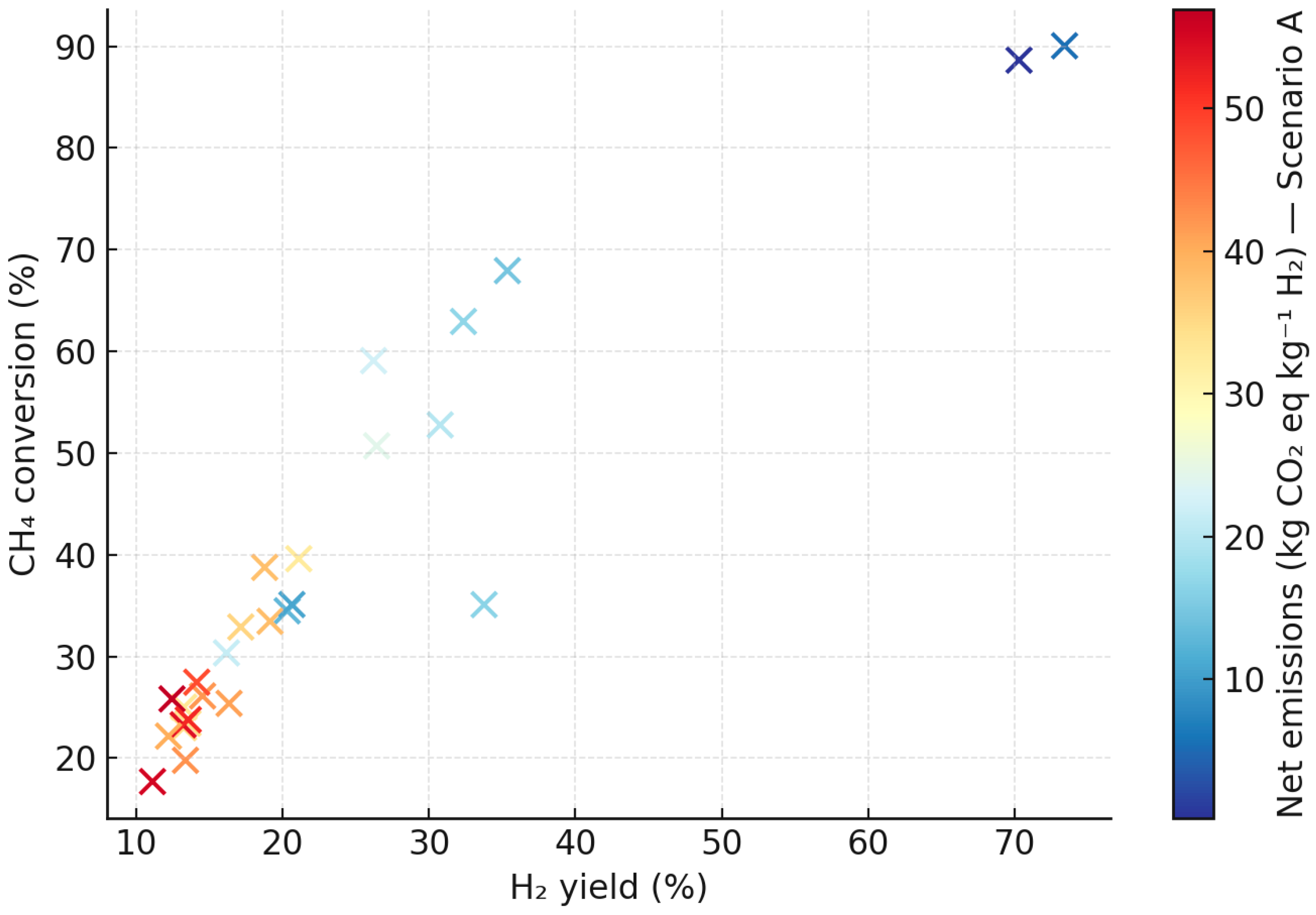
Net cradle-to-gate CO
2 balances varied significantly with operating conditions (
Figure 19). Under Scenario A (natural gas heat), most runs remained emission-positive; however, high-conversion, high-yield cases approached carbon neutrality. The best condition (Run 2; 800 °C; CH
4 conversion = 88.6%; H
2 yield = 70.3%) emitted only +0.26 kg CO
2 eq·kg
−1 H
2, far below conventional SMR values (9–11 kg CO
2 eq·kg
−1 H
2).
Switching to renewable heat (Scenario B) rendered the same case net-negative (–5.9 kg CO
2 eq·kg
−1 H
2), while the biogas-based configuration (Scenario C) achieved −32 kg CO
2 eq·kg
−1 H
2 due to low upstream emissions.
Table 10 summarizes these results alongside benchmark SMR and electrolysis pathways.
Figure 19 illustrates the relationship between CH
4 conversion, H
2 yield, and net CO
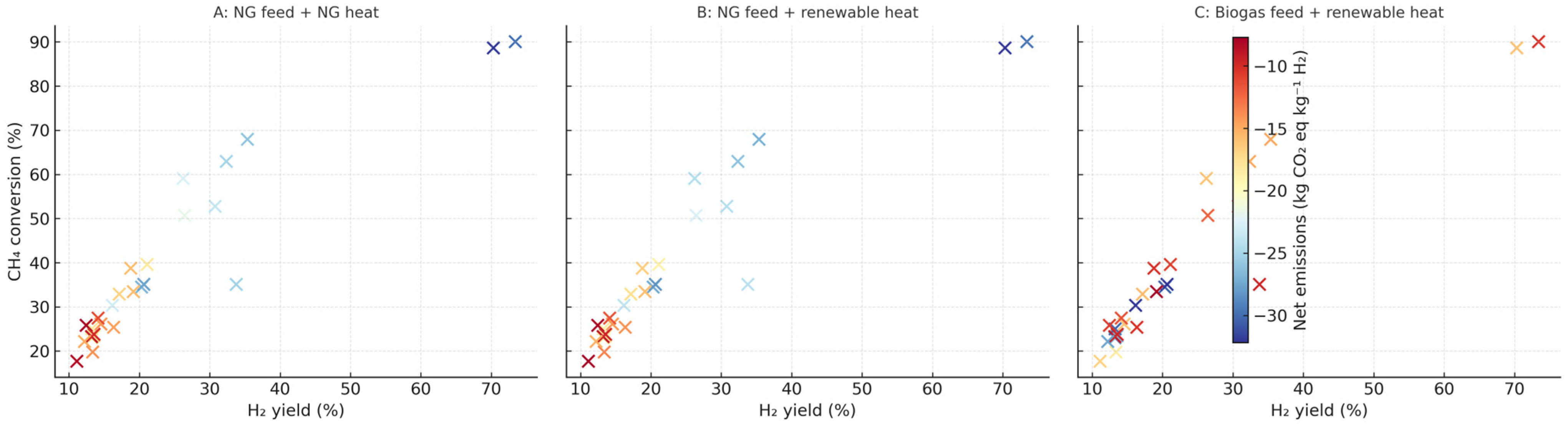
2 emissions under Scenario A, whereas
Figure 20A–C contrast Scenarios A–C, highlighting progressive decarbonization as fossil inputs are replaced by renewable heat and biogenic CH
4.
These findings demonstrate that DRM can achieve net cradle-to-gate CO2 emissions as low as +0.26 kg CO2 eq·kg−1 H2 under optimized conditions with natural gas heat and net-negative emissions (–5.9 kg CO2 eq·kg−1 H2) when powered by renewable heat. Under biogas and renewable heat (Scenario C), DRM achieves strongly negative emissions (−32 kg CO2 eq·kg−1 H2), surpassing SMR and approaching or exceeding renewable electrolysis performance.
DRM, particularly when integrated with renewable energy sources, offers both economic and environmental advantages, positioning it as a potential carbon-negative hydrogen pathway.
11.3. Discussion and Benchmarking
Process intensification and decarbonized energy supply jointly determine whether DRM attains carbon-neutral or carbon-negative performance. Higher CH4 conversion and H2 yield simultaneously reduce feed and heat requirements, amplifying the CO2-utilization credit. Even incremental efficiency gains thus produce disproportionate life-cycle benefits.
Compared with SMR, DRM exhibits a substantially lower inherent carbon footprint under renewable heat. Electrolysis remains the benchmark for zero-carbon hydrogen, yet DRM provides a thermochemical route that valorizes CO
2 and can integrate with renewable power or plasma heating. For comparison, industrial SMR without carbon capture emits 9–11 kg CO
2 eq kg
−1 H
2, SMR + CCS (90% capture) 1–2.5 kg CO
2 eq kg
−1 H
2, while renewable electrolysis approaches zero [
14,
15,
16,
17,
18]. These benchmarks contextualize the present results, wherein optimized DRM under renewable heat becomes net-negative in carbon balance.
11.4. Limitations and Future Work
This preliminary assessment omits several contributions required for a complete cradle-to-gate inventory:
Recycle of unreacted gases (>85% typical) reduces fresh CH4 input and heat duty.
Electricity for compression/separation, ≈0.5–2 kWh kg−1 H2 (0–1.6 kg CO2 eq kg−1 H2 depending on grid mix).
Catalyst embodied emissions, ≈5–10 kg CO2 eq kg−1 catalyst (~0.01 kg CO2 eq kg−1 H2 over multi-year use).
CO2 source accounting (waste-flue CO2 ≈ zero upstream penalty; DAC ≈ 3 MJ kg−1 CO2 energy penalty).
Including these effects—using Ecoinvent or GREET emission factors—will enable sensitivity and scenario analyses linking process simulation with techno-economic optimization. Future work should couple the experimental DRM dataset with plant-scale energy models to produce comprehensive cradle-to-grave inventories.
Net-emissions comparison with SMR is shown.
Table 10 includes an additional column reporting the percentage reduction in cradle-to-gate CO
2 emissions relative to a representative Steam Methane Reforming (SMR) baseline of 10 kg CO
2 eq kg
−1 H
2 (industrial SMR typically emits 9–11 kg CO
2 eq kg
−1 H
2). The percentage reduction was computed as
. Scenarios B and C achieve values > 100%, indicating that these configurations are net-negative relative to conventional SMR. Sensitivity bands using the 9–11 kg baseline range are provided in the table notes.
Figure 19 presents a two-dimensional scatter of H
2 yield vs. CH
4 conversion coloured by net CO
2 emissions (Scenario A). High-performance conditions cluster in the blue region (low or negative emissions), confirming that improved catalytic efficiency directly enhances life-cycle sustainability. The extended panel (
Figure 20A–C) contrasts Scenarios A–C, showing progressive reduction in life-cycle carbon intensity as fossil inputs are displaced by renewable heat and biogenic CH
4.
11.5. Refinement and Future Integration
The simplified LCA presented captures only feedstock- and heat-related emissions, offering an indicative yet incomplete picture of DRM’s full environmental profile. Future refinement toward an engineering-scale, cradle-to-gate model should incorporate several additional contributions that are significant at industrial scales:
- (i)
Recycle of unreacted gases: Industrial DRM units typically achieve >85–90% recycling of CH4 and CO2, substantially reducing fresh feed requirements and thermal duty. Accounting for this closed-loop behaviour will improve both energy and carbon efficiency estimates.
- (ii)
Electricity consumption for gas compression and separation: These auxiliary systems typically demand 0.5–2 kWh kg−1 H2, which can contribute up to 1.6 kg CO2 eq kg−1 H2 depending on the grid mix. Incorporating realistic electricity sources (renewable, grid, or hybrid) will refine the life-cycle footprint.
- (iii)
Catalyst embodied emissions: Ni- and Fe-based catalysts typically carry 5–10 kg CO2 eq kg−1 catalyst in embodied impacts. Distributed over multi-year lifetimes, this equates to approximately 0.01 kg CO2 eq kg−1 H2. Including catalyst manufacture and regeneration will improve attributional accuracy.
- (iv)
CO2-source accounting: Distinguishing between flue gas recycling (zero upstream burden) and captured CO2 (≈3 MJ kg−1 CO2 capture energy penalty) is essential for comparing DRM with CCS- or DAC-coupled systems.
Incorporating these parameters within a comprehensive cradle-to-gate framework—using harmonized Ecoinvent or GREET emission factors will enable rigorous sensitivity and scenario analyses. Such integration will also support techno-economic optimization, allowing direct benchmarking of DRM against Steam Methane Reforming (SMR), autothermal reforming, and electrolysis under future low-carbon energy systems.
12. Discussion
This study provides a comprehensive and multidimensional assessment of Dry Reforming of Methane (DRM) as a sustainable hydrogen production pathway. By integrating thermodynamic analysis, physics-informed machine learning (ML), uncertainty quantification, techno-economic evaluation, and life-cycle assessment (LCA), this work bridges fundamental reaction understanding with system-level sustainability.
The thermodynamic and kinetic analyses reaffirm that DRM is driven by endothermic and entropy-favoured reactions, becoming increasingly favourable at high temperatures and near-stoichiometric CH
4/CO
2 feed ratios. The activation energy estimates (42–46 kJ mol
−1 for CH
4 and CO
2 conversions and 56 kJ mol
−1 for H
2 yield) confirm a surface reaction-controlled mechanism, where hydrogen formation remains the rate-limiting step due to C–H bond scission and competitive reactions such as the reverse water–gas shift. These findings underscore the importance of catalyst innovation to enhance active-site accessibility and minimize carbon deposition, especially under high-temperature operation [
24,
25].
The physics-informed ML framework captured the nonlinear dependencies among feed ratio, temperature, and catalyst loading more accurately than traditional kinetic models. By embedding thermodynamic quantities and sustainability features, such as reaction enthalpy, carbon intensity, and syngas energy recovery (%), the ML models achieved both high predictive accuracy and interpretability. Feature importance analyses consistently identified carbon intensity, reaction temperature, and syngas energy recovery (%) as dominant drivers, confirming that data-driven models grounded in physical principles can generalize effectively while retaining scientific relevance [
26,
27].
Syngas energy recovery (%) was found to be a dominant feature in physics-informed ML models and sensitivity analyses. While values above 100% are observed, possibly due to the endothermic nature of DRM, the process absorbs heat from the surroundings, resulting in syngas with a higher combined energy content than the methane feed alone.
This reflects the comparative energy content of syngas relative to CH4 and does not represent absolute thermodynamic efficiency, as it does not account for the external heat input required by the endothermic reaction. Future work should incorporate full-process energy balances, including thermal input, to assess absolute efficiency.
Sustainability metrics offered an additional lens for interpreting DRM performance. Carbon intensity, expressed as unconverted CO
2 per unit of hydrogen produced, emerged as the most sensitive and informative indicator [
28,
29]. Under optimized conditions, DRM achieved carbon intensities as low as 0.17 and syngas energy recovery values approaching 95%, surpassing those of conventional Steam Methane Reforming (SMR). Monte Carlo and scenario analyses revealed distinct operating clusters rather than a single performance continuum, highlighting the presence of stable high-yield regimes that can guide industrial process control [
30].
Techno-economic evaluation positioned DRM as a bridge technology between SMR and water electrolysis. While SMR remains the lowest-cost route in markets without carbon constraints, its high emissions make it unsustainable in the long term. Electrolysis, though nearly emission-free when powered by renewables, is energy-intensive and capital-heavy. DRM, by contrast, occupies an intermediate space—capable of utilizing CO
2 as a feedstock and operating efficiently under renewable or waste heat integration scenarios. Scenario analyses show that under moderate carbon pricing, DRM’s cost competitiveness improves markedly, especially when coupled with renewable heat or biogenic CH
4 sources [
31].
The life-cycle assessment (LCA) conducted in this study contextualizes DRM’s sustainability beyond reactor-scale metrics. Using experimental data from 27 operating conditions, cradle-to-gate carbon balances were computed under three scenarios: (A) natural gas feed and heat, (B) natural gas feed with renewable heat, and (C) biogas feed with renewable heat. The analysis—based on reaction enthalpy (ΔH = +247.3 kJ mol−1 CH4), 70% thermal efficiency, and established emission factors (2.3 kg CO2 kg−1 CH4 for natural gas, 0.056 kg CO2 MJ−1 for heat, and 0.5 kg CO2 kg−1 CH4 for biogas)—showed striking contrasts among cases.
In the baseline case (Scenario A), high-performance runs (e.g., 800 °C, CH
4 conversion 88.6%, H
2 yield 70.3%) achieved nearly carbon-neutral outcomes (+0.26 kg CO
2 eq kg
−1 H
2), already far below SMR’s 9–11 kg CO
2 eq kg
−1 H
2. With renewable heat (Scenario B), the same run became net negative (–5.9 kg CO
2 eq kg
−1 H
2) due to CO
2 utilization credits, while a biogas-fed configuration (Scenario C) yielded strongly negative values (–32 kg CO
2 eq kg
−1 H
2). Corresponding
Figure 19 and
Figure 20A–C visualize these dependencies, showing a clear transition from emission-positive to emission-negative regimes as catalytic efficiency and energy source decarbonization improve.
These results reinforce the thermodynamic and techno-economic findings: the synergy between high conversion, efficient heat management, and low-carbon inputs can transform DRM from a transitional process into a genuinely net-negative hydrogen route. However, the simplified cradle-to-gate model omits key elements such as unreacted gas recycle, separation and compression energy, catalyst embodied emissions, and the specific CO2 source (flue gas vs. direct air capture). Future refinement using GREET or Ecoinvent factors, combined with process simulation, will enable full cradle-to-grave inventories and policy-aligned scenario modelling.
Overall, the integrated LCA highlights that DRM’s sustainability is not intrinsic but contingent—determined by catalyst performance, process efficiency, and upstream carbon intensity. This multiscale framework linking microkinetics, data-driven prediction, and life-cycle outcomes establishes a rigorous foundation for designing and evaluating next-generation CO2 utilization systems.
DRM thus represents a transitional pathway bridging current methane-based hydrogen systems and future renewable–electrolysis infrastructure by valorizing CO2 while maintaining process familiarity and lower capital intensity.
13. Conclusions
This work presents a unified sustainability evaluation of Dry Reforming of Methane (DRM), combining thermodynamic, kinetic, machine learning, techno-economic, and life-cycle perspectives. The results confirm that DRM can achieve syngas energy recovery values up to 190% and carbon intensities below 0.2 under optimized high-temperature, near-stoichiometric conditions. The metric is used here as a comparative indicator for process optimization and sustainability analysis.
The process is surface-reaction controlled, with hydrogen formation representing the main kinetic barrier—an insight that directly informs catalyst design strategies aimed at enhancing activity and carbon resistance. Physics-informed ML models demonstrated superior predictive capability over both baseline ML and traditional kinetic formulations by embedding reaction energetics and sustainability metrics into model architecture. Uncertainty quantification through Monte Carlo simulation identified robust operating zones that sustain high performance despite variability in feed and temperature, providing valuable guidance for industrial process design.
The techno-economic analysis positions DRM as a cost-effective transitional technology between SMR and electrolysis. While not yet the lowest-cost route, it offers a clear pathway to emission reduction through CO2 utilization and compatibility with renewable or waste heat sources.
The life-cycle assessment adds crucial system-level evidence: DRM can shift from carbon-positive to net-negative hydrogen production depending on the carbon intensity of the feed and heat. In particular, the use of renewable heat and biogenic methane transforms DRM into a carbon sink rather than a source. These findings establish DRM as a flexible platform technology—capable of delivering sustainable hydrogen today while complementing the gradual expansion of renewable-powered electrolysis in future energy systems.
Future work should advance in three directions: (i) catalyst innovation to lower activation barriers and mitigate coking; (ii) integration of renewable electricity or solar thermal inputs for continuous, low-emission operation; and (iii) full cradle-to-grave LCA incorporating recycle, separation, and catalyst life-cycle impacts. Collectively, these efforts will enable DRM to evolve from a promising CO2 utilization reaction into a cornerstone of the low-carbon hydrogen economy.
In regions like Australia and India, where natural gas and CO2-rich industrial streams coexist, DRM can complement renewable hydrogen deployment and accelerate decarbonization of industrial clusters.