Analytical and Optimisation-Based Strategies for Load Frequency Control in Renewable-Rich Power Systems




Abstract
1. Introduction
1.1. Identified Research Gaps
1.2. Research Scope
1.3. Key Contributions of This Study
2. Background: Frequency Stability and System Inertia
2.1. Frequency Stability in Modern Power Systems
2.2. Traditional Role of System Inertia
2.3. Impact of Renewable Energy Sources on Frequency Stability
2.4. Synthetic and Fast Frequency Response (FFR)
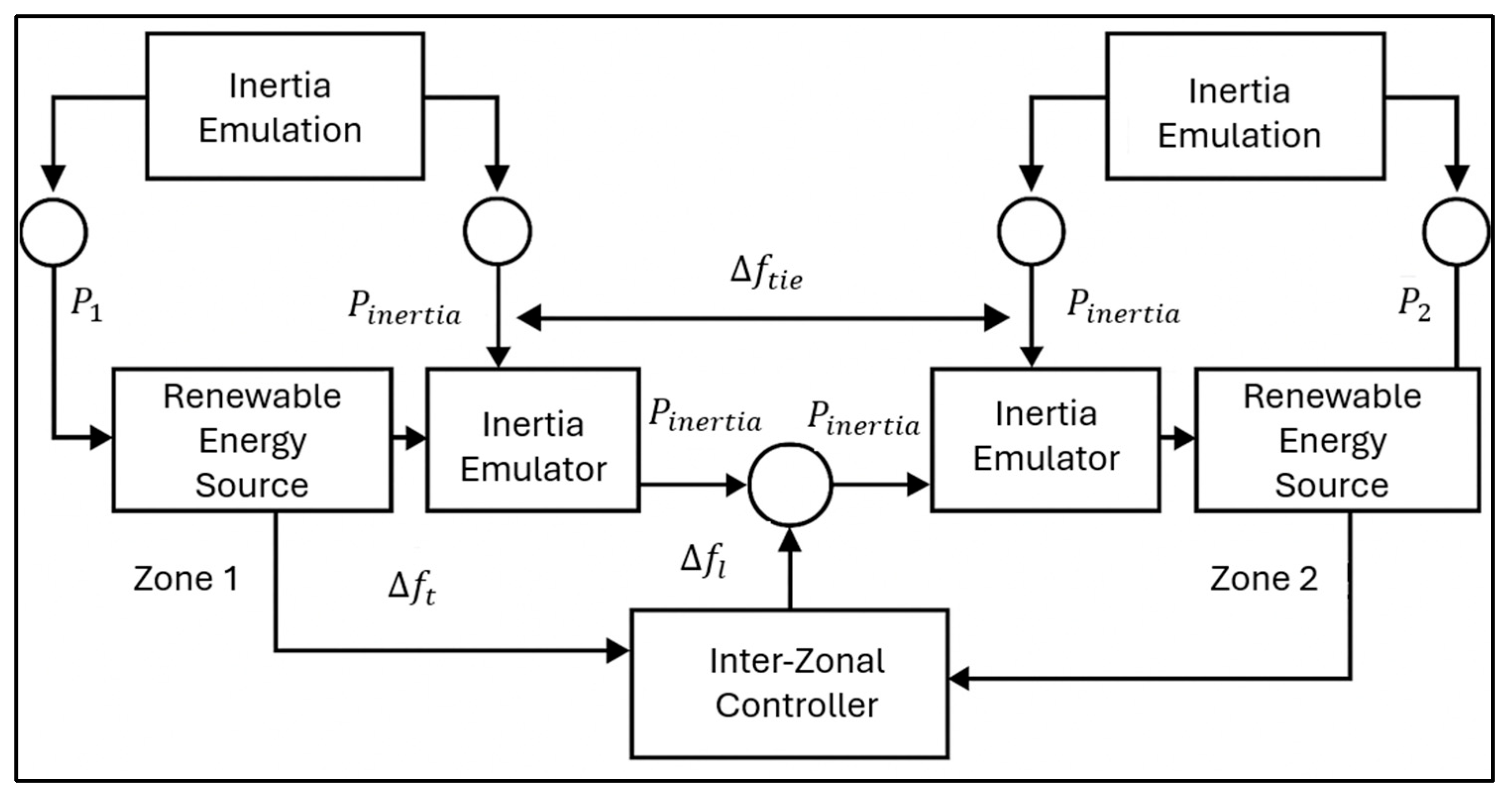
- Synthetic Inertia: Some wind turbines can emulate inertia by extracting kinetic energy from rotating blades during disturbances. However, this depletes rotational energy, and operators must carefully manage it to avoid post-disturbance instability [74].
- Battery-Based FFR: FFR refers to rapid active power injections (or curtailments) by inverter-based resources, demand response, or storage systems, which occur within a response time of hundreds of milliseconds to a few seconds, much faster than conventional governor action. Unlike synthetic inertia, which responds proportionally to the frequency derivative, FFR often triggers based on frequency thresholds. Batteries can inject power within milliseconds, compensating for reduced synchronous inertia [75]. Their limitations lie in state-of-charge constraints and degradation costs [76].
- Hybrid Solutions: Within the FCUC framework, inverter-based RES and energy storage systems (ESS) act as hybrid frequency-support providers, delivering synthetic inertia and FFR services [77]. Their integration affects both the frequency-related constraints and the objective function of the optimisation problem. When synthetic inertia is available, the inertia adequacy constraint becomes less stringent, as inverter-based resources enhance the system’s effective inertia [78]. Similarly, with FFR participation, RoCoF and frequency nadir constraints become less restrictive, thereby reducing the reliance on costly synchronous reserves and improving the overall efficiency of frequency-secure scheduling [79].
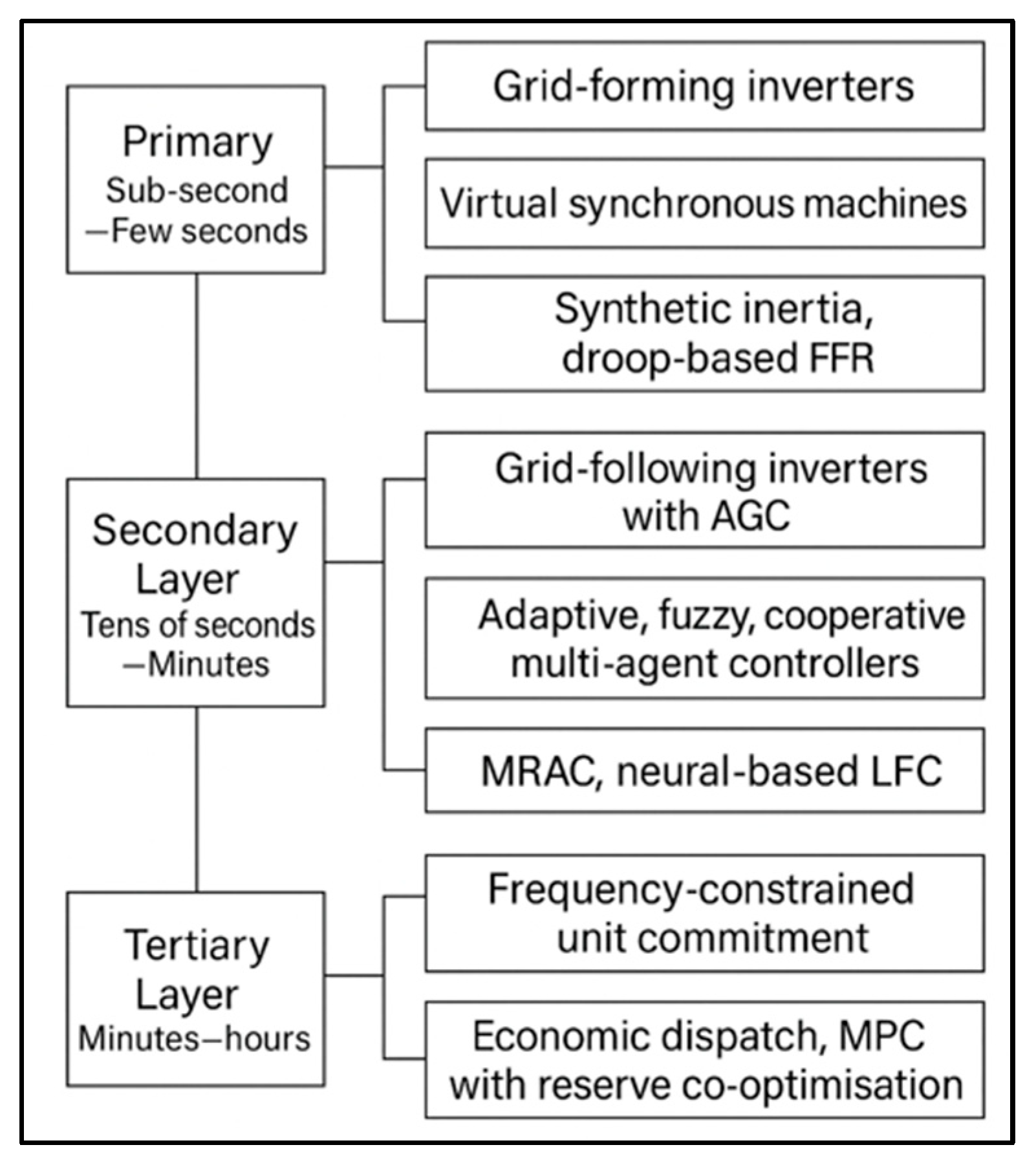
2.5. Hierarchical Taxonomy of Load Frequency Control (LFC) Strategies
2.6. Frequency-Constrained Optimisation Frameworks
2.7. Limitations of Current Approaches
2.8. Synthesis and Outlook
3. Single-Area Load Frequency Control
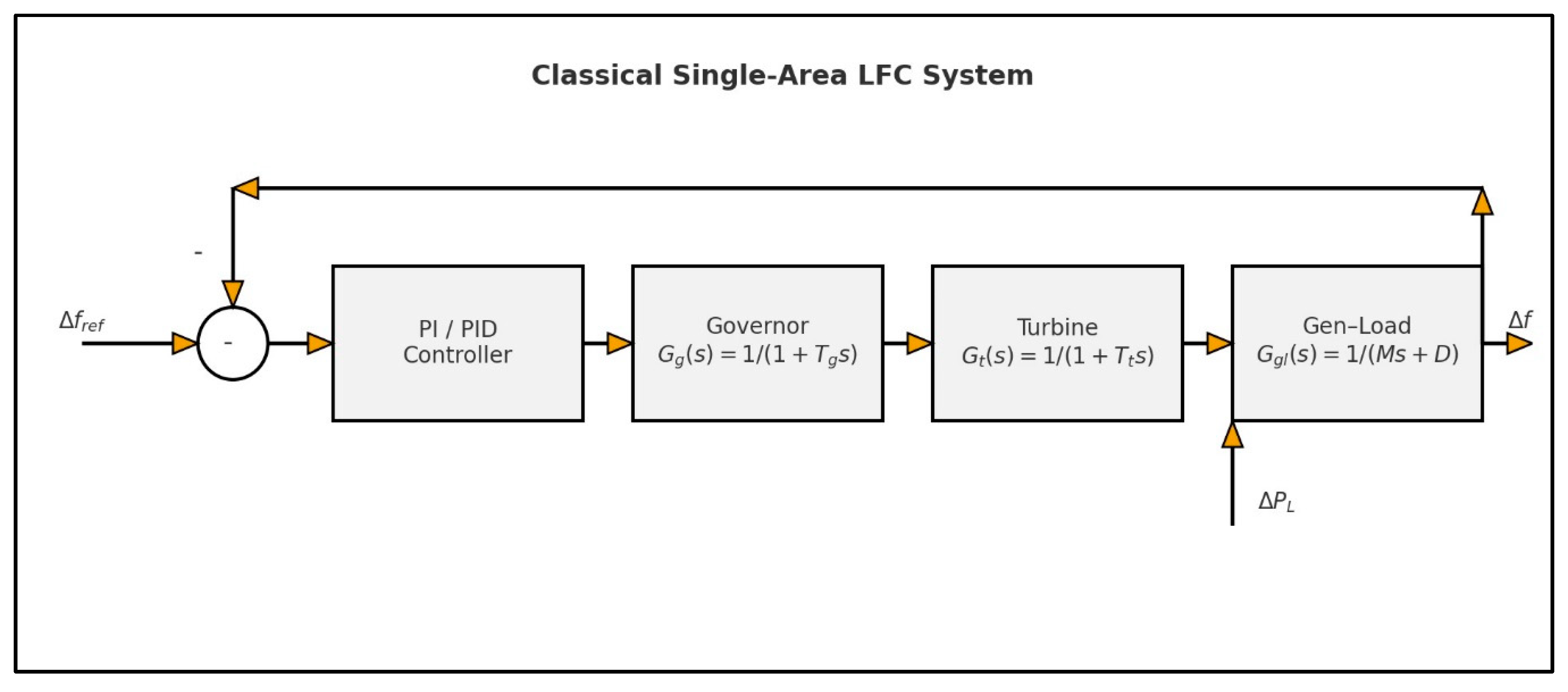
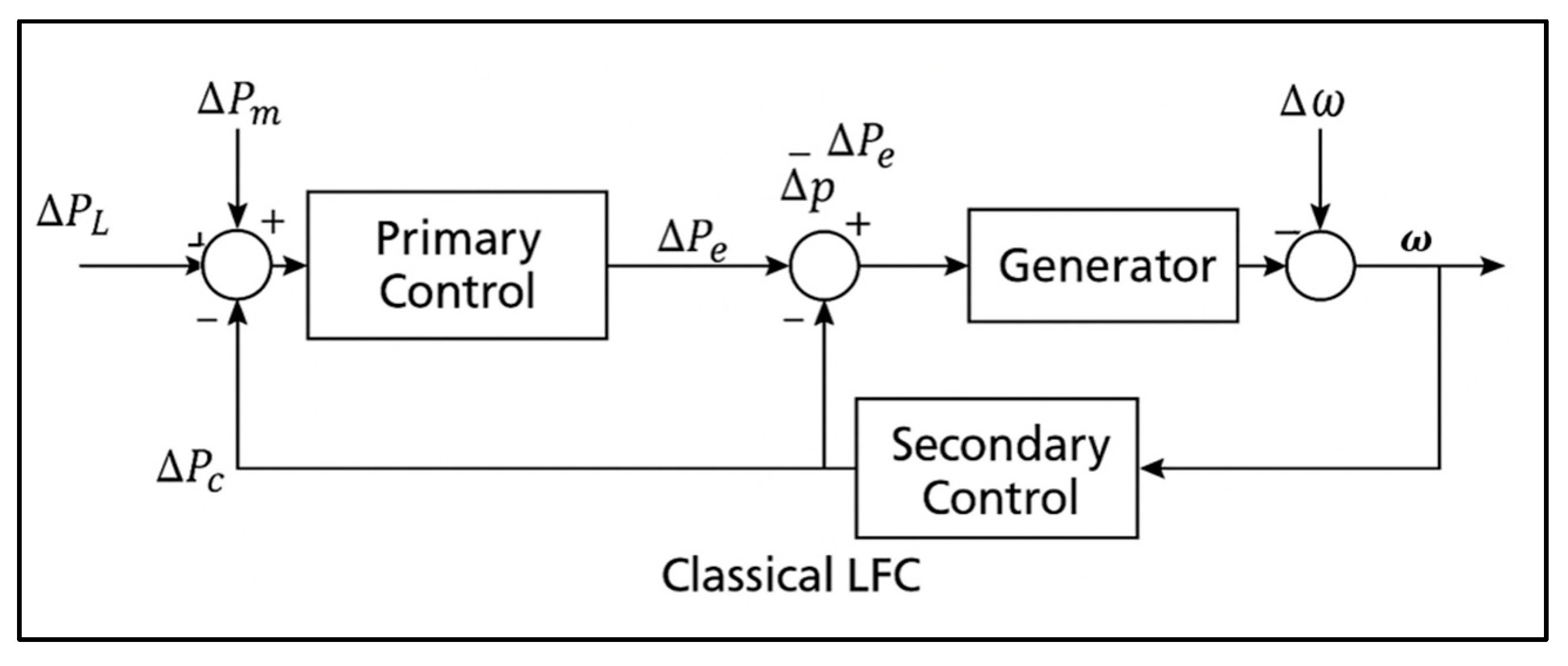
3.1. Overview of Single-Area LFC
- Governor:
- 2.
- Turbine:
- 3.
- Generator Load:
3.1.1. Justification of Assumptions, Parameters, and Boundary Conditions
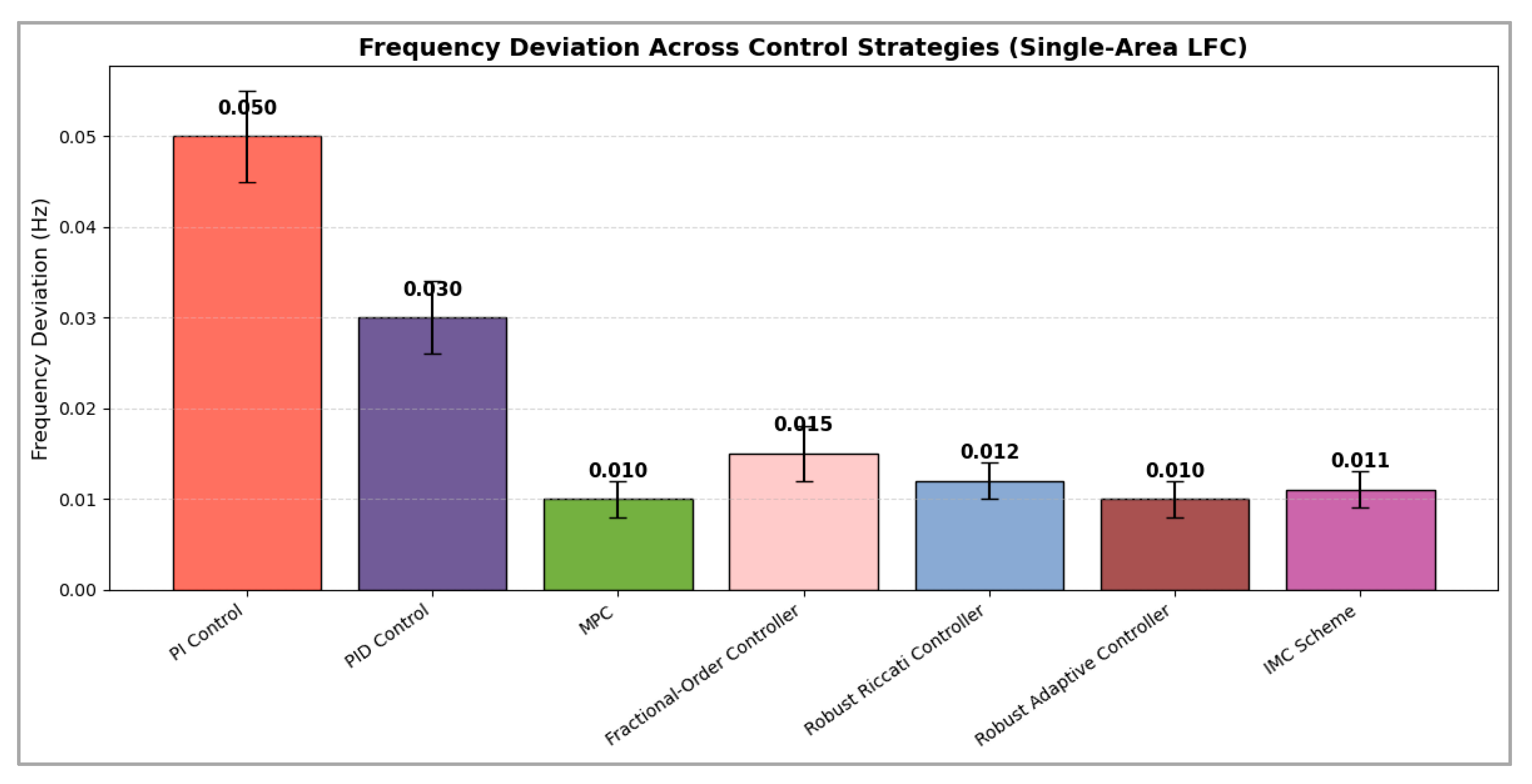
3.1.2. Comparative Analysis of Single-Area LFC
3.1.3. Methodology Validation (Sensitivity and Parametric Robustness Analysis)
3.2. Classical PI and PID Controllers
3.3. Advanced Analytical Controllers
3.3.1. Model Predictive Control (MPC)
3.3.2. Internal Model Control (IMC)
3.3.3. Robust Control of LFC (H∞ and Sliding Mode Control)
- H∞ Control: In LFC applications, H∞ control provides robust stability and performance under variations in system parameters such as inertia, damping, and tie-line coefficients, while mitigating the adverse effects of RES variability by ensuring bounded frequency deviations even under significant uncertainties. Studies confirm that it outperforms conventional PI controllers in multi-area systems, delivering improved damping and lower deviations [85,101]. Its strengths lie in its strong theoretical foundation, effectiveness under wide parameter variations, and suitability for interconnected grids. However, it remains computationally intensive, depends on accurate uncertainty bounds, and may result in conservative designs.
- Sliding Mode Control (SMC): SMC is a nonlinear robust control technique that drives system trajectories onto a predefined sliding surface and maintains them there, ensuring stability despite disturbances or model inaccuracies. In the context of LFC, SMC has demonstrated superior performance in multi-area systems with high-RES penetration, achieving faster settling times (~5–7 s versus ~12 s for PI control) and offering robust disturbance rejection against tie-line fluctuations and renewable variability. By employing a switching control law, SMC is particularly well-suited for systems characterised by nonlinear dynamics and parameter uncertainties.
- Control Law: A typical SMC control input is given by [102]
3.3.4. Adaptive Control
3.4. Summary for Single-Area LFC
4. Multi-Area Load Frequency Control
4.1. Overview of Multi-Area LFC
4.2. Mathematical Modelling of Tie-Line Dynamics
4.3. Classical Tie-Line Bias Control (TBC)
4.4. Advanced Analytical Approaches for MALFC
4.4.1. Decentralised Control Strategies
4.4.2. Robust Control (H∞, and Sliding Mode Control)
4.4.3. Optimal Control (LQR, LQG)
4.4.4. Model Predictive Control for Multi-Area Systems
4.4.5. Metaheuristic Optimisation of Controllers
4.5. Comparative Case Studies
4.6. Practical Implementation Issues
4.7. Key Insights for MALFC
4.8. Summary of Future Trends in MALFC
5. Frequency-Constrained Unit Commitment (FCUC)
5.1. Introduction to FCUC
- Low inertia challenges. A significant consequence of high RES penetration is that it reduces system inertia, a critical factor that directly affects frequency stability [85,101]. Lower inertia increases the RoCoF and leads to a deeper frequency nadir following disturbances. The nadir frequency, defined as the minimum frequency reached after a disturbance, is a key stability indicator; a lower nadir reflects a more severe frequency excursion and, if it drops below critical thresholds, can heighten the risk of system instability or even blackouts [119]. To address this, FCUC models must explicitly account for inertia effects in frequency dynamics to ensure secure and reliable operation.
- Diverse governor response dynamics also require consideration. While conventional systems rely on steam and hydro generators, wind turbines (WTs) [120,121] and PVs [122,123] have distinct frequency response behaviours due to their unique control algorithms. In high-RES systems, these dynamics significantly influence frequency stability and must be incorporated into FCUC models.
- Reserve levels and allocation are critical. Adequate spinning reserves restore balance post-disturbances, but their distribution among devices affects regulation capacity and overall system stability [64,65]. FCUC models should optimise reserve levels and allocations to ensure frequency stability while minimising costs and maximising renewable integration.
5.2. Mathematical Formulation of FCUC
5.2.1. Objective Function
5.2.2. Conventional Constraints (From SCUC)
5.2.3. Frequency-Specific Constraints (FCUC Enhancements)
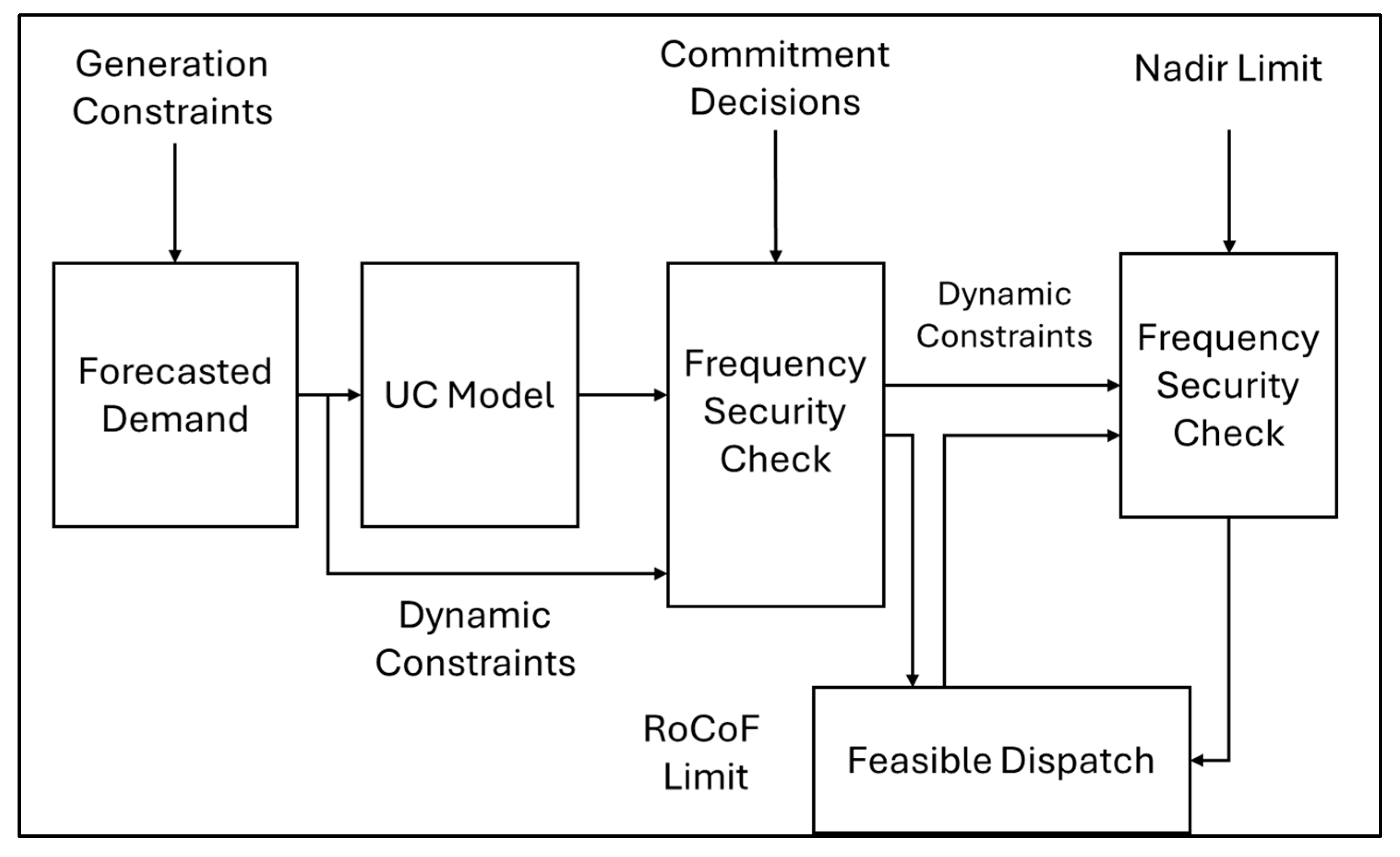
- Inertia Adequacy: System inertia is a critical determinant of frequency response. In low-inertia grids dominated by RES, insufficient inertia leads to a high RoCoF after a disturbance. FCUC enforces a minimum system inertia requirement at each scheduling period:
- 2.
- Rate of Change of Frequency (RoCoF) Limit: The RoCoF after a contingency must not exceed permissible thresholds (typically 0.5–1 Hz/s for protection equipment). This constraint links generator scheduling dynamic frequency stability by ensuring RoCoF does not trip protection relays or destabilise inverter-based resources.
- 3.
- Frequency Nadir Constraint: Frequency nadir is the lowest or highest system frequency point. A low nadir can trigger UFLS, leading to load shedding and demand risks [125], while a high nadir may damage SG rotors through overspeed or shaft failure. In traditional power systems, the SG rotor dynamics primarily govern the frequency response. Because SGs share similar structures and responses, variations in individual rotor dynamics become negligible, allowing an aggregated SG model to approximate the system frequency accurately. The inertia response is given by “(17)”, and primary frequency control is aggregated with and representing the control coefficient and time delay. For a sudden load increase of , the leads to system frequency deviation dynamics expressed power deficit () as [125]
5.3. Integration of Emerging Resources in FCUC
5.3.1. Energy Storage Systems (ESS)
5.3.2. Renewable Energy Sources (RES)
- Forecast Uncertainty in RES: RES participation constraints arise from the difference between forecasted and actual output [131]:
- 2.
- Stochastic FCUC: In stochastic formulations, multiple RES output scenarios are generated based on probabilistic forecast distributions. The unit commitment schedule is optimised across all scenarios to balance expected cost and reliability [131]:
- 3.
- Robust FCUC: Robust optimisation approaches assume the RES forecast error lies within a predefined uncertainty set (e.g., ±20% of the forecast). The optimisation seeks schedules that remain feasible under the worst-case RES output [131]:
5.3.3. Demand Response (DR)
Role of DR in Frequency-Constrained Scheduling
Mathematical Modelling of DR in FCUC
5.4. Solution Approaches
5.5. Comparative Literature Insights
5.6. Implementation Challenges
6. Comparative Analysis
6.1. Classical Controllers (PI/PID)
6.2. Robust and Optimal Controllers (H∞, SMC, MPC, IMC)
6.3. Metaheuristic-Tuned Advanced Classical Controllers (e.g., PSO-FOPID)
6.4. FCUC Frameworks vs. Real-Time Controllers
6.5. Complexity vs. Performance: What the Numbers Imply
6.6. Deployment and Organisational Fit
6.7. Comparative Analysis Summary
6.8. Quantitative Performance Summary
6.9. Sensitivity Considerations in FCUC Studies
6.10. Limitations
6.11. Control Layer Mapping and Practical Considerations
7. Conclusions
8. Future Research Directions
8.1. Hybrid Analytical–Optimisation Models
8.2. Decentralised FCUC Frameworks
8.3. Computational Efficiency
8.4. Regional Studies and Developing Country Contexts
8.5. Key Understandings
Author Contributions
Funding
Data Availability Statement
Acknowledgments
Conflicts of Interest
Abbreviations
| ACE | Area Control Error |
| AGC | Automatic Generator Control |
| ANFIS | Adaptive Neoro Fuxxy Inference Systems |
| BESS | Battery Energy Storage Systems |
| BWO | Black Widow Optimisation |
| DERs | Distributed Energy Resources |
| DL | Deep Learning |
| DR | Demand Response |
| ESS | Energy Storage Systems |
| FCUC | Frequency-Constrained Unit Commitment |
| FFR | Fast Frequency Response |
| FOPID | Fractional Order PID |
| GA | Generic Algorithm |
| IBRs | Inverter-Based Resources |
| IMC | Internal Model Control |
| IR | Inertial Response |
| ISE | Integral of Squared Error |
| ITAE | Integral of Time Weighted Absolute Error |
| LFC | Local Frequency Control |
| LMI | Linear Matrix Inequality |
| LQI | Linear Quadratic Regulator |
| LQG | Linear Quadratic Gaussian |
| MALFC | Multi Area Level Frequency Control |
| MPC | Model Predictive Control |
| MRAC | Model Reference Adaptive Control |
| PFR | Primary Frequency Response |
| PI | Proportional-Integral |
| PID | Proportional-Integral-Derivative |
| PSO | Particle Swarm Optimisation |
| PV | Photovoltic |
| RoCoF | Rate of Change of Frequency |
| RES | Renewable Energy Sources |
| RLS | Recursive Least Squares |
| SCUC | Security-Constrained Unit Commitment |
| SFR | Secondary Frequency Response |
| SG | Synchronous Generator |
| SMC | Sliding Mode Control |
| SOC | State of Charge |
| STR | Self-Tuning Regulator |
| SUC | Stochastic Unit Commitment |
| TBC | Tie Line Bias Control |
| TFR | Tertiary Frequency Response |
| UC | Unit Commitment |
| UFLS | Under-Frequency Load Shedding |
| VRE | Variable Renewable Energy |
| VSM | Virtual Synchronous Machine |
| WTs | Wind Turbines |
References
- Fulghum, N. Total Electricity Generation as a Share of Primary Energy; Our World Data: Oxford, UK, 2024; Available online: https://archive.ourworldindata.org/20250624-125417/grapher/electricity-as-a-share-of-primary-energy.html (accessed on 25 September 2025).
- Saleh, H.M.; Hassan, A.I. The challenges of sustainable energy transition: A focus on renewable energy. Appl. Chem. Eng. 2024, 7, 2084. [Google Scholar] [CrossRef]
- Cavus, M. Advancing Power Systems with Renewable Energy and Intelligent Technologies: A Comprehensive Review on Grid Transformation and Integration. Electronics 2025, 14, 1159. [Google Scholar] [CrossRef]
- UNFCCC. United Nations Framework Convention on Climate Change; UNFCCC: Bonn, Germany, 1992; pp. 1–25. [Google Scholar]
- Matemilola, S.; Fadeyi, O.; Sijuade, T. Paris Agreement. In Encyclopedia of Sustainable Management; Springer International Publishing: Cham, Switzerland, 2020; pp. 1–5. [Google Scholar] [CrossRef]
- Moore, P.; Alimi, O.A.; Abu-Siada, A. A Review of System Strength and Inertia in Renewable-Energy-Dominated Grids: Challenges, Sustainability, and Solutions. Challenges 2025, 16, 12. [Google Scholar] [CrossRef]
- Lin, Y.; Eto, J.H.; Johnson, B.B.; Flicker, J.D.; Lasseter, R.H.; Villegas Pico, H.N.; Seo, G.-S.; Pierre, B.J.; Ellis, A.; Miller, J.; et al. Pathways to the Next-Generation Power System with Inverter-Based Resources: Challenges and recommendations. IEEE Electrif. Mag. 2022, 10, 10–21. [Google Scholar] [CrossRef]
- Thota, K.; Velpula, S.; Basetti, V. A scientometric analysis on DFIG-based wind energy conversion system research trends. Discov. Appl. Sci. 2025, 7, 7. [Google Scholar] [CrossRef]
- Asad, M.; Sánchez-Fernández, J.Á. Frequency Regulation Provided by Doubly Fed Induction Generator Based Variable-Speed Wind Turbines Using Inertial Emulation and Droop Control in Hybrid Wind–Diesel Power Systems. Appl. Sci. 2025, 15, 5633. [Google Scholar] [CrossRef]
- He, C.; Geng, H.; Rajashekara, K.; Chandra, A. Analysis and Control of Frequency Stability in Low-Inertia Power Systems: A Review. IEEE/CAA J. Autom. Sin. 2024, 11, 2363–2383. [Google Scholar] [CrossRef]
- Kroposki, B.; Johnson, B.; Zhang, Y.; Gevorgian, V.; Denholm, P.; Hodge, B.-M.; Hannegan, B. Achieving a 100% Renewable Grid: Operating Electric Power Systems with Extremely High Levels of Variable Renewable Energy. IEEE Power Energy Mag. 2017, 15, 61–73. [Google Scholar] [CrossRef]
- Qian, J.; Lv, X. Load Frequency Control of Renewable Energy Power Systems Based on Adaptive Global Fast Terminal Sliding Mode Control. Appl. Sci. 2025, 15, 7030. [Google Scholar] [CrossRef]
- Singh, A.; Kumar, N.; Badoni, M.; Kumar, R.; Joshi, B.P.; Semwal, S. Model Predictive Control (Mpc) and Proportional-Integral-Derivative (Pid) Controllers for Load Frequency Control Scheme. Suranaree J. Sci. Technol. 2025, 32, 010352. [Google Scholar] [CrossRef]
- Khan, I.A.; Mokhlis, H.; Mansor, N.N.; Illias, H.A.; Jamilatul Awalin, L.; Wang, L. New trends and future directions in load frequency control and flexible power system: A comprehensive review. Alex. Eng. J. 2023, 71, 263–308. [Google Scholar] [CrossRef]
- Mbeutcho, N.N.; Kenfack, P.; Dzonde Naoussi, S.R.; Nyatte, S. Improving power system stability: A 3-level UPFC with PI control for enhanced power quality and dynamic performance. Int. J. Adv. Comput. Res. 2024, 14, 104–124. [Google Scholar] [CrossRef]
- Olivares, D.E.; Mehrizi-Sani, A.; Etemadi, A.H.; Canizares, C.A.; Iravani, R.; Kazerani, M.; Hajimiragha, A.H.; Gomis-Bellmunt, O.; Saeedifard, M.; Palma-Behnke, R.; et al. Trends in Microgrid Control. IEEE Trans. Smart Grid 2014, 5, 1905–1919. [Google Scholar] [CrossRef]
- da Costa, J.P.; Pinheiro, H.; Degner, T.; Arnold, G. Robust Controller for DFIGs of Grid-Connected Wind Turbines. IEEE Trans. Ind. Electron. 2011, 58, 4023–4038. [Google Scholar] [CrossRef]
- Kassem, A.M.; Hasaneen, K.M.; Yousef, A.M. Dynamic modeling and robust power control of DFIG driven by wind turbine at infinite grid. Int. J. Electr. Power Energy Syst. 2013, 44, 375–382. [Google Scholar] [CrossRef]
- Wang, S.; Zhou, J.; Duan, Z. Finite Frequency H∞ Control for Doubly Fed Induction Generators with Input Delay and Gain Disturbance. Sustainability 2023, 15, 4520. [Google Scholar] [CrossRef]
- Rouabhi, R.; Herizi, A.; Djerioui, A. Performance of Robust Type-2 Fuzzy Sliding Mode Control Compared to Various Conventional Controls of Doubly-Fed Induction Generator for Wind Power Conversion Systems. Energies 2024, 17, 3778. [Google Scholar] [CrossRef]
- Shayeghi, H.; Shayanfar, H.A.; Jalili, A. Load frequency control strategies: A state-of-the-art survey for the researcher. Energy Convers. Manag. 2009, 50, 344–353. [Google Scholar] [CrossRef]
- Huynh, V.V.; Minh, B.L.; Amaefule, E.N.; Tran, A.T.; Tran, P.T. Highly Robust Observer Sliding Mode Based Frequency Control for Multi Area Power Systems with Renewable Power Plants. Electronics 2021, 10, 274. [Google Scholar] [CrossRef]
- Das, A.; Sengupta, A. Model predictive control for resilient frequency management in power systems. Electr. Eng. 2024, 106, 6131–6157. [Google Scholar] [CrossRef]
- Shahzad, M.I.; Gulzar, M.M.; Habib, S.; Shafiullah, M.; Shahzad, A.; Khalid, M. Advanced frequency stabilization framework for multi-area renewable energy grids with EV aggregator support: A multi-stage control perspective. Sustain. Comput. Inform. Syst. 2025, 46, 101120. [Google Scholar] [CrossRef]
- Behara, R.K.; Saha, A.K. Artificial Intelligence Control System Applied in Smart Grid Integrated Doubly Fed Induction Generator-Based Wind Turbine: A Review. Energies 2022, 15, 6488. [Google Scholar] [CrossRef]
- Ali, Y.A.; Ouassaid, M.; Cabrane, Z.; Lee, S.-H. Enhanced Primary Frequency Control Using Model Predictive Control in Large-Islanded Power Grids with High Penetration of DFIG-Based Wind Farm. Energies 2023, 16, 4389. [Google Scholar] [CrossRef]
- Kerdphol, T.; Rahman, F.; Mitani, Y.; Hongesombut, K.; Küfeoğlu, S. Virtual Inertia Control-Based Model Predictive Control for Microgrid Frequency Stabilization Considering High Renewable Energy Integration. Sustainability 2017, 9, 773. [Google Scholar] [CrossRef]
- Saleh, A.; Hasanien, H.M.; Turky, R.A.; Turdybek, B.; Alharbi, M.; Jurado, F.; Omran, W.A. Optimal Model Predictive Control for Virtual Inertia Control of Autonomous Microgrids. Sustainability 2023, 15, 5009. [Google Scholar] [CrossRef]
- Qi, X.; Lei, L.; Yu, C.; Ma, Z.; Qu, T.; Du, M.; Gu, M. Adaptive distributed MPC based load frequency control with dynamic virtual inertia of offshore wind farms. IET Control Theory Appl. 2024, 18, 2228–2238. [Google Scholar] [CrossRef]
- Rajanala, P.; Kumar, M.K.; Giriprasad, A.; Choi, J.-H.; Rao, K.V.G.; Sravan, V.S.; Reddy, C.R. Intelligent MPPT and coordinated control for voltage stability in brushless DFIG wind turbines. Sci. Rep. 2025, 15, 22669. [Google Scholar] [CrossRef] [PubMed]
- Shikuma, R.; Fujimoto, Y.; Orihara, D.; Kikusato, H.; Taoka, H.; Hayashi, Y. Impact of Virtual Synchronous Generators on Frequency-Constrained Unit Commitment: A Neural Network-Assisted Framework for Assessing Rate of Change of Frequency. IEEE Access 2025, 13, 117716–117731. [Google Scholar] [CrossRef]
- Rajabdorri, M.; Lobato, E.; Sigrist, L.; Aghaei, J. Data-driven continuous-time framework for frequency-constrained unit commitment. Int. J. Electr. Power Energy Syst. 2024, 162, 110327. [Google Scholar] [CrossRef]
- Liu, X.; Fang, X.; Gao, N.; Yuan, H.; Hoke, A.; Wu, H.; Tan, J. Frequency Nadir Constrained Unit Commitment for High Renewable Penetration Island Power Systems. IEEE Open Access J. Power Energy 2024, 11, 141–153. [Google Scholar] [CrossRef]
- Latify, M.A.; Mokhtari, A.; Alavi-Eshkaftaki, A.; Rajaei Najafabadi, F.; Hashemian, S.N.; Khaleghizadeh, A.; Nezamabadi, H.; Yousefi Ramandi, M.; Mozdawar, S.A.; Hatziargyriou, N.D.; et al. Security-constrained unit commitment: Modeling, solutions and evaluations. Appl. Energy 2025, 390, 125796. [Google Scholar] [CrossRef]
- Yang, N.; Dong, Z.; Wu, L.; Zhang, L.; Shen, X.; Chen, D.; Zhu, B.; Liu, Y. A Comprehensive Review of Security-constrained Unit Commitment. J. Mod. Power Syst. Clean Energy 2022, 10, 562–576. [Google Scholar] [CrossRef]
- Kumar, R.S.; Prasanth, B.V.; Rao, R.S. A Critical Review on Smart Control Techniques for Load Frequency Control in an Interconnected Power System. J. New Mater. Electrochem. Syst. 2024, 27, 356. [Google Scholar] [CrossRef]
- Goksu, O.; Altin, M.; Fortmann, J.; Sorensen, P.E. Field Validation of IEC 61400-27-1 Wind Generation Type 3 Model with Plant Power Factor Controller. IEEE Trans. Energy Convers. 2016, 31, 1170–1178. [Google Scholar] [CrossRef]
- Almohaimeed, S.A.; Abdel-Akher, M. Power Quality Issues and Mitigation for Electric Grids with Wind Power Penetration. Appl. Sci. 2020, 10, 8852. [Google Scholar] [CrossRef]
- Behara, R.K.; Saha, A.K. Artificial Intelligence Methodologies in Smart Grid-Integrated Doubly Fed Induction Generator Design Optimization and Reliability Assessment: A Review. Energies 2022, 15, 7164. [Google Scholar] [CrossRef]
- Heylen, E.; Deconinck, G.; Van Hertem, D. Review and classification of reliability indicators for power systems with a high share of renewable energy sources. Renew. Sustain. Energy Rev. 2018, 97, 554–568. [Google Scholar] [CrossRef]
- Osborne, H.S. The international electrotechnical commission. Electr. Eng. 1953, 72, 101–104. [Google Scholar] [CrossRef]
- Vardhan, B.V.S.; Khedkar, M.; Srivastava, I. Cost Effective Day-Ahead Scheduling with Stochastic Load and Intermittency Forecasting for Distribution System Considering Distributed Energy Resources. Energy Sources Part A Recover. Util. Environ. Eff. 2025, 47, 11679–11704. [Google Scholar] [CrossRef]
- Ejuh Che, E.; Roland Abeng, K.; Iweh, C.D.; Tsekouras, G.J.; Fopah-Lele, A. The Impact of Integrating Variable Renewable Energy Sources into Grid-Connected Power Systems: Challenges, Mitigation Strategies, and Prospects. Energies 2025, 18, 689. [Google Scholar] [CrossRef]
- Xie, Y.; Li, C.; Zhang, H.; Sun, H.; Terzija, V. Long-Term Frequency Stability Assessment Based on Extended Frequency Response Model. IEEE Access 2020, 8, 122444–122455. [Google Scholar] [CrossRef]
- Liu, L.; Li, W.; Ba, Y.; Shen, J.; Jin, C.; Wen, K. An Analytical Model for Frequency Nadir Prediction Following a Major Disturbance. IEEE Trans. Power Syst. 2020, 35, 2527–2536. [Google Scholar] [CrossRef]
- Kumari, N.; Tran, B.; Sharma, A.; Alahakoon, D. A Comprehensive Review on Stability Analysis of Hybrid Energy System. Sensors 2025, 25, 2974. [Google Scholar] [CrossRef]
- Shrestha, A.; Gonzalez-Longatt, F. Frequency Stability Issues and Research Opportunities in Converter Dominated Power System. Energies 2021, 14, 4184. [Google Scholar] [CrossRef]
- Bustamante-Mesa, S.; Gonzalez-Sanchez, J.W.; Saldarriaga-Zuluaga, S.D.; López-Lezama, J.M.; Muñoz-Galeano, N. Data for Optimal Estimation of Under-Frequency Load Shedding Scheme Parameters by Considering Virtual Inertia Injection. Data 2024, 9, 80. [Google Scholar] [CrossRef]
- Koosha, A.A.; Amraee, T. Under Frequency Load Shedding Against Severe Generation Outages in Low Inertia Power Grids. In Proceedings of the 2020 15th International Conference on Protection and Automation of Power Systems (IPAPS), Shiraz, Iran, 30–31 December 2020; pp. 108–114. [Google Scholar] [CrossRef]
- Hu, S.; Yang, J.; Wang, Y.; Zhao, Y.; Chao, C. Inertia and Primary Frequency Response Requirement Assessment for High-Penetration Renewable Power Systems Based on Planning Perspective. Sustainability 2023, 15, 16191. [Google Scholar] [CrossRef]
- Radaelli, L.; Martinez, S. Frequency Stability Analysis of a Low Inertia Power System with Interactions among Power Electronics Interfaced Generators with Frequency Response Capabilities. Appl. Sci. 2022, 12, 11126. [Google Scholar] [CrossRef]
- Hasan, A.K.; Haque, M.H.; Mahfuzul Aziz, S. Enhancing Frequency Response Characteristics of Low Inertia Power Systems Using Battery Energy Storage. IEEE Access 2024, 12, 116861–116874. [Google Scholar] [CrossRef]
- Hassan, A.; Ahmed, J.; Papadopoulos, S.; Kahwash, F.; Goh, K. A comprehensive review of frequency response and control strategies for grid-connected solar photovoltaic systems. Renew. Sustain. Energy Rev. 2026, 226, 116324. [Google Scholar] [CrossRef]
- Kumar, C.; Kundu, R.; Ghosh, S.; Pramanick, S.; Mallick, C.; Kumar, S.; Banerjee, S. Improvement in performance of primary frequency response of generatingunits in Indian power system. In Proceedings of the 2022 CIGRE Canada Conference & Expo, Calgary, Alberta, 31 October–3 November 2022. [Google Scholar]
- Abayateye, J.; Zimmerle, D.J. Analysis of Primary and Secondary Frequency Control Challenges in African Transmission System. Energy Storage Appl. 2025, 2, 10. [Google Scholar] [CrossRef]
- Al Kez, D.; Foley, A.M.; Ahmed, F.; Morrow, D.J. Overview of frequency control techniques in power systems with high inverter-based resources: Challenges and mitigation measures. IET Smart Grid 2023, 6, 447–469. [Google Scholar] [CrossRef]
- Zhu, Y. Analysis of the cause of power system inertia generation and decline. Appl. Comput. Eng. 2023, 10, 188–195. [Google Scholar] [CrossRef]
- Waldron, M.; Adam, P.; Hatziargyriou, N.; Stephen, R.; Franck, C.; Liang, X. Innovation in the Power Systems industry. CIGRE 2017, 8. [Google Scholar]
- Chown, G.A.; Wright, J.; van Heerden, R.; Coker, M. System inertia and Rate of Change of Frequency (RoCoF) with increasing non-synchronous renewable energy penetration. CIGRE Sci.-Eng. 2018, 11, 1–16. Available online: https://www.researchgate.net/publication/324280415_System_inertia_and_Rate_of_Change_of_Frequency_RoCoF_with_increasing_non-synchronous_renewable_energy_penetration (accessed on 4 October 2025).
- Collins, S.P.; Storrow, A.; Liu, D.; Jenkins, C.A.; Miller, K.F.; Kampe, C.; Butler, J. Physics for Scientists and Engineers; Cengage Learning: Singapore, 2021; ISBN 0534408427. [Google Scholar]
- Shazon, M.N.H.; Nahid-Al-Masood; Jawad, A. Frequency control challenges and potential countermeasures in future low-inertia power systems: A review. Energy Rep. 2022, 8, 6191–6219. [Google Scholar] [CrossRef]
- Huang, L.; Wu, C.; Zhou, D.; Blaabjerg, F. Mixed Grid-Forming and Grid-Following Inverters with Secondary Control Providing Fast Voltage and Frequency Support. In Proceedings of the 2023 25th European Conference on Power Electronics and Applications (EPE’23 ECCE Europe), Aalborg, Denmark, 4–8 September 2023; pp. 1–10. [Google Scholar] [CrossRef]
- Unruh, P.; Nuschke, M.; Strauß, P.; Welck, F. Overview on Grid-Forming Inverter Control Methods. Energies 2020, 13, 2589. [Google Scholar] [CrossRef]
- Peng, B.; Zhang, F.; Liang, J.; Ding, L.; Liang, Z.; Wu, Q. Coordinated control strategy for the short-term frequency response of a DFIG-ES system based on wind speed zone classification and fuzzy logic control. Int. J. Electr. Power Energy Syst. 2019, 107, 363–378. [Google Scholar] [CrossRef]
- Liu, W.; Liu, Y. Hierarchical model predictive control of wind farm with energy storage system for frequency regulation during black-start. Int. J. Electr. Power Energy Syst. 2020, 119, 105893. [Google Scholar] [CrossRef]
- Bhowmik, B.; Acquah, M.A.; Kim, S.Y. Hybrid compatible grid forming inverters with coordinated regulation for low inertia and mixed generation grids. Sci. Rep. 2025, 15, 29996. [Google Scholar] [CrossRef] [PubMed]
- Khan, M.; Wu, W.; Li, L. Grid-forming control for inverter-based resources in power systems: A review on its operation, system stability, and prospective. IET Renew. Power Gener. 2024, 18, 887–907. [Google Scholar] [CrossRef]
- Dieng, N.K.D.; Wolter, M.; Thiaw, L.; Manga, A.O. Inverter-based resources dominated grid: Voltage and frequency stability in a weakly interconnected power system. e-Prime—Adv. Electr. Eng. Electron. Energy 2025, 12, 100984. [Google Scholar] [CrossRef]
- Impram, S.; Varbak Nese, S.; Oral, B. Challenges of renewable energy penetration on power system flexibility: A survey. Energy Strateg. Rev. 2020, 31, 100539. [Google Scholar] [CrossRef]
- Wamukoya, B.K.; Muriithi, C.M.; Kaberere, K.K. Improving frequency regulation for future low inertia power grids: A review. Bull. Electr. Eng. Inform. 2024, 13, 76–87. [Google Scholar] [CrossRef]
- Varhegyi, G.; Nour, M. Advancing Fast Frequency Response Ancillary Services in Renewable-Heavy Grids: A Global Review of Energy Storage-Based Solutions and Market Dynamics. Energies 2024, 17, 3737. [Google Scholar] [CrossRef]
- Varhegyi, G.; Nour, M. Integrating fast frequency response ancillary services: A global review of technical, procurement, and market integration challenges. Clean Energy 2025, 9, 204–218. [Google Scholar] [CrossRef]
- Nordstr, H. Fast Frequency Reserves to Ensure Frequency Stability Regarding N-1 Criteria. 2022. Available online: https://www.diva-portal.org/smash/get/diva2:1738312/FULLTEXT01.pdf (accessed on 4 October 2025).
- Kothari, D.P. Modern Power System, 4th ed.; McGraw Hill: New York, NY, USA, 1998. [Google Scholar]
- Khodabakhshian, A.; Hooshmand, R. A new PID controller design for automatic generation control of hydro power systems. Int. J. Electr. Power Energy Syst. 2010, 32, 375–382. [Google Scholar] [CrossRef]
- Sibtain, D.; Murtaza, A.F.; Ahmed, N.; Sher, H.A.; Gulzar, M.M. Multi control adaptive fractional order PID control approach for PV/wind connected grid system. Int. Trans. Electr. Energy Syst. 2021, 31, e12809. [Google Scholar] [CrossRef]
- Kushwaha, P.; Prakash, V.; Bhakar, R.; Yaragatti, U.R. Synthetic inertia and frequency support assessment from renewable plants in low carbon grids. Electr. Power Syst. Res. 2022, 209, 107977. [Google Scholar] [CrossRef]
- Teng, F.; Strbac, G. Assessment of the Role and Value of Frequency Response Support from Wind Plants. IEEE Trans. Sustain. Energy 2016, 7, 586–595. [Google Scholar] [CrossRef]
- Panagi, S.; Aristidou, P. Graphical Abstract. Heterocycl. Commun. 2007, 13, 258–262. [Google Scholar] [CrossRef] [PubMed]
- Tuo, M.; Li, X. Security-Constrained Unit Commitment Considering Locational Frequency Stability in Low-Inertia Power Grids. IEEE Trans. Power Syst. 2023, 38, 4134–4147. [Google Scholar] [CrossRef]
- Feng, Z.; Zhang, Y.; Liu, J.; Wang, T.; Cai, P.; Xu, L. Analysis of Renewable Energy Absorption Potential via Security-Constrained Power System Production Simulation. Energies 2025, 18, 2994. [Google Scholar] [CrossRef]
- Marneris, I.; Biskas, P.; Bakirtzis, A. Stochastic and Deterministic Unit Commitment Considering Uncertainty and Variability Reserves for High Renewable Integration. Energies 2017, 10, 140. [Google Scholar] [CrossRef]
- Zare, M.; Malekpour, M.; Azizipanah-Abarghooee, R.; Terzija, V. Stochastic unit commitment to determine frequency response ramp rate including wind turbines with synthetic inertia and virtual synchronous generator. Int. J. Electr. Power Energy Syst. 2023, 152, 109272. [Google Scholar] [CrossRef]
- Jiang, S.; Zhao, X.; Pan, G.; Gao, S.; Wu, C.; Liu, Y.; Wang, S. A novel robust frequency-constrained unit commitment model with emergency control of HVDC. Energy Rep. 2022, 8, 15729–15739. [Google Scholar] [CrossRef]
- Zhang, Y.; Guo, Q.; Zhou, Y.; Sun, H. Frequency-constrained unit commitment for power systems with high renewable energy penetration. Int. J. Electr. Power Energy Syst. 2023, 153, 109274. [Google Scholar] [CrossRef]
- Alfaverh, F.; Denaï, M.; Sun, Y. Optimal vehicle-to-grid control for supplementary frequency regulation using deep reinforcement learning. Electr. Power Syst. Res. 2023, 214, 108949. [Google Scholar] [CrossRef]
- Yang, D.; Yan, G.-G.; Zheng, T.; Zhang, X.; Hua, L. Fast Frequency Response of a DFIG Based on Variable Power Point Tracking Control. IEEE Trans. Ind. Appl. 2022, 58, 5127–5135. [Google Scholar] [CrossRef]
- Kim, J.-K.; Lee, S.; Kim, J.-S.; Choi, H. The Need for Modeling the Impact of Behind-the-Meter Generation Trip on Primary Frequency Response Through Operational Experiences in Korea Power System. IEEE Trans. Power Syst. 2022, 37, 1661–1664. [Google Scholar] [CrossRef]
- Akter, K.; Nath, L.; Tanni, T.A.; Surja, A.S.; Iqbal, M.S. An Improved Load Frequency Control Strategy for Single & Multi-Area Power System. In Proceedings of the 2022 International Conference on Advancement in Electrical and Electronic Engineering (ICAEEE), Gazipur, Bangladesh, 24–26 February 2022; pp. 1–6. [Google Scholar] [CrossRef]
- Almahri, G.A. Resilient Power System Load Frequency Control. Master’s Thesis, Rochester Institute of Technology, Rochester, NY, USA, 2025. [Google Scholar]
- Rasolomampionona, D.D.; Połecki, M.; Zagrajek, K.; Wróblewski, W.; Januszewski, M. A Comprehensive Review of Load Frequency Control Technologies. Energies 2024, 17, 2915. [Google Scholar] [CrossRef]
- Mohamed, T.H.; Shabib, G.; Abdelhameed, E.H.; Khamies, M.; Qudaih, Y. Load Frequency Control in Single Area System Using Model Predictive Control and Linear Quadratic Gaussian Techniques. Int. J. Electr. Energy 2015, 3, 141–144. [Google Scholar] [CrossRef]
- Pain, S.; Acharjee, P. Tuning of PID Controller for Realistic Load Frequency Control System using Chaotic Exponential PSO Algorithm. Int. J. Eng. Technol. 2016, 8, 2712–2724. [Google Scholar] [CrossRef][Green Version]
- Panda, S.; Yegireddy, N.K. Automatic generation control of multi-area power system using multi-objective non-dominated sorting genetic algorithm-II. Int. J. Electr. Power Energy Syst. 2013, 53, 54–63. [Google Scholar] [CrossRef]
- Sekyere, Y.O.M.; Effah, F.B.; Okyere, P.Y. Optimal Tuning of PID Controllers for LFC in Renewable Energy Source Integrated Power Systems Using an Improved PSO. J. Electron. Electr. Eng. 2024, 3, 65. [Google Scholar] [CrossRef]
- Doan, D.-V.; Nguyen, K. A Novel Fuzzy Logic Based Load Frequency Control for Multi-Area Interconnected Power Systems. Eng. Technol. Appl. Sci. Res. 2021, 11, 7522–7530. [Google Scholar] [CrossRef]
- Almutairi, S.; Anayi, F.; Packianather, M.; Shouran, M. An Innovative LFC System Using a Fuzzy FOPID-Enhanced via PI Controller Tuned by the Catch Fish Optimization Algorithm Under Nonlinear Conditions. Sustainability 2025, 17, 5966. [Google Scholar] [CrossRef]
- An, Z.; Liu, X.; Xiao, G.; Zhang, M.; Pan, Z.; Kang, Y.; Jenkins, N. Learning-Based Tube MPC for Multi-Area Interconnected Power Systems with Wind Power and HESS: A Set Identification Strategy. IEEE Trans. Autom. Sci. Eng. 2025, 22, 20458–20468. [Google Scholar] [CrossRef]
- Yousef, H.A.; AL-Kharusi, K.; Albadi, M.H.; Hosseinzadeh, N. Load Frequency Control of a Multi-Area Power System: An Adaptive Fuzzy Logic Approach. IEEE Trans. Power Syst. 2014, 29, 1822–1830. [Google Scholar] [CrossRef]
- Li, N.; Yang, H.; Zhu, W.; Liu, C. A novel grey decision-DE optimized internal model controller for vibration control of nonlinear uncertain aeroelastic blade system. ISA Trans. 2020, 107, 27–39. [Google Scholar] [CrossRef] [PubMed]
- Thorp, J.S.; Seyler, C.E.; Phadke, A.G. Electromechanical wave propagation in large electric power systems. IEEE Trans. Circuits Syst. I Fundam. Theory Appl. 1998, 45, 614–622. [Google Scholar] [CrossRef]
- Machowski, J.; Bialek, J.W.; Bumby, J. Power System Stability and Control; Wiley–Blackwell: Hoboken, NJ, USA, 2017. [Google Scholar]
- Mohamed, T.H.; Alamin, M.A.M.; Hassan, A.M. A novel adaptive load frequency control in single and interconnected power systems. Ain Shams Eng. J. 2021, 12, 1763–1773. [Google Scholar] [CrossRef]
- Dong, L.; Zhang, Y. On design of a robust load frequency controller for interconnected power systems. In Proceedings of the Proceedings of the 2010 American Control Conference, Baltimore, MD, USA, 30 June–2 July 2010; pp. 1731–1736. [Google Scholar] [CrossRef]
- Wei, M.; Lin, S.; Zhao, Y.; Wang, H.; Liu, Q. An Adaptive Sliding Mode Control Based on Disturbance Observer for LFC. Front. Energy Res. 2021, 9, 733910. [Google Scholar] [CrossRef]
- Abubakr, H.; Lashab, A.; Golestan, S.; Abusorrah, A.M.; Rawa, M.J.H.; Yaqoob, M.; Vasquez, J.C.; Guerrero, J.M. Adaptive Control as a Hierarchical System. In Proceedings of the 2023 25th European Conference on Power Electronics and Applications (EPE’23 ECCE Europe), Aalborg, Denmark, 4–8 September 2023; pp. 1–9. [Google Scholar] [CrossRef]
- Rahangdale, C.K.; Shukla, S.P.; Singh, S.K. Automatic Generation Control Using Model Reference Adaptive Control (MRAC) Scheme in a Multi Area Power System. NeuroQuantology 2021, 19, 811–820. [Google Scholar] [CrossRef]
- Salama, H.S.; Magdy, G.; Bakeer, A.; Alghamdi, T.A.H.; Alenezi, M.; Rihan, M. An adaptive coordination control solution to boost frequency stability for a hybrid distributed generation system. PLoS ONE 2025, 20, e0321657. [Google Scholar] [CrossRef]
- Alnefaie, S.A.; Alkuhayli, A.; Al-Shaalan, A.M. Optimizing Load Frequency Control of Multi-Area Power Renewable and Thermal Systems Using Advanced Proportional–Integral–Derivative Controllers and Catch Fish Algorithm. Fractal Fract. 2025, 9, 355. [Google Scholar] [CrossRef]
- Elgerd, O.; Fosha, C. Optimum Megawatt-Frequency Control of Multiarea Electric Energy Systems. IEEE Trans. Power Appar. Syst. 1970, PAS-89, 556–563. [Google Scholar] [CrossRef]
- Morstyn, T.; Hredzak, B.; Aguilera, R.P.; Agelidis, V.G. Model Predictive Control for Distributed Microgrid Battery Energy Storage Systems. IEEE Trans. Control Syst. Technol. 2018, 26, 1107–1114. [Google Scholar] [CrossRef]
- Hu, J.; Shan, Y.; Guerrero, J.M.; Ioinovici, A.; Chan, K.W.; Rodriguez, J. Model predictive control of microgrids—An overview. Renew. Sustain. Energy Rev. 2021, 136, 110422. [Google Scholar] [CrossRef]
- Zhao, D.; Sun, S.; Mohammadzadeh, A.; Mosavi, A. Adaptive Intelligent Model Predictive Control for Microgrid Load Frequency. Sustainability 2022, 14, 11772. [Google Scholar] [CrossRef]
- Tahir, M.; Amin, N.S. Advances in visible light responsive titanium oxide-based photocatalysts for CO2 conversion to hydrocarbon fuels. Energy Convers. Manag. 2013, 76, 194–214. [Google Scholar] [CrossRef]
- Paserba, J. Robust control improving system dynamic performance. IEEE Power Energy Mag. 2007, 5, 79–81. [Google Scholar] [CrossRef]
- Lara, J.D.; Henriquez-Auba, R.; Callaway, D.S.; Hodge, B.-M. AGC Simulation Model for Large Renewable Energy Penetration Studies. In Proceedings of the 2020 52nd North American Power Symposium (NAPS), Tempe, AZ, USA, 11–13 April 2021; pp. 1–6. [Google Scholar] [CrossRef]
- Gahlaut, K.; Maurya, A.K.; Ahuja, H. Stability and Performance Characteristics of PID Controller Tuning Optimization Applied for LFC at Uncertain Load Conditions by Implementing PSO. In Proceedings of the 2024 15th International Conference on Computing Communication and Networking Technologies (ICCCNT), Kamand, India, 24–28 June 2024; pp. 1–6. [Google Scholar] [CrossRef]
- Fathy, A.; Bouaouda, A.; Hashim, F.A. A novel modified Cheetah Optimizer for designing fractional-order PID-LFC placed in multi-interconnected system with renewable generation units. Sustain. Comput. Inform. Syst. 2024, 43, 101011. [Google Scholar] [CrossRef]
- Li, H.; Wang, L.; Qi, S.; Wang, Z.; Wang, Y.; Zhou, S.; Zheng, W. Power system frequency nadir prediction based on data-driven and power-frequency polynomial fitting. Front. Energy Res. 2024, 12, 1501181. [Google Scholar] [CrossRef]
- Hansen, A.D.; Hansen, L.H. Wind turbine concept market penetration over 10 years (1995–2004). Wind Energy 2007, 10, 81–97. [Google Scholar] [CrossRef]
- Liu, Y.; You, S.; Liu, Y. Study of Wind and PV Frequency Control in U.S. Power Grids—EI and TI Case Studies. IEEE Power Energy Technol. Syst. J. 2017, 4, 65–73. [Google Scholar] [CrossRef]
- Li, W.; Li, Y.; Li, J.; Zhang, Y.; Chang, X.; Sun, Z. Variable droop gain frequency supporting control with maximum rotor kinetic energy utilization for wind-storage system. Int. J. Electr. Power Energy Syst. 2024, 163, 110289. [Google Scholar] [CrossRef]
- Conroy, J.F.; Watson, R. Frequency Response Capability of Full Converter Wind Turbine Generators in Comparison to Conventional Generation. IEEE Trans. Power Syst. 2008, 23, 649–656. [Google Scholar] [CrossRef]
- Constante-Flores, G.E.; Conejo, A.J.; Qiu, F. AC network-constrained unit commitment via conic relaxation and convex programming. Int. J. Electr. Power Energy Syst. 2022, 134, 107364. [Google Scholar] [CrossRef]
- Nahid-Al-Masood; Shazon, M.N.H.; Deeba, S.R.; Modak, S.R. A Frequency and Voltage Stability-Based Load Shedding Technique for Low Inertia Power Systems. IEEE Access 2021, 9, 78947–78961. [Google Scholar] [CrossRef]
- Sierra-aguillar, J.E. Investigating inclusion of linear sensitivity factors in analytical frequency constrained unit commitment formulation. In Proceedings of the 2025 33rd Southern African Universities Power Engineering Conference (SAUPEC), Pretoria, South Africa, 29–30 January 2025; pp. 1–6. [Google Scholar] [CrossRef]
- Zheng, X.; Zhang, D.; Wang, Y.; Wu, X. Unit Commitment Considering Inertia-Frequency Security Constraints with Energy Storage Support Characteristics. SSRN 2024. preprint. [Google Scholar] [CrossRef]
- Zidong, Z.; Jinquan, Z. Security-constrained unit commitment model considering frequency and voltage stabilities with multiresource participation. Front. Energy Res. 2024, 12, 1437271. [Google Scholar] [CrossRef]
- González-Inostroza, P.; Rahmann, C.; Álvarez, R.; Haas, J.; Nowak, W.; Rehtanz, C. The Role of Fast Frequency Response of Energy Storage Systems and Renewables for Ensuring Frequency Stability in Future Low-Inertia Power Systems. Sustainability 2021, 13, 5656. [Google Scholar] [CrossRef]
- Jin Choi, K.; Park, J.; Kwon, T.; Kwon, S.; Kwon, D.-H.; Lee, Y.-I.; Sim, M.K. A Quadratic Formulation of ESS Degradation and Optimal DC Microgrid Operation Strategy Using Quadratic Programming. IEEE Access 2024, 12, 88534–88546. [Google Scholar] [CrossRef]
- Xu, D.Y.; Wu, Z. A Novel Frequency Constrained Unit Commitment Considering Vsc-Hvdc’s Frequency Support in Asynchronous Interconnected System Under Renewable Energy Source’s Uncertainty. SSRN 2024. preprint. [Google Scholar] [CrossRef]
- Xu, D.; Wu, Z.; Liu, Y.; Zhu, L. Enhancing Frequency Security for Renewable-Dominated Power Systems Via Distributionally Robust Frequency Constrained Unit Commitment. SSRN 2024. preprint. [Google Scholar] [CrossRef]
- Almassalkhi, M.; Brahma, S.; Nazir, N.; Ossareh, H.; Racherla, P.; Kundu, S.; Nandanoori, S.P.; Ramachandran, T.; Singhal, A.; Gayme, D.; et al. Hierarchical, Grid-Aware, and Economically Optimal Coordination of Distributed Energy Resources in Realistic Distribution Systems. Energies 2020, 13, 6399. [Google Scholar] [CrossRef] [PubMed]



| Control Strategy | Robustness to System Uncertainties | Computational Complexity | Settling Time | Overshoot | Typical Control Layer |
|---|---|---|---|---|---|
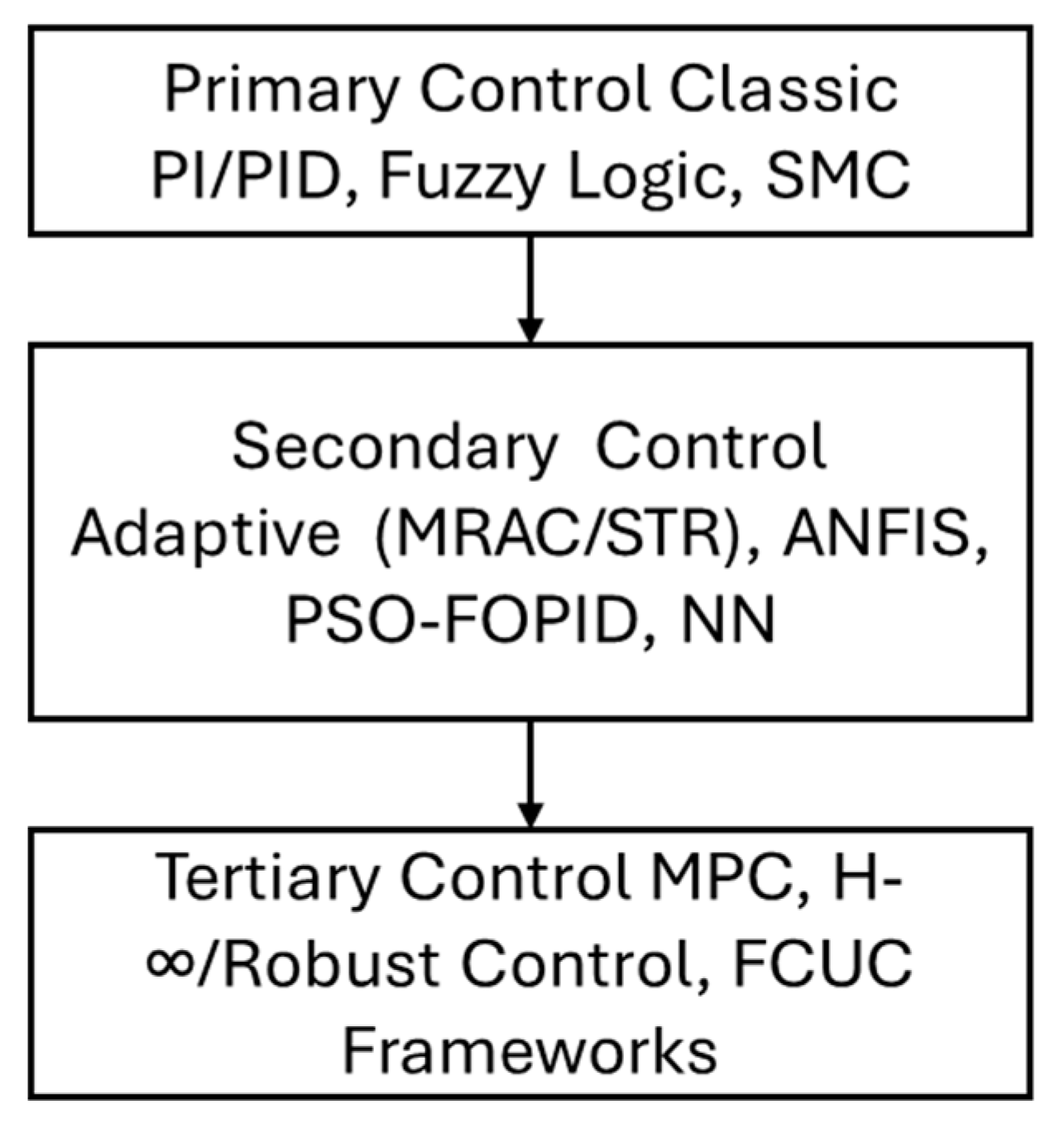
| Classical PI/PID | Low—Sensitive to parameter variations and nonlinearities | Low—Simple structure and easy implementation | Moderate (4–10 s) | High (8–15%) | Secondary (AGC) |
| Model Predictive Control (MPC) | High—Effectively manages constraints and multivariable interactions | High—Requires real-time optimisation over the prediction horizon | Fast (5–8 s) | Very Low < 5% | Secondary often with Tertiary co-ordination |
| Robust Control (H∞/SMC) | Very High Designed to maintain performance under uncertainties | Moderate to High—Advanced control law computation | Fast (2–4 s) | Low < 5% | Secondary |
| Internal Model Control (IMC) | High—Incorporates process model for disturbance rejection | Moderate—Requires model reduction and filter design | Fast (6–8 s) | Very Low < 5% | Secondary |
| Adaptive Control (MRAC/STR) | High | Moderate to High—Advanced control law computation | Fast (4–8 s) | Very Low < 5% | Secondary |
| Aspect | H∞ Control | Sliding Mode Control (SMC) | Adaptive Control (MRAC/STR) |
|---|---|---|---|
| Type | Frequency-domain robust optimal control | Nonlinear robust control with switching law | Online parameter estimation to track reference dynamics. |
| Focus | Minimises worst-case disturbance amplification | Forces dynamics onto the sliding surface | Continuously adapts controller parameters to maintain the desired dynamic response in the presence of parameter drift and uncertainties. |
| Strengths | Strong theoretical guarantees are adequate for multi-area systems | High robustness, fast settling, disturbance rejection | Maintains performance under changing system parameters; self-tuning capability. |
| Weaknesses | Computationally intensive, conservative design | Chattering requires careful design | Slower adaptation under rapid disturbances; stability depends on adaptation law design. |
| Performance in LFC | Ensures bounded frequency deviations under RES uncertainty | Settling time ~5–7 s vs. ~12 s for PI in multi-area RES systems. Overshoot: <3% compared to 8–15% for classical controllers | Provides adaptive correction of frequency deviations with smooth convergence; improves dynamic response under time-varying parameters and renewable fluctuations |
| Use Cases | Systems with structured uncertainties and model-based design | Systems with nonlinearities and high variability | Systems with frequent parameter variations, communication delays, or decentralised operation; ideal for adaptive and cooperative LFC frameworks |
| Key Selection Factors | Suitable when system model and uncertainty bounds are well characterised; preferred for guaranteed robustness in low-inertia systems with known dynamic ranges. | Favoured for strongly nonlinear systems or high disturbance environments; applied where fast dynamics and chattering suppression can be managed. | Recommended when system parameters vary frequently or are uncertain; ideal for renewable-integrated and multi-area systems needing real-time adjustment. |
| Factor | Explanation |
|---|---|
| Generalisation vs. Overfitting | NNs are data-driven. If not trained on a diverse and realistic dataset (including system nonlinearities and disturbances), they may overfit to training data and perform poorly in unseen scenarios. |
| Training Quality | Performance heavily depends on hyperparameters, architecture (number of layers/neurons), and quality of the training algorithm (e.g., backpropagation, optimiser choice). |
| System Variability | LFC systems have non-linearities, time delays, and varying load/generation dynamics. NNs might fail to adapt quickly unless integrated with adaptive logic or retraining capabilities. |
| No Online Learning by Default | Static NNs (trained offline) do not adapt in real time. Unlike Adaptive Control, which can respond dynamically to disturbances, NNs often require retraining. |
| Sensitivity to Noise | NNs are sensitive to outliers and measurement noise unless specifically designed to handle them (e.g., via regularisation, noise injection). |
| Interpretability | Neural controllers are often black-boxes. Operators may prefer more explainable models, such as ANFIS or fuzzy-PID, for critical infrastructure. |
| Computational Complexity | Real-time application of deep or recurrent networks (e.g., LSTM) can be computationally heavy unless optimised. |
| Controller Type | Robustness | Computational Complexity | Settling Time | Overshoot | Nadir (Hz) | RoCoF (Hz/s) | RES Suitability | Key Features | Typical Control Layer |
|---|---|---|---|---|---|---|---|---|---|
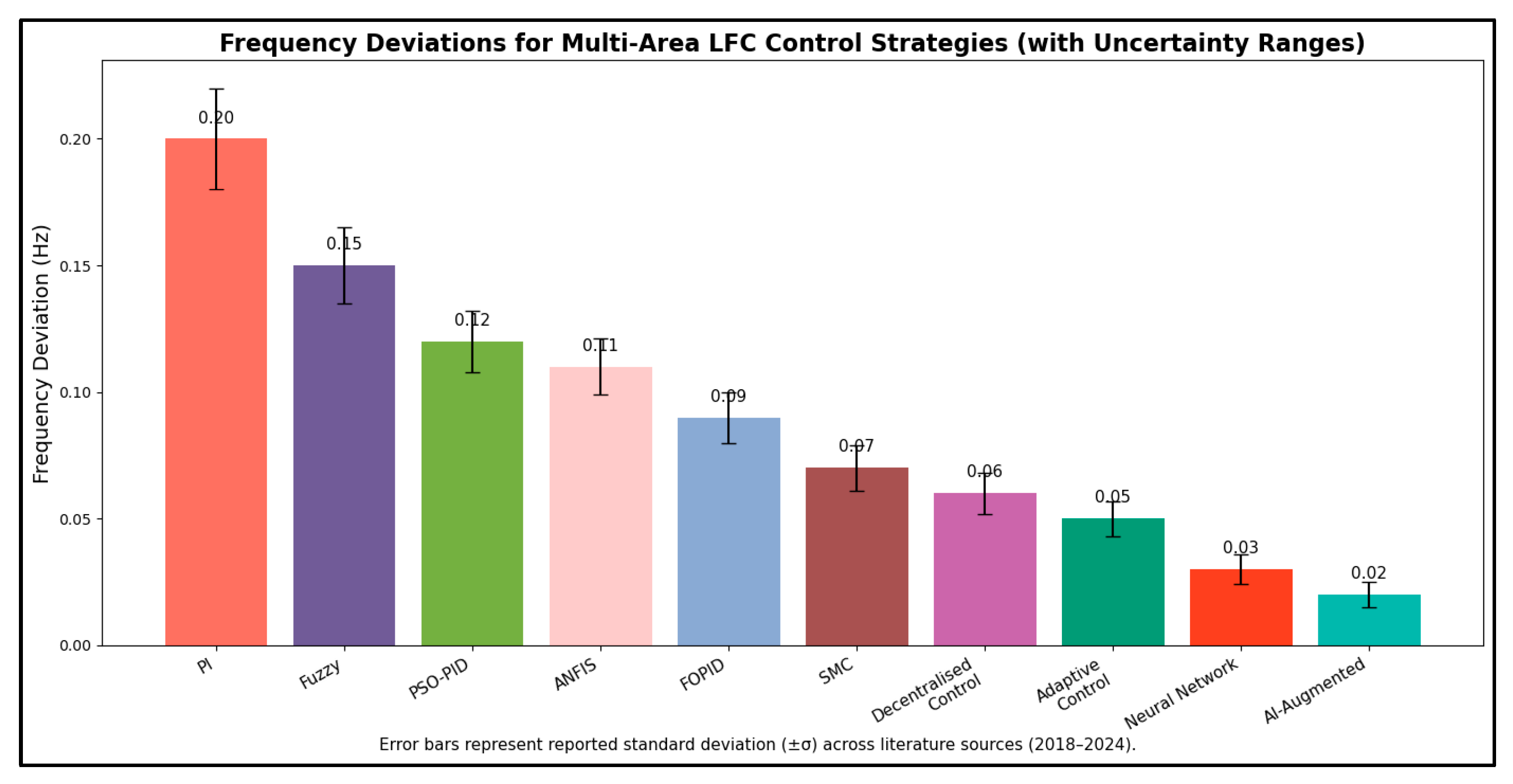
| Classical PI/PID | Low | Very Low | Long (~10–30 s) | High (~10–20%) | −0.20 to −0.25 | 0.15–0.20 | Poor | Simple structure; requires manual tuning; fails under significant disturbances. | Secondary |
| ANFIS (Adaptive Neuro-Fuzzy) | High | High | Moderate (~5–10 s) | Very Low (<5%) | −0.08 to −0.10 | 0.05–0.07 | Excellent | Adaptive and self-tuning; a hybrid neuro-fuzzy structure enhances resilience to parameter changes. | Secondary (with Tertiary optimisation link) |
| PSO-FOPID | Very High | Moderate to high | Short (~3–6 s) | Very Low (<3%) | −0.06 to −0.08 | 0.03–0.05 | Excellent | Fractional-order dynamics improve tuning flexibility; metaheuristic optimisation ensures robustness. | Secondary |
| SMC (Sliding Mode Control) | Very High | Moderate | Very Short (~2–5 s) | Minimal (<2%) | −0.04 to −0.06 | 0.02–0.04 | Excellent | Robust to external disturbances; effectively mitigates RES fluctuations. | Secondary |
| Fuzzy Logic Controller | Medium | Low to moderate | Moderate (~6–12 s) | Low (~5–10%) | −0.10 to −0.12 | 0.07–0.10 | Good | Simple rule-based design; performance depends on rule selection and membership functions. | Secondary |
| Neural Network (NN) | High | High | Short (~4–8 s) | Low (<5%) | −0.07 to −0.09 | 0.04–0.06 | Excellent | Requires sufficient training; can adapt to changes in system dynamics in real-time. | Secondary (with Tertiary optimisation link) |
| Adaptive Control | High | Moderate | Short (~4–8 s) | Low (~5%) | −0.07 to −0.09 | 0.04–0.06 | Excellent | Parameter adaptation improves stability under varying load and generation conditions. | Secondary |
| Decentralised Control | Medium | Low | Moderate (~8–15 s) | Medium (~5–10%) | −0.12 to −0.15 | 0.09–0.12 | Good | Enables area-wise independence but may lack global optimality. | Secondary |
| Robust H∞ Control | Very High | High | Short (~3–7 s) | Very Low (<3%) | −0.05 to −0.07 | 0.03–0.04 | Excellent | Guarantees performance under worst-case disturbances; needs advanced design | Secondary |
| Approach | Strengths | Weaknesses | Computational Aspects |
|---|---|---|---|
| Deterministic FCUC | Simple formulation; fast and computationally efficient. | Ignores RES uncertainty; not reliable under high variability. | Low complexity; scalable to large systems; suitable for preliminary scheduling and planning. |
| Stochastic FCUC | Captures RES uncertainty via multiple probabilistic scenarios; improves realism [9,10]. | Scenario explosion leads to a significant computational burden, requiring accurate probability distributions. | Medium to high complexity; scenario reduction techniques are often required for tractability. |
| Robust FCUC | Guarantees feasibility under worst-case uncertainty; ensures frequency security [11]. | Overly conservative; leads to excessive reserve commitments and higher costs. | Moderate complexity; tractable with linear formulations; less scalable under large systems. |
| Chance-Constrained FCUC | Provides probabilistic guarantees (e.g., ≥95% confidence); balances realism and tractability [12,13]. | Requires accurate statistical characterisation of RES uncertainty; risk of infeasibility if distributions are mis-specified. | Higher complexity than deterministic but less than stochastic; solvable with convex relaxations. |
| Hybrid (Stochastic + Robust) | Balances risk sensitivity and conservatism; shown to yield more cost-effective and reliable schedules. | Increased modelling and computational complexity require careful tuning of trade-offs. | High complexity; typically solved using decomposition, scenario reduction, or parallel computing. |
| Approach | Settling Time | Overshoot | Frequency Nadir | ITAE Reduction | RoCoF | Computational Time | Strengths | Limitations |
|---|---|---|---|---|---|---|---|---|
| Classical PI/PID [41,42,62,95] | ~10 s | 8–15% | ITAE 3–4× higher than robust methods | - | ~0.45 Hz/s | 10.2 | Simple, widely deployed, low computation | Poor robustness in low-inertia grids, high overshoot |
| Robust/Optimal (H∞, SMC, MPC, IMC) [63,64,65,66] | 2–7 s | <3% | strong RoCoF/nadir control | 35–45% | <0.25 Hz/s | 12.3 | High robustness, predictive adaptability, and handles constraints | Complex design (H∞/SMC), high computation (MPC) |
| Metaheuristic-tuned (PSO-FOPID, ANFIS) [95] | 3–8 s | <5% | better robustness via optimisation | 30–40% | <0.30 Hz/s | 8.2 | Practical trade-off: near-robust performance with simpler tuning | Needs offline optimisation scenario-specific tuning |
| Adaptive/MRAC [96,99] | 4–7 s | <4% | Enhanced nadir recovery (0.15–0.3 Hz improvement) | 25–30% | <0.28 Hz/s | 9.5 | Self-tuning capability, improved adaptability to parameter changes | Slower adaptation in highly nonlinear dynamics; model dependence |
| FCUC (Frequency-Constrained Unit Commitment) [32,33,34,35,36,106] | 3–5 s | <2–3% | Improves nadir by 0.2–0.4 Hz vs. SCUC ensures inertia | 40–50% | <0.20 Hz/s | 6.4 | Holistic scheduling security co-optimises reserves and inertia | Scalability and decentralisation challenges model simplifications |
Disclaimer/Publisher’s Note: The statements, opinions and data contained in all publications are solely those of the individual author(s) and contributor(s) and not of MDPI and/or the editor(s). MDPI and/or the editor(s) disclaim responsibility for any injury to people or property resulting from any ideas, methods, instructions or products referred to in the content. |
© 2025 by the authors. Licensee MDPI, Basel, Switzerland. This article is an open access article distributed under the terms and conditions of the Creative Commons Attribution (CC BY) license (https://creativecommons.org/licenses/by/4.0/).
Share and Cite
Gumede, S.; Behara, K.; Sharma, G. Analytical and Optimisation-Based Strategies for Load Frequency Control in Renewable-Rich Power Systems. Energies 2025, 18, 6295. https://doi.org/10.3390/en18236295
Gumede S, Behara K, Sharma G. Analytical and Optimisation-Based Strategies for Load Frequency Control in Renewable-Rich Power Systems. Energies. 2025; 18(23):6295. https://doi.org/10.3390/en18236295
Chicago/Turabian StyleGumede, Stephen, Kavita Behara, and Gulshan Sharma. 2025. "Analytical and Optimisation-Based Strategies for Load Frequency Control in Renewable-Rich Power Systems" Energies 18, no. 23: 6295. https://doi.org/10.3390/en18236295
APA StyleGumede, S., Behara, K., & Sharma, G. (2025). Analytical and Optimisation-Based Strategies for Load Frequency Control in Renewable-Rich Power Systems. Energies, 18(23), 6295. https://doi.org/10.3390/en18236295