Management Challenges in the Biogas Production Sector in Poland—Current Status, Potential and Perspectives



Abstract
1. Introduction
2. Current State of Biogas Production in Poland—Literature Review and Contextual Background
2.1. Justification for the Review
- -
- Political and regulatory;
- -
- Economic conditions;
- -
- Technological capacity;
- -
- Public opinion.
2.2. Statistics: Number of Installations, Installed Capacity, and Energy Production
2.3. Types of Biogas Plants in Poland
2.3.1. Agricultural Biogas Plants
- -
- Electricity and heat generation, supported by feed-in tariffs (FIT), feed-in premiums (FIP), or RES auctions.
- -
- Waste management fees for slurry and organic residues, which provide a stable income stream and help farmers meet environmental obligations.
- -
- Digestate utilization as an organic fertilizer, contributing to nutrient recycling and reducing dependence on synthetic fertilizers—an increasingly relevant factor given rising fertilizer prices and EU Farm-to-Fork goals [25].
2.3.2. Wastewater Treatment Plant Digesters
- -
- They stabilize sewage sludge, reducing its volume and pathogen load before final disposal.
- -
- They enable energy recovery from otherwise problematic waste streams.
- -
- Thermal hydrolysis pre-treatment, which breaks down sludge cell walls, increasing biogas yield by 30–50% and improving dewaterability of digestate.
- -
- Advanced process monitoring and control, including online measurement of volatile fatty acids (VFA) and real-time biogas composition [54].
- -
- Post-digestion and polishing steps, such as second-stage anaerobic digestion or upgrading biogas to biomethane for grid injection.
2.3.3. Landfill Gas Recovery Systems
- -
- Economic viability as gas production declines, reducing revenues while fixed operating costs remain.
- -
- Collection efficiency, which must be optimized to minimize fugitive emissions, often requiring better wellfield design and monitoring.
- -
- Integration with other renewable sources to maintain profitability, e.g., hybrid projects combining solar PV with LFG generation to share infrastructure [58].
2.3.4. Comparative Significance and Future Outlook
2.4. Technological Innovation, Digitalization, and Benchmarking in the EU Context
- -
- Biogas upgrading technologies—Increasing numbers of plants are installing upgrading units such as pressure swing adsorption (PSA), membrane separation, and water and amine scrubbing systems. These solutions allow the production of grid-quality biomethane, which can be injected into the gas grid or used as bio-CNG/LNG for transport, supporting Poland’s compliance with EU decarbonization targets [25].
- -
- Thermal hydrolysis and advanced pre-treatment—Particularly in WWTP digesters, thermal hydrolysis systems improve the biodegradability of sludge and other feedstocks, boosting methane yield by up to 50% and enhancing digestate dewaterability.
- -
- Digitalization and smart monitoring—The integration of IoT-based sensors and AI-supported process control systems enables real-time monitoring and optimization of key parameters (pH, temperature, organic loading rate, gas composition). Predictive maintenance tools and data-driven analytics improve operational reliability and reduce downtime, which translates into lower production costs and higher plant profitability [67].
- -
- Hybrid renewable energy systems—Biogas CHP units are increasingly connected with solar PV and wind installations to create hybrid microgrids, ensuring a more stable supply of electricity and heat while balancing intermittent renewables [66].
3. Analysis and Discussion: Management Challenges of the Biogas Production Sector in Poland—Economic and Environmental Aspects
3.1. Investment and Operating Costs, Financing Sources
- -
- NFOŚiGW programs such as Agroenergia, offering grants and preferential loans covering up to 50% of eligible costs.
- -
- National Recovery and Resilience Plan (KPO) funds for biomethane grid connections and digitalization projects.
- -
- EU cohesion funds and the Modernisation Fund, which prioritize renewable heat and gas infrastructure.
- -
- Private equity and bank loans, which are becoming more available as biomethane projects gain bankability.
3.2. Revenue Model and Market Economics
- -
- Harmonized GoO systems for biomethane and renewable electricity under the EU RED III directive are creating a tradable market for green attributes, allowing operators to capture additional value and sell “green gas” premiums to industry or energy suppliers.
- -
- Transport sector incentives: The implementation of bio-CNG and bio-LNG as advanced renewable fuels generates compliance value under the EU Renewable Energy Directive (RED III) and Poland’s National Indicative Target (NIT). This creates an additional market for upgraded biomethane, particularly attractive for heavy transport and municipal fleets.
- -
- Digestate utilization: As mineral fertilizer prices remain volatile, digestate is increasingly valued as a locally available, nutrient-rich soil amendment. The monetization of digestate, whether via direct sales or nutrient credit schemes, contributes both to farm economics and circular economy objectives [25].
- -
- Carbon credits: Although still nascent in Poland, voluntary carbon markets are beginning to recognize methane avoidance from manure management as a tradable credit. Future integration with the EU ETS for non-CO2 agricultural emissions could further enhance revenue streams.
3.3. Environmental Benefits and Circular Economy Contribution
- (1)
- Reduction in greenhouse gas emissions (CO2 eq), calculated according to the RED II methodology based on avoided methane emissions and substitution of fossil fuels;
- (2)
- Energy recovery efficiency, measured as the ratio of usable biogas energy to total feedstock energy potential;
- (3)
- Nutrient recycling efficiency, based on digestate utilization rates in agricultural applications.
= 0.5 \times GHG_{red} + 0.3 \times E_{rec} + 0.2 \times N_{rec}Eenv
= 0.5 × GHGred + 0.3 × Erec + 0.2 × Nrec
4. Conclusions: Potential and Future Perspectives for the Biogas Production Sector in Poland
4.1. Theoretical and Technical Potential of Biogas and Biomethane
- -
- Agricultural residues—livestock manure and slurry represent more than 50% of the potential, offering a dual benefit of energy generation and methane emission mitigation.
- -
- Crop residues and catch crops—maize silage, straw, and other energy crops grown on marginal land could contribute another 20–30% of the potential, with careful management to avoid competition with food production [73].
- -
- Agri-food industry waste—by-products from dairies, breweries, distilleries, and sugar refineries are highly suitable substrates due to their high methane yield, providing an opportunity for industrial symbiosis.
- -
- Municipal and sewage sludge streams—although smaller in absolute volume, they contribute a steady year-round feedstock base and support circular economy objectives [28].
- -
- Capacity expansion—scaling up from the current 300 MW installed capacity to at least 700–800 MW by 2030, implying a near tripling of current output [75].
- -
- Biogas upgrading deployment—widespread installation of PSA, membrane, water and amine scrubbing units to produce grid-quality biomethane, enabling gas grid injection and use in transport as bio-CNG and bio-LNG [74].
- -
- Grid integration and infrastructure—building new biomethane injection points, especially in rural areas, and introducing standardized quality and metering requirements [50].
- -
- Technological optimization—implementing high-rate anaerobic digestion, thermal hydrolysis, and AI/IoT-driven process control to increase methane yield and reduce operational costs [51].
- -
- Energy security—reducing dependence on imported natural gas, especially in the context of geopolitical instability.
- -
- Climate action—contributing to Fit for 55 and the Methane Strategy by avoiding fugitive methane emissions from agriculture and landfills.
- -
- Circular economy—enabling nutrient recycling and waste management solutions that reduce environmental burdens.
- -
- Accelerating permitting and standardizing biomethane grid injection rules;
- -
- Expanding rural gas grid infrastructure and injection hubs;
- -
- Creating long-term market signals through power purchase agreements (PPAs) and guarantees of origin;
- -
- Fostering innovation in modular and cost-efficient upgrading technologies.
4.2. The Role of Biogas in Poland’s Energy Transition
4.3. Future Development Pathways and Scenarios
4.4. Barriers to Development and Recommendations
- -
- Regulatory and Administrative Barriers.
- -
- Economic and Financial Barriers.
- -
- Technological and Infrastructure Barriers.
- -
- Social and Environmental Barriers.
- -
- Recommendations for Policy and Practice
- Regulatory Streamlining: Introduce a one-stop-shop permitting system and harmonize biomethane quality and metering rules across DSOs to reduce administrative burden and investor risk.
- Stable Support Framework: Extend support schemes or introduce market-based instruments such as long-term PPAs for biomethane and renewable electricity to provide post-FIT/FIP revenue stability.
- Infrastructure Investment: Expand rural gas grid connections, create regional biomethane hubs, and invest in seasonal gas storage solutions.
- Financial Support: Increase access to preferential loans, guarantees, and EU funds targeting small- and medium-sized farms. Consider CAPEX subsidies for upgrading units to accelerate biomethane deployment.
- Technological Innovation: Promote digitalization, predictive maintenance, and modular upgrading systems to lower OPEX and CAPEX.
- Social Engagement: Develop community-benefit schemes and transparent communication strategies to improve local acceptance and highlight co-benefits such as job creation and odor reduction.
- Environmental Safeguards: Encourage sustainable feedstock sourcing, crop rotation practices, and digestate management plans to prevent negative environmental impacts.
4.5. Key Findings of the Review
- (1)
- Policy and regulatory barriers—due to unstable support mechanisms, lengthy permitting procedures, and frequent legislative changes;
- (2)
- Economic barriers—related to feedstock price volatility, limited access to long-term financing, and low profitability of small-scale plants;
- (3)
- Technological barriers—concerning upgrading technology costs and grid interconnection constraints; and
- (4)
- Social barriers—primarily low public awareness and limited stakeholder cooperation.
Author Contributions
Funding
Data Availability Statement
Conflicts of Interest
References
- Wang, Y.; Li, Y.; Yao, L.; Fu, L.; Liu, Z. The Biogas Production Potential and Community Structure Characteristics of the Co-Digestion of Dairy Manure and Tomato Residues. Agronomy 2024, 14, 881. [Google Scholar] [CrossRef]
- Jin, W.Y.; Xu, X.C.; Yang, F.L.; Li, C.L.; Zhou, M. Performance enhancement by rumen cultures in anaerobic co-digestion of corn straw with pig manure. Biomass Bioenergy 2018, 115, 120–129. [Google Scholar] [CrossRef]
- Korberg, A.D.; Skov, I.R.; Mathiesen, B.V. The role of biogas and biogas-derived fuels in a 100% renewable energy system in Denmark. Energy 2020, 199, 117426. [Google Scholar] [CrossRef]
- Li, Y.Y.; Manandhar, A.; Li, G.X.; Shah, A. Life cycle assessment of integrated solid state anaerobic digestion and composting for on-farm organic residues treatment. Waste Manag. 2018, 76, 294–305. [Google Scholar] [CrossRef]
- Li, C.X.; Champagne, P.; Anderson, B.C. Evaluating and modeling biogas production from municipal fat, oil, and grease and synthetic kitchen waste in anaerobic co-digestions. Bioresour. Technol. 2011, 102, 9471–9480. [Google Scholar] [CrossRef]
- Bond, T.; Templeton, M.R. History and future of domestic biogas plants in the developing world. Energy Sustain. Dev. 2011, 15, 347–354. [Google Scholar] [CrossRef]
- Bhat, P.R.; Chanakya, H.N.; Ravindranath, N.H. Biogas plant dissemination: Success story of Sirsi, India. Energy Sustain. Dev. 2001, 5, 39–46. [Google Scholar] [CrossRef]
- Uranga-Valencia, L.P.; Pérez-Álvarez, S.; Gabriel-Parra, R.; Chávez-Medina, J.A.; Magallanes-Tapia, M.A.; Sánchez-Chávez, E.; Muñoz-Márquez, E.; García-García, S.A.; Rascón-Solano, J.; Castruita-Esparza, L.U. Biogas Production from Organic Waste in the Forestry and Agricultural Context: Challenges and Solutions for a Sustainable Future. Energies 2025, 18, 3174. [Google Scholar] [CrossRef]
- Wang, Z.; Sanusi, I.A.; Wang, J.; Ye, X.; Kana, E.B.G.; Olaniran, A.O.; Shao, H. Developments and Prospects of Farmland Application of Biogas Slurry in China—A Review. Microorganisms 2023, 11, 2675. [Google Scholar] [CrossRef]
- Perea-Moreno, M.A.; Samerón-Manzano, E.; Perea-Moreno, A.J. Biomass as renewable energy: Worldwide research trends. Sustainability 2019, 11, 863. [Google Scholar] [CrossRef]
- Mmusi, K.; Mudiwa, J.; Rakgati, E.; Vishwanathan, V. Biogas a Sustainable Source of Clean Energy in Sub Saharan Africa: Challenges and Opportunities. J. Appl. Mater. Sci. Eng. Res. 2021, 5, 7–12. [Google Scholar]
- Bai, D.; Jain, V.; Tripathi, M.; Ali, S.A.; Shabbir, M.S.; Mohamed, M.A.; Ramos-Meza, C.S. Performance of biogas plant analysis and policy implications: Evidence from the commercial sources. Energy Policy 2022, 169, 113173. [Google Scholar] [CrossRef]
- Bhatt, A.H.; Tao, L. Economic perspectives of biogas production via AD. Bioengineering 2020, 7, 74. [Google Scholar] [CrossRef]
- Velásquez-Piñas, J.A.; Calle-Roalcaba, O.D.; Miramontes-Martínez, L.R.; Alonso-Gómez, L.A. Economic and environmental assessment of biogas utilization technologies and perspectives of multicriteria analysis. ION J. 2023, 36, 29–47. [Google Scholar]
- Cervi, R.G.; Esperancini, M.S.; Bueno, O.D.C. Economic Viability of using Biogas for Electrical Power Generation. Inf. Technol. 2011, 22, 3–14. [Google Scholar]
- Yu, X.; Yan, L.; Wang, H.; Bi, S.; Zhang, F.; Huang, S.; Wang, Y.; Wang, Y. Anaerobic co-digestion of cabbage waste and cattle manure: Effect of mixing ratio and hydraulic retention time. Renew. Energy 2024, 221, 119743. [Google Scholar] [CrossRef]
- Saracevic, E.; Frühauf, S.; Miltner, A.; Karnpakdee, K.; Munk, B.; Lebuhn, M.; Wlcek, B.; Leber, J.; Lizasoain, J.; Friedl, A.; et al. Utilization of food and agricultural residues for a flexible biogas production: Process stability and effects on needed biogas storage capacities. Energies 2019, 12, 2678. [Google Scholar] [CrossRef]
- Abbas, Y.; Yun, S.; Mehmood, A.; Shah, F.A.; Wang, K.; Eldin, E.T.; Al-Qahtani, W.H.; Ali, S.; Bocchetta, P. Co-digestion of cow manure and food waste for biogas enhancement and nutrients revival in bio-circular economy. Chemosphere 2023, 311, 137018. [Google Scholar] [CrossRef]
- Mlaik, N.; Sayadi, S.; Masmoudi, M.A.; Yaacoubi, D.; Loukil, S.; Khoufi, S. Optimization of anaerobic co-digestion of fruit and vegetable waste with animal manure feedstocks using mixture design. Biomass Convers. Biorefinery 2024, 14, 4007–4016. [Google Scholar] [CrossRef]
- Nevzorova, T.; Kutcherov, V. Barriers to the wider implementation of biogas as a source of energy: A state-of-the-art review. Energy Strategy Rev. 2019, 26, 100414. [Google Scholar] [CrossRef]
- Scarlat, N.; Dallemand, J.F.; Fahl, F. Biogas: Developments and perspectives in Europe. Renew. Energy 2018, 129, 457–472. [Google Scholar] [CrossRef]
- Capodaglio, A.G.; Callegari, A.; Lope, M.V. European framework for the diffusion of biogas uses: Emerging technologies, acceptance, incentive strategies, and institutional–regulatory support. Sustainability 2016, 8, 298. [Google Scholar] [CrossRef]
- Alayi, R.; Shamel, A.; Kasaeian, A.; Harasii, H.; Topchlar, M.A. The role of biogas to sustainable development (aspects environmental, security and economic). J. Chem. Pharm. Res. 2016, 8, 112–118. [Google Scholar]
- Kiselev, A.; Magaril, E.; Magaril, R.; Panepinto, D.; Ravina, M.; Zanetti, M.C. Towards circular economy: Evaluation of sewage sludge biogas solutions. Resources 2019, 8, 91. [Google Scholar] [CrossRef]
- REPowerEU Plan; European Commission: Brussels, Belgium, 2022. Available online: https://commission.europa.eu/topics/energy/repowereu_en (accessed on 1 October 2025).
- Thrän, D.; Deprie, K.; Dotzauer, M.; Kornatz, P.; Nelles, M.; Radtke, K.S.; Schindler, H. The potential contribution of biogas to the security of gas supply in Germany. Energy Sustain. Soc. 2023, 13, 12. [Google Scholar] [CrossRef]
- Energy Regulatory Office (URE). National Energy Market Report 2024; URE: Warsaw, Poland, 2024. Available online: https://www.ure.gov.pl/en/about-us/reports/67,Reports.html (accessed on 29 September 2025).
- Eurostat. Renewable Energy Statistics–2024 Edition; Publications Office of the European Union: Luxembourg, 2024; Available online: https://ec.europa.eu/eurostat/web/interactive-publications/energy-2024 (accessed on 4 October 2025).
- European Biogas Association. EBA Statistical Report 2024; EBA: Brussels, Belgium, 2024; Available online: https://www.europeanbiogas.eu/wp-content/uploads/2024/12/EBA_stats_report_complete_241204_preview.pdf (accessed on 3 October 2025).
- National Fund for Environmental Protection and Water Management (NFOŚiGW). Annual Report 2023; NFOŚiGW: Warsaw, Poland, 2023. Available online: https://www.gov.pl/web/nfosigw/sprawozdanie-z-dzialalnosci-nfosigw-w-roku-2023 (accessed on 29 September 2025).
- National Support Centre for Agriculture (KOWR). Bioenergy Market Report 2025; National Support Centre for Agriculture (KOWR): Warsaw, Poland, 2025. Available online: https://www.gov.pl/web/kowr/odnawialne-zrodla-energii (accessed on 30 September 2025).
- Kowalska, M.; Chomać-Pierzecka, E. Sustainable Development Through the Lens of Climate Change: A Diagnosis of Attitudes in Southeastern Rural Poland. Sustainability 2025, 17, 5568. [Google Scholar] [CrossRef]
- International Renewable Energy Agency (IRENA). Renewable Capacity Statistics 2023; International Renewable Energy Agency (IRENA): Abu Dhabi, United Arab Emirates, 2023; Available online: https://www.irena.org/Publications/2023/Mar/Renewable-capacity-statistics-2023 (accessed on 4 October 2025).
- Polish Biogas Association. Biogas Market in Poland 2024; Polish Biogas Association: Warsaw, Poland, 2024; Available online: https://bioch4.org/en/forum-en-copy/ (accessed on 1 October 2025).
- PwC. Energy Transformation in Poland 2024; PwC: Warsaw, Poland, 2024; Available online: https://www.pwc.pl/pl/o-nas/raport-zrownowazonego-rozwoju-pwc-polska-2024.html (accessed on 4 October 2025).
- Szymańska, D.; Lewandowska, A. Biogas power plants in Poland—Structure, capacity, and spatial distribution. Sustainability 2015, 7, 16801–16819. [Google Scholar] [CrossRef]
- Bednarek, A.; Klepacka, A.M.; Siudek, A. Development barriers of agricultural biogas plants in Poland. Econ. Environ. 2023, 1, 229–258. [Google Scholar] [CrossRef]
- Scarlat, N.; Fahl, F.; Dallemand, J.-F.; Monforti, F.; Motola, V. A spatial analysis of biogas potential from manure in Europe. Renew. Sustain. Energy Rev. 2018, 94, 915–930. [Google Scholar] [CrossRef]
- IEA Bioenergy. Task 37: Country Reports Summary 2023. Available online: https://task37.ieabioenergy.com/country-reports/ (accessed on 3 October 2025).
- D’Adamo, I.; Ribichini, M.; Tsagarakis, K.P. Biomethane as an energy resource for achieving sustainable production: Economic assessments and policy implications. Sustain. Prod. Consum. 2023, 35, 13–27. [Google Scholar] [CrossRef]
- Moher, D.; Liberati, A.; Tetzlaff, J.; Altman, D.G.; The PRISMA Group. Preferred Reporting Items for Systematic Reviews and Meta Analyses: The PRISMA Statement. PLoS Med. 2009, 6, e1000097. [Google Scholar] [CrossRef]
- Bała, M.M.; Leśniak, W.; Jaeschke, R. Process of developing systematic reviews, including Cochrane reviews. Pol. Arch. Med. Wewn. 2015, 125, 16–25. Available online: https://bm.cm.uj.edu.pl/cm/uploads/2021/04/Proces-przygotowywania-przegladow-systematycznych-z-uwzglednieniem-przegladow-Cochrane.pdf (accessed on 11 November 2025). [CrossRef] [PubMed]
- Central Statistical Office of Poland (GUS). Statistical Yearbook of the Republic of Poland 2024; Central Statistical Office of Poland (GUS): Warsaw, Poland, 2024. Available online: https://stat.gov.pl/en/topics/statistical-yearbooks/statistical-yearbooks/statistical-yearbook-of-the-republic-of-poland-2024,2,26.html (accessed on 30 September 2025).
- Biogas and biomethane in Poland 2024 Report. Available online: https://magazynbiomasa.pl/pobierz-raport-biogaz-i-biometan-w-polsce-2024/ (accessed on 30 September 2025).
- Zupok, S.; Chomać-Pierzecka, E.; Dmowski, A.; Dyrka, S.; Hordyj, A. A Review of Key Factors Shaping the Development of the U.S. Wind Energy Market in the Context of Contemporary Challenges. Energies 2025, 18, 4224. [Google Scholar] [CrossRef]
- Chomać-Pierzecka, E. Innovation as an Attribute of the Sustainable Development of Pharmaceutical Companies. Sustainability 2025, 17, 2417. [Google Scholar] [CrossRef]
- Mertins, A.; Wawer, T. How to use biogas?: A systematic review of biogas utilization pathways and business models. Bioresour. Bioprocess. 2022, 9, 59. [Google Scholar] [CrossRef]
- Chomać-Pierzecka, E.; Dyrka, S.; Kokiel, A.; Urbańczyk, E. Sustainable HR and Employee Psychological Well-Being in Shaping the Performance of a Business. Sustainability 2024, 16, 10913. [Google Scholar] [CrossRef]
- Brahmi, M.; Bruno, B.; Dhayal, K.S.; Esposito, L.; Parziale, A. From manure to megawatts: Navigating the sustainable innovation solution through biogas production from livestock waste for harnessing green energy for green economy. Heliyon 2024, 10, e34504. [Google Scholar] [CrossRef]
- European Commission. EU Energy Outlook 2023; European Commission: Brussels, Belgium, 2023. Available online: https://ec.europa.eu/commission/presscorner/detail/en/ac_22_7677 (accessed on 30 September 2025).
- Lima, D.; Li, L.; Appleby, G. Biogas Production Modelling Based on a Semi-Continuous Feeding Operation in a Municipal Wastewater Treatment Plant. Energies 2025, 18, 1065. [Google Scholar] [CrossRef]
- Miranzadeh, M.B.; Jafarsalehi, M.; Akram, J.; Ebrahimi, M.; Mazaheri, A.; Mashayekh, M. Boosting biogas production in wastewater treatment plants: A narrative review on co-digestion of sewage sludge with internal and external organic waste. Bioresour. Technol. Rep. 2024, 26, 101856, ISSN 2589-014X. [Google Scholar] [CrossRef]
- López-Herrada, E.; Gallardo-Rodríguez, J.J.; López-Rosales, L.; Cerón-García, M.C.; Sánchez-Mirón, A.; García-Camacho, F. Life-cycle assessment of a microalgae-based fungicide under a biorefinery approach. Bioresour. Technol. 2023, 383, 129244. [Google Scholar] [CrossRef]
- Mukundan, S.; Xuan, J.; Dann, S.E.; Wagner, J.L. Highly active and magnetically recoverable heterogeneous catalyst for hydrothermal liquefaction of biomass into high quality bio-oil. Bioresour. Technol. 2023, 369, 128479. [Google Scholar] [CrossRef]
- Thaysen, E.M.; McMahon, S.; Strobel, G.J.; Butler, I.B.; Ngwenya, B.T.; Heinemann, N.; Wilkinson, M.; Hassanpouryouzband, A.; McDermott, C.I.; Edlmann, K. Estimating microbial growth and hydrogen consumption in hydrogen storage in porous media. Renew. Sustain. Energy Rev. 2021, 151, 111481. [Google Scholar] [CrossRef]
- Deublein, D.; Steinhauser, A. Biogas from Waste and Renewable Resources: An Introduction, 2nd ed.; Wiley-VCH: Weinheim, Germany, 2011. [Google Scholar] [CrossRef]
- International Energy Agency (IEA). World Energy Outlook 2023; OECD/IEA: Paris, France, 2023; Available online: https://www.iea.org/reports/world-energy-outlook-2023 (accessed on 1 October 2025).
- Kim, J.-C.; Huh, J.-H.; Ko, J.-S. Optimization Design and Test Bed of Fuzzy Control Rule Base for PV System MPPT in Micro Grid. Sustainability 2020, 12, 3763. [Google Scholar] [CrossRef]
- Hamman, P.; Dziebowski, A. Building an Agricultural Biogas Supply Chain in Europe: Organizational Models and Social Challenges. Sustainability 2025, 17, 5806. [Google Scholar] [CrossRef]
- Wellinger, A.; Murphy, J.; Baxter, D. (Eds.) The Biogas Handbook: Science, Production and Applications; Woodhead Publishing: London, UK, 2013. [Google Scholar] [CrossRef]
- Igliński, B.; Piechota, G.; Iwański, P.; Skarzatek, M.; Pilarski, G. 15 Years of the Polish Agricultural Biogas Plants: Their History, Current Status, Biogas Potential and Perspectives. Clean Technol. Environ. Pol. 2020, 22, 281–307. [Google Scholar] [CrossRef]
- Zupok, S. Innowacje jako element budowy wartości dla klienta–studium przypadku RCGW S.A. w Tychach. Zarz. Finans. 2017, 15, 375–387. [Google Scholar]
- Hosseini, M.; Leonenko, Y. A reliable model to predict the methane-hydrate equilibrium: An updated database and machine learning approach. Renew. Sustain. Energy Rev. 2023, 173, 113103. [Google Scholar] [CrossRef]
- Kęsy, I.; Godawa, S.; Błaszczak, B.; Chomać-Pierzecka, E. Human Safety in Light of the Economic, Social and Environmental Aspects of Sustainable Development—Determination of the Awareness of the Young Generation in Poland. Sustainability 2025, 17, 6190. [Google Scholar] [CrossRef]
- Chomać-Pierzecka, E. Economic, Environmental and Social Security in accordance with the Concept of Sustainable Development. Stud. Adm. Bezpiecz. 2025, 18, 257–272. [Google Scholar] [CrossRef]
- Baredar, P.; Khare, V.; Nema, S. Design and Optimization of Biogas Energy Systems; Academic Press: Cambridge, MA, USA, 2020. [Google Scholar] [CrossRef]
- Akash, M.A.H.; Hossain, M.S.; Islam, M.; Islam, K.S.; Islam, M.N.; Sony, S.Y. Optimization of methane production in anaerobic digestion: A hybrid approach using experimental analysis, process simulation and machine learning. Results Eng. 2025, 28, 107464. [Google Scholar] [CrossRef]
- Jabraeelzadeh, A.; Gharehghani, A.; Ahbabi Saray, J.; Mahmoudzadeh Andwari, A.; Borhani, T.N. Techno-economic analysis of biogas upgrading through amine scrubbing: A comparative study of different single amines. Fuel 2025, 381, 133662. [Google Scholar] [CrossRef]
- Jameel, M.K.; Mustafa, M.A.; Ahmed, H.S.; Mohammed, A.J.; Ghazy, H.; Shakir, M.N.; Lawas, A.M.; Mohammed, S.K.; Idan, A.H.; Mahmoud, Z.H.; et al. Biogas: Production, properties, applications, economic and challenges: A review. Results Chem. 2024, 7, 101549. [Google Scholar] [CrossRef]
- Sganzerla, W.G. (Ed.) Biogas: A Sustainable Approach for Renewable Energy, 1st ed.; Woodhead Publishing: London, UK, 2025; ISBN 9780443336805. [Google Scholar]
- Kusz, D.; Nowakowski, T.; Kusz, B. The Capacity of Power of Biogas Plants and Their Technical Efficiency: A Case Study of Poland. Energies 2024, 17, 6256. [Google Scholar] [CrossRef]
- Sobczak, A.; Chomać-Pierzecka, E.; Kokiel, A.; Różycka, M.; Stasiak, J.; Soboń, D. Economic Conditions of Using Biodegradable Waste for Biogas Production, Using the Example of Poland and Germany. Energies 2022, 15, 5239. [Google Scholar] [CrossRef]
- Czekała, W.; Drozdowski, J.; Łabiak, P. Modern Technologies for Waste Management: A Review. Appl. Sci. 2023, 13, 8847. [Google Scholar] [CrossRef]
- Ashokkumar, V.; Kumar, G.; Lakshmanan, H.; Chandramughi, V.P.; Flora, G.; Kothari, R.; Piechota, G. A critical review of biogas production and upgrading from organic wastes: Recent advances, challenges and opportunities. Biomass Bioenergy 2025, 194, 107566. [Google Scholar] [CrossRef]
- Ciuła, J.; Wiewiórska, I.; Banaś, M.; Pająk, T.; Szewczyk, P. Balance and Energy Use of Biogas in Poland: Prospects and Directions of Development for the Circular Economy. Energies 2023, 16, 3910. [Google Scholar] [CrossRef]
- Piechota, G.; Igliński, B. Biomethane in Poland—Current Status, Potential, Perspective and Development. Energies 2021, 14, 1517. [Google Scholar] [CrossRef]
- Ministry of Climate and Environment. Polish Energy Policy until 2040 (PEP2040). Warsaw 2021. Available online: https://www.gov.pl/web/climate/energy-policy-of-poland-until-2040-epp2040 (accessed on 4 October 2025).
- Chomać-Pierzecka, E. Value as an economic category in the light of the multidimensionality of the concept ‘value’. Lang. Relig. Identity 2021, 2, 155–166. [Google Scholar] [CrossRef]
- Guidehouse. Biogases Towards 2040 and Beyond. Guidehouse. 2024. Available online: https://guidehouse.com/insights/communities-energy-infrastructure/2024/biogases-towards-2040-and-beyond (accessed on 3 October 2025).
- Sher, F.; Smječanin, N.; Hrnjić, H.; Karadža, A.; Omanović, R.; Šehović, E.; Sulejmanović, J. Emerging technologies for biogas production: A critical review on recent progress, challenges and future perspectives. Process Saf. Environ. Prot. 2024, 188, 834–859. [Google Scholar] [CrossRef]
- National Energy and Climate Plans, European Commission 2023. Available online: https://commission.europa.eu/energy-climate-change-environment/implementation-eu-countries/energy-and-climate-governance-and-reporting/national-energy-and-climate-plans_en (accessed on 3 October 2025).



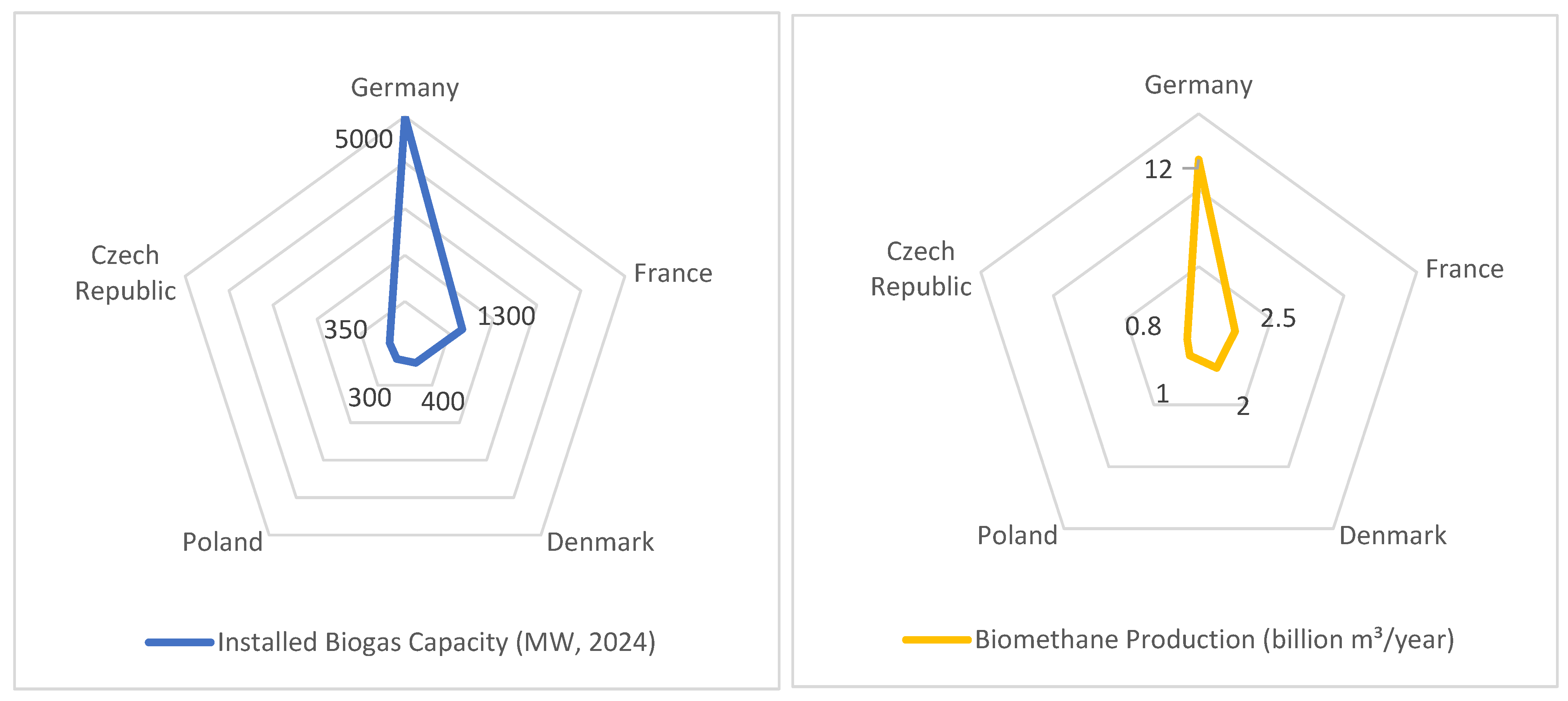
| Country | Installed Biogas Capacity (MW, 2024) | Biomethane Production (Billion m3/Year) | Key Policy Driver |
|---|---|---|---|
| Germany | >5000 | 12.0 | EEG 2023, Biomethane Strategy |
| France | ~1300 | 2.5 | National Biomethane Plan |
| Denmark | ~400 | 2.0 | Full grid integration and heat tariffs |
| Poland | 300 | ~1.0 | FIT/FIP auctions, Agroenergia |
| Czech Republic | ~350 | 0.8 | Agricultural support schemes |
| Year | Number of Biogas Plants | Installed Electrical Capacity (MW) | Electricity Production (TWh) |
|---|---|---|---|
| 2015 | 98 | 165 | 0.55 |
| 2016 | 110 | 180 | 0.6 |
| 2017 | 123 | 195 | 0.68 |
| 2018 | 136 | 210 | 0.75 |
| 2019 | 149 | 225 | 0.82 |
| 2020 | 162 | 240 | 0.9 |
| 2021 | 174 | 260 | 1.0 |
| 2022 | 181 | 275 | 1.08 |
| 2023 | 192 | 290 | 1.15 |
| 2024 | 400 | 300 | 1.25 |
| Type of Biogas Plant | Share of Total Installations (%) | Share of Installed Capacity (%) | Typical Feedstock | Main Advantages |
|---|---|---|---|---|
| Agricultural | ~45 | ~50–55 | Manure, slurry, silage, agri-food waste | Circular economy, methane mitigation, rural development |
| Wastewater treatment plants | ~30 | ~25–30 | Sewage sludge, co-substrates (fats, food waste) | Energy self-sufficiency, sludge stabilization, reduced disposal cost |
| Landfill gas recovery | ~25 | ~15–20 | Biodegradable municipal waste | Methane capture, GHG mitigation, compliance with EU directives |
| Category | Drivers (Growth Factors) | Barriers (Challenges) |
|---|---|---|
| Policy and Regulation |
|
|
| Economics and Finance |
|
|
| Technology and Infrastructure |
|
|
| Environmental and Social |
|
|
| Technology | Key Advantages | Main Limitations | Typical Cost Range (€/Nm3 Biogas) |
|---|---|---|---|
| Pressure Swing Adsorption (PSA) |
|
| 0.10–0.20 |
| Water Scrubbing |
|
| 0.12–0.25 |
| Membrane Separation |
|
| 0.10–0.18 |
| Chemical /Amine Scrubbing |
|
| 0.15–0.30 |
| Cryogenic Separation |
|
| 0.20–0.35 |
| Revenue Stream | Typical Share of Total Revenue (%) | Notes/Key Drivers |
|---|---|---|
| Electricity sales (FIT/FIP/auction) | 50–60% | Primary revenue source, 15-year guaranteed price under auction/FIT/FIP schemes; price-indexed, relatively low risk. |
| Heat sales | 10–15% | Depends on availability of district heating grid or on-site thermal demand (greenhouses, drying facilities, municipal networks). |
| Waste treatment (gate) fees | 20–30% | Stable income stream from accepting manure, slurry, food waste; particularly important in plants using co-digestion. |
| Guarantees of origin and green certificates | 5–8% | Growing share due to RED III harmonization; tradable GoOs add a “green premium” to gas and electricity sales. |
| Digestate sales/nutrient credits | 3–5% | Increasingly monetized as fertilizer prices rise; contributes to circular economy targets. |
| Other (carbon credits, ancillary services) | <3% | Emerging markets; potential future upside with voluntary carbon credits and grid flexibility services. |
| Environmental Benefit | Typical Quantitative Effect (Indicative Range) | Key Contribution to Policy Goals | Source |
|---|---|---|---|
| GHG emission reduction | 1.5–3.0 t CO2-eq avoided per 1000 m3 of raw biogas produced | Supports EU Effort Sharing targets, Methane Strategy, and REPowerEU | [25,39] |
| Methane capture from manure | 50–70% CH4 emission reduction compared with open storage | Reduces agricultural sector’s non-CO2 emissions, improves air quality | [72] |
| Waste diversion from landfill | 30–50% of organic waste diverted from landfill streams | Compliance with EU Landfill Directive and Circular Economy Package | [28] |
| Nutrient recycling (digestate) | 3–4 kg N and 1–1.5 kg P recycled per tonne of digestate | Substitution of synthetic fertilizers, contribution to Farm-to-Fork targets | [25] |
| Energy efficiency (CHP) | >70% total efficiency (electric + thermal) | Displacement of fossil fuel-based heat and power | [60] |
| Local development and jobs | 5–7 permanent jobs per MW installed | Rural development, local value creation | [39] |
| Category | Estimated Potential (Billion m3/Year) | Share of Poland’s Gas Demand (%) | Key Notes |
|---|---|---|---|
| Theoretical Potential | 7.0–8.0 | 20–25% | Includes all available biomass resources, energy crops, manure, agri-food waste, and residues. |
| Technical Potential | 3.3–4.0 | 10–12% | Feasible under current technology, economic conditions, and infrastructure. |
| Current Production (2024) | ≈1.1 (biogas equivalent) | ≈3% | Based on ~1.25 TWh electricity production and CHP heat use. |
| Gap to Technical Potential | ≈2.2–2.9 | ≈7–9% | Represents expansion need via new plants, upgrading, and grid connection projects. |
| Sector/Application | Role of Biogas/Biomethane | Strategic Impact |
|---|---|---|
| Electricity System | Dispatchable renewable power from CHP units; balancing of solar/wind variability | Enhances grid stability, provides peak-load capacity, supports coal phase-out |
| District Heating | Low-carbon heat from CHP integrated with local networks | Reduces coal dependence in urban heating systems, improves air quality |
| Transport (Road & Maritime) | Bio-CNG and bio-LNG as renewable fuels for trucks, buses, ships | Contributes to RED III transport targets, cuts emissions in hard-to-electrify sectors |
| Industry | Renewable substitute for natural gas in high-temperature processes | Supports decarbonization of hard-to-abate industrial sectors (chemicals, ceramics, food processing) |
| Agriculture & Waste | Manure management, organic waste valorization | Cuts methane emissions, supports nutrient recycling, aligns with Circular Economy objectives |
| Energy Security | Domestic production of renewable gas | Reduces import dependence, improves resilience to gas price shocks |
| Scenario | 2030 Installed Capacity (MW) | 2030 Biomethane Production (Billion m3) | Share of Gas Demand in 2030 (%) | 2050 Outlook | Key Drivers |
|---|---|---|---|---|---|
| Optimistic | 700–800 | 3.5–4.0 | 10–12 | Near-technical potential (5–6 bcm/year), 15–20% of gas demand | Strong policy support, streamlined permitting, grid expansion, investment incentives |
| Baseline | 550–600 | 2.0–2.5 | 6–8 | 70–80% of technical potential achieved | Moderate policy stability, gradual grid expansion, partial uptake of biomethane |
| Constrained | 400–450 | 1.2–1.5 | 3–4 | <50% of potential achieved | Policy uncertainty, financing barriers, limited grid access, high CAPEX |
| Barrier Category | Key Challenges | Recommended Solutions |
|---|---|---|
| Regulatory & Administrative | Lengthy permitting, lack of harmonized biomethane standards, uncertainty after FIT/FIP period | Introduce one-stop-shop permitting, standardize biomethane injection rules, develop post-FIT/FIP market mechanisms (PPAs, capacity markets) |
| Economic & Financial | High CAPEX for upgrading/grid connection, limited financing for SMEs, substrate price volatility | Expand CAPEX subsidies, create risk-sharing funds, support cooperative and farmer-owned biogas projects |
| Technological & Infrastructure | Limited injection points, lack of storage, low digitalization | Invest in biomethane hubs and seasonal storage, promote IoT and AI for process optimization |
| Social & Environmental | NIMBY effect, concerns about monocultures, traffic and odor | Community engagement, benefit-sharing mechanisms, enforce sustainable feedstock sourcing and crop rotation |
Disclaimer/Publisher’s Note: The statements, opinions and data contained in all publications are solely those of the individual author(s) and contributor(s) and not of MDPI and/or the editor(s). MDPI and/or the editor(s) disclaim responsibility for any injury to people or property resulting from any ideas, methods, instructions or products referred to in the content. |
© 2025 by the authors. Licensee MDPI, Basel, Switzerland. This article is an open access article distributed under the terms and conditions of the Creative Commons Attribution (CC BY) license (https://creativecommons.org/licenses/by/4.0/).
Share and Cite
Chomać-Pierzecka, E.; Zupok, S.; Ćwik, K.; Bykowski, P. Management Challenges in the Biogas Production Sector in Poland—Current Status, Potential and Perspectives. Energies 2025, 18, 6255. https://doi.org/10.3390/en18236255
Chomać-Pierzecka E, Zupok S, Ćwik K, Bykowski P. Management Challenges in the Biogas Production Sector in Poland—Current Status, Potential and Perspectives. Energies. 2025; 18(23):6255. https://doi.org/10.3390/en18236255
Chicago/Turabian StyleChomać-Pierzecka, Ewa, Sebastian Zupok, Kamila Ćwik, and Paweł Bykowski. 2025. "Management Challenges in the Biogas Production Sector in Poland—Current Status, Potential and Perspectives" Energies 18, no. 23: 6255. https://doi.org/10.3390/en18236255
APA StyleChomać-Pierzecka, E., Zupok, S., Ćwik, K., & Bykowski, P. (2025). Management Challenges in the Biogas Production Sector in Poland—Current Status, Potential and Perspectives. Energies, 18(23), 6255. https://doi.org/10.3390/en18236255