Article

Thermal Performance Improvement of Phase Change Plates in Underground Refuge Chambers Through Nano-Graphite Particles and Fins

1
State Key Laboratory of Mining Safety and Disaster Prevention of Metal Mines, Maanshan 243000, China
2
Sinosteel Maanshan General Institute of Mining Research Co., Ltd., Maanshan 243000, China
3
State Key Laboratory of Intelligent Construction and Healthy Operation & Maintenance of Deep Underground Engineering, China University of Mining and Technology, Xuzhou 221116, China
4
School of Mechanics and Civil Engineering, China University of Mining and Technology, Xuzhou 221116, China
*
Authors to whom correspondence should be addressed.
Energies 2025, 18(23), 6224; https://doi.org/10.3390/en18236224
Submission received: 30 October 2025 / Revised: 23 November 2025 / Accepted: 25 November 2025 / Published: 27 November 2025
(This article belongs to the Topic Thermal Energy Transfer and Storage, 2nd Edition)

Abstract

As coal mining operations extend deeper underground, the importance of refuge chambers as temporary shelters for miners grows given the heightened risk of accidents. The severe geothermal conditions in deep mines present significant challenges to temperature regulation within these chambers, potentially subjecting miners to hazardous heat exposure. The utilization of phase change plates (PCPs) presents a promising approach to improving temperature regulation performance. To systematically investigate the enhancement effects of nano-graphite particles (NGPs) and fin structures on the thermal performance of phase change materials (PCMs), this study conducted thermophysical property tests and temperature-controlled melting experiments to analyze the influence of varying NGP concentrations on the thermal characteristics of PCMs, while observing their melting behavior. Four PCP models were designed: base PCM, PCM with NGPs, plate fin, and pin fin. Based on the enthalpy-porosity method, numerical simulations were performed to systematically evaluate the melting kinetics and temperature regulation performance of each design under extended operation conditions. The findings indicate that while NGP doping markedly increases the thermal conductivity and peak melting temperature of the PCM, it also results in a reduction in latent heat capacity. The NGP-enhanced No. 25 paraffin wax (RT25) PCP reduced the surface temperature by 1.02 °C compared to the base material. During extended operation, the NGP-based model outperformed others, maintaining effective temperature regulation for 149.8 h, 13 h longer than the base PCM and exceeding the standard requirement by 53.8 h. This underscores its notable advantages in thermal management. These advancements offer a valuable reference for the utilization of PCP in refuge chambers, thereby augmenting their temperature regulation capabilities.

1. Introduction

Despite global energy transition initiatives, coal remains a primary energy source [1,2,3]. With the depletion of shallow resources, strategic development of kilometer-deep mines has become imperative [4,5]. However, increased mining depths introduce more complex environments and higher risk of accidents, necessitating enhanced underground worker safety measures [6]. In emergency situations, underground refuge chambers provide critical temporary shelter for miners, significantly extending potential rescue windows [7]. These chambers must maintain a survivable environment for at least 96 h [8,9,10]. The enclosed nature of these spaces leads to rapid temperature rise from metabolic heat and equipment operation [7,10,11], compounded by growing geothermal challenges at depth [12]. Chinese coal mine safety regulations mandate that refuge chamber temperatures must not exceed 35 °C during the 96 h period [13], as prolonged exposure to high temperatures and humidity jeopardizes both physiological and psychological health [14,15,16], ultimately affecting survival rates [17,18,19]. Thus, to prolong the effective evacuation period and enhance the success rate of rescue efforts, it is crucial to keep the environmental temperature in the evacuation area within a safe range.
The four primary cooling techniques currently available are liquid vaporization [20,21], forced ventilation cooling [7,22], ice storage cooling [23,24], and phase change cooling [25,26]. Liquid vaporization uses CO2 or air expansion for simultaneous cooling and drying but faces CO2 hazards and high-pressure upkeep [21]. Ventilation cooling via buried or surface ducts becomes impractical at depth due to rising complexity and cost [24]. Ice-storage systems rely on power-hungry refrigeration and strict insulation, and they fail when power is lost during accidents [27,28]. Phase change cooling systems offer distinct advantages through their mechanical simplicity, operational reliability, and energy autonomy [29]. Phase change cooling systems utilize phase change materials (PCMs) that can absorb or release large amounts of latent heat at specific temperatures, thereby effectively regulating the temperature inside the refuge chamber [30]. This also helps to reduce dependence on traditional energy sources and lower energy consumption, showing significant potential in addressing the limited energy supply in refuge chambers [31]. Li et al. [25] found that incorporating PCMs can effectively lower the temperature inside the refuge chamber and improve the comfort of its occupants. Wu et al. [32] discovered that PCMs with melting points of 20–30 °C are capable of maintaining the chamber’s temperature control for 96 h. Gao et al. [33] demonstrated that for rock–PCM hybrid systems, 29 °C is the optimal phase transition temperature for thermal regulation. Liu et al. [34] found that incorporating PCMs into cement mortar to create phase change energy storage mortar has good thermal insulation and temperature control functions in underground projects.
However, conventional PCMs still suffer from poor thermal conductivity [35], a sharp drop in efficiency of heat transfer during the later phases of the phase change, and rapid temperature rise inside the chamber [36]. To improve the thermal regulation performance of PCMs, recent research has mainly focused on material modification [37,38] and structural enhancement [39,40]. Incorporating high-thermal-conductivity particles markedly improves matrix heat transfer. Sahan et al. [41] found that adding 10 wt% nano-Fe3O4 increased the thermal conductivity of paraffin by approximately 2.5 times. Yang et al. [42] demonstrated trace ZnO or CuO nano-graphite particles (NGPs) enhance both conductivity and latent heat storage. Mishra et al. [37] reported that incorporating Cu, SiC, and BN NGPs at 1 wt% into paraffin-based PCMs effectively improved thermal conductivity and reduced melting time. Zhang et al. [43] revealed the influence of graphite nanoplatelet content on the structure and thermophysical properties of PCMs, noting that it significantly reduced supercooling. While NGPs can augment thermal conductivity, they may present challenges such as phase separation, NGP agglomeration, and sedimentation during extended thermal cycling processes. These occurrences result in the deterioration of the thermal conduction network and diminished heat transfer efficiency [44,45]. Nourani et al. [46] found that the sedimentation rate of NGPs increased after 25 thermal cycles in composite PCMs. Sun et al. [47] indicated that under conditions without dispersants, the addition of high-concentration NGPs tends to cause agglomeration during long-term cycling. Furthermore, its influence on latent heat and phase change dynamics of PCMs warrants more detailed investigation.
In terms of structural enhancement, the incorporation of fins has been shown to enhance heat transfer [48,49,50], prompting extensive research on fin structure optimization. Pin-fin diameter and spacing are critical parameters, and high-density, uniformly distributed pin fins can significantly enhance heat transfer [39]. Abdi et al. [40] analyzed the effects of the quantity and height of vertical fins. Sheikholeslami et al. [51] examined the impact of V-shaped fin angles on the heat release efficiency of thermal storage units. Abdulateef et al. [52] found that an 18% fin aspect ratio most effectively reduced melting time. Zheng et al. [53] demonstrated that fractal network fins substantially improved the melting and heat transfer characteristics of PCMs in energy storage systems. Zhang et al. [54] found a 66.2% reduction in the total solidification time when compared to conventional radial fins. However, fins do not always promote heat transfer; Xu et al. [55] pointed out that fins may suppress natural convection. Ren et al. [56] numerically demonstrated that optimizing both the quantity and thickness of pin fins helps balance the heat transfer performance and latent heat utilization of composite PCMs. While fins offer the benefit of increasing heat transfer area, they can impede natural convection in later stages and reduce PCM storage capacity. Therefore, it is crucial to examine pin-fin structures within the framework of extended temperature control.
A substantial body of scholarly research has been dedicated to the optimization of PCMs, primarily focusing on strategies such as high thermal conductivity particle doping and fin structure enhancement. However, there is a relative paucity of studies exploring the integration of NGPs with pin-fin structures for enhancing PCM performance, particularly in the context of refuge chamber cooling applications. Furthermore, there is a dearth of systematic investigation into the long-term thermal performance evolution of such enhanced PCMs under simulated emergency refuge conditions extending beyond 96 h. To address these research gaps, this study offers a systematic examination into the influence of NGPs and pin-fin structure on the heat performance of phase change plates (PCPs). Through experimental analysis, the thermal characteristics of three distinct PCMs and their NGP-modified composite materials were evaluated to determine the optimal PCM. To elucidate the melting mechanisms and heat transfer properties of PCPs under extended operation, four distinct numerical models were developed and compared: a base model, an NGP model, a plate-fin model, and a pin-fin model. Subsequently, the efficacy of each model was then analyzed through continuous operation simulation, considering various aspects such as the melting process, air temperature control, and effective temperature control duration. The findings of this study can serve as an important theoretical foundation and design reference for the development of high-performance refuge chamber cooling systems.

2. Materials and Methods

2.1. Refuge Chamber Model

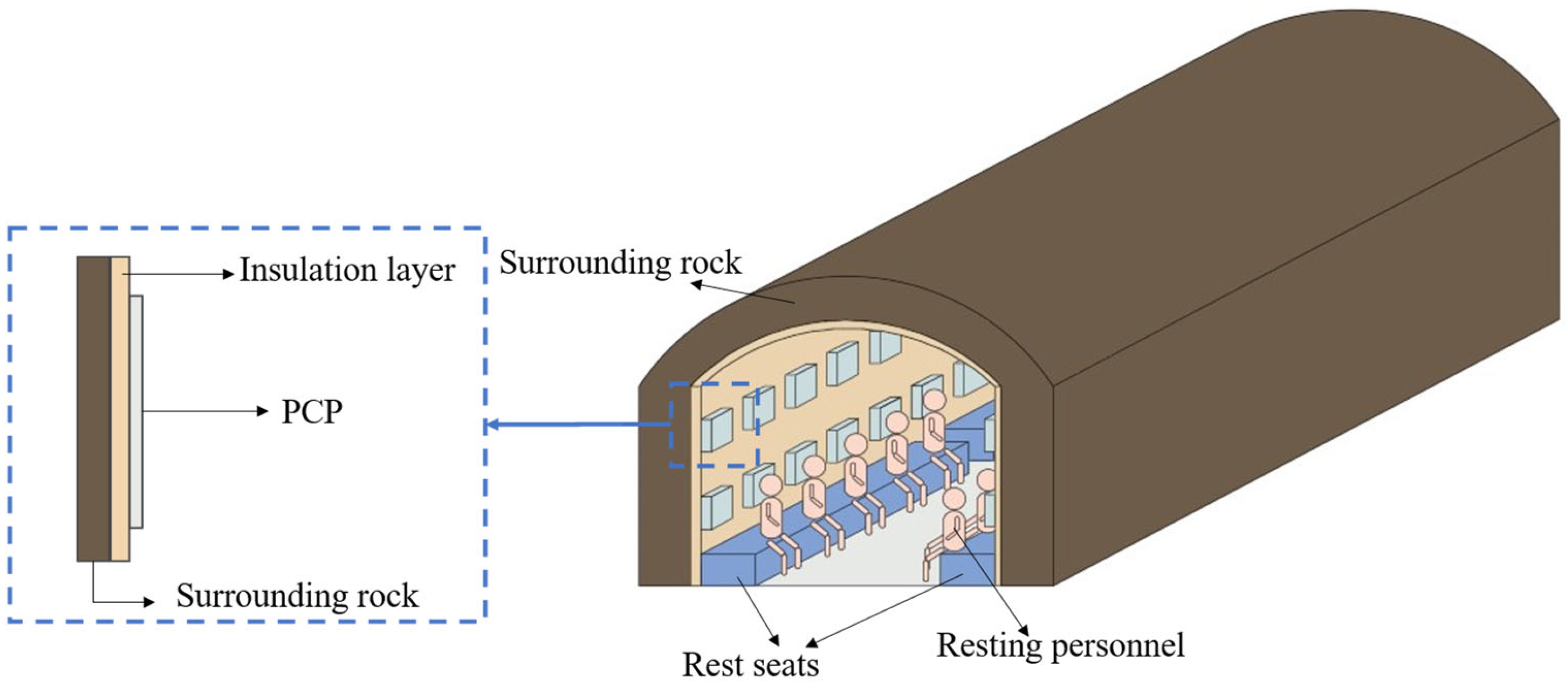
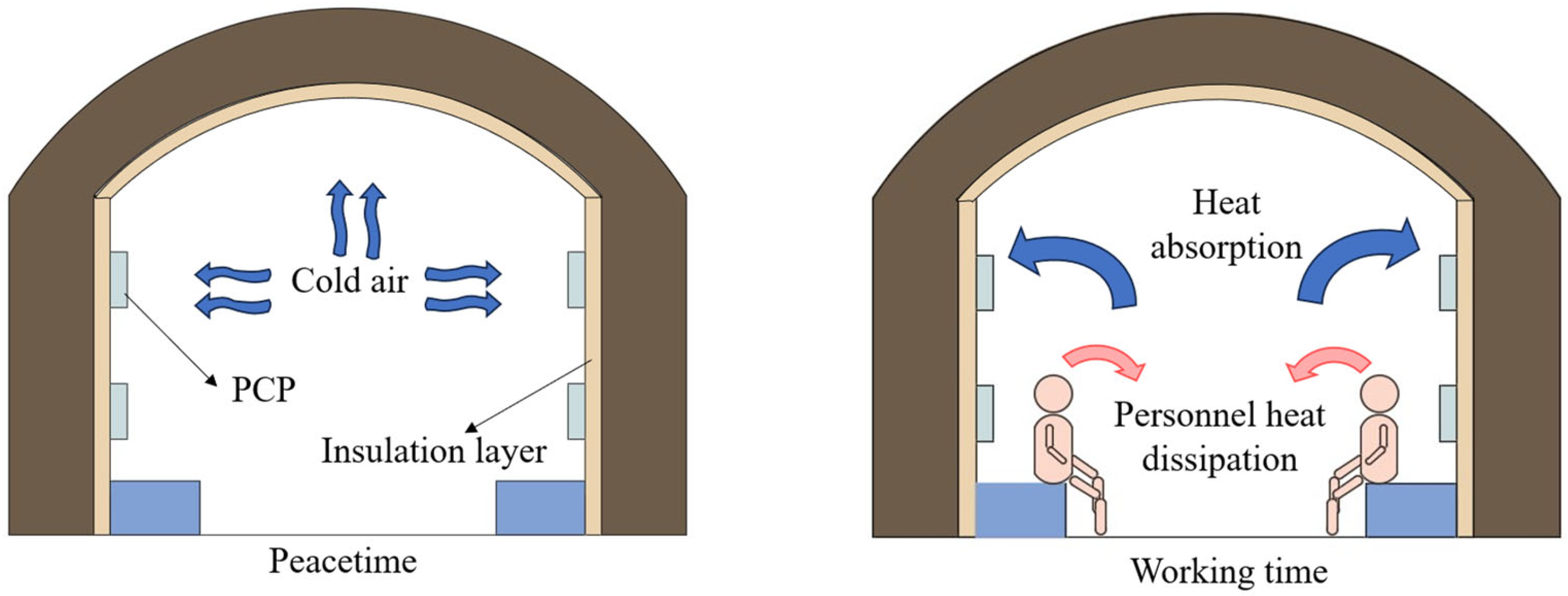
Figure 1 illustrates a schematic diagram of a compact PCP system specifically designed for emergency shelters. The system consists of insulation made of surrounding rock and PCPs, which can store and release cooling capacity through the utilization of the latent heat inherent to the PCM. One side of the PCP is securely fastened to the insulated wall of the refuge chamber, while the other side is directly exposed to the internal chamber space to facilitate convective heat exchange with the air. Figure 2 depicts a schematic diagram of the PCP system operating principle for the refuge chamber. During peacetime, precooling is facilitated via forced convection, wherein the PCP retains and stores cooling capacity in a solid state. The insulation layer effectively inhibits the dissipation of this cooling capacity to the adjacent rock. When the refuge chamber is operational, the heat produced by personnel and equipment is absorbed by the PCP. This material melts at an almost constant phase change temperature, delivering high latent-heat capacity, thereby offering a substantial thermal storage efficiency. Simultaneously, the insulation layer prevents heat influx from the surrounding rock [26]. The primary participants in the heat exchange process are personnel heat dissipation, air, and the PCP.

2.2. Experimental Methods

2.2.1. PCM Modification Setup

The selection of materials was based on the principles of suitable phase change temperature, high latent heat, and non-toxicity [57]. The chosen materials were No. 25 paraffin wax (RT25), No. 30 paraffin wax (RT30), and No. 600 polyethylene glycol (PEG600). Information regarding the phase change temperatures and latent heat of fusion for these selected materials is provided in Table 1. NGPs were added to create a modified composite PCM. The NGPs used had a particle size of 20 nm and appeared as a black powder at room temperature. NGPs were added at concentrations of 3 wt% and 5 wt% to each of the three base materials. Their thermal physical properties were then tested to determine the most suitable composite PCM for temperature control in refuge chambers.
Table 2 presents the main equipment and their specifications used in this experiment for preparing composite PCMs. The synthesis process of the composite PCMs is as follows: first, an electronic balance with a precision of 0.01 g was employed to accurately weigh the PCMs and NGPs; subsequently, the mixture was stirred and heated using a magnetic stirrer for 30 min until completely melted and homogenized; then, the homogeneous mixture was subjected to ultrasonic dispersion treatment for 2 h to ensure thorough dispersion, ultimately yielding the target composite PCM. For thermal property characterization, a differential scanning calorimeter (DSC) with a resolution of 0.1 μW was utilized to determine the phase transition temperature and latent heat variation in the synthesized composite PCM. A Hot Disk 500 thermal constant analyzer was applied to measure the thermal conductivity of the material, which had a measurement accuracy of ±3%.

2.2.2. PCP Experimental System and Procedure

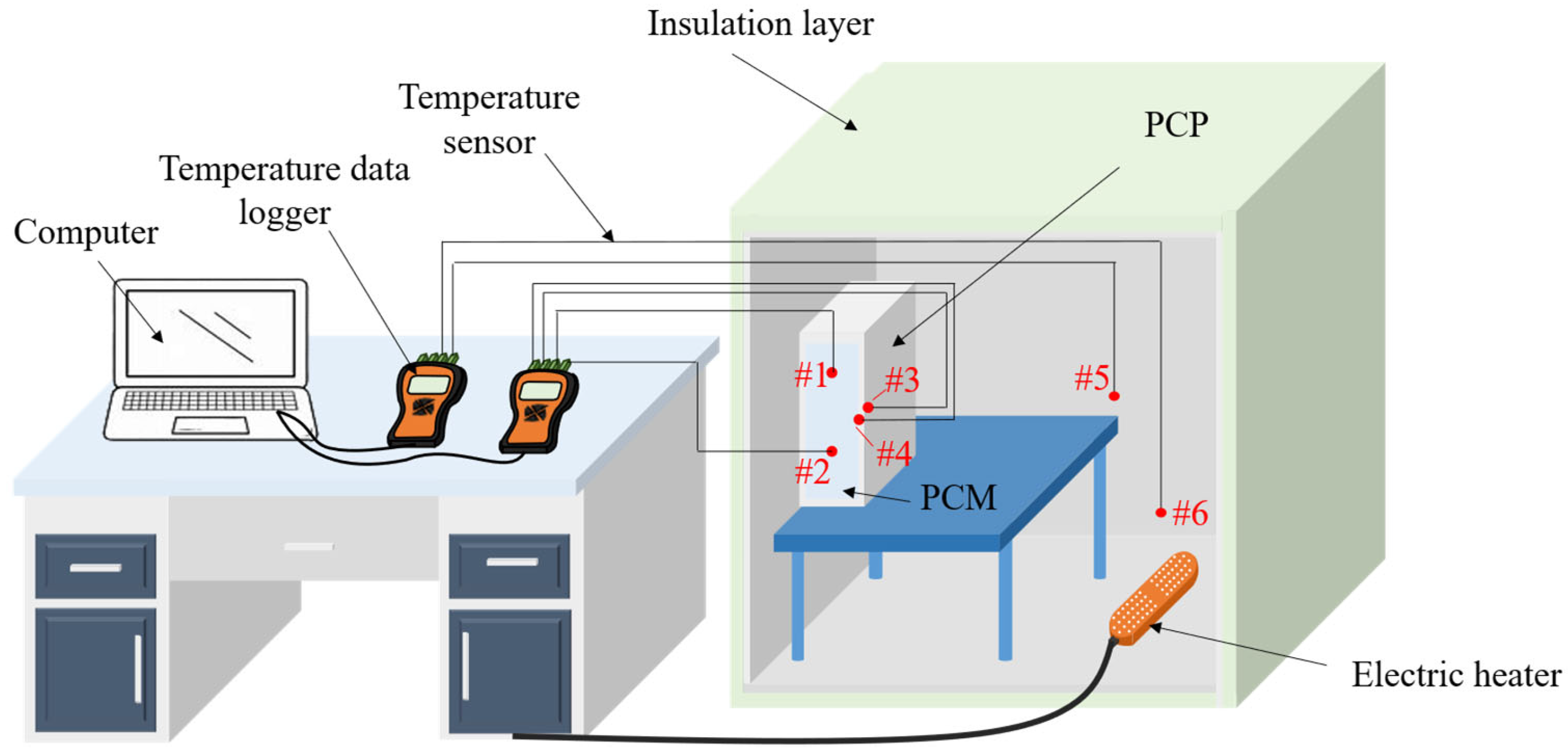
To investigate the enhancement of heat transfer in composite PCMs, the PCP melting experimental system was developed and shown in Figure 3. Its size was 500 mm  ×  500 mm  ×  500 mm acrylic cubic frame, the wall thickness was 4 mm, and an aerogel material with 10 mm thickness covered the outside to reduce thermal interference from the environment. The test sample was a 100 mm  ×  100 mm  ×  60 mm PCP with 5 mm thickness which contained the PCM. This experiment primarily investigated the melting behavior and heat transfer characteristics of a PCP during a single heating process. A 5 W air heater was used as the heat source to heat the experimental box. Six K-type thermocouples were arranged in the temperature monitoring system, four of which were used to measure the temperatures of the PCP; #1 and #2 were used to measure the PCM temperature at depths of 20 mm and 50 mm, respectively; #3 and #4 were used to record the temperatures of the inner and outer walls of the plate. Additionally, two other sensors, designated as #5 and #6, were used to monitor the air temperature at the mid-height and bottom of the chamber. The temperature data were recorded by SMART SENSOR AS887 thermometers with an accuracy of 1.5%.
The temperature control process of the PCP is described in detail below. (1) Install the temperature sensor probe in advance. Pour 600 mL of the three different modified PCMs into the PCP container and seal tightly. (2) Place each PCP in a refrigerator at 15 °C for 10 h and then place them in the test chamber. (3) Close the door of the chamber, block the gaps, turn on the air heater, and start timing. Record the temperature every 5 min. (4) Continue the next cycle of the PCP test until the experiment is over.

2.3. Numerical Methods

2.3.1. Physical Models

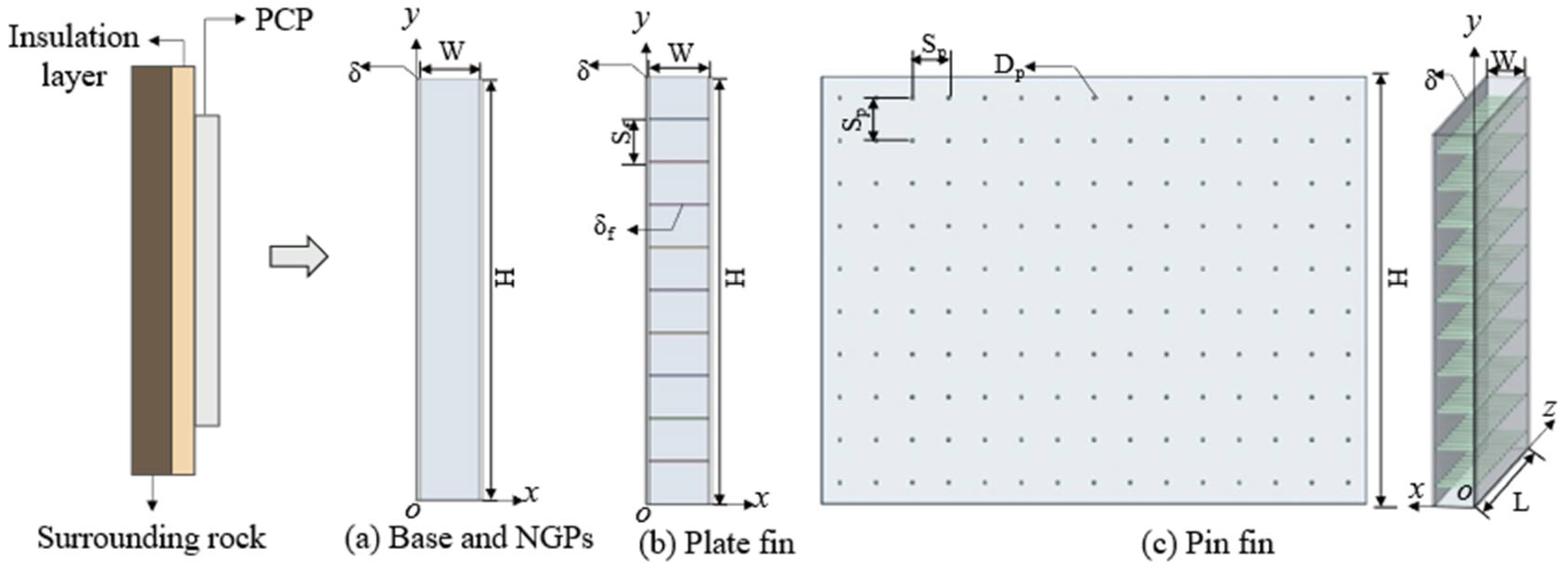
Figure 4 illustrates the numerical model of the PCP. Considering the substantial disparity between the 25 m length of the refuge chamber and the 50 mm thickness of the plate, coupled with the intricacies of internal heat transfer, comprehensive modeling was computationally prohibitive. Consequently, the study focused on a single PCP [13]. This PCP was conceptualized as a vertical hollow flat-plate structure affixed to an insulated wall, encompassing an aluminum shell filled with PCM [26,33]. The investigation scrutinized four distinct configurations, the base, NGP-enhanced, plate fin, and pin-fin PCP types, to evaluate their enduring performance and influence on the thermal environment of the chamber. Among them, the plate fins and pin fins refer to solid thin plates and slender cylinders, respectively, that traverse the PCM layer and connect the two sidewalls, both made of aluminum [58,59]. Both enhance overall heat transfer by expanding the heat transfer surface area and inducing micro-convection within the molten PCM. All models were encapsulated within 3 mm thick aluminum, boasting overall dimensions of 400 mm × 600 mm × 50 mm.
Figure 4a,b illustrate that natural convection in base, NGP, and plate-fin PCPs primarily induces horizontal flow and heat transfer, with negligible vertical effects. This justifies the use of a 2D rectangular model. Conversely, Figure 4c shows that the pin-fin PCP, due to the presence of pin fins, provokes vertical fluid flow, necessitating a 3D rectangular unit model. The plate fin PCP is equipped with fins measuring δf = 2 mm in thickness and Sf = 40 mm in spacing, comprising nine layers. The PCP features pin fins with a diameter Dp of 2 mm, a spacing Sp of 40 mm between fins, and a total of 150 pin fins.

2.3.2. Mathematical Model

The development of the mathematical model is based on the following assumptions:
(1)
The delay in air temperature rise is neglected, and the air temperature within the chamber is considered spatially uniform;
(2)
The PCM is considered to be a uniform and isotropic medium [60];
(3)
The flow of the liquid PCM is assumed to be laminar, unsteady, and incompressible [61];
(4)
Thermal contact resistance and viscous dissipation effects are disregarded;
(5)
Natural convection triggered by density fluctuations during phase transformations is included in the model, with the representation of density alterations following the Boussinesq approximation [62,63].
The enthalpy-porosity technique is employed to model the processes of solidification and melting [58]. This is an enthalpy-based method that describes the process of phase change by incorporating the liquid-phase fraction, a parameter that is iteratively updated according to the conservation equation of enthalpy. The liquid-phase fraction, expressed as a ratio, is determined by dividing the volume of the liquid phase by the total volume within a computational cell, varying from 0 to 1. When the value is 0, it means the region is completely solidified; when the value ranges from 0 to 1, it means the region is a mushy or slurry zone; and when the value is 1, it means the region is fully liquid. The source term is incorporated into the momentum equations to simulate the drag force induced by the solid phase; thus, a unified governance applicable to solid, slurry, and liquid regions can be obtained. In this model, both the temperature and enthalpy of the phase change material are also taken as the dependent variables in the solution.
Based on the above assumptions, the continuity equation, momentum equation, and heat equation for the PCM phase change process are expressed by the following [58]:
(1)
The continuity equation is shown in Equation (1).
ρ t + · ( ρ u ) = 0
where u is the components of the velocity, m/s; ρ is the density of the PCM, kg/m3.
(2)
The momentum conservation equation is shown in Equation (2).
ρ ( u t + ( · u ) u ) = η 2 u p + ρ ( 0 , g α ( T T r e f ) , g α ( T T r e f ) + S
where   η is the dynamic viscosity of the PCM, Pa·s; α is the coefficient of thermal expansion associated with the PCM, °C−1; p is the surface pressure, Pa; T and Tref are the temperature of the PCM and the thermal expansion reference, respectively, °C; g is the acceleration due to gravity, m·s−2; S is the momentum sink term, and its calculation formula is shown in Equation (3) [58].
S = ( 1 β ) 2 ( β 3 + ε ) A m u , ( 1 β ) 2 ( β 3 + ε ) A m v , ( 1 β ) 2 ( β 3 + ε ) A m w ,   ( u = ( u , v , w )
where β is the liquid-phase fraction, defined in Equation (4) [64]; ε is a small constant to prevent the denominator from becoming zero; and A m is a constant describing the velocity change near the freezing point in the paste region, typically ranging from 104 to 107.
β = 0 ,         T < T s   T T s T l T s ,   T s < T < T l 1 ,       T > T l
where T s and T l are the PCM temperature of solidification and melting, respectively, in °C.
(3)
The momentum energy equation is shown in Equation (5).
t ( ρ H ) + ( ρ u H ) = ( k f T )
where kf is the thermal conductivity of PCM, W/(m·°C);   H is the total enthalpy, consisting of sensible and latent heat enthalpy, J/kg, as shown in Equations (6)–(8) [64].
H = h + H
h = h 0 + T 0 T c P d T
H = β L
where h is the sensible heat enthalpy, J/kg; H is the latent heat enthalpy, J/kg; h0 is the initial enthalpy value, J/kg; T0 the initial temperature, °C; cp is the specific heat capacity at constant pressure, J·kg−1·°C−1; and L is the latent heat of complete melting of the PCM, J/kg.
The improved thermal performance of NGP-PCMs can be attributed to two principal mechanisms: firstly, graphite nanoparticles self-assemble into a network that boasts both high thermal conductivity and permeability; secondly, the Brownian motion of these nanoparticles facilitates micro-convection, thereby augmenting heat transfer [65]. Considering the Brownian motion characteristics exhibited by graphite particles in both the paste and liquid phases, it becomes necessary to adjust the thermal conductivity coefficient of the composite system. Equation (9) is crucial for accurately mirroring the variations in thermal conductivity throughout the phase transition of NGP PCM [36,66].
k n f = k n + 2 k f 2 ( k f k n ) φ k n + 2 k f + ( k f k n ) φ k f + 5 × 1 0 4 β k ζ φ ρ f C p . f B T ρ n d n f ( T ,   φ )
where knf is the thermal conductivity of the NGP PCM, (W/m·K); kn is the thermal conductivity of the NGPs, (W/m·K); φ is the volume fraction of the NGPs; ρf is the density of the PCM, kg/m3; ρn is the density of the NGPs, kg/m3; dn is the diameter of the NGPs, m; β is the Boltzmann constant, 1.381 × 10⁻²³ J/K, ζ is the Brownian motion correction factor; B is the the Boltzmann constant, 1.38 × 10⁻²³ J/°C; the function f(T, φ) is defined by Equation (10) [36,66]:
f T , φ = 2.8217 × 1 0 2 φ + 3.917 × 1 0 3 T T l i q u i d 3.0669 × 1 0 2 φ + 3.91123 × 1 0 3
where Tliquid is the liquidus temperature of the PCM, K.

2.3.3. Boundary and Initial Conditions

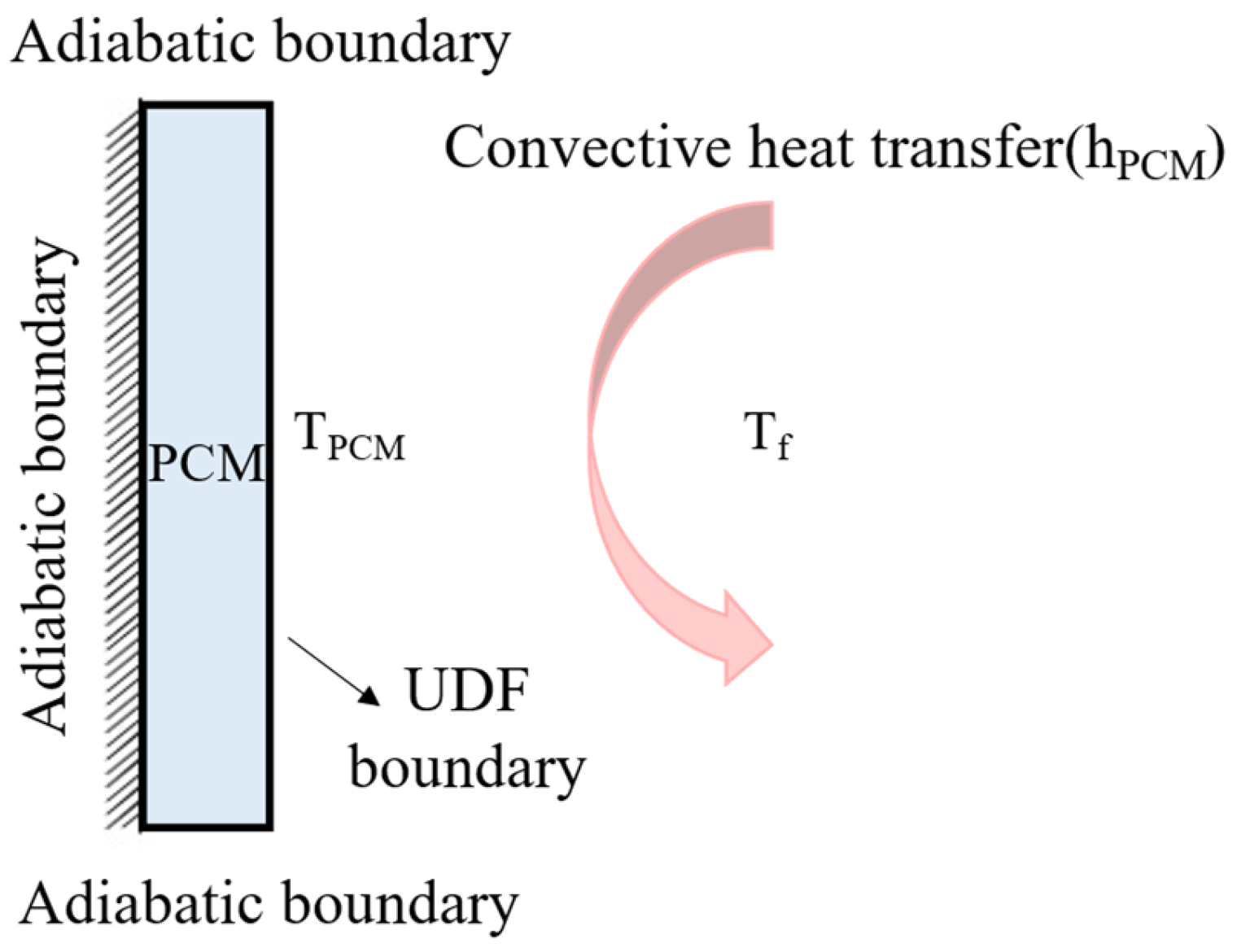
Figure 5 shows the boundary condition configuration of the PCP model. Based on research by Gao et al. [33], the conditions for the PCP simulation were established. The personnel and equipment were regarded as heat sources, which transfer heat to the air, and the air transfers heat to the PCP. The plate surface facing the air was set as the third kind of convective heat transfer boundary, and the plate surface in contact with the chamber wall was adiabatic. The heat exchange between the PCP and the air was realized through a user defined function (UDF). This function incorporated the heat conduction of the plate, its natural convection, and the phase change melting process. In the UDF, the air temperature and the convective heat transfer coefficient were dynamically calculated. The SIMPLE algorithm in transient mode was used as the numerical solution for the model. The gravity was activated to consider the natural convection. In the simulation of the melting process of the composite PCM, we activated the Energy module, Viscous module, and Solidification/Melting module in ANSYS Fluent 2022 R2. A laminar flow model was adopted, with the Boussinesq assumption was used for density treatment [36]. For pressure discretization, the PRESTO! scheme was employed to maintain both calculation accuracy and economic efficiency.
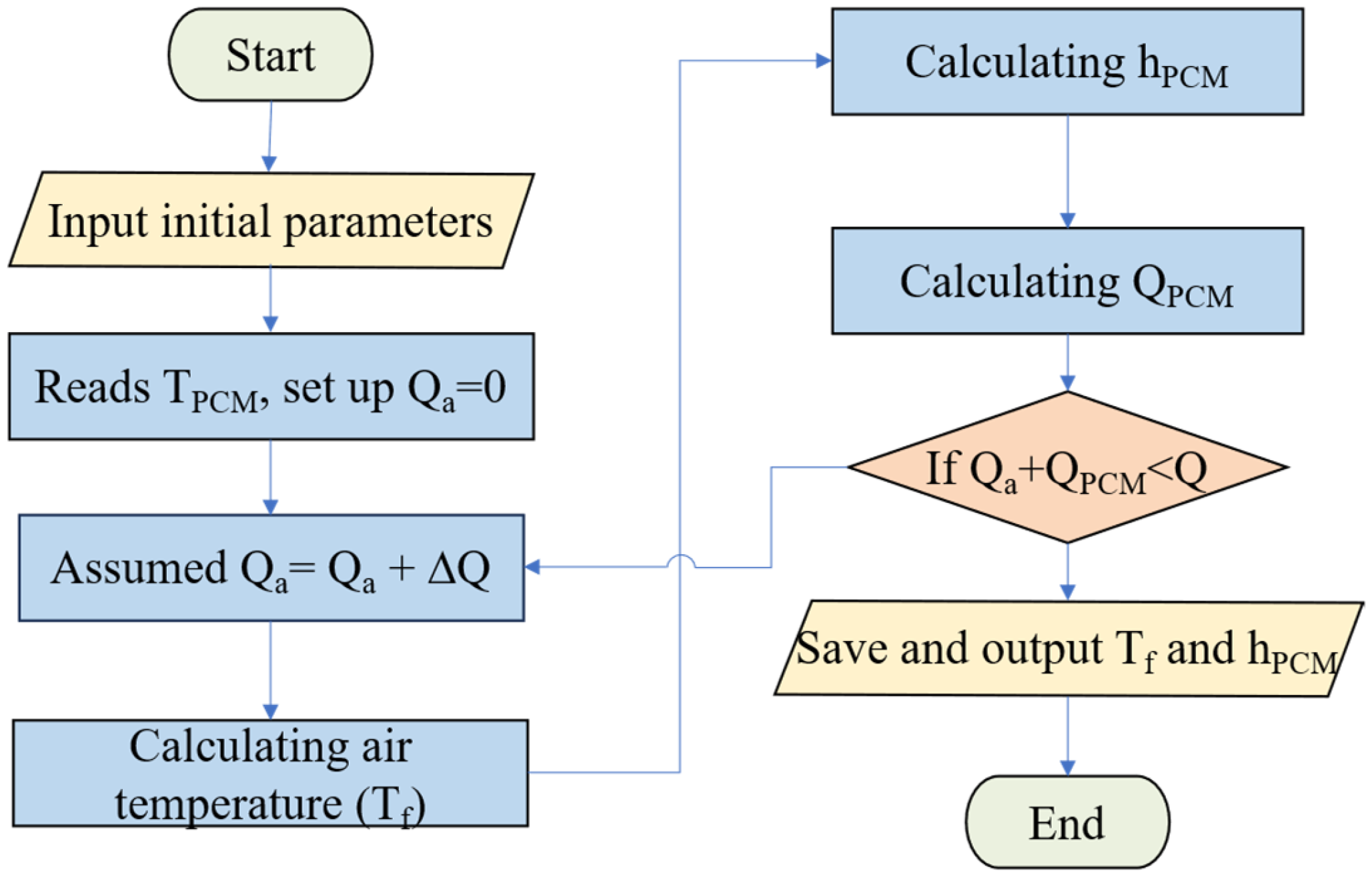
Figure 6 depicts the computational process of the integrated surrounding-rock–insulation–PCP temperature control model. This model adopts the PCM computational framework developed by Yuan et al. [13], with air temperature as the core variable, and employs an iterative algorithm for solution. The refuge chamber’s initial temperature is set to 24 °C, with a control target of 32 °C. Considering the actual operating conditions and the PCM’s characteristics, each PCP averages a cooling load of approximately 9 W, and the initial temperature of plate is 23 °C. The model operates on a principle of thermal balance, performing iterative calculations. If the combined heat absorption from the air (Qa) and the plate (QPCM) equals or exceeds the indoor heat source output (Q), the current air temperature and convective heat transfer coefficient are output as boundary conditions. If not, iteration continues. To improve computational efficiency, only one trial calculation is performed per time step. The process unfolds as follows:
(1)
Initialize Q = 9 W, Qa = 0 W. Read previous air temperature Tf0 from UDM and plate surface temperature TPCM from Fluent. Set ΔQ = 0.1 W.
(2)
Update Qa: Qa = Qa + ΔQ.
(3)
Compute current air temperature Tf from Qa, then determine convective coefficient hPCM and plate absorption QPCM.
(4)
If Qa + QPCM < Q, return to Step 2; otherwise, proceed.
(5)
Save Tf and hPCM to UDM and transfer to Fluent as boundary conditions.
Figure 6. Flowchart of boundary condition calculation program.
Energies 18 06224 g006

2.3.4. Mesh Partitioning and Model Validation

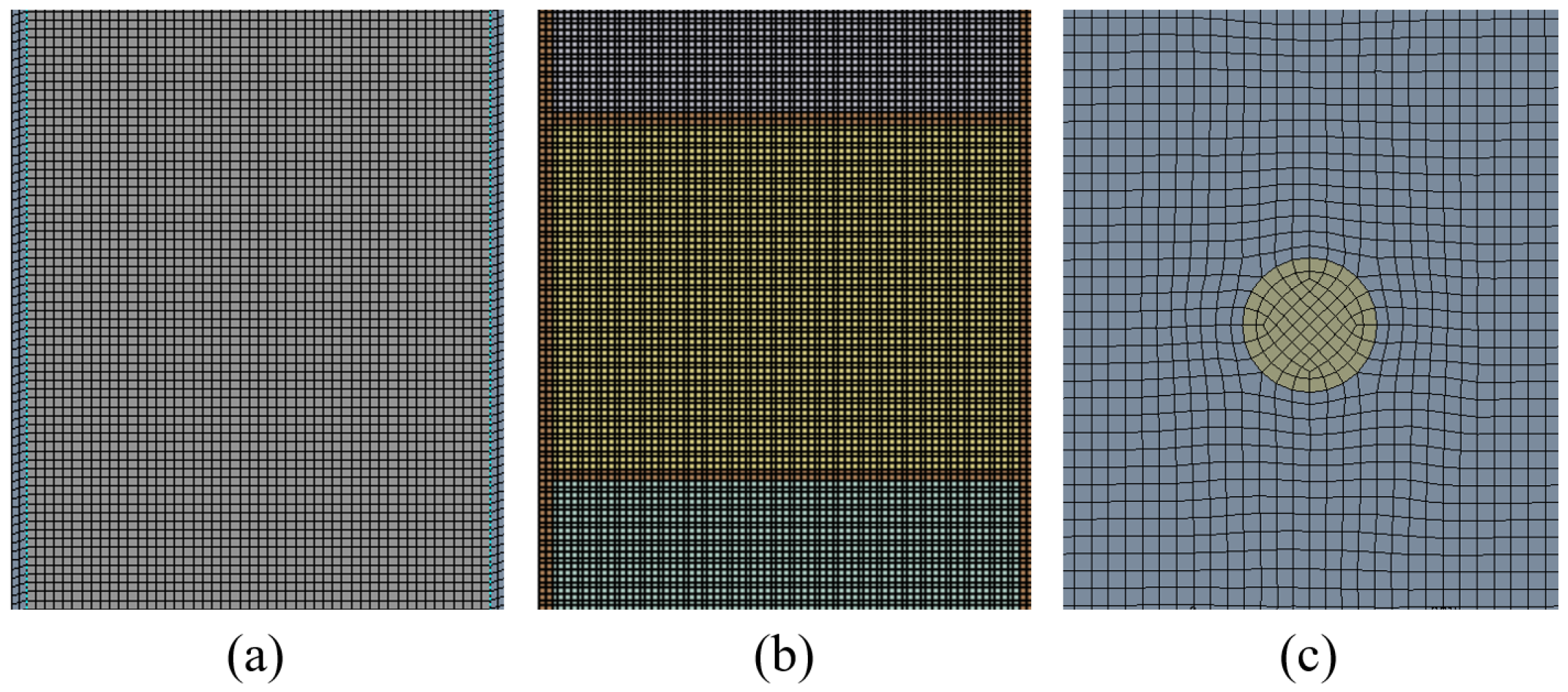
Figure 7 shows the division of meshes and local enlarged views of various PCP models. To take into account the differences in the geometric features, a customized mesh partitioning method is used in this work. As depicted in Figure 7a,b, structured meshes are used for both finless and plate-fin PCPs to ensure the accuracy of computation. For the PCP model with complex pin fins, Figure 7c shows the O-type mesh partitioning method, which can capture the dynamic behavior of the phase change interface well. The orthogonality quality of all meshes was greater than 0.85, and the determinant values of Jacobian matrices were between 0.8 and 0.92, which met the mesh quality requirements.
(1)
Grid Independence Analysis
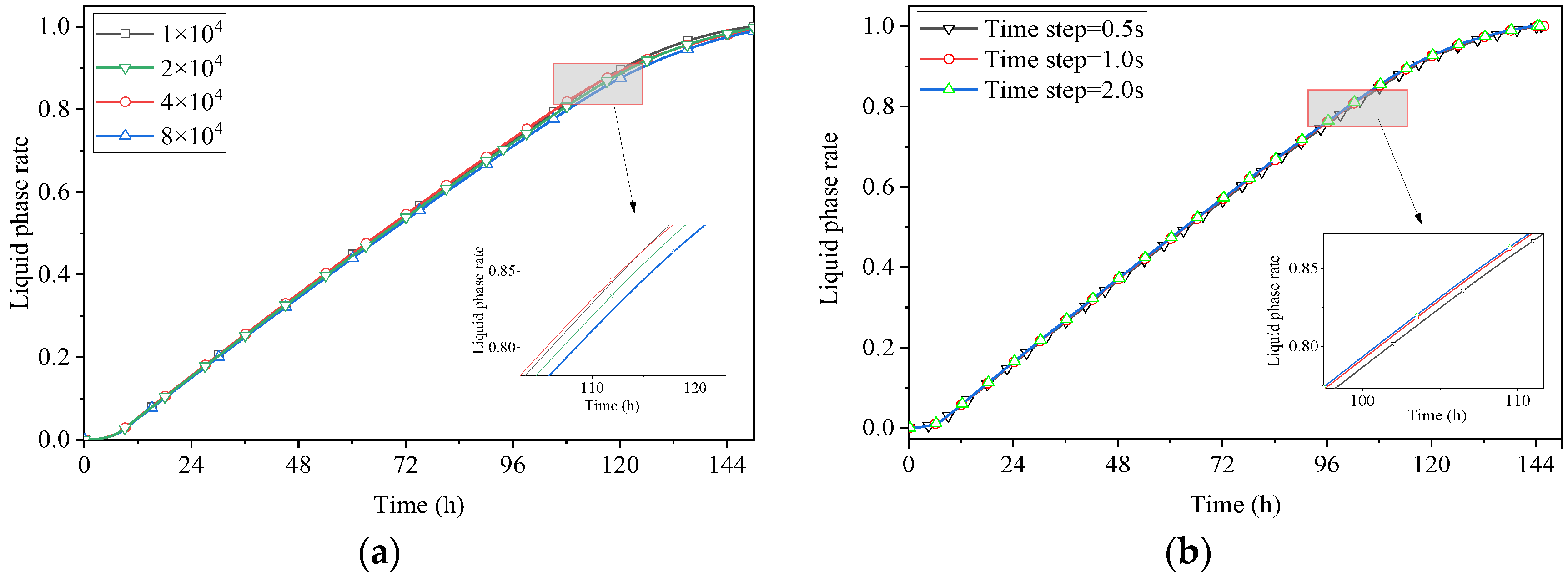
Figure 8 illustrates the evaluation of grid and time step independence, conducted to ensure the stability and reliability of the computational results. Figure 8a depicts the verification results for grid independence. To mitigate the effects induced by the grid, four distinct mesh configurations, comprising 1 × 10⁴, 2 × 10⁴, 4 × 10⁴, and 8× 10⁴ faces, were scrutinized. The simulation outcomes reveal that the melting behavior of the PCMs remain fundamentally consistent across diverse mesh densities, with only marginal variations observed in the liquid-phase fraction curves. The maximum relative error documented was 2.2%, thereby satisfying the prescribed accuracy criteria. Subsequently, a mesh encompassing 2 × 10⁴ faces was selected for future simulations to achieve an optimal balance between computational efficiency and accuracy.
Figure 8b illustrates the check of mesh independence for a small time period. Three time steps, 0.5 s, 1 s and 2 s, were selected for transient calculations. The maximum relative error was 0.9%, which demonstrates that the time step of 2 s could meet the accuracy requirements. Taking the calculation cost and time resolution into account, the time step of 2 s was chosen in the following analyses. At each time step, the maximum number of iterations was limited to 50. Convergence residuals were set to 10−3 for the continuity equation, 10−5 for the momentum equation, and 10−6 for the energy equation. The iterative processes moved to the next time step when the residuals reached convergence criteria.
(2)
Model Validation of Accuracy
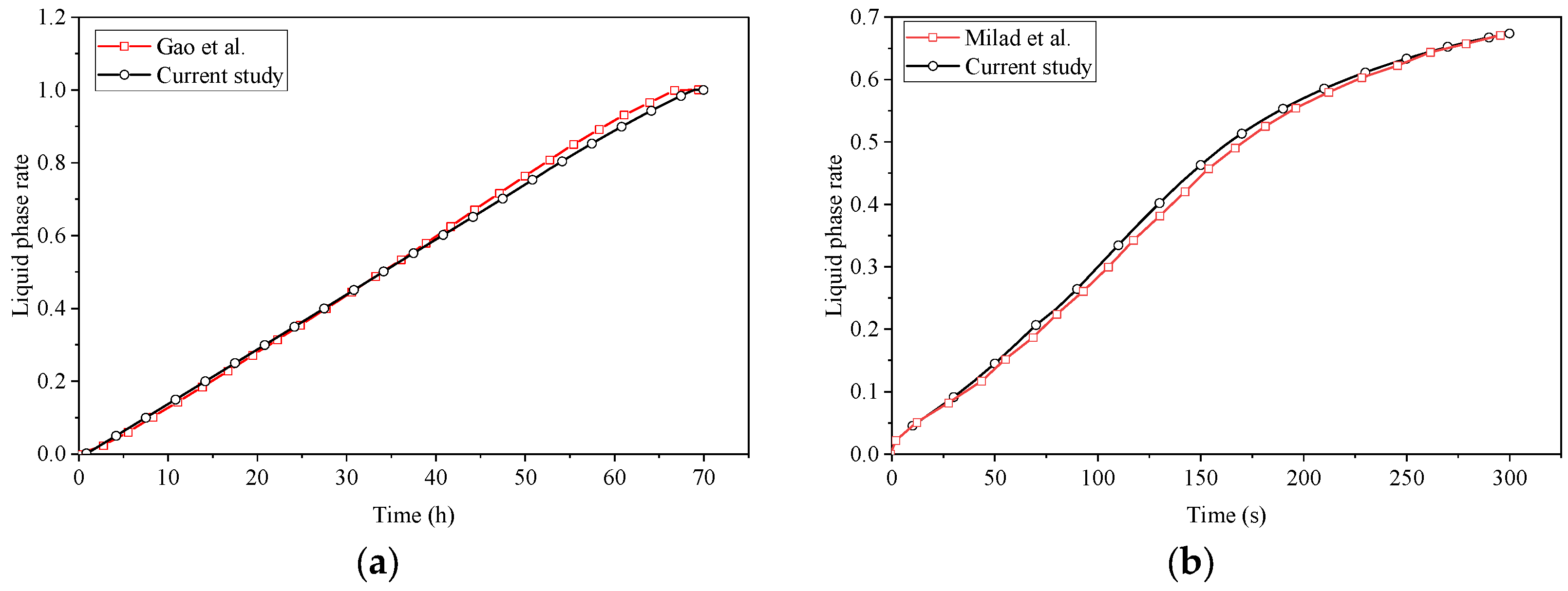
To ensure the precision of the numerical model, a comparison is made between this paper and the existing literature as illustrated in Figure 9. Specifically, Figure 9a specifically illustrates the comparative analysis between the PCP heat transfer model used in this paper and the experimental data derived from Gao et al. [33], who examined the application of base RT26 PCPs for temperature regulation in refuge chambers. The maximum relative deviation of the liquid-phase fraction was observed to be 3.11%, thereby confirming the reliability of the underlying heat transfer model. Furthermore, as illustrated in Figure 9b, the comparison between the NGP model utilized in this study and the research by Milad et al. [65], who applied nano-Al2O3 with a weight of 2.0 wt% for heat transfer enhancement in refrigerated plates, shows a maximum relative deviation of 3.23% between the current model and that of Milad’s. This suggests that the model setup is accurate. Taken together, these comparative results indicate that the numerical models developed in this study have high fidelity and are capable of accurately simulating the heat transfer behavior of PCP systems.

3. Results and Discussion

3.1. Thermal Performance

3.1.1. Thermal Properties

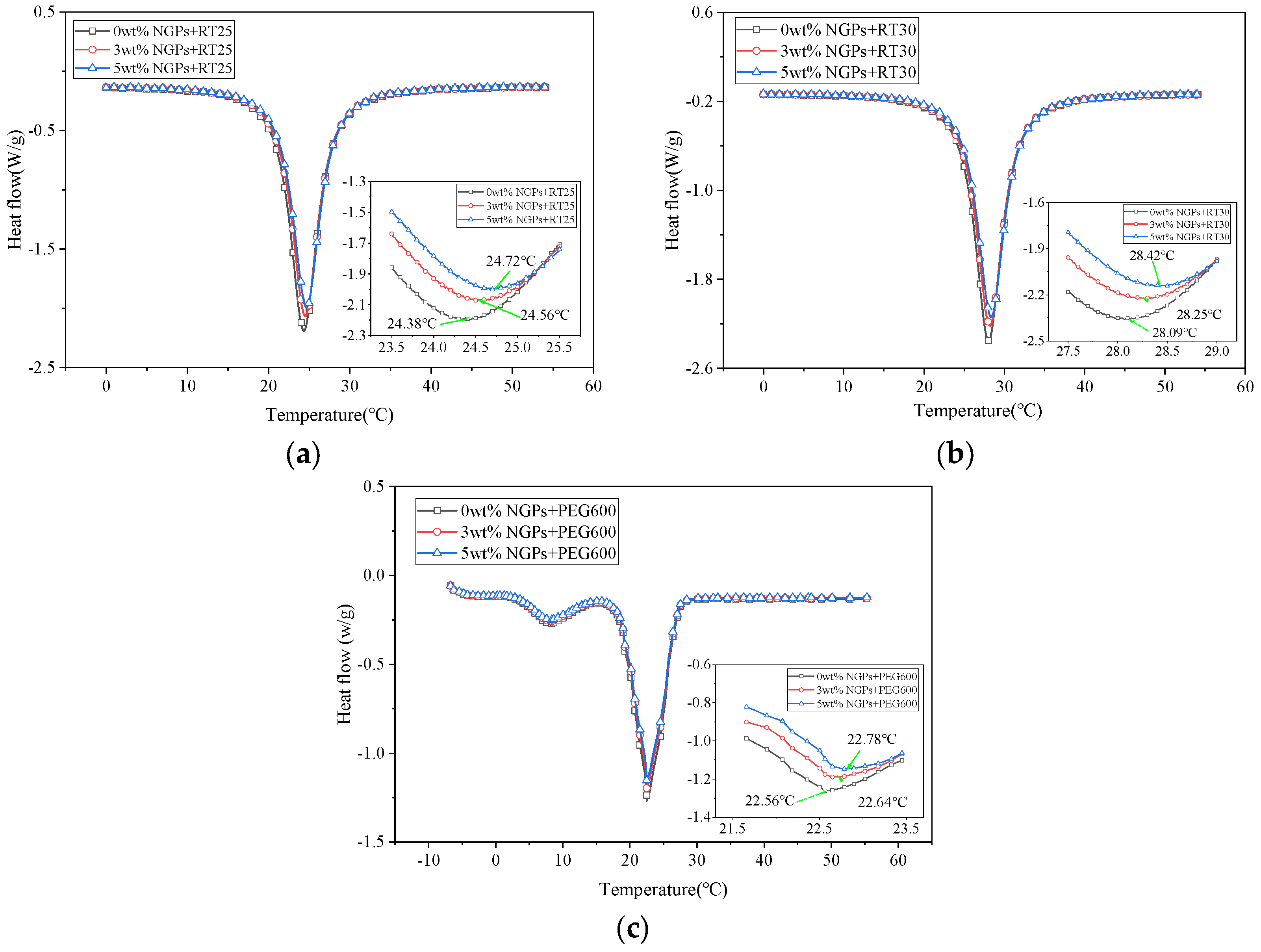
Figure 10 presents the DSC curves for different PCMs. The DSC analysis was conducted to ascertain the phase change temperatures and enthalpies of RT25, RT30, and PEG600 PCMs. The experimental findings show that their phase transition temperatures are consistently within the range of 22–29 °C. For paraffin-based PCMs, a distinct endothermic melting process becomes evident when the temperature falls below the phase transition point. Specifically, as the temperature rises, a rapid surge flow is observed, while the material’s temperature increases at a slower rate. Upon reaching its peak, the heat flow starts to diminish, and the peak temperature is marked as the phase transition temperature. This is attributed to the incorporation of NGPs, which alters the crystallization kinetics process of PCMs, resulting in a slight shift in the phase transition temperature and subsequently affecting both the phase change enthalpy and the width of the phase transition temperature range [67]. The phase change enthalpy is derived by integrating the heat flow curve over the respective phase transition duration. Additional studies were undertaken to evaluate the influence of different NGP concentrations on the thermal attributes of the three PCMs, with the findings presented in Table 3. The incorporation of NGP results in an elevation of the thermal conductivity and the peak melting temperature of the PCMs, while the latent heat of phase change displays a decrease. For instance, when 5% NGPs are added to RT25, in comparison to the base PCM, there is an augmentation in the thermal conductivity from 0.41 to 0.59 W/(m·°C), signifying an increase of 0.21 W/(m·°C). Additionally, the peak melting temperature elevates from 24.38 °C to 24.72 °C, marking an increase of 0.34 °C. Concurrently, the latent heat of phase change diminishes from 159.8 to 144.5 kJ·kg−1. The findings suggest that the incorporation of NGPs predominantly enhanced the thermal conductivity of the composite [68], with minimal influence on the melting point [69]. In addition, the active phase change components were diluted by NGPs, thus reducing the specific heat storage. The NGPs changed the crystallization behavior of the PCM by destroying the molecular ordering and hindered the phase transition [70], thereby reducing the latent heat. Among the three PCMs with the same content of NGPs, RT25 had the highest thermal conductivity, while RT30 had the highest peak melting temperature and latent heat capacity.

3.1.2. Temperature Variations

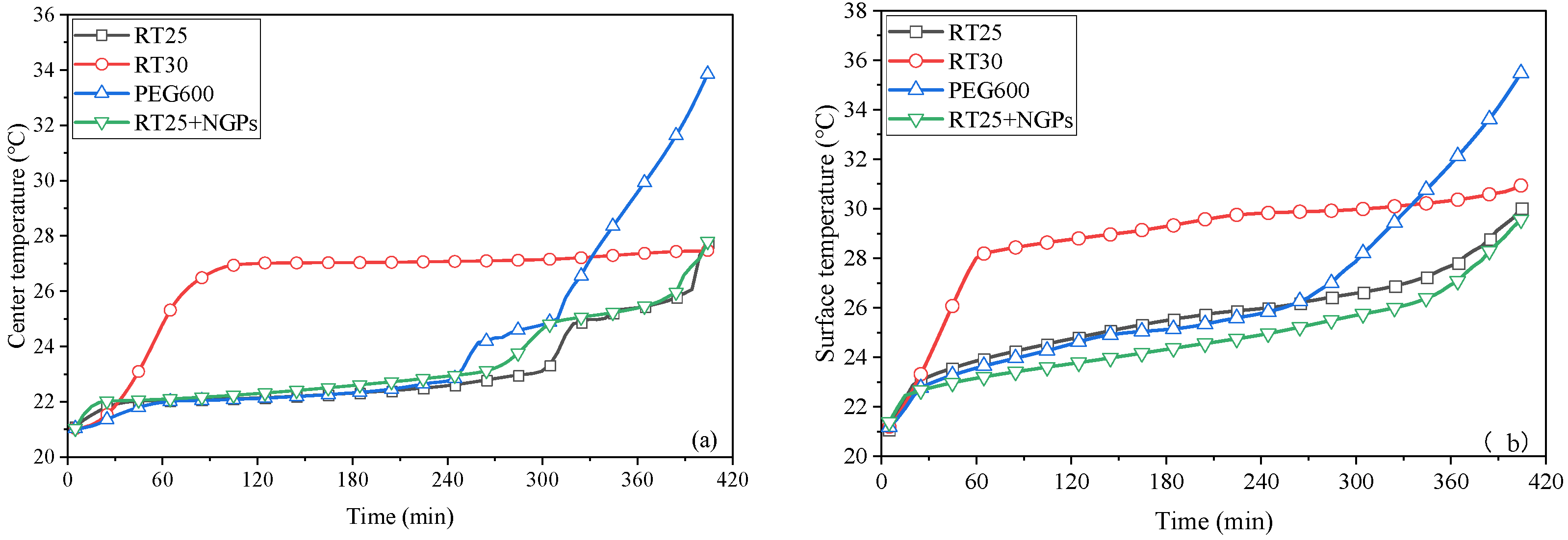
Figure 11 illustrates the temperature profiles at the center and surface of three PCMs, including those containing 5%wt NGPs. The melting process can be categorized into three phases: the rapid conduction stage, where the PCM remains in a solid state and heat transfer primarily occurs through conduction, leading to a swift temperature increase at each measurement point; the phase transition plateau stage, where the PCM undergoes a phase transition within a specific temperature range and, due to its non-crystalline nature, the temperature curve displays a step-like slow growth; and the liquid sensible heating stage, where the PCM has completely melted and enters a rapid heating phase characterized by sensible heat absorption. Specifically, for RT25, the temperature rise rate decreases from 1.26 °C/h to 0.3 °C/h after 45 min, reflecting a shift from heat transfer primarily through conduction in the early stage to convection-dominated mechanisms in the later stage. As depicted in Figure 11a, the temperature curve of the materials rises rapidly and then enters a plateau phase that corresponds to the melting point. Subsequently, the temperature continues to rise after melting. The beginning of the plateau phase corresponds to the material’s melting point. A higher melting point leads to a longer heat conduction phase and a higher final temperature. RT25, RT30, and PEG600 have plateaus at approximately 45 min, 105 min, and 60 min, and average plateau temperatures of 22.26 °C, 27.12 °C, and 22.25 °C, respectively. This indicates that PCMs with more latent heat and a longer phase change interval have flatter melting curves, which is similar to the conclusion reached by Lu et al. [70]. After melting is completed, the temperature of PEG600 reaches 33.84 °C, while the others are stabilized at approximately 27 °C. In addition, the influence of NGPs on the center temperature of the PCMs is relatively small compared with the material itself. When 5 wt% NGPs are added to RT25, the center temperature of the plateau increases to 22.46 °C, which results from the enhanced thermal conductivity and convection caused by NGPs [47,71]. As the melting process progresses, the thermal enhancement effect of additives decreases gradually.
Figure 11b shows the surface temperature profiles of PCP, and it has the same trend as the center. For the average surface temperature of different materials of PCP, RT30 > PEG600 > RT25. At first, the temperature of PEG600 is lower than that of RT25, but after about 270 min, the temperature of PEG600 is higher than that of RT25 because the melting process of PEG600 is faster. It is because its latent heat is only 108 kJ·kg−1, so the melting starts earliest. Furthermore, the lack of latent heat buffering makes the temperature increase rapidly. The addition of NGPs makes the surface temperature decrease significantly. For RT25, the surface temperature of the base PCP is 25.51 °C, while the temperature reduces by 1.02 °C when the NGPs are added. During the initial period, the high thermal conductivity of NGPs [38] makes the heat dissipate faster, so the surface temperature of RT25 PCP with NGPs is the lowest. It is noteworthy that the enhancement of thermal conductivity in PCM is directly correlated with the dispersion state of NGPs. An ideal NGP dispersion state can form continuous heat conduction pathways, whereas agglomeration of NGPs introduces additional interfacial thermal resistance, thereby limiting the effectiveness of thermal conductivity enhancement [72].
The experimental results indicated that RT25 exhibited the most optimal thermal performance compared to the other three PCMs. It consistently maintained lower wall and air temperatures throughout the testing duration and recorded the lowest temperature increase in the later stages. Consequently, RT25 was chosen for further studies on the enhancement of PCP.

3.2. Melting Process

3.2.1. Liquid Fraction of PCPs

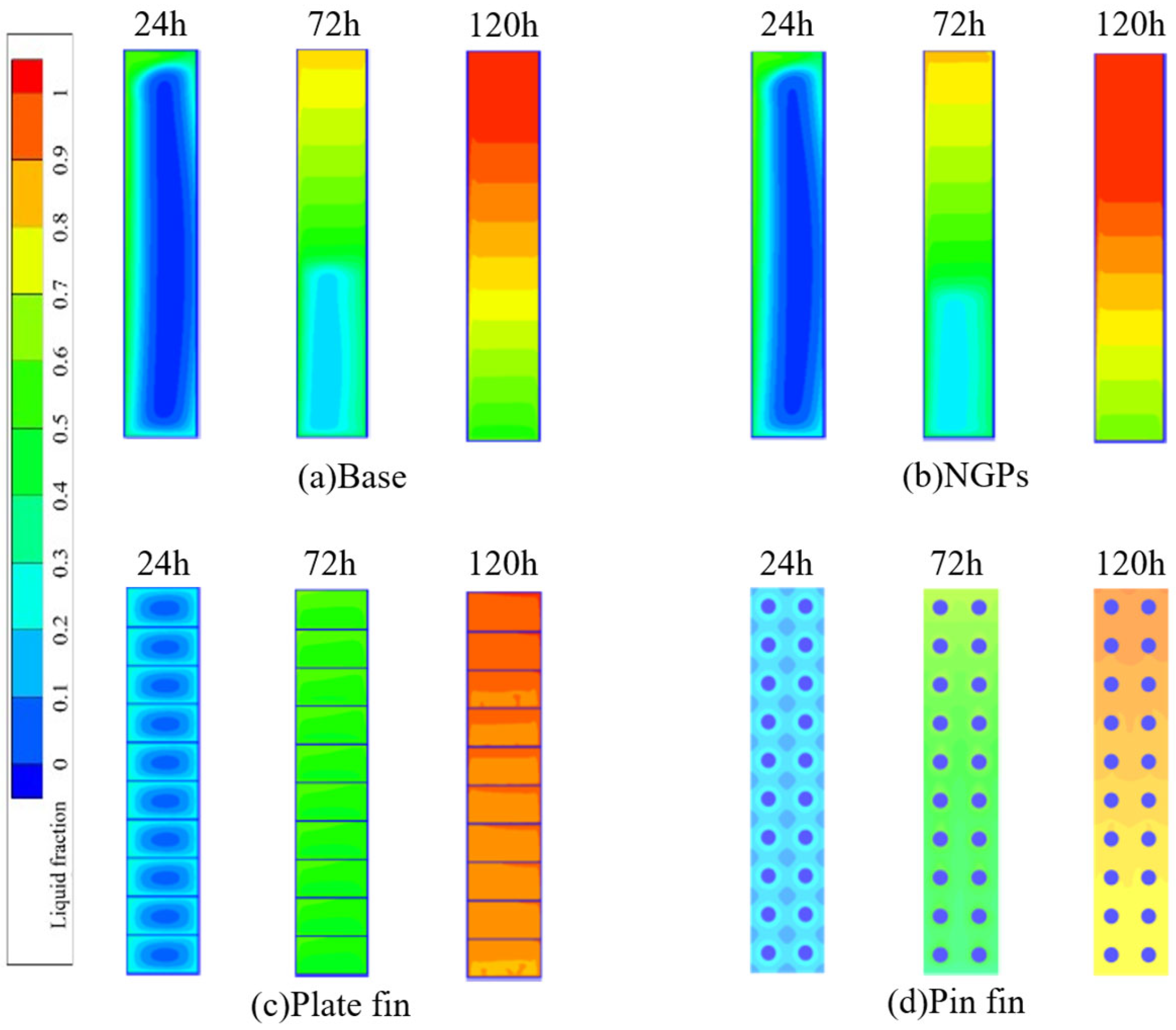
Figure 12 illustrates the distribution of liquid fractions in PCP at various time points. The left wall constantly transfers heat from the air to the PCM, causing it to melt gradually. The blue region represents the solid PCM, while the red-colored area indicates the fully melted liquid PCM. The region between the blue and red zones is recognized as the mushy zone, characterized by the PCM undergoing an ongoing melting process.
Figure 12a illustrates the melting behavior of the base PCP. During the initial 24 h of melting, all the heat produced by the source is absorbed entirely by the air and the sensible heat of the PCP. Given the low specific heat capacity of both the air and the plate shell, combined with the low thermal conductivity of the PCM, the air temperature rises quickly, continually heating the plate [49]. The aluminum shell, possessing high thermal conductivity, facilitates the transfer of heat from the left sidewall to the top and bottom, creating a temperature distribution that is elevated in the middle and reduced at the extremities. After 72 h, as the air temperature keeps rising, the left sidewall and nearby PCM attain temperatures beyond the melting point, triggering melting. Natural convection induces the movement of the melted PCM adjacent to the heated wall to ascend, causing it to rise, subsequently cool down near the solid interface, and then descend [33]. This circulation boosts heat transfer between the heated wall and internal PCM and erodes the solid PCM, leading to the most rapid melting in the upper-left area and slower melting at the base. By 120 h, the overall liquid fraction surpasses 0.5, and noticeable stratification appears inside the unit, with the liquid fraction diminishing from top to bottom. This implies that the primary mode of heat transfer during the later stages of melting is conduction, given that natural convection around the solid PCM has lessened. Furthermore, the thin PCM layer next to the aluminum plate shows a lower melting degree than other areas at the same height, owing to the larger temperature difference on the left side and stronger natural convection.
Figure 12b depicts the liquid fraction distribution in the PCP following the addition of 5 wt% graphite particles. Although the melting process largely mirrors that of the base PCP, the melting rate at any given moment is faster. This improvement is due to the superior thermal conductivity of NGPs, which augment the effective thermal conductivity of the composite PCM. Furthermore, the promotion of micro-convection and heat transfer pathways by the nanoparticles enhances local heat transfer [38]. When compared to the base PCP system, the total melting time decreases. By 120 h, nearly two-thirds of the PCM has fully melted.
Figure 12c depicts the liquid fraction within the PCP featuring plate fins. These fins segment the interior into 10 small square cavities, where heat transfer primarily occurs via conduction between adjacent cavities. During the initial melting stage, the high thermal conductivity of the fins facilitates uniform heating from all surrounding walls within each cavity. As depicted at 24 h, the melting interfaces in all cavities are elliptical and similar in shape, with a faster melting rate observed near the left heated wall. After 72 h, the PCM transitions to a predominantly liquid state, with natural convection commencing near the left wall. By 120 h, the PCM is nearly fully melted, as evidenced by a liquid fraction exceeding 0.8. When compared to the base PCP, plate-fin assemblies foster a more even melting process. This is accomplished by extending heat transfer pathways and augmenting the surface area [58]. This approach effectively alleviates the constraints associated with unilateral heating and unidirectional progression inherent in the melting process of base PCP.
Figure 12d depicts the distribution of the liquid phase with the yoz plane (x = 25 mm, z = 240–300 mm) within the pin-fin PCP. During the initial stages of melting, the superior thermal conductivity of the pin fins facilitates a more rapid melting of the central PCM compared to the plate-fin scenario, resulting in temperatures that radially diffuse outward [61]. At 24 h, the liquid fraction predominantly remains below 0.2, indicating a heat transfer regime dominated by conduction. However, post 72 h, the PCM takes on a more liquid-like consistency, and natural convection begins to play a role. The PCM surrounding the pin fins is heated and subsequently ascends, leading to the formation of layered liquid fraction patterns. By the 120 h mark, the liquid fraction in the central region attains a value between 0.8 and 0.9. When contrasted with the base PCP scenario, the pin-fin PCP notably hastens the melting process.
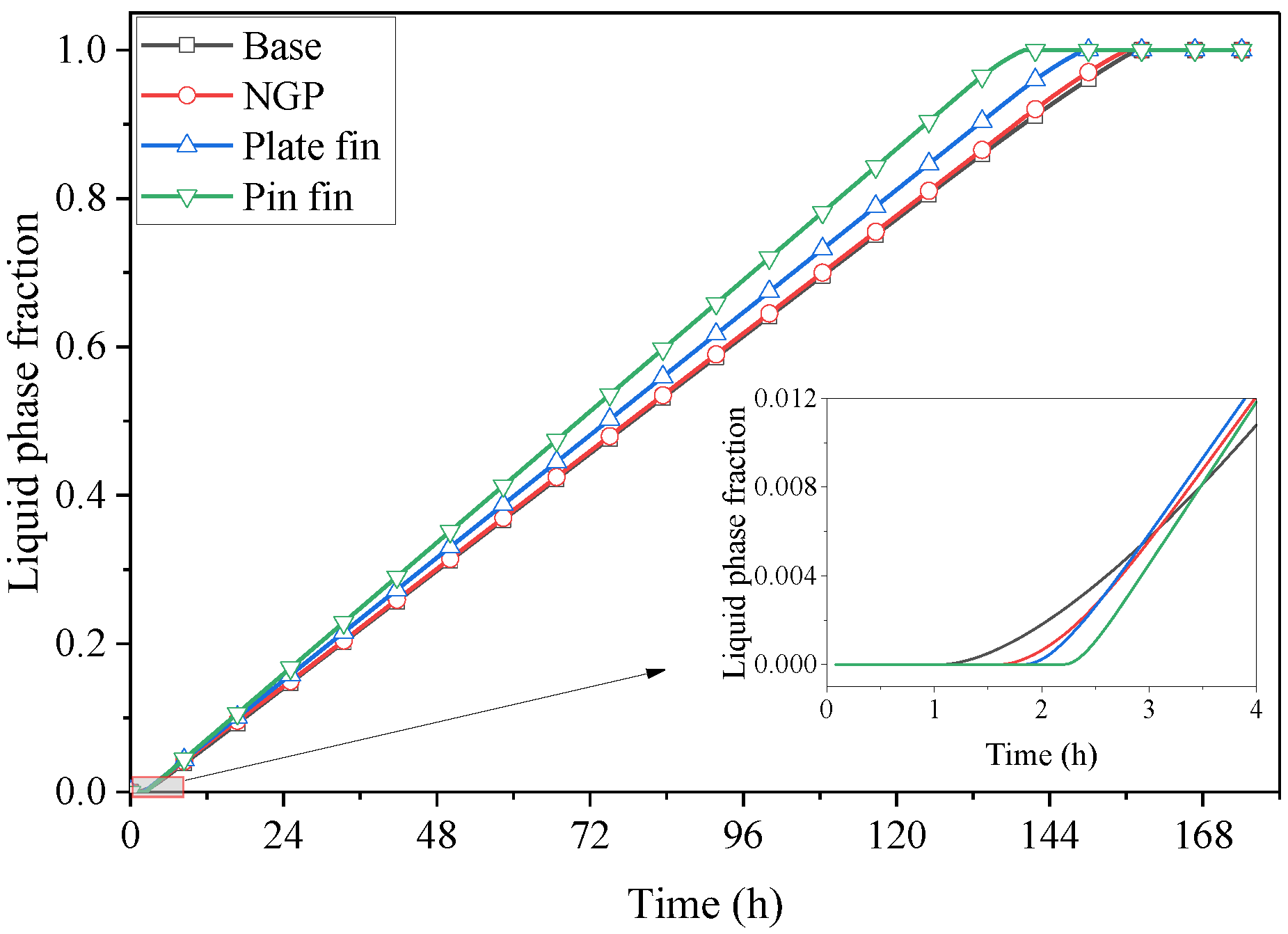
Figure 13 presents the variations in the liquid fraction for base, NGP, plate-fin, and pin-fin PCP models. Three different stages were observed in all curves. In the first stage sensible heat absorption is dominant. Because the original temperature of the PCP is less than the phase change point, the PCM is totally solid, with a liquid fraction equal to zero. When the air temperature inside the cavity increases, the plate absorbs heat continuously until the PCM melting point, where the second stage begins. This phase is distinguished by the absorption of latent heat, during which the PCM gradually transitions from a solid to a liquid state. This results in an increase in the liquid fraction from 0 to 1. The third stage commences once the PCM has completely melted. At this point, with the exhaustion of latent heat, the absorption of sensible heat once again becomes the prevailing mode. This phase is characterized by the absorption of latent heat, during which the PCM progressively transforms from a solid to a liquid state, leading to an increase in the liquid fraction from 0 to 1. The subsequent stage begins upon the complete melting of the PCM. At this juncture, with the depletion of latent heat, the absorption of sensible heat resumes as the dominant process.
The right inset in Figure 13 shows the change in liquid fraction over the initial 4 h of melting. The times at which melting started were different under the same enhancement method. The base PCM melted the earliest, and its melting started at 1.08 h after heat transfer began. The melting of the NGP-enhanced PCM and plate-fin structure began at 1.67 h and 1.92 h, respectively. The PCM in the pin-fin PCP exhibited the latest onset of melting, at 2.25 h. While NGPs augment the thermal conductivity of the PCM to some degree, they also elevate the PCM’s melting temperature, thereby postponing the initiation of melting [47]. While the incorporation of fins augments the heat transfer surface area, it simultaneously segments the PCM melting region. This segmentation impedes the natural convection of the molten liquid, thereby postponing heat transfer during the initial phase of melting [73]. Compared with the base PCM, the NGPs delay melting start time by 0.59 h, and the plate fin and pin fin delay melting start time by 0.84 h and 1.17 h, respectively. The findings indicate that the enhancement techniques notably augment the thermal stability of the PCM and extend the melting process, thereby extending the effective working time of the PCM in mine refuge chambers.
In terms of the melting completion time, the base PCM needs 156.75 h, and the addition of NGPs, plate fins, and pin fins reduces the melting time by 2.26 h, 9.09 h, and 16.67 h, respectively. The slight enhancement of the NGPs is caused by the simultaneous increase in thermal conductivity and viscosity, which inhibits convective heat transfer [70]. The high-conductivity aluminum plate and pin fins, with their extended surface areas [74], notably accelerate the melting process. The plate fin divides the original 8:1 height-to-thickness ratio cavity into 10 4:5 subdivisions. The extension of the heat transfer area provided by the aluminum fins, coupled with a reduction in the thermal conduction path, enhances the melting rate by an additional 5.8%. The pin fin uses the cylindrical fin to drive the flow of liquid PCM to across the solid–liquid interface to form local micro-convection, resulting in the shortest melting time, and the performance is improved by 10.6%, which achieves the best complete melting time. Akula et al. [63] demonstrated that the plate-fin and pin-fin designs can significantly reduce melting time and demonstrated the cooling performance of these two heat sinks in enhancing the cooling performance of the mine refuge chamber.

3.2.2. Temperature Distribution of PCPs

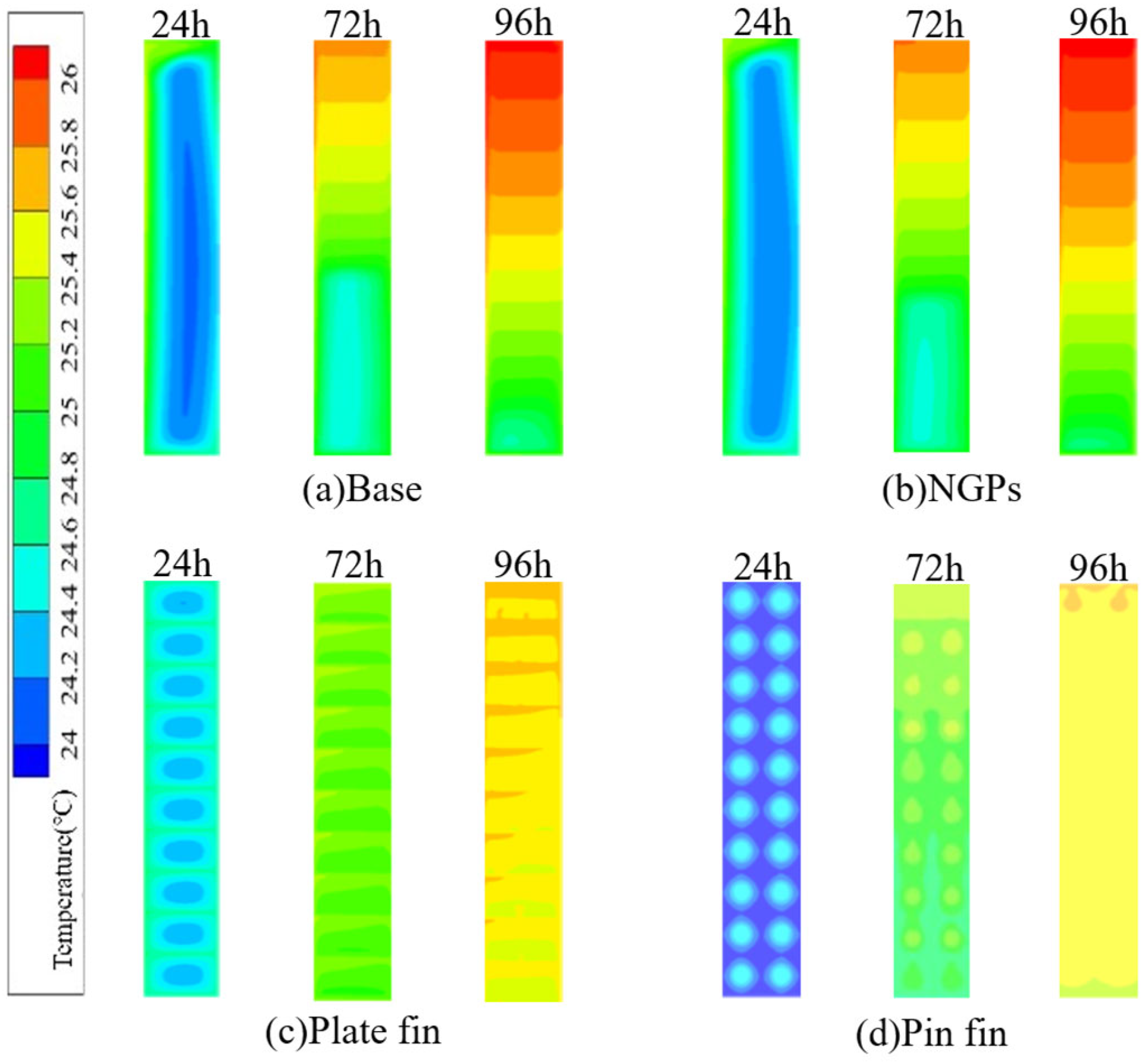
Figure 14 presents the temperature distribution during the melting phase for four variations of PCPs at assorted time intervals. Specifically, Figure 14a depicts the internal temperature modifications of the base PCM throughout the melting stage. During the preliminary stage of melting, there is a pronounced non-uniformity in the temperature distribution. When the liquid fraction remains below 0.5, the PCM is primarily in a solid state, and its temperature field aligns closely with the contour of the melting front. However, after 24 h, the overall temperature distribution of the base PCP assumes an arch-like configuration, with a more pronounced thickness in the middle and tapering towards the ends, accompanied by a notable inclination to the right. This unique temperature profile is predominantly ascribed to the heightened thermal conductivity of the aluminum casing. This attribute facilitates the swift conduction of heat from the left heating wall along the top and bottom edges, leading to heightened central temperatures while keeping the ends relatively cooler [73]. During the initial phase, natural convection is not yet fully established, with heat transfer primarily occurring through conduction. However, between 72 and 96 h, natural convection gradually supplants conduction as the dominant heat transfer mechanism. This results in a distinct stratified temperature field, with temperatures decreasing from top to bottom and the highest temperatures concentrated in the upper region. This phenomenon aligns with the Boussinesq hypothesis: as the temperature increases, the density of the liquid PCM decreases, leading to an unstable density stratification under the influence of gravity. This mechanism propels the warmer fluid to ascend along the heated wall, while the cooler fluid sinks along the solid–liquid interface, forming a stable natural convection loop [75]. Moreover, the temperature field in the mushy zone exhibits a trend towards uniformity at the same height, with PCM temperatures being slightly higher on the left and lower on the right. This suggests that in the mushy zone, heat is conducted from the high-temperature wall to the PCM within the same layer, subsequently moving to the right wall, and ultimately being conducted to the lower-temperature PCM at the bottom.
Figure 14b illustrates the melting process of PCPs enhanced with NGPs. When compared to the base PCP, the melting process of PCMs combined with NGPs is generally similar, although the degree of melting is higher at equivalent time points. After 24 h, the temperature distribution in the NGP PCP is significantly more uniform. This outcome underscores the beneficial impact of NGPs on elevating the thermal response rate and melting consistency of PCMs. The introduction of NGPs significantly alters the natural convection behavior of PCMs. On one hand, NGPs accelerate the melting of solid-phase PCMs by enhancing thermal conductivity; on the other hand, its doping substantially increases the liquid-phase viscosity, which intensifies with increasing concentration and directly suppresses flow capability [42]. Under elevated temperatures, the temperature sensitivity of liquid viscosity is enhanced, while the microscale dispersion of NGPs further impedes fluid movement, resulting in thickened thermal boundary layers that weaken natural convection, amplify internal temperature gradients, and exacerbate heat transfer differentials [76]. Particularly at the bottom region, NGP enrichment concentrates viscous effects, causing more pronounced boundary layer thickening that amplifies the temperature difference between the bottom and upper sections. After an operation period of 96 h, the peak temperature difference in the NGP PCP composite is approximately 1 K. While this is less than that of the base PCP, a significant temperature gradient persists. This suggests that, despite NGPs’ augmentation of effective thermal conductivity to some extent, their effect on the flow structure during the convection-dominated phase remains limited and does not entirely eradicate thermal stratification.
Figure 14c illustrates the temporal variation in the temperature field of a PCP subsequent to the integration of a plate fin. Upon the addition of the plate fin, the PCM was segmented into 10 relatively independent square cavities. Owing to the elevated thermal conductivity of the plate-fin structure, the PCM within each cavity experiences heating from all four sides, thereby establishing uniform heating conditions and a consistent melting process. After 24 h, the melting interface exhibits a regular elliptical shape, with a more rapid melting rate observed near the left heating wall. This suggests that the plate fin augments the heat conduction path, enhances the overall melting rate, and promotes temperature uniformity. Subsequent to 72 h, the upper cavity demonstrates a faster melting rate, while the progress in the lower cavity is more gradual. This disparity can be attributed to the obstruction presented by the plate fin, which directs the higher-temperature PCM to accumulate at the upper left side of each square cavity and subsequently heats the upper cavity through the plate fin. Consequently, this results in variations in the melting speed across different square cavities. After 96 h, each cavity displays a relatively uniform temperature distribution, maintaining the maximum temperature difference within 0.2 K. This effect can be primarily attributed to the spatial constraint imposed by the plate-fin partition, which effectively mitigates large-scale natural convection vortices. These observations align with the findings of Bouguila et al. [58], further substantiating the assertion that the plate-fin structure can proficiently regulate natural convection and enhance temperature uniformity.
Figure 14d illustrates the temperature distribution within the yoz plane (x = 25 mm, z = 280–320 mm) of the pin-fin PCP. During the initial melting stage, the pin-fin structure exhibits superior heat transfer capabilities; the melting speed in the central region is significantly more rapid than that in the plate-fin PCP. After 24 h, a concentric circular pattern of temperature reduction along the pin fins suggests that these fins not only bolster local axial conduction but also facilitate radial heat diffusion. Between 24 and 72 h, the temperature field and melting speed within the PCP remain relatively unchanged, indicating that heat absorbed by the PCP is efficiently conducted throughout the entire area due to the effect of the pin fins, thereby maintaining effective temperature control. After 96 h, the pin-fin structure achieves optimal temperature uniformity compared to other configurations. This outcome can be ascribed to the pin fins’ capacity to substantially augment the heat transfer area, coupled with their high thermal conductivity [59]. This facilitates rapid heat transmission from the heat source to the distal regions of the PCM container, effectively diminishing the temperature gradient within the system. Consequently, it forestalls localized overheating and bolsters the overall efficiency of thermal management. As noted by Dmitruk et al. [61], pin fins foster the creation of multiple local micro-convection units, thereby substantially boosting the overall heat response rate and temperature uniformity.

3.3. Temperature-Controlling Characteristics

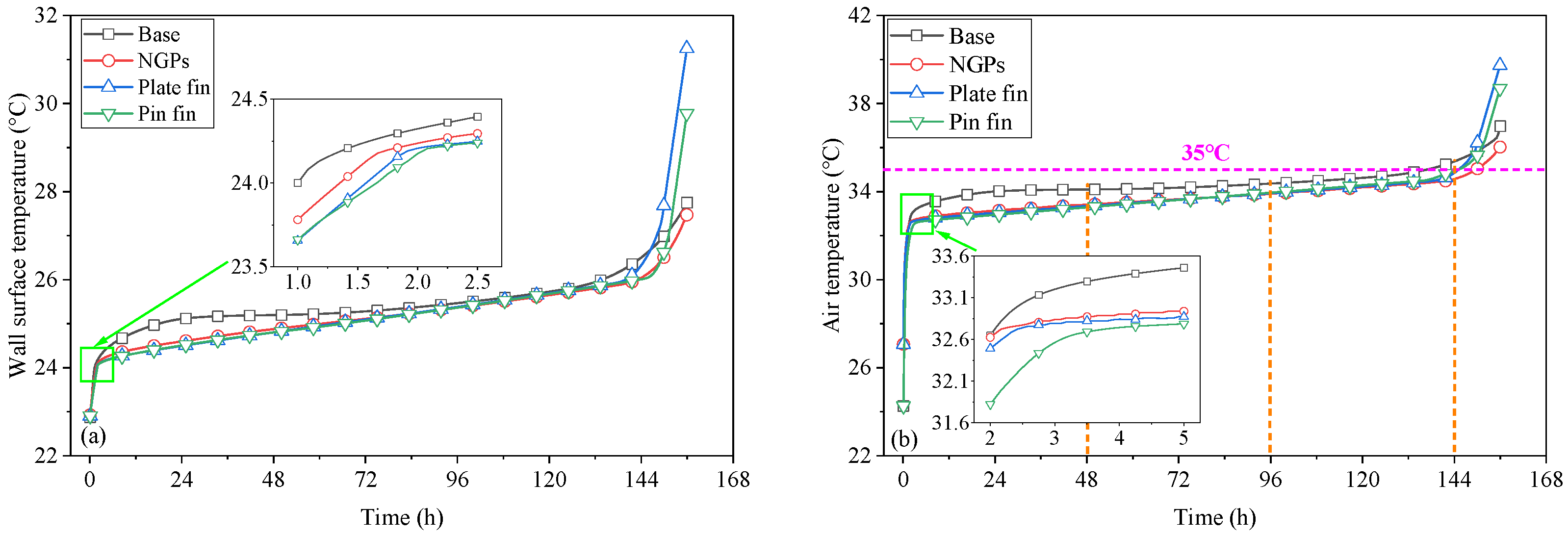
Figure 15 depicts the variation in wall surface and air temperatures across different PCP configurations. The thermal comfort within the chamber is maintained by the plates through convective heat exchange with air and radiative exchange with occupants. Hence, the indoor air temperature serves as a critical indicator of their thermal performance, which is directly linked to the wall surface temperature of the plates. As illustrated in Figure 15a, the heating wall surface temperature across all models displays a similar three-stage pattern: a rapid increase, a plateau, and a secondary rapid rise. In the initial stage, there is a rapid rise in wall surface temperature as it absorbs heat. The temperature curves of all four models are almost identical, with melting points around 24 °C. Zou et al. [49] also noted that the addition of NGPs has a negligible impact on the melting point during this stage. Furthermore, all three enhanced models exhibit a delayed onset of melting compared to the base PCP. In the second stage, the melting of the PCM commences, resulting in a plateau with a slow temperature increase. The wall surface temperature stabilizes as the PCM absorbs latent heat, with warming rates ranging from 0.013 °C/h to 0.0145 °C/h. The total temperature elevations observed for the base PCM, NGP, plate-fin, and pin-fin models were 0.91 °C, 1.05 °C, 1.35 °C, and 1.20 °C, respectively. This is attributed to the ongoing heat absorption by unmelted PCM, which suppresses temperature rise. In the third stage, the wall surface temperature again rises sharply, attributable to the reduced heat storage capacity after the complete melting of PCM [47], with warming rates of 0.13 °C/h, 0.07 °C/h, 0.36 °C/h, and 0.5 °C/h for the four models. During the later stage of phase transition, as temperature increases and the liquid-phase region expands, the Brownian motion of NGPs intensifies while intermolecular van der Waals forces strengthen [76]. This leads to increased transient aggregation probability, resulting in elevated local viscosity within the liquid-phase region, which further impairs convective heat transfer capability. This phenomenon explains why the heating rates of both the wall and air in the NGP model accelerate relatively during the later stage compared to the initial phase, ultimately causing a slight degradation in thermal performance. Additionally, due to the reduced PCM content and the high thermal conductivity of the fins, both the plate-fin and pin-fin models exhibit higher temperature rise rates during the later operational stages [58]. Pakrouh et al. [60] also confirmed that pin-fin models exhibit steeper temperature curves in this stage.
Figure 15b shows that the change in air temperature for all four models exhibits a similar three-stage pattern, which is synchronized with the wall temperature. The first stage is a rapid rise. Due to the low initial wall temperature and unmelted PCM, heat absorption is weak at this stage. Consequently, the majority of the heat is adsorbed by the air, leading to a swift rise in air temperature, which is mirrored by a corresponding increase in wall temperature [64]. The temperature increases by 9.19 °C, 8.73 °C, 8.67 °C, and 8.55 °C within the first 3 h for base PCM, NGP, plate-fin, and pin-fin models, respectively. The second stage is a plateau phase, which is slightly delayed relative to the wall, where all models have a warming rate of around 0.015 °C/h. The reason for the slow increase in this stage is that the melted PCM reduces the rate of increase in wall temperature while increasing the temperature difference, thus transferring the responsibility of heat absorption to the plates and slowing down the warming of the air [47]. The third stage is a further increase in air temperature, occurring after the PCM has fully melted and the wall’s heat absorption capacity diminishes. The final temperature of the base PCP model was 36.98 °C. Compared with the base PCP model, the NGP PCP enhanced model reduced the air temperature by 0.96 °C, while the plate-fin and pin-fin PCP models increased the air temperature by 2.76 °C and 1.71 °C, respectively. Throughout the duration of the test, the pin-fin model had the lowest air temperature until 78.75 h. The initial enhancement of thermal performance is attributed to the fins, which increase the contact area with PCM and provide additional heat conduction pathways, thereby strengthening heat transfer during the conduction-dominated stage. However, the fins themselves occupy limited space within the PCP, directly reducing the usable PCM mass per unit volume and consequently decreasing the system’s overall energy storage density, which leads to diminished temperature regulation performance in later stages [73]. It causes a faster temperature rise in the pin-fin model during its later phases, culminating in a terminal temperature that surpasses that of the base PCP model. Within 156 h, among the four models, the NGP PCP model performed the best. Specifically, the NGP PCP model reduced the wall surface and air average temperature by 0.66 °C and 0.69 °C, respectively, compared to the baseline PCP model. This overall superior performance is attributed to the early-stage thermal conductivity enhancement of NGPs, which outweighs the negative effects of late-stage convective suppression and particle aggregation, validating the feasibility of using NGPs as a long-term thermal regulation strategy for enhancing PCP.
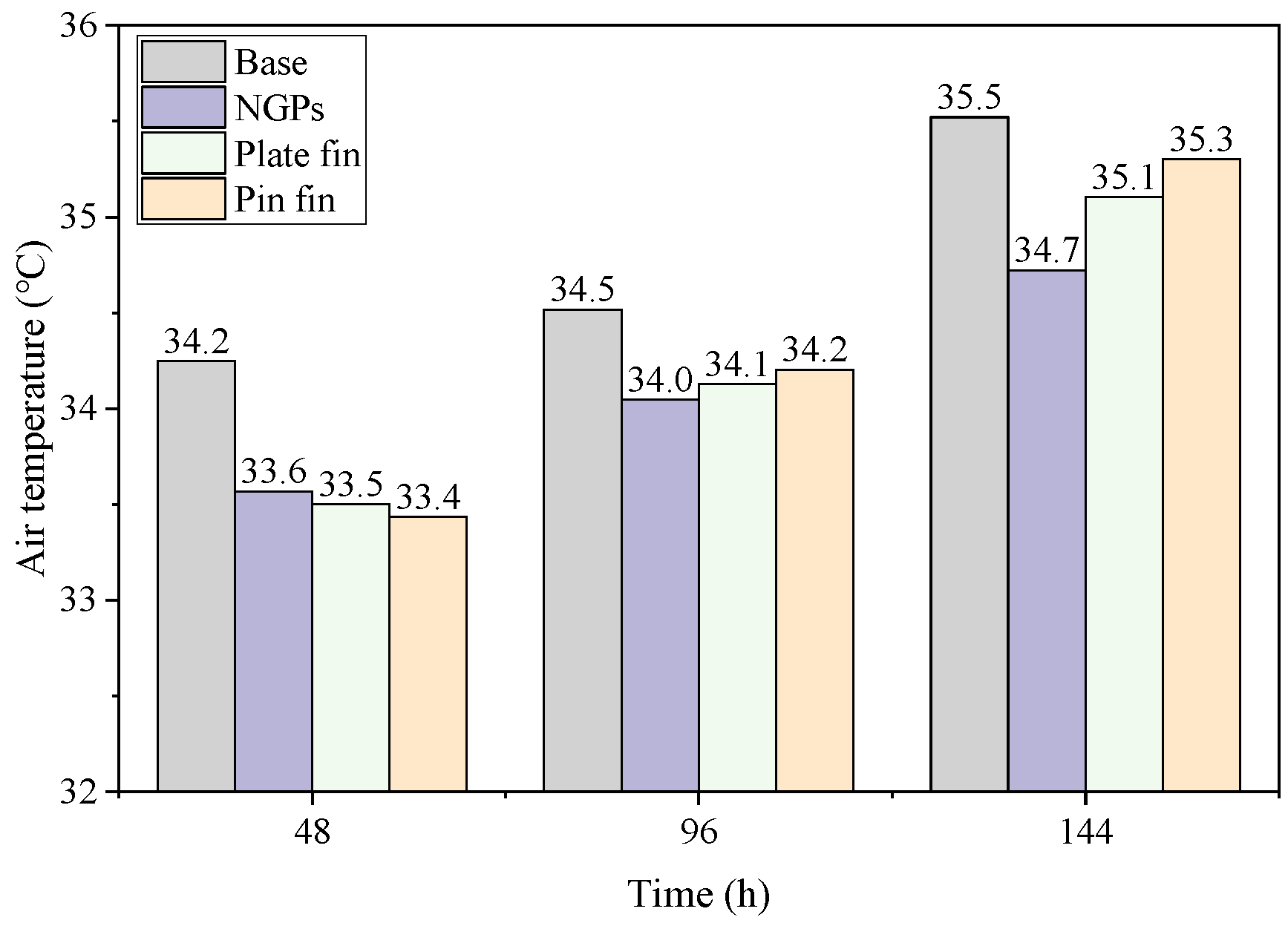
Figure 16 presents the comparison of the air temperatures of four PCP at different times. In the early melting stage, the pin-fin PCP has the lowest air temperature, followed by the plate fin and NGP PCP, and the basic PCP has the highest temperature. As time goes on, the air temperature of each type of PCP gradually rises, and the impact of different PCP configurations on the air temperature is also different. When the operation time is 144 h, the basic PCP has the highest air temperature of 35.5 °C, and the NGP PCP has the lowest air temperature of 34.7 °C. The efficacy of temperature control exerted by the plate-fin and pin-fin PCP diminishes during the latter stages of melting. This is primarily attributable to the reduction in the effective volume of the PCM caused by the fin structure, and the high thermal conductivity of the fin material speeds up the overall temperature increase [60]. In accordance with the relevant standards, the temperature within the refuge chamber must not surpass 35 °C over a 96 h period [32]. Therefore, the temperatures of the four types of PCPs all meet the requirements. At an operation time of 96 h, the temperatures of the base PCP, NGP PCP, plate-fin PCP, and pin-fin PCP are recorded as 34.5 °C, 34 °C, 34.1 °C, and 34.2 °C, respectively. The above results verify the latent heat storage and temperature control effect of PCMs, which is consistent with the conclusions of Yuan et al. [13].
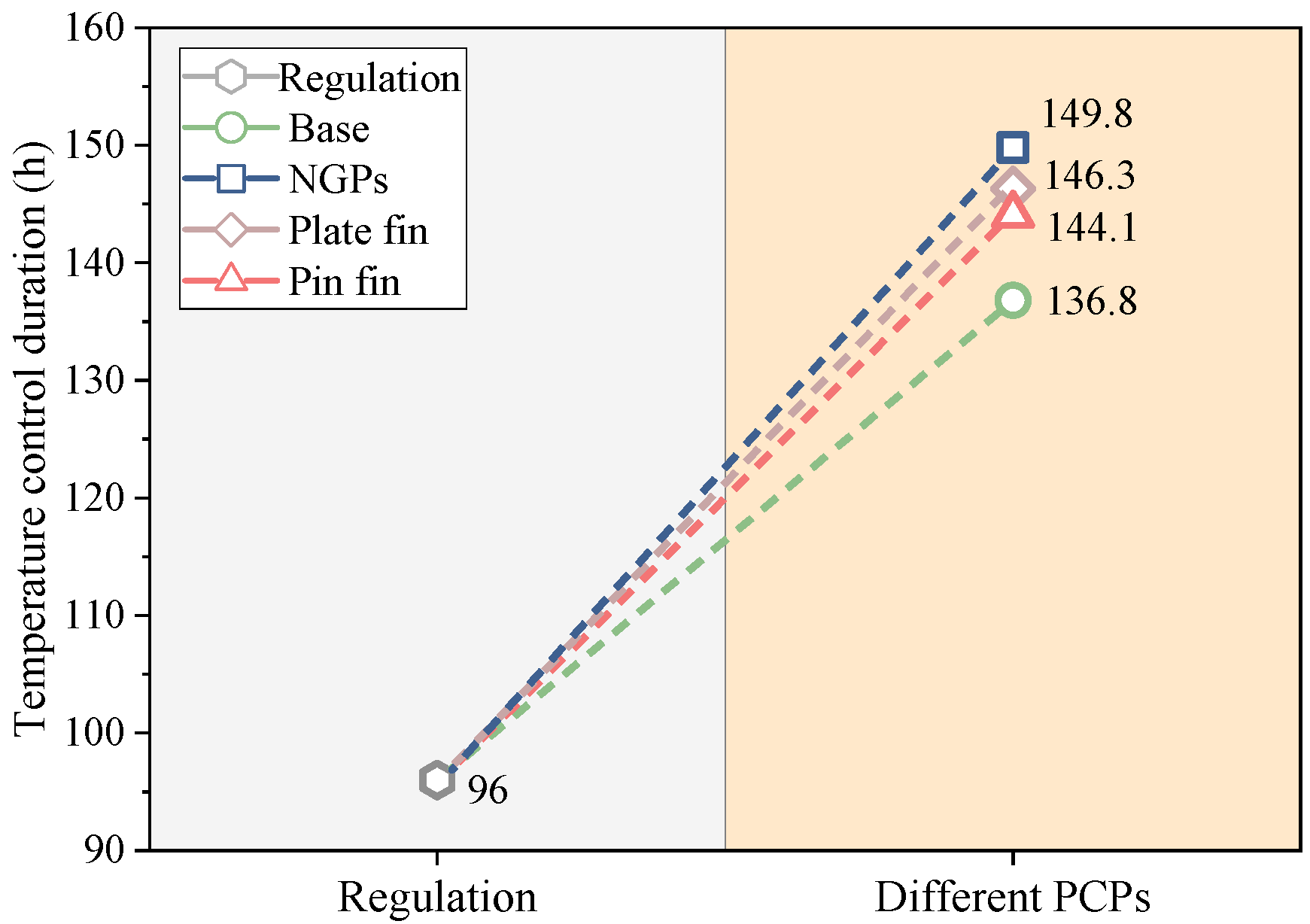
Figure 17 illustrates the comparison of the thermal regulation duration of four different PCP configurations. The definition hinges on the duration required to attain a threshold temperature of 35 °C. The base PCP maintained temperature control for a duration of 136.8 h. As a comparison, the NGP PCP exhibited the most extended regulation period of 149.8 h, surpassing both the plate-fin PCP, which lasted for 146.3 h, and the pin-fin PCP, which remained effective for 144.1 h. All variants of the PCP system exceeded the 96 h requirement. Specifically, the temperature control durations for the base, NGP, plate-fin, and pin-fin PCP models were extended by 40.8 h, 53.8 h, 50.3 h, and 48.1 h, respectively, when compared to the specified 96 h. The results indicate that the NGP modification and optimization of fin structure contribute to extending the temperature control duration in the refuge chamber. This can be attributed to the improved heat transfer performance resulting from the inclusion of NGPs, which boosts thermal conductivity, and the proliferation of fin structures, which augments the heat transfer surface area, thereby accelerating and uniformizing the heat distribution into the PCM [36,77]. Moreover, the added NGP model has the least temperature rise at the end of melting, resulting in the highest duration of temperature regulation, thus increasing the control time by around 13 h compared to the base PCP. Lu et al. [70] found that the PCP with added NGPs maintained the target temperature range for a longer period.

3.4. Limitations and Outlook

This study systematically investigates the enhancement effects of NGPs and fin structures on the thermal performance of PCPs through experimental and numerical simulations, providing valuable insights for the design of temperature control systems in underground shelters. However, further research is required to realize its engineering application in underground refuge chambers. Firstly, this study primarily focuses on a laboratory-scale model of a single PCP unit. Although the model has been validated and provides guiding significance, its scalability to full-size, multi-module collaborative systems in actual refuge chambers requires further verification. Validation experiments using intermediate-scale test panels composed of multiple PCP modules should be conducted to investigate thermal coupling effects between modules; field tests of PCP systems in real underground refuge chamber environments are necessary to evaluate their comprehensive performance and reliability under authentic complex operating conditions. Secondly, this study concentrates on the thermal performance of single-cycle PCP operations. The long-term cycling stability of nanocomposite materials constitutes a critical factor for engineering applications. Therefore, subsequent research should conduct repeated melting–solidification cycle experiments on NGP PCMs, employing DSC and thermal conductivity measurements at key cycle stages to quantitatively analyze evolutionary patterns of phase change enthalpy, phase transition temperature, and thermal conductivity, thereby elucidating mechanisms of performance degradation. Additionally, to optimize NGP and fin structure enhancements for PCM performance, parametric studies should determine the optimal mass fraction of NGPs that balances thermal conductivity enhancement with latent heat loss; systematic analysis and optimization of critical geometric parameters of fins (including height, thickness, spacing, etc.) should also be performed to identify optimal heat transfer enhancement configurations. Conducting these follow-up investigations will improve the practical effectiveness of PCP systems and provide more robust technical support for ensuring safety in deep underground operations.

4. Conclusions

This study undertook experimental investigations to evaluate the effects of incorporating NGPs into various PCMs on their thermophysical properties. Additionally, the heat transfer characteristics of PCM-NGP mixtures were assessed. Simulations were also conducted to determine the impact of various heat storage plate enhancement strategies on temperature regulation within refuge chambers, optimizing their utilization. The findings led to the following conclusions:
(1)
Adding NGPs significantly increases the thermal conductivity of PCMs but simultaneously reduces their latent heat capacity. For example, adding 5 wt% NGPs to RT25 increased the thermal conductivity by 0.19 W/(m·°C) and reduced the phase change latent heat by 15.3 kJ/kg.
(2)
PCMs with higher melting points have longer temperature control times, and PCMs with larger latent heat and broader phase change intervals exhibit flatter melting curves. For example, the RT25 PCM shows the best thermal performance among tested PCMs, with lower wall and air temperatures and minimal late-stage temperature increase. Adding 5 wt% NGPs enhances its thermal conductivity, slightly raising the plateau temperature but significantly lowering the surface temperature by 1.02 °C.
(3)
Enhancement techniques profoundly impact the phase transition behavior of PCMs. The base PCP liquid fraction and temperature distribution demonstrate marked stratification. NGPs foster consistent melting within the PCM, whereas plate fins and pin fins augment melting rates and promote a more even temperature distribution.
(4)
In extended operation, the NGP structure demonstrates the best overall performance. Compared to the standard, the temperature drops by 1.64 °C at the 96th hour, and the temperature control period is prolonged by 53.8 h. In comparison with base PCP, the average wall temperature is reduced by 0.66 °C, a reduction in the average air temperature of 0.69 °C and an extension in the temperature control duration of 13 h.
(5)
To further enhance the application effectiveness of PCP systems in underground refuge chambers, additional research is required. It is necessary to conduct medium-scale experimental validation using multiple PCP modules and subsequently perform field testing under actual chamber conditions. Secondly, long-term cyclic stability studies should be carried out on NGP-PCM composite materials. Furthermore, key parameters including NGP mass fraction as well as fin height, thickness, and spacing need optimization to achieve the optimal balance between performance and cost.

Author Contributions

Methodology, G.L. and Y.W. (Yijiang Wang); software, M.L. and Y.Z.; writing, Y.W. (Yangjie Wang), Y.Z., and M.L.; supervision, G.L. and Y.W. (Yijiang Wang); funding acquisition, G.L. and Y.W. (Yijiang Wang). All authors have read and agreed to the published version of the manuscript.

Funding

The authors wish to thank the National Natural Science Foundation of China (52578150, 51978653), the State Key Laboratory of Safety and Disaster Prevention for Metal Mines (2023-JSKSSYS-08).

Data Availability Statement

The original contributions presented in this study are included in the article. Further inquiries can be directed to the corresponding author(s).

Conflicts of Interest

Author Gang Li was employed by the company Sinosteel Maanshan General Institute of Mining Research Co., Ltd. The remaining authors declare that the research was conducted in the absence of any commercial or financial relationships that could be construed as a potential conflict of interest. All authors have read and agreed to the published version of the manuscript.

Abbreviations

The following abbreviations are used in this manuscript:
PCMPhase change material
PCPPhase change plate
NGPNano-graphite particle
RT25No. 25 paraffin wax
RT30No. 30 paraffin wax
PEG600No. 600 polyethylene glycol
DSCDifferential scanning calorimeter
UDFUser defined function

References

  1. Xie, H.P.; Zhang, J.X.; Gao, F.; Li, B.Y.; Li, C.B.; Xie, Y.C.; Zhou, N. Theory and technical conception of carbon-negative and high-efficient backfill mining in coal mines. J. China Coal Soc. 2024, 49, 36–46. [Google Scholar]
  2. Wu, Q.; Tu, K.; Zeng, Y.F.; Liu, S. Discussion on the main problems and countermeasures for building an upgrade version of main energy (coal) industry in China. J. China Coal Soc. 2019, 44, 1625–1636. [Google Scholar]
  3. International Energy Agency. World Energy Statistics Yearbook; International Energy Agency: Paris, France, 2025. [Google Scholar]
  4. Xie, H.P.; Li, W.X.; Zheng, Z.D. Prediction on the energy consumption and coal demand of China in 2025. J. China Coal Soc. 2019, 44, 1949–1960. [Google Scholar]
  5. Liu, Y.L.; Li, J.L.; Wang, Y.P.; Li, G.Q.; Hu, Z.X.; Chen, H.; Zhou, K.P. Comparison of artificial refrigeration cooling schemes for high temperature tunneling roadway in deep mines—The case of Yunnan Dahongshan Copper Mine. Case Stud. Therm. Eng. 2024, 61, 104997. [Google Scholar] [CrossRef]
  6. Zhang, W.J.; Huang, T.W. Current Situation and Prospect of Coal Mine Safety Regulation System in China. Saf. Coal Mines 2020, 51, 10–17. [Google Scholar]
  7. Yang, H.S.; Zhang, Z.J.; Zhou, J.; Mao, R.Y.; Wu, H.W.; Liang, X. Enhanced temperature control performance in underground refuge chambers through optimization of air inlets layout. Build. Environ. 2025, 280, 113109. [Google Scholar] [CrossRef]
  8. Guo, W.S.; Zhang, Z.J.; Wu, H.W.; Ge, L.; Liang, X.; Mao, R.Y. Experimental study on cooling and dehumidification performance of an ice storage air conditioner used in underground refuge chamber. Int. Commun. Heat Mass Transf. 2023, 146, 106930. [Google Scholar] [CrossRef]
  9. Jin, T.; Zhang, Z.J.; Ge, L.; Liang, X.; Wu, H.W.; Zhou, J.R.; Mao, R.Y. Investigation on temperature control performance of an underground confined space under ventilation. Therm. Sci. Eng. Prog. 2024, 50, 102591. [Google Scholar] [CrossRef]
  10. Zhang, Z.J.; Yuan, Y.P.; Wang, K.Q.; Gao, X.K.; Cao, X.L. Experimental investigation on Influencing Factors of air curtain systems barrier efficiency for mine refuge chamber. Process Saf. Environ. Prot. 2016, 102, 534–546. [Google Scholar] [CrossRef]
  11. Chen, L.; Shi, Q.C. Experimental study and performance analysis on a closed-cycle rotary dehumidification air conditioning system in deep underground spaces. Case Stud. Therm. Eng. 2022, 37, 102245. [Google Scholar] [CrossRef]
  12. Jin, H.; Zhang, Z.J.; Zhou, J.R.; Mao, R.Y.; Wu, H.W.; Liang, X. Study on surrounding rock thermal physical properties on thermal comfort in a ventilated underground refuge chamber. Int. J. Therm. Sci. 2025, 211, 109755. [Google Scholar] [CrossRef]
  13. Yuan, Y.P.; Gao, X.K.; Wu, H.W.; Zhang, Z.J.; Cao, X.L.; Sun, L.L.; Yu, N.Y. Coupled cooling method and application of latent heat thermal energy storage combined with pre-cooling of envelope: Method and model development. Energy 2017, 119, 817–833. [Google Scholar] [CrossRef]
  14. Wang, X.M.; Wang, Y.J.; Wang, Z.Y.; Lai, X.J.; Sang, C.L. Development and validation of modified predicted heat strain model for various metabolic rates in hot-humid underground environments. J. Therm. Biol. 2025, 127, 104066. [Google Scholar] [CrossRef]
  15. Wang, Y.J.; Wang, Y.T.; Wang, X.M.; Wang, C.X.; Li, G. Experimental investigation on physiological and perceptual thermal responses through simulated hot-humid deep mine conditions. Build. Environ. 2024, 255, 111435. [Google Scholar] [CrossRef]
  16. Wang, F.M.; Wang, X.M.; Su, W.; Liu, J.Y.; Lei, T.; Yang, J.; Yang, B. Shift work duration and heatstroke risk among healthcare workers during hot summer months: A modelling study across 34 Chinese cities. Build. Environ. 2024, 248, 111100. [Google Scholar] [CrossRef]
  17. Wang, X.M.; Zhang, Y.T.; Huang, Y.M.; Yang, J. Development and validation of an individualized predicted heat strain model for simulating physiological responses in various conditions. Build. Environ. 2022, 214, 108922. [Google Scholar] [CrossRef]
  18. Marsicek, J.; Shuman, B.N.; Bartlein, P.J.; Shafer, S.L.; Brewer, S. Reconciling divergent trends and millennial variations in Holocene temperatures. Nature 2018, 554, 92–96. [Google Scholar] [CrossRef]
  19. Xu, T.T.; Yao, R.M.; Du, C.Q.; Li, B.Z. Outdoor thermal perception and heatwave adaptation effects in summer—A case study of a humid subtropical city in China. Urban Clim. 2023, 52, 101724. [Google Scholar] [CrossRef]
  20. Yang, J.L.; Yang, L.W.; Wei, J.; Ma, Y.Z.; Zhang, Z. Study on open-cycle carbon dioxide refrigerator for movable mine refuge chamber. Appl. Therm. Eng. 2013, 52, 304–312. [Google Scholar] [CrossRef]
  21. Yan, L.C.; Yantek, D.; Reyes, M.; Whisner, B.; Bickson, J.; Srednicki, J.; Damiano, N.; Bauer, E. Cryogenic Air Supply for Cooling Built-in-Place Refuge Alternatives in Hot Mine. Min. Metall. Explor. 2020, 37, 861–871. [Google Scholar] [CrossRef]
  22. Zhang, Z.J.; Wu, H.W.; Wang, K.Q.; Day, R.; Yuan, Y.P. Air quality control in mine refuge chamber with ventilation through pressure air pipeline. Process Saf. Environ. Prot. 2020, 135, 46–58. [Google Scholar] [CrossRef]
  23. Wang, S.; Jin, L.Z.; Yang, Z.; Ou, S.N.; Zhong, H.L. Effect of ice storage air conditioning condition on human thermal comfort in refuge station living area. J. China Coal Soc. 2014, S2, 405–410. [Google Scholar]
  24. Sang, D.; Sun, S.F.; Hu, Y.; Song, W.L.; Wang, L. Development Application Status and Thermodynamic Analysis for Air Conditioning Technology of Mine Rescue Capsule. Saf. Coal Mines 2012, 43, 161–164. [Google Scholar]
  25. Li, X.; Yang, H.S.; Mao, R.Y.; Wu, H.W.; Liang, X.; Zhou, J.R.; Zhang, Z.J. Experimental investigation on the temperature control performance of compressed air coupled phase change plate system for underground refuge chamber. Int. J. Heat Mass Transf. 2024, 233, 126028. [Google Scholar] [CrossRef]
  26. Gao, X.K.; Zhang, Z.J.; Yuan, Y.P.; Cao, X.L.; Zeng, C.; Yan, D. Coupled cooling method for multiple latent heat thermal storage devices combined with pre-cooling of envelope: Model development and operation optimization. Energy 2018, 159, 508–524. [Google Scholar] [CrossRef]
  27. Du, Y.; Gai, W.M.; Jin, L.Z.; Sheng, W. Thermal comfort model analysis and optimization performance evaluation of a multifunctional ice storage air conditioning system in a confined mine refuge chamber. Energy 2017, 141, 964–974. [Google Scholar] [CrossRef]
  28. Xu, X.; You, S.J.; Zheng, X.J.; Zhang, H.; Liu, S. Cooling performance of encapsulated ice plates used for the underground refuge chamber. Appl. Therm. Eng. 2017, 112, 259–272. [Google Scholar] [CrossRef]
  29. Nazir, H.; Batool, M.; Bolivar Osorio, F.J.; Isaza-Ruiz, M.; Xu, X.; Vignarooban, K.; Phelan, P.; Inamuddin; Kannan, A.M. Recent developments in phase change materials for energy storage applications: A review. Int. J. Heat Mass Transf. 2019, 129, 491–523. [Google Scholar] [CrossRef]
  30. Qin, Y.H.; Ghalambaz, M.; Sheremet, M.; Fteiti, M.; Alresheedi, F. A bibliometrics study of phase change materials (PCMs). J. Energy Storage 2023, 73, 108987. [Google Scholar] [CrossRef]
  31. Jin, X.; Zhang, S.L.; Xu, X.D.; Zhang, X.S. Effects of PCM state on its phase change performance and the thermal performance of building walls. Build. Environ. 2014, 81, 334–339. [Google Scholar] [CrossRef]
  32. Wu, B.; Lei, B.W.; Zhou, C.H.; Zhao, Z.Y. Experimental Study of Phase Change Material’s Application in Refuge Chamber of Coal Mine. Procedia Eng. 2012, 45, 936–941. [Google Scholar] [CrossRef][Green Version]
  33. Gao, X.K.; Yuan, Y.P.; Cao, X.L.; Wu, H.W.; Zhao, X.D. Coupled cooling method and application of latent heat thermal energy storage combined with pre-cooling of envelope: Sensitivity analysis and optimization. Process Saf. Environ. Prot. 2017, 107, 438–453. [Google Scholar] [CrossRef]
  34. Liu, S.X.; Meng, X.X.; Xu, W.R.; Xin, S. Study of a thermal regulation mortar incorporating phase change microcapsules for overheating reduction underground engineering. Mater. Lett. 2023, 347, 134561. [Google Scholar] [CrossRef]
  35. Wu, X.H.; Gao, M.T.; Wang, K.; Wang, Q.W.; Cheng, C.X.; Zhu, Y.J.; Zhang, F.F.; Zhang, Q. Experimental Study of the Thermal Properties of a Homogeneous Dispersion System of a Paraffin-based Composite Phase Change Materials. J. Energy Storage 2021, 36, 102398. [Google Scholar] [CrossRef]
  36. Abdulateef, A.M.; Abdulateef, J.; Al-Abidi, A.A.; Sopian, K.; Mat, S.; Mahdi, M.S. A combination of fins-nanoparticle for enhancing the discharging of phase-change material used for liquid desiccant air conditioning unite. J. Energy Storage 2019, 24, 100784. [Google Scholar] [CrossRef]
  37. Mishra, A.K.; Morciano, M.; Agegnehu, B.W.; Campagnoli, E.; Giaretto, V.; Bottega, A.; Fasano, M.; Mongibello, L.; Chiavazzo, E. Dynamic PCM strategies with nano-enhanced composites for optimal thermal energy storage and management. Chem. Eng. J. Adv. 2025, 23, 100789. [Google Scholar] [CrossRef]
  38. Kumar, K.S.; Munimathan, A.; Ravi, S.; Gupta, D.; Rajan, K.; Dhairiyasamy, R.; Mohanavel, V.; Subbiah, R.; Soudagar, M.E.M. Improving the thermal efficiency of a solar water heater by using PCM with copper powder (Cu), silicon carbide (SiC), and boron nitride (BN) nano particles. Results Eng. 2025, 27, 105952. [Google Scholar] [CrossRef]
  39. Baby, R.; Balaji, C. Thermal optimization of PCM based pin fin heat sinks: An experimental study. Appl. Therm. Eng. 2013, 54, 65–77. [Google Scholar] [CrossRef]
  40. Abdi, A.; Martin, V.; Chiu, J.N.W. Numerical investigation of melting in a cavity with vertically oriented fins. Appl. Energy 2019, 235, 1027–1040. [Google Scholar] [CrossRef]
  41. Sahan, N.; Paksoy, H.O. Thermal enhancement of paraffin as a phase change material with nanomagnetite. Sol. Energy Mater. Sol. Cells 2014, 126, 56–61. [Google Scholar] [CrossRef]
  42. Yang, R.T.; Li, D.; Salazar, S.L.; Rao, Z.H.; Arıcı, M.; Wei, W. Photothermal properties and photothermal conversion performance of nano-enhanced paraffin as a phase change thermal energy storage material. Sol. Energy Mater. Sol. Cells 2021, 219, 110792. [Google Scholar] [CrossRef]
  43. Zhang, N.; Jing, Y.G.; Song, Y.L.; Du, Y.X.; Yuan, Y.P. Thermal properties and crystallization kinetics of pentaglycerine/graphene nanoplatelets composite phase change material for thermal energy storage. Int. J. Energy Res. 2019, 44, 448–459. [Google Scholar] [CrossRef]
  44. Yu, Z.T.; Fang, X.; Fan, L.W.; Wang, X.; Xiao, Y.Q.; Zeng, Y.; Xu, X.; Hu, Y.C.; Cen, K.F. Increased thermal conductivity of liquid paraffin-based suspensions in the presence of carbon nano-additives of various sizes and shapes. Carbon 2013, 53, 277–285. [Google Scholar] [CrossRef]
  45. Saydam, V.; Duan, X. Dispersing different nanoparticles in paraffin wax as enhanced phase change materials. J. Therm. Anal. Calorim. 2019, 135, 1135–1144. [Google Scholar] [CrossRef]
  46. Nourani, M.; Hamdami, N.; Keramat, J.; Moheb, A.; Shahedi, M. Preparation of a stable nanocomposite phase change material (NCPCM) using sodium stearoyl lactylate (SSL) as the surfactant and evaluation of its stability using image analysis. Renew. Energy 2016, 93, 404–411. [Google Scholar] [CrossRef]
  47. Sun, X.Q.; Liu, L.H.; Mo, Y.J.; Li, J.; Li, C.C. Enhanced thermal energy storage of a paraffin-based phase change material (PCM) using nano carbons. Appl. Therm. Eng. 2020, 181, 115992. [Google Scholar] [CrossRef]
  48. Talati, F.; Mosaffa, A.H.; Rosen, M.A. Analytical approximation for solidification processes in PCM storage with internal fins: Imposed heat flux. Heat Mass Transf. 2011, 47, 369–376. [Google Scholar] [CrossRef]
  49. Zou, J.L.; Ge, W.Y.; Hu, C.X.; Fukuda, H.; Meng, X. Effect of copper foam fin shapes on the thermal performance of spherical encapsulated Phase-Change Material (PCM) in packed-bed latent heat storage system. Case Stud. Therm. Eng. 2025, 72, 106390. [Google Scholar] [CrossRef]
  50. Zhang, D.X.; Yang, L.S.; Kong, X.Q.; Lu, X. Thermal control performance of a novel PCM-based pin fin hybrid heat sink. J. Energy Storage 2025, 131, 117630. [Google Scholar] [CrossRef]
  51. Sheikholeslami, M.; Haq, R.; Shafee, A.; Li, Z. Heat transfer behavior of nanoparticle enhanced PCM solidification through an enclosure with V shaped fins. Int. J. Heat Mass Transf. 2019, 130, 1322–1342. [Google Scholar] [CrossRef]
  52. Abdulateef, A.M.; Abdulateef, J.; Sopian, K.; Mat, S.; Ibrahim, A. Optimal fin parameters used for enhancing the melting and solidification of phase-change material in a heat exchanger unite. Case Stud. Therm. Eng. 2019, 14, 100487. [Google Scholar] [CrossRef]
  53. Zheng, J.Y.; Yu, C.; Chen, T.T.; Yu, Y.S.; Wang, F. Optimization of the Melting Performance of a Thermal Energy Storage Unit with Fractal Net Fins. Processes 2019, 7, 42. [Google Scholar] [CrossRef]
  54. Zhang, C.B.; Li, J.; Chen, Y.P. Improving the energy discharging performance of a latent heat storage (LHS) unit using fractal-tree-shaped fins. Appl. Energy 2020, 259, 114102. [Google Scholar] [CrossRef]
  55. Xu, Y.; Wang, J.L.; Li, T. Experimental study on the heat transfer performance of a phase change material based pin-fin heat sink for heat dissipation in airborne equipment under hypergravity. J. Energy Storage 2022, 52, 104742. [Google Scholar] [CrossRef]
  56. Ren, Q.L.; Guo, P.H.; Zhu, J.J. Thermal management of electronic devices using pin-fin based cascade microencapsulated PCM/expanded graphite composite. Int. J. Heat Mass Transf. 2020, 149, 119199. [Google Scholar] [CrossRef]
  57. Chuang, C.A.; Chueh, C.C. Enhanced thermal efficiency of PCM-integrated heat sinks: Insights into T-shaped fins and PCM–air Interface morphology. J. Energy Storage 2025, 128, 117201. [Google Scholar] [CrossRef]
  58. Bouguila, M.; Samet, A.; Souf, M.A.B.; Hami, A.E.; Haddar, M. Thermal performances of finned heat sink filled with nano-enhanced phase change materials: Design optimization and parametric study. Int. J. Heat Mass Transf. 2023, 202, 123710. [Google Scholar] [CrossRef]
  59. Kumar, A.; Kothari, R.; Sahu, S.K.; Kundalwal, S.I. A comparative study and optimization of phase change material based heat sinks for thermal management of electronic components. J. Energy Storage 2021, 43, 103224. [Google Scholar] [CrossRef]
  60. Pakrouh, R.; Hosseini, M.J.; Ranjbar, A.A.; Bahrampoury, R. A numerical method for PCM-based pin fin heat sinks optimization. Energy Conv. Manag. 2015, 103, 542–552. [Google Scholar] [CrossRef]
  61. Dmitruk, A.; Naplocha, K.; Kaczmar, J.W.; Smykowski, D. Pin-fin metal alloy structures enhancing heat transfer in PCM-based heat storage units. Heat Mass Transf. 2020, 56, 2265–2271. [Google Scholar] [CrossRef]
  62. Chen, Z.Q.; Gao, D.Y.; Shi, J. Experimental and numerical study on melting of phase change materials in metal foams at pore scale. Int. J. Heat Mass Transf. 2014, 72, 646–655. [Google Scholar] [CrossRef]
  63. Akula, R.; Minnikanti, A.; Balaji, C. Pin fin-PCM composite heat sink solution for thermal management of cylindrical Li-ion battery. Appl. Therm. Eng. 2024, 248, 123146. [Google Scholar] [CrossRef]
  64. Jia, X.J.; Zhai, X.Q.; Cheng, X.W. Thermal performance analysis and optimization of a spherical PCM capsule with pin-fins for cold storage. Appl. Therm. Eng. 2019, 148, 929–938. [Google Scholar] [CrossRef]
  65. Mahdi, J.M.; Nsofor, E.C. Melting enhancement in triplex-tube latent heat energy storage system using nanoparticles-metal foam combination. Appl. Energy 2017, 191, 22–34. [Google Scholar] [CrossRef]
  66. Vajjha, R.S.; Das, D.K.; Namburu, P.K. Numerical study of fluid dynamic and heat transfer performance of Al2O3 and CuO nanofluids in the flat tubes of a radiator. Int. J. Heat Fluid Flow 2010, 31, 613–621. [Google Scholar] [CrossRef]
  67. Li, W.H.; Lai-Iskandar, S.; Tan, D.L.; Simonini, L.; Dudon, J.; Leong, F.N.; Tay, R.Y.; Tsang, S.H.; Joshi, S.C.; Teo, E.H.T. Thermal Conductivity Enhancement and Shape Stabilization of Phase-Change Materials Using Three-Dimensional Graphene and Graphene Powder. Energy Fuels 2020, 34, 2435–2444. [Google Scholar] [CrossRef]
  68. Wang, F.X.; Zhang, C.; Liu, J.; Fang, X.M.; Zhang, Z.G. Highly stable graphite nanoparticle-dispersed phase change emulsions with little supercooling and high thermal conductivity for cold energy storage. Appl. Energy 2017, 188, 97–106. [Google Scholar] [CrossRef]
  69. Liu, J.; Chen, L.L.; Fang, X.M.; Zhang, Z.G. Preparation of graphite nanoparticles-modified phase change microcapsules and their dispersed slurry for direct absorption solar collectors. Sol. Energy Mater. Sol. Cells 2017, 159, 159–166. [Google Scholar] [CrossRef]
  70. Lu, Z.; Wang, S.L.; Ying, H.H.; Liu, B.; Jia, W.R.; Xie, J.S.; Sun, Y.W. Preparation and thermal properties of eutectic phase change materials (EPCMs) with nanographite addition for cold thermal energy storage. Energy 2024, 290, 130148. [Google Scholar] [CrossRef]
  71. Tang, Z.L.; Zhan, B.; Zhang, S.Y.; Zhang, H.S.; Yuan, X.G. Microconvection phenomena accompanying CO2 desorption from nanofluids. CISESC J. 2012, 63, 1691–1696. [Google Scholar]
  72. Kittusamy, R.K.; Rajagopal, V.; Felix, P.G. Numerical and experimental investigation on the melting heat transfer of nanographene-enhanced phase change material composites for thermal energy storage applications. Int. J. Heat Mass Transf. 2023, 206, 123940. [Google Scholar] [CrossRef]
  73. Arshad, A.; Ali, H.M.; Ali, M.; Manzoor, S. Thermal performance of phase change material (PCM) based pin-finned heat sinks for electronics devices: Effect of pin thickness and PCM volume fraction. Appl. Therm. Eng. 2017, 112, 143–155. [Google Scholar] [CrossRef]
  74. Pakrouh, R.; Hosseini, M.J.; Ranjbar, A.A. A parametric investigation of a PCM-based pin fin heat sink. Mech. Sci. 2015, 6, 65–73. [Google Scholar] [CrossRef]
  75. Chen, J.Q.; Cao, S.H. Effect of Natural Convection on Melting Heat Storage of Phase Change Paraffin in a Square Cavity. Sci. Technol. Eng. 2022, 22, 10586–10593. [Google Scholar]
  76. Han, L.; Zhang, X.L.; Ji, J.; Ma, K.L. Research progress on the influence of nano-additives on phase change materials. J. Energy Storage 2022, 55, 105807. [Google Scholar] [CrossRef]
  77. Bayat, M.; Faridzadeh, M.R.; Toghraie, D. Investigation of finned heat sink performance with nano enhanced phase change material (NePCM). Therm. Sci. Eng. Prog. 2018, 5, 50–59. [Google Scholar] [CrossRef]
Figure 1. Schematic diagram of the PCP system in the refuge chamber.
Energies 18 06224 g001
Figure 2. Schematic diagram of the PCP system operation in the refuge chamber.
Energies 18 06224 g002
Figure 3. PCP temperature-controlled melting test chamber system.
Energies 18 06224 g003
Figure 4. Model of PCP: (a) base and NGPs; (b) plate fin; (c) pin fin.
Energies 18 06224 g004
Figure 5. The boundary condition setup for the PCP model.
Energies 18 06224 g005
Figure 7. Computational mesh of PCP models: (a) base and NGPs, (b) plate fin, and (c) pin fin.
Energies 18 06224 g007
Figure 8. Independence verification: (a) grid; (b) time step.
Energies 18 06224 g008
Figure 9. Model accuracy verification, (a) air–PCP heat transfer model [33]; (b) NGP-PCP heat transfer model [65].
Energies 18 06224 g009
Figure 10. DSC curves of PCM at different NGP concentrations: (a) RT25, (b) RT30, and (c) PEG600.
Energies 18 06224 g010
Figure 11. Temperature evolution of the PCP during melting under different enhancement schemes: (a) PCM center temperature, (b) PCP wall surface temperature.
Energies 18 06224 g011
Figure 12. Temporal variation in liquid fraction in the PCP: (a) base, (b) NGPs, (c) plate fin, (d) pin fin.
Energies 18 06224 g012
Figure 13. Comparison of PCP liquid-phase fractions under different reinforcement techniques.
Energies 18 06224 g013
Figure 14. Temperature distribution of four PCPs at different time points: (a) base, (b) NGPs, (c) plate fin, and (d) pin fin.
Energies 18 06224 g014
Figure 15. Temperature-rise profiles of the wall surface and air with different PCPs: (a) wall surface temperature, (b) air temperature.
Energies 18 06224 g015
Figure 16. Temperature comparison of four different PCPs at different times.
Energies 18 06224 g016
Figure 17. Thermal regulation duration for different PCPs.
Energies 18 06224 g017
Table 1. Phase change temperatures and latent heat of three PCMs.
MaterialPeak Melting Temperature
(°C)
Phase Change Latent Heat
(kJ·kg−1)
RT2524160
RT3030170
PEG60023146
Table 2. Parameters of instruments.
EquipmentManufacturerTypeRangePrecision
Electronic balanceShanghai Precision Instruments and Meters Co., Ltd., Shanghai, ChinaLS-I20000~500 g0.01 g
Magnetic mixerLINGKE, Shanghai, ChinaZNCL-GS130*70Water bath at room temperature~100 °C;
Oil bath at room temperature~250 °C
Ultrasonic dispersion instrumentFuyang, Shenzhen, ChinaF-020SDRoom temperature~80 °C
DSC testerNETZSCH, Bavaria, GermanyDSC200F30~±500 mW0.1 μW
Hot Disk 500Hot Disk, Gothenburg, SwedenHot Disk 5000.005~500 W/(m·°C)±3%
Table 3. Thermal properties of various materials.
MaterialNGP Content
(wt%)
Thermal Conductivity
W/(m·°C)
Peak Melting Temperature
(°C)
Phase Change Latent Heat
(kJ·kg−1)
RT2500.4124.38159.8
30.5224.56150.1
50.5924.71144.5
RT3000.3628.09172.3
30.5128.25161.9
50.5728.42155.6
PEG60000.2522.56108
30.3922.64101.5
50.4622.7897.5
Disclaimer/Publisher’s Note: The statements, opinions and data contained in all publications are solely those of the individual author(s) and contributor(s) and not of MDPI and/or the editor(s). MDPI and/or the editor(s) disclaim responsibility for any injury to people or property resulting from any ideas, methods, instructions or products referred to in the content.