Article

Log-Log Pressure Curve–Based Analysis and Evaluation of Shale Gas Stimulation: A Case Study from Block X, Sichuan Basin

1
PetroChina Southwest Oil & Gasfield Company, Chengdu 610056, China
2
State Key Laboratory of Petroleum Resources and Engineering, China University of Petroleum, Beijing 102249, China
*
Author to whom correspondence should be addressed.
Energies 2025, 18(23), 6213; https://doi.org/10.3390/en18236213
Submission received: 29 September 2025 / Revised: 10 November 2025 / Accepted: 19 November 2025 / Published: 27 November 2025
(This article belongs to the Topic Advanced Technology for Oil and Nature Gas Exploration)

Abstract

To address the challenges in interpreting fracturing treatment curves and the ambiguity in evaluating stimulation performance in shale gas fracturing, this study develops a comprehensive post-fracturing evaluation approach based on field data from shale gas wells in Block X of the Sichuan Basin, aiming to identify the key controlling factors influencing the stimulated reservoir volume (SRV). Using 295 fracturing stages, log–log pressure curve analysis was applied to process treatment data and optimize slope classification thresholds. The fracturing effectiveness of different curve types was compared with SRV results derived from microseismic monitoring, and the dominant factors were identified through grey relational analysis combined with normalized weighting calculations. The results show that fluid intensity, shut-in pressure, and proppant intensity are positively correlated with SRV. In highly brittle reservoirs, a rock property exemplified by Block X in the Sichuan Basin, increasing proppant concentration and optimizing treatment parameters in real time can effectively enlarge the stimulated reservoir volume. This study establishes a log–log pressure curve analysis and evaluation framework applicable to shale gas wells in Block X of the Sichuan Basin, providing a practical reference for improving fracturing design and stimulation effectiveness.

1. Introduction

Shale gas, as an important unconventional hydrocarbon resource, relies on hydraulic fracturing technology to enhance reservoir permeability and improve gas well productivity [1]. However, shale gas reservoirs are inherently characterized by low permeability, low porosity, and strong heterogeneity, which make it difficult to achieve economically viable development in the Sichuan Basin [2]. In this context, volume fracturing technology expands natural fractures and induces shear slip in brittle rocks, thereby forming a three-dimensional network of interconnected natural and induced fractures in length, width, and height directions to maximize the stimulated reservoir volume (SRV) [3]. As demonstrated by the shale gas revolution in North America, the size and complexity of the SRV are key determinants of well productivity. Optimizing fracturing design can effectively control fracture complexity and shape the SRV [4]. Nevertheless, in field practice, significant variations in fracturing performance are observed not only between different blocks but even among adjacent wells within the same block. Some wells exhibit insufficient SRV development, resulting in unsatisfactory stimulation effectiveness. Moreover, the formation of SRV is jointly controlled by geological and engineering factors [5], and establishing the quantitative relationship between fracturing parameters and SRV is a critical step toward optimizing fracturing design. Therefore, developing a comprehensive post-fracturing evaluation method based on shale gas well treatment data and identifying the dominant factors influencing SRV are of great significance for optimizing fracturing design and promoting efficient shale gas development in the Sichuan Basin [6].
Significant progress has been made by domestic and international scholars in evaluating shale gas well stimulation effectiveness and identifying controlling factors. Warpinski et al. reviewed microseismic monitoring methods and data interpretation based on case studies from six major shale basins in North America [7]. Wang et al. quantitatively evaluated the stimulated area and fracture complexity in the Fanye-1 shale oil demonstration zone through large-array real-time microseismic monitoring [8]. Liu et al. proposed three typical SRV estimation methods based on the alpha-shape algorithm, voxel discretization, and octree decomposition, and quantitatively assessed their performance under different fracture geometries and noise ratios [9]. Li et al. found that hydraulic fracturing (HF) in Seam 6 generated a flattened ellipsoidal fracture network, revealing a clear SRV fracturing effect during borehole HF operations [10]. Liu et al. developed a “source-mechanism-to-event” channel connectivity criterion and applied it, along with SRV evaluation, to a 3.18 h fracturing stage containing 216 microseismic events [11]. Wang et al. used microseismic monitoring to analyze the post-fracturing productivity enhancement and fracture network complexity in the Ordos Basin and evaluated the stimulation performance of refractured wells using dynamic data [12]. Furthermore, Liu proposed a “short fracture half-length and SRV high-permeability zone combination” model to illustrate the segmental productivity enhancement of shale gas wells in the Weiyuan Block of the Sichuan Basin, emphasizing the major fracture channels near the wellbore [13]. Bennour et al. evaluated laboratory hydraulic fracturing using fluorescence microscopy and found that low-viscosity fluids such as water, oil, and liquid CO2 generate better fracture networks and larger SRV [14]. Fan et al. experimentally determined that the optimal mass ratio of temporary plugging agent to proppant is 16%, with the plugging zone composed of 40/70 and 20/100 mesh materials, effectively meeting the requirements of temporary plugging and diversion in effective volume fracturing of shale gas reservoirs [15]. Wang et al. observed that higher natural fracture density and injection rate maximize SRV during fracture evolution in naturally fractured formations [16]. In addition, Qian et al. proposed a new time-difference particle swarm optimization (TD-PSO) method for microseismic source localization and applied it to large-scale field simulations, combining SRV distribution to conclude that Stages #2 and #4 of Well YL1-1 achieved the best stimulation performance [17]. Song et al. developed a physics-constrained neural network, showing that geological and hydraulic fracturing parameters contribute over 90% to fracture half-length prediction [18]. Zhong et al. combined pressure depletion with thermal stimulation and found that the presence of fractures increases effective well spacing and enhances gas production, with larger spacing yielding better results [19]. Wu et al. integrated numerical pore pressure calculations and field-measured rock failure data to estimate SRV, finding that elevated fluid pressure and thermal stress around the injection well increase fracture aperture and permeability [20]. Fazelipour developed a seamless integration of hydraulic fracturing design/fracture propagation software with a reservoir simulator to predict SRV using detailed hydraulic fracture properties [21]. Mauricio et al. coupled fracture propagation simulations with the embedded discrete fracture model (EDFM) to reveal the impact of proppant efficiency on production and effective drainage area control in the Eagle Ford shale [22]. Zhao et al. established a fully coupled mathematical model for multistage fractured horizontal wells that incorporates shale flow mechanisms and analyzed the influence of fracture number, SRV, and permeability on pressure behavior [23]. T. Jatykov et al. integrated G-function derivative analysis with vertical lithofacies interpretation to optimize fracture design for wells with fracture-height recession modes, providing a new perspective on fracture closure interpretation [24]. Li et al. introduced a free variable μ into the G-function theory to correct fluid-loss coefficients associated with natural fractures and established a G-function chart and productivity evaluation model for the southern Fuling shale gas field in China [25]. Tu proposed a new model to estimate multi-fracture geometry based on G-function curves derived from pressure-decline data after each fracturing stage [26]. He et al. applied principal component analysis and found that drilling horizontal wells in thicker high-quality reservoirs and expanding fracture scale can significantly enlarge SRV in the Weiyuan shale gas field [27]. Bian et al. identified fracturing fluid viscosity as the dominant factor influencing fracture width and SRV; increasing gel ratio led to larger average fracture width but smaller SRV [28]. Yang et al. demonstrated positive correlations between SRV and fluid volume, proppant mass, Young’s modulus, permeability, and porosity, while SRV was negatively correlated with minimum horizontal stress, pore pressure, Poisson’s ratio, and stress difference [29]. Shu et al. developed a mathematical model for complex fracture propagation and verified that lower natural fracture cohesion increases SRV. Increasing perforation clusters and applying temporary plugging earlier can prevent excessive fracture extension, improve initiation efficiency, and enlarge SRV [30].
Currently, the effectiveness of shale gas well stimulation is primarily evaluated using microseismic monitoring, pressure decline well testing, and numerical simulation methods. Microseismic monitoring is costly and complex in field operations. The G-function analysis method based on shut-in pressure decline requires long-duration pressure data after pumping cessation, which cannot be applied when the field pressure measurement time is short. Post-fracturing evaluations derived from numerical simulation models often exhibit non-uniqueness and depend on input data corresponding to specific model assumptions [31]. Log–log pressure curve analysis enables real-time interpretation of pressure responses during each fracturing stage. Based on the classical Nolte–Smith hydraulic fracturing theory and actual geological characteristics, this method classifies curve types using slope threshold criteria and can be applied to SRV evaluation at low cost.
For the X Block in the Sichuan Basin, this study applies the log–log transformation technique derived from the Nolte–Smith theory to analyze pressure curves and explores an optimized, slope-oriented classification criterion for traditional log–log curve types, followed by mechanistic interpretation of each summarized curve type. Microseismic monitoring data are incorporated to compare and analyze the fracturing performance associated with different pressure curve morphologies. The grey relational analysis method is used to quantify the influence of each parameter on SRV, and normalization-based weighting is applied to identify the dominant controlling factors of stimulation effectiveness. Detailed analysis is conducted on key operational parameters with significant impacts on SRV in Platforms A and D to clarify the correspondence between fracturing parameters and SRV. This log–log pressure curve analysis and integrated evaluation framework provides a practical and cost-effective approach for optimizing shale gas fracturing design, reducing field monitoring costs, and enhancing the economic efficiency of field development.

2. Geological Overview of the Study Block

Platform A in Block X of the Sichuan Basin is located on the northern flank of the Fuji syncline and is classified as Type I-A. As shown in Figure 1, the platform lies within a medium-risk zone, approximately 1.7 km from Fault Luo-23 and 1.6 km from Fault Luo-24. Two wells encountered faults in the build-up section of their well trajectories. Natural fractures are relatively well developed in this platform and intersect the wellbore at high angles. Six fracture belts are identified, as labeled F1−F6 in Figure 1b. Among which F1 and F3 are major through-going fractures between wells, while F2, F4, F5, and F6 are large fractures traversing between platforms. Platform B is also located in the Fuji syncline within the southern Sichuan low-fold belt and is likewise classified as Type I-A. This platform lies within a high-risk zone, where natural fractures and faults interconnect between wells, resulting in a high risk of slippage. Wells 1 and 2 intersected three faults in their horizontal sections, while Well 3 encountered one fault. All encountered faults were located within predicted fracture belts. Fractures develop predominantly in a single orientation and intersect the wellbore at high angles. Platform D is situated in the upper boundary of the Ordovician Wufeng Formation on the northern flank of the Fuji syncline and is classified as Type I-B. The overlying strata contain relatively small-scale faults, and surface faulting is not well developed, with seismogenic faults located at a considerable distance from the syncline. Wells 1, 2, and 4 intersected faults, while Wells 3, 5, and 6 encountered flexures.
All data used in this study were obtained from the fracturing operation records of sixteen shale gas wells distributed across Platforms A, B, C, and D in the X Block of the Sichuan Basin. The pressure monitoring system in this block was configured with a data acquisition frequency of 1 Hz (one sample per second), enabling the complete capture of low-frequency transient variations in reservoir pressure. Within a measurement range of 0–100 MPa, the system achieved a precision of ±0.01 MPa, allowing accurate detection of subtle pressure fluctuations associated with the initiation of microfractures. In addition, microseismic monitoring was employed to acquire real-time fracture development data during fracturing operations, with monitoring continuing for two hours after treatment. The detected fracture events were then processed for real-time location, and the results were visualized. Finally, a comprehensive analysis of the fracture events was performed to calculate the SRV of horizontal sections and to characterize fracture geometry, including length, width, and height, thereby providing a detailed evaluation of fracturing effectiveness.

3. Research Methods

3.1. Log P–Log t Diagnostic Curve Analysis

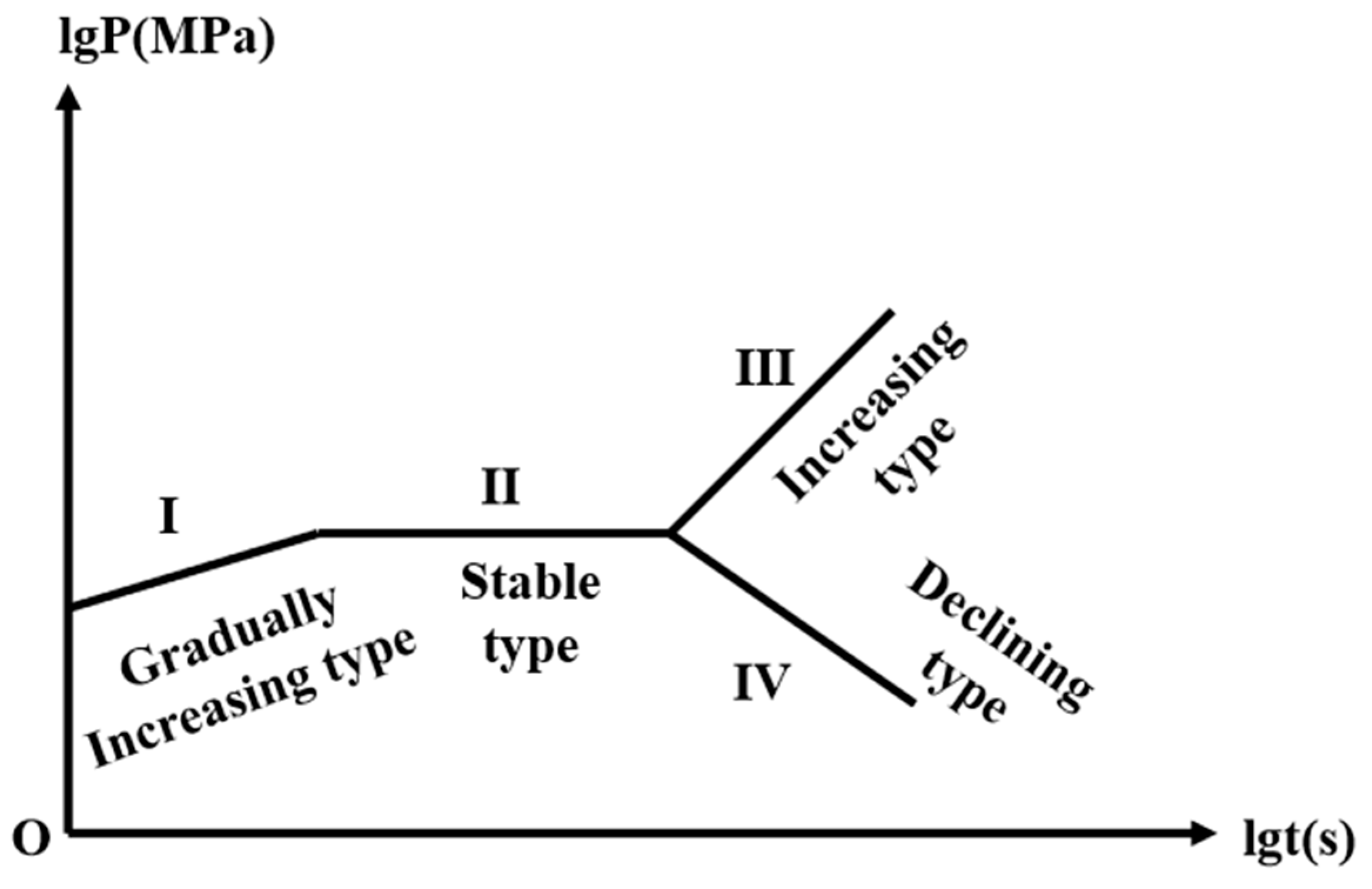
The classical Nolte–Smith hydraulic fracturing theory established the foundation for real-time monitoring and effectiveness evaluation of hydraulic fracturing. Through the analysis of fracturing pressure curves, it quantifies the relationship between pressure response and fracture propagation behavior [32]. The log P–log t analysis method determines characteristic slopes of fracturing pressure versus time in a double-logarithmic coordinate system. As illustrated in Figure 2, four major diagnostic curve types can be used to interpret the complexity of fracture propagation during fracturing operations. The theoretical basis of this method originates from classical fracture propagation models, which predict that pressure and time follow specific power-law relationships under different geometric controls, represented by characteristic theoretical slopes on log–log plots [33]. Within this theoretical framework, four typical diagnostic curves are interpreted mechanistically as follows:
  • Curve I: A log P–log t slope with a low positive value corresponds to the PKN model, indicating that fracture height growth is restricted while fracture length extends gradually. Under ideal, leakoff-controlled conditions, the PKN model predicts a time-dependent pressure slope of 1/4 power, whereas the KGD model predicts a slope between 1/4 and 1/3. Therefore, a slope of approximately 0.2–0.3 theoretically reflects a planar fracture propagation pattern constrained vertically by impermeable layers.
  • Curve II: A slope near zero suggests the opening of natural microfractures or initiation of new fractures, which increases fluid leakoff until the leakoff rate balances the injection rate. This pattern is a characteristic indicator of a complex fracture network activation, consistent with a leakoff-dominated fracture propagation regime.
  • Curve III: A slope of approximately 1 occurs when fracture propagation ceases due to near-wellbore bridging, proppant screenout, or severe stress shadow effects. The fracture cavity then behaves as a fixed volume, and pressure becomes directly proportional to injection time, meaning the pressure increment scales with injected fluid volume. This corresponds to the fracture cavity filling model, indicating severe proppant blockage or effective tip screenout within the fracture.
  • Curve IV: A negative slope indicates that as the fracture propagates into a low-stress layer, the resistance decreases and the fracture accelerates into that interval, resulting in pressure decline. Vertical fracture growth or intersection with natural fractures may also lead to pressure release. This deviation from classical planar fracture models marks a transition in the fracture propagation regime, which can be explained by the pseudo-three-dimensional (P3D) model exhibiting uncontrolled fracture height growth or by the complex fracture network model involving large-scale natural fracture connectivity.
In practical fracturing analysis, direct application of the Nolte–Smith classical hydraulic fracturing theory is often limited, as the model is formulated based on net pressure within the fracture, which cannot be accurately determined during or after field operations. The calculation of net pressure during hydraulic fracturing is influenced by fluctuations in fluid properties and variations in proppant injection, making it difficult to obtain a complete and reliable net pressure curve. According to the principle of pressure transmission conservation, and neglecting the variation in frictional resistance along the fracture walls during the fracturing process, the relationship between the measured surface pressure (P) and the net pressure within the fracture (ΔP) can be expressed as follows:
P = Δ P + P f w + P f f + P c P L
In the above equation:
P: surface treating pressure (MPa);
ΔP: net pressure within the fracture (MPa);
Pfw: pressure loss along the wellbore fluid column (MPa);
Pff: near-wellbore tortuosity and fracture-wall friction loss (MPa);
Pc: closure pressure (MPa), which in engineering practice is generally taken as the minimum horizontal principal stress;
PL: hydrostatic pressure of the vertical fluid column (MPa).
According to the above relationship, the treating pressure P is positively correlated with the net pressure ΔP [34].
To develop a practical and field-applicable diagnostic tool, this study establishes a simplified and rapid evaluation method by using the treating pressure as the primary analytical parameter. Under stable displacement, stable sand concentration, or stepwise proppant ramping conditions, the log–log plot of treating pressure versus time is analyzed to identify fracture propagation patterns. However, this approach has inherent limitations. The treating pressure includes components such as wellbore friction, near-wellbore tortuosity losses, and hydrostatic column pressure. These components are theoretically non-constant, and their variations may influence the slope of the log–log curve. The objective of this study is to establish a simplified, rapid diagnostic approach applicable under stable injection and proppant conditions. Therefore, for the X Block platforms (A, B, C, and D), treating pressure is used as the diagnostic variable in real-time field evaluation. The resulting log–log pressure curves observed after fracturing treatment can be categorized into three types: stable type, gradually increasing type, and declining type.

3.2. Threshold Classification of Log–Log Curve Types

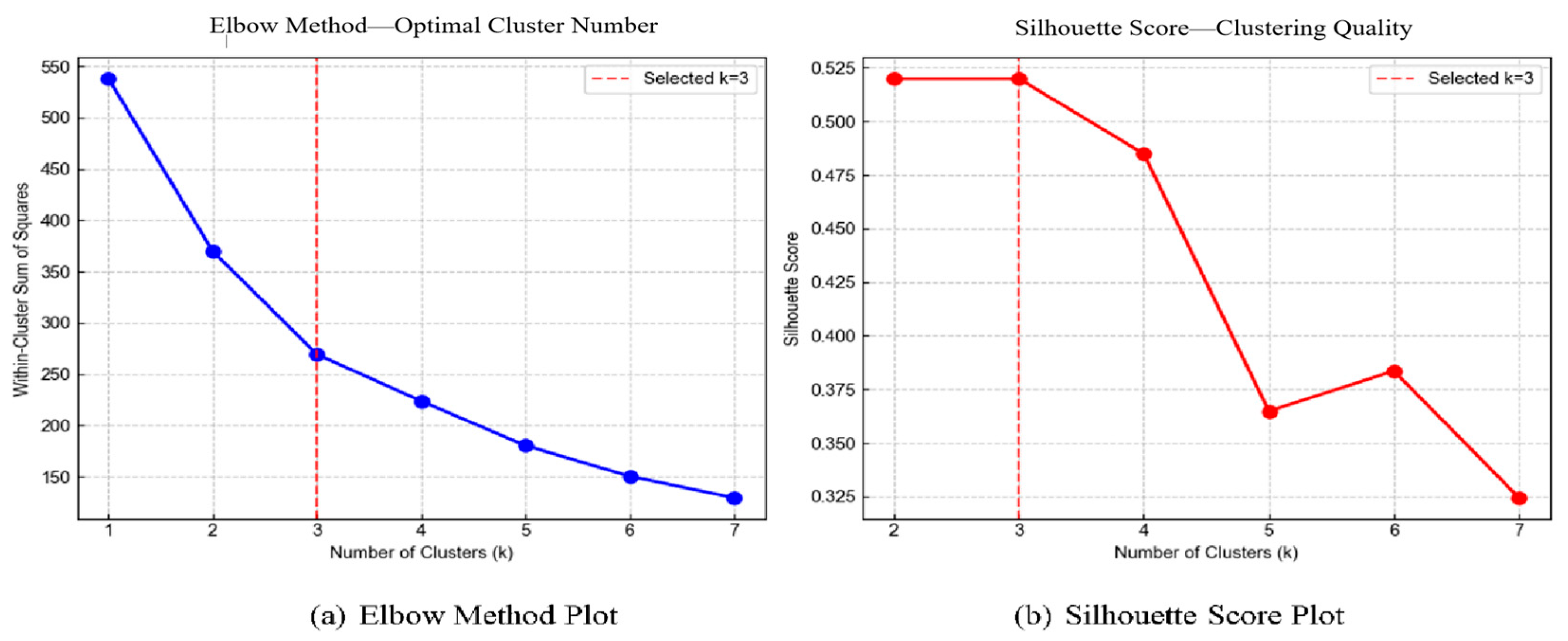
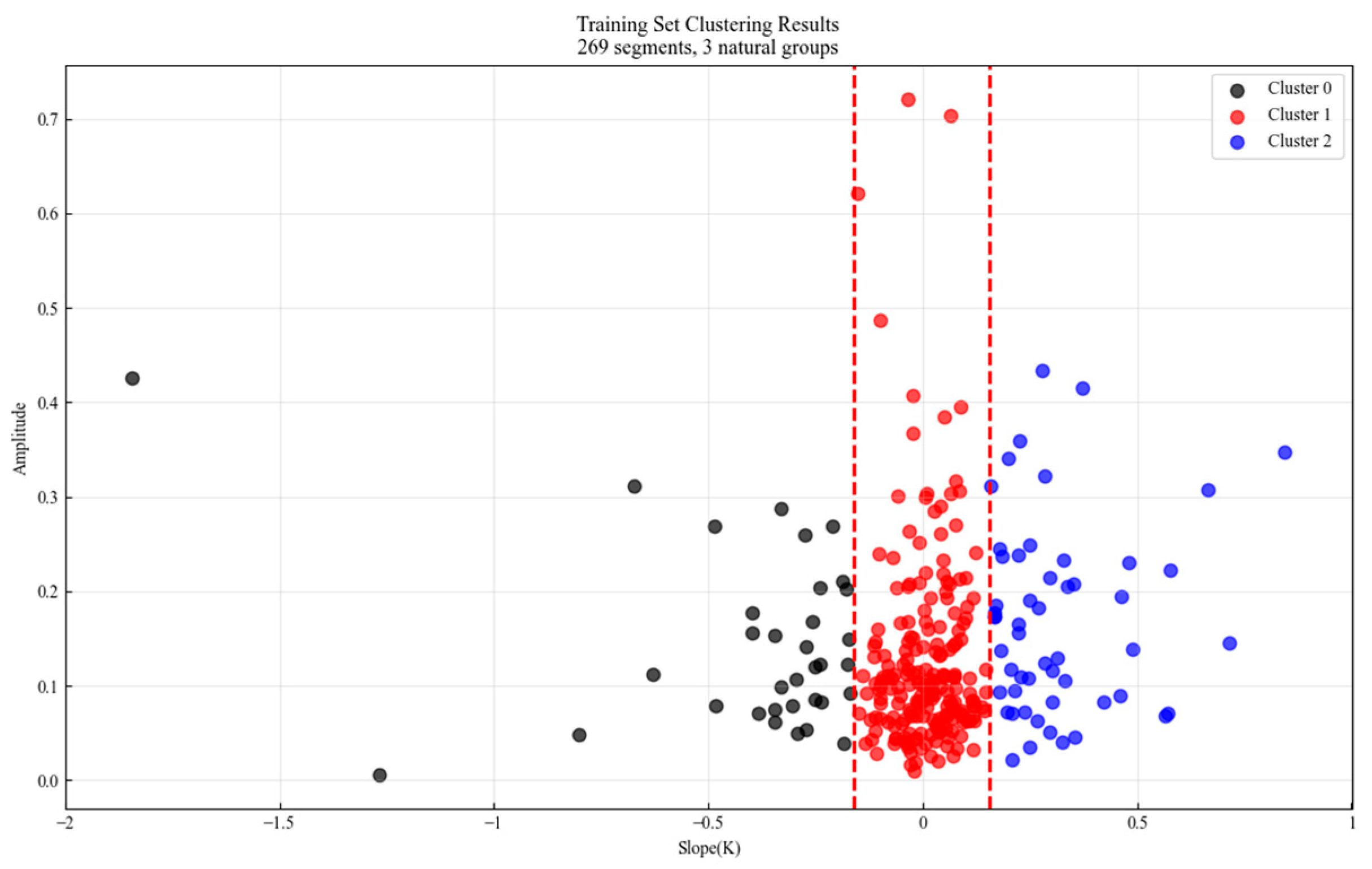
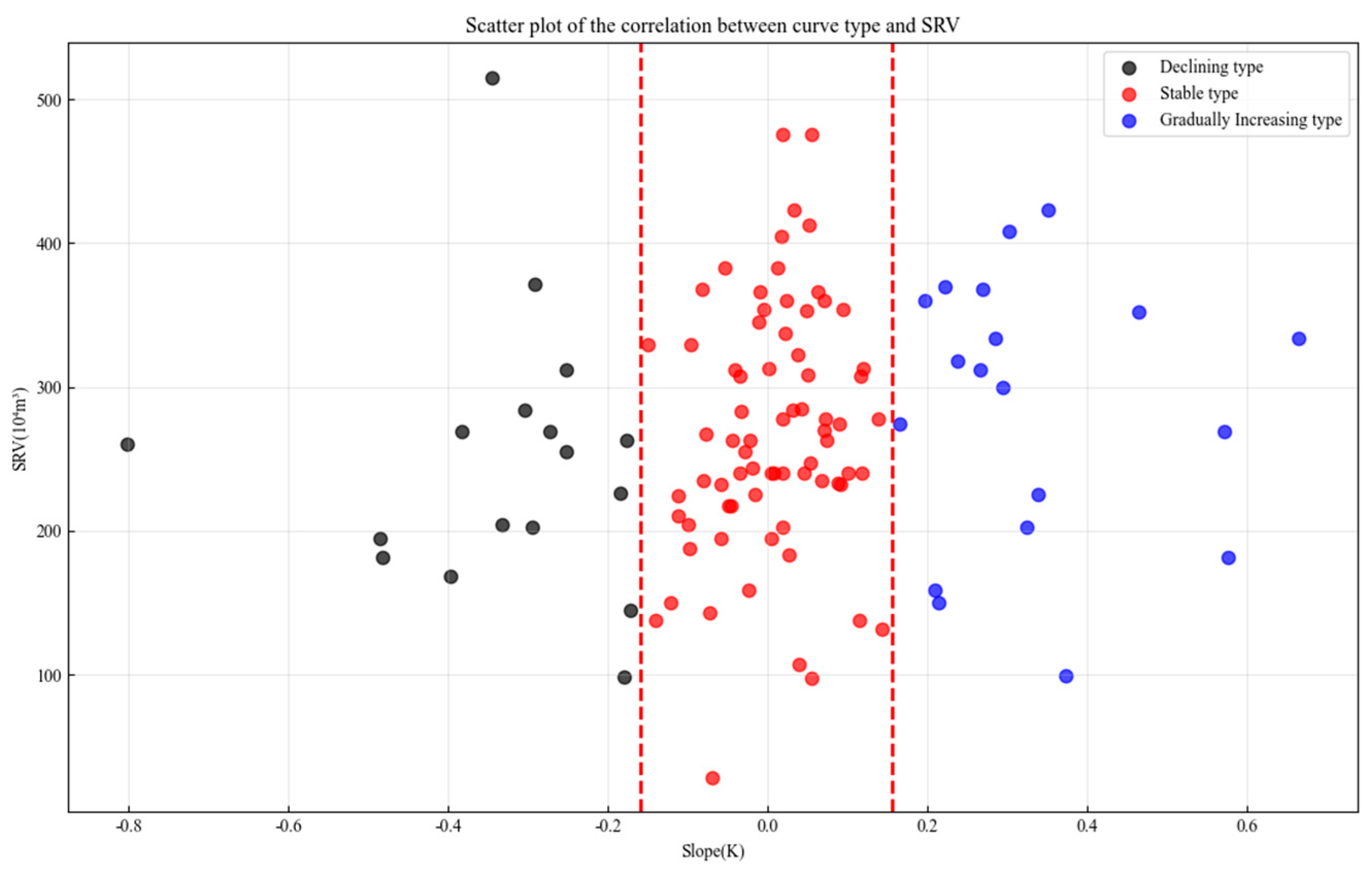
To achieve accurate diagnosis of curve types, this study proposes a data-driven classification threshold method for log–log pressure curve analysis. The approach consists of four stages: unsupervised clustering and natural grouping, threshold derivation, statistical validation, and independent testing. A total of 295 fracturing stages from shale gas wells in the X Block of the Sichuan Basin were processed using log–log transformation of treating pressure versus time (lgP–lgt). The slope (K) and fluctuation amplitude of each curve were extracted to form a feature dataset, which was then divided into a training set and an independent validation set. The K-means clustering algorithm was applied to the training data to identify the natural grouping of samples and eliminate potential bias from subjectively predefining the number of clusters. As shown in Figure 3, silhouette coefficient analysis determined the optimal number of clusters to be three (silhouette coefficient = 0.520). Figure 4 illustrates that the data naturally exhibit three aggregation patterns, with Clusters 0 and 2 displaying dispersed distributions, while Cluster 1 shows concentrated and clearly separated boundaries. The red dashed line serves to delineate the cluster boundaries, distinguishing the distribution areas of different clusters. To the left of the dashed line lies primarily Cluster 0 (black points), while Cluster 1 (red points) and Cluster 2 (blue points) are located to the right.
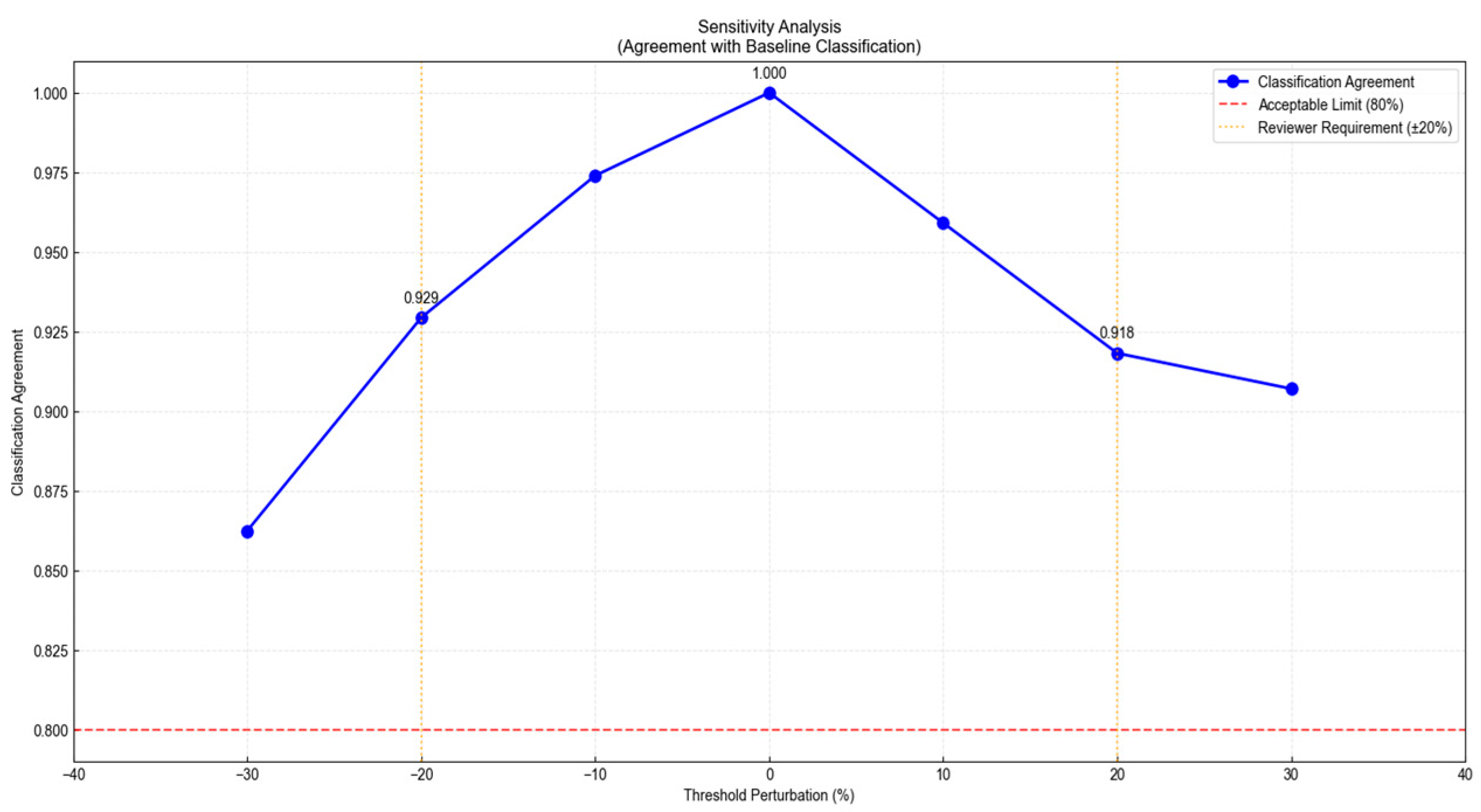
Based on the clustering results, objective threshold derivation was performed by calculating the boundary of slope distributions between adjacent clusters. The midpoint between two adjacent cluster boundaries was defined as the initial objective threshold, yielding results of [−0.160, 0.155]. To assess the statistical stability of the derived thresholds, Bootstrap resampling (n = 500) was applied, and the 95% confidence intervals (CI) for the two thresholds were determined as [−1.349, −0.052] and [−0.153, 0.279], respectively. Both thresholds fell within their confidence intervals, with the latter exhibiting a narrower CI, indicating greater stability of estimation. As shown in Figure 5, sensitivity analysis under varying threshold perturbation levels demonstrated high classification consistency. Even with ±20% threshold variations, the consistency remained above 92.6%, confirming the method’s robustness and low sensitivity to threshold changes.
To further evaluate the generalization capability, independent well data not used in threshold development were tested. The Cohen’s Kappa coefficient comparing this method with the classical Nolte–Smith standard reached 0.834, demonstrating strong consistency between the proposed classification approach and the conventional diagnostic criterion.
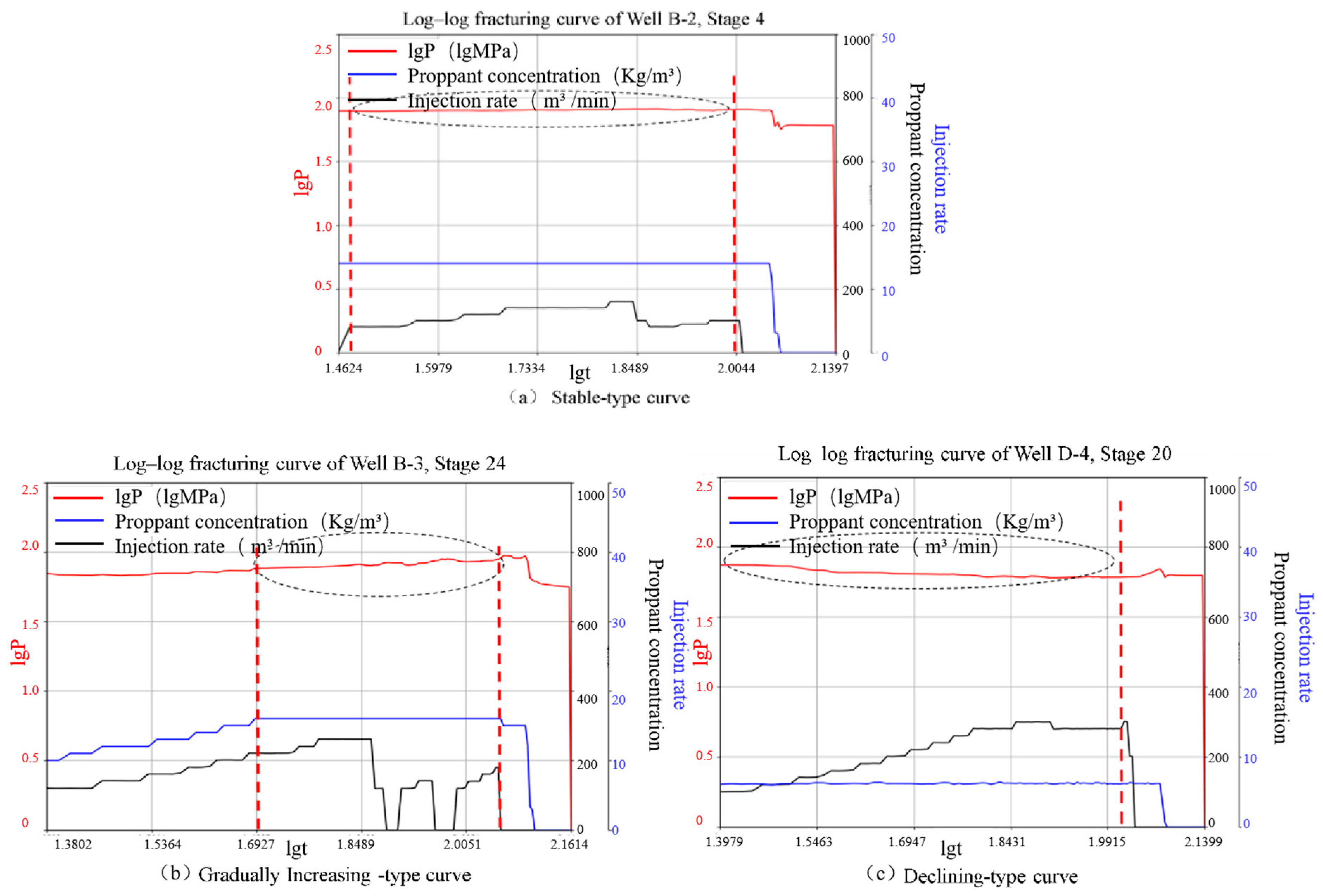
Based on the above study, a classification standard for log–log fracturing curve types in X Block was derived. As shown in Figure 6, three typical curve types for X Block are presented, and the following slope-threshold definitions are proposed to classify curve types (Figure 6). The red dash lines in the figure mark the stable pumping stages:
Stable type (Figure 6a): Typical well behavior in this block during stages with stable pump rate, stable proppant concentration, or stepwise proppant ramping. Curve characteristic: slope within the range −0.160 ≤ K ≤ 0.155.
Gradually increasing type (Figure 6b): Typical well behavior in this block during stages with stable pump rate, stable proppant concentration, or stepwise proppant ramping. Curve characteristic: pressure curve shows a dominant increasing trend; slope K > 0.155.
Declining type (Figure 6c): Typical well behavior in this block during stages with stable pump rate, stable proppant concentration, or stepwise proppant ramping. Curve characteristic: pressure curve shows a dominant decreasing trend; slope K < −0.160.

3.3. Verification of the Log–Log Method Using Cross-Microseismic Monitoring Results

The spatial dynamics of fracture propagation revealed by microseismic monitoring directly reflect the behavior of net pressure within the fracture. By comparing the classification results of treating pressure curves with microseismic monitoring data, the reliability of applying the log–log transformation of treating pressure for X Block can be verified from an engineering perspective. In this section, 30 fracturing stages with both pressure and microseismic monitoring data were selected to form a new validation dataset. The curve types of the validation dataset were independently classified according to the slope thresholds derived in Section 3.2, resulting in three curve categories: stable type, gradually increasing type, and declining type. Subsequently, these classification results were systematically compared with the fracture spatial propagation patterns revealed by microseismic monitoring.
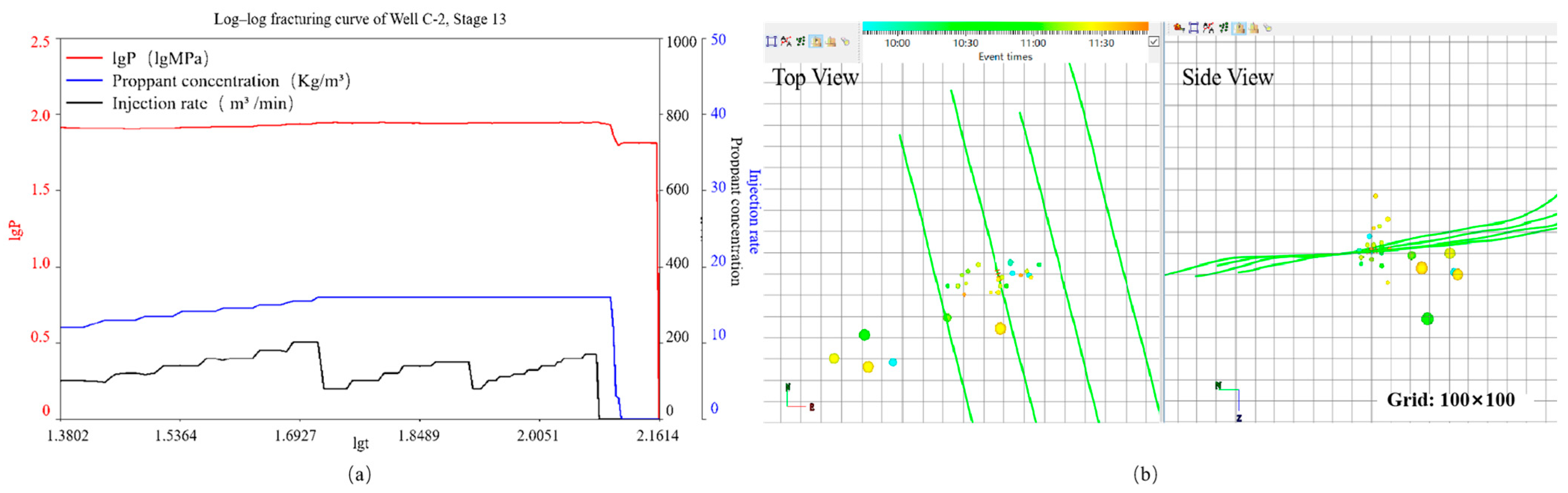
For instance, in Well C-2, Stage 13, the log–log pressure curve exhibits a slope of approximately 0, representing a typical stable-type curve. Within the range of log t ≈ 1.5–2.05, both injection rate and proppant concentration remain stable, while pressure variations are minor. The curve slope approaches zero, showing only a slight decline in the late stage (log t ≈ 2.05–2.19). This pattern indicates that during the middle and late phases of fracturing, the system reaches a dynamic balance between fluid pressure and fracture propagation. The limited increase in fracture volume suggests a relatively stable and controllable growth stage. As illustrated in Figure 7, the spatiotemporal distribution of microseismic events—derived from 3D microseismic location results—corroborates the log–log curve interpretation. The time sequence is color-coded as blue (early), yellow (mid), and orange (late), with colored spheres representing the position and magnitude of microseismic events. Events propagate steadily along the east–west direction, ultimately forming a continuous linear event band with an azimuth of 78° and a total length of 461 m. During the main fracturing phase (10:30–11:10, corresponding to log t ≈ 1.5–2.19), the microseismic events display distinct temporal segmentation, which corresponds closely to the “stable expansion stage” of microseismic activity and the “steady segment” of the log–log pressure curve, as summarized in Table 1. As shown in Table 2, all 30 validation stages demonstrate consistent correspondence between pressure-curve classifications and microseismic monitoring results across the three curve types. This statistical agreement confirms the reliability and applicability of the log–log diagnostic method based on treating pressure for the X Block, providing a solid foundation for its engineering implementation.

4. Fracturing Diagnostic Results and Applications

4.1. Distribution Characteristics of Curve Types

Using the slope-threshold classification system described in Section 3.2, the proportions of each log–log pressure curve type on Platforms A, B, C, and D in the X Block of the Sichuan Basin were statistically analyzed, as summarized in Table 3, to identify the dominant curve types on each platform. On Platform A, for Wells 2 and 4, the Stable Type curves accounted for the majority of fracturing stages. Specifically, there were 32 Stable-Type curves, 4 Gradually increasing-Type curves, and 2 Declining-Type curves. On Platform B, for Wells 1, 2, and 3, the Gradually increasing-Type curves were more prevalent than on the other platforms. On Platforms C and D, the Stable-Type curves predominated, whereas Platform D contained the highest proportion of Declining-Type curves compared to the other three platforms. The spatial distribution of curve types across platforms exhibits significant heterogeneity. On Platforms A and C, Stable-Type curves accounted for 84.21% and 79.76%, respectively. On Platform D, in addition to Stable-Type curves, Declining-Type curves represented 61.29% of all Declining-Type curves observed across the four platforms.
The statistical results across platforms exhibit a non-random distribution pattern, indicating that curve types are systematically associated with coupled geological and engineering factors. The following section analyzes the geological engineering mechanisms controlling the dominant curve types on each platform.
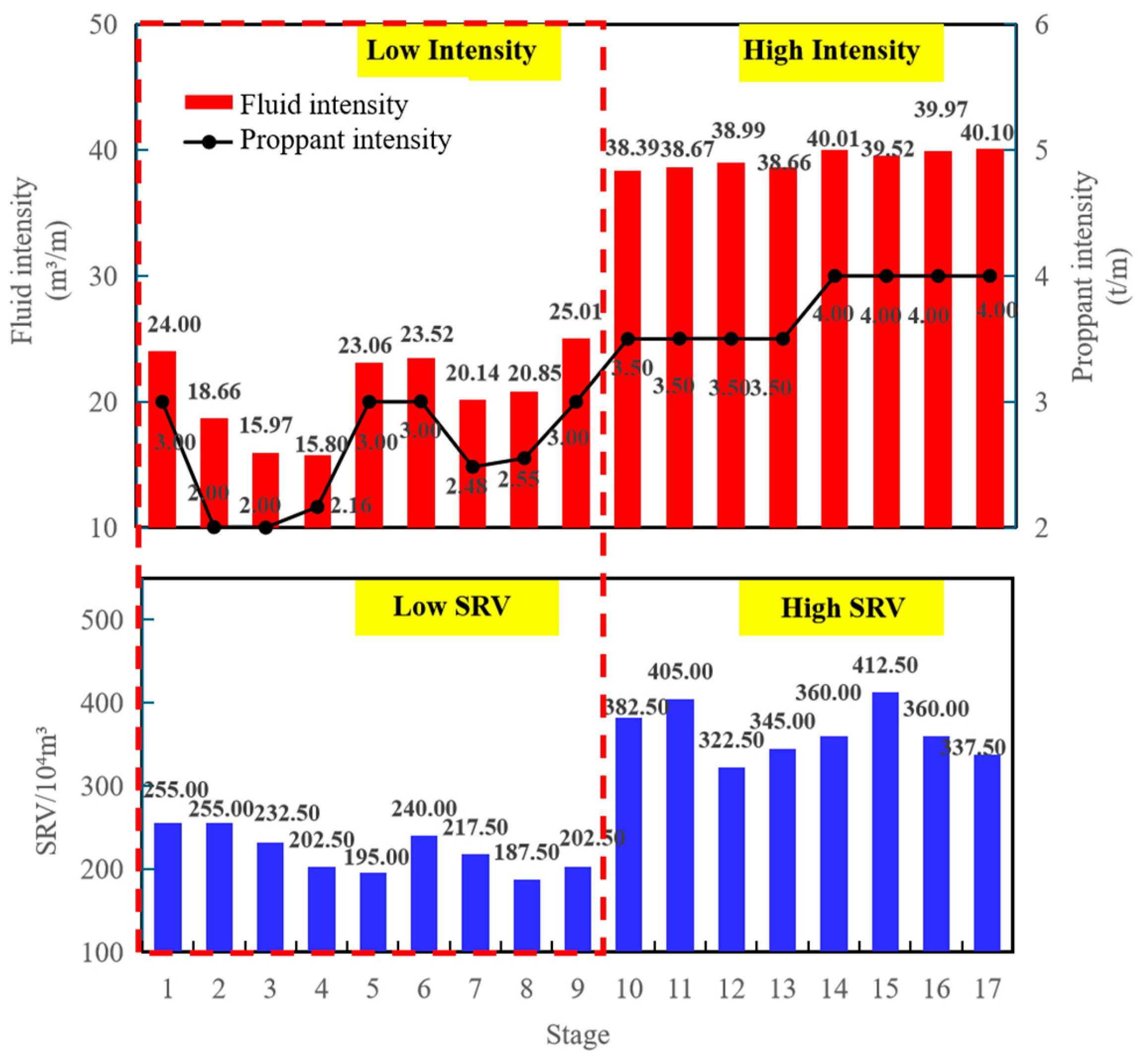
As introduced in Section 1, Platform A is located in a medium-risk zone, with two large, weakly active faults in its vicinity. These provide relatively confined mechanical boundaries for hydraulic fracture propagation, effectively controlling the overall morphology and extension of the fracture network. Within these boundaries, multiple natural fractures are intersected. During fracturing, hydraulic fractures connect with natural fractures, accelerating fluid leakoff until a dynamic balance with the injection rate is achieved. The injected fluid is lost to the formation, limiting effective fracture pressure increase and fracture propagation. This behavior manifests as a typical Stable Type curve on the log–log plot. The laminated structures formed by strata crossing the wellbore prevent excessive extension along a single plane. The resulting multi-tier fracture network allows more uniform fluid distribution; even if local pathways are obstructed, other paths maintain continuous fluid flow, stabilizing the treating pressure. However, local complexities still exist. For instance, in Well 2 of Platform A, cross-flow occurs similarly to Well 1. Comparing the fracture-stimulated reservoir volume (SRV) across all stages (Figure 8), stages with insufficient fluid and proppant intensity exhibit SRV values lower than the well average, with an average reduction of 35.79%. For these stages, increasing fluid and proppant intensity is recommended to ensure sufficient fracture propagation and support.
Platform B contains natural fractures intersecting the wellbore at large angles, as well as inter-well connected natural fractures and faults. These features objectively limit the uncontrolled expansion of the fracture network, providing natural boundaries that concentrate energy into a “trunk–branch” type large-scale complex fracture network, with lateral branches constrained. From an engineering perspective, coordinated fracturing across adjacent wells, using staggered operations, controls the operation rhythm and ensures that fractures crossing inter-well fracture belts are activated sequentially. This prevents simultaneous multi-well operations from over-activating natural fracture–fault systems and interfering with stress, creating a relatively stable local stress environment for single-well operations. The main sections on the platform employ stage-wise composite diversion techniques, enabling uniform extension when fracturing fluid enters large-angle natural fractures, thereby maintaining stable treating pressure. Furthermore, integrating natural fracture activation and complex fracture network formation, fracturing designs targeting connected fracture belts focus on continuous energy injection to activate the complex network, producing a gradually increasing and controllable pressure trend. By avoiding geologically risky zones, using multi-scale composite diversion, adjusting displacement–proppant ratios, and employing full-cycle dynamic monitoring, a four-step closed-loop management strategy of “avoid, divert, control, monitor” is implemented, achieving synergistic improvement in fracturing efficiency and safety in faulted areas.
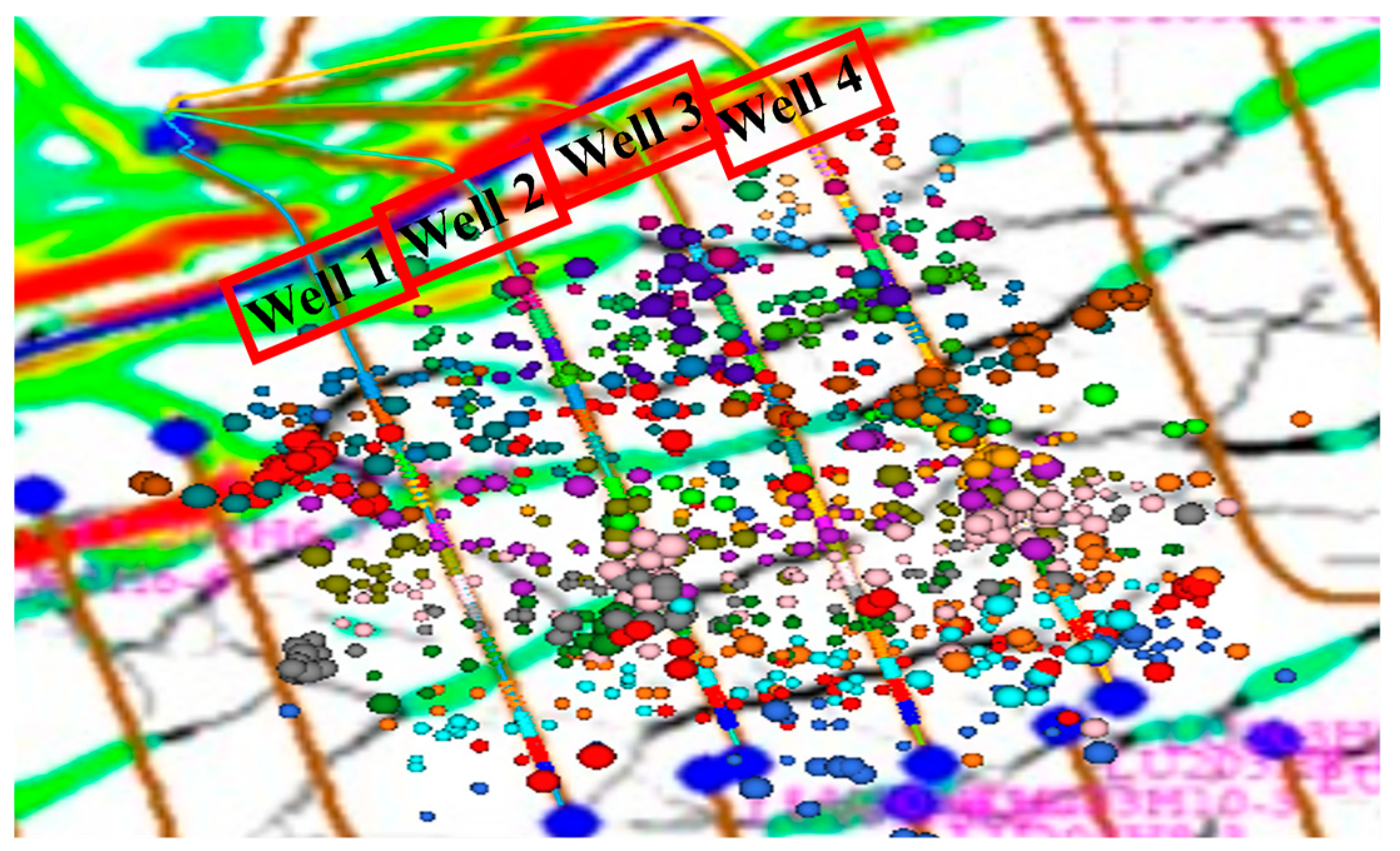
As shown in Figure 9, the four colored main lines from left to right represent the wellbore positions of Wells 1–4 on Platform D, while the colored spheres denote microseismic events, with different colors denoting distinct fracturing stages. The spheres of varying sizes indicate microseismic event energy, with larger spheres representing greater fracture energy release. Different colors are used to distinguish the temporal sequence of the microseismic events [35]. For Wells 1, 2, 3, and 4 on Platform D, fracturing events are distributed relatively symmetrically along both sides of the wellbore, with comparable extension distances, while natural fracture events account for a small proportion. The microseismic event energy levels reflect the magnitude of fracture energy release, and events with energy levels above 0 represent approximately 15.8% of total events. This indicates limited activation of natural fractures, reducing fluid diversion into secondary fractures. The combination of symmetrical fracture morphology and low natural fracture interference promotes efficient fluid leakoff. The platform exhibits an average brittleness index of 72.73%, indicating high energy release efficiency and a certain propping effect. This generates a high-brittleness response mechanism that reinforces pressure decline. Such a pattern reduces operational complexity but requires caution to prevent excessive leakoff, which could lead to uneven proppant placement.

4.2. Relationship Between Curve Types and SRV

Based on the log–log pressure curve types for each platform summarized in Section 4.1 and incorporating microseismic monitoring data from Platforms A and D, a correspondence between curve types and stimulated reservoir volume (SRV) was established, as shown in Figure 10. The figure illustrates the SRV distribution for individual fracturing stages, showing substantial overlap in SRV ranges between the Declining-Type, Stable-Type, and Gradually increasing-Type curves. The red dashed line serves as the threshold classification line.
To determine whether SRV differs significantly between the curve types, a variance analysis was conducted. The descriptive statistics for each curve type are summarized in Table 4. The Stable-Type curves have an average SRV of 267.46 ± 86.81 m3, Gradually increasing-Type curves average 286.24 ± 92.87 m3, and Declining-Type curves average 253.10 ± 94.40 m3. Numerically, the Gradually increasing-Type exhibits a relatively higher mean SRV, while the Declining-Type has the lowest mean SRV. However, the within-group standard deviations are substantial (all exceeding 85 m3), indicating significant variability in fracture stimulation effectiveness within each curve type. Notably, although Declining-Type curves have the lowest mean SRV, they include the largest single-stage SRV in the full dataset (514.8 m3). While the Gradually increasing-Type shows a higher mean SRV, the ANOVA results indicate that the differences in SRV between the three curve types are not statistically significant (F = 0.650, p = 0.524).
This statistical evidence reveals an important feature of the X Block: the morphology of the fracturing pressure curves is not the controlling factor for fracture-stimulated volume, and SRV cannot be reliably inferred from curve type alone.

4.3. Identification of Dominant Hydraulic Fracturing Parameters

Grey relational analysis (GRA) is a method within grey system theory that evaluates the degree of association between factors based on the similarity or dissimilarity of their developmental trends, defined as the grey relational grade [36]. In Block X of the Sichuan Basin, the post-fracturing performance of wells shows varying degrees of effectiveness. To investigate the influence of fracturing parameters on the stimulated reservoir volume (SRV), six wells from Platforms A and D were selected as the study objects. The GRA method was applied to determine the relational grade and weight of each influencing factor. In this analysis, the reference sequence was defined as the fracture-stimulated reservoir volume (SRV), while the comparison sequences (parameters under study) included: breakdown pressure, shut-in pressure, fluid intensity, proppant intensity, total fluid volume, total proppant volume, and injection Rate. Taking Well 1 of Platform D as an example, the relational calculation process is outlined as follows. The original fracturing parameters are listed in Table 5.
First, the raw data were normalized to ensure comparability between all parameters and eliminate the influence of differing units. The min–max normalization method was selected because it linearly scales all data into the [0,1] range while better preserving the relative relationships between the original values. For each column of parameters, the minimum and maximum values were determined to perform the normalization. Prior to normalization, the range of all raw data was examined, and no extreme outliers were detected.
X n o r m = X X min X max X min
After dimensionless processing of both the reference sequence and comparison sequences, the absolute differences between the two were computed.
Δ i k = X 0 , n o r m k X i , n o r m k
Subsequently, the grey relational coefficients were calculated using the following formula:
γ X 0 , n o r m k X i , n o r m k = min i   min k   Δ i k + ρ   max i   max k   Δ i k Δ i k + ρ max i   max k   Δ i k
where min i   min k   Δ i k is the minimum absolute difference in the comparative sequence. max i   max k   Δ i k is the maximum absolute difference in the comparative sequence; ρ is the distinguishing coefficient. Normalization enhances the significance of differences between correlation coefficients, with normalized values typically ranging from 0 to 1. In this study, the common practice from the literature was followed for data preprocessing, set to 0.5 [37].
The mean of the grey relational coefficients was then calculated to obtain the relational grade of each fracturing parameter with SRV.
γ 0 i = 1 n i = 1 n γ X 0 , n o r m k , X i , n o r m k
Finally, based on the calculated relational grades, the weights of individual parameters were determined using normalization.
ω i = γ 0 , i i = 1 m γ j
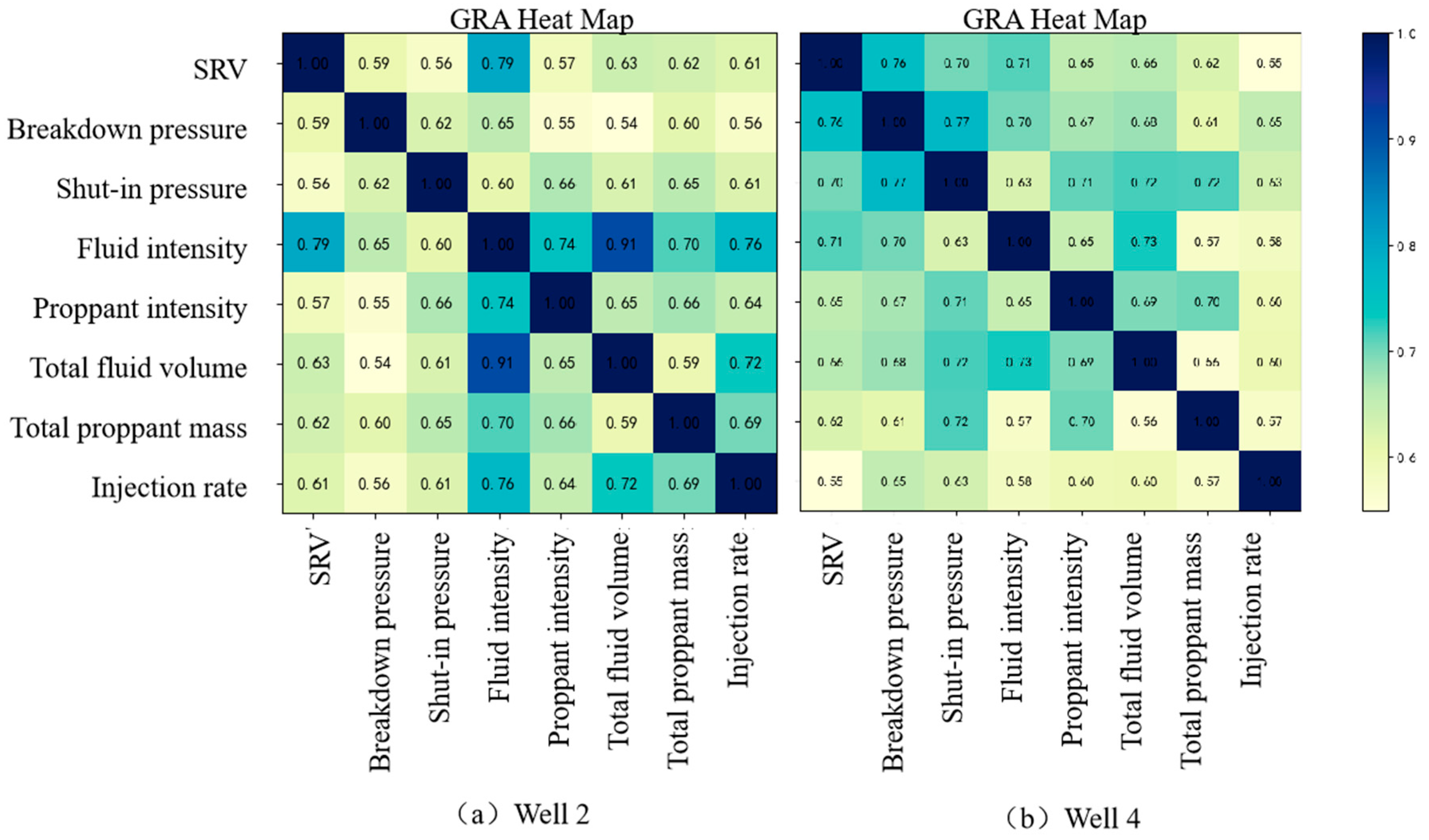
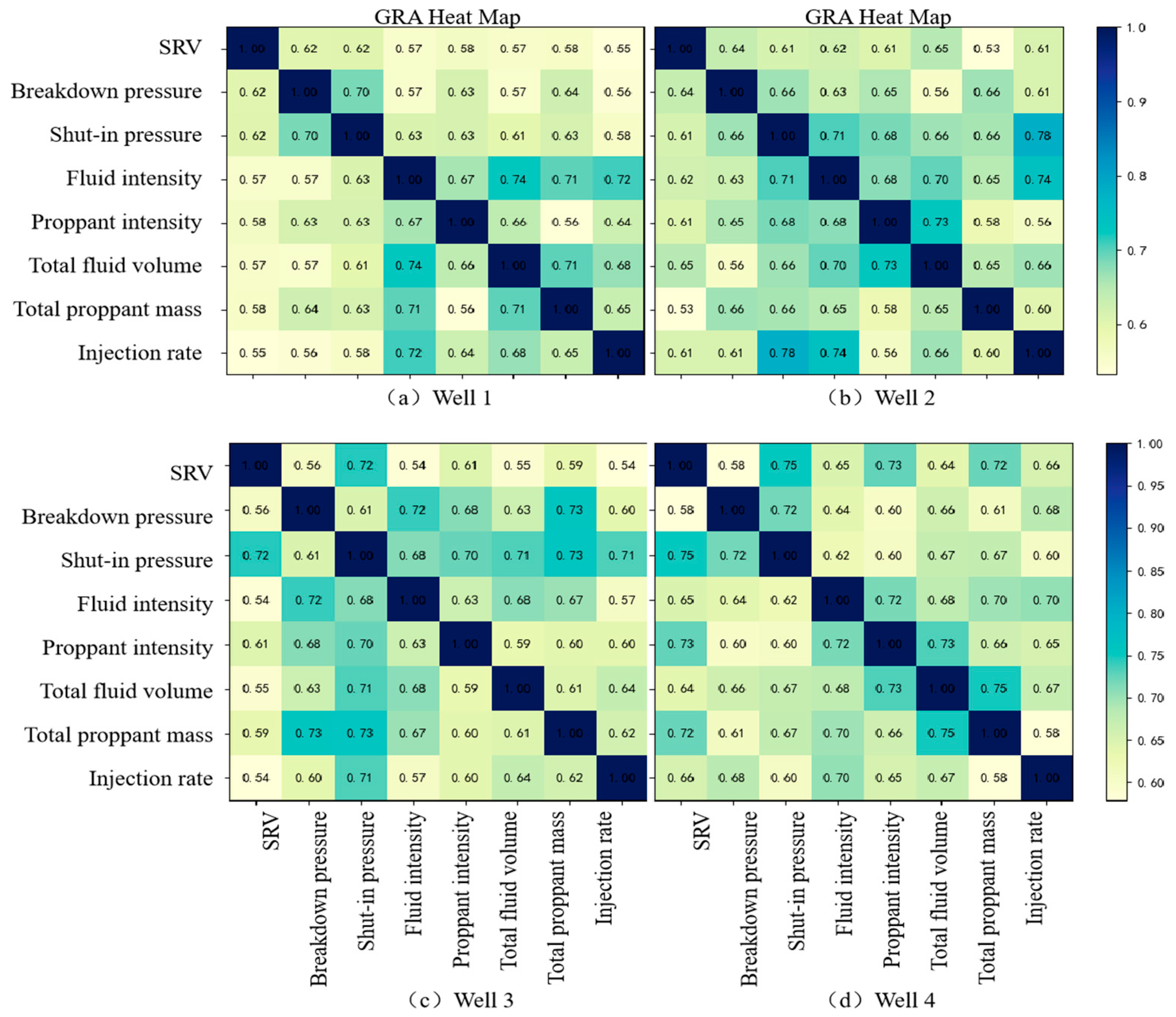
Based on the grey relational analysis method, heatmaps were generated for wells in Platforms A and D to evaluate the degree of association between fracturing parameters and SRV (Figure 11 and Figure 12). The color gradients represent the normalized grey relational degree within the range of 0–1, where rows and columns correspond to different evaluation parameters in the X block of the Sichuan Basin. The color depth indicates the strength of correlation: darker shades represent stronger associations with SRV, while lighter shades indicate weaker associations. For Platform A, the highest correlation parameter for Well 2 was Injection Intensity, while for Well 4 it was Breakdown Pressure. For Platform D, the parameters with the highest correlation for Wells 1–4 were Breakdown Pressure and Shut-in Pressure, Breakdown Pressure, Shut-in Pressure, and Shut-in Pressure, respectively.
A sensitivity analysis was conducted on the grey relational grades to examine the results under different values of the distinguishing coefficient ( ρ ). A systematic analysis of six wells was performed by varying ρ from 0.1 to 0.9 in increments of 0.1, and the relational grades and ranking order of each parameter were recalculated. The stability of parameter rankings under different ρ values was compared to evaluate the robustness of the study conclusions. Taking Well A-2 as an example, the sensitivity analysis results are presented in Table 6. The relational grades were observed to increase with larger ρ values, while the importance ranking of parameters demonstrated strong stability across different distinguishing coefficients. Specifically, fluid intensity consistently ranked first under all ρ values, while total fluid volume and total proppant mass alternated between second and third positions, with these three parameters consistently occupying the top three ranks. Statistical results from all six wells showed consistent patterns, indicating that the overall configuration of main influencing factors remains stable. The analysis results demonstrate that the grey relational ranking obtained in this study using ρ = 0.5 is not influenced by the specific value chosen for the distinguishing coefficient.
Table 7 presents the grey relational degree results, which identify the correlation between fracturing parameters and SRV for individual platforms in X Block.
Relying solely on the mean values to identify platform-level dominant parameters can obscure inter-platform heterogeneity and mask characteristic parameters. Furthermore, anomalous single-well values may skew the platform average and misrepresent the true dominant factors, indicating that the mean-value approach is insufficient to reveal unified trends across the block. Therefore, common parameters were extracted, and their correlation ranks were scored to obtain a consistent evaluation of operational parameters at both platform and block scales. The analysis was conducted in the order of block, platform, and individual well, enabling a refined examination of the correlation between fracturing parameters and SRV.
For Platform A, the top three parameters with the highest correlation were extracted to identify common factors. According to the heatmap color variations, the ranking for Well 2 was: Injection Intensity, Total fluid volume, and Total Proppant Volume; for Well 4: Breakdown Pressure, Injection Intensity, and Shut-in Pressure. Injection Intensity was thus identified as the key parameter at the platform scale. By assigning ordinal scores to the correlation ranks of Wells 2 and 4, the top three cumulative scores determined the platform-level dominant parameters as: Injection intensity > Breakdown pressure > Total fluid volume. Similarly, for Platform D, the top three parameters were ranked as: Shut-in pressure > Sand concentration > Total fluid volume. The subsequent analysis focuses on the core parameters of Platform A (Injection Intensity) and Platform D (Shut-in Pressure and Sand Concentration), exploring their correlation with SRV through both statistical validation and engineering mechanism interpretation.
Fluid intensity is a critical indicator reflecting the scale of flow treatment during hydraulic fracturing operations. It represents the amount of fracturing fluid injected per unit length of the stimulated reservoir interval, directly controlling the energy input per stage.
The fluid intensity exhibits a critical threshold effect of energy input, which can be explained by the energy balance theory of fracture propagation in linear elastic fracture mechanics.
Δ W i n j G c A + σ 3 Δ V
where ∆Winj represents the work performed by the fluid, Gc denotes the rock fracture toughness, σ3 is the minimum principal stress, A is the fracture area, and ∆V is the fracture volume increment.
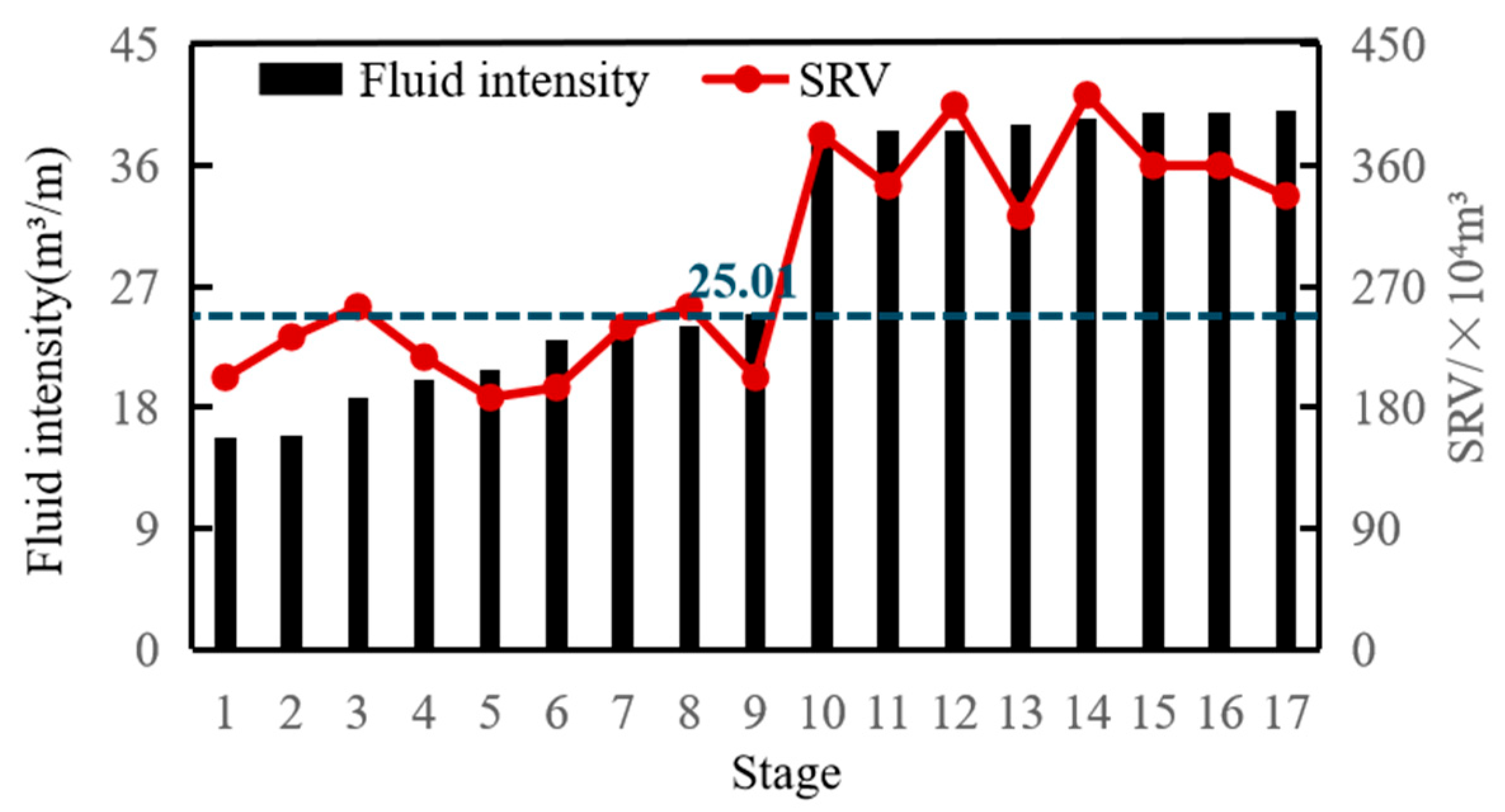
As shown in Table 8 and Figure 13, the response of fluid intensity at different stages can be observed. Taking Well 2 as an example, when the fluid intensity is below approximately 25 m3/m (red threshold line), the eight analyzed fracturing stages indicate that most of the injected fluid energy is consumed in overcoming near-wellbore friction and filling natural fractures. Consequently, the SRV response is limited, pressure fluctuations are large, and energy is not effectively transmitted to the far field. When the fluid intensity exceeds approximately 25 m3/m, in the nine analyzed stages, the injected fluid energy is sufficient to overcome the minimum principal stress of the reservoir. The microseismic-monitored SRV shows an increase of up to 68.72%, while pressure fluctuations decrease, and propagation pressure stabilizes. Adequate fluid volume maintains fracture width, promoting stable fracture extension toward the far field. Within the observed data range of this well, fluid intensity is positively correlated with SRV, and higher values favor increased fracture-stimulated reservoir volume.
The shut-in pressure refers to the bottomhole pressure recorded when pumping ceases during hydraulic fracturing. It directly represents the minimum horizontal principal stress and reflects the self-supporting capacity of fractures.
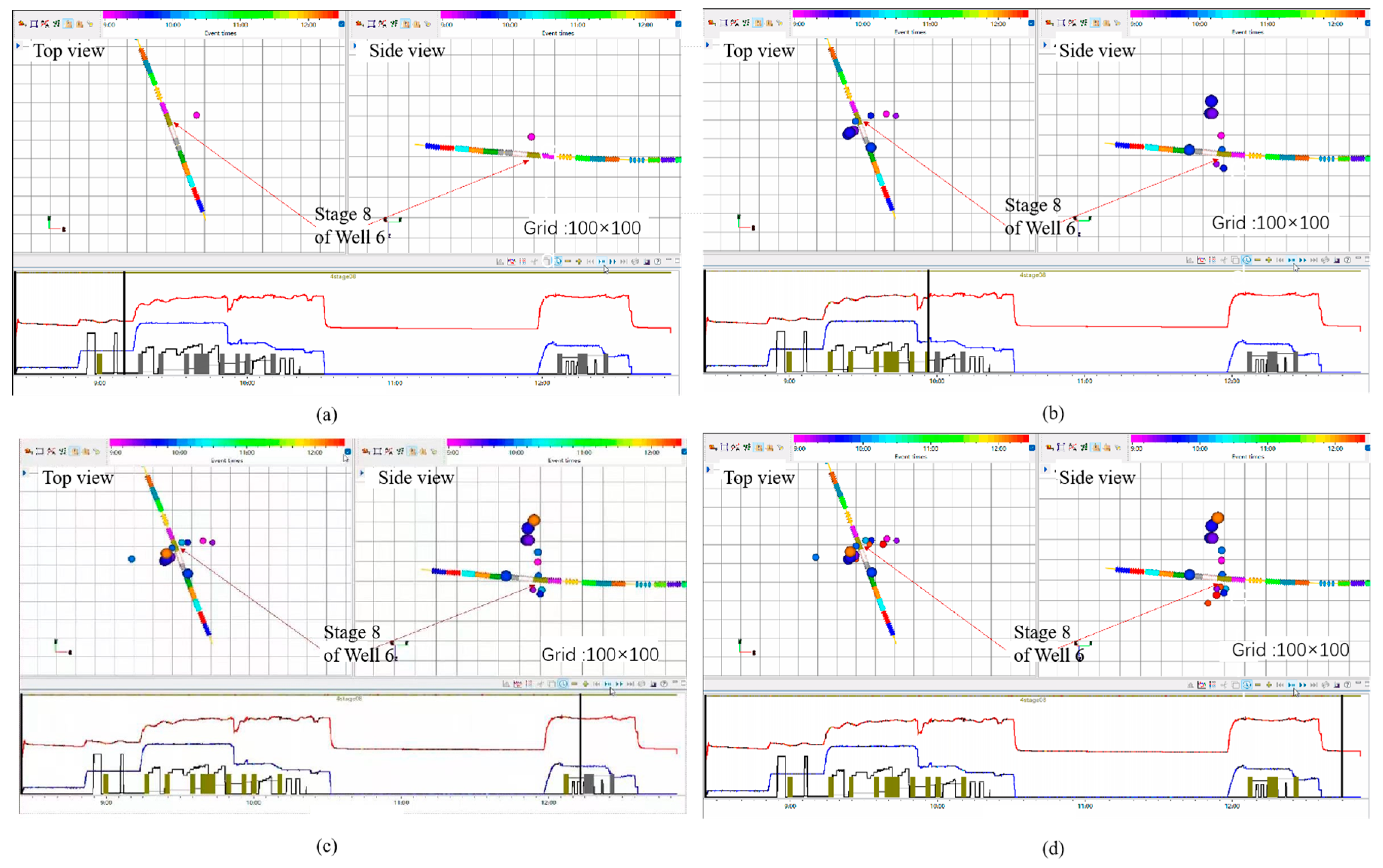
The strong correlation between shut-in pressure and SRV can be explained by the far-field fracture extension control mechanism. When the shut-in pressure significantly exceeds the minimum principal stress, the net pressure within the fracture remains sufficient to counteract closure stress, enabling fracture extension after shut-in. The core of this mechanism lies in the fact that higher shut-in pressure provides the energy required for far-field propagation, representing the capacity for sustained extension. The higher the shut-in pressure, the longer fractures can continue to propagate after pumping stops, thereby significantly enlarging SRV. The order of shut-in pressures from highest to lowest is: Well 4, Well 2, Well 1, and Well 3; the SRV follows the same order: Well 4, Well 2, Well 1, and Well 3. As shown in Figure 14, the spatiotemporal microseismic map of Stage 8 in Well 4 is presented, with the left panel showing the top view and the right panel the side view. The spherical markers surrounding the wellbore represent detected microseismic events, with different colors distinguishing the timing of the events. Panels (a) through (d) represent sequential stages from the earliest to the latest fracturing times, displaying purple, blue, cyan, green, and red spheres in order. In panel (d), several microseismic events (red spheres) are still detected after shut-in, corresponding to late-time microseismic events. Since these signals were not induced by pumping, they are interpreted as natural fractures reactivated by residual stress release [38]. As the “ultimate criterion” of fracture dynamics, shut-in pressure reflects both the potential for fracture extension and the sufficiency of reservoir stimulation, thereby directly influencing the magnitude of SRV.
Proppant intensity refers to the amount of proppant injected per unit length during hydraulic fracturing. From the perspective of rock mechanics, brittle rocks generally exhibit a smaller horizontal stress difference, leading to more random fracture propagation directions. Highly brittle rocks are characterized by a low Poisson’s ratio and high Young’s modulus, with low compressive strength, allowing proppants to more effectively keep fractures open. During fracturing, such rocks tend to generate branching fractures rather than a single dominant fracture. Proppant intensity directly influences the conductivity of fractures. A high proppant intensity forms a densely packed proppant layer within the fracture, thereby enhancing conductivity. The residence of proppants prevents fracture closure, particularly in highly brittle reservoirs, where fracture surface roughness is high, making it easier to sustain a fracture network and form stable flow channels.
This indicates an overall positive correlation between proppant intensity and SRV, the stimulated reservoir volume (SRV) increases with higher proppant intensity. This finding is consistent with the results of Wang et al. (2021) in the Rongwei Shale Gas Field, Sichuan Basin [39]. Such significant correlation can be explained by the unique geomechanical response mechanisms of high-brittleness reservoirs.
The Pearson correlation coefficient measures the linear relationship between two continuous variables, ranging from [−1, 1]. When R = 1, a perfect positive linear correlation exists; when R = −1, a perfect negative linear correlation exists; when R = 0, no linear correlation exists [40]. The formula for calculating the Pearson correlation coefficient is as follows:
r = i = 1 n X i X ¯ Y i Y ¯ i = 1 n X i X ¯ 2 i = 1 n Y i Y ¯ 2
where X i , Y i represent paired observations; X ¯ , Y ¯ represent the variable means; and denotes the sample size.
As an exploratory analysis. As shown in Table 9, in this targeted context, in fracturing stages with high brittleness indices, multiple statistical methods were used to corroborate the correlation between proppant intensity and SRV. First, non-parametric correlation coefficients were calculated, yielding Spearman’s rank correlation of 0.693 (p = 0.026) and a Kendall’s Tau of 0.539 (p = 0.031). The Pearson correlation coefficient was r = 0.783 (p = 0.007), with all three results indicating a significant positive correlation. Next, Bootstrap resampling (n = 9999) was applied to estimate the 95% confidence interval of the Pearson correlation coefficient, which was [0.497, 0.927], effectively excluding the possibility of weak correlation (|r| < 0.3) and confirming the robustness of the estimate. Finally, effect size analysis showed that proppant intensity explains 61.4% of the variance in SRV (R2 = 0.614), with Cohen’s f2 = 1.589, far exceeding the threshold for a large effect (f2 ≥ 0.35). Despite the limited sample size, the observed strong correlation demonstrates both statistical robustness and engineering significance.
This finding provides engineering insights for differentiated fracturing design: in similarly high-brittleness layers, prioritizing higher proppant intensity can maximize SRV and production; the use of low-density, high-strength ceramics in high-brittleness intervals can further optimize the proppant mixture and reduce embedment loss.

5. Conclusions

By applying the log–log diagnostic method to hydraulic fracturing treatment curves, the following conclusions are drawn:
(1) Statistical methods were applied to screen thresholds, and unsupervised clustering was used to objectively derive the log–log curve classification thresholds. Independent validation with a test set confirmed the robustness and reliability of this threshold-based classification system in X Block.
(2) Integration of microseismic monitoring and statistical testing revealed that on Platform D, X Block, the fracture-stimulated reservoir volume (SRV) does not differ significantly between different curve types. Although the Gradually increasing-Type curves show a numerically higher mean SRV, this alone cannot serve as a decisive indicator of reservoir stimulation effectiveness.
(3) The grey relational analysis indicates that fluid intensity, shut-in pressure, and proppant intensity are positively correlated with the SRV. These findings suggest that in similar high-brittleness shale formations, increasing proppant intensity and optimizing treatment parameters in real time may contribute to improving stimulation effectiveness and enlarging the stimulated reservoir volume.
(4) Case studies demonstrate that during fracturing operations, dynamic evaluation and real-time interpretation based on log–log curve characteristics provide a reliable basis for adjusting operational parameters. This approach offers valuable guidance for ensuring both the safety and effectiveness of fracturing in X Block.
It should be noted that this study used treatment pressure instead of net pressure for log–log analysis. Although validated as effective in the X Block, its physical meaning differs from the Nolte–Smith theory, and the results should be interpreted within the treatment pressure framework. As a case study, the conclusions may have limited generalizability and require further testing in other geological settings. The grey correlation analysis could also benefit from future refinement through multicollinearity and uncertainty quantification, for example, by introducing variance inflation factors and resampling methods to improve robustness.

Author Contributions

Methodology, X.H.; Software, Y.S.; Validation, X.Y.; Formal analysis, X.Y.; Investigation, X.Z. and Y.H.; Resources, X.H.; Data curation, W.D., W.S. and Y.D.; Writing—original draft, Y.S., X.Y., X.Z., Y.H., W.D., W.S. and Y.D.; Writing—review & editing, X.Y.; Supervision, X.H.; Project administration, Y.S. All authors have read and agreed to the published version of the manuscript.

Funding

This research received no external funding.

Data Availability Statement

The original contributions presented in the study are included in the article, further inquiries can be directed to the corresponding authors.

Acknowledgments

We gratefully acknowledge the support from PetroChina Southwest Oil & Gasfield Company, Chengdu.

Conflicts of Interest

Authors Yi Song, Yongzhi Huang, Wenquan Deng, Xiaojin Zhou, Wenjing Song and Yurou Du were employed by the company PetroChina Southwest Oil & Gasfield Company. The remaining authors declare that the research was conducted in the absence of any commercial or financial relationships that could be construed as a potential conflict of interest.

Nomenclature

Nomenclature
SymbolsDescriptionUnits
PTreating pressureMPa
PNet pressureMPa
PcFracture closure pressureMPa
PffNear-wellbore tortuosity and fracture wall frictionMPa
PfwFrictional pressure loss in the wellboreMPa
PLHydrostatic pressure from the fluid column in the vertical wellbore sectionMPa
WinjRepresents the work performed by the fluidJ
GCDenotes the rock fracture toughnessJ/m2
σ3Minimum principal stressMPa
AFracture aream2
VFracture volume incrementm3
Abreviation Expansion
i(k)Absolute Difference between Target Sequence and Reference Sequence
γ(X0,norm(k), Xi,norm(k))Grey relational coefficient
miniminki(k)Minimum absolute difference in the target sequence
maximaxki(k)Maximum absolute difference in the target sequence
ρDistinguishing or resolution coefficient
γ0iGrey relational grade for individual parameter
ωiNormalized weight (from grey relational analysis)

References

  1. Auping, W.L.; Pruyt, E.; de Jong, S.; Kwakkel, J.H. The geopolitical impact of the shale revolution: Exploring consequences on energy prices and rentier states. Energy Policy 2016, 98, 390–399. [Google Scholar] [CrossRef]
  2. Dong, D.; Gao, S.; Huang, J.; Guan, Q.; Wang, S.; Wang, Y. A discussion on the shale gas exploration & development prospect in the Sichuan Basin. Nat. Gas Ind. B 2015, 2, 9–23. [Google Scholar] [CrossRef]
  3. Mayerhofer, M.J.; Lolon, E.P.; Warpinski, N.R.; Cipolla, C.L.; Walser, D.; Rightmire, C.M. What is stimulated reservoir volume? SPE Prod. Oper. 2010, 25, 89–98. [Google Scholar] [CrossRef]
  4. Cipolla, C.L.; Warpinski, N.R.; Mayerhofer, M.J.; Lolon, E.P.; Vincent, M.C. The Relationship Between Fracture Complexity, Reservoir Properties, and Fracture Treatment Design. In Proceedings of the SPE Annual Technical Conference and Exhibition, Denver, CO, USA, 21–24 September 2008. [Google Scholar]
  5. Wang, F.; Kobina, F. The Influence of Geological Factors and Transmission Fluids on the Exploitation of Reservoir Geothermal Resources: Factor Discussion and Mechanism Analysis. Reserv. Sci. 2025, 1, 3–18. [Google Scholar] [CrossRef]
  6. Xu, T.; Zhai, M.; Huang, B.; Zhang, L.; Li, A.; Zhang, Q.; Zhang, Z.; Wang, L.; Li, L. Numerical Analysis of Multiple Factors Affecting Hydraulic Fracturing in Heterogeneous Reservoirs Using a Coupled Hydraulic-Mechanical-Damage Model. Geofluids 2021, 2021, 5552287. [Google Scholar] [CrossRef]
  7. Warpinski, N.R.R.; Du, J.; Zimmer, U. Measurements of Hydraulic-Fracture-Induced Seismicity in Gas Shales. SPE Prod. Oper. 2012, 27, 240–252. [Google Scholar]
  8. Wang, L.; Wan, X.; Shi, H.; Zhao, X.; Wang, Y.; Tang, C. Application of large-array microseismic real-time monitoring technology in shale oil hydraulic fracturing. Oil Geophys. Prospect. 2024, 59, 523–532. [Google Scholar] [CrossRef]
  9. Liu, X.; Jin, Y.; Lin, B. Classification and evaluation for stimulated reservoir volume (SRV) estimation models using microseismic events based on three typical grid structures. J. Pet. Sci. Eng. 2022, 211, 110169. [Google Scholar] [CrossRef]
  10. Li, N.; Fang, L.; Sun, W.; Zhang, X.; Chen, D. Evaluation of Borehole Hydraulic Fracturing in Coal Seam Using the Microseismic Monitoring Method. Rock Mech. Rock Eng. 2021, 54, 607–625. [Google Scholar] [CrossRef]
  11. Liu, L.; Song, W.; Yang, X.; Zhou, D.; Dong, L.; Hu, J. Channel connection and stimulated reservoir volume estimation derived by the timing, location, and focal mechanism of microseismic events. Interpretation 2023, 11, T75–T87. [Google Scholar] [CrossRef]
  12. Wang, H.; Liao, X.; Ye, H. The Performance Evaluation of Old Well after SRV in Ordos Basin Tight Oil Reservoir. In Proceedings of the SPE Trinidad and Tobago Section Energy Resources Conference, Port of Spain, Trinidad and Tobago, 9–11 June 2014; pp. 1–10. [Google Scholar]
  13. Liu, X. Shale-gas well test analysis and evaluation after hydraulic fracturing by stimulated reservoir volume (SRV). Nat. Gas Ind. B 2016, 3, 577–584. [Google Scholar] [CrossRef]
  14. Bennour, Z.; Watanabe, S.; Chen, Y.; Ishida, T.; Akai, T. Evaluation of stimulated reservoir volume in laboratory hydraulic fracturing with oil, water and liquid carbon dioxide under microscopy using the fluorescence method. Curr. Pollut. Rep. 2018, 4, 39–50. [Google Scholar] [CrossRef]
  15. Fan, Y.; Zhang, H.; Zhang, J.; Song, Y.; Zhong, Y. Experimental Study on Synergistic Application of Temporary Plugging and Propping Technologies in SRV Fracturing of Gas Shales. Chem. Technol. Fuels Oils 2021, 57, 311–323. [Google Scholar] [CrossRef]
  16. Wang, Y.; Hu, Y.Z. Optimization and Evaluation of Multiple Hydraulically Fractured Parameters in Random Naturally Fractured Model Blocks: An Experimental Investigation. Geotech. Geol. Eng. 2018, 36, 3411–3423. [Google Scholar] [CrossRef]
  17. Qian, Y.; Li, Q.; Li, W.; Hu, Q.; Yan, B.; Yu, C.; Peng, S. Evaluation of Hydraulic Fracturing in Coal Seam Based on Time Difference-Particle Swarm Optimization Algorithm. Energy Fuels 2024, 38, 10955–10971. [Google Scholar] [CrossRef]
  18. Song, H.; Du, S.; Yang, J.; Zhao, Y.; Yu, M. Evaluation of hydraulic fracturing effect on coalbed methane reservoir based on deep learning method considering physical constraints. J. Pet. Sci. Eng. 2022, 212, 110360. [Google Scholar] [CrossRef]
  19. Zhong, X.; Pan, D.; Zhai, L.; Zhu, Y.; Zhang, H.; Zhang, Y.; Wang, Y.; Li, X.; Chen, C. Evaluation of the gas production enhancement effect of hydraulic fracturing on combining depressurization with thermal stimulation from challenging ocean hydrate reservoirs. J. Nat. Gas Sci. Eng. 2020, 83, 103621-1–103621-13. [Google Scholar] [CrossRef]
  20. Wu, J.; Ansari, U. From CO2 Sequestration to Hydrogen Storage: Further Utilization of Depleted Gas Reservoirs. Reserv. Sci. 2025, 1, 19–35. [Google Scholar] [CrossRef]
  21. Fazelipour, W. Development of Techniques to Integrate Hydraulic Fracturing Design and Reservoir Simulation Technologies—Application to Forecast Production of Stimulated Wells in Unconventional Gas Reservoirs. In Proceedings of the Society of Petroleum Engineers Middle East Unconventional Gas Conference and Exhibition, Muscat, Oman, 31 January–2 February 2011; pp. 1–14. [Google Scholar]
  22. Torres, M.F.; Morales, A.; Yu, W.; Miao, J. Characterization of complex hydraulic fractures in Eagle Ford shale oil development through embedded discrete fracture modeling. Pet. Explor. Dev. 2021, 48, 713–720. [Google Scholar] [CrossRef]
  23. Zhao, Y.L.; Zhang, L.-H.; Shan, B.-C. Mathematical model of fractured horizontal well in shale gas reservoir with rectangular stimulated reservoir volume. J. Nat. Gas Sci. Eng. 2018, 59, 67–79. [Google Scholar] [CrossRef]
  24. Jatykov, T.; Bimuratkyzy, K. Case Study: An Approach for Hydraulic Fracturing Minifrac G-Function Analysis in Relation to Facies Distribution in Multilayered Clastic Reservoirs. SPE Prod. Oper. 2022, 37, 99–106. [Google Scholar] [CrossRef]
  25. Li, S.; Liu, D.; Du, C.; Ma, P.; Li, M.; Gao, H. Graphic Template Establishment and Productivity Evaluation Model of Post-Fracturing Based on the Fluctuation Pattern of G-Function Curve. Processes 2023, 11, 1657. [Google Scholar] [CrossRef]
  26. Tu, Z.; Hu, X.; Zhou, F. A new multi-fracture geometry inversion model based on hydraulic-fracture treatment pressure falloff data. J. Pet. Sci. Eng. 2022, 215, 110724. [Google Scholar] [CrossRef]
  27. He, C.; Wan, Y.; Geng, X.; Su, Y.; Zhang, X. Quantitative evaluation and application of main controlling factors for high production of shale gas horizontal wells. Spec. Oil Gas Reserv. 2021, 28, 113–119. [Google Scholar]
  28. Bian, X.; Hou, L.; Jiang, T.; Gao, D.; Zhang, C. Influencing factors of fracture morphology in deep shale. Lithol. Reserv. 2019, 31, 161–168. [Google Scholar]
  29. Yang, K.; Luo, S.; Hua, L.; Tang, H.; Sun, Z. Prediction of fracturing sweet spots in tight conglomerate reservoirs: A case study of the Ma18 block. Sci. Technol. Eng. 2022, 22, 14174–14183. [Google Scholar]
  30. Shu, H.; Liu, C.; Li, Z.; Duan, G.; Lai, J.; Jiang, M. Numerical simulation of complex fracture propagation during shallow shale gas fracturing in Zhaotong. Pet. Drill. Tech. 2023, 51, 77–84. [Google Scholar] [CrossRef]
  31. Bian, X.; Jiang, T.; Jia, C.; Wang, H.; Li, S.; Su, Y.; Wei, R. A new method for post-fracturing evaluation of shale gas wells based on construction curves. Nat. Gas Ind. 2016, 36, 60–65. [Google Scholar]
  32. Nolte, K.G.; Smith, M.B. Interpretation of Fracturing Pressures. J. Pet. Technol. 1981, 33, 1767–1775. [Google Scholar] [CrossRef]
  33. Economides, M.J.; Nolte, K.G. Reservoir Stimulation, 3rd ed; John Wiley & Sons: New York, NY, USA, 2000. [Google Scholar]
  34. Yuan, K. Analysis and application of fracturing construction curves in shale gas wells. J. Jianghan Pet. Staff. Univ. 2016, 29, 55–58. [Google Scholar]
  35. Li, Z.; Chang, X.; Yao, Z.X.; Wang, Y.B. Fracture monitoring and reservoir evaluation using the microseismic method. Chin. J. Geophys. 2019, 62, 707–719. [Google Scholar]
  36. Wei, G.-W. Gray relational analysis method for intuitionistic fuzzy multiple attribute decision making. Expert Syst. Appl. 2011, 38, 11671–11677. [Google Scholar] [CrossRef]
  37. Wang, K.J. Application of grey correlation method in the analysis of factors affecting reservoir stimulation effectiveness. Oil Gas Well Test. 2023, 32, 29–33. [Google Scholar]
  38. Miao, X.X.; Zhao, X.; Wu, X.G. Evaluation of deep shale reservoir fracturing effectiveness based on microseismic monitoring. J. Oil Gas Technol. 2024, 46, 164–169. [Google Scholar] [CrossRef]
  39. Wang, X.; Lin, Y.; Miao, W. Volume fracturing technology of deep shale gas in southern Sichuan. Reserv. Eval. Dev. 2021, 11, 102–108. [Google Scholar]
  40. Gu, Z.; Liu, B.; Liu, W.; Liu, L.; Wei, H.; Yu, B.; Dong, L.; Zhong, P.; Lin, H. Analysis on Correlation Model Between Fracture Network Complexity and Gas-Well Production: A Case in the Y214 Block of Changning, China. Energies 2024, 17, 6026. [Google Scholar] [CrossRef]
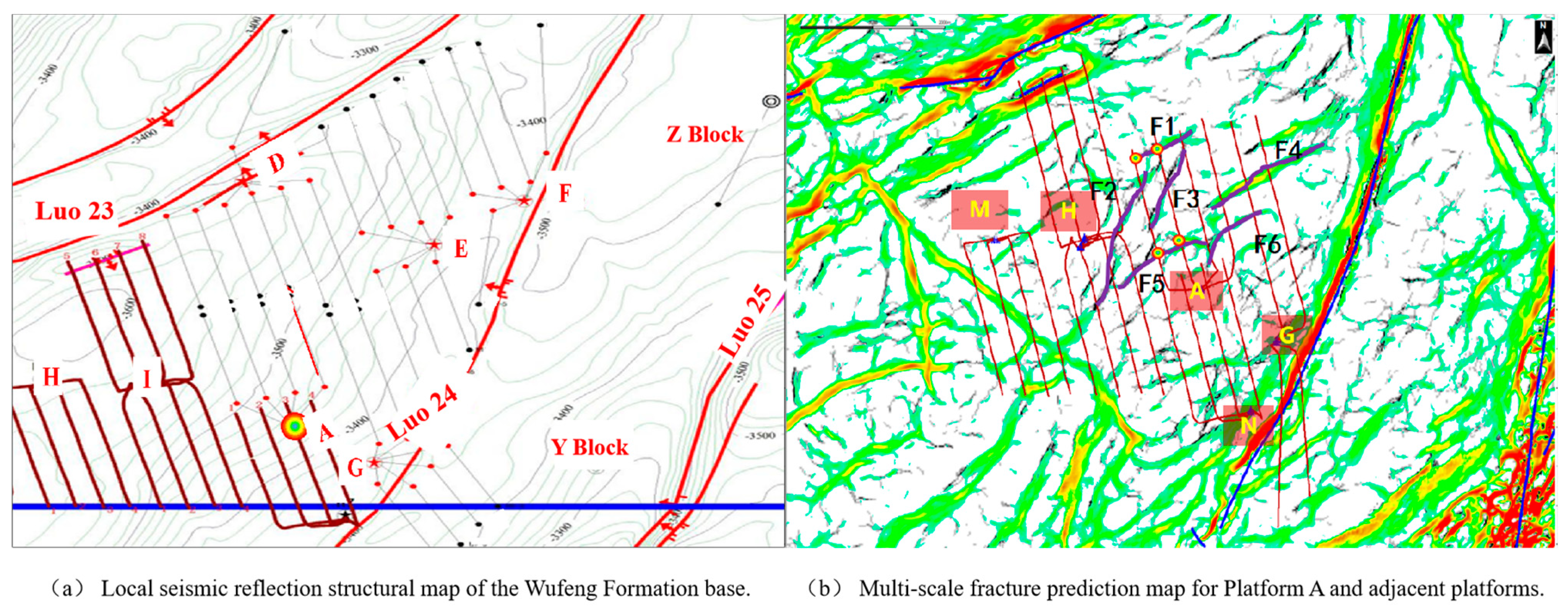
Figure 1. Geological Overview of Platform A in the Sichuan Basin.
Energies 18 06213 g001
Figure 2. Log–log diagnostic plot of pressure and time.
Energies 18 06213 g002
Figure 3. (a) Elbow Method Plot and (b) Silhouette Score Plot.
Energies 18 06213 g003
Figure 4. Clustering Scatter Plot.
Energies 18 06213 g004
Figure 5. Sensitivity Analysis Plot.
Energies 18 06213 g005
Figure 6. Log-log type curves for hydraulic fracturing analysis.
Energies 18 06213 g006
Figure 7. Cross-validation of Log–log Processing and Microseismic Results for Well C-2, Stage 13: ((a): Log–log Curve, (b): Spatiotemporal Distribution of Microseismic Events).
Energies 18 06213 g007
Figure 8. Comparison Chart of Fluid Intensity, Proppant Intensity, and SRV for Platform A.
Energies 18 06213 g008
Figure 9. Microseismic Monitoring-Based Fracture Mapping of Wells 1–4 at Platform D, X Block, Sichuan Basin (From Left to Right: Well 1 to Well 4).
Energies 18 06213 g009
Figure 10. Scatter plot of SRV versus curve type.
Energies 18 06213 g010
Figure 11. Gray Correlation Heatmap of Platform A.
Energies 18 06213 g011
Figure 12. Grey Relational Analysis Heatmap for Wells 1–4, Platform D.
Energies 18 06213 g012
Figure 13. Composite Plot of Fluid Intensity versus Stimulated Reservoir Volume (SRV).
Energies 18 06213 g013
Figure 14. Microseismic Monitoring Map of Platform D in X Block, Sichuan Basin. (a)At 9:10; (b) At 9:56; (c) At 12:18; (d) At 12:45. The black, blue, and red curves represent proppant concentration, flow rate, and pressure, respectively.
Energies 18 06213 g014
Table 1. Correspondence between microseismic evolution stages and pressure double-logarithmic curve features in Stage 13 of Well C-2.
StageOperation TimeLog t RangeMicroseismic
Characteristics
Pressure Curve CharacteristicsStage Interpretation
Initiation Stage10:00–10:301.49–1.63Few events concentrated near the wellbore, limited energy releaseSlight pressure increaseFracture initiation
Propagation Stage10:30–11:001.63–2.05Dense events extending westward, rapid growth of fracture geometryStable pressure response with near-zero slopeFracture propagation
Stabilization Stage11:00–11:302.05–2.19Fewer events, stable spatial distributionPressure remains steady with slight declineFracture stabilization
/cessation of growth
Table 2. Consistency Validation Between Pressure Curve Diagnosis and Microseismic Characterization.
Pressure Curve Diagnosis TypeNumber of StagesMicroseismic Signature
Stable Type12Linear/Band Distribution, Balanced Propagation
Gradually increasing type9Unidirectional/Confined Propagation
Declining Type9Complex/Divergent Pattern
Table 3. Statistics of Fracturing Log–Log Curve Types for Wells in X Block of Sichuan Basin.
Well NameStable TypeGradually
Increasing Type
Declining TypeTotal
Platform ANumber324238
Percentage84.21%10.53%5.26%100%
Platform BNumber3914558
Percentage67.24%24.14%8.62%100%
Platform CNumber6712584
Percentage79.76%14.29%5.95%100%
Platform DNumber62121993
Percentage66.67%12.90%20.43%100%
Table 4. Descriptive statistics of SRV for different curve types.
Slope CategoryMeanStd50%75%Max
Stable type267.4686.81262.5324.18475.2
Gradually increasing type286.2492.87312356422.8
Declining type253.194.4257.5280.2514.8
Table 5. Key Parameter Values of Well D-1, Platform D.
StageSRV
×104 m3
Breakdown Pressure
MPa
Shut-In Pressure
MPa
Fluid
Intensity
m3/m
Proppant Intensity
t/m
Total Fluid Volume
m3
Total Proppant Mass
t
Injection Rate
m3/min
1107.269.086320.0821604.24154.1118
298.871.5263.519.621566.01154.0518
3369.669.676322.0521754.9154.1518
4282.870.7363.95.191.08521100.176
5307.672.2164.64.80.98528.87100.246
6408.470.8764.619.121690.85178.1419
7308.872.2464.518.32.041621.28173.6918
8514.873.076624.923.022032.68235.2620
9234.869.816619.812.031624.96160.1418
Table 6. Sensitivity Analysis of Distinguishing Coefficient on Parameter Rankings for Well A-2.
ρ 1st Most Influential2nd Most Influential3rd Most Influential
0.1Fluid Intensity
(0.555)
Total Fluid Volume
(0.393)
Total Proppant Mass
(0.322)
0.2Fluid Intensity
(0.659)
Total Fluid Volume
(0.483)
Total Proppant Mass
(0.440)
0.3Fluid Intensity
(0.721)
Total Fluid Volume
(0.546)
Total Proppant Mass
(0.519)
0.4Fluid Intensity(0.763)Total Fluid Volume
(0.593)
Total Proppant Mass
(0.577)
0.5Fluid Intensity(0.793)Total Fluid Volume
(0.631)
Total Proppant Mass
(0.621)
0.6Fluid Intensity
(0.816)
Total Fluid Volume
(0.662)
Total Proppant Mass
(0.657)
0.7Fluid Intensity
(0.834)
Total Fluid Volume
(0.688)
Total Proppant Mass
(0.686)
0.8Fluid Intensity
(0.849)
Total Proppant Mass
(0.710)
Total Fluid Volume
(0.710)
0.9Fluid Intensity
(0.861)
Total Proppant Mass
(0.731)
Total Fluid Volume
(0.729)
Table 7. Computed Grey Relational Grades and Parameter Weights.
Breakdown Pressure
MPa
Shut-In Pressure
MPa
Fluid
Intensity
m3/m
Proppant Intensity
t/m
Total Fluid
Volume
m3
Total Proppant Mass
t
Injection Rate
m3/min
Platform A0.6750.630.750.610.6450.620.58
Platform D0.60.6750.5950.6330.6030.6050.59
Block X, Sichuan Basin0.6380.6530.6730.6210.6240.6130.585
Weight0.1450.1480.1530.1410.1420.1390.132
Table 8. Response Patterns of Fluid Intensity Across Stages for Well A-2, Platform A.
Fluid Intensity Range (m3/m) SRV Response
Characteristics
Pressure Fluctuation
Amplitude (MPa)
<25Increase of 1.09%±5.14
25–40Increase of 68.72%±1.96
Table 9. Correlation Between Proppant Intensity and SRV Under High Brittleness Index Conditions- Well D-3.
Brittleness
Index (%)
SRVProppant
Intensity
t/m
Pearson Correlation Coefficient
%×104 m3
High
Brittleness
Index
79.2475.22.920.78
79.2422.82.9
79.23663.05
79194.82
79274.42.94
761381.11
79.1181.22
79.1329.23
791502.05
793342.08
Disclaimer/Publisher’s Note: The statements, opinions and data contained in all publications are solely those of the individual author(s) and contributor(s) and not of MDPI and/or the editor(s). MDPI and/or the editor(s) disclaim responsibility for any injury to people or property resulting from any ideas, methods, instructions or products referred to in the content.