Article

Game-Based Optimal Scheduling of the Integrated Energy Park, Aggregator, and Utility Considering Energy Supply Risk

College of Electrical Engineering, Sichuan University, Chengdu 610065, China
*
Author to whom correspondence should be addressed.
Energies 2025, 18(23), 6204; https://doi.org/10.3390/en18236204
Submission received: 31 October 2025 / Revised: 22 November 2025 / Accepted: 25 November 2025 / Published: 26 November 2025

Abstract

To address the issues of benefit coordination and energy supply risk management in energy trading between integrated energy parks and the main grid utility, this paper proposes a bi-level game-based optimal scheduling model for the electricity–heat–hydrogen integrated energy system considering energy supply risks. A bi-level game framework of the integrated energy park (IEP), aggregator, and utility is firstly built, where the aggregator acts as an intermediary coordination entity. The upper-level and lower-level game models, the trading strategies between the aggregator and the utility, as well as the trading strategies between the aggregator and the IEP, are, respectively, optimized after achieving the equilibrium. Furthermore, a conditional value-at-risk (CVaR)-based energy supply risk quantification model is introduced to characterize the operational risks caused by differences in traded energy quantities and then is incorporated into the proposed game-based optimal scheduling model. Finally, a bi-level game-based optimal scheduling model of the IEP, aggregator, and utility considering energy supply risk is proposed. Case studies demonstrate that the proposed model can effectively reduce the operating cost of the utility, reasonably allocate the benefit of the aggregator and the IEP, and can effectively balance energy supply risk and social welfare maximization of the electricity–heat–hydrogen integrated energy system.

1. Introduction

As a carrier integrating electricity, heat, hydrogen, and other energy types, integrated energy systems (IES) play an increasingly important role in the low-carbon transition of the worldwide energy structure. As a typical representative of IES, integrated energy parks (IEP) couple multiple forms of energy, such as electricity, heat, and hydrogen, by integrating diverse energy conversion and consumption equipment to achieve economic operation through multi-energy complementarity [1]. Moreover, IEPs can behave as energy suppliers, flexibly providing multiple types of energy to the main grids [2,3]. However, IEPs generally have their own economic interests that are not aligned with that of the main grid utility. Therefore, balancing the interests of the main grid utility and the grid-connected IEPs is important to promote the maximization of social welfare of the IES. Establishing an effective energy trading mechanism between the main grid utility and the IEPs becomes momentous to further promote the development of IES.
In recent years, optimal operation of IEPs has been extensively studied. Reference [4] proposed an optimal operation model for IEPs considering the coordination of multi-timescale demand response. Reference [5] summarized the typical structures of electricity-heat-gas IEPs and incorporated carbon trading mechanisms to take the impact of carbon pricing on system operating costs into account. Reference [6] developed a three-stage coordinated optimal operation model for green electricity trading among IEPs. Reference [7] proposed refined models of diversified flexible resources on both the supply and demand sides of IEPs. The aforementioned models focus more on the optimal operation of IEPs and particularly their energy trading towards main grid utilities. The IEPs and the main grid utility are usually coordinated in a centralized manner, which, on the one hand, neglects the inconsistency of interests between the IEPs and the main grid utility, and on the other hand, rarely addresses the issue of integrating multiple IEPs with their respective economic objectives. To this end, some studies introduced aggregators as an intermediary layer to facilitate the integration of IEPs and their coordination with the main grid utility [8].
The pricing mechanisms of energy trading between the main grid utility and IEPs can generally be divided into two categories [9]: (1) the traditional time-of-use pricing mechanism [10] and (2) the real-time pricing strategy considering demand response from the IEPs [11,12,13]. However, these pricing mechanisms are all centralized and from the perspective of the main grid utility and thus unable to coordinate the benefit of different IEPs. Game theory-based models that can describe strategic interactions among multiple participants and effectively coordinate the benefit allocation among different participants have been extensively studied [14,15]. Reference [16] proposed a two-stage scheduling model for IEPs based on a hybrid leader–follower cooperative game. Based on a cooperative game, reference [17] developed an inter-district energy interaction model that explicitly captures the economic incentives and cost-sharing relationships among districts, aiming to minimize the economic cost and carbon emission. Considering the low-carbon goal, reference [18] proposed an incentive mechanism based on an interactive game between electric vehicles and the main grid to realize orderly charging and discharging of electric vehicles. Reference [19] proposed a bi-level game model to promote the trading of renewable energy certificate. Although above works have explored the benefit of coordinating IEPs, economic interests of individual IEPs during the gaming process are usually considerably simplified.
Furthermore, in the coordinated scheduling of the IEPs and the main grid utility, differences may exist between the energy demand of the main grid and the actual energy supply from the IEPs. Such differences would compromise the economic efficiency of multi-energy trading, increase the operational risk, and even threaten the safe operation of the IES [20,21]. Existing works have extensively studied risk quantification, employing typical methods, such as conditional value-at-risk (CVaR) theory [22,23,24], distributionally robust programming [25], and information gap decision (IGDT) theory [26]. Reference [27] developed a CVaR-based holistic risk-aware bi-level optimization framework to analyze the impact mechanisms of financial entities with varying risk preferences, particularly aggressive bidding strategies, on day-ahead and real-time market clearing processes. Reference [28] employed distributionally robust programming to characterize the stochastic nature of renewable power generation and the fluctuation of load demand, thereby quantifying real-time trading risks. Reference [29] developed a risk-constrained bidding strategy based on IGDT to quantify trading risks induced by energy price uncertainty. However, current risk quantification approaches mainly focus on the operational risks caused by multiple uncertainties, while the risk introduced by energy supply differences have been relatively less addressed. Moreover, for existing bi-level game frameworks, a notable gap remains in applying CvaR theory to quantify the risks arising from energy supply deviations.
To this end, focusing on electricity–heat–hydrogen IEP and the main grid utility, this paper proposes a game-based optimal scheduling model that accounts for energy supply risk. Aggregator is introduced as an intermediary layer to facilitate energy trading between the IEPs and the main grid utility. On this basis, an IEP–aggregator–utility game framework is firstly built, and a bi-level game-based optimal scheduling model is proposed. Considering the energy supply differences between the main grid utility and the aggregator, energy supply risk is further incorporated. Specifically, a CVaR-based energy supply risk quantification method is developed and incorporated into the proposed bi-level game-based optimal scheduling model, ultimately forming a game-based optimal scheduling model of the IEP, aggregator, and utility considering energy supply risk.
The structure of this paper is organized as follows: Section 2 establishes the upper-level and lower-level optimal scheduling models, respectively, focusing on aggregator–utility and IEP–aggregator coordination. Section 3 develops an energy supply risk model based on the CVaR theory and integrates it into the proposed IEP–aggregator–utility game framework. Finally, Section 4 verifies the effectiveness of the proposed bi-level game-based optimal scheduling method.

2. The Bi-Level Game-Based Optimal Scheduling Model

2.1. The Framework of the IEP–Aggregator–Utility Game

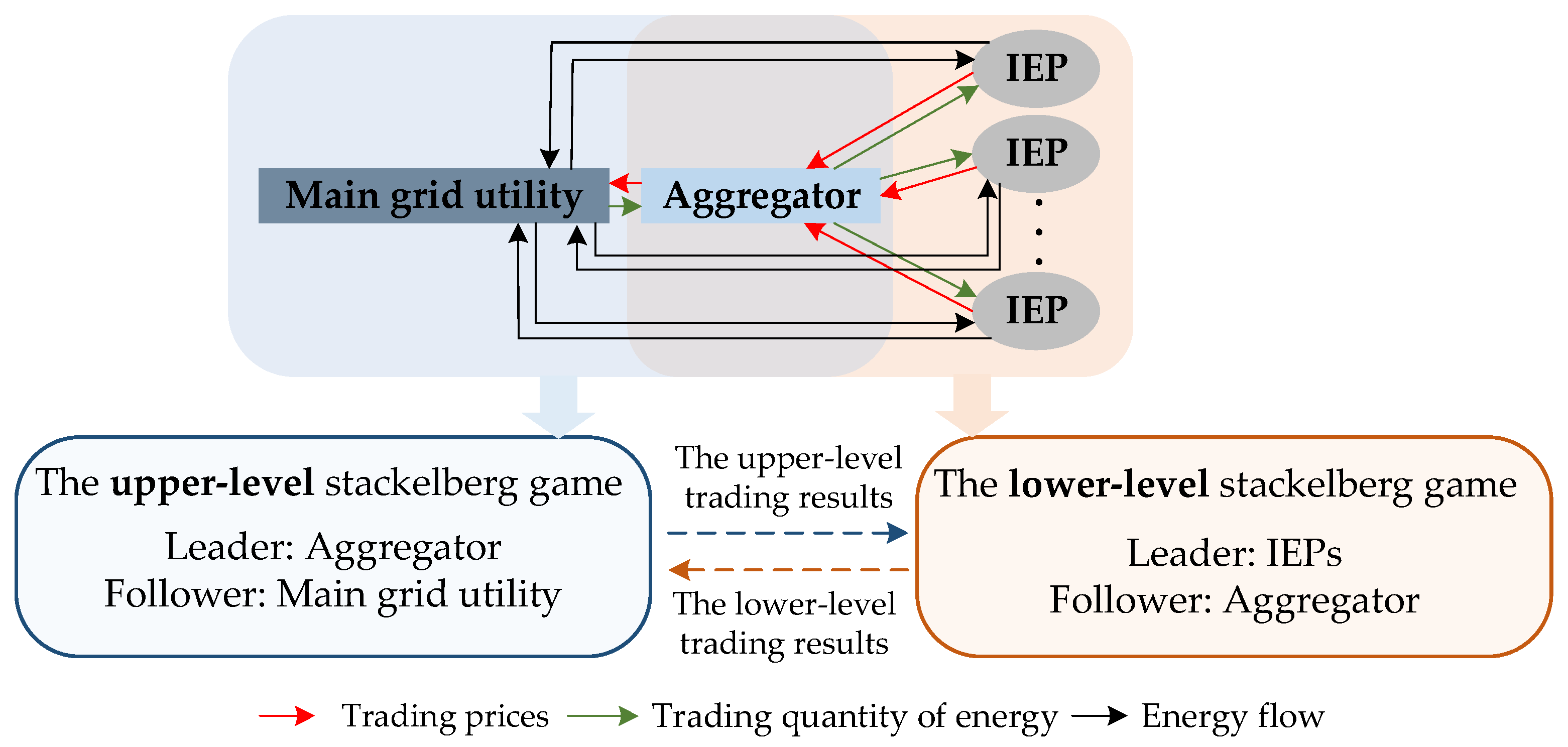
To address the challenges of coordinating the benefit allocation among IEPs and facilitating their energy trading with the main grid utility, the aggregator is introduced in this paper as an intermediary. On this basis, a bi-level IEP–aggregator–utility game framework is proposed. The proposed framework involves three trading participants, i.e., the main grid utility, the aggregator, and the IEP which conduct joint electricity, heat, and hydrogen trading. The IEPs are directly connected to the main grid. The aggregator acts as an intermediary to coordinate energy trading between the IEPs and the main grid utility. The energy flow physically exists between the main grid utility and the IEPs, while the aggregator coordinates their energy trading with price signals and energy trading quantities. Each IEP integrates the production, storage, and utilization of electricity, heat, and hydrogen. On the one hand, the IEP can sell its surplus energy to the utility through the aggregator to increase its revenue. The main grid utility imports energy from the upper-level energy network with a fixed price and trades with the aggregator based on its offers. The aggregator, acting as an intermediary, strategically bids to the utility based on the offers of IEPs and arbitrage from price differences. On the other hand, the IEP can purchase energy from the utility through the aggregator when its internal energy production is less than the demand. In this case, energy trading between the utility and the aggregator, as well as between the IEP and the aggregator, are settled at the fixed price from the upper-level grid, meaning neither the aggregator nor the main grid utility profits from energy trading.
The structure of the bi-level game-based optimal scheduling model is illustrated in Figure 1. The upper-level game model involves the aggregator and the main grid utility, where, acting as the leader, the aggregator determines the trading prices with the objective of maximizing its profit, while the utility, as the follower, minimizes its operating cost and determines the corresponding energy trading quantities based on the trading prices. The lower-level game model involves the IEPs and the aggregator. The IEPs, as the leader, determine the trading prices to maximize their selling revenues and the aggregator determines the energy trading quantities to maximize its profit as the follower. The upper-level game model is firstly solved by estimating the results of the lower-level model, and then the trading results between the aggregator and the main grid utility are passed to the lower-level game model. After the lower-level game model is solved with equilibrium, the trading results between the IEPs and the aggregator are fed back to the upper-level model to update the relevant settings. The two models are solved iteratively until the equilibrium results of the two levels converge.

2.2. The Upper-Level Game Model

2.2.1. The Scheduling Model of the Main Grid

The main grid utility imports a partial amount of electricity, heat, and hydrogen energy from the upper-level energy network and trades the remaining energy with the aggregator. The objective of the main grid utility is to minimize its operating cost, which includes the costs associated with electricity F electricity , heat F heat , and hydrogen F hydrogen , as expressed in (1)–(4). The operating cost consists of the energy purchase cost from the aggregator, the revenue from selling energy to the aggregator, and the energy purchase cost from the upper-level energy network. It is worth noting that the energy selling prices of the main grid utility to the aggregator are same as the trading prices between the upper-level energy network and the main grid utility. In other words, the main grid utility does not profit from selling energy to the aggregator.
min F electricity + F heat + F hydrogen
F electricity = t c t p P t A , in λ t p P t A , out + λ t p z P z t
F heat = t c t h H t A , in λ t h H t A , out + λ t h g H g t
F hydrogen = t c t u U t A , in λ t u U t A , out + λ t u o U o t
The energy balance constraints of the main grid are given as in (5)–(7), respectively representing the electric active power balance (5), heat power balance (6), and hydrogen power balance (7). For the main grid, the sum of electricity, heat, and hydrogen energy purchased from the upper-level energy network and from the aggregator should be equal to the sum of the energy sold to the aggregator, energy transmission loss, and load demand.
z Ω j P z t + P t A , in P t A , out P t loss = j P j t load
g H p H g t + H t A , in H t A , out H t loss = p H p t load
o U u U o t + U t A , in U t A , out U t loss = u U u t load
In addition, for the main grid, its energy trading with the aggregator should satisfy constraints (8) and (9), which specify the maximum energy trading quantity and avoid simultaneous energy purchasing and selling.
0 P t A , in P t A , in , max I t p , in 0 H t A , in H t A , in , max I t h , in 0 U t A , in U t A , in , max I t u , in
0 P t A , out P t A , out , max 1 I t p , in 0 H t A , out H t A , out , max 1 I t h , in 0 U t A , out U t A , out , max 1 I t u , in

2.2.2. The Scheduling Model of the Aggregator in the Upper-Level Game Model

In the upper-level game model, the aggregator acts as the leader and determines the trading prices ( c t p , c t h , c t u ) with the main grid utility to maximize its own profit. The objective function, as expressed in Equations (10) and (11), includes the revenue from selling energy to the utility, the cost of purchasing energy from the IEPs, the cost of purchasing energy from the utility, and the revenue from selling energy to the IEPs. It is worth noting that the aggregator, similarly to the utility, does not profit by selling energy to IEPs, and thus the energy selling prices of the aggregator to the IEPs are same as the trading prices between the upper-level energy network and the utility.
In the upper-level game model, the aggregator functions purely as a trading intermediary that aggregates IEPs’ bids without engaging in physical connection and energy flows. Therefore, it is not subject to energy flow constraints and simply maximizes its own profit. Therefore, its scheduling model does not include additional operational constraints.
max F A , up = t R t A
R t A = c t p P t A , in + c t h H t A , in + c t u U t A , in v c v t p P v t A , in + c v t h H v t A , in + c v t u U v t A , in + v λ t p P v t A , out + λ t h H v t A , out + λ t u U v t A , out λ t p P t A , out λ t A , out H t A , out λ t u U t A , out

2.3. The Lower-Level Game Model

2.3.1. The Scheduling Model of the IEP

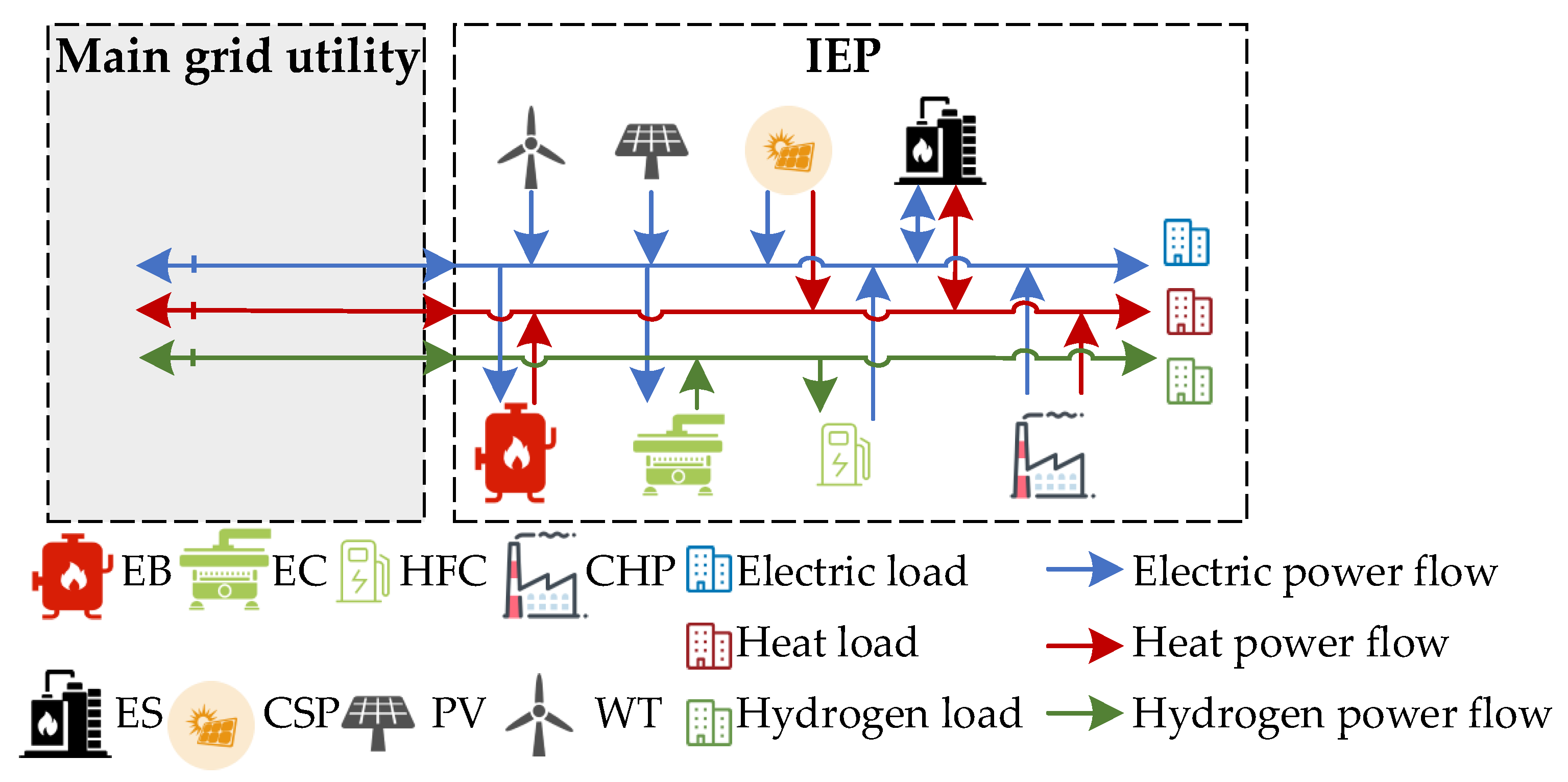
As shown in Figure 2, the IEP coordinates its internal equipment, including PV, WT, CSP, CHP, EB, EC, HFC, and ES, to achieve the economic production and consumption of electricity, heat, and hydrogen. The surplus or deficit of energy is balanced through energy trading with the aggregator. When energy production of the internal equipment, such as WT, PV, and CSP, exceed the demand of the IEP, the surplus energy can be sold to the aggregator to increase its revenue or offset operating cost. Conversely, when the internal energy production is less than the demand, the IEP can purchase energy from the aggregator.
In the lower-level game model, the IEP acts as the leader and trades energy to the aggregator with the objective of revenues maximization. The objective function is expressed as in (12)–(15), including the revenue from selling energy to the aggregator (13), the cost of purchasing energy from the aggregator (14), and the operating cost of the IEP (15) and (16). The operating cost primarily consists of the fuel cost of the CHP unit. It is worth noting that the CHP fuel cost covers both the energy used to meet the internal demand of the IEP and the energy sold externally. In this model, a portion factor α v t is used to allocate the operating cost proportionally to the traded energy quantity.
max F park = v t R v t C v t C v t opt
R v t = c v t p P v t A , in + c v t h H v t A , in + c v t u U v t A , in
C v t = λ t p P v t A , out + λ t h H v t A , out + λ t u U v t A , out
C v t opt = α v t c fuel a F P a v , t + S U a v , t + S D a v , t
α v t = P v t A , in / ( P v t ld + P v t A , in )
The operational constraints of the IEP mainly include the energy balance constraints and the operational constraints of equipment, such as CHP, PV, WT, CSP, EB, EC, HFC, and ES.
  • Energy balance constraints
The electricity, heat, and hydrogen power balance are enforced with (17)–(19). For IEP v, the total power production of energy generating equipment, such as WT, PV, CHP, and CSP, and the power purchased from the aggregator should be equal to the sum of the power consumed by energy consuming equipment, such as EB and EC, the power sold to the aggregator, and the load demand. Considering the current immaturity and high capital cost of hydrogen storage and conversion technologies, this paper assumes no hydrogen load in the IEPs.
a P a v , t + w P w v , t P w v , t cur + s P s v , t P s v , t cur + b P b v , t + y P y v , t + c P c v , t dis = c P c v , t cha + P v t A , in P v t A , out + P v t ld + e P e v , t + f P f v , t
a H a v , t + e H e v , t + b H b v , t + y H y v , t + r H r v , t dis = r H r v , t cha + H v t A , in H v t A , out + H v t ld
f U f v , t = y U y v , t cha + U v t A , in U v t A , out
2.
Constraints of equipment
  • The constraints of CHP
The CHP unit consists of a micro gas turbine and an absorption chiller, and the relationship between electric power and heat power production is expressed as in (20).
H a v , t = η a v h C a v OPh P a v , t 1 η a v MT η a v L / η a v MT
The CHP unit should satisfy the output limit constraint (21), ramping constraint (22), minimum ON/OFF time constraint (23), and start-up/shut-down energy consumption constraint (24).
P a v min I a v , t P a v , t P a v max I a v , t
P a v , t P a v , t 1 P a v max 1 I a v , t + S a v UR I a v , t 1 + P a v min ( I a v , t I a v , t 1 ) P a v , t 1 P a v , t P a v max 1 I a v , t 1 + S a v DR I a v , t + P a v min ( I a v , t 1 I a v , t )
I a v , t 1 I a v , t X a v , t 1 on T a v on 0 I a v , t I a v , t 1 X a v , t 1 off T a v off 0
S U a v , t s u a v I a v , t I a v , t 1 , S U a v , t 0 S D a v , t s d a v I a v , t 1 I a v , t , S U a v , t 0
  • The constraints of CSP
The CSP unit consists of three components: a solar concentrating and heat collection unit, a heat ES, and an electric power production unit. The solar-to-heat conversion constraint of the heat collection unit is shown as in (25). The power balance of the heat ES is enforced by (26), and the relationship between electric power and heat power production is described by (27). The operational constraints of the heat ES are shown as in (28), including the charging/discharging rate constraint and the charging/discharging state constraint.
H b v , t SF = η b v s h S SF D b t
H b v , t SF = H b v , t + H b v , t TS , cha η b v dis H b v , t TS , dis + H b v , t SF , loss
P b v , t = η b v h e H b v , t + η b v dis H b v , t TS , dis
H b v TS , cha , min I b v , t cha H b v , t TS , cha H b v TS , cha , max I b v , t cha H b v TS , dis , min I b v , t dis H b v , t TS , dis H b v TS , dis , max I b v , t dis I b v , t cha + I b v , t dis 1
Similarly to the CHP unit, for the CSP, ramping constraint, as shown in (29), are included.
P b v , t P b v , t 1 P b v max 1 I b v , t + S b v UR I b v , t 1 + P b v min ( I b v , t I b v , t 1 ) P b v , t 1 P b v , t P b v max 1 I b v , t 1 + S b v DR I b v , t + P b v min ( I b v , t 1 I b v , t )
  • The constraints of EB
The working principle of the EB is to generate heat through electrical resistance, e.g., metal heating tubes, or electromagnetic induction, e.g., electromagnetic boilers, when energized. The relationship between its electric power consumption and heat power production is expressed as in (30).
H e v , t = η e v e h P e v , t
The output limit of the EB is given as in (31), and the ramping ability of EB is limited by (32).
H e v min I e v , t H e v , t H e v max I e v , t
H e v , t H e v , t 1 H e v max 1 I e v , t + S e v UR I e v , t 1 + H e v min ( I e v , t I e v , t 1 ) H e v , t 1 H e v , t H e v max 1 I e v , t 1 + S e v DR I e v , t + H e v min ( I e v , t 1 I e v , t )
  • The constraints of EC
The EC is currently the most mature and widely commercialized technology for hydrogen production via water electrolysis. Its electricity-to-hydrogen conversion can be modeled with (33), and its electric power consumption is limited by (34).
U f v , t = η f v H 2 P f v , t
P f v min I f v , t P f v , t P f v max I f v , t
  • The constraints of HFC
The HFC can directly and efficiently convert the chemical energy of hydrogen and oxygen into electric power. It mainly consists of a fuel cell, a hydrogen ES, and a heat exchange unit. The power conversion relationships between hydrogen, electricity, and heat in the fuel cell are expressed as in (35) and (36).
P y v , t = η y v u e U y v , t dis
H y v , t = η y v u h U y v , t dis
The constraints of the hydrogen ES include the capacity constraint (37), the hydrogen charging/discharging rate constraints (38) and (39), and the hydrogen charging/discharging state constraint (40).
S y v , t = S y v , t 1 + U y v , t cha U y v , t dis
0 U y v , t cha U y v cha , max I y v , t cha
0 U y v , t dis U y v dis , max I y v , t dis
I y v , t dis + I y v , t cha 1
  • The constraints of ES
The ES consists of electricity and heat energy storage. The operational constraints of electrical ES include the capacity constraints (41) and (42), the charging/discharging rate constraints (43) and (44), and the charging/discharging state constraint (45). Similarly to the electrical ES, the operational constraint of heat ES is given in Equation (46).
S c v , t = S c v , t 1 + P c v , t cha η c v PS , cha P c v , t dis / η c v PS , dis
S c v min S c v , t S c v max
0 P c v , t cha I c v , t cha P c v cha , max
0 P c v , t dis I c v , t dis P c v dis , max
I c v , t cha + I c v , t dis 1
S r v , t = S r v , t 1 + H r v , t cha η r v HS , cha H r v , t dis / η r v HS , dis S r v min S r v , t S r v max 0 H r v , t cha I r v , t cha H r v cha , max 0 H r v , t dis I r v , t dis H r v dis , max I r v , t cha + I r v , t dis 1

2.3.2. The Scheduling Model of the Aggregator in the Lower-Level Game Model

In the lower-level game model, the aggregator acts as the follower and conducts energy trading with the IEPs for maximizing its profit. The objective function is consistent with that in the upper-level game model, as shown in (10). The aggregator considers the operational constraints of the main grid to reasonably determine the energy trading quantities with the IEPs. The operational constraints of the electric main grid include the active and reactive power balance constraints (47) and (48), reactive power compensation constraint (49), power flow constraints (50) and (53), and power flow loss constraints (54) and (55). In this paper, the electric power flow of the main grid is modeled using the DistFlow model [30].
z Ω j P z t + v Ω j P v t A , in P v t A , out + P i j , t P i j , t loss k Ω j P k j , t = P j t load
z Ω j Q z t + Q j t con + Q i j , t Q i j , t loss k Ω j Q k j , t = Q j t load
0 Q j t con Q j con , max
V i t 2 = V j t 2 2 P i j , t R i j + Q i j , t X i j + I i j , t 2 R i j 2 + X i j 2
2 P i j , t 2 + 2 Q i j , t 2 + I i j , t 2 V j t 2 2 I i j , t 2 + V j t 2 2
V j min 2 V j t 2 V j max 2
I i j min 2 I i j , t 2 I i j max 2
P i j , t loss = I i j , t 2 R i j
Q i j , t loss = I i j , t 2 X i j
The heat operational constraints of main grid include the power balance constraint (56) and the pipeline flow constraints (57) and (58). The heat flow loss is correlated with the supply water temperature of pipeline T sw .
g H p H g t + v H p H v t A , in H v t A , out + q H p ( H q p , t H q p , t loss ) h H p H p h , t = H p t load
H q p min H q p , t H q p max
H q p , t loss = 2 π L q p T sw T e R
In this paper, the hydrogen main grid is built by HTTs. Each node represents a hydrogen refueling station capable of hydrogen ES charging and discharging. The hydrogen operational constraints include the power balance constraint (59) and the HTT operational constraints (60)–(62). Constraint (60) ensures that each node is served by only one HTT at any given time. Constraint (61) represents the operational state of the hydrogen ES within the HTT. Constraint (62) calculates the hydrogen flow loss of the main grid based on the pressure difference between the hydrogen ES and the node’s refueling station.
o U u U o t + v U u U v t A , in U v t A , out + m U u U m u , t out U m u , t in U m u , t loss = U u t load
u I m u , t = 1
0 U m u , t in I m u , t in U m in , max 0 U m u , t out I m u , t out U m out , max 0 I m u , t out + I m u , t in I m u , t
U m u , t loss = η m loss U m u , t out

2.4. The Solving Process

The proposed bi-level game-based optimal scheduling model of the IEP, aggregator, and utility can be solved through iteratively solving the upper-level and lower-level game models. In the upper-level and lower-level game models, the energy trading quantities and the trading prices are both variables to be optimized, while their product term in the objective functions introduces nonlinearity and complicates the solving process. The particle swarm optimization (PSO) algorithm, characterized by its memory and evolutionary capabilities, can effectively retain both the local and global optimal solutions of all particles during the iterative process. This feature allows it to accurately simulate the interactive behavior in the game process. Therefore, in this paper, the PSO algorithm is employed to iteratively solve both the upper-level and lower-level game models.
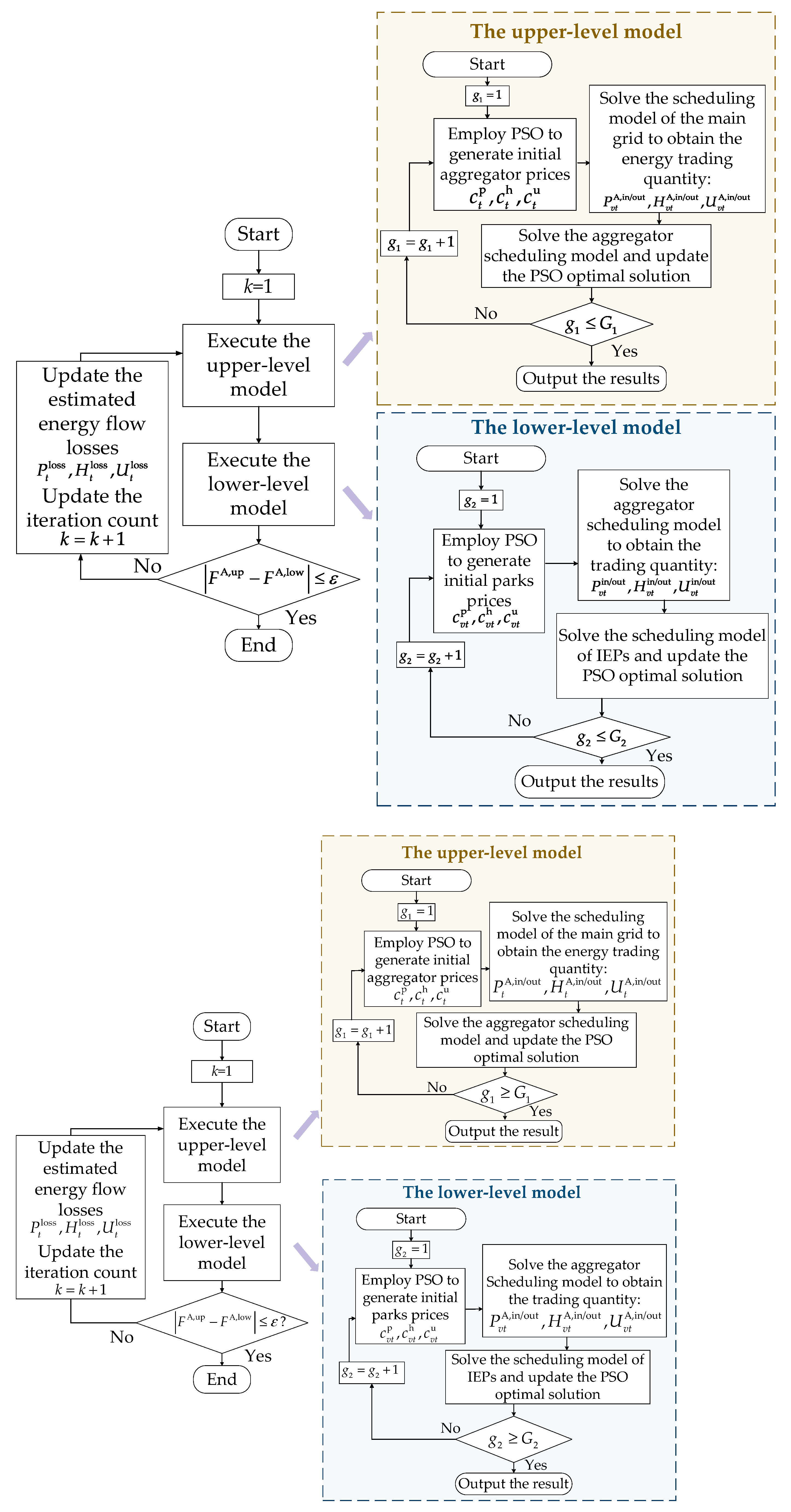
In the proposed model, the costs associated with electricity, heat, and hydrogen energy flow losses are borne by the aggregator. Since the energy flow losses of the main grid are not explicitly calculated in the upper-level game model, the energy flow losses are treated as estimated values in the upper-level game model. In the lower-level game model, the aggregator determines its actual energy trading quantities with each IEP based on the trading quantities determined by the upper-level game model and the estimated energy losses. As shown in (63), χ t p represents the difference between the estimated electricity trading quantity derived from the upper-level game model and the actual electricity trading quantity in the lower-level game model. When χ t p is larger than 0, the actual electricity trading quantity between the aggregator and the IEPs is higher than the estimated value, and thus the estimated electricity trading quantity needs to be corrected. Conversely, χ t p 0 suggests that the estimated electricity trading quantity is excessive, meaning the IEPs cannot meet the electricity trading quantity set by the aggregator.
P t A , in P t A , out P t A , loss + χ t p = v P v t A , in P v t A , out
Similarly, in the heat and hydrogen energy trading, the aggregator also needs to allocate its actual energy trading quantities with each IEP based on the estimated energy trading quantities, as shown in (64) and (65). Auxiliary variables χ t h and χ t u are introduced to represent the differences between the actual and estimated energy trading quantities of the aggregator with the IEPs.
H t A , in H t A , out H t A , loss + χ t h = v H v t A , in H v t A , out
U t A , in U t A , out U t A , loss + χ t u = v U v t A , in U v t A , out
In the lower-level game model, the aggregator determines its actual energy trading quantities with IEPs based on the trading quantities with the utility determined in the upper-level game model. The actual value of energy flow losses is then calculated and fed back to the upper-level game model for iterative correction until the estimated energy flow losses in the upper-level game model converge to the actual energy flow losses in the lower-level game model. At this point, the difference between the actual and estimated energy trading quantities approaches zero, and the aggregator’s objective function value in the upper-level game model becomes consistent with that in the lower-level game model, as in (66)–(69).
F A , up F A , low ε
χ t p ε
χ t h ε
χ t u ε
The iterative solving process of the proposed bi-level game-based optimal scheduling model of the IEP, aggregator, and utility is illustrated in Figure 3.

3. The Bi-Level Game-Based Optimal Scheduling Model Considering Energy Supply Risk

In the upper-level game model, the main grid utility trades electricity, heat, and hydrogen with the aggregator, while the actual energy supply is provided by the IEPs. However, considering the variability of operating conditions, the IEPs may fail to deliver the contracted trading quantities determined by the main grid utility and the aggregator, which potentially poses risks to the secure operation of the main grid. To this end, a CVaR based energy supply risk model is developed to quantify and constrain the risk associated with energy trading between the aggregator and the main grid utility.

3.1. Energy Supply Risk Model

In the upper-level game model, the utility should fully consider the energy supply risk when determining the electricity, heat, and hydrogen energy trading quantities with the aggregator. In this section, the energy supply risk is quantified and constrained based on the sample average approximation method and the CVaR theory.

3.1.1. Energy Supply Difference Scenario Generation

To begin with, the scenario generation approach is applied to construct the energy supply difference scenarios. The generation of electricity supply differences are enabled and constrained by (70)–(74). Specifically, (70) and (71) define the constraints for negative difference scenarios, while (72) and (73) describe the constraints for positive difference scenarios.
It is assumed that most differences are limited within a specified range, 1 α , 1 + α , as shown in (70) and (72), and a limited number of scenarios exhibit larger fluctuations beyond this range, as shown in (71) and (73). In addition, (75) limits the number of large- difference scenarios using a threshold parameter, and (76) guarantees that the generated energy supply difference scenarios approximately conform to a normal distribution.
1 δ ω t p 1 M + 1 α P t A , 0 P ω t A , in P t A , 0 ε + 1 δ ω t p 1 M
P ω t A , in 1 α P t A , 0 + 1 δ ω t p 2 M
1 δ ω t p 3 M + P t A , 0 + ε P ω t A , in 1 + α P t A , 0 + 1 δ ω t p 3 M
P ω t A , in 1 + α P t A , 0 1 δ ω t p 4 M
δ ω t p 1 + δ ω t p 2 + δ ω t p 3 + δ ω t p 4 = 1
ω N ω δ ω t p 2 + δ ω t p 4 1 β N ω
ω P ω t A , in = N ω P t A , 0 ω P ω t A , in P t A , 0 2 = N ω
Similarly, the scenario generation constraints for heat energy are given as in (77) and (78), and those for hydrogen energy are given as in (79) and (80).
1 δ ω t h 1 M + 1 α H t A , 0 H ω t A , in H t A , 0 ε + 1 δ ω t h 1 M 1 δ ω t h 2 M + H t A , 0 + ε H ω t A , in 1 + α H t A , 0 + 1 δ ω t h 2 M H ω t A , in 1 + α H t A , 0 1 δ ω t h 3 M H ω t A , in 1 α H t A , 0 + 1 δ ω t h 4 M δ ω t h 1 + δ ω t h 2 + δ ω t h 3 + δ ω t h 4 1 ω N ω δ ω t h 3 + δ ω t h 4 1 β N ω
ω H ω t A , in = N ω H t A , 0 ω H ω t A , in H t A , 0 2 = N ω
1 δ ω t u 1 M + 1 α U t A , 0 U ω t A , in U t A , 0 ε + 1 δ ω t u 1 M 1 δ ω t u 2 M + U t A , 0 + ε U ω t A , in 1 + α U t A , 0 + 1 δ ω t u 2 M U ω t A , in 1 + α U t A , 0 1 δ ω t u 3 M U ω t A , in 1 α U t A , 0 + 1 δ ω t u 4 M δ ω t u 1 + δ ω t u 2 + δ ω t u 3 + δ ω t u 4 1 ω N ω δ ω t u 3 + δ ω t u 4 1 β N ω
ω U ω t A , in = N ω U t A , 0 ω U ω t A , in U t A , 0 2 = N ω

3.1.2. CvaR-Based Energy Supply Risk Quantification

CVaR is a widely adopted metric for risk assessment [31]. Based on the CVaR theory, an energy supply risk quantification method is developed in this paper. For N ω generated energy supply difference scenarios, the supply risks of electricity F p , heat F h , and hydrogen F u are calculated with (81), where function + extracts the positive differences between the actual traded and the contracted energy quantities in each scenario. Moreover, the probability density function of the supply difference is discretized to N ω equiprobable scenarios from which the tail risk of the difference quantities at a confidence level β CVaR can be derived.
F p = η t p + 1 N ω 1 β CVaR ω P ω t A , in P t A , 0 η t p + F h = η t h + 1 N ω 1 β CVaR ω H ω t A , in H t A , 0 η t h + F u = η t u + 1 N ω 1 β CVaR ω U ω t A , in U t A , 0 η t u +
To overcome the non-smoothness of function + , auxiliary variables are introduced to simplify the formulation, as shown in (82). The estimated energy supply risk F p , F h , F u can then be reformulated as in (83). Consequently, the overall energy supply risk F p , F h , F u can be constrained within a specified range by setting appropriate risk thresholds γ p , CVaR , γ h , CVaR , γ u , CVaR .
The risk thresholds, γ p , CVaR , γ h , CVaR , γ u , CVaR , represent the tolerance levels for the energy supply risk. A higher threshold implies larger acceptable energy supply differences and potentially leads to a lower operating cost. By contrast, a lower threshold imposes stricter requirements, forcing the main grid utility to keep the energy supply risk at a low level. In this case, the utility would adopt more conservative trading strategies, such as purchasing additional energy from the upper-level energy network, which is more reliable but relatively expensive.
u ω t p P ω t A , in P t A , 0 η t p , u ω t p 0 u ω t h H ω t A , in H t A , 0 η t h , u ω t h 0 u ω t u U ω t A , in U t A , 0 η t u , u ω t u 0
η t p + ω u ω t p N ω t 1 β CVaR γ p , CVaR η t h + ω u ω t h N ω 1 β CVaR γ h , CVaR η t u + ω u ω t u N ω 1 β CVaR γ u , CVaR

3.2. Integrating Energy Supply Risk into the Bi-Level Game Model

In this subsection, building upon the bi-level game-based optimal scheduling model, the energy supply risk is incorporated. In the upper-level model, the energy trading strategies of both the aggregator and the utility are influenced by the energy supply risk. For the main grid utility, it is essential to balance the economic advantages offered by aggregators against the potential risks associated with energy supply. This trade-off is quantified through the CVaR-based constraint, as in Section 3.1. In the lower-level model, the energy trading strategies of the aggregator and IEPs will also be influenced by the trading results determined in the upper-level game model.

3.2.1. The Upper-Level Game Model Considering the Energy Supply Risk

In the upper-level game model, the main grid utility is the follower and minimizes its operating cost considering energy supply risk. The corresponding objective function and constraints under each energy supply difference scenario are formulated as in (1)–(9) and can be further extended to integrate multiple scenarios. The energy supply difference scenario constraints are presented as in (70) and (80), and the energy supply risk constraints are specified as in (82) and (83). The model then can be formulated in a compact form (84). In (84), G, H, L, a, and b are coefficient matrices and vectors in the objective and the constraints; β and γ respectively denote the confidence level and the risk threshold of the energy supply risk.
min E ω a T x + b T y ω   s . t .   G x 0    H x , y ω , ξ ω 0    CVaR β L x , y ω , ξ ω γ
As the leader in the upper-level game model, the aggregator determines the electricity, heat, and hydrogen energy trading prices c t p , c t h , c t u with the main grid utility. The aggregator aims to maximize its profit, without considering operational constraints. The objective function of the aggregator under each energy supply difference scenario is formulated as in (10) and (11) and can be further extended as in (85) considering multiple scenarios. In (85), c and d denote coefficient vectors of the objective.
max F A , up = E ω c T x + d T y ω

3.2.2. The Lower-Level Game Model Considering the Energy Supply Risk

In the lower-level game model, the aggregator acts as the follower and adopts the same objective as in the upper-level game model, determining the electricity, heat, and hydrogen energy trading quantities with each IEP. Unlike in the upper-level game model, the lower-level game model requires the aggregator to consider operational constraints of the main grid, as specified in (47)–(62). The scheduling model of the aggregator in the lower-level game model can be written in a compact form (86). In (86), J and K denote coefficient matrices of the objective and the constraints.
max c T x + d T y   s . t .   J x 0    K x , y 0
As the leader in the lower-level game model, each IEP determines the electricity, heat, and hydrogen energy trading prices, c v t p , c v t h , c v t u , with the aggregator. According to the energy trading quantities set by the aggregator, the IEP coordinates its internal equipment to maximize its revenue while maintaining production–consumption balance. The optimal scheduling model of the IEP in the lower-level game model is formulated as in (12)–(46) and can be written in a compact form (87). In (87), M, N, e, and f, respectively, denote coefficient matrices and vectors in the objective and the constraints.
max e T x + f T y s . t .   M x 0    N x , y 0

4. Case Study

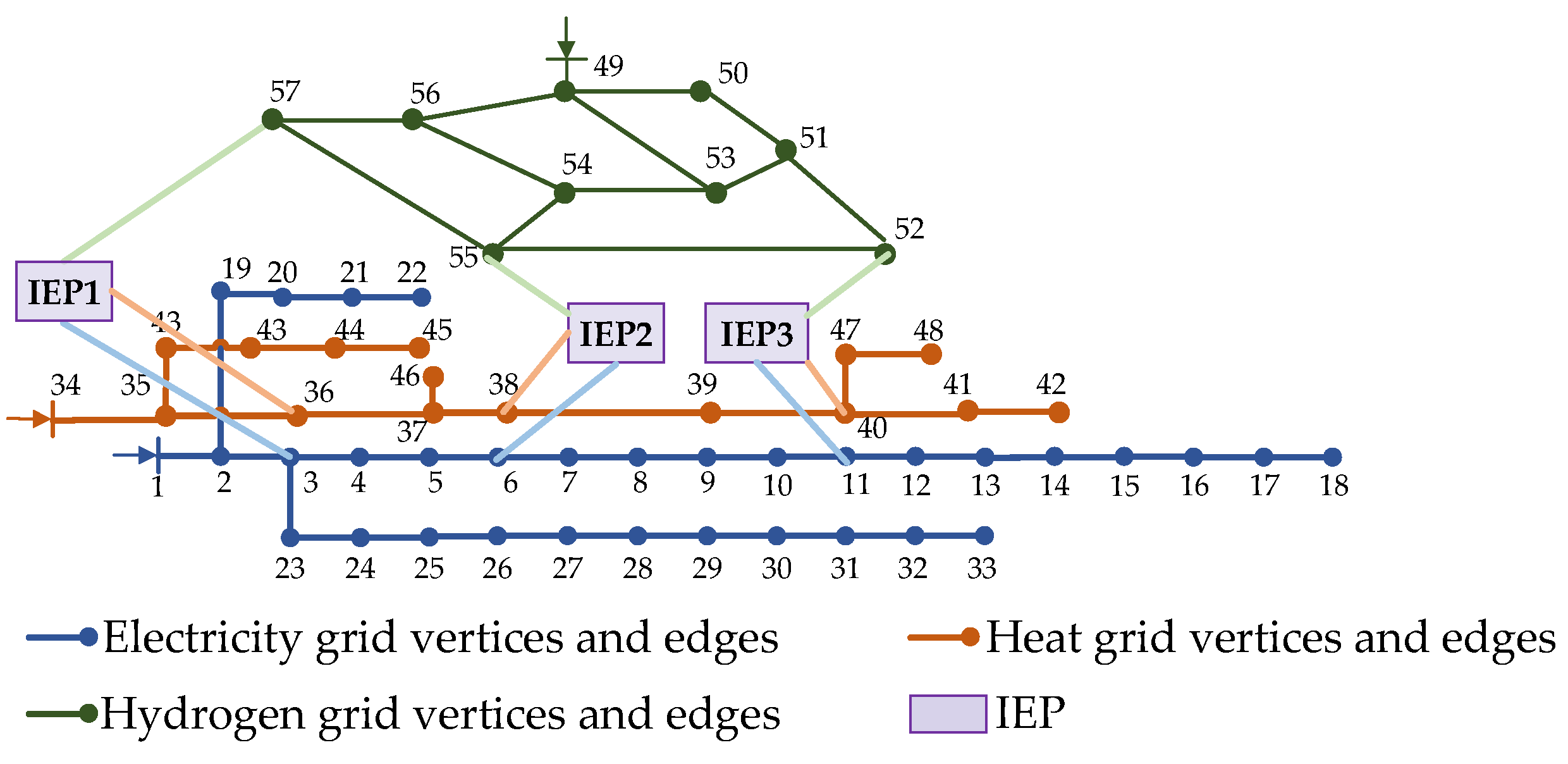
In this paper, case studies are conducted with an integrated energy system consisting of a modified 33-node electric distribution grid, a 16-node heat grid, and a 9-node hydrogen grid. Three IEPs are connected to the main grid, and the structure is shown in Figure 4. The electric, heat, and hydrogen grids are, respectively, connected to the upper-level energy networks through nodes 1, 34, and 49.
The connected nodes of the three IEPs are detailed as the following:
IEP 1 is connected to node 3 of the electric grid, node 36 of the heat grid, and node 57 of the hydrogen grid.
IEP 2 is connected to node 6 of the electric grid, node 38 of the heat grid, and node 55 of the hydrogen grid.
IEP 3 is connected to node 11 of the electric grid, node 40 of the heat grid, and node 52 of the hydrogen grid.
The internal equipment configurations of the three IEPs are listed in Table 1. IEP 1 is equipped with WT, PV, and CSP units, enabling it to maintain relatively stable renewable power generation under varying weather conditions and provide a certain degree of flexibility. IEP 2 is equipped only with WT, representing the typical operational characteristics of a wind power park. IEP 3 relies on PV and CSP units, making full use of solar energy during daytime hours.
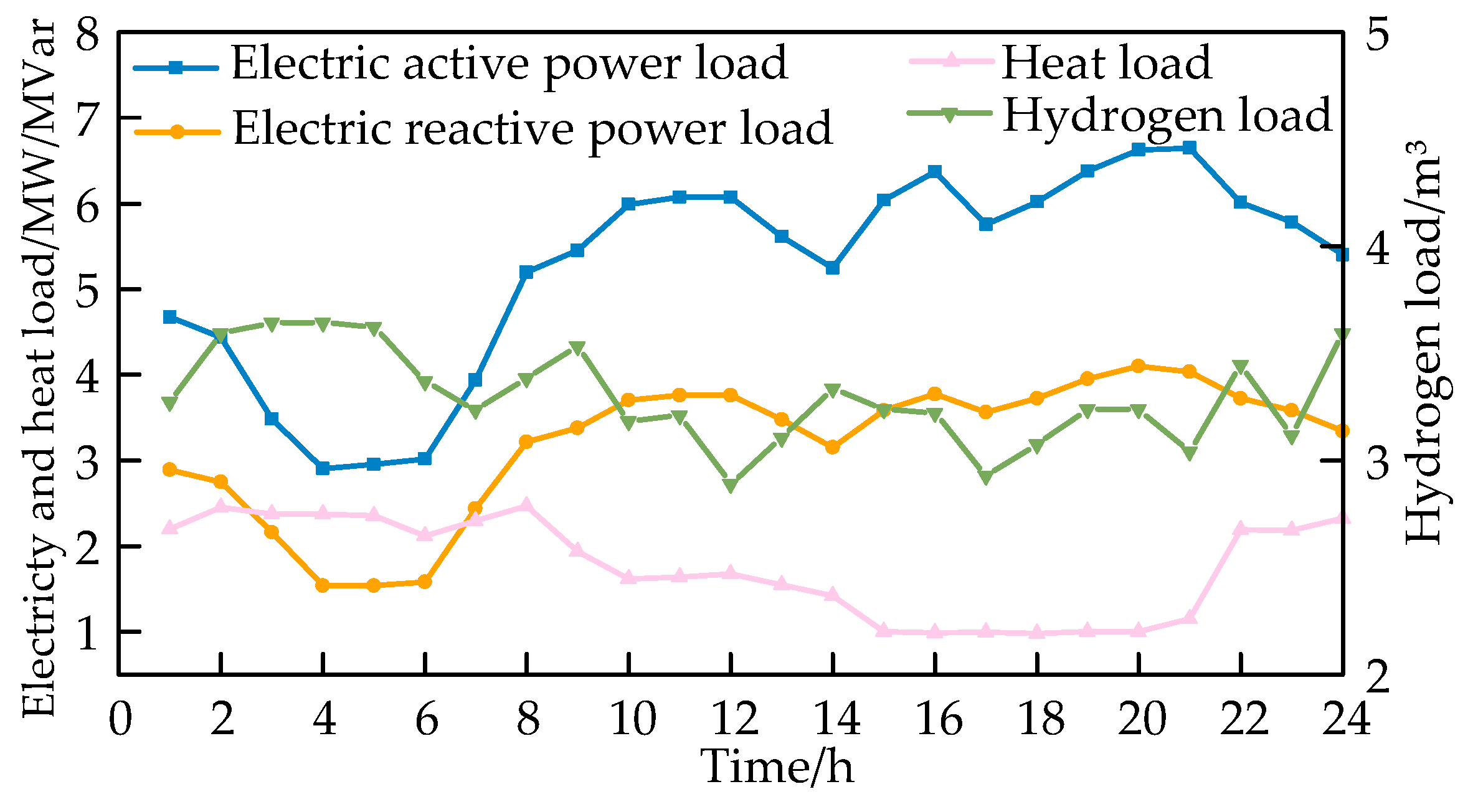
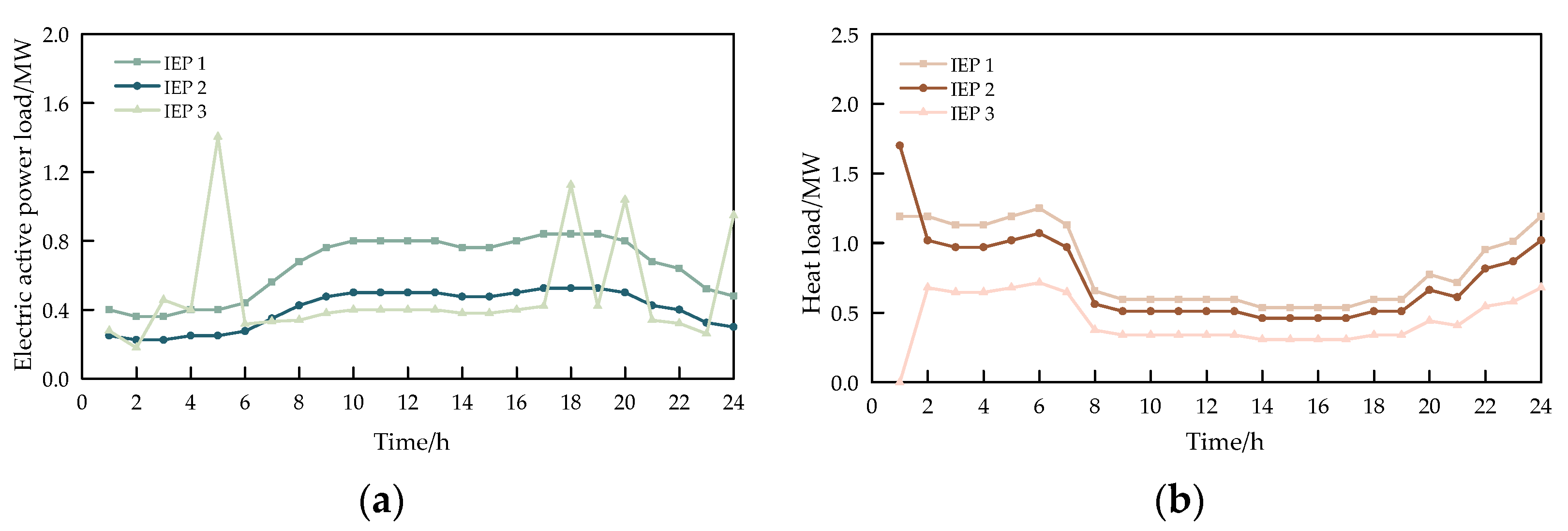
The load curves, including electric active power, electric reactive power, heat power, and hydrogen power, of the main grid, are shown in Figure 5, and the electricity and heat load curves of the three IEPs are illustrated in Figure 6.
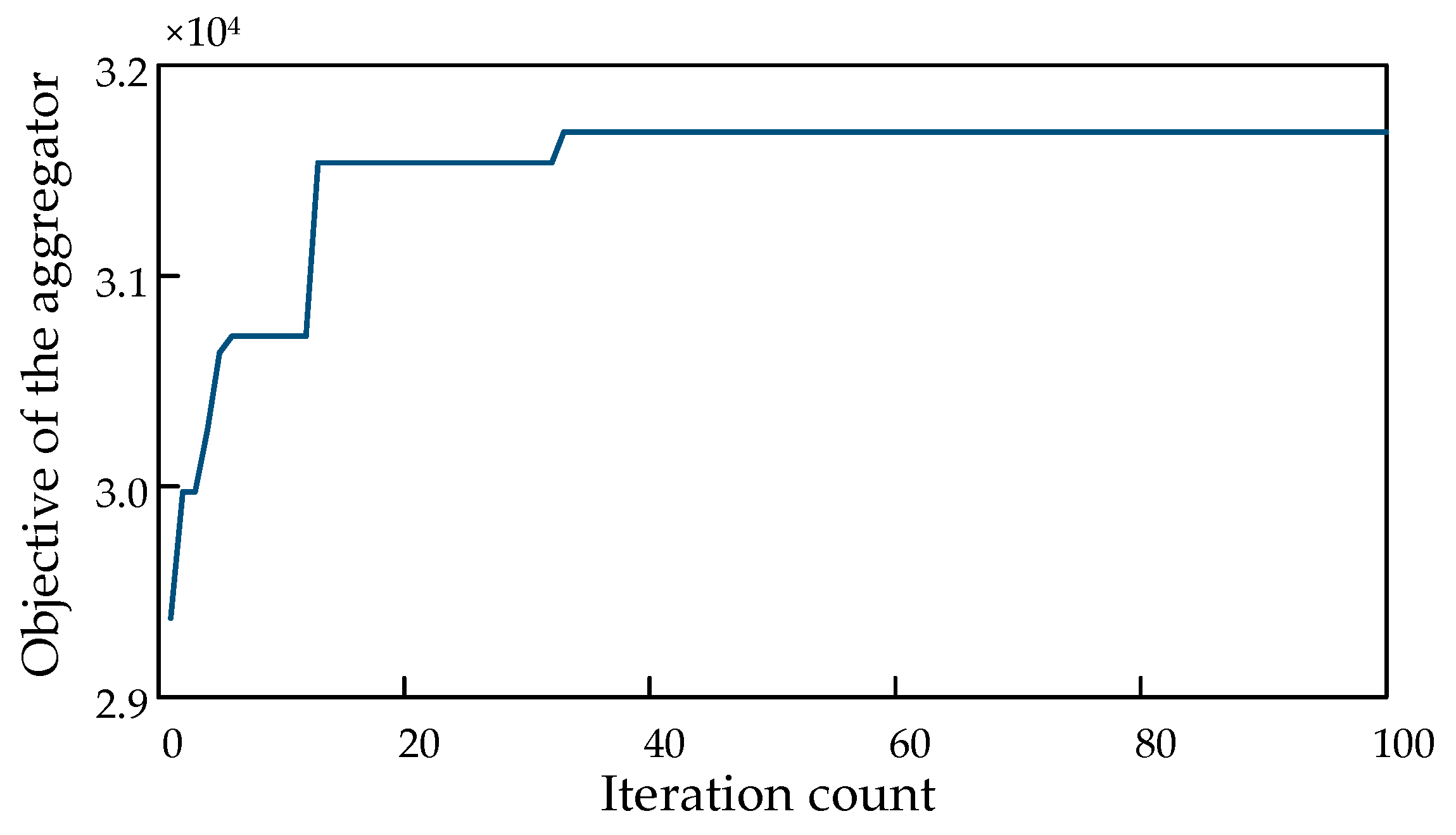
The PSO algorithm is applied to solve the upper-level and lower-level game models. The swarm size is set as 20. The maximum iteration count is set as 100. The inertia coefficients are set as 0.4 and 0.9. The learning factors are configured as 2.0. Taking the upper-level game as an example, the iterative process of the aggregator’s objective is shown in Figure 7. It can be observed that the results show improved convergence performance.

4.1. The Results of the IEP–Aggregator–Utility Bi-Level Game

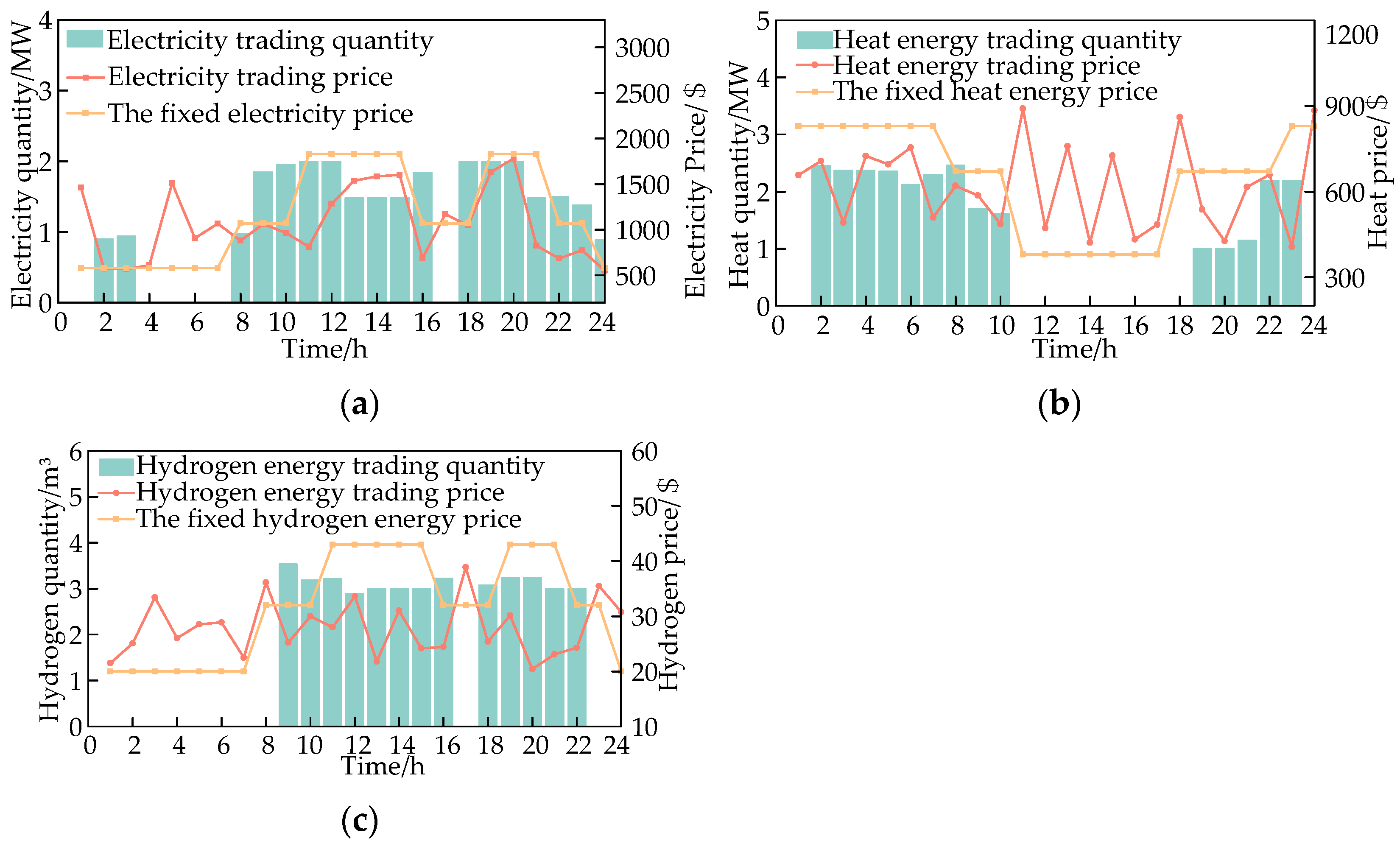
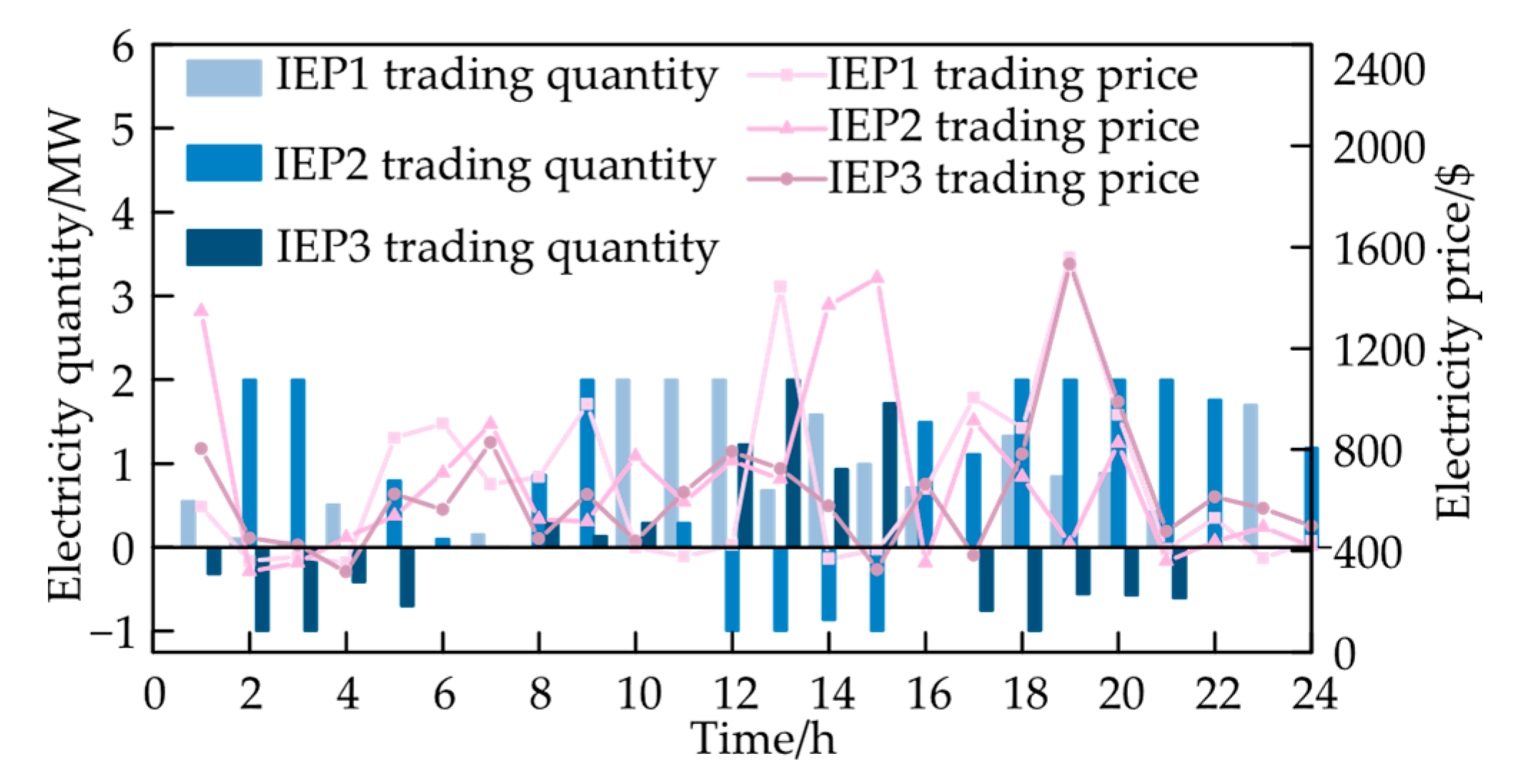
Based on the proposed IEP–aggregator–utility game framework, the bi-level game-based optimal scheduling model can be solved, and the optimal scheduling of the IEPs, the aggregator, and the main grid utility are obtained. The electricity, heat, and hydrogen energy trading quantities between the main grid utility and the aggregator, as well as the corresponding prices, are shown in Figure 8. The electricity trading quantities and corresponding prices between the aggregator and the IEPs are shown in Figure 9.
As shown in Figure 8a, the electricity trading between the main grid utility and the aggregator exhibits a clear interaction with the trading price and the trading quantity. Specifically, when the electricity trading price between the main grid utility and the aggregator is lower than the fixed electricity price offered by the upper-level energy network to the main grid utility, the utility purchases electricity from the aggregator to reduce its operating cost. During peak load hours (08:00–23:00), the electricity trading price between the main grid utility and the aggregator is significantly lower than the fixed price of the upper-level energy network, incentivizing the utility to increase its electricity purchase from the aggregator. The trading quantity is increased to 2.00 MW, effectively reducing the main grid’s operating cost during peak hours and, to some extent, increasing the revenue of the aggregator. Conversely, during specific periods such as 01:00 and 04:00–07:00, when the electricity price between the main grid utility and the aggregator is higher than the fixed electricity price offered by the upper-level energy network, the utility stops purchasing electricity from the aggregator and instead relies entirely on the upper-level energy network.
In Figure 8b, during the peak heat load hours, i.e., 01:00–08:00 and 22:00–24:00, the main grid utility purchases approximately 1–2 MW of heat energy from the aggregator, as the heat energy trading price between the main grid utility and the aggregator is significantly lower than the fixed heat energy price from the upper-level energy network. It is worth noting that at 01:00 and 24:00, the main grid utility does not purchase any heat energy from the aggregator. This occurs because, at 01:00, the IEPs have to activate its internal equipment to cope with the high heat load, which precludes any energy export to the aggregator. Subsequently, at 24:00, the trading is avoided as the heat price offered by the aggregator exceeds that of the upper-level network. Conversely, during the valley heat load hours, the optimized price offered by the aggregator is higher than that of the upper-level energy network, making the utility to source all its heat from the upper-level energy network to minimize operating costs. The hydrogen energy trading results shown in Figure 8c follow the same pattern. During 09:00–16:00 and 18:00–22:00, the main grid trades hydrogen energy with the aggregator that offers lower prices. During periods of low hydrogen demand, the aggregator raises the price to ensure profitability.
In sum, the optimized results of energy trading quantities and prices demonstrate that the proposed bi-level game-based optimal scheduling model of the IEP, aggregator, and utility can effectively facilitate energy interactions through price signals, enabling both the aggregator and the utility to achieve economic optimality. As the leader, the aggregator sets differentiated electricity, heat, and hydrogen energy trading prices to guide the utility. In general, the aggregator reduces prices to increase energy trading quantities of the utility during periods of high demand and raises prices during low-demand periods to secure its own profits. This price-based coordinated scheduling strategy allows the aggregator to obtain reasonable profit through price differentials, while helping the main grid utility reduce its operating costs.
Furthermore, the energy trading results between the aggregator and the IEPs are studied. As shown in Figure 9, the electricity trading strategies of the three IEPs are closely related to their configurations of renewable energy resources. IEP 1, equipped with WT, PV, and CSP units, has sufficient renewable power production capacity and therefore sells electricity to the main grid utility through the aggregator during most time periods. IEP 2, equipped only with a WT unit, exhibits significant intermittency in its electricity selling due to the fluctuating nature of WTs. IEP 3, which includes only PV and CSP units, shows a clear solar-dominant characteristic that significant power is exported during periods of abundant solar irradiation. In addition, as shown in Figure 9, notable strategic differences exist in the energy trading prices between the aggregator and each IEP. During any period when the aggregator purchases electricity, the IEP with the largest energy trading quantity always offers the lowest trading price among the three IEPs. This indicates that, in the game between the aggregator and the IEPs, each IEP actively adjusts its pricing strategy to enhance competitiveness. Although prices are reduced, the increased energy trading quantity can lead to a higher overall revenue. Meanwhile, the aggregator, acting as a price taker, prioritizes purchasing lower-price electricity to minimize its cost, thereby ensuring sufficient arbitrage margin between the trading with the IEPs and the main grid utility. In sum, the proposed game mechanism can effectively balance the profits of the IEPs and the aggregator.
To further demonstrate the advantages of the proposed bi-level game-based scheduling model, it is compared with the centralized scheduling model proposed in reference [32], which adopts fixed energy trading prices between the main grid utility and the IEPs. The operating costs of the utility and the revenues of the IEPs with the two models are compared in Table 2. It can be seen, after introducing the aggregator and establishing the IEP–aggregator–utility game framework, the operating cost of the main grid decreases to $174,861.09, i.e., a 2.91% reduction. The reduction is attributed to the enabling of the trading between the main grid utility and the aggregator with a lower cost. Meanwhile, the aggregator achieves a profit of $31,682.59 by optimizing its energy purchasing and selling strategies as well as pricing mechanisms. It is worthwhile to mention that the total revenue of the IEPs decreases from $28,543.34 to $16,684.06. This is because, after introducing the aggregator, part of the IEPs’ income is transferred to the aggregator for its coordination and management.
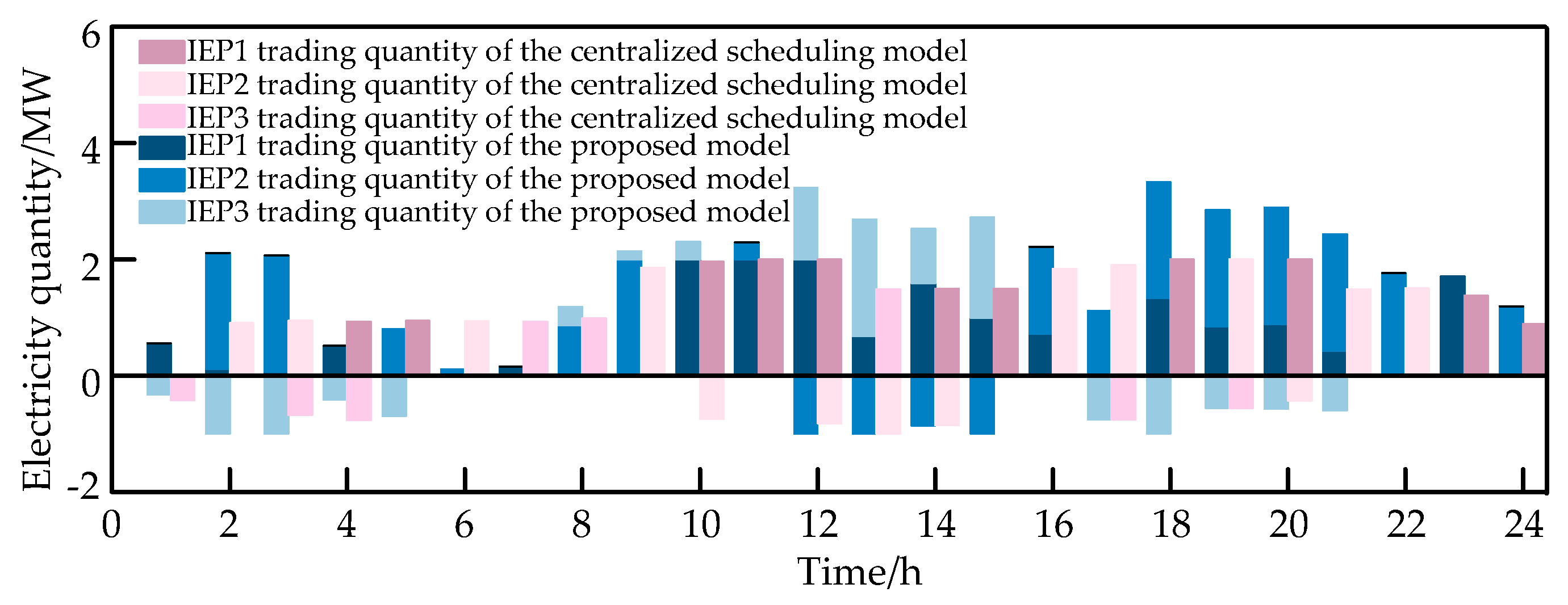
The comparison result of electricity trading quantities is shown in Figure 10. It can be seen that introducing the aggregator and implementing the proposed bi-level game-based optimal scheduling model could significantly increase the electricity trading quantities. Specifically, during peak demand periods (12:00–15:00 and 18:00–21:00), the hourly electricity trading quantity shows an increase of over 0.5 MW, indicating more efficient utilization of surplus energy within the IEP. Overall, the sum of the cost reduction in the main grid utility and the profit of the aggregator far exceeds the revenue loss of the IEPs, which indicates that the proposed game-based optimal scheduling model can significantly improve the overall economic performance, i.e., social welfare, of the integrated energy system. In conclusion, the proposed IEP–aggregator–utility game framework not only can reduce the operating cost of the main grid utility but also can provide reasonable profit margins for both the aggregator and the IEP, thereby enhancing the economic efficiency and coordination among multiple participants.

4.2. Energy Supply Risk Impact Analysis

4.2.1. Result Comparison with Consideration of Energy Supply Risk

The confidence level is set to 90%, and different energy supply risk thresholds are, respectively, assigned for electricity, heat, and hydrogen, with values of 0.6 MW, 1.1 MW, and 1.5 MW. The settings are mainly based on the operational constraints and the severity of supply differences in different energy systems. Electricity supply with the highest reliability requirement is set to the lowest threshold of 0.6 MW, approximately corresponding to 60% of the maximum tolerable risk level. Heat energy supply exhibits time delay characteristics compared to electricity and is set with a moderate threshold of 1.1 MW. Hydrogen energy supply, considering its small scale and relatively high supply flexibility, is assigned a threshold of 1.5 MW. In this paper, M is set as 106, which is big enough considering that the scale of the maximum parameter is 103.
As shown in Table 3, the operating cost of the main grid and the profit of aggregator change significantly after considering energy supply risk. The operating cost of the main grid increases from $174,861.09 to $180,263.71, representing a rise of approximately 3.09%. This increase is mainly attributed to the adoption of a more conservative scheduling strategy under the risk constraints, which prioritizes energy purchasing directly from the upper-level energy network that offers more stable energy supply with higher prices. Meanwhile, the profit of the aggregator decreases from $31,682.59 to $26,026.38, a reduction of 17.85%. The decrease results from the risk constraints that limit arbitrage opportunities and scheduling flexibility of the aggregator in energy trading and make it more difficult for the aggregator to achieve high profits through aggressive pricing strategies. Although the economic performance slightly decreases, the consideration of energy supply risk enhances energy supply reliability and effectively reduces the probability of supply differences caused by unexpected events.
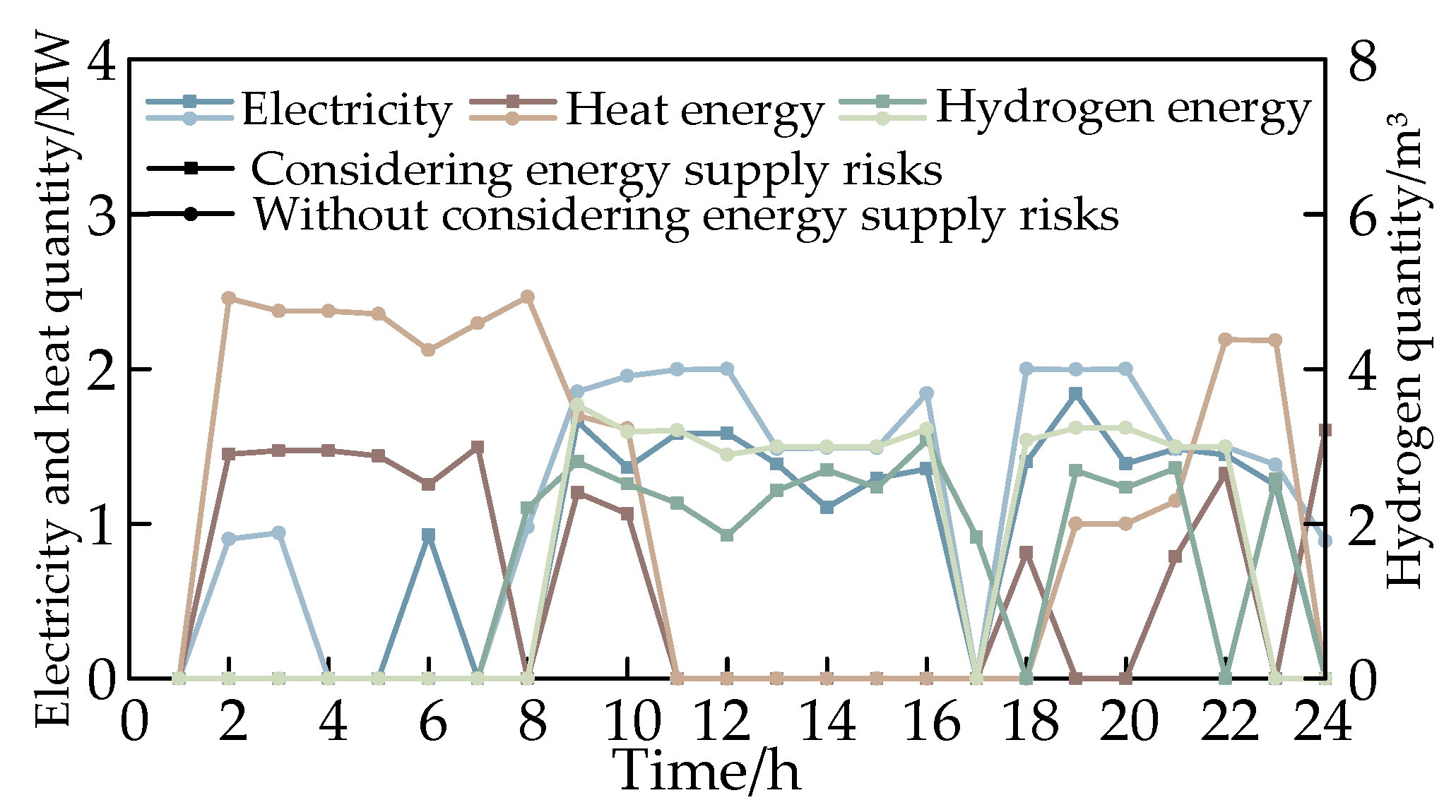
The energy trading quantities between the main grid utility and the aggregator with and without considering energy supply risk are compared in Figure 11. After incorporating energy supply risk, the electricity purchasing of the main grid utility from the aggregator are lower in most periods compared to the case without considering energy supply risk, which indicates that, in order to satisfy the risk thresholds, the utility reduces the proportion of electricity purchased from the aggregator and instead relies more on the upper-level energy network, which offers a more stable energy supply with higher prices. Similar observations can be made in heat and hydrogen energy trading. The main grid utility reduces the proportion of energy purchased from the aggregator to mitigate the energy supply risk.
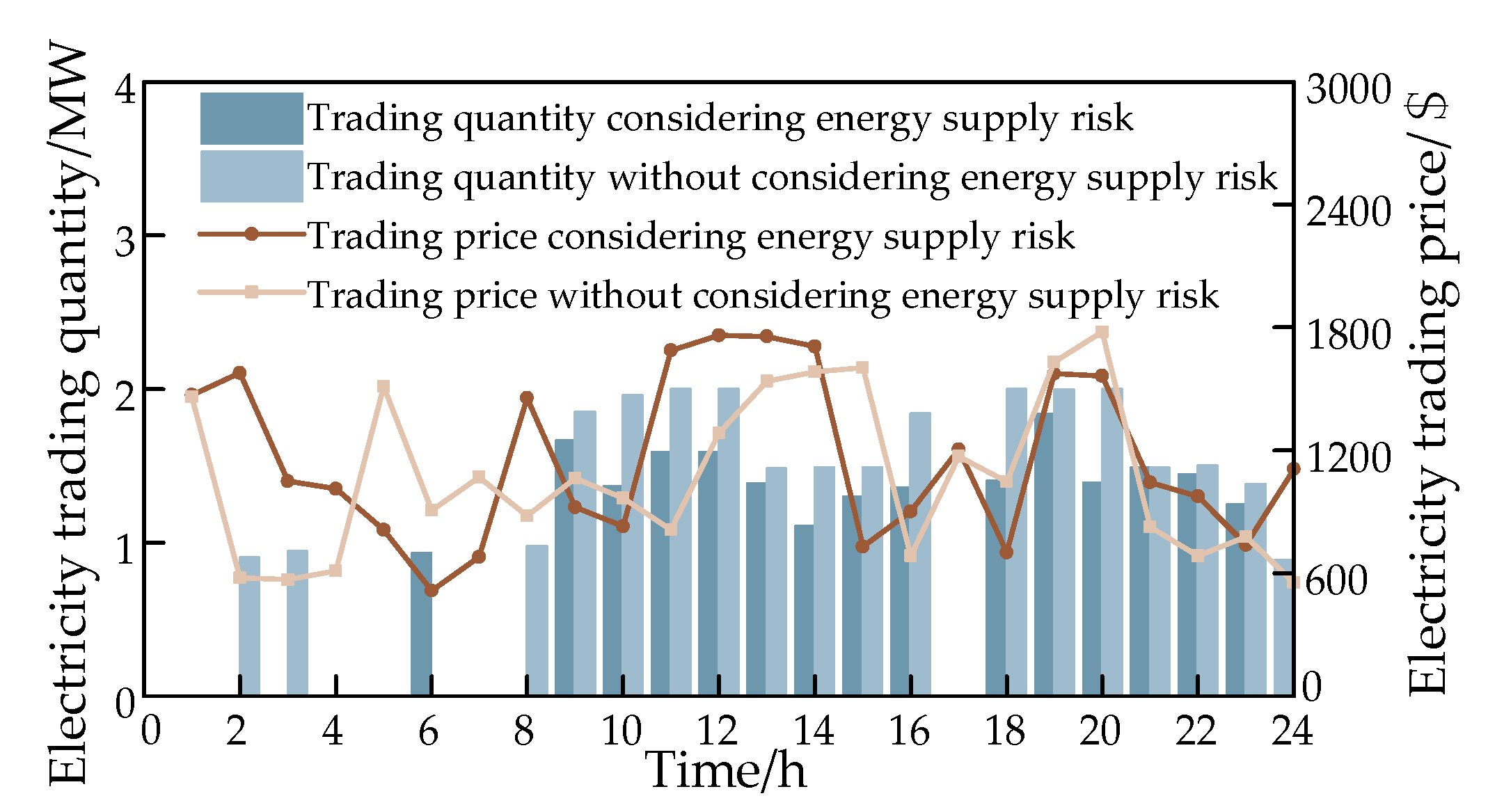
Figure 12 further compares the impact of energy supply risk on the aggregator’s pricing strategy in electricity trading. During 11:00–14:00, the main grid utility reduces the trading quantity with the aggregator considering the energy supply risk. In response, the aggregator increases the trading prices to maintain its revenue and mitigate potential economic losses from risk consideration. For other periods, the aggregator reduces its energy trading prices to the utility. By offering more competitive prices, the aggregator seeks to sell more energy to the main grid. In sum, considering energy supply risk could reflect the trade-off between risk management and economic efficiency.

4.2.2. Sensitivity Analysis of Risk Threshold and Confidence Level

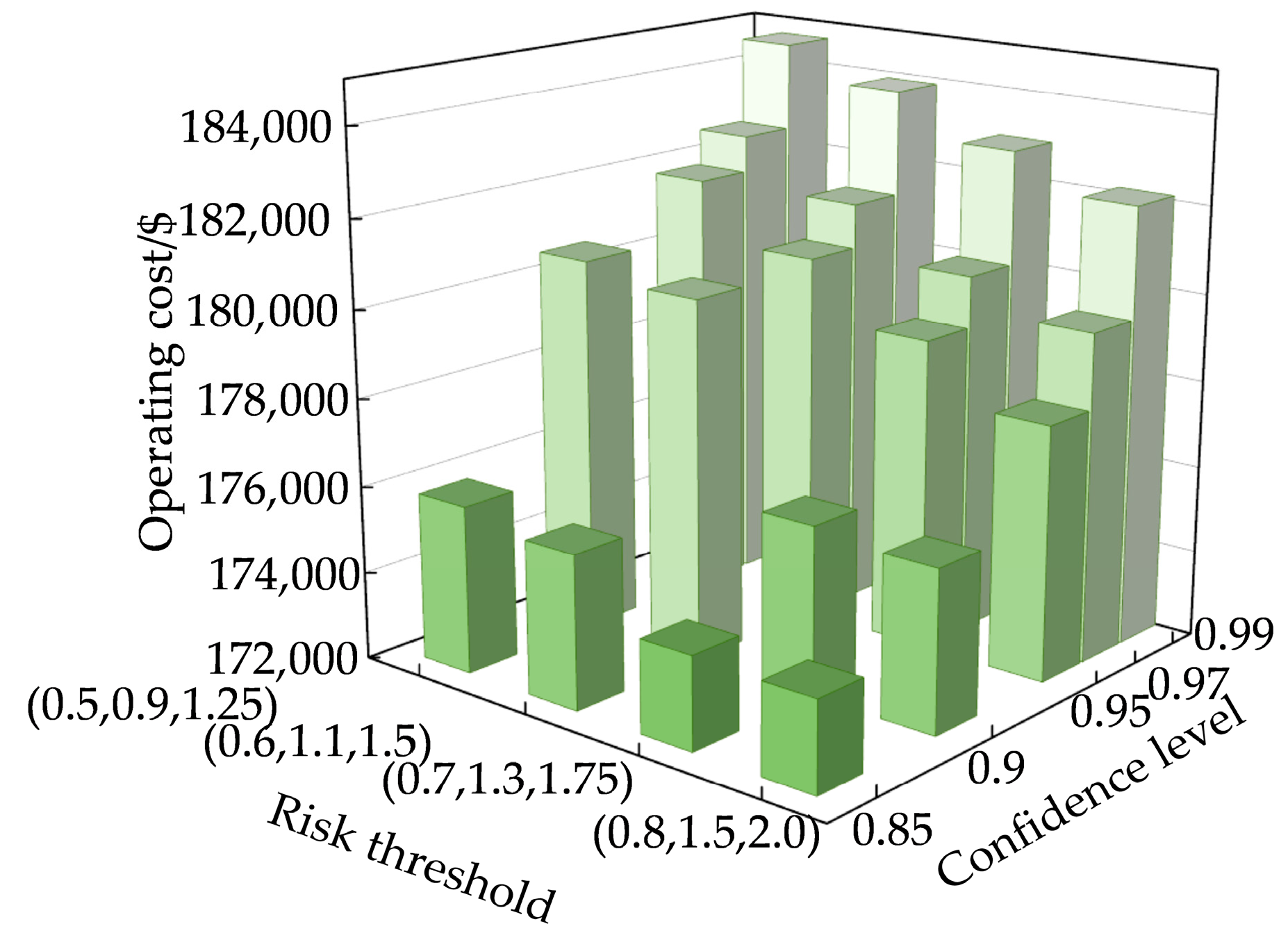
To further study the impact of the energy supply risk on the scheduling results, we conduct a sensitivity analysis on the risk threshold and the confidence level. The risk thresholds for electricity, heat, and hydrogen are, respectively, gradually increased from 0.5, 0.9, and 1.25 to 0.8, 1.5, and 2.0, while the confidence level increases from 0.85 to 0.99. Figure 13 shows the operating cost of the main grid under different risk thresholds and confidence levels.
As shown in Figure 13, a higher risk threshold leads to a lower operating cost. When the confidence level is set as 0.90, the operating cost decreases from $180,590.04 to $175,697.70 (a decrease of 2.71%) as the risk threshold increases. When the confidence level is 0.85, the reduction in the operating cost is about 1.00%. This indicates that a higher risk threshold allows the main grid utility to tolerate greater energy supply uncertainty, thereby reducing the amount of expensive energy offered by the upper-level energy network to hedge against risks. Conversely, a higher confidence level results in a higher operating cost. When the risk thresholds for electricity, heat, and hydrogen are fixed at 0.5, 0.9, and 1.25, respectively, the operating cost of the main grid increases from $175,840.27 to $184,609.93 as the confidence level rises from 0.85 to 0.99 (an increase of 4.99%). It can be concluded that a high confidence level requires the utility to satisfy the energy supply even under extreme risk scenarios, compelling it to adopt a more conservative energy trading strategy. In sum, with the energy supply risk constraint, the impact of the confidence level on the main grid operating cost is more significant than that of the risk threshold, highlighting the dominant role of the confidence level in risk management.

5. Conclusions

This paper first builds a bi-level game-based optimal scheduling model for the electricity–heat–hydrogen IEPs, aggregator, and main grid utility. Based on the CVaR theory, an enhanced model considering energy supply risk is further proposed. The simulation results demonstrate the following: (1) By building a game framework between the IEPs, aggregator, and main grid utility, the interests of all game participants are balanced and reasonable economic outcomes for the three types of participants are achieved. (2) Considering energy supply risk in the trading between the main grid utility and the aggregator, the energy supply stability of the main grid can be improved at the cost of operational economy. By adjusting the risk threshold and the confidence level, the main grid utility can effectively achieve a balance between supply reliability and operational economy. Future work will focus on developing mechanisms that incentivize user participation, enhancing the implementation feasibility of trading mechanisms, and modelling emerging energy carriers.

Author Contributions

Y.Z.: Writing—original draft, methodology, software, formal analysis. L.N.: Writing—review and editing, supervision, methodology, validation. Z.H.: Writing—review and editing, software, validation, visualization. All authors have read and agreed to the published version of the manuscript.

Funding

This research was supported by [the State Grid Southwest Division of State Grid Corporation of China] grant number [52999825000J].

Data Availability Statement

The data that support the findings of this study are available on request from the corresponding author.

Conflicts of Interest

The authors declare no conflicts of interest.

Nomenclature

Abbreviations
CHPCombined heat and power
CSPCombined solar and power
EBElectric boiler
ECElectric cell
ESEnergy storage
HFCHydrogen fuel cell
HTTHydrogen tube trailer
IEPIntegrated energy park
PVPhotovoltaic
WTWind turbine
Indices and Sets
ω Index of energy supply risk scenarios
Ω , H , U Sets of nodes in the electric/heat/hydrogen main grid
a, b, cIndices of CHP, CSP, and electrical ES
e, fIndices of EB and EC
i, j, kIndices of nodes in the electric main grid
m, oIndices of HTT in the hydrogen main grid and nodes connected to the upper-level energy network within the hydrogen main grid
p, qIndices of nodes in the heat main grid
rIndex of heat ES
sIndex of PV
tIndex of scheduling hours
uIndex of nodes in the hydrogen main grid
vIndex of IEP
wIndex of WT
yIndex of HFC
zIndex of nodes connected to the upper-level energy network within the electric main grid
Variables
δ ω t p 1 , δ ω t p 2 , δ ω t p 3 , δ ω t p 4 Auxiliary binary variable for electricity supply differences
δ ω t h 1 , δ ω t h 2 , δ ω t h 3 , δ ω t h 4 Auxiliary binary variable for heat supply differences
δ ω t u 1 , δ ω t u 2 , δ ω t u 3 , δ ω t u 4 Auxiliary binary variable for hydrogen supply differences
η t p , η t h , η t u Value-at-risk of electricity, heat, and hydrogen energy supply
C v t , C v t opt Energy purchasing cost of IEP v from the aggregator at time t, operating cost of IEP v at time t
c v t p , c v t h , c v t u Electricity, heat, and hydrogen energy purchasing prices by the aggregator from IEP v at time t
c t p , c t h , c t u Electricity, heat, and hydrogen energy purchasing prices by the main grid utility from the aggregator at time t
F A , up , F A , low Profit of the aggregator in the upper/lower-level game model
F park Revenue of IEPs
F electricity , F heat , F hydrogen Electricity/Heat/Hydrogen operating cost of the main grid utility
H ω t A , in , H t A , 0 Actual/contracted heat power trading quantity between the aggregator and the main gird utility under scenario ω at time t
H t A , in , H t A , out Heat power purchased/sold by the main grid utility from/to the aggregator at time t
H v t A , in , H v t A , out Heat power purchased/sold by the aggregator from/to IEP v at time t
H q p , t loss Heat flow loss of pipeline qp in main grid at time t
H a v , t , H b v , t , H e v , t , H y v , t Heat power produced by CHP a, CSP b, EB e, and HFC y in IEP v at time t
H b v , t TS , cha , H b v , t TS , dis , H b v , t SF , H b v , t SF , loss Heat charging/discharging rate of heat ES, heat power production/loss of heat collection unit in CSP b in IEP v at time t
H g t , H q p , t , H p h , t Heat power purchased by the main gird utility from the upper-level energy network at time t; heat power between nodes q, p and p, h in the main gird at time t
H r v , t cha , H r v , t dis Heat charging/discharging rate of heat ES r in IEP v at time t
I i j , t Current of line ij in the electric main grid at time t
I m u , t , I m u , t in , I m u , t out Binary variable indicating whether HTT m is located at node u at time t, and the hydrogen charging/discharging state of HTT m at time t
I a v , t , I b v , t , I e v , t , I f v , t ON/OFF states of CHP a, CSP b, EB e, and EC f in IEP v at time t
I b v , t cha , I b v , t dis Charging/discharging state of heat ES of CSP b in IEP v
I y v , t cha , I y v , t dis Charging/discharging state of hydrogen ES in HFC y in IEP v at time t
I c v , t cha , I c v , t dis , I r v , t cha , I r v , t dis Charging/discharging states of electrical ES c and heat ES r in IEP v at time t
I t p , in Electric power purchasing state from the main grid utility to the aggregator at time t
I t h , in Heat power purchasing state from the main grid utility to the aggregator at time t
I t u , in Hydrogen power purchasing state from the main grid utility to the aggregator at time t
P v , t A , in , P v , t A , out Electric power purchased/sold by the aggregator from/to IEP v at time t
P ω t A , in , P t A , 0 Actual/contracted electric power trading quantity between the aggregator and the main grid utility under scenario ω at time t.
P t A , in , P t A , out Electric power purchased/sold by the main grid utility from/to the aggregator at time t
P z t , P i j , t , P k j , t Electric power purchased by the main gird utility from the upper-level energy network at time t, active power between nodes i, j and k, j in the main gird at time t
P i j , t loss Electric active power flow loss between nodes i, j in the main grid at time t
P a v , t , P b v , t , P y v , t , P e v , t , P f v , t Electric active power produced by CHP a, CSP b and HFC y, and electric active power consumed by EB e and EC f in IEP v at time t
P w v , t cur , P s v , t cur Curtailed electric active power of WT w and PV s in IEP v at time t
P c v , t cha , P c v , t dis Electric active power charging/discharging rate of electrical ES c in IEP v at time t
Q i j , t , Q k j , t , Q i j , t loss Electric reactive power flow between nodes i, j and k, j, and reactive power flow loss between nodes i, j in the main grid at time t
Q j t con , Q z t Electric reactive power compensation at node j in the main grid at time t, and reactive power purchased by the main gird utility from the upper-level energy network at time t
R t A Total profit of the aggregator at time t
R v t Energy selling revenue of IEP v from the aggregator at time t
S c v , t , S s v , t , S y v , t Capacity of electrical ES c, heat ES s, and hydrogen ES of HFC y in IEP v at time t
S U a v , t , S D a v , t Start-up/shut-down fuel consumption of CHP a in IEP v at time t
U t A , in , U t A , out Hydrogen power purchased/sold by the main grid utility from/to the aggregator at time t
U v t A , in , U v t A , out Hydrogen power purchased/sold by the aggregator from/to IEP v at time t
U ω t A , in , U t A , 0 Actual/contracted hydrogen power trading quantity between the aggregator and the utility under scenario ω at time t
U o t , U m u , t in , U m u , t out Hydrogen power purchased by the main gird utility from the upper-level energy network at time t, hydrogen charging/discharging rate of HTT m
U m u , t loss Hydrogen power flow loss between HTT m and node j in the main grid at time t
U y v , t cha , U y v , t dis Hydrogen charging/discharging rate of hydrogen ES in HFC y in IEP v at time t
U f v , t Hydrogen power produced by EC f in IEP v at time t
u ω t p , u ω t h , u ω t u Risk auxiliary variables for electricity, heat and hydrogen
V j t Voltage at node j in the electric main grid at time t
X a v , t on , X a v , t off Start-up/shut-down time counter of CHP a in IEP v at time t
Parameters
α Range coefficient of energy supply differences
β Threshold parameter of large- difference scenarios
ε A sufficiently small positive constant
η b v s h Solar-to-heat conversion efficiency of CSP b in IEP v
η m loss Hydrogen discharging loss rate of HTT m
η a v h , η a v MT , η a v L Performance coefficient of the absorption chiller, electric active power production efficiency, and the heat dissipation loss rate of the microturbine in CHP a in IEP v
η b v h e Heat-to-electricity conversion ratio of CSP b in IEP v
η e v e h Electricity-to-heat conversion efficiency of EB e in IEP v
η b v dis Discharging efficiency of heat ES in CSP b in IEP v
η c v PS , cha , η c v PS , dis Charging/discharging efficiency of electrical ES c in IEP v
η r v HS , cha , η r v HS , dis Charging/discharging efficiency of heat ES r in IEP v
η f v H 2 Electricity-to-hydrogen conversion efficiency of EC f in IEP v
η y v u e , η y v u h Hydrogen-to-electricity/heat conversion efficiency of HFC y in IEP v
λ t p , λ t h , λ t u Electricity, heat, and hydrogen energy trading prices between the upper-level energy network/IEP and the main grid utility at time t
C a v OPh Flue gas recovery rate of CHP a in IEP v
c fuel Fuel price of CHP units
D b t Solar radiation index of CSP b at time t
H t loss Estimated heat flow loss at time t
H t A , in , max , H t A , out , max Upper limit of heat power purchased/sold by the main grid utility from/to the aggregator at time t
H q p max , H q p min Heat flow upper/lower limit of pipeline qp in the main grid
H e v max , H e v min Upper/lower limit of heat power produced by EB e in IEP v
H b v TS , cha , max , H b v TS , cha , min Upper/lower heat charging rate limit of CSP b in IEP v
H b v TS , dis , max , H b v TS , dis , min Upper/lower heat discharging rate limit of CSP b in IEP v
H r v cha , max , H r v dis , max Upper heat charging/discharging rate limit of heat ES r in IEP v
H p t load , H v t ld Heat load of node p in the main grid at time t, heat load of IEP v at time t
I i j max , I i j min Upper/lower current limit of line ij
L q p Length of pipeline qp
M A large positive constant
N ω Number of energy supply risk scenarios
P t loss Estimated electric active power flow loss at time t
P t A , in , max , P t A , out , max Upper limit of electric active power purchased/sold by the main grid utility from/to the aggregator at time t
P s v , t , P w v , t Electric active power produced by WT w and PV s at time t
P f v max , P f v min Upper/lower limit of electric active power consumed by EC f in IEP v
P a v max , P a v min , P b v max , P b v min Upper/lower limit of electric active power produced by CHP a and CSP b in IEP v
P c v cha , max , P c v dis , max Upper active power charging/discharging rate limit of electrical ES c in IEP v
P j t load , P v t ld Electric active power load of node j in the main grid at time t, electricity active power load of IEP v at time t
Q j t load Electric reactive power load of node j in the main grid at time t
Q j con , max Upper limit of electric reactive power compensation of node j
R i j , R Resistance of line ij and heat resistance of pipeline pq in the main grid
S SF S SF Area of the heliostat field
S c v max , S c v min , S r v max , S r v min Upper/lower capacity limits of electrical ES c and heat ES r in IEP v
S a v UR , S a v DR Up/down ramping rate of CHP a in IEP v
S b v UR , S b v DR Up/down ramping rate of CSP b in IEP v
S e v UR , S e v DR Up/down ramping rate of EB e in IEP v
s u a v , s d a v One-time start-up/shut-down fuel consumption of CHP a in IEP v
T e Ambient temperature of the heat main grid
T a v on , T a v off Minimum On/Off time of CHP a in IEP v
T sw Supply water temperature of pipeline
U t loss Estimated hydrogen flow loss at time t
U t A , in , max , U t A , out , max Upper limit of hydrogen power purchased/sold by the main grid utility from/to the aggregator at time t
U y v cha , max , U y v dis , max Upper hydrogen charging/discharging rate limit of hydrogen ES in HFC y in IEP v at time t
U m in , max , U m out , max Upper limit of heat charging/discharging rate of HTT m
U u t load Hydrogen load of node u in the main grid at time t
V j max , V j min Upper/lower voltage limit of node j
X i j Reactance of line ij in the main grid

References

  1. Kachirayil, F.; Weinand, J.M.; Scheller, F.; McKenna, R. Reviewing local and integrated energy system models: Insights into flexibility and robustness challenges. Appl. Energy 2022, 324, 19666. [Google Scholar] [CrossRef]
  2. Xu, X.; Wang, B.; Shi, M.; Li, G.; Zhang, Y.; Wang, Q.; Liu, D. Research on hydrogen storage system configuration and optimization in regional integrated energy systems considering electric-gas-heat-hydrogen integrated demand response. Int. J. Hydrogen Energy 2025, 135, 86–103. [Google Scholar] [CrossRef]
  3. Sun, T.; Wu, Y.; Qian, X.; Wang, B. Interval optimal scheduling method of integrated energy system with ground source heat pump based on quantum derivative algorithm. Energy Rep. 2025, 13, 4151–4161. [Google Scholar] [CrossRef]
  4. Wang, L.; Lin, J.; Dong, H.; Wang, Y.; Zeng, M. Demand response comprehensive incentive mechanism-based multi-time scale optimization scheduling for park integrated energy system. Energy 2023, 270, 126893. [Google Scholar] [CrossRef]
  5. Guo, W.; Wang, Q.; Liu, H.; Desire, W.A. Multi-energy collaborative optimization of park integrated energy system considering carbon emission and demand response. Energy Rep. 2023, 9, 3683–3694. [Google Scholar] [CrossRef]
  6. Li, Y.; Hu, W.K.; Zhang, F.; Li, Y. Multi-objective collaborative operation optimization of park-level integrated energy system clusters considering green power forecasting and trading. Energy 2025, 319, 135055. [Google Scholar] [CrossRef]
  7. Fan, S.; Xu, G.; Jiang, B.; Wu, Z.; Xing, H.; Gao, Y.; Ai, Q. Low-carbon economic operation of commercial park-level integrated energy systems incorporating supply and demand flexibility. Energy 2025, 323, 135770. [Google Scholar] [CrossRef]
  8. Yin, S.; Ai, Q.; Li, J.; Li, Z.; Fan, S. Energy pricing and sharing strategy based on hybrid stochastic robust game approach for a virtual energy station with energy cells. IEEE Trans. Sustain. Energy 2021, 12, 772–784. [Google Scholar] [CrossRef]
  9. Dou, Z.; Zhang, C.; Wang, W.; Wang, D.; Zhang, Q.; Cai, Y.; Fan, R. Review on key technologies and typical applications of multi-station integrated energy systems. Glob. Energy Interconnect. 2022, 5, 309–327. [Google Scholar] [CrossRef]
  10. Song, Y.; Shangguan, L.; Li, G. Simulation analysis of flexible concession period contracts in electric vehicle charging infrastructure public-private-partnership (EVCI-PPP) projects based on time-of-use (TOU) charging price strategy. Energy 2021, 228, 120328. [Google Scholar] [CrossRef]
  11. Cheng, C.; Li, S. The stochastic economic model for integrated energy system with carbon mechanism. Comput. Electr. Eng. 2025, 124 Pt A, 110304. [Google Scholar] [CrossRef]
  12. Zhu, G.; Gao, Y.; Liu, H. Optimal scheduling of an integrated energy system considering carbon trading mechanism and multi-energy supply uncertainties in a real-time price environment. Sustain. Energy Grids Netw. 2024, 38, 101351. [Google Scholar]
  13. Liu, Y.; Huang, B.; Lin, Y.; Chen, Y.; Wu, L. Optimal SOC headroom of pump storage hydropower for maximizing joint revenue from day-ahead and real-time markets under regional transmission organization dispatch. J. Mod. Power Syst. Clean Energy 2024, 12, 238–250. [Google Scholar]
  14. Yang, S.; Tan, Z.; Zhou, J.; Xue, F.; Gao, H.; Lin, H.; Zhou, F. A two-level game optimal dispatching model for the park integrated energy system considering Stackelberg and cooperative games. Int. J. Electr. Power Energy Syst. 2021, 130, 106959. [Google Scholar] [CrossRef]
  15. Wang, Y.; Jin, Z.; Liang, J.; Li, Z.; Dinavahi, V.; Liang, J. Low-carbon optimal scheduling of park-integrated energy system based on bidirectional Stackelberg-Nash game theory. Energy 2024, 305, 132342. [Google Scholar]
  16. Ma, L.; Xie, L.; Ye, J.; Bian, Y. Two-stage dispatching strategy for park-level integrated energy systems based on a master-slave-cooperative hybrid game model. Renew. Energy 2024, 232, 120971. [Google Scholar] [CrossRef]
  17. Liang, W.; Wang, S.; Li, X.; Li, X.; Xu, K. Optimization method of low carbon park integrated energy system based on multi-agent game. Electr. Power Syst. Res. 2025, 243, 111484. [Google Scholar] [CrossRef]
  18. Shi, S.; Ji, Y.; Zhu, L.; Liu, J.; Gao, X.; Chen, H.; Gao, Q. Interactive optimization of electric vehicles and park integrated energy system driven by low carbon: An incentive mechanism based on Stackelberg game. Energy 2025, 318, 134799. [Google Scholar] [CrossRef]
  19. Tao, Y.; Qiu, J.; Lai, S.; Zhao, J. Renewable energy certificates and electricity trading models: Bi-level game approach. Int. J. Electr. Power Energy Syst. 2021, 130, 106940. [Google Scholar] [CrossRef]
  20. Bao, M.; Ding, Y.; Zhou, X.; Guo, C.; Shao, C. Risk assessment and management of electricity markets: A review with suggestions. CSEE J. Power Energy Syst. 2021, 7, 1322–1333. [Google Scholar] [CrossRef]
  21. Xiao, D. A Review on Risk-Averse Bidding Strategies for Virtual Power Plants with Uncertainties: Resources, Technologies, and Future Pathways. Technologies 2025, 13, 488. [Google Scholar] [CrossRef]
  22. Aydoğdu, A.; Tör, O.; Güven, A. CVaR-based stochastic wind-thermal generation coordination for Turkish electricity market. J. Mod. Power Syst. Clean Energy 2019, 7, 1307–1318. [Google Scholar] [CrossRef]
  23. Yang, H.; Zhang, S.; Qiu, J.; Qiu, D.; Lai, M.; Dong, Z. CVaR-constrained optimal bidding of electric vehicle aggregators in day-ahead and real-time markets. IEEE Trans. Ind. Inform. 2017, 13, 2555–2565. [Google Scholar] [CrossRef]
  24. Zhang, N.; Kang, C.; Xia, Q.; Ding, Y.; Huang, Y.; Sun, R.; Huang, J.; Bai, J. A convex model of risk-based unit commitment for day-ahead market clearing considering wind power uncertainty. IEEE Trans. Power Syst. 2015, 30, 1582–1592. [Google Scholar] [CrossRef]
  25. Daneshvar, M.; Mohammadi-ivatloo, B.; Abapour, M.; Asadi, S.; Khanjani, R. Distributionally robust chance-constrained transactive energy framework for coupled electrical and gas microgrids. IEEE Trans. Ind. Electron. 2021, 68, 347–357. [Google Scholar] [CrossRef]
  26. Li, Y.; Huang, J.; Liu, Y.; Zhao, T.; Zhou, Y.; Zhao, Y.; Yuen, C. Day-ahead risk averse market clearing considering demand response with data-driven load uncertainty representation: A Singapore electricity market study. Energy 2022, 254 Pt A, 123923. [Google Scholar] [CrossRef]
  27. Xiao, D.; Peng, Z.; Lin, Z.; Zhong, X.; Wei, C.; Dong, Z.; Wu, Q. Incorporating financial entities into spot electricity market with renewable energy via holistic risk-aware bilevel optimization. Appl. Energy 2025, 398, 126449. [Google Scholar] [CrossRef]
  28. Bagchi, A.; Best, R.; Morrow, D. Investigating impacts of storage devices on distribution network aggregator’s day-ahead bidding strategy considering uncertainties. IEEE Access 2021, 9, 120940–120954. [Google Scholar]
  29. Shafiee, S.; Zareipour, H.; Knight, A.M.; Amjady, N.; Mohammadi-Ivatloo, B. Risk-constrained bidding and offering strategy for a merchant compressed air energy storage plant. IEEE Trans. Power Syst. 2017, 32, 946–957. [Google Scholar]
  30. Min, L.; Lou, C.; Yang, J.; Yu, J.; Yu, Z. Operational Coordination Optimization of Electricity and Natural Gas Networks Based on Sequential Symmetrical Second-Order Cone Programming. J. Mod. Power Syst. Clean Energy 2025, 13, 488–499. [Google Scholar] [CrossRef]
  31. Sarykalin, S.; Serraino, G.; Uryasev, S. Value-at-Risk vs. Conditional Value-at-Risk in Risk Management and Optimization. In TutORials in Operations Research; INFORMS: Catonsville, MD, USA, 2014; pp. 270–294. [Google Scholar] [CrossRef]
  32. Li, J.; Yang, B.; Zhou, Y.; Yan, B.; Li, H.; Gao, D.; Jiang, L. Stackelberg game-based optimal coordination for low carbon park with hydrogen blending system. Renew. Energy 2026, 256, 124118. [Google Scholar] [CrossRef]
Figure 1. The structure of the bi-level game-based optimal scheduling model.
Energies 18 06204 g001
Figure 2. The structure of the IEP.
Energies 18 06204 g002
Figure 3. The iterative solving process of the proposed bi-level game-based optimal scheduling model.
Energies 18 06204 g003
Figure 4. The configuration of the test system.
Energies 18 06204 g004
Figure 5. Load curves of the main grid.
Energies 18 06204 g005
Figure 6. (a) Electric active power load curves of the IEPs, (b) Heat load curves of the IEPs.
Energies 18 06204 g006
Figure 7. The aggregator’s objective in the upper-level game model in the iterative process.
Energies 18 06204 g007
Figure 8. Trading results between the main grid utility and the aggregator. (a) Electricity trading results; (b) heat energy trading results; (c) hydrogen energy trading results.
Energies 18 06204 g008
Figure 9. Electricity trading results between the aggregator and the IEPs.
Energies 18 06204 g009
Figure 10. The electricity trading quantities comparison of the proposed model and the model in reference [32] for IEPs.
Energies 18 06204 g010
Figure 11. Energy trading quantities between the aggregator and the main grid utility with and without considering the energy supply risk.
Energies 18 06204 g011
Figure 12. Electricity trading quantity and trading price between the aggregator and the main grid utility with and without considering the energy supply risk.
Energies 18 06204 g012
Figure 13. Operating cost of the main grid under different risk thresholds and confidence levels.
Energies 18 06204 g013
Table 1. Configurations of IEPs.
Equipment
Capacity
CHPWTPVCSPEBECHFCES
Park ID
12.0 MW1.3 MW1.7 MW0.8 MW0.8 MW2 MW
22.0 MW××1.8 MW0.7 MW0.9 MW2.5 MW
32.0 MW×1.3 MW1.9 MW0.9 MW0.8 MW2 MW
√/× indicates whether the IEP is equipped with this type of equipment.
Table 2. Result comparison of the proposed model and the model in reference [32].
Cost/Revenue ($)The Centralized
Scheduling Model in Reference [32]
The Proposed Model
Operating cost of the main grid utilityTotal cost180,104.87174,861.09
Electricity purchasing cost from the upper-level energy network122,327.66117,464.40
Heat energy purchasing cost from the upper-level energy network10,847.118093.88
Hydrogen energy purchasing cost from the upper-level energy network1364.79906.74
Profit of the aggregator--31,682.59
Revenue of the IEPs28,543.3416,684.06
Table 3. Comparison of results with and without considering energy supply risk.
Cost or Profit ($)Without Considering Energy Supply RiskWith Considering Energy Supply Risk
Operating cost of the upper-level energy network174,861.09180,263.71
Profit of the aggregator31,682.5926,026.38
Disclaimer/Publisher’s Note: The statements, opinions and data contained in all publications are solely those of the individual author(s) and contributor(s) and not of MDPI and/or the editor(s). MDPI and/or the editor(s) disclaim responsibility for any injury to people or property resulting from any ideas, methods, instructions or products referred to in the content.