Article

Methodology for Evaluating and Comparing Different Sustainable Energy Generation and Storage Systems for Residential Buildings—Application to the Case of Spain


by
Oscar Castillo Campo
and
Roberto Álvarez Fernández
*
Department of Industrial Engineering, Universidad Nebrija, Calle Santa Cruz de Marcenado 27, 28015 Madrid, Spain
*
Author to whom correspondence should be addressed.
Energies 2025, 18(21), 5863; https://doi.org/10.3390/en18215863
Submission received: 1 October 2025 / Revised: 31 October 2025 / Accepted: 4 November 2025 / Published: 6 November 2025
(This article belongs to the Special Issue Sustainable Energy Transition: Urban Planning and Climate Change)

Abstract

This paper focuses on assessing different sustainable energy generation and storage systems for residential buildings in Spain, identifying the best-performing system according to the end-user requirements. As outlined by the consulted literature, the authors have selected two types of hybrid configurations—a Photovoltaic System with Battery Backup (PSBB) and a Photovoltaic System with Hydrogen Hybrid Storage Backup (PSHB)—and a Grid-Based System with Renewable Hydrogen Contribution (GSHC) is proposed. A Fuzzy Analytical Hierarchy Process methodology (FAHP) is employed for evaluating the hybrid power systems from a multi-criteria approach: acquisition, operational, and environmental. The main requirements for selecting the optimal system are organized under these criteria and evaluated using key performance indicators. This methodology allows the selection of the best option considering objective and subjective system performance indicators. Beyond establishing the ranking, a sensitivity analysis was conducted to provide insights into how individual criteria influence the ranking of the hybrid power systems alternatives. The results demonstrate that the selection of hybrid power systems for a residential building is highly dependent on consumer preferences, but the PSBB system scores highly in operation and acquisition criteria, while the GSHC has good performance in all the criteria.

1. Introduction

Buildings have an impact on long-term energy consumption. Europe and its goal of achieving climate neutrality by 2050 (zero net greenhouse gas emissions) involve the whole society and the economic sectors as key actors in achieving this goal. In 2022, households accounted for 25.8% of final energy consumption in the EU [1]. In terms of residential fuels, natural gas accounted for 30.9%, electricity for 25.1%, renewables and waste for 22.6%, oil and oil products for 10.9%, while a small proportion still used solid fossil fuels (2.3%). The main energy used by EU households in 2022 was for heating homes (63.5% of final energy consumption), electricity used for lighting and most electrical appliances accounted for 13.9%, while water heating accounted for 15%. In the case of Spain, 40.1% of household energy consumption is for space conditioning, 41.1% for illumination and electrical appliances, and 18.9% for water heating. Of the total energy consumption, 41.7% corresponds to electricity and 23% to natural gas employed in heating homes and water. Moreover, the introduction of the electric vehicle as a decarbonizing vector for transport pivots the problem into a new and complex perspective: the capacity of the system to provide the necessary power to recharge the available vehicle fleet at home [2] and the implications of the vehicle-to-grid technology (V2G), where bidirectional chargers allow people to draw power from the grid and push energy from the electric vehicle battery back to the grid [3].
For all these reasons, the importance of electricity generation and supply, either from the grid or from complementary systems that allow for flexibility of supply from the grid through storage and cogeneration, is clarified.
Directive 2010/31/EU [4] established that, from 2020, all new buildings must be nearly zero-energy, bringing this obligation forward to 2018 for all buildings occupied by public administrations and public ownership. Aligned with the EU sustainability goals, the Spanish government presented its strategic energy and climate framework in February 2019, which consists of a climate law and a transition strategy.
Spain adopted the Climate Change and Energy Transition Law in May 2021 [5]. This law sets the target to achieve climate neutrality before 2050 and energy and climate targets for 2030 [6]. The standard has been very restrictive for new buildings, which already include constructive measures to achieve significant reductions in energy consumption. For most of the existing building stock, it is necessary to implement energy rehabilitation measures and to switch to renewable energies, without forgetting behavioral changes for an efficient use of energy.
The development of alternative systems that allow the generation and/or storage of cleaner energy is even more necessary to reduce the consumption of energy coming from the main supply networks to which buildings are connected: electricity and natural gas, respectively.
From a techno-economic perspective, most hybrid systems for residential building applications are based on generation by solar panels and storage in lithium batteries to cover electricity, hot water generation, and space heating demand [7,8,9]. However, alternative solutions based on hydrogen technologies have also been explored [10,11,12,13,14]. In addition, the environmental performance of a hybrid solar–hydrogen-based energy system for buildings [15] and the impact of self-sufficient energy systems in the European renewable energy transition [16] are studied.
According to the consulted literature, two types of hybrid configurations—Photovoltaic System with Battery Backup (PSBB) and Photovoltaic System with Hydrogen Hybrid Storage Backup (PSHB)—are proposed. Additionally, a Grid-Based System with Renewable Hydrogen Contribution (GSHC) is presented.
Therefore, the primary objective of this study is to develop a methodology for assessing sustainable energy generation and storage systems for residential buildings (EGSSRB). Once the methodology is defined, it is applied in Spain, identifying the best-performing EGSSRB according to end-user requirements. To support this objective, a Fuzzy Analytical Hierarchy Process (FAHP) method has been developed for evaluating the EGSSRB systems from a multi-criteria approach: acquisition, operational, and environmental. The main requirements for selecting the optimal EGSSRB are organized under these criteria and evaluated using key performance indicators (KPIs). The requirements for selecting the optimal EGSSRB include system cost, commercial deployment, safety, efficiency, power output, system reliability, use phase emissions, and space requirements. With this approach, it is possible to apply quantitative and qualitative requirements in the analysis. Although the FAHP method accounts for uncertainty through the use of fuzzy numbers, these numbers are derived from the opinions of experts, which can significantly influence the final decision results. For this reason, a sensitivity analysis is performed to help assess the robustness of the obtained rankings when the input values are modified.
The proposed approach can substantially support final decision-making in ongoing EGSSRB investments by integrating technical, economic, and environmental end-user requirements for residential buildings, assessing benefits and potential drawbacks.
The following sections of the paper are arranged as follows: Section 2 presents different sustainable energy generation and storage systems technologies for residential applications, Section 3 explains the research methodology, Section 4 shows the results and discussion, and finally, Section 5 reveals the conclusions and further implications.

2. Sustainable Energy Generation and Storage Systems for Residential Buildings

There exists a transition toward the electrification of energy end-uses, given that electricity serves as an energy carrier with greater potential for decarbonization. This trend is also observed in centralized cooling and heating combined systems in urban buildings using heat pumps. However, there are infrastructure constraints of urban electrical distribution grids that can slow down this transition. To overcome this issue, EGSSRB systems are quickly emerging as a key solution for delivering a reliable and steady flow of renewable energy to residential buildings.
An EGSSRB system is a combination of energy generation sources and storage systems whose coordinated operation reduces the building energy demand from the conventional grid. The set of components used presents complementary characteristics and they are controlled by an energy management system (EMS) that makes them work together as hybrid generation and storage systems. The components combined are detailed here.

2.1. Solar Panels

Obtaining energy from the sun is fully consolidated, both for obtaining domestic hot water (solar thermal collectors—STC) and for electricity generation (photovoltaic panels—PV). In both cases, this is considered a clean and free energy source, but with obvious limitations in terms of available space, hours of sunshine, geographic location, and orientation of the facility’s site [17,18].
Spain is a territory with a climate characterized by high solar incidence. On average, the country receives approximately 2500 h of sunlight per year [19]. In addition to the number of sunlight hours, Spain benefits from high solar irradiance. For instance, Madrid has a monthly average global solar radiation on a horizontal plane ranging from 2.1 to 8 kWh/m2 [20].
Flat plate collectors are the most common type of non-concentrating STC [21] and are usually employed for water heating in residential buildings to support natural gas or electricity, reducing the primary energy source consumption with average efficiencies from 30% to 55% [22]. Therefore, a system with an average efficiency of 45% could generate a rated thermal energy of 2160 Wh/m2.
Monocrystalline photovoltaic panels, which are made from highly pure single-crystal silicon, are one of the most popular types of solar panels for building applications. They stand out for their high module efficiency rates, in the range of 17% to 24% [23], with a rated power output of 350 W and a long lifespan, with a warranty of 25 years in most cases. A cheaper option is polycrystalline solar panels made of multiple silicon crystals, but offering a lower efficiency, in the range of 13% to 16% [24].
To evaluate the energy that a panel can produce daily in a given location, it is useful to consider the concept of peak sun hour (PSH), which represents the value of the energy incident on a horizontal surface of 1 m2 expressed in kWh. This would be the hours of sunshine at an intensity of 1000 W per square meter. The solar panel power output is measured in the laboratory under standard conditions, which are a temperature of 25 °C and an irradiation of 1000 W/m2, equivalent to 1 PSH. In Spain, the average PSH value is in the range of 3.6 to 6. Therefore, a solar panel with a rated power output of 350 W in a location with an average PSH of 4.8 per day could generate 1600 Wh or 947 Wh for a solar panel with standard dimensions of 1.69 m2. However, in real-world applications, peak power could be reduced by up to 20% due to the accumulation of dirt on the surface of the panels, shadows and reflections, module degradation, and electrical losses.

2.2. Electrochemical Storage Technologies

Batteries are the energy storage system that serves to compensate for periods in which energy generation does not reach the required levels. There are several types of batteries with different operating characteristics that can be adjusted to the operational performance of the system to be implemented. Li-ion batteries are the most common type in buildings [25]. This type of battery operates under the concept of electromechanical potential. They present moderate energy density, up to 350 Wh/kg or 750 Wh/L [26,27], and they do not need to follow complete charge–discharge cycles, but they are very sensitive to extreme temperatures [28]. They have a life cycle, up to 30,000 cycles, with a calendar life of 15 to 20 years [25].
Considering Li-ion batteries’ economic and environmental concerns, the use of repurposed batteries coming from electric vehicles in a second life as stationary energy storage systems (SESSs) combined with renewable energy sources has received a lot of interest in recent years [29]. Nonetheless, the economic viability of SESS second-life applications is governed not only by the remaining service lifespan [30] but also by the battery capacity and the interaction between battery capacity [31], cycling profiles, and energy management strategies, such as energy arbitrage and peak shaving [32].

2.3. Hydrogen Energy Systems for Residential Applications

Hydrogen, in the past, had been a valuable chemical gas for several industrial activities, and now it can act as an energy storage vector. In its elemental form, hydrogen is non-toxic and it produces electricity and water with no pollutants or greenhouse gases when processed in a fuel cell. The original idea of renewable (green) hydrogen is the storage in tanks of hydrogen obtained through the electrolysis process of water fed with surplus electricity generated in solar and wind power plants that cannot be used or sold due to electricity market constraints. However, this first idea has changed and today there exists a new green hydrogen generation concept in which the production plants are specifically created to generate hydrogen through an electrolysis process, whose electricity comes from dedicated renewable electricity sources.
Green hydrogen, generated via renewable energy pathways, is gaining recognition as a viable option for sustainable building energy systems. Its integration holds the potential to improve energy autonomy and significantly lower greenhouse gas emissions [33]. Nevertheless, the role that green hydrogen will play in building energy systems will depend heavily on its price [34]. Electrolysis is currently more expensive than traditional methods like steam methane reforming (SMR). Although SMR accounts for about 50% of global hydrogen production due to the reduced production costs, it is a carbon-intensive process.
Currently, the production price of green hydrogen globally ranges between $2.7 and $8.8/kg, and all studies predict a significant price decrease by 2030 to a range of $2–6/kg [35]. In the case of green hydrogen, operational expenditures (OpEx) are directly linked to the cost of renewable electricity. On the other hand, regarding capital expenditure (CapEx), the investment cost of electrolyzers is expected to decrease significantly over time due to economies of scale. By 2050, studies estimate a price range of between $1.5 and $5/kg, with some expecting a cost of $1/kg or less for green hydrogen in countries with excellent renewable resources [36]. Furthermore, a comprehensive evaluation of the techno-economic constraints and performance challenges is essential to assess its feasibility for large-scale implementation.
Integrating green hydrogen into energy systems for buildings presents several technical challenges: the electrolyzers’ and fuel cells’ efficiency, the use of advanced storage solutions, the development of infrastructure for hydrogen distribution, and the implementation of a regulatory framework to support the integration of hydrogen into existing energy systems, addressing safety and compatibility issues.
Stationary fuel cells are well-suited for electricity generation—either as grid-connected units supplying additional power and backup to essential zones or as standalone systems delivering on-site energy independent of the electrical grid.
Hydrogen pipeline infrastructure estimated cost represents approximately 10% to 20% more than natural gas pipelines [37]. However, repurposing existing gas networks to carry hydrogen could help avoid the substantial expense of developing entirely new infrastructure. Future investments in the gas system are focused on local distribution rather than long-distance transmission [38]. A technical hurdle in converting existing networks is that hydrogen flow has about 20% to 30% lower energy content compared to natural gas for pipelines of equal diameter and pressure drop. Another matter for consideration is the leakage from low-pressure pipes, which is generally minimal and unlikely to pose a significant issue unless hydrogen accumulates indoors, a risk that remains poorly understood.
In case hydrogen is produced on-site, it would be necessary to store it as compressed gas. The acquisition cost of a hydrogen storage tank is in the range of 300 to EUR 900/kg [39,40,41]. In case hydrogen is supplied in standard 50 L compressed gas cylinders at 20 MPa, a typical industrial pack of 28 bottles has a capacity of 14.4 kg of hydrogen with a space requirement of 1.4 m2 footprint with a total volume of 2.2 m3 [42].

2.4. Combined Heat and Power Systems for Residential Buildings

Combined heat and power (CHP) systems produce on-site electricity, with a prime mover propelled by a single or blended fuel source, and recover the wasted thermal energy generated in the prime mover device [43,44]. Afterward, this recovered heat can be used to cover heating or cooling building demand. Typically, prime mover equipment for CHP systems in buildings is reciprocating engines, gas turbines, and, to a lesser extent, fuel cells. From an environmental perspective, although most traditional CHP systems could run with low-carbon fuels, such as biogas, CHP systems utilizing fuel cells fed with green hydrogen present an effective approach for meeting thermal and domestic hot water demands in buildings, offering reductions in both primary energy usage and associated CO2 emissions [45].
A residential hydrogen energy system comprises a fuel cell stack, a hydrogen storage tank, a grid-synchronized inverter, a thermal storage unit for hot water, and ancillary components. In the electrochemical process within the fuel cell stack, hydrogen reacts with oxygen to produce direct current (DC) electricity and thermal energy. The DC power is converted into alternating current (AC) via an inverter for integration with the household electrical load or exportation to the grid. Alternatively, the electricity can be stored in a battery for later use. Simultaneously, the waste heat generated during the reaction is recovered and stored in a thermal buffer tank to satisfy domestic hot water or space heating demands.
There are several technologies of fuel cells suitable for building applications in CHP systems by improving the utilization of waste heat. Among the various fuel cell technologies, solid oxide fuel cells (SOFCs) represent the most technologically mature option, particularly due to their capability to utilize natural gas as fuel. Concurrently, systems employing proton exchange membrane fuel cells (PEMFCs) and alkaline fuel cells (AFCs) are undergoing rapid development. PEMFCs and AFCs operate at low temperatures, in the range of 40 °C to 90 °C, and part-load conditions, which fit better with building applications. In particular, PEMFCs are widely used in domestic energy systems and are the core technology in fuel cell vehicles. PEM technology now delivers excellent efficiency, electrical and thermal efficiency of 40% and 55%, respectively, long-lasting performance (60,000–80,000 h), and high-reliability operation, with costs significantly reduced thanks to large-scale manufacturing [46].
Several research works available in the literature have investigated the integration of hydrogen fuel cell-based systems with other means of energy storage and generation to cover the heat and power demands of residential buildings. However, the main concern is how to provide hydrogen to the system.
One option is using a local natural gas reformer in combination with a desulfurization device and a CO shift reactor. This solution is used by Haneda et al. [47] to provide hydrogen to fuel cell-powered vehicles with the unutilized capacity of the system during partial load situations, such as nights or the summer season. Ozawa and Kudoh [48] explored the economic and environmental viability of PEMFCs and SOFCs for small-sized households in Japan, obtaining a greenhouse gas (GHG) emissions reduction and cost savings depending on the system management and household size.
Another option is using an electrolyzer to generate on-site hydrogen that is stored. This stored hydrogen was subsequently utilized as a fuel cell to generate electricity, operating alongside a battery to accommodate variable power demands typical of residential usage profiles. The electricity to power the electrolyzer comes from the grid or another power source. McLay et al. [49] explore the use of a reversible fuel cell powered by a solar photovoltaic array for residential applications. Renau et al. [45] studied a fuel cell CHP system based on the consumer heat-to-power ratio, determining that this type of installation reduces the primary energy consumption by 50% and CO2 emissions with similar capital investments to other technologies. The Lokar and Virtic research [50] demonstrates that full energy self-sufficiency and reliance are attainable through the integration of PV systems with hydrogen fuel cells in a hybrid system incorporating battery energy storage. From an economic perspective, such systems are becoming increasingly feasible for commercial deployment, although the high upfront costs are primarily due to the expense of hydrogen storage infrastructure. Gabana et al. [51] explored the potential of fuel cells in CHP systems by evaluating several system configurations, each combining various methods of hydrogen production (natural gas reforming or electrolysis), different production locations (centralized or on-site), and the inclusion or exclusion of heat recovery during hydrogen generation. The findings indicate that optimal performance is achieved when the generation system’s heat-to-power ratio aligns closely with that of the demand.

3. Methodology

The Analytic Hierarchy Process (AHP) is a multi-criteria decision-making method (MCDM) that facilitates the resolution of complex problems by decomposing them into more manageable sub-problems [52]. These sub-problems are then evaluated through pairwise comparisons using a predefined scale of preferences. This structured approach ultimately yields a prioritized ranking of a finite set of alternatives. However, it is assumed that decision-makers can provide precise judgments, but assessments are inherently subjective, making exact comparisons challenging.
The Fuzzy Analytic Hierarchy Process (FAHP) enhances the conventional AHP methodology, addressing this limitation by incorporating fuzzy logic, enabling decision-makers to articulate their preferences using fuzzy numbers, and integrating both quantitative and qualitative data within a single framework. Fuzzy sets enable decision-makers to convey their preferences using ranges instead of exact numerical values. In this context, fuzzy methods act as an advanced form of interval analysis, designed to manage uncertainty more effectively, resulting in a more adaptable and realistic decision-making framework. AHP and FAHP are particularly effective for addressing energy planning challenges [53,54,55,56].
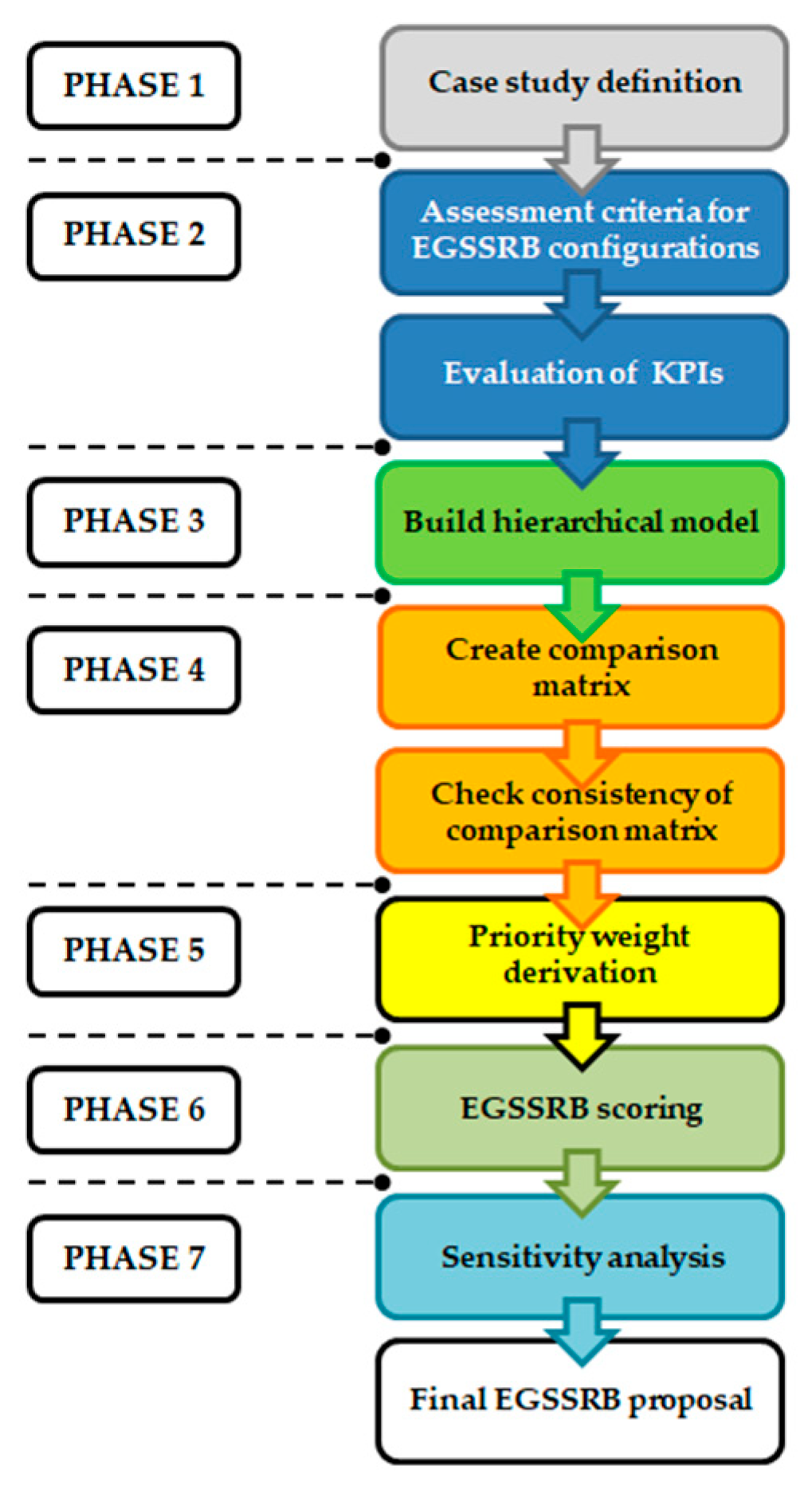
The FAHP method follows a structured sequence of phases to prioritize and assess a group of alternatives based on multiple criteria. The phases of the methodology include the following:
  • Phase 1. Case study definition. Clearly articulates the decision-making objective.
  • Phase 2. Identification of the assessment criteria for EGSSRB configurations. These criteria should be well-defined, measurable, and suitable for the decision-making objective. The measurement of the criteria is conducted by the evaluation of KPIs.
  • Phase 3. Build a hierarchical model. Develop a hierarchical structure that visually organizes the decision elements by levels.
  • Phase 4. Pairwise comparisons. Conduct pairwise assessments of criteria and alternatives using several comparison matrices.
  • Phase 5. Priority weight derivation. Calculate the relative weights of criteria and the alternatives by solving fuzzy linear equations derived from the pairwise comparisons. These weights express the relative significance of each element.
  • Phase 6. Overall score computation. Combine the weights with the performance values to calculate an aggregate score for each alternative, indicating the extent to which it meets the defined criteria.
  • Phase 7. Sensitivity analysis: evaluate the stability of the results by analyzing how variations in input values or priority weights affect the final rankings, thereby testing the robustness of the decision model.
The methodology process flow chart for this study is illustrated in Figure 1.
The variables used in the model are listed in Table 1.

3.1. Phase 1: Case Study Definition

The objective of this study is to define the most suitable EGSSRB for a residential building according to specific Spanish user requirements. Despite the case study being focused on Spain, the methodology could be applied to other countries.

3.1.1. Residential Building Characteristics

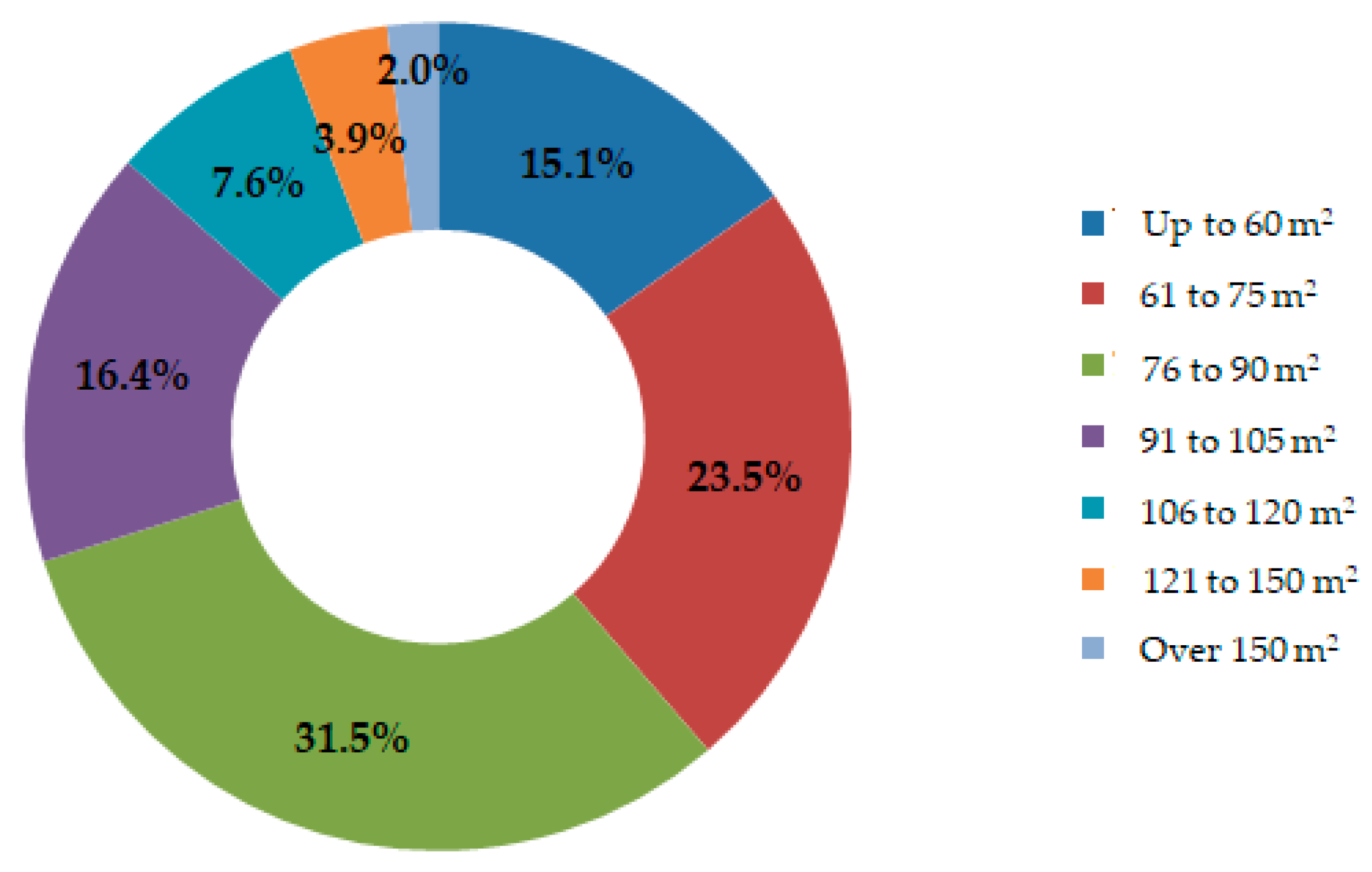
The building to be studied in this research is a multi-family housing building. According to Spanish National Institute of Statistics (INE) data, around 52% of dwellings are located in residential buildings with more than 10 dwellings, and over 71% have a floor area in the range of 61 to 105 m2 (see Figure 2).
The typical yearly energy consumption for homes in Spain is projected to lie within the range of 7500 to 15,500 kWh [57], depending on several factors such as climatology, season of the year, home characteristics, the number of members per home, and the number and efficiency of installed devices. However, daily electricity consumption in Spanish households exhibits a relatively stable pattern, with minimal variation between weekdays and public holidays. Although the overall shape of this profile remains consistent across seasons, total consumption levels differ between winter and summer, and the timing of specific activities may shift slightly. The magnitude of household electricity demand is largely determined by the degree of electrification and the usage intensity of electrical devices, particularly those employed for space conditioning and domestic hot water production.
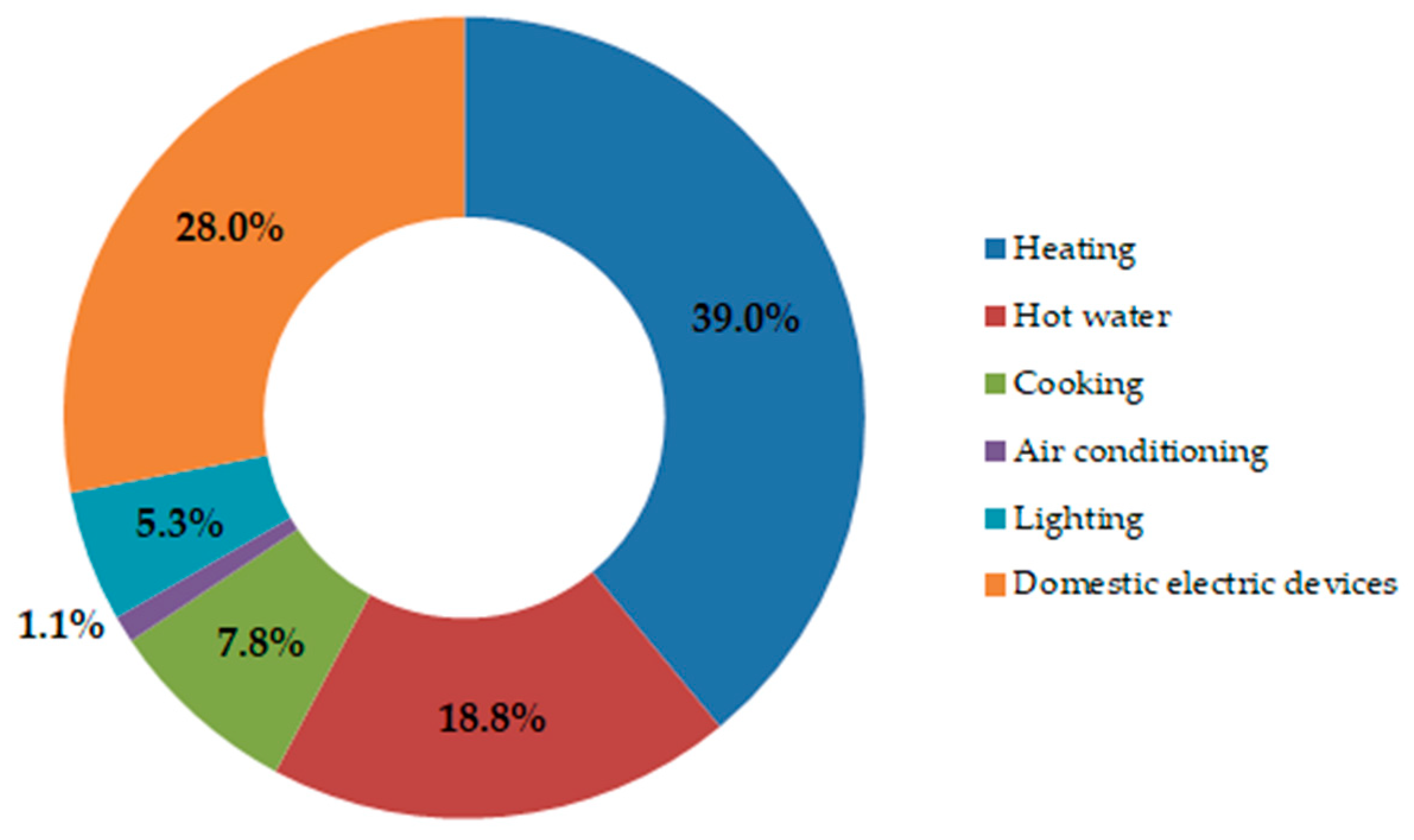
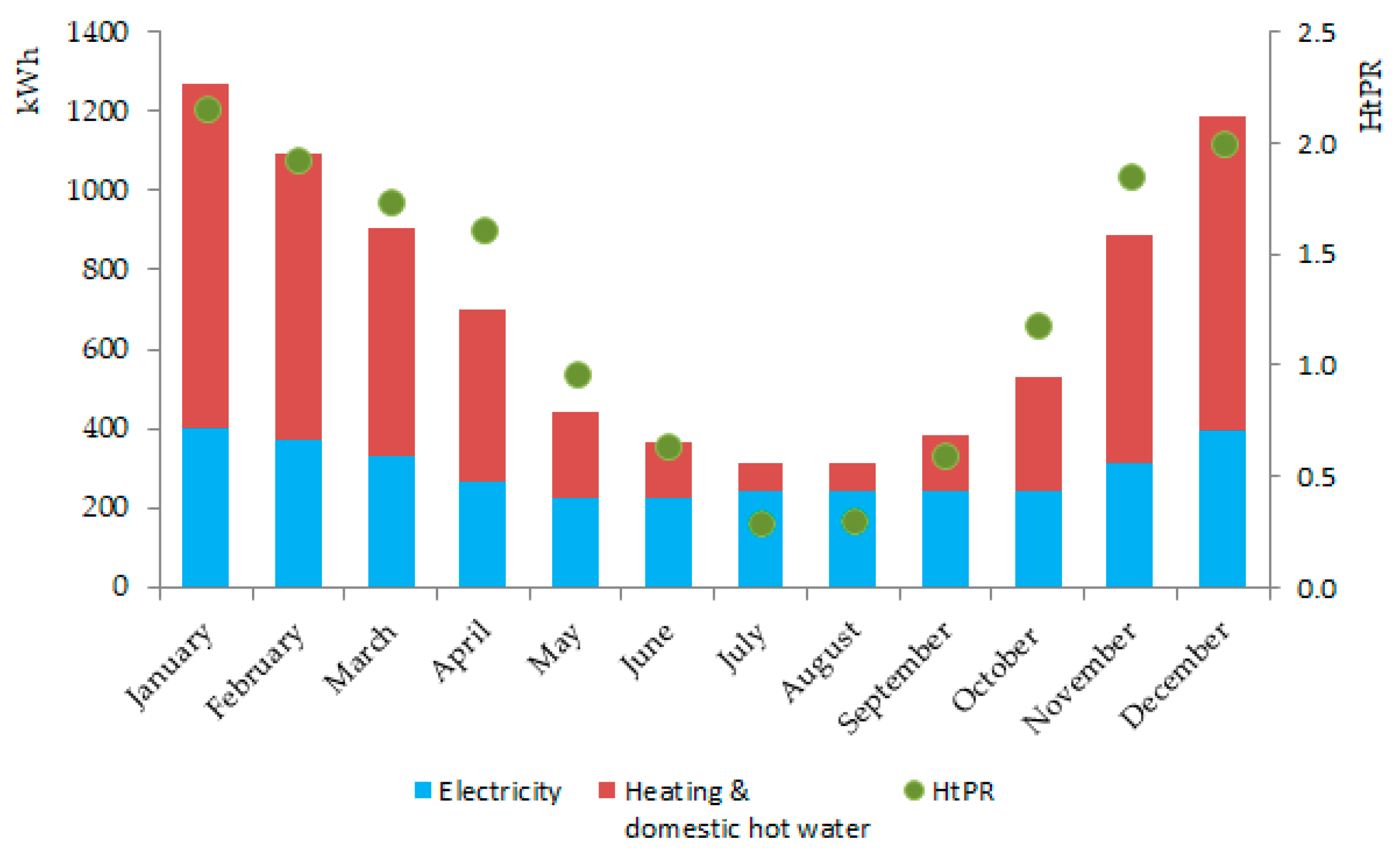
Figure 3 shows the consumption by use in Spain for the residential sector in the year 2023 [58,59]. As can be seen, the thermal demand for heating and hot water accounts for 57.8% compared to the demand for electricity, which accounts for 41.1%. This translates to a heat-to-power ratio (HtPR) of 1.4, which is an important selection factor for CGP systems [58]. However, the HtPR ratio has variable values because the residential energy consumption is hourly and monthly dependent. Figure 4 shows the average monthly evolution of energy consumption in Spanish homes disaggregated by electricity and thermal demand and the corresponding HtPR values between 0.3 and 2.1. The peak and average monthly electricity consumption are 402 kWh and 292 kWh. Moreover, the peak and average monthly thermal consumption are 865 kWh and 408 kWh. In addition, there are medium and long-term effects that also affect the residential energy demand, such as demography, income levels, number of family members and age composition, and the adoption of demand management, energy saving, and tariff incentives measures.
In Spain, thermal energy demand is typically met with natural gas. However, the present study considers that all domestic services are fed with electricity, where heating and cooling demand is covered with an individual heat pump, while hot water is provided by a centralized system. The dwellings are included in a building, with a constructed area of 90 m2, where a mid-sized family is residing. In this context, the authors estimate that the average annual energy consumption per household in Spain is approximately 8400 kWh, with an electricity demand of 3500 kWh and thermal demand of 4900 kWh, split into 1590 kWh and 3310 kWh for hot water and space heating demand, respectively. It should be noted that in Spain, approximately 92% [57] of the energy demand for heating and domestic hot water is covered by natural gas. Considering these assumptions, annual electricity consumption per household would be 7500 kWh per year, divided between electrical loads (3500 kWh) and thermal loads (4000 kWh).

3.1.2. EGSSRB System Layouts Description

The different combinations of energy generation and storage devices of the EGSSRB result in system configurations with different performances and control strategies. Usually, the management strategies are based on rule-driven strategies, such as energy arbitrage or peak shaving, for optimizing one objective or a combination of different objectives related to economic or grid operator issues.
The set of components used in the EGSSRB configurations is presented in Table 2.
The authors have selected three types of EGSSRB configurations:
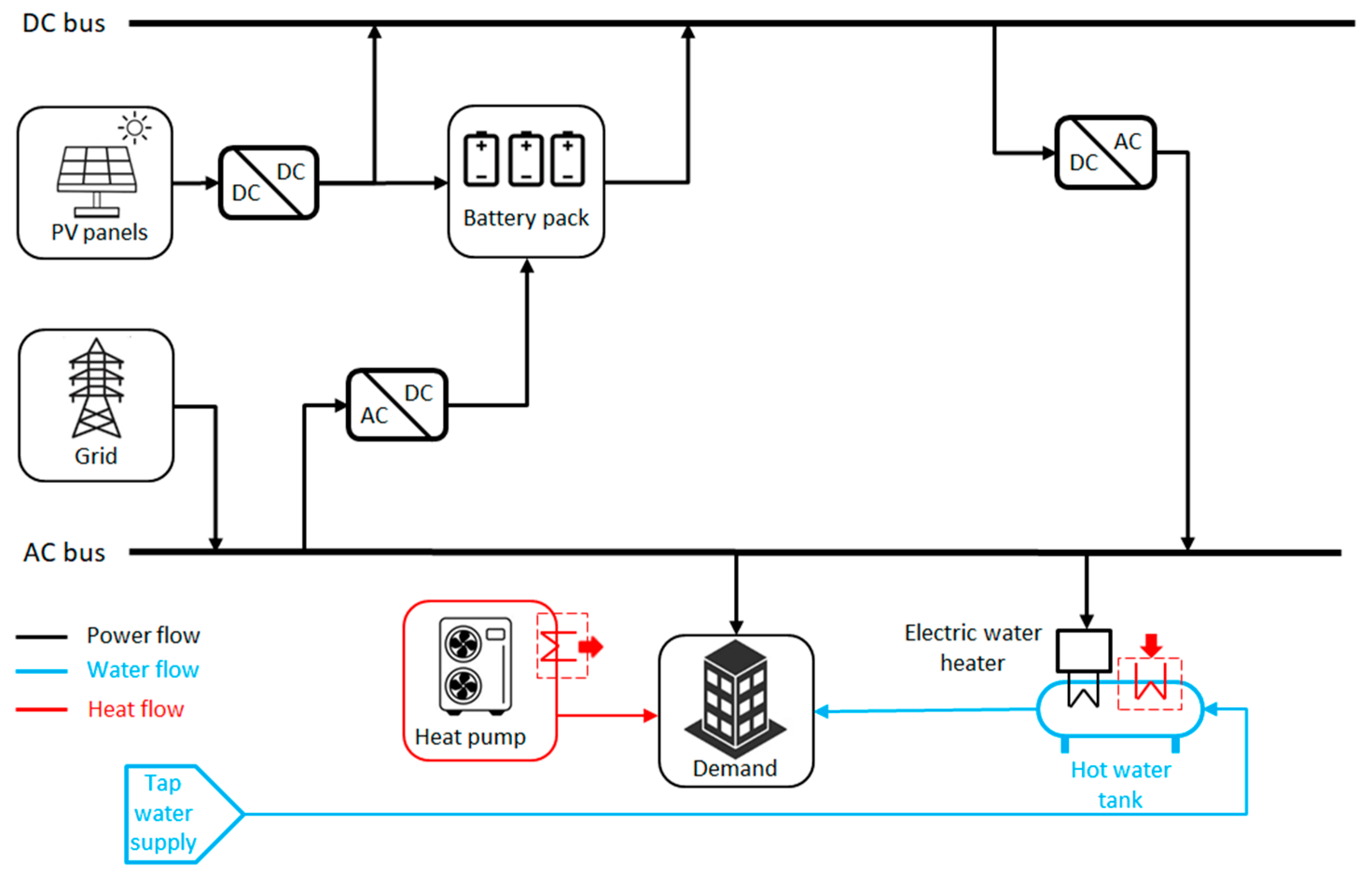
  • Photovoltaic System with Battery Backup (PSBB); see Figure 5. The PV system generates electricity that is consumed by the building or stored in the battery pack. When the electricity demand exceeds the PV output, the battery acts as a backup system and, if there is a deficit, it is covered by drawing power from the electrical grid. The hot water is produced by a combination of a heat pump water heater and a backup electric water heater. The space heating demand is provided by a heat pump.
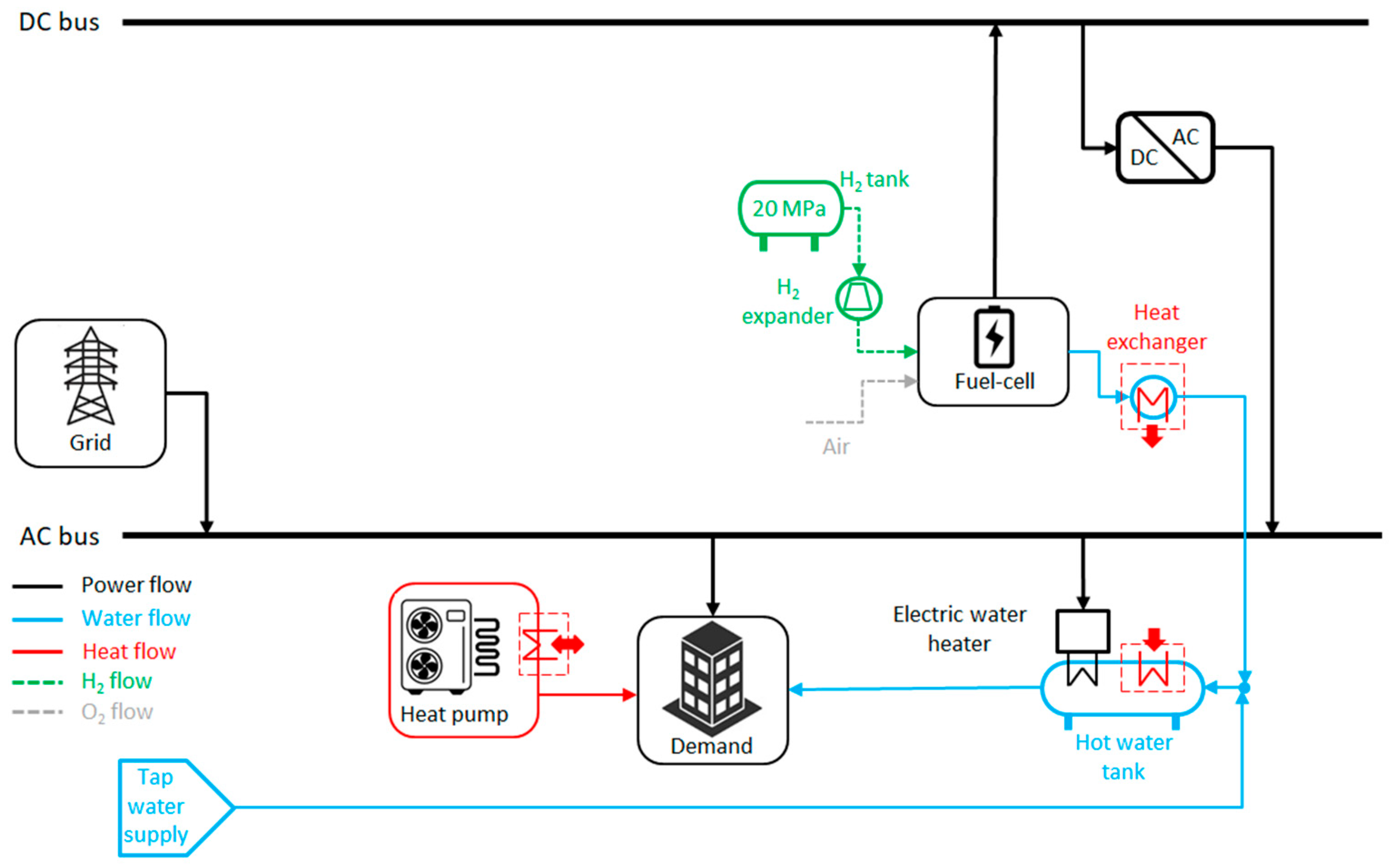
  • Photovoltaic System with Hydrogen Storage Backup (PSHB); see Figure 6. The PV system generates electricity that is consumed by the building or used to generate hydrogen that is stored in a pressure vessel at 20 MPa. When the household demands electricity that exceeds the PV output, the electricity demand is covered by the fuel cell system output and/or the grid. The heat generated by the fuel cell is used to produce hot water, which is stored in a tank. When the stored thermal energy is insufficient, the additional heating requirements are completed with a combination of a heat pump water heater and a backup electric water heater. The space heating demand is met by a heat pump cogeneration system that utilizes the residual heat generated in the fuel cell.
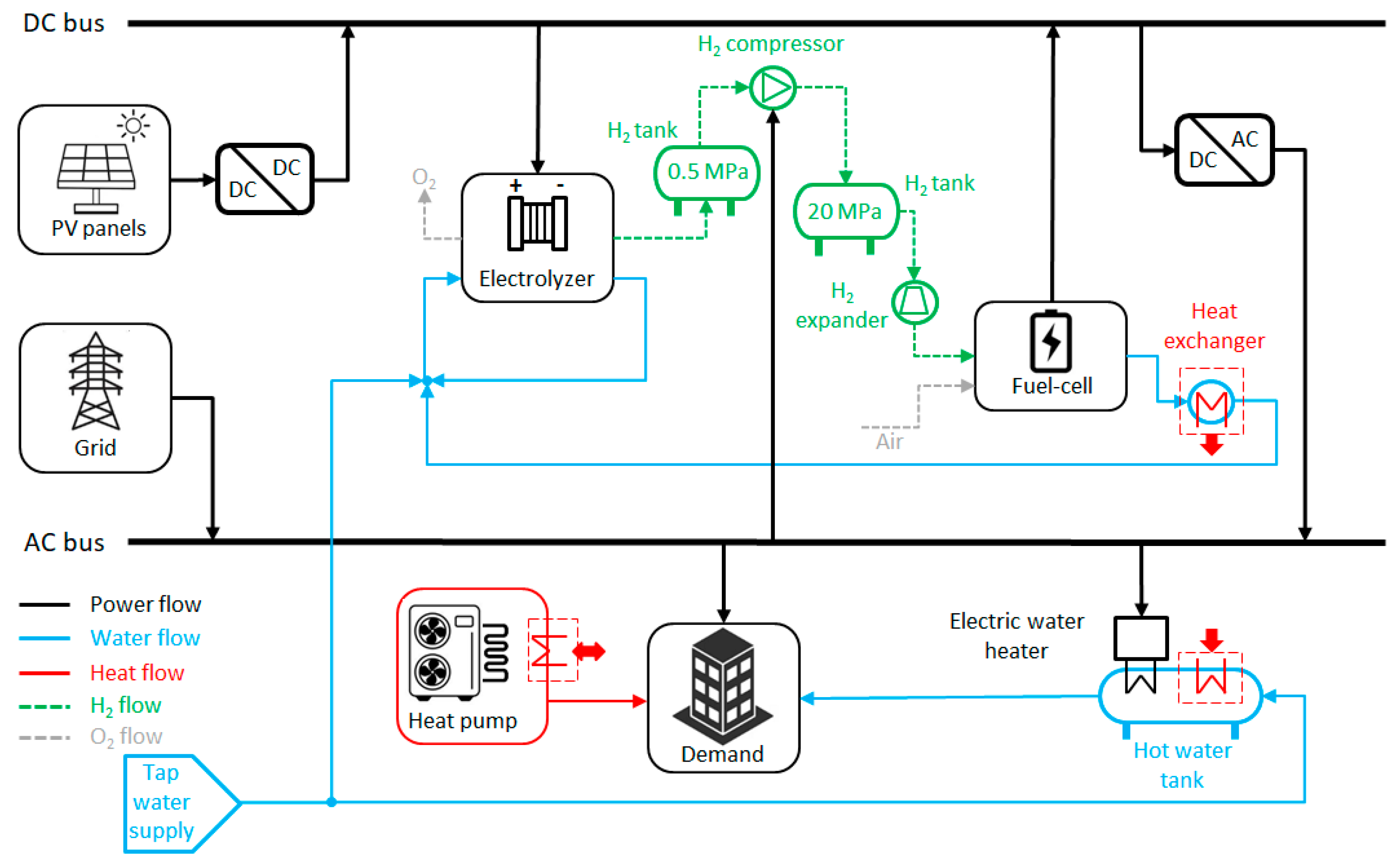
  • Grid-Based System with Renewable Hydrogen Contribution (GSHC); see Figure 7. The electric demand of the building is covered with electricity from the grid. However, in specific cases, the power demand could be totally or partially met by the electricity supplied by the fuel cell. The hydrogen to feed the fuel cell system is provided by a gas supplier in high-pressure cylinders at pressures up to 20 MPa as standard. The heat generated by the fuel cell is used to produce hot water, which is stored in a tank. When the stored thermal energy is insufficient, the additional heating requirements are completed with a combination of a heat pump water heater and a backup electric water heater. The space heating demand is met by a heat pump cogeneration system that utilizes the residual heat generated in the fuel cell.
The authors have considered several assumptions for the installation sizing:
  • The PV system must cover at least 25% of energy demand, considering that the PSH coefficient can vary between 2.5 and 8 values.
  • The battery pack capacity must fulfill the demand and provide an energy reserve for one day, considering a maximum depth of discharge of 80%.
  • The fuel cell and the electrolyzer for the PSHB system are designed to use the excess of energy generated by solar panels in the form of pressurized hydrogen at 200 bar for later reuse. The electrolyzer is powered only by the excess electricity produced by the solar panels. In this case, the solar panels focused on covering the electricity demand from the electrical load (3500 kWh per year).
  • The hydrogen pressure vessel capacity in the PSHB system is designed to store the PV system’s excess production during the year and to cover peak energy demands.
  • The fuel cell in the GSHC system is selected to cover most of the space heating and hot-water demand, provided that the electricity produced is at most equal to the demand.
  • The heat pump coefficient of performance (COP) is 4, meaning that for each kWh of electricity consumed, the system provides 4 kWh of heating or cooling energy.
  • The energy density of hydrogen is determined based on the lower heating value (LHV) of 33.3 kWh/kg.
  • The emission factors considered for the calculations are 0.175 kgCO2e/kWh for the national electricity production [59] and 0.03 kgCO2e/kWh in the case of green hydrogen obtained from 100% renewable electricity and local use [60].
  • The cost of electricity and hydrogen acquired is EUR 0.135/kWh and EUR 0.3/kWh (EUR 10/kgH2), respectively. The excess of energy generated by the system is transferred to the electrical grid, yielding a profit of EUR 0.05/kWh.

3.2. Phase 2: Identification of the Assessment Criteria for EGSSRB Configurations

The evaluation of EGSSRB configurations is performed using a multi-criteria approach: acquisition and operation issues, as well as taking into account the environmental concerns. The acquisition criteria refer to the expenses to acquire the system, the market availability and after-sales service, and the safety requirements for the installation. Additionally, operation criteria consider the system efficiency, capacity factor, and reliability. Finally, environmental criteria account for the system emissions during operation and room size requirements.
On this basis, the first step is the definition of the KPIs for assessing the EGSSRB configurations according to the system requirements. Afterwards, these KPIs must be evaluated for each EGSSRB configuration.

3.2.1. Definition of the Key Performance Indicators

The selection requirements include costs, technological maturity, efficiency, power capacity, reliability, safety, room size specifications, and environmental impact. These requirements are categorized under the aforementioned criteria and measured using key performance indicators. These requirements and KPIs are described and classified in detail in Table 3.

3.2.2. Evaluation of KPIs

Each EGSSRB configuration is evaluated based on the selected KPIs of its specific components. KPIs are divided into two categories: quantitative and qualitative. Quantitative indicators can be measured and expressed numerically, while qualitative indicators express characteristics that are not measurable. To perform a systematic analysis, these values will be quantified by assigning a numerical value according to the characteristic within a predefined scale ranging from 1 to 5.
KPIs calculations are explained in the following expressions:
  • System Cost (SC). Costing for a configuration is determined by summing up the LCOE and LCOS of its components, as expressed in Equation (1).
S C = j L C O E j + L C O S j
For this study, the authors have used a simplified calculation of LCOE and LCOS, Equation (2). The evaluation of both parameters is equivalent, but they differ in the concept of energy delivered.
L C O E _ S = I + t = 1 T O M t + F t 1 + r t t = 1 T E g t 1 + r t  
where I is the investment expenditure, OM is the operation and maintenance costs per year, F is the yearly cost of the energy consumed whenever necessary, r is the discount rate, T is the system lifetime, and Egt is the useful energy output per year. For the calculation, the discount rate is 3.5%, and the energy exchanged is estimated according to the energy generated by each system.
  • Commercial Deployment (CD). It is a qualitative indicator that is evaluated using the quantization scaling that considers the supplier availability and after-sales service: 1 (very low), 2 (low), 3 (moderate), 4 (high), and 5 (very high).
  • Fail-safety (FS). It is a qualitative indicator that is evaluated using the quantization scaling that considers the level of certification requirements: 5 (very low), 4 (low), 3 (moderate), 2 (high), and 1 (very high).
  • Global Efficiency (EF). Efficiency evaluation for a configuration is determined by the ratio between the useful energy output (Eg) and the external energy consumed (Ec), as expressed in Equation (3). The external energy consumed is provided by the electrical grid (Ece) or a green hydrogen supplier (EcH2).
E F = E g E c = E g E c e + E c H 2
The useful energy provided by the system must fulfill the total energy demand (Ed) estimated at 7500 kWh per year. Meanwhile, the electric consumption, hot water demand, and space heating proportions are 3500 kWh, 1075 kWh, and 2925 kWh, respectively.
  • Capacity Factor (CF). This is defined as the ratio between the energy acquired from the (Ece) and the household energy demand (Ed), as expressed in Equation (4).
C F = 1 E c e E d
  • System’s Reliability (SR). Reliability for a configuration is determined with its system component characteristic lifespan (CCL) referenced to a system life expectancy (SLE) of 25 years using a Weibull model [61] with a shape parameter value (β) of 2; Equation (5).
S R = j e S L E C C L j C C L j β
  • Use Phase Emissions (UPE). Emissions during the operation of the system depend on the energy consumption of the system, electricity and hydrogen, and the emission factor (EM) measured in kg CO2eq per kWh associated; see Equation (6).
U P E = E M e · E c e + E M H 2 · E c H 2
  • System Footprint (SF). The system space requirements are estimated using commercially available systems as a reference. It is calculated as the ratio of the sum of the space used by the components of the system (SpRej) and the useful energy output (Eg) (Equation (7)).
S F = j S p R e j E g

3.3. Phase 3: Hierarchical Model

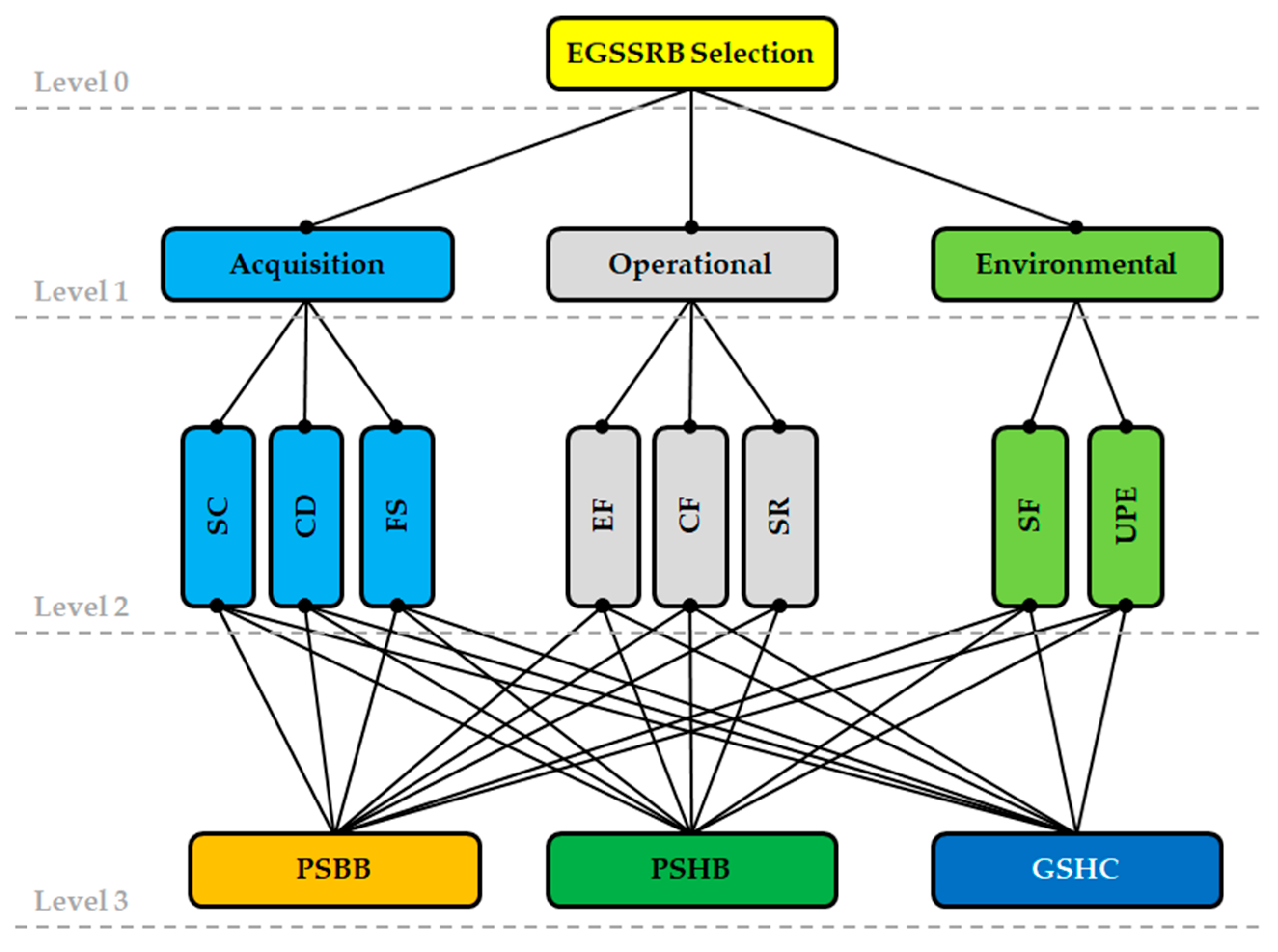
The hierarchy model consists of four levels: (i) goal level; (ii) criteria level, such as acquisition, operational, and environmental; (iii) sub-criteria level, including system cost (SC), commercial deployment (CD), fail-safety (FS), efficiency (EF), power rating (PWR), system’s reliability (SR), operating emissions (UPE), and system installation space requirements (SF); and (iv) potential alternatives (EGSSRB configurations). The decision-making framework used in this study is illustrated in Figure 8.

3.4. Phase 4: Pairwise Comparisons

At the fourth step, it is necessary to build the comparison decision matrices (CDMs) to make comparisons between pairs of elements in each level concerning the preceding level. Each component of a CDM is created by comparing one element with another at the same level using the normalized scale developed by Saaty [52]. This method employs a ratio scale ranging from 1 to 9, presented in Table 4. Within this scale, under a given control node, a value of 1 signifies equal importance between two nodes, whereas a value of 9 reflects an extreme preference for the control node over the other one.
The results obtained for the KPIs are normalized into the 1–9 AHP scale using Equation (8), where xn is the value of the x normalized, and x is a KPI with values in xmin to xmax range.
x n = 1 + 8 · x x m i n x m a x x m i n
In FAHP, conventional pairwise comparison matrices are substituted with fuzzy matrices. The pairwise comparisons are performed within a matrix framework utilizing Triangular Fuzzy Numbers (TFNs) to assess and rank the alternatives. A fuzzy number is typically represented as a triplet: x ~   = (l, m, u). The parameters l, m, and u denote the smallest possible value, the most likely value, and the upper potential value, respectively. A range of TFNs can be applied depending on the specific needs and contexts of the analysis. The TFN scale commonly used in MCDM analysis is presented in Table 5.

3.4.1. Create Comparison Matrix

Several CDMs were developed for each hierarchical level. In this sense, there is one CDM at level 1 comparing the selection criteria with the objective, three CDMs at level 2 comparing each criterion with their KPIs, and finally eight CDMs evaluating each alternative with respect to the KPIs. Each element x ~ i j of a CDM M ~ (Equation (9)) denotes the comparison between the control node i with respect to the node j at the same level. Therefore, x ~ i j represents the relative importance between the E1 element on the row and the E2 element on the column. Each x ~ i j is a triplet (lij, mij, uij) according to Table 5. Obviously, when the control node compares itself, the result is (1, 1, 1). Then all the diagonal elements of the CDM will be composed of ones.
M ~ = x ~ i j x ~ 1 n x ~ n 1 x ~ n n

3.4.2. Consistency of the Comparison Matrix

For every CDM, two key components are calculated: the corresponding weight vector and the consistency ratio of the matrix (CR). The latter serves as a measure of the coherence of the pairwise comparisons. The computation of the CR of each CDM is obtained from Equation (10), where CI is the consistency index and RI is a random index obtained from Table 6 as a function of the CDM size n.
C R = C I R I
For estimating the CI, it is necessary to defuzzify x ~ i j components and obtain a crisp comparison matrix M, where its components xij are calculated using Equation (11).
x i j = l i j + 4 · m i j + u i j 6
The priority vectors (W) are obtained using Equation (12). This vector is the normalized principal eigen vector, and it is a row-averaged value of a normalized column of matrix M.
w i = j = 1 n x i j k = 1 n x k i n
Once the priority vectors (W) are determined, the weighted sum criteria matrix T can be calculated using Equation (13).
T = M × W
Finally, the maximum eigenvalue λmax is calculated from Equation (14). The CI can be determined in Equation (15).
λ m a x = i = 1 n t i w i n
C I = λ m a x n n 1
A CR below 10% is generally interpreted as an indication that the judgments in the matrix are consistent.

3.5. Phase 5: Priority Weight Derivation

Fuzzy weight vector ( W ~ ) is calculated using arithmetic operations defined in Equation (16) according to Equation (17) for fuzzy numbers from the geometric mean vector R ~ obtained from the fuzzy comparison matrix M ~ in Equation (18).
r 1 ~ r 2 ~ = r _ l 1 + r _ l 2 , r _ m 1 + r _ m 2 ,   r _ u 1 + r _ u 2 r 1 ~ r 2 ~ = r _ l 1 · r _ l 2 , r _ m 1 · r _ m 2 ,   r _ u 1 · r _ u 2
w ~ i = w _ l i , w _ m i ,   w _ u i = r i ~   ( r 1 ~   r 2 ~       r n ~ ) 1
r i ~ = r _ l i , r _ m i ,   r _ u i = j = 1 n x i j 1 n
Afterwards, the defuzzy weight vector ( W ¯ ) operation is defined in Equation (19) and normalized in Equation (20).
w i ¯ = w _ l i + w _ m i + w _ u i 3
w n i ¯ = w i ¯ i = 1 n w i ¯

3.6. Phase 6: Overall Score Computation

These computed weights are then used to rank the alternatives based on their aggregated performance scores. The overall score for a determined alternative is computed in the final decision matrix (FDM) as the sum of the products of the priorities at each level of the hierarchy model according to Equation (21), where Sa is the overall score of the alternative a with respect to the objective and w n ¯ is the normalized priority vector for each level l and criteria r.
S a = r = 1 n l = 1 3 w n l r ¯

3.7. Phase 7: Sensitivity Analysis

Even though FAHP considers uncertainty using fuzzy numbers, the values of these fuzzy numbers are usually based on expert judgment, which can substantially affect the decision outcomes. Conducting sensitivity analysis allows for examining how reliable the resulting rankings remain when these inputs are varied.
The sensitivity analysis was performed by varying the weights of the criteria (level 1). In this process, the weights of the KPIs are fixed, and the weights of the rest of the criteria, different from the changing critera, are adjusted proportionally to satisfy the constraint that the sum of the weights of the criteria equals one. Each criterion variation generates a new scenario, and combining with the specific performance of each alternative, the overall rankings are generated. According to the sensitivity analysis outputs, it is possible to check variations in the overall ranking due to the weight changes and make the final decisions.

4. Results

4.1. Evaluation of EGSSRB Configurations

The evaluation of each EGSSRB configuration based on the KPIs is summarized in Table 7. The evaluation of the specific KPIs of the EGSSRB components is available in Appendix A.
Table 8 presents the evaluations of the alternatives, normalized using Equation (8), which serves as a reference for constructing the pairwise comparison matrix between criteria. Detailed calculations for the pairwise comparison matrix are provided in Appendix B.

4.2. AHP Analysis

The study was conducted under the hypothesis that the acquisition criteria are more important than operational criteria, and the least influential criterion is the environmental one. However, it analyzed the influence of the importance of the KPIs in the decision process, generating three different cases of study:
  • Case A. It has been considered that the most important sub-criteria are the fail-safety, the system’s reliability, and the use phase emissions.
  • Case B. In this case, system cost, efficiency, and use phase emissions are the most influential sub-criteria.
  • Case C. Finally, this case considers that commercial deployment, capacity factor, and system footprint are the most relevant sub-criteria.
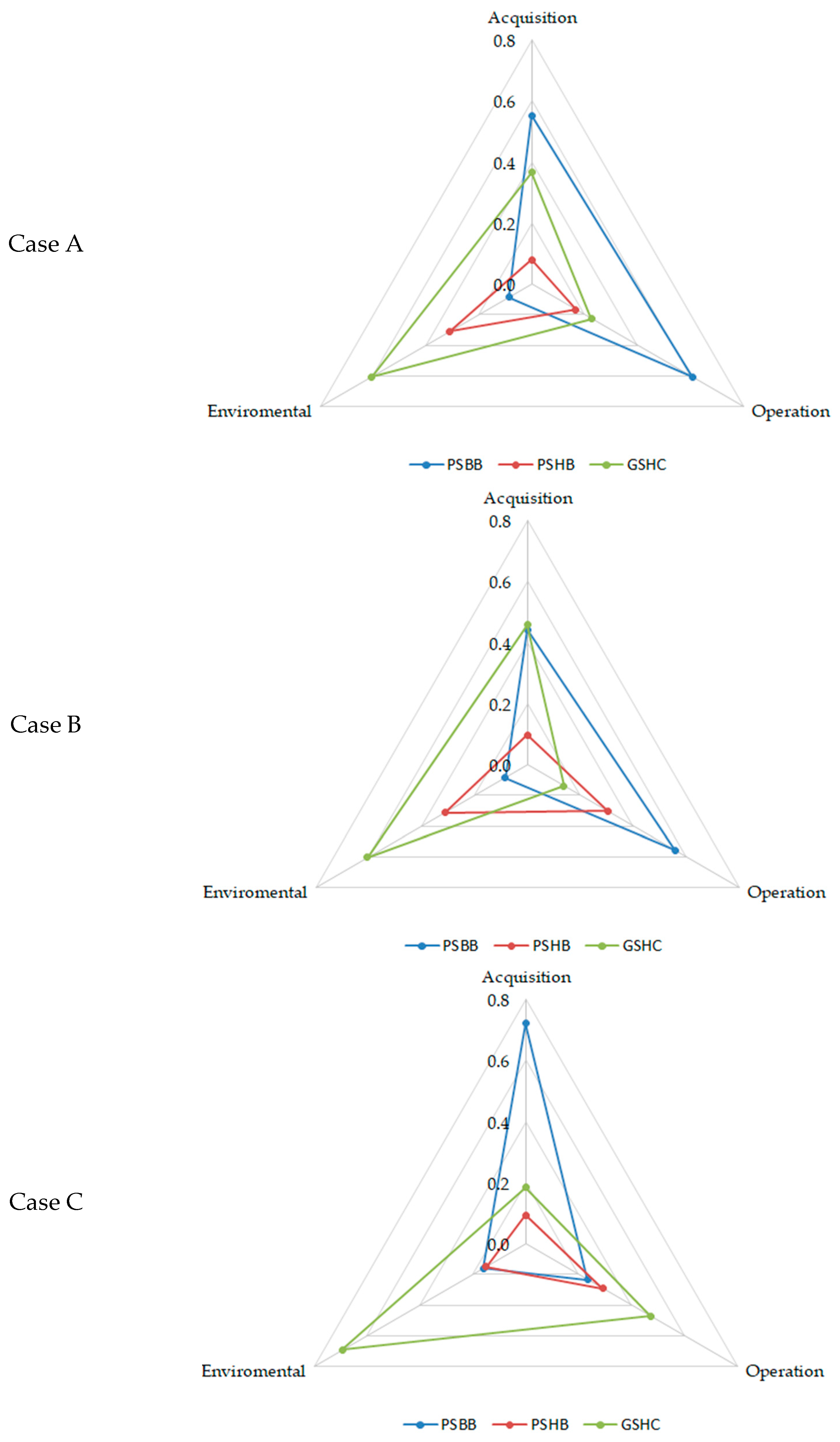
Figure 9 shows the criteria weight results obtained for the different analysis scenarios. The graphs illustrate how each system is scored according to the selection criteria: acquisition, operational, and environmental. The PSBB system scores highly in operation and acquisition criteria in cases A and B, but it is ranked lower in case C in terms of operational and environmental criteria due to its greater dependence on the power grid and the space required for its installation. The GSHC system works correctly in all scenarios and for every criterion, especially the environmental one, but it is penalized in case B in the operational criterion due to its lower efficiency. Nevertheless, the PSHB system stands out in the environmental criteria in cases A and B, while it performs well for case C in the operating criterion because it is highly independent from the power grid.
Table 9 summarizes the decision matrix results in cases A, B, and C, respectively, for the selection of the most suitable EGSSRB system. The final ranking of each system is placed in parentheses. Detailed decision matrix results are available in Appendix B.
The results point out the advantages of the PSBB and GSHC system options versus the PSHB, particularly in cases A and C. The PSBB system is the best option when considering commercial deployment, fail-safety, reliability, efficiency, and system cost performance indicators. However, the GSHC system highlights when emissions, system cost, installation footprint, and capacity factor performance indicators are important for the end-user. Nevertheless, the PSHB system has poor results, except in case B, due to its good efficiency and capacity factor.

4.3. Sensitivity Analysis

The conducted analysis demonstrated that modifications in the decision-maker preference weights could influence the resulting rankings, with different alternatives attaining the highest priority depending on the scenario considered. This variability highlights the capacity of the method to facilitate the selection of an installation configuration that is optimally aligned with the stakeholders’ strategic and investment objectives.
For assessing the impact of changes in the criterion priority, the weights of the criteria in the base case are modified until all the criteria have the same weight. These variations lead to different scenarios.
Table 10 summarizes the weights used in each scenario. Detailed results of the sensitivity analysis are available in Appendix C.
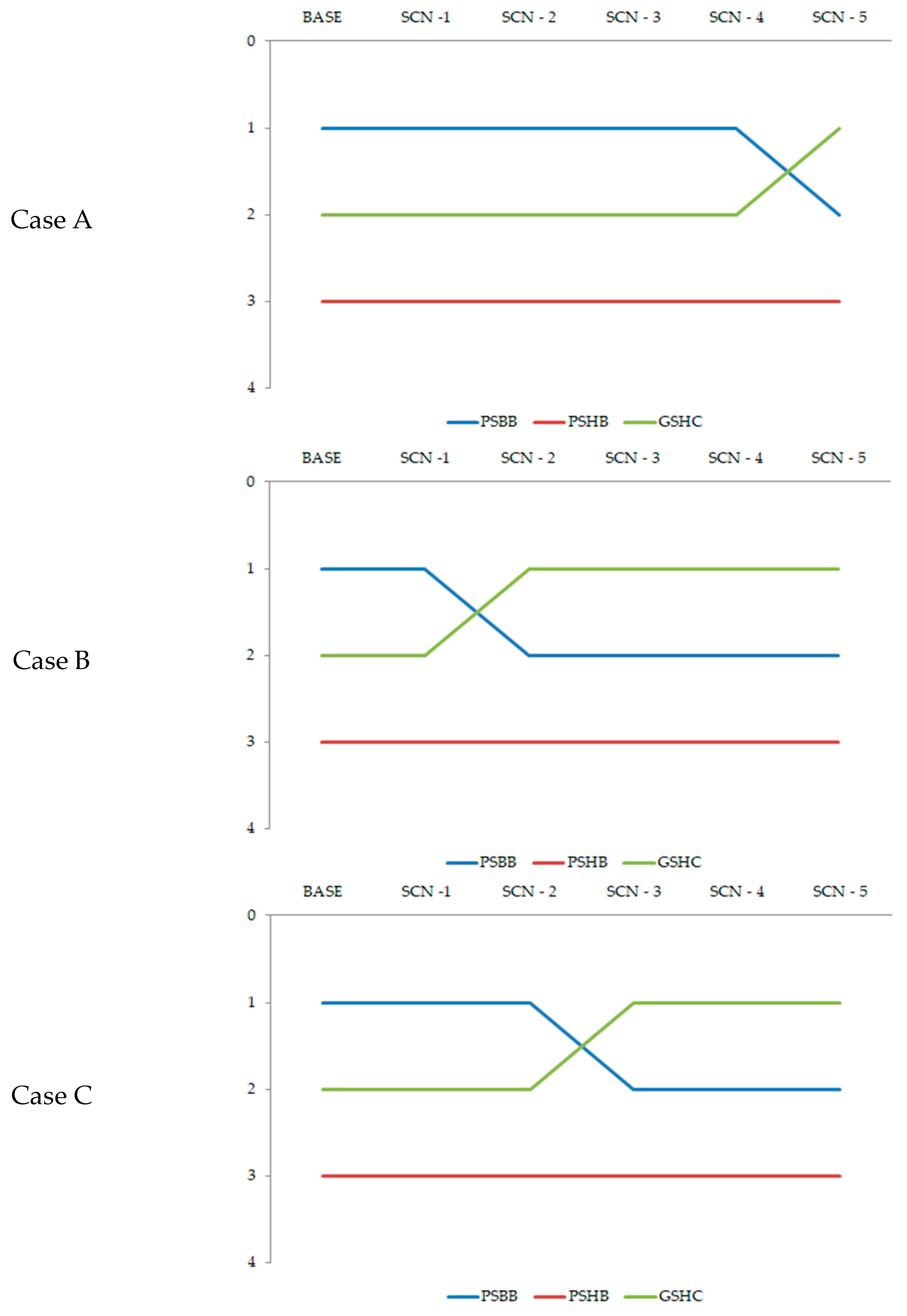
The influence of variations in the weighting of individual criteria on the final ranking of the evaluated alternatives is illustrated graphically. Figure 10 depicts the sensitivity analysis performed to assess the effect of adjustments in the decision-maker’s primary criteria.
In all cases, the PSBB system remains the best option in most scenarios, and the GSHC system obtains an outstanding result. Nevertheless, in case A, the GSHC system becomes the best option in scenario 5 due to the advantage in use phase emissions. Similar behavior is shown in case B, but in scenario 2. However, in case C, the PSBB system is the preferred option until the weight assigned to the acquisition criterion decreases slightly (scenario 3). At that stage, the GSHC system becomes the preferred option due to the reduced system footprint.
The results obtained in the sensitivity analysis for case B lead to considering what would happen if the costs associated with the GSHC system decrease. To study this effect, the authors selected a price of hydrogen of EUR 4/kg. Under these conditions, the cost of the GSHC system is reduced to EUR 0.63/kWh, while the cost associated with the PSBB system is EUR 1.20/kWh. However, this reduction in cost has a limited effect on the final ranking obtained (see Table 11), but the score obtained by the GSHC system improves in all cases, particularly in case B, eliminating the advantage of the PSBB system.

5. Discussion

Applying the AHP approach to the selection of renewable energy technologies for hybrid power generation systems with energy storage is not new. However, most of the focus is on large-scale facilities [53,54,63,64,65] based on solar and wind energy, and only some propose their application to residential buildings [56,66] and do not consider the use of green hydrogen.
Therefore, this study applied FAHP analysis on hybrid EGSSRB systems for residential buildings that consider the use of hydrogen obtained from renewable sources. Based on the analysis conducted, this study demonstrates that the selection criteria chosen (operational, acquisition, and environmental) and the performance indicators used to characterize them define the end-user preferences.
The selection of the most suitable EGSSRB systems is dependent on the final application and the user requirements. It is for this reason that, even though the weights assigned to the selection criteria vary, the performance of the systems for residential use determines the selection of a specific system.
In this regard, the PSBB system highlights most of the acquisition and operational performance indicators, such as system cost, commercial deployment, fail-safety, efficiency, and the system’s reliability. However, hydrogen-based systems are weighed down by these indicators, but they feature prominently in system footprint, use phase emissions, and capacity factor. In particular, the GSHC system has reasonable performance in system cost, fail-safety, and system reliability, achieving a compromise between environmental, acquisition, and operation criteria.
Nevertheless, this result does not imply that the technical dimension of the EGSSRB system selection can be disregarded. As with any technology, technical considerations remain an integral part of the evaluation process. In relation to economic criteria, the technical factors appear comparatively less decisive, since with adequate financial resources, any technical solution can be implemented. Thus, irrespective of the technical aspects, the chosen EGSSRB system must be justified in terms of investment cost, operation, and maintenance expenses.
Combined heat and power hybrid EGSSRB systems based on fuel cell technology, especially the GSHC option proposed by the authors, could play an important role in residential applications with mid-to-high heat demand, limited space available, and green hydrogen supply at a reasonable cost (below EUR 10/kgH2) as has been pointed out by previous studies [21,45,48,51,67,68]. This solution would reduce demand for electricity from the grid, relieving congestion in the electrical system and ensuring security of supply in the progressive transition to renewable energy sources [33,69,70,71]. In addition, integrating PV arrays with hydrogen storage and smaller battery packs notably increases operational performance.

6. Conclusions

This study has outlined a methodology for EGSSRB system selection for residential applications, considering the evaluation of the end-user selection criteria using a FAHP multi-criteria decision support method.
The method has been used for the evaluation of different EGSSRB system configurations based on renewable energy resources, designed to support the energy demand of Spanish households situated in a residential building. It is shown that the developed tool based on the FAHP methodology is an effective tool for selecting EGSSRB systems with different configurations and features. The results obtained in a score list of configurations allow for the selection of a solution that better suits the decision-maker’s preferences.
The findings of this study, considering the acquisition criteria as the most influential, reveal that the PSBB system is the best option. However, if the importance of all the criteria is equivalent, the GSHC configuration becomes the most suitable option. The selection of hydrogen-based EGSSRB systems is ultimately weighted by fail-safety, commercial deployment, system reliability, and efficiency sub-criteria. However, the GSHC system achieved good performance in scenarios where acquisition, operational, and environmental criteria have the same importance. This configuration may be of particular interest within the European Union framework, where the reduction in emissions and the maximization of energy demand coverage using renewable energy sources are priority objectives. Additionally, the GSHC solution fits well in the urban environment where the space resources are scarce.
Nevertheless, the integration of green hydrogen into building energy systems involves multiple technical challenges, including the efficiency of electrolyzers and fuel cells. It also involves the adoption of advanced storage technologies, the establishment of suitable infrastructure for hydrogen distribution, and the creation of regulatory frameworks that ensure safety and compatibility within existing energy systems.
It should be noted that the analysis was conducted on a small number of EGSSRB system configurations, and these configurations were implemented with specific components to provide a solution to a generic case. Therefore, depending on the case requirements, the EGSSRB configuration should change, including its components. Consequently, the evaluation of the performance indicators should change, which could have a significant influence on the final ranking result. This is a challenge when using the proposed FAHP methodology.
This study contributes to the body of knowledge by establishing a hierarchy of criteria and sub-criteria for supporting final decision-making in ongoing EGSSRB investments by integrating technical, economic, and environmental end-user requirements for residential buildings, assessing benefits and potential drawbacks.

Author Contributions

Conceptualization, R.Á.F.; methodology, R.Á.F. and O.C.C.; software, O.C.C.; validation, R.Á.F. and O.C.C.; writing—original draft preparation, O.C.C.; writing—review and editing, R.Á.F. All authors have read and agreed to the published version of the manuscript.

Funding

This research received no external funding.

Data Availability Statement

The original contributions presented in this study are included in the article. Further inquiries can be directed to the corresponding author.

Conflicts of Interest

The authors declare no conflicts of interest.

Abbreviations

The following abbreviations are used in this manuscript:
AFCAlkaline Fuel Cell
AHPAnalytical Hierarchy Process
CDCommercial Deployment
CDMComparison Decision Matrix
CHPCombined Heat and Power systems
CIConsistency Index
CRConsistency Ratio
EFGlobal Efficiency
EGSSRBEnergy Generation and Storage System for Residential Buildings
EMSEnergy Management System
FAHPFuzzy Analytical Hierarchy Process
FDMFinal Decision Matrix
FSFail-safety
GSHCGrid-Based System with Renewable Hydrogen Contribution
KPIKey Performance Indicators
LCOELevelized Cost of Energy
LCOSLevelized Cost of Storage
LHWLower Heating Value
MCDMMulti-criteria Decision-making Method
PEMFCProton Exchange Membrane Fuel Cell
PSHPeak Sun Hour
PSHBPhotovoltaic System with Hydrogen Storage Backup
PSBBPhotovoltaic System with Battery Backup
PVPhotovoltaic panels
PWRPower Rating
SCSystem Cost
SFSystem Footprint
SESSStationary Energy Storage Systems
SMRSteam Methane Reforming
SOFCSolid Oxide Fuel Cell
SRSystem’s Reliability
STCSolar Thermal Collectors
TFNTriangular Fuzzy Numbers
TRLTechnology Readiness Levels
UPEUse Phase Emissions
V2GVehicle-to-Grid technology

Appendix A

The following tables show the information used in the evaluation of the specific KPIs for the EGSSRB components.
Table A1. Economic, technical, and environmental characteristics of a solar panel (PV).
ParameterUnitsValueConsiderationsRef.
Investment costEUR/household2730Considering six solar panels per household[34,71]
Maintenance costEUR/household27.31% of the investment costOwn
assumption
Electric efficiency%20.7Standard panel dimensions 1.69 m × 1 m (length × width) and 1000 W/m2 of incident solar power
(standard solar irradiance)
Own
calculation
Peak powerkWp0.35Peak power output per panelOwn
assumption
Rated energy outputkWh1.60Rated energy output per panel PSH ratio is between 2.5 to 8Own
calculation
System
lifespan
year20 [34,71]
System
reliability
unitless0.94 Own
calculation
Space
requirements
m2/household11.2Standard panel dimensions 1.69 m × 1 m (length × width), optimum inclination angle of 40 degrees and minimum solar irradiation angle to the horizontal of 23.5 degreesOwn
calculation
Table A2. Economic, technical, and environmental characteristics of the battery pack in the PSBB system.
ParameterUnitsValueConsiderationsRef.
Investment costEUR/household10,47625 kWh of net usable capacityOwn
calculation
Maintenance costEUR/household104.761% of the investment cost[71]
Electric
efficiency
%95Charge and discharge cycles[34]
Peak powerkWp17.5C-rate of 0.5 COwn
calculation
Rated energy outputkWh25 Own
calculation
System
lifespan
year16Considering 6000 cycles of service life and one cycle per day [34,50]
System
reliability
unitless0.73 Own
calculation
Space
requirements
m2/household0.49Floor-standing cabinet
(modular stacks)
0.3–0.4 m2 per 25 kWh
(gross capacity)
Own
calculation
Table A3. Economic, technical, and environmental characteristics of the fuel cell in the GSHC system.
ParameterUnitsValueConsiderationsRef.
Investment costEUR/household9400Fuel cell power output of 2.9 kW, considering that fuel cell stacks operate more efficiently at partial loads (25%), leading to higher overall electrical efficiency[34,49,51,70,71]
Maintenance costEUR/household93.71% of the investment costOwn
calculation
Electric
efficiency
%50 [34,49,51,70,71]
Thermal efficiency %40 [34,49,51,70,71]
Peak powerkWp2.9Considering a peak electricity demand of 16 kWh per day and partial load (25%) operationOwn
calculation
Rated
energy
output
kWh0.7Considering 22 operating hours per dayOwn
calculation
System
lifespan
year12 [46,71]
System
reliability
unitless0.31 Own
calculation
Space
requirements
m2/household0.4 Own
assumption
Table A4. Economic, technical, and environmental characteristics of the fuel cell in the PSHB system.
ParameterUnitsValueConsiderationsRef.
Investment costEUR/household2345 Own
calculation
Maintenance costEUR/household3501% of the investment costOwn
calculation
Electric
efficiency
%50 [34,49,51,70,71]
Thermal efficiency %40 [34,49,51,70,71]
Peak powerkWp0.3Considering a peak electricity demand of 1.8 kWh per day and partial load (25%) operationOwn
calculation
Rated
energy
output
kWh0.08Considering 22 operating hours per dayOwn
calculation
System
lifespan
year12 [46,71]
System
reliability
unitless0.31 Own
calculation
Space
requirements
m2/household0.19 Own
assumption
Table A5. Economic, technical, and environmental characteristics of the electrolyzer in the PSHB system.
ParameterUnitsValueCommentsRef.
Investment costEUR/household6600 [49,71]
Maintenance costEUR/household665% of the investment costOwn
calculation
Electric efficiency%75 [51,71]
Thermal efficiency %15 [71]
Peak powerkW0.8Considering a peak production of 0.17 kgH2 per day.Own
calculation
Rated energy outputkWh9.2
0.24
Considering 7 operating hours per dayOwn
calculation
System
lifespan
year15 [71]
System
reliability
unitless0.64 Own
calculation
Space
requirements
m2/household1.0 Own
calculation
Table A6. Economic, technical, and environmental characteristics for the compressed hydrogen storage.
ParameterUnitsValueCommentsRef.
Investment costEUR/household12,10020 kg of hydrogen tank capacity (20 MPa) [50,71]
Maintenance costEUR/household1211% of the investment costOwn
assumption
System
lifespan
year25 [71]
System
reliability
unitless1.00 Own
calculation
Space
requirements
m2/household1.03Compressed gas cylinders at 200 bar and 298 K have a nominal volume of 250 LOwn
calculation
Table A7. Economic, technical, and environmental characteristics of the hydrogen compressor.
ParameterUnitsValueCommentsRef.
Investment costEUR/household8500Hydrogen compressor of 0.5 Nm3/h @ 200 barOwn
assumption
Maintenance costEUR/household3404% of the investment costOwn
assumption
Electric
efficiency
%85 Own
assumption
System
lifespan
year20 [71]
System
reliability
unitless0.94 Own
calculation
Space requirementsm2/household0.5 Own
calculation
Table A8. Economic, technical, and environmental characteristics of the power converter.
ParameterUnitsValueCommentsRef.
Investment costEUR/household7056 Own
assumption
Maintenance costEUR/household105.81.5% of the investment costOwn
assumption
Electric
efficiency
%95 Own
assumption
Peak powerkWp16.4 Own
calculation
System
lifespan
year10 Own
assumption
System reliabilityunitless0.11 Own
calculation
Space requirementsm2/household0.67 Own
calculation
Table A9. Economic, technical, and environmental characteristics of the heat accumulator with an electric water heater.
ParameterUnitsValueCommentsRef.
Investment costEUR/household210Estimated
capacity of 100 L
Own
calculation
Maintenance costEUR/household60 Own
assumption
Electric
efficiency
%98 [71]
Thermal efficiency%90Usual range of values 85–95%Own
assumption
Peak powerkWp1.5 Own
assumption
System
lifespan
year20 [34,71]
System
reliability
unitless0.88 Own
calculation
Space
requirements
m2/household0.20 Own
calculation

Appendix B

This appendix compiles the calculations related to the Fuzzy AHP analysis.
Table A10. Case A: decision matrix and rank of EGSSRB systems.
Alternatives
Criteria Sub-CriteriaNormalized WiPSBBPSHBGSHC
Acquisition 0.520.5530.0800.367
System Cost 0.230.3590.1080.533
Commercial
Deployment
0.070.8000.1000.100
Fail-safety 0.700.5900.0690.341
Operation 0.310.6080.1670.225
Global
Efficiency
0.230.5720.3690.060
Capacity Factor0.070.0600.3500.589
System’s
Reliability
0.700.6750.0840.242
Environmental 0.170.0850.3100.605
Use Phase
Emissions
0.820.0640.3560.580
System
Footprint
0.180.1830.0960.721
0.4890.1470.365
Rank132
Table A11. Case B: decision matrix and rank of EGSSRB systems.
Alternatives
Criteria Sub-CriteriaNormalized WiPSBBPSHBGSHC
Acquisition 0.520.4420.0990.459
System Cost 0.700.3590.1080.533
Commercial
Deployment
0.070.8000.1000.100
Fail-safety 0.230.5900.0690.341
Operation 0.310.5590.3030.138
Global Efficiency 0.700.5720.3690.060
Capacity Factor0.070.0600.3500.589
System’s
Reliability
0.230.6750.0840.242
Environmental 0.170.0840.3120.604
Use Phase
Emissions
0.830.0640.3560.580
System
Footprint
0.170.1830.0960.721
0.4160.1990.385
Rank132
Table A12. Case C: decision matrix and rank of EGSSRB systems.
Alternatives
Criteria Sub-CriteriaNormalized WiPSBBPSHBGSHC
Acquisition 0.520.7340.0950.171
System Cost 0.070.5430.1230.334
Commercial
Deployment
0.700.8000.1000.100
Fail-safety 0.230.5900.0690.341
Operation 0.310.2350.2920.473
Global Efficiency 0.070.5720.3690.060
Capacity Factor0.700.0600.3500.589
System’s
Reliability
0.230.6750.0840.242
Environmental 0.170.1580.1890.653
Use Phase
Emissions
0.200.0600.5520.388
System
Footprint
0.800.1830.0960.721
0.4810.1720.348
Rank132

Appendix C

This appendix compiles the calculations related to the sensitivity analysis.
Table A13. Case A: ranking sensitivity analysis of EGSSRB systems.
Weights
CriteriaBASESCN–1SCN–2SCN–3SCN–4SCN–5
Acquisition0.520.470.420.380.330.28
Operation0.310.320.320.330.340.35
Environmental0.170.210.250.290.330.37
Alternatives
PSBB0.4890.4710.4530.4350.4170.399
PSHB0.1470.1560.1660.1760.1850.195
GSHC0.3650.3730.3810.3890.3970.406
Rank
PSBB111112
PSHB333333
GSHC222221
Table A14. Case B: ranking sensitivity analysis of EGSSRB systems.
Weights
CriteriaBASESCN–1SCN–2SCN–3SCN–4SCN–5
Acquisition0.520.470.420.380.330.28
Operation0.310.320.320.330.340.35
Environmental0.170.210.250.290.330.37
Alternatives
PSBB0.4160.4030.3900.3770.3640.350
PSHB0.1990.2090.2190.2290.2390.249
GSHC0.3850.3880.3910.3950.3980.401
Rank
PSBB112222
PSHB333333
GSHC221111
Table A15. Case C: ranking sensitivity analysis of EGSSRB systems.
Weights
CriteriaBASESCN–1SCN–2SCN–3SCN–4SCN–5
Acquisition0.520.470.420.380.330.28
Operation0.310.320.320.330.340.35
Environmental0.170.210.250.290.330.37
Alternatives
PSBB0.4740.4480.4220.3960.3700.344
PSHB0.1640.1680.1720.1760.1790.183
GSHC0.3620.3840.4060.4280.4500.473
Rank
PSBB111222
PSHB333333
GSHC222111

References

  1. Eurostat. Energy Consumption in Households; Eurostat: Luxembourg, 2025.
  2. Fernández, R.A. Stochastic Analysis of Future Scenarios for Battery Electric Vehicle Deployment and the Upgrade of the Electricity Generation System in Spain. J. Clean. Prod. 2021, 316, 128101. [Google Scholar] [CrossRef]
  3. Dixon, J.; Bukhsh, W.; Bell, K.; Brand, C. Vehicle to Grid: Driver Plug-in Patterns, Their Impact on the Cost and Carbon of Charging, and Implications for System Flexibility. eTransportation 2022, 13, 100180. [Google Scholar] [CrossRef]
  4. European Parliament. Directive 2010/31/EU of the European Parliament and of the Council of 19 May 2010 on the Energy Performance of Buildings (Recast); European Union: Brussels, Belgium, 2010. [Google Scholar]
  5. BOE. Ley 7/2021, de 20 de Mayo, de Cambio Climático y Transición Energética; Boletín Oficial del Estado (BOE): Madrid, Spain, 2021; Volume 121, pp. 62009–62052.
  6. Morgado, H.; Erbach, G. Spain’s Climate Action Strategy; European Parliamentary Research Service: Luxembourg, 2024.
  7. Vieira, F.M.; Moura, P.S.; de Almeida, A.T. Energy Storage System for Self-Consumption of Photovoltaic Energy in Residential Zero Energy Buildings. Renew. Energy 2017, 103, 308–320. [Google Scholar] [CrossRef]
  8. Ali Yildirim, M.; Bartyzel, F.; Vallati, A.; Woźniak, M.K.; Ocłoń, P. Efficient Energy Storage in Residential Buildings Integrated with RESHeat System. Appl. Energy 2023, 335, 120752. [Google Scholar] [CrossRef]
  9. Maka, A.O.M.; Chaudhary, T.N. Performance Investigation of Solar Photovoltaic Systems Integrated with Battery Energy Storage. J. Energy Storage 2024, 84, 110784. [Google Scholar] [CrossRef]
  10. Ul Hassan, M.; Bremner, S.; Menictas, C.; Kay, M. Assessment of Hydrogen and Lithium-Ion Batteries in Rooftop Solar PV Systems. J. Energy Storage 2024, 86, 111182. [Google Scholar] [CrossRef]
  11. Abdolmaleki, L.; Berardi, U. Hybrid Solar Energy Systems with Hydrogen and Electrical Energy Storage for a Single House and a Midrise Apartment in North America. Int. J. Hydrogen Energy 2024, 52, 1381–1394. [Google Scholar] [CrossRef]
  12. Babatunde, O.M.; Munda, J.L.; Hamam, Y. Hybridized Off-Grid Fuel Cell/Wind/Solar PV /Battery for Energy Generation in a Small Household: A Multi-Criteria Perspective. Int. J. Hydrogen Energy 2022, 47, 6437–6452. [Google Scholar] [CrossRef]
  13. Soyturk, G.; Kizilkan, O.; Ezan, M.A.; Colpan, C.O. Design, Modeling, and Analysis of a PV/T and PEM Fuel Cell Based Hybrid Energy System for an off-Grid House. Int. J. Hydrogen Energy 2024, 67, 1181–1193. [Google Scholar] [CrossRef]
  14. Ceylan, C.; Devrim, Y. Green Hydrogen Based Off-Grid and on-Grid Hybrid Energy Systems. Int. J. Hydrogen Energy 2023, 48, 39084–39096. [Google Scholar] [CrossRef]
  15. Naumann, G.; Schropp, E.; Steegmann, N.; Möller, M.C.; Gaderer, M. Environmental Performance of a Hybrid Solar-Hydrogen Energy System for Buildings. Int. J. Hydrogen Energy 2024, 49, 1185–1199. [Google Scholar] [CrossRef]
  16. Rahdan, P.; Zeyen, E.; Gallego-Castillo, C.; Victoria, M. Distributed Photovoltaics Provides Key Benefits for a Highly Renewable European Energy System. Appl. Energy 2024, 360, 122721. [Google Scholar] [CrossRef]
  17. Pytel, K.; Hudy, W.; Filipek, R.; Piaskowska-Silarska, M.; Depešová, J.; Sito, R.; Janiszewska, E.; Sieradzka, I.; Sulkowski, K. Evaluation of Environmental Factors Influencing Photovoltaic System Efficiency Under Real-World Conditions. Energies 2025, 18, 2113. [Google Scholar] [CrossRef]
  18. Sepúlveda-Oviedo, E.H. A Review of Operational Factors Affecting Photovoltaic System Performance. Energy Convers. Manag. X 2025, 26, 100942. [Google Scholar] [CrossRef]
  19. Sancho, J.; Riesco, J.; Jiménez, C. Atlas de Radiación Solar En España Utilizando Datos Del SAF de Clima de EUMETSAT; Agencia Estatal de Meteorología: Madrid, Spain, 2014.
  20. ADRASE. Acceso a Datos de Radiación Solar En España. Available online: http://www.adrase.es/acceso-a-los-mapas/mapa-zona-peninsula.html (accessed on 21 October 2025).
  21. Kalogirou, S.A. Solar Thermal Collectors and Applications; Elsevier: Amsterdam, The Netherlands, 2004; Volume 30, ISBN 3572240646. [Google Scholar]
  22. Ayompe, L.M.; Duffy, A. Analysis of the Thermal Performance of a Solar Water Heating System with Flat Plate Collectors in a Temperate Climate. Appl. Therm. Eng. 2013, 58, 447–454. [Google Scholar] [CrossRef]
  23. Dhilipan, J.; Vijayalakshmi, N.; Shanmugam, D.B.; Jai Ganesh, R.; Kodeeswaran, S.; Muralidharan, S. Performance and Efficiency of Different Types of Solar Cell Material—A Review. Mater. Today Proc. 2022, 66, 1295–1302. [Google Scholar] [CrossRef]
  24. Benghanem, M.; Haddad, S.; Alzahrani, A.; Mellit, A.; Almohamadi, H.; Khushaim, M.; Aida, M.S. Evaluation of the Performance of Polycrystalline and Monocrystalline PV Technologies in a Hot and Arid Region: An Experimental Analysis. Sustainability 2023, 15, 14831. [Google Scholar] [CrossRef]
  25. Thomas, L.V.; Schmidt, O.; Gambhir, A.; Few, S.; Staffell, I. Comparative Life Cycle Assessment of Lithium-Ion Battery Chemistries for Residential Storage. J. Energy Storage 2020, 28, 101230. [Google Scholar] [CrossRef]
  26. Niu, H.; Zhang, N.; Lu, Y.; Zhang, Z.; Li, M.; Liu, J.; Song, W.; Zhao, Y.; Miao, Z. Strategies toward the Development of High-Energy-Density Lithium Batteries. J. Energy Storage 2024, 88, 111666. [Google Scholar] [CrossRef]
  27. Khan, F.M.N.U.; Rasul, M.G.; Sayem, A.S.M.; Mandal, N. Maximizing Energy Density of Lithium-Ion Batteries for Electric Vehicles: A Critical Review. Energy Rep. 2023, 9, 11–21. [Google Scholar] [CrossRef]
  28. Ma, S.; Jiang, M.; Tao, P.; Song, C.; Wu, J.; Wang, J.; Deng, T.; Shang, W. Temperature Effect and Thermal Impact in Lithium-Ion Batteries: A Review. Prog. Nat. Sci. Mater. Int. 2018, 28, 653–666. [Google Scholar] [CrossRef]
  29. Álvarez Fernández, R.; Castillo Campo, O. A Method Based on Circular Economy to Improve the Economic Performance of Second-Life Batteries. Sustainability 2025, 17, 1765. [Google Scholar] [CrossRef]
  30. Montes, T.; Etxandi-Santolaya, M.; Eichman, J.; Ferreira, V.J.; Trilla, L.; Corchero, C. Procedure for Assessing the Suitability of Battery Second Life Applications after EV First Life. Batteries 2022, 8, 122. [Google Scholar] [CrossRef]
  31. Boonraksa, T.; Pinthurat, W.; Wongdet, P.; Boonraksa, P.; Marungsri, B.; Hredzak, B. Optimal Capacity and Cost Analysis of Hybrid Energy Storage System in Standalone DC Microgrid. IEEE Access 2023, 11, 65496–65506. [Google Scholar] [CrossRef]
  32. Omar, M.A. The Significance of Considering Battery Service-Lifetime for Correctly Sizing Hybrid PV–Diesel Energy Systems. Energies 2024, 17, 103. [Google Scholar] [CrossRef]
  33. Kaleem, A.; Zaman, A.; Rajakaruna, S. Hydrogen at Home: The Current and Future Landscape of Green Hydrogen in Residential Settings. Sustain. Energy Technol. Assess. 2024, 72, 104058. [Google Scholar] [CrossRef]
  34. Knosala, K.; Langenberg, L.; Pflugradt, N.; Stenzel, P.; Kotzur, L.; Stolten, D. The Role of Hydrogen in German Residential Buildings. Energy Build. 2022, 276, 112480. [Google Scholar] [CrossRef]
  35. World Energy Council. Hydrogen Demand and Cost Dynamics; World Energy Council: London, UK, 2021. [Google Scholar]
  36. International Energy Agency. World Energy Outlook 2023; International Energy Agency: Paris, France, 2023.
  37. Decourt, B.; Lajoie, B.; Debarre, R.; Soupa, O. Leading the Energy Transition: Hydrogen-Based Energy Conversion; SBC Energy Institute: Paris, France, 2014. [Google Scholar]
  38. Haines, M.R.; Polman, E.A.; De Laat, J.C. Reduction of CO2 Emissions by Addition of Hydrogen to Natural Gas. In Proceedings of the 7th International Conference on Greenhouse Gas Control Technologies, Vancouver, BC, Canada, 5 September 2005. [Google Scholar]
  39. Shin, H.K.; Ha, S.K. A Review on the Cost Analysis of Hydrogen Gas Storage Tanks for Fuel Cell Vehicles. Energies 2023, 16, 5233. [Google Scholar] [CrossRef]
  40. Kubilay Karayel, G.; Javani, N.; Dincer, I. A Comprehensive Assessment of Energy Storage Options for Green Hydrogen. Energy Convers. Manag. 2023, 291, 117311. [Google Scholar] [CrossRef]
  41. Amos, W. Costs of Storing and Transporting Hydrogen; National Renewable Energy Laboratory: Golden, CO, USA, 1998.
  42. Carbotainer. 200 Bar Cylinder Bundles. Available online: https://www.carbotainer.es/200-bar-cylinder-bundle.php (accessed on 28 July 2025).
  43. Hinnells, M. Combined Heat and Power in Industry and Buildings. Energy Policy 2008, 36, 4522–4526. [Google Scholar] [CrossRef]
  44. Man, S.S.; Lee, W.K.H.; Chan, A.H.S.; Tsang, S.N.H. The Economic and Environmental Evaluations of Combined Heat and Power Systems in Buildings with Different Contexts: A Systematic Review. Appl. Sci. 2023, 13, 3855. [Google Scholar] [CrossRef]
  45. Renau, J.; García, V.; Domenech, L.; Verdejo, P.; Real, A.; Giménez, A.; Sánchez, F.; Lozano, A.; Barreras, F. Novel Use of Green Hydrogen Fuel Cell-Based Combined Heat and Power Systems to Reduce Primary Energy Intake and Greenhouse Emissions in the Building Sector. Sustainability 2021, 13, 1776. [Google Scholar] [CrossRef]
  46. Dodds, P.E.; Staffell, I.; Hawkes, A.D.; Li, F.; Grünewald, P.; McDowall, W.; Ekins, P. Hydrogen and Fuel Cell Technologies for Heating: A Review. Int. J. Hydrogen Energy 2015, 40, 2065–2083. [Google Scholar] [CrossRef]
  47. Haneda, T.; Ono, Y.; Ikegami, T.; Akisawa, A. Technological Assessment of Residential Fuel Cells Using Hydrogen Supply Systems for Fuel Cell Vehicles. Int. J. Hydrogen Energy 2017, 42, 26377–26388. [Google Scholar] [CrossRef]
  48. Ozawa, A.; Kudoh, Y. Performance of Residential Fuel-Cell-Combined Heat and Power Systems for Various Household Types in Japan. Int. J. Hydrogen Energy 2018, 43, 15412–15422. [Google Scholar] [CrossRef]
  49. MacLay, J.D.; Brouwer, J.; Samuelsen, G.S. Experimental Results for Hybrid Energy Storage Systems Coupled to Photovoltaic Generation in Residential Applications. Int. J. Hydrogen Energy 2011, 36, 12130–12140. [Google Scholar] [CrossRef]
  50. Lokar, J.; Virtič, P. The potential for integration of hydrogen for complete energy self-sufficiency in residential buildings with photovoltaic and battery storage systems. Int. J. Hydrogen Energy 2020, 45, 34566–34578. [Google Scholar] [CrossRef]
  51. Gabana, P.; Tinaut, F.V.; Reyes, M.; Domínguez, J.I. Performance Evaluation of a Fuel Cell MCHP System under Different Configurations of Hydrogen Origin and Heat Recovery. Energies 2023, 16, 6420. [Google Scholar] [CrossRef]
  52. Saaty, T.; Vargas, L. Models, Methods, Concepts & Applications of the Analytic Hierarchy Process; Springer: Berlin/Heidelberg, Germany, 2012; ISBN 978-1-4614-3596-9. [Google Scholar]
  53. Hernández-Torres, D.; Urdaneta Urdaneta, A.J.; De Oliveira-De Jesus, P. A Hierarchical Methodology for the Integral Net Energy Design of Small-Scale Hybrid Renewable Energy Systems. Renew. Sustain. Energy Rev. 2015, 52, 100–110. [Google Scholar] [CrossRef]
  54. Alhammadi, H.; Alghailani, M.; Alkhzaimi, N.; Alsuwaidi, D.; Mayyas, A. Multi-Criteria Decision-Making Methods for Selecting the Best Energy Storage Systems in Arid Regions. Energy Rep. 2025, 13, 3575–3592. [Google Scholar] [CrossRef]
  55. Pohekar, S.D.; Ramachandran, M. Application of Multi-Criteria Decision Making to Sustainable Energy Planning—A Review. Renew. Sustain. Energy Rev. 2004, 8, 365–381. [Google Scholar] [CrossRef]
  56. Tomczewski, A.; Mikulski, S.; Szymenderski, J. Application of the Analytic Hierarchy Process Method to Select the Final Solution for Multi-Criteria Optimization of the Structure of a Hybrid Generation System with Energy Storage. Energies 2024, 17, 6435. [Google Scholar] [CrossRef]
  57. Instituto para la Diversificacion y Ahorro de la Energia (IDAE). Análisis Del Consumo Energético Del Sector Residencial En España; Instituto para la Diversificación y Ahorro de la Energía: Madrid, Spain, 2011.
  58. IDAE. Estructura Del Consumo Por Usos En El Año 2023. Available online: https://informesweb.idae.es/consumo-usos-residencial/informe.php (accessed on 12 June 2025).
  59. REE. The Spanish Electricity System; Red Eléctrica de España: Madrid, Spain, 2020. [Google Scholar]
  60. Green Hydrogen Organisation. Green Hydrogen Standard: The Global Standard for Green Hydrogen and Green Hydrogen Derivatives Including Green Ammonia; Green Hydrogen Organisation: Genève, Switzerland, 2023. [Google Scholar]
  61. Smith, R.L. Weibull Regression Models for Reliability Data. Reliab. Eng. Syst. Saf. 1991, 34, 55–76. [Google Scholar] [CrossRef]
  62. Chang, D.Y. Applications of the Extent Analysis Method on Fuzzy AHP. Eur. J. Oper. Res. 1996, 95, 649–655. [Google Scholar] [CrossRef]
  63. Suprova, N.T.; Zidan, R.; Rashid, A.R.M.H. Optimal Site Selection for Solar Farms Using GIS and AHP: A Literature Review. In Proceedings of the International Conference on Industrial & Mechanical Engineering and Operations Management, Dhaka, Bangladesh, 26–27 December 2020. [Google Scholar]
  64. Wang, Y.; Xu, L.; Solangi, Y.A. Strategic Renewable Energy Resources Selection for Pakistan: Based on SWOT-Fuzzy AHP Approach. Sustain. Cities Soc. 2020, 52, 101861. [Google Scholar] [CrossRef]
  65. Zaidi, M.F.A.; Shafie, S.M.; Rahim, M.K.I.A. AHP Analysis on the Criteria and Sub-Criteria for the Selection of Fuel Cell Power Generation in Malaysia. J. Adv. Res. Fluid. Mech. Therm. Sci. 2022, 98, 1–14. [Google Scholar] [CrossRef]
  66. Chai, X.; Zhu, Y.; Qiu, L.; Cao, S. Research on the Problem of Solar Energy Storage System Based on AHP. E3S Web Conf. 2022, 352, 02002. [Google Scholar] [CrossRef]
  67. Acha, S.; Le Brun, N.; Damaskou, M.; Fubara, T.C.; Mulgundmath, V.; Markides, C.N.; Shah, N. Fuel Cells as Combined Heat and Power Systems in Commercial Buildings: A Case Study in the Food-Retail Sector. Energy 2020, 206, 118046. [Google Scholar] [CrossRef]
  68. Napoli, R.; Gandiglio, M.; Lanzini, A.; Santarelli, M. Techno-Economic Analysis of PEMFC and SOFC Micro-CHP Fuel Cell Systems for the Residential Sector. Energy Build. 2015, 103, 131–146. [Google Scholar] [CrossRef]
  69. Das, D.; Chakraborty, I.; Bohre, A.K.; Kumar, P.; Agarwala, R. Sustainable Integration of Green Hydrogen in Renewable Energy Systems for Residential and EV Applications. Int. J. Energy Res. 2024, 2024, 8258624. [Google Scholar] [CrossRef]
  70. Baroutaji, A.; Arjunan, A.; Robinson, J.; Wilberforce, T.; Abdelkareem, M.A.; Olabi, A.G. PEMFC Poly-Generation Systems: Developments, Merits, and Challenges. Sustainability 2021, 13, 11696. [Google Scholar] [CrossRef]
  71. Knosala, K.; Kotzur, L.; Röben, F.T.C.; Stenzel, P.; Blum, L.; Robinius, M.; Stolten, D. Hybrid Hydrogen Home Storage for Decentralized Energy Autonomy. Int. J. Hydrogen Energy 2021, 46, 21748–21763. [Google Scholar] [CrossRef]
Figure 1. Methodology process flow chart.
Energies 18 05863 g001
Figure 2. Dwelling distribution per floor area for residential buildings in Spain.
Energies 18 05863 g002
Figure 3. Distribution of energy consumption by end uses in Spanish homes.
Energies 18 05863 g003
Figure 4. Distribution of monthly energy consumption in Spanish homes.
Energies 18 05863 g004
Figure 5. Photovoltaic System with Battery Backup (PSBB); see Figure 6.
Energies 18 05863 g005
Figure 6. Photovoltaic System with Hydrogen Storage Backup (PSHB).
Energies 18 05863 g006
Figure 7. Grid-Based System with Renewable Hydrogen Contribution (GSHC).
Energies 18 05863 g007
Figure 8. Four-level hierarchy model.
Energies 18 05863 g008
Figure 9. Criteria weight results for each EGSSRB system in the analyzed cases.
Energies 18 05863 g009
Figure 10. Ranking variation in the EGSSRB system for each case, attending to the criteria weight.
Energies 18 05863 g010
Table 1. Variables and their definitions.
VariableDescription
S C i Cost of the system i (PSBB, PSHB, GSHC)
L C O E i j Levelized cost of energy for the component j (solar panel, electrolyzer, fuel cell, hydrogen compressor, heat pump and power converters) in the system i
L C O S i j Levelized cost of storing energy for the component j (battery pack, hydrogen storage and heat accumulator) in the system i
rDiscount rate
TSystem lifetime
EgtUseful energy output per year t
EFiEfficiency of the system i
EctEnergy consumption from an external supplier per year t
EceElectrical energy consumption from the grid
EcH2Green hydrogen consumption from an external supplier
EdHousehold energy demand
C F i Capacity factor of the system i
S R i Reliability of the system i.
C C L i j Characteristic lifespan of the component j in the system i
S L E System life expectancy
βWeibull model shape parameter
U P E i Use phase emissions of system i
EMeEmission factor of the electricity acquired from the grid
EMH2Emission factor of the green hydrogen acquired
SFiFootprint ratio of the system i configuration
S p R e i j Footprint of the component j of the system i
xKPI value
x n Normalized KPI value
x ~ Fuzzy number assigned to a KPI value
l, m, uThe triplet l, m and u denote the smallest possible value, the most likely value, and the upper potential value, respectively, of a fuzzy number x ~
MComparison matrix
CRConsistency ratio of a comparison matrix M
CIConsistency index
λmaxMaximum eigenvalue of comparison matrix
RIRandom index
WPriority vector with components wi
TCriteria matrix
W ~ Fuzzy priority vector
M ~ Fuzzy comparison matrix
W ¯ De-fuzzy weight vector with components w n i ¯
SaOverall score of the alternative a
Table 2. Type of components of the EGSSRB system.
ComponentType—Technology
Solar panelsPolycrystalline
Fuel cellProton Exchange Membrane Fuel Cell—PEMFC
ElectrolyzerUnipolar Alkaline Electrolyzer
Hydrogen compressorDiaphragm Compressor
Hydrogen storageType III—High-strength alloys of steel or aluminum fully wrapped with a composite liner
Battery packLi-ion (Lithium Iron Phosphate/Carbon—LFP/C)
DC—DC power converterBuck-Boost Converter
DC—AC power converterBidirectional voltage source inverter (VSI)
Heat accumulatorHot water tank
Heat exchangerLiquid–liquid plate heat exchanger counterflow
Electric water heaterElectric immersion on-demand water heater
Table 3. Definition of the selection requirements and KPIs for the EGSSRB system.
CriteriaKPIDefinition
AcquisitionSystem Cost (SC)The SC is evaluated using the Levelized Cost of Energy (LCOE) and Levelized Cost of Storage (LCOS) metrics. LCOE and LCOS express the lifetime cost of energy systems in terms of the cost per unit of energy delivered over their service life. Both are standardized metrics used to consistently evaluate and compare different energy generation and storage technologies. SC includes CapEx and OpEx.
Commercial
Deployment (CD)
CD refers to the technology market availability and penetration, the number of competing suppliers in the market, technical support, and after-sales service.
Fail-safety (FS)FS refers to the measures put in place to guarantee the secure functioning of the system while reducing potential hazards to individuals, infrastructure, and the environment, based on the maturity of certifications and standards.
OperationGlobal Efficiency (EF)EF refers to the ratio of useful energy output to the total energy consumed. EF considers the electric (EFe) and thermal efficiency (EFth). EFe refers to the ratio of useful electrical output power to the total electrical power consumed. Moreover, EFth measures the effectiveness of converting thermal energy (heat) into useful work.
Capacity Factor (CF)CF represents the proportion of household energy demand is covered by the system. A higher capacity factor indicates that the system delivers power consistently to the load, reducing energy dependence on the electricity grid.
System’s
Reliability (SR)
SR refers to the expected probability that the system will perform within acceptable performance standards without failure over a specified period.
EnvironmentalUse Phase
Emissions (UPE)
UPE refers to the greenhouse gas (GHG) emissions generated during the system’s operation.
System
Footprint (SF)
SF takes into account the system dimensions. It is directly related to the system power and energy density. It is important to consider that it will be necessary to provide dedicated spaces in the building for all the components of the EGSSRB, depending on the system configuration.
Table 4. The AHP scale for pairwise comparisons, adapted from [52].
Importance
Level
DefinitionExplanation
1Equal importanceBoth nodes contribute equally to the objective
3Weak importance of one over anotherSlightly favors one node over another
5Essential importanceModerate favor one node over another
7Strong or demonstrated importanceA node is favored strongly over another. Its dominance is demonstrated in practice.
9Absolute importanceThe evidence that favors one node over another is of the highest possible order of affirmation.
2, 4, 6, 8 Intermediate values
between adjacent scales
values
Intermediate values are used if necessary to refine the comparison.
Table 5. The Fuzzy AHP scale correspondence for pairwise comparisons, adapted from [62].
AHP ScaleFuzzy AHP Scale
1(1, 1, 1)
3(2, 3, 4)
5(4, 5, 6)
7(6, 7, 8)
9(9, 9, 9)
Table 6. Random index (RI) for the computation of the inconsistency ratio of CDM.
Matrix
Dimensions
12345678
RI000.580.91.121.241.321.41
Table 7. EGSSRB systems KPI valorization.
Configurations 1
KPIUnits 2PSBBPSHBGSHC
System cost EUR/kWh1.22.00.9
Commercial deployment unitless533
Fail-safetyunitless423
Global efficiency %89.974.848.9
Capacity factor%72.582.584.8
System reliability%161212
Use phase emissionskgCO2e/kWh0.170.100.06
System footprintm2/kWh0.00420.00450.0004
1 Photovoltaic System with Battery Backup (PSBB), Photovoltaic System with Hydrogen Storage Backup (PSHB), Grid-Based System with Renewable Hydrogen Contribution (GSHC). 2 SC, UPE, and SF performance indicators are normalized based on the energy generated for each system configuration.
Table 8. Normalized values of KPIs for EGSSRB systems.
Configurations 1
KPIPSBBPSHBGSHC
System Cost729
Commercial Deployment911
Fail-safety 915
Global Efficiency 961
Capacity Factor 179
System reliability913
Use Phase Emissions169
System Footprint219
1 Photovoltaic System with Battery Backup (PSBB), Photovoltaic System with Hydrogen Storage Backup (PSHB), Grid-Based System with Renewable Hydrogen Contribution (GSHC).
Table 9. Global priority weight and final ranking of EGSSRB systems for each case.
PSBBPSHBGSHC
Case A
(Ranking)
0.489
(1)
0.147
(3)
0.365
(2)
Case B
(Ranking)
0.416
(1)
0.199
(3)
0.385
(2)
Case C
(Ranking)
0.474
(1)
0.164
(3)
0.362
(2)
Table 10. Scenarios generated through the criteria weight variation.
CriteriaWeights
BASESCN–1SCN–2SCN–3SCN–4SCN–5
Acquisition0.520.470.420.380.330.28
Operation0.310.320.320.330.340.35
Environmental0.170.210.250.290.330.37
Table 11. Global priority weight and final ranking of EGSSRB systems for each case, considering a reduced price for the hydrogen consumed.
PSBBPSHBGSHC
Case A
(Ranking)
0.481
(1)
0.141
(3)
0.378
(2)
Case B
(Ranking)
0.391
(2)
0.210
(3)
0.399
(1)
Case C
(Ranking)
0.471
(1)
0.169
(3)
0.359
(2)
Disclaimer/Publisher’s Note: The statements, opinions and data contained in all publications are solely those of the individual author(s) and contributor(s) and not of MDPI and/or the editor(s). MDPI and/or the editor(s) disclaim responsibility for any injury to people or property resulting from any ideas, methods, instructions or products referred to in the content.