Abstract
With the global low-voltage power market expanding rapidly, lead-free dielectric ceramics exhibit excellent stability and environmental friendliness, but their strong field-dependence limits low-field applications. There is an urgent need to develop lead-free ceramic systems with outstanding energy-storage performance under modest electric fields to meet the rapidly expanding global low-voltage power market for bulk ceramics. In this study, high-entropy ceramics (1 − x%)(NaBiBa)0.205(SrCa)0.1925TiO3-x%La(Zr0.5Mg0.5)O3 (x = 0–8) were successfully prepared. The introduced La(Zr0.5Mg0.5)O3 not only dissolves well in the high-entropy elementary lattice but also effectively improves its relaxation characteristics. High-entropy ceramics show optimal energy-storage characteristics, as indicated by an excellent energy-storage density of 4.46 J/cm3 and an energy-storage efficiency of 94.55% at 318 kV/cm. Moreover, its power density is as high as 92.20 MV/cm3, and the discharge time t0.9 is only 145 ns.
1. Introduction
With the increasing global concern for environmental protection and urgent demand for renewable energy, ceramic capacitors are attracting intensified attention due to their superior energy-storage performance, ultrafast charge–discharge capability, and excellent thermal stability. University-led research therefore focuses on compositional routes that (i) suppress remanent polarization and strengthen relaxor behavior; (ii) incorporate wide-band-gap species to raise the breakdown field (Eb); and (iii) judiciously tailor B-site chemistry to maximize the maximum polarization (Pmax), thereby jointly boosting recoverable energy density (Wrec) and efficiency (η).
Dielectric families exhibit distinct advantages. Linear dielectrics such as SrTiO3 and CaTiO3 display slim P–E loops and high η, yet their low Pmax limits Wrec. For instance, ferroelectric materials such as BaTiO3 and NaBiTiO3 exhibit high maximum polarization values in their hysteresis loops, and therefore, a relatively significant characteristic advantage in terms of energy-storage density. However, their high residual polarization values limit their efficient energy-storage characteristics. Antiferroelectrics (e.g., NaNbO3, AgNbO3) possess moderate Pr and high Pmax, but the presence of a switching field that collapses Wrec under cyclic operation hampers practical deployment [1,2]. Relaxor ferroelectrics—engineered by doping ferroelectric or antiferroelectric hosts with disorder-inducing species—integrate the merits of the three classes and have consequently become the central theme of current academic and industrial research [2]. For example, Yang et al. introduced Sn4+ into the Na0.5Bi0.5TiO3–SrTiO3 system, reinforced relaxor characteristics, and achieved Wrec = 3.4 J/cm3 with η = 90% under an applied field of 380 kV/cm [3].
The emergence of high-entropy (HE) design, originally developed for metallic alloys, has recently been extended to ceramics. By synergizing the intrinsic virtues of linear dielectrics, ferroelectrics and antiferroelectrics, medium- to high-entropy lead-free relaxor ferroelectric ceramics with markedly enhanced Wrec and η have been realized [4,5,6,7]. Nevertheless, most state-of-the-art compositions deliver impressive Wrec only at ultrahigh electric fields (E > 400 kV/cm), restricting their use in miniaturized, integrated electronics that operate at moderate or low fields. There is, therefore, an urgent need to develop lead-free relaxor ferroelectric ceramics that exhibit high Wrec and η under modest drive fields [8,9,10]. Wang et al. exploited thermodynamic entropy tuning in Na0.2Bi0.2Ba0.2Sr0.2 Ca0.2TiO3 high-entropy ceramics and obtained Wrec = 1.32 J/cm3 with η = 91% at only 110 kV/cm [9]. Ning et al. further refined the (NaBiBa)0.205(SrCa)0.1925TiO3 composition by rationally modulating the ferroelectric (BNT, BT) and linear-dielectric (ST, CT) end-members, yielding even superior energy-storage metrics under moderate fields [10]. However, the Wrec and η of these high-entropy ceramics under medium and low electric fields are still below a certain level, so their energy-storage performance still needs to be further improved.
Inspired by these advances, this study targets the development of a novel high-entropy, lead-free relaxor ferroelectric ceramic based on (NaBiBa)0.205(SrCa)0.1925TiO3 (hereafter NBBSCT) that delivers excellent Wrec and η at low-to-moderate electric fields. Because La3+ possesses a higher valence than the A-site host cations, its incorporation can trap oxygen-vacancy-related defects and enhance polarizability, thereby strengthening ferroelectricity [11,12,13,14,15]. R. Kumar et al. verified this concept by doping La3+ into BaTi0.95Sn0.05O3, where randomly distributed defect dipoles promoted the formation of polar nanoregions (PNRs) and significantly boosted Wrec [15]. Zr4+, a common B-site substituent for Ti4+, is simultaneously introduced to intensify relaxor behavior, yielding slimmer P–E loops and lower Pr. Zhu et al. incorporated Bi(Mg0.5Zr0.5)O3 into (Bi0.5Na0.5)0.65Sr0.35TiO3, increased the PNR density, and achieved an ultrahigh Wrec = 8.46 J/cm3 at 522 kV/cm [16]. Because La3+ exhibits limited solid solubility in the NBBSCT lattice, MgO is selected as a sintering aid to promote densification and phase purity. Ren et al. previously demonstrated that MgO addition in BaTi0.85Sn0.15O3 raised Eb and yielded Wrec = 0.51 J/cm3 with η = 92.11% at 190 kV/cm [17].
In conclusion, based on the literature above and the preliminary experimental results, this study takes a new material system of (1 − x%)(NaBiBa)0.205(SrCa) 0.1925-TIO3-x%La(Mg0.5Zr0.5)O3 (x = 0–8, abbreviated as NBBSCT-xLMZ) by introducing La(Mg0.5Zr0.5)O3. The detailed research focuses on entropy analysis, calcination phase formation, microstructure, dielectric and energy-storage characteristics.
2. Materials and Methods
2.1. High Entropy Caculation
Unlike traditional doped modified ceramics, high-entropy ceramics have a highly disordered solid solution structure formed by the synergistic effect of multiple principal components, which gives them more prominent performance advantages in many applications. Based on the intrinsic computational relationship between Gibbs free energy and configurational entropy, ΔSconfig, synthesis temperature and enthalpy change, this enables ceramics to form single-phase solid solutions more easily under high-temperature conditions. The calculation formula of the configurational entropy of high-entropy ceramics is specifically shown in the following equation [18,19,20]:
where xi, N, and R are the mole fraction of each component, number of components, and ideal gas constant.
In the field of electricity, taking the perovskite structure as an example, lattice distortion has a significant impact on its oxygen octahedral structure, thereby altering the polarization characteristics within the material and causing different changes in its dielectric energy-storage properties. Generally, the size difference factor Δδsize is used to reflect the influence of the difference in atomic radii within the material on lattice distortion, which is specifically calculated by the following formulas [20,21]:
where n represents the number of elements, ci is the molar fraction of the i-th element, and ri is the ionic radius of the i-th element.
From Formula (1), it can be seen that when n ≥ 5 and the atomic fractions of each element are close, ΔSconfig can reach or exceed 1.5R. At this time, the material system tends to form a disordered solid solution rather than a compound, and it is called a high-entropy ceramic. In addition to the configurational entropy ΔSconfig, for high-entropy ceramics with perovskite structural characteristics, the Goldschmidt tolerance factor t is a very important parameter for evaluating material stability. Combined with the ionic radii of each element within the high-entropy ceramic system, specific calculations can be carried out according to the following formula [20,21]:
where RA, RB and Ro represent the average radius of ions at position A, the average radius of ions at position B, and the O2− ion radius, respectively.
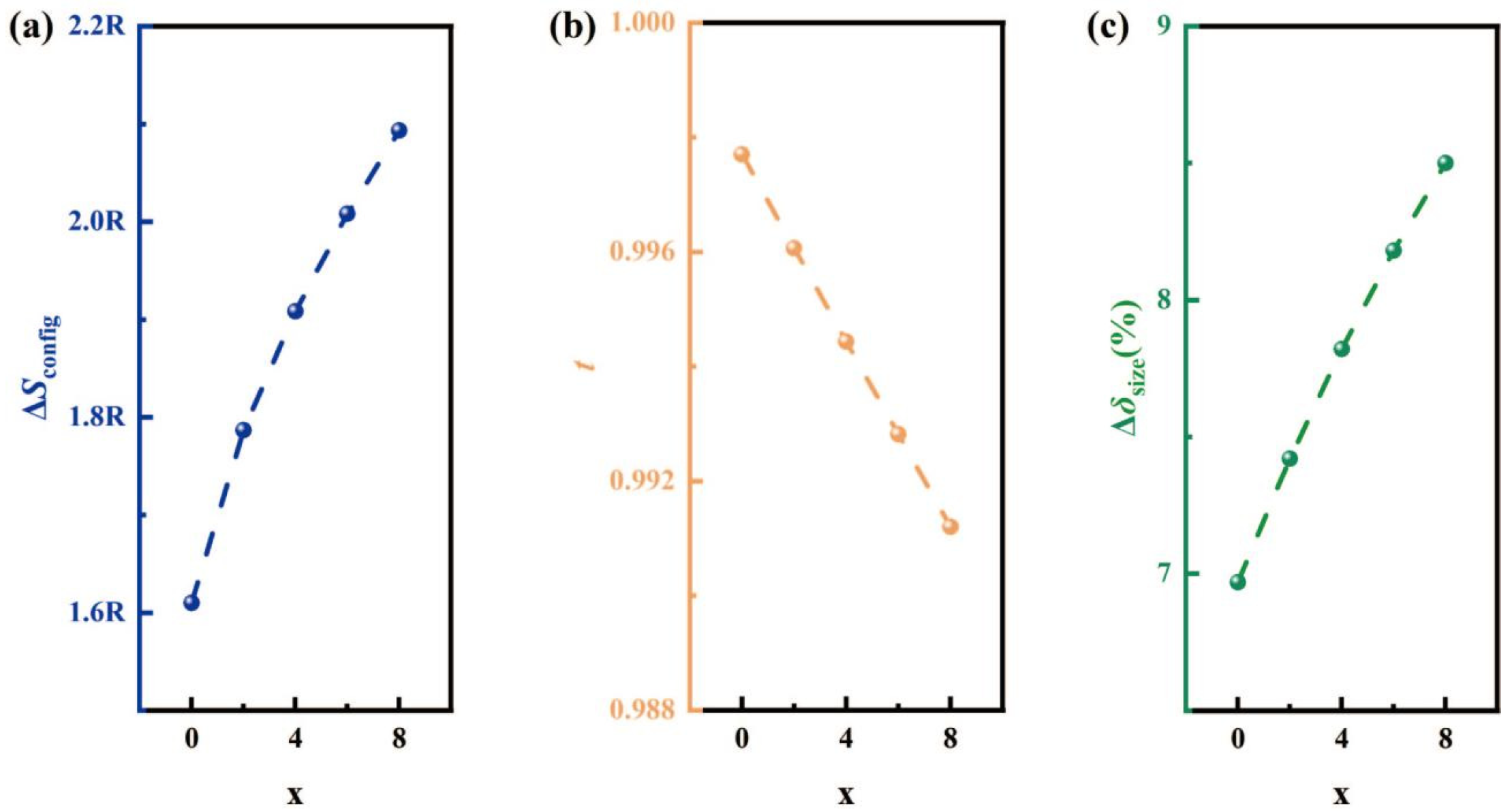
Figure 1 shows the variation relationship of ΔSconfig, the Goldschmidt tolerance factor (t) and size difference factor (δ) of NBBSCT-xLMZ high-entropy ceramics with the incorporation amount x. It can be seen from the results that the configurational entropy of the NBBSCT-xLMZ ceramics is greater than 1.5R, forming a high-entropy component material system. Moreover, as shown in Figure 1a, the configurational entropy increases from 1.61R to 2.09R as the LMZ content x increases from 0 to 8. This indicates that the entropy increase effect brought about by the increase in LMZ content should make the component composition of the material more uneven. For the ABO3-type perovskite material system, the tolerance factor t is usually adopted to evaluate the stability of the perovskite structure of the material. Therefore, the tolerance factor t of the NBBSCT-xLMZ high-entropy ceramics is calculated, and the results are shown in Figure 1b. The tolerance factor t with different contents of LMZ is above 0.990, remaining stable within the range of 0.9 to 1.0. This indicates that the new high-entropy material with LMZ can still form a stable perovskite structure. However, as the content of LMZ increases from 0 to 8, its tolerance factor t also decreases from 0.998 to 0.991. It indicates that the overall stability of its perovskite structure will gradually deteriorate. Not only that, when conducting research on the NBBSCT-xLMZ high-entropy ceramic systems, due to the influence of their lattice distortion effects, the study of their size difference factor Δδsize is also indispensable. The size difference factor of the NBBSCT-xLMZ high-entropy ceramics is calculated. As shown in Figure 1c, as the amount of LMZ increases from 0 to 8, the size difference factor has increased from 6.97% to 8.50%, indicating that the lattice distortion effect of this material system is more significant, which may have an impact on its electrical properties.
Figure 1.
The variation relationship of (a) ΔSconfig, (b) the Goldschmidt tolerance factor (t) and (c) size difference factor (δ) of NBBSCT-xLMZ high-entropy ceramics with the incorporation amount x.
Therefore, based on the significant changes in key parameters such as configuration entropy, tolerance factor, and size difference factor, it can be inferred that as the content of LMZ increases, the component chaos of the new high-entropy material system increases, the lattice structure of the material becomes more distorted, and the overall stability of the material slightly decreases. The combination of LMZ enables the introduction of La3+, Zr4+, and Mg2+ with different characteristics at the A- and B-sites of the original component material. The “cocktail effect” brought about by this itself may have different directional influences on the various properties of the material. Therefore, this provides the possibility for guiding the high energy-storage characteristics under medium and low electric fields.
2.2. Experimental
NBBSCT-xLMZ high-entropy ceramics were prepared by the conventional solid-state reaction method. Na2CO3 (99.9%), Bi2O3 (99.0%), BaCO3 (99.95%), SrCO3 (99.95%), CaCO3 (99.0%), TiO2 (98.0%), La2O3 (99.99%), ZrO2 (99.99%) and MgO (99.9%) were weighed according to stoichiometric ratios and homogeneously mixed in a nylon milling jar at a speed of 400 r/min for 12 h using anhydrous ethanol as the grinding medium. After drying, the well-mixed powder was pre-synthesized at 950 °C for 4 h to obtain the pure phase in a muffle furnace under an air atmosphere. The pre-synthesized powder was then subjected to a second ball milling at 400 r/min for 10 h using anhydrous ethanol as the grinding medium, and then dried and sifted through a 120-mesh sieve to obtain the final powder. This powder was pressed into disc-shaped samples with a diameter of 12 mm and a thickness of approximately 1.2 mm by cold isostatic pressing at 240 MPa for 5 min. Finally, the ceramic samples were sintered at 1200–1300 °C for 2 h and then cooled naturally in a muffle furnace under an air atmosphere. The heating rate was 3 °C/min.
The phase structure of the NBBSCT-xLMZ high-entropy ceramics was analyzed using an X-ray powder diffractometer (XRD SmartLab-3 kW, Rigaku Ltd., Tokyo, Japan) with Cu Kα radiation. The microstructure and EDS measurements were characterized by scanning electron microscopy (SEM, Zeiss Sigma300, Oberkochen, Germany), and the average grain size was calculated using Nano Measurer 1.2. For dielectric measurements, the sintered pellets were polished to ~0.6 mm thickness, coated with silver electrodes on both surfaces, and measured using a precision impedance analyzer (E4980A, Agilent, Santa Clara, CA, USA) for temperature-dependent dielectric properties. For ferroelectric and charge–discharge measurements, the samples were polished to ~0.06 to 0.1 mm thickness and coated with 2.0 mm diameter silver electrodes and then characterized by measuring polarization versus electric field (P-E) hysteresis loops and current versus electric field (I-E) curves using a ferroelectric analyzer (TF Analyzer 2000, aixACCT, Aachen, Germany), as well as by charge–discharge energy density measurements using a charge–discharge test system (CFD-003, TG Technology, Shanghai, China).
3. Results and Discussion
3.1. XRD
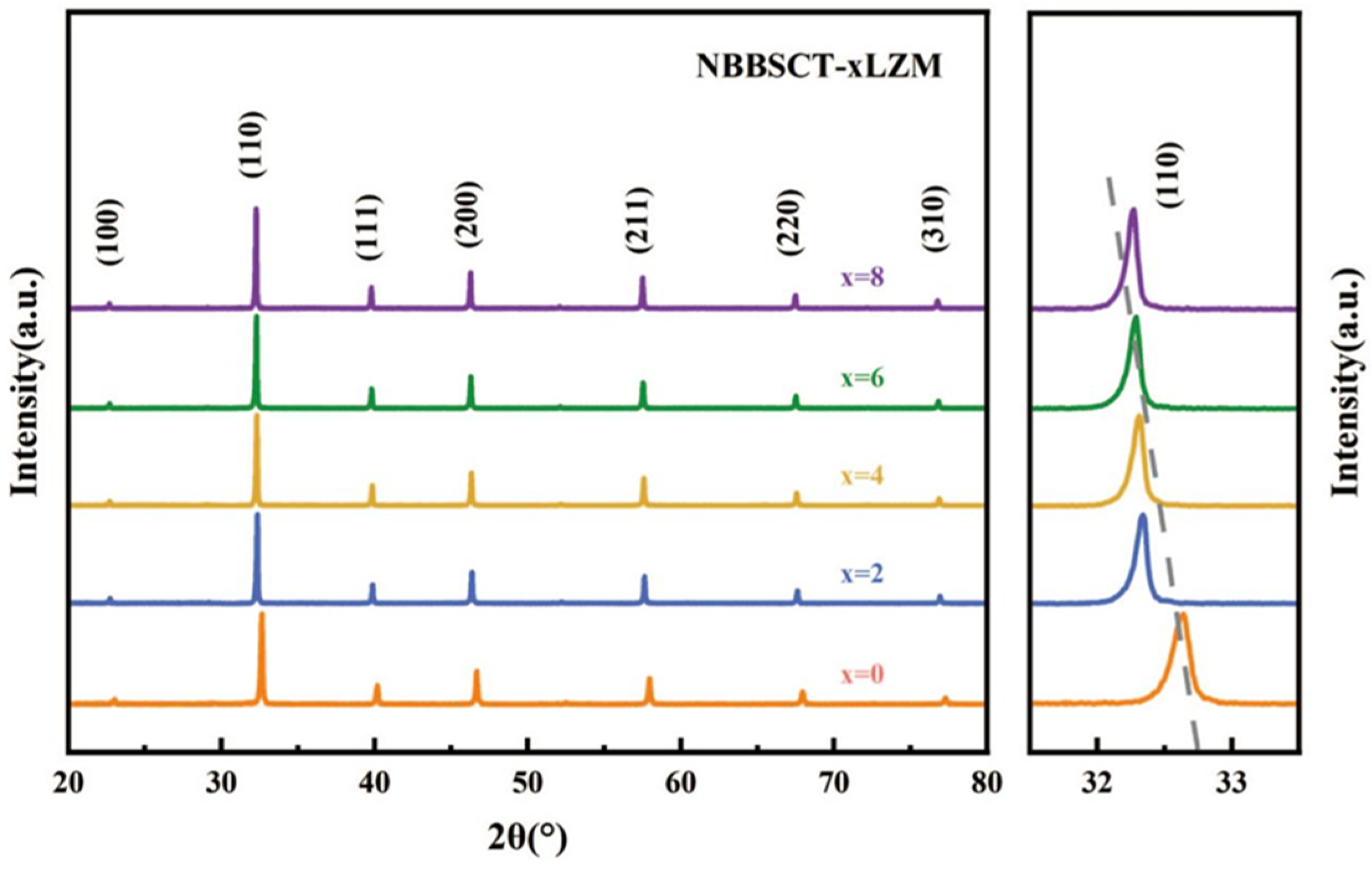
To investigate the phase structure of the synthesized NBBSCT-xLMZ high-entropy ceramics, a detailed analysis of the XRD data was performed. Figure 2 presents the room-temperature XRD patterns of the NBBSCT-xLMZ sintered at the optimal temperature, collected over the 2θ range of 20–80°. All characteristic reflections corresponding to different crystallographic orientations of the perovskite structure are labeled. The patterns confirm that all four compositions—regardless of LMZ content—form single-phase solid solutions without any detectable secondary phases, indicating the successful design of a stable, single-phase ABO3-type perovskite high-entropy ceramic based on the novel NBBSCT matrix.
Figure 2.
XRD pattern of NBBSCT-xLZM high-entropy ceramics (the insert is narrow spectra from 31.5° to 33.5°).
Moreover, the magnified region between 32° and 33° (inset) reveals a systematic shift of the (110) reflection toward lower angles with increasing LMZ content. This shift arises from the larger ionic radii of Mg2+ (0.72 Å, in octahedral oxygen coordination) and Zr4+ (0.72 Å, in octahedral oxygen coordination) compared to Ti4+ (0.605 Å, in octahedral oxy-gen coordination), leading to lattice expansion upon substitution. Additionally, the narrow full width at half maximum (FWHM) of the primary XRD peaks across all compositions suggests a relatively low porosity and uniform grain growth in the newly developed high-entropy ceramics.
To further elucidate the evolution of statistically robust lattice parameters as a function of composition in the NBBSCT-xLMZ high-entropy ceramics, Rietveld refinement was performed on the raw XRD patterns using the GSAS-II software (https://gsasii.github.io/, accessed on 26 October 2025). The cubic lattice parameter increases monotonically from 3.914799 Å to 3.924548 Å, while the unit-cell volume V expands from 59.997 Å3 to 60.446 Å3 when x rises from 0 to 8. This progressive enlargement confirms the occurrence of lattice distortion upon LMZ incorporation. The corresponding reliability indices are summarized in Table 1. The profile reliability factors Rp (<7%) and Rwp (<9%) are well below the 10% threshold, and the goodness-of-fit χ2 values are all below 1.5, significantly outperforming the reference value of 2.25. These results indicate that the refined patterns—based on the Pmm space group—match the experimental data extremely well, corroborating that the fundamental crystal structure of NBBSCT remains essentially intact despite the introduction of varying amounts of LMZ.
Table 1.
Rietveld refinement results of NBBSCT-xLZM ceramics.
3.2. SEM
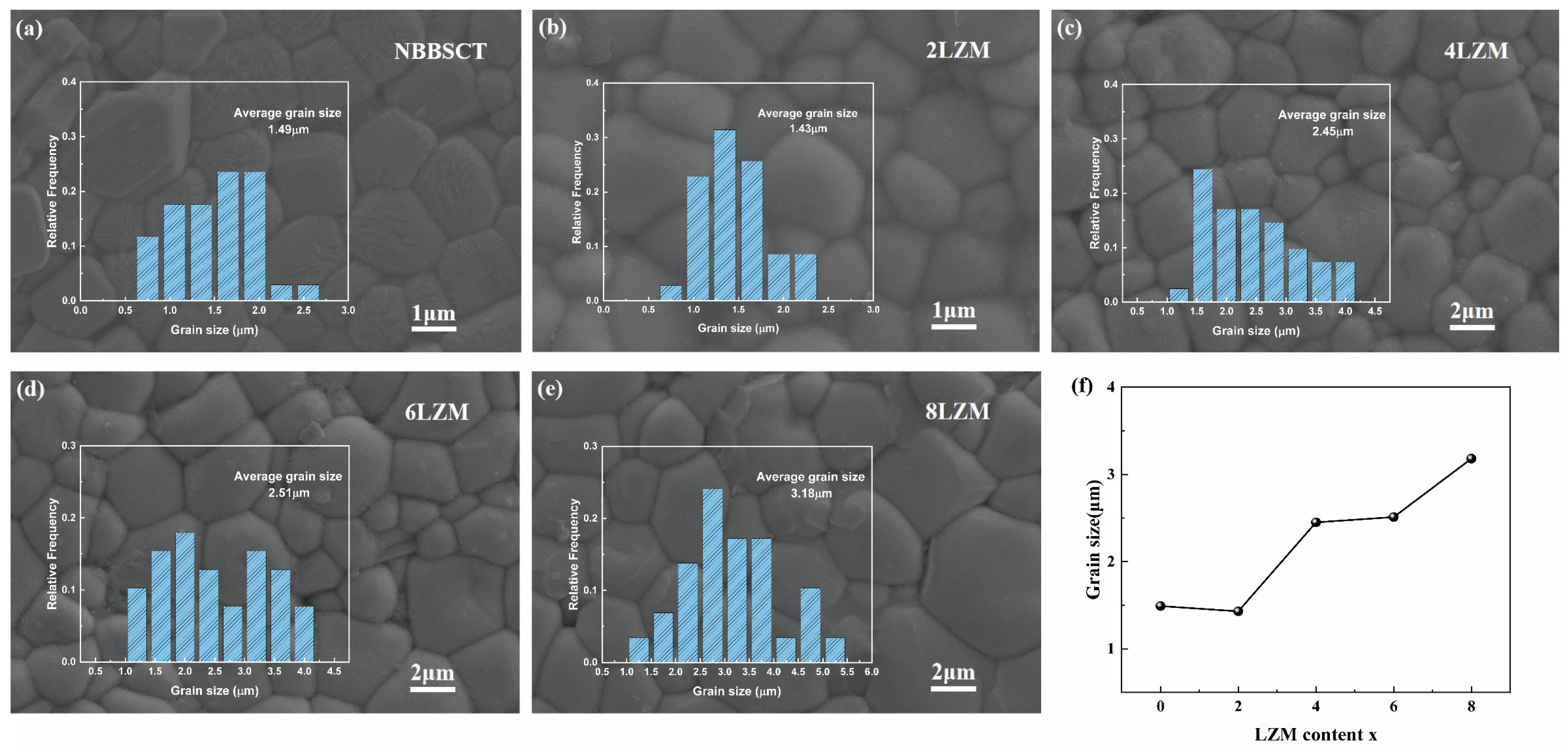
To investigate the relationship between surface morphology and energy-storage performance in the NBBSCT-xLMZ high-entropy ceramics, scanning electron microscopy (SEM) was employed to characterize their microstructures. SEM images and average grain-size changes of the NBBSCT-xLZM high-entropy ceramics with different contents of LZM are shown in Figure 3.
Figure 3.
SEM images and average grain-size changes of the NBBSCT-xLZM high-entropy ceramics with different contents of LZM: (a) x = 0, pure NBBSCT ceramic; (b) x = 2; (c) x = 4; (d) x = 6; (e) x = 8; (f) the grain-size evolution with different x contents.
Figure 3a–e present the surface SEM images of the xLMZ series sintered at the optimal temperature. No visible secondary phases were observed in any of the samples, consistent with the phase-purity results discussed earlier in XRD. The SEM micrographs reveal a bimodal grain-size distribution in which fine and coarse grains interpenetrate. Average grain sizes are below 3.5 µm for every composition. The surfaces are pore-free, and the grain boundaries are sharply defined, indicating a high degree of densification—crucial for attaining respectable breakdown strengths under medium-to-low electric fields. Figure 3f quantifies the grain-size evolution: as the LMZ content increases, the average grain size grows from 1.49 µm to 3.18 µm with the content of LMZ increasing from 0 to 8.
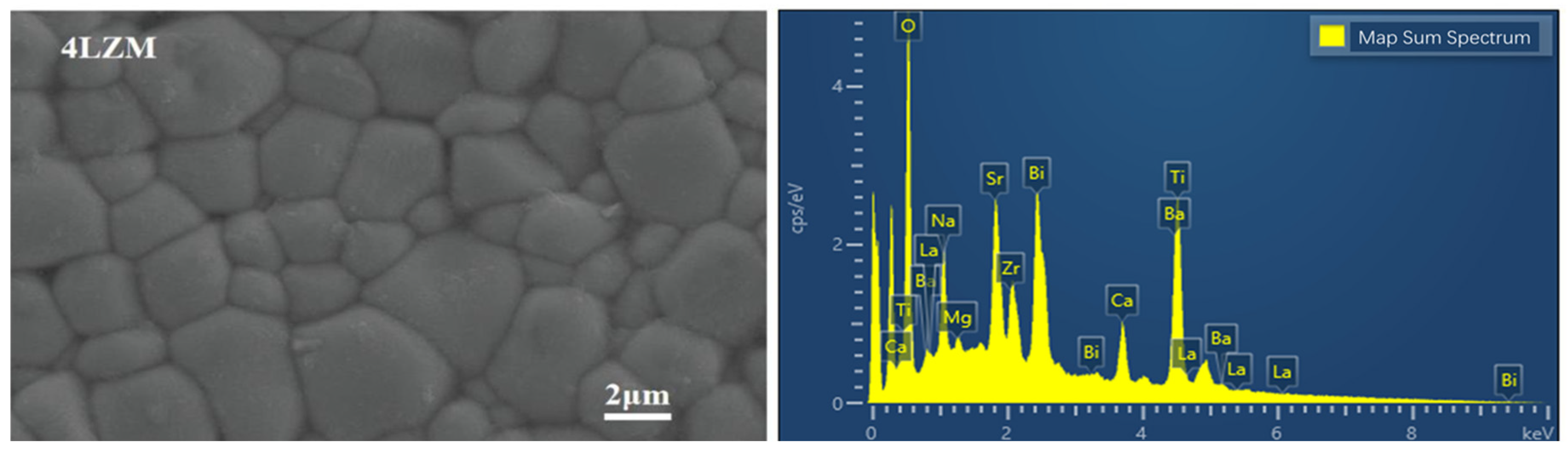
Studies show that metal Bi is prone to intense volatilization during high-temperature processing, which leads to component segregation [22,23], and the optimal 4LMZ (x = 4) sample was selected to assess its compositional uniformity. The EDS elemental energy spectra are shown in Figure 4, and the EDS semi-quantitative analysis of the as-received specimen are listed in Table 2. From the results, this cation ratio is essentially unity, satisfying the ideal perovskite stoichiometry AMO3. Consequently, the grain is a multi-cation A-site and B-site perovskite-type oxide. This compositional homogeneity ensures the reliability of subsequent dielectric, ferroelectric, and charge–discharge evaluations. Overall, the material exhibits good compositional uniformity, which ensures the reliability of subsequent dielectric, ferroelectric, and charge–discharge evaluations.
Figure 4.
EDS elemental energy spectra of selected NBBSCT-xLZM high-entropy ceramics (x = 4).
Table 2.
EDS semi-quantitative analysis of the as-received specimen.
3.3. Dielectric Properties
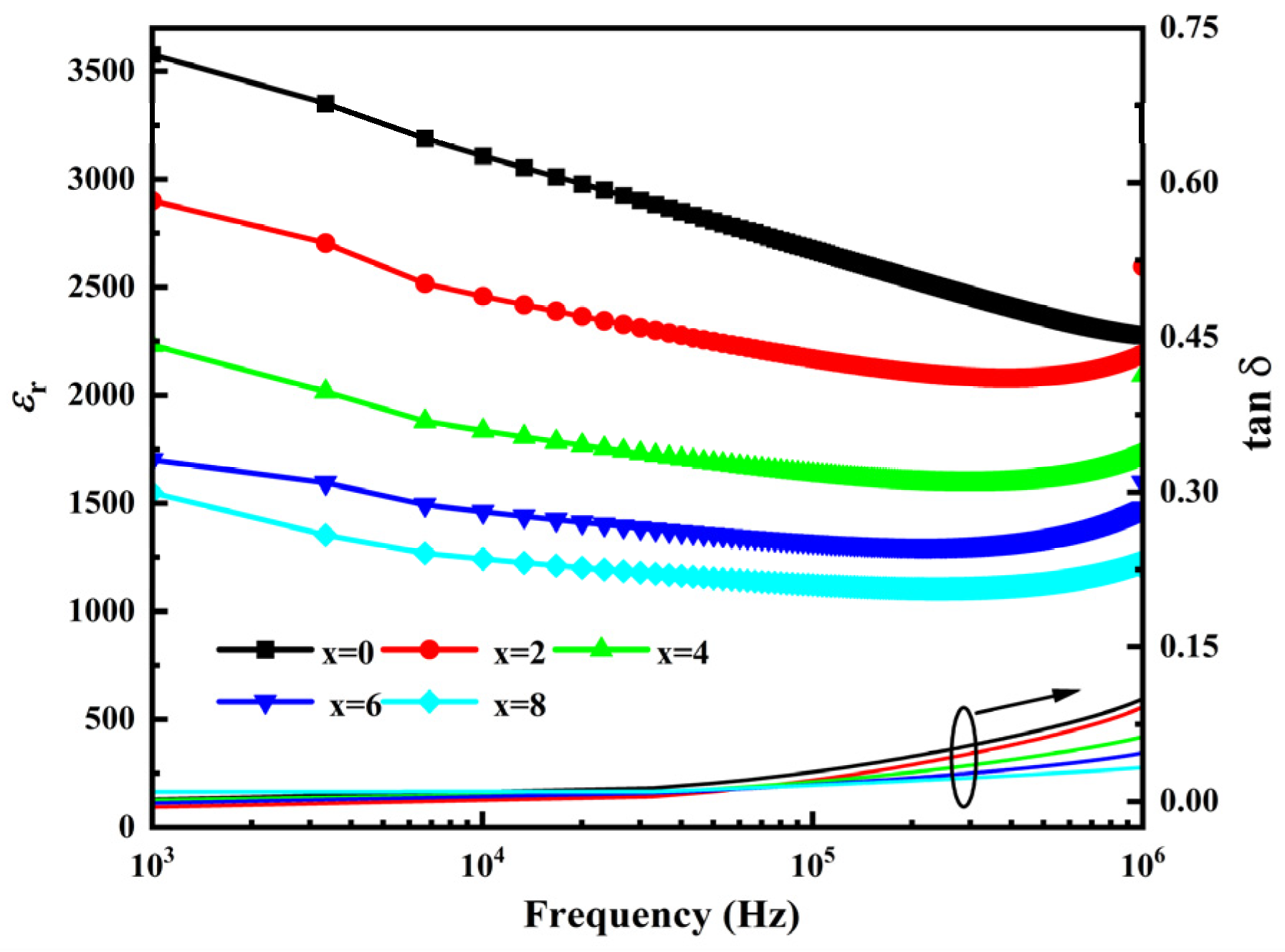
For the NBBSCT-xLZM high-entropy ceramics, it is necessary to explore the changes in their dielectric properties. Figure 5 illustrates the frequency-dependent characteristics of the relative permittivity and dielectric loss for NBBSCT-xLMZ high-entropy samples with different content levels over a broad frequency range. As seen in the figure, the dielectric constant of all compositions continuously decreases slowly with increasing test frequency, exhibiting the higher values in the low-frequency region and gradually stabilizing in the high-frequency region. At the same time, the dielectric loss increases slowly with the rise in test frequency.
Figure 5.
Frequency-dependent dielectric properties of NBBSCT-xLMZ high-entropy ceramics.
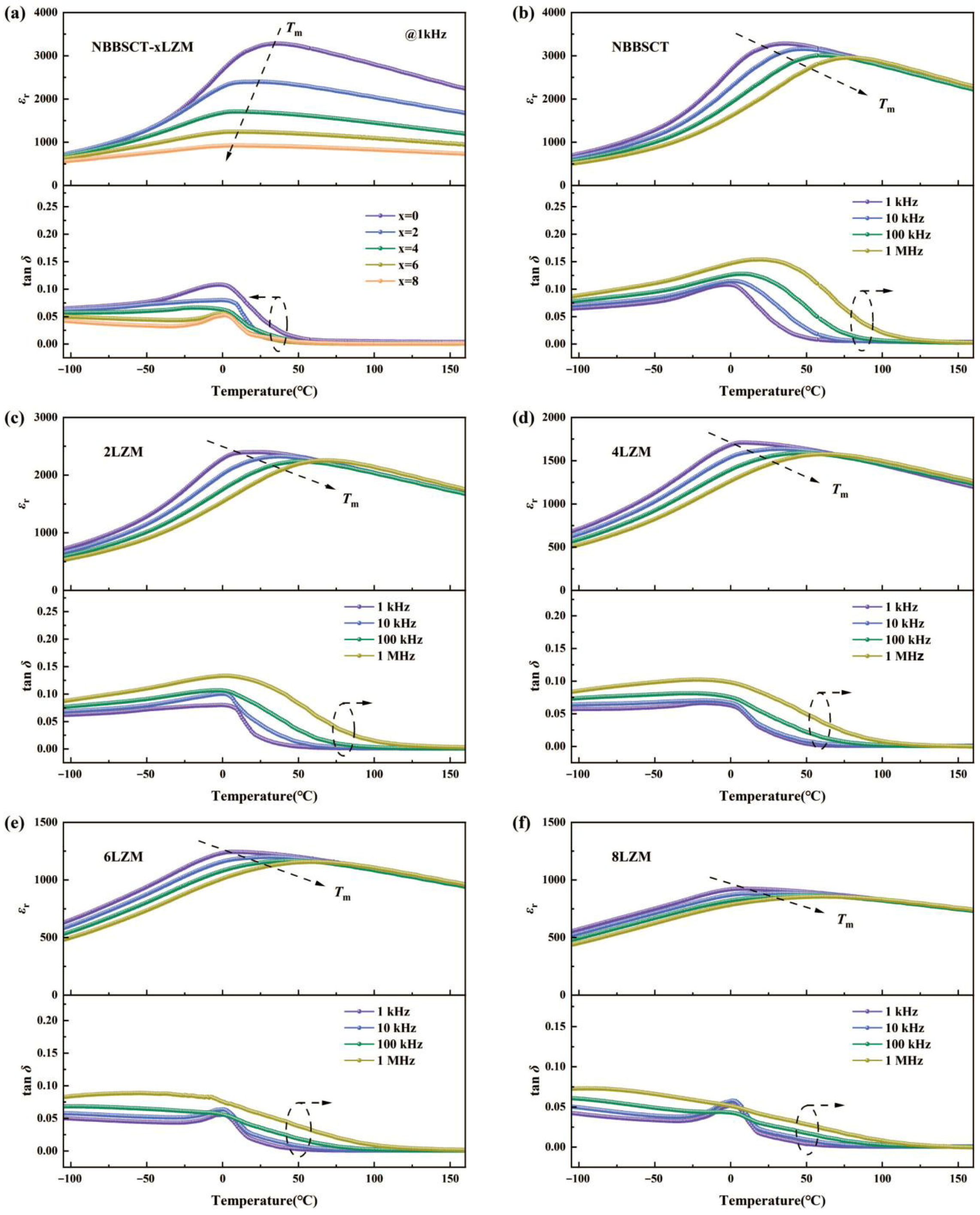
By analyzing the dielectric spectrum as a function of temperature, one can readily uncover the rules governing temperature-driven phase transitions. Therefore, the temperature-dependent dielectric responses of each component of the NBBSCT-xLZM high-entropy ceramics at different frequencies are systematically measured, and the resultant spectroscopic maps are shown in Figure 6.
Figure 6.
Temperature-dependent dielectric properties of NBBSCT-xLZM high-entropy ceramics with different contents of LZM at various frequencies: (a) all samples at 1 kHz; (b) x = 0; (c) x = 2; (d) x = 4; (e) x = 6; (f) x = 8 with different frequencies.
From Figure 6a, it can be seen that as the amount of xLMZ increases, its phase transition temperature shifts towards lower temperatures, causing the NBBSCT-xLZM high-entropy ceramics to exhibit a paraelectric phase at room temperature. This is conducive to obtaining more polar nano-micro-regions at room temperature, thereby enhancing the material’s relaxation properties and achieving excellent energy storage. From the perspective of lattice distortion and entropy change, this is because the ions Zr4+ and Mg2+ undergo ionic radius mismatch with the matrix ion Ti4+ in the NBBSCT unit, and the random occupation of high-entropy components increases the effect of configuration entropy, weakens its ferroelectric long-range orderliness, and causes the Curie temperature to shift towards a lower temperature. Not only that, the introduction of LMZ also broadens the dielectric Curie peak of the material, enabling the NBBSCT-xLZM high-entropy ceramic materials to maintain relatively stable dielectric properties over a wide temperature range, with the dielectric constant remaining at a high level, thereby enhancing the polarization intensity of the material. Moreover, within the broadened dielectric Curie peak range, the domain structure of the material can respond more effectively to changes in the electric field. The energy barrier for domain inversion is reduced, making polarization inversion more likely to occur, thereby significantly suppressing losses and increasing energy-storage density and improving energy-storage efficiency. Therefore, the improvement of the above-mentioned dielectric properties is mainly attributed to the introduction of the ionic substitution effect of LMZ on NBBSCT in the crystal structure, which leads to the reduction in the dielectric Curie peak and the improvement of temperature stability. Additionally, the dielectric constants of all components have only one sudden change peak when varying with temperature. This indicates that during the temperature change from low to high, the components of the new high-entropy material undergo only one temperature field-driven phase transition, that is, from ferroelectric phase to paraelectric phase. From Figure 6b–f, it can be seen that as the frequency gradually increases from 1 kHz to 1 MHz, the phase transition temperatures of each component of the NBBSCT-xLZM high-entropy ceramics shift towards higher temperatures, showing a relatively obvious frequency dispersion phenomenon. This also proves that the newly synthesized NBBSCT-xLZM high-entropy ceramics are typical relaxor ferroelectrics.
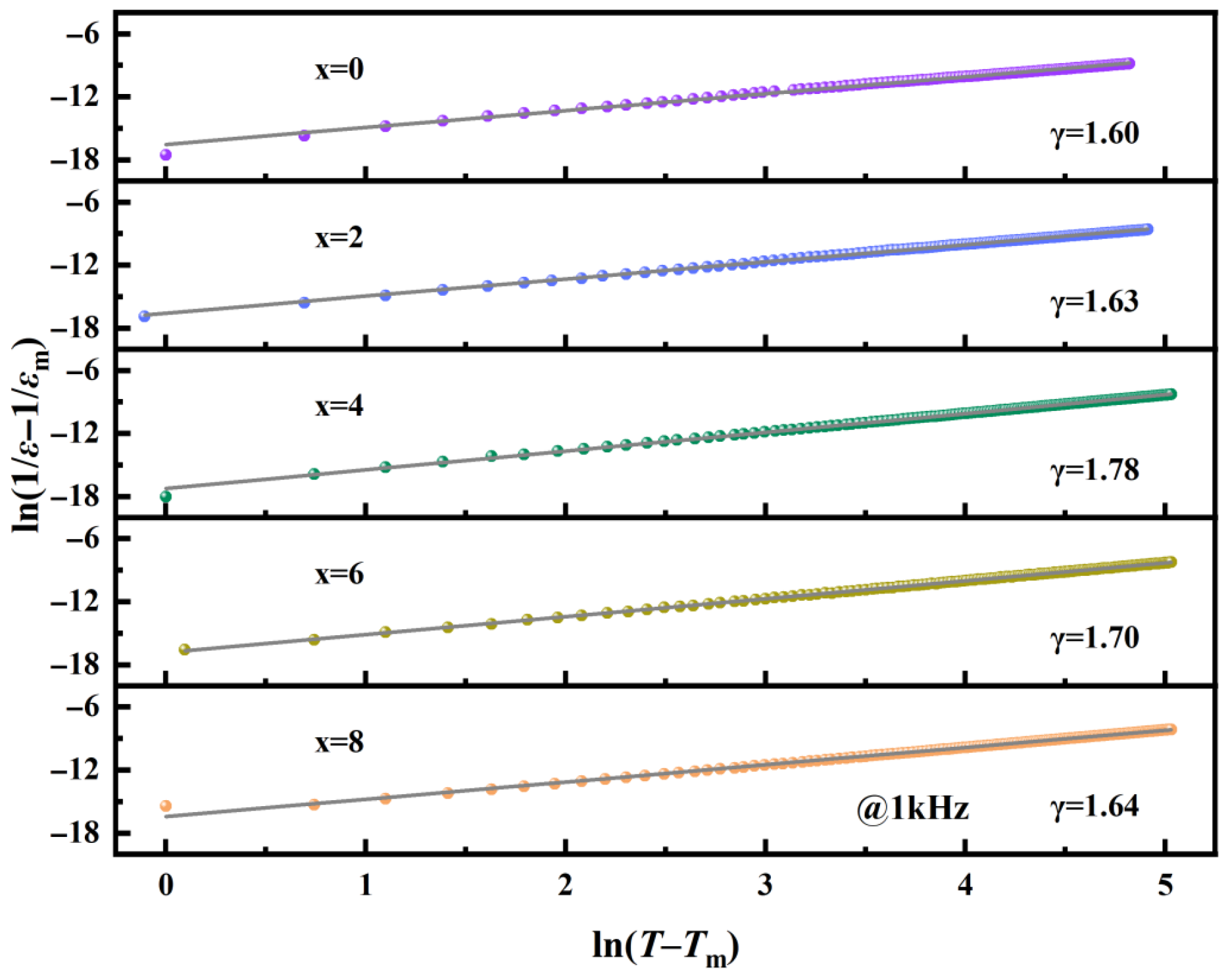
In the study of dielectric properties of the NBBSCT-xLZM high-entropy ceramics, the parameter γ is usually used to measure their relaxation characteristics. The relaxation factor γ of NBBSCT-xLZM high-entropy ceramics with different contents of LZM was calculated, and the results of the fitting curve graph are plotted in Figure 7. From the picture, it can be seen that with the increase in the introduction content of xLMZ, its γ value shows a trend of first increasing and then decreasing, and both are greater than the NBBSCT unit components. This indicates that the introduction of xLMZ improves the relaxation characteristics of the material, and the most superior relaxation characteristics are achieved at x = 4, with a γ value of 1.78. It indicates that the best energy-storage characteristics may be achieved in 4LMZ high-entropy ceramics. It should be emphasized that, owing to the limited resolution and temperature/frequency coverage of the present data, the discussion of the phase transition and the γ-relaxation parameter remains qualitative. A physically grounded model for the NBBSCT-xLZM high-entropy ceramics will be developed in the future, while systematic dielectric and in situ X-ray measurements spanning the full transition region are available.
Figure 7.
The relaxation factor fitting curve graph of NBBSCT-xLZM high-entropy ceramics with different content of LZM.
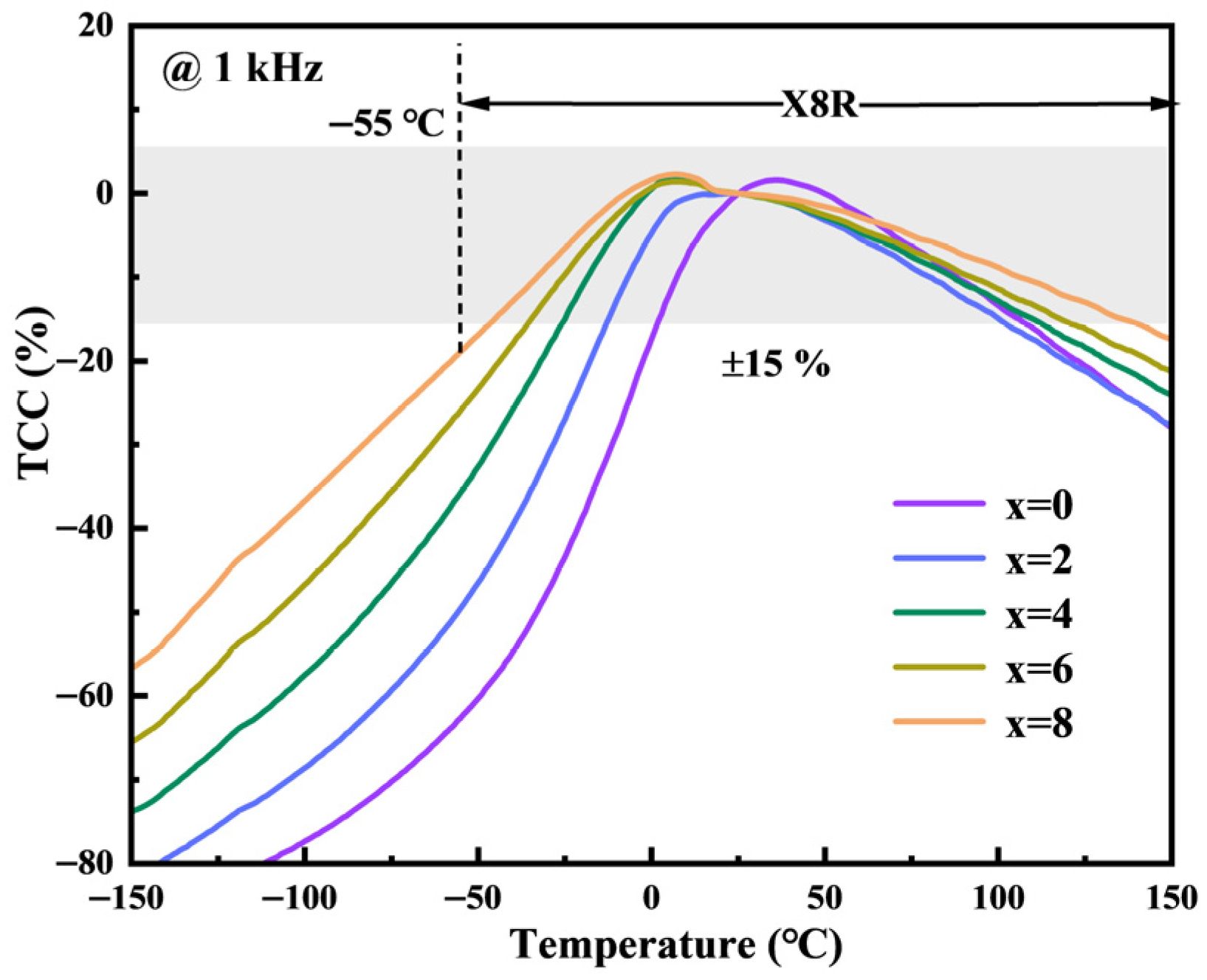
For practical applications of dielectric ceramics, the stability of the permittivity over a temperature range is a critical parameter. The dielectric temperature stability of the NBBSCT-xLMZ high-entropy ceramic is characterized by the temperature coefficient of capacitance (TCC). The TCC is a key metric for quantifying the reliability of dielectric materials over a range of operating temperatures. The calculation is based on the following formula [24,25]:
where CT denotes the capacitance at temperature T, while C25 represents the capacitance at room temperature. The results of temperature coefficient of capacitance of NBBSCT-xLMZ high-entropy ceramic are shown in Figure 8.
Figure 8.
Temperature coefficient of capacitance of NBBSCT-xLMZ high-entropy ceramic.
From Figure 8, it can be seen that the TCC peak broadens progressively with increasing LMZ content, which indicates a substantial improvement in dielectric temperature stability. This enhancement can be attributed to the highly disordered state induced by the increased configurational entropy. This disorder effectively suppresses the formation of long-range ferroelectric domains, thereby preventing the drastic fluctuation of the dielectric constant that typically occurs during phase transition at a specific temperature. Furthermore, the TCC of all NBBSCT-xLMZ high-entropy ceramics varies by less than ±15% over the temperature range of −47 °C to 142 °C. This stable thermal performance, which meets the X8R capacitor standard (−55 °C~150 °C), contributes to their superior energy-storage performance by ensuring enhanced thermal stability [24,25].
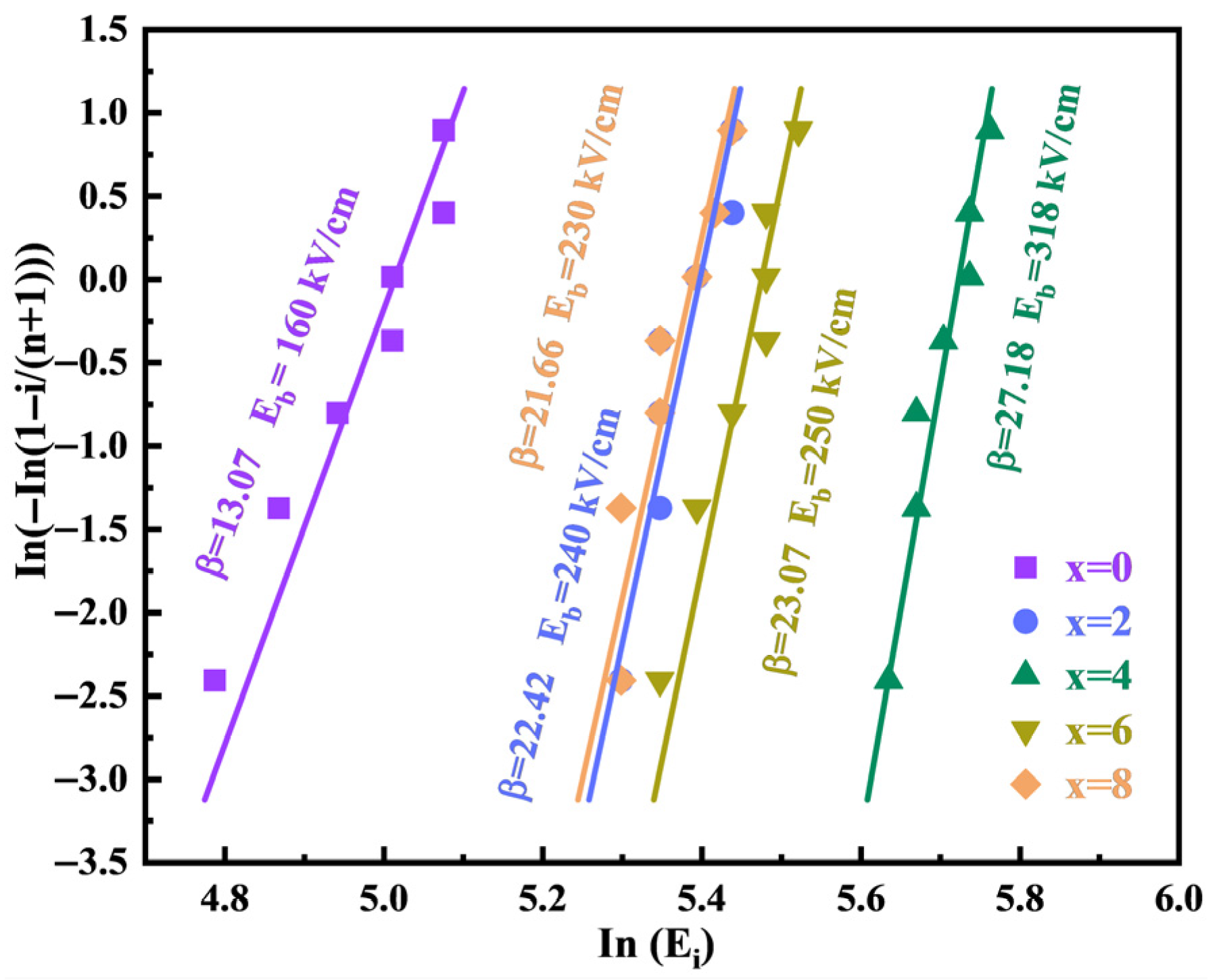
Additionally, a statistical analysis of Weibull distribution of the breakdown field is a standard method for evaluating the reliability and characteristic breakdown strength of dielectric ceramics, providing insight into the failure probability and material homogeneity. Figure 9 shows the Weibull distribution plot of the breakdown field for NBBSCT-xLMZ high-entropy ceramic with different x contents.
Figure 9.
Weibull distribution plot of the breakdown field for NBBSCT-xLMZ high-entropy ceramic.
To evaluate the breakdown characteristics and reliability of the NBBSCT-xLMZ high-entropy ceramic, the Weibull distribution of the breakdown electric field was fitted using seven data sets for each composition, according to the following formula [26,27]:
Among these parameters, Ei denotes the maximum electric field intensity of the i-th sample, n represents the total number of samples, and i denotes the sample sequence. As shown in Figure 9, all samples conform to the Weibull distribution and exhibit a linear relationship. The Weibull fitting curves shift to higher electric fields with increasing x, with the x = 4 sample achieving a maximum breakdown electric field of 318 kV/cm. Moreover, all samples exhibit a shape parameter β > 10, confirming the high reliability of the Weibull analysis.
3.4. Energy-Storage Properties
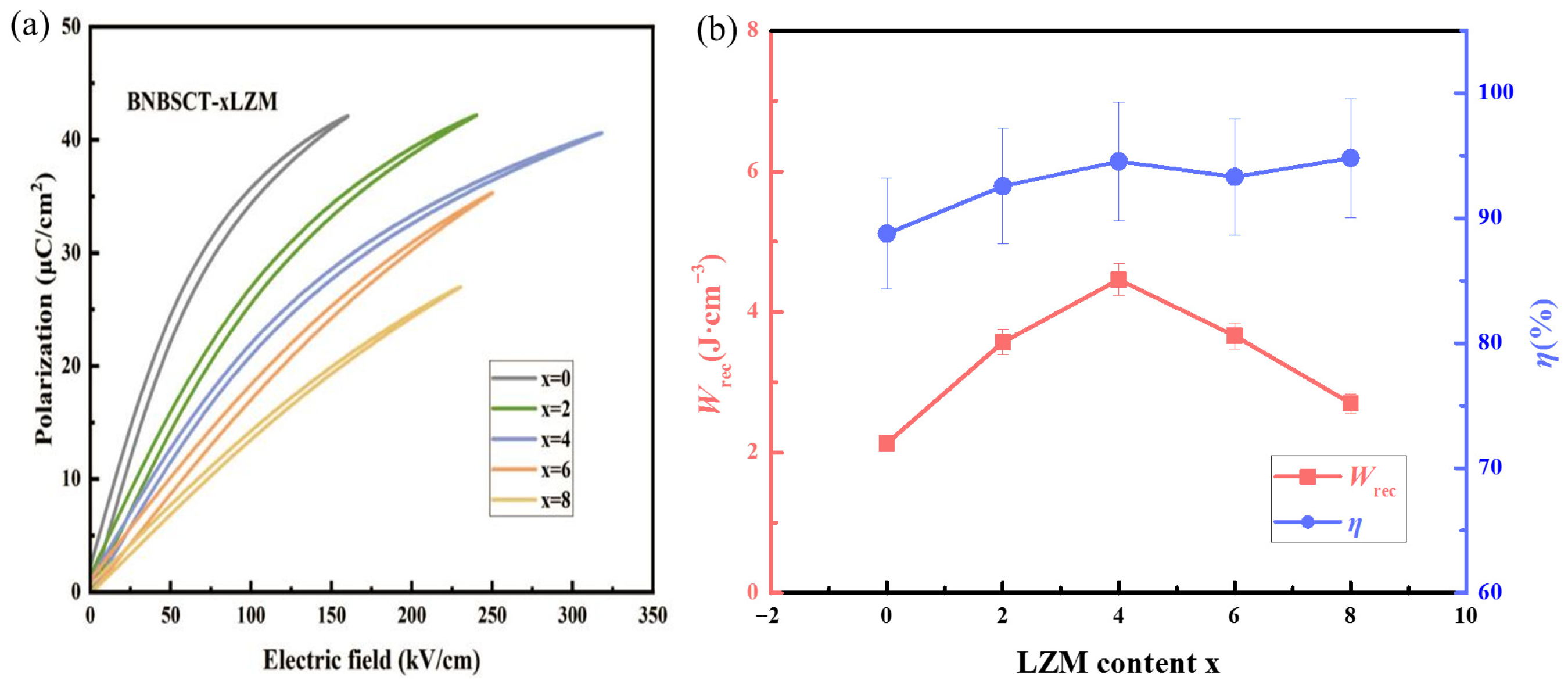
To further explore the energy-storage characteristics of the NBBSCT-xLZM high-entropy ceramics, their ferroelectric properties were measured and analyzed. Figure 10a shows the variation in the hysteresis loop with the amount x of LMZ under an electric field of 120 kV/cm. It can be seen from the figure that as the content of LMZ increases, the P-E curve of the NBBSCT-xLZM high-entropy ceramics becomes slimmer, and its residual polarization shows a gradient decline trend. The residual polarization intensity decreased from 2.28 μC/cm2 to 0.32 μC/cm2 while the x increased from 0 to 8, and the relaxation characteristics were also enhanced. This may be attributed to the improvement of the material’s relaxation characteristics by Zr4+ [28,29]. With the introduction of LMZ, the content of Bi3+ in the component system gradually decreases due to the substitution effect of La3+ at the A-site. This weakens the large-shift polarization brought by Bi3+ and the ionic bonding between Bi3+ and O2−. Meanwhile, Ti4+ at the B-site is replaced by Zr4+ and Mg2+ with large ionic radii. The strong interaction between O2− and Ti4+ in the lattice was weakened, and the displacement polarization of O2− and Ti4+ in the oxygen octahedral structure was restricted [28,29]. Therefore, the overall polarization value of the material decreased with the increase in LMZ content, that is, from 38.19 μC/cm2 to 16.14 μC/cm2. Therefore, it can be observed that the introduction of LMZ greatly improves the relaxation characteristics of the original high-entropy material NBBSCT, and at the same time reduces the maximum polarization value theoretically obtainable in the material system. That is to say, in order to obtain more superior energy-storage properties, the addition of LMZ content needs to be strictly controlled. However, in some research or application contexts, intentionally attenuating ferroelectricity—manifested as a reduced coercive field (Ec) and diminished remnant polarization (Pr)—is a deliberate design strategy to minimize switching energy and shorten write/erase times in non-volatile memory and synaptic devices. In antiferroelectric–ferroelectric phase change materials or relaxor ferroelectrics, the reduction in polarization may be accompanied by higher energy-storage efficiency and lower losses, which is beneficial for high-power energy-storage capacitors. So, “polarization reduction” in itself is not a good thing, but under specific goals, it may be a means to achieve higher performance or better functionality [4,30]. Therefore, in the process of application-oriented optimization, the moderate weakening of ferroelectricity may be a necessary cost to achieve higher system performance.
Figure 10.
(a) P-E loop and (b) energy-storage performance of NBBSCT-xLZM high-entropy ceramics with different content of LZM under 120 KV/cm.
It can be further observed from the figure that LMZ content has enhanced the breakdown field strength of the material to varying degrees. The optimal breakdown field strength of 318 kV/cm was achieved at x = 4, which is a significant improvement compared to the breakdown field strength of 160 kV/cm of x = 0. Moreover, the improvement of the material’s relaxation characteristics is proportional to the content of LMZ. The high-entropy ceramic becomes more relaxed with the addition of LMZ. Its ferroelectric curve becomes more slender, presenting a nearly linear P-E hysteresis loop at x = 8, with a residual polarization value of 0.66 μC/cm2 at an electric field of 230 kV/cm, while the residual polarization value of x = 0 at an electric field of 160 kV/cm is 2.37 μC/cm2.
From Figure 10b, it can be seen that the best energy-storage characteristics can be achieved in the NBBSCT-xLZM high-entropy ceramic with x = 4. The saturation polarization value of its hysteresis loop under an electric field of 318 kV/cm2 is 40.61 μC/cm2, and the residual polarization value is 1.11 μC/cm2. According to the calculation, the effective energy-storage density can be obtained as 4.46 J/cm3. The energy-storage efficiency is 94.55%, which is a significant improvement compared to the original component NBBSCT (with an energy-storage density of 2.13 J/cm3 and an energy-storage efficiency of 88.77%), demonstrating excellent performance in both energy-storage density and efficiency under medium and low electric fields. According to the literature [10,31,32,33,34,35,36], most experimental results under low-to-moderate electric fields fall between 3.5 and 7.3 J/cm3, primarily involving the (NaBiBaSrCa)TiO3 system. Among them, the highest energy-storage density occurs in the design of high-entropy ceramics with unequal amounts of elements. The present study result demonstrates a comparatively high energy-storage density at relatively low field strengths, indicating that a non-stoichiometric, multi-component, high-entropy ceramic design is promising for even better performance. The details are listed in Table 3.
Table 3.
Comparison of some reported data under moderate electric fields.
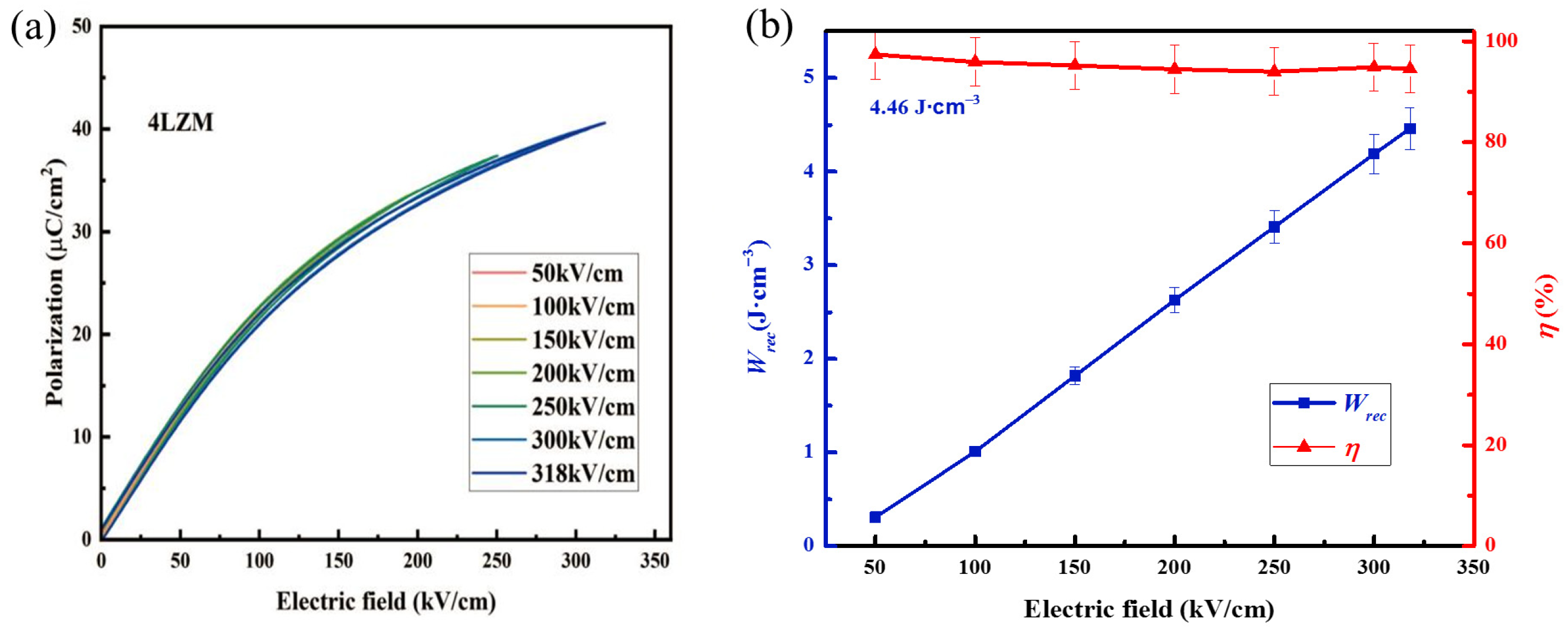
To further study the energy-storage characteristics of NBBSCT-xLZM high-entropy ceramics, ferroelectric curve and energy-storage tests of selected samples with x = 4 (named as 4LMZ) under different electric fields were carried out, and the results are plotted in Figure 11. As shown in Figure 11a, when the applied electric field is less than 250 kV/cm, the maximum polarization value of the P-E hysteresis loop increases rapidly. When the electric field exceeds 250 kV/cm, its P-E hysteresis loop gradually becomes curved, and the growth of its maximum polarization value also gradually slows down. This indicates that for 4LMZ high-entropy ceramics at 250 kV/cm, the phase transition caused by the external electric field drive gradually saturates. With the increase in the applied electric field intensity, its residual polarization value, although increasing slowly, remains at a relatively low level. Under the 318 kV/cm electric field, its residual polarization value is only 1.11 μC/cm2. Therefore, the ferroelectric curve still presents a slender shape, indicating that it has strong relaxor ferroelectricity. From Figure 11b, it can be seen that with the increase in the electric field, the energy-storage density of the high-entropy ceramic increases significantly in a nearly linear growth trend. Although its energy-storage efficiency slightly decreases, it still remains at a relatively high level, dropping from 97.39% at a 50 kV/cm electric field to 94.55% at a 318 kV/cm electric field. Moreover, under an electric field of 318 kV/cm, its effective energy-storage density is 4.46 J/cm3, demonstrating its excellent energy-storage characteristics in medium and low electric fields.
Figure 11.
(a) P-E loop and (b) energy-storage performance of selected NBBSCT-xLZM high-entropy ceramics under different electrical fields (x = 4).
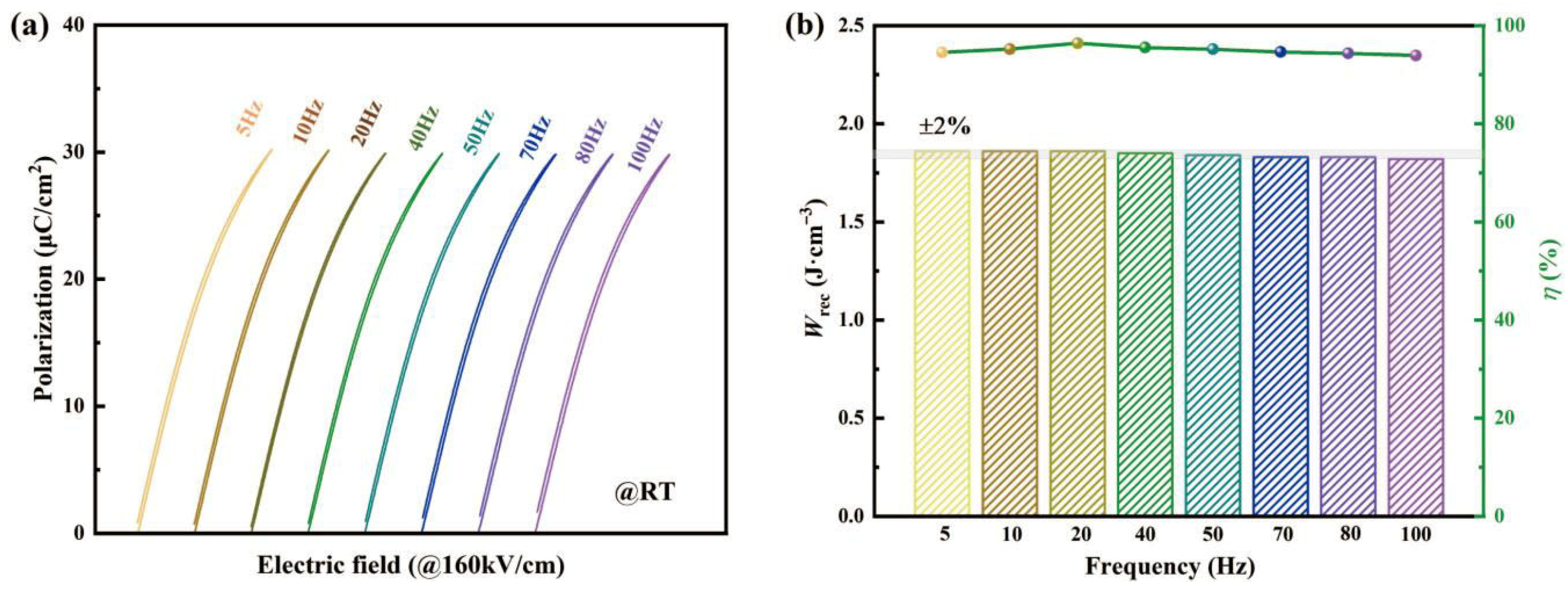
In the practical industrial application of the high-entropy ceramic capacitors, it is crucial to evaluate their performance stability. Due to the current and voltage fluctuations caused by the transmission of electrical energy, the frequency stability of the energy-storage characteristics of the high-entropy ceramic capacitors is one of the important evaluation parameters. Figure 12a shows the variation relationship of the P-E hysteresis loop of a NBBSCT-xLZM (x = 4) high-entropy ceramic capacitor with frequency when an electric field of 160 kV/cm is applied at room temperature. From Figure 12a, it can be seen that within the frequency variation range of 5 to 100 Hz, the ferroelectric curve of the high-entropy ceramic capacitor always maintains a slender shape. It indicates that its superior relaxor ferroelectricity is less affected by frequency changes, and the residual polarization of its ferroelectric curve slightly increases, from 0.73 μC/cm2 at 10 Hz electric field to 1.66 μC/cm2 at 100 Hz electric field. With the frequency of the electric field increases, the reorientation time of the electric domains within the high-entropy ceramic decreases. After the applied electric field is withdrawn, some of the electric domains fail to complete the turning in a short time and still maintain a certain degree of polarization. Eventually, the residual polarization slightly increases, and at high frequencies, some local charge accumulation or interface polarization phenomena may have formed at the inner interface of the high-entropy ceramic, which to a certain extent also increases the residual polarization. However, as the frequency of the applied electric field increases, the maximum polarization value of the high-entropy ceramic remains at a relatively high level. Under a 100 Hz electric field, the maximum residual polarization is 29.81 μC/cm2, which is only slightly lower than 30.14 μC/cm2 under a 10 Hz electric field. The possible reason is there are still some easily polarized regions or electric domains in the ceramic material. They can respond rapidly under a high electric field and achieve a high degree of polarization. Figure 12b shows the variation curves of the energy-storage density and efficiency of the high-entropy ceramic capacitor with the increase in the applied electric field frequency. According to the variation relationship in the figure, it can be observed that its energy-storage characteristics maintain excellent frequency stability. Under a 160 kV/cm electric field at room temperature, within the frequency variation range of 5 to 100 Hz, the variation range of its energy-storage density is 1.86 ± 0.03 J/cm3 (<2%), and the variation range of energy-storage efficiency is 95.40 ± 1.07%.
Figure 12.
(a) P-E loop and (b) energy-storage performance of selected NBBSCT-xLZM high-entropy ceramics with different frequency (x = 4).
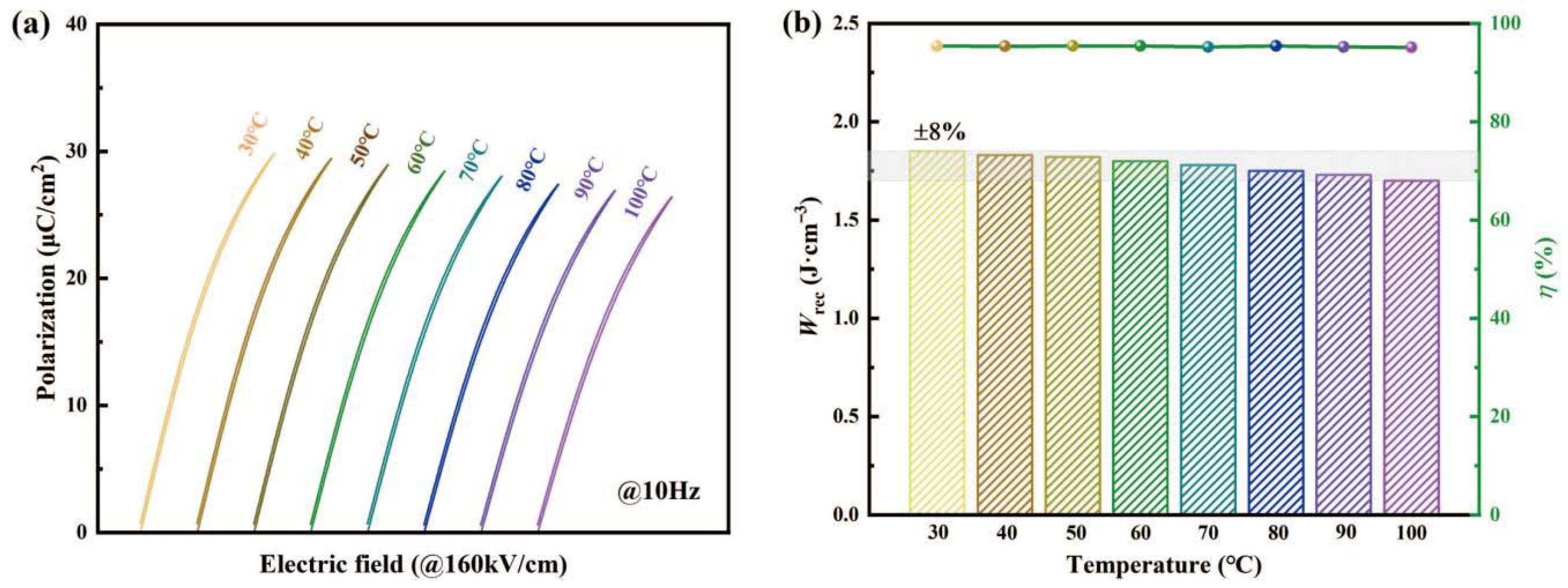
Due to the uncertainty of the application environment of high-entropy ceramic capacitors and the possible heating conditions that may occur during the actual use of circuit boards, it is also necessary to evaluate the temperature stability of their energy-storage characteristics. Figure 13a shows the variation relationship of the P-E hysteresis loop of the selected high-entropy ceramic capacitor with temperature at a frequency of 10 Hz and an applied electric field of 160 kV/cm. It can be seen from the figure that within the temperature range of 30 to 100 °C, the maximum polarization value of the ferroelectric curve of the high-entropy ceramic capacitor slightly decreases. It decreased from 29.85 μC/cm2 at 30 °C to 26.41 μC/cm2 at 100 °C. This phenomenon can be attributed to the directional movement of the inner domain walls of high-entropy ceramics under the action of an electric field. The increase in temperature intensifies the thermal motion within the ceramic material, interfering with the ordered arrangement and orientation of its domain walls under an external electric field, thereby causing the maximum polarization value to decrease. At the same time, the residual polarization value of high-entropy ceramics slightly decreases with the increase in temperature. It decreased from 0.69 μC/cm2 at 30 °C to 0.59 μC/cm2 at 100 °C. Therefore, the ferroelectric curve of the 4LMZ high-entropy ceramic as a whole presents a slender shape, indicating that the influence of temperature changes on its relaxation characteristics is relatively small.
Figure 13.
Temperature-dependent plots of (a) polarization and (b) energy-storage performance of selected NBBSCT-xLZM high-entropy ceramics (x = 4).
Figure 13b shows the relationship between the energy-storage characteristics of the high-entropy ceramic capacitor and temperature. It can be seen from the figure that within the temperature range of 30 to 100 °C, the energy-storage density varies by 1.86 ± 0.14 J/cm3 (<8%), and the energy-storage efficiency varies by 95.40 ± 0.27%. It demonstrated its relatively superior temperature stability in terms of energy-storage effect. Whether it is frequency variation or temperature variation, the high-entropy ceramic capacitors always demonstrate excellent stability, which shows their broad industrial application prospects.
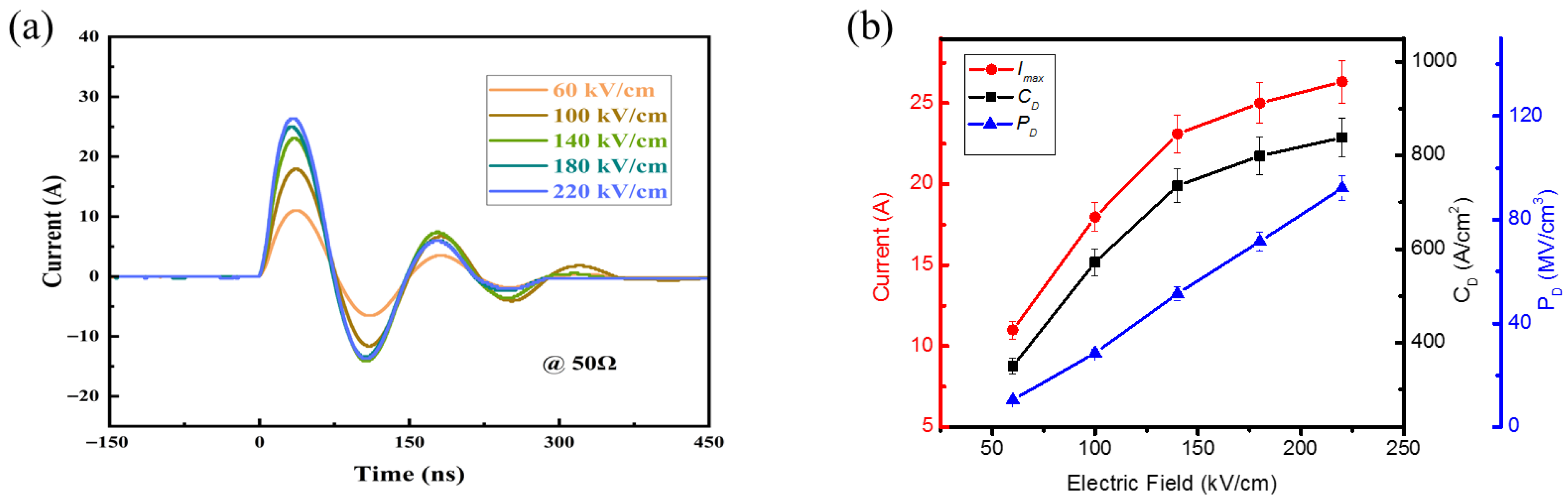
Dielectric ceramic capacitors have been widely used in high-pulse instruments and equipment due to their high power density and fast charging and discharging characteristics. Therefore, it is of great significance to evaluate the charge and discharge characteristics of the high-entropy ceramic capacitors under different damping conditions. The time-dependent relationship of the discharge current and energy-storage density of selected NBBSCT-xLZM high-entropy ceramics under underdamped load (x = 4) is shown in Figure 14.
Figure 14.
Time-dependent relationship of (a) the discharge current and (b) energy-storage density of selected NBBSCT-xLZM high-entropy ceramics under underdamped load (x = 4).
Figure 14a shows the relationship between the discharge current of the selected high-entropy ceramic capacitor (x = 4) and the discharge time under a 50 Ω underdamped load. It can be seen from the figure that below a 140 kV/cm electric field, the maximum discharge current of the material changes rapidly with the increase in the electric field, and under an applied 220 kV/cm electric field, its maximum discharge current can reach 26.33 A. Based on the discharge current curve data obtained from the test, the discharge current density and power density can be calculated. Figure 14b shows the relationship curve of the peak discharge current, discharge current density, and power density of the high-entropy ceramic capacitor with discharge time. It can be seen from the figure that under an external electric field of 220 kV/cm, the discharge current density CD can reach 838.22 A/cm2. The power density PD is as high as 92.20 MV/cm3, presenting an excellent application prospect in terms of energy-storage characteristics under medium and low electric fields.
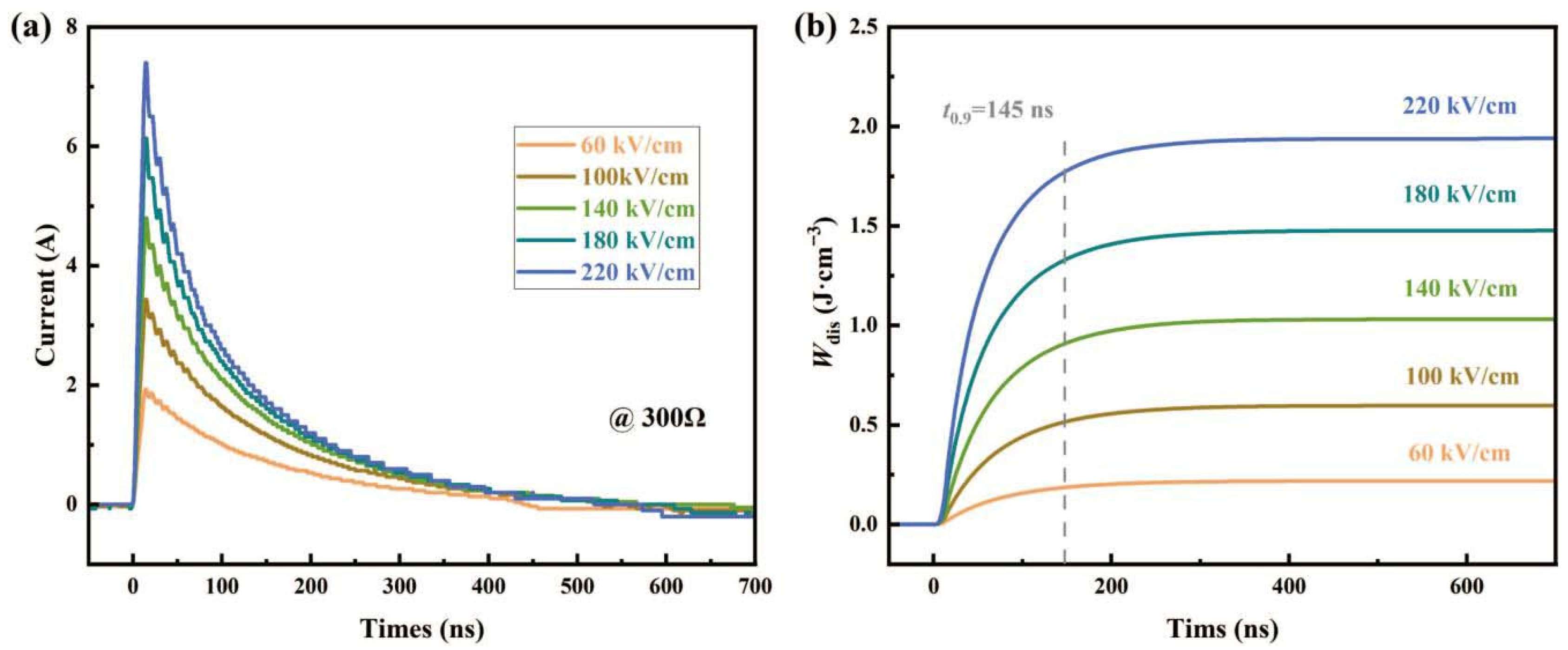
For the charge and discharge performance of dielectric capacitors, it is equally crucial to evaluate their discharge capacity under over-damped load conditions. Figure 15a shows the relationship between the discharge current of the high-entropy ceramic capacitor and the discharge time under a 300 Ω over-damped load. As shown in Figure 15b, it presents the relationship diagram of the discharge energy-storage density of the high-entropy ceramic capacitor varying with time. The discharge speed of dielectric capacitors is usually evaluated by parameter t0.9, which indicates the time required for 90% of the electrical energy stored in the capacitor to be released. As can be seen from the figure, the t0.9 of the high-entropy ceramic capacitor is 145 ns, demonstrating its superior fast charging and discharging characteristics. The high-entropy ceramic capacitor demonstrates superior charge and discharge characteristics under various damping load conditions, laying an important performance foundation for its industrial application in medium and low electric fields. The calculation formula for the discharge current is as follows:
where R represents the resistance value of the load resistance, where the over-damping condition is 300 Ω, I is the discharge current, t is the discharge time, and V is the volume of the ceramic material.
Figure 15.
Time-dependent relationship of (a) the discharge current and (b) energy-storage density of selected NBBSCT-xLZM high-entropy ceramics under overdamped load (x = 4).
4. Conclusions
In this study, the NBBSCT-LMZ high-entropy perovskite ceramics were engineered and prepared by gradient, site-selective substitution of La3+, Zr4+ and Mg2+ (LMZ) into A- and B-sites of NBBSCT via traditional solid-state synthesis. The effects of substitution on the structure, dielectric properties, and energy-storage properties were explored in detail. The results show that all samples present a single-phase structure indicating that LMZ can be well dissolved into the NBBSCT perovskite lattice. In addition, the NBBSCT-xLZM high-entropy ceramics show optimal energy-storage characteristics, as indicated by an excellent energy-storage density of 4.46 J/cm3 and an energy-storage efficiency of 94.55% at 318 kV/cm. Moreover, its power density is as high as 92.20 MV/cm3, and the discharge time t0.9 is only 145 ns while keeping temperature and frequency stable up to 150 °C and 1 kHz. The work proves that high-entropy design with A/B-site multi-element co-occupation is a generic route to combine high density with ultrafast discharge in lead-free electrostatic capacitors.
Author Contributions
Conceptualization, P.S. and Y.Z.; methodology, Y.W. and H.L.; formal analysis, Z.W. and Y.Z.; investigation, P.S.; writing—original draft preparation, P.S.; supervision, P.S. All authors have read and agreed to the published version of the manuscript.
Funding
This research received no external funding.
Data Availability Statement
The original contributions presented in this study are included in the article. Further inquiries can be directed to the corresponding author.
Conflicts of Interest
The authors declare no conflicts of interest.
References
- Zhang, L.; Chen, Z.; Luo, G.; Ai, F.; Luo, N.N. NaNbO3-based short-range antiferroelectric ceramics with ultrahigh energy storage performance. J. Eur. Ceram. Soc. 2023, 43, 6077–6083. [Google Scholar] [CrossRef]
- Liu, Z.; Lu, T.; Ye, J.; Wang, G.; Dong, X.L.; Withers, R.; Liu, Y. Antiferroelectrics for Energy Storage Applications: A Review. Adv. Mater. 2018, 3, 1800111. [Google Scholar] [CrossRef]
- Yang, L.T.; Kong, X.; Cheng, Z.X.; Zhang, H.Y.; Wang, F.; Li, B.; Li, J.F.; Li, Y.L.; Chen, L.Q.; Zhang, S.J. Ultra-high energy storage performance with mitigated polarization saturation in lead-free relaxors. J. Mater. Chem. A 2019, 7, 8573–8580. [Google Scholar] [CrossRef]
- Zhang, M.; Lan, S.; Yang, B.B.; Pan, H.; Liu, Y.Q.; Zhang, Q.H.; Qi, J.L.; Chen, D.; Su, H.; Yi, D.; et al. Ultrahigh energy storage in high-entropy ceramic capacitors with polymorphic relaxor phase. Science 2024, 384, 185–189. [Google Scholar] [CrossRef] [PubMed]
- Fu, S.; Jia, Z.J.; Wan, D.T.; Bao, Y.W. Synthesis, microstructure and thermophysical properties of (La0.2Y0.2Sm0.2Eu0.2Gd0.2)2Zr2O7 high-entropy oxide ceramic. Ceram. Inter. 2024, 50, 5510–5515. [Google Scholar] [CrossRef]
- Chen, H.; Fu, J.; Zhang, P.; Peng, H.; Abney, C.W.; Jie, K.; Liu, X.; Chi, M.; Dai, S. Entropy-stabilized metal oxide solid solutions as CO oxidation catalysts with high-temperature stability. J. Mater. Chem. A 2018, 6, 11129–11133. [Google Scholar] [CrossRef]
- Peng, H.; Wu, T.; Fu, Z.; Wang, D.; Hao, Y.; Xu, F.; Wang, G.; Chu, J. High-entropy relaxor ferroelectric ceramics for ultrahigh energy storage. Nat. Commun. 2024, 15, 11187193. [Google Scholar] [CrossRef]
- Yang, B.; Zhang, Y.; Pan, H.; Si, W.; Zhang, Q.; Shen, Z.; Yu, Y.; Lan, S.; Meng, F.; Liu, Y.; et al. High-entropy enhanced capacitive energy storage. Nat. Mater. 2022, 21, 1074–1080. [Google Scholar] [CrossRef]
- Wang, T.; Li, Y.J.; Zhang, X.F.; Zhang, D.D.; Gong, W.P. Simultaneous excellent energy storage density and efficiency under applied low electric field for high entropy relaxor ferroelectric ceramics. Mater Res Bull. 2023, 157, 112024. [Google Scholar] [CrossRef]
- Ning, Y.; Pu, Y.; Chen, Z.; Zhang, L.; Wu, C.; Zhang, X.; Wang, B.; Zhang, J. Novel high-entropy relaxors with ultrahigh energy-storage efficiency and density. Chem. Eng. J. 2023, 476, 146673. [Google Scholar] [CrossRef]
- Wen, Z.; Tang, Z.; Liu, Y.; Zhuang, L.; Yu, H.; Chu, Y. Ultrastrong and High Thermal Insulating Porous High-Entropy Ceramics up to 2000 °C. Adv. Mater. 2024, 36, 2311870. [Google Scholar] [CrossRef] [PubMed]
- Du, C.H.; Yu, T.T.; Sui, X.D.; Zhang, Z.C.; Cai, R.X.; Zhang, L.; Feng, Y.; Feng, M.; Zhou, F.; Wang, D. Macro-Superlubricity Induced by Tribocatalysis of High-Entropy Ceramics. Adv. Mater. 2025, 37, 2413781. [Google Scholar] [CrossRef] [PubMed]
- Gao, C.; Zhu, J.P.; Ye, S.B.; Liu, Y.W.; Zhang, Y.; Zhao, X.; Wu, J.M. Novel high-entropy perovskite titanate: A potential thermal protective material with improved thermophysical properties. J. Eur. Ceram. Soc. 2025, 45, 116878. [Google Scholar] [CrossRef]
- Wang, J.; Wang, W.; Liu, X.N.; Zhang, T.; Li, D.; Zhou, Y.C. High-entropy (YErYbLu)2SiO5 ceramic aerogel: A potential ceramic insulator with low thermal conductivity. Ceram. Inter. 2024, 50, 1795–1806. [Google Scholar] [CrossRef]
- Kumar, R.; Singh, I.; Meena, R.; Asokan, K.; Birajdar, B.; Patnaik, S. Effect of La-doping on dielectric properties and energy storage density of lead-free Ba(Ti0.95Sn0.05)O3 ceramics. Mater. Res. Bull. 2020, 123, 110694. [Google Scholar] [CrossRef]
- Zhu, X.P.; Gao, Y.F.; Shi, P.; Kang, R.R.; Kang, F.; Qiao, W.J.; Zhao, J.Y.; Wang, Z.; Yuan, Y.; Lou, X.J. Ultrahigh energy storage density in (Bi0.5Na0.5)0.65Sr0.35TiO3-based lead-free relaxor ceramics with excellent temperature stability. Nano Energy 2022, 98, 107276. [Google Scholar] [CrossRef]
- Ren, P.; Wang, Q.; Li, S.; Zhao, G. Energy storage density and tunable dielectric properties of BaTi0.85Sn0.15O3/MgO composite ceramics prepared by spark plasma sintering. J. Eur. Ceram. Soc. 2017, 37, 1501–1507. [Google Scholar] [CrossRef]
- Li, H.Y.; Zhou, Y.; Liang, Z.H.; Zhang, T.; Wang, J.; Yang, Z. High-Entropy Oxides: Advanced Research on Electrical Properties. Coatings 2021, 11, 628. [Google Scholar] [CrossRef]
- Salian, A.; Mandal, S. Entropy stabilized multicomponent oxides with diverse functionality-a review. Crit. Rev. Solid. State 2022, 47, 142–193. [Google Scholar] [CrossRef]
- Xiang, H.M.; Xing, Y.; Dai, F.Z.; Zhang, L.; Zhang, B.; Zhang, J.X.; Zhang, X.; Zhou, Y.C. High-entropy ceramics: Present status, challenges, and a look forward. J. Adv. Ceram. 2021, 10, 385–441. [Google Scholar] [CrossRef]
- Fan, L.C.; Li, Y.X.; Li, J.; Xiang, Q.; Wang, X.; Wen, T.; Zhong, Z.; Liao, Y. High entropy dielectrics. J. Adv. Dielectr. 2023, 13, 2350014. [Google Scholar] [CrossRef]
- Li, X.Q.; Cai, W.; Chen, D.K.; Du, M.C.; Gao, R.L.; Chen, G.; Deng, X.L.; Fu, C.L. Dielectric and energy storage performances of Na0.7Bi0.1NbO3 relaxor ferroelectric ceramics with submicron grain size fabricated via cold sintering. J. Mater. Res. Bul. 2024, 180, 113018. [Google Scholar] [CrossRef]
- Yang, H.; Cai, Z.M.; Zhu, C.Q.; Feng, P.Z.; Wang, X.H. Ultra-high energy storage performance in BNT-based ferroelectric ceramics with simultaneously enhanced polarization and breakdown strength. ACS Sustainable Chem. Eng. 2022, 10, 9176–9183. [Google Scholar] [CrossRef]
- Zhang, Y.Y.; Wang, D.; Li, Q.; Liu, H.; Sun, S.K.; Cui, Z.; Li, L.L.; Li, C.C.; Li, J.; Li, W. Medium temperature sintered BaTiO3-based ceramics for X8R capacitors. J. Materiomics 2025, 11, 123–130. [Google Scholar] [CrossRef]
- Zhu, W.; Song, F.S.; Shen, Z.Y.; Luo, W.Q.; Wang, Z.M.; Li, Y.M. KNN+Nb2O5 co-modified BNBST-based relaxor ferroelectric ceramics for X8R energy storage capacitors. Ceram. Int. 2023, 49, 38196–38203. [Google Scholar] [CrossRef]
- Lan, J.; Li, H.; Zhang, G.; Lin, F.; Liu, G. Mixed Three-Parameter Weibull Breakdown Distribution Model and Breakdown Mechanism of Metalized Films. In Proceedings of the 2023 4th International Symposium on Insulation and Discharge Computation for Power Equipment (IDCOMPU2023), Wuhan, China, 26–28 May 2023; Springer: Singapore, 2024; Volume 1101, pp. 1–12. [Google Scholar]
- Niu, Y.W.; Zhang, F.; Zhang, X.; Zhang, Z.Q.; Bai, Y.; Wang, Z.J. Enhanced energy storage properties of (Bi0.2Na0.2Ca0.2Ba0.2Sr0.2) (Ti1-xZrx)O3 high entropy ceramics by Zr doping at B-site. Ceram. Int. 2024, 50, 230–237. [Google Scholar] [CrossRef]
- Zhu, X.; Li, Q.; Liu, Q.; Ke, S.; Zhang, Y.; Wu, J.; Xiao, D.; Zhu, J. Excellent energy-storage performance in Bi0.5Na0.5TiO3-based lead-free high-entropy relaxor ferroelectrics via B-site modification. J. Adv. Ceram. 2024, 13, 9220859. [Google Scholar]
- Veerapandiyan, V.; Benes, F.; Gindel, T.; Deluca, M. Strategies to improve the energy-storage properties of perovskite lead-free relaxor ferroelectrics: A review. Materials 2020, 13, 5742. [Google Scholar] [CrossRef]
- Yang, W.; Zeng, H.R.; Yang, F.; Lin, J.F.; Ge, G.L.; Cao, Y.; Du, W.T.; Zhao, K.Y.; Li, G.R.; Xie, H.J.; et al. Superior energy storage properties in NaNbO3-based ceramics via synergistically optimizing domain and band structures. J. Mater. Chem. A 2022, 10, 11613–11624. [Google Scholar] [CrossRef]
- Deng, T.; Liu, Z.; Hu, T.; Dai, K.; Hu, Z.; Wang, G. Excellent energy-storage performance in Bi0.5Na0.5TiO3-based lead-free composite ceramics via introducing pyrochlore phase Sm2Ti2O7. Chem. Eng. J. 2023, 465, 142992. [Google Scholar] [CrossRef]
- Ning, Y.; Pu, Y.; Wu, C.; Zhou, S.; Zhang, L.; Zhang, J.; Zhang, X.; Shang, Y. Enhanced capacitive energy-storage and dielectric temperature stability of A-site disordered high-entropy perovskite oxides. J. Mater. Sci. Technol. 2023, 145, 66–73. [Google Scholar] [CrossRef]
- Ning, Y.; Pu, Y.; Zhang, Q.; Zhou, S.; Wu, C.; Zhang, L.; Shi, Y.; Sun, Z. Achieving high energy-storage properties in perovskite oxide via high-entropy design. Ceram. Int. 2023, 49, 12214–12223. [Google Scholar] [CrossRef]
- Ning, Y.; Pu, Y.; Zhang, X.; Chen, Z.; Wu, C.; Zhang, L.; Wang, B.; Li, X. Remarkable energy-storage density together with efficiency of above 92% in high-entropy ferroelectric ceramics. Mater. Today Phys. 2024, 43, 101418. [Google Scholar] [CrossRef]
- Ning, Y.; Pu, Y.; Zhang, Q.; Chen, Z.; Zhang, J.; Ouyang, T.; Shang, J.; Zhang, L.; Wang, B.; Li, X. Improved energy-storage capacity of high-entropy ferroelectric perovskite ceramic via flash sintering. J. Phys. D Appl. Phys. 2024, 618, 235205. [Google Scholar] [CrossRef]
- Niu, Y.; Zhang, F.; Zhang, Z.; Li, M.; Liu, J.; Wang, Z. Improving energy-storage performance of (Bi0.5Na0.5)0.94Ba0.06TiO3-based high-entropy ceramics by A/B-site co-regulation. Ceram. Int. 2025, 51, 25182–25191. [Google Scholar] [CrossRef]
Disclaimer/Publisher’s Note: The statements, opinions and data contained in all publications are solely those of the individual author(s) and contributor(s) and not of MDPI and/or the editor(s). MDPI and/or the editor(s) disclaim responsibility for any injury to people or property resulting from any ideas, methods, instructions or products referred to in the content. |
© 2025 by the authors. Licensee MDPI, Basel, Switzerland. This article is an open access article distributed under the terms and conditions of the Creative Commons Attribution (CC BY) license (https://creativecommons.org/licenses/by/4.0/).