Article

AI-Driven Signal Processing for SF6 Circuit Breaker Performance Optimization

by
Philippe A. V. D. Liz
1,*,†,‡,
Giovani B. Vitor
1,*,‡,
Ricardo T. Lima
2,‡,
Aurélio L. M. Coelho
1,‡ and
Eben P. Silveira
1,‡
1
Laboratory of Robotics, Intelligent and Complex Systems—ROBSIC, Itabira 35903-087, MG, Brazil
2
Centrais Elétricas Brasileiras S/A—ELETROBRÁS, Rio de Janeiro 20091-005, RJ, Brazil
*
Authors to whom correspondence should be addressed.
Current address: Institute of Technological Sciences, ICT, Federal University of Itajubá, UNIFEI, Itabira Campus, Itabira 35903-087, MG, Brazil.
These authors contributed equally to this work.
Energies 2025, 18(2), 377; https://doi.org/10.3390/en18020377
Submission received: 13 November 2024 / Revised: 11 December 2024 / Accepted: 20 December 2024 / Published: 17 January 2025
(This article belongs to the Special Issue Measurement Systems for Electric Machines and Motor Drives)

Abstract

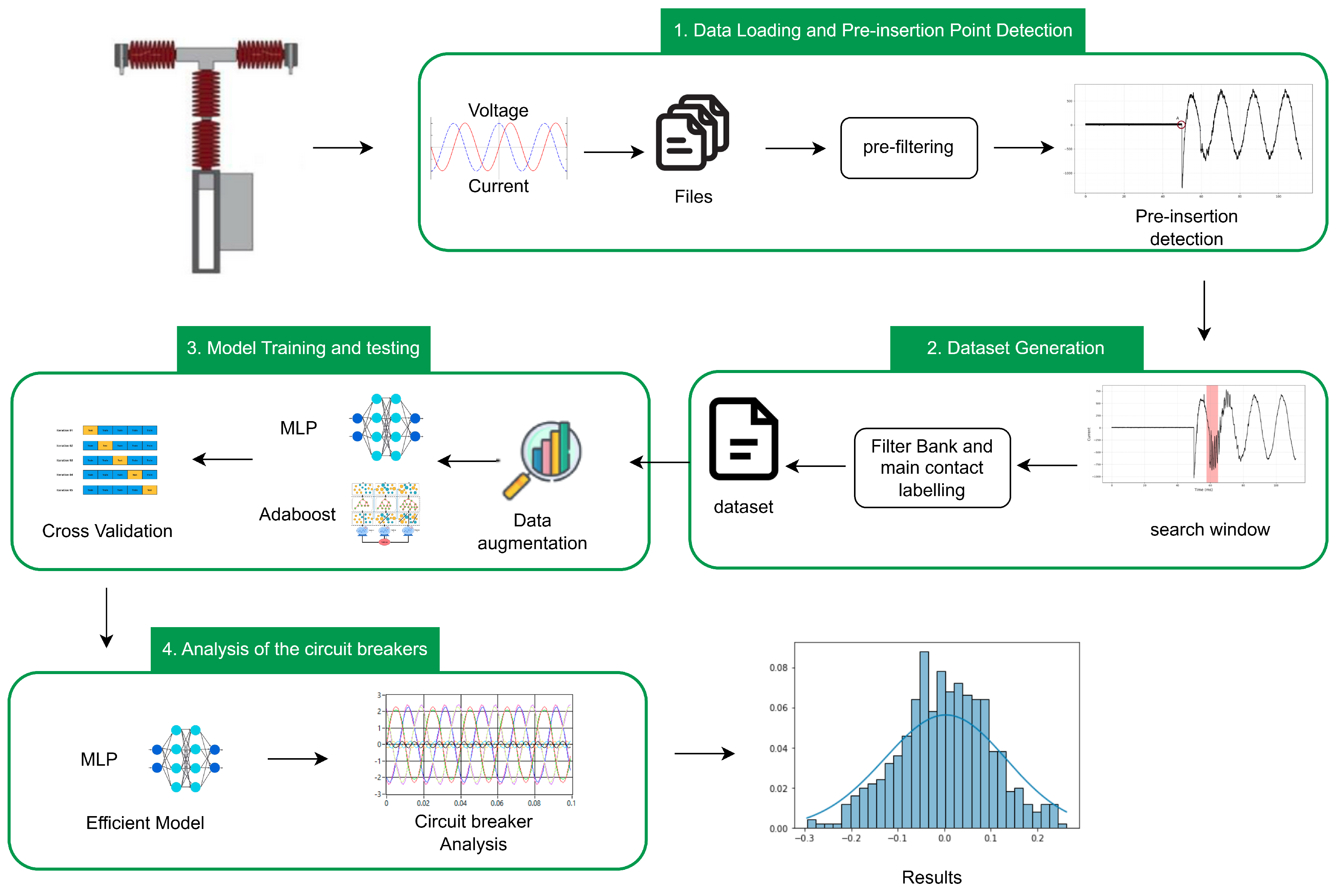
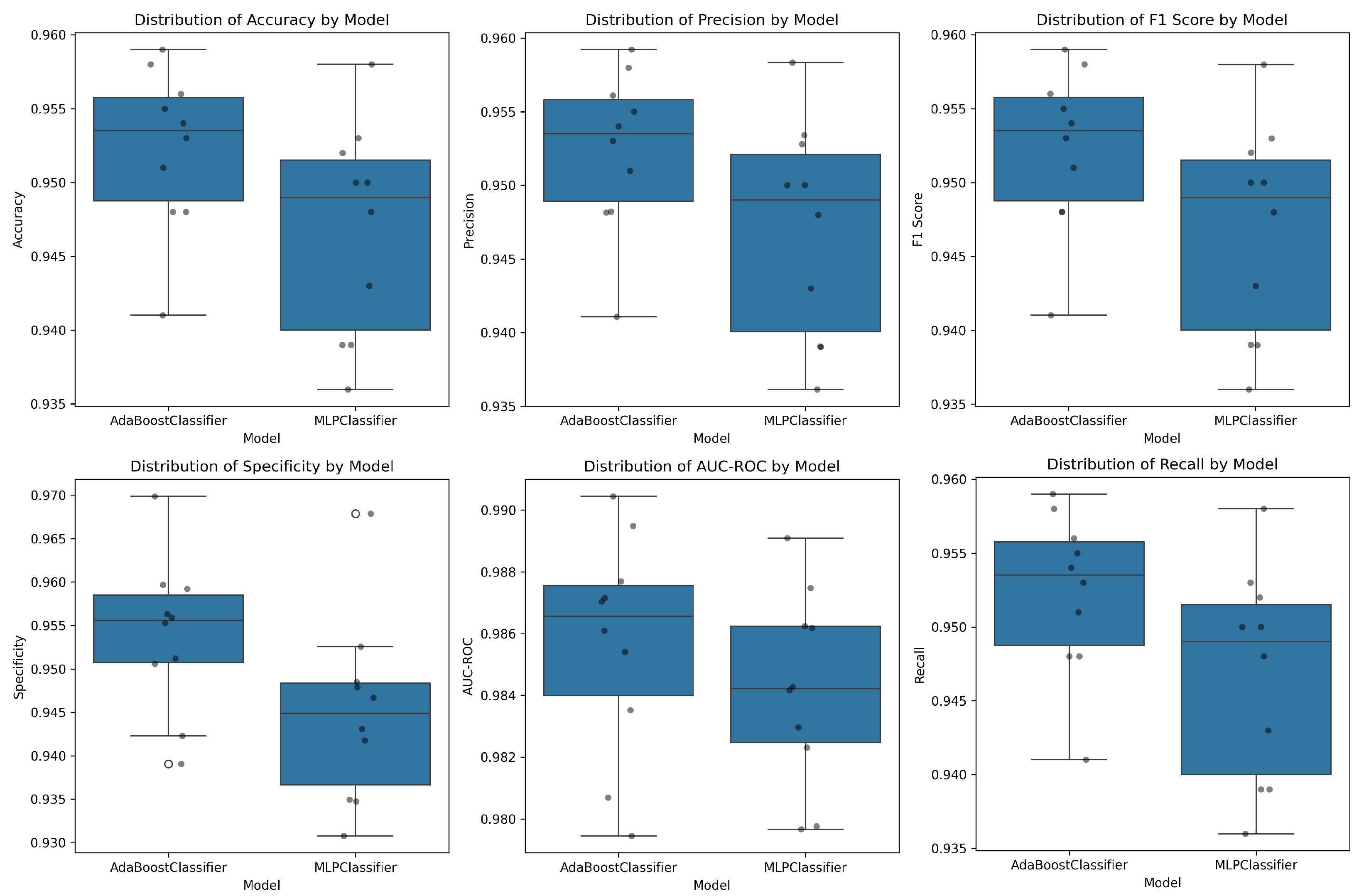
This work presents an approach based on signal processing and artificial intelligence (AI) to identify the pre-insertion resistor (PIR) and main contact instants during the operation of high-voltage SF6 circuit breakers to help improve the settings of controlled switching and attenuate transients. For this, the current and voltage signals of a real Brazilian substation are used as AI inputs, considering the noise and interferences common in this type of environment. Thus, the proposed modeling considers the signal preprocessing steps for feature extraction, the generation of the dataset for model training, the use of different machine learning techniques to automatically find the desired points, and, finally, the identification of the best moments for controlled switching of the circuit breakers. As a result, the models evaluated obtained good performance in the identification of operation points above 93%, considering precision and accuracy. In addition, valuable statistical notes related to the controlled switching condition are obtained from the circuit breakers evaluated in this research.
Keywords: high-voltage circuit breakers; artificial intelligence; substation capacitor bank; controlled switching high-voltage circuit breakers; artificial intelligence; substation capacitor bank; controlled switching