Article

Energy-Constrained Optimization of Data Center Layouts: An Integer Linear Programming Approach

School of Economics, Wuhan University of Technology, Wuhan 430070, China
*
Author to whom correspondence should be addressed.
Energies 2025, 18(18), 5040; https://doi.org/10.3390/en18185040
Submission received: 19 August 2025 / Revised: 12 September 2025 / Accepted: 18 September 2025 / Published: 22 September 2025

Abstract

Optimizing the layout of data centers is important for the rapid development of digital infrastructure, while also addressing the issues of energy consumption, environmental sustainability, and geographic resource distribution. Traditional strategies usually focus only on the distance to demand centers and ignore the energy and environmental costs of data centers in densely populated areas. In this paper, we propose a layout optimization model based on energy consumption constraints that combines integer linear programming with binary decision variables. The model combines energy efficiency, renewable resource availability, and regional characteristics to balance economic benefits and environmental impacts, consistent with the “East data, West computing” project. The experimental results showed that the energy efficient scenario consistently reduced costs, from ¥3.68 × 10⁸ to ¥3.08 × 10⁸ without energy constraints, and from ¥4.08 × 10⁸ to ¥3.47 × 10⁸ under energy consumption constraints. Additionally, energy constraints increased the number of required data centers from two to three. The results of the study emphasized the importance of strategic siting, especially in low electricity price areas, in order to optimize the layout and improve sustainability.

1. Introduction

Digital technology’s rapid growth and surging data volumes drive the need for large data centers, critical for cloud computing, big data, AI [1,2], IoT, and 5G. These facilities underpin the digital economy but face challenges, as escalating energy consumption harms the environment, and strategic siting is essential. China’s “East Data, West Computing” strategy addresses this by shifting data center operations to western regions with abundant clean energy, cooler climates, and lower costs, promoting efficiency and sustainability.
Data center layout optimization involves balancing electricity usage, geographic location, resource availability, and policy [3,4]. Historically concentrated in economically developed eastern areas, data centers there faced high energy costs and environmental pressure. The “East Data, West Computing” initiative necessitates new models to ensure balanced, sustainable network development, integrating economic and environmental factors. Energy consumption depends on size, computing power, climate, renewable energy access, and power system stability, while policies and social environmental concerns also impact layout and operations. Researchers now leverage dynamic optimization algorithms and machine learning to adapt to evolving market and environmental demands [5,6,7,8].
Early studies used cost models to evaluate siting factors like power supply and policy. Goiri and Hans proposed a nonlinear cost-minimization model with response time and availability constraints [9,10], while Wang et al. analyzed data center spatial distributions and their impacts on energy use and emissions [11]. Recent work applies intelligent techniques like mixed integer programming and heuristics to improve energy efficiency and sustainability.
The problem of locating and interconnecting capacity facilities subject to regional energy consumption caps aims to minimize the total life-cycle cost while ensuring demand coverage, site capacity, and compliance with regional energy consumption limits. Specifically, given a set of user demand nodes and candidate sites, the problem involves deciding which candidate sites to build data centers on, which data center to assign to each user node, and how to establish interconnection links between data centers. Existing solutions primarily fall into three categories. Among these, the p -median algorithm focuses on minimizing transportation costs, the Multi-Criteria Location Problem (MCLP) prioritizes maximizing coverage, and Capacity Facility Location Planning (CFLP) considers site capacity. Some data center site selection efforts incorporate electricity rates or PUE as cost factors within the objective function. However, energy consumption is rarely treated as a system-level hard constraint, and it is even less common to perform end-to-end joint optimization within a single model that integrates both computational and storage resource capacities, inter-site interconnection topologies, and regional energy consumption budgets.
In summary, models such as p -median, MCLP, and CFLP either do not explicitly model energy consumption or incorporate energy consumption as coefficients within the objective function. This paper proposes a data center layout optimization model based on energy consumption constraints, setting the total regional energy consumption as an upper bound that cannot be violated. The model integrates integer linear programming (ILP) and binary decision variables to optimize data center layout while minimizing construction and operation costs. By integrating parameters such as energy price, resource capacity, and geographic characteristics, the model provides a comprehensive framework for sustainable data center development. This is an integrated integer programming framework that simultaneously considers energy consumption constraints, dual resource capacities, interconnection topologies, and total costs, not merely adding an energy consumption coefficient to existing p -median or MCLP models.
(1) An optimization framework has been developed that integrates energy consumption constraints with resource availability, offering an innovative approach to data center site selection. This framework treats regional energy consumption as a hard constraint rather than a soft cost item, characterizing changes in the feasible domain under policy and quota restrictions and empirically demonstrating a structural transition in the optimal number of sites.
(2) Unlike the single capacity setting used in traditional facility site selection, this paper establishes separate site capacity limits for computing and storage. It further incorporates PUE heterogeneity and electricity pricing to influence operational energy consumption and costs. This approach determines the combined boundary for both the facility location area and the selected capacity.
(3) This paper treats interconnection establishment as a binary variable (0 and 1), incorporating link costs and reliability constraints for sufficient connectivity. This end-to-end method determines three tiered structures, where to build, where to connect, and whom to serve, enabling topology to coevolve with energy consumption.
The paper’s structure is as follows. Section 2 reviews related work on data center layout optimization. Section 3 details the proposed optimization model, including decision variables, objective functions, and constraints. Section 4 presents the experimental setup and results, and Section 5 concludes with future research directions. This empirical study focuses on the main effects of energy consumption caps, PUE, and electricity price heterogeneity. Interconnection energy consumption is excluded from this round of assessment, with only fiber CAPEX and connectivity included.

2. Related Work

2.1. Data Center Layout Issues

The data center layout problem has been a focus of attention in both academia and industry. Scholars usually focus on how to reduce costs, improve energy efficiency, reduce network latency, and support sustainable development through optimal siting. Data center layout involves various factors, such as power supply and cost, geographic location, policy support, resource availability, and environmental factors.
Most of studies focus on how to use cost models to evaluate various factors affecting data center location. For example, Goiri et al. proposed a nonlinear cost-minimization model constrained by response time, data consistency, and service availability, later linearizing the problem to analyze potential U.S. regions and develop a decision-making tool for optimal siting [9,10]. Hans et al. divided the total cost into the siting fixed costs and variable costs due to resource availability to better understand the cost structure in data center operations [10]. Turek et al. [12] integrated climate factors such as temperature, humidity and wind speed into a cost model, proposing an energy-efficient data center siting optimization model. Yan et al. [13] developed a Total Cost of Ownership (TCO) model for long-term data preservation, accounting for equipment replacement, data migration, and energy consumption over extended operational lifespans. Li et al. [14] used a multi-criteria decision model incorporating energy costs, land availability, and infrastructure to frame big data center siting. Wang et al. [11] analyzed data center spatial distributions, revealing layout impacts on energy use, emissions, and regional development. Kheybari et al. [15] proposed an integrated multi-criteria, set-covering site selection framework. First, a three-dimensional indicator system and weights were constructed based on sustainability to evaluate the utility of each candidate site. These utilities were then incorporated into a linear set-covering model to determine the optimal spatial layout of data centers under given coverage radius and center number constraints, thereby simultaneously ensuring site suitability and service coverage. Wang et al. [16] developed a carbon emission-minimizing model with a hyper-heuristic algorithm based on ant colony principles for low-carbon vehicle routing. Zhang et al. [17] developed an indicator system and decision-making framework for assessing the sustainability of big data centers. They refined several sub-indicators across four levels, big data layer, equipment layer, server room layer, and data center layer, emphasizing that PUE alone is insufficient for measuring sustainability. This systematic evaluation framework employs a blend of qualitative and quantitative methods, introducing fuzzy theory for the first time into multi criteria decision making for big data center sustainability to address uncertainties in expert judgments.

2.2. Optimization Models for Siting Problems

Siting problem research is a core domain of optimization modeling, encompassing classical frameworks such as the Maximum Covering Location Problem (MCLP), ensemble coverage model, and p -median model, which are widely applied in emergency facility planning, industrial logistics, and urban infrastructure design.
Proposed by Church and ReVelle, MCLP aims to maximize the number of demand points covered by selecting a specified number of facilities within a predefined service radius, critical for public emergency infrastructure like first-aid centers and fire stations [18]. In 2016, Colombo et al. enhanced MCLP-solving efficiency via a variable neighborhood search method using exponential neighborhoods [19]. Drakulic et al. extended MCLP to fuzzy environments, using fuzzy numbers to model uncertain coverage radii and inter-location distances for enhanced ambiguity resilience [20]. Sudtachat proposed ambulance siting schemes with varying unit numbers via compliance table strategies [21]. Stanimirović et al. designed multi-type emergency service networks using MCLP, incorporating diverse incident and unit types [22]. Mišković et al. developed dynamic robust DMCLP, leveraging hybrid variable neighborhood search and linear programming to improve solution efficiency [23]. Manuel et al. addressed MCLP data inaccuracy with a binary linear multi-objective model, using the augmented weighted Chebyshev method for coverage-reliability trade-offs [24]. Wei Wang and Shining Wu comprehensively analyzed discrete-coverage emergency facility siting, exploring solution methods and future directions for coverage models [25].
The ensemble coverage model seeks to minimize the number of facilities required to fully cover all demand points, with Toregas et al. first formalizing it to reduce facility count or construction costs [26]. Perera et al. applied it to EV charging infrastructure planning, developing a life-cycle framework to balance costs and coverage for long-term optimization [27]. Xia et al. [28] studied two-tier path planning with ground vehicles and UAVs for multi-area coverage, minimizing travel time and energy consumption. Qiang Su optimized EMS resource allocation via an improved dual coverage model to reduce delayed emergency costs [29]. Agam and Andriansyah et al. applied ensemble coverage algorithms to waste management, optimizing facility locations [30]. Liu and Cao et al. proposed an ensemble model for emergency medical facilities during the COVID-19 pandemic to optimize layouts [31].
The p -median model selects p facilities from candidate locations and assigns demand points to minimize transportation costs, widely used in industrial siting for factories and warehouses. Çelik et al. applied the p -median model to EV charging station siting, using genetic algorithms to optimize locations with considerations for user accessibility and grid capacity [32]. Jabbarzadeh proposed a robust model for post-disaster blood supply networks, optimizing facility siting and resource allocation [33]. Bayram studied shelter siting by integrating evacuation traffic assignment to determine optimal locations [34]. Shahriari proposed joint siting for ground and air emergency medical services to enhance service levels [35]. Murad et al. modified the p -median model with accessibility and service quality metrics to optimize public hospital locations in Jeddah, improving citywide health coverage [36]. Calik et al. proposed a p -center model to minimize the maximum distance between demand points and facilities [37]. Gwalani et al. addressed large-scale p -median problems by decomposing regions by demand density, developing a distributed algorithm for near-optimal clustered solutions [38].
Contemporary siting research integrates constraints like energy use, resource limits, and time sensitivity. Razi et al. optimized search and rescue vessel siting under time constraints to enhance maritime emergency response speed via constrained optimization [39]. Glavić compared p -center and improved p -median models for winter road maintenance siting, showing the latter’s advantage in balancing coverage and costs [40]. In this context, this study constructs a data center area layout optimization model under energy consumption constraints, aiming to improve resource use efficiency, reduce energy consumption and optimize overall service level through rational layout.
The correspondence between the model established in this paper and the classical facility location model is as follows. Coverage and serviceability are specified by user assignment constraints, corresponding to Equations (13) and (14). Distance and delay do not have hard thresholds but are incorporated into the cost function as distance terms. Capacity is constrained at the site level with upper bounds for computation and storage, corresponding to Equation (17). Interconnection and fundamental reliability among data centers are ensured through connectivity constraints, corresponding to Equation (15). Facility quantity is controlled by a counting constraint, corresponding to Equation (12). Energy sustainability is characterized by a system energy consumption upper bound, corresponding to Equation (16). The above summary covers the core assumptions of mainstream paradigms, including MCLP, Set-Cover, p -median, p -center, and capacity facility location.

3. Methodology

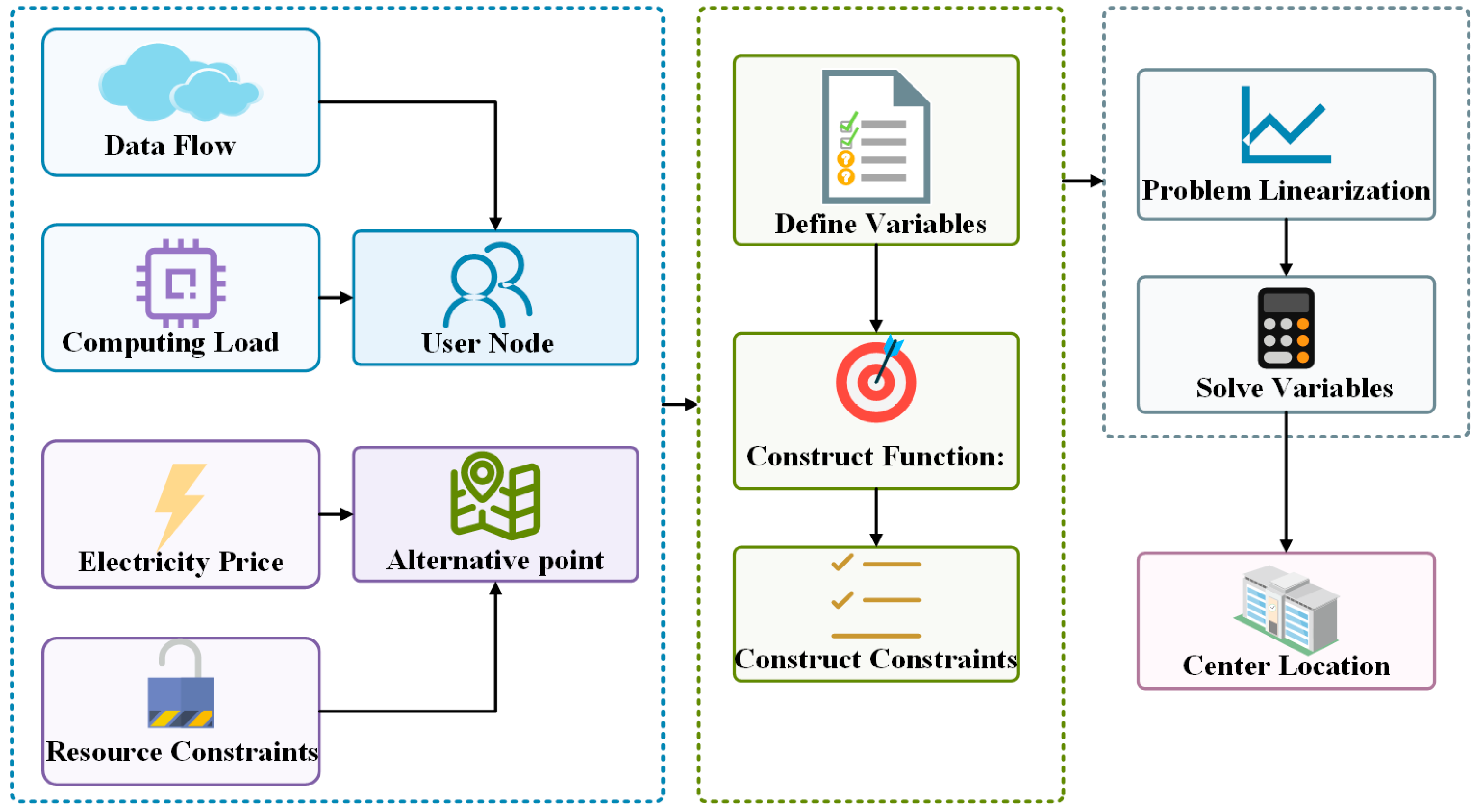
Under the energy consumption constraint, a data center regional layout optimization model is constructed, combining integer linear programming and 0–1 planning, aiming to optimize the regional layout of data centers and minimize the construction and operation costs while meeting the energy consumption limit. The core idea of this optimization model is to rationally configure data center site selection and resource allocation based on ensuring that user demands are met, in order to achieve double optimization of economic benefits and energy efficiency. The construction of the methodology includes the setting of user demand nodes and alternative point parameters, as well as the specific design and solution process of the optimization model, through which the complex regional layout and energy consumption constraints are effectively addressed.
The steps of model construction are shown in Figure 1, which demonstrates the basic framework of data center regional layout, including the relationship between alternative points, user demand nodes, and layout siting decisions. Figure 1 will clearly present the setting of decision variables and constraints, as well as the formation process of optimization objectives.

3.1. Definition and Characteristics of User Demand Nodes and Alternative Points

In data center area layout optimization, the selection of user demand nodes and alternative points is crucial. User demand nodes are specific locations that need services provided by the data center, and the characteristics of these nodes directly affect the design of layout optimization. Define the set of user demand nodes as R = r 1 , r 2 , , where the user’s computation and storage demand on the demand node r i is usually expressed as the computational load demand α r i , and the communication demand between each user demand node r i and the data center is usually measured by the data transfer rate β r i . For the alternative points, a number of potential layout points are selected considering factors such as electricity price, energy efficiency, and climate conditions. The setting of alternative point parameters impacts the data center’s energy consumption, construction cost, and operational efficiency, significantly influencing the final layout optimization results. The set of alternative points is defined as L = { l 1 , l 2 , . . . } . Each alternative point has different electricity price, energy efficiency and resource cap. The price of electricity in the region where the alternative point is located, E P i , is an important part of the operating cost; the energy usage efficiency. Energy usage efficiency e i reflects the data center’s energy efficiency, typically measured as the ratio of total energy consumed by the data center to the energy consumed by IT loads. R E p i is defined as the resource constraints of the alternative location and determines the size of the data center that can be built at that location. R s p i is defined as the maximum storage resources available and affects the storage capacity that can be provided by the data center. These parameters serve as key inputs to the model’s constraints and objective function, ensuring that the service requirements at each user demand node are satisfied.

3.2. Identification and Analysis of Decision Variables

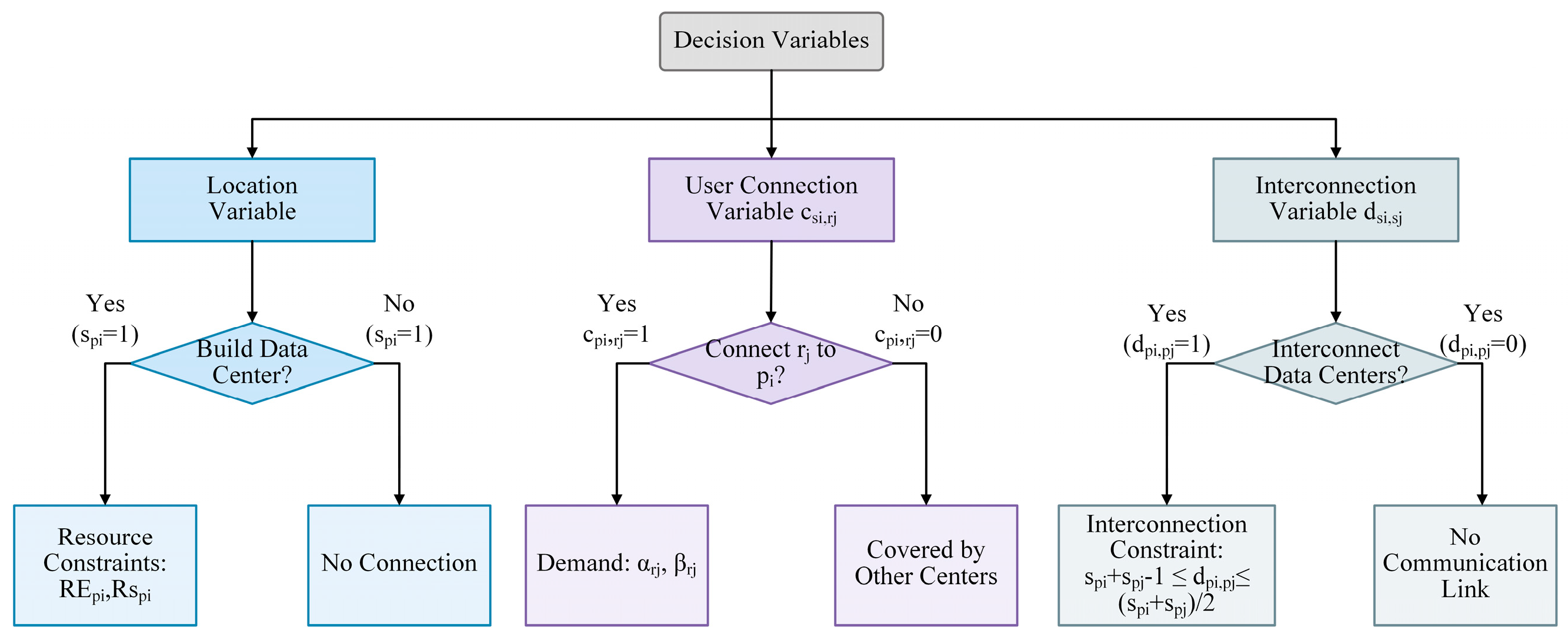
Decision variables are the core components in the optimization model and are the uncertain variables to be optimized in the model, including whether the data center is sited at an alternative point and the user connection and interconnection. These variables are all binary variables and are denoted by s p i , c p i , r j , and d p i , p j for the data center siting variable, the user-data center connection variable, and the interconnection variable between data centers, respectively. Specifically, if a data center is constructed at an alternative point, the variable takes the value of 1, otherwise it is 0. Similarly, if the user demand node is connected to the data center, the variable takes the value of 1, otherwise it is 0. For the interconnection between data centers, if the centers of the two alternatives are connected to each other, the variable also takes the value of 1, otherwise it is 0. These binary variables are introduced not only to simplify decision making but also to capture data center locations, user demand allocation, and network interconnections among centers. In turn, they enable optimization of the regional layout of data centers. For clarity, the relationships between decision variables and their constraints are visualized in Figure 2.

3.3. Design of Objective Function and Constraints

The objective function and constraints are central to the optimization model, determining its feasibility and optimal solution. The objective function is usually oriented to cost minimization, while the constraints define the practical limitations of data center layout and operation to ensure that specific requirements are met. With these constraints met, the regional layout of the data center is optimized by minimizing the total cost, thus maximizing economic benefits and sustainable development.
The core objective of the objective function is to minimize the total cost of the data center, which includes two main components, namely the initial construction cost and the operation cost. Through detailed analysis and comprehensive consideration of these two parts of the cost, the optimal solution can be provided for the regional layout of the data center, so as to maximize the cost-effectiveness.
For the initial construction cost, it is the fixed cost that the data center needs to invest in the early stage of planning and construction, which is mainly composed of three aspects. The first aspect is the land lease cost, which is the land lease cost to be paid for the location of the data center. The land lease cost varies greatly from region to region and is usually determined according to the geographic location and market price of the alternative site. Land acquisition fee E a and total cost E c 1 in the regional layout are defined in Equations (1) and (2) below:
E a = C p C s
E c 1 = p i P s p i E a
where C p represents the price per unit of land area. C s represents the footprint of the data center.
The second aspect is the construction and installation costs, which are mainly related to the acquisition of the underlying infrastructure, such as the power supply and distribution system, the heat dissipation and cooling system and the integrated cabling system, as well as the construction costs. The power supply and distribution system includes equipment such as distribution cabinets, transformers, uninterruptible power supply, diesel generator sets and battery backup to ensure a stable power supply to the data center. The cooling system, comprising air-cooling or liquid-cooling equipment, controls the heat generated during operation to ensure normal data center functioning. Comprehensive cabling systems mainly include network cabinets, optical cable laying and termination, and bridges and other equipment to ensure unimpeded communication and data transmission between equipment in the data center. The construction cost of these systems together constitute the initial construction cost of the data center, which directly affects the decision of site selection. The mathematical expression of the construction engineering fee E b and total cost E c 2 in the regional layout of the data center as expressed in the following Equations (3) and (4):
E b = e = 1 e P 1 e N 1 e + c = 1 c P 1 c N 1 c + l = 1 l P 1 l N 1 l
E c 2 = p i P s p i E b
where e represents the total number of equipment types in the required power supply and distribution system, and P 1 e and N 1 e represent the unit price and quantity of equipment in the power supply and distribution system of category e , respectively. c represents the total number of equipment types in the required heat dissipation and cooling system, and P 1 c and N 1 c represent the unit price and quantity of equipment in the heat dissipation and cooling system of category c , respectively. l represents the total number of equipment types in the required integrated wiring system, and P 1 l and N 1 l represent the unit price and quantity of equipment in the integrated wiring system of category l , respectively.
The third aspect is the communication network cost, which involves the network cost E c 3 for connecting the selected user demand node location to the selected data center and the network cost E c 4 required for interconnecting different data centers, as shown in Equations (5) and (6):
E c 3 = p i P r j R c p i , r j D p i , r j η
E c 4 = 1 2 p i P p j P d p i , p j D p i , p j η
where η denotes the cost per unit length of the fiber optic network. D is the distance between the two locations to be connected.
For the operation cost, it is the variable cost that the data center needs to spend in the process of daily operation, which can also include three aspects. The first aspect is power consumption, the dominant share of operating costs, including electricity for servers, cooling systems, and lighting. It is expressed as Equation (7):
E o 1 = p i P r j R c p i , r j e p p i e i α r j λ + β r j ρ ε t
where λ ,   ρ ,   ε and t are given constants. λ represents the power consumption of processors in the data center during computation. ρ represents the amount of time the user’s business requirements data is stored in the data center. ε represents the power consumption of storage devices during data storage. t is the design life of the data center, set by the initial planning.
The second aspect is the cost of equipment maintenance, which includes routine maintenance and repair costs for servers, network equipment, cooling systems, etc. The equations for equipment maintenance cost E c and total cost E o 2 are shown in Equations (8) and (9):
E c = c E c 2
E o 2 = p i P s p i E c
where c denotes the portion of the investment in data center equipment calculated on a fixed percentage basis.
The third aspect is the labor cost, which involves the salary expenses of operation managers, technical support staff, etc., and is defined as Equation (10):
E o 3 = p i P s p i γ
where γ denotes the unit data center manpower cost.
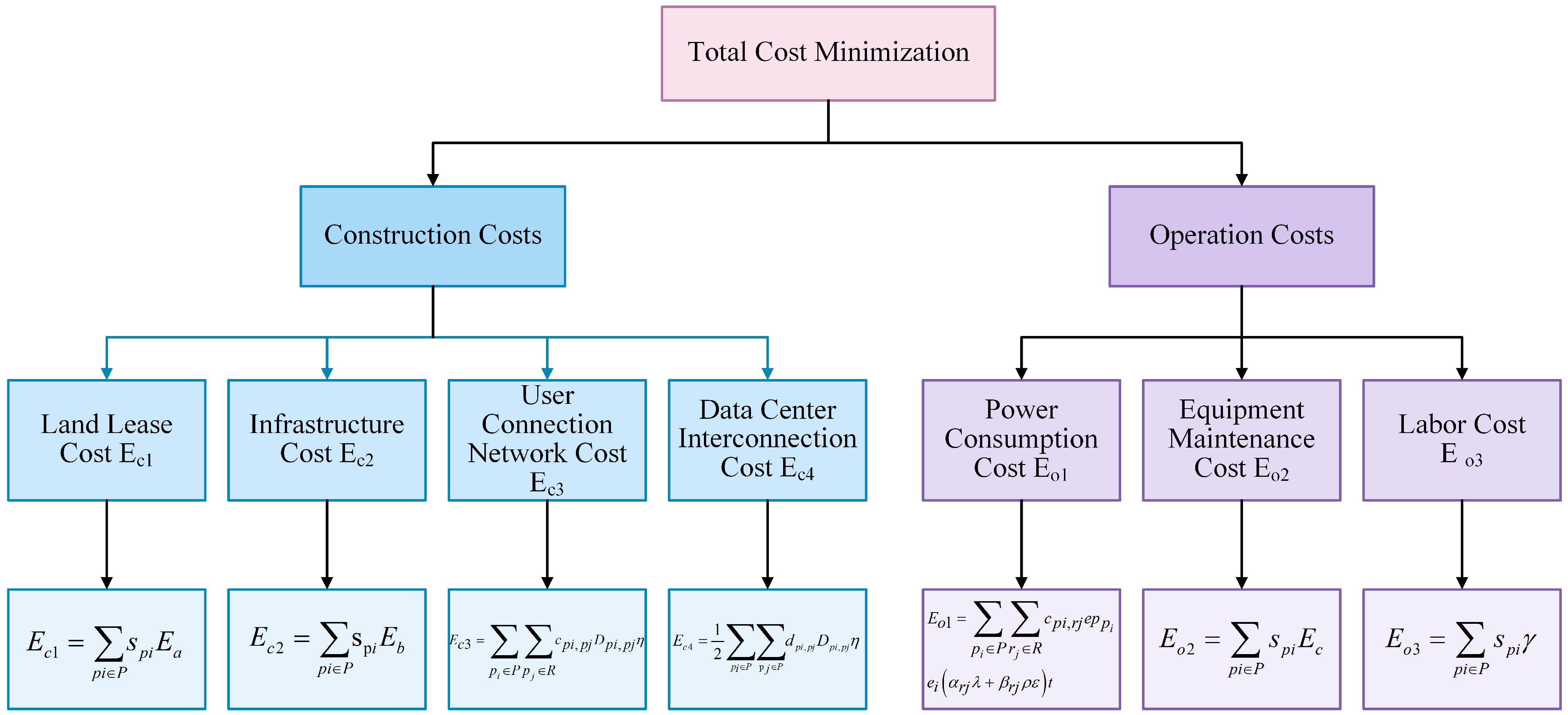
The cost structure is illustrated in Figure 3, highlighting the components and their mathematical formulations as defined in the model. Combining the above cost factors, the mathematical expression of the objective function is shown in Equation (11):
E o = E o 1 + E o 2 + E o 3
The constraints cover the number of data centers, user requirements, energy consumption, and resource use. Specifically, the constraint on the number of data centers ensures that they are only located at predefined alternative sites, with the total number not exceeding the available alternatives, so as to reasonably allocate resources and control the construction cost. The mathematical expression for this constraint is defined as Equation (12):
1   p i P s p i T p
where T p is the total number of alternative points.
The user demand constraint ensures that each user demand node is connected to at least one data center, thus ensuring that the user’s business requirements are satisfied. The specific mathematical expressions are Equations (13) and (14):
0 c p i , r j s p i
p i P c p i , r j = 1
In order to improve the efficiency of fault handling, the communication interconnections between data centers need to be constrained to ensure that there are sufficient interconnections between data centers, and the specific mathematical expression is defined as Equation (15):
s p i + s p j 1 d p i , p j 1 2 s p i + s p j
The energy consumption constraint specifies that the total energy consumption of the data center cannot exceed a predefined energy consumption limit to ensure that the data center operation is sustainable in terms of energy usage. This constraint ensures that the total energy consumption of the data center does not exceed the specified upper limit while meeting user requirements, thus effectively controlling energy consumption. The computational resource constraint and storage resource constraint for the alternative points are defined as Equations (16) and (17):
r i R c p i , r j α r i R E p i
r j R c p i , r j β r i ρ R s p i
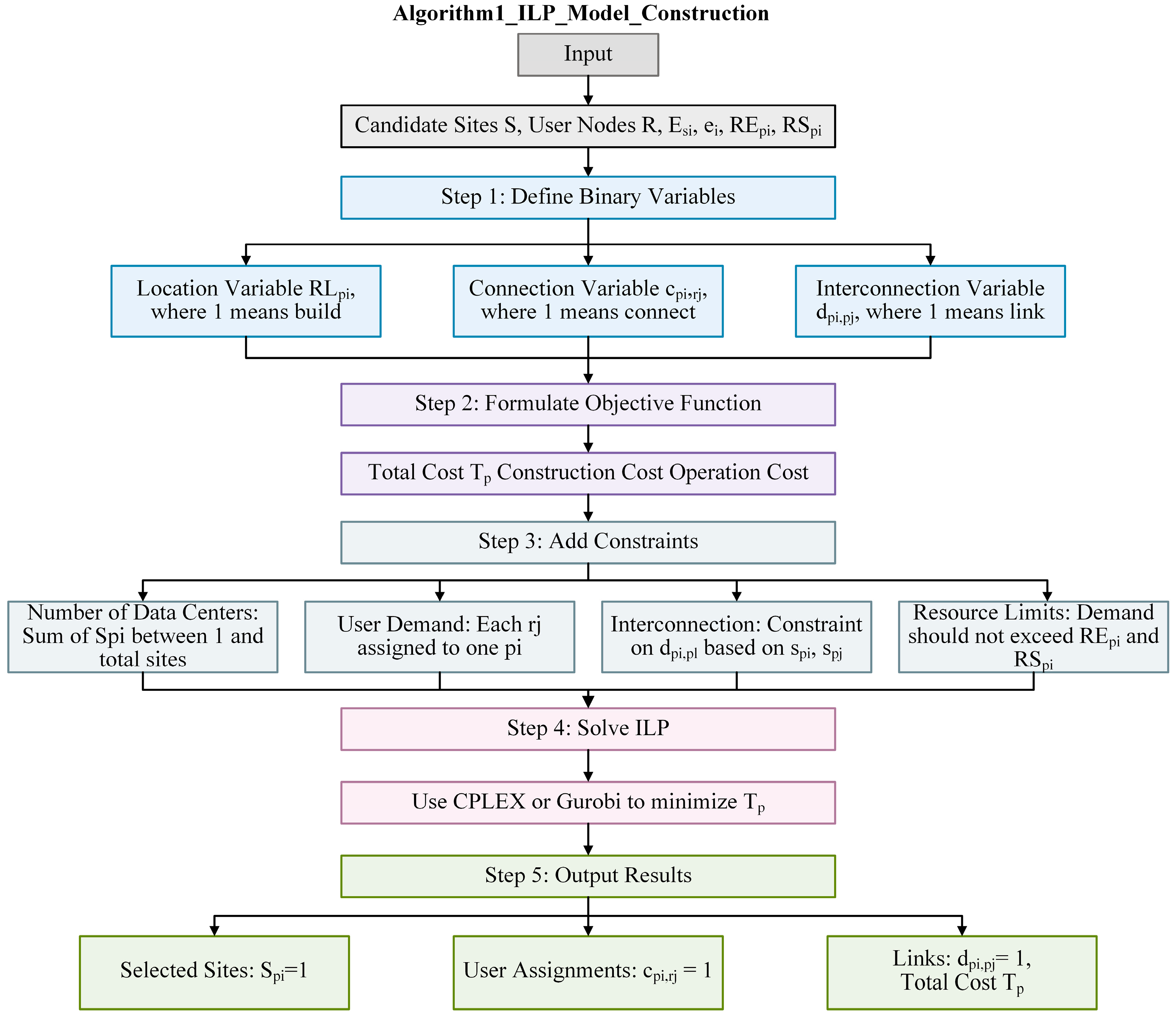
To conclude this methodology section, Figure 4 comprehensively showcases the integer linear programming model construction. Starting from the input of parameters including resource limitations R E p i , R S p i , the model proceeds to define binary decision variables R p i , c p i , r j , and d p i , p j . These variables are then incorporated into the objective function, aiming to minimize the total cost, which is a combination of construction and operation costs. Simultaneously, a series of constraints, such as those on data center quantity 1   p i P s p i T p and user demands p i P c p i , r j = 1 , are applied. Through this process, the model achieves the optimal data center layout, integrating various factors to balance economic and environmental objectives.
In energy consumption calculations, this paper incorporates network power consumption within data centers into site energy usage and costs via PUE. Power consumption of inter data center (Inter DC) transmission equipment, such as transceivers, ROADMs/amplifiers, and edge routers, is not explicitly modeled. Interconnections are accounted for solely as fiber unit length costs in construction expenses and are used to satisfy connectivity constraints. This approach isolates the primary effects of energy consumption caps, PUE, and electricity price heterogeneity on site selection and topology without introducing additional parameter uncertainties.

3.4. Optimization Methods and Optimality

This study is a single-objective optimization problem, specifically minimizing total cost, with other requirements expressed through constraints. This paper models data center site selection and interconnection as a zero one mixed integer linear programming MILP or ILP problem. It minimizes total lifecycle cost while satisfying constraints including user allocation, computational and storage capacity, interconnection connectivity, and system energy consumption limits. We employ commercial integer programming solvers CPLEX and Gurobi with branch and cut strategies, utilizing YALMIP Matlab Optimization Modeling Toolbox for modeling and invocation.
The optimality criterion is determined by the MIP Gap (Mixed-Integer Programming Gap) provided by the solver. This paper adopts a default stopping tolerance of MIPGap ≤ 1 × 10⁻⁴ (0.01%). When multiple optimal solutions exist, a lexicographical rule is applied to select the representative solution. Priority is given first to the solution with the minimum number of sites, then to the solution with the shortest total fiber length across data centers, ensuring uniqueness and reproducibility of results.
Let the on-site renewable installed capacity be y i , the technical upper limit be Y i m a x the capacity factor be C F i . The annual green electricity output is R i = 8760 × C F i × y i , the grid power purchase is G i , and the total site energy consumption is E i = P U E i × E i I T , satisfying the energy balance constraint R i   +   G i     E i . All numerical experiments in this study adopt the instantiated setting where y i = 0 and σ i = 0 , equivalent to Y i m a x = 0 , meaning no on-site renewable energy is deployed in this round. By evaluating energy consumption ceilings solely based on local grid power supply and assessing the impact of PUE and electricity price heterogeneity, we ensure existing results naturally correspond to this specific case without requiring any numerical adjustments. Due to limitations in data sources and research focus, this paper aims to isolate the primary effects of energy consumption ceilings from variations in energy efficiency and electricity prices. Therefore, renewable variables are uniformly set to zero, with the introduction of renewables and sensitivity analysis reserved for subsequent extensions.

4. Experiment

4.1. Condition Setting

To simulate data center layout strategies under diverse regional resource constraints in the “East Data, West Computing” project and maximize economic benefits, two scenarios were established, namely the conventional baseline and the energy-efficient scenario. This study’s experiments are based on the scenario commonality assumption. The Power Usage Effectiveness (PUE) values for each site already include network energy consumption within the data center. Inter-DC transmission energy consumption is set to zero in this evaluation round, accounting only for fiber CAPEX and connectivity costs. This approach allows us to focus on the impact of energy consumption ceilings and the heterogeneity of PUE/electricity prices.
The conventional baseline scenario adheres to current policies, focusing on constructing an integrated new computing network system. It evaluates data center feasibility using parameters like electricity prices and PUE in candidate cities, aiming to balance energy efficiency and costs within existing infrastructure. In contrast, the energy-efficient scenario aligns with national goals for data center efficiency. The planning goal was to reduce the PUE value of data centers in cluster cities to less than 1.25 and even strive to reduce it to 1.2 in some areas, so as to achieve greater energy-saving benefits as shown in Table 1. This requires promoting green data center construction, increasing renewable energy use, and optimizing cross-regional computing scheduling. Together, these scenarios enable multi-dimensional evaluations of data center layouts, energy efficiency, and economic benefits, providing a scientific foundation for future planning, optimization, and policy-making.
According to the specific implementation content of the “East data, West computing” project, this paper selected a series of parameters closely related to the construction and operation of data centers by analyzing the seven hub nodes identified in the project and the ten planned data center clusters. Specifically, 12 cities including Beijing, Tianjin, Shijiazhuang, Shanghai, Nanjing, Hangzhou, Shenzhen, Chengdu, Hohhot, Guiyang, Lanzhou, and Yinchuan were selected as the user demand nodes in this paper, and the computational load and data traffic of these cities were expressed in terms of millions of instructions per second (MIPS) and millions of bits per second (Mbps), respectively. MIPS stood for the computational power of the user demand nodes, while Mbps represented the size of data traffic. To ensure the rationality of data center design, this paper set the computing load and data traffic demand of each city based on the demand characteristics of each city, referring to the relevant domestic studies and industry reports, as shown in Table 2, which reflected the differences in the demand for computing resources and data transmission capacity in different regions.
Based on the data of these cities in the Table 2, we carried out example analysis, and concluded eight cities, including Langfang, Hefei, Zhuhai, Mianyang, Baotou, Zunyi, Lanzhou, and Yinchuan, as alternative points for detailed parameter setting and analysis. The selection of alternative cities took into account their geographic location, power supply, policy support and infrastructure development. Based on the relevant data from China Power Intelligence Network, this study set the upper limit of the deployment of computing and storage devices for these alternative sites, and considered their energy supply capacity and resource constraints. Table 3 listed in detail the parameters such as the geographic location and the upper limit of computing and storage resource deployment for these alternative points. With these data, it was possible to evaluate the resource allocation effectiveness of different alternative points in meeting the computing and storage requirements of user demand nodes, and then optimize the layout.
In order to ensure the accuracy of the computational load, the processor performance was set as shown in Table 4 with reference to the Intel Xeon Gold series, and the running power of the computational load was set to 2.8 × 10⁻⁵ kW/MIPS. Meanwhile, the performance of the data storage device was adjusted accordingly, and the running power of the storage load was set to 3.7 × 10⁻¹⁰ kW/Mbit, based on the PB-class hard disk performance was estimated.
The data storage time is set to 365 days, and the power consumption of the computing load and storage load provides the basis for subsequent economic benefit analysis. The operating life of the data center is set to 12 years, which provides a long-term perspective for comprehensively estimating its construction and operation costs. The economic benefits of data center construction and operation are comprehensively estimated based on the set key parameters. First, the construction cost of the data center includes the initial land acquisition cost and equipment procurement cost. The land acquisition cost is about ¥1.55 million, while the construction and equipment procurement cost, including power supply and distribution system, heat dissipation and cooling system, is about ¥3.2 million. In addition, the cost of fiber optic construction was also taken into account and set at ¥7200/km. These initial investments provide an important foundation for subsequent operations. During the operation phase, the annual O&M cost of the data center is ¥650,000, while the labor cost during the life cycle of the data center is about ¥450,000 in total.
Implementation details. All experiments were conducted in CPLEX or Gurobi environments with default preprocessing and cutting planes enabled. The deterministic mode was set with an optimality tolerance of MIPGap = 1 × 10⁻⁴. For instances where global optimality was proven, we report gap = 0. For approximate optima, the final MIPGap is also reported. When solutions are equivalent, the one with the minimum number of sites or shortest link length is selected according to lexicographical order.
Data centers may connect to distribution systems or directly to transmission or subtransmission systems, depending on their scale and reliability requirements. This paper treats data centers as large-load users. In typical scenarios, they connect to medium-voltage distribution (10–35 kV), while hyperscale campuses may connect directly to subtransmission or transmission (≥66–110 kV). The model quantifies differences using local grid connection rates and Power Usage Effectiveness metrics.
The exogenous inputs for this model encompass the following aspects: demand nodes with load and traffic; coordinates, electricity prices, PUE, and compute/storage caps for candidate sites; cost and energy consumption coefficients; as well as scenario policies and solution settings (MIPGap). This simulation employs 8 candidate sites and 12 demand nodes. Two scenarios were defined with PUE = 1.49 and PUE = 1.25/1.20, respectively. Electricity prices were based on local industrial rates sourced from public map services. The grid electricity prices and PUE values for each candidate city are sourced from publicly available data and policy document summaries on the China Electric Power Intelligent Information Network. λ = 2.8 × 10 5 / M I P S , ε = 3.7 × 10 10 kW/Mbit, ρ = 365   d a y s , t = 12   y e a r s , η = 7200   ¥ / k m . The global optimum was obtained using CPLEX/Gurobi with MIPGap ≤ 1 × 10⁻⁴.
The experiments in this paper are not random simulations but systematic scans of the parameter space. Point-by-point solutions are obtained for the range of facility quantities and several tiers of energy consumption limits. Each point represents a deterministic mixed-integer linear programming problem. The model aims solely at minimizing total cost while satisfying constraints such as allocation, capacity, interconnection, and energy consumption. Solutions were obtained using Matlab’s YALMIP interface to invoke CPLEX’s branch-and-cut algorithm, with MIPGap set to 10−4. Deterministic solver settings were enabled, and lexicographic rules were applied to resolve ties. Consequently, identical data and parameters converge to the same global optimum and identical layout, ensuring no variation in results across repeated runs.

4.2. Experimental Results and Analysis

The regional layout optimization model proposed in this paper was an integer linear programming problem, which was solved using the YALMIP toolbox and CPLEX solver in Matlab. In this paper, two scenarios were studied, namely the conventional baseline scenario and the energy efficient scenario. The model considered two scenarios in which the data center meets the user’s demand in Scenario A and meets the demand under the energy consumption constraints in Scenario B, as shown below.
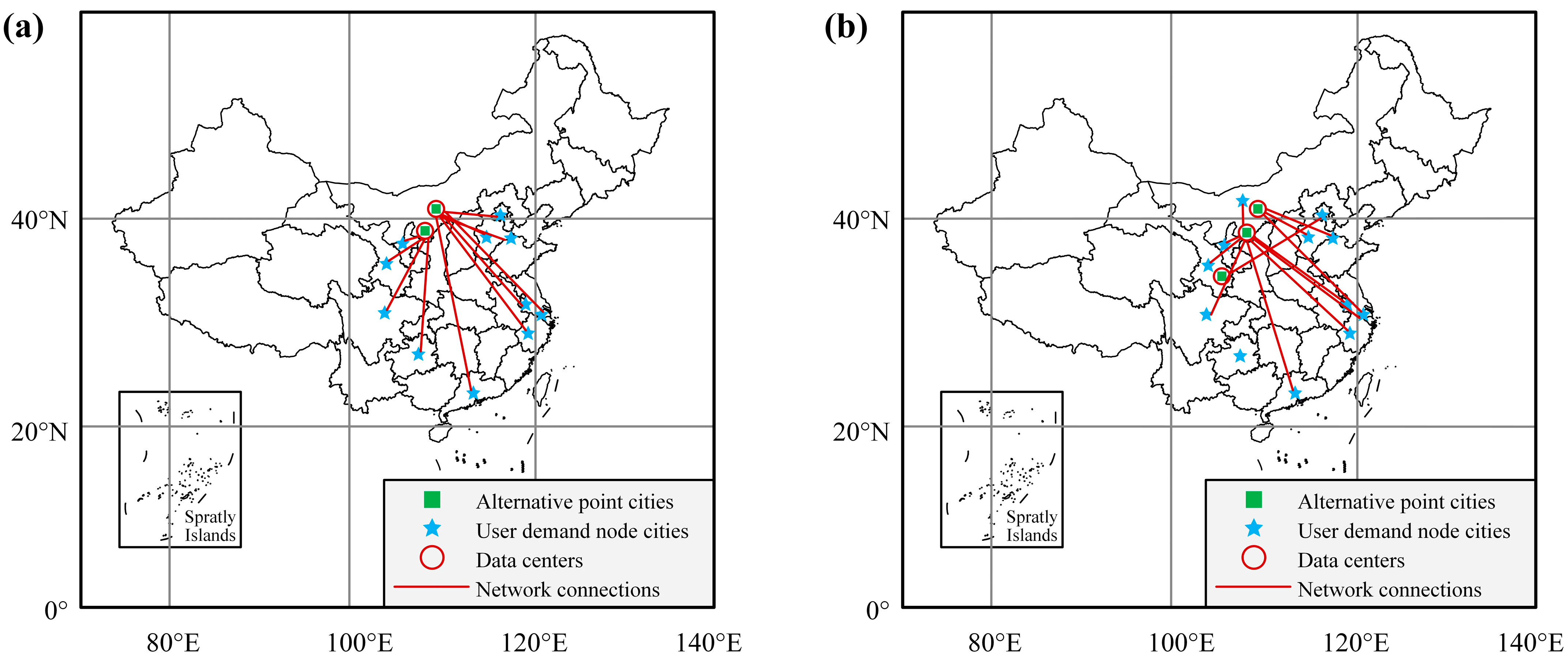
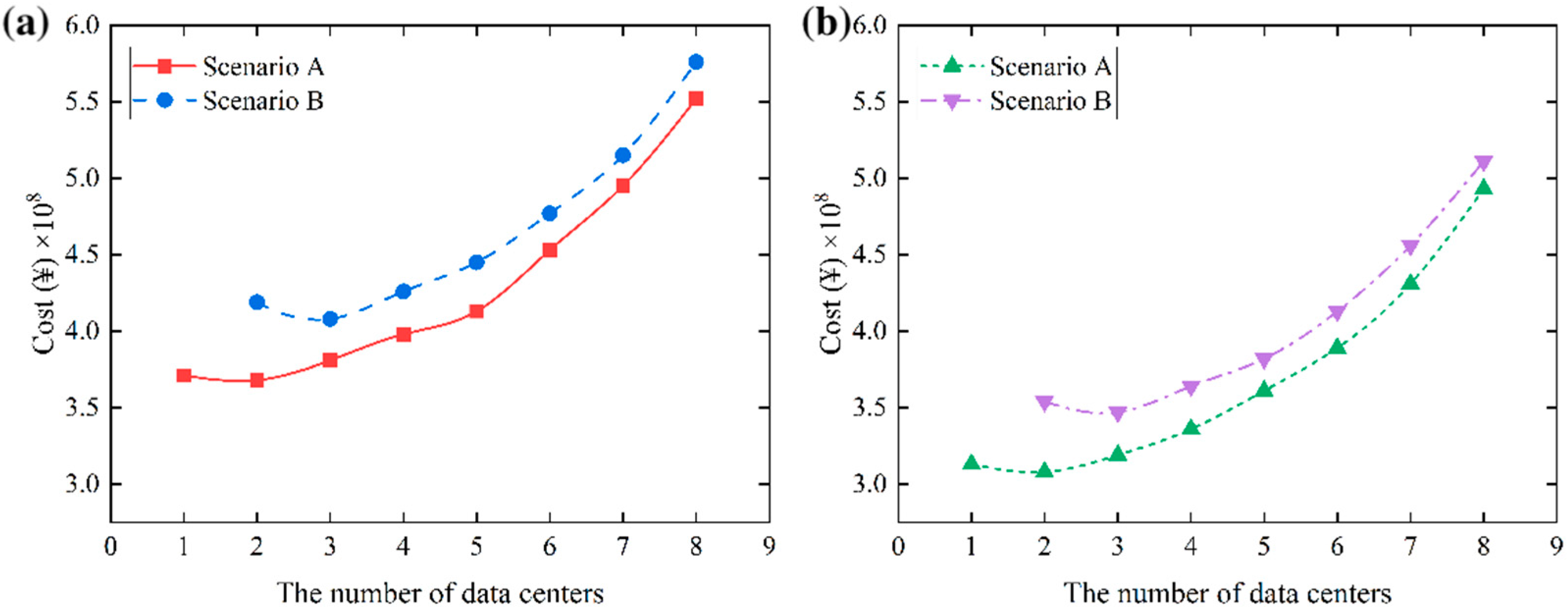
In the conventional baseline scenario, the electricity price and energy efficiency parameters of each alternative point were shown in Table 1. According to the CPLEX solution, in Scenario A, when two data centers were laid out, the total cost was the lowest at ¥3.68 × 10⁸, calculated using the total cost formula Equation (11), which aggregates the land cost Equation (2), construction cost Equation (4), communication network Equations (5) and (6), power consumption cost Equation (7), maintenance cost Equation (9), and labor cost Equation (10), while satisfying the constraints defined in Equations (12)–(15), as shown in Table 5. The data center layout and communication network were shown in Figure 5a. The data center located in Wuzhong connected the user demand nodes in Chongqing, Guiyang and other cities to provide data processing and storage services, while the data center located in Baotou served the demand in Hohhot, Beijing, Tianjin and other cities. In Scenario B, the layout of one data center could not satisfy the demand, and the total cost was at least ¥4.08 × 10⁸ as shown in Table 5 when three data centers were laid out, calculated using the total cost formula Equation (11) and considering the constraints defined in Equations (12)–(15) and the energy expansion constraints in Equations (16) and (17). The data centers in Baotou, Tianshui and Wuzhong were responsible for connecting user demand nodes in different regions, respectively.
As shown in Table 5, under Scenario A (no energy consumption cap), the optimal solution is 2 sites. After applying the energy consumption cap (Scenario B), the 1-site solution becomes infeasible, and the optimal solution shifts to 3 sites. To explain the feasibility reason, we examine the constraint status at the optimal solution. In the 3-site optimal solution of Scenario B, the system energy consumption upper bound Equation (16) holds as an equality (with a slack of 0), while the computational/storage capacity constraints Equation (17) at some sites reach their upper limits. Therefore, the 2-site solution cannot simultaneously satisfy both Equations (16) and (17), necessitating the introduction of a third site to share the load and energy consumption. Compared to the three buildings in Scenario B, the two buildings in Scenario A exhibit a minimum cost difference of approximately ¥0.40 × 10⁸, reflecting the cost increase resulting from the implementation of energy consumption constraints.
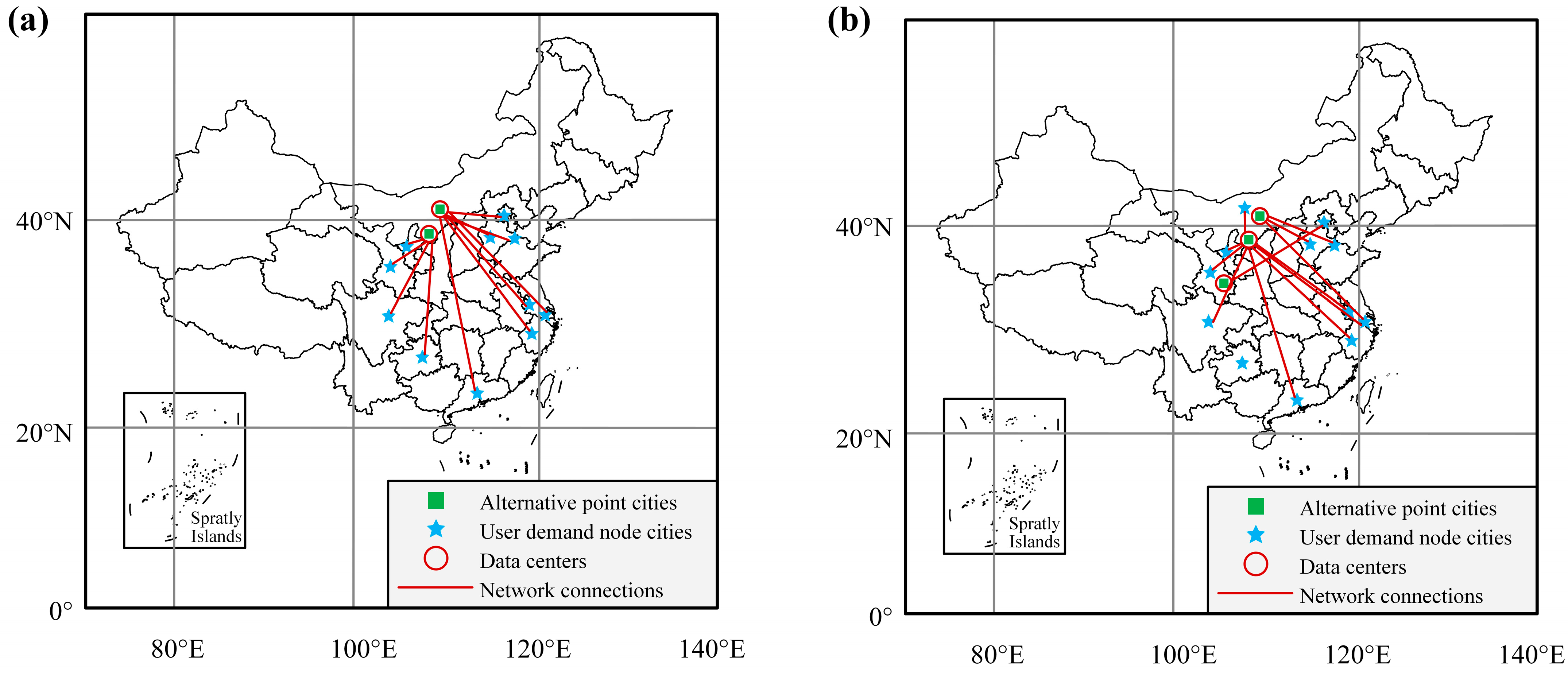
In the energy efficient scenario, the solution results showed that in Scenario A, the total cost was the lowest at ¥3.08 × 10⁸ calculated using Equations (11)–(15), as shown in Table 6, when two data centers were laid out, and the layout and communication network were shown in Figure 6a, with the data centers in Baotou and Yinchuan meeting the needs of the cities of Hohhot, Beijing, and Tianjin, respectively. In Scenario B, the lowest total cost was ¥3.47 × 10⁸ calculated using Equations (11)–(17), as shown in Table 6, when three data centers were laid out, and the layout was shown in Figure 6b. At this time, the data centers in Baotou, Lanzhou and Yinchuan established communication networks with different user demand nodes to provide data processing and storage services.
Under the energy-efficient scenario, the PUE decreases from 1.49 to either 1.25 or 1.20. Table 6 shows that in Scenario A without an energy consumption cap, the two-site configuration remains the lowest-cost option. However, in Scenario B with a system energy consumption cap, the one-site configuration becomes infeasible, and the three-site configuration emerges as optimal. To explain this, we examine the constraint status at the three-site optimal solution. The system energy consumption upper bound of Equation (16) is a tight constraint, satisfying the equality with zero slack. Simultaneously, the computational or storage capacity constraints of Equation (17) reach their upper limits for some sites. Consequently, the two-site solution cannot simultaneously meet both the energy consumption upper bound and capacity constraints. Adding a third site to share the load and energy consumption is necessary to achieve a feasible and cost-optimal layout.
When the constraints were different, the layout and total cost of the data centers were different. As shown in Figure 7a,b, under the demand constraint, the total cost of layout optimization was low and only two data centers were needed to meet the demand. However, after adding the energy consumption constraint, the layout optimization required three data centers. The communication network changed. Some user demand was transferred from the data center in Baotou to the data center in Yinchuan, and the cost increased accordingly. Considering the layout with energy consumption constraints might lead to cost increase, but the resource constraint was a necessary factor to consider due to the difference in resource endowment.
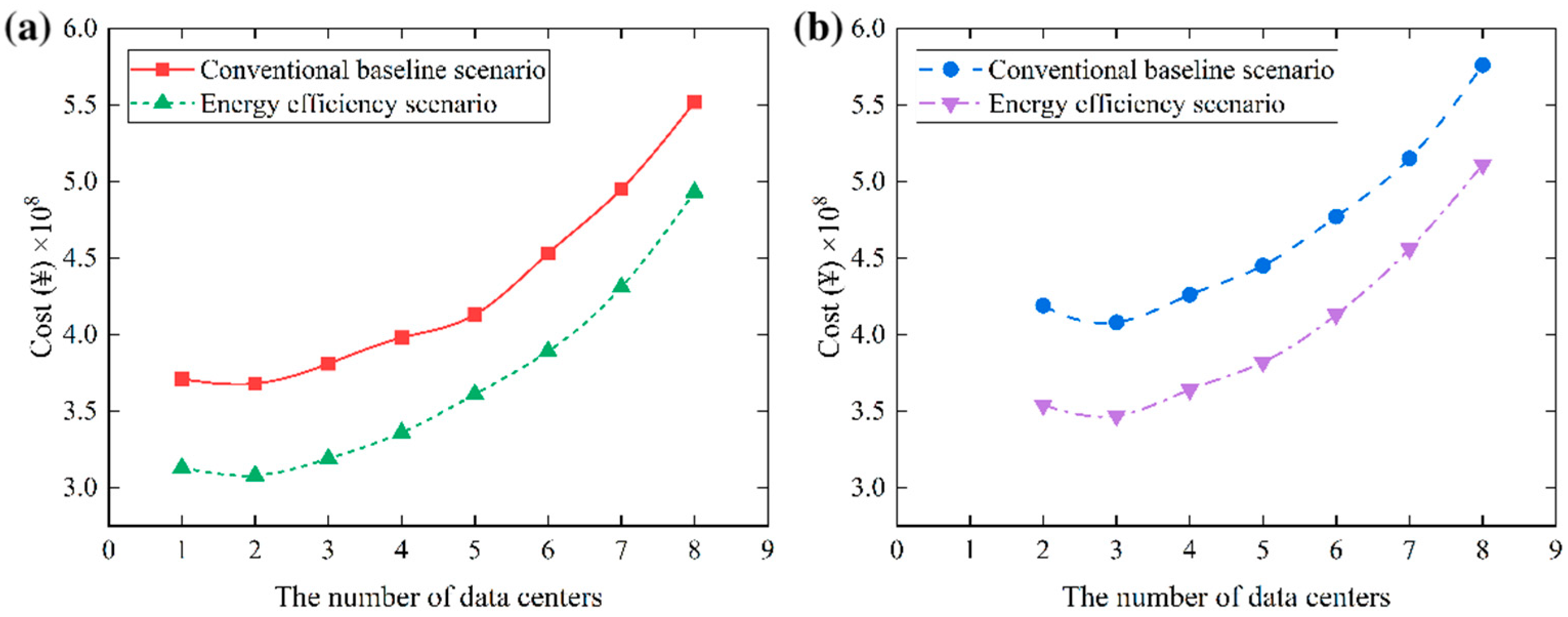
The results of different energy efficiency scenarios differed under the same constraints. As shown in Figure 8a,b, the number of layouts was the same in the conventional baseline scenario and the energy-efficient scenario, but the total cost in the energy-efficient scenario was significantly lower than that in the conventional baseline scenario. The energy-efficient scenario resulted in a lower energy consumption efficiency of the data center, and thus the optimized total cost was significantly reduced. Therefore, to achieve green development of data centers, it was important to pay attention to energy efficiency and consider energy efficiency factors in layout optimization.
Based on the analysis and research process, we recommend the following for developing the data industry under energy-consumption constraints and optimizing the regional layout of data centers. Prioritize further research into energy-saving technologies, focusing on advanced solutions such as indirect evaporative cooling, high-efficiency cooling systems, and the integration of renewable energy. These technologies have the potential to significantly reduce data center energy consumption and carbon emissions. Secondly, it is crucial to strengthen regional collaboration and promote the coordinated development of regional data centers. This can be achieved by establishing a unified national data center network and promoting interregional sharing of resources and information. Lastly, policy support and standardization. The government should continue to provide policy support and standardization for the development. This includes issuing detailed regulations and standards for construction and operation, and offering incentives for energy-efficient, environmentally friendly projects.

5. Conclusions

This paper introduces a data center layout optimization model that addresses the critical challenges of energy consumption and resource distribution in the context of rapid digital infrastructure development. By developing an integer linear programming model, we have demonstrated that energy constraints significantly affect the number of required data centers, total layout costs, and communication network connectivity. The results show that the total cost is consistently lower in the energy-efficient scenario than in the baseline scenario, highlighting the importance of improving energy efficiency to reduce costs. The study also shows that data center siting is closely related to electricity prices. In both the baseline and energy-efficiency scenarios, total cost is lowest when the data center is located in an alternative site with lower electricity prices.
The results highlight the significant potential of incorporating energy-saving policies and intelligent optimization techniques in data center planning. However, future challenges remain, including improving cross-regional resource scheduling, adapting to evolving energy standards, and addressing policy uncertainties. Addressing these issues will require further advancements in optimization algorithms and collaboration between policymakers and industry stakeholders. Additionally, this study does not explicitly account for the energy consumption of inter-DC communications, which may underestimate the operational costs of long-distance interconnection topologies. However, this treatment does not affect the feasibility domain constraints imposed by the energy consumption upper bound on IT+facility energy consumption. Subsequent sensitivity analysis will be conducted by extending the ILP with linear substitution terms.
Future work will build a tighter joint model linking site selection and power systems. It will support finer allocation and grid integration decisions; embed grid node and substation data; add decision variables for data center to substation connections; include transformer and feeder spare capacity constraints and access level constraints; ensure each allocation meets node capacity and reliability needs; use multi period modeling with time of use pricing and renewable generation curves; capture diurnal and seasonal fluctuations; apply linearized power flow when needed to keep computation efficient; check voltage and line current limits at critical nodes; extend the objective to a cost energy delay trade off frontier; apply epsilon constraints or weighted scalarization; determine facility counts, site allocations, and interconnection topologies under different grid constraint strengths; provide actionable engineering recommendations; prefer sites near secondary transmission or high-level distribution substations with surplus capacity; choose areas with low marginal emissions and strong renewable integration potential; limit straight line distances from sites to access points to cut connection cost and construction risk; improve supply reliability with dual source and ring networks; and ensure cross campus interconnection redundancy by integrating backbone fiber resources.

Author Contributions

Conceptualization, J.L.; Methodology, J.L. and D.C.; Software, S.X.; Validation, D.C. and S.X.; Formal analysis, J.L. and S.X.; Investigation, J.L.; Resources, J.L.; Data curation, D.C. and S.X.; Writing—original draft, D.C.; Writing—review & editing, J.L. All authors have read and agreed to the published version of the manuscript.

Funding

This research was funded by National Science and Technology Council grant number 2022YFB3305600.

Data Availability Statement

The original contributions presented in this study are included in the article. Further inquiries can be directed to the corresponding author.

Conflicts of Interest

The authors declare no conflict of interest.

Correction Statement

This article has been republished with a minor correction to the Data Availability Statement. This change does not affect the scientific content of the article.

References

  1. Chen, Z.; Yi, Y.; Gan, C.; Tang, Z.; Kong, D. Scene Chinese Recognition with Local and Global Attention. Pattern Recognit. 2025, 158, 111013. [Google Scholar] [CrossRef]
  2. Chen, Z. Arbitrary Shape Text Detection with Discrete Cosine Transform and CLIP for Urban Scene Perception in ITS. IEEE Trans. Intell. Transp. Syst. 2025, 1–9. [Google Scholar] [CrossRef]
  3. Zhou, S.; Zhou, M.; Wu, Z.; Wang, Y.; Li, G. Energy-Aware Coordinated Operation Strategy of Geographically Distributed Data Centers. Int. J. Electr. Power Energy Syst. 2024, 159, 110032. [Google Scholar] [CrossRef]
  4. Yuan, L.; Chengliang, L.; Weisheng, M.; Yongshun, X. Spatial Characteristics and Location Selection of Global Data Center Expansion. Dili Xuebao Acta Geograph. Sin. 2023, 78, 1936–1954. [Google Scholar]
  5. Chen, M.; Gao, C.; Song, M.; Chen, S.; Li, D.; Liu, Q. Internet Data Centers Participating in Demand Response: A Comprehensive Review. Renew. Sustain. Energy Rev. 2020, 117, 109466. [Google Scholar] [CrossRef]
  6. Liang, G.; Xu, Q.; Shuiwang, L.; Yongshun, C. Research on Key Technologies of Data Center Parameter Automatic Optimization Based on Machine Learning. Inf. Commun. Technol. Policy 2020, 46, 21. [Google Scholar]
  7. You, Y.; Zhang, Z.; Hsieh, C.-J.; Demmel, J.; Keutzer, K. Imagenet Training in Minutes. In Proceedings of the 47th International Conference on Parallel Processing, Eugene, OR, USA, 13–16 August 2018; pp. 1–10. [Google Scholar]
  8. Zhang, Q.; Meng, Z.; Hong, X.; Zhan, Y.; Liu, J.; Dong, J.; Bai, T.; Niu, J.; Deen, M.J. A Survey on Data Center Cooling Systems: Technology, Power Consumption Modeling and Control Strategy Optimization. J. Syst. Archit. 2021, 119, 102253. [Google Scholar] [CrossRef]
  9. Goiri, Í.; Le, K.; Guitart, J.; Torres, J.; Bianchini, R. Intelligent Placement of Datacenters for Internet Services. In Proceedings of the 2011 31st International Conference on Distributed Computing Systems, Minneapolis, MN, USA, 20–24 June 2011; pp. 131–142. [Google Scholar]
  10. Hans, R.; Steffen, D.; Lampe, U.; Richerzhagen, B.; Steinmetz, R. Setting Priorities-A Heuristic Approach for Cloud Data Center Selection. In Proceedings of the International Conference on Cloud Computing and Services Science (CLOSER), Lisbon, Portugal, 20–22 May 2015; pp. 221–228. [Google Scholar]
  11. Wang, J.; Du, F.; Xiao, F. Spatial Evolution of New Infrastructure and Its Determinants: A Case Study of Big Data Centers. Acta Geograph. Sin. 2023, 78, 259–272. [Google Scholar]
  12. Turek, D.; Radgen, P. Optimized Data Center Site Selection—Mesoclimatic Effects on Data Center Energy Consumption and Costs. Energy Effic. 2021, 14, 33. [Google Scholar] [CrossRef]
  13. Yan, W.; Yao, J.; Cao, Q.; Zhang, Y. LT-TCO: A TCO Calculation Model of Data Centers for Long-Term Data Preservation. In Proceedings of the 2019 IEEE International Conference on Networking, Architecture and Storage (NAS), Enshi, China, 15–17 August 2019; pp. 1–8. [Google Scholar]
  14. Li, C.; Yu, X.; Zhao, W.-X. An Integrated Approach to Site Selection for a Big Data Center Using PROMETHEE-MCGP Methodology. J. Intell. Fuzzy Syst. 2021, 41, 6495–6515. [Google Scholar] [CrossRef]
  15. Kheybari, S.; Davoodi Monfared, M.; Farazmand, H.; Rezaei, J. Sustainable Location Selection of Data Centers: Developing a Multi-Criteria Set-Covering Decision-Making Methodology. Int. J. Inf. Technol. Decis. Mak. 2020, 19, 741–773. [Google Scholar] [CrossRef]
  16. Wang, S.; Zhao, Y.; Leng, L.; Zhang, C.; Jiang, H.; Mitras, B. Low-Carbon Location-Routing Problem Based on Envolutionary Hyper-Heuristic Algorithm of Ant Colony Selection Mechanism. Jisuanji Jicheng Zhizao Xitong/Computer Integrated Manufacturing Systems. CIMS 2020, 26, 1702–1716. [Google Scholar] [CrossRef]
  17. Zhang, Q.; Yang, S. Evaluating the Sustainability of Big Data Centers Using the Analytic Network Process and Fuzzy TOPSIS. Environ. Sci. Pollut. Res. 2021, 28, 17913–17927. [Google Scholar] [CrossRef] [PubMed]
  18. Ghaderi, A.; Momeni, M. A Multi-Period Maximal Coverage Model for Locating Simultaneous Ground and Air Emergency Medical Services Facilities. J. Ambient Intell. Humaniz. Comput. 2021, 12, 1577–1600. [Google Scholar] [CrossRef]
  19. Colombo, F.; Cordone, R.; Lulli, G. The Multimode Covering Location Problem. Comput. Oper. Res. 2016, 67, 25–33. [Google Scholar] [CrossRef]
  20. Drakulić, D.; Takači, A.; Marić, M. New Model of Maximal Covering Location Problem with Fuzzy Conditions. Comput. Inform. 2016, 35, 635–652. [Google Scholar]
  21. Sudtachat, K.; Mayorga, M.E.; Mclay, L.A. A Nested-Compliance Table Policy for Emergency Medical Service Systems under Relocation. Omega 2016, 58, 154–168. [Google Scholar] [CrossRef]
  22. Stanimirović, Z.; Mišković, S.; Trifunović, D.; Veljović, V. A Two-Phase Optimization Method for Solving the Multi-Type Maximal Covering Location Problem in Emergency Service Networks. Inf. Technol. Control 2017, 46, 100–117. [Google Scholar] [CrossRef]
  23. Mišković, S. A VNS-LP Algorithm for the Robust Dynamic Maximal Covering Location Problem. OR Spectr. 2017, 39, 1011–1033. [Google Scholar] [CrossRef]
  24. Arana-Jiménez, M.; Blanco, V.; Fernández, E. On the Fuzzy Maximal Covering Location Problem. Eur. J. Oper. Res. 2020, 283, 692–705. [Google Scholar] [CrossRef]
  25. Wang, W.; Wu, S.; Wang, S.; Zhen, L.; Qu, X. Emergency Facility Location Problems in Logistics: Status and Perspectives. Transp. Res. Part E Logist. Transp. Rev. 2021, 154, 102465. [Google Scholar] [CrossRef]
  26. Toregas, C.; Swain, R.; ReVelle, C.; Bergman, L. The Location of Emergency Service Facilities. Oper. Res. 1971, 19, 1363–1373. [Google Scholar] [CrossRef]
  27. Perera, P.H.K. Recharging Infrastructure Planning for Electric Vehicles: A Lifecycle Thinking Approach. Ph.D. Thesis, University of British Columbia, Vancouver, BC, USA, 2020. [Google Scholar]
  28. Xia, Y.; Chen, C.; Liu, Y.; Shi, J.; Liu, Z. Two-Layer Path Planning for Multi-Area Coverage by a Cooperative Ground Vehicle and Drone System. Expert Syst. Appl. 2023, 217, 119604. [Google Scholar] [CrossRef]
  29. Su, Q.; Luo, Q.; Huang, S.H. Cost-Effective Analyses for Emergency Medical Services Deployment: A Case Study in Shanghai. Int. J. Prod. Econ. 2015, 163, 112–123. [Google Scholar] [CrossRef]
  30. Syahputra, R.A.; Andriansyah; Sentia, P.D.; Arifin, R. Determining Optimal New Waste Disposal Facilities Location by Using Set Covering Problem Algorithm. In Conference on Broad Exposure to Science and Technology 2021 (BEST 2021); Atlantis Press: Dordrecht, The Netherlands, 2022; pp. 295–301. [Google Scholar]
  31. Liu, J.; Cao, L.; Zhang, D.; Chen, Z.; Lian, X.; Li, Y.; Zhang, Y. Optimization of Site Selection for Emergency Medical Facilities Considering the SEIR Model. Comput. Intell. Neurosci. 2022, 2022, 1912272. [Google Scholar] [CrossRef]
  32. Çelik, S.; Ok, Ş. Electric Vehicle Charging Stations: Model, Algorithm, Simulation, Location, and Capacity Planning. Heliyon 2024, 10, e29153. [Google Scholar] [CrossRef]
  33. Jabbarzadeh, A.; Fahimnia, B.; Seuring, S. Dynamic Supply Chain Network Design for the Supply of Blood in Disasters: A Robust Model with Real World Application. Transp. Res. Part E Logist. Transp. Rev. 2014, 70, 225–244. [Google Scholar] [CrossRef]
  34. Bayram, V.; Tansel, B.Ç.; Yaman, H. Compromising System and User Interests in Shelter Location and Evacuation Planning. Transp. Res. Part B Methodol. 2015, 72, 146–163. [Google Scholar] [CrossRef]
  35. Shahriari, M.; Bozorgi-Amiri, A.; Tavakoli, S.; Yousefi-Babadi, A. Bi-Objective Approach for Placing Ground and Air Ambulance Base and Helipad Locations in Order to Optimize EMS Response. Am. J. Emerg. Med. 2017, 35, 1873–1881. [Google Scholar] [CrossRef] [PubMed]
  36. Murad, A.; Faruque, F.; Naji, A.; Tiwari, A.; Qurnfulah, E.; Rahman, M.; Dewan, A. Optimizing Health Service Location in a Highly Urbanized City: Multi Criteria Decision Making and P-Median Problem Models for Public Hospitals in Jeddah City, KSA. PLoS ONE 2024, 19, e0294819. [Google Scholar] [CrossRef] [PubMed]
  37. Calik, H.; Labbé, M.; Yaman, H. P-Center Problems. In Location Science; Springer: Berlin/Heidelberg, Germany, 2015; pp. 79–92. [Google Scholar]
  38. Gwalani, H.; Helsing, J.; Alshammari, S.M.; Tiwari, C.; Mikler, A.R. A Distributed Algorithm for Solving Large-Scale p-Median Problems Using Expectation Maximization. PeerJ Comput. Sci. 2024, 10, e2446. [Google Scholar] [CrossRef] [PubMed]
  39. Ren, Z.-G.; Feng, Z.-R.; Ke, L.-J.; Zhang, Z.-J. New Ideas for Applying Ant Colony Optimization to the Set Covering Problem. Comput. Ind. Eng. 2010, 58, 774–784. [Google Scholar] [CrossRef]
  40. Razi, N.; Karatas, M. A Multi-Objective Model for Locating Search and Rescue Boats. Eur. J. Oper. Res. 2016, 254, 279–293. [Google Scholar] [CrossRef]
Figure 1. Overview of steps in model construction.
Energies 18 05040 g001
Figure 2. Relationship of Decision Variables and Constraints.
Energies 18 05040 g002
Figure 3. Cost Structure of the Objective Function.
Energies 18 05040 g003
Figure 4. Detailed Steps of Integer Linear Programming Model for Data Center Layout Optimization.
Energies 18 05040 g004
Figure 5. The data center layout and communication network, conventional baseline scenario with (a) Scenario A layout results and (b) Scenario B layout results.
Energies 18 05040 g005
Figure 6. The data center layout and communication network, energy efficient scenario with (a) Scenario A layout results and (b) Scenario B layout results.
Energies 18 05040 g006
Figure 7. The cost function of different constraint conditions under (a) conventional baseline scenario and (b) energy efficient scenario.
Energies 18 05040 g007
Figure 8. The cost function of different efficiency scenarios under (a) demand constraint and (b) energy consumption constraint.
Energies 18 05040 g008
Table 1. Scenario setting related parameters.
Alternative Point CitiesConventional Baseline ScenarioEnergy Efficiency Scenario
Electricity Prices (¥/kWh)PUEElectricity Prices (¥/kWh)PUE
Langfang0.441.490.441.25
Hefei0.481.490.481.25
Zhuhai0.571.490.571.25
Mianyang0.431.490.431.25
Baotou0.311.490.311.2
Zunyi0.361.490.361.2
Lanzhou0.391.490.391.2
Yinchuan0.321.490.321.2
Table 2. Parameters related to user demand nodes.
ProvinceUser Demand NodeLongitude/°ELatitude/°Eαri/MIPSβri/Mbps
Inner MongoliaHohhot111.7540.841.54 × 10112.64 × 107
BeijingBeijing116.4139.94.49 × 10107.70 × 107
TianjinTianjin117.1939.133.34 × 10105.91 × 107
NingxiaYinchuan106.2338.494.09 × 10107.01 × 107
HebeiShijiazhuang114.538.051.55 × 10112.66 × 107
GansuLanzhou103.8336.065.42 × 10109.30 × 107
JiangsuNanjing118.7732.042.51 × 10114.31 × 107
ShanghaiShanghai121.4731.236.20 × 10101.06 × 107
SichuanChengdu104.0730.574.53 × 10107.99 × 107
ZhejiangHangzhou120.1530.291.90 × 10113.26 × 107
GuizhouGuiyang106.7126.586.24 × 10101.07 × 107
GuangzhouShenzhen114.0622.543.24 × 10115.12 × 107
Table 3. Parameters related to alternative points.
ProvinceAlternative PointLongitude/°ELatitude/°E R E p i /MIPS R S p i /Mbps
HebeiLangfang116.7139.531.80 × 10121.01 × 1017
AnhuiHefei117.2731.861.49 × 10127.93 × 1016
GuangdongZhuhai113.5622.272.95 × 10121.63 × 1017
SichuanMianyang104.7331.471.79 × 10121.02 × 1017
Inner MongoliaBaotou109.8440.652.82 × 10121.49 × 1017
GuizhouZunyi106.9327.731.38 × 10127.13 × 1016
GansuTianshui105.7334.581.12 × 10125.71 × 1016
NingxiaWuzhong106.237.981.02 × 10125.73 × 1016
Table 4. Data center-related equipment parameters.
ParameterMeaningUnitData
ρData Storage Durationday365
λProcessor Computing Power ConsumptionkW/MIPS2.8 × 10−5
εStorage Device Power ConsumptionkW/Mbit3.7 × 10−10
ηCost per Unit Length of Optical Fiber Network¥/km7200
tDesign Lifespan of Data Centeryear12
Table 5. Total cost of Scenario A layout results and Scenario B layout results under the conventional baseline scenario.
The Number of Data CenterTotal Cost (¥)
Scenario AScenario B
13.71 × 10⁸-
23.68 × 1084.19 × 108
33.81 × 1084.08 × 108
43.98 × 1084.26 × 108
54.13 × 1084.45 × 108
64.53 × 1084.77 × 108
74.95 × 1085.15 × 108
85.52 × 1085.76 × 108
Table 6. Total cost of Scenario A layout results and Scenario B layout results under the energy efficient scenario.
The Number of Data CenterTotal Cost (¥)
Scenario AScenario B
13.13 × 10⁸-
23.08 × 1083.54 × 108
33.19 × 1083.47 × 108
43.36 × 1083.64 × 108
53.61 × 1083.82 × 108
63.89 × 1084.13 × 108
74.31 × 1084.56 × 108
84.93 × 1085.11 × 108
Disclaimer/Publisher’s Note: The statements, opinions and data contained in all publications are solely those of the individual author(s) and contributor(s) and not of MDPI and/or the editor(s). MDPI and/or the editor(s) disclaim responsibility for any injury to people or property resulting from any ideas, methods, instructions or products referred to in the content.