Article

Soiling Dynamics and Cementation in Bifacial Photovoltaic Modules Under Arid Conditions: A One-Year Study in the Atacama Desert

by
Abel Taquichiri
1,
Douglas Olivares
1,*,
Aitor Marzo
2,3,*,
Felipe Valencia
4,5,
Felipe M. Galleguillos-Madrid
1,
Martin Gaete
1 and
Edward Fuentealba
1
1
Centro de Desarrollo Energético de Antofagasta, Universidad de Antofagasta, Antofagasta 1270300, Chile
2
Department of Optics, University of Granada, Profesor Adolfo Rancaño St, 18071 Granada, Spain
3
CIESOL, Joint Centre of the University of Almeria-CIEMAT, 04120 Almería, Spain
4
Corporación ATAMOSTEC, Uribe 636, Oficina 302, Antofagasta 1240000, Chile
5
Instituto de Electricidad y Electrónica, Facultad de Ciencias de la Ingeniería, Universidad Austral de Chile, Independencia 631, Edificio 6000, Valdivia 5090000, Chile
*
Authors to whom correspondence should be addressed.
Energies 2025, 18(18), 4999; https://doi.org/10.3390/en18184999
Submission received: 22 August 2025 / Revised: 11 September 2025 / Accepted: 18 September 2025 / Published: 19 September 2025

Abstract

Soiling is one of the main performance risks for bifacial photovoltaic (PV) technology, particularly in arid environments such as the Atacama Desert, where dust is deposited asymmetrically on the front and rear surfaces of the modules. This study evaluates one year (July 2022 to June 2023) of soiling behavior in bifacial modules installed in fixed-tilt and horizontal single-axis tracking (HSAT) configurations, enabling a comparison to be made between static and moving structures. The average dust accumulation was found to be 0.33 mg/cm2 on the front surface and 0.15 mg/cm2 on the rear surface of the fixed modules. In contrast, the respective values for the HSAT systems were found to be lower at 0.25 mg/cm2 and 0.035 mg/cm2. These differences resulted in performance losses of 5.8% for fixed modules and 3.7% for HSAT systems. Microstructural analysis revealed that wetting and drying cycles had formed dense, cemented layers on the front surface of fixed modules, whereas tracking modules exhibited looser deposits. Natural cleaning events, such as fog, dew and frost, only provided partial and temporary mitigation. These findings demonstrate that bifaciality introduces differentiated soiling dynamics between the front and rear surfaces, emphasizing the importance of tailored cleaning strategies and the integration of monitoring systems that consider bifacial gain as a key operational parameter. These insights are crucial for developing predictive models and cost-effective O&M strategies in large-scale bifacial PV deployments under desert conditions.

1. Introduction

In recent years, renewable energy sources have become the main drivers of global electricity generation expansion, particularly among the member countries of the Clean Energy Ministerial (CEM). While in 2009 they represented only about half of newly installed capacity, by 2023 this share had risen to over 95% of net capacity additions [1]. Moreover, in the first half of 2024 alone, renewable energy projects attracted over £270 billion in new investments [2]. These facts illustrate the scale and speed of the global transformation in electricity generation, underscoring the central role of renewables in the transition to a more sustainable energy system. Among these technologies, solar photovoltaic (PV) energy has emerged as a cornerstone of this transition, with continuous innovations driving its rapid deployment across diverse environments.
Solar photovoltaic (PV) energy has undergone accelerated growth in recent decades, establishing itself as a key component of the global energy transition. Within this expansion, bifacial photovoltaic modules have gained prominence due to their ability to capture irradiance on both sides of the panel [3]. Depending on the ground albedo and system configuration, this advantage can increase electricity generation by 10% to 35% [4]. The performance of bifacial systems can be limited by soiling, despite their potential [5]. Soiling refers to the accumulation of solid particles, such as mineral dust, ash, salt, organic matter, soot and industrial aerosols, on the surfaces of PV panels exposed to the environment. These particles create a shading effect, resulting in optical losses that reduce the amount of solar radiation reaching the cells. In arid environments with low precipitation and high atmospheric aerosol content, soiling losses can amount to 10–50% per year [6,7]. In extreme conditions, such as the Atacama Desert or the Arabian Peninsula, daily degradation rates of around 1% have been reported in fixed-tilt configurations [8,9,10]. Dust accumulation not only reduces the incident irradiance on the front surface but also directly affects the bifacial gain by blocking the reflected radiation from the ground, thereby compromising one of this technology’s main advantages.
Soiling is a highly complex, multifactorial process resulting from the interaction of environmental variables (e.g., wind, relative humidity, surface temperature and albedo), the intrinsic properties of particulate matter (e.g., size, shape, hygroscopicity, electrostatic charge and chemical composition), and system-specific conditions (e.g., module type, installation geometry, height and orientation) [11,12]. This complexity is further amplified in bifacial systems, where the deposition dynamics differ between the front and rear surface. The presence of bifaciality introduces an additional dimension of analysis, as the soiling mechanisms, their optical impact and cleaning behaviors vary between the two faces. This multiplicity of interactions makes it difficult to develop robust predictive models and poses significant challenges for standardizing loss metrics and optimizing mitigation strategies in real-world contexts.
Beyond energy yield losses, soiling also affects the economic performance of PV projects [13]. Cleaning operations represent one of the most significant operational expenditure (OPEX) components, and the frequency and technique must be adapted to the specific environment to avoid unnecessary expenses or premature module wear [7,14]. Inadequate cleaning strategies can increase the levelized cost of energy (LCOE) and reduce the expected return on investment [13]. Therefore, characterizing soiling through a site-specific, bifacial approach is essential for making informed decisions when designing, maintaining and implementing predictive monitoring of advanced solar plants.
Although the soiling of monofacial systems has been widely studied, little is known about the asymmetric behavior of bifacial modules under desert conditions, where cementation and natural cleaning processes may affect the persistence of deposits. This knowledge gap hinders the development of predictive models and optimized cleaning strategies. To address this, the present work investigates one year of soiling evolution in bifacial PV modules installed in fixed-tilt and horizontal single-axis tracking (HSAT) configurations in the Atacama Desert. This study integrates electrical measurements (I–V curves), the morphological and compositional characterization of deposited material using scanning electron microscopy and energy-dispersive X-ray spectroscopy, and continuous meteorological monitoring to identify differential deposition patterns and evaluate their impact on bifacial performance.
The importance of this work lies in its unique combination of one year of continuous field monitoring and advanced characterization of the material deposited on bifacial modules in one of the world’s most extreme solar environments. By explicitly addressing the asymmetric soiling mechanisms of bifacial modules, this study provides essential insights for improving predictive models, reducing uncertainty in performance assessments, and guiding the development of cost-effective operation and maintenance strategies. The underlying research hypothesis is that soiling dynamics in bifacial modules are asymmetric between the front and rear surfaces and that cementation processes significantly influence deposit persistence and performance losses. These contributions advance both the scientific understanding of soiling processes and the practical deployment of bifacial photovoltaic technology in arid regions.

2. Materials and Methods

2.1. Location and Meteorological Monitoring

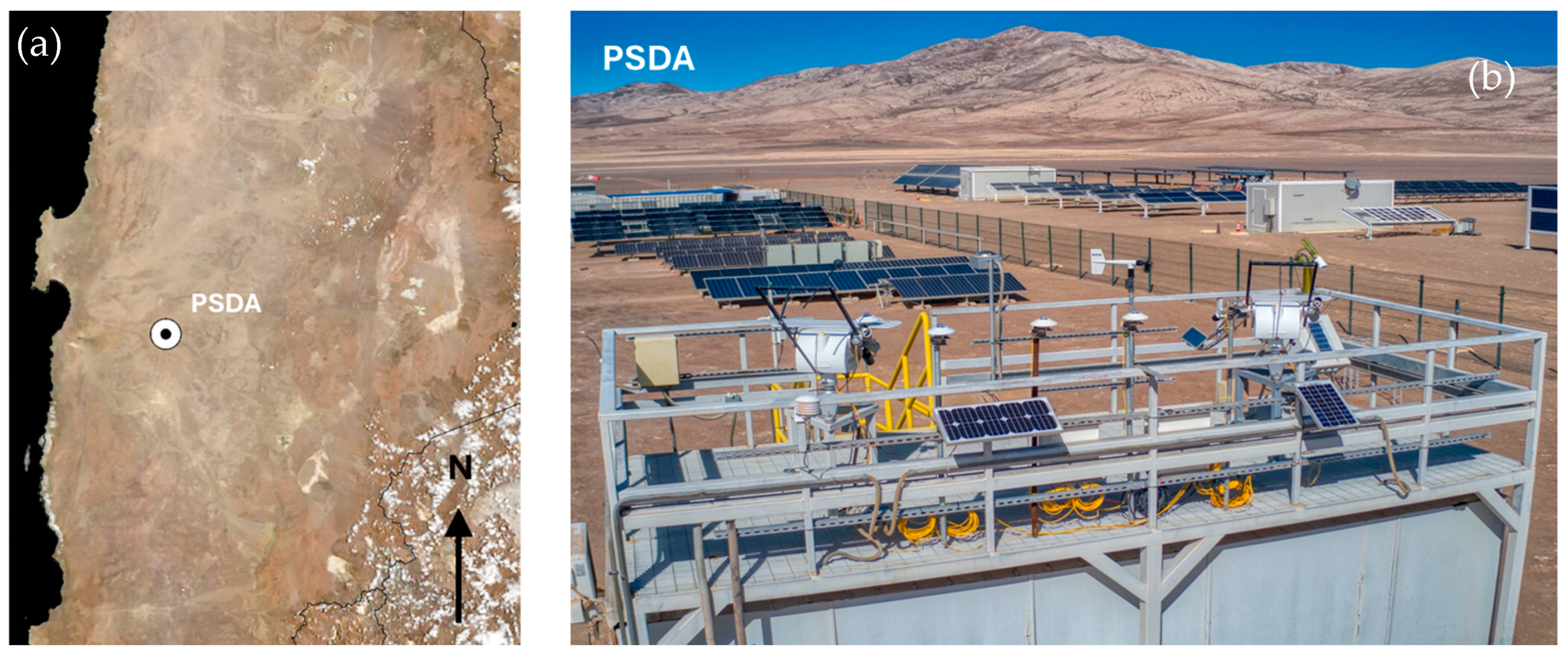
The Plataforma Solar del Desierto de Atacama (PSDA) is located in the Atacama Desert (24.09° S, 69.93° W) at an altitude of 965 m above sea level. This site has a cold desert climate, classified as BWk according to the Köppen climate classification system (Figure 1a) [15]. It is characterized by very low cloud cover and high levels of solar irradiance, reaching approximately 2500 kWh/m2/year [16,17]. To monitor atmospheric parameters relevant to the soiling process in bifacial PV modules, a local weather station was deployed (Figure 1b). Ambient temperature (Tamb) and relative humidity (RH) were measured using a CS215-L11 thermometer (Campbell Scientific, Logan, UT, USA) and an HMP60-L11 hygrometer (Vaisala, Vantaa, Finland), respectively. Wind speed was recorded with a 05103-5 anemometer (Campbell Scientific, Logan, UT, USA) and global horizontal irradiance (GHI) was measured with a Kipp & Zonen CMP21 pyranometer (Kipp & Zonen, Delft, The Netherlands). Additionally, an SWS-250 visibility sensor (Bristol Industrial & Research Associates Ltd. (Biral), Bristol, UK) was employed to detect precipitation, dust and fog events at the site. Meteorological data were collected continuously over one year, from July 2022 to June 2023, with a sampling interval of five minutes. This high temporal resolution allows us to correlate short-term variations in meteorological parameters with deposition and cleaning events, capturing phenomena such as fog, dew or frost that directly influence soiling behavior.

2.2. Gravimetric Analysis of Deposited Particles

To quantify the accumulation of soiling in bifacial modules, six standard photovoltaic glass samples were installed on a fixed structure (three on the front and three on the back) and a further six were installed on an HSAT with the same configuration. Each sample measured 4.5 cm × 6.5 cm × 3.2 mm. The samples were weighed monthly using a precision balance LF224R (Vibra, Tokyo, Japan) with automatic range adjustment and a resolution of 0.1 mg to determine the mass variation associated with the deposited material.
The gravimetric method provides a direct and highly sensitive measure of surface loading, enabling the detection of small changes in deposition over time and establishing the baseline for annual accumulation trends.

2.3. Morphological and Compositional Characterization (FE-SEM/EDX)

This study was conducted for one year (July 2022 to June 2023). At the end of the experimental year, the particles accumulated on the samples from the fixed structure were characterized using field emission scanning electron microscopy FE-SEM, model JSM-6360LV (JEOL Ltd., Tokyo, Japan) to analyze their morphology and surface distribution. Additionally, compositional analysis was performed using energy-dispersive X-ray spectroscopy Oxford (EDX) to identify the present chemical elements.
Knowledge of particle morphology (e.g., shape, size and surface texture) and elemental composition are essential to identify cementation processes and hygroscopic behavior that cannot be detected by gravimetry alone.

2.4. Electrical Performance Measurements (I–V, SR)

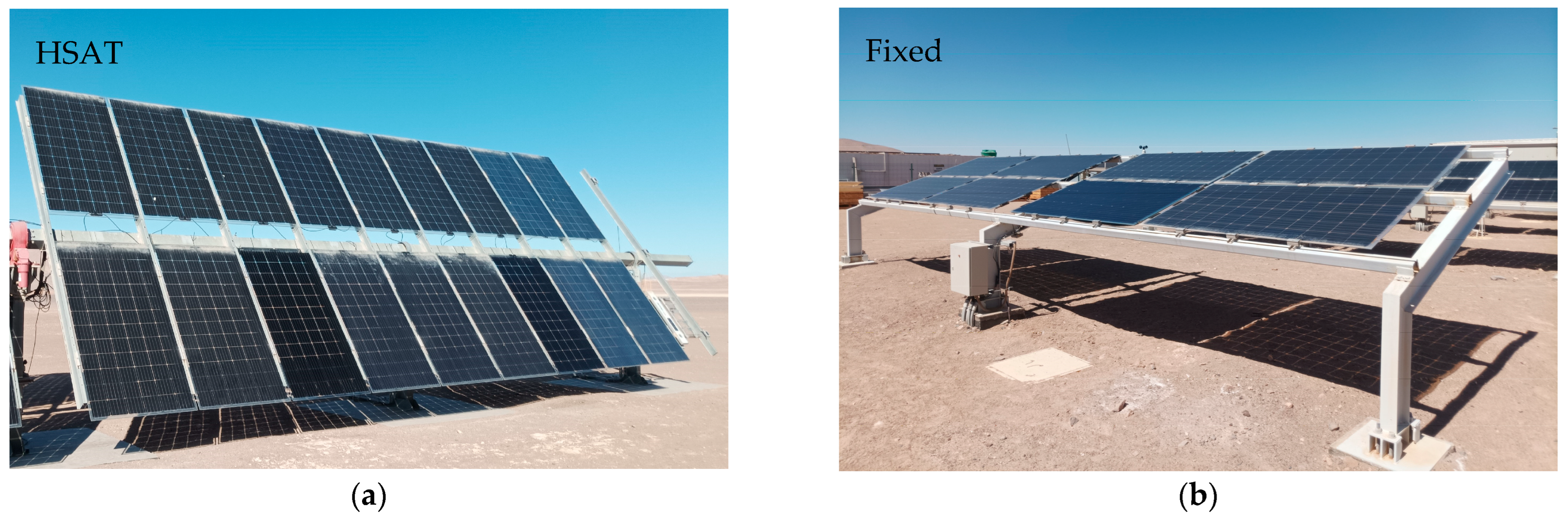
The PV installations under study are illustrated in Figure 2. In both configurations, two identical bifacial PV modules were considered and used to analyze soiling. The technical characteristics of the modules are described in Table 1. Furthermore, silicon reference cells (model Si-V-10TC-T) were utilized in both configurations to measure the irradiance on the front (GIF) and rear (GIR) surfaces of the modules. The temperature of the PV modules (Tmod) was monitored using PT100 thermocouples installed on the rear of each module. Electrical performance parameters, including open circuit voltage (Voc), short circuit current (Isc) and maximum power point (Pmpp), were measured using a measurement system equipped with an electronic load. The system was engineered to function at the maximum power point (MPP) and to execute periodic sweeps of the current-voltage (I-V) curve.
At the start of the experimental period, both PV modules were cleaned to establish a baseline state. One module was designated as the reference module and was cleaned on a weekly basis, while the second module was left uncleaned to assess the impact of soiling. The cleaning procedures were carried out with demineralized water and a soft brush to minimize the risk of surface abrasion. This clean module served as the control for SR calculations, ensuring that performance losses were solely attributable to soiling. The quantification of soiling losses was conducted using the Soiling Ratio (SR) index, as defined in the international standard IEC 61724-1 [16]. The SR index is expressed as the ratio between the electrical output of the soiled module and that of the clean reference module. For this study, the Isc measurements were used as the primary parameter for SR calculations, as described in Equation (1). Corrections to the SR values were made using Equation (2) to account for irradiance (G), the temperature coefficient (α), and Tmod. The reference temperature (Tref) was set at 25 °C, and the standard test condition irradiance (GSTC) was defined as 1 kW/m2.
S R = I s c , s o i l I s c , c l e a n
I s c = I s c , m e a s u r e d · G S T C G   ·   1 1 + α · T m o d T r e f
While I–V measurements allow for precise quantification of power losses under controlled conditions, the SR provides continuous, real-time information on relative performance degradation between clean and exposed modules, directly linking deposition processes with their operational consequences.

3. Results and Discussion

3.1. Atmospheric Monitoring and Its Role in Soiling Dynamics

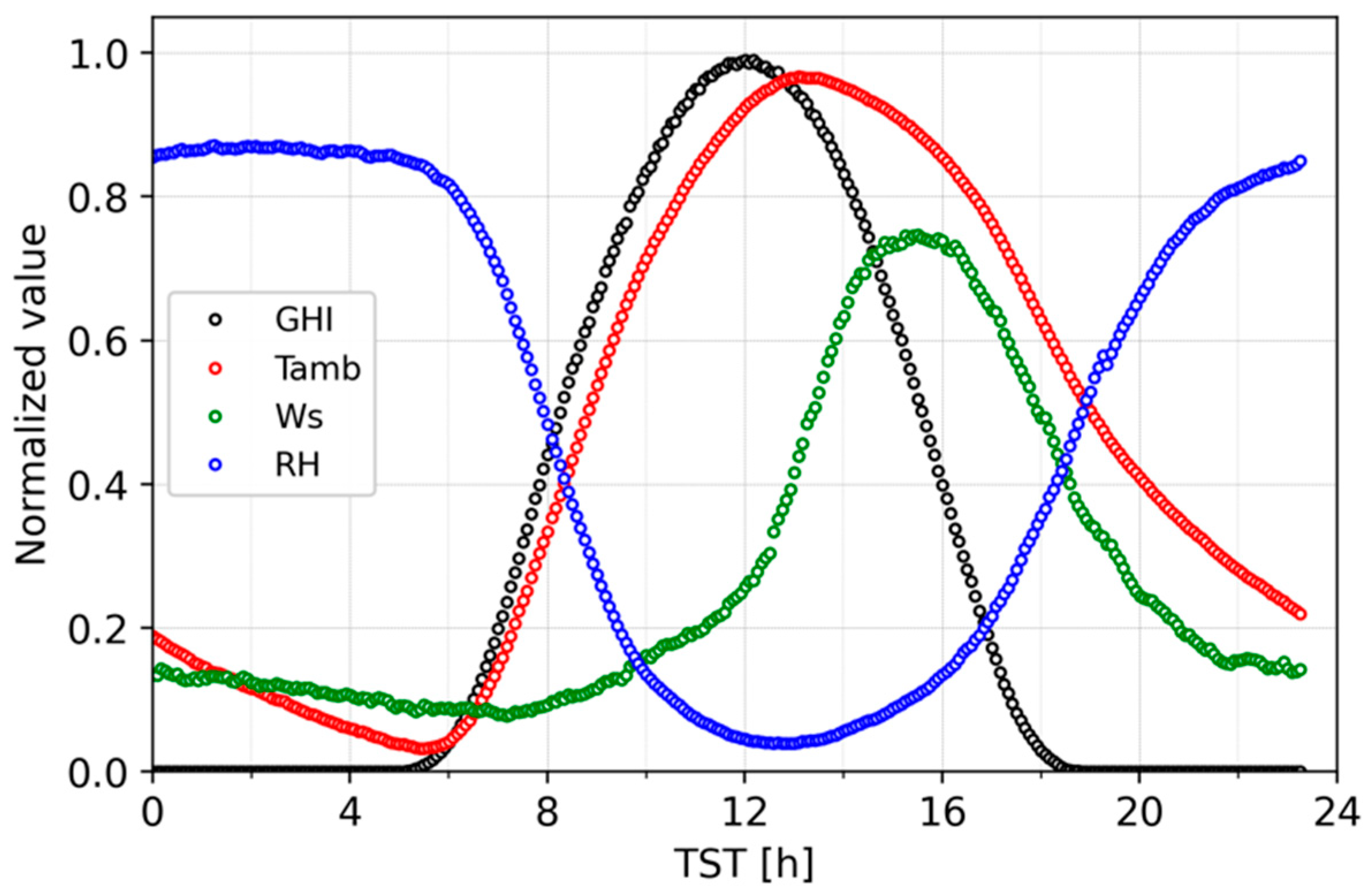
The Atacama Desert’s atmospheric conditions, characterized by low relative humidity, specific wind patterns, and significant daily temperature variations directly impact the transport, deposition, and removal of dust particles on the surfaces of bifacial photovoltaic modules [17]. To capture these effects, meteorological data were continuously collected during the experimental campaign (July 2022–June 2023) and processed to construct a representative daily profile (Figure 3). The variables were normalized using the expression Xnormalized = (X − Xmin)/(Xmax − Xmin), which allowed direct comparison on a common scale [18]. This approach was supported by the stable and repetitive meteorological patterns of the region, enabling a more accurate description of the daily dust accumulation cycle [19].
Figure 3 shows the normalized profiles of global horizontal irradiance (GHI), ambient temperature, relative humidity and wind speed for an average day at the PSDA. During the early morning (00:00–06:00), the relative humidity exceeds 75%, while the ambient temperature drops to a minimum of 5–8 °C. These conditions favor the formation of thin films of water on the surfaces of the photovoltaic modules, thereby facilitating the adhesion of particles with hygroscopic character. From 08:00 onwards, GHI and temperature increase progressively, reaching maxima of close to 1100 W/m2 and 25 °C, respectively, between 13:00 and 15:00. At the same time, relative humidity decreases to a minimum of 10–15%, favoring the drying of any previously moistened material. Wind speed intensifies from around midday, reaching maximum of 6–8 m/s in the afternoon. This contributes to the transport and deposition of particles, mainly from the southwest, creating different soiling patterns on the front and rear faces of the bifacial PV modules. These atmospheric patterns represent the main environmental drivers of soiling processes at the PSDA and provide the basis for interpreting the subsequent morphological and performance analyses.

3.2. Morphological and Chemical Characterization of Deposited Material by SEM/EDX

Building on the atmospheric characterization presented in Section 3.1, we used FE-SEM and EDX to investigate the morphology and elemental composition of materials deposited on PV module surfaces. These microstructural and chemical analyses complement the meteorological context by revealing the mechanisms governing particle adhesion, transformation (e.g., recrystallisation) and persistence under PSDA conditions. Previous studies at this location have reported the presence of a wide range of minerals in airborne particulates, including quartz, feldspar, gypsum, halite, calcite, aragonite, dolomite, hematite, magnetite, albite and clay minerals such as kaolinite and smectite [20]. This provides a basis for interpreting the features identified in our FE-SEM images and EDX elemental maps.
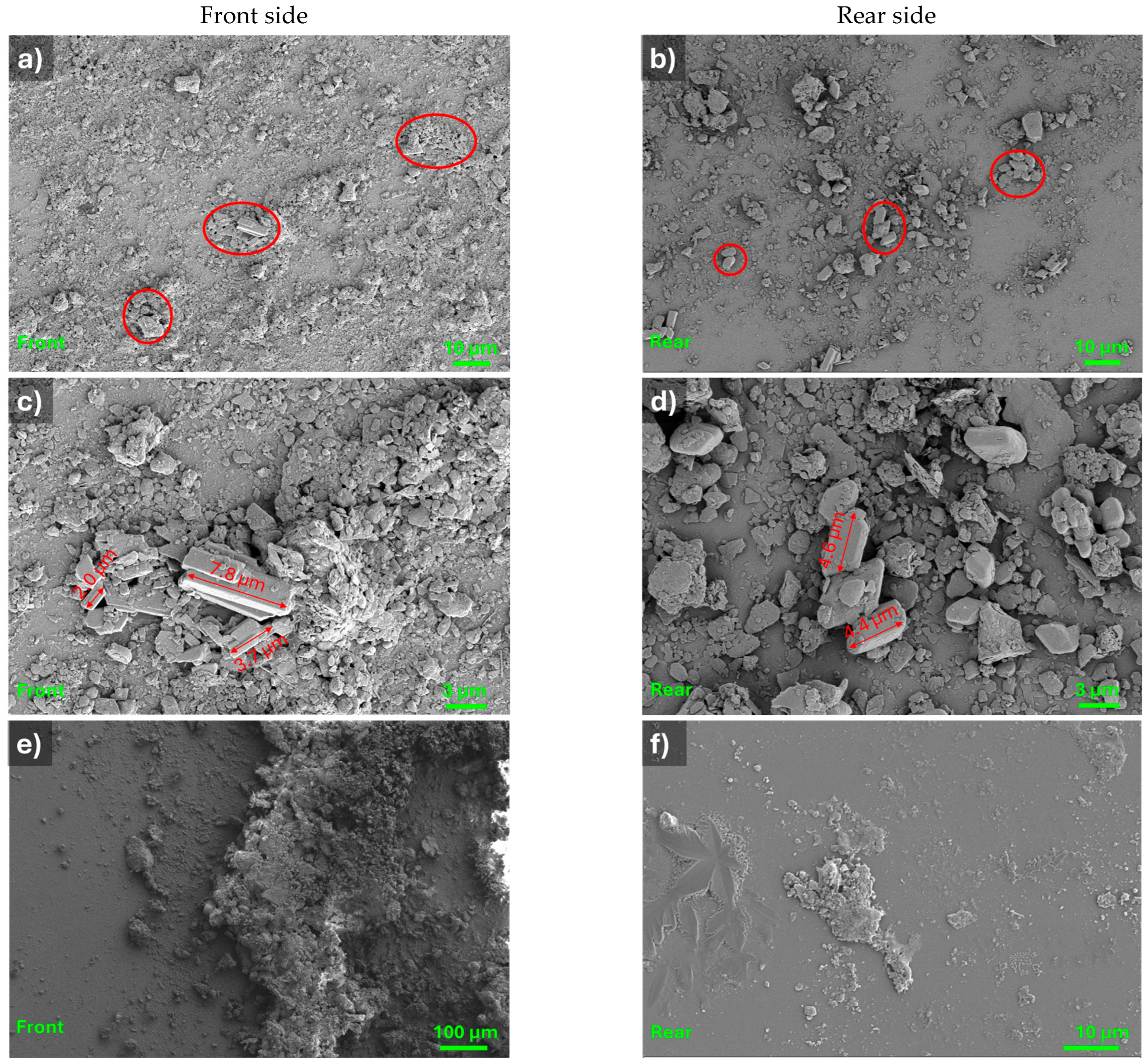
(Figure 4a,c,e = front surface; Figure 4b,d,f = rear surface) illustrates the morphological contrasts of the deposits. On the front-facing samples (Figure 4a,c), deposits are dense and dominated by prismatic particles with sharp edges, typically ranging from 2 to 8 µm in length. Agglomerates and compact layers are also visible, indicating progressive deposition and recrystallization promoted by cycles of condensation and drying. In contrast, the rear-facing samples (Figure 4b,d) show lower deposition density and more amorphous morphologies. Particle sizes range from fine aggregates to angular fragments up to ~5 µm, with surfaces lacking the sharp edges characteristic of the front side. These differences suggest reduced recrystallization on the rear surface, consistent with its limited exposure to condensed moisture.
Additional evidence of surface transformation is observed in Figure 4e–f. On the front side (Figure 4e), overlapping layers of material evolve into consolidated crusts, reflecting cementation driven by repeated wetting–drying cycles. In contrast, the rear side (Figure 4f) mainly shows drying stains with only incipient cementation features, probably linked to localized nucleation points. Overall, SEM analyses confirm that deposition and transformation processes are more advanced on the front surface, underscoring the asymmetric soiling dynamics characteristic of bifacial modules.
These microstructural observations are consistent with the atmospheric conditions described in Section 3.1, where cycles of high nighttime humidity and daytime drying promote recrystallization on exposed surfaces. The prevalence of gypsum crystals and compact crusts on the front side aligns with previous findings at the PSDA [19], highlighting the role of hygroscopic minerals in driving cementation.
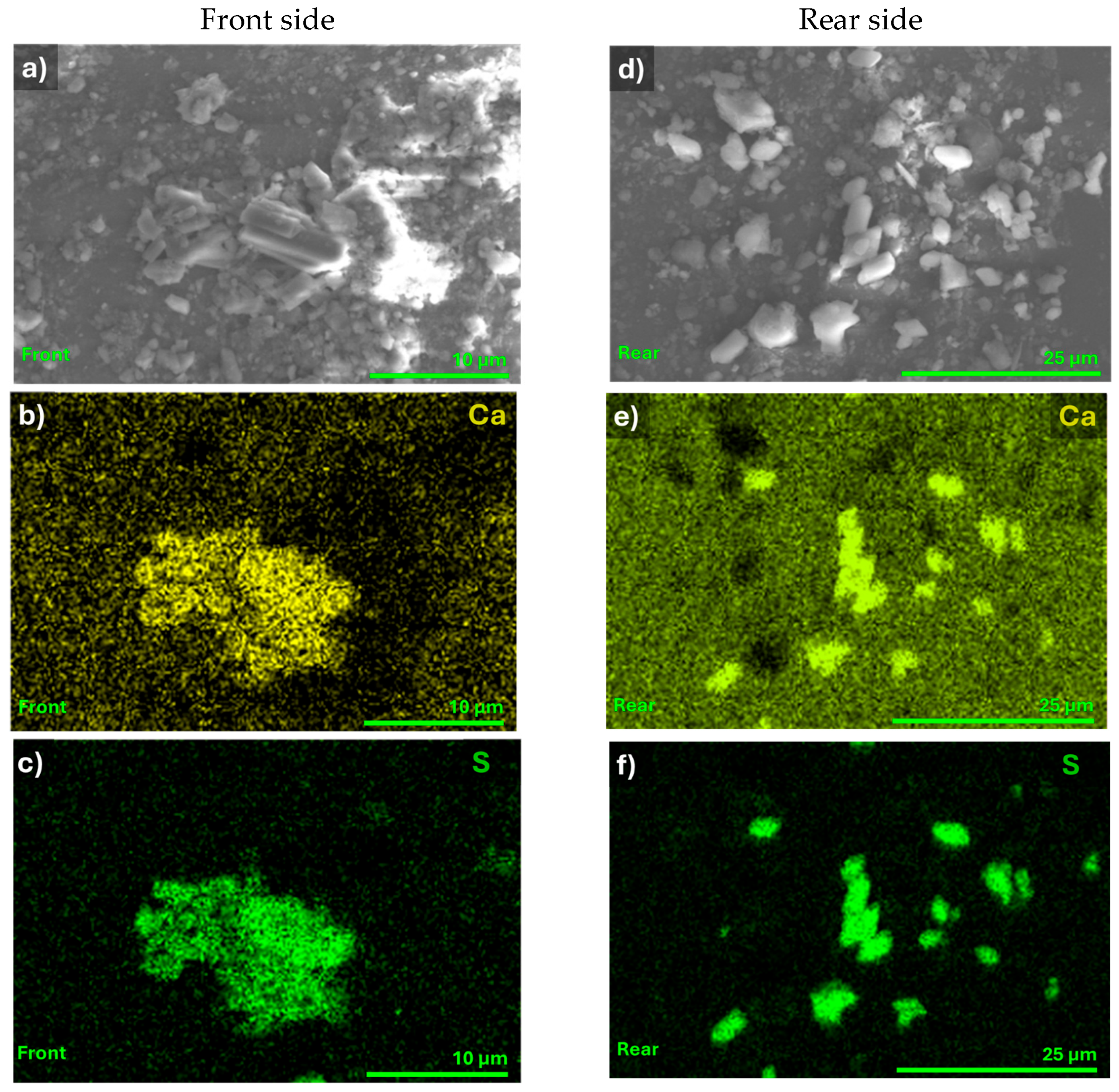
To better understand the mineral phases driving the cementation processes observed in SEM, elemental mapping was performed using EDX (Figure 5). On the front surface (Figure 5a–c), prismatic crystals correspond to areas of strong calcium (yellow) and sulfur (green) signals, which largely overlap at the 10 µm scale. This confirms the predominance of gypsum (CaSO4) as the main cementing agent, consistent with previous findings at the PSDA [19]. The detection of this compound explains the compact and well-defined crusts observed in the SEM images, since gypsum is hygroscopic and prone to repeated cycles of dissolution and recrystallization [21].
In contrast, the rear surface (Figure 5d–f), analyzed at a larger scale of 25 µm, shows weaker and more dispersed Ca and S signals with limited spatial overlap. These correspond to smaller, less defined particles and the absence of clear gypsum crystals, indicating that cementation is less developed on this side due to lower deposition density and limited interaction with condensed moisture.
When integrated with SEM observations, these EDX results reveal that the asymmetry between the front and rear surfaces of bifacial modules is both morphological and compositional. The front side, directly exposed to particle flux and more intense humidity fluctuations, develops gypsum-rich crusts that enhance cementation. The rear side accumulates thinner and less cohesive deposits with little crystalline development. This explains why cemented layers are more persistent on the front surface and why cleaning requirements for bifacial modules must be face-specific in arid environments such as the PSDA.

3.3. Natural Cleaning Events and Dust Density Evolution (Soiling Ratio and Electrical Performance Losses)

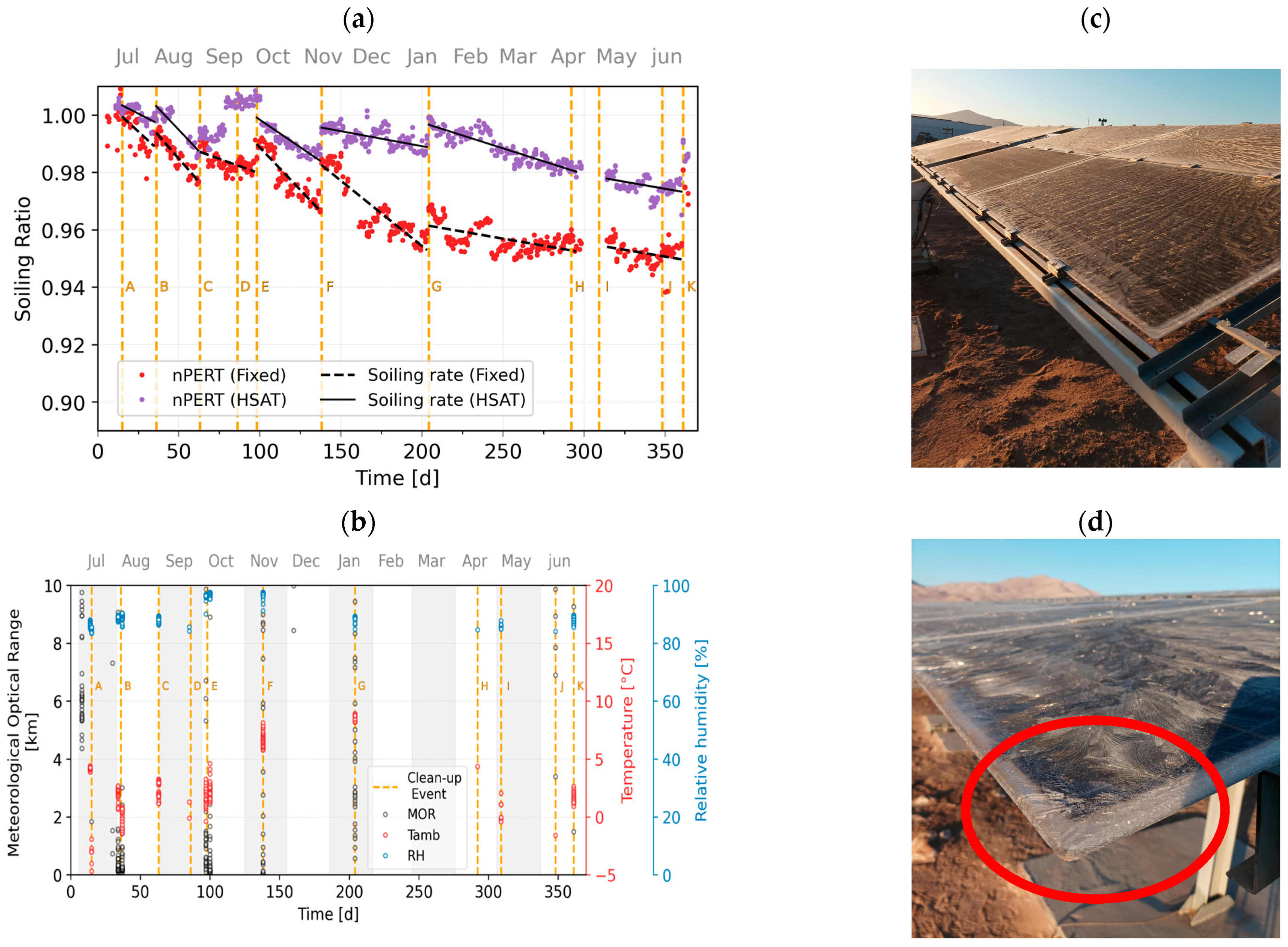
The combined effects of deposition and cementation determine not only how dust adheres to and persists on module surfaces, but also how it responds to natural cleaning processes. These factors directly influence electrical performance and are reflected in the evolution of the SR during field exposure [22]. As shown in Figure 6a, the SR decreased from 1.0 to 0.942 over 365 days for modules mounted on fixed structures, while HSAT systems showed a smaller reduction, reaching 0.96. This indicates that fixed modules are more susceptible to dust accumulation due to their static orientation, which favors particle deposition and consolidation. The daily motion of HSAT systems mitigates deposition by altering the incidence angle and limiting the persistence of dust layers, although minor cementation effects are still observed [9,23,24].
Several studies have reported that rear-face soiling in bifacial modules is consistently lower than on the front, regardless of system configuration. In Jaipur, India, Raina and Sinha documented soiling rates of 0.328%/day and 0.031%/day on the front and rear of tilted modules, respectively, and 0.047%/day on vertically mounted bifacial modules [25]. Under desert conditions in Qatar, Abdallah et al. found rear-face deposition to be practically negligible compared with the front [26]. These observations agree with the present study, where rear-face deposition remained much lower, even under conditions favorable to cementation.
Natural cleaning events were identified during monitoring, reflected as abrupt positive variations in SR (Figure 6a). Since no scheduled cleaning was performed, these fluctuations can be attributed to environmental factors such as fog, dew, and frost. Their occurrence was analyzed against atmospheric visibility records from the meteorological optical range (MOR). As shown in Figure 6b, events with MOR < 10 km, and in some cases < 1 km, coincided with relative humidity > 80% and temperatures close to the dew point, conditions favorable for condensation on module surfaces. On certain nights, air temperatures fell below 0 °C, producing frost or thin ice layers that were later confirmed visually (Figure 6c,d). With sunrise, these layers melted and mobilized part of the deposited dust, temporarily reducing soiling losses.
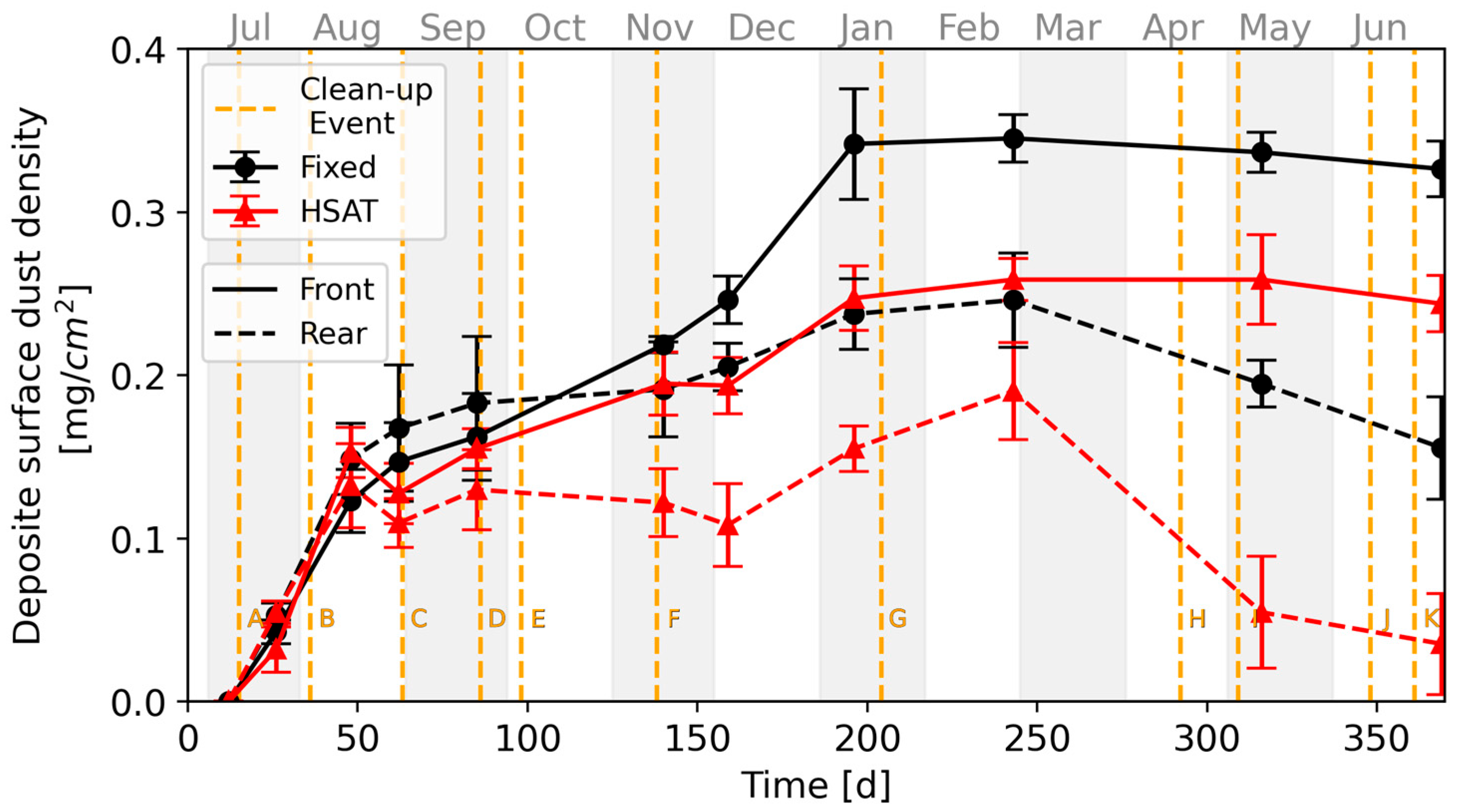
Figure 7 shows the monthly evolution of surface dust density, including mean values with standard deviations derived from replicate samples. A sustained increase in dust loading was observed in both configurations, with fixed modules reaching 0.33 mg/cm2 on the front surface compared with 0.25 mg/cm2 for HSAT by the end of the monitoring period. These differences reflect the effect of orientation and motion: fixed modules promote stable deposition and consolidation, while HSAT modules disrupt particle accumulation and delay cementation. Rear surfaces again showed markedly lower densities, with 0.15 mg/cm2 for fixed and 0.035 mg/cm2 for HSAT. Although front–rear asymmetry has been reported in other studies [27], the present results provide a quantitative assessment under the extreme arid conditions of the PSDA, highlighting not only the magnitude of the difference but also its persistence throughout the year. These findings emphasize that bifacial modules are subject to uneven soiling dynamics on each surface.
The temporal evolution of surface dust density (Figure 7) is consistent with the decline in soiling ratio (Figure 6a), confirming that deposition was cumulative but modulated by monthly atmospheric conditions. From August to October, both indicators show a rapid increase in soiling, reflecting intense particle deposition. Between November and January, the rate of accumulation slowed, but fixed modules continued to increase steadily, while HSAT modules displayed more variability, with partial recoveries that match fluctuations observed in the SR curve. From February onwards, the curves indicate temporary modulations in surface density, reflecting short-term atmospheric variability, yet overall deposition quickly resumed its cumulative trend. Together, these results confirm that while soiling progresses cumulatively across the year, its short-term dynamics are strongly influenced by local meteorological variability and installation configuration.
These findings highlight the operational implications of soiling asymmetry in bifacial modules. While natural events provide occasional and partial relief, they cannot counteract the cumulative effect of deposition and cementation. Effective O&M therefore requires active cleaning strategies adapted to configuration and local conditions. The integration of real-time monitoring tools with morphological and chemical analyses can support predictive maintenance and optimize performance under the extreme environmental conditions of the PSDA.

4. Conclusions

This study investigated the soiling dynamics of bifacial photovoltaic modules installed in the Atacama Desert, comparing fixed structures with horizontal single-axis tracking systems. Morphological and compositional analyses revealed that cementation occurs on both faces of the modules but is more pronounced on the front due to its greater exposure to environmental conditions and interaction with condensed moisture. This asymmetry in particulate accumulation and consolidation confirms that bifaciality introduces distinct soiling dynamics between the front and rear surfaces.
Analysis of electrical performance losses and surface dust density showed higher degradation and deposition levels for fixed modules (0.33 mg/cm2 on the front surface) than for horizontal single-axis tracking systems (0.25 mg/cm2). Significantly lower deposition levels were observed on the rear surface (0.15 mg/cm2 in fixed systems and 0.035 mg/cm2 in horizontal single-axis tracking systems), indicating the necessity of assessing soiling separately for each active module surface. Although natural cleaning events associated with fog, dew and frost were identified, these proved insufficient to achieve complete or sustained cleaning. Rapid re-accumulation occurred after each event. The persistence of cemented deposits, even on moving systems, confirms that natural cleaning only partially mitigates the effects of soiling.
These findings have direct implications for the operation of bifacial photovoltaic plants in arid environments, emphasizing the need for maintenance plans tailored to the configuration and exposure of each surface. Integrating cleaning strategies adapted to each surface, supported by real-time monitoring of electrical performance and deposit morphology assessment, can optimize the utilization of solar resources and preserve long-term bifacial gain.
Looking ahead, future research should focus on extending the monitoring period to capture interannual variability in bifacial modules, testing advanced cleaning techniques adapted to cemented deposits, and integrating optical and remote sensing tools for large-scale soiling detection. In addition, the development of predictive models that couple environmental parameters with asymmetric soiling mechanisms on both sides of bifacial modules will be essential to improve operation and maintenance planning and reduce uncertainty in energy yield assessments. These efforts will contribute to the reliable and large-scale deployment of bifacial photovoltaic technology in arid regions worldwide.

Author Contributions

Conceptualization, A.T. and D.O.; methodology, A.T. and D.O.; software, M.G.; validation, A.M., F.M.G.-M. and F.V.; formal analysis, A.M. and F.M.G.-M.; investigation, A.T.; resources, E.F. and A.M.; data curation, M.G.; writing—original draft preparation, A.T. and D.O.; writing—review and editing, A.M. and F.V.; visualization, A.T.; supervision, D.O.; project administration, A.M.; funding acquisition, E.F. and A.M. All authors have read and agreed to the published version of the manuscript.

Funding

This work was supported by MICIU/AEI/10.13039/501100011033 and by the European Union “NextGenerationEU/PRTR” (grant RYC2021-031958-I), the Chilean Economic Development Agency, CORFO, with the contract no. 17PTECES-75830 under the framework of the project ATAMOSTEC and the projects ANID/FONDAP/1523A0006 “Solar Energy Research Center”- SERC-Chile. The author thanks the doctoral program in Solar Energy of the Universidad de Antofagasta (UA), Project Engineering 2030 Code 16ENI2-71940 and the CDEA for the accessibility of the data and the use of their facilities.

Data Availability Statement

The original contributions presented in this study are included in the article. Further inquiries can be directed to the corresponding author.

Acknowledgments

The authors thank Grant RYC2021-031958-I funded by MICIU/AEI/10.13039/501100011033 and by the European Union “NextGenerationEU/PRTR”; ANID/FONDAP/1523A0006 “Solar Energy Research Center” SERC-Chile; the Chilean Economic Development Agency (CORFO), contract No. 17PTECES-75830 for the project “AtaMoS TeC”; ANID–Fondecyt 1210490; and the ANID Millennium Science Initiative Program—NNBP # NCN2021_021. This work further benefited from the equipment acquired through ANID’s Concurso Equipamiento Científico y Tecnológico FONDEQUIP Mediano 2022, EQM 220028 “ Adquisición de un Microscopio Electrónico FE-SEM para el fortalecimiento de la investigación, vinculación y docencia de pre y postgrado de la Universidad de Antofagasta. We gratefully acknowledge the Laboratory for Territorial Characterization and Radiometry at the Centro de Desarrollo Energético de Antofagasta (CDEA) for providing the infrastructure and technical facilities essential for this study. We also thank the Solar Energy PhD Program at the University of Antofagasta for its academic support throughout the research process. The authors want to acknowledge the CACTUS project funded by the European Commission in the HORIZONINFRA- 2023-DEV-01-06 program (Ref.: 101132182), And Transferencia Ruta Solar e Hidrogeno Verde en la Región de Antofagasta: Una Planificación Estratégica para el Desarrollo Energético local. BIP 40067568-0 Gobierno Regional de Antofagasta.

Conflicts of Interest

Author Felipe Valencia was employed by the company Corporación ATAMOSTEC. The remaining authors declare that the research was conducted in the absence of any commercial or financial relationships that could be construed as a potential conflict of interest.

References

  1. Power Transition Trends 2023|BloombergNEF. Available online: https://about.bnef.com/insights/clean-energy/power-transition-trends-2023/ (accessed on 4 August 2025).
  2. Clean Electricity Breaks New Records; Renewables on Track for Another Strong Year: BloombergNEF|BloombergNEF. Available online: https://about.bnef.com/insights/clean-energy/clean-electricity-breaks-new-records-renewables-on-track-for-another-strong-year-bloombergnef/ (accessed on 4 August 2025).
  3. Guerrero-Lemus, R.; Vega, R.; Kim, T.; Kimm, A.; Shephard, L. Bifacial solar photovoltaics—A technology review. Renew. Sustain. Energy Rev. 2016, 60, 1533–1549. [Google Scholar] [CrossRef]
  4. Libal, J.; Kopecek, R. Bifacial Photovoltaics: Technology, Applications and Economics; Institution of Engineering and Technology: London, UK, 2018. [Google Scholar]
  5. Muñoz-García, M.; Fouris, T.; Pilat, E. Analysis of the soiling effect under different conditions on different photovoltaic glasses and cells using an indoor soiling chamber. Renew. Energy 2021, 163, 1560–1568. [Google Scholar] [CrossRef]
  6. Ilse, K.K.; Figgis, B.W.; Naumann, V.; Hagendorf, C.; Bagdahn, J. Fundamentals of soiling processes on photovoltaic modules. Renew. Sustain. Energy Rev. 2018, 98, 239–254. [Google Scholar] [CrossRef]
  7. Salamah, T.; Ramahi, A.; Alamara, K.; Juaidi, A.; Abdallah, R.; Abdelkareem, M.A.; Amer, E.-C.; Olabi, A.G. Effect of dust and methods of cleaning on the performance of solar PV module for different climate regions: Comprehensive review. Sci. Total Environ. 2022, 827, 154050. [Google Scholar] [CrossRef] [PubMed]
  8. Borah, P.; Micheli, L.; Sarmah, N. Analysis of Soiling Loss in Photovoltaic Modules: A Review of the Impact of Atmospheric Parameters, Soil Properties, and Mitigation Approaches. Sustainability 2023, 15, 16669. [Google Scholar] [CrossRef]
  9. Laarabi, B.; El Baqqal, Y.; Rajasekar, N.; Barhdadi, A. Updated review on soiling of solar photovoltaic systems Morocco and India contributions. J. Clean. Prod. 2021, 311, 127608. [Google Scholar] [CrossRef]
  10. Maghami, M.R.; Hizam, H.; Gomes, C.; Radzi, M.A.; Rezadad, M.I.; Hajighorbani, S. Power loss due to soiling on solar panel: A review. Renew. Sustain. Energy Rev. 2016, 59, 1307–1316. [Google Scholar] [CrossRef]
  11. Figgis, B.; Ennaoui, A.; Ahzi, S.; Remond, Y. Review of PV soiling measurement methods. In Proceedings of the 2016 International Renewable and Sustainable Energy Conference (IRSEC), Marrakech, Morocco, 14–17 November 2016. [Google Scholar]
  12. Figgis, B.; Ennaoui, A.; Ahzi, S.; Rémond, Y. Review of PV soiling particle mechanics in desert environments. Renew. Sustain. Energy Rev. 2017, 76, 872–881. [Google Scholar] [CrossRef]
  13. Ilse, K.; Micheli, L.; Figgis, B.W.; Lange, K.; Daßler, D.; Hanifi, H.; Wolfertstetter, F.; Naumann, V.; Hagendorf, C.; Gottschalg, R.; et al. Techno-Economic Assessment of Soiling Losses and Mitigation Strategies for Solar Power Generation. Joule 2019, 3, 2303–2321. [Google Scholar] [CrossRef]
  14. Al Shehri, A.; Parrott, B.; Carrasco, P.; Al Saiari, H.; Taie, I. Impact of dust deposition and brush-based dry cleaning on glass transmittance for PV modules applications. Sol. Energy 2016, 135, 317–324. [Google Scholar] [CrossRef]
  15. NASA-Goddard Space Flight Center. AErosol RObotic NETwork. Available online: https://aeronet.gsfc.nasa.gov/ (accessed on 1 December 2024).
  16. IEC 61724-1: 2021; Photovoltaic system performance—Part 1: Monitoring. International Electrotechnical Commission (IEC): Geneva, Switzerland, 2021.
  17. Wang, F.; Michalski, G.; Seo, J.-H.; Ge, W. Geochemical, isotopic, and mineralogical constraints on atmospheric deposition in the hyper-arid Atacama Desert, Chile. Geochim. Cosmochim. Acta 2014, 135, 29–48. [Google Scholar] [CrossRef]
  18. Olivares, D.; Trigo-González, M.; Marzo, A.; Ferrada, P.; Llanos, J.; Araya, F.; López, G.; Polo, J.; Alonso-Montesinos, J.; Gueymard, C. Analysis of the local factors that influence the cementation of soil and effects on PV generation at the plataforma solar del desierto de atacama, Chile. In Proceedings of the ISES Solar World Congress 2019 and IEA SHC International Conference on Solar Heating and Cooling for Buildings and Industry, Santiago, Chile, 3–7 November 2019. [Google Scholar]
  19. Olivares, D.; Ferrada, P.; Marzo, A.; Llanos, J.; Miranda-Ostojic, C.; del Campo, V.; Bravo, S.; Fuentealba, E. Microstructural analysis of the PV module cementation process at the Solar Platform of the Atacama Desert. Sol. Energy Mater. Sol. Cells 2021, 227, 111109. [Google Scholar] [CrossRef]
  20. Olivares, D.; Ferrada, P.; de Matos, C.; Marzo, A.; Cabrera, E.; Portillo, C.; Llanos, J. Characterization of soiling on PV modules in the Atacama Desert. Energy Procedia 2017, 124, 547–553. [Google Scholar] [CrossRef]
  21. Olivares, D.; Marzo, A.; Taquichiri, A.; Espinoza, R.; Henriquez, M.; Portillo, C.; Ferrada, P.; Conde, L.; Fuentealba, E.; del Campo, V. Impact of thermoelectric coal-fired power plant emissions on the soiling mechanisms of nearby photovoltaic power plants in the Atacama Desert. Renew. Energy 2025, 244, 122684. [Google Scholar] [CrossRef]
  22. Bessa, J.G.; Micheli, L.; Almonacid, F.; Fernández, E.F. Monitoring photovoltaic soiling: Assessment, challenges, and perspectives of current and potential strategies. iScience 2021, 24, 102165. [Google Scholar] [CrossRef] [PubMed]
  23. Azouzoute, A.; Hajjaj, C.; Zitouni, H.; El Ydrissi, M.; Mertah, O.; Garoum, M.; Ghennioui, A. Modeling and experimental investigation of dust effect on glass cover PV module with fixed and tracking system under semi-arid climate. Sol. Energy Mater. Sol. Cells 2021, 230, 111219. [Google Scholar] [CrossRef]
  24. Patel, M.T.; Ahmed, M.S.; Imran, H.; Butt, N.Z.; Khan, M.R.; Alam, M.A. Global analysis of next-generation utility-scale PV: Tracking bifacial solar farms. Appl. Energy 2021, 290, 116478. [Google Scholar] [CrossRef]
  25. Raina, G.; Sinha, S. Experimental investigations of front and rear side soiling on bifacial PV module under different installations and environmental conditions. Energy Sustain. Dev. 2023, 72, 301–313. [Google Scholar] [CrossRef]
  26. Kivambe, M.; Abdallah, A.; Figgis, B.; Scabbia, G.; Abdelrahim, M.; Lopez-Garcia, J. Assessing vertical east-west bifacial photovoltaic systems in desert environments: Energy yield and soiling mitigation. Sol. Energy 2024, 279, 112835. [Google Scholar] [CrossRef]
  27. Sengupta, S.; Chanda, C.K.; Saha, H.; Sengupta, S. Physics based modeling of dust accumulation on a bifacial solar PV module for generation loss estimation due to soiling. Sol. Energy Adv. 2023, 3, 100046. [Google Scholar] [CrossRef]
Figure 1. (a) Atacama Desert (satellite image obtained from the NASA Worldview application, part of the NASA Earth Observing System Data and Information System (EOSDIS)), (https://worldview.earthdata.nasa.gov (accessed on 4 January 2024)) and (b) Meteorological station located at the PSDA, equipped for continuous monitoring of local environmental conditions relevant to soiling and PV performance assessment.
Energies 18 04999 g001
Figure 2. (a) HSAT configuration of nPERT modules (b) Fixed-tilt configuration of nPERT modules, both installed at the PSDA site.
Energies 18 04999 g002
Figure 3. Typical daily profiles of GHI, ambient temperature, wind speed, and relative humidity at the PSDA. All variables are normalized using min-max scaling (X − Xmin)/(Xmax − Xmin) to facilitate comparative analysis across parameters.
Energies 18 04999 g003
Figure 4. Scanning electron microscopy (FE-SEM). Images (a,c,e) correspond to soiling deposits on the upper (front) surfaces of the modules, while images (b,d,f) correspond to the rear surfaces. The red circles in the figures above indicate areas of interest for analysis.
Energies 18 04999 g004
Figure 5. Elemental analysis of dirty samples exposed to the exterior: (ac) Deposition on the front surface. (df) Deposition on the rear surface. (Yellow corresponds to Ca and green to S).
Energies 18 04999 g005
Figure 6. (a) Parameters related to cleaning events and surface density of dust on the front and rear of the fixed installation and HSAT. (b) The relationship between module cleaning events (orange dashed lines) and atmospheric conditions during the study period. Three parameters are presented: atmospheric visibility (black), ambient temperature (Tamb, red circles), and relative humidity (RH, blue circles). (c) Fixed installation. (d) HSAT installation.
Energies 18 04999 g006
Figure 7. Parameters related to cleaning events and surface density of dust on the front and rear of the fixed installation and HSAT. Clean-up event 13 June 2023.
Energies 18 04999 g007
Table 1. PV Module soiling period and soiling rate.
TypePMMP [W]Isc [A]Voc [V]φ *β [%/°C] **α [%/°C] ***
nPERT3487.452.50.88−0.30.048
(*) Bifaciality, (**) Voc Temperature Coefficient, (***) Isc Temperature Coefficient.
Disclaimer/Publisher’s Note: The statements, opinions and data contained in all publications are solely those of the individual author(s) and contributor(s) and not of MDPI and/or the editor(s). MDPI and/or the editor(s) disclaim responsibility for any injury to people or property resulting from any ideas, methods, instructions or products referred to in the content.