Article

Hybrid PCM–Liquid Cooling System with Optimized Channel Design for Enhanced Thermal Management of Lithium–Ion Batteries


1
Department of Mechanical Engineering, Dongguk University-Seoul, 30 Pildong-Ro 1-Gil, Jung-Gu, Seoul 04620, Republic of Korea
2
Department of Mechanical, Robotics and Energy Engineering, Dongguk University-Seoul, 30 Pildong-Ro 1-Gil, Jung-Gu, Seoul 04620, Republic of Korea
*
Author to whom correspondence should be addressed.
Energies 2025, 18(18), 4996; https://doi.org/10.3390/en18184996
Submission received: 23 July 2025 / Revised: 26 August 2025 / Accepted: 17 September 2025 / Published: 19 September 2025

Abstract

The increasing demand for high-efficiency cooling technologies necessitates improved methods to prevent degradation and ensure reliable operation of lithium–ion batteries. Conventional PCM (phase change material)-based cooling systems are limited by low thermal conductivity and uneven phase change processes, which lead to non-uniform thermal distribution and diminished performance. In response to these challenges, this study introduces a hybrid thermal management system that combines an indirect liquid-cooling structure with multiple cooling channel configurations within a PCM-based battery pack. Numerical simulations were conducted to systematically assess the thermal performance of the proposed design. Experimental validation with various cooling media showed that PCM achieved the greatest reduction in temperature (47%) and the longest isothermal duration (56 min) under air-cooled conditions, surpassing thermally conductive adhesive (40%) and silicone oil (26%) for temperature decrease. Vertical temperature differentials were effectively reduced, staying below only 2 °C for silicone oil and reaching a maximum of 4 °C for PCM. Phase change evaluation indicated that after 30 min of operation, only 37% of the PCM volume had melted, highlighting localized constraints in heat transfer. Comparative analysis among four liquid-cooling channel arrangements (A–D) and a standalone PCM system demonstrated that configuration D exhibited the highest cooling capability, lowering the battery surface temperature by as much as 9 °C (17.8%). Flow rate analysis determined that increases above 0.2 L/min resulted in only modest thermal improvements (<1 °C), with 0.108 L/min identified as the most efficient rate. Relative to PCM-only designs, the advanced hybrid cooling system achieved significantly enhanced thermal regulation and temperature uniformity, underscoring its promise as a superior solution for lithium–ion battery thermal management.

1. Introduction

Increasing global energy demand is causing carbon emissions to continue rising, which results in a range of serious environmental problems, including global warming, air pollution, and sea level rise [1]. Greenhouse gases and air pollutants emitted from the transportation sector present substantial risks to human health, thus further driving the shift from conventional internal combustion engine vehicles to electric vehicles [2]. At the heart of electric vehicles (EVs), lithium–ion batteries have become the dominant secondary (rechargeable) battery technology because of their high energy density, outstanding power performance, and long cycle life [3]. However, lithium–ion batteries are highly sensitive to temperature changes, and their performance and longevity are strongly affected by thermal conditions.
To achieve optimal performance and a longer service life, the temperatures of lithium–ion battery cells generally need to be controlled within the range (20–50) °C, while the temperature difference between individual cells and packs needs to remain below 5 °C [4]. In order to meet these thermal specifications, comprehensive investigations have focused on diverse battery thermal management systems (BTMSs), auxiliary cooling devices, and thermal interface materials.
Representative BTMS technologies can be categorized by the type of heat transfer medium used: air cooling, liquid cooling, or phase change material (PCM) cooling [5]. Air cooling systems, which were prevalent in initial applications because of their structural simplicity and low cost, are constrained by the inherent low heat transfer capability of air, rendering them inadequate for guaranteeing uniform temperature distribution in high-energy-density battery cells and packs [6]. Liquid cooling systems are now the most extensively researched and employed BTMSs, due to their greater thermal conductivity when compared to air, allowing maintenance of proper temperatures and enhanced temperature uniformity. However, these systems have the drawbacks of increased complexity, larger size, and higher cost [7].
PCM-based cooling systems have received considerable attention as passive thermal management solutions, as they function without requiring extra energy input and provide superior temperature uniformity [8]. PCMs absorb and release thermal energy through latent heat during phase transitions, maintaining temperatures that are nearly constant within their specific phase change intervals [9,10]. In battery thermal management applications, PCMs can efficiently control temperature gradients both between battery packs and among individual cells, ensuring operation within acceptable parameters. PCMs are generally classified as organic (e.g., paraffins, fatty acids), inorganic (e.g., molten salts, hydrated salts), or composite multi-component systems. Among these groups, organic PCMs are widely regarded as the most suitable option for battery thermal management because their properties—such as chemical stability, non-corrosiveness, cost-efficiency, resistance to phase separation, and low supercooling—make them ideal candidates for further study [11]. Despite their advantages, PCM-based systems face ongoing challenges such as identifying optimal PCMs, developing effective integration approaches for real-world applications, and addressing the inherently low thermal conductivity of PCMs. Sustained research and innovation are therefore required to overcome these challenges [12,13].
Accordingly, numerous studies have been actively conducted to analyze the impact of PCM integration on battery cooling performance. Recent research emphasizes not only methods to increase PCM thermal conductivity but also the potential of hybrid PCM–liquid cooling designs. For instance, Liu et al. [14] numerically analyzed ten types of fins embedded in PCM surrounding 18,650 cells and reported that bifurcated fin configurations reduced peak cell temperature by approximately 6.16 °C compared to pure PCM at 5 C; additional improvements were observed by increasing the number of fins and minimizing thermal contact resistance, underscoring the critical role of efficient heat conduction within PCM. Similarly, hybridizing PCM with liquid cooling plates can yield superior results over stand-alone solutions: Wang et al. [15] introduced a PCM–wavy microchannel plate design, which demonstrated a 2 K reduction in maximum temperature relative to straight-channel plates at 1 C. Further, when the PCM was formulated as an expanded-graphite composite (10 wt %), the hybrid configuration achieved even lower temperature peaks and greater uniformity; under thermal-runaway conditions, the module maintained all cells below 318 K with a maximum temperature difference of about 1.6 K. Additionally, Zhao et al. [16] comprehensively reviewed liquid-cooling, PCM, and their integration, concluding that hybrid PCM–liquid-cooling systems combine the rapid heat removal of liquid coolants with the temperature-equalizing properties of PCM, thereby alleviating the saturation constraints of individual PCM solutions and providing recommendations for hybrid design and operational strategies.
In addition, Hallaj et al. [17] were the first to introduce the use of PCM in battery thermal management systems, demonstrating that PCM-based battery modules achieved a more uniform temperature distribution compared to air cooling systems. Bai et al. [18] analyzed the influence of PCM thermal conductivity, phase change temperature, and inter-cell spacing on the battery cooling effect. Their results showed that enhancements in PCM thermal conductivity and inter-cell spacing led to reductions in both the maximum battery temperature and the temperature gradient. Conversely, increasing the PCM phase change temperature produced a slight rise in peak battery temperature but enhanced the temperature uniformity among cells. Moraga et al. [19] developed cooling plates with single- or multi-layered PCM arrangements using different PCMs and assessed their thermal regulation capabilities. Their findings demonstrated that a sodium carbonate-based three-layer PCM cooling plate could lower the battery’s peak temperature by up to 20 °C. Furthermore, the optimal configuration involved placing the PCM with the highest thermal conductivity adjacent to the battery, while situating the PCM with lower conductivity on the outermost layer.
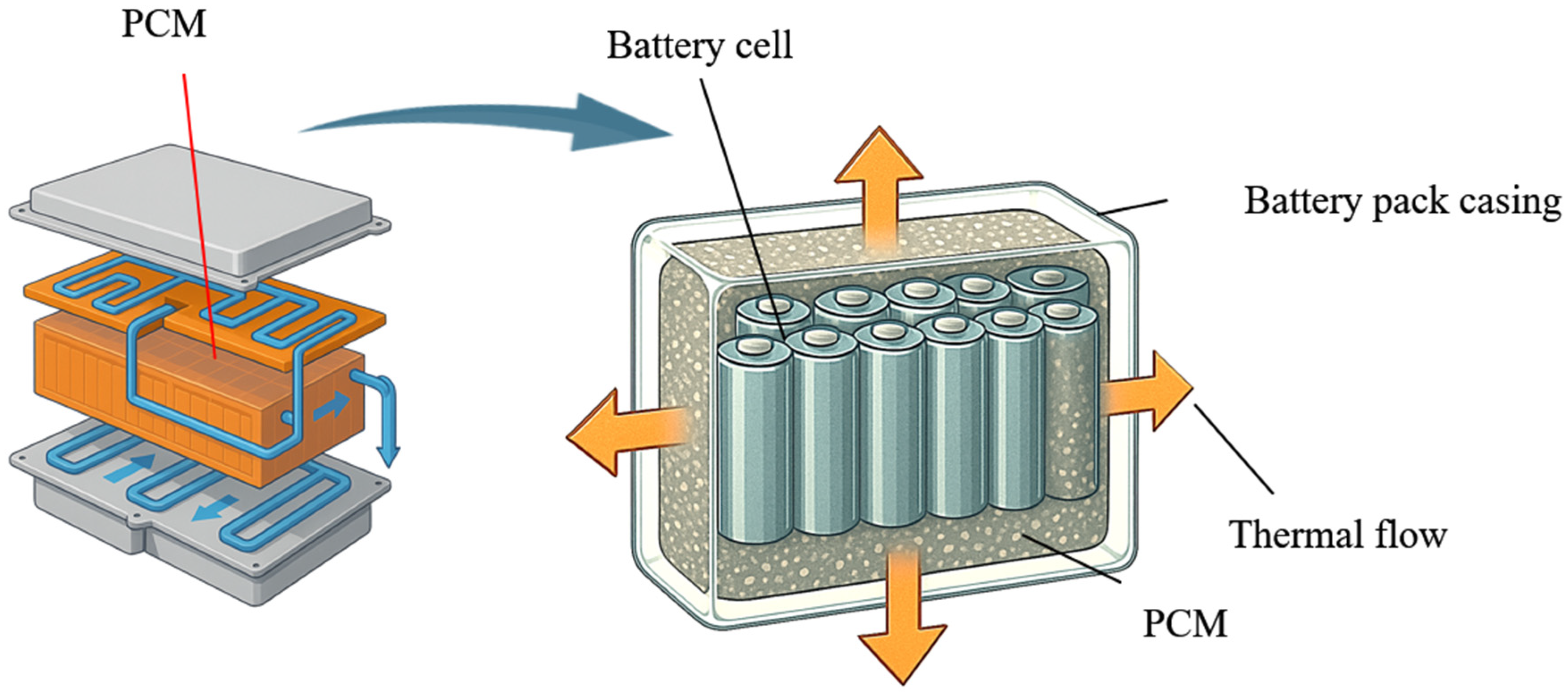
Previous research has predominantly investigated improvements in PCM thermal conductivity via chemical modification [20]. Conversely, this study focused on systematically evaluating the use of PCM as a direct cooling medium and its effects on the thermal management of lithium–ion batteries. To achieve this, battery packs were constructed and tested under four distinct cooling scenarios: PCM, silicone oil, thermally conductive adhesive, and natural convection without supplementary cooling. Figure 1 presents a schematic illustration of a battery cooling system incorporating PCM. Discharge tests were conducted under consistent conditions, and thermal performance was characterized using metrics such as maximum battery pack temperature, overall temperature gradient, cell-to-cell temperature deviation, and residual heat dissipation after discharge. PCM’s viability as an independent cooling solution for battery thermal management was rigorously assessed by comparing its performance to that of other cooling methods. Additionally, numerical simulations of the PCM-cooled battery pack were undertaken, and the computational model was verified by comparison with experimental observations. This methodology facilitated an in-depth examination of the internal phase change mechanisms and temperature profiles within the PCM, which are challenging to monitor experimentally. The outcomes offer meaningful design guidance and considerations for optimizing PCM-based battery hybrid thermal management systems. Furthermore, a supplementary case study explored the enhancement of PCM-based cooling by incorporating an indirect liquid cooling subsystem. In this configuration, a cooling coil was positioned adjacent to the battery module, enabling systematic analysis of different coil channel geometries on system cooling effectiveness. Battery average temperature and temperature uniformity were measured for varied flow patterns to determine the optimal cooling setup.

2. Theoretical Background

During charge and discharge cycles of lithium–ion battery cells, heat is produced due to electrochemical reactions, which subsequently affects the overall temperature distribution within the cell. This thermal distribution in turn impacts the kinetics of electrochemical reactions, ionic transport, and phase equilibrium in electrode materials. As a result, the electrical, electrochemical, and thermal behaviors in lithium–ion batteries exhibit strong mutual interaction and dynamic coupling. In this work, the Newman–Tiedemann–Geske–Kim (NTGK) semi-empirical model was utilized to numerically investigate both thermal and electrical responses within a lithium–ion battery cell [18]. This approach enables simultaneous computation of the electric field and temperature evolution of the battery within a CFD simulation framework. Equation (1) outlines the principal governing equations for this model [21]:
( ρ C p T ) t k T = σ + ϕ + 2 + σ ϕ 2 + q ˙ e c h + q ˙ s h o r t + q ˙ a b u s e
Equation (1) provides the thermal energy conservation law for the battery cell, accounting for time-dependent temperature changes, heat conduction, and internal heat development. The left-hand terms correspond to specific heat capacity, temporal temperature gradients, and heat conduction phenomena. On the right, the equation sums contributions from Joule heating, heat from electrochemical reactions, heat from internal short circuits, and heat associated with thermal runaway events; here, ρ , C p , T , k , σ + , σ , ϕ + , ϕ , q ˙ e c h , q ˙ s h o r t , and q ˙ a b u s e symbolize the density, specific heat, temperature, thermal conductivity, effective electrical conductivity for both electrodes, electrode potentials, electrochemical heat generation rate, internal short-circuit heat rate, and heat generated during thermal runaway, respectively. Equation (2) specifies the volumetric current density j produced by electrochemical processes inside the cell. The current is governed by the difference between the cell and open-circuit voltages, internal resistance effects, the battery’s rated capacity, and the cell’s active volume [22]:
j = V U Y · Q r e f Q n o m · Q a c t i v e
where V , U , Y , Q r e f , Q n o m , and Q a c t i v e indicate the cell voltage, open-circuit voltage, an internal resistance-related parameter, the rated capacity of the reference battery, the rated capacity for the battery under consideration, and the effective volume of the battery cell, respectively. Equation (3) defines the linear relationship between open-circuit voltage and depth of discharge (DOD). Here, the voltage is evaluated using experimentally determined constants C 1 and C 2 [23]:
U ( D O D , T ) = C 1 + C 2 D O D
where U , D O D , C 1 , and C 2 correspond to the open-circuit voltage, depth of discharge, and NTGK model coefficients, respectively, all of which are determined through experimental methods. Equation (4) characterizes the linear dependence of the internal resistance coefficient Y on temperature, illustrating the typical decrease in resistance as temperature rises [24]:
Y T = C 3 + C 4 T
where Y , T , C 3 , and C 4 refer to the internal resistance coefficient, temperature, and NTGK model coefficients determined by experiment, respectively. Equation (5) quantifies heat generation resulting from electrochemical reactions, wherein reaction heat is calculated as the product of current density and the potential difference [23]:
q ˙ e c h = j · ( V U )
where q ˙ e c h , j , V , and U indicate the heat generation rate due to electrochemical reactions, volumetric current density, cell voltage, and open-circuit voltage, respectively. The main equations governing the numerical analysis of the PCM are as follows: Equation (6) represents the continuity equation, Equation (7) the momentum equation, and Equation (8) the energy equation [25]:
· ρ V = 0
ρ V t + ρ ( V · ) V = p + μ 2 V + f g + S
ρ H t + · ρ V H = · k T
The PCM in its liquid state was assumed to be incompressible and to exhibit laminar flow behavior. Internal natural convection was analyzed using the Boussinesq approximation [26]. In this formulation, the buoyancy effect within solid PCM is defined by the balance between gravitational force and the density difference between phases, as given in Equation (9), while the density of liquid PCM ( ρ l ) is expressed as a function of temperature and the thermal expansion coefficient ( β ) in Equation (10) [27]:
f g = ρ ρ l g
ρ l = ρ / β ( T l T m e l t )
The phase change process of the PCM was modeled using the enthalpy–porosity framework [28]. In this methodology, the “mushy” region is regarded as a porous medium, where the parameter assumes a value of 1 for liquid regions and 0 for solid regions. Equation (11) defines the total enthalpy utilized in Equation (8), computed as the sum of the sensible heat (expressed in Equation (12)) and the latent heat of the PCM. Equation (13) models the liquid fraction of the PCM in relation to the melting temperature, with the liquid fraction additionally specified in Equation (14) [25]:
H = h + α l L
h = h 0 + T 0 T c p d T
α l = 0 i f T * < 0 T i f 0 < T * < 1 1 i f 1 < T *
T * = T T s o l i d T l i q u i d T s o l i d
where h denotes the sensible heat, L corresponds to the latent heat, α l indicates the liquid fraction, h 0 represents the sensible heat at a reference temperature T 0 , and c p denotes the specific heat capacity. T s o l i d and T l i q u i d correspond to the temperatures of the solid and liquid phases, respectively, during the melting process. During phase change, the temperature satisfies the relationship T l i q u i d > T > T s o l i d . Equation (15) presents the momentum sink term, defined as a damping element in the momentum equation in accordance with Darcy’s law to account for fluid flow in porous media. This term ensures that the velocity approaches zero in the solid PCM regions within the “mushy” zone during phase change [29].
S = ( 1 α l ) 2 ( α l 3 + ϵ ) A m u s h u i
where the porosity ϵ was chosen as 0.001 to prevent division by zero in the denominator, and Amush represents a constant that defines the magnitude of velocity attenuation during fluid solidification. In this study, the thermal performance of the PCM-integrated battery pack was quantitatively assessed using the Reynolds number, Nusselt number, and Rayleigh number, as specified by Equations (16)–(18), respectively:
R e = ρ v L μ
N u = h L k
R a = g β ( T ) L 3   ν k α
where ρ represents the fluid density, v is the velocity, L specifies the characteristic length, h denotes the convective heat transfer coefficient, and k refers to the thermal conductivity. Furthermore, g denotes the gravitational acceleration, β is the thermal expansion coefficient, T identifies the temperature gradient within the fluid, ν k indicates the kinematic viscosity, and α represents the thermal diffusivity.

3. Experimental and Numerical Setup

3.1. Battery Pack Fabrication and Discharge Experiment Setting

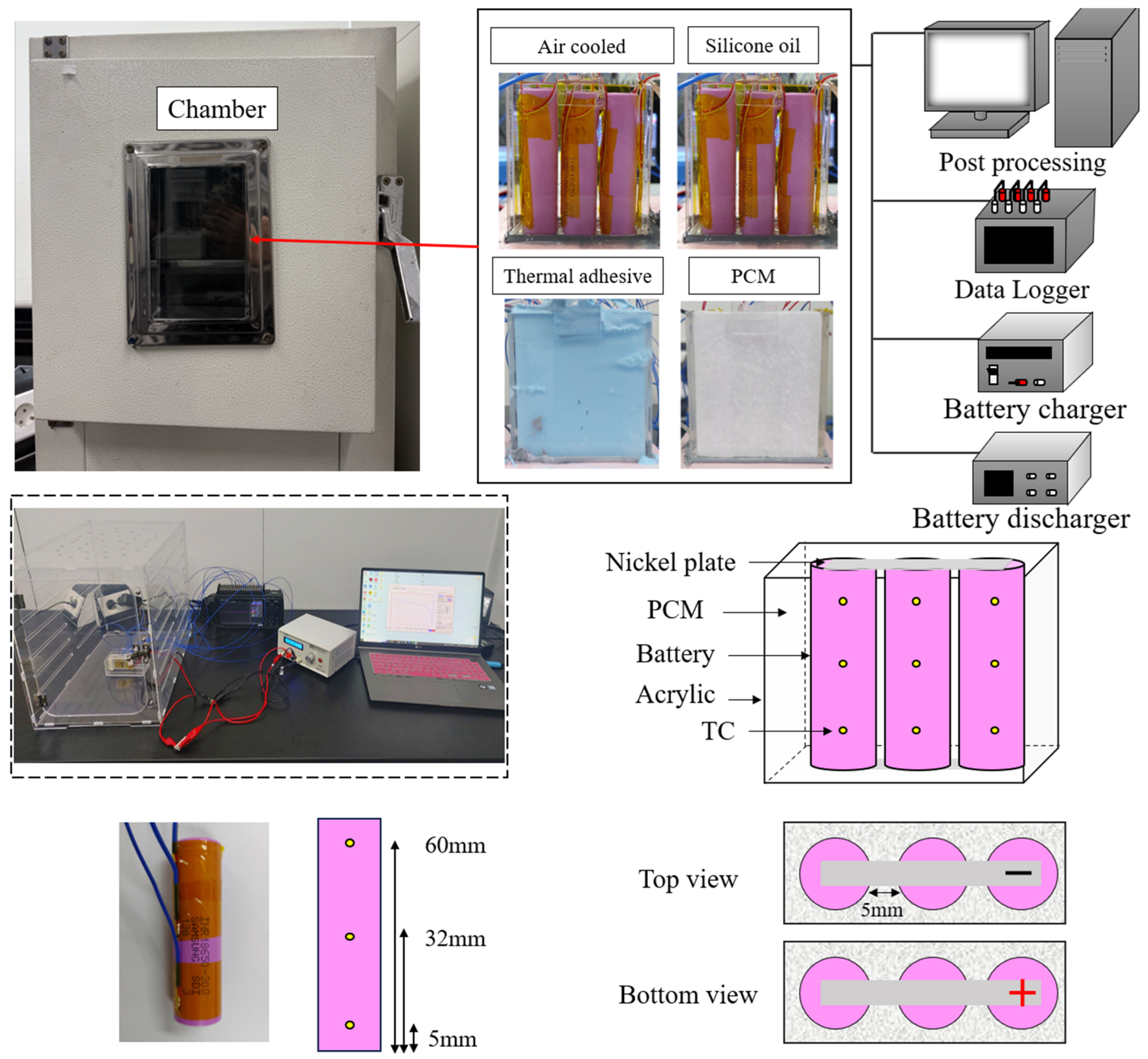
In this study, a cooling experiment was performed to assess the thermal management capabilities of lithium–ion batteries utilizing PCM. Figure 2 illustrates the experimental configuration, which included a battery discharge system, a temperature-controlled chamber, a data acquisition device (GL840, GRAPHTEC), a laptop, and a battery pack. The GL840 data logger is manufactured by Graphtec Corporation in Yokohama, Japan. The thermal management testing employed UTL8513 cell testing equipment, offering a measurement accuracy of ±0.05%. The battery selected for this experiment was a cylindrical lithium–ion cell (Samsung INR18650-30Q, NMC (LiNiMnCoO2)) with a rated capacity of 3000 mA·h and a nominal voltage of 3.6 V. The Samsung INR18650-30Q battery is manufactured by Samsung SDI Co., Ltd. in Yongin, Republic of Korea. Table 1 summarizes the key specifications of the battery.
The battery pack was assembled by connecting three identical cells in parallel (3p), and positioned inside an acrylic enclosure with dimensions of (65 mm × 30 mm × 65 mm) and a wall thickness of 3 mm. The remaining internal volume, not occupied by battery cells, was completely filled with different thermal management media, including phase change material (PCM), silicone oil (KF–96), and thermally conductive adhesive (PK–404DM), to facilitate a comparative analysis of their cooling effectiveness. Paraffin wax, possessing a melting point of 40 °C, was selected as the PCM due to its compatibility with the optimal operating temperature range of the batteries [19].
Table 2 presents the thermophysical properties of the cooling materials, while Table 3 details the primary experimental apparatus. For precise temperature monitoring along the vertical cell profile, three K-type thermocouples were affixed to each cell at the top, middle, and bottom positions. Additionally, thermocouples were located on the external wall and at the center of the PCM to allow a detailed assessment of its internal thermal response. All testing was carried out within a temperature-controlled chamber set to 20 °C ambient conditions. The batteries were discharged at a 2 C-rate, beginning from an initial voltage of 4.2 V and continuing until the cell voltage decreased to 2.5 V.
Real-time temperature data were collected at 1 s intervals using the GL840 data logger. The resulting temperature profiles were then analyzed to determine the peak temperature increase in the batteries, temperature gradients, and the time span during which isothermal conditions persisted after discharge.

3.2. Numerical Setup

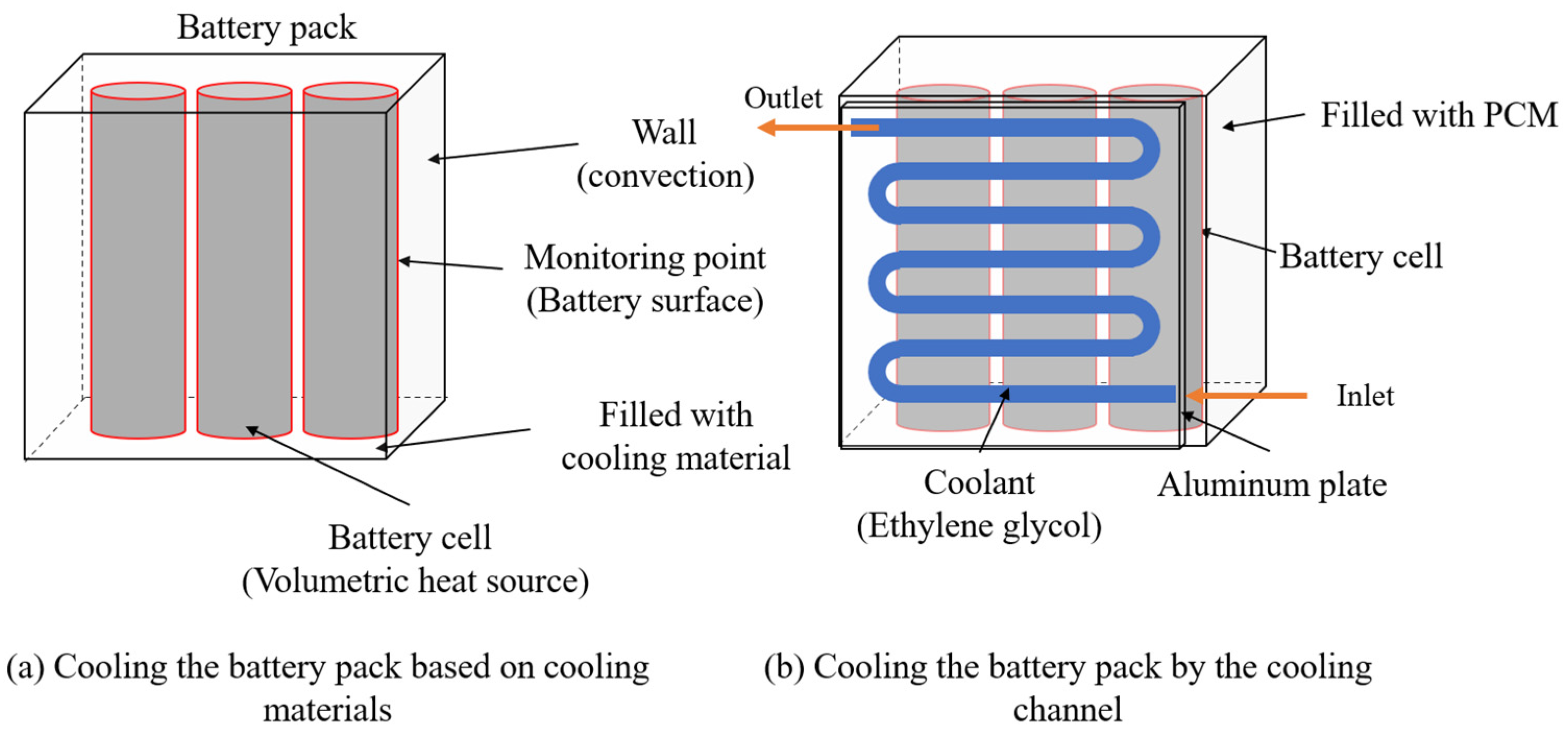
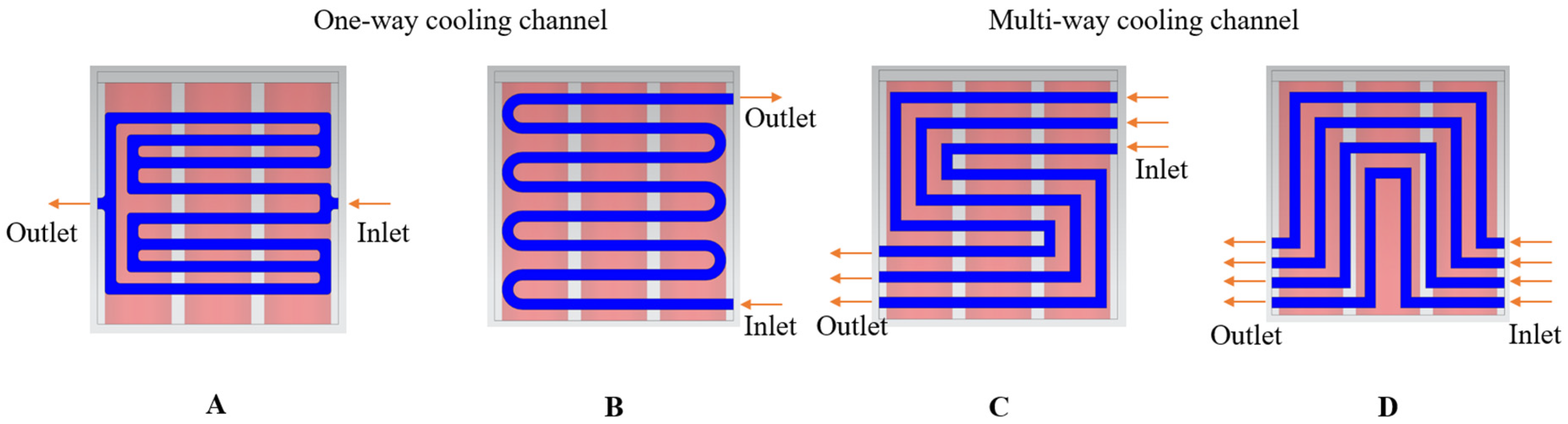
Figure 3a,b display the computational domains for the battery pack utilizing different cooling materials and the domains featuring a variety of cooling channel configurations, respectively. In this work, a hybrid cooling arrangement was developed by combining a passive PCM-based cooling system with an indirect water-cooling system to improve the thermal management efficiency of the battery cells. The water-cooling mechanism was established by embedding cooling channels underneath the battery pack. To investigate the effect of channel geometry on thermal transfer performance, several flow path designs were examined. Figure 4 depicts the cooling channel configurations implemented in the battery pack. For each cooling channel design, performance was quantitatively assessed by comparing the average surface temperature and the temperature uniformity of the batteries.
Numerical simulations were conducted to predict the thermal response during the phase change process over time using the commercial CFD software STAR−CCM+ (Version 22.06). The computational domain included the battery cells, PCM, and cooling channels. A tetrahedral unstructured mesh was constructed throughout the domain, applying a grid size of 1 mm in both the battery and PCM zones. The heat generated within the battery cells was determined using the NTGK model, which predicts heat generation dynamically based on factors such as electrochemical reactions, internal resistance, depth of discharge (DOD), and cell temperature. This model further accounts for real-time heat source variations during both charge and discharge events. The thermophysical properties for the PCM were extracted from Table 2. During the simulation, the battery’s thermal conductivity and specific heat were taken to be constant through discharge, and all boundary surfaces were treated as no-slip walls.
Table 4 lists the boundary conditions implemented in this analysis. The enthalpy–porosity approach was used to numerically model the phase change processes in the PCM, with latent heat incorporated into the energy conservation equation. To minimize fluid movement in solid PCM areas, a damping factor was added to the momentum equation. The Volume of Fluid (VOF) method was employed to model flow dynamics in the PCM during phase change. All governing equations were solved using the finite volume method (FVM). The coupling of pressure and velocity was managed with the Semi-Implicit Method for Pressure-Linked Equations (SIMPLE) algorithm, and pressure discretization was performed using the Pressure Staggering Option (PRESTO) scheme. The momentum and energy equations were discretized with the Quadratic Upstream Interpolation for Convective Kinematics (QUICK) scheme.
To maintain solution stability and achieve convergence, a time-step of 2 s was selected, ensuring the Courant number (CFL) remained below 1 throughout all simulations. The residual convergence thresholds for the continuity, momentum, and energy equations were set at 10−6. The PCM was initialized at a temperature of 20 °C, with natural convection effects modeled via the Boussinesq approximation. The external wall boundary was maintained at an ambient temperature of 20 °C, while a convective heat transfer coefficient of 5 W/m2·K was imposed. The heat generated within the battery cell first conducts through the filler material (PCM, oil, or adhesive), then transfers to the acrylic wall, and is subsequently released to the ambient air at approximately 20 °C by means of natural convection. For this outer heat transfer, a natural convection coefficient of 5 W·m−2·K−1 was utilized.
Figure 4 illustrates the channel geometries evaluated for this study. For each design, the average battery surface temperature and temperature uniformity were quantitatively analyzed to identify the most effective cooling channel configuration. Additionally, the numerical outcomes were compared with experimental data on battery cell temperature and PCM melting progression to verify model accuracy.

4. Results and Discussion

Cooling the Battery with Cooling Materials

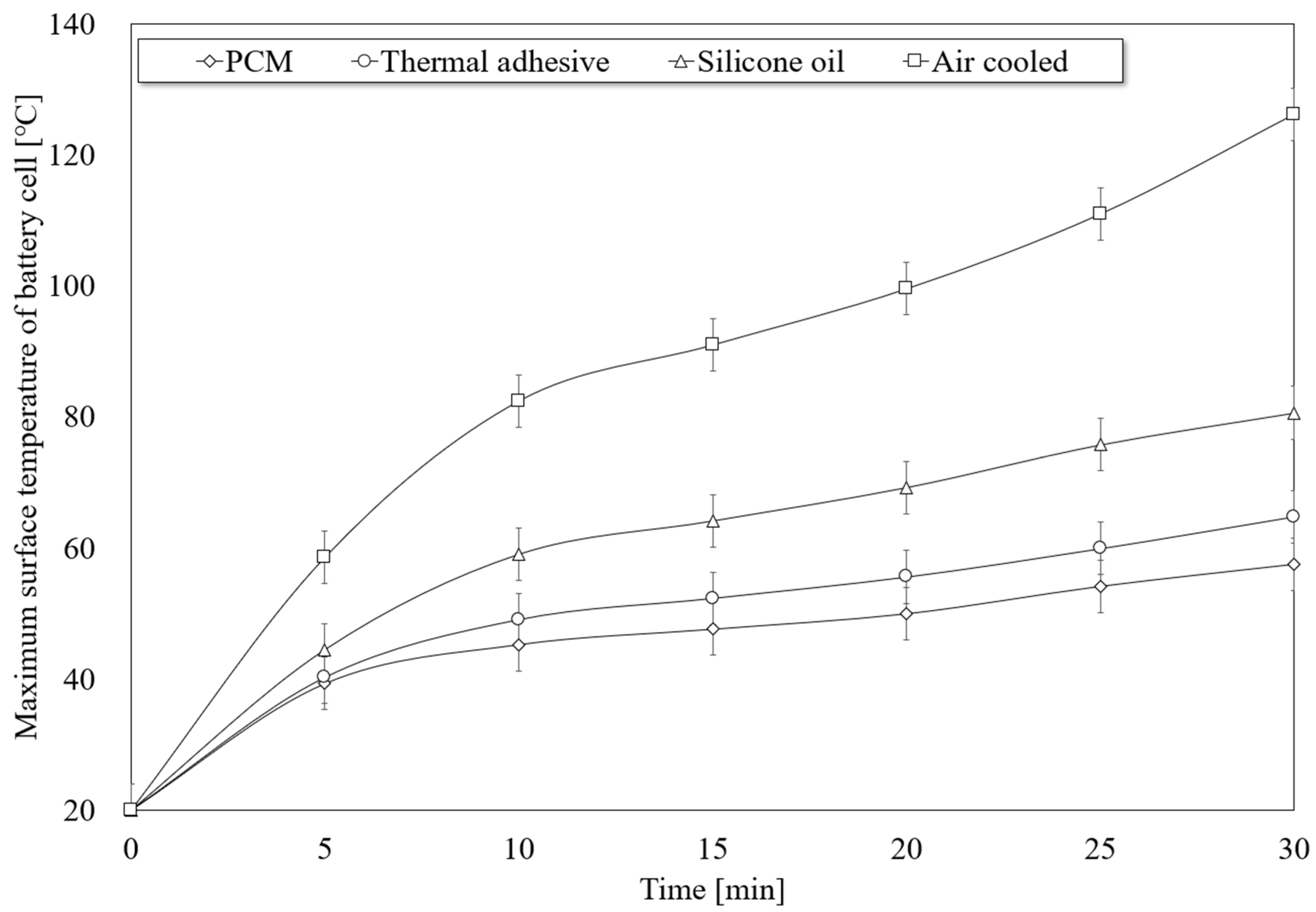
Figure 5 illustrates the time-dependent changes in the maximum surface temperature of battery cells subjected to a 2 C discharge rate for various cooling materials. Each experimental scenario was conducted three times, with the curves displaying the averaged results. Statistical evaluation of reproducibility and error margins confirmed the results’ reliability at a 95% confidence level. In this investigation, thermal management performance was evaluated under four conditions: phase change material (PCM), silicone oil (KF−96), thermally conductive adhesive (PK−404DM), and an air-cooled condition lacking a dedicated cooling system. For the air-cooled scenario, the maximum surface temperature reached approximately 126.1 °C, reflecting the rapid temperature increase caused by insufficient thermal regulation. In contrast, the application of PCM achieved the lowest maximum temperature at 52.7 °C, representing a 47.4% reduction compared to the air-cooled setup. The maximum temperatures observed for silicone oil and the thermally conductive adhesive were 73.6 and 59.4 °C, resulting in temperature reductions of 26.5% and 40.7%, respectively, relative to the air-cooled case. These results indicate that PCM outperformed the other tested materials in terms of cooling efficiency. The enhanced thermal regulation offered by PCM is primarily due to its latent heat storage capability, which allows efficient absorption of the heat produced during discharge and mitigates temperature escalation. Furthermore, PCM displayed isothermal behavior during the phase change, which facilitated effective temperature control during intervals of rapid heat generation.
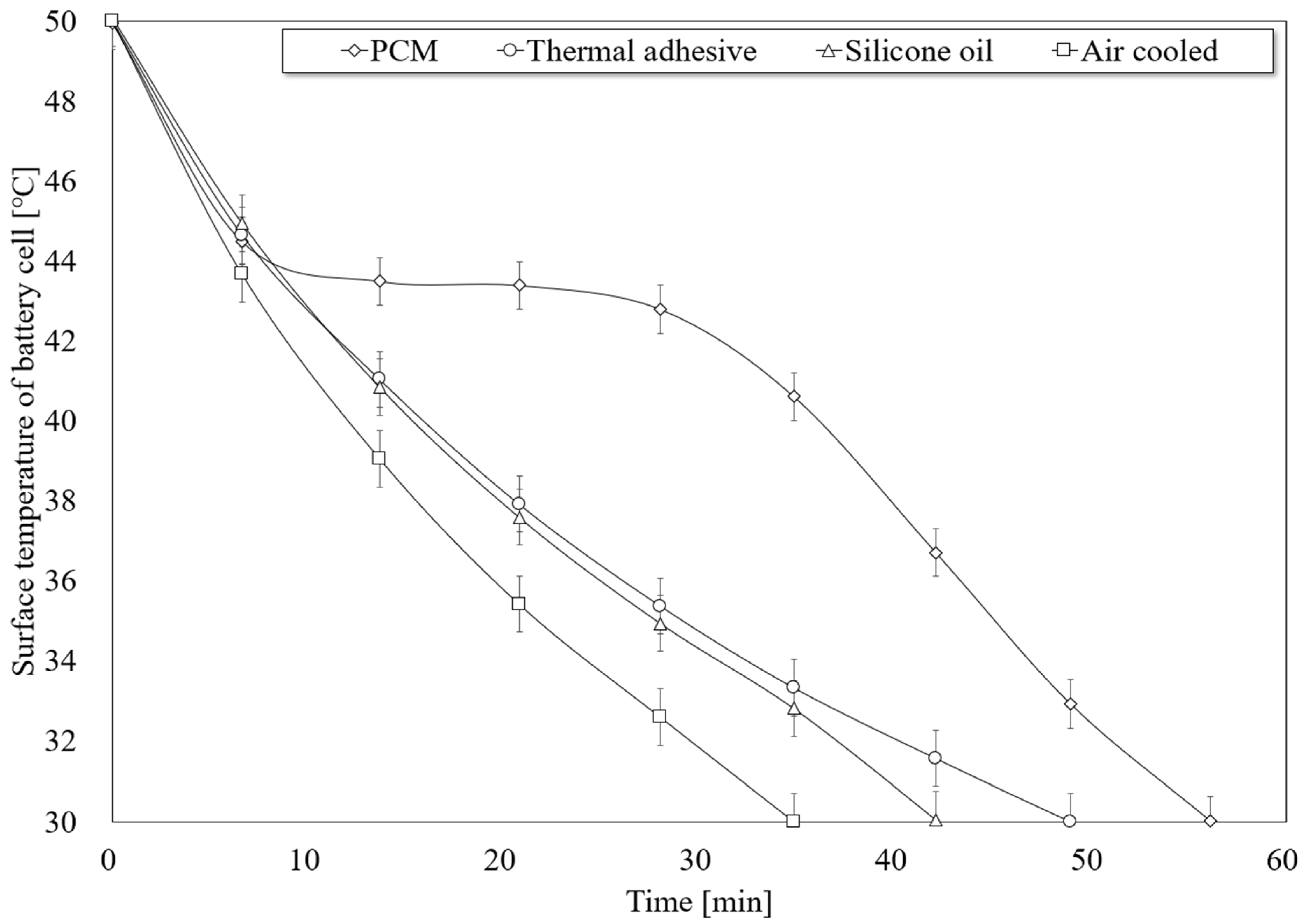
Figure 6 illustrates the natural cooling behavior of the battery cells over time, starting immediately after the completion of a 2 C discharge cycle. In this investigation, the period during which the surface temperature remained within the safe operating range of (30−50) °C was designated as the “isothermal maintenance time”. This metric served as a basis for comparing the thermal buffering properties of each cooling material. The experimental outcomes revealed that the battery pack with PCM maintained the target temperature range for 56 min, marking the longest duration among all the tested cooling materials. In comparison, the thermal adhesive condition maintained this temperature range for 49 min, silicone oil for 43 min, and the air-cooled condition only for 36 min. In contrast to PCM, thermal adhesive and silicone oil did not undergo a phase change, resulting in the absence of a temperature plateau and instead displaying a steady temperature reduction, which was governed solely by sensible heat dissipation. Relying exclusively on natural convection, the battery pack’s temperature rapidly left the desired range within a brief timeframe. Relying on natural convection alone, the battery pack’s temperature rapidly exceeded the safe range within a short timeframe. These results demonstrate that PCM significantly enhances thermal buffering by releasing latent heat during the solidification phase after discharge, thus supporting temperature stability over an extended duration. The release of latent heat from PCM prolongs isothermal performance, indicating that the PCM-integrated system delivers more consistent and efficient cooling than the other materials tested.
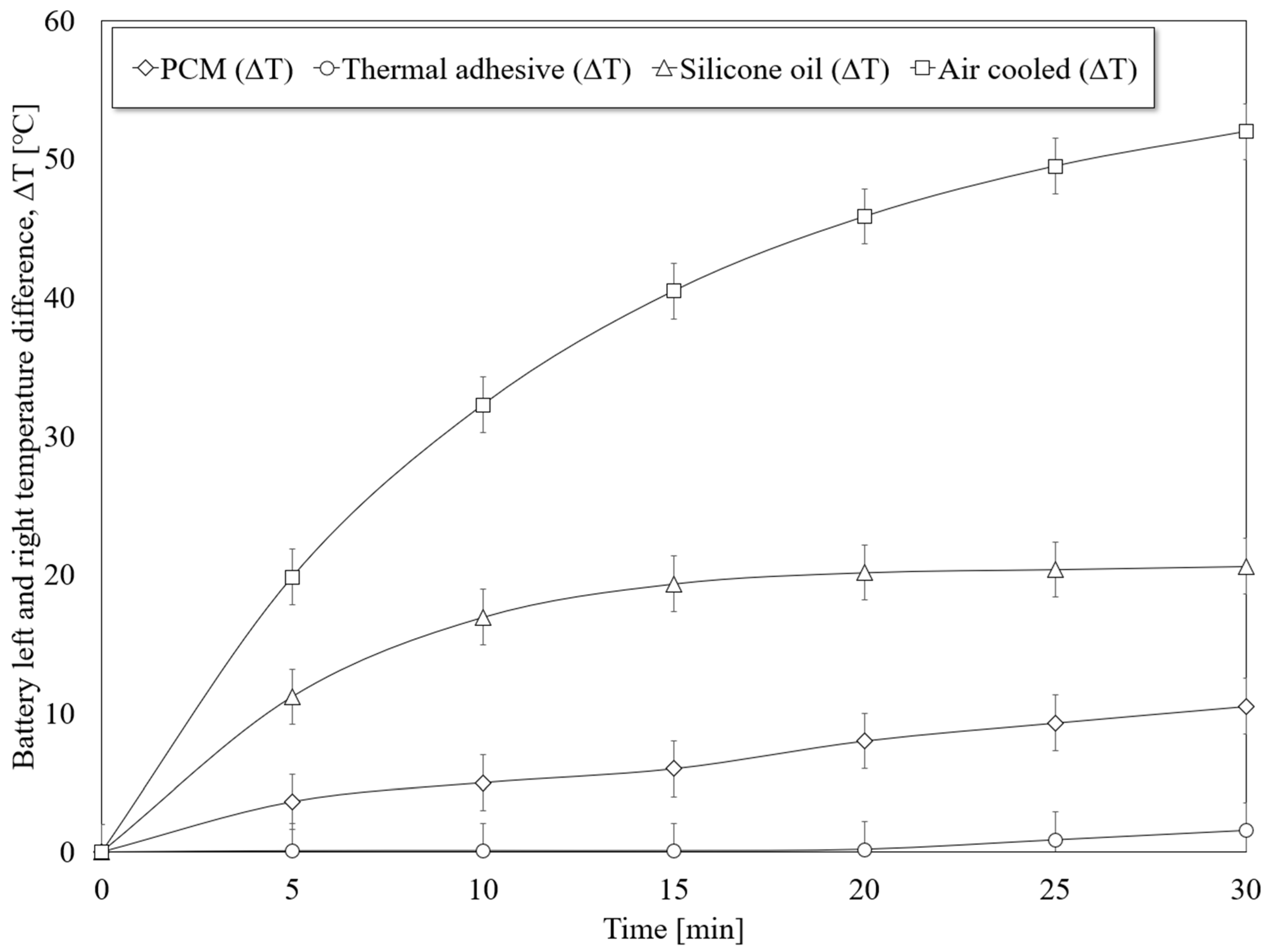
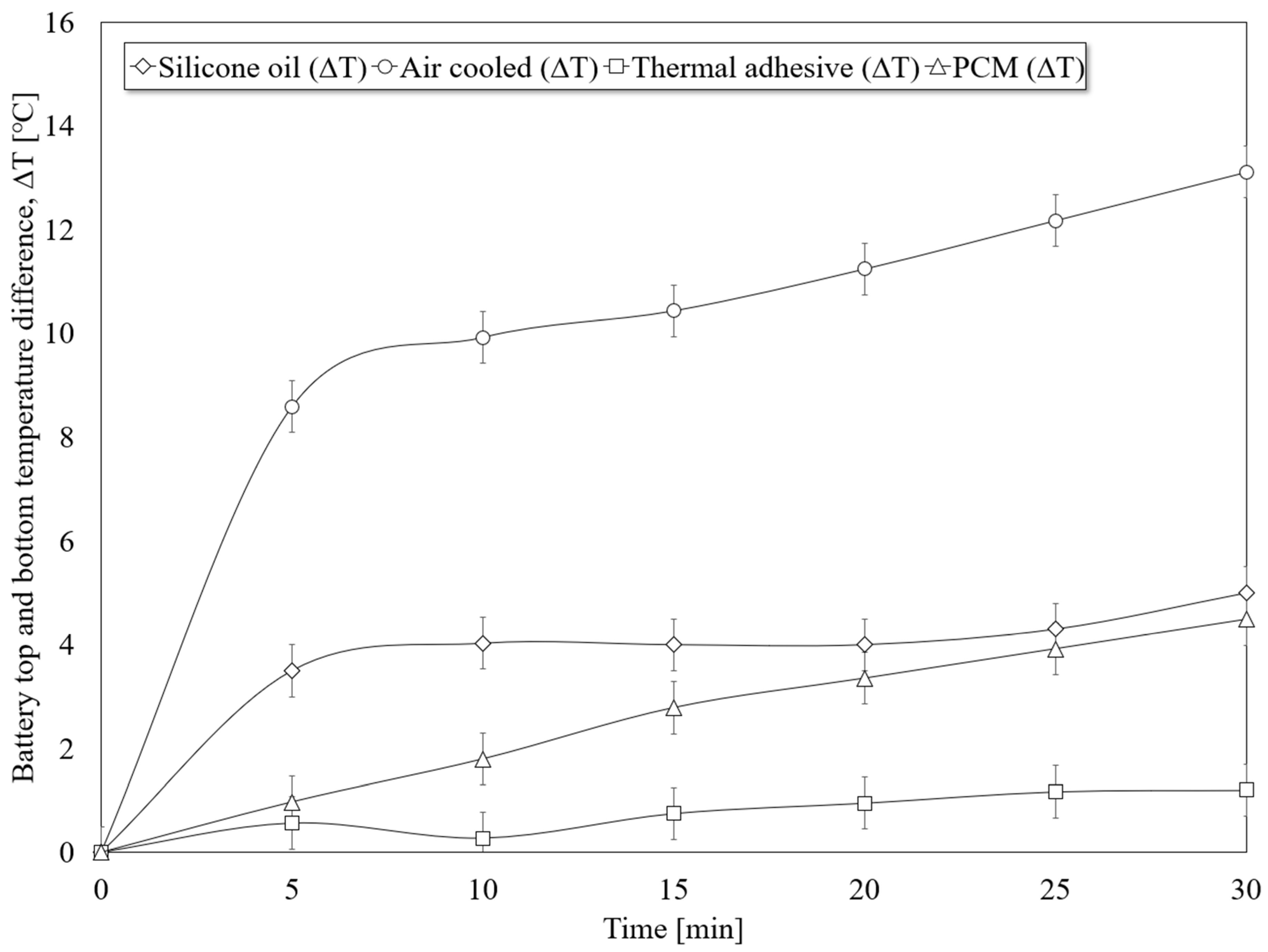
Figure 7 and Figure 8 show the time evolution of temperature non-uniformity during 2 C discharge: Figure 7 reports the left–right (inter-cell) ΔT across the pack, whereas Figure 8 reports the top–bottom (intra-cell) ΔT within a cell, for four cooling materials. The air-cooled scenario demonstrated a swift rise in temperature non-uniformity, reaching a peak of 52 °C after 30 min. For the silicone oil scenario, the temperature difference gradually increased to 20.6 °C. In the PCM-based system, the lateral temperature difference remained below 5 °C during the first 20 min due to latent heat absorption. Nevertheless, as localized heat began accumulating in later stages, the difference grew to about 10.5 °C. Conversely, incorporating thermal adhesive maintained the lateral temperature difference below 2 °C for the entire discharge period, indicating significantly enhanced thermal uniformity in the horizontal direction. Figure 8 shows the vertical temperature difference between the top and bottom of the battery cells. Among the tested configurations, silicone oil demonstrated the most consistent performance, with the difference reaching a maximum of only 1.2 °C over the full discharge duration, confirming efficient vertical heat transfer. The PCM experienced a temporary decrease in temperature difference between (10 and 20) min as a result of the endothermic melting effect. Once the phase transition was finished or delayed, the vertical temperature difference increased to 5.0 °C. For thermal adhesive, the observed maximum difference was 13.1 °C, signifying reduced effectiveness in promoting vertical temperature uniformity. The air-cooled system recorded a peak difference of 4.5 °C. These outcomes indicate that the specific thermal characteristics of each cooling medium distinctly affect lateral and vertical heat distribution patterns. Although PCM initially enhances temperature uniformity through the absorption of latent heat, as the phase change proceeds, its relatively low thermal conductivity can increase temperature non-uniformity.
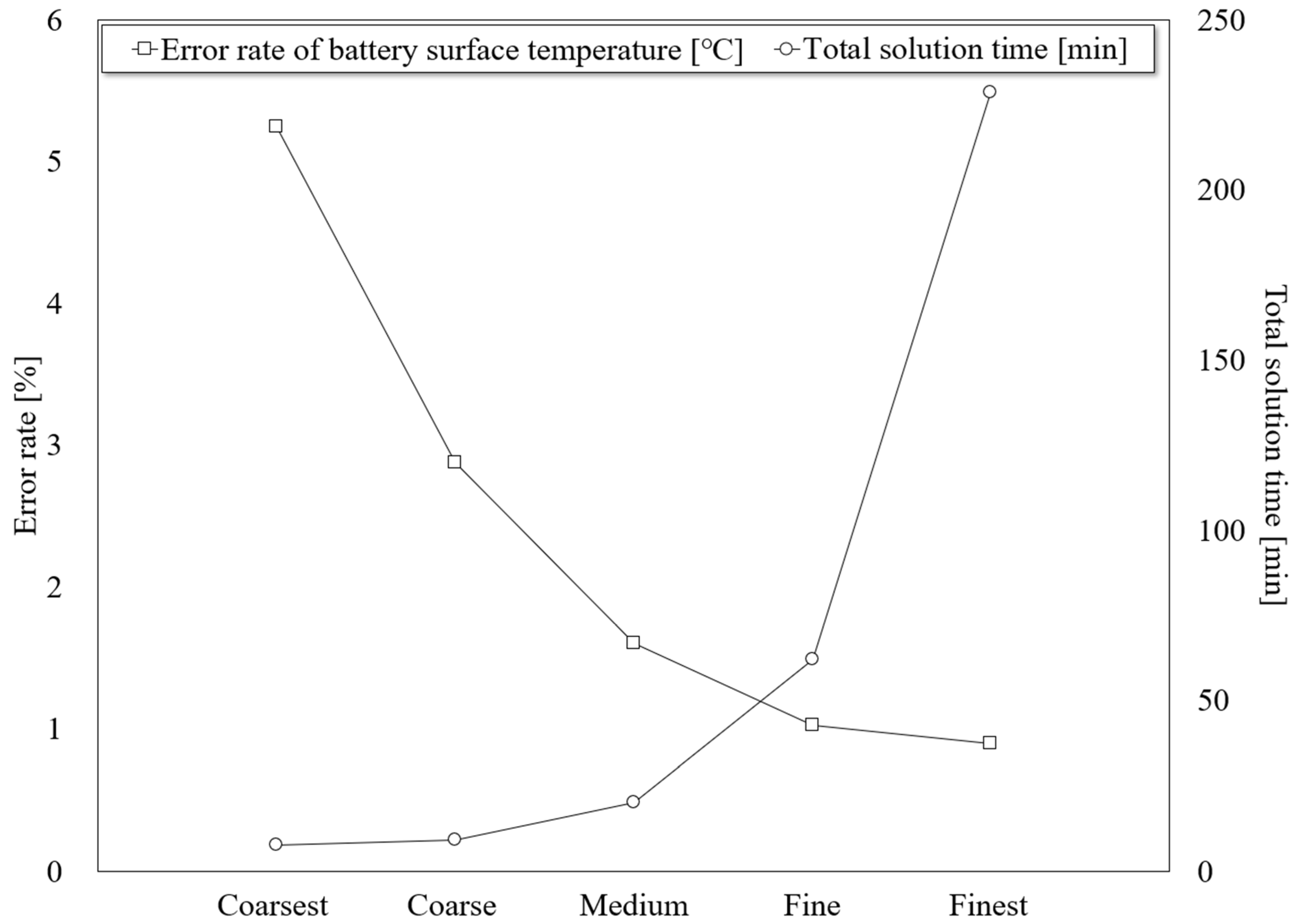
To ensure both computational accuracy and efficiency in the numerical analysis, a mesh independence test was conducted. Figure 9 presents how temperature error rates and total solution time vary with mesh density. The computational grids were divided into five categories: Coarsest, Coarse, Medium, Fine, and Finest, with total element counts ranging from approximately 25,000 to 1,500,000. The predicted average surface temperature of the battery and the total computation time for each mesh type were analyzed. The results showed that, compared to experimental results, both the Medium and Fine meshes exhibited temperature errors of less than 1%. Nevertheless, the computation time for the Fine mesh exceeded that of the Medium mesh by more than threefold. In contrast, using a Coarse mesh instead of a Medium mesh led to an increase of about 2 °C in the predicted average surface temperature, resulting in an error increase of approximately 3.5%. Thus, the Medium mesh was chosen as the optimal configuration, as it offers a compromise between computational accuracy and efficiency. This mesh used an unstructured tetrahedral grid with an average cell size of 1 mm.
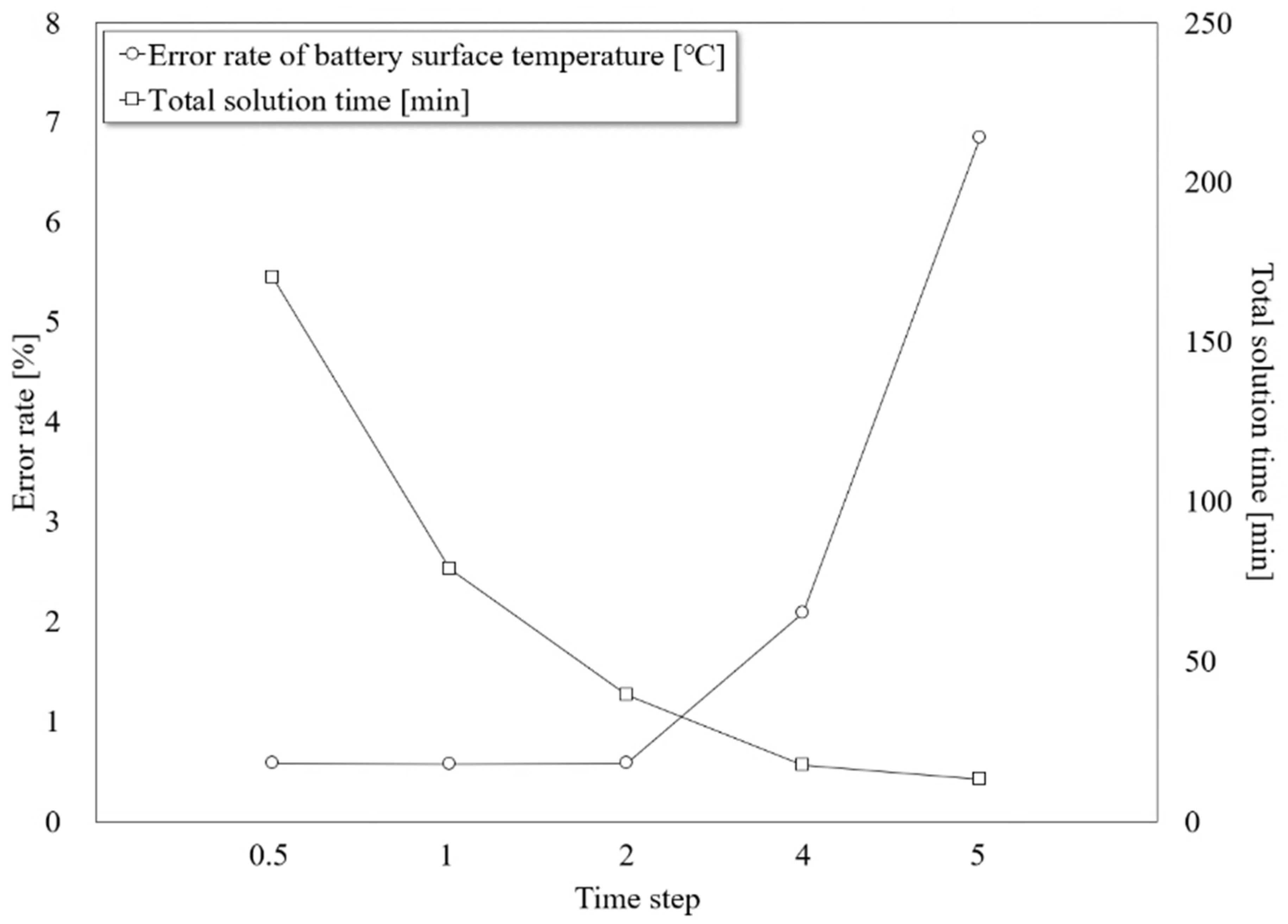
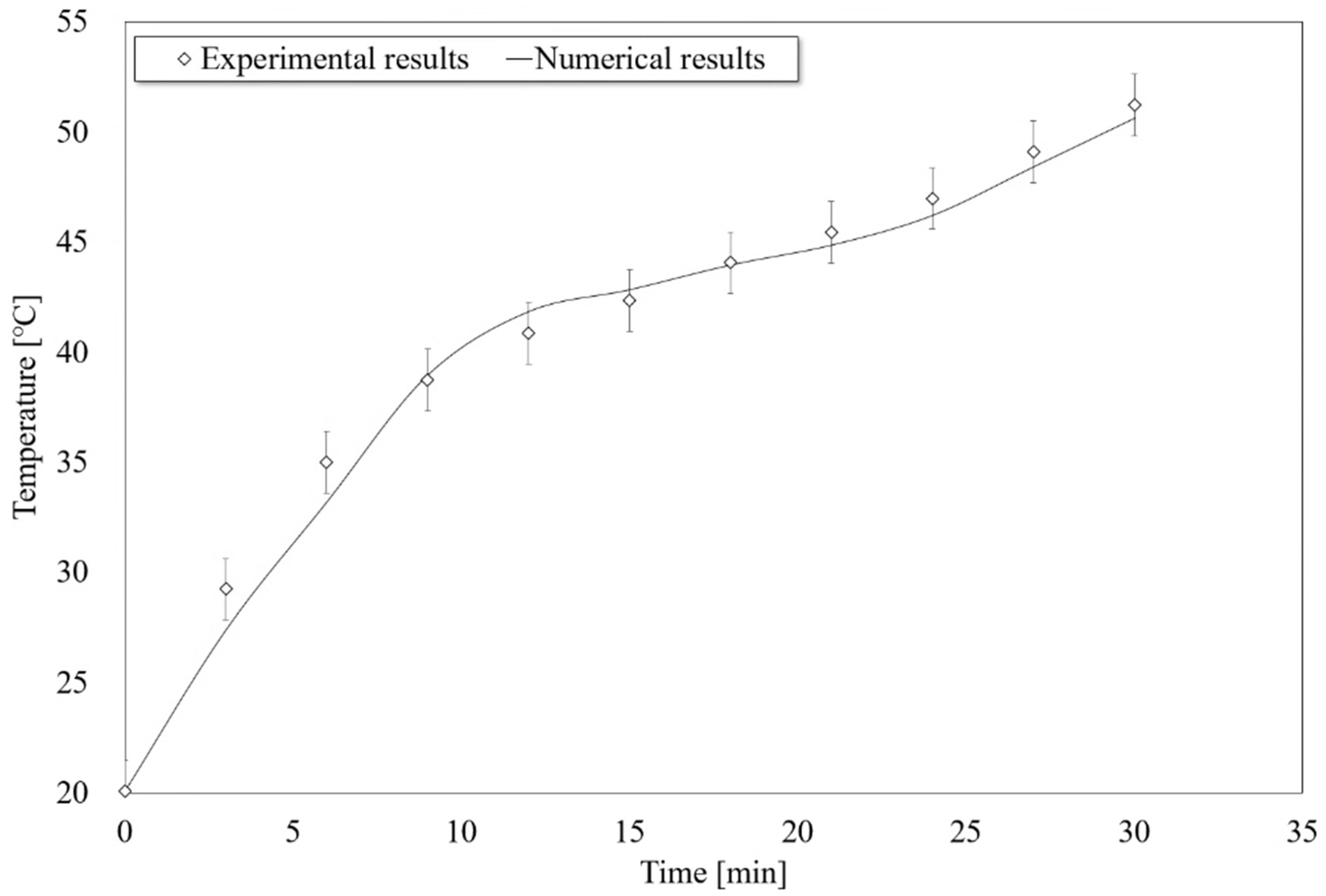
Figure 10 displays the sensitivity analysis for different time-step sizes in the numerical simulations. When the time-step was set to 2 s, the temperature difference compared to a 1 s time-step was about 0.1 °C, equating to a relative error of only 0.02%. Furthermore, the total computation time was reduced by roughly 40 min, demonstrating a considerable gain in computational efficiency. In contrast, increasing the time-step to 4 s shortened the calculation time by another 22 min, but the surface temperature error rose to 1 °C, corresponding to a relative error of 2.03%. Therefore, a time-step of 2 s was identified as the optimal value to balance accuracy and efficiency. With this setting, the relative error remained below 2%, while the simulation time was substantially decreased. Figure 11 presents a comparison between the experimental and simulated results for the surface temperature evolution of the battery pack with PCM during discharge. The simulation utilized the optimized mesh and time-step determined through sensitivity analysis. The predicted maximum battery surface temperature was 50.6 °C, while the measured value was 51.2 °C, yielding a relative error under 1%. This strong correlation confirms the reliability of the numerical model, indicating its capability to accurately capture both the phase change processes of PCM and the internal heat generation of the battery cells.
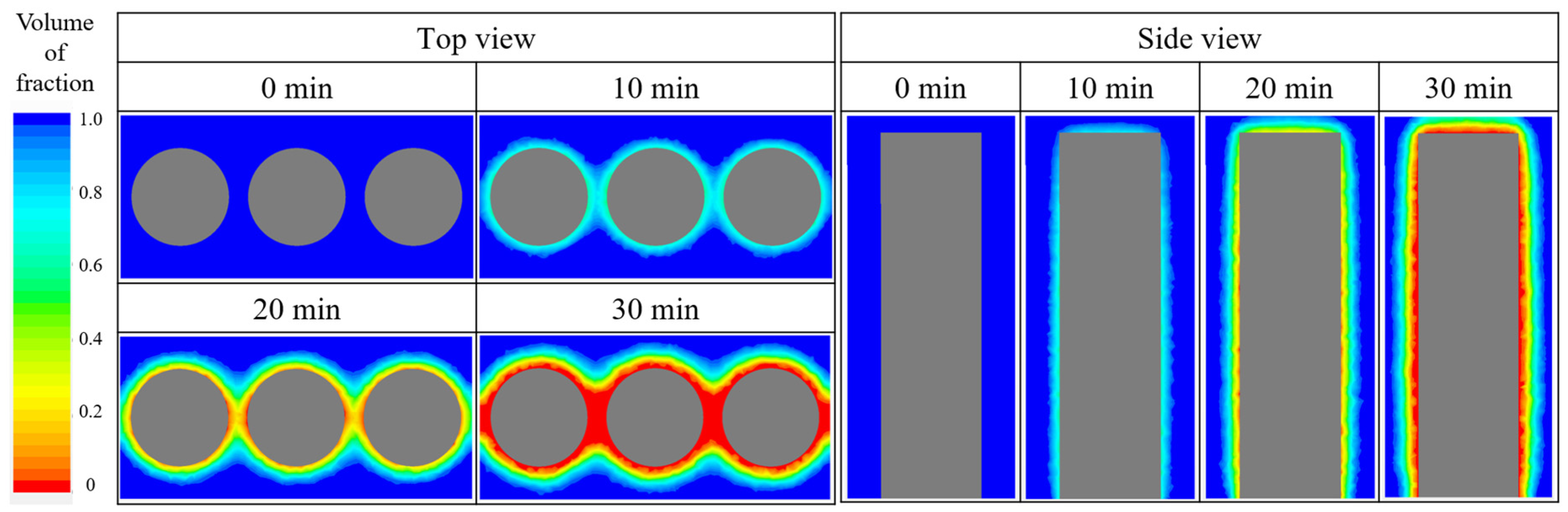
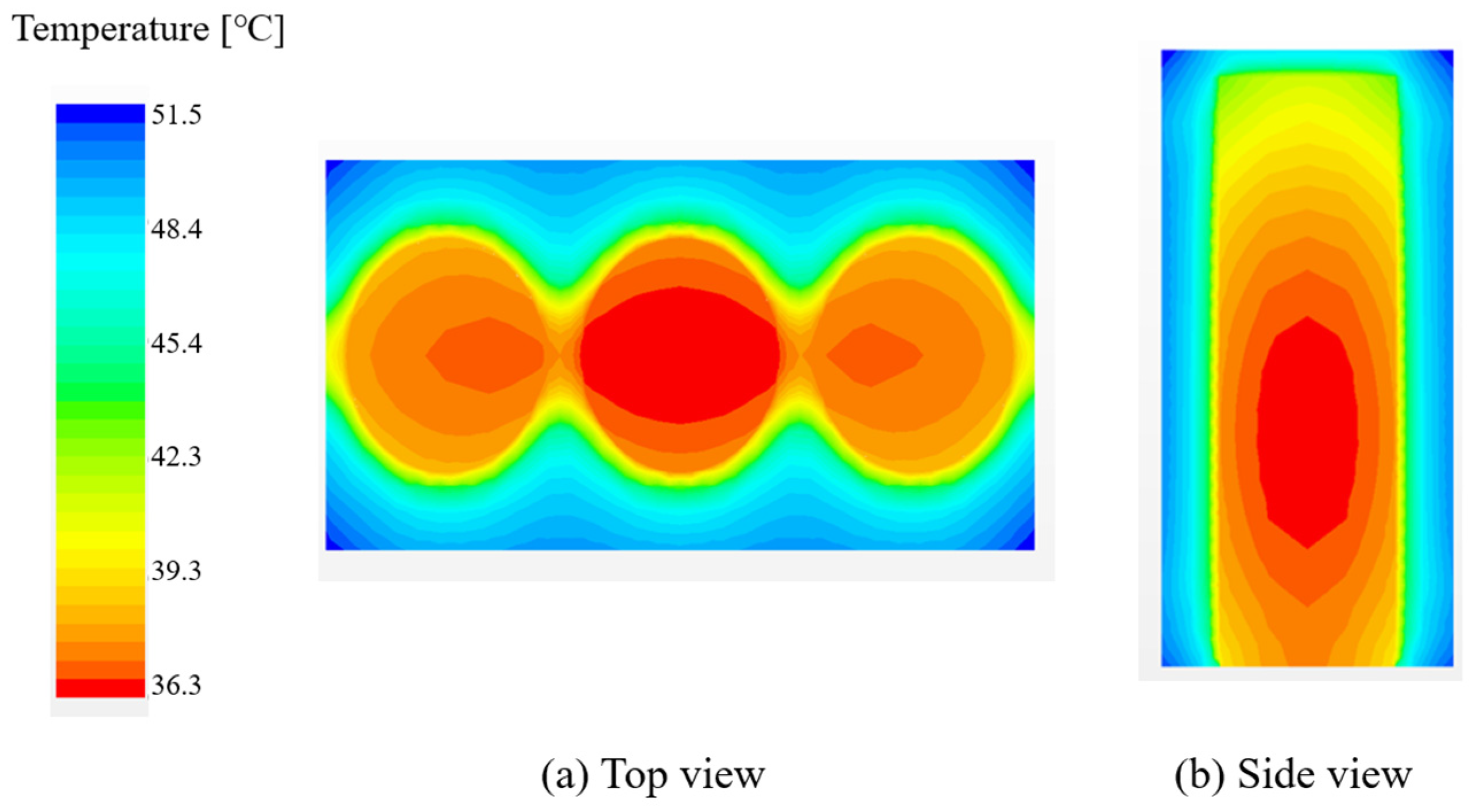
Figure 12 and Figure 13 depict the evolution of PCM melting over time, captured from both top and side perspectives in the numerical simulation. In these visualizations, blue denotes solid PCM and red signifies regions where the PCM is fully liquefied. During the initial phase of discharge, melting began in areas immediately surrounding the battery cells. Over time, the extent of the melted regions systematically increased, spreading away from the heat source. At the 30 min point, analysis of both top and side views indicated that approximately 37% of the entire PCM volume had transitioned to liquid. This finding indicates that latent heat was absorbed and released effectively in proximity to the battery cells. Conversely, PCM in areas farther from the cells remained mostly solid, primarily due to low thermal conductivity limiting the transfer of heat. Figure 13 further supports this observation by presenting the temperature distribution, where a sharp temperature increase is seen near the cells, while the PCM farther out retains much lower temperatures. This produces a substantial temperature gradient throughout the PCM, emphasizing inefficient heat transfer caused by localized thermal non-uniformity and the material’s intrinsic low thermal conductivity.
Table 5 presents a summary of the surface temperature, Nusselt number (Nu), and heat transfer coefficient (h) of the battery pack after 30 min for various cooling channel configurations. The heat transfer coefficient ℎ was determined using Equation (15), based on the average surface temperature of the battery pack and the defined boundary conditions in the numerical simulation. Both Nu and ℎ denote the averaged values computed over the entire battery surface area. The measurements focused on the battery surface areas in contact with the PCM and the cooling channels, thereby capturing the local convective heat transfer between the battery and its surrounding media. Surface temperature monitoring was performed during discharge for both the PCM-only scenario and for each of the four distinct cooling channel designs (A−D). The findings indicated that in the PCM-only setup, the surface temperature increased to nearly 49 °C after 30 min. Conversely, employing the configuration D cooling channel resulted in a maximum surface temperature of about 40 °C, marking a reduction of 9 °C (17.8%). These results demonstrate that integrating a liquid cooling system with channel flow yields a notably higher thermal management capability than PCM alone. Among the four tested channel designs, configuration D delivered the highest cooling effectiveness. The improved performance is attributed not only to the channel surface area, but also to factors like flow path length and the consistency of coolant distribution from inlet to outlet, both of which have a substantial impact on thermal extraction. The effective cooling surface areas for configurations A, B, C, and D were (1560, 1509, 1719, and 1698) mm2, respectively. Despite configuration C offering the largest surface area, the channel in configuration D achieved superior cooling performance. This observation highlights the significant roles of flow path length and coolant residence time in governing heat transfer efficiency. Moreover, an evaluation of the time-dependent temperature differences showed that at 9 min, the temperature gap between configuration D and the PCM-only condition was around 2.5 °C (6.8%). As discharge progressed, this gap further increased. These findings substantiate that the efficacy of a cooling channel design hinges not only on the contact surface area but is also critically influenced by the flow path length and the maintenance of a uniform velocity profile. Configuration D, with its relatively extended flow path and dispersed flow layout, facilitated more effective heat dissipation from the PCM-adjacent zones.
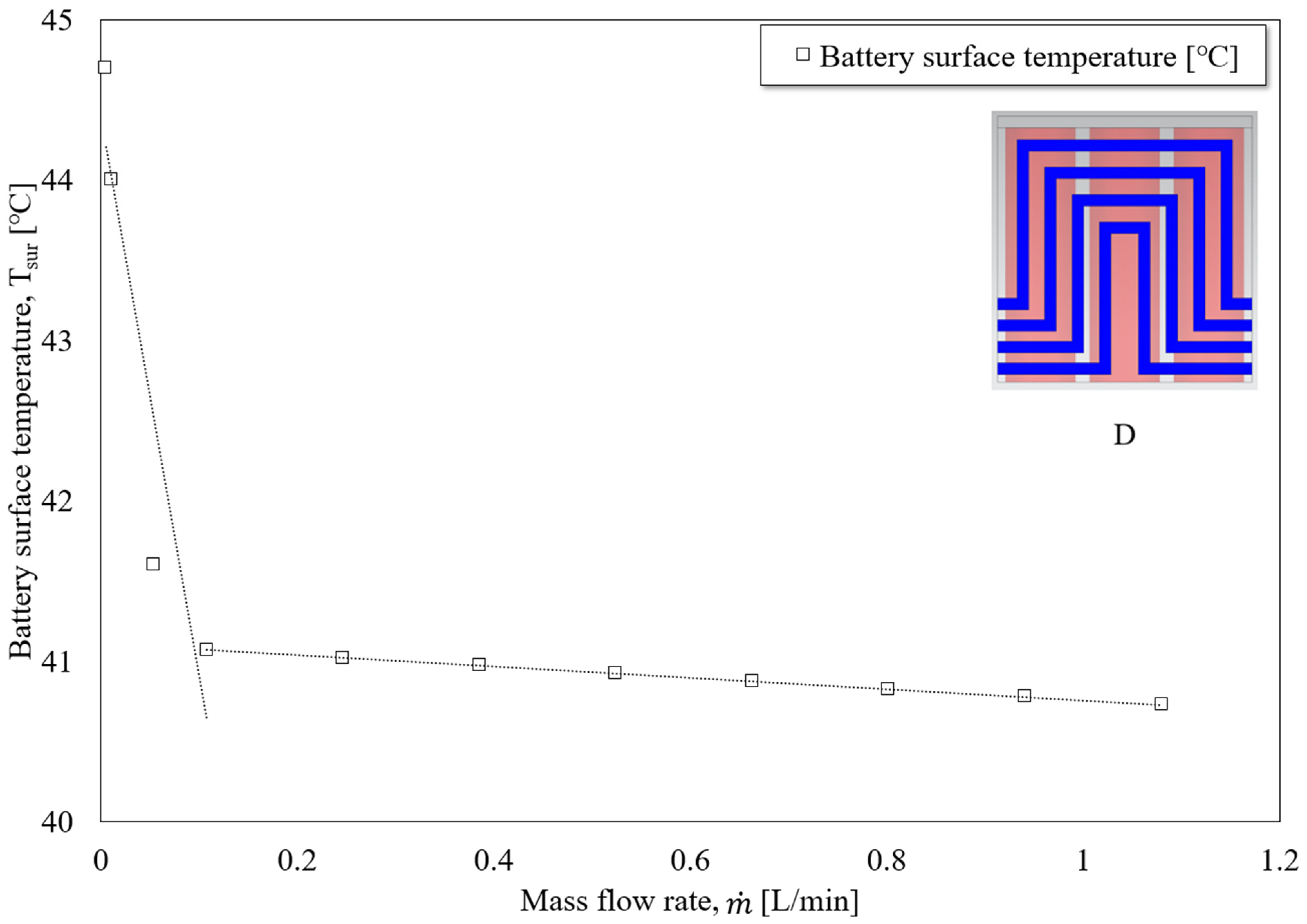
Figure 14 shows the peak battery surface temperature during 2 C discharge as a function of coolant mass-flow rate for channel configuration D. When the flow rate increased from (0.005 to 1.08) L/min, the surface temperature initially decreased sharply, then exhibited a more gradual decline at higher flow rates. Specifically, for (0.005 to 0.108) L/min, a marked reduction in temperature of approximately 3.7 °C was recorded. However, beyond this interval, further increases in flow rate resulted in only a minor temperature decrease of less than 1 °C. Conversely, as the flow rate surpassed 0.108 L/min, the incremental gains in cooling efficiency became minimal. As a result, a flow rate of 0.108 L/min was determined to be optimal, providing a practical operational balance between heat dissipation effectiveness and energy expenditure. Further research should investigate the durability and thermal performance of the system over extended durations at this optimal flow rate.
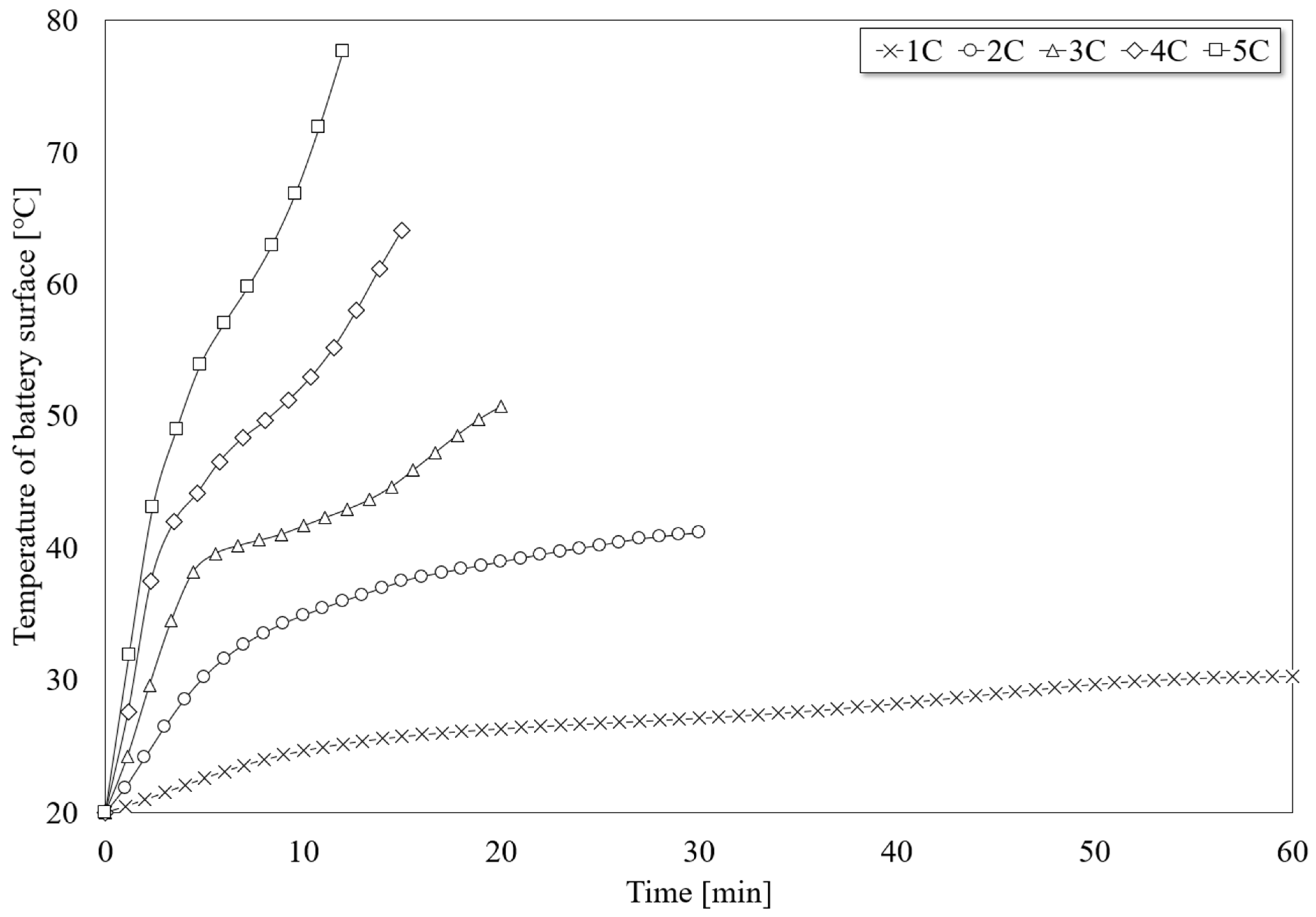
Based on the preceding analyses, the configuration D channel was determined to be the most effective multi-channel arrangement for thermal management. With this configuration, the battery surface temperature was assessed numerically under several discharge rates (C–rates) at the optimized flow rate of 0.108 L/min. Figure 15 presents the time-dependent variation in the battery surface temperature for discharge rates ranging from 1 to 5 C. As discharge rates increase, the battery surface temperature shows a substantial rise. Importantly, at 4 and 5 C, the surface temperature surpassed the recommended operational limits within 20 min, reaching approximately 60 and 75 °C, respectively. Conversely, at lower discharge rates of 1 and 2 C, the surface temperature remained fairly steady, stabilizing at about 30 and 42 °C, respectively. These observations demonstrate that higher discharge rates result in markedly increased heat generation within the battery cells, severely testing the cooling system’s heat removal effectiveness. The findings established that the configuration D multi-channel design delivers superior performance over PCM-only solutions, particularly at the optimal flow rate of 0.108 L/min, by more effectively limiting surface temperature increases. Nonetheless, for high discharge rates (≥4 C), the combined thermal management provided by the cooling channels and PCM was inadequate to fully avert thermal runaway risk. Thus, it is recommended that further enhancements, such as integrating high thermal conductivity materials or adding active forced convection systems, be explored to improve thermal management under extreme operating conditions. When the discharge rate is ≥3 C, heat generation accelerates significantly, leading to sharp increases in peak temperature and greater temperature non-uniformity (ΔT), which heightens safety concerns. Therefore, for this configuration, it is advisable to limit operation to ≤2 C.
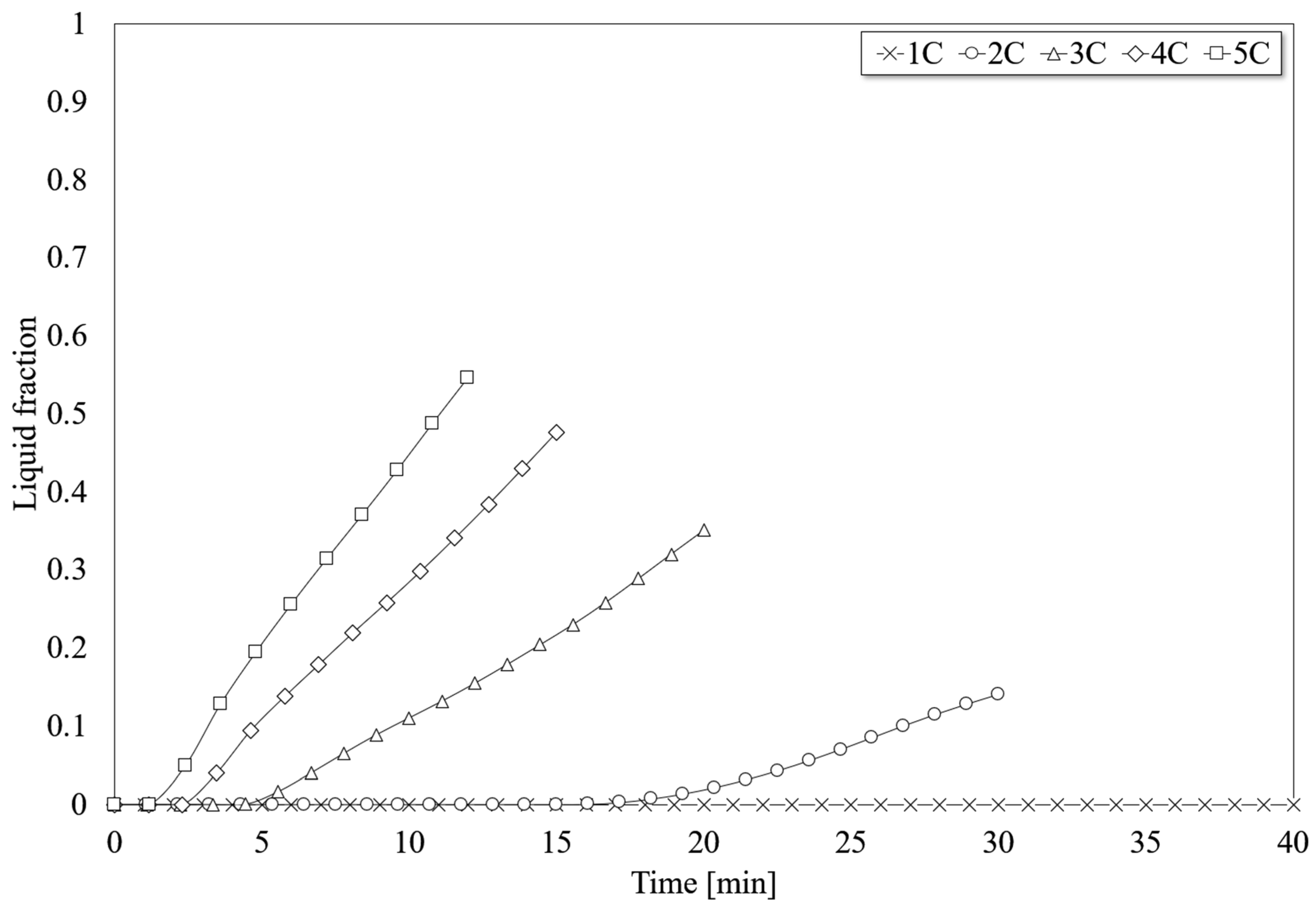
Figure 16 depicts the changes in the liquid fraction of PCM over time at various discharge rates (C–rates) when operated at the optimal flow rate of 0.108 L/min. The results demonstrate that the melting of PCM becomes notably faster as the discharge rate increases. Specifically, at 5 C and 4 C, the liquid fraction rose sharply within the initial 10 min of discharge, reaching values of approximately 0.55 and 0.48, respectively. This observation indicates a substantial conversion of PCM to its liquid phase. By comparison, at 1 C, PCM melting was minimal, and the liquid fraction stayed near zero for the full discharge period. These results indicate that higher discharge rates lead to substantial heat generation within battery cells, which in turn accelerates the latent heat absorption and increases the PCM liquid fraction rapidly. However, after the PCM has fully melted, it can no longer store latent heat, reducing its effectiveness in limiting subsequent temperature increases. This effect is particularly pronounced in surface temperature trends seen in Fig. 15. Despite the high liquid fraction observed at 5 C, the battery surface temperature still exceeded 70 °C. This outcome is due to the intrinsically low thermal conductivity of PCM, which restricts heat dissipation and causes localized heat accumulation around the cells.

5. Conclusions

In this study, battery packs were constructed using various cooling materials, including PCM, silicone oil, and thermally conductive adhesive, to address the thermal management challenges associated with lithium–ion batteries. The thermal performance of these battery systems was quantitatively assessed through a combination of experimental measurements and numerical simulations. Additionally, to mitigate shortcomings of PCM such as localized melting and low intrinsic thermal conductivity, a hybrid cooling strategy incorporating water-cooled channels was designed. This study systematically investigated the thermal influences of channel geometry and flow rate. Experimental findings showed that, relative to natural convection, PCM reduced the maximum battery surface temperature by up to 47%, thermally conductive adhesive by 40%, and silicone oil by 26%. Furthermore, PCM exhibited the highest heat storage capability, sustaining the isothermal condition for the longest period. Nonetheless, the limited thermal conductivity of PCM resulted in non-uniform melting and higher temperature gradients during extended discharge operations. Evaluation of temperature uniformity revealed that silicone oil and thermally conductive adhesive provided enhanced temperature consistency in both vertical and horizontal orientations, whereas PCM sustained stability at the initial stage but exhibited greater non-uniformity as melting advanced. The hybrid cooling configuration with a type D water channel yielded an additional reduction in battery surface temperature of up to 9 °C, compared to the PCM-only system, corresponding to an approximate improvement of 17.8%. It was determined that, beyond a flow rate of 0.108 L/min, no further enhancement in cooling performance occurred, indicating this flow rate as the optimal condition.

Author Contributions

Methodology, D.H.S.; Software, S.W.H.; Validation, D.H.S.; Formal analysis, S.W.H.; Investigation, S.W.H. and J.H.K.; Data curation, S.W.H. and J.H.K.; Writing—original draft, S.W.H.; Writing—review & editing, S.W.H. and D.H.S.; Supervision, D.H.S.; Project administration, D.H.S. All authors have read and agreed to the published version of the manuscript.

Funding

This work was supported by a National Research Foundation of Korea (NRF) grant, funded by the Korean government (MSIT) [NRF−2022R1C1C1007652].

Data Availability Statement

The original contributions presented in the study are included in the article, further inquiries can be directed to the corresponding author.

Conflicts of Interest

The authors declare that they have no known competing financial interests or personal relationships that could have appeared to influence the work reported in this paper.

References

  1. Bamdezh, M.A.; Molaeimanesh, G.R.; Mohammadi Saman Kand, R.; Mostajeran, M. Effects of Temperate, Cold, and Warm Climate Conditions on Electric Vehicle and Battery Thermal Management System Performance: Energy Usage, Battery Aging, and Carbon Footprints. Energy Convers. Manag. 2025, 339, 119935. [Google Scholar] [CrossRef]
  2. Osmani, K.; Alkhedher, M.; Ramadan, M.; Choi, D.S.; Li, L.K.B.; Doranehgard, M.H.; Olabi, A.G. Recent Progress in the Thermal Management of Lithium-Ion Batteries. J. Clean. Prod. 2023, 389, 136024. [Google Scholar] [CrossRef]
  3. Xia, G.; Cao, L.; Bi, G. A Review on Battery Thermal Management in Electric Vehicle Application. J. Power Sources 2017, 367, 90–105. [Google Scholar] [CrossRef]
  4. Feng, X.; Zheng, S.; Ren, D.; He, X.; Wang, L.; Cui, H.; Liu, X.; Jin, C.; Zhang, F.; Xu, C.; et al. Investigating the Thermal Runaway Mechanisms of Lithium-Ion Batteries Based on Thermal Analysis Database. Appl. Energy 2019, 246, 53–64. [Google Scholar] [CrossRef]
  5. Safdari, M.; Ahmadi, R.; Sadeghzadeh, S. Numerical Investigation on PCM Encapsulation Shape Used in the Passive-Active Battery Thermal Management. Energy 2020, 193, 116840. [Google Scholar] [CrossRef]
  6. Akinlabi, A.A.H.; Solyali, D. Configuration, Design, and Optimization of Air-Cooled Battery Thermal Management System for Electric Vehicles: A Review. Renew. Sustain. Energy Rev. 2020, 125, 109815. [Google Scholar] [CrossRef]
  7. Kalaf, O.; Solyali, D.; Asmael, M.; Zeeshan, Q.; Safaei, B.; Askir, A. Experimental and Simulation Study of Liquid Coolant Battery Thermal Management System for Electric Vehicles: A Review. Int. J. Energy Res. 2021, 45, 6495–6517. [Google Scholar] [CrossRef]
  8. Ping, P.; Peng, R.; Kong, D.; Chen, G.; Wen, J. Investigation on Thermal Management Performance of PCM-Fin Structure for Li-Ion Battery Module in High-Temperature Environment. Energy Convers. Manag. 2018, 176, 131–146. [Google Scholar] [CrossRef]
  9. Shin, D.H.; Park, J.; Choi, S.H.; Ko, H.S.; Karng, S.W.; Shin, Y. A New Type of Heat Storage System Using the Motion of Phase Change Materials in an Elliptical-Shaped Capsule. Energy Convers. Manag. 2019, 182, 508–519. [Google Scholar] [CrossRef]
  10. Shin, D.H.; Kim, S.; Karng, S.W.; Shin, Y. Development of a New Type of PCM Thermal Capsule Transport System. Int. J. Heat Mass Transf. 2022, 183, 122034. [Google Scholar] [CrossRef]
  11. Patel, J.R.; Rathod, M.K. Recent Developments in the Passive and Hybrid Thermal Management Techniques of Lithium-Ion Batteries. J. Power Sources 2020, 480, 228820. [Google Scholar] [CrossRef]
  12. Kannan, C.; Vignesh, R.; Karthick, C.; Ashok, B. Critical Review towards Thermal Management Systems of Lithium-Ion Batteries in Electric Vehicle with Its Electronic Control Unit and Assessment Tools. Proc. Inst. Mech. Eng. Part D J. Automob. Eng. 2021, 235, 1783–1807. [Google Scholar] [CrossRef]
  13. He, L.; Jing, H.; Zhang, Y.; Li, P.; Gu, Z. Review of Thermal Management System for Battery Electric Vehicle. J. Energy Storage 2023, 59, 106443. [Google Scholar] [CrossRef]
  14. Liu, H.; Jin, C.; Li, H.; Ji, Y. A Numerical Study of PCM Battery Thermal Management Performance Enhancement with Fin Structures. Energy Rep. 2023, 9, 1793–1802. [Google Scholar] [CrossRef]
  15. Wang, Y.; Wang, Y.; He, T.; Mao, N. A Numerical Study on a Hybrid Battery Thermal Management System Based on PCM and Wavy Microchannel Liquid Cooling. Renew. Energy 2024, 235, 121273. [Google Scholar] [CrossRef]
  16. Zhao, Y.; Zhang, X.; Yang, B.; Cai, S. A Review of Battery Thermal Management Systems Using Liquid Cooling and PCM. J. Energy Storage 2024, 76, 109836. [Google Scholar]
  17. Al Hallaj, S.; Selman, J.R. A Novel Thermal Management System for Electric Vehicle Batteries Using Phase-Change Material. J. Electrochem. Soc. 2000, 147, 3231. [Google Scholar] [CrossRef]
  18. Bai, F.F.; Chen, M.B.; Song, W.J.; Li, Y.; Feng, Z.P.; Li, Y. Thermal Performance of Pouch Lithium-Ion Battery Module Cooled by Phase Change Materials. Energy Procedia 2019, 158, 3682–3689. [Google Scholar] [CrossRef]
  19. Moraga, N.O.; Xamán, J.P.; Araya, R.H. Cooling Li-Ion Batteries of Racing Solar Car by Using Multiple Phase Change Materials. Appl. Therm. Eng. 2016, 108, 1041–1054. [Google Scholar] [CrossRef]
  20. Lin, X.; Zhang, X. Research Progress of Phase Change Storage Material on Power Battery Thermal Management. Energy Technol. 2021, 9, 2000940. [Google Scholar] [CrossRef]
  21. Uzun, M. Thermal and Electrical Analysis of 26650 Li-Ion Batteries in Series Connection Using the NTGK Model and Virtual Simulations. Eur. Mech. Sci. 2025, 9, 46–58. [Google Scholar] [CrossRef]
  22. Zhang, Y.; Liu, H.; Liu, S.; Pan, S.; Tian, C.; Hu, J. Prediction Model of Thermal Behavior of Lithium Battery Module under High Charge-Discharge Rate. J. Energy Storage 2023, 74, 109366. [Google Scholar] [CrossRef]
  23. Hemavathi, S.; Thiru Kumaran, A.; Srinivas, S.; Prakash, A.S. Synthetic Ester-Based Forced Flow Immersion Cooling Technique for Fast Discharging Lithium-Ion Battery Packs. J. Energy Storage 2024, 97, 112852. [Google Scholar] [CrossRef]
  24. Heidarshenas, B.; Aghaei, A.; Hossein Zamani, A.; Yuan, Y. Comparison of Different Cooling Techniques for a Lithium-Ion Battery at Various Discharge Rates Using Electrochemical Thermal Modeling. Appl. Therm. Eng. 2025, 258, 124596. [Google Scholar] [CrossRef]
  25. Park, J.; Shin, D.H.; Shin, Y.; Karng, S.W. Analysis of Heat Transfer in Latent Heat Thermal Energy Storage Using a Flexible PCM Container. Heat Mass Transf. Waerme Und Stoffuebertragung 2019, 55, 1571–1581. [Google Scholar] [CrossRef]
  26. Gray, D.D.; Giorcini, A. The Validity of the Boussinesq Approximation for Liquids and Gases; Pergamon Press: Oxford, UK, 1976; Volume 19. [Google Scholar]
  27. Hyun, S.W.; Han, S.J.; Kang, H.J.; Shin, D.H. Investigation of Packed Bed Pouches Filled with Phase Change Material for Air Heating. Appl. Therm. Eng. 2023, 235, 121426. [Google Scholar] [CrossRef]
  28. Voller, V.R.; Brent, A.D.; Prakash, C. The Modelling of Heat, Mass and Solute Transport in Solidification Systems. Int. J. Heat Mass Transf. 1989, 32, 1719–1731. [Google Scholar] [CrossRef]
  29. Park, J.; Shin, D.H.; Lee, S.J.; Shin, Y.; Karng, S.W. Effective Latent Heat Thermal Energy Storage System Using Thin Flexible Pouches. Sustain. Cities Soc. 2019, 45, 143–150. [Google Scholar] [CrossRef]
  30. Sutheesh, P.M.; Jose, J.; Hotta, T.K.; Rohinikumar, B. Numerical Investigations on Thermal Performance of PCM-Based Lithium-Ion Battery Thermal Management System Equipped with Advanced Honeycomb Structures. Int. Commun. Heat Mass Transf. 2024, 158, 107937. [Google Scholar] [CrossRef]
  31. Zhou, Y.; Wang, Z.; Xie, Z.; Wang, Y. Parametric Investigation on the Performance of a Battery Thermal Management System with Immersion Cooling. Energies 2022, 15, 2554. [Google Scholar] [CrossRef]
Figure 1. Schematic of a battery hybrid thermal management system with phase change materials.
Energies 18 04996 g001
Figure 2. Schematic of the experimental setup for the battery test.
Energies 18 04996 g002
Figure 3. Domain and boundaries of the numerical setup.
Energies 18 04996 g003
Figure 4. Schematic of different indirect cooling channels: (A) One-way cooling channel with a serpentine path, single inlet and single outlet, (B) One-way cooling channel with parallel loops, single inlet and single outlet, (C) Multi-way cooling channel with branched flow distribution, single inlet and multiple outlets, (D) Multi-way cooling channel with multiple parallel paths, single inlet and multiple outlets.
Energies 18 04996 g004
Figure 5. Comparison of maximum surface temperature of battery cells under different cooling conditions (Air cooled, silicone oil, thermal adhesive, and PCM) during 2 C discharge.
Energies 18 04996 g005
Figure 6. Surface temperature decreases in battery cells after 2 C discharge and comparison of isothermal maintenance time under different cooling conditions (Air cooled, silicone oil, thermal adhesive, and PCM).
Energies 18 04996 g006
Figure 7. Left–right temperature difference (ΔT) between cells in the battery pack during 2 C discharge, comparing four cooling materials (air cooling, silicone oil, thermal adhesive, and PCM).
Energies 18 04996 g007
Figure 8. Top–bottom temperature difference (ΔT) within a battery cell during 2 C discharge, comparing four cooling materials (air cooling, silicone oil, thermal adhesive, and PCM).
Energies 18 04996 g008
Figure 9. Mesh independence test for battery surface temperature.
Energies 18 04996 g009
Figure 10. Time-step independent test for battery surface temperature.
Energies 18 04996 g010
Figure 11. Experimental and simulated temperature profiles of the battery surface over time during the discharging process.
Energies 18 04996 g011
Figure 12. Volume fraction distribution of PCM in the battery pack after 2 C discharge: top and side view.
Energies 18 04996 g012
Figure 13. Temperature profile in the battery pack after 2 C discharge: (a) top view, and (b) side view.
Energies 18 04996 g013
Figure 14. Peak battery surface temperature during 2 C discharge as a function of coolant mass-flow rate for channel configuration D.
Energies 18 04996 g014
Figure 15. Battery surface temperature under different C–rates at the optimal flow rate of 0.108 L/min using the channel configuration D.
Energies 18 04996 g015
Figure 16. PCM liquid fraction over time at different C–rates under the optimal flow rate of 0.108 L/min.
Energies 18 04996 g016
Table 1. Specifications of the Samsung INR18650-30Q, NMC (LiNiMnCoO2).
SpecificationsValue
Diameter of cell(18.33 ± 0.07) mm
Height of cell(64.85 ± 0.15) mm
Mass of cell48 g
Nominal voltage3.6 V
Nominal capacity3000 mA·h
Charging temperature(0 to 50) °C
Discharge temperature(−20 to 75) °C
Table 2. Properties of the cooling materials.
MaterialLatent Thermal Energy Storage Capacity
[kJ/kg]
Density
[kg/m]
Specific Heat Capacity
Specific Heat Capacity [kJ/kg∙K]
Thermal Conductivity [W/m∙K]
PCM
(1-tetradecanol)
[30]
227873 (Solid)
821 (Liquid)
2.04 (Solid)
2.36 (Liquid)
0.252 (Solid)
0.159 (Liquid)
Silicone oil [31] 9681.630.16
Thermal adhesive 3000-3.6
Table 3. Experimental devices and resolution.
Experimental ApparatusModelSpecificationResolution and Error
Constant temperature and humidity chamber
(JEIO TECH)
TH3−KE−025(−40 to 250) °C±0.3 °C
Battery discharger
(ZKE Tech)
EBD−A20H30 V/20 A0.1 V ± 0.05%
0.01 A ± 0.05%
Battery charger
(SkyRC)
IMAX−B680 W/6 A-
Datalogger
(GRAPHTEC)
GL 840−M(−200 to 1370) °C±0.05% or 1.0 °C
Thermocouple
(Autonics)
K–type(−270 to 1260) °C±0.75% or 1.7 °C
Table 4. Boundary conditions in numerical setup.
BoundaryConditionValue
PCMSolid fraction at flow stop0.999
Volume fraction[1, 0]
Momentum source termBody force (buoyancy)
Mass flow inletMass flow rate [L/min]0.005 to 1.08
Temperature [°C]20
Pressure outletPressure [Pa]0
Outer wallTemperature [°C]20
Heat transfer coefficient [W/m2∙K]5
Table 5. Comparison of the surface temperatures of the battery pack during 2 C discharge under various cooling channel designs (A−D) and the PCM-only condition.
Cooling Channel
Configuration
Battery Cell Surface Temperature [°C]Nusselt Numberh [W/m2 · K]
No cooling channel52.7515.4
A42.12164.6
B41.939120
C41.853163.1
D41.268209.2
Disclaimer/Publisher’s Note: The statements, opinions and data contained in all publications are solely those of the individual author(s) and contributor(s) and not of MDPI and/or the editor(s). MDPI and/or the editor(s) disclaim responsibility for any injury to people or property resulting from any ideas, methods, instructions or products referred to in the content.