Review

Review of Accuracy Assessment Methods for Current Transformers: Errors, Uncertainties, and Dynamic Performance


1
Faculty of Electrical and Computer Engineering, Cracow University of Technology, Warszawska 24, 31-155 Krakow, Poland
2
Faculty of Mechanical Engineering, Cracow University of Technology, Jana Pawła II 37, 31-864 Krakow, Poland
*
Author to whom correspondence should be addressed.
Energies 2025, 18(18), 4995; https://doi.org/10.3390/en18184995
Submission received: 7 August 2025 / Revised: 13 September 2025 / Accepted: 16 September 2025 / Published: 19 September 2025
(This article belongs to the Section F1: Electrical Power System)

Abstract

Accurate electric current measurement is fundamental to the safe and efficient operation of modern power systems. Current transformers (CTs), which serve as a critical interface between high-voltage power networks and measuring or protection devices, are susceptible to various errors and uncertainties that can significantly impact the reliability of measurement results. This article provides a critical and comprehensive review of the current literature concerning the types and causes of errors in CTs, with particular emphasis on current ratio error and phase displacement. Special attention is given to the role of international standards in defining accuracy classes and permissible error limits. Methods for evaluating measurement uncertainty are also discussed, in accordance with the guidelines outlined in the Guide to the Expression of Uncertainty in Measurement (GUM), highlighting their decisive impact on the credibility of measurement results. Modern approaches—such as the application of artificial intelligence in estimating measurement errors—are also considered. This review serves as a comprehensive resource for engineers, metrologists, and researchers seeking to enhance the accuracy of CTs, particularly in measurement and protection applications.

1. Introduction

Current transformers (CTs) are electromechanical devices designed to convert high levels of operating current into proportional, significantly lower secondary currents. This functionality ensures their wide applicability in the electrical power industry. The primary function of a CT is to accurately reproduce the primary current in the secondary circuit while maintaining a defined transformation ratio [1]. This enables precise and, most importantly, safe operation of measurement instruments, automation and protection systems, and data acquisition equipment, which are not designed to handle high current levels [2,3].
Accurate current measurement is crucial for the reliable operation of modern power systems, from both technical and economic perspectives [4]. CTs are fundamental components that interface between the power grid and measurement or protection devices. Their reliability and accuracy directly impact energy management efficiency, network operational safety, and the quality of electrical services [5,6]. In protection applications, even minor ratio errors or phase displacements can lead to incorrect operation of overcurrent or differential protection systems. Such errors may, in turn, result in delayed or unnecessary relay actions, exposing network components to avoidable outages or even potential damage [2]. In the context of electric energy measurement for billing purposes, the accuracy of CTs plays a critical role in ensuring correct tariff calculations for both residential and industrial consumers. Persistent deviations from actual current values can lead to significant financial losses for both energy providers and end users [7,8].
Additionally, the development of smart grids and renewable energy sources, along with the dynamic nature of load variations over time, requires measurement systems capable of withstanding disturbances, nonlinearities, and complex dynamic conditions. In such environments, not only high accuracy but also the ability of CTs to perform self-monitoring and error compensation is essential [3]. Contemporary engineering and scientific research emphasize the need to consider factors such as secondary load effects, core saturation, harmonic distortion, temperature influences, and the presence of DC bias in current measurements. Incorporating these phenomena into power systems’ design—along with the use of digital CTs equipped with advanced signal processing and integrated AI algorithms—helps enhance the operational reliability of these systems. Taking into account the intrinsic characteristics of CTs in measurement processes is especially critical for managing power networks based on SCADA (Supervisory Control And Data Acquisition) infrastructure, which relies on real-time data acquisition and processing [9,10].
From a metrological perspective, increasing importance is placed on the estimation of measurement uncertainty in accordance with the Guide to the Expression of Uncertainty in Measurement (GUM) [11], as it enables the quantification of measurement quality and the establishment of confidence levels for the results obtained [12]. The reproduction of the primary current value in the secondary circuit of CTs is inherently imperfect due to errors and uncertainties arising from the physical, structural, and operational characteristics of these devices [2,8,12,13,14]. To ensure consistent accuracy, quality, and safety of measurements within power systems, legal regulations have been established in the form of international technical standards specific to CTs. The two most prominent groups of standards are IEC 61869, the international standard (used in Europe and other IEC member countries) [6,15]; and IEEE C57.13, the American standard (used primarily in North America) [5,16]. IEC 61869 is a series of standards developed by the International Electrotechnical Commission, which replaced the earlier IEC 60044-1 standard [17]. This set comprises multiple parts, with the most relevant for CTs being IEC 61869-1: General requirements for instrument transformers, and IEC 61869-2: Additional requirements for CTs [6]. The IEC standard defines accuracy classes (e.g., 0.1, 0.2, 0.5), rated burden and voltage parameters, mechanical and thermal requirements, and permissible error values in practical measurements and protection applications. IEC 61869-2 also includes modeling guidelines for simulating CT errors, such as ratio error and phase displacement, under various operating conditions. The IEEE C57.13-2016 standard, developed by the IEEE Power & Energy Society for the North American market, is widely applied in the United States, Canada, and several countries in Asia and South America. This standard covers both measurement and protection accuracy classes (e.g., 0.3, 0.15 for measurement; C200, C400 for protection), along with design, testing, and operational guidelines for CTs. It also provides definitions of measurement errors and specifies acceptable deviations under different loading conditions.
Recent advances in smart grids and renewable energy sources have introduced new operating conditions for CTs. In particular, inverter-based sources—such as photovoltaic systems—significantly broaden the spectrum of grid current harmonics [18,19,20]. Moreover, their operation leads to power fluctuations that generate distorted current waveforms with pronounced high-frequency components [21,22]. These phenomena place additional stress on CTs, often pushing them into nonlinear operating regions and thereby amplifying various types of measurement errors [23,24,25,26]. As a result, conventional CT testing methods may be insufficient to capture the full range of challenges associated with such conditions.
In light of the need to maintain the highest standards of reliability and safety in power systems, the analysis of the dynamic characteristics of CTs is also of critical importance. Dynamic accuracy refers to the ability of a CT to accurately reproduce current variations in real time—particularly under dynamic conditions such as rapid load changes, transient operating states, or electrical faults. Considering the above, this article presents a critical review of issues related to measurement errors, uncertainties, and dynamic accuracy, in line with the current state of knowledge in the field.

2. Classification of Current Transformers

Current transformers (CTs), based on their construction and operating principles, can be classified into the following categories: conventional (also known as classical, inductive, or ferromagnetic), non-conventional (including optoelectronic and electronic types), Rogowski coils, and digital transformers [13,27].
Conventional CTs operate on the principle of electromagnetic induction and are constructed with a ferromagnetic core. However, this design introduces a fundamental drawback related to core saturation, which can introduce significant errors in the transformation of short-circuit currents. On the other hand, their main advantage lies in their widespread adoption and long-standing use, which contribute to minimizing both operational and design-related errors [28].
Non-conventional CTs lack a ferromagnetic core, which significantly reduces their size compared to conventional transformers. Their operating principle is based on the magneto-optical effect, whereby the transmission of measurement signals from the primary to the secondary circuit occurs through an optical phenomenon. However, due to their lower internal resistance, these transformers are more susceptible to electromagnetic interference and do not operate according to the same principles as conventional CTs [29].
Rogowski coils are air-core devices designed for alternating current measurements, particularly in applications involving high-impulse currents, variable-amplitude currents, or high-frequency currents—without interfering with the electrical circuit [30]. They offer a wide linear range and broad frequency bandwidth, even at high current levels. This performance is attributed to the absence of a magnetic core, which eliminates hysteresis losses and prevents the core saturation commonly observed in conventional transformers. These coils are especially useful in high-voltage systems or industrial installations, as they do not require interruption of the circuit during measurement. Their low self-inductance and galvanic isolation from the measurement circuit significantly enhance safety for both users and connected measuring equipment [31].
Digital Current Transformers (DCTs) represent a modern alternative to conventional CTs, as they convert the current signal directly into its digital equivalent and enable seamless integration with smart grids [32]. The digital signal is transmitted to control, supervision, and monitoring systems via communication protocols such as the international IEC 61850 standard [33]. The operation of these transformers is based on the principle of electromagnetic induction, allowing them to achieve high accuracy, wide bandwidth, and compact physical dimensions. DCTs are used in systems requiring dynamic current measurement, time synchronization, and integration with network automation infrastructure [34].
To provide a clearer overview of the CT types discussed—and to highlight their performance under not only steady-state but also dynamic operating conditions—a comparative summary is presented in Table 1. This comparison emphasizes the inherent advantages and disadvantages of conventional CTs, non-conventional CTs, Rogowski coils, and digital CTs, while also delineating their respective application boundaries. The table serves as a bridge between classification and critical analysis, offering a concise synthesis that supports the subsequent discussion.
As shown in Table 1, Rogowski coils offer clear advantages in terms of wide bandwidth and immunity to core saturation, which makes them particularly well suited for fast transient detection. However, their susceptibility to electromagnetic interference and dependence on integrator circuits can reduce accuracy under noisy conditions. In contrast, conventional CTs remain highly reliable for steady-state measurements, but they become less effective during dynamic events due to core saturation. Non-conventional and digital CTs offer promising alternatives, although their higher cost and implementation complexity currently limit large-scale deployment. This comparison underscores that no single CT technology is universally optimal, and applicability strongly depends on the specific operating scenario.

3. Classification of Errors in Current Transformers

Under real operating conditions, current transformers (CTs) do not perform an ideal conversion of the primary current to the secondary current; therefore, they introduce errors that must be strictly considered in the design and analysis of power systems.
The comparative method for measuring current transformer errors is described in the IEC 61869-2 standard [6]. It involves comparing the error of the tested transformer with that of a reference transformer, with both devices being energized by currents with equivalent network parameters. The comparative method is a widely used approach for determining current transformer errors, particularly the relative ratio error, also referred to as the transformation ratio error, commonly denoted by the symbol ε i . As defined in the standard [6], this error represents the deviation of the actual transformation ratio from the nominal ratio, expressed as a percentage of the primary current, and is calculated as follows:
ε i = K n I s I p I p · 100 %
where K n , I p , and I s are the rated transformation ratio, the primary current, and the secondary current, respectively.
The phase displacement, also defined in [6] (often called phase, angle, or phase-angle error), is denoted by δ ,   Θ , or φ and expressed in minutes [′] or radians [rad]. This error is given by
δ = θ s θ p
where θ p and θ s are the phases of the primary and secondary currents, respectively.
Phase displacement is particularly significant in both measurement and protection applications.
It should be emphasized that the definitions of ratio error and phase displacement given in (1) and (2) apply primarily to the fundamental component of the current. However, under real operating conditions, the presence of higher-order harmonics introduces a coupling mechanism that amplifies these errors. Due to the nonlinear magnetization characteristics of the CT core, the excitation current increases disproportionately with the harmonic content, particularly for the third, fifth, and higher harmonics. As a result, flux distortion occurs, and the secondary current waveform no longer represents a simple scaled version of the primary current. This leads to a superposition of harmonic-induced errors on the fundamental ratio error, effectively amplifying the overall deviation. Previous studies have shown that harmonic components, being significantly phase-shifted and attenuated compared to the fundamental, deform the actual value of the current [19,20,26].

3.1. Nature, Causes, and Classification of CT Errors

In practice, ratio error and phase displacement are the fundamental metrics; however, the operating environment—including non-sinusoidal currents, harmonic content, burden, and parasitic effects—determines how these errors manifest. In the following subsection, we systematize the various types of CT error, their physical origins, and their classification according to relevant standards, along with the methodologies used to quantify and mitigate them.
The comparative method requires costly reference CTs [35,36] and a high-current source, which limits its practicality. At the National Research Council (NRC) of Canada, two calibration methods showed very low deviations, confirming high accuracy [35]. A wideband reference inductive CT, operating up to 3 kHz, was developed in [36], while PTB (Physikalisch-Technische Bundesanstalt) proposed a new calibration system for CTs using actively compensated current comparators [37]. Generating realistic high-current signals (hundreds or thousands of amperes) requires complex systems with precise control and harmonic capability [21,22]. Simplified alternatives include a low-cost setup using a sinusoidal generator and power amplifier [21,22], a current generator with waveform shaping [21], and an improved version incorporating frequency-domain feedback [22]. These alternatives reduce cost but introduce limitations: reduced accuracy compared to high-class commercial reference comparators [38]; nonlinearity of the generator–amplifier–transformer chain, especially at high current levels [21]; and high algorithmic complexity of the control signal correction [22]. Overall, dedicated current generators remain a major cost factor in CT error evaluation.
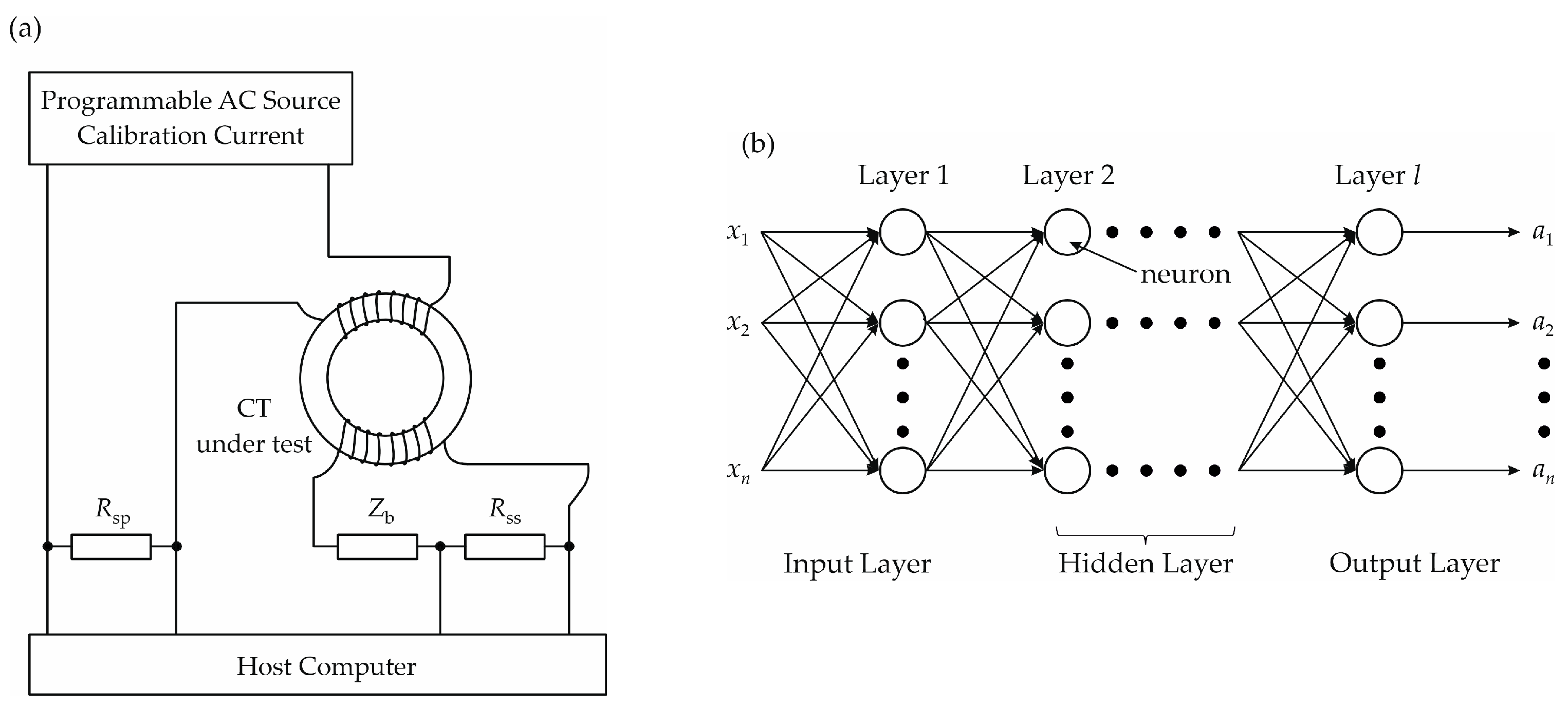
Power quality degradation caused by devices such as inverters, rectifiers, and LED lighting increases CT errors, particularly in conventional designs [19,20]. Harmonics increase the excitation current, thereby amplifying both ratio error and phase displacement, as higher-order components are generally weaker and phase-shifted relative to the fundamental [19,20]. To mitigate these effects, [23] introduced an Artificial Neural Network (ANN)-based correction method using Fast Fourier Transform (FFT) features extracted from the secondary current. Tests on CTs with silicon–iron and nanocrystalline cores confirmed that FFT analysis effectively captures key relationships involving transformation ratio, load, frequency, and magnetic nonlinearities. The extracted data were used to train a multilayer ANN (27 inputs, 2 hidden layers, 1 output). The experimental setup and ANN architecture are shown in Figure 1, which also illustrates the simultaneous acquisition system using a programmable AC source and calibrated shunts. Tests performed with both sinusoidal and distorted waveforms (containing the third, fifth, seventh, and ninth harmonics) achieved significant error correction, with measured errors of approximately 60 μA and 0.3′. The corresponding test bench is also shown in Figure 1.
A multilayer feedforward neural network—with an input layer, two hidden layers, and an output layer—is used, where neurons transmit data only to subsequent layers and training is based on gradient descent minimization of a loss function. The number of output neurons corresponds to the number of predicted parameters. As shown in [23], correction accuracy strongly depends on the representativeness of the training dataset, while implementation costs are increased by the use of a dSPACE platform [39] and a programmable AC source [40]. In [41], the bandwidth of conventional CTs is identified as a key factor in accurately reproducing non-sinusoidal currents. Analytical expressions for CT transresistance, including parasitic elements, are derived, and equivalent circuit models are used to estimate cut-off frequencies and bandwidth. These models are experimentally validated on a Ferroxcube ferrite-core transformer [42]. The results show that higher magnetizing inductance lowers the lower cut-off frequency, while reduced leakage inductance and parasitic capacitance increase the upper cut-off frequency. This methodological framework enables broadband CT design and simulation in SPICE or MATLAB R2025a [43], and it can also be extended to conventional transformers due to model similarity.
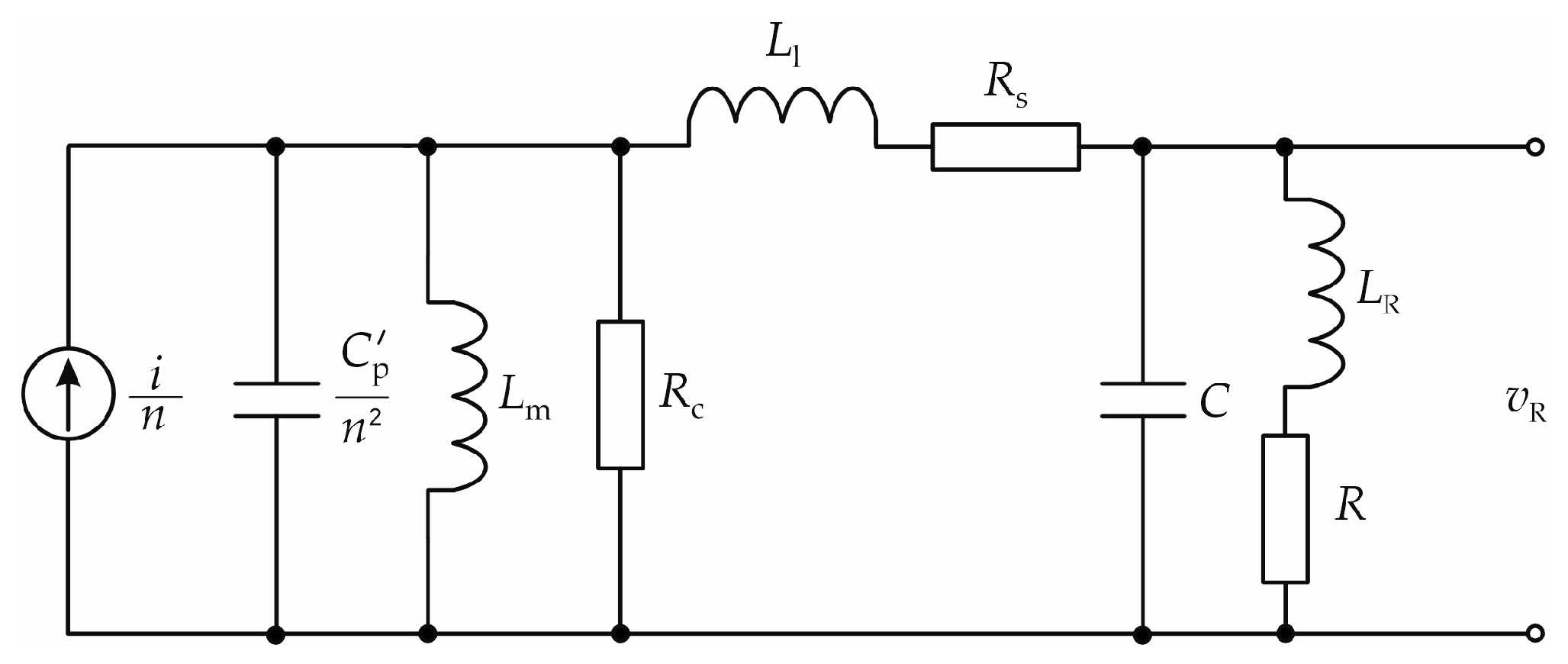
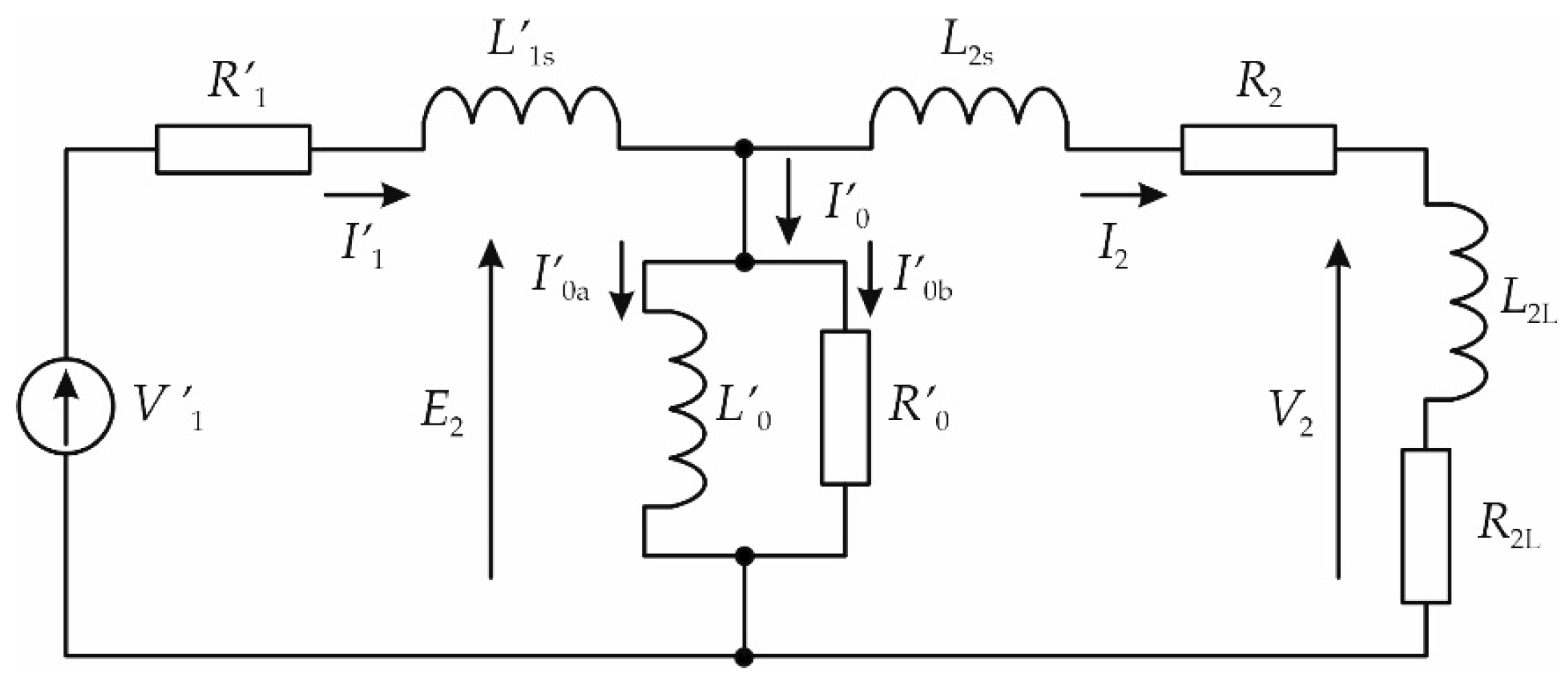
Figure 2 shows the equivalent circuit model of a CT, with the primary-side capacitance reflected to the secondary side.
In order to accurately reproduce the non-sinusoidal waveform of the primary current—characterized by a wide range of harmonics—on the secondary side, with proportional amplitude and preserved waveform shape, the CT must exhibit sufficient frequency bandwidth. This analysis assumes that the circuit operates linearly and within the unsaturated region of the magnetic core [44,45].
The transresistance of the CT is defined as follows:
R m ( s ) = V R ( s ) I ( s )
where V R ( s ) and I ( s ) are the equivalents of the voltage across the sense resistor and the measured current in the s domain, respectively, where s = j ω denotes the argument of the Laplace domain, while j and ω are the imaginary unit and angular frequency [rad/s], respectively [41,46].
A key limitation of earlier methods is the need for expensive, high-power current sources to reproduce harmonic signals with proper phase shifts. To address this issue, [24] proposed an FFT-based technique that analyzes the CT’s secondary signal to determine the ratio error and phase displacement for individual harmonics. This method offers high accuracy, enables identification of the optimal secondary load, and eliminates the need for costly current generators. However, it has certain limitations, including sensitivity to CT winding design, magnetic operating point, and overall measurement precision. Despite these drawbacks, the method provides an effective and low-cost diagnostic tool for evaluating CT performance under real operating conditions. The study also introduced a formula for calculating the percentage composite error of individual harmonics, as presented in the following equation:
ε % Σ h = ε 2 ε 1 h 2 I 2 I 1 h 2 · 100 %
where ε ,   ε 1 h ,   I , and I 1 h are the RMS values of the composite error, the main harmonic component of the composite error, the primary current, and the main harmonic of the primary current, respectively.
The percentage component of the composite error resulting from the CT phase displacement is expressed as follows:
ε % φ = 2 1 c o s φ · 100 % s i n φ · 100 %
Equation (5) presents the arithmetic difference between the composite errors, determined based on the law of cosines applied to the vectors of the primary and secondary currents of the CTs, assuming a phase displacement equal to φ .
To present a structured overview of the errors occurring in CTs, Table 2 summarizes them according to their nature, physical origin, and classification based on international standards. The table also outlines the methodologies reported in the literature for mitigating these errors and highlights the key contributions of each approach. Such a comparison enables a clear association between the error sources and the corresponding mitigation strategies, providing a solid foundation for the critical analysis that follows.
As shown in Table 2, ratio error and phase displacement are systematic under sinusoidal conditions but become increasingly frequency- and operating-point-dependent as the harmonic content grows. Where core nonlinearity and parasitic elements become significant, these errors evolve from simple constant offsets to dynamic, harmonic-indexed deviations. Traditional comparative calibration methods (Table 2, rows 1–2) offer high precision but are limited in their ability to characterize per-harmonic behavior, which is more effectively captured by FFT-based analysis and equivalent circuit modeling (Table 2, rows 3–4). It should be noted that the body of work from the NRC/PTB [34,36,37] establishes high-accuracy baselines, demonstrating very small differences between calibration systems, the use of a broadband reference CT up to 3 kHz, and the implementation of active differential measurement schemes. These studies are foundational for defining accuracy classes and developing acceptance tests, but they require costly reference instruments. While their strength lies in their traceability and compliance with international standards, their limitation is a reduced ability to resolve harmonic-dependent mechanisms, along with the high infrastructure cost.

3.2. Harmonic Distortion and Its Impact on CT Errors

Modern power grids exhibit high levels of harmonic distortion caused by inverters, rectifiers, switched-mode power supplies, LED lighting, and other nonlinear loads. This increased harmonic content leads to higher excitation current and often amplifies both ratio error and phase displacement in conventional CTs [19,24], as harmonic components are significantly attenuated or phase-shifted relative to the fundamental frequency [19,20].
Reference [25] presents a wideband self-calibration method for inductive CTs under ampere-turns conditions, eliminating the need for a reference transducer. The results were validated by comparison of two CTs, rather than exclusively relying on the classical ampere-turns method [2]. The errors for individual harmonics were found to be within the limits specified by the relevant standards. This development holds significant practical relevance, as it enables the testing of CTs under distorted waveform conditions without requiring high-current generators or specialized laboratory infrastructure. The proposed method can be applied both during the manufacturing process and in the diagnostics of CTs, particularly in systems characterized by high harmonic distortion. The ratio error of the transformation of the hk higher harmonic component of the distorted current by the tested CT is determined as follows [26]:
I h k = I 2 h k I 1 h k I 1 h k · 100 %
where I 1 h k and I 2 h k are the RMS values of the hk harmonic of the primary current and the hk harmonic of the secondary current of the tested CT, respectively, while the RMS values of harmonics of the secondary current are determined as follows:
I 2 h k = U R s h k k 2 + U R d h k 10 2 2 U R s h k k U R d h k 10 c o s φ h k
where U R s h k ,   U R d h k , and φ h k denote the RMS values of the hk harmonic of the voltage across the current shunt R s equal to 1 or 0.1 Ω , the RMS values of the hk harmonic of the voltage across the current shunt R d of resistance equal to 10 Ω , and the phase angle between hk harmonic of the voltage from resistors R s and R d , respectively, while R s and R d are the current shunt for measurement of the primary current (5/1 A) and the differential current, respectively. The RMS value of the hk harmonic of the primary current is
I 1 h k = U R s h k R s
The phase error of the transformation of the higher harmonic component of a distorted current by the tested CT is expressed as follows [26]:
δ h k = a r c s i n ε % I h k 2 I h k 2 100 %
where
ε % I h k = R s U R d h k R d U R s h k
In addition to the qualitative descriptions of calibration methods, it is also important to indicate their quantitative applicability with respect to CT accuracy classes. The comparative method, as standardized in IEC 61869-2, offers the highest achievable accuracy—often below ± 0.05% for ratio error and within ± 0.1′ for phase displacement—and is therefore indispensable when testing class-0.1 CTs [36,37,38]. However, this approach requires a high-grade reference transformer, which significantly increases the overall cost. Self-calibration methods, such as those reported in [25], demonstrate maximum achievable accuracies in the order of ± 0.01% for ratio error and ±   0.01 ° for phase displacement at 50 Hz, and approximately ± 0.03% and ±   0.01 ° at 5 kHz. This level of precision is generally sufficient for CTs of accuracy classes 0.2 or 0.5, and it fully satisfies the requirements for class-0.1 devices, even enabling class-0.05 performance in some cases. Impedance-based approaches [14] provide accuracy comparable to that of the comparative method under laboratory conditions, with reported errors equal to 0.0048% for ratio error and 0.14′ for phase displacement. However, these values are strongly dependent on the resolution and stability of the measuring instruments used. Table 3 summarizes the accuracy limits of different calibration methods and highlights their suitability for various CT accuracy classes.
The comparison presented in Table 3 clearly demonstrates that the comparative method remains the only universally reliable option for calibrating class-0.1 CTs, owing to its very high accuracy and established international standardization [6,34,36,37]. However, its reliance on expensive reference CTs and controlled high-current sources makes it costly and less practical for routine applications. In contrast, FFT-based [23,24] and self-calibration techniques [25] provide sufficient precision for class-0.2 and class-0.5 CTs, offering cost-effective alternatives suitable for both laboratory and field use. Their main limitation lies in their sensitivity to CT design parameters and operating conditions, which may compromise accuracy under non-ideal circumstances [21,22]. The impedance-based method [14], while capable of achieving accuracies close to those of the comparative method in controlled setups, has not yet been widely validated under diverse field conditions. Therefore, although innovative approaches hold considerable promise in reducing calibration costs and complexity, the comparative method remains indispensable for applications requiring the highest level of accuracy, particularly in measurement and protection systems with strict compliance demands.
Since harmonic distortion represents one of the most significant challenges in modern power networks, it is essential to compare how different methodologies address this problem. Table 4 summarizes the main approaches reported in the literature for reducing CT errors under harmonic conditions, highlighting their respective advantages and limitations. This structured comparison provides the basis for identifying which techniques are most effective in practice.
Table 4 shows that FFT-based methods and per-harmonic metrics provide better diagnostic accuracy than comparative approaches under distortion. When budgets are limited, FFT-based methods and, where feasible, ANN-based techniques offer better cost efficiency than high-current generators. However, the performance of ANNs depends strongly on the quality and diversity of the training data (e.g., core type, burden, frequency, nonlinearity). High-current generators remain important for type testing and worst-case evaluations. Studies [21,22,38] show a gradual evolution—from simple sinusoidal generators to distortion-capable systems, and eventually to feedback-compensated sources— albeit with increasing complexity and cost. Reference [23] further demonstrates that FFT-informed ANNs can effectively correct errors in silicon–iron and nanocrystalline cores, provided that synchronized sampling and calibrated shunts are used.
It is important to also emphasize that the practical consequences of ratio error and phase displacement differ between measurement and protection applications. In measurement systems, even small systematic measurement uncertainties directly impact energy billing accuracy and power quality assessment, potentially leading to long-term financial discrepancies [6,7,8]. In protection applications, however, such errors are more critical, especially under transient conditions, where ratio error and phase displacement can cause delayed or erratic relay operation, thereby compromising system safety [2,6].

3.3. Frequency-Domain, Modeling, and Bandwidth-Oriented Methodologies

Bandwidth determines a CT’s ability to accurately reproduce non-sinusoidal waveforms. Using an equivalent circuit comprising magnetizing inductance L m , leakage inductance L l , primary capacitance C p referred to the secondary, core loss resistance R c , winding resistance R s , and stray capacitance C , one can derive the lower and upper cut-off frequencies as well as the overall bandwidth [2,21,26,30,38]. Experimental validation was performed on a Ferroxcube ferrite core [42]. Key sensitivities include increasing L m , decreasing L l , and minimizing parasitic elements.
The frequency response of CTs is directly related to their ability to reproduce distorted currents with sufficient accuracy. Table 5 summarizes the methodologies proposed in the literature for analyzing CT bandwidth and equivalent circuit behavior, highlighting their respective strengths and weaknesses. This structured overview enables an assessment [6,7,8] of which modeling strategies offer the most reliable predictions under harmonic and broadband operating conditions.
Model-based design (Table 5, col. 1) is crucial in engineering broadband CTs, as it provides guidance on hardware modification. FFT- and self-calibration-based approaches, in contrast, offer insight into the performance of the as-built device under realistic signals, often without requiring large current sources. For development workflows, combining both approaches shortens the iteration cycles and focuses attention on the parasitic elements that have the greatest impact on bandwidth.

3.4. Alternative Low-Cost Methods

In addition to classical and advanced calibration approaches, several alternative low-cost methods have been proposed for evaluating CT performance. These solutions are particularly valuable in practical scenarios where expensive reference equipment or high-current sources are not available. By combining simplified measurement setups with analytical evaluation of excitation current and impedance, such approaches can achieve accuracy comparable to that of standard comparative methods while significantly reducing cost and complexity.
In [47], a comparison was made between two broadband power sources: a PWM (Pulse-Width Modulation) inverter and a system consisting of an audio amplifier combined with an arbitrary waveform generator, used to generate distorted test currents for CTs [48,49]. The audio amplifier offers twice the output power at a lower cost compared with the broadband power supply, enabling current generation up to 800 A. The main limitation of the presented method, however, is its inability to provide the full frequency bandwidth required for comprehensive CT testing [47]. In [50], the results of electromagnetic compatibility (EMC) tests for two broadband power supplies—a PWM power supply [48] and an audio amplifier [47]—are presented. Both devices are intended to power the measurement system used to evaluate CT accuracy. The tests aimed to detect disturbances that could negatively affect the accuracy of the obtained measurements. The susceptibility of both sources to low-frequency conducted disturbances was also assessed. Additionally, voltage gain error and output voltage phase shift were measured. The results showed that the PWM-based power source exceeded the limits of radiated emissions, while the audio amplifier exceeded the limits of conducted emissions. Consequently, neither source fully complied with the IEC 61326-1 standard [51].
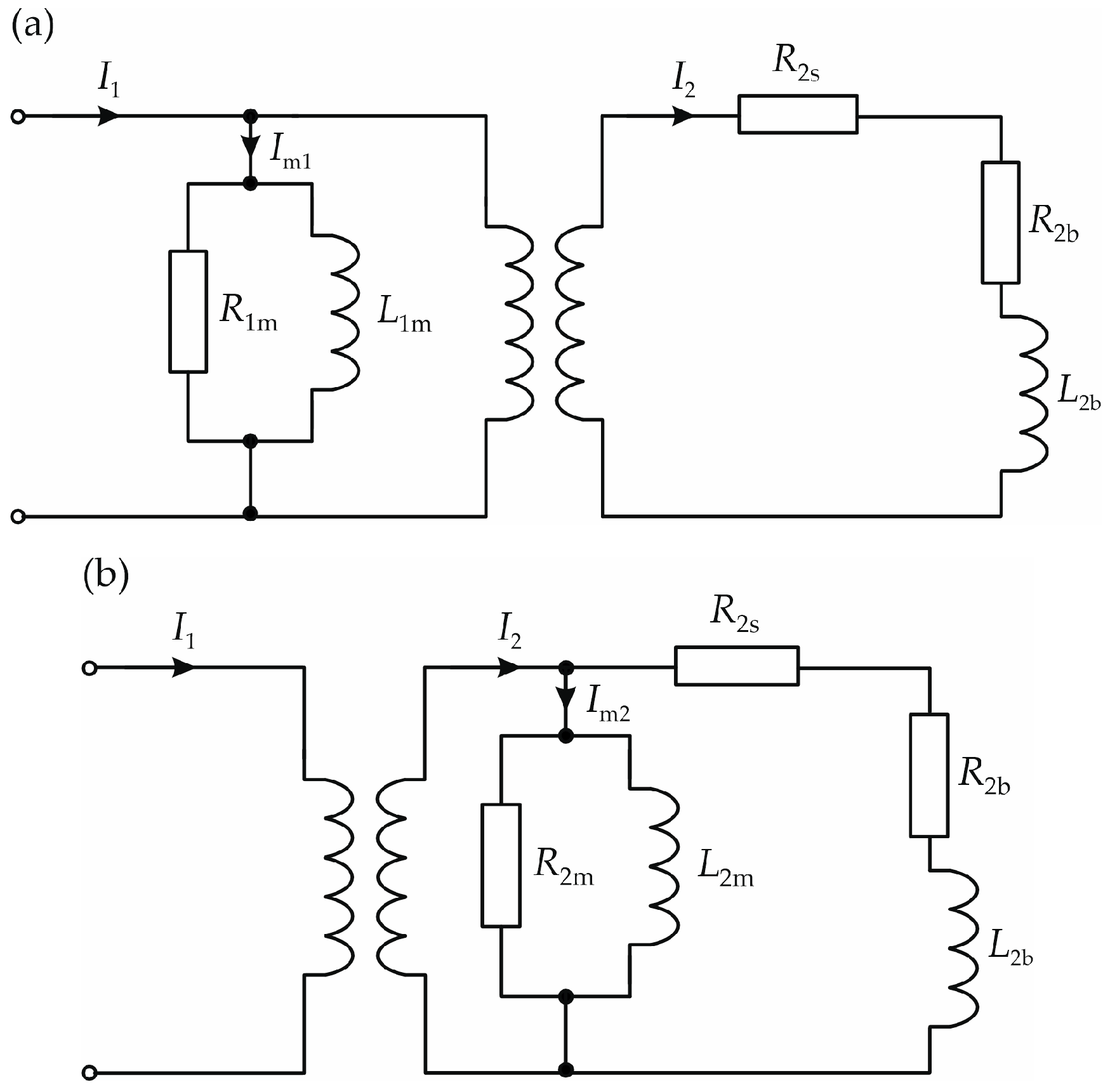
The IEC 61869-2 standard also defines an alternative method for determining the CT errors, in which the transformer’s primary side is left open and its secondary side is energized with voltages of varying magnitudes [52,53]. The method involves measuring the voltages on both sides together with the excitation current. Based on the obtained measurements, the ratio error and turns correction are determined. Unlike the comparative method, this approach does not require a high-current power source, since it focuses on the excitation current—the current responsible for generating the magnetic flux in the CT core. However, due to the core nonlinearity, the excitation current becomes distorted by the harmonics of the sinusoidal voltage applied to the secondary terminals [54]. Reference [55] presents a method for determining the ratio error and phase displacement of conventional CTs during the transformation of currents distorted by higher harmonics. The method consists of applying a known harmonic voltage to the secondary winding and measuring the excitation current, which carries information about the CT’s errors. A key contribution of the study is the explicit consideration of the nonlinear magnetization characteristic of the core, which plays a crucial role in analyzing higher-order harmonics. The proposed method enables the separate determination of errors for each individual harmonic, which is practically unachievable with the standard calibration techniques specified in IEC 61869-2. A major advantage of this approach is the significant simplification of the measurement setup, as it eliminates the need for high-current generators and comparative systems. It only requires energizing the CT’s secondary winding and performing an appropriate analysis of the magnetizing current. Even when the voltage applied to the secondary terminal is sinusoidal, the excitation current is distorted by corresponding harmonics [23], which confirms the applicability of the method. In [14], an alternative approach to determining CT errors is proposed. This method is based on measuring the turns correction factor and the magnetizing impedance of the transformer. The turns correction factor is determined using the differential voltage method, which requires only a millivoltmeter. The magnetizing impedance is measured with an instrument designed for impedance testing of the secondary winding, eliminating the need for a high-power current source. This approach avoids the development of a complex measurement system and further allows measurements to be performed directly at the CT installation site. Figure 3a,b show the excitation branches on the primary and secondary sides of the CT analyzed in [14], respectively.
ε = m z 2 m z 2 + z 2 m 1 · 100 %
where
m = I 1 I 1 I m 1
and
z 2 m = j R 1 m ω L 1 m R 1 m + j ω L 1 m
and
z 2 = R 2 s + R 2 b + j ω L 2 b
represents the impedance of the secondary circuit, while I 1 and I m 1 represent the actual primary current and the equivalent excitation current on the secondary side, respectively.
The phase displacement formula is given as follows:
δ = a r c s i n k r I m 2 s i n β α I 1
where I m 2 is the equivalent excitation current on the secondary side, while the parameters α and β are as follows:
α = a r c t a n ω L 2 R 2
and
β = a r c t a n R 2 m ω L 2 m
The error values of the CT under consideration, measured at a rated primary current, were 0.0048% for the ratio error and 0.14′ for phase displacement. The results, obtained using an impedance measurement device with an accuracy of 0.1 and a millivoltmeter with a resolution of 0.1 μV, show that the proposed method yields measurement errors comparable to those of the comparative method. The study further confirmed that the results closely align with those obtained using the comparative method, validating the effectiveness and accuracy of the proposed approach.
To illustrate the potential of simplified measurement strategies, Table 6 compares alternative low-cost methodologies for determining CT errors. It highlights the equipment required, the level of accuracy achieved, and the practical advantages and limitations of each approach. This structured overview enables a direct assessment of the performance of these methods relative to traditional comparative techniques.
Table 7 provides a structured summary of the most important studies published between 2021 and 2025 on these topics. It highlights the types of errors considered, the methodologies applied, and the key contributions of each study.
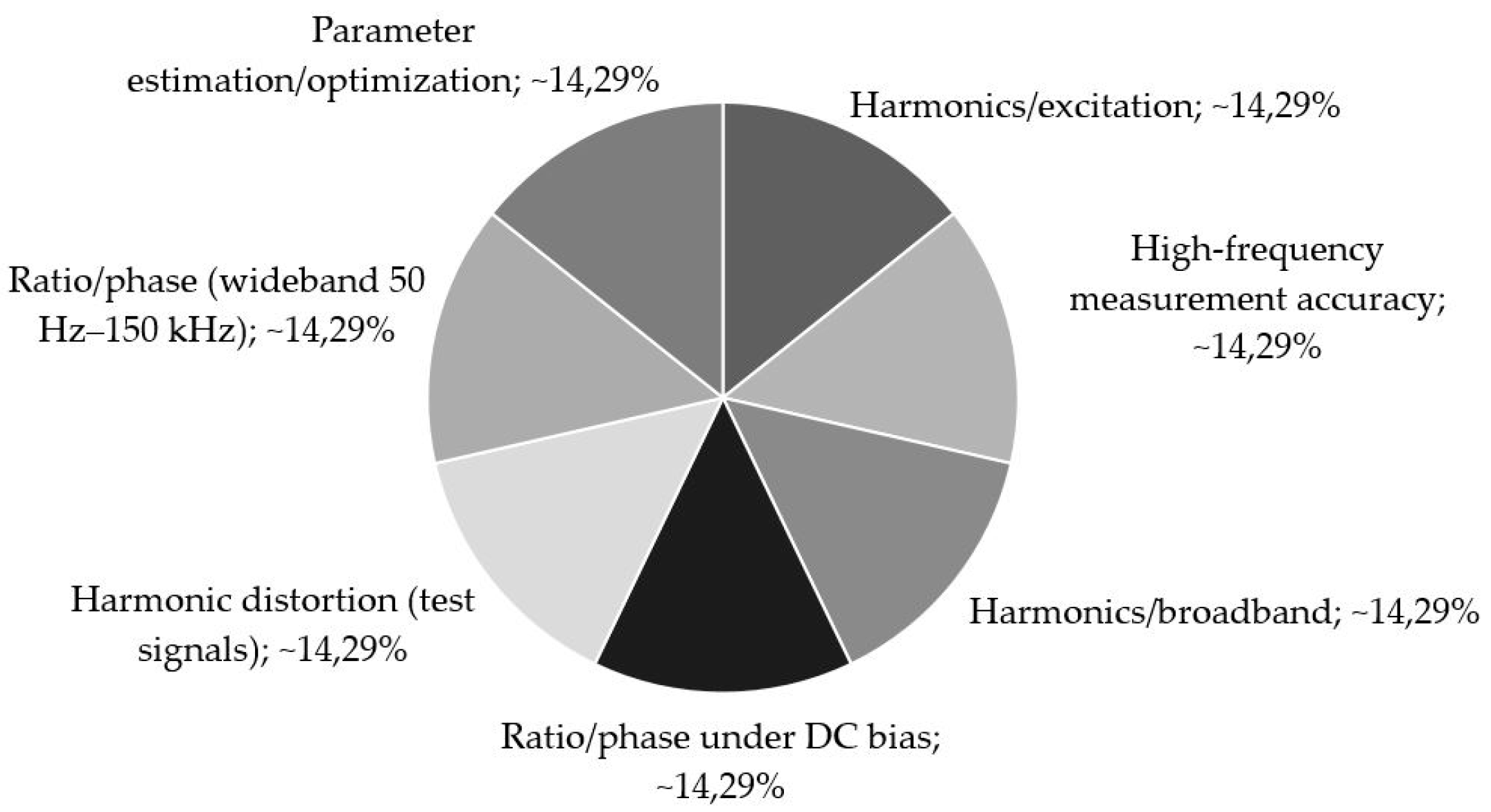
To provide a quantitative perspective on research trends from 2022 to 2025, Figure 4 shows a pie chart illustrating the distribution of CT error studies by error type addressed.
The chart shows that research efforts between 2022 and 2025 were evenly distributed across seven categories of CT error studies, each representing about 14% of the total. These categories include ratio/phase errors under DC bias, wideband ratio/phase evaluation, harmonic-related errors (excitation and broadband), distortion in test signals, high-frequency measurement accuracy, and optimization approaches. This distribution indicates that no single error type dominated research during this period; instead, studies covered a broad spectrum ranging from classical error mechanisms and harmonic effects to bandwidth and advanced optimization methods.

3.5. Static vs. Dynamic Errors in Current Transformers

While most of the methodologies discussed address static errors—namely, ratio error and phase displacement defined under steady-state sinusoidal or harmonic conditions—it is essential to distinguish these from dynamic errors, which arise primarily during transient processes [6,16,18,19].
Static errors are typically measured under steady sinusoidal excitation or controlled harmonic distortion, and they remain relatively constant for a given CT design, burden, and frequency. They are the primary focus of international standards such as IEC 61869-2 [6].
Dynamic errors, on the other hand, are associated with the transient response of CTs. They arise during fault conditions, switching events, or other disturbances that drive the magnetic core into partial or full saturation [52]. Under such conditions, the CT may exhibit significant deviations in both ratio and phase characteristics, often resulting in distorted secondary currents.
A key distinction lies in the nonlinear magnetization behavior of the core: during dynamic events, the excitation current rises abruptly, and the CT core may saturate asymmetrically, depending on the residual flux [53]. This leads to waveform distortion and a temporary loss of accuracy that static error definitions cannot capture. The concept of dynamic accuracy therefore extends beyond steady-state metrics, emphasizing the CT’s ability to reproduce rapidly changing primary currents under fault or switching conditions [20]. This distinction is particularly critical for protective relaying, where misrepresentation of transient currents may lead, for example, to incorrect relay operation [30]. By clarifying these differences, this review highlights the importance of dynamic error assessment as a complementary dimension to static accuracy evaluation, enhancing its relevance in modern power systems characterized by frequent transient disturbances [41,56]. Dynamic CT accuracy is increasingly linked to the operational reliability of protection systems, wide-area monitoring, and cyber–physical grid environments. In protection systems, CT saturation, remanence, limited bandwidth, and dynamic errors during transients can distort secondary currents, which may cause delayed or incorrect relay tripping in differential, distance, and overcurrent protection. Recent analyses of faulty operation continue to identify CT saturation as a major factor causing a lack of coordination and false relay trips, emphasizing the importance of saturation-tolerant relaying algorithms and careful selection of CTs or low-power transformers, particularly in networks with a large number of inverters [58,59]. In the context of wide-area monitoring and phasor measurement unit (PMU) applications [60], the dynamic behavior of CTs directly affects PMU performance, as defined by the class-P and class-M requirements in the IEC/IEEE 60255-118-1 standard [61]. While class-P devices are optimized for the fast dynamic tracking required in protection and control, class-M devices emphasize steady-state accuracy. Recently, waveform measurement units have been proposed as a complementary technology to capture high-frequency transients that exceed the dynamic response of conventional PMUs, thus emphasizing the importance of CT bandwidth and accuracy [62].
In cyber–physical power systems, digitizing CT outputs by combining IEC 61869-13-compliant units and transmitting them as sampled values according to IEC 61850 implies that dynamic accuracy depends not only on sensor performance but also on process-bus latency and jitter. Studies have shown that sampling-level anomalies and spoofed time-synchronization signals—such as falsified phasor measurement unit data—can degrade protection and monitoring functions, underscoring the need for secure communication protocols, anomaly detection, and fault-tolerant analytics for phasor measurement units [63,64]. Overall, improving the dynamic accuracy of CTs is not only a metrological challenge but also a prerequisite for robust protection, reliable situational awareness, and safe operation of digital substations in modern real-time power systems.

4. Measurement Uncertainty Analysis

Measurement uncertainty in CTs plays a critical role in ensuring the reliable operation of both measurement and protection systems. Although numerous studies have reported various methods for uncertainty estimation [6,34,36], the treatment is often fragmented and lacks a clear classification of the underlying sources. To improve clarity, this section is organized into three thematic groups: metrological uncertainties, environmental and operational uncertainties, and uncertainties related to modeling and data processing. Each subsection includes a comparative table summarizing the uncertainty type, its cause, relevant conditions, and methodologies reported in the literature, followed by a critical synthesis.

4.1. Metrological Uncertainties

Metrological uncertainties arise from the intrinsic characteristics of CTs, including transformation ratio deviation, phase displacement, accuracy class limits, and burden dependence. These aspects are extensively formalized in IEC 61869-2 [6] and have been the subject of comparative laboratory evaluations in several studies [34,37,41]. These uncertainties are considered to be the most fundamental, as they establish the baseline for CT accuracy with external influences taken into account.
These uncertainties can originate from a variety of sources, including physical, design-related, and environmental factors, and can significantly impact the accuracy of protection devices, energy measurements, and power quality assessments in electrical power systems. Sources of uncertainty in CTs include systematic errors such as ratio error and phase displacement, environmental factors like temperature (which alters the magnetic properties) [65], magnetic core nonlinearity [66], electromagnetic interference [67], and variations in load impedance [68]. Additionally, uncertainty values may be affected by CT aging, which leads to changes in insulation properties and core material characteristics.
Reference [38] identifies the main sources of measurement uncertainty in both conventional and electronic CTs as follows:
Uncertainty of the reference transformer;
Uncertainties related to passive components (such as voltage dividers and shunt resistors) used to adapt the signal to the input of the A/D converter;
Uncertainties arising from variations in the characteristics of the A/D converter measurement channels;
Uncertainties associated with FFT algorithm errors [69], primarily due to spectral leakage effects [70].
The following methods of compensating measurement uncertainties have been proposed:
Automatic compensation by measuring and accounting for differences when the same signal is applied to both channels;
Application of signal windowing (e.g., flat-top window) in the FFT algorithm;
Sampling under near-synchronous conditions (e.g., 256 samples per cycle at 50 Hz);
Performing multiple repeated measurements and averaging, which allows for the estimation of Type-A uncertainty.
The method proposed in [38] enables a simple and cost-effective determination of measurement uncertainties. However, uncertainties introduced by passive components and A/D converter channels may lead to systematic errors, and the method remains sensitive to sampling conditions.
In [54], the uncertainty in determining ratio error and phase displacement was analyzed in accordance with the JCGM guidelines, taking into account the accuracy of the harmonics, phase angle, and secondary winding parameters. At 50 Hz, the expanded uncertainties were ±0.043% for the ratio error and ±0.044° for the phase displacement. At 5 kHz, these values increased to (0.1 ± 0.197)% and (0.1 ± 0.198)°, respectively. The results indicate that the uncertainty is influenced primarily by secondary parameters and operating conditions—such as temperature—rather than by primary current harmonics. However, this method yields higher uncertainty than the traditional ampere-turns method [71]. A complementary approach [45] involves estimating the magnetizing impedance using an LCR meter [72,73], where the dominant sources of uncertainty are the instrument’s accuracy (±0.1%) and the nonlinear behavior of the magnetic core.
A precision bridge system [74] with compensated current comparators [75], developed at the Physikalisch-Technische Bundesanstalt (PTB), that models Type-B uncertainty is presented in [37]. Another method [76] accounts for uncertainty resulting from CT nonlinearity, including excitation current, self-generation of harmonics [25,77], and turns ratio correction. However, a combined uncertainty estimate in accordance with the GUM is not considered.
Calibration of CTs with low secondary currents (<1 A) using a 5 A reference transformer is made possible by employing a two-stage differential transformer, which compensates for reference errors and achieves uncertainty levels comparable to those of conventional calibration methods [78]. This approach also allows for further current reduction (down to 10–20 mA), which is important for accurate energy measurement [79,80,81,82]. For harmonic measurements, [83] proposes a complex error model based on the Volterra model [84,85], which separates deterministic and stochastic components. The stochastic component dominates the overall uncertainty, while the deterministic component can be extracted using the least squares method [86]. Although this method is effective, it requires large datasets and advanced computational tools such as MATLAB or Mathcad [87,88].
Reference [89] investigates split-core current transformers [90,91], with the aim of achieving class-0.2 S accuracy [92]. Using 3D electromagnetic field analysis [93] and the circuit-field method [94], uncertainties were assessed and validated through laboratory testing [95]. The results indicate a strong dependence on core geometry, winding configuration, and instrument accuracy (CA507 comparator [96]). Although 3D models [97] offer improved accuracy compared to 2D models [98], their high cost and complexity limit their practical application in mass production.
To clarify the nature of metrological uncertainties, Table 8 summarizes the main error sources identified in the literature, along with their typical causes, the test conditions under which they appear, and the methodologies proposed to quantify or mitigate them. This comparative overview highlights that conventional ratio and phase errors are influenced not only by intrinsic design parameters but also by burden conditions and accuracy class limits, as emphasized in [6,34,36,37,41].
Among metrological uncertainties, ratio error and phase displacement remain the most significant. Comparative methods using reference CTs provide the most reliable evaluation but require costly laboratory setups. FFT-based techniques and impedance-optimized designs show promise for field applications; however, they exhibit limitations for class-0.1 CTs, where reliance on high-precision reference transformers remains unavoidable.
From the standpoint of international standardization, the principal sources of measurement uncertainty in CTs are identified as ratio error, phase displacement, their dependence on secondary burden, and the influence of temperature and magnetic nonlinearity on these error components [6,35,36,37,41]. The IEC 61869 series provides a rigorous framework by defining accuracy classes (e.g., 0.1, 0.2, 0.5) and specifying permissible limits for these errors under defined burden and environmental conditions [6,14]. In parallel, the IEEE C57.13 standard sets accuracy requirements for both measurement and protection CTs, albeit with class limits and testing methodologies different from those adopted in the IEC framework [6]. While both standards recognize ratio error and phase displacement as the dominant contributors to overall measurement uncertainty, neither offers explicit guidance on uncertainty propagation in accordance with the GUM methodology. As a result, several critical sources of uncertainty—such as harmonic distortion, dynamic errors under transient conditions, and long-term aging effects—remain insufficiently addressed in current regulatory documents. This gap highlights the need for further systematic research and the potential development of new regulatory frameworks to ensure the reliable operation of CTs in modern power systems characterized by distortion and dynamic operating conditions.
In addition to conventional uncertainty assessments based on laboratory testing, real-time operational factors must also be considered in modern power systems [99]. In billing applications, the dynamic accuracy of CTs directly influences the fairness and reliability of energy settlements [100], especially in grids with high levels of renewable generation and rapidly changing inverter-based loads. In such contexts, transient behavior, core saturation, and communication delays introduce additional sources of uncertainty that are not captured by steady-state calibration methods [9,15].
Similarly, in monitoring systems, uncertainty propagation affects the validity of power quality metrics, regulatory compliance, and long-term performance statistics. Even small deviations in real-time measurements can lead to incorrect reliability assessments, inaccurate load forecasts, or miscalculations of stability margins [101]. Furthermore, in cyber–physical environments, overall measurement uncertainty is determined not only by sensor accuracy but also by time-synchronization errors and communication delays in protocols such as IEC 61850 [102]. These operational factors highlight that metrological uncertainty should be regarded as a dynamic, context-dependent parameter rather than a fixed laboratory constant, with direct implications for both billing accuracy and system monitoring [103].

4.2. Environmental and Operational Uncertainties

Beyond laboratory calibration, CTs are exposed to a wide range of environmental and operational conditions that can significantly affect their performance. Temperature dependence of core properties [44,45,51], humidity-induced insulation degradation [25,47], long-term material aging [25,47], and electromagnetic interference [50] are among the most frequently reported influences. Additionally, variability in the connected burden impedance during field installation may alter the effective transformation accuracy [25]. These uncertainties are typically classified as Type-B contributions under the GUM framework and must be carefully considered when CTs are applied in non-ideal operating conditions.
While metrological uncertainties are primarily associated with the intrinsic properties of CTs, environmental and operational factors play an equally important role in shaping overall measurement accuracy. Table 9 outlines how variations in ambient temperature, load impedance, and external electromagnetic disturbances contribute to the total uncertainty budget. Reported methodologies—including correction algorithms and controlled laboratory simulations [95]—demonstrate the extent to which external influences must be incorporated into CT testing and calibration procedures.
Among environmental uncertainties, temperature and burden variations are the most influential—with the former typically classified as a Type-B systematic uncertainty and the latter depending on installation conditions. Although correction factors and electromagnetic shielding can mitigate these effects, residual uncertainty often remains significant under non-laboratory conditions, underscoring the need for robust field calibration methodologies. Within the domain of calibration methodologies, a fundamental trade-off exists between comparison-based approaches employing high-accuracy reference CTs and in situ impedance-based techniques. Comparison calibration offers the highest level of metrological reliability; however, it requires certified reference transformers and laboratory-grade infrastructure, significantly increasing costs and limiting its practicality for routine industrial practice [34,37]. In contrast, impedance-based methods utilize the intrinsic electrical parameters of the CT under test to estimate error contributions directly under operational conditions, offering a cost-effective and field-deployable alternative [46]. The principal drawback of impedance-based approaches lies in their reduced accuracy compared to reference-based calibration, particularly in the presence of nonlinear magnetization and transient phenomena. Consequently, comparison methods continue to serve as the benchmark for precision metrology and international standardization. Meanwhile, impedance-based techniques are gaining traction in industrial environments, where economic efficiency and operational practicality outweigh the requirement for sub-percent uncertainty. This dichotomy suggests that hybrid calibration schemes, which combine impedance-based error estimation with advanced data-driven compensation strategies such as neural networks or metaheuristic optimization, represent a promising direction for future research aimed at reconciling accuracy and practicality in large-scale deployment scenarios.

4.3. Modeling and Data Processing Uncertainties

Beyond metrological and environmental influences, a significant portion of CT uncertainty arises from modeling assumptions and data processing techniques. Table 10 compares the main modeling and computational approaches reported in the literature—ranging from equivalent circuit approximations [41,42] to FFT-based harmonic analysis [23,24], and even to advanced correction methods employing artificial intelligence [23,39]. These contributions demonstrate both the potential and the limitations of post-processing methodologies, which can either reduce or, if misapplied, amplify the overall measurement uncertainty.
Modeling and computational methods offer cost-effective alternatives to laboratory-based calibration, particularly under distorted waveform conditions. Their reliability, however, depends critically on model fidelity and the representativeness of the input data. ANN-based corrections show considerable promise but remain constrained by the diversity of available training datasets. Hybrid approaches that integrate physical models with machine learning are increasingly regarded as the most effective direction for future research.
To provide a more detailed view of the application of the GUM methodology to CTs, Table 11 summarizes the decomposition of uncertainty contributions for a class-0.2 CT evaluated under nominal test conditions. The data highlight that Type-A repeatability contributes less than 5% of the total expanded uncertainty, whereas Type-B sources dominate the uncertainty budget. In particular, nonlinear magnetization of the core accounts for nearly 40% of the combined uncertainty [14,15,21,22,25,26,32,34,37,38,53,54,56], while ambient temperature variations and load impedance interactions account for approximately 25% [44,45]. Additional contributions arise from harmonic distortion of the excitation current [51,53,54], which, although often neglected in conventional assessments, introduces measurable bias in the determination of ratio error and phase displacement.
Table 11 shows that the major contribution to the overall uncertainty originates from Type-B components. In particular, core nonlinearity exerts the strongest impact on the uncertainty budget, underscoring the difficulty of fully compensating for this effect under both sinusoidal and distorted current conditions. Temperature variation and load impedance interactions are also significant, together accounting for approximately one-quarter of the total uncertainty. In contrast, the contribution of repeatability (Type A) remains relatively low, indicating that stochastic variations in the measurement process are less critical than systematic sources. These results confirm the importance of explicitly incorporating nonlinearity and environment-related uncertainties when applying the GUM approach to CTs, as emphasized in [25,26,34,36,38,45,53].

5. Dynamic Accuracy of Current Transformers

Static accuracy [19,52,53] of CTs occurs when the transformer faithfully reproduces the root-mean-square value of the primary current under steady-state conditions, i.e., with stable, unchanging operating parameters. The static accuracy of CTs is influenced by the ratio error, phase displacement, and the corresponding accuracy class [19,32,53], which defines the maximum allowable percentage error within a specified load range—for example, class 0.2 corresponds to a ± 0.2 % error limit. Static accuracy is particularly important in measurement applications, such as energy metering, due to the need for precise reproduction of the actual current consumption. Although static errors are well defined under steady-state conditions, many CTs that comply with the 0.2 or 0.1 accuracy class in static tests may still exhibit excessive dynamic errors during transients, particularly due to magnetic core saturation [13,19,20,53].
Table 12 provides a concise overview of recent research (2021–2025) on improving the dynamic accuracy of CTs. Particular attention is paid to methods and approaches developed for real-time applications, including protection systems, wide-area monitoring, and digital substations. The table presents the main objectives, methodologies, and contexts of these studies, highlighting their contribution to improving the performance of CTs in modern power systems.
Table 12 provides a concise overview of recent research (2021–2025) on improving the dynamic accuracy of CTs. Particular attention is given to methods and approaches developed for real-time applications, including protection systems, wide-area monitoring, and digital substations. This table summarizes the main objectives, methodologies, and contexts of these studies, and it highlights their contributions to enhancing the performance of CTs in modern power systems.
The summary presented in Table 12 covers the latest work from 2021–2025 aimed at improving the dynamic accuracy and efficiency of CTs in real-time operation. These studies include design innovations (e.g., split-core CTs), online self-correction methods, measurement bandwidth extension, digital CT calibration within the IEC 61850 standard, and new approaches to wide-range verification. Particular attention is also given to data-driven diagnostic methods (e.g., PCA), which enable real-time tracking of error conditions. The results of these studies demonstrate a shift in emphasis from the sensor itself toward comprehensive measurement quality assurance in digital, integrated power systems.

5.1. Correlation Between Static and Dynamic Accuracy

The internal correlation between static and dynamic errors can be established by analyzing how the static parameters of CTs (such as magnetizing inductance, excitation current, and knee-point voltage) influence transient responses. A transfer function model K ( s ) can be formulated to capture the relationship between the steady-state equivalent circuit and the transient saturation response. For instance, CTs with low magnetizing inductance and high core losses tend to saturate earlier under fault currents, resulting in dynamic ratio errors that may exceed 10% despite meeting static accuracy requirements under sinusoidal conditions [13,19,20,41,42,53].
To further illustrate the relationship between static and dynamic performance, Table 13 summarizes representative cases reported in the literature in which CTs that comply with static accuracy requirements (e.g., class 0.2) nevertheless exhibit excessive dynamic errors during fault transients. This table highlights the static parameters (ratio error, phase displacement, burden conditions), the observed dynamic deviations under transient conditions, and the main contributing factors, such as core saturation, residual flux, and nonlinear magnetization effects. This comparative view underscores the need to complement static accuracy tests with dedicated dynamic error evaluations.
The comparison in Table 13 shows that static parameters, although sufficient for classification under the IEC 61869-2 standard, are not predictive of CT performance under fault conditions. The mapping between static and dynamic responses indicates that CTs designed with optimized magnetizing inductance and high knee-point voltage exhibit superior dynamic accuracy. However, this remains an open challenge in CT standardization, as there is currently no direct requirement linking static and dynamic performance.

5.2. Mathematical Modeling of Dynamic Accuracy

To fully capture the dynamic response of CTs under transient conditions, mathematical models based on equivalent circuits are essential. These models make it possible to describe how static circuit parameters manifest as transient phenomena such as saturation, distortion, and waveform delay.
Dynamic accuracy [108,109,110,111,112,113] refers to the behavior of CTs under rapidly changing operating conditions, such as during short circuits, overvoltages, or sudden load changes [13,19,20,53]. In these situations, the following factors are crucial:
The rise time of the measurement signal, which determines the CT’s ability to respond quickly to sudden changes in the primary current;
Core saturation—once the transformer enters saturation, its ability to accurately reproduce the current drastically decreases;
Exceeding the rated current value, a key factor in protection applications.
Dynamic accuracy of CTs is extremely important because, during short circuits, the current can increase to several times the rated value. The CT must accurately reproduce the shape and amplitude of the current to ensure that protection devices, such as relays, respond correctly to these conditions. Dynamic accuracy is directly related to the concept of dynamic error [114,115], defined as the difference between the actual current waveform and the waveform reproduced by the transformer under dynamic conditions. Analogous to the accuracy class of CTs under static conditions, the upper bound of the dynamic error [116,117,118,119] can be applied, typically calculated using a quality criterion such as the integral square error in measurement technology [120]. To determine the dynamic accuracy of CTs via the dynamic error or its upper bound, it is necessary to obtain the transfer function [121] from the corresponding equivalent circuit of the CT [122,123]. This derivation process is referred to as mathematical modeling [124]. Modeling of CTs is based on Faraday’s law of electromagnetic induction, which states that if the surface area, its spatial position, and the magnetic permeability of the medium remain constant [4,13,19,24], the transformer effect occurs. This effect underlies the operation of all transformers, including CTs, combined transformer–reactors, and various primary converters of alternating current [1].
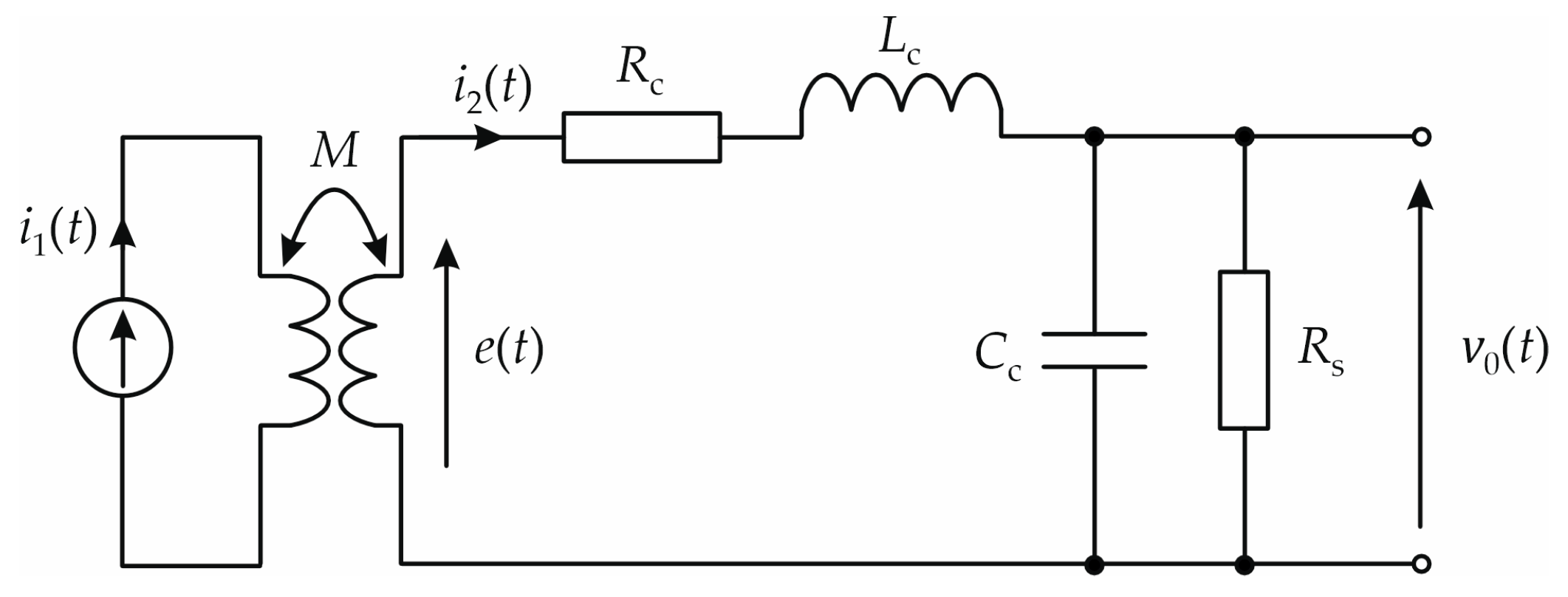
Reference [121] provides the theoretical foundations of mathematical modeling and a detailed analysis of the dynamic properties of conventional CTs, using the equivalent circuit representation shown in Figure 5.
The transfer function relating the currents I 1 and I 2 in the s domain is presented in [4,6,8,12,15,121,125,126]:
K 12 ( s ) = I 2 ( s ) I 1 ( s )
where s = j ω denotes the complex frequency variable of the Laplace transform, while j and ω are the imaginary unit and angular frequency [rad/s], respectively. In [127], the mathematical formulae necessary for deriving the transfer function given by Equation (18) are presented. The transfer function, describing the relationships between the primary and secondary currents, as well as between the primary current and the magnetizing current, enables analysis of the transformer’s dynamic response using operator calculus (Laplace transform) [128], and frequency analysis based on the Nyquist function [129].
The definition of dynamic error is presented in [116,117,118,119]. This definition is given by the following formula:
k ( t ) = 0 t k ( t τ ) x ( τ ) d τ
where k ( t ) and x ( t ) are the impulse response associated with the corresponding transfer function and the input current signal, respectively, while τ is the integration variable. The formula for determining the impulse response is presented in [129,130,131].
Based on the analysis of the impulse response, numerical studies and computer simulations were conducted, allowing assessment of the CT’s behavior under transient conditions, particularly in the presence of aperiodic components of the primary current, characteristic of faults and sudden load changes. The results showed that under such conditions, dynamic errors may reach significant values, exceeding 20–30% for the aperiodic component [13,19,25,53].
It was demonstrated that strong core saturation causes significant distortion of the secondary current. The study also pointed out that the analysis of CTs based on simplified equivalent circuits (series models) may not fully reflect the actual dynamic behavior under transient conditions. Therefore, the use of more accurate parallel models is recommended. Additionally, it was indicated that CTs should not be used as primary transducers in automation and protection systems for electric drives where high dynamic accuracy is required. A weaker aspect of the analysis presented in [121] is the assumption of linearity in the magnetizing circuit parameters, whereas in practical applications these parameters are strongly nonlinear and dependent on both the frequency and amplitude of the magnetic field. Amplitude and phase responses of CTs are also used in the analysis of dynamic properties. These characteristics play an important role in analyzing the dynamic behavior of CTs, because they describe how the transformer reproduces time-varying current signals as a function of frequency [30,122,132].
The transfer function model establishes a structured analytical framework for investigating dynamic errors in CTs by explicitly linking equivalent circuit parameters with transient waveform distortions [24,25,26,121]. This formulation enables effective assessment of ratio error and phase displacement under conditions such as core saturation or short circuits, thereby providing reliable predictive insight for protection-oriented applications [24,44,45]. It must be acknowledged, however, that the model relies on a quasilinear approximation of the magnetization characteristic and, therefore, cannot fully capture the influence of nonlinear hysteresis phenomena. Alternative formulations, including the Jiles–Atherton hysteresis model [133,134,135], can model dynamic errors more accurately, particularly in scenarios involving deep saturation and residual flux. Such nonlinear approaches, however, require extensive parameter identification and significantly higher computational effort, which constrains their routine use in standardized accuracy assessments [25,26]. Consequently, while the transfer function model remains a practical and analytically tractable tool [119], the incorporation of nonlinear hysteresis modeling represents a promising direction for future research aimed at improving the predictive accuracy of CT dynamic error analysis [24,25,26,44,45,116,117,118,119,133,134,135].
Recent research emphasizes that the practical performance of CTs is strongly influenced by their transient and frequency-response characteristics, especially under distorted and harmonic-rich conditions. As shown in [13,19,25,53], conventional CTs often exhibit delayed saturation and distortion of secondary currents during short-circuit or switching events, which directly affects their dynamic accuracy. Broadband CT designs and improved core materials have been proposed to mitigate these effects [112].
In addition, studies such as [41,131] have demonstrated that frequency response beyond the fundamental is crucial for the accuracy of harmonic measurements. Under harmonic excitation, errors in both ratio and phase displacement tend to increase with frequency, with significant degradation observed above several kilohertz. Methods for extending the usable frequency range include optimized winding arrangements and advanced compensation techniques [115].

5.3. Indicators for Dynamic Error Evaluation

Dynamic error assessment in CTs requires a comprehensive approach, as no single indicator can capture all aspects of performance in a universally valid way. The suitability of different evaluation metrics depends strongly on the engineering context. In protection systems, where rapid and reliable fault detection is paramount, emphasis is placed on peak error indicators, which reflect the maximum instantaneous deviation between the true and reproduced current. In contrast, measurement systems prioritize the long-term accuracy of energy measurement, where integral or energy-based errors provide a more representative evaluation of CT performance.
Table 14 summarizes the most widely used indicators for CT dynamic error evaluation, highlighting their advantages, limitations, and practical applicability.
The comparison shows that protection-oriented applications benefit from the use of peak error indicators, as these directly reflect a CT’s ability to handle short circuits and switching events to ensure reliable relay operation. Conversely, measurement-oriented applications require cumulative measures such as energy error, which align with long-term consumption accuracy. Although less intuitive in practice, the integral square error remains indispensable for research and model validation, particularly when benchmarking CT behavior against mathematical models and transfer-function-based formulations. Emerging approaches propose composite or adaptive indicators that integrate these perspectives, underscoring the increasingly multifunctional role of CTs in smart grids.

5.4. Dynamic Models of Non-Conventional CTs

While conventional CTs are typically represented by equivalent circuits with leakage inductances and magnetizing branches, non-conventional CTs (NCVTs) require extended models incorporating parasitic capacitances, cable parameters, and dissipative elements [30]. Compared to conventional CTs, NCVTs (e.g., Rogowski and optical CTs) exhibit a wider bandwidth but are more sensitive to external disturbances (e.g., capacitive coupling). This makes them promising for fast protection systems, yet more challenging in terms of calibration and uncertainty estimation [25,26].
The analysis of the dynamic properties of NCVTs is presented in [30]. In this work, the equivalent circuit of this type of CT was developed, as shown in Figure 6.
The study in [30] presents a detailed analysis of the time and frequency characteristics of a non-conventional CT and the impact of its behavior on the performance of protection systems. This analysis was carried out through theoretical considerations, laboratory experiments, and simulation-based studies. The paper provides a comprehensive and systematic examination of the dynamic properties of the examined CT, based on the specific parameter values of the analyzed system. However, although experimental validation is included, large-scale real-world tests remain limited, which constrains the assessment of practical performance.
In the reviewed literature on errors, uncertainties, and dynamic properties of CTs, there is a clear lack of studies focused on evaluating dynamic errors using calibration test signals (e.g., multisine, chirp, PRBS) [140], as well as on determining the upper bound of the dynamic error [116,117,118,119]. The current state of knowledge in this area is summarized below, based on an analysis of the relevant literature.
Reference [121] focuses on the analysis of dynamic errors of CTs, particularly during transient states such as short circuits or sudden load changes. In such conditions, the primary current of the CT includes an aperiodic component, which leads to strong saturation of the magnetic core and, consequently, results in significant measurement errors (the total error may reach 20–30% for the aperiodic component) [13,19,25,53]. However, this study lacks experimental validation to confirm the results obtained from simulation.
Reference [137] presents an analysis of errors in CTs operating under dynamic conditions, where the load current changes rapidly. A mathematical model of the examined CT was developed based on the Jiles–Atherton hysteresis model, which accurately reflects the nonlinear magnetic properties of the core. To quantitatively assess the dynamic errors, simulations were carried out using two types of dynamic test signals, namely, OOK (On–Off Keying) [141] and M-sequence [142], which reflect the complex operating conditions of CTs. The simulations were performed using PSCAD and MATLAB software [143]. A composite error analysis algorithm was proposed, enabling accurate determination of the CT’s dynamic error. The results showed that dynamic errors vary depending on the type of test signal:
For OOK signals, the largest errors occur at high current values;
For M-sequence signals, the highest errors appear at low current values.
Moreover, changes in CT design parameters such as core cross-section, magnetic path length, and number of turns significantly affect the magnitude of dynamic error, with the turns ratio having the most substantial impact. The M-sequence signal causes larger errors than the OOK signal, due to more frequent signal changes within a single cycle. The developed CT model and dynamic error estimation algorithm capture errors of real operating conditions, which is crucial in the context of dynamically changing loads in modern power systems. However, the study has some limitations, such as a narrow range of test signals (e.g., no analysis of PRBS—Pseudorandom Binary Sequence [144]), the omission of noise and disturbance effects [145], and the absence of comparisons with other dynamic error estimation methods.
Reference [136] describes the modeling of the dynamic behavior of CTs under fault conditions, with particular emphasis on core saturation and distortion of the secondary current. It was shown that when a fault current flows through the primary winding of the CT, its asymmetric component causes an increase in the magnetic flux, leading to core saturation. This, in turn, results in significant distortion of the secondary current, which forms the basis of dynamic error occurrence. The study presents a dynamic model of the CT, which serves as a foundation for determining the corresponding dynamic errors in both the time domain and the frequency domain. A notable weakness of this study is the lack of a quantitative analysis of the dynamic error and the limitation of simulations to only one CT type (1200/5 A).
In [138], a dynamic model of the CT is presented, along with the corresponding mathematical formulae. The secondary current waveforms of the CT are determined for different load (burden resistance) values. The results of the numerical analysis are compared with those of a practical experiment conducted for a CT with the following parameters: 30/1 A and 2.5 VA. However, the study lacks verification of the obtained results through comparison of the tested CT’s errors with those of other CTs. Nevertheless, the results—particularly in the area of mathematical modeling of the CT—may serve as a foundation for determining dynamic errors for arbitrary test signals, as well as for calculating the upper bound of the dynamic error.
In [139], an analysis of the sources of both steady-state and transient errors in CTs is presented, along with a method for error detection inspired by reinforcement learning techniques, with references to generic reinforcement learning [146] and Q-learning [147]. This method enables real-time monitoring and detection of dynamic errors in CTs, making it particularly applicable in smart grid systems. The experiments were conducted using a test platform simulating real operating conditions of CTs. The study provides formulae representing the steady-state error and transient error of CTs. Data analysis showed that the reinforcement learning-based approach can effectively identify and correct measurement errors. However, the study lacks a comparative analysis with alternative dynamic error detection methods, which limits the assessment of the proposed method’s relative performance and robustness.
Apart from electrical behavior, environmental and aging factors play a significant role in CT performance. Temperature variations affect winding resistance and the core, leading to increased uncertainty and drift in transformation accuracy [117]. Long-term aging processes, such as insulation degradation and stress-induced changes in magnetic materials, have likewise been identified as critical issues. Recent works highlight diagnostic methods for tracking these effects in real time. Thermal cycling tests and accelerated aging experiments have revealed measurable impacts on dynamic accuracy, particularly in nanocrystalline and amorphous-core CTs. Techniques such as adaptive calibration and real-time compensation algorithms [121,139] are now being explored to extend CT lifetime and maintain operational efficiency under varying environmental conditions.

5.5. Recent Advances in Dynamic Calibration of Digital CTs

In recent years, substantial progress has been reported in the domain of dynamic calibration of digital CTs, with particular emphasis on online error-monitoring frameworks closely integrated with IEC 61850 process-bus communications. State-of-the-art laboratory metrology, based on synchronous analog–digital calibration bridges, has elucidated the primary sources of measurement uncertainty and highlighted the synchronization requirements associated with sampled value (SV)-based devices. These results provide a rigorous metrological benchmark for the development and validation of field-oriented online calibration methodologies [91,132]. Contemporary implementations increasingly leverage the IEC 61850-9-2 SV protocol in combination with precision time synchronization to achieve deterministic timing performance, which is essential for the characterization of fast transient phenomena. Standardized engineering profiles further enhance interoperability, while recent investigations have systematically quantified SV latency and publishing-rate stability for calibration devices and intelligent electronic devices, including implementations on non-real-time operating systems [104,148].
To summarize recent progress, Table 15 provides an overview of representative advances in the dynamic calibration of digital CTs reported over the past five years. The entries highlight methodological approaches, implementation platforms, and technical characteristics, as well as the associated benefits in measurement accuracy, interoperability, and deployment readiness. The listed works include both laboratory metrology studies and field demonstrations, underscoring the ongoing transition of dynamic calibration techniques from experimental validation to integration in smart grid environments.
The comparative overview in Table 15 demonstrates that research on the dynamic calibration of digital CTs has evolved from metrological laboratory studies toward deployment-ready solutions for smart grid environments. Early works focused on establishing reference measurement infrastructure and addressing synchronization constraints between analog and digital outputs.

6. Conclusions

This review provides a comprehensive analysis of the state of knowledge concerning errors, uncertainties, and the dynamic accuracy of current transformers (CTs). The survey shows that although classical CTs remain indispensable in power systems, their measurement accuracy is significantly affected by nonlinear effects, core saturation, frequency dependence, transient conditions, and environmental factors. Modern approaches to CT testing increasingly emphasize precise identification of uncertainty sources and the implementation of dynamic calibration techniques. These approaches enable performance assessment under conditions where parameters undergo dynamic changes similar to those in actual operation. Recent research suggests replacing traditional calibration tests with modern methodologies that integrate real-time CT monitoring, experimental studies, and error and uncertainty modeling. The adoption of advanced signal processing, adaptive compensation algorithms, and data-driven diagnostic methods has significantly enhanced error detection and mitigation. Simultaneously, improved metrological methodologies and evolving IEC/IEEE standards provide a more robust foundation for assessing dynamic accuracy, ensuring the comparability of results across devices and manufacturers. Overall, this review highlights that accurate evaluation of CT errors and uncertainties is central to the reliability of protection, control, and monitoring systems in modern power grids. By linking metrological rigor with system-level requirements, current research paves the way toward more reliable, flexible, and secure power system operation.
Future technological frontiers are poised to substantially enhance the performance of CTs within emerging smart grid infrastructures. Real-time self-calibration frameworks, natively embedded in digital substations, can provide continuous in situ accuracy verification, thereby eliminating the dependency on costly external references. The integration of digital twin concepts with CTs adds an additional dimension, enabling predictive monitoring by virtually replicating transformer behavior under diverse loading scenarios and fault conditions, thus anticipating accuracy degradation before it affects grid operation. Moreover, the convergence of AI-driven error compensation with edge-computing architectures opens the way toward ultra-low-latency correction of ratio and phase errors directly at the device level. Collectively, these innovations outline a trajectory toward the development of intelligent, self-adapting CTs capable of meeting the stringent accuracy, interoperability, and reliability demands of next-generation power systems.

Future Directions and Recommendations

Based on the literature review and recent studies, the following research and development directions are recommended to advance the understanding and application of CT errors, uncertainties, and dynamic accuracy:
  • Error characterization and compensation:
    To develop advanced analytical and numerical models that more accurately capture error mechanisms under transient and nonlinear conditions;
    To implement adaptive correction and compensation schemes to minimize systematic and environment-dependent errors in real time.
  • Uncertainty quantification:
    To establish comprehensive frameworks for uncertainty analysis that combine laboratory calibration, simulation, and field measurements;
    To integrate dynamic uncertainty estimation into international standards (IEC/IEEE), ensuring consistency across different CT technologies and manufacturers.
  • Dynamic accuracy enhancement:
    To investigate the transient and high-frequency performance of CTs using broadband transducers and advanced signal processing techniques;
    To apply machine learning-based methods for monitoring accuracy degradation in real time without reliance on external reference devices.
  • System-level reliability and flexibility:
    To explore the role of CT accuracy and uncertainty in power system protection, stability assessment, and flexibility services;
    To develop CT monitoring methods that improve fault detection speed, selectivity, and resilience against disturbances.
  • Protection and cybersecurity aspects:
    To assess the impact of measurement errors and uncertainties on the dependability of protection schemes;
    To combine accurate CT monitoring with secure synchronization and communication frameworks, ensuring robustness of protection against both physical and cyber threats.

Author Contributions

Conceptualization, K.T.; validation, K.T. and M.S.; formal analysis, K.T., M.S., K.O. and D.O.; investigation, K.T. and M.S.; data curation, K.T.; writing—original draft preparation, K.T.; writing—review and editing, K.T., M.S., K.O. and D.O.; visualization, K.T.; supervision, K.T.; project administration, K.T. All authors have read and agreed to the published version of the manuscript.

Funding

This research was conducted at the Faculty of Electrical and Computer Engineering, Cracow University of Technology, and was financially supported by the Ministry of Science and Higher Education, Republic of Poland (grant no. E-1/2025).

Institutional Review Board Statement

Not applicable.

Informed Consent Statement

Not applicable.

Data Availability Statement

No new data were created or analyzed in this study.

Conflicts of Interest

The authors declare no conflicts of interest.

References

  1. Emanuel, A.E.; Orr, J.A. Current Harmonics Measurement by Means of Current Transformers. IEEE Trans. Power Deliv. 2007, 22, 1318–1325. [Google Scholar] [CrossRef]
  2. Stano, E.; Kaczmarek, P.; Kaczmarek, M. Understanding the Frequency Characteristics of Current Error and Phase Displacement of the Corrected Inductive Current Transformer. Energies 2022, 15, 5436. [Google Scholar] [CrossRef]
  3. Leśniewska, E.; Rajchert, R. Behaviour of Measuring Current Transformers with Cores Composed from Different Magnetic Materials at Non-Rated Loads and Overcurrents. IET Sci. Meas. Technol. 2019, 13, 1222–1228. [Google Scholar] [CrossRef]
  4. Pau, M.; Pegoraro, P.A.; Monti, A.; Muscas, C.; Ponci, F.; Sulis, S. Impact of Current and Power Measurements on Distribution System State Estimation Uncertainty. IEEE Trans. Instrum. Meas. 2018, 99, 3992–4002. [Google Scholar] [CrossRef]
  5. IEEE Standard C57.13-2016; IEEE Standard Requirements for Instrument Transformers. IEEE Power & Energy Society: Piscataway, NJ, USA, 2016.
  6. IEC 61869-2:2012; Instrument Transformers—Part 2: Additional Requirements for Current Transformers. IEC: Geneva, Switzerland, 2012.
  7. Tahir, Z.M.; Tahir, T.; Arfan, T.; Asim, A.; Fahad, M.; Rauf, S. Design and Implementation of Prepaid Energy Meter with Home Automation and Peak Load Management Using Android Application. Eng. Proc. 2023, 46, 23. [Google Scholar] [CrossRef]
  8. Vieira, D.; Shayani, R.A.; De Oliveira, M.A.G. Reactive Power Billing under Nonsinusoidal Conditions for Low-Voltage Systems. IEEE Trans. Instrum. Meas. 2017, 66, 2004–2011. [Google Scholar] [CrossRef]
  9. Dang, S.; Xiao, Y.; Wang, B.; Zhang, D.; Zhang, B.; Hu, S.; Song, H.; Xu, C.; Cai, Y. A High-Precision Error Calibration Technique for Current Transformers under the Influence of DC Bias. Energies 2023, 16, 7917. [Google Scholar] [CrossRef]
  10. Duz, F.H.d.S.; Zacarias, T.G.; Ribeiro Junior, R.F.; Steiner, F.M.; Assuncao, F.d.O.; Bonaldi, E.L.; Borges-da-Silva, L.E. Smart Monitoring of Power Transformers in Substation 4.0: Multi-Sensor Integration and Machine Learning Approach. Sensors 2025, 25, 5469. [Google Scholar] [CrossRef]
  11. ISO/IEC Guide 98-3:2008; Uncertainty of Measurement—Part 3: Guide to the Expression of Uncertainty in Measurement (GUM:1995). International Organization for Standardization/International Electrotechnical Commission: Geneva, Switzerland, 2008.
  12. Mingotti, A.; Peretto, L.; Tinarelli, R.; Ghaderi, A. Uncertainty Analysis of a Test Bed for Calibrating Voltage Transformers vs. Temperature. Sensors 2019, 19, 4472. [Google Scholar] [CrossRef]
  13. Kojovic, L.J.A. Comparative Performance Characteristics of Current Transformers and Rogowski Coils Used for Protective Relaying Purposes. In Proceedings of the IEEE Power Engineering Society General Meeting, Tampa, FL, USA, 24–28 June 2007; 1–6. [Google Scholar] [CrossRef]
  14. You, H.; Gan, M.; Duan, D.; Zhao, C.; Lv, F.; Yuan, J. Approach of Obtaining the Error of Current Transformers through the Measurement of Turns Correction Factor and Impedance. Sens. Actuators A Phys. 2024, 376, 115566. [Google Scholar] [CrossRef]
  15. Verhelst, B.; Rens, S.; Rens, J.; Knockaert, J.; Desmet, J. On the Remote Calibration of Instrumentation Transformers: Influence of Temperature. Energies 2023, 16, 4744. [Google Scholar] [CrossRef]
  16. León-Martínez, V.; Peñalvo-López, E.; Andrada-Monrós, C.; Sáiz-Jiménez, J.Á. Load Losses and Short-Circuit Resistances of Distribution Transformers According to IEEE Standard C57.110. Inventions 2023, 8, 154. [Google Scholar] [CrossRef]
  17. IEC 60044-1; Instrument Transformers—Part 1: Current Transformers. International Electrotechnical Commission: Geneva, Switzerland, 1996; Amendments 1 (2000), 2 (2002).
  18. Dirik, H.; Duran, I.U.; Gezegin, C. A Computation and Metering Method for Harmonic Emissions of Individual Consumers. IEEE Trans. Instrum. Meas. 2019, 68, 412–420. [Google Scholar] [CrossRef]
  19. Kaczmarek, M. Inductive Current Transformer Accuracy of Transformation for the PQ Measurements. Electr. Power Syst. Res. 2017, 150, 169–176. [Google Scholar] [CrossRef]
  20. Rönnberg, S.; Bollen, M. Power Quality Issues in the Electric Power System of the Future. Electr. J. 2016, 29, 49–61. [Google Scholar] [CrossRef]
  21. Cristaldi, L.; Faifer, M.; Laurano, C.; Ottoboni, R.; Toscani, S.; Zanoni, M. A Low-Cost Generator for Testing and Calibrating Current Transformers. IEEE Trans. Instrum. Meas. 2019, 68, 2792–2799. [Google Scholar] [CrossRef]
  22. Faifer, M.; Laurano, C.; Ottoboni, R.; Toscani, S. Low-Cost High-Performance Generator for Testing Current Transformers Based on Frequency-Domain Feedback. In Proceedings of the IEEE 13th International Workshop on Applied Measurements for Power Systems (AMPS), Caserta, Italy, 18–20 September 2024; pp. 1–6. [Google Scholar] [CrossRef]
  23. Ballal, M.S.; Wath, M.G.; Suryawanshi, H.M. A Novel Approach for the Error Correction of CT in the Presence of Harmonic Distortion. IEEE Trans. Instrum. Meas. 2019, 68, 4015–4027. [Google Scholar] [CrossRef]
  24. Stano, E.; Kaczmarek, M. A Practical Approach to Evaluation of Accuracy of Inductive Current Transformer for Transformation of Distorted Current Higher Harmonics. Electr. Power Syst. Res. 2015, 119, 258–265. [Google Scholar] [CrossRef]
  25. Stano, E.; Kaczmarek, M. Wideband Self-Calibration Method of Inductive CTs and Verification of Determined Values of Current and Phase Errors at Harmonics for Transformation of Distorted Current. Sensors 2020, 20, 2167. [Google Scholar] [CrossRef]
  26. Kaczmarek, M.; Stano, E. Proposal for extension of routine tests of the inductive current transformers to evaluation of transformation accuracy of higher harmonics. Int. J. Electr. Power Energy Syst. 2019, 113, 842–849. [Google Scholar] [CrossRef]
  27. Salah, O.; Atwa, E. Practical Power System and Protective Relays Commissioning; Elsevier Inc.: Amsterdam, The Netherlands, 2019; ISBN 978-0-12-816858-5. [Google Scholar] [CrossRef]
  28. Kaczmarek, M.; Pacholczyk, B. Development of Inductive Current Transformer 400/5/1 of Class 0.2S for Frequency Range 50 Hz–5 kHz. Sensors 2024, 24, 8011. [Google Scholar] [CrossRef] [PubMed]
  29. Burgund, D.; Nikolovski, S. Comparison of Functionality of Non-Conventional Instrument Transformers and Conventional Current Transformers in Distribution Networks. In Proceedings of the International Conference on Smart Systems and Technologies, Osijek, Croatia, 19–21 October 2022; IEEE: New York, NY, USA, 2022; pp. 55–60. [Google Scholar] [CrossRef]
  30. Wang, Y.; Li, J.; Hu, Y.; An, R.; Cai, Z.; He, R. Analysis on the Transfer Characteristics of Rogowski-coil Current Transformer and Its Influence on Protective Relaying. Energy Power Eng. 2013, 5, 1324–1329. [Google Scholar] [CrossRef]
  31. Ramboz, J.D. Machinable Rogowski Coil, Design, and Calibration. IEEE Trans. Instrum. Meas. 1996, 45, 511–515. [Google Scholar] [CrossRef]
  32. Frigo, G.; Agustoni, M. Calibration of a Digital Current Transformer Measuring Bridge: Metrological Challenges and Uncertainty Contributions. Metrology 2021, 1, 93–106. [Google Scholar] [CrossRef]
  33. IEC 61850; Communication Networks and Systems for Power Utility Automation. International Electrotechnical Commission: Geneva, Switzerland, 2004.
  34. Ponomarev, S.V.; Trapeznikova, E.S. Combined Digital Current and Voltage Transformer for Medium Voltage Networks. In Proceedings of the 25th International Conference of Young Professionals in Electron Devices and Materials (EDM), Altai, Russia, 5 August 2024; IEEE: Piscataway, NJ, USA, 2024; pp. 1520–1524. [Google Scholar] [CrossRef]
  35. Djokić, B.V.; Parks, H.; Wise, N.; Naumović-Vuković, D.; Škundrić, S.P.; Žigić, A.D. A Comparison of Two Current Transformer Calibration Systems at NRC Canada. IEEE Trans. Instrum. Meas. 2016, 66, 1628–1635. [Google Scholar] [CrossRef]
  36. Kaczmarek, M.; Kaczmarek, P.; Stano, E. The Reference Wideband Inductive Current Transformer. Energies 2023, 16, 7307. [Google Scholar] [CrossRef]
  37. Mohns, E.; Roeissle, G.; Fricke, S.; Pauling, F. An AC Current Transformer Standard Measuring System for Power Frequencies. IEEE Trans. Instrum. Meas. 2017, 66, 1433–1440. [Google Scholar] [CrossRef]
  38. Brandolini, A.; Faifer, M.; Ottoboni, R. A Simple Method for the Calibration of Traditional and Electronic Measurement Current and Voltage Transformers. IEEE Trans. Instrum. Meas. 2009, 58, 1345–1353. [Google Scholar] [CrossRef]
  39. Altin, N.; Sefa, İ. dSPACE Based Adaptive Neuro-Fuzzy Controller of Grid Interactive Inverter. Energy Convers. Manag. 2012, 56, 130–139. [Google Scholar] [CrossRef]
  40. Chen, H.; Qian, Z.; Liu, C.; Wu, J.; Li, W.; He, X. Time-Multiplexed Self-Powered Wireless Current Sensor for Power Transmission Lines. Energies 2021, 14, 1561. [Google Scholar] [CrossRef]
  41. Kondrath, N.; Kazimierczuk, M.K. Bandwidth of Current Transformers. IEEE Trans. Instrum. Meas. 2009, 58, 2008–2016. [Google Scholar] [CrossRef]
  42. Zhang, B.W. A Theoretical Study on the Transfer Impedance of a Plane Current Probe. Appl. Mech. Mater. 2011, 63–64, 673–677. [Google Scholar] [CrossRef]
  43. Marjanović, M.; Ilić, S.D.; Veljković, S.; Mitrović, N.; Gurer, U.; Yilmaz, O.; Kahraman, A.; Aktag, A.; Karacali, H.; Budak, E.; et al. The SPICE Modeling of a Radiation Sensor Based on a MOSFET with a Dielectric HfO2/SiO2 Double-Layer. Sensors 2025, 25, 546. [Google Scholar] [CrossRef]
  44. Dashti, H. Discriminating Transformer Large Inrush Currents from Fault Currents. Int. J. Electr. Power Energy Syst. 2016, 75, 74–82. [Google Scholar] [CrossRef]
  45. Solovev, D.B. Instrument Current Transducer for Measurements in Asymmetrical Conditions in Three-Phase Circuits with Upper Harmonics. Int. J. Electr. Power Energy Syst. 2017, 84, 195–201. [Google Scholar] [CrossRef]
  46. Chojowski, M.; Baszyński, M.; Sosnowski, R.; Dziadecki, A. High-Frequency Current Transformers Cascade for Power Electronics Measurements. Sensors 2022, 22, 5846. [Google Scholar] [CrossRef] [PubMed]
  47. Kaczmarek, M.; Kaczmarek, P. Comparison of the Wideband Power Sources Used to Supply Step-Up Current Transformers for Generation of Distorted Currents. Energies 2020, 13, 1849. [Google Scholar] [CrossRef]
  48. Zhong, M.; Tong, X.; Liu, X. A New Fast PWM Modulation Strategy for Power Electric Converter Based on Finite Set State Machine Theory. Energy Rep. 2023, 9, 90–96. [Google Scholar] [CrossRef]
  49. Bauer, J.; Ripka, P.; Draxler, K.; Styblikova, R. Demagnetization of Current Transformers Using PWM Burden. IEEE Trans. Magn. 2015, 51, 1–4. [Google Scholar] [CrossRef]
  50. Brodecki, D.; Stano, E.; Andrychowicz, M.; Kaczmarek, P. EMC of Wideband Power Sources. Energies 2021, 14, 1457. [Google Scholar] [CrossRef]
  51. IEC 61326-1; Electrical Equipment for Measurement, Control and Laboratory Use—EMC Requirements—Part 1: General Requirements. International Electrotechnical Commission: Geneva, Switzerland, 2020.
  52. Zajec, P. Current Ratio and Stability Issues of Electronically Enhanced Current Transformer Stimulated by Stray Inter-Winding Capacitance and Secondary-Side Disturbance Voltage. Sensors 2022, 22, 7565. [Google Scholar] [CrossRef]
  53. Mahtani, K.; Guerrero, J.M.; Platero, C.A. Improved Instantaneous Current Value-Based Protection Methods for Faulty Synchronizations of Synchronous Generators. Electronics 2024, 13, 4747. [Google Scholar] [CrossRef]
  54. Cataliotti, A.; Cosentino, V.; Crotti, G.; Delle Femine, A.; Di Cara, D.; Gallo, D.; Giordano, D.; Landi, C.; Luiso, M.; Modarres, M.; et al. Compensation of Nonlinearity of Voltage and Current Instrument Transformers. IEEE Trans. Instrum. Meas. 2018, 68, 1322–1332. [Google Scholar] [CrossRef]
  55. Stano, E.; Kaczmarek, M. Analytical Method to Determine the Values of Current Error and Phase Displacement of Inductive Current Transformers during Transformation of Distorted Currents Higher Harmonics. Measurement 2022, 200, 111664. [Google Scholar] [CrossRef]
  56. Rom, M.; van den Brom, H.E.; Houtzager, E.; van Leeuwen, R.; van der Born, D.; Rietveld, G.; Muñoz, F. Measurement System for Current Transformer Calibration from 50 Hz to 150 kHz Using a Wideband Power Analyzer. Sensors 2025, 25, 5429. [Google Scholar] [CrossRef]
  57. Shaikh, M.S.; Lin, H.; Xie, S.; Dong, X.; Lin, Y.; Shiva, C.K.; Mbasso, W.F. An Intelligent Hybrid Grey Wolf–Particle Swarm Optimizer for Optimization in Complex Engineering Design Problem. Sci. Rep. 2025, 15, 18313. [Google Scholar] [CrossRef]
  58. Abdulhakeem, R.M.; Kircay, A.; Antar, R.K. Renewable Power Energy Management for Single and Three-Phase Inverters Design. Energy Rep. 2024, 12, 3096–3113. [Google Scholar] [CrossRef]
  59. Azizi, A.; Akhbari, M.; Danyali, S.; Tohidinejad, Z.; Shirkhani, M. A Review on Topology and Control Strategies of High-Power Inverters in Large-Scale Photovoltaic Power Plants. Heliyon 2025, 11, e42334. [Google Scholar] [CrossRef]
  60. Chen, L.; Li, X.; Yang, L. An Online Method for the Accuracy Level Evaluation of the Phasor Measurement Units. Int. J. Electr. Power Energy Syst. 2024, 156, 109763. [Google Scholar] [CrossRef]
  61. IEC/IEEE 60255-118-1; Measuring Relays and Protection Equipment—Part 118-1: Synchrophasor for Power Systems—Measurements. International Electrotechnical Commission: Geneva, Switzerland; Institute of Electrical and Electronics Engineers: New York, NY, USA, 2018.
  62. Mohsenian-Rad, H.; Kezunovic, M.; Rahmatian, F. Synchro-Waveforms in Wide-Area Monitoring, Control, and Protection: Real-World Examples and Future Opportunities. IEEE Power Energy Mag. 2025, 23, 69–80. [Google Scholar] [CrossRef]
  63. Oinonen, M.; Morsi, W.G. Real-Time Detection of Insider Attacks on Substation Automation Systems Using Short Length Orthogonal Wavelet Filters and OPAL-RT. Int. J. Electr. Power Energy Syst. 2024, 162, 110311. [Google Scholar] [CrossRef]
  64. Almasabi, S.; Alsuwian, T.; Awais, M.; Irfan, M.; Jalalah, M.; Aljafari, B.; Harraz, F.A. False Data Injection Detection for Phasor Measurement Units. Sensors 2022, 22, 3146. [Google Scholar] [CrossRef] [PubMed]
  65. Hu, H.; Xu, K.; Zhang, X.; Li, F.; Zhu, L.; Xu, R.; Li, D. Research on Predictive Maintenance Methods for Current Transformers with Iron Core Structures. Electronics 2025, 14, 625. [Google Scholar] [CrossRef]
  66. Dolinar, M.; Štumberger, G.; Polajžer, B.; Dolinar, D. Determining the Magnetically Nonlinear Characteristics of a Three Phase Core-Type Power Transformer. J. Magn. Magn. Mater. 2006, 304, 813–815. [Google Scholar] [CrossRef]
  67. Li, Z.; Chen, X.; Wu, L.; Ahmed, A.-S.; Wang, T.; Zhang, Y.; Li, H.; Li, Z.; Xu, Y.; Tong, Y. Error Analysis of Air-Core Coil Current Transformer Based on Stacking Model Fusion. Energies 2021, 14, 1912. [Google Scholar] [CrossRef]
  68. Januário, M.; Kuo-Peng, P.; Batistela, N.J. Modelling of the Impedance Frequency Response of Transformers at No Load and under Nominal Conditions. IET Electr. Power Appl. 2015, 9, 412. [Google Scholar] [CrossRef]
  69. Majorkowska-Mech, D.; Cariow, A. Some FFT Algorithms for Small-Length Real-Valued Sequences. Appl. Sci. 2022, 12, 4700. [Google Scholar] [CrossRef]
  70. Fox, S.; Collins, R.; Boxall, J. Traditional Leakage Models for Leakage Modelling: Effective or Not? Procedia Eng. 2015, 119, 35–42. [Google Scholar] [CrossRef][Green Version]
  71. Zhu, Q.; Su, Y. A Non-inductive Coil Design Used to Provide High-Frequency and Large Currents. Sensors 2024, 24, 2027. [Google Scholar] [CrossRef]
  72. Malepe, L.; Ndungu, P.; Ndinteh, T.D.; Mamo, M.A. An In-Situ FTIR-LCR Meter Technique to Study the Sensing Mechanism of MnO2ZIF-8/CNPs and a Direct Relationship between the Sensitivity of the Sensors and the Rate of Surface Reaction. Results Phys. 2023, 52, 106864. [Google Scholar] [CrossRef]
  73. Inácio, P.M.C.; Guerra, R.; Stallinga, P. An Ultra-Low-Cost RCL-Meter. Sensors 2022, 22, 2227. [Google Scholar] [CrossRef] [PubMed]
  74. Wan, C.; Zhou, Z.; Li, S.; Ding, Y.; Xu, Z.; Yang, Z.; Xia, Y.; Yin, F. Development of a Bridge Management System Based on the Building Information Modeling Technology. Sustainability 2019, 11, 4583. [Google Scholar] [CrossRef]
  75. Wang, X.; Li, H.; Liu, H.; Ding, X.; Wang, J.; Zhao, P.; Jiang, H. High-Precision, Wide-Ratio, Self-Balancing Current Comparator. Sensors 2025, 25, 5289. [Google Scholar] [CrossRef] [PubMed]
  76. Kaczmarek, M.; Stano, E. New Approach to Evaluate the Transformation Accuracy of Inductive CTs for Distorted Current. Energies 2023, 16, 3026. [Google Scholar] [CrossRef]
  77. Tiliouine, I.; Leventoux, Y.; Orlianges, J.-C.; Crunteanu, A.; Froidevaux, M.; Merdji, H.; Février, S. High-Harmonic Generation in an Optical Fiber Functionalized with Zinc Oxide Thin Films. Photonics 2025, 12, 82. [Google Scholar] [CrossRef]
  78. Naumovic-Vukovic, D.; Skundric, S. Contribution to the calibration of current transformers with a rated secondary current of less than 1A. Meas. Sens. 2025, 38, 101428. [Google Scholar] [CrossRef]
  79. Cultrera, A.; Germito, G.; Serazio, D.; Galliana, F.; Trinchera, B.; Aprile, G.; Chirulli, M.; Callegaro, L. Active Energy Meters Tested in Realistic Non-Sinusoidal Conditions Recorded on the Field and Reproduced in Laboratory. Energies 2024, 17, 1403. [Google Scholar] [CrossRef]
  80. Fahad, M.; Shahid, A.; Manumachu, R.R.; Lastovetsky, A. A Comparative Study of Methods for Measurement of Energy of Computing. Energies 2019, 12, 2204. [Google Scholar] [CrossRef]
  81. Li, L.; Huang, H.; Zhao, F.; Gao, M.; Liu, Z.; Sutherland, J.W. Power Measurement in Energy Efficient Manufacturing: Accuracy Analysis, Challenges, and Perspectives for Improvement. Procedia CIRP 2019, 80, 138–143. [Google Scholar] [CrossRef]
  82. Veselý, T.; Smrčka, P.; Kliment, R.; Vítězník, M.; Hon, Z.; Hána, K. Accuracy Improvement of Energy Expenditure Estimation Through Neural Networks: A Pilot Study. AI 2024, 5, 2914–2925. [Google Scholar] [CrossRef]
  83. Faifer, M.; Laurano, C.; Ottoboni, R.; Toscani, S. A New Method to Represent the Harmonic Measurement Accuracy of Current Transformers. IEEE Trans. Instrum. Meas. 2024, 73, 9001611. [Google Scholar] [CrossRef]
  84. Sidorov, D.; Tynda, A.; Muratov, V.; Yanitsky, E. Volterra Black-Box Models Identification Methods: Direct Collocation vs. Least Squares. Mathematics 2024, 12, 227. [Google Scholar] [CrossRef]
  85. Aboites, V.; Bravo-Avilés, J.F.; García-López, J.H.; Jaimes-Reategui, R.; Huerta-Cuellar, G. Interpretation and Dynamics of the Lotka–Volterra Model in the Description of a Three-Level Laser. Photonics 2022, 9, 16. [Google Scholar] [CrossRef]
  86. Chen, K.S.; Lin, K.P.; Yan, J.X.; Hsieh, W.L. Renewable Power Output Forecasting Using Least-Squares Support Vector Regression and Google Data. Sustainability 2019, 11, 3009. [Google Scholar] [CrossRef]
  87. Kim, S.; Kim, Y.J.; Choi, S. The Development of a MATLAB/Simulink-SCADA/EMS-Integrated Framework for Microgrid Pre-Validation. Energies 2025, 18, 2739. [Google Scholar] [CrossRef]
  88. Ochkov, V.; Vasileva, I.; Orlov, K.; Chudova, J.; Tikhonov, A. Visualization in Mathematical Packages When Teaching with Information Technologies. Mathematics 2022, 10, 3413. [Google Scholar] [CrossRef]
  89. Leśniewska, E. Influence of the Selection of the Core Shape and Winding Arrangement on the Accuracy of Current Transformers with Through-Going Primary Cable. Energies 2021, 14, 1932. [Google Scholar] [CrossRef]
  90. Chaves, T.R.; Martins, M.A.I.; Martins, K.A.; de Macedo, A.F.; de Francisci, S. Application Study in the Field of Solutions for the Monitoring Distribution Transformers of the Overhead Power Grid. Energies 2021, 14, 6072. [Google Scholar] [CrossRef]
  91. Teng, J.; Wang, S.; Jiang, L.; Xie, W.; Fang, C.; Liu, S. An Online Self-Correction Method to Improve Accuracy of Split-Core Current Transformer in Low-Voltage Distribution Networks. Measurement 2022, 195, 111052. [Google Scholar] [CrossRef]
  92. Hong, Y. Measurement Analysis of Three Phase Intelligent Electricity Meter Based on Nonlinear Load. Meas. Sens. 2024, 33, 101215. [Google Scholar] [CrossRef]
  93. Jing, Z.; Gong, Y.; Cai, H.; Tang, H. Research on the Three-Dimensional Electromagnetic Positioning Method Based on Spectrum Line Interpolation. Electronics 2023, 12, 3988. [Google Scholar] [CrossRef]
  94. De Gersem, H.; Hameyer, K.; Weiland, T. Field–Circuit Coupled Models in Electromagnetic Simulation. J. Comput. Appl. Math. 2004, 168, 125–133. [Google Scholar] [CrossRef]
  95. Kaczmarek, M.; Kaczmarek, P.; Stano, E. The Performance of the High-Current Transformer during Operation in the Wide Frequencies Range. Energies 2022, 15, 7208. [Google Scholar] [CrossRef]
  96. Isaiev, V.; Velychko, O. Metrological Characterisation of Current Transformers Calibration Unit for Accurate Measurement. Acta IMEKO 2021, 10, 6–13. [Google Scholar] [CrossRef]
  97. Dong, B.; Gu, Y.; Gao, C.; Zhang, Z.; Wen, T.; Li, K. Three-Dimensional Electro-Thermal Analysis of a New Type Current Transformer Design for Power Distribution Networks. Energies 2021, 14, 1792. [Google Scholar] [CrossRef]
  98. Wang, J.; He, J.; Chen, X.; Tian, T.; Yao, C.; Abu-Siada, A. Power Transformer Short-Circuit Force Calculation Using Three and Two-Dimensional Finite-Element Analysis. Energies 2025, 18, 3898. [Google Scholar] [CrossRef]
  99. Bonavolontà, F.; Liccardo, A.; Mottola, F.; Proto, D. Real-Time Monitoring of Energy Contributions in Renewable Energy Communities Through an IoT Measurement System. Sensors 2025, 25, 1402. [Google Scholar] [CrossRef]
  100. Din, J.; Su, H. Blockchain-Enabled Smart Grids for Optimized Electrical Billing and Peer-to-Peer Energy Trading. Energies 2024, 17, 5744. [Google Scholar] [CrossRef]
  101. Samanta, S.; Yang, B.; Seo, G.-S. Stability Analysis of Power Systems with High Penetration of State-of-the-Art Inverter Technologies. Energies 2025, 18, 3645. [Google Scholar] [CrossRef]
  102. Ribas Monteiro, L.F.; Rodrigues, Y.R.; Zambroni de Souza, A.C. Cybersecurity in Cyber–Physical Power Systems. Energies 2023, 16, 4556. [Google Scholar] [CrossRef]
  103. Ikwuagwu, C.V.; Ajah, S.A. Estimated Energy Consumption and Billing Modelling Using Power Availability Recorder. e-Prime—Adv. Electr. Eng. Electron. Energy. 2023, 6, 100307. [Google Scholar] [CrossRef]
  104. Agustoni, M.; Frigo, G. Characterization of Sampled Value Streams in Non Real-Time Calibration Systems. Energies 2022, 15, 3245. [Google Scholar] [CrossRef]
  105. Li, T.; Liu, Q.; Zheng, F.; Chen, Y.; Li, Z. Online Evaluation of Error State of Current Transformer Based on Data Analysis. Scalable Comput. Pract. Exp. 2025, 26, 1317–1325. [Google Scholar] [CrossRef]
  106. Agustoni, M.; Castello, P.; Frigo, G. Phasor Measurement Unit With Digital Inputs: Synchronization and Interoperability Issues. IEEE Trans. Instrum. Meas. 2022, 71, 5501910. [Google Scholar] [CrossRef]
  107. Fan, X.; Guo, X.; Wang, B.; Wu, B.; Ma, X.; Lu, L. Research on Current Transformer Error Verification System Based on Digital Comparison Method. In Proceedings of the 2024 8th International Conference on Electrical, Mechanical and Computer Engineering (ICEMCE), Xi’an, China, 25–27 October 2024; IEEE: New York, NY, USA, 2024. [Google Scholar] [CrossRef]
  108. Kuhlmann de Canaviri, L.; Meiszl, K.; Hussein, V.; Abbassi, P.; Mirraziroudsari, S.D.; Hake, L.; Potthast, T.; Ratert, F.; Schulten, T.; Silberbach, M.; et al. Static and Dynamic Accuracy and Occlusion Robustness of SteamVR Tracking 2.0 in Multi-Base Station Setups. Sensors 2023, 23, 725. [Google Scholar] [CrossRef] [PubMed]
  109. Bertuletti, S.; Cereatti, A.; Comotti, D.; Caldara, M.; Della Croce, U. Static and Dynamic Accuracy of an Innovative Miniaturized Wearable Platform for Short Range Distance Measurements for Human Movement Applications. Sensors 2017, 17, 1492. [Google Scholar] [CrossRef] [PubMed]
  110. Burgund, D.; Nikolovski, S.; Galić, D.; Maravić, N. Pearson Correlation in Determination of Quality of Current Transformers. Sensors 2023, 23, 2704. [Google Scholar] [CrossRef]
  111. Wang, S. Application of Dynamic Accuracy Evaluation for Press Systems Based on Orthogonal Design Method. MethodsX 2024, 12, 102568. [Google Scholar] [CrossRef]
  112. Aihara, T.; Kamio, C.; Hara, Y.; Ito, K.; Jujo, K. Dynamic Accuracy Measurement System for Mechanical Wristwatch. Precis. Eng. 2021, 70, 117–123. [Google Scholar] [CrossRef]
  113. Tomczyk, K.; Beńko, P.; Ostrowska, K. Maximum Energy Density for Evaluation of the Dynamic Accuracy of LVDT Sensors Applied in the Energy Industry. Energies 2024, 17, 5525. [Google Scholar] [CrossRef]
  114. Dichev, D.; Diakov, D.; Zhelezarov, I.; Valkov, S.; Ormanova, M.; Dicheva, R.; Kupriyanov, O. A Method for Correction of Dynamic Errors When Measuring Flat Surfaces. Sensors 2024, 24, 5154. [Google Scholar] [CrossRef] [PubMed]
  115. Wang, X.; Wang, J.; Yuan, R.; Jiang, Z. Dynamic Error Testing Method of Electricity Meters by a Pseudo Random Distorted Test Signal. Appl. Energy 2019, 249, 67–78. [Google Scholar] [CrossRef]
  116. Layer, E. Modelling of Simplified Dynamical Systems; Springer: Berlin, Germany, 2002; ISBN 978-3642560989. [Google Scholar]
  117. Tomczyk, K. Procedure Proposal for Establishing the Class of Dynamic Accuracy for Measurement Sensors Using Simulation Signals with One Constraint. Measurement 2021, 178, 109367. [Google Scholar] [CrossRef]
  118. Tomczyk, K.; Kowalczyk, M. Assessment of uncertainties when determining the upper bound on the dynamic error in the measurement of cutting forces. Measurement 2025, 249, 116997. [Google Scholar] [CrossRef]
  119. Tomczyk, K.; Piekarczyk, M.; Sokal, G. Radial Basis Functions Intended to Determine the Upper Bound of Absolute Dynamic Error at the Output of Voltage-Mode Accelerometers. Sensors 2019, 19, 4154. [Google Scholar] [CrossRef]
  120. Verma, B.; Padhy, P.K. Integral-Square-Error Based Normalized Relative Gain Array for the Input-Output Pairing and Equivalent Transfer Function Design of MIMO Processes. IETE J. Res. 2021, 69, 5975–5985. [Google Scholar] [CrossRef]
  121. Solovev, D.B.; Gorkavyy, M.A. Current Transformers: Transfer Functions, Frequency Response, and Static Measurement Error. In Proceedings of the 2019 International Science and Technology Conference EastConf, Vladivostok, Russia, 20–21 September 2019; IEEE: New York, NY, USA, 2019; pp. 1–7. [Google Scholar] [CrossRef]
  122. Yu, W.; Shen, H.; Hu, D.; Ni, S.; Wu, C.; Lu, X. Modeling and Transfer Characteristics Simulation Analysis of Electronic Current Transformers. J. Phys. Conf. Ser. 2024, 2903, 012012. [Google Scholar] [CrossRef]
  123. Koul, S. Comprehensive Overview of Current Transformer. Int. J. Eng. Res. Technol. 2024, 1–10. Available online: https://www.ijert.org (accessed on 1 October 2024).
  124. Li, X. Mathematical Model for Current Transformer Based On Jiles-Atherton Theory and Saturation Detection Method. Master’s Thesis, University of Kentucky, Lexington, KY, USA, 2016; pp. 1–85. [Google Scholar] [CrossRef]
  125. Stojčić, B. Current Distribution in the Low-Voltage Winding of the Furnace Transformer. Int. J. Electr. Power Energy Syst. 2012, 43, 1251–1258. [Google Scholar] [CrossRef]
  126. Theodoridis, S.; Chellappa, R. Academic Press Library in Signal Processing: Signal Processing Theory and Machine Learning; Academic Press: Cambridge, MA, USA, 2013; ISBN 978-012-39-7226-2. [Google Scholar] [CrossRef]
  127. Gómez, P.; Uribe, F.A. The Numerical Laplace Transform: An Accurate Technique for Analyzing Electromagnetic Transients on Power System Devices. Int. J. Electr. Power Energy Syst. 2009, 31, 116–123. [Google Scholar] [CrossRef]
  128. Hasheminejad, S. A New Protection Method for the Power Transformers Using Teager Energy Operator and a Fluctuation Identifier Index. Electr. Power Syst. Res. 2022, 213, 108776. [Google Scholar] [CrossRef]
  129. Corsi, S. Voltage Control and Protection in Electrical Power Systems: From System Components to Wide-Area Control; Springer: Berlin/Heidelberg, Germany, 2015; ISBN 978-1-4471-6635-1. [Google Scholar] [CrossRef]
  130. May, L.; Farzaneh, N.; Das, O.; Abel, J.S. Comparison of Impulse Response Generation Methods for a Simple Shoebox-Shaped Room. Acoustics 2025, 7, 56. [Google Scholar] [CrossRef]
  131. Cataliotti, A.; Di Cara, D.; Nuccio, S. Frequency Response of Measurement Current Transformers. In Proceedings of the 2008 IEEE Instrumentation and Measurement Technology Conference (IMTC), Victoria, BC, Canada, 12–15 May 2008. [Google Scholar] [CrossRef]
  132. Hu, H.; Xu, Y.; Wu, X.; Lin, F.; Xiao, X.; Lei, M. Passive-compensation clamp-on two-stage current transformer for online calibration. IET Sci. Meas. Technol. 2021, 15, 730–737. [Google Scholar] [CrossRef]
  133. Zhao, J.; Zhou, J.; Zhang, L.; Sun, J. State Space Representation of Jiles–Atherton Hysteresis Model and Application for Closed-Loop Control. Materials 2024, 17, 3695. [Google Scholar] [CrossRef]
  134. Regan, A.; Wilson, J.; Peyton, A.J. Extension to the Jiles—Atherton Hysteresis Model Using Gaussian Distributed Parameters for Quenched and Tempered Engineering Steels. Sensors 2025, 25, 1328. [Google Scholar] [CrossRef]
  135. Xue, G.; Bai, H.; Li, T.; Ren, Z.; Liu, X.; Lu, C. Numerical Solving Method for Jiles-Atherton Model and Influence Analysis of the Initial Magnetic Field on Hysteresis. Mathematics 2022, 10, 4431. [Google Scholar] [CrossRef]
  136. Noshad, B. Dynamic Analysis of a Current Transformer during Electrical Faults. Int. J. Adv. Innov. Res. 2014, 3, 270–273. [Google Scholar]
  137. Xue, R.; Wang, X.; Wang, J.; Qiu, L.; Li, B.; Cao, M. The Dynamic Error Analysis of the Current Transformer. In Proceedings of the 23rd IMEKO TC4 International Symposium—Electrical & Electronic Measurements Promote Industry 4.0, Xi’an, China, 17–20 September 2019. [Google Scholar]
  138. Tümay, M.; Simpson, R.R.S.; El-Khatroushi, H. Dynamic Model of a Current Transformer. Int. J. Electr. Eng. Educ. 2000, 37, 247–258. [Google Scholar] [CrossRef]
  139. Song, H.; Hu, L. Dynamic Measurement Error Detection Method of High Voltage Current Transformer Based on Reinforcement Learning. In Proceedings of the 2021 International Conference on Wireless Communications and Smart Grid (ICWCSG), Guilin, China, 20–22 August 2021; IEEE: Piscataway, NJ, USA, 2021. [Google Scholar] [CrossRef]
  140. Maringolo, I.; Carvalho, A.Z.; Rocha, D.L. Simple multi-signal calibrations exploiting flow analysis systems. Talanta 2024, 272, 125787. [Google Scholar] [CrossRef] [PubMed]
  141. Xu, W.; Ji, X.; Zhu, R. Covert Communication Scheme for OOK in Asymmetric Noise Systems. Sensors 2025, 25, 2948. [Google Scholar] [CrossRef] [PubMed]
  142. Song, X.; Wang, X.; Dong, Z.; Zhao, X.; Feng, X. Analysis of Pseudo-Random Sequence Correlation Identification Parameters and Anti-Noise Performance. Energies 2018, 11, 2586. [Google Scholar] [CrossRef]
  143. Cai, Z.; Wang, Y.; Zhang, D.; Wen, L.; Liu, H.; Xiong, Z.; Wajid, K.; Feng, R. Digital Twin Modeling for Hydropower System Based on Radio Frequency Identification Data Collection. Electronics 2024, 13, 2576. [Google Scholar] [CrossRef]
  144. Yang, K.; Feng, Z.; Niu, P.; Song, Z.; Meng, J. Fast impedance measurement method for large capacity batteries using chirp and filtered pseudo-random binary sequence. J. Power Sources 2024, 624, 235587. [Google Scholar] [CrossRef]
  145. Wei, J.; Chammam, A.; Feng, J.; Alshammari, A.; Tehranian, K.; Innab, N.; Deebani, W.; Shutaywi, M. Power system monitoring for electrical disturbances in wide network using machine learning. Sustain. Comput. Inform. Syst. 2024, 42, 100959. [Google Scholar] [CrossRef]
  146. Shakya, A.K.; Pillai, G.; Chakrabarty, S. Reinforcement Learning Algorithms: A Brief Survey. Expert Syst. Appl. 2023, 231, 120495. [Google Scholar] [CrossRef]
  147. Mienye, I.D.; Swart, T.G. A Comprehensive Review of Deep Learning: Architectures, Recent Advances, and Applications. Information 2024, 15, 755. [Google Scholar] [CrossRef]
  148. IEC/IEEE 61850-9-2:2011+AMD1:2020; Communication Networks and Systems for Power Utility Automation—Part 9-2: Specific Communication Service Mapping (SCSM)—Sampled Values over ISO/IEC 8802-3. IEC/IEEE: Geneva, Switzerland, 2020.
  149. Li, Z.; Du, Y.; Abu-Siada, A.; Li, Z.; Zhang, T. A New Online Temperature Compensation Technique for Electronic Instrument Transformers. IEEE Access 2019, 7, 97614–97623. [Google Scholar] [CrossRef]
  150. Frigo, G.; Agustoni, M. Phasor Measurement Unit and Sampled Values: Measurement and Implementation Challenges. In Proceedings of the 2021 IEEE 11th International Workshop on Applied Measurements for Power Systems (AMPS), Cagliari, Italy, 29 September–1 October 2021; pp. 1–6. [Google Scholar] [CrossRef]
Figure 1. Test bench used for the error measurement (a) and the structure of a multilayer neural network (b) [23]. System configuration: programmable AC source injects the primary current: 1–2000 A, 45–65 Hz; series primary resistor R s p : 10–50 mΩ; secondary shunt R s s : 0.1–1 Ω; rated burden Z b : 1–15 VA, representing the secondary load, while a host computer with a data acquisition card (50 kHz–1 MHz) records and processes measurement signals.
Energies 18 04995 g001
Figure 2. Equivalent model of a CT with the primary-side capacitance reflected to the secondary side [41]: i —measured current, n —number of turns, C p / n 2 —equivalent parasitic capacitance of primary winding referred to secondary (pF–nF range), L m —magnetizing inductance on the secondary side (mH–H range), R c —core equivalent parallel resistance (100 kΩ–1 MΩ), L l —leakage inductance of the secondary winding (µH–mH), R s —secondary winding resistance (0.1–10 Ω), C —stray capacitance (pF–µF), L R —inductance of the sense resistor (µH–mH), R —sense resistor (1–15 Ω, depending on the burden), v R —voltage across the sense resistor.
Energies 18 04995 g002
Figure 3. Excitation branches on the primary (a) and secondary (b) sides [14]. The formula for the CT error, based on the turns correction factor and the impedance, is given below.
Energies 18 04995 g003
Figure 4. Distribution of CT error studies (2022–2025).
Energies 18 04995 g004
Figure 5. Equivalent circuit of a conventional CT [121]: V 1 —primary-winding voltage applied to the secondary winding, I 1 —primary-winding current applied to the secondary winding, R 1 —active primary-winding resistance applied to the secondary winding, L 1 s —primary-winding stray inductance applied to the secondary winding, E 2 —secondary-winding EMF (electromotive force), I 0 —magnetizing current applied to the secondary winding, I 0 a —active component of the current I 0 , which depends on the magnetic induction in the transformer core, I 0 b —reactive component of the current I 0 , which corresponds to the MMF (magnetomotive force) and magnetizes or over-magnetizes the CT magnetic core, R 0 —active magnetizing-circuit resistance applied to the secondary winding, L 0 —magnetizing inductance applied to the secondary winding, V 2 —secondary-winding voltage, I 2 —secondary-winding current, R 2 —active secondary-winding resistance, L 2 s —secondary-winding stray inductance, R 2 L —active CT load resistance, L 2 L —CT load inductance.
Energies 18 04995 g005
Figure 6. Equivalent circuit of a non-conventional CT [30]: i 1 ( t ) measured current, i 2 ( t ) secondary current, M —mutual inductance, R c —secondary lead resistance, L c —secondary dissipative inductance, R s —load resistance, C c —cable capacitance.
Energies 18 04995 g006
Table 1. Comparative overview of CT types and their performance under dynamic scenarios.
CT TypeAdvantages
(Dynamic
Conditions)
Disadvantages
(Dynamic
Conditions)
Typical Application Boundaries
Conventional CTsMature technology; high accuracy in steady state; robust insulation; cost-effectiveCore saturation under fault transients; limited bandwidth; increased ratio error under harmonic conditionsSuitable for steady-state measurement and basic protection; less reliable in transient-rich smart grids
Non-Conventional CTs (Optical, Hybrid)Wide dynamic range; immune to magnetic saturation; high accuracy under harmonicsSensitive to temperature and optical alignment; higher cost; complex installationAdvanced protection and measurement in grids with high harmonic distortion
Rogowski CoilsVery wide bandwidth; linear response; lightweight; no magnetic core (no saturation)Require integration circuits (sensitive to drift and noise); less accurate at low frequencies; susceptible to electromagnetic interference (EMI)Fault transient detection; power quality monitoring; wideband current measurement
Digital CTsDirect digital output; flexible signal processing; easy integration with smart grid systemsLatency due to A/D conversion; dependence on electronic stability; higher costSmart grid protection; renewable integration; synchrophasor measurement
Table 2. Error types in CTs—nature, causes, classification, and literature methodologies.
Error TypeNatureUnderlying Cause(s)Classification (Per
Practice/IEC)
Methodologies (Literature) and Major
Contributions
Ratio ErrorDeviation from the nominal transformation ratioMagnetizing current; core nonlinearity; leakage flux; burdenSystematic; class-dependent (IEC 61869-2)Comparative calibration with reference CTs; NRC/PTB systems [31,32,33]: very low differences; active differential measurement; broadband reference CT up to 3 kHz
Phase DisplacementPhase difference between the primary and secondary currentsCore magnetization curve, leakage reactanceSystematic; frequency-dependentComparative/ampere-turns; FFT-based harmonic extraction [18,19,34]
Composite/Harmonic ErrorsDistortion of amplitude and phase of individual harmonicsCore nonlinearity, saturation, stray capacitance, load nonlinearityNonlinear/systematic; harmonic-indexedFFT-based per-harmonic assessment and ANN correction [20]; composite error metrics [21]
Bandwidth-Related ErrorsAttenuation and phase lag vs. frequencyFinite L m ,   L l , capacitances, and resistances Frequency-response limitationEquivalent circuit together with parasitic elements; analytical bandwidth derivation and experimental validation [37,38,39]
Table 3. Accuracy limits and applicability of calibration methods for CTs.
Calibration MethodReported Maximum AccuracyApplicable CT Accuracy
Classes
Key Limitations
Comparative Method (IEC 61869-2 [35,36,37])±0.05% (for ratio error), ±0.1′ (for phase displacement)0.1, 0.2, 0.5Requires expensive reference CT; high-current source needed
FFT-Based Methods ([24])±0.1% (for ratio error), ±0.3′ (for phase displacement)0.2, 0.5Limited to CTs with uniform winding; sensitive to operating point
Self-Calibration Methods ([25,26])±0.1% (for ratio error), ±0.2′ (for phase displacement)0.2, 0.5Insufficient accuracy for class-0.1 CTs; relies on excitation current modeling
Impedance-Based Method ([14])0.0048% (for ratio error), 0.14′ (for phase displacement)0.1, 0.2Results depend strongly on the resolution of the measuring instruments; less field-proven
Table 4. Methodologies for reducing CT errors under harmonic distortion.
MethodologyMain IdeaStrengthsLimitationsLiterature and Notable Results
High-Current Harmonic GeneratorsGenerate large, controllable, distorted currentsRealistic emulation; controlled phaseCostly; complex; accuracy depends on burdenWorks [21,22,38] (including the frequency-domain feedback in [22])
FFT-Based ANN CorrectionUse the FFT of the secondary current as features for an ANNHigh correction capability; supports multiple coresCost of the dSPACE platformPhase displacement errors presented in [23]
Composite Per-Harmonic MetricsDefine I h k ,   δ h k , and ε % I h k Per-harmonic insight; no reference CTAssumes measurement chain precision; uniform windings preferredSolutions developed in [24,25,26]
Table 5. Frequency-domain, modeling, and bandwidth-oriented methodologies.
MethodologyModeling/
Measurement Focus
AdvantagesLimitationsLiterature and Contribution
Equivalent Circuit with Parasitic Effects IncludedTransresistance R m ( s ) bandwidth via L m ,   L l , R , and C Predictive design; experimentally validated Requires accurate parameter identificationWorks [21,26,30,41] (analytical transresistance; bandwidth formulae, and corresponding validation)
FFT-Based Per-Harmonic CharacterizationThe secondary current FFT Field-deployable diagnosticsSensitive to shunt calibrationWorks [24,25,26]
Self-Calibration via Excitation/ImpedanceWide-frequency impedance of the secondaryNo high-current source; standards-consistent error boundsOperating-point sensitivityWork [25] (comparison with the ampere-turns method)
Table 6. Alternative low-cost methodologies and performance.
MethodologyEquipmentAccuracy/
Notable Results
AdvantagesLimitationsLiterature
Secondary Harmonic ExcitationLow-voltage source and measurement ± 0.02 % to ± 0.25 % for ratio error, ±0.02° to ±0.3° for phase displacement at 5 kHzNo high-current source; per-harmonic errorsIf only sinusoidal current is present, the benefit is reducedWork [55]
Impedance and Turns CorrectionMillivoltmeter and impedance meter0.0048% for ratio error, 0.14′ for phase displacement at rated currentLow hardware costEmphasizes sinusoidal regime; needs careful calibrationWork [14]
Table 7. Summary of published studies on CT errors (2022–2025).
YearReferenceError Type
Addressed
MethodologyKey Contribution
2022[55]Harmonics/excitationNonlinear core excitation analysisHarmonic-specific ratio and phase displacement determination without high-current source
2022[46]High-frequency measurement accuracyCascade connection of HFCTs (High-Frequency Current Transformers)Extended bandwidth and reduced sensor size/weight for fast transient current measurements in power electronics
2023[36]Harmonics/broadbandBroadband reference inductive CTAccurate CT measurements up to 3 kHz
2023[9]Ratio/phase under DC biasRFC-based saturation classificationTwo-stage reconstruction of primary current under DC bias; accurate ratio/phase displacement correction meeting 0.2 S class requirements
2024[22]Harmonic distortionFrequency-domain feedback in generatorImproved accuracy of distorted current generation for CT testing
2025[56]Ratio/phase (wideband 50 Hz–150 kHz)Sampling ammeter (precision power analyzer)CT calibration system with quantified uncertainties
2025[57]Parameter estimation and optimizationHybrid Grey Wolf–Particle Swarm Optimizer (GWO–PSO)Proposes an advanced swarm intelligence algorithm for optimization in complex engineering design; can be applicable to CT parameter estimation and error correction
Table 8. Comparative overview of metrological uncertainties in CTs.
Uncertainty TypeSourceTest
Conditions
Impact on
Accuracy
Estimation MethodologyReferences
Ratio ErrorImperfect transformation ratio, magnetic core lossSteady-state sinusoidal currentsDirect % deviation in current measurementComparative method with reference CTs; GUM-based error propagation[6,34,36]
Phase DisplacementFlux leakage, magnetizing currentRated current, sinusoidal excitationIncorrect phase angle, affects power/energy measurementsPhase comparator methods; FFT-based estimation[6,24,37]
Burden EffectLoad impedance on secondaryDifferent burdens appliedChanges ratio error and phase displacementOptimization of secondary load; impedance matching[25,41]
Accuracy Class LimitationCT class (0.1, 0.2, 0.5, etc.)Laboratory calibration IEC comparative calibration, harmonic analysis[6,26]
Table 9. Environmental and operational sources of uncertainty in CTs.
Uncertainty TypeSourceTest
Conditions
Impact on
Accuracy
Estimation MethodologyReferences
Temperature EffectCore nonlinearity varies with temperature–20 °C to +60 °CPhase displacement and ratio error shiftTemperature-compensated core materials, correction factors[44,45,51]
Humidity and AgingMoisture ingress, insulation degradationLong-term operationIncreases leakage currents, deteriorates accuracyProtective coatings, periodic recalibration[25,47]
Electromagnetic InterferenceExternal EMI couplingDistorted network conditionsNoise superimposed on secondary currentShielding, filtering[50]
Load Impedance VariabilitySecondary wiring length, connected devicesField installationsAffects ratio error and phase displacementBurden optimization, self-calibration[25,41]
Table 10. Modeling and data processing sources of uncertainty in CTs.
Uncertainty TypeSourceTest
Conditions
Impact on
Accuracy
Estimation MethodologyReferences
Equivalent Circuit SimplificationNeglect of parasitic elementsHigh-frequency harmonicsUnderestimated bandwidth limitationsExtended equivalent models with parasitic effects included[41,42]
FFT ResolutionLimited frequency resolutionNon-sinusoidal currentsLeakage between harmonic binsHigher-resolution FFT, windowing[24,26]
ANN GeneralizationDependence on training dataVariable network conditionsPoor prediction for unseen patternsLarger training datasets, hybrid ANN–physical models[23,39]
Numerical PropagationUncertainty propagation in GUMAll conditionsAccumulation of computational errorsMonte Carlo methods, interval analysis[19,20]
Table 11. Example decomposition of CT measurement uncertainty based on the GUM methodology.
Uncertainty SourceType (A/B)Typical
Contribution
Remarks
Reference CT CalibrationB0.02%Traceability to national standards; negligible drift
Measurement Equipment (Digitizers, Shunts)B0.01%Includes calibration uncertainty of shunts
Core Nonlinearity and HysteresisB0.05%Strongly dependent on flux density; increases at higher harmonics
Ambient Temperature Variation (±10 °C)B0.03%Affects winding resistance and burden; cross-influence with load
Load Impedance Tolerance (±5%)B0.04%Impacts phase displacement; larger for inductive burdens
Statistical Repeatability of MeasurementsA0.01%Based on the standard deviation of repeated measurements
Table 12. Recent research efforts (2021–2025) on improving CT dynamic accuracy and efficiency, with a focus on real-time applications.
YearFocus AreaMethodology/
Approach
Real-Time
Application Context
References
2021Split-core CT design3D electromagnetic field modeling for error/uncertainty reductionEnhancing accuracy of compact CTs in practical installations[89]
2022Split-core CT self-correctionOnline self-correction of split-core CTsField-deployable accuracy improvement under distorted conditions[91]
2022Digital CT calibration and sampled-value performanceCharacterization of IEC 61850-9-2 sampled-value streams (latency, stability)Ensuring fidelity and interoperability in digital substations[95]
2021Calibration and metrologyDigital CT measuring bridge calibration; uncertainty budgetPrecision accuracy verification for CTs in operational grids[32]
2022, 2024Digital CT calibrationSampled-value integration and comparison methods (IEC 61850-9-2); device interoperabilityOnline assessment and interoperability in digital substations[33,104,105,106]
2024Wide dynamic CT calibrationDual spectral-line interpolation with Nuttall windowing0.1% verification accuracy[107]
2025Advanced error trackingPCA-based online evaluation of CT error statesReal-time error deterioration detection in converter stations[105]
Table 13. Correlation between static parameters and dynamic error behavior.
Static ParameterExpected Effect on
Dynamic Response
Typical Dynamic
Error Outcome
References
High Magnetizing InductanceDelays onset of core saturationLower dynamic ratio error[13,19,24]
Low Knee-Point VoltageFaster core saturation under faultHigher transient error[20,25,53]
High Excitation CurrentIncreased waveform distortionPhase displacement increase[19,26,45,52]
Large Core LossesIncreased distortion due to hysteresis and eddy lossesReduced bandwidth, phase displacement, harmonic-rich secondary signal[24,41,42]
Table 14. Comparative overview of mainstream dynamic error evaluation indicators for CT.
IndicatorDefinitionAdvantagesDisadvantagesTypical
Applications
References
Peak ErrorMaximum instantaneous deviation during transientDirectly relevant to worst-case CT behavior in faultsSensitive to noise and outliers; may overestimate significanceProtection relays; fault current monitoring[115,136]
Integral Square Error (ISE)Integral of squared deviation over timeCaptures cumulative distortion; suitable for modelingLess intuitive for operational engineers; requires full waveform dataBenchmarking CT models; research on transient CT behavior[119,120,133]
Energy ErrorDeviation in measured vs. actual energy over intervalDirectly relates to billing accuracy; easy to interpretIgnores instantaneous distortions important in protectionEnergy measurement, revenue CT applications[19,115,137,138]
Composite Error IndicesHybrid metrics (e.g., combining peak and RMS error)Provides balanced view; adaptableMore complex to compute; less standardizedSmart grid applications, mixed-use CTs[137,139]
Table 15. Recent advances in dynamic calibration of digital CTs.
YearMethodStandardKey FeaturesBenefitsReferences
2021–2022Metrological calibration of digital CT measuring bridgesLaboratory (synchronous analog–digital)Uncertainty budget; synchronization of analog and IEC 61850 SV outputsBenchmark for online/dynamic calibration infrastructures[32,104]
2020–2022IEC 61850-9-2 SV-based calibrator characterizationSmart grid test platformSV latency and publishing-rate stability; synch analog and SV generationSeamless IED/SCADA integration for online assessment[105,107,149,
150]
2019Online temperature compensation for electronic instrument transformersElectronic instrument transformersReal-time thermal drift correctionImproved field accuracy and stability[149]
2025PCA-based online evaluation of CT error stateConverter station (three CTs at the same point)Residual-subspace Q-statistics; contribution plotsReal-time detection of error deterioration without standard references[105]
2021–2022PMU and SV integration for digital substationsIEC 61850-90-5/IEC 61850-9-2PMU on digital inputs; mapping PMU data to IEC 61850Dynamic performance tracking in WAMS[106,150]
2024Verification method for combined digital CT/VT (CDCVT)
(VT—Voltage Transformer)
IEC 61850-9-2 SV; GPS/PTP time synchronizationEnd-to-end verification; interoperability tests with IEDs/metersPractical deployment readiness[33]
2024Digital comparison method calibrator for wide dynamic CTHarmonic-rich/AC–DC mixed conditionsDual spectral-line interpolation with Nuttall windowing ± 0.1% verification accuracy for complex signals[107]
Disclaimer/Publisher’s Note: The statements, opinions and data contained in all publications are solely those of the individual author(s) and contributor(s) and not of MDPI and/or the editor(s). MDPI and/or the editor(s) disclaim responsibility for any injury to people or property resulting from any ideas, methods, instructions or products referred to in the content.