Article

Investigation on Oxygen Mass Transfer Resistance Mechanism in Fuel Cell Gas Diffusion Layer Under Compression


1
School of Materials Science and Chemical Engineering, Ningbo University, Ningbo 315211, China
2
Ningbo Institute of Material Technology and Engineering, Chinese Academy of Sciences, Ningbo 315201, China
3
China Construction Sixth Engineering Bureau Corp., Ltd., Tianjin 100037, China
4
School of Mechanical Engineering, Tianjin University, Tianjin 300072, China
5
Tianjin Key Lab of Refrigeration Technology, Tianjin University of Commerce, Tianjin 300134, China
6
Ningbo Key Laboratory of High Energy Density Battery, Yuyao Innovation Institute, Zhejiang Wanli University, Ningbo 315100, China
*
Authors to whom correspondence should be addressed.
These authors contributed equally to this work.
Energies 2025, 18(18), 4968; https://doi.org/10.3390/en18184968
Submission received: 1 September 2025 / Revised: 13 September 2025 / Accepted: 16 September 2025 / Published: 18 September 2025
(This article belongs to the Special Issue Advanced Hydrogen and Fuel Cell Technologies)

Abstract

The significant potential loss of proton exchange membrane fuel cells (PEMFCs) at high current densities is primarily attributed to the high mass transfer resistance of the gas diffusion layer (GDL). The underlying mechanism of how structural parameters of the GDL under actual assembly conditions affect oxygen transport resistance remains unclear, particularly the quantitative relationship between the compression ratio (α) and tortuosity (γ). This study systematically evaluated the output performance and mass transfer overpotential of three commercially available GDLs with similar thickness and porosity under different compression ratios (5.4% to 27%) and four inlet humidity conditions (RH0% to RH100%). By accurately extracting and comparing mass transfer overpotentials, it was observed that the mass transfer overpotential initially decreased and then increased with the rising compression ratio, with an optimum observed at 21.6%. An empirical correlation between the compression ratio (α) and tortuosity (γ) was established as γ = 3.42α + 2.1. Based on this, a modified oxygen diffusion equation was proposed to accurately describe oxygen transport behavior within the GDL under compressed conditions. A modified oxygen diffusion equation was proposed to more accurately characterize the oxygen transport process within compressed GDLs. These findings establish a foundation for optimizing GDL design and stack assembly processes. Future work will build upon this study by incorporating multiphysics conditions such as stack clamping pressure, number of cells, intercell contact resistance, and assembly conditions (temperature and relative humidity), with the aim of elucidating the force–thermal–electrical–mass coupling mechanisms within the stack, thereby enhancing the overall performance and reliability of high-power-density proton exchange membrane fuel cell (PEMFC) stacks.

1. Introduction

As a core device enabling zero-carbon hydrogen-to-electricity conversion, the proton exchange membrane fuel cell (PEMFC) represents a key technology for realizing a hydrogen-based and clean society [1]. The core components of a PEMFC include the membrane electrode assembly (MEA), gas diffusion layers (GDLs), bipolar plates with flow fields, and end plates. The MEA itself consists of a proton exchange membrane (PEM) coated with catalyst layers (CLs) on both sides. The GDL is commonly made from carbon-based materials like carbon paper, often treated with Polytetrafluoroethylene (PTFE) for hydrophobicity and coated with a microporous layer (MPL). These characteristics directly impact performance by controlling water management, oxygen transport to the catalyst layer, and electronic contact resistance, which are critical for achieving high efficiency and preventing flooding. The gas diffusion layer (GDL), a critical component of PEMFCs, serves multiple functions including reactant gas transport, product water removal, heat and electron conduction, and mechanical support [2]. Its key structural parameters directly affect the overall efficiency and stability of PEMFCs [3]. In addition to GDL, the proton exchange membrane (PEM) is another critical component that significantly impacts PEMFC performance [4]. Quantitatively characterizing and reducing the oxygen transport resistance within the GDL is a critical scientific challenge in current research [5]. Based on prior literature reviews, many researchers tend to believe that compression has negligible effects on the microporous layer structure under actual assembly conditions. For instance, Banerjee et al. [6] reported that most compression occurs in the carbon fiber substrate region, with minimal compression in the MPL; Moslemi et al. [7] and Ira et al. [8] demonstrated that compression primarily alters water equilibrium and breakthrough pathways within the GDL substrate, while the MPL structure remains stable under compression; Dotelli et al. [9] concluded that compression has negligible effects on MPL structures; Zhang et al. [10] showed that key structural parameters such as porosity, tortuosity, and average pore size in the MPL region exhibit no significant changes under low compression.
Equation (1) quantitatively describes the physical process of oxygen diffusion from the flow channel through the GDL to the catalyst layer under steady-state conditions [11]:
χ O 2 c l = χ O 2 c h J R T 4 F D O 2 , N 2 P c d [ 1 s ¯ ε ] γ
Here, χ O 2 c l and χ O 2 c h represent the oxygen mole fraction at the catalyst layer and flow channel, respectively. The second term on the right-hand side denotes the decrease in oxygen concentration across the GDL, where J is the current density, R the universal gas constant, T the temperature, F Faraday’s constant, D O 2 , N 2 the binary diffusion coefficient of O2 in N2, and P c the average pressure in the cathode flow channel. The primary parameters influencing mass transfer resistance in the GDL are thickness (d), porosity (ε), tortuosity (γ), and the average liquid water saturation ( s ¯ ) within the GDL. Tortuosity (γ) is a dimensionless parameter that characterizes the complexity of the pore pathways within a porous medium. Qualitatively, it represents the ratio of the actual average path length a molecule must travel to the straight-line distance across the medium. A higher tortuosity indicates more winding and obstructed paths, leading to greater resistance to diffusion. Note that s ¯ is a state parameter whose value is jointly affected by operating conditions (temperature T, pressure P) and GDL structural parameters (e.g., thickness d, porosity ε, tortuosity γ).
The presence of liquid water within the GDL significantly affects mass transfer characteristics and complicates the multiphase transport mechanisms inside the cell [12]. To distill the quantitative impact of GDL structural parameters (ε, γ, d) on oxygen transport, researchers often employ strong water removal methods to eliminate liquid water from the GDL. Under actual stack assembly conditions, the GDL beneath the flow field ribs is compressed, leading to significant accumulation of liquid water that is difficult to remove effectively [13]. Research by Wang et al. [14] confirmed that compression promotes the accumulation of liquid water in the under-rib region, significantly increasing local oxygen transport resistance. To address this, various flow field designs have been proposed to enhance mass transfer and drainage capabilities in the under-rib region. Examples include the 3D serpentine flow field designed by Li et al. [15], the bio-inspired fishbone-like auxiliary flow field proposed by Wang et al. [16], the constricted straight channel flow field developed by Zhang et al. [17], the novel flow field structure developed by Baz et al. [18], and the variable cross-section parallel flow field used in Toyota’s new Mirai fuel cell [19]. These designs aim to enhance forced convection under the ribs, promote liquid water removal, and improve oxygen transport. As evidenced above, the presence of liquid water in the GDL reduces porosity and elongates the transport pathways-effects remarkably similar to those induced by compression. Furthermore, the difficulty in quantifying the liquid water within the GDL directly complicates the elucidation of the quantitative mapping mechanism between the compression ratio and tortuosity (γ).
Current research on GDLs primarily focuses on material optimization [20,21,22], porosity regulation [23], and wettability modification [24,25], with insufficient attention paid to the effects of compression on the effective diffusion distance and porosity of the GDL. Compression affects the actual thickness of the GDL, and this change in thickness influences the effective diffusion distance for gas transport. Therefore, quantifying the effective transport distance of the GDL after compression is a crucial prerequisite for elucidating the mass transfer mechanism. Compression reduces the porosity of the GDL and alters its microstructural properties. Regarding studies on the impact of compressed GDL micro-pore structures, Rao et al. [26] revealed that compression reduces porosity, leading to decreased cell performance. Zhang et al. [27] demonstrated that compression causes changes in contact resistance and induces anisotropic distribution of GDL porosity. Bao et al. [28] and Espinoza et al. [29], by reconstructing the anisotropic fiber structure of the GDL and simulating the compression process using the finite element method, uncovered how GDL porosity changes with compression. Inoue et al. [30] employed numerical analysis to evaluate structural properties such as porosity distribution and surface roughness. These studies collectively indicate that compression alters the micro-pore structure of the GDL, consequently affecting its transport properties. Thus, a comprehensive analysis of the influence of compression on the effective diffusion distance and porosity of the GDL is of significant importance.
Compression markedly alters the tortuosity (γ) of the GDL, thereby affecting the transport efficiency of reactant gases. Concerning research on how changes in GDL tortuosity under compression influence the mass transfer mechanism, Lu et al. [11] based on ex situ measurements of GDL, proposed an empirical tortuosity value around 1.5. Liao et al. [31], using the lattice Boltzmann method on reconstructed GDLs, found tortuosity values in the range of 1.3–1.4 across different thicknesses. Gu et al. [32] suggested a tortuosity value between 3–4, while Inoue et al. [2] estimated it to be around 2. Consequently, there is substantial discrepancy in the understanding of the true value of tortuosity (γ) under actual power generation conditions, which severely impacts the accuracy of design and calculation. Furthermore, Chen et al. [33] discussed common GDL microstructure reconstruction methods and pointed out that existing approaches still face significant challenges in simulating gas transport mechanisms under two-phase flow conditions. The aforementioned research highlights the high complexity of compression’s effect on GDL tortuosity, with values obtained by different methods showing considerable discreteness. Based on this analysis, the difficulty in optimizing the mass transfer equation lies in decoupling the influence of liquid water, and the research focus should be on refining the in situ tortuosity value that truly reflects gas transport resistance under actual operating conditions. A deep understanding and quantification of compression’s effect on in situ tortuosity are crucial for optimizing GDL structural design and enhancing the gas mass transfer efficiency and water–thermal management capabilities of fuel cells.
In summary, there is currently a lack of research on the in situ real tortuosity of GDLs under practical compression states. This gap exists due to the following key limitations in current studies on the impact of GDL compression: (1) The non-uniform distribution of liquid water within the GDL hinders further refinement of the quantitative mechanism by which structural parameters affect oxygen mass transfer. (2) Significant discrepancies exist regarding the true value of the key parameter, tortuosity (γ), under actual power generation conditions.
To address the two aforementioned challenges, this study first designed convection flow field structure to decouple the influence of liquid water. Subsequently, the effects of compression on the effective diffusion distance, porosity, and tortuosity were systematically investigated. The ultimate goal was to refine the oxygen mass transfer mechanism within the GDL under compression and establish a controllable regulation mechanism linking GDL compression to the mass transfer performance of fuel cells. Furthermore, this study aims to develop an innovative method for indirectly measuring in situ tortuosity, thereby clarifying the quantitative coupling relationship between the GDL compression ratio and mass transfer characteristics under practical operating conditions. Although the modified equation proposed herein does not currently account for the influence of liquid water, it is noteworthy that many commercial fuel cell stacks employ flow field designs based on forced drainage strategies, incorporating frequent under-rib mass transfer to remove generated liquid water. Additionally, under high-temperature operating conditions of fuel cells, the liquid water content within the GDL is also close to zero. Therefore, investigating the impact mechanism of GDL compression on gas mass transfer under liquid-water-free conditions holds significant importance and practical application value.

2. Experimental Section

2.1. Materials and Setup

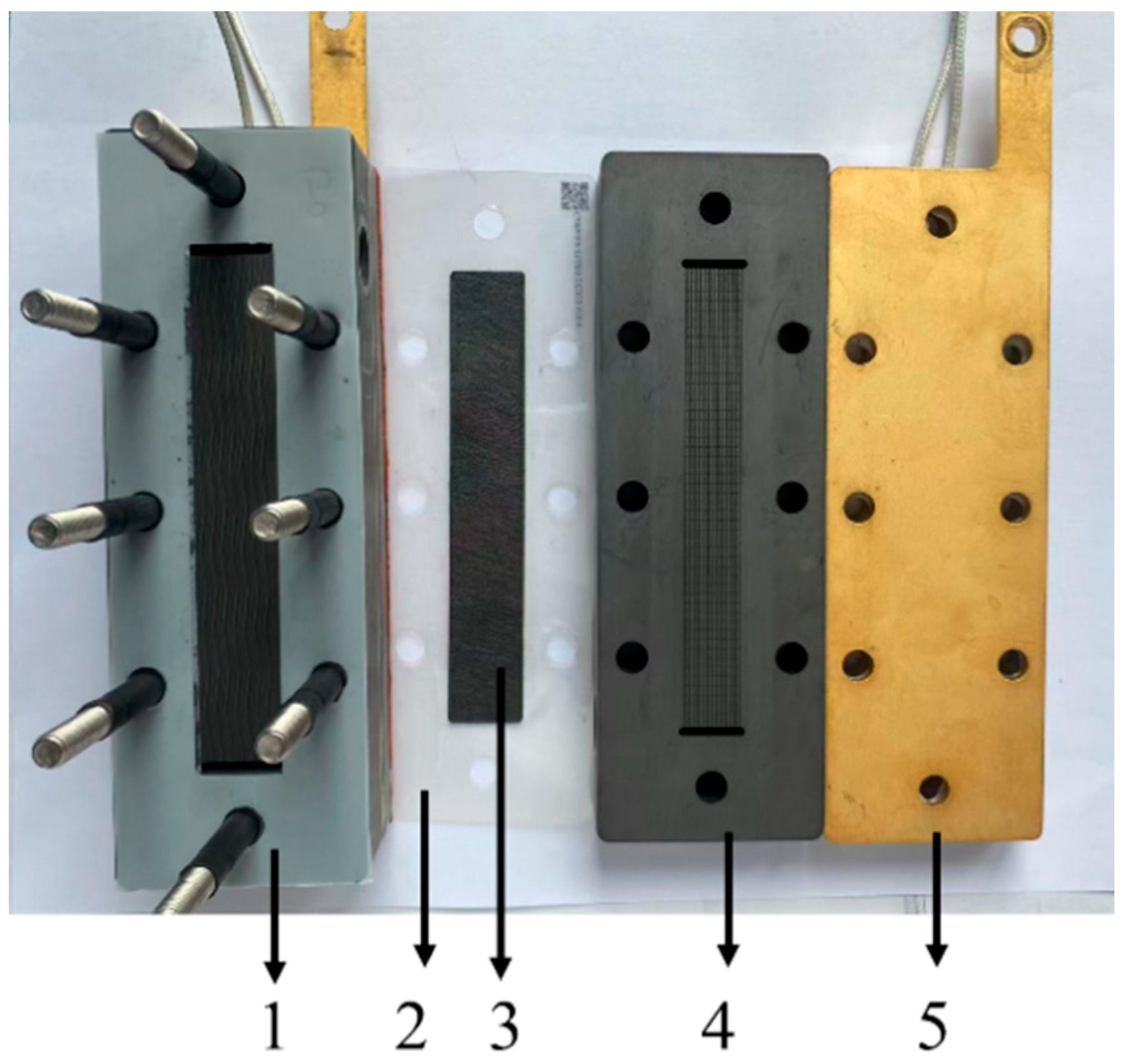
This study focuses on three commercially available gas diffusion layers (GDLs): Toray-055 (Toray Industries, Tokyo, Japan), TY-S-18 (Shenzhen General Hydrogen Energy Technology Co., Ltd., Shenzhen, China), and H15C14 (Freudenberg Performance Materials, Weinheim, Germany). These GDLs were selected due to their comparable initial thickness and porosity, which facilitates a direct investigation into the influence of compression ratio on tortuosity. Their key specifications are summarized in Table 1. This study employed a 15-micron membrane (HS411-775.15) manufactured by Zhejiang Tangfeng Energy Technology Co., Ltd. (Huzhou, China). This membrane electrode exhibits excellent proton conductivity and chemical stability. The compression ratio of the GDL was chosen as the primary structural parameter under study. To achieve precise and controllable compression ratios, polytetrafluoroethylene (PTFE) gaskets of four different thicknesses (Shenzhen Jinfengyuan Plastic Material Co., Ltd., Shenzhen, China) were employed. Figure 1 illustrates the schematic structure of the proton exchange membrane fuel cell used in the experiments. The cell performance and high-frequency impedance were measured using a 100 W PEM test station (BaiTe Control Technology Co., Ltd., Changzhou, China) and an impedance meter (HIOKI Measurement Technology Co., Ltd., Nagano, Japan), respectively. The operating conditions are detailed in Table 2. The uniformity of pressure distribution on the GDL was confirmed using pressure-sensitive paper prior to electrochemical testing.

2.2. Experimental Methods

2.2.1. Liquid Water Decoupling Experiment

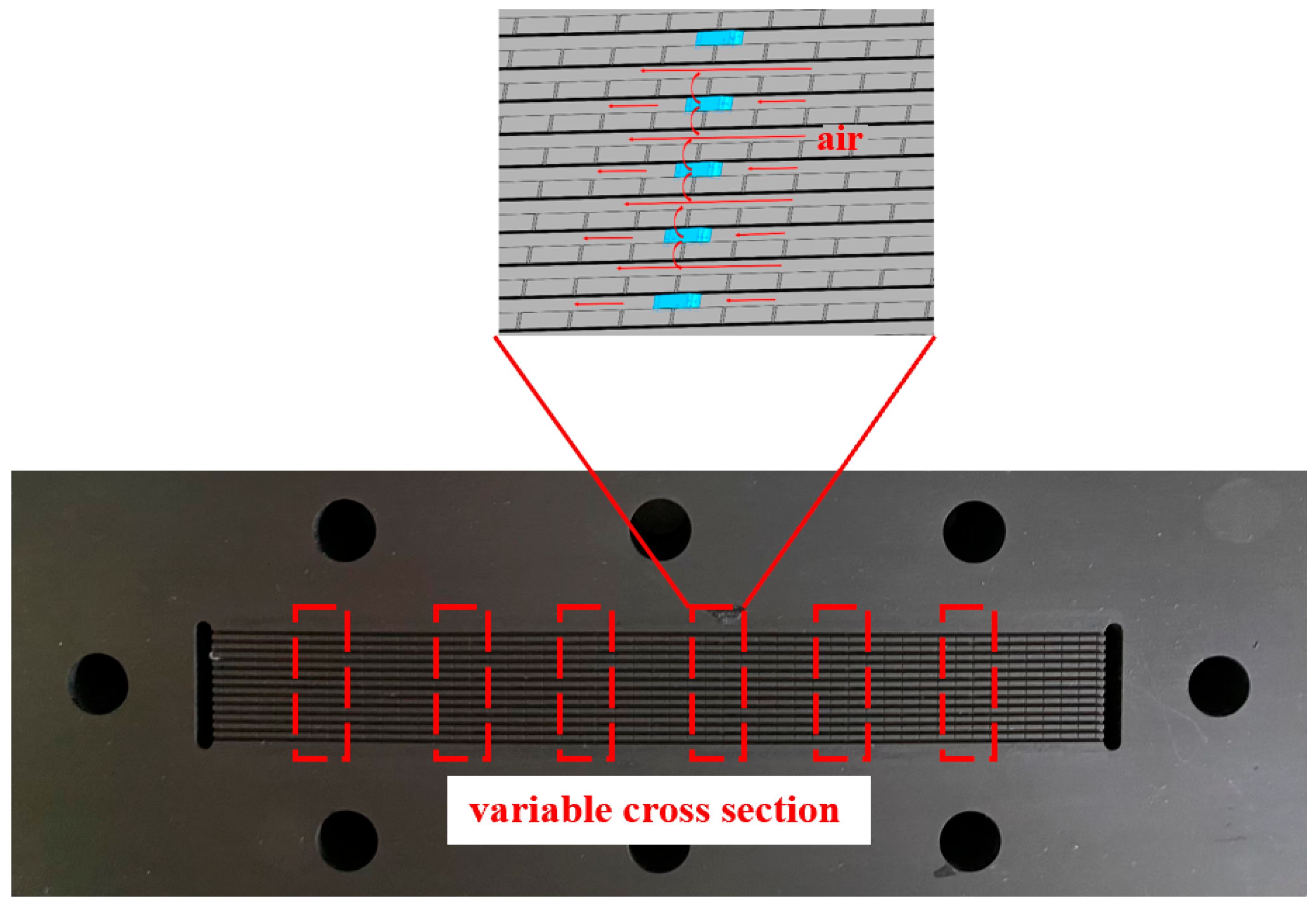
To eliminate the interference of liquid water within the GDL on the mass transfer mechanism investigation, this study employed a cross-section scaling structure to generate high-intensity under-rib convection. This convection effectively disrupts liquid water accumulation and carries it into adjacent flow channels for removal. Numerical simulations using ANSYS Fluent (Version 2024 R1) verified that the liquid water saturation in the flow channel decreases gradiently from the inlet to the outlet, approaching nearly zero. This confirms the effectiveness of the design in decoupling liquid water effects, thereby providing an experimental foundation for studying GDL compression and mass transfer without liquid water interference.

2.2.2. Calculation of GDL Compression Ratio

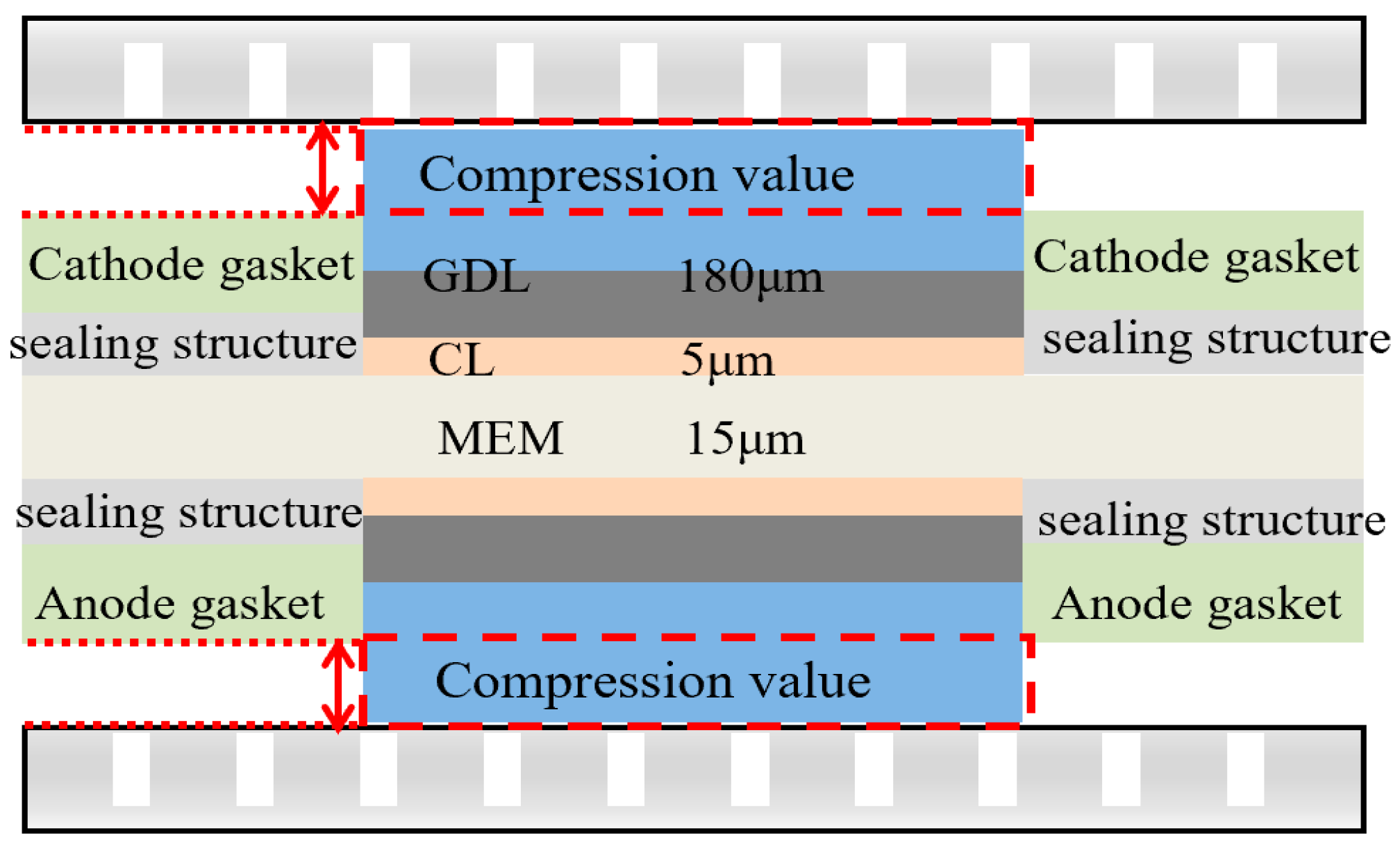
The GDL compression ratio was precisely controlled by employing PTFE gaskets of four different thicknesses (80 μm, 90 μm, 100 μm, and 120 μm) and applying assembly torques in incremental steps (1.5 N·m, 3.0 N·m, and 5.0 N·m). Three commercial GDLs (Toray-055, TY-S-18, H15C14) have very similar initial thickness and porosity, so their through-plane stiffness might also be comparable. Figure 2 illustrates the schematic of GDL compression deformation within the membrane electrode assembly. The corresponding compression ratio was calculated using Equation (2) [34]:
Compression = GDL   Thickness +   CL   Thickness   Gasket   Thickness   sealing   Thickness GDL   Thickness +   CL   Thickness
The calculated compression ratios are summarized in Table 3. The thickness of the sealing structure was 55 μm ± 5 μm.

2.2.3. In Situ Tortuosity Measurement Method

Building upon the flow field structure that decouples liquid water effects, this study innovatively proposes an indirect method for the in situ measurement of the tortuosity (γ) of compressed GDLs. The mass transfer loss was accurately extracted from the experimentally measured polarization curves. By calculating the differences in the mass transfer overpotential obtained under various relative humidity conditions, the true in situ tortuosity values for the three types of GDLs were determined through fitting. Each test condition was repeated three times to ensure data accuracy. Ultimately, a quantitative mapping relationship between tortuosity and compression ratio was established.

3. Results and Discussion

3.1. Elimination of Liquid Water Effects Using Convective Flow Field

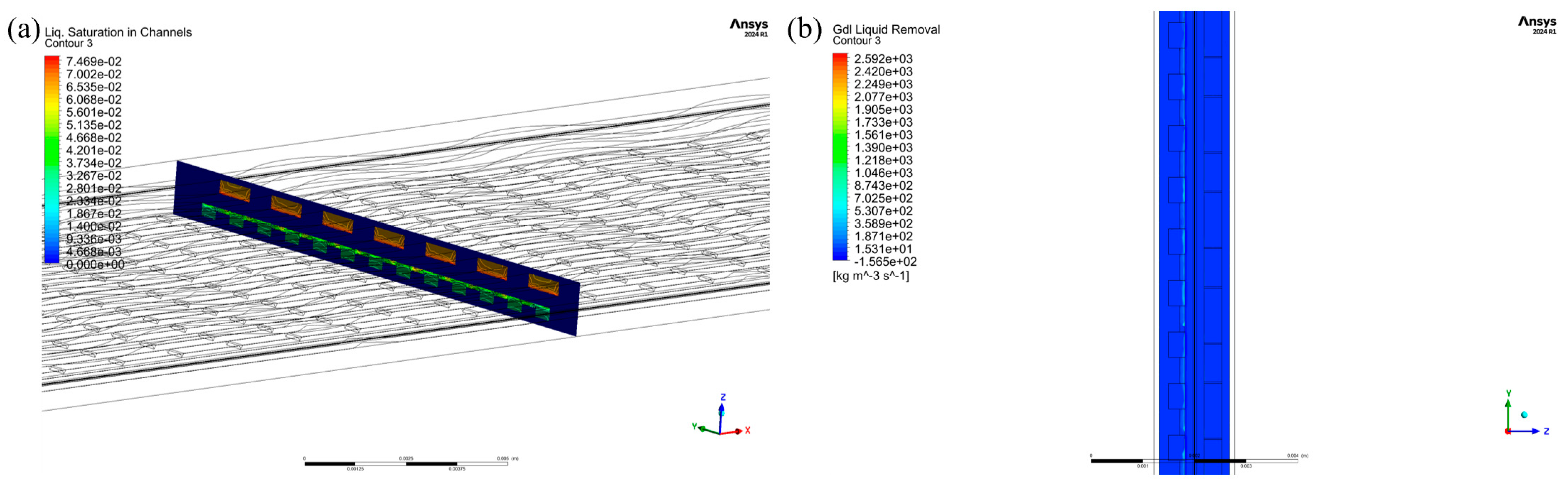
This study employs a specifically designed convective flow field to eliminate the influence of liquid water within the GDL (Figure 3). The key features of this flow field design are: (1) Controlled local pressure differences between adjacent parallel channels are generated by localized scaling of the flow channel cross-section. (2) The flow rate and velocity of under-rib convection are regulated through the design of transverse and longitudinal channels. Figure 4 presents the three-dimensional simulation results of the high-convection flow field under the conditions of 3 A/cm2, 70 °C, and 100% inlet humidity. Numerical simulations were performed using ANSYS Fluent (Version 2024 R1). The geometry of the convection flow field (shown in Figure 3) was meshed with polyhedral cells, with refined mesh near the walls and GDL interface. The model employed a multi-phase Mixture model. Boundary conditions were set as follows: mass-flow-inlet for cathode air with specified relative humidity (100% for the case shown in Figure 4), temperature, and mass flow rate; pressure-outlet for the outlet; no-slip wall conditions for other boundaries. The operating pressure was set to 30 kPa. The detailed model parameters and methodology refer to the study by Wang et al. [35]. The distribution of liquid water saturation and its removal amount indicates a significant gradient decrease in saturation along the flow channel direction, from the highest value at the inlet to nearly zero downstream. This demonstrates that the convective effect facilitates rapid removal of liquid water. The numerical value approaching zero indicates that liquid water near the GDL is almost completely eliminated, verifying the strong capability of the convective flow field in clearing liquid water from within the GDL.

3.2. Effect of Compression on the Effective Diffusion Distance and Porosity of the GDL

Under actual assembly conditions, the compression beneath the channels and under the ribs differs to some extent. However, according to studies by Liu et al. [36] and Wang et al. [37], treating the gas diffusion layer as uniformly compressed in-plane can still yield reasonably accurate predictive results. Therefore, to conveniently quantify the mass transfer characteristics of the GDL under compression, this study adopted the modeling approach proposed by Liu et al. [36], neglecting the difference in compression between the channel and rib areas. Based on this modeling approach, the quantitative formula for the effective diffusion distance of the compressed GDL is as follows:
d e f f = 1 α d g d l
where d e f f represents the effective diffusion distance, d g d l is the initial thickness of the GDL, and α is the compression ratio. Regarding the effect of compression on GDL porosity, this study utilized the compressed porosity model proposed by Wang et al. [37] to calculate the porosity after compression:
ε c o m = 1 1 ε 0 1 α
where ε c o m represents the porosity after compression and ε 0 is the initial porosity of the GDL.
Building on this, and incorporating the traditional oxygen diffusion equation, the following modified oxygen diffusion equation (Equation (5)) is derived to comprehensively reflect the coupled influence of the compression ratio on the effective diffusion distance and porosity:
χ O 2 c l = χ O 2 c h J R T 4 F D O 2 , N 2 P c 1 α d g d l [ 1 1 ε 0 1 α ] C 1 γ

3.3. Refinement of the In Situ Tortuosity Calculation Method

After quantifying the influence mechanism of the compression ratio on the effective diffusion distance and porosity, tortuosity (γ), as a key parameter characterizing the complexity of the oxygen transport path within the GDL, exerts the most significant impact on mass transfer resistance. To investigate the intrinsic characteristics of γ as a function of the compression ratio, power generation experiments were conducted on three types of GDLs (Toray-055, TY-S-18, H15C14) under four compression ratios (5.4%, 16.2%, 21.6%, and 27%) and four relative humidity levels (RH 0%, RH 30%, RH 60%, and RH 100%). The process of accurately extracting the mass transfer loss from the polarization curves is detailed below, using the Toray-055 GDL at a compression ratio of 21.6% as an example (results for TY-S-18 and H15C14 are provided in the Supplementary Materials):
  • Identification of Loss Types. The output voltage of a fuel cell ( E c e l l ) is composed of three primary losses: activation loss, ohmic loss, and mass transfer loss, as expressed by Equation (6) [32]:
    E c e l l = 1.23 R T α c F l n J J 0 J R H F R R T α c F l n P O 2 , r e f χ O 2 c l P c
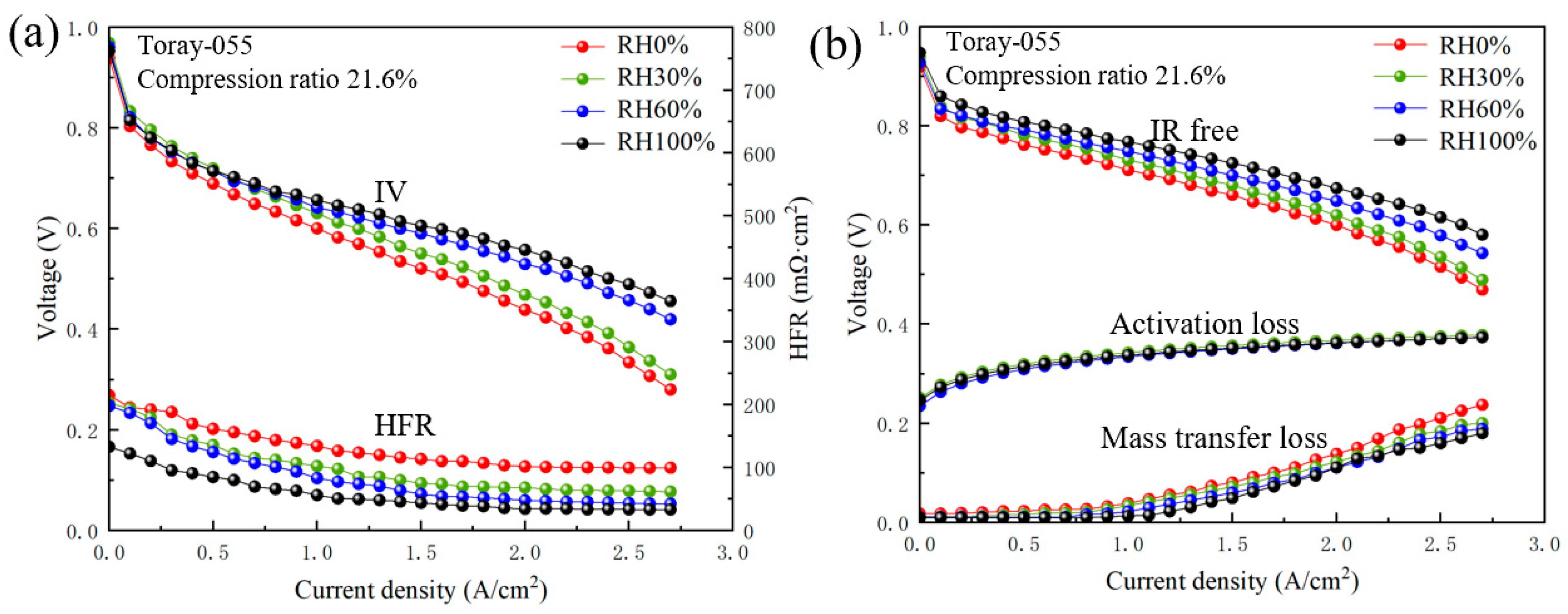
    Here, E c e l l denotes the output voltage of the cell; 1.23 V represents the typical value of the reversible equilibrium potential; the term R T α c F l n J J 0 corresponds to the activation loss, where α c is the cathode charge transfer coefficient and J 0 is the exchange current density; J R H F R represents the ohmic loss, with R H F R being the high-frequency resistance; and R T α c F l n P O 2 , r e f χ O 2 c l P c denotes the mass transfer loss, which is influenced by the oxygen mole fraction at the catalyst layer. P O 2 , r e f refers to the reference oxygen partial pressure. The values of E c e l l (I-V curve in Figure 5a) and R H F R (HFR curve in Figure 5a) are obtained directly from experimental measurements.
  • Isolation of Ohmic Loss. The ohmic loss is isolated by compensating the polarization curve using the measured high-frequency resistance ( R H F R ), yielding the IR-free voltage ( E i r f r e e ) as defined in Equation (7) and illustrated by the IR-free curve in Figure 5b. This correction method effectively eliminates interference from variations in flow field structures and operating environments, allowing the analysis to focus specifically on the structural characteristics of the membrane electrode assembly.
    E i r f r e e = 1.23 R T α c F l n J J 0 R T α c F l n P O 2 , r e f χ O 2 c l P c
    Here, E i r f r e e represents the voltage after compensation for the ohmic loss.
  • Removal of Activation Loss. Based on the Tafel equation [38], the activation loss voltage (represented by the Activation loss curve in Figure 5b) is subtracted from the IR-free voltage ( E i r f r e e ). The remaining voltage loss corresponds to the mass transfer loss, denoted as Δ V m t and given by Equation (8). This component is illustrated by the mass transfer loss curve in Figure 5b.
    Δ V m t = R T α c F l n P O 2 , r e f χ O 2 c l P c
    Here, Δ V m t represents the mass transfer loss voltage. The physical quantities on the right-hand side of the equation are key factors influencing the mass transfer loss. Among them, the oxygen concentration at the catalyst layer, χ O 2 c l , exhibits a strong inherent correlation with the mass transfer loss.
As shown in Figure 5a, when using the Toray-055 gas diffusion layer, the cell voltage exhibits a significant increasing trend with rising inlet humidity, while the high-frequency resistance (HFR) gradually decreases. The loss separation results in Figure 5b indicate that the activation loss is largely independent of inlet humidity. The IR-free voltage similarly increases with higher humidity, whereas the mass transfer loss voltage decreases markedly. This phenomenon is primarily ascribed to the direct influence of the membrane electrode’s hydration state on proton conduction performance: under low humidity conditions, loss of water molecules in the membrane interrupts proton conduction paths and increases proton transport resistance; conversely, under high humidity conditions, sufficient wetting of the membrane electrode restores and enhances the proton conduction network, thereby significantly reducing proton conduction resistance and improving the overall cell performance. Similar trends in output performance were observed when using the TY-S-18 and H15C14 gas diffusion layers; detailed results are provided in the Supplementary Materials.
4.
Extraction of γ Based on Mass Transfer Loss Difference. When the compression ratio is fixed, the tortuosity (γ) is an intrinsic geometric property of the GDL microstructure. Its variation with compression remains invariant to humidity changes. Therefore, γ can be determined by calculating the difference in mass transfer loss voltages under different relative humidity conditions, i.e., by differencing the values from the mass transfer loss curves corresponding to different humidities in Figure 5b:
Δ V = R T α c F l n P O 2 , r e f χ O 2 , 1 c l P c R T α c F l n P O 2 , r e f χ O 2 , 2 c l P c
Here, Δ V on the left side of the equation represents the difference in mass transfer loss voltage between two different relative humidity conditions. The terms R T α c F l n P O 2 , r e f χ O 2 , 1 c l P c and R T α c F l n P O 2 , r e f χ O 2 , 2 c l P c denote the mass transfer loss voltages under operating condition 1 and condition 2, respectively. This differential calculation effectively eliminates the interference of ohmic resistance, thereby directly reflecting changes in mass transfer resistance. Given that the same type and performance of catalyst were used throughout the experiments, and by incorporating the oxygen diffusion equation (Equation (10)):
χ O 2 c l = χ O 2 c h J R T 4 F D O 2 , N 2 P c 1 α d g d l [ 1 1 ε 0 1 α ] C 1 γ
Equations (9) and (10) can be combined and simplified to yield Equation (11):
Δ V =   R T α c F   l n χ O 2 , 2 c h C 2 1 1 1 ε 0 1 α C 1 γ χ O 2 , 1 c h C 2 1 1 1 ε 0 1 α C 1 γ
where C 2 = J R T 1 α d g d l 4 F D O 2 , N 2 P c . Equation (11) successfully establishes an implicit mathematical relationship between the voltage difference (ΔV) and the tortuosity (γ). Based on this relationship, the in situ tortuosity (γ) under operating conditions can be extracted, thereby establishing a controllable regulation mechanism between GDL compression and the mass transfer performance of the fuel cell.

3.4. Analysis of the In Situ Relationship Between Compression Ratio and Tortuosity

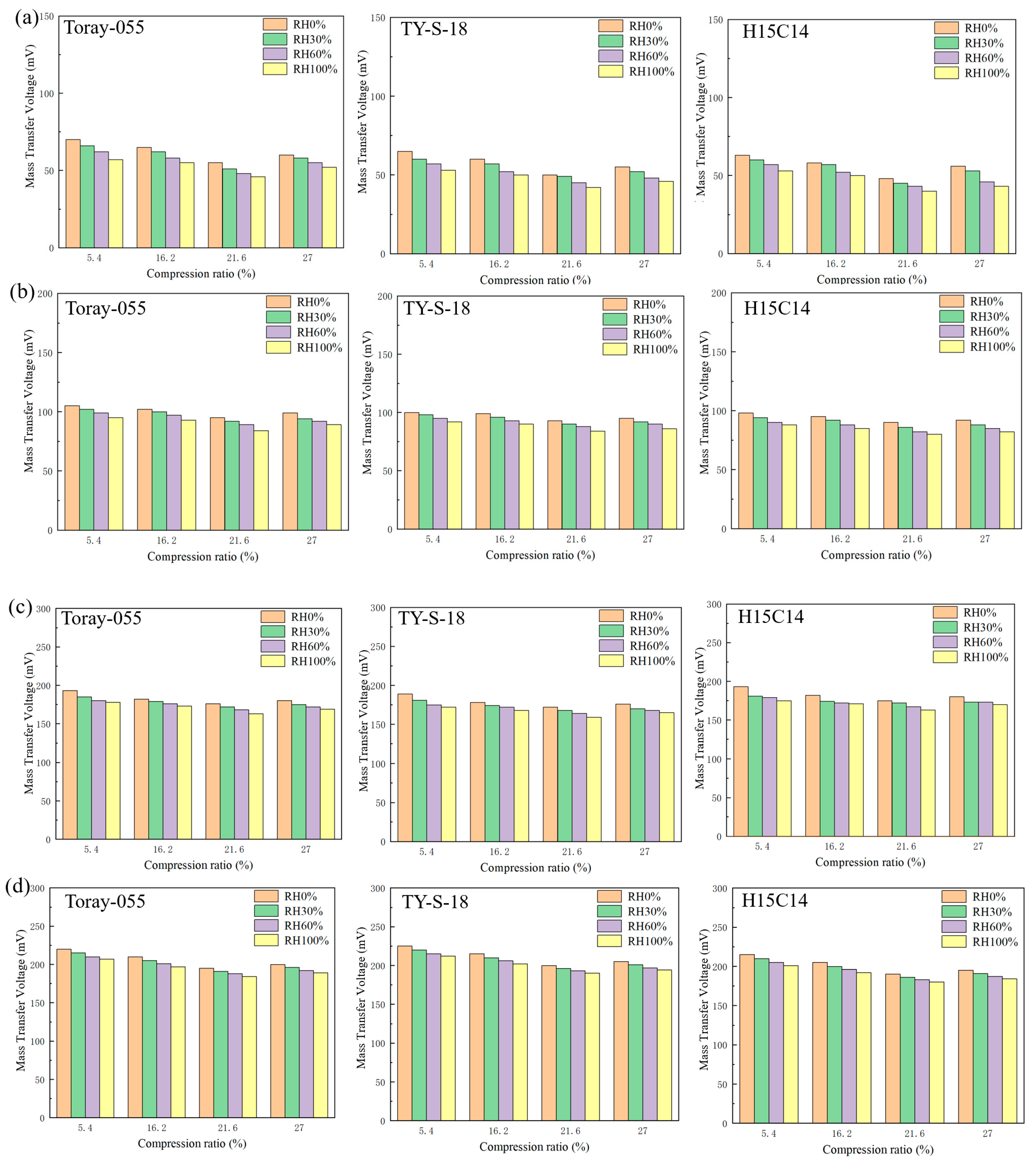
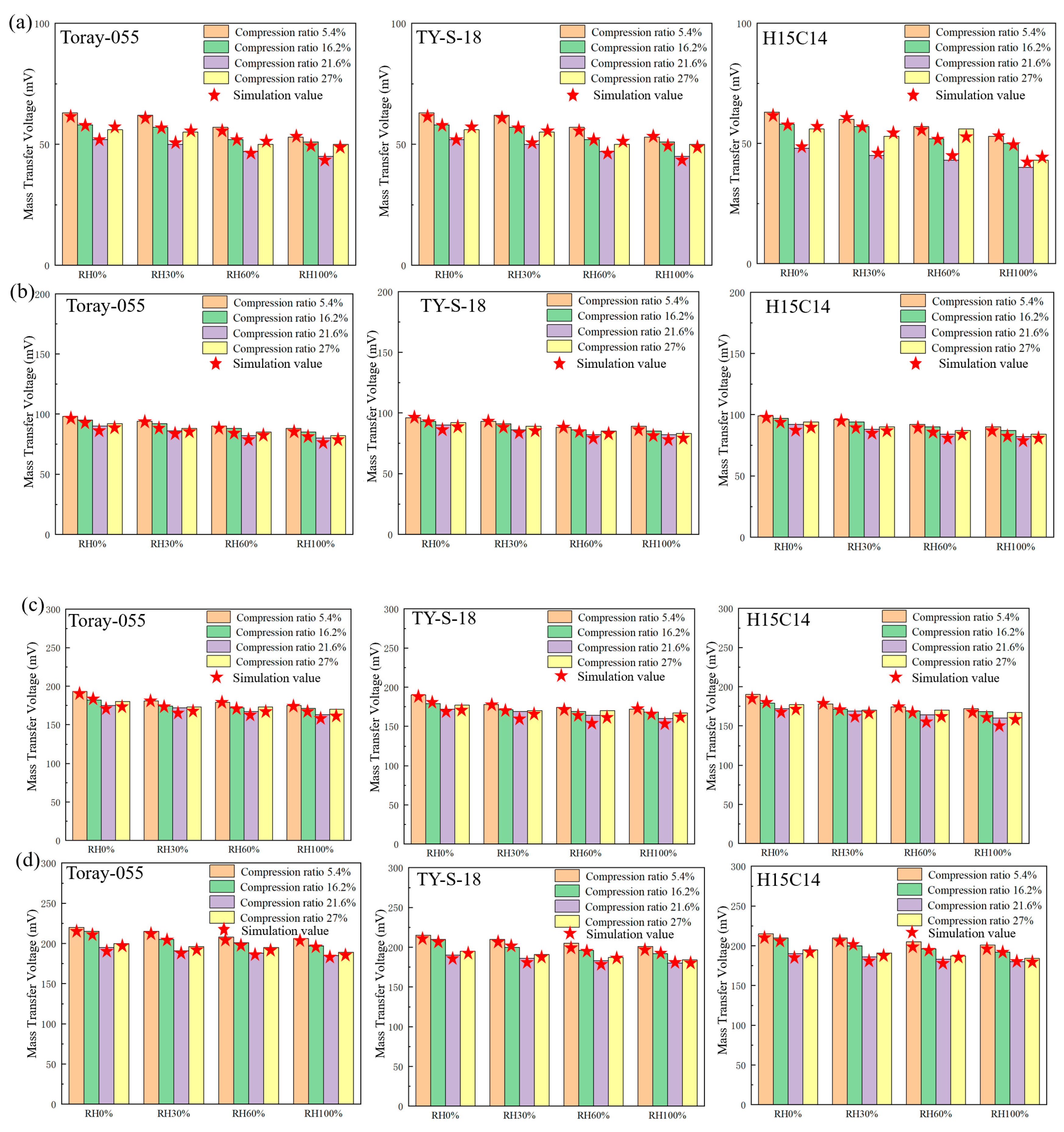
Through in situ experiments under different compression ratios, a functional relationship between the compression ratio and tortuosity was successfully established, thereby quantifying the influence mechanism of the compression ratio on tortuosity under operating conditions. Figure 6 shows the mass transfer overpotential for the three GDLs (Toray-055, TY-S-18, H15C14) under four compression ratios (5.4%, 16.2%, 21.6%, and 27%) and four relative humidity levels (RH 0%, RH 30%, RH 60%, and RH 100%) at current densities of 1.0 A/cm2, 1.5 A/cm2, 2.0 A/cm2, and 2.5 A/cm2. As shown in Figure 6a, at lower current densities, the mass transfer overpotential decreases gradually with increasing relative humidity. This phenomenon is primarily because the electrochemical reaction rate is limited at low current densities, resulting in minimal liquid water generation. Under these conditions, the hydration state of the membrane electrode becomes the dominant factor: lower relative humidity tends to cause dehydration of the proton exchange membrane, increasing ohmic polarization, whereas higher humidity significantly enhances the proton conductivity of the membrane, thereby indirectly improving overall cell performance. As illustrated in Figure 6b, in the medium current density range, the magnitude of the decrease in mass transfer overpotential becomes more pronounced with increasing relative humidity (see quantitative values in Supplementary Tables S1—S4). This is attributed to the increased reaction rate, which begins to cause liquid water accumulation. At lower humidity, the membrane may still experience partial dehydration. Increasing the humidity helps promote the removal of product water in vapor form, preventing the accumulation of liquid water that blocks gas pathways. This alleviates the mass transfer resistance caused by liquid water blockage, leading to a notable reduction in mass transfer overpotential. As seen in Figure 6c,d, at high current densities, the sensitivity of the mass transfer overpotential to changes in relative humidity is the highest, and the extent of its decrease rises significantly with increasing humidity. This is because water production increases substantially in this regime. A high-humidity environment ensures sufficient membrane hydration and, by increasing the water vapor partial pressure, enhances evaporation. This works synergistically with the gas flow in the channels to effectively remove liquid water, greatly mitigating flooding. Consequently, the mass transfer overpotential shows the most pronounced decreasing trend with rising humidity. In summary, as the current density increases, the sensitivity of the mass transfer overpotential to changes in relative humidity gradually strengthens, manifesting as a gentle change at low current densities and a significant change at high current densities. Furthermore, under all current density conditions, the mass transfer overpotential initially decreases and then increases with increasing compression ratio, indicating the existence of an optimal compression ratio. Under the operating conditions of 80 °C, 30 kPa inlet pressure, and anode/cathode flow rates of 1.2 L/min and 3.6 L/min, respectively, the optimal compression ratio is 21.6%.
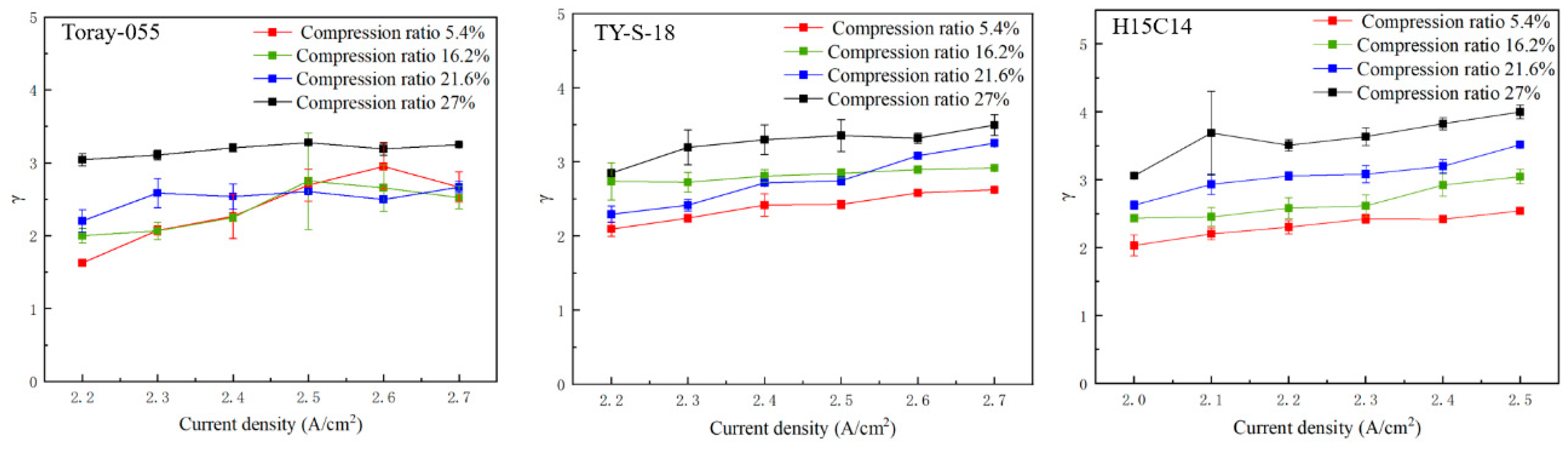
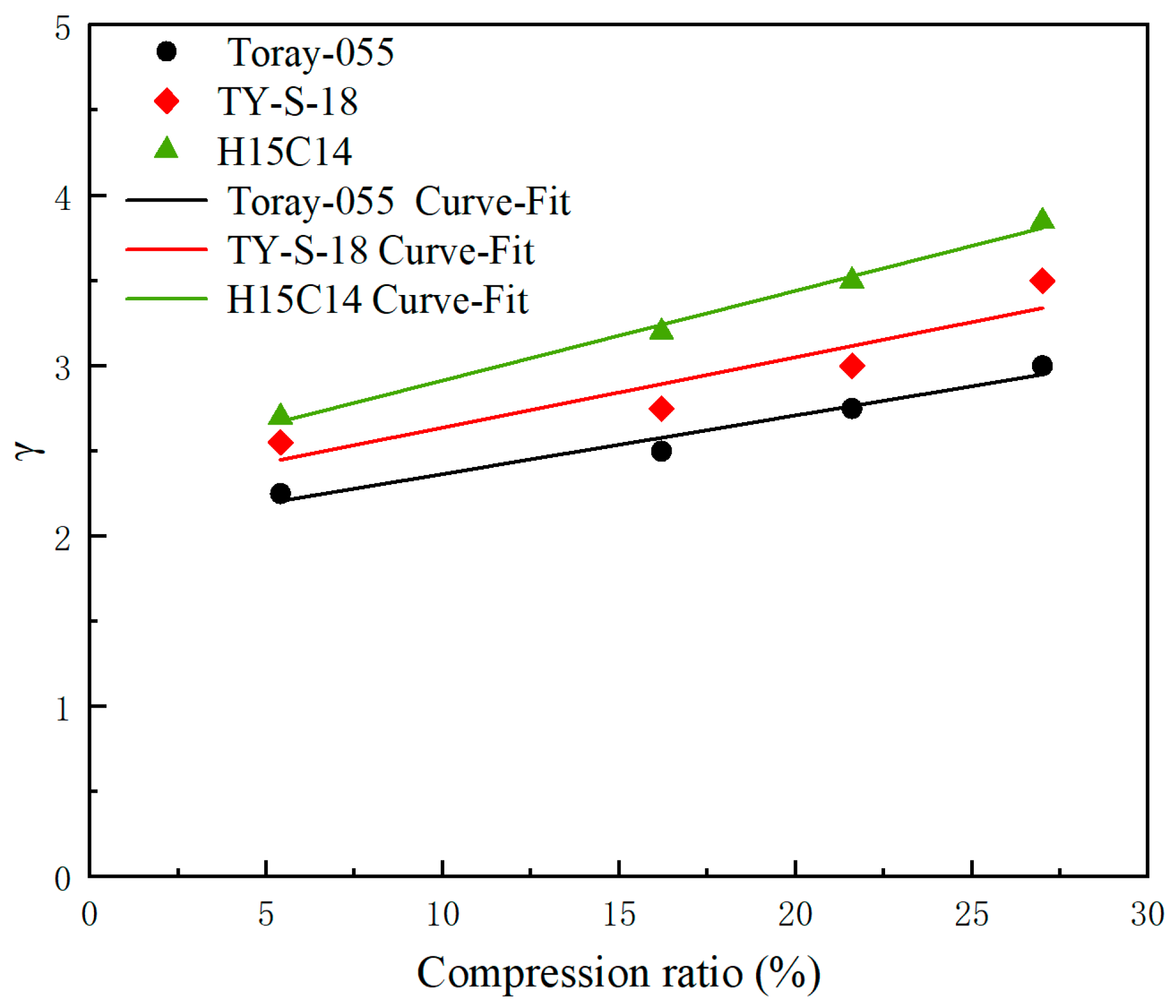
By employing the in situ tortuosity extraction method, the tortuosity value (γ) under operating conditions can be determined. Figure 7 presents the fitted results of the real tortuosity for the three gas diffusion layers under different compression ratios. This method, based on multi-condition experiments and theoretical calculations, reveals the mass transfer loss characteristics. The corresponding γ values were obtained by calculating the voltage differences in mass transfer loss under different humidity conditions. The γ value at each current density was derived from the difference in mass transfer overpotential measured at 0%, 30%, 60%, and 100% relative humidity, ensuring data reliability through multi-dimensional validation. Each reported γ value is the mean calculated from three independent computations at each current density. The fitted mean γ values, plotted against current density, are derived from a large dataset of fuel cell operational tests. The data points on the curve represent the average fitted γ values from three trials. The tolerance band above and below these averages indicates the deviation between the maximum/minimum values and the mean, serving to observe and evaluate the credibility of the fitted data. A tolerance band approaching zero indicates that the fitted values converge toward the true value. In this study, the convergence criterion was set as the ratio of the tolerance band width to the average value being less than 1%.
Since γ values at high current densities are closer to their true values, and the influences of activation and ohmic losses are minimized in this regime, the analysis of γ variation in this study was conducted within the current density range of 2.0 A/cm2 to 2.7 A/cm2. According to the oxygen diffusion equation:
χ O 2 c l = χ O 2 c h J R T 4 F D O 2 , N 2 P c 1 α d 0 [ 1 1 ε 0 1 α ] C 1 γ
When the compression ratio is fixed, the geometry of the gas diffusion layer remains constant, and thus its intrinsic parameters are in a determined state. Under these conditions, the value of the parameter γ tends to stabilize and ultimately converges to a true value. In the low to medium current density range, the variation in γ is more pronounced, primarily due to the significant combined influence of activation and ohmic losses [39] on the accuracy of the γ value. To further identify the current density range corresponding to the true value of γ, a trend analysis was performed by calculating the differences between consecutive mean γ values.
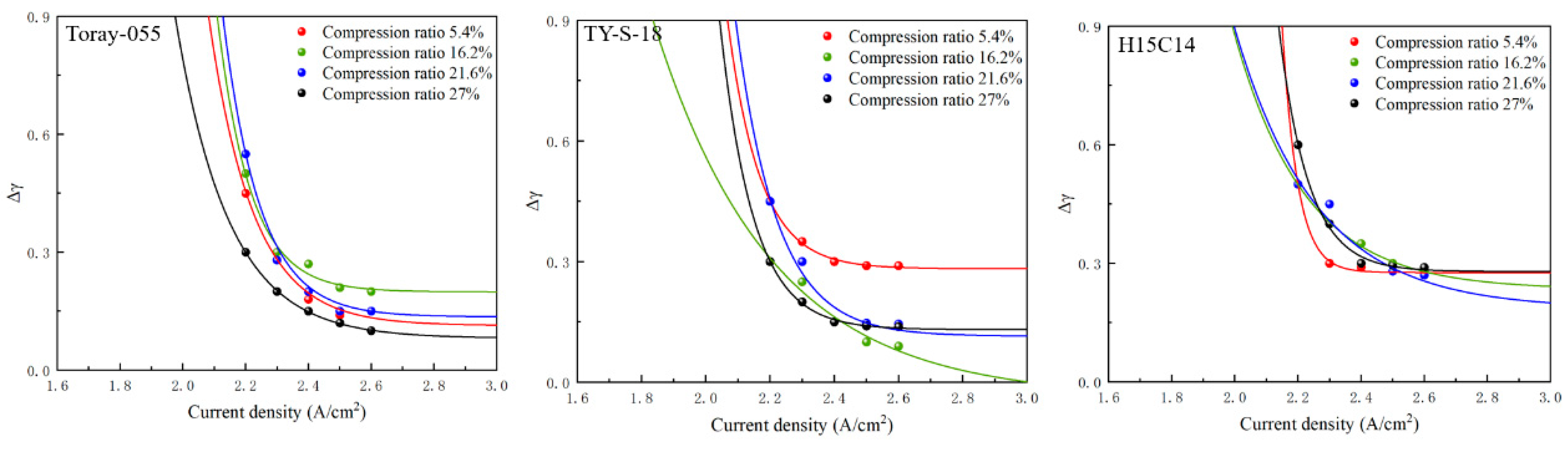
The fitted differences in the tortuosity values (Δγ) among the three GDLs are shown in Figure 8. The results indicate that as the current density increases, Δγ exhibits a continuous decreasing trend. When the current density exceeds 2.5 A/cm2, Δγ stabilizes, with the difference between consecutive γ values not exceeding 0.3. This indicates that the γ value at this point has reached a stable state and is close to the true value. Figure 9 illustrates the fitted relationship between the true γ value and the compression ratio for the three GDLs. The results demonstrate that γ increases with increasing compression ratio. This is because compression of the GDL elongates the mass transfer path for gases, increasing the gas transport resistance and consequently leading to a higher γ value. The fitted curves for the three GDL types show no statistically significant difference in slope, indicating a consistent trend in γ variation under compression. All data points for tortuosity are distributed near the function γ = 3.42α + 2.1.
The experimental results for the mass transfer overpotential of the three GDLs at current densities of 1.0, 1.5, 2.0, and 2.5 A/cm2 are shown in Figure 10. Analysis reveals that at 0% relative humidity, the mass transfer loss voltage is lower when the compression ratio increases from 5.4% to 16.2%, indicating that moderate compression shortens the oxygen diffusion path. Similarly, under intermediate humidity (RH 30%) and high humidity (RH 60% and RH 100%) conditions, comparing the mass transfer loss voltages at 5.4% and 16.2% compression ratios shows that the 16.2% compression ratio yields better mass transfer performance at high current densities, further validating the promoting effect of low compression ratios on mass transfer performance. This confirms that the compression ratio indeed affects the tortuosity, and a functional relationship exists between them. Further investigation into the in situ relationship between compression ratio and tortuosity through comprehensive analysis of the polarization curves reveals that low compression (5.4–21.6%) improves the output voltage. This is attributed to reduced contact resistance and decreased mass transfer loss voltage under low compression. In contrast, high compression (21.6–27%) decreases the output voltage due to reduced porosity, increased tortuosity, and consequently increased gas transport resistance within the GDL. Excessive compression increases mass transfer resistance. Therefore, the output performance of the fuel cell first increases and then decreases with increasing GDL compression ratio, indicating the existence of an optimal GDL compression ratio. Based on the loss separation data from the four compression ratios, the mass transfer loss of the cell initially decreases with increasing compression ratio and begins to rise after reaching 21.6%. This suggests that, given a determined electrode activity, the optimal performance of the fuel cell is ultimately determined by the dynamic balance between ohmic loss and mass transfer loss, achieving an optimum at a compression ratio of 21.6%. Thus, through experiments at different compression ratios, an in situ relationship between compression and tortuosity was established.
In summary, by designing convection flow field to promote under-rib mass transfer, the influence of liquid water was successfully decoupled. Measurements and deformation analysis of the practically compressed GDL, combined with theoretical calculations, quantified the relationship between compression and changes in GDL thickness and porosity. Furthermore, a large amount of real operational fuel cell data was used to refine the tortuosity value (γ) under operating conditions, establishing a controllable regulation mechanism between GDL compression and the mass transfer performance of the fuel cell. Based on this, the actual values of key parameters in the oxygen diffusion equation under compression were determined, leading to an optimized oxygen diffusion equation (Equation (13)). Here, α is the compression ratio, 1 α is the thickness correction factor, 1 ε 0 1 α is the corrected porosity after compression, and (3.42α + 2.1) is the true in situ tortuosity value γ, which is linearly related to the compression ratio. Calculations using the modified formula, as shown in Figure 10, demonstrate that the computed mass transfer overpotential values are in close agreement with the experimentally extracted values, confirming the universality of the modified oxygen diffusion equation.
χ O 2 c l = χ O 2 c h J R T 4 F D O 2 , N 2 P c 1 α d 0 1 1 ε 0 1 α 3.42 α + 2.1

4. Conclusions

Addressing the unclear oxygen mass transfer mechanism within the Gas Diffusion Layer (GDL) under compression, this study conducted systematic power generation experiments and polarization curve analysis on three commercial GDLs (Toray-055, TY-S-18, H15C14) under various compression ratios (5.4%, 16.2%, 21.6%, 27%) and relative humidity levels (RH 0%, RH 30%, RH 60%, RH 100%). The research provides an in-depth quantitative analysis of the impact of GDL compression deformation on mass transfer performance in PEMFCs. The main conclusions are as follows:
  • A flow channel design capable of controlling liquid water content within the GDL was implemented. By enhancing convection, the liquid water saturation in the channel was reduced gradiently from the inlet to the outlet until nearly zero, effectively removing liquid water from the GDL. This laid the foundation for accurately refining mass transfer parameters under compression.
  • Within the RH 0% to RH 100% humidity range, the optimal compression ratio was found to be 21.6% as the compression ratio increased.
  • Within the 5.4% to 27% compression ratio range, the optimal compression ratio shifted from 27% to 21.6% as humidity increased.
  • Across the combined ranges of 0–100% humidity and 5.4–27% compression ratio, the compression ratio significantly influenced output performance. Comprehensively, the optimal compression ratio range was determined to be between 21.6% and 27%. Future studies will expand on this work by investigating the combined effects of compression and operating temperature.
  • Based on fitting calculations, the initial tortuosity for GDLs from different manufacturers (with porosity 0.76–0.78 and thickness 170–180 μm) had a median value around 2.1. The tortuosity increased linearly with the compression ratio within the 5.4–27% range. The tortuosity (γ) showed a linear relationship with the compression ratio (α), yielding the empirical correlation: γ = 3.42α + 2.1.
  • An empirical oxygen diffusion equation for the compressed state was proposed. This equation quantitatively describes the combined influence of the compression ratio on the effective diffusion distance, porosity, and tortuosity of the GDL:
    χ O 2 c l = χ O 2 c h J R T 4 F D O 2 , N 2 P c 1 α d 0 1 1 ε 0 1 α 3.42 α + 2.1  
    This equation accurately describes the oxygen concentration distribution and the variation in mass transfer resistance within the GDL under compression. It successfully establishes a coupled mass transfer mechanism for PEMFCs based on compressed GDLs, enabling accurate prediction of mass transfer performance under different compression ratios. This provides a crucial theoretical foundation for the design optimization and performance enhancement of PEMFCs. Furthermore, future work will involve fabricating GDLs with customized porosity and thickness to validate and refine the proposed model across a wider parameter space.

Supplementary Materials

The following supporting information can be downloaded at https://www.mdpi.com/article/10.3390/en18184968/s1, Figure S1: Voltage loss separation for Toray-055 GDL under compression ratios of 5.4%, 16.2%, and 27%; Figure S2: Voltage loss separation for TY-S-18 GDL under compression ratios of 5.4%, 16.2%, 21.6%, and 27%; Figure S3: Voltage loss separation for H15C14 GDL under compression ratios of 5.4%, 16.2%, 21.6%, and 27%; Table S1: Mass transfer overpotential for the three GDLs (Toray-055, TY-S-18, H15C14) under com-pression ratios of 5.4%, 16.2%, 21.6%, and 27% and relative humidity levels of RH 0%, RH 30%, RH 60%, and RH 100% at current densities of 1.0 A/cm2; Table S2: Mass transfer overpotential for the three GDLs (Toray-055, TY-S-18, H15C14) under com-pression ratios of 5.4%, 16.2%, 21.6%, and 27% and relative humidity levels of RH 0%, RH 30%, RH 60%, and RH 100% at current densities of 1.5 A/cm2; Table S3: Mass transfer overpotential for the three GDLs (Toray-055, TY-S-18, H15C14) under com-pression ratios of 5.4%, 16.2%, 21.6%, and 27% and relative humidity levels of RH 0%, RH 30%, RH 60%, and RH 100% at current densities of 2.0 A/cm2; Table S4: Mass transfer overpotential for the three GDLs (Toray-055, TY-S-18, H15C14) under com-pression ratios of 5.4%, 16.2%, 21.6%, and 27% and relative humidity levels of RH 0%, RH 30%, RH 60%, and RH 100% at current densities of 2.5 A/cm2.

Author Contributions

Conceptualization, G.L., L.Z., Y.L., Y.B., Y.W., K.H. and H.L. (Hua Li); Methodology, L.H., J.Z., G.L., L.Z., Y.L., Y.B., Y.W., K.H. and H.L. (Hua Li); Software, Y.W., K.H. and H.L. (Hua Li); Validation, L.H., J.Z., S.H., S.G. and H.L. (Hangling Li), Y.L. and Y.B.; Formal Analysis, L.H. and J.Z.; Investigation, L.H., J.Z., S.H., S.G. and H.L. (Hangling Li); Resources, G.L., L.Z., Y.L., Y.B., Y.W. and H.L. (Hua Li); Data Curation, L.H., J.Z., S.H., S.G., H.L. (Hangling Li), G.L., L.Z., Y.L. and Y.B.; Writing—Original Draft Preparation, L.H., J.Z. and S.H.; Writing—Review and Editing, G.L., L.Z., Y.W., K.H. and H.L. (Hua Li); Visualization, L.H.; Supervision, Y.W., K.H. and H.L. (Hua Li); Project Administration, Y.W., K.H. and H.L. (Hua Li); Funding Acquisition, K.H. and H.L. (Hua Li). Note: L.H. and J.Z. contributed equally to this work. All authors have read and agreed to the published version of the manuscript.

Funding

This work was supported by the National Key Research and Development Program of China (No. 2023YFB4005902), Yongjiang Talent Engineering Technology Innovation Team Project of Zhejiang Province (No. 2022A-008-C), and China Construction Sixth Engineering Bureau Corp. Ltd.

Data Availability Statement

Dataset available on request from the authors.

Conflicts of Interest

Authors Junlong Zhou, Yikang Li, Yumeng Bai and Keqi Huang were employed by the company China Construction Sixth Engineering Bureau Corp., Ltd. The remaining authors declare that the research was conducted in the absence of any commercial or financial relationships that could be construed as a potential conflict of interest. The funders had no role in the design of the study; in the collection, analyses, or interpretation of data; in the writing of the manuscript; or in the decision to publish the results.

References

  1. Ajanovic, A.; Haas, R. Prospects and impediments for hydrogen and fuel cell vehicles in the transport sector. Int. J. Hydrogen Energy 2021, 46, 10049–10058. [Google Scholar] [CrossRef]
  2. Inoue, G.; Yoshimoto, T.; Matsukuma, Y.; Minemoto, M. Development of simulated gas diffusion layer of polymer electrolyte fuel cells and evaluation of its structure. J. Power Sources 2008, 175, 145–158. [Google Scholar] [CrossRef]
  3. Jiao, K.; Xuan, J.; Du, Q.; Bao, Z.; Xie, B.; Wang, B.; Zhao, Y.; Fan, L.; Wang, H.; Hou, Z.; et al. Designing the next generation of proton-exchange membrane fuel cells. Nature 2021, 595, 361–369. [Google Scholar] [CrossRef]
  4. Shang, Z.; Hossain, M.; Wycisk, R.; Pintauro, P.N. Poly(phenylene sulfonic acid)-expanded polytetrafluoroethylene composite membrane for low relative humidity operation in hydrogen fuel cells. J. Power Sources 2022, 535, 231375. [Google Scholar] [CrossRef]
  5. Okereke, I.C.; Ismail, M.S.; Ingham, D.; Hughes, K.J.; Ma, L.; Pourkashanian, M. The effects of GDL anisotropic transport properties on the PEFC performance. Int. J. Numer. Methods Heat Fluid Flow 2022, 33, 648–672. [Google Scholar] [CrossRef]
  6. Banerjee, R.; Hinebaugh, J.; Liu, H.; Yip, R.; Ge, N.; Bazylak, A. Heterogeneous porosity distributions of polymer electrolyte membrane fuel cell gas diffusion layer materials with rib-channel compression. Int. J. Hydrogen Energy 2016, 41, 14885–14896. [Google Scholar] [CrossRef]
  7. Moslemi, M.; Javaherdeh, K.; Ashorynejad, H.R. Effect of compression of microporous and gas diffusion layers on liquid water transport of PEMFC with interdigitated flow field by Lattice Boltzmann method. Colloids Surf. A Physicochem. Eng. Asp. 2022, 642, 128623. [Google Scholar] [CrossRef]
  8. Ira, Y.; Bakhshan, Y.; Khorshidimalahmadi, J. Effect of wettability heterogeneity and compression on liquid water transport in gas diffusion layer coated with microporous layer of PEMFC. Int. J. Hydrogen Energy 2021, 46, 17397–17413. [Google Scholar] [CrossRef]
  9. Dotelli, G.; Omati, L.; Stampino, P.G.; Grassini, P.; Brivio, D. Investigation of gas diffusion layer compression by electrochemical impedance spectroscopy on running polymer electrolyte membrane fuel cells. J. Power Sources 2011, 196, 8955–8966. [Google Scholar] [CrossRef]
  10. Zhang, H.; Hu, H.; Sarker, M.; Shao, X.; Zhan, Z.; Sui, P.-C.; Chuang, P.-Y.A. Numerical investigation of effect of mechanical compression on the transport properties of fuel cell microporous layer using a pore-scale model. Int. J. Hydrogen Energy 2024, 62, 591–600. [Google Scholar] [CrossRef]
  11. Loo, K.H.; Wong, K.H.; Lai, Y.M.; Tan, S.C.; Tse, C.K. Derivation of a fast mathematical model of PEM fuel cell with two-phase water transport. IEEE Trans. Energy Convers. 2010, 26, 216–226. [Google Scholar] [CrossRef]
  12. Shi, L.; Tang, X.; Xu, S.; Liu, Z. Numerical research on liquid water removal mechanism and the influence of pore structure on water removal rate based on real pore GDL structure during shutdown purge of fuel cell. Energy 2023, 288, 129892. [Google Scholar] [CrossRef]
  13. Hu, K.; Zhao, P.; Wang, S.; Wang, Y. Three-dimensional multiphase simulation of a partially narrowed flow field configuration for a high-performance polymer electrolyte membrane fuel cell. Appl. Therm. Eng. 2023, 223, 119986. [Google Scholar] [CrossRef]
  14. Wang, C.; Zhang, Q.; Shen, S.; Yan, X.; Zhu, F.; Cheng, X.; Zhang, J. The respective effect of under-rib convection and pressure drop of flow fields on the performance of PEM fuel cells. Sci. Rep. 2017, 7, 43447. [Google Scholar] [CrossRef] [PubMed]
  15. Li, W.; Zhang, Q.; Wang, C.; Yan, X.; Shen, S.; Xia, G.; Zhu, F.; Zhang, J. Experimental and numerical analysis of a three-dimensional flow field for PEMFCs. Appl. Energy 2017, 195, 278–288. [Google Scholar] [CrossRef]
  16. Wang, Y.; Si, C.; Qin, Y.; Wang, X.; Fan, Y.; Gao, Y. Bio-inspired design of an auxiliary fishbone-shaped cathode flow field pattern for polymer electrolyte membrane fuel cells. Energy Convers. Manag. 2021, 227, 113588. [Google Scholar] [CrossRef]
  17. Zhang, Y.; He, S.; Jiang, X.; Xiong, M.; Ye, Y.; Yang, X. Three-dimensional multi-phase simulation of proton exchange membrane fuel cell performance considering constriction straight channel. Energy 2022, 267, 126544. [Google Scholar] [CrossRef]
  18. Baz, F.; Ookawara, S.; Ahmed, M. Enhancing under-rib mass transport in proton exchange membrane fuel cells using new serpentine flow field designs. Int. J. Hydrogen Energy 2019, 44, 30644–30662. [Google Scholar] [CrossRef]
  19. Yoshizumi, T.; Kubo, H.; Okumura, M. Development of High-Performance FC Stack for the New MIRAI; SAE Technical Paper Series, No. 2021-01-0740; SAE International: Warrendale, PA, USA, 2021. [Google Scholar] [CrossRef]
  20. Laoun, B.; Kasat, H.A.; Ahmad, R.; Kannan, A.M. Gas diffusion layer development using design of experiments for the optimization of a proton exchange membrane fuel cell performance. Energy 2018, 151, 689–695. [Google Scholar] [CrossRef]
  21. Reshetenko, T.; Ben, B.L. Impact of a gas diffusion layer’s structural and textural properties on oxygen mass transport resistance in the cathode and performance of proton exchange membrane fuel cells. Electrochim. Acta 2021, 371, 137752. [Google Scholar] [CrossRef]
  22. Ozden, A.; Shahgaldi, S.; Li, X.; Hamdullahpur, F. A review of gas diffusion layers for proton exchange membrane fuel cells—With a focus on characteristics, characterization techniques, materials and designs. Prog. Energy Combust. Sci. 2019, 74, 50–102. [Google Scholar] [CrossRef]
  23. Omrani, R.; Shabani, B. Gas diffusion layer modifications and treatments for improving the performance of proton exchange membrane fuel cells and electrolysers: A review. Int. J. Hydrogen Energy 2017, 42, 28515–28536. [Google Scholar] [CrossRef]
  24. Yue, L.; Wang, S.; Araki, T.; Utaka, Y.; Wang, Y. Effect of water distribution in gas diffusion layer on proton exchange membrane fuel cell performance. Int. J. Hydrogen Energy 2021, 46, 2969–2977. [Google Scholar] [CrossRef]
  25. Hao, L.; Cheng, P. Capillary pressures in carbon paper gas diffusion layers having hydrophilic and hydrophobic pores. Int. J. Heat Mass Transf. 2012, 55, 133–139. [Google Scholar] [CrossRef]
  26. Rao, S.S.L.; Shaija, A.; Jayaraj, S. Performance analysis of a transparent PEM fuel cell at theoptimized clamping pressure ap-plied on its bolts. Mater. Today Proc. 2018, 5, 58–65. [Google Scholar] [CrossRef]
  27. Zhang, H.; Rahman, A.; Mojica, F.; Sui, P.; Chuang, P.A. A comprehensive two-phase proton exchange membrane fuel cell model coupled with anisotropic properties and mechanical deformation of the gas diffusion layer. Electrochimica Acta 2021, 382, 138273. [Google Scholar] [CrossRef]
  28. Bao, Z.; Li, Y.; Zhou, X.; Gao, F.; Du, Q.; Jiao, K. Transport properties of gas diffusion layer of proton exchange membrane fuel cells: Effects of compression. Int. J. Heat Mass Transf. 2021, 178, 121608. [Google Scholar] [CrossRef]
  29. Espinoza, M.; Andersson, M.; Yuan, J.; Sundén, B. Compress effects on porosity, gas-phase tortuosity, and gas permeability in a simulated PEM gas diffusion layer. Int. J. Energy Res. 2015, 39, 1528–1536. [Google Scholar] [CrossRef]
  30. Inoue, G.; Matsukuma, Y.; Minemoto, M. Effect of gas channel depth on current density distribution of polymer electrolyte fuel cell by numerical analysis including gas flow through gas diffusion layer. J. Power Sources 2005, 157, 136–152. [Google Scholar] [CrossRef]
  31. Liao, J.; Yang, G.; Li, S.; Shen, Q.; Jiang, Z.; Wang, H.; Xu, L.; Espinoza-Andaluz, M.; Pan, X. Effect of Structural Parameters on Mass Transfer Characteristics in the Gas Diffusion Layer of Proton Exchange Membrane Fuel Cells Using the Lattice Boltzmann Method. Energy Fuels 2021, 35, 2654–2664. [Google Scholar] [CrossRef]
  32. Gu, W.; Baker, D.R.; Liu, Y.; Gasteiger, H.A. Proton Exchange Membrane Fuel Cell (PEMFC) Down-the-Channel Performance Model. In Handbook of Fuel Cells; John Wiley & Sons, Ltd.: Hoboken, NJ, USA, 2010. [Google Scholar]
  33. Chen, Q.; Niu, Z.; Li, H.; Jiao, K.; Wang, Y. Recent progress of gas diffusion layer in proton exchange membrane fuel cell: Two-phase flow and material properties. Int. J. Hydrogen Energy 2021, 46, 8640–8671. [Google Scholar] [CrossRef]
  34. Chi, P.; Chan, S.; Weng, F.; Su, A.; Sui, P.; Djilali, N. On the effects of non-uniform property distribution due to compression in the gas diffusion layer of a PEMFC. Int. J. Hydrogen Energy 2010, 35, 2936–2948. [Google Scholar] [CrossRef]
  35. Wang, Y.; Guan, C.; Li, H.; Zhao, Y.; Wang, C.; He, W. Flow field configuration design for a large-scale hydrogen polymer electrolyte membrane fuel cell. Appl. Energy 2023, 351, 121852. [Google Scholar] [CrossRef]
  36. Liu, H.; Hu, Z.; Li, J.; Xu, L.; Shao, Y.; Ouyang, M. Investigation on the optimal GDL thickness design for PEMFCs considering channel/rib geometry matching and operating conditions. Energy 2023, 282, 128780. [Google Scholar] [CrossRef]
  37. Wang, Y.; Wang, X.; Qin, Y.; Zhang, L.; Wang, Y. Three-dimensional numerical study of a cathode gas diffusion layer with a through/in plane synergetic gradient porosity distribution for PEM fuel cells. Int. J. Heat Mass Transf. 2022, 188. [Google Scholar] [CrossRef]
  38. Neyerlin, K.C.; Gu, W.; Jorne, J.; Clark, A.; Gasteiger, H.A. Cathode catalyst utilization for the ORR in a PEMFC: Analytical model and experimental validation. J. Electrochem. Soc. 2007, 154, B279. [Google Scholar] [CrossRef]
  39. Alaswad, A.; Omran, A.; Sodre, J.R.; Wilberforce, T.; Pignatelli, G.; Dassisti, M.; Baroutaji, A.; Olabi, A.G. Technical and Commercial Challenges of Proton-Exchange Membrane (PEM) Fuel Cells. Energies 2020, 14, 144. [Google Scholar] [CrossRef]
Figure 1. Structure of the fuel cell used in the experiment: 1—Gasket; 2—Membrane electrode assembly (MEA); 3—Gas diffusion layer (GDL); 4—Graphite flow field plate; 5—Current collector.
Energies 18 04968 g001
Figure 2. Schematic diagram of GDL compression deformation within the membrane electrode assembly.
Energies 18 04968 g002
Figure 3. Structure of the variable cross-section convective flow field.
Energies 18 04968 g003
Figure 4. Three-dimensional simulation of the convection flow field: (a) Liquid water saturation. (b) Liquid water removal amount.
Energies 18 04968 g004
Figure 5. Voltage loss separation for the Toray-055 GDL under different relative humidity conditions: (a) I-V curves and high-frequency resistance (HFR); (b) IR-free voltage, activation loss voltage, and mass transfer loss voltage.
Energies 18 04968 g005
Figure 6. Mass transfer overpotential for the three GDLs (Toray-055, TY-S-18, H15C14) under compression ratios of 5.4%, 16.2%, 21.6%, and 27% and relative humidity levels of RH 0%, RH 30%, RH 60%, and RH 100% at current densities of (a) 1.0 A/cm2, (b) 1.5 A/cm2, (c) 2.0 A/cm2, and (d) 2.5 A/cm2.
Energies 18 04968 g006
Figure 7. Fitted tortuosity values for the three GDLs (Toray-055, TY-S-18, H15C14) under compression ratios of 5.4%, 16.2%, 21.6%, and 27%.
Energies 18 04968 g007
Figure 8. Fitted differences in tortuosity (Δγ) for the three GDLs (Toray-055, TY-S-18, H15C14) under compression ratios of 5.4%, 16.2%, 21.6%, and 27%.
Energies 18 04968 g008
Figure 9. Fitted curves showing the relationship between the tortuosity (γ) of the compressed gas diffusion layer and the compression ratio for the three GDLs (Toray-055, TY-S-18, H15C14).
Energies 18 04968 g009
Figure 10. Mass transfer overpotential (experimental and calculated) for the three GDLs (Toray-055, TY-S-18, H15C14) at current densities of (a) 1.0 A/cm2, (b) 1.5 A/cm2, (c) 2.0 A/cm2, and (d) 2.5 A/cm2.
Energies 18 04968 g010
Table 1. Basic parameters of the three commercial gas diffusion layers. (The thickness values represent the initial, uncompressed state of the GDLs.).
GDLThickness (μm)Porosity
Toray-055178 ± 40.78
TY-S-18176 ± 30.80
H15C14175 ± 30.76
Table 2. Fuel cell operating test conditions.
ParametersSetpoint
Temperature80 °C
Relative humidityAnode/Cathode: 0%, 30%, 60%, 100%
Gas flow rateAnode: 1.2 L/min, Cathode: 3.6 L/min
Inlet pressureAnode/Cathode: 30 kPa
Table 3. GDL compression ratios corresponding to gaskets of different thicknesses.
GDLInitial
Thickness (μm)
Gasket
Thickness (μm)
Compression Deformation (μm)Average
Compression Ratio
Toray-055178 ± 480 ± 350 ± 1027.0%
90 ± 538 ± 921.6%
100 ± 828 ± 516.2%
120 ± 88 ± 35.4%
TY-S-18176 ± 380 ± 350 ± 1027.0%
90 ± 538 ± 821.6%
100 ± 827 ± 516.2%
120 ± 88 ± 35.4%
H15C14175 ± 380 ± 350 ± 1327.0%
90 ± 540 ± 921.6%
100 ± 828 ± 516.2%
120 ± 89 ± 35.4%
Disclaimer/Publisher’s Note: The statements, opinions and data contained in all publications are solely those of the individual author(s) and contributor(s) and not of MDPI and/or the editor(s). MDPI and/or the editor(s) disclaim responsibility for any injury to people or property resulting from any ideas, methods, instructions or products referred to in the content.