Article

Rapid Open-Source-Based Simulation Approach for Coaxial Medium-Deep and Deep Borehole Heat Exchanger Systems

by
Dmitry Romanov
1,*,
Ingela Becker-Grupe
1,
Amir M. Jodeiri
2,
Marco Cozzini
2 and
Stefan Holler
1
1
Faculty of Resource Management, HAWK Hildesheim/Holzminden/Göttingen University of Applied Sciences and Arts, Rudolf-Diesel-Straße 12, 37075 Göttingen, Germany
2
EURAC Research, Institute for Renewable Energy, Viale Druso 1, 39100 Bolzano, Italy
*
Author to whom correspondence should be addressed.
Energies 2025, 18(18), 4921; https://doi.org/10.3390/en18184921
Submission received: 7 August 2025 / Revised: 12 September 2025 / Accepted: 13 September 2025 / Published: 16 September 2025
(This article belongs to the Special Issue Geothermal Energy Heating Systems)

Abstract

Compared to shallow geothermal systems, coaxial medium-deep and deep borehole heat exchangers (MDBHE and DBHE) offer higher temperatures and heat extraction rates while requiring less surface area, making them attractive options for sustainable heat supply in combination with ground-source heat pumps (GSHP). However, existing simulation tools for such systems are often limited in computational efficiency or open-source availability. To address this gap, we propose a rapid modeling approach using the open-source Python package “pygfunction” (v2.3.0). Its workflow was adjusted to accept the fluid inlet temperature as input. The effective undisturbed ground temperature and ground thermophysical properties were weight-averaged considering stratified ground layers. Validation of the approach was conducted by comparing simulation results with 12 references, including established models and experimental data. The proposed method enables fast estimation of fluid temperatures and heat extraction rates for single boreholes and small-scale bore fields in both homogeneous and heterogeneous geological conditions at depths of 700–3000 m, thus supporting rapid assessments of the coefficient of performance (COP) of GSHP. The approach systematically underestimates fluid outlet temperatures by up to 2–3 °C, resulting in a maximum underestimation of COP of 4%. Under significant groundwater flow or extreme geothermal gradients, these errors may increase to 4 °C and 6%, respectively. Based on the available data, these discrepancies may result in errors in GSHP electric power estimation of approximately ±10%. The method offers practical value for GSHP performance evaluation, geothermal potential mapping, and district heating network planning, supporting geologists, engineers, planners, and decision-makers.

1. Introduction

Worldwide, heating and cooling constitute about 50% of total energy consumption, of which 46% is used in residential and commercial buildings [1]. This sector is responsible for 40% of global carbon emissions, making it a prime target for decarbonization, as stated in the 2015 Paris Agreement on Climate Change. Reducing emissions from buildings requires lowering their energy demand to the technologically and economically feasible minimum. Simultaneously, the remaining energy demand should be met by renewable sources [2]. While renewable energy sources accounted for 45.3% of gross electricity consumption in the European Union (EU) in 2023, they contributed only 26.2% to the total energy used for heating and cooling [3]. This indicates that the heating sector is lagging behind in the adoption of renewable energy sources. District heating (DH), particularly new generations of low-temperature DH systems [4,5], can play an important role in the decarbonization of the heating sector. Among the renewable sources with significant potential for DH is geothermal energy [6]. However, geothermal heat amounted to 1.1 EJ, or 4.2% of the global renewable heat consumption in 2023 [7] and thus has the smallest share among renewable heat sources. Nevertheless, driven by the increasing prices of natural gas in the late 2000s, investments in the geothermal sector have been growing steadily in the EU [8].

1.1. Categories of Geothermal Systems

Geothermal energy is the Earth’s energy at varying depths, with the main advantages over other heat sources being its long lifespan and continuous availability throughout the year. Geothermal systems are often categorized as shallow, medium-deep, or deep; however, there is no universal definition or classification for these categories [9,10]. Classifying such systems is challenging, as it depends on multiple factors [6]. In Germany, wells of up to 400 m in depth are usually categorized as shallow geothermal systems, typically yielding temperatures up to 25 °C [11]. For DH applications, these systems are usually equipped with ground-source heat pumps (GSHPs) to raise the temperature to the required level [12]. Wells deeper than 400 m are generally considered deep geothermal systems. However, this definition appears to be too broad. The category of medium-deep geothermal energy is not strictly defined, and sources vary in their classifications, placing medium-deep systems between 400 and 3000 m [11,13]. Within this interval, achievable temperatures can range from 25 to 120 °C, depending on site-specific characteristics such as thermal conductivity, geothermal gradient and hydrogeological parameters. For the purposes of this work, we classify the systems with a depth lower than 2000 m as medium-deep systems, while those starting from 2000 m are classed as deep geothermal systems.
Conventional open-loop systems exploit geothermal reservoirs by extracting heated fluid through a production well [14]. The extracted fluid is reinjected or discarded after being used for various purposes, such as space and greenhouse heating, operation of heat pumps, industrial process heat, or electricity generation [15]. For deep open-loop systems, hydraulic or chemical stimulation may be necessary to enhance subsurface circulation, which can result in critical hazards such as induced seismicity [16,17], leading to poor public acceptance [18]. Other risks related to drilling, financing, and operation may also hinder such projects [19,20]. In contrast, closed-loop systems operate with a single closed borehole in which heat from the surrounding geological structure is usually transferred through conduction between the borehole walls and the reservoir. Generally, two classes of borehole heat exchangers (BHEs) are distinguished: U-pipes and coaxial pipes [14,21]. While U-pipes are typically installed as loops within a single borehole (primarily in shallow systems), such a configuration can also consist of two vertical wells connected horizontally underground in deeper systems [22]. In contrast to the U-tube design, the coaxial configuration consists of a single large-diameter outer pipe with one smaller inner pipe arranged concentrically. In some cases, more than one inner pipe may be present; these additional pipes are typically distributed within the cross-section of the outer pipe and are not necessarily concentric with it. In both U-tube and coaxial designs, fluid is continuously pumped through the pipes without direct interaction with the reservoir, thereby reducing geological risk. Due to their lower thermal resistance, reduced pressure drop, and lower power requirements for circulation pumps compared to U-pipes, coaxial pipes are more frequently used for boreholes deeper than 500 m [14,23]. Although recent studies [24,25] have shown that U-shaped closed-loop geothermal systems achieve higher heat extraction rates, they are associated with higher costs [25].

1.2. Modeling Coaxial Medium-Deep and Deep Borehole Heat Exchangers

There has been growing interest in coaxial medium-deep borehole heat exchangers (MDBHEs) and coaxial deep borehole heat exchangers (DBHEs) in recent years, highlighting the importance of this topic [14,22]. In contrast to shallow geothermal systems, MDBHEs and DBHEs can achieve higher extraction temperatures and greater heat extraction rates while requiring a smaller surface footprint, making them appealing options for sustainable heat supply in combination with GSHPs. The design of geothermal systems depends on various geological, hydraulic, and economic parameters and can be costly. Consequently, various numerical and analytical models have been developed to simulate heat transfer in geothermal reservoirs and coaxial BHEs [26,27,28].

1.2.1. Numerical Approach

With increasing borehole depth, factors such as the geothermal gradient, groundwater flow, geological layering and other site-specific parameters have a strong influence on the heat extraction [28,29,30,31,32,33], making simulations of deep boreholes more complex. Accurate representation often requires three-dimensional models that fully capture the geometry and heterogeneous conditions along the entire borehole, necessitating numerical solutions capable of handling this complexity. However, such numerical models typically result in longer computation times [14,34].
The numerical modeling of MDBHEs and DBHEs is based on three main principles: (1) mass and energy conservation in the surrounding subsurface; (2) mass and energy conservation in the MDBHE and DBHE pipes; and (3) heat flux coupling between the pipes and the surrounding subsurface [14]. Boundary conditions applied for the modeling include:
  • Dirichlet conditions (with a constant wellbore surface temperature or local ground surface temperature),
  • a Neumann condition at the bottom of the simulation domain to represent a constant geothermal heat flux,
  • Robin conditions at interfaces where convective heat exchange occurs between the wellbore and the surrounding ground or fluid [35].
The initial temperature distribution in all model domains (ground, grout, fluid) is generally set according to the undisturbed ground temperature profile, typically derived from the geothermal gradient. The computational domain is discretized using numerical methods such as the finite volume method (FVM), finite element method (FEM), or finite difference method (FDM), with mesh refinement near the borehole to capture steep temperature gradients.

1.2.2. Analytical Approach

Analytical methods often simplify the complex three-dimensional thermohydraulic phenomena occurring in boreholes by making assumptions regarding geometry, material properties, and boundary conditions, thus facilitating faster calculations and easier implementation.
Conventional analytical models with varying complexity are mainly based on the following three approaches: Kelvin’s line source or infinite line source (ILS) method [36], Eskilson’s model or finite line source (FLS) method [37,38], and the cylindrical source model [39]. The validity domains of these models were shown by Philippe et al. [40].
The ILS treats the borehole as an infinite line source with a constant heat flux. By assuming a simplified heat conduction process, this model offers short computation times; however, it can only be applied to small pipes and may cause significant errors [41]. The FLS model accounts for the finite length of a borehole and axial heat flow along its length, and the so-called g-functions (thermal response factors) calculate the temperature response of a geothermal system to heat rejection and extraction. The cylindrical source model represents the borehole as an infinite cylinder source (ICS) with constant ground properties and considers heat transfer through pure conduction. This approach yields accurate results when either the heat transfer rate between the pipe and ground or the pipe surface temperature remains constant [41]. In recent years, adaptations have been developed to overcome this limitation, resulting in finite cylinder source (FCS) models [42] and segmented FCS (SFCS) models [43].

1.3. Pygfunction

Pygfunction is an open-source Python library developed by Cimmino [44] and first presented in 2018 as a toolbox of analytical methods to generate g-functions for ground heat exchanger fields, based on the FLS solution [44]. They represent a non-dimensional change of the borehole wall temperature under constant heat extraction or injection rate [45,46]:
T b = T g   Q ¯ 2 π k s g ( t t s ,   r b H ,   B H ,   D H )
where T b —borehole wall temperature, [°C]; T g —undisturbed ground temperature, [°C]; Q ¯ —average heat extraction rate per unit borehole length, [W/m]; k s —ground thermal conductivity, [W/m/K]; g —g-function including t t s —non-dimensional time, where t s = H 2 / 9     α s is the characteristic time of the bore field, H is borehole length, [m], and α s is ground thermal diffusivity [m2/s]; r b H —non-dimensional borehole radius; B H —non-dimensional borehole spacing; and D H —non-dimensional buried depth.
The program models the geometry of borehole fields (position, depth, radius, etc.) in a 2D spatial model to evaluate the thermal interference between the individual boreholes in a BHE array. Based on spatial and temporal superimpositions of the FLS solution, pygfunction predicts the flow and temperature response of the bore field over time. This provides valuable parameters, such as fluid inlet and outlet temperatures as well as heat extraction rate, for modeling GSHPs. Assumptions made by the tool are an undisturbed ground temperature, a homogenous ground structure and pure conduction. By using the FLS solution, an analytical approach is created to calculate regular and irregular bore field configurations at small calculation times. For shallow geothermal systems in “[…] homogenous isotropic ground without groundwater advection” [44], pygfunction has been proven to be accurate and time efficient [47].
Due to its flexibility and thorough documentation [48], pygfunction has been widely adopted in research and practice. For example, it has been used to evaluate g-functions for bore fields by various software tools such as nPro, GHEtool, and GHEDesigner [49,50,51]. Multiple studies have demonstrated the practical application of pygfunction in system-level simulations and geothermal field design. For instance, Cimmino [52] extended the g-function framework to support variable mass flow rates and reversible flow direction in series- and parallel-connected borehole networks. Spitler and Cook [53] proposed a high-performance implementation of pygfunction that significantly reduces memory usage and computation time for irregular bore fields while maintaining strong agreement with the original results.
Another group of studies used pygfunction to explore geometry and cost optimisations. Aljabr [54] examined borehole fields with mixed depths, showing that strategic variation in borehole lengths can reduce thermal interference and improve efficiency without increasing total drilling depth. In another study [55], the author applied pygfunction to test a central borehole removal design, demonstrating that omitting selected boreholes from the field center can significantly lower drilling costs while maintaining system performance. Li et al. [56] used pygfunction to simulate a real-world installation of 220 boreholes with varied depths and series-parallel hydraulic connections. This case study highlighted the tool’s flexibility for complex configurations and supported performance validation against monitored data.
At the district scale, Hermans et al. [57] integrated pygfunction into a solar community design tool with seasonal thermal energy storage. The study used the library to evaluate bore field temperature evolution under varying solar coverage and storage configurations. Wallin et al. [58] similarly used pygfunction in a techno-economic analysis of low-to-medium-depth borehole fields regenerated with waste heat from buildings, modeling long-term thermal interactions and exploring active versus passive regeneration strategies in Nordic climates. Finally, some studies have used pygfunction primarily as a reference model for benchmarking new methods. Miocic et al. [59] developed a fast steady-state estimation method for regional-scale potential mapping and validated their results against pygfunction outputs, showing comparable accuracy with substantially faster computation times. Korhonen et al. [60] employed pygfunction to validate the concept of an infinite borehole field, helping to define the thermal influence radius in support of their urban-scale finite element simulations.

1.4. Research Objectives

Several tools based on the numerical approach are available for borehole simulations [61]. These include commercial software packages such as COMSOL, FEFLOW, and ANSYS Fluent, but also open-source projects such as OpenGeoSys [62] and GeothermoTool [63]. It has, however, been argued that numerical models are not always practical for engineering applications, as they can be time-consuming and challenging to use [64], particularly for long-period simulations.
A computationally efficient model of DBHE was developed by [65]. However, this model is applicable only to the conductive heat transfer in a single DBHE. Building on the FLS model, further analytical solutions have been developed to incorporate, for example, segmented soil profiles (SFLS) [29], geothermal gradient and stratification (SS-FLS) [66], and groundwater flow [67]. Recent developments include a stratified-seepage-segmented FLS method for DBHEs [68] and an analytical model suitable for both shallow and deep BHEs [69]. Nevertheless, these models have not been implemented as open-source tools yet.
While there is a wide variety of tools and publications covering shallow geothermal systems [70,71], there remains a lack of open-source tools for rapid simulations of MDBHEs and DBHEs. This gap could potentially be addressed by pygfunction, which is a well-established open-source tool that offers significantly shorter computing times compared to numerical tools. Although pygfunction was developed and tested primarily for modeling shallow geothermal systems [56,72], the present work aims to develop and validate a pygfunction-based approach for simulating MDBHEs and DBHEs. To the best of the authors’ knowledge, there are no comprehensive studies that are concerned with a similar approach based on open-source tools for rapid simulations of various cases of MDBHEs and DBHEs, particularly in complex scenarios such as heterogeneous ground, groundwater presence, or extreme geothermal gradients. Consequently, this study aims to analyze error margins of the pygfunction-based approach across various application scenarios and examine how these errors affect the accuracy of GSHP performance modeling.
By addressing these questions, this study seeks to contribute to the available methods for simulating coaxial closed-loop medium-deep and deep geothermal systems and to provide additional insights for geothermal engineering practice, particularly regarding rapid GSHP performance evaluation, geothermal potential mapping, and district heating networks planning.

2. Materials and Methods

In this section, the methodology used is explained, focusing on the key aspects required to address the research objectives of this study.

2.1. Modification of Pygfunction

For a flexible, practical application, it was decided to adapt the original pygfunction model (v2.3.0), which is discussed in this section.

2.1.1. Original Pygfunction Model

As presented in [44], g-functions in pygfunction are obtained by solving three sets of equations in matrix form: (1) the superposition of the FLS solution, (2) the global energy balance, and (3) the boundary condition at the borehole walls.
The standard pygfunction implementation calculates borehole wall and fluid temperature variations for various BHE configurations using heat rate and mass flow rate inputs, employing a load aggregation scheme to improve computational efficiency [48]. In the context of BHEs, load aggregation replaces direct inlet temperature specification, providing a computationally efficient way to simulate borehole wall temperatures over time. Aggregation methods such as Claesson–Javed algorithm [73] reduce simulation time by combining the influence of past and current heat loads into an aggregated profile. This approach is logical, as recent thermal loads have a greater impact than older ones. Aggregated loads are then used to compute the average borehole wall temperature at each time step, from which the inlet fluid temperature is determined using the heat transfer equations, fluid properties, and heat exchanger geometry.
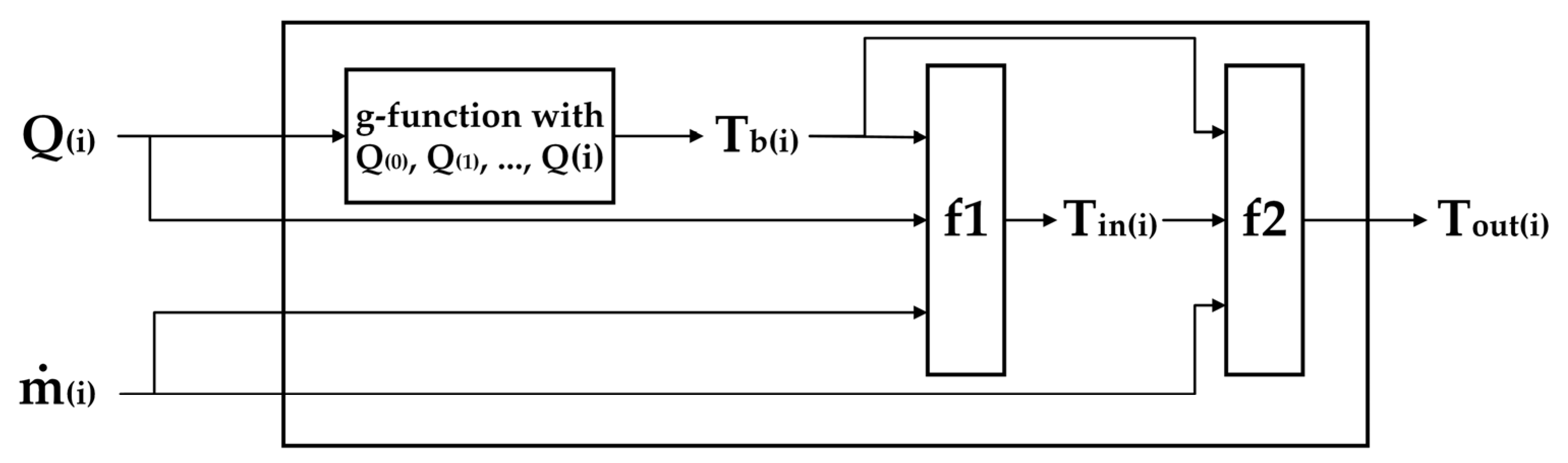
Figure 1 presents a computational flow diagram illustrating the structure of a borehole thermal response model based on the pygfunction library. The diagram captures the sequential calculation of the fluid outlet temperature T o u t ( i ) at each timestep i , using the thermal load Q ( i ) and the mass flow rate m ˙ ( i ) as inputs.
First, the thermal load is processed through a load aggregation module that performs a g-function-based convolution with the full history of past loads Q 0 ,   Q 1 ,   ,   Q ( i ) , yielding the borehole wall temperature T b ( i ) . This step reflects the core of pygfunction’s methodology, where the thermal interaction between boreholes over time is captured through superposition of temporal response factors. The computed T b ( i ) , together with the mass flow rate, is then used in a first functional block ( f 1 ) to determine the fluid inlet temperature T i n ( i ) , typically based on borehole thermal resistances and energy balance principles. A second function ( f 2 ) subsequently evaluates the fluid outlet temperature T o u t ( i ) , completing the modeling loop.

2.1.2. Modified Pygfunction Model

In practical applications, the fluid inlet temperature is often specified as the input parameter rather than the heat rate. To make pygfunction compatible with this practical input format, the model is slightly modified to accept hourly inlet temperature T i n ( i ) and mass flow rate m ˙ ( i ) as direct inputs, similar to the implementation in TRNSYS Type 285 [74].
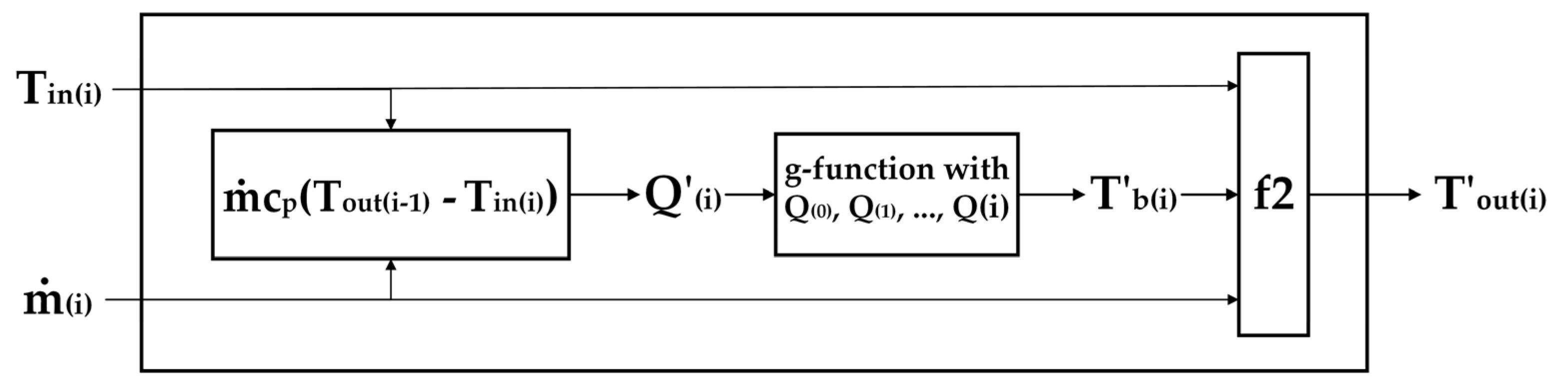
As shown in Figure 2, a procedure is introduced to determine the corresponding heat rate P ( i ) at each timestep, when the inlet temperature T i n ( i ) is used as an input, in contrast to Figure 1. This is estimated using the expression:
Q i = m ˙ i · c p · [ T o u t i 1 T i n i ]
where the fluid outlet temperature from the previous timestep T o u t ( i 1 ) , [°C or K], is used, and the undisturbed ground temperature T g ¯ is considered as T o u t ( i 1 ) for the initial timestep; c p —specific heat capacity of fluid, [J/kg/K]; m ˙ ( i ) —fluid mass flow rate for timestep i , [kg/s]; Q ( i ) —heat rate, [W]; T i n ( i ) —fluid inlet temperature, [°C or K].
After determining the heat rate, and similarly to the original pygfunction model, the estimated heat rate is passed through the g-function convolution, incorporating all previous heat loads Q 0 ,   Q 1 ,   ,   Q ( i ) , to compute the average borehole wall temperature T b ( i ) . This temperature is subsequently used in the borehole internal model (block f 2 ) to update the outlet temperature T o u t ( i ) . Thus, the core functionality of pygfunction remains unchanged.

2.1.3. Validation Method

A validation process was used to ensure the modified model preserves the accuracy and consistency of the original pygfunction. This process compares outputs between the original (heat-rate-driven) and the modified (inlet-temperature-driven) versions. The outlet temperature T o u t ( i ) , calculated by the modified model, was compared against T o u t ( i ) produced by the original pygfunction, where the heat load Q ( i ) is directly provided. To enable direct comparison between the two schemes, the value of T i n ( i ) internally generated by the original model is extracted and used as input to the modified one. In addition to the outlet temperature, the modified pygfunction model is verified by comparing its thermal power Q i and cumulative heat output to those from the original model.
The validation simulations were performed using two code implementations: (1) the original pygfunction model, based on the example available at the pygfunction GitHub repository [75], and (2) the abovementioned modified version. The original model generates a synthetic thermal load profile internally, based on Bernier et al. [76], while the modified model uses externally provided inlet temperature and mass flow rate profiles as inputs (Section 2.1.2). For validation, the fluid inlet temperature computed by the original model was extracted and used as input to the modified model to ensure consistent boundary conditions. Both models simulated a one-year period using an hourly time step. A constant mass flow rate of 0.25 kg/s per borehole was applied throughout the simulation. The complete simulation parameters and boundary conditions are summarized in Table A1 (Appendix A).

2.2. Pygfunction-Based Approach for Modeling Coaxial Medium-Deep and Deep Boreholes

As the next step, both the original and the modified pygfunction models are applied for simulating different cases of coaxial MDBHEs and DBHEs. For this purpose, the effective undisturbed ground temperature and the effective thermophysical properties of the ground are required, as the pygfunction was originally developed for modeling shallow geothermal systems, where single values for the undisturbed ground temperature and the thermophysical properties are used.
In cases with homogeneous ground, the effective undisturbed ground temperature can be calculated as the average of the ground surface and the ground bottom temperature, as follows:
T g ¯ = 0.5 · ( T g 0 + T b o t )
T b o t = T g 0 + t ¯ g r a d · H
where T g ¯ —effective undisturbed ground temperature, [°C]; T g 0 —ground surface temperature, [°C]; T b o t —ground temperature at the bottom of the borehole, [°C]; t ¯ g r a d —effective (average) geothermal gradient, [°C/m]; H —borehole depth, [m].
In cases of heterogeneous ground with different geothermal gradients for each layer, we propose to calculate the effective undisturbed ground temperature as the weighted average of the mean temperatures of each layer:
T g ¯ =   i = 1 n l T i + T i 1 2 · h i H
T i = T i 1 + t g r a d i · h i
where n l —number of ground layers; h i —thickness of layer i , [m]; t g r a d i —geothermal gradient in layer i , [°C/m]; T i —ground temperature at the bottom of layer i , [°C]; T i 1 —ground temperature at the top of layer i , [°C]; T i 1 = T g 0 when i = 1.
The thermophysical properties of heterogeneous ground can be determined using a weighted average, analogous to the calculation of the effective undisturbed ground temperature described above, based on the properties of the individual subsurface layers.

2.3. Validation of the Approach

The results obtained from the proposed approach were compared with numerical and semi-analytical models, as well as experimental data available in the literature. The considered scenarios included different depths (ranging from 700 to 3000 m), various input parameters, and configurations with multiple ground layers exhibiting distinct thermophysical properties.
All simulations used the so-called CXA configuration of BHE, which is a coaxial tube where the outer pipe serves as the inlet and the inner pipe as the outlet [77]. This configuration is typically used for heat extraction, whereas the opposite configuration (CXC) is mainly applied for heat injection [33,77,78].

2.3.1. Scenarios

To account for various possible configurations and conditions, the comparison was performed for the following cases:
  • coaxial medium-deep and deep borehole heat exchangers;
  • homogeneous and heterogeneous ground conditions;
  • single borehole and small-scale borehole field configurations;
  • presence of groundwater seepage;
  • scenario with extreme geothermal gradient.

2.3.2. Literature Data

For the comparison, various data sources were reviewed and analyzed based on data availability and parameter compatibility. Table 1 lists twelve articles selected as the basis for this research, corresponding to the scenarios mentioned in Section 2.3.1. An essential prerequisite for selection was the availability of both input and output data, enabling the reproduction of results in pygfunction. The selected articles provide the necessary input data, which are presented in Table 2. Simulation results based on numerical and semi-analytical models, as well as experimental data, were either obtained directly from the authors of the selected articles or extracted by digitizing published plots using an online tool developed by Rohatgi [79].
Table A2, Table A3, Table A4, and Table A5 in Appendix A summarize, respectively, the main dimensions of the coaxial medium-deep and deep boreholes, ground properties, thermal conductivity of grout and pipes, and fluid properties—all of which were obtained from the selected articles and used in this work.

2.3.3. Error Calculations

For the validation of the proposed approach, the main parameter compared in this work was the fluid outlet temperature. Its mean error (ME) was calculated as follows:
M E =   1 t · i = 1 t ( T o u t p y g i   T o u t l i t i )
where t —considered time period, [h];   T o u t p y g i —fluid outlet temperature calculated by the pygfunction-based method at time step i , [°C]; T o u t l i t i —fluid outlet temperature from the considered article at time step i , [°C].
The ME was intentionally calculated without applying the modulus. This approach allows to detect if the error of the pygfunction-based method has a systematic bias towards positive or negative values, i.e., consistent overestimation or underestimation.
The mean relative error (MRE) was calculated using the following formula:
M R E =   1 t · i = 1 t T o u t p y g i   T o u t l i t i T o u t l i t i
Numerical models can show initial discrepancies due to step size adaptation, implementation of initial conditions, or numerical noise. Similarly, measurements at the very beginning of an experiment may be less reliable due to sensor timing, latency, or response time. To minimize the influence of these effects on the comparison, the first 3% of the simulation period was excluded from the error calculation.
In this work, the agreement between results was categorized as very good, good, satisfactory, or poor based on the corresponding absolute values of ME for the fluid outlet temperature (Table 3).
The errors were computed not only for the fluid outlet temperature, but also for the fluid inlet temperature and total heat rate, in cases where these parameters were available in the selected articles. Similar formulas for the ME and MRE were applied. The fluid temperature profile along the length of the borehole was also compared with the available profiles from the considered literature.

2.3.4. Heat Pump Simulations

Although various methods for calculating the coefficient of performance (COP) of the GSHP exist [46], it is often determined as a quadratic function of the fluid outlet temperature from the bore field [93,95,97,98], with the coefficients of the quadratic approximation typically obtained from the heat pump manufacturers. However, in such cases, the fluid temperature entering the bore field from the GSHP does not impact the calculation.
In this work, the COP of the GSHP was calculated using a method based on the Lorenz efficiency [99], which accounts for the influence of both fluid inlet and outlet temperatures:
C O P h p = C O P L o r · η L o r
C O P L o r = T ¯ s i n k T ¯ s i n k T ¯ s o u r c e
η L o r = 0.312 · ln T ¯ s i n k T ¯ s o u r c e 0.0406
where T ¯ s i n k and T ¯ s o u r c e are mean logarithmic sink and source temperatures, respectively:
T ¯ s i n k = ( T s u p T r e t ) / ln T s u p T r e t
T ¯ s o u r c e = ( T o u t T i n ) / ln T o u t T i n
where T s u p —DH supply temperature, [K]; T r e t —DH return temperature, [K]; T o u t —fluid outlet temperature, [K]; T i n —fluid inlet temperature, [K].
For this study, two values of T ¯ s i n k were assumed: 353.15 K (80 °C) and 333.15 K (60 °C).
Heat pump electric power was calculated based on the COP of the GSHP and the total heat extraction rate from the bore field:
P h p = Q e x t r C O P h p 1
where Q e x t r —total heat extraction rate, [W]; P h p —heat pump electric power, [W].
The formulas above were used to determine the COP and the electric power of the GSHP based on the total heat extraction rate as well as the calculated fluid inlet and outlet temperatures, together with those reported in the selected literature. The resulting errors of the simulations were obtained as explained in Section 2.3.3.

3. Results

This section presents the main results of the study. The scenarios described in Section 2.3.1 and Section 2.3.2 were simulated using the proposed method on a laptop with an Intel® Core™ Ultra 7 165H processor (3.80 GHz), 32 GB RAM, and Windows 11. Computation times for each scenario are provided in Table A6 in Appendix A. In all cases, the computation time did not exceed six seconds.

3.1. Modified Pygfunction Model Validation

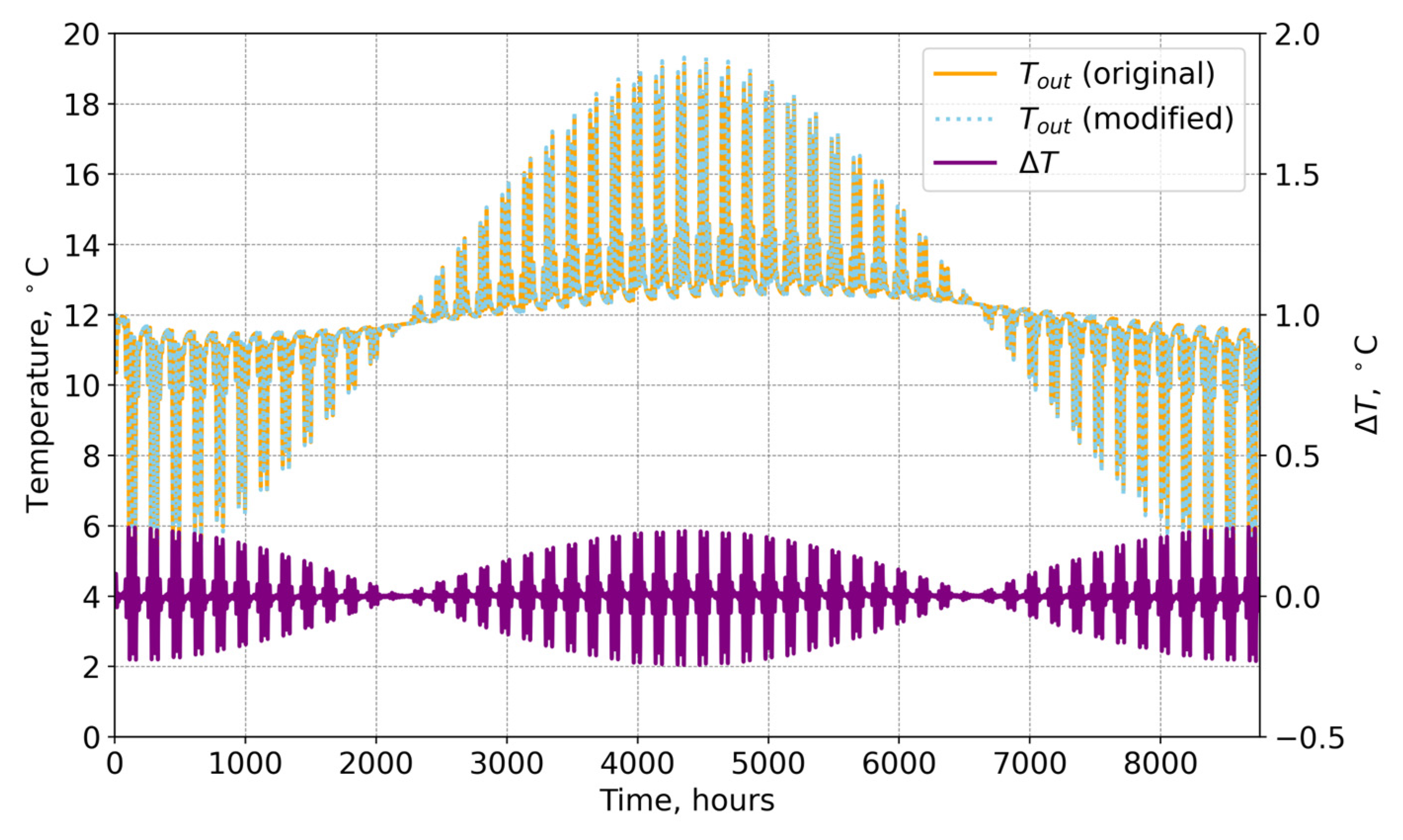
Figure 3 compares the fluid outlet temperature profiles of the original and modified models—labelled T o u t ( o r i g i n a l ) and T o u t ( m o d i f i e d ) , respectively—together with their difference ( T = T o u t o r i g i n a l T o u t ( m o d i f i e d ) ) over a one-year period. The two temperature profiles almost completely overlap, making them visually indistinguishable at the figure’s scale. The dedicated difference curve ( T ) shows that the maximum deviation does not exceed ±0.25 °C, confirming that the modification of the pygfunction does not introduce significant discrepancies in the outlet temperature compared to the original one. The comparison of thermal power, cumulative heat, and reconstructed inlet temperatures also demonstrated very good agreement between the two models.
These results confirm that the modified model retains the accuracy and computational robustness of the original pygfunction framework, while extending its flexibility for practical applications. This advancement supports the use of pygfunction in system-level simulations and design workflows that rely on measured fluid inlet temperature and flow rate data, such as building energy management systems and geothermal field performance analysis.

3.2. Homogeneous Ground

The original and modified pygfunction models were used for further analysis in this work, depending on the input data: heat rate or fluid inlet temperature, respectively.

3.2.1. Medium-Deep Borehole Heat Exchanger

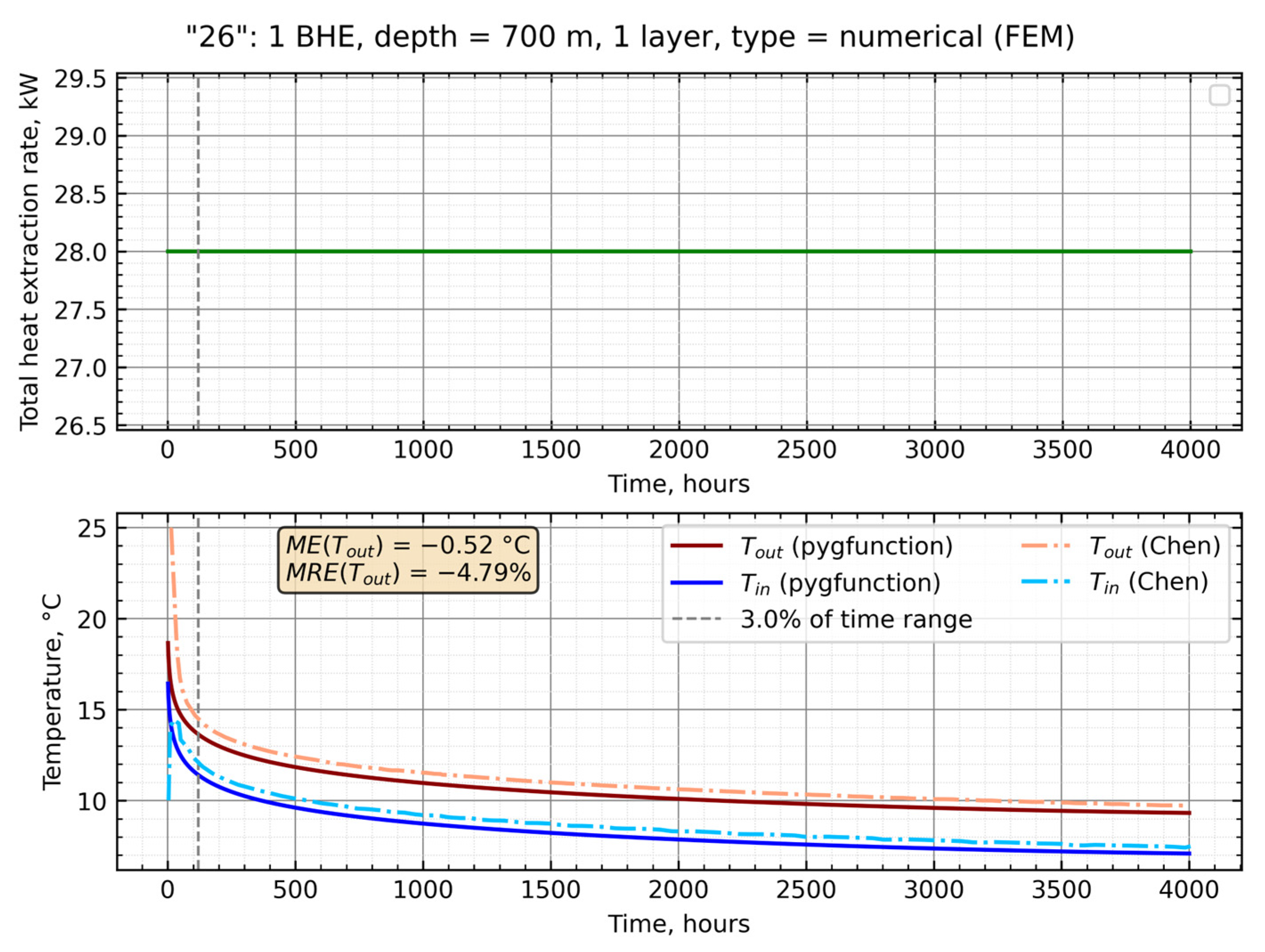
The case representing a single MDBHE in homogeneous ground is presented in Figure 4. In this figure, the results simulated by the pygfunction-based method are compared with those obtained by Chen [80]. The total heat extraction rate was used as input. The figure displays very good agreement between the results, with the ME of the fluid outlet temperature being −0.52 °C and the MRE being −4.79%. These results indicate that the proposed approach underestimates the fluid outlet temperature, but the deviation is relatively small.

3.2.2. Deep Borehole Heat Exchanger

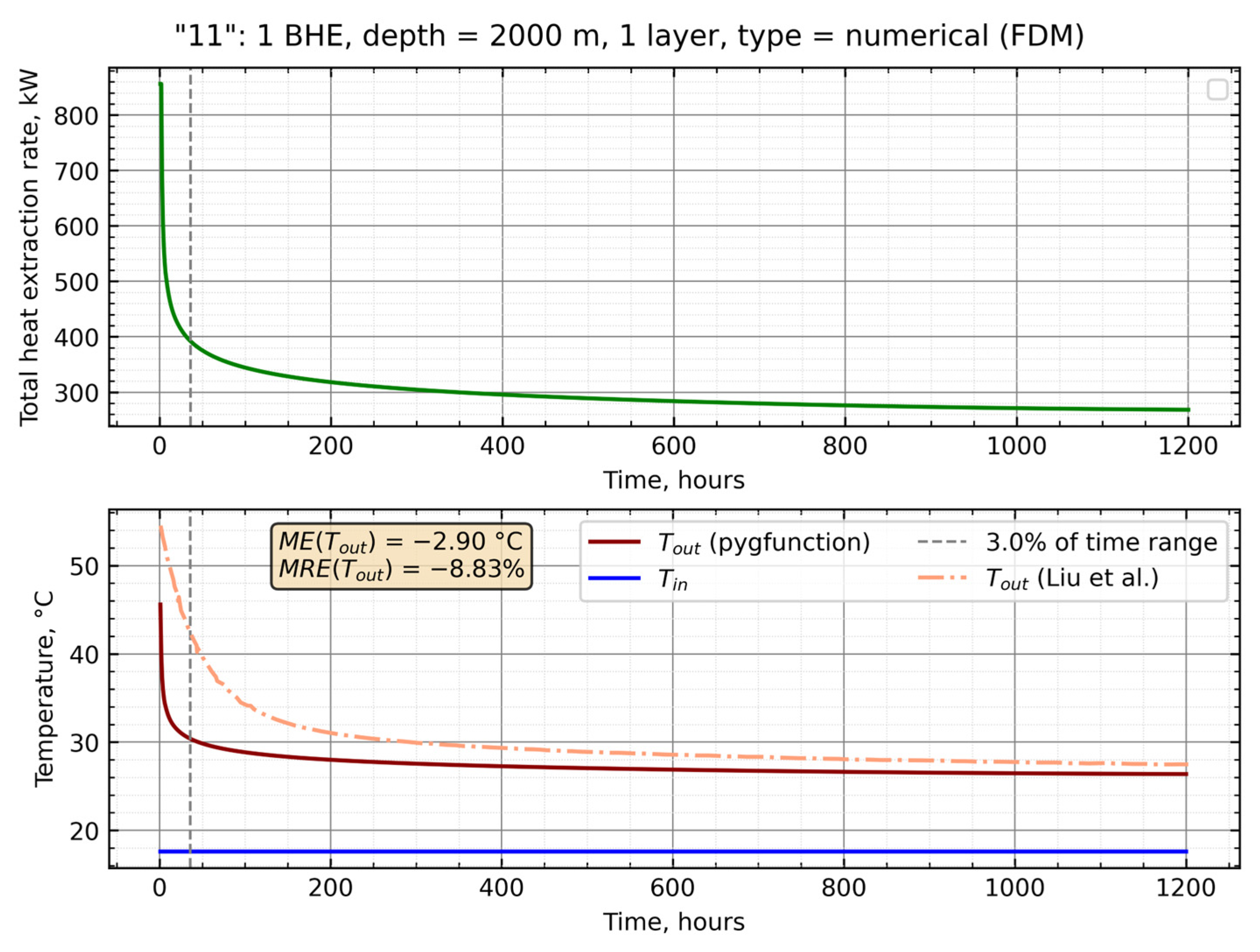
The case representing a single DBHE in homogeneous ground is presented in Figure 5. It shows a comparison between the results simulated by the pygfunction-based method and those obtained by Liu et al. [32], with the fluid inlet temperature used as input. In this case, the ME is −2.9 °C and the MRE is −8.83%, both of which are higher than the values observed for the MDBHE considered in Section 3.2.1. Liu et al. validated their numerical model against the experimental data from a 2000 m-deep well in Xi’an, China [84]. Describing their validation, they write: “The average relative error of the simulated outlet temperature is 5.83% and the maximum relative error is 8.12%. […] Previously measured outlet temperatures are lower than the simulated temperatures obtained from our model.” This suggests that the results obtained in the present work may actually be closer to the experimental data from [84], and, therefore, the true error of the pygfunction-based method may be smaller in this case.
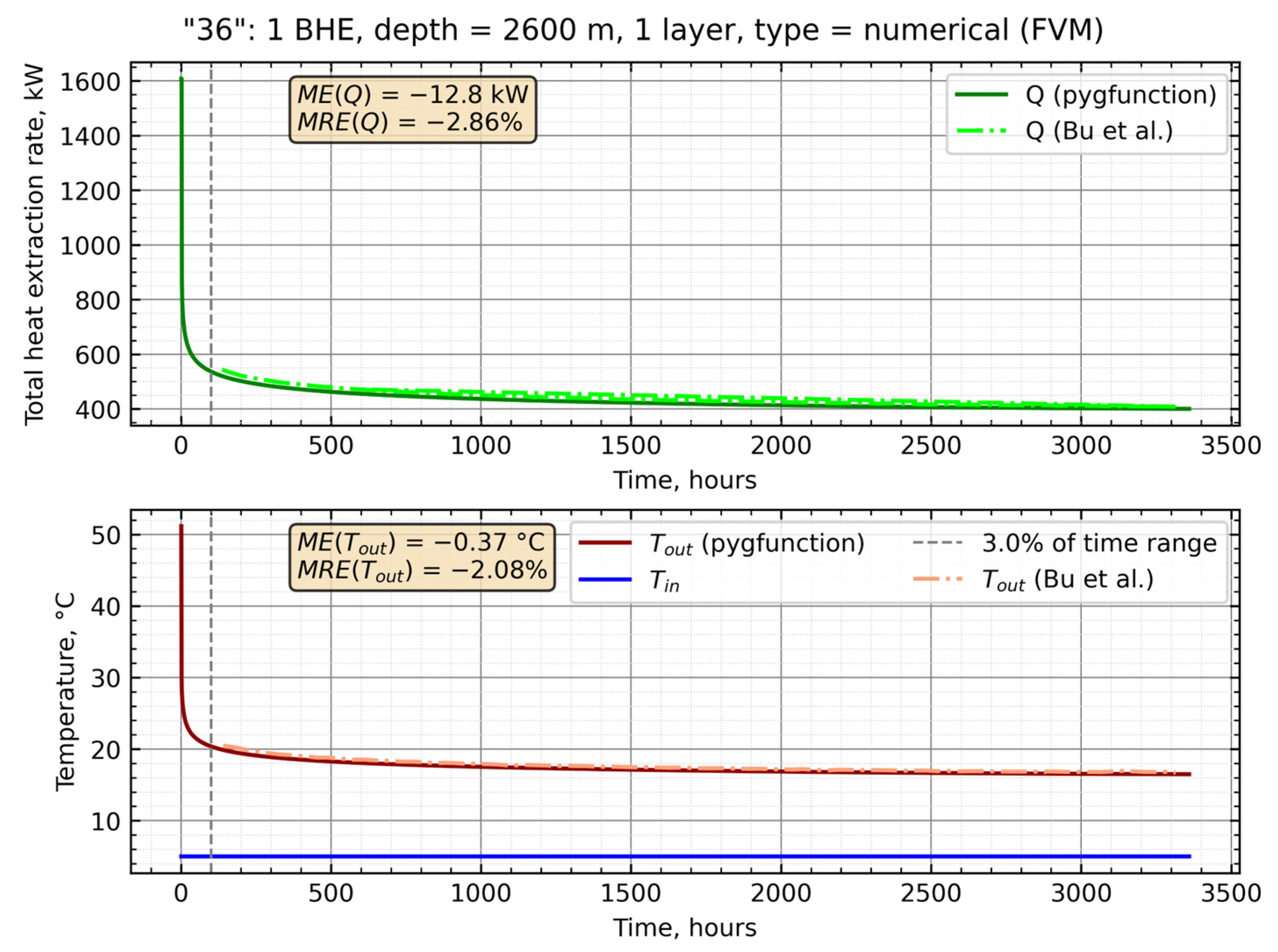
For further comparison of simulation results for a single DBHE in homogeneous ground, the work of Bu et al. [85] was used, where they developed a numerical model and validated it against the experimental data from a 2600 m well in Qingdao, China [85]. The fluid inlet temperature was used as input. Figure 6 demonstrates very good agreement between the results from the pygfunction-based method and those from the numerical model by Bu et al., with the ME of the fluid outlet temperature being −0.37 °C and the MRE being −2.08%. Additionally, the ME and MRE of the total heat extraction rate are −12.8 kW and −2.86%, respectively.
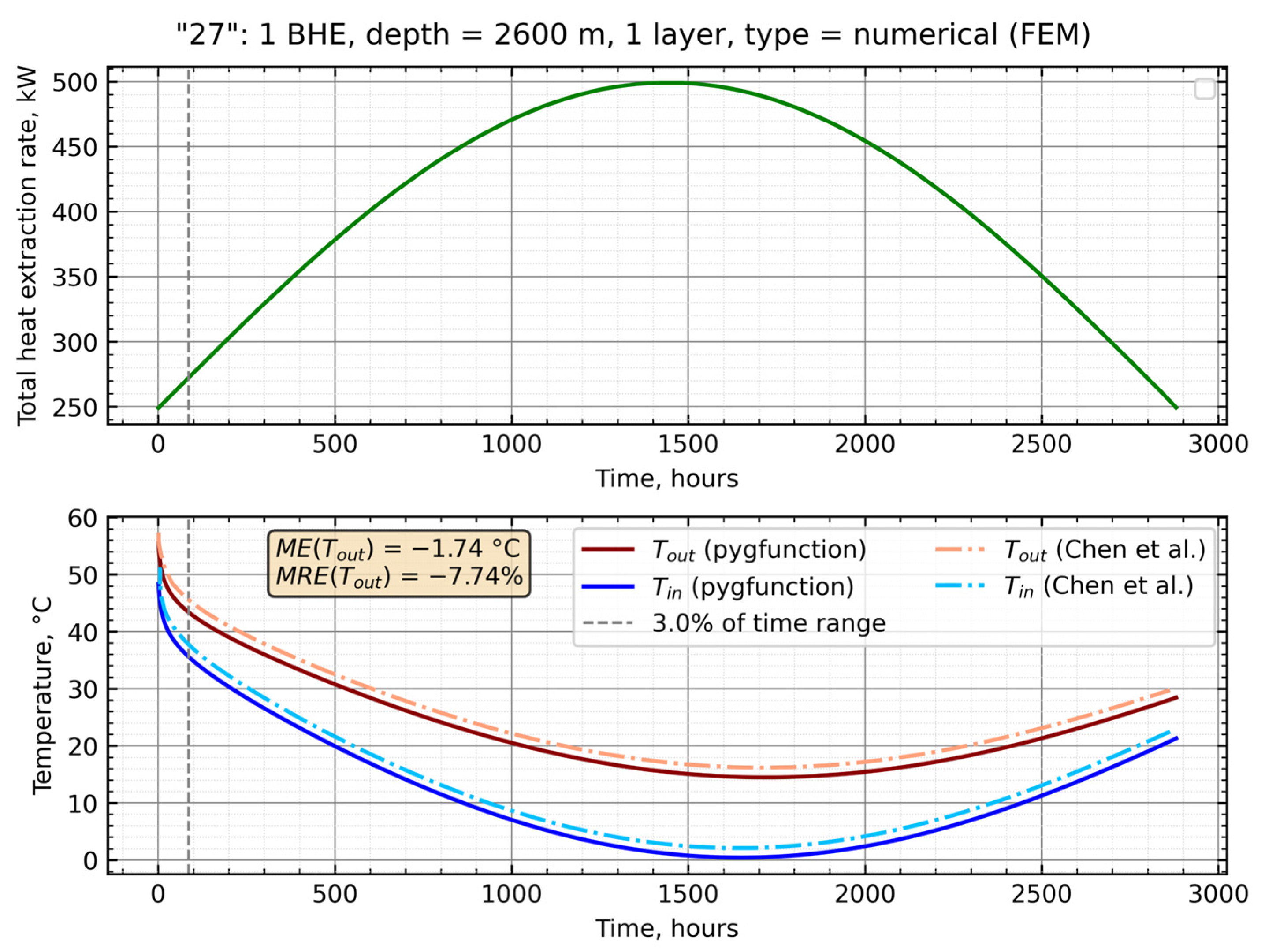
Figure 7 presents another comparison for a single DBHE in homogeneous ground. In this scenario, the input heat rate varies from 250 to 500 kW. As a result, the error levels can be considered good, with the ME of the fluid outlet temperature being −1.74 °C and the MRE being −7.74%.

3.3. Heterogeneous Ground

While the previous results concern homogeneous ground, this section considers scenarios for heterogeneous ground.

3.3.1. Medium-Deep Borehole Heat Exchanger

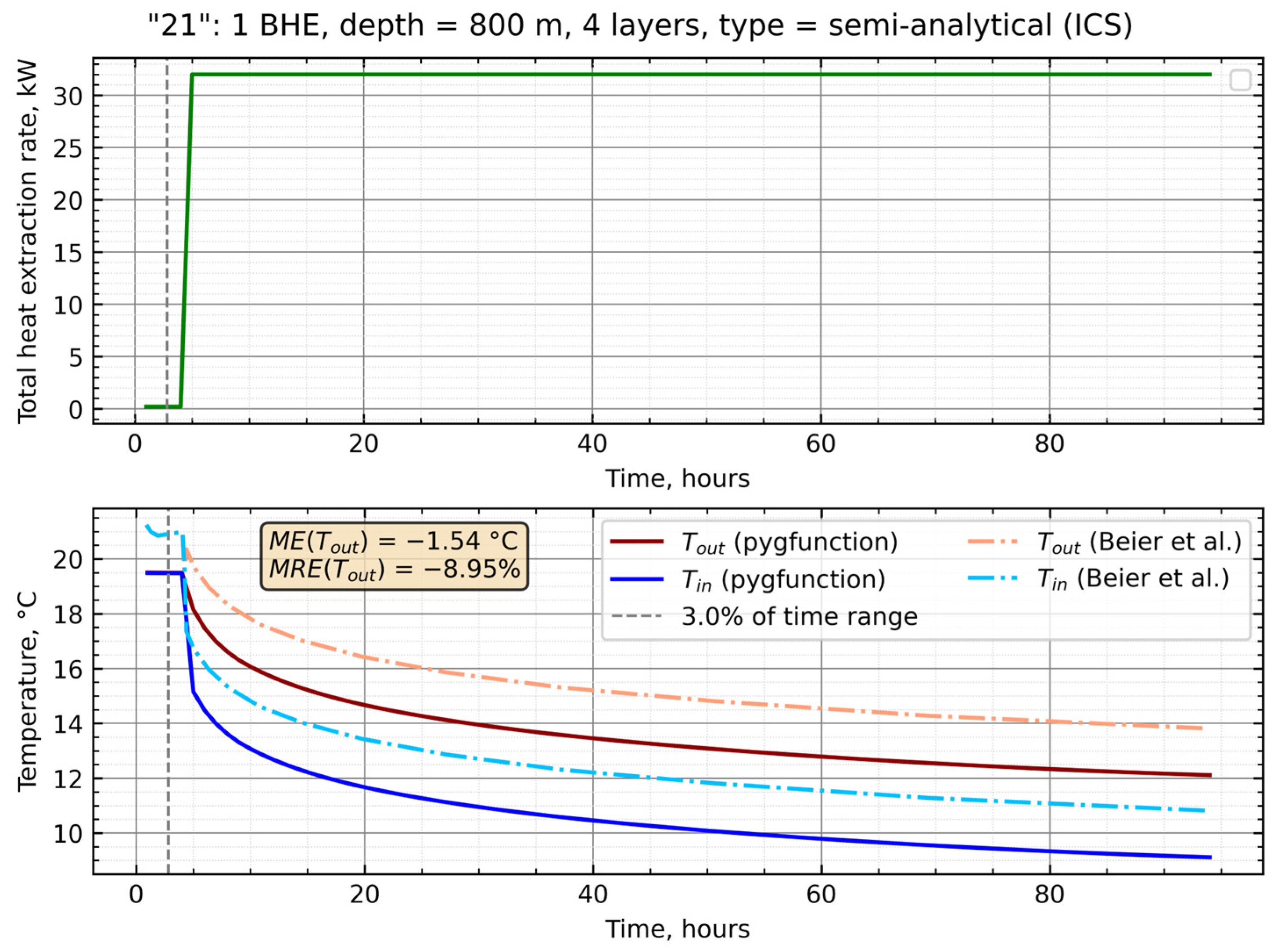
Figure 8 presents a comparison between the results obtained using the pygfunction-based method and those reported by Beier et al. [88] for an MDBHE (800 m deep) in heterogeneous ground comprising four layers. The total heat extraction rate was used as input, and the first four hours prior to heat extraction were modeled as the fluid circulation. As a result, the ME of the outlet temperature is −1.54 °C and the MRE is −8.95%, both of which can be considered good.

3.3.2. Deep Borehole Heat Exchanger

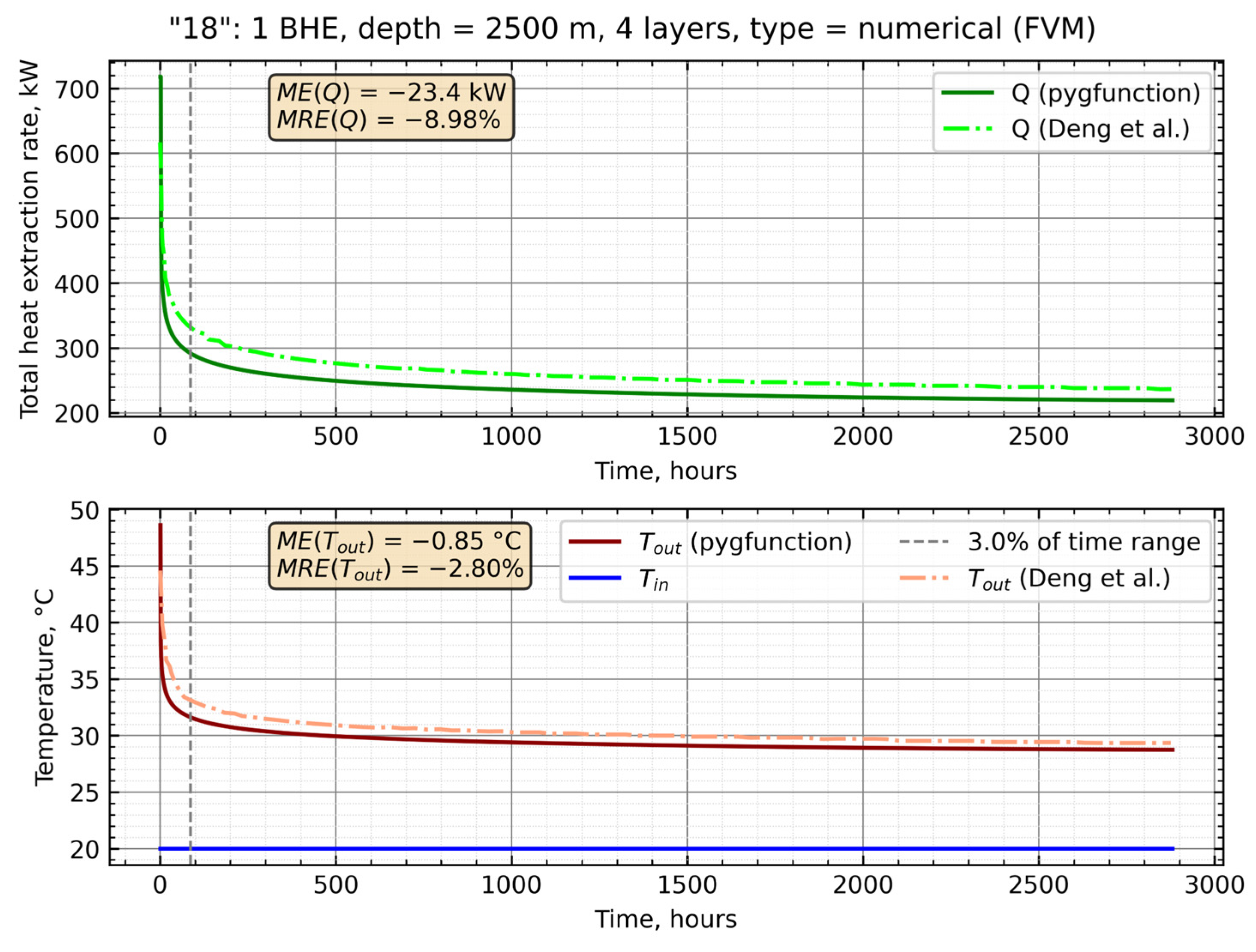
The following scenario considers a DBHE in heterogeneous ground with four layers. The numerical model by Deng et al. [89], validated against experimental data from a 2500 m well in Xi’an, China, served as a reference for comparison with the pygfunction-based method. Figure 9 shows very good agreement between the results, with the ME of the fluid outlet temperature being −0.85 °C and the MRE being −2.8%. Additionally, the ME and MRE of the total heat extraction rate are −23.4 kW and −8.98%, respectively.
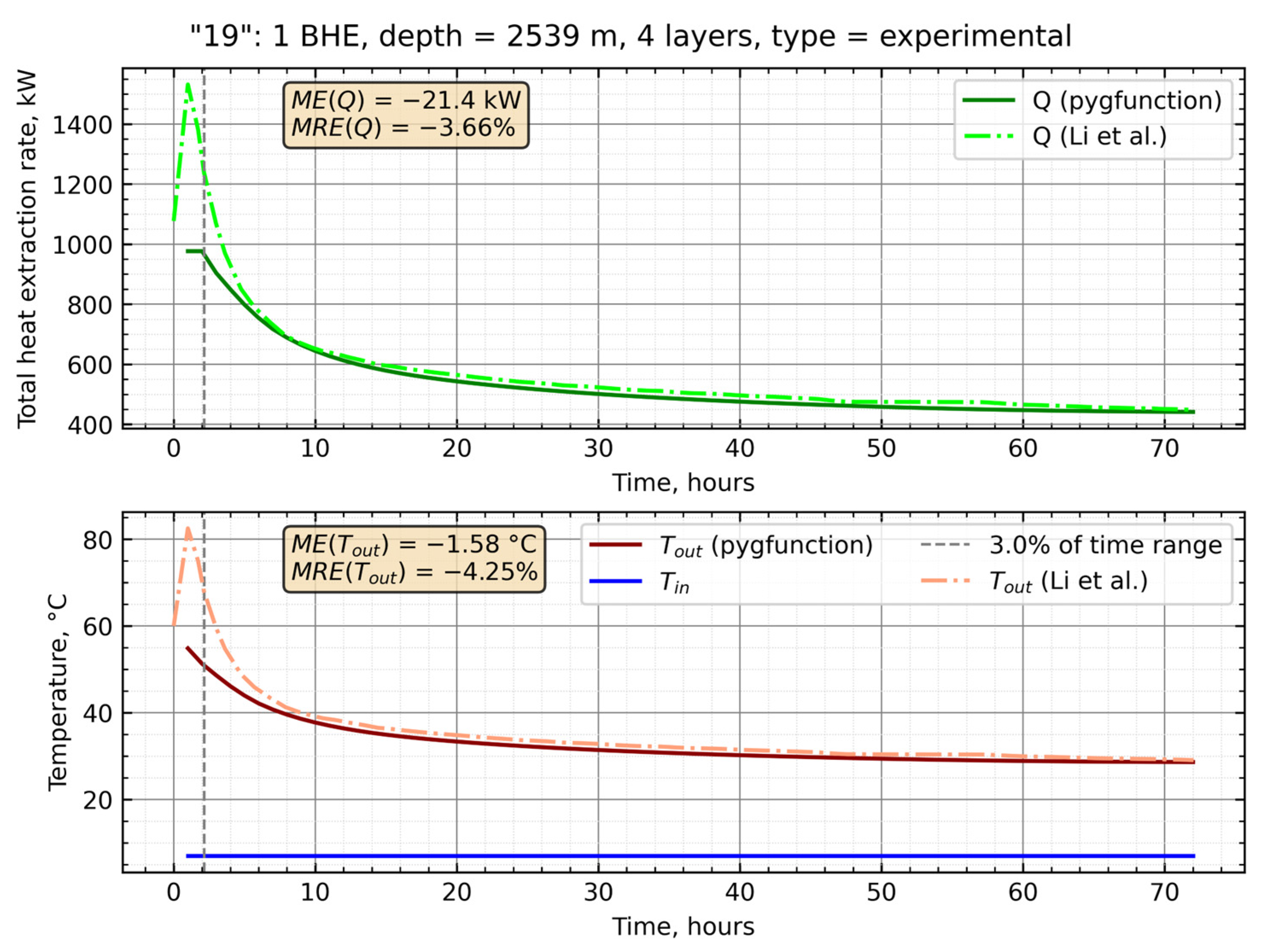
Experimental data from another deep borehole in Xi’an, China [90] were used to further compare simulation results for a single DBHE in heterogeneous ground with four layers. Figure 10 also shows good agreement between the pygfunction-based method and the experimental data, with the ME of the fluid outlet temperature being −1.58 °C and the MRE being −4.25%. Moreover, the ME and MRE of the total heat extraction rate are −21.4 kW and −3.66%, respectively.
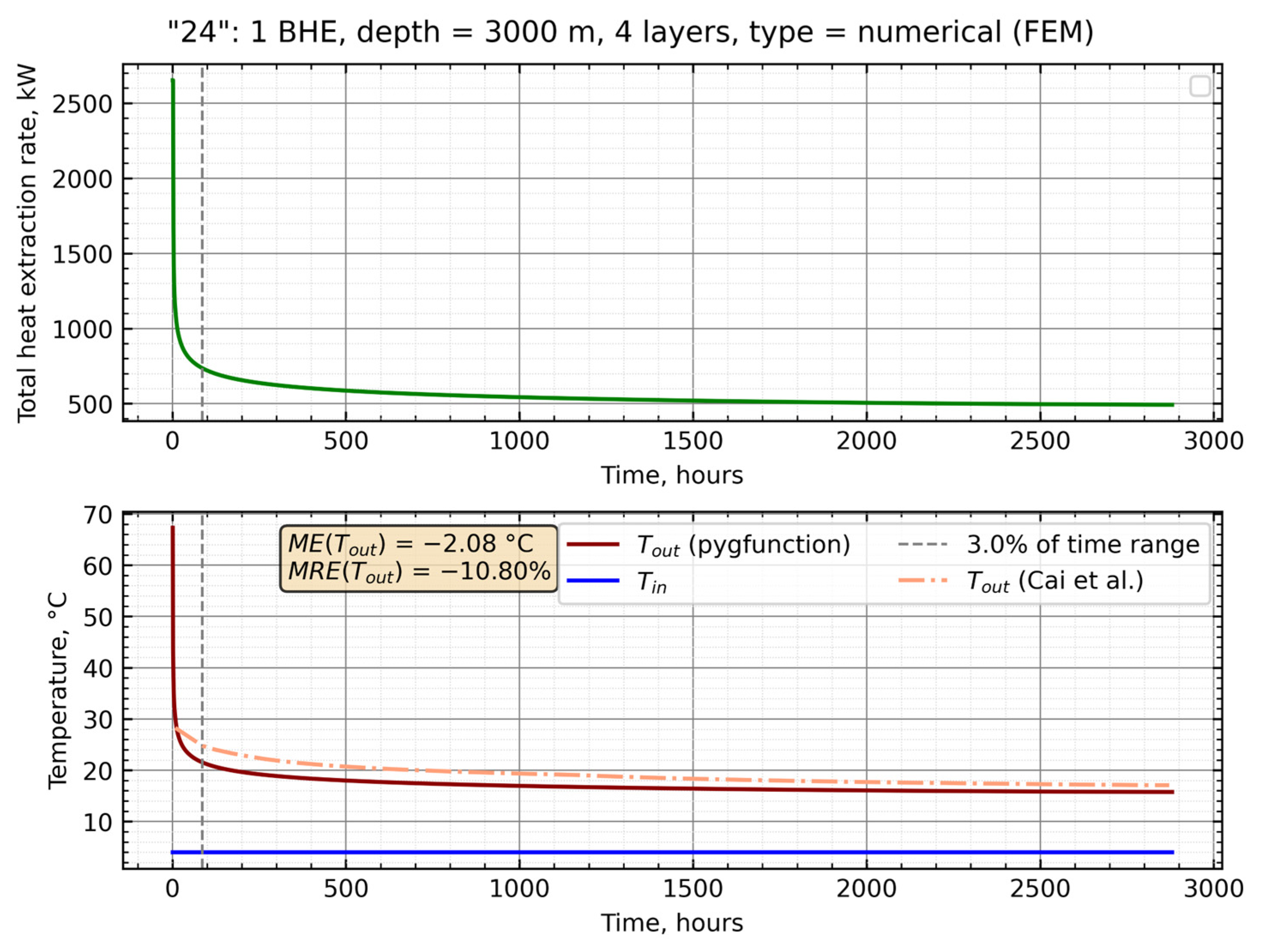
Figure 11 shows a comparison between the results obtained using the pygfunction-based method and those reported by Cai et al. [91] for the DBHE in heterogeneous ground. In this case, the errors are satisfactory, with the ME of the fluid outlet temperature being −2.08 °C and the MRE being −10.8%.
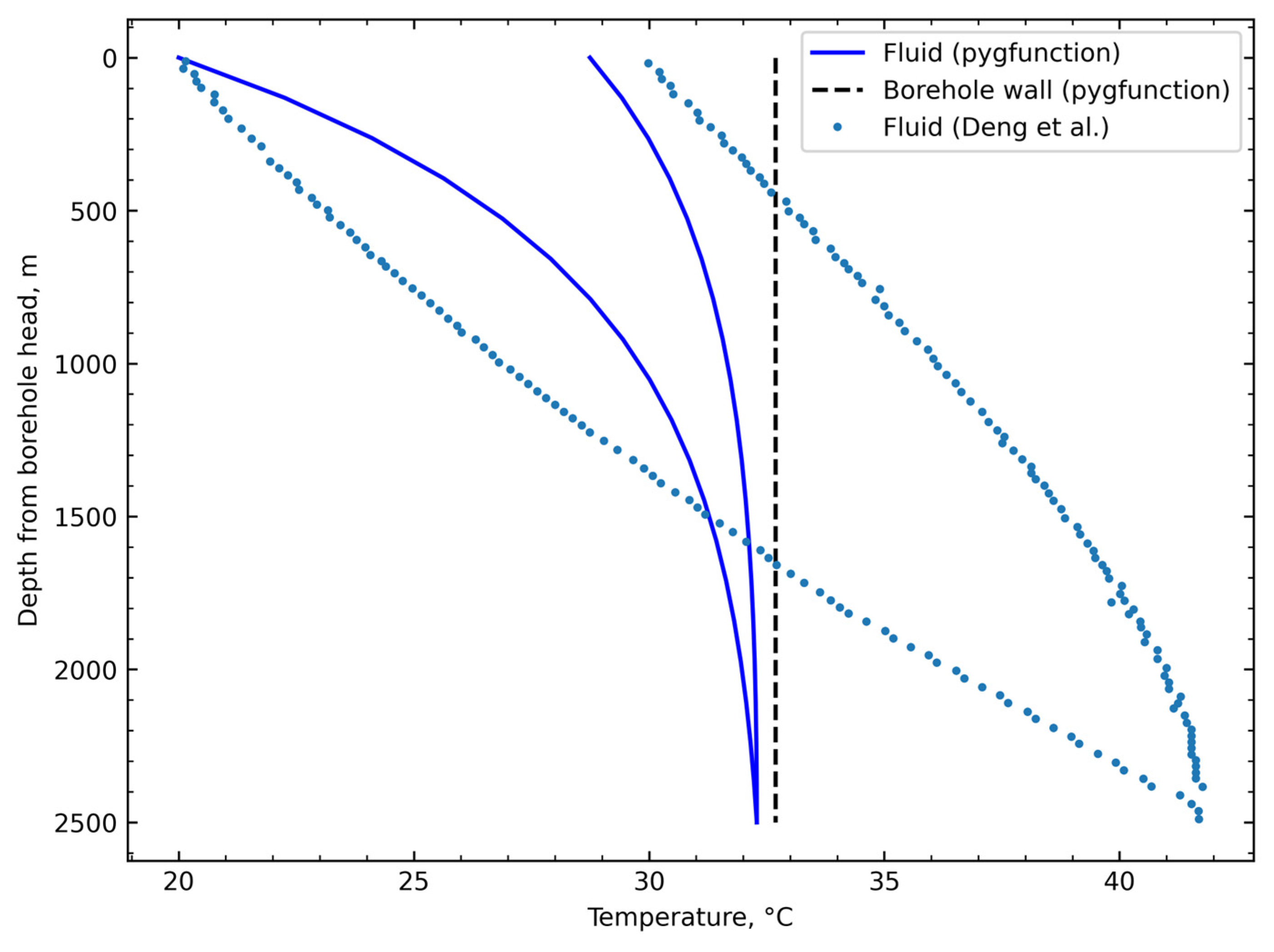
Although the fluid outlet temperature is shown to have a relatively small error in the cases above, it should be noted that pygfunction cannot accurately simulate the fluid temperature profile along the borehole length for medium-deep and deep boreholes. The assumption of a constant undisturbed ground temperature (averaged over the borehole length) may be acceptable for shallow boreholes, but with increasing depth, it leads to a misrepresentation of the actual subsurface conditions. This limitation and the resulting discrepancy are illustrated in Figure 12.

3.4. Field of Borehole Heat Exchangers

While the previous sections discussed single boreholes, fields of medium-deep and deep boreholes are considered in this section. However, only a few such fields with a small number of boreholes were found in the literature [94,100], in contrast to shallow fields, which often comprise multiple boreholes.

3.4.1. Medium-Deep Borehole Heat Exchangers

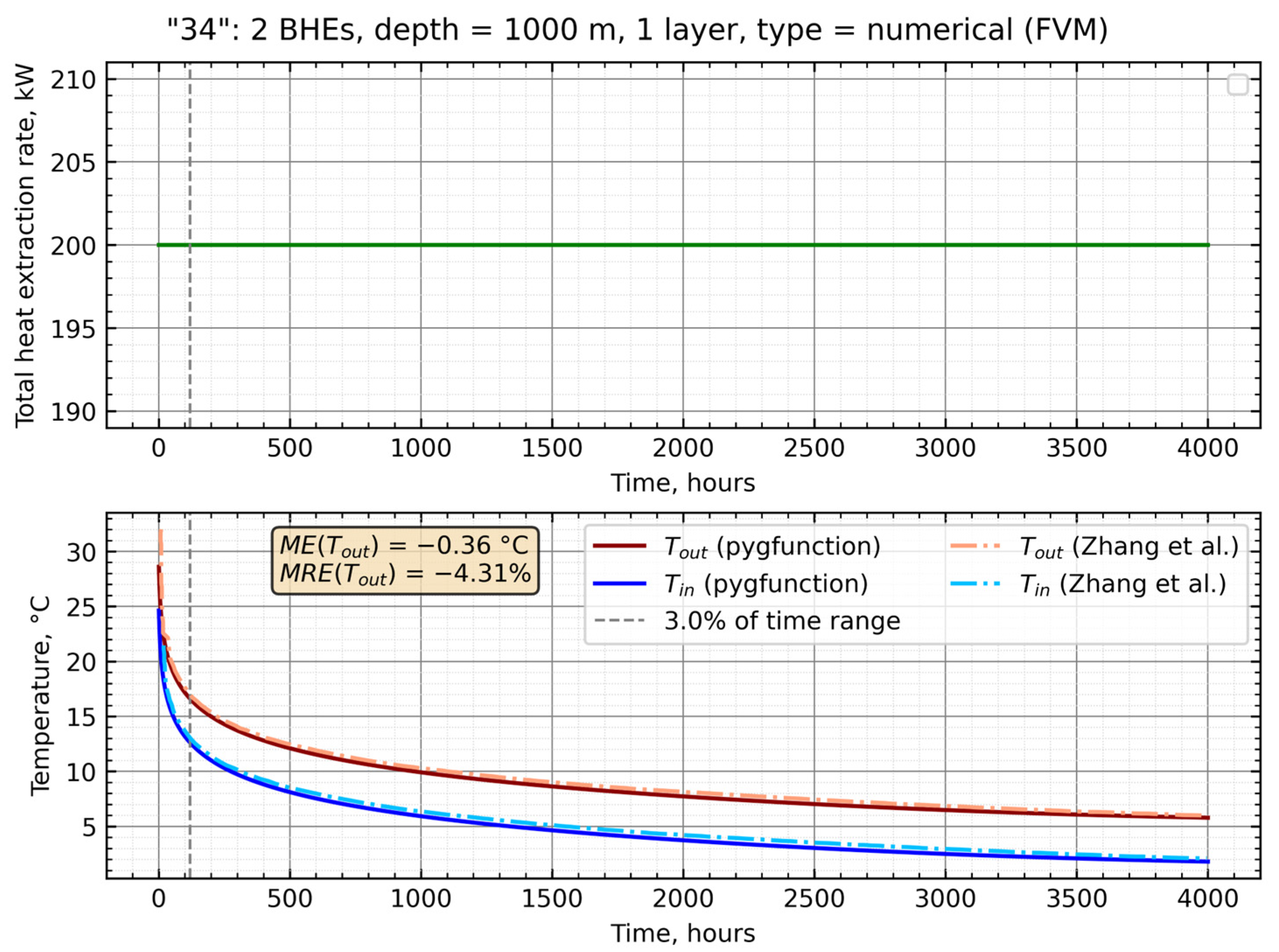
Figure 13 shows a comparison between the results obtained using the pygfunction-based method and those reported by Zhang et al. [92] for two MDBHEs, each 1000 m deep, in homogeneous ground. In this case, the agreement is very good, with the ME of the fluid outlet temperature being −0.36 °C and the MRE being −4.31%.

3.4.2. Deep Borehole Heat Exchangers

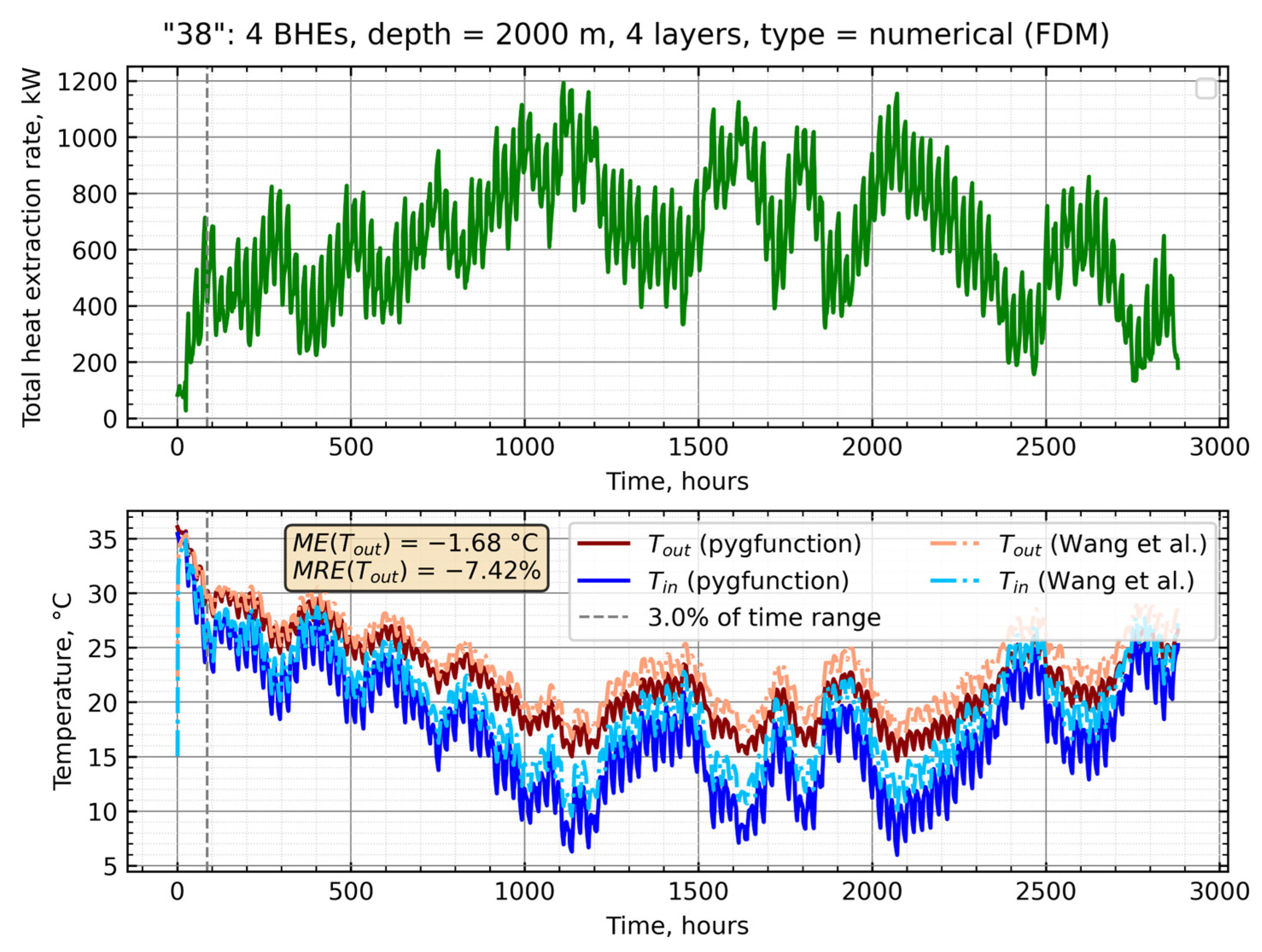
A numerical model, developed by Wang et al. [93] and validated against the experimental data from four 2000 m wells in Xi’an, China [94], was used for further comparison of the simulation results for a deep bore field in heterogeneous ground. A varying heat extraction rate, which corresponds to the heat load of a residential building in Jinan, China [93], was used as input. Figure 14 shows good agreement between the results obtained using the pygfunction-based method and those from the numerical model by Wang et al. [93], with the ME of the fluid outlet temperature being −1.68 °C and the MRE being −7.42%.
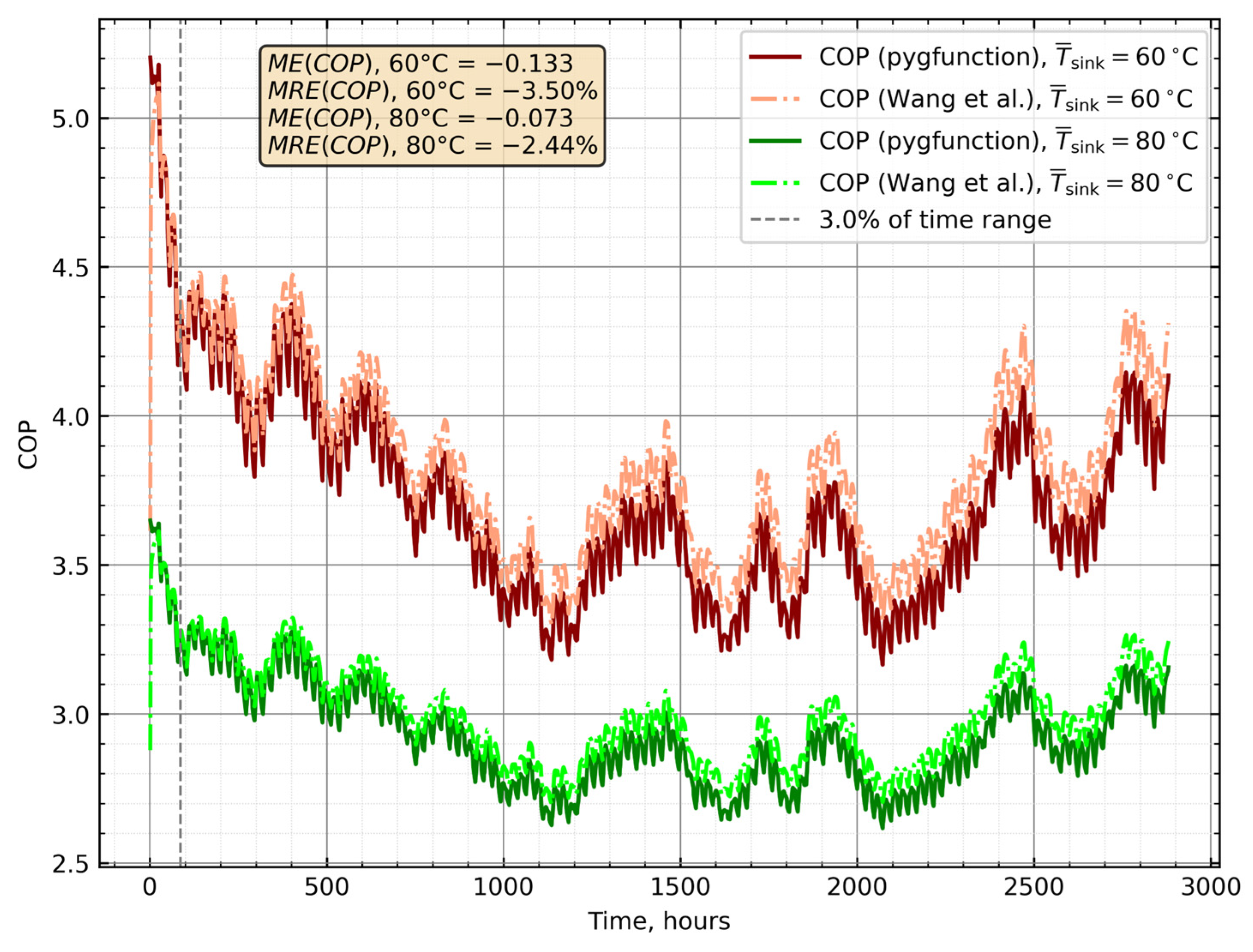
To show the influence of the different fluid inlet and outlet temperature simulations on the COP of the GSHP, the COP model described in Section 2.3.4 was used. As shown in Figure 15, the MRE of the COP is −3.5% (when T ¯ s i n k = 60 °C), which is smaller in magnitude (i.e., closer to zero) than the MRE of the fluid outlet temperature (Figure 14).

3.5. Groundwater Seepage

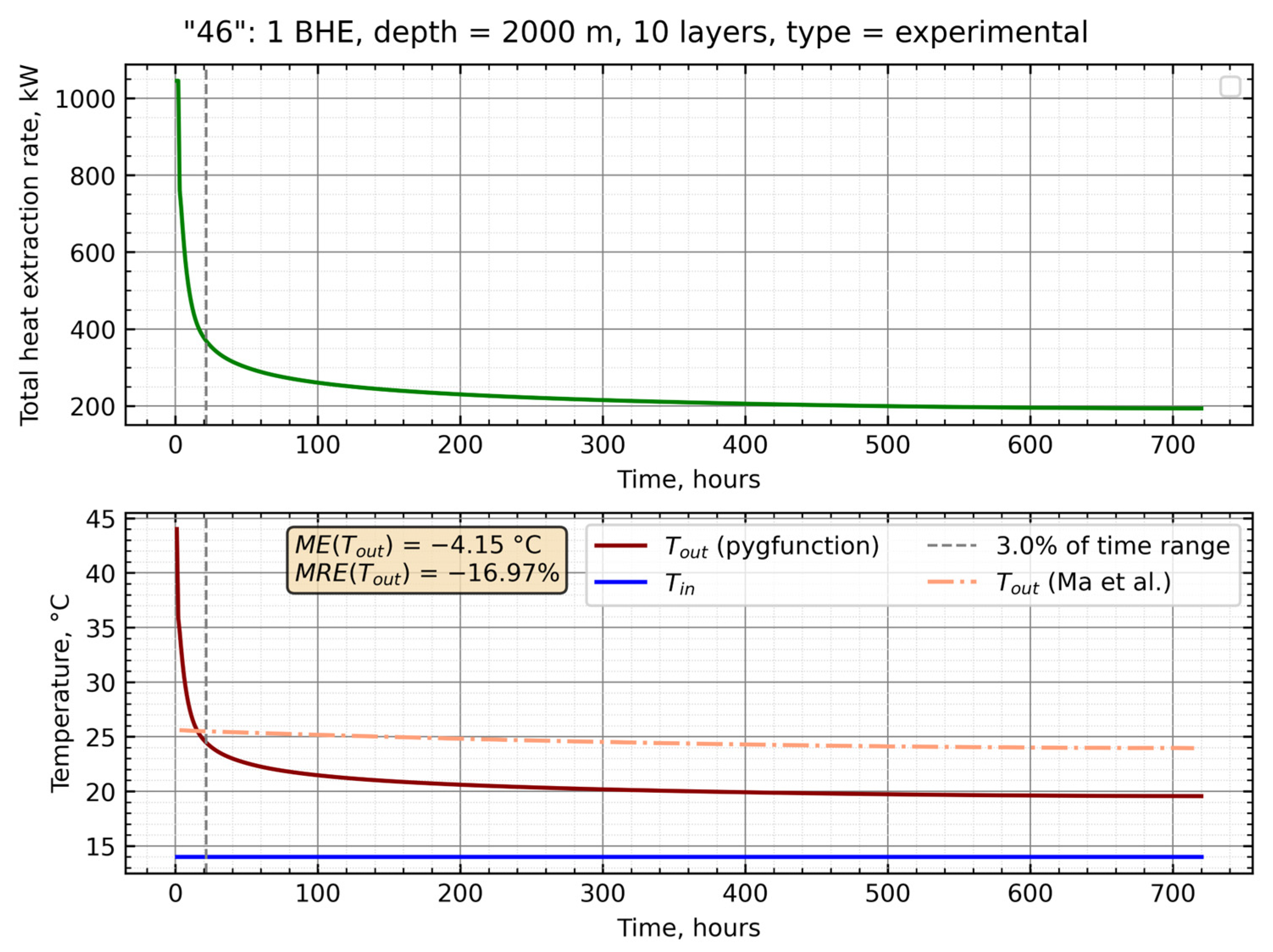
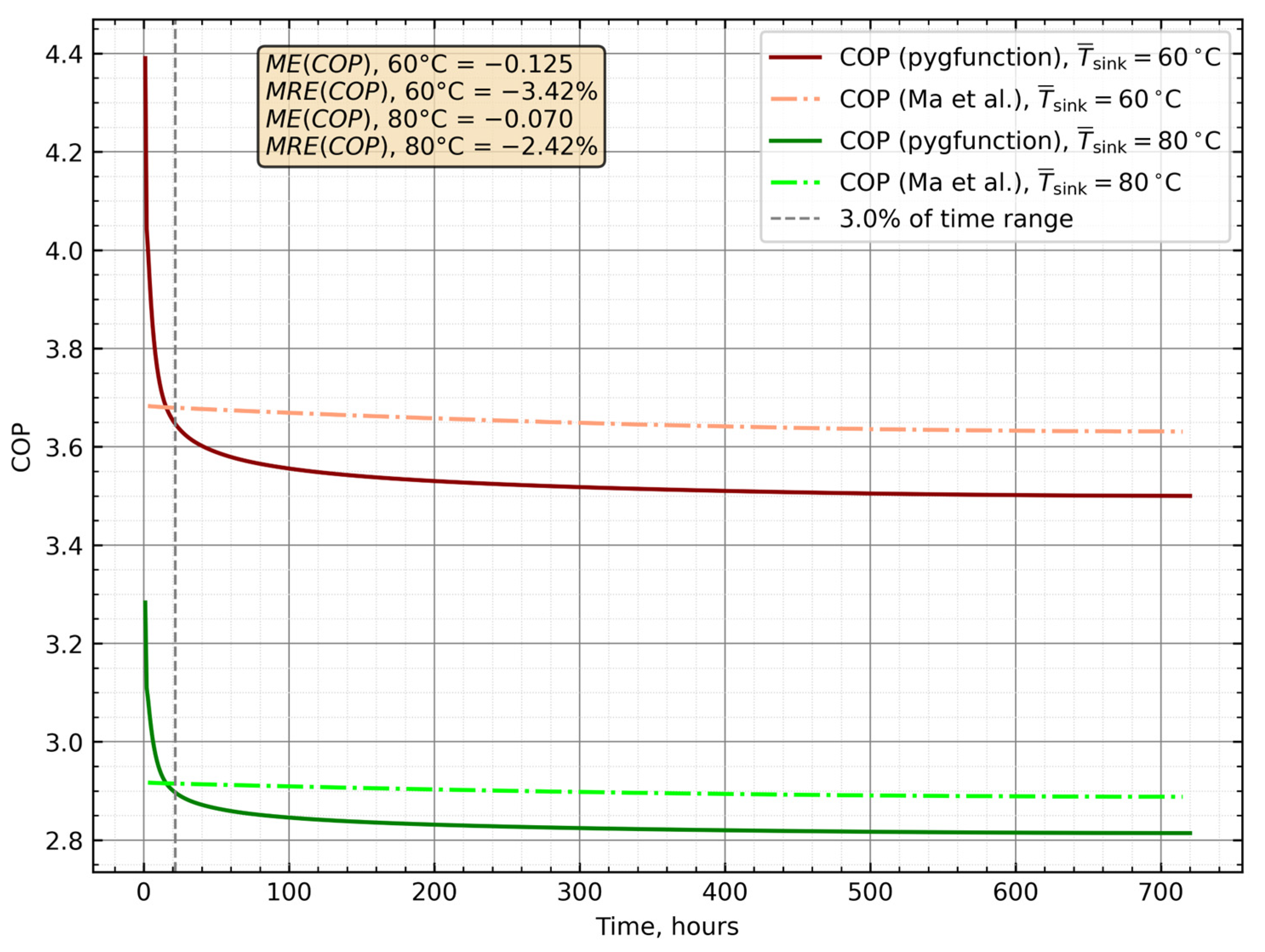
The influence of groundwater seepage was investigated by comparing the pygfunction results with those of a numerical model validated against experimental data from a 2000 m-deep borehole in Tianjin, China [95]. The considered system comprises 10 ground layers. As shown in Figure 16, agreement between the results is poor, with the ME being −4.15 °C and the MRE being about −17%.
Huang et al. [101] concluded that “[…] for a high seepage velocity, the thermal performance of a DBHE will be underestimated if the influence of seepage is ignored.” Pokhrel [102] reported a 19.5% drop in the thermal output when using a purely conductive model without seepage in the formation. Li et al. [103] also observed that groundwater flow can have a significant influence on DBHE performance, which may not be adequately captured by using effective ground thermal properties.
These results indicate that simulating complex cases involving groundwater flow in pygfunction can be challenging without additional modifications. However, Figure 17 shows that even with substantial discrepancies in the fluid outlet temperature, the COP of the heat pump is underestimated by less than 4% when the mean sink temperature is in the range of 60 to 80 °C.

3.6. Extreme Geothermal Gradient

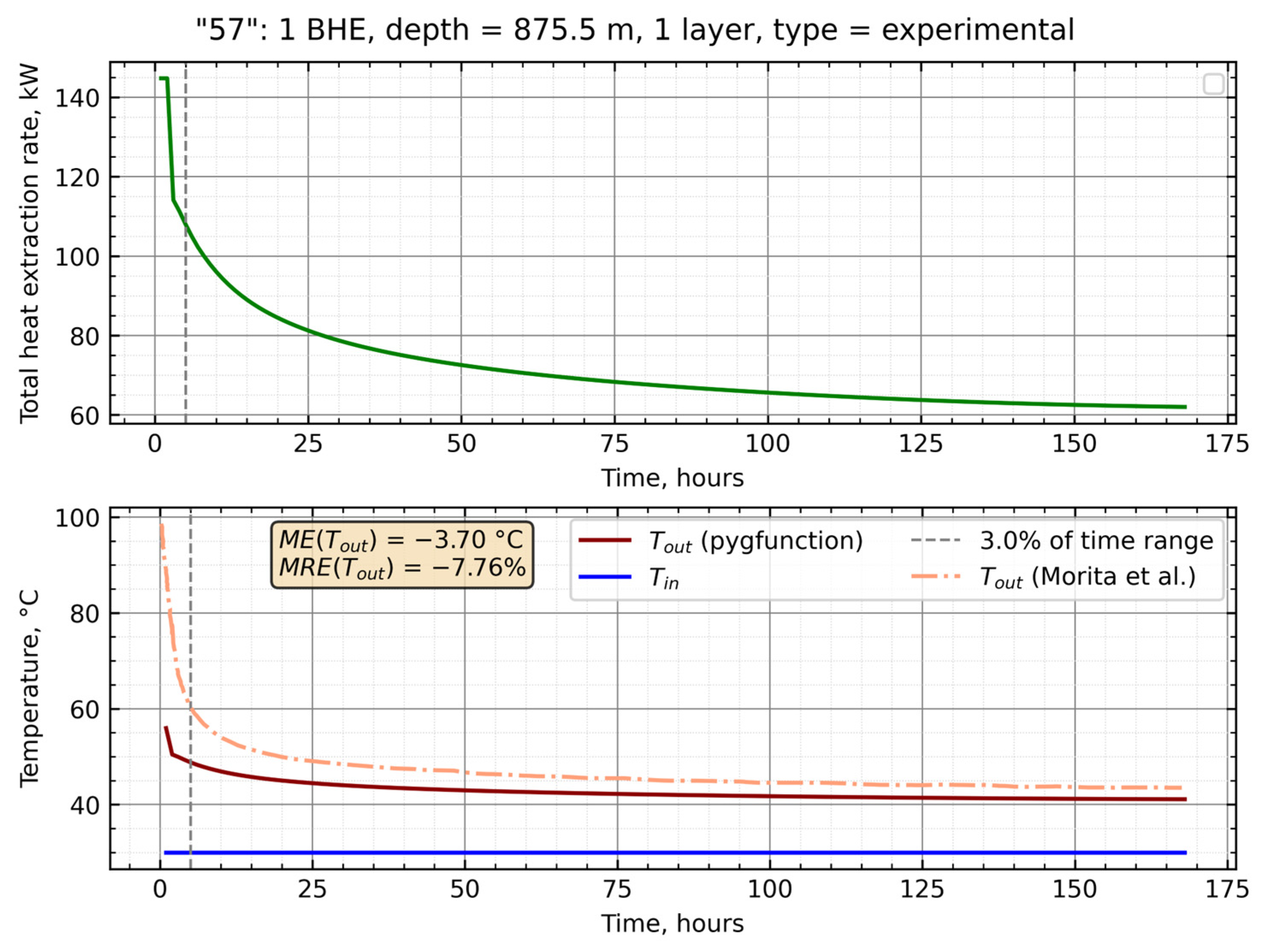
For the case with an extreme geothermal gradient, the geothermal project in Hawaii, USA [96] was considered. With a value of 96.7 °C/km (Table A3 in Appendix A), this significantly exceeds the typical geothermal gradient of 25–30 °C/km [104]. In this scenario, the results presented in Figure 18 indicate that the discrepancy between the pygfunction-based method and the experimental data from [96] is substantial, with the ME being −3.7 °C. This can be explained by the use of a single value for the effective undisturbed ground temperature in the pygfunction-based method, rather than the actual ground temperature profile. When the geothermal gradient is very high, the resulting error is likely to increase.

4. Discussion

To simulate coaxial MDBHEs and DBHEs, the undisturbed ground temperature and thermophysical properties were weight-averaged along the borehole depth in pygfunction, which was also adapted to use the fluid inlet temperature as input. The proposed method was then compared against numerical and semi-analytical simulations, as well as experimental data from the literature, considering various depths (700–3000 m) and configurations, including multiple ground layers with distinct thermophysical properties, groundwater flow, and anomalously high geothermal gradient. The results are presented above, in Section 3, and summarized in Table A7 in Appendix A.
With the discrepancies remaining within an acceptable range, our comparisons indicate that the proposed approach predicts fluid inlet and outlet temperatures as well as heat extraction rates of coaxial MDBHEs and DBHEs reasonably well, demonstrating its applicability for fast simulations of medium-deep and deep geothermal systems. The computation time for each considered scenario is less than six seconds (Table A6). Consequently, the proposed approach offers computationally efficient and sufficiently accurate results for GSHP modeling involving MDBHEs and DBHEs, particularly in contexts where rapid computation and reasonable accuracy are required for preliminary design and analysis.
The method may have limitations, particularly in complex cases involving groundwater seepage or extreme geothermal gradients. Nevertheless, even in these cases, the COP of the heat pump is underestimated by less than 6% for the mean sink temperature in the range of 60 °C to 80 °C. As presented in Table A7, the absolute values of the mean relative errors for the COP are lower than those for the fluid temperatures. This suggests that COP values are not highly sensitive to inaccuracies in fluid temperature simulations and, therefore, are not significantly affected by less precise modeling.
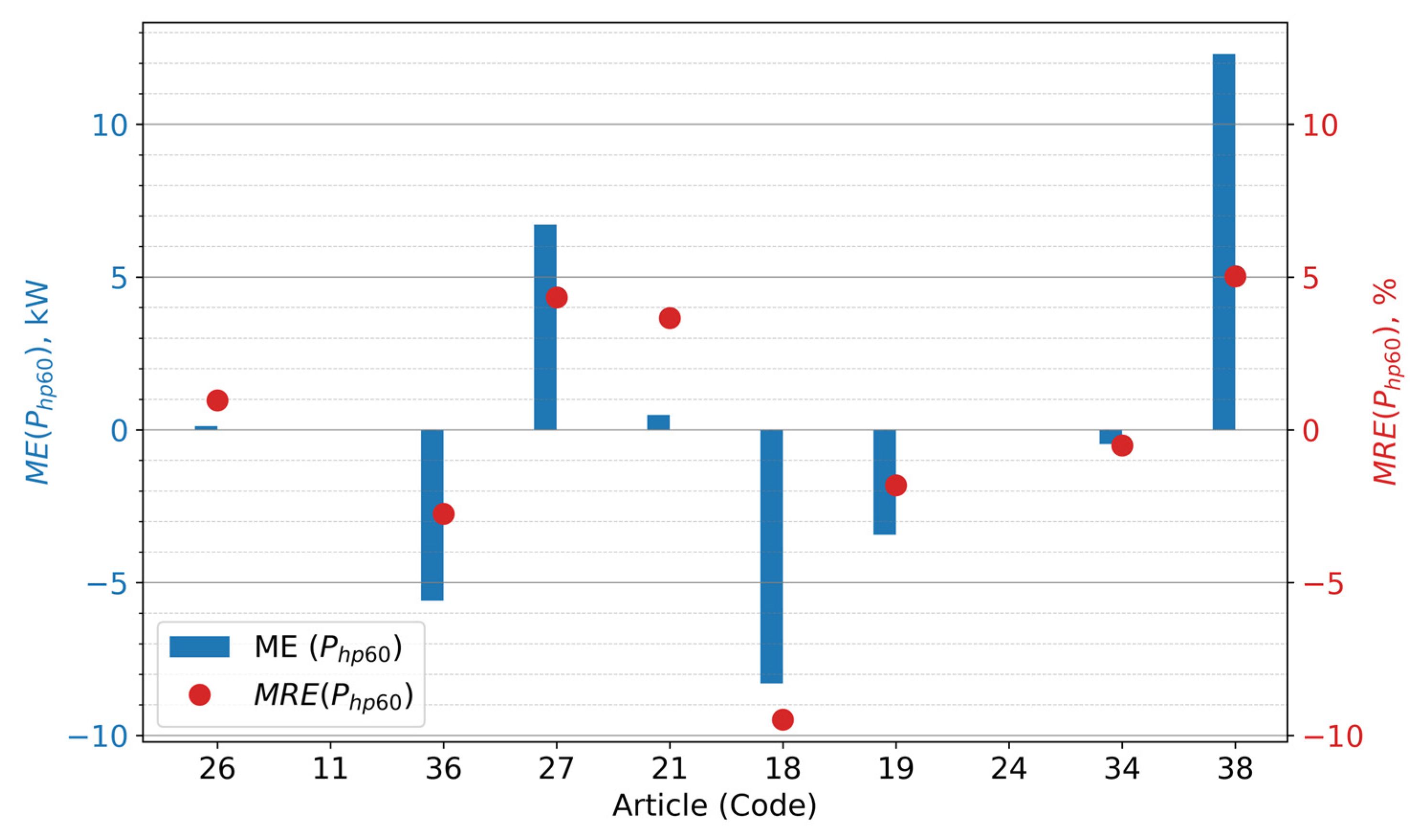
In all considered cases, the pygfunction underestimates the fluid inlet and outlet temperatures. This also leads to an underestimation of the COP of the GSHP when the heat extraction rate is used as the model input. As a result, the required electric power of the GSHP is overestimated (see the formulas in Section 2.3.4). This overestimation can be observed in Figure 19 and Table A7 (codes “26”, “27”, “21”, and “38”; code “34” is an exception, showing an insignificant underestimation of 0.5%). For practical applications, the overestimation is generally a favorable situation compared to the opposite scenario, in which the electric power would be underestimated. However, when the fluid inlet temperature is used as input, not only is the fluid outlet temperature underestimated, but also the heat extraction rate. Both the fluid outlet temperature and the heat extraction rate influence the electric power of the GSHP, but in opposite directions (see the formulas in Section 2.3.4). In this case, Figure 19 and Table A7 (code “36”, “18”, and “19”) show that the electric power of the GSHP is underestimated. Thus, it should be noted that for all scenarios in which it was possible to compare the electric power of the GSHP, the MRE is within ±10%.
Although the method does not accurately simulate the fluid temperature profile along the length of a deep borehole, due to assumptions that are only valid for shallow geothermal boreholes, this limitation is not critical for simulating the overall performance of the GSHP. If a more accurate fluid temperature profile is required, advanced methods such as numerical simulations can be recommended.
High costs and extensive time requirements limit experimental research and pilot projects on MDBHE and DBHE systems with multiple coaxial boreholes. As a result, the literature on such systems is scarce and, therefore, this study considers only small-scale bore fields with up to four boreholes. However, the installation of multiple deep boreholes is expected to become more common in the future. Consequently, further research may be necessary to confirm the applicability of the proposed method for large-scale bore fields with coaxial medium-deep and deep boreholes.
In many cases, the charts in Section 3 show that the results obtained by the pygfunction-based method are equidistant from the data reported in the literature (Table 1), and a correction (i.e., the addition of a few degrees) to the effective undisturbed ground temperature could eliminate the error almost entirely. However, no universal correction factor applicable to all reference cases was found. This could be a topic for future research aimed at developing a more precise method for calculating the effective undisturbed ground temperature in different scenarios when using pygfunction.
Although it might be expected that the error in calculating the fluid outlet temperature using the proposed approach would increase with greater borehole depth, the results in Table A7 do not provide strong evidence for this. Meanwhile, as shown in Table A7, the absolute underestimation of the COP for the mean sink temperature of 60 °C is, in all cases, greater than or equal to that for 80 °C.
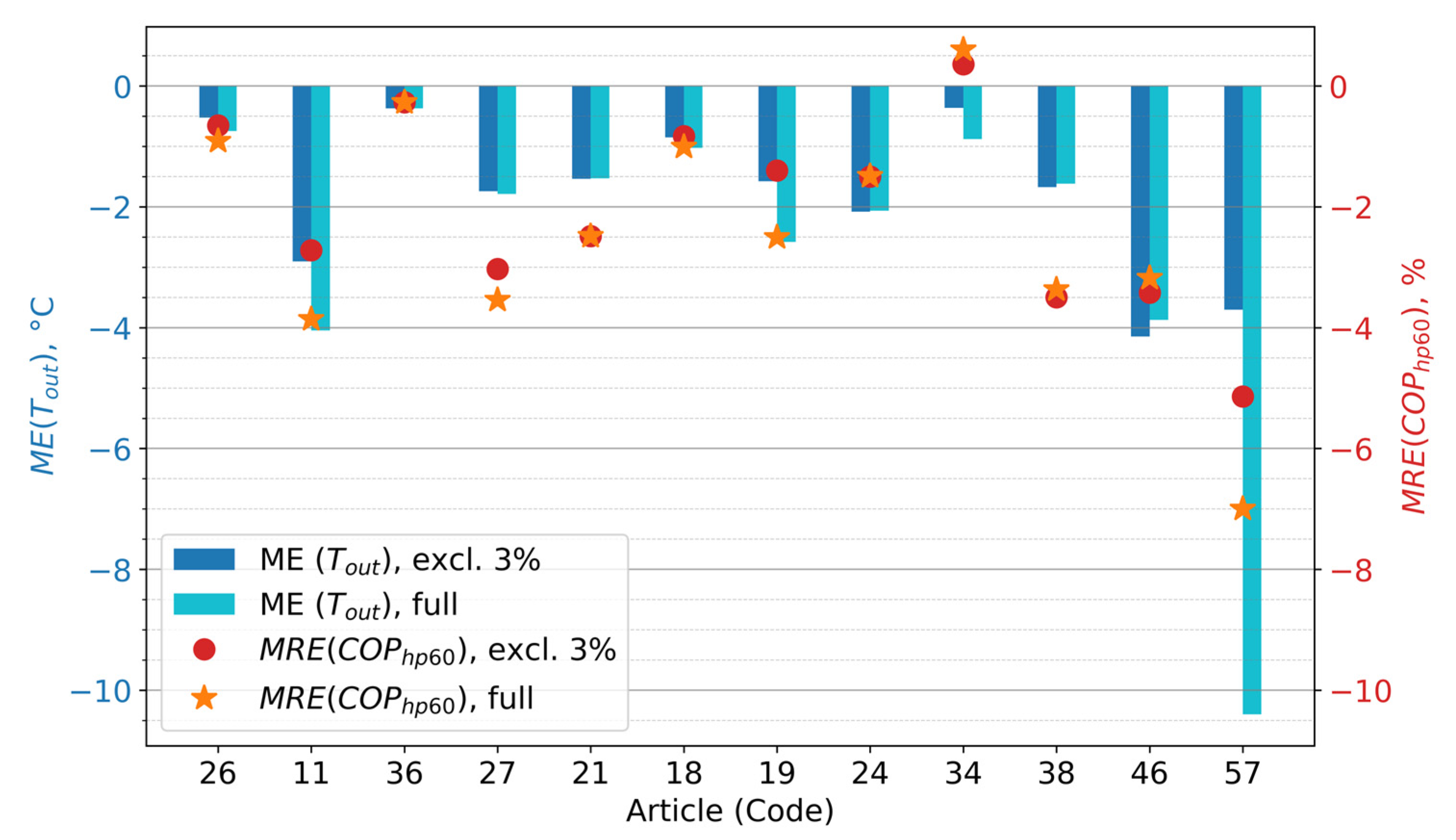
As mentioned in Section 2.3.3, the first 3% of the simulation period was excluded from the error calculation. To show the effect of this choice, Figure 20 presents error metrics both with and without the exclusion. In almost all cases, the chart displays that considering the full-time range increases the errors. It, however, affects significantly only two results: article “11”, where the model [32] is up to 8.12% over the experimental data and article “57”, where the extreme geothermal gradient was considered.
As mentioned in Section 2.3.2, an online tool [79] was used to obtain the relevant information from the plots found in the literature. This tool may have introduced an additional error when comparing results in Section 3.
As discussed in Section 1.3, several tools rely on the pygfunction package, so further development of pygfunction could be relevant for these tools and may be facilitated by the results of this work.

5. Conclusions

In this study, an approach for rapid modeling of coaxial medium-deep and deep borehole heat exchanger systems is proposed. It is based on using the open-source Python package “pygfunction” (version 2.3.0) together with the effective undisturbed ground temperature and effective thermophysical properties of the ground. These effective parameters were determined by weighted averaging over the length of the borehole. Additionally, an adjustment to the original pygfunction model was implemented, enabling it to accept the fluid inlet temperature as input instead of the heat rate. To verify the proposed approach, simulations were conducted, and the results were comprehensively compared with 12 simulation and experimental data sets from the literature.
As a result, the proposed approach can be used for modeling both single boreholes and small-scale bore fields in a wide depth range of 700–3000 m in homogeneous and heterogeneous grounds. When applying this method, it should be taken into consideration that it underestimates the fluid outlet temperature by up to 2–3 °C on average. Nevertheless, this does not significantly affect the calculation of the heat pump COP, resulting in an average underestimation of up to 4% for the mean sink temperature in the range of 60 °C to 80 °C. However, in cases of groundwater seepage or extreme geothermal gradients, the underestimation is higher (minus 3–4 °C), and correspondingly, the COP underestimation can reach up to 6%. Based on the available data, these discrepancies may result in an error of approximately ±10% in the estimation of the heat pump’s electric power, which can be considered acceptable for engineering practice.
Given the lack of open-source tools for rapid predesign simulations of medium-deep and deep coaxial boreholes to enable subsequent heat pump simulations, the proposed method can be used for this purpose, allowing for the rapid evaluation of fluid temperatures and heat extraction rates as well as the COP and the electric power of ground-source heat pumps. This may be particularly useful for mapping geothermal potential and planning district heating networks, thereby supporting the energy transition. Consequently, the results of this work can have practical value for geologists, engineers, planners, researchers, and decision-makers in the field of renewable energy and sustainable development.

Author Contributions

Conceptualization, D.R.; methodology, D.R.; software, D.R. and A.M.J.; investigation, D.R. and I.B.-G.; data curation, D.R. and I.B.-G.; writing—original draft preparation, D.R., I.B.-G. and A.M.J.; writing—review and editing, D.R., I.B.-G., A.M.J., M.C. and S.H.; visualization, D.R. and A.M.J.; supervision, D.R.; project administration, M.C. and S.H.; funding acquisition, D.R., A.M.J., M.C. and S.H. All authors have read and agreed to the published version of the manuscript.

Funding

This work received funding from the International Energy Agency—Technology Collaboration Programme on District Heating and Cooling (IEA DHC), Annex XIV. Project: InteGradeDH. Reference number: XIV-1.

Data Availability Statement

Data will be made available on request.

Acknowledgments

The authors are grateful to Massimo Cimmino (Polytechnique Montréal) for the valuable discussions and to Mingzhi Yu (Shandong Jianzhu University) for providing their data. During the preparation of this work, the authors used OpenAI GPT-4 for the purposes of improving the readability of the manuscript. The authors have reviewed and edited the output and take full responsibility for the content of this publication.

Conflicts of Interest

The authors declare no conflicts of interest.

Abbreviations

The following abbreviations are used in this manuscript:
BHEBorehole Heat Exchanger
CFDComputational Fluid Dynamics
COPCoefficient Of Performance
DBHEDeep Borehole Heat Exchanger
DHDistrict Heating
EUEuropean Union
FCSFinite Cylinder Source
FDMFinite Difference Method
FEMFinite Element Method
FLSFinite Line Source
FVMFinite Volume Method
GSHPGround-Source Heat Pump
ICSInfinite Cylindrical Source
ILSInfinite Line Source
MEMean Error
MDBHEMedium-Deep Borehole Heat Exchanger
MREMean Relative Error
SFCSSegmented Finite Cylinder Source
SFLSSegmented Finite Line Source
SS-FLSStratified-Segmented Finite Line Source

Appendix A

Table A1. Simulation setup and boundary conditions used for the validation of the modified pygfunction model against the original implementation.
ParameterValue/Description
Bore field configuration6 × 4 grid, 24 boreholes
Borehole spacing7.5 m
Borehole depth150 m
Borehole radius0.075 m
Pipe configurationCoaxial parallel flow
Inner pipe’s inner and outer radius0.022 m, 0.025 m
Outer pipe’s inner and outer radius0.049 m, 0.055 m
Undisturbed ground temperature12 °C
Ground thermal conductivity2.0 W/(m·K)
Ground thermal diffusivity 1.0 × 10 6   m2/s
Grout thermal conductivity1.0 W/(m·K)
Fluid typePropylene glycol (20%) at 20 °C
Table A2. Dimensions used in the considered articles (Table 1).
Code H ,
[m]
d i n ,
[mm]
δ i n ,
[mm]
d o u t ,
[mm]
δ o u t ,
[mm]
d b ,
[mm]
267001106.31594.5250
11200011010177.89.19177.8
36260011010177.86.91244.5
272600124.687.34189.745.87216
218001068139.90.4140
1825009331594.5254
192539114.319.15177.89.19241.3
24300011010177.89.2241.3
34100010052005260
38200012511.4193.78.33280
46200090624510319
57875.58919.2177.89.2311.2
H —borehole depth; d i n —outer diameter of inner pipe; δ i n —thickness of inner pipe; d o u t —outer diameter of outer pipe; δ o u t —thickness of outer pipe; d b —borehole diameter.
Table A3. Ground properties used in the considered articles.
Code H ,
[m]
T g 0 ,
[°C]
t ¯ g r a d ,
[°C/km]
T b o t ,
[°C]
T g ¯ ,
[°C]
k s ¯ ,
[W/m/K]
α ¯ ,
[mm2/s]
2670010.030.031.020.52.501.190
11200015.630.075.645.64.001.495
36260015.027.887.351.13.491.355
2726006.040.0110.058.02.501.116
218008.023.326.619.52.050.682
18250013.028.584.348.63.291.343
19253920.527.089.254.81.720.790
24300014.835.0119.867.32.051.057
34100015.030.045.030.02.501.042
38200015.017.750.436.43.301.371
46200014.532.880.144.01.680.573
57875.525.696.7110.056.01.600.603
H —borehole depth; T g 0 —ground surface temperature; t ¯ g r a d —effective geothermal gradient; T b o t —ground temperature at the bottom of the borehole; T g ¯ —effective undisturbed ground temperature; k s ¯ —effective ground thermal conductivity; α ¯ —effective ground thermal diffusivity.
Table A4. Thermal conductivity of grout and pipes used in the considered articles.
Code k g ,
[W/m/K]
k p _ i n , [W/m/K] k p _ o u t , [W/m/K]
261.500.2452.00
11-0.4540.00
360.730.2140.00
271.300.211.30
21-0.420.42
182.000.1854.00
191.340.0214.48
241.400.4240.00
342.500.1745.00
381.500.4160.50
461.800.4242.00
570.990.0646.10
k g —grout thermal conductivity; k p _ i n —thermal conductivity of inner pipe; k p _ o u t —thermal conductivity of outer pipe. The symbol “-“ in the table means that the boreholes in the corresponding works were not grouted.
Table A5. Fluid properties used in the considered articles.
Code c p _ f ,
[J/kg/K]
ρ f ,
[kg/m3]
μ f , [mPa·s] k f ,
[W/m/K]
264176.71000.01.0700.594
114179.5990.00.5900.636
364181.3987.50.5370.643
274190.01000.01.1400.590
214186.01000.01.0000.600
184180.4988.70.5600.640
194182.8985.80.5050.647
244190.0998.00.9310.600
344177.8995.60.7980.615
384177.6993.50.6990.624
464179.0990.60.6070.634
574183.2985.20.4970.648
c p _ f —specific heat capacity of fluid; ρ f —density of fluid; μ f —dynamic viscosity of fluid; k f —thermal conductivity of fluid.
Table A6. Computation times required for hourly simulations and result processing in the considered scenarios.
Code H ,
[m]
n b h ,
[-]
n l ,
[-]
t ,
[h]
τ ,
[s]
267001140002.17
1120001112001.79
3626001133603.15
2726001128801.99
2180014941.71
1825001428802.01
19253914721.89
2430001428801.76
3410002140005.93
3820004428802.27
4620001107201.79
57875.5111681.64
H —borehole depth; n b h —number of boreholes; n l —number of ground layers; t —considered time period;   τ —computation time including the hourly simulation in pygfunction, calculation of the COP and the electric power of the GSHP, computation of the corresponding errors, and plotting of the resulting charts.
Table A7. Mean errors and mean relative errors of the pygfunction-based approach compared with the considered articles.
Code T o u t T i n C O P h p 80 C O P h p 60 Q e x t r P h p 80 P h p 60
ME,
[°C]
MRE,
[%]
ME,
[°C]
MRE,
[%]
ME,
[-]
MRE,
[%]
ME,
[-]
MRE,
[%]
ME,
[kW]
MRE,
[%]
ME, [kW]MRE,
[%]
ME, [kW]MRE,
[%]
26−0.52−4.79−0.46−5.39−0.01−0.48−0.02−0.65--0.140.790.120.97
11−2.90−8.83--−0.06−1.85−0.11−2.72------
36−0.37−2.08--−0.01−0.20−0.01−0.27−12.77−2.86−7.71−2.82−5.59−2.75
27−1.74−7.74−1.73−26.93−0.06−2.10−0.12−3.03--7.283.306.724.33
21−1.54−8.95−1.51−10.44−0.05−1.80−0.08−2.48--0.532.910.493.66
18−0.85−2.80--−0.02−0.56−0.03−0.83−23.41−8.98−12.33−9.74−8.30−9.48
19−1.58−4.25--−0.03−0.96−0.06−1.40−21.43−3.66−6.27−2.27−3.43−1.82
24−2.08−10.80--−0.03−1.10−0.05−1.50------
34−0.36−4.31−0.43−10.680.010.260.010.36--−0.50−0.41−0.46−0.51
38−1.68−7.42−2.36−13.64−0.07−2.44−0.13−3.50--13.323.8512.305.02
46−4.15−16.97--−0.07−2.42−0.12−3.42------
57−3.70−7.76--−0.12−3.01−0.30−5.14------
T o u t —fluid outlet temperature; T i n —fluid inlet temperature; C O P h p 80 —heat pump coefficient of performance when mean sink temperature is 80 °C; C O P h p 60 —heat pump coefficient of performance when mean sink temperature is 60 °C; Q e x t r —total heat extraction rate; P h p 80 heat pump electric power when mean sink temperature is 80 °C; P h p 60 heat pump electric power when mean sink temperature is 60 °C; “-“ in the table means that the calculation could not be performed.

References

  1. IRENA, OECD/IEA and REN21. Renewable Energy Policies in a Time of Transition: Heating and Cooling, 2020. Available online: https://www.irena.org/publications/2020/Nov/Renewable-Energy-Policies-in-a-Time-of-Transition-Heating-and-Cooling (accessed on 28 April 2025).
  2. Nugent, A.; Montano-Owen, C.; Pallares, L.; Richardson, S.; Rowland, M. World Green Building Council: EU Policy Whole Life Carbon Roadmap, 2022. Available online: https://build-up.ec.europa.eu/en/resources-and-tools/publications/eu-policy-roadmap-decarbonised-buildings (accessed on 5 May 2025).
  3. Eurostat. Renewable Energy Statistics. Available online: https://ec.europa.eu/eurostat/statistics-explained/index.php?title=Renewable_energy_statistics (accessed on 27 July 2025).
  4. Lund, H.; Werner, S.; Wiltshire, R.; Svendsen, S.; Thorsen, J.E.; Hvelplund, F.; Mathiesen, B.V. 4th Generation District Heating (4GDH). Energy 2014, 68, 1–11. [Google Scholar] [CrossRef]
  5. Buffa, S.; Cozzini, M.; D’Antoni, M.; Baratieri, M.; Fedrizzi, R. 5th generation district heating and cooling systems: A review of existing cases in Europe. Renew. Sustain. Energy Rev. 2019, 104, 504–522. [Google Scholar] [CrossRef]
  6. Romanov, D.; Leiss, B. Geothermal energy at different depths for district heating and cooling of existing and future building stock. Renew. Sustain. Energy Rev. 2022, 167, 112727. [Google Scholar] [CrossRef]
  7. IEA. The Future of Geothermal Energy, Paris, 2024. Available online: https://www.iea.org/reports/the-future-of-geothermal-energy (accessed on 14 May 2025).
  8. Bruhn, D.; Taylor, N.; Ince, E.; Mountraki, A.; Shtjefni, D.; Georgakaki, A.; Joanny Ordonez, G.; Eulaerts, O.; Grabowska, M. Deep Geothermal Energy in the European Union—2022 Status Report on Technology Development, Trends, Value Chains and Markets. Available online: https://setis.ec.europa.eu/deep-geothermal-energy-european-union_en (accessed on 8 July 2025).
  9. YouTube Seminar. Geothermie Insights—Definition Mitteltiefe Geothermie mit Prof. Dr. Inga Moeck. Available online: https://www.youtube.com/watch?v=cf0SqdMqJgc (accessed on 30 June 2025).
  10. Piipponen, K.; Martinkauppi, A.; Korhonen, K.; Vallin, S.; Arola, T.; Bischoff, A.; Leppäharju, N. The deeper the better? A thermogeological analysis of medium-deep borehole heat exchangers in low-enthalpy crystalline rocks. Geotherm Energy 2022, 10, 12. [Google Scholar] [CrossRef]
  11. Bundesverband Geothermie. Geothermische Technologien. Available online: https://www.geothermie.de/geothermie/geothermische-technologien (accessed on 29 April 2025).
  12. Soleimani, A.; Davidsson, P.; Malekian, R.; Spalazzese, R. Modeling hybrid energy systems integrating heat pumps and district heating: A systematic review. Energy Build. 2025, 329, 115253. [Google Scholar] [CrossRef]
  13. He, Y.; Jia, M.; Li, X.; Yang, Z.; Song, R. Performance analysis of coaxial heat exchanger and heat-carrier fluid in medium-deep geothermal energy development. Renew. Energy 2021, 168, 938–959. [Google Scholar] [CrossRef]
  14. Kolo, I.; Brown, C.S.; Nibbs, W.; Cai, W.; Falcone, G.; Nagel, T.; Chen, C. A comprehensive review of deep borehole heat exchangers (DBHEs): Subsurface modelling studies and applications. Geotherm Energy 2024, 12, 19. [Google Scholar] [CrossRef]
  15. Lund, J.W.; Freeston, D.H.; Boyd, T.L. Direct application of geothermal energy: 2005 Worldwide review. Geothermics 2005, 34, 691–727. [Google Scholar] [CrossRef]
  16. Bayer, P.; Rybach, L.; Blum, P.; Brauchler, R. Review on life cycle environmental effects of geothermal power generation. Renew. Sustain. Energy Rev. 2013, 26, 446–463. [Google Scholar] [CrossRef]
  17. Deichmann, N.; Giardini, D. Earthquakes Induced by the Stimulation of an Enhanced Geothermal System below Basel (Switzerland). Seismol. Res. Lett. 2009, 80, 784–798. [Google Scholar] [CrossRef]
  18. Kunze, C.; Hertel, M. Contested deep geothermal energy in Germany—The emergence of an environmental protest movement. Energy Res. Soc. Sci. 2017, 27, 174–180. [Google Scholar] [CrossRef]
  19. Leiss, B.; Romanov, D.; Wagner, B. Risks and Challenges of the Transition to an Integrated Geothermal Concept for the Göttingen University Campus. In Proceedings of the 1st Geoscience & Engineering in Energy Transition Conference, Strasbourg, France, 16–18 November 2020; Volume 2020, pp. 1–5. [Google Scholar] [CrossRef]
  20. Leiss, B.; Wagner, B.; Heinrichs, T.; Romanov, D.; Tanner, D.; Vollbrecht, A.; Wemmer, K. Integrating deep, medium and shallow geothermal energy into district heating and cooling system as an energy transition approach for the Göttingen University Campus. Zenodo. In Proceedings of the Proceedings World Geothermal Congress, Reykjavik, Iceland, 30 March–27 October 2021. [Google Scholar] [CrossRef]
  21. Soltani, M.; Kashkooli, F.M.; Dehghani-Sanij, A.R.; Kazemi, A.R.; Bordbar, N.; Farshchi, M.J.; Elmi, M.; Gharali, K.; Dusseault, M.B. A comprehensive study of geothermal heating and cooling systems. Sustain. Cities Soc. 2019, 44, 793–818. [Google Scholar] [CrossRef]
  22. Dong, J.; Wang, H.; Huang, S.; Jiang, Y.; Liu, J. Advances in the effects of multiple factors on the thermal performance of deep borehole heat exchangers: A systematic review. J. Build. Eng. 2024, 96, 110488. [Google Scholar] [CrossRef]
  23. Brown, C.S.; Kolo, I.; Banks, D.; Falcone, G. Comparison of the thermal and hydraulic performance of single U-tube, double U-tube and coaxial medium-to-deep borehole heat exchangers. Geothermics 2024, 117, 102888. [Google Scholar] [CrossRef]
  24. Zhang, W.; Li, W.; Sørensen, B.R.; Cui, P.; Man, Y.; Yu, M.; Fang, Z. Comparative analysis of heat transfer performance of coaxial pipe and U-type deep borehole heat exchangers. Geothermics 2021, 96, 102220. [Google Scholar] [CrossRef]
  25. Xiao, D.; Liu, M.; Li, L.; Cai, X.; Qin, S.; Gao, R.; Liu, J.; Liu, X.; Tang, H.; Li, G. Model for economic evaluation of closed-loop geothermal systems based on net present value. Appl. Therm. Eng. 2023, 231, 121008. [Google Scholar] [CrossRef]
  26. O’Sullivan, M.J.; Pruess, K.; Lippmann, M.J. State of the art of geothermal reservoir simulation. Geothermics 2001, 30, 395–429. [Google Scholar] [CrossRef]
  27. Franco, A.; Vaccaro, M. Numerical simulation of geothermal reservoirs for the sustainable design of energy plants: A review. Renew. Sustain. Energy Rev. 2014, 30, 987–1002. [Google Scholar] [CrossRef]
  28. Hu, J. An improved analytical model for vertical borehole ground heat exchanger with multiple-layer substrates and groundwater flow. Appl. Energy 2017, 202, 537–549. [Google Scholar] [CrossRef]
  29. Abdelaziz, S.L.; Ozudogru, T.Y.; Olgun, C.G.; Martin, J.R. Multilayer finite line source model for vertical heat exchangers. Geothermics 2014, 51, 406–416. [Google Scholar] [CrossRef]
  30. Erol, S.; François, B. Multilayer analytical model for vertical ground heat exchanger with groundwater flow. Geothermics 2018, 71, 294–305. [Google Scholar] [CrossRef]
  31. Fang, L.; Diao, N.; Shao, Z.; Zhu, K.; Fang, Z. A computationally efficient numerical model for heat transfer simulation of deep borehole heat exchangers. Energy Build. 2018, 167, 79–88. [Google Scholar] [CrossRef]
  32. Liu, J.; Wang, F.; Cai, W.; Wang, Z.; Li, C. Numerical investigation on the effects of geological parameters and layered subsurface on the thermal performance of medium-deep borehole heat exchanger. Renew. Energy 2020, 149, 384–399. [Google Scholar] [CrossRef]
  33. Luo, Y.; Guo, H.; Meggers, F.; Zhang, L. Deep coaxial borehole heat exchanger: Analytical modeling and thermal analysis. Energy 2019, 185, 1298–1313. [Google Scholar] [CrossRef]
  34. Diersch, H.-J.; Bauer, D.; Heidemann, W.; Rühaak, W.; Schätzl, P. Finite element modeling of borehole heat exchanger systems. Comput. Geosci. 2011, 37, 1122–1135. [Google Scholar] [CrossRef]
  35. LI, J.; DAI, C.; LEI, H. The influence of thermal boundary conditions of wellbore on the heat extraction performance of deep borehole heat exchangers. Geothermics 2022, 100, 102325. [Google Scholar] [CrossRef]
  36. Ingersoll, L.; Plass, H. Theory of the ground pipe source for the heat pump. ASHVE J. Sect. 1948, 54, 339–348. [Google Scholar]
  37. Eskilson, P. Thermal Analysis of Heat Extraction Boreholes; University of Lund: Lund, Sweden, 1987. [Google Scholar]
  38. Zeng, H.Y.; Diao, N.R.; Fang, Z.H. A finite line-source model for boreholes in geothermal heat exchangers. Heat Trans. Asian Res. 2002, 31, 558–567. [Google Scholar] [CrossRef]
  39. Carslaw, H.S.; Jaeger, J.C.; Feshbach, H. Conduction of Heat in Solids. Phys. Today 1962, 15, 74–76. [Google Scholar] [CrossRef]
  40. Philippe, M.; Bernier, M.; Marchio, D. Validity ranges of three analytical solutions to heat transfer in the vicinity of single boreholes. Geothermics 2009, 38, 407–413. [Google Scholar] [CrossRef]
  41. Yang, H.; Cui, P.; Fang, Z. Vertical-borehole ground-coupled heat pumps: A review of models and systems. Appl. Energy 2010, 87, 16–27. [Google Scholar] [CrossRef]
  42. Bandos, T.V.; Campos-Celador, Á.; López-González, L.M.; Sala-Lizarraga, J.M. Finite cylinder-source model for energy pile heat exchangers: Effects of thermal storage and vertical temperature variations. Energy 2014, 78, 639–648. [Google Scholar] [CrossRef]
  43. Luo, Y.; Yu, J.; Yan, T.; Zhang, L.; Liu, X. Improved analytical modeling and system performance evaluation of deep coaxial borehole heat exchanger with segmented finite cylinder-source method. Energy Build. 2020, 212, 109829. [Google Scholar] [CrossRef]
  44. Cimmino, M. pygfunction: An open-source toolbox for the evaluation of thermal response factors for geothermal borehole fields. In Proceedings of the eSIM 2018, Montréal, QC, Canada, 9–10 May 2018. [Google Scholar]
  45. Cimmino, M. The effects of borehole thermal resistances and fluid flow rate on the g-functions of geothermal bore fields. Int. J. Heat Mass Transf. 2015, 91, 1119–1127. [Google Scholar] [CrossRef]
  46. Romanov, D.; Chakraborty, I.; Holler, S. Comparative analysis of scenarios of data center waste heat utilization for district heating networks of different generations. Energy Convers. Manag. 2025, 334, 119856. [Google Scholar] [CrossRef]
  47. Cimmino, M.; Cook, J. pygfunction 2.2: New features and improvements in accuracy and computational efficiency. In Proceedings of the IGSHPA Research Track 2022, Las Vegas, NV, USA, 6–8 December 2022; International Ground Source Heat Pump Association: Springfield, IL, USA, 2022. [Google Scholar]
  48. Cimmino, M. Pygfunction 2.3.0 Documentation. Available online: https://pygfunction.readthedocs.io/en/stable/ (accessed on 27 June 2025).
  49. Wirtz, M. nPro; nPro Energy GmbH: Monheim am Rhein, Germany, 2022. [Google Scholar]
  50. Peere, W.; Blanke, T. GHEtool: An open-source tool for borefield sizing in Python. J. Open Source Softw. 2022, 7, 4406. [Google Scholar] [CrossRef]
  51. Spitler, J.; West, T.; Liu, X. Ground heat exchanger design tool with rowwise placement of boreholes. In Proceedings of the IGSHPA Research Track 2022, Las Vegas, NV, USA, 6–8 December 2022; International Ground Source Heat Pump Association: Springfield, IL, USA, 2022. [Google Scholar]
  52. Cimmino, M. g -Functions for fields of series- and parallel-connected boreholes with variable fluid mass flow rate and reversible flow direction. Renew. Energy 2024, 228, 120661. [Google Scholar] [CrossRef]
  53. Spitler, J.; Cook, J. Faster computation of g-functions used for modeling of ground heat exchangers with reduced memory consumption. In Proceedings of the Building Simulation 2021: 17th Conference of IBPSA, Bruges, Belgium, 1–3 September 2021; Volume 17, pp. 2276–2283. [Google Scholar] [CrossRef]
  54. Aljabr, A. Investigation on the influence of mixed borehole depths in vertical ground heat exchanger systems. Geothermics 2024, 119, 102971. [Google Scholar] [CrossRef]
  55. Aljabr, A. Enhancing Thermal Performance of Vertical Ground Heat Exchangers Through a Central Borehole Removal Design. Processes 2025, 13, 333. [Google Scholar] [CrossRef]
  56. Li, H.X.; Okolo, D.E.; Tabadkani, A.; Arnel, T.; Zheng, D.; Shi, L. An integrated framework of ground source heat pump utilisation for high-performance buildings. Sci. Rep. 2023, 13, 371. [Google Scholar] [CrossRef]
  57. Hermans, L.; Haesen, R.; Uytterhoeven, A.; Peere, W.; Boydens, W.; Helsen, L. Pre-design of collective residential solar districts with seasonal thermal energy storage: Importance of level of detail. Appl. Therm. Eng. 2023, 226, 120203. [Google Scholar] [CrossRef]
  58. Wallin, A.; Thomasson, T.; Abdurafikov, R. Urban low-to-medium deep borehole field regeneration with waste heat from energy efficient buildings: A techno-economic study in Nordic climate. Energy Build. 2023, 300, 113628. [Google Scholar] [CrossRef]
  59. Miocic, J.M.; Schleichert, L.; van de Ven, A.; Koenigsdorff, R. Fast calculation of the technical shallow geothermal energy potential of large areas with a steady-state solution of the finite line source. Geothermics 2024, 116, 102851. [Google Scholar] [CrossRef]
  60. Korhonen, K.; Markó, Á.; Bischoff, A.; Szijártó, M.; Mádl-Szőnyi, J. Infinite borehole field model—A new approach to estimate the shallow geothermal potential of urban areas applied to central Budapest, Hungary. Renew. Energy 2023, 208, 263–274. [Google Scholar] [CrossRef]
  61. Chen, H.; Tomac, I. Technical review on coaxial deep borehole heat exchanger. Geomech. Geophys. Geoenerg. Georesour. 2023, 9, 120. [Google Scholar] [CrossRef]
  62. Naumov, D.; Bilke, L.; Buchwald, J.; Wang, W.; Max, J.; Fischer, T.; Meisel, T.; Lehmann, C.; Shao, H.; Kiszkurno, F.K.; et al. OpenGeoSys; Zenodo: Geneva, Switzerland, 2025. [Google Scholar]
  63. Hu, J.; Tian, Y.; Li, Z.; Jiang, G.; Zuo, Y.; Zhang, C.; Wang, Y.; Wang, Y.; Hu, S. GeothermoTool: An open-source software for basic geothermal calculations and plots. Geothermics 2022, 106, 102551. [Google Scholar] [CrossRef]
  64. Li, M.; Lai, A.C. Review of analytical models for heat transfer by vertical ground heat exchangers (GHEs): A perspective of time and space scales. Appl. Energy 2015, 151, 178–191. [Google Scholar] [CrossRef]
  65. Zhao, Y.; Qin, X.; Shi, X. Heat Transfer Modeling on High-Temperature Charging and Discharging of Deep Borehole Heat Exchanger with Transient Strong Heat Flux. Sustainability 2022, 14, 9702. [Google Scholar] [CrossRef]
  66. Luo, Y.; Xu, G.; Cheng, N. Proposing stratified segmented finite line source (SS-FLS) method for dynamic simulation of medium-deep coaxial borehole heat exchanger in multiple ground layers. Renew. Energy 2021, 179, 604–624. [Google Scholar] [CrossRef]
  67. Molina-Giraldo, N.; Blum, P.; Zhu, K.; Bayer, P.; Fang, Z. A moving finite line source model to simulate borehole heat exchangers with groundwater advection. Int. J. Therm. Sci. 2011, 50, 2506–2513. [Google Scholar] [CrossRef]
  68. Luo, Y.; Cheng, N.; Xu, G. Analytical modeling and thermal analysis of deep coaxial borehole heat exchanger with stratified-seepage-segmented finite line source method (S3-FLS). Energy Build. 2022, 257, 111795. [Google Scholar] [CrossRef]
  69. Luo, Y.; Shen, J.; Song, Y.; Tian, Z.; Fan, J.; Zhang, L. A unified analytical model for vertical ground heat exchangers: Non-uniform finite line source method (NFLS). Renew. Energy 2026, 256, 124072. [Google Scholar] [CrossRef]
  70. Christodoulides, P.; Vieira, A.; Lenart, S.; Maranha, J.; Vidmar, G.; Popov, R.; Georgiev, A.; Aresti, L.; Florides, G. Reviewing the Modeling Aspects and Practices of Shallow Geothermal Energy Systems. Energies 2020, 13, 4273. [Google Scholar] [CrossRef]
  71. Roka, R.; Figueiredo, A.; Vieira, A.; Cardoso, J. A systematic review on shallow geothermal energy system: A light into six major barriers. Soil. Rocks 2022, 46, e2023007622. [Google Scholar] [CrossRef]
  72. Heim, E.; Stoffel, P.; Düber, S.; Knapp, D.; Kümpel, A.; Müller, D.; Klitzsch, N. Comparison of simulation tools for optimizing borehole heat exchanger field operation. Geotherm Energy 2024, 12, 24. [Google Scholar] [CrossRef]
  73. Claesson, J.; Javed, S. A load-aggregation method to calculate extraction temperatures of borehole heat exchangers. Ashrae Trans. 2012, 118, 530–539. [Google Scholar]
  74. Antelmi, M.; Turrin, F.; Zille, A.; Fedrizzi, R. A New Type in TRNSYS 18 for Simulation of Borehole Heat Exchangers Affected by Different Groundwater Flow Velocities. Energies 2023, 16, 1288. [Google Scholar] [CrossRef]
  75. Cimmino, M. Pygfunction/Examples/Fluid_Temperature_Multiple_Boreholes.py at Master · MassimoCimmino/Pygfunction. Available online: https://github.com/MassimoCimmino/pygfunction/blob/master/examples/fluid_temperature_multiple_boreholes.py (accessed on 26 June 2025).
  76. Bernier, M.A.; Pinel, P.; Labib, R.; Paillot, R. A Multiple Load Aggregation Algorithm for Annual Hourly Simulations of GCHP Systems. HVACR Res. 2004, 10, 471–487. [Google Scholar] [CrossRef]
  77. Kolo, I.; Brown, C.S.; Falcone, G.; Banks, D. Repurposing a Geothermal Exploration Well as a Deep Borehole Heat Exchanger: Understanding Long-Term Effects of Lithological Layering, Flow Direction, and Circulation Flow Rate. Available online: https://www.mdpi.com/2071-1050/15/5/4140 (accessed on 14 April 2025).
  78. Morchio, S.; Fossa, M. On the ground thermal conductivity estimation with coaxial borehole heat exchangers according to different undisturbed ground temperature profiles. Appl. Therm. Eng. 2020, 173, 115198. [Google Scholar] [CrossRef]
  79. Rohatgi, A. automeris.io: Computer Vision Assisted Data Extraction from Charts Using WebPlotDigitizer. Available online: https://automeris.io/ (accessed on 27 June 2025).
  80. Chaofan Chen. Investigation on the Heat Extraction Performance of Deep Closed-Loop Borehole Heat Exchanger System for Building Heating; Technische Universität Dresden: Dresden, Germany, 2022. [Google Scholar]
  81. Beier, R.A. Thermal response tests on deep borehole heat exchangers with geothermal gradient. Appl. Therm. Eng. 2020, 178, 115447. [Google Scholar] [CrossRef]
  82. Holmberg, H.; Acuña, J.; Næss, E.; Sønju, O.K. Thermal evaluation of coaxial deep borehole heat exchangers. Renew. Energy 2016, 97, 65–76. [Google Scholar] [CrossRef]
  83. Acuña, J.; Palm, B. Distributed thermal response tests on pipe-in-pipe borehole heat exchangers. Appl. Energy 2013, 109, 312–320. [Google Scholar] [CrossRef]
  84. Wang, Z.; Wang, F.; Liu, J.; Ma, Z.; Han, E.; Song, M. Field test and numerical investigation on the heat transfer characteristics and optimal design of the heat exchangers of a deep borehole ground source heat pump system. Energy Convers. Manag. 2017, 153, 603–615. [Google Scholar] [CrossRef]
  85. Bu, X.; Ran, Y.; Zhang, D. Experimental and simulation studies of geothermal single well for building heating. Renew. Energy 2019, 143, 1902–1909. [Google Scholar] [CrossRef]
  86. Chen, C.; Shao, H.; Naumov, D.; Kong, Y.; Tu, K.; Kolditz, O. Numerical investigation on the performance, sustainability, and efficiency of the deep borehole heat exchanger system for building heating. Geotherm. Energy 2019, 7, 18. [Google Scholar] [CrossRef]
  87. Beier, R.A.; Acuña, J.; Mogensen, P.; Palm, B. Transient heat transfer in a coaxial borehole heat exchanger. Geothermics 2014, 51, 470–482. [Google Scholar] [CrossRef]
  88. Beier, R.A.; Morchio, S.; Fossa, M. Thermal response tests on deep boreholes through multiple ground layers. Geothermics 2022, 101, 102371. [Google Scholar] [CrossRef]
  89. Deng, J.; Wei, Q.; He, S.; Liang, M.; Zhang, H. Simulation Analysis on the Heat Performance of Deep Borehole Heat Exchangers in Medium-Depth Geothermal Heat Pump Systems. Energies 2020, 13, 754. [Google Scholar] [CrossRef]
  90. Li, C.; Guan, Y.; Liu, J.; Jiang, C.; Yang, R.; Hou, X. Heat transfer performance of a deep ground heat exchanger for building heating in long-term service. Renew. Energy 2020, 166, 20–34. [Google Scholar] [CrossRef]
  91. Cai, W.; Wang, F.; Jiang, J.; Wang, Z.; Liu, J.; Chen, C. Long-term Performance Evaluation and Economic Analysis for Deep Borehole Heat Exchanger Heating System in Weihe Basin. Front. Earth Sci. 2022, 10, 806416. [Google Scholar] [CrossRef]
  92. Zhang, F.; Yu, M.; Sørensen, B.R.; Cui, P.; Zhang, W.; Fang, Z. Heat extraction capacity and its attenuation of deep borehole heat exchanger array. Energy 2022, 254, 124430. [Google Scholar] [CrossRef]
  93. Wang, Z.; Ding, J.; Yu, M.; Mao, Y.; Zhu, K.; Zhang, W.; Cui, P.; Zhuang, Z.; Zhou, S. Influence of ground source heat exchanger operation modes on multi-borehole mid-deep ground source heat pump system performance. Geothermics 2025, 125, 103186. [Google Scholar] [CrossRef]
  94. Cai, W.; Wang, F.; Chen, S.; Chen, C.; Liu, J.; Deng, J.; Kolditz, O.; Shao, H. Analysis of heat extraction performance and long-term sustainability for multiple deep borehole heat exchanger array: A project-based study. Appl. Energy 2021, 289, 116590. [Google Scholar] [CrossRef]
  95. Ma, J.; Wang, H.; Li, Y.; Ren, J.; Sun, H.; Du, S.; Wen, H. Heating and storage of medium-deep borehole heat exchangers: Analysis of operational characteristics via an optimized analytical solution model. J. Energy Storage 2024, 90, 111760. [Google Scholar] [CrossRef]
  96. Morita, K.; Bollmeier, W.S.; Mizogami, H. Analysis of the results from the downhole coaxial heat exchanger (DCHE) experiment in Hawaii; Geothermal Resources Council: Davis, CA, USA, 1992. [Google Scholar]
  97. Adebayo, P.; Shor, R.; Mohamad, A.; Wemhöner, C.; Mwesigye, A. Performance analysis of a solar-assisted ground source heat pump with a single vertical U-tube ground heat exchanger. Appl. Therm. Eng. 2024, 257, 124452. [Google Scholar] [CrossRef]
  98. Li, C.; Mao, J.; Zhang, H.; Xing, Z.; Li, Y.; Zhou, J. Numerical simulation of horizontal spiral-coil ground source heat pump system: Sensitivity analysis and operation characteristics. Appl. Therm. Eng. 2017, 110, 424–435. [Google Scholar] [CrossRef]
  99. Miškić, J.; Dorotić, H.; Pukšec, T.; Soldo, V.; Duić, N. Optimization of data centre waste heat integration into the low-temperature district heating networks. Optim Eng 2023, 25, 63–91. [Google Scholar] [CrossRef]
  100. Seib, L.; Frey, M.; Bossennec, C.; Krusemark, M.; Burschil, T.; Buness, H.; Weydt, L.; Sass, I. Assessment of a medium-deep borehole thermal energy storage site in the crystalline basement: A case study of the demo site Lichtwiese Campus, Darmstadt. Geothermics 2024, 119, 102933. [Google Scholar] [CrossRef]
  101. Huang, S.; Li, J.; Gao, H.; Zhu, K.; Dong, J.; Li, J.; Tao, J.; Jiang, Y. Numerical modeling and thermal performance analysis of deep borehole heat exchangers considering groundwater seepage. Appl. Therm. Eng. 2024, 250, 123508. [Google Scholar] [CrossRef]
  102. Pokhrel, S. Analysis of Coaxial Borehole Heat Exchanger for Geothermal Heat and Power. Ph.D. Thesis, University of British Columbia, Vancouver, BC, Canada, 2024. [Google Scholar]
  103. Li, Z.; Wang, C.; Fu, Q. Effects of groundwater flow on thermal response test of deep borehole heat exchanger. Geothermics 2022, 106, 102570. [Google Scholar] [CrossRef]
  104. Kolawole, F.; Evenick, J.C. Global distribution of geothermal gradients in sedimentary basins. Geosci. Front. 2023, 14, 101685. [Google Scholar] [CrossRef]
Figure 1. Block diagram of original pygfunction-based borehole field simulation.
Energies 18 04921 g001
Figure 2. Block diagram of modified pygfunction-based borehole field simulation.
Energies 18 04921 g002
Figure 3. Time series comparison of fluid outlet temperatures T o u t ( o r i g i n a l ) and T o u t ( m o d i f i e d ) from the original and modified pygfunction models.
Energies 18 04921 g003
Figure 4. Comparison of the results obtained using the pygfunction-based method with those reported by Chen [80] for the MDBHE in homogeneous ground.
Energies 18 04921 g004
Figure 5. Comparison of the results obtained using the pygfunction-based method with those reported by Liu et al. [32] for the DBHE in homogeneous ground.
Energies 18 04921 g005
Figure 6. Comparison of the results obtained using the pygfunction-based method with those reported by Bu et al. [85] for the DBHE in homogeneous ground.
Energies 18 04921 g006
Figure 7. Comparison of the results obtained using the pygfunction-based method with those reported by Chen et al. [86] for the DBHE in homogeneous ground.
Energies 18 04921 g007
Figure 8. Comparison of the results obtained using the pygfunction-based method with those reported by Beier et al. [88] for the MDBHE in heterogeneous ground. Fluid inlet and outlet temperatures were calculated from the mean fluid temperature plotted in [88].
Energies 18 04921 g008
Figure 9. Comparison of the results obtained using the pygfunction-based method with those reported by Deng et al. [89] for the DBHE in heterogeneous ground.
Energies 18 04921 g009
Figure 10. Comparison of the results obtained using the pygfunction-based method with those reported by Li et al. [90] for the DBHE in heterogeneous ground. Power failure in the middle of the experiment is ignored in this figure.
Energies 18 04921 g010
Figure 11. Comparison of the results obtained using the pygfunction-based method with those reported by Cai et al. [91] for the DBHE in heterogeneous ground.
Energies 18 04921 g011
Figure 12. Fluid temperature and bore wall temperature along the length of the borehole at the end of the considered time period (2880 h). Comparison of the results obtained using the pygfunction-based method with those reported by Deng et al. [89].
Energies 18 04921 g012
Figure 13. Comparison of the results obtained using the pygfunction-based method with those reported by Zhang et al. [92] for two MDBHEs in homogeneous ground.
Energies 18 04921 g013
Figure 14. Comparison of the results obtained using the pygfunction-based method with those reported by Wang et al. [93] for four DBHEs in heterogeneous ground.
Energies 18 04921 g014
Figure 15. Comparison of the COP calculation results for different sink temperatures using the pygfunction-based method with results from Wang et al. [93] for the DBHE in heterogeneous ground.
Energies 18 04921 g015
Figure 16. Comparison of the results obtained using the pygfunction-based method with those reported by Ma et al. [95] for the DBHE in heterogeneous ground with groundwater seepage.
Energies 18 04921 g016
Figure 17. Comparison of COP calculation results for different sink temperatures using the pygfunction-based method with results from Ma et al. [95] for the DBHE in heterogeneous ground with groundwater seepage.
Energies 18 04921 g017
Figure 18. Comparison of the results obtained using the pygfunction-based method with those reported by Morita et al. [96] for the MDBHE in homogeneous ground with extreme geothermal gradient.
Energies 18 04921 g018
Figure 19. Comparison of GSHP electric power calculations (for T ¯ s i n k = 60 °C) using the pygfunction-based method with reference results from Table 1 (where available).
Energies 18 04921 g019
Figure 20. Mean error of the fluid outlet temperature and mean relative error of the COP ( T ¯ s i n k = 60 °C) considering the full-time range and excluding the first 3% of the time range.
Energies 18 04921 g020
Table 1. Articles selected for comparison with the pygfunction-based approach.
CodeAuthorYear H ,
[m]
Type of Reference ResultsValidation ReferencesSection
26Chen [80]2022700numerical (FEM)Beier [81] => 190 m-deep well [82,83]3.2.1
11Liu et al. [32]20202000numerical (FDM)2000 m-deep well, Xi’an, China [84]3.2.2
36Bu et al. [85]20192600numerical (FVM)2600 m-deep well, Qingdao, China [85]3.2.2
27Chen et al. [86]20192600numerical (FEM)Beier et al. [87] => 190 m-deep well [83]3.2.2
21Beier et al. [88]2022800semi-analytical (ICS)Morchio et al. [78] => 190 m-deep well [83]3.3.1
18Deng et al. [89]20202500numerical (FVM)2500 m-deep well, Xi’an, China [89]3.3.2
19Li et al. [90]20202539experimental2539 m-deep well, Xi’an, China [90]3.3.2
24Cai et al. [91]20223000numerical (FEM)Beier [81] => 190 m-deep well [82,83]3.3.2
34Zhang et al. [92]20221000numerical (FVM)Model in CFD software FLUENT [92]3.4.1
38Wang et al. [93]20252000numerical (FDM)2000 m-deep wells, Xi’an, China [94]3.4.2
46Ma et al. [95]20242000experimental2000 m-deep well, Tianjin, China [95]3.5
57Morita et al. [96]1992875.5experimental876.5 m-deep well, Hawaii, USA [96]3.6
The column “Code” shows the internal identifiers of the articles considered during the literature review.
Table 2. Simulation parameters used in the selected articles.
Code H ,
[m]
n b h ,
[-]
n l ,
[-]
t ,
[h]
m ˙ , [kg/s] T i n ,
[°C]
Q e x t r ,
[kW]
267001140003.01---28
1120001112007.3217.6---
3626001133608.335---
2726001128808.33---250–500
2180014942.55---32
1825001428806.0020---
19253914724.887---
24300014288010.004---
3410002140006.00---200
3820004428808.00---50–1200
4620001107208.3314---
57875.5111681.3330---
H —borehole depth; n b h —number of boreholes; n l —number of ground layers; t —considered time period; m ˙ —mass flow rate per borehole; T i n —fluid inlet temperature; Q e x t r —total heat extraction rate.
Table 3. Classification of result agreement according to mean error of fluid outlet temperature.
M E , [°C]Agreement
0–1very good
1–2good
2–3satisfactory
more than 3poor
Disclaimer/Publisher’s Note: The statements, opinions and data contained in all publications are solely those of the individual author(s) and contributor(s) and not of MDPI and/or the editor(s). MDPI and/or the editor(s) disclaim responsibility for any injury to people or property resulting from any ideas, methods, instructions or products referred to in the content.