Article

A Hybrid MCDM Approach to Optimize Molten Salt Selection for Off-Grid CSP Systems

by
Ghazi M. Magableh
2,*,
Mahmoud Z. Mistarihi
1,2 and
Saba Abu Dalu
3
1
Department Mechanical and Industrial Engineering, Liwa University, Abu Dhabi 4109, United Arab Emirates
2
Industrial Engineering Department, Yarmouk University, Irbid 21163, Jordan
3
Industrial Engineering Department, Jordan University of Science and Technology, Irbid 22110, Jordan
*
Author to whom correspondence should be addressed.
Energies 2025, 18(16), 4323; https://doi.org/10.3390/en18164323
Submission received: 1 July 2025 / Revised: 7 August 2025 / Accepted: 8 August 2025 / Published: 14 August 2025

Abstract

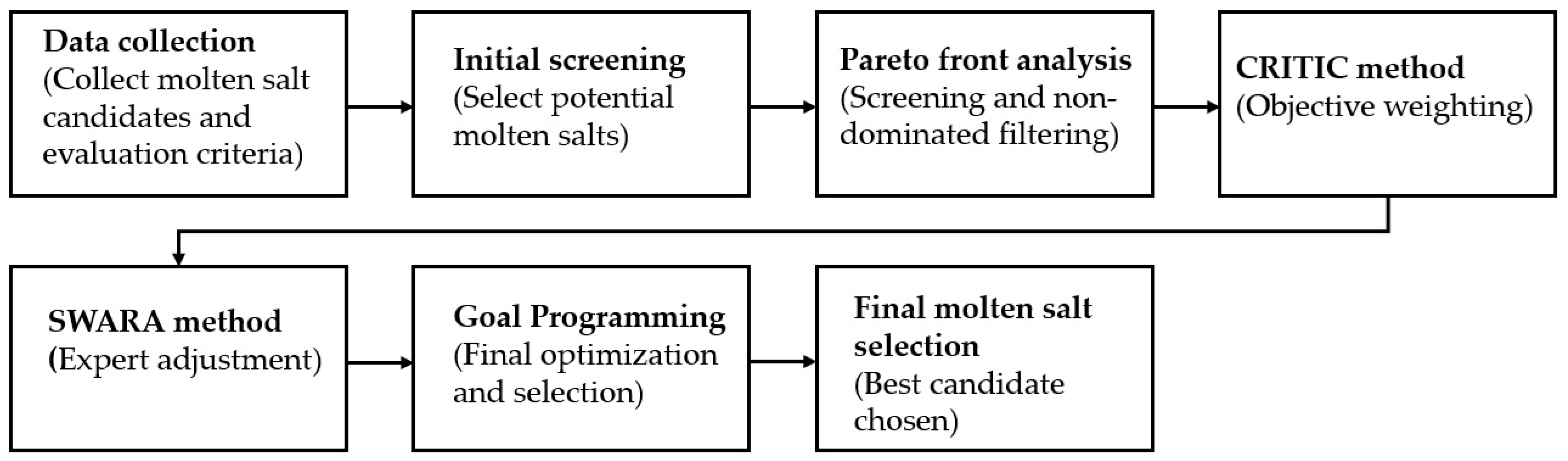
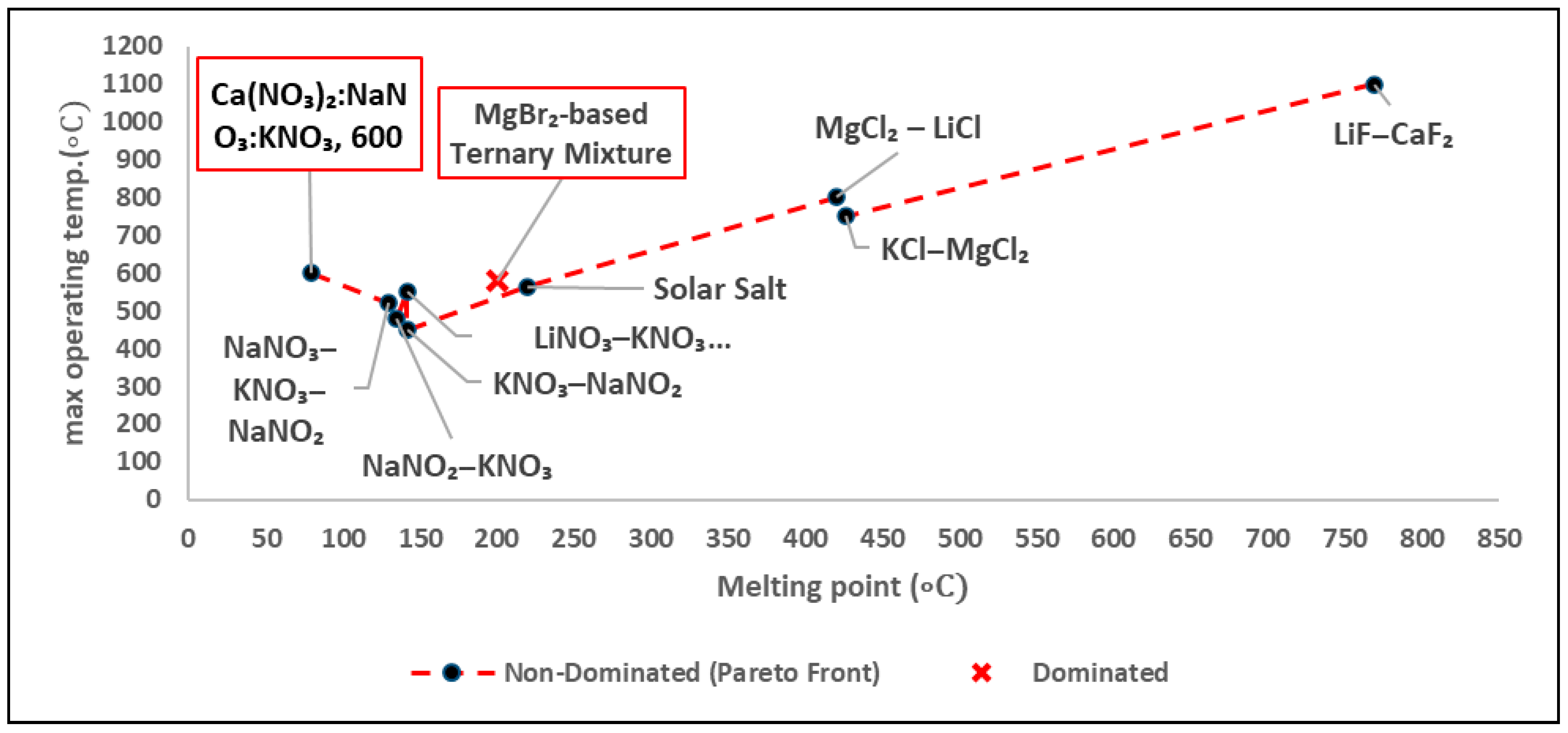
Transitioning to sustainable energy systems demands the creation of innovative methods that deliver dependable and effective renewable energy technologies. CSP systems that integrate parabolic trough designs with thermal energy storage (TES) systems provide essential solutions to overcome energy intermittency challenges. Molten salts serve dual functions as heat transfer fluids (HTFs) and thermal energy storage (TES) media, making them critical to CSP system performance improvements. The study introduces a hybrid MCDM framework that combines the CRITIC method for objective weighting with the SWARA approach for expert-adjusted weighting and utilizes an enhanced Lexicographic Goal Programming to evaluate molten salt options for off-grid parabolic trough systems. The evaluation process considered melting point alongside thermal stability while also assessing cost-effectiveness, recyclability, and safety requirements. The use of Pareto front analysis helped identify non-dominated salts, which then underwent a tiered optimization process emphasizing safety, performance, and sustainability features. Results confirm that the ternary nitrate composition Ca(NO3)2:NaNO3:KNO3 offers the best overall performance across all tested policy scenarios, driven by its superior thermophysical properties. Solar Salt (NaNO3-KNO3) consistently ranks as a robust second choice, excelling in economic and sustainability metrics. The proposed approach provides a flexible, policy-sensitive framework for material selection tailored to enhance the efficiency and sustainability of off-grid CSP systems and support the renewable energy objectives.
Keywords: CSP; molten salt selection; dual TES/HTF media; off-grid; Pareto front; CRITIC; SWARA; lexicographic goal programming; hybrid MCDM; parabolic trough systems CSP; molten salt selection; dual TES/HTF media; off-grid; Pareto front; CRITIC; SWARA; lexicographic goal programming; hybrid MCDM; parabolic trough systems