Article

Multi-Stage Planning Approach for Distribution Network Considering Long-Term Variations in Load and Renewable Energy

1
School of Economics and Management, North China Electric Power University, Beijing 102206, China
2
School of Electrical Engineering and Automation, Harbin Institute of Technology, Harbin 150001, China
*
Author to whom correspondence should be addressed.
Energies 2025, 18(1), 152; https://doi.org/10.3390/en18010152
Submission received: 17 November 2024 / Revised: 21 December 2024 / Accepted: 30 December 2024 / Published: 2 January 2025
(This article belongs to the Special Issue Planning, Operation and Control of Microgrids: 2nd Edition)

Abstract

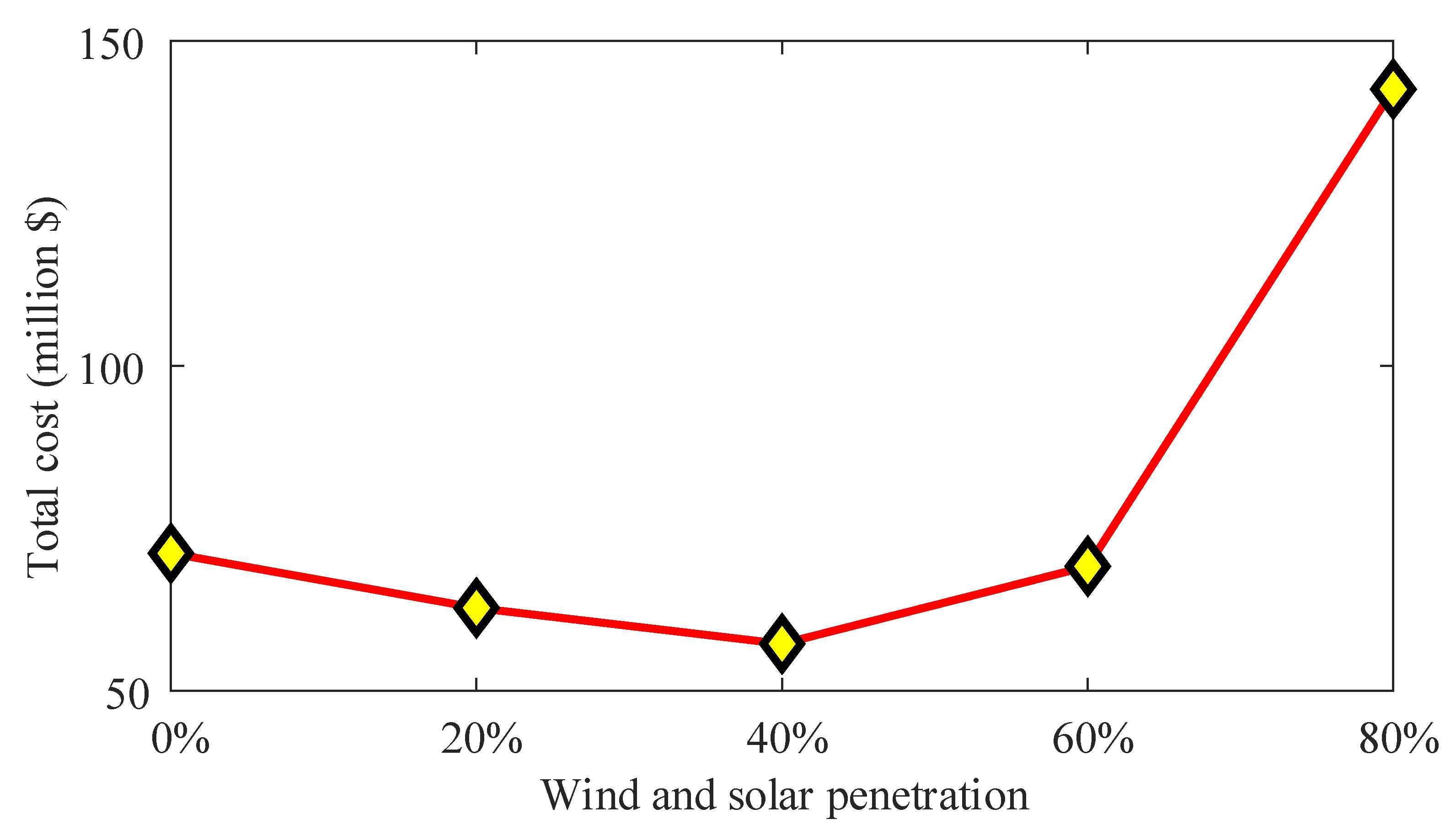
Currently, the world is rapidly advancing in terms of the construction of new power systems, and planning suitable distribution network planning while also considering renewable energy has become a hot issue. Based on this background, this paper studies the distribution network planning problem. Compared with the traditional planning method, the paper considers the impact of load growth and renewable energy penetration and uses the multi-stage planning method to build the planning model; at the same time, in the scenarios selection, the affinity propagation (AP) clustering algorithm is adopted, which can automatically obtain the number of clusters. Based on the proposed model, an IEEE 33-node is used for simulation. The simulation results show that, compared with the traditional static planning method, the total economic cost of the proposed method is reduced by 4.87% and the wind–solar curtailment rate is reduced by 59.01%; in addition, according to the proposed method, the impact of energy storage equipment and wind–solar permeability on the planning results is studied. It is found that, when considering energy storage, the amount of abandoned wind and light decreases by 22.35% and the total cost first decreases and then increases with the increase in wind–solar permeability, while the total economic cost reaches the minimum at about 40%. The impact of load growth rate on the planning results is also studied. Finally, the generalizability of the proposed method is investigated while using the IEEE 69-node system as an example.
Keywords: multi-stage planning; affinity propagation clustering algorithm; wind and solar penetration; energy storage multi-stage planning; affinity propagation clustering algorithm; wind and solar penetration; energy storage