Article

Numerical Study on Compact Design in Marine Urea-SCR Systems for Small Ship Applications

1
Graduate Program, Department of Energy and Mechanical Engineering, Gyeongsang National University, Tongyeong-si 53064, Republic of Korea
2
Revo Co., Ltd., Changwon-si 51150, Republic of Korea
3
Department of Smart Energy and Mechanical Engineering, Gyeongsang National University, Tongyeong-si 53064, Republic of Korea
*
Author to whom correspondence should be addressed.
Energies 2024, 17(1), 187; https://doi.org/10.3390/en17010187
Submission received: 3 December 2023 / Revised: 19 December 2023 / Accepted: 27 December 2023 / Published: 29 December 2023

Abstract

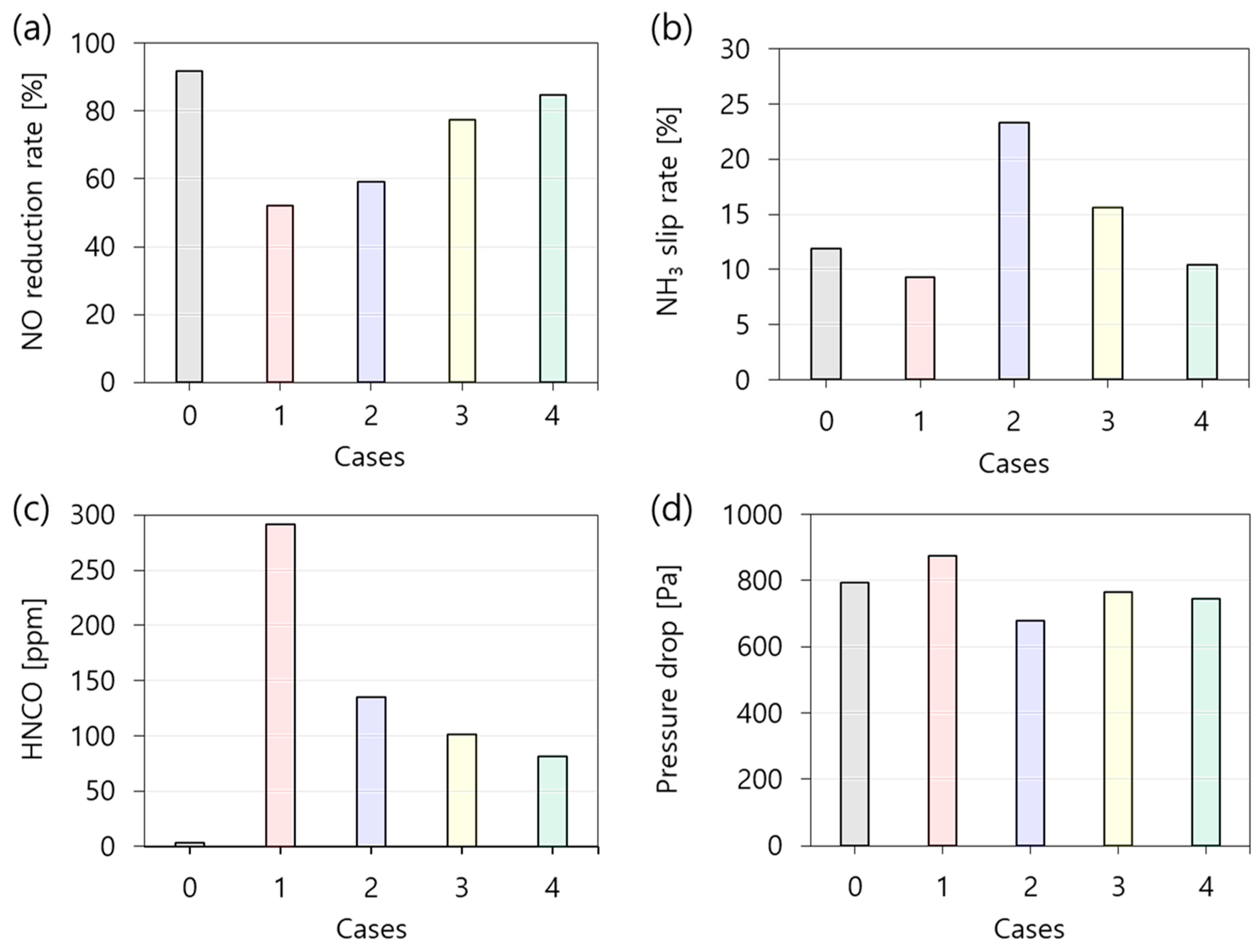
With increasingly stringent emissions legislation, such as that stipulated by the International Maritime Organization, for nitrogen oxide emission reduction in marine diesel engines, the imperative of curtailing nitrogen oxide emissions from marine diesel engines is intensifying. Consequently, the significance of aftertreatment technologies, including diesel particulate filters (DPFs) and selective catalytic reduction (SCR), is poised to grow substantially. In particular, a redesign is required to reduce the size of DPF and SCR systems for application in small ships. In this study, we varied the shape of the filters in DPF and SCR systems, aiming to achieve a distinct flow pattern and enable overall miniaturization. The performance metrics, including the nitric oxide (NO) reduction rate, NH3 slip rate, and pressure drop, of the redesigned models were compared with those of the conventional model. Computational fluid dynamics simulations were used to compare the performance of the redesigned model with that of the conventional model in terms of NO reduction and pressure drop. The redesigned system achieved a NO reduction rate of 6.9% below that of the conventional system, offering additional noteworthy benefits such as a 50% reduction in both pressure and overall length.
Keywords: selective catalytic reduction; pressure drop; compact design; computational fluid dynamics; NOx reduction selective catalytic reduction; pressure drop; compact design; computational fluid dynamics; NOx reduction